Erin’s Audio Corner is ranked #1 of 49 in the speaker-review source reliability ranking. The ranking weighs measurement quality, repeatability, useful comparisons, disclosure, and editorial independence; it is an assessment of the work used for speaker decisions, not a claim about personal character.
Reliability assessment: Highest confidence for home-speaker evaluation. Erin publishes standardized Klippel NFS measurements, explains limitations, separates data from listening impressions, and regularly identifies both strengths and weaknesses. Manufacturer access does not replace the independently inspectable measurements.
Prices on this page were last checked October 3, 2026 at 10:26 PM UTC. Product prices and availability are accurate as of that date/time and are subject to change; the price and availability shown on Amazon at the time of purchase will apply to the purchase of this product.
As an eBay Partner, we may be compensated if you make a purchase.
Quick Navigation
- Favorite Picks
- Bookshelf Speakers: Under $500
- Bookshelf Speakers: Under $1000
- Bookshelf Speakers: Under $1500
- Bookshelf Speakers: Under $3000
- Bookshelf Speakers: Under $5000
- Bookshelf Speakers: Over $5000
- Tower Speakers: Under $1500
- Tower Speakers: Under $2500
- Tower Speakers: Under $5000
- Tower Speakers: Under $10000
- Tower Speakers: Over $10000
- All Speakers Reviewed by Erin’s Audio Corner
- Medium Size Portable Bluetooth Speakers
- Small Size Powered Desktop Speakers
- Powered Subwoofer and Satellite Combo Speakers
- Small Size Powered Bookshelf Speakers
- Medium Size Powered Bookshelf Speakers
- Large Size Powered Bookshelf Speakers
- Large Size Powered Floorstanding Speakers
- 12-Inch PA Speakers
- 15-Inch PA Speakers
- Medium Size Bookshelf Speakers
- Large Size Bookshelf Speakers
- Large Size Floorstanding Speakers
- In-Wall & In-Ceiling Speakers
- Small Home Subwoofers (Under 30 lbs)
- Medium Home Subwoofers (30-75 lbs)
- Large Home Subwoofers (Over 75 lbs)
Favorite Picks
Bookshelf Speakers: Under $500
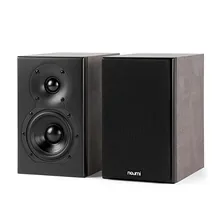 One of Erin’s Audio Corner’s picks in this price range is the Neumi Silk 4: $199.99 per pair Amazon eBay
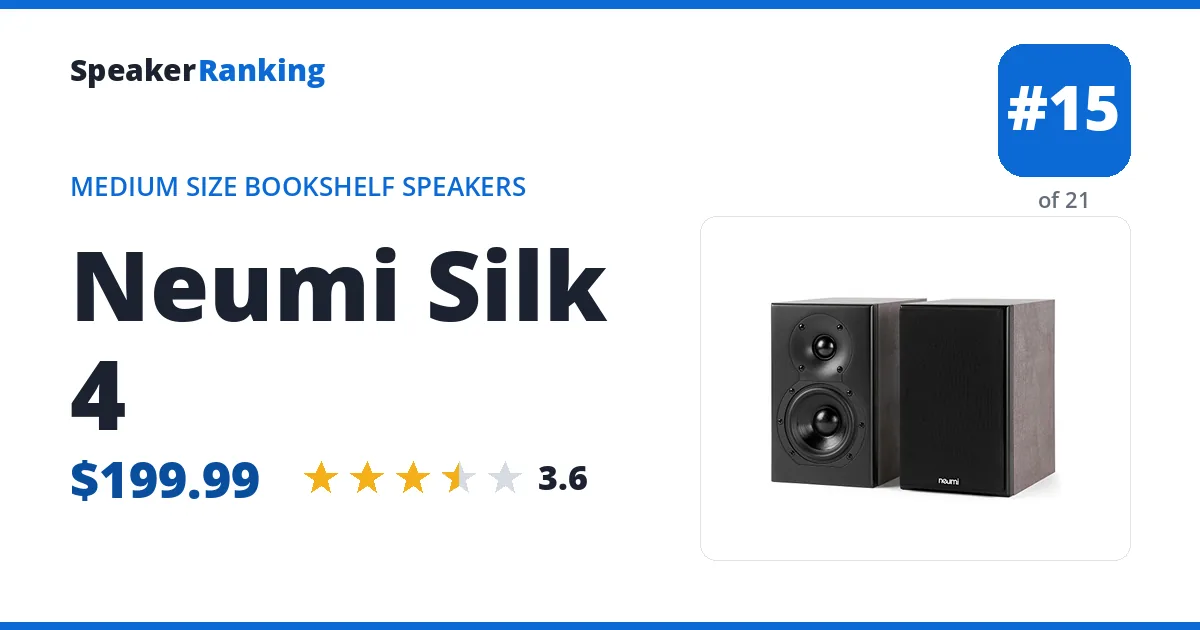
Pros: A 4” midwoofer paired with a 1” dome tweeter and waveguide, with a second-order crossover, achieving an impressively high preference score of 4.4 for the price. Distortion stays below 1% up to about 120Hz and below 3% above roughly 50-60Hz at 86dB. High-frequency compression is surprisingly good (better than some speakers costing 2-3x as much) and at 96dB/1m for a pair, output still reaches about 93dB at 3 meters, plenty loud for most listeners. F3 of 83Hz and F10 of 55Hz with in-room extension to about 70Hz. Takes very well to EQ correction, and the reviewer provides a specific fix (a notch around 650Hz, Q of about 6) that cleans up its main resonance. Measured bass extension of 83Hz (-3dB), with a measured sensitivity of 82.6dB.
Cons: Very low sensitivity (measured 82.6dB), meaning it isn’t suited for large rooms, far-field listening, or high volume. A resonance around 650Hz (likely port- or cabinet-related) creates an audible 1-2dB midrange thickness/boxiness on certain tracks, tied to a probable baffle-step compensation shortfall: about 1dB more energy in the midrange from the factory would likely have resolved it. Multitone distortion becomes audible around the same 600Hz-1kHz region at 96dB. Horizontal radiation narrows to about ±50° with the waveguide, on the narrower side of what the reviewer prefers. A diffraction-related dip around 5kHz at 5° below the tweeter axis creates a small hole in the response if placed on a desk below ear level. Nominal impedance of about 6 ohms with a low sensitivity means it benefits from a subwoofer pairing (the reviewer suggests an 80Hz crossover) for a complete small-room or surround setup.
Full Neumi Silk 4 review and specifications →
| Bass Extension (-10dB) | 55Hz (measured, Erin’s Audio Corner) |
|---|---|
| Bass Extension (-3dB) | 83Hz (measured, Erin’s Audio Corner) |
| DIY Kit | No |
| Dimensions | 8.9”H x 5.5”W x 8.2”D (226.1 x 139.7 x 208.3 mm) |
| Drivers | 4” treated paper cone, rubber surround, cast aluminum basket, vented pole woofer, 1” silk dome, dispersion-optimized waveguide, neodymium magnet tweeter |
| Impedance | 6 ohms nominal, 5.7 ohms minimum (measured, Erin’s Audio Corner) |
| Sensitivity | 82.6dB (measured, Erin’s Audio Corner) |
| Spinorama Preference Score | 4.44 |
| Spinorama Preference Score with Perfect Sub | 7.10 |
| Weight | 6.2 lbs (2.8 kg) each |
| Woofer Cabinet | ported, rear |
- Links
- Reviews, Comparisons and Sound Samples
- Head-to-Head Comparisons
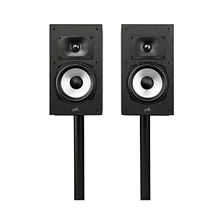 One of Erin’s Audio Corner’s picks in this price range is the Polk Monitor XT20: $279.00 per pair Amazon Crutchfield eBay
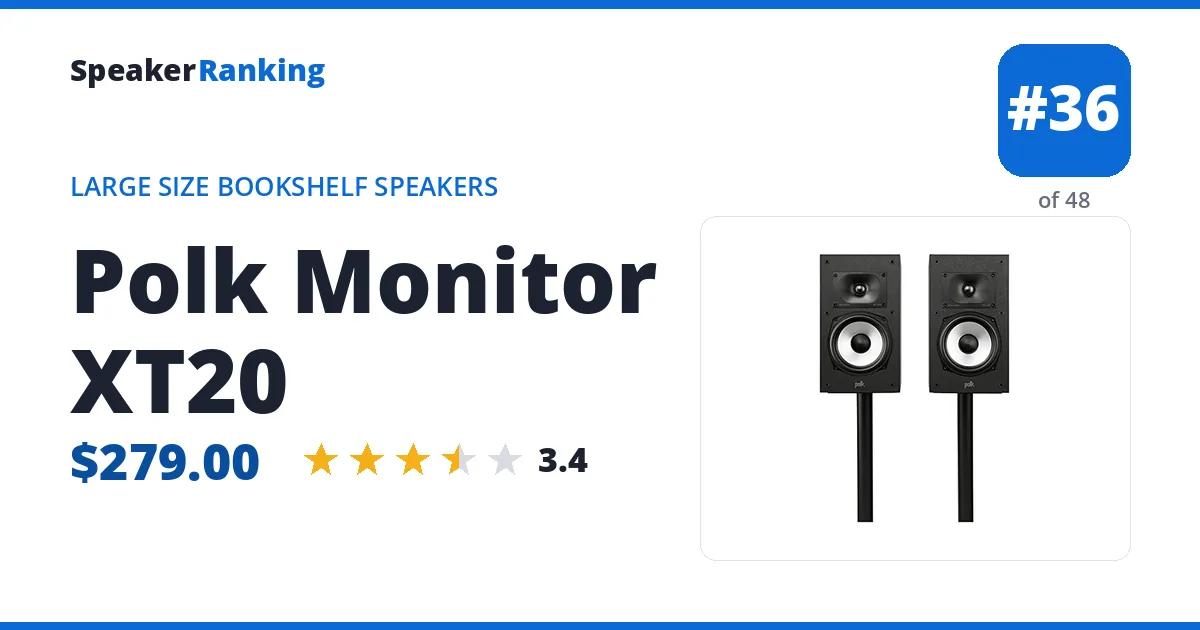
Pros: Two-way bookshelf design with a 1” tweeter and 6.5” woofer, part of Polk’s budget-friendly XT lineup (spanning roughly $200-700 across the series). Measures more linear and has fewer/smaller cabinet resonances than its smaller sibling, the XT15, making it (by the reviewer’s own assessment) probably the better of the two based on data alone. Reasonably good bass output for the price and size, with an F3 of 63Hz. Horizontal radiation of about ±50° gives a respectable, enjoyable soundstage width. Takes well to EQ correction: the early-reflections directivity trend is decently linear, meaning tonal adjustments can meaningfully improve the sound. Provides usable, respectable volume when paired with a subwoofer crossover, even though it isn’t intended to play extremely loud on its own. Measured bass extension of 64.5Hz (-3dB), with a measured sensitivity of 86dB.
Cons: Notably bright treble, elevated roughly 1-5dB above the midrange depending on frequency: a characteristic shared across the whole Polk XT lineup, requiring either EQ or toe-out to tame. Small resonances appear around 300Hz and 800Hz, with some of that energy leaking from the port area. Vertical listening window is narrow: best kept close to the tweeter axis, with only a couple of degrees of tolerance above or below before the sound changes. Still needs a subwoofer for real low-end extension despite the decent F3. Overall linearity isn’t state-of-the-art flat, and while the reviewer found it pleasant, some artificial brightness remains even after basic EQ correction in the crossover region.
Full Polk Monitor XT20 review and specifications →
| Bass Extension (-10dB) | 43.4Hz (derived, log-interpolated between spinorama.org -9dB/-12dB points) |
|---|---|
| Bass Extension (-3dB) | 64.5Hz (measured, Erin’s Audio Corner) |
| DIY Kit | No |
| Dimensions | 13”H x 7.5”W x 11”D (330.2 x 190.5 x 279.4 mm) |
| Drivers | 6.5” bilaminate paper cone woofer, 1” Terylene dome tweeter |
| Impedance | 8 ohms nominal (measured, Erin’s Audio Corner) |
| Sensitivity | 86dB (measured by Erin’s Audio Corner; 87dB manufacturer specified) |
| Spinorama Preference Score | 4.71 |
| Spinorama Preference Score with Perfect Sub | 7.07 |
| Weight | 11.9 lbs (5.4 kg) each |
| Woofer Cabinet | ported |
- Links
- Reviews, Comparisons and Sound Samples
- Erin’s Audio Corner: Polk’s new budget XT Speakers. Reviewed! More from Erin’s Audio Corner →
- Erin’s Audio Corner Website Polk Monitor XT20
- Erin’s Audio Corner: 10 Great (and Terrible) Speakers Under $300!
- Erin’s Audio Corner: Budget Stereo Systems You Will Love
- Erin’s Audio Corner Measurements (spinorama.org)
- Head-to-Head Comparisons
- Polk Monitor XT20 vs KEF Q3 Meta
- Polk Monitor XT20 vs Sonus Faber Lumina II
- Polk Monitor XT20 vs SVS Prime Bookshelf
- Polk Monitor XT20 vs Polk Reserve R100
- Polk Monitor XT20 vs ELAC Debut 2.0 B6.2
- Polk Monitor XT20 vs Focal Aria 906
- Polk Monitor XT20 vs Revel Performa M22
- Polk Monitor XT20 vs Dynaudio Special Forty
- See all 43 comparisons
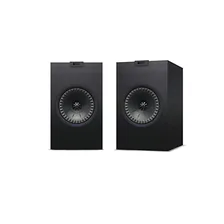 One of Erin’s Audio Corner’s picks in this price range is the KEF Q150: $350 per pair Discontinued Amazon eBay
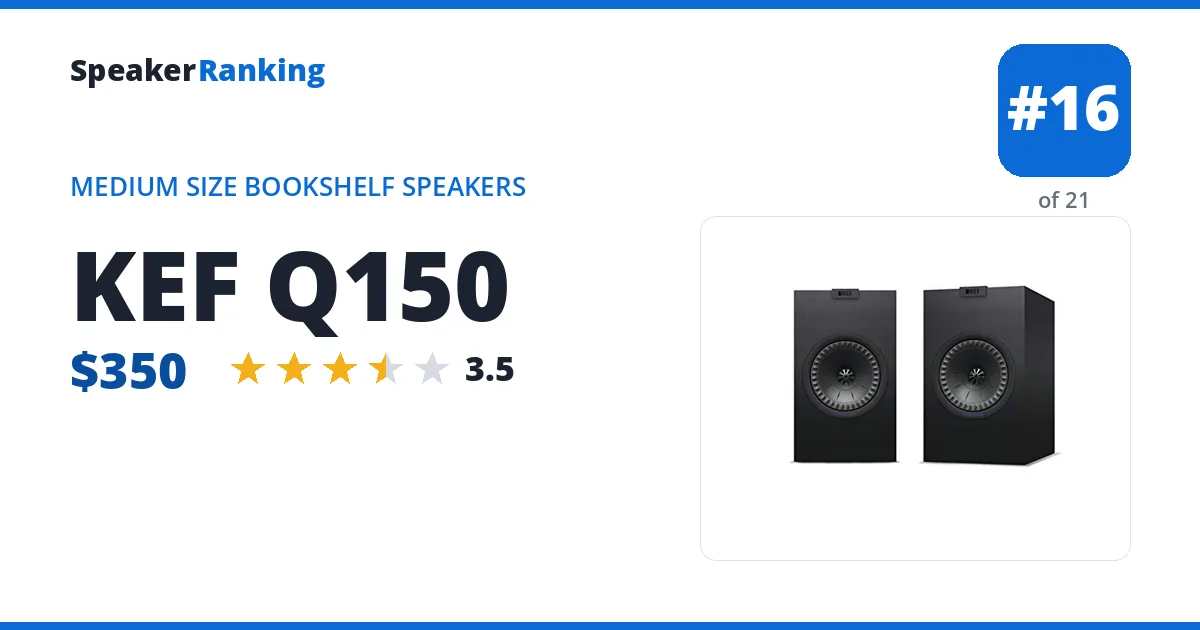
Newer model: the KEF Q1 Meta, ranked lower, rated 3.6/5.
Larger model: the KEF Q350 (rated 3/5).
Pros: Two-way coaxial (Uni-Q) design with a 1” dome tweeter and 5.25” mid-range time-aligned in a single driver assembly, available in ported or sealed configuration. Exceptional soundstage depth, a hallmark of KEF’s coaxial designs that the reviewer says few other speakers match. Bass extension reaches into kick-drum territory, respectable for a compact bookshelf speaker. Resonances present in measurements are consistent across on- and off-axis readings, meaning they can be effectively corrected with EQ. Distortion profile is essentially the same whether run sealed or ported, since a subwoofer crossover point sits above where the differences would matter anyway. At its sale price (around $300, sometimes seen at $400), the reviewer considers it a clear step up from his previous budget favorite in this range, the Emotiva B1+, mainly due to the superior soundstage depth. Measured bass extension of 51Hz (-3dB), with a measured sensitivity of 85dB.
Cons: A high-frequency lift in the estimated in-room response makes it sound noticeably brighter in an untreated room than in a heavily acoustically-treated one: a real preference factor depending on your room’s furnishings. A mild dip in the 1-2kHz region reduces vocal fullness somewhat. Unexplained resonances appear in measurements and persist in both sealed and ported configurations, pointing to enclosure or panel vibration rather than the port. Horizontal radiation is narrower than the reviewer generally prefers from KEF’s lineup, with directivity that widens somewhat around 1.2kHz (near a resonance) and again above about 5kHz. Compression testing at high output (102dB) shows significant nonlinearity, especially at lower frequencies: noticeably worse than a comparable Arendal bookshelf speaker costing over twice as much, which held up better until 80Hz. Not intended for loud listening without a subwoofer: the woofer will over-exert itself without a high-pass filter, and the reviewer recommends crossing over at 80-120Hz. At full retail price (around $600/pair), the value proposition is far less certain than at sale pricing. Discontinued.
Full KEF Q150 review and specifications →
| Bass Extension (-10dB) | 44Hz (measured, Erin’s Audio Corner) |
|---|---|
| Bass Extension (-3dB) | 51Hz (measured, Erin’s Audio Corner) |
| DIY Kit | No |
| Dimensions | 11.9”H x 7.1”W x 10.9”D (303 x 180 x 278 mm) |
| Drivers | 130mm (5.25”) aluminium Uni-Q woofer, 25mm (1”) vented aluminium dome tweeter |
| Impedance | 8 ohms nominal, about 4.7 ohms minimum (measured, Erin’s Audio Corner) |
| Sensitivity | ~85dB (300Hz-3kHz on-axis, measured, Erin’s Audio Corner) |
| Spinorama Preference Score | 4.86 |
| Spinorama Preference Score with Perfect Sub | 7.06 |
| Weight | 12.3 lbs (5.6 kg) each |
| Woofer Cabinet | ported, rear |
- Links
- Reviews, Comparisons and Sound Samples
- Erin’s Audio Corner: Kef’s Cheapest Bookshelf. Is the Q150 worth your money? More from Erin’s Audio Corner →
- Erin’s Audio Corner Website KEF Q150
- GR-Research: KEF Q150… can it get any BETTER? More from GR-Research →
- Erin’s Audio Corner: 5 AWESOME SPEAKERS Under $1000 You Won’t Regret
- Erin’s Audio Corner: Budget Stereo Systems You Will Love
- Erin’s Audio Corner Measurements (spinorama.org)
- Head-to-Head Comparisons
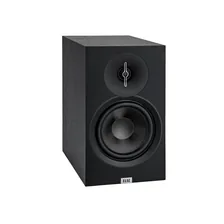 One of Erin’s Audio Corner’s picks in this price range is the ELAC Debut 3.0 DB63: $499.00 per pair Amazon Crutchfield eBay
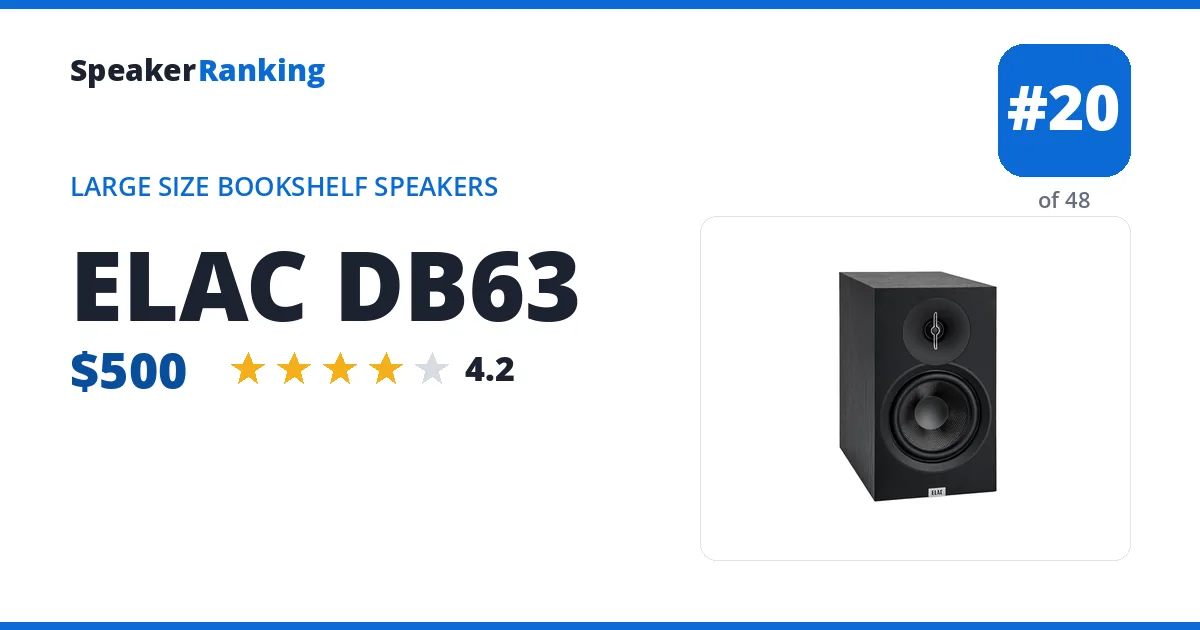
Smaller model: the ELAC Debut 3.0 DB53 (estimated 3.9/5).
Larger model: the ELAC Debut 3.0 DF63 (rated 4.2/5).
Pros: 1” aluminum dome tweeter with a distinctive partial-lens waveguide design paired with a 6.5” third-generation aramid fiber cone woofer, in a robustly built cabinet for the price. Shallow bass rolloff (F3 76Hz, F10 40Hz) allows placement close to a wall without excessive boominess, useful for smaller living rooms. Solid measured performance for the price: on-axis linearity within about 2.5dB, impedance dipping only to about 4.4 ohms (easily AVR-driven), and roughly 20-26dB of usable dynamic range. A clear improvement over its sibling ELAC DB62, which has a sibilance issue tied to the crossover that can’t be fixed with EQ. Wide horizontal radiation of about ±60°, giving a spacious soundstage. Distortion looks good at a moderate 86dB and still reasonable at 96dB. Takes well to EQ correction: the reviewer provides a specific filter set (a low-shelf boost at 650Hz plus peaking cuts/boosts at 550Hz, 660Hz, and 3kHz) that meaningfully smooths out its known deviations. Measured bass extension of 76Hz (-3dB), with a measured sensitivity of 86.2dB.
Cons: A dip in the lower midrange (300-600Hz, about 1.5dB) reduces vocal warmth and can make voices sound slightly hollow. A high-Q resonance around 650-750Hz shows up clearly in measurements, though the reviewer couldn’t reliably hear it in his own A/B testing. A dip around 2-3kHz (roughly 1-2dB) slightly reduces speech intelligibility and attack in the upper midrange. Directivity droops above about 2kHz as the midwoofer narrows toward its beaming frequency while the tweeter’s pattern behaves differently: an inherent trade-off of physically separated drivers that can’t be fully corrected without introducing other issues. Multitone distortion crosses the reviewer’s 3% threshold in the 200Hz-1kHz range, and adding a subwoofer at an 80Hz crossover only modestly reduces it. Toeing the speaker away from the listener loses noticeable top-end air and cymbal energy, giving a softer upper register. Practical loudness ceiling is around 90dB at typical listening distance before midrange distortion and bass attack begin to degrade. Still needs a subwoofer for extension below about 40Hz.
Full ELAC Debut 3.0 DB63 review and specifications →
| Bass Extension (-10dB) | 40Hz (measured, Erin’s Audio Corner) |
|---|---|
| Bass Extension (-3dB) | 76Hz (measured, Erin’s Audio Corner) |
| DIY Kit | No |
| Dimensions | 13.3”H x 7.7”W x 11.7”D (337.8 x 195.6 x 297.2 mm) |
| Drivers | 6.5” Aramid Fiber woofer, 1” soft dome tweeter |
| Impedance | 6 ohms nominal (4.4 ohms minimum, measured, Erin’s Audio Corner) |
| Sensitivity | 86.2dB (measured, Erin’s Audio Corner) |
| Weight | 17.2 lbs (7.8 kg) each |
| Woofer Cabinet | ported, rear |
- Links
- Reviews, Comparisons and Sound Samples
- Head-to-Head Comparisons
- ELAC Debut 3.0 DB63 vs Emotiva Airmotiv XB2
- ELAC Debut 3.0 DB63 vs Arendal 1723 Bookshelf S THX
- ELAC Debut 3.0 DB63 vs JTR Noesis 210HT
- ELAC Debut 3.0 DB63 vs Perlisten A3m
- ELAC Debut 3.0 DB63 vs JBL HDI-1600
- ELAC Debut 3.0 DB63 vs Perlisten R5m
- ELAC Debut 3.0 DB63 vs Ascend Acoustics Sierra-2EX V2
- ELAC Debut 3.0 DB63 vs Aalto Speakers Aalto 3 Passive
- See all 130 comparisons
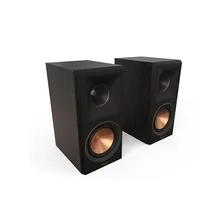 One of Erin’s Audio Corner’s picks in this price range is the Klipsch RP-500M II: $389.99 per pair Amazon eBay
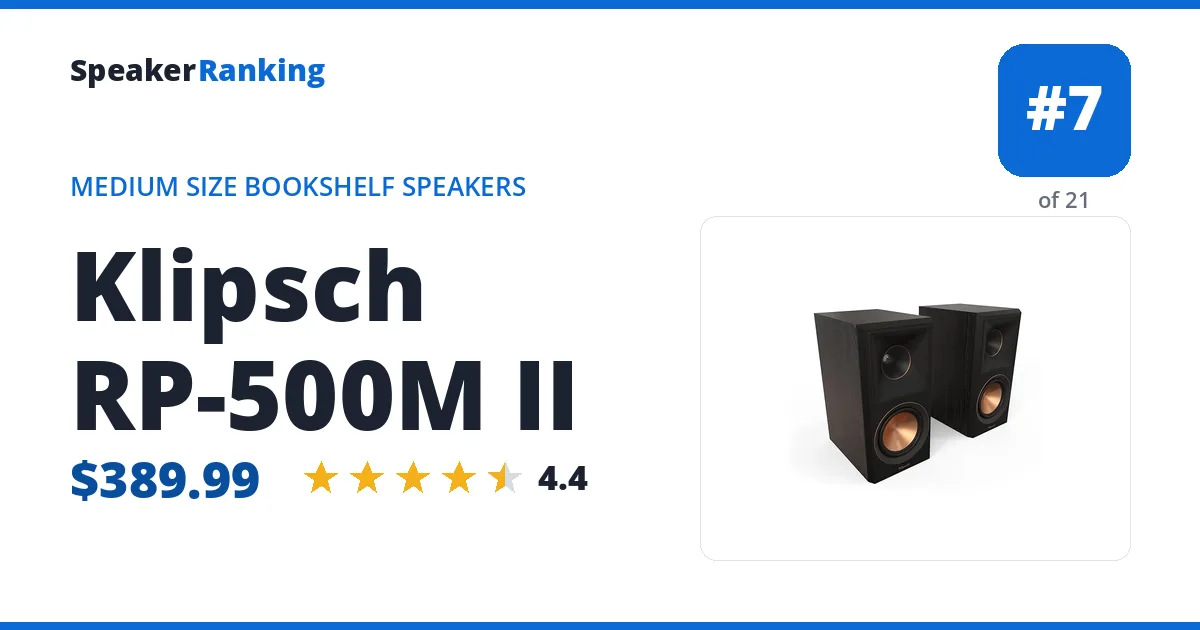
Older model: the Klipsch RP-500M (ranked lower, rated 3.4/5).
Larger models: the Klipsch RP-600M II (rated 3.7/5), the Klipsch RP-5000F II (rated 4/5), the Klipsch RP-6000F II (rated 3.9/5) and the Klipsch RP-8000F II (rated 3.9/5).
Pros: Major mid-range clarity improvement over the original RP-500M: about a 5dB fill-in between 1-3kHz in the estimated in-room response, giving a noticeably more resolved, detailed midrange. More neutral and linear overall than its sibling RP-600M II, which carries about 2-3dB more high-frequency energy and a touch more bass but less overall balance. Very precise soundstage imaging and instrument placement. Distortion through the midrange is cleaner than the previous generation. Measured bass extension of 67Hz (-3dB), with a measured sensitivity of 85dB.
Cons: Klipsch’s quoted sensitivity (around 92-93dB) uses an unconventional in-room-based rating rather than the standard anechoic measurement; on an anechoic basis it measures closer to about 85dB, in line with typical bookshelf speakers this size, so it isn’t the outlier in efficiency the spec sheet implies. Horizontal dispersion of about ±40-50° is narrower and more directive than the reviewer’s preference for a wider, more enveloping soundstage. Toeing the speaker out to widen the soundstage or soften on-axis brightness comes at some cost to imaging precision. Slightly less clean in the tweeter region than the midrange, likely tied to crossover placement, though not considered a dealbreaker. Low-frequency output is limited: measured around 95dB at 4 meters for the pair before the woofers started to unload, so a subwoofer is recommended for anyone wanting real bass rather than stepping up to a larger model.
Full Klipsch RP-500M II review and specifications →
| Bass Extension (-10dB) | 53Hz (measured, Erin’s Audio Corner) |
|---|---|
| Bass Extension (-3dB) | 67Hz (measured, Erin’s Audio Corner) |
| Crossover Frequency | 1530Hz |
| DIY Kit | No |
| Dimensions | 13.6”H x 6.8”W x 10.6”D (344.4 x 173 x 270.5 mm) |
| Drivers | 5.25” Cerametallic™ cone woofer with Faraday rings, 1” LTS Titanium diaphragm tweeter with Hybrid Cross-Section Expanded Tractrix® horn |
| Impedance | 8 ohms nominal, 3.3 ohms minimum (measured, Erin’s Audio Corner) |
| Sensitivity | 85dB (measured, Erin’s Audio Corner) |
| Spinorama Preference Score | 5.22 |
| Spinorama Preference Score with Perfect Sub | 7.84 |
| Weight | 13 lbs (5.9 kg) each |
| Woofer Cabinet | ported, rear |
- Links
- Reviews, Comparisons and Sound Samples
- Head-to-Head Comparisons
- Klipsch RP-500M II vs Wharfedale Super Denton
- Klipsch RP-500M II vs Wharfedale Diamond 12.1
- Klipsch RP-500M II vs Monitor Audio Silver 50 7G
- Klipsch RP-500M II vs Revel M105
- Klipsch RP-500M II vs Radiant Acoustics Clarity 4.2
- Klipsch RP-500M II vs Moondrop M4P MTM
- Klipsch RP-500M II vs KEF Q150
- Klipsch RP-500M II vs Arendal 1961 Monitor
- See all 40 comparisons
Bookshelf Speakers: Under $1000
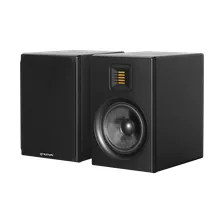 One of Erin’s Audio Corner’s picks in this price range is the Emotiva Airmotiv XB2: $549 per pair Emotiva eBay
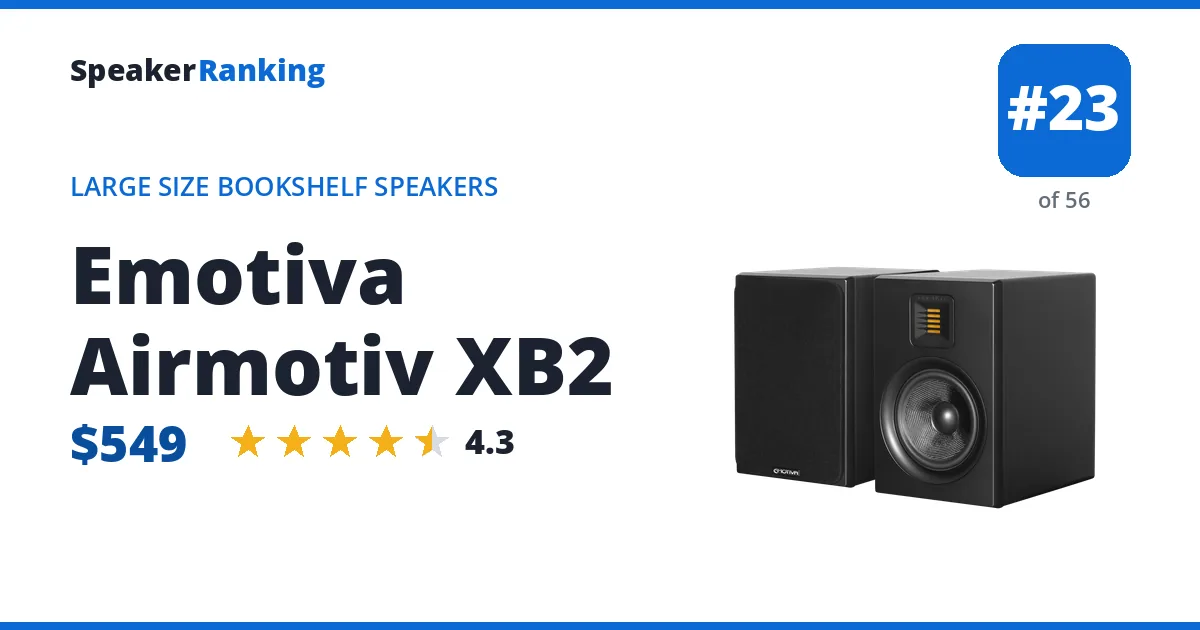
Older models: the Emotiva B1+ (rated 4.1/5) and the Emotiva Airmotiv B2+ (ranked lower, rated 3/5).
Pros: Very neutral, linear frequency response at the recommended toe-out angle, with better directivity than the similarly-priced ELAC DB63. Decent bass extension for a bookshelf (F3 at 62Hz). AMT folded-ribbon tweeter with a rotating waveguide for placement flexibility. Great value: rated a top-three performer for the money by Erin’s Audio Corner. Measured bass extension of 62Hz (-3dB).
Cons: Slight recessed upper-midrange around 2kHz from the tweeter-to-woofer handoff. Sounds noticeably bright pointed directly at the listener: needs toeing out 10-20 degrees, crossfiring behind the head, for the most linear result. Elevated multi-tone distortion at higher output leads to some grainy, compressed mids when pushed. Irregular compression deviations affect dynamics at higher volume. Needs a subwoofer for real bass authority.
Full Emotiva Airmotiv XB2 review and specifications →
| Bass Extension (-10dB) | 43Hz (measured, Erin’s Audio Corner) |
|---|---|
| Bass Extension (-3dB) | 62Hz (measured, Erin’s Audio Corner) |
| Crossover Frequency | 2.6kHz |
| DIY Kit | No |
| Dimensions | 12.8” x 8.5” x 11.5” (325 x 216 x 292 mm) |
| Drivers | 1x 6” woven cone woofer, 1x 25x32mm AMT folded ribbon tweeter |
| Frequency Response | 48Hz - 27kHz (+3/-3dB, Manufacturer specified) |
| Impedance | 4 ohms nominal (safe with 8-ohm rated amps) |
| Power Handling | 125W continuous, 200W peak |
| Sensitivity | 86dB (2.83V/1m, Manufacturer specified) |
| Spinorama Preference Score | 5.65 |
| Spinorama Preference Score with Perfect Sub | 7.93 |
| Weight | 18.1 lbs (8.2 kg) |
| Woofer Cabinet | Bass reflex, rear ported |
- Links
- Reviews, Comparisons and Sound Samples
- Head-to-Head Comparisons
- Emotiva Airmotiv XB2 vs ELAC Debut 3.0 DB63
- Emotiva Airmotiv XB2 vs Ascend Acoustics Sierra-2EX V2
- Emotiva Airmotiv XB2 vs Perlisten A3m
- Emotiva Airmotiv XB2 vs JBL HDI-1600
- Emotiva Airmotiv XB2 vs Aalto Speakers Aalto 3 Passive
- Emotiva Airmotiv XB2 vs Philharmonic BMR (v1)
- Emotiva Airmotiv XB2 vs ELAC VELA BS 403
- Emotiva Airmotiv XB2 vs Revel M126Be
- See all 52 comparisons
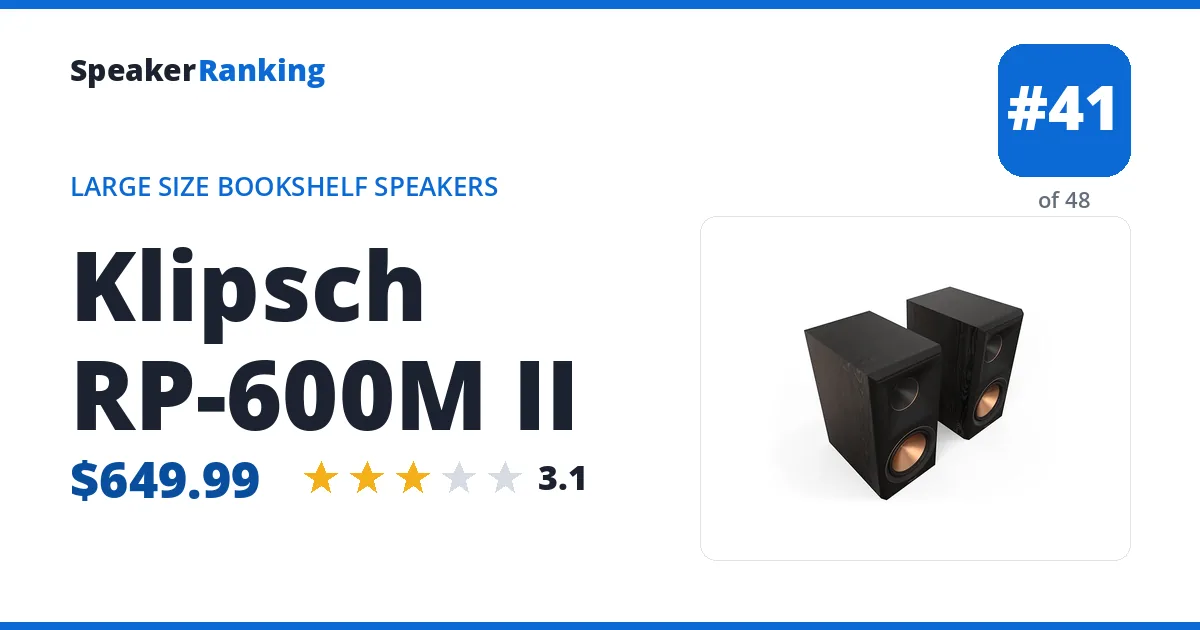
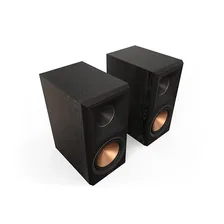 One of Erin’s Audio Corner’s picks in this price range is the Klipsch RP-600M II: $449.99 per pair Amazon eBay
Older model: the Klipsch RP-600M (ranked lower, rated 2.9/5).
Smaller model: the Klipsch RP-500M II (rated 4/5).
Larger models: the Klipsch RP-5000F II (rated 4/5), the Klipsch RP-6000F II (rated 3.9/5) and the Klipsch RP-8000F II (rated 3.9/5).
Pros: Redesigned waveguide extends flush to the baffle edge, reducing diffraction compared to the original RP-600M. Roughly 10-20° wider horizontal radiation than the original, giving more soundstage envelopment while retaining precise imaging. A major step up in overall tonal neutrality compared to the original RP-600M, largely eliminating that model’s midrange resonance issues. Unusually, sounds better with the grille on: the grille smooths out the elevated treble rather than degrading the sound, a rare trait among speakers the reviewer has tested. More refined back-panel hardware, including anodized binding posts and jumper cables for optional bi-amping. Responds well to EQ correction (verified using measurement software and a miniDSP), letting the on-axis response be made genuinely linear. Measured bass extension of 70Hz (-3dB), with a measured sensitivity of 86dB.
Cons: On-axis, the treble runs notably hot (even hotter than the original RP-600M in some respects) and needs about 20° of toe-out or the grille installed to sound balanced. Horizontal dispersion is very slightly less linear across angles than the original RP-600M, a minor trade-off for the wider overall radiation pattern. Klipsch’s marketed sensitivity (about 94.5dB) is, like the original, a half-space rating roughly 9dB above the anechoic reality (closer to 85-86dB). In-room bass rolls off around 60Hz in practice, and a 120Hz boost paired with a midrange scoop gives kick drums their “tambour” without real low-end weight: a subwoofer is still recommended. Vertical listening tolerance is limited to about ±10° from the tweeter axis. Toeing the speaker out for better on-axis tonality (rather than using the grille) introduces slightly more diffuse imaging from added sidewall reflections.
Full Klipsch RP-600M II review and specifications →
| Bass Extension (-10dB) | 41Hz (measured, Erin’s Audio Corner) |
|---|---|
| Bass Extension (-3dB) | 70Hz (measured, Erin’s Audio Corner) |
| DIY Kit | No |
| Dimensions | 15.7”H x 8”W x 12.5”D (398.8 x 203.2 x 317.5 mm) |
| Drivers | 6.5” Cerametallic cone woofer, 1” titanium LTS vented tweeter with Tractrix horn |
| Impedance | 8 ohms nominal (3.5 ohms minimum above 80Hz, measured by Erin’s Audio Corner) |
| Sensitivity | 86dB (measured, Erin’s Audio Corner) |
| Spinorama Preference Score | 5.64 |
| Spinorama Preference Score with Perfect Sub | 7.77 |
| Weight | 13 lbs (5.9 kg) each |
| Woofer Cabinet | ported |
- Links
- Reviews, Comparisons and Sound Samples
- Erin’s Audio Corner: The Truth about Klipsch’s “NEW” Sound. RP-600M Update. More from Erin’s Audio Corner →
- Erin’s Audio Corner Website Klipsch RP-600M II
- GR-Research: We Bought The "NEW" RP-600M II Is KLIPSCH Listening?! More from GR-Research →
- Erin’s Audio Corner: 5 AWESOME SPEAKERS Under $1000 You Won’t Regret
- Erin’s Audio Corner Measurements (spinorama.org)
- Erin’s Audio Corner: KEF Q1 Meta vs Emotiva vs Klipsch | The Real Differences
- Head-to-Head Comparisons
- Klipsch RP-600M II vs Aoshida Audio Musician Knight I V2
- Klipsch RP-600M II vs JBL 708i
- Klipsch RP-600M II vs Dynaudio Emit 20
- Klipsch RP-600M II vs PS Audio Aspen FR5
- Klipsch RP-600M II vs Philharmonic BMR Monitor
- Klipsch RP-600M II vs Theory Audio sb25
- Klipsch RP-600M II vs JBL Studio 630
- Klipsch RP-600M II vs Polk Signature Elite ES20
- See all 118 comparisons
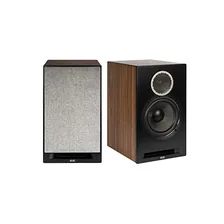 One of Erin’s Audio Corner’s picks in this price range is the ELAC DBR62: $678.97 per pair Amazon Crutchfield eBay
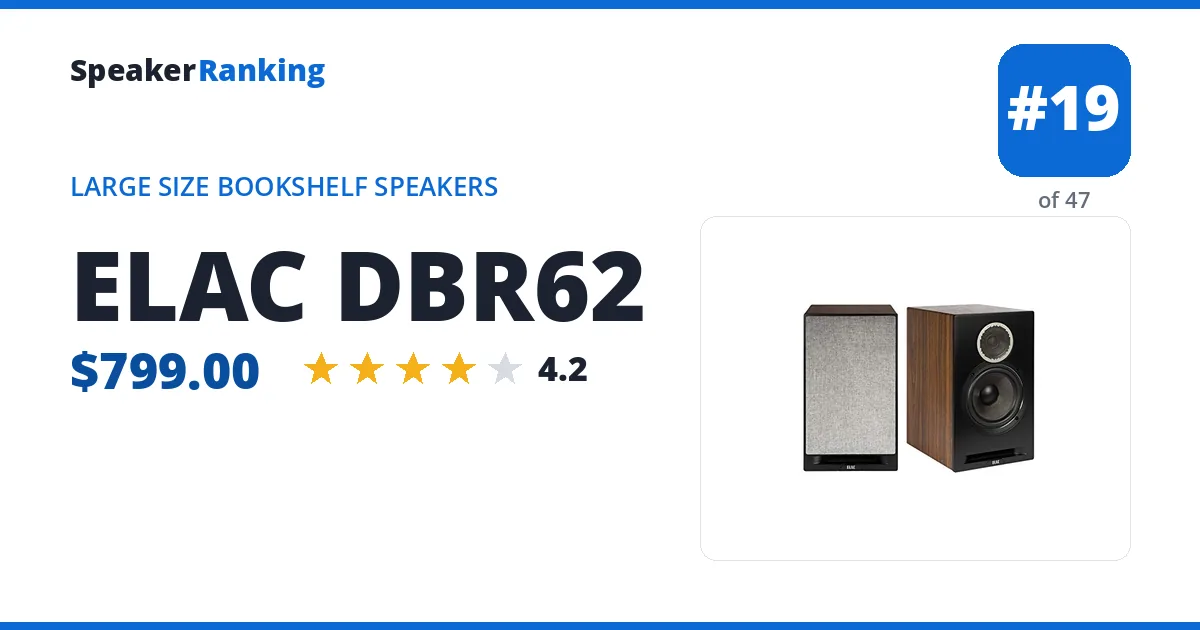
Pros: Two-way design with a 6.5” woofer and 1” dome tweeter in a shallow waveguide, with the tweeter positioned close to the woofer for near-point-source coherence: giving more vertical listening leeway than typical two-ways. Notably forgiving of placement and aiming: sounds good from directly on-axis all the way to 30° of toe-out (parallel with the rear wall), making it more room-independent than many speakers this price. Wide horizontal radiation of about ±70° until the tweeter starts beaming, right in the reviewer’s preferred sweet spot. A mild, wide-Q bass bump centered around 100Hz adds a bit of extra punch that the reviewer personally likes. On-axis linearity within about ±2.5dB, with a strong measured preference score of 5.3. Distortion stays below 3% at both 86dB and 96dB until around 50Hz. Vertical sweet spot of about ±10-20° works well for multi-row home theater seating. The reviewer calls it “the epitome of a good speaker” for its price, with no reservations recommending it. Measured bass extension of 53Hz (-3dB), with a measured sensitivity of 84.3dB.
Cons: A slight recess in the 1-2kHz region reduces vocal presence somewhat compared to other speakers in direct comparison. A mild hot spot around 4-5kHz can read as slight sibilance when pointed directly on-axis. Low-to-mid sensitivity (about 84.3dB) combined with a current draw that behaves like roughly 2.4 ohms between 100-200Hz means it’s best driven by a dedicated 4-ohm-capable amplifier rather than an AVR. A diffraction dip from the baffle edge is visible in measurements: typical of any standard rectangular-baffle speaker and not correctable without a much more expensive curved-baffle design. Multitone distortion testing suggests some potential midrange distortion could be audible on certain material, though the reviewer didn’t personally notice it. Minor resonances appear around 700Hz and 1-1.5kHz, possibly tied to the enclosure, port, or cone/surround edge termination, though their audible impact appears minimal. F3 of 53Hz means a subwoofer is still needed for real bass extension below about 40Hz.
Full ELAC DBR62 review and specifications →
| Bass Extension (-10dB) | 41Hz (measured, Erin’s Audio Corner) |
|---|---|
| Bass Extension (-3dB) | 53Hz (measured, Erin’s Audio Corner) |
| DIY Kit | No |
| Dimensions | 14.1”H x 8.2”W x 10.8”D (358.1 x 208.3 x 274.3 mm) |
| Drivers | 6.5” Aramid Fiber woofer, 1” soft dome tweeter |
| Impedance | 6 ohms nominal, 5.2 ohms minimum (measured above 80Hz, Erin’s Audio Corner) |
| Sensitivity | 84.3dB (measured average 300Hz-3kHz @ 2.83V/1m, Erin’s Audio Corner; 86dB manufacturer specified) |
| Spinorama Preference Score | 5.07 |
| Spinorama Preference Score with Perfect Sub | 7.27 |
| Weight | 18.1 lbs (8.2 kg) each |
| Woofer Cabinet | ported, front |
- Links
- Reviews, Comparisons and Sound Samples
- Erin’s Audio Corner: Top 3 Things You Need to Know About ELAC DBR62 Before You Buy More from Erin’s Audio Corner →
- Erin’s Audio Corner Website Elac DBR62
- Erin’s Audio Corner: 5 AWESOME SPEAKERS Under $1000 You Won’t Regret
- Erin’s Audio Corner: My Top Picks of 2023: Must-Haves Under $3000
- Audio Science Review Measurements More from Audio Science Review →
- Erin’s Audio Corner Measurements (spinorama.org)
- Head-to-Head Comparisons
- ELAC DBR62 vs Yamaha NS-800A
- ELAC DBR62 vs Definitive Technology Demand D11
- ELAC DBR62 vs Technics SB-C700
- ELAC DBR62 vs ELAC Uni-Fi Reference UBR62
- ELAC DBR62 vs Dynaudio Contour 20i
- ELAC DBR62 vs Ascend Acoustics Sierra Duo V2 Ribbon
- ELAC DBR62 vs SVS Ultra Bookshelf
- ELAC DBR62 vs Revel Concerta2 M16
- See all 68 comparisons
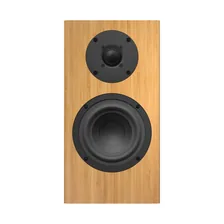 One of Erin’s Audio Corner’s picks in this price range is the Ascend Sierra 1 v2: $1000 per pair Ascend Acoustics eBay
Pros: Formaldehyde-free layered bamboo ply cabinet with a 1” dome tweeter over a 5.25” midwoofer, mated by a 4th-order acoustic crossover rather than a stock textbook design. In-room response is extremely linear (the reviewer called it “textbook”) a clear step up from the earlier V1, which had boxiness around 700Hz-1kHz and sibilance around 4-6kHz. Preference score of 8.4 with a subwoofer (6.8 without), which the reviewer calls topnotch. Wide, even horizontal radiation of about ±70° up to 6kHz. Better vertical directivity than its tweeter-to-woofer spacing would suggest, thanks to the steep 4th-order crossover slopes. No mechanical noise, port chuffing, or woofer bottoming even driven to 96dB/1m. In a three-way comparison against the Dynaudio Emit 20 and a Revel bookshelf model (all around $1,000/pair), measured as the most linear of the three and was the reviewer’s personal pick over both, despite the Dynaudio’s deeper bass and higher output capability. Independent ASR Klippel measurements corroborate Erin’s findings: superb off-axis response with only slight on-axis variations, and an in-room response the reviewer called “incredibly smooth and accurate. Amazing for a non-DSP speaker.” Distortion above 200Hz at 86dB/1m is very low for the class. Measured bass extension of 55Hz (-3dB), with a measured sensitivity of 81.5dB.
Cons: F3 of 55Hz and F10 of 39Hz mean in-room extension tops out in the mid-40s Hz; the reviewer still recommends a subwoofer for full-range material. Diffraction dips appear around 3kHz and 5-6kHz, and the 1” dome tweeter starts beaming above roughly 6.7kHz, narrowing the soundstage radiation in the top octave: a straightforward consequence of dome size rather than a design flaw. At 96dB/1m the 5.25” midwoofer shows increased distortion in the midrange, likely tied to motor topology; high-passing to a subwoofer around 80Hz largely clears it up. Moderate sensitivity (~81-82dB average) with a 7-ohm minimum impedance. ASR’s power-sweep testing found response holds steady up to 96dB SPL/1m, but pushing to 102dB causes midbass below 400Hz to sag with distortion “through the roof”: a harder output ceiling than the 96dB tests alone suggest. Vertical directivity also narrows above about 1kHz, so the reviewer recommends staying at tweeter-axis height for best results.
Full Ascend Sierra 1 v2 review and specifications →
| Bass Extension (-10dB) | 39Hz (measured, Erin’s Audio Corner) |
|---|---|
| Bass Extension (-3dB) | 55Hz (measured, Erin’s Audio Corner) |
| DIY Kit | No |
| Dimensions | 14.2”H x 7.5”W x 10.5”D (361.9 x 190.5 x 266.7 mm) |
| Drivers | 5.25” proprietary mineral-filled polypropylene cone with cast aluminum frame woofer, 26mm aluminum/magnesium alloy dome tweeter with titanium former (SEAS Titan) |
| Impedance | 8 ohms nominal, 7 ohms minimum (measured, Erin’s Audio Corner) |
| Sensitivity | 81.5dB (measured, Erin’s Audio Corner) |
| Spinorama Preference Score | 6.65 |
| Spinorama Preference Score with Perfect Sub | 8.61 |
| Weight | 18.5 lbs (8.4 kg) each |
| Woofer Cabinet | ported |
- Links
- Reviews, Comparisons and Sound Samples
- Erin’s Audio Corner: NEW! Ascend Acoustics Sierra-1 V2 Review More from Erin’s Audio Corner →
- Erin’s Audio Corner Website Ascend Sierra 1 v2
- Audio Science Review Ascend Sierra 1 v2 More from Audio Science Review →
- Erin’s Audio Corner: 5 AWESOME SPEAKERS Under $1000 You Won’t Regret
- Erin’s Audio Corner: I Tested 250 Speakers So You Don’t Have To!
- Erin’s Audio Corner: My Top Picks of 2023: Must-Haves Under $3000
- Manufacturer Measurements (spinorama.org)
- Head-to-Head Comparisons
- Ascend Sierra 1 v2 vs KEF LS50 Meta
- Ascend Sierra 1 v2 vs Philharmonic Ceramic Mini
- Ascend Sierra 1 v2 vs Audio First Fidelia
- Ascend Sierra 1 v2 vs XMechanik Mechano23 DIY
- Ascend Sierra 1 v2 vs Ascend Acoustics HTM-200SE2
- Ascend Sierra 1 v2 vs Arendal 1961 Monitor
- Ascend Sierra 1 v2 vs Ascend Acoustics Luna V2 Mini-Monitor Titan
- Ascend Sierra 1 v2 vs Aalto Speakers Aalto 1 EVO
- See all 50 comparisons
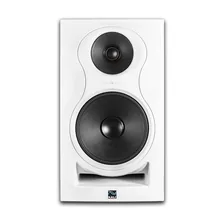 One of Erin’s Audio Corner’s picks in this price range is the Kali Audio IN-8 V2: $998 per pair Amazon eBay
Smaller model: the Kali Audio IN-5 (rated 4.2/5).
Pros: The IN-8 V2’s coaxial midrange/tweeter supports coherent imaging, and low distortion at ordinary levels complements its 7.30 ideal-subwoofer score. Measured -3dB extension of 45.4Hz provides useful bass; boundary settings assist placement. The front port allows placement near a wall without port noise problems. Measured bass extension of 44Hz (-3dB), with a measured sensitivity of 89dB.
Cons: The measured 3.0dB response span from 300Hz to 5kHz includes unevenness that can make some vocals sound forward. Bass and limiter behavior constrain high-level playback. These measurements apply to the V2, not the first-generation IN-8. On-axis, the 4 to 5kHz range sounds forward; Kali recommends about 10° of toe-out, and some EQ helps.
Full Kali Audio IN-8 V2 review and specifications →
| AES Input | No |
|---|---|
| Amplifier Power | 140w Per Speaker |
| App | No |
| Aux Input | No |
| Bass Extension (-10dB) | 36Hz (measured, Erin’s Audio Corner) |
| Bass Extension (-3dB) | 44Hz (measured, Erin’s Audio Corner) |
| Bluetooth | No |
| Coaxial Input | No |
| DSP | No |
| Dimensions | 17.8”H x 10”W x 11.3”D (452.1 x 254 x 287 mm) |
| Drivers | 8” (203mm) woofer |
| EQ | Yes (Room adjustment) |
| Frequency Response | 45Hz - 21kHz (±3dB) (Manufacturer specified) |
| HDMI Input | No |
| Inputs | XLR, RCA |
| Optical Input | No |
| RCA Input | Yes |
| Sensitivity | 89dB (measured at 0.3V/1m, Erin’s Audio Corner) |
| Spinorama Preference Score | 5.36 |
| Spinorama Preference Score with Perfect Sub | 7.30 |
| TRS Input | No |
| USB Input | No |
| Weight | 22.9 lbs (10.4 kg) each |
| XLR Input | Yes |
- Links
- Reviews, Comparisons and Sound Samples
- Head-to-Head Comparisons
- Kali Audio IN-8 V2 vs Genelec 8050B
- Kali Audio IN-8 V2 vs Kali Audio LP-6 V2
- Kali Audio IN-8 V2 vs Yamaha HS8
- Kali Audio IN-8 V2 vs JBL 4305P
- Kali Audio IN-8 V2 vs JBL 308P MKII
- Kali Audio IN-8 V2 vs Focal Solo6 ST6
- Kali Audio IN-8 V2 vs Kali Audio LP-6
- Kali Audio IN-8 V2 vs Genelec S360
- See all 40 comparisons
Bookshelf Speakers: Under $1500
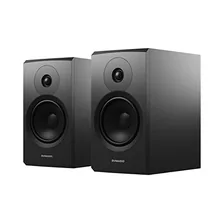 One of Erin’s Audio Corner’s picks in this price range is the Dynaudio Emit 20: $1,049.00 per pair Amazon eBay
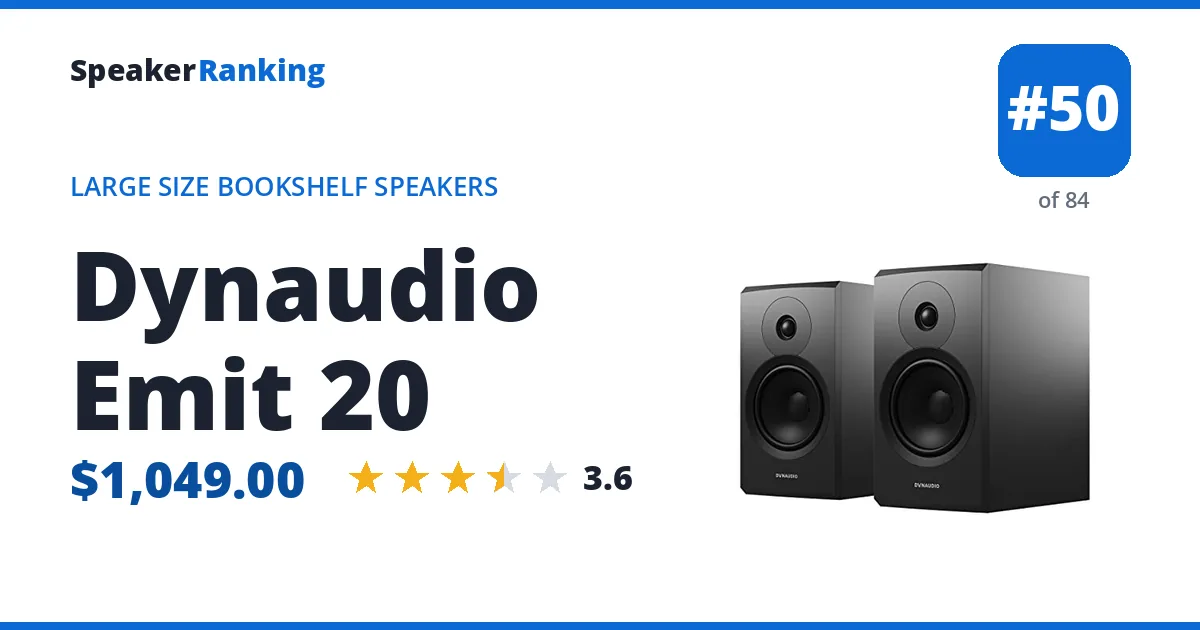
Pros: Two-way design with a 28mm Esotar soft dome tweeter (Hexis-damped) and an 18cm mid-woofer, using a first-order crossover on the tweeter and second-order on the woofer. Exceptional bass extension for a bookshelf speaker: reaches a clean, authoritative 40Hz in-room, rare enough that the reviewer says most listeners could skip a subwoofer for typical music. Very low distortion across the board, staying below 1% THD down to 40Hz at 86dB and below 3% even at 96dB: unusually clean bass performance where most two-way bookshelf speakers start rising in distortion around 80Hz. Wide, remarkably consistent horizontal directivity (about ±50-60°) that holds steady up to roughly 13kHz: rare for a speaker in this format, thanks to a beveled tweeter edge that acts as a mild waveguide. Excellent compression and dynamic-range linearity at the frequency extremes, actually showing slight bass enhancement rather than the sharp low-end compression common in similarly-sized bookshelf speakers. Measured bass extension of 54Hz (-3dB), with a measured sensitivity of 83.5dB.
Cons: A resonance around 600-800Hz gives snares and similar percussion a muffled, flat quality lacking impact: confirmed as originating in the woofer itself (isolated via measurements of the raw driver out of the cabinet), and attempts at constrained-layer damping didn’t resolve it. A peak around 4kHz adds a sharp, edgy quality to some male vocals. A roughly 5dB boost above 10kHz gives cymbals and hi-hats excess shimmer that can sound unnatural, especially pointed directly on-axis. Vertical dispersion shows two separate crossover-related notches (above and below the tweeter reference line around 5kHz) rather than the usual single one, a direct consequence of the shallow crossover slopes used on both drivers. Multitone distortion is elevated in the midrange, possibly due to the woofer’s magnet structure lacking a shorting ring. Best aimed slightly off-axis (about 10-15° of toe-out) to tame the excess high-frequency shimmer, rather than pointed straight at the listener.
Full Dynaudio Emit 20 review and specifications →
| Bass Extension (-10dB) | 33Hz (measured, Erin’s Audio Corner) |
|---|---|
| Bass Extension (-3dB) | 54Hz (measured, Erin’s Audio Corner) |
| DIY Kit | No |
| Dimensions | 14.6”H x 8.1”W x 12.3”D (370.0 x 205.0 x 312.0 mm) |
| Drivers | 7.1” Magnesium Silicate Polymer woofer, 1.1” Cerotar soft dome with Hexis tweeter |
| Impedance | 6 ohms nominal (5.5 ohms minimum above 80Hz, measured, Erin’s Audio Corner) |
| Sensitivity | 83.5dB (measured, Erin’s Audio Corner; 86dB manufacturer specified) |
| Spinorama Preference Score | 4.22 |
| Spinorama Preference Score with Perfect Sub | 5.92 |
| Weight | 12.8 lbs (5.8 kg) |
| Woofer Cabinet | ported, rear |
- Links
- Reviews, Comparisons and Sound Samples
- Head-to-Head Comparisons
- Dynaudio Emit 20 vs Philharmonic BMR Monitor
- Dynaudio Emit 20 vs Klipsch RP-600M II
- Dynaudio Emit 20 vs JBL Studio 630
- Dynaudio Emit 20 vs Behringer B2030P
- Dynaudio Emit 20 vs Mission LX-3 MKII
- Dynaudio Emit 20 vs Polk Signature Elite ES20
- Dynaudio Emit 20 vs Ascend CBM-170 SE2
- Dynaudio Emit 20 vs Infinity Reference R162
- See all 68 comparisons
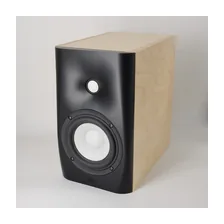 One of Erin’s Audio Corner’s picks in this price range is the Audio First Fidelia: £950 per pair for the flatpack kit (assembly required) Audio First Designs eBay
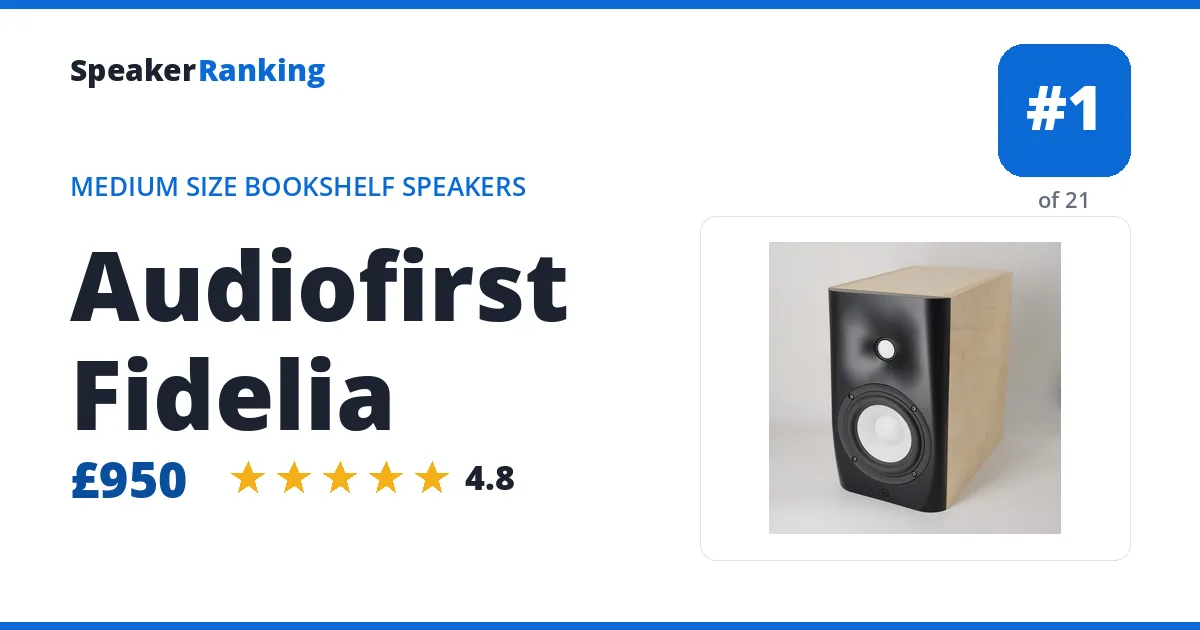
Pros: Kit speaker offering exceptional value and tonal accuracy; chosen by reviewer as reference standard for future speaker tonality comparisons despite 1,250 USD price point. Achieves bass extension to 53 Hz (F3) and 38 Hz (F10) from compact cabinet. Direct-from-manufacturer availability eliminates retailer markup. Measured bass extension of 53Hz (-3dB).
Cons: Kit assembly required; lower sensitivity (~83-85 dB vs. typical 85 dB average) demands adequate amplifier power. Only available direct from UK manufacturer with associated shipping costs and lead times. Trade-off between compact driver configuration and maximum dynamic output.
Full Audio First Fidelia review and specifications →
| Bass Extension (-10dB) | 38Hz (measured, Erin’s Audio Corner) |
|---|---|
| Bass Extension (-3dB) | 53Hz (measured, Erin’s Audio Corner) |
| Crossover Frequency | 1560Hz |
| DIY Kit | Yes |
| Dimensions | 11.8”H x 7.1”W x 11.7”D (300 x 180 x 297.6 mm) |
| Drivers | 5” ceramic-aluminum cone woofer, 1” ceramic-aluminum tweeter |
| Impedance | 4 ohms |
| Sensitivity | 84dB |
| Spinorama Preference Score | 6.45 |
| Spinorama Preference Score with Perfect Sub | 8.46 |
| Weight | 15 lbs (6.8 kg) each |
| Woofer Cabinet | ported, rear |
- Links
- Reviews, Comparisons and Sound Samples
- Erin’s Audio Corner: The #1 Reason audiophiles Are Raving About Fidelia’s Sound Quality More from Erin’s Audio Corner →
- Erin’s Audio Corner: I Tested 250 Speakers So You Don’t Have To!
- Erin’s Audio Corner: My Absolute Favorite Products of 2024 Revealed
- Erin’s Audio Corner Measurements (spinorama.org)
- Erin’s Audio Corner Website: Audio First Fidelia
- Head-to-Head Comparisons
- Audio First Fidelia vs Philharmonic Ceramic Mini
- Audio First Fidelia vs Ascend Sierra 1 v2
- Audio First Fidelia vs KEF LS50 Meta
- Audio First Fidelia vs XMechanik Mechano23 DIY
- Audio First Fidelia vs Ascend Acoustics HTM-200SE2
- Audio First Fidelia vs Arendal 1961 Monitor
- Audio First Fidelia vs Ascend Acoustics Luna V2 Mini-Monitor Titan
- Audio First Fidelia vs Aalto Speakers Aalto 1 EVO
- See all 26 comparisons
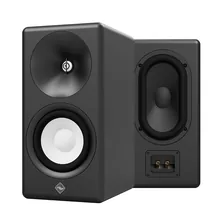 One of Erin’s Audio Corner’s picks in this price range is the AsciLab C6B: $1145 per pair Ascilab eBay
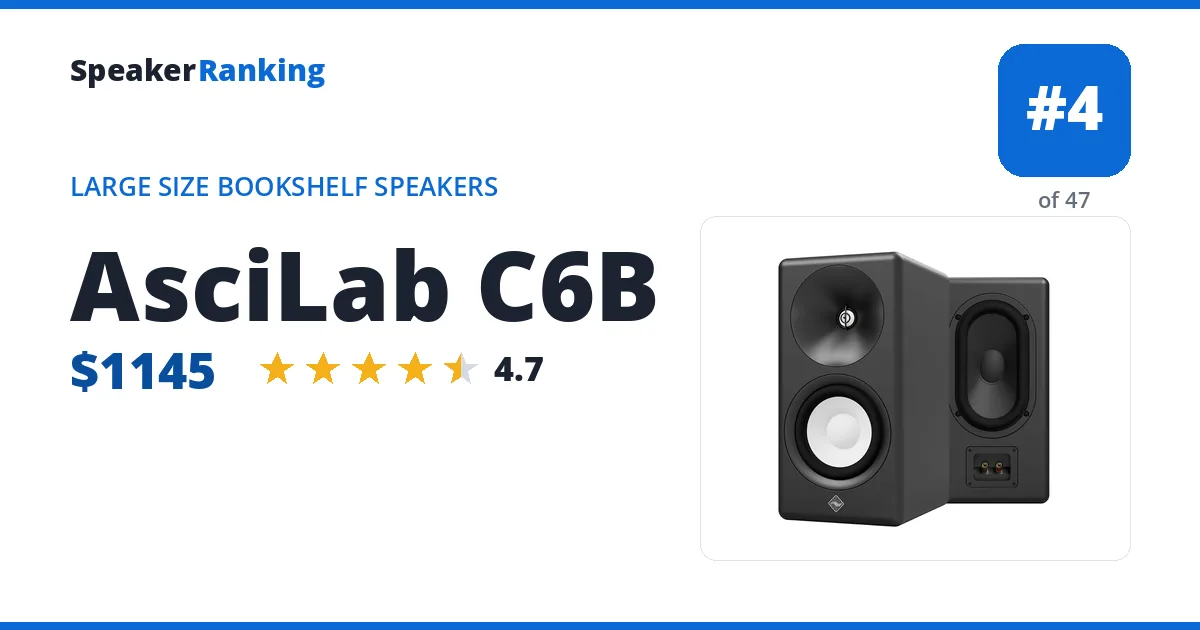
Pros: Two-way design pairing a 1” aluminum ceramic dome tweeter on a large waveguide with a 6” aluminum ceramic cone woofer, crossed over at 1.1kHz, plus a rear passive radiator. Unusual trait: horizontal radiation actually widens at higher frequencies instead of narrowing like most two-way designs, which keeps image focus and soundstage depth consistent whether you toe the speakers in or out (5-10° off-axis was the sweet spot in testing). Vertical radiation also stays wide straight through the 2kHz crossover region, so the sound doesn’t collapse when standing up: unusual at this price. CA2034 measurements show strong on-axis linearity, listening window, early reflections, and directivity. Midrange and tweeter distortion stay very low even at 96dB, holding up against a $5,900 Arendal speaker in that regard despite roughly a 5x price gap. At $1145 shipped to the US, the reviewer calls it the best-value bookshelf speaker he’s tested, rivaling speakers 2-5x the price. Measured bass extension of 54Hz (-3dB), with a measured sensitivity of 85.6dB.
Cons: Bass rolls off around 50Hz in-room (F3 54Hz, F10 35Hz), so a subwoofer is needed for real extension below that. Low-frequency harmonic distortion increases substantially at 96dB versus 86dB, though it’s second-order and less audible than it looks on paper. Minimum impedance dips to 2.6 ohms (EPDR as low as 1.2 ohms), so it wants an amplifier comfortable driving 4-ohm loads, ideally 100W or more. At 102dB, compression noticeably eats into midrange, bass, and some treble output. Shipping to the US adds roughly $200 on top of AsciLab’s list price. Against the reviewer’s reference Audiofirst Fidelia at a similar price, has slightly less lower-midrange body (about 1dB difference) and a smaller perceived soundstage size.
Full AsciLab C6B review and specifications →
| Bass Extension (-10dB) | 35Hz (measured, Erin’s Audio Corner) |
|---|---|
| Bass Extension (-3dB) | 54Hz (measured, Erin’s Audio Corner) |
| DIY Kit | No |
| Dimensions | 15.7”H x 8”W x 10.4”D (398.8 x 203.2 x 264.2 mm) |
| Drivers | 6” Aluminium Ceramic Cone with cast Aluminium Chassis woofer, 1” Aluminium Ceramic Dome tweeter |
| Impedance | 4 ohms nominal, 2.6 ohms minimum (measured, Erin’s Audio Corner) |
| Sensitivity | 85.6dB (measured, Erin’s Audio Corner) |
| Spinorama Preference Score | 6.33 |
| Spinorama Preference Score with Perfect Sub | 8.28 |
| Weight | 18.5 lbs (8.4 kg) each |
| Woofer Cabinet | passive radiator |
- Links
- Reviews, Comparisons and Sound Samples
- Head-to-Head Comparisons
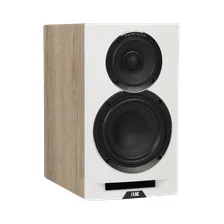 One of Erin’s Audio Corner’s picks in this price range is the ELAC Uni-Fi Reference UBR62: $1,199 per pair Amazon eBay
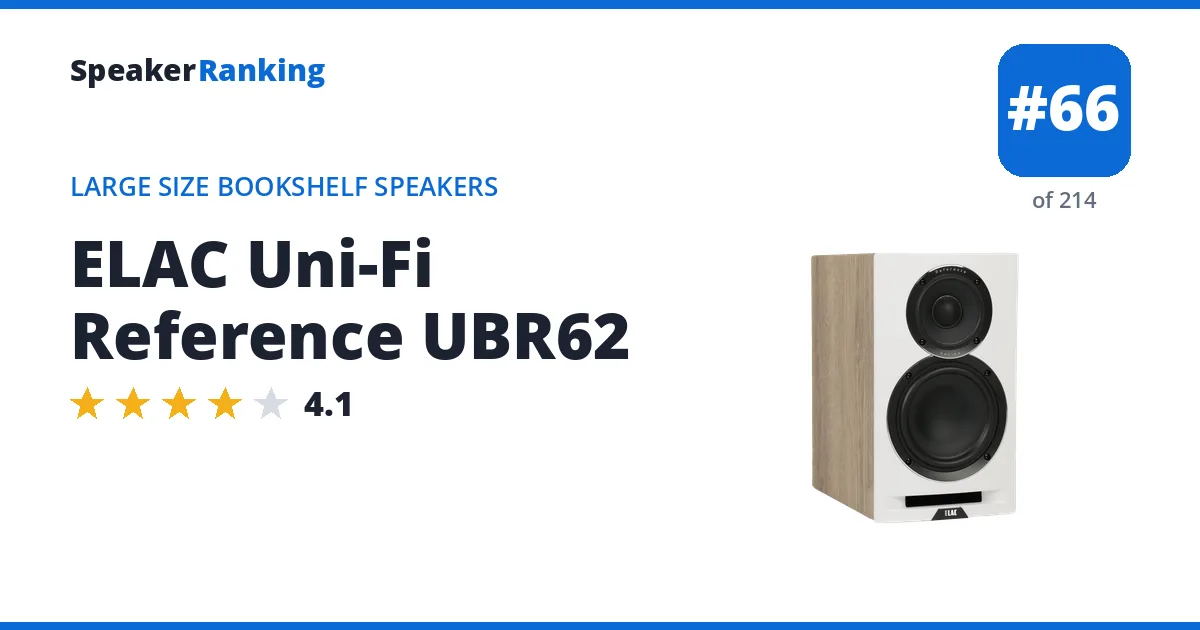
Pros: True three-way stand-mount using a 1-inch tweeter concentrically mounted in a 4-inch aluminum midrange plus a dedicated 6.5-inch aluminum woofer. Erin found the directivity and overall tonality well controlled, with dual front slot vents minimizing placement sensitivity and cabinet bracing suppressing obvious coloration. The mostly 5-ohm-or-higher load is manageable for a genuinely 4-ohm-capable amplifier, and the coherent concentric upper range supports stable imaging across seats. Measured bass extension of 58.6Hz (-3dB), with a measured sensitivity of 83dB.
Cons: Erin measured very low 83dB/2.83V/1m sensitivity; his 110W Parasound was insufficient for the high-level test and the more powerful HINT 6 was needed. Impedance reaches 4 ohms near 50Hz (Erin), while woofer excursion and bass output were less capable than expected for the cabinet size. A broad 500-700Hz rise and associated lower/female-vocal coloration were audible, and the slightly subdued listening-window treble is necessary to avoid an overly bright in-room balance rather than evidence of ruler-flat axial tuning.
Full ELAC Uni-Fi Reference UBR62 review and specifications →
| Bass Extension | 41Hz manufacturer specified; Erin’s response-linearity graph shows limited high-output bass headroom |
|---|---|
| Bass Extension (-10dB) | 41.9Hz (measured, Erin’s Audio Corner) |
| Bass Extension (-3dB) | 58.6Hz (measured, Erin’s Audio Corner) |
| DIY Kit | No |
| Dimensions | 14.1”H x 8.2”W x 13.1”D |
| Drivers | 1” tweeter coaxial with 4” midrange; 6.5” woofer |
| Impedance | 4 ohms minimum near 50Hz (measured, Erin’s Audio Corner) |
| Sensitivity | 83dB/2.83V/1m (measured, Erin’s Audio Corner) |
| Spinorama Preference Score | 5.44 (measured, spinorama.org) |
| Spinorama Preference Score with Perfect Sub | 7.7 (measured, spinorama.org) |
| Weight | 23.5 lbs (10.68 kg) each |
| Woofer Cabinet | ported, dual front slot vents |
- Links
- Reviews, Comparisons and Sound Samples
- Head-to-Head Comparisons
- ELAC Uni-Fi Reference UBR62 vs Power Sound Audio MT-110-M
- ELAC Uni-Fi Reference UBR62 vs Revel Concerta2 M16
- ELAC Uni-Fi Reference UBR62 vs SVS Ultra Evolution Bookshelf
- ELAC Uni-Fi Reference UBR62 vs ELAC DBR62
- ELAC Uni-Fi Reference UBR62 vs Yamaha NS-800A
- ELAC Uni-Fi Reference UBR62 vs Definitive Technology Demand D11
- ELAC Uni-Fi Reference UBR62 vs Technics SB-C700
- ELAC Uni-Fi Reference UBR62 vs Dynaudio Contour 20i
- See all 26 comparisons
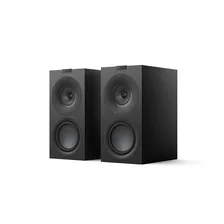 One of Erin’s Audio Corner’s picks in this price range is the KEF Q Concerto Meta: $1,399.99 per pair Amazon Crutchfield eBay
Smaller models: the KEF Q3 Meta (ranked lower, rated 3.4/5) and the KEF Q1 Meta (rated 3.6/5).
Larger models: the KEF Q7 Meta (estimated 3.5/5) and the KEF Q11 Meta (rated 4/5).
Pros: Really good in-room neutrality with consistent horizontal directivity from seat to seat. Directivity holds remarkably steady from lower treble into upper treble, where many similarly-priced speakers narrow sharply as frequency rises: one of the reviewer’s top 10 picks under $1,500. Measured bass extension of 53Hz (-3dB), with a measured sensitivity of 84.2dB.
Cons: Radiation pattern measures about ±50°, narrower than the reviewer’s preferred ±60° for a stronger sense of envelopment. Needs to be pointed closer to on-axis rather than heavily toed out: combined with its rolled-off, shelved-down top end, too much toe-out makes it sound noticeably dark.
Full KEF Q Concerto Meta review and specifications →
| Bass Extension (-10dB) | 35Hz (measured, Erin’s Audio Corner) |
|---|---|
| Bass Extension (-3dB) | 53Hz (measured, Erin’s Audio Corner) |
| DIY Kit | No |
| Dimensions | 16.3”H x 8.3”W x 12.4”D (414 x 210.8 x 315 mm) |
| Drivers | 165 mm (6.5 in.) hybrid aluminium cone woofer, 100 mm (4 in.) aluminium cone midrange, 19 mm (0.75 in.) vented aluminium dome with MAT tweeter |
| Impedance | 4 ohms nominal (3.3 ohms minimum above 80Hz, measured by Erin’s Audio Corner) |
| Sensitivity | 84.2dB (measured average, Erin’s Audio Corner) |
| Spinorama Preference Score | 6.01 |
| Spinorama Preference Score with Perfect Sub | 7.71 |
| Weight | 20.9 lbs (9.5 kg) each |
| Woofer Cabinet | ported, rear |
- Links
- Reviews, Comparisons and Sound Samples
- Erin’s Audio Corner: HiFi Perfection? KEF CONCERTO META Delivers! More from Erin’s Audio Corner →
- Erin’s Audio Corner Website KEF Q Concerto Meta
- Erin’s Audio Corner: I Tested 250 Speakers So You Don’t Have To!
- Erin’s Audio Corner: HiFi Perfection? KEF CONCERTO META Delivers!
- Erin’s Audio Corner: My Absolute Favorite Products of 2024 Revealed
- Erin’s Audio Corner Measurements (spinorama.org)
- Head-to-Head Comparisons
- KEF Q Concerto Meta vs KEF R3 Meta
- KEF Q Concerto Meta vs AsciLab F6B
- KEF Q Concerto Meta vs Wharfedale Aura 2
- KEF Q Concerto Meta vs Revel M106
- KEF Q Concerto Meta vs KEF R3
- KEF Q Concerto Meta vs Audio First Cadentia 3
- KEF Q Concerto Meta vs AsciLab C6B
- KEF Q Concerto Meta vs Buchardt Audio E50
- See all 105 comparisons
Bookshelf Speakers: Under $3000
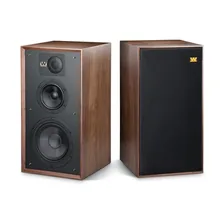 One of Erin’s Audio Corner’s picks in this price range is the Wharfedale Linton 85: $1999 per pair Crutchfield eBay
Pros: Very neutral frequency response and good bass extension. Measured bass extension of 52Hz (-3dB), with a measured sensitivity of 85.1dB.
Cons: The spacing of the drivers makes the vertical off axis not very good
Full Wharfedale Linton 85 review and specifications →
| Bass Extension (-10dB) | 35Hz (measured, Erin’s Audio Corner) |
|---|---|
| Bass Extension (-3dB) | 52Hz (measured, Erin’s Audio Corner) |
| DIY Kit | No |
| Dimensions | 22.2”H x 11.8”W x 13”D (563.9 x 299.7 x 330.2 mm) |
| Drivers | 8”(200mm) black woven Kevlar® cone woofer, 5”(135mm) black woven Kevlar® cone midrange, 1” (25mm) soft dome tweeter |
| Impedance | 6 ohms nominal, 3.5 ohms minimum (measured above 80Hz, Erin’s Audio Corner) |
| Sensitivity | 85.1dB (measured average 300Hz-3kHz @ 2.83V/1m, Erin’s Audio Corner) |
| Spinorama Preference Score | 6.07 |
| Spinorama Preference Score with Perfect Sub | 7.87 |
| Weight | 40.6 lbs (18.4 kg) each |
| Woofer Cabinet | ported, rear |
- Links
- Reviews, Comparisons and Sound Samples
- Erin’s Audio Corner: Discover Why I Can’t Stop Raving About the Wharfedale Linton 85th Anniversary Speaker More from Erin’s Audio Corner →
- Erin’s Audio Corner Website Wharfedale Linton 85 Review
- Erin’s Audio Corner: My Top 5 Speakers at Any Price
- Erin’s Audio Corner: Upgrade Your Sound with These 6 Surprisingly Affordable Speakers!
- Erin’s Audio Corner: My Personal Favorite Speakers Under $2500
- Erin’s Audio Corner Measurements (spinorama.org)
- Erin’s Audio Corner: KLH Model 5 or Wharfedale Linton? Linton for me. But you may disagree. Here is why.
- Head-to-Head Comparisons
- Wharfedale Linton 85 vs Ascend Acoustics Sierra-LX
- Wharfedale Linton 85 vs Revel M126Be
- Wharfedale Linton 85 vs ELAC VELA BS 403
- Wharfedale Linton 85 vs Philharmonic BMR (v1)
- Wharfedale Linton 85 vs Dynaudio Heritage Special
- Wharfedale Linton 85 vs Ascend Acoustics Sierra-2EX V2
- Wharfedale Linton 85 vs Radiant Acoustics Clarity 6.2
- Wharfedale Linton 85 vs MoFi SourcePoint 10
- See all 68 comparisons
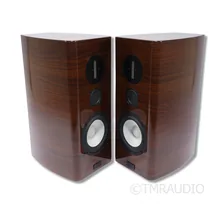 One of Erin’s Audio Corner’s picks in this price range is the Philharmonic BMR Monitor: $2200 per pair Philharmonic Audio eBay
Older model: the Philharmonic BMR (v1) (ranked higher, rated 4.3/5).
Pros: Three-way design combining a 6” SB Acoustics mid-woofer, a 2.5” Tectonic balanced-mode radiator (BMR) for the midrange, and a ribbon tweeter: premium component choices relative to the asking price. A clear improvement over the V1: the earlier version’s overly hot, plateauing treble has been resolved, leaving a genuinely good in-room response outside of one specific area. Extremely wide horizontal radiation of about ±70-80°, creating an enveloping, wide soundstage that illuminates the sidewalls. Well-built, attractive cabinet. Midrange and tweeter show no stress or elevated distortion even at higher output: all the compression and distortion issues trace back to the mid-woofer alone. Measured bass extension of 47Hz (-3dB), with a measured sensitivity of 84dB.
Cons: A 1-2dB bump around 2-3kHz creates a “glare” on vocals, guitars, and strings that the reviewer noticed consistently across many tracks. The extremely wide radiation trades off against imaging precision: instrument placement became noticeably more diffuse and harder to pinpoint in a narrower, more reflective room, though it improved substantially in a larger, more open room with less sidewall interaction. A suspected resonance around 500Hz shows up as an imbalance in sound power and horizontal directivity measurements, loosely correlating with a vague sense of resonance the reviewer heard subjectively. Moderate sensitivity (about 84.1dB anechoic) and a mid-woofer that runs out of steam under real stress: distortion exceeds 3% even at 100Hz at 96dB, and the reviewer notes SB Acoustics’ published excursion specs tend to overstate real-world linear excursion by nearly 2x. Significant compression appears at 102dB: the woofer audibly unloads around 120Hz, and the ribbon tweeter also compresses heavily at high output. Not well suited to very loud two-channel listening (above about 90dB at 4 meters). In-room bass rolls off around 50Hz, so a subwoofer is recommended for most music. Benefits noticeably from a few bands of EQ if available.
Full Philharmonic BMR Monitor review and specifications →
| Bass Extension (-10dB) | 32Hz (measured, Erin’s Audio Corner) |
|---|---|
| Bass Extension (-3dB) | 47Hz (measured, Erin’s Audio Corner) |
| DIY Kit | No |
| Dimensions | 20”H x 8”W x 12.5”D (508 x 203.2 x 317.5 mm) |
| Drivers | 6” Ceramic woofer, Balanced Mode Radiator 2.5” midrange, RAAL 64-10X OEM tweeter |
| Impedance | 4 ohms nominal (3 ohms minimum above 80Hz, measured by Erin’s Audio Corner) |
| Sensitivity | 84dB (measured, Erin’s Audio Corner) |
| Spinorama Preference Score | 6.02 (spinorama.org) |
| Spinorama Preference Score with Perfect Sub | 7.67 (spinorama.org) |
| Weight | 32 lbs (14.5 kg) each |
| Woofer Cabinet | ported, rear |
- Links
- Reviews, Comparisons and Sound Samples
- Head-to-Head Comparisons
- Philharmonic BMR Monitor vs Dynaudio Emit 20
- Philharmonic BMR Monitor vs Klipsch RP-600M II
- Philharmonic BMR Monitor vs Mission LX-3 MKII
- Philharmonic BMR Monitor vs Polk Signature Elite ES20
- Philharmonic BMR Monitor vs GR-Research X-LS Encore
- Philharmonic BMR Monitor vs Ascend CBM-170 SE2
- Philharmonic BMR Monitor vs Dynaudio Special Forty
- Philharmonic BMR Monitor vs Buchardt S400 MKII
- See all 48 comparisons
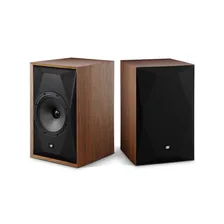 One of Erin’s Audio Corner’s picks in this price range is the MoFi SourcePoint 8: $2594 per pair Crutchfield eBay
Pros: 8” twin-drive concentric driver paired with a 1.25” soft dome tweeter, in a diffraction-reducing baffle design; rated 47Hz-30kHz. Notably more neutral and true-to-source than its sibling SourcePoint 10, which the reviewer found a bit too bright in the treble by comparison: measured about 4-5dB less high-frequency output. Excellent imaging: passed multiple stereo-panning and depth tests, including smooth continuous left-to-right pans without wobble and correct front-to-back layering of vocals versus percussion. Wide horizontal dispersion of about ±60°, broader than the reviewer expected from a coaxial design, and forgiving enough in placement that about 10° of toe-out variance and moving above or below the tweeter axis both still sound good. Excellent dynamic range and compression linearity: about 26dB of headroom up to 102dB/1m equivalent, with issues only appearing below about 60Hz. 8-ohm nominal impedance made it easy to drive on everything from a budget Denon AVR to a high-end Macintosh amplifier. No significant evidence of woofer-cone modulation distortion affecting the tweeter, even at 96dB/1m. Measured bass extension of 52Hz (-3dB), with a measured sensitivity of 86.3dB.
Cons: Like other coincident designs, produces diffraction dips around 4kHz and 7kHz when pointed directly on-axis; needs about 10-15° of toe-out to smooth those out. The rear-ported cabinet (two ports) means it can’t be placed too close to a wall without the bass becoming overblown: the reviewer settled on about 2 feet of clearance. F3 of 52Hz and F10 of 43Hz mean genuine deep bass tops out in the mid-40s Hz in-room: a subwoofer is still needed for true low-end extension. Harmonic distortion crosses the reviewer’s 3% threshold at 96dB (though it’s second-order and less audibly significant), and multitone distortion becomes noticeably more audible at that same output level. Vertical response doesn’t perfectly mirror horizontal, since the cabinet is a rectangle rather than a perfect square around the driver.
Full MoFi SourcePoint 8 review and specifications →
| Bass Extension (-10dB) | 43Hz (measured, Erin’s Audio Corner) |
|---|---|
| Bass Extension (-3dB) | 52Hz (measured, Erin’s Audio Corner) |
| DIY Kit | No |
| Dimensions | 18”H x 11.4”W x 13.2”D (457.2 x 289.6 x 335.3 mm) |
| Drivers | 8” woofer, 1.25-inch soft-dome tweeter |
| Impedance | 8 ohms nominal (8 ohms minimum above 80Hz, measured, Erin’s Audio Corner) |
| Sensitivity | 86.3dB (measured, Erin’s Audio Corner) |
| Spinorama Preference Score | 5.15 |
| Spinorama Preference Score with Perfect Sub | 7.28 |
| Weight | 28 lbs (12.7 kg) each |
| Woofer Cabinet | ported, rear |
- Links
- Reviews, Comparisons and Sound Samples
- Erin’s Audio Corner: Why Do People Love the MoFi SourcePoint 8? More from Erin’s Audio Corner →
- Erin’s Audio Corner Website MoFi SourcePoint 8
- Erin’s Audio Corner: Upgrade Your Sound with These 6 Surprisingly Affordable Speakers!
- Erin’s Audio Corner: My Personal Favorite Speakers Under $2500
- Erin’s Audio Corner: My Top Picks of 2023: Must-Haves Under $3000
- GR-Research: Danny Tackles Andrews Jones: The Source Point 8! Spoiler Alert (It’s Really Good) More from GR-Research →
- Erin’s Audio Corner Measurements (spinorama.org)
- Head-to-Head Comparisons
- MoFi SourcePoint 8 vs Buchardt Audio E50
- MoFi SourcePoint 8 vs KEF R3
- MoFi SourcePoint 8 vs Epos ES14N
- MoFi SourcePoint 8 vs AsciLab F6Bs
- MoFi SourcePoint 8 vs Wharfedale Aura 2
- MoFi SourcePoint 8 vs Arendal 1528 Monitor 8
- MoFi SourcePoint 8 vs KEF Q Concerto Meta
- MoFi SourcePoint 8 vs Ascend Acoustics CMT-340 SE2
- See all 60 comparisons
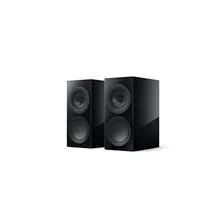 One of Erin’s Audio Corner’s picks in this price range is the KEF R3 Meta: $2,499.99 per pair Amazon Crutchfield eBay
Larger models: the KEF R7 Meta (estimated 4.6/5) and the KEF R11 Meta (rated 4.4/5).
Pros: Three-way design with an unconventional concentric layout: the 1” tweeter is recessed into the throat of the 5.25” midrange driver, deeper integration than a standard coaxial arrangement. A quasi sealed/ported bass alignment gives an extended low-end shelf tuned to match typical in-room gain, reaching about 50Hz for most content: deeper than recently-tested rivals like the Focal Aria 906, Polk R200, and an 8” Aperion design. Spinorama measurements show class-leading directivity and sound power, plus very linear on-axis response (at the recommended 10° toe-out) and early-reflections directivity, so it takes EQ exceptionally well. The vertical sweet spot extends to about ±20-30° off the reference axis with nearly identical tonality, unusually wide for a two- or three-way design. A clear upgrade over the earlier, non-Meta R3, eliminating the treble brightness the original had even when toed off-axis. Outperforms similarly-priced rivals (Revel M106, Wharfedale Linton, Philharmonic BMR V2, JBL HDI 1600) specifically on directivity and linearity in the reviewer’s measurements. At $2500/pair, called the best value in its class with near-reference-level anechoic performance. Measured bass extension of 76Hz (-3dB), with a measured sensitivity of 85.9dB.
Cons: Pointed straight on-axis, there’s a 1-2dB bump around 9kHz that stays consistent across angles thanks to the constant-directivity waveguide: only toeing the speaker out about 10° tames it. Minimum impedance dips to about 3.2 ohms nominal (EPDR as low as 1.9 ohms), so it needs a 4-ohm-stable amplifier; a standard AVR likely won’t cut it. Distortion crosses the reviewer’s 3% threshold around 80Hz at 96dB output and shows added deviation again near 50Hz, indicating it runs out of headroom at higher volumes: a subwoofer is recommended for loud listening. Horizontal radiation narrows from about ±70° at low frequency to ±40° at high frequency. Below about 100Hz, compression testing shows fairly wide deviations at both 86dB and 96dB output, though the reviewer notes this is typical for speakers in this size and price class. Current R3 owners who are already happy with that speaker have little reason to upgrade.
Full KEF R3 Meta review and specifications →
| Bass Extension (-10dB) | 37Hz (measured, Erin’s Audio Corner) |
|---|---|
| Bass Extension (-3dB) | 76Hz (measured, Erin’s Audio Corner) |
| DIY Kit | No |
| Dimensions | 16.6”H x 7.9”W x 13.2”D (421.6 x 200.7 x 335.3 mm) |
| Drivers | 6.5” Hybrid aluminum ported woofer, 5” aluminum cone midrange, 1” vented aluminium dome with MAT tweeter |
| Impedance | 4 ohms nominal (3.2 ohms minimum above 80Hz, measured, Erin’s Audio Corner) |
| Sensitivity | 85.9dB (measured, Erin’s Audio Corner; 87dB manufacturer specified) |
| Spinorama Preference Score | 6.10 |
| Spinorama Preference Score with Perfect Sub | 7.91 |
| Weight | 27.3 lbs (12.4 kg) each |
| Woofer Cabinet | ported |
- Links
- Reviews, Comparisons and Sound Samples
- Erin’s Audio Corner: KEF R3 Meta: The Speaker to Beat. More from Erin’s Audio Corner →
- Erin’s Audio Corner Website KEF R3 Meta Review
- Erin’s Audio Corner: Upgrade Your Sound with These 6 Surprisingly Affordable Speakers!
- Erin’s Audio Corner: My Personal Favorite Speakers Under $2500
- Erin’s Audio Corner: My Top Picks of 2023: Must-Haves Under $3000
- GR-Research: Finally… a Speaker Danny Doesn’t Have to Fix? More from GR-Research →
- New Record Day: The Gold Standard Of "Pretty Good" KEF R3 Meta Review
- Erin’s Audio Corner Measurements (spinorama.org)
- Erin’s Audio Corner: KEF R3 vs R3 Meta vs Reference 1 Meta. Why such a big price gap?
- Head-to-Head Comparisons
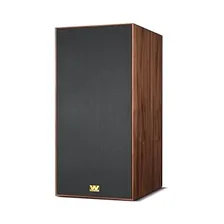 One of Erin’s Audio Corner’s picks in this price range is the Wharfedale Super Linton: $2,699.00 per pair Amazon Crutchfield eBay
Pros: Three-way design with a 1” soft dome tweeter, 5” woven Kevlar mid-range, and 8” woven Kevlar woofer in a dual rear-ported, heavily damped MDF/particle-board cabinet. Comes as a genuinely matched pair (measured within about 1dB of each other) and includes custom matching stands. A major dynamic-range improvement over the original Heritage Linton: kick drums retain their impact from low to high volume instead of compressing, the standout objective improvement in this update. Fixes the original Linton’s main flaw: a 1-3kHz scoop that made it sound a bit soft and subdued is filled in here, giving noticeably more attack and dynamic punch. About 3dB more sensitivity than the original Linton (measured ~88.2dB), meaning roughly half the amplifier power for the same output. Wide horizontal radiation of about ±70°, right in the reviewer’s preferred range for an enveloping soundstage. Lower midrange distortion than the original Linton. Bass-shelf tuning intentionally allows closer-to-wall placement (about 1 foot worked well) without excess boominess, more flexible than the original Linton in that regard. Measured bass extension of 77Hz (-3dB), with a measured sensitivity of 88.2dB.
Cons: Rolls off earlier than the original Linton (F3 77Hz versus the original’s 52Hz), a deliberate trade-off for the closer-wall-placement flexibility. On-axis, there’s a mild treble lift around 4-6kHz that can sound a touch sibilant, though the reviewer found it not very noteworthy in practice. Diffraction shows up around 1.5-2kHz on-axis; needs about 10° of toe-out to smooth this out, though going further to 30° starts to lose some top-end air. Distortion peaks slightly higher than the original Linton in the 50-70Hz region. Minimum impedance dips to about 3 ohms around 150Hz, so a 4-ohm-stable amplifier is recommended for best results. Vertical dispersion of about ±20° means multi-row home theater seating outside that window will hear reduced top-end. Asymmetrical design requires attention to setup (tweeters need to face outward) for the most linear in-room response. A costly upgrade for existing Linton owners if the original’s specific flaws didn’t bother them.
Full Wharfedale Super Linton review and specifications →
| Bass Extension (-10dB) | 34Hz (measured, Erin’s Audio Corner) |
|---|---|
| Bass Extension (-3dB) | 77Hz (measured, Erin’s Audio Corner) |
| DIY Kit | No |
| Dimensions | 23.8”H x 11.8”W x 13”D (604.5 x 299.7 x 330.2 mm) |
| Drivers | 8”(200mm) black woven Kevlar® cone woofer, 5”(135mm) black woven Kevlar® cone midrange, 1” (25mm) soft dome tweeter |
| Impedance | 4 ohms nominal (3 ohms minimum, measured, Erin’s Audio Corner) |
| Sensitivity | 88.2dB (measured, Erin’s Audio Corner) |
| Spinorama Preference Score | 6.09 |
| Spinorama Preference Score with Perfect Sub | 7.94 |
| Weight | 43.7 lbs (19.8 kg) each |
| Woofer Cabinet | ported, rear |
- Links
- Reviews, Comparisons and Sound Samples
- Erin’s Audio Corner: 5 Reasons Wharfedale Super Linton is the Hidden Gem of Audio Equipment More from Erin’s Audio Corner →
- Erin’s Audio Corner Website Wharfedale Super Linton Review
- Erin’s Audio Corner: Upgrade Your Sound with These 6 Surprisingly Affordable Speakers!
- Erin’s Audio Corner: My Absolute Favorite Products of 2024 Revealed
- Erin’s Audio Corner Measurements (spinorama.org)
- Head-to-Head Comparisons
- Wharfedale Super Linton vs Ascend Acoustics CMT-340 SE2
- Wharfedale Super Linton vs Arendal 1528 Monitor 8
- Wharfedale Super Linton vs MoFi SourcePoint 10
- Wharfedale Super Linton vs Radiant Acoustics Clarity 6.2
- Wharfedale Super Linton vs Perlisten R4b
- Wharfedale Super Linton vs Dynaudio Heritage Special
- Wharfedale Super Linton vs AsciLab F6Bs
- Wharfedale Super Linton vs Epos ES14N
- See all 63 comparisons
Bookshelf Speakers: Under $5000
 One of Erin’s Audio Corner’s picks in this price range is the MoFi SourcePoint V10 Master Edition: $7995 per pair Crutchfield eBay
Pros: Extended bass to approximately 30 Hz in-room without subwoofer; images with excellent precision indicating tight frequency response matching between speakers. Integrated bass management with three-way treble attenuation switches for room tuning. New design from Andrew Jones represents reviewer personal second choice (behind only KEF Blade 2 Meta at 29k) among hundreds of systems auditioned; ranks above Dutch & Dutch 8C, JBL 4367, and JBL M2. Measured bass extension of 38Hz (-3dB), with a measured sensitivity of 88.8dB.
Cons: Moderate sensitivity (~89 dB) means amplifier power requirements higher than many alternatives. Deep bass extension ends above subsonic frequencies (pipe organ territory below 17 Hz requires subwoofer).
Full MoFi SourcePoint V10 Master Edition review and specifications →
| Bass Extension (-10dB) | 25Hz (measured, Erin’s Audio Corner) |
|---|---|
| Bass Extension (-3dB) | 38Hz (measured, Erin’s Audio Corner) |
| DIY Kit | No |
| Dimensions | 48.8”H x 15.5”W x 19.9”D (1239.5 x 393.7 x 505.5 mm) |
| Drivers | 10” woofer, 10” paper‑cone concentric midrange, 1.25” soft‑dome concentric tweeter |
| Impedance | 6 ohms nominal, 5.3 ohms minimum (measured, Erin’s Audio Corner) |
| Sensitivity | 88.8dB (measured, Erin’s Audio Corner) |
| Spinorama Preference Score | 5.00 |
| Spinorama Preference Score with Perfect Sub | 6.31 |
| Weight | 160.9 lbs (73 kg) |
| Woofer Cabinet | passive radiator |
- Links
- Reviews, Comparisons and Sound Samples
- Head-to-Head Comparisons
- MoFi SourcePoint V10 Master Edition vs KEF Blade Two Meta
- MoFi SourcePoint V10 Master Edition vs GR-Research NX-Treme
- MoFi SourcePoint V10 Master Edition vs MoFi SourcePoint 888
- MoFi SourcePoint V10 Master Edition vs Revel F328Be
- MoFi SourcePoint V10 Master Edition vs Radiant Acoustics Clarity 66
- MoFi SourcePoint V10 Master Edition vs Ascend Acoustics ELX Ribbon Tower
- MoFi SourcePoint V10 Master Edition vs Revel F226Be
- MoFi SourcePoint V10 Master Edition vs JBL 4367
- See all 29 comparisons
 One of Erin’s Audio Corner’s picks in this price range is the Revel M126Be: $4,400 per pair Crutchfield eBay
Older model: the Revel M106 (ranked higher, rated 4.6/5).
Larger models: the Revel F226Be (rated 4.6/5), the Revel F228Be (rated 4.5/5) and the Revel F328Be (rated 4.7/5).
Pros: Two-way design pairing a 6.5” midwoofer with a 1” beryllium dome tweeter, the smaller sibling to the reviewer’s favorite Revel F226Be. Wide, immersive stereo imaging: hard-panned sounds in test tracks localized 2-3 feet outside the physical speaker positions without losing pinpoint precision. Horizontal radiation of about 60-70°, landing right in the reviewer’s preferred range for an enveloping yet still well-focused soundstage. Extended bass-shelf tuning (similar in concept to the KEF R3 Meta) combines with in-room gain for a more linear low end rather than a boomy hump. Diffraction dips visible on-axis around 3kHz and 7kHz largely disappear in the estimated in-room response, since they fill in as you move off-axis. Distortion stays within 3% down to about 100Hz at both 86dB and 96dB output: strong performance for a 6.5” bookshelf woofer. Can be driven by a standard AVR thanks to a manageable 4.9-ohm minimum impedance. Measured bass extension of 103Hz (-3dB), with a measured sensitivity of 86.1dB.
Cons: At $2200/pair, the reviewer doesn’t consider it a strong value: an improvement over Revel’s less expensive M106 and Performa3 models, but not proportional to the price jump. Bass tops out around 50Hz in-room; a subwoofer is still needed for real low-end extension. Vertical placement is fairly critical: there’s a notable hole in the response around the 1.7kHz crossover if you sit above the tweeter axis. Toeing the speaker out to a full 30° introduces a roughly 1dB discontinuity in the midrange along with high-frequency rolloff; the reviewer recommends staying close to on-axis or within about 10°. An unexplained jump in distortion appears right at the 1.7kHz crossover point under compression testing, which may be linked to an occasional “glaring” quality the reviewer noticed in the 2-3kHz region at very high volumes (92-93dB from 2 meters). A mild 2-3kHz forwardness occasionally stood out on some tracks, correctable with about 1dB of EQ, though the reviewer considers it minor.
Full Revel M126Be review and specifications →
| Bass Extension (-10dB) | 44Hz (measured, Erin’s Audio Corner) |
|---|---|
| Bass Extension (-3dB) | 103Hz (measured, Erin’s Audio Corner) |
| DIY Kit | No |
| Dimensions | 15.2”H x 8.3”W x 10.3”D (386.1 x 210.8 x 261.6 mm) |
| Drivers | 6.5” Deep Ceramic Composite (DCC) Aluminum Cone with cast frame woofer, 1” Beryllium dome with acoustic lens waveguide tweeter |
| Impedance | 6 ohms nominal (4.9 ohms minimum, measured, Erin’s Audio Corner) |
| Sensitivity | 86.1dB (measured, Erin’s Audio Corner) |
| Spinorama Preference Score | 5.08 |
| Spinorama Preference Score with Perfect Sub | 7.34 |
| Weight | 22 lbs (10.0 kg) each |
| Woofer Cabinet | ported, rear |
- Links
- Reviews, Comparisons and Sound Samples
- Head-to-Head Comparisons
- Revel M126Be vs ELAC VELA BS 403
- Revel M126Be vs Ascend Acoustics Sierra-LX
- Revel M126Be vs Wharfedale Linton 85
- Revel M126Be vs Ascend Acoustics Sierra-2EX V2
- Revel M126Be vs Selah Audio Purezza
- Revel M126Be vs JTR Noesis 210HT
- Revel M126Be vs Emotiva Airmotiv XB2
- Revel M126Be vs Dynaudio Heritage Special
- See all 24 comparisons
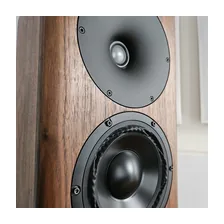 One of Erin’s Audio Corner’s picks in this price range is the March Audio Sointuva AWG: $4150 per pair March Audio eBay
Older model: the March Audio Sointuva (ranked lower, rated 4.6/5).
Pros: Purifi drivers deliver exceptionally low midrange distortion (the reviewer calls them “world class”) paired with bass extension unusually deep for a bookshelf (F3 40Hz, F10 30Hz), reaching down to about 30Hz in-room with some boundary reinforcement. Sensitivity tolerance band measured extremely tight at 1.6-1.73dB, indicating excellent build consistency. Estimated in-room response is exceptionally smooth and neutral: one of the flattest the reviewer has measured, with none of the usual coloration descriptors (bright, boomy, nasal, shouty) needed to describe it. Distortion stays so low even at loud volumes that there’s no audible warning cue before you’re playing dangerously loud: a backhanded compliment to how clean it sounds. At $4150/pair, ranked among the reviewer’s top three bookshelf speakers in that price range. Measured bass extension of 40Hz (-3dB), with a measured sensitivity of 82.4dB.
Cons: Correct listening axis sits about 7° above the tweeter line, which means shorter stands (around 24”) than typical bookshelf stands are sold at: get the height wrong and the sound scoops out in the mid/high frequencies. Moderate-low sensitivity (~82dB) is roughly 3dB below a typical bookshelf speaker, meaning close to double the amplifier power is needed for the same output; low impedance also calls for a 4-ohm capable amp. Horizontal radiation holds a wide ±60° only up to about 3kHz before narrowing: tighter top-end dispersion than the reviewer’s preferred ±60-70° through the treble, and the reason he left the previous generation off his all-time top-five list. Multitone distortion rises above the reviewer’s personal 3% threshold in the 1-2kHz region, though it wasn’t audible in his listening. Not intended to be crossed over with a subwoofer at 80Hz: designed to play full-range down to 40-50Hz, so pairing it with a sub and cutting it off early wastes its bass capability. Best positioned about 3 feet from the rear wall, requiring more floor space than many bookshelf speakers.
Full March Audio Sointuva AWG review and specifications →
| Bass Extension (-10dB) | 30Hz (measured, Erin’s Audio Corner) |
|---|---|
| Bass Extension (-3dB) | 40Hz (measured, Erin’s Audio Corner) |
| DIY Kit | No |
| Dimensions | 17.7”H x 9.4”W x 8.7”D (449.6 x 238.8 x 221 mm) |
| Drivers | 6.5” Purifi PTT-OEM Midwoofer, Satori TW29BNWG-4 Beryllium Dome Tweeter with Waveguide |
| Impedance | 6 ohms |
| Sensitivity | 82.4dB (measured, Erin’s Audio Corner) |
| Spinorama Preference Score | 6.95 |
| Spinorama Preference Score with Perfect Sub | 8.45 |
| Weight | 11 lbs (5 kg) |
| Woofer Cabinet | passive radiator |
- Links
- Reviews, Comparisons and Sound Samples
- Head-to-Head Comparisons
- March Audio Sointuva AWG vs AsciLab C6B
- March Audio Sointuva AWG vs GR-Research NX-Studio
- March Audio Sointuva AWG vs KEF Reference 1 Meta
- March Audio Sointuva AWG vs KEF R3 Meta
- March Audio Sointuva AWG vs KEF Q Concerto Meta
- March Audio Sointuva AWG vs Wharfedale Aura 2
- March Audio Sointuva AWG vs KEF R3
- March Audio Sointuva AWG vs MoFi SourcePoint 8
- See all 12 comparisons
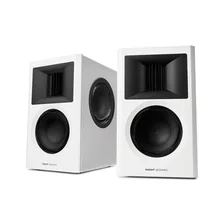 One of Erin’s Audio Corner’s picks in this price range is the Radiant Acoustics Clarity 6.2: $4500 per pair Radiant Acoustics eBay
Pros: Custom AMT (Air Motion Transformer) tweeter paired with a 6.5” Purifi Eikona midrange and dual Purifi passive radiators in a passive-radiator enclosure, crossed over at 2.4kHz. Rigid cabinet construction (21mm MDF with a 15mm aluminum front baffle, extensive internal bracing) helps keep resonance in check. A deliberately rising on-axis response paired with narrowing directivity above about 2kHz yields a genuinely linear, non-fatiguing in-room sound rather than the “fake detail” of speakers with a straight treble boost. Excellent pair matching between units (within about 1dB), contributing to precise, well-focused imaging that clearly separated fine details in test tracks. In-room bass extension reaches a solid 40Hz with real kick-drum authority, not just sub-bass rumble. Class-leading dynamic range and compression performance: among the best the reviewer has measured at this price point. Measured bass extension of 55Hz (-3dB), with a measured sensitivity of 84.3dB.
Cons: Needs a fairly specific setup to sound its best: about 15-20° of toe-out (per the manufacturer’s own recommendation) and roughly 2 feet from the rear wall; pointed straight on-axis, the treble reads as noticeably elevated. Low impedance (2.1-ohm minimum, about 1-ohm minimum EPDR) demands an amplifier genuinely comfortable with 4-ohm-and-below loads. Soundstage width narrows above about 5kHz, even though the AMT tweeter itself is capable of wider dispersion. An unexplained resonance appears in harmonic distortion measurements on both units tested (though not on the reviewer’s reference speaker): possibly a basket resonance, and not something the reviewer could hear. A minor bump around 500Hz in the estimated in-room response could add a touch of boxiness for some listeners, though the reviewer didn’t personally notice it. F3 of 55Hz and F10 of 32Hz mean a subwoofer is still needed for home-theater rumble or bass-heavy genres like rap.
Full Radiant Acoustics Clarity 6.2 review and specifications →
| Bass Extension (-10dB) | 32Hz (measured, Erin’s Audio Corner) |
|---|---|
| Bass Extension (-3dB) | 55Hz (measured, Erin’s Audio Corner) |
| DIY Kit | No |
| Dimensions | 14.3”H x 8.7”W x 10.5”D (363.2 x 221 x 266.7 mm) |
| Drivers | 6.5” PURIFI USHINDI woofer, Custom AMT (Air Motion Transformer) tweeter |
| Impedance | 4 ohms nominal (2.1 ohms minimum above 80Hz, measured, Erin’s Audio Corner) |
| Sensitivity | 84.3dB (measured, Erin’s Audio Corner) |
| Spinorama Preference Score | 5.97 |
| Spinorama Preference Score with Perfect Sub | 7.75 |
| Weight | 23.8 lbs (10.8 kg) each |
| Woofer Cabinet | passive radiator |
- Links
- Reviews, Comparisons and Sound Samples
- Head-to-Head Comparisons
- Radiant Acoustics Clarity 6.2 vs MoFi SourcePoint 10
- Radiant Acoustics Clarity 6.2 vs Dynaudio Heritage Special
- Radiant Acoustics Clarity 6.2 vs Wharfedale Super Linton
- Radiant Acoustics Clarity 6.2 vs Ascend Acoustics CMT-340 SE2
- Radiant Acoustics Clarity 6.2 vs Arendal 1528 Monitor 8
- Radiant Acoustics Clarity 6.2 vs Wharfedale Linton 85
- Radiant Acoustics Clarity 6.2 vs Ascend Acoustics Sierra-LX
- Radiant Acoustics Clarity 6.2 vs AsciLab F6Bs
- See all 46 comparisons
 One of Erin’s Audio Corner’s picks in this price range is the Buchardt A10: $4300 per pair Buchardt Audio eBay
Pros: The measured tuning combines 31.5Hz -3dB bass extension with preference scores of 7.28 standalone and 8.00 with an ideal subwoofer. A 1.9dB response span from 300Hz to 5kHz supports broadly even mids, and selectable DSP tunings offer useful flexibility. Measured bass extension of 30Hz (-3dB).
Cons: The rising treble balance can sound brighter on axis; toe-out or a different tuning may suit some rooms. Deep-bass demands cause compression before the largest monitors reach their limits. A subwoofer with appropriate high-pass filtering can improve headroom; alternate presets should not be assumed to share the quoted scores.
Full Buchardt A10 review and specifications →
| AES Input | No |
|---|---|
| Amplifier Power | 200w Per Speaker |
| App | No |
| Aux Input | No |
| Bass Extension (-10dB) | 21Hz (measured, Erin’s Audio Corner) |
| Bass Extension (-3dB) | 30Hz (measured, Erin’s Audio Corner) |
| Bluetooth | No |
| Coaxial Input | No |
| DSP | No |
| Dimensions | 14.6”H x 7”W x 9.6”D (370.8 x 177.8 x 243.8 mm) |
| Drivers | 6.5” PURIFI Extended Stroke Driver with Ultra Low Distortion, Custom made with triple Voice Coil woofer, 19 mm / 0.74” Resonance Free Aluminum dome with CDC aluminum waveguide tweeter |
| EQ | Yes (Room adjustment) |
| Frequency Response | 28Hz - 40kHz (±1.5dB) (Manufacturer specified) |
| HDMI Input | No |
| Inputs | XLR |
| Optical Input | No |
| RCA Input | No |
| Spinorama Preference Score | 7.28 |
| Spinorama Preference Score with Perfect Sub | 8.00 |
| TRS Input | No |
| USB Input | No |
| Weight | 15 lbs (6.8 kg) each |
| Woofer Cabinet | sealed |
| XLR Input | Yes |
- Links
- Reviews, Comparisons and Sound Samples
- Head-to-Head Comparisons
Bookshelf Speakers: Over $5000
 One of Erin’s Audio Corner’s picks in this price range is the KEF Reference 1 Meta: $9999.98 per pair KEF eBay
Larger models: the KEF Reference 3 Meta (rated 4.6/5) and the KEF Reference 5 Meta (estimated 4.8/5).
Pros: Meta technology places a Helmholtz-style resonator behind the tweeter to absorb rear-radiated resonance, and pair matching is within about ±0.5dB: unusually tight for a passive speaker. Sounds most neutral pointed straight on-axis rather than toed out, with no 5-8kHz harshness of the kind that plagues many speakers marketed as “detailed.” One of the most three-dimensional soundstages the reviewer has heard from a passive speaker, beaten only by $13,000+ active Xmachina Pulsar MK2 monitors (though this speaker’s tonality was preferred). Distortion stays below 1% down to about 70Hz at 86dB, and below 1% to ~150Hz / below 3% to ~70Hz even at 96dB. High-frequency response holds essentially flat as volume increases (no audible crossover or voice-coil compression) giving strong dynamic range up to its output limit (about 98dB at 3.5 meters before the woofer starts running out of excursion). All-passive design still measures ±1.5dB from 80Hz to 16kHz with zero DSP. Swappable dual-port system (long port for near-wall placement, short port for out-into-the-room placement with more bass extension) lets you tune bass behavior to where the speaker actually sits. Measured bass extension of 52Hz (-3dB), with a measured sensitivity of 82.5dB.
Cons: At roughly $10000/pair, nearly four times the cost of the similarly-sized KEF R3. Radiation narrows from about ±60° in the midrange to ±50° at high frequency: tighter than the reviewer’s ~70° preference (though wider than the R3’s ~±40°); toeing the speakers out for more width sacrifices treble energy that then needs EQ to restore. Moderate-to-low sensitivity (measured 83-84dB) calls for a solid amplifier. In-room bass only extends to about 40Hz, so a subwoofer is worth adding for bass-heavy material at higher volumes or listening beyond 3-4 meters. Minor directivity mismatch around 2kHz shows up in measurements, likely a vertical diffraction effect that wasn’t fully explained. Bass port choice (long vs. short) meaningfully changes the sound depending on placement, so the wrong port for your room can leave the bass sounding off until you experiment.
Full KEF Reference 1 Meta review and specifications →
| Bass Extension (-10dB) | 32Hz (measured, Erin’s Audio Corner) |
|---|---|
| Bass Extension (-3dB) | 52Hz (measured, Erin’s Audio Corner) |
| DIY Kit | No |
| Dimensions | 17.3”H x 8.1”W x 16.6”D (439.4 x 205.7 x 421.6 mm) |
| Drivers | 165 mm (6.5 in.) aluminium cone woofer, 125 mm (5 in.) aluminium cone midrange, 25 mm (1 in.) aluminium dome with MAT tweeter |
| Impedance | 4 ohms nominal, 2.9 ohms minimum (measured, Erin’s Audio Corner) |
| Sensitivity | 82.5dB (measured average, Erin’s Audio Corner) |
| Spinorama Preference Score | 6.48 |
| Spinorama Preference Score with Perfect Sub | 8.29 |
| Weight | 40.1 lbs (18.2 kg) each |
| Woofer Cabinet | ported, rear |
- Links
- Reviews, Comparisons and Sound Samples
- Erin’s Audio Corner: First Look!! Kef Reference 1 META Bookshelf Speaker Review. More from Erin’s Audio Corner →
- Erin’s Audio Corner Website KEF Reference 1 Meta Review
- Erin’s Audio Corner: My Top 5 Speakers at Any Price
- Erin’s Audio Corner Measurements (spinorama.org)
- Erin’s Audio Corner: KEF R3 vs R3 Meta vs Reference 1 Meta. Why such a big price gap?
- Head-to-Head Comparisons
- KEF Reference 1 Meta vs GR-Research NX-Studio
- KEF Reference 1 Meta vs Perlisten S4b
- KEF Reference 1 Meta vs March Audio Sointuva AWG
- KEF Reference 1 Meta vs AsciLab C6B
- KEF Reference 1 Meta vs Audio First Cadentia 3
- KEF Reference 1 Meta vs Revel M106
- KEF Reference 1 Meta vs KEF R3 Meta
- KEF Reference 1 Meta vs KEF Q Concerto Meta
- See all 48 comparisons
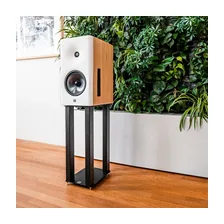 One of Erin’s Audio Corner’s picks in this price range is the Dutch & Dutch 8C: $13000 per pair Tidepool Audio eBay
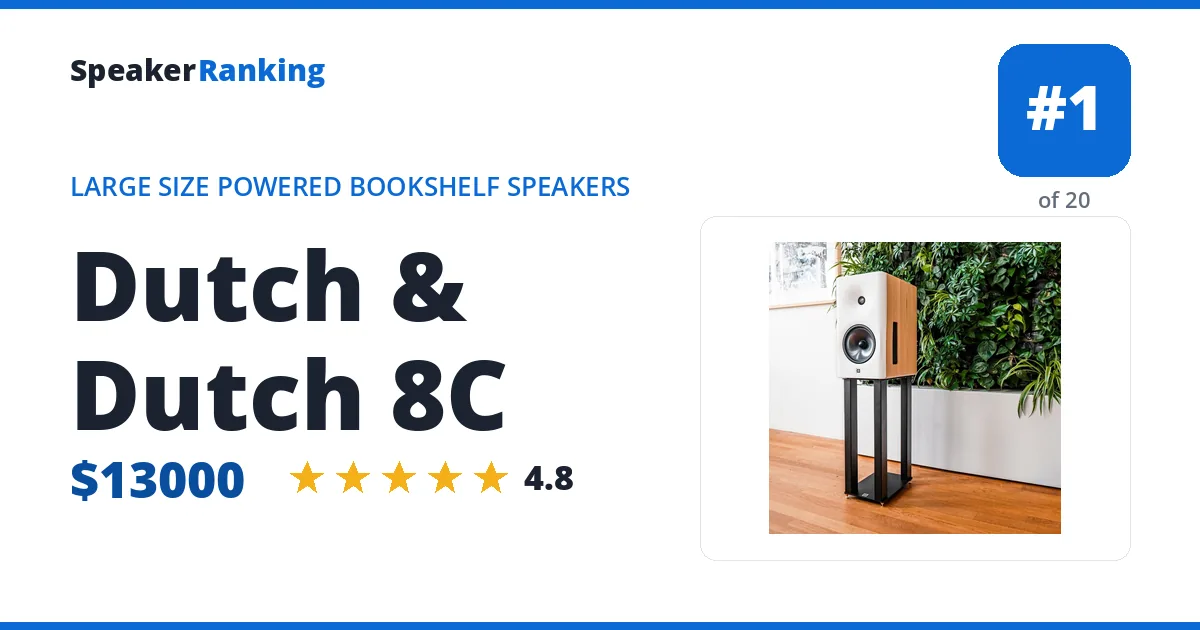
Pros: Very deep measured bass reaches 23.4Hz at -3dB, while the 1.8dB response span from 300Hz to 5kHz supports even mids. The 6.51 standalone score reflects that full-range strength. Cardioid midrange radiation and boundary-aware bass adjustment help integrate the system with nearby walls. Measured bass extension of 23Hz (-3dB), with a measured sensitivity of 106dB.
Cons: Cardioid operation reduces some reflections; it does not make the speaker independent of the room. Rear-woofer placement and setup remain important. Its 7.16 ideal-subwoofer score trails the strongest tonal performers here, although its deep native bass is a meaningful advantage for listening without a sub.
Full Dutch & Dutch 8C review and specifications →
| AES Input | No |
|---|---|
| Amplifier Power | 1000W (250W tweeter + 250W mid + 500W dual woofers) |
| App | Yes (Ascend) |
| Aux Input | No |
| Bass Extension (-10dB) | <20Hz (measured, Erin’s Audio Corner) |
| Bass Extension (-3dB) | 23Hz (measured, Erin’s Audio Corner) |
| Bluetooth | No |
| Coaxial Input | No |
| DSP | Yes |
| Dimensions | 19”H x 10.5”W x 15”D (482.6 x 266.7 x 381 mm) |
| Drivers | 2x 8” Aluminium Cone woofers, 8” Aluminium Cone midrange, 1” Aluminium/Magnesium dome tweeter |
| EQ | Yes (24-band parametric) |
| Frequency Response | 20Hz - 20kHz (Manufacturer specified) |
| HDMI Input | No |
| Inputs | XLR |
| Maximum SPL | 106dB @ 1m continuous (manufacturer specified) |
| Optical Input | No |
| RCA Input | No |
| Sensitivity | ~106dB (measured at 0.30V/1m, Erin’s Audio Corner) |
| Streaming Services | Yes (network streaming) |
| TRS Input | No |
| USB Input | No |
| Weight | 57.3 lbs (26 kg) each |
| Wi-Fi | Yes (Ethernet) |
| XLR Input | Yes |
- Links
- Reviews, Comparisons and Sound Samples
- Head-to-Head Comparisons
- Dutch & Dutch 8C vs Aalto Speakers Aalto 3 Active Pro
- Dutch & Dutch 8C vs Genelec 8361A
- Dutch & Dutch 8C vs Neumann KH420
- Dutch & Dutch 8C vs Kii THREE
- Dutch & Dutch 8C vs Yamaha HS8
- Dutch & Dutch 8C vs Kali Audio LP-6 V2
- Dutch & Dutch 8C vs Kali Audio IN-8 V2
- Dutch & Dutch 8C vs JBL M2 Master Reference Monitor
- See all 13 comparisons
Tower Speakers: Under $1500
 One of Erin’s Audio Corner’s picks in this price range is the Magnepan LRS+: $1300 per pair Magnepan eBay
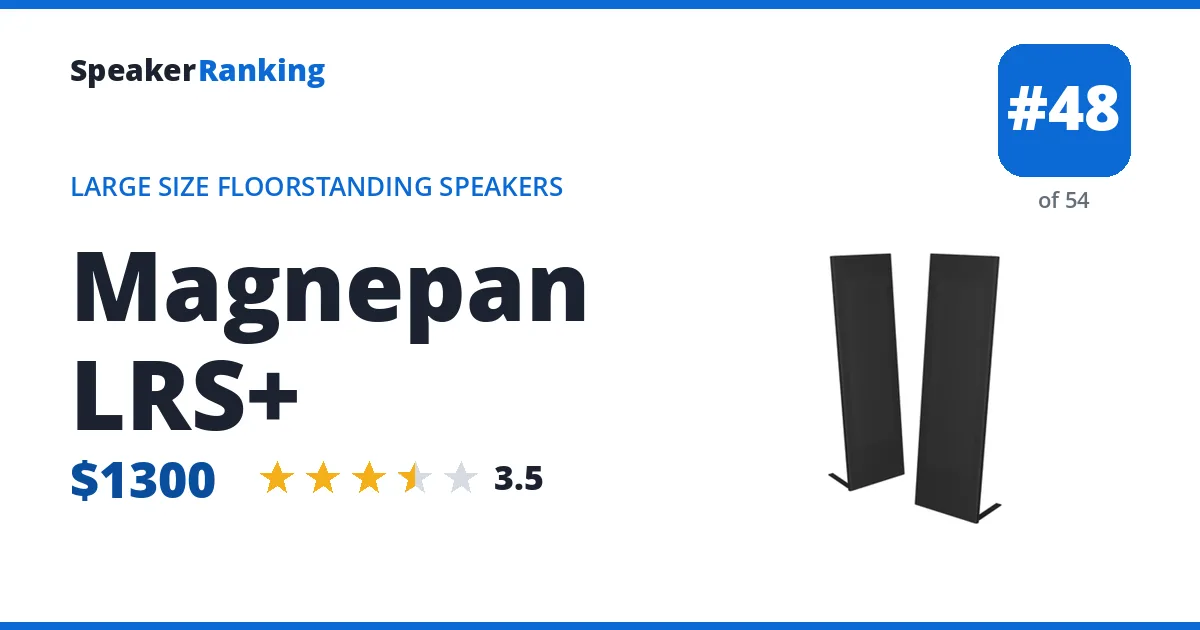
Pros: Thin, two-way planar-magnetic open-baffle/dipole panel design (about 48” tall, just 1” deep). Delivers a uniquely dramatic and enveloping soundstage with genuinely three-dimensional depth effects that work across all music genres, not just classical or orchestral material as commonly assumed. Extremely tight, locked-in center-phantom imaging when set up correctly. Open-baffle design avoids the “boxy” enclosure coloration of conventional cabinet speakers. Multitone distortion is remarkably consistent from low to high frequency, a characteristic the reviewer hasn’t observed in conventional cone-and-dome speakers. Compression at high output stays modest (about 0.5-1dB) through the midrange and treble, giving roughly 20-26dB of usable dynamic range in that region. At its price, a strong contender for a dedicated secondary listening room, even if not a main-system replacement. Measured bass extension of 74Hz (-3dB), with a measured sensitivity of 85.1dB.
Cons: Extremely current-hungry and power-hungry: even a pair of 600W Macintosh monoblock amplifiers only averaged about 90dB output. A robust, high-power amplifier is essentially mandatory, and budget amps won’t cut it. Bass rolls off very quickly (F3 74Hz, F10 67Hz, described as falling off “like a rock”), making a subwoofer an absolute requirement for any low-end content. A roughly 3dB dip in the mid-bass (100-300Hz) region thins out vocal body and fullness compared to a conventional bookshelf speaker. A resonance/bump around 400Hz adds a mild boxy quality, though it responds well to about 2dB of EQ correction. Extraordinarily fussy about exact positioning: both seating height (must align with the acoustic reference point between the panel’s lower tie-down points) and horizontal aiming are unusually critical; moving just a couple of inches can cause treble content above roughly 500-600Hz to nearly vanish. Distinct off-axis cancellation zones exist directly to the sides of the panel, where very little sound is audible at all. Fails badly under extreme dynamic-transient testing in the bass, and the reviewer blew fuses pushing the speaker during testing: not built for high-volume or highly dynamic playback. A genuinely different category from conventional hi-fi speakers, requiring more setup patience and experimentation than a typical monopole design.
Full Magnepan LRS+ review and specifications →
| Bass Extension (-10dB) | 67Hz (measured, Erin’s Audio Corner) |
|---|---|
| Bass Extension (-3dB) | 74Hz (measured, Erin’s Audio Corner) |
| DIY Kit | No |
| Dimensions | 48”H x 13.5”W x 1”D (1219.2 x 342.9 x 25.4 mm) |
| Drivers | Full-range planar magnetic dipole panel (48” tall x 13.5” wide); quasi-ribbon design, two-way with separate mid/bass and tweeter ribbon sections |
| Impedance | 4 ohms nominal, 3 ohms minimum (measured, Erin’s Audio Corner) |
| Sensitivity | 85.1dB (measured, Erin’s Audio Corner) |
| Spinorama Preference Score | 1.27 |
| Spinorama Preference Score with Perfect Sub | 4.32 |
| Weight | 30 lbs (13.6 kg) |
| Woofer Cabinet | open baffle |
- Links
- Reviews, Comparisons and Sound Samples
- Head-to-Head Comparisons
 One of Erin’s Audio Corner’s picks in this price range is the ELAC Debut 3.0 DF63: $1,298 per pair Amazon eBay
Smaller models: the ELAC Debut 3.0 DB63 (rated 4.2/5) and the ELAC Debut 3.0 DB53 (estimated 3.9/5).
Pros: Three-driver floorstanding layout: two 6” dedicated midbase drivers plus a separate 6” mid-range driver (confirmed by measuring different driver impedance/inductance) and a 1” dome tweeter, each woofer given its own stuffed chamber inside the cabinet. The dedicated midrange driver keeps distortion low even at higher output, avoiding the intermodulation grain typical of two-way bookshelf designs. The waveguide keeps high-frequency directivity well controlled, and overall horizontal directivity is good up to about 2kHz. Harmonic distortion looks good at both 86dB and 96dB, and multitone distortion stays below the reviewer’s 3% threshold. A shallow bass rolloff (F3 71Hz, F10 29Hz) lets it extend fairly low without a hard cutoff. Preferred by the reviewer over the similarly-priced Polk R500 (too much high-frequency narrowing, less neutral) and considered ahead of the Polk R700 as well. Measured bass extension of 71Hz (-3dB), with a measured sensitivity of 86.6dB.
Cons: A genuine measured resonance around 200-300Hz (visible in frequency response, impedance, and group delay) causes an audible “droning” coloration on female vocals. A mild peak around 10kHz makes shakers and similar high-frequency percussion jump too far forward in the mix; needed about 2dB of EQ to tame in testing. A dip in the 1-3kHz range gives the speaker a warm, slightly veiled character: the reviewer suspects the tweeter crossover point (around 2-3kHz) is set a bit high and could be lowered to fill this in. Directivity shows a noticeable handoff mismatch around 2.5kHz where the midrange driver hands off to the tweeter, though it’s minor at the -6dB point. Vertical directivity is narrower than horizontal, so listeners need to stay close to the tweeter axis. Low EPDR (about 1.5 ohms minimum) means a Class AB amplifier should be well-ventilated. Best positioned pointed directly at the listener and closer to the front wall: toeing it out into the room causes too much high-frequency rolloff.
Full ELAC Debut 3.0 DF63 review and specifications →
| Bass Extension (-10dB) | 29Hz (measured, Erin’s Audio Corner) |
|---|---|
| Bass Extension (-3dB) | 71Hz (measured, Erin’s Audio Corner) |
| DIY Kit | No |
| Dimensions | 43.1”H x 7.7”W x 10.6”D (1094.7 x 195.6 x 269.2 mm) |
| Drivers | Two 6.5” Aramid Fiber woofer, 6.5” Aramid Fiber midrange, 1” Aluminum Dome tweeter |
| Impedance | 6 ohms nominal (3.4 ohms minimum, measured, Erin’s Audio Corner) |
| Sensitivity | 86.6dB (measured, Erin’s Audio Corner) |
| Spinorama Preference Score | 5.83 |
| Spinorama Preference Score with Perfect Sub | 7.33 |
| Weight | 58.2 lbs (26.4 kg) each |
| Woofer Cabinet | ported, rear |
- Links
- Reviews, Comparisons and Sound Samples
- Head-to-Head Comparisons
- ELAC Debut 3.0 DF63 vs Polk Reserve R500
- ELAC Debut 3.0 DF63 vs Emotiva Airmotiv T2+
- ELAC Debut 3.0 DF63 vs Linkwitz Lab LXmini
- ELAC Debut 3.0 DF63 vs Infinity Primus 360
- ELAC Debut 3.0 DF63 vs PSB Imagine T65
- ELAC Debut 3.0 DF63 vs Polk Audio Reserve R700
- ELAC Debut 3.0 DF63 vs Q Acoustics 5040
- ELAC Debut 3.0 DF63 vs JBL HDI-3600
- See all 42 comparisons
 One of Erin’s Audio Corner’s picks in this price range is the Polk Reserve R500: $1,259.98 per pair Amazon eBay
Smaller model: the Polk Reserve R100 (rated 3.4/5).
Pros: Dual 5.25” midwoofers paired with a ring radiator tweeter in a floorstanding tower design. Surprisingly neutral overall compared to Polk’s smaller bookshelf models: notably more even-handed than the brighter-sounding R200 the reviewer tested previously. Good linearity on-axis, within about -3/+2dB. Sensitivity close to 86dB, easily driven to adequate levels in a small-to-medium room with a 100W-capable amplifier. Takes very well to EQ: a single band of correction (about a 2dB cut around 4-5kHz) resolves the main tonal issue and transforms the sound. Dynamic range and compression performance is solidly “medium,” holding up fine through about 20dB of level increase before higher-frequency and bass output start to taper at extreme volumes. Measured bass extension of 51Hz (-3dB), with a measured sensitivity of 86.2dB.
Cons: A bump around 4-6kHz gives a “shouty,” mildly sibilant quality in the lower treble. Counterintuitively, toeing the speaker out to reduce brightness makes this worse rather than better, since the ring-radiator tweeter’s directivity narrows rapidly above about 6-7kHz: pointed on-axis retains enough top-end air to balance the bump, but toed away that air drops off and the shoutiness stands out more. Bass is adequate for its 5.25” woofers but lacks real weight below about 40-50Hz; a subwoofer is still needed for movies and bass-heavy music. A cabinet resonance around 160-170Hz subtracts from rather than adds boom to the mid-bass region. Vertical listening window is fairly narrow: sitting more than about 10-20° above or below the tweeter axis causes a suckout in the 2-5kHz range, reducing clarity and attack. Multitone distortion ramps up noticeably around 1kHz, and crossing over to a subwoofer at 80Hz doesn’t meaningfully reduce it: likely a surround-related effect rather than excursion-related. Without applying corrective EQ, the reviewer says the 4-6kHz brightness would make it harder to live with day to day.
Full Polk Reserve R500 review and specifications →
| Bass Extension (-10dB) | 33Hz (measured, Erin’s Audio Corner) |
|---|---|
| Bass Extension (-3dB) | 51Hz (measured, Erin’s Audio Corner) |
| DIY Kit | No |
| Dimensions | 40.3”H x 6.8”W x 12.4”D (1023.6 x 172.7 x 315 mm) |
| Drivers | Two 5.25” Turbine Cone woofer, 1” Pinnacle Ring Radiator tweeter |
| Impedance | 4.1 ohms minimum above 80Hz (measured, Erin’s Audio Corner; 8 ohms nominal per manufacturer) |
| Sensitivity | 86.2dB (measured, Erin’s Audio Corner) |
| Spinorama Preference Score | 5.86 |
| Spinorama Preference Score with Perfect Sub | 7.44 |
| Weight | 39.2 lbs (17.8 kg) each |
| Woofer Cabinet | ported, rear |
- Links
- Reviews, Comparisons and Sound Samples
- Head-to-Head Comparisons
- Polk Reserve R500 vs ELAC Debut 3.0 DF63
- Polk Reserve R500 vs Linkwitz Lab LXmini
- Polk Reserve R500 vs Emotiva Airmotiv T2+
- Polk Reserve R500 vs Infinity Primus 360
- Polk Reserve R500 vs PSB Imagine T65
- Polk Reserve R500 vs Q Acoustics 5040
- Polk Reserve R500 vs Polk Audio Reserve R700
- Polk Reserve R500 vs Klipsch Forte IV
- See all 35 comparisons
 One of Erin’s Audio Corner’s picks in this price range is the Klipsch RP-6000F II: $1500 per pair Amazon eBay
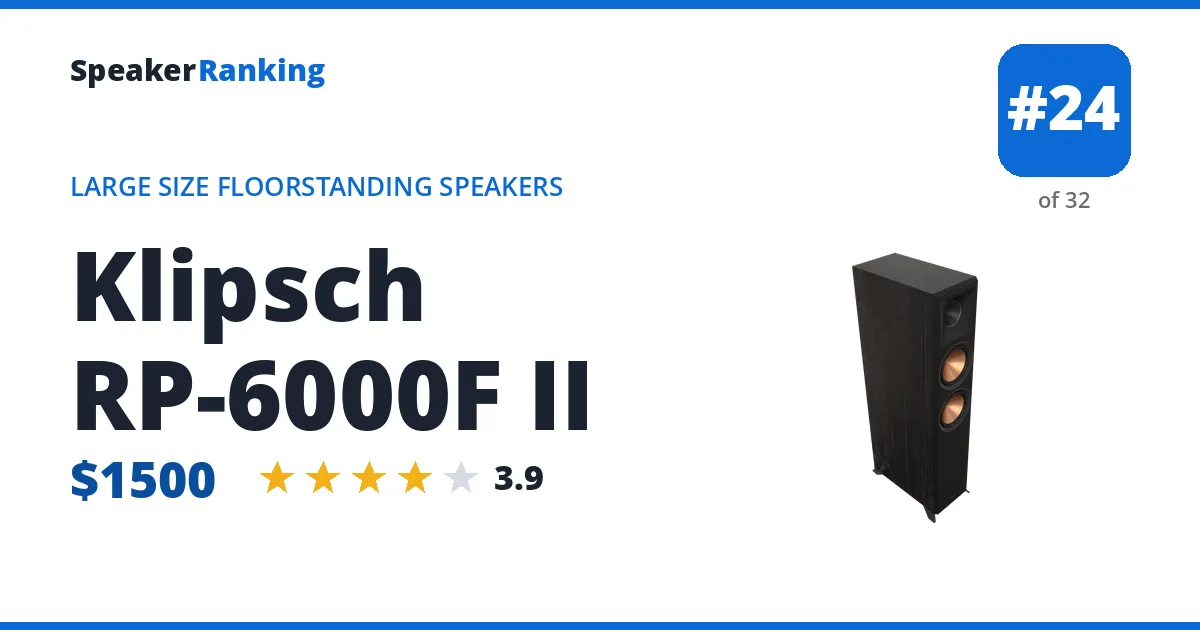
Smaller models: the Klipsch RP-5000F II (ranked higher, rated 4/5), the Klipsch RP-600M II (rated 3.7/5) and the Klipsch RP-500M II (rated 4/5).
Larger model: the Klipsch RP-8000F II (ranked higher, rated 3.9/5).
Pros: Highest power handling and clean, well-behaved compression at typical volumes. Precise imaging from the controlled horn directivity. Measured bass extension of 67Hz (-3dB), with a measured sensitivity of 90dB.
Cons: Worse baffle-step coloration than the smaller RP-5000F II (3-4dB swing vs 2dB), plus a sibilance issue the 5000F doesn’t have: a real regression in tonal balance despite the higher price. Bass extension is mixed (less deep at -3dB (67Hz) than the 5000F) and needs a subwoofer regardless. Narrow horizontal dispersion (~50-60 degrees).
Full Klipsch RP-6000F II review and specifications →
| Bass Extension (-10dB) | 33Hz (measured, Erin’s Audio Corner) |
|---|---|
| Bass Extension (-3dB) | 67Hz (measured, Erin’s Audio Corner) |
| Crossover Frequency | 1770Hz |
| DIY Kit | No |
| Dimensions | 39.6” x 9.3” x 17.6” (1006 x 236 x 446 mm) |
| Drivers | 1” titanium tweeter with Tractrix horn, dual 6.5” cerametallic woofers |
| Frequency Response | 38Hz - 25kHz (+-3dB, Manufacturer specified) |
| Impedance | 8 ohms nominal (3.7 ohms minimum, measured, Erin’s Audio Corner) |
| Power Handling | 125W continuous, 500W peak |
| Sensitivity | 90dB (2.83V/1m, measured by Erin’s Audio Corner) |
| Spinorama Preference Score | 5.74 |
| Spinorama Preference Score with Perfect Sub | 7.47 |
| Weight | 49.4 lbs (22.4 kg) |
| Woofer Cabinet | ported, rear |
- Links
- Reviews, Comparisons and Sound Samples
- Head-to-Head Comparisons
- Klipsch RP-6000F II vs Dynaudio Emit 30
- Klipsch RP-6000F II vs Klipsch RP-8000F II
- Klipsch RP-6000F II vs Definitive Technology BP-9020
- Klipsch RP-6000F II vs SVS Ultra Evolution Pinnacle
- Klipsch RP-6000F II vs Polk T50
- Klipsch RP-6000F II vs Klipsch RP-5000F II
- Klipsch RP-6000F II vs KEF Q11 Meta
- Klipsch RP-6000F II vs Focal Aria Evo X N°2
- See all 42 comparisons
Tower Speakers: Under $2500
 One of Erin’s Audio Corner’s picks in this price range is the Klipsch RP-8000F II: $1,159.98 per pair Amazon eBay
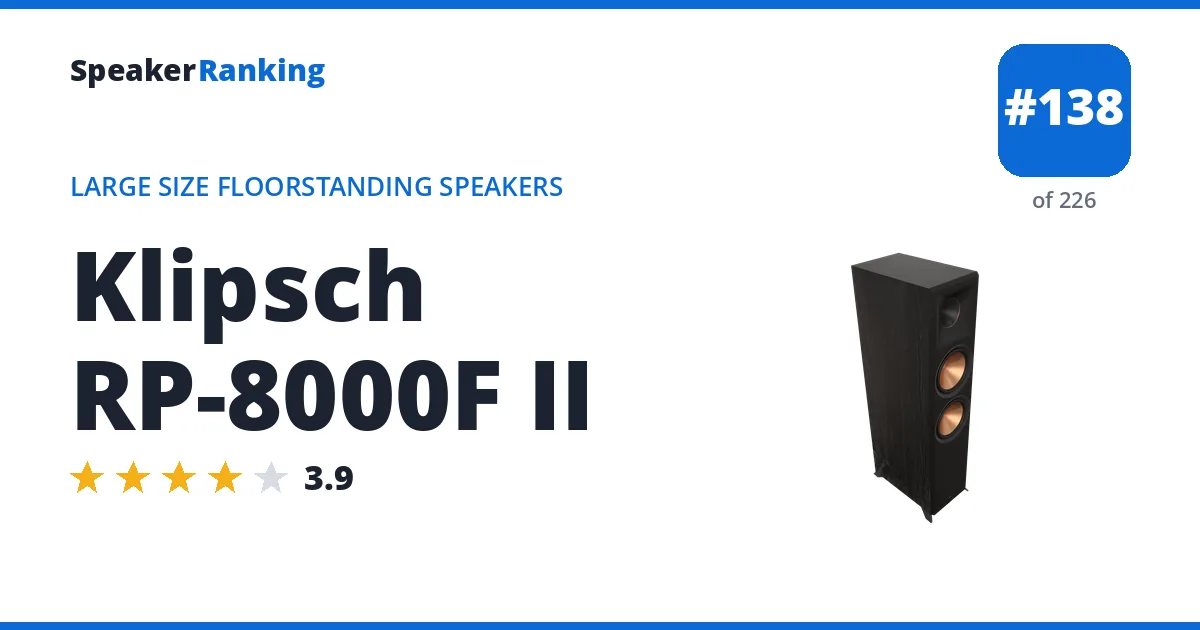
Smaller models: the Klipsch RP-6000F II (ranked lower, rated 3.9/5), the Klipsch RP-5000F II (ranked higher, rated 4/5), the Klipsch RP-600M II (rated 3.7/5) and the Klipsch RP-500M II (rated 4/5).
Pros: Highest sensitivity of the RP II floorstander line (~92dB measured) and the best dynamics/compression behavior of the three under load: the cleanest at high output. Dual 8-inch woofers and the highest power handling in the line. Measured bass extension of 67Hz (-3dB), with a measured sensitivity of 92dB.
Cons: Mid-bass sounds lean despite the dual 8-inch woofers, and bass extension disappointed for its size: expected to reach 50Hz, didn’t get there in-room. Has its own edgy upper-mid bump (2-6kHz) that’s harder to EQ out than the other two models’ issues, since it stems from the vertical horn/woofer offset rather than simple tonal balance. The most placement-critical of the three, with the narrowest horizontal (~40-50 degrees) and vertical (+5/-10 degrees) dispersion.
Full Klipsch RP-8000F II review and specifications →
| Bass Extension (-10dB) | 33Hz (measured, Erin’s Audio Corner) |
|---|---|
| Bass Extension (-3dB) | 67Hz (measured, Erin’s Audio Corner) |
| Crossover Frequency | 1630Hz |
| DIY Kit | No |
| Dimensions | 43.1” x 10.8” x 18.3” (1095 x 275 x 464 mm) |
| Drivers | 1” titanium tweeter with 90x90 Tractrix horn, dual 8” cerametallic woofers |
| Frequency Response | 35Hz - 25kHz (+-3dB, Manufacturer specified) |
| Impedance | 8 ohms nominal (3.7 ohms minimum above 80Hz, measured by Erin’s Audio Corner) |
| Power Handling | 150W continuous, 600W peak |
| Sensitivity | 92dB (2.83V/1m, measured by Erin’s Audio Corner) |
| Spinorama Preference Score | 5.39 |
| Spinorama Preference Score with Perfect Sub | 7.12 |
| Weight | 61.3 lbs (27.8 kg) |
| Woofer Cabinet | ported, rear |
- Links
- Reviews, Comparisons and Sound Samples
- Head-to-Head Comparisons
- Klipsch RP-8000F II vs Dynaudio Emit 30
- Klipsch RP-8000F II vs Klipsch RP-6000F II
- Klipsch RP-8000F II vs Klipsch RP-5000F II
- Klipsch RP-8000F II vs KLH Model Five
- Klipsch RP-8000F II vs Definitive Technology BP-9020
- Klipsch RP-8000F II vs KEF Q11 Meta
- Klipsch RP-8000F II vs SVS Ultra Evolution Pinnacle
- Klipsch RP-8000F II vs Polk T50
- See all 45 comparisons
 One of Erin’s Audio Corner’s picks in this price range is the Arendal 1961 Tower: $1,900 per pair Arendal Sound eBay
Smaller model: the Arendal 1961 Monitor (rated 4.3/5).
Pros: Exceptional output cleanliness for a slim tower: Erin measured under 1% THD to about 100Hz at 96dB/1m and only crossed 3% near 80Hz, while compression was better than several physically larger competitors. The response and listening window are broadly neutral, early-reflections and sound-power directivity are well controlled, and the waveguided dome supports stable imaging. A sealed HDF cabinet, four 5.5-inch woofers and a ten-year warranty provide serious theater-grade engineering in a tiny footprint. Measured bass extension of 62Hz (-3dB), with a measured sensitivity of 86.5dB.
Cons: Erin measured F3 at 62Hz and F10 at 43Hz, so the four woofers prioritize clean output over deep extension; a subwoofer remains necessary. Sensitivity is a moderate 86.5dB and impedance dips below four ohms, which may challenge budget AVRs even though a competent power amplifier has no issue. The optimal axis is roughly 5° above the tweeter and radiation begins narrowing around 1.3kHz, so seat height and toe-in deserve attention.
Full Arendal 1961 Tower review and specifications →
| Bass Extension (-10dB) | 43Hz (measured, Erin’s Audio Corner) |
|---|---|
| Bass Extension (-3dB) | 62Hz (measured, Erin’s Audio Corner) |
| DIY Kit | No |
| Dimensions | 33”H x 6.4”W x 11.2”D (837.5 x 163 x 285 mm) (without feet) |
| Drivers | Four 5.5-inch woofers; 28mm waveguided soft dome |
| Enclosure | Sealed HDF |
| Impedance | 4 ohms nominal; dips below 4 ohms (measured, Erin’s Audio Corner) |
| Sensitivity | 86.5dB/2.83V/1m (measured, Erin’s Audio Corner) |
| Spinorama Preference Score | 4.83 |
| Spinorama Preference Score with Perfect Sub | 7.25 |
| Weight | 39.5 lbs (17.9 kg) each |
- Links
- Reviews, Comparisons and Sound Samples
- Head-to-Head Comparisons
 One of Erin’s Audio Corner’s picks in this price range is the Morel Avyra 633: $2,000 per pair eBay
Pros: A 2.5-way floorstanding tower with two 6” mid-woofers (each with an unusually large 3” voice coil for better power handling) and a dome tweeter; the bottom woofer only covers up to about 250Hz while the top woofer runs all the way to the 2.2kHz crossover point. Easy to drive at a nominal 4 ohms (minimum 3.8 ohms). On-axis linearity measures within about ±2.25dB: genuinely impressive for a tower in this class, enough that the reviewer said he’d have guessed a $4,000-5,000 per pair price just from the look and the data alone. F3 of about 50Hz and F10 of about 32Hz give reasonable kick-drum-level bass without a subwoofer. Wide horizontal radiation around ±70° with good continuity outside the treble region. Harmonic distortion stays under 1% THD to about 100Hz at both 86dB and 96dB, and using an 80Hz subwoofer crossover barely changes midrange distortion: a sign the drive units themselves are good quality rather than excursion-limited. About 20dB of usable dynamic range. No through-holes for spikes, so no risk of dropped hardware during setup. Measured bass extension of 50Hz (-3dB), with a measured sensitivity of 86.5dB.
Cons: A bit bright out of the box: extra tweeter energy in the 4-7kHz region (which also shows up as nonlinearity in the early-reflections directivity data, making it harder to fully correct with EQ) reflects off nearby sidewalls and can sound tipped-up or edgy; a single EQ band (about 4.4kHz, -2dB, Q of 1) or absorption panels placed 60-80° off-axis on the sidewalls resolves it. Best aimed directly at the listener rather than toed out, since the top end already rolls off a little at wider angles. Imaging loses a bit of precision specifically in that lower-treble region. Multitone distortion exceeds the reviewer’s 3% comfort threshold at higher output. Real bass extension below 50Hz still needs a subwoofer. Not the same speaker as the Parts Express “Solstice” DIY kit despite surface similarities: different tweeter, different (ported vs. transmission line) enclosure, and measurably different woofers.
Full Morel Avyra 633 review and specifications →
| Bass Extension (-10dB) | 32Hz (measured, Erin’s Audio Corner) |
|---|---|
| Bass Extension (-3dB) | 50Hz (measured, Erin’s Audio Corner) |
| Country | Israel |
| Crossover Frequency | 250Hz, 2.2kHz |
| DIY Kit | No |
| Dimensions | 38.7”H x 12.8”W x 12.2”D (982 x 326 x 310 mm) |
| Drivers | Dome tweeter, two 6” mid-woofers (3” voice coil) |
| Frequency Response | 25Hz - 20kHz (±3dB, manufacturer specified) |
| Impedance | 4 ohms nominal (3.8 ohms minimum, measured, Erin’s Audio Corner) |
| Recommended Power | 200-1000W |
| Sensitivity | 86.5dB (measured, Erin’s Audio Corner) |
| Spinorama Preference Score | 5.43 |
| Spinorama Preference Score with Perfect Sub | 7.20 |
| Weight | 48.5 lbs (22 kg) each |
| Woofer Cabinet | ported |
- Links
- Reviews, Comparisons and Sound Samples
- Head-to-Head Comparisons
 One of Erin’s Audio Corner’s picks in this price range is the Polk Audio Reserve R700: $2,398 per pair Amazon eBay
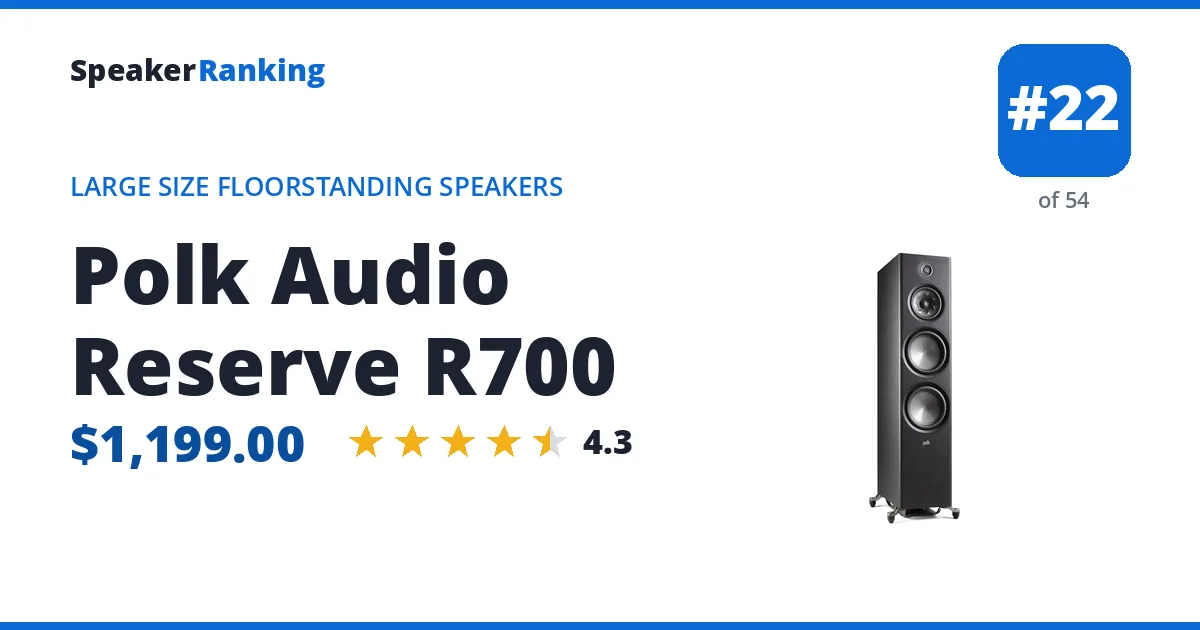
Pros: Three-way design with a 1” ring radiator tweeter, 6.5” mid-range, and dual 8” mid-bass drivers in a ported, down-firing cabinet. On-axis frequency response holds within about ±2dB across most of its range, with genuinely deep bass extension (F3 40Hz) reaching into the mid-30s Hz in-room. Wide horizontal radiation of about ±70°, giving a strong, enveloping stereo width and stage-extension effect on well-recorded tracks. Good low-level dynamics: solid bass thump at quiet listening volumes without over-accentuation. Strong distortion and compression control through the bass and midrange. Real nominal impedance closer to 4 ohms than the marketed 8 ohms, so with the right amplifier it can be driven hard: a $3,000 two-channel integrated brought out significantly more life than a budget $300 unit could. Excellent value at its roughly $1199/pair, ranking among the reviewer’s top picks under $2,500; outperforms the similarly-priced Klipsch RP-8000F II in bass extension and overall smoothness. Measured bass extension of 40Hz (-3dB), with a measured sensitivity of 87.5dB.
Cons: Compression in the high frequencies rises sharply between 96dB and 102dB output: a real limitation only at very high volumes (around 100dB at 3 meters), but a clear step down from pricier ($5,000+) towers. Horizontal directivity mismatch around 4-5kHz, where the tweeter flares wider than the midrange, can sound a bit forward, especially noticeable when toed out further into the room; sidewall absorption or curtains help tame it. Harmonic distortion crosses the reviewer’s 3% threshold around 7kHz at 96dB output, possibly contributing to that same forward quality at high volume. Narrow vertical sweet spot (about ±15° from the tweeter axis), typical of non-coaxial tower designs: more of a consideration for multi-row home theater seating than single-row listening. The ring-radiator tweeter narrows noticeably above about 7-8kHz, and toeing the speaker out more than about 20° causes the top end to fall off quickly. Needs at least 2 feet of clearance from the rear wall to avoid boomy, exaggerated bass, since it lacks the bass-shelf tuning some rivals use to allow closer wall placement. Compared to the pricier KEF R5 Meta, has narrower horizontal (and much narrower vertical) directivity, so seating flexibility is more limited.
Full Polk Audio Reserve R700 review and specifications →
| Bass Extension (-10dB) | 31Hz (measured, Erin’s Audio Corner) |
|---|---|
| Bass Extension (-3dB) | 40Hz (measured, Erin’s Audio Corner) |
| DIY Kit | No |
| Dimensions | 45”H x 12.6”W x 16.9”D (1143.8 x 320.7 x 428.3 mm) |
| Drivers | 2x 8” polypropylene cone woofers, 1x 6.5” turbine cone midrange, 1x 1” Pinnacle ring radiator tweeter |
| Impedance | 4 ohms nominal, 3.5 ohms minimum (measured above 80Hz, Erin’s Audio Corner) |
| Sensitivity | 87.5dB (measured average 300Hz-3kHz @ 2.83V/1m, Erin’s Audio Corner) |
| Spinorama Preference Score | 6.38 |
| Spinorama Preference Score with Perfect Sub | 7.83 |
| Weight | 102.1 lbs (46.3 kg) |
| Woofer Cabinet | ported, down-firing |
- Links
- Reviews, Comparisons and Sound Samples
- Head-to-Head Comparisons
- Polk Audio Reserve R700 vs PSB Imagine T65
- Polk Audio Reserve R700 vs JBL HDI-3600
- Polk Audio Reserve R700 vs JBL Studio 698
- Polk Audio Reserve R700 vs Emotiva Airmotiv T2+
- Polk Audio Reserve R700 vs ELAC Debut 3.0 DF63
- Polk Audio Reserve R700 vs Focal Theva N°2
- Polk Audio Reserve R700 vs Polk Reserve R500
- Polk Audio Reserve R700 vs KEF R11 Meta
- See all 46 comparisons
 One of Erin’s Audio Corner’s picks in this price range is the KEF Q11 Meta: $2,499.98 per pair Amazon eBay
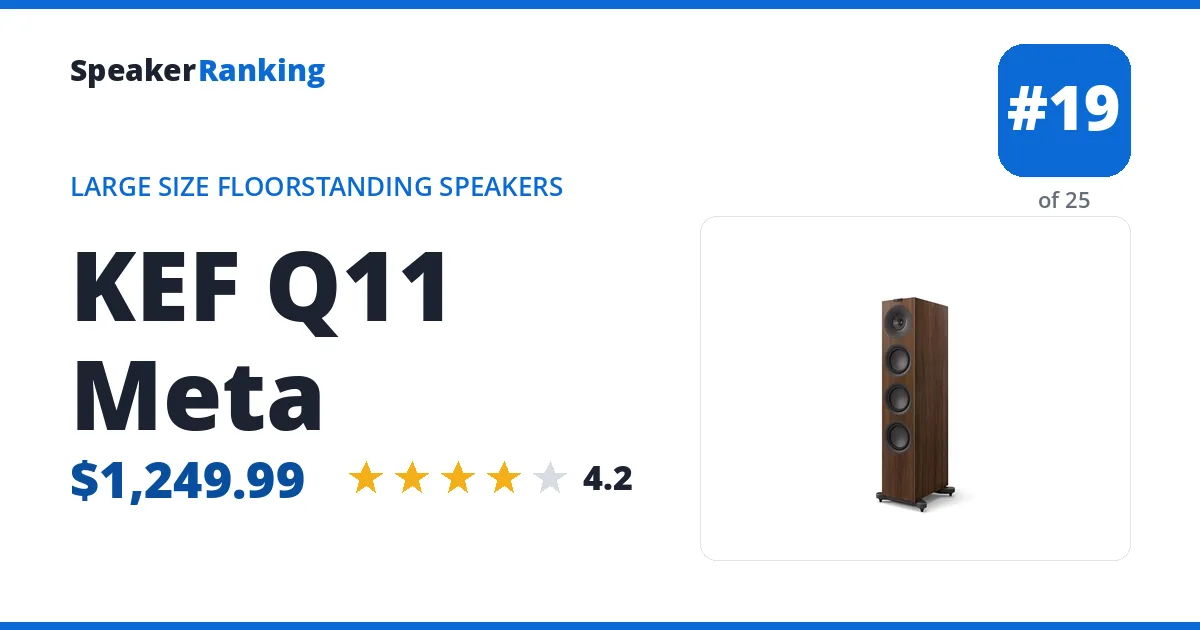
Smaller models: the KEF Q7 Meta (ranked lower, estimated 3.5/5), the KEF Q Concerto Meta (rated 4.6/5), the KEF Q3 Meta (rated 3.4/5) and the KEF Q1 Meta (rated 3.6/5).
Pros: Three-way tower design with a coaxial layout: a 3/4” aluminum dome tweeter (with KEF’s Metamaterial Absorption Technology behind it) mounted at the center of a 4” mid-range, plus three 6.5” bass drivers. Extremely linear estimated in-room response when placed correctly, thanks to a deliberately declining on-axis response paired with well-controlled directivity: a technically sound design philosophy, even though it reads as “dark” in raw anechoic on-axis measurements. In-room bass extension to about 40-50Hz when placed near a wall, thanks to extended bass-shelf tuning. Sounds excellent whether pointed directly at the listener or toed out a full 30° parallel to the back wall: unusually flexible placement. More vertical listening leeway than standard non-coaxial two-way designs, thanks to the coincident tweeter/midrange. Distortion looks good at both 86dB and 96dB, and multitone distortion holds up well too. Comes with a plinth/outrigger kit for stability given its floorstanding height (about 43-44”). Measured bass extension of 60Hz (-3dB), with a measured sensitivity of 88.6dB.
Cons: Genuinely dark-sounding on raw on-axis measurement, and needs a typical room with sidewall reflections (within about 6 feet/2 meters) to sound properly neutral: in a large room with little sidewall interaction, it may sound too dull for some listeners. Must be placed close to a rear wall (about 1 foot) to get proper bass: pulling it out to the “standard” 3-foot audiophile recommendation causes bass output to drop off noticeably. Horizontal radiation of about ±50° is narrower than the reviewer’s preferred ±60°, giving a slightly less enveloping soundstage than some rivals. Notably darker than sibling KEF models in the same product family: measures 2-5dB less top-end energy than the R3 Meta and a few dB less than the Q Concerto Meta. Minor lingering resonances appear in burst decay measurements between 500Hz-1kHz. The tweeter shows some strain at very high output volumes, a limitation the reviewer notes is common even among more budget-friendly speakers generally.
Full KEF Q11 Meta review and specifications →
| Bass Extension (-10dB) | 29Hz (measured, Erin’s Audio Corner) |
|---|---|
| Bass Extension (-3dB) | 60Hz (measured, Erin’s Audio Corner) |
| DIY Kit | No |
| Dimensions | 43.8”H x 12.5”W x 15”D (1112.8 x 317.5 x 381.0 mm) |
| Drivers | 25mm tweeter + dual 165mm drivers |
| Impedance | 4 ohms nominal (3.2 ohms minimum, measured, Erin’s Audio Corner) |
| Sensitivity | 88.6dB (measured, Erin’s Audio Corner) |
| Spinorama Preference Score | 6.72 |
| Spinorama Preference Score with Perfect Sub | 8.03 |
| Weight | 106.9 lbs (48.5 kg) |
| Woofer Cabinet | ported, rear |
- Links
- Reviews, Comparisons and Sound Samples
- Head-to-Head Comparisons
Tower Speakers: Under $5000
 One of Erin’s Audio Corner’s picks in this price range is the KEF R5 Meta: $3,999.99 per pair Discontinued eBay
Pros: 12th generation 5” Uni-Q coaxial driver array with Metamaterial Absorption Technology (MAT) delivers remarkably smooth, controlled horizontal (±50°) and vertical directivity with near-identical off-axis tracking. Exceptional frequency response linearity through the midrange and treble that takes extremely well to minor parametric EQ adjustments. Constrained Layer Damping cabinet construction and flexible rear ports minimize enclosure resonances and port turbulence. Deliberately tuned low-frequency roll-off profile permits boundary-adjacent room placement near front walls without boomy acoustic buildup. Measured bass extension of 52Hz (-3dB), with a measured sensitivity of 86dB.
Cons: Low-frequency extension (F3 of 52Hz, F10 of 38Hz) requires pairing with a dedicated subwoofer crossed over at 80Hz for high-output home theater or bass-heavy music performance. High-frequency radiation above 7kHz shows a mild on-axis taper (1-2dB downward slope), performing best when listened to 10-20° off-axis. Moderate sensitivity (~86dB SPL average) requires a clean, robust 4-ohm capable amplifier to drive high dynamic peaks without clipping. Discontinued.
Full KEF R5 Meta review and specifications →
| Bass Extension (-10dB) | 38Hz (measured, Erin’s Audio Corner) |
|---|---|
| Bass Extension (-3dB) | 52Hz (measured, Erin’s Audio Corner) |
| DIY Kit | No |
| Dimensions | 42.2”H x 10.7”W x 13.6”D (1073 x 273 x 346 mm) |
| Drivers | 1 in. vented aluminum dome tweeter with MAT, 5 in. aluminum cone midrange, two 5.25 in. hybrid aluminum cone woofers |
| Impedance | 4 ohms nominal |
| Sensitivity | 86dB (measured average, Erin’s Audio Corner) |
| Spinorama Preference Score | 6.33 |
| Spinorama Preference Score with Perfect Sub | 8.07 |
| Weight | 54 lbs (24.5 kg) each |
| Woofer Cabinet | ported, rear |
- Links
- Reviews, Comparisons and Sound Samples
- Head-to-Head Comparisons
Tower Speakers: Under $10000
 One of Erin’s Audio Corner’s picks in this price range is the MoFi SourcePoint 888: $5495 per pair Crutchfield eBay
Pros: Three-way vented design: an 8” coaxial mid-range/1.25” dome tweeter driver plus two additional 8” woofers crossed at about 130Hz, giving genuinely full-range output (F3 34Hz, F10 26Hz) other than the deepest subsonic content. Ranked by the reviewer among his personal top three speakers out of roughly 200 tested, alongside the KEF Blade 2 Meta and Dutch & Dutch 8C, despite costing a small fraction of either. Excellent compression/dynamic-range linearity, holding its own against much pricier speakers like the March Audio Sointuva AWG, KEF Reference 1 Meta, and KEF Blade 2 Meta. On-axis (0°) and 30°-off-axis estimated in-room responses track within about 1-1.5dB of each other above 500Hz, so tonal balance barely changes with placement or listening angle: excellent for multi-seat home theater or entertaining. Wide horizontal dispersion of about ±60°. Distortion stays low: under 1% at 86dB, and under 1% above 200Hz even at 96dB, with multitone distortion mostly under 1% as well. Not a difficult amplifier load (5-ohm minimum impedance, 4.2-ohm minimum EPDR). Checks the three boxes the reviewer considers essential for a home theater speaker: low compression, low distortion, and excellent directivity. Measured bass extension of 34Hz (-3dB), with a measured sensitivity of 85.6dB.
Cons: A significant investment, best ordered from a dealer with a good return policy. Large and heavy floorstander (about 96 lbs, 42” tall) requiring real floor space and rear clearance. Positioning is fairly specific: needs about 2 feet from the rear wall. Closer causes boominess in the 40-50Hz region, farther loses bass extension. Vertical dispersion (about ±50°) is narrower than horizontal (about ±60°), since the two 8” woofers are spaced vertically apart on a tower cabinet, causing some vertical mismatch at lower frequencies. A small on-axis dip around 500Hz and a deliberately lower tweeter level (about 0.5dB below the midrange) are intentional design choices for smoother in-room response, but mean the raw on-axis measurement isn’t perfectly flat. A mild diffraction-related dip appears around 3kHz in directivity measurements. Toeing the speaker out more than about 10° starts to noticeably reduce top-end energy.
Full MoFi SourcePoint 888 review and specifications →
| Bass Extension (-10dB) | 26Hz (measured, Erin’s Audio Corner) |
|---|---|
| Bass Extension (-3dB) | 34Hz (measured, Erin’s Audio Corner) |
| DIY Kit | No |
| Dimensions | 41.2”H x 12.6”W x 16.1”D (1046.5 x 320 x 408.9 mm) |
| Drivers | Dual 8” paper cone woofers, 8” Paper Cone midrange, 1.25” wide roll soft dome tweeter |
| Impedance | 6 ohms nominal, 5 ohms minimum (measured, Erin’s Audio Corner) |
| Sensitivity | 85.6dB (measured, Erin’s Audio Corner) |
| Spinorama Preference Score | 6.09 |
| Spinorama Preference Score with Perfect Sub | 7.21 |
| Weight | 94.8 lbs (43 kg) each |
| Woofer Cabinet | ported, rear |
- Links
- Reviews, Comparisons and Sound Samples
- Head-to-Head Comparisons
- MoFi SourcePoint 888 vs Revel F328Be
- MoFi SourcePoint 888 vs Radiant Acoustics Clarity 66
- MoFi SourcePoint 888 vs Ascend Acoustics ELX Ribbon Tower
- MoFi SourcePoint 888 vs MoFi SourcePoint V10 Master Edition
- MoFi SourcePoint 888 vs KEF Blade Two Meta
- MoFi SourcePoint 888 vs KEF R5 Meta
- MoFi SourcePoint 888 vs Revel F226Be
- MoFi SourcePoint 888 vs GR-Research NX-Treme
- See all 36 comparisons
 One of Erin’s Audio Corner’s picks in this price range is the KEF LS60: $5,999.99 per pair Crutchfield eBay
Pros: Erin’s on-axis measurement combines a 1.9dB response span from 300Hz to 5kHz with a 7.91 ideal-subwoofer preference score, supporting even vocal and instrumental balance. Extended-mode bass reaches roughly 25Hz at -3dB. The coaxial Uni-Q arrangement maintains unusually consistent tonality across listening positions, while HDMI, digital and analog inputs plus network streaming make this a convenient complete music and TV system. Measured bass extension of 23Hz (-3dB), with a measured sensitivity of 97.7dB.
Cons: A diffraction dip around 9kHz can soften cymbal shimmer when aimed directly at the listener; 10-20 degrees of toe-out helps. DSP limiting reduces bass reach and dynamic output at high volume, so its deep low-level extension is not a promise of the same performance on loud peaks. App placement and tone controls are less flexible than parametric room correction. Each roughly 31kg tower is awkward to move.
Full KEF LS60 review and specifications →
| AES Input | No |
|---|---|
| Amplifier Power | 700W (500W LF Class D + 100W MF Class D + 100W HF Class AB) |
| App | Yes (KEF Connect) |
| Aux Input | No |
| Bass Extension (-10dB) | <20Hz (measured, Erin’s Audio Corner) |
| Bass Extension (-3dB) | 23Hz (measured, Erin’s Audio Corner) |
| Bluetooth | Yes (5.0 with SBC, AAC) |
| Bluetooth Codecs | SBC, AAC |
| Coaxial Input | Yes |
| DSP | Yes (Music Integrity Engine) |
| Dimensions | 42.9”H x 8.3”W x 15.5”D (1089.7 x 210.8 x 393.7 mm) |
| Drivers | 4 x 135 mm (5.25 in.) Uni-Core Force Cancelling Driver: woofers, 100 mm (4in.) aluminium cone midrange, 19 mm (0.75 in.) vented aluminium dome with Metamaterial Absorption Technology tweeter |
| EQ | Yes (Normal and Expert modes, room adaptation) |
| Frequency Response | 31Hz - 24kHz (±3dB) (Manufacturer specified) |
| HDMI Input | Yes |
| Inputs | Wifi, Optical, Digital coaxial, RCA, HDMI eARC, Ethernet |
| Maximum SPL | 111dB @ 1m (pink noise) (manufacturer specified) |
| Optical Input | Yes |
| Outputs | Subwoofer RCA |
| RCA Input | Yes |
| Sensitivity | 97.7dB (measured at 0.3V/1m, Erin’s Audio Corner) |
| Spinorama Preference Score | 7.26 |
| Spinorama Preference Score with Perfect Sub | 7.91 |
| Streaming Services | Yes (AirPlay 2, Chromecast, Roon Ready, Spotify Connect, Tidal Connect, Amazon Music, Qobuz, Deezer) |
| Subwoofer Output | Yes |
| TRS Input | No |
| USB Input | No |
| Weight | 69 lbs (31.3 kg) each |
| Wi-Fi | Yes (dual-band) |
| XLR Input | No |
- Links
- Reviews, Comparisons and Sound Samples
- Head-to-Head Comparisons
 One of Erin’s Audio Corner’s picks in this price range is the JBL HDI-3800: $5,000 per pair Discontinued eBay
Pros: 2410H-2 1” Teonex compression driver matched to a custom High-Definition Imaging (HDI) horn geometry achieves exceptional horizontal directivity control, high output capability, and effortless transient response. Triple 8” Advanced Aluminum Matrix woofers deliver deep, authoritative bass extension down to an F3 of 37Hz and F10 of 28Hz with minimal low-frequency compression. Outstanding sensitivity (92dB SPL at 2.83V/1m) and ultra-low THD/multitone distortion allow extremely high undistorted SPL output in large home theater spaces. Measured bass extension of 37Hz (-3dB), with a measured sensitivity of 92dB.
Cons: On-axis frequency response features a narrow upper-frequency elevation around 8-10kHz, performing noticeably smoother when toed out 10-20° off-axis. Vertical directivity handoff across the triple woofer layout creates vertical soundstage height tilt depending on listening distance and ear height. Minimum impedance dips to 3.8 ohms, requiring high-current amplifier stability. Substantial cabinet dimensions and 38kg weight require significant room real estate. Discontinued.
Full JBL HDI-3800 review and specifications →
| Bass Extension (-10dB) | 28Hz (measured, Erin’s Audio Corner) |
|---|---|
| Bass Extension (-3dB) | 37Hz (measured, Erin’s Audio Corner) |
| DIY Kit | No |
| Dimensions | 43.3”H x 11.8”W x 16.4”D (1100.5 x 300.0 x 417.8 mm) |
| Drivers | 1 in. 2410H-2 Teonex compression driver with HDI horn, triple 8 in. Advanced Aluminum Matrix cone woofers |
| Impedance | 4 ohms nominal (3.8 ohms minimum, measured by Erin’s Audio Corner) |
| Sensitivity | 92dB (measured average, Erin’s Audio Corner) |
| Spinorama Preference Score | 5.62 |
| Spinorama Preference Score with Perfect Sub | 7.03 |
| Weight | 83.8 lbs (38.0 kg) each |
| Woofer Cabinet | ported, rear |
- Links
- Reviews, Comparisons and Sound Samples
- Head-to-Head Comparisons
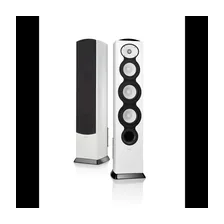 One of Erin’s Audio Corner’s picks in this price range is the Revel F226Be: $7700 per pair Crutchfield eBay
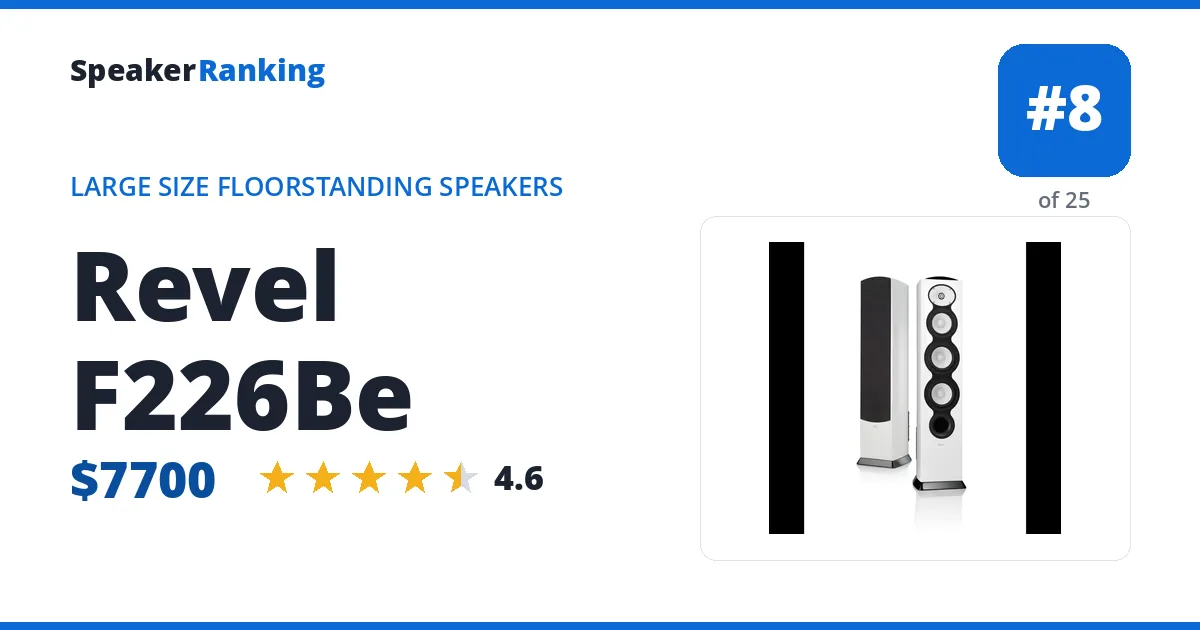
Older model: the Revel F206 (ranked lower, rated 4.5/5).
Smaller model: the Revel M126Be (rated 4.3/5).
Larger models: the Revel F228Be (ranked lower, rated 4.5/5) and the Revel F328Be (ranked higher, rated 4.7/5).
Pros: Compact three-way tower with a beryllium dome tweeter in an acoustic lens waveguide, a dedicated 5.25” mid-range, and dual 6.5” woofers (not a coaxial layout): all Deep Ceramic Composite aluminum cones engineered specifically to avoid breakup outside their crossover bands, and it measures that way: neither the woofers nor the mid-range show breakup spikes even well outside their intended pass bands, and even the front port measures unusually clean (only a mild ~3dB bump around 150Hz, well controlled versus the resonances the reviewer typically sees from ports). On-axis frequency response holds within about ±1.5dB above roughly 65Hz (excellent linearity) and off-axis behavior tracks it closely, with only mild, subdued peaking around 4-6kHz that doesn’t show up as real resonance in the spinorama data. Average sensitivity around 90dB (2.83V/1m), notably higher than some competing three-way designs and most bookshelf speakers, translating directly into better dynamic range at both low and high listening levels: one reviewer specifically praised its ability to deliver full transient impact (snare hits, kick drum) even at quiet, conversational volumes rather than needing to be cranked up to feel dynamic. Wide, consistent horizontal radiation of about ±60-70° at the -6dB point, landing right in the reviewer’s preferred range for an enveloping soundstage without excess diffusion, and exceptionally wide vertical dispersion: roughly ±80° up to 10kHz and still ±70° above that, which one reviewer called the widest vertical radiation pattern he had measured to date. Distortion stays under 3% even at 104dB SPL, and in real-world testing up to 105dB from 12-14 feet away, full-range with no crossover, the reviewer heard no audible mechanical noise, port chuffing, or compression at all. Flat enough on- and off-axis response that toeing the speaker 10-15° away from the listener preserves the same tonal balance rather than changing it, and the wide, well-controlled directivity lets sidewall reflections reinforce rather than smear the soundstage. Measured bass extension of 56Hz (-3dB), with a measured sensitivity of 89.7dB.
Cons: Minimum impedance dips to about 3.7-4 ohms below roughly 500Hz despite the 8-ohm nominal rating, so it wants a genuine 4-ohm-capable two-channel amplifier; budget AVRs rated only for 6 or 8 ohms may struggle. F3 of 56Hz and F10 of 36Hz mean it doesn’t extend nearly as low as some three-way rivals with larger woofers: a dedicated subwoofer (10-12”, or 15” for content below 30Hz) is recommended for home theater or bass-heavy music, even though the speaker itself can play surprisingly loud without one. Vertical directivity tolerance is tighter in the crossover handoff region than a true coaxial design would offer, since the tweeter, midrange, and woofers are physically separated: a mild directivity bump appears around 2-2.5kHz that’s typical of non-coaxial multi-way speakers, though not audibly problematic within about ±10° vertically. On-axis, the top end reads as a bit bright according to one reviewer’s subjective impression, generally benefiting from some toe-out. High-gloss cabinet finish can create distracting reflections if used behind a projector screen in a home theater setup. Front-ported, so it can technically sit close to a wall, but doing so makes the bass boomier.
Full Revel F226Be review and specifications →
| Bass Extension (-10dB) | 36Hz (measured, Erin’s Audio Corner) |
|---|---|
| Bass Extension (-3dB) | 56Hz (measured, Erin’s Audio Corner) |
| DIY Kit | No |
| Dimensions | 41.3”H x 9.8”W x 13.7”D (1049 x 248.9 x 348 mm) |
| Drivers | Two 6.5” (165mm) Deep Ceramic Composite aluminum cones, with cast frames woofer, 5-1/4” (130mm) Deep Ceramic Composite aluminum cone, with cast frame midrange, 1” (25mm) Beryllium dome, with acoustic lens waveguide tweeter |
| Impedance | 8 ohms nominal (3.7 ohms minimum, measured, Erin’s Audio Corner) |
| Sensitivity | 89.7dB (measured, Erin’s Audio Corner) |
| Spinorama Preference Score | 5.96 (spinorama.org) |
| Spinorama Preference Score with Perfect Sub | 8.15 (spinorama.org) |
| Weight | 58.2 lbs (26.4 kg) each |
| Woofer Cabinet | ported, front |
- Links
- Reviews, Comparisons and Sound Samples
- Erin’s Audio Corner: Revel PerformaBe F226Be Floorstanding Loudspeaker Review. I love this speaker. More from Erin’s Audio Corner →
- Erin’s Audio Corner: Should You Buy the Revel F226Be or the MoFi 888?
- Erin’s Audio Review Website Revel F226B
- Erin’s Audio Corner: My Top 5 Speakers at Any Price
- Erin’s Audio Corner Measurements (spinorama.org)
- Head-to-Head Comparisons
Tower Speakers: Over $10000
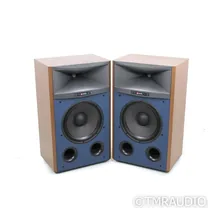 One of Erin’s Audio Corner’s picks in this price range is the JBL 4367: $16,500 per pair Discontinued eBay
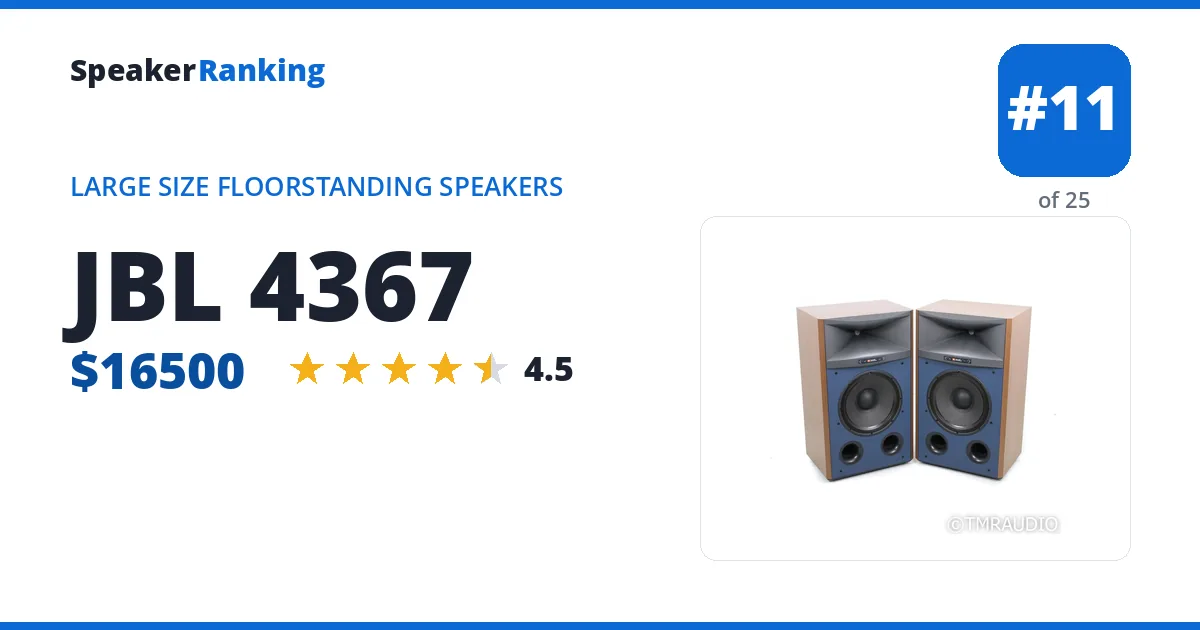
Newer model: the JBL 4369, ranked higher, estimated 4.7/5.
Pros: Three-way design pairing a 15” front-ported woofer with a compression driver on a controlled-dispersion horn/waveguide, crossed over at 700Hz. On-axis frequency response is nearly dead flat, holding within about ±1.5dB, with the listening window tracking it closely except right at the crossover. Distortion stays below 1% THD across the entire audible band at both 86dB and 96dB. Compression/dynamic-range linearity is exceptional: within about a quarter of a dB from 76dB to 102dB, among the best the reviewer has measured. High sensitivity (about 92.6dB average) eases the amplifier match despite the speaker’s size. Minimal rear radiation thanks to the 15” woofer’s directivity and front-firing ports: rear energy runs about 20dB down from the primary wavefront, giving it a near-cardioid radiation pattern. Well-controlled horn directivity keeps the soundstage from noticeably shifting in width across the 700Hz crossover region. A natural high-frequency rolloff above about 7-8kHz gives it an easy, non-fatiguing character for extended listening sessions. Measured bass extension of 43Hz (-3dB), with a measured sensitivity of 92.5dB.
Cons: At roughly $16500/pair, this is a major investment: the reviewer recommends buying from a dealer with a liberal return policy. Vertical response shows dips beyond about ±10-20°, with a larger null further out: an inherent trade-off of mating a 15” woofer to a horn compression driver at a 700Hz crossover, since crossing lower would hurt power handling and dynamic range. Horizontal directivity isn’t perfectly consistent with frequency: narrow (about ±20°) through 200-800Hz, briefly widening to near ±50° above the crossover, then narrowing again at high frequency. An unusual, non-constant pattern. The high-frequency rolloff that gives it an easy-listening character also reduces the sense of air and space in the soundstage when listening from off-center seats. Massive and heavy (about 120 lbs, roughly 36-37” tall): needs to be raised on a stand to bring the horn to ear level, and isn’t something one person easily moves alone. Only modest EQ adjustment is available on the speaker itself (about ±1-2dB bass/treble trim). Discontinued.
Full JBL 4367 review and specifications →
| Bass Extension (-10dB) | 31Hz (measured, Erin’s Audio Corner) |
|---|---|
| Bass Extension (-3dB) | 43Hz (measured, Erin’s Audio Corner) |
| DIY Kit | No |
| Dimensions | 37.2”H x 22.2”W x 16.8”D (944.9 x 563.9 x 426.7 mm) |
| Drivers | 15” (380mm) 2216Nd-1 Dual Differential Drive® woofer, 3” (75mm) D2430K dual compression tweeter |
| Impedance | 4 ohms nominal (5.3 ohms minimum above 80Hz, measured by Erin’s Audio Corner) |
| Sensitivity | 92.5dB (measured average, Erin’s Audio Corner) |
| Spinorama Preference Score | 5.07 |
| Spinorama Preference Score with Perfect Sub | 6.88 |
| Weight | 119 lbs (54 kg) each |
| Woofer Cabinet | ported, front |
- Links
- Reviews, Comparisons and Sound Samples
- Head-to-Head Comparisons
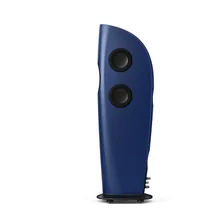 One of Erin’s Audio Corner’s picks in this price range is the KEF Blade Two Meta: $28,000 per pair only sold in stores eBay
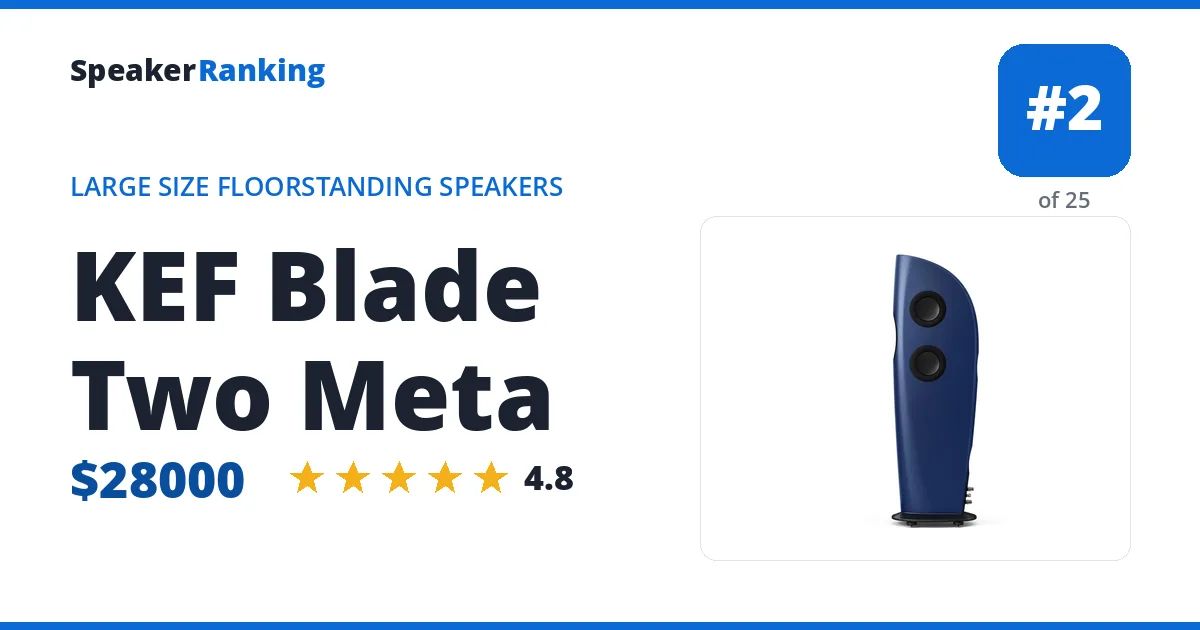
Larger model: the KEF Blade One Meta (ranked higher, estimated 4.8/5).
Pros: True point-source coaxial design (four 6.5in mid-bass drivers flanking a coincident mid/tweeter) with matched ~50 degree horizontal and vertical dispersion, unusual for a multi-driver speaker. Fully rounded, edgeless cabinet eliminates baffle diffraction. Frequency response holds within about 2.5dB across the listening window. Extremely low harmonic and multitone distortion even at 96dB, with under 0.5dB of compression at full output, rivaling the Reference 1 Meta and JBL 4367 in dynamic range. Reviewer described the imaging and soundstage depth as revealing recording details other speakers he tested (PS Audio FR10, MoFi SourcePoint 8, Neumann KH80) masked. Available in any custom finish at no extra charge. Measured bass extension of 31Hz (-3dB), with a measured sensitivity of 86.8dB.
Cons: 2dB dip and slight resonance around 200Hz, also visible in KEF white paper and likely cabinet-related. Bass rolls off fairly quickly below its 31Hz F3. Horizontal dispersion (~50 degrees) is narrower than the reviewer preferred 70-80 degrees; benefits from toeing out 10-20 degrees to open soundstage without losing image focus. Needs a separate power amp, not AVR-friendly.
Full KEF Blade Two Meta review and specifications →
| Bass Extension (-10dB) | 26Hz (measured, Erin’s Audio Corner) |
|---|---|
| Bass Extension (-3dB) | 31Hz (measured, Erin’s Audio Corner) |
| DIY Kit | No |
| Dimensions | 46.6”H x 13.5”W x 14.8”D (1183.6 x 342.9 x 375.9 mm) |
| Drivers | 4 x 165 mm (6.5 in.) aluminium cone, force cancelling woofers, 125 mm (5 in.) aluminium cone midrange, 25 mm (1 in.) aluminium dome with MAT tweeter |
| Impedance | 4 ohms nominal (3.3 ohms minimum, measured, Erin’s Audio Corner) |
| Sensitivity | 86.8dB (measured, Erin’s Audio Corner) |
| Spinorama Preference Score | 6.99 |
| Spinorama Preference Score with Perfect Sub | 8.11 |
| Weight | 79.4 lbs (36 kg) each |
| Woofer Cabinet | ported, rear |
- Links
- Reviews, Comparisons and Sound Samples
- Head-to-Head Comparisons
- KEF Blade Two Meta vs GR-Research NX-Treme
- KEF Blade Two Meta vs MoFi SourcePoint V10 Master Edition
- KEF Blade Two Meta vs JBL 4369
- KEF Blade Two Meta vs MoFi SourcePoint 888
- KEF Blade Two Meta vs Revel F328Be
- KEF Blade Two Meta vs Radiant Acoustics Clarity 66
- KEF Blade Two Meta vs Ascend Acoustics ELX Ribbon Tower
- KEF Blade Two Meta vs Magico S5 2024
- See all 38 comparisons
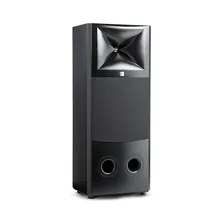 One of Erin’s Audio Corner’s picks in this price range is the JBL M2 Master Reference Monitor: $15,000 per pair JBL Professional Dealer Locator eBay
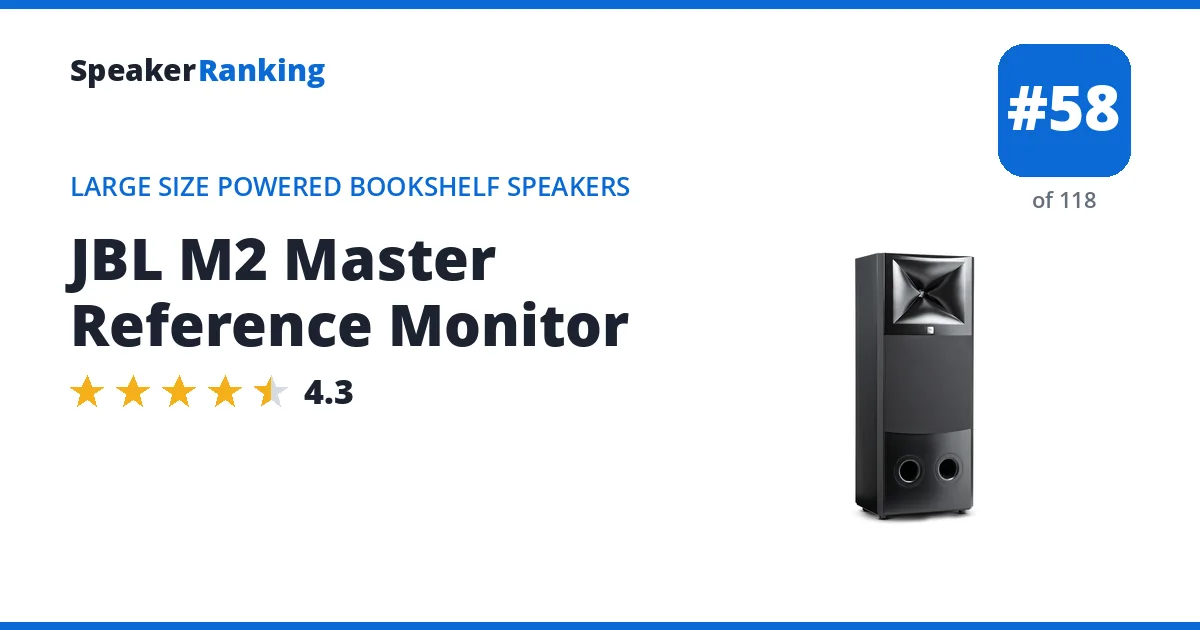
Pros: A high-output specialist: Erin’s low-distortion and compression tests support considerable dynamic capability, beyond what a single preference score captures. Measured -3dB extension is 33.7Hz. The large woofer and waveguide are particularly useful for greater listening distances. Measured bass extension of 34Hz (-3dB).
Cons: Its 4.1dB response span from 300Hz to 5kHz and 6.58 ideal-subwoofer score do not support a top tonal-accuracy ranking. It requires the correct external amplification and DSP rather than a simple built-in amplifier. The very large cabinet, installation cost and possible amplifier fan noise make it impractical for most desks.
Full JBL M2 Master Reference Monitor review and specifications →
| AES Input | No |
|---|---|
| Amplifier Power | External two-channel amplification and JBL DSP tuning required |
| Aux Input | No |
| Bass Extension (-10dB) | 21.0Hz (measured, Erin’s Audio Corner) |
| Bass Extension (-3dB) | 34Hz (measured, Erin’s Audio Corner) |
| Bluetooth | No |
| Coaxial Input | No |
| Crossover Frequency | 800Hz active DSP |
| Dimensions | 49.4”H x 20”W x 14”D (1256 x 508 x 355.6 mm) |
| Drivers | 15” 2216Nd woofer; D2 compression driver in Image Control Waveguide |
| Frequency Response | 20Hz - 40kHz (±3dB) (Manufacturer specified) |
| HDMI Input | No |
| Inputs | None (passive cabinet driven by a matched Crown amplifier via speaker-level connection) |
| Maximum SPL | 123dB manufacturer specified |
| Optical Input | No |
| RCA Input | No |
| Spinorama Preference Score | 5.74 |
| Spinorama Preference Score with Perfect Sub | 6.58 |
| TRS Input | No |
| USB Input | No |
| Weight | 130.1 lbs (59 kg) each |
| XLR Input | No |
- Links
- Reviews, Comparisons and Sound Samples
- Head-to-Head Comparisons
- JBL M2 Master Reference Monitor vs Genelec 8040B
- JBL M2 Master Reference Monitor vs JBL 708P
- JBL M2 Master Reference Monitor vs Klipsch The Nines
- JBL M2 Master Reference Monitor vs JBL 4305P
- JBL M2 Master Reference Monitor vs Genelec 8050B
- JBL M2 Master Reference Monitor vs Kali Audio IN-8 V2
- JBL M2 Master Reference Monitor vs JBL 4329P
- JBL M2 Master Reference Monitor vs Kali Audio LP-6 V2
- See all 24 comparisons
All Speakers Reviewed by Erin’s Audio Corner
Every speaker on this site Erin’s Audio Corner has reviewed, highest-rated first, with a direct link to each review below its card.
Medium Size Portable Bluetooth Speakers
 Ranked #53 of 164 in Medium Size Portable Bluetooth Speakers - Bose Soundlink Revolve+: $255.03 Discontinued Amazon eBay
Newer model: the Bose Soundlink Revolve+ II, ranked higher, rated 3.6/5.
Pros: True 360° sound stays consistent no matter where you stand. Built-in carry handle, useful even with wet hands; can hang from a hook via carabiner. ~12 hour battery at medium-high volume. Measured bass extension of 54.2Hz (-3dB).
Cons: Overly boosted bass, warm sounding. Boosted mids. Rolled off treble. Discontinued.
Full Bose Soundlink Revolve+ review and specifications →
| App | Yes |
|---|---|
| Aux Input | Yes |
| Bass Extension (-10dB) | 56Hz |
| Bass Extension (-3dB) | 54.2Hz (measured, Erin’s Audio Corner) |
| Battery Life | 16 hours (Manufacturer specified) |
| Bluetooth | Yes |
| Bluetooth Codecs | SBC |
| Bluetooth Version | 4.2 |
| Digital Aux Input | No |
| Dimensions | 4.1” x 7.2” x 4.1” (105 x 184 x 105 mm) |
| Drivers | 91mm fullrange |
| EQ | No |
| IP Rating | IP55 |
| Omnidirectional | Yes |
| Party Mode | Yes (Bose Party mode) |
| Power Input | Micro USB |
| Stereo | No |
| Strap | No |
| TWS | Yes |
| Weight | 2 lbs (0.91 kg) |
- Reviews, Comparisons and Sound Samples
- Alan Ross Reviews: The Ultimate 360 Degree Bluetooth Speaker Showdown: Bose Soundlink Revolve Vs Tribit Stormbox Pro More from alanrossreviews →
- Erin’s Audio Corner Measurements (spinorama.org) More from Erin’s Audio Corner →
- Erin’s Audio Corner: Live Reviews and Q&A! Bose Soundbar, Monoprice Monitors, Bluetooth Speakers and more.
- Erin’s Audio Corner Website: Bose Soundlink Revolve+
- Head-to-Head Comparisons
- Bose Soundlink Revolve+ vs Bose Soundlink Revolve+ II
- Bose Soundlink Revolve+ vs W-King D320
- Bose Soundlink Revolve+ vs Soundcore Glow
- Bose Soundlink Revolve+ vs JBL Pulse 5
- Bose Soundlink Revolve+ vs Xiaomi Sound Outdoor
- Bose Soundlink Revolve+ vs Sonos Play
- Bose Soundlink Revolve+ vs Bose Soundlink Revolve
- Bose Soundlink Revolve+ vs Tribit Stormbox Pro
- See all 74 comparisons
 Ranked #60 of 164 in Medium Size Portable Bluetooth Speakers - Bose Soundlink Revolve: $194.00 Discontinued Amazon eBay
Newer model: the Bose SoundLink Revolve (Series II), ranked higher, rated 3.6/5.
Pros: True 360° sound stays consistent no matter where you stand around it, unlike most portable speakers. Measured bass extension of 64.5Hz (-3dB).
Cons: Not stereo. Strange sizzling treble, peaks and dips. Overly boosted boomy bass at 75Hz. Discontinued.
Full Bose Soundlink Revolve review and specifications →
| App | Bose Connect |
|---|---|
| Aux Input | Yes |
| Bass Extension (-10dB) | 60Hz |
| Bass Extension (-3dB) | 64.5Hz (measured, Erin’s Audio Corner) |
| Battery Life | 12 hours (Manufacturer specified) |
| Bluetooth | Yes |
| Bluetooth Codecs | SBC |
| Bluetooth Version | 4.2 |
| Built-in Microphone | Yes |
| Digital Aux Input | No |
| Dimensions | 3.2” x 6” x 3.2” (82 x 152 x 82 mm) |
| Drivers | 1x omnidirectional full-range transducer (~45mm) + 2x passive radiators |
| EQ | No |
| IP Rating | IPX4 |
| Omnidirectional | Yes |
| Party Mode | Yes (Bose Party mode) |
| Power Input | Micro USB |
| Stereo | No |
| TWS | Yes |
| Weight | 1.5 lbs (660 g) |
- Reviews, Comparisons and Sound Samples
- Alan Ross Reviews: The Ultimate 360 Degree Bluetooth Speaker Showdown: Bose Soundlink Revolve Vs Tribit Stormbox Pro More from alanrossreviews →
- Alan Ross Reviews: The Ultimate 360 Degree Bluetooth Speaker Showdown: Bose Soundlink Revolve Vs Tribit Stormbox Pro
- Erin’s Audio Corner Measurements (spinorama.org) More from Erin’s Audio Corner →
- Erin’s Audio Corner: Live Reviews and Q&A! Bose Soundbar, Monoprice Monitors, Bluetooth Speakers and more.
- Erin’s Audio Corner Website: Bose Soundlink Revolve
- Head-to-Head Comparisons
- Bose Soundlink Revolve vs Tribit Stormbox Flow
- Bose Soundlink Revolve vs Sonos Play
- Bose Soundlink Revolve vs JBL Charge 4
- Bose Soundlink Revolve vs Turtlebox Ranger
- Bose Soundlink Revolve vs Bose Soundlink Revolve+
- Bose Soundlink Revolve vs Bose Soundlink Revolve+ II
- Bose Soundlink Revolve vs Soundcore 3
- Bose Soundlink Revolve vs W-King D320
- See all 74 comparisons
Small Size Powered Desktop Speakers
 Ranked #9 of 13 in Small Size Powered Desktop Speakers - Apple HomePod Mini: $149.36 each Amazon eBay
Larger model: the Apple HomePod 2nd Gen (rated 4/5).
Pros: SoundGuys called it good sound for its size, with a full-range driver and dual passive bass radiators giving the bassline in Anderson .Paak’s “Come Down” a decent thump most speakers this small can’t manage. “Hey Siri” reliably hears the wake phrase even at full volume, it can distinguish different people’s voices for personalized requests, and setup with an iPhone nearby takes moments.
Cons: SoundGuys’ listed cons include no mute button at all, an occasionally annoying Handoff prompt, and no direct Spotify integration since Siri only launches Apple Music by voice. There is no way to stream to it over Bluetooth, only Apple’s AirPlay/Handoff, no battery, and no IP rating (Apple only claims humidity resistance, not a certified rating). It requires an iPhone or iPad to set up and get the most out of.
Full Apple HomePod Mini review and specifications →
| AES Input | No |
|---|---|
| App | Yes (Apple Home) |
| Aux Input | No |
| Battery Life | No Battery |
| Bluetooth | No |
| Built-in Microphone | Yes (4 far-field mics, no mute button) |
| Coaxial Input | No |
| Dimensions | 3.3” x 3.9” (84.3 x 97.9 mm) (H x diameter) |
| Drivers | Full-range driver + dual passive bass radiators |
| EQ | No |
| HDMI Input | No |
| IP Rating | None |
| Inputs | Wi-Fi, AirPlay 2 |
| Optical Input | No |
| Party Mode | Yes (AirPlay 2 multi-room) |
| Power Bank | No |
| Power Input | External AC adapter (USB-C) |
| RCA Input | No |
| Stereo | No |
| Streaming Services | AirPlay 2, Apple Music (direct voice control); other services via AirPlay only |
| TRS Input | No |
| TWS | Yes (stereo pairing via Home app) |
| USB Input | No |
| Voice Assistants | Apple Siri |
| Weight | 0.8 lbs (345 g) |
| Wi-Fi | Yes |
| XLR Input | No |
- Links
- Reviews, Comparisons and Sound Samples
- Head-to-Head Comparisons
- Apple HomePod Mini vs Amazon Echo Dot 5th Gen
- Apple HomePod Mini vs Google Nest Audio
- Apple HomePod Mini vs Google Home Speaker
- Apple HomePod Mini vs Google Nest Mini 2nd Gen
- Apple HomePod Mini vs Amazon Echo Pop
- Apple HomePod Mini vs Denon Home 150
- Apple HomePod Mini vs Amazon Echo Dot Max
- Apple HomePod Mini vs Amazon Echo Studio 2nd Gen
- See all 29 comparisons
Powered Subwoofer and Satellite Combo Speakers
 Ranked #4 of 8 in Powered Subwoofer and Satellite Combo Speakers - Klipsch ProMedia Lumina: $379.99 Amazon eBay
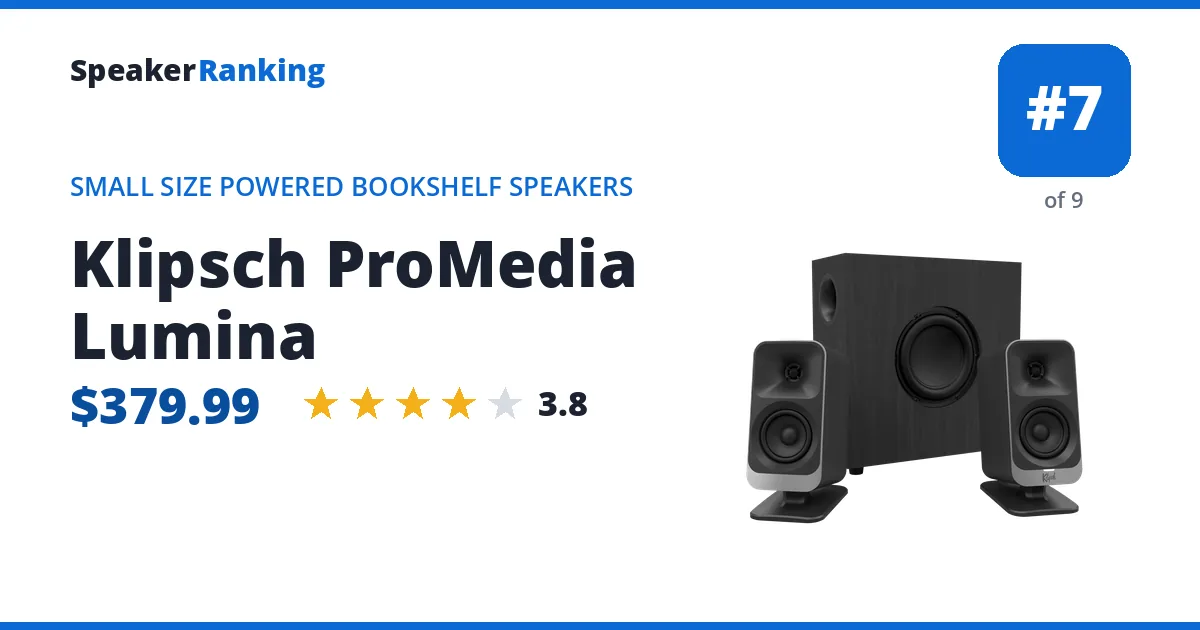
Pros: The included powered subwoofer gives this compact desktop system a real low-bass advantage: the linked review reports F3 around 46Hz and F10 around 38Hz. Tiltable stands, app control and lighting add practical desktop features. The existing review reports reasonable distortion for the system’s size. Measured bass extension of 46Hz (-3dB).
Cons: The review reports treble elevated about 3-5dB when aimed straight at the listener; some toe-out can reduce the brightness. Fixed-band app EQ is less flexible than parametric correction. Its separate subwoofer also means the system occupies more space than the satellites alone suggest.
Full Klipsch ProMedia Lumina review and specifications →
| AES Input | No |
|---|---|
| Amplifier Power | 100W RMS, 200W peak |
| App | Klipsch Control app - EQ (fixed bands), RGB lighting control, night mode, music-reactive mode |
| Aux Input | Yes |
| Bass Extension (-10dB) | 38Hz (measured, Erin’s Audio Corner) |
| Bass Extension (-3dB) | 46Hz (measured, Erin’s Audio Corner) |
| Bluetooth | Yes, 5.3 |
| Bluetooth Codecs | SBC |
| Bluetooth Version | 5.3 |
| Coaxial Input | No |
| Crossover Frequency | Satellite: 3.5kHz, Subwoofer: 150Hz |
| Dimensions | Satellite: 248 x 165 x 102 mm, Subwoofer: 356 x 152 x 352 mm |
| Drivers | 1” tractrix horn tweeter, 3.5” mid, 6.5” powered subwoofer |
| EQ | Fixed-band EQ via app (not parametric) |
| Frequency Response | 40Hz - 20kHz (-6dB, Manufacturer specified) |
| HDMI Input | No |
| Inputs | USB-C, 3.5mm Aux, Bluetooth 5.3 |
| Maximum SPL | 98dB (manufacturer specified) |
| Optical Input | No |
| RCA Input | No |
| TRS Input | No |
| USB Input | Yes |
| Weight | Satellite: 2.1 lbs (0.95 kg) each, Subwoofer: 11 lbs (4.99 kg) |
| XLR Input | No |
- Links
- Reviews, Comparisons and Sound Samples
- Head-to-Head Comparisons
- Klipsch ProMedia Lumina vs Audioengine A2+
- Klipsch ProMedia Lumina vs Fiio SP3
- Klipsch ProMedia Lumina vs Mackie CR3-X
- Klipsch ProMedia Lumina vs Edifier MR3
- Klipsch ProMedia Lumina vs Edifier M60
- Klipsch ProMedia Lumina vs Adam Audio D3v
- Klipsch ProMedia Lumina vs IK Multimedia iLoud Micro Monitor
- Klipsch ProMedia Lumina vs Genelec 8010A
- See all 19 comparisons
Small Size Powered Bookshelf Speakers
 Ranked #1 of 34 in Small Size Powered Bookshelf Speakers - Audio Smile Little British Monitor: £529 per pair Audio Smile eBay
Pros: Among the strongest measured tonal performers in this size class: ASR’s Klippel data gives a 5.46 predicted preference score, or 8.21 with an ideal subwoofer. Low narrow-band response deviations on-axis and across the listening window support clear, relatively uncolored vocals and instruments. Broad horizontal coverage makes small changes of listening position less critical. Active DSP crossover and a very compact cabinet suit close desktop listening. Measured bass extension of 71.8Hz (-3dB).
Cons: Bass reaches -3dB at about 72Hz, so a subwoofer is important for the lowest notes. The measured response still spans 3.3dB from 300Hz to 5kHz; the small average-deviation statistic should not be mistaken for an almost perfectly flat response. Small drivers limit the intended application to nearfield listening, and the preference score does not establish maximum clean output. Its 50W Class A/B amplifiers and narrow ±1dB treble trim leave little headroom or adjustment next to larger active monitors.
Full Audio Smile Little British Monitor review and specifications →
| AES Input | No |
|---|---|
| Amplifier Power | 100W total (50W LF, 50W HF, Class A/B) |
| Aux Input | Yes |
| Bass Extension (-10dB) | 56.6Hz (measured, Audio Science Review) |
| Bass Extension (-3dB) | 71.8Hz (measured, Audio Science Review) |
| Bluetooth | Yes |
| Bluetooth Codecs | SBC, aptX HD |
| Coaxial Input | No |
| Country | United Kingdom |
| Crossover Frequency | 1.5kHz |
| Dimensions | 8.1”H x 4.7”W x 5.3”D (205 x 120 x 135 mm) |
| Drivers | 0.75” wide band tweeter, 3” long throw mid woofer |
| Enclosure | ported |
| Frequency Response | 58Hz-20kHz -6dB |
| HDMI Input | No |
| Inputs | RCA, Aux, Bluetooth |
| Optical Input | No |
| RCA Input | Yes |
| Spinorama Preference Score | 5.46 |
| Spinorama Preference Score with Perfect Sub | 8.21 |
| TRS Input | No |
| USB Input | No |
| Warranty | 12 months |
| Weight | 3.7 lbs (1.7 kg) (Master unit) / 3.1 lbs (1.4 kg) (Slave unit) |
| XLR Input | No |
- Links
- Reviews, Comparisons and Sound Samples
- Head-to-Head Comparisons
 Ranked #3 of 34 in Small Size Powered Bookshelf Speakers - Adam Audio D3v: $349.99 per pair Amazon eBay
Pros: Excellent midrange linearity for a tiny desktop speaker: Erin’s Klippel data spans just 1.7dB from 300Hz to 5kHz. Side passive radiators help bass reach -3dB at about 51Hz, substantially deeper than the Genelec 8010A or Audio Smile LBM. Predicted preference scores of 5.37 standalone and 7.59 with an ideal subwoofer support it as a particularly useful compact system without a sub. USB-C, analog inputs and placement filters simplify desk setup. Measured bass extension of 50Hz (-3dB), with a measured sensitivity of 86.5dB.
Cons: A rising upper-frequency balance and vertical crossover interference keep it from being uniformly neutral at every angle; aim the tweeters toward ear height. The limiter reduces bass and midrange output as volume rises, with the existing review’s compression tests putting usable maximum output around 89-90dB at 1m. Deep bass at moderate volume should not be confused with high output capability.
Full Adam Audio D3v review and specifications →
| AES Input | No |
|---|---|
| Amplifier Power | 100W RMS per speaker (70W woofer + 30W tweeter) (Manufacturer specified) |
| App | No |
| Aux Input | No |
| Bass Extension (-10dB) | 45Hz (measured, Erin’s Audio Corner) |
| Bass Extension (-3dB) | 50Hz (measured, Erin’s Audio Corner) |
| Bluetooth | No |
| Coaxial Input | No |
| Dimensions | 200H (240H on included stand) x 115W x 150D mm |
| Drivers | 3.5” aluminium woofer, D-ART folded ribbon tweeter, 2 x 3.5” passive radiators (each) |
| EQ | Yes (Room adjustment filters) |
| Frequency Response | 48Hz - 22.6kHz (-3dB) (Manufacturer specified) |
| HDMI Input | No |
| Headphone Output | Yes |
| Inputs | USB-C, balanced 1/4-inch TRS |
| Maximum SPL | 98dB peak @ 1m (IEC-weighted noise, manufacturer specified) |
| Optical Input | No |
| Outputs | 3.5mm headphone |
| RCA Input | No |
| Sensitivity | 86.5dB (measured at 0.3V/1m, Erin’s Audio Corner) |
| Spinorama Preference Score | 5.37 |
| Spinorama Preference Score with Perfect Sub | 7.59 |
| TRS Input | Yes |
| USB Input | Yes |
| Weight | 7.9 lbs (3.58 kg) (pair) |
| XLR Input | No |
- Links
- Reviews, Comparisons and Sound Samples
- Erin’s Audio Corner: ADAM Audio D3V: Mighty Small But Mighty Awesome Desktop Speaker More from Erin’s Audio Corner →
- Erin’s Audio Review Adam Audio D3v
- Erin’s Audio Corner Measurements (spinorama.org)
- Jasper Tech: Best Desktop Computer Speakers for Every Budget – 2026 More from Jasper Tech →
- Jasper Tech: Are the D3V The Best Studio Monitors For The Money?
- Erin’s Audio Corner: The Best Budget Desktop Speakers, Tested & Rated
- Head-to-Head Comparisons
- Adam Audio D3v vs Genelec 8010A
- Adam Audio D3v vs Cambridge Audio L/R S
- Adam Audio D3v vs IK Multimedia iLoud Micro Monitor
- Adam Audio D3v vs Audio Smile Little British Monitor
- Adam Audio D3v vs Edifier M60
- Adam Audio D3v vs HiVi Swan X3
- Adam Audio D3v vs Edifier MR3
- Adam Audio D3v vs Kanto ORA4
- See all 22 comparisons
 Ranked #4 of 34 in Small Size Powered Bookshelf Speakers - Cambridge Audio L/R S: $549.00 per pair Amazon eBay
Pros: A 2-way active bookshelf pair built for near-field desktop use, with a 21mm aluminum tweeter and a 3-inch long-throw woofer on each speaker. Erin’s Audio Corner measured a very neutral on-axis response with good directivity control up through the 2-3kHz handoff to the tweeter, an F3 of about 57Hz and F10 of about 50Hz, and output held within roughly plus or minus 2.5dB from 80Hz to 20kHz. Horizontal dispersion of about plus or minus 60 degrees and a vertical window of about plus 30 to minus 20 degrees make it forgiving of off-center desktop seating. Two rear switches (a desktop-placement compensation switch and a near-wall/free-space switch) plus in-app DSP for room size, wall distance, and reflective surface type let you tune the in-room response rather than just hoping placement works out, and the reviewer noted an audible tightening of the bass moving between room-size settings. Rear connectivity includes RCA, optical digital, USB-C, and a dedicated subwoofer output. Measured bass extension of 57Hz (-3dB).
Cons: Maximum clean output is limited: Erin’s Audio Corner measured about 86dB before the onboard limiter engages around 96dB to protect the drivers, so this is a near-field or small-room speaker rather than one built to fill a living room. Each speaker’s Class D amplifier splits only 50W to the woofer and 50W to the tweeter, modest for the class. The DSP room-correction options are preset-based rather than a true microphone-measured calibration at the listening position, so results depend on picking settings that match your actual room.
Full Cambridge Audio L/R S review and specifications →
| AES Input | No |
|---|---|
| Amplifier Power | 100W total (50W to woofer, 50W to tweeter, per speaker) |
| App | Yes |
| Aux Input | No |
| Bass Extension (-10dB) | 50Hz (measured, Erin’s Audio Corner) |
| Bass Extension (-3dB) | 57Hz (measured, Erin’s Audio Corner) |
| Bluetooth | Yes |
| Bluetooth Codecs | SBC, AAC, aptX, aptX HD |
| Coaxial Input | No |
| DSP | Yes, room size, wall distance, and reflective surface correction; desktop-placement and near-wall/free-space switches |
| Dimensions | 5.3” (134 mm) W x 226mm H x 180mm D (each) |
| Drivers | 21mm aluminum dome tweeter, 3” long-throw woofer |
| Frequency Response | 55Hz - 24kHz (±3dB, manufacturer specified) |
| HDMI Input | No |
| Inputs | RCA, optical digital, USB-C |
| Optical Input | Yes |
| Outputs | Subwoofer, wired speaker-to-speaker link |
| RCA Input | Yes |
| Subwoofer Output | Yes |
| TRS Input | No |
| USB Input | Yes |
| Weight | 6.6 lbs (3.0kg) primary speaker, 5.7 lbs (2.6kg) secondary speaker |
| XLR Input | No |
- Links
- Reviews, Comparisons and Sound Samples
- Head-to-Head Comparisons
- Cambridge Audio L/R S vs Adam Audio D3v
- Cambridge Audio L/R S vs IK Multimedia iLoud Micro Monitor
- Cambridge Audio L/R S vs Genelec 8010A
- Cambridge Audio L/R S vs Edifier M60
- Cambridge Audio L/R S vs Audio Smile Little British Monitor
- Cambridge Audio L/R S vs HiVi Swan X3
- Cambridge Audio L/R S vs Edifier MR3
- Cambridge Audio L/R S vs Sovox MiniMax3
- See all 17 comparisons
 Ranked #7 of 34 in Small Size Powered Bookshelf Speakers - Edifier M60: $199.99 per pair Amazon eBay
Pros: Erin’s Klippel data shows a reasonably even midrange, spanning 2.8dB from 300Hz to 5kHz, with broad horizontal coverage for desktop listening. Predicted preference scores are 4.60 standalone and 7.33 with an ideal subwoofer, a comparatively strong result in this compact category. USB-C, auxiliary input, Bluetooth and included angled stands make it easy to integrate into a small desk setup. LDAC Bluetooth support and illuminated touch controls round out the features. Measured bass extension of 67Hz (-3dB), with a measured sensitivity of 87.5dB.
Cons: The on-axis response rises by about 0.57dB per octave, so the tonal balance becomes brighter toward the treble. Measured -3dB bass extension is about 70Hz; it cannot reproduce deep bass at full level. Sitting below the tweeter axis worsens the crossover-region response. Limiting and compression constrain louder playback, so use it nearfield rather than expecting room-filling output.
Full Edifier M60 review and specifications →
| AES Input | No |
|---|---|
| Amplifier Power | 66W total (33W per speaker) |
| App | Yes |
| Aux Input | Yes |
| Bass Extension (-10dB) | 57Hz (measured, Erin’s Audio Corner) |
| Bass Extension (-3dB) | 67Hz (measured, Erin’s Audio Corner) |
| Bluetooth | Yes |
| Bluetooth Codecs | SBC, LDAC |
| Bluetooth Version | 5.3 |
| Coaxial Input | No |
| Dimensions | 6.6”H x 3.9”W x 5.8”D (167.6 x 99.1 x 147.3 mm) |
| Drivers | 3” woofer, 1” silk dome tweeter |
| EQ | Yes |
| Frequency Response | 55Hz - 40kHz (Manufacturer specified) |
| HDMI Input | No |
| Inputs | Bluetooth, Aux, USB-C |
| Maximum SPL | 96dB @ 1m (manufacturer specified) |
| Optical Input | No |
| RCA Input | No |
| Sensitivity | 87.5dB (measured at 0.3V/1m, Erin’s Audio Corner) |
| Spinorama Preference Score | 4.60 |
| Spinorama Preference Score with Perfect Sub | 7.33 |
| TRS Input | No |
| USB Input | Yes |
| Weight | 6.6 lbs (3 kg) |
| XLR Input | No |
- Links
- Reviews, Comparisons and Sound Samples
- Erin’s Audio Corner: Edifier M60 Desktop Speaker Delivers Big Fun! More from Erin’s Audio Corner →
- Erin’s Audio Corner: The Best Budget Desktop Speakers, Tested & Rated
- Erin’s Audio Corner Website: Edifier M60
- Erin’s Audio Corner Measurements (spinorama.org)
- Jasper Tech: Best Desktop Computer Speakers for Every Budget – 2026 More from Jasper Tech →
- Head-to-Head Comparisons
 Ranked #9 of 34 in Small Size Powered Bookshelf Speakers - Edifier MR3: $109.99 per pair Amazon eBay
Pros: Erin’s measurements show little overall tilt across the listening window, helping voices retain a broadly natural balance at a desk. Scores of 3.91 standalone and 6.53 with an ideal subwoofer support it as a useful budget nearfield option rather than a reference monitor. Tone controls and app-based EQ provide unusually flexible adjustment, and its bass extends farther than the Fostex PM03’s. Measured bass extension of 70Hz (-3dB), with a measured sensitivity of 83.3dB.
Cons: Local response ripples remain: the measured 300Hz-5kHz span is 4.5dB and listening-window narrow-band deviation is 0.538. Bass reaches -3dB at about 70Hz. The limiter protects the drivers but prevents much extra loudness when pushed; existing compression testing puts effective single-speaker output around 86-87dB at 1m. Vertical crossover interference makes tweeter height and tilt important.
Full Edifier MR3 review and specifications →
| AES Input | No |
|---|---|
| Amplifier Power | 36W total (18W per speaker) |
| App | Yes (Edifier ConneX) |
| Aux Input | Yes |
| Bass Extension (-10dB) | 53Hz (measured, Erin’s Audio Corner) |
| Bass Extension (-3dB) | 70Hz (measured, Erin’s Audio Corner) |
| Bluetooth | Yes |
| Bluetooth Codecs | SBC |
| Bluetooth Version | 5.4 |
| Coaxial Input | No |
| Dimensions | 8.7”H x 4.9”W x 7.3”D (220 x 125.5 x 185 mm) (active); 220H x 125.5W x 176D mm (passive) |
| Drivers | 3.5” mid-low driver, 1” silk dome tweeter |
| EQ | Yes (rear knobs and app room compensation) |
| Frequency Response | 52Hz - 40kHz (Manufacturer specified) |
| HDMI Input | No |
| Headphone Output | Yes |
| Inputs | Balanced TRS, RCA, Aux, Bluetooth |
| Maximum SPL | 93dB @ 1m (manufacturer specified) |
| Optical Input | No |
| Outputs | 3.5mm headphone |
| RCA Input | Yes |
| Sensitivity | 83.3dB (measured at 0.3V/1m, Erin’s Audio Corner) |
| Spinorama Preference Score | 3.91 |
| Spinorama Preference Score with Perfect Sub | 6.53 |
| TRS Input | Yes |
| USB Input | No |
| Weight | 8.5 lbs (3.85 kg) |
| XLR Input | No |
- Links
- Reviews, Comparisons and Sound Samples
- Head-to-Head Comparisons
 Ranked #10 of 34 in Small Size Powered Bookshelf Speakers - Kanto ORA4: $449.99 per pair Amazon eBay
Smaller model: the Kanto ORA (ranked lower, rated 3.7/5).
Pros: Compact powered desktop speakers with 4-inch aluminum-cone woofers and 3/4-inch silk-dome tweeters in waveguides, bi-amplified with 70W RMS in total. Erin’s Audio Corner’s Klippel measurements show a well-behaved design for the size: the listening window stays within about a 4.5dB span from 300Hz to 5kHz and tracks the on-axis response closely, and the predicted in-room response is smooth. Bass goes deeper than most desktop speakers, to about 54Hz at -3dB and 43Hz at -10dB, and a subwoofer output with an automatic 80Hz crossover makes adding one easy. Inputs cover RCA, USB-C audio and Bluetooth 5.0. Measured bass extension of 54Hz (-3dB).
Cons: Its score here is our estimate: spinorama.org hasn’t published numeric data for it yet, so we traced Erin’s Audio Corner’s published charts, which put its preference score with an ideal subwoofer at roughly 6.9, level with the better small powered speakers but short of the best. Treble sits slightly above the midrange, and there is no optical input. Kanto’s own rating stops at 60Hz, so a subwoofer still helps for deep bass at higher volumes.
Full Kanto ORA4 review and specifications →
| Amplifier Power | 70W RMS total (140W peak) per pair |
|---|---|
| Aux Input | No |
| Bass Extension (-10dB) | 43Hz (measured, Erin’s Audio Corner charts) |
| Bass Extension (-3dB) | 54Hz (measured, Erin’s Audio Corner charts) |
| Bluetooth | Yes |
| Bluetooth Codecs | SBC |
| Bluetooth Version | 5.0 |
| Coaxial Input | No |
| Drivers | 3/4” silk dome tweeter, 4” aluminum cone woofer |
| Frequency Response | 60Hz - 22kHz (Manufacturer specified) |
| HDMI Input | No |
| Inputs | RCA, USB-C, Bluetooth |
| Optical Input | No |
| RCA Input | Yes |
| Subwoofer Output | Yes (automatic 80Hz crossover) |
| USB Input | Yes (USB-C) |
| XLR Input | No |
- Links
- Reviews, Comparisons and Sound Samples
- Head-to-Head Comparisons
 Ranked #11 of 34 in Small Size Powered Bookshelf Speakers - Sovox MiniMax3: $650 per pair Sovox eBay
Pros: A coaxial midrange and tweeter give a wide, even sweet spot, and a listening-window smoothness of 0.78 lifts it to a 6.48 preference score with an ideal subwoofer, so tonal balance holds as you shift around a desk. The 3.5-inch woofer and 5-inch passive radiator reach 66Hz at -3dB and about 53Hz at -12dB, deeper than most speakers this small. The unibody aluminum enclosure is solid and only 195mm tall, and Free, Desk, Wall and Desk & Wall presets plus treble and bass trims adapt it to its placement. Measured bass extension of 66Hz (-3dB).
Cons: Output tops out around 86dB, with heavy compression and very high distortion as it gets there, so it only suits nearfield listening at modest volume. Treble rises on axis (+0.35dB per octave), which holds its standalone preference score to 3.84; toeing it about 10 degrees away from your ears smooths the top end. Bass falls away quickly below 60Hz and there is no subwoofer output, and inputs are limited to balanced XLR and RCA.
Full Sovox MiniMax3 review and specifications →
| AES Input | No |
|---|---|
| Amplifier Power | 68.6W total (44.3W LF + 17.95W MF + 6.32W HF Class D) |
| Aux Input | No |
| Bass Extension (-10dB) | 55Hz (measured, Erin’s Audio Corner) |
| Bass Extension (-3dB) | 66Hz (measured, Erin’s Audio Corner) |
| Bluetooth | No |
| Coaxial Input | No |
| DSP | Yes |
| Dimensions | 7.7”H x 4.3”W x 7.9”D (195 x 110 x 200 mm) |
| Drivers | 3 in. carbon fiber coaxial midrange with 1 in. silk dome tweeter, 3.5 in. carbon fiber woofer, 5 in. passive radiator |
| EQ | Yes (Free, Desk, Wall and Desk & Wall presets; treble and bass trims) |
| Frequency Response | 49Hz - 20kHz (±3dB) (Manufacturer specified) |
| HDMI Input | No |
| Inputs | XLR, RCA |
| Maximum SPL | 97dB @ 1m short term (manufacturer specified) |
| Optical Input | No |
| RCA Input | Yes |
| Spinorama Preference Score | 3.84 |
| Spinorama Preference Score with Perfect Sub | 6.48 |
| Subwoofer Output | No |
| TRS Input | No |
| USB Input | No |
| Weight | 9 lbs (4.1 kg) each |
| XLR Input | Yes |
- Links
- Reviews, Comparisons and Sound Samples
- Head-to-Head Comparisons
- Sovox MiniMax3 vs Edifier MR3
- Sovox MiniMax3 vs Bowers & Wilkins Formation Flex
- Sovox MiniMax3 vs HiVi Swan X3
- Sovox MiniMax3 vs Audioengine A2+
- Sovox MiniMax3 vs Edifier M60
- Sovox MiniMax3 vs Monacor SOUND-4BT
- Sovox MiniMax3 vs Kanto YU4
- Sovox MiniMax3 vs Cambridge Audio L/R S
- See all 9 comparisons
 Ranked #15 of 34 in Small Size Powered Bookshelf Speakers - Audioengine A2+: $299.00 per pair Amazon Audioengine eBay
Pros: Erin’s Klippel measurements give a 6.10 predicted preference score with an ideal subwoofer. The tiny footprint, multiple inputs and variable RCA output are useful for desktop listening. The existing review found desk placement more forgiving than free-space placement, with no major port-chuffing problem in its tests. Measured bass extension of 105.5Hz (-3dB).
Cons: The 2.78 standalone score and roughly 106Hz measured -3dB point reveal how much bass is missing without reinforcement or a subwoofer. Midrange and crossover-region dips remain; desk gain is placement-dependent and cannot be assumed to correct them. Compression becomes substantial above roughly 87dB at 1m in the review, so this is a quiet nearfield option rather than a high-output monitor.
Full Audioengine A2+ review and specifications →
| AES Input | No |
|---|---|
| Amplifier Power | 15W RMS / 30W peak per channel |
| App | No |
| Aux Input | Yes |
| Bass Extension (-10dB) | 58.9Hz (measured, Erin’s Audio Corner) |
| Bass Extension (-3dB) | 105.5Hz (measured, Erin’s Audio Corner) |
| Bluetooth | Yes |
| Bluetooth Version | 5.0 |
| Coaxial Input | No |
| Dimensions | 6” x 4” x 5.2” (152 x 102 x 133 mm) |
| Drivers | 0.75” silk dome tweeter, 2.75” fiber woofer |
| EQ | No (fixed volume knob only) |
| Frequency Response | 65Hz - 22kHz (+-2dB, Manufacturer specified) |
| HDMI Input | No |
| Inputs | RCA, 3.5mm, USB, Bluetooth 5.0 |
| Optical Input | No |
| Outputs | RCA variable output (subwoofer) |
| RCA Input | Yes |
| Spinorama Preference Score | 2.78 |
| Spinorama Preference Score with Perfect Sub | 6.10 |
| Subwoofer Output | Yes |
| TRS Input | No |
| USB Input | Yes |
| Weight | 3.5 lbs (1.6 kg) left / 3.1 lbs (1.4 kg) right |
| XLR Input | No |
- Links
- Reviews, Comparisons and Sound Samples
- Head-to-Head Comparisons
- Audioengine A2+ vs Bowers & Wilkins Formation Flex
- Audioengine A2+ vs Monacor SOUND-4BT
- Audioengine A2+ vs Kanto YU4
- Audioengine A2+ vs Sovox MiniMax3
- Audioengine A2+ vs Monoprice Monolith MM-3
- Audioengine A2+ vs Edifier MR3
- Audioengine A2+ vs HiVi Swan X3
- Audioengine A2+ vs Edifier M60
- See all 17 comparisons
 Ranked #18 of 34 in Small Size Powered Bookshelf Speakers - Kanto YU4: $479.99 per pair Discontinued Amazon B&H Photo Video eBay
Newer model: the Kanto YU4 G2, estimated 3.6/5.
Smaller model: the Kanto YU2 (ranked higher, estimated 3.4/5).
Larger model: the Kanto YU6 (rated 3.9/5).
Pros: Phono, optical and Bluetooth inputs, remote control and a subwoofer output make it convenient for a compact multi-source system. ASR’s measured horizontal coverage is broad enough for some freedom of seating position. The ideal-subwoofer preference score of 5.83 indicates that bass support would materially improve its usefulness.
Cons: Standalone preference is only 2.89, with a -3dB point around 86Hz and a 4.2dB midrange response span. Response irregularities remain even after bass extension is removed from the comparison, so a subwoofer alone will not make it neutral. Sensitivity measured at an arbitrary powered-speaker gain setting is not a reliable basis for judging efficiency or maximum volume. Discontinued.
Full Kanto YU4 review and specifications →
| AES Input | No |
|---|---|
| Amplifier Power | 70W RMS / 140W peak per pair |
| Aux Input | Yes |
| Bluetooth | Yes, 4.0 |
| Bluetooth Codecs | SBC, aptX |
| Coaxial Input | No |
| Dimensions | 8.7H x 5.5W x 7.5D in |
| Drivers | 1” silk-dome tweeter, 4” Kevlar woofer |
| Enclosure | Powered 2-way, rear-ported |
| Frequency Response | 60Hz-20kHz |
| HDMI Input | No |
| Inputs | Bluetooth, optical, RCA/phono, 3.5mm |
| Optical Input | Yes |
| Outputs | Subwoofer |
| RCA Input | Yes |
| Spinorama Preference Score | 2.89 |
| Spinorama Preference Score with Perfect Sub | 5.83 |
| Subwoofer Output | Yes |
| TRS Input | No |
| USB Input | No |
| Weight | 6.8 lbs (3.1 kg) powered / 5.5 lbs (2.5 kg) passive |
| XLR Input | No |
- Links
- Reviews, Comparisons and Sound Samples
- Kanto YU4 Measurements (spinorama.org)
- Jasper Tech: Best Powered Bookshelf Speakers for Every Budget - 2025 More from Jasper Tech →
- Jasper Tech: Best Premium Computer Speakers: Kanto ORA4 Review & Comparison
- Jasper Tech: Best Desktop Computer Speakers for Every Budget
- Erin’s Audio Corner: 10 Great (and Terrible) Speakers Under $300! More from Erin’s Audio Corner →
- Head-to-Head Comparisons
 Ranked #20 of 34 in Small Size Powered Bookshelf Speakers - Monoprice Monolith MM-3: $299.99 per pair Monoprice eBay
Pros: With the ports plugged, Erin’s Klippel data yields preference scores of 3.82 standalone and 6.24 with an ideal subwoofer, and a measured -3dB point around 62Hz. The reviewer found blocking the ports improved the bass peak and midrange resonances. Bluetooth, analog inputs, a headphone jack and angled stands provide a convenient compact desktop package.
Cons: These measurements describe modified, port-plugged speakers, not the stock product. Even in that configuration the review identifies substantial tonal problems and recommends off-axis placement to reduce excess treble. The score therefore does not justify ranking the stock MM-3 alongside better-balanced monitors. Small drivers limit its application, and the proprietary inter-speaker cable complicates replacement.
Full Monoprice Monolith MM-3 review and specifications →
| AES Input | No |
|---|---|
| Amplifier Power | 50W total, bi-amplified |
| Aux Input | Yes |
| Bluetooth | Yes |
| Bluetooth Codecs | SBC, aptX |
| Coaxial Input | No |
| Country | United States (design) |
| Dimensions | 8.3H x 5.5W x 6.3D in |
| Drivers | 0.75” silk-dome tweeter, 3” polypropylene woofer |
| Enclosure | 2-way active, rear slot port |
| Frequency Response | 50Hz - 22kHz (Manufacturer specified) |
| HDMI Input | No |
| Inputs | Bluetooth aptX, RCA, 3.5mm |
| Optical Input | No |
| RCA Input | Yes |
| Spinorama Preference Score | 3.82 |
| Spinorama Preference Score with Perfect Sub | 6.24 |
| TRS Input | No |
| USB Input | No |
| Weight | approx. 7.9 lbs (3.6 kg) each |
| XLR Input | No |
- Links
- Reviews, Comparisons and Sound Samples
- Head-to-Head Comparisons
- Monoprice Monolith MM-3 vs Audioengine HD3
- Monoprice Monolith MM-3 vs Kanto YU4
- Monoprice Monolith MM-3 vs Monacor SOUND-4BT
- Monoprice Monolith MM-3 vs Audioengine A2+
- Monoprice Monolith MM-3 vs Fluid Audio C35BT
- Monoprice Monolith MM-3 vs Bowers & Wilkins Formation Flex
- Monoprice Monolith MM-3 vs Fiio SP3
- Monoprice Monolith MM-3 vs Edifier MR3
- See all 13 comparisons
 Ranked #24 of 34 in Small Size Powered Bookshelf Speakers - Mackie CR3-X: $99.99 per pair Amazon eBay
Pros: Erin’s Klippel data predicts 2.50 standalone and 5.42 with an ideal subwoofer. The existing comparative review found less exaggerated tonal shaping and better sustained-output behavior than the original PreSonus E3.5 tested alongside it. Midrange distortion was reasonably controlled for inexpensive desktop speakers at moderate listening levels. Measured bass extension of 80Hz (-3dB), with a measured sensitivity of 96dB.
Cons: The response spans 4.4dB from 300Hz to 5kHz, with substantial narrow-band irregularities and bass rolloff reaching -3dB around 75Hz. Bass peaking and crossover-region changes with listening height prevent neutral monitoring. Limiting becomes intrusive above modest desktop levels, and there are no tone controls. Comparisons with the original E3.5 should not be treated as measurements of its second generation.
Full Mackie CR3-X review and specifications →
| AES Input | No |
|---|---|
| Amplifier Power | 50W total (25W per speaker) |
| App | No |
| Aux Input | Yes |
| Bass Extension (-10dB) | 70Hz (measured, Erin’s Audio Corner) |
| Bass Extension (-3dB) | 80Hz (measured, Erin’s Audio Corner) |
| Bluetooth | No |
| Coaxial Input | No |
| Dimensions | 8.1”H x 5.5”W x 7.1”D (205.7 x 139.7 x 180.3 mm) |
| Drivers | 3” woofer, 0.75” silk dome tweeter |
| EQ | No |
| Frequency Response | 80 Hz-20 kHz (-3dB) (Manufacturer specified) |
| HDMI Input | No |
| Headphone Output | Yes |
| Inputs | RCA, Aux |
| Maximum SPL | 92dB @ 1m (manufacturer specified) |
| Optical Input | No |
| Outputs | 1/8” headphone jack |
| RCA Input | Yes |
| Sensitivity | 96dB (measured at 0.3V/1m, Erin’s Audio Corner) |
| Spinorama Preference Score | 2.50 |
| Spinorama Preference Score with Perfect Sub | 5.42 |
| TRS Input | No |
| USB Input | No |
| Weight | 7.7 lbs (3.5 kg) |
| XLR Input | No |
- Links
- Reviews, Comparisons and Sound Samples
- Erin’s Audio Corner Review Measurements More from Erin’s Audio Corner →
- Audio Science Review Measurements More from Audio Science Review →
- DSAUDIO.review: Presonus Eris E3.5 vs Mackie CR3 Sound Demo w/ Bass Test More from DSAUDIOreview →
- DSAUDIO.review: Mackie CR3-X vs Edifier R1280T Sound, Distortion & Frequency Response Comparison
- Erin’s Audio Corner: Mackie CR3-X vs PreSonus E3.5 Budget Monitor Showdown!
- Erin’s Audio Corner Measurements (spinorama.org)
- Head-to-Head Comparisons
 Ranked #27 of 34 in Small Size Powered Bookshelf Speakers - Fiio SP3: $299.99 per pair Amazon eBay
Pros: Compact cabinets and angled bases fit a small desk. The existing review found useful dynamic capability at higher frequencies, so lack of output is not the only issue. Erin’s Klippel data shows a measured -3dB bass point around 60Hz, deeper than several similarly sized alternatives. Measured bass extension of 59Hz (-3dB).
Cons: The response rises strongly toward the treble, about 1.13dB per octave, with a recessed midrange and problematic crossover behavior. Its 3.56 standalone and 6.17 ideal-subwoofer scores do not capture the full practical impact of the review’s boomy bass and off-axis tonal problems. Changing angle trades one coloration for another. Those audible limitations weigh against it more heavily than its numerical score or build quality.
Full Fiio SP3 review and specifications →
| AES Input | No |
|---|---|
| Amplifier Power | 40W total (30W midwoofer + 10W tweeter) |
| Aux Input | Yes |
| Bass Extension (-10dB) | 53Hz (measured, Erin’s Audio Corner) |
| Bass Extension (-3dB) | 59Hz (measured, Erin’s Audio Corner) |
| Bluetooth | No |
| Coaxial Input | No |
| Dimensions | 6.4”H x 4.7”W x 5.2”D (163 x 120 x 132 mm) |
| Drivers | 3.5” carbon fiber midwoofer, 1” silk dome tweeter |
| Frequency Response | 65Hz - 20kHz (±2dB) (Manufacturer specified) |
| HDMI Input | No |
| Inputs | AUX, RCA |
| Optical Input | No |
| RCA Input | Yes |
| Spinorama Preference Score | 3.56 |
| Spinorama Preference Score with Perfect Sub | 6.17 |
| TRS Input | No |
| USB Input | No |
| Weight | 4.3 lbs (1.95 kg) each |
| XLR Input | No |
- Links
- Reviews, Comparisons and Sound Samples
- Head-to-Head Comparisons
 Ranked #31 of 34 in Small Size Powered Bookshelf Speakers - Presonus Eris E3.5 2nd Gen: $99.99 per pair Amazon eBay
Pros: Rear-panel bass and treble controls allow broad correction for desk and wall placement. Erin’s second-generation Klippel measurements give a -3dB point around 69Hz, so the speaker has useful upper-bass reach for its size. Its adjustable balance is more flexible than a fixed-response budget desktop pair. Measured bass extension of 80Hz (-3dB), with a measured sensitivity of 87.4dB.
Cons: The stock response spans 7.2dB from 300Hz to 5kHz and has a strong rising trend of about 1.27dB per octave, emphasizing treble over the midrange. Preference scores of 1.51 standalone and 4.17 with an ideal subwoofer indicate major tonal problems beyond bass extension. EQ may help, but a subwoofer alone will not make it neutral. Output and port-modification results from reviews of the original E3.5 should not be assumed to apply to this second-generation model.
Full Presonus Eris E3.5 2nd Gen review and specifications →
| AES Input | No |
|---|---|
| Amplifier Power | 50W total (25W per speaker) |
| App | No |
| Aux Input | No |
| Bass Extension (-10dB) | 70Hz (measured, Erin’s Audio Corner) |
| Bass Extension (-3dB) | 80Hz (measured, Erin’s Audio Corner) |
| Bluetooth | No |
| Coaxial Input | No |
| Dimensions | 8.3”H x 6”W x 5.5”D (210.8 x 152.4 x 139.7 mm) |
| Drivers | 3.5” woofer, 1” silk dome tweeter |
| EQ | Yes (Acoustic space) |
| Frequency Response | 80 Hz-20 kHz (-3dB) (Manufacturer specified) |
| HDMI Input | No |
| Headphone Output | Yes |
| Inputs | RCA, 1/4” Balanced |
| Maximum SPL | 95dB @ 1m (manufacturer specified) |
| Optical Input | No |
| Outputs | 1/8” headphone jack |
| RCA Input | Yes |
| Sensitivity | 87.4dB (measured at 0.3V/1m, Erin’s Audio Corner) |
| Spinorama Preference Score | 1.51 |
| Spinorama Preference Score with Perfect Sub | 4.17 |
| TRS Input | No |
| USB Input | No |
| Weight | 8.6 lbs (3.9 kg) |
| XLR Input | No |
- Links
- Reviews, Comparisons and Sound Samples
- Erin’s Audio Corner Review Measurements More from Erin’s Audio Corner →
- Audio Science Review Measurements More from Audio Science Review →
- DSAUDIO.review: DSAUDIO.review Edifier MR4 vs Presonus Eris E3.5 sound.DEMO More from DSAUDIOreview →
- DSAUDIO.review: Presonus Eris E3.5 vs Edifier R1280T Sound Demo w/ Bass Test
- DSAUDIO.review: Presonus Eris E3.5 vs Mackie CR3 Sound Demo w/ Bass Test
- Erin’s Audio Corner: Mackie CR3-X vs PreSonus E3.5 Budget Monitor Showdown!
- Erin’s Audio Corner: 10 Great (and Terrible) Speakers Under $300!
- Erin’s Audio Corner Measurements (spinorama.org)
- Jasper Tech: Are the iLoud Micro Monitor Pro the Best Studio Monitor Speakers for your Home Studio? More from Jasper Tech →
- Jasper Tech: Best Desktop Computer Speakers for Every Budget
- Head-to-Head Comparisons
- Presonus Eris E3.5 2nd Gen vs Midiplus MI3 II
- Presonus Eris E3.5 2nd Gen vs Monoprice DT-3
- Presonus Eris E3.5 2nd Gen vs M-Audio BX3
- Presonus Eris E3.5 2nd Gen vs Fiio SP3
- Presonus Eris E3.5 2nd Gen vs Fluid Audio C35BT
- Presonus Eris E3.5 2nd Gen vs Mackie CR3-X
- Presonus Eris E3.5 2nd Gen vs Audioengine HD3
- Presonus Eris E3.5 2nd Gen vs Audioengine A2+
- See all 16 comparisons
 Ranked #34 of 34 in Small Size Powered Bookshelf Speakers - Monoprice DT-3: $139.99 per pair Amazon Monoprice eBay
Pros: An inexpensive, compact powered pair with front volume control, auxiliary input and headphone output. Erin’s Klippel measurements put the -3dB bass point around 74Hz, sufficient for some upper-bass content at a desk.
Cons: The measured response spans 7.6dB from 300Hz to 5kHz, with large irregularities both on-axis and across the listening window. Preference scores are 0.10 standalone and only 3.03 with an ideal subwoofer, among the weakest results for a powered speaker. That means adding bass support does not remove its major tonal problems. It offers little reason to choose it for accurate listening over better-measuring budget alternatives.
Full Monoprice DT-3 review and specifications →
| AES Input | No |
|---|---|
| Amplifier Power | 50W system |
| Aux Input | Yes |
| Bass Extension (-6dB) | 69Hz (measured, Spinorama) |
| Bluetooth | No |
| Coaxial Input | No |
| Dimensions | 8H x 5.5W x 5.9D in each |
| Drivers | 0.75-inch tweeter, 3.5-inch woofer |
| Enclosure | Powered 2-way stereo pair, rear-ported |
| Frequency Response | 75Hz - 20kHz (Manufacturer specified) |
| HDMI Input | No |
| Headphone Output | Yes |
| Inputs | Rear stereo RCA and front 3.5mm auxiliary |
| Optical Input | No |
| Outputs | Front headphone |
| RCA Input | Yes |
| Spinorama Preference Score | 0.10 |
| Spinorama Preference Score with Perfect Sub | 3.03 |
| TRS Input | No |
| USB Input | No |
| XLR Input | No |
- Links
- Reviews, Comparisons and Sound Samples
- Head-to-Head Comparisons
Medium Size Powered Bookshelf Speakers
 Ranked #1 of 76 in Medium Size Powered Bookshelf Speakers - Genelec 8331A: $5750 per pair B&H Photo Video eBay
Pros: Erin’s Klippel measurements support its reference-monitor credentials: a 1.4dB response span from 300Hz to 5kHz, low listening-window and predicted-room irregularity, and preference scores of 6.57 standalone and 8.51 with an ideal subwoofer. The coaxial mid/tweeter and concealed woofers maintain coherent radiation as listening position changes. Bass reaches -3dB around 48Hz, and GLM adds level, delay and room-response calibration. Measured bass extension of 49Hz (-3dB).
Cons: Expensive, with studio-oriented XLR connectivity rather than consumer streaming. The compact woofers still limit deep-bass output, and the review reports protection muting when pushed beyond its operating range. GLM calibration hardware is an additional purchase. Its excellent tonal score does not remove the need for a subwoofer or larger monitor at demanding levels.
Full Genelec 8331A review and specifications →
| AES Input | Yes |
|---|---|
| Amplifier Power | 72W LF + 36W MF + 36W HF |
| Aux Input | No |
| Bass Extension (-10dB) | 39Hz (measured, Erin’s Audio Corner) |
| Bass Extension (-3dB) | 49Hz (measured, Erin’s Audio Corner) |
| Bluetooth | No |
| Coaxial Input | No |
| Dimensions | 12”H x 7.4”W x 8.3”D (305 x 189 x 212 mm) |
| Drivers | Dual 130x65mm woofers; 90mm coaxial mid; 19mm tweeter |
| Frequency Response | 45Hz - 37kHz (-6dB) (Manufacturer specified) |
| HDMI Input | No |
| Inputs | XLR, AES/EBU |
| Maximum SPL | 100dB at 3m before protection (measured, Erin’s Audio Corner) |
| Optical Input | No |
| RCA Input | No |
| Spinorama Preference Score | 6.57 |
| Spinorama Preference Score with Perfect Sub | 8.51 |
| TRS Input | No |
| USB Input | No |
| Weight | 14.8 lbs (6.7kg) each |
| XLR Input | Yes |
- Links
- Reviews, Comparisons and Sound Samples
- Head-to-Head Comparisons
 Ranked #4 of 76 in Medium Size Powered Bookshelf Speakers - Neumann KH80 DSP: $1,197.96 per pair Amazon B&H Photo Video eBay
Larger models: the Neumann KH120 MKII (ranked higher, rated 4.7/5) and the Neumann KH 150 (rated 4.8/5).
Pros: ASR’s selected Klippel measurement has a 1.4dB midrange response span and virtually no overall on-axis tilt. Scores of 5.89 standalone and 8.25 with an ideal subwoofer indicate excellent tonal accuracy in a compact monitor. The waveguide and steep crossover provide useful control of reflected sound, while placement filters help compensate for a desk or nearby boundaries. Existing multitone testing supports good moderate-level clarity. Measured bass extension of 57Hz (-3dB), with a measured sensitivity of 91.9dB.
Cons: Bass reaches -3dB around 59Hz in this measurement, less deep than the KH120 II. Output protection and increasing multitone distortion limit loud listening, especially in the bass. Room reflections and listening distance can alter perceived treble balance despite its flat direct response. Calibration equipment adds to the cost; the preference score is not a measurement of maximum clean output. It is expensive for its size.
Full Neumann KH80 DSP review and specifications →
| AES Input | No |
|---|---|
| Amplifier Power | 140W (90W woofer + 50W tweeter) |
| App | Yes (MA 1 alignment) |
| Aux Input | No |
| Bass Extension (-10dB) | 51Hz (measured, Erin’s Audio Corner) |
| Bass Extension (-3dB) | 57Hz (measured, Erin’s Audio Corner) |
| Bluetooth | No |
| Coaxial Input | No |
| DSP | Yes |
| Dimensions | 13.6”H x 10.8”W x 9.6”D (345.4 x 274.3 x 243.8 mm) |
| Drivers | 4.1” woofer, 1” fabric dome tweeter |
| EQ | Yes (via DSP) |
| Frequency Response | 57 Hz - 25 kHz (+-3 dB) (Manufacturer specified) |
| HDMI Input | No |
| Inputs | XLR |
| Maximum SPL | 110.7dB @ 1m (manufacturer specified) |
| Optical Input | No |
| RCA Input | No |
| Sensitivity | 91.9dB (measured at 0.3V/1m, Erin’s Audio Corner) |
| Spinorama Preference Score | 5.89 |
| Spinorama Preference Score with Perfect Sub | 8.25 |
| TRS Input | No |
| USB Input | No |
| Weight | 9 lbs (4.1 kg) each |
| XLR Input | Yes |
- Links
- Reviews, Comparisons and Sound Samples
- Erin’s Audio Corner: Neumann KH 80 Studio Monitor Review. Excellent Performance. Small Size. More from Erin’s Audio Corner →
- Erin’s Audio Corner Review Measurements
- Audio Science Review Measurements More from Audio Science Review →
- DSAUDIO.review: Neumann KH80 DSP vs Genelec 8020D Sound & Frequency Response Comparison More from DSAUDIOreview →
- DSAUDIO.review: Neumann KH80 DSP vs Yamaha HS8 Sound & Frequency Response Comparison
- DSAUDIO.review: Neumann KH80 DSP vs Focal Shape 40 Sound & Frequency Response Comparison
- DSAUDIO.review: Neumann KH80 DSP vs IK Multimedia iLoud MTM Sound & Frequency Response Comparison
- DSAUDIO.review: Neumann KH80 DSP vs JBL 305P MKII Sound & Frquency Response Comparison
- DSAUDIO.review: KEF LSX vs Neumann KH80 DSP Sound & Frequency Response Comparison
- DSAUDIO.review: Adam Audio A3X vs Neumann KH80 DSP Sound & Frequency Response Comparison
- DSAUDIO.review: Neumann KH80 DSP vs KRK Rokit 5 G4 RP5G4 Sound & Frequency Response Comparison
- Joy & Oluv’Sone: 🎃🔥 UBoom X - Halloween Rock Special 🎸🤘 More from Oluv’Sone →
- Audio Science Review Measurements (spinorama.org)
- Head-to-Head Comparisons
- Neumann KH80 DSP vs Genelec 8030C
- Neumann KH80 DSP vs Reflector Audio Square Two
- Neumann KH80 DSP vs Neumann KH120 MKII
- Neumann KH80 DSP vs Dynaudio LYD 5
- Neumann KH80 DSP vs Genelec 8331A
- Neumann KH80 DSP vs Genelec 8330A
- Neumann KH80 DSP vs Genelec 8320A
- Neumann KH80 DSP vs Devialet Phantom II 98 dB
- See all 66 comparisons
 Ranked #10 of 76 in Medium Size Powered Bookshelf Speakers - Topping MA4: €449 per pair Audiophonics eBay
Pros: The selected manufacturer-supplied Klippel data shows a 1.6dB span from 300Hz to 5kHz, bass reaching -3dB around 50Hz, and preference scores of 5.64 standalone and 7.83 with an ideal subwoofer. That is strong measured tonal performance for a compact monitor. Its analog crossover and balanced XLR connection suit an existing audio interface. Measured bass extension of 49.8Hz (-3dB).
Cons: The native listening-window response is not as smooth as the leading Genelec and Neumann measurements. No USB, Bluetooth or built-in room-correction DSP: source control and correction need external equipment. Bass extension alone does not establish clean output capability. On-axis narrow-band deviation measures 0.503dB and listening-window smoothness a moderate 0.44.
Full Topping MA4 review and specifications →
| AES Input | No |
|---|---|
| Amplifier Power | 75W total (50W woofer, 25W tweeter, Class D) |
| Aux Input | No |
| Bass Extension (-10dB) | 42.9Hz (measured, spinorama.org vendor data) |
| Bass Extension (-3dB) | 49.8Hz (measured, spinorama.org vendor data) |
| Bluetooth | No |
| Coaxial Input | No |
| Country | China |
| Crossover Frequency | 1.3kHz |
| Dimensions | 10”H x 5.5”W x 11.3”D (255 x 140 x 288 mm) |
| Drivers | 1” soft dome tweeter with waveguide, 4” paper cone woofer |
| Enclosure | ported |
| Frequency Response | 49Hz-20kHz +/-3dB |
| HDMI Input | No |
| Inputs | XLR (balanced analog) |
| Maximum SPL | 105dB @ 1m (manufacturer specified) |
| Optical Input | No |
| RCA Input | No |
| Sensitivity | 92dB |
| Spinorama Preference Score | 5.64 |
| Spinorama Preference Score with Perfect Sub | 7.83 |
| TRS Input | No |
| USB Input | No |
| Warranty | 1-2 years (varies by region) |
| Weight | 8.3 lbs (3.78 kg) each |
| XLR Input | Yes |
- Links
- Reviews, Comparisons and Sound Samples
- Head-to-Head Comparisons
 Ranked #12 of 76 in Medium Size Powered Bookshelf Speakers - Klipsch The Fives: $699 per pair Amazon eBay
Newer model: the Klipsch The Fives II, ranked lower, estimated 4.3/5.
Larger models: the Klipsch The Sevens (rated 3.7/5) and the Klipsch The Nines (rated 4.2/5).
Pros: In the tested Bass Cut mode, Erin’s Klippel data gives preference scores of 5.52 standalone and 7.89 with an ideal subwoofer, with a 2.7dB midrange response span. That mode offers considerably better tonal balance than the bass-heavy default behavior. HDMI ARC, phono/line input, digital inputs and subwoofer output make it a versatile stereo alternative to a soundbar. Measured bass extension of 57Hz (-3dB).
Cons: The favorable score specifically requires Bass Cut mode; it does not describe every firmware or bass setting. Bass reaches -3dB around 59Hz in that configuration. The review reports increasing compression around 200Hz and below 80Hz as volume rises, reducing bass dynamics. Careful placement and a subwoofer remain useful, and the horn/woofer transition is not perfectly uniform off-axis.
Full Klipsch The Fives review and specifications →
| AES Input | No |
|---|---|
| Amplifier Power | 160W total system power (320W peak) |
| Aux Input | No |
| Bass Extension (-10dB) | 47.3Hz (measured, Erin’s Audio Corner) |
| Bass Extension (-3dB) | 57Hz (measured, Erin’s Audio Corner) |
| Bluetooth | Yes, 5.0 |
| Bluetooth Codecs | SBC, AAC, aptX, aptX HD |
| Coaxial Input | No |
| DSP | Dynamic Bass, Flat and Bass Cut profiles |
| Dimensions | 12”H x 6.5”W x 9.2”D (304.8 x 165.1 x 234.95 mm) |
| Drivers | 1” horn-loaded tweeter; 4.5” woofer |
| Frequency Response | 50Hz - 25kHz (Manufacturer specified) |
| HDMI Input | Yes |
| Inputs | HDMI ARC, USB, optical, Bluetooth, phono/line RCA |
| Optical Input | Yes |
| Outputs | Subwoofer |
| RCA Input | Yes |
| Spinorama Preference Score | 5.52 |
| Spinorama Preference Score with Perfect Sub | 7.89 |
| Subwoofer Output | Yes |
| TRS Input | No |
| USB Input | Yes |
| Weight | Primary 11.8 lbs (5.35 kg), Secondary 10.7 lbs (4.85 kg) |
| XLR Input | No |
- Links
- Reviews, Comparisons and Sound Samples
- Erin’s Audio Corner: Klipsch The Fives Review More from Erin’s Audio Corner →
- Erin’s Audio Corner Website: Klipsch The Fives
- Erin’s Audio Corner Measurements (spinorama.org)
- Jasper Tech: Best Bookshelf Speakers For TV & Gaming - 2025 More from Jasper Tech →
- Jasper Tech: Best Powered Bookshelf Speakers for Every Budget - 2025
- Head-to-Head Comparisons
- Klipsch The Fives vs JBL 305P MKII
- Klipsch The Fives vs Genelec 8020D
- Klipsch The Fives vs Topping MA4
- Klipsch The Fives vs KEF LS50 Wireless II
- Klipsch The Fives vs Vanatoo Transparent One Encore Plus
- Klipsch The Fives vs Devialet Phantom II 98 dB
- Klipsch The Fives vs Genelec 8320A
- Klipsch The Fives vs Genelec 8330A
- See all 55 comparisons
 Ranked #13 of 76 in Medium Size Powered Bookshelf Speakers - JBL 305P MKII: $289.00 per pair Amazon eBay
Larger models: the JBL 306P MKII (rated 4.1/5) and the JBL 308P MKII (rated 4.4/5).
Pros: Erin’s Klippel data gives 5.38 standalone and 7.52 with an ideal subwoofer, with bass reaching -3dB around 51Hz. Broad horizontal coverage and reasonably smooth reflected sound support stable imaging across a desk. The existing review reports effective limiting and little sustained thermal compression, making it a strong budget-monitor option rather than just a speaker with a promising frequency curve. Measured bass extension of 50Hz (-3dB), with a measured sensitivity of 91.1dB.
Cons: The 3.3dB midrange span and rising response show it is not perfectly neutral. A port-related feature around 1.6kHz and some excess treble can be audible; the review recommends the treble-trim switch. Vertical crossover interference makes ear height important. Amplifier hiss may matter in very quiet nearfield use, and rear-port placement needs room-boundary adjustment.
Full JBL 305P MKII review and specifications →
| AES Input | No |
|---|---|
| Amplifier Power | 81w Per Speaker |
| App | No |
| Aux Input | No |
| Bass Extension (-10dB) | 43Hz (measured, Erin’s Audio Corner) |
| Bass Extension (-3dB) | 50Hz (measured, Erin’s Audio Corner) |
| Bluetooth | No |
| Coaxial Input | No |
| Dimensions | 11.7”H x 7.3”W x 9.1”D (297.2 x 185.4 x 231.1 mm) |
| Drivers | 5” (127mm) woofer |
| EQ | Yes (Room adjustment) |
| Frequency Response | 49 Hz - 20 kHz (+-3 dB) (Manufacturer specified) |
| HDMI Input | No |
| Inputs | XLR, TRS |
| Optical Input | No |
| RCA Input | No |
| Sensitivity | 91.1dB (measured at 0.3V/1m, Erin’s Audio Corner) |
| Spinorama Preference Score | 5.38 |
| Spinorama Preference Score with Perfect Sub | 7.52 |
| TRS Input | Yes |
| USB Input | No |
| Weight | 10.4 lbs (4.7 kg) each |
| XLR Input | Yes |
- Links
- Reviews, Comparisons and Sound Samples
- Erin’s Audio Corner Review Measurements More from Erin’s Audio Corner →
- Audio Science Review Measurements More from Audio Science Review →
- Erin’s Audio Corner: LIVE! JBL 305P MkII Powered Studio Monitor Review
- DSAUDIO.review: DSAUDIO.review Focal Alpha 50 EVO vs JBL 305P MKII sound.DEMO More from DSAUDIOreview →
- DSAUDIO.review: JBL 305P MKII vs Yamaha HS5 6-Track Comparison
- DSAUDIO.review: DSAUDIO.review JBL 305P MKII vs KRK Classic 5 CL5G3 sound.DEMO
- DSAUDIO.review: JBL 305P MKII vs Adam Audio T5V 6-Track Comparison
- DSAUDIO.review: DSAUDIO.review Adam Audio A5X vs JBL 305P MKII sound.DEMO
- DSAUDIO.review: DSAUDIO.review Kali Audio LP-6 V2 (2nd Wave) vs JBL 305P MKII sound.DEMO
- DSAUDIO.review: DSAUDIO.review Edifier MR4 vs JBL 305P MKII sound.DEMO
- DSAUDIO.review: Kali Audio IN-5 vs JBL 305P MKII Sound & Frequency Response Comparison
- DSAUDIO.review: JBL 308P MKII vs JBL 305P MKII Sound & Frequency Response Comparison
- DSAUDIO.review: Neumann KH80 DSP vs JBL 305P MKII Sound & Frquency Response Comparison
- DSAUDIO.review: JBL 305P MKII vs PreSonus Eris E5 6-Track Comparison
- Erin’s Audio Corner Measurements (spinorama.org)
- Jasper Tech: Best Desktop Computer Speakers for Every Budget – 2026 More from Jasper Tech →
- Jasper Tech: Best Powered Bookshelf Speakers for Every Budget - 2025
- Jasper Tech: Are the iLoud Micro Monitor Pro the Best Studio Monitor Speakers for your Home Studio?
- Head-to-Head Comparisons
- JBL 305P MKII vs KEF LS50 Wireless II
- JBL 305P MKII vs Klipsch The Fives
- JBL 305P MKII vs Genelec 8020D
- JBL 305P MKII vs Vanatoo Transparent One Encore Plus
- JBL 305P MKII vs Topping MA4
- JBL 305P MKII vs Devialet Phantom II 98 dB
- JBL 305P MKII vs IK Multimedia iLoud MTM MKII
- JBL 305P MKII vs Genelec 8320A
- See all 68 comparisons
 Ranked #14 of 76 in Medium Size Powered Bookshelf Speakers - KEF LS50 Wireless II: $2,999.99 per pair Amazon KEF Crutchfield eBay
Pros: Erin’s measurements give preference scores of 5.43 standalone and 7.51 with an ideal subwoofer, with a -3dB point around 51Hz. The coincident Uni-Q layout helps preserve tonal consistency across horizontal and vertical listening positions. Low listening-window narrow-band deviation of 0.308 supports relatively clean midrange reproduction. HDMI eARC and streaming functions make it a capable all-in-one stereo system. Measured bass extension of 51.3Hz (-3dB).
Cons: The 3.0dB response span is good but not reference-leading, and dispersion still varies with frequency. Compact bass drivers limit deep-bass output. App placement adjustments are not the same as microphone-based automatic room correction. The price and primary/secondary architecture are practical trade-offs; neither driver geometry nor a single directivity statistic guarantees the best sound in every room.
Full KEF LS50 Wireless II review and specifications →
| AES Input | No |
|---|---|
| Amplifier Power | 280W (LF) + 100W (HF) per speaker, bi-amped |
| App | KEF Connect (placement EQ presets, source selection, firmware updates) |
| Aux Input | Yes |
| Bass Extension (-10dB) | 41.5Hz (measured, spinorama.org) |
| Bass Extension (-3dB) | 51.3Hz (measured, spinorama.org) |
| Bluetooth | Yes, 4.2 |
| Coaxial Input | Yes |
| Dimensions | 12” x 7.9” x 12.2” (305 x 200 x 311 mm) each |
| Drivers | Uni-Q coincident array: 130mm aluminum woofer + 25mm MAT aluminum dome tweeter |
| EQ | Yes, fixed placement presets (desk/bookshelf/wall-mount) - no automatic room correction |
| Frequency Response | 45Hz - 28kHz ±3dB |
| HDMI Input | Yes |
| Inputs | HDMI eARC, optical, digital coaxial, 3.5mm analog, USB-A (service), Ethernet |
| Maximum SPL | 108dB at 1m (manufacturer specified) |
| Optical Input | Yes |
| Outputs | RCA subwoofer |
| RCA Input | No |
| Spinorama Preference Score | 5.43 |
| Spinorama Preference Score with Perfect Sub | 7.51 |
| Subwoofer Output | Yes |
| TRS Input | No |
| USB Input | No |
| Weight | 44.3 lbs (20.1 kg) for the pair |
| XLR Input | No |
- Links
- Reviews, Comparisons and Sound Samples
- Head-to-Head Comparisons
- KEF LS50 Wireless II vs JBL 305P MKII
- KEF LS50 Wireless II vs Vanatoo Transparent One Encore Plus
- KEF LS50 Wireless II vs Klipsch The Fives
- KEF LS50 Wireless II vs Genelec 8020D
- KEF LS50 Wireless II vs IK Multimedia iLoud MTM MKII
- KEF LS50 Wireless II vs Devialet Phantom II 98 dB
- KEF LS50 Wireless II vs Genelec 8320A
- KEF LS50 Wireless II vs Kali Audio SM-5
- See all 46 comparisons
 Ranked #15 of 76 in Medium Size Powered Bookshelf Speakers - Vanatoo Transparent One Encore Plus: $699.99 per pair Amazon eBay
Pros: Erin’s Klippel data combines a small 1.7dB midrange response span with a -3dB point around 44Hz. Scores of 5.57 standalone and 7.38 with an ideal subwoofer make it an attractive standalone system as well as a subwoofer partner. Remote tone controls, multiple digital and analog inputs, and automatic subwoofer crossover engagement simplify setup. Measured bass extension of 42Hz (-3dB).
Cons: A mild 4-6kHz edge and a smaller 1-2kHz recession were audible in the review, so its smooth midrange summary does not mean there is nothing to improve with EQ. No HDMI ARC. Deep bass and louder playback still benefit from a subwoofer; amplifier wattage alone does not establish clean room-filling output.
Full Vanatoo Transparent One Encore Plus review and specifications →
| AES Input | No |
|---|---|
| Amplifier Power | 240W total (100W + 20W Class D amplifiers per enclosure) |
| Aux Input | No |
| Bass Extension (-10dB) | 34Hz (measured, Erin’s Audio Corner) |
| Bass Extension (-3dB) | 42Hz (measured, Erin’s Audio Corner) |
| Bluetooth | Yes |
| Bluetooth Codecs | SBC, AAC, aptX, aptX HD |
| Coaxial Input | Yes |
| Dimensions | 10” x 6.5” x 8” (254 x 165 x 203 mm) |
| Drivers | 5.25” aluminum-cone woofer with XBL motor, 5.25” passive radiator (rear), 1” aluminum dome tweeter with waveguide and phase plug |
| Frequency Response | 48Hz - 20kHz ±3dB (manufacturer specified, Flat mode) |
| HDMI Input | No |
| Inputs | USB, Optical, Coax, Analog, Bluetooth |
| Optical Input | Yes |
| Outputs | RCA subwoofer |
| RCA Input | No |
| Spinorama Preference Score | 5.57 |
| Spinorama Preference Score with Perfect Sub | 7.38 |
| Subwoofer Output | Yes |
| TRS Input | No |
| USB Input | Yes |
| Weight | 10.8 lbs (4.9 kg) (passive unit), 12.1 lbs (5.5 kg) (active unit) |
| XLR Input | No |
- Links
- Reviews, Comparisons and Sound Samples
- Head-to-Head Comparisons
- Vanatoo Transparent One Encore Plus vs KEF LS50 Wireless II
- Vanatoo Transparent One Encore Plus vs JBL 305P MKII
- Vanatoo Transparent One Encore Plus vs Klipsch The Fives
- Vanatoo Transparent One Encore Plus vs IK Multimedia iLoud MTM MKII
- Vanatoo Transparent One Encore Plus vs Genelec 8020D
- Vanatoo Transparent One Encore Plus vs Topping MA4
- Vanatoo Transparent One Encore Plus vs Kali Audio SM-5
- Vanatoo Transparent One Encore Plus vs Devialet Phantom II 98 dB
- See all 51 comparisons
 Ranked #18 of 76 in Medium Size Powered Bookshelf Speakers - IK Multimedia iLoud MTM MKII: $799.99 per pair Amazon eBay
Older model: the IK Multimedia iLoud MTM (ranked lower, rated 4.1/5).
Pros: Erin’s MKII measurements give a 2.2dB midrange span, a -3dB point around 53Hz, and preference scores of 5.22 standalone and 7.44 with an ideal subwoofer. The compact layout and included calibration microphone suit a close desktop setup. Existing tests show useful room-peak correction and good harmonic-distortion behavior at moderate levels. Measured bass extension of 52.7Hz (-3dB).
Cons: Some excess treble remains in the native tuning. The two-woofer MTM arrangement narrows the vertical listening window, so ear height and orientation matter. Multitone distortion rises strongly when pushed toward 96dB/1m; the review favors moderate listening levels, and a subwoofer does not eliminate all midrange output limits. These are MKII results, not measurements of the original MTM. Treble runs about 3dB hot on-axis; the rear -3dB treble switch overcorrects, and about -1.5dB of external EQ works better.
Full IK Multimedia iLoud MTM MKII review and specifications →
| AES Input | No |
|---|---|
| Amplifier Power | 100w Per Speaker |
| App | Yes (X-MONITOR speaker emulation) |
| Aux Input | No |
| Bass Extension (-10dB) | 46.3Hz (measured, Erin’s Audio Corner) |
| Bass Extension (-3dB) | 52.7Hz (measured, Erin’s Audio Corner) |
| Bluetooth | No |
| Coaxial Input | No |
| Dimensions | 10.4”H x 5.1”W x 6.3”D (264.2 x 129.5 x 160 mm) |
| Drivers | 2x 3.5” (89mm) woofers, 1” silk dome tweeter |
| EQ | Yes (Room adjustment) |
| Frequency Response | 48 Hz - 28 kHz (±2dB) (Manufacturer specified) |
| HDMI Input | No |
| Inputs | XLR |
| Maximum SPL | 112.5dB peak (manufacturer specified) |
| Optical Input | No |
| RCA Input | No |
| Spinorama Preference Score | 5.22 |
| Spinorama Preference Score with Perfect Sub | 7.44 |
| TRS Input | No |
| USB Input | No |
| Weight | 5.5 lbs (2.5 kg) each |
| XLR Input | Yes |
- Links
- Reviews, Comparisons and Sound Samples
- Head-to-Head Comparisons
- IK Multimedia iLoud MTM MKII vs Sigberg Audio SBS Gen 2
- IK Multimedia iLoud MTM MKII vs HEDD Type 05 A-CORE
- IK Multimedia iLoud MTM MKII vs Vanatoo Transparent One Encore Plus
- IK Multimedia iLoud MTM MKII vs Kali Audio SM-5
- IK Multimedia iLoud MTM MKII vs Kali Audio IN-5
- IK Multimedia iLoud MTM MKII vs KEF LS50 Wireless II
- IK Multimedia iLoud MTM MKII vs IK Multimedia iLoud MTM
- IK Multimedia iLoud MTM MKII vs JBL 305P MKII
- See all 63 comparisons
 Ranked #21 of 76 in Medium Size Powered Bookshelf Speakers - Kali Audio SM-5: $3000 per pair B&H Photo Video eBay
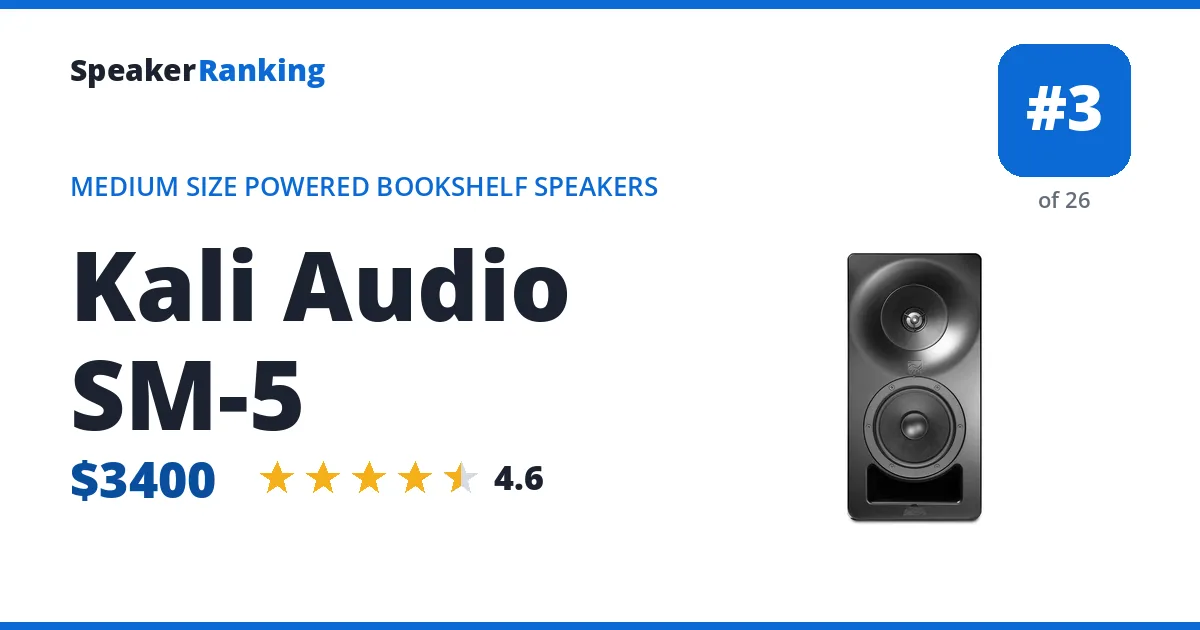
Pros: Erin’s measurements show bass reaching -3dB around 43Hz and a 2.8dB midrange response span. The coaxial mid/tweeter and large waveguide give useful consistency horizontally and vertically, reducing sensitivity to listening height. Built-in per-speaker DSP and mounting options make placement flexible. Existing testing reports low midrange distortion at 96dB. Measured bass extension of 45Hz (-3dB).
Cons: Scores of 5.18 standalone and 7.13 with an ideal subwoofer are good but below the leading reference monitors, so its advanced driver layout does not justify a near-top ranking by itself. A small upper-midrange irregularity remains. The five-inch woofer and limiter constrain loud bass; the review places compression onset roughly in the 96-102dB/1m region.
Full Kali Audio SM-5 review and specifications →
| AES Input | Yes |
|---|---|
| Amplifier Power | 150W total |
| App | Kali Audio DSP software (free download) |
| Aux Input | No |
| Bass Extension (-10dB) | 39Hz (measured, Erin’s Audio Corner) |
| Bass Extension (-3dB) | 45Hz (measured, Erin’s Audio Corner) |
| Bluetooth | No |
| Coaxial Input | No |
| Dimensions | 15.7”H x 7.9”W x 9.8”D (400 x 200 x 250 mm) |
| Drivers | 1” coaxial tweeter, 4” coaxial midrange, 5” mid-bass woofer |
| EQ | Yes, per-speaker DSP |
| Frequency Response | 39Hz - 35kHz ±10dB (47Hz - 21kHz ±3dB, Manufacturer specified) |
| HDMI Input | No |
| Inputs | XLR/TRS, AES/EBU (BNC), RJ45 network control |
| Maximum SPL | 117dB (manufacturer specified) |
| Optical Input | No |
| RCA Input | No |
| Spinorama Preference Score | 5.18 |
| Spinorama Preference Score with Perfect Sub | 7.13 |
| TRS Input | Yes |
| USB Input | No |
| Weight | 20.9 lbs (9.5 kg) each |
| XLR Input | Yes |
- Links
- Reviews, Comparisons and Sound Samples
- Head-to-Head Comparisons
- Kali Audio SM-5 vs Kali Audio IN-5
- Kali Audio SM-5 vs IK Multimedia iLoud MTM
- Kali Audio SM-5 vs IK Multimedia iLoud MTM MKII
- Kali Audio SM-5 vs Pioneer DJ VM-50
- Kali Audio SM-5 vs Vanatoo Transparent One Encore Plus
- Kali Audio SM-5 vs Airpulse A100
- Kali Audio SM-5 vs KEF LSX II LT
- Kali Audio SM-5 vs KEF LS50 Wireless II
- See all 50 comparisons
 Ranked #22 of 76 in Medium Size Powered Bookshelf Speakers - Kali Audio IN-5: $698 per pair Amazon eBay
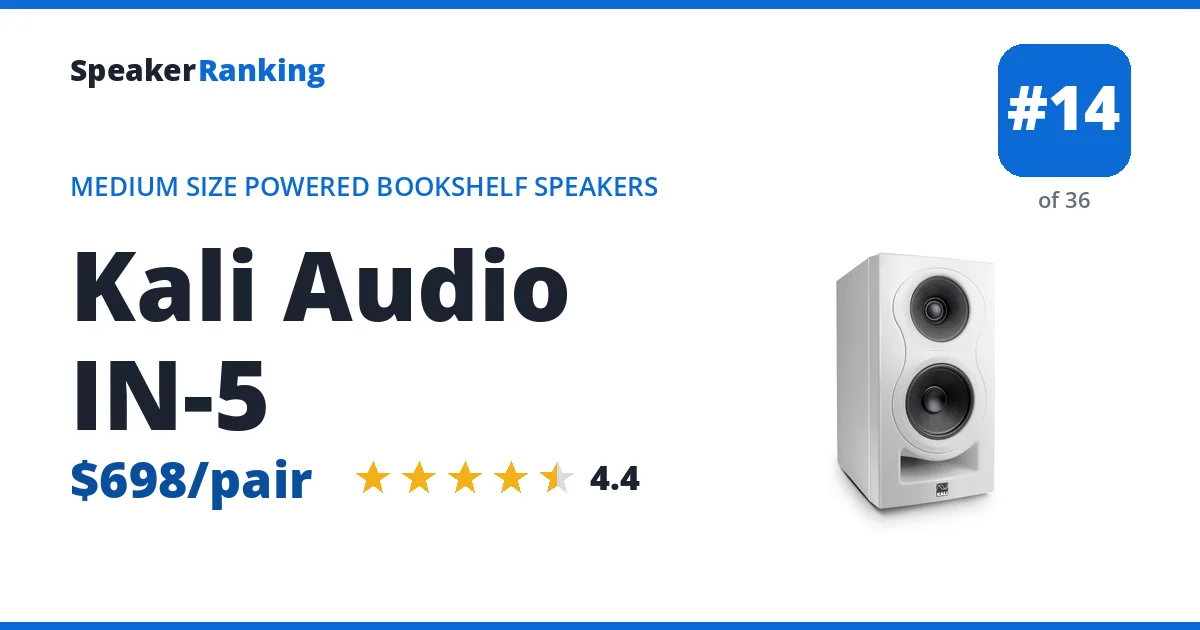
Larger model: the Kali Audio IN-8 V2 (rated 4.4/5).
Pros: The active three-way layout separates bass duties from the coaxial mid/tweeter, giving flexible listening geometry. Erin’s data shows a 1.8dB midrange response span and -3dB bass around 45Hz, with scores of 5.12 standalone and 7.13 with an ideal subwoofer. Placement switches and balanced inputs help integrate it into a studio; moderate-level distortion is well controlled in the existing review. Measured bass extension of 45Hz (-3dB).
Cons: Local listening-window irregularities remain despite the small overall midrange span. The review reports midrange distortion rising above 3% at 96dB and a brighter perceived balance at closer distances. Limiting makes it unsuitable for demanding farfield playback. Coaxial construction improves geometry but does not remove response errors or guarantee unlimited output.
Full Kali Audio IN-5 review and specifications →
| AES Input | No |
|---|---|
| Amplifier Power | 80W LF + 40W mid + 40W HF |
| Aux Input | No |
| Bass Extension (-10dB) | 40.0Hz (measured, Erin’s Audio Corner) |
| Bass Extension (-3dB) | Approximately 45Hz (measured, Erin’s Audio Corner) |
| Bluetooth | No |
| Coaxial Input | No |
| Dimensions | 15” x 8.1” x 11.1” (382 x 206 x 282 mm) (H x W x D) |
| Drivers | 1” tweeter coaxial with 4” midrange; 5” woofer |
| Frequency Response | 39Hz - 25kHz (-10dB) (Manufacturer specified) |
| HDMI Input | No |
| Inputs | XLR, TRS, RCA |
| Optical Input | No |
| RCA Input | Yes |
| Spinorama Preference Score | 5.12 |
| Spinorama Preference Score with Perfect Sub | 7.13 |
| TRS Input | Yes |
| USB Input | No |
| Weight | 18.6 lbs (8.43 kg) each |
| Woofer Cabinet | ported, front |
| XLR Input | Yes |
- Links
- Reviews, Comparisons and Sound Samples
- Head-to-Head Comparisons
- Kali Audio IN-5 vs IK Multimedia iLoud MTM
- Kali Audio IN-5 vs Kali Audio SM-5
- Kali Audio IN-5 vs HEDD Type 05 A-CORE
- Kali Audio IN-5 vs Sigberg Audio SBS.1
- Kali Audio IN-5 vs Sigberg Audio SBS Gen 2
- Kali Audio IN-5 vs Mackie MR524
- Kali Audio IN-5 vs IK Multimedia iLoud MTM MKII
- Kali Audio IN-5 vs Pioneer DJ VM-50
- See all 62 comparisons
 Ranked #26 of 76 in Medium Size Powered Bookshelf Speakers - Pioneer DJ VM-50: $338 per pair Amazon eBay
Pros: Erin’s Klippel measurements give scores of 4.64 standalone and 7.00 with an ideal subwoofer, with a -3dB point around 60Hz. The existing review reports low distortion and little sustained compression, supporting practical clean playback beyond what the tonal score alone captures. Separate bass and treble voicings and balanced inputs make adjustment straightforward. Measured bass extension of 61Hz (-3dB).
Cons: The default response spans 3.5dB from 300Hz to 5kHz, and the upper-midrange/treble balance varies with angle. EQ-switch selection and aiming therefore matter. Bass below about 50Hz is reduced, so it is not a full-range substitute for a monitor-and-subwoofer system. Its output evidence supports nearfield use, not unrestricted home-theater levels.
Full Pioneer DJ VM-50 review and specifications →
| AES Input | No |
|---|---|
| Amplifier Power | 30W LF + 30W HF; Class D |
| Aux Input | No |
| Bass Extension (-10dB) | 47.3Hz (measured, Erin’s Audio Corner) |
| Bass Extension (-3dB) | 61Hz (measured, Erin’s Audio Corner) |
| Bluetooth | No |
| Coaxial Input | No |
| DSP | Four LF and four HF EQ settings |
| Dimensions | 7.8” x 11.8” x 10.1” (198 x 300 x 256 mm) (W x H x D) |
| Drivers | 1” tweeter in horn; 5.25” aramid-fiber woofer |
| Frequency Response | 40Hz - 36kHz (Manufacturer specified) |
| HDMI Input | No |
| Inputs | XLR/TRS combo and RCA |
| Optical Input | No |
| RCA Input | Yes |
| Spinorama Preference Score | 4.64 |
| Spinorama Preference Score with Perfect Sub | 7.00 |
| TRS Input | Yes |
| USB Input | No |
| Weight | 12.1 lbs (5.5 kg) |
| XLR Input | Yes |
- Links
- Reviews, Comparisons and Sound Samples
- Head-to-Head Comparisons
- Pioneer DJ VM-50 vs Airpulse A100
- Pioneer DJ VM-50 vs KEF LSX II LT
- Pioneer DJ VM-50 vs Audioengine A5+ Classic
- Pioneer DJ VM-50 vs IK Multimedia iLoud MTM
- Pioneer DJ VM-50 vs Kali Audio IN-5
- Pioneer DJ VM-50 vs Adam Audio T5V
- Pioneer DJ VM-50 vs Kali Audio SM-5
- Pioneer DJ VM-50 vs Kanto YU6
- See all 54 comparisons
 Ranked #28 of 76 in Medium Size Powered Bookshelf Speakers - KEF LSX II LT: $479.99 per pair Amazon eBay
Pros: The coincident driver provides useful consistency across listening positions, and the app offers placement and subwoofer adjustments. Erin’s measurements give preference scores of 4.81 standalone and 7.03 with an ideal subwoofer, with -3dB bass around 56Hz. HDMI and USB connectivity make it convenient for a small TV or desktop system. Horizontal and vertical dispersion both reach about ±60°, giving a broad sweet spot for more than one seat. Measured bass extension of 55Hz (-3dB), with a measured sensitivity of 84dB.
Cons: The 3.4dB midrange response span and treble-region dips keep it below more neutral monitors. The existing review finds bass compression around 88-92dB/1m and rising distortion at higher levels, so the small drivers suit close listening rather than a large room. This LT version has no analog input; a turntable cannot plug straight into it.
Full KEF LSX II LT review and specifications →
| AES Input | No |
|---|---|
| Amplifier Power | 100w RMS Per Speaker |
| App | No |
| Aux Input | No |
| Bass Extension (-10dB) | 46Hz (measured, Erin’s Audio Corner) |
| Bass Extension (-3dB) | 55Hz (measured, Erin’s Audio Corner) |
| Bluetooth | Yes |
| Coaxial Input | No |
| Dimensions | 9.5”H x 6.1”W x 7.1”D (241.3 x 154.9 x 180.3 mm) |
| Drivers | 115mm (4.5in.) magnesium/aluminium alloy cone woofer, 19mm (0.75in.) aluminium dome tweeter |
| EQ | No |
| Frequency Response | 54Hz - 28kHz (±3dB) (Manufacturer specified) |
| HDMI Input | Yes |
| Inputs | Wifi, USB-C, HDMI, Optical, Bluetooth |
| Optical Input | Yes |
| Outputs | RCA Subwoofer |
| RCA Input | No |
| Sensitivity | 84dB (measured at 0.3V/1m, Erin’s Audio Corner) |
| Spinorama Preference Score | 4.81 |
| Spinorama Preference Score with Perfect Sub | 7.03 |
| Subwoofer Output | Yes |
| TRS Input | No |
| USB Input | Yes |
| Weight | 15 lbs (6.8 kg) |
| XLR Input | No |
- Links
- Reviews, Comparisons and Sound Samples
- Erin’s Audio Corner: Transform Your Sound System with the KEF LSX II LT Speaker More from Erin’s Audio Corner →
- Erin’s Audio Corner Website: KEF LSX II LT
- Erin’s Audio Corner Measurements (spinorama.org)
- Jasper Tech: Best Desktop Computer Speakers for Every Budget – 2026 More from Jasper Tech →
- Jasper Tech: Best Bookshelf Speakers For TV & Gaming - 2025
- Jasper Tech: Best Powered Bookshelf Speakers for Every Budget - 2025
- Head-to-Head Comparisons
 Ranked #36 of 76 in Medium Size Powered Bookshelf Speakers - Kali LP-UNF: $349.00 per pair Amazon eBay
Pros: A practical compact desktop system with USB-C, analog inputs and Bluetooth, plus extensive placement switches. Erin’s Klippel data gives -3dB bass around 54Hz and scores of 4.60 standalone and 6.67 with an ideal subwoofer. The low crossover and waveguide provide useful freedom of listening height for a two-way design, and moderate-level distortion is well controlled in the review. The 1.9kHz crossover gives vertical coverage of about ±30 to 40°, well beyond the typical ±10 to 15° of a two-way. Measured bass extension of 54Hz (-3dB), with a measured sensitivity of 88.1dB.
Cons: The 2.9dB midrange span masks local response ripples; listening-window narrow-band deviation of 0.467 is behind the best monitors. The review finds limiting around 91dB/1m per speaker. No dedicated subwoofer output means integration requires suitable external routing or bass management. Its strength is affordable close listening, not top-tier tonal accuracy or high-output room playback.
Full Kali LP-UNF review and specifications →
| AES Input | No |
|---|---|
| Amplifier Power | 160W total (Class D, 2-channel bi-amped) |
| App | No |
| Aux Input | No |
| Bass Extension (-10dB) | 39Hz (measured, Erin’s Audio Corner) |
| Bass Extension (-3dB) | 54Hz (measured, Erin’s Audio Corner) |
| Bluetooth | Yes |
| Coaxial Input | No |
| Dimensions | 10”H x 6.5”W x 7.4”D (254 x 165 x 188 mm) |
| Drivers | 4.5” woofer, 1” Textile Dome tweeter |
| EQ | No |
| Frequency Response | 39Hz - 25kHz (-10dB) (Manufacturer specified) |
| HDMI Input | No |
| Inputs | Bluetooth, USB-C (digital), RCA, TRS |
| Optical Input | No |
| RCA Input | Yes |
| Sensitivity | 88.1dB (measured at 0.3V/1m, Erin’s Audio Corner) |
| Spinorama Preference Score | 4.60 |
| Spinorama Preference Score with Perfect Sub | 6.67 |
| TRS Input | Yes |
| USB Input | Yes |
| Weight | 17.2 lbs (7.8 kg) |
| XLR Input | No |
- Links
- Reviews, Comparisons and Sound Samples
- Erin’s Audio Corner Review Measurements More from Erin’s Audio Corner →
- Erin’s Audio Corner: The Perfect Desktop Speaker? Kali LP-UNF.
- Erin’s Audio Corner: The Best Budget Desktop Speakers, Tested & Rated
- Erin’s Audio Corner: My Absolute Favorite Products of 2024 Revealed
- Erin’s Audio Corner: 10 Great (and Terrible) Speakers Under $300!
- Erin’s Audio Corner Measurements (spinorama.org)
- Jasper Tech: Best Desktop Computer Speakers for Every Budget – 2026 More from Jasper Tech →
- Jasper Tech: Are the iLoud Micro Monitor Pro the Best Studio Monitor Speakers for your Home Studio?
- Head-to-Head Comparisons
 Ranked #37 of 76 in Medium Size Powered Bookshelf Speakers - Vanatoo Transparent Zero Plus: $499.99 per pair Amazon eBay
Pros: Erin’s data shows a small 1.7dB span from 300Hz to 5kHz and a broadly level midrange trend. Scores of 4.07 standalone and 6.73 with an ideal subwoofer support it as a useful compact desktop option. Flexible cabinet orientation, multiple inputs and automatic subwoofer crossover behavior help with setup. Measured bass extension of 92Hz (-3dB), with a measured sensitivity of 88.5dB.
Cons: The measured -3dB point is around 95Hz, with a much lower F10 in the original review; this is not flat bass to the low-50Hz region. Vertical listening angle changes the upper-midrange response. The review finds cleaner results at moderate levels than near maximum output, where multitone distortion increases. A subwoofer is particularly valuable here. An 8th-order high-pass filter at 58Hz sharply cuts bass below that point, so kick drum fundamentals need a subwoofer.
Full Vanatoo Transparent Zero Plus review and specifications →
| AES Input | No |
|---|---|
| Amplifier Power | 120W total (Class D) |
| Aux Input | Yes |
| Bass Extension (-10dB) | 53Hz (measured, Erin’s Audio Corner) |
| Bass Extension (-3dB) | 92Hz (measured, Erin’s Audio Corner) |
| Bluetooth | Yes |
| Bluetooth Codecs | SBC, AAC, aptX, aptX HD |
| Coaxial Input | No |
| DSP | Yes (8th-order Butterworth high-pass at 58Hz) |
| Dimensions | 8.5”H x 5.5”W x 6”D |
| Drivers | 4” aluminum cone woofer, 4” long-throw passive radiator, 1” soft dome tweeter |
| Frequency Response | 56Hz - 20kHz (+/-3dB) (Manufacturer specified) |
| HDMI Input | No |
| Inputs | Bluetooth (aptX HD), USB (24-bit/96kHz), Toslink Optical (24-bit/96kHz), 3.5mm Analog |
| Optical Input | Yes |
| Outputs | RCA subwoofer |
| RCA Input | No |
| Sensitivity | 88.5dB (measured at 0.3V/1m, Erin’s Audio Corner) |
| Spinorama Preference Score | 4.07 |
| Spinorama Preference Score with Perfect Sub | 6.73 |
| Subwoofer Output | Yes |
| TRS Input | No |
| USB Input | Yes |
| Weight | 7.1 lbs (3.2 kg) each |
| XLR Input | No |
- Links
- Reviews, Comparisons and Sound Samples
- Erin’s Audio Corner: Vanatoo Transparent Zero Plus Review. More from Erin’s Audio Corner →
- Erin’s Audio Corner Website: Vanatoo Transparent Zero Plus
- Erin’s Audio Corner Measurements (spinorama.org)
- Jasper Tech: Best Desktop Computer Speakers for Every Budget – 2026 More from Jasper Tech →
- Jasper Tech: Are the D3V The Best Studio Monitors For The Money?
- Jasper Tech: Best Powered Bookshelf Speakers for Every Budget - 2025
- Jasper Tech: Best Premium Computer Speakers: Kanto ORA4 Review & Comparison
- Jasper Tech: Are the iLoud Micro Monitor Pro the Best Studio Monitor Speakers for your Home Studio?
- Jasper Tech: Best Desktop Computer Speakers for Every Budget
- Head-to-Head Comparisons
- Vanatoo Transparent Zero Plus vs Kali LP-UNF
- Vanatoo Transparent Zero Plus vs Kanto Tuk G2
- Vanatoo Transparent Zero Plus vs Neumi BS5P
- Vanatoo Transparent Zero Plus vs JBL 705P
- Vanatoo Transparent Zero Plus vs Focal Alpha 50 EVO
- Vanatoo Transparent Zero Plus vs M-Audio BX5 D3
- Vanatoo Transparent Zero Plus vs Dayton Audio M4
- Vanatoo Transparent Zero Plus vs Kanto YU6
- See all 54 comparisons
 Ranked #39 of 76 in Medium Size Powered Bookshelf Speakers - Neumi BS5P-ARC: $219.99 per pair Amazon eBay
Older model: the Neumi BS5P (ranked lower, rated 3.8/5).
Pros: Erin’s selected measurements give a 2.6dB midrange span and a 7.03 ideal-subwoofer preference score, indicating better tonal performance above the bass than its former near-bottom position suggested. HDMI ARC makes it a convenient low-cost TV stereo system.
Cons: The standalone score drops to 3.84. The published response reaches -3dB around 113Hz and -6dB around 83Hz, so bass balance is a significant limitation in that measured configuration. It is not the same model or dataset as the original BS5P. The score alone cannot establish clean output, and a subwoofer should not be assumed to solve crossover or room-integration issues automatically.
Full Neumi BS5P-ARC review and specifications →
| AES Input | No |
|---|---|
| Amplifier Power | 75W total (37.5W per channel) |
| Aux Input | No |
| Bluetooth | Yes |
| Coaxial Input | Yes |
| Country | China |
| Dimensions | 10.6H x 7.2W x 8.5D in each |
| Drivers | 1” silk dome tweeter with integrated waveguide, 5” poly-cone woofer |
| Enclosure | 2-way active |
| Frequency Response | 50Hz - 20kHz (Typical In-Room) (Manufacturer specified) |
| HDMI Input | Yes |
| Inputs | HDMI ARC, Bluetooth, USB-C, optical, coaxial, RCA analog |
| Optical Input | Yes |
| RCA Input | Yes |
| Spinorama Preference Score | 3.84 |
| Spinorama Preference Score with Perfect Sub | 7.03 |
| TRS Input | No |
| USB Input | Yes |
| Weight | 24.9 lbs (11.3 kg) pair |
| XLR Input | No |
- Links
- Reviews, Comparisons and Sound Samples
- Head-to-Head Comparisons
 Ranked #40 of 76 in Medium Size Powered Bookshelf Speakers - Neumi BS5P: $150 per pair Discontinued eBay
Newer model: the Neumi BS5P-ARC, ranked higher, rated 3.8/5.
Pros: Erin’s retest with corrected tweeter polarity, updated internal EQ and plugged ports gives a much more neutral result: 4.83 standalone and 7.83 with an ideal subwoofer, with a 2.7dB midrange span. The reviewer also found that configuration substantially better in listening. Its analog and digital inputs make it a flexible inexpensive system. Measured bass extension of 90.8Hz (-3dB).
Cons: That result is conditional on the tested firmware and port configuration, not a guarantee for an unknown stock or used pair. The first sample had reversed tweeter polarity, so its poor initial result should not be generalized to every unit either. Plugged-port bass reaches -3dB around 91Hz. Confirm configuration before expecting the improved balance; tonal scores do not remove output limits. Discontinued.
Full Neumi BS5P review and specifications →
| AES Input | No |
|---|---|
| Amplifier Power | 75W total |
| Aux Input | No |
| Bass Extension | Erin’s response shows usable midbass but limited deep-bass headroom |
| Bass Extension (-10dB) | 56.1Hz (measured, Erin’s Audio Corner) |
| Bass Extension (-3dB) | 90.8Hz (measured, Erin’s Audio Corner) |
| Bluetooth | Yes |
| Coaxial Input | Yes |
| Dimensions | 10.6” x 7.2” x 8.5” (269 x 183 x 216 mm) (H x W x D) |
| Drivers | 1” silk-dome tweeter; 5” fiberglass woofer |
| Frequency Response | 50Hz - 20kHz (Typical in-room) (Manufacturer specified) |
| HDMI Input | No |
| Inputs | Bluetooth, optical, coaxial and RCA |
| Optical Input | Yes |
| RCA Input | Yes |
| Spinorama Preference Score | 4.83 |
| Spinorama Preference Score with Perfect Sub | 7.83 |
| TRS Input | No |
| USB Input | No |
| XLR Input | No |
- Links
- Reviews, Comparisons and Sound Samples
- Head-to-Head Comparisons
 Ranked #42 of 76 in Medium Size Powered Bookshelf Speakers - Dayton Audio M4: $249.98 per pair Parts Express eBay
Pros: A compact powered pair with a subwoofer output, useful source connections and a solid cabinet. The existing review describes reasonable linearity for the price and a subdued upper treble that avoids an aggressively bright presentation. It is best considered for a close desktop setup. Measured bass extension of 121Hz (-3dB).
Cons: Existing listening and output notes describe limited bass, a balance that changes with distance, and distortion rising above roughly 93dB. The soft treble is a tonal preference, not evidence of reference neutrality; a subwoofer does not establish greater midrange headroom.
Full Dayton Audio M4 review and specifications →
| AES Input | No |
|---|---|
| Amplifier Power | 75W RMS (150W peak) |
| App | No |
| Aux Input | Yes (RCA) |
| Bass Extension (-10dB) | 60Hz (measured, Erin’s Audio Corner) |
| Bass Extension (-3dB) | 121Hz (measured, Erin’s Audio Corner) |
| Bluetooth | Yes, 5.0 |
| Bluetooth Codecs | SBC, aptX |
| Bluetooth Version | 5.0 |
| Coaxial Input | No |
| Digital Aux Input | Yes (USB-C DAC, up to 192kHz/32-bit) |
| Dimensions | 5” x 6.5” x 9.5” (127 x 165 x 241 mm) (W x D x H) |
| Drivers | 4” aluminum woofer, 1” silk dome tweeter |
| Frequency Response | 40Hz - 20kHz (Manufacturer specified) |
| HDMI Input | No |
| Inputs | RCA, USB-C, Bluetooth |
| Optical Input | No |
| Outputs | Subwoofer (20Hz-200Hz) |
| Power Input | AC Power cord |
| RCA Input | Yes |
| Stereo | Yes |
| Subwoofer Output | Yes |
| TRS Input | No |
| USB Input | Yes |
| Weight | 6.2 lbs (2.81 kg) (active), 5.1 lbs (2.31 kg) (passive) |
| XLR Input | No |
- Links
- Reviews, Comparisons and Sound Samples
- Head-to-Head Comparisons
 Ranked #44 of 76 in Medium Size Powered Bookshelf Speakers - Onkyo GX-30ARC: $269.99 per pair Amazon B&H Photo Video eBay
Pros: HDMI ARC, USB-C, optical and analog inputs make it a convenient compact system for a desk or TV. Erin’s Klippel data gives a 3.69 standalone preference score and 6.42 with an ideal subwoofer. The midrange response spans 3.8dB, offering usable but not reference-level tonal performance.
Cons: The response rises toward the treble by about 0.48dB per octave. Bass reaches -3dB around 74Hz, not the lower LFX value used inside the preference model. Vertical listening position affects crossover balance. Its extensive connectivity does not compensate for response irregularities, and the published tonal data alone does not establish maximum clean output.
Full Onkyo GX-30ARC review and specifications →
| AES Input | No |
|---|---|
| Amplifier Power | Class D amplification |
| Aux Input | Yes |
| Bluetooth | Yes, 5.3 |
| Coaxial Input | No |
| Country | Japan (design) |
| Dimensions | approx. 8.7H x 5.8W x 7.9D in each |
| Drivers | 1” tweeter, 4” woofer |
| Enclosure | 2-way powered, rear-ported |
| Frequency Response | 55Hz - 20kHz (Manufacturer specified) |
| HDMI Input | Yes |
| Inputs | HDMI ARC, USB-C, optical, phono/line, 3.5mm aux, Bluetooth 5.3 |
| Optical Input | Yes |
| Outputs | Subwoofer |
| RCA Input | No |
| Spinorama Preference Score | 3.69 |
| Spinorama Preference Score with Perfect Sub | 6.42 |
| Subwoofer Output | Yes |
| TRS Input | No |
| USB Input | Yes |
| Weight | 6.2 lbs (2.8 kg) (primary speaker) |
| XLR Input | No |
- Links
- Reviews, Comparisons and Sound Samples
- Head-to-Head Comparisons
 Ranked #55 of 76 in Medium Size Powered Bookshelf Speakers - Edifier MR4: $138.99 per pair Amazon eBay
Pros: Erin’s data supports a useful budget desktop monitor: a 3.0dB midrange span, little overall on-axis tilt, and preference scores of 3.25 standalone and 6.00 with an ideal subwoofer. Balanced TRS inputs and tone controls are practical at its price, and its response is more balanced than the measured R1280T. Measured bass extension of 79Hz (-3dB), with a measured sensitivity of 78dB.
Cons: Bass reaches -3dB around 79Hz, so deep extension should not be inferred from the overall flat trend. Listening-window response still has local irregularities, including lower-treble unevenness. The existing review reports rapidly increasing distortion and audible distress when pushed well above moderate desktop levels. No Bluetooth, and adding a subwoofer does not cure every output or tonal limitation.
Full Edifier MR4 review and specifications →
| AES Input | No |
|---|---|
| Amplifier Power | 42W RMS total (21W per speaker) |
| App | No |
| Aux Input | Yes |
| Bass Extension (-10dB) | 59Hz (measured, Erin’s Audio Corner) |
| Bass Extension (-3dB) | 79Hz (measured, Erin’s Audio Corner) |
| Bluetooth | No |
| Coaxial Input | No |
| Dimensions | 9”H x 5.5”W x 7.6”D (228.6 x 139.7 x 193 mm) |
| Drivers | 4” (102mm) woofer, 1” silk dome tweeter |
| EQ | Yes (Monitor and Music modes) |
| Frequency Response | 60 Hz-20 kHz (-3dB) (Manufacturer specified) |
| HDMI Input | No |
| Headphone Output | Yes |
| Inputs | TRS Balanced, RCA, Aux |
| Optical Input | No |
| Outputs | Headphone |
| RCA Input | Yes |
| Sensitivity | 78dB (measured at 0.3V/1m, Erin’s Audio Corner) |
| Spinorama Preference Score | 3.25 |
| Spinorama Preference Score with Perfect Sub | 6.00 |
| TRS Input | Yes |
| USB Input | No |
| Weight | 9.9 lbs (4.5 kg) |
| XLR Input | No |
- Links
- Reviews, Comparisons and Sound Samples
- Erin’s Audio Corner Review Measurements More from Erin’s Audio Corner →
- Audio Science Review Measurements More from Audio Science Review →
- DSAUDIO.review: DSAUDIO.review Edifier MR4 vs Edifier R1280DBs sound.DEMO More from DSAUDIOreview →
- DSAUDIO.review: DSAUDIO.review Edifier MR4 vs Edifier R1700BT sound.DEMO
- DSAUDIO.review: DSAUDIO.review Edifier MR4 vs JBL 305P MKII sound.DEMO
- DSAUDIO.review: DSAUDIO.review Edifier MR4 vs Presonus Eris E3.5 sound.DEMO
- DSAUDIO.review: DSAUDIO.review Edifier MR4 vs iLoud Micro Monitor sound.DEMO
- DSAUDIO.review: DSAUDIO.review Edifier MR4 vs Presonus Eris E4.5 sound.DEMO
- DSAUDIO.review: DSAUDIO.review Edifier MR4 vs Mackie CR4-X sound.DEMO
- Erin’s Audio Corner Measurements (spinorama.org)
- Jasper Tech: Best Desktop Computer Speakers for Every Budget – 2026 More from Jasper Tech →
- Jasper Tech: Are the iLoud Micro Monitor Pro the Best Studio Monitor Speakers for your Home Studio?
- Erin’s Audio Corner: Edifier MR4 Powered Studio Monitors Review
- Head-to-Head Comparisons
 Ranked #59 of 76 in Medium Size Powered Bookshelf Speakers - Edifier MR5: $349.99 per pair Amazon B&H Photo Video eBay
Pros: Erin’s Audio Corner measured useful bass for a compact 5-inch monitor, with F3 around 51Hz. The three-way active design adds a dedicated 3.75-inch midrange, and the 110W RMS system, app EQ, room-compensation controls, LDAC, balanced XLR/TRS inputs, and front headphone output make it unusually well equipped at $350 per pair. Measured bass extension of 51Hz (-3dB), with a measured sensitivity of 85dB.
Cons: Erin’s CTA-2034 data shows upper-midrange and treble irregularities, while off-axis response narrows more quickly than ideal above about 2-3kHz. Bass output is level-limited below about 70Hz and distortion/compression rise at higher levels, so it suits moderate nearfield use better than loud mid-field playback.
Full Edifier MR5 review and specifications →
| AES Input | No |
|---|---|
| Amplifier Power | 110W RMS total (Manufacturer specified) |
| App | Yes (Edifier ConneX) |
| Aux Input | Yes |
| Bass Extension (-3dB) | 51Hz (measured, Erin’s Audio Corner) |
| Bluetooth | Yes, 6.0 |
| Bluetooth Codecs | LDAC, SBC |
| Bluetooth Version | 6.0 |
| Coaxial Input | No |
| Dimensions | 6.3”W x 10.4”H x 11”D (159 x 264 x 280 mm) (active); 159W x 264H x 257D mm (passive) |
| Drivers | 5-inch woofer + 3.75-inch midrange + 1-inch silk-dome tweeter (each) |
| EQ | Yes (app EQ and rear high/low controls) |
| Frequency Response | 46Hz-40kHz (Manufacturer specified) |
| HDMI Input | No |
| Headphone Output | Yes |
| Inputs | Balanced XLR, balanced 6.35mm TRS, RCA, 3.5mm Aux |
| Maximum SPL | 101dB (Manufacturer specified, 1m) |
| Measurement Source | Erin’s Audio Corner |
| Optical Input | No |
| Outputs | 3.5mm headphone |
| RCA Input | Yes |
| Sensitivity | 85dB (measured at 0.3V/1m, Erin’s Audio Corner) |
| TRS Input | Yes |
| USB Input | No |
| Weight | 22.9 lbs (10.38 kg) |
| XLR Input | Yes |
- Links
- Reviews, Comparisons and Sound Samples
- Head-to-Head Comparisons
 Ranked #64 of 76 in Medium Size Powered Bookshelf Speakers - Kali Audio IN-UNF: $699 per pair Kali Audio eBay
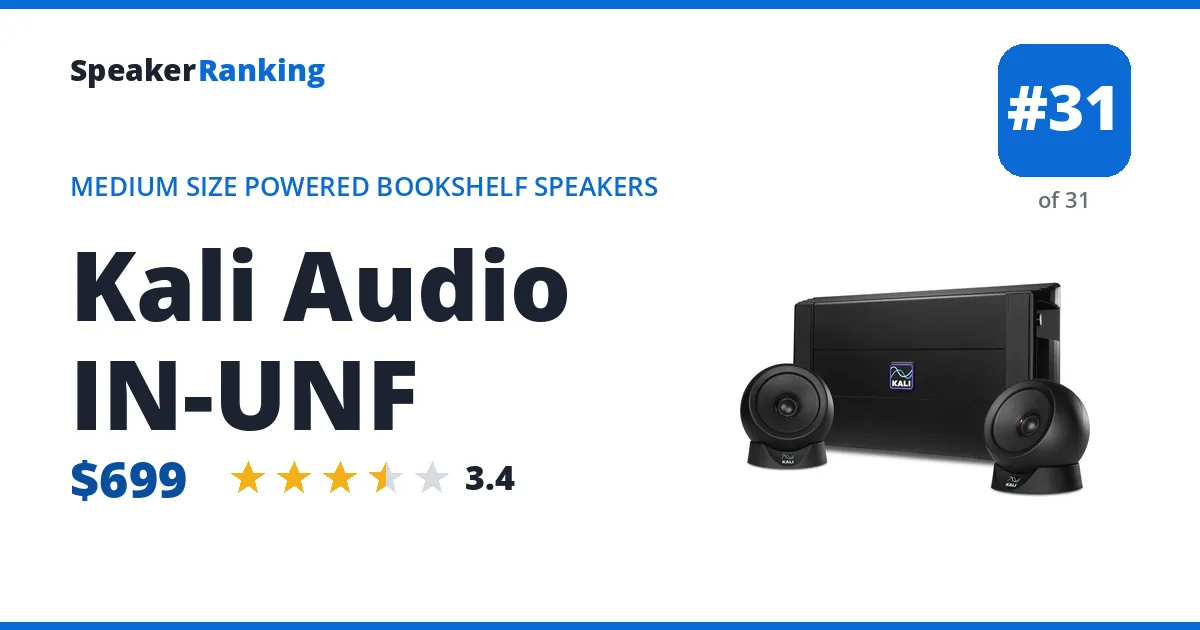
Pros: A specialized ultra-nearfield system with coaxial satellites and an opposed-woofer bass module designed to sit on the desk. Erin found it worked much better when positioned using Kali’s placement template, with useful agreement between the intended response and close-range moving-microphone measurements. DSP placement controls and varied inputs make it a thoughtful solution for the right desk.
Cons: The intended desk geometry is part of the acoustic design. The bass module and prescribed spacing occupy considerable desk space and may conflict with large monitors. It is not designed for arbitrary room placement.
Full Kali Audio IN-UNF review and specifications →
| AES Input | No |
|---|---|
| Amplifier Power | 100W LF + 60W mid/HF per channel (continuous) |
| Aux Input | Yes |
| Bass Extension (-10dB) | 39Hz (manufacturer specified; Erin did not publish an anechoic F10) |
| Bass Extension (-3dB) | 47Hz (manufacturer specified; Erin did not publish an anechoic F3) |
| Bluetooth | No |
| Coaxial Input | No |
| Crossover Frequency | 280Hz LF-to-midrange; 2.8kHz midrange-to-HF |
| DSP | Yes (placement/boundary and tonal trims) |
| Dimensions | Bass module: 11.6”H x 19.4”W x 5.25”D; satellites: 6.25” diameter |
| Drivers | Bass module: two opposed 4.5” woofers; satellites: 4” coincident midrange with 1” textile-dome tweeter |
| Frequency Response | 47Hz - 21kHz +/-3dB (manufacturer specified) |
| HDMI Input | No |
| Inputs | USB-C, optical, 3.5mm, balanced TRS |
| Maximum SPL | 103dB peak at 1m (manufacturer specified) |
| Optical Input | Yes |
| RCA Input | No |
| TRS Input | Yes |
| USB Input | Yes |
| Weight | 24.7 lbs (11.2 kg) |
| XLR Input | No |
- Links
- Reviews, Comparisons and Sound Samples
- Head-to-Head Comparisons
- Kali Audio IN-UNF vs Edifier S1000MKII
- Kali Audio IN-UNF vs Audioengine HD4
- Kali Audio IN-UNF vs Edifier S1000W
- Kali Audio IN-UNF vs Edifier R1700BT
- Kali Audio IN-UNF vs Edifier R2000DB
- Kali Audio IN-UNF vs Audioengine HD6
- Kali Audio IN-UNF vs Edifier R1280DB
- Kali Audio IN-UNF vs Edifier R1280T
- See all 53 comparisons
 Ranked #73 of 76 in Medium Size Powered Bookshelf Speakers - Donner Dyna 3: $89 per pair Amazon eBay
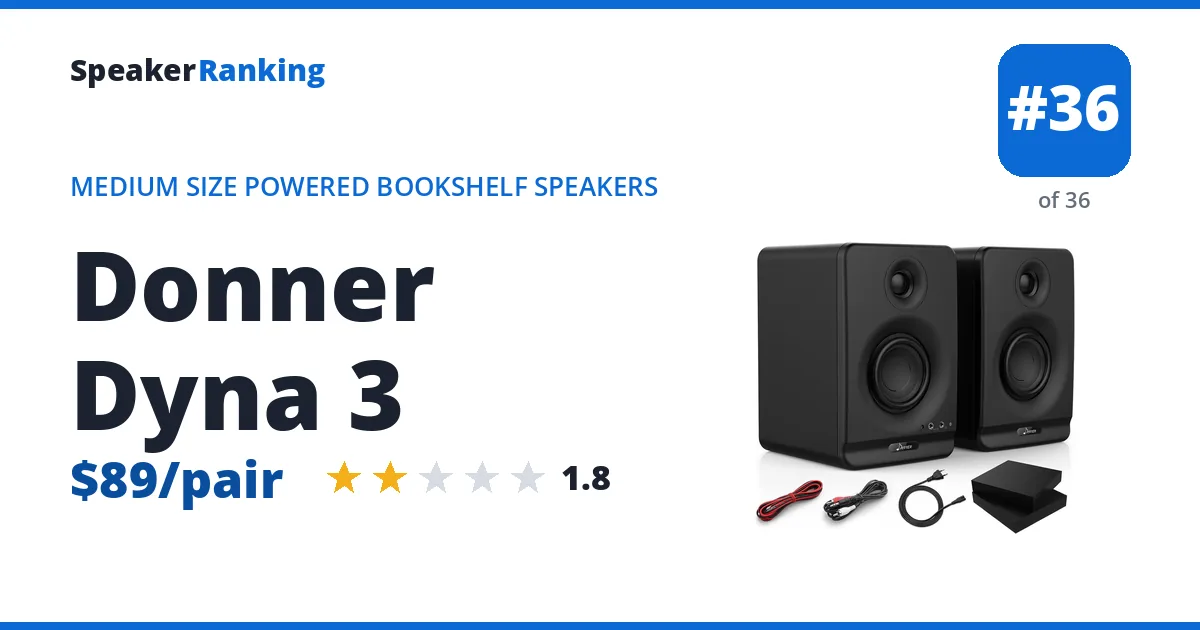
Pros: A low-cost powered desktop pair with several input options and a small footprint. It can provide basic close-range background playback without an external amplifier. Measured bass extension of 85.0Hz (-3dB).
Cons: Erin’s Klippel measurements give a negative standalone preference score of -0.06 and only 3.24 with an ideal subwoofer. The response spans 8.2dB from 300Hz to 5kHz, with large listening-window irregularities. Bass reaches -3dB around 85Hz, and the existing review reports distortion and compression limits. It is not a credible neutral studio monitor despite that style of marketing.
Full Donner Dyna 3 review and specifications →
| AES Input | No |
|---|---|
| Amplifier Power | Built in |
| Aux Input | Yes |
| Bass Extension | Limited by 3” woofer (Erin’s Audio Corner measurement) |
| Bass Extension (-10dB) | 66.8Hz (measured, Erin’s Audio Corner) |
| Bass Extension (-3dB) | 85.0Hz (measured, Erin’s Audio Corner) |
| Bluetooth | Yes, 5.0 |
| Coaxial Input | No |
| Dimensions | 5.4” x 5.9” x 8.1” (136 x 150 x 205 mm) |
| Drivers | 1” dome tweeter; 3” woofer |
| Frequency Response | 80Hz - 22kHz (Manufacturer specified) |
| HDMI Input | No |
| Inputs | Bluetooth, TRS, RCA and 3.5mm |
| Optical Input | No |
| RCA Input | Yes |
| Spinorama Preference Score | -0.06 |
| Spinorama Preference Score with Perfect Sub | 3.24 |
| TRS Input | Yes |
| USB Input | No |
| XLR Input | No |
- Links
- Reviews, Comparisons and Sound Samples
- Head-to-Head Comparisons
Large Size Powered Bookshelf Speakers
 Ranked #2 of 79 in Large Size Powered Bookshelf Speakers - Mesanovic CDM65: $5,998 per pair Front End Audio eBay
Pros: Erin’s measurements show a very even 1.1dB span from 300Hz to 5kHz and an 8.57 ideal-subwoofer preference score, strong evidence for natural tonal balance. Measured -3dB bass extension is 36.6Hz. Switchable cardioid operation offers useful control of rearward radiation; an optional WiSA hub adds wireless system integration. Measured bass extension of 36.6Hz (-3dB).
Cons: Cardioid operation and bass tuning affect placement and output, so use the appropriate mode for the room. A subwoofer is still useful for deep bass at high levels. These are substantial, roughly 14.5kg cabinets, and the optional hub adds cost rather than being necessary for wired playback.
Full Mesanovic CDM65 review and specifications →
| AES Input | No |
|---|---|
| Amplifier Power | 600W total (150W tweeter, 150W midrange, 300W subwoofers combined) |
| Aux Input | No |
| Bass Extension (-10dB) | 29.8Hz (measured, Erin’s Audio Corner) |
| Bass Extension (-3dB) | 36.6Hz (measured, Erin’s Audio Corner) |
| Bluetooth | No |
| Coaxial Input | No |
| Country | United States |
| Crossover Frequency | 150Hz, 2,300Hz |
| Dimensions | 15”H x 8”W x 14”D (381 x 203 x 356 mm) |
| Drivers | 1” aluminum dome waveguide tweeter, 5” aluminum cone midrange, 2x 6.5” paper Kevlar side mounted subwoofers |
| Enclosure | sealed |
| Frequency Response | 40Hz-20kHz +/-1.0dB |
| HDMI Input | No |
| Inputs | XLR (balanced analog), WiSA wireless |
| Maximum SPL | 103dB @ 1m (manufacturer specified) |
| Optical Input | No |
| RCA Input | No |
| Spinorama Preference Score | 7.07 |
| Spinorama Preference Score with Perfect Sub | 8.57 |
| TRS Input | No |
| USB Input | No |
| Warranty | 2 years |
| Weight | 32 lbs (14.5 kg) each |
| XLR Input | Yes |
- Links
- Reviews, Comparisons and Sound Samples
- Head-to-Head Comparisons
 Ranked #3 of 79 in Large Size Powered Bookshelf Speakers - Kii THREE: $16,970 per pair Vintage King eBay
Pros: Exceptionally even measured balance: the 300Hz-5kHz response spans only 1.2dB, with preference scores of 7.70 standalone and 8.35 with an ideal subwoofer. Cardioid control reduces rearward low-midrange energy, while measured -3dB extension of 29.3Hz provides convincing full-range bass in a compact system. Measured bass extension of 28Hz (-3dB).
Cons: Deep-bass output has limits: demanding low-frequency material at high levels can trigger compression or audible distress. The reviewer preferred a small treble reduction, so the high score is not a promise of ideal tonal balance for every listener. Linear-phase operation adds latency, and the system is expensive.
Full Kii THREE review and specifications →
| AES Input | Yes |
|---|---|
| Amplifier Power | 1,500W total per speaker; Six Ncore channels |
| Aux Input | No |
| Bass Extension (-10dB) | 20.5Hz (measured, Erin’s Audio Corner) |
| Bass Extension (-3dB) | 28Hz (measured, Erin’s Audio Corner) |
| Bluetooth | No |
| Coaxial Input | No |
| Coverage | DSP-controlled cardioid above approximately 70-90Hz |
| DSP | Yes; boundary, contour, phase-exact and low-latency modes |
| Dimensions | 15.7”H x 7.9”W x 15.7”D |
| Drivers | Four 6.5” woofers; 5” midrange; 1” waveguided tweeter |
| Frequency Response | 20Hz - 20kHz (-6dB at 20Hz; ±0.5dB 100Hz-10kHz; ±1dB 10kHz-20kHz) (Manufacturer specified) |
| HDMI Input | No |
| Inputs | XLR (analog), XLR AES/EBU (digital), proprietary KiiLink digital multi-pin |
| Optical Input | No |
| RCA Input | No |
| Spinorama Preference Score | 7.70 |
| Spinorama Preference Score with Perfect Sub | 8.35 |
| TRS Input | No |
| USB Input | No |
| Weight | 42.1 lbs (19.1 kg) each |
| XLR Input | Yes |
- Links
- Reviews, Comparisons and Sound Samples
- Head-to-Head Comparisons
 Ranked #6 of 79 in Large Size Powered Bookshelf Speakers - Genelec 8361A: $10900 per pair B&H Photo Video eBay
Pros: The coaxial design combines consistent imaging with substantial output capability. ASR measured a 1.8dB response span from 300Hz to 5kHz, 33.7Hz -3dB extension and a 8.08 ideal-subwoofer score. Low distortion and restrained compression support its use at greater distances than smaller nearfield monitors. Woofers above and below the coaxial driver give nearly identical vertical response whether you sit or stand. Measured bass extension of 34Hz (-3dB).
Cons: Its larger size buys headroom, not uniformly better tonality than the smaller Ones models. Some lower-midrange unevenness remains, and listening angle can affect perceived treble balance. The cabinets are very heavy and expensive; GLM setup and suitable stands need to be budgeted separately.
Full Genelec 8361A review and specifications →
| AES Input | No |
|---|---|
| Amplifier Power | 1000w Per Speaker |
| App | Yes (GLM) |
| Aux Input | No |
| Bass Extension (-10dB) | 29Hz (measured, Erin’s Audio Corner) |
| Bass Extension (-3dB) | 34Hz (measured, Erin’s Audio Corner) |
| Bluetooth | No |
| Coaxial Input | No |
| DSP | Yes |
| Dimensions | 22.5”H x 14”W x 13.6”D (571.5 x 355.6 x 345.4 mm) |
| Drivers | Dual 263 x 137 mm woofers, 5.1” coaxial with tweeter midrange, 1” (25mm) coaxial tweeter |
| EQ | Yes (via GLM software) |
| Frequency Response | 30Hz - 43kHz (±2dB) (Manufacturer specified) |
| HDMI Input | No |
| Inputs | XLR |
| Maximum SPL | 118dB @ 1m (manufacturer specified) |
| Optical Input | No |
| RCA Input | No |
| Spinorama Preference Score | 6.76 |
| Spinorama Preference Score with Perfect Sub | 8.08 |
| TRS Input | No |
| USB Input | No |
| Weight | 70.3 lbs (31.9 kg) each |
| XLR Input | Yes |
- Links
- Reviews, Comparisons and Sound Samples
- Head-to-Head Comparisons
Ranked #10 of 79 in Large Size Powered Bookshelf Speakers - Dutch & Dutch 8C: $13000 per pair Tidepool Audio eBay
Pros: Very deep measured bass reaches 23.4Hz at -3dB, while the 1.8dB response span from 300Hz to 5kHz supports even mids. The 6.51 standalone score reflects that full-range strength. Cardioid midrange radiation and boundary-aware bass adjustment help integrate the system with nearby walls. Measured bass extension of 23Hz (-3dB), with a measured sensitivity of 106dB.
Cons: Cardioid operation reduces some reflections; it does not make the speaker independent of the room. Rear-woofer placement and setup remain important. Its 7.16 ideal-subwoofer score trails the strongest tonal performers here, although its deep native bass is a meaningful advantage for listening without a sub.
Full Dutch & Dutch 8C review and specifications →
| AES Input | No |
|---|---|
| Amplifier Power | 1000W (250W tweeter + 250W mid + 500W dual woofers) |
| App | Yes (Ascend) |
| Aux Input | No |
| Bass Extension (-10dB) | <20Hz (measured, Erin’s Audio Corner) |
| Bass Extension (-3dB) | 23Hz (measured, Erin’s Audio Corner) |
| Bluetooth | No |
| Coaxial Input | No |
| DSP | Yes |
| Dimensions | 19”H x 10.5”W x 15”D (482.6 x 266.7 x 381 mm) |
| Drivers | 2x 8” Aluminium Cone woofers, 8” Aluminium Cone midrange, 1” Aluminium/Magnesium dome tweeter |
| EQ | Yes (24-band parametric) |
| Frequency Response | 20Hz - 20kHz (Manufacturer specified) |
| HDMI Input | No |
| Inputs | XLR |
| Maximum SPL | 106dB @ 1m continuous (manufacturer specified) |
| Optical Input | No |
| RCA Input | No |
| Sensitivity | ~106dB (measured at 0.30V/1m, Erin’s Audio Corner) |
| Streaming Services | Yes (network streaming) |
| TRS Input | No |
| USB Input | No |
| Weight | 57.3 lbs (26 kg) each |
| Wi-Fi | Yes (Ethernet) |
| XLR Input | Yes |
- Links
- Reviews, Comparisons and Sound Samples
- Head-to-Head Comparisons
- Dutch & Dutch 8C vs Aalto Speakers Aalto 3 Active Pro
- Dutch & Dutch 8C vs Genelec 8361A
- Dutch & Dutch 8C vs Neumann KH420
- Dutch & Dutch 8C vs Kii THREE
- Dutch & Dutch 8C vs Yamaha HS8
- Dutch & Dutch 8C vs Kali Audio LP-6 V2
- Dutch & Dutch 8C vs Kali Audio IN-8 V2
- Dutch & Dutch 8C vs JBL M2 Master Reference Monitor
- See all 13 comparisons
Ranked #12 of 79 in Large Size Powered Bookshelf Speakers - Buchardt A10: $4300 per pair Buchardt Audio eBay
Pros: The measured tuning combines 31.5Hz -3dB bass extension with preference scores of 7.28 standalone and 8.00 with an ideal subwoofer. A 1.9dB response span from 300Hz to 5kHz supports broadly even mids, and selectable DSP tunings offer useful flexibility. Measured bass extension of 30Hz (-3dB).
Cons: The rising treble balance can sound brighter on axis; toe-out or a different tuning may suit some rooms. Deep-bass demands cause compression before the largest monitors reach their limits. A subwoofer with appropriate high-pass filtering can improve headroom; alternate presets should not be assumed to share the quoted scores.
Full Buchardt A10 review and specifications →
| AES Input | No |
|---|---|
| Amplifier Power | 200w Per Speaker |
| App | No |
| Aux Input | No |
| Bass Extension (-10dB) | 21Hz (measured, Erin’s Audio Corner) |
| Bass Extension (-3dB) | 30Hz (measured, Erin’s Audio Corner) |
| Bluetooth | No |
| Coaxial Input | No |
| DSP | No |
| Dimensions | 14.6”H x 7”W x 9.6”D (370.8 x 177.8 x 243.8 mm) |
| Drivers | 6.5” PURIFI Extended Stroke Driver with Ultra Low Distortion, Custom made with triple Voice Coil woofer, 19 mm / 0.74” Resonance Free Aluminum dome with CDC aluminum waveguide tweeter |
| EQ | Yes (Room adjustment) |
| Frequency Response | 28Hz - 40kHz (±1.5dB) (Manufacturer specified) |
| HDMI Input | No |
| Inputs | XLR |
| Optical Input | No |
| RCA Input | No |
| Spinorama Preference Score | 7.28 |
| Spinorama Preference Score with Perfect Sub | 8.00 |
| TRS Input | No |
| USB Input | No |
| Weight | 15 lbs (6.8 kg) each |
| Woofer Cabinet | sealed |
| XLR Input | Yes |
- Links
- Reviews, Comparisons and Sound Samples
- Head-to-Head Comparisons
 Ranked #16 of 79 in Large Size Powered Bookshelf Speakers - Buchardt A500: $4,150 per pair Discontinued Buchardt Audio eBay
Pros: Erin measured unusually deep bass for the cabinet size: 24.9Hz at -3dB. A 1.8dB response span from 300Hz to 5kHz and 7.02 standalone preference score support balanced, full-range listening. Master Tunings and optional wireless integration provide practical flexibility. Measured bass extension of 24.9Hz (-3dB).
Cons: Bass extension depends on the selected tuning and comes with output tradeoffs at high levels. The 7.92 ideal-subwoofer score is good but not class-leading. A rear-facing woofer does not by itself establish cardioid radiation, and alternate Master Tunings should not inherit the measured configuration’s score. Discontinued.
Full Buchardt A500 review and specifications →
| AES Input | No |
|---|---|
| Amplifier Power | 3 x 150W per speaker |
| Aux Input | No |
| Bass Extension | Master-tuning dependent; approximately 25–40Hz |
| Bass Extension (-10dB) | 23.4Hz (measured, Erin’s Audio Corner) |
| Bass Extension (-3dB) | 24.9Hz (measured, Erin’s Audio Corner) |
| Bluetooth | No |
| Coaxial Input | No |
| Dimensions | 14.4H x 7W x 11D inches |
| Drivers | 0.74-inch dome; front and rear 6-inch long-throw woofers |
| Frequency Response | 25Hz - 40kHz (+/- 1.5dB) (Manufacturer specified) |
| HDMI Input | No |
| Inputs | XLR, WiSA |
| Optical Input | No |
| RCA Input | No |
| Spinorama Preference Score | 7.02 |
| Spinorama Preference Score with Perfect Sub | 7.92 |
| TRS Input | No |
| USB Input | No |
| Weight | 55.1 lbs (25kg)/pair |
| XLR Input | Yes |
- Links
- Reviews, Comparisons and Sound Samples
- Head-to-Head Comparisons
 Ranked #24 of 79 in Large Size Powered Bookshelf Speakers - SHIVAUDYO Point Zero: €6,500 per pair Shivaudyo eBay
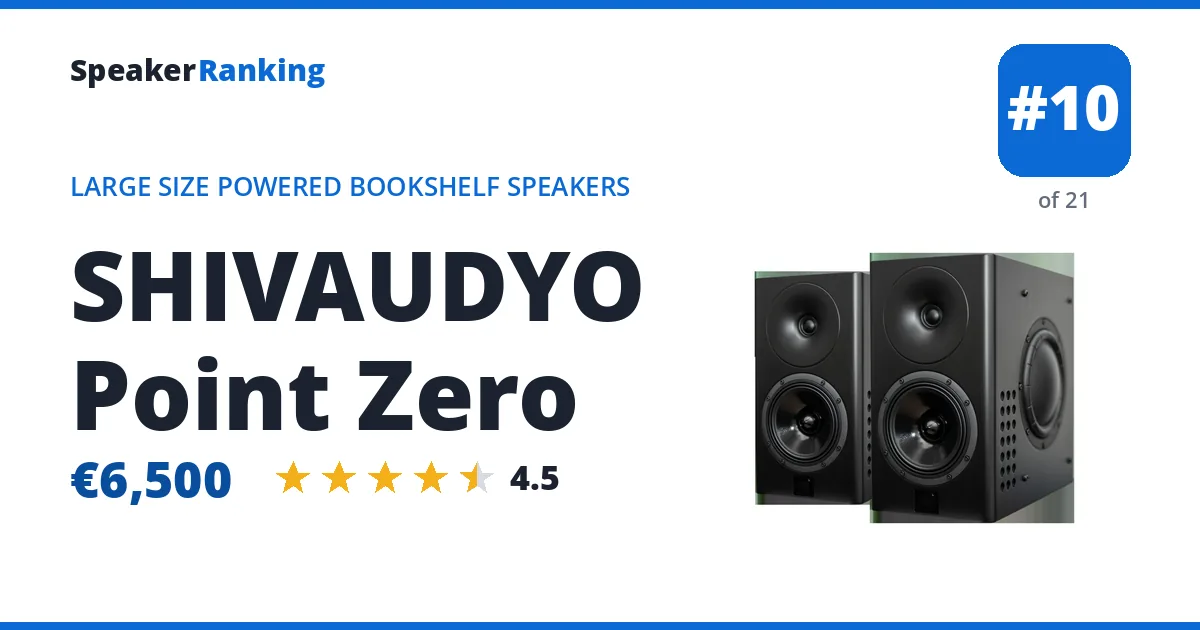
Pros: Measured -3dB extension of 31.5Hz and a 7.66 ideal-subwoofer score combine useful bass with broadly balanced sound. Cardioid control through the low midrange reduces some rearward energy, and selectable bass presets let the listener trade extension for headroom. Measured bass extension of 31Hz (-3dB), with a measured sensitivity of 92.9dB.
Cons: Cardioid control begins around 200Hz rather than extending through all deep bass. Listening height can change vocal weight, and the measured 2.0dB midband span does not capture every directional variation. The deepest bass preset sacrifices output, so its nominal cutoff is not a clean-SPL guarantee.
Full SHIVAUDYO Point Zero review and specifications →
| AES Input | Yes |
|---|---|
| Amplifier Power | 600W total (300W subs + 200W mid-woofer + 100W tweeter, Hypex NCore) |
| App | No |
| Aux Input | No |
| Bass Extension (-10dB) | 22Hz (measured on-axis, Erin’s Audio Corner) |
| Bass Extension (-3dB) | 31Hz (measured on-axis, Erin’s Audio Corner) |
| Bluetooth | No |
| Coaxial Input | Yes |
| Crossover Frequency | 120Hz / 1600Hz, 4th-order Linkwitz-Riley |
| DSP | Yes (Hypex, downloadable software, 3 bass presets) |
| Dimensions | 15.7”H x 8.7”W x 15.4”D (400 x 220 x 390 mm) |
| Drivers | 6.5” mid-woofer, 1” waveguide dome tweeter, 2x 8” side-firing subwoofers (opposed, vibration-cancelling) |
| Frequency Response | 30Hz - 20kHz ±1dB (anechoic, Preset 1) |
| HDMI Input | No |
| Inputs | XLR, RCA, AES-EBU, S/PDIF, Toslink |
| Maximum SPL | 110dB long-term, 116dB short-term, 120dB peak (manufacturer specified) |
| Optical Input | Yes |
| RCA Input | Yes |
| Sensitivity | 92.9dB (measured at 0.3V/1m, Erin’s Audio Corner; Erin notes this figure is scaled rather than directly comparable to passive-speaker sensitivity) |
| Spinorama Preference Score | 6.59 |
| Spinorama Preference Score with Perfect Sub | 7.66 |
| TRS Input | No |
| USB Input | No |
| Weight | 36.4 lbs (16.5 kg) each |
| XLR Input | Yes |
- Links
- Reviews, Comparisons and Sound Samples
- Head-to-Head Comparisons
- SHIVAUDYO Point Zero vs Yamaha HS8
- SHIVAUDYO Point Zero vs Kali Audio LP-6 V2
- SHIVAUDYO Point Zero vs Devialet Phantom Ultimate 108dB
- SHIVAUDYO Point Zero vs Thomann Swissonic A306
- SHIVAUDYO Point Zero vs JBL M2 Master Reference Monitor
- SHIVAUDYO Point Zero vs Genelec 8351B
- SHIVAUDYO Point Zero vs Kii THREE
- SHIVAUDYO Point Zero vs Klipsch The Nines
- See all 13 comparisons
 Ranked #29 of 79 in Large Size Powered Bookshelf Speakers - Kali Audio LP-6 V2: $398 per pair Amazon B&H Photo Video eBay
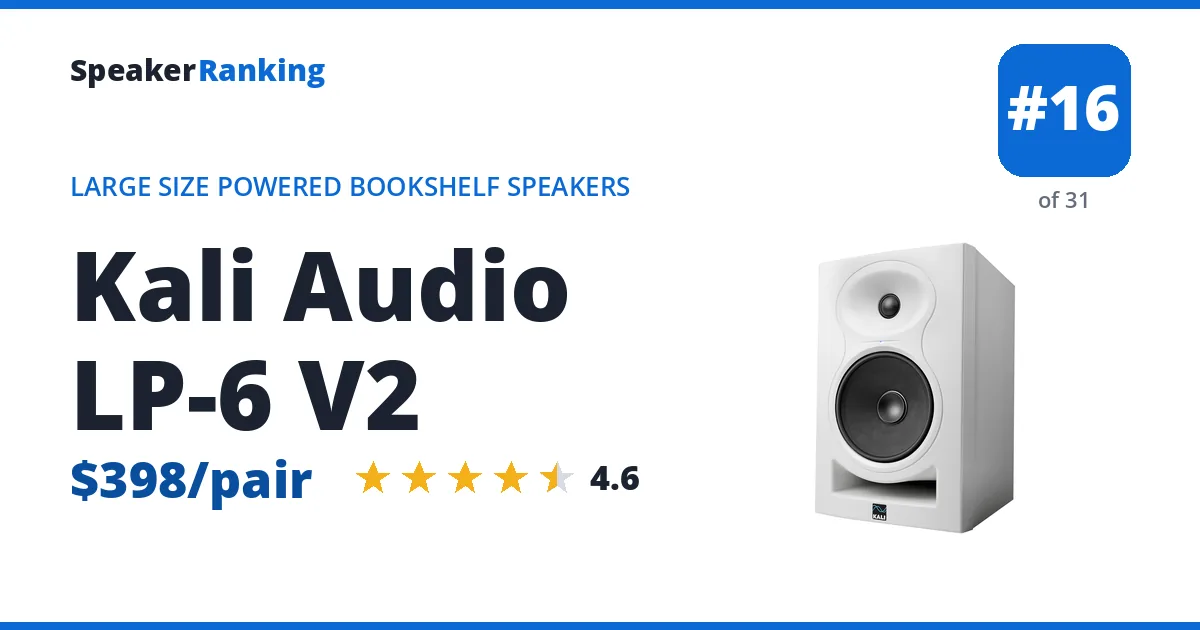
Older model: the Kali Audio LP-6 (ranked lower, rated 4.3/5).
Larger model: the Kali Audio LP-8 V2 (ranked lower, rated 4.1/5).
Pros: Erin’s measurements give a 7.48 ideal-subwoofer score and 42.5Hz -3dB bass extension, a strong combination for an affordable nearfield monitor. The waveguide and placement switches help with practical setup, and the second generation improves close-range noise behavior. Measured bass extension of 42Hz (-3dB).
Cons: The 2.5dB response span from 300Hz to 5kHz leaves some tonal unevenness. Vertical crossover behavior makes ear-height placement important, and compression limits loud bass playback. Its good tonal score is not evidence of the output capability of a much larger monitor.
Full Kali Audio LP-6 V2 review and specifications →
| AES Input | No |
|---|---|
| Amplifier Power | 40W LF + 40W HF per speaker; Bi-amplified Class D |
| Aux Input | No |
| Bass Extension (-10dB) | 39.1Hz (measured, Erin’s Audio Corner) |
| Bass Extension (-3dB) | 42Hz (measured, Erin’s Audio Corner) |
| Bluetooth | No |
| Coaxial Input | No |
| DSP | Yes; boundary presets and LF/HF trims |
| Dimensions | 14.1”H x 8.8”W x 10.2”D |
| Drivers | 1” soft-dome tweeter; 6.5” woofer |
| Frequency Response | 47Hz - 21kHz (±3dB) (Manufacturer specified) |
| HDMI Input | No |
| Inputs | XLR, balanced TRS and RCA |
| Maximum SPL | Approximately 102dB per pair with good measured linearity (Erin’s Audio Corner) (manufacturer specified) |
| Optical Input | No |
| RCA Input | Yes |
| Spinorama Preference Score | 5.53 |
| Spinorama Preference Score with Perfect Sub | 7.48 |
| TRS Input | Yes |
| USB Input | No |
| Weight | 15.5 lbs (7.05 kg) each |
| XLR Input | Yes |
- Links
- Reviews, Comparisons and Sound Samples
- Head-to-Head Comparisons
- Kali Audio LP-6 V2 vs Kali Audio IN-8 V2
- Kali Audio LP-6 V2 vs Yamaha HS8
- Kali Audio LP-6 V2 vs Genelec 8050B
- Kali Audio LP-6 V2 vs O.S. Acoustics DBS8
- Kali Audio LP-6 V2 vs JBL 4305P
- Kali Audio LP-6 V2 vs JBL 308P MKII
- Kali Audio LP-6 V2 vs Devialet Phantom Ultimate 108dB
- Kali Audio LP-6 V2 vs SHIVAUDYO Point Zero
- See all 65 comparisons
Ranked #30 of 79 in Large Size Powered Bookshelf Speakers - Kali Audio IN-8 V2: $998 per pair Amazon eBay
Smaller model: the Kali Audio IN-5 (rated 4.2/5).
Pros: The IN-8 V2’s coaxial midrange/tweeter supports coherent imaging, and low distortion at ordinary levels complements its 7.30 ideal-subwoofer score. Measured -3dB extension of 45.4Hz provides useful bass; boundary settings assist placement. The front port allows placement near a wall without port noise problems. Measured bass extension of 44Hz (-3dB), with a measured sensitivity of 89dB.
Cons: The measured 3.0dB response span from 300Hz to 5kHz includes unevenness that can make some vocals sound forward. Bass and limiter behavior constrain high-level playback. These measurements apply to the V2, not the first-generation IN-8. On-axis, the 4 to 5kHz range sounds forward; Kali recommends about 10° of toe-out, and some EQ helps.
Full Kali Audio IN-8 V2 review and specifications →
| AES Input | No |
|---|---|
| Amplifier Power | 140w Per Speaker |
| App | No |
| Aux Input | No |
| Bass Extension (-10dB) | 36Hz (measured, Erin’s Audio Corner) |
| Bass Extension (-3dB) | 44Hz (measured, Erin’s Audio Corner) |
| Bluetooth | No |
| Coaxial Input | No |
| DSP | No |
| Dimensions | 17.8”H x 10”W x 11.3”D (452.1 x 254 x 287 mm) |
| Drivers | 8” (203mm) woofer |
| EQ | Yes (Room adjustment) |
| Frequency Response | 45Hz - 21kHz (±3dB) (Manufacturer specified) |
| HDMI Input | No |
| Inputs | XLR, RCA |
| Optical Input | No |
| RCA Input | Yes |
| Sensitivity | 89dB (measured at 0.3V/1m, Erin’s Audio Corner) |
| Spinorama Preference Score | 5.36 |
| Spinorama Preference Score with Perfect Sub | 7.30 |
| TRS Input | No |
| USB Input | No |
| Weight | 22.9 lbs (10.4 kg) each |
| XLR Input | Yes |
- Links
- Reviews, Comparisons and Sound Samples
- Head-to-Head Comparisons
- Kali Audio IN-8 V2 vs Genelec 8050B
- Kali Audio IN-8 V2 vs Kali Audio LP-6 V2
- Kali Audio IN-8 V2 vs Yamaha HS8
- Kali Audio IN-8 V2 vs JBL 4305P
- Kali Audio IN-8 V2 vs JBL 308P MKII
- Kali Audio IN-8 V2 vs Focal Solo6 ST6
- Kali Audio IN-8 V2 vs Kali Audio LP-6
- Kali Audio IN-8 V2 vs Genelec S360
- See all 40 comparisons
 Ranked #32 of 79 in Large Size Powered Bookshelf Speakers - JBL 4305P: $1,499.99 per pair Amazon JBL eBay
Pros: The measured 1.5dB response span from 300Hz to 5kHz supports even mids, with a 7.45 ideal-subwoofer score and 45.4Hz -3dB bass extension. Integrated consumer connectivity makes this a more convenient living-room system than many studio monitors. Measured bass extension of 45Hz (-3dB).
Cons: Crossover-region directivity changes mean the narrow on-axis span does not describe every listening angle. Limiting becomes relevant at high output, particularly with bass-heavy music. It suits near- to midfield listening better than the largest high-output systems here. Erin measured about 8dB lost near 50Hz at the highest drive level and reached roughly 93dB unweighted at 2m in-room.
Full JBL 4305P review and specifications →
| AES Input | No |
|---|---|
| Amplifier Power | 300W system: 125W LF + 25W HF per speaker |
| Aux Input | Yes |
| Bass Extension (-10dB) | 40.5Hz (measured, Erin’s Audio Corner) |
| Bass Extension (-3dB) | 45Hz (measured, Erin’s Audio Corner) |
| Bluetooth | Yes, 5.1 |
| Coaxial Input | No |
| Dimensions | 13.2H x 8.3W x 8.8D inches |
| Drivers | 5.25-inch pulp woofer; 1-inch annular compression driver |
| Frequency Response | 45Hz - 25kHz (-6dB) (Manufacturer specified) |
| HDMI Input | No |
| Inputs | XLR/TRS combo, 3.5mm Aux, Optical, USB-B, Ethernet |
| Maximum SPL | ~93dB at 2m in-room before limiting (measured, Erin’s Audio Corner) |
| Optical Input | Yes |
| RCA Input | No |
| Spinorama Preference Score | 5.44 |
| Spinorama Preference Score with Perfect Sub | 7.45 |
| TRS Input | Yes |
| USB Input | Yes |
| Weight | Primary 14.6 lbs (6.6 kg), Secondary 14.1 lbs (6.4 kg) |
| XLR Input | Yes |
- Links
- Reviews, Comparisons and Sound Samples
- Head-to-Head Comparisons
 Ranked #33 of 79 in Large Size Powered Bookshelf Speakers - Devialet Phantom Ultimate 108dB: $7,998 per pair Amazon B&H Photo Video eBay
Pros: Erin’s measurements show full bass output all the way down to about 20Hz, the lowest frequency measured, which is remarkable from a single cabinet about 34cm deep. The listening window is close to flat, with a -0.04dB per octave tilt and 0.80 smoothness, earning a 6.73 preference score on its own and 7.38 with an ideal subwoofer. Directivity is smooth, so room reflections keep the same tonal balance as the direct sound. Wi-Fi 6 streaming with AirPlay 2, Google Cast, Spotify Connect, TIDAL Connect and Roon Ready, plus Ethernet and optical inputs, makes one unit a complete music system. Measured bass extension of <21Hz (-3dB).
Cons: DSP limiting and compression take over near maximum volume, so the deep bass you hear at moderate levels shrinks when you push it; Erin’s 96dB distortion test ran into the limiter. Stereo means buying two units, which puts a pair well above conventional powered monitors that measure as well. There is no analog input or subwoofer output, and the rounded shape does not sit on a shelf or desk stand like a box speaker.
Full Devialet Phantom Ultimate 108dB review and specifications →
| AES Input | No |
|---|---|
| Amplifier Power | 1,100W total |
| App | Yes (Devialet) |
| Aux Input | No |
| Bass Extension (-10dB) | <21Hz (measured, Erin’s Audio Corner) |
| Bass Extension (-3dB) | <21Hz (measured, Erin’s Audio Corner) |
| Bluetooth | Yes (5.3 with SBC, AAC) |
| Bluetooth Codecs | SBC, AAC |
| Coaxial Input | No |
| Dimensions | 10”H x 9.7”W x 13.5”D (255 x 246 x 342 mm) |
| Drivers | Aluminum tweeter, aluminum midrange, two opposed aluminum woofers |
| Frequency Response | 14Hz - 35kHz (Manufacturer specified) |
| HDMI Input | No |
| Inputs | Wi-Fi, Ethernet, Bluetooth, Optical |
| Maximum SPL | 108dB (manufacturer specified) |
| Optical Input | Yes |
| RCA Input | No |
| Spinorama Preference Score | 6.73 |
| Spinorama Preference Score with Perfect Sub | 7.38 |
| Streaming Services | Yes (AirPlay 2, Google Cast, Spotify Connect, TIDAL Connect, Roon Ready, UPnP) |
| Subwoofer Output | No |
| TRS Input | No |
| USB Input | No |
| Weight | 24.5 lbs (11.1 kg) each |
| Wi-Fi | Yes (Wi-Fi 6, dual-band) |
| XLR Input | No |
- Links
- Reviews, Comparisons and Sound Samples
- Head-to-Head Comparisons
- Devialet Phantom Ultimate 108dB vs Kali Audio LP-6 V2
- Devialet Phantom Ultimate 108dB vs O.S. Acoustics DBS8
- Devialet Phantom Ultimate 108dB vs SHIVAUDYO Point Zero
- Devialet Phantom Ultimate 108dB vs Genelec S360
- Devialet Phantom Ultimate 108dB vs PSI Audio A21-M
- Devialet Phantom Ultimate 108dB vs Meyer Sound Amie
- Devialet Phantom Ultimate 108dB vs Pitt & Giblin Flare
 Ranked #36 of 79 in Large Size Powered Bookshelf Speakers - Thomann Swissonic A306: $250 per pair Discontinued Thomann eBay
Pros: With the treble control set to -2dB, Erin measured a 7.29 ideal-subwoofer score and 43.9Hz -3dB bass extension. This is a useful affordable monitoring option when carefully set up, with onboard controls for basic tonal adjustment. Measured bass extension of 43Hz (-3dB), with a measured sensitivity of 89.9dB.
Cons: The published result is not the flat-control setting: it specifically uses -2dB treble. Even then, the response spans 2.8dB from 300Hz to 5kHz, so balance is not as even as the leaders. Bass output and vertical listening position remain practical limitations. Discontinued.
Full Thomann Swissonic A306 review and specifications →
| AES Input | No |
|---|---|
| Amplifier Power | 100W bi-amplified total (50W + 50W, Class D) |
| Aux Input | No |
| Bass Extension (-10dB) | 34Hz (measured, Erin’s Audio Corner) |
| Bass Extension (-3dB) | 43Hz (measured, Erin’s Audio Corner) |
| Bluetooth | No |
| Coaxial Input | No |
| Crossover Frequency | 2600Hz |
| DSP | Yes (rear-panel treble/bass trim, wall/near-wall placement switches) |
| Dimensions | 8.8”W x 14.2”H x 11.1”D (224 x 361 x 282 mm) |
| Drivers | 6.5” woofer, 1” silk dome tweeter with waveguide |
| Frequency Response | 43Hz - 20kHz (manufacturer specified) |
| HDMI Input | No |
| Inputs | XLR (balanced), RCA (unbalanced) |
| Optical Input | No |
| RCA Input | Yes |
| Sensitivity | 89.9dB (measured at 0.3V/1m, Erin’s Audio Corner) |
| Spinorama Preference Score | 5.41 |
| Spinorama Preference Score with Perfect Sub | 7.29 |
| TRS Input | No |
| USB Input | No |
| Weight | 13.6 lbs (6.17 kg) each |
| XLR Input | Yes |
- Links
- Reviews, Comparisons and Sound Samples
- Head-to-Head Comparisons
- Thomann Swissonic A306 vs Kali Audio LP-6 V2
- Thomann Swissonic A306 vs Yamaha HS8
- Thomann Swissonic A306 vs SHIVAUDYO Point Zero
- Thomann Swissonic A306 vs JBL 4329P
- Thomann Swissonic A306 vs Kali Audio LP-8 V2
- Thomann Swissonic A306 vs M-Audio BX8 D3
- Thomann Swissonic A306 vs Focal Alpha 65 EVO
- Thomann Swissonic A306 vs Adam Audio T8V
- See all 12 comparisons
Ranked #40 of 79 in Large Size Powered Bookshelf Speakers - JBL M2 Master Reference Monitor: $15,000 per pair JBL Professional Dealer Locator eBay
Pros: A high-output specialist: Erin’s low-distortion and compression tests support considerable dynamic capability, beyond what a single preference score captures. Measured -3dB extension is 33.7Hz. The large woofer and waveguide are particularly useful for greater listening distances. Measured bass extension of 34Hz (-3dB).
Cons: Its 4.1dB response span from 300Hz to 5kHz and 6.58 ideal-subwoofer score do not support a top tonal-accuracy ranking. It requires the correct external amplification and DSP rather than a simple built-in amplifier. The very large cabinet, installation cost and possible amplifier fan noise make it impractical for most desks.
Full JBL M2 Master Reference Monitor review and specifications →
| AES Input | No |
|---|---|
| Amplifier Power | External two-channel amplification and JBL DSP tuning required |
| Aux Input | No |
| Bass Extension (-10dB) | 21.0Hz (measured, Erin’s Audio Corner) |
| Bass Extension (-3dB) | 34Hz (measured, Erin’s Audio Corner) |
| Bluetooth | No |
| Coaxial Input | No |
| Crossover Frequency | 800Hz active DSP |
| Dimensions | 49.4”H x 20”W x 14”D (1256 x 508 x 355.6 mm) |
| Drivers | 15” 2216Nd woofer; D2 compression driver in Image Control Waveguide |
| Frequency Response | 20Hz - 40kHz (±3dB) (Manufacturer specified) |
| HDMI Input | No |
| Inputs | None (passive cabinet driven by a matched Crown amplifier via speaker-level connection) |
| Maximum SPL | 123dB manufacturer specified |
| Optical Input | No |
| RCA Input | No |
| Spinorama Preference Score | 5.74 |
| Spinorama Preference Score with Perfect Sub | 6.58 |
| TRS Input | No |
| USB Input | No |
| Weight | 130.1 lbs (59 kg) each |
| XLR Input | No |
- Links
- Reviews, Comparisons and Sound Samples
- Head-to-Head Comparisons
- JBL M2 Master Reference Monitor vs Genelec 8040B
- JBL M2 Master Reference Monitor vs JBL 708P
- JBL M2 Master Reference Monitor vs Klipsch The Nines
- JBL M2 Master Reference Monitor vs JBL 4305P
- JBL M2 Master Reference Monitor vs Genelec 8050B
- JBL M2 Master Reference Monitor vs Kali Audio IN-8 V2
- JBL M2 Master Reference Monitor vs JBL 4329P
- JBL M2 Master Reference Monitor vs Kali Audio LP-6 V2
- See all 24 comparisons
 Ranked #42 of 79 in Large Size Powered Bookshelf Speakers - Palmer Orbit 11: $1,532 per pair Thomann eBay
Pros: A 27.8Hz measured -3dB point provides genuinely deep standalone bass. The 1.8dB response span from 300Hz to 5kHz supports even mids, and the coaxial arrangement offers a compact acoustic source for nearfield listening. A cardioid front baffle reduces rear and side room reflections. Measured bass extension of 27.8Hz (-3dB).
Cons: Its 7.10 ideal-subwoofer score is more modest than the narrow midrange span alone suggests; response outside that band and off-axis behavior also matter. Deep-bass extension does not prove high-level headroom. Studio-oriented connections and setup are less convenient than an all-in-one consumer pair. It has XLR analog and AES3 digital connections only, with no RCA or TRS.
Full Palmer Orbit 11 review and specifications →
| AES Input | Yes |
|---|---|
| Amplifier Power | 1000W peak / 400W RMS total; Tri-amped Class D |
| Aux Input | No |
| Bass Extension (-10dB) | 21.5Hz (measured, spinorama.org) |
| Bass Extension (-3dB) | 27.8Hz (measured, spinorama.org) |
| Bluetooth | No |
| Coaxial Input | No |
| Dimensions | 8.5” x 11.5” x 11.5” (217 x 293 x 292 mm) each |
| Drivers | 1” tweeter + 6.5” midrange (coaxial), 2x 8” woofers |
| Frequency Response | 28Hz - 28kHz (-3dB) (Manufacturer specified) |
| HDMI Input | No |
| Inputs | XLR (balanced analog), AES3 (digital, via XLR) |
| Maximum SPL | 116dB peak at 1m |
| Optical Input | No |
| RCA Input | No |
| Spinorama Preference Score | 6.20 |
| Spinorama Preference Score with Perfect Sub | 7.10 |
| TRS Input | No |
| USB Input | No |
| Weight | 30.6 lbs (13.9 kg) each |
| XLR Input | Yes |
- Links
- Reviews, Comparisons and Sound Samples
- Head-to-Head Comparisons
- Palmer Orbit 11 vs Focal Trio6 ST6
- Palmer Orbit 11 vs Kali Audio IN-8 V2
- Palmer Orbit 11 vs Cambridge Audio L/R X
- Palmer Orbit 11 vs Kali Audio LP-6 V2
- Palmer Orbit 11 vs Yamaha HS8
- Palmer Orbit 11 vs Focal Alpha 65 EVO
- Palmer Orbit 11 vs JBL 308P MKII
- Palmer Orbit 11 vs Adam Audio A7V
- See all 20 comparisons
 Ranked #45 of 79 in Large Size Powered Bookshelf Speakers - JBL 708P: $4000 per pair B&H Photo Video eBay
Pros: Erin’s measurements give 43.9Hz -3dB extension and a 6.91 ideal-subwoofer score, with useful bass from a professional active monitor. The waveguide and onboard processing make it a practical choice for a carefully installed studio system. Measured bass extension of 43.9Hz (-3dB).
Cons: The 2.6dB response span from 300Hz to 5kHz includes audible-relevance irregularities, with port-region features and vertical crossover sensitivity. High-level distortion remains a constraint. Its professional positioning and amplifier power do not make it automatically more neutral than the cheaper 308P MKII. A port resonance adds a mild rise around 600 to 900Hz, and vertical dispersion is narrower than horizontal, so stay within a few degrees of the tweeter axis.
Full JBL 708P review and specifications →
| AES Input | Yes |
|---|---|
| Amplifier Power | 500W total (250W woofer, 250W tweeter) |
| App | No |
| Aux Input | No |
| Bass Extension (-10dB) | 35.6Hz (derived, log-interpolated between spinorama.org -9dB/-12dB points) |
| Bass Extension (-3dB) | 43.9Hz (measured, Erin’s Audio Corner) |
| Bluetooth | No |
| Coaxial Input | No |
| DSP | No |
| Dimensions | 17.2”H x 9.8”W x 11.5”D (438 x 248 x 292 mm) |
| Drivers | 8” woofer, 2409H 1” compression driver |
| EQ | No |
| Frequency Response | 41Hz - 25kHz (+/-3dB) (Manufacturer specified) |
| HDMI Input | No |
| Inputs | XLR/TRS combo (analog), XLR AES3 (digital) |
| Optical Input | No |
| RCA Input | No |
| Spinorama Preference Score | 5.03 |
| Spinorama Preference Score with Perfect Sub | 6.91 |
| TRS Input | Yes |
| USB Input | No |
| Weight | 25.1 lbs (11.4 kg) each |
| XLR Input | Yes |
- Links
- Reviews, Comparisons and Sound Samples
- Head-to-Head Comparisons
 Ranked #46 of 79 in Large Size Powered Bookshelf Speakers - Klipsch The Nines: $999.99 per pair Crutchfield eBay
Newer model: the Klipsch The Nines II, ranked higher, estimated 4.3/5.
Smaller models: the Klipsch The Sevens (ranked lower, rated 3.7/5) and the Klipsch The Fives (rated 4.3/5).
Pros: The 1.7dB response span from 300Hz to 5kHz supports even mids, and measured -3dB extension is 42.5Hz. Extensive consumer connections and app adjustment make it convenient for TV and music, while the horn provides a focused listening presentation. Erin called it his favorite Klipsch speaker. Measured bass extension of 42.5Hz (-3dB), with a measured sensitivity of 82.5dB.
Cons: The 6.90 ideal-subwoofer score reflects limitations beyond the narrow midband span. Horizontal coverage is relatively focused, so placement matters for multiple seats. The reviewer preferred reduced treble, and bass limiting at higher playback levels means the large woofer is not a guarantee of unlimited output. The app’s flat setting leaves treble elevated; Erin preferred a -2dB tweeter trim.
Full Klipsch The Nines review and specifications →
| AES Input | No |
|---|---|
| Amplifier Power | 240W total (480W peak; 100W LF + 20W HF per powered speaker) |
| App | Klipsch Connect (bass/mid/treble EQ) |
| Aux Input | Yes |
| Bass Extension (-10dB) | 31Hz (measured, Erin’s Audio Corner) |
| Bass Extension (-3dB) | 42.5Hz (measured, Erin’s Audio Corner) |
| Bluetooth | Yes, 5.0 |
| Bluetooth Codecs | SBC, AAC, aptX, aptX HD |
| Coaxial Input | No |
| Dimensions | 19.13”H x 9.5”W x 13.38”D |
| Drivers | 8” high-excursion fiber-composite woofer, 1” titanium LTS vented tweeter with Tractrix horn |
| Frequency Response | 34Hz - 25kHz +/-3dB (manufacturer specified) |
| HDMI Input | Yes |
| Inputs | HDMI ARC, Bluetooth 5.0, phono/line RCA, 3.5mm, USB, optical |
| Maximum SPL | 115dB at 1m (stereo pair, manufacturer specified) |
| Optical Input | Yes |
| Outputs | Subwoofer |
| RCA Input | Yes |
| Sensitivity | 82.5dB (measured at 0.30V/1m, Erin’s Audio Corner) |
| Spinorama Preference Score | 5.32 |
| Spinorama Preference Score with Perfect Sub | 6.90 |
| Subwoofer Output | Yes |
| TRS Input | No |
| USB Input | Yes |
| Weight | 28.4 lbs (12.9 kg) primary, 26.9 lbs (12.2 kg) secondary |
| Woofer Cabinet | rear-ported bass reflex |
| XLR Input | No |
- Links
- Reviews, Comparisons and Sound Samples
- Head-to-Head Comparisons
- Klipsch The Nines vs JBL 306P MKII
- Klipsch The Nines vs JBL 708P
- Klipsch The Nines vs JBL 4329P
- Klipsch The Nines vs JBL M2 Master Reference Monitor
- Klipsch The Nines vs APS Klasik 2020
- Klipsch The Nines vs Genelec 8040B
- Klipsch The Nines vs Kali Audio LP-6
- Klipsch The Nines vs Emotiva Airmotiv 6s
- See all 34 comparisons
 Ranked #49 of 79 in Large Size Powered Bookshelf Speakers - Fluid Audio Image 2: $3,798 per pair Fluid Audio eBay
Pros: Measured -3dB extension of 38.1Hz gives useful bass reach, while a 2.5dB response span from 300Hz to 5kHz supports broadly balanced mids. The active multiway design and DSP tools offer flexibility for a studio installation.
Cons: The 6.80 ideal-subwoofer score places its measured native tonality below the leading monitors. DSP flexibility should not be confused with verified accuracy before adjustment. Full-range headroom, room integration and cabinet placement still need attention in a demanding monitoring system.
Full Fluid Audio Image 2 review and specifications →
| AES Input | Yes |
|---|---|
| Amplifier Power | 675W each |
| Aux Input | No |
| Bluetooth | No |
| Coaxial Input | Yes |
| Dimensions | 14.3H x 9.5W x 13.8D in |
| Drivers | AMT tweeter, 5-inch midrange, dual opposed 8-inch woofers |
| Enclosure | Active sealed 3-way |
| Frequency Response | 40Hz-27kHz +/-2.2dB |
| HDMI Input | No |
| Inputs | XLR/TRS, AES/EBU, SPDIF |
| Maximum SPL | 112dB each |
| Optical Input | No |
| RCA Input | No |
| Spinorama Preference Score | 5.22 |
| Spinorama Preference Score with Perfect Sub | 6.80 |
| TRS Input | Yes |
| USB Input | No |
| Weight | 28.4 lbs (12.9 kg) each |
| XLR Input | Yes |
- Links
- Reviews, Comparisons and Sound Samples
- Head-to-Head Comparisons
- Fluid Audio Image 2 vs Barefoot Footprint 01
- Fluid Audio Image 2 vs Sigberg Audio Manta
- Fluid Audio Image 2 vs JBL 4329P
- Fluid Audio Image 2 vs JBL 708P
- Fluid Audio Image 2 vs Dynaudio Core 47
- Fluid Audio Image 2 vs Cambridge Audio L/R X
- Fluid Audio Image 2 vs Adam Audio A7V
- Fluid Audio Image 2 vs Genelec 8040B
- See all 11 comparisons
 Ranked #51 of 79 in Large Size Powered Bookshelf Speakers - JBL 4329P: $4,500 per pair Discontinued eBay
Pros: Measured -3dB extension of 32.2Hz provides deeper native bass than the smaller 4305P. Integrated amplification and streaming make it convenient for a full-range living-room system, and its larger format is useful when scale matters. Measured bass extension of 31Hz (-3dB), with a measured sensitivity of 102.2dB.
Cons: The measured 4.5dB response span from 300Hz to 5kHz includes a notable midrange dip, so it is not as neutral as its size and price might suggest. Its 6.72 ideal-subwoofer score trails the 4305P. There is no HDMI connection for the simplest TV hookup. Discontinued.
Full JBL 4329P review and specifications →
| AES Input | No |
|---|---|
| Amplifier Power | 300W RMS per speaker (600W total system power) |
| Aux Input | Yes |
| Bass Extension (-10dB) | 27Hz (measured, Erin’s Audio Corner) |
| Bass Extension (-3dB) | 31Hz (measured, Erin’s Audio Corner) |
| Bluetooth | Yes, 5.3 |
| Bluetooth Codecs | SBC, aptX Adaptive |
| Coaxial Input | No |
| Dimensions | 20.3”H x 12.6”W x 12.7”D |
| Drivers | 8” midwoofer, 1” compression driver with JBL High-Definition Imaging horn |
| Frequency Response | 30Hz - 20kHz (anechoic, manufacturer specified) |
| HDMI Input | No |
| Inputs | USB, Optical, Bluetooth, Analog, 3.5mm, AirPlay 2 |
| Optical Input | Yes |
| RCA Input | No |
| Sensitivity | 102.2dB (measured at 0.3V/1m, Erin’s Audio Corner) |
| Spinorama Preference Score | 5.40 |
| Spinorama Preference Score with Perfect Sub | 6.72 |
| TRS Input | No |
| USB Input | Yes |
| Weight | 34.4 lbs (15.6 kg) (primary), 34.4 lbs (15.6 kg) (secondary) |
| Woofer Cabinet | ported |
| XLR Input | No |
- Links
- Reviews, Comparisons and Sound Samples
- Head-to-Head Comparisons
 Ranked #52 of 79 in Large Size Powered Bookshelf Speakers - Kali Audio LP-8 V2: $598 per pair Amazon eBay
Older model: the Kali Audio LP-8 (ranked lower, rated 3.9/5).
Smaller model: the Kali Audio LP-6 V2 (ranked higher, rated 4.4/5).
Pros: Erin measured 39.6Hz -3dB extension, useful for music without a subwoofer. Placement switches and the waveguide assist nearfield setup, with second-generation noise improvements making it more practical at a desk.
Cons: The 3.8dB response span from 300Hz to 5kHz and 6.68 ideal-subwoofer score show less even tonality than the smaller LP-6 V2. A larger woofer brings bandwidth and output tradeoffs, not automatically greater accuracy. Vertical placement and bass demands still matter.
Full Kali Audio LP-8 V2 review and specifications →
| AES Input | No |
|---|---|
| Amplifier Power | 100W total, bi-amped (60W LF, 40W HF) |
| Aux Input | No |
| Bluetooth | No |
| Coaxial Input | No |
| Country | United States (design) |
| Dimensions | 16.5”H x 10”W x 11.3”D (419 x 254 x 286 mm) |
| Drivers | 1” soft dome tweeter, 8” woofer |
| Enclosure | 2-way active, ported |
| Frequency Response | 37Hz - 25kHz (-10dB) (Manufacturer specified) |
| HDMI Input | No |
| Inputs | XLR, TRS, RCA |
| Optical Input | No |
| RCA Input | Yes |
| Spinorama Preference Score | 4.94 |
| Spinorama Preference Score with Perfect Sub | 6.68 |
| TRS Input | Yes |
| USB Input | No |
| Weight | 19.8 lbs (9 kg) each |
| XLR Input | Yes |
- Links
- Reviews, Comparisons and Sound Samples
- Head-to-Head Comparisons
- Kali Audio LP-8 V2 vs Dynaudio Core 47
- Kali Audio LP-8 V2 vs JBL 4329P
- Kali Audio LP-8 V2 vs KRK Rokit 8 G5
- Kali Audio LP-8 V2 vs JBL 306P MKII
- Kali Audio LP-8 V2 vs M-Audio BX8 D3
- Kali Audio LP-8 V2 vs Thomann Swissonic A306
- Kali Audio LP-8 V2 vs Presonus Eris Studio 8
- Kali Audio LP-8 V2 vs Kali Audio IN-8 V2
- See all 9 comparisons
 Ranked #54 of 79 in Large Size Powered Bookshelf Speakers - Cambridge Audio L/R X: $2,399.00 per pair Amazon eBay
Pros: A 2.5-way active design with a 28mm aluminum tweeter, a front-facing 5-inch mid-woofer, a second 5-inch woofer at the base whose passband overlaps the first (the source of the “.5”), and dual 6-inch side-firing passive radiators per speaker. Erin’s Audio Corner measured wide, even horizontal dispersion (a broad flare out to about the -6dB point around 1.5 to 3kHz) and deeper extension than the smaller L/R S, with an F3 of about 43Hz and F10 of about 37Hz. In-app DSP for room size, speaker distance from the front wall, and reflective surface type gave an audible change in bass tightness in testing. Connectivity covers HDMI eARC, RCA aux, a moving-magnet phono input, optical digital, USB-C, USB-A, Wi-Fi streaming, and a subwoofer output, making it a full living-room hub rather than just a stereo pair. Measured bass extension of 43Hz (-3dB).
Cons: On-axis response is less linear than the L/R S, with dips in the bass, a peak around 1-2kHz, and a dip spanning the upper mid-range into the lower treble; Cambridge confirmed the dip is a deliberate DSP notch for a tweeter breakup resonance rather than a driver flaw, but it was audible as a mild suck-out in an AB pink-noise comparison. Vertical dispersion is narrower and asymmetric than the L/R S, at about plus 20 to minus 10 degrees, because the greater distance between the tweeter and mid-woofer creates more lobing, so listening height and stand placement matter more. Multitone distortion rides close to the 3% threshold at 96dB measured at 1 meter in the far field, limiting headroom for loud, wide-band material. Output falls off quickly below about 50Hz, so home-theater use with deep bass content benefits from an added subwoofer.
Full Cambridge Audio L/R X review and specifications →
| AES Input | No |
|---|---|
| Amplifier Power | 800W total (400W per speaker) |
| App | Yes |
| Aux Input | No |
| Bass Extension (-10dB) | 37Hz (measured, Erin’s Audio Corner) |
| Bass Extension (-3dB) | 43Hz (measured, Erin’s Audio Corner) |
| Bluetooth | Yes |
| Bluetooth Codecs | SBC, AAC |
| Coaxial Input | No |
| DSP | Yes, room size, wall distance, and reflective surface correction |
| Dimensions | 7.9” (200 mm) W x 330mm H x 260mm D (each) |
| Drivers | 28mm aluminum tweeter, 2x 5” mid-woofers, 2x 6” side-firing passive radiators |
| Frequency Response | 35Hz - 24kHz (±3dB, manufacturer specified) |
| HDMI Input | Yes |
| Inputs | HDMI eARC, RCA aux, RCA phono (MM), optical digital, USB-C, USB-A, Ethernet, Wi-Fi |
| Optical Input | Yes |
| Outputs | Subwoofer |
| RCA Input | Yes |
| Subwoofer Output | Yes |
| TRS Input | No |
| USB Input | Yes |
| Weight | 22.9 lbs (10.4kg) each |
| XLR Input | No |
- Links
- Reviews, Comparisons and Sound Samples
- Head-to-Head Comparisons
- Cambridge Audio L/R X vs Dynaudio Core 47
- Cambridge Audio L/R X vs JBL 4329P
- Cambridge Audio L/R X vs Focal Alpha 65 EVO
- Cambridge Audio L/R X vs Barefoot Footprint 01
- Cambridge Audio L/R X vs Adam Audio A7V
- Cambridge Audio L/R X vs Fluid Audio Image 2
- Cambridge Audio L/R X vs Adam Audio T8V
- Cambridge Audio L/R X vs Adam Audio T7V
- See all 24 comparisons
 Ranked #69 of 79 in Large Size Powered Bookshelf Speakers - Klipsch The Sevens II: $1,929.00 per pair Estimated Amazon eBay
Older model: the Klipsch The Sevens (ranked lower, rated 3.7/5).
Smaller model: the Klipsch The Fives II (estimated 4.3/5).
Larger model: the Klipsch The Nines II (ranked higher, estimated 4.3/5).
Pros: A 6.5-inch Cerametallic woofer and a 1-inch titanium tweeter in Klipsch’s Tractrix horn, with 200W of amplification per side. It adds far more than the original Sevens: HDMI 2.1 eARC with Dolby Atmos decoding, Wi-Fi streaming with Google Cast, AirPlay 2, Spotify, Tidal and Qobuz Connect and Roon Ready, Dirac Live room correction, a phono stage, and RCA, USB-C, optical and coaxial inputs plus Bluetooth. Klipsch rates it at 39Hz to 25kHz.
Cons: Erin’s Audio Corner has reviewed it, but the measurements the other speakers here are ranked on aren’t available yet, so it can’t be placed against them or against the original Sevens. At about $1,900 to $2,000 a pair it costs roughly twice as much as the original.
Full Klipsch The Sevens II review and specifications →
| Amplifier Power | 200W per speaker |
|---|---|
| App | Yes |
| Bluetooth | Yes |
| Coaxial Input | Yes |
| Dolby Atmos | Yes |
| Drivers | 1” titanium tweeter with Tractrix horn, 6.5” Cerametallic woofer |
| EQ | Yes (Dirac Live room correction) |
| Frequency Response | 39Hz - 25kHz (Manufacturer specified) |
| HDMI Input | Yes (HDMI 2.1 eARC) |
| Inputs | HDMI eARC, RCA (phono), USB-C, Optical, Coaxial, Bluetooth, Wi-Fi |
| Optical Input | Yes |
| RCA Input | Yes (switchable phono preamp) |
| USB Input | Yes (USB-C) |
| Wi-Fi | Yes (Google Cast, AirPlay 2, Spotify Connect, Tidal Connect, Qobuz Connect, Roon Ready) |
| XLR Input | No |
- Links
- Reviews, Comparisons and Sound Samples
- Head-to-Head Comparisons
 Ranked #72 of 79 in Large Size Powered Bookshelf Speakers - Focal Twin6 Be: $4,400 per pair Amazon eBay
Pros: The dual-woofer arrangement offers useful output capability for studio work, with a 48.3Hz measured -3dB point in the horizontal test. Its professional controls and format can suit a dedicated monitoring installation. Measured bass extension of 48.3Hz (-3dB).
Cons: The horizontal measurement scores 6.06 with an ideal subwoofer and spans 2.9dB from 300Hz to 5kHz. Off-axis variation limits tonal consistency across listening positions. Orientation matters, and neither the beryllium tweeter nor the additional woofer makes its measured balance class-leading. Erin suspected intermodulation-related roughness even though harmonic distortion measured low.
Full Focal Twin6 Be review and specifications →
| AES Input | No |
|---|---|
| Amplifier Power | 150W LF + 100W LF/MF + 100W HF |
| Aux Input | No |
| Bass Extension | 40Hz manufacturer specified; Erin measured strong low-frequency linearity |
| Bass Extension (-10dB) | 39.1Hz (measured, Erin’s Audio Corner) |
| Bass Extension (-3dB) | 48.3Hz (measured, Erin’s Audio Corner) |
| Bluetooth | No |
| Coaxial Input | No |
| Dimensions | 9.8” x 19.7” x 13.4” (250 x 500 x 340 mm) (H x W x D) |
| Drivers | 1” inverted beryllium tweeter; dual 6.5” W-cone drivers |
| Frequency Response | 40Hz - 40kHz (±3dB) (Manufacturer specified) |
| HDMI Input | No |
| Inputs | Balanced XLR with +4dBu/-10dBV sensitivity |
| Optical Input | No |
| RCA Input | No |
| Spinorama Preference Score | 4.04 |
| Spinorama Preference Score with Perfect Sub | 6.06 |
| TRS Input | No |
| USB Input | No |
| Weight | 48.5 lbs (22 kg) |
| XLR Input | Yes |
- Links
- Reviews, Comparisons and Sound Samples
- Head-to-Head Comparisons
- Focal Twin6 Be vs Edifier R2850DB
- Focal Twin6 Be vs Ex Machina Pulsar MKII
- Focal Twin6 Be vs Klipsch The Sevens
- Focal Twin6 Be vs PMC result6
- Focal Twin6 Be vs Ocean Way Audio HR5
- Focal Twin6 Be vs Kali Audio LP-8
- Focal Twin6 Be vs Adam Audio T7V
- Focal Twin6 Be vs Adam Audio T8V
- See all 36 comparisons
 Ranked #75 of 79 in Large Size Powered Bookshelf Speakers - Klipsch The Sevens: $999.99 per pair Amazon eBay

Newer model: the Klipsch The Sevens II, ranked higher, estimated 3.8/5.
Smaller model: the Klipsch The Fives (rated 4.3/5).
Larger model: the Klipsch The Nines (ranked higher, rated 4.2/5).
Pros: Erin reported 49Hz -3dB extension, with useful bass for ordinary music listening. HDMI, phono, USB, optical and Bluetooth connections make the system convenient for TV and music, while app controls and a subwoofer output provide adjustment options. Bass reaches about 36Hz at -10dB, delivering a controlled thump near 40Hz in-room without strain. Measured bass extension of 49Hz (-3dB).
Cons: The review found a recessed 2-4kHz region and upper-treble emphasis, producing a scooped balance that a simple treble reduction did not fully fix. Relatively narrow horizontal coverage limits consistency across seats.
Full Klipsch The Sevens review and specifications →
| AES Input | No |
|---|---|
| Amplifier Power | 200W total (400W peak) |
| App | Yes (treble/mid/bass EQ, subwoofer output, dynamic bass mode) |
| Aux Input | Yes |
| Bass Extension (-10dB) | 36Hz (measured, Erin’s Audio Corner) |
| Bass Extension (-3dB) | 49Hz (measured, Erin’s Audio Corner) |
| Bluetooth | Yes, 5.0 |
| Bluetooth Codecs | SBC, AAC, aptX, aptX HD |
| Coaxial Input | No |
| Dimensions | 16.375”H x 8.125”W x 13.1875”D |
| Drivers | 6.5” high-excursion woofer, 1” titanium tweeter on Tractrix horn |
| Frequency Response | 39Hz - 25kHz (+/-3dB) (Manufacturer specified) |
| HDMI Input | Yes |
| Inputs | HDMI, Phono, 3.5mm, USB, Optical, Bluetooth |
| Optical Input | Yes |
| Outputs | Subwoofer |
| RCA Input | No |
| Subwoofer Output | Yes |
| TRS Input | No |
| USB Input | Yes |
| Weight | 22.3 lbs (10.1 kg) (primary), 19.8 lbs (9 kg) (secondary) |
| Woofer Cabinet | ported, rear flared port |
| XLR Input | No |
- Links
- Reviews, Comparisons and Sound Samples
- Head-to-Head Comparisons
- Klipsch The Sevens vs EVE Audio SC305
- Klipsch The Sevens vs Focal Twin6 Be
- Klipsch The Sevens vs Edifier R2850DB
- Klipsch The Sevens vs Edifier S3000Pro
- Klipsch The Sevens vs Klipsch The Sevens II
- Klipsch The Sevens vs Presonus Eris Studio 8
- Klipsch The Sevens vs Kali Audio LP-8
- Klipsch The Sevens vs Adam Audio T7V
- See all 37 comparisons
Large Size Powered Floorstanding Speakers
 Ranked #1 of 9 in Large Size Powered Floorstanding Speakers - Genelec 8381A: $64,000 per pair Estimated B&H Photo Video eBay
Pros: Genelec’s flagship main monitor: each speaker combines three 15” woofers, four 5” midrange drivers and a coaxial 5” midrange with 1” tweeter, specified at ±1.5dB from 20Hz to 35kHz, so it reaches the bottom of the audible range with no subwoofer. It is specified at 126dB short-term output from 5,426W of Class D amplification. GLM room calibration, analog XLR and AES/EBU digital inputs are included.
Cons: Only listening reviews have been published, so its tonal balance and directivity can’t be compared with ranked speakers. Each speaker is 1.46m tall and weighs 162kg, and the amplifiers live in a separate 3U rack, so it only suits a large dedicated room.
Full Genelec 8381A review and specifications →
| AES Input | Yes |
|---|---|
| Amplifier Power | 5426W Class D (external 3U rack amplifiers) |
| App | Yes (GLM) |
| Aux Input | No |
| Bluetooth | No |
| Coaxial Input | No |
| DSP | Yes |
| Dimensions | 57.4”H x 19.7”W x 27.3”D (1458 x 500 x 694 mm) |
| Drivers | 3x 15” (380mm) woofers, 4x 5” (125mm) midrange, 5” (125mm) coaxial midrange with 1” (25mm) coaxial tweeter |
| EQ | Yes (via GLM software) |
| Frequency Response | 20Hz - 35kHz (±1.5dB) (Manufacturer specified) |
| HDMI Input | No |
| Inputs | XLR, AES/EBU |
| Maximum SPL | 126dB @ 1m (manufacturer specified) |
| Optical Input | No |
| RCA Input | No |
| TRS Input | No |
| USB Input | No |
| Weight | 357.1 lbs (162 kg) each |
| XLR Input | Yes |
- Links
- Reviews, Comparisons and Sound Samples
- Head-to-Head Comparisons
Ranked #2 of 9 in Large Size Powered Floorstanding Speakers - KEF LS60: $5,999.99 per pair Crutchfield eBay
Pros: Erin’s on-axis measurement combines a 1.9dB response span from 300Hz to 5kHz with a 7.91 ideal-subwoofer preference score, supporting even vocal and instrumental balance. Extended-mode bass reaches roughly 25Hz at -3dB. The coaxial Uni-Q arrangement maintains unusually consistent tonality across listening positions, while HDMI, digital and analog inputs plus network streaming make this a convenient complete music and TV system. Measured bass extension of 23Hz (-3dB), with a measured sensitivity of 97.7dB.
Cons: A diffraction dip around 9kHz can soften cymbal shimmer when aimed directly at the listener; 10-20 degrees of toe-out helps. DSP limiting reduces bass reach and dynamic output at high volume, so its deep low-level extension is not a promise of the same performance on loud peaks. App placement and tone controls are less flexible than parametric room correction. Each roughly 31kg tower is awkward to move.
Full KEF LS60 review and specifications →
| AES Input | No |
|---|---|
| Amplifier Power | 700W (500W LF Class D + 100W MF Class D + 100W HF Class AB) |
| App | Yes (KEF Connect) |
| Aux Input | No |
| Bass Extension (-10dB) | <20Hz (measured, Erin’s Audio Corner) |
| Bass Extension (-3dB) | 23Hz (measured, Erin’s Audio Corner) |
| Bluetooth | Yes (5.0 with SBC, AAC) |
| Bluetooth Codecs | SBC, AAC |
| Coaxial Input | Yes |
| DSP | Yes (Music Integrity Engine) |
| Dimensions | 42.9”H x 8.3”W x 15.5”D (1089.7 x 210.8 x 393.7 mm) |
| Drivers | 4 x 135 mm (5.25 in.) Uni-Core Force Cancelling Driver: woofers, 100 mm (4in.) aluminium cone midrange, 19 mm (0.75 in.) vented aluminium dome with Metamaterial Absorption Technology tweeter |
| EQ | Yes (Normal and Expert modes, room adaptation) |
| Frequency Response | 31Hz - 24kHz (±3dB) (Manufacturer specified) |
| HDMI Input | Yes |
| Inputs | Wifi, Optical, Digital coaxial, RCA, HDMI eARC, Ethernet |
| Maximum SPL | 111dB @ 1m (pink noise) (manufacturer specified) |
| Optical Input | Yes |
| Outputs | Subwoofer RCA |
| RCA Input | Yes |
| Sensitivity | 97.7dB (measured at 0.3V/1m, Erin’s Audio Corner) |
| Spinorama Preference Score | 7.26 |
| Spinorama Preference Score with Perfect Sub | 7.91 |
| Streaming Services | Yes (AirPlay 2, Chromecast, Roon Ready, Spotify Connect, Tidal Connect, Amazon Music, Qobuz, Deezer) |
| Subwoofer Output | Yes |
| TRS Input | No |
| USB Input | No |
| Weight | 69 lbs (31.3 kg) each |
| Wi-Fi | Yes (dual-band) |
| XLR Input | No |
- Links
- Reviews, Comparisons and Sound Samples
- Head-to-Head Comparisons
 Ranked #7 of 9 in Large Size Powered Floorstanding Speakers - Buchardt A700: $6,600 per pair Buchardt Audio eBay
Pros: The standard tuning measures a 1.8dB response span from 300Hz to 5kHz and scores 7.72 with an ideal subwoofer. Low midrange multitone distortion supports clean reproduction at ordinary listening levels. Selectable Master Tunings include cardioid operation for near-wall placement, while an optional Platin hub adds streaming and useful room and manual EQ. Measured bass extension of 51Hz (-3dB).
Cons: Standard-mode bass crosses -3dB around 51Hz but continues to -6dB around 26Hz; it is not flat to the deepest advertised frequencies. Cardioid tuning changes that balance and bass reach substantially. The roughly +/-50-degree horizontal presentation is more focused than wider-radiating alternatives, and vertical listening height needs care. DSP limiting constrains loud full-range playback; a subwoofer with high-pass filtering can improve headroom.
Full Buchardt A700 review and specifications →
| AES Input | No |
|---|---|
| Amplifier Power | 600W total (4x150W amplifier channels per speaker) |
| App | Yes (with Platin hub) |
| Aux Input | No |
| Bass Extension (-10dB) | 22Hz (measured, Erin’s Audio Corner) |
| Bass Extension (-3dB) | 51Hz (measured, Erin’s Audio Corner) |
| Bluetooth | No |
| Coaxial Input | No |
| DSP | Yes (multiple selectable Master Tuning profiles via USB, plus room/manual EQ via Platin hub app) |
| Dimensions | 40”H x 7”W x 11”D |
| Drivers | 3/4” tweeter with waveguide, 6” midwoofer, 2x 6” front woofers, 2x 6” rear woofers |
| Frequency Response | 19Hz - 29kHz (+/-3dB) (Manufacturer specified) |
| HDMI Input | No |
| Inputs | RCA, Optical, Platin wireless hub (streaming) |
| Optical Input | Yes |
| RCA Input | Yes |
| Spinorama Preference Score | 6.60 |
| Spinorama Preference Score with Perfect Sub | 7.72 |
| TRS Input | No |
| USB Input | No |
| Weight | 61.7 lbs (28 kg) each |
| XLR Input | No |
- Links
- Reviews, Comparisons and Sound Samples
- Head-to-Head Comparisons
12-Inch PA Speakers
 Ranked #54 of 54 in 12-Inch PA Speakers - Behringer Eurolive B212XL: $219.00 each Passive Amazon eBay
Pros: A low-cost passive 12-inch two-way with a 1.75-inch titanium compression driver, rated at 95dB sensitivity so a modest amplifier drives it loud, and light at 10.9kg. Parallel speakON and quarter-inch inputs let you daisy-chain a second box, and it fits a standard speaker pole. Measured bass extension of 95Hz (-3dB).
Cons: Erin’s Audio Corner’s measurements are among the weakest in this class: the listening window spans 8.5dB between 300Hz and 5kHz, the predicted in-room response is rough (0.32 smoothness), and the preference score is -1.01 (2.30 with an ideal subwoofer). Bass rolls off early, around 95Hz at -3dB, so it needs a subwoofer for music, and being passive it also needs an external amplifier. Erin’s verdict was not to buy it for home theater.
Full Behringer Eurolive B212XL review and specifications →
| AES Input | No |
|---|---|
| Amplifier Power | Passive speaker; use external amplification within the 800W peak handling rating |
| Aux Input | No |
| Bass Extension (-3dB) | 95Hz (measured, Erin’s Audio Corner) |
| Bluetooth | No |
| Cabinet Material | Molded enclosure |
| Coaxial Input | No |
| Configuration | Passive 2-way bass-reflex PA speaker |
| Coverage | 90° x 60° |
| DSP | No (passive) |
| Dimensions | 21.7”H x 13.6”W x 10.6”D (550 x 345 x 270 mm) |
| Drivers | 12” woofer, 1.75” titanium-diaphragm compression driver |
| Frequency Response | 65Hz - 18kHz (manufacturer specified) |
| Guitar Input | No |
| HDMI Input | No |
| Impedance | 8 ohms nominal (manufacturer specified) |
| Inputs | Parallel professional twist-lock and quarter-inch inputs |
| Microphone Input | No |
| Optical Input | No |
| Power Handling | 200W continuous, 800W peak (manufacturer specified) |
| RCA Input | No |
| Rigging | Standard speaker-pole mount; optional wall bracket |
| Sensitivity | 95dB (manufacturer specified) |
| Spinorama Preference Score | -1.01 |
| Spinorama Preference Score with Perfect Sub | 2.30 |
| TRS Input | Yes |
| USB Input | No |
| Weight | 24 lbs (10.9 kg) |
| XLR Input | No |
- Links
- Reviews, Comparisons and Sound Samples
- Head-to-Head Comparisons
15-Inch PA Speakers
 Ranked #36 of 40 in 15-Inch PA Speakers - Behringer Eurolive B215XL: $329.00 Passive Amazon B&H Photo Video eBay
Pros: High-quality independent measurement data gives a clear, well-documented result: a 3.39 ideal-subwoofer preference score with 77Hz extension. At a fraction of the price of every active speaker here, it is a genuine budget entry point for a 15-inch two-way box. Measured bass extension of 85Hz (-3dB).
Cons: Being passive, it needs an external amplifier and crossover to work at all, and RMS power handling and build quality trail every powered alternative in this ranking. The 70° x 40° pattern is on the narrow side.
Full Behringer Eurolive B215XL review and specifications →
| AES Input | No |
|---|---|
| Amplifier Power | Passive speaker; use external amplification within the 1,000W peak handling rating |
| Aux Input | No |
| Bass Extension (-3dB) | 85Hz (measured, independent data) |
| Bluetooth | No |
| Cabinet Material | Molded enclosure |
| Coaxial Input | No |
| Configuration | Passive 2-way bass-reflex PA speaker |
| Coverage | 70° x 40° |
| DSP | No (passive) |
| Dimensions | 27.4”H x 17.3”W x 13.2”D (695 x 440 x 335 mm) |
| Drivers | 15” woofer, 1.75” titanium-diaphragm compression driver |
| Frequency Response | 55Hz - 20kHz (manufacturer specified) |
| Guitar Input | No |
| HDMI Input | No |
| Inputs | Parallel professional twist-lock and quarter-inch inputs |
| Maximum SPL | 126dB (manufacturer specified) |
| Microphone Input | No |
| Optical Input | No |
| Power Handling | 1,000W peak (manufacturer specified) |
| RCA Input | No |
| Rigging | Standard speaker-pole mount; optional wall bracket |
| Spinorama Preference Score | 0.25 |
| Spinorama Preference Score with Perfect Sub | 3.39 |
| TRS Input | Yes |
| USB Input | No |
| Weight | 38.8 lbs (17.6 kg) |
| XLR Input | No |
- Links
- Reviews, Comparisons and Sound Samples
- Head-to-Head Comparisons
 Ranked #40 of 40 in 15-Inch PA Speakers - Altec Lansing SoundRover Pro 650: $299.00 each Amazon eBay
Pros: A 15-inch woofer and horn-loaded tweeter in a wheeled cabinet with a trolley handle, at a lower price than most 15-inch PA speakers. A wireless microphone and a tripod stand come in the box, and it adds a guitar input, a 1/8-inch aux input, USB and SD playback, USB charging ports and LED lighting. Two can be paired for stereo. Measured bass extension of 60Hz (-3dB).
Cons: Erin’s Audio Corner’s Klippel measurements are among the worst we rank: the listening window swings over an 8.4dB span between 300Hz and 5kHz, the predicted in-room response is very uneven (0.24 smoothness), and the preference score is -0.72 (1.81 with an ideal subwoofer). Bass only reaches about 60Hz (-3dB) and 56Hz (-6dB) despite the 15-inch woofer, and horizontal coverage averages a narrow 30 degrees. It has no battery and no app.
Full Altec Lansing SoundRover Pro 650 review and specifications →
| Amplifier Power | 650W peak |
|---|---|
| App | No |
| Aux Input | Yes |
| Bass Extension (-10dB) | 52Hz (measured, Erin’s Audio Corner) |
| Bass Extension (-3dB) | 60Hz (measured, Erin’s Audio Corner) |
| Battery Life | No Battery |
| Bluetooth | Yes |
| Bluetooth Codecs | SBC |
| Built-in Microphone | No |
| Digital Aux Input | No |
| Dimensions | 31.5”H x 18”W x 22”D (801 x 457 x 558 mm) |
| Drivers | 15” woofer, horn-loaded tweeter |
| Guitar Input | Yes |
| Lights | Yes |
| Microphone Input | Yes (wireless microphone included) |
| Omnidirectional | No |
| Party Mode | No |
| Power Bank | Yes (USB charging ports) |
| Power Input | AC Power cord |
| Removable Battery | No |
| Spinorama Preference Score | -0.72 |
| Spinorama Preference Score with Perfect Sub | 1.81 |
| Stereo | No |
| Strap | No |
| TWS | Yes |
| USB Playback | Yes (USB and SD card) |
| Weight | 44.1 lbs (20 kg) |
| Wheels | Yes |
| Wi-Fi | No |
- Links
- Reviews, Comparisons and Sound Samples
- Head-to-Head Comparisons
Medium Size Bookshelf Speakers
Ranked #1 of 101 in Medium Size Bookshelf Speakers - Audio First Fidelia: £950 per pair for the flatpack kit (assembly required) Audio First Designs eBay
Pros: Kit speaker offering exceptional value and tonal accuracy; chosen by reviewer as reference standard for future speaker tonality comparisons despite 1,250 USD price point. Achieves bass extension to 53 Hz (F3) and 38 Hz (F10) from compact cabinet. Direct-from-manufacturer availability eliminates retailer markup. Measured bass extension of 53Hz (-3dB).
Cons: Kit assembly required; lower sensitivity (~83-85 dB vs. typical 85 dB average) demands adequate amplifier power. Only available direct from UK manufacturer with associated shipping costs and lead times. Trade-off between compact driver configuration and maximum dynamic output.
Full Audio First Fidelia review and specifications →
| Bass Extension (-10dB) | 38Hz (measured, Erin’s Audio Corner) |
|---|---|
| Bass Extension (-3dB) | 53Hz (measured, Erin’s Audio Corner) |
| Crossover Frequency | 1560Hz |
| DIY Kit | Yes |
| Dimensions | 11.8”H x 7.1”W x 11.7”D (300 x 180 x 297.6 mm) |
| Drivers | 5” ceramic-aluminum cone woofer, 1” ceramic-aluminum tweeter |
| Impedance | 4 ohms |
| Sensitivity | 84dB |
| Spinorama Preference Score | 6.45 |
| Spinorama Preference Score with Perfect Sub | 8.46 |
| Weight | 15 lbs (6.8 kg) each |
| Woofer Cabinet | ported, rear |
- Links
- Reviews, Comparisons and Sound Samples
- Erin’s Audio Corner: The #1 Reason audiophiles Are Raving About Fidelia’s Sound Quality More from Erin’s Audio Corner →
- Erin’s Audio Corner: I Tested 250 Speakers So You Don’t Have To!
- Erin’s Audio Corner: My Absolute Favorite Products of 2024 Revealed
- Erin’s Audio Corner Measurements (spinorama.org)
- Erin’s Audio Corner Website: Audio First Fidelia
- Head-to-Head Comparisons
- Audio First Fidelia vs Philharmonic Ceramic Mini
- Audio First Fidelia vs Ascend Sierra 1 v2
- Audio First Fidelia vs KEF LS50 Meta
- Audio First Fidelia vs XMechanik Mechano23 DIY
- Audio First Fidelia vs Ascend Acoustics HTM-200SE2
- Audio First Fidelia vs Arendal 1961 Monitor
- Audio First Fidelia vs Ascend Acoustics Luna V2 Mini-Monitor Titan
- Audio First Fidelia vs Aalto Speakers Aalto 1 EVO
- See all 26 comparisons
 Ranked #2 of 101 in Medium Size Bookshelf Speakers - Philharmonic Ceramic Mini: $900 per pair Philharmonic Audio eBay
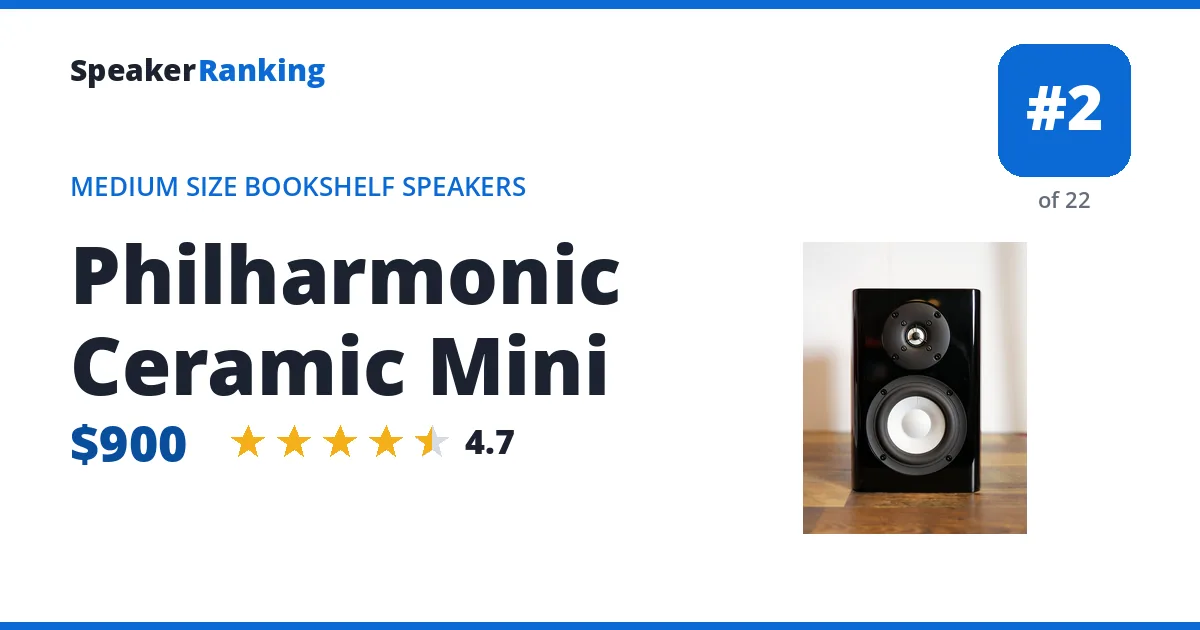
Pros: Gorgeous looks and finish options for the price. Very low midrange distortion for the size, well under 1% above about 400-500Hz. Excellent on-axis linearity. Mild, pleasant bass bump around 100Hz that adds welcome warmth without being excessive. Wide soundstage and dispersion (~70-80 degrees horizontally). Clean cabinet and port with no measured resonances. A great value combination of looks and performance at this price. Measured bass extension of 51Hz (-3dB), with a measured sensitivity of 82dB.
Cons: Somewhat limited output capability for its size: audible woofer compression (“flopping”) around 95dB at 3 meters for a stereo pair, so keep to moderate levels or pair with a subwoofer for home theater use. A mild diffraction-related dip around 4-6kHz can cause occasional sibilance on some vocal tracks. Measured sensitivity (82.2dB average) runs a bit below the manufacturer’s claimed 84dB, so it needs more amp power than the spec alone suggests. Needs a subwoofer for real bass authority below about 40Hz.
Full Philharmonic Ceramic Mini review and specifications →
| Bass Extension (-10dB) | 36Hz (measured, Erin’s Audio Corner) |
|---|---|
| Bass Extension (-3dB) | 51Hz (measured, Erin’s Audio Corner) |
| Country | USA (Vienna, Virginia) |
| Crossover Frequency | 2kHz (Linkwitz-Riley 4th order) |
| DIY Kit | No |
| Dimensions | 12” x 8.5” x 11.3” (305 x 216 x 286 mm) |
| Drivers | 5.25” ceramic woofer, 1” ceramic dome tweeter |
| Frequency Response | 55Hz - 20kHz (+1.5/-3dB, Manufacturer specified, ported) |
| Impedance | 4 ohms nominal (3.2 ohms min, 15 ohms max) (measured, Erin’s Audio Corner) |
| Sensitivity | 82dB (2.83V/1m, measured by Erin’s Audio Corner) |
| Spinorama Preference Score | 5.77 |
| Spinorama Preference Score with Perfect Sub | 7.78 |
| Weight | 17 lbs (7.7 kg) |
| Woofer Cabinet | ported, rear |
- Links
- Reviews, Comparisons and Sound Samples
- Head-to-Head Comparisons
- Philharmonic Ceramic Mini vs Ascend Sierra 1 v2
- Philharmonic Ceramic Mini vs Audio First Fidelia
- Philharmonic Ceramic Mini vs KEF LS50 Meta
- Philharmonic Ceramic Mini vs XMechanik Mechano23 DIY
- Philharmonic Ceramic Mini vs Ascend Acoustics HTM-200SE2
- Philharmonic Ceramic Mini vs Arendal 1961 Monitor
- Philharmonic Ceramic Mini vs Ascend Acoustics Luna V2 Mini-Monitor Titan
- Philharmonic Ceramic Mini vs Aalto Speakers Aalto 1 EVO
- See all 24 comparisons
Ranked #3 of 101 in Medium Size Bookshelf Speakers - Ascend Sierra 1 v2: $1000 per pair Ascend Acoustics eBay
Pros: Formaldehyde-free layered bamboo ply cabinet with a 1” dome tweeter over a 5.25” midwoofer, mated by a 4th-order acoustic crossover rather than a stock textbook design. In-room response is extremely linear (the reviewer called it “textbook”) a clear step up from the earlier V1, which had boxiness around 700Hz-1kHz and sibilance around 4-6kHz. Preference score of 8.4 with a subwoofer (6.8 without), which the reviewer calls topnotch. Wide, even horizontal radiation of about ±70° up to 6kHz. Better vertical directivity than its tweeter-to-woofer spacing would suggest, thanks to the steep 4th-order crossover slopes. No mechanical noise, port chuffing, or woofer bottoming even driven to 96dB/1m. In a three-way comparison against the Dynaudio Emit 20 and a Revel bookshelf model (all around $1,000/pair), measured as the most linear of the three and was the reviewer’s personal pick over both, despite the Dynaudio’s deeper bass and higher output capability. Independent ASR Klippel measurements corroborate Erin’s findings: superb off-axis response with only slight on-axis variations, and an in-room response the reviewer called “incredibly smooth and accurate. Amazing for a non-DSP speaker.” Distortion above 200Hz at 86dB/1m is very low for the class. Measured bass extension of 55Hz (-3dB), with a measured sensitivity of 81.5dB.
Cons: F3 of 55Hz and F10 of 39Hz mean in-room extension tops out in the mid-40s Hz; the reviewer still recommends a subwoofer for full-range material. Diffraction dips appear around 3kHz and 5-6kHz, and the 1” dome tweeter starts beaming above roughly 6.7kHz, narrowing the soundstage radiation in the top octave: a straightforward consequence of dome size rather than a design flaw. At 96dB/1m the 5.25” midwoofer shows increased distortion in the midrange, likely tied to motor topology; high-passing to a subwoofer around 80Hz largely clears it up. Moderate sensitivity (~81-82dB average) with a 7-ohm minimum impedance. ASR’s power-sweep testing found response holds steady up to 96dB SPL/1m, but pushing to 102dB causes midbass below 400Hz to sag with distortion “through the roof”: a harder output ceiling than the 96dB tests alone suggest. Vertical directivity also narrows above about 1kHz, so the reviewer recommends staying at tweeter-axis height for best results.
Full Ascend Sierra 1 v2 review and specifications →
| Bass Extension (-10dB) | 39Hz (measured, Erin’s Audio Corner) |
|---|---|
| Bass Extension (-3dB) | 55Hz (measured, Erin’s Audio Corner) |
| DIY Kit | No |
| Dimensions | 14.2”H x 7.5”W x 10.5”D (361.9 x 190.5 x 266.7 mm) |
| Drivers | 5.25” proprietary mineral-filled polypropylene cone with cast aluminum frame woofer, 26mm aluminum/magnesium alloy dome tweeter with titanium former (SEAS Titan) |
| Impedance | 8 ohms nominal, 7 ohms minimum (measured, Erin’s Audio Corner) |
| Sensitivity | 81.5dB (measured, Erin’s Audio Corner) |
| Spinorama Preference Score | 6.65 |
| Spinorama Preference Score with Perfect Sub | 8.61 |
| Weight | 18.5 lbs (8.4 kg) each |
| Woofer Cabinet | ported |
- Links
- Reviews, Comparisons and Sound Samples
- Erin’s Audio Corner: NEW! Ascend Acoustics Sierra-1 V2 Review More from Erin’s Audio Corner →
- Erin’s Audio Corner Website Ascend Sierra 1 v2
- Audio Science Review Ascend Sierra 1 v2 More from Audio Science Review →
- Erin’s Audio Corner: 5 AWESOME SPEAKERS Under $1000 You Won’t Regret
- Erin’s Audio Corner: I Tested 250 Speakers So You Don’t Have To!
- Erin’s Audio Corner: My Top Picks of 2023: Must-Haves Under $3000
- Manufacturer Measurements (spinorama.org)
- Head-to-Head Comparisons
- Ascend Sierra 1 v2 vs KEF LS50 Meta
- Ascend Sierra 1 v2 vs Philharmonic Ceramic Mini
- Ascend Sierra 1 v2 vs Audio First Fidelia
- Ascend Sierra 1 v2 vs XMechanik Mechano23 DIY
- Ascend Sierra 1 v2 vs Ascend Acoustics HTM-200SE2
- Ascend Sierra 1 v2 vs Arendal 1961 Monitor
- Ascend Sierra 1 v2 vs Ascend Acoustics Luna V2 Mini-Monitor Titan
- Ascend Sierra 1 v2 vs Aalto Speakers Aalto 1 EVO
- See all 50 comparisons
 Ranked #4 of 101 in Medium Size Bookshelf Speakers - KEF LS50 Meta: $1,599.00 per pair Amazon Crutchfield eBay
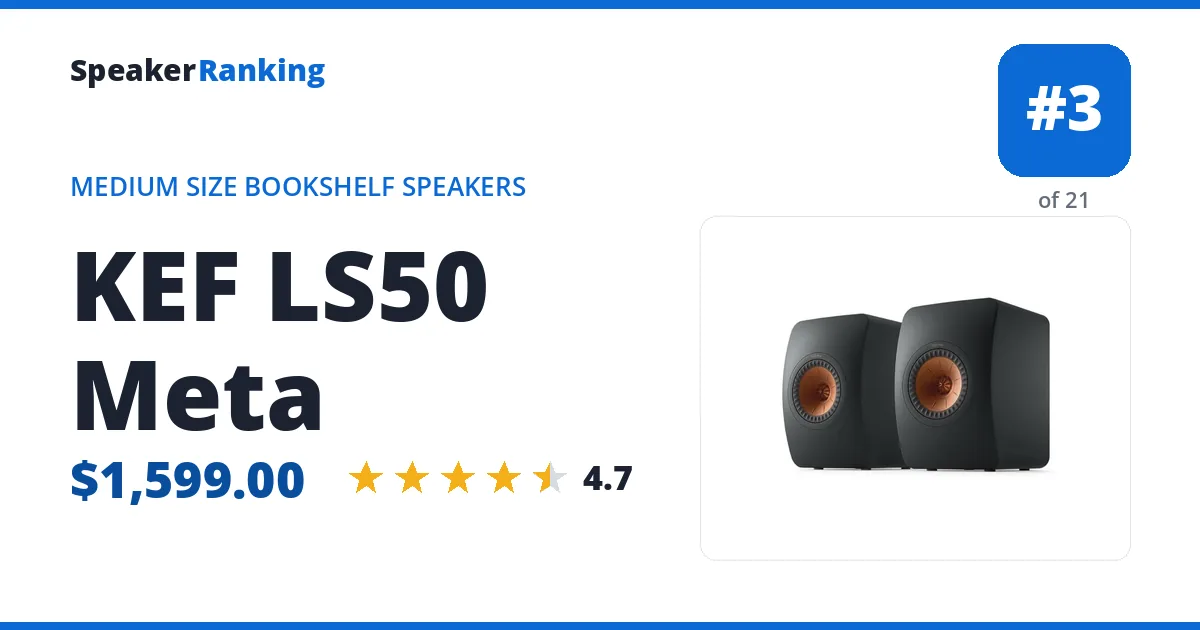
Pros: Uni-Q concentric driver mounts a 1” vented aluminum dome tweeter at the center of a 5.25” aluminum cone woofer, rated 79Hz-20kHz+. Speaker-to-speaker matching measured tight at roughly 0.5dB deviation between the pair tested, versus 2-3dB seen on some other speakers: likely why imaging stayed so precise. Imaging stays tight and focused even toed out, unlike most coincident designs where toe-out typically diffuses the image, giving more of an oval-shaped soundstage than a hard rectangular boundary. Horizontal and vertical directivity both hold to about ±50° at the -6dB point, so tonality stays consistent across roughly a 100° listening cone. The extended bass shelf is deliberately tuned for near-wall/boundary placement rather than the usual “pull it 3 feet into the room” advice, playing lower without excess boominess when placed close to a wall. At its frequent sale price, well below list, called a no-brainer for a compact stand-mount speaker. Independent ASR Klippel measurements corroborate this: very good directivity with the on- and off-axis curves tracking closely, and a predicted in-room response the reviewer called “very close to ideal.”. Measured bass extension of 68Hz (-3dB), with a measured sensitivity of 83dB.
Cons: F3 of 67Hz and F10 of 42Hz mean it doesn’t get much below 50Hz in-room; a subwoofer is recommended for real bass. A 2-3dB scoop around 2-4kHz shows up in both the listening window and sound power measurements, matching a subjectively noticed lack of attack and vocal clarity that the reviewer wanted to correct with about 2dB of EQ. An on-axis diffraction dip around 8kHz smooths out with about 15° of toe-out (typical for concentric designs, but still present at 0°). Distortion is elevated at low frequencies since the single 5.25” cone shares surface area with the tweeter housing, reducing effective radiating area; multitone distortion crosses the 3% threshold at 96dB/1m, making roughly 88dB or below the safer output ceiling. Moderate sensitivity (~83dB average) needed 2-3dB more amplifier gain than typical in testing. Adding a subwoofer at an 80Hz crossover only helps lower-midrange distortion, not the elevated distortion in the 1-2kHz and above-5kHz regions. ASR’s own Klippel testing found the same pattern in starker terms: THD is very good at 86dB SPL/1m but climbs past 100% in the bass at 96dB SPL/1m, confirming this is not a near-field speaker for high-output bass-heavy material. Cumulative spectral decay (waterfall) also shows a couple of resonances lingering in the 1-2kHz region.
Full KEF LS50 Meta review and specifications →
| Bass Extension (-10dB) | 43Hz (measured, Erin’s Audio Corner) |
|---|---|
| Bass Extension (-3dB) | 68Hz (measured, Erin’s Audio Corner) |
| DIY Kit | No |
| Dimensions | 11.9”H x 7.9”W x 11”D (302 x 200 x 280.5 mm) |
| Drivers | 130 mm (5.25 in.) aluminium cone woofer, 25 mm (1 in.) vented aluminium dome with Metamaterial Absorption tweeter |
| Impedance | 8 ohms nominal (3.7 ohms minimum above 80Hz, measured by Erin’s Audio Corner) |
| Sensitivity | 83dB (measured average, Erin’s Audio Corner; 85dB manufacturer specified) |
| Spinorama Preference Score | 5.74 |
| Spinorama Preference Score with Perfect Sub | 7.88 |
| Weight | 17.2 lbs (7.8 kg) each |
| Woofer Cabinet | ported, rear |
- Links
- Reviews, Comparisons and Sound Samples
- Erin’s Audio Corner: Unveiling the KEF LS50 Meta: The Truth Behind the Hype More from Erin’s Audio Corner →
- Erin’s Audio Corner Website KEF LS50 Meta
- Audio Science Review KEF LS50 Meta More from Audio Science Review →
- GR-Research: KEF LS50 Meta! Worthy of HYPE? More from GR-Research →
- Erin’s Audio Corner: My Top Picks of 2023: Must-Haves Under $3000
- Erin’s Audio Corner Measurements (spinorama.org)
- Head-to-Head Comparisons
- KEF LS50 Meta vs Ascend Sierra 1 v2
- KEF LS50 Meta vs Ascend Acoustics Luna V2 Mini-Monitor Ribbon
- KEF LS50 Meta vs Philharmonic Ceramic Mini
- KEF LS50 Meta vs XMechanik Mechano23 DIY
- KEF LS50 Meta vs Audio First Fidelia
- KEF LS50 Meta vs Ascend Acoustics HTM-200SE2
- KEF LS50 Meta vs Arendal 1961 Monitor
- KEF LS50 Meta vs SunAudio Purified 4
- See all 85 comparisons
 Ranked #8 of 101 in Medium Size Bookshelf Speakers - Arendal 1961 Monitor: $1150 per pair Arendal Sound eBay
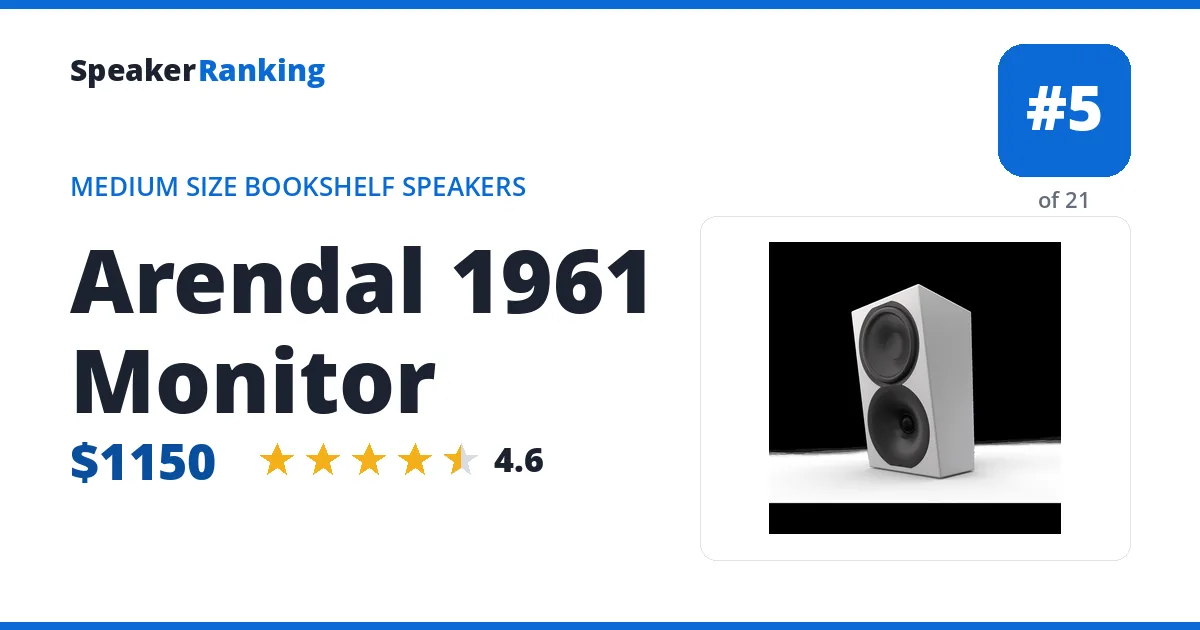
Larger model: the Arendal 1961 Tower (rated 4.4/5).
Pros: A physically robust build the reviewer calls “a little bit of a tank,” delivering low compression, low distortion, and overall really good neutrality: one of the reviewer’s top 10 picks under $1,500 across roughly 250 speakers tested. Works well both as home theater mains and as surrounds. Independent ASR Klippel measurements corroborate the low-distortion finding: THD at 86dB SPL/1m stays well below the reviewer’s audibility threshold, and even at 96dB SPL/1m it stays “far better than most bookshelves” thanks to the built-in high-pass filter that protects the woofers. Measured bass extension of 84Hz (-3dB), with a measured sensitivity of 85.9dB.
Cons: Bass rolls off around 70-80Hz, so it cannot be used as full-range mains for music without a subwoofer, and a sub is recommended for home theater use as well. Vertical radiation window is narrow, typical of MTM (mid-tweeter-mid) layouts (tighter than a standard two-way’s roughly ±20°) so a second home theater row sitting above or below the tweeter axis will hear a noticeably different tonal balance. ASR’s CEA2034 measurements show the response is elevated above 2kHz with resonant peaks around 3kHz and 9kHz, leading the reviewer to predict it will “likely sound bright.” Those same resonances show up as lingering ridges in the cumulative spectral decay (waterfall) at 96dB SPL/1m.
Full Arendal 1961 Monitor review and specifications →
| Bass Extension (-10dB) | 60Hz (measured, Erin’s Audio Corner) |
|---|---|
| Bass Extension (-3dB) | 84Hz (measured, Erin’s Audio Corner) |
| Crossover Frequency | 1500Hz |
| DIY Kit | No |
| Dimensions | 16.6”H x 6.4”W x 5.9”D (421.6 x 162.6 x 149.9 mm) |
| Drivers | 2 x 5.5” woofers, 28mm tweeter |
| Impedance | 4 ohms nominal (4.1 ohms minimum above 80Hz, measured by Erin’s Audio Corner) |
| Sensitivity | 85.9dB (measured average, Erin’s Audio Corner) |
| Spinorama Preference Score | 3.38 |
| Spinorama Preference Score with Perfect Sub | 6.69 |
| Weight | 16 lbs (7.25 kg) each |
| Woofer Cabinet | sealed |
- Links
- Reviews, Comparisons and Sound Samples
- Head-to-Head Comparisons
- Arendal 1961 Monitor vs SunAudio Purified 4
- Arendal 1961 Monitor vs Ascend Acoustics HTM-200SE2
- Arendal 1961 Monitor vs XMechanik Mechano23 DIY
- Arendal 1961 Monitor vs Ascend Acoustics Luna V2 Mini-Monitor Titan
- Arendal 1961 Monitor vs Aalto Speakers Aalto 1 EVO
- Arendal 1961 Monitor vs Moondrop M4P MTM
- Arendal 1961 Monitor vs KEF LS50 Meta
- Arendal 1961 Monitor vs Ascend Sierra 1 v2
- See all 56 comparisons
 Ranked #12 of 101 in Medium Size Bookshelf Speakers - Moondrop M4P MTM: $920 per pair Shenzhen Audio eBay
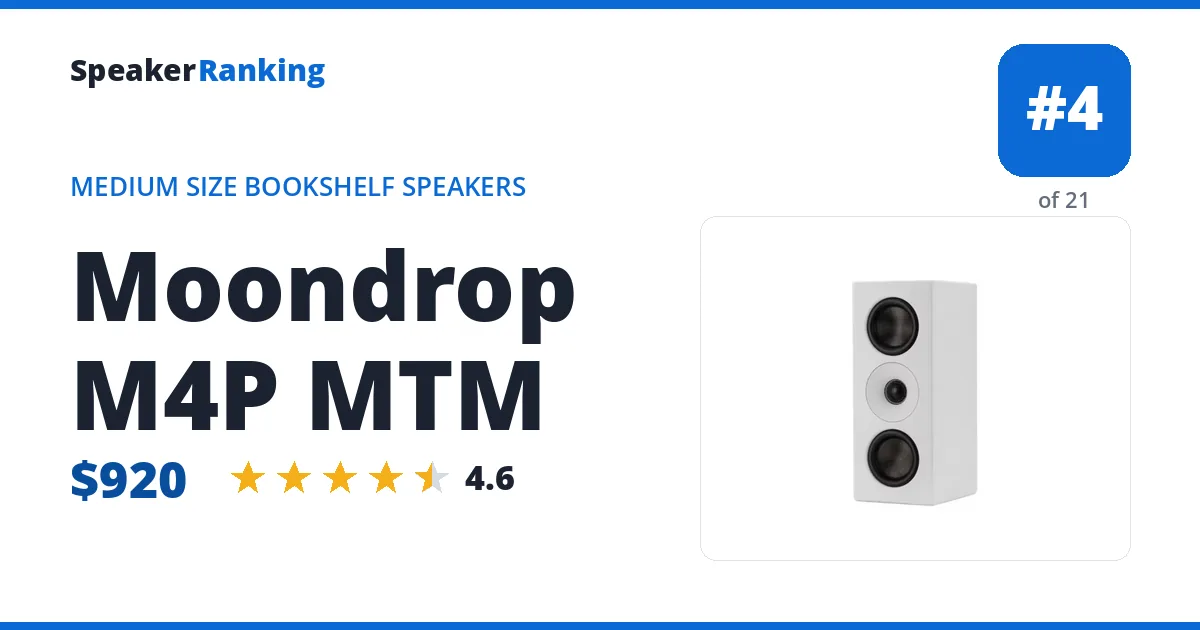
Pros: MTM (mid-tweeter-mid) two-way layout with dual 4” carbon-cone woofers flanking a 1” aluminum-magnesium dome tweeter, crossed over at 1.8kHz. Wide horizontal radiation of about ±60° through the midrange and still around ±50° near the tweeter, giving an expansive, enveloping soundstage on well-recorded stereo material. Noticeable mid-bass “thump” around 100-160Hz that adds a sense of punch and kick-drum impact, more pronounced than the reviewer’s Audiofirst Fidelia reference. Rolled-off, laid-back treble (roughly 1-2dB below linear) rather than the 2-5dB high-frequency boost common on speakers marketed as “detailed”: a plus for listeners who find brighter speakers fatiguing. Tonal balance stays consistent whether pointed straight on or toed out about 30°, so side-to-side seating position doesn’t change the sound much. At $920/pair in a compact monitor cabinet (13-14 lbs), reasonably priced for the format. Measured bass extension of 69Hz (-3dB), with a measured sensitivity of 85dB.
Cons: Vertical placement is very fussy: staying within about ±20° of the tweeter axis is essential, because the two woofers cancel each other through the crossover region (classic MTM lobing). Sit above or below that window and the upper midrange loses clarity and detail. SPL-limited: noticeable compression showed up both subjectively (thinner-sounding transients at 80-85dB/10 feet) and in measurements, with roughly 1.5dB of dynamic-range loss and about 3dB of added distortion under instantaneous compression testing. Harmonic distortion jumps substantially at 96dB versus 86dB (mostly second-order, so less audible than it looks on paper), and multitone distortion rides right at the reviewer’s 3% threshold at full output. Low impedance (3.7-ohm minimum, 1.7-ohm minimum EPDR) means a Class AB amp may run hot over longer sessions; a Class D amp is recommended for better thermal headroom. Designed primarily for nearfield use (about 1 meter); farfield listening is more of a gamble since dynamic range drops off noticeably at distance. Slight sibilance and a mild upper-midrange dip give a touch of a recessed, warm character alongside the bass emphasis. Bass reaches only about 50-60Hz in-room, and not with much volume before running into the SPL limits noted above.
Full Moondrop M4P MTM review and specifications →
| Bass Extension (-10dB) | 46Hz (measured, Erin’s Audio Corner) |
|---|---|
| Bass Extension (-3dB) | 69Hz (measured, Erin’s Audio Corner) |
| Crossover Frequency | 1800Hz |
| DIY Kit | No |
| Dimensions | 15”H x 6.1”W x 7.3”D (380 x 155 x 185 mm) |
| Drivers | 2x 4” (87mm) carbon cone woofer, 1” (25mm) aluminum/magnesium dome tweeter |
| Impedance | 4 ohms nominal, 3.7 ohms minimum (measured above 80Hz, Erin’s Audio Corner) |
| Power Handling | 75W rated / 150W max |
| Sensitivity | 85dB (measured average 300Hz-3kHz @ 2.83V/1m, Erin’s Audio Corner) |
| Spinorama Preference Score | 5.05 |
| Spinorama Preference Score with Perfect Sub | 7.59 |
| Weight | 13.7 lbs (6.2 kg) each |
| Woofer Cabinet | ported |
- Links
- Reviews, Comparisons and Sound Samples
- Head-to-Head Comparisons
- Moondrop M4P MTM vs Ascend Acoustics Luna V2 Mini-Monitor Titan
- Moondrop M4P MTM vs Arendal 1961 Monitor
- Moondrop M4P MTM vs Klipsch RP-500M II
- Moondrop M4P MTM vs KEF LS50 Meta
- Moondrop M4P MTM vs Ascend Sierra 1 v2
- Moondrop M4P MTM vs Wharfedale Diamond 12.1
- Moondrop M4P MTM vs Radiant Acoustics Clarity 4.2
- Moondrop M4P MTM vs KEF Q150
- See all 11 comparisons
 Ranked #14 of 101 in Medium Size Bookshelf Speakers - Monitor Audio Silver 50 7G: $799 per pair Crutchfield eBay
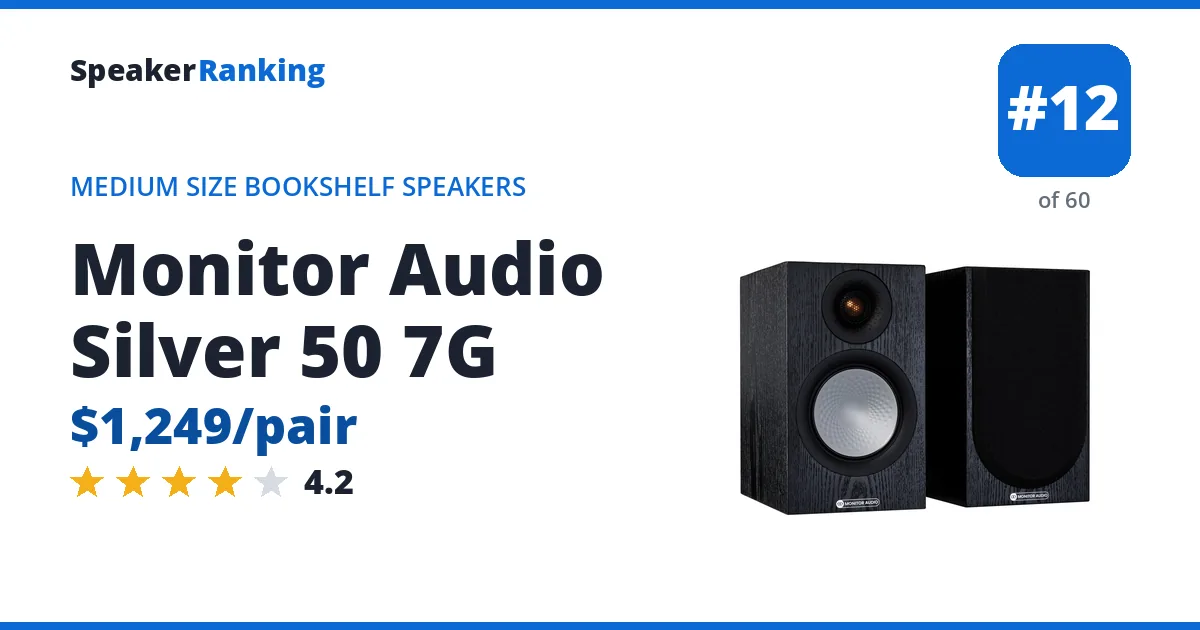
Pros: The 7th generation C-CAM Gold Dome tweeter with UD Waveguide II and RST II mid bass driver produce a listening window smoothness score of 0.50 at an accessible price, earning a Hi-Fi News Outstanding Product Award. A HiVe II reflex port system is tuned to 58Hz for real bass weight from a compact 5.25 inch two way. Measured bass extension of 87.9Hz (-3dB).
Cons: The on axis response trends noticeably upward toward the treble (rising about 0.5dB per octave, a steep tilt), which can read as bright on already bright recordings. Off axis sound also tracks the on axis response less consistently than most speakers here. Bass extension is limited to a measured 87.9Hz at -3dB, so a subwoofer is recommended for full range use, and minimum impedance dips to 3.9 ohms at 250Hz.
Full Monitor Audio Silver 50 7G review and specifications →
| Bass Extension (-10dB) | 50.7Hz (measured, Erin’s Audio Corner) |
|---|---|
| Bass Extension (-3dB) | 87.9Hz (measured, Erin’s Audio Corner) |
| Country | China |
| Crossover Frequency | 2.6kHz |
| DIY Kit | No |
| Dimensions | 11.1”H x 6.5”W x 10.7”D (282 x 165 x 272 mm) |
| Drivers | 1” C-CAM Gold Dome tweeter, 5.25” C-CAM RST II mid bass driver |
| Enclosure | ported |
| Impedance | 8 ohms nominal, 3.9 ohms minimum |
| Maximum SPL | 104dB (manufacturer specified) |
| Port Tuning | 58Hz |
| Power Handling | 100W RMS handling, 40-100W recommended amplifier power |
| Sensitivity | 86dB @ 2.83V/1m |
| Spinorama Preference Score | 5.40 |
| Spinorama Preference Score with Perfect Sub | 8.01 |
| Warranty | Lifetime, parts and labor |
| Weight | 12.3 lbs (5.6 kg) each |
- Links
- Reviews, Comparisons and Sound Samples
- Head-to-Head Comparisons
- Monitor Audio Silver 50 7G vs Revel M105
- Monitor Audio Silver 50 7G vs Elac Carina BS243.4
- Monitor Audio Silver 50 7G vs Aalto Speakers Aalto 1 EVO
- Monitor Audio Silver 50 7G vs Ascend Acoustics Luna V2 Mini-Monitor Titan
- Monitor Audio Silver 50 7G vs Klipsch RP-500M II
- Monitor Audio Silver 50 7G vs Wharfedale Super Denton
- Monitor Audio Silver 50 7G vs Arendal 1961 Monitor
- Monitor Audio Silver 50 7G vs Ascend Acoustics HTM-200SE2
- See all 30 comparisons
 Ranked #15 of 101 in Medium Size Bookshelf Speakers - Arendal Sound 1961 Bookshelf: $900 per pair Arendal Sound eBay
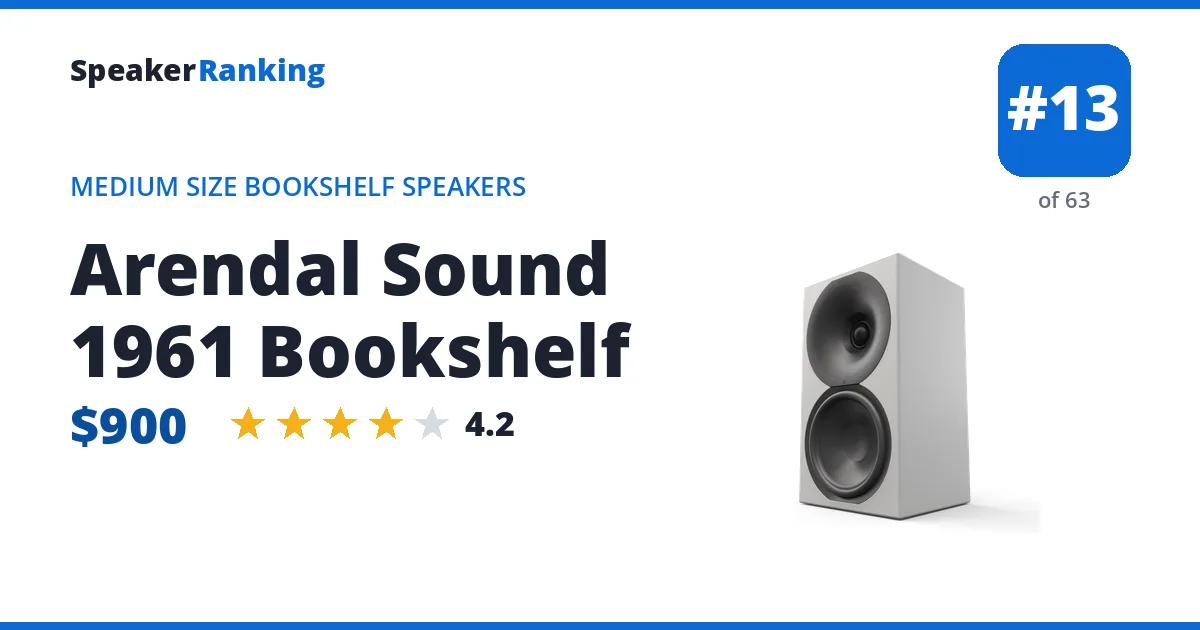
Pros: Direct-to-consumer pricing at $900/pair backed by a 10-year speaker warranty (5-year on electronics) and a 60-day home audition with free return shipping. On-axis response is close to flat for a compact sealed design, tilting by only about 0.09dB per octave. Compact sealed 5.5” woofer + 28mm tweeter 2-way layout in a small 28.7 x 16.3 x 15cm, 4.9kg cabinet. Measured bass extension of 108.4Hz (-3dB).
Cons: The sealed cabinet and compact 5.5” woofer cap bass extension at 108.4Hz (-3dB) / 54.9Hz (-10dB): the shallowest-extending speaker in this entire batch, a real tradeoff for the small footprint. On-axis response is somewhat uneven, with an average deviation of about 0.53dB, so it is less smooth than pricier active speakers. Direct-to-consumer model means no local dealer for an in-person audition before buying (mitigated by the 60-day home trial).
Full Arendal Sound 1961 Bookshelf review and specifications →
| Bass Extension (-10dB) | 54.9Hz (measured, spinorama.org) |
|---|---|
| Bass Extension (-3dB) | 108.4Hz (measured, spinorama.org) |
| DIY Kit | No |
| Dimensions | 28.7 x 16.3 x 15cm (11.3 x 6.4 x 5.9 in) each |
| Drivers | 28mm tweeter, 5.5” woofer |
| Impedance | 4 ohms nominal |
| Sensitivity | 84dB (2.83V/1m) |
| Spinorama Preference Score | 4.15 |
| Spinorama Preference Score with Perfect Sub | 7.14 |
| Weight | 10.8 lbs (4.9 kg) each |
| Woofer Cabinet | Sealed |
- Links
- Reviews, Comparisons and Sound Samples
- Head-to-Head Comparisons
 Ranked #17 of 101 in Medium Size Bookshelf Speakers - Emotiva B1+: $250 per pair Discontinued eBay
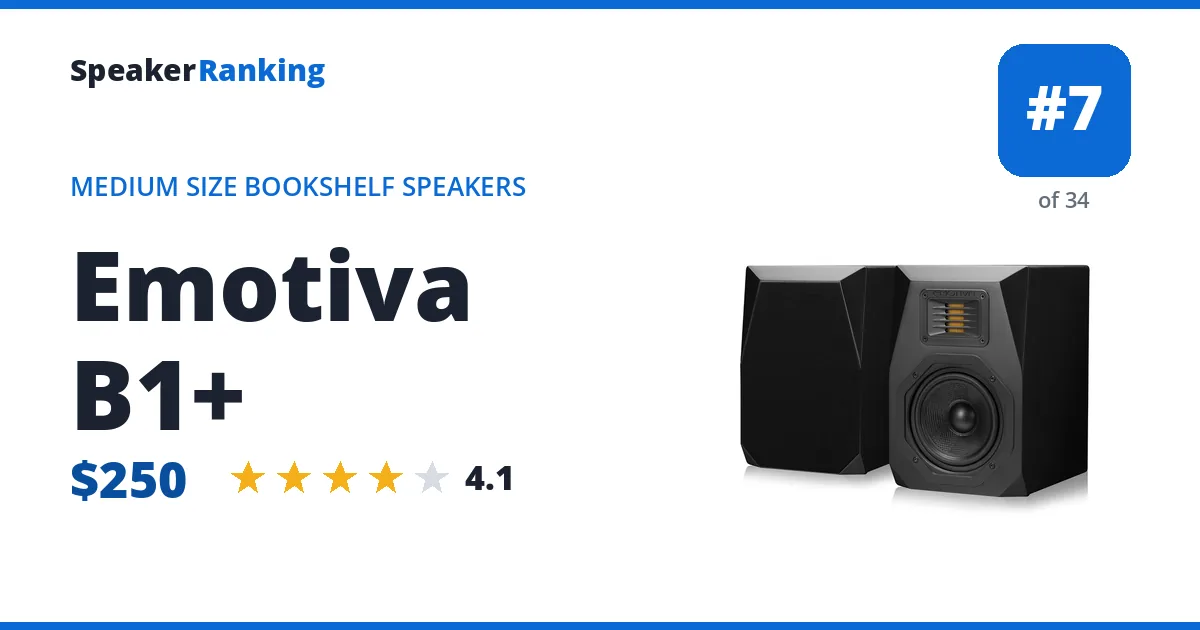
Newer model: the Emotiva Airmotiv XB2, rated 4.2/5.
Pros: Emotiva B1+ uses 5.25” woven fiber cone with SBR surround woofer, 25x32 mm Airmotiv folded ribbon tweeter in a conventional wired-speaker design. Its form factor and driver layout make it a sensible match for a properly chosen amplifier and room. Measured bass extension of 70Hz (-3dB), with a measured sensitivity of 85dB.
Cons: It needs an external amplifier and thoughtful placement. Speaker performance will depend heavily on the partnering electronics and room acoustics. Discontinued.
Full Emotiva B1+ review and specifications →
| Bass Extension (-10dB) | 49Hz (measured, Erin’s Audio Corner) |
|---|---|
| Bass Extension (-3dB) | 70Hz (measured, Erin’s Audio Corner) |
| DIY Kit | No |
| Dimensions | 10.8”H x 7.1”W x 8.3”D (274 x 181 x 210 mm) |
| Drivers | 5.25” woven fiber cone with SBR surround woofer, 25x32 mm Airmotiv folded ribbon tweeter |
| Impedance | 8 ohms |
| Sensitivity | 85dB (measured, Erin’s Audio Corner) |
| Spinorama Preference Score | 5.34 (spinorama.org) |
| Spinorama Preference Score with Perfect Sub | 7.86 (spinorama.org) |
| Weight | 8.8 lbs (4.0 kg) each |
| Woofer Cabinet | ported, rear |
- Reviews, Comparisons and Sound Samples
- Head-to-Head Comparisons
Ranked #19 of 101 in Medium Size Bookshelf Speakers - Klipsch RP-500M II: $389.99 per pair Amazon eBay
Older model: the Klipsch RP-500M (ranked lower, rated 3.4/5).
Larger models: the Klipsch RP-600M II (rated 3.7/5), the Klipsch RP-5000F II (rated 4/5), the Klipsch RP-6000F II (rated 3.9/5) and the Klipsch RP-8000F II (rated 3.9/5).
Pros: Major mid-range clarity improvement over the original RP-500M: about a 5dB fill-in between 1-3kHz in the estimated in-room response, giving a noticeably more resolved, detailed midrange. More neutral and linear overall than its sibling RP-600M II, which carries about 2-3dB more high-frequency energy and a touch more bass but less overall balance. Very precise soundstage imaging and instrument placement. Distortion through the midrange is cleaner than the previous generation. Measured bass extension of 67Hz (-3dB), with a measured sensitivity of 85dB.
Cons: Klipsch’s quoted sensitivity (around 92-93dB) uses an unconventional in-room-based rating rather than the standard anechoic measurement; on an anechoic basis it measures closer to about 85dB, in line with typical bookshelf speakers this size, so it isn’t the outlier in efficiency the spec sheet implies. Horizontal dispersion of about ±40-50° is narrower and more directive than the reviewer’s preference for a wider, more enveloping soundstage. Toeing the speaker out to widen the soundstage or soften on-axis brightness comes at some cost to imaging precision. Slightly less clean in the tweeter region than the midrange, likely tied to crossover placement, though not considered a dealbreaker. Low-frequency output is limited: measured around 95dB at 4 meters for the pair before the woofers started to unload, so a subwoofer is recommended for anyone wanting real bass rather than stepping up to a larger model.
Full Klipsch RP-500M II review and specifications →
| Bass Extension (-10dB) | 53Hz (measured, Erin’s Audio Corner) |
|---|---|
| Bass Extension (-3dB) | 67Hz (measured, Erin’s Audio Corner) |
| Crossover Frequency | 1530Hz |
| DIY Kit | No |
| Dimensions | 13.6”H x 6.8”W x 10.6”D (344.4 x 173 x 270.5 mm) |
| Drivers | 5.25” Cerametallic™ cone woofer with Faraday rings, 1” LTS Titanium diaphragm tweeter with Hybrid Cross-Section Expanded Tractrix® horn |
| Impedance | 8 ohms nominal, 3.3 ohms minimum (measured, Erin’s Audio Corner) |
| Sensitivity | 85dB (measured, Erin’s Audio Corner) |
| Spinorama Preference Score | 5.22 |
| Spinorama Preference Score with Perfect Sub | 7.84 |
| Weight | 13 lbs (5.9 kg) each |
| Woofer Cabinet | ported, rear |
- Links
- Reviews, Comparisons and Sound Samples
- Head-to-Head Comparisons
- Klipsch RP-500M II vs Wharfedale Super Denton
- Klipsch RP-500M II vs Wharfedale Diamond 12.1
- Klipsch RP-500M II vs Monitor Audio Silver 50 7G
- Klipsch RP-500M II vs Revel M105
- Klipsch RP-500M II vs Radiant Acoustics Clarity 4.2
- Klipsch RP-500M II vs Moondrop M4P MTM
- Klipsch RP-500M II vs KEF Q150
- Klipsch RP-500M II vs Arendal 1961 Monitor
- See all 40 comparisons
 Ranked #20 of 101 in Medium Size Bookshelf Speakers - Wharfedale Super Denton: $1499 per pair Crutchfield eBay
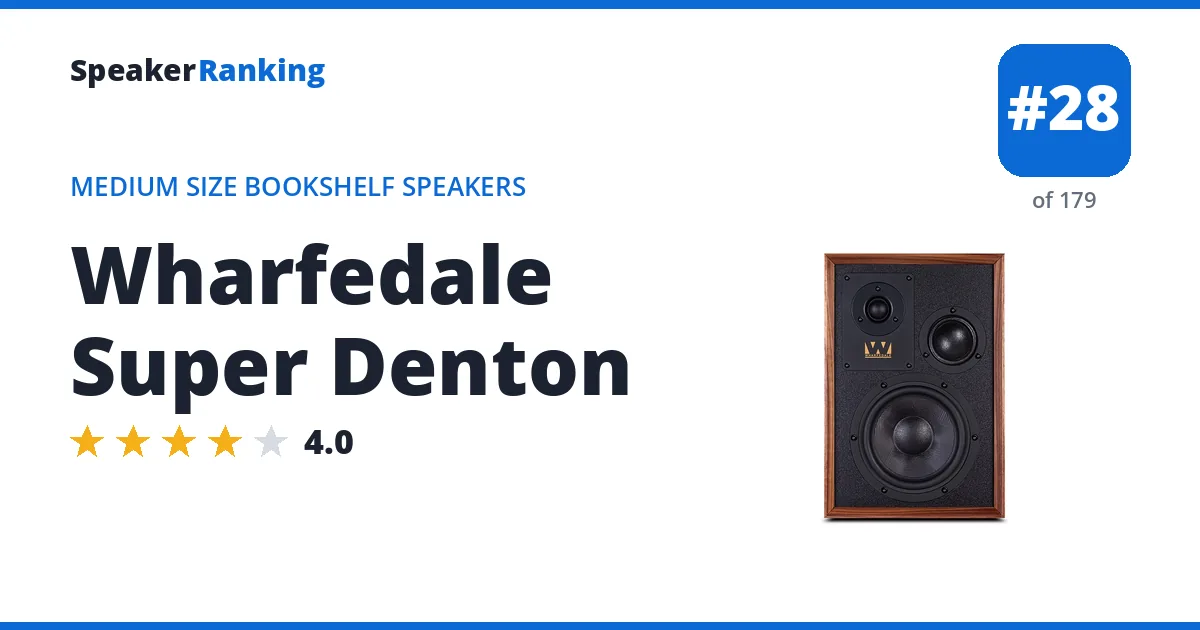
Pros: A 3-way design with a 1” soft dome tweeter, a 2” soft dome midrange offset to the side of a centered 6.5” woven Kevlar woofer: a more compact alternative to Wharfedale’s own Linton 85 with a similar overall character. Measured sensitivity around 86.6-87dB with on-axis linearity within about ±3dB. No cabinet or box resonances turned up in impedance testing, and there are no spike feet to install. Harmonic distortion looks good at both 86dB and 96dB, with about 20dB of usable dynamic range up to 96dB before compression starts to affect the midrange more noticeably near 102dB. Because bass rolls off starting around 60Hz, placing it closer to a wall (about 1-2 feet) than usual boosts low-end punch without the midbass bloat a deeper-extending speaker would get from the same placement. In the reviewer’s own comparison, its estimated in-room response actually measured more linear than the pricier Linton 85’s, despite being a bit less linear on-axis. Measured bass extension of 61Hz (-3dB), with a measured sensitivity of 86.6dB.
Cons: A mid-range scoop from about 200-800Hz and a separate upper-midrange scoop were both audible in direct ABX comparison against a reference-neutral speaker, giving aggressive-sounding material a more subdued character. A resonance around 660-700Hz shows up in measurement, though the reviewer couldn’t reliably hear it with real music in his own blind-ish A/B testing. The offset tweeter-and-midrange layout makes horizontal off-axis response noticeably asymmetric (response drops as much as 8dB more to one side than the other at wider angles) so the reviewer recommends aiming the speakers directly at the listener (not toed out, which loses upper treble) and suggests sidewall absorption to control uneven reflections. Must be listened to with the grille on: measurements are noticeably worse with it off (wider 2-4kHz dip, extra treble bump). Horizontal soundstage width felt a bit narrower than the reviewer personally prefers, likely related to the same offset driver layout. Multitone distortion gets high in the midrange at 96dB/1m, a concern mainly in larger rooms where you’d need to play louder.
Full Wharfedale Super Denton review and specifications →
| Bass Extension (-10dB) | 41Hz (measured, Erin’s Audio Corner) |
|---|---|
| Bass Extension (-3dB) | 61Hz (measured, Erin’s Audio Corner) |
| Crossover Frequency | 940Hz, 4.6kHz |
| DIY Kit | No |
| Dimensions | 14.2”H x 9.7”W x 10.8”D (360 x 246 x 275 mm) |
| Drivers | 1” soft dome tweeter, 2” soft dome midrange, 6.5” woven Kevlar woofer |
| Frequency Response | 52Hz - 20kHz (±3dB, manufacturer specified); -6dB to 40Hz |
| Impedance | 6 ohms nominal, 3 ohms minimum (measured, Erin’s Audio Corner) |
| Sensitivity | 86.6dB (measured by Erin’s Audio Corner) |
| Spinorama Preference Score | 5.9 (Erin’s Audio Corner) |
| Weight | 20.3 lbs (9.2 kg) each |
| Woofer Cabinet | ported |
- Links
- Reviews, Comparisons and Sound Samples
- Head-to-Head Comparisons
- Wharfedale Super Denton vs Klipsch RP-500M II
- Wharfedale Super Denton vs Wharfedale Diamond 12.1
- Wharfedale Super Denton vs Elac Carina BS243.4
- Wharfedale Super Denton vs Monitor Audio Silver 50 7G
- Wharfedale Super Denton vs Radiant Acoustics Clarity 4.2
- Wharfedale Super Denton vs Revel M105
- Wharfedale Super Denton vs KEF Q150
- Wharfedale Super Denton vs Aalto Speakers Aalto 1 EVO
- See all 43 comparisons
 Ranked #23 of 101 in Medium Size Bookshelf Speakers - Wharfedale Diamond 12.1: $599 per pair Discontinued eBay
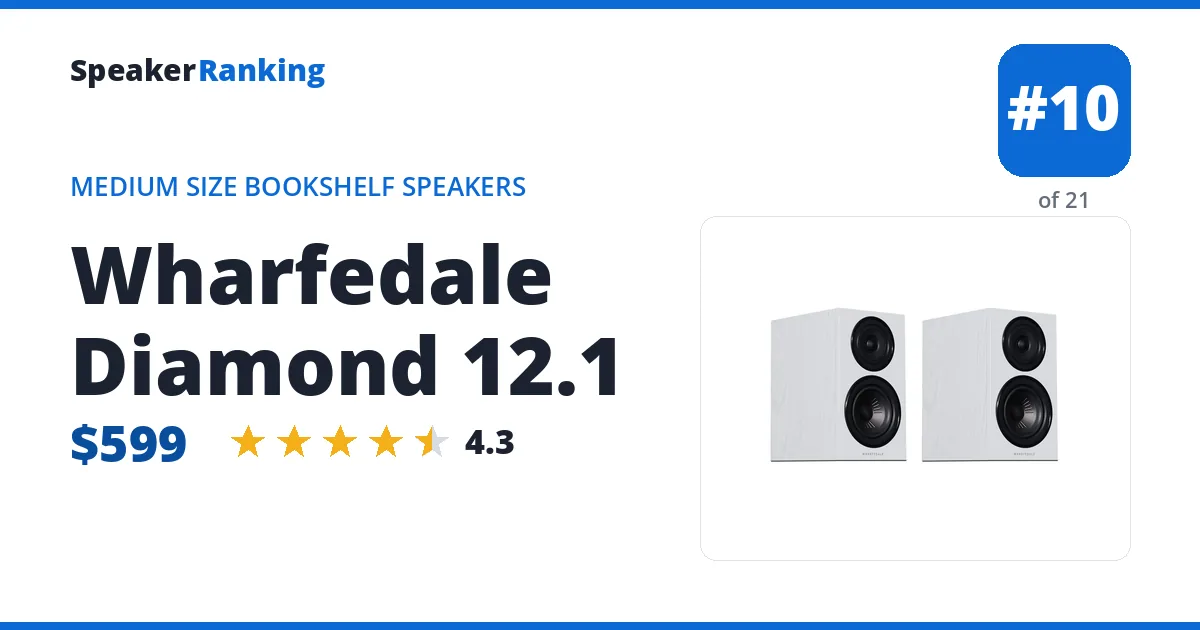
Newer model: the Wharfedale Diamond 12.1i, ranked higher, estimated 4/5.
Larger model: the Wharfedale Diamond 12.2 (estimated 4.1/5).
Pros: A budget two-way bookshelf speaker (5” polypropylene woofer, 1” textile dome tweeter) that measures well for its price: harmonic distortion at 86dB stays under 1% THD down to about 60Hz, genuinely good for a 5” mid-woofer. Wide horizontal radiation of about ±60° up to roughly 5kHz before the tweeter starts to beam. Tonally smooth and easy to listen to at moderate volumes, with a pleasant, non-fatiguing character the reviewer said he’d happily recommend to someone who wants noticeably better fit, finish and looks than typical speakers in the $300-400 range. A high-pass crossover around 80Hz meaningfully cleans up midrange multitone distortion, so pairing it with a subwoofer helps more than usual for a speaker this size. Measured bass extension of 61Hz (-3dB), with a measured sensitivity of 84dB.
Cons: A dip of about 3dB in the 1-3kHz crossover region (on-axis, in the predicted in-room response, and even off-axis) gives the speaker a soft, “laid-back” character that noticeably saps attack and transient bite from drums, guitar and other percussive material: possibly an intentional BBC-style dip, but one the reviewer would still prefer tuned flat. Vertical directivity is unusually tight for this class of speaker, holding together only within about ±5° of the tweeter axis before a real hole opens up in the response, so seating height matters a lot more than on most bookshelf designs. Diffraction artifacts around 3kHz and 5kHz show up as differences between the listening-window and on-axis curves. Distortion climbs well past acceptable levels at higher output: harmonic distortion exceeds 3% around 150Hz at 96dB (versus under 1% at 86dB), multitone distortion tops 10% at 96dB/1m, and real compression sets in between 96-102dB (about 1.5dB of lost dynamic range around 300Hz at 102dB/1m, roughly equivalent to 92dB for a pair at 4m in a room). A genuine limitation on how loud or how far away this speaker can be pushed. Measured average sensitivity (84dB) runs a few dB below the 87dB spec. Only a 5” woofer, so a subwoofer is required for real bass. Discontinued.
Full Wharfedale Diamond 12.1 review and specifications →
| Bass Extension (-10dB) | 46Hz (measured, Erin’s Audio Corner) |
|---|---|
| Bass Extension (-3dB) | 61Hz (measured, Erin’s Audio Corner) |
| Crossover Frequency | 2.6kHz |
| DIY Kit | No |
| Dimensions | 12.2”H x 7”W x 10.9”D (310 x 178 x 277 mm) |
| Drivers | 5” advanced polypropylene cone woofer, 1” textile dome tweeter |
| Impedance | 8 ohms nominal (3.9 ohms minimum above 80Hz, measured, Erin’s Audio Corner) |
| Sensitivity | 84dB (measured by Erin’s Audio Corner; 87dB manufacturer specified) |
| Spinorama Preference Score | 5.01 |
| Spinorama Preference Score with Perfect Sub | 7.42 |
| Weight | 15 lbs (6.8 kg) each |
| Woofer Cabinet | ported |
- Links
- Reviews, Comparisons and Sound Samples
- Erin’s Audio Corner: Wharfedale 12.1 Budget Bookshelf Speaker with “Laid Back” sound but output limited. More from Erin’s Audio Corner →
- Audio Science Review Wharfedale Diamond 12.1 More from Audio Science Review →
- Erin’s Audio Corner Website: Wharfedale Diamond 12.1
- Audio Science Review Measurements (spinorama.org)
- Head-to-Head Comparisons
- Wharfedale Diamond 12.1 vs Carmody S2000
- Wharfedale Diamond 12.1 vs Radiant Acoustics Clarity 4.2
- Wharfedale Diamond 12.1 vs Wharfedale Super Denton
- Wharfedale Diamond 12.1 vs Klipsch RP-500M II
- Wharfedale Diamond 12.1 vs Wharfedale Diamond 12.1i
- Wharfedale Diamond 12.1 vs KEF Q150
- Wharfedale Diamond 12.1 vs Wharfedale Diamond 220
- Wharfedale Diamond 12.1 vs Monitor Audio Silver 50 7G
- See all 39 comparisons
 Ranked #25 of 101 in Medium Size Bookshelf Speakers - Neumi BS5: $139.99 per pair Amazon eBay
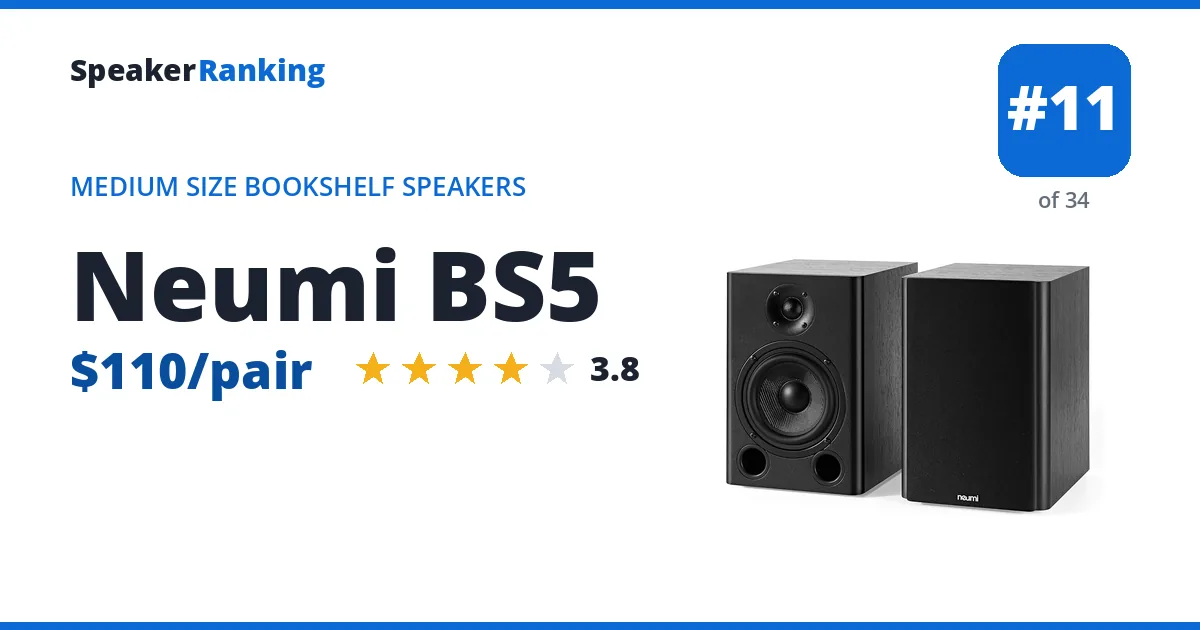
Pros: Exceptional budget value: Erin measured approximately +/-1.5dB on-axis linearity through most of the mid/treble, 84dB/2.83V/1m sensitivity and a manageable 4.6-ohm minimum. The 5-inch fiberglass woofer and 1-inch silk dome provide good horizontal directivity for the price; a mild upper-bass rise adds punch, and ordinary modern AVRs can generally drive the mostly six-ohm load at sensible levels. Measured bass extension of 64Hz (-3dB), with a measured sensitivity of 84dB.
Cons: Erin measured F3 at 64Hz, so kick-drum punch should not be mistaken for deep-bass extension. Output around 90dB began to reveal distortion and compression, limiting farfield/high-volume use. A narrow dip near 800Hz, port/cabinet resonances and imperfect crossover directivity remain visible; the tweeter itself is approximately four ohms even though the system is sold as nominal six ohms. A subwoofer is strongly preferred.
Full Neumi BS5 review and specifications →
| Bass Extension (-10dB) | 41.0Hz (measured, Erin’s Audio Corner) |
|---|---|
| Bass Extension (-3dB) | 64Hz (measured, Erin’s Audio Corner) |
| DIY Kit | No |
| Dimensions | 10.6”H x 7.2”W x 8.5”D (269.2 x 182.9 x 215.9 mm) |
| Drivers | 1” silk-dome tweeter; 5” fiberglass woofer |
| Impedance | 4.6 ohms minimum; approximately 6 ohms nominal (measured, Erin’s Audio Corner) |
| Sensitivity | Approximately 84dB/2.83V/1m (measured, Erin’s Audio Corner) |
| Spinorama Preference Score | 3.60 |
| Spinorama Preference Score with Perfect Sub | 6.12 |
| Weight | 7.1 lbs (3.2 kg) each |
| Woofer Cabinet | ported, front |
- Links
- Reviews, Comparisons and Sound Samples
- Head-to-Head Comparisons
 Ranked #26 of 101 in Medium Size Bookshelf Speakers - Radiant Acoustics Clarity 4.2: $2,998 per pair Radiant Acoustics eBay
Pros: Compact bookshelf design using a 4” Purifi mid-woofer with matching Purifi passive radiators and an AMT tweeter on a purpose-designed waveguide, built with genuine heft: aluminum baffle, extensive internal bracing and damping. Surprisingly wide horizontal dispersion (about ±70° through the midrange and into the treble), more enveloping than its larger 6.2 sibling despite the smaller cabinet. More linear on-axis than the bigger Clarity 6.2, which needs 15-20° of toe-out to tame a rising treble; the 4.2 can be listened to closer to on-axis without that same correction. Wider-than-typical vertical dispersion (roughly +30°/-20°) for a two-way design, since its smaller woofer keeps the tweeter-to-woofer distance short. Genuinely deep bass extension for its size (F3 44Hz, reaching about 40Hz in-room), though it comes at a real cost to sensitivity. No resonance issues visible in impedance measurements. Measured bass extension of 44 Hz (-3dB).
Cons: Low sensitivity (rated 78dB, measured 78.5dB) is the trade-off for its bass extension: needs a fair amount of amplifier power, around 100W recommended for small-to-medium rooms versus the manufacturer’s own 60W baseline. Designed specifically for smaller rooms; the reviewer had to move testing out of his open-plan living room and into a smaller bedroom to avoid running into compression. A dip in the upper midrange gives a mild lack of attack and clarity, and a peak around 5kHz occasionally added a touch of extra sibilance. Multitone distortion crosses the reviewer’s 3% threshold at 96dB, making about 88dB a better average listening level; a slight upper-midrange bump persists even with an 80Hz high-pass filter applied. Dynamic range is limited: fine at 86dB, but the woofer starts giving up headroom by 96dB and drops off significantly by 102dB. Compared to its pricier sibling Clarity 6.2, has notably less dynamic range and higher multitone distortion, reflecting the smaller driver complement. A niche product size-wise: the reviewer couldn’t identify a clear direct competitor in the same size/price/SPL class.
Full Radiant Acoustics Clarity 4.2 review and specifications →
| Amplifier Power | External amplifier required |
|---|---|
| Bass Extension (-10dB) | 35 Hz (measured, Erin’s Audio Corner) |
| Bass Extension (-3dB) | 44 Hz (measured, Erin’s Audio Corner) |
| DIY Kit | No |
| Dimensions | 9.5”H x 6.3”W x 9.4”D (241 x 160 x 239 mm) |
| Drivers | (2) 4” (102mm) woofer + AMT tweeter |
| Frequency Response | 40 Hz - 25 kHz |
| Impedance | 4 ohms |
| Recommended Power | 50-200W |
| Sensitivity | 78 dB |
| Weight | 28.7 lbs (13 kg) (per pair: 57.3 lbs (26 kg)) |
| Woofer Cabinet | passive radiator |
- Links
- Reviews, Comparisons and Sound Samples
- Head-to-Head Comparisons
- Radiant Acoustics Clarity 4.2 vs Wharfedale Diamond 12.1
- Radiant Acoustics Clarity 4.2 vs KEF Q150
- Radiant Acoustics Clarity 4.2 vs Wharfedale Super Denton
- Radiant Acoustics Clarity 4.2 vs Polk Audio XT15
- Radiant Acoustics Clarity 4.2 vs Klipsch RP-500M II
- Radiant Acoustics Clarity 4.2 vs Moondrop M4P MTM
- Radiant Acoustics Clarity 4.2 vs Arendal 1961 Monitor
- Radiant Acoustics Clarity 4.2 vs KEF LS50 Meta
- See all 24 comparisons
 Ranked #27 of 101 in Medium Size Bookshelf Speakers - Tekton Troubadour: $1,000 per pair Discontinued eBay
Pros: Offset in-phase array of 2x 5.25” mid-woofers and 3x 1” dome tweeters gives good on-axis linearity (within about ±2.5 dB) and a wide vertical listening window (about ±20°), so seating height isn’t fussy. Bass extension is solid for a stand-mount this size: F3 around 51 Hz, F10 around 39 Hz, with distortion staying below 3% THD down to about 40 Hz at 96 dB. Made in the USA. Asymmetrical tweeter/mid-woofer placement broadens horizontal dispersion versus a conventional symmetric layout. Measured bass extension of 51Hz (-3dB), with a measured sensitivity of 88dB.
Cons: Forward, elevated upper-midrange presentation from increased off-axis energy in the 2-8 kHz range, centered around 4 kHz, that can read as hot or aggressive depending on the room and listener; a couple bands of EQ can tame it. Multitone distortion climbs to about 10% around 1 kHz at higher output, attributed to the 4-inch mid-range drivers. Because the driver layout is offset rather than mirror-imaged, left/right placement and toe-in matter more than with a standard symmetric bookshelf design. Discontinued.
Full Tekton Troubadour review and specifications →
| Bass Extension (-10dB) | 39Hz (measured, Erin’s Audio Corner) |
|---|---|
| Bass Extension (-3dB) | 51Hz (measured, Erin’s Audio Corner) |
| Country | USA |
| DIY Kit | No |
| Dimensions | 21” x 13.5” x 9” (533 x 343 x 229 mm) |
| Drivers | 2x 5.25” mid-woofers, 3x 1” dome tweeters (offset in-phase array) |
| Impedance | 4 ohms nominal, 3.6 ohms minimum (measured above 80Hz, Erin’s Audio Corner) |
| Sensitivity | 88dB (measured average 300Hz-3kHz @ 2.83V/1m, Erin’s Audio Corner) |
| Spinorama Preference Score | 5.50 |
| Spinorama Preference Score with Perfect Sub | 7.52 |
| Weight | 32 lbs (14.5 kg) each |
- Reviews, Comparisons and Sound Samples
- Head-to-Head Comparisons
Ranked #29 of 101 in Medium Size Bookshelf Speakers - KEF Q150: $350 per pair Discontinued Amazon eBay
Newer model: the KEF Q1 Meta, ranked lower, rated 3.6/5.
Larger model: the KEF Q350 (rated 3/5).
Pros: Two-way coaxial (Uni-Q) design with a 1” dome tweeter and 5.25” mid-range time-aligned in a single driver assembly, available in ported or sealed configuration. Exceptional soundstage depth, a hallmark of KEF’s coaxial designs that the reviewer says few other speakers match. Bass extension reaches into kick-drum territory, respectable for a compact bookshelf speaker. Resonances present in measurements are consistent across on- and off-axis readings, meaning they can be effectively corrected with EQ. Distortion profile is essentially the same whether run sealed or ported, since a subwoofer crossover point sits above where the differences would matter anyway. At its sale price (around $300, sometimes seen at $400), the reviewer considers it a clear step up from his previous budget favorite in this range, the Emotiva B1+, mainly due to the superior soundstage depth. Measured bass extension of 51Hz (-3dB), with a measured sensitivity of 85dB.
Cons: A high-frequency lift in the estimated in-room response makes it sound noticeably brighter in an untreated room than in a heavily acoustically-treated one: a real preference factor depending on your room’s furnishings. A mild dip in the 1-2kHz region reduces vocal fullness somewhat. Unexplained resonances appear in measurements and persist in both sealed and ported configurations, pointing to enclosure or panel vibration rather than the port. Horizontal radiation is narrower than the reviewer generally prefers from KEF’s lineup, with directivity that widens somewhat around 1.2kHz (near a resonance) and again above about 5kHz. Compression testing at high output (102dB) shows significant nonlinearity, especially at lower frequencies: noticeably worse than a comparable Arendal bookshelf speaker costing over twice as much, which held up better until 80Hz. Not intended for loud listening without a subwoofer: the woofer will over-exert itself without a high-pass filter, and the reviewer recommends crossing over at 80-120Hz. At full retail price (around $600/pair), the value proposition is far less certain than at sale pricing. Discontinued.
Full KEF Q150 review and specifications →
| Bass Extension (-10dB) | 44Hz (measured, Erin’s Audio Corner) |
|---|---|
| Bass Extension (-3dB) | 51Hz (measured, Erin’s Audio Corner) |
| DIY Kit | No |
| Dimensions | 11.9”H x 7.1”W x 10.9”D (303 x 180 x 278 mm) |
| Drivers | 130mm (5.25”) aluminium Uni-Q woofer, 25mm (1”) vented aluminium dome tweeter |
| Impedance | 8 ohms nominal, about 4.7 ohms minimum (measured, Erin’s Audio Corner) |
| Sensitivity | ~85dB (300Hz-3kHz on-axis, measured, Erin’s Audio Corner) |
| Spinorama Preference Score | 4.86 |
| Spinorama Preference Score with Perfect Sub | 7.06 |
| Weight | 12.3 lbs (5.6 kg) each |
| Woofer Cabinet | ported, rear |
- Links
- Reviews, Comparisons and Sound Samples
- Erin’s Audio Corner: Kef’s Cheapest Bookshelf. Is the Q150 worth your money? More from Erin’s Audio Corner →
- Erin’s Audio Corner Website KEF Q150
- GR-Research: KEF Q150… can it get any BETTER? More from GR-Research →
- Erin’s Audio Corner: 5 AWESOME SPEAKERS Under $1000 You Won’t Regret
- Erin’s Audio Corner: Budget Stereo Systems You Will Love
- Erin’s Audio Corner Measurements (spinorama.org)
- Head-to-Head Comparisons
 Ranked #32 of 101 in Medium Size Bookshelf Speakers - Polk Audio XT15: $179.00 per pair Amazon B&H Photo Video Crutchfield eBay
Pros: Very low $179/pair entry price for a Hi-Res Audio Certified 2-way design that’s Dolby Atmos and DTS:X compatible, and works with either 4- or 8-ohm amplifier outputs so it drops into almost any AVR without matching concerns. Off axis sound tracks the on axis response reasonably consistently for the price. Measured bass extension of 77.6Hz (-3dB).
Cons: Bass rolls off early, at 77.6Hz (-3dB) and 54.2Hz (-10dB). On-axis response is relatively uneven, with an average deviation of about 0.45dB, and its listening window is less smooth than pricier speakers. Modest 86dB sensitivity wants a reasonably powered amp channel. The 5.25” bi-laminate paper woofer is Polk’s entry-tier driver, not the polypropylene/Turbine cones used in its pricier Signature Elite/Reserve lines.
Full Polk Audio XT15 review and specifications →
| Bass Extension (-10dB) | 54.2Hz (measured, spinorama.org) |
|---|---|
| Bass Extension (-3dB) | 77.6Hz (measured, spinorama.org) |
| DIY Kit | No |
| Dimensions | 16.51 x 18.24cm (6.5 x 7.18 in), 4.08kg (9 lb) each |
| Drivers | 1” Terylene dome tweeter, 5.25” bi-laminate paper woofer |
| Impedance | 4/8-ohm compatible |
| Sensitivity | 86dB (1W/1m) |
| Spinorama Preference Score | 4.56 |
| Spinorama Preference Score with Perfect Sub | 7.31 |
| Weight | 9 lbs (4.08 kg) each |
| Woofer Cabinet | Ported |
- Links
- Reviews, Comparisons and Sound Samples
- Head-to-Head Comparisons
- Polk Audio XT15 vs Wharfedale Diamond 220
- Polk Audio XT15 vs Neumi Silk 4
- Polk Audio XT15 vs KEF Q150
- Polk Audio XT15 vs Boston Acoustics A25
- Polk Audio XT15 vs Radiant Acoustics Clarity 4.2
- Polk Audio XT15 vs Neumi BS5
- Polk Audio XT15 vs Wharfedale Diamond 12.1
- Polk Audio XT15 vs Wharfedale Super Denton
- See all 43 comparisons
 Ranked #33 of 101 in Medium Size Bookshelf Speakers - PSB Imagine B50: $999 per pair PSB Speakers eBay
Pros: The standmount sibling to PSB’s Imagine T65 tower, from PSB’s current 2023-refreshed Imagine line, using the same titanium-dome tweeter and woven-carbon-fiber woofer platform. Measured bass extension of 69.6Hz (-3dB).
Cons: On-axis smoothness of just 0.235 and a deviation of 0.368dB are unremarkable for the price, with a +0.22dB per octave upward tilt giving it a brighter-leaning balance, a predicted in-room smoothness of just 0.35, and a Harman in-room bass extension estimate of only 49Hz. Current retail pricing ($999/pair) has risen well above the ~$700 figure recorded in the spinorama snapshot.
Full PSB Imagine B50 review and specifications →
| Bass Extension (-10dB) | 44.4Hz (derived, log-interpolated between spinorama.org -9dB/-12dB points) |
|---|---|
| Bass Extension (-3dB) | 69.6Hz (measured, Erin’s Audio Corner via spinorama.org) |
| Country | Canada (design) |
| DIY Kit | No |
| Dimensions | 6.75W x 11.8H x 9.875D in |
| Drivers | 1” titanium dome tweeter (ferrofluid neodymium magnet), 5.25” woven carbon-fiber woofer |
| Enclosure | 2-way, bass-reflex with rear slot port |
| Impedance | 8 ohms nominal, 4 ohms minimum |
| Sensitivity | 85dB anechoic / 87dB in-room |
| Spinorama Preference Score | 4.63 |
| Spinorama Preference Score with Perfect Sub | 6.92 |
| Weight | approx. 11.2 lbs (5.1 kg) each |
- Links
- Reviews, Comparisons and Sound Samples
- Head-to-Head Comparisons
 Ranked #34 of 101 in Medium Size Bookshelf Speakers - Jamo S7-15B: $299.00 per pair Amazon eBay
Pros: Distinctive 7-degree tilted cabinetry, fabric-dome tweeter and a solid 4.52 raw local Spinorama score. With a subwoofer it reaches 6.66, while the compact format and magnetic grilles suit living-room use. Measured bass extension of 69.6Hz (-3dB).
Cons: Despite the 45Hz snapshot extension metric, Jamo specifies a conservative 71Hz +/-3dB bandwidth, so deep bass needs support. The four-ohm load and modest 86.3dB sensitivity require a capable amplifier.
Full Jamo S7-15B review and specifications →
| Bass Extension (-3dB) | 69.6Hz (measured, Erin’s Audio Corner via spinorama.org) |
|---|---|
| DIY Kit | No |
| Dimensions | 12.6H x 7.9W x 13.4D in |
| Drivers | 1-inch fabric tweeter, 5.5-inch paper woofer |
| Enclosure | 2-way bass reflex |
| Frequency Response | 71Hz-22kHz +/-3dB |
| Impedance | 4 ohms |
| Sensitivity | 86.3dB |
| Spinorama Preference Score | 4.52 |
| Spinorama Preference Score with Perfect Sub | 6.66 |
| Weight | 13 lbs (5.9 kg) each |
- Links
- Reviews, Comparisons and Sound Samples
- Head-to-Head Comparisons
Ranked #35 of 101 in Medium Size Bookshelf Speakers - Neumi Silk 4: $199.99 per pair Amazon eBay
Pros: A 4” midwoofer paired with a 1” dome tweeter and waveguide, with a second-order crossover, achieving an impressively high preference score of 4.4 for the price. Distortion stays below 1% up to about 120Hz and below 3% above roughly 50-60Hz at 86dB. High-frequency compression is surprisingly good (better than some speakers costing 2-3x as much) and at 96dB/1m for a pair, output still reaches about 93dB at 3 meters, plenty loud for most listeners. F3 of 83Hz and F10 of 55Hz with in-room extension to about 70Hz. Takes very well to EQ correction, and the reviewer provides a specific fix (a notch around 650Hz, Q of about 6) that cleans up its main resonance. Measured bass extension of 83Hz (-3dB), with a measured sensitivity of 82.6dB.
Cons: Very low sensitivity (measured 82.6dB), meaning it isn’t suited for large rooms, far-field listening, or high volume. A resonance around 650Hz (likely port- or cabinet-related) creates an audible 1-2dB midrange thickness/boxiness on certain tracks, tied to a probable baffle-step compensation shortfall: about 1dB more energy in the midrange from the factory would likely have resolved it. Multitone distortion becomes audible around the same 600Hz-1kHz region at 96dB. Horizontal radiation narrows to about ±50° with the waveguide, on the narrower side of what the reviewer prefers. A diffraction-related dip around 5kHz at 5° below the tweeter axis creates a small hole in the response if placed on a desk below ear level. Nominal impedance of about 6 ohms with a low sensitivity means it benefits from a subwoofer pairing (the reviewer suggests an 80Hz crossover) for a complete small-room or surround setup.
Full Neumi Silk 4 review and specifications →
| Bass Extension (-10dB) | 55Hz (measured, Erin’s Audio Corner) |
|---|---|
| Bass Extension (-3dB) | 83Hz (measured, Erin’s Audio Corner) |
| DIY Kit | No |
| Dimensions | 8.9”H x 5.5”W x 8.2”D (226.1 x 139.7 x 208.3 mm) |
| Drivers | 4” treated paper cone, rubber surround, cast aluminum basket, vented pole woofer, 1” silk dome, dispersion-optimized waveguide, neodymium magnet tweeter |
| Impedance | 6 ohms nominal, 5.7 ohms minimum (measured, Erin’s Audio Corner) |
| Sensitivity | 82.6dB (measured, Erin’s Audio Corner) |
| Spinorama Preference Score | 4.44 |
| Spinorama Preference Score with Perfect Sub | 7.10 |
| Weight | 6.2 lbs (2.8 kg) each |
| Woofer Cabinet | ported, rear |
- Links
- Reviews, Comparisons and Sound Samples
- Head-to-Head Comparisons
 Ranked #36 of 101 in Medium Size Bookshelf Speakers - Dayton Audio OPAL1: $1,038.99 per pair Dayton Audio eBay
Pros: A 2-way bookshelf speaker with a 5.25” mid-woofer (large surround) and a 1” dome tweeter, plus two passive radiators on the rear panel. A bass shelf in its response lets it sit closer to a wall than many speakers without sounding overly boomy, a similar design trait to the KEF R3 Meta. Measured F3 of about 55Hz and F10 of about 30Hz. Harmonic distortion is good for a 5.25” mid-woofer at both 86dB and 96dB output, and dynamic range/compression is reasonably well controlled up to about 96dB. Horizontal radiation of about ±60° lands right in the reviewer’s personally preferred range for soundstage width. On-axis, the sound is a little forward-leaning rather than dull, and EQ can bring back midrange fullness and a bigger sense of image spread if the stock tuning’s slightly recessed midrange isn’t to your taste. Measured bass extension of 55Hz (-3dB), with a measured sensitivity of 75.7dB.
Cons: Measured average sensitivity is notably low at about 75.7dB (well under the 78dB spec) due to a nearly 3dB dip through the midrange, and the reviewer needed serious amplification (monoblock power amps, not just a compact streaming amp) to drive them to real listening levels for bass testing. On-axis response is within only about ±3dB (a 6dB window) (not very linear) with a mid-range scoop and a bump around 1kHz that makes the sound a bit forward and less full than a neutral reference; EQ can address most of this but makes the image slightly more diffuse in exchange for added fullness. A roughly one-octave-wide diffraction dip between 3-5kHz can’t be corrected with EQ, since boosting it raises reflected energy in a band that’s already elevated off-axis. Top end rolls off fairly quickly above about 10kHz on-axis, and toeing the speakers out more than about 10° loses noticeable air and cymbal/hi-hat detail: best kept close to on-axis. Multitone distortion jumps substantially between 87dB and 96dB SPL/1m, so headroom for loud listening is limited. Vertical window is tight at about ±20°.
Full Dayton Audio OPAL1 review and specifications →
| Bass Extension (-10dB) | 30Hz (measured, Erin’s Audio Corner) |
|---|---|
| Bass Extension (-3dB) | 55Hz (measured, Erin’s Audio Corner) |
| Crossover Frequency | 2,200Hz |
| DIY Kit | No |
| Dimensions | 14”H x 7”W x 9.5”D |
| Drivers | 5.25” mid-woofer, 1” dome tweeter, dual rear passive radiators |
| Frequency Response | 32Hz - 20kHz (-3dB, half-space, manufacturer specified) |
| Impedance | 8 ohms nominal (4.3 ohms minimum @ 4.4kHz, measured, Erin’s Audio Corner) |
| Power Handling | 200W RMS (75-200W recommended amplifier power) |
| Sensitivity | 75.7dB (measured by Erin’s Audio Corner; 78dB manufacturer specified) |
| Spinorama Preference Score | 5.08 |
| Spinorama Preference Score with Perfect Sub | 6.58 |
| Weight | 20.7 lbs (9.4 kg) each |
| Woofer Cabinet | passive radiator, rear (dual) |
- Links
- Reviews, Comparisons and Sound Samples
- Head-to-Head Comparisons
 Ranked #38 of 101 in Medium Size Bookshelf Speakers - MartinLogan Motion B10: $1,299.98 per pair Crutchfield eBay
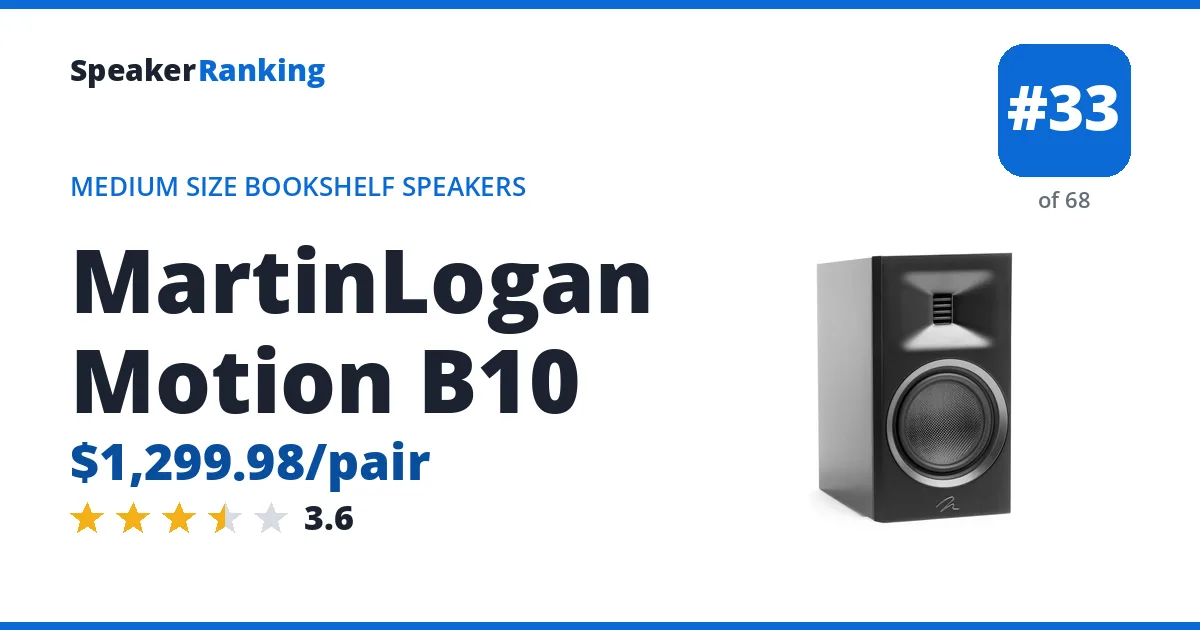
Pros: MartinLogan’s folded-motion tweeter technology (a 9.2 sq in diaphragm, larger than a typical dome) reaches this price point, with an excellent sound-power smoothness score of 0.111, meaning its off-axis output tracks its on-axis response unusually well. Sensitivity of 92dB makes it easy to drive. Measured bass extension of 74.7Hz (-3dB).
Cons: On-axis deviation of 0.669dB is rough for the price, with a pronounced +0.32dB per octave upward tilt giving it a notably bright balance, and predicted in-room smoothness of just 0.16, the roughest of any speaker measured here. Bass extension is shallow too, a Harman in-room estimate of just 62Hz.
Full MartinLogan Motion B10 review and specifications →
| Bass Extension (-10dB) | 56.1Hz (derived, log-interpolated between spinorama.org -9dB/-12dB points) |
|---|---|
| Bass Extension (-3dB) | 74.7Hz (measured, Erin’s Audio Corner via spinorama.org) |
| Country | United States (design) |
| DIY Kit | No |
| Dimensions | 12.5H x 7W x 9.75D in |
| Drivers | 1” x 1.4” Gen2 Obsidian Folded Motion tweeter, 5.5” woven fiberglass midrange |
| Enclosure | Rear-ported, 2-way |
| Impedance | 5 ohms nominal |
| Sensitivity | 92dB |
| Spinorama Preference Score | 4.01 |
| Spinorama Preference Score with Perfect Sub | 6.76 |
| Weight | 14.6 lbs (6.6 kg) each |
- Links
- Reviews, Comparisons and Sound Samples
- Head-to-Head Comparisons
 Ranked #42 of 101 in Medium Size Bookshelf Speakers - KEF Q1 Meta: $399.99 per pair Amazon eBay
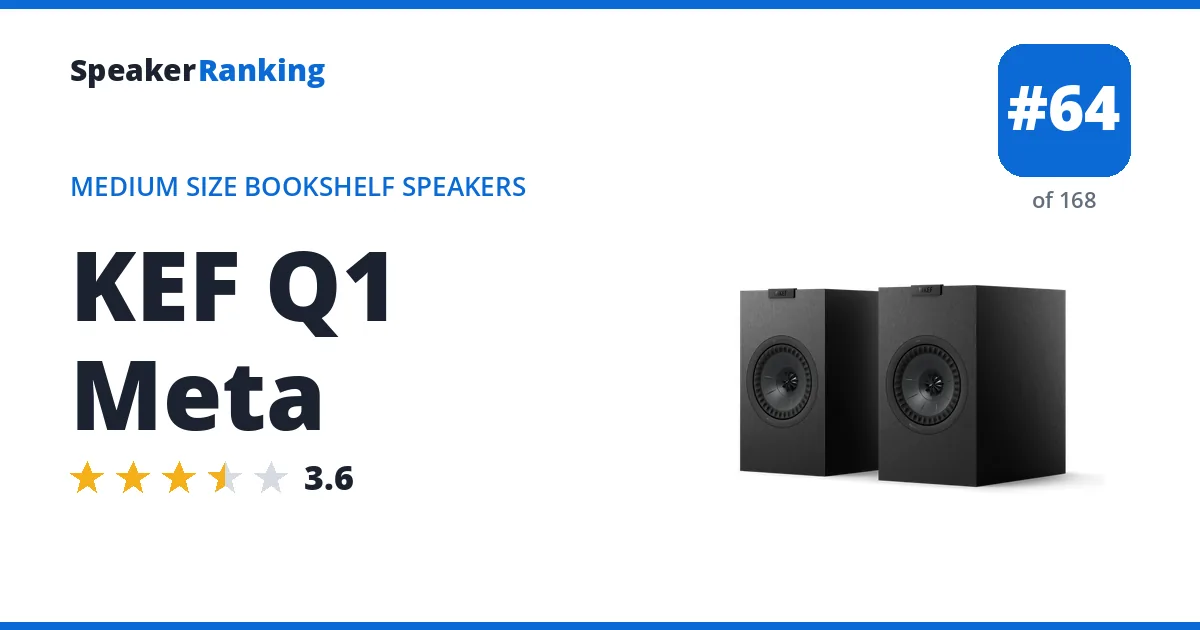
Older models: the KEF Q150 (ranked higher, rated 3.7/5) and the KEF Q100 (ranked lower, rated 2.4/5).
Larger models: the KEF Q3 Meta (rated 3.4/5), the KEF Q Concerto Meta (rated 4.6/5), the KEF Q7 Meta (estimated 3.5/5) and the KEF Q11 Meta (rated 4/5).
Pros: 12th generation Uni-Q coaxial driver places the 1” vented aluminium dome tweeter at the centre of the 5.25” aluminium woofer, with KEF’s Metamaterial Absorption Technology behind the tweeter. KEF’s own Spinorama measurements, published on spinorama.org, hold the 300Hz to 5kHz response within 2.3dB with a flat on-axis trend, so the tonal balance is even. Measured bass reaches 65Hz (-3dB) and about 43Hz (-10dB), respectable for a compact bookshelf. Same cabinet size as the Q150 it replaces. Measured bass extension of 65.1Hz (-3dB).
Cons: The only measurements are KEF’s own, not independently verified, and spinorama.org computes no preference score for them because the data is truncated at low frequencies. Sound power directivity is less even than the best in this class (3.16dB index deviation), so off-axis listeners and room reflections shift the balance more. Minimum impedance of 3.2 ohms is a harder load than the Q150’s, and rated maximum output is a modest 108dB, so plan on a subwoofer for loud listening.
Full KEF Q1 Meta review and specifications →
| Bass Extension (-10dB) | about 43.4Hz (measured, KEF vendor data via spinorama.org) |
|---|---|
| Bass Extension (-3dB) | 65.1Hz (measured, KEF vendor data via spinorama.org) |
| Cabinet Color | Satin Black, Satin White, Walnut |
| Crossover Frequency | 2.1kHz |
| Dimensions | 11.9”H x 7.1”W x 10.9”D (302 x 180 x 277 mm) |
| Drivers | Uni-Q: 130mm (5.25”) aluminium cone woofer, 25mm (1”) vented aluminium dome tweeter with MAT |
| Frequency Response | 51Hz-20kHz ±3dB (manufacturer specified) |
| Impedance | 4 ohms nominal, 3.2 ohms minimum (manufacturer specified) |
| Maximum SPL | 108dB (manufacturer specified) |
| Recommended Power | 10-150W |
| Sensitivity | 86dB (2.83V/1m, manufacturer specified) |
| Weight | 13.4 lbs (6.1 kg) each |
| Woofer Cabinet | ported |
- Links
- Reviews, Comparisons and Sound Samples
- Head-to-Head Comparisons
 Ranked #43 of 101 in Medium Size Bookshelf Speakers - Aperion Audio Novus N5B: $449.25 per pair Aperion Audio eBay
Pros: Compact front-ported bookshelf pair with a silk-dome tweeter, 5.25-inch aramid woofer and wall-mount inserts. Erin’s data shows a nearly flat +0.02dB/octave tonal slope, 47Hz extension and a 5.98 preference score with a subwoofer. Measured bass extension of 58.6Hz (-3dB), with a measured sensitivity of 85dB.
Cons: Measured sensitivity is very low at about 81.6dB and the 4-ohm load benefits from a capable amplifier. On-axis smoothness (0.221) is only fair, predicted in-room smoothness is poor at 0.160, and the raw no-subwoofer preference score is 3.76.
Full Aperion Audio Novus N5B review and specifications →
| Bass Extension (-3dB) | 58.6Hz (measured, Erin’s Audio Corner via spinorama.org) |
|---|---|
| DIY Kit | No |
| Dimensions | 11.8H x 7.1W x 7.9D in |
| Drivers | 1” silk-dome tweeter, 5.25” aramid-fiber woofer |
| Enclosure | 2-way passive, front-ported |
| Impedance | 4 ohms |
| Sensitivity | 85dB specified; 81.6dB measured |
| Spinorama Preference Score | 3.76 |
| Spinorama Preference Score with Perfect Sub | 5.98 |
| Weight | 9.9 lbs (4.5 kg) each |
- Links
- Reviews, Comparisons and Sound Samples
- Head-to-Head Comparisons
 Ranked #44 of 101 in Medium Size Bookshelf Speakers - ELAC BS41: $180.00 per pair Discontinued Amazon eBay
Pros: A small sealed two-way with a 4-inch woofer and a 1-inch tweeter that measures more evenly than its low price suggests. Erin’s Audio Corner found the listening window within a 2.5dB span from 300Hz to 5kHz and a predicted in-room response smoothness of 0.60, for a preference score of 4.29 (6.57 with an ideal subwoofer). Bass reaches about 54Hz (-3dB) and 47Hz (-10dB), and the sealed box makes it easy to place near a wall. Measured bass extension of 54.2Hz (-3dB).
Cons: The sealed 4-inch woofer limits output and deep bass, so it suits small rooms or pairing with a subwoofer. Sensitivity is a modest 84.5dB. It is discontinued and mostly found used.
Full ELAC BS41 review and specifications →
| Bass Extension (-10dB) | 46.9Hz (measured, Erin’s Audio Corner) |
|---|---|
| Bass Extension (-3dB) | 54.2Hz (measured, Erin’s Audio Corner) |
| DIY Kit | No |
| Drivers | 4” woofer, 1” tweeter |
| Frequency Response | 48Hz-20kHz (manufacturer specified) |
| Impedance | 6 ohms nominal (manufacturer specified) |
| Sensitivity | 84.5dB (manufacturer specified) |
| Spinorama Preference Score | 4.29 |
| Spinorama Preference Score with Perfect Sub | 6.57 |
| Woofer Cabinet | sealed |
- Reviews, Comparisons and Sound Samples
- Head-to-Head Comparisons
 Ranked #45 of 101 in Medium Size Bookshelf Speakers - Polk Signature Elite ES15: $299.00 per pair Passive Amazon eBay
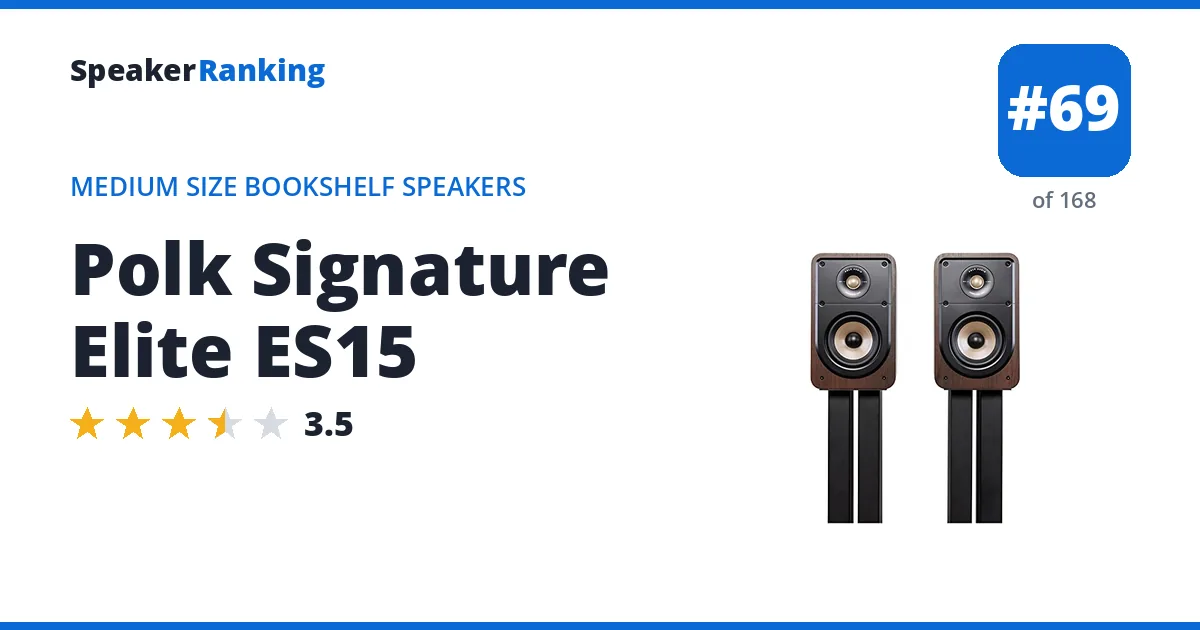
Larger models: the Polk Signature Elite ES20 (rated 3.7/5) and the Polk Signature Elite ES60 (rated 3.4/5).
Pros: A compact 5.25-inch passive bookshelf speaker designed for hi-res stereo music and home theater surrounds. Features a 1-inch Terylene dome tweeter capable of extending up to 40kHz alongside a 5.25-inch mica-reinforced polypropylene woofer and Polk’s patented Power Port bass-reflex technology. Erin’s Audio Corner Klippel NFS testing demonstrates excellent directivity control and smooth listening-window response with very low distortion. Power Port reduces turbulent air noise and provides clean low-frequency reinforcement down to approximately 58Hz. Measured bass extension of 58Hz (-3dB).
Cons: The 5.25-inch woofer has lower sensitivity (88dB) and less low-bass extension than its larger sibling, the 6.5-inch ES20. A dedicated subwoofer is recommended for home theater action dynamics and full-range orchestral playback.
Full Polk Signature Elite ES15 review and specifications →
| Bass Extension (-10dB) | 44Hz (measured, Erin’s Audio Corner) |
|---|---|
| Bass Extension (-3dB) | 58Hz (measured, Erin’s Audio Corner) |
| Crossover Frequency | 2.5kHz |
| Dimensions | 12” x 7.5” x 10.2” (305 x 191 x 259 mm) |
| Drivers | 1” Terylene high-res dome tweeter, 5.25” mica-reinforced polypropylene woofer |
| Frequency Response | 48Hz - 40kHz (Manufacturer specified) |
| Impedance | 8 ohms (4-8 ohm compatible) |
| Passive | Yes |
| Sensitivity | 88dB (2.83V @ 1m) |
| Weight | 13 lbs (5.9 kg) each |
- Links
- Reviews, Comparisons and Sound Samples
 Ranked #46 of 101 in Medium Size Bookshelf Speakers - Klipsch RP-500M: $299.00 per pair Amazon eBay
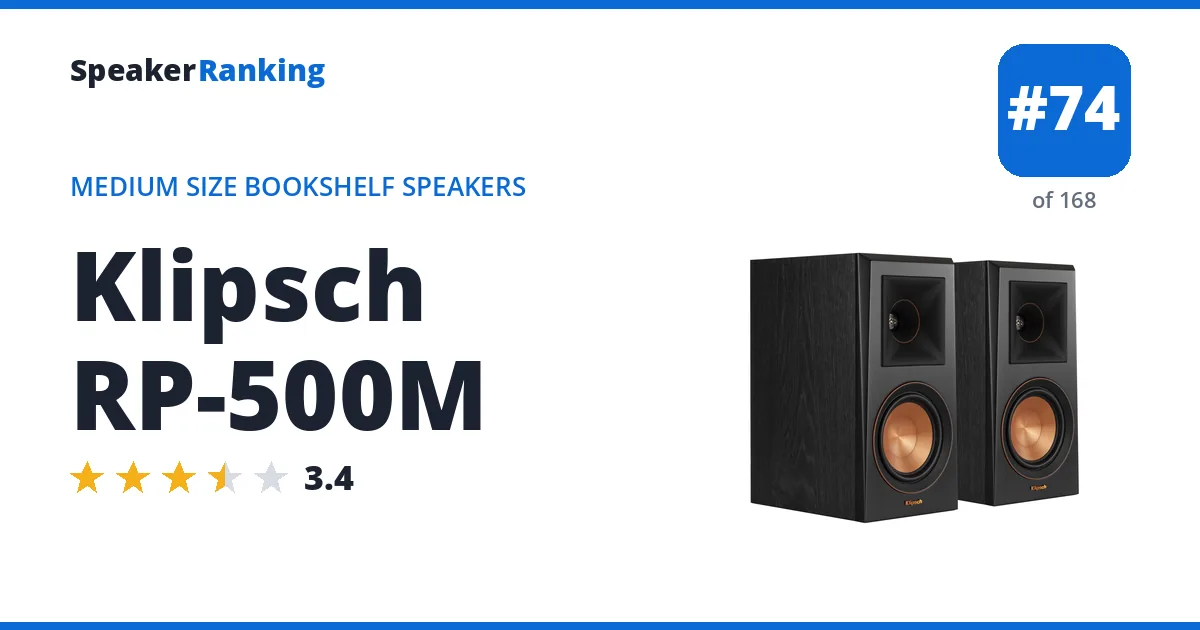
Newer model: the Klipsch RP-500M II, ranked higher, rated 4/5.
Pros: The original Reference Premiere 2-way bookshelf, still sold new alongside the newer RP-500M II at a lower price. Klipsch’s signature Hybrid Tractrix Horn tweeter loading is unmistakable and the price has dropped from its original $579/pair to roughly $299/pair.
Cons: Independently measured by Erin’s Audio Corner with a very rough response: on-axis deviation of 0.961dB and on-axis smoothness of just 0.216, well behind the revised tuning Klipsch gave the newer RP-500M II. Directivity-index standard deviation of 4.24, a pronounced +0.26dB per octave upward tilt, and a predicted in-room smoothness of just 0.16, the worst of any speaker measured here, all point to an inconsistent, brighter-leaning presentation. Full sensitivity and impedance specs aren’t published on Klipsch’s own product page.
Full Klipsch RP-500M review and specifications →
| Country | United States (Klipsch design) |
|---|---|
| DIY Kit | No |
| Dimensions | 13.50H x 6.81W x 9.50D in |
| Drivers | 1” Titanium LTS tweeter (Hybrid Tractrix Horn), 5.25” Spun Copper Cerametallic woofer |
| Enclosure | 2-way, ported |
| Impedance | 8 ohms nominal |
| Sensitivity | 93dB (manufacturer specified, 2.83V/1m) |
| Spinorama Preference Score | 4.38 |
| Spinorama Preference Score with Perfect Sub | 7.00 |
| Weight | 11.9 lbs (5.4 kg) each |
- Links
- Reviews, Comparisons and Sound Samples
- Head-to-Head Comparisons
 Ranked #54 of 101 in Medium Size Bookshelf Speakers - ELAC Debut 2.0 B5.2: $269.00 per pair Amazon eBay
Larger model: the ELAC Debut 2.0 B6.2 (rated 3.5/5).
Pros: Good horizontal directivity: the off-axis curves track the on-axis response closely, so the broad tonal error responds predictably to EQ. Erin demonstrated that a single high-shelf filter centered near 1.6kHz, about -2dB with Q near 2, substantially improves linearity. Moderate roughly +/-50-60 degree horizontal coverage balances room interaction and image focus. The front port makes close-to-wall placement practical. Erin measured F3 near 60Hz and F10 near 40Hz, useful extension for a compact 5.25-inch two-way. Harmonic distortion is mostly below 1% at 86dB/1m, and low-frequency distortion is better than its size might suggest. Compact cabinet and inexpensive pair pricing make it a workable EQ-assisted desktop or small-room system. Measured bass extension of 60Hz (-3dB), with a measured sensitivity of 83dB.
Cons: Erin measured a broad +3dB step beginning around 1.5kHz; the resulting elevated upper range sounds tonally uneven even though it is not a narrow, sharp resonance. Native response spans roughly -2.6 to +4dB around the mean, so this is not a neutral speaker without correction. Sensitivity is only about 83dB after correcting the shelf, demanding materially more amplifier voltage than ELAC’s 86dB specification implies. Vertical response changes substantially outside roughly +/-10 degrees of tweeter height. Dynamic compression is the larger limitation: at the highest sweep level it loses roughly 1-1.5dB through the midrange, and even the 86dB trace shows unusual nonlinearity that may involve crossover heating. At about 96dB, multitone distortion rises audibly around 600Hz; an 80-120Hz subwoofer crossover helps but does not turn it into a high-output design. Erin recommends the larger B6.2 instead when EQ is unavailable.
Full ELAC Debut 2.0 B5.2 review and specifications →
| Bass Extension (-10dB) | 40Hz (measured, Erin’s Audio Corner) |
|---|---|
| Bass Extension (-3dB) | 60Hz (measured, Erin’s Audio Corner) |
| DIY Kit | No |
| Dimensions | 13.4”H x 7.1”W x 9.2”D (341 x 180 x 234 mm) |
| Drivers | 5.25” aramid-fiber woofer, 1” cloth-dome tweeter |
| Impedance | 6 ohms nominal (manufacturer specified) |
| Sensitivity | About 83dB after recommended EQ (measured, Erin’s Audio Corner; 86dB manufacturer specified) |
| Spinorama Preference Score | 5.02 |
| Spinorama Preference Score with Perfect Sub | 7.27 |
| Weight | 13 lbs (5.9 kg) each |
| Woofer Cabinet | ported, front |
- Links
- Reviews, Comparisons and Sound Samples
- Head-to-Head Comparisons
- ELAC Debut 2.0 B5.2 vs Sony SS-CS5 M2
- ELAC Debut 2.0 B5.2 vs Paradigm Monitor SE Atom
- ELAC Debut 2.0 B5.2 vs JBL Studio 530
- ELAC Debut 2.0 B5.2 vs JBL Stage 250B
- ELAC Debut 2.0 B5.2 vs Monoprice Monolith THX Compact Satellite
- ELAC Debut 2.0 B5.2 vs Dynaudio Emit M10
- ELAC Debut 2.0 B5.2 vs ELAC BS U5
- ELAC Debut 2.0 B5.2 vs Dynaudio X14
- See all 45 comparisons
 Ranked #55 of 101 in Medium Size Bookshelf Speakers - Sony SS-CS5 M2: $278.00 per pair Amazon eBay
Pros: Added internal bracing (corners, sides, front baffle) plus an updated crossover meaningfully reduce the resonance issues that plagued the original SS-CS5, giving a smoother, more neutral character overall. A modest mid-range dip (about 1-2dB) is present but tolerable, and the reviewer would rather have this dip than a peak in that region. Slightly deeper bass than the previous version, measuring about 2dB more output around 60Hz. Distortion drops noticeably when crossed to a subwoofer around 80-120Hz, meaningfully improving midrange clarity and detail versus running full-range. Easy to drive on a standard AVR: no need for a dedicated high-power amplifier. More modern, understated waveguide look compared to the previous version’s glossy trim. Measured bass extension of 80Hz (-3dB).
Cons: Mild sibilance in the 3-5kHz range stands out on S and T sounds in vocals. Some forwardness in the midrange noticeable on certain vocal recordings. Soundstage and sense of envelopment are comparatively flat and two-dimensional, especially next to reference-quality speakers with strong 3D imaging. Marketed as a “three-way” design mainly due to an added super-tweeter that the reviewer considers largely superfluous: it engages only at very high frequencies and adds complexity without a clearly audible benefit, when that cost might have been better spent on the main crossover. Output-limited: realistic ceiling is around the mid-90s dB SPL at a few meters, with comfortable listening closer to 75-85dB at 3-4 meters before distortion and compression become audible. Bass noticeably compresses/shelves below about 120Hz as volume increases, softening kick-drum impact at higher output. Smaller drivers and a lighter motor structure than rivals like the Polk XT20, which the reviewer generally prefers for its better directivity and higher SPL capability. Still needs a subwoofer for any real bass extension.
Full Sony SS-CS5 M2 review and specifications →
| Bass Extension (-10dB) | 54Hz (measured, Erin’s Audio Corner) |
|---|---|
| Bass Extension (-3dB) | 80Hz (measured, Erin’s Audio Corner) |
| DIY Kit | No |
| Dimensions | 13.2”H x 7”W x 8.7”D (335 x 178 x 220 mm) |
| Drivers | 5.12” woofer, 0.98 in tweeter; 0.75-inch supertweeter; 0.75-inch supertweeter; 0.75-inch supertweeter; 0.75-inch supertweeter |
| Impedance | 6 ohms |
| Sensitivity | 82.5dB |
| Weight | 9.5 lbs (4.3 kg) each |
| Woofer Cabinet | ported, rear |
- Links
- Reviews, Comparisons and Sound Samples
- Head-to-Head Comparisons
- Sony SS-CS5 M2 vs ELAC Debut 2.0 B5.2
- Sony SS-CS5 M2 vs Paradigm Monitor SE Atom
- Sony SS-CS5 M2 vs JBL Stage 250B
- Sony SS-CS5 M2 vs Monoprice Monolith THX Compact Satellite
- Sony SS-CS5 M2 vs JBL Studio 530
- Sony SS-CS5 M2 vs Totem Kin One
- Sony SS-CS5 M2 vs Dynaudio Emit M10
- Sony SS-CS5 M2 vs ELAC BS U5
- See all 46 comparisons
 Ranked #57 of 101 in Medium Size Bookshelf Speakers - Micca MB42X Mark III: $99.99 per pair Amazon eBay
Pros: A very inexpensive, compact 4-inch passive pair with a real crossover and removable grilles. Erin’s data predicts a respectable 6.27 preference score when crossed to a subwoofer, low 0.099 on-axis roughness and broad horizontal coverage. Measured bass extension of 101.6Hz (-3dB).
Cons: Bass extension is limited to about 81Hz in-room and the response rises steeply at +0.81dB per octave, so it can sound bright without EQ. The measurement’s provenance is not fully documented, sensitivity is low, and output is limited by the small woofer.
Full Micca MB42X Mark III review and specifications →
| Bass Extension (-10dB) | 61.7Hz (derived, log-interpolated between spinorama.org -9dB/-12dB points) |
|---|---|
| Bass Extension (-3dB) | 101.6Hz (measured, Erin’s Audio Corner via spinorama.org) |
| Country | United States (design) |
| DIY Kit | No |
| Dimensions | 9.5H x 5.8W x 6.5D in |
| Drivers | 0.75” silk-dome tweeter, 4” carbon-fiber woofer |
| Enclosure | 2-way, rear-ported |
| Impedance | 4-8 ohms |
| Sensitivity | 85dB |
| Spinorama Preference Score | 3.04 |
| Spinorama Preference Score with Perfect Sub | 6.27 |
| Weight | approx. 4 lbs (1.8 kg) each |
- Links
- Reviews, Comparisons and Sound Samples
- Head-to-Head Comparisons
 Ranked #59 of 101 in Medium Size Bookshelf Speakers - JBL Stage 250B: $439.95 per pair Amazon JBL eBay
Older model: the JBL Stage A130 (ranked lower, rated 2.1/5).
Smaller model: the JBL Stage 2 240B (ranked lower, estimated 2.7/5).
Larger model: the JBL Stage 2 280F (rated 3.4/5).
Pros: Good local Spinorama scores of 4.06 raw and 6.60 with a subwoofer, with smooth horizontal directivity from JBL’s next-generation HDI waveguide. The current Stage 2 model offers solid build details, magnetic grilles and useful 56Hz measured extension at an accessible price. Measured bass extension of 64.5Hz (-3dB).
Cons: Its objective score is good rather than class-leading, and the rear port needs some wall clearance. At 86dB sensitivity and six-ohm nominal impedance it is not especially easy to drive, while the compact woofer limits deep-bass output.
Full JBL Stage 250B review and specifications →
| Bass Extension (-10dB) | 50Hz (measured, Erin’s Audio Corner) |
|---|---|
| Bass Extension (-3dB) | 64.5Hz (measured, Erin’s Audio Corner via spinorama.org) |
| DIY Kit | No |
| Dimensions | 12.6H x 7.9W x 9.5D in |
| Drivers | 1-inch aluminum tweeter, 5.25-inch polycellulose woofer |
| Enclosure | Passive 2-way rear-ported |
| Frequency Response | 50Hz-25kHz (-6dB) |
| Impedance | 6 ohms |
| Power Handling | 75W RMS |
| Recommended Power | 20-150W |
| Sensitivity | 86dB/2.83V/1m |
| Spinorama Preference Score | 4.06 |
| Spinorama Preference Score with Perfect Sub | 6.60 |
| Weight | 12.3 lbs (5.6 kg) each |
| Woofer Cabinet | ported, rear |
- Links
- Reviews, Comparisons and Sound Samples
- Head-to-Head Comparisons
- JBL Stage 250B vs Paradigm Monitor SE Atom
- JBL Stage 250B vs Sony SS-CS5 M2
- JBL Stage 250B vs ELAC Debut 2.0 B5.2
- JBL Stage 250B vs Dynaudio Emit M10
- JBL Stage 250B vs ELAC BS U5
- JBL Stage 250B vs Dynaudio X14
- JBL Stage 250B vs Pioneer SP-BS22-LR (Philharmonic AAM Mod)
- JBL Stage 250B vs JBL Studio 530
- See all 42 comparisons
 Ranked #60 of 101 in Medium Size Bookshelf Speakers - Monoprice Monolith THX Compact Satellite: $249.99 per pair Amazon Monoprice eBay
Pros: A compact sealed satellite with a 4.5-inch coaxial driver and a 20mm silk-dome tweeter mounted at its center, THX certified and built to sit with a subwoofer crossed over at 80Hz. Erin’s Audio Corner measured a listening window within a 4.0dB span from 300Hz to 5kHz, a smooth predicted in-room response (0.61 smoothness) and wide, even dispersion (about 60 degrees horizontally and 55 degrees vertically), and its preference score rises to 6.56 with an ideal subwoofer. A keyhole slot makes wall mounting easy. Measured bass extension of 82Hz (-3dB).
Cons: Bass stops at about 82Hz (-3dB) and 62Hz (-10dB), so it needs a subwoofer for any full-range use, and without one its preference score is only 3.57. Sensitivity is a low 81dB into a 4-ohm load, so it needs a capable amplifier to play loud. Out of stock at Monoprice and Amazon, with Monoprice quoting a restock date well into 2027.
Full Monoprice Monolith THX Compact Satellite review and specifications →
| Bass Extension (-10dB) | 61.5Hz (measured, Erin’s Audio Corner) |
|---|---|
| Bass Extension (-3dB) | 82Hz (measured, Erin’s Audio Corner) |
| DIY Kit | No |
| Dimensions | 6.3”H x 6”W x 5.9”D (160 x 153 x 150 mm) |
| Drivers | 4.5” polypropylene woofer with coaxial 20mm silk-dome tweeter |
| Frequency Response | 80Hz-20kHz ±3dB (manufacturer specified) |
| Impedance | 4 ohms nominal (manufacturer specified) |
| Sensitivity | 81dB (manufacturer specified) |
| Spinorama Preference Score | 3.57 |
| Spinorama Preference Score with Perfect Sub | 6.56 |
| Weight | 4.2 lbs (1.9 kg) each |
| Woofer Cabinet | sealed |
- Links
- Reviews, Comparisons and Sound Samples
- Head-to-Head Comparisons
 Ranked #62 of 101 in Medium Size Bookshelf Speakers - Totem Kin One: $600 per pair Sky by Gramophone eBay
Pros: Compact two-way design with a 1” titanium-infused soft dome tweeter and 4” MHex cone woofer, available in distinctive colorways beyond the usual black/white. Surprisingly spacious, wide sound for its tiny size: horizontal dispersion of about ±75° through the midrange gives real envelopment and soundstage width. Reasonably good overall directivity, meaning it takes well to EQ correction. Pairs well with an EQ-capable streaming amp (the reviewer specifically suggests something like a WiiM Amp), which can smooth out its main tonal issues with just a few bands of correction. Crossing over to a subwoofer around 80Hz measurably reduces midrange distortion and improves resolution. For a 4” woofer, distortion performance up to about 88dB is reasonable and shouldn’t be judged against larger-driver speakers. Measured bass extension of 91Hz (-3dB), with a measured sensitivity of 83.4dB.
Cons: Real-world sensitivity measured significantly below the manufacturer’s spec (about 83.4dB measured versus 89dB claimed). Treble rolls off sharply above about 8kHz, an unusually attenuated top end that the reviewer wasn’t sure was even an intentional design choice. A dip around 600Hz-1kHz paired with a nearby resonance (likely port-related) gives a combination of hollow and forward character depending on the exact frequency. Bass rolls off around 80-90Hz (F3 91Hz, F10 59Hz), typical for a compact 4” woofer, so a subwoofer is essential for any real bass. Vertical placement has a real sweet spot: going too far above or especially below the tweeter axis noticeably changes the tonal balance. Distortion rises substantially at 96dB and the port/woofer begin struggling at extreme low frequencies and volumes. Best aimed directly at the listener given how quickly the treble rolls off; toeing it out requires EQ compensation to avoid sounding dull.
Full Totem Kin One review and specifications →
| Bass Extension (-10dB) | 59Hz (measured, Erin’s Audio Corner) |
|---|---|
| Bass Extension (-3dB) | 91Hz (measured, Erin’s Audio Corner) |
| DIY Kit | No |
| Dimensions | 9.5”H x 5”W x 6.3”D (241 x 127 x 159 mm) |
| Drivers | 4” MHEX cone woofer, 1” titanium infused soft dome tweeter |
| Impedance | 6 ohms nominal, 4.4 ohms minimum (measured above 80Hz, Erin’s Audio Corner) |
| Power Handling | 20-100W RMS |
| Sensitivity | 83.4dB (measured average 300Hz-3kHz @ 2.83V/1m, Erin’s Audio Corner; 89dB manufacturer specified) |
| Spinorama Preference Score | 3.68 |
| Spinorama Preference Score with Perfect Sub | 6.61 |
| Weight | 6.2 lbs (2.83 kg) each |
| Woofer Cabinet | ported, rear |
- Links
- Reviews, Comparisons and Sound Samples
- Head-to-Head Comparisons
 Ranked #67 of 101 in Medium Size Bookshelf Speakers - Acoustic Energy AE100 Mk2: $399 per pair Discontinued Amazon eBay
Pros: Good directivity linearity: on-axis and off-axis response track each other well despite an otherwise uneven overall response, which means the tonal problems can be EQ’d out with reasonably good success. Wide horizontal radiation, about ±50°. Nicely finished cabinet: the reviewer specifically called out the fit and finish as a genuine positive. Both units of the review pair measured closely matched to each other. Measured bass extension of 63Hz (-3dB), with a measured sensitivity of 84dB.
Cons: High-frequency level runs noticeably too hot regardless of placement: the reviewer tried four different setups (near/far from wall, on-axis, 30° off-axis) at two listening distances and couldn’t get it to sound right at any of them. A mid-range dip that the reviewer attributes to internal cabinet resonance rather than intentional baffle-step compensation, reinforced by an internal inspection showing no cross-bracing and a slot port that may itself be resonating when tapped. Small tweeter waveguide magnet suggests limited power handling headroom. At this price and radiation pattern, the reviewer would pick the ELAC DBR62 (more neutral, similar ±60° pattern) or, for less money, the ELAC Debut 2.0 B6.2 over this speaker; the KEF Q150 and SVS Prime Bookshelf are also called out as more linear alternatives nearby in price. Discontinued.
Full Acoustic Energy AE100 Mk2 review and specifications →
| Bass Extension (-10dB) | 42Hz (measured, Erin’s Audio Corner) |
|---|---|
| Bass Extension (-3dB) | 63Hz (measured, Erin’s Audio Corner) |
| Crossover Frequency | 2.9kHz |
| DIY Kit | No |
| Dimensions | 11.4”H x 6.5”W x 9.8”D (290 x 165 x 250 mm) |
| Drivers | 5.25” midwoofer, 1” soft fabric dome tweeter with waveguide |
| Impedance | 6 ohms nominal, 4.7 ohms minimum (measured, Erin’s Audio Corner) |
| Sensitivity | 84dB (measured average, Erin’s Audio Corner) |
| Spinorama Preference Score | 4.96 |
| Spinorama Preference Score with Perfect Sub | 7.18 |
| Weight | 20.1 lbs (9.1 kg) each |
| Woofer Cabinet | ported, rear slot port |
- Links
- Reviews, Comparisons and Sound Samples
- Head-to-Head Comparisons
 Ranked #75 of 101 in Medium Size Bookshelf Speakers - JBL L52 Classic: $999.00 per pair Amazon eBay
Pros: Genuine walnut wood veneer cabinet with a retro Quadrex foam grille (black, orange, or dark blue) reviving JBL’s classic L-series look. 5.25” pure pulp cone woofer and 0.75” titanium dome tweeter on a waveguide, front-firing bass reflex port, in a compact stand-mount cabinet. A pronounced upper-bass bump around 100 Hz gives kick drums a punchy, textured character. Measured bass extension of 62Hz (-3dB), with a measured sensitivity of 85dB.
Cons: Measured compression and distortion behavior from about 1-5 kHz was inconsistent (“wonky”) across output levels, and didn’t clean up even at lower volume; adding a subwoofer high-pass didn’t fix the high-frequency distortion either. Response rolls off quickly above the upper-bass bump, so there’s punch and impact but not real low-end rumble or fundamental weight below about 60 Hz without a subwoofer. Soundstage width was inconsistent track to track, with imaging not staying locked to where instruments should be. Vocals could sound hot and slightly grainy in the 2.5-5 kHz region; pointing the speakers off-axis reduced that sharpness but also killed high-frequency air.
Full JBL L52 Classic review and specifications →
| Bass Extension (-10dB) | 45Hz (measured average, Erin’s Audio Corner) |
|---|---|
| Bass Extension (-3dB) | 62Hz (measured average, Erin’s Audio Corner) |
| Crossover Frequency | 2.8kHz |
| DIY Kit | No |
| Dimensions | 13-1/16”H x 7-13/16”W x 8-11/16”D |
| Drivers | 5.25” pure pulp cone woofer, 0.75” titanium dome tweeter with waveguide |
| Frequency Response | 47Hz - 24kHz (-6dB, manufacturer specified) |
| Impedance | 4 ohms nominal, 3.7 ohms minimum (measured, Erin’s Audio Corner) |
| Power Handling | 10-75W RMS |
| Sensitivity | 85dB (measured average, Erin’s Audio Corner) |
| Spinorama Preference Score | 4.54 |
| Spinorama Preference Score with Perfect Sub | 6.96 |
| Weight | 11 lbs (5 kg) each |
- Links
- Reviews, Comparisons and Sound Samples
- Head-to-Head Comparisons
- JBL L52 Classic vs JBL Stage A120
- JBL L52 Classic vs ELAC Uni-Fi 2.0 UB52
- JBL L52 Classic vs KEF Q100
- JBL L52 Classic vs Q Acoustics 3020i
- JBL L52 Classic vs Pioneer SP-BS22-LR (Philharmonic AAM Mod)
- JBL L52 Classic vs Dynaudio X14
- JBL L52 Classic vs Micca RB42
- JBL L52 Classic vs ELAC BS U5
- See all 35 comparisons
 Ranked #76 of 101 in Medium Size Bookshelf Speakers - Parts Express Copperhead Desktop Kit: $119.98 per pair Parts Express eBay
Pros: Inexpensive, beginner-friendly CNC flat-pack kit with a compact 8 x 5-inch desktop footprint and only one 3.5-inch full-range driver per channel. The point-source layout avoids a conventional woofer/tweeter crossover and, when listened to around 20 degrees above the driver as intended, can produce precise near-field imaging. Erin measured roughly 81dB sensitivity, consistent with Parts Express’s specification. The included baffle-step network improves lower-midrange balance, while the optional series inductor reduces the driver’s rising top end; Erin recommends retaining it. Several remaining narrow peaks can be corrected with desktop software EQ. Bottom porting conserves desk space, and unfinished MDF invites custom finishing. Measured bass extension of 98.1Hz (-3dB), with a measured sensitivity of 81dB.
Cons: Despite the ‘full-range’ label, output rolls off around 120-150Hz and a subwoofer with an unusually high 100-200Hz crossover is effectively mandatory. Native response has resonances near roughly 2.1kHz and 8kHz plus a broad 14-20kHz rise of 5-8dB, so it is not smooth without the supplied network and additional EQ. Distortion already exceeds 3% in places at 86dB/1m and becomes extreme at 96dB. Erin’s multitone test approached -10dB distortion (roughly 30%) full-range at the highest level, accompanied by 3-4dB compression; even a 200Hz high-pass leaves roughly 3-5% distortion and 2-3dB compression. The angled cabinet demands a specific near-field ear height, and its very low sensitivity plus 10W RMS power rating leave almost no clean-output headroom for room listening.
Full Parts Express Copperhead Desktop Kit review and specifications →
| Bass Extension (-10dB) | 69.3Hz (measured, Erin’s Audio Corner) |
|---|---|
| Bass Extension (-3dB) | 98.1Hz (measured, Erin’s Audio Corner) |
| DIY Kit | Yes |
| Dimensions | 8”H x 5”W x 6.5”D (203 x 127 x 165 mm) |
| Drivers | 3.5” Dayton Audio PS95-8 full-range driver |
| Frequency Response | 120Hz-20kHz +/-3dB (manufacturer specified) |
| Impedance | 8 ohms (manufacturer specified) |
| Power Handling | 10W RMS / 20W maximum; 25W RMS with 50Hz high-pass |
| Sensitivity | 81dB @ 1W/1m (measured by Erin’s Audio Corner and manufacturer specified) |
| Spinorama Preference Score | 2.11 (spinorama.org) |
| Spinorama Preference Score with Perfect Sub | 5.35 (spinorama.org) |
| Woofer Cabinet | ported, bottom |
- Links
- Reviews, Comparisons and Sound Samples
- Head-to-Head Comparisons
- Parts Express Copperhead Desktop Kit vs JBL Stage A120
- Parts Express Copperhead Desktop Kit vs Pioneer SP-BS22-LR (Philharmonic AAM Mod)
- Parts Express Copperhead Desktop Kit vs Jamo S 803
- Parts Express Copperhead Desktop Kit vs JBL Studio 530
- Parts Express Copperhead Desktop Kit vs KEF Q150
- Parts Express Copperhead Desktop Kit vs Neumi BS5
- Parts Express Copperhead Desktop Kit vs Arendal 1961 Monitor
- Parts Express Copperhead Desktop Kit vs KEF LS50 Meta
 Ranked #77 of 101 in Medium Size Bookshelf Speakers - JBL Stage A120: $299 per pair Discontinued eBay
Newer model: the JBL Stage 2 240B, ranked higher, estimated 2.7/5.
Larger model: the JBL Stage A130 (ranked lower, rated 2.1/5).
Pros: Comes with a port bung, letting you experiment between ported and sealed configurations: the reviewer found the sound improved somewhat with the port sealed. Distortion at 96dB is broadly comparable to competitors in this price range outside of some elevated low-end THD. Wide horizontal radiation pattern for a compact bookshelf speaker in the low-to-midrange. Measured bass extension of 71Hz (-3dB), with a measured sensitivity of 83dB.
Cons: A pronounced “Batman”-shaped frequency response: boosted bass, a scooped midrange, and elevated treble (about 3-4dB above the midrange), driven partly by confirmed cabinet panel resonance around 800Hz-1.7kHz. Directivity shows significant back-to-back peaks and dips, making the speaker harder to correct with EQ since the off-axis sound doesn’t track the direct sound cleanly. Elevated treble that some might call “detailed” reads as an unwelcome boost to the reviewer rather than genuine resolution. Compression testing shows the low end degrading substantially at high output (102dB). Overall considered one of the weaker speakers the reviewer has tested in this class, with a competing model (Emotiva Airmotiv B1+) recommended instead at a similar price. Discontinued.
Full JBL Stage A120 review and specifications →
| Bass Extension (-10dB) | 53Hz (measured, Erin’s Audio Corner) |
|---|---|
| Bass Extension (-3dB) | 71Hz (measured, Erin’s Audio Corner) |
| DIY Kit | No |
| Dimensions | 11.3”H x 6.8”W x 7.4”D (285.8 x 171.5 x 188.9 mm) |
| Drivers | 0.75” tweeter + 5” woofer |
| Impedance | 6 ohms |
| Sensitivity | 83dB (measured, Erin’s Audio Corner) |
| Spinorama Preference Score | 3.50 |
| Spinorama Preference Score with Perfect Sub | 6.24 |
| Weight | 10.6 lbs (4.8 kg) |
| Woofer Cabinet | ported |
- Reviews, Comparisons and Sound Samples
- Head-to-Head Comparisons
- JBL Stage A120 vs Parts Express Copperhead Desktop Kit
- JBL Stage A120 vs ELAC Uni-Fi 2.0 UB52
- JBL Stage A120 vs KEF Q100
- JBL Stage A120 vs JBL L52 Classic
- JBL Stage A120 vs Q Acoustics 3020i
- JBL Stage A120 vs JBL Stage 2 240B
- JBL Stage A120 vs Micca RB42
- JBL Stage A120 vs Q Acoustics 5020
- See all 37 comparisons
 Ranked #83 of 101 in Medium Size Bookshelf Speakers - Micca RB42: $159.99 per pair Amazon eBay
Pros: Curved cabinet fit and finish look closer to a speaker costing three times as much. Rated for a wide 15-100W amplifier range with 4-8 ohm compatibility, giving flexibility with modest amplification. Measured bass extension of 85Hz (-3dB), with a measured sensitivity of 80dB.
Cons: CEA2034 spinorama shows significant peaks and valleys in the on-axis and listening-window response starting a few kHz up, with excess high-frequency energy the reviewer found fatiguing over time despite an initial impression of “detail.” Off-axis response diverges heavily from on-axis, meaning tonality shifts with room and listening position in ways EQ can’t correct. Distorts and the woofer visibly flaps under moderate volume; low 83dB sensitivity makes it a harder amplifier load than its size suggests.
Full Micca RB42 review and specifications →
| Bass Extension (-10dB) | 62Hz (measured, Audio Science Review) - the reviewer noted an artificial boost around 100-300Hz, so true extension may be worse than this on-axis reading suggests |
|---|---|
| Bass Extension (-3dB) | 85Hz (measured, Audio Science Review) - the reviewer noted an artificial boost around 100-300Hz, so true extension may be worse than this on-axis reading suggests |
| DIY Kit | No |
| Dimensions | 8.7H x 4.9W x 7.9D in |
| Drivers | 4” coated paper woofer, 0.75” silk dome tweeter |
| Frequency Response | 50Hz - 20kHz (Manufacturer specified, typical in-room) |
| Impedance | 4-8 ohms |
| Power Handling | 15-100W each |
| Sensitivity | 80dB (2.83V/1m, measured, Audio Science Review) |
| Spinorama Preference Score | 4.59 |
| Spinorama Preference Score with Perfect Sub | 6.87 |
| Weight | 6 lbs (2.7 kg) each (per retailer listing) |
| Woofer Cabinet | ported, front |
- Links
- Reviews, Comparisons and Sound Samples
- Head-to-Head Comparisons
 Ranked #84 of 101 in Medium Size Bookshelf Speakers - Q Acoustics 5020: $1,199.00 per pair Amazon eBay
Pros: Attractively finished compact standmount with a 5-inch Continuous Curved Cone woofer and carefully engineered cabinet details. Erin found distortion well controlled at normal levels: below 1% down to about 50Hz at 86dB/1m. Its 87dB measured sensitivity is unremarkable rather than hard to drive, and it maintains acceptable output for typical 80-85dB listening. The rear port can be plugged for placement flexibility. Measured bass extension of 103Hz (-3dB), with a measured sensitivity of 87.1dB.
Cons: Erin found the tonal balance distinctly too crisp, forward and treble-heavy: the top end is roughly 3-5dB elevated while the 1-3kHz region is recessed, so vocals change level unnaturally as they move through their range. The shallow woofer crossover and steeper tweeter slope contribute to the off-axis discontinuity, while the port has a strong 1kHz resonance. Bass is limited: Erin measured F3 103Hz and F10 48Hz; at 96dB distortion reaches about 3% by 100Hz, and he bottomed the woofer when pushed hard. He preferred the less-expensive 3020i’s linearity and did not recommend the 5020 for neutral listening without EQ.
Full Q Acoustics 5020 review and specifications →
| Bass Extension (-10dB) | 48Hz (measured, Erin’s Audio Corner) |
|---|---|
| Bass Extension (-3dB) | 103Hz (measured, Erin’s Audio Corner) |
| Crossover Frequency | 2.5kHz (manufacturer specified) |
| DIY Kit | No |
| Dimensions | 11.2”H x 7.1”W x 11.5”D |
| Drivers | 5” (125mm) C3 mid/bass driver, 1” (25mm) tweeter |
| Frequency Response | 53Hz - 30kHz (-6dB, manufacturer specified) |
| Impedance | 6 ohms nominal, 3.3 ohms minimum (manufacturer specified) |
| Recommended Power | 25W - 100W (manufacturer specified) |
| Sensitivity | 87.1dB (2.83V/1m, measured, Erin’s Audio Corner; 87.9dB manufacturer specified) |
| Spinorama Preference Score | 3.63 |
| Spinorama Preference Score with Perfect Sub | 6.55 |
| Weight | 15.4 lbs (7.0 kg) each |
| Woofer Cabinet | rear-ported |
- Links
- Reviews, Comparisons and Sound Samples
- Head-to-Head Comparisons
- Q Acoustics 5020 vs Micca RB42
- Q Acoustics 5020 vs Verdant Audio Bambusa AL-1
- Q Acoustics 5020 vs JBL Stage A130
- Q Acoustics 5020 vs Fluance Signature HFS
- Q Acoustics 5020 vs Q Acoustics 3020i
- Q Acoustics 5020 vs JBL Control 1 Pro
- Q Acoustics 5020 vs KEF Q100
- Q Acoustics 5020 vs Polk T15
- See all 43 comparisons
 Ranked #86 of 101 in Medium Size Bookshelf Speakers - JBL Stage A130: $399 per pair Discontinued eBay
Newer model: the JBL Stage 250B, ranked higher, rated 3.2/5.
Smaller model: the JBL Stage A120 (ranked higher, rated 2.5/5).
Pros: More constant, better-behaved directivity than the smaller A120 once past the tweeter crossover point, giving a more consistent radiation pattern that likely explains some of its positive reception among other reviewers. Distortion at 96dB measures slightly better than a direct competitor (Emotiva Airmotiv B1+) in the low end, though slightly worse at high frequencies. The tweeter itself sounded decent to the reviewer, who considers it a reasonable value at its price point despite other reservations. Wide, well-filled horizontal radiation through the midrange. Measured bass extension of 66Hz (-3dB), with a measured sensitivity of 85.2dB.
Cons: Still shows the same underlying “Batman”-shaped response pattern as the A120: a bass bump, a midrange dip, a cabinet-resonance peak around 800Hz-1.7kHz (confirmed via accelerometer testing on the cabinet panels), and roughly a 5dB treble bump around 10kHz. Does not include a port bung, so sealed-cabinet listening requires DIY stuffing rather than a proper factory solution. The reviewer’s own measurements notably diverge from another well-known publication’s results on this same model, possibly reflecting a running production change, though this couldn’t be confirmed. Overall sound quality struck the reviewer as not a good-sounding speaker despite the more favorable measurements relative to the A120. Output-limited at extreme volumes (102dB), similar to its smaller sibling. Loses to the similarly-priced Emotiva Airmotiv B1+ in overall linearity and neutrality, according to the reviewer’s direct comparison. Discontinued.
Full JBL Stage A130 review and specifications →
| Bass Extension (-10dB) | 50Hz (measured, Erin’s Audio Corner) |
|---|---|
| Bass Extension (-3dB) | 66Hz (measured, Erin’s Audio Corner) |
| Crossover Frequency | 3.2kHz |
| DIY Kit | No |
| Dimensions | 12.6”H x 7.5”W x 9.1”D (321 x 190 x 230 mm) |
| Drivers | 5.25” (133mm) polycellulose woofer, 1” (25mm) aluminum dome tweeter |
| Impedance | 6 ohms nominal, about 4.3 ohms minimum (measured, Erin’s Audio Corner) |
| Sensitivity | 85.2dB (measured, Erin’s Audio Corner) |
| Spinorama Preference Score | 4.04 |
| Spinorama Preference Score with Perfect Sub | 6.51 |
| Weight | 12 lbs (5.45 kg) each |
| Woofer Cabinet | ported |
- Links
- Reviews, Comparisons and Sound Samples
- Head-to-Head Comparisons
- JBL Stage A130 vs Fluance Signature HFS
- JBL Stage A130 vs JBL Control 1 Pro
- JBL Stage A130 vs Q Acoustics 5020
- JBL Stage A130 vs Micca RB42
- JBL Stage A130 vs Polk T15
- JBL Stage A130 vs Definitive Technology ProMonitor 1000
- JBL Stage A130 vs Q Acoustics 3020i
- JBL Stage A130 vs KEF Q100
- See all 36 comparisons
 Ranked #95 of 101 in Medium Size Bookshelf Speakers - Klipsch R-51M: $289.99 per pair Passive Amazon eBay
Smaller model: the Klipsch R-41M (ranked lower, rated 1.3/5).
Pros: A high-efficiency 5.25-inch passive bookshelf speaker featuring Klipsch’s 90 x 90 square Tractrix horn mated to a 1-inch aluminum LTS tweeter and spun-copper IMG woofer. Delivers high sensitivity (93dB @ 2.83V/1m) that allows it to achieve loud volume levels effortlessly even with low-powered budget amplifiers. Rear-firing Tractrix port provides clean, tight punch down to approximately 62Hz at -3dB, offering noticeably fuller low-end weight than the smaller 4-inch R-41M. Measured bass extension of 62Hz (-3dB).
Cons: Anechoic NFS measurements from Erin’s Audio Corner and ASR reveal significant tonal colorations: a sharp treble boost between 2kHz and 6kHz combined with a recessed upper midrange creates a bright, sibilant presentation that causes listener fatigue over time. Requires aggressive DSP/EQ correction to achieve neutral tonal accuracy.
Full Klipsch R-51M review and specifications →
| Bass Extension (-10dB) | 48Hz (measured, Erin’s Audio Corner) |
|---|---|
| Bass Extension (-3dB) | 62Hz (measured, Erin’s Audio Corner) |
| Crossover Frequency | 1660Hz |
| Dimensions | 13.3” x 7” x 8.5” (338 x 178 x 215 mm) |
| Drivers | 1” aluminum LTS tweeter on 90x90 Tractrix horn, 5.25” spun-copper IMG woofer |
| Frequency Response | 62Hz - 21kHz (+/- 3dB, Manufacturer specified) |
| Impedance | 8 ohms |
| Passive | Yes |
| Sensitivity | 93dB (2.83V @ 1m) |
| Weight | 11 lbs (5.0 kg) each |
- Links
- Reviews, Comparisons and Sound Samples
 Ranked #96 of 101 in Medium Size Bookshelf Speakers - Jamo C 93 II: $299 per pair Discontinued eBay
Pros: Attractive cabinet and finish for the price. The mild midbass rise can add subjectively enjoyable punch at modest playback levels, and the speaker is reasonably compact. Erin measured about 84dB sensitivity through the midrange. Harmonic distortion at moderate output is not the central problem; the much larger limitations are frequency-response accuracy, directivity and compression. Measured bass extension of 68.8Hz (-3dB), with a measured sensitivity of 84dB.
Cons: Extremely non-linear tonal balance: Erin measured treble averaging roughly 5dB above the midrange, with local swings from near the midrange level to +6dB by about 12kHz. The result is hollow midrange, exaggerated apparent detail and a bright, fatiguing balance. Multiple diffraction discontinuities around the crossover and waveguide prevent reliable EQ correction; turning the speakers 30 degrees outward does not fix the irregularity. Midwoofer directivity narrows before the tweeter abruptly widens, indicating poor crossover/directivity matching. Vertical listening position should remain near tweeter axis. Output behavior is exceptionally poor: Erin found compression running off the plotted scale at high level and multitone distortion crossing -20dB (10%) across roughly 200Hz-1.2kHz, which produces audible grain. The grille makes response still less linear. Erin judged the cheaper Emotiva B1+ better in accuracy, soundstage and output. Discontinued.
Full Jamo C 93 II review and specifications →
| Bass Extension (-10dB) | 53.2Hz (measured, Erin’s Audio Corner) |
|---|---|
| Bass Extension (-3dB) | 68.8Hz (measured, Erin’s Audio Corner) |
| DIY Kit | No |
| Dimensions | 13.8”H x 7.9”W x 10.2”D (350 x 200 x 260 mm) |
| Drivers | 6” HCCC cone woofer, 1” silk-dome tweeter with waveguide |
| Impedance | 6 ohms nominal (manufacturer specified) |
| Sensitivity | 84dB (measured average, Erin’s Audio Corner) |
| Spinorama Preference Score | 3.35 |
| Spinorama Preference Score with Perfect Sub | 5.97 |
| Weight | 14.1 lbs (6.4 kg) each |
| Woofer Cabinet | ported, rear |
- Links
- Reviews, Comparisons and Sound Samples
- Head-to-Head Comparisons
 Ranked #98 of 101 in Medium Size Bookshelf Speakers - Jamo S 803: $119.99 per pair Discontinued Amazon Crutchfield eBay
Pros: Low pair price, compact dimensions and a front slot port suit inexpensive desktop or surround installations. The pronounced 80-100Hz hump supplies immediate punch and can sound impressive in a short demonstration. Harmonic distortion at 86dB is broadly typical for an inexpensive 5-inch two-way, and high-passing near 80Hz reduces some woofer-driven midrange distortion. The cabinet also accepts Jamo’s matching top-mounted Atmos module. Measured bass extension of 60.1Hz (-3dB), with a measured sensitivity of 81dB.
Cons: A textbook V-shaped response rather than accurate reproduction. Erin measured only about 81dB average sensitivity from 300Hz-3kHz, far below Jamo’s 87dB claim; bass around 80-100Hz and the treble are each roughly 5dB above that midrange reference. The bass is therefore resonant one-note punch rather than deep extension. Horizontal coverage is only about +/-50 degrees, while the midwoofer narrows before the tweeter widens abruptly, creating a directivity discontinuity that EQ cannot repair around 4kHz. Vertical tolerance is especially asymmetric: roughly 10 degrees above tweeter axis is usable, but moving below it rapidly damages the response. At high output, compression and multitone distortion become audible; an 80Hz crossover helps but does not correct the native tonality. Erin’s conclusion was an unequivocal pass in favor of a more neutral alternative. Discontinued.
Full Jamo S 803 review and specifications →
| Bass Extension (-10dB) | 48.7Hz (measured, Erin’s Audio Corner) |
|---|---|
| Bass Extension (-3dB) | 60.1Hz (measured, Erin’s Audio Corner) |
| DIY Kit | No |
| Dimensions | 13.9”H x 7.5”W x 9.9”D (353 x 191 x 252 mm) |
| Drivers | 5” polyfiber woofer, 1” soft-dome tweeter with waveguide |
| Frequency Response | 57Hz-26kHz (manufacturer specified) |
| Impedance | 8 ohms nominal (manufacturer specified) |
| Sensitivity | 81dB (measured average 300Hz-3kHz, Erin’s Audio Corner; 87dB manufacturer specified) |
| Spinorama Preference Score | 3.59 |
| Spinorama Preference Score with Perfect Sub | 6.10 |
| Weight | 13 lbs (5.9 kg) each |
| Woofer Cabinet | ported, front slot |
- Links
- Reviews, Comparisons and Sound Samples
- Head-to-Head Comparisons
Large Size Bookshelf Speakers
 Ranked #1 of 141 in Large Size Bookshelf Speakers - TAD Compact Reference One (CR1TX): $87,500 per pair eBay
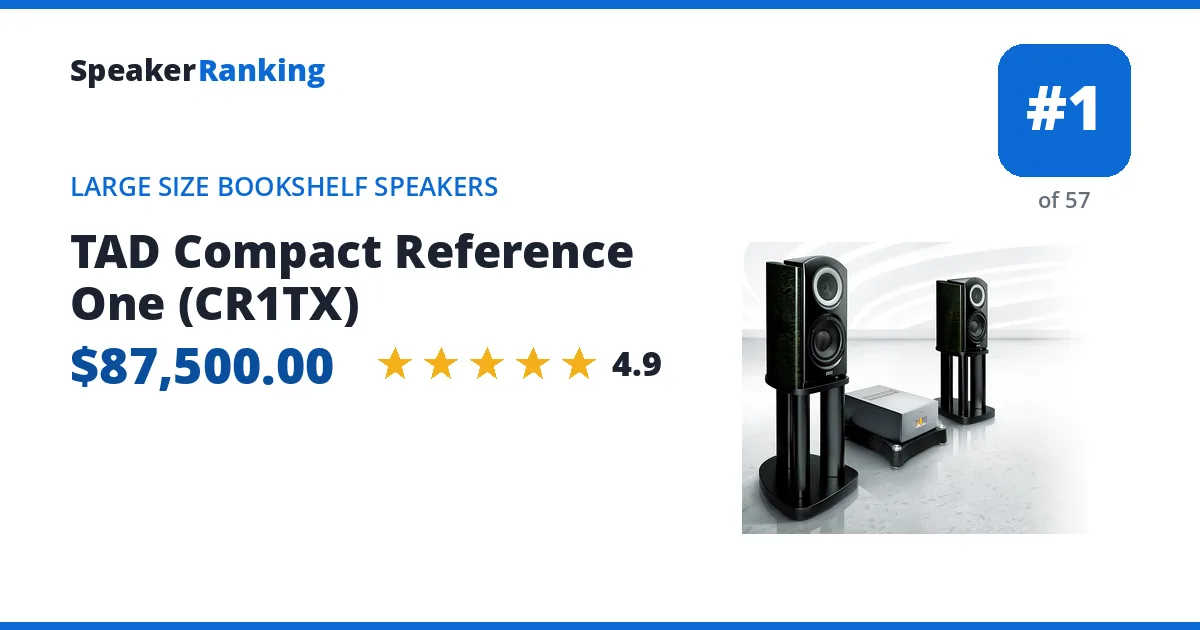
Pros: A 3-way stand-mount design built around a coaxial tweeter-and-6.5” midrange assembly plus an 8” woofer, crossed over at 250Hz and 2kHz, rated for 200W and 86dB sensitivity (measured at about 85.2dB, 2.83V/1m). On-axis linearity holds within about ±3dB down to its F3 of 69Hz (F10 38Hz). The coaxial layout gives it exceptionally wide, consistent tonality moving around the room (both horizontally and vertically) since the tweeter and midrange radiate from the same point, unlike a conventional offset tweeter-over-woofer layout that narrows vertically much sooner. Harmonic and multitone distortion measured the lowest the reviewer has recorded to date, beating even the KEF Blade Two Meta and PS Audio Aspen FR10, previously his two lowest-distortion references. Compression is minimal: only about 0.5dB of low-frequency loss between 76dB and 102dB output (26dB of usable dynamic range), with softening only appearing at the very top end at 102dB. At 101 lbs each, the massive, heavily braced cabinet is completely inert: no audible panel resonance even driven hard with full-range bass. CTA-2034 sound power is excellent, and a mild dip in the lower treble/upper midrange shows up with smooth, consistent directivity through that region, indicating it’s a deliberate voicing choice rather than a crossover flaw. Measured bass extension of 69Hz (-3dB), with a measured sensitivity of 85.5dB.
Cons: Extraordinarily expensive at $87500 per pair. Despite the manual recommending the speakers be placed close to a wall (about 1-2 feet) and aimed directly at the listener, the reviewer found direct on-axis aiming made the treble read a bit hot, and preferred toeing them out about 20-30° for a smoother top end: worth experimenting with in your own room. The mid-base-to-midrange transition region is deliberately sloped down in anechoic measurement, meaning it’s designed to be reinforced by nearby wall boundary gain rather than played free-standing well out into the room. At 101 lbs each, the speakers are genuinely difficult to move or set up alone.
Full TAD Compact Reference One (CR1TX) review and specifications →
| Bass Extension (-10dB) | 38Hz (measured, Erin’s Audio Corner) |
|---|---|
| Bass Extension (-3dB) | 69Hz (measured, Erin’s Audio Corner) |
| Country | Japan |
| Crossover Frequency | 250Hz, 2kHz |
| DIY Kit | No |
| Dimensions | 24.7”H x 13.4”W x 17.6”D (628 x 341 x 446 mm) |
| Drivers | Coaxial 1.38” tweeter + 6.5” midrange, 8” woofer |
| Frequency Response | 32Hz - 100kHz (manufacturer specified) |
| Impedance | 4 ohms nominal, 3.7 ohms minimum (measured above 80Hz, Erin’s Audio Corner) |
| Power Handling | 200W max |
| Sensitivity | 85.5dB (measured average 300Hz-3kHz @ 2.83V/1m, Erin’s Audio Corner) |
| Spinorama Preference Score | 5.45 |
| Spinorama Preference Score with Perfect Sub | 7.79 |
| Weight | 101 lbs (45.8 kg) each |
- Links
- Reviews, Comparisons and Sound Samples
- Head-to-Head Comparisons
- TAD Compact Reference One (CR1TX) vs Revel M106
- TAD Compact Reference One (CR1TX) vs KEF R3 Meta
- TAD Compact Reference One (CR1TX) vs KEF Q Concerto Meta
- TAD Compact Reference One (CR1TX) vs KEF R3
- TAD Compact Reference One (CR1TX) vs Buchardt Audio S400
- TAD Compact Reference One (CR1TX) vs ELAC Debut 3.0 DB63
- TAD Compact Reference One (CR1TX) vs Klipsch RP-600M II
 Ranked #2 of 141 in Large Size Bookshelf Speakers - Perlisten S4b: $8,000 per pair Perlisten Dealer Locator eBay
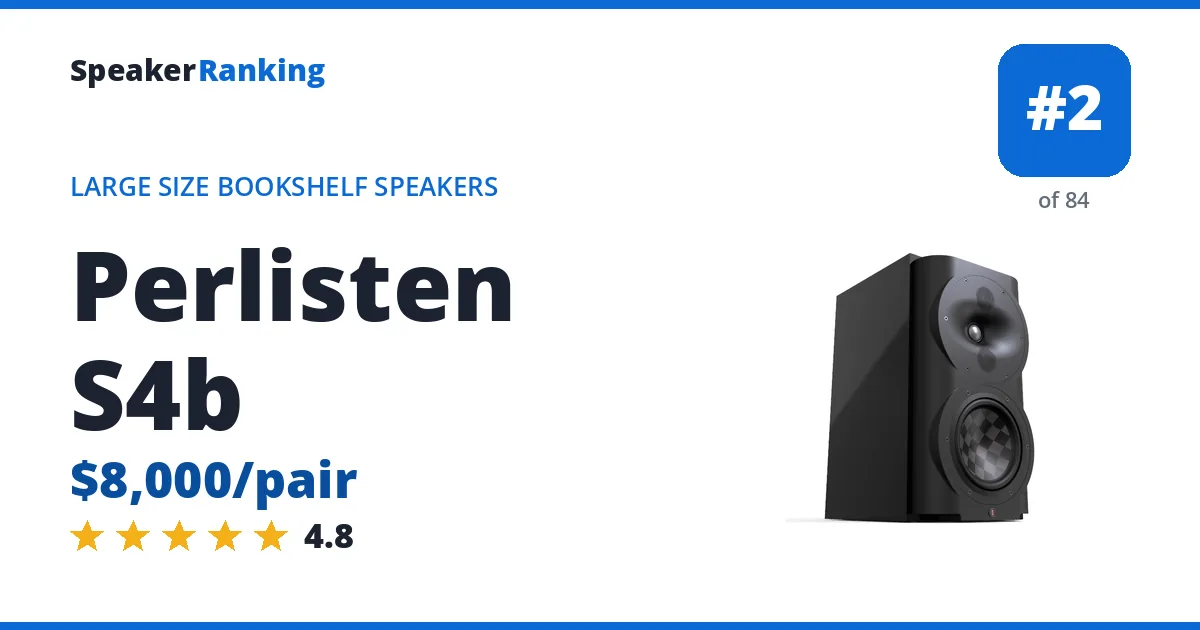
Pros: Reference-grade directivity and output from a compact sealed monitor. Erin called its radiation behavior the smoothest he had measured: Perlisten’s DPC array (beryllium tweeter between two midrange domes) shapes vertical output while transitioning cleanly to the 7-inch woofer. Harmonic distortion remains below 1% at 86dB and, above 100Hz, also below 1% at 96dB; compression is exceptionally low. The response is highly linear, the midrange was a listening highlight, and the sealed F10 of 40Hz provides a predictable slope for subwoofer integration. Measured bass extension of 78Hz (-3dB), with a measured sensitivity of 84.5dB.
Cons: Erin measured only 84.5dB sensitivity and an impedance minimum just under 4 ohms, a difficult efficiency/load combination that deserves substantial clean amplification. Its 78Hz F3 means a subwoofer is effectively mandatory for full-range listening despite the 40Hz F10. A roughly +3dB feature around 10kHz appears on-axis, though Erin did not find it objectionable. Price is extreme for a stand-mount and the tightly managed vertical radiation makes correct stand height important.
Full Perlisten S4b review and specifications →
| Bass Extension (-10dB) | 40Hz (measured, Erin’s Audio Corner) |
|---|---|
| Bass Extension (-3dB) | 78Hz (measured, Erin’s Audio Corner) |
| DIY Kit | No |
| Dimensions | 16.5”H x 9.4”W x 7.3”D |
| Drivers | DPC array with 28mm beryllium tweeter and dual 28mm midrange domes; 7” woofer |
| Impedance | Just under 4 ohms minimum (measured, Erin’s Audio Corner) |
| Sensitivity | 84.5dB/2.83V/1m (measured, Erin’s Audio Corner) |
| Spinorama Preference Score | 5.35 |
| Spinorama Preference Score with Perfect Sub | 8.01 |
| Weight | 24.3 lbs (11 kg) each |
| Woofer Cabinet | sealed |
- Links
- Reviews, Comparisons and Sound Samples
- Head-to-Head Comparisons
Ranked #3 of 141 in Large Size Bookshelf Speakers - KEF Reference 1 Meta: $9999.98 per pair KEF eBay
Larger models: the KEF Reference 3 Meta (rated 4.6/5) and the KEF Reference 5 Meta (estimated 4.8/5).
Pros: Meta technology places a Helmholtz-style resonator behind the tweeter to absorb rear-radiated resonance, and pair matching is within about ±0.5dB: unusually tight for a passive speaker. Sounds most neutral pointed straight on-axis rather than toed out, with no 5-8kHz harshness of the kind that plagues many speakers marketed as “detailed.” One of the most three-dimensional soundstages the reviewer has heard from a passive speaker, beaten only by $13,000+ active Xmachina Pulsar MK2 monitors (though this speaker’s tonality was preferred). Distortion stays below 1% down to about 70Hz at 86dB, and below 1% to ~150Hz / below 3% to ~70Hz even at 96dB. High-frequency response holds essentially flat as volume increases (no audible crossover or voice-coil compression) giving strong dynamic range up to its output limit (about 98dB at 3.5 meters before the woofer starts running out of excursion). All-passive design still measures ±1.5dB from 80Hz to 16kHz with zero DSP. Swappable dual-port system (long port for near-wall placement, short port for out-into-the-room placement with more bass extension) lets you tune bass behavior to where the speaker actually sits. Measured bass extension of 52Hz (-3dB), with a measured sensitivity of 82.5dB.
Cons: At roughly $10000/pair, nearly four times the cost of the similarly-sized KEF R3. Radiation narrows from about ±60° in the midrange to ±50° at high frequency: tighter than the reviewer’s ~70° preference (though wider than the R3’s ~±40°); toeing the speakers out for more width sacrifices treble energy that then needs EQ to restore. Moderate-to-low sensitivity (measured 83-84dB) calls for a solid amplifier. In-room bass only extends to about 40Hz, so a subwoofer is worth adding for bass-heavy material at higher volumes or listening beyond 3-4 meters. Minor directivity mismatch around 2kHz shows up in measurements, likely a vertical diffraction effect that wasn’t fully explained. Bass port choice (long vs. short) meaningfully changes the sound depending on placement, so the wrong port for your room can leave the bass sounding off until you experiment.
Full KEF Reference 1 Meta review and specifications →
| Bass Extension (-10dB) | 32Hz (measured, Erin’s Audio Corner) |
|---|---|
| Bass Extension (-3dB) | 52Hz (measured, Erin’s Audio Corner) |
| DIY Kit | No |
| Dimensions | 17.3”H x 8.1”W x 16.6”D (439.4 x 205.7 x 421.6 mm) |
| Drivers | 165 mm (6.5 in.) aluminium cone woofer, 125 mm (5 in.) aluminium cone midrange, 25 mm (1 in.) aluminium dome with MAT tweeter |
| Impedance | 4 ohms nominal, 2.9 ohms minimum (measured, Erin’s Audio Corner) |
| Sensitivity | 82.5dB (measured average, Erin’s Audio Corner) |
| Spinorama Preference Score | 6.48 |
| Spinorama Preference Score with Perfect Sub | 8.29 |
| Weight | 40.1 lbs (18.2 kg) each |
| Woofer Cabinet | ported, rear |
- Links
- Reviews, Comparisons and Sound Samples
- Erin’s Audio Corner: First Look!! Kef Reference 1 META Bookshelf Speaker Review. More from Erin’s Audio Corner →
- Erin’s Audio Corner Website KEF Reference 1 Meta Review
- Erin’s Audio Corner: My Top 5 Speakers at Any Price
- Erin’s Audio Corner Measurements (spinorama.org)
- Erin’s Audio Corner: KEF R3 vs R3 Meta vs Reference 1 Meta. Why such a big price gap?
- Head-to-Head Comparisons
- KEF Reference 1 Meta vs GR-Research NX-Studio
- KEF Reference 1 Meta vs Perlisten S4b
- KEF Reference 1 Meta vs March Audio Sointuva AWG
- KEF Reference 1 Meta vs AsciLab C6B
- KEF Reference 1 Meta vs Audio First Cadentia 3
- KEF Reference 1 Meta vs Revel M106
- KEF Reference 1 Meta vs KEF R3 Meta
- KEF Reference 1 Meta vs KEF Q Concerto Meta
- See all 48 comparisons
Ranked #5 of 141 in Large Size Bookshelf Speakers - March Audio Sointuva AWG: $4150 per pair March Audio eBay
Older model: the March Audio Sointuva (ranked lower, rated 4.6/5).
Pros: Purifi drivers deliver exceptionally low midrange distortion (the reviewer calls them “world class”) paired with bass extension unusually deep for a bookshelf (F3 40Hz, F10 30Hz), reaching down to about 30Hz in-room with some boundary reinforcement. Sensitivity tolerance band measured extremely tight at 1.6-1.73dB, indicating excellent build consistency. Estimated in-room response is exceptionally smooth and neutral: one of the flattest the reviewer has measured, with none of the usual coloration descriptors (bright, boomy, nasal, shouty) needed to describe it. Distortion stays so low even at loud volumes that there’s no audible warning cue before you’re playing dangerously loud: a backhanded compliment to how clean it sounds. At $4150/pair, ranked among the reviewer’s top three bookshelf speakers in that price range. Measured bass extension of 40Hz (-3dB), with a measured sensitivity of 82.4dB.
Cons: Correct listening axis sits about 7° above the tweeter line, which means shorter stands (around 24”) than typical bookshelf stands are sold at: get the height wrong and the sound scoops out in the mid/high frequencies. Moderate-low sensitivity (~82dB) is roughly 3dB below a typical bookshelf speaker, meaning close to double the amplifier power is needed for the same output; low impedance also calls for a 4-ohm capable amp. Horizontal radiation holds a wide ±60° only up to about 3kHz before narrowing: tighter top-end dispersion than the reviewer’s preferred ±60-70° through the treble, and the reason he left the previous generation off his all-time top-five list. Multitone distortion rises above the reviewer’s personal 3% threshold in the 1-2kHz region, though it wasn’t audible in his listening. Not intended to be crossed over with a subwoofer at 80Hz: designed to play full-range down to 40-50Hz, so pairing it with a sub and cutting it off early wastes its bass capability. Best positioned about 3 feet from the rear wall, requiring more floor space than many bookshelf speakers.
Full March Audio Sointuva AWG review and specifications →
| Bass Extension (-10dB) | 30Hz (measured, Erin’s Audio Corner) |
|---|---|
| Bass Extension (-3dB) | 40Hz (measured, Erin’s Audio Corner) |
| DIY Kit | No |
| Dimensions | 17.7”H x 9.4”W x 8.7”D (449.6 x 238.8 x 221 mm) |
| Drivers | 6.5” Purifi PTT-OEM Midwoofer, Satori TW29BNWG-4 Beryllium Dome Tweeter with Waveguide |
| Impedance | 6 ohms |
| Sensitivity | 82.4dB (measured, Erin’s Audio Corner) |
| Spinorama Preference Score | 6.95 |
| Spinorama Preference Score with Perfect Sub | 8.45 |
| Weight | 11 lbs (5 kg) |
| Woofer Cabinet | passive radiator |
- Links
- Reviews, Comparisons and Sound Samples
- Head-to-Head Comparisons
- March Audio Sointuva AWG vs AsciLab C6B
- March Audio Sointuva AWG vs GR-Research NX-Studio
- March Audio Sointuva AWG vs KEF Reference 1 Meta
- March Audio Sointuva AWG vs KEF R3 Meta
- March Audio Sointuva AWG vs KEF Q Concerto Meta
- March Audio Sointuva AWG vs Wharfedale Aura 2
- March Audio Sointuva AWG vs KEF R3
- March Audio Sointuva AWG vs MoFi SourcePoint 8
- See all 12 comparisons
Ranked #6 of 141 in Large Size Bookshelf Speakers - AsciLab C6B: $1145 per pair Ascilab eBay
Pros: Two-way design pairing a 1” aluminum ceramic dome tweeter on a large waveguide with a 6” aluminum ceramic cone woofer, crossed over at 1.1kHz, plus a rear passive radiator. Unusual trait: horizontal radiation actually widens at higher frequencies instead of narrowing like most two-way designs, which keeps image focus and soundstage depth consistent whether you toe the speakers in or out (5-10° off-axis was the sweet spot in testing). Vertical radiation also stays wide straight through the 2kHz crossover region, so the sound doesn’t collapse when standing up: unusual at this price. CA2034 measurements show strong on-axis linearity, listening window, early reflections, and directivity. Midrange and tweeter distortion stay very low even at 96dB, holding up against a $5,900 Arendal speaker in that regard despite roughly a 5x price gap. At $1145 shipped to the US, the reviewer calls it the best-value bookshelf speaker he’s tested, rivaling speakers 2-5x the price. Measured bass extension of 54Hz (-3dB), with a measured sensitivity of 85.6dB.
Cons: Bass rolls off around 50Hz in-room (F3 54Hz, F10 35Hz), so a subwoofer is needed for real extension below that. Low-frequency harmonic distortion increases substantially at 96dB versus 86dB, though it’s second-order and less audible than it looks on paper. Minimum impedance dips to 2.6 ohms (EPDR as low as 1.2 ohms), so it wants an amplifier comfortable driving 4-ohm loads, ideally 100W or more. At 102dB, compression noticeably eats into midrange, bass, and some treble output. Shipping to the US adds roughly $200 on top of AsciLab’s list price. Against the reviewer’s reference Audiofirst Fidelia at a similar price, has slightly less lower-midrange body (about 1dB difference) and a smaller perceived soundstage size.
Full AsciLab C6B review and specifications →
| Bass Extension (-10dB) | 35Hz (measured, Erin’s Audio Corner) |
|---|---|
| Bass Extension (-3dB) | 54Hz (measured, Erin’s Audio Corner) |
| DIY Kit | No |
| Dimensions | 15.7”H x 8”W x 10.4”D (398.8 x 203.2 x 264.2 mm) |
| Drivers | 6” Aluminium Ceramic Cone with cast Aluminium Chassis woofer, 1” Aluminium Ceramic Dome tweeter |
| Impedance | 4 ohms nominal, 2.6 ohms minimum (measured, Erin’s Audio Corner) |
| Sensitivity | 85.6dB (measured, Erin’s Audio Corner) |
| Spinorama Preference Score | 6.33 |
| Spinorama Preference Score with Perfect Sub | 8.28 |
| Weight | 18.5 lbs (8.4 kg) each |
| Woofer Cabinet | passive radiator |
- Links
- Reviews, Comparisons and Sound Samples
- Head-to-Head Comparisons
 Ranked #7 of 141 in Large Size Bookshelf Speakers - Audio First Cadentia 3: $7199 per pair Audio First Designs eBay
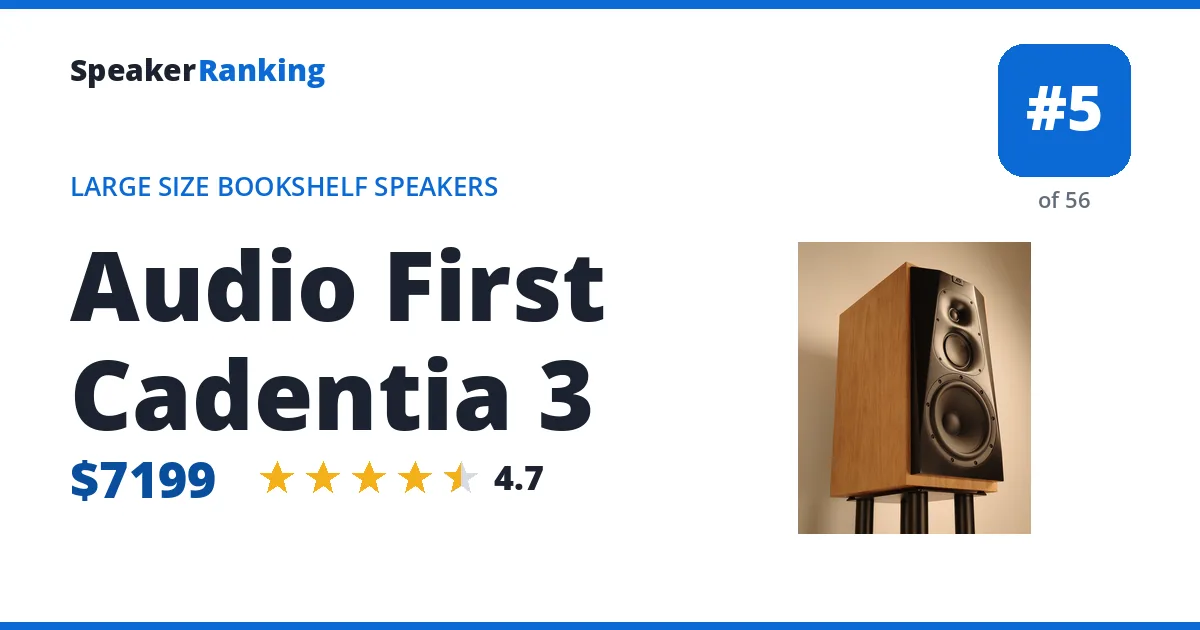
Pros: Near-textbook measurements: excellent on-axis linearity, listening window, and directivity, with only minor deviations. Extremely low distortion and compression, holding steady even at 102dB with barely any loss. Very wide, consistent horizontal dispersion (~70 degrees) gives a big, enveloping soundstage with strong image specificity outside the speaker boundaries. Strong bass extension for a bookshelf (F3 43Hz, F10 26Hz) with a punchy, guttural mid-bass. Measured bass extension of 43Hz (-3dB), with a measured sensitivity of 86.4dB.
Cons: A mild scoop through the upper midrange/lower treble slightly softens the attack of snares, hand claps, and sibilants: fixable with a single-band EQ (2.5kHz, +1dB, Q~1). High-frequency dispersion narrows quickly above about 4kHz, so off-axis listeners lose some air and detail. Very high asking price for a bookshelf-class speaker, and the complete (finished) version has a long lead time; the loaner kit version ships as an unfinished cabinet you assemble and finish yourself.
Full Audio First Cadentia 3 review and specifications →
| Bass Extension (-10dB) | 26Hz (measured, Erin’s Audio Corner) |
|---|---|
| Bass Extension (-3dB) | 43Hz (measured, Erin’s Audio Corner) |
| Country | United Kingdom (Cambridge) |
| DIY Kit | No |
| Dimensions | 23.2” x 11.8” x 17” (590 x 300 x 433 mm) |
| Drivers | 1.1” tweeter, 4.5” midrange, 9” woofer |
| Impedance | 4 ohms nominal (3.1 ohms minimum, measured by Erin’s Audio Corner) |
| Sensitivity | 86.4dB (2.83V/1m, measured by Erin’s Audio Corner) |
| Spinorama Preference Score | 7.55 |
| Spinorama Preference Score with Perfect Sub | 8.91 |
| Weight | 45.9 lbs (20.8 kg) each |
| Woofer Cabinet | 3-way, bass reflex |
- Links
- Reviews, Comparisons and Sound Samples
- Head-to-Head Comparisons
- Audio First Cadentia 3 vs March Audio Sointuva
- Audio First Cadentia 3 vs AsciLab C6B
- Audio First Cadentia 3 vs KEF R3 Meta
- Audio First Cadentia 3 vs GR-Research NX-Studio
- Audio First Cadentia 3 vs KEF Q Concerto Meta
- Audio First Cadentia 3 vs KEF Reference 1 Meta
- Audio First Cadentia 3 vs Perlisten S4b
- Audio First Cadentia 3 vs Wharfedale Aura 2
- See all 48 comparisons
 Ranked #8 of 141 in Large Size Bookshelf Speakers - March Audio Sointuva: $3,995 per pair Discontinued eBay
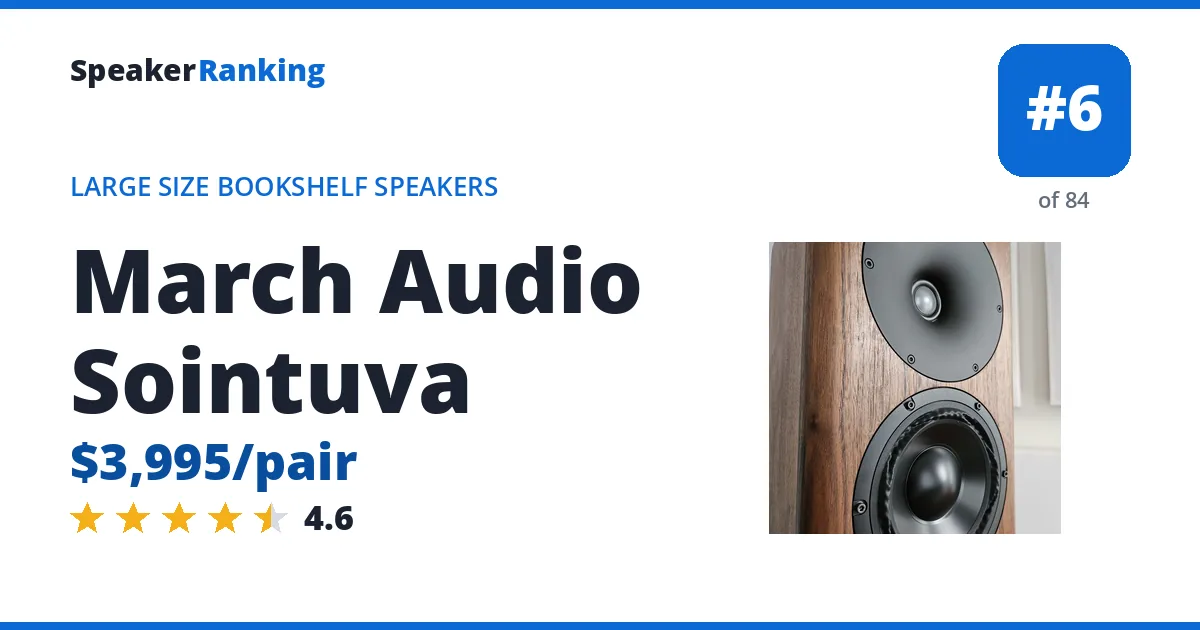
Newer model: the March Audio Sointuva AWG, ranked higher, rated 4.7/5.
Pros: The Purifi woofer and Satori waveguided tweeter combine class-leading distortion with unusually deep extension for a compact cabinet. Erin measured roughly 83dB sensitivity yet found the speaker could still sustain about 96dB/1m with 3% THD not crossed until ~60Hz; compression remains exceptionally low until the deepest bass at the highest sweep. Horizontal directivity is broad and smooth, the early-reflections trend is readily equalizable, and the passive radiators avoid port turbulence while reaching approximately 50Hz anechoic and lower in-room. Measured bass extension of ~50Hz (-3dB), with a measured sensitivity of 83dB.
Cons: Erin measured a 3.8-ohm minimum and an average load near four ohms; combined with ~83dB sensitivity, this demands a powerful four-ohm-stable amplifier even though the drivers tolerate that power cleanly. Vertical directivity shows the unavoidable woofer/tweeter crossover cancellation, so stand height matters. The original waveguide narrows somewhat in the upper treble compared with the later AWG revision, and the premium price is difficult to justify if low-level listening or an 80Hz sub crossover leaves the Purifi woofer’s excursion capability unused. Discontinued.
Full March Audio Sointuva review and specifications →
| Bass Extension (-10dB) | 32.7Hz (measured, Erin’s Audio Corner) |
|---|---|
| Bass Extension (-3dB) | ~50Hz (measured, Erin’s Audio Corner) |
| DIY Kit | No |
| Dimensions | 17.7”H x 9.4”W x 8.7”D (450 x 240 x 220 mm) |
| Drivers | 6.5-inch Purifi woofer; Satori waveguided dome tweeter; dual passive radiators |
| Enclosure | Dual passive radiator |
| Impedance | ~4 ohms average; 3.8 ohms minimum (measured, Erin’s Audio Corner) |
| Sensitivity | ~83dB/2.83V/1m (measured, Erin’s Audio Corner) |
| Spinorama Preference Score | 6.80 |
| Spinorama Preference Score with Perfect Sub | 8.45 |
| Weight | 14.6 lbs (6.6 kg) each |
- Reviews, Comparisons and Sound Samples
- Head-to-Head Comparisons
Ranked #10 of 141 in Large Size Bookshelf Speakers - KEF R3 Meta: $2,499.99 per pair Amazon Crutchfield eBay
Larger models: the KEF R7 Meta (estimated 4.6/5) and the KEF R11 Meta (rated 4.4/5).
Pros: Three-way design with an unconventional concentric layout: the 1” tweeter is recessed into the throat of the 5.25” midrange driver, deeper integration than a standard coaxial arrangement. A quasi sealed/ported bass alignment gives an extended low-end shelf tuned to match typical in-room gain, reaching about 50Hz for most content: deeper than recently-tested rivals like the Focal Aria 906, Polk R200, and an 8” Aperion design. Spinorama measurements show class-leading directivity and sound power, plus very linear on-axis response (at the recommended 10° toe-out) and early-reflections directivity, so it takes EQ exceptionally well. The vertical sweet spot extends to about ±20-30° off the reference axis with nearly identical tonality, unusually wide for a two- or three-way design. A clear upgrade over the earlier, non-Meta R3, eliminating the treble brightness the original had even when toed off-axis. Outperforms similarly-priced rivals (Revel M106, Wharfedale Linton, Philharmonic BMR V2, JBL HDI 1600) specifically on directivity and linearity in the reviewer’s measurements. At $2500/pair, called the best value in its class with near-reference-level anechoic performance. Measured bass extension of 76Hz (-3dB), with a measured sensitivity of 85.9dB.
Cons: Pointed straight on-axis, there’s a 1-2dB bump around 9kHz that stays consistent across angles thanks to the constant-directivity waveguide: only toeing the speaker out about 10° tames it. Minimum impedance dips to about 3.2 ohms nominal (EPDR as low as 1.9 ohms), so it needs a 4-ohm-stable amplifier; a standard AVR likely won’t cut it. Distortion crosses the reviewer’s 3% threshold around 80Hz at 96dB output and shows added deviation again near 50Hz, indicating it runs out of headroom at higher volumes: a subwoofer is recommended for loud listening. Horizontal radiation narrows from about ±70° at low frequency to ±40° at high frequency. Below about 100Hz, compression testing shows fairly wide deviations at both 86dB and 96dB output, though the reviewer notes this is typical for speakers in this size and price class. Current R3 owners who are already happy with that speaker have little reason to upgrade.
Full KEF R3 Meta review and specifications →
| Bass Extension (-10dB) | 37Hz (measured, Erin’s Audio Corner) |
|---|---|
| Bass Extension (-3dB) | 76Hz (measured, Erin’s Audio Corner) |
| DIY Kit | No |
| Dimensions | 16.6”H x 7.9”W x 13.2”D (421.6 x 200.7 x 335.3 mm) |
| Drivers | 6.5” Hybrid aluminum ported woofer, 5” aluminum cone midrange, 1” vented aluminium dome with MAT tweeter |
| Impedance | 4 ohms nominal (3.2 ohms minimum above 80Hz, measured, Erin’s Audio Corner) |
| Sensitivity | 85.9dB (measured, Erin’s Audio Corner; 87dB manufacturer specified) |
| Spinorama Preference Score | 6.10 |
| Spinorama Preference Score with Perfect Sub | 7.91 |
| Weight | 27.3 lbs (12.4 kg) each |
| Woofer Cabinet | ported |
- Links
- Reviews, Comparisons and Sound Samples
- Erin’s Audio Corner: KEF R3 Meta: The Speaker to Beat. More from Erin’s Audio Corner →
- Erin’s Audio Corner Website KEF R3 Meta Review
- Erin’s Audio Corner: Upgrade Your Sound with These 6 Surprisingly Affordable Speakers!
- Erin’s Audio Corner: My Personal Favorite Speakers Under $2500
- Erin’s Audio Corner: My Top Picks of 2023: Must-Haves Under $3000
- GR-Research: Finally… a Speaker Danny Doesn’t Have to Fix? More from GR-Research →
- New Record Day: The Gold Standard Of "Pretty Good" KEF R3 Meta Review
- Erin’s Audio Corner Measurements (spinorama.org)
- Erin’s Audio Corner: KEF R3 vs R3 Meta vs Reference 1 Meta. Why such a big price gap?
- Head-to-Head Comparisons
Ranked #11 of 141 in Large Size Bookshelf Speakers - KEF Q Concerto Meta: $1,399.99 per pair Amazon Crutchfield eBay
Smaller models: the KEF Q3 Meta (ranked lower, rated 3.4/5) and the KEF Q1 Meta (rated 3.6/5).
Larger models: the KEF Q7 Meta (estimated 3.5/5) and the KEF Q11 Meta (rated 4/5).
Pros: Really good in-room neutrality with consistent horizontal directivity from seat to seat. Directivity holds remarkably steady from lower treble into upper treble, where many similarly-priced speakers narrow sharply as frequency rises: one of the reviewer’s top 10 picks under $1,500. Measured bass extension of 53Hz (-3dB), with a measured sensitivity of 84.2dB.
Cons: Radiation pattern measures about ±50°, narrower than the reviewer’s preferred ±60° for a stronger sense of envelopment. Needs to be pointed closer to on-axis rather than heavily toed out: combined with its rolled-off, shelved-down top end, too much toe-out makes it sound noticeably dark.
Full KEF Q Concerto Meta review and specifications →
| Bass Extension (-10dB) | 35Hz (measured, Erin’s Audio Corner) |
|---|---|
| Bass Extension (-3dB) | 53Hz (measured, Erin’s Audio Corner) |
| DIY Kit | No |
| Dimensions | 16.3”H x 8.3”W x 12.4”D (414 x 210.8 x 315 mm) |
| Drivers | 165 mm (6.5 in.) hybrid aluminium cone woofer, 100 mm (4 in.) aluminium cone midrange, 19 mm (0.75 in.) vented aluminium dome with MAT tweeter |
| Impedance | 4 ohms nominal (3.3 ohms minimum above 80Hz, measured by Erin’s Audio Corner) |
| Sensitivity | 84.2dB (measured average, Erin’s Audio Corner) |
| Spinorama Preference Score | 6.01 |
| Spinorama Preference Score with Perfect Sub | 7.71 |
| Weight | 20.9 lbs (9.5 kg) each |
| Woofer Cabinet | ported, rear |
- Links
- Reviews, Comparisons and Sound Samples
- Erin’s Audio Corner: HiFi Perfection? KEF CONCERTO META Delivers! More from Erin’s Audio Corner →
- Erin’s Audio Corner Website KEF Q Concerto Meta
- Erin’s Audio Corner: I Tested 250 Speakers So You Don’t Have To!
- Erin’s Audio Corner: HiFi Perfection? KEF CONCERTO META Delivers!
- Erin’s Audio Corner: My Absolute Favorite Products of 2024 Revealed
- Erin’s Audio Corner Measurements (spinorama.org)
- Head-to-Head Comparisons
- KEF Q Concerto Meta vs KEF R3 Meta
- KEF Q Concerto Meta vs AsciLab F6B
- KEF Q Concerto Meta vs Wharfedale Aura 2
- KEF Q Concerto Meta vs Revel M106
- KEF Q Concerto Meta vs KEF R3
- KEF Q Concerto Meta vs Audio First Cadentia 3
- KEF Q Concerto Meta vs AsciLab C6B
- KEF Q Concerto Meta vs Buchardt Audio E50
- See all 105 comparisons
 Ranked #12 of 141 in Large Size Bookshelf Speakers - AsciLab F6B: $980 per pair Ascilab eBay
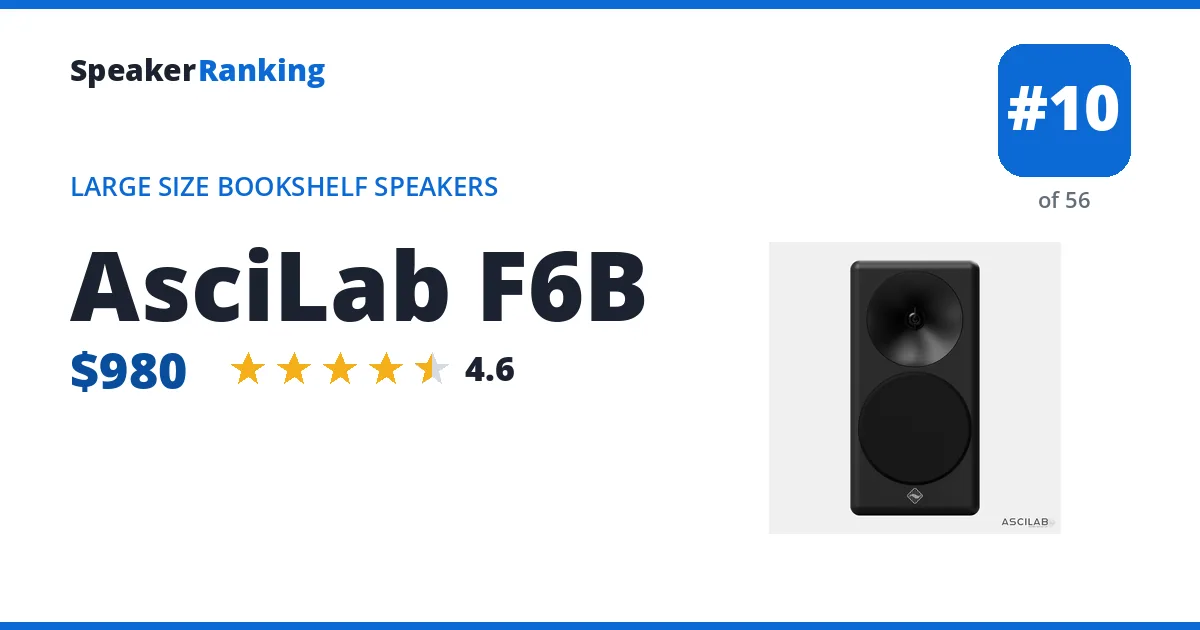
Pros: Called by the reviewer the best sub-$1000 pair of speakers he’s come across to date. Very good on-axis linearity and directivity for the price, with a large waveguide-loaded 1” aluminum dome tweeter that keeps a two-way design well-behaved through the crossover. Nice midbass punch from a slightly undersized enclosure alignment that gives kick drums extra impact. Solid, unfussy tonal balance overall. Measured bass extension of 56Hz (-3dB), with a measured sensitivity of 85dB.
Cons: A mild sibilance-inducing lift around 6-8kHz, most noticeable on female vocals, paired with a shallow dip in the upper midrange: correctable with a simple 3-band EQ the reviewer provided. In-room bass extension is only about 50-60Hz despite a 6” woofer, trading some low-end reach for that extra midbass punch. Compression and graininess creep in at higher volumes (upper 80s to low 90s dB at 10ft), and directivity (~50-60 degrees horizontal) is narrower than the reviewer’s other current favorite, the Audio First Cadentia 3.
Full AsciLab F6B review and specifications →
| Bass Extension (-10dB) | 38Hz (measured, Erin’s Audio Corner) |
|---|---|
| Bass Extension (-3dB) | 56Hz (measured, Erin’s Audio Corner) |
| Crossover Frequency | 1000Hz |
| DIY Kit | No |
| Dimensions | 15.7” x 8” x 10.4” (400 x 203 x 265 mm) |
| Drivers | 1” aluminum dome tweeter, 6” fiber cone woofer |
| Impedance | 4 ohms nominal (3.5 ohms minimum above 80Hz, measured by Erin’s Audio Corner) |
| Recommended Power | up to 125W |
| Sensitivity | 85dB (2.83V/1m, measured by Erin’s Audio Corner) |
| Spinorama Preference Score | 6.32 |
| Spinorama Preference Score with Perfect Sub | 8.26 |
| Weight | 16.5 lbs (7.5 kg) each |
| Woofer Cabinet | Passive radiator loaded |
- Links
- Reviews, Comparisons and Sound Samples
- Head-to-Head Comparisons
 Ranked #13 of 141 in Large Size Bookshelf Speakers - Wharfedale Aura 2: $2799 per pair Crutchfield eBay
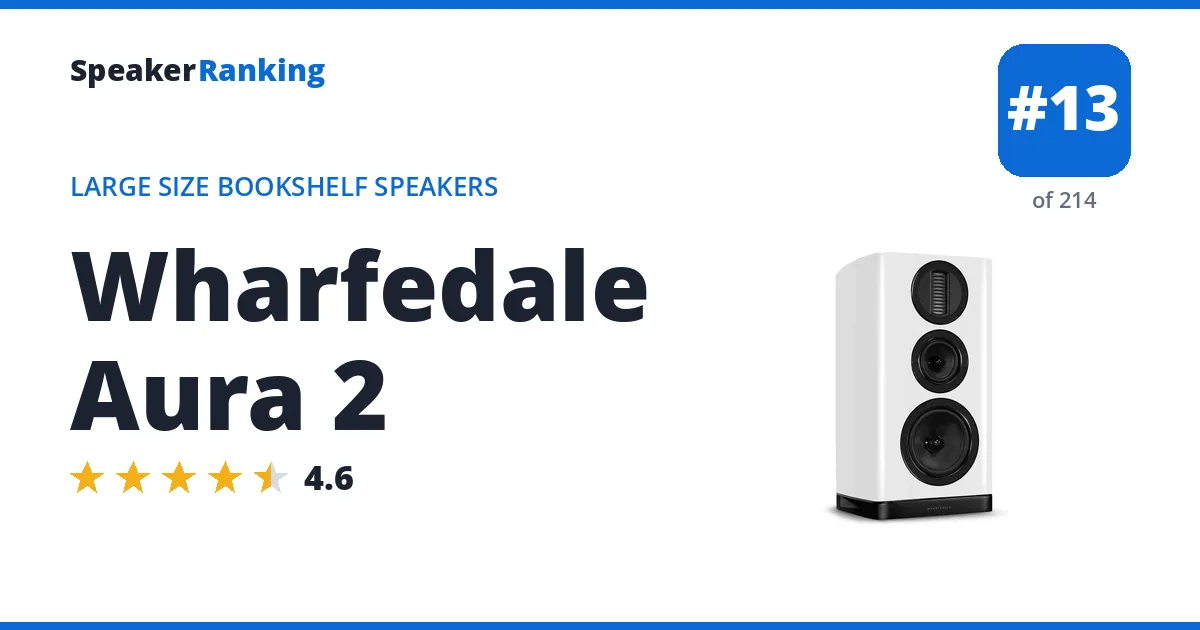
Pros: Three-way “mini tower” design with a 27x90mm AMT tweeter, 4” mid-range, and 6.5” midwoofer, using an unusual bottom-firing port. Nearly “ruler flat” on-axis linearity (within about 1.5dB for most of the range) apart from one specific breakup point. Exceptional output capability with very low distortion even at high volume: the reviewer reached about 100dB average at 10 feet with no audible strain, outperforming rivals like the KEF LS50 Meta in multitone distortion above 1kHz. Wide horizontal radiation of about ±70° combined with excellent imaging and pair matching: passed demanding stereo-separation test tracks with precise instrument placement. Bass reaches a genuine 40Hz in most rooms, potentially eliminating the need for a subwoofer for material that doesn’t demand extreme sub-bass. About 20dB of usable dynamic range with no compression issues at 96dB/1m. Considered by the reviewer one of the best speakers he’s tested, potentially challenging his personal all-time top five. Measured bass extension of 56Hz (-3dB), with a measured sensitivity of 87dB.
Cons: A breakup/peak around 13kHz can sound sharp or shrill depending on the track, the main tonal flaw noted. Minor midbase-to-midrange balance discrepancy (about 1dB), most noticeable if the speaker sits more than about 2 feet from the rear wall. Vertical listening window is narrower than typical, a consequence of the AMT ribbon tweeter’s tall physical size: staying within about ±15-20° of the tweeter reference axis (or slightly below it) is important. Impedance dips to about 3.1 ohms with a 1.4-ohm minimum EPDR, meaning a dedicated amplifier is recommended over an AVR due to potential power-supply strain. Distortion rises at the very lowest frequencies (an expected limitation of a 6.5” woofer), and the woofer audibly struggles with extreme 30-35Hz content at high volume. Horizontal directivity narrows from about ±70° to ±50° above roughly 6-7kHz as the ribbon tweeter’s pattern collapses inward.
Full Wharfedale Aura 2 review and specifications →
| Bass Extension (-10dB) | 30Hz (measured, Erin’s Audio Corner) |
|---|---|
| Bass Extension (-3dB) | 56Hz (measured, Erin’s Audio Corner) |
| DIY Kit | No |
| Dimensions | 22.1”H x 11.3”W x 15.3”D (561.3 x 287 x 388.6 mm) |
| Drivers | 6.5” Black Glass Fibre Matrix Cone woofer, 4” Black Glass Fibre Matrix Cone midrange, 27x90mm AMT tweeter |
| Impedance | 6 ohms nominal (3.1 ohms minimum above 80Hz, measured, Erin’s Audio Corner) |
| Sensitivity | 87dB (measured, Erin’s Audio Corner) |
| Spinorama Preference Score | 6.03 |
| Spinorama Preference Score with Perfect Sub | 7.65 |
| Weight | 45 lbs (20.4 kg) each |
| Woofer Cabinet | ported, rear |
- Links
- Reviews, Comparisons and Sound Samples
- Erin’s Audio Corner: Why the Wharfedale AURA 2 Will Blow Your Mind More from Erin’s Audio Corner →
- Erin’s Audio Corner Website Wharfedale Aura 2
- Erin’s Audio Corner: Upgrade Your Sound with These 6 Surprisingly Affordable Speakers!
- Erin’s Audio Corner: My Personal Favorite Speakers Under $2500
- Erin’s Audio Corner Measurements (spinorama.org)
- Head-to-Head Comparisons
- Wharfedale Aura 2 vs KEF Q Concerto Meta
- Wharfedale Aura 2 vs KEF R3
- Wharfedale Aura 2 vs KEF R3 Meta
- Wharfedale Aura 2 vs Buchardt Audio E50
- Wharfedale Aura 2 vs MoFi SourcePoint 8
- Wharfedale Aura 2 vs Revel M106
- Wharfedale Aura 2 vs Audio First Cadentia 3
- Wharfedale Aura 2 vs AsciLab C6B
- See all 50 comparisons
 Ranked #14 of 141 in Large Size Bookshelf Speakers - DIYSG HTM-12 v2: $920 per pair per kit Discontinued DIY Sound Group eBay
Pros: Purpose-built high-output cinema kit pairing a 12-inch woofer with a compression driver in a large SEOS waveguide. Erin measured 91dB/2.83V/1m sensitivity, extraordinarily low distortion (still below 1% to about 60Hz at 102dB) and only about 0.5dB tweeter compression at the same level. Horizontal directivity is consistent and crossover integration is unusually good, so response corrections remain EQ-friendly. The benign impedance curve can be driven by many capable AVRs. Measured bass extension of 67Hz (-3dB), with a measured sensitivity of 91dB.
Cons: Erin measured F3 at approximately 67Hz, the normal efficiency/bass-extension tradeoff of a high-sensitivity 12-inch design, so a subwoofer is mandatory. A few narrow resonances appear in the response, impedance and decay plots; Erin suggested crossover/component investigation could improve them. Vertical radiation narrows around the crossover, the unfinished kit requires cabinet assembly and finishing, and its broad baffle is visually and physically substantial. Discontinued.
Full DIYSG HTM-12 v2 review and specifications →
| Bass Extension (-10dB) | 45Hz (measured, Erin’s Audio Corner) |
|---|---|
| Bass Extension (-3dB) | 67Hz (measured, Erin’s Audio Corner) |
| DIY Kit | Yes |
| Dimensions | 25”H x 18”W x 9.5”D (635 x 457.2 x 241.3 mm) |
| Drivers | 12” woofer; compression driver in SEOS waveguide |
| Impedance | AVR-compatible impedance profile (measured, Erin’s Audio Corner) |
| Sensitivity | 91dB/2.83V/1m (measured, Erin’s Audio Corner) |
| Spinorama Preference Score | 3.26 |
| Spinorama Preference Score with Perfect Sub | 5.88 |
| Weight | 39.9 lbs (18.1 kg) assembled |
| Woofer Cabinet | ported |
- Links
- Reviews, Comparisons and Sound Samples
- Head-to-Head Comparisons
 Ranked #15 of 141 in Large Size Bookshelf Speakers - KEF R3: $2,200 per pair Amazon eBay
Pros: True three-way stand-mount with a 6.5-inch woofer below KEF’s 5-inch Uni-Q midrange/1-inch tweeter. Erin measured approximately 86-87dB/2.83V/1m sensitivity, exceptionally low sub-1% distortion at 86dB and orderly directivity in both planes. The coaxial geometry maintains image stability across seats, while Flexible Port Technology avoids the strong midrange port resonance common to rear-vented competitors. A 110W Parasound drove it successfully in Erin’s listening. Measured bass extension of 35.2Hz (-10dB), with a measured sensitivity of 87dB.
Cons: The low-frequency alignment rolls gradually rather than delivering high-output sub-bass; KEF specifies 58Hz +/-3dB and Erin’s high-level data supports using an 80Hz subwoofer crossover. Narrow high-frequency features and natural Uni-Q narrowing toward the top octave make toe angle audible, although off-axis tracking remains smooth. Sensitivity is moderate, the cabinet weighs almost 30 lb, and this original R3 lacks the Meta successor’s MAT absorber.
Full KEF R3 review and specifications →
| Bass Extension (-10dB) | 35.2Hz (measured, Audio Science Review) |
|---|---|
| Bass Extension (-3dB) | Approximately 58Hz (manufacturer specified; consistent with Erin’s measured roll-off) |
| DIY Kit | No |
| Dimensions | 16.6”H x 7.9”W x 13.2”D |
| Drivers | 1” tweeter coaxial with 5” midrange; 6.5” woofer |
| Impedance | 8 ohms nominal; suitable for Erin’s 4/8-ohm-rated amplifier |
| Sensitivity | Approximately 86-87dB/2.83V/1m (measured, Erin’s Audio Corner) |
| Spinorama Preference Score | 6.2 (spinorama.org) |
| Spinorama Preference Score with Perfect Sub | 7.97 (spinorama.org) |
| Weight | 29.9 lbs (13.55 kg) each |
| Woofer Cabinet | ported, rear Flexible Port |
- Links
- Reviews, Comparisons and Sound Samples
- Erin’s Audio Corner: KEF R3 Review More from Erin’s Audio Corner →
- Erin’s Audio Corner Website: KEF R3
- Audio Science Review Measurements More from Audio Science Review →
- Audio Science Review Measurements (spinorama.org)
- Erin’s Audio Corner: Which is Better for Home Theater: (3) Kef R3 or (3) Kef R2c Center Channel speakers?
- Erin’s Audio Corner: KEF R3 vs R3 Meta vs Reference 1 Meta. Why such a big price gap?
- Head-to-Head Comparisons
 Ranked #16 of 141 in Large Size Bookshelf Speakers - Buchardt Audio E50: $4600 per pair Buchardt Audio eBay
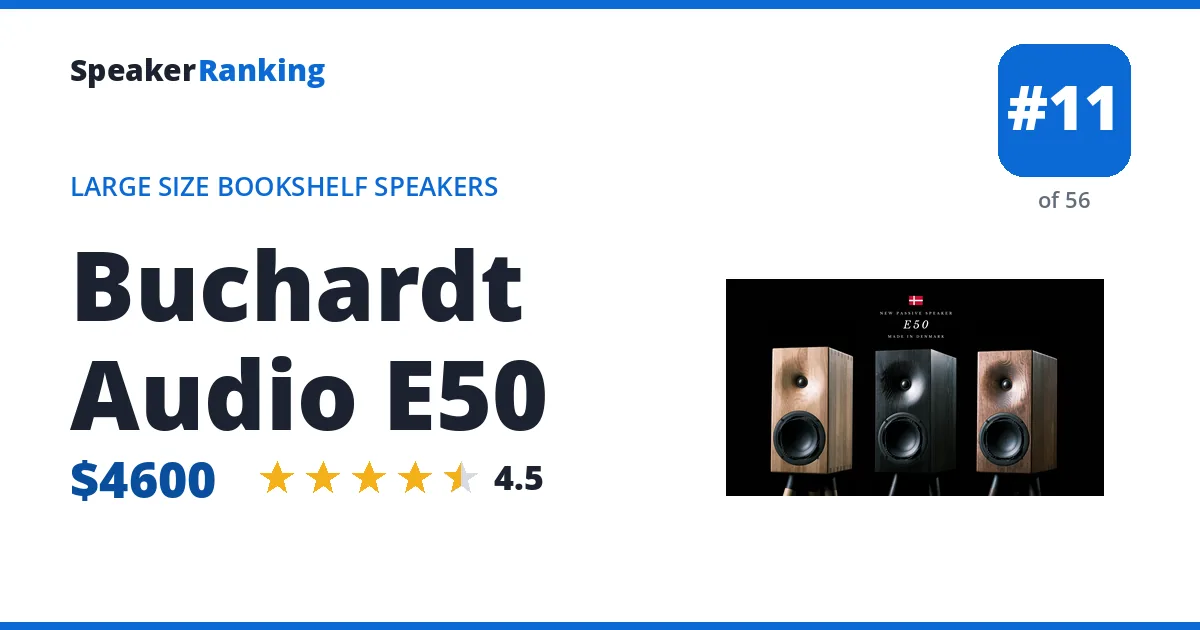
Pros: Exceptional bass extension for a bookshelf (F3 at 40Hz, F10 at 34Hz) with genuinely low-end weight the reviewer kept noticing track after track, not just a single room-boosted note. Mid and lower-midrange are very neutral with no coloration and well-executed baffle-step compensation, so it doesn’t need to sit close to a wall like many bookshelf designs. Low distortion throughout the midrange, controlled ~60-degree horizontal directivity, and a striking driver/waveguide integration that looks genuinely upscale. Measured bass extension of 40Hz (-3dB), with a measured sensitivity of 83.1dB.
Cons: A roughly 3dB dip in the upper midrange/lower treble softens attack and dialogue clarity: the reviewer’s main complaint, and it’s baked into the crossover rather than a directivity artifact, so it’s audible both on and off axis. Sounds too bright pointed directly at the listener; needs about 10-20 degrees of toe-out to tame the treble and slightly smooth (not eliminate) that dip. Below-average sensitivity (measured 83.1dB vs 85dB spec) calls for a beefier amp, and the speaker’s tonal balance is unusually sensitive to amplifier output impedance: a poor tube amp can shift the midrange by up to 2dB.
Full Buchardt Audio E50 review and specifications →
| Bass Extension (-10dB) | 34Hz (measured, Erin’s Audio Corner) |
|---|---|
| Bass Extension (-3dB) | 40Hz (measured, Erin’s Audio Corner) |
| Country | Denmark |
| Crossover Frequency | 2000Hz |
| DIY Kit | No |
| Dimensions | 15.6” x 7.5” x 11.2” (395 x 190 x 284 mm) |
| Drivers | 1” Scanspeak dome tweeter with waveguide, 6.5” Purifi extended-stroke woofer, dual 6.5” passive radiators |
| Frequency Response | 36Hz - 30kHz ±3dB (Manufacturer specified) |
| Impedance | 4 ohms nominal |
| Recommended Power | 60W - 200W |
| Sensitivity | 83.1dB (2.83V/1m, measured by Erin’s Audio Corner) |
| Spinorama Preference Score | 5.84 |
| Spinorama Preference Score with Perfect Sub | 7.61 |
| Weight | 19 lbs (8.6 kg) each |
| Woofer Cabinet | Passive radiator loaded |
- Links
- Reviews, Comparisons and Sound Samples
- Head-to-Head Comparisons
- Buchardt Audio E50 vs KEF R3
- Buchardt Audio E50 vs MoFi SourcePoint 8
- Buchardt Audio E50 vs Wharfedale Aura 2
- Buchardt Audio E50 vs AsciLab F6Bs
- Buchardt Audio E50 vs KEF Q Concerto Meta
- Buchardt Audio E50 vs Arendal 1528 Monitor 8
- Buchardt Audio E50 vs KEF R3 Meta
- Buchardt Audio E50 vs Ascend Acoustics CMT-340 SE2
- See all 46 comparisons
Ranked #17 of 141 in Large Size Bookshelf Speakers - MoFi SourcePoint 8: $2594 per pair Crutchfield eBay
Pros: 8” twin-drive concentric driver paired with a 1.25” soft dome tweeter, in a diffraction-reducing baffle design; rated 47Hz-30kHz. Notably more neutral and true-to-source than its sibling SourcePoint 10, which the reviewer found a bit too bright in the treble by comparison: measured about 4-5dB less high-frequency output. Excellent imaging: passed multiple stereo-panning and depth tests, including smooth continuous left-to-right pans without wobble and correct front-to-back layering of vocals versus percussion. Wide horizontal dispersion of about ±60°, broader than the reviewer expected from a coaxial design, and forgiving enough in placement that about 10° of toe-out variance and moving above or below the tweeter axis both still sound good. Excellent dynamic range and compression linearity: about 26dB of headroom up to 102dB/1m equivalent, with issues only appearing below about 60Hz. 8-ohm nominal impedance made it easy to drive on everything from a budget Denon AVR to a high-end Macintosh amplifier. No significant evidence of woofer-cone modulation distortion affecting the tweeter, even at 96dB/1m. Measured bass extension of 52Hz (-3dB), with a measured sensitivity of 86.3dB.
Cons: Like other coincident designs, produces diffraction dips around 4kHz and 7kHz when pointed directly on-axis; needs about 10-15° of toe-out to smooth those out. The rear-ported cabinet (two ports) means it can’t be placed too close to a wall without the bass becoming overblown: the reviewer settled on about 2 feet of clearance. F3 of 52Hz and F10 of 43Hz mean genuine deep bass tops out in the mid-40s Hz in-room: a subwoofer is still needed for true low-end extension. Harmonic distortion crosses the reviewer’s 3% threshold at 96dB (though it’s second-order and less audibly significant), and multitone distortion becomes noticeably more audible at that same output level. Vertical response doesn’t perfectly mirror horizontal, since the cabinet is a rectangle rather than a perfect square around the driver.
Full MoFi SourcePoint 8 review and specifications →
| Bass Extension (-10dB) | 43Hz (measured, Erin’s Audio Corner) |
|---|---|
| Bass Extension (-3dB) | 52Hz (measured, Erin’s Audio Corner) |
| DIY Kit | No |
| Dimensions | 18”H x 11.4”W x 13.2”D (457.2 x 289.6 x 335.3 mm) |
| Drivers | 8” woofer, 1.25-inch soft-dome tweeter |
| Impedance | 8 ohms nominal (8 ohms minimum above 80Hz, measured, Erin’s Audio Corner) |
| Sensitivity | 86.3dB (measured, Erin’s Audio Corner) |
| Spinorama Preference Score | 5.15 |
| Spinorama Preference Score with Perfect Sub | 7.28 |
| Weight | 28 lbs (12.7 kg) each |
| Woofer Cabinet | ported, rear |
- Links
- Reviews, Comparisons and Sound Samples
- Erin’s Audio Corner: Why Do People Love the MoFi SourcePoint 8? More from Erin’s Audio Corner →
- Erin’s Audio Corner Website MoFi SourcePoint 8
- Erin’s Audio Corner: Upgrade Your Sound with These 6 Surprisingly Affordable Speakers!
- Erin’s Audio Corner: My Personal Favorite Speakers Under $2500
- Erin’s Audio Corner: My Top Picks of 2023: Must-Haves Under $3000
- GR-Research: Danny Tackles Andrews Jones: The Source Point 8! Spoiler Alert (It’s Really Good) More from GR-Research →
- Erin’s Audio Corner Measurements (spinorama.org)
- Head-to-Head Comparisons
- MoFi SourcePoint 8 vs Buchardt Audio E50
- MoFi SourcePoint 8 vs KEF R3
- MoFi SourcePoint 8 vs Epos ES14N
- MoFi SourcePoint 8 vs AsciLab F6Bs
- MoFi SourcePoint 8 vs Wharfedale Aura 2
- MoFi SourcePoint 8 vs Arendal 1528 Monitor 8
- MoFi SourcePoint 8 vs KEF Q Concerto Meta
- MoFi SourcePoint 8 vs Ascend Acoustics CMT-340 SE2
- See all 60 comparisons
 Ranked #22 of 141 in Large Size Bookshelf Speakers - Arendal 1528 Monitor 8: $6000 per pair Arendal Sound eBay
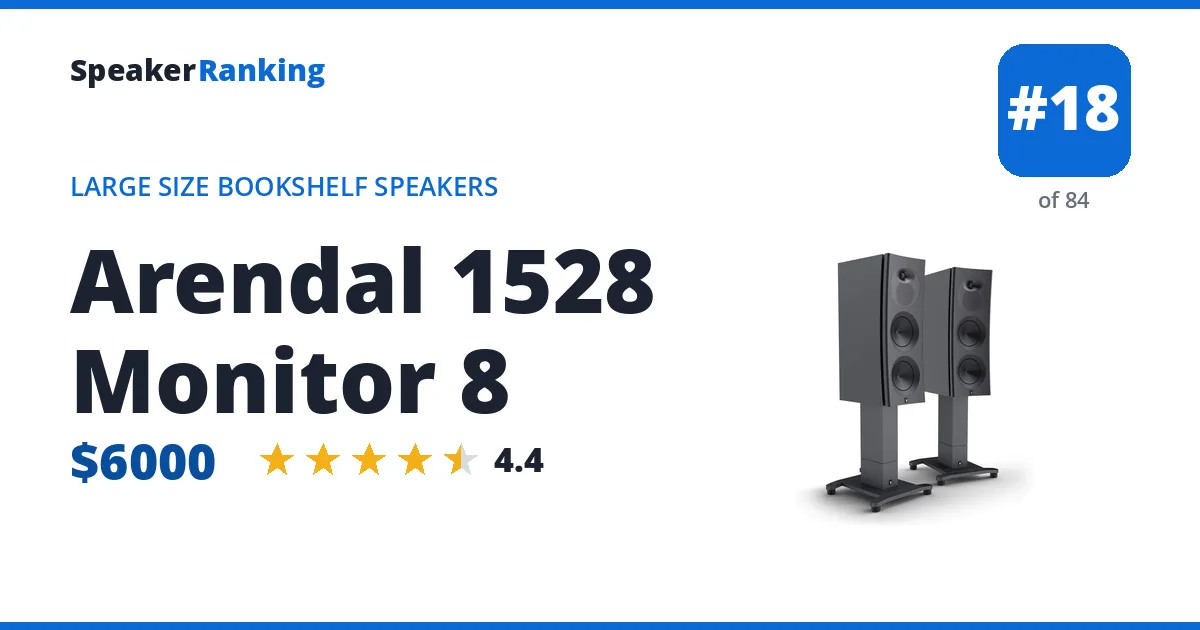
Pros: Three-way design featuring a 28mm tweeter, 5” mid-range, and dual 8” mid-bass drivers in a convertible sealed/ported HDF cabinet, with a supplied port bung for sealed operation near a wall. In ported configuration, reaches down to about 35Hz in most rooms (F3 41Hz, F10 26Hz): deep enough that many listeners could skip a subwoofer unless they want output below 40Hz. Extremely low distortion and compression across the board (harmonic, multitone, and both long- and short-term compression testing): among the best the reviewer has tested at this price, beating speakers costing twice as much. Wide, consistent horizontal soundstage of about ±60°. Smooth, non-fatiguing high frequency rather than the elevated “detail” boost common on speakers marketed for resolution. A slight forwardness around 1.5kHz adds a touch of attack without tipping into brightness. Measured bass extension of 41Hz (-3dB), with a measured sensitivity of 84.4dB.
Cons: A dip in the midbase around 100Hz noticeably reduces the “chestiness” of male vocals compared to the reviewer’s reference speaker. A diffraction-related flare in the upper-midrange/lower-treble (around 1.5-2kHz) gives a mild forwardness that benefits from sidewall absorption panels, though it’s not a major issue. Vertical sweet spot is fairly narrow at about ±20°: a bigger consideration for multi-row home theater seating than rivals like the MoFi SourcePoint 8, which manages about ±60°. The MoFi SourcePoint 8, a similarly-priced rival, also has more linear bass with no midbase dip, at the cost of a more elevated top end. Minor resonances appear around 400Hz and 800Hz in measurements, though the reviewer considers them inaudible or insignificant. Very heavy (about 104 lbs each) HDF cabinet requires dedicated, sturdy stands. Low EPDR (dips to about 1.9 ohms in two spots) means a Class AB amplifier needs to comfortably handle a 4-ohm load without overheating; a Class D amp is a safer choice for full-range use.
Full Arendal 1528 Monitor 8 review and specifications →
| Bass Extension (-10dB) | 26Hz (measured, Erin’s Audio Corner) |
|---|---|
| Bass Extension (-3dB) | 41Hz (measured, Erin’s Audio Corner) |
| DIY Kit | No |
| Dimensions | 31.8”H x 11.4”W x 17.6”D (807.7 x 289.6 x 447 mm) |
| Drivers | Dual 8” woofers, 5” midrange, 28mm tweeter |
| Impedance | 4 ohms nominal, 3.8 ohms minimum (measured, Erin’s Audio Corner) |
| Sensitivity | 84.4dB (measured, Erin’s Audio Corner) |
| Spinorama Preference Score | 5.59 |
| Spinorama Preference Score with Perfect Sub | 7.04 |
| Weight | 103.6 lbs (47 kg) each |
| Woofer Cabinet | ported |
- Links
- Reviews, Comparisons and Sound Samples
- Head-to-Head Comparisons
- Arendal 1528 Monitor 8 vs Ascend Acoustics CMT-340 SE2
- Arendal 1528 Monitor 8 vs Wharfedale Super Linton
- Arendal 1528 Monitor 8 vs AsciLab F6Bs
- Arendal 1528 Monitor 8 vs MoFi SourcePoint 10
- Arendal 1528 Monitor 8 vs MoFi SourcePoint 8
- Arendal 1528 Monitor 8 vs Radiant Acoustics Clarity 6.2
- Arendal 1528 Monitor 8 vs Dynaudio Heritage Special
- Arendal 1528 Monitor 8 vs Buchardt Audio E50
- See all 46 comparisons
Ranked #24 of 141 in Large Size Bookshelf Speakers - Wharfedale Super Linton: $2,699.00 per pair Amazon Crutchfield eBay
Pros: Three-way design with a 1” soft dome tweeter, 5” woven Kevlar mid-range, and 8” woven Kevlar woofer in a dual rear-ported, heavily damped MDF/particle-board cabinet. Comes as a genuinely matched pair (measured within about 1dB of each other) and includes custom matching stands. A major dynamic-range improvement over the original Heritage Linton: kick drums retain their impact from low to high volume instead of compressing, the standout objective improvement in this update. Fixes the original Linton’s main flaw: a 1-3kHz scoop that made it sound a bit soft and subdued is filled in here, giving noticeably more attack and dynamic punch. About 3dB more sensitivity than the original Linton (measured ~88.2dB), meaning roughly half the amplifier power for the same output. Wide horizontal radiation of about ±70°, right in the reviewer’s preferred range for an enveloping soundstage. Lower midrange distortion than the original Linton. Bass-shelf tuning intentionally allows closer-to-wall placement (about 1 foot worked well) without excess boominess, more flexible than the original Linton in that regard. Measured bass extension of 77Hz (-3dB), with a measured sensitivity of 88.2dB.
Cons: Rolls off earlier than the original Linton (F3 77Hz versus the original’s 52Hz), a deliberate trade-off for the closer-wall-placement flexibility. On-axis, there’s a mild treble lift around 4-6kHz that can sound a touch sibilant, though the reviewer found it not very noteworthy in practice. Diffraction shows up around 1.5-2kHz on-axis; needs about 10° of toe-out to smooth this out, though going further to 30° starts to lose some top-end air. Distortion peaks slightly higher than the original Linton in the 50-70Hz region. Minimum impedance dips to about 3 ohms around 150Hz, so a 4-ohm-stable amplifier is recommended for best results. Vertical dispersion of about ±20° means multi-row home theater seating outside that window will hear reduced top-end. Asymmetrical design requires attention to setup (tweeters need to face outward) for the most linear in-room response. A costly upgrade for existing Linton owners if the original’s specific flaws didn’t bother them.
Full Wharfedale Super Linton review and specifications →
| Bass Extension (-10dB) | 34Hz (measured, Erin’s Audio Corner) |
|---|---|
| Bass Extension (-3dB) | 77Hz (measured, Erin’s Audio Corner) |
| DIY Kit | No |
| Dimensions | 23.8”H x 11.8”W x 13”D (604.5 x 299.7 x 330.2 mm) |
| Drivers | 8”(200mm) black woven Kevlar® cone woofer, 5”(135mm) black woven Kevlar® cone midrange, 1” (25mm) soft dome tweeter |
| Impedance | 4 ohms nominal (3 ohms minimum, measured, Erin’s Audio Corner) |
| Sensitivity | 88.2dB (measured, Erin’s Audio Corner) |
| Spinorama Preference Score | 6.09 |
| Spinorama Preference Score with Perfect Sub | 7.94 |
| Weight | 43.7 lbs (19.8 kg) each |
| Woofer Cabinet | ported, rear |
- Links
- Reviews, Comparisons and Sound Samples
- Erin’s Audio Corner: 5 Reasons Wharfedale Super Linton is the Hidden Gem of Audio Equipment More from Erin’s Audio Corner →
- Erin’s Audio Corner Website Wharfedale Super Linton Review
- Erin’s Audio Corner: Upgrade Your Sound with These 6 Surprisingly Affordable Speakers!
- Erin’s Audio Corner: My Absolute Favorite Products of 2024 Revealed
- Erin’s Audio Corner Measurements (spinorama.org)
- Head-to-Head Comparisons
- Wharfedale Super Linton vs Ascend Acoustics CMT-340 SE2
- Wharfedale Super Linton vs Arendal 1528 Monitor 8
- Wharfedale Super Linton vs MoFi SourcePoint 10
- Wharfedale Super Linton vs Radiant Acoustics Clarity 6.2
- Wharfedale Super Linton vs Perlisten R4b
- Wharfedale Super Linton vs Dynaudio Heritage Special
- Wharfedale Super Linton vs AsciLab F6Bs
- Wharfedale Super Linton vs Epos ES14N
- See all 63 comparisons
 Ranked #25 of 141 in Large Size Bookshelf Speakers - GR-Research NX-Bravo: $1540 per pair kit with finished cabinets (assembly required) GR Research eBay
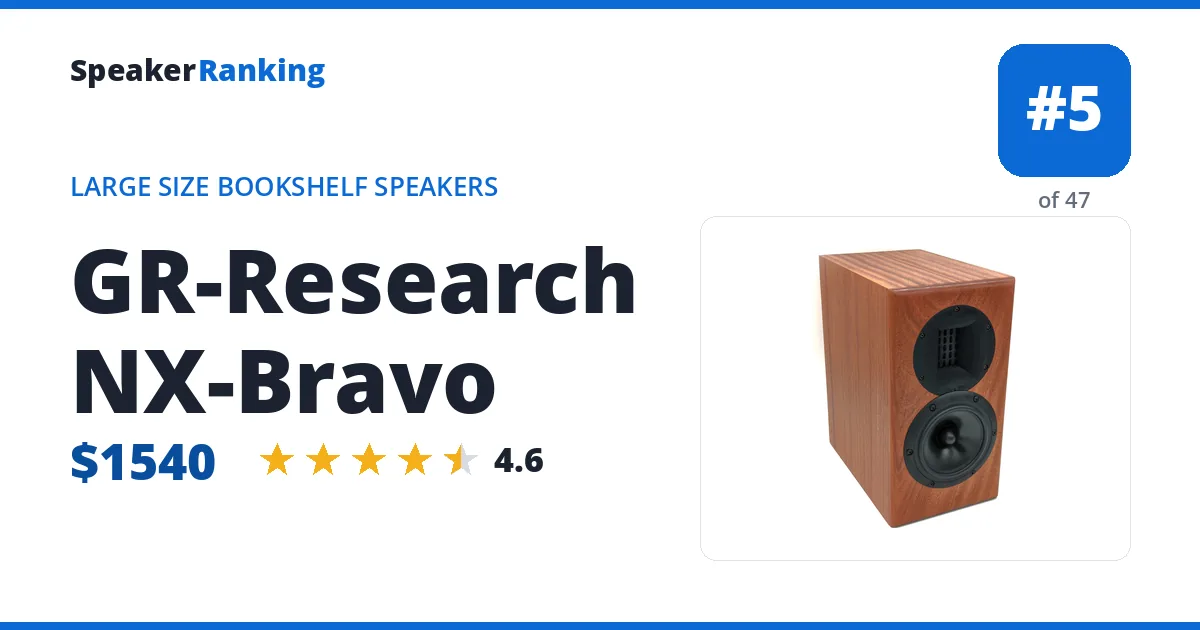
Pros: Vertical dispersion is unusually wide for a two-way bookshelf: tonal matching holds from about 50° above the tweeter axis down to 20° below it, well beyond the roughly ±10-20° typical of most two-ways. Horizontal dispersion is also wide at about ±70° through the midrange, widening further when toed out, so sidewall acoustic treatment isn’t really necessary. Burst decay is extremely clean with essentially no ringing: the reviewer compared it favorably to a $13,000/pair speaker that showed significant ringing at 120Hz and 500Hz. A deliberate dip around 7kHz reduces sibilance while the 1-4kHz upper-midrange stays neutral, so the sound doesn’t come across as laid-back or recessed. Easy to drive electrically, with a 5-ohm minimum impedance and 2.5-ohm minimum EPDR. Available from $700 as a kit up to about $2,500 fully finished, with the option of the designer’s flush-mount tube/banana-plug terminals for a cleaner look. Measured bass extension of 77Hz (-3dB), with a measured sensitivity of 84.8dB.
Cons: Pointed straight on-axis there’s a deliberate ~5dB high-frequency bump meant to compensate for narrowing dispersion off-axis; it needs about 15° of toe-out (aimed to cross behind the listener) to sound balanced, which won’t suit every room layout. Higher-than-normal high-frequency distortion becomes audible in sine-sweep testing at higher output, and multitone distortion crosses the reviewer’s 3% threshold around 96dB, making roughly 88dB the safer output ceiling. SPL-limited by the manufacturer’s own admission: not intended for loud, full-range playback and best paired with a subwoofer, as with most two-way bookshelf designs. F3 of 77Hz and F10 of 45Hz mean bass only reaches about 50-60Hz in-room. A minor enclosure or port resonance shows up in the frequency response (though not in burst decay), likely a non-issue but visible in measurements. Adding a subwoofer reduces midrange distortion but doesn’t address the elevated high-frequency distortion.
Full GR-Research NX-Bravo review and specifications →
| Bass Extension (-10dB) | 45Hz (measured, Erin’s Audio Corner) |
|---|---|
| Bass Extension (-3dB) | 77Hz (measured, Erin’s Audio Corner) |
| DIY Kit | Yes |
| Dimensions | 14”H x 7.5”W x 11.5”D (355.6 x 190.5 x 292.1 mm) |
| Drivers | GR-Research M165 6.5” paper cone, non-resonant polymer frame woofer, GR-Research Neo3 Planar Magnetic Ribbon deep rear cup tweeter |
| Impedance | 6 ohms nominal, 5 ohms minimum (measured, Erin’s Audio Corner) |
| Sensitivity | 84.8dB (measured, Erin’s Audio Corner) |
| Spinorama Preference Score | 5.18 |
| Spinorama Preference Score with Perfect Sub | 7.52 |
| Weight | 16.1 lbs (7.3 kg) each |
| Woofer Cabinet | ported |
- Links
- Reviews, Comparisons and Sound Samples
- Head-to-Head Comparisons
- GR-Research NX-Bravo vs MoFi SourcePoint 8
- GR-Research NX-Bravo vs Wharfedale Linton 85
- GR-Research NX-Bravo vs KEF R3
- GR-Research NX-Bravo vs KEF Q Concerto Meta
- GR-Research NX-Bravo vs KEF R3 Meta
- GR-Research NX-Bravo vs ELAC Debut 3.0 DB63
- GR-Research NX-Bravo vs AsciLab C6B
- GR-Research NX-Bravo vs March Audio Sointuva AWG
- See all 9 comparisons
 Ranked #26 of 141 in Large Size Bookshelf Speakers - MoFi SourcePoint 10: $3795 per pair Crutchfield eBay
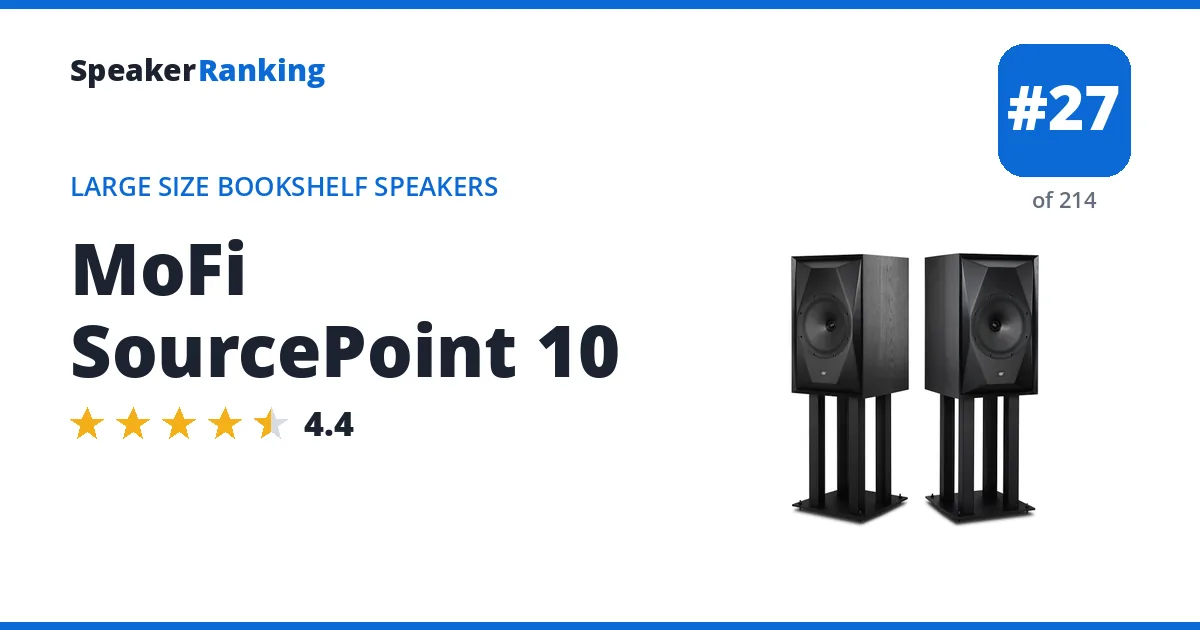
Pros: Andrew Jones-designed concentric/coincident driver delivers best-in-class sound power and early-reflections directivity in the reviewer’s testing: a genuine “point source” design. Vertical and horizontal radiation patterns closely match each other (about ±50° horizontal, ±30-40° vertical), a hallmark benefit of a well-executed concentric driver. Distortion stays low: under 1% above 100Hz at 86dB, and under 3% up to 100Hz even at 96dB, better than the reviewer expected from a low-excursion waveguide-loaded woofer. Surprisingly strong dynamic capability with little audible compression at both low and high volume. Widely spaced (about 11 feet apart) with roughly 15° of toe-out produced a huge, expansive soundstage without significant loss of imaging precision. Solidly built cabinet (about 40 lbs, heavily braced) minimizes cabinet resonance. Measured bass extension of 56Hz (-3dB), with a measured sensitivity of 88.2dB.
Cons: Like virtually all coincident designs, sounds notably bright pointed directly on-axis due to a deliberate treble lift (meant to compensate for the 28mm tweeter’s earlier beaming versus a typical 25mm/1” tweeter) combined with a diffraction dip/peak from the waveguide edge; needs about 15° of toe-out to sound neutral, and even then benefits from an extra 1-2dB of treble EQ. Toeing out further (to 30°) flattens the treble further but introduces a dip in the midrange-to-tweeter crossover region: there’s no single toe-out angle that fixes everything at once. F3 of 56Hz and F10 of 38Hz (about 40Hz in-room) mean genuine deep bass is limited; the reviewer would pair it with a sealed 10” or 12” subwoofer for regular daily listening. Bass extension and cabinet placement trade off against midrange cleanliness: placing it close to a wall for more bass risks a wall-bounce suckout in the midrange (roughly 200-500Hz depending on distance). Not perfectly time-aligned between tweeter and woofer (about 0.4ms delta), an inherent limitation of passive coincident drivers versus actively time-corrected designs. Some resonances appear in measurements, likely port-related. Minimum impedance around 6.4 ohms with EPDR near 3 ohms, so the reviewer recommends sticking with a 4-ohm-rated amplifier to be safe.
Full MoFi SourcePoint 10 review and specifications →
| Bass Extension (-10dB) | 38Hz (measured, Erin’s Audio Corner) |
|---|---|
| Bass Extension (-3dB) | 56Hz (measured, Erin’s Audio Corner) |
| DIY Kit | No |
| Dimensions | 22.5”H x 14.5”W x 16.6”D (571.5 x 368.3 x 421.6 mm) |
| Drivers | 10” Paper-pulp Cone woofer, 1.25-inch soft-dome tweeter |
| Impedance | 8 ohms nominal, 6.4 ohms minimum (measured, Erin’s Audio Corner) |
| Sensitivity | 88.2dB (measured, Erin’s Audio Corner) |
| Spinorama Preference Score | 4.16 |
| Spinorama Preference Score with Perfect Sub | 6.17 |
| Weight | 46.3 lbs (21.0 kg) each |
| Woofer Cabinet | ported, rear |
- Links
- Reviews, Comparisons and Sound Samples
- Head-to-Head Comparisons
- MoFi SourcePoint 10 vs Radiant Acoustics Clarity 6.2
- MoFi SourcePoint 10 vs Wharfedale Super Linton
- MoFi SourcePoint 10 vs Dynaudio Heritage Special
- MoFi SourcePoint 10 vs Ascend Acoustics CMT-340 SE2
- MoFi SourcePoint 10 vs Arendal 1528 Monitor 8
- MoFi SourcePoint 10 vs AsciLab F6Bs
- MoFi SourcePoint 10 vs Wharfedale Linton 85
- MoFi SourcePoint 10 vs Ascend Acoustics Sierra-LX
- See all 49 comparisons
Ranked #27 of 141 in Large Size Bookshelf Speakers - Radiant Acoustics Clarity 6.2: $4500 per pair Radiant Acoustics eBay
Pros: Custom AMT (Air Motion Transformer) tweeter paired with a 6.5” Purifi Eikona midrange and dual Purifi passive radiators in a passive-radiator enclosure, crossed over at 2.4kHz. Rigid cabinet construction (21mm MDF with a 15mm aluminum front baffle, extensive internal bracing) helps keep resonance in check. A deliberately rising on-axis response paired with narrowing directivity above about 2kHz yields a genuinely linear, non-fatiguing in-room sound rather than the “fake detail” of speakers with a straight treble boost. Excellent pair matching between units (within about 1dB), contributing to precise, well-focused imaging that clearly separated fine details in test tracks. In-room bass extension reaches a solid 40Hz with real kick-drum authority, not just sub-bass rumble. Class-leading dynamic range and compression performance: among the best the reviewer has measured at this price point. Measured bass extension of 55Hz (-3dB), with a measured sensitivity of 84.3dB.
Cons: Needs a fairly specific setup to sound its best: about 15-20° of toe-out (per the manufacturer’s own recommendation) and roughly 2 feet from the rear wall; pointed straight on-axis, the treble reads as noticeably elevated. Low impedance (2.1-ohm minimum, about 1-ohm minimum EPDR) demands an amplifier genuinely comfortable with 4-ohm-and-below loads. Soundstage width narrows above about 5kHz, even though the AMT tweeter itself is capable of wider dispersion. An unexplained resonance appears in harmonic distortion measurements on both units tested (though not on the reviewer’s reference speaker): possibly a basket resonance, and not something the reviewer could hear. A minor bump around 500Hz in the estimated in-room response could add a touch of boxiness for some listeners, though the reviewer didn’t personally notice it. F3 of 55Hz and F10 of 32Hz mean a subwoofer is still needed for home-theater rumble or bass-heavy genres like rap.
Full Radiant Acoustics Clarity 6.2 review and specifications →
| Bass Extension (-10dB) | 32Hz (measured, Erin’s Audio Corner) |
|---|---|
| Bass Extension (-3dB) | 55Hz (measured, Erin’s Audio Corner) |
| DIY Kit | No |
| Dimensions | 14.3”H x 8.7”W x 10.5”D (363.2 x 221 x 266.7 mm) |
| Drivers | 6.5” PURIFI USHINDI woofer, Custom AMT (Air Motion Transformer) tweeter |
| Impedance | 4 ohms nominal (2.1 ohms minimum above 80Hz, measured, Erin’s Audio Corner) |
| Sensitivity | 84.3dB (measured, Erin’s Audio Corner) |
| Spinorama Preference Score | 5.97 |
| Spinorama Preference Score with Perfect Sub | 7.75 |
| Weight | 23.8 lbs (10.8 kg) each |
| Woofer Cabinet | passive radiator |
- Links
- Reviews, Comparisons and Sound Samples
- Head-to-Head Comparisons
- Radiant Acoustics Clarity 6.2 vs MoFi SourcePoint 10
- Radiant Acoustics Clarity 6.2 vs Dynaudio Heritage Special
- Radiant Acoustics Clarity 6.2 vs Wharfedale Super Linton
- Radiant Acoustics Clarity 6.2 vs Ascend Acoustics CMT-340 SE2
- Radiant Acoustics Clarity 6.2 vs Arendal 1528 Monitor 8
- Radiant Acoustics Clarity 6.2 vs Wharfedale Linton 85
- Radiant Acoustics Clarity 6.2 vs Ascend Acoustics Sierra-LX
- Radiant Acoustics Clarity 6.2 vs AsciLab F6Bs
- See all 46 comparisons
 Ranked #28 of 141 in Large Size Bookshelf Speakers - Dynaudio Heritage Special: $7,000 per pair Safe and Sound HQ eBay
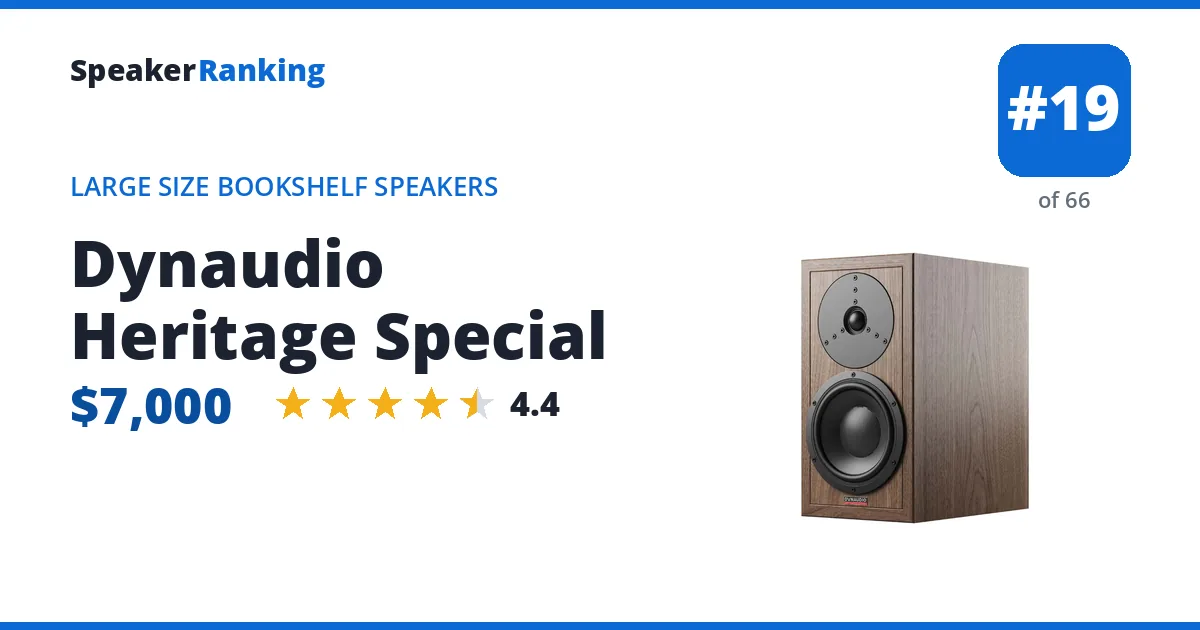
Pros: One of the rare cases where the reviewer measured a speaker as flawed but still genuinely enjoyed listening to it. A massive 4” voice coil on the midwoofer gives it exceptional output capability for a bookshelf speaker: averaged 100dB at 3.5 meters with no audible mechanical noise, port chuffing, or woofer bottoming even when deliberately pushed hard. Bass is very robust and doesn’t noticeably give up output as volume increases, staying solid at both low and high listening levels. Big, well-proportioned soundstage: wide without losing image focus. Limited run of 2,500 pairs with genuine collectible/heritage value; the tweeter (Esotar 3) and midwoofer both use premium Dynaudio-made drivers with an unusually wide, stout voice coil. Measured bass extension of 52Hz (-3dB), with a measured sensitivity of 85dB.
Cons: At lower listening volumes, dynamic range and kick-drum punch fell short of higher-sensitivity speakers the reviewer has tested (JBL 4367, KEF Reference 1 Meta): the sheer output ceiling is impressive, but it isn’t a highly dynamic-sounding speaker at modest levels. A degree of “softness” in the upper mid-range. Selective sibilance in the 4-6kHz treble region that shows up on some tracks but not others, which the reviewer found mildly aggravating and would want to EQ down given the choice. Neither the tweeter nor the woofer is fully flush-mounted to the baffle, likely intentional as part of the heritage-styled look, but the reviewer wonders how much this affected linearity. At $7000/pair (and a discontinued limited run, so used/open-box pricing around $5,000/pair is about the best you’ll do now), this is a serious investment for a bookshelf speaker.
Full Dynaudio Heritage Special review and specifications →
| Bass Extension (-10dB) | 38Hz (measured, Erin’s Audio Corner) |
|---|---|
| Bass Extension (-3dB) | 52Hz (measured, Erin’s Audio Corner) |
| Country | Denmark |
| DIY Kit | No |
| Dimensions | 15.2”H x 8.2”W x 12.6”D (385 x 208 x 320 mm) |
| Drivers | 18cm MSP cone woofer, 28mm Esotar 3 dome tweeter |
| Impedance | 5.1 ohms minimum, ported mode (measured, Erin’s Audio Corner) |
| Sensitivity | 85dB (measured at 2.83V/1m, Erin’s Audio Corner) |
| Spinorama Preference Score | 4.32 |
| Spinorama Preference Score with Perfect Sub | 6.33 |
| Weight | 24.3 lbs (11 kg) each |
- Links
- Reviews, Comparisons and Sound Samples
- Head-to-Head Comparisons
- Dynaudio Heritage Special vs Radiant Acoustics Clarity 6.2
- Dynaudio Heritage Special vs MoFi SourcePoint 10
- Dynaudio Heritage Special vs Wharfedale Super Linton
- Dynaudio Heritage Special vs Wharfedale Linton 85
- Dynaudio Heritage Special vs Ascend Acoustics CMT-340 SE2
- Dynaudio Heritage Special vs Arendal 1528 Monitor 8
- Dynaudio Heritage Special vs Ascend Acoustics Sierra-LX
- Dynaudio Heritage Special vs Revel M126Be
- See all 48 comparisons
 Ranked #29 of 141 in Large Size Bookshelf Speakers - Buchardt Audio S400: €1,800 per pair Discontinued eBay
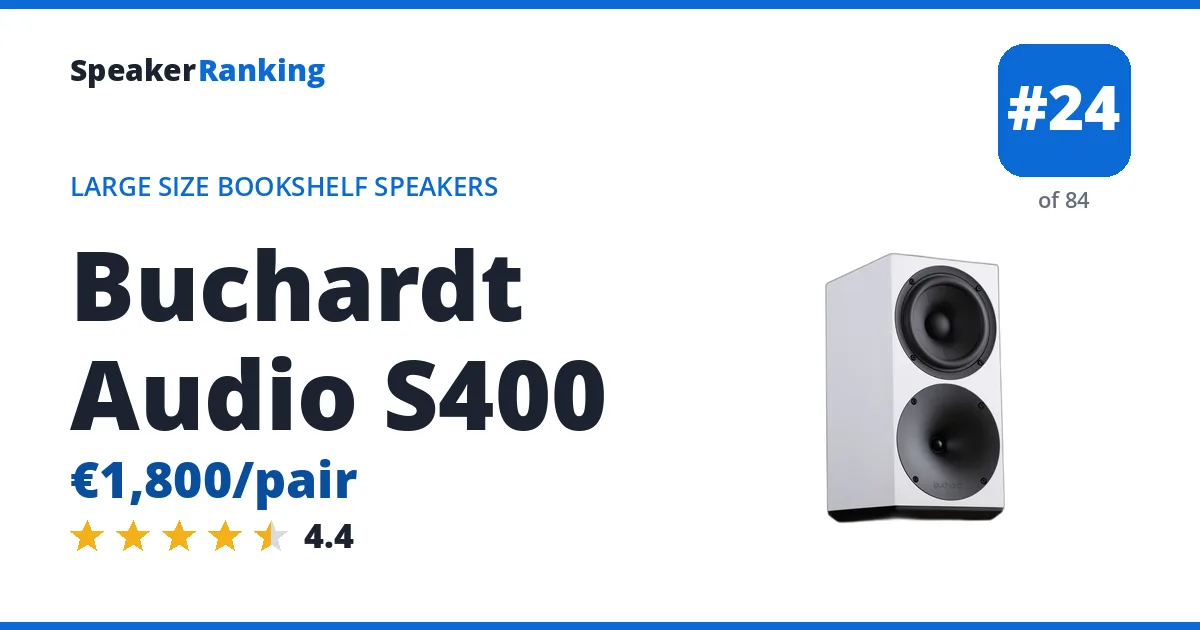
Newer model: the Buchardt S400 MK3, ranked lower, estimated 4/5.
Pros: Compact passive design with a 6-inch aluminum woofer, rear passive radiator and waveguided 0.74-inch tweeter positioned below the woofer. Erin measured F3/F10 at 53Hz/38Hz, approximately 86dB/2.83V/1m sensitivity and smooth, broad horizontal directivity. The waveguide controls crossover handoff effectively, the passive radiator avoids port chuffing, and Erin heard no objectionable narrow-band distortion despite excellent extension for the enclosure volume. Measured bass extension of 53Hz (-3dB), with a measured sensitivity of 86dB.
Cons: The impedance reaches 3.7 ohms (Erin), so a genuinely four-ohm-stable separate amplifier is recommended rather than a basic AVR. Low-frequency distortion naturally rises at high output and the compact woofer cannot supply theater-level deep bass; crossing to a subwoofer protects headroom. Erin measured narrow distortion features above 8-9kHz and vertical lobing outside the intended axis. This is the original S400, distinct from the S400 MKII already ranked. Discontinued.
Full Buchardt Audio S400 review and specifications →
| Bass Extension (-10dB) | 38Hz (measured, Erin’s Audio Corner) |
|---|---|
| Bass Extension (-3dB) | 53Hz (measured, Erin’s Audio Corner) |
| DIY Kit | No |
| Dimensions | 14.8”H x 7.1”W x 9.6”D (375 x 180 x 245 mm) |
| Drivers | 0.74” waveguided tweeter; 6” aluminum woofer |
| Impedance | 3.7 ohms minimum (measured, Erin’s Audio Corner) |
| Sensitivity | Approximately 86dB/2.83V/1m (measured, Erin’s Audio Corner) |
| Spinorama Preference Score | 5.23 |
| Spinorama Preference Score with Perfect Sub | 7.43 |
| Weight | 16.1 lbs (7.30 kg) each |
| Woofer Cabinet | sealed with rear passive radiator |
- Links
- Reviews, Comparisons and Sound Samples
- Head-to-Head Comparisons
 Ranked #30 of 141 in Large Size Bookshelf Speakers - Selah Audio Purezza: $2,950 per pair Discontinued Selah Audio eBay
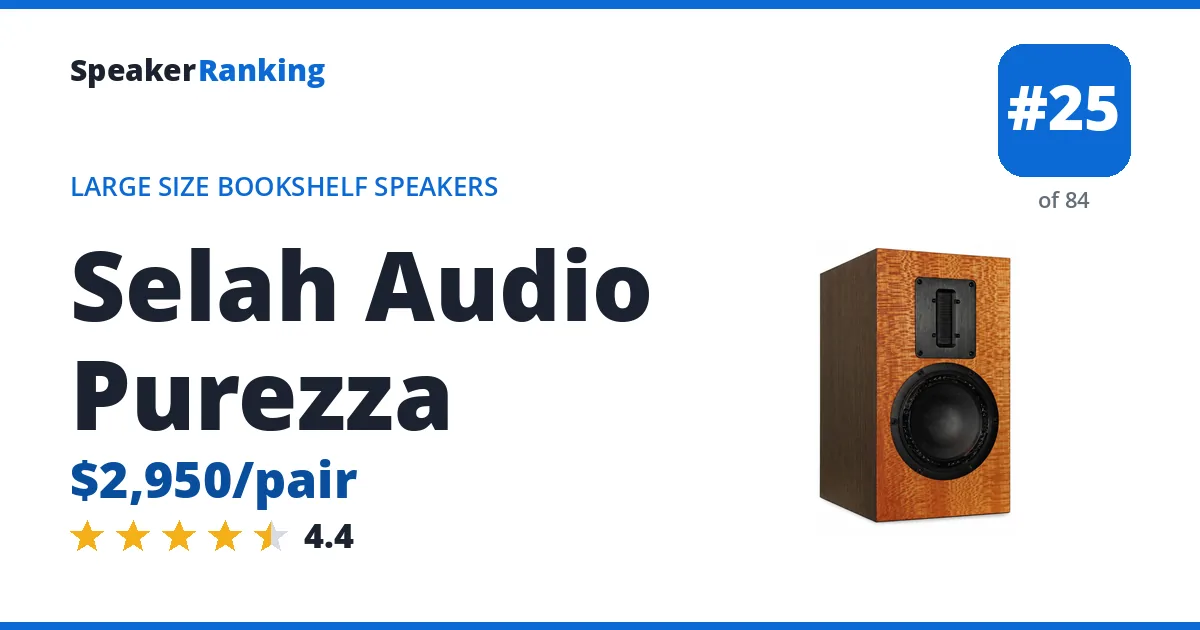
Pros: Premium two-way built around Purifi’s exceptionally linear 6.5-inch woofer and a tall RAAL ribbon. Erin measured about 85dB/2.83V/1m sensitivity, a 4.7-ohm minimum and the lowest midrange nonlinear distortion he had measured at the time. It reached roughly 103dB at 1m with little audible strain; horizontal response is smooth and broad, and Erin’s 200Hz low shelf (+3.5dB, Q 0.7) flattened the lower-mid/bass balance effectively. Measured bass extension of 86.0Hz (-3dB), with a measured sensitivity of 85dB.
Cons: The ribbon’s tall aperture creates deliberately narrow vertical radiation (roughly 20-30 degrees around 7kHz), so stand height and listening elevation are critical. Erin found a directivity change around 1-2kHz, a feature near 4kHz, and insufficient baffle-step compensation below 200-300Hz in his sample. The 4.7-ohm minimum and modest sensitivity favor a separate amplifier. A subwoofer crossed near 80Hz is recommended for distance and output. Discontinued.
Full Selah Audio Purezza review and specifications →
| Bass Extension | Subwoofer crossover near 80Hz recommended by Erin’s Audio Corner |
|---|---|
| Bass Extension (-10dB) | 34.9Hz (measured, Erin’s Audio Corner) |
| Bass Extension (-3dB) | 86.0Hz (measured, Erin’s Audio Corner) |
| DIY Kit | No |
| Dimensions | 15.5H x 8.5W x 11D in |
| Drivers | RAAL ribbon tweeter; 6.5” Purifi woofer |
| Impedance | 4.7 ohms minimum (measured, Erin’s Audio Corner) |
| Maximum SPL | Approximately 103dB at 1m (measured, Erin’s Audio Corner) (manufacturer specified) |
| Sensitivity | Approximately 85dB/2.83V/1m (measured, Erin’s Audio Corner) |
| Spinorama Preference Score | 5.61 (spinorama.org) |
| Spinorama Preference Score with Perfect Sub | 7.65 (spinorama.org) |
| Weight | 24.9 lbs (11.3 kg) each |
| Woofer Cabinet | ported |
- Links
- Reviews, Comparisons and Sound Samples
- Head-to-Head Comparisons
Ranked #33 of 141 in Large Size Bookshelf Speakers - Wharfedale Linton 85: $1999 per pair Crutchfield eBay
Pros: Very neutral frequency response and good bass extension. Measured bass extension of 52Hz (-3dB), with a measured sensitivity of 85.1dB.
Cons: The spacing of the drivers makes the vertical off axis not very good
Full Wharfedale Linton 85 review and specifications →
| Bass Extension (-10dB) | 35Hz (measured, Erin’s Audio Corner) |
|---|---|
| Bass Extension (-3dB) | 52Hz (measured, Erin’s Audio Corner) |
| DIY Kit | No |
| Dimensions | 22.2”H x 11.8”W x 13”D (563.9 x 299.7 x 330.2 mm) |
| Drivers | 8”(200mm) black woven Kevlar® cone woofer, 5”(135mm) black woven Kevlar® cone midrange, 1” (25mm) soft dome tweeter |
| Impedance | 6 ohms nominal, 3.5 ohms minimum (measured above 80Hz, Erin’s Audio Corner) |
| Sensitivity | 85.1dB (measured average 300Hz-3kHz @ 2.83V/1m, Erin’s Audio Corner) |
| Spinorama Preference Score | 6.07 |
| Spinorama Preference Score with Perfect Sub | 7.87 |
| Weight | 40.6 lbs (18.4 kg) each |
| Woofer Cabinet | ported, rear |
- Links
- Reviews, Comparisons and Sound Samples
- Erin’s Audio Corner: Discover Why I Can’t Stop Raving About the Wharfedale Linton 85th Anniversary Speaker More from Erin’s Audio Corner →
- Erin’s Audio Corner Website Wharfedale Linton 85 Review
- Erin’s Audio Corner: My Top 5 Speakers at Any Price
- Erin’s Audio Corner: Upgrade Your Sound with These 6 Surprisingly Affordable Speakers!
- Erin’s Audio Corner: My Personal Favorite Speakers Under $2500
- Erin’s Audio Corner Measurements (spinorama.org)
- Erin’s Audio Corner: KLH Model 5 or Wharfedale Linton? Linton for me. But you may disagree. Here is why.
- Head-to-Head Comparisons
- Wharfedale Linton 85 vs Ascend Acoustics Sierra-LX
- Wharfedale Linton 85 vs Revel M126Be
- Wharfedale Linton 85 vs ELAC VELA BS 403
- Wharfedale Linton 85 vs Philharmonic BMR (v1)
- Wharfedale Linton 85 vs Dynaudio Heritage Special
- Wharfedale Linton 85 vs Ascend Acoustics Sierra-2EX V2
- Wharfedale Linton 85 vs Radiant Acoustics Clarity 6.2
- Wharfedale Linton 85 vs MoFi SourcePoint 10
- See all 68 comparisons
 Ranked #34 of 141 in Large Size Bookshelf Speakers - Ascend Acoustics Sierra-LX: $1598 per pair Ascend Acoustics eBay
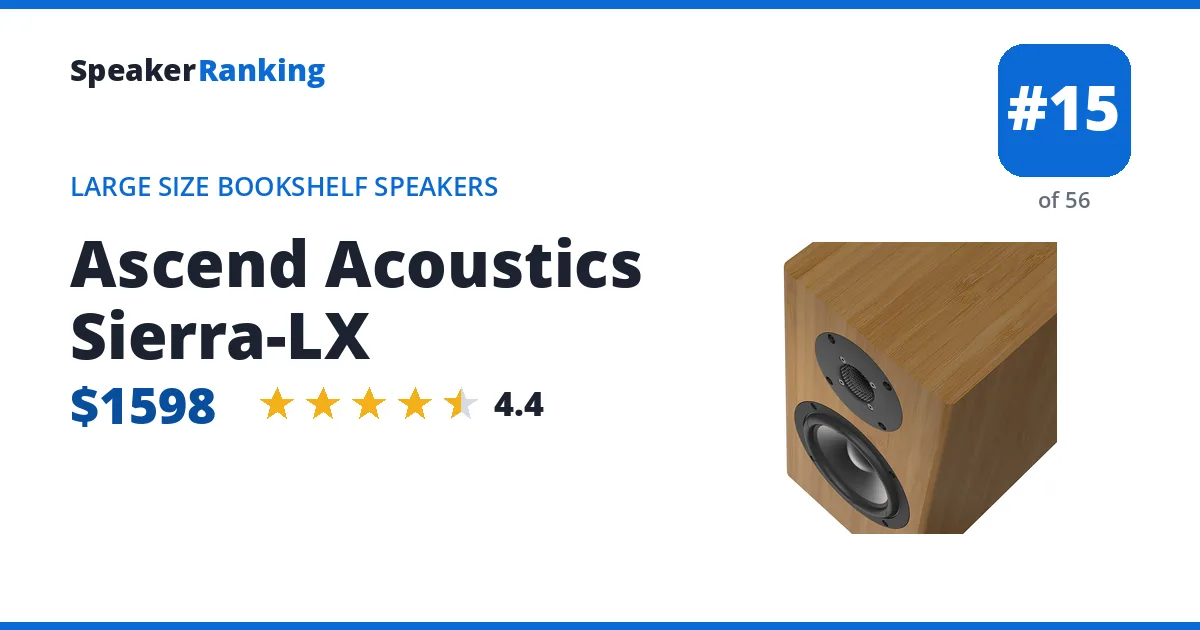
Pros: Very neutral, flat frequency response: within about plus or minus 1.5dB ignoring one narrow dip. Bass extension down to about 40Hz in-room despite the compact size. Wide, well-balanced soundstage (~60 degrees). Solid build quality with a laminated bamboo cabinet. Measured bass extension of 47Hz (-3dB), with a measured sensitivity of 81dB.
Cons: Very low sensitivity at about 81dB, so it needs a genuinely powerful amplifier to reach normal listening levels. Noticeable midrange distortion becomes audible above about 82-83dB SPL. A narrow dip around 3.5kHz on-axis in larger rooms without sidewall reflections: toeing the speakers out 10-20 degrees fills it in, but adds some brightness to the treble. Sensitive to listening height: sitting even slightly above or below tweeter level noticeably shifts the tonal balance.
Full Ascend Acoustics Sierra-LX review and specifications →
| Bass Extension (-10dB) | 38Hz (measured, Erin’s Audio Corner) |
|---|---|
| Bass Extension (-3dB) | 47Hz (measured, Erin’s Audio Corner) |
| Country | USA |
| DIY Kit | No |
| Dimensions | 14.3” x 7.5” x 10.5” (362 x 191 x 267 mm) |
| Drivers | 6” aluminum cone woofer, 26mm dome tweeter |
| Frequency Response | 28Hz - 23kHz (in-room, manufacturer specified) |
| Impedance | 8 ohms nominal (5.5 ohms minimum) |
| Power Handling | 350W continuous, 500W peak |
| Sensitivity | 81dB (2.83V/1m, measured by Erin’s Audio Corner) |
| Spinorama Preference Score | 6.63 |
| Spinorama Preference Score with Perfect Sub | 8.44 |
| Weight | 20.9 lbs (9.5 kg) |
| Woofer Cabinet | Bass reflex, flared rear port |
- Links
- Reviews, Comparisons and Sound Samples
- Head-to-Head Comparisons
- Ascend Acoustics Sierra-LX vs Wharfedale Linton 85
- Ascend Acoustics Sierra-LX vs Revel M126Be
- Ascend Acoustics Sierra-LX vs Philharmonic BMR (v1)
- Ascend Acoustics Sierra-LX vs Ascend Acoustics Sierra-2EX V2
- Ascend Acoustics Sierra-LX vs Dynaudio Heritage Special
- Ascend Acoustics Sierra-LX vs Radiant Acoustics Clarity 6.2
- Ascend Acoustics Sierra-LX vs Emotiva Airmotiv XB2
- Ascend Acoustics Sierra-LX vs MoFi SourcePoint 10
- See all 50 comparisons
Ranked #35 of 141 in Large Size Bookshelf Speakers - Revel M126Be: $4,400 per pair Crutchfield eBay
Older model: the Revel M106 (ranked higher, rated 4.6/5).
Larger models: the Revel F226Be (rated 4.6/5), the Revel F228Be (rated 4.5/5) and the Revel F328Be (rated 4.7/5).
Pros: Two-way design pairing a 6.5” midwoofer with a 1” beryllium dome tweeter, the smaller sibling to the reviewer’s favorite Revel F226Be. Wide, immersive stereo imaging: hard-panned sounds in test tracks localized 2-3 feet outside the physical speaker positions without losing pinpoint precision. Horizontal radiation of about 60-70°, landing right in the reviewer’s preferred range for an enveloping yet still well-focused soundstage. Extended bass-shelf tuning (similar in concept to the KEF R3 Meta) combines with in-room gain for a more linear low end rather than a boomy hump. Diffraction dips visible on-axis around 3kHz and 7kHz largely disappear in the estimated in-room response, since they fill in as you move off-axis. Distortion stays within 3% down to about 100Hz at both 86dB and 96dB output: strong performance for a 6.5” bookshelf woofer. Can be driven by a standard AVR thanks to a manageable 4.9-ohm minimum impedance. Measured bass extension of 103Hz (-3dB), with a measured sensitivity of 86.1dB.
Cons: At $2200/pair, the reviewer doesn’t consider it a strong value: an improvement over Revel’s less expensive M106 and Performa3 models, but not proportional to the price jump. Bass tops out around 50Hz in-room; a subwoofer is still needed for real low-end extension. Vertical placement is fairly critical: there’s a notable hole in the response around the 1.7kHz crossover if you sit above the tweeter axis. Toeing the speaker out to a full 30° introduces a roughly 1dB discontinuity in the midrange along with high-frequency rolloff; the reviewer recommends staying close to on-axis or within about 10°. An unexplained jump in distortion appears right at the 1.7kHz crossover point under compression testing, which may be linked to an occasional “glaring” quality the reviewer noticed in the 2-3kHz region at very high volumes (92-93dB from 2 meters). A mild 2-3kHz forwardness occasionally stood out on some tracks, correctable with about 1dB of EQ, though the reviewer considers it minor.
Full Revel M126Be review and specifications →
| Bass Extension (-10dB) | 44Hz (measured, Erin’s Audio Corner) |
|---|---|
| Bass Extension (-3dB) | 103Hz (measured, Erin’s Audio Corner) |
| DIY Kit | No |
| Dimensions | 15.2”H x 8.3”W x 10.3”D (386.1 x 210.8 x 261.6 mm) |
| Drivers | 6.5” Deep Ceramic Composite (DCC) Aluminum Cone with cast frame woofer, 1” Beryllium dome with acoustic lens waveguide tweeter |
| Impedance | 6 ohms nominal (4.9 ohms minimum, measured, Erin’s Audio Corner) |
| Sensitivity | 86.1dB (measured, Erin’s Audio Corner) |
| Spinorama Preference Score | 5.08 |
| Spinorama Preference Score with Perfect Sub | 7.34 |
| Weight | 22 lbs (10.0 kg) each |
| Woofer Cabinet | ported, rear |
- Links
- Reviews, Comparisons and Sound Samples
- Head-to-Head Comparisons
- Revel M126Be vs ELAC VELA BS 403
- Revel M126Be vs Ascend Acoustics Sierra-LX
- Revel M126Be vs Wharfedale Linton 85
- Revel M126Be vs Ascend Acoustics Sierra-2EX V2
- Revel M126Be vs Selah Audio Purezza
- Revel M126Be vs JTR Noesis 210HT
- Revel M126Be vs Emotiva Airmotiv XB2
- Revel M126Be vs Dynaudio Heritage Special
- See all 24 comparisons
 Ranked #36 of 141 in Large Size Bookshelf Speakers - ELAC VELA BS 403: $2,899 per pair Discontinued eBay
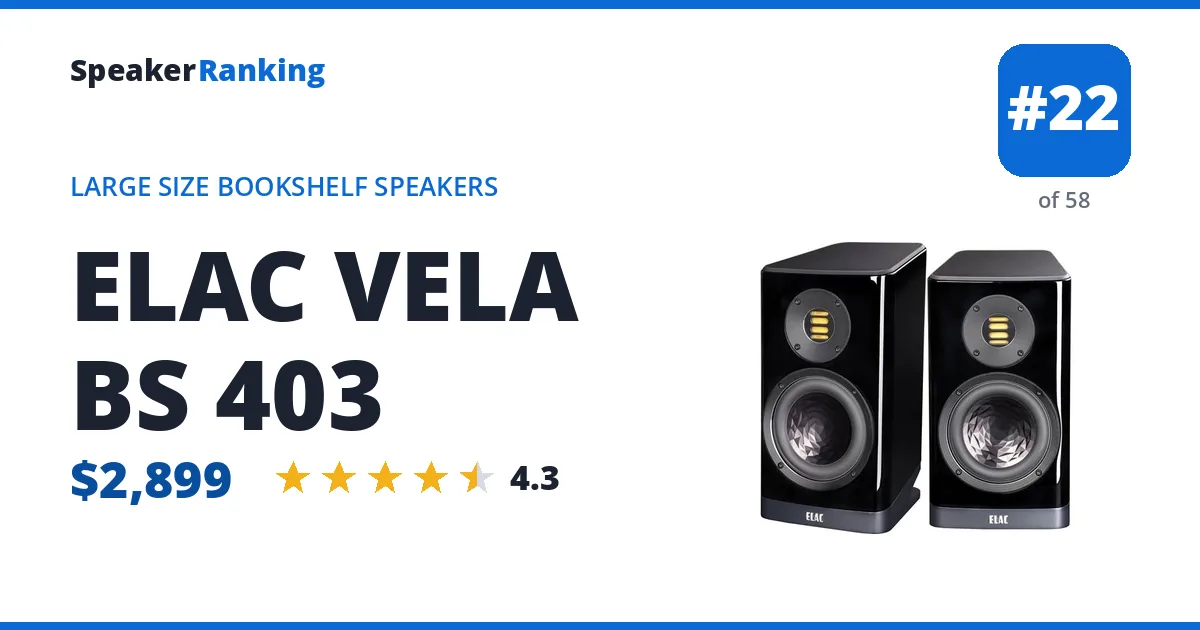
Newer model: the ELAC Vela BS 403.2, ranked higher, estimated 4.4/5.
Pros: JET 5 folded ribbon tweeter pairs with a 6” aluminum/paper sandwich woofer for extended, well-controlled bass: Erin measured usable in-room extension to about 50 Hz, deeper than JBL’s competing L52 Classic despite lacking that speaker’s mild upper-bass bump. Compression stays within about 1 dB above 100 Hz up to 102 dB, on the better side of normal for a bookshelf this size, indicating good dynamic and transient capability. Wide, spacious soundstage radiation. Overall neutral voicing that Erin called “a really good speaker,” from the looks to the sound. Measured bass extension of 59Hz (-3dB), with a measured sensitivity of 84.3dB.
Cons: Deliberate dip-and-peak voicing in the crossover region around 2 kHz reduces attack and clarity in the mids and highs: intentional per ELAC’s design, but not to Erin’s personal preference. Lower measured sensitivity (84.3 dB) means it wants more amplifier power than average to reach the same levels. Multitone distortion roughly triples, from about 1% to 3%, between 88 dB and 96 dB output, so it’s happiest at moderate listening levels. A minor distortion bump shows up around 800 Hz in the data, though Erin didn’t hear it. Discontinued and no longer sold new.
Full ELAC VELA BS 403 review and specifications →
| Bass Extension (-10dB) | 46Hz (measured average, Erin’s Audio Corner) |
|---|---|
| Bass Extension (-3dB) | 59Hz (measured average, Erin’s Audio Corner) |
| Crossover Frequency | 2.4kHz |
| DIY Kit | No |
| Dimensions | 14-3/16”H x 7-1/2”W x 9-3/8”D |
| Drivers | JET 5 folded ribbon tweeter, 6” aluminum/paper sandwich cone woofer |
| Frequency Response | 41Hz - 50kHz (manufacturer specified) |
| Impedance | 4 ohms nominal, 3.2 ohms minimum (measured, Erin’s Audio Corner) |
| Recommended Power | up to 100W RMS |
| Sensitivity | 84.3dB (measured average, Erin’s Audio Corner) |
| Spinorama Preference Score | 3.94 |
| Spinorama Preference Score with Perfect Sub | 6.28 |
| Weight | 15.7 lbs (7.1 kg) each |
- Reviews, Comparisons and Sound Samples
- Head-to-Head Comparisons
- ELAC VELA BS 403 vs Philharmonic BMR (v1)
- ELAC VELA BS 403 vs Revel M126Be
- ELAC VELA BS 403 vs Wharfedale Linton 85
- ELAC VELA BS 403 vs ELAC Vela BS 403.2
- ELAC VELA BS 403 vs JTR Noesis 210HT
- ELAC VELA BS 403 vs Selah Audio Purezza
- ELAC VELA BS 403 vs Emotiva Airmotiv XB2
- ELAC VELA BS 403 vs ELAC Debut 3.0 DB63
- See all 15 comparisons
 Ranked #37 of 141 in Large Size Bookshelf Speakers - Philharmonic BMR (v1): $2,395 per pair Discontinued eBay
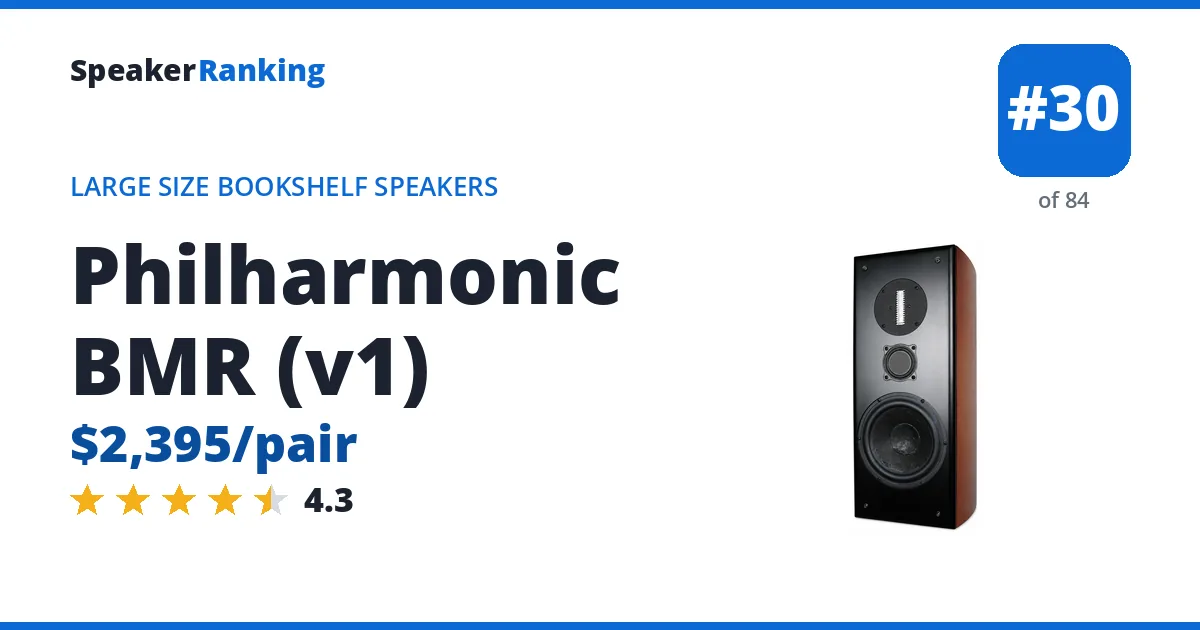
Newer model: the Philharmonic BMR Monitor, ranked lower, rated 3.6/5.
Pros: Large three-way combining a Scan-Speak 7-inch paper/carbon woofer, 2.5-inch Tectonic balanced-mode midrange and RAAL 64-10 ribbon. Erin measured approximately +/-1.5dB linearity from 80Hz upward, very broad +/-40-degree-or-better horizontal coverage and about 83dB/2.83V/1m sensitivity. The port is tuned in the mid/low-30Hz region without audible chuffing, the midrange provides unusually expansive staging, and distortion remained subjectively unobtrusive. Measured bass extension of 62Hz (-3dB), with a measured sensitivity of 83dB.
Cons: The measured 83dB sensitivity and roughly 4-ohm load demand meaningful external amplification. A 1-2dB shelf below about 300Hz reduces warmth unless corrected, while a response/impedance feature near 250-300Hz corresponded with Erin’s sense of resonance. The ribbon produces narrower vertical than horizontal radiation, and second-order high-frequency distortion plus dynamic enhancement near 3kHz appeared in testing. This was an earlier cabinet/version, not the current v2. Discontinued.
Full Philharmonic BMR (v1) review and specifications →
| Bass Extension (-10dB) | 37.8Hz (measured, Erin’s Audio Corner) |
|---|---|
| Bass Extension (-3dB) | Approximately 62Hz relative to mean (measured, Erin’s Audio Corner website) |
| DIY Kit | No |
| Dimensions | 22H x 9W x 13.5D in |
| Drivers | RAAL 64-10 ribbon; 2.5” BMR midrange; 7” Scan-Speak woofer |
| Impedance | Approximately 4 ohms nominal (measured, Erin’s Audio Corner) |
| Port Tuning | Mid/low-30Hz range (measured, Erin’s Audio Corner) |
| Sensitivity | Approximately 83dB/2.83V/1m (measured, Erin’s Audio Corner) |
| Spinorama Preference Score | 4.86 |
| Spinorama Preference Score with Perfect Sub | 7.17 |
| Weight | 37.9 lbs (17.2 kg) each |
| Woofer Cabinet | ported |
- Links
- Reviews, Comparisons and Sound Samples
- Head-to-Head Comparisons
- Philharmonic BMR (v1) vs ELAC VELA BS 403
- Philharmonic BMR (v1) vs Selah Audio Integrity
- Philharmonic BMR (v1) vs Ascend Acoustics Sierra-2EX V2
- Philharmonic BMR (v1) vs Ascend Acoustics Sierra-LX
- Philharmonic BMR (v1) vs Wharfedale Linton 85
- Philharmonic BMR (v1) vs Emotiva Airmotiv XB2
- Philharmonic BMR (v1) vs ELAC Debut 3.0 DB63
- Philharmonic BMR (v1) vs Selah Audio Purezza
- See all 50 comparisons
 Ranked #41 of 141 in Large Size Bookshelf Speakers - JTR Noesis 210HT: $3,998 per pair JTR Speakers eBay
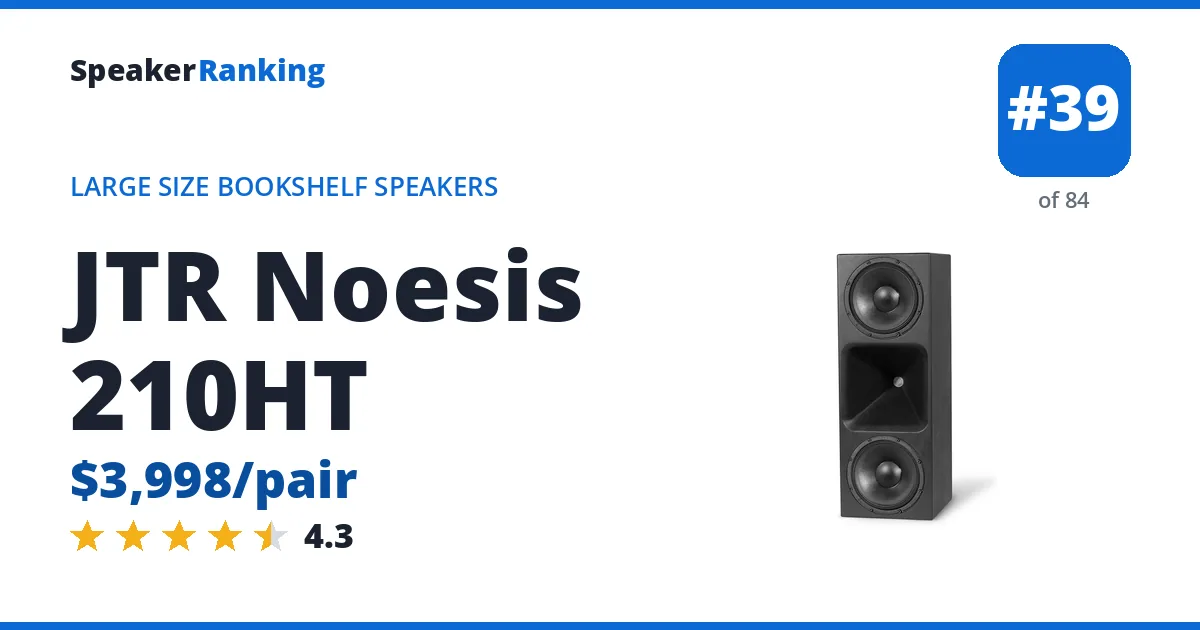
Pros: Exceptionally high-output sealed loudspeaker: Erin measured 92.5dB/2.83V/1m sensitivity, less than 3% distortion at both 86dB and 96dB test levels, and excellent compression behavior. The coaxial compression driver and dual 10-inch woofers cross at roughly 850Hz into a nominal 60° x 60° pattern, keeping radiation controlled enough that broad response errors remain amenable to EQ. Its sealed 12dB/octave bass roll-off simplifies subwoofer integration, while Baltic-birch construction and professional-grade drivers suit reference-level cinema use. Measured bass extension of 76Hz (-3dB), with a measured sensitivity of 92.5dB.
Cons: Erin measured F3 at 76Hz and F10 at 43Hz, so the 210HT is designed to hand bass duties to subwoofers rather than operate full-range. The impedance falls to approximately 3 ohms through 100-200Hz (Erin), making a stable separate amplifier preferable. Midrange resonances and the horn-to-woofer directivity transition raise the predicted in-room treble balance; careful toe-in, room treatment and DSP are advisable. Each enclosure is unusually large and heavy for a stand-mount, and the narrow coverage is less forgiving across a wide seating area.
Full JTR Noesis 210HT review and specifications →
| Bass Extension (-10dB) | 43Hz (measured, Erin’s Audio Corner) |
|---|---|
| Bass Extension (-3dB) | 76Hz (measured, Erin’s Audio Corner) |
| Crossover Frequency | Approximately 850Hz |
| DIY Kit | No |
| Dimensions | 34”H x 12.25”W x 14”D |
| Drivers | Dual 10” woofers; coaxial compression driver on 60° x 60° horn |
| Impedance | Approximately 3 ohms minimum at 100-200Hz (measured, Erin’s Audio Corner) |
| Sensitivity | 92.5dB/2.83V/1m (measured, Erin’s Audio Corner) |
| Spinorama Preference Score | 2.66 |
| Spinorama Preference Score with Perfect Sub | 5.41 |
| Weight | 85.1 lbs (38.6 kg) each |
| Woofer Cabinet | sealed |
- Links
- Reviews, Comparisons and Sound Samples
- Head-to-Head Comparisons
- JTR Noesis 210HT vs ELAC Debut 3.0 DB63
- JTR Noesis 210HT vs ELAC VELA BS 403
- JTR Noesis 210HT vs Revel M126Be
- JTR Noesis 210HT vs Selah Audio Purezza
- JTR Noesis 210HT vs Yamaha NS-800A
- JTR Noesis 210HT vs KEF R3
- JTR Noesis 210HT vs KEF Q Concerto Meta
- JTR Noesis 210HT vs KEF R3 Meta
- See all 10 comparisons
Ranked #42 of 141 in Large Size Bookshelf Speakers - Emotiva Airmotiv XB2: $549 per pair Emotiva eBay
Older models: the Emotiva B1+ (rated 4.1/5) and the Emotiva Airmotiv B2+ (ranked lower, rated 3/5).
Pros: Very neutral, linear frequency response at the recommended toe-out angle, with better directivity than the similarly-priced ELAC DB63. Decent bass extension for a bookshelf (F3 at 62Hz). AMT folded-ribbon tweeter with a rotating waveguide for placement flexibility. Great value: rated a top-three performer for the money by Erin’s Audio Corner. Measured bass extension of 62Hz (-3dB).
Cons: Slight recessed upper-midrange around 2kHz from the tweeter-to-woofer handoff. Sounds noticeably bright pointed directly at the listener: needs toeing out 10-20 degrees, crossfiring behind the head, for the most linear result. Elevated multi-tone distortion at higher output leads to some grainy, compressed mids when pushed. Irregular compression deviations affect dynamics at higher volume. Needs a subwoofer for real bass authority.
Full Emotiva Airmotiv XB2 review and specifications →
| Bass Extension (-10dB) | 43Hz (measured, Erin’s Audio Corner) |
|---|---|
| Bass Extension (-3dB) | 62Hz (measured, Erin’s Audio Corner) |
| Crossover Frequency | 2.6kHz |
| DIY Kit | No |
| Dimensions | 12.8” x 8.5” x 11.5” (325 x 216 x 292 mm) |
| Drivers | 1x 6” woven cone woofer, 1x 25x32mm AMT folded ribbon tweeter |
| Frequency Response | 48Hz - 27kHz (+3/-3dB, Manufacturer specified) |
| Impedance | 4 ohms nominal (safe with 8-ohm rated amps) |
| Power Handling | 125W continuous, 200W peak |
| Sensitivity | 86dB (2.83V/1m, Manufacturer specified) |
| Spinorama Preference Score | 5.65 |
| Spinorama Preference Score with Perfect Sub | 7.93 |
| Weight | 18.1 lbs (8.2 kg) |
| Woofer Cabinet | Bass reflex, rear ported |
- Links
- Reviews, Comparisons and Sound Samples
- Head-to-Head Comparisons
- Emotiva Airmotiv XB2 vs ELAC Debut 3.0 DB63
- Emotiva Airmotiv XB2 vs Ascend Acoustics Sierra-2EX V2
- Emotiva Airmotiv XB2 vs Perlisten A3m
- Emotiva Airmotiv XB2 vs JBL HDI-1600
- Emotiva Airmotiv XB2 vs Aalto Speakers Aalto 3 Passive
- Emotiva Airmotiv XB2 vs Philharmonic BMR (v1)
- Emotiva Airmotiv XB2 vs ELAC VELA BS 403
- Emotiva Airmotiv XB2 vs Revel M126Be
- See all 52 comparisons
Ranked #43 of 141 in Large Size Bookshelf Speakers - ELAC Debut 3.0 DB63: $499.00 per pair Amazon Crutchfield eBay
Smaller model: the ELAC Debut 3.0 DB53 (estimated 3.9/5).
Larger model: the ELAC Debut 3.0 DF63 (rated 4.2/5).
Pros: 1” aluminum dome tweeter with a distinctive partial-lens waveguide design paired with a 6.5” third-generation aramid fiber cone woofer, in a robustly built cabinet for the price. Shallow bass rolloff (F3 76Hz, F10 40Hz) allows placement close to a wall without excessive boominess, useful for smaller living rooms. Solid measured performance for the price: on-axis linearity within about 2.5dB, impedance dipping only to about 4.4 ohms (easily AVR-driven), and roughly 20-26dB of usable dynamic range. A clear improvement over its sibling ELAC DB62, which has a sibilance issue tied to the crossover that can’t be fixed with EQ. Wide horizontal radiation of about ±60°, giving a spacious soundstage. Distortion looks good at a moderate 86dB and still reasonable at 96dB. Takes well to EQ correction: the reviewer provides a specific filter set (a low-shelf boost at 650Hz plus peaking cuts/boosts at 550Hz, 660Hz, and 3kHz) that meaningfully smooths out its known deviations. Measured bass extension of 76Hz (-3dB), with a measured sensitivity of 86.2dB.
Cons: A dip in the lower midrange (300-600Hz, about 1.5dB) reduces vocal warmth and can make voices sound slightly hollow. A high-Q resonance around 650-750Hz shows up clearly in measurements, though the reviewer couldn’t reliably hear it in his own A/B testing. A dip around 2-3kHz (roughly 1-2dB) slightly reduces speech intelligibility and attack in the upper midrange. Directivity droops above about 2kHz as the midwoofer narrows toward its beaming frequency while the tweeter’s pattern behaves differently: an inherent trade-off of physically separated drivers that can’t be fully corrected without introducing other issues. Multitone distortion crosses the reviewer’s 3% threshold in the 200Hz-1kHz range, and adding a subwoofer at an 80Hz crossover only modestly reduces it. Toeing the speaker away from the listener loses noticeable top-end air and cymbal energy, giving a softer upper register. Practical loudness ceiling is around 90dB at typical listening distance before midrange distortion and bass attack begin to degrade. Still needs a subwoofer for extension below about 40Hz.
Full ELAC Debut 3.0 DB63 review and specifications →
| Bass Extension (-10dB) | 40Hz (measured, Erin’s Audio Corner) |
|---|---|
| Bass Extension (-3dB) | 76Hz (measured, Erin’s Audio Corner) |
| DIY Kit | No |
| Dimensions | 13.3”H x 7.7”W x 11.7”D (337.8 x 195.6 x 297.2 mm) |
| Drivers | 6.5” Aramid Fiber woofer, 1” soft dome tweeter |
| Impedance | 6 ohms nominal (4.4 ohms minimum, measured, Erin’s Audio Corner) |
| Sensitivity | 86.2dB (measured, Erin’s Audio Corner) |
| Weight | 17.2 lbs (7.8 kg) each |
| Woofer Cabinet | ported, rear |
- Links
- Reviews, Comparisons and Sound Samples
- Head-to-Head Comparisons
- ELAC Debut 3.0 DB63 vs Emotiva Airmotiv XB2
- ELAC Debut 3.0 DB63 vs Arendal 1723 Bookshelf S THX
- ELAC Debut 3.0 DB63 vs JTR Noesis 210HT
- ELAC Debut 3.0 DB63 vs Perlisten A3m
- ELAC Debut 3.0 DB63 vs JBL HDI-1600
- ELAC Debut 3.0 DB63 vs Perlisten R5m
- ELAC Debut 3.0 DB63 vs Ascend Acoustics Sierra-2EX V2
- ELAC Debut 3.0 DB63 vs Aalto Speakers Aalto 3 Passive
- See all 130 comparisons
 Ranked #44 of 141 in Large Size Bookshelf Speakers - Arendal 1723 Bookshelf S THX: $1,499 per pair Arendal Sound eBay
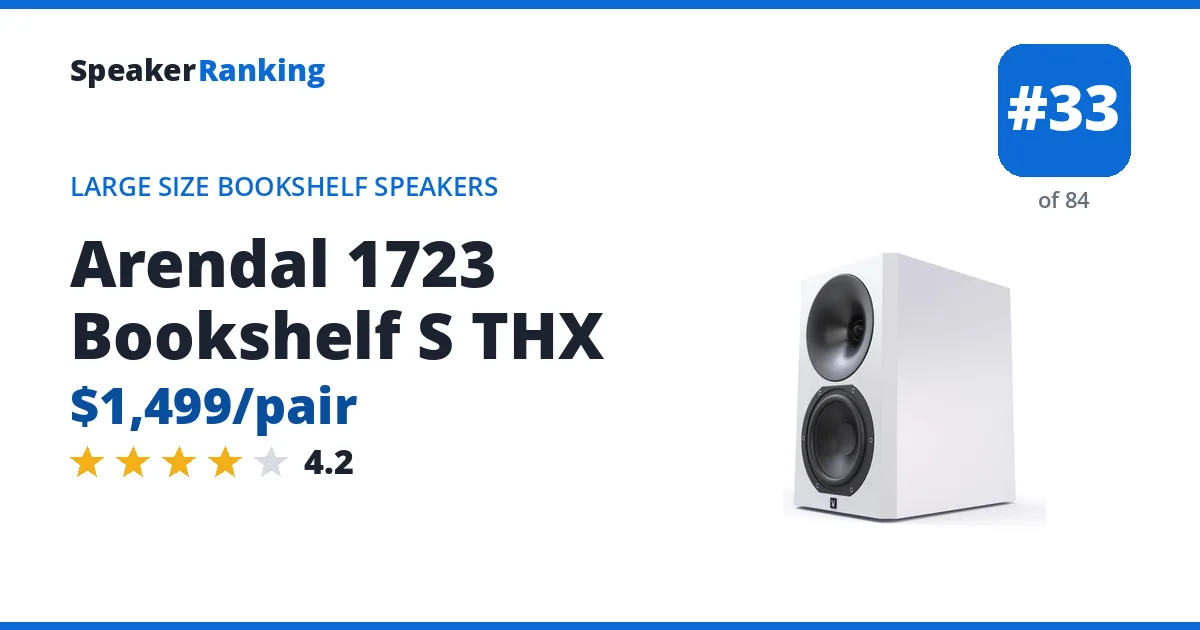
Pros: Exceptionally controlled radiation for a conventional two-way: Erin found the early-reflections directivity index smooth enough for broad-band EQ, while horizontal coverage remains orderly through the 1.5kHz crossover. Midbass attack around 120-160Hz is strong, the response is mostly neutral below the treble shelf, and dynamic compression remains under roughly 1dB even near 102dB/1m above the bass. The waveguided 28mm dome and heavy HDF enclosure support clean, cinema-capable output, and sealed/ported flexibility eases subwoofer integration. Measured bass extension of ~80Hz (-3dB), with a measured sensitivity of 81.6dB.
Cons: Erin measured only 81.6dB/2.83V/1m sensitivity, so substantial amplifier voltage is required. Anechoic output rolls off around 80Hz and 3% THD is crossed near 80Hz at 96dB, making an 80Hz subwoofer crossover effectively mandatory. The treble sits a couple dB high on-axis and can sound bright; Erin preferred roughly 20° toe-out or a ~2dB high shelf. A vertical cancellation appears above the tweeter axis, so multi-row installations need careful height/aiming.
Full Arendal 1723 Bookshelf S THX review and specifications →
| Bass Extension (-10dB) | 44.6Hz (measured, Erin’s Audio Corner) |
|---|---|
| Bass Extension (-3dB) | ~80Hz (measured, Erin’s Audio Corner) |
| DIY Kit | No |
| Dimensions | 15.2”H x 9.6”W x 12.6”D (385 x 245 x 320 mm) |
| Drivers | 6.5-inch woofer; 28mm waveguided soft-dome tweeter |
| Enclosure | HDF, sealed/ported |
| Impedance | 4 ohms nominal |
| Sensitivity | 81.6dB/2.83V/1m (measured, Erin’s Audio Corner) |
| Spinorama Preference Score | 4.89 |
| Spinorama Preference Score with Perfect Sub | 7.68 |
| Weight | 32 lbs (14.5 kg) each |
- Links
- Reviews, Comparisons and Sound Samples
- Head-to-Head Comparisons
- Arendal 1723 Bookshelf S THX vs ELAC Debut 3.0 DB63
- Arendal 1723 Bookshelf S THX vs JBL HDI-1600
- Arendal 1723 Bookshelf S THX vs Philharmonic BMR (v1)
- Arendal 1723 Bookshelf S THX vs Power Sound Audio MT-110-M
- Arendal 1723 Bookshelf S THX vs Wharfedale Linton 85
- Arendal 1723 Bookshelf S THX vs ELAC DBR62
- Arendal 1723 Bookshelf S THX vs Wharfedale Super Linton
- Arendal 1723 Bookshelf S THX vs KEF R3
- See all 11 comparisons
 Ranked #48 of 141 in Large Size Bookshelf Speakers - Danley SH50: $8,000 per pair Danley Dealer Contact eBay
Pros: A true point-source-style professional loudspeaker: two 12-inch woofers, four 5-inch midranges and a compression driver share one Synergy horn, preserving approximately 50° x 50° constant directivity through most of the passband. Erin measured roughly 97dB/2.83V/1m sensitivity, an F3 near 60Hz and extraordinary output. Distortion stayed below 1% above about 60Hz at 86dB, and compression remained negligible above roughly 70Hz even at 102dB. Broad response trends can be corrected with DSP without destroying the controlled radiation pattern. Measured bass extension of 60Hz (-3dB), with a measured sensitivity of 97dB.
Cons: This 133-pound, roughly 28-inch cube is engineered for venues and large rooms, not conventional domestic nearfield listening. Its narrow 50° coverage demands precise aiming and provides a small sweet area close up. Erin measured impedance just below 4 ohms near 100Hz and 1kHz; the high sensitivity eases voltage demand, but professional use still warrants a robust dedicated amplifier and DSP. A resonance/second-harmonic distortion feature around 900Hz and smaller nonminimum-phase response features cannot be fully equalized. Subwoofers remain appropriate below the approximately 60Hz measured F3.
Full Danley SH50 review and specifications →
| Bass Extension (-10dB) | 43.4Hz (measured, Erin’s Audio Corner) |
|---|---|
| Bass Extension (-3dB) | Approximately 60Hz (measured, Erin’s Audio Corner) |
| Coverage | 50° horizontal x 50° vertical |
| DIY Kit | No |
| Dimensions | 28”H x 28”W x 25.5”D |
| Drivers | Two 12” woofers; four 5” midranges; 1” compression driver in Synergy horn |
| Impedance | Just under 4 ohms near 100Hz and 1kHz (measured, Erin’s Audio Corner) |
| Maximum SPL | 127dB continuous, 133dB peak (manufacturer specified) |
| Sensitivity | Approximately 97dB/2.83V/1m (measured, Erin’s Audio Corner) |
| Spinorama Preference Score | -0.29 (spinorama.org) |
| Spinorama Preference Score with Perfect Sub | 1.93 (spinorama.org) |
| Weight | 132.9 lbs (60.3 kg) each |
- Links
- Reviews, Comparisons and Sound Samples
- Head-to-Head Comparisons
 Ranked #49 of 141 in Large Size Bookshelf Speakers - Arendal Sound 1723 Monitor THX: $2,400 per pair Arendal Sound eBay
Pros: Independent ASR Klippel data shows a narrow 1.8dB reference band, 0.391 listening-window smoothness, and useful bass extension to 48.3Hz at -6dB. Its preference score rises from 5.16 to 7.30 with a subwoofer. Dual 8-inch woofers, a waveguided tweeter, robust HDF construction, and THX Ultra certification suit high-output rooms. Measured bass extension of 63Hz (-3dB).
Cons: The measured on-axis average absolute deviation is 0.979dB and the sound-power directivity-index standard deviation is 3.63, so its response and dispersion are less even than the best alternatives. Bass reaches only 63Hz at -3dB despite the very large cabinet, and the 1.239 low-frequency Q indicates a pronounced alignment. At roughly 60 lb each, these require substantial stands and space.
Full Arendal Sound 1723 Monitor THX review and specifications →
| Bass Extension (-10dB) | approximately 37Hz (measured, spinorama.org) |
|---|---|
| Bass Extension (-3dB) | 63Hz (measured, spinorama.org) |
| Certification | THX Ultra |
| DIY Kit | No |
| Dimensions | 15.7”H x 10.8”W x 25”D (400 x 275 x 635 mm) |
| Drivers | Two 8-inch woofers; 28mm waveguided tweeter |
| Impedance | 4 ohms nominal |
| Sensitivity | 89dB (manufacturer specified, 2.83V/1m) |
| Spinorama Preference Score | 5.16 |
| Spinorama Preference Score with Perfect Sub | 7.30 |
| Weight | 58.9 lbs (26.7 kg) each |
- Links
- Reviews, Comparisons and Sound Samples
- Head-to-Head Comparisons
- Arendal Sound 1723 Monitor THX vs Power Sound Audio MT-110-M
- Arendal Sound 1723 Monitor THX vs ELAC Debut 3.0 DB63
- Arendal Sound 1723 Monitor THX vs Arendal Sound 1723 Monitor S THX
- Arendal Sound 1723 Monitor THX vs Paradigm Founder 40B
- Arendal Sound 1723 Monitor THX vs Wharfedale Super Linton
- Arendal Sound 1723 Monitor THX vs Klipsch RP-600M II
- Arendal Sound 1723 Monitor THX vs KEF R3
- Arendal Sound 1723 Monitor THX vs KEF Q Concerto Meta
- See all 9 comparisons
 Ranked #52 of 141 in Large Size Bookshelf Speakers - StarkSound Beta 5: $499.00 per pair Amazon eBay
Pros: Impressive bass extension for the price: F3 at 52Hz, F10 at 37Hz, reaching down to 40-50Hz in-room with solid kick-drum impact. Good harmonic distortion control at both moderate and loud listening levels. Solid build with a thick polycarbonate baffle meant to reduce cabinet resonance. Measured bass extension of 52Hz (-3dB), with a measured sensitivity of 83dB.
Cons: Sensitivity undershoots its own spec: rated 86dB, measured closer to 83dB. A resonance artifact shows up independently in the on-axis response, burst decay, and impedance measurements, hurting directivity. Multitone distortion spikes to about 10% in the 800Hz-1kHz range, tied to woofer excursion: a subwoofer crossover helps. Needs to sit close to the wall (about 10 inches) or be EQ’d if placed further out, since the midrange sounds thin and the treble boosted otherwise.
Full StarkSound Beta 5 review and specifications →
| Bass Extension (-10dB) | 37Hz (measured, Erin’s Audio Corner) |
|---|---|
| Bass Extension (-3dB) | 52Hz (measured, Erin’s Audio Corner) |
| Crossover Frequency | 2200Hz |
| DIY Kit | No |
| Dimensions | 11.9” x 7.2” x 13” (302 x 182 x 330 mm) |
| Drivers | 1.15” tweeter, 5.25” dry-carbon woofer |
| Frequency Response | 45Hz - 23kHz (-3dB, Manufacturer specified) |
| Impedance | 4 ohms nominal |
| Maximum SPL | 108dB (1m, Manufacturer specified) |
| Recommended Power | 30W - 150W |
| Sensitivity | 83dB (2.83V/1m, measured by Erin’s Audio Corner) |
| Weight | 15 lbs (6.8 kg) |
| Woofer Cabinet | Bass reflex, rear ported |
- Links
- Reviews, Comparisons and Sound Samples
- Head-to-Head Comparisons
 Ranked #54 of 141 in Large Size Bookshelf Speakers - Power Sound Audio MT-110-M: $1,350 per pair Power Sound Audio eBay
Pros: Made in the USA with a 1” polyimide compression tweeter on a cast aluminum exponential horn plus a 10” high-efficiency neodymium woofer, both BMS-made drivers. Reasonably high measured sensitivity (about 92.5dB at 2.83V/1m), so it doesn’t need much power to play loud. Excellent dynamic range: frequency response barely shifts (about 0.5dB deviation) from 76dB to 102dB output, which the reviewer calls completely acceptable headroom. Not fatiguing or bright despite the horn-loaded compression driver: the constant-directivity horn avoids the artificially flat, reflection-heavy in-room high-frequency buildup that some waveguide designs suffer from. Sealed cabinet design means placement near a wall is less of a bass-reinforcement concern than with a ported design. Solid build quality using threaded nutserts rather than screws driven directly into the cabinet wood. Measured bass extension of 113Hz (-3dB), with a measured sensitivity of 92.5dB.
Cons: A mid-range bump makes the tonal balance sound too thick and needs 2-3 bands of EQ to flatten out; correcting it also pulls measured sensitivity down to about 90-91dB in practice. F3 of 113Hz and F10 of 68Hz mean this doesn’t get low without a subwoofer: in the reviewer’s room it barely reached 70Hz with any real authority. Rising distortion in the upper mid-range, likely from woofer breakup, that lines up with anomalies seen in the impedance sweep above 500Hz: not a major concern but worth noting. The reviewer explicitly frames this as a home theater speaker rather than a stereo/music speaker.
Full Power Sound Audio MT-110-M review and specifications →
| Bass Extension (-10dB) | 68Hz (measured, Erin’s Audio Corner) |
|---|---|
| Bass Extension (-3dB) | 113Hz (measured, Erin’s Audio Corner) |
| Country | USA |
| DIY Kit | No |
| Dimensions | 17.5”H x 11”W x 14”D (includes grille) |
| Drivers | 1” polyimide compression tweeter with cast aluminum exponential horn, 10” high-efficiency neodymium woofer |
| Impedance | 8 ohms nominal (measured, Erin’s Audio Corner; matches manufacturer spec) |
| Power Handling | 175W |
| Sensitivity | 92.5dB (measured at 2.83V/1m, Erin’s Audio Corner; matches manufacturer spec) |
| Spinorama Preference Score | 2.53 |
| Spinorama Preference Score with Perfect Sub | 5.86 |
| Weight | 30 lbs (13.6 kg) each (unboxed) |
| Woofer Cabinet | sealed |
- Links
- Reviews, Comparisons and Sound Samples
- Head-to-Head Comparisons
- Power Sound Audio MT-110-M vs ELAC Uni-Fi Reference UBR62
- Power Sound Audio MT-110-M vs Arendal Sound 1723 Monitor THX
- Power Sound Audio MT-110-M vs Arendal 1723 Bookshelf S THX
- Power Sound Audio MT-110-M vs ELAC Debut 3.0 DB63
- Power Sound Audio MT-110-M vs SVS Ultra Bookshelf
- Power Sound Audio MT-110-M vs Klipsch RP-600M II
- Power Sound Audio MT-110-M vs KEF R3
- Power Sound Audio MT-110-M vs KEF Q Concerto Meta
- See all 9 comparisons
Ranked #56 of 141 in Large Size Bookshelf Speakers - ELAC Uni-Fi Reference UBR62: $1,199 per pair Amazon eBay
Pros: True three-way stand-mount using a 1-inch tweeter concentrically mounted in a 4-inch aluminum midrange plus a dedicated 6.5-inch aluminum woofer. Erin found the directivity and overall tonality well controlled, with dual front slot vents minimizing placement sensitivity and cabinet bracing suppressing obvious coloration. The mostly 5-ohm-or-higher load is manageable for a genuinely 4-ohm-capable amplifier, and the coherent concentric upper range supports stable imaging across seats. Measured bass extension of 58.6Hz (-3dB), with a measured sensitivity of 83dB.
Cons: Erin measured very low 83dB/2.83V/1m sensitivity; his 110W Parasound was insufficient for the high-level test and the more powerful HINT 6 was needed. Impedance reaches 4 ohms near 50Hz (Erin), while woofer excursion and bass output were less capable than expected for the cabinet size. A broad 500-700Hz rise and associated lower/female-vocal coloration were audible, and the slightly subdued listening-window treble is necessary to avoid an overly bright in-room balance rather than evidence of ruler-flat axial tuning.
Full ELAC Uni-Fi Reference UBR62 review and specifications →
| Bass Extension | 41Hz manufacturer specified; Erin’s response-linearity graph shows limited high-output bass headroom |
|---|---|
| Bass Extension (-10dB) | 41.9Hz (measured, Erin’s Audio Corner) |
| Bass Extension (-3dB) | 58.6Hz (measured, Erin’s Audio Corner) |
| DIY Kit | No |
| Dimensions | 14.1”H x 8.2”W x 13.1”D |
| Drivers | 1” tweeter coaxial with 4” midrange; 6.5” woofer |
| Impedance | 4 ohms minimum near 50Hz (measured, Erin’s Audio Corner) |
| Sensitivity | 83dB/2.83V/1m (measured, Erin’s Audio Corner) |
| Spinorama Preference Score | 5.44 (measured, spinorama.org) |
| Spinorama Preference Score with Perfect Sub | 7.7 (measured, spinorama.org) |
| Weight | 23.5 lbs (10.68 kg) each |
| Woofer Cabinet | ported, dual front slot vents |
- Links
- Reviews, Comparisons and Sound Samples
- Head-to-Head Comparisons
- ELAC Uni-Fi Reference UBR62 vs Power Sound Audio MT-110-M
- ELAC Uni-Fi Reference UBR62 vs Revel Concerta2 M16
- ELAC Uni-Fi Reference UBR62 vs SVS Ultra Evolution Bookshelf
- ELAC Uni-Fi Reference UBR62 vs ELAC DBR62
- ELAC Uni-Fi Reference UBR62 vs Yamaha NS-800A
- ELAC Uni-Fi Reference UBR62 vs Definitive Technology Demand D11
- ELAC Uni-Fi Reference UBR62 vs Technics SB-C700
- ELAC Uni-Fi Reference UBR62 vs Dynaudio Contour 20i
- See all 26 comparisons
 Ranked #57 of 141 in Large Size Bookshelf Speakers - Arendal Sound 1723 Monitor S THX: $2,200 per pair Arendal Sound eBay
Pros: A THX-certified two-way with twin 6.5-inch woofers around a waveguided 28mm tweeter, and port plugs that let you run it sealed, with one vent or two to suit the room. Erin’s Audio Corner measured a listening window within a 2.4dB span from 300Hz to 5kHz, a smooth listening window (0.77) and predicted in-room response (0.71), and a preference score of 5.07 that rises to 7.08 with an ideal subwoofer. Sensitivity is a healthy 88.7dB. Measured bass extension of 76.9Hz (-3dB).
Cons: In the configuration measured, the bass response starts to fall early, about 77Hz at -3dB, though it keeps going to about 50Hz at -6dB and 33Hz at -10dB, so it benefits from a subwoofer or placement near a wall. It is large and heavy for a stand-mount at 56.9cm tall and 18.7kg, presents a 4-ohm load, and is sold direct by Arendal.
Full Arendal Sound 1723 Monitor S THX review and specifications →
| Bass Extension (-10dB) | 32.9Hz (measured, Erin’s Audio Corner) |
|---|---|
| Bass Extension (-3dB) | 76.9Hz (measured, Erin’s Audio Corner) |
| Certification | THX Ultra |
| DIY Kit | No |
| Dimensions | 22.4”H x 9.6”W x 12.6”D (569 x 245 x 320 mm) |
| Drivers | Two 6.5-inch woofers; 28mm waveguided tweeter |
| Frequency Response | 46Hz-20kHz ±3dB with two vents, 66Hz sealed (manufacturer specified) |
| Impedance | 4 ohms nominal |
| Sensitivity | 88.7dB (manufacturer specified, 2.83V/1m) |
| Spinorama Preference Score | 5.07 |
| Spinorama Preference Score with Perfect Sub | 7.08 |
| Weight | 41.2 lbs (18.7 kg) each |
| Woofer Cabinet | sealed or ported (port plugs included) |
- Links
- Reviews, Comparisons and Sound Samples
- Head-to-Head Comparisons
 Ranked #58 of 141 in Large Size Bookshelf Speakers - Paradigm Founder 40B: $2,399.98 per pair Audio Advice eBay
Pros: A 6-inch aluminum-magnesium woofer and a 1-inch ceramic dome tweeter in a deep waveguide, with Paradigm’s perforated phase-aligning lenses over both. Toed in 30 degrees as Paradigm recommends, Erin’s Audio Corner measured an exceptionally even listening window, within a 1.7dB span from 300Hz to 5kHz, with low on-axis deviation (0.36) and wide horizontal dispersion averaging 60 degrees, for a preference score of 4.89 that rises to 7.11 with an ideal subwoofer. Sensitivity is a high 89dB anechoic. Measured bass extension of 69.6Hz (-3dB).
Cons: Bass rolls off early for a speaker this size, about 70Hz at -3dB and 44Hz at -10dB, so it works best with a subwoofer or close to a wall. It needs the recommended toe-in: measured straight on, its response is less even (preference score 4.58) and the tonal balance shifts. At about $2,400 a pair it is expensive for a 6-inch two-way.
Full Paradigm Founder 40B review and specifications →
| Bass Extension (-10dB) | 43.9Hz (measured, Erin’s Audio Corner) |
|---|---|
| Bass Extension (-3dB) | 69.6Hz (measured, Erin’s Audio Corner) |
| DIY Kit | No |
| Dimensions | 14.5”H x 7.8”W x 12.6”D (368 x 197 x 320 mm) |
| Drivers | 6” AL-MAG woofer; 1” AL-MAC ceramic dome tweeter with waveguide |
| Frequency Response | 69Hz-23kHz ±2dB (manufacturer specified) |
| Impedance | Compatible with 8 ohms (manufacturer specified) |
| Sensitivity | 89dB anechoic, 92dB in-room (manufacturer specified) |
| Spinorama Preference Score | 4.89 |
| Spinorama Preference Score with Perfect Sub | 7.11 |
| Weight | 24.9 lbs (11.3 kg) each |
| Woofer Cabinet | ported |
- Links
- Reviews, Comparisons and Sound Samples
- Head-to-Head Comparisons
Ranked #61 of 141 in Large Size Bookshelf Speakers - ELAC DBR62: $678.97 per pair Amazon Crutchfield eBay
Pros: Two-way design with a 6.5” woofer and 1” dome tweeter in a shallow waveguide, with the tweeter positioned close to the woofer for near-point-source coherence: giving more vertical listening leeway than typical two-ways. Notably forgiving of placement and aiming: sounds good from directly on-axis all the way to 30° of toe-out (parallel with the rear wall), making it more room-independent than many speakers this price. Wide horizontal radiation of about ±70° until the tweeter starts beaming, right in the reviewer’s preferred sweet spot. A mild, wide-Q bass bump centered around 100Hz adds a bit of extra punch that the reviewer personally likes. On-axis linearity within about ±2.5dB, with a strong measured preference score of 5.3. Distortion stays below 3% at both 86dB and 96dB until around 50Hz. Vertical sweet spot of about ±10-20° works well for multi-row home theater seating. The reviewer calls it “the epitome of a good speaker” for its price, with no reservations recommending it. Measured bass extension of 53Hz (-3dB), with a measured sensitivity of 84.3dB.
Cons: A slight recess in the 1-2kHz region reduces vocal presence somewhat compared to other speakers in direct comparison. A mild hot spot around 4-5kHz can read as slight sibilance when pointed directly on-axis. Low-to-mid sensitivity (about 84.3dB) combined with a current draw that behaves like roughly 2.4 ohms between 100-200Hz means it’s best driven by a dedicated 4-ohm-capable amplifier rather than an AVR. A diffraction dip from the baffle edge is visible in measurements: typical of any standard rectangular-baffle speaker and not correctable without a much more expensive curved-baffle design. Multitone distortion testing suggests some potential midrange distortion could be audible on certain material, though the reviewer didn’t personally notice it. Minor resonances appear around 700Hz and 1-1.5kHz, possibly tied to the enclosure, port, or cone/surround edge termination, though their audible impact appears minimal. F3 of 53Hz means a subwoofer is still needed for real bass extension below about 40Hz.
Full ELAC DBR62 review and specifications →
| Bass Extension (-10dB) | 41Hz (measured, Erin’s Audio Corner) |
|---|---|
| Bass Extension (-3dB) | 53Hz (measured, Erin’s Audio Corner) |
| DIY Kit | No |
| Dimensions | 14.1”H x 8.2”W x 10.8”D (358.1 x 208.3 x 274.3 mm) |
| Drivers | 6.5” Aramid Fiber woofer, 1” soft dome tweeter |
| Impedance | 6 ohms nominal, 5.2 ohms minimum (measured above 80Hz, Erin’s Audio Corner) |
| Sensitivity | 84.3dB (measured average 300Hz-3kHz @ 2.83V/1m, Erin’s Audio Corner; 86dB manufacturer specified) |
| Spinorama Preference Score | 5.07 |
| Spinorama Preference Score with Perfect Sub | 7.27 |
| Weight | 18.1 lbs (8.2 kg) each |
| Woofer Cabinet | ported, front |
- Links
- Reviews, Comparisons and Sound Samples
- Erin’s Audio Corner: Top 3 Things You Need to Know About ELAC DBR62 Before You Buy More from Erin’s Audio Corner →
- Erin’s Audio Corner Website Elac DBR62
- Erin’s Audio Corner: 5 AWESOME SPEAKERS Under $1000 You Won’t Regret
- Erin’s Audio Corner: My Top Picks of 2023: Must-Haves Under $3000
- Audio Science Review Measurements More from Audio Science Review →
- Erin’s Audio Corner Measurements (spinorama.org)
- Head-to-Head Comparisons
- ELAC DBR62 vs Yamaha NS-800A
- ELAC DBR62 vs Definitive Technology Demand D11
- ELAC DBR62 vs Technics SB-C700
- ELAC DBR62 vs ELAC Uni-Fi Reference UBR62
- ELAC DBR62 vs Dynaudio Contour 20i
- ELAC DBR62 vs Ascend Acoustics Sierra Duo V2 Ribbon
- ELAC DBR62 vs SVS Ultra Bookshelf
- ELAC DBR62 vs Revel Concerta2 M16
- See all 68 comparisons
 Ranked #62 of 141 in Large Size Bookshelf Speakers - Yamaha NS-800A: $4,999.90 per pair The Music Room eBay
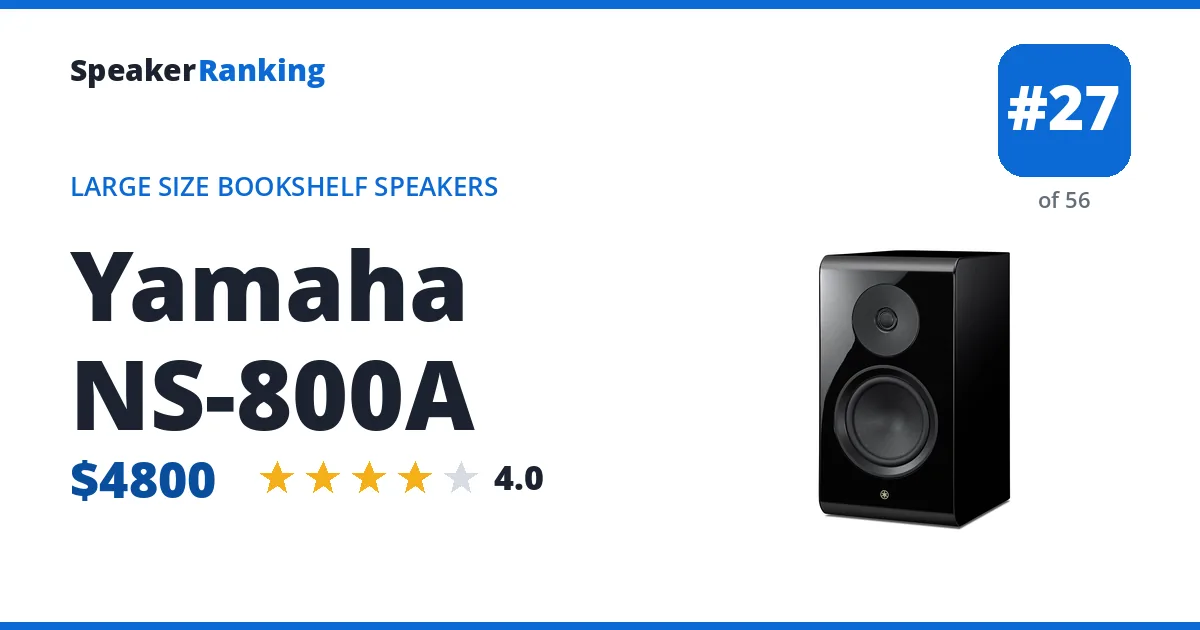
Pros: Exceptionally well-built cabinet with no internal resonance issues at all: confirmed clean in both burst decay and impedance measurements. Good, wide directivity (~75 degrees horizontal) that stays consistent enough to EQ successfully. Distortion is low, staying under 3% at 96dB, and dynamic range holds up well until right near its 102dB limit. A shallower, higher-frequency bass rolloff profile (F3 68Hz, F10 35Hz) means it can be placed closer to the wall (about a foot) without turning boomy, actually gaining bass presence rather than losing it. Measured bass extension of 68Hz (-3dB), with a measured sensitivity of 84.9dB.
Cons: A wide, roughly 2kHz-10kHz scoop in the upper-midrange/lower-treble gives it a laidback, soft, low-attack character: notably worse than the reviewer’s Audio First Fidelia reference in an A/B comparison. On top of that, treble breaks up badly above 10kHz, swinging up as much as 8dB: a significant, named flaw. Sounds inconsistently voiced as a result (bright on some material like cymbals and shakers, dull/laidback on vocals and instrument attack) until corrected with real parametric EQ (the reviewer needed a +2dB boost around 4.5kHz at Q0.5 plus taming the treble spike to bring it to life) combined with near-wall placement and 30-degree toe-out. Without that combination, it’s a tough sale for a $5000 bookshelf speaker.
Full Yamaha NS-800A review and specifications →
| Bass Extension (-10dB) | 35Hz (measured, Erin’s Audio Corner) |
|---|---|
| Bass Extension (-3dB) | 68Hz (measured, Erin’s Audio Corner) |
| Crossover Frequency | 2600Hz |
| DIY Kit | No |
| Dimensions | 16.5”H x 9.1”W x 14.1”D (419.1 x 231.8 x 358.8 mm) |
| Drivers | 1.25” dome tweeter, 6.5” mid-woofer |
| Impedance | 6 ohms nominal, 4.3 ohms minimum (measured above 80Hz, Erin’s Audio Corner) |
| Power Handling | 40W nominal, 120W max |
| Sensitivity | 84.9dB (measured average 300Hz-3kHz @ 2.83V/1m, Erin’s Audio Corner; 86.5dB manufacturer specified) |
| Spinorama Preference Score | 4.66 |
| Spinorama Preference Score with Perfect Sub | 6.43 |
| Weight | 28.7 lbs (13.0 kg) each |
| Woofer Cabinet | Bass reflex |
- Links
- Reviews, Comparisons and Sound Samples
- Head-to-Head Comparisons
- Yamaha NS-800A vs Definitive Technology Demand D11
- Yamaha NS-800A vs ELAC DBR62
- Yamaha NS-800A vs Technics SB-C700
- Yamaha NS-800A vs Dynaudio Contour 20i
- Yamaha NS-800A vs ELAC Uni-Fi Reference UBR62
- Yamaha NS-800A vs SVS Ultra Bookshelf
- Yamaha NS-800A vs Revel Concerta2 M16
- Yamaha NS-800A vs Infinity Reference R162
- See all 23 comparisons
 Ranked #65 of 141 in Large Size Bookshelf Speakers - JBL L100 Classic MKII: $5,599.90 per pair Crutchfield eBay
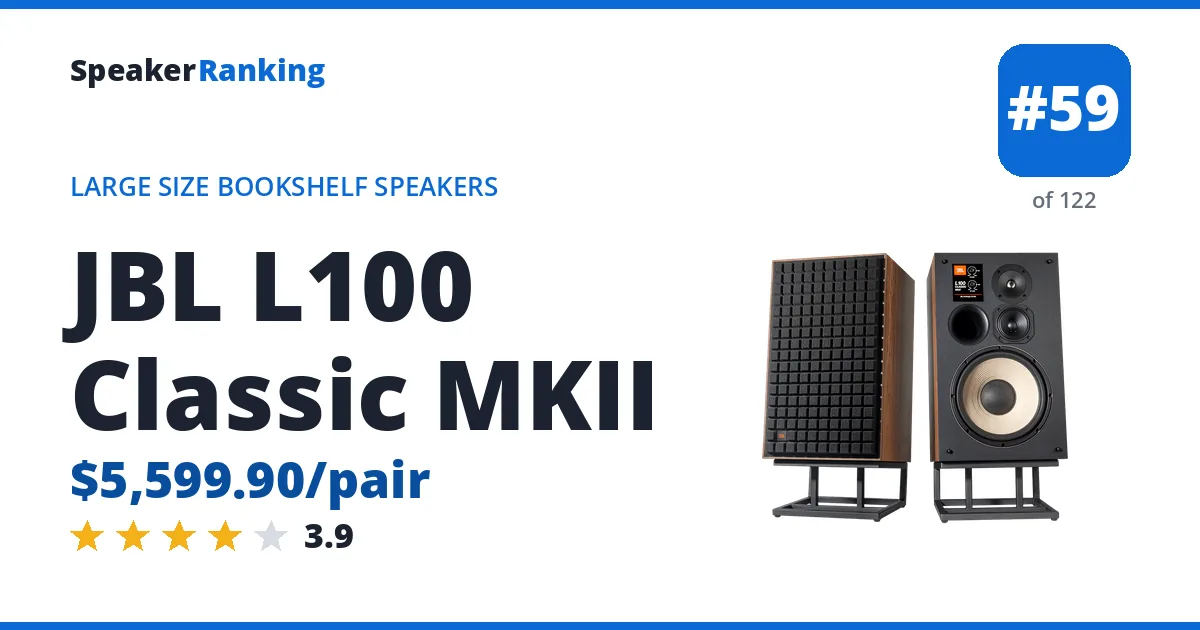
Pros: A high-output modern version of JBL’s iconic 1970s monitor, with a 12-inch woofer, dedicated midrange and adjustable mid/treble level controls. Erin’s measurements show excellent 0.152 on-axis smoothness, a tight 2.70 directivity-index deviation, and 41Hz estimated in-room extension. Measured bass extension of 50.5Hz (-3dB).
Cons: The response has a moderate -0.30dB-per-octave downward tilt and the bass alignment is somewhat resonant at Q 1.64. It is very large for a standmount, weighs nearly 59 lb each, and matching JS-120 stands cost extra.
Full JBL L100 Classic MKII review and specifications →
| Bass Extension (-3dB) | 50.5Hz (measured, Erin’s Audio Corner via spinorama.org) |
|---|---|
| Country | United States (design) |
| DIY Kit | No |
| Dimensions | 25.1H x 15.7W x 14.6D in |
| Drivers | 1” titanium-dome tweeter, 5.25” midrange, 12” pulp-cone woofer |
| Enclosure | 3-way, front-ported |
| Impedance | 4 ohms |
| Sensitivity | 90dB |
| Spinorama Preference Score | 4.64 |
| Spinorama Preference Score with Perfect Sub | 6.59 |
| Weight | 58.9 lbs (26.7 kg) each |
- Links
- Reviews, Comparisons and Sound Samples
- Head-to-Head Comparisons
 Ranked #66 of 141 in Large Size Bookshelf Speakers - Dynaudio Contour 20i: $5750 per pair Safe and Sound HQ eBay
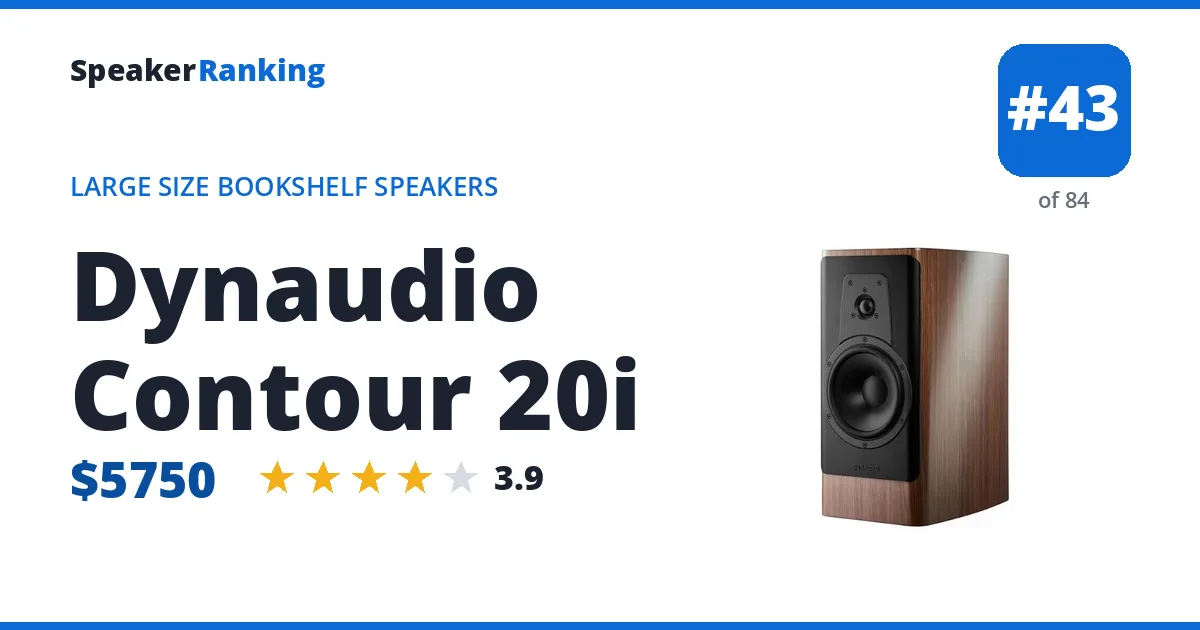
Pros: Two-way design with a 1.125” Esotar2i silk dome tweeter and a 7” magnesium silicate polymer woofer in a vented enclosure. A shallow bass rolloff profile lets it sit closer to a wall (about 1-2 feet worked best in testing) without becoming boomy, and makes subwoofer integration comparatively easy. Very wide horizontal radiation (about ±70° through the midrange) gives an enveloping, spacious sound in a suitably sized room. On-axis response holds within about ±3dB overall and ±1.5dB through the midrange. Attractive build quality with a distinctive metal front baffle and gloss finish options. Long-term compression stays good up to 96dB, and short-term compression is within about 0.5dB at that same level. Measured bass extension of 56Hz (-3dB).
Cons: Notably room-dependent: sounds too bright in the lower treble in smaller rooms with close sidewalls, needing sidewall absorption to sound neutral, while performing better in larger or more open rooms without that treatment. A roughly 2dB lift in the lower treble combined with wide dispersion means more energy reflecting off sidewalls than some listeners will prefer. Relatively low sensitivity (about 82.5dB measured). Unusually sensitive to amplifier output impedance: high-output-impedance amps like tube or SET designs introduce up to a 2dB dip in the midrange, making the sound more mellow rather than “warmer,” the opposite of what many tube-amp buyers expect. Elevated harmonic and multitone distortion around 700Hz, which the reviewer attributes to typical cone-edge/surround behavior common across many driver brands, though it stands out on the measurement graphs. An upper-midrange dip around 2kHz can reduce attack and clarity on vocals and brass instruments. Vertical listening window is fairly narrow (roughly -20° to +30°): moving outside that range causes a noticeable tonal shift, unlike coaxial designs that tolerate more vertical movement.
Full Dynaudio Contour 20i review and specifications →
| Bass Extension (-10dB) | 32Hz (measured, Erin’s Audio Corner) |
|---|---|
| Bass Extension (-3dB) | 56Hz (measured, Erin’s Audio Corner) |
| DIY Kit | No |
| Dimensions | 17.4”H x 8.5”W x 14.2”D (442 x 215.9 x 360.7 mm) |
| Drivers | 18 cm MSP woofer, 28mm Esotar 2i with Hexis tweeter |
| Impedance | 4 ohms |
| Sensitivity | 82.5dB |
| Weight | 30.9 lbs (14 kg) each |
| Woofer Cabinet | ported, rear |
- Links
- Reviews, Comparisons and Sound Samples
- Head-to-Head Comparisons
- Dynaudio Contour 20i vs SVS Ultra Bookshelf
- Dynaudio Contour 20i vs Technics SB-C700
- Dynaudio Contour 20i vs Definitive Technology Demand D11
- Dynaudio Contour 20i vs Yamaha NS-800A
- Dynaudio Contour 20i vs ELAC DBR62
- Dynaudio Contour 20i vs Infinity Reference R162
- Dynaudio Contour 20i vs Ascend CBM-170 SE2
- Dynaudio Contour 20i vs Polk Signature Elite ES20
- See all 58 comparisons
 Ranked #68 of 141 in Large Size Bookshelf Speakers - SVS Ultra Bookshelf: $1,200 per pair Discontinued eBay
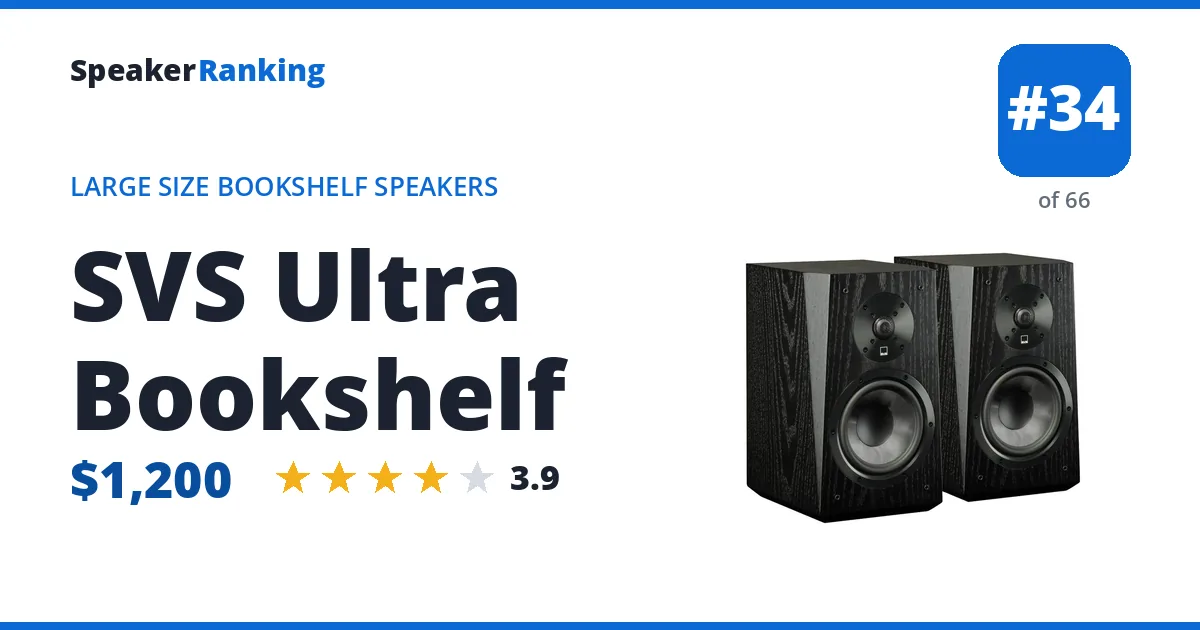
Newer model: the SVS Ultra Evolution Bookshelf, ranked higher, estimated 4/5.
Pros: Noticeably more tonally neutral than the cheaper SVS Prime Bookshelf, with response staying within about -3dB/+1.5dB on average: a genuine step up in linearity for roughly double the price. Slightly higher sensitivity than the Prime (about 87.8dB) with similarly wide, consistent horizontal radiation. Toeing the speakers out about 30 degrees smooths the in-room response nicely if the on-axis tonal balance runs a bit forward for your taste. Distortion and dynamics hold up well; this is a mature, well-regarded design (roughly a decade old at review time) that’s aged better than many contemporaries. Measured bass extension of 69Hz (-3dB), with a measured sensitivity of 87.8dB.
Cons: Still has a boosted upper mid-range/mid-range area, though less severe than the Prime: the reviewer suspects a baffle-step or tweeter-level issue rather than a resonance, giving mixes a slightly forward, occasionally tinny character. Bass extension is modest for the price (F3 69Hz, F10 48Hz measured): SVS is clearly counting on you pairing this with one of their subwoofers rather than expecting full-range performance from the bookshelf alone. Measured minimum impedance dips to about 3.8 ohms, so a 4-ohm-stable amplifier is recommended rather than a basic 8-ohm-only AVR. Radiation pattern is wide (around 80°), wider than the reviewer’s typical ~60° sweet spot preference, so acoustic treatment on nearby walls helps tame reflections and keep the off-axis response from diverging too much from on-axis. Discontinued; SVS replaced the Ultra line with the Ultra Evolution series.
Full SVS Ultra Bookshelf review and specifications →
| Bass Extension (-10dB) | 48Hz (measured, Erin’s Audio Corner) |
|---|---|
| Bass Extension (-3dB) | 69Hz (measured, Erin’s Audio Corner) |
| DIY Kit | No |
| Dimensions | 14.9”H x 8.5”W x 10”D |
| Drivers | 6.5” composite glass fiber cone woofer, 1” aluminum dome tweeter |
| Frequency Response | 45Hz - 32kHz (manufacturer specified) |
| Impedance | 8 ohms nominal, 3.8 ohms minimum (measured, Erin’s Audio Corner) |
| Recommended Power | 20-150W |
| Sensitivity | 87.8dB (measured average, Erin’s Audio Corner) |
| Spinorama Preference Score | 5.63 |
| Spinorama Preference Score with Perfect Sub | 8.10 |
| Weight | 19 lbs (8.6 kg) each |
- Links
- Reviews, Comparisons and Sound Samples
- Head-to-Head Comparisons
- SVS Ultra Bookshelf vs Dynaudio Contour 20i
- SVS Ultra Bookshelf vs Infinity Reference R162
- SVS Ultra Bookshelf vs Definitive Technology Demand D11
- SVS Ultra Bookshelf vs Yamaha NS-800A
- SVS Ultra Bookshelf vs ELAC DBR62
- SVS Ultra Bookshelf vs SVS Ultra Evolution Bookshelf
- SVS Ultra Bookshelf vs Klipsch RP-600M II
- SVS Ultra Bookshelf vs ELAC Uni-Fi Reference UBR62
- See all 12 comparisons
 Ranked #69 of 141 in Large Size Bookshelf Speakers - Monolith Encore B6: $360 per pair Amazon Monoprice eBay
Pros: For its budget price, the B6 delivers useful midbass punch and a long reflex tail: Erin measured F3 at 68Hz and F10 near 37Hz. The revised tweeter assembly yields broadly smooth horizontal directivity and an early-reflections trend that accepts EQ well. At sane levels, its 6.5-inch pulp woofer provides satisfying attack, and gloss top/bottom panels plus a braced MDF cabinet are unusually substantial for the class. Measured bass extension of 68Hz (-3dB), with a measured sensitivity of 85.3dB.
Cons: Erin measured 85.3dB sensitivity and a 3.4-ohm minimum, so this is not an easy load despite its modest output ceiling. Low-frequency compression reaches about 2dB and distortion rises rapidly when driven full-range; use an 80Hz subwoofer crossover. Response variation is roughly +2.7/-3.7dB, with residual crossover/treble irregularities that keep it from true neutrality without EQ. The listening window tightens vertically, so ear height matters.
Full Monolith Encore B6 review and specifications →
| Bass Extension (-10dB) | 37Hz (measured, Erin’s Audio Corner) |
|---|---|
| Bass Extension (-3dB) | 68Hz (measured, Erin’s Audio Corner) |
| DIY Kit | No |
| Dimensions | 15.7H x 7.9W x 9.9D inches |
| Drivers | 6.5-inch pulp woofer; 25mm waveguided silk dome |
| Impedance | 4 ohms nominal; 3.4 ohms minimum (measured, Erin’s Audio Corner) |
| Sensitivity | 85.3dB/2.83V/1m (measured, Erin’s Audio Corner) |
| Spinorama Preference Score | 4.67 |
| Spinorama Preference Score with Perfect Sub | 6.93 |
| Weight | 15.4 lbs (7.0 kg) each |
- Links
- Reviews, Comparisons and Sound Samples
- Head-to-Head Comparisons
- Monolith Encore B6 vs Klipsch RP-600M II
- Monolith Encore B6 vs StarkSound Beta 5
- Monolith Encore B6 vs Parts Express Samba MT
- Monolith Encore B6 vs ELAC Debut 3.0 DB63
- Monolith Encore B6 vs Emotiva Airmotiv XB2
- Monolith Encore B6 vs KEF R3
- Monolith Encore B6 vs KEF Q Concerto Meta
- Monolith Encore B6 vs KEF R3 Meta
 Ranked #70 of 141 in Large Size Bookshelf Speakers - Buchardt S400 MKII: $2400 per pair Discontinued Buchardt Audio eBay
Newer model: the Buchardt S400 MK3, ranked higher, estimated 4/5.
Pros: Two-way design with a 3/4” tweeter on a well-implemented aluminum waveguide (compression-driver style, letting the small tweeter cross unusually low at 1800Hz), a 6” SB Acoustics-style mid-woofer, and a tunable 5x8” passive radiator adjustable via rear weights. Exceptionally flat on-axis linearity, within about ±2dB from 80Hz to 16kHz. Wide horizontal radiation for a waveguided design (about ±45-50°), notably broader than a comparable narrow-waveguide rival like the Klipsch Sevens (~±30°). Well-focused, precise imaging, aided by tight pair matching between the two speakers. Takes very well to EQ correction, letting listeners easily dial in the top end or add midrange fullness to taste. Bass extension reaches a genuine 50Hz in-room from a mellow, well-tuned rolloff rather than an artificially boosted one. Measured bass extension of 59Hz (-3dB), with a measured sensitivity of 84.7dB.
Cons: Sounds a bit bright and slightly boosted above about 7-8kHz on-axis, even with 30° of toe-out: benefits from about 1 inch of sidewall absorption at the first reflection points to tame it. A mild dullness noted especially on male vocals, alongside a small dip around 300-600Hz. Vertical positioning is critical and unusually “temperamental”: sitting even slightly toward the tweeter line causes a suckout, while sitting above it adds too much energy; not well suited to multi-height home theater seating. Distortion is fine at 86dB but runs into real issues by 96dB: not a high-output speaker. Some compression-related enhancement appears around 1.2kHz (crossover-region interaction), and the tweeter shows clear compression at 102dB. The woofer can bottom out at extreme low-frequency content played very loud; crossing to a subwoofer below 60Hz caused output problems at high volume, while 80-100Hz worked well. A subwoofer isn’t strictly required to protect the speaker at moderate listening levels (80-85dB at 3 meters), but is still recommended for genuine low-octave extension. Discontinued.
Full Buchardt S400 MKII review and specifications →
| Bass Extension (-10dB) | 40Hz (measured, Erin’s Audio Corner) |
|---|---|
| Bass Extension (-3dB) | 59Hz (measured, Erin’s Audio Corner) |
| DIY Kit | No |
| Dimensions | 14.4”H x 7”W x 11”D (365.8 x 177.8 x 279.4 mm) |
| Drivers | 6.5” aluminum cone woofer, 1” soft dome tweeter |
| Impedance | 4 ohms nominal, 3 ohms minimum (measured, Erin’s Audio Corner) |
| Sensitivity | 84.7dB (measured, Erin’s Audio Corner; 87dB manufacturer specified) |
| Spinorama Preference Score | 5.38 |
| Spinorama Preference Score with Perfect Sub | 7.46 |
| Weight | 16.5 lbs (7.5 kg) each |
| Woofer Cabinet | ported |
- Links
- Reviews, Comparisons and Sound Samples
- Head-to-Head Comparisons
- Buchardt S400 MKII vs Klipsch RP-600M II
- Buchardt S400 MKII vs ELAC DBR62
- Buchardt S400 MKII vs Dynaudio Emit 20
- Buchardt S400 MKII vs Buchardt S400 MK3
- Buchardt S400 MKII vs Philharmonic BMR Monitor
- Buchardt S400 MKII vs Dynaudio Special Forty
- Buchardt S400 MKII vs ELAC Debut 3.0 DB63
- Buchardt S400 MKII vs KEF Q3 Meta
- See all 19 comparisons
 Ranked #74 of 141 in Large Size Bookshelf Speakers - MoFi SourcePoint 10 Master Edition: $3,799 per pair MoFi Electronics eBay
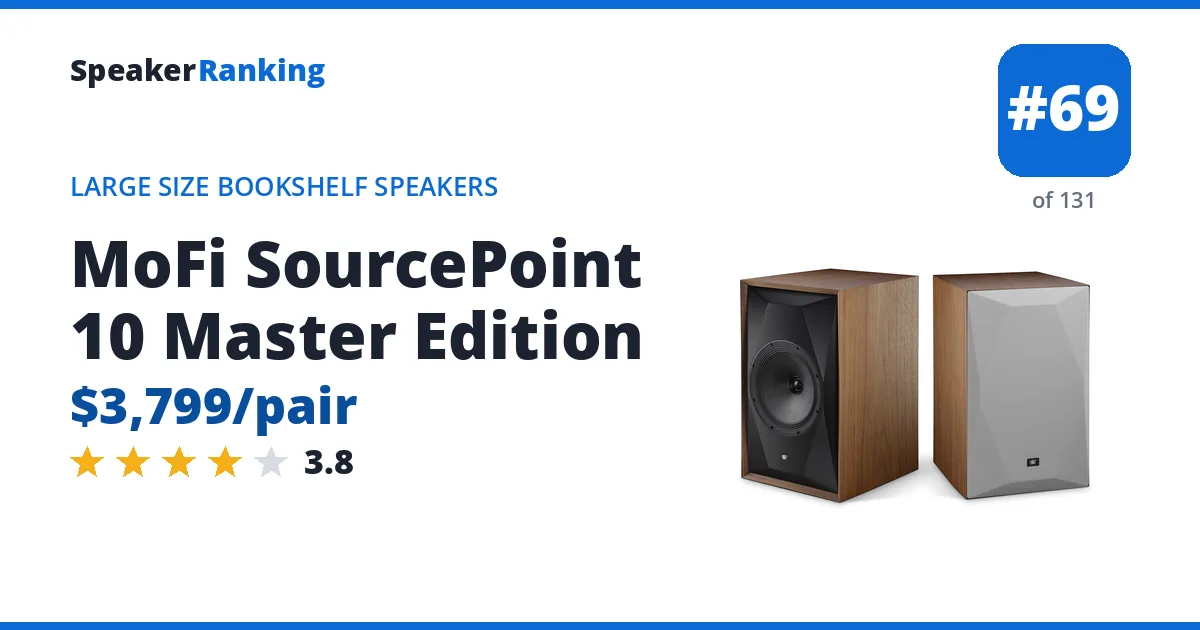
Pros: A high-sensitivity 10-inch concentric design with a refined crossover, adjustable treble and amplifier-friendly impedance. Local Spinorama scores of 4.76 raw and 6.77 with a subwoofer combine with 42Hz extension and broad controlled radiation. Measured bass extension of 56.4Hz (-3dB).
Cons: The cabinets are unusually large and heavy for stand-mount speakers, and suitable stands add expense and floor space. A mild response contour remains despite the premium Master Edition crossover.
Full MoFi SourcePoint 10 Master Edition review and specifications →
| Bass Extension (-10dB) | 41.0Hz (derived from Erin’s Audio Corner on-axis curve, spinorama.org) |
|---|---|
| Bass Extension (-3dB) | 56.4Hz (measured, Erin’s Audio Corner via spinorama.org) |
| DIY Kit | No |
| Dimensions | 22.5H x 14.5W x 16.6D in |
| Drivers | 1.25-inch soft-dome tweeter concentric in 10-inch paper woofer |
| Enclosure | 2-way vented |
| Frequency Response | 42Hz-30kHz |
| Impedance | 8 ohms nominal, 6.2 ohms minimum |
| Sensitivity | 91dB |
| Spinorama Preference Score | 4.76 |
| Spinorama Preference Score with Perfect Sub | 6.77 |
| Weight | 46.3 lbs (21 kg) each |
- Links
- Reviews, Comparisons and Sound Samples
- Head-to-Head Comparisons
 Ranked #77 of 141 in Large Size Bookshelf Speakers - PS Audio Aspen FR5: $3,499 per pair PS Audio eBay
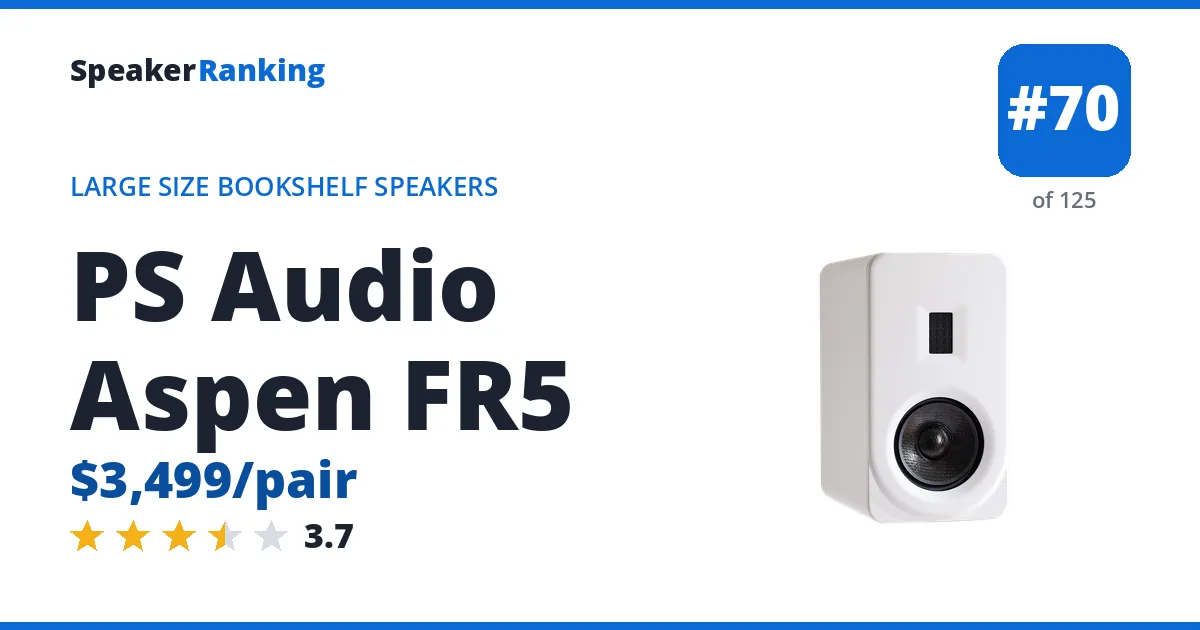
Pros: Deep-reaching compact design combining a 6.5-inch woofer, rear passive radiator and planar-magnetic tweeter. Erin’s data estimates 34Hz extension, a near-neutral +0.10dB/octave slope and a 6.26 preference score with a subwoofer. Measured bass extension of 56.4Hz (-3dB), with a measured sensitivity of 83.5dB.
Cons: Very low measured sensitivity near 81.6dB means it needs capable amplification despite its benign 5.6-ohm minimum. On-axis smoothness (0.217), directivity consistency (3.46) and predicted in-room smoothness (0.229) are respectable rather than exceptional at this price.
Full PS Audio Aspen FR5 review and specifications →
| Bass Extension (-3dB) | 56.4Hz (measured, Erin’s Audio Corner via spinorama.org) |
|---|---|
| DIY Kit | No |
| Dimensions | 14.5H x 8W x 13D in |
| Drivers | 2.5” planar tweeter, 6.5” woofer |
| Enclosure | 2-way passive with rear passive radiator |
| Impedance | 6 ohms nominal, 5.6 ohms minimum |
| Sensitivity | 83.5dB specified; 81.6dB measured |
| Spinorama Preference Score | 4.64 |
| Spinorama Preference Score with Perfect Sub | 6.26 |
| Weight | 26.7 lbs (12.1 kg) each |
- Links
- Reviews, Comparisons and Sound Samples
- Head-to-Head Comparisons
Ranked #79 of 141 in Large Size Bookshelf Speakers - Klipsch RP-600M II: $449.99 per pair Amazon eBay
Older model: the Klipsch RP-600M (ranked lower, rated 2.9/5).
Smaller model: the Klipsch RP-500M II (rated 4/5).
Larger models: the Klipsch RP-5000F II (rated 4/5), the Klipsch RP-6000F II (rated 3.9/5) and the Klipsch RP-8000F II (rated 3.9/5).
Pros: Redesigned waveguide extends flush to the baffle edge, reducing diffraction compared to the original RP-600M. Roughly 10-20° wider horizontal radiation than the original, giving more soundstage envelopment while retaining precise imaging. A major step up in overall tonal neutrality compared to the original RP-600M, largely eliminating that model’s midrange resonance issues. Unusually, sounds better with the grille on: the grille smooths out the elevated treble rather than degrading the sound, a rare trait among speakers the reviewer has tested. More refined back-panel hardware, including anodized binding posts and jumper cables for optional bi-amping. Responds well to EQ correction (verified using measurement software and a miniDSP), letting the on-axis response be made genuinely linear. Measured bass extension of 70Hz (-3dB), with a measured sensitivity of 86dB.
Cons: On-axis, the treble runs notably hot (even hotter than the original RP-600M in some respects) and needs about 20° of toe-out or the grille installed to sound balanced. Horizontal dispersion is very slightly less linear across angles than the original RP-600M, a minor trade-off for the wider overall radiation pattern. Klipsch’s marketed sensitivity (about 94.5dB) is, like the original, a half-space rating roughly 9dB above the anechoic reality (closer to 85-86dB). In-room bass rolls off around 60Hz in practice, and a 120Hz boost paired with a midrange scoop gives kick drums their “tambour” without real low-end weight: a subwoofer is still recommended. Vertical listening tolerance is limited to about ±10° from the tweeter axis. Toeing the speaker out for better on-axis tonality (rather than using the grille) introduces slightly more diffuse imaging from added sidewall reflections.
Full Klipsch RP-600M II review and specifications →
| Bass Extension (-10dB) | 41Hz (measured, Erin’s Audio Corner) |
|---|---|
| Bass Extension (-3dB) | 70Hz (measured, Erin’s Audio Corner) |
| DIY Kit | No |
| Dimensions | 15.7”H x 8”W x 12.5”D (398.8 x 203.2 x 317.5 mm) |
| Drivers | 6.5” Cerametallic cone woofer, 1” titanium LTS vented tweeter with Tractrix horn |
| Impedance | 8 ohms nominal (3.5 ohms minimum above 80Hz, measured by Erin’s Audio Corner) |
| Sensitivity | 86dB (measured, Erin’s Audio Corner) |
| Spinorama Preference Score | 5.64 |
| Spinorama Preference Score with Perfect Sub | 7.77 |
| Weight | 13 lbs (5.9 kg) each |
| Woofer Cabinet | ported |
- Links
- Reviews, Comparisons and Sound Samples
- Erin’s Audio Corner: The Truth about Klipsch’s “NEW” Sound. RP-600M Update. More from Erin’s Audio Corner →
- Erin’s Audio Corner Website Klipsch RP-600M II
- GR-Research: We Bought The "NEW" RP-600M II Is KLIPSCH Listening?! More from GR-Research →
- Erin’s Audio Corner: 5 AWESOME SPEAKERS Under $1000 You Won’t Regret
- Erin’s Audio Corner Measurements (spinorama.org)
- Erin’s Audio Corner: KEF Q1 Meta vs Emotiva vs Klipsch | The Real Differences
- Head-to-Head Comparisons
- Klipsch RP-600M II vs Aoshida Audio Musician Knight I V2
- Klipsch RP-600M II vs JBL 708i
- Klipsch RP-600M II vs Dynaudio Emit 20
- Klipsch RP-600M II vs PS Audio Aspen FR5
- Klipsch RP-600M II vs Philharmonic BMR Monitor
- Klipsch RP-600M II vs Theory Audio sb25
- Klipsch RP-600M II vs JBL Studio 630
- Klipsch RP-600M II vs Polk Signature Elite ES20
- See all 118 comparisons
Ranked #81 of 141 in Large Size Bookshelf Speakers - Dynaudio Emit 20: $1,049.00 per pair Amazon eBay
Pros: Two-way design with a 28mm Esotar soft dome tweeter (Hexis-damped) and an 18cm mid-woofer, using a first-order crossover on the tweeter and second-order on the woofer. Exceptional bass extension for a bookshelf speaker: reaches a clean, authoritative 40Hz in-room, rare enough that the reviewer says most listeners could skip a subwoofer for typical music. Very low distortion across the board, staying below 1% THD down to 40Hz at 86dB and below 3% even at 96dB: unusually clean bass performance where most two-way bookshelf speakers start rising in distortion around 80Hz. Wide, remarkably consistent horizontal directivity (about ±50-60°) that holds steady up to roughly 13kHz: rare for a speaker in this format, thanks to a beveled tweeter edge that acts as a mild waveguide. Excellent compression and dynamic-range linearity at the frequency extremes, actually showing slight bass enhancement rather than the sharp low-end compression common in similarly-sized bookshelf speakers. Measured bass extension of 54Hz (-3dB), with a measured sensitivity of 83.5dB.
Cons: A resonance around 600-800Hz gives snares and similar percussion a muffled, flat quality lacking impact: confirmed as originating in the woofer itself (isolated via measurements of the raw driver out of the cabinet), and attempts at constrained-layer damping didn’t resolve it. A peak around 4kHz adds a sharp, edgy quality to some male vocals. A roughly 5dB boost above 10kHz gives cymbals and hi-hats excess shimmer that can sound unnatural, especially pointed directly on-axis. Vertical dispersion shows two separate crossover-related notches (above and below the tweeter reference line around 5kHz) rather than the usual single one, a direct consequence of the shallow crossover slopes used on both drivers. Multitone distortion is elevated in the midrange, possibly due to the woofer’s magnet structure lacking a shorting ring. Best aimed slightly off-axis (about 10-15° of toe-out) to tame the excess high-frequency shimmer, rather than pointed straight at the listener.
Full Dynaudio Emit 20 review and specifications →
| Bass Extension (-10dB) | 33Hz (measured, Erin’s Audio Corner) |
|---|---|
| Bass Extension (-3dB) | 54Hz (measured, Erin’s Audio Corner) |
| DIY Kit | No |
| Dimensions | 14.6”H x 8.1”W x 12.3”D (370.0 x 205.0 x 312.0 mm) |
| Drivers | 7.1” Magnesium Silicate Polymer woofer, 1.1” Cerotar soft dome with Hexis tweeter |
| Impedance | 6 ohms nominal (5.5 ohms minimum above 80Hz, measured, Erin’s Audio Corner) |
| Sensitivity | 83.5dB (measured, Erin’s Audio Corner; 86dB manufacturer specified) |
| Spinorama Preference Score | 4.22 |
| Spinorama Preference Score with Perfect Sub | 5.92 |
| Weight | 12.8 lbs (5.8 kg) |
| Woofer Cabinet | ported, rear |
- Links
- Reviews, Comparisons and Sound Samples
- Head-to-Head Comparisons
- Dynaudio Emit 20 vs Philharmonic BMR Monitor
- Dynaudio Emit 20 vs Klipsch RP-600M II
- Dynaudio Emit 20 vs JBL Studio 630
- Dynaudio Emit 20 vs Behringer B2030P
- Dynaudio Emit 20 vs Mission LX-3 MKII
- Dynaudio Emit 20 vs Polk Signature Elite ES20
- Dynaudio Emit 20 vs Ascend CBM-170 SE2
- Dynaudio Emit 20 vs Infinity Reference R162
- See all 68 comparisons
Ranked #82 of 141 in Large Size Bookshelf Speakers - Philharmonic BMR Monitor: $2200 per pair Philharmonic Audio eBay
Older model: the Philharmonic BMR (v1) (ranked higher, rated 4.3/5).
Pros: Three-way design combining a 6” SB Acoustics mid-woofer, a 2.5” Tectonic balanced-mode radiator (BMR) for the midrange, and a ribbon tweeter: premium component choices relative to the asking price. A clear improvement over the V1: the earlier version’s overly hot, plateauing treble has been resolved, leaving a genuinely good in-room response outside of one specific area. Extremely wide horizontal radiation of about ±70-80°, creating an enveloping, wide soundstage that illuminates the sidewalls. Well-built, attractive cabinet. Midrange and tweeter show no stress or elevated distortion even at higher output: all the compression and distortion issues trace back to the mid-woofer alone. Measured bass extension of 47Hz (-3dB), with a measured sensitivity of 84dB.
Cons: A 1-2dB bump around 2-3kHz creates a “glare” on vocals, guitars, and strings that the reviewer noticed consistently across many tracks. The extremely wide radiation trades off against imaging precision: instrument placement became noticeably more diffuse and harder to pinpoint in a narrower, more reflective room, though it improved substantially in a larger, more open room with less sidewall interaction. A suspected resonance around 500Hz shows up as an imbalance in sound power and horizontal directivity measurements, loosely correlating with a vague sense of resonance the reviewer heard subjectively. Moderate sensitivity (about 84.1dB anechoic) and a mid-woofer that runs out of steam under real stress: distortion exceeds 3% even at 100Hz at 96dB, and the reviewer notes SB Acoustics’ published excursion specs tend to overstate real-world linear excursion by nearly 2x. Significant compression appears at 102dB: the woofer audibly unloads around 120Hz, and the ribbon tweeter also compresses heavily at high output. Not well suited to very loud two-channel listening (above about 90dB at 4 meters). In-room bass rolls off around 50Hz, so a subwoofer is recommended for most music. Benefits noticeably from a few bands of EQ if available.
Full Philharmonic BMR Monitor review and specifications →
| Bass Extension (-10dB) | 32Hz (measured, Erin’s Audio Corner) |
|---|---|
| Bass Extension (-3dB) | 47Hz (measured, Erin’s Audio Corner) |
| DIY Kit | No |
| Dimensions | 20”H x 8”W x 12.5”D (508 x 203.2 x 317.5 mm) |
| Drivers | 6” Ceramic woofer, Balanced Mode Radiator 2.5” midrange, RAAL 64-10X OEM tweeter |
| Impedance | 4 ohms nominal (3 ohms minimum above 80Hz, measured by Erin’s Audio Corner) |
| Sensitivity | 84dB (measured, Erin’s Audio Corner) |
| Spinorama Preference Score | 6.02 (spinorama.org) |
| Spinorama Preference Score with Perfect Sub | 7.67 (spinorama.org) |
| Weight | 32 lbs (14.5 kg) each |
| Woofer Cabinet | ported, rear |
- Links
- Reviews, Comparisons and Sound Samples
- Head-to-Head Comparisons
- Philharmonic BMR Monitor vs Dynaudio Emit 20
- Philharmonic BMR Monitor vs Klipsch RP-600M II
- Philharmonic BMR Monitor vs Mission LX-3 MKII
- Philharmonic BMR Monitor vs Polk Signature Elite ES20
- Philharmonic BMR Monitor vs GR-Research X-LS Encore
- Philharmonic BMR Monitor vs Ascend CBM-170 SE2
- Philharmonic BMR Monitor vs Dynaudio Special Forty
- Philharmonic BMR Monitor vs Buchardt S400 MKII
- See all 48 comparisons
 Ranked #83 of 141 in Large Size Bookshelf Speakers - JBL Studio 630: $699 per pair Discontinued eBay
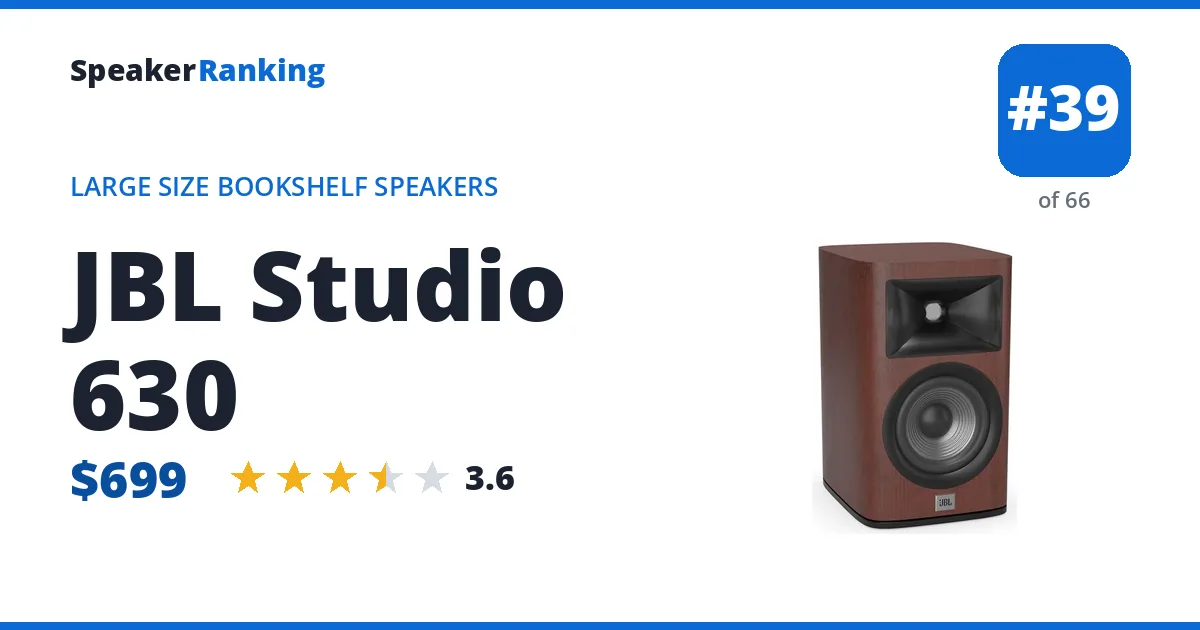
Pros: Excellent directivity linearity: harmonics of the same instrument stay collocated in the soundstage instead of drifting between positions, giving precise, stable imaging that holds up well into higher frequencies where many speakers start to beam and narrow. Good compression behavior: mid-bass stays taut and controlled from low to high volume without the sound falling apart or distorting as you turn it up. A pleasant, controlled mid-bass bump in the 60-100 Hz range adds punch to kick drums without bleeding into an uncontrolled boom on bass guitar. Horizontal radiation holds steady off-axis (about ±60°), so toe-in isn’t fussy. Compared directly to its predecessor, the JBL Studio 530, the reviewer would pick the 630 (smoother trend line through the upper mids and treble, and likely more dynamic headroom) as long as you’re willing to EQ. Measured bass extension of 54.2Hz (-3dB), with a measured sensitivity of 83.2dB.
Cons: Noticeable mid-range dip/scoop relative to the higher frequencies: not dramatic, but audibly “missing” something by the second or third track. Some tracks read as forward or aggressive around 2 kHz, like the upper frequencies are jumping out at you rather than sitting in stage depth. Needs EQ to bring the mid-range back up to be fully recommendable; without EQ available, the reviewer says he’d look at a different speaker entirely. Measured sensitivity (about 83.2dB) runs noticeably below the 85dB manufacturer spec, likely a byproduct of the mid-range dip skewing the average downward. Discontinued and no longer sold new.
Full JBL Studio 630 review and specifications →
| Bass Extension (-10dB) | 37.0Hz (measured, Erin’s Audio Corner) |
|---|---|
| Bass Extension (-3dB) | 54.2Hz (measured, Erin’s Audio Corner) |
| DIY Kit | No |
| Dimensions | 14-13/16”H x 9”W x 11-5/16”D |
| Drivers | 6.5” PolyPlas cone woofer, 1” compression driver (2414H-1) with waveguide |
| Frequency Response | 45Hz - 40,000Hz (manufacturer specified) |
| Impedance | 6 ohms nominal, 4.7 ohms minimum (measured, Erin’s Audio Corner) |
| Power Handling | up to 150W |
| Sensitivity | 83.2dB (measured, Erin’s Audio Corner; 85dB manufacturer specified) |
| Spinorama Preference Score | 3.67 |
| Spinorama Preference Score with Perfect Sub | 5.68 |
| Weight | 19.8 lbs (9 kg) each |
- Links
- Reviews, Comparisons and Sound Samples
- Head-to-Head Comparisons
- JBL Studio 630 vs Behringer B2030P
- JBL Studio 630 vs Dynaudio Emit 20
- JBL Studio 630 vs Klipsch RP-600M II
- JBL Studio 630 vs Infinity IL10
- JBL Studio 630 vs Dynaudio Special Forty
- JBL Studio 630 vs ELAC Debut 2.0 B6.2
- JBL Studio 630 vs Infinity Reference R162
- JBL Studio 630 vs SVS Prime Bookshelf
- See all 36 comparisons
 Ranked #87 of 141 in Large Size Bookshelf Speakers - MartinLogan Motion XT B100: $1,699.98 per pair MartinLogan Dealer Network eBay
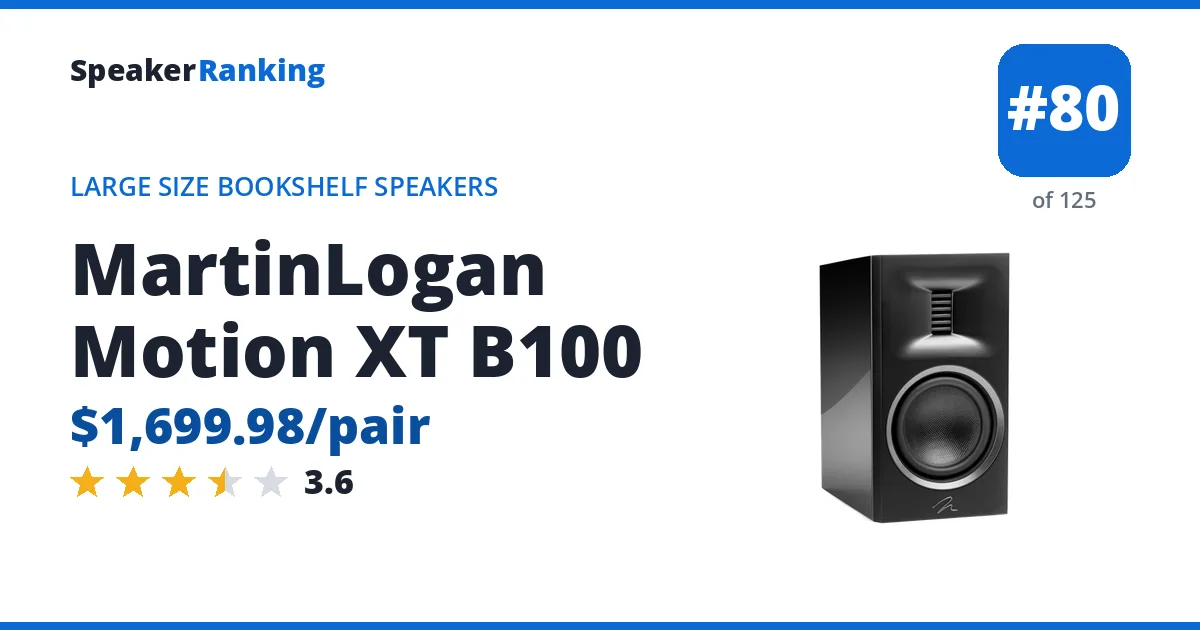
Pros: A premium 6.5-inch standmount with MartinLogan’s large folded-motion tweeter and high rated sensitivity. Erin’s data predicts 55Hz in-room extension, a 6.35 subwoofer-assisted preference score and good 0.153 sound-power smoothness. Measured bass extension of 71.8Hz (-3dB).
Cons: The measured response rises strongly at +0.84dB per octave and directivity-index consistency is a poor 4.34, so tonal balance and off-axis behavior are less neutral than the price implies. The cabinet is large, heavy and $850 per pair before stands.
Full MartinLogan Motion XT B100 review and specifications →
| Bass Extension (-10dB) | 50.7Hz (derived, log-interpolated between spinorama.org -9dB/-12dB points) |
|---|---|
| Bass Extension (-3dB) | 71.8Hz (measured, Erin’s Audio Corner via spinorama.org) |
| Country | United States (design) |
| DIY Kit | No |
| Dimensions | 14.5H x 8W x 12.5D in |
| Drivers | 1.25 x 2.4” folded-motion XT tweeter, 6.5” Kevlar woofer |
| Enclosure | 2-way, rear-ported |
| Impedance | 4 ohms |
| Sensitivity | 93dB |
| Spinorama Preference Score | 3.83 |
| Spinorama Preference Score with Perfect Sub | 6.35 |
| Weight | 20.5 lbs (9.3 kg) each |
- Links
- Reviews, Comparisons and Sound Samples
- Head-to-Head Comparisons
 Ranked #89 of 141 in Large Size Bookshelf Speakers - Parts Express Samba MT: $329.96 per pair Parts Express eBay
Pros: A Dayton Audio designed two-way kit built around the RS180P-4 7-inch Reference paper woofer and the RST28F-4 fabric-dome tweeter, with CNC-cut MDF knock-down panels, the crossover parts and damping included. Erin’s Audio Corner measured deep bass for a bookshelf, about 45Hz at -3dB and 34Hz at -10dB, a smooth predicted in-room response (0.69 smoothness) and wide horizontal dispersion averaging 60 degrees, for a preference score of 4.46. Measured bass extension of 45.4Hz (-3dB).
Cons: The listening window spans 6.0dB between 300Hz and 5kHz in Erin’s Audio Corner’s measurements, less even than the best speakers here, and the preference score only reaches 6.27 with an ideal subwoofer. It is a kit: you assemble the cabinet, solder the crossover and finish the raw MDF yourself, and each kit builds a single speaker.
Full Parts Express Samba MT review and specifications →
| Bass Extension (-10dB) | 33.7Hz (measured, Erin’s Audio Corner) |
|---|---|
| Bass Extension (-3dB) | 45.4Hz (measured, Erin’s Audio Corner) |
| DIY Kit | Yes |
| Dimensions | 15”H x 8.5”W x 11.7”D (381 x 216 x 298 mm) |
| Drivers | Dayton Audio RS180P-4 7” paper woofer, RST28F-4 1-1/8” fabric dome tweeter |
| Frequency Response | 40Hz-20kHz (manufacturer specified) |
| Impedance | 4 ohms nominal (manufacturer specified) |
| Power Handling | 70W RMS, 140W max (manufacturer specified) |
| Sensitivity | 87dB 1W/1m (manufacturer specified) |
| Spinorama Preference Score | 4.46 |
| Spinorama Preference Score with Perfect Sub | 6.27 |
| Woofer Cabinet | ported |
- Links
- Reviews, Comparisons and Sound Samples
- Head-to-Head Comparisons
 Ranked #93 of 141 in Large Size Bookshelf Speakers - Dynaudio Special Forty: $3600 per pair Safe and Sound HQ eBay
Pros: Smooth, “buttery” overall tonal character consistent with Dynaudio’s house sound. Surprisingly precise, focused imaging despite wide horizontal radiation (about ±70°): atypical, since wide-radiating speakers usually sacrifice some image precision in reflective rooms. Strong output capability: reached 100-101dB average at 3.5 meters with no audible distortion or woofer distress, and compression testing at 102dB shows the cabinet holding up mechanically well at extreme output. Bass reaches a genuine 50Hz (potentially 40Hz) in most rooms from a rear-ported design. Distortion stays below 1% at 86dB and doesn’t cross 3% THD until about 50Hz even at 96dB. Extra weight and impact on snares and percussion around 700-800Hz that the reviewer found appealing on many tracks. Measured bass extension of 54Hz (-3dB), with a measured sensitivity of 83.5dB.
Cons: A glaring, sometimes sibilant quality around 3-4kHz was the most noticeable issue in listening, the one thing the reviewer would want notched out with EQ. Multiple enclosure resonances appear between 500Hz-1kHz across on-axis, listening window, early-reflections, and sound-power measurements, corroborated by independent third-party CSD data showing similar 500-800Hz cabinet resonances. A dip around 1.2kHz traces to a cone-edge-to-surround compliance mismatch in the driver itself (confirmed by testing the bare driver’s impedance): a known artifact common to many similarly-sized drivers across several manufacturers, contributing to elevated second-order distortion in that region. A somewhat laid-back, recessed 1-2kHz character (sometimes described as a “BBC dip”) gives an overall subdued quality that isn’t overtly problematic but shapes the tonal balance. Impedance drops below 3 ohms in the 100-200Hz region, requiring a genuinely 4-ohm-stable amplifier rather than an AVR. Rear port means it can’t be placed directly against a wall.
Full Dynaudio Special Forty review and specifications →
| Bass Extension (-10dB) | 39Hz (measured, Erin’s Audio Corner) |
|---|---|
| Bass Extension (-3dB) | 54Hz (measured, Erin’s Audio Corner) |
| DIY Kit | No |
| Dimensions | 14.1”H x 7.7”W x 12.1”D (358.1 x 195.6 x 307.3 mm) |
| Drivers | 5.9” MSP (Magnesium Silicate Polymer) cone woofer, 1” Esotar soft dome tweeter |
| Impedance | 6 ohms nominal (4.9 ohms minimum above 80Hz, measured, Erin’s Audio Corner) |
| Sensitivity | 83.5dB (measured, Erin’s Audio Corner; 86dB manufacturer specified) |
| Spinorama Preference Score | 4.73 |
| Spinorama Preference Score with Perfect Sub | 6.74 |
| Weight | 17.9 lbs (8.1 kg) each |
| Woofer Cabinet | ported |
- Links
- Reviews, Comparisons and Sound Samples
- Head-to-Head Comparisons
- Dynaudio Special Forty vs ELAC Debut 2.0 B6.2
- Dynaudio Special Forty vs Infinity IL10
- Dynaudio Special Forty vs SVS Prime Bookshelf
- Dynaudio Special Forty vs GR-Research X-LS Encore
- Dynaudio Special Forty vs KEF Q3 Meta
- Dynaudio Special Forty vs Polk Monitor XT20
- Dynaudio Special Forty vs Sonus Faber Lumina II
- Dynaudio Special Forty vs XTZ Spirit 4
- See all 56 comparisons
 Ranked #94 of 141 in Large Size Bookshelf Speakers - ELAC Debut 2.0 B6.2: $479.00 per pair Amazon Crutchfield eBay
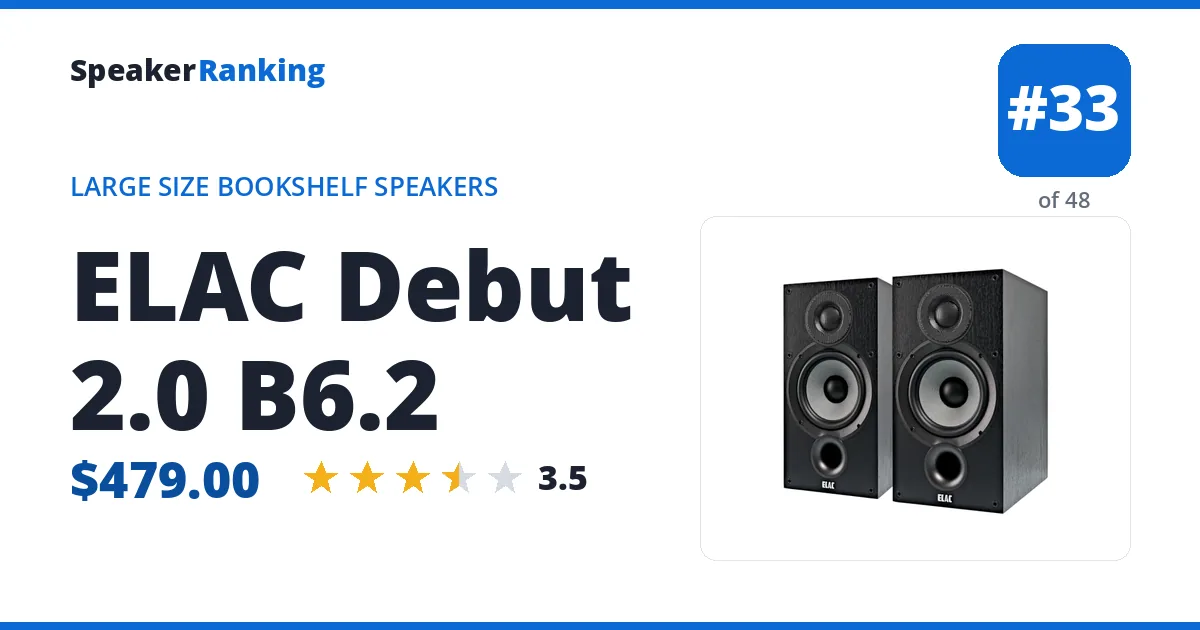
Smaller model: the ELAC Debut 2.0 B5.2 (rated 3.2/5).
Pros: Reasonably flat on-axis and listening-window response with reasonably even horizontal directivity, holding about ±60° up to roughly 8kHz for consistent stereo width whether aimed directly at the listener or toed out. Its larger-than-typical woofer lets it play very loud with minimal distortion, staying under about 1% THD down to 50Hz at 86dB, and minimum impedance stays a comfortable 5-6 ohms. In-room bass extension reaches about 50Hz without much trouble, enough for a solid kick-drum sound. Takes equalization very well: correcting the on-axis response doesn’t cost sensitivity through the midrange, and the underlying directivity behavior (diffraction, vertical mismatch) is mild enough that EQ alone gets most of the way to a well-balanced sound. Vertical tolerance is asymmetric and fairly forgiving: about 10° above the tweeter axis and 20° below it before tonal balance meaningfully shifts. One reviewer called it “a good speaker” with “a good price” rather than just good-for-the-price, and found it fairly neutral overall in-room. Measured bass extension of 64Hz (-3dB), with a measured sensitivity of 86.5dB.
Cons: A good size resonant peak around 700Hz stands out from an otherwise smooth response and lingers in cumulative spectral decay (waterfall) measurements: in one reviewer’s sighted A/B test, reducing it by about 5dB via EQ made a noticeable but not dramatic difference. Directivity error shows up around 3.3kHz, and the upper-midrange around 4-6kHz stood out as edgy and sharp, almost sibilant at times, in casual listening: the predicted in-room response shows a lack of energy between 1-2kHz and a bit too much above that, which one reviewer thought would sound bright. Distortion at 96dB SPL/1m shows two harmonic peaks the reviewer says “should not be there,” one from woofer breakup around 400Hz and another around 7-8kHz from the tweeter, and multitone distortion approaches 10% in the 500-800Hz range at that output level. Real compression shows up even at moderate volume and worsens at 96dB and above, with the woofer clearly giving up around 60-70Hz: a subwoofer is recommended for anyone wanting to listen loud, since running it full-range at high output costs real dynamic range in the midbass and bass. Don’t place it close to a wall: boundary reinforcement adds a midbass bump that undoes the otherwise smooth, linear response. Getting the best out of it takes EQ (taming the 700Hz peak, filling in the 1-2kHz dip, and trimming the highs).
Full ELAC Debut 2.0 B6.2 review and specifications →
| Bass Extension (-10dB) | 40Hz (measured, Erin’s Audio Corner) |
|---|---|
| Bass Extension (-3dB) | 64Hz (measured, Erin’s Audio Corner) |
| DIY Kit | No |
| Dimensions | 14.8”H x 7.7”W x 10.6”D (375.0 x 195.0 x 268.0 mm) |
| Drivers | 25mm tweeter + 165mm woofer |
| Impedance | 6 ohms nominal, 5.2 ohms minimum (measured, Erin’s Audio Corner) |
| Sensitivity | 86.5dB (measured, Audio Science Review) |
| Spinorama Preference Score | 4.75 (spinorama.org) |
| Spinorama Preference Score with Perfect Sub | 7.0 (spinorama.org) |
| Weight | 29.1 lbs (13.2 kg) |
| Woofer Cabinet | ported, front |
- Links
- Reviews, Comparisons and Sound Samples
- Head-to-Head Comparisons
- ELAC Debut 2.0 B6.2 vs SVS Prime Bookshelf
- ELAC Debut 2.0 B6.2 vs Dynaudio Special Forty
- ELAC Debut 2.0 B6.2 vs Infinity IL10
- ELAC Debut 2.0 B6.2 vs GR-Research X-LS Encore
- ELAC Debut 2.0 B6.2 vs KEF Q3 Meta
- ELAC Debut 2.0 B6.2 vs Polk Monitor XT20
- ELAC Debut 2.0 B6.2 vs Sonus Faber Lumina II
- ELAC Debut 2.0 B6.2 vs Parts Express Samba MT
- See all 64 comparisons
 Ranked #95 of 141 in Large Size Bookshelf Speakers - SVS Prime Bookshelf: $699.00 per pair Amazon eBay
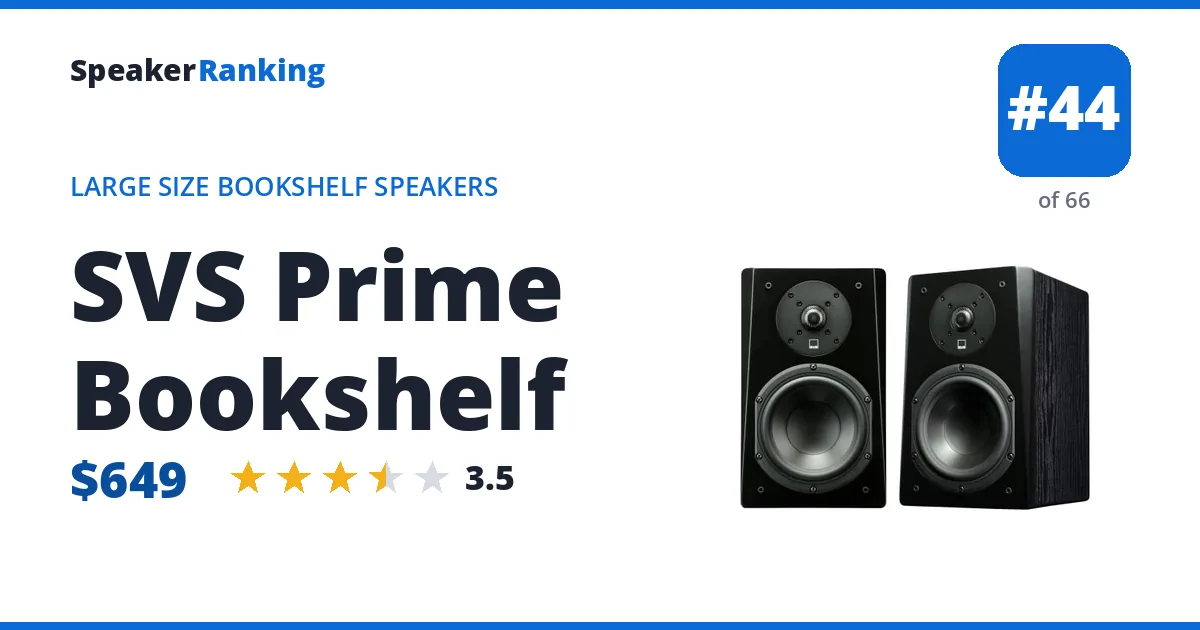
Smaller model: the SVS Prime Satellite (estimated 3.3/5).
Larger models: the SVS Prime Tower (estimated 3.6/5) and the SVS Prime Pinnacle (estimated 3.8/5).
Pros: Reasonable sensitivity for the price at about 87dB, and the 6.5” woofer sits in its own dedicated sealed sub-compartment inside the cabinet for cleaner midrange/bass separation. Overall response stays within about ±3dB from 80Hz-16kHz, which the reviewer calls reasonable for the price point. Wide, consistent horizontal radiation. Toeing the speakers 30 degrees off-axis smooths the in-room response noticeably if the on-axis tonal balance isn’t to your taste. Measured bass extension of 72Hz (-3dB), with a measured sensitivity of 87dB.
Cons: A scooped mid-range paired with a boosted upper mid-range creates an audibly uneven tonal balance, and there’s an additional dip in the treble around 4-5kHz that reads as slightly tinny relative to the recessed mid-range. Measured minimum impedance dips below 4 ohms (EPDR even lower), so an 8-ohm-only amplifier or AVR may struggle: a 4-ohm-stable amp or separate amplification is recommended. Bass extension is modest (F3 72Hz, F10 49Hz measured): SVS clearly designed this to be paired with one of their subwoofers rather than to stand fully alone. Compared directly against its pricier sibling, the SVS Ultra Bookshelf, in the same review, the reviewer found the Ultra noticeably more tonally neutral.
Full SVS Prime Bookshelf review and specifications →
| Bass Extension (-10dB) | 49Hz (measured, Erin’s Audio Corner) |
|---|---|
| Bass Extension (-3dB) | 72Hz (measured, Erin’s Audio Corner) |
| DIY Kit | No |
| Dimensions | 13.2”H x 8”W x 10.2”D (335.3 x 203.2 x 259.1 mm) |
| Drivers | 6.5” polypropylene cone woofer with aluminum shorting ring (sealed sub-compartment), 1” aluminum dome tweeter |
| Frequency Response | 48Hz - 25kHz ±3dB (manufacturer specified) |
| Impedance | 8 ohms nominal, 3.9 ohms minimum (measured, Erin’s Audio Corner) |
| Sensitivity | 87dB (measured average, Erin’s Audio Corner) |
| Spinorama Preference Score | 5.17 |
| Spinorama Preference Score with Perfect Sub | 7.78 |
| Weight | 15.5 lbs (7.03 kg) each |
- Links
- Reviews, Comparisons and Sound Samples
- Head-to-Head Comparisons
- SVS Prime Bookshelf vs ELAC Debut 2.0 B6.2
- SVS Prime Bookshelf vs KEF Q3 Meta
- SVS Prime Bookshelf vs Dynaudio Special Forty
- SVS Prime Bookshelf vs Polk Monitor XT20
- SVS Prime Bookshelf vs Infinity IL10
- SVS Prime Bookshelf vs Sonus Faber Lumina II
- SVS Prime Bookshelf vs GR-Research X-LS Encore
- SVS Prime Bookshelf vs XTZ Spirit 4
- See all 58 comparisons
 Ranked #96 of 141 in Large Size Bookshelf Speakers - McIntosh XR50: $4,000 per pair Crutchfield eBay
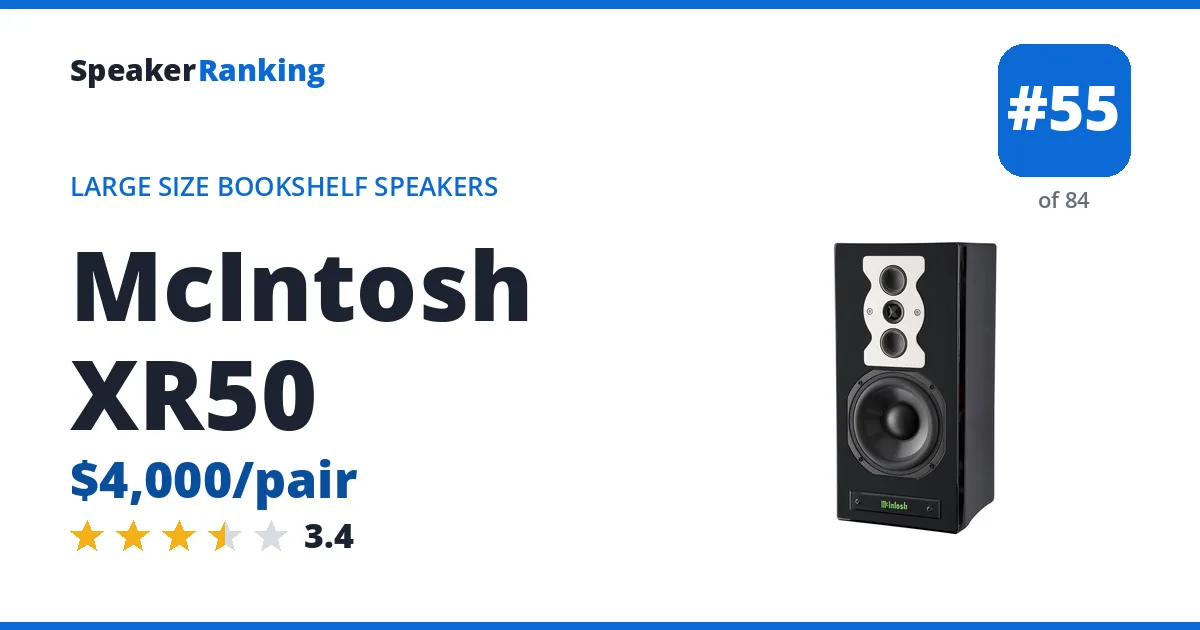
Pros: The compact XR50 produces unexpectedly authoritative bass: Erin measured F3 at 43Hz and praised its low-end weight. Horizontal radiation is exceptionally wide, and the four-driver three-way layout holds distortion and compression together reasonably well through the midband. The sealed-back 2-inch inverted-dome midranges isolate vocals from woofer pressure, while the heavily braced nonparallel cabinet, premium terminals and five-year warranty are genuinely high-grade. Measured bass extension of 43Hz (-3dB), with a measured sensitivity of 81dB.
Cons: Erin measured roughly 80-81dB sensitivity, making the XR50 exceptionally power hungry despite its nominal eight-ohm rating. A broad treble excess sounds bright and sibilant on-axis; at least 20° toe-out or EQ is needed, but toe-out increases reflected energy and trades away image focus. Direct and reflected responses diverge through parts of the treble, limiting perfect EQ correction. At $2000/pair, its tonal flaws and low efficiency are hard to excuse as merely the cost of premium construction.
Full McIntosh XR50 review and specifications →
| Bass Extension (-10dB) | 35.6Hz (measured, Erin’s Audio Corner) |
|---|---|
| Bass Extension (-3dB) | 43Hz (measured, Erin’s Audio Corner) |
| DIY Kit | No |
| Dimensions | 17H x 8W x 11.75D inches |
| Drivers | 6-inch woofer; dual 2-inch inverted-dome mids; 0.75-inch titanium dome |
| Impedance | 8 ohms nominal |
| Sensitivity | ~81dB/2.83V/1m (measured, Erin’s Audio Corner) |
| Spinorama Preference Score | 4.99 |
| Spinorama Preference Score with Perfect Sub | 6.80 |
| Weight | 19.4 lbs (8.8 kg) each |
- Links
- Reviews, Comparisons and Sound Samples
- Head-to-Head Comparisons
 Ranked #97 of 141 in Large Size Bookshelf Speakers - KEF Q3 Meta: $899.99 per pair Amazon Crutchfield eBay
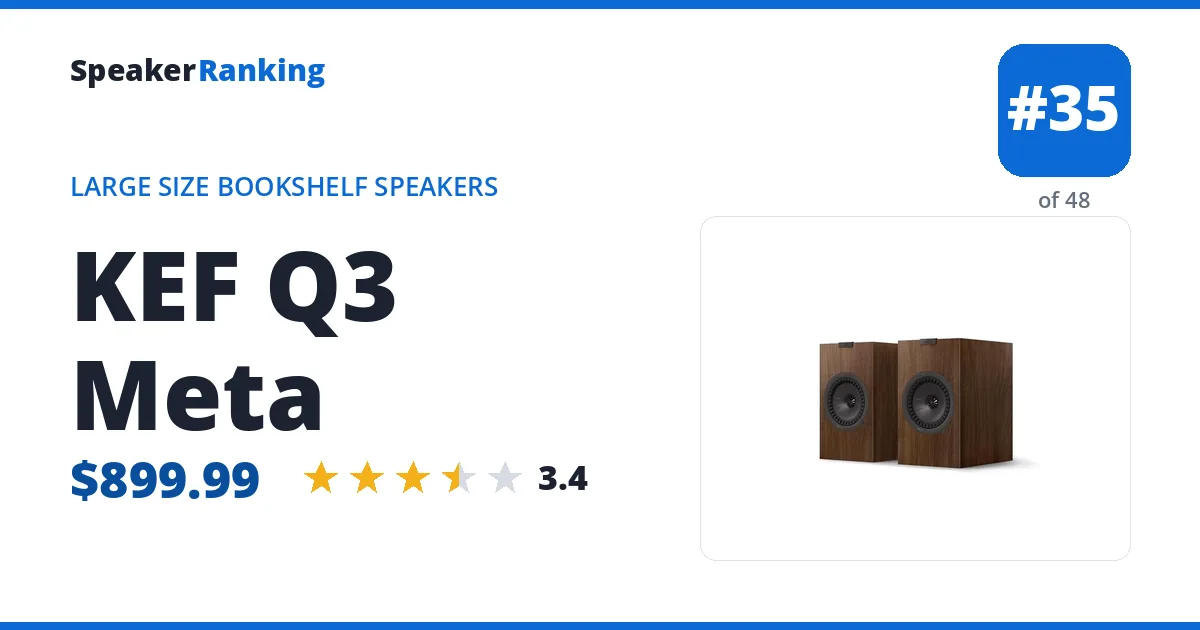
Older model: the KEF Q350 (ranked lower, rated 3/5).
Smaller model: the KEF Q1 Meta (rated 3.6/5).
Larger models: the KEF Q Concerto Meta (ranked higher, rated 4.6/5), the KEF Q7 Meta (estimated 3.5/5) and the KEF Q11 Meta (rated 4/5).
Pros: Coaxial two-way design (1” vented aluminum dome tweeter with Meta absorber embedded in a 6.5” aluminum cone mid/bass driver) delivering unusually wide dispersion both horizontally and vertically (about ±60° each): wider than typical KEF models, which usually run closer to ±50° horizontal and ±15-20° vertical for non-coaxial designs. A deliberate ~2dB bump around 120Hz gives a satisfying sense of kick-drum impact, a voicing choice the reviewer personally favors even though it’s not strictly accurate. Extended bass-shelf tuning allows placement close to a rear wall (about 1 foot) without sounding boomy. Good directivity overall means it takes well to EQ correction if desired. Cabinet resonances around 350-370Hz and 600Hz look concerning in impedance measurements, but blind ABX testing (24 trials) after adding damping material couldn’t reliably distinguish the treated cabinet from the untreated one: these particular resonances appear to fall below the threshold of audibility. Sturdier build than previous KEF Q-series models. Measured bass extension of 52Hz (-3dB), with a measured sensitivity of 84.5dB.
Cons: Not well suited to high-output use: compression and strain in the 1-2kHz region emerge above about 90dB at 10 feet, so a high-output home theater setup isn’t the best application. A slight loss of attack and clarity around 1-2kHz was noticeable both subjectively and in measurements. F3 of 52Hz with a fairly quick rolloff below 50Hz means a subwoofer is still recommended for real bass extension, even for moderate-volume home theater use. Sealed configuration (using the included port bungs) pushes the bass rolloff up into the 100Hz+ region: the reviewer recommends leaving it in ported mode instead. Sounds best pointed directly at the listener; toeing it out 30° rolls off the top end without a meaningful soundstage benefit. Compression testing shows real breakdown at 102dB/1m, with the woofer losing excursion control: confirms the practical output ceiling. An unexplained -5dB dip appears in on-axis measurements that the reviewer couldn’t attribute to a specific cause.
Full KEF Q3 Meta review and specifications →
| Bass Extension (-10dB) | 37Hz (measured, Erin’s Audio Corner) |
|---|---|
| Bass Extension (-3dB) | 52Hz (measured, Erin’s Audio Corner) |
| DIY Kit | No |
| Dimensions | 14.1”H x 8.3”W x 12”D (357.0 x 210.0 x 305.0 mm) |
| Drivers | 165 mm (6.5 in.) aluminium cone woofer, 25 mm (1 in.) vented aluminium dome with MAT tweeter |
| Impedance | 4 ohms nominal, 3.7 ohms minimum (measured above 80Hz, Erin’s Audio Corner) |
| Sensitivity | 84.5dB (measured average 300Hz-3kHz @ 2.83V/1m, Erin’s Audio Corner; 87dB manufacturer specified) |
| Spinorama Preference Score | 4.66 |
| Spinorama Preference Score with Perfect Sub | 6.50 |
| Weight | 15.9 lbs (7.2 kg) |
| Woofer Cabinet | ported, rear |
- Links
- Reviews, Comparisons and Sound Samples
- Head-to-Head Comparisons
Ranked #98 of 141 in Large Size Bookshelf Speakers - Polk Monitor XT20: $279.00 per pair Amazon Crutchfield eBay
Pros: Two-way bookshelf design with a 1” tweeter and 6.5” woofer, part of Polk’s budget-friendly XT lineup (spanning roughly $200-700 across the series). Measures more linear and has fewer/smaller cabinet resonances than its smaller sibling, the XT15, making it (by the reviewer’s own assessment) probably the better of the two based on data alone. Reasonably good bass output for the price and size, with an F3 of 63Hz. Horizontal radiation of about ±50° gives a respectable, enjoyable soundstage width. Takes well to EQ correction: the early-reflections directivity trend is decently linear, meaning tonal adjustments can meaningfully improve the sound. Provides usable, respectable volume when paired with a subwoofer crossover, even though it isn’t intended to play extremely loud on its own. Measured bass extension of 64.5Hz (-3dB), with a measured sensitivity of 86dB.
Cons: Notably bright treble, elevated roughly 1-5dB above the midrange depending on frequency: a characteristic shared across the whole Polk XT lineup, requiring either EQ or toe-out to tame. Small resonances appear around 300Hz and 800Hz, with some of that energy leaking from the port area. Vertical listening window is narrow: best kept close to the tweeter axis, with only a couple of degrees of tolerance above or below before the sound changes. Still needs a subwoofer for real low-end extension despite the decent F3. Overall linearity isn’t state-of-the-art flat, and while the reviewer found it pleasant, some artificial brightness remains even after basic EQ correction in the crossover region.
Full Polk Monitor XT20 review and specifications →
| Bass Extension (-10dB) | 43.4Hz (derived, log-interpolated between spinorama.org -9dB/-12dB points) |
|---|---|
| Bass Extension (-3dB) | 64.5Hz (measured, Erin’s Audio Corner) |
| DIY Kit | No |
| Dimensions | 13”H x 7.5”W x 11”D (330.2 x 190.5 x 279.4 mm) |
| Drivers | 6.5” bilaminate paper cone woofer, 1” Terylene dome tweeter |
| Impedance | 8 ohms nominal (measured, Erin’s Audio Corner) |
| Sensitivity | 86dB (measured by Erin’s Audio Corner; 87dB manufacturer specified) |
| Spinorama Preference Score | 4.71 |
| Spinorama Preference Score with Perfect Sub | 7.07 |
| Weight | 11.9 lbs (5.4 kg) each |
| Woofer Cabinet | ported |
- Links
- Reviews, Comparisons and Sound Samples
- Erin’s Audio Corner: Polk’s new budget XT Speakers. Reviewed! More from Erin’s Audio Corner →
- Erin’s Audio Corner Website Polk Monitor XT20
- Erin’s Audio Corner: 10 Great (and Terrible) Speakers Under $300!
- Erin’s Audio Corner: Budget Stereo Systems You Will Love
- Erin’s Audio Corner Measurements (spinorama.org)
- Head-to-Head Comparisons
- Polk Monitor XT20 vs KEF Q3 Meta
- Polk Monitor XT20 vs Sonus Faber Lumina II
- Polk Monitor XT20 vs SVS Prime Bookshelf
- Polk Monitor XT20 vs Polk Reserve R100
- Polk Monitor XT20 vs ELAC Debut 2.0 B6.2
- Polk Monitor XT20 vs Focal Aria 906
- Polk Monitor XT20 vs Revel Performa M22
- Polk Monitor XT20 vs Dynaudio Special Forty
- See all 43 comparisons
 Ranked #99 of 141 in Large Size Bookshelf Speakers - Sonus Faber Lumina II: $1,600 per pair Crutchfield eBay
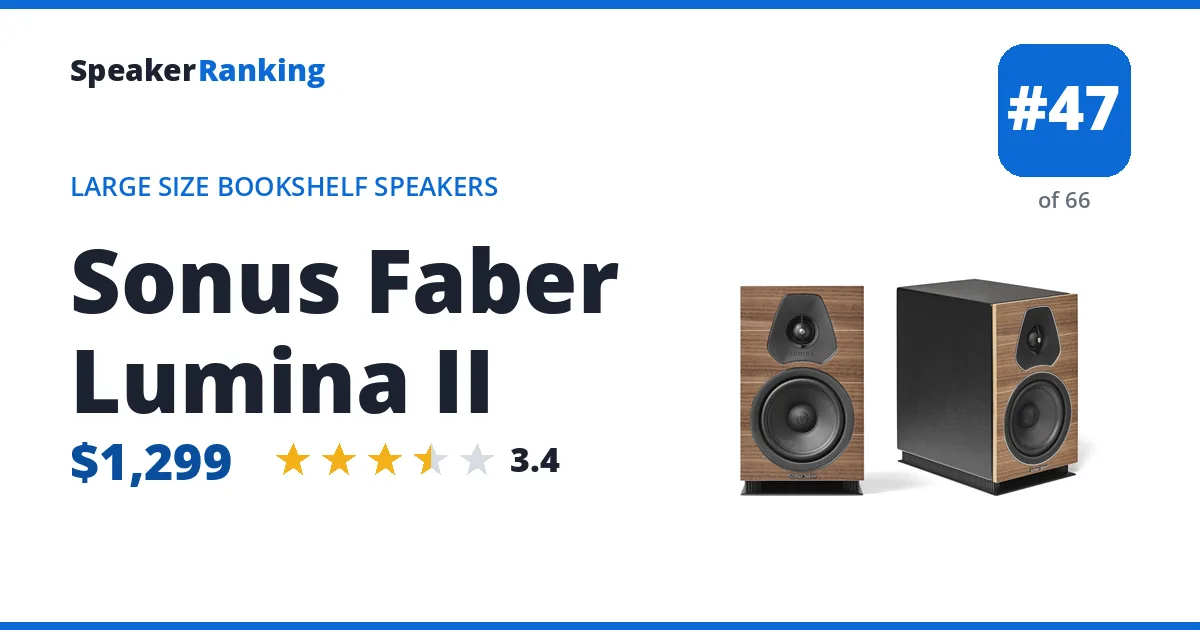
Pros: Handmade in Italy with a gloss-finished front baffle and black leather-wrapped cabinet: genuinely nice-looking speaker with real brand cachet. Bass extension is competitive for the size, reaching about 50 Hz in-room with mild compression and good distortion figures, so higher output levels and greater listening distances aren’t a problem down to that point. About 20 dB of dynamic range at typical listening levels (73 dB at 4m), which comfortably covers most music without the tonal balance shifting as instruments and vocals peak. Off-axis behavior is consistent: toeing the speakers 20-30 degrees out doesn’t meaningfully change the in-room high-frequency character, so placement flexibility is good once you’ve dialed in the tonal balance. Measured bass extension of 60Hz (-3dB), with a measured sensitivity of 86dB.
Cons: Not a neutral speaker: has a persistent high-frequency boost/lift that makes it sound forward and bright, present whether pointed directly at the listener or toed out. A slightly nasal quality traced to a resonance around 1 kHz that EQ can address. The reviewer needed to trim treble by about 4 dB on his preamp to get the tonal balance he wanted, meaning most listeners will want equalization available to fully enjoy this speaker. At roughly the same $1,000ish price point, alternatives like the Ascend Acoustics Sierra 1 V2 measure more linear (with a tradeoff in distortion and crossover-region directivity), and the Dynaudio Emit 20 offers deeper bass extension and lower compression at the cost of a more deliberately colored tonal signature.
Full Sonus Faber Lumina II review and specifications →
| Bass Extension (-10dB) | 41Hz (measured, Erin’s Audio Corner) |
|---|---|
| Bass Extension (-3dB) | 60Hz (measured, Erin’s Audio Corner) |
| Crossover Frequency | 1800Hz |
| DIY Kit | No |
| Dimensions | 12” x 7.1” x 10.4” (304 x 180 x 263 mm) |
| Drivers | 29mm DAD dome tweeter, 150mm paper cone mid-woofer |
| Frequency Response | 55Hz - 24kHz (manufacturer specified) |
| Impedance | 4 ohms nominal, 4.1 ohms minimum (measured, Erin’s Audio Corner) |
| Recommended Power | 30W - 150W |
| Sensitivity | 86dB (measured average, Erin’s Audio Corner; matches manufacturer spec) |
| Spinorama Preference Score | 3.81 |
| Spinorama Preference Score with Perfect Sub | 6.10 |
| Weight | 12.5 lbs (5.65 kg) each |
- Links
- Reviews, Comparisons and Sound Samples
- Head-to-Head Comparisons
- Sonus Faber Lumina II vs Polk Monitor XT20
- Sonus Faber Lumina II vs XTZ Spirit 4
- Sonus Faber Lumina II vs KEF Q3 Meta
- Sonus Faber Lumina II vs Polk Reserve R100
- Sonus Faber Lumina II vs Focal Aria 906
- Sonus Faber Lumina II vs Revel Performa M22
- Sonus Faber Lumina II vs SVS Prime Bookshelf
- Sonus Faber Lumina II vs ELAC Debut 2.0 B6.2
- See all 58 comparisons
 Ranked #101 of 141 in Large Size Bookshelf Speakers - Polk Reserve R100: $699.00 per pair Amazon Polk Audio eBay
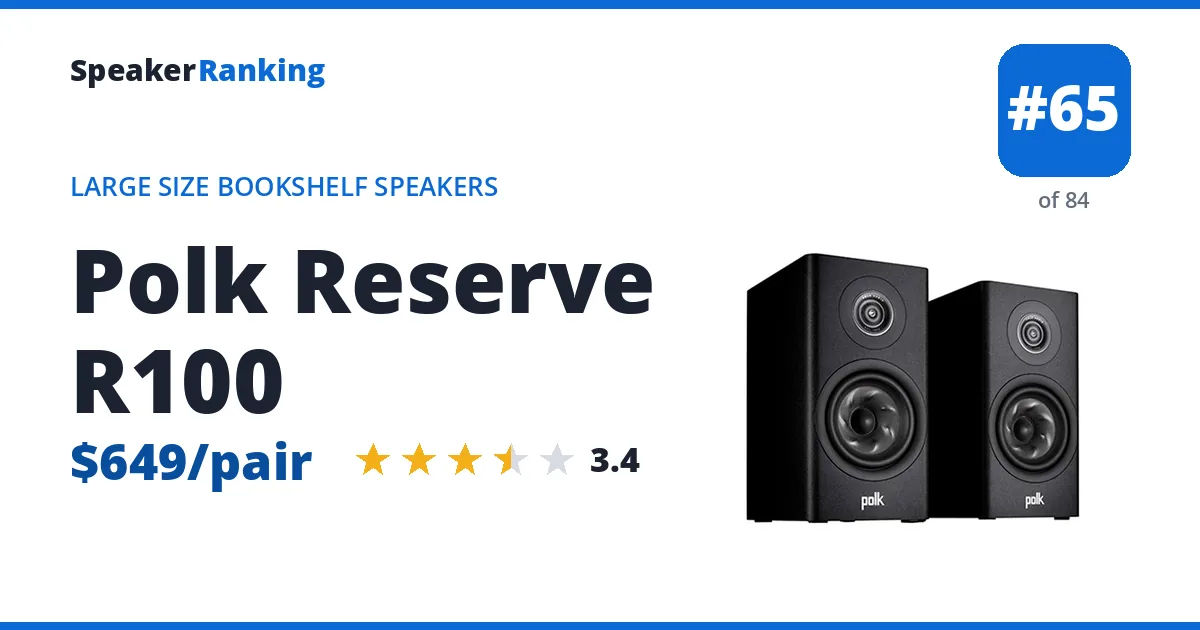
Larger model: the Polk Reserve R500 (rated 4.2/5).
Pros: Compact cabinet, unusually useful bass for its size and well-controlled woofer breakup. Erin measured F3/F10 points of 68Hz/49Hz, and the X-Port vent avoids much of the chuffing and pipe resonance common to budget rear ports. The 5.25-inch Turbine Cone woofer and 1-inch Pinnacle ring-radiator tweeter produce good detail at moderate levels, while listening roughly 20° off-axis reduces part of the elevated top octave. Measured bass extension of 68Hz (-3dB), with a measured sensitivity of 85dB.
Cons: Erin measured only about 85dB sensitivity and the impedance reaches 3.6 ohms, so it is neither efficient nor an entirely benign AVR load. The treble runs roughly 3dB above the midrange and becomes aggressive above about 85dB SPL. A directivity discontinuity through the woofer/tweeter crossover means EQ cannot fully repair the power response, and a 400Hz impedance feature plus 500Hz-1kHz response irregularity suggests a cabinet or system resonance. Substantial low-frequency compression at higher playback levels limits clean dynamics.
Full Polk Reserve R100 review and specifications →
| Bass Extension (-10dB) | 49Hz (measured, Erin’s Audio Corner) |
|---|---|
| Bass Extension (-3dB) | 68Hz (measured, Erin’s Audio Corner) |
| DIY Kit | No |
| Dimensions | 12.8”H x 6.5”W x 10.2”D |
| Drivers | 1” Pinnacle ring-radiator tweeter; 5.25” Turbine Cone midwoofer |
| Impedance | 3.6 ohms minimum (measured, Erin’s Audio Corner) |
| Sensitivity | 85dB/2.83V/1m (measured, Erin’s Audio Corner) |
| Spinorama Preference Score | 5.46 |
| Spinorama Preference Score with Perfect Sub | 7.93 |
| Weight | 12.1 lbs (5.5 kg) each |
| Woofer Cabinet | ported, rear X-Port |
- Links
- Reviews, Comparisons and Sound Samples
- Head-to-Head Comparisons
- Polk Reserve R100 vs Focal Aria 906
- Polk Reserve R100 vs Revel Performa M22
- Polk Reserve R100 vs Sonus Faber Lumina II
- Polk Reserve R100 vs Polk Monitor XT20
- Polk Reserve R100 vs HSU Research MFL-6
- Polk Reserve R100 vs KEF Q3 Meta
- Polk Reserve R100 vs SVS Prime Bookshelf
- Polk Reserve R100 vs Polk R200
- See all 31 comparisons
 Ranked #102 of 141 in Large Size Bookshelf Speakers - Focal Aria 906: $2,199.00 per pair used Discontinued Amazon eBay
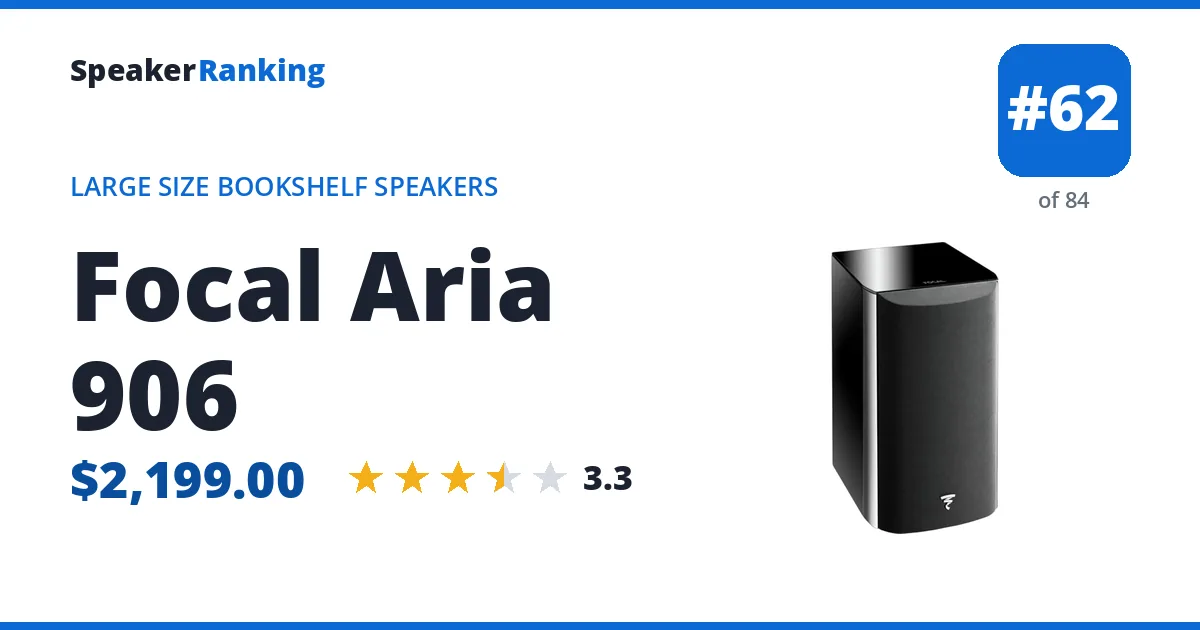
Newer model: the Focal Aria Evo X N°1, ranked higher, estimated 3.5/5.
Pros: CEA2034 spinorama shows very flat bass response, with the reviewer rating overall performance “good.” Predicted in-room response is almost perfect prior to 1kHz. Horizontal dispersion of about ±60 degrees is good and stays even out to about -12dB before getting erratic. Woofer distortion is quite low at 86dB SPL/1m. Measured bass extension of 63Hz (-3dB), with a measured sensitivity of 86.5dB.
Cons: 3dB dip around 2.8kHz. Some resonance around 800Hz, small directivity error around 7kHz. A dip in the upper midrange also shows up in the predicted in-room response. Distortion becomes problematic at 96dB SPL/1m, with a notable peak around 1.3-1.5kHz alongside broader midrange elevation. Discontinued.
Full Focal Aria 906 review and specifications →
| Bass Extension (-10dB) | 47Hz (measured, Erin’s Audio Corner) |
|---|---|
| Bass Extension (-3dB) | 63Hz (measured, Erin’s Audio Corner) |
| DIY Kit | No |
| Dimensions | 15.4”H x 8.9”W x 11”D (390.0 x 225.0 x 280.0 mm) |
| Drivers | 26mm tweeter + 165mm mid-woofer |
| Impedance | 4 ohms nominal (4.8 ohms minimum above 80Hz, measured by Erin’s Audio Corner) |
| Sensitivity | 86.5dB (measured average, Erin’s Audio Corner) |
| Spinorama Preference Score | 4.64 |
| Spinorama Preference Score with Perfect Sub | 7.00 |
| Weight | 39.9 lbs (18.1 kg) |
| Woofer Cabinet | ported, front |
- Links
- Reviews, Comparisons and Sound Samples
- Head-to-Head Comparisons
 Ranked #108 of 141 in Large Size Bookshelf Speakers - Polk R200: $799.00 per pair Amazon eBay
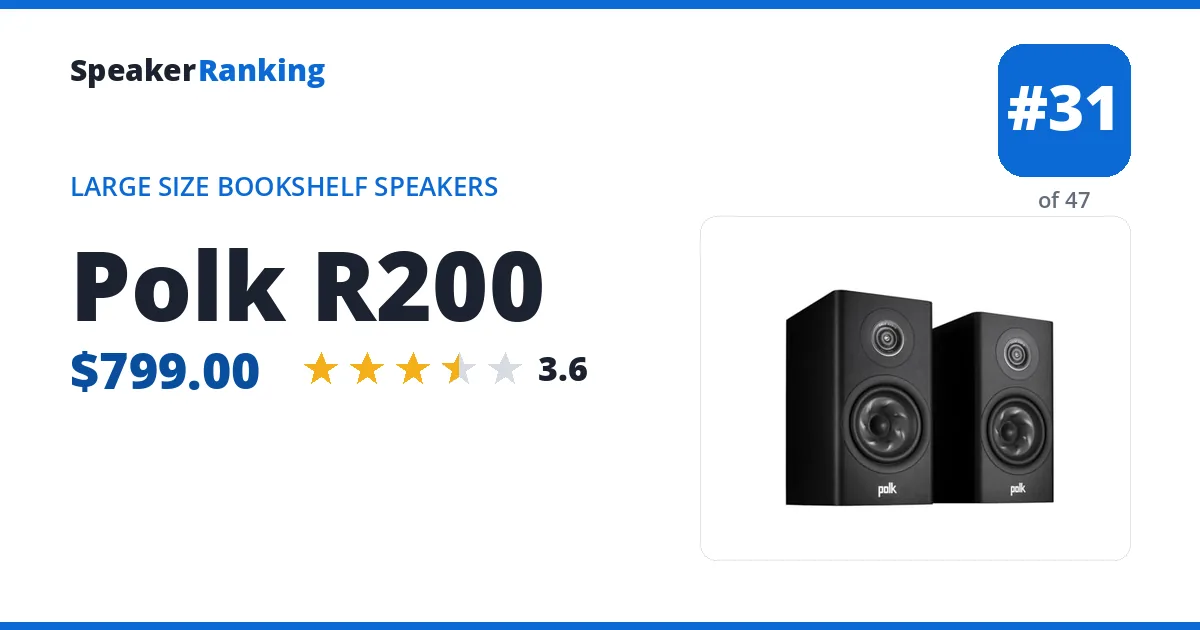
Pros: Two-way design with a 6.5” midwoofer and 1” ring radiator tweeter, giving reasonably tight, well-defined imaging. Neutral through most of the midrange (roughly 200Hz-1kHz). On-axis response holds within about 1.5dB up to 10kHz. About 20dB of usable dynamic range (76dB to 96dB) before more significant compression sets in. Reasonably close to a 4-ohm nominal load, giving some flexibility with amplifier choice, though a dedicated 4-ohm-capable amp is still recommended. Measured bass extension of 74Hz (-3dB).
Cons: A resonance and associated distortion increase around 800Hz-1kHz creates a “tinny,” occasionally glaring quality on certain instruments and vocals, confirmed both by ear and in the frequency-response and distortion measurements. Above about 10kHz, the ring-radiator tweeter takes on an artificial, “digital-esque” quality, then falls off quickly above 16kHz. F3 of 74Hz and F10 of 50Hz mean there’s essentially no meaningful bass “thump” below about 60Hz: a subwoofer is strongly recommended even just to restore basic kick-drum presence. The ring radiator tweeter’s dispersion narrows sharply above about 8kHz, so the speaker should be aimed close to on-axis (no more than 5-10° of toe-out). Vertical listening position is fairly critical: moving more than a few degrees above or below the tweeter line causes a noticeable timbre shift due to a gap in the crossover region. Multitone distortion spikes substantially (to around 10%) in the 600Hz-1kHz region at higher output levels (around 96dB/1m), meaning the glare gets worse the louder it’s played. At the highest tested output (102dB, 26dB of dynamic range), the woofer shows clear signs of struggling; crossing to a subwoofer around 80-100Hz helps prevent bottoming out but doesn’t fully eliminate the compression.
Full Polk R200 review and specifications →
| Bass Extension (-10dB) | 50Hz (measured, Erin’s Audio Corner) |
|---|---|
| Bass Extension (-3dB) | 74Hz (measured, Erin’s Audio Corner) |
| DIY Kit | No |
| Dimensions | 14.1”H x 7.5”W x 13.9”D (359.0 x 190.0 x 353.8 mm) |
| Drivers | 25mm soft dome + 165mm woofer |
| Impedance | 4 ohms nominal, 3.8 ohms minimum (measured, Erin’s Audio Corner) |
| Sensitivity | 85dB |
| Spinorama Preference Score | 5.09 |
| Spinorama Preference Score with Perfect Sub | 7.61 |
| Weight | 31.3 lbs (14.2 kg) |
| Woofer Cabinet | ported, rear |
- Links
- Reviews, Comparisons and Sound Samples
- Head-to-Head Comparisons
 Ranked #111 of 141 in Large Size Bookshelf Speakers - Audio Craftsmen Victoria: $4,000 per pair Discontinued eBay
Pros: Two-way bass-reflex design with a 180mm mid-base driver and 29mm tweeter in a distinctive slit-pattern cabinet, well-built overall. Wide, enveloping horizontal radiation of about ±70° through the midrange and lower treble. Low, well-controlled distortion overall, staying below about 1% up to roughly 100Hz at both 86dB and 96dB. Easy to drive electrically (minimum impedance about 7.3 ohms, minimum EPDR 4.4 ohms), fine for most Class AB amplifiers. Best placed closer to the rear wall (about 6 inches to a foot) rather than the typical 1-meter recommendation, reducing a mid-range cancellation dip that worsens with more wall clearance. Measured bass extension of 65Hz (-3dB), with a measured sensitivity of 83.7dB.
Cons: A notably thin, hollow midrange (a dip roughly 1-2 octaves wide) reduces vocal fullness and “thump,” seemingly from a baffle-step compensation shortfall in the crossover design. Very light bass overall; a subwoofer is recommended for both deep bass (30-40Hz) and even basic mid-bass kick (50-80Hz). Highly aiming-dependent in the treble: toeing the speaker away from the listener (about 30°) causes a significant loss of high-frequency shimmer and detail. A crossover handoff mismatch between the mid-woofer and tweeter shows up in directivity measurements, correlating with the midrange dip. Multitone distortion becomes elevated around 1kHz at higher output levels, confirmed through careful band-pass diagnostic testing and independently corroborated by another reviewer’s similar impression. Limited dynamic range below about 100Hz at higher volumes: driver excursion appears suspension-limited, causing real compression above roughly 90dB for a pair at typical listening distances. Below-average sensitivity (about 84dB versus a typical 85-86dB for bookshelf speakers) partly offsets its easy-to-drive impedance. Not well suited to listening beyond about 10 feet or much above 85-90dB. Discontinued.
Full Audio Craftsmen Victoria review and specifications →
| Bass Extension (-10dB) | 45Hz (measured, Erin’s Audio Corner) |
|---|---|
| Bass Extension (-3dB) | 65Hz (measured, Erin’s Audio Corner) |
| DIY Kit | No |
| Dimensions | 15.9”H x 9.1”W x 14”D (405.0 x 230.0 x 355.0 mm) |
| Drivers | 1” tweeter + 4” woofer |
| Impedance | 8 ohms nominal, 7.3 ohms minimum (measured, Erin’s Audio Corner) |
| Sensitivity | 83.7dB (measured, Erin’s Audio Corner) |
| Spinorama Preference Score | 4.87 |
| Spinorama Preference Score with Perfect Sub | 7.34 |
| Weight | 37 lbs (16.8 kg) |
| Woofer Cabinet | ported, rear |
- Links
- Reviews, Comparisons and Sound Samples
- Head-to-Head Comparisons
 Ranked #112 of 141 in Large Size Bookshelf Speakers - Sonus Faber Sonetto II G2: $3500 per pair Crutchfield eBay
Pros: Two-way design with a 1.125” damped Apex Dome silk tweeter and 6.5” cone woofer, using a base of concrete, aluminum, and steel with under-cabinet venting. Notably more neutral than Sonus Faber’s own Lumina 2, which runs 2-5dB hotter in the treble. Horizontal directivity narrows at a fairly constant, well-behaved rate rather than narrowing-then-widening-then-narrowing like some rivals (including the Lumina 2), meaning sidewall reflections match the direct sound well enough that the reviewer doesn’t recommend sidewall absorption for this speaker. The tweeter-to-woofer crossover handoff around 3kHz looks clean, suggesting a higher-order crossover than typical for the size/price class. Good dynamic range: the low end loses only about 2dB from 76dB to 96dB, otherwise holding up well. Not a difficult amplifier load (about 4.2 ohms minimum impedance). Bass extension reaches a genuine 50Hz in-room, fuller than the Lumina 2. Measured bass extension of 62Hz (-3dB), with a measured sensitivity of 87dB.
Cons: Sounds notably bright pointed directly on-axis; toeing the speaker out about 30° reduces treble energy and sibilance meaningfully. A resonance around 700Hz gives vocals a slightly nasal, hollow quality. A dip in the upper midrange (roughly 1-2kHz) reduces perceived detail and attack, while the elevated treble can read as “analytical” or “detailed” to some listeners despite being a coloration rather than true resolution. Needs more clearance from the rear wall than some rivals (about 1.5-2 feet in an ideal room, more or less depending on your specific room modes) or the 80-120Hz region can become boomy. Vertical listening window is limited to about ±10-15° from the tweeter axis. Some unexplained directivity irregularities appear around 1.2kHz and 1.6kHz, possibly port-related, along with a longer decay in the 800Hz-1600Hz range in burst-decay measurements. Multitone distortion approaches the reviewer’s 3% threshold through the midrange, though likely not obviously audible without direct A/B comparison. A resonance in the cabinet appears around 400Hz in impedance measurements.
Full Sonus Faber Sonetto II G2 review and specifications →
| Bass Extension (-10dB) | 38Hz (measured, Erin’s Audio Corner) |
|---|---|
| Bass Extension (-3dB) | 62Hz (measured, Erin’s Audio Corner) |
| DIY Kit | No |
| Dimensions | 16.3”H x 8.9”W x 14”D (414.3 x 227.0 x 355.6 mm) |
| Drivers | 1x 6.5” mid-woofer (paper cone), 1x 1.1” (28mm) DAD soft dome tweeter |
| Impedance | 4 ohms nominal (4.2 ohms minimum, measured by Erin’s Audio Corner) |
| Sensitivity | 87dB (measured, Erin’s Audio Corner) |
| Spinorama Preference Score | 4.25 |
| Spinorama Preference Score with Perfect Sub | 6.54 |
| Weight | 38.4 lbs (17.4 kg) |
| Woofer Cabinet | ported, front |
- Links
- Reviews, Comparisons and Sound Samples
- Head-to-Head Comparisons
- Sonus Faber Sonetto II G2 vs Audio Craftsmen Victoria
- Sonus Faber Sonetto II G2 vs Emotiva Airmotiv B2+
- Sonus Faber Sonetto II G2 vs Pylon Jasper Monitor 18
- Sonus Faber Sonetto II G2 vs JBL XPL-90
- Sonus Faber Sonetto II G2 vs KEF Q350
- Sonus Faber Sonetto II G2 vs Sonus Faber Lumina II Amator
- Sonus Faber Sonetto II G2 vs Polk R200
- Sonus Faber Sonetto II G2 vs Klipsch RP-600M
- See all 60 comparisons
 Ranked #113 of 141 in Large Size Bookshelf Speakers - Emotiva Airmotiv B2+: $449 per pair Discontinued eBay
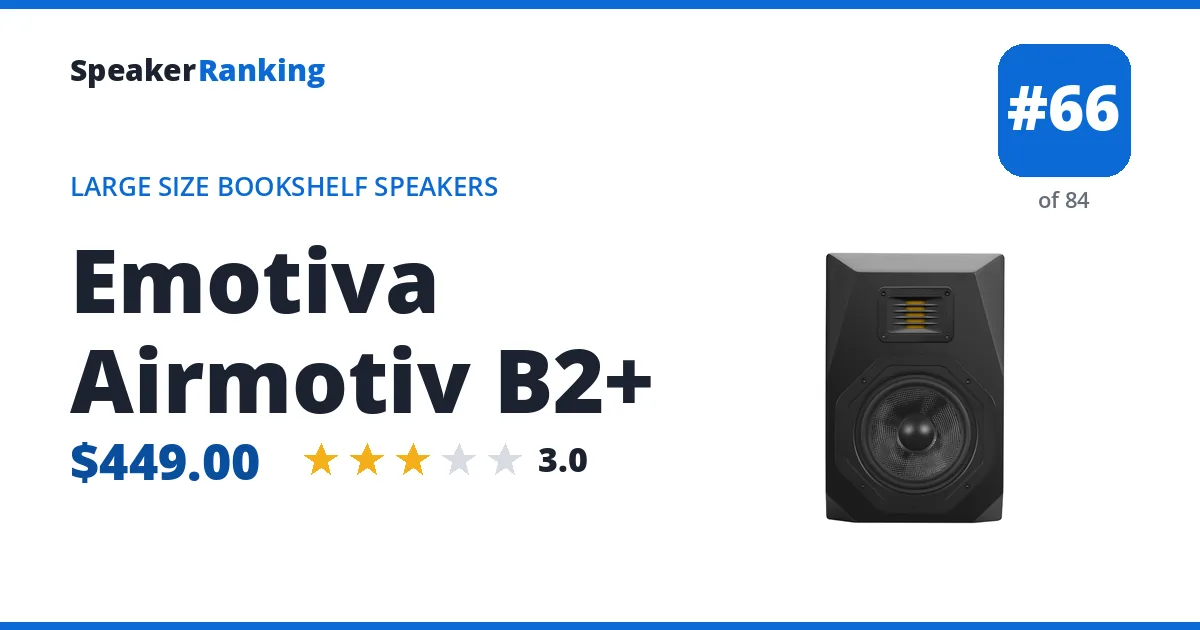
Newer model: the Emotiva Airmotiv XB2, ranked higher, rated 4.2/5.
Pros: Erin measured a useful 86dB average sensitivity and strong midbass punch around 120Hz. The folded-ribbon tweeter provides very broad upper-treble radiation, and the speaker can create a spacious presentation when positioned carefully. Response and directivity remain reasonably orderly below the roughly 2kHz crossover region. The 6.5-inch woofer offers more output capability than compact 5-inch competitors, while F3/F10 of 66/43Hz leave adequate overlap for a conventional 80Hz subwoofer crossover. Horizontal directivity data makes the broad baffle-step trend amenable to partial EQ below the crossover. Measured bass extension of 66Hz (-3dB), with a measured sensitivity of 86dB.
Cons: The replacement B2+ did not deliver the neutral upgrade Erin expected. A baffle-step loss around 500Hz depresses the lower midrange while the AMT’s much wider radiation above crossover injects excess room energy, yielding a bright, forward balance and false impression of cymbal detail. The directivity discontinuity near 2kHz cannot be completely equalized. Erin measured F3 at 66Hz and F10 at 43Hz, so meaningful kick-drum fundamentals and low bass still need a subwoofer. Vertical listening tolerance is roughly +/-10 degrees, with best results between the top of the woofer and tweeter axes. Broad lateral treble energy may require careful toe-out and sidewall absorption. Despite a large cabinet, it offers limited deep-bass advantage and was not Erin’s hoped-for successor to the more linear B1+. Discontinued.
Full Emotiva Airmotiv B2+ review and specifications →
| Bass Extension (-10dB) | 43Hz (measured, Erin’s Audio Corner) |
|---|---|
| Bass Extension (-3dB) | 66Hz (measured, Erin’s Audio Corner) |
| DIY Kit | No |
| Dimensions | 12.8”H x 8.5”W x 11.5”D (324 x 216 x 293 mm) |
| Drivers | 6.5” woven-fiber woofer, 32 x 25mm folded-ribbon tweeter |
| Impedance | 4 ohms nominal (manufacturer specified) |
| Sensitivity | 86dB (measured average, Erin’s Audio Corner) |
| Spinorama Preference Score | 5.60 |
| Spinorama Preference Score with Perfect Sub | 7.96 |
| Weight | 15.7 lbs (7.1 kg) each |
| Woofer Cabinet | ported, rear |
- Reviews, Comparisons and Sound Samples
- Head-to-Head Comparisons
- Emotiva Airmotiv B2+ vs Sonus Faber Sonetto II G2
- Emotiva Airmotiv B2+ vs KEF Q350
- Emotiva Airmotiv B2+ vs JBL XPL-90
- Emotiva Airmotiv B2+ vs Sonus Faber Lumina II Amator
- Emotiva Airmotiv B2+ vs Klipsch RP-600M
- Emotiva Airmotiv B2+ vs Polk R200
- Emotiva Airmotiv B2+ vs Wharfedale Diamond 9.1
- Emotiva Airmotiv B2+ vs Triangle Borea BR03
- See all 28 comparisons
 Ranked #114 of 141 in Large Size Bookshelf Speakers - Pylon Jasper Monitor 18: $2,499 per pair Discontinued eBay
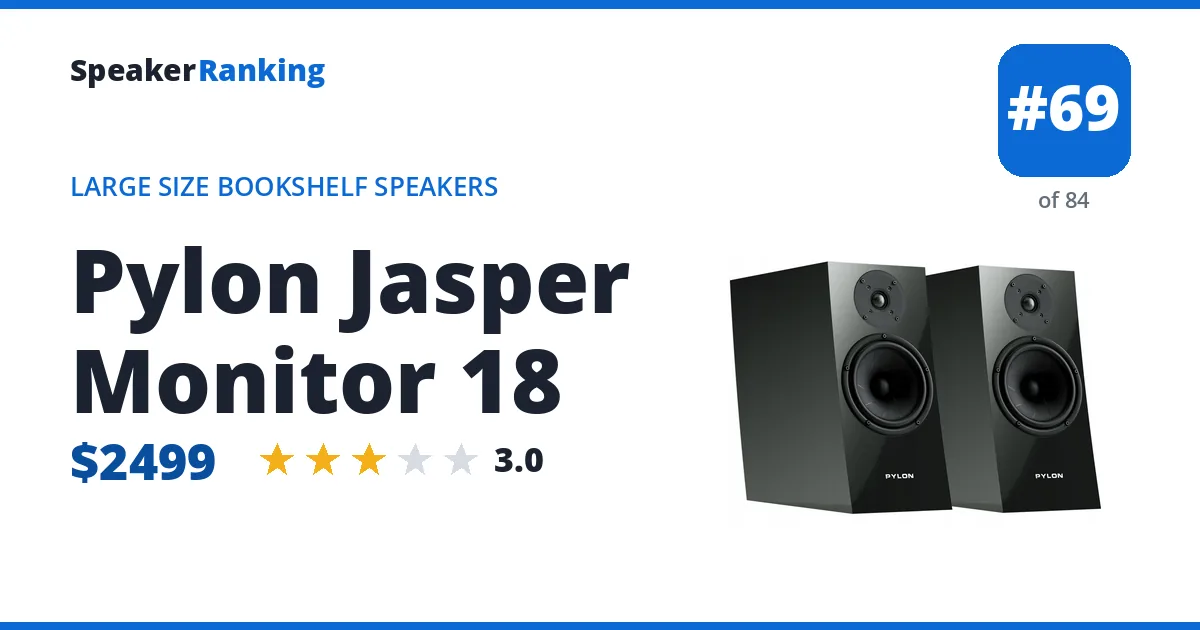
Pros: Premium two-way monitor using a ScanSpeak Revelator midwoofer and ScanSpeak tweeter, drivers the reviewer has a longstanding personal fondness for. Delivers extra mid-bass thump and attack that makes instruments “jump out,” giving an engaging, lively character at lower listening volumes. Wide horizontal radiation of about ±60-70°, right in the reviewer’s preferred range for an enveloping soundstage. Compression holds up well to about 95-96dB before real issues appear. Attractive build quality and finish options. Measured bass extension of 48Hz (-3dB), with a measured sensitivity of 83dB.
Cons: Sounds notably bright, thumpy, and fatiguing pointed directly on-axis; needs about 30° of toe-out to bring the high-frequency lift into better balance. A peak around 2kHz combined with a recessed midrange and a dip around 3-4kHz makes vocals sound hollow while accentuating that same 2kHz energy, especially noticeable at higher listening volumes (75-85dB). The bass bump around 100Hz measures 3-5dB, more than the reviewer’s preferred 1-2dB range, adding more mid-bass emphasis than he’d like. Even toed off-axis, the speaker still reads as bright in a typical room with sidewall reflections: the reviewer recommends adding 2-4” acoustic absorption panels at the first reflection points. The ScanSpeak Revelator woofer (an older, though well-regarded, drive unit design) carries some inherent resonance and elevated second-order distortion, independently corroborated by third-party raw driver measurements: crossing over to a subwoofer at 80Hz doesn’t fully resolve it since it’s a driver characteristic rather than a bass-loading issue. Vertical listening window is limited (about ±10-20°) due to the curved baffle, and angling your ears upward toward the tweeter rather than keeping them level with it causes a suckout in the upper-mid/tweeter region. Bass output (about 60Hz extension) noticeably drops at higher volumes due to compression. Moderate sensitivity (about 83dB) paired with a 4.4-ohm minimum impedance means a genuinely powerful amplifier is needed to avoid potential heat issues driving it hard. Discontinued.
Full Pylon Jasper Monitor 18 review and specifications →
| Bass Extension (-10dB) | 32Hz (measured, Erin’s Audio Corner) |
|---|---|
| Bass Extension (-3dB) | 48Hz (measured, Erin’s Audio Corner) |
| DIY Kit | No |
| Dimensions | 16.9”H x 7.9”W x 16.3”D (430.0 x 200.0 x 413.0 mm) |
| Drivers | 1” tweeter + 6.5” woofer |
| Impedance | 4 ohms nominal, 4.4 ohms minimum (measured, Erin’s Audio Corner) |
| Sensitivity | 83dB (measured by Erin’s Audio Corner) |
| Spinorama Preference Score | 4.72 |
| Spinorama Preference Score with Perfect Sub | 6.34 |
| Weight | 34.2 lbs (15.5 kg) |
| Woofer Cabinet | ported, rear |
- Links
- Reviews, Comparisons and Sound Samples
- Head-to-Head Comparisons
 Ranked #116 of 141 in Large Size Bookshelf Speakers - Sonus Faber Lumina II Amator: $2000 per pair Crutchfield eBay
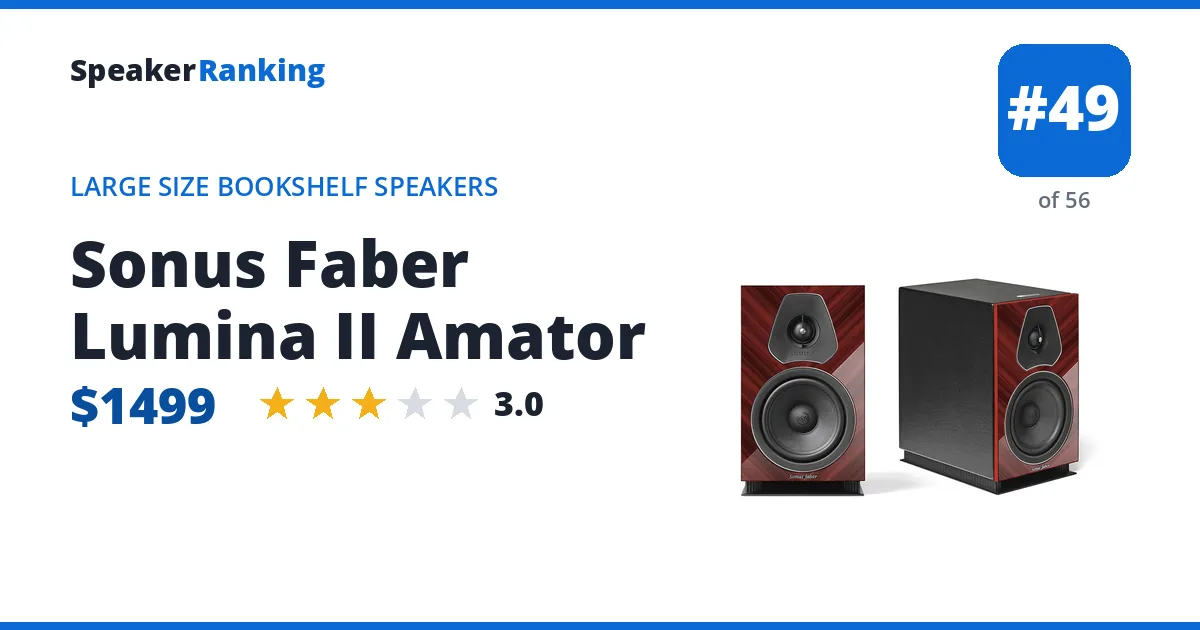
Pros: Solid bass extension for a bookshelf (F3 63Hz, F10 43Hz), reaching about 50Hz in-room. Decent sensitivity and wide, consistent horizontal dispersion (~60-70 degrees): better directivity than expected for a two-way design. Gorgeous, luxury-grade cabinet design. Measured bass extension of 63Hz (-3dB), with a measured sensitivity of 86.9dB.
Cons: Very bright treble, running 3-6dB above the midrange depending on measurement angle: independently corroborated by other owners online, not just one reviewer’s opinion. Causes audible sibilance and a forward, grainy character. Notably the brightest of three Sonus Faber models Erin’s Audio Corner has tested, even brighter than the brand’s own Sonetto II G2. A mechanical resonance/ringing artifact shows up around 1kHz in measurements. Needs a subwoofer for anything below about 50Hz.
Full Sonus Faber Lumina II Amator review and specifications →
| Bass Extension (-10dB) | 43Hz (measured, Erin’s Audio Corner) |
|---|---|
| Bass Extension (-3dB) | 63Hz (measured, Erin’s Audio Corner) |
| Country | Italy (Vicenza) |
| Crossover Frequency | 2600Hz |
| DIY Kit | No |
| Dimensions | 12” x 7.1” x 10.4” (304 x 180 x 263 mm) |
| Drivers | 1.14” DAD (Damped Apex Dome) tweeter, 5.9” paper cone woofer |
| Frequency Response | 55Hz - 24kHz (Manufacturer specified) |
| Impedance | 4 ohms nominal, 3.9 ohms minimum (measured, Erin’s Audio Corner) |
| Recommended Power | 30W - 150W |
| Sensitivity | 86.9dB (2.83V/1m, measured by Erin’s Audio Corner) |
| Weight | 12.8 lbs (5.8 kg) |
| Woofer Cabinet | Bass reflex, ported |
- Links
- Reviews, Comparisons and Sound Samples
- Head-to-Head Comparisons
- Sonus Faber Lumina II Amator vs KEF Q350
- Sonus Faber Lumina II Amator vs Klipsch RP-600M
- Sonus Faber Lumina II Amator vs Pylon Jasper Monitor 18
- Sonus Faber Lumina II Amator vs Wharfedale Diamond 9.1
- Sonus Faber Lumina II Amator vs Emotiva Airmotiv B2+
- Sonus Faber Lumina II Amator vs Sonus Faber Sonetto II G2
- Sonus Faber Lumina II Amator vs Triangle Borea BR03
- Sonus Faber Lumina II Amator vs B&W 805S
- See all 58 comparisons
 Ranked #117 of 141 in Large Size Bookshelf Speakers - Klipsch RP-600M: $377.99 per pair Discontinued Amazon eBay
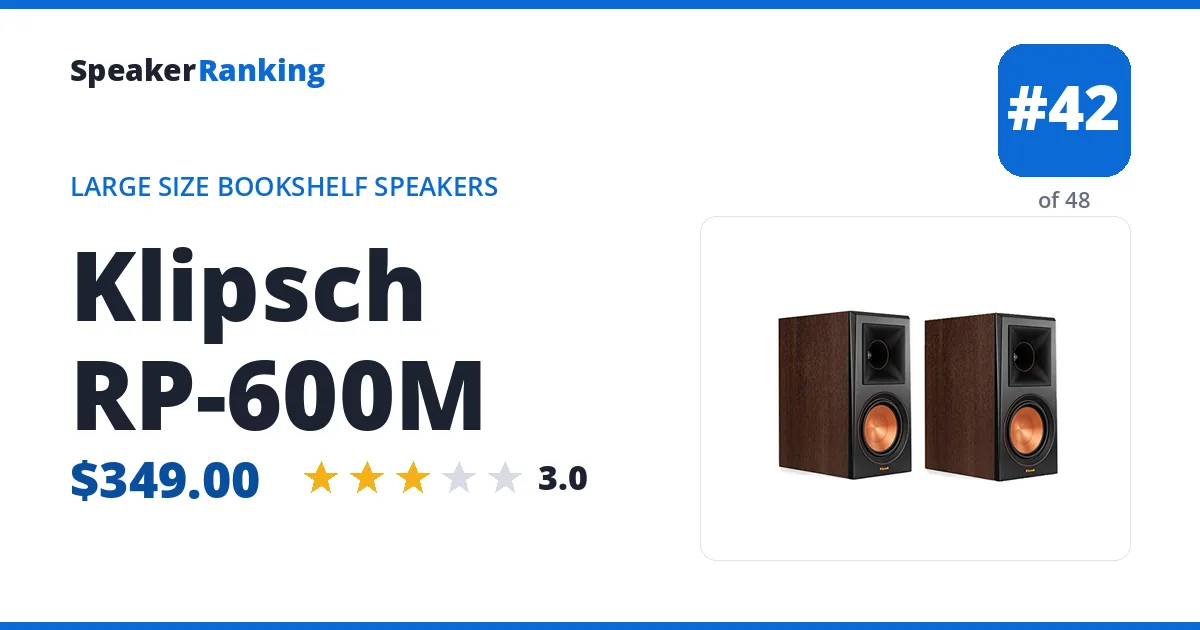
Newer model: the Klipsch RP-600M II, ranked higher, rated 3.7/5.
Pros: More linear horizontal dispersion than the updated RP-600M II: as you move side-to-side, the tonal character changes less, a genuine advantage for off-axis listening consistency. Takes exceptionally well to EQ correction (miniDSP or similar), letting a knowledgeable owner fix its tonal shortcomings without needing to upgrade. Standard 6.5” woofer/horn-tweeter two-way design with reasonably gradual bass rolloff (F3 ~70Hz, F10 ~40Hz) rather than a steep vented-enclosure cutoff. Measured bass extension of 73Hz (-3dB), with a measured sensitivity of 85.2dB.
Cons: A strong, annoying resonance in the lower vocal range around 300Hz stands out clearly (though it can be EQ’d out). Overall tonal balance is notably less neutral than the newer RP-600M II, with a roughly 3-4dB suckout in the estimated in-room response. The waveguide doesn’t extend flush to the baffle edge, increasing diffraction compared to the redesigned version. Klipsch’s marketed sensitivity spec (about 96dB) is a half-space, in-room-style rating roughly 9dB above the true anechoic figure (closer to 85-86dB), which can mislead buyers comparing spec sheets. Elevated treble on-axis, similar to its successor, benefits from toe-out or careful placement. Vertical listening tolerance is limited to about ±10° from the tweeter axis. Still needs a subwoofer for real bass weight; a boost around 120Hz gives kick drums their “tambour” without the underlying “meat.”. Discontinued.
Full Klipsch RP-600M review and specifications →
| Bass Extension (-10dB) | 40Hz (measured, Erin’s Audio Corner) |
|---|---|
| Bass Extension (-3dB) | 73Hz (measured, Erin’s Audio Corner) |
| DIY Kit | No |
| Dimensions | 15.7”H x 8”W x 11.9”D (398.8 x 203.2 x 302.3 mm) |
| Drivers | 6.5” Cerametallic cone woofer, 1” titanium LTS vented tweeter with Tractrix horn |
| Impedance | 8 ohms nominal, 3.5 ohms minimum (measured, Erin’s Audio Corner) |
| Sensitivity | 85.2dB (measured, Erin’s Audio Corner) |
| Spinorama Preference Score | 3.66 |
| Spinorama Preference Score with Perfect Sub | 5.61 |
| Weight | 16.1 lbs (7.3 kg) each |
| Woofer Cabinet | ported |
- Links
- Reviews, Comparisons and Sound Samples
- Erin’s Audio Corner: The Truth about Klipsch’s “NEW” Sound. RP-600M Update. More from Erin’s Audio Corner →
- Erin’s Audio Corner Website Klipsch RP-600M
- GR-Research: We Bought The "NEW" RP-600M II Is KLIPSCH Listening?! More from GR-Research →
- Audio Science Review Measurements More from Audio Science Review →
- Audio Science Review Measurements (spinorama.org)
- Head-to-Head Comparisons
- Klipsch RP-600M vs Sonus Faber Lumina II Amator
- Klipsch RP-600M vs Wharfedale Diamond 9.1
- Klipsch RP-600M vs KEF Q350
- Klipsch RP-600M vs Triangle Borea BR03
- Klipsch RP-600M vs Emotiva Airmotiv B2+
- Klipsch RP-600M vs B&W 805S
- Klipsch RP-600M vs Sonus Faber Sonetto II G2
- Klipsch RP-600M vs Aperion Audio Verus V8B
- See all 31 comparisons
 Ranked #120 of 141 in Large Size Bookshelf Speakers - Triangle Borea BR03: $398.00 per pair Amazon eBay
Pros: Bass output is genuinely decent for the price: measured extension reaches F3 57Hz/F10 42Hz, which the reviewer had no real complaints about. Dual front-firing ports and a well-stuffed, well-braced cabinet. Solid build quality overall. Measured bass extension of 57Hz (-3dB), with a measured sensitivity of 87.5dB.
Cons: A noticeable mid-range suckout, most pronounced in the upper mid-range/lower treble, that the reviewer attributes to cabinet resonances and driver breakup rather than a deliberate voicing choice: it makes vocals and instruments sound recessed and thin rather than warm. Sibilance in the 4-8kHz region shows up on every track the reviewer tried. Measured minimum impedance dips to about 4.2 ohms (with an even lower EPDR), despite the speaker and its own rear panel being labeled 8 ohms: worth knowing if you’re planning to drive these with a receiver/AVR that assumes an 8-ohm nominal load. The reviewer is upfront that this speaker has a devoted following among other reviewers, but says he specifically doesn’t hear what they hear and wants people who own it to trust their own ears rather than assume something’s wrong with their hearing if they don’t love it either.
Full Triangle Borea BR03 review and specifications →
| Bass Extension (-10dB) | 42Hz (measured, Erin’s Audio Corner) |
|---|---|
| Bass Extension (-3dB) | 57Hz (measured, Erin’s Audio Corner) |
| Crossover Frequency | 3600Hz |
| DIY Kit | No |
| Dimensions | 14.96”H x 8.11”W x 12.36”D |
| Drivers | 6.5” natural cellulose midwoofer, 1” (25mm) EFS silk dome tweeter |
| Impedance | 8 ohms nominal (manufacturer spec), 4.2 ohms minimum (measured, Erin’s Audio Corner) |
| Recommended Power | 100W |
| Sensitivity | 87.5dB (measured at 2.83V/1m, Erin’s Audio Corner) |
| Spinorama Preference Score | 4.03 |
| Spinorama Preference Score with Perfect Sub | 6.38 |
| Weight | 13.2 lbs (6 kg) each |
| Woofer Cabinet | ported, dual front ports |
- Links
- Reviews, Comparisons and Sound Samples
- Head-to-Head Comparisons
- Triangle Borea BR03 vs B&W 805S
- Triangle Borea BR03 vs Wharfedale Diamond 9.1
- Triangle Borea BR03 vs Klipsch RP-600M
- Triangle Borea BR03 vs Sonus Faber Lumina II Amator
- Triangle Borea BR03 vs Aperion Audio Verus V8B
- Triangle Borea BR03 vs KEF Q350
- Triangle Borea BR03 vs Emotiva Airmotiv B2+
- Triangle Borea BR03 vs Sonus Faber Sonetto II G2
- See all 52 comparisons
 Ranked #123 of 141 in Large Size Bookshelf Speakers - Fosi Audio SP601: $339.99 per pair Amazon Fosiaudio eBay
Pros: Two-way bookshelf design with a 6.5” paper/aluminum-alloy composite cone woofer and 1.5” silk dome tweeter. Bass reaches a respectable 60-70Hz in most rooms (F3 59Hz, F10 40Hz) for a budget bookshelf speaker. Distortion at 86dB and 96dB measures reasonably well at face value, and compression issues at extreme output are generally in line with what’s expected for a speaker at this price point. The overall tonal character can be substantially improved with basic EQ: the reviewer found a boost around 400Hz plus a cut around 4kHz brought it to an acceptable baseline. Measured bass extension of 59Hz (-3dB), with a measured sensitivity of 85.4dB.
Cons: An unusually erratic, up-and-down frequency response (a scooped midrange followed by an upper-mid bump, a dip, another small bump, then a strong 3-4dB peak around 4-7kHz) makes the speaker’s overall character genuinely hard to characterize: the reviewer compared the experience to a similarly disliked model, the Triangle Borea BR03, which has a comparably inconsistent response. The 4-7kHz peak gives a sharp, sibilant edge to S and T sounds in vocals. A strong diffraction dip around 4kHz followed by a peak can’t be fully corrected with EQ; the reviewer recommends sidewall absorption panels instead, since off-axis energy in the 2-7kHz range actually exceeds the direct sound reaching the listener. Multitone distortion becomes more noticeable and grainy at higher volumes, concentrated in the upper-midrange where hearing is most sensitive. A peaking distortion issue right at the crossover region suggests a possible combination of tweeter distortion and midwoofer/crossover-component strain. The enclosure sounds notably hollow when tapped, and a flashlight inspection suggested a lack of internal damping material, along with likely insufficient bracing. Vertical listening position is fairly tightly constrained around the tweeter axis. Still requires a subwoofer for real kick-drum impact and bass authority.
Full Fosi Audio SP601 review and specifications →
| App | No |
|---|---|
| Bass Extension (-10dB) | 40Hz (measured, Erin’s Audio Corner) |
| Bass Extension (-3dB) | 59Hz (measured, Erin’s Audio Corner) |
| DIY Kit | No |
| DSP | No |
| Dimensions | 14.5”H x 9.1”W x 14”D (368.3 x 231.1 x 355.6 mm) |
| Drivers | 6.5” woofer, 1.5” Silk Dome Tweeters |
| EQ | No |
| Impedance | 4 ohms nominal, 4.1 ohms minimum (measured, Erin’s Audio Corner) |
| Power Handling | 80w RMS Per Speaker |
| Sensitivity | 85.4dB (measured, Erin’s Audio Corner) |
| Weight | 11.5 lbs (5.2 kg) |
| Woofer Cabinet | ported, rear |
- Links
- Reviews, Comparisons and Sound Samples
- Head-to-Head Comparisons
 Ranked #124 of 141 in Large Size Bookshelf Speakers - Aperion Audio Verus V8B: $1,499 per pair Aperion Audio eBay
Pros: Low-distortion bass that reaches a reasonable level for an 8-inch mid-woofer: the reviewer had no complaints about bass cleanliness, just extension. Wide-enough horizontal radiation to give some room involvement without being uncomfortably narrow. HDF (high-density fiberboard) cabinet construction instead of the more typical MDF. Nice aesthetic in the gloss cherry finish (also available in black); solidly built at nearly 28 lbs each. Measured bass extension of 55Hz (-3dB), with a measured sensitivity of 85dB.
Cons: A large mid-range scoop from about 100Hz-500Hz strips out the “meat” of male and female vocals, giving the speaker an overall dull, subdued character the reviewer specifically didn’t care for. Two back-to-back resonant peaks (around 4kHz and 10kHz) cause sibilance and an overbearing hi-hat crispness on some tracks; toeing the speakers 30 degrees off-axis helps a little but doesn’t remove the underlying resonances. At $1499/pair, the reviewer felt EQ shouldn’t be necessary to get a satisfying result out of the box. Minimum impedance (EPDR) dips to around 3 ohms despite a 5.7-ohm nominal rating, so a Class AB amplifier needs to be 4-ohm capable. Bass extension is modest for an 8” driver: measured F3 55Hz/F10 39Hz, getting into the mid-40s Hz in-room rather than truly deep bass.
Full Aperion Audio Verus V8B review and specifications →
| Bass Extension (-10dB) | 39Hz (measured, Erin’s Audio Corner) |
|---|---|
| Bass Extension (-3dB) | 55Hz (measured, Erin’s Audio Corner) |
| DIY Kit | No |
| Dimensions | 17”H x 10.6”W x 13”D |
| Drivers | 8” Woven Kevlar long-throw woofer, 1.1” Custom Aperion ASR dome tweeter with ferrofluid |
| Frequency Response | 30Hz - 35kHz ±3dB (manufacturer specified) |
| Impedance | 6 ohms nominal (manufacturer spec), 5.7 ohms nominal / ~3 ohms EPDR minimum (measured, Erin’s Audio Corner) |
| Recommended Power | 20-150W |
| Sensitivity | 85dB (measured average, Erin’s Audio Corner; 88dB manufacturer specified) |
| Spinorama Preference Score | 3.65 |
| Spinorama Preference Score with Perfect Sub | 5.79 |
| Weight | 28 lbs (12.7 kg) each |
| Woofer Cabinet | ported, rear |
- Links
- Reviews, Comparisons and Sound Samples
- Head-to-Head Comparisons
- Aperion Audio Verus V8B vs B&W 805S
- Aperion Audio Verus V8B vs Triangle Borea BR03
- Aperion Audio Verus V8B vs Wharfedale Diamond 9.1
- Aperion Audio Verus V8B vs Klipsch RP-600M
- Aperion Audio Verus V8B vs Sonus Faber Lumina II Amator
- Aperion Audio Verus V8B vs KEF Q350
- Aperion Audio Verus V8B vs HSU Research CCB-8
- Aperion Audio Verus V8B vs Sonus Faber Sonetto II G2
- See all 16 comparisons
 Ranked #125 of 141 in Large Size Bookshelf Speakers - Triad In-Room Gold LCR: $6,600 per pair Triad Authorized Dealer eBay
Pros: Built for serious home theater output: the sealed three-way layout uses dual 8.5-inch woofers, a 5.5-inch midrange and a 1-inch fabric dome. At 86dB/1m, Erin measured under 1% distortion to 50Hz; at 96dB it remained under 1% only above about 80Hz, supporting Triad’s intended 80Hz subwoofer crossover. Compression and 32-band multitone distortion were both low, even at high playback levels. Broad horizontal coverage (about +/-70 to 80 degrees through the midrange) and a roughly +/-20-degree vertical window give a generous listening area. It can be made substantially more linear with EQ, and its 89dB measured sensitivity is suitable for a capable AVR or power amplifier. Measured bass extension of 57Hz (-3dB), with a measured sensitivity of 88.9dB.
Cons: At $6600/pair, Erin found the raw response and value hard to defend without EQ: a 100-300Hz dip makes male vocals thin, a 1kHz dip adds hollowness, and a 4-5kHz rise makes sibilants harsh. The directivity begins to narrow above about 5kHz as the tweeter beams. Despite its dual woofers, it requires a subwoofer; Erin measured F3 57Hz and F10 40Hz. Load dips below 3 ohms, so it needs an amplifier stable into 4 ohms. Plain, utilitarian styling will not suit everyone.
Full Triad In-Room Gold LCR review and specifications →
| Bass Extension (-10dB) | 40Hz (measured, Erin’s Audio Corner) |
|---|---|
| Bass Extension (-3dB) | 57Hz (measured, Erin’s Audio Corner) |
| Country | USA (handcrafted, manufacturer specified) |
| DIY Kit | No |
| Dimensions | 29”H x 10.75”W x 11.375”D |
| Drivers | Two 8.5” metal woofers, 5.5” paper/fiber midrange, 1” fabric-dome tweeter |
| Frequency Response | 50Hz - 20kHz +/-3dB (manufacturer specified) |
| Impedance | 4 ohms nominal; dips below 3 ohms (measured, Erin’s Audio Corner) |
| Power Handling | 100W - 450W recommended (manufacturer specified) |
| Sensitivity | 88.9dB (2.83V/1m, measured, Erin’s Audio Corner; 92dB manufacturer specified) |
| Spinorama Preference Score | 4.04 |
| Spinorama Preference Score with Perfect Sub | 6.41 |
| Weight | 54.9 lbs (24.9 kg) each |
| Woofer Cabinet | sealed / acoustic suspension |
- Links
- Reviews, Comparisons and Sound Samples
- Head-to-Head Comparisons
- Triad In-Room Gold LCR vs ATC SCM19
- Triad In-Room Gold LCR vs Wharfedale Diamond 9.1
- Triad In-Room Gold LCR vs Klipsch RP-600M II
- Triad In-Room Gold LCR vs Danley SH50
- Triad In-Room Gold LCR vs ELAC Debut 3.0 DB63
- Triad In-Room Gold LCR vs KEF R3
- Triad In-Room Gold LCR vs KEF Q Concerto Meta
- Triad In-Room Gold LCR vs KEF R3 Meta
 Ranked #127 of 141 in Large Size Bookshelf Speakers - Cerwin Vega LA165: $266.01 per pair Amazon eBay
Pros: Passive bookshelf design with decent internal cabinet damping/batting material for the price. Delivers noticeable mid-bass punch around 100-120Hz, giving a sense of kick and impact that fans of the brand’s traditionally punchy sound may appreciate. Horizontal radiation of about ±60-70° lands in the reviewer’s preferred range for soundstage width. Reasonably priced at around $266/pair. Measured bass extension of 66.7Hz (-3dB), with a measured sensitivity of 86.2dB.
Cons: Overall tonal balance is far from neutral: a 2-3dB cut through the vocal fundamental range gives a hollow midrange, while a dip around 2-4kHz removes attack, snap, and clarity from snares and other transient sounds. An elevated upper treble region adds a sibilant, edgy quality (though not as extreme as some pricier speakers with similar issues). The manufacturer’s quoted 33Hz-20kHz frequency response is essentially meaningless without a tolerance bound: actual measured extension is closer to an F3 of 67Hz and F10 of 47Hz, roughly 19dB down at the claimed 33Hz. Measured sensitivity (about 86.2dB) runs several dB below the manufacturer’s 90dB spec regardless of which impedance figure is used to convert it. Significant modal ringing in the midwoofer cone, confirmed by testing the driver in isolation, ties directly to elevated distortion and resonances around 700Hz-1kHz from a cone-edge/surround mismatch. Multitone distortion crosses the reviewer’s 3% threshold at 96dB, adding graininess through the midrange and upper-mid. Unusual compression behavior shows the treble actually gaining level (rather than compressing) under both long-term and instantaneous testing: an atypical and not particularly desirable trait. Directly compared to the similarly-priced Polk XT20, which the reviewer considers clearly superior in linearity, distortion, and bass extension.
Full Cerwin Vega LA165 review and specifications →
| Bass Extension (-10dB) | 47Hz (measured, Erin’s Audio Corner) |
|---|---|
| Bass Extension (-3dB) | 66.7Hz (measured, Erin’s Audio Corner) |
| DIY Kit | No |
| Dimensions | 13.7”H x 8”W x 12.4”D (348.0 x 203.2 x 315.0 mm) |
| Drivers | 1” tweeter + 6.5” woofer |
| Impedance | 4 ohms nominal |
| Sensitivity | 86.2dB (2.83V/1m, measured by Erin’s Audio Corner) |
| Spinorama Preference Score | 3.01 |
| Spinorama Preference Score with Perfect Sub | 5.48 |
| Weight | 26.5 lbs (12 kg) |
| Woofer Cabinet | ported, rear |
- Links
- Reviews, Comparisons and Sound Samples
- Head-to-Head Comparisons
- Cerwin Vega LA165 vs Harbeth Monitor 30
- Cerwin Vega LA165 vs Tannoy Revolution XT 6
- Cerwin Vega LA165 vs Infinity IL10
- Cerwin Vega LA165 vs Klipsch RP-600M II
- Cerwin Vega LA165 vs ELAC Debut 3.0 DB63
- Cerwin Vega LA165 vs KEF R3
- Cerwin Vega LA165 vs KEF Q Concerto Meta
- Cerwin Vega LA165 vs KEF R3 Meta
 Ranked #132 of 141 in Large Size Bookshelf Speakers - Dayton Audio MK602X: $149 per pair Discontinued eBay
Pros: Inexpensive, compact two-way with a 6.5-inch glass-fiber woofer and 1-inch silk dome. Erin measured respectable small-box extension (72Hz F3 and 43Hz F10) and roughly 85dB sensitivity. The cabinet and removable grille are tidy for the price, and the response can be made less bright with broad treble EQ when listening close to the reference axis. Measured bass extension of 72Hz (-3dB), with a measured sensitivity of 85dB.
Cons: The top end sits roughly 5dB above the midband, producing brightness that can masquerade as detail. More seriously, the low-order woofer filter creates a 4-5dB directivity discontinuity around 2kHz; because the reflected sound differs from the direct sound, equalization cannot fully fix it. Erin also found multiple resonances around 900Hz and rising distortion/compression from the woofer at higher levels. Its 4-ohm nominal load and modest 85dB measured sensitivity demand more amplifier current than the price suggests, while the 72Hz F3 makes a subwoofer advisable despite the relatively low F10. Discontinued.
Full Dayton Audio MK602X review and specifications →
| Bass Extension (-10dB) | 43Hz (measured, Erin’s Audio Corner) |
|---|---|
| Bass Extension (-3dB) | 72Hz (measured, Erin’s Audio Corner) |
| DIY Kit | No |
| Dimensions | 15.1”H x 8.6”W x 11.8”D |
| Drivers | 1” silk-dome tweeter; 6.5” glass-fiber midwoofer |
| Impedance | 4 ohms nominal (manufacturer specified; Erin’s impedance measurement confirms a low-impedance load) |
| Sensitivity | Approximately 85dB/2.83V/1m (measured, Erin’s Audio Corner) |
| Spinorama Preference Score | 4.39 |
| Spinorama Preference Score with Perfect Sub | 6.91 |
| Woofer Cabinet | ported, rear |
- Links
- Reviews, Comparisons and Sound Samples
- Head-to-Head Comparisons
 Ranked #133 of 141 in Large Size Bookshelf Speakers - Chesky LC1: $1,000 per pair Discontinued eBay
Pros: Premium build details: silver-soldered crossover with film capacitors, dual inertially-balanced 8” passive radiators, and a multi-layer, non-resonant cabinet construction. Wide horizontal radiation of about ±60-70° through the midrange, in the reviewer’s preferred range. Extremely easy to drive electrically (minimum impedance about 8.4 ohms, minimum EPDR 5.4 ohms). Distortion shows good separation between second- and third-order harmonics at both 86dB and 96dB. The reviewer took the unusual step of verifying his measurements weren’t due to a defective unit: he impedance-swept both speakers, then corresponded directly with the manufacturer, whose own measurements matched his, confirming the sound reflects the actual product design. Measured bass extension of 71Hz (-3dB), with a measured sensitivity of 81.4dB.
Cons: Overall tonal balance sounded dull, hollow, and unengaging in extensive listening, with recessed vocals (both male and female) and minimal bass: the reviewer independently confirmed the same impressions auditioning the speakers at an audio show, ruling out a fluke with his own pair. Essentially no meaningful bass below about 90-100Hz in-room (F3 71Hz, F10 49Hz), well short of the 50Hz frequency-response spec, and measured sensitivity (about 81.4dB) runs well below the 86dB claimed. A pattern of peaks and dips across the spectrum, rather than a simple tilt, makes different instruments sound inconsistent depending on what frequency range they occupy: an unusually difficult profile to characterize or EQ around. Center-image focus never locked in properly regardless of listening position: traced to a measurable mismatch between the two individual speaker samples’ on-axis response, an unusual quality-control issue for a simple dome-tweeter design. A cancellation/lobing region just below the tweeter axis, likely from shallow first-order crossover slopes and some crossover-region overlap, means listening position needs to stay right at or slightly above tweeter level. Elevated multitone distortion in a region tied to a cone-edge/surround resonance (a known issue across several driver brands), only marginally improved by adding a subwoofer. Sample-to-sample driver measurements showed real inconsistency between the two review units’ tweeters and midwoofers. A cosmetic gap around the tweeter’s flush-mount cutout suggests room for tighter fit-and-finish. Discontinued.
Full Chesky LC1 review and specifications →
| Bass Extension (-10dB) | 49Hz (measured, Erin’s Audio Corner) |
|---|---|
| Bass Extension (-3dB) | 71Hz (measured, Erin’s Audio Corner) |
| DIY Kit | No |
| Dimensions | 10”H x 8”W x 10”D (254.0 x 203.2 x 254.0 mm) |
| Drivers | 1” tweeter + 4” woofer |
| Impedance | 8 ohms nominal (8.4 ohms minimum, measured, Erin’s Audio Corner) |
| Sensitivity | 81.4dB (measured, Erin’s Audio Corner) |
| Spinorama Preference Score | 3.21 |
| Spinorama Preference Score with Perfect Sub | 5.87 |
| Weight | 17.6 lbs (8 kg) |
| Woofer Cabinet | passive radiator |
- Links
- Reviews, Comparisons and Sound Samples
- Head-to-Head Comparisons
 Ranked #134 of 141 in Large Size Bookshelf Speakers - HSU Research CCB-8: $699 per pair HSU Research eBay
Pros: Legitimately good midrange and mid-bass punch below about 1kHz, with in-room bass extension to about 60-70Hz that’s impressive for an 8” coaxial driver running this high a sensitivity (~90dB measured). Wide horizontal dispersion (~55 degrees) that holds up reasonably well off-axis. Measured bass extension of 65Hz (-3dB), with a measured sensitivity of 90.4dB.
Cons: Badly unbalanced top end that the reviewer called ‘just a terrible speaker’ outright: a roughly 7dB peak-dip swing in the upper mid/treble causes real listening fatigue regardless of listening angle (tried on-axis, 15 degrees off, and 30 degrees off, all bad). Resonances around 600Hz and 1.2kHz plus erratic high-frequency behavior hurt imaging noticeably. Would need 9 bands of EQ to get close to flat, and even then two dips near 2kHz and 8kHz are baked into the crossover and can’t be fixed with EQ at all: the reviewer’s verdict was simply to skip it.
Full HSU Research CCB-8 review and specifications →
| Bass Extension (-10dB) | 52Hz (measured, Erin’s Audio Corner) |
|---|---|
| Bass Extension (-3dB) | 65Hz (measured, Erin’s Audio Corner) |
| DIY Kit | No |
| Dimensions | 15” x 10.5” x 12” (381 x 267 x 305 mm) |
| Drivers | 8” coaxial driver, constant-directivity horn tweeter |
| Frequency Response | 50Hz - 20kHz (+-2dB at 15 degrees off-axis, Manufacturer specified) |
| Impedance | 8 ohms nominal |
| Recommended Power | 10-400W RMS per channel |
| Sensitivity | 90.4dB (2.83V/1m, measured by Erin’s Audio Corner) |
| Spinorama Preference Score | 1.62 |
| Spinorama Preference Score with Perfect Sub | 4.04 |
| Weight | 22 lbs (10 kg) each |
| Woofer Cabinet | Vented |
- Links
- Reviews, Comparisons and Sound Samples
- Head-to-Head Comparisons
- HSU Research CCB-8 vs Aperion Audio Verus V8B
- HSU Research CCB-8 vs KEF Q350
- HSU Research CCB-8 vs Polk R200
- HSU Research CCB-8 vs KEF Q3 Meta
- HSU Research CCB-8 vs Klipsch RP-600M II
- HSU Research CCB-8 vs ELAC Debut 3.0 DB63
- HSU Research CCB-8 vs KEF R3
- HSU Research CCB-8 vs KEF Q Concerto Meta
- See all 9 comparisons
 Ranked #136 of 141 in Large Size Bookshelf Speakers - Yamaha NS-10: $499 per pair Discontinued eBay
Pros: Legendary studio reference monitor with a well-documented history; Yamaha’s original spec sheet included genuine measured data (frequency response, distortion, impedance, polar response) rather than just marketing numbers, unusually transparent for the era. Distortion, compression, and multitone performance all measured better than the reviewer expected for a decades-old design: in some respects competitive with newer speakers he’s tested. Vertical dispersion holds up reasonably well for a speaker of this vintage. The redesigned “Studio” cabinet is more robust than the original, with crossover tweaks and nicer binding-post terminals. Sealed cabinet design allows placement close to a wall without added boominess, though at the cost of overall bass extension. Measured bass extension of 126Hz (-3dB), with a measured sensitivity of 90.2dB.
Cons: A pronounced peak of about 7dB above the midrange average around 1.7kHz gives the sound a forward, bright, or “tinny” character: this is the real underlying issue, and it wasn’t actually fixed by the “Studio” revision. Comparing the Studio version’s measured response to the original NS-10M’s published data, the original arguably measures more linear: Yamaha’s fix (lowering tweeter level by 2-3dB) left the core midrange peak largely untouched, addressing the wrong problem. The famous “tissue paper over the tweeter” mixing-engineer trick doesn’t actually help: testing it directly showed it adds diffraction and comb filtering rather than correcting the real midrange peak. Poor horizontal directivity, especially in its designed on-console orientation: usable window is only about ±20° off the tweeter axis before tonal character shifts noticeably. Directivity mismatches between direct and reflected sound make this difficult to properly correct with EQ in a typical farfield listening setup with nearby wall reflections. Bass is quite limited (F3 around 100Hz in most rooms once corrected for the inflated on-axis sensitivity reading), typical of a small sealed monitor design. Correcting the main midrange peak with EQ likely requires two bands rather than a single simple filter, since the peak isn’t perfectly symmetrical. Possible age-related tweeter compression at very high output, potentially from degraded ferrofluid affecting heat dissipation in these decades-old drivers. Discontinued.
Full Yamaha NS-10 review and specifications →
| Bass Extension (-10dB) | 75Hz (measured, Erin’s Audio Corner) |
|---|---|
| Bass Extension (-3dB) | 126Hz (measured, Erin’s Audio Corner) |
| DIY Kit | No |
| Dimensions | 15”H x 8.5”W x 7.8”D (382.0 x 215.0 x 198.0 mm) |
| Drivers | 7.1” woofer, 1.4” soft dome tweeter |
| Impedance | 8 ohms nominal, 5.4 ohms minimum (measured, Erin’s Audio Corner) |
| Sensitivity | 90.2dB (measured, Erin’s Audio Corner) |
| Spinorama Preference Score | 2.24 (spinorama.org) |
| Spinorama Preference Score with Perfect Sub | 5.63 (spinorama.org) |
| Weight | 9.5 lbs (4.3 kg) |
| Woofer Cabinet | sealed |
- Reviews, Comparisons and Sound Samples
- Head-to-Head Comparisons
 Ranked #139 of 141 in Large Size Bookshelf Speakers - Zu Audio Method: $700 per pair Zu Audio eBay
Pros: High-sensitivity design (measured about 90-90.7dB average through the 300Hz-3kHz vocal range), making it easy to drive to loud levels with modest amplifier power. Not a difficult electrical load: minimum impedance around 5.8 ohms, compatible with most 8-ohm-rated amplifiers, though Class A/AB amps should have good ventilation given a 3-ohm minimum EPDR. Verified not to be a defective unit: both speakers in the pair measured consistently with each other, and an independent reviewer’s own measurements of the same model matched the findings here. Measured bass extension of 92Hz (-3dB).
Cons: A severe suckout in the 1.5-3kHz range (down as much as 19dB below the mean at its worst) removes attack and clarity from brass, woodwinds, and snares, and gives an overall laid-back, unengaging character. Erratic, inconsistent high-frequency response (alternating between accentuated and subdued at different frequencies) makes cymbals, hi-hats, and sibilant vocal sounds behave unpredictably from track to track. Directivity is poor and inconsistent with frequency, meaning off-axis (sidewall-reflected) energy is actually louder than the direct sound in several bands: a problem that fundamentally cannot be corrected with EQ, since boosting the direct sound would boost the already-too-loud reflections even more. High sensitivity comes at the direct cost of bass extension: F3 of 92Hz and F10 of 56Hz mean essentially no meaningful bass. Despite the high sensitivity, dynamic headroom is poor rather than better as often assumed: distortion in the higher frequencies creates what the reviewer calls an “electronic glare.” Third-order harmonic distortion peaks sharply around 6-7kHz, contributing to an edgy, metallic quality on cymbals and hi-hats, and multitone distortion crosses the reviewer’s 3% threshold. Instantaneous compression testing shows serious dynamic-range issues specifically in the treble (a dip around 2kHz, a peak around 4kHz, and a large dip across 5-7kHz). Vertical radiation has an unusually narrow sweet spot, since the midrange driver beams while the tweeter stays wide, creating a mismatch. Switching to a high-output-impedance amplifier shifts the response by roughly 1-1.5dB in places but doesn’t come close to correcting the fundamental frequency-response problems. Toeing the speakers out reduces some of the on-axis dip’s severity but doesn’t restore a properly immersive soundstage, since off-axis and on-axis response remain too different from each other.
Full Zu Audio Method review and specifications →
| Bass Extension (-10dB) | 56Hz (measured, Erin’s Audio Corner) |
|---|---|
| Bass Extension (-3dB) | 92Hz (measured, Erin’s Audio Corner) |
| DIY Kit | No |
| Dimensions | 15”H x 8.7”W x 11”D (381.0 x 222.0 x 280.0 mm) |
| Drivers | 8” coax HE (Eminence/Zu) woofer, Eminence ASD-1001 tweeter |
| Impedance | 8 ohms |
| Sensitivity | 91dB |
| Spinorama Preference Score | 0.25 |
| Spinorama Preference Score with Perfect Sub | 3.05 |
| Weight | 12.1 lbs (5.5 kg) |
| Woofer Cabinet | ported, front |
- Links
- Reviews, Comparisons and Sound Samples
- Head-to-Head Comparisons
- Zu Audio Method vs Polk Monitor XT20
- Zu Audio Method vs ELAC Debut 2.0 B6.2
- Zu Audio Method vs GR-Research X-LS Encore
- Zu Audio Method vs Klipsch RP-600M II
- Zu Audio Method vs HiVi Swans 3.1A Sehlin Sound Solutions mod
- Zu Audio Method vs ELAC Debut 3.0 DB63
- Zu Audio Method vs MoFi SourcePoint 10
- Zu Audio Method vs KEF R3
- See all 12 comparisons
Large Size Floorstanding Speakers
Ranked #3 of 89 in Large Size Floorstanding Speakers - KEF Blade Two Meta: $28,000 per pair only sold in stores eBay
Larger model: the KEF Blade One Meta (ranked higher, estimated 4.8/5).
Pros: True point-source coaxial design (four 6.5in mid-bass drivers flanking a coincident mid/tweeter) with matched ~50 degree horizontal and vertical dispersion, unusual for a multi-driver speaker. Fully rounded, edgeless cabinet eliminates baffle diffraction. Frequency response holds within about 2.5dB across the listening window. Extremely low harmonic and multitone distortion even at 96dB, with under 0.5dB of compression at full output, rivaling the Reference 1 Meta and JBL 4367 in dynamic range. Reviewer described the imaging and soundstage depth as revealing recording details other speakers he tested (PS Audio FR10, MoFi SourcePoint 8, Neumann KH80) masked. Available in any custom finish at no extra charge. Measured bass extension of 31Hz (-3dB), with a measured sensitivity of 86.8dB.
Cons: 2dB dip and slight resonance around 200Hz, also visible in KEF white paper and likely cabinet-related. Bass rolls off fairly quickly below its 31Hz F3. Horizontal dispersion (~50 degrees) is narrower than the reviewer preferred 70-80 degrees; benefits from toeing out 10-20 degrees to open soundstage without losing image focus. Needs a separate power amp, not AVR-friendly.
Full KEF Blade Two Meta review and specifications →
| Bass Extension (-10dB) | 26Hz (measured, Erin’s Audio Corner) |
|---|---|
| Bass Extension (-3dB) | 31Hz (measured, Erin’s Audio Corner) |
| DIY Kit | No |
| Dimensions | 46.6”H x 13.5”W x 14.8”D (1183.6 x 342.9 x 375.9 mm) |
| Drivers | 4 x 165 mm (6.5 in.) aluminium cone, force cancelling woofers, 125 mm (5 in.) aluminium cone midrange, 25 mm (1 in.) aluminium dome with MAT tweeter |
| Impedance | 4 ohms nominal (3.3 ohms minimum, measured, Erin’s Audio Corner) |
| Sensitivity | 86.8dB (measured, Erin’s Audio Corner) |
| Spinorama Preference Score | 6.99 |
| Spinorama Preference Score with Perfect Sub | 8.11 |
| Weight | 79.4 lbs (36 kg) each |
| Woofer Cabinet | ported, rear |
- Links
- Reviews, Comparisons and Sound Samples
- Head-to-Head Comparisons
- KEF Blade Two Meta vs GR-Research NX-Treme
- KEF Blade Two Meta vs MoFi SourcePoint V10 Master Edition
- KEF Blade Two Meta vs JBL 4369
- KEF Blade Two Meta vs MoFi SourcePoint 888
- KEF Blade Two Meta vs Revel F328Be
- KEF Blade Two Meta vs Radiant Acoustics Clarity 66
- KEF Blade Two Meta vs Ascend Acoustics ELX Ribbon Tower
- KEF Blade Two Meta vs Magico S5 2024
- See all 38 comparisons
Ranked #4 of 89 in Large Size Floorstanding Speakers - MoFi SourcePoint V10 Master Edition: $7995 per pair Crutchfield eBay
Pros: Extended bass to approximately 30 Hz in-room without subwoofer; images with excellent precision indicating tight frequency response matching between speakers. Integrated bass management with three-way treble attenuation switches for room tuning. New design from Andrew Jones represents reviewer personal second choice (behind only KEF Blade 2 Meta at 29k) among hundreds of systems auditioned; ranks above Dutch & Dutch 8C, JBL 4367, and JBL M2. Measured bass extension of 38Hz (-3dB), with a measured sensitivity of 88.8dB.
Cons: Moderate sensitivity (~89 dB) means amplifier power requirements higher than many alternatives. Deep bass extension ends above subsonic frequencies (pipe organ territory below 17 Hz requires subwoofer).
Full MoFi SourcePoint V10 Master Edition review and specifications →
| Bass Extension (-10dB) | 25Hz (measured, Erin’s Audio Corner) |
|---|---|
| Bass Extension (-3dB) | 38Hz (measured, Erin’s Audio Corner) |
| DIY Kit | No |
| Dimensions | 48.8”H x 15.5”W x 19.9”D (1239.5 x 393.7 x 505.5 mm) |
| Drivers | 10” woofer, 10” paper‑cone concentric midrange, 1.25” soft‑dome concentric tweeter |
| Impedance | 6 ohms nominal, 5.3 ohms minimum (measured, Erin’s Audio Corner) |
| Sensitivity | 88.8dB (measured, Erin’s Audio Corner) |
| Spinorama Preference Score | 5.00 |
| Spinorama Preference Score with Perfect Sub | 6.31 |
| Weight | 160.9 lbs (73 kg) |
| Woofer Cabinet | passive radiator |
- Links
- Reviews, Comparisons and Sound Samples
- Head-to-Head Comparisons
- MoFi SourcePoint V10 Master Edition vs KEF Blade Two Meta
- MoFi SourcePoint V10 Master Edition vs GR-Research NX-Treme
- MoFi SourcePoint V10 Master Edition vs MoFi SourcePoint 888
- MoFi SourcePoint V10 Master Edition vs Revel F328Be
- MoFi SourcePoint V10 Master Edition vs Radiant Acoustics Clarity 66
- MoFi SourcePoint V10 Master Edition vs Ascend Acoustics ELX Ribbon Tower
- MoFi SourcePoint V10 Master Edition vs Revel F226Be
- MoFi SourcePoint V10 Master Edition vs JBL 4367
- See all 29 comparisons
Ranked #8 of 89 in Large Size Floorstanding Speakers - MoFi SourcePoint 888: $5495 per pair Crutchfield eBay
Pros: Three-way vented design: an 8” coaxial mid-range/1.25” dome tweeter driver plus two additional 8” woofers crossed at about 130Hz, giving genuinely full-range output (F3 34Hz, F10 26Hz) other than the deepest subsonic content. Ranked by the reviewer among his personal top three speakers out of roughly 200 tested, alongside the KEF Blade 2 Meta and Dutch & Dutch 8C, despite costing a small fraction of either. Excellent compression/dynamic-range linearity, holding its own against much pricier speakers like the March Audio Sointuva AWG, KEF Reference 1 Meta, and KEF Blade 2 Meta. On-axis (0°) and 30°-off-axis estimated in-room responses track within about 1-1.5dB of each other above 500Hz, so tonal balance barely changes with placement or listening angle: excellent for multi-seat home theater or entertaining. Wide horizontal dispersion of about ±60°. Distortion stays low: under 1% at 86dB, and under 1% above 200Hz even at 96dB, with multitone distortion mostly under 1% as well. Not a difficult amplifier load (5-ohm minimum impedance, 4.2-ohm minimum EPDR). Checks the three boxes the reviewer considers essential for a home theater speaker: low compression, low distortion, and excellent directivity. Measured bass extension of 34Hz (-3dB), with a measured sensitivity of 85.6dB.
Cons: A significant investment, best ordered from a dealer with a good return policy. Large and heavy floorstander (about 96 lbs, 42” tall) requiring real floor space and rear clearance. Positioning is fairly specific: needs about 2 feet from the rear wall. Closer causes boominess in the 40-50Hz region, farther loses bass extension. Vertical dispersion (about ±50°) is narrower than horizontal (about ±60°), since the two 8” woofers are spaced vertically apart on a tower cabinet, causing some vertical mismatch at lower frequencies. A small on-axis dip around 500Hz and a deliberately lower tweeter level (about 0.5dB below the midrange) are intentional design choices for smoother in-room response, but mean the raw on-axis measurement isn’t perfectly flat. A mild diffraction-related dip appears around 3kHz in directivity measurements. Toeing the speaker out more than about 10° starts to noticeably reduce top-end energy.
Full MoFi SourcePoint 888 review and specifications →
| Bass Extension (-10dB) | 26Hz (measured, Erin’s Audio Corner) |
|---|---|
| Bass Extension (-3dB) | 34Hz (measured, Erin’s Audio Corner) |
| DIY Kit | No |
| Dimensions | 41.2”H x 12.6”W x 16.1”D (1046.5 x 320 x 408.9 mm) |
| Drivers | Dual 8” paper cone woofers, 8” Paper Cone midrange, 1.25” wide roll soft dome tweeter |
| Impedance | 6 ohms nominal, 5 ohms minimum (measured, Erin’s Audio Corner) |
| Sensitivity | 85.6dB (measured, Erin’s Audio Corner) |
| Spinorama Preference Score | 6.09 |
| Spinorama Preference Score with Perfect Sub | 7.21 |
| Weight | 94.8 lbs (43 kg) each |
| Woofer Cabinet | ported, rear |
- Links
- Reviews, Comparisons and Sound Samples
- Head-to-Head Comparisons
- MoFi SourcePoint 888 vs Revel F328Be
- MoFi SourcePoint 888 vs Radiant Acoustics Clarity 66
- MoFi SourcePoint 888 vs Ascend Acoustics ELX Ribbon Tower
- MoFi SourcePoint 888 vs MoFi SourcePoint V10 Master Edition
- MoFi SourcePoint 888 vs KEF Blade Two Meta
- MoFi SourcePoint 888 vs KEF R5 Meta
- MoFi SourcePoint 888 vs Revel F226Be
- MoFi SourcePoint 888 vs GR-Research NX-Treme
- See all 36 comparisons
 Ranked #10 of 89 in Large Size Floorstanding Speakers - Radiant Acoustics Clarity 66: $7,998 per pair Radiant Acoustics eBay
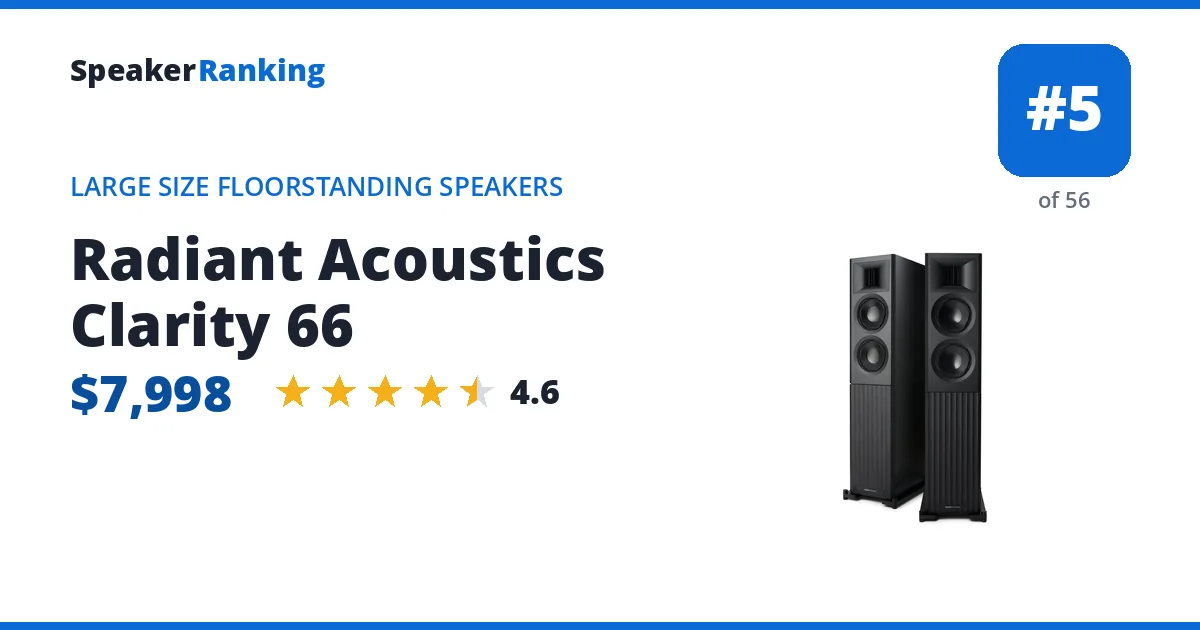
Pros: ASR’s revised Spinorama measurement shows bass reaching 32.2Hz at -3dB and 27.8Hz at -6dB, giving substantial low-end weight without a subwoofer. The response spans 2.3dB from 300Hz to 5kHz, with preference scores of 6.01 standalone and 7.03 with an ideal subwoofer. The review’s exceptionally low bass distortion at ordinary levels complements that extension, while dual 6.5-inch Purifi woofers provide a strong foundation for full-range listening. Measured bass extension of 32.2Hz (-3dB), with a measured sensitivity of 85.9dB.
Cons: Vertical directivity is narrow and horizontal coverage is uneven, so listening height and placement affect tonal balance. Treble resonances and response irregularities keep it from reference-level neutrality. Spinorama’s modeled EQ improves the scores to 6.85 standalone and 7.75 with an ideal subwoofer, but those are corrected results, not stock performance. Measured sensitivity is 85.9dB at 2.83V/1m with a nominal 4-ohm load; use an amplifier comfortable driving 4 ohms. Distortion rises at very high playback levels.
Full Radiant Acoustics Clarity 66 review and specifications →
| Bass Extension (-10dB) | 24.4Hz (measured, Audio Science Review) |
|---|---|
| Bass Extension (-3dB) | 32.2Hz (measured, Audio Science Review) |
| Crossover Frequency | 2.4kHz |
| DIY Kit | No |
| Dimensions | 40.4”H x 8.7”W x 14”D (1025 x 222 x 355 mm) |
| Drivers | Custom waveguide-loaded tweeter with beam-expansion fins, 2x 6.5” Purifi USHINDI aluminum-cone woofers |
| Impedance | 4 ohms nominal |
| Sensitivity | 85.9dB (2.83V/1m, measured, Audio Science Review; 86dB manufacturer specified) |
| Spinorama Preference Score | 6.01 |
| Spinorama Preference Score with Perfect Sub | 7.03 |
| Weight | 101.4 lbs (46 kg) each |
| Woofer Cabinet | ported, large rear port |
- Links
- Reviews, Comparisons and Sound Samples
- Head-to-Head Comparisons
- Radiant Acoustics Clarity 66 vs Ascend Acoustics ELX Ribbon Tower
- Radiant Acoustics Clarity 66 vs Revel F328Be
- Radiant Acoustics Clarity 66 vs MoFi SourcePoint 888
- Radiant Acoustics Clarity 66 vs Revel F226Be
- Radiant Acoustics Clarity 66 vs JBL 4367
- Radiant Acoustics Clarity 66 vs MoFi SourcePoint V10 Master Edition
- Radiant Acoustics Clarity 66 vs KEF Blade Two Meta
- Radiant Acoustics Clarity 66 vs KEF Reference 3 Meta
- See all 25 comparisons
Ranked #13 of 89 in Large Size Floorstanding Speakers - KEF R5 Meta: $3,999.99 per pair Discontinued eBay
Pros: 12th generation 5” Uni-Q coaxial driver array with Metamaterial Absorption Technology (MAT) delivers remarkably smooth, controlled horizontal (±50°) and vertical directivity with near-identical off-axis tracking. Exceptional frequency response linearity through the midrange and treble that takes extremely well to minor parametric EQ adjustments. Constrained Layer Damping cabinet construction and flexible rear ports minimize enclosure resonances and port turbulence. Deliberately tuned low-frequency roll-off profile permits boundary-adjacent room placement near front walls without boomy acoustic buildup. Measured bass extension of 52Hz (-3dB), with a measured sensitivity of 86dB.
Cons: Low-frequency extension (F3 of 52Hz, F10 of 38Hz) requires pairing with a dedicated subwoofer crossed over at 80Hz for high-output home theater or bass-heavy music performance. High-frequency radiation above 7kHz shows a mild on-axis taper (1-2dB downward slope), performing best when listened to 10-20° off-axis. Moderate sensitivity (~86dB SPL average) requires a clean, robust 4-ohm capable amplifier to drive high dynamic peaks without clipping. Discontinued.
Full KEF R5 Meta review and specifications →
| Bass Extension (-10dB) | 38Hz (measured, Erin’s Audio Corner) |
|---|---|
| Bass Extension (-3dB) | 52Hz (measured, Erin’s Audio Corner) |
| DIY Kit | No |
| Dimensions | 42.2”H x 10.7”W x 13.6”D (1073 x 273 x 346 mm) |
| Drivers | 1 in. vented aluminum dome tweeter with MAT, 5 in. aluminum cone midrange, two 5.25 in. hybrid aluminum cone woofers |
| Impedance | 4 ohms nominal |
| Sensitivity | 86dB (measured average, Erin’s Audio Corner) |
| Spinorama Preference Score | 6.33 |
| Spinorama Preference Score with Perfect Sub | 8.07 |
| Weight | 54 lbs (24.5 kg) each |
| Woofer Cabinet | ported, rear |
- Links
- Reviews, Comparisons and Sound Samples
- Head-to-Head Comparisons
Ranked #14 of 89 in Large Size Floorstanding Speakers - Revel F226Be: $7700 per pair Crutchfield eBay
Older model: the Revel F206 (ranked lower, rated 4.5/5).
Smaller model: the Revel M126Be (rated 4.3/5).
Larger models: the Revel F228Be (ranked lower, rated 4.5/5) and the Revel F328Be (ranked higher, rated 4.7/5).
Pros: Compact three-way tower with a beryllium dome tweeter in an acoustic lens waveguide, a dedicated 5.25” mid-range, and dual 6.5” woofers (not a coaxial layout): all Deep Ceramic Composite aluminum cones engineered specifically to avoid breakup outside their crossover bands, and it measures that way: neither the woofers nor the mid-range show breakup spikes even well outside their intended pass bands, and even the front port measures unusually clean (only a mild ~3dB bump around 150Hz, well controlled versus the resonances the reviewer typically sees from ports). On-axis frequency response holds within about ±1.5dB above roughly 65Hz (excellent linearity) and off-axis behavior tracks it closely, with only mild, subdued peaking around 4-6kHz that doesn’t show up as real resonance in the spinorama data. Average sensitivity around 90dB (2.83V/1m), notably higher than some competing three-way designs and most bookshelf speakers, translating directly into better dynamic range at both low and high listening levels: one reviewer specifically praised its ability to deliver full transient impact (snare hits, kick drum) even at quiet, conversational volumes rather than needing to be cranked up to feel dynamic. Wide, consistent horizontal radiation of about ±60-70° at the -6dB point, landing right in the reviewer’s preferred range for an enveloping soundstage without excess diffusion, and exceptionally wide vertical dispersion: roughly ±80° up to 10kHz and still ±70° above that, which one reviewer called the widest vertical radiation pattern he had measured to date. Distortion stays under 3% even at 104dB SPL, and in real-world testing up to 105dB from 12-14 feet away, full-range with no crossover, the reviewer heard no audible mechanical noise, port chuffing, or compression at all. Flat enough on- and off-axis response that toeing the speaker 10-15° away from the listener preserves the same tonal balance rather than changing it, and the wide, well-controlled directivity lets sidewall reflections reinforce rather than smear the soundstage. Measured bass extension of 56Hz (-3dB), with a measured sensitivity of 89.7dB.
Cons: Minimum impedance dips to about 3.7-4 ohms below roughly 500Hz despite the 8-ohm nominal rating, so it wants a genuine 4-ohm-capable two-channel amplifier; budget AVRs rated only for 6 or 8 ohms may struggle. F3 of 56Hz and F10 of 36Hz mean it doesn’t extend nearly as low as some three-way rivals with larger woofers: a dedicated subwoofer (10-12”, or 15” for content below 30Hz) is recommended for home theater or bass-heavy music, even though the speaker itself can play surprisingly loud without one. Vertical directivity tolerance is tighter in the crossover handoff region than a true coaxial design would offer, since the tweeter, midrange, and woofers are physically separated: a mild directivity bump appears around 2-2.5kHz that’s typical of non-coaxial multi-way speakers, though not audibly problematic within about ±10° vertically. On-axis, the top end reads as a bit bright according to one reviewer’s subjective impression, generally benefiting from some toe-out. High-gloss cabinet finish can create distracting reflections if used behind a projector screen in a home theater setup. Front-ported, so it can technically sit close to a wall, but doing so makes the bass boomier.
Full Revel F226Be review and specifications →
| Bass Extension (-10dB) | 36Hz (measured, Erin’s Audio Corner) |
|---|---|
| Bass Extension (-3dB) | 56Hz (measured, Erin’s Audio Corner) |
| DIY Kit | No |
| Dimensions | 41.3”H x 9.8”W x 13.7”D (1049 x 248.9 x 348 mm) |
| Drivers | Two 6.5” (165mm) Deep Ceramic Composite aluminum cones, with cast frames woofer, 5-1/4” (130mm) Deep Ceramic Composite aluminum cone, with cast frame midrange, 1” (25mm) Beryllium dome, with acoustic lens waveguide tweeter |
| Impedance | 8 ohms nominal (3.7 ohms minimum, measured, Erin’s Audio Corner) |
| Sensitivity | 89.7dB (measured, Erin’s Audio Corner) |
| Spinorama Preference Score | 5.96 (spinorama.org) |
| Spinorama Preference Score with Perfect Sub | 8.15 (spinorama.org) |
| Weight | 58.2 lbs (26.4 kg) each |
| Woofer Cabinet | ported, front |
- Links
- Reviews, Comparisons and Sound Samples
- Erin’s Audio Corner: Revel PerformaBe F226Be Floorstanding Loudspeaker Review. I love this speaker. More from Erin’s Audio Corner →
- Erin’s Audio Corner: Should You Buy the Revel F226Be or the MoFi 888?
- Erin’s Audio Review Website Revel F226B
- Erin’s Audio Corner: My Top 5 Speakers at Any Price
- Erin’s Audio Corner Measurements (spinorama.org)
- Head-to-Head Comparisons
Ranked #15 of 89 in Large Size Floorstanding Speakers - JBL 4367: $16,500 per pair Discontinued eBay
Newer model: the JBL 4369, ranked higher, estimated 4.7/5.
Pros: Three-way design pairing a 15” front-ported woofer with a compression driver on a controlled-dispersion horn/waveguide, crossed over at 700Hz. On-axis frequency response is nearly dead flat, holding within about ±1.5dB, with the listening window tracking it closely except right at the crossover. Distortion stays below 1% THD across the entire audible band at both 86dB and 96dB. Compression/dynamic-range linearity is exceptional: within about a quarter of a dB from 76dB to 102dB, among the best the reviewer has measured. High sensitivity (about 92.6dB average) eases the amplifier match despite the speaker’s size. Minimal rear radiation thanks to the 15” woofer’s directivity and front-firing ports: rear energy runs about 20dB down from the primary wavefront, giving it a near-cardioid radiation pattern. Well-controlled horn directivity keeps the soundstage from noticeably shifting in width across the 700Hz crossover region. A natural high-frequency rolloff above about 7-8kHz gives it an easy, non-fatiguing character for extended listening sessions. Measured bass extension of 43Hz (-3dB), with a measured sensitivity of 92.5dB.
Cons: At roughly $16500/pair, this is a major investment: the reviewer recommends buying from a dealer with a liberal return policy. Vertical response shows dips beyond about ±10-20°, with a larger null further out: an inherent trade-off of mating a 15” woofer to a horn compression driver at a 700Hz crossover, since crossing lower would hurt power handling and dynamic range. Horizontal directivity isn’t perfectly consistent with frequency: narrow (about ±20°) through 200-800Hz, briefly widening to near ±50° above the crossover, then narrowing again at high frequency. An unusual, non-constant pattern. The high-frequency rolloff that gives it an easy-listening character also reduces the sense of air and space in the soundstage when listening from off-center seats. Massive and heavy (about 120 lbs, roughly 36-37” tall): needs to be raised on a stand to bring the horn to ear level, and isn’t something one person easily moves alone. Only modest EQ adjustment is available on the speaker itself (about ±1-2dB bass/treble trim). Discontinued.
Full JBL 4367 review and specifications →
| Bass Extension (-10dB) | 31Hz (measured, Erin’s Audio Corner) |
|---|---|
| Bass Extension (-3dB) | 43Hz (measured, Erin’s Audio Corner) |
| DIY Kit | No |
| Dimensions | 37.2”H x 22.2”W x 16.8”D (944.9 x 563.9 x 426.7 mm) |
| Drivers | 15” (380mm) 2216Nd-1 Dual Differential Drive® woofer, 3” (75mm) D2430K dual compression tweeter |
| Impedance | 4 ohms nominal (5.3 ohms minimum above 80Hz, measured by Erin’s Audio Corner) |
| Sensitivity | 92.5dB (measured average, Erin’s Audio Corner) |
| Spinorama Preference Score | 5.07 |
| Spinorama Preference Score with Perfect Sub | 6.88 |
| Weight | 119 lbs (54 kg) each |
| Woofer Cabinet | ported, front |
- Links
- Reviews, Comparisons and Sound Samples
- Head-to-Head Comparisons
 Ranked #16 of 89 in Large Size Floorstanding Speakers - KEF Reference 203: $5,000 per pair Discontinued eBay
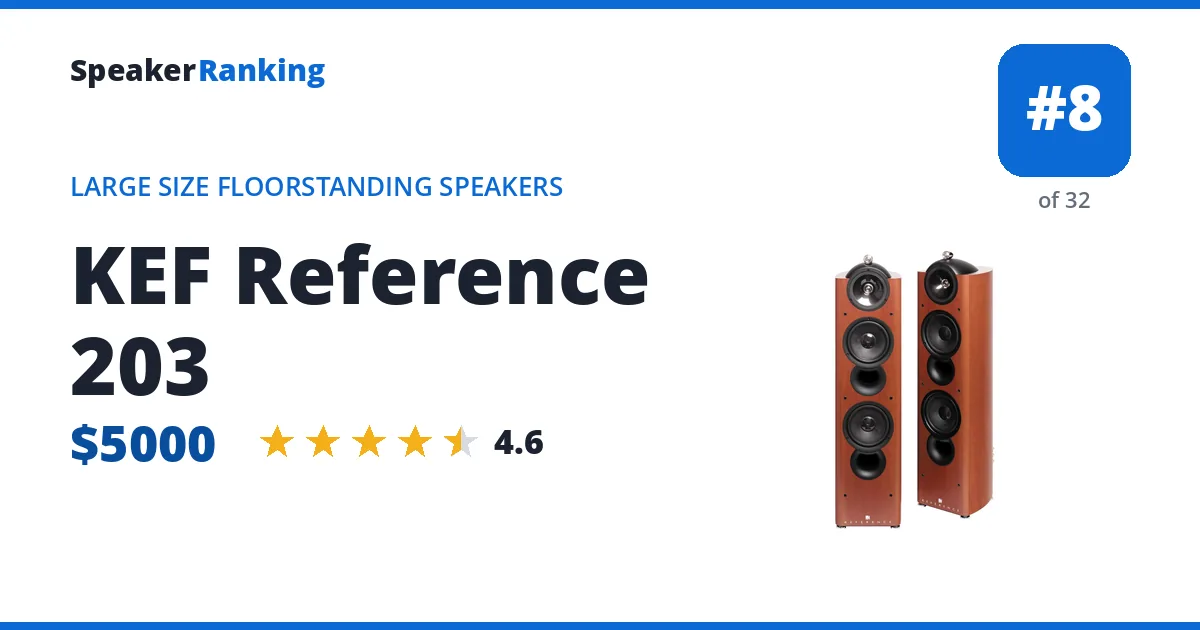
Newer model: the KEF Reference 3 Meta, ranked lower, rated 4.6/5.
Pros: An unusually accomplished 4-way design for its era: excellent on-axis linearity (within about +/-3dB), genuinely good directivity both horizontally (~55 degrees) and vertically (~40-50 degrees), and an estimated in-room response that closely matches what the reviewer actually heard. Distortion is excellent: under 1% harmonic above 80Hz at both 86dB and 96dB, and multitone stays around 1% even at 96dB. Bass reaches a real F3 of 51Hz (F10 37Hz), with in-room extension into the low-mid-40s. The reviewer’s overall listening notes were essentially “nothing stood out bad or good”: a genuinely neutral, accurate speaker with a distinctive rounded-baffle look that avoids the diffraction issues a flat baffle this wide would normally have. Measured bass extension of 51Hz (-3dB), with a measured sensitivity of 88dB.
Cons: This is a 20+ year old, long-discontinued speaker only findable secondhand (Facebook Marketplace, Craigslist, audio forums): condition, driver matching, and component aging vary by unit, so audition before buying if at all possible. Demands a robust amplifier: impedance dips to about 3.6 ohms with an EPDR of 2.2 ohms. The small supertweeter shows minor breakup artifacts at the extremes of the vertical polar plot and some compression at very high output in the top octave, though neither was audible in normal listening.
Full KEF Reference 203 review and specifications →
| Bass Extension (-10dB) | 37Hz (measured, Erin’s Audio Corner) |
|---|---|
| Bass Extension (-3dB) | 51Hz (measured, Erin’s Audio Corner) |
| Crossover Frequency | 400Hz, 2.7kHz, 15kHz |
| DIY Kit | No |
| Dimensions | 42”H (1067H mm) |
| Drivers | 1x 0.75” supertweeter, coaxial 1” dome tweeter + 6.5” midrange, 2x 6.5” woofers |
| Frequency Response | 55Hz - 55kHz ±3dB (Manufacturer specified) |
| Impedance | 8 ohms nominal (3.6 ohms minimum, measured, Erin’s Audio Corner; 3.2 ohms per manufacturer spec) |
| Recommended Power | 50-200W |
| Sensitivity | 88dB (2.83V/1m, measured by Erin’s Audio Corner) |
| Spinorama Preference Score | 5.83 |
| Spinorama Preference Score with Perfect Sub | 7.84 |
| Weight | 58 lbs (26.3 kg) |
| Woofer Cabinet | Bass reflex, with switchable flat/cut/lifted bass ports for wall placement |
- Links
- Reviews, Comparisons and Sound Samples
- Head-to-Head Comparisons
Ranked #19 of 89 in Large Size Floorstanding Speakers - JBL HDI-3800: $5,000 per pair Discontinued eBay
Pros: 2410H-2 1” Teonex compression driver matched to a custom High-Definition Imaging (HDI) horn geometry achieves exceptional horizontal directivity control, high output capability, and effortless transient response. Triple 8” Advanced Aluminum Matrix woofers deliver deep, authoritative bass extension down to an F3 of 37Hz and F10 of 28Hz with minimal low-frequency compression. Outstanding sensitivity (92dB SPL at 2.83V/1m) and ultra-low THD/multitone distortion allow extremely high undistorted SPL output in large home theater spaces. Measured bass extension of 37Hz (-3dB), with a measured sensitivity of 92dB.
Cons: On-axis frequency response features a narrow upper-frequency elevation around 8-10kHz, performing noticeably smoother when toed out 10-20° off-axis. Vertical directivity handoff across the triple woofer layout creates vertical soundstage height tilt depending on listening distance and ear height. Minimum impedance dips to 3.8 ohms, requiring high-current amplifier stability. Substantial cabinet dimensions and 38kg weight require significant room real estate. Discontinued.
Full JBL HDI-3800 review and specifications →
| Bass Extension (-10dB) | 28Hz (measured, Erin’s Audio Corner) |
|---|---|
| Bass Extension (-3dB) | 37Hz (measured, Erin’s Audio Corner) |
| DIY Kit | No |
| Dimensions | 43.3”H x 11.8”W x 16.4”D (1100.5 x 300.0 x 417.8 mm) |
| Drivers | 1 in. 2410H-2 Teonex compression driver with HDI horn, triple 8 in. Advanced Aluminum Matrix cone woofers |
| Impedance | 4 ohms nominal (3.8 ohms minimum, measured by Erin’s Audio Corner) |
| Sensitivity | 92dB (measured average, Erin’s Audio Corner) |
| Spinorama Preference Score | 5.62 |
| Spinorama Preference Score with Perfect Sub | 7.03 |
| Weight | 83.8 lbs (38.0 kg) each |
| Woofer Cabinet | ported, rear |
- Links
- Reviews, Comparisons and Sound Samples
- Head-to-Head Comparisons
 Ranked #24 of 89 in Large Size Floorstanding Speakers - Revel Concerta2 F35: $900 per pair Crutchfield eBay
Smaller model: the Revel Concerta2 M16 (rated 4.1/5).
Pros: Two-and-a-half-way, four-driver design: a 1” aluminum dome tweeter on a waveguide, a 5.25” mid-range, and dual 5.25” mid-bass drivers in a rear-ported cabinet. Measured sensitivity of 89.4dB closely matches the 90dB spec, and distortion looks good at both 86dB and 96dB, holding up well even with a high-pass filter applied. At its sale price of $900/pair, down from full retail, the reviewer calls it a “no-brainer,” undercutting comparable budget floorstanders like the ELAC DF63. Frequency response and directivity mismatches are largely EQ-able, since most of what shows up in measurements traces to physical tweeter/mid-range separation rather than a fundamental flaw. Compression is fairly well controlled for the price: about 1dB of loss around 100Hz under long-term compression, described as “par for the course” at this cost. Measured bass extension of 70Hz (-3dB), with a measured sensitivity of 89.4dB.
Cons: F3 of 61Hz and F10 of 39Hz mean a subwoofer is needed for real bass extension. A dip in the lower midrange/2-3kHz region reduces attack and detail, and a peak around 5kHz adds some edge and sibilance in the lower treble. A peak in off-axis energy around 3kHz reflects off sidewalls at roughly 60-70° off-axis and arrives louder than the direct sound: this specific issue can’t be fixed with EQ (boosting the direct sound would boost the stronger reflection too) and would need acoustic absorption to properly address, though the reviewer considers it a minor, optional fix at this price. A couple of minor resonances appear in the impedance plot, including one around 300Hz that may partly explain a subtle sense of vocal warmth noticed in listening, though it’s more likely room-related. Minimum impedance around 3.8 ohms. Short-term compression testing shows some increased distortion in the tweeter and higher-frequency compression at loud output.
Full Revel Concerta2 F35 review and specifications →
| Bass Extension (-10dB) | 50Hz (measured, Erin’s Audio Corner) |
|---|---|
| Bass Extension (-3dB) | 70Hz (measured, Erin’s Audio Corner) |
| DIY Kit | No |
| Dimensions | 40.3”H x 8.4”W x 12.2”D (1023.6 x 213.4 x 309.9 mm) |
| Drivers | 3x 5.25” deep anodized aluminum cone woofers, 1” Aluminum Tweeter |
| Impedance | 6 ohms nominal (3.8 ohms minimum, measured by Erin’s Audio Corner) |
| Sensitivity | 89.4dB (measured, Erin’s Audio Corner; 90dB manufacturer specified) |
| Spinorama Preference Score | 5.35 |
| Spinorama Preference Score with Perfect Sub | 7.30 |
| Weight | 41 lbs (18.6 kg) each |
| Woofer Cabinet | ported, rear |
- Links
- Reviews, Comparisons and Sound Samples
- Audio Science Review Revel Concerta2 F35 More from Audio Science Review →
- Erin’s Audio Corner: Revel F35 Review: Great Sound, Lower Price! More from Erin’s Audio Corner →
- Erin’s Audio Review Website Revel Concerta2 F35
- Audio Science Review Measurements (spinorama.org)
- Erin’s Audio Corner: You’ve Never Seen a Review Like This. Revel F35 Review (Part 1).
- Head-to-Head Comparisons
- Revel Concerta2 F35 vs Revel F206
- Revel Concerta2 F35 vs Perlisten S7t
- Revel Concerta2 F35 vs Revel F228Be
- Revel Concerta2 F35 vs Revel F208
- Revel Concerta2 F35 vs KEF R5
- Revel Concerta2 F35 vs Focal Chora 816
- Revel Concerta2 F35 vs JBL HDI-3800
- Revel Concerta2 F35 vs KEF R11 Meta
- See all 57 comparisons
 Ranked #27 of 89 in Large Size Floorstanding Speakers - KEF R5: $2,999 per pair Discontinued eBay
Pros: Slim three-way tower with the acoustic advantages of KEF’s coincident Uni-Q midrange/tweeter: horizontal and vertical off-axis responses track the direct sound smoothly, producing stable imaging and a well-behaved directivity index. Erin measured deep low-frequency reach for the cabinet width (77Hz F3 but 33Hz F10) and less than 1% harmonic distortion at 86dB. At 96dB it remains clean when high-passed, and its mild response deviations are suitable for equalization because the radiation pattern stays orderly. Measured bass extension of 77Hz (-3dB), with a measured sensitivity of 86dB.
Cons: The unusual gap between 77Hz F3 and 33Hz F10 indicates a gradual bass contour rather than flat deep-bass output; a subwoofer and roughly 80Hz high-pass are recommended for high-level playback. Erin measured a minimum near 3.5 ohms around 150Hz, although most of the curve remains above 4 ohms, so amplifier quality still matters. Sensitivity is approximately 86dB/2.83V/1m. At 102dB, compression reaches roughly 1dB around 150Hz, showing the limits of the twin 5.25-inch woofers. This original model lacks the Meta version’s MAT rear-wave absorption. Discontinued.
Full KEF R5 review and specifications →
| Bass Extension (-10dB) | 33Hz (measured, Erin’s Audio Corner) |
|---|---|
| Bass Extension (-3dB) | 77Hz (measured, Erin’s Audio Corner) |
| DIY Kit | No |
| Dimensions | 40.4”H x 6.9”W x 13.5”D |
| Drivers | 1” aluminum tweeter coaxial with 5” midrange; dual 5.25” woofers |
| Impedance | Approximately 3.5 ohms minimum near 150Hz (measured, Erin’s Audio Corner) |
| Sensitivity | Approximately 86dB/2.83V/1m (measured, Erin’s Audio Corner) |
| Spinorama Preference Score | 5.78 |
| Spinorama Preference Score with Perfect Sub | 7.40 |
| Weight | 59.5 lbs (27 kg) each |
| Woofer Cabinet | ported, rear |
- Links
- Reviews, Comparisons and Sound Samples
- Head-to-Head Comparisons
 Ranked #28 of 89 in Large Size Floorstanding Speakers - Arendal Sound 1610 Tower 8: $7,600 per pair Arendal Sound eBay
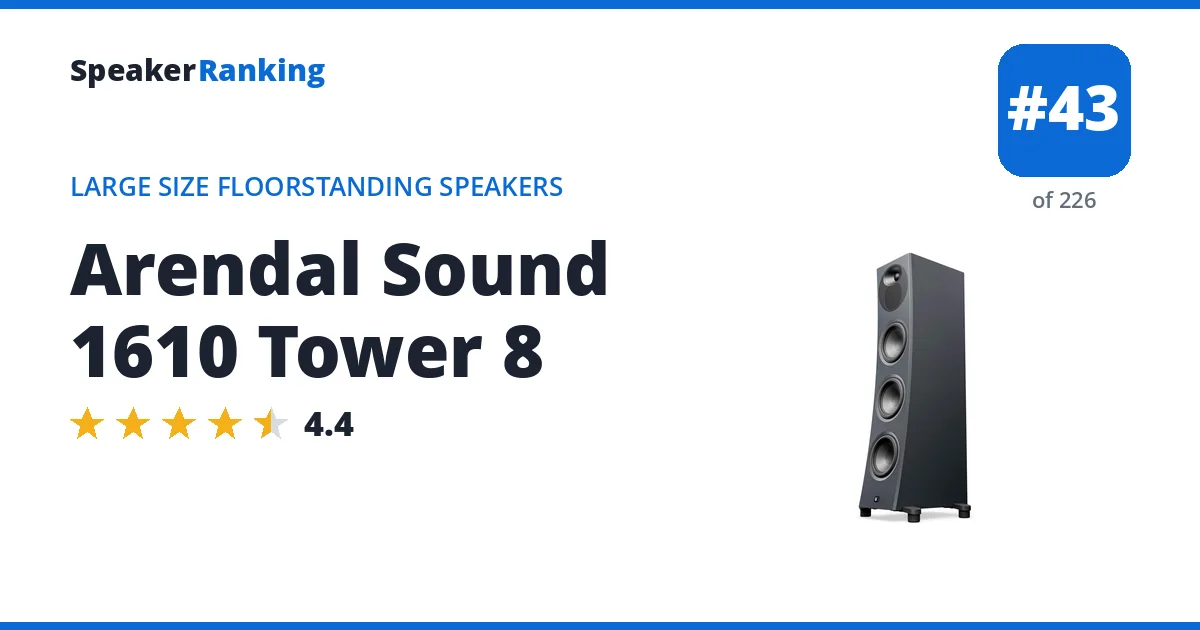
Pros: Arendal’s flagship passive tower, a 5-driver 3-way design with a dedicated carbon-cone midrange in its own sealed sub-enclosure and triple 8” aluminum woofers, measuring a -3dB extension point of 42.8Hz (manufacturer measurement); Erin’s Audio Corner independently measured F3 at 41Hz and F10 at 27Hz, with sensitivity of about 88dB at 2.83V/1m. Listening-window smoothness of 0.687 is strong for a tower this size. Erin’s Audio Corner also measured about plus or minus 60 degrees of horizontal dispersion, a wide-but-focused soundstage the reviewer specifically liked, plus a roughly 2-3dB mid-bass bump around 80Hz that adds real punch and weight to kick drum and low male vocals versus flatter competitors, and lower multi-tone distortion in the higher frequencies than two similarly priced coaxial rivals tested alongside it. Measured bass extension of 27Hz (-10dB), with a measured sensitivity of 89.5dB.
Cons: At 45.4kg each and nearly 4 feet tall, it’s a serious room commitment, and sound-power smoothness (0.378) is more middling than the on-axis figures suggest. Directivity-index standard deviation of 3.69, on the higher side, and a -0.22dB per octave downward tilt both point to a moderately dark tonal character, and predicted in-room smoothness (0.45) is only middling. Erin’s Audio Corner found the same 80Hz mid-bass bump pulls the F3 higher than a flatter tuning would, so bass appears to roll off more sharply below that point, and content under about 40Hz will need a subwoofer. Because it’s a 3-way design with a vertical gap between the tweeter and midrange, there’s a lobing null around 3kHz that causes an audible suck-out just below the tweeter’s axis, worth noting for home theater rows with more than one seating height. A dip through the upper mid-range to lower treble crossover softens the bite of brass and other transient-heavy instruments compared to a flatter response.
Full Arendal Sound 1610 Tower 8 review and specifications →
| Bass Extension (-10dB) | 27Hz (measured, Erin’s Audio Corner) |
|---|---|
| Bass Extension (-3dB) | 41Hz (measured, Erin’s Audio Corner); 42.8Hz (manufacturer measurement) |
| Country | Norway (designed); manufactured overseas |
| DIY Kit | No |
| Dimensions | 115.0H x 26.5W x 45.0D cm (119.8cm tall with feet) |
| Drivers | 28mm Al-Mg dome tweeter, 5” carbon-cone midrange (sealed sub-enclosure), 3x 8” aluminum-cone woofers |
| Enclosure | 3-way, ported (optional sealed configuration) |
| Impedance | 4 ohms nominal |
| Sensitivity | 89.5dB @ 2.83V/1m (manufacturer); 88dB @ 2.83V/1m (measured, Erin’s Audio Corner) |
| Spinorama Preference Score | 7.03 |
| Spinorama Preference Score with Perfect Sub | 8.20 |
| Weight | 100 lbs (45.37 kg) each |
- Links
- Reviews, Comparisons and Sound Samples
- Head-to-Head Comparisons
Ranked #32 of 89 in Large Size Floorstanding Speakers - Arendal 1961 Tower: $1,900 per pair Arendal Sound eBay
Smaller model: the Arendal 1961 Monitor (rated 4.3/5).
Pros: Exceptional output cleanliness for a slim tower: Erin measured under 1% THD to about 100Hz at 96dB/1m and only crossed 3% near 80Hz, while compression was better than several physically larger competitors. The response and listening window are broadly neutral, early-reflections and sound-power directivity are well controlled, and the waveguided dome supports stable imaging. A sealed HDF cabinet, four 5.5-inch woofers and a ten-year warranty provide serious theater-grade engineering in a tiny footprint. Measured bass extension of 62Hz (-3dB), with a measured sensitivity of 86.5dB.
Cons: Erin measured F3 at 62Hz and F10 at 43Hz, so the four woofers prioritize clean output over deep extension; a subwoofer remains necessary. Sensitivity is a moderate 86.5dB and impedance dips below four ohms, which may challenge budget AVRs even though a competent power amplifier has no issue. The optimal axis is roughly 5° above the tweeter and radiation begins narrowing around 1.3kHz, so seat height and toe-in deserve attention.
Full Arendal 1961 Tower review and specifications →
| Bass Extension (-10dB) | 43Hz (measured, Erin’s Audio Corner) |
|---|---|
| Bass Extension (-3dB) | 62Hz (measured, Erin’s Audio Corner) |
| DIY Kit | No |
| Dimensions | 33”H x 6.4”W x 11.2”D (837.5 x 163 x 285 mm) (without feet) |
| Drivers | Four 5.5-inch woofers; 28mm waveguided soft dome |
| Enclosure | Sealed HDF |
| Impedance | 4 ohms nominal; dips below 4 ohms (measured, Erin’s Audio Corner) |
| Sensitivity | 86.5dB/2.83V/1m (measured, Erin’s Audio Corner) |
| Spinorama Preference Score | 4.83 |
| Spinorama Preference Score with Perfect Sub | 7.25 |
| Weight | 39.5 lbs (17.9 kg) each |
- Links
- Reviews, Comparisons and Sound Samples
- Head-to-Head Comparisons
Ranked #33 of 89 in Large Size Floorstanding Speakers - Morel Avyra 633: $2,000 per pair eBay
Pros: A 2.5-way floorstanding tower with two 6” mid-woofers (each with an unusually large 3” voice coil for better power handling) and a dome tweeter; the bottom woofer only covers up to about 250Hz while the top woofer runs all the way to the 2.2kHz crossover point. Easy to drive at a nominal 4 ohms (minimum 3.8 ohms). On-axis linearity measures within about ±2.25dB: genuinely impressive for a tower in this class, enough that the reviewer said he’d have guessed a $4,000-5,000 per pair price just from the look and the data alone. F3 of about 50Hz and F10 of about 32Hz give reasonable kick-drum-level bass without a subwoofer. Wide horizontal radiation around ±70° with good continuity outside the treble region. Harmonic distortion stays under 1% THD to about 100Hz at both 86dB and 96dB, and using an 80Hz subwoofer crossover barely changes midrange distortion: a sign the drive units themselves are good quality rather than excursion-limited. About 20dB of usable dynamic range. No through-holes for spikes, so no risk of dropped hardware during setup. Measured bass extension of 50Hz (-3dB), with a measured sensitivity of 86.5dB.
Cons: A bit bright out of the box: extra tweeter energy in the 4-7kHz region (which also shows up as nonlinearity in the early-reflections directivity data, making it harder to fully correct with EQ) reflects off nearby sidewalls and can sound tipped-up or edgy; a single EQ band (about 4.4kHz, -2dB, Q of 1) or absorption panels placed 60-80° off-axis on the sidewalls resolves it. Best aimed directly at the listener rather than toed out, since the top end already rolls off a little at wider angles. Imaging loses a bit of precision specifically in that lower-treble region. Multitone distortion exceeds the reviewer’s 3% comfort threshold at higher output. Real bass extension below 50Hz still needs a subwoofer. Not the same speaker as the Parts Express “Solstice” DIY kit despite surface similarities: different tweeter, different (ported vs. transmission line) enclosure, and measurably different woofers.
Full Morel Avyra 633 review and specifications →
| Bass Extension (-10dB) | 32Hz (measured, Erin’s Audio Corner) |
|---|---|
| Bass Extension (-3dB) | 50Hz (measured, Erin’s Audio Corner) |
| Country | Israel |
| Crossover Frequency | 250Hz, 2.2kHz |
| DIY Kit | No |
| Dimensions | 38.7”H x 12.8”W x 12.2”D (982 x 326 x 310 mm) |
| Drivers | Dome tweeter, two 6” mid-woofers (3” voice coil) |
| Frequency Response | 25Hz - 20kHz (±3dB, manufacturer specified) |
| Impedance | 4 ohms nominal (3.8 ohms minimum, measured, Erin’s Audio Corner) |
| Recommended Power | 200-1000W |
| Sensitivity | 86.5dB (measured, Erin’s Audio Corner) |
| Spinorama Preference Score | 5.43 |
| Spinorama Preference Score with Perfect Sub | 7.20 |
| Weight | 48.5 lbs (22 kg) each |
| Woofer Cabinet | ported |
- Links
- Reviews, Comparisons and Sound Samples
- Head-to-Head Comparisons
 Ranked #36 of 89 in Large Size Floorstanding Speakers - JBL Studio 698: $1,499.90 per pair Crutchfield eBay
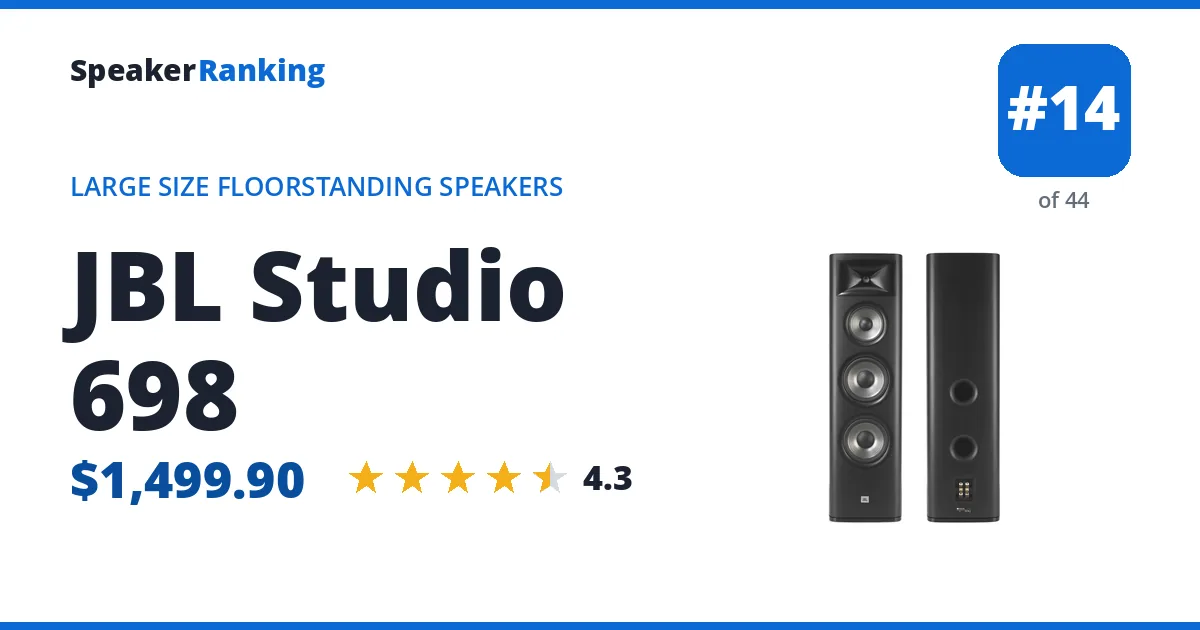
Older model: the JBL Studio 590 (ranked lower, rated 2.8/5).
Pros: High-Definition Imaging (HDI) horn waveguide paired with a 1” compression driver provides excellent high-frequency directivity control and seamless acoustic handoff to the 6” PolyPlas midrange. Dual 8” PolyPlas woofers deliver robust low-end authority with solid bass extension down to an F3 of 53Hz and F10 of 34Hz. High voltage sensitivity (90dB SPL at 2.83V/1m) and clean power handling provide effortless dynamic headroom and low distortion for home theater and music listening. Measured bass extension of 53Hz (-3dB), with a measured sensitivity of 90dB.
Cons: Measured response exhibits a prominent mid-bass emphasis bump around 80Hz that can sound overly thick or chesty in smaller rooms without DSP EQ. Treble response lacks top-octave ‘air’ above 12kHz compared to high-end dome or ribbon tweeters. Physically large, heavy cabinet (35.8 kg per speaker) requires careful room placement and a wide acoustic footprint.
Full JBL Studio 698 review and specifications →
| Bass Extension (-10dB) | 34Hz (measured, Erin’s Audio Corner) |
|---|---|
| Bass Extension (-3dB) | 53Hz (measured, Erin’s Audio Corner) |
| DIY Kit | No |
| Dimensions | 41.7”H x 11.8”W x 15.7”D (1058 x 300 x 400 mm) |
| Drivers | 1 in. High-Definition Imaging compression driver, 6 in. PolyPlas midrange, dual 8 in. PolyPlas woofers |
| Impedance | 6 ohms nominal (4.1 ohms minimum above 80Hz, measured by Erin’s Audio Corner) |
| Sensitivity | 90dB (measured average, Erin’s Audio Corner) |
| Spinorama Preference Score | 4.20 |
| Spinorama Preference Score with Perfect Sub | 6.14 |
| Weight | 78.9 lbs (35.8 kg) each |
| Woofer Cabinet | ported, rear |
- Links
- Reviews, Comparisons and Sound Samples
- Head-to-Head Comparisons
- JBL Studio 698 vs JBL HDI-3600
- JBL Studio 698 vs Polk Audio Reserve R700
- JBL Studio 698 vs Morel Avyra 633
- JBL Studio 698 vs Arendal 1961 Tower
- JBL Studio 698 vs PSB Imagine T65
- JBL Studio 698 vs KEF R11 Meta
- JBL Studio 698 vs Ascend Acoustics Sierra Titan Tower
- JBL Studio 698 vs Emotiva Airmotiv T2+
- See all 52 comparisons
Ranked #39 of 89 in Large Size Floorstanding Speakers - Polk Audio Reserve R700: $2,398 per pair Amazon eBay
Pros: Three-way design with a 1” ring radiator tweeter, 6.5” mid-range, and dual 8” mid-bass drivers in a ported, down-firing cabinet. On-axis frequency response holds within about ±2dB across most of its range, with genuinely deep bass extension (F3 40Hz) reaching into the mid-30s Hz in-room. Wide horizontal radiation of about ±70°, giving a strong, enveloping stereo width and stage-extension effect on well-recorded tracks. Good low-level dynamics: solid bass thump at quiet listening volumes without over-accentuation. Strong distortion and compression control through the bass and midrange. Real nominal impedance closer to 4 ohms than the marketed 8 ohms, so with the right amplifier it can be driven hard: a $3,000 two-channel integrated brought out significantly more life than a budget $300 unit could. Excellent value at its roughly $1199/pair, ranking among the reviewer’s top picks under $2,500; outperforms the similarly-priced Klipsch RP-8000F II in bass extension and overall smoothness. Measured bass extension of 40Hz (-3dB), with a measured sensitivity of 87.5dB.
Cons: Compression in the high frequencies rises sharply between 96dB and 102dB output: a real limitation only at very high volumes (around 100dB at 3 meters), but a clear step down from pricier ($5,000+) towers. Horizontal directivity mismatch around 4-5kHz, where the tweeter flares wider than the midrange, can sound a bit forward, especially noticeable when toed out further into the room; sidewall absorption or curtains help tame it. Harmonic distortion crosses the reviewer’s 3% threshold around 7kHz at 96dB output, possibly contributing to that same forward quality at high volume. Narrow vertical sweet spot (about ±15° from the tweeter axis), typical of non-coaxial tower designs: more of a consideration for multi-row home theater seating than single-row listening. The ring-radiator tweeter narrows noticeably above about 7-8kHz, and toeing the speaker out more than about 20° causes the top end to fall off quickly. Needs at least 2 feet of clearance from the rear wall to avoid boomy, exaggerated bass, since it lacks the bass-shelf tuning some rivals use to allow closer wall placement. Compared to the pricier KEF R5 Meta, has narrower horizontal (and much narrower vertical) directivity, so seating flexibility is more limited.
Full Polk Audio Reserve R700 review and specifications →
| Bass Extension (-10dB) | 31Hz (measured, Erin’s Audio Corner) |
|---|---|
| Bass Extension (-3dB) | 40Hz (measured, Erin’s Audio Corner) |
| DIY Kit | No |
| Dimensions | 45”H x 12.6”W x 16.9”D (1143.8 x 320.7 x 428.3 mm) |
| Drivers | 2x 8” polypropylene cone woofers, 1x 6.5” turbine cone midrange, 1x 1” Pinnacle ring radiator tweeter |
| Impedance | 4 ohms nominal, 3.5 ohms minimum (measured above 80Hz, Erin’s Audio Corner) |
| Sensitivity | 87.5dB (measured average 300Hz-3kHz @ 2.83V/1m, Erin’s Audio Corner) |
| Spinorama Preference Score | 6.38 |
| Spinorama Preference Score with Perfect Sub | 7.83 |
| Weight | 102.1 lbs (46.3 kg) |
| Woofer Cabinet | ported, down-firing |
- Links
- Reviews, Comparisons and Sound Samples
- Head-to-Head Comparisons
- Polk Audio Reserve R700 vs PSB Imagine T65
- Polk Audio Reserve R700 vs JBL HDI-3600
- Polk Audio Reserve R700 vs JBL Studio 698
- Polk Audio Reserve R700 vs Emotiva Airmotiv T2+
- Polk Audio Reserve R700 vs ELAC Debut 3.0 DF63
- Polk Audio Reserve R700 vs Focal Theva N°2
- Polk Audio Reserve R700 vs Polk Reserve R500
- Polk Audio Reserve R700 vs KEF R11 Meta
- See all 46 comparisons
 Ranked #40 of 89 in Large Size Floorstanding Speakers - PSB Imagine T65: $2,699 per pair PSB Speakers eBay
Pros: Three-way design with dual 6.5” woven carbon fiber woofers delivers genuinely strong, extended low end for a $2699 tower: among the better performers Erin has measured in this price class. Distortion shows a clean second-order character with clear separation from third-order all the way up to 96 dB, indicating a well-controlled motor. Compression data shows enhancement rather than compression below about 50-60 Hz, so the bass can sound louder as you turn it up rather than choking off. Wide, forgiving vertical listening window (about ±25°) thanks to the 3-way layout, giving more seating and placement flexibility than most towers. Plenty of dynamic headroom for home theater use or a two-channel system: 100W drove it comfortably in Erin’s room. Measured bass extension of 47Hz (-3dB), with a measured sensitivity of 85.1dB.
Cons: Noticeable dip in the midrange/crossover region that Erin flagged as affecting dialogue and vocal clarity, though he notes a couple bands of EQ smooths it out. Some horizontal dispersion mismatch (about 10-15° of ballooning between 1-3 kHz) between the midrange and tweeter can add extra perceived attack or detail if your room’s sidewalls are reflective. Dips to 4 ohms, so it wants an amplifier comfortable driving a 4-ohm load. Distortion climbs above 3% around 60 Hz at 96 dB, though it’s benign second-order distortion.
Full PSB Imagine T65 review and specifications →
| Bass Extension (-10dB) | 26Hz (measured average, Erin’s Audio Corner) |
|---|---|
| Bass Extension (-3dB) | 47Hz (measured average, Erin’s Audio Corner) |
| Crossover Frequency | 600Hz & 2000Hz, 4th-order Linkwitz-Riley |
| DIY Kit | No |
| Dimensions | 38.8” x 8.4” x 13.5” (986 x 213 x 343 mm) |
| Drivers | 1” titanium dome tweeter, 5.25” woven carbon fiber midrange, 2x 6.5” woven carbon fiber woofers |
| Enclosure | Vented: dual rear slot ports, individual woofer chambers |
| Frequency Response | 28Hz - 20kHz (±1.5dB, manufacturer specified) |
| Impedance | 8 ohms nominal (3.3 ohms minimum measured by Erin’s Audio Corner; manufacturer specifies 4 ohms minimum) |
| Recommended Power | 20-200W |
| Sensitivity | 85.1dB (measured average, Erin’s Audio Corner) |
| Spinorama Preference Score | 5.29 |
| Spinorama Preference Score with Perfect Sub | 6.51 |
| Weight | 44.1 lbs (20 kg) each |
- Links
- Reviews, Comparisons and Sound Samples
- Head-to-Head Comparisons
- PSB Imagine T65 vs Polk Audio Reserve R700
- PSB Imagine T65 vs Emotiva Airmotiv T2+
- PSB Imagine T65 vs JBL HDI-3600
- PSB Imagine T65 vs ELAC Debut 3.0 DF63
- PSB Imagine T65 vs JBL Studio 698
- PSB Imagine T65 vs Polk Reserve R500
- PSB Imagine T65 vs Arendal 1961 Tower
- PSB Imagine T65 vs Infinity Primus 360
- See all 42 comparisons
 Ranked #42 of 89 in Large Size Floorstanding Speakers - Emotiva Airmotiv XT2: $999 per pair Discontinued Estimated Emotiva eBay
Older model: the Emotiva Airmotiv T2+ (ranked lower, rated 4.2/5).
Pros: A three-way tower with a 25mm x 32mm Airmotiv folded ribbon tweeter, a 5.25” woven fiber midrange in its own sub-enclosure, and three 6” long-throw woofers, crossed at 430Hz and 3.1kHz. Emotiva rates it at 40Hz to 27kHz (±3dB) and 90dB (2.83V/1m) efficiency. A 31mm braced baffle, rear port, bi-amp terminals, outrigger feet with spikes, magnetic grilles and a five year warranty.
Cons: No independent measurements have been published yet, so it can’t be compared with the Airmotiv T2+ it replaces, which Erin measured reaching about 32Hz (-10dB) from two 8” woofers. The XT2 swaps those for three 6” woofers. Its 4 ohm load calls for an amplifier of 100W or more that is comfortable with 4 ohms. It weighs 22kg per speaker, and it is sold mainly direct from Emotiva, where it currently shows sold out. Discontinued.
Full Emotiva Airmotiv XT2 review and specifications →
| Crossover Frequency | 430Hz, 3.1kHz |
|---|---|
| DIY Kit | No |
| Dimensions | 44.8”H x 8.5”W x 12.2”D (1137 x 216 x 311 mm) |
| Drivers | 25mm x 32mm folded ribbon tweeter, 5.25” woven fiber midrange, 3x 6” woven fiber woofers |
| Frequency Response | 40Hz - 27kHz ±3dB (Manufacturer specified) |
| Impedance | 4 ohms |
| Recommended Power | 100W or more |
| Sensitivity | 90dB (2.83V/1m, manufacturer specified) |
| Weight | 48.9 lbs (22.2 kg) each |
| Woofer Cabinet | ported, rear |
- Links
- Reviews, Comparisons and Sound Samples
- Head-to-Head Comparisons
 Ranked #43 of 89 in Large Size Floorstanding Speakers - Emotiva Airmotiv T2+: $999 per pair Discontinued Emotiva eBay
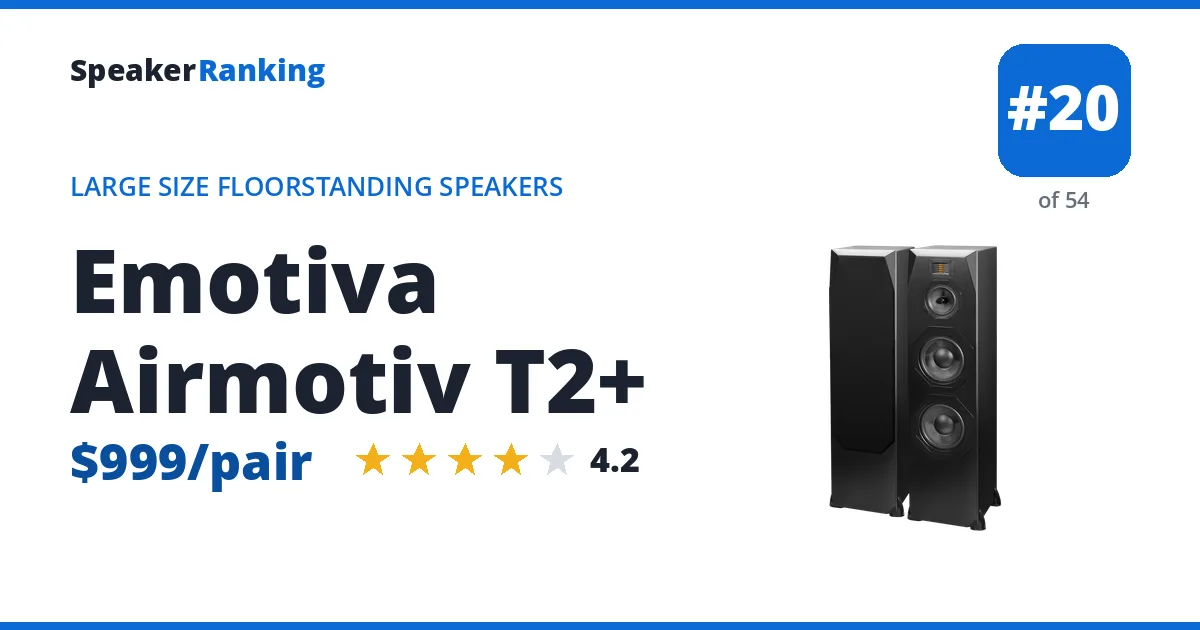
Newer model: the Emotiva Airmotiv XT2, ranked higher, estimated 4.2/5 (also discontinued).
Pros: High-value three-way tower with strong output and unusually deep usable sealed-room bass for the price. Erin measured F3 at 62Hz and F10 at 32Hz, with sensitivity just under 90dB/2.83V/1m. Dual 8-inch woven-fiber woofers relieve the 5.25-inch midrange, and the 32mm folded-ribbon tweeter provides broad horizontal coverage. Approximately +/-2.5dB response linearity, solid cabinet bracing and low compression allow substantial playback levels; the gradual low-frequency roll-off integrates well with either room gain or a subwoofer. Measured bass extension of 62Hz (-3dB), with a measured sensitivity of 89.5dB.
Cons: The nominal 4-ohm system approaches 3 ohms near 100Hz in Erin’s measurement, so a high-current amplifier is preferable. Horizontal and especially vertical directivity through the midrange/tweeter transition is less uniform than the best waveguided or coaxial designs; listener height and nearby reflections matter, and EQ cannot correct the narrowing mismatch. The large rear-ported cabinet needs placement clearance, and its deep F10 should not be confused with flat 30Hz output at cinema levels. Discontinued.
Full Emotiva Airmotiv T2+ review and specifications →
| Bass Extension (-10dB) | 32Hz (measured, Erin’s Audio Corner) |
|---|---|
| Bass Extension (-3dB) | 62Hz (measured, Erin’s Audio Corner) |
| DIY Kit | No |
| Dimensions | 42.7”H x 12.2”W x 12.3”D |
| Drivers | 32mm folded-ribbon tweeter; 5.25” midrange; dual 8” woofers |
| Impedance | Approximately 3 ohms minimum near 100Hz (measured, Erin’s Audio Corner) |
| Sensitivity | Approximately 89.5dB/2.83V/1m (measured, Erin’s Audio Corner) |
| Spinorama Preference Score | 5.56 |
| Spinorama Preference Score with Perfect Sub | 7.14 |
| Weight | 56.9 lbs (25.8 kg) each |
| Woofer Cabinet | ported, rear |
- Links
- Reviews, Comparisons and Sound Samples
- Head-to-Head Comparisons
- Emotiva Airmotiv T2+ vs ELAC Debut 3.0 DF63
- Emotiva Airmotiv T2+ vs Emotiva Airmotiv XT2
- Emotiva Airmotiv T2+ vs Polk Reserve R500
- Emotiva Airmotiv T2+ vs PSB Imagine T65
- Emotiva Airmotiv T2+ vs Polk Audio Reserve R700
- Emotiva Airmotiv T2+ vs Infinity Primus 360
- Emotiva Airmotiv T2+ vs JBL HDI-3600
- Emotiva Airmotiv T2+ vs JBL Studio 698
- See all 26 comparisons
Ranked #44 of 89 in Large Size Floorstanding Speakers - ELAC Debut 3.0 DF63: $1,298 per pair Amazon eBay
Smaller models: the ELAC Debut 3.0 DB63 (rated 4.2/5) and the ELAC Debut 3.0 DB53 (estimated 3.9/5).
Pros: Three-driver floorstanding layout: two 6” dedicated midbase drivers plus a separate 6” mid-range driver (confirmed by measuring different driver impedance/inductance) and a 1” dome tweeter, each woofer given its own stuffed chamber inside the cabinet. The dedicated midrange driver keeps distortion low even at higher output, avoiding the intermodulation grain typical of two-way bookshelf designs. The waveguide keeps high-frequency directivity well controlled, and overall horizontal directivity is good up to about 2kHz. Harmonic distortion looks good at both 86dB and 96dB, and multitone distortion stays below the reviewer’s 3% threshold. A shallow bass rolloff (F3 71Hz, F10 29Hz) lets it extend fairly low without a hard cutoff. Preferred by the reviewer over the similarly-priced Polk R500 (too much high-frequency narrowing, less neutral) and considered ahead of the Polk R700 as well. Measured bass extension of 71Hz (-3dB), with a measured sensitivity of 86.6dB.
Cons: A genuine measured resonance around 200-300Hz (visible in frequency response, impedance, and group delay) causes an audible “droning” coloration on female vocals. A mild peak around 10kHz makes shakers and similar high-frequency percussion jump too far forward in the mix; needed about 2dB of EQ to tame in testing. A dip in the 1-3kHz range gives the speaker a warm, slightly veiled character: the reviewer suspects the tweeter crossover point (around 2-3kHz) is set a bit high and could be lowered to fill this in. Directivity shows a noticeable handoff mismatch around 2.5kHz where the midrange driver hands off to the tweeter, though it’s minor at the -6dB point. Vertical directivity is narrower than horizontal, so listeners need to stay close to the tweeter axis. Low EPDR (about 1.5 ohms minimum) means a Class AB amplifier should be well-ventilated. Best positioned pointed directly at the listener and closer to the front wall: toeing it out into the room causes too much high-frequency rolloff.
Full ELAC Debut 3.0 DF63 review and specifications →
| Bass Extension (-10dB) | 29Hz (measured, Erin’s Audio Corner) |
|---|---|
| Bass Extension (-3dB) | 71Hz (measured, Erin’s Audio Corner) |
| DIY Kit | No |
| Dimensions | 43.1”H x 7.7”W x 10.6”D (1094.7 x 195.6 x 269.2 mm) |
| Drivers | Two 6.5” Aramid Fiber woofer, 6.5” Aramid Fiber midrange, 1” Aluminum Dome tweeter |
| Impedance | 6 ohms nominal (3.4 ohms minimum, measured, Erin’s Audio Corner) |
| Sensitivity | 86.6dB (measured, Erin’s Audio Corner) |
| Spinorama Preference Score | 5.83 |
| Spinorama Preference Score with Perfect Sub | 7.33 |
| Weight | 58.2 lbs (26.4 kg) each |
| Woofer Cabinet | ported, rear |
- Links
- Reviews, Comparisons and Sound Samples
- Head-to-Head Comparisons
- ELAC Debut 3.0 DF63 vs Polk Reserve R500
- ELAC Debut 3.0 DF63 vs Emotiva Airmotiv T2+
- ELAC Debut 3.0 DF63 vs Linkwitz Lab LXmini
- ELAC Debut 3.0 DF63 vs Infinity Primus 360
- ELAC Debut 3.0 DF63 vs PSB Imagine T65
- ELAC Debut 3.0 DF63 vs Polk Audio Reserve R700
- ELAC Debut 3.0 DF63 vs Q Acoustics 5040
- ELAC Debut 3.0 DF63 vs JBL HDI-3600
- See all 42 comparisons
Ranked #45 of 89 in Large Size Floorstanding Speakers - Polk Reserve R500: $1,259.98 per pair Amazon eBay
Smaller model: the Polk Reserve R100 (rated 3.4/5).
Pros: Dual 5.25” midwoofers paired with a ring radiator tweeter in a floorstanding tower design. Surprisingly neutral overall compared to Polk’s smaller bookshelf models: notably more even-handed than the brighter-sounding R200 the reviewer tested previously. Good linearity on-axis, within about -3/+2dB. Sensitivity close to 86dB, easily driven to adequate levels in a small-to-medium room with a 100W-capable amplifier. Takes very well to EQ: a single band of correction (about a 2dB cut around 4-5kHz) resolves the main tonal issue and transforms the sound. Dynamic range and compression performance is solidly “medium,” holding up fine through about 20dB of level increase before higher-frequency and bass output start to taper at extreme volumes. Measured bass extension of 51Hz (-3dB), with a measured sensitivity of 86.2dB.
Cons: A bump around 4-6kHz gives a “shouty,” mildly sibilant quality in the lower treble. Counterintuitively, toeing the speaker out to reduce brightness makes this worse rather than better, since the ring-radiator tweeter’s directivity narrows rapidly above about 6-7kHz: pointed on-axis retains enough top-end air to balance the bump, but toed away that air drops off and the shoutiness stands out more. Bass is adequate for its 5.25” woofers but lacks real weight below about 40-50Hz; a subwoofer is still needed for movies and bass-heavy music. A cabinet resonance around 160-170Hz subtracts from rather than adds boom to the mid-bass region. Vertical listening window is fairly narrow: sitting more than about 10-20° above or below the tweeter axis causes a suckout in the 2-5kHz range, reducing clarity and attack. Multitone distortion ramps up noticeably around 1kHz, and crossing over to a subwoofer at 80Hz doesn’t meaningfully reduce it: likely a surround-related effect rather than excursion-related. Without applying corrective EQ, the reviewer says the 4-6kHz brightness would make it harder to live with day to day.
Full Polk Reserve R500 review and specifications →
| Bass Extension (-10dB) | 33Hz (measured, Erin’s Audio Corner) |
|---|---|
| Bass Extension (-3dB) | 51Hz (measured, Erin’s Audio Corner) |
| DIY Kit | No |
| Dimensions | 40.3”H x 6.8”W x 12.4”D (1023.6 x 172.7 x 315 mm) |
| Drivers | Two 5.25” Turbine Cone woofer, 1” Pinnacle Ring Radiator tweeter |
| Impedance | 4.1 ohms minimum above 80Hz (measured, Erin’s Audio Corner; 8 ohms nominal per manufacturer) |
| Sensitivity | 86.2dB (measured, Erin’s Audio Corner) |
| Spinorama Preference Score | 5.86 |
| Spinorama Preference Score with Perfect Sub | 7.44 |
| Weight | 39.2 lbs (17.8 kg) each |
| Woofer Cabinet | ported, rear |
- Links
- Reviews, Comparisons and Sound Samples
- Head-to-Head Comparisons
- Polk Reserve R500 vs ELAC Debut 3.0 DF63
- Polk Reserve R500 vs Linkwitz Lab LXmini
- Polk Reserve R500 vs Emotiva Airmotiv T2+
- Polk Reserve R500 vs Infinity Primus 360
- Polk Reserve R500 vs PSB Imagine T65
- Polk Reserve R500 vs Q Acoustics 5040
- Polk Reserve R500 vs Polk Audio Reserve R700
- Polk Reserve R500 vs Klipsch Forte IV
- See all 35 comparisons
 Ranked #46 of 89 in Large Size Floorstanding Speakers - Linkwitz Lab LXmini: $505.00 per pair Madisound LXmini Kit eBay
Pros: Open-baffle/dipole upper driver and cylindrical woofer enclosure create a very large, open soundstage with unusually little cabinet signature. Erin praised the stable, well-controlled directivity: despite using a nominal full-range upper driver, off-axis response retains composure beyond its beaming region and the directivity index is smooth enough for reliable DSP voicing. Imaging can be precisely adjusted through placement and toe angle. Erin measured F3 at 50Hz and F10 at 33Hz, impressive for the narrow footprint, and found the system satisfying for much music without a subwoofer. The supplied miniDSP configuration is readily editable; broad shelf correction near 550Hz and a handful of narrow filters can make the response substantially more linear. The kit is mechanically simple, highly customizable and based on well-documented Linkwitz engineering. Measured bass extension of 50Hz (-3dB).
Cons: This is not a conventional passive pair: it requires a construction-plan license, assembly, miniDSP, four matched amplifier channels and careful gain/setup work, so the apparent kit price is not the complete system cost. Output below about 50Hz lacks kick-drum weight and benefits from subwoofers. Erin found rising second-order distortion near 1.5kHz on both samples, accompanied by an impedance blip that may indicate an enclosure reflection or driver-compliance effect. At high output the system behaves as if electronically limited even with miniDSP limiting bypassed, reducing bass and subjective dynamics. Default voicing is less linear than expected, with irregularities above roughly 2kHz, though its controlled directivity makes these correctable. Dipole rear radiation demands meaningful distance from the front wall and makes placement less flexible than a box speaker.
Full Linkwitz Lab LXmini review and specifications →
| Amplifier Power | Four channels, 50W/channel minimum with identical voltage gain |
|---|---|
| Bass Extension (-10dB) | 33Hz (measured, Erin’s Audio Corner) |
| Bass Extension (-3dB) | 50Hz (measured, Erin’s Audio Corner) |
| Crossover Frequency | 700Hz LR2, active DSP |
| DIY Kit | Yes |
| Drivers | 6.5” SEAS woofer in sealed tube, 4” SEAS full-range dipole driver |
| Impedance | 4 ohms upper driver / 8 ohms woofer nominal (separate actively bi-amplified loads; manufacturer specified) |
| Sensitivity | 85dB upper driver / 87dB woofer @ 1W/1m (individual driver specifications; complete active-DSP system sensitivity is not directly specified) |
| Spinorama Preference Score | 3.89 (measured, spinorama.org) |
| Spinorama Preference Score with Perfect Sub | 5.77 (measured, spinorama.org) |
| Woofer Cabinet | sealed cylindrical enclosure; open-baffle upper driver |
- Links
- Reviews, Comparisons and Sound Samples
- Head-to-Head Comparisons
 Ranked #47 of 89 in Large Size Floorstanding Speakers - PS Audio Aspen FR10: $12000 per pair PS Audio eBay
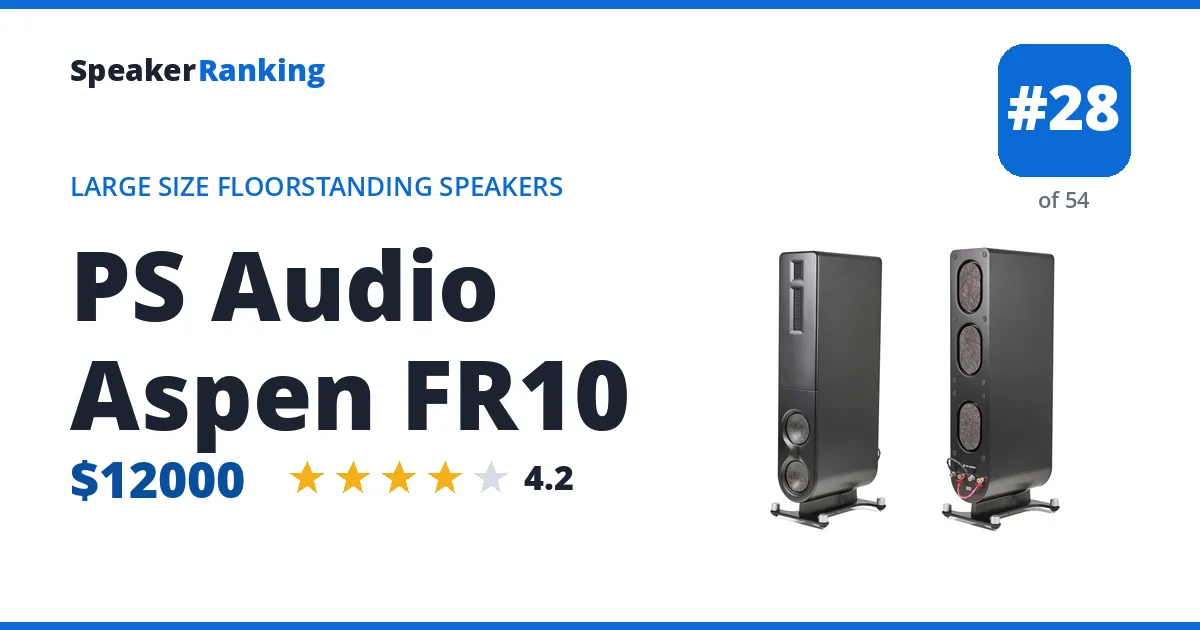
Pros: Distinctive driver layout: two 6” mid-bass drivers plus three 6x9” passive radiators, an 8” planar ribbon mid-range, and a 2.5” planar ribbon tweeter, with the woofers placed low near the floor to counteract typical floor-bounce cancellation in the mid-bass/lower-midrange handoff. Deliberately shelved bass response around 150Hz allows placement closer to the rear wall than typical, without the usual boominess. Extremely wide horizontal dispersion (the -6dB point isn’t reached until about 80-85° off-axis), giving a wide, enveloping soundstage that stays consistent rather than narrowing unevenly at different frequencies. Passed multiple stereo-imaging tests with precise placement despite the wide radiation, keeping instruments distinctly separated even in complex, heavily panned tracks. Exceptionally low multitone distortion at high frequency: among the best the reviewer has measured on any speaker. Bass extends smoothly to an F3 of 47Hz and F10 of 28Hz, potentially usable without a subwoofer for material that doesn’t dig much below 40Hz. Shows output enhancement rather than compression below about 50Hz even at high volume, adding extra punch and attack to bass transients. Measured bass extension of 47Hz (-3dB), with a measured sensitivity of 84.4dB.
Cons: At roughly $12000/pair, expectations are high, and the reviewer found some measured shortfalls relative to that price. A scoop around 600Hz slightly thins out vocal fullness; EQ can restore some body there. A narrow but pronounced dip around 6-7kHz shows up in measurements, though EQ didn’t meaningfully improve it in testing and the reviewer says he’d rather have a dip than a peak in that sibilance-prone region. On-axis, the treble reads as mildly elevated (though far less than some rivals like Martin Logan or Focal); needs about 20° of toe-out, per the manufacturer’s own recommendation, to sound properly balanced and take on a warmer character. Sidewall acoustic treatment should be avoided, since the speaker’s wide, room-filling sound depends on that sidewall interaction, limiting setup flexibility in treated rooms. A minor resonance-like anomaly appears around 800Hz, and some compression shows up at the highest frequencies (around 12kHz) under extreme output testing, though unlikely to be audible in real listening. Large and heavy floorstander (about 76 lbs each, 41” tall).
Full PS Audio Aspen FR10 review and specifications →
| Bass Extension (-10dB) | 28Hz (measured, Erin’s Audio Corner) |
|---|---|
| Bass Extension (-3dB) | 47Hz (measured, Erin’s Audio Corner) |
| DIY Kit | No |
| Dimensions | 41.5”H x 11.8”W x 16.3”D (1054.1 x 298.5 x 412.8 mm) |
| Drivers | 2x 6.5” carbon fiber cone woofers, 1x 8” planar magnetic ribbon midrange, 1x 2.5” planar magnetic ribbon tweeter + 3x passive radiators |
| Impedance | 4 ohms nominal, 3.6 ohms minimum (measured, Erin’s Audio Corner) |
| Sensitivity | 84.4dB (measured, Erin’s Audio Corner) |
| Spinorama Preference Score | 4.08 |
| Spinorama Preference Score with Perfect Sub | 5.40 |
| Weight | 119 lbs (54 kg) |
| Woofer Cabinet | passive radiator |
- Links
- Reviews, Comparisons and Sound Samples
- Head-to-Head Comparisons
 Ranked #48 of 89 in Large Size Floorstanding Speakers - Infinity Primus 360: $650 per pair Discontinued eBay
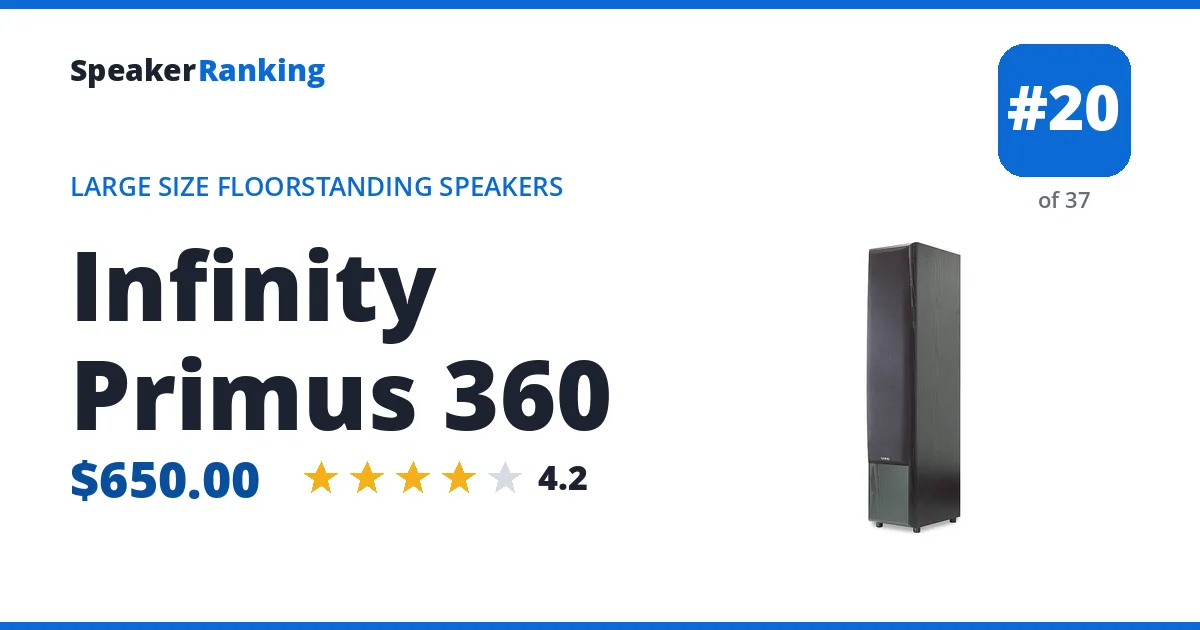
Pros: A three-way tower from 2005 (two 6.5” mid-woofers, a 4” mid-range, and a 0.75” dome tweeter, 8 ohms nominal) that holds up remarkably well by modern measurement standards: on-axis linearity is within about ±2dB, and the listening window stays consistent out to roughly ±30° horizontal and ±10° vertical off the mid-range axis. Horizontal directivity is well controlled out to about ±75° before tonality starts to drift, meaning the reflected sound in a room stays close in character to the direct sound: a speaker that takes EQ well without fighting itself. Harmonic distortion measures low at both 86dB and 96dB, and multitone distortion stays under the reviewer’s 3% threshold. Silky, smooth midrange with a rich lower-midrange/upper-bass character. No mechanical issues or surround degradation found in a 20-year-old pair, and a second unit measured within about 1-1.5dB of the first, suggesting good long-term consistency for the design. Measured bass extension of 53Hz (-3dB), with a measured sensitivity of 89.4dB.
Cons: Manufacturer-spec sensitivity of 93dB runs about 3-4dB optimistic versus the measured 89.4dB average. Bass output drops off fairly quickly below about 50Hz in-room (F3 53Hz, F10 37Hz), so a subwoofer is needed for real low-end extension. Resonances show up around 170Hz, 220Hz, and 350Hz. On-axis, the lower treble can sound a bit bright or sibilant when the speaker is aimed directly at the listener; toeing out about 10-15° (rather than the more extreme 30°) gave the best balance, and some sidewall acoustic absorption further tamed a 4-5kHz peak. Placed close to the rear wall, bass gets boomy: pulling the speakers out about a foot resolves most of it, with roughly 1.5 feet from the wall as a good compromise between bass character and typical room aesthetics. Straying beyond about 25° above or below the mid-range axis introduces audible suckout. No longer in production, so it’s a used/secondhand purchase only.
Full Infinity Primus 360 review and specifications →
| Bass Extension (-10dB) | 37Hz (measured, Erin’s Audio Corner) |
|---|---|
| Bass Extension (-3dB) | 53Hz (measured, Erin’s Audio Corner) |
| Crossover Frequency | 350Hz & 3.3kHz, 24dB/octave |
| DIY Kit | No |
| Dimensions | 39” x 8.2” x 13” (990 x 208 x 330 mm) |
| Drivers | Two 6.5” mid-woofers, 4” mid-range, 0.75” dome tweeter |
| Frequency Response | 38Hz - 20kHz (±3dB, Manufacturer specified) |
| Impedance | 8 ohms nominal, 3.5 ohms minimum (measured, Erin’s Audio Corner) |
| Recommended Power | 10-200W |
| Sensitivity | 89.4dB (measured, Erin’s Audio Corner; 93dB manufacturer specified) |
| Spinorama Preference Score | 4.97 |
| Spinorama Preference Score with Perfect Sub | 7.10 |
| Weight | 48.5 lbs (22 kg) each |
- Reviews, Comparisons and Sound Samples
- Head-to-Head Comparisons
- Infinity Primus 360 vs Linkwitz Lab LXmini
- Infinity Primus 360 vs Q Acoustics 5040
- Infinity Primus 360 vs Klipsch Forte IV
- Infinity Primus 360 vs Polk Reserve R500
- Infinity Primus 360 vs ELAC Debut 3.0 DF63
- Infinity Primus 360 vs KEF Q11 Meta
- Infinity Primus 360 vs Emotiva Airmotiv T2+
- Infinity Primus 360 vs Klipsch RP-5000F II
- See all 31 comparisons
 Ranked #50 of 89 in Large Size Floorstanding Speakers - Q Acoustics 5040: $2,472.98 per pair Amazon eBay
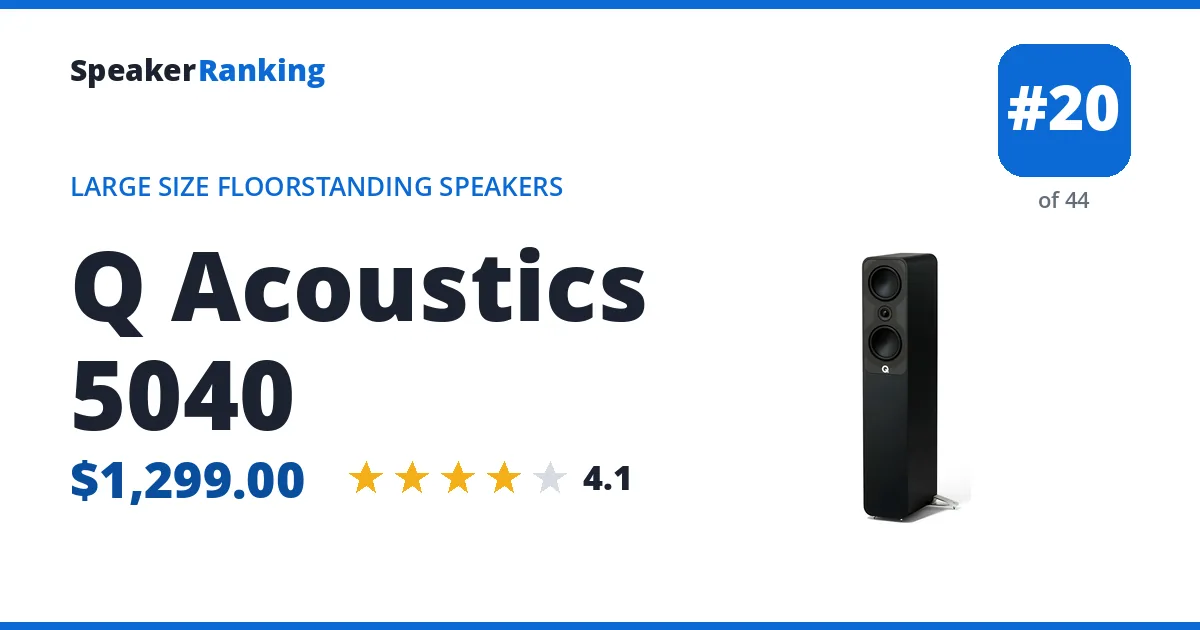
Pros: C3 (Continuous Curved Cone) driver profile technology provides smooth midrange integration, controlled cone breakup, and improved bass damping. High voltage sensitivity (91.5dB SPL at 2.83V/1m) allows loud listening with low-to-moderate amplifier wattage. Cabinet features Point-to-Point (P2P) internal bracing and Helmholtz Pressure Equalizer (HPE) tubes to suppress internal standing waves and panel vibrations. Measured bass extension of 70Hz (-3dB), with a measured sensitivity of 91.5dB.
Cons: Free-field frequency response exhibits a noticeable mid-bass scoop around 200Hz (~6dB lower than mean SPL), causing an F3 of 70Hz (F10 of 39Hz) in open space and requiring boundary placement (11-22 inches from front wall) to reinforce upper bass output. Measurements indicate an enclosure resonance near 300Hz visible in sound power data. Minimum impedance drops to 3.0 ohms, demanding a stable 4-ohm rated amplifier despite high sensitivity.
Full Q Acoustics 5040 review and specifications →
| Bass Extension (-10dB) | 39Hz (measured, Erin’s Audio Corner) |
|---|---|
| Bass Extension (-3dB) | 70Hz (measured, Erin’s Audio Corner) |
| DIY Kit | No |
| Dimensions | 38.1”H x 11.5”W x 14.2”D (967 x 293 x 361 mm) |
| Drivers | 0.88 in. decoupled dome tweeter, twin 5.0 in. C3 Continuous Curved Cone woofers |
| Impedance | 6 ohms nominal (3.0 ohms minimum, measured by Erin’s Audio Corner) |
| Sensitivity | 91.5dB (measured average, Erin’s Audio Corner) |
| Spinorama Preference Score | 3.80 |
| Spinorama Preference Score with Perfect Sub | 6.41 |
| Weight | 39.7 lbs (18.0 kg) each |
| Woofer Cabinet | ported, rear |
- Links
- Reviews, Comparisons and Sound Samples
- Head-to-Head Comparisons
- Q Acoustics 5040 vs Klipsch Forte IV
- Q Acoustics 5040 vs Infinity Primus 360
- Q Acoustics 5040 vs KEF Q11 Meta
- Q Acoustics 5040 vs Polk Reserve R500
- Q Acoustics 5040 vs Klipsch RP-5000F II
- Q Acoustics 5040 vs ELAC Debut 3.0 DF63
- Q Acoustics 5040 vs Emotiva Airmotiv T2+
- Q Acoustics 5040 vs Klipsch RP-8000F II
- See all 42 comparisons
 Ranked #51 of 89 in Large Size Floorstanding Speakers - Klipsch Forte IV: $5,499.98 per pair Amazon Crutchfield eBay
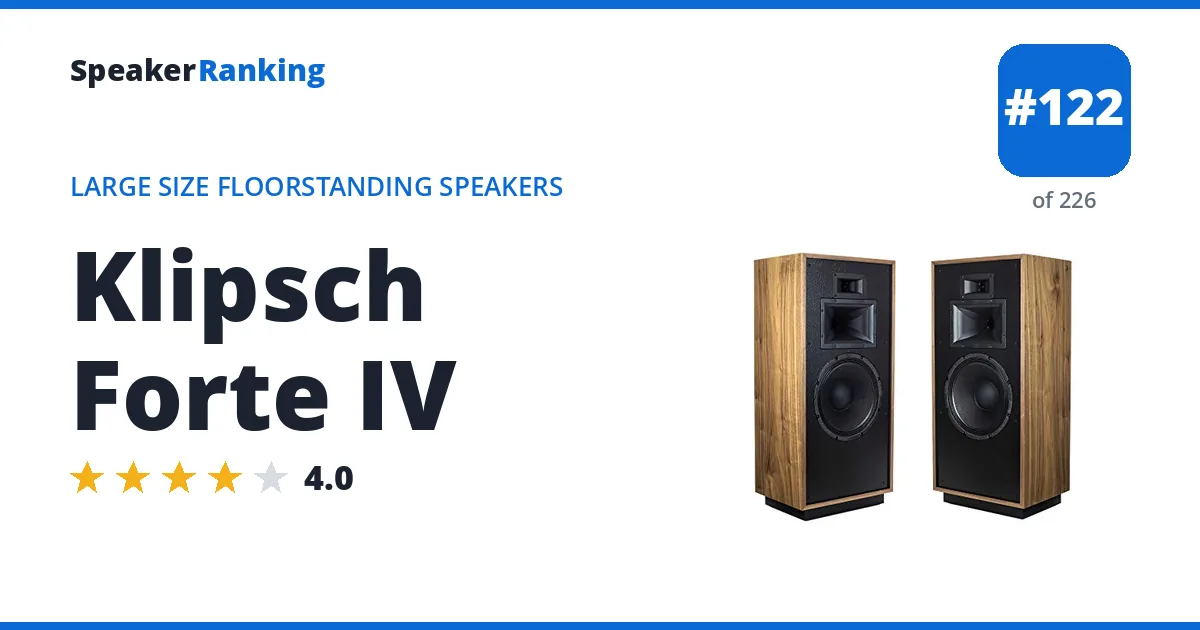
Pros: Three-way heritage design: a 1” titanium tweeter and 1.75” compression driver for the midrange mated to a 12” woofer, plus a 15” passive radiator for extra bass reinforcement. Genuinely resonance-free cabinet, a clear improvement over the notably boomy, resonant Heresy 4 in the same lineup. Surprisingly wide, expansive soundstage that beat both the Heresy 4 and a KEF LS50 Wireless 2 in direct comparison: images occasionally appeared several feet outside the physical speaker location. Deeper bass extension than the Heresy 4 (F3 of 82Hz, about 10Hz lower). Distortion measures well below 1% at 86dB and stays mostly within 1% even at 96dB. Comes as a factory-matched serial-numbered pair, backed by an unusually generous 10-year warranty. Mostly above 4 ohms impedance, so it’s compatible with AVRs, solid-state, or tube amplifiers. More neutral overall than other Klipsch models the reviewer has tested, making it a reasonable pick for listeners who already like the “Klipsch sound” but want something more balanced. Measured bass extension of 82Hz (-3dB), with a measured sensitivity of 93.8dB.
Cons: Contrary to the classic Klipsch reputation for being forward and bright, this model is actually somewhat recessed in the 1.5-4kHz “presence” region, which can make some tracks sound dull or lacking in detail. A peak around 6kHz reads as sibilant and “painful” when seated exactly on the tweeter axis; sitting a bit above that axis reduces it somewhat. Klipsch’s marketed 99dB sensitivity figure is an in-room rating that assumes 3-6dB of boundary gain: anechoic sensitivity measures closer to 94dB, which the manufacturer does disclose but can still mislead buyers comparing spec sheets. Radiation width isn’t consistent across all frequencies: a noticeable notch around 2-3kHz interrupts otherwise wide dispersion, which can cause a fundamental tone and its harmonics to image in slightly different places in the soundstage. Uses shallow low-pass crossover slopes (despite Klipsch’s steep-crossover marketing, which applies only to the high-pass side), likely contributing to some of the measured dips and possible cone-breakup artifacts. Some compression shows up around the midrange crossover point at very high output (102dB), though likely only audible at extreme volumes. At around $5500/pair, a significant investment, and still needs a subwoofer for material extending below about 50Hz.
Full Klipsch Forte IV review and specifications →
| Bass Extension (-10dB) | 39Hz (measured, Erin’s Audio Corner) |
|---|---|
| Bass Extension (-3dB) | 82Hz (measured, Erin’s Audio Corner) |
| DIY Kit | No |
| Dimensions | 36”H x 16.5”W x 13”D (914.4 x 419.1 x 330.2 mm) |
| Drivers | 1x 12” (305mm) fiber-composite woofer + 15” passive radiator, 1x 1.75” compression driver midrange on horn, 1x 1” titanium compression tweeter on horn |
| Impedance | 8 ohms |
| Sensitivity | 93.8dB (measured average, Erin’s Audio Corner; manufacturer rates 99dB in-room / ~94dB anechoic) |
| Spinorama Preference Score | 3.78 |
| Spinorama Preference Score with Perfect Sub | 5.72 |
| Weight | 117.3 lbs (53.2 kg) |
| Woofer Cabinet | passive radiator |
- Links
- Reviews, Comparisons and Sound Samples
- Head-to-Head Comparisons
- Klipsch Forte IV vs Q Acoustics 5040
- Klipsch Forte IV vs KEF Q11 Meta
- Klipsch Forte IV vs Infinity Primus 360
- Klipsch Forte IV vs Klipsch RP-5000F II
- Klipsch Forte IV vs Polk Reserve R500
- Klipsch Forte IV vs ELAC Debut 3.0 DF63
- Klipsch Forte IV vs Klipsch RP-8000F II
- Klipsch Forte IV vs Dynaudio Emit 30
- See all 48 comparisons
 Ranked #52 of 89 in Large Size Floorstanding Speakers - Revival Audio Atalante 5: $5000 per pair Don Better Audio eBay
Pros: Strong, punchy mid-bass at moderate-to-loud volumes with no port chuffing or excursion strain even pushed hard: a rarity at this price. Good bass extension for the class (F3 42Hz, F10 30Hz), reaching about 40Hz in-room with authority. Distortion is very low (under 1% through most of the range) and compression is well controlled outside the extreme top octave. Striking build and looks, with a large 12” woofer and 3” dome midrange that give real visual presence. Measured bass extension of 42Hz (-3dB), with a measured sensitivity of 88.6dB.
Cons: A pronounced on-axis peak around 4kHz creates real glare/shoutiness on some material, and combined with a mid-bass emphasis that overshadows lower-midrange detail at higher volumes, tonal balance can feel inconsistent: the reviewer described some tracks as sounding notably different from the neutral mix. Imaging precision is looser than more directivity-controlled designs (coaxial or waveguide speakers), with instrument placement sounding a bit fuzzy rather than pinpoint. Horizontal directivity fluctuates between about 40-60 degrees rather than staying constant, worst right around the mid/tweeter crossover. Needs real room to breathe: at least 2-3 feet from the rear wall in ported mode (about a foot if sealed via the included port bungs), and benefits from 5-10 degrees of toe-out to tame the top end.
Full Revival Audio Atalante 5 review and specifications →
| Bass Extension (-10dB) | 30Hz (measured, Erin’s Audio Corner) |
|---|---|
| Bass Extension (-3dB) | 42Hz (measured, Erin’s Audio Corner) |
| Country | France |
| Crossover Frequency | 450Hz, 3.5kHz |
| DIY Kit | No |
| Dimensions | 28” x 16.5” x 14” (710 x 420 x 355 mm) |
| Drivers | 1.1” (28mm) dome tweeter, 3” dome midrange, 12” woofer |
| Frequency Response | 28Hz - 22kHz -3dB (Manufacturer specified) |
| Impedance | 4 ohms nominal (3.2 ohms minimum, measured above 80Hz, Erin’s Audio Corner) |
| Power Handling | 30-200W recommended |
| Sensitivity | 88.6dB (2.83V/1m, measured by Erin’s Audio Corner) |
| Spinorama Preference Score | 5.11 |
| Spinorama Preference Score with Perfect Sub | 6.69 |
| Weight | 72.8 lbs (33 kg) |
| Woofer Cabinet | 3-way, switchable ported/sealed via port bungs |
- Links
- Reviews, Comparisons and Sound Samples
- Head-to-Head Comparisons
Ranked #53 of 89 in Large Size Floorstanding Speakers - KEF Q11 Meta: $2,499.98 per pair Amazon eBay
Smaller models: the KEF Q7 Meta (ranked lower, estimated 3.5/5), the KEF Q Concerto Meta (rated 4.6/5), the KEF Q3 Meta (rated 3.4/5) and the KEF Q1 Meta (rated 3.6/5).
Pros: Three-way tower design with a coaxial layout: a 3/4” aluminum dome tweeter (with KEF’s Metamaterial Absorption Technology behind it) mounted at the center of a 4” mid-range, plus three 6.5” bass drivers. Extremely linear estimated in-room response when placed correctly, thanks to a deliberately declining on-axis response paired with well-controlled directivity: a technically sound design philosophy, even though it reads as “dark” in raw anechoic on-axis measurements. In-room bass extension to about 40-50Hz when placed near a wall, thanks to extended bass-shelf tuning. Sounds excellent whether pointed directly at the listener or toed out a full 30° parallel to the back wall: unusually flexible placement. More vertical listening leeway than standard non-coaxial two-way designs, thanks to the coincident tweeter/midrange. Distortion looks good at both 86dB and 96dB, and multitone distortion holds up well too. Comes with a plinth/outrigger kit for stability given its floorstanding height (about 43-44”). Measured bass extension of 60Hz (-3dB), with a measured sensitivity of 88.6dB.
Cons: Genuinely dark-sounding on raw on-axis measurement, and needs a typical room with sidewall reflections (within about 6 feet/2 meters) to sound properly neutral: in a large room with little sidewall interaction, it may sound too dull for some listeners. Must be placed close to a rear wall (about 1 foot) to get proper bass: pulling it out to the “standard” 3-foot audiophile recommendation causes bass output to drop off noticeably. Horizontal radiation of about ±50° is narrower than the reviewer’s preferred ±60°, giving a slightly less enveloping soundstage than some rivals. Notably darker than sibling KEF models in the same product family: measures 2-5dB less top-end energy than the R3 Meta and a few dB less than the Q Concerto Meta. Minor lingering resonances appear in burst decay measurements between 500Hz-1kHz. The tweeter shows some strain at very high output volumes, a limitation the reviewer notes is common even among more budget-friendly speakers generally.
Full KEF Q11 Meta review and specifications →
| Bass Extension (-10dB) | 29Hz (measured, Erin’s Audio Corner) |
|---|---|
| Bass Extension (-3dB) | 60Hz (measured, Erin’s Audio Corner) |
| DIY Kit | No |
| Dimensions | 43.8”H x 12.5”W x 15”D (1112.8 x 317.5 x 381.0 mm) |
| Drivers | 25mm tweeter + dual 165mm drivers |
| Impedance | 4 ohms nominal (3.2 ohms minimum, measured, Erin’s Audio Corner) |
| Sensitivity | 88.6dB (measured, Erin’s Audio Corner) |
| Spinorama Preference Score | 6.72 |
| Spinorama Preference Score with Perfect Sub | 8.03 |
| Weight | 106.9 lbs (48.5 kg) |
| Woofer Cabinet | ported, rear |
- Links
- Reviews, Comparisons and Sound Samples
- Head-to-Head Comparisons
 Ranked #54 of 89 in Large Size Floorstanding Speakers - KLH Model Five: $2,998.00 per pair Amazon Crutchfield eBay
Pros: Exceptionally wide and even horizontal radiation of roughly +/-70-80 degrees gives a spacious soundstage without sacrificing image focus when toed out about 10 degrees. Three rear-panel mid/high attenuation settings are genuinely useful for room and placement matching; Erin preferred Low in his room, with the grille fitted and slight toe-out. The sealed 10-inch acoustic-suspension woofer reaches an Erin-measured F3 near 52Hz and integrates gradually with a subwoofer. At 96dB/1m, harmonic distortion stays mostly below 1%, and multitone distortion is also well controlled. Compression is good at ordinary and high listening levels until the most extreme sweep, supporting convincing dynamics. The included slanted stands aim the unusually low tweeter toward seated ear height. Near-wall placement naturally fills the mild 200Hz baffle-step depression, as the manual intends. Measured bass extension of 52Hz (-3dB), with a measured sensitivity of 85dB.
Cons: On-axis response is visibly irregular because the wide vintage baffle creates diffraction, and the upper/lower midbass mismatch around 200Hz can sound lean away from the intended wall placement. Erin heard a mild 800-900Hz resonance that coincides with a clear impedance blip, plus occasional hardness around the 2-4kHz crossover region at elevated level. Vertical directivity is narrow; the included five-degree slant bases are important because the tweeter otherwise aims below seated ears. The top end rolls off relative to the midrange, producing a warm balance that may not suit listeners seeking maximum air. At the highest test level the tweeter develops substantial compression. Large size, 52lb weight with stand and roughly $2998/pair price are significant commitments, and subwoofers remain necessary for the lowest octave.
Full KLH Model Five review and specifications →
| Bass Extension (-10dB) | 32.2Hz (measured, Erin’s Audio Corner) |
|---|---|
| Bass Extension (-3dB) | 52Hz (measured, Erin’s Audio Corner) |
| DIY Kit | No |
| Dimensions | 26”H x 13.8”W x 11.5”D (660 x 350 x 292 mm) without stand |
| Drivers | 10” paper-cone woofer, 4” paper-cone midrange, 1” aluminum-dome tweeter |
| Impedance | 6 ohms nominal, 3.5 ohms minimum at 140Hz (manufacturer specified) |
| Sensitivity | About 85dB @ 2.83V/1m (measured, Erin’s Audio Corner; 87.5dB free-field manufacturer specified) |
| Spinorama Preference Score | 4.76 |
| Spinorama Preference Score with Perfect Sub | 6.71 |
| Weight | 44.1 lbs (20 kg) each without stand; 52 lbs (23.6 kg) with stand |
| Woofer Cabinet | sealed acoustic suspension |
- Links
- Reviews, Comparisons and Sound Samples
- Head-to-Head Comparisons
 Ranked #55 of 89 in Large Size Floorstanding Speakers - Klipsch RP-5000F II: $1,199.98 per pair B&H Photo Video eBay
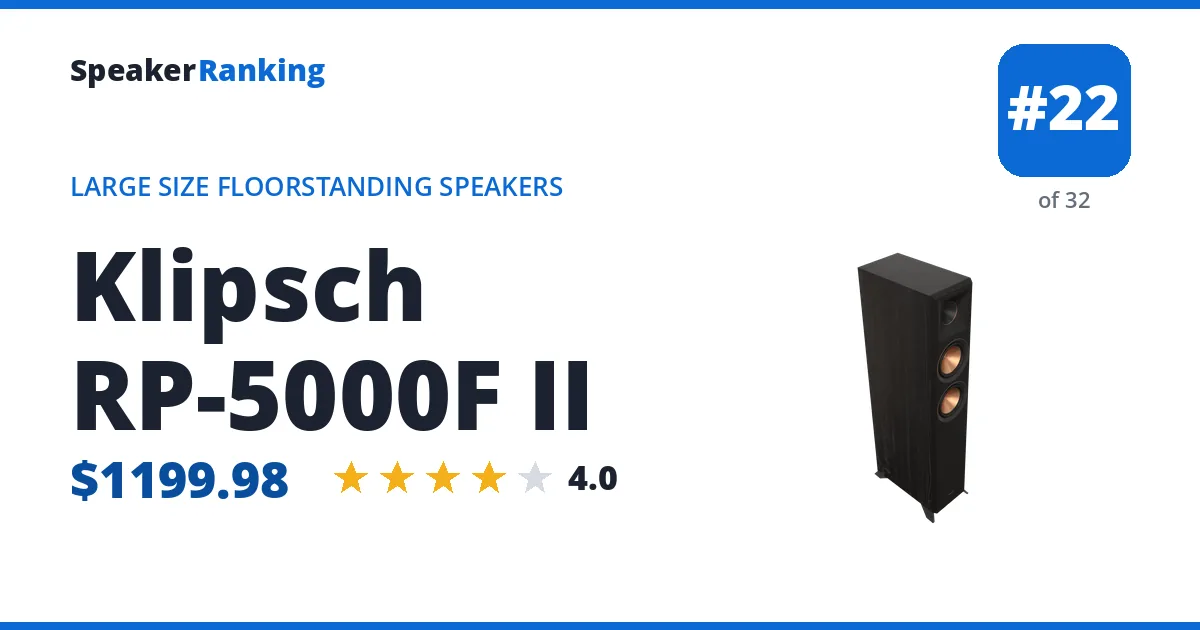
Smaller models: the Klipsch RP-600M II (rated 3.7/5) and the Klipsch RP-500M II (rated 4/5).
Larger models: the Klipsch RP-6000F II (ranked lower, rated 3.9/5) and the Klipsch RP-8000F II (ranked lower, rated 3.9/5).
Pros: The most tonally coherent of the RP II floorstander line, with a mild baffle-step dip and treble tilt but no additional coloration issues beyond that. Precise imaging thanks to the controlled horn/waveguide directivity. Measured bass extension of 55Hz (-3dB), with a measured sensitivity of 90dB.
Cons: Bass extension is underwhelming for a floorstander (F3 at 55Hz, F10 at 41Hz) and needs a subwoofer. Narrow horizontal dispersion (~50-60 degrees) trades soundstage width for imaging precision. A mild high-frequency tilt and a slight lack of detail around 1-1.5kHz.
Full Klipsch RP-5000F II review and specifications →
| Bass Extension (-10dB) | 41Hz (measured, Erin’s Audio Corner) |
|---|---|
| Bass Extension (-3dB) | 55Hz (measured, Erin’s Audio Corner) |
| Crossover Frequency | 1900Hz |
| DIY Kit | No |
| Dimensions | 36.1” x 8.1” x 14.8” (917 x 207 x 375 mm) |
| Drivers | 1” titanium tweeter with Tractrix horn, dual 5.25” cerametallic woofers |
| Frequency Response | 40Hz - 25kHz (+-3dB, Manufacturer specified) |
| Impedance | 8 ohms nominal, 3.3 ohms minimum (measured above 80Hz, Erin’s Audio Corner) |
| Power Handling | 100W continuous, 400W peak |
| Sensitivity | 90dB (2.83V/1m, measured by Erin’s Audio Corner) |
| Spinorama Preference Score | 5.24 |
| Spinorama Preference Score with Perfect Sub | 7.25 |
| Weight | 38.6 lbs (17.5 kg) |
| Woofer Cabinet | ported, rear |
- Links
- Reviews, Comparisons and Sound Samples
- Head-to-Head Comparisons
- Klipsch RP-5000F II vs KEF Q11 Meta
- Klipsch RP-5000F II vs Monolith THX-365T
- Klipsch RP-5000F II vs Klipsch RP-8000F II
- Klipsch RP-5000F II vs Dynaudio Emit 30
- Klipsch RP-5000F II vs Klipsch Forte IV
- Klipsch RP-5000F II vs Klipsch RP-6000F II
- Klipsch RP-5000F II vs Q Acoustics 5040
- Klipsch RP-5000F II vs Infinity Primus 360
- See all 45 comparisons
 Ranked #56 of 89 in Large Size Floorstanding Speakers - Monolith Encore T6: $800 per pair Amazon Monoprice eBay
Pros: Three 6.5-inch pulp-cone drivers provide more displacement and cleaner cinema output than the B6, with good compression behavior at normal levels. Erin found the revised waveguided tweeter’s horizontal radiation consistent enough for predictable EQ, while the gloss-capped, heavily braced 49lb cabinet feels far above its price. The tower can produce useful midbass impact when crossed to a subwoofer. Measured bass extension of ~68Hz (-3dB).
Cons: Despite its size, Erin measured F3 around 68Hz, so the tower does not eliminate the need for a subwoofer. The native response needs equalization: crossover-region unevenness and excess top-octave energy prevent a fully neutral presentation. The four-ohm load and low-frequency phase angle warrant a robust amplifier, and the tall multi-driver array creates a narrower vertical listening window than a compact two-way.
Full Monolith Encore T6 review and specifications →
| Bass Extension (-10dB) | 31.1Hz (measured, Erin’s Audio Corner) |
|---|---|
| Bass Extension (-3dB) | ~68Hz (measured, Erin’s Audio Corner) |
| DIY Kit | No |
| Dimensions | 40H x 7.9W x 13.8D inches |
| Drivers | Three 6.5-inch pulp woofers; 25mm waveguided silk dome |
| Impedance | 4 ohms nominal |
| Sensitivity | 87.8dB/2.83V/1m (manufacturer) |
| Spinorama Preference Score | 4.57 |
| Spinorama Preference Score with Perfect Sub | 6.45 |
| Weight | 49.2 lbs (22.3 kg) each |
- Links
- Reviews, Comparisons and Sound Samples
- Head-to-Head Comparisons
 Ranked #57 of 89 in Large Size Floorstanding Speakers - Monolith THX-365T: $900 per pair Amazon Monoprice eBay
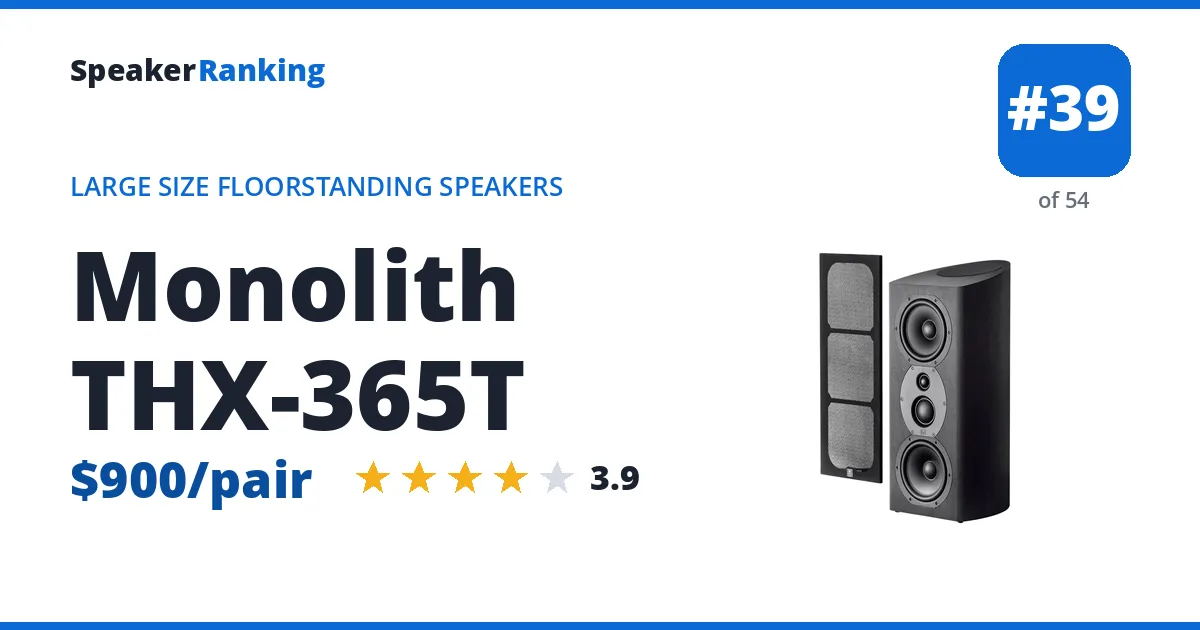
Pros: The coaxial midrange/tweeter produces coherent horizontal and vertical coverage through most of the vocal band, while twin 6.5-inch woofers deliver good 88.6dB measured sensitivity. Erin found low distortion above the bass and useful dynamic capacity for home theater; the sealed enclosure also makes the intended 80Hz THX crossover predictable. An integrated up-firing Atmos module and THX Ultra certification make this a compact, unusually versatile LCR/tower. Measured bass extension of 84Hz (-3dB), with a measured sensitivity of 88.6dB.
Cons: Erin measured F3 at 84Hz (F10 roughly 40Hz), so it categorically needs a subwoofer. Native response has enough upper-mid/treble irregularity that Erin recommended it only with EQ. Although mostly above four ohms, impedance falls to nearly 3 ohms with an adverse phase angle, potentially stressing an AVR; a separate four-ohm-capable amplifier is prudent. The Atmos module adds cost and height but cannot substitute for properly placed ceiling speakers.
Full Monolith THX-365T review and specifications →
| Bass Extension (-10dB) | ~40Hz (measured, Erin’s Audio Corner) |
|---|---|
| Bass Extension (-3dB) | 84Hz (measured, Erin’s Audio Corner) |
| DIY Kit | No |
| Dimensions | 22.9”H x 9.7”W x 10.8”D (581 x 246 x 275 mm) (without grille) |
| Drivers | Dual 6.5-inch woofers; 2-inch coaxial midrange/1-inch dome; 5.25-inch Atmos coaxial |
| Enclosure | Sealed |
| Impedance | 4 ohms nominal; nearly 3 ohms minimum (measured, Erin’s Audio Corner) |
| Sensitivity | 88.6dB/2.83V/1m (measured, Erin’s Audio Corner) |
| Spinorama Preference Score | 3.83 |
| Spinorama Preference Score with Perfect Sub | 6.90 |
| Weight | 28.4 lbs (12.9 kg) each |
- Links
- Reviews, Comparisons and Sound Samples
- Head-to-Head Comparisons
Ranked #58 of 89 in Large Size Floorstanding Speakers - Klipsch RP-8000F II: $1,159.98 per pair Amazon eBay
Smaller models: the Klipsch RP-6000F II (ranked lower, rated 3.9/5), the Klipsch RP-5000F II (ranked higher, rated 4/5), the Klipsch RP-600M II (rated 3.7/5) and the Klipsch RP-500M II (rated 4/5).
Pros: Highest sensitivity of the RP II floorstander line (~92dB measured) and the best dynamics/compression behavior of the three under load: the cleanest at high output. Dual 8-inch woofers and the highest power handling in the line. Measured bass extension of 67Hz (-3dB), with a measured sensitivity of 92dB.
Cons: Mid-bass sounds lean despite the dual 8-inch woofers, and bass extension disappointed for its size: expected to reach 50Hz, didn’t get there in-room. Has its own edgy upper-mid bump (2-6kHz) that’s harder to EQ out than the other two models’ issues, since it stems from the vertical horn/woofer offset rather than simple tonal balance. The most placement-critical of the three, with the narrowest horizontal (~40-50 degrees) and vertical (+5/-10 degrees) dispersion.
Full Klipsch RP-8000F II review and specifications →
| Bass Extension (-10dB) | 33Hz (measured, Erin’s Audio Corner) |
|---|---|
| Bass Extension (-3dB) | 67Hz (measured, Erin’s Audio Corner) |
| Crossover Frequency | 1630Hz |
| DIY Kit | No |
| Dimensions | 43.1” x 10.8” x 18.3” (1095 x 275 x 464 mm) |
| Drivers | 1” titanium tweeter with 90x90 Tractrix horn, dual 8” cerametallic woofers |
| Frequency Response | 35Hz - 25kHz (+-3dB, Manufacturer specified) |
| Impedance | 8 ohms nominal (3.7 ohms minimum above 80Hz, measured by Erin’s Audio Corner) |
| Power Handling | 150W continuous, 600W peak |
| Sensitivity | 92dB (2.83V/1m, measured by Erin’s Audio Corner) |
| Spinorama Preference Score | 5.39 |
| Spinorama Preference Score with Perfect Sub | 7.12 |
| Weight | 61.3 lbs (27.8 kg) |
| Woofer Cabinet | ported, rear |
- Links
- Reviews, Comparisons and Sound Samples
- Head-to-Head Comparisons
- Klipsch RP-8000F II vs Dynaudio Emit 30
- Klipsch RP-8000F II vs Klipsch RP-6000F II
- Klipsch RP-8000F II vs Klipsch RP-5000F II
- Klipsch RP-8000F II vs KLH Model Five
- Klipsch RP-8000F II vs Definitive Technology BP-9020
- Klipsch RP-8000F II vs KEF Q11 Meta
- Klipsch RP-8000F II vs SVS Ultra Evolution Pinnacle
- Klipsch RP-8000F II vs Polk T50
- See all 45 comparisons
 Ranked #59 of 89 in Large Size Floorstanding Speakers - Dynaudio Emit 30: $1,274.25 per pair Amazon eBay
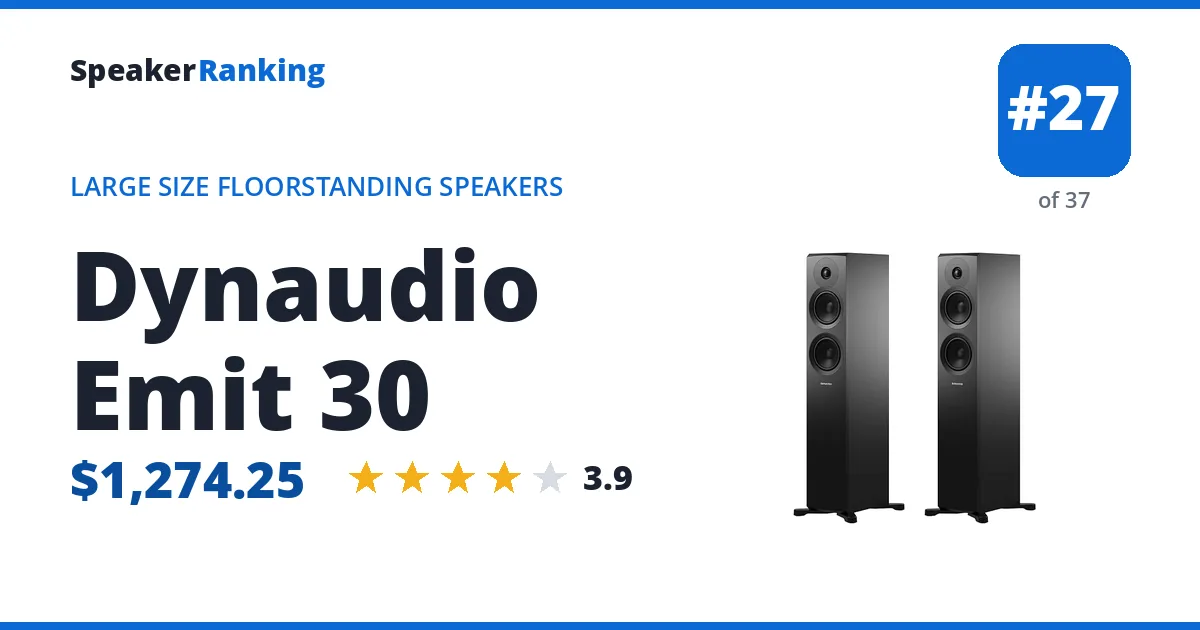
Pros: A 2.5-way floorstander: two 5.25” mid-woofers paired with a roughly 1” dome tweeter, driven through dual rear bass-reflex ports. The two woofers hand off at staggered crossover points (around 1kHz and 3.5kHz) rather than sharing one, which avoids the acoustic lobing a shared crossover point would cause between the tweeter and the lower woofer, and adds a few dB of sensitivity in the process. Genuinely deep bass for a speaker around this price: measured F3 near 44Hz and extends audibly down to about 40Hz in-room without much difficulty. Harmonic distortion measures clean and low at both 86dB and 96dB SPL/1m. Good CTA-2034 sound power and uniform directivity mean the speaker takes EQ correction well if a listener wants to dial in its one tonal weak point. Dynamic range and compression performance are strong overall, with only a minor, high-Q compression artifact tied to a cone-edge resonance that’s unlikely to be audible. Wide, consistent horizontal dispersion around ±70° with just a small ~10° narrowing between 1-3kHz, and a reasonably forgiving ±20° vertical window centered on the tweeter axis. Measured bass extension of 44Hz (-3dB).
Cons: A dip and inconsistency in the lower-treble presence region (roughly 2-5kHz) makes the top end sound uneven (sometimes soft, sometimes forward) depending on the specific instrument or frequency being reproduced; male vocals can lack presence and cymbals can lack sizzle as a result. A cone-edge surround resonance shows up around 1-1.3kHz in burst-decay measurements (a trait the reviewer has also seen on other Dynaudio models) and lines up with elevated multitone distortion across roughly 600Hz-1.5kHz. An enclosure resonance appears around 350Hz in the impedance curve. Placed too close to a rear wall, the dual ports make the bass noticeably boomy: pulling the speaker out is needed to keep the low end from overloading the room. Fully resolving the top-end inconsistency needs a modest EQ correction (roughly +2dB with a Q of about 1, centered 3-6kHz), so out-of-the-box tonal accuracy in that band isn’t quite class-leading despite otherwise strong measured performance.
Full Dynaudio Emit 30 review and specifications →
| Bass Extension (-10dB) | 36Hz (measured, Erin’s Audio Corner) |
|---|---|
| Bass Extension (-3dB) | 44Hz (measured, Erin’s Audio Corner) |
| Country | Denmark |
| DIY Kit | No |
| Dimensions | 35.4”H x 6.7”W x 10.7”D (900.0 x 170.0 x 272.0 mm) |
| Drivers | Dual 5.25” mid-woofers, 1” soft dome tweeter |
| Frequency Response | 44Hz - 25kHz (±3dB, manufacturer specified) |
| Impedance | 4 ohms |
| Power Handling | 180W (IEC rated) |
| Sensitivity | 87dB |
| Spinorama Preference Score | 3.84 |
| Spinorama Preference Score with Perfect Sub | 5.69 |
| Weight | 34.2 lbs (15.5 kg) |
| Woofer Cabinet | ported, rear (dual) |
- Links
- Reviews, Comparisons and Sound Samples
- Head-to-Head Comparisons
- Dynaudio Emit 30 vs Klipsch RP-6000F II
- Dynaudio Emit 30 vs Klipsch RP-8000F II
- Dynaudio Emit 30 vs Definitive Technology BP-9020
- Dynaudio Emit 30 vs SVS Ultra Evolution Pinnacle
- Dynaudio Emit 30 vs Klipsch RP-5000F II
- Dynaudio Emit 30 vs Polk T50
- Dynaudio Emit 30 vs KEF Q11 Meta
- Dynaudio Emit 30 vs Focal Aria Evo X N°2
- See all 44 comparisons
Ranked #60 of 89 in Large Size Floorstanding Speakers - Klipsch RP-6000F II: $1500 per pair Amazon eBay
Smaller models: the Klipsch RP-5000F II (ranked higher, rated 4/5), the Klipsch RP-600M II (rated 3.7/5) and the Klipsch RP-500M II (rated 4/5).
Larger model: the Klipsch RP-8000F II (ranked higher, rated 3.9/5).
Pros: Highest power handling and clean, well-behaved compression at typical volumes. Precise imaging from the controlled horn directivity. Measured bass extension of 67Hz (-3dB), with a measured sensitivity of 90dB.
Cons: Worse baffle-step coloration than the smaller RP-5000F II (3-4dB swing vs 2dB), plus a sibilance issue the 5000F doesn’t have: a real regression in tonal balance despite the higher price. Bass extension is mixed (less deep at -3dB (67Hz) than the 5000F) and needs a subwoofer regardless. Narrow horizontal dispersion (~50-60 degrees).
Full Klipsch RP-6000F II review and specifications →
| Bass Extension (-10dB) | 33Hz (measured, Erin’s Audio Corner) |
|---|---|
| Bass Extension (-3dB) | 67Hz (measured, Erin’s Audio Corner) |
| Crossover Frequency | 1770Hz |
| DIY Kit | No |
| Dimensions | 39.6” x 9.3” x 17.6” (1006 x 236 x 446 mm) |
| Drivers | 1” titanium tweeter with Tractrix horn, dual 6.5” cerametallic woofers |
| Frequency Response | 38Hz - 25kHz (+-3dB, Manufacturer specified) |
| Impedance | 8 ohms nominal (3.7 ohms minimum, measured, Erin’s Audio Corner) |
| Power Handling | 125W continuous, 500W peak |
| Sensitivity | 90dB (2.83V/1m, measured by Erin’s Audio Corner) |
| Spinorama Preference Score | 5.74 |
| Spinorama Preference Score with Perfect Sub | 7.47 |
| Weight | 49.4 lbs (22.4 kg) |
| Woofer Cabinet | ported, rear |
- Links
- Reviews, Comparisons and Sound Samples
- Head-to-Head Comparisons
- Klipsch RP-6000F II vs Dynaudio Emit 30
- Klipsch RP-6000F II vs Klipsch RP-8000F II
- Klipsch RP-6000F II vs Definitive Technology BP-9020
- Klipsch RP-6000F II vs SVS Ultra Evolution Pinnacle
- Klipsch RP-6000F II vs Polk T50
- Klipsch RP-6000F II vs Klipsch RP-5000F II
- Klipsch RP-6000F II vs KEF Q11 Meta
- Klipsch RP-6000F II vs Focal Aria Evo X N°2
- See all 42 comparisons
 Ranked #62 of 89 in Large Size Floorstanding Speakers - Definitive Technology BP-9020: $500 per pair Discontinued eBay
Pros: Integrated powered 8” side-firing subwoofer with a 150-watt Class D amplifier provides exceptional sub-bass extension down to an F3 of 35Hz and F10 of 29Hz without requiring a standalone subwoofer enclosure. Forward-Focused Bipolar Array technology (dual 3.5” front midrange drivers + 1” annealed aluminum dome tweeter, plus a 3.5” rear-firing midrange driver) creates a remarkably wide, spacious soundstage with broad room envelopment. On-axis frequency response stays smooth and relatively neutral when listened to directly aligned with the tweeter. Measured average sensitivity of 87.7dB SPL (2.83V/1m) allows comfortable drive from standard multi-channel receivers. Measured bass extension of 35Hz (-3dB), with a measured sensitivity of 87.7dB.
Cons: Significant high-frequency boost creates notable treble brightness and noticeable sibilance on vocal s-sounds. Bipolar rear driver radiation creates a diffuse soundstage that compromises razor-sharp imaging focus and pinpoint instrument placement. DSP-based internal limiter aggressively compresses output below 80Hz at higher listening levels, causing lower mid-bass and sub-bass impact to diminish as volume increases. Midrange clarity shows slight ‘cuppiness’ and upper-frequency directivity irregularities due to front/rear driver interaction. Discontinued.
Full Definitive Technology BP-9020 review and specifications →
| Bass Extension (-10dB) | 29Hz (measured, Erin’s Audio Corner) |
|---|---|
| Bass Extension (-3dB) | 35Hz (measured, Erin’s Audio Corner) |
| DIY Kit | No |
| Dimensions | 35.3”H x 11”W x 13”D (895.4 x 279.4 x 330.2 mm) |
| Drivers | 1 in. annealed aluminum dome tweeter, two 3.5 in. BDSS midrange (front), one 3.5 in. BDSS midrange (rear), 8 in. powered subwoofer |
| Impedance | 8 ohms nominal |
| Sensitivity | 87.7dB (measured average, Erin’s Audio Corner) |
| Spinorama Preference Score | 5.08 |
| Spinorama Preference Score with Perfect Sub | 6.53 |
| Weight | 30 lbs (13.6 kg) each |
| Woofer Cabinet | ported, slot |
- Links
- Reviews, Comparisons and Sound Samples
- Head-to-Head Comparisons
- Definitive Technology BP-9020 vs SVS Ultra Evolution Pinnacle
- Definitive Technology BP-9020 vs Polk T50
- Definitive Technology BP-9020 vs Klipsch RP-6000F II
- Definitive Technology BP-9020 vs Dynaudio Emit 30
- Definitive Technology BP-9020 vs Klipsch RP-8000F II
- Definitive Technology BP-9020 vs Focal Aria Evo X N°2
- Definitive Technology BP-9020 vs Klipsch RP-5000F II
- Definitive Technology BP-9020 vs KEF Q11 Meta
- See all 37 comparisons
 Ranked #63 of 89 in Large Size Floorstanding Speakers - SVS Ultra Evolution Pinnacle: $2,499.00 per pair Amazon SVS eBay
Smaller models: the SVS Ultra Evolution Titan (ranked higher, estimated 4.2/5), the SVS Ultra Evolution Tower (ranked higher, estimated 4.1/5), the SVS Ultra Evolution Bookshelf (estimated 4/5) and the SVS Ultra Evolution Nano (estimated 3.9/5).
Pros: Flagship three-way tower with a diamond-coated tweeter, dual midranges and four force-balanced 8-inch woofers. Erin measured exceptional 27Hz extension, broad roughly +/-75-degree horizontal coverage, an 88.1dB sensitivity and a 4.91 preference score even without a subwoofer. Measured bass extension of 41.0Hz (-3dB).
Cons: The 5.25-to-8-inch transitions and complex array do not produce class-leading smoothness: 0.184 on-axis, 0.226 predicted in-room and 3.64 directivity-index consistency. At 96.7 pounds each, these are difficult to position, and their Q of 1.25 indicates some bass emphasis. A dip in the upper midrange followed closely by a peak around 2 to 3kHz gives vocals a shouty, forward quality that toe-out alone does not resolve.
Full SVS Ultra Evolution Pinnacle review and specifications →
| Bass Extension (-3dB) | 41.0Hz (measured, Erin’s Audio Corner via spinorama.org) |
|---|---|
| DIY Kit | No |
| Dimensions | 50.2H x 11.8W x 18.1D in |
| Drivers | 1” diamond-coated tweeter, dual 5.25” midranges, quad 8” woofers |
| Enclosure | 3-way passive, dual rear ports |
| Impedance | 6 ohms nominal |
| Sensitivity | 88dB |
| Spinorama Preference Score | 4.91 |
| Spinorama Preference Score with Perfect Sub | 6.13 |
| Weight | 96.8 lbs (43.9 kg) each |
- Links
- Reviews, Comparisons and Sound Samples
- Head-to-Head Comparisons
- SVS Ultra Evolution Pinnacle vs Polk T50
- SVS Ultra Evolution Pinnacle vs Definitive Technology BP-9020
- SVS Ultra Evolution Pinnacle vs Klipsch RP-6000F II
- SVS Ultra Evolution Pinnacle vs Dynaudio Emit 30
- SVS Ultra Evolution Pinnacle vs Focal Aria Evo X N°2
- SVS Ultra Evolution Pinnacle vs Klipsch RP-8000F II
- SVS Ultra Evolution Pinnacle vs Klipsch RP-5000F II
- SVS Ultra Evolution Pinnacle vs Infinity Reference 253
- See all 24 comparisons
 Ranked #65 of 89 in Large Size Floorstanding Speakers - Vandersteen Treo CT: $11,090 per pair Audio Connection eBay
Pros: A time-aligned four-driver floorstander with carbon tweeter, first-order crossovers and exceptional measured bass reach. Erin’s data predicts 27Hz in-room extension, a 4.95 standalone preference score, smooth 0.106 sound power and a 6.17 score with a subwoofer. Measured bass extension of 43.9Hz (-3dB).
Cons: At $11090 per pair, 80 lb each and only 85dB sensitivity, it is costly and amplifier-demanding. The response rises about +0.62dB per octave, horizontal coverage narrows to roughly +/-40 degrees, and on-axis smoothness is only 0.170.
Full Vandersteen Treo CT review and specifications →
| Bass Extension (-10dB) | 22.4Hz (derived, log-interpolated between spinorama.org -9dB/-12dB points) |
|---|---|
| Bass Extension (-3dB) | 43.9Hz (measured, Erin’s Audio Corner via spinorama.org) |
| Country | United States |
| DIY Kit | No |
| Dimensions | 43H x 10W x 15D in |
| Drivers | 1” carbon tweeter, 4.5” midrange, 6.5” woofer, 8” acoustic coupler |
| Enclosure | 4-driver, floorstanding bass-reflex |
| Impedance | 6 ohms nominal, 4 ohms minimum |
| Sensitivity | 85dB |
| Spinorama Preference Score | 4.95 |
| Spinorama Preference Score with Perfect Sub | 6.17 |
| Weight | 80 lbs (36.3 kg) each |
- Links
- Reviews, Comparisons and Sound Samples
- Head-to-Head Comparisons
 Ranked #67 of 89 in Large Size Floorstanding Speakers - Focal Aria Evo X N°2: $4,798 per pair Amazon eBay
Smaller model: the Focal Aria Evo X N°1 (estimated 3.5/5).
Pros: Solid bass with a deliberate mid-bass bump (80-120Hz) that gives extra thump and weight, extending to about 40-50Hz in-room. High sensitivity (measured 88.2dB) makes it easy to drive, and distortion is low throughout the range even at high output: the reviewer found only a minor compression “glare” around 4.5kHz at very high volumes, not a real concern. Directivity components (mid-range and tweeter) transition smoothly rather than abruptly, and the overall soundstage is wide and enveloping. Measured bass extension of 50Hz (-3dB), with a measured sensitivity of 88.2dB.
Cons: Sounds very bright pointed directly at the listener: the tweeter comes in 5-6dB above the midrange with an unusually wide, roughly two-octave dip (1kHz-4kHz) leading into it, giving a laid-back, low-attack character even after toeing out ~20 degrees. Fixing this properly requires real EQ (a mini DSP or similar), not just toe-out or absorption alone; without EQ, expect it to sound bright for stereo listening. A mild dip around 200Hz makes male vocals sound slightly subdued. Narrow vertical directivity (about +/-15 degrees) means you need to stay close to tweeter-axis height. Impedance dips to 3.4 ohms (EPDR 1.4 ohms), so it wants a 4-ohm-capable amplifier, and requires a plinth for floor clearance since it’s bottom-ported.
Full Focal Aria Evo X N°2 review and specifications →
| Bass Extension (-10dB) | 38Hz (measured, Erin’s Audio Corner) |
|---|---|
| Bass Extension (-3dB) | 50Hz (measured, Erin’s Audio Corner) |
| DIY Kit | No |
| Dimensions | 40.7”H x 14.6”W x 11.6”D (1035 x 371 x 294 mm) |
| Drivers | Aluminum-magnesium inverted dome tweeter with waveguide, 6.5” flax midrange, dual 6.5” flax midbass woofers |
| Frequency Response | 45Hz - 30kHz (Manufacturer specified) |
| Impedance | 8 ohms nominal (2.9 ohms minimum, Manufacturer specified; 3.4 ohms minimum measured by Erin’s Audio Corner) |
| Recommended Power | 40-250W |
| Sensitivity | 88.2dB (2.83V/1m, measured by Erin’s Audio Corner; 91.5dB Manufacturer specified) |
| Spinorama Preference Score | 4.88 |
| Spinorama Preference Score with Perfect Sub | 6.82 |
| Weight | 55.1 lbs (25 kg) each |
| Woofer Cabinet | 3-way, bass reflex (bottom-firing port, requires plinth) |
- Links
- Reviews, Comparisons and Sound Samples
- Head-to-Head Comparisons
- Focal Aria Evo X N°2 vs Polk T50
- Focal Aria Evo X N°2 vs SVS Ultra Evolution Pinnacle
- Focal Aria Evo X N°2 vs Polk Audio XT60
- Focal Aria Evo X N°2 vs Infinity Reference 253
- Focal Aria Evo X N°2 vs Definitive Technology BP-9020
- Focal Aria Evo X N°2 vs Magnepan LRS+
- Focal Aria Evo X N°2 vs Klipsch RP-6000F II
- Focal Aria Evo X N°2 vs Dynaudio Emit 30
- See all 47 comparisons
 Ranked #69 of 89 in Large Size Floorstanding Speakers - Polk Audio XT70: $698 per pair Amazon eBay
Pros: The flagship tower in Polk’s current Monitor XT lineup, sitting above the XT60 and XT15 in the same series, adding a second 6.5” woofer and dual 8” passive radiators for more low-end output. Rated for both 4 and 8 ohm operation. Measured bass extension of 43.9Hz (-3dB).
Cons: On-axis smoothness (0.274) and listening-window smoothness (0.303) are unremarkable for a tower this size, with a pronounced +0.28dB per octave upward tonal tilt giving it a brighter-leaning balance and a predicted in-room smoothness of just 0.31. Directivity-index standard deviation of 3.33 is unremarkable either way.
Full Polk Audio XT70 review and specifications →
| Bass Extension (-10dB) | 37.7Hz (derived, sustained-crossing interpolation, Erin’s Audio Corner via spinorama.org) |
|---|---|
| Bass Extension (-3dB) | 43.9Hz (measured, Erin’s Audio Corner via spinorama.org) |
| Country | China |
| DIY Kit | No |
| Dimensions | 40.4H x 9.25W x 12.5D in |
| Drivers | 1” Terylene dome tweeter, 2x 6.5” Dynamic Balance woofers, 2x 8” passive radiators |
| Enclosure | Ported, critically-braced MDF |
| Impedance | 4/8 ohm compatible |
| Sensitivity | 89dB @ 1W/1m |
| Spinorama Preference Score | 5.16 |
| Spinorama Preference Score with Perfect Sub | 7.10 |
| Weight | 35.1 lbs (15.9 kg) each |
- Links
- Reviews, Comparisons and Sound Samples
- Head-to-Head Comparisons
 Ranked #71 of 89 in Large Size Floorstanding Speakers - Polk Audio XT60: $458 per pair Amazon B&H Photo Video Crutchfield eBay
Pros: Passive-radiator-loaded design (6.5” woofer plus two 6.5” passive radiators) gives deeper bass than the driver size alone would suggest: 43.9Hz at -3dB / 38.1Hz at -10dB, genuinely competitive extension for a budget tower. Hi-Res Audio certified, Dolby Atmos/DTS:X compatible, and works with either 4- or 8-ohm amplifier outputs. Measured bass extension of 43.9Hz (-3dB).
Cons: Bass alignment Q (lfq 0.96) is the highest, least-controlled figure in this entire batch, consistent with owner reports of a slightly loose, boomy low end at higher volumes. On-axis response is also relatively uneven, with narrow-band deviation of about 0.51dB. The vinyl-wrapped (not wood veneer) cabinet reads as budget up close per owner reviews, and at least one owner reported blowing a driver under sustained heavy bass: some caution is warranted with bass-heavy source material at volume.
Full Polk Audio XT60 review and specifications →
| Bass Extension (-10dB) | 38.1Hz (measured, spinorama.org) |
|---|---|
| Bass Extension (-3dB) | 43.9Hz (measured, spinorama.org) |
| DIY Kit | No |
| Dimensions | 19.05 x 92.5 x 23.09cm (7.5 x 36.4 x 9.09 in) each |
| Drivers | 1” Terylene dome tweeter, 6.5” bilaminate polypropylene woofer, 2x 6.5” passive radiators |
| Impedance | 4/8-ohm compatible |
| Sensitivity | 86dB (1W/1m) |
| Spinorama Preference Score | 5.19 |
| Spinorama Preference Score with Perfect Sub | 7.13 |
| Weight | 20 lbs (9.07 kg) each |
| Woofer Cabinet | Passive radiator-loaded |
- Links
- Reviews, Comparisons and Sound Samples
- Head-to-Head Comparisons
- Polk Audio XT60 vs Magnepan LRS+
- Polk Audio XT60 vs Polk Audio XT70
- Polk Audio XT60 vs Polk Signature Elite ES60
- Polk Audio XT60 vs Focal Aria Evo X N°2
- Polk Audio XT60 vs JBL Stage 2 280F
- Polk Audio XT60 vs Polk T50
- Polk Audio XT60 vs Definitive Technology BP-9020
- Polk Audio XT60 vs Klipsch RP-6000F II
- See all 40 comparisons
Ranked #73 of 89 in Large Size Floorstanding Speakers - Magnepan LRS+: $1300 per pair Magnepan eBay
Pros: Thin, two-way planar-magnetic open-baffle/dipole panel design (about 48” tall, just 1” deep). Delivers a uniquely dramatic and enveloping soundstage with genuinely three-dimensional depth effects that work across all music genres, not just classical or orchestral material as commonly assumed. Extremely tight, locked-in center-phantom imaging when set up correctly. Open-baffle design avoids the “boxy” enclosure coloration of conventional cabinet speakers. Multitone distortion is remarkably consistent from low to high frequency, a characteristic the reviewer hasn’t observed in conventional cone-and-dome speakers. Compression at high output stays modest (about 0.5-1dB) through the midrange and treble, giving roughly 20-26dB of usable dynamic range in that region. At its price, a strong contender for a dedicated secondary listening room, even if not a main-system replacement. Measured bass extension of 74Hz (-3dB), with a measured sensitivity of 85.1dB.
Cons: Extremely current-hungry and power-hungry: even a pair of 600W Macintosh monoblock amplifiers only averaged about 90dB output. A robust, high-power amplifier is essentially mandatory, and budget amps won’t cut it. Bass rolls off very quickly (F3 74Hz, F10 67Hz, described as falling off “like a rock”), making a subwoofer an absolute requirement for any low-end content. A roughly 3dB dip in the mid-bass (100-300Hz) region thins out vocal body and fullness compared to a conventional bookshelf speaker. A resonance/bump around 400Hz adds a mild boxy quality, though it responds well to about 2dB of EQ correction. Extraordinarily fussy about exact positioning: both seating height (must align with the acoustic reference point between the panel’s lower tie-down points) and horizontal aiming are unusually critical; moving just a couple of inches can cause treble content above roughly 500-600Hz to nearly vanish. Distinct off-axis cancellation zones exist directly to the sides of the panel, where very little sound is audible at all. Fails badly under extreme dynamic-transient testing in the bass, and the reviewer blew fuses pushing the speaker during testing: not built for high-volume or highly dynamic playback. A genuinely different category from conventional hi-fi speakers, requiring more setup patience and experimentation than a typical monopole design.
Full Magnepan LRS+ review and specifications →
| Bass Extension (-10dB) | 67Hz (measured, Erin’s Audio Corner) |
|---|---|
| Bass Extension (-3dB) | 74Hz (measured, Erin’s Audio Corner) |
| DIY Kit | No |
| Dimensions | 48”H x 13.5”W x 1”D (1219.2 x 342.9 x 25.4 mm) |
| Drivers | Full-range planar magnetic dipole panel (48” tall x 13.5” wide); quasi-ribbon design, two-way with separate mid/bass and tweeter ribbon sections |
| Impedance | 4 ohms nominal, 3 ohms minimum (measured, Erin’s Audio Corner) |
| Sensitivity | 85.1dB (measured, Erin’s Audio Corner) |
| Spinorama Preference Score | 1.27 |
| Spinorama Preference Score with Perfect Sub | 4.32 |
| Weight | 30 lbs (13.6 kg) |
| Woofer Cabinet | open baffle |
- Links
- Reviews, Comparisons and Sound Samples
- Head-to-Head Comparisons
 Ranked #75 of 89 in Large Size Floorstanding Speakers - JBL Stage 2 280F: $1,319.90 per pair Amazon eBay
Smaller models: the JBL Stage 250B (rated 3.2/5) and the JBL Stage 2 240B (estimated 2.7/5).
Pros: Genuinely impressive output capability and low compression/distortion for the price, courtesy of the dual 8” woofers: the reviewer’s standout praise for this pair. High sensitivity (89.5dB measured) and low impedance make it easy to drive. Decent bass extension (F3 48Hz, F10 30Hz) reaches about 50Hz in-room. Horizontal dispersion is reasonably consistent (~55 degrees), meaning the speaker takes reasonably well to EQ correction. Measured bass extension of 48Hz (-3dB), with a measured sensitivity of 89.5dB.
Cons: Explicitly called out as disappointing relative to expectations for the JBL name and this price point: lacks native linearity compared to similarly-priced alternatives like the Polk Reserve R500, which the reviewer recommends instead for anyone who doesn’t want to rely on EQ. Treble falls off a cliff above about 10-12kHz, giving a notable lack of air/space that needs real correction (a wide +Q0.5 boost from 10-20kHz) to fix. A sharp impedance resonance around 900Hz-1.1kHz is nearly impossible to EQ out cleanly even with narrow filters. Elevated multitone distortion in the 600Hz-2.5kHz range, tied to the midwoofer rather than the tweeter. Compared to the similarly-priced Klipsch RP-6000F II/RP-8000F II, this JBL is less directive and native-flat but does extend roughly 20Hz deeper in the bass: a real tradeoff either way, not a clean win.
Full JBL Stage 2 280F review and specifications →
| Bass Extension (-10dB) | 30Hz (measured, Erin’s Audio Corner) |
|---|---|
| Bass Extension (-3dB) | 48Hz (measured, Erin’s Audio Corner) |
| Crossover Frequency | 1.1kHz, 2.1kHz |
| DIY Kit | No |
| Dimensions | 43.8” x 14.1” x 16.5” (1113 x 358 x 419 mm) |
| Drivers | 1” anodized aluminum dome tweeter with HDI waveguide, dual 8” polycellulose woofers |
| Impedance | 6 ohms nominal, 3.9 ohms minimum (measured, Erin’s Audio Corner) |
| Power Handling | 125W RMS |
| Sensitivity | 89.5dB (2.83V/1m, measured by Erin’s Audio Corner) |
| Spinorama Preference Score | 4.69 |
| Spinorama Preference Score with Perfect Sub | 6.14 |
| Weight | 55.1 lbs (25 kg) each |
| Woofer Cabinet | ported, rear |
- Links
- Reviews, Comparisons and Sound Samples
- Head-to-Head Comparisons
- JBL Stage 2 280F vs Polk Signature Elite ES60
- JBL Stage 2 280F vs Magnepan LRS+
- JBL Stage 2 280F vs Infinity Reference 253
- JBL Stage 2 280F vs Polk Audio XT60
- JBL Stage 2 280F vs Sony SS-CS3
- JBL Stage 2 280F vs Polk Audio XT70
- JBL Stage 2 280F vs JBL Studio 590
- JBL Stage 2 280F vs Focal Aria Evo X N°2
- See all 40 comparisons
 Ranked #76 of 89 in Large Size Floorstanding Speakers - Dali Rubikore 6: $8000 per pair Safe and Sound HQ eBay
Pros: Unusual 2.5-plus-half-way, four-driver configuration: two woofers overlap up to 800Hz, then one continues alone to about 2600Hz where the tweeter takes over, followed by a supertweeter engaging at 14kHz. A design layout the reviewer says he’d never encountered before. Bass extension reaches a solid 40-45Hz in-room. Distortion is quite low overall, with an especially impressive gap between second- and third-order harmonic distortion in the midwoofers. Wide horizontal radiation of about ±75°, close to the reviewer’s preferred range for an enveloping soundstage. Very good dynamic range, holding up to about 26dB of level increase (70dB to 102dB) with distortion staying within the reviewer’s 3% threshold even at full output. Multiple attractive finish options, including bi-wireable connections. Measured bass extension of 43Hz (-3dB), with a measured sensitivity of 86.4dB.
Cons: On-axis, the treble sits 3-5dB above the midrange (especially around 4kHz), giving a sibilant, hot top end that the manufacturer itself recommends compensating for with 30° of toe-out (firing the speakers straight into the room rather than at the listener). Even with that toe-out, the midrange still reads as somewhat scooped and recessed: the reviewer needed a wide, +2dB EQ boost around 2.5kHz to bring vocals back into proper balance. A high-Q resonance appears around 590Hz, and another shows up around 800Hz in burst decay measurements. Best combined with sidewall absorption to help tame the elevated 4-5kHz energy, adding to setup complexity. Needs specific listening-height positioning: ears should be at the tweeter (not supertweeter) level for the most accurate sound. Without EQ or acoustic treatment, the reviewer found the combination of a hot tweeter and recessed midrange a “tough sale” despite otherwise strong measured performance.
Full Dali Rubikore 6 review and specifications →
| Bass Extension (-10dB) | 31Hz (measured, Erin’s Audio Corner) |
|---|---|
| Bass Extension (-3dB) | 43Hz (measured, Erin’s Audio Corner) |
| DIY Kit | No |
| Dimensions | 39”H x 7.9”W x 15”D (990.0 x 200.0 x 380.0 mm) |
| Drivers | 28mm tweeter + dual 180mm woofers |
| Impedance | 4 ohms nominal (4.3 ohms minimum above 80Hz, measured, Erin’s Audio Corner) |
| Sensitivity | 86.4dB (measured, Erin’s Audio Corner; 88.5dB manufacturer specified) |
| Spinorama Preference Score | 5.27 |
| Spinorama Preference Score with Perfect Sub | 6.96 |
| Weight | 114.9 lbs (52.1 kg) |
| Woofer Cabinet | ported, rear |
- Links
- Reviews, Comparisons and Sound Samples
- Head-to-Head Comparisons
- Dali Rubikore 6 vs Atlantic Technology 8600eLR
- Dali Rubikore 6 vs Endow Audio Bravura 7
- Dali Rubikore 6 vs Børresen X3
- Dali Rubikore 6 vs Focal Aria Evo X N°2
- Dali Rubikore 6 vs PS Audio Aspen FR10
- Dali Rubikore 6 vs JBL Studio 698
- Dali Rubikore 6 vs Revel Concerta2 F35
- Dali Rubikore 6 vs Revel F226Be
 Ranked #78 of 89 in Large Size Floorstanding Speakers - Endow Audio Bravura 7: $14,000 per pair Discontinued eBay
Pros: A genuinely unusual radiation concept: nine small midrange drivers radiate nearly omnidirectionally from roughly 300Hz to 6kHz, producing an exceptionally large, enveloping soundstage and illuminating the sidewalls, floor and ceiling much more evenly than a conventional box. Erin found solid, snappy midbass and measured F3 at 50Hz and F10 at 36Hz. On-axis response below the tweeter transition is broadly linear for such an unconventional array. Multitone distortion remains comparatively well controlled at ordinary levels. The rear passive radiator and 7-inch woofer give useful extension, and the system’s room-filling spatial presentation is unlike a standard forward radiator. Measured bass extension of 50Hz (-3dB), with a measured sensitivity of 82dB.
Cons: The radiation pattern changes abruptly at 6kHz: below it the array is nearly omnidirectional, but the waveguided tweeter collapses to about +/-20 degrees horizontally and less than +/-10 degrees vertically. Ears must remain almost exactly on tweeter axis or the top octave largely disappears. Erin measured very low 81-82dB sensitivity despite the nine-driver array, so substantial amplifier power is required. A 7-8dB high-frequency peak suggests tweeter breakup or diffraction. The small midranges show notable compression at high level; 96dB is acceptable but the 102dB sweep loses significant midrange output, while the woofer compresses below about 60Hz. Harmonic distortion is high around 100Hz at 96dB. Its huge reflected-sound contribution makes results unusually room-dependent, and its price is extremely high for its sensitivity, output limits and discontinuous treble directivity. Discontinued.
Full Endow Audio Bravura 7 review and specifications →
| Bass Extension (-10dB) | 36Hz (measured, Erin’s Audio Corner) |
|---|---|
| Bass Extension (-3dB) | 50Hz (measured, Erin’s Audio Corner) |
| DIY Kit | No |
| Dimensions | 21”H x 9”W x 11”D (533 x 229 x 279 mm) |
| Drivers | 7” woofer, nine 1.5” omnidirectional midrange drivers, waveguided tweeter, rear passive radiator |
| Impedance | 4 ohms nominal, 3.1 ohms minimum above 80Hz; 1.5 ohms minimum EPDR (measured, Erin’s Audio Corner) |
| Sensitivity | 81-82dB (measured, Erin’s Audio Corner) |
| Spinorama Preference Score | 2.67 |
| Spinorama Preference Score with Perfect Sub | 4.62 |
| Weight | 24.3 lbs (11 kg) each |
| Woofer Cabinet | passive radiator, rear |
- Links
- Reviews, Comparisons and Sound Samples
- Head-to-Head Comparisons
 Ranked #79 of 89 in Large Size Floorstanding Speakers - Børresen X3: $11,000 per pair eBay
Pros: A 2.5-way tower built around a planar ribbon tweeter, a 4.5” mid-range driver, and dual 4.5” bass drivers, spec’d at 88dB/1W sensitivity into a 4-ohm nominal load (measured minimum impedance stays a friendly 6.1 ohms above 80Hz, so it doesn’t actually need much power despite the sub-90dB rating). Very wide, remarkably consistent horizontal directivity around ±70° gives an expansive, enveloping soundstage, helped by the reviewer’s pair measuring essentially identically to each other for tight image precision. A pronounced high-Q bass shelf centered around 80Hz (roughly 8dB above the mean level) delivers a punchy, attention-grabbing low-end thump at moderate volumes. Harmonic distortion is clean through the midrange at 86dB, and multitone distortion stays under about 3% even though the low end is handled by relatively small 4.5” drivers rather than something larger. Detailed, extended high frequencies when seated on the tweeter’s intended axis. Measured bass extension of 50Hz (-3dB).
Cons: A significant midrange suckout centered around 200-300Hz measures 8-11dB below the mean SPL, creating an audible hole in the mid-range that multiple independent listeners also flagged unprompted. The 80Hz bass shelf comes with the worst low-frequency ringing the reviewer says he has measured to date on a waterfall plot: it lingers well after the surrounding frequencies have decayed, giving kick drum and bass notes a boomy, one-note quality. Significant dynamic compression sets in as volume rises: bass output near 90Hz drops only about 1.5dB at 86dB SPL, but the loss grows substantially by 96dB and 102dB (around 26dB of total dynamic range), so the appealing bass punch measurably fades at higher listening levels. The upper-midrange and lower treble (2-4kHz) read soft and recessed unless the listener sits almost exactly on the tweeter’s reference axis, within about 15°: the manufacturer’s recommended setup (tweeter aimed above ear height, per their design intent) makes this worse rather than better for a seated listener at normal height. A crossover-related directivity kink between the tweeter and mid-range driver, visible in the vertical response, trades some pinpoint image precision for a more diffuse sense of envelopment compared to smaller two-way designs. Resonances appear in the impedance curve near 300Hz and 2kHz, coinciding with the measured midrange dip.
Full Børresen X3 review and specifications →
| Bass Extension (-10dB) | 25Hz (measured, Erin’s Audio Corner) |
|---|---|
| Bass Extension (-3dB) | 50Hz (measured, Erin’s Audio Corner) |
| Country | Denmark |
| DIY Kit | No |
| Dimensions | 50.8”H x 13.6”W x 23.9”D (1290.0 x 345.0 x 607.0 mm) |
| Drivers | Planar ribbon tweeter, 4.5” mid-range driver, dual 4.5” bass drivers |
| Frequency Response | 35Hz - 50kHz (Manufacturer specified) |
| Impedance | 4 ohms |
| Recommended Power | 50W minimum |
| Sensitivity | 88dB |
| Spinorama Preference Score | 2.38 |
| Spinorama Preference Score with Perfect Sub | 3.50 |
| Weight | 121.3 lbs (55 kg) |
- Links
- Reviews, Comparisons and Sound Samples
- Head-to-Head Comparisons
 Ranked #81 of 89 in Large Size Floorstanding Speakers - Sony SS-CS3: $450 per pair Discontinued eBay
Pros: Affordable entry-level floorstanding tower offering solid sensitivity (88.6dB SPL at 2.83V/1m), making it easy to power with standard budget AVRs. Harmonic distortion remains reasonably low at moderate listening levels (86dB SPL) when high-pass filtered above 80-100Hz with a dedicated subwoofer. Front-ported design allows relatively close placement to front boundaries without excessive port occlusion. Measured bass extension of 72Hz (-3dB), with a measured sensitivity of 88.6dB.
Cons: Severe cabinet and driver resonances plague the passband between 100Hz and 600Hz, imparting audible coloration and chesty resonances to male vocals and acoustic instruments. Irregular frequency response peaks and dips make automated receiver room correction difficult to equalize effectively. Poor low-frequency extension (F3 of 72Hz, F10 of 39Hz) for a floorstander, combined with rapid distortion escalation below 80Hz at higher SPLs (96dB+). Supertweeter driver adds crossover complexity without providing audible high-frequency benefit within the human hearing spectrum. Discontinued.
Full Sony SS-CS3 review and specifications →
| Bass Extension (-10dB) | 39Hz (measured, Erin’s Audio Corner) |
|---|---|
| Bass Extension (-3dB) | 72Hz (measured, Erin’s Audio Corner) |
| DIY Kit | No |
| Dimensions | 36.3”H x 9.1”W x 10.2”D (922 x 230 x 260 mm) |
| Drivers | 0.75 in. supertweeter, 0.98 in. polyester main tweeter, dual 5.12 in. MRC woofers |
| Impedance | 6 ohms nominal |
| Sensitivity | 88.6dB (measured average, Erin’s Audio Corner) |
| Spinorama Preference Score | 4.11 |
| Spinorama Preference Score with Perfect Sub | 6.65 |
| Weight | 25.4 lbs (11.5 kg) each |
| Woofer Cabinet | ported, front |
- Links
- Reviews, Comparisons and Sound Samples
- Head-to-Head Comparisons
 Ranked #83 of 89 in Large Size Floorstanding Speakers - Jamo S807: $299.00 per pair Discontinued Amazon eBay
Pros: A slim 2.5-way tower with two 5-inch woofers and a 1-inch tweeter in a shallow waveguide, with a front slot port so it can sit closer to a wall. Its 8-ohm load stays close to 8 ohms across the range in Erin’s Audio Corner’s measurements, so any receiver drives it easily, and harmonic distortion stays under 0.5% above 200Hz at an 85dB level. Metal fasteners on top accept Jamo’s S8 ATM Dolby Atmos elevation module. Measured bass extension of 51.9Hz (-3dB), with a measured sensitivity of 84dB.
Cons: Erin’s Audio Corner’s measurements show a smiley-face tuning: boosted bass around 80Hz and boosted treble with the dialogue range sitting 3 to 5dB lower, plus a resonance near 400Hz. The listening window spans 4.6dB between 300Hz and 5kHz, the predicted in-room response is rough (0.39 smoothness) and the preference score is 3.84 (5.94 with an ideal subwoofer). Measured sensitivity is about 84dB against the 90dB claim, and it loses about 2dB to compression at 40Hz at loud listening levels. Erin’s verdict was not to buy it. Jamo has phased out the Studio 8 series it belongs to, so it is mainly a used buy. Discontinued.
Full Jamo S807 review and specifications →
| Bass Extension (-10dB) | 36.2Hz (measured, Erin’s Audio Corner) |
|---|---|
| Bass Extension (-3dB) | 51.9Hz (measured, Erin’s Audio Corner) |
| DIY Kit | No |
| Dimensions | 36”H x 7.5”W x 9.9”D (915 x 191 x 252 mm) |
| Drivers | 2x 5” woofer, 1” tweeter with waveguide (2.5-way) |
| Impedance | 8 ohms nominal (manufacturer specified) |
| Power Handling | 100W rated, 200W peak (manufacturer specified) |
| Sensitivity | 84dB (measured average 300Hz-3kHz, Erin’s Audio Corner; 90dB manufacturer specified) |
| Spinorama Preference Score | 3.84 |
| Spinorama Preference Score with Perfect Sub | 5.94 |
| Weight | 26 lbs (11.8 kg) each |
| Woofer Cabinet | ported, front slot |
- Links
- Reviews, Comparisons and Sound Samples
- Head-to-Head Comparisons
 Ranked #85 of 89 in Large Size Floorstanding Speakers - Klipsch Heresy IV: $3,198 per pair Amazon Crutchfield eBay
Pros: Very high 94.5dB/2.83V/1m sensitivity in Erin’s anechoic measurement (well below Klipsch’s 99dB in-room claim, but still excellent) and strong short-term output from a 12-inch woofer plus horn-loaded midrange and tweeter. The compact, furniture-grade Heritage cabinet is easier to place than most high-efficiency designs, and dynamics at moderate levels can sound lively. A stable four-ohm-capable amplifier can produce substantial SPL with relatively little voltage. Measured bass extension of 77Hz (-3dB), with a measured sensitivity of 94.5dB.
Cons: Erin measured a 77Hz F3 and response rolling away near 100Hz in-room, so a subwoofer is required for modern full-range reproduction. The impedance dips to about 4 ohms, reducing the practical amplifier advantage implied by its sensitivity. Pronounced directivity mismatch at the driver transitions, impedance/response resonances and elevated distortion spikes around the crossover remain audible concerns that EQ cannot fully solve. At 102dB Erin measured roughly 1.5dB midband compression; at 96dB distortion rises around crossover. Performance is difficult to justify at the price, and Erin explicitly did not recommend it.
Full Klipsch Heresy IV review and specifications →
| Bass Extension (-10dB) | 50.0Hz (measured, Erin’s Audio Corner) |
|---|---|
| Bass Extension (-3dB) | 77Hz (measured, Erin’s Audio Corner) |
| DIY Kit | No |
| Dimensions | 24.8”H x 15.6”W x 13.3”D |
| Drivers | 1” horn-loaded tweeter; 1.75” horn-loaded midrange; 12” woofer |
| Impedance | Approximately 4 ohms minimum (measured, Erin’s Audio Corner) |
| Sensitivity | 94.5dB/2.83V/1m (measured, Erin’s Audio Corner) |
| Spinorama Preference Score | 2.27 |
| Spinorama Preference Score with Perfect Sub | 5.02 |
| Weight | 45 lbs (20.4 kg) each |
| Woofer Cabinet | ported, rear |
- Links
- Reviews, Comparisons and Sound Samples
- Head-to-Head Comparisons
- Klipsch Heresy IV vs Rockville RockTower 68B
- Klipsch Heresy IV vs Sony SS-CS3
- Klipsch Heresy IV vs Atlantic Technology 8600eLR
- Klipsch Heresy IV vs JBL Stage 2 280F
- Klipsch Heresy IV vs Magnepan LRS+
- Klipsch Heresy IV vs Infinity Reference 253
- Klipsch Heresy IV vs Polk Audio XT60
- Klipsch Heresy IV vs Focal Aria Evo X N°2
- See all 44 comparisons
 Ranked #88 of 89 in Large Size Floorstanding Speakers - Bose 901 Series V Discontinued Amazon eBay
Pros: Historically distinctive direct/reflecting architecture uses eight rear-firing and one front-firing full-range drivers to create a very large, room-filling presentation. Erin measured a benign 6.2-ohm minimum impedance, so the raw electrical load is easier than many modern four-ohm speakers. The supplied active equalizer offers user-adjustable tonal balance and is integral to obtaining usable bandwidth. Measured bass extension of 55.8Hz (-3dB), with a measured sensitivity of 81dB.
Cons: Even with the required EQ, Erin measured only about 81dB sensitivity, grossly non-flat response, numerous impedance/resonance irregularities and very high distortion. Output above roughly 90-95dB at his seat became audibly poor; multitone testing reached only about 98dB before the distortion limit. The reflection-dominant radiation prevents precise imaging and makes results strongly room-dependent. It requires the proprietary equalizer and substantial amplifier power despite its benign impedance. Discontinued.
Full Bose 901 Series V review and specifications →
| Bass Extension | Strongly dependent on supplied active equalizer and room (measured, Erin’s Audio Corner) |
|---|---|
| Bass Extension (-10dB) | 34.5Hz (measured, Erin’s Audio Corner) |
| Bass Extension (-3dB) | 55.8Hz (measured, Erin’s Audio Corner) |
| DIY Kit | No |
| DSP | External analog active equalizer required |
| Dimensions | 21”H x 21”W x 12.6”D (533.4 x 533.4 x 320.7 mm) |
| Drivers | Nine full-range drivers: eight rear-firing, one front-firing |
| Impedance | 6.2 ohms minimum (measured, Erin’s Audio Corner) |
| Sensitivity | Approximately 81dB/2.83V/1m with tested EQ setting (measured, Erin’s Audio Corner) |
| Spinorama Preference Score | 0.43 |
| Spinorama Preference Score with Perfect Sub | 2.11 |
| Weight | 35.3 lbs (16 kg) each |
- Reviews, Comparisons and Sound Samples
- Head-to-Head Comparisons
- Bose 901 Series V vs Triangle Esprit Antal Ez
- Bose 901 Series V vs JBL Studio 590
- Bose 901 Series V vs Sony SS-CS3
- Bose 901 Series V vs Børresen X3
- Bose 901 Series V vs JBL Stage 2 280F
- Bose 901 Series V vs Magnepan LRS+
- Bose 901 Series V vs Infinity Reference 253
- Bose 901 Series V vs Focal Aria Evo X N°2
- See all 25 comparisons
In-Wall & In-Ceiling Speakers
 Ranked #2 of 18 in In-Wall & In-Ceiling Speakers - Revel W553L: $1,089.90 per pair Crutchfield eBay
Pros: Erin’s Audio Corner’s Klippel measurement gives a preference score of 4.84, or 7.50 with a perfect subwoofer, a strong result for an in-wall speaker at this price. On-axis response is smooth (0.68 smoothness) and directivity is well controlled (SPDI deviation 2.35dB), so the sound off to the sides stays close to the sound you hear straight on. Bass measures to 64.5Hz at -3dB and 51.3Hz at -6dB. The 1” aluminum dome tweeter swivels toward the listening seat, a three-position switch trims treble to suit the room, and the cabinet mounts vertically or horizontally, so it works as a left, right or center channel. Measured bass extension of 64.5Hz (-3dB).
Cons: At $545 each a stereo pair costs twice that, and a separate amplifier is required. Bass ends early for a main speaker, with -3dB at 64.5Hz, so a subwoofer is needed for music and movies. Audio Science Review’s own measurement was less flattering (preference score 4.04, -3dB at 82Hz), so results differ between test benches. Two 5.25” woofers give less output headroom than the larger Revel in-wall models.
Full Revel W553L review and specifications →
| Bass Extension (-10dB) | 39.3Hz (measured, Erin’s Audio Corner) |
|---|---|
| Bass Extension (-3dB) | 64.5Hz (measured, Erin’s Audio Corner) |
| DIY Kit | No |
| Dimensions | 15.1”H x 7.4”W (384 x 188 mm) (74mm mounting depth) |
| Drivers | 2x 5.25” micro-ceramic composite (MCC) woofers, 1” swiveling aluminum dome tweeter with waveguide |
| Enclosure | In-wall, LCR (vertical or horizontal mounting) |
| Mounting Cutout | 163W x 359H mm |
| Power Handling | 10-150W recommended amplifier power |
| Sensitivity | 90dB |
| Spinorama Preference Score | 4.84 |
| Spinorama Preference Score with Perfect Sub | 7.50 |
| Warranty | Lifetime |
| Weight | 7.7 lbs (3.5 kg) |
- Links
- Reviews, Comparisons and Sound Samples
- Erin’s Audio Corner Website: Revel W553L More from Erin’s Audio Corner →
- Audio Science Review: Revel W553L Measurements (In-Wall Speaker) More from Audio Science Review →
- Erin’s Audio Corner Measurements (spinorama.org)
- Erin’s Audio Corner: HiFi In-Wall Speaker Shootout! The results will floor (wall?) you!!!
- Head-to-Head Comparisons
 Ranked #8 of 18 in In-Wall & In-Ceiling Speakers - JBL Synthesis SCL-6: $3,629.90 per pair Audio Advice eBay
Pros: Erin’s Audio Corner measured it with a very tight 1.2dB reference band and 0.67 listening-window smoothness, and its preference score rises from 3.92 to 6.71 with a subwoofer. Four 5.25-inch aluminum woofers around a 2410H-2 compression driver on JBL’s imaging horn give 91dB sensitivity and high output, with an 80 degree by 80 degree treble coverage pattern that keeps directivity consistent. Bass measures 67.4Hz at -3dB and about 40.8Hz at -10dB in free air, before the extra wall reinforcement of an in-wall install. Measured bass extension of 67.4Hz (-3dB).
Cons: Bass is limited without a subwoofer, and a 3.92 standard score trails the best in-wall speakers here. Average on-axis deviation of 0.49dB is rougher than the Revel in-walls. The 4 ohm load and 766mm tall cutout need a capable amplifier and a tall wall cavity, and at $1815 each it is sold mainly through custom-installation dealers.
Full JBL Synthesis SCL-6 review and specifications →
| Bass Extension (-10dB) | 40.8Hz (measured, spinorama.org Erin’s Audio Corner data) |
|---|---|
| Bass Extension (-3dB) | 67.4Hz (measured, spinorama.org Erin’s Audio Corner data) |
| Crossover Frequency | 1.8kHz |
| DIY Kit | No |
| Dimensions | 31.3”H x 7.3”W x 3.8”D (796 x 185 x 97 mm) (92mm mounting depth) |
| Drivers | Four 5.25” aluminum matrix cone woofers, 1” 2410H-2 compression driver on HDI horn (2.5-way) |
| Enclosure | In-wall, open back |
| Frequency Response | 50Hz-30kHz -6dB (manufacturer, 2pi) |
| Impedance | 4 ohms |
| Mounting Cutout | 157 x 766mm (6.18 x 30.18 in) |
| Power Handling | 25-200W recommended amplifier power |
| Sensitivity | 91dB (2.83V/1m, 2pi anechoic) |
| Spinorama Preference Score | 3.92 |
| Spinorama Preference Score with Perfect Sub | 6.71 |
| Weight | 22.2 lbs (10.07 kg) |
- Links
- Reviews, Comparisons and Sound Samples
- Head-to-Head Comparisons
 Ranked #13 of 18 in In-Wall & In-Ceiling Speakers - Miller & Kreisel IW150: $4,998 per pair Audiolab (authorized M&K dealer) eBay
Pros: Erin’s Audio Corner’s Klippel measurement shows well controlled directivity (SPDI deviation 2.43dB) and a smooth predicted in-room response, with a preference score of 2.88, or 6.32 with a perfect subwoofer. The unusual layout puts two 5.25” polypropylene woofers beside a column of three 1” soft dome tweeters, a design meant to give even coverage across a room from a single wall opening. It is rated at 90dB sensitivity, and Erin’s measurement computed a real 88.2dB, and it accepts 25-400W of amplifier power. Measured bass extension of 95.2Hz (-3dB).
Cons: Bass is thin: measured -3dB is 95.2Hz and -6dB is 82.0Hz, and Miller & Kreisel rates it only to 80Hz, so a subwoofer is required, and even with a perfect subwoofer the score reaches only 6.32. On-axis smoothness is 0.48 and on-axis deviation averages 0.62dB, so the midrange is rougher than the better in-wall designs. At $2499 each a stereo pair costs twice that. Erin describes it as discontinued from what he can tell, so stock may be limited to remaining inventory.
Full Miller & Kreisel IW150 review and specifications →
| Bass Extension (-10dB) | 68.7Hz (measured, Erin’s Audio Corner) |
|---|---|
| Bass Extension (-3dB) | 95.2Hz (measured, Erin’s Audio Corner) |
| DIY Kit | No |
| Dimensions | 13.9”H x 12.2”W (354 x 311 mm) baffle (95mm mounting depth) |
| Drivers | 2x 5.25” polypropylene bass/midrange drivers, 3x 1” soft fabric dome tweeters |
| Enclosure | In-wall |
| Frequency Response | 80Hz-20kHz +/-3dB (manufacturer) |
| Impedance | 4 ohms |
| Mounting Cutout | 288W x 331H mm |
| Power Handling | 25-400W recommended amplifier power |
| Sensitivity | 90dB |
| Spinorama Preference Score | 2.88 |
| Spinorama Preference Score with Perfect Sub | 6.32 |
| Weight | 18.7 lbs (8.5 kg) |
- Links
- Reviews, Comparisons and Sound Samples
- Head-to-Head Comparisons
- Miller & Kreisel IW150 vs JBL Synthesis SCL-4
- Miller & Kreisel IW150 vs Revel W990
- Miller & Kreisel IW150 vs JBL Synthesis SCL-7
- Miller & Kreisel IW150 vs JBL Synthesis SCL-3
- Miller & Kreisel IW150 vs MartinLogan Tribute 5XW
- Miller & Kreisel IW150 vs JBL Synthesis SCL-6
- Miller & Kreisel IW150 vs Revel W226Be
 Ranked #17 of 18 in In-Wall & In-Ceiling Speakers - MartinLogan Tribute 5XW: $6,999.98 per pair Audio Advice eBay
Pros: Erin’s Audio Corner’s Klippel measurement shows a rated 94dB sensitivity that measured a still efficient 88.1dB at 1 meter, so it plays loudly for its size. The folded thin-film Folded Motion XT Obsidian tweeter rotates for horizontal or vertical mounting, and it pairs two carbon fiber woofers with two 6.5” passive radiators in a sealed box. It accepts 20-250W of amplifier power and mounts with a slim 3.8” depth behind the wall. Measured bass extension of 74.7Hz (-3dB), with a measured sensitivity of 94dB.
Cons: The measurement is the weakest of the in-wall speakers here: a preference score of 1.84, or just 4.91 with a perfect subwoofer, with on-axis smoothness of 0.30, an average on-axis deviation of 1.56dB and wide directivity swings (SPDI deviation 3.25dB). Bass measured -3dB at only 74.7Hz, so a subwoofer is required, and MartinLogan rates it to 71Hz. At $3500 each a stereo pair costs twice that and MartinLogan sells it through dealers.
Full MartinLogan Tribute 5XW review and specifications →
| Bass Extension (-10dB) | 68.3Hz (measured, Erin’s Audio Corner) |
|---|---|
| Bass Extension (-3dB) | 74.7Hz (measured, Erin’s Audio Corner) |
| Crossover Frequency | 2,250Hz |
| DIY Kit | No |
| Dimensions | 31.1”H x 10.6”W x 4.1”D (791 x 269 x 104 mm) (97mm mounting depth) |
| Drivers | 1.25 x 2.4” Folded Motion XT Obsidian tweeter, 2x 5.25” carbon fiber woofers, 2x 6.5” passive radiators |
| Enclosure | Sealed back box, in-wall |
| Frequency Response | 71Hz-25kHz +/-3dB (manufacturer) |
| Impedance | 4 ohms |
| Mounting Cutout | 236W x 757H mm |
| Power Handling | 20-250W recommended amplifier power |
| Sensitivity | 94dB (manufacturer), 88.1dB (measured, Erin’s Audio Corner) |
| Spinorama Preference Score | 1.84 |
| Spinorama Preference Score with Perfect Sub | 4.91 |
| Weight | 25.6 lbs (11.6 kg) |
- Links
- Reviews, Comparisons and Sound Samples
- Head-to-Head Comparisons
- MartinLogan Tribute 5XW vs Grimani Systems Rixos-L
- MartinLogan Tribute 5XW vs Revel W990
- MartinLogan Tribute 5XW vs Miller & Kreisel IW150
- MartinLogan Tribute 5XW vs JBL Synthesis SCL-4
- MartinLogan Tribute 5XW vs JBL Synthesis SCL-3
- MartinLogan Tribute 5XW vs KEF CI250RRM-THX
- MartinLogan Tribute 5XW vs Revel W228Be
Small Home Subwoofers (Under 30 lbs)
 Ranked #9 of 55 in Small Home Subwoofers (Under 30 lbs) - SVS 3000 Micro: $999.00 Amazon eBay
Newer model: the SVS 3000 Micro R|Evolution, ranked higher, estimated 3.8/5.
Pros: Independent CEA-2010 testing records 90.6 dB at 20 Hz and 113.5 dB through 40-80 Hz. The sealed enclosure with 2x 8” (203mm) driver delivers substantial upper-bass output for movie effects and music.
Cons: Deep-bass output is more limited than the strong 40-80 Hz result suggests, so it is not the right choice when the lowest movie effects are the priority. The 276.9H x 297.2W x 271.8D mm cabinet and 10.2 kg mass still require deliberate placement and calibration.
Full SVS 3000 Micro review and specifications →
| CEA-2010-A Average (40-80Hz) | 113.5 dB |
|---|---|
| Cabinet Color | black, white |
| Country | United States |
| Dimensions | 10.9”H x 11.7”W x 10.7”D (276.9 x 297.2 x 271.8 mm) |
| Drivers | 2x 8” (203mm) driver |
| Enclosure | sealed |
| Measurement Source | Brent Butterworth |
| Output SPL at 20 Hz | 90.6 dB |
| Output SPL at 25 Hz | 92.9 dB |
| Output SPL at 31.5 Hz | 98.3 dB |
| Output SPL at 40 Hz | 103.6 dB |
| Output SPL at 50 Hz | 110.7 dB |
| Output SPL at 63 Hz | 117.5 dB |
| Output SPL at 80 Hz | 122.1 dB |
| Warranty | 5 |
| Weight | 22.5 lbs (10.2 kg) |
- Links
- Reviews, Comparisons and Sound Samples
- Head-to-Head Comparisons
- SVS 3000 Micro vs SVS SB-1000 PRO
- SVS 3000 Micro vs Velodyne Acoustics SPL-1200 Series II
- SVS 3000 Micro vs Onkyo SKW-204
- SVS 3000 Micro vs SVS SB-1000
- SVS 3000 Micro vs Klipsch Flexus Sub 100
- SVS 3000 Micro vs Polk Audio PSW10
- SVS 3000 Micro vs GoldenEar ForceField 3
- SVS 3000 Micro vs MartinLogan Dynamo 700w
- See all 17 comparisons
 Ranked #10 of 55 in Small Home Subwoofers (Under 30 lbs) - Sony SA-CS9: $200 Discontinued eBay
Pros: Independent CEA-2010 testing records 83.7 dB at 20 Hz and 112.7 dB through 40-80 Hz. The ported, rear enclosure with 10” (254mm) driver delivers substantial upper-bass output for movie effects and music.
Cons: Deep-bass output is more limited than the strong 40-80 Hz result suggests, so it is not the right choice when the lowest movie effects are the priority. The 344.9H x 294.9W x 399.8D mm cabinet and 11.5 kg mass still require deliberate placement and calibration. Discontinued.
Full Sony SA-CS9 review and specifications →
| CEA-2010-A Average (40-80Hz) | 112.7 dB |
|---|---|
| Cabinet Color | black |
| Country | Japan |
| Dimensions | 13.6”H x 11.6”W x 15.7”D (344.9 x 294.9 x 399.8 mm) |
| Drivers | 10” (254mm) driver |
| Enclosure | ported, rear |
| Measurement Source | Brent Butterworth |
| Output SPL at 20 Hz | 83.7 dB |
| Output SPL at 25 Hz | 95.1 dB |
| Output SPL at 31.5 Hz | 98.8 dB |
| Output SPL at 40 Hz | 104.3 dB |
| Output SPL at 50 Hz | 112.4 dB |
| Output SPL at 63 Hz | 117.2 dB |
| Output SPL at 80 Hz | 116.9 dB |
| Warranty | 1? |
| Weight | 25.4 lbs (11.5 kg) |
- Links
- Reviews, Comparisons and Sound Samples
- Head-to-Head Comparisons
 Ranked #22 of 55 in Small Home Subwoofers (Under 30 lbs) - Polk Audio PSW10: $249.00 Discontinued Amazon eBay
Pros: 10-inch Dynamic Balance polymer composite driver with 100W Peak Class D amp. Deep bass capabilities are impressive with exceptional definition/control per CNet. Reduces distortion (uncommon at this price). Good hard clean bass performs well at higher volumes. Easy setup and affordable price consistently highlighted by thousands of buyers. Polk Power Port channels airflow cleanly for tighter bass without port noise. Best for average/small rooms and apartments.
Cons: Budget-tier construction, ported room dependency, lower 110.3 dB output, and $249 entry-level positioning. Discontinued.
Full Polk Audio PSW10 review and specifications →
| CEA-2010-A Average (40-80Hz) | 110.3 dB |
|---|---|
| Cabinet Color | black |
| Country | United States |
| Dimensions | 14.4”H x 14”W x 16.1”D (365.0 x 355.6 x 409.4 mm) |
| Drivers | 10” (254mm) driver |
| Enclosure | ported, front |
| Measurement Source | ErinsAudioCorner |
| Output SPL at 31.5 Hz | 96.1 dB |
| Output SPL at 40 Hz | 104.7 dB |
| Output SPL at 50 Hz | 109.7 dB |
| Output SPL at 63 Hz | 113.8 dB |
| Output SPL at 80 Hz | 113.1 dB |
| Output SPL at 100 Hz | 112.2 dB |
| Output SPL at 125 Hz | 110.7 dB |
| Warranty | 5/3 |
| Weight | 26 lbs (11.8 kg) |
- Links
- Reviews, Comparisons and Sound Samples
- Head-to-Head Comparisons
- Polk Audio PSW10 vs GoldenEar ForceField 3
- Polk Audio PSW10 vs MartinLogan Dynamo 700w
- Polk Audio PSW10 vs ELAC IW-S10EQ in-wall
- Polk Audio PSW10 vs Velodyne Acoustics SPL-1200 Series II
- Polk Audio PSW10 vs Klipsch HD Theater 600
- Polk Audio PSW10 vs SVS 3000 Micro
- Polk Audio PSW10 vs Definitive Technology SuperCube 2000
- Polk Audio PSW10 vs SVS SB-1000 PRO
- See all 13 comparisons
 Ranked #29 of 55 in Small Home Subwoofers (Under 30 lbs) - Polk Audio PSW108: $179.00 each Amazon eBay
Pros: The cosmetic and retail refresh of Polk’s legendary PSW10 budget subwoofer. Pairs a 10-inch dynamic balance polymer composite woofer with a 50W RMS / 100W peak Class A/B amplifier and front-firing tuned port. Clean, compact black vinyl cabinet fits easily into tight living spaces or corners, providing noticeable bass fullness down to 35Hz for budget music and home theater systems. Includes both RCA line-level inputs and speaker-level binding posts for easy integration with vintage receivers lacking a dedicated sub out.
Cons: The 50W internal amplifier is modest by modern subwoofer standards and will compress or produce audible port turbulence when pushed hard on heavy movie low-frequency effects. Bass extension drops off rapidly below 35Hz.
Full Polk Audio PSW108 review and specifications →
| Amplifier Power | 50W RMS, 100W peak |
|---|---|
| Bass Extension (-3dB) | 35Hz (Manufacturer specified) |
| CEA-2010-A Average (40-80Hz) | 110.3 dB |
| Crossover Frequency | 80Hz - 160Hz variable |
| Dimensions | 14.4” x 14” x 16.1” (365 x 356 x 409 mm) |
| Drivers | 10” dynamic balance polymer composite woofer |
| Enclosure | Ported, front-firing port |
| Frequency Response | 35Hz - 200Hz (-3dB, Manufacturer specified) |
| Inputs | RCA line in, speaker-level spring terminals |
| Measurement Source | ErinsAudioCorner |
| Output SPL at 31.5 Hz | 96.1 dB |
| Output SPL at 40 Hz | 104.7 dB |
| Output SPL at 50 Hz | 109.7 dB |
| Output SPL at 63 Hz | 113.8 dB |
| Output SPL at 80 Hz | 113.1 dB |
| Output SPL at 100 Hz | 112.2 dB |
| Output SPL at 125 Hz | 110.7 dB |
| Phase Control | 0° / 180° switch |
| RCA Input | Yes |
| Weight | 26 lbs (11.8 kg) |
- Links
- Reviews, Comparisons and Sound Samples
 Ranked #32 of 55 in Small Home Subwoofers (Under 30 lbs) - ELAC SUB1010: $550 eBay
Pros: A compact 10-inch ported subwoofer with useful measured output through the upper-bass range: 102.7dB at 40Hz and 110.8dB at 63Hz. Its small cabinet makes it an approachable option for a modest room or a first 2.1 setup, where careful placement can add satisfying weight without taking much floor space.
Cons: Deep-bass output is limited compared with larger subwoofers, with 96.5dB measured at 31.5Hz, so it is not the right choice for demanding home-theater effects or a large room. Ported-room placement can also become boomy; experiment with position and crossover rather than expecting a plug-and-play upgrade.
Full ELAC SUB1010 review and specifications →
| CEA-2010-A Average (40-80Hz) | 108.1 dB |
|---|---|
| Cabinet Color | black |
| Country | Germany |
| Dimensions | 14.8”H x 12.2”W x 12.2”D (376.2 x 309.4 x 309.4 mm) |
| Drivers | 10” (254mm) driver |
| Enclosure | ported, rear |
| Measurement Source | ErinsAudioCorner |
| Output SPL at 31.5 Hz | 96.5 dB |
| Output SPL at 40 Hz | 102.7 dB |
| Output SPL at 50 Hz | 107.0 dB |
| Output SPL at 63 Hz | 110.8 dB |
| Output SPL at 80 Hz | 111.9 dB |
| Output SPL at 100 Hz | 111.2 dB |
| Output SPL at 125 Hz | 109.5 dB |
| Warranty | 3/1 |
| Weight | 21.8 lbs (9.9 kg) |
- Links
- Reviews, Comparisons and Sound Samples
- Head-to-Head Comparisons
- ELAC SUB1010 vs Klipsch HD Theater 600
- ELAC SUB1010 vs Monitor Audio BRW10
- ELAC SUB1010 vs Q Acoustics 3060S
- ELAC SUB1010 vs ELAC IW-S10EQ in-wall
- ELAC SUB1010 vs Klipsch R-10SW
- ELAC SUB1010 vs Monoprice Premium Select 8in 200-Watt
- ELAC SUB1010 vs Dayton Audio SUB-1000L
- ELAC SUB1010 vs MartinLogan Dynamo 700w
- See all 17 comparisons
 Ranked #38 of 55 in Small Home Subwoofers (Under 30 lbs) - Klipsch R-10SW: $399 eBay
Newer model: the Klipsch Reference R-101SW, estimated 3.3/5.
Pros: Independent CEA-2010 testing records 106.8 dB through 40-80 Hz. The ported, rear enclosure with 10” (254mm) driver is a compact way to add useful midbass support to a modest system.
Cons: Without a published 20 Hz result, deep-bass capability is less certain than the midbass figure. The 355.6H x 317.5W x 398.8D mm cabinet and 11.6 kg mass still need careful placement and calibration.
Full Klipsch R-10SW review and specifications →
| CEA-2010-A Average (40-80Hz) | 106.8 dB |
|---|---|
| Cabinet Color | black |
| Country | United States |
| Dimensions | 14”H x 12.5”W x 15.7”D (355.6 x 317.5 x 398.8 mm) |
| Drivers | 10” (254mm) driver |
| Enclosure | ported, rear |
| Measurement Source | ErinsAudioCorner |
| Output SPL at 40 Hz | 103.0 dB |
| Output SPL at 50 Hz | 106.5 dB |
| Output SPL at 63 Hz | 109.0 dB |
| Output SPL at 80 Hz | 108.8 dB |
| Output SPL at 100 Hz | 107.0 dB |
| Output SPL at 125 Hz | 104.1 dB |
| Warranty | 5/2 |
| Weight | 25.6 lbs (11.6 kg) |
- Links
- Reviews, Comparisons and Sound Samples
- Head-to-Head Comparisons
- Klipsch R-10SW vs Monoprice Premium Select 8in 200-Watt
- Klipsch R-10SW vs Yamaha NS-SW100
- Klipsch R-10SW vs Monitor Audio BRW10
- Klipsch R-10SW vs ELAC SUB1010
- Klipsch R-10SW vs Klipsch HD Theater 600
- Klipsch R-10SW vs ELAC IW-S10EQ in-wall
- Klipsch R-10SW vs Klipsch Flexus Sub 100
- Klipsch R-10SW vs Sony SA-CS9
 Ranked #41 of 55 in Small Home Subwoofers (Under 30 lbs) - Yamaha NS-SW100: $249.95 Amazon eBay
Pros: 10-inch ported with 100W RMS. Compact 26-pound design delivers surprising deep bass at tight price point. Twisted flare port provides accurate, powerfully rich response. Stylish design complements home decor while delivering satisfying bass depth.
Full Yamaha NS-SW100 review and specifications →
| CEA-2010-A Average (40-80Hz) | 105.0 dB |
|---|---|
| Cabinet Color | black |
| Country | Japan |
| Dimensions | 13.9”H x 13.9”W x 16.1”D (352.3 x 352.3 x 409.4 mm) |
| Drivers | 10” (254mm) driver |
| Enclosure | ported, side |
| Measurement Source | ErinsAudioCorner |
| Output SPL at 40 Hz | 97.4 dB |
| Output SPL at 50 Hz | 103.2 dB |
| Output SPL at 63 Hz | 108.6 dB |
| Output SPL at 80 Hz | 110.7 dB |
| Output SPL at 100 Hz | 109.7 dB |
| Output SPL at 125 Hz | 107.8 dB |
| Warranty | 2 |
| Weight | 26.5 lbs (12.0 kg) |
- Links
- Reviews, Comparisons and Sound Samples
- Head-to-Head Comparisons
 Ranked #42 of 55 in Small Home Subwoofers (Under 30 lbs) - Yamaha HS8S: $499.99 Amazon eBay
Pros: Independent CEA-2010 testing records 104.8 dB through 40-80 Hz. The ported, front enclosure with 8” (203mm) driver is intended to add useful bass support without a full-size cabinet.
Cons: Without a published 20 Hz output result, deep-bass capability is less certain than its midbass figure. The 349.2H x 300.0W x 388.9D mm cabinet and 10.2 kg mass still need careful placement and calibration.
Full Yamaha HS8S review and specifications →
| AES Input | No |
|---|---|
| Aux Input | No |
| CEA-2010-A Average (40-80Hz) | 104.8 dB |
| Cabinet Color | black |
| Coaxial Input | No |
| Country | Japan |
| Dimensions | 13.7”H x 11.8”W x 15.3”D (349.2 x 300.0 x 388.9 mm) |
| Drivers | 8” (203mm) driver |
| Enclosure | ported, front |
| HDMI Input | No |
| Inputs | XLR (2), TRS (2, balanced) |
| Measurement Source | ErinsAudioCorner |
| Optical Input | No |
| Output SPL at 31.5 Hz | 90.8 dB |
| Output SPL at 40 Hz | 100.7 dB |
| Output SPL at 50 Hz | 104.9 dB |
| Output SPL at 63 Hz | 106.3 dB |
| Output SPL at 80 Hz | 107.2 dB |
| Output SPL at 100 Hz | 105.7 dB |
| RCA Input | No |
| TRS Input | Yes |
| USB Input | No |
| Warranty | 2 |
| Weight | 22.5 lbs (10.2 kg) |
| XLR Input | Yes |
- Links
- Reviews, Comparisons and Sound Samples
- Head-to-Head Comparisons
 Ranked #44 of 55 in Small Home Subwoofers (Under 30 lbs) - JL Audio Dominion d108: $1,100 eBay
Pros: Independent CEA-2010 testing records 79.7 dB at 20 Hz and 103.0 dB through 40-80 Hz. The sealed enclosure with 8” (203mm) driver is best suited to upper-bass support in a modest room.
Cons: Deep-bass output is limited relative to its midbass result, so it is not the right choice for the lowest movie effects. The 288.8H x 254.0W x 336.0D mm cabinet and 12.0 kg mass still need deliberate placement and calibration.
Notes: Ash colour.
Full JL Audio Dominion d108 review and specifications →
| CEA-2010-A Average (40-80Hz) | 103.0 dB |
|---|---|
| Cabinet Color | black |
| Country | United States |
| Dimensions | 11.4”H x 10”W x 13.2”D (288.8 x 254.0 x 336.0 mm) |
| Drivers | 8” (203mm) driver |
| Enclosure | sealed |
| Measurement Source | ErinsAudioCorner |
| Output SPL at 20 Hz | 79.7 dB |
| Output SPL at 25 Hz | 85.8 dB |
| Output SPL at 31.5 Hz | 91.5 dB |
| Output SPL at 40 Hz | 98.4 dB |
| Output SPL at 50 Hz | 102.9 dB |
| Output SPL at 63 Hz | 105.6 dB |
| Output SPL at 80 Hz | 105.0 dB |
| Output SPL at 100 Hz | 103.9 dB |
| Warranty | 3 |
| Weight | 26.5 lbs (12.0 kg) |
- Links
- Reviews, Comparisons and Sound Samples
- Head-to-Head Comparisons
 Ranked #50 of 55 in Small Home Subwoofers (Under 30 lbs) - Monoprice Monolith 8 THX Certified: $350 Discontinued eBay
Pros: A compact 9kg, ported 8-inch subwoofer with THX certification that can suit a small room or satellite-based system without taking much floor space. Measured output is useful through the upper bass: 99.3dB at 50Hz, 100.7dB at 63Hz and 101.6dB at 80Hz. Its selectable THX/EQ modes provide a more controlled option for music than the extended setting.
Cons: Deep-bass output is modest for a home-theater subwoofer, falling to 72.9dB at 20Hz and 86.1dB at 25Hz. It will not deliver the infrasonic impact or room-filling output of a larger model, and the manufacturer lists it as out of stock. Choose it for compactness and moderate listening levels, not for demanding cinema effects. Discontinued.
Notes: Product # 41289
Full Monoprice Monolith 8 THX Certified review and specifications →
| CEA-2010-A Average (40-80Hz) | 99.6 dB |
|---|---|
| Cabinet Color | black |
| Country | United States |
| Dimensions | 12.6”H x 13.5”W x 12.6”D (319.8 x 342.9 x 319.8 mm) |
| Drivers | 8” (203mm) driver |
| Enclosure | ported |
| Measurement Source | ErinsAudioCorner |
| Output SPL at 20 Hz | 72.9 dB |
| Output SPL at 25 Hz | 86.1 dB |
| Output SPL at 31.5 Hz | 93.2 dB |
| Output SPL at 40 Hz | 96.9 dB |
| Output SPL at 50 Hz | 99.3 dB |
| Output SPL at 63 Hz | 100.7 dB |
| Output SPL at 80 Hz | 101.6 dB |
| Output SPL at 100 Hz | 101.9 dB |
| Weight | 19.8 lbs (9.0 kg) |
- Links
- Reviews, Comparisons and Sound Samples
- Head-to-Head Comparisons
- Monoprice Monolith 8 THX Certified vs Paradigm Millenia CT
- Monoprice Monolith 8 THX Certified vs Jamo SUB 800
- Monoprice Monolith 8 THX Certified vs Monoprice Premium Select 8in 200-Watt
- Monoprice Monolith 8 THX Certified vs Andover Audio SpinSub
- Monoprice Monolith 8 THX Certified vs ELAC SUB1010
- Monoprice Monolith 8 THX Certified vs Dayton Audio SUB-1000L
 Ranked #55 of 55 in Small Home Subwoofers (Under 30 lbs) - REL Acoustics Tzero MKIII: $599.00 Amazon eBay
Pros: Independent CEA-2010 testing records 89.2 dB through 40-80 Hz. The sealed enclosure with 6.5” (165mm) driver is intended to add useful bass support without a full-size cabinet.
Cons: Without a published 20 Hz output result, deep-bass capability is less certain than its midbass figure. The 241.3H x 215.9W x 266.7D mm cabinet and 6.8 kg mass still need careful placement and calibration.
Full REL Acoustics Tzero MKIII review and specifications →
| CEA-2010-A Average (40-80Hz) | 89.2 dB |
|---|---|
| Cabinet Color | black, white |
| Country | United Kingdom |
| Dimensions | 9.5”H x 8.5”W x 10.5”D (241.3 x 215.9 x 266.7 mm) |
| Drivers | 6.5” (165mm) driver |
| Enclosure | sealed |
| Measurement Source | ErinsAudioCorner |
| Output SPL at 25 Hz | 70.4 dB |
| Output SPL at 31.5 Hz | 76.6 dB |
| Output SPL at 40 Hz | 83.7 dB |
| Output SPL at 50 Hz | 89.7 dB |
| Output SPL at 63 Hz | 91.5 dB |
| Output SPL at 80 Hz | 92.1 dB |
| Output SPL at 100 Hz | 90.8 dB |
| Warranty | 3 |
| Weight | 15 lbs (6.8 kg) |
- Links
- Reviews, Comparisons and Sound Samples
- Head-to-Head Comparisons
Medium Home Subwoofers (30-75 lbs)
 Ranked #2 of 167 in Medium Home Subwoofers (30-75 lbs) - JTR Kallos 12Sub: $3,699 Estimated JTR Speakers eBay
Pros: A compact sealed subwoofer with a 12-inch driver and a 2,000W RMS Class D amplifier, with DSP tuning for a smooth response and high output. JTR rates it at 22Hz to 800Hz within 3dB outdoors, with in-room gain extending it lower. The cabinet is stacked Baltic birch, about 48cm square and 32cm deep.
Cons: Erin’s Audio Corner tested it outdoors on video, but CEA-2010 output figures in the form the other subwoofers here are ranked on haven’t been published, so it can’t be placed against them. At $3,699 it is expensive for a single 12-inch subwoofer, and it is sold mainly direct from JTR.
Full JTR Kallos 12Sub review and specifications →
| Amplifier Power | 2000W RMS (Class D) |
|---|---|
| Cabinet Material | Stacked Baltic birch |
| Country | United States |
| Dimensions | 18.7”H x 18.7”W x 12.8”D (476 x 476 x 324 mm) |
| Drivers | 12” (305mm) driver |
| Enclosure | sealed |
| Frequency Response | 22Hz - 800Hz (+/-3dB outdoor) (Manufacturer specified) |
- Links
- Reviews, Comparisons and Sound Samples
- Head-to-Head Comparisons
 Ranked #16 of 167 in Medium Home Subwoofers (30-75 lbs) - SVS SB-3000: $1,149.00 Amazon eBay
Newer model: the SVS SB-3000 R|Evolution, ranked higher, estimated 4.2/5.
Pros: 13-inch sealed design with 800W RMS (2500W peak) that Audioholics measured at a 118.7dB CEA-2010-A average from 40-80Hz, and rated by SVS at 18-270Hz within ±3dB. Beautifully made with pinpoint control and flawless tonal accuracy. Sweet spot performance-to-value ratio. Three-band parametric EQ with 1Hz precision adjustment.
Cons: Being sealed, it gives up deep-bass output: Audioholics measured 96.6dB at 20Hz and 101.7dB at 25Hz, about 15dB behind the ported SVS PB-3000 from the same series, so a large room or reference-level movie bass may call for a second sub.
Full SVS SB-3000 review and specifications →
| Amplifier Power | 800W RMS / 2500W peak |
|---|---|
| CEA-2010-A Average (40-80Hz) | 118.7 dB |
| Cabinet Color | black |
| Country | United States |
| Crossover Frequency | 30-200Hz adjustable, 6/12/18/24dB slopes |
| Dimensions | 15.6”H x 15.2”W x 15.7”D (396.2 x 386.1 x 398.8 mm) |
| Drivers | 13” (330mm) driver |
| Enclosure | sealed |
| Features | Auto/On, 3-12V AC/DC trigger |
| Frequency Response | 18-270Hz, ±3dB |
| Inputs | RCA (unbalanced), USB |
| Measurement Source | Audioholics |
| Output SPL at 15 Hz | 90.3 dB |
| Output SPL at 20 Hz | 96.6 dB |
| Output SPL at 25 Hz | 101.7 dB |
| Output SPL at 31.5 Hz | 107.8 dB |
| Output SPL at 40 Hz | 114.6 dB |
| Output SPL at 50 Hz | 118.7 dB |
| Output SPL at 63 Hz | 120.7 dB |
| Output SPL at 80 Hz | 120.9 dB |
| Output SPL at 100 Hz | 120.8 dB |
| Output SPL at 125 Hz | 120.7 dB |
| Phase Control | 0°-180° |
| Warranty | 5 |
| Weight | 54.5 lbs (24.7 kg) |
- Links
- Reviews, Comparisons and Sound Samples
- Head-to-Head Comparisons
- SVS SB-3000 vs Monoprice SW-15
- SVS SB-3000 vs Power Sound Audio (PSA) XS15
- SVS SB-3000 vs Power Sound Audio (PSA) XV15SEICE-BASE
- SVS SB-3000 vs Power Sound Audio (PSA) XS15-BASE
- SVS SB-3000 vs Power Sound Audio (PSA) XV15-BASE
- SVS SB-3000 vs Paradigm Defiance X12
- SVS SB-3000 vs Klipsch SPL-120
- SVS SB-3000 vs Power Sound Audio (PSA) XV15
- See all 92 comparisons
 Ranked #36 of 167 in Medium Home Subwoofers (30-75 lbs) - SVS PB-2000 PRO: $1,199.00 Amazon eBay
Older model: the SVS PB-2000 (ranked higher, rated 4.1/5).
Pros: 12-inch ported with 550W RMS (1500W peak) delivers breathtaking 116.5dB average output (40-80Hz). Reaches to 16Hz subterranean extension with precision detail. Three-band parametric EQ with SVS smartphone app control. Large-room performance rating.
Full SVS PB-2000 PRO review and specifications →
| Amplifier Power | 550W RMS / 1500W peak |
|---|---|
| CEA-2010-A Average (40-80Hz) | 116.5 dB |
| Cabinet Color | black |
| Country | United States |
| Dimensions | 20.9”H x 17.3”W x 22.5”D (530.9 x 439.4 x 571.5 mm) |
| Drivers | 12” (305mm) driver with ported design |
| Enclosure | ported, front |
| Frequency Response | 16-290Hz, ±3dB |
| Measurement Source | Audioholics |
| Output SPL at 15 Hz | 96.8 dB |
| Output SPL at 20 Hz | 108.1 dB |
| Output SPL at 25 Hz | 114.8 dB |
| Output SPL at 31.5 Hz | 116.2 dB |
| Output SPL at 40 Hz | 116.7 dB |
| Output SPL at 50 Hz | 116.6 dB |
| Output SPL at 63 Hz | 116.4 dB |
| Output SPL at 80 Hz | 116.1 dB |
| Output SPL at 100 Hz | 116.0 dB |
| Output SPL at 125 Hz | 116.3 dB |
| Warranty | 5 |
| Weight | 64.8 lbs (29.4 kg) |
- Links
- Reviews, Comparisons and Sound Samples
- Head-to-Head Comparisons
 Ranked #49 of 167 in Medium Home Subwoofers (30-75 lbs) - Arendal 1961 Subwoofer 1S: $1,000 Arendal Sound eBay
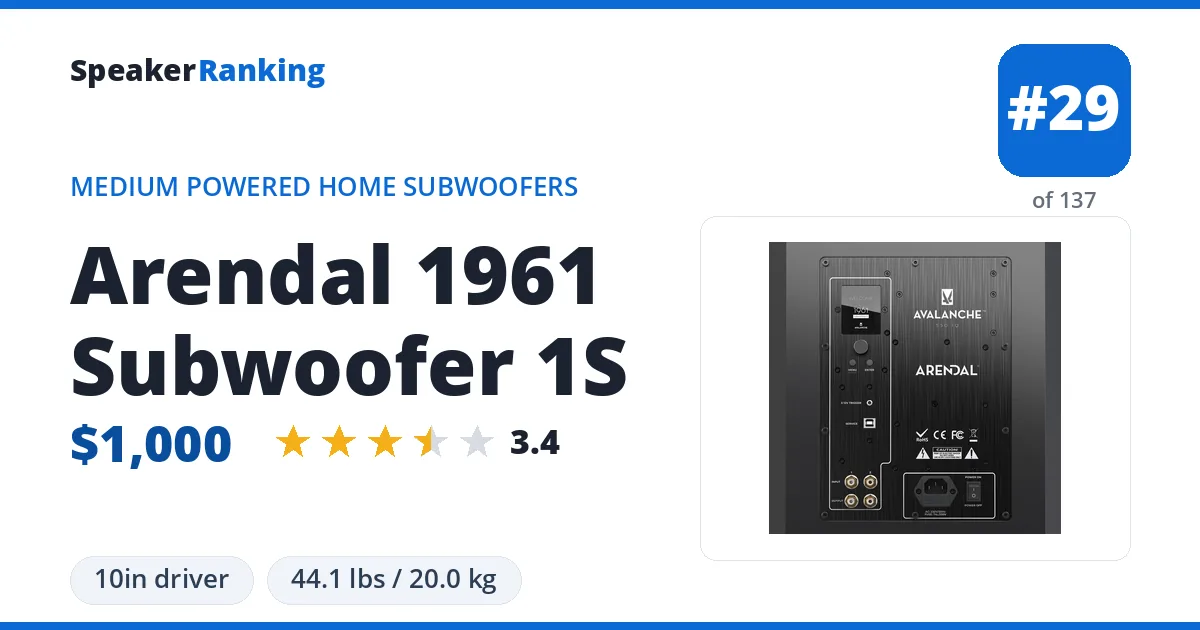
Pros: Sealed 12-inch with 550W RMS delivers clean 110dB+ punch with extension below 20Hz. Better group delay than most sealed subs avoids overhang or sluggishness. Exceptional build quality and flexible adjustability for hi-fi and cinema.
Full Arendal 1961 Subwoofer 1S review and specifications →
| Amplifier Power | 550W RMS |
|---|---|
| CEA-2010-A Average (40-80Hz) | 115.5 dB |
| Cabinet Color | black, white |
| Country | Norway |
| Dimensions | 16.3”H x 12.4”W x 16.3”D (414.8 x 315.0 x 414.8 mm) |
| Drivers | 12.2” (310mm) driver |
| Enclosure | sealed |
| Frequency Response | 19-200Hz, ±3dB |
| Measurement Source | ErinsAudioCorner |
| Output SPL at 15 Hz | 93.2 dB |
| Output SPL at 20 Hz | 102.5 dB |
| Output SPL at 25 Hz | 102.6 dB |
| Output SPL at 31.5 Hz | 107.8 dB |
| Output SPL at 40 Hz | 111.3 dB |
| Output SPL at 50 Hz | 115.0 dB |
| Output SPL at 63 Hz | 117.5 dB |
| Output SPL at 80 Hz | 118.0 dB |
| Output SPL at 100 Hz | 117.6 dB |
| Warranty | 10/5 |
| Weight | 44.1 lbs (20.0 kg) |
- Links
- Reviews, Comparisons and Sound Samples
- Head-to-Head Comparisons
 Ranked #63 of 167 in Medium Home Subwoofers (30-75 lbs) - Dayton Audio SUB-1200: $180 Discontinued eBay
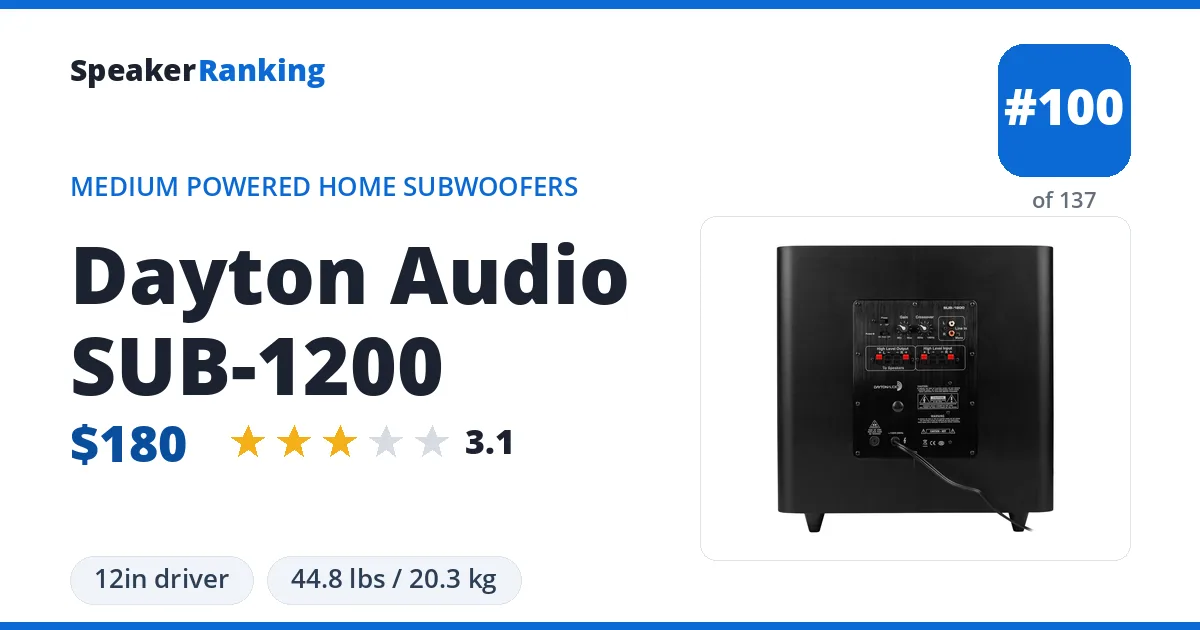
Newer model: the Dayton Audio CS1200, ranked higher, rated 4.1/5.
Pros: 12” long-throw woofer, 120W. Impeccable construction inside and out. Tight and controlled like sealed, digs deep like ported. Continuously variable 40-140Hz crossover. High-level inputs/outputs. Great bang-for-buck at $180.
Cons: Discontinued.
Full Dayton Audio SUB-1200 review and specifications →
| Amplifier Power | 120W RMS |
|---|---|
| CEA-2010-A Average (40-80Hz) | 115.1 dB |
| Cabinet Color | black |
| Country | United States |
| Dimensions | 16.7”H x 16.2”W x 17.7”D (425.4 x 411.0 x 450.8 mm) |
| Drivers | 12” (305mm) driver |
| Enclosure | ported, bottom |
| Frequency Response | 25-140Hz |
| Measurement Source | Brent Butterworth |
| Output SPL at 16 Hz | 82.1 dB |
| Output SPL at 20 Hz | 91.5 dB |
| Output SPL at 25 Hz | 101.7 dB |
| Output SPL at 31.5 Hz | 106.8 dB |
| Output SPL at 40 Hz | 111.3 dB |
| Output SPL at 50 Hz | 114.8 dB |
| Output SPL at 63 Hz | 117.2 dB |
| Output SPL at 80 Hz | 117.2 dB |
| Warranty | 5 |
| Weight | 44.8 lbs (20.3 kg) |
- Links
- Reviews, Comparisons and Sound Samples
- Head-to-Head Comparisons
 Ranked #66 of 167 in Medium Home Subwoofers (30-75 lbs) - SVS SB-2000 Pro: $899.00 each Amazon eBay
Older models: the SVS SB-2000 (ranked higher, rated 3.9/5) and the SVS SB12-Plus (ranked lower, rated 3.6/5).
Pros: A compact sealed 12-inch subwoofer, about 37cm on each side, with a 550W RMS (1,500W peak) Sledge amplifier and SVS’s smartphone app for volume, crossover, phase, room gain compensation and parametric EQ from the listening seat. Erin’s Audio Corner measured a 114.7dB CEA-2010-A average from 40 to 80Hz, and SVS rates it at 19-240Hz within 3dB.
Cons: Output is modest next to larger or ported subwoofers: Erin’s Audio Corner measured about 102.5dB at 20Hz, and he judged the SB-3000, about $200 more, the better value for its considerably higher output. Sealed designs this size run out of headroom sooner in large rooms.
Full SVS SB-2000 Pro review and specifications →
| Amplifier Power | 550W RMS, 1500W peak |
|---|---|
| CEA-2010-A Average (40-80Hz) | 114.7 dB |
| Cabinet Color | black |
| Country | United States |
| Dimensions | 14.6”H x 14.2”W x 15.6”D (370.8 x 360.7 x 396.2 mm) |
| Drivers | 12” (305mm) driver |
| Enclosure | sealed |
| Frequency Response | 19-240Hz ±3dB |
| Measurement Source | Erin’s Audio Corner |
| Output SPL at 20 Hz | 102.5 dB |
| Output SPL at 25 Hz | 113.3 dB |
| Output SPL at 40 Hz | 114.0 dB |
| Output SPL at 50 Hz | 114.1 dB |
| Output SPL at 63 Hz | 115.9 dB |
| Output SPL at 80 Hz | 115.0 dB |
| Warranty | 5 |
| Weight | 38.6 lbs (17.5 kg) |
- Links
- Reviews, Comparisons and Sound Samples
- Head-to-Head Comparisons
- SVS SB-2000 Pro vs BIC America PL-300
- SVS SB-2000 Pro vs Monoprice SSW-10
- SVS SB-2000 Pro vs SVS PB-1000 PRO
- SVS SB-2000 Pro vs RSL (Rogersound Labs) Speedwoofer 10S MKII
- SVS SB-2000 Pro vs JBL HDI-1200P
- SVS SB-2000 Pro vs Power Sound Audio (PSA) XS15SE
- SVS SB-2000 Pro vs Klipsch R-121SW
- SVS SB-2000 Pro vs KRK S12.4
- See all 23 comparisons
 Ranked #82 of 167 in Medium Home Subwoofers (30-75 lbs) - Infinity Speakers REFERENCE SUB R12: $500 Discontinued eBay
Pros: 12-inch ported with 300W RMS. Slipstream tuned-port technology delivers optimized low-frequency sound. Seamless integration and powerful performance for budget-conscious buyers. Good home theater value option.
Cons: Discontinued.
Full Infinity Speakers REFERENCE SUB R12 review and specifications →
| Amplifier Power | 300W RMS |
|---|---|
| CEA-2010-A Average (40-80Hz) | 112.6 dB |
| Cabinet Color | black |
| Country | United States |
| Dimensions | 18.7”H x 15.2”W x 16.8”D (476.0 x 385.1 x 426.0 mm) |
| Drivers | 12” (305mm) driver |
| Enclosure | ported, rear |
| Frequency Response | 29-150Hz |
| Measurement Source | ErinsAudioCorner |
| Output SPL at 15 Hz | 77.0 dB |
| Output SPL at 20 Hz | 90.6 dB |
| Output SPL at 25 Hz | 98.8 dB |
| Output SPL at 31.5 Hz | 106.3 dB |
| Output SPL at 40 Hz | 107.6 dB |
| Output SPL at 50 Hz | 112.3 dB |
| Output SPL at 63 Hz | 115.8 dB |
| Output SPL at 80 Hz | 114.6 dB |
| Output SPL at 100 Hz | 113.2 dB |
| Output SPL at 125 Hz | 111.7 dB |
| Warranty | 5/2 |
| Weight | 40.1 lbs (18.2 kg) |
- Links
- Reviews, Comparisons and Sound Samples
 Ranked #83 of 167 in Medium Home Subwoofers (30-75 lbs) - OSD (Optimal Speaker Design) TreVoce 12 DSP: $599 Discontinued eBay
Pros: 12-inch dual passive radiator with 300W RMS reaches 18Hz. Onboard DSP with 25-band parametric EQ via app control. Compact cube delivers high output from small footprint. Clean nuanced performance for movies and music. AVSForum Top Choice.
Cons: Discontinued.
Full OSD (Optimal Speaker Design) TreVoce 12 DSP review and specifications →
| Amplifier Power | 300W RMS |
|---|---|
| CEA-2010-A Average (40-80Hz) | 112.5 dB |
| Cabinet Color | black |
| Country | United States |
| Dimensions | 15.4”H x 16”W x 15”D (391.2 x 406.4 x 381.0 mm) |
| Drivers | 12” (305mm) driver |
| Enclosure | passive radiator |
| Frequency Response | 18-250Hz |
| Measurement Source | ErinsAudioCorner |
| Output SPL at 25 Hz | 77.3 dB |
| Output SPL at 31.5 Hz | 102.5 dB |
| Output SPL at 40 Hz | 108.2 dB |
| Output SPL at 50 Hz | 112.3 dB |
| Output SPL at 63 Hz | 115.4 dB |
| Output SPL at 80 Hz | 114.0 dB |
| Output SPL at 100 Hz | 111.5 dB |
| Output SPL at 125 Hz | 110.1 dB |
| Warranty | 2 |
| Weight | 44.1 lbs (20.0 kg) |
- Reviews, Comparisons and Sound Samples
 Ranked #91 of 167 in Medium Home Subwoofers (30-75 lbs) - WiiM Sub Pro: $479.00 Amazon eBay
Pros: Independent CEA-2010 testing records 77.4 dB at 20 Hz and 111.8 dB through 40-80 Hz. The ported enclosure with an 8” driver suits a small-to-mid room.
Cons: The 398.8H x 299.7W x 322.6D mm cabinet and 16.0 kg mass still need deliberate placement. Newly launched, so long-term reliability is unproven.
Full WiiM Sub Pro review and specifications →
| CEA-2010-A Average (40-80Hz) | 111.8 dB |
|---|---|
| Country | China |
| Dimensions | 15.7”H x 11.8”W x 12.7”D (398.8 x 299.7 x 322.6 mm) |
| Drivers | 8” (203mm) driver |
| Enclosure | ported |
| Measurement Source | Brent Butterworth |
| Output SPL at 20 Hz | 77.4 dB |
| Output SPL at 25 Hz | 92.9 dB |
| Output SPL at 31.5 Hz | 102.0 dB |
| Output SPL at 40 Hz | 109.5 dB |
| Output SPL at 50 Hz | 111.7 dB |
| Output SPL at 63 Hz | 113.6 dB |
| Output SPL at 80 Hz | 112.6 dB |
| Warranty | 1 |
| Weight | 35.3 lbs (16.0 kg) |
- Links
- Reviews, Comparisons and Sound Samples
- Head-to-Head Comparisons
 Ranked #101 of 167 in Medium Home Subwoofers (30-75 lbs) - Monoprice 12in 150-Watt Powered: $183.43 Amazon eBay
Pros: 12-inch ported with 150W RMS delivers extraordinary output for the price. Excellent performance reaches 111.7dB average. Easy setup at ultra-budget price point.
Notes: Product # 9723
Full Monoprice 12in 150-Watt Powered review and specifications →
| Amplifier Power | 150W RMS |
|---|---|
| CEA-2010-A Average (40-80Hz) | 111.7 dB |
| Cabinet Color | black |
| Country | United States |
| Dimensions | 17”H x 17.3”W x 17.5”D (431.8 x 439.4 x 444.5 mm) |
| Drivers | 12” (305mm) driver |
| Enclosure | ported, bottom |
| Frequency Response | 25-250Hz |
| Measurement Source | ErinsAudioCorner |
| Output SPL at 20 Hz | 90.2 dB |
| Output SPL at 25 Hz | 89.8 dB |
| Output SPL at 31.5 Hz | 99.7 dB |
| Output SPL at 40 Hz | 105.1 dB |
| Output SPL at 50 Hz | 110.6 dB |
| Output SPL at 63 Hz | 115.7 dB |
| Output SPL at 80 Hz | 115.4 dB |
| Output SPL at 100 Hz | 114.2 dB |
| Output SPL at 125 Hz | 113.3 dB |
| Weight | 53.8 lbs (24.4 kg) |
- Links
- Reviews, Comparisons and Sound Samples
- Head-to-Head Comparisons
 Ranked #102 of 167 in Medium Home Subwoofers (30-75 lbs) - Monoprice Monolith 10 THX Select: $699 Discontinued eBay
Newer model: the Monoprice Monolith M-10 V2, ranked lower, rated 3.4/5.
Pros: THX-certified 10-inch ported with 500W amp extends down to 20Hz with no internal resonance or port noise. HDF cabinet construction ensures inert enclosure. Variable phase adjustment and robust built-to-last design.
Cons: Discontinued.
Notes: Product # 24456
Full Monoprice Monolith 10 THX Select review and specifications →
| AES Input | No |
|---|---|
| Amplifier Power | 500W RMS |
| Aux Input | No |
| CEA-2010-A Average (40-80Hz) | 111.5 dB |
| Cabinet Color | black |
| Coaxial Input | No |
| Country | United States |
| Dimensions | 18.9”H x 15”W x 19.7”D (480.1 x 381.0 x 500.4 mm) |
| Drivers | 10” (254mm) driver |
| Enclosure | ported, front |
| Frequency Response | 17-20Hz |
| HDMI Input | No |
| Inputs | XLR, RCA, XLR passthrough out |
| Measurement Source | ErinsAudioCorner |
| Optical Input | No |
| Output SPL at 15 Hz | 95.4 dB |
| Output SPL at 20 Hz | 102.6 dB |
| Output SPL at 25 Hz | 107.7 dB |
| Output SPL at 31.5 Hz | 109.0 dB |
| Output SPL at 40 Hz | 110.0 dB |
| Output SPL at 50 Hz | 112.0 dB |
| Output SPL at 63 Hz | 112.0 dB |
| Output SPL at 80 Hz | 112.0 dB |
| Output SPL at 100 Hz | 112.0 dB |
| Output SPL at 125 Hz | 111.0 dB |
| RCA Input | Yes |
| TRS Input | No |
| USB Input | No |
| Warranty | 5 |
| Weight | 72.5 lbs (32.9 kg) |
| XLR Input | Yes |
- Links
- Reviews, Comparisons and Sound Samples
- Head-to-Head Comparisons
 Ranked #128 of 167 in Medium Home Subwoofers (30-75 lbs) - BIC America F-12: $299.00 Amazon eBay
Pros: 12” woofer with 475W peak power, reaches 116dB. Ported enclosure with low distortion. 150W RMS with high SNR. Performs like subs costing twice as much. Backed by 5-year warranty.
Full BIC America F-12 review and specifications →
| Amplifier Power | 150W RMS |
|---|---|
| CEA-2010-A Average (40-80Hz) | 110.1 dB |
| Cabinet Color | black |
| Country | United States |
| Dimensions | 17”H x 14.7”W x 17.2”D (431.8 x 374.6 x 438.1 mm) |
| Drivers | 12” (305mm) driver |
| Enclosure | ported, rear |
| Frequency Response | 25-200Hz |
| Measurement Source | ErinsAudioCorner |
| Output SPL at 15 Hz | 74.9 dB |
| Output SPL at 20 Hz | 83.8 dB |
| Output SPL at 25 Hz | 95.8 dB |
| Output SPL at 31.5 Hz | 101.6 dB |
| Output SPL at 40 Hz | 104.6 dB |
| Output SPL at 50 Hz | 110.6 dB |
| Output SPL at 63 Hz | 113.3 dB |
| Output SPL at 80 Hz | 111.9 dB |
| Output SPL at 100 Hz | 110.0 dB |
| Output SPL at 125 Hz | 106.7 dB |
| Warranty | 5 |
| Weight | 42.1 lbs (19.1 kg) |
- Links
- Reviews, Comparisons and Sound Samples
- Head-to-Head Comparisons
 Ranked #140 of 167 in Medium Home Subwoofers (30-75 lbs) - Klipsch R-12SW: $279.00 Amazon eBay
Pros: 12-inch copper-spun IMG driver provides low frequency with minimal breakup/distortion. 400W digital amplifier (200W RMS) with 29-120Hz frequency response. Unique copper diaphragm ensures durability while producing deep bass without distortion. Clean detailed bass at this price range stands out. Elegant cube design (14x18.5x16 inches, 30 lbs) with straightforward setup and easy connectivity via RCA inputs.
Full Klipsch R-12SW review and specifications →
| Amplifier Power | 200W RMS |
|---|---|
| CEA-2010-A Average (40-80Hz) | 108.5 dB |
| Cabinet Color | black |
| Country | United States |
| Dimensions | 16”H x 14”W x 18.5”D (406.4 x 355.6 x 469.9 mm) |
| Drivers | 12” (305mm) driver |
| Enclosure | ported, rear |
| Frequency Response | 29-120Hz |
| Measurement Source | ErinsAudioCorner |
| Output SPL at 15 Hz | 68.5 dB |
| Output SPL at 20 Hz | 86.9 dB |
| Output SPL at 25 Hz | 97.1 dB |
| Output SPL at 31.5 Hz | 100.0 dB |
| Output SPL at 40 Hz | 104.7 dB |
| Output SPL at 50 Hz | 109.0 dB |
| Output SPL at 63 Hz | 111.2 dB |
| Output SPL at 80 Hz | 109.3 dB |
| Output SPL at 100 Hz | 107.6 dB |
| Output SPL at 125 Hz | 105.8 dB |
| Warranty | 5/2 |
| Weight | 33.1 lbs (15.0 kg) |
- Links
- Reviews, Comparisons and Sound Samples
- Head-to-Head Comparisons
 Ranked #151 of 167 in Medium Home Subwoofers (30-75 lbs) - Jamo C 912 SUB: $599 Discontinued eBay
Pros: 12-inch ported with 200W RMS outputs fairly accurate smooth bass for music and movies. Relaxed energetic low-frequency presentation without listening fatigue. Front-facing port enables flexible placement.
Cons: Discontinued.
Full Jamo C 912 SUB review and specifications →
| Amplifier Power | 200W RMS |
|---|---|
| CEA-2010-A Average (40-80Hz) | 106.7 dB |
| Cabinet Color | black, white, wood |
| Country | Denmark |
| Dimensions | 17.9”H x 14”W x 18.9”D (454.4 x 355.3 x 479.6 mm) |
| Drivers | 12” (305mm) driver |
| Enclosure | ported, front |
| Frequency Response | 29-125Hz |
| Measurement Source | ErinsAudioCorner |
| Output SPL at 15 Hz | 78.4 dB |
| Output SPL at 20 Hz | 88.0 dB |
| Output SPL at 25 Hz | 95.5 dB |
| Output SPL at 31.5 Hz | 99.0 dB |
| Output SPL at 40 Hz | 103.4 dB |
| Output SPL at 50 Hz | 106.5 dB |
| Output SPL at 63 Hz | 108.6 dB |
| Output SPL at 80 Hz | 108.1 dB |
| Output SPL at 100 Hz | 106.6 dB |
| Output SPL at 125 Hz | 104.9 dB |
| Warranty | 5/2 |
| Weight | 41.7 lbs (18.9 kg) |
- Links
- Reviews, Comparisons and Sound Samples
- Head-to-Head Comparisons
 Ranked #159 of 167 in Medium Home Subwoofers (30-75 lbs) - Kali Audio WS-6.2: $599.00 Amazon eBay
Pros: Dual 6.5-inch ported drivers deliver 104.5dB CEA-2010-A average in a compact powered design.
Full Kali Audio WS-6.2 review and specifications →
| AES Input | No |
|---|---|
| Amplifier Power | 400W RMS |
| Aux Input | No |
| CEA-2010-A Average (40-80Hz) | 104.5 dB |
| Cabinet Color | black |
| Coaxial Input | No |
| Country | United States |
| Dimensions | 14.5”H x 12.2”W x 11”D (368.3 x 309.9 x 279.4 mm) |
| Drivers | 2x 6.5” (165mm) driver |
| Enclosure | ported, front |
| Frequency Response | 27-200Hz |
| HDMI Input | No |
| Inputs | XLR/TRS combo (2), RCA (2) |
| Measurement Source | ErinsAudioCorner |
| Optical Input | No |
| Output SPL at 25 Hz | 96.6 dB |
| Output SPL at 31.5 Hz | 102.5 dB |
| Output SPL at 40 Hz | 102.4 dB |
| Output SPL at 50 Hz | 101.8 dB |
| Output SPL at 63 Hz | 103.4 dB |
| Output SPL at 80 Hz | 110.4 dB |
| Output SPL at 100 Hz | 111.6 dB |
| RCA Input | Yes |
| TRS Input | Yes |
| USB Input | No |
| Weight | 31.1 lbs (14.1 kg) |
| XLR Input | Yes |
- Links
- Reviews, Comparisons and Sound Samples
- Head-to-Head Comparisons
 Ranked #160 of 167 in Medium Home Subwoofers (30-75 lbs) - Kef KF92: $2,000 Discontinued eBay
Newer model: the KEF KC92, ranked higher, estimated 3.3/5.
Pros: Dual opposing 9-inch force-canceling sealed drivers with 1000W deliver tight clean deep bass to 11Hz. Music Integrity Engine (iBX) provides intelligent dynamic enhancement. Flexible setup options for various room placements.
Cons: Discontinued.
Full Kef KF92 review and specifications →
| Amplifier Power | 1000W RMS |
|---|---|
| CEA-2010-A Average (40-80Hz) | 103.7 dB |
| Cabinet Color | black |
| Country | United Kingdom |
| Dimensions | 13.9”H x 13”W x 14.2”D (352.3 x 329.9 x 360.4 mm) |
| Drivers | 2x 9.2” (234mm) driver |
| Enclosure | sealed |
| Frequency Response | 11-160Hz |
| Measurement Source | ErinsAudioCorner |
| Output SPL at 20 Hz | 86.0 dB |
| Output SPL at 25 Hz | 91.6 dB |
| Output SPL at 31.5 Hz | 95.4 dB |
| Output SPL at 40 Hz | 101.1 dB |
| Output SPL at 50 Hz | 103.0 dB |
| Output SPL at 63 Hz | 104.4 dB |
| Output SPL at 80 Hz | 106.3 dB |
| Output SPL at 100 Hz | 107.2 dB |
| Warranty | 5/2/5 |
| Weight | 44.1 lbs (20.0 kg) |
- Links
- Reviews, Comparisons and Sound Samples
- Head-to-Head Comparisons
 Ranked #163 of 167 in Medium Home Subwoofers (30-75 lbs) - JBL SUB 550P: $600 Discontinued eBay
Pros: 10-inch sealed with 300W RMS delivers low distortion realistic bass compared to cheaper options. Deep bass response similar to larger 12” models. Multiple line-level inputs and adjustable crossover control.
Cons: Discontinued.
Full JBL SUB 550P review and specifications →
| Amplifier Power | 300W RMS |
|---|---|
| CEA-2010-A Average (40-80Hz) | 102.9 dB |
| Cabinet Color | black |
| Country | United States |
| Dimensions | 17.5”H x 14.9”W x 15”D (444 x 379 x 380 mm) |
| Drivers | 10” (254mm) driver |
| Enclosure | sealed |
| Frequency Response | 27-150Hz |
| Measurement Source | ErinsAudioCorner |
| Output SPL at 20 Hz | 84.7 dB |
| Output SPL at 25 Hz | 89.8 dB |
| Output SPL at 31.5 Hz | 98.1 dB |
| Output SPL at 40 Hz | 101.5 dB |
| Output SPL at 50 Hz | 103.2 dB |
| Output SPL at 63 Hz | 103.3 dB |
| Output SPL at 80 Hz | 103.7 dB |
| Output SPL at 100 Hz | 104.2 dB |
| Warranty | 1 |
| Weight | 50 lbs (22.7 kg) |
- Links
- Reviews, Comparisons and Sound Samples
- Head-to-Head Comparisons
 Ranked #167 of 167 in Medium Home Subwoofers (30-75 lbs) - Kef KC62: $1,699.99 Amazon eBay
Larger model: the KEF KC92 (ranked higher, estimated 3.3/5).
Pros: Dual 6.5-inch force-canceling drivers with 1000W in ultra-compact basketball-sized sealed enclosure. Deep extension to 11Hz with five room placement EQ presets. Elegant design fits any décor.
Full Kef KC62 review and specifications →
| Amplifier Power | 1000W RMS |
|---|---|
| CEA-2010-A Average (40-80Hz) | 96.9 dB |
| Cabinet Color | black, white |
| Country | United Kingdom |
| Dimensions | 9.7”H x 10.1”W x 9.8”D (245.9 x 255.8 x 247.9 mm) |
| Drivers | 2x 6.5” (165mm) driver |
| Enclosure | sealed |
| Frequency Response | 11-200Hz |
| Measurement Source | ErinsAudioCorner |
| Output SPL at 20 Hz | 80.0 dB |
| Output SPL at 25 Hz | 84.6 dB |
| Output SPL at 31.5 Hz | 88.5 dB |
| Output SPL at 40 Hz | 92.2 dB |
| Output SPL at 50 Hz | 95.1 dB |
| Output SPL at 63 Hz | 97.7 dB |
| Output SPL at 80 Hz | 102.6 dB |
| Output SPL at 100 Hz | 104.2 dB |
| Warranty | 5/2/5 |
| Weight | 30.9 lbs (14.0 kg) |
- Links
- Reviews, Comparisons and Sound Samples
- Head-to-Head Comparisons
Large Home Subwoofers (Over 75 lbs)
 Ranked #65 of 125 in Large Home Subwoofers (Over 75 lbs) - Monoprice Monolith 13 THX Ultra: $1,700 Discontinued eBay
Pros: Independent CEA-2010 testing records 115.0 dB at 20 Hz and 121.1 dB through 40-80 Hz. The ported, front enclosure with 13” (330mm) driver has the headroom for demanding film bass in a large room.
Cons: The 604.5H x 515.6W x 739.1D mm cabinet and 69.5 kg mass make this a serious placement and moving commitment. Ported output does not solve room modes, so careful placement and calibration remain essential. Discontinued.
Notes: Product # 41496
Full Monoprice Monolith 13 THX Ultra review and specifications →
| AES Input | No |
|---|---|
| Aux Input | No |
| CEA-2010-A Average (40-80Hz) | 121.1 dB |
| Cabinet Color | black |
| Coaxial Input | No |
| Country | United States |
| Dimensions | 23.8”H x 20.3”W x 29.1”D (604.5 x 515.6 x 739.1 mm) |
| Drivers | 13” (330mm) driver |
| Enclosure | ported, front |
| HDMI Input | No |
| Inputs | XLR (stereo balanced), RCA (stereo/mono) |
| Measurement Source | Audioholics |
| Optical Input | No |
| Output SPL at 12.5 Hz | 94.0 dB |
| Output SPL at 15 Hz | 109.1 dB |
| Output SPL at 20 Hz | 115.0 dB |
| Output SPL at 25 Hz | 118.0 dB |
| Output SPL at 31.5 Hz | 119.5 dB |
| Output SPL at 40 Hz | 120.3 dB |
| Output SPL at 50 Hz | 120.7 dB |
| Output SPL at 63 Hz | 121.4 dB |
| Output SPL at 80 Hz | 122.1 dB |
| Output SPL at 100 Hz | 122.7 dB |
| Output SPL at 125 Hz | 123.8 dB |
| RCA Input | Yes |
| TRS Input | No |
| USB Input | No |
| Warranty | 5 |
| Weight | 153.2 lbs (69.5 kg) |
| XLR Input | Yes |
- Links
- Reviews, Comparisons and Sound Samples
- Head-to-Head Comparisons
- Monoprice Monolith 13 THX Ultra vs SVS PB16-Ultra
- Monoprice Monolith 13 THX Ultra vs Arendal 1723 Subwoofer 2V
- Monoprice Monolith 13 THX Ultra vs HSU Research VTF-3 MK5 HP
- Monoprice Monolith 13 THX Ultra vs HSU Research VTF-15H MK2
- Monoprice Monolith 13 THX Ultra vs Rythmik FV15HP
- Monoprice Monolith 13 THX Ultra vs SVS PB17-Ultra R-Evolution
- Monoprice Monolith 13 THX Ultra vs Monoprice Monolith 16 THX Ultra
- Monoprice Monolith 13 THX Ultra vs JTR Speakers Captivator S2
 Ranked #68 of 125 in Large Home Subwoofers (Over 75 lbs) - Monoprice Monolith 15 THX Ultra: $1,999 Discontinued eBay
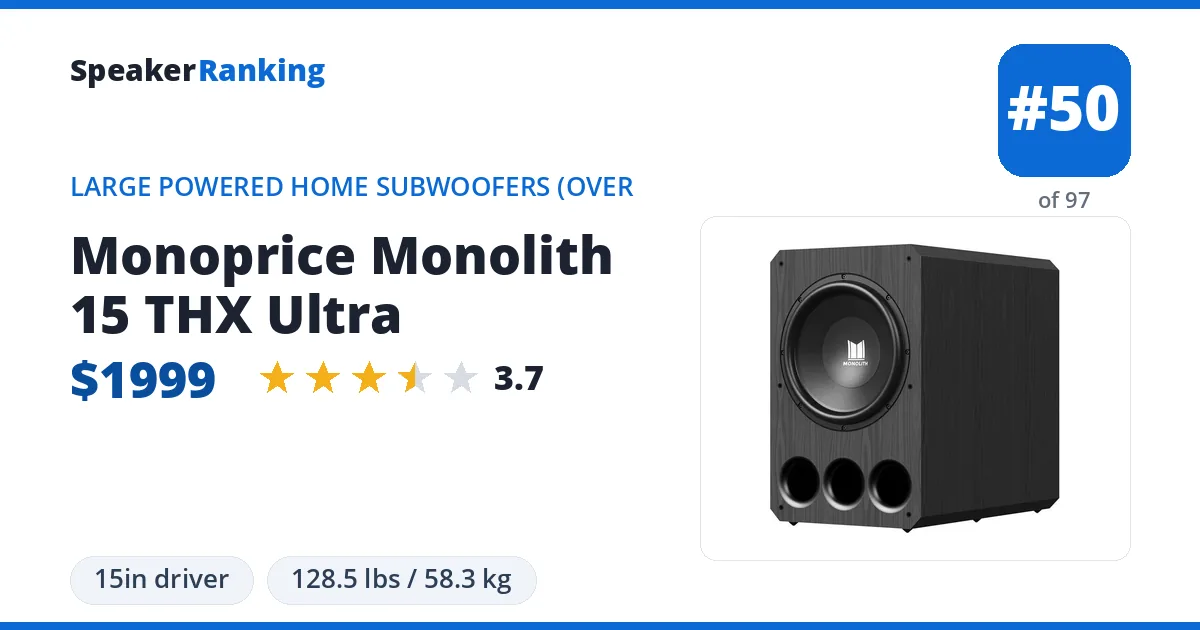
Newer model: the Monoprice Monolith M-15 V2, ranked lower, rated 4.2/5 (also discontinued).
Pros: Independent CEA-2010 testing records 110.0 dB at 20 Hz and 120.5 dB through 40-80 Hz. The ported, front enclosure with 15” (381mm) driver has the headroom for demanding film bass in a large room.
Cons: The 680.7H x 449.6W x 701.0D mm cabinet and 58.3 kg mass make this a serious placement and moving commitment. Ported output does not solve room modes, so careful placement and calibration remain essential. Discontinued.
Notes: Product # 24458
Full Monoprice Monolith 15 THX Ultra review and specifications →
| AES Input | No |
|---|---|
| Aux Input | No |
| CEA-2010-A Average (40-80Hz) | 120.5 dB |
| Cabinet Color | black |
| Coaxial Input | No |
| Country | United States |
| Dimensions | 26.8”H x 17.7”W x 27.6”D (680.7 x 449.6 x 701.0 mm) |
| Drivers | 15” (381mm) driver |
| Enclosure | ported, front |
| HDMI Input | No |
| Inputs | XLR, RCA |
| Measurement Source | ErinsAudioCorner |
| Optical Input | No |
| Output SPL at 12.5 Hz | 90.0 dB |
| Output SPL at 15 Hz | 100.8 dB |
| Output SPL at 20 Hz | 110.0 dB |
| Output SPL at 25 Hz | 115.6 dB |
| Output SPL at 31.5 Hz | 118.0 dB |
| Output SPL at 40 Hz | 122.0 dB |
| Output SPL at 50 Hz | 121.0 dB |
| Output SPL at 63 Hz | 120.0 dB |
| Output SPL at 80 Hz | 119.0 dB |
| Output SPL at 100 Hz | 119.0 dB |
| Output SPL at 125 Hz | 118.0 dB |
| RCA Input | Yes |
| TRS Input | No |
| USB Input | No |
| Warranty | 5 |
| Weight | 128.5 lbs (58.3 kg) |
| XLR Input | Yes |
- Links
- Reviews, Comparisons and Sound Samples
- Head-to-Head Comparisons
 Ranked #109 of 125 in Large Home Subwoofers (Over 75 lbs) - Arendal 1961 Subwoofer 1V: $1,200 Arendal Sound eBay
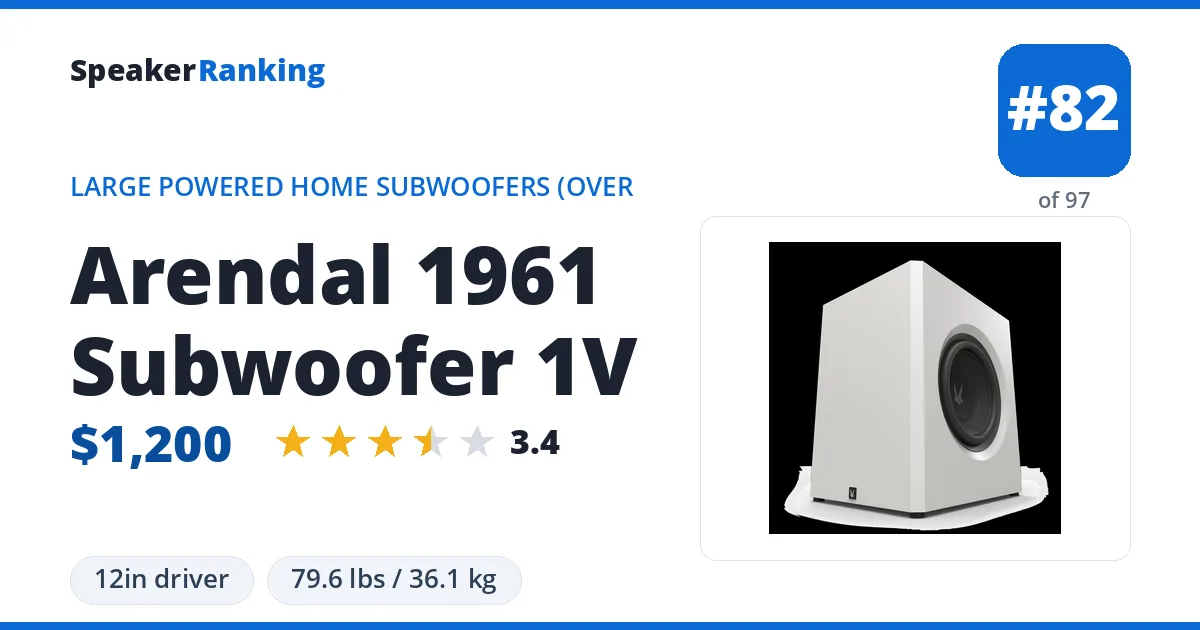
Pros: Independent CEA-2010 testing records 104.3 dB at 20 Hz and 116.0 dB through 40-80 Hz. The ported, rear enclosure with 12” (305mm) driver delivers substantial upper-bass output for movie effects and music.
Cons: Deep-bass output is more limited than the strong 40-80 Hz result suggests, so it is not the right choice when the lowest movie effects are the priority. The 544.8H x 389.9W x 499.9D mm cabinet and 36.1 kg mass still require deliberate placement and calibration.
Full Arendal 1961 Subwoofer 1V review and specifications →
| CEA-2010-A Average (40-80Hz) | 116.0 dB |
|---|---|
| Cabinet Color | black, white |
| Country | Norway |
| Dimensions | 21.4”H x 15.4”W x 19.7”D (544.8 x 389.9 x 499.9 mm) |
| Drivers | 12” (305mm) driver |
| Enclosure | ported, rear |
| Measurement Source | ErinsAudioCorner |
| Output SPL at 15 Hz | 101.8 dB |
| Output SPL at 20 Hz | 104.3 dB |
| Output SPL at 25 Hz | 107.2 dB |
| Output SPL at 31.5 Hz | 111.3 dB |
| Output SPL at 40 Hz | 113.5 dB |
| Output SPL at 50 Hz | 116.1 dB |
| Output SPL at 63 Hz | 117.2 dB |
| Output SPL at 80 Hz | 117.3 dB |
| Output SPL at 100 Hz | 116.2 dB |
| Warranty | 10/5 |
| Weight | 79.6 lbs (36.1 kg) |
- Links
- Reviews, Comparisons and Sound Samples
- Head-to-Head Comparisons
 Ranked #110 of 125 in Large Home Subwoofers (Over 75 lbs) - Monoprice Monolith 12 THX Ultra: $1,499 Discontinued eBay
Newer model: the Monoprice Monolith M-12 V2, ranked lower, rated 3.8/5 (also discontinued).
Pros: Independent CEA-2010 testing records 108.4 dB at 20 Hz and 115.2 dB through 40-80 Hz. The ported, front enclosure with 12” (305mm) driver has the headroom for demanding film bass in a large room.
Cons: The 579.1H x 424.2W x 599.4D mm cabinet and 44.7 kg mass make this a serious placement and moving commitment. Ported output does not solve room modes, so careful placement and calibration remain essential. Discontinued.
Notes: Product # 24457
Full Monoprice Monolith 12 THX Ultra review and specifications →
| AES Input | No |
|---|---|
| Aux Input | No |
| CEA-2010-A Average (40-80Hz) | 115.2 dB |
| Cabinet Color | black |
| Coaxial Input | No |
| Country | United States |
| Dimensions | 22.8”H x 16.7”W x 23.6”D (579.1 x 424.2 x 599.4 mm) |
| Drivers | 12” (305mm) driver |
| Enclosure | ported, front |
| HDMI Input | No |
| Inputs | XLR, RCA, XLR passthrough out |
| Measurement Source | ErinsAudioCorner |
| Optical Input | No |
| Output SPL at 12.5 Hz | 87.7 dB |
| Output SPL at 15 Hz | 101.2 dB |
| Output SPL at 20 Hz | 108.4 dB |
| Output SPL at 25 Hz | 110.9 dB |
| Output SPL at 31.5 Hz | 113.0 dB |
| Output SPL at 40 Hz | 114.0 dB |
| Output SPL at 50 Hz | 115.0 dB |
| Output SPL at 63 Hz | 116.0 dB |
| Output SPL at 80 Hz | 116.0 dB |
| Output SPL at 100 Hz | 115.0 dB |
| Output SPL at 125 Hz | 114.0 dB |
| RCA Input | Yes |
| TRS Input | No |
| USB Input | No |
| Warranty | 5 |
| Weight | 98.5 lbs (44.7 kg) |
| XLR Input | Yes |
- Links
- Reviews, Comparisons and Sound Samples
- Head-to-Head Comparisons
 Ranked #114 of 125 in Large Home Subwoofers (Over 75 lbs) - RSL (Rogersound Labs) Speedwoofer 12S: $884.96 RSL eBay
Pros: Independent CEA-2010 testing records 109.3 dB at 20 Hz and 113.2 dB through 40-80 Hz. The ported, rear enclosure with 12” (305mm) driver has the headroom for demanding film bass in a large room.
Cons: The 565.1H x 479.4W x 562.0D mm cabinet and 37.2 kg mass make this a serious placement and moving commitment. Ported output does not solve room modes, so careful placement and calibration remain essential.
Full RSL (Rogersound Labs) Speedwoofer 12S review and specifications →
| CEA-2010-A Average (40-80Hz) | 113.2 dB |
|---|---|
| Cabinet Color | black, white |
| Country | United States |
| Dimensions | 22.2”H x 18.9”W x 22.1”D (565.1 x 479.4 x 562.0 mm) |
| Drivers | 12” (305mm) driver |
| Enclosure | ported, rear |
| Measurement Source | ErinsAudioCorner |
| Output SPL at 15 Hz | 104.4 dB |
| Output SPL at 20 Hz | 109.3 dB |
| Output SPL at 25 Hz | 110.9 dB |
| Output SPL at 31.5 Hz | 112.5 dB |
| Output SPL at 40 Hz | 113.4 dB |
| Output SPL at 50 Hz | 113.4 dB |
| Output SPL at 63 Hz | 113.0 dB |
| Output SPL at 80 Hz | 113.1 dB |
| Output SPL at 100 Hz | 112.2 dB |
| Warranty | 5/3 |
| Weight | 82 lbs (37.2 kg) |
- Links
- Reviews, Comparisons and Sound Samples
- Head-to-Head Comparisons
- RSL (Rogersound Labs) Speedwoofer 12S vs HSU Research VTF-3 MK3
- RSL (Rogersound Labs) Speedwoofer 12S vs BK Electronics Monolith-DF
- RSL (Rogersound Labs) Speedwoofer 12S vs SVS SB13-Plus
- RSL (Rogersound Labs) Speedwoofer 12S vs Rythmik F18
- RSL (Rogersound Labs) Speedwoofer 12S vs SVS PB-4000
- RSL (Rogersound Labs) Speedwoofer 12S vs Rythmik FV15HP
- RSL (Rogersound Labs) Speedwoofer 12S vs JTR Speakers Captivator 1400
- RSL (Rogersound Labs) Speedwoofer 12S vs Monoprice Monolith M-215
- See all 14 comparisons