This page ranks 44 popular active and passive PA speakers built around an 8-inch woofer and a high-frequency compression driver: a small, light size well suited to compact mains, stage monitors, and grab-and-go setups. Prices are per speaker unless stated otherwise.
8-inch cabinets favor portability over standalone output and bass reach, so a subwoofer is close to essential if you want full-range sound at event levels. Ranking weighs measured sound quality alongside the things that matter on the job: maximum volume, coverage, build quality, weight, inputs, and onboard DSP.
Manufacturer maximum-SPL claims are measured under different conditions from one brand to the next, so treat them as a rough guide rather than a precise comparison. Several entries here are passive designs that need an external amplifier and crossover to work.
| Select to compare | |||||||
|---|---|---|---|---|---|---|---|
| 1 | QSC K8.2 | $749.99 | 128dB peak | 2025W peak | 8" woofer, 1.4" titan… | 26.9 lbs | |
| 2 | L-Acoustics 108P | - | 127dB peak | 760W | 8" coaxial woofer, co… | 28.7 lbs | |
| 3 | Turbosound NuQ82 | $500 | 123dB peak | Passive/bi-amp speake… | 8" coaxial woofer, co… | 22.5 lbs | |
| 4 | Yamaha DXR8mkII | $769.99 | 130dB peak | 1100W dynamic / 700W… | 8" woofer, 1.75" comp… | 28.2 lbs | |
| 5 | JBL PRX908 | $699.00 | 126dB peak | 2000W peak / 1000W RMS | 8" woofer, 1.5" compr… | 30.2 lbs | |
| 6 | L-Acoustics X8 | - | 129dB | Passive speaker; requ… | 8" low-frequency driv… | 26.5 lbs | |
| 7 | RCF KX 08-A | $2,308.50 | 128dB peak | 2000W peak | 8" woofer, 1.75" voic… | 24.3 lbs | |
| 8 | Vue Audiotechnik A-8 | $999 | 124dB peak | - | 8" neodymium woofer,… | 28.9 lbs | |
| 9 | EAW MKC80 | - | 132dB | Passive speaker; requ… | 8" cone woofer with 2… | 22 lbs | |
| 10 | Alcons Audio VR8 | - | 128dB peak | Passive speaker; requ… | 8" woofer, RBN401 4"… | 26.5 lbs | |
| 11 | DAS Audio ARTEC 508A | $2,180.25 | 122dB | 500W RMS, 720W peak | 8" woofer, M-34 compr… | 21.8 lbs | |
| 12 | Meyer Sound Ultra X40 | - | 127dB linear peak | 1,950W peak, 3-channe… | 2x 8" cone woofers, c… | Under 55.1 lbs | |
| 13 | One Systems 108HTH | - | - | Passive speaker; requ… | 8" woofer, compressio… | 36.4 lbs | |
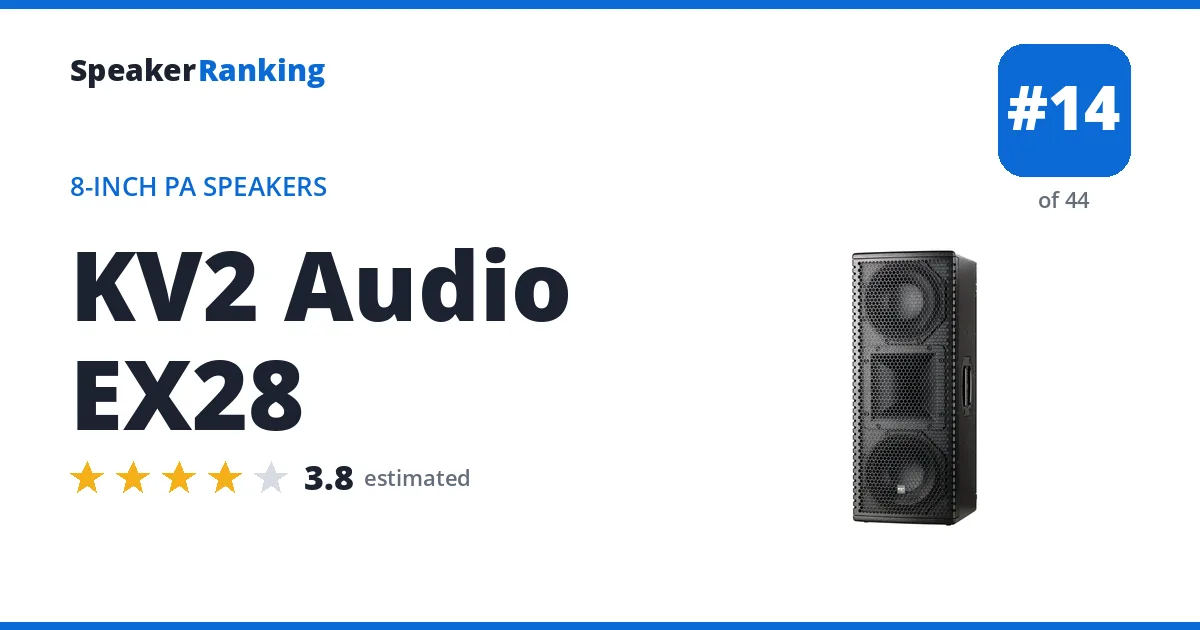
| 14 | KV2 Audio EX28 | - | 132dB peak / 126dB lo… | - | 2x 8" woofers, compre… | 50.7 lbs | |
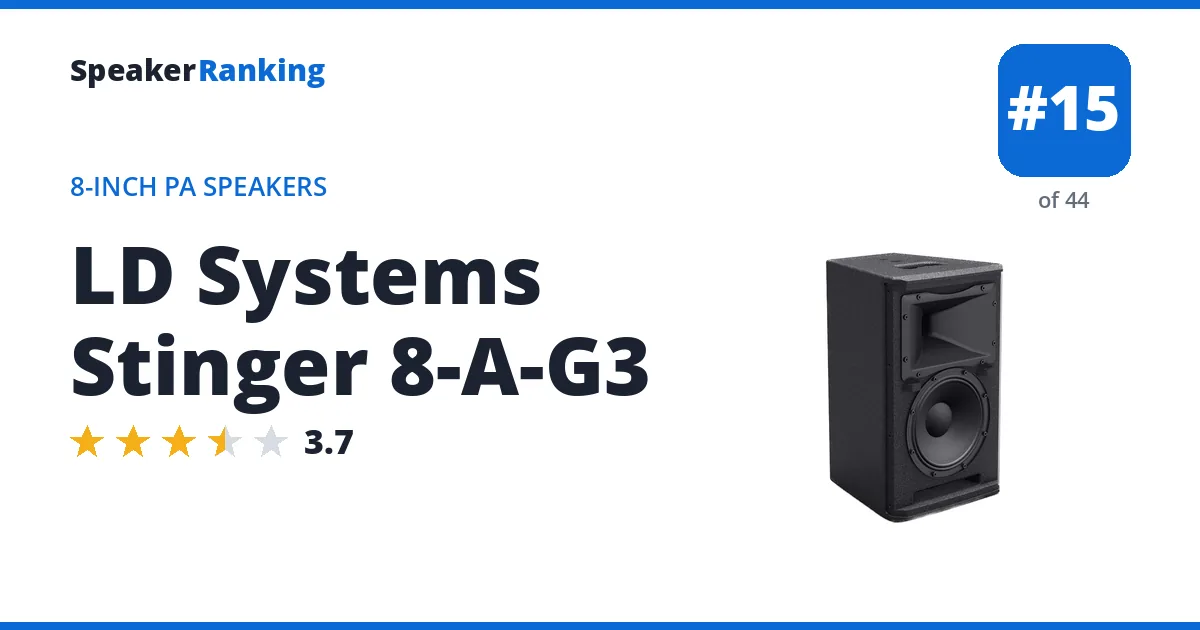
| 15 | LD Systems Stinger 8-A-G3 | $599.99 | 125dB peak | 600W peak / 300W RMS | 8" woofer, compressio… | 23.1 lbs | |
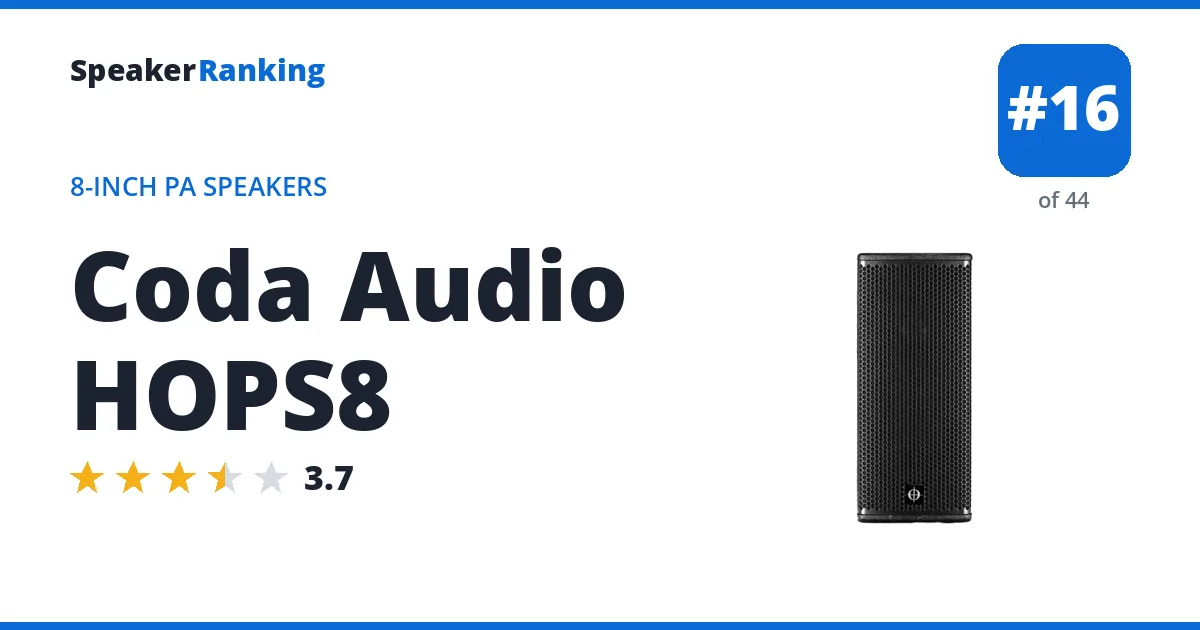
| 16 | Coda Audio HOPS8 | - | 133.5dB peak | Passive speaker; requ… | 8" woofer, 8" coaxial… | 26.5 lbs | |
| 17 | FBT J8A | $800 | 128dB peak | 250W RMS | 8" woofer, 1" compres… | 18.7 lbs | |
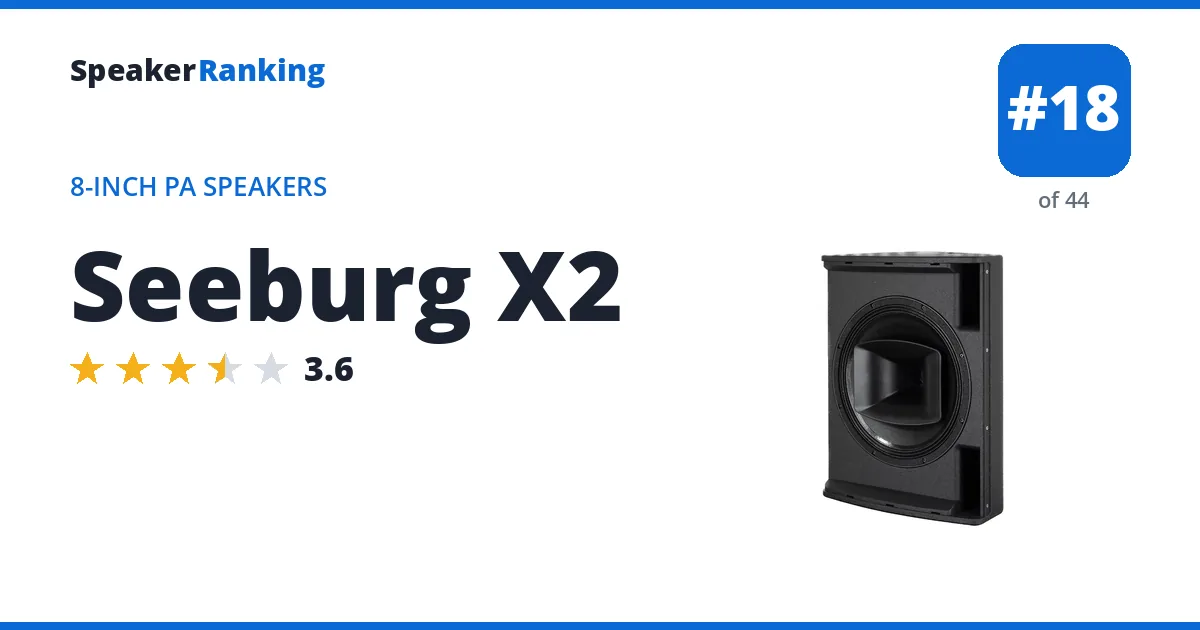
| 18 | Seeburg X2 | $1,059.00 | 124dB | Passive speaker; requ… | 8" neodymium woofer,… | 17.6 lbs | |
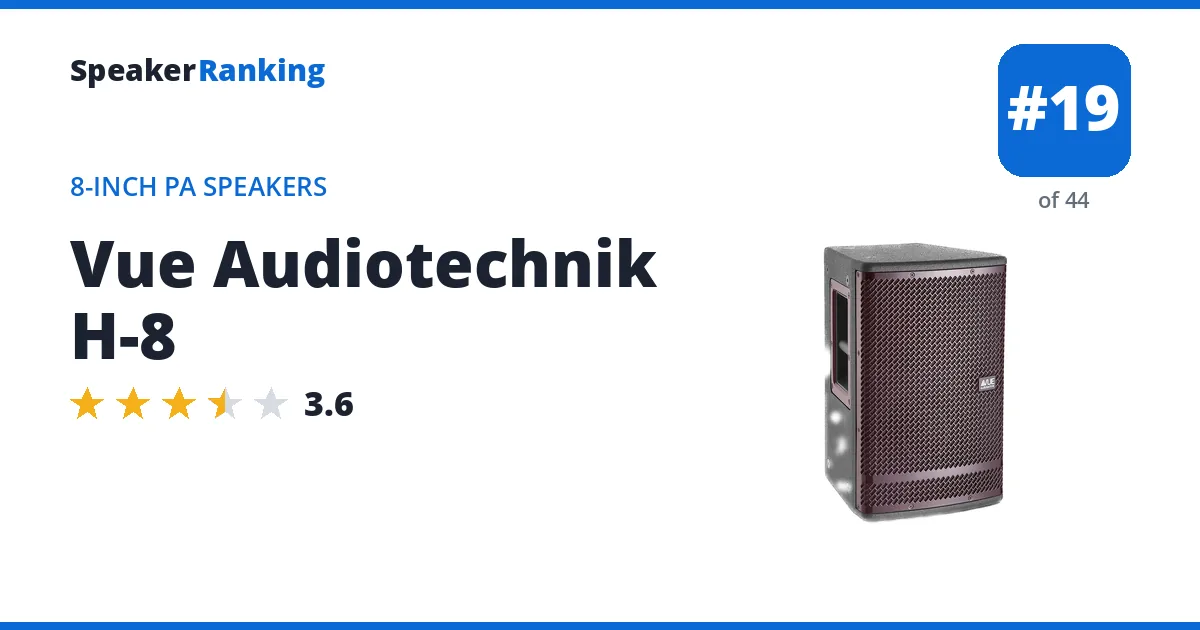
| 19 | Vue Audiotechnik H-8 | $3,800 | 122dB peak | 315W long-term | 8" woofer, beryllium-… | 51.2 lbs | |
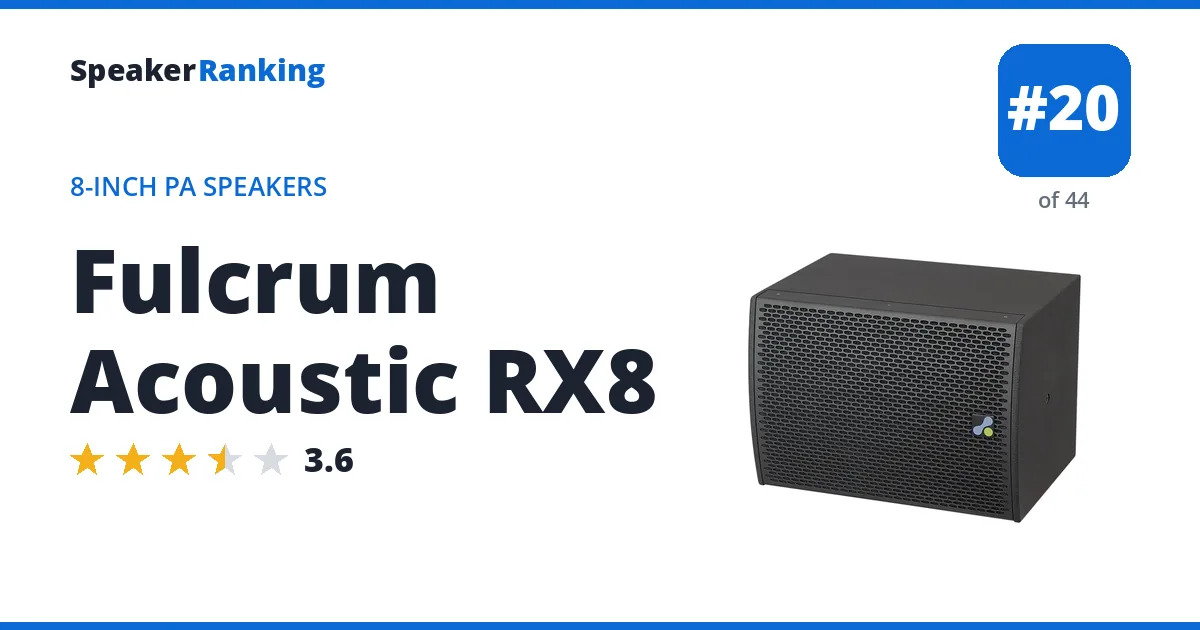
| 20 | Fulcrum Acoustic RX8 | - | 122dB peak / 116dB co… | Passive speaker; requ… | 8" woofer with 2" voi… | 14.1 lbs | |
| 21 | LD Systems Stinger 28-A-G3 | $799 | 131dB | 500W RMS / 1,000W pea… | 2x 8" woofers, BMS co… | 45.2 lbs | |
| 22 | One Systems 208HTC | - | - | Passive speaker; requ… | 2 x 8" woofers | 43 lbs | |
| 23 | Coda Audio G308 | - | 124dB peak | Passive speaker; requ… | 8" woofer, 1" compres… | 20.9 lbs | |
| 24 | Amate Audio X82FD | - | 137dB peak | 3,000W | 2x 8" neodymium woofe… | 50.7 lbs | |
| 25 | Axiom ED80P | $950 | 124dB peak | Passive speaker; use… | 8" woofer, 1" compres… | 17.6 lbs | |
| 26 | RCF ART 708-A MK5 | $499.00 | 128dB peak | 1400W peak | 8" woofer, 1.4" compr… | 22.9 lbs | |
| 27 | Electro-Voice EVC-1082 | $1,074.95 | 120dB | Passive speaker; requ… | 8" EVS-2008 woofer, 1… | 24.7 lbs | |
| 28 | Fulcrum Acoustic P8 | - | 125dB | Passive speaker; requ… | 8" woofer with 2" voi… | 16.1 lbs | |
| 29 | Martin Audio CDD-LIVE 8 | $2,600.00 | 123dB peak / 117dB co… | 1,300W peak | 8" woofer with coaxia… | 30.9 lbs | |
| 30 | HK Audio Linear 5 MK2 308 LTA | $2,869.99 | 138dB peak | 1,200W peak | 3x 8" woofers, 1" com… | 55.1 lbs | |
| 31 | Martin Audio CDD8 | - | 123dB peak / 117dB co… | Passive speaker; use… | 8" coaxial woofer, 1"… | 20.9 lbs | |
| 32 | Biamp Community IC6-1082 | - | 124dB peak / 118dB co… | Passive speaker; requ… | 8" woofer, compressio… | 24.9 lbs | |
| 33 | Bose AMM108 | - | 128dB peak | Passive speaker; requ… | 8" coaxial woofer and… | 28.7 lbs | |
| 34 | d&b audiotechnik 8S | - | 127dB | Passive speaker; requ… | 8" woofer, coaxial 1"… | 16.3 lbs | |
| 35 | RCF ART 708-A MK4 | $525.00 | 127dB peak | 800W peak / 400W RMS | 8" woofer, 1" compres… | 22.9 lbs | |
| 36 | Martin Audio FlexPoint FP8 | - | 124dB peak / 118dB co… | Passive speaker; requ… | 8" woofer, compressio… | 20.5 lbs | |
| 37 | Tannoy VX8 | $1,138.00 per pair | 119dB peak / 113dB av… | Passive speaker; requ… | 8" Dual Concentric dr… | 17.9 lbs | |
| 38 | Novacoustic Pariz P28 | - | 136dB | Passive speaker; requ… | 2 x 8" carbon cone wo… | 39.7 lbs | |
| 39 | Biamp Community V2-8 | - | 120dB peak | Passive speaker; requ… | 8" woofer, compressio… | 25.4 lbs | |
| 40 | Novacoustic KIRA 8 | - | 123dB peak | Passive speaker; requ… | 8" coaxial driver | 19.8 lbs | |
| 41 | Rockville SPG88 | $64.95 each | 119dB peak | - | 8" woofer, tweeter | 11.9 lbs | |
| 42 | Biamp Community V2-28 | $851.00 | 125dB peak | Passive speaker; requ… | 2 x 8" woofers, compr… | 36.8 lbs | |
| 43 | Audiofocus VENU 8a | $2,100 | 134dB peak | 430W AES / 1,720W peak | 8" woofer, 1" compres… | 25.4 lbs | |
| 44 | LYX SPA8PAS | $100 each | - | - | 8" woofer, tweeter | - |
Prices on this page were last checked October 12, 2026 at 4:13 PM UTC. Product prices and availability are accurate as of that date/time and are subject to change; the price and availability shown on Amazon at the time of purchase will apply to the purchase of this product.
As an eBay Partner, we may be compensated if you make a purchase.
 #1 QSC K8.2: $749.99 Amazon $749.99 B&H Photo Video $749.99 Guitar Center $749.99 eBay
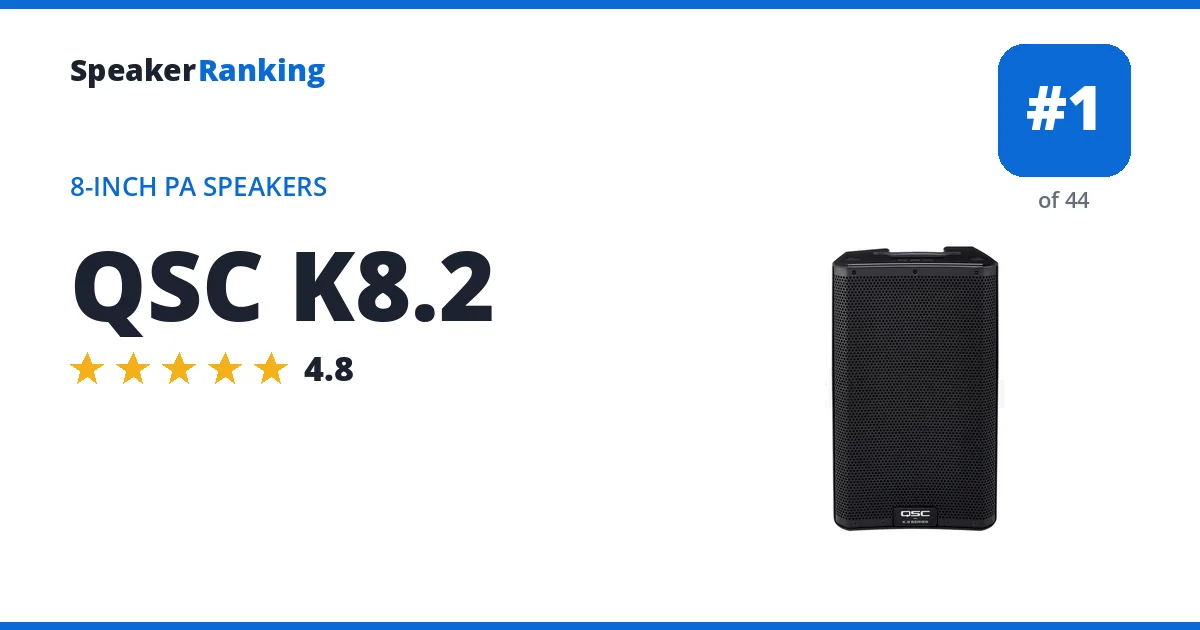
Same family: the QSC K10.2 (larger model, rated 4.8/5) and the QSC K12.2 (larger model, rated 4.7/5).
Pros: This is the standout measured result in this ranking: low-quality vendor data still returns a 7.74 ideal-subwoofer preference score, continuing the K.2 series’ strong showing at every driver size. Extensive onboard DSP, a titanium compression driver and QSC’s long market track record make it an unusually safe general-purpose 8-inch pick. Measured bass extension of 58Hz (-3dB).
Cons: The underlying Spinorama source is low quality, so its apparent measured lead deserves some caution. An 8-inch woofer means a subwoofer partner matters even more than with the larger K.2 models.
Full QSC K8.2 review and specifications →
| Released | May 2017 (9 years ago) |
|---|---|
| AES Input | No |
| Amplifier Power | 2025W peak (1800W LF + 225W HF) |
| Aux Input | Yes |
| Bass Extension (-3dB) | 58Hz (measured, vendor Spinorama data) |
| Bluetooth | No |
| Cabinet Material | Impact-resistant ABS |
| Coaxial Input | No |
| Configuration | Active 2-way bass-reflex PA speaker |
| Coverage | 105° conical |
| DSP | Yes |
| Dimensions | 17.7”H x 11”W x 10.6”D (449 x 280 x 269 mm) |
| Drivers | 8” woofer, 1.4” titanium compression driver |
| Frequency Response | 59Hz - 20kHz (-6dB, manufacturer specified) |
| Guitar Input | No |
| HDMI Input | No |
| Inputs | 2 x XLR/TRS combo, 3.5mm aux; 2 x XLR thru and XLR mix outputs |
| Maximum SPL | 128dB peak (manufacturer specified) |
| Microphone Input | No |
| Optical Input | No |
| Passive | No |
| RCA Input | No |
| Rigging | 2 x M10 inserts and pull-back point; 35mm pole mount |
| Spinorama Preference Score | 5.26 |
| Spinorama Preference Score with Perfect Sub | 7.74 |
| TRS Input | Yes |
| USB Input | No |
| Weight | 26.9 lbs (12.2 kg) |
| XLR Input | Yes |
- Links
- Reviews, Comparisons and Sound Samples
- Head-to-Head Comparisons
 #2 L-Acoustics 108P Discontinued eBay
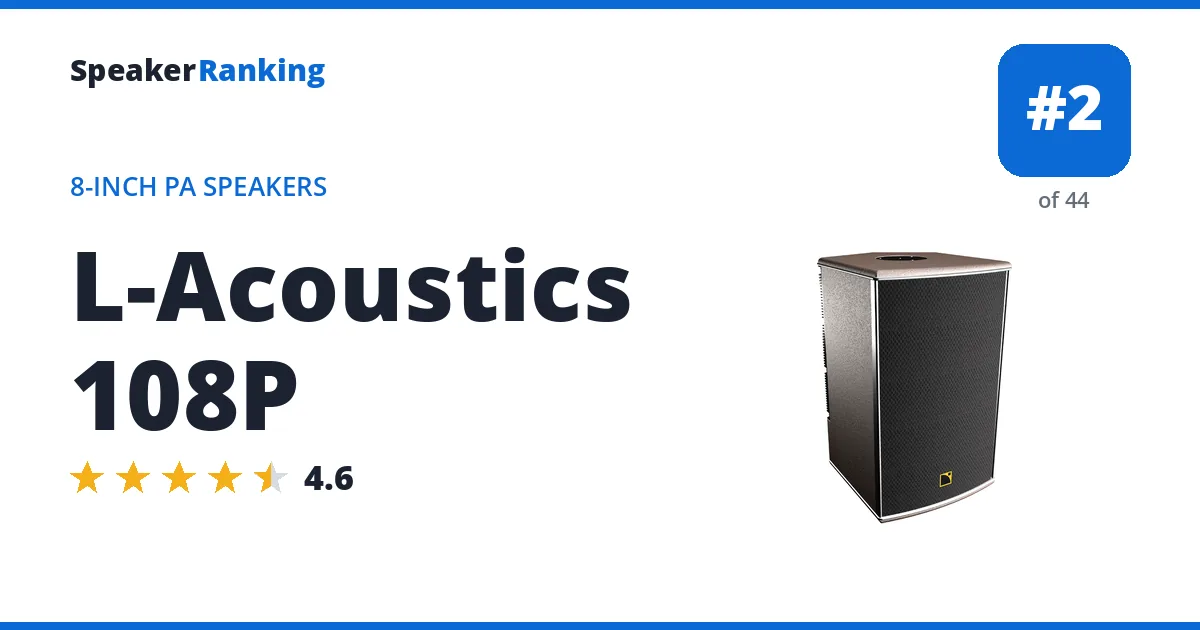
Pros: Medium-quality vendor Spinorama data produces a 7.32 ideal-subwoofer preference score, one of the strongest results in this entire family of rankings, with 61Hz bass extension from a compact 8-inch coaxial cabinet. Measured bass extension of 71Hz (-3dB).
Cons: This discontinued cabinet is difficult to source and lacks modern networking or an onboard mixer. Its ranking reflects acoustic performance rather than present-day value or ownership convenience.
Full L-Acoustics 108P review and specifications →
| Released | 2005 (21 years ago) |
|---|---|
| AES Input | No |
| Amplifier Power | 760W (500W LF at 4Ω + 260W HF at 8Ω, manufacturer specified) |
| Aux Input | No |
| Bass Extension (-3dB) | 71Hz (measured, vendor Spinorama data) |
| Bluetooth | No |
| Cabinet Material | 15/18mm Baltic birch plywood |
| Coaxial Input | No |
| Configuration | Self-powered 2-way coaxial PA speaker |
| Coverage | 100° conical (-6dB) x 30° vertical |
| DSP | Yes, onboard presets and protection |
| Dimensions | 16.6”H x 9.8”W x 11.8”D (421 x 250 x 299 mm) |
| Drivers | 8” coaxial woofer, compression driver |
| Frequency Response | 55Hz - 22kHz (-10dB, FRONT preset, manufacturer specified) |
| Guitar Input | No |
| HDMI Input | No |
| Inputs | Two parallel XLR inputs; two PowerCON AC input/link connectors |
| Maximum SPL | 127dB peak (1m, pink noise crest factor 4) |
| Microphone Input | No |
| Optical Input | No |
| Passive | No |
| RCA Input | No |
| Rigging | Integrated pole-mount socket; optional ETR8-2 bracket |
| Spinorama Preference Score | 4.62 |
| Spinorama Preference Score with Perfect Sub | 7.32 |
| TRS Input | No |
| USB Input | No |
| Weight | 28.7 lbs (13 kg) |
| XLR Input | Yes |
- Links
- Reviews, Comparisons and Sound Samples
- Head-to-Head Comparisons
 #3 Turbosound NuQ82: $500 Passive Discontinued eBay
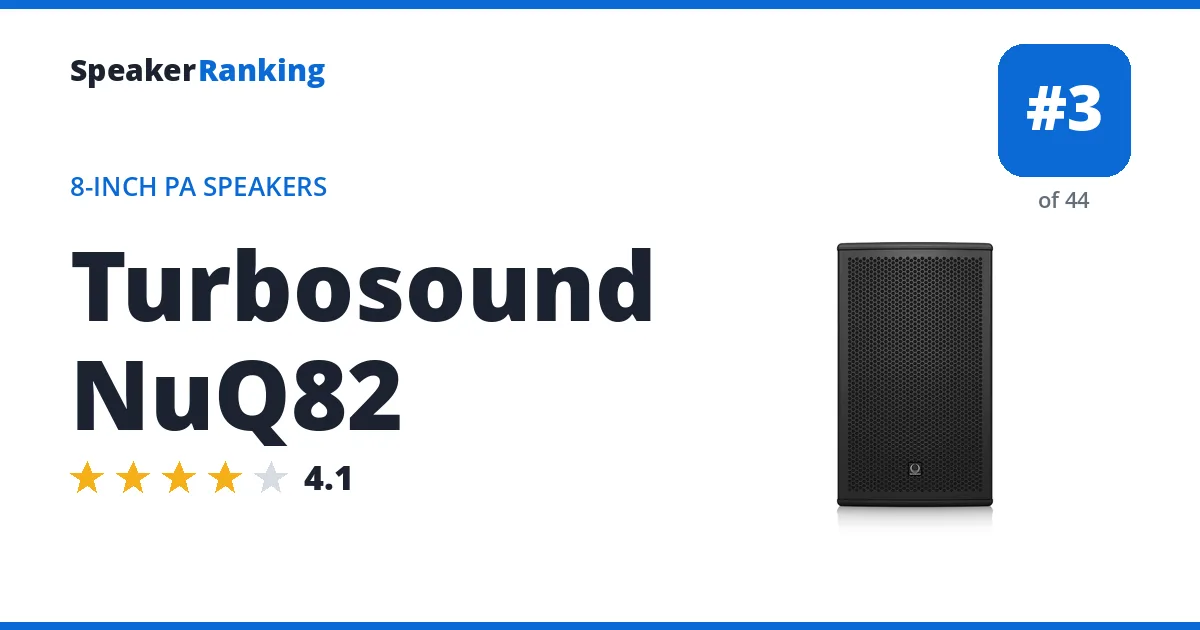
Same family: the Turbosound NuQ62 (smaller model, rated 3.6/5), the Turbosound NuQ102 (larger model, rated 4/5), the Turbosound NuQ122 (larger model, rated 3.5/5) and the Turbosound NuQ152 (larger model, rated 3.7/5).
Pros: Low-quality vendor data still shows a 5.7 ideal-subwoofer preference score with 52Hz measured extension, the deepest bass reach of any 8-inch box in this ranking. The switchable passive/bi-amp design and coaxial point-source layout give installers flexibility on amplification and DSP. Measured bass extension of 73Hz (-3dB).
Cons: Being passive-by-default, it needs an external amplifier and crossover to work at all, and its 123dB peak claim trails every active speaker here. Discontinued.
Full Turbosound NuQ82 review and specifications →
| AES Input | No |
|---|---|
| Amplifier Power | Passive/bi-amp speaker; use external amplification within the 250W continuous / 1,000W peak handling rating |
| Aux Input | No |
| Bass Extension (-3dB) | 73Hz (measured, vendor Spinorama data) |
| Bluetooth | No |
| Cabinet Material | 12mm birch plywood |
| Coaxial Input | No |
| Configuration | Passive/bi-amp switchable 2-way coaxial PA speaker |
| Coverage | 100° x 60° |
| DSP | Yes, Klark Teknik DSP with dynamic EQ, limiting, position compensation, user EQ and subwoofer integration; LCD/rotary control plus USB for PC remote control |
| Dimensions | 18.3”H x 10.8”W x 8.7”D (464 x 274 x 220 mm) |
| Drivers | 8” coaxial woofer, compression driver |
| Frequency Response | 65Hz - 18kHz (±3dB, manufacturer specified); 55Hz - 20kHz (-10dB) |
| Guitar Input | No |
| HDMI Input | No |
| Inputs | Two Neutrik speakON NL4 connectors |
| Maximum SPL | 123dB peak (manufacturer specified) |
| Microphone Input | No |
| Optical Input | No |
| Passive | Yes |
| Power Handling | 250W continuous / 1,000W peak (IEC, manufacturer specified) |
| RCA Input | No |
| Rigging | Eight M10 and three M8 fly points |
| Spinorama Preference Score | 3.25 |
| Spinorama Preference Score with Perfect Sub | 5.68 |
| TRS Input | No |
| USB Input | No |
| Weight | 22.5 lbs (10.2 kg) |
| XLR Input | No |
- Links
- Reviews, Comparisons and Sound Samples
- Head-to-Head Comparisons
 #4 Yamaha DXR8mkII: $769.99 Discontinued Amazon $769.99 Guitar Center $769.99 eBay
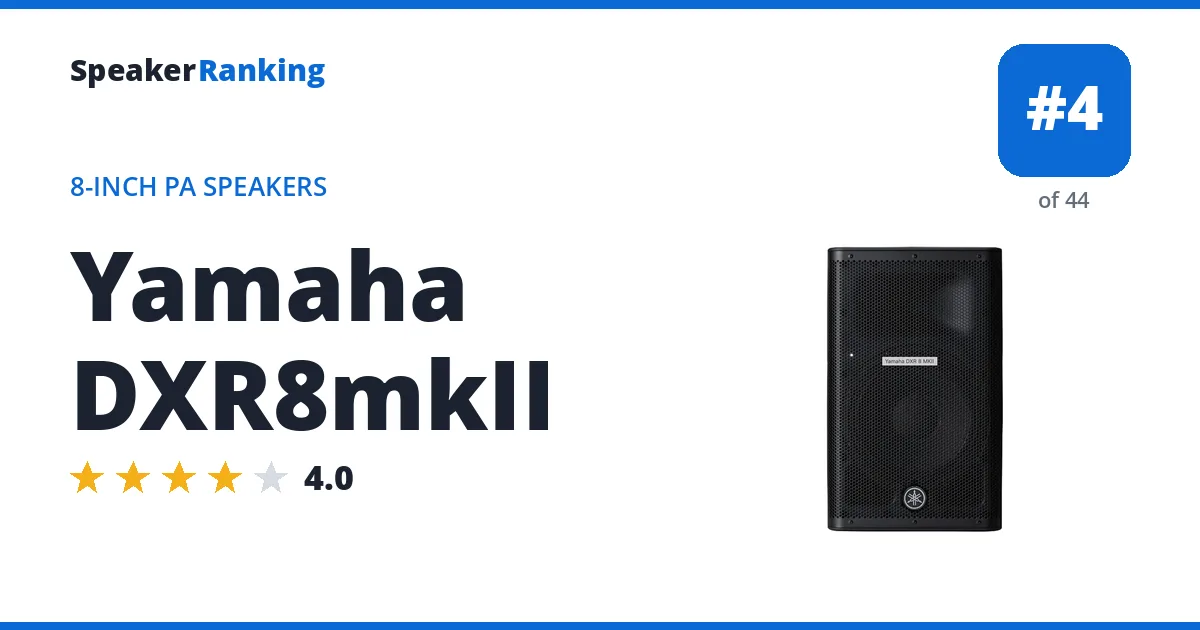
Same family: the Yamaha DXR10mkII (larger model, rated 3.8/5), the Yamaha DXR12mkII (larger model, rated 4/5) and the Yamaha DXR15mkII (larger model, rated 3.7/5). See every Yamaha DXR and CXR generation.
Pros: Medium-quality vendor data shows a 5.89 ideal-subwoofer preference score with 64Hz measured extension, among the strongest results here. Yamaha’s FIR-X processing, a 1.75-inch neodymium compression driver and a 90° x 60° constant-directivity horn carry over the larger DXR models’ engineering into a compact cabinet. Measured bass extension of 69Hz (-3dB).
Cons: No mkIII successor exists for this size yet, so it is the oldest design generation in this ranking’s Yamaha lineup, without app control or Bluetooth audio. Discontinued.
Full Yamaha DXR8mkII review and specifications →
| Released | 2019 (7 years ago) |
|---|---|
| AES Input | No |
| Amplifier Power | 1100W dynamic / 700W continuous (950W LF + 150W HF dynamic) |
| Aux Input | No |
| Bass Extension (-3dB) | 69Hz (measured, vendor Spinorama data) |
| Bluetooth | No |
| Cabinet Material | Matte-finish ABS |
| Coaxial Input | No |
| Configuration | Active 2-way bass-reflex PA speaker |
| Coverage | 90° x 60° |
| DSP | Yes |
| Dimensions | 18”H x 11”W x 11”D (458 x 280 x 280 mm) |
| Drivers | 8” woofer, 1.75” compression driver |
| Frequency Response | 57Hz - 20kHz (-10dB, manufacturer specified) |
| Guitar Input | No |
| HDMI Input | No |
| Inputs | XLR, dual 1/4-inch, stereo RCA; XLR thru and link outputs |
| Maximum SPL | 130dB peak (manufacturer specified) |
| Microphone Input | No |
| Optical Input | No |
| Passive | No |
| RCA Input | Yes |
| Rigging | 3 x M8 points; 35mm dual-angle pole mount |
| Spinorama Preference Score | 3.08 |
| Spinorama Preference Score with Perfect Sub | 5.89 |
| TRS Input | Yes |
| USB Input | No |
| Weight | 28.2 lbs (12.8 kg) |
| XLR Input | Yes |
- Links
- Reviews, Comparisons and Sound Samples
- Head-to-Head Comparisons
 #5 JBL PRX908: $699.00 Amazon $699.00 B&H Photo Video $699.00 Guitar Center $699.00 eBay
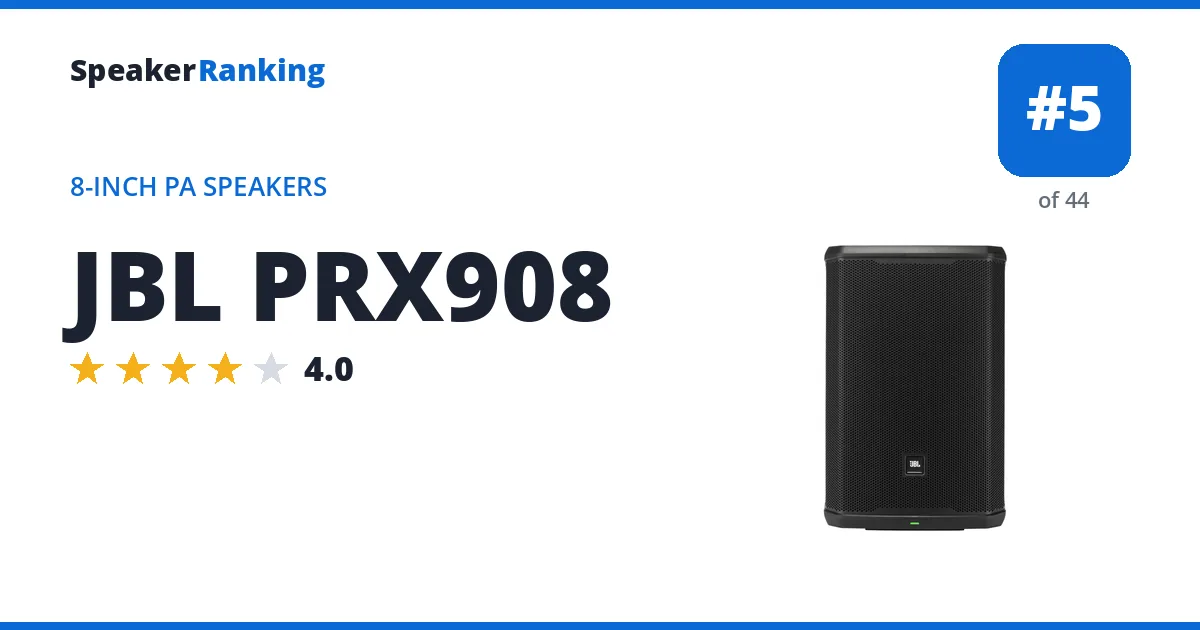
Same family: the JBL PRX912 (larger model, rated 4.3/5) and the JBL PRX915 (larger model, rated 3.9/5).
Pros: High-quality vendor data shows a 5.69 ideal-subwoofer preference score with 58Hz measured extension, backed by JBL’s extensive service network. A 12-band parametric EQ with dbx DriveRack feedback suppression and BLE app control carry over the PRX900 series’ engineering into an 8-inch cabinet. Measured bass extension of 63Hz (-3dB).
Cons: Its 126dB peak claim is modest for a main speaker, so pairing with a subwoofer matters more here than with the larger PRX modules.
Full JBL PRX908 review and specifications →
| Released | 2022 (4 years ago) |
|---|---|
| AES Input | No |
| Amplifier Power | 2000W peak / 1000W RMS |
| Aux Input | Yes |
| Bass Extension (-3dB) | 63Hz (measured, vendor Spinorama data) |
| Bluetooth | Yes, control via JBL Pro Connect app |
| Cabinet Material | Polypropylene/talc composite |
| Coaxial Input | No |
| Configuration | Active 2-way bass-reflex PA speaker |
| Coverage | 105° x 60° |
| Crossover Frequency | 1930Hz |
| DSP | Yes, 12-band parametric EQ and dbx DriveRack |
| Dimensions | 18.9”H x 12.3”W x 11.2”D (479 x 312 x 285 mm) |
| Drivers | 8” woofer, 1.5” compression driver |
| Frequency Response | 55Hz - 20kHz (-10dB, manufacturer specified) |
| Guitar Input | No |
| HDMI Input | No |
| Inputs | 2 x XLR/TRS combo, 3.5mm aux; 2 x XLR thru and XLR mix outputs |
| Maximum SPL | 126dB peak (manufacturer specified) |
| Microphone Input | No |
| Optical Input | No |
| Passive | No |
| RCA Input | No |
| Rigging | 6 x M10 suspension points; dual 36mm pole sockets |
| Spinorama Preference Score | 3.10 |
| Spinorama Preference Score with Perfect Sub | 5.69 |
| TRS Input | Yes |
| USB Input | No |
| Weight | 30.2 lbs (13.7 kg) |
| XLR Input | Yes |
- Links
- Reviews, Comparisons and Sound Samples
- Head-to-Head Comparisons
 #6 L-Acoustics X8 Passive eBay
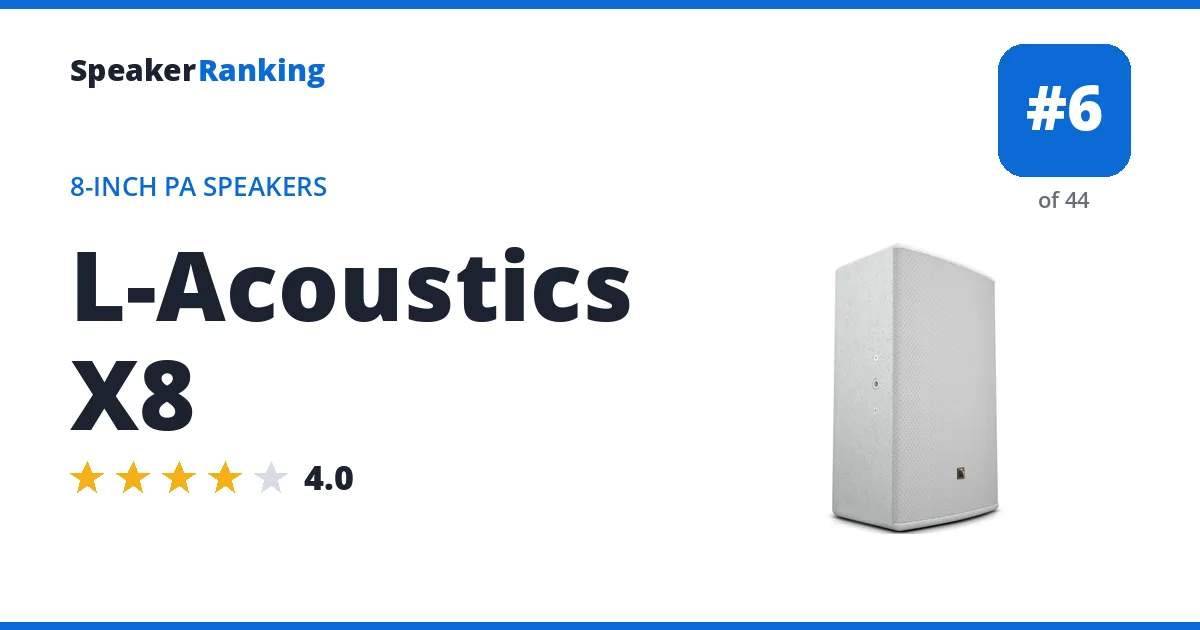
Same family: the L-Acoustics X4i (smaller model, rated 3.6/5), the L-Acoustics X6i (smaller model, rated 3.9/5), the L-Acoustics X12 (larger model, rated 4.6/5) and the L-Acoustics X15 HiQ (larger model, rated 4.4/5).
Pros: Vendor Spinorama data gives preference scores of 4.29 standalone and 7.09 with an ideal subwoofer, the best standalone score in this ranking. Bass reaches about 71Hz (-3dB) with a deviation of only 1.0dB across the reference band, and the 100° axisymmetric coaxial pattern stays even off axis. It reaches 129dB from a 12kg cabinet with a 35° monitor angle. Measured bass extension of 71Hz (-3dB).
Cons: It is a passive cabinet that needs an L-Acoustics amplified controller. Listening-window narrow-band deviation is 0.363 and predicted in-room smoothness is 0.615, a step behind the best-measuring boxes. Pricing is dealer quoted and high for an 8-inch box.
Full L-Acoustics X8 review and specifications →
| Released | 2015 (11 years ago) |
|---|---|
| AES Input | No |
| Amplifier Power | Passive speaker; requires external amplification (L-Acoustics amplified controller) |
| Aux Input | No |
| Bass Extension (-3dB) | 71Hz (measured, vendor Spinorama data) |
| Bluetooth | No |
| Coaxial Input | No |
| Configuration | Passive 2-way coaxial PA speaker |
| Coverage | 100° axisymmetric |
| DSP | No (passive; processing comes from the amplified controller) |
| Drivers | 8” low-frequency driver, 1.5” compression driver (coaxial) |
| Frequency Response | 60Hz - 20kHz (manufacturer specified) |
| Guitar Input | No |
| HDMI Input | No |
| Maximum SPL | 129dB (manufacturer specified) |
| Microphone Input | No |
| Optical Input | No |
| Passive | Yes |
| RCA Input | No |
| Rigging | 35° monitoring angle |
| Spinorama Preference Score | 4.29 |
| Spinorama Preference Score with Perfect Sub | 7.09 |
| TRS Input | No |
| USB Input | No |
| Weight | 26.5 lbs (12 kg) |
| XLR Input | No |
- Links
- Reviews, Comparisons and Sound Samples
- Head-to-Head Comparisons
 #7 RCF KX 08-A: $2,308.50 B&H Photo Video $2,308.50 Guitar Center eBay
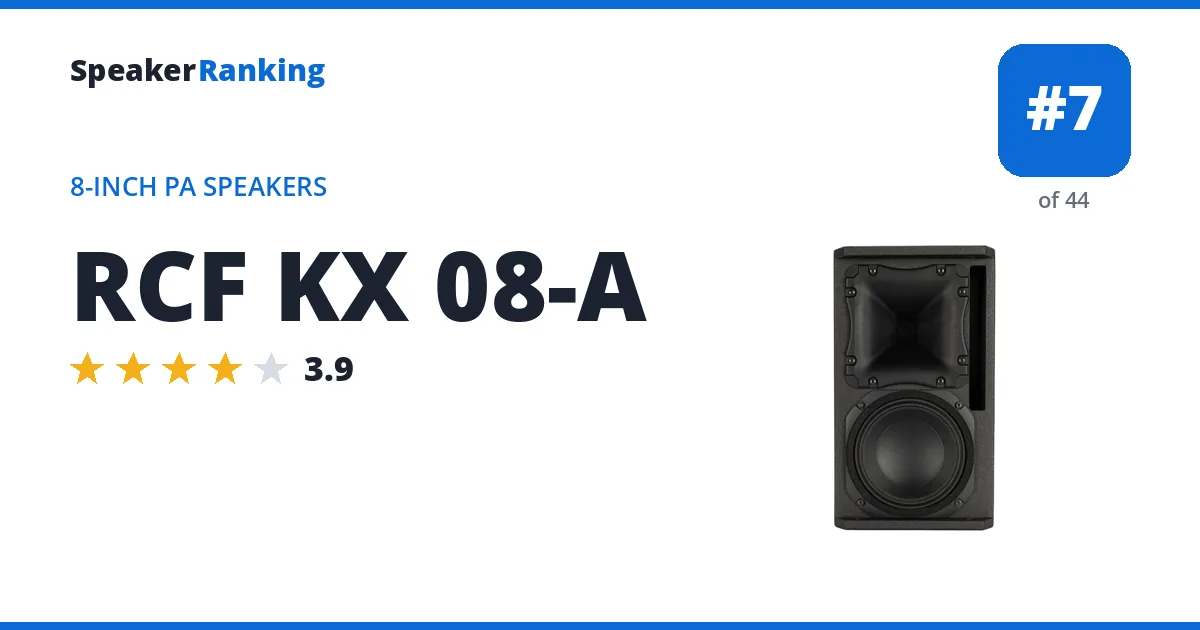
Same family: the RCF KX 10-A (larger model, rated 4/5), the RCF KX 32-A (larger model, rated 4.3/5) and the RCF KX 45-A (larger model, rated 4.2/5).
Pros: The entry point into RCF’s flagship KX point-source range, with a 2000W amplifier, a PKX-dome neodymium compression driver, RDNet remote control and a rotatable 90° x 70° horn in a manageable 12.5kg cabinet. Measured bass extension of 82.5Hz (-3dB).
Cons: The local measurement is truncated and cannot produce a preference score, and pricing/retail availability are not yet well established for this model.
Full RCF KX 08-A review and specifications →
| AES Input | No |
|---|---|
| Amplifier Power | 2000W peak (1400W LF + 600W HF) |
| Aux Input | No |
| Bass Extension (-3dB) | 82.5Hz (measured, vendor Spinorama data) |
| Bluetooth | No |
| Cabinet Material | Baltic birch plywood |
| Coaxial Input | No |
| Configuration | Active 2-way bass-reflex point-source PA speaker |
| Coverage | 90° x 70°, rotatable |
| Crossover Frequency | 1400Hz |
| DSP | Yes, RDNet remote management |
| Dimensions | 17.7”H x 10.2”W x 11.2”D (450 x 260 x 285.4 mm) |
| Drivers | 8” woofer, 1.75” voice-coil neodymium compression driver |
| Frequency Response | 65Hz - 20kHz (manufacturer specified) |
| Guitar Input | No |
| HDMI Input | No |
| Inputs | XLR and EtherCON RDNet input/link |
| Maximum SPL | 128dB peak (manufacturer specified) |
| Microphone Input | No |
| Network Control | RDNet |
| Optical Input | No |
| Passive | No |
| RCA Input | No |
| Rigging | M10 inserts; 35mm pole mount |
| TRS Input | No |
| USB Input | No |
| Weight | 24.3 lbs (11 kg) |
| XLR Input | Yes |
- Links
- Reviews, Comparisons and Sound Samples
- Head-to-Head Comparisons
 #8 Vue Audiotechnik A-8: $999 Passive eBay
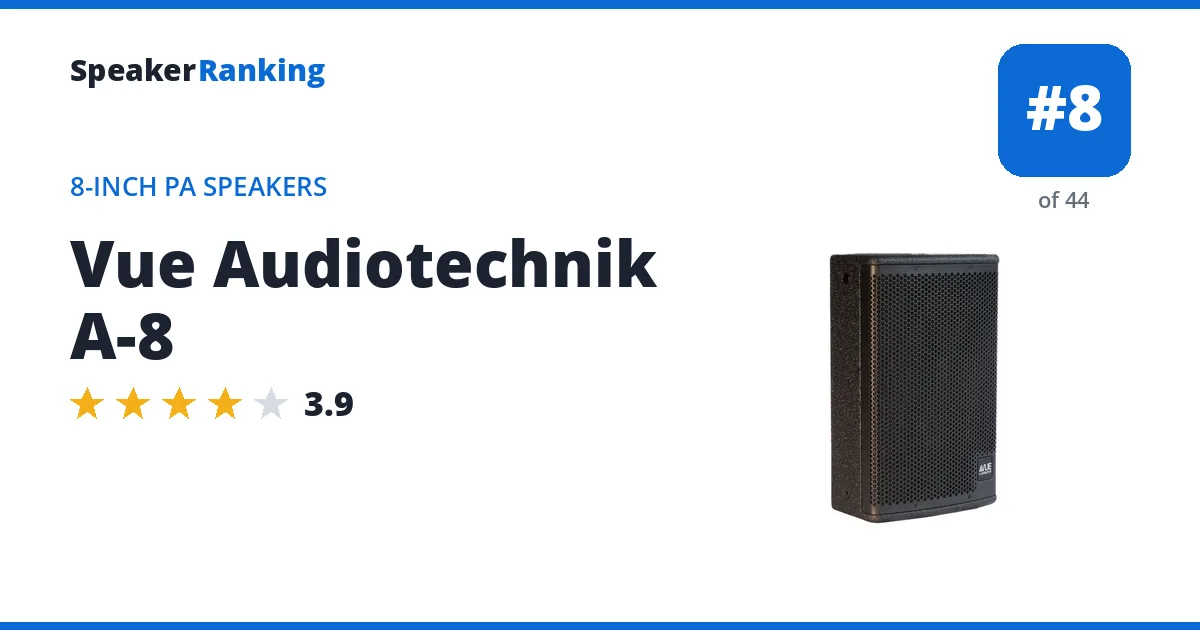
Same family: the Vue Audiotechnik A-10 (larger model, rated 3.7/5), the Vue Audiotechnik A-12 (larger model, rated 3.6/5) and the Vue Audiotechnik A-15 (larger model, rated 3.5/5).
Pros: Low-quality vendor data shows a 5.61 ideal-subwoofer preference score, the strongest measured result among the passive entries in this ranking. A neodymium woofer and aluminum-dome compression driver on a rotatable 70° x 55° horn keep amplification and DSP choices flexible for installers. Measured bass extension of 90Hz (-3dB).
Cons: Being passive, it needs an external amplifier and processing to perform correctly, adding cost and complexity that self-powered rivals avoid. Measured bass extension is shallow at roughly 90Hz.
Full Vue Audiotechnik A-8 review and specifications →
| Released | 2012 (14 years ago) |
|---|---|
| Amplifier Power | Passive speaker; external amplifier required (manufacturer output rating not published in the current product page) |
| Aux Input | No |
| Bass Extension (-3dB) | 90Hz (measured, vendor Spinorama data) |
| Bluetooth | No |
| Cabinet Material | Multi-ply cross-grain laminated birch plywood |
| Configuration | Passive 2-way bass-reflex PA speaker |
| Coverage | 70° x 55°, rotatable |
| DSP | No (passive, passive crossover network only) |
| Dimensions | 18.1” x 11.3” x 10.8” (460 x 286 x 274 mm) |
| Drivers | 8” neodymium woofer, aluminum-dome compression driver |
| Frequency Response | 75Hz - 20kHz (manufacturer specified) |
| Guitar Input | No |
| Inputs | 2x Neutrik NL-4 Speakon |
| Maximum SPL | 124dB peak (manufacturer specified) |
| Microphone Input | No |
| Passive | Yes |
| Rigging | Integrated fly points and pole-mount system |
| Spinorama Preference Score | 2.35 |
| Spinorama Preference Score with Perfect Sub | 5.61 |
| Weight | 28.9 lbs (13.1 kg) |
| XLR Input | No |
- Links
- Reviews, Comparisons and Sound Samples
- Head-to-Head Comparisons
 #9 EAW MKC80 Passive Full Compass eBay
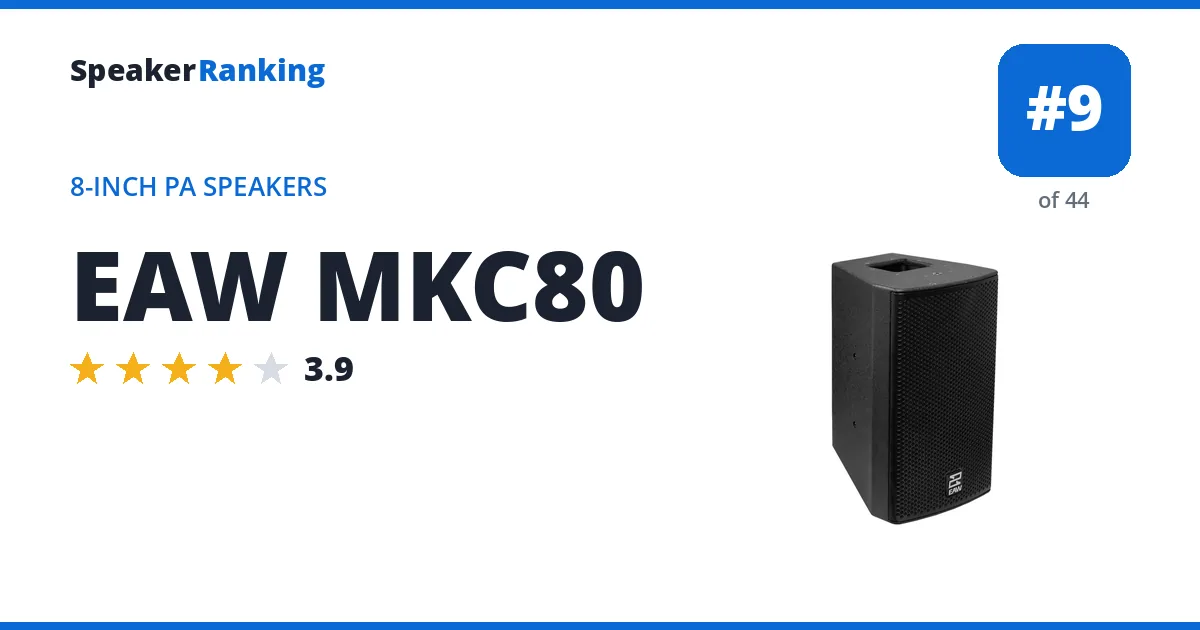
Same family: the EAW MKC50 (smaller model, rated 3.6/5), the EAW MKC60 (smaller model, rated 3.8/5) and the EAW MKC120 (larger model, rated 4.3/5).
Pros: Vendor Spinorama data gives preference scores of 4.08 standalone and 7.10 with an ideal subwoofer. A 93dB sensitivity and 450W handling deliver a 132dB peak rating from a 10kg cabinet, and the rotatable 90° x 60° coaxial horn suits horizontal or vertical placement. Measured bass extension of 85Hz (-3dB).
Cons: Bass reaches only about 85Hz (-3dB), and listening-window narrow-band deviation is 0.321, so the tonal balance is less even than the best 8-inch models. It is passive, so an amplifier and processor with EAW presets are needed to play it.
Full EAW MKC80 review and specifications →
| Released | 2023 (3 years ago) |
|---|---|
| AES Input | No |
| Amplifier Power | Passive speaker; requires external amplification within the 450W handling rating |
| Aux Input | No |
| Bass Extension (-3dB) | 85Hz (measured, vendor Spinorama data) |
| Bluetooth | No |
| Coaxial Input | No |
| Configuration | Passive 2-way coaxial PA speaker |
| Coverage | 90° x 60° (rotatable) |
| DSP | No (passive) |
| Dimensions | 16.6”H x 10”W x 10.5”D (422 x 255 x 267 mm) |
| Drivers | 8” cone woofer with 2” voice coil, 1” exit compression driver with CSA coaxial loading |
| Frequency Response | 60Hz - 20kHz (manufacturer specified) |
| Guitar Input | No |
| HDMI Input | No |
| Maximum SPL | 132dB (manufacturer specified) |
| Microphone Input | No |
| Optical Input | No |
| Passive | Yes |
| Power Handling | 450W at 8 ohms (manufacturer specified) |
| RCA Input | No |
| Rigging | Integrated M10 mounting points, pole mount |
| Sensitivity | 93dB |
| Spinorama Preference Score | 4.08 |
| Spinorama Preference Score with Perfect Sub | 7.10 |
| TRS Input | No |
| USB Input | No |
| Weight | 22 lbs (10 kg) |
| XLR Input | No |
- Links
- Reviews, Comparisons and Sound Samples
- Head-to-Head Comparisons
 #10 Alcons Audio VR8 Passive eBay
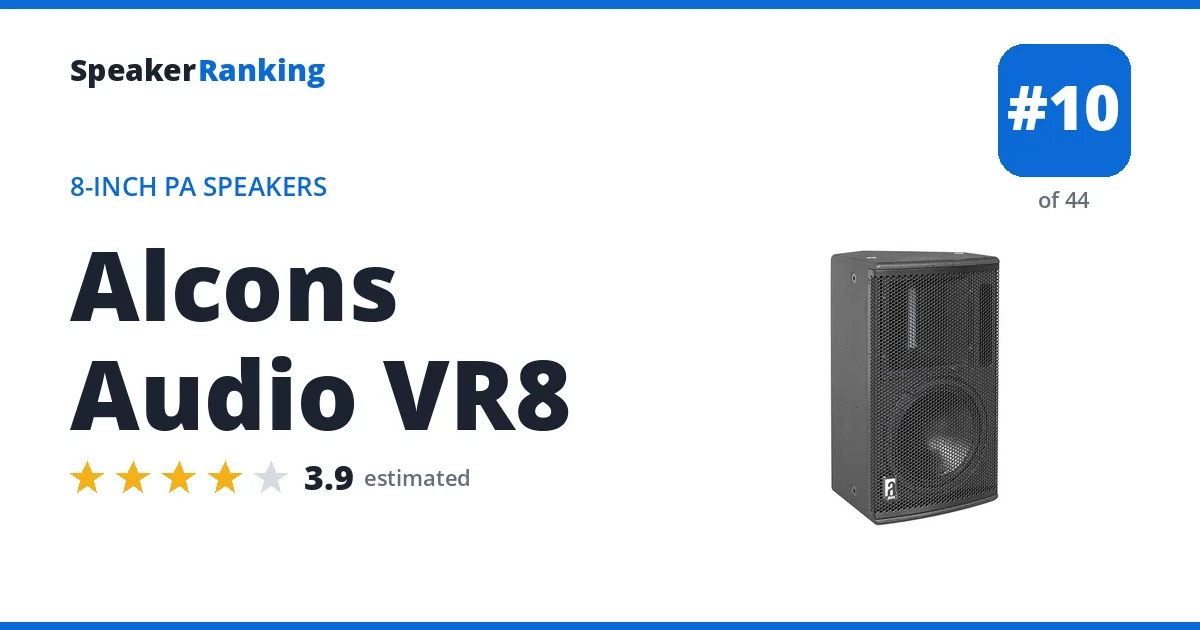
Same family: the Alcons Audio VR5 V1 (smaller model, rated 4/5) and the Alcons Audio VR12 (larger model, estimated 4/5).
Pros: A passive pro-ribbon point source from Alcons’ VR series, a larger sibling of the measured Alcons Audio VR5 V1: an 8” woofer under Alcons’ 4” RBN401 pro-ribbon, the same ribbon type used in the VR5. The ribbon’s low distortion and controlled horizontal pattern are what lift the measured VR5 near the top of the compact class.
Cons: No independent measurements yet, so it can’t be compared with ranked PA speakers. It needs an Alcons Sentinel amplifier and controller preset for its rated response, and Alcons sells only through dealers, so there is no retail price.
Full Alcons Audio VR8 review and specifications →
| Amplifier Power | Passive speaker; requires external amplification |
|---|---|
| Bass Extension (-3dB) | 74Hz (manufacturer specified) |
| Bluetooth | No |
| Configuration | Passive 2-way pro-ribbon PA speaker |
| DSP | No (passive) |
| Drivers | 8” woofer, RBN401 4” pro-ribbon driver |
| Maximum SPL | 128dB peak (manufacturer specified) |
| Passive | Yes |
| Weight | 26.5 lbs (12 kg) |
| XLR Input | No |
- Links
- Reviews, Comparisons and Sound Samples
- No independent measurement review is linked for this model; it is ranked from hands-on listening and comparison against similarly priced speakers.
 #11 DAS Audio ARTEC 508A: $2,180.25 SoundPro $2,180.25 eBay
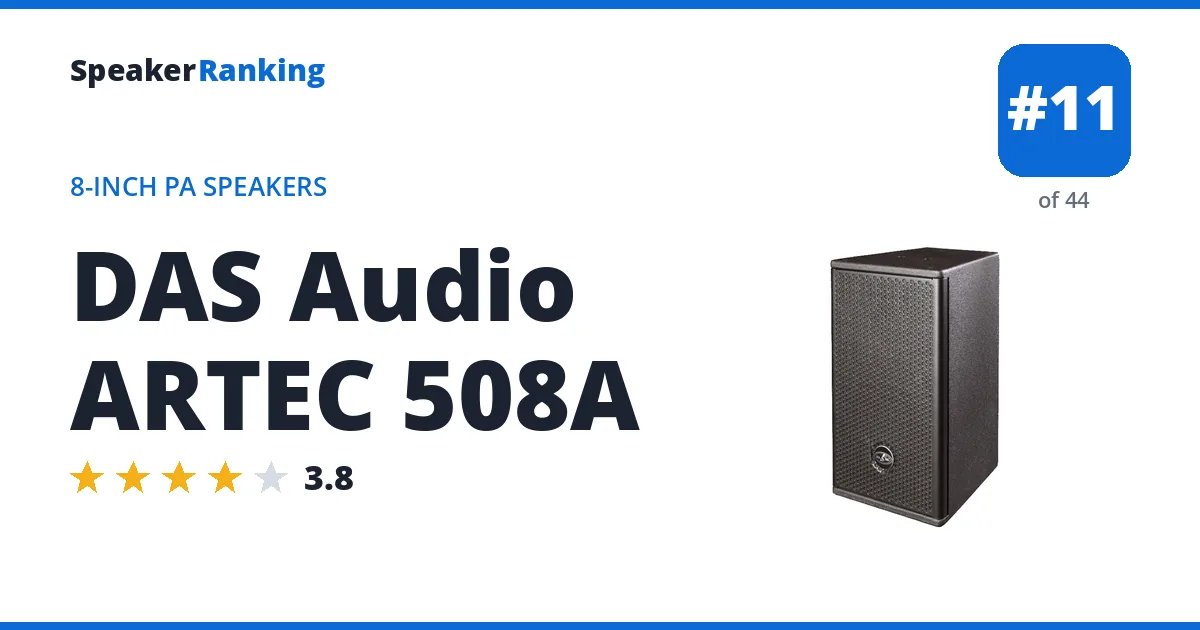
Same family: the DAS Audio ARTEC 506A (smaller model, rated 4/5), the DAS Audio ARTEC 526A (smaller model, rated 4.1/5) and the DAS Audio ARTEC 510A (larger model, rated 3.6/5).
Pros: Vendor Spinorama data gives preference scores of 4.32 standalone and 7.24 with an ideal subwoofer, near the top of the 8-inch ranking. Predicted in-room smoothness is 0.622 with a wide, even 80° x 80° pattern. The 500W built-in amplifier and DSP reach 122dB in a 9.9kg birch cabinet with 91dB sensitivity. Measured bass extension of 75Hz (-3dB).
Cons: Bass reaches only about 75Hz (-3dB), with 60Hz at -10dB, so it needs a subwoofer for full-range music. Listening-window narrow-band deviation is 0.30, less even than the best 8-inch models. The installation styling and high price make it costly for what is a compact 8-inch box.
Full DAS Audio ARTEC 508A review and specifications →
| Released | Jun 2012 (14 years ago) |
|---|---|
| AES Input | No |
| Amplifier Power | 500W RMS, 720W peak (Class D) |
| Aux Input | No |
| Bass Extension (-3dB) | 75Hz (measured, vendor Spinorama data) |
| Bluetooth | No |
| Cabinet Material | Birch plywood |
| Coaxial Input | No |
| Configuration | Active 2-way full-range PA speaker |
| Coverage | 80° x 80° |
| DSP | Yes |
| Dimensions | 17.7”H x 9.6”W x 11.4”D (450 x 245 x 290 mm) |
| Drivers | 8” woofer, M-34 compression driver on BC-88 80° x 80° horn |
| Frequency Response | 60Hz - 20kHz (-10dB, manufacturer specified) |
| Guitar Input | No |
| HDMI Input | No |
| Inputs | Balanced XLR input, Speakon NL4 connector |
| Maximum SPL | 122dB (manufacturer specified) |
| Microphone Input | No |
| Optical Input | No |
| Passive | No |
| RCA Input | No |
| Rigging | M10 flying points, 35mm pole socket, AXU/AXF/AXR bracket compatible |
| Sensitivity | 91dB |
| Spinorama Preference Score | 4.32 |
| Spinorama Preference Score with Perfect Sub | 7.24 |
| TRS Input | No |
| USB Input | No |
| Weight | 21.8 lbs (9.9 kg) |
| XLR Input | Yes |
- Links
- Reviews, Comparisons and Sound Samples
- Head-to-Head Comparisons
 #12 Meyer Sound Ultra X40 eBay
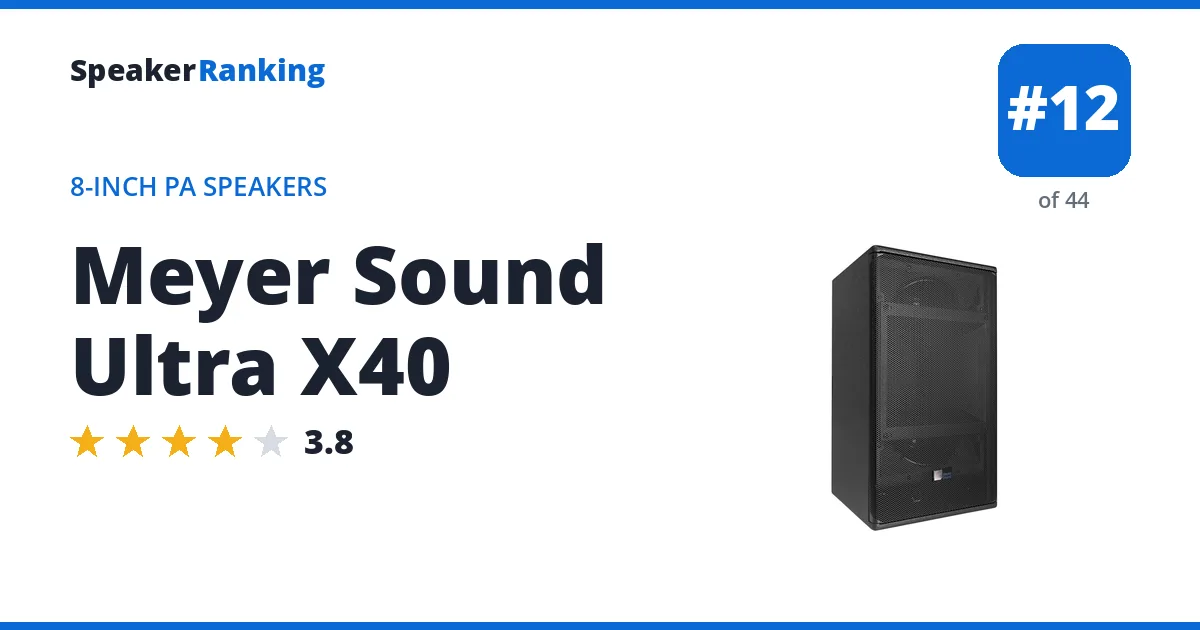
Same family: the Meyer Sound Ultra X20 (smaller model, rated 3.6/5), the Meyer Sound Ultra X22 (smaller model, rated 3.9/5), the Meyer Sound Ultra X23 (smaller model, rated 3.3/5) and the Meyer Sound Ultra X80 (larger model, estimated 3.9/5).
Pros: Bass reaches 65Hz at -3dB and about 57Hz at -10dB, deep for a pair of 8-inch woofers, and manufacturer measurements give a 5.43 preference score with an ideal subwoofer. The concentric 3-inch compression driver and 110° x 50° Constant-Q horn give wide, even coverage, and the built-in 1,950W peak amplifier reaches 127dB. Networked Galileo processing and a sub-25kg weight make it easy to fly or pole-mount. Measured bass extension of 65Hz (-3dB).
Cons: The 3.8dB reference band and 0.66 listening-window deviation make its tonal balance rougher than the Meyer Sound Ultra X20’s, with a 2.73 standalone score. It is sold through pro dealers with no published price, and Sweetwater requires a sales engineer to order it.
Full Meyer Sound Ultra X40 review and specifications →
| Released | 2019 (7 years ago) |
|---|---|
| AES Input | No |
| Amplifier Power | 1,950W peak, 3-channel Class D |
| Aux Input | No |
| Bass Extension (-10dB) | about 56.8Hz (measured, vendor Spinorama data) |
| Bass Extension (-3dB) | 65Hz (measured, vendor Spinorama data) |
| Bluetooth | No |
| Coaxial Input | No |
| Configuration | Self-powered 2-way concentric loudspeaker |
| Coverage | 110° x 50° Constant-Q horn |
| DSP | Yes, Galileo GEN-1 networked processing |
| Dimensions | 22.3”H x 12.5”W x 14”D (567 x 318 x 356 mm) |
| Drivers | 2x 8” cone woofers, concentric 3” compression driver |
| Frequency Response | 56Hz - 19kHz (manufacturer specified) |
| Guitar Input | No |
| HDMI Input | No |
| Maximum SPL | 127dB linear peak (manufacturer specified) |
| Microphone Input | No |
| Network Control | Galileo GEN-1 networked audio and DSP control |
| Optical Input | No |
| Passive | No |
| RCA Input | No |
| Rigging | 11 x M8 inserts; 35mm pole-mount receptacle |
| Spinorama Preference Score | 2.73 |
| Spinorama Preference Score with Perfect Sub | 5.43 |
| TRS Input | No |
| USB Input | No |
| Weight | Under 55.1 lbs (25 kg) |
| XLR Input | Yes |
- Links
- Reviews, Comparisons and Sound Samples
- Head-to-Head Comparisons
 #13 One Systems 108HTH Passive eBay
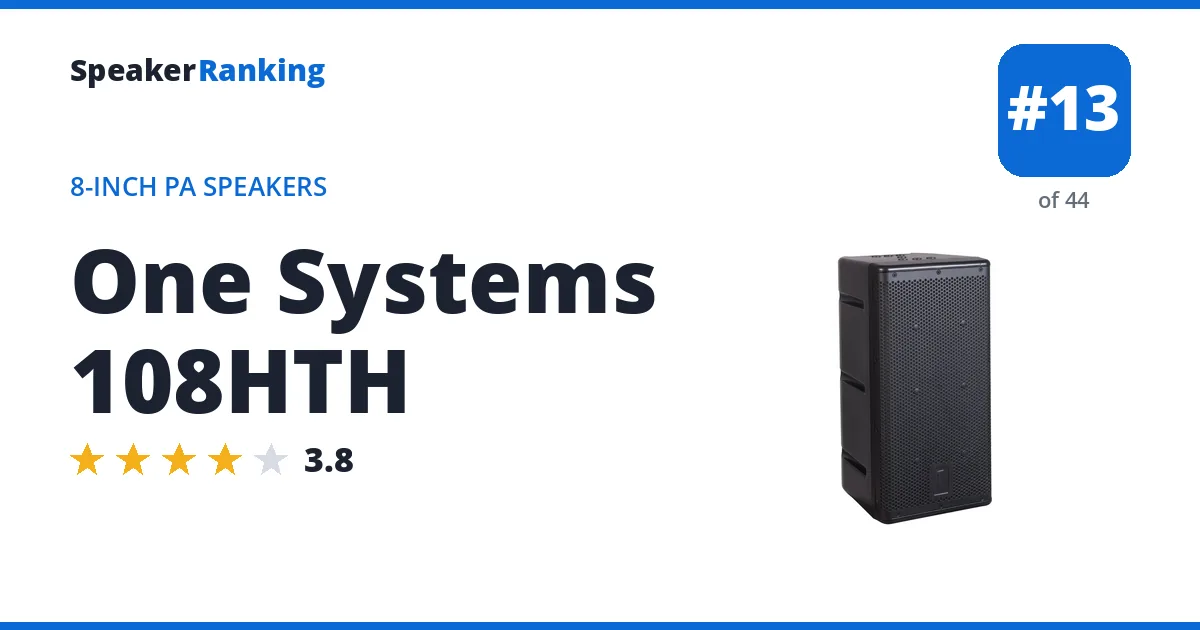
Pros: Manufacturer measurements give the best result in this group of weatherproof installation speakers: preference scores of 3.25 standalone and 6.11 with an ideal subwoofer. Bass reaches about 52Hz at -10dB, deep for an 8-inch design, and the IP56 cabinet with 70V/100V taps suits outdoor bars, patios and pool areas. Measured bass extension of 118Hz (-3dB).
Cons: The treble is rolled off on axis, with response quoted only to 16kHz, so it sounds less airy than the flattest 8-inch models. It is passive and needs an amplifier, and it is sold through pro dealers with no published price.
Full One Systems 108HTH review and specifications →
| AES Input | No |
|---|---|
| Amplifier Power | Passive speaker; requires external amplification |
| Aux Input | No |
| Bass Extension (-10dB) | about 52.1Hz (measured, vendor Spinorama data) |
| Bass Extension (-3dB) | 118Hz (measured, vendor Spinorama data) |
| Bluetooth | No |
| Coaxial Input | No |
| Configuration | Passive 2-way PA speaker, IP56 weather rated |
| Coverage | 105° x 60° or 60° x 40° (rotatable horn) |
| DSP | No (passive) |
| Dimensions | 19”H x 9.6”W x 10.7”D (483 x 243 x 271 mm) |
| Drivers | 8” woofer, compression driver on a rotatable horn |
| Frequency Response | 65Hz - 16kHz (manufacturer specified) |
| Guitar Input | No |
| HDMI Input | No |
| Impedance | 8 ohms, with 70V/100V taps |
| Microphone Input | No |
| Optical Input | No |
| Passive | Yes |
| Power Handling | 200W continuous / 800W peak |
| RCA Input | No |
| Rigging | 7 x M8 rigging points; optional pole mount and brackets |
| Sensitivity | 92dB |
| Spinorama Preference Score | 3.25 |
| Spinorama Preference Score with Perfect Sub | 6.11 |
| TRS Input | No |
| USB Input | No |
| Weight | 36.4 lbs (16.5 kg) |
| XLR Input | No |
- Links
- Reviews, Comparisons and Sound Samples
 #14 KV2 Audio EX28 eBay
Same family: the KV2 Audio EX6 (smaller model, estimated 3.6/5), the KV2 Audio EX26 (smaller model, estimated 3.6/5), the KV2 Audio EX10 (smaller model, rated 3.7/5), the KV2 Audio EX12 (larger model, rated 4.4/5) and the KV2 Audio EX15 (larger model, rated 4/5).
Pros: A self-powered model from KV2’s EX range alongside the measured KV2 Audio EX10 and KV2 Audio EX12: two 8” woofers and a rotatable 100° x 80° horn, bridging the 10” and 12” models. KV2 pairs a switched-rail Class D woofer amplifier with a Class AB tweeter amplifier and rates it at 132dB peak / 126dB long-term with a 62Hz - 20kHz (-3dB) response.
Cons: No independent measurements yet, so it can’t be compared with ranked PA speakers. KV2 sells through specialist dealers, so there is no retail price, and it is heavy for its size at 23 kg.
Full KV2 Audio EX28 review and specifications →
| Released | 2024 (2 years ago) |
|---|---|
| Bass Extension (-3dB) | 62Hz (manufacturer specified) |
| Bluetooth | No |
| Configuration | Active 2-way PA speaker |
| Coverage | 100° x 80°, rotatable |
| DSP | Yes |
| Drivers | 2x 8” woofers, compression driver on a rotatable horn |
| Frequency Response | 62Hz - 20kHz (-3dB) (manufacturer specified) |
| Maximum SPL | 132dB peak / 126dB long-term (manufacturer specified) |
| Passive | No |
| Rigging | 4 x M10 suspension points; 35mm pole mount |
| Weight | 50.7 lbs (23 kg) |
| XLR Input | Yes |
- Links
- Reviews, Comparisons and Sound Samples
- No independent measurement review is linked for this model; it is ranked from hands-on listening and comparison against similarly priced speakers.
 #15 LD Systems Stinger 8-A-G3: $599.99 Amazon $599.99 eBay
Same family: the LD Systems Stinger 28-A-G3 (larger model, ranked lower, rated 3.5/5), the LD Systems Stinger 10-A-G3 (larger model, rated 4.1/5), the LD Systems Stinger 12 A G3 (larger model, rated 3.5/5) and the LD Systems Stinger 15-A-G3 (larger model, rated 3.4/5).
Pros: Medium-quality vendor data returns a 5.20 ideal-subwoofer preference score with 49Hz measured extension, a genuinely deep result for an affordable 8-inch box. At 10.5kg it is one of the lightest active speakers in this ranking. Measured bass extension of 56Hz (-3dB).
Cons: Its 125dB peak claim is modest next to the higher-output rivals here, and its 90° x 50° horn is on the narrower side.
Full LD Systems Stinger 8-A-G3 review and specifications →
| Released | 2017 (9 years ago) |
|---|---|
| AES Input | No |
| Amplifier Power | 600W peak / 300W RMS |
| Aux Input | No |
| Bass Extension (-3dB) | 56Hz (measured, vendor Spinorama data) |
| Bluetooth | No |
| Cabinet Material | 12mm plywood with polyurea coating |
| Coaxial Input | No |
| Configuration | Active 2-way bass-reflex PA speaker |
| Coverage | 90° x 50° |
| DSP | Yes |
| Dimensions | 18”H x 10.6”W x 11.4”D (457 x 270 x 290 mm) |
| Drivers | 8” woofer, compression driver |
| Frequency Response | 70Hz - 20kHz (manufacturer specified) |
| Guitar Input | No |
| HDMI Input | No |
| Inputs | 2 x XLR/TRS line/mic inputs; XLR mono mix output |
| Maximum SPL | 125dB peak (manufacturer specified) |
| Microphone Input | Yes |
| Optical Input | No |
| Passive | No |
| RCA Input | No |
| Rigging | M10 suspension points; 36mm Dual-Tilt pole mount |
| Spinorama Preference Score | 2.88 |
| Spinorama Preference Score with Perfect Sub | 5.20 |
| TRS Input | Yes |
| USB Input | No |
| Weight | 23.1 lbs (10.5 kg) |
| XLR Input | Yes |
- Links
- Reviews, Comparisons and Sound Samples
- Head-to-Head Comparisons
- LD Systems Stinger 8-A-G3 vs Coda Audio HOPS8
- LD Systems Stinger 8-A-G3 vs FBT J8A
- LD Systems Stinger 8-A-G3 vs Meyer Sound Ultra X40
- LD Systems Stinger 8-A-G3 vs Vue Audiotechnik H-8
- LD Systems Stinger 8-A-G3 vs LD Systems Stinger 28-A-G3
- LD Systems Stinger 8-A-G3 vs Vue Audiotechnik A-8
- LD Systems Stinger 8-A-G3 vs RCF KX 08-A
 #16 Coda Audio HOPS8 Passive eBay
Same family: the Coda Audio HOPS5 (smaller model, rated 3.8/5) and the Coda Audio HOPS12i-Pro (larger model, estimated 3/5). See every Coda Audio HOPS generation.
Pros: High-quality manufacturer measurements give preference scores of 2.82 standalone and 5.53 with an ideal subwoofer, and bass reaches 63Hz at -3dB, deep for an 8-inch design. An 8-inch woofer plus an 8-inch coaxial driver with a 1.75-inch compression driver gives wide 100° conical coverage. It is rated at 98dB sensitivity and a 133.5dB peak from a 12kg cabinet. Measured bass extension of 63Hz (-3dB).
Cons: Listening-window deviation of 0.586 means the tonal balance is less even than the best 8-inch models, and a 3.69 directivity-index deviation means off-axis tone varies. It is passive and needs an amplifier with Coda presets. It is sold through pro dealers with no published price.
Full Coda Audio HOPS8 review and specifications →
| Released | 2015 (11 years ago) |
|---|---|
| AES Input | No |
| Amplifier Power | Passive speaker; requires external amplification |
| Aux Input | No |
| Bass Extension (-10dB) | about 56.8Hz (measured, vendor Spinorama data) |
| Bass Extension (-3dB) | 63Hz (measured, vendor Spinorama data) |
| Bluetooth | No |
| Coaxial Input | No |
| Configuration | Passive 2-way PA speaker |
| Coverage | 100° conical |
| DSP | No (passive) |
| Dimensions | 21.3”H x 9.1”W x 10.9”D (540 x 230 x 278 mm) |
| Drivers | 8” woofer, 8” coaxial driver with 1.75” compression driver |
| Frequency Response | 60Hz - 20kHz (-6dB, manufacturer specified) |
| Guitar Input | No |
| HDMI Input | No |
| Impedance | 8 ohms |
| Maximum SPL | 133.5dB peak (manufacturer specified) |
| Microphone Input | No |
| Optical Input | No |
| Passive | Yes |
| Power Handling | 450W AES / 1,800W peak |
| RCA Input | No |
| Rigging | CODA mobile suspension and flange adapter; optional U- and L-brackets |
| Sensitivity | 98dB |
| Spinorama Preference Score | 2.82 |
| Spinorama Preference Score with Perfect Sub | 5.53 |
| TRS Input | No |
| USB Input | No |
| Weight | 26.5 lbs (12 kg) |
| XLR Input | No |
- Links
- Reviews, Comparisons and Sound Samples
- Head-to-Head Comparisons
 #17 FBT J8A: $800 Discontinued eBay
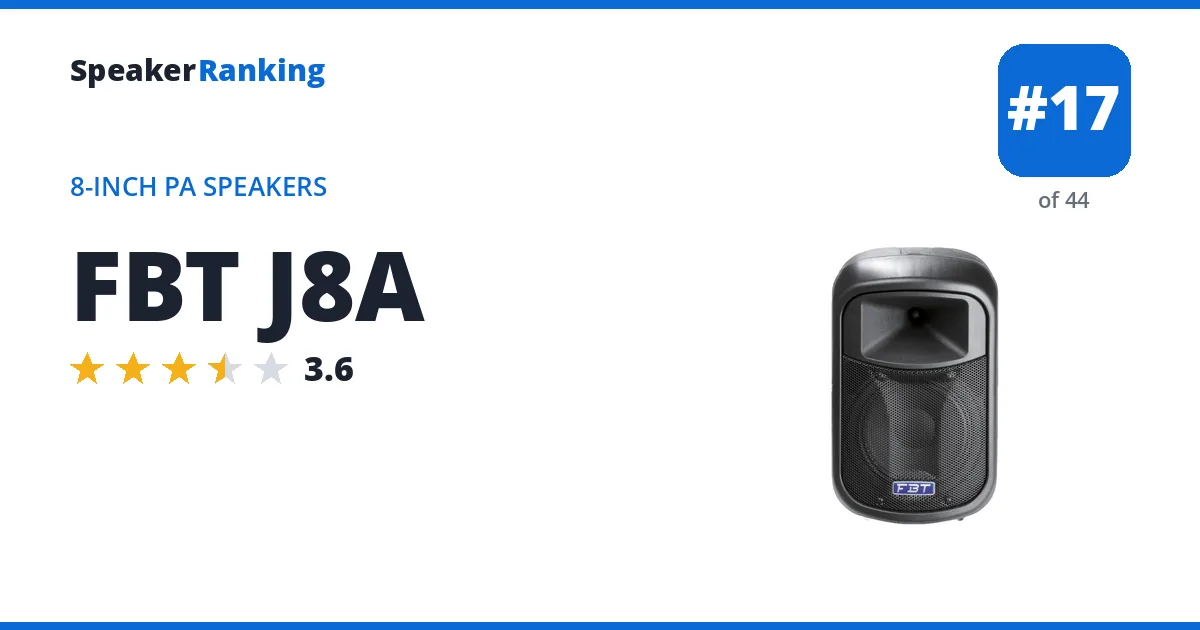
Pros: Medium-quality vendor data shows a 5.09 ideal-subwoofer preference score with 58Hz measured extension. A bi-amplified 200W/50W Class-D design, a 1-inch compression driver on a 90° x 60° horn and switchable Original/Boost DSP presets pack real flexibility into a compact monitor-capable cabinet. Measured bass extension of 60Hz (-3dB).
Cons: Its 120/128dB SPL claims trail the higher-output actives in this ranking, and it lacks an app or Bluetooth control. Discontinued.
Full FBT J8A review and specifications →
| Released | 2013 (13 years ago) |
|---|---|
| AES Input | No |
| Amplifier Power | 250W RMS (200W LF + 50W HF); 500W peak (400W LF + 100W HF) |
| Aux Input | No |
| Bass Extension (-3dB) | 60Hz (measured, vendor Spinorama data) |
| Bluetooth | No |
| Cabinet Material | Polypropylene |
| Coaxial Input | No |
| Configuration | Active 2-way bi-amped bass-reflex PA speaker |
| Coverage | 90° x 60° |
| Crossover Frequency | 2.5kHz (manufacturer specified) |
| DSP | Yes, 2 factory presets (Original/Boost) |
| Dimensions | 16.3”H x 10”W x 9.6”D (415 x 255 x 245 mm) |
| Drivers | 8” woofer, 1” compression driver |
| Frequency Response | 60Hz - 20kHz (-6dB, manufacturer specified) |
| Guitar Input | No |
| HDMI Input | No |
| Inputs | Balanced XLR/jack combo input; balanced XLR link output |
| Maximum SPL | 128dB peak (manufacturer specified) |
| Microphone Input | No |
| Optical Input | No |
| Passive | No |
| RCA Input | No |
| Rigging | Two M6 fly points; 35mm speaker-stand socket |
| Spinorama Preference Score | 2.49 |
| Spinorama Preference Score with Perfect Sub | 5.09 |
| TRS Input | Yes |
| USB Input | No |
| Weight | 18.7 lbs (8.5 kg) |
| XLR Input | Yes |
- Links
- Reviews, Comparisons and Sound Samples
- Head-to-Head Comparisons
 #18 Seeburg X2: $1,059.00 Passive Thomann $1,059.00 eBay
Same family: the Seeburg X1 (smaller model, rated 3.4/5), the Seeburg X4 (larger model, rated 3.9/5), the Seeburg X6 (larger model, rated 3.9/5) and the Seeburg X8 (larger model, rated 3.5/5).
Pros: The 8kg coaxial cabinet has a rotatable 90° x 60° horn, M10 rigging points and a pole flange. Vendor Spinorama data gives preference scores of 3.39 standalone and 6.64 with an ideal subwoofer, with predicted in-room smoothness of 0.645. Measured bass extension of 90Hz (-3dB).
Cons: Bass reaches only about 90Hz (-3dB), and listening-window narrow-band deviation is 0.466, so it needs a subwoofer and sounds uneven in the midrange. It is passive, needs an external amplifier, and costs more than powered 8-inch competitors that measure similarly.
Full Seeburg X2 review and specifications →
| AES Input | No |
|---|---|
| Amplifier Power | Passive speaker; requires external amplification within the 250W AES / 750W peak handling rating |
| Aux Input | No |
| Bass Extension (-3dB) | 90Hz (measured, vendor Spinorama data) |
| Bluetooth | No |
| Coaxial Input | No |
| Configuration | Passive 2-way coaxial PA speaker |
| Coverage | 90° x 60° (rotatable horn) |
| DSP | No (passive) |
| Dimensions | 14.8”H x 9.8”W x 9.8”D (375 x 250 x 250 mm) |
| Drivers | 8” neodymium woofer, 1” neodymium compression driver (coaxial) |
| Frequency Response | 70Hz - 19kHz (-6dB, manufacturer specified) |
| Guitar Input | No |
| HDMI Input | No |
| Inputs | Two Speakon NL4 connectors |
| Maximum SPL | 124dB (manufacturer specified) |
| Microphone Input | No |
| Optical Input | No |
| Passive | Yes |
| Power Handling | 250W AES / 750W peak (manufacturer specified) |
| RCA Input | No |
| Rigging | M10 rigging points, 35mm stand flange |
| Spinorama Preference Score | 3.39 |
| Spinorama Preference Score with Perfect Sub | 6.64 |
| TRS Input | No |
| USB Input | No |
| Weight | 17.6 lbs (8.0 kg) |
| XLR Input | No |
- Links
- Reviews, Comparisons and Sound Samples
- Head-to-Head Comparisons
 #19 Vue Audiotechnik H-8: $3,800 eBay
Same family: the Vue Audiotechnik H-5 (smaller model, rated 3.6/5), the Vue Audiotechnik h-12 (larger model, rated 3.8/5) and the Vue Audiotechnik H-15 (larger model, rated 4.3/5).
Pros: Low-quality vendor data shows a 5.0 ideal-subwoofer preference score, continuing the h-Class’s Truextent beryllium-diaphragm compression driver in a compact cabinet with a 100° x 50° horn and fanless 2-channel amplification. Measured bass extension of 77.5Hz (-3dB).
Cons: At 23.22kg and roughly $3800 this is an unusually heavy and expensive 8-inch box, aimed at rental and touring use rather than casual portability.
Full Vue Audiotechnik H-8 review and specifications →
| Released | Feb 2014 (12 years ago) |
|---|---|
| AES Input | Yes |
| Amplifier Power | 315W long-term (275W LF + 40W HF); 900W burst (600W LF + 300W HF) |
| Aux Input | No |
| Bass Extension (-3dB) | 77.5Hz (measured, vendor Spinorama data) |
| Bluetooth | No |
| Cabinet Material | Multi-ply birch hardwood |
| Coaxial Input | No |
| Configuration | Active 2-way bass-reflex PA speaker |
| Coverage | 100° x 40° |
| DSP | Yes |
| Dimensions | 18.1”H x 11.3”W x 11.9”D (460 x 286 x 303 mm) |
| Drivers | 8” woofer, beryllium-diaphragm compression driver |
| Frequency Response | 75Hz - 21kHz (±2.5dB, manufacturer specified); 60Hz - 26kHz (-10dB) |
| Guitar Input | No |
| HDMI Input | No |
| Inputs | XLR analog/AES input with XLR loop output |
| Maximum SPL | 122dB peak (manufacturer specified) |
| Microphone Input | No |
| Network Control | Ethernet/IP remote monitoring and control |
| Optical Input | No |
| Passive | No |
| RCA Input | No |
| Rigging | Pole mount and integrated hanging points |
| Spinorama Preference Score | 2.14 |
| Spinorama Preference Score with Perfect Sub | 5.00 |
| TRS Input | No |
| USB Input | No |
| Weight | 51.2 lbs (23.22 kg) |
| XLR Input | Yes |
- Links
- Reviews, Comparisons and Sound Samples
- Head-to-Head Comparisons
 #20 Fulcrum Acoustic RX8 Passive eBay
Same family: the Fulcrum Acoustic RX4 (smaller model, rated 3.2/5), the Fulcrum Acoustic RX5 (smaller model, rated 3.3/5) and the Fulcrum Acoustic RX6 (smaller model, rated 3.7/5). See every Fulcrum Acoustic RX generation.
Pros: Vendor measurements give preference scores of 2.49 standalone and 5.91 with an ideal subwoofer, and the on-axis response is very even (0.78dB average deviation). At 6.4kg it is light for an 8-inch coaxial, and the 16 ohm load lets several share one amplifier channel. Measured bass extension of 109Hz (-3dB).
Cons: Bass rolls off early for an 8-inch speaker, at about 109Hz (-3dB) and 86Hz (-10dB), so pair it with a subwoofer. Its directivity index varies more than the Fulcrum Acoustic RX6 (5.05dB deviation), so off-axis tone changes more. It is passive and sold through pro dealers with no published price.
Full Fulcrum Acoustic RX8 review and specifications →
| Released | 2024 (2 years ago) |
|---|---|
| AES Input | No |
| Amplifier Power | Passive speaker; requires external amplification |
| Aux Input | No |
| Bass Extension (-10dB) | about 85.8Hz (measured, vendor Spinorama data) |
| Bass Extension (-3dB) | 109Hz (measured, vendor Spinorama data) |
| Bluetooth | No |
| Coaxial Input | No |
| Configuration | Passive 2-way coaxial PA speaker |
| Coverage | 90° x 75° |
| DSP | No (passive) |
| Dimensions | 9”H x 12.7”W x 9.3”D (229 x 323 x 235 mm) |
| Drivers | 8” woofer with 2” voice coil, coaxial 1” compression driver |
| Guitar Input | No |
| HDMI Input | No |
| Impedance | 16 ohms |
| Maximum SPL | 122dB peak / 116dB continuous (manufacturer specified) |
| Microphone Input | No |
| Optical Input | No |
| Passive | Yes |
| Power Handling | 200W at 16 ohms |
| RCA Input | No |
| Rigging | 2 x M6 yoke points; 2 x M6 rear points; VESA 75 mounting points |
| Sensitivity | 93dB |
| Spinorama Preference Score | 2.49 |
| Spinorama Preference Score with Perfect Sub | 5.91 |
| TRS Input | No |
| USB Input | No |
| Weight | 14.1 lbs (6.4 kg) |
| XLR Input | No |
- Links
- Reviews, Comparisons and Sound Samples
 #21 LD Systems Stinger 28-A-G3: $799 Thomann $799 eBay
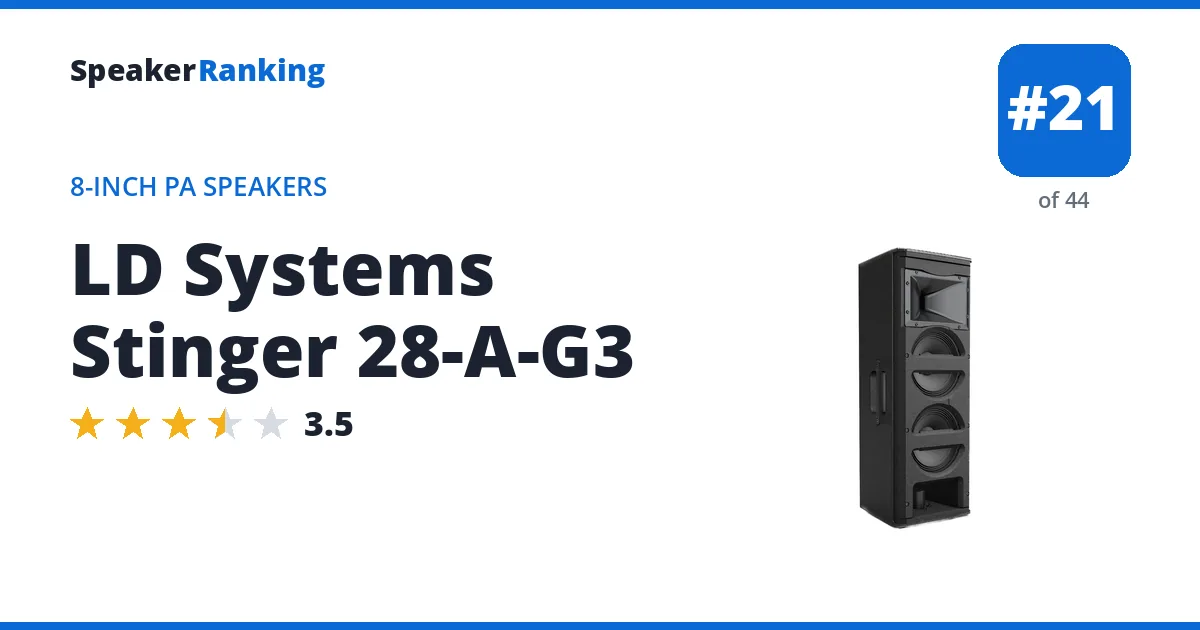
Same family: the LD Systems Stinger 8-A-G3 (smaller model, ranked higher, rated 3.7/5), the LD Systems Stinger 10-A-G3 (larger model, rated 4.1/5), the LD Systems Stinger 12 A G3 (larger model, rated 3.5/5) and the LD Systems Stinger 15-A-G3 (larger model, rated 3.4/5).
Pros: Two 8-inch woofers give bass to 56Hz at -3dB and about 50Hz at -10dB, deep for an 8-inch design, from a 500W (1000W peak) amplifier rated to 131dB. The birch plywood cabinet has a polyurea coating and steel grille, and DynX DSP presets let it work as a full-range top, satellite or monitor. Measured bass extension of 56Hz (-3dB).
Cons: Manufacturer measurements show a wide 3.7dB reference band and 0.729 listening-window deviation, so tonal balance is uneven, and the standalone preference score is only 1.96. The single-8-inch LD Systems Stinger 8-A-G3 measures better for the money.
Full LD Systems Stinger 28-A-G3 review and specifications →
| AES Input | No |
|---|---|
| Amplifier Power | 500W RMS / 1,000W peak, Class-D |
| Aux Input | No |
| Bass Extension (-10dB) | about 49.6Hz (measured, vendor Spinorama data) |
| Bass Extension (-3dB) | 56Hz (measured, vendor Spinorama data) |
| Bluetooth | No |
| Cabinet Material | Birch plywood with polyurea coating |
| Coaxial Input | No |
| Configuration | Active 2-way bass-reflex PA speaker |
| Coverage | 90° x 50° |
| DSP | Yes, DynX DSP presets |
| Drivers | 2x 8” woofers, BMS compression driver |
| Frequency Response | 58Hz - 20kHz (manufacturer specified) |
| Guitar Input | No |
| HDMI Input | No |
| Maximum SPL | 131dB (manufacturer specified) |
| Microphone Input | No |
| Optical Input | No |
| Passive | No |
| RCA Input | No |
| Rigging | M10 rigging points; 36mm dual-tilt pole mount |
| Spinorama Preference Score | 1.96 |
| Spinorama Preference Score with Perfect Sub | 4.44 |
| TRS Input | Yes |
| USB Input | No |
| Weight | 45.2 lbs (20.5 kg) |
| XLR Input | Yes |
- Links
- Reviews, Comparisons and Sound Samples
- Head-to-Head Comparisons
- LD Systems Stinger 28-A-G3 vs Seeburg X2
- LD Systems Stinger 28-A-G3 vs Coda Audio HOPS8
- LD Systems Stinger 28-A-G3 vs RCF ART 708-A MK5
- LD Systems Stinger 28-A-G3 vs LD Systems Stinger 8-A-G3
- LD Systems Stinger 28-A-G3 vs Electro-Voice EVC-1082
- LD Systems Stinger 28-A-G3 vs JBL PRX908
- LD Systems Stinger 28-A-G3 vs Biamp Community V2-28
 #22 One Systems 208HTC Passive eBay
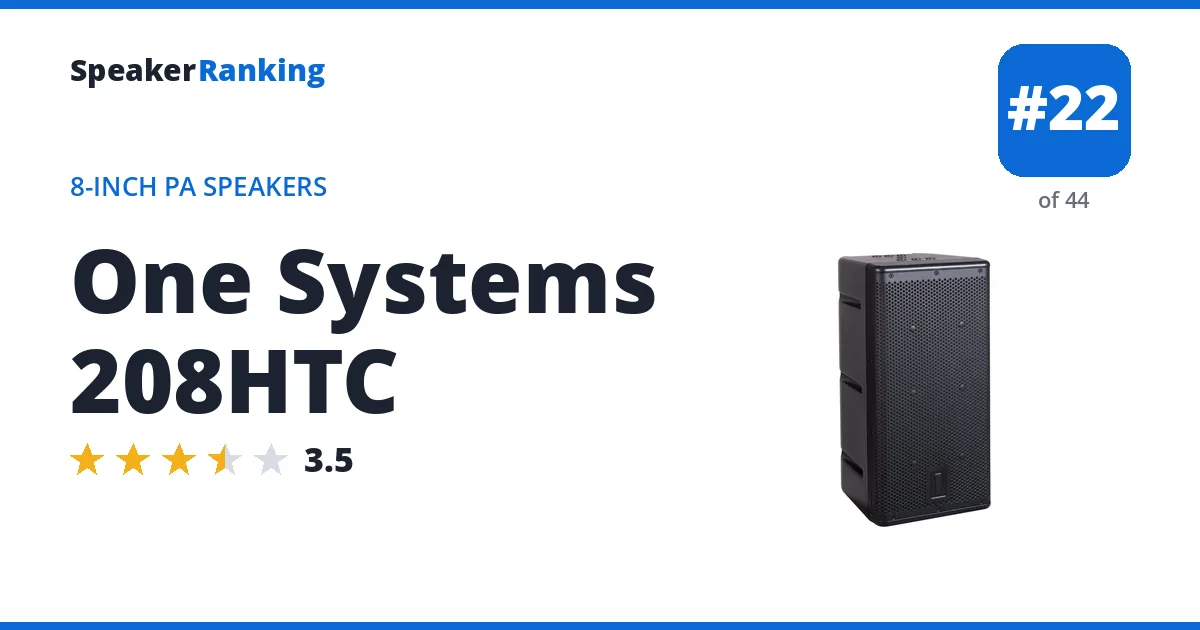
Pros: Two 8-inch woofers give bass to about 66Hz at -10dB and 96dB sensitivity, and manufacturer measurements give a preference score of 5.14 with an ideal subwoofer. The weatherized cabinet with 70V/100V taps suits outdoor and distributed systems. Measured bass extension of 118Hz (-3dB).
Cons: The on-axis response is uneven (1.83dB average deviation) with treble quoted only to 16kHz, and it scores 1.57 without a subwoofer. It is passive, weighs 19.5kg, and is sold through pro dealers with no published price.
Full One Systems 208HTC review and specifications →
| AES Input | No |
|---|---|
| Amplifier Power | Passive speaker; requires external amplification |
| Aux Input | No |
| Bass Extension (-10dB) | about 66.4Hz (measured, vendor Spinorama data) |
| Bass Extension (-3dB) | 118Hz (measured, vendor Spinorama data) |
| Bluetooth | No |
| Coaxial Input | No |
| Configuration | Passive 2-way PA speaker, weather rated |
| Coverage | 70° conical |
| DSP | No (passive) |
| Drivers | 2 x 8” woofers (upper one coaxial with titanium compression driver) |
| Frequency Response | 65Hz - 16kHz (manufacturer specified) |
| Guitar Input | No |
| HDMI Input | No |
| Impedance | 4 ohms, with 70V/100V taps |
| Microphone Input | No |
| Optical Input | No |
| Passive | Yes |
| Power Handling | 400W continuous / 1,600W peak |
| RCA Input | No |
| Rigging | 7 x M8 rigging points; optional pole mount and pan/tilt brackets |
| Sensitivity | 96dB |
| Spinorama Preference Score | 1.57 |
| Spinorama Preference Score with Perfect Sub | 5.14 |
| TRS Input | No |
| USB Input | No |
| Weight | 43 lbs (19.5 kg) |
| XLR Input | No |
- Links
- Reviews, Comparisons and Sound Samples
 #23 Coda Audio G308 Passive eBay
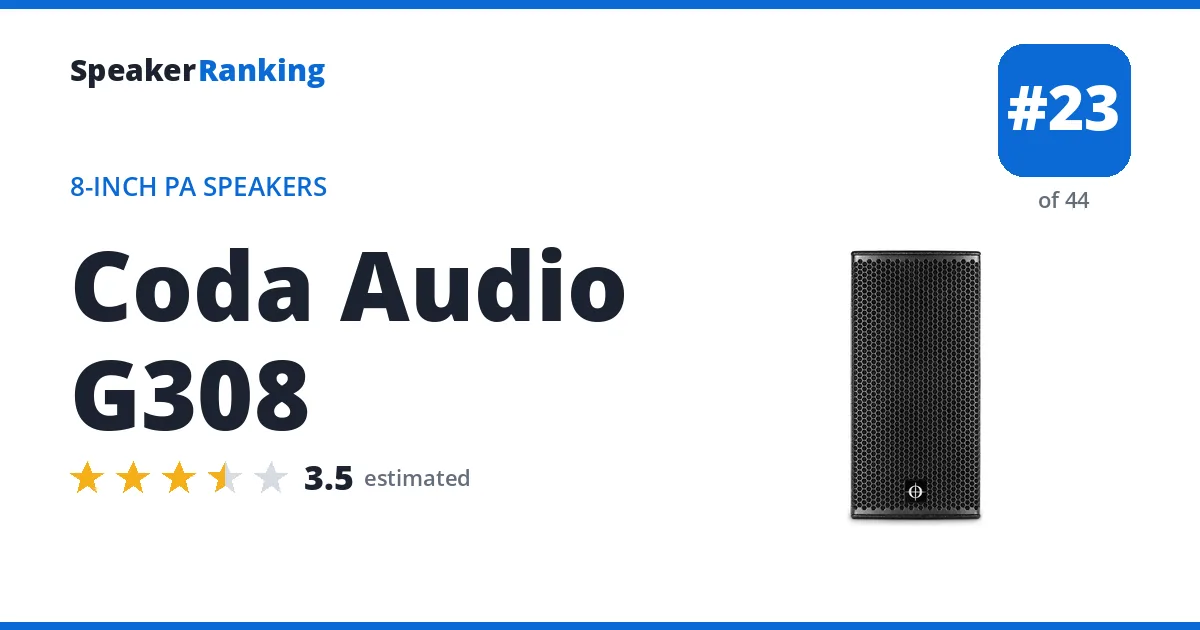
Same family: the Coda Audio G512 (larger model, rated 3.6/5), the Coda Audio G515 (larger model, rated 3.7/5), the Coda Audio G712 (larger model, rated 3.8/5) and the Coda Audio G715 (larger model, rated 3.8/5).
Pros: The 8-inch model of Coda’s G-Series multidesign boxes, smaller than the measured Coda Audio G512 and Coda Audio G515. An 8” low-distortion woofer and a 1” compression driver on a 90° conical wooden waveguide cover 60Hz to 30kHz (-6dB) with 220W AES handling, and the cabinet works upright, on its side or as a floor monitor.
Cons: No independent measurements yet, so it can’t be compared with ranked PA speakers. It needs an external amplifier and controller and is sold only through Coda dealers, so there is no retail price.
Full Coda Audio G308 review and specifications →
| Amplifier Power | Passive speaker; requires external amplification |
|---|---|
| Bluetooth | No |
| Configuration | Passive 2-way multipurpose PA speaker |
| Coverage | 90° conical |
| DSP | No (passive) |
| Drivers | 8” woofer, 1” compression driver |
| Frequency Response | 60Hz - 30kHz (-6dB, manufacturer specified) |
| Maximum SPL | 124dB peak (manufacturer specified) |
| Passive | Yes |
| Power Handling | 220W AES |
| Rigging | M6 and M8 threaded points; flange adapter; GFA flying adapter |
| Weight | 20.9 lbs (9.5 kg) |
| XLR Input | No |
- Links
- Reviews, Comparisons and Sound Samples
- No independent measurement review is linked for this model; it is ranked from hands-on listening and comparison against similarly priced speakers.
- Head-to-Head Comparisons
 #24 Amate Audio X82FD eBay
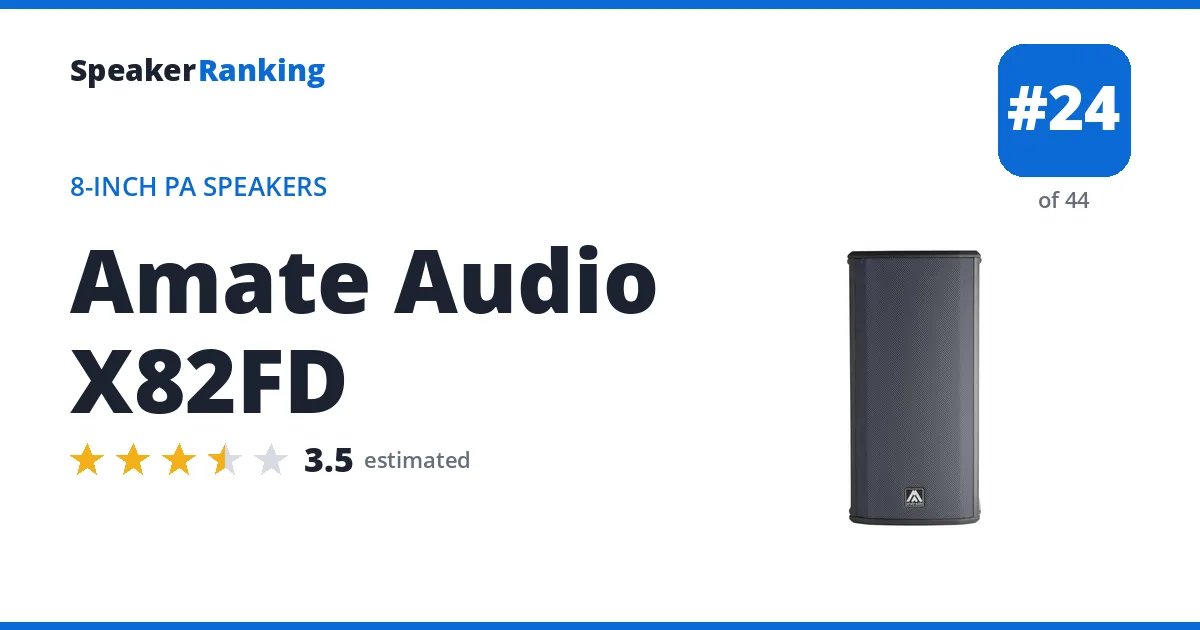
Same family: the Amate Audio X10FD (smaller model, estimated 3.6/5), the Amate Audio X102FD (larger model, rated 3.6/5) and the Amate Audio X14FD (larger model, rated 3.6/5).
Pros: A self-powered model from Amate’s Xcellence range alongside the measured Amate Audio X102FD and Amate Audio X14FD: two 8” woofers and a 3” compression driver driven by 3,000W, for long throws from a narrow cabinet. Amate rates it at 137dB peak with 80° x 60° coverage, and it has Dante networking and touchscreen DSP control.
Cons: No independent measurements yet, so it can’t be compared with ranked PA speakers. Amate sells through dealers, so there is no retail price. Bass stops around 68Hz (-10dB), so it needs a subwoofer for full-range music.
Full Amate Audio X82FD review and specifications →
| Amplifier Power | 3,000W (2,500W LF, 500W HF), Class D bi-amplified |
|---|---|
| Bluetooth | No |
| Configuration | Active 2-way PA speaker |
| Coverage | 80° x 60° |
| DSP | Yes |
| Drivers | 2x 8” neodymium woofers, 3” diaphragm compression driver |
| Frequency Response | 68Hz - 19kHz (-10dB) (manufacturer specified) |
| Maximum SPL | 137dB peak (manufacturer specified) |
| Network Control | Dante |
| Passive | No |
| Rigging | M8 rigging points; RB-S flying bar; wall bracket |
| Weight | 50.7 lbs (23 kg) |
| XLR Input | Yes |
- Links
- Reviews, Comparisons and Sound Samples
- No independent measurement review is linked for this model; it is ranked from hands-on listening and comparison against similarly priced speakers.
 #25 Axiom ED80P: $950 Passive Discontinued eBay
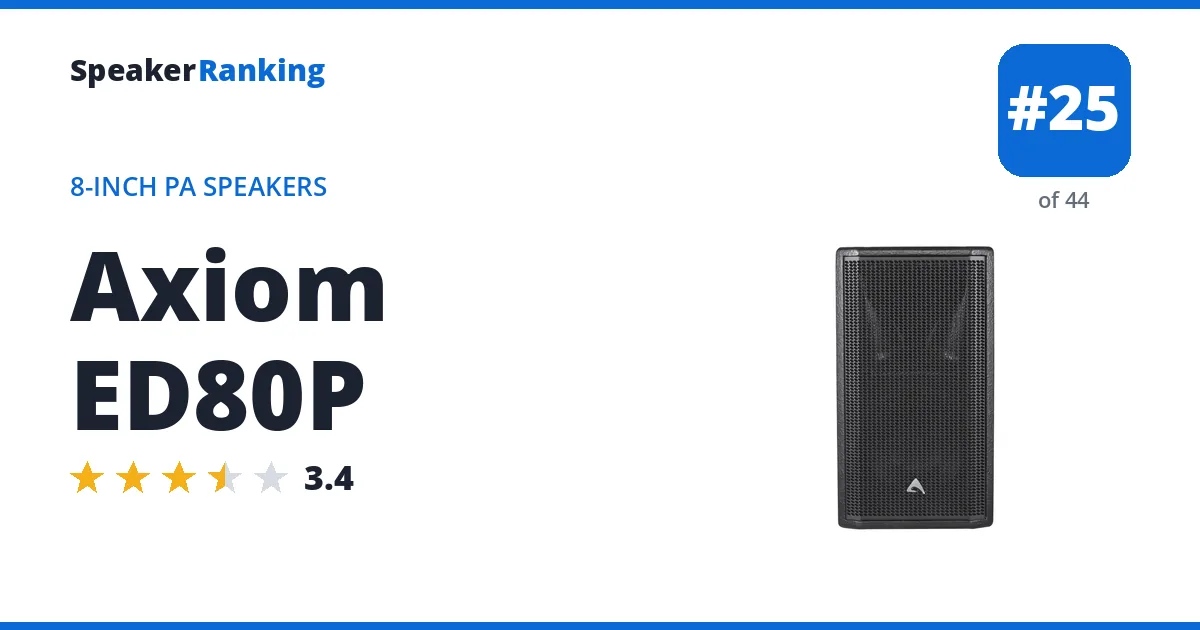
Same family: the Axiom ED60P (smaller model, rated 3.3/5), the Axiom ED120A (larger model, rated 4/5) and the Axiom ED150A (larger model, rated 3.8/5).
Pros: High-quality vendor data returns a 4.9 ideal-subwoofer preference score. A 1-inch aluminum-voice-coil compression driver pairs with the 8-inch woofer in a compact passive point-source cabinet aimed at fixed-install and portable use.
Cons: Being passive, it needs an external amplifier and crossover, and Axiom has a much smaller North American dealer and service network than JBL, Yamaha or QSC. The vendor measurement’s implied bass reach should be treated with some skepticism for a cabinet this compact. Discontinued.
Full Axiom ED80P review and specifications →
| AES Input | No |
|---|---|
| Amplifier Power | Passive speaker; use external amplification within the 280W AES / 560W program rating |
| Aux Input | No |
| Bluetooth | No |
| Cabinet Material | 15mm reinforced phenolic birch plywood |
| Coaxial Input | No |
| Configuration | Passive 2-way full-range PA speaker |
| Coverage | 60-120° horizontal (asymmetric), 55° vertical average |
| DSP | No (passive, requires external amplifier/DSP) |
| Dimensions | 17.7”H x 9.8”W x 9.1”D (450 x 250 x 230 mm) |
| Drivers | 8” woofer, 1” compression driver |
| Frequency Response | 75Hz - 18kHz (-6dB, manufacturer specified) |
| Guitar Input | No |
| HDMI Input | No |
| Inputs | Two Neutrik speakON NL4 connectors (input and link) |
| Maximum SPL | 124dB peak (manufacturer specified) |
| Microphone Input | No |
| Optical Input | No |
| Passive | Yes |
| Power Handling | 280W AES / 560W program (manufacturer specified) |
| RCA Input | No |
| Rigging | M10 and M6 fly points; pole-mount socket |
| Spinorama Preference Score | 3.48 |
| Spinorama Preference Score with Perfect Sub | 4.88 |
| TRS Input | No |
| USB Input | No |
| Weight | 17.6 lbs (8 kg) |
| XLR Input | No |
- Links
- Reviews, Comparisons and Sound Samples
- Head-to-Head Comparisons
 #26 RCF ART 708-A MK5: $499.00 Amazon $499.00 B&H Photo Video $499.00 Guitar Center $499.00 eBay
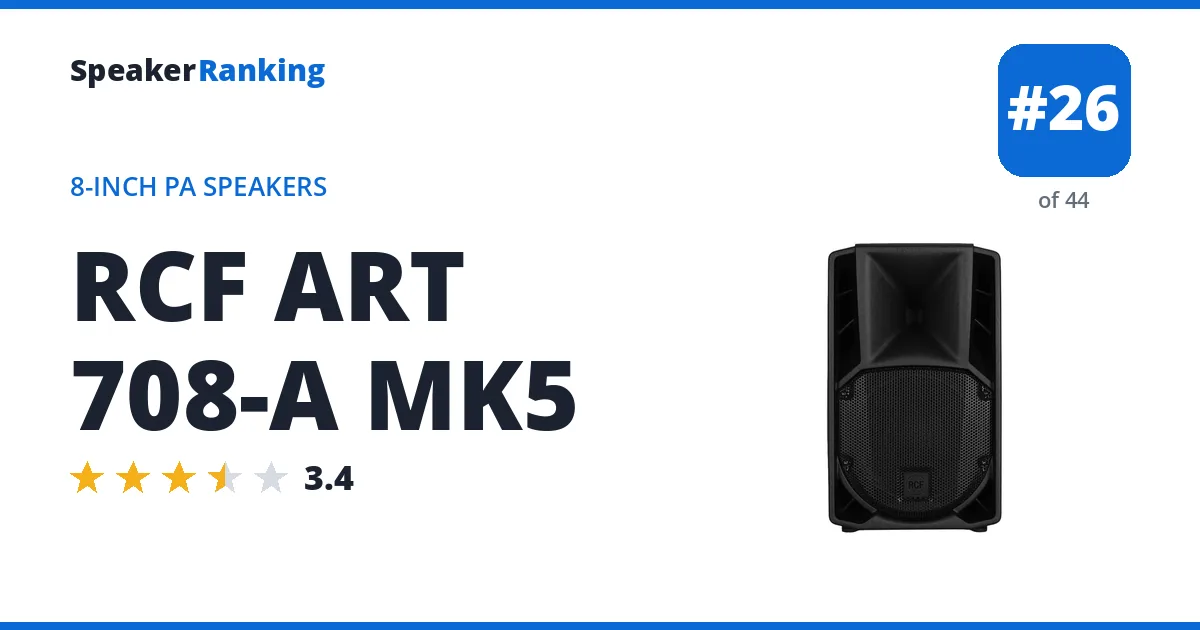
Older model: the RCF ART 708-A MK4 (ranked lower, rated 3/5). See every RCF ART 7 generation.
Same family: the RCF ART 710-A MK5 (larger model, rated 3.6/5), the RCF ART 712-A MK5 (larger model, rated 3.6/5), the RCF ART 732-A MK5 (larger model, rated 3.8/5), the RCF ART 715-A MK5 (larger model, rated 3.6/5), the RCF ART 735-A MK5 (larger model, estimated 3.4/5) and the RCF ART 745-A MK5 (larger model, rated 3.5/5).
Pros: A compact, affordable RCF with a 1.4-inch compression driver, 128dB claimed output and FiRPHASE processing, well suited to buyers who plan to cross to a subwoofer and do not need app control. At 10.4kg it is easy to carry. Measured bass extension of 75Hz (-3dB).
Cons: The local low-quality manufacturer data has no computed preference score, making its measured tonal position uncertain.
Full RCF ART 708-A MK5 review and specifications →
| Released | Jan 2024 (2 years ago) |
|---|---|
| AES Input | No |
| Amplifier Power | 1400W peak (1000W LF + 400W HF) |
| Aux Input | No |
| Bass Extension (-3dB) | 75Hz (measured, vendor Spinorama data) |
| Bluetooth | No |
| Cabinet Material | PP composite |
| Coaxial Input | No |
| Configuration | Active 2-way bass-reflex PA speaker |
| Coverage | 90° x 70° |
| Crossover Frequency | 1600Hz |
| DSP | Yes, FiRPHASE, EQ, limiting and protection |
| Dimensions | 18.9”H x 11.5”W x 10.9”D (480 x 291 x 276 mm) |
| Drivers | 8” woofer, 1.4” compression driver |
| Frequency Response | 60Hz - 20kHz (manufacturer specified) |
| Guitar Input | No |
| HDMI Input | No |
| Inputs | XLR and 1/4-inch jack input; XLR output |
| Maximum SPL | 128dB peak (manufacturer specified) |
| Microphone Input | No |
| Optical Input | No |
| Passive | No |
| RCA Input | No |
| Rigging | 2 x M10 inserts; 35mm pole mount |
| TRS Input | Yes |
| USB Input | No |
| Weight | 22.9 lbs (10.4 kg) |
| XLR Input | Yes |
- Links
- Reviews, Comparisons and Sound Samples
- Head-to-Head Comparisons
- RCF ART 708-A MK5 vs Axiom ED80P
- RCF ART 708-A MK5 vs Martin Audio CDD8
- RCF ART 708-A MK5 vs LD Systems Stinger 28-A-G3
- RCF ART 708-A MK5 vs Vue Audiotechnik H-8
- RCF ART 708-A MK5 vs Bose AMM108
- RCF ART 708-A MK5 vs Seeburg X2
- RCF ART 708-A MK5 vs RCF ART 708-A MK4
- RCF ART 708-A MK5 vs RCF KX 08-A
- See all 13 comparisons
 #27 Electro-Voice EVC-1082: $1,074.95 Passive B&H $1,074.95 eBay
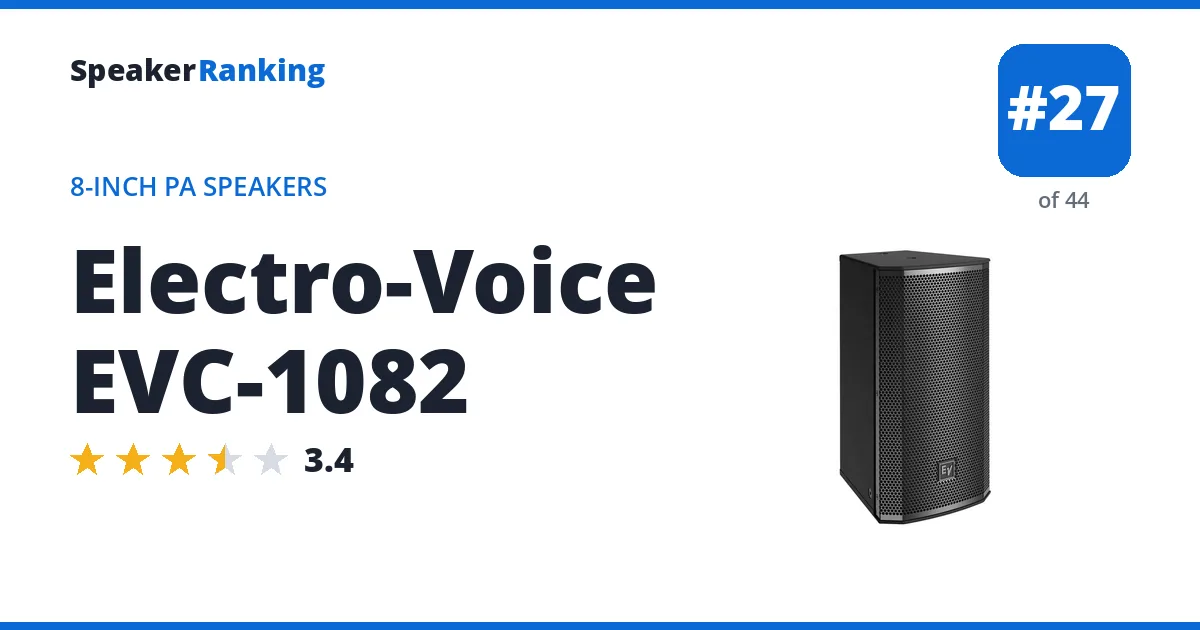
Same family: the Electro-Voice EVC-1122 (larger model, rated 3.2/5) and the Electro-Voice EVC-1152 (larger model, rated 3.3/5).
Pros: Vendor measurements give preference scores of 2.27 standalone and 5.02 with an ideal subwoofer, the best of the EVC models here, and bass reaches 67Hz (-3dB) and about 56Hz (-10dB), deep for an 8-inch cabinet. The rotatable waveguide lets it mount vertically or horizontally. Measured bass extension of 67Hz (-3dB).
Cons: The listening window spreads across a 4.2dB band, so the tonal balance changes off axis. Sensitivity is a modest 91dB with a 120dB maximum, and it is passive, so it needs an amplifier.
Full Electro-Voice EVC-1082 review and specifications →
| AES Input | No |
|---|---|
| Amplifier Power | Passive speaker; requires external amplification |
| Aux Input | No |
| Bass Extension (-10dB) | about 55.7Hz (measured, vendor Spinorama data) |
| Bass Extension (-3dB) | 67Hz (measured, vendor Spinorama data) |
| Bluetooth | No |
| Coaxial Input | No |
| Configuration | Passive 2-way installation PA speaker |
| Coverage | 90° x 60° (rotatable) |
| DSP | No (passive) |
| Drivers | 8” EVS-2008 woofer, 1.25” titanium compression driver on a rotatable waveguide |
| Frequency Response | 75Hz - 21kHz (manufacturer specified) |
| Guitar Input | No |
| HDMI Input | No |
| Impedance | 8 ohms |
| Maximum SPL | 120dB (manufacturer calculated) |
| Microphone Input | No |
| Optical Input | No |
| Passive | Yes |
| Power Handling | 200W continuous |
| RCA Input | No |
| Rigging | 8 x M10 flying points; optional U-bracket or wall mount |
| Sensitivity | 91dB |
| Spinorama Preference Score | 2.27 |
| Spinorama Preference Score with Perfect Sub | 5.02 |
| TRS Input | No |
| USB Input | No |
| Weight | 24.7 lbs (11.2 kg) |
| XLR Input | No |
- Links
- Reviews, Comparisons and Sound Samples
- Head-to-Head Comparisons
 #28 Fulcrum Acoustic P8 Passive eBay
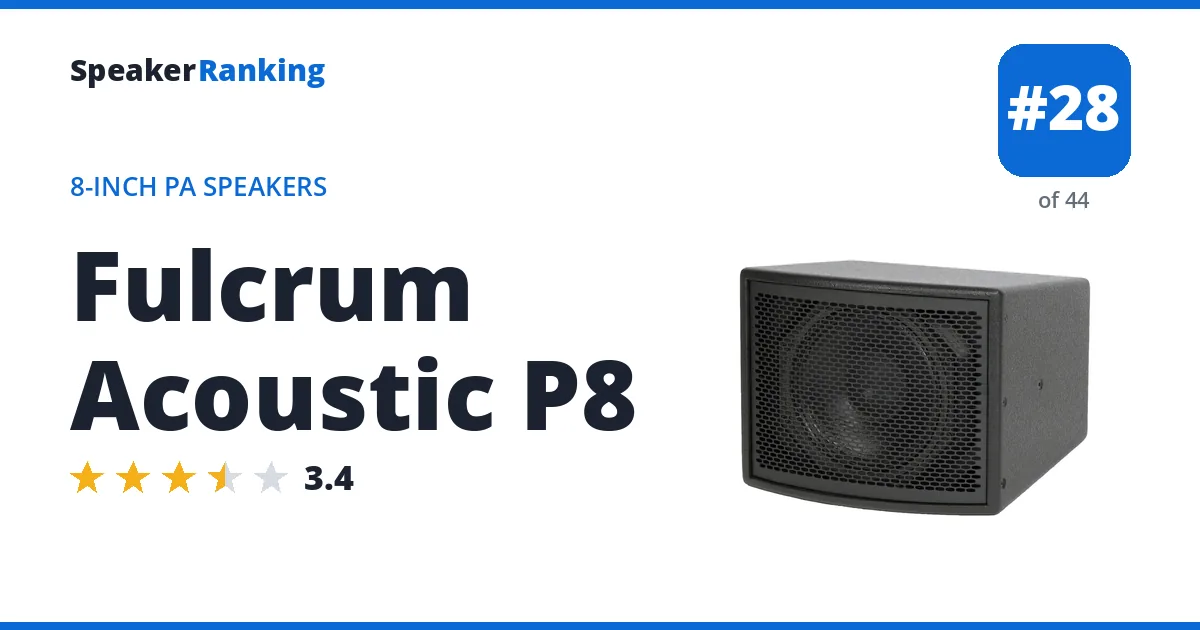
Pros: Very high 101dB sensitivity and a 125dB peak from a 7.3kg coaxial cabinet, with wide 100° conical coverage. Vendor measurements give a preference score of 4.81 with an ideal subwoofer. Measured bass extension of 132Hz (-3dB).
Cons: The listening window spreads across a 6.4dB band, the widest in this group, so the tonal balance is uneven, and it scores only 0.99 standalone. Bass stops near 132Hz (-3dB), so it needs a subwoofer. It is passive and sold through pro dealers with no published price.
Full Fulcrum Acoustic P8 review and specifications →
| AES Input | No |
|---|---|
| Amplifier Power | Passive speaker; requires external amplification |
| Aux Input | No |
| Bass Extension (-10dB) | about 94.0Hz (measured, vendor Spinorama data) |
| Bass Extension (-3dB) | 132Hz (measured, vendor Spinorama data) |
| Bluetooth | No |
| Coaxial Input | No |
| Configuration | Passive 2-way coaxial PA speaker |
| Coverage | 100° conical |
| DSP | No (passive) |
| Dimensions | 9.8”H x 12.3”W x 11.6”D (250 x 313 x 294 mm) |
| Drivers | 8” woofer with 2” voice coil, coaxial 1.7” titanium compression driver |
| Frequency Response | 90Hz - 20kHz (operating range) |
| Guitar Input | No |
| HDMI Input | No |
| Maximum SPL | 125dB (manufacturer specified) |
| Microphone Input | No |
| Optical Input | No |
| Passive | Yes |
| Power Handling | 250W |
| RCA Input | No |
| Sensitivity | 101dB |
| Spinorama Preference Score | 0.99 |
| Spinorama Preference Score with Perfect Sub | 4.81 |
| TRS Input | No |
| USB Input | No |
| Weight | 16.1 lbs (7.3 kg) |
| XLR Input | No |
- Reviews, Comparisons and Sound Samples
 #29 Martin Audio CDD-LIVE 8: $2,600.00 Full Compass $2,600.00 eBay
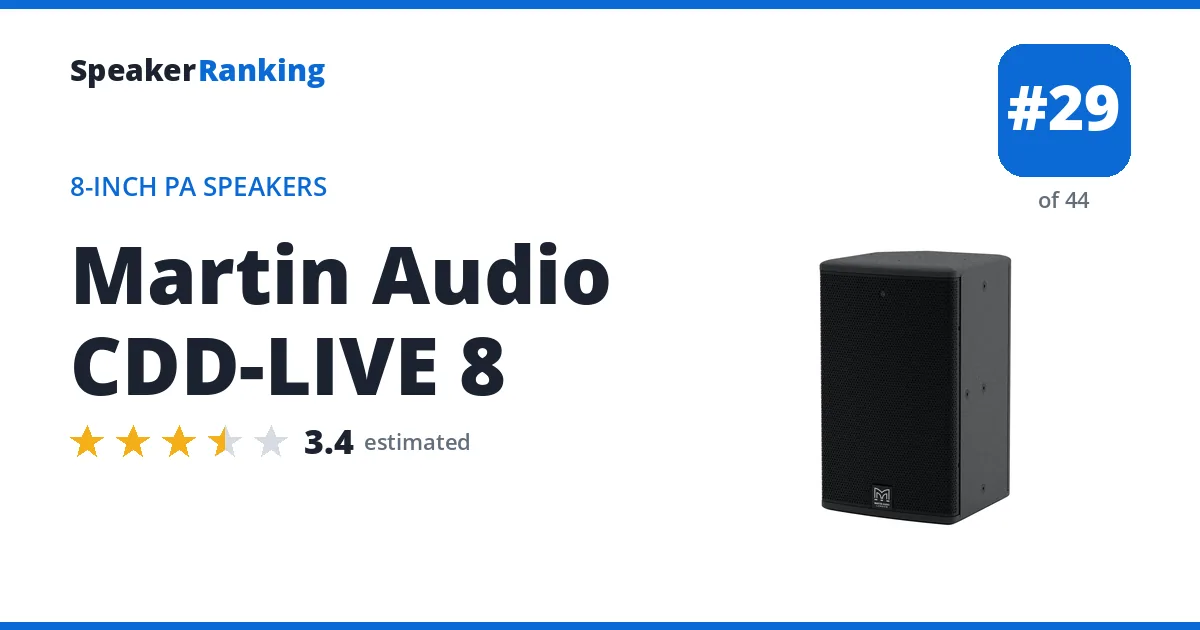
Same family: the Martin Audio CDD-LIVE 12 (larger powered model, estimated 3.1/5), the Martin Audio CDD-LIVE 15 (larger powered model, estimated 3.5/5), the Martin Audio CDD5 (smallest passive model, estimated 3/5), the Martin Audio CDD6 (passive model, estimated 3.1/5), the Martin Audio CDD8 (passive model, ranked lower, rated 3.2/5), the Martin Audio CDD10 (passive model, rated 3.1/5), the Martin Audio CDD12 (passive model, rated 2.9/5) and the Martin Audio CDD15 (largest passive model, rated 3.3/5).
Pros: The self-powered version of the measured Martin Audio CDD8, with the same 8” Coaxial Differential Dispersion driver plus built-in Class D amplification, DSP tuning and Dante networking. Martin rates it at 123dB peak / 117dB continuous with bass to 50Hz (-10dB), and the coaxial driver rotates for horizontal or vertical mounting.
Cons: No independent measurements yet, so it can’t be compared with ranked PA speakers. It costs far more than most powered PA speakers of its size, and the CDD design favors even coverage over maximum throw.
Full Martin Audio CDD-LIVE 8 review and specifications →
| Released | 2016 (10 years ago) |
|---|---|
| Amplifier Power | 1,300W peak (1,000W LF, 300W HF) |
| Bass Extension (-3dB) | 70Hz (manufacturer specified) |
| Bluetooth | No |
| Configuration | Active 2-way coaxial PA speaker |
| DSP | Yes |
| Drivers | 8” woofer with coaxial 1” exit HF driver |
| Frequency Response | 70Hz - 20kHz (±3dB), 50Hz (-10dB) (manufacturer specified) |
| Maximum SPL | 123dB peak / 117dB continuous (manufacturer specified) |
| Network Control | Dante |
| Passive | No |
| Rigging | 15 x M8 inserts; top hat pole mount |
| Weight | 30.9 lbs (14 kg) |
| XLR Input | Yes |
- Links
- Reviews, Comparisons and Sound Samples
- No independent measurement review is linked for this model; it is ranked from hands-on listening and comparison against similarly priced speakers.
- Head-to-Head Comparisons
 #30 HK Audio Linear 5 MK2 308 LTA: $2,869.99 Full Compass $2,869.99 eBay
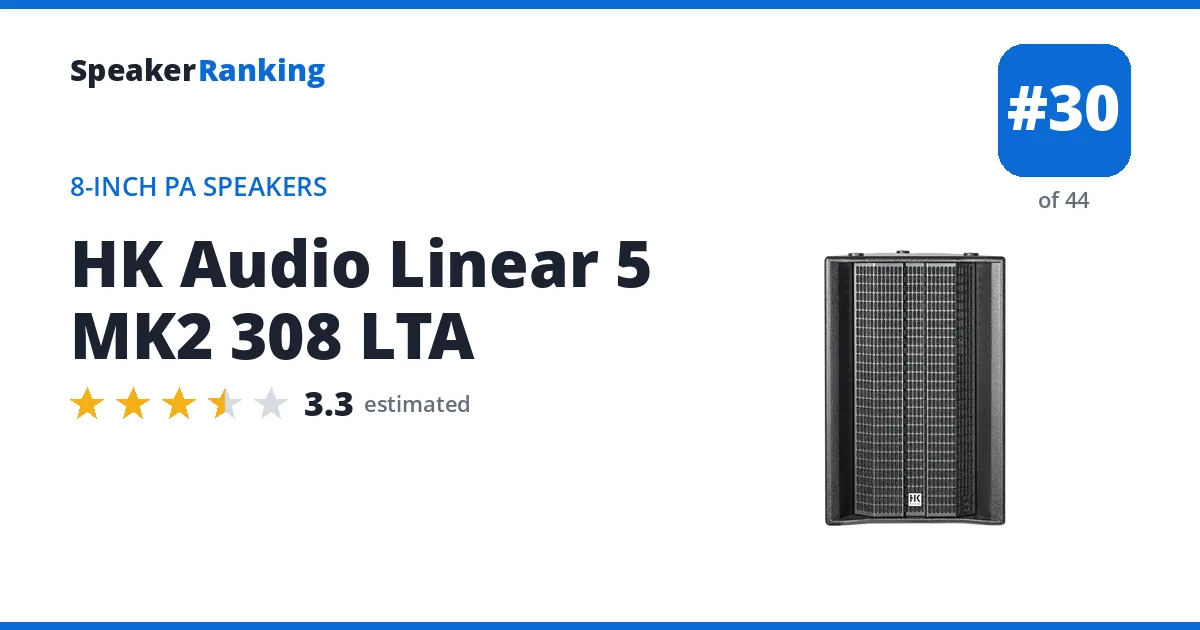
Same family: the HK Audio Linear 5 MK2 110 XA (smaller model, estimated 3.6/5), the HK Audio Linear 5 MK2 112 FA (smaller model, estimated 3.7/5), the HK Audio Linear 5 MK2 112 XA (smaller model, estimated 3.7/5), the HK Audio Linear 5 MK2 115 FA (smaller model, estimated 3.6/5) and the HK Audio Linear 5 MK2 115 XA (smaller model, estimated 3.5/5). See every HK Audio Linear 5 generation.
Pros: Part of HK Audio’s LINEAR 5 MK II series alongside the HK Audio Linear 5 MK2 112 FA: a long-throw top with three 8” woofers whose asymmetric vertical pattern reaches about 40 meters. A 1,200W peak (600W RMS) bi-amplified Class D module with DSP drives it, and HK rates it at 138dB peak with 60° horizontal, asymmetric vertical long throw coverage.
Cons: No independent measurements yet, so it can’t be compared with ranked PA speakers. Bass stops around 105Hz, so it must be paired with subwoofers.
Full HK Audio Linear 5 MK2 308 LTA review and specifications →
| Released | Nov 2023 (2 years ago) |
|---|---|
| Amplifier Power | 1,200W peak (600W RMS), bi-amplified |
| Bluetooth | No |
| Configuration | Active 2-way PA speaker |
| Coverage | 60° horizontal, asymmetric vertical long throw |
| DSP | Yes |
| Drivers | 3x 8” woofers, 1” compression driver |
| Frequency Response | 105Hz - 18kHz (-6dB) (manufacturer specified) |
| Maximum SPL | 138dB peak (manufacturer specified) |
| Passive | No |
| Rigging | 5 x M8 rigging points; MonoTilt 0° pole mount |
| Weight | 55.1 lbs (25 kg) |
| XLR Input | Yes |
- Links
- Reviews, Comparisons and Sound Samples
- No independent measurement review is linked for this model; it is ranked from hands-on listening and comparison against similarly priced speakers.
- Head-to-Head Comparisons
 #31 Martin Audio CDD8 Passive eBay
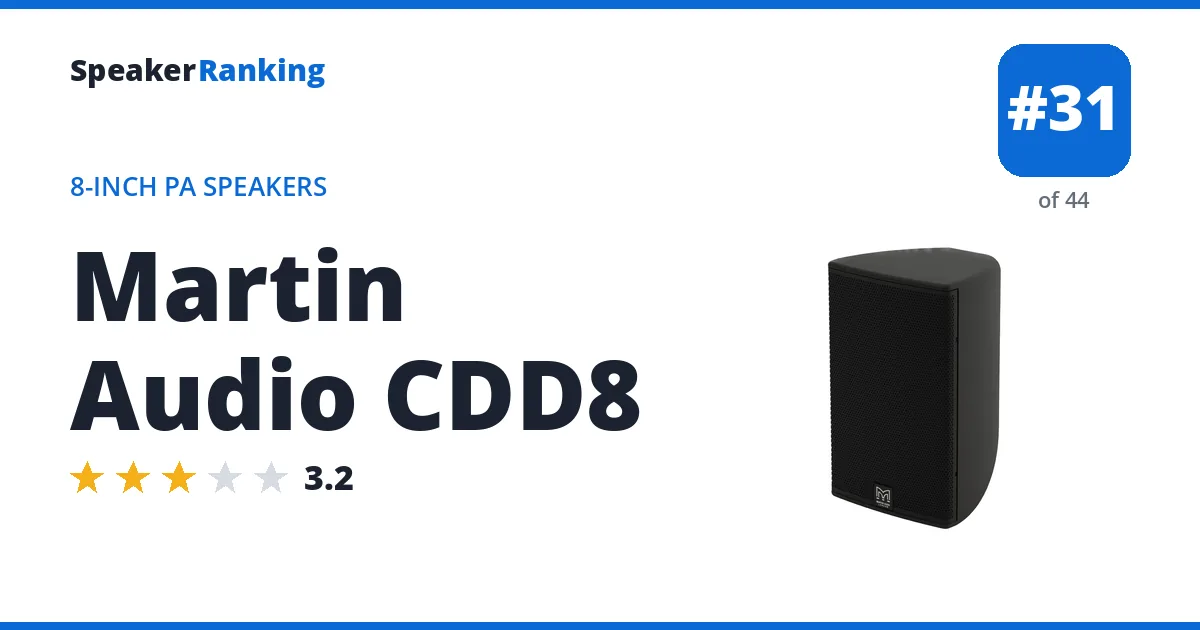
Same family: the Martin Audio CDD-LIVE 8 (smallest powered model, ranked higher, estimated 3.4/5), the Martin Audio CDD-LIVE 12 (powered model, estimated 3.1/5), the Martin Audio CDD-LIVE 15 (largest powered model, estimated 3.5/5), the Martin Audio CDD5 (smaller passive model, estimated 3/5), the Martin Audio CDD6 (smaller passive model, estimated 3.1/5), the Martin Audio CDD10 (larger passive model, rated 3.1/5), the Martin Audio CDD12 (larger passive model, rated 2.9/5) and the Martin Audio CDD15 (larger passive model, rated 3.3/5).
Pros: Medium-quality vendor data shows a 4.1 ideal-subwoofer preference score. The coaxial Differential Dispersion driver gives point-source summation of the LF and HF sections for consistent coverage, and the ultra-compact enclosure mounts horizontally or vertically for on-wall installation use. Measured bass extension of 128Hz (-3dB).
Cons: Being passive, it needs an external amplifier and crossover, and its compact on-wall design targets installed foreground music over full PA main duty.
Full Martin Audio CDD8 review and specifications →
| Released | Jun 2015 (11 years ago) |
|---|---|
| AES Input | No |
| Amplifier Power | Passive speaker; use external amplification within the 200W AES / 800W peak handling rating |
| Aux Input | No |
| Bass Extension (-3dB) | 128Hz (measured, vendor Spinorama data) |
| Bluetooth | No |
| Cabinet Material | Composite material |
| Coaxial Input | No |
| Configuration | Passive 2-way coaxial PA speaker |
| Coverage | 80-110° horizontal (user-rotatable), 60° vertical |
| Crossover Frequency | 2.3kHz passive |
| DSP | No (passive; used with a DX-series controller or MA Series amplifier for EQ and limiter presets) |
| Dimensions | 16.1”H x 10.1”W x 9.9”D (410 x 256 x 252 mm) |
| Drivers | 8” coaxial woofer, 1” exit compression driver |
| Frequency Response | 70Hz - 20kHz (±3dB, manufacturer specified); 55Hz (-10dB) |
| Guitar Input | No |
| HDMI Input | No |
| Inputs | Low-profile 13A push-lock input and link |
| Maximum SPL | 123dB peak / 117dB continuous |
| Microphone Input | No |
| Optical Input | No |
| Passive | Yes |
| Power Handling | 200W AES / 800W peak (manufacturer specified) |
| RCA Input | No |
| Rigging | Six M6 inserts for wall/ceiling brackets |
| Spinorama Preference Score | 1.11 |
| Spinorama Preference Score with Perfect Sub | 4.14 |
| TRS Input | No |
| USB Input | No |
| Weight | 20.9 lbs (9.5 kg) |
| XLR Input | No |
- Links
- Reviews, Comparisons and Sound Samples
- Head-to-Head Comparisons
 #32 Biamp Community IC6-1082 Passive eBay
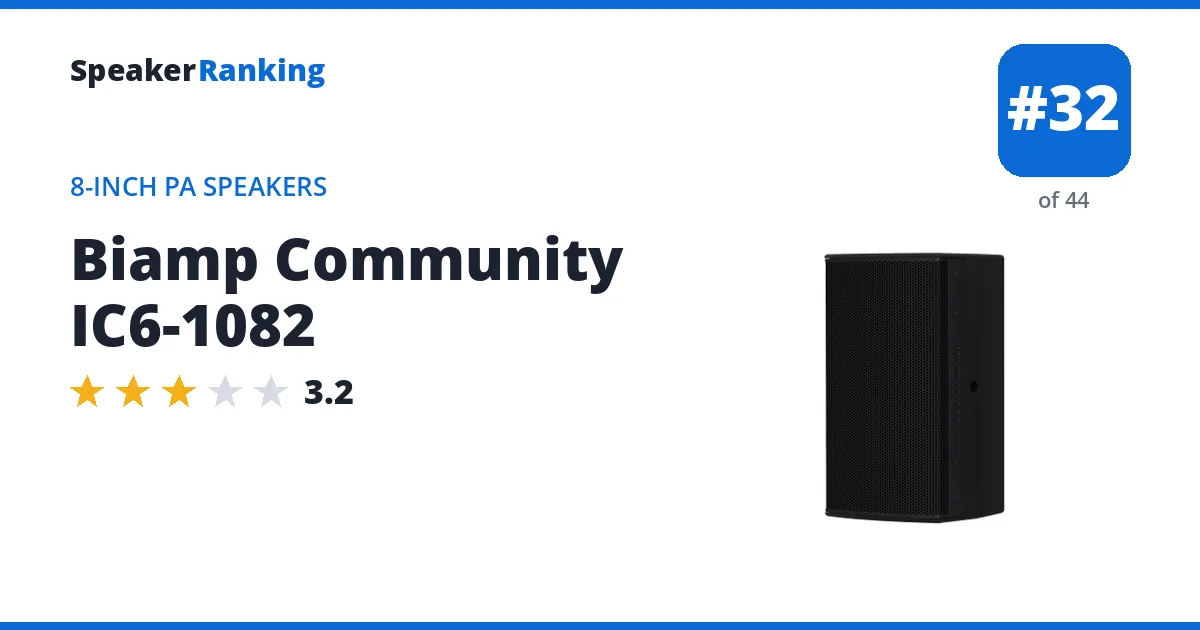
Same family: the Biamp Community IC6-1062 (smaller model, rated 3.2/5).
Pros: Deep bass for an 8-inch installation speaker, reaching 75Hz at -3dB and about 60Hz at -10dB in vendor measurements, with 94dB sensitivity and a 124dB peak for houses of worship and conference halls. Measured bass extension of 75Hz (-3dB).
Cons: Preference scores of 1.40 standalone and 4.15 with an ideal subwoofer are low, because the listening window drifts across a 3.7dB band and off-axis tone varies. It is passive and sold through installation dealers with no published price.
Full Biamp Community IC6-1082 review and specifications →
| Released | 2016 (10 years ago) |
|---|---|
| AES Input | No |
| Amplifier Power | Passive speaker; requires external amplification |
| Aux Input | No |
| Bass Extension (-10dB) | about 60.3Hz (measured, vendor Spinorama data) |
| Bass Extension (-3dB) | 75Hz (measured, vendor Spinorama data) |
| Bluetooth | No |
| Coaxial Input | No |
| Configuration | Passive 2-way installation PA speaker |
| Coverage | 120° x 60° or 90° x 60° |
| DSP | No (passive) |
| Dimensions | 18.7”H x 10.4”W x 10.6”D (476 x 264 x 270 mm) |
| Drivers | 8” woofer, compression driver |
| Guitar Input | No |
| HDMI Input | No |
| Impedance | 8 ohms |
| Maximum SPL | 124dB peak / 118dB continuous (manufacturer specified) |
| Microphone Input | No |
| Optical Input | No |
| Passive | Yes |
| RCA Input | No |
| Rigging | 7 x M10 and 4 x M8 rigging inserts |
| Sensitivity | 94dB |
| Spinorama Preference Score | 1.40 |
| Spinorama Preference Score with Perfect Sub | 4.15 |
| TRS Input | No |
| USB Input | No |
| Weight | 24.9 lbs (11.3 kg) |
| XLR Input | No |
- Reviews, Comparisons and Sound Samples
 #33 Bose AMM108 Passive B&H eBay
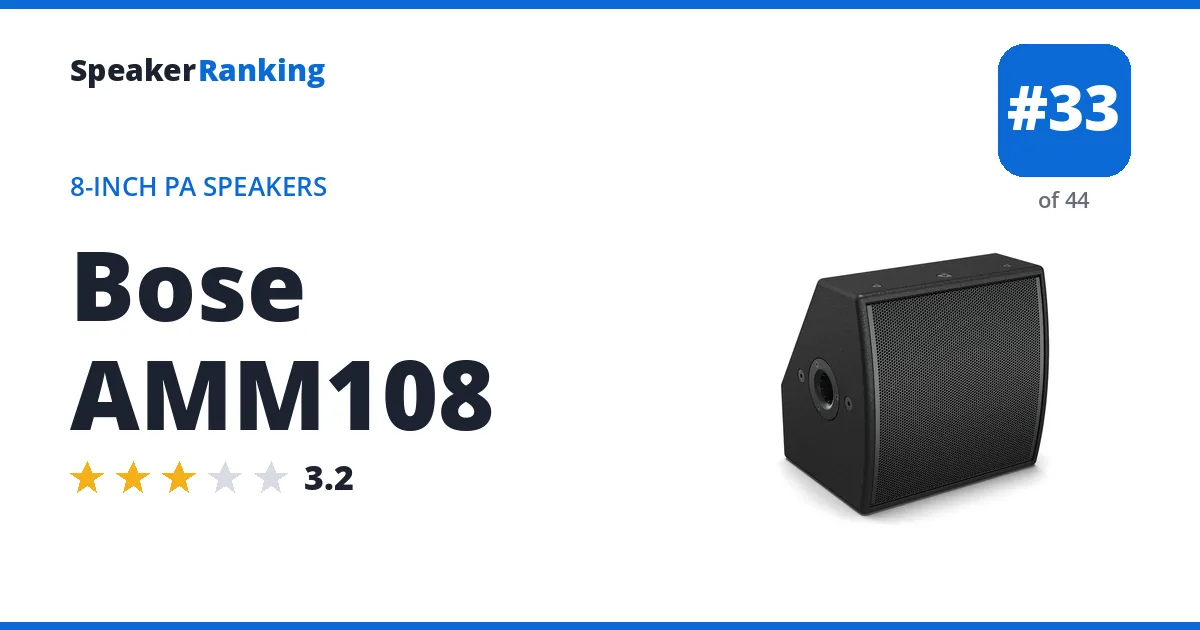
Same family: the Bose AMM112 (larger model, rated 3.3/5).
Pros: High-quality manufacturer measurements show a smooth on-axis response (0.76dB average deviation), and the compact wedge cabinet doubles as a fill or floor monitor with 110° x 60° coverage and a 128dB peak. Measured bass extension of 87.5Hz (-3dB).
Cons: Preference scores of 1.09 standalone and 4.34 with an ideal subwoofer are low because the listening window spreads across 4.4dB. Bass reaches only 88Hz at -3dB, so it needs a subwoofer for music. It is passive.
Full Bose AMM108 review and specifications →
| Released | Apr 2021 (5 years ago) |
|---|---|
| AES Input | No |
| Amplifier Power | Passive speaker; requires external amplification |
| Aux Input | No |
| Bass Extension (-10dB) | about 76.0Hz (measured, vendor Spinorama data) |
| Bass Extension (-3dB) | 87.5Hz (measured, vendor Spinorama data) |
| Bluetooth | No |
| Coaxial Input | No |
| Configuration | Passive 2-way coaxial PA speaker |
| Coverage | 110° x 60° |
| DSP | No (passive) |
| Dimensions | 12.5”H x 12.5”W x 10.6”D (318 x 318 x 268 mm) |
| Drivers | 8” coaxial woofer and compression driver |
| Frequency Response | 88Hz - 17kHz (-3dB, manufacturer specified) |
| Guitar Input | No |
| HDMI Input | No |
| Maximum SPL | 128dB peak (manufacturer calculated) |
| Microphone Input | No |
| Optical Input | No |
| Passive | Yes |
| RCA Input | No |
| Rigging | 35mm pole cup; 4 x M8 inserts; 6 x M10 inserts |
| Sensitivity | 94dB |
| Spinorama Preference Score | 1.09 |
| Spinorama Preference Score with Perfect Sub | 4.34 |
| TRS Input | No |
| USB Input | No |
| Weight | 28.7 lbs (13 kg) |
| XLR Input | No |
- Links
- Reviews, Comparisons and Sound Samples
- Head-to-Head Comparisons
 #34 d&b audiotechnik 8S Passive eBay
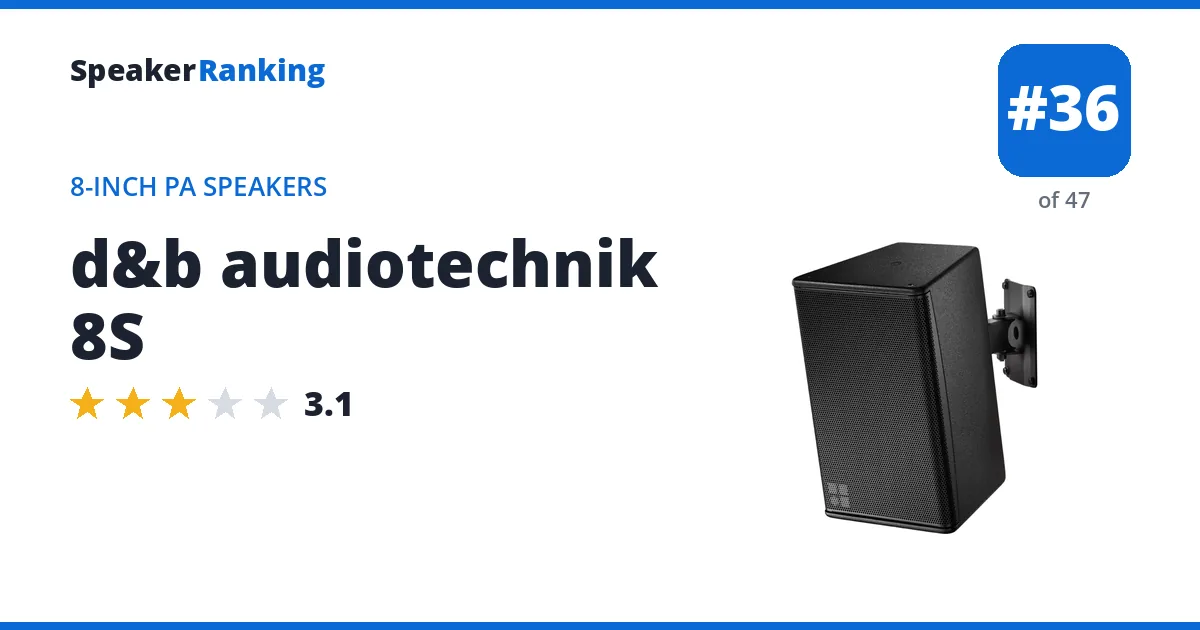
Same family: the d&b audiotechnik 4S (smaller model, estimated 3.2/5), the d&b audiotechnik 42S (smaller model, estimated 3.5/5), the d&b audiotechnik 44S (smaller model, rated 3.6/5), the d&b audiotechnik 5S (smaller model, estimated 3.3/5), the d&b audiotechnik 10S (larger model, rated 3.7/5), the d&b audiotechnik 12S (larger model, rated 3.8/5) and the d&b audiotechnik 24S (larger model, rated 3.8/5).
Pros: A 127dB maximum from a 7.4kg coaxial cabinet with wide 100° conical coverage, and bass reaches about 66Hz at -10dB in vendor measurements. Measured bass extension of 106Hz (-3dB).
Cons: Preference scores of 0.93 standalone and 4.01 with an ideal subwoofer are the lowest in this group, because the listening window spreads across a 3.8dB band. It is passive, needs d&b amplifiers and presets, and is sold only through d&b dealers with no published price.
Full d&b audiotechnik 8S review and specifications →
| AES Input | No |
|---|---|
| Amplifier Power | Passive speaker; requires external amplification |
| Aux Input | No |
| Bass Extension (-10dB) | about 65.6Hz (measured, vendor Spinorama data) |
| Bass Extension (-3dB) | 106Hz (measured, vendor Spinorama data) |
| Bluetooth | No |
| Coaxial Input | No |
| Configuration | Passive 2-way coaxial PA speaker |
| Coverage | 100° x 100° |
| DSP | No (passive) |
| Dimensions | 13.9”H x 8.8”W x 8.1”D (352 x 224 x 205 mm) |
| Drivers | 8” woofer, coaxial 1” compression driver |
| Frequency Response | 70Hz - 20kHz (manufacturer specified) |
| Guitar Input | No |
| HDMI Input | No |
| Impedance | 12 ohms |
| Maximum SPL | 127dB (manufacturer specified) |
| Microphone Input | No |
| Optical Input | No |
| Passive | Yes |
| Power Handling | 800W peak |
| RCA Input | No |
| Rigging | M8 inserts in top and bottom panels; 2 x M8 inserts on rear |
| Spinorama Preference Score | 0.93 |
| Spinorama Preference Score with Perfect Sub | 4.01 |
| TRS Input | No |
| USB Input | No |
| Weight | 16.3 lbs (7.4 kg) |
| XLR Input | No |
- Links
- Reviews, Comparisons and Sound Samples
 #35 RCF ART 708-A MK4: $525.00 Discontinued Guitar Center $525.00 eBay
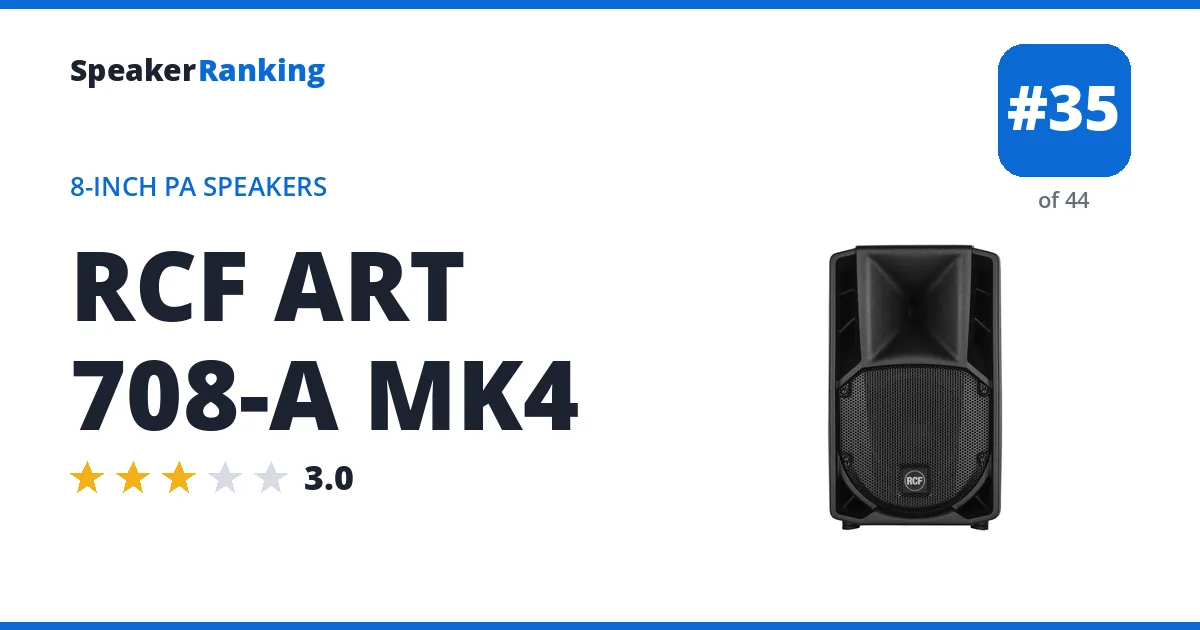
Newer model: the RCF ART 708-A MK5, ranked higher, rated 3.4/5, released Jan 2024. See every RCF ART 7 generation.
Pros: The 10.4kg cabinet combines 127dB claimed peak output, a broad horn and RCF’s FiRPHASE processing in a straightforward, affordable package for an 8-inch box. Measured bass extension of 75Hz (-3dB).
Cons: The low-quality vendor measurement is truncated and cannot produce a reliable preference score. This discontinued MK4 offers little reason to choose it over the newer RCF ART 708-A MK5 unless the used price is substantially lower.
Full RCF ART 708-A MK4 review and specifications →
| Released | Aug 2017 (9 years ago) |
|---|---|
| AES Input | No |
| Amplifier Power | 800W peak / 400W RMS (600W LF + 200W HF peak, manufacturer specified) |
| Aux Input | No |
| Bass Extension (-3dB) | 75Hz (measured, vendor Spinorama data) |
| Bluetooth | No |
| Cabinet Material | Polypropylene composite |
| Coaxial Input | No |
| Configuration | Active 2-way bass-reflex PA speaker |
| Coverage | 100° x 70° |
| Crossover Frequency | 1.6kHz (manufacturer specified) |
| DSP | Yes, FiRPHASE, EQ, limiting and protection |
| Dimensions | 18.9”H x 11.5”W x 10.9”D (480 x 291 x 276 mm) |
| Drivers | 8” woofer, 1” compression driver |
| Frequency Response | 60Hz - 20kHz (manufacturer specified) |
| Guitar Input | No |
| HDMI Input | No |
| Inputs | XLR/jack combo input; XLR output |
| Maximum SPL | 127dB peak (manufacturer specified) |
| Microphone Input | No |
| Optical Input | No |
| Passive | No |
| RCA Input | No |
| Rigging | Two M10 fly points; 35mm pole socket |
| TRS Input | Yes |
| USB Input | No |
| Weight | 22.9 lbs (10.4 kg) |
| XLR Input | Yes |
- Links
- Reviews, Comparisons and Sound Samples
- Head-to-Head Comparisons
- RCF ART 708-A MK4 vs Martin Audio CDD8
- RCF ART 708-A MK4 vs Audiofocus VENU 8a
- RCF ART 708-A MK4 vs RCF ART 708-A MK5
- RCF ART 708-A MK4 vs RCF KX 08-A
- RCF ART 708-A MK4 vs JBL PRX908
- RCF ART 708-A MK4 vs Yamaha DXR8mkII
- RCF ART 708-A MK4 vs QSC K8.2
- RCF ART 708-A MK4 vs QSC K10.2
- See all 11 comparisons
 #36 Martin Audio FlexPoint FP8 Passive eBay
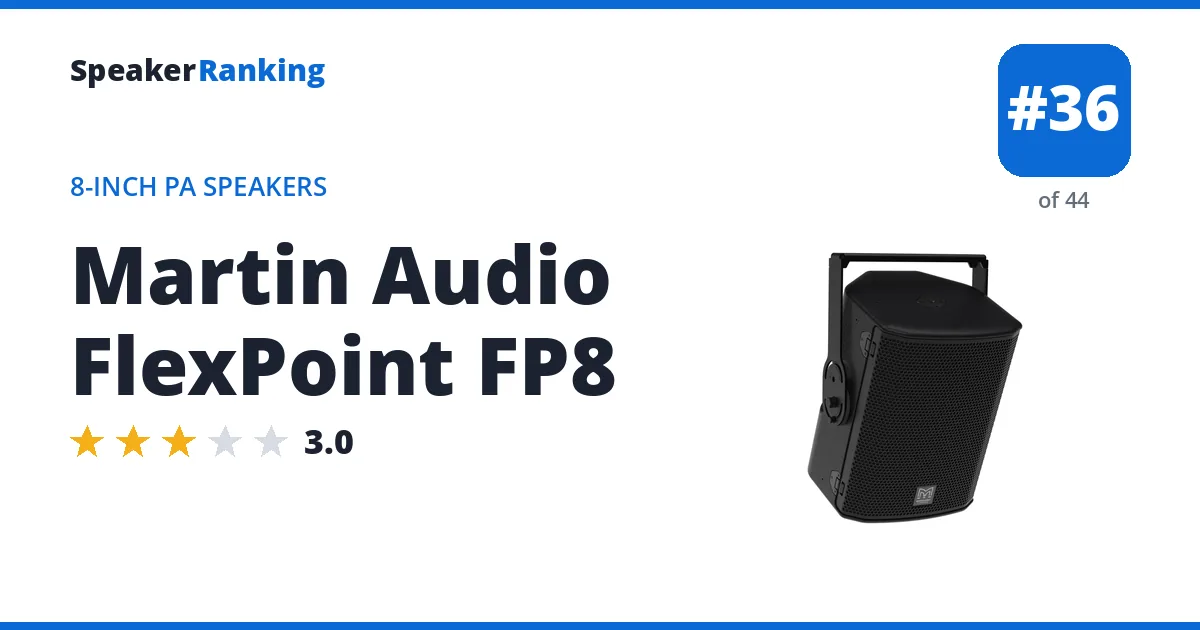
Same family: the Martin Audio FlexPoint FP4 (smaller model, rated 3/5), the Martin Audio FlexPoint FP6 (smaller model, rated 3/5), the Martin Audio FlexPoint FP12 (larger model, rated 3/5) and the Martin Audio FlexPoint FP15 (larger model, rated 2.7/5).
Pros: Deep bass for an 8-inch speaker, reaching 58Hz at -3dB and about 47Hz at -10dB in vendor measurements, with a smooth on-axis response (0.44dB average deviation) and 94dB sensitivity. Measured bass extension of 58Hz (-3dB).
Cons: Preference scores of 1.19 standalone and 3.51 with an ideal subwoofer are low because the listening window spreads across 4.8dB, so off-axis listeners hear a different balance. It is passive.
Full Martin Audio FlexPoint FP8 review and specifications →
| Released | 2023 (3 years ago) |
|---|---|
| AES Input | No |
| Amplifier Power | Passive speaker; requires external amplification |
| Aux Input | No |
| Bass Extension (-10dB) | about 46.7Hz (measured, vendor Spinorama data) |
| Bass Extension (-3dB) | 58Hz (measured, vendor Spinorama data) |
| Bluetooth | No |
| Coaxial Input | No |
| Configuration | Passive 2-way PA speaker |
| DSP | No (passive) |
| Drivers | 8” woofer, compression driver |
| Guitar Input | No |
| HDMI Input | No |
| Maximum SPL | 124dB peak / 118dB continuous (manufacturer specified) |
| Microphone Input | No |
| Optical Input | No |
| Passive | Yes |
| RCA Input | No |
| Rigging | 4 x M10 and 15 x M6 inserts; dual-angle pole socket |
| Sensitivity | 94dB |
| Spinorama Preference Score | 1.19 |
| Spinorama Preference Score with Perfect Sub | 3.51 |
| TRS Input | No |
| USB Input | No |
| Weight | 20.5 lbs (9.3 kg) |
| XLR Input | No |
- Links
- Reviews, Comparisons and Sound Samples
 #37 Tannoy VX8: $1,138.00 per pair Passive B&H Photo Video $1,138.00 eBay
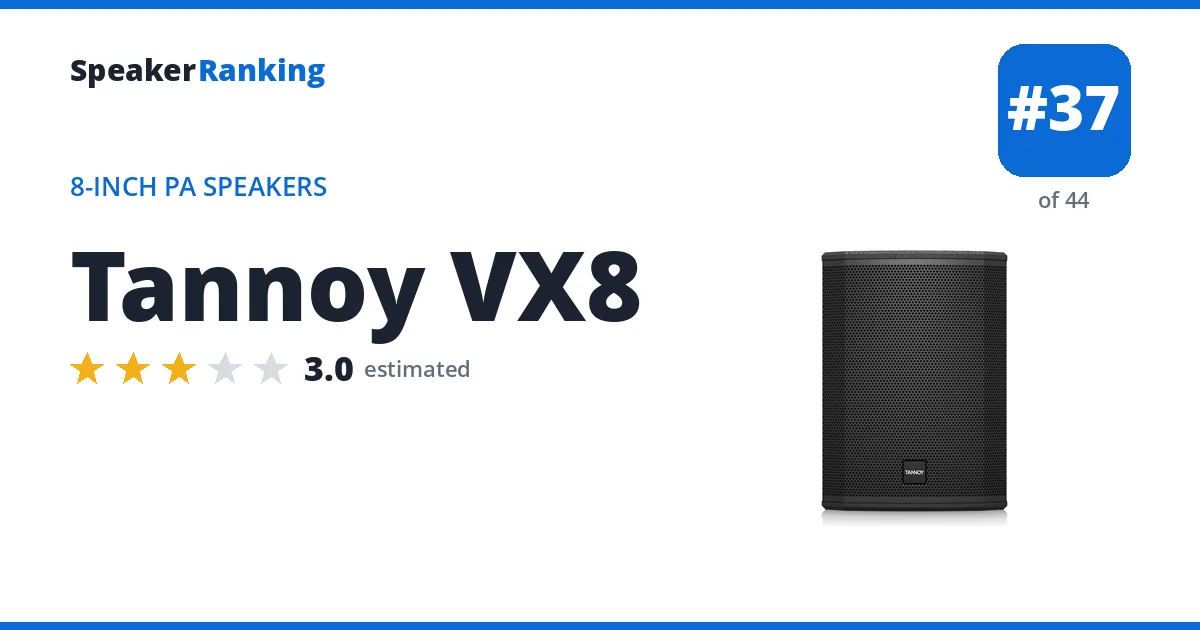
Same family: the Tannoy VX6 (smaller model, estimated 2.9/5), the Tannoy VX12 (larger model, rated 3.1/5) and the Tannoy VX15HP (larger model, estimated 3.1/5).
Pros: A passive model from Tannoy’s VX range alongside the measured Tannoy VX12: the 8” model, with a little more output and bass than the VX 6. Every VX uses a Dual Concentric driver with the tweeter in the center of the woofer, so the sound comes from one point and stays consistent off axis. Tannoy rates it at 92dB sensitivity and 119dB peak / 113dB average.
Cons: No independent measurements yet, so it can’t be compared with ranked PA speakers. It needs an external amplifier, ideally with Tannoy’s recommended EQ, and US dealers list it as a special order with long lead times.
Full Tannoy VX8 review and specifications →
| Amplifier Power | Passive speaker; requires external amplification |
|---|---|
| Bass Extension (-3dB) | 85Hz (manufacturer specified) |
| Bluetooth | No |
| Configuration | Passive Dual Concentric PA speaker |
| DSP | No (passive) |
| Drivers | 8” Dual Concentric driver |
| Frequency Response | 85Hz - 35kHz (-3dB), 62Hz (-10dB) (manufacturer specified) |
| Impedance | 8 ohms |
| Maximum SPL | 119dB peak / 113dB average (manufacturer specified) |
| Passive | Yes |
| Power Handling | 130W average / 520W peak |
| Rigging | M10 flying and yoke inserts; M6 inserts; optional pole mount |
| Sensitivity | 92dB |
| Weight | 17.9 lbs (8.1 kg) |
| XLR Input | No |
- Links
- Reviews, Comparisons and Sound Samples
- No independent measurement review is linked for this model; it is ranked from hands-on listening and comparison against similarly priced speakers.
- Head-to-Head Comparisons
 #38 Novacoustic Pariz P28 Passive eBay
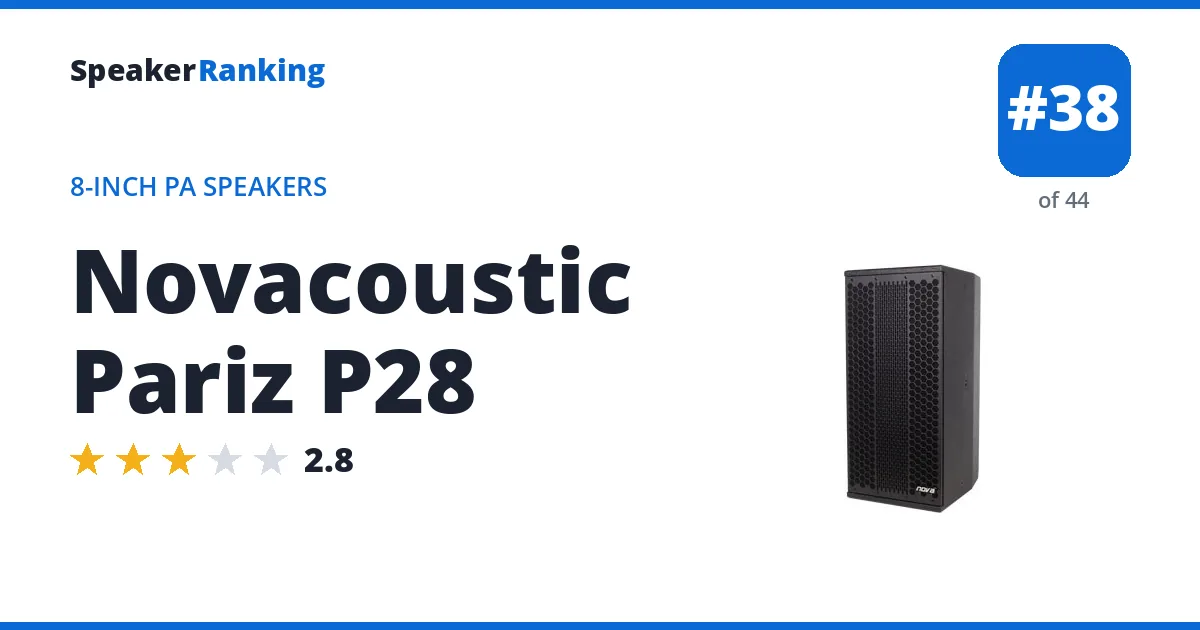
Pros: Very high 100dB sensitivity and a 136dB maximum from two 8-inch woofers, with bass to 78Hz at -3dB and about 66Hz at -10dB in vendor measurements. Measured bass extension of 77.5Hz (-3dB).
Cons: Preference scores of -0.19 standalone and 2.83 with an ideal subwoofer are low, with an uneven on-axis response (1.17dB average deviation). It is passive and sold through pro dealers with no published price.
Full Novacoustic Pariz P28 review and specifications →
| AES Input | No |
|---|---|
| Amplifier Power | Passive speaker; requires external amplification |
| Aux Input | No |
| Bass Extension (-10dB) | about 65.6Hz (measured, vendor Spinorama data) |
| Bass Extension (-3dB) | 77.5Hz (measured, vendor Spinorama data) |
| Bluetooth | No |
| Coaxial Input | No |
| Configuration | Passive 2-way PA speaker |
| Coverage | 90° x 40° |
| DSP | No (passive) |
| Dimensions | 23.2”H x 10.6”W x 13”D (590 x 270 x 330 mm) |
| Drivers | 2 x 8” carbon cone woofers, 1.4” compression driver |
| Frequency Response | 75Hz - 18kHz (±3dB, manufacturer specified) |
| Guitar Input | No |
| HDMI Input | No |
| Maximum SPL | 136dB (manufacturer specified) |
| Microphone Input | No |
| Optical Input | No |
| Passive | Yes |
| Power Handling | 1,000W RMS |
| RCA Input | No |
| Rigging | 16 x M8 mounting points; self-locking U-bracket system |
| Sensitivity | 100dB |
| Spinorama Preference Score | -0.19 |
| Spinorama Preference Score with Perfect Sub | 2.83 |
| TRS Input | No |
| USB Input | No |
| Weight | 39.7 lbs (18 kg) |
| XLR Input | No |
- Links
- Reviews, Comparisons and Sound Samples
 #39 Biamp Community V2-8 Passive eBay
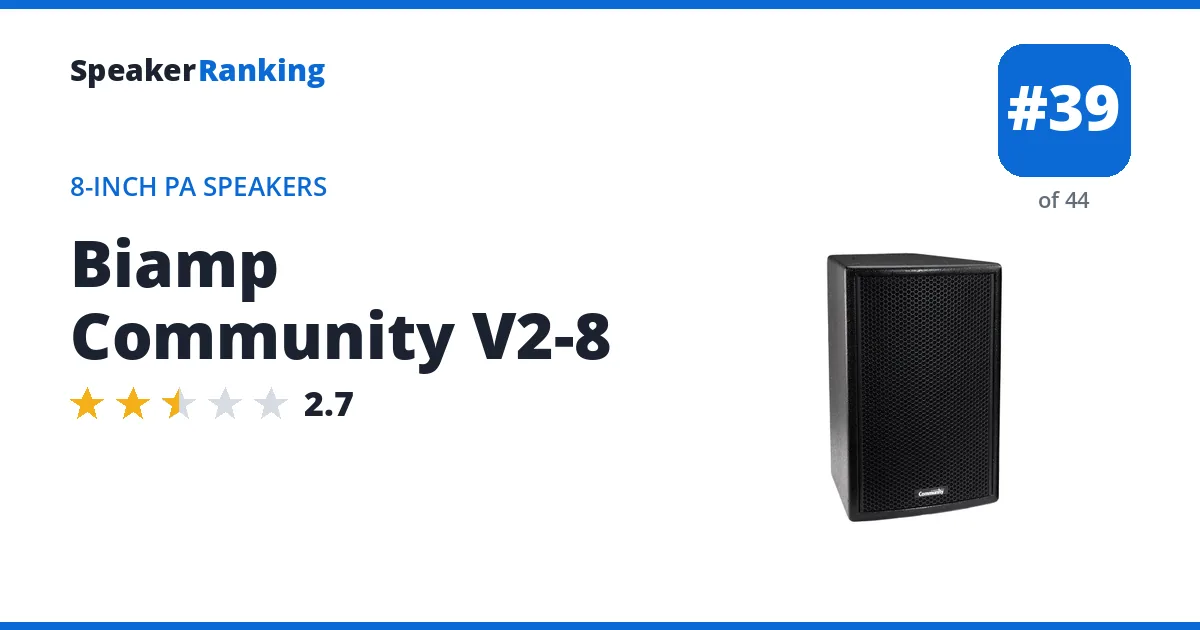
Same family: the Biamp Community V2-6 (smaller model, rated 2.8/5), the Biamp Community V2-26 (smaller model, rated 2.8/5), the Biamp Community V2-28 (larger model, ranked lower, rated 2.4/5), the Biamp Community V2-3294 (larger model, rated 2.7/5) and the Biamp Community V2-3594 (larger model, rated 2.7/5).
Pros: A smooth on-axis response (0.43dB average deviation in vendor measurements) and 92dB sensitivity in a compact installation cabinet. Measured bass extension of 100Hz (-3dB).
Cons: Bass rolls off at 100Hz (-3dB), early for an 8-inch woofer, so it scores -0.64 standalone and 2.72 with an ideal subwoofer. It is passive and sold through installation dealers.
Full Biamp Community V2-8 review and specifications →
| AES Input | No |
|---|---|
| Amplifier Power | Passive speaker; requires external amplification |
| Aux Input | No |
| Bass Extension (-10dB) | about 65.1Hz (measured, vendor Spinorama data) |
| Bass Extension (-3dB) | 100Hz (measured, vendor Spinorama data) |
| Bluetooth | No |
| Coaxial Input | No |
| Configuration | Passive 2-way installation PA speaker |
| DSP | No (passive) |
| Drivers | 8” woofer, compression driver |
| Frequency Response | 70Hz - 18kHz (-10dB, manufacturer specified) |
| Guitar Input | No |
| HDMI Input | No |
| Impedance | 8 ohms |
| Maximum SPL | 120dB peak (manufacturer specified) |
| Microphone Input | No |
| Optical Input | No |
| Passive | Yes |
| Power Handling | 150W continuous / 375W program |
| RCA Input | No |
| Rigging | 9 x M6 rigging points; 4 x M6 third-party fittings; yoke bracket |
| Sensitivity | 92dB |
| Spinorama Preference Score | -0.64 |
| Spinorama Preference Score with Perfect Sub | 2.72 |
| TRS Input | No |
| USB Input | No |
| Weight | 25.4 lbs (11.5 kg) |
| XLR Input | No |
- Reviews, Comparisons and Sound Samples
 #40 Novacoustic KIRA 8 Passive eBay
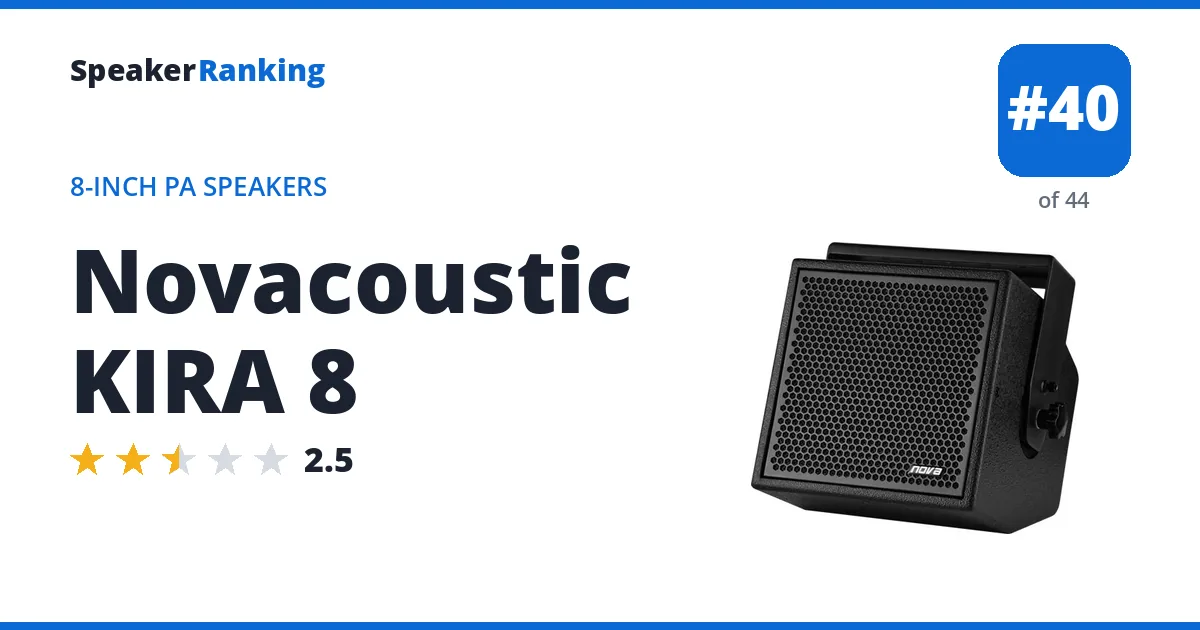
Same family: the Novacoustic KIRA 5 (smaller model, rated 2.5/5), the Novacoustic KIRA 10 (larger model, rated 2/5) and the Novacoustic KIRA 12 (larger model, rated 2.7/5).
Pros: A compact coaxial cabinet with 96dB sensitivity, a 123dB peak and 90° conical coverage, with bass to about 78Hz at -10dB. Measured bass extension of 118Hz (-3dB).
Cons: Preference scores of -1.23 standalone and 2.13 with an ideal subwoofer are low, because the listening window spreads across 7.7dB and bass rolls off at 118Hz (-3dB). It is passive.
Full Novacoustic KIRA 8 review and specifications →
| AES Input | No |
|---|---|
| Amplifier Power | Passive speaker; requires external amplification |
| Aux Input | No |
| Bass Extension (-10dB) | about 77.7Hz (measured, vendor Spinorama data) |
| Bass Extension (-3dB) | 118Hz (measured, vendor Spinorama data) |
| Bluetooth | No |
| Coaxial Input | No |
| Configuration | Passive 2-way coaxial PA speaker |
| Coverage | 90° x 90° |
| DSP | No (passive) |
| Dimensions | 9.8”H x 9.8”W x 9.8”D (250 x 250 x 250 mm) |
| Drivers | 8” coaxial driver |
| Frequency Response | 55Hz - 20kHz (manufacturer specified) |
| Guitar Input | No |
| HDMI Input | No |
| Impedance | 8 ohms |
| Maximum SPL | 123dB peak (manufacturer specified) |
| Microphone Input | No |
| Optical Input | No |
| Passive | Yes |
| Power Handling | 250W RMS |
| RCA Input | No |
| Rigging | 2 x M10 inserts with U-bracket; M5 wall mount points; optional stand adapter |
| Sensitivity | 96dB |
| Spinorama Preference Score | -1.23 |
| Spinorama Preference Score with Perfect Sub | 2.13 |
| TRS Input | No |
| USB Input | No |
| Weight | 19.8 lbs (9 kg) |
| XLR Input | No |
- Links
- Reviews, Comparisons and Sound Samples
- Head-to-Head Comparisons
 #41 Rockville SPG88: $64.95 each Passive Amazon $64.95 eBay
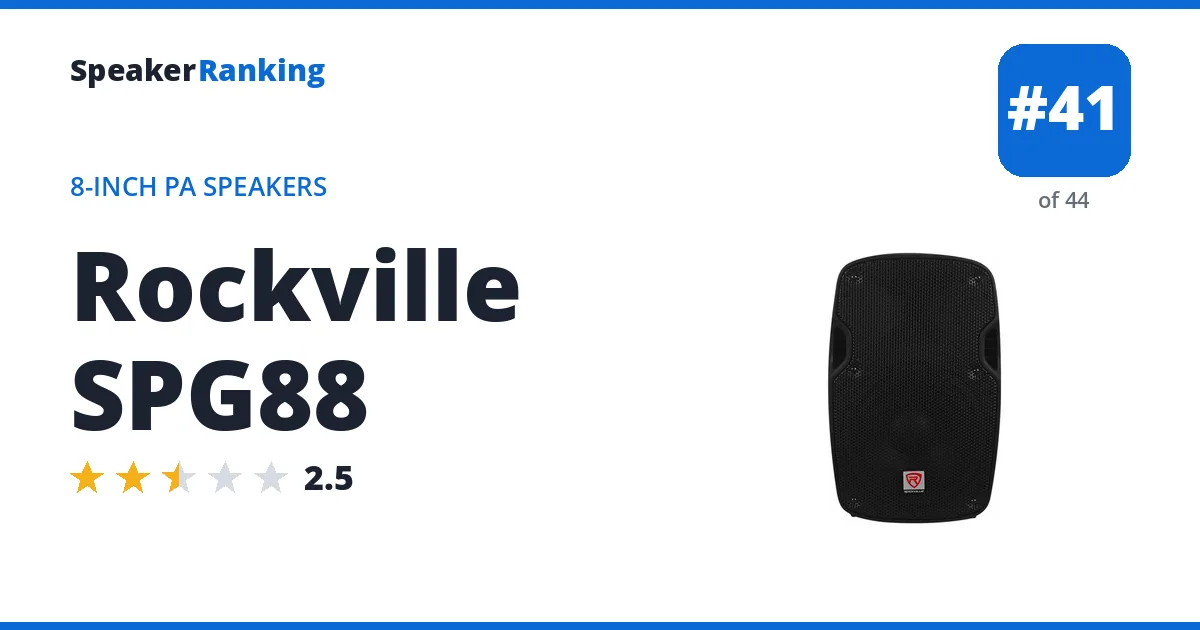
Pros: A budget passive PA speaker with an 8” woofer in an ABS cabinet. Measurements show a preference score of -0.89 that reaches 2.76 with an ideal subwoofer, with 0.95 listening window deviation. Measured bass extension of 111.5Hz (-3dB).
Cons: Bass is limited and the on-axis response is uneven (1.75 average deviation), and that data is low quality. Bass reaches 111.5Hz (-3dB) and about 79Hz (-10dB). That data is low quality.
Full Rockville SPG88 review and specifications →
| Released | Aug 2026 (2 months ago) |
|---|---|
| Bass Extension (-10dB) | about 78.8Hz (measured, third-party data via spinorama.org) |
| Bass Extension (-3dB) | 111.5Hz (measured, third-party data via spinorama.org) |
| Bluetooth | No |
| DIY Kit | No |
| Drivers | 8” woofer, tweeter |
| Maximum SPL | 119dB peak (manufacturer specified) |
| Passive | Yes |
| Rigging | 35mm pole mount |
| Spinorama Preference Score | -0.89 |
| Spinorama Preference Score with Perfect Sub | 2.76 |
| Weight | 11.9 lbs (5.4 kg) |
- Reviews, Comparisons and Sound Samples
- Head-to-Head Comparisons
 #42 Biamp Community V2-28: $851.00 Passive Amazon $851.00 eBay
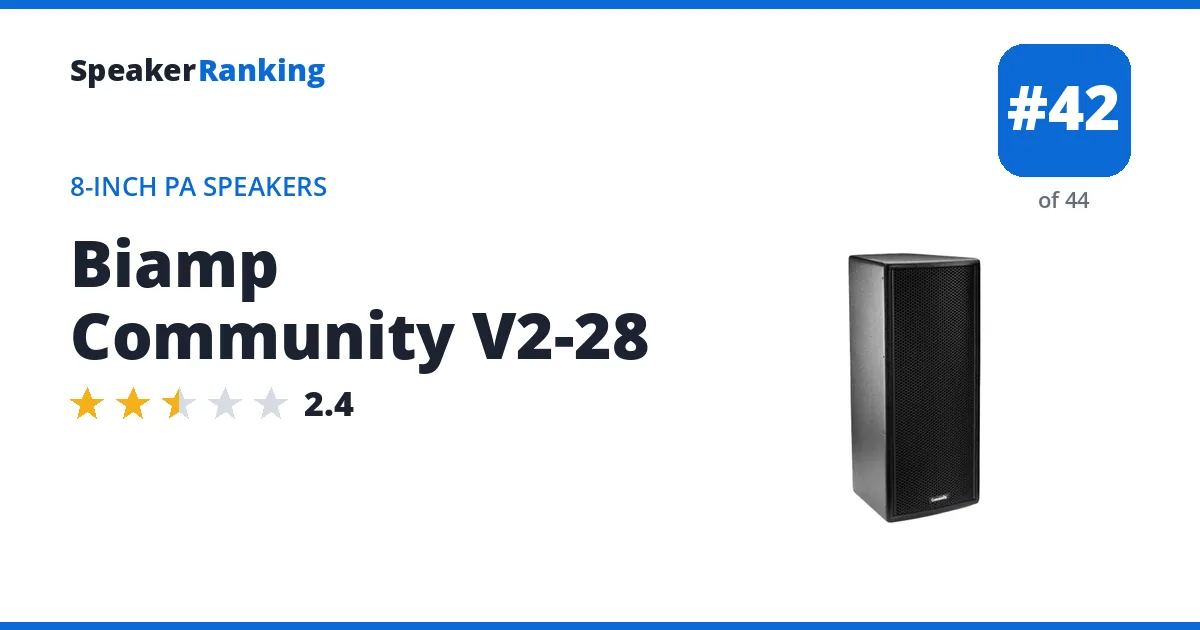
Same family: the Biamp Community V2-6 (smaller model, rated 2.8/5), the Biamp Community V2-26 (smaller model, rated 2.8/5), the Biamp Community V2-8 (smaller model, ranked higher, rated 2.7/5), the Biamp Community V2-3294 (larger model, rated 2.7/5) and the Biamp Community V2-3594 (larger model, rated 2.7/5).
Pros: Two 8-inch woofers and 94dB sensitivity give more output than the single-woofer Biamp Community V2-8, with bass to about 59Hz at -10dB in vendor measurements. Measured bass extension of 90Hz (-3dB).
Cons: Preference scores of -1.6 standalone and 1.65 with an ideal subwoofer are among the lowest here, because the listening window spreads across a 9.9dB band. It is passive and weighs 16.7kg.
Full Biamp Community V2-28 review and specifications →
| AES Input | No |
|---|---|
| Amplifier Power | Passive speaker; requires external amplification |
| Aux Input | No |
| Bass Extension (-10dB) | about 59.5Hz (measured, vendor Spinorama data) |
| Bass Extension (-3dB) | 90Hz (measured, vendor Spinorama data) |
| Bluetooth | No |
| Coaxial Input | No |
| Configuration | Passive 2-way installation PA speaker |
| DSP | No (passive) |
| Drivers | 2 x 8” woofers, compression driver |
| Frequency Response | 60Hz - 18kHz (-10dB, manufacturer specified) |
| Guitar Input | No |
| HDMI Input | No |
| Maximum SPL | 125dB peak (manufacturer specified) |
| Microphone Input | No |
| Optical Input | No |
| Passive | Yes |
| Power Handling | 300W continuous / 750W program |
| RCA Input | No |
| Rigging | 13 x M6 rigging inserts; yoke bracket included |
| Sensitivity | 94dB |
| Spinorama Preference Score | -1.60 |
| Spinorama Preference Score with Perfect Sub | 1.65 |
| TRS Input | No |
| USB Input | No |
| Weight | 36.8 lbs (16.7 kg) |
| XLR Input | No |
- Reviews, Comparisons and Sound Samples
- Head-to-Head Comparisons
 #43 Audiofocus VENU 8a: $2,100 eBay
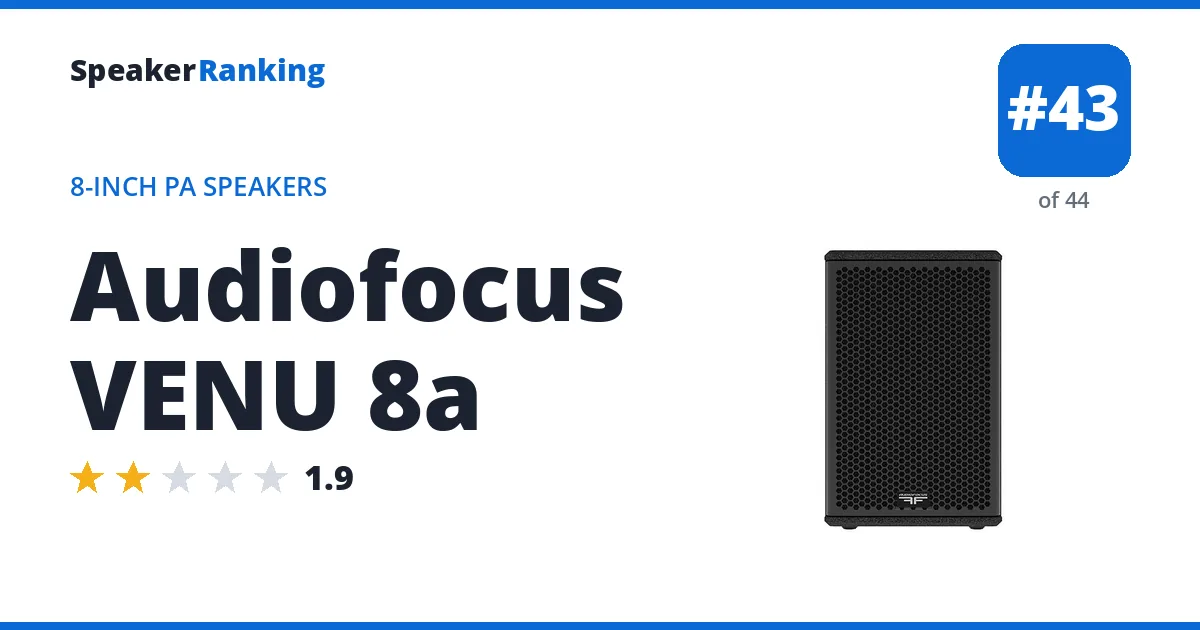
Same family: the Audiofocus VENU 12a (larger model, rated 2.8/5) and the Audiofocus VENU 15a (larger model, rated 2.1/5).
Pros: A wide 80° x 80° horn and 134dB claimed peak give it unusually broad, symmetric coverage and high maximum output for stage use, and its 11.5kg weight is manageable for a touring box. Measured bass extension of 112Hz (-3dB).
Cons: Low-quality vendor data shows a 1.68 ideal-subwoofer preference score with bass extension only to roughly 106Hz, the weakest measured result of any speaker in this family of rankings; this cabinet is voiced as a subwoofer-dependent top rather than a stand-alone full-range box.
Full Audiofocus VENU 8a review and specifications →
| AES Input | No |
|---|---|
| Amplifier Power | 430W AES / 1,720W peak (350W LF + 80W HF AES, manufacturer specified) |
| Aux Input | No |
| Bass Extension (-3dB) | 112Hz (measured, vendor Spinorama data) |
| Bluetooth | No |
| Cabinet Material | High-grade birch plywood with polyurea coating |
| Coaxial Input | No |
| Configuration | Active 2-way full-range PA speaker |
| Coverage | 80° x 80° |
| DSP | Yes |
| Dimensions | 16.9”H x 10.7”W x 11.5”D (430 x 273 x 291 mm) |
| Drivers | 8” woofer, 1” compression driver |
| Frequency Response | 55Hz - 20kHz (-6dB, manufacturer specified) |
| Guitar Input | No |
| HDMI Input | No |
| Inputs | Three-pin XLR input and link output |
| Maximum SPL | 134dB peak (manufacturer specified) |
| Microphone Input | No |
| Optical Input | No |
| Passive | No |
| RCA Input | No |
| Rigging | Adjustable pole mount and M8 threaded inserts |
| Spinorama Preference Score | -2.04 |
| Spinorama Preference Score with Perfect Sub | 1.68 |
| TRS Input | No |
| USB Input | No |
| Weight | 25.4 lbs (11.5 kg) |
| XLR Input | Yes |
- Links
- Reviews, Comparisons and Sound Samples
- Head-to-Head Comparisons
 #44 LYX SPA8PAS: $100 each Passive Discontinued eBay
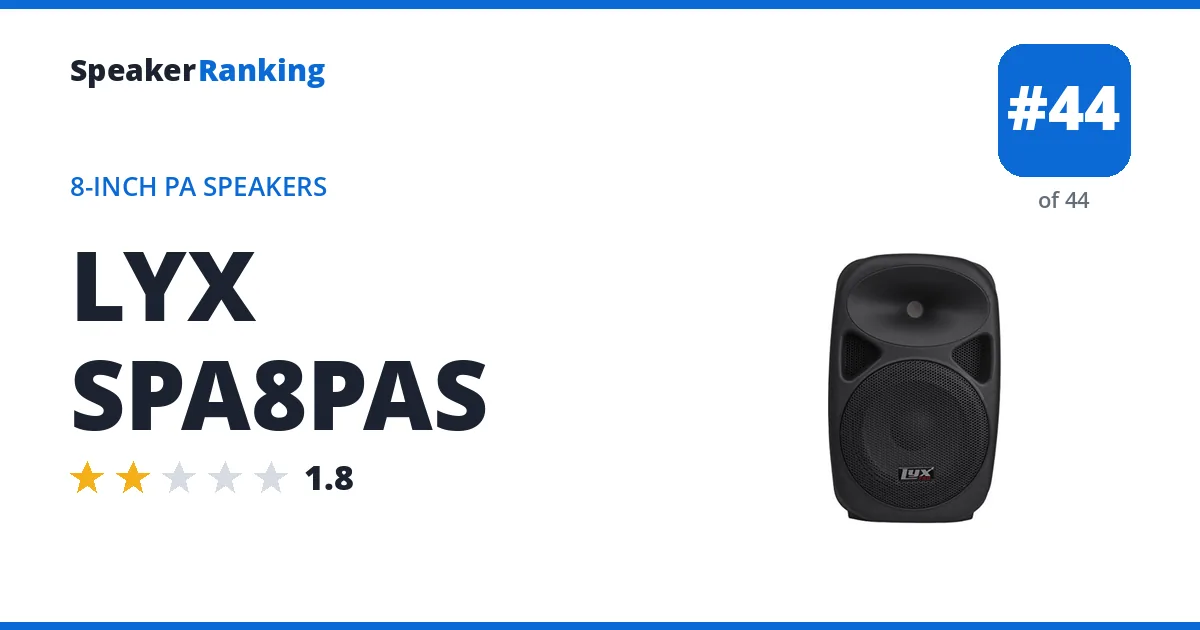
Pros: A budget passive PA speaker with an 8” woofer. Measurements show a preference score of -3.34 that reaches 0.56 with an ideal subwoofer, with 1.23 listening window deviation. Measured bass extension of 123.4Hz (-3dB).
Cons: The response is very uneven, for a preference score of -3.34 that reaches only 0.56 with an ideal subwoofer, and that data is low quality. Its current availability could not be confirmed. Bass reaches 123.4Hz (-3dB) and about 99Hz (-10dB). That data is low quality. Discontinued.
Full LYX SPA8PAS review and specifications →
| Bass Extension (-10dB) | about 98.9Hz (measured, third-party data via spinorama.org) |
|---|---|
| Bass Extension (-3dB) | 123.4Hz (measured, third-party data via spinorama.org) |
| Bluetooth | No |
| DIY Kit | No |
| Drivers | 8” woofer, tweeter |
| Passive | Yes |
| Spinorama Preference Score | -3.34 |
| Spinorama Preference Score with Perfect Sub | 0.56 |
- Reviews, Comparisons and Sound Samples