This page ranks 14 small powered desktop speakers. These are stereo inside a single compact enclosure with woofers under 4”. They have no battery and no waterproofing, and include a built-in amp so you can play directly from your phone or laptop.
Imaging is limited because the left and right channels sit close together rather than being widely separated like a proper bookshelf pair, and the small woofers give up low-end extension. Pick one of these when space is the top priority; otherwise consider a portable Bluetooth speaker or a real bookshelf pair.
| Select to compare | |||||||
|---|---|---|---|---|---|---|---|
| 1 | Audio Pro C3 | $330 each | 25W | 60Hz - 20kHz | Yes | 4.6 lbs | |
| 2 | Amazon Echo Studio 2nd Gen | $219.99 each | - | - | Yes | 3.6 lbs | |
| 3 | Marshall Acton IV | $329.99 each | 110W | 37Hz - 38kHz | Yes | 5.8 lbs | |
| 4 | Denon Home 200 | $399.00 each | 3 x Class D | - | Yes | 4.9 lbs | |
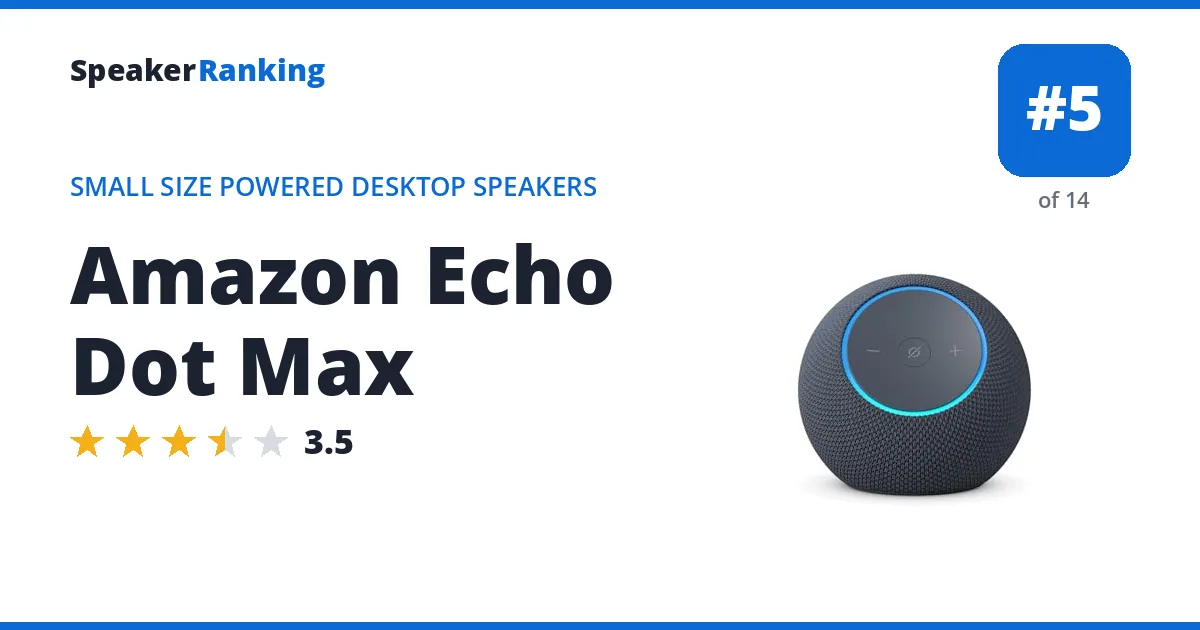
| 5 | Amazon Echo Dot Max | $119.99 each | - | - | Yes | - | |
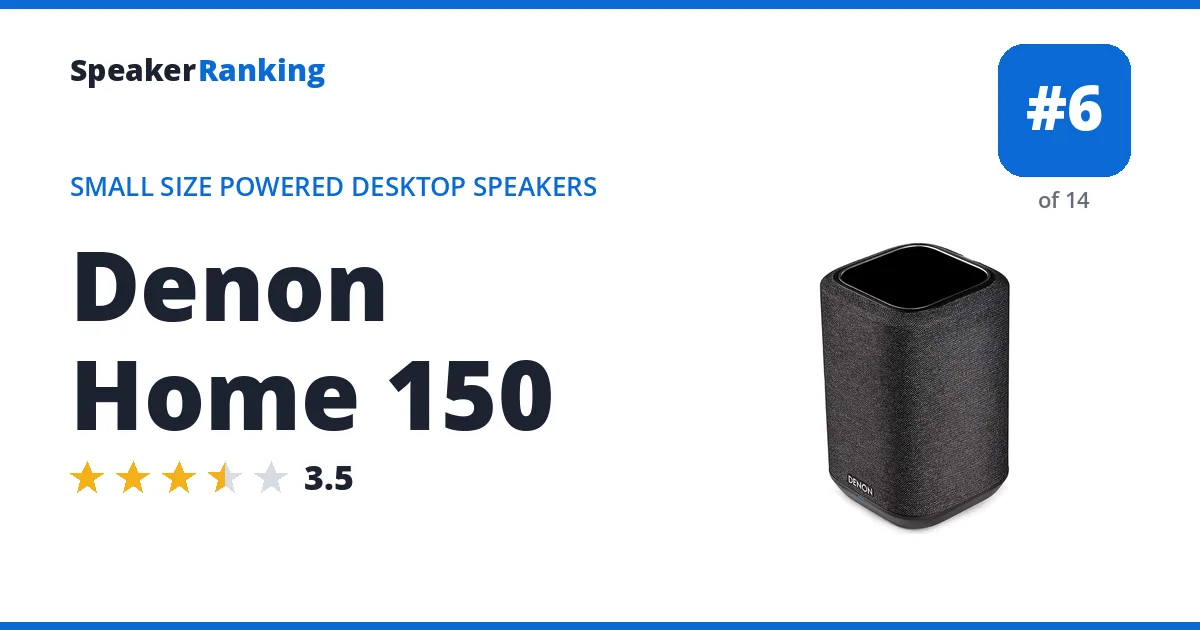
| 6 | Denon Home 150 | $249 each | - | - | Yes | 3.7 lbs | |
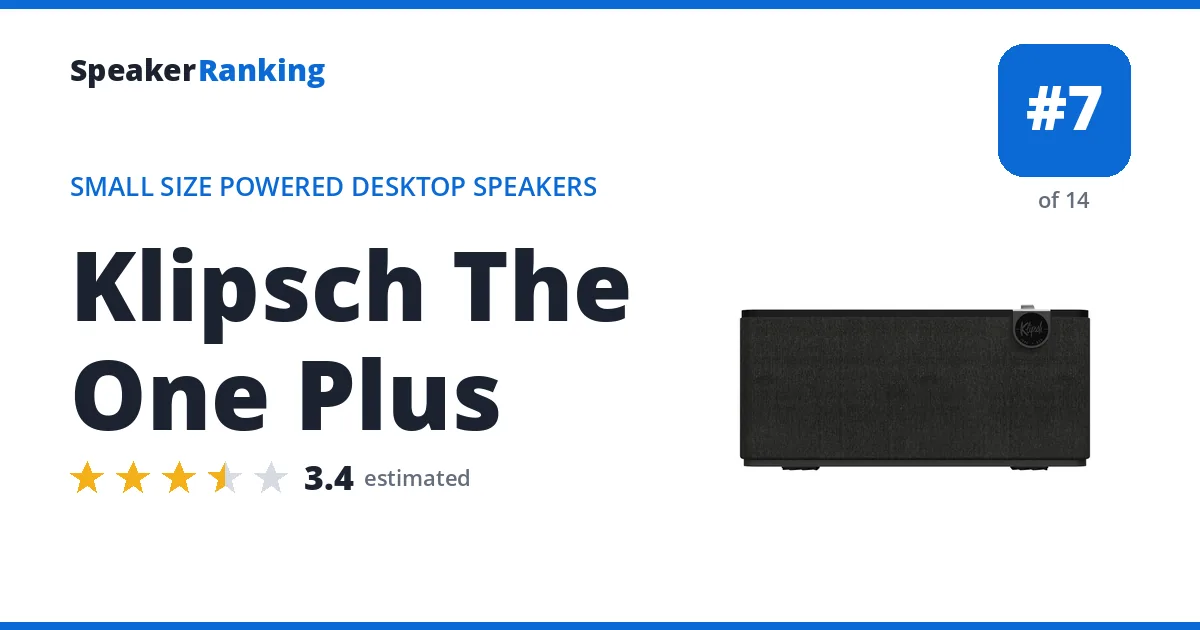
| 7 | Klipsch The One Plus | $239.99 each | 60W total | 55Hz - 20kHz | Yes | 7.9 lbs | |
| 8 | Amazon Echo (4th Gen) | $99.99 each | 30W total system power | 55Hz - 20kHz | Yes | 2.1 lbs | |
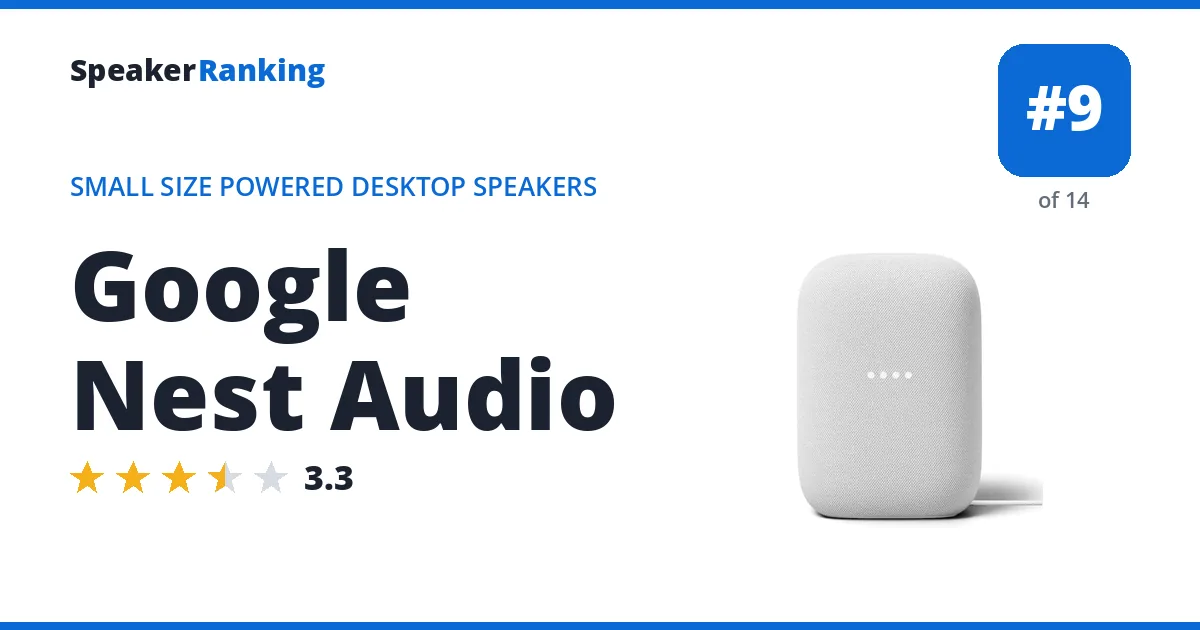
| 9 | Google Nest Audio | $99.99 each | 30W | - | Yes | 2.6 lbs | |
| 10 | Apple HomePod Mini | $149.36 each | - | - | No | 0.8 lbs | |
| 11 | Amazon Echo Dot 5th Gen | $79.99 each | - | - | Yes | 0.7 lbs | |
| 12 | Google Home Speaker | $99.99 each | - | - | Yes | 0.9 lbs | |
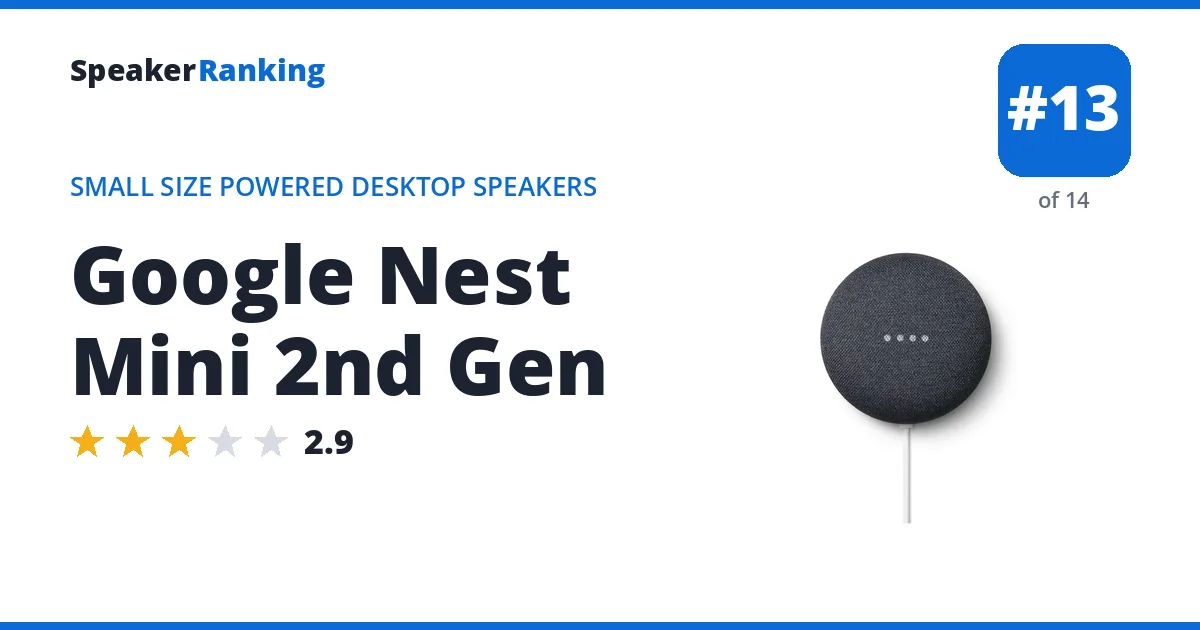
| 13 | Google Nest Mini 2nd Gen | $114.95 each | - | - | Yes | 0.4 lbs | |
| 14 | Amazon Echo Pop | $45.98 each | - | - | Yes | 0.4 lbs |
Prices on this page were last checked October 12, 2026 at 4:13 PM UTC. Product prices and availability are accurate as of that date/time and are subject to change; the price and availability shown on Amazon at the time of purchase will apply to the purchase of this product.
As an eBay Partner, we may be compensated if you make a purchase.
 #1 Audio Pro C3: $330 each Discontinued eBay
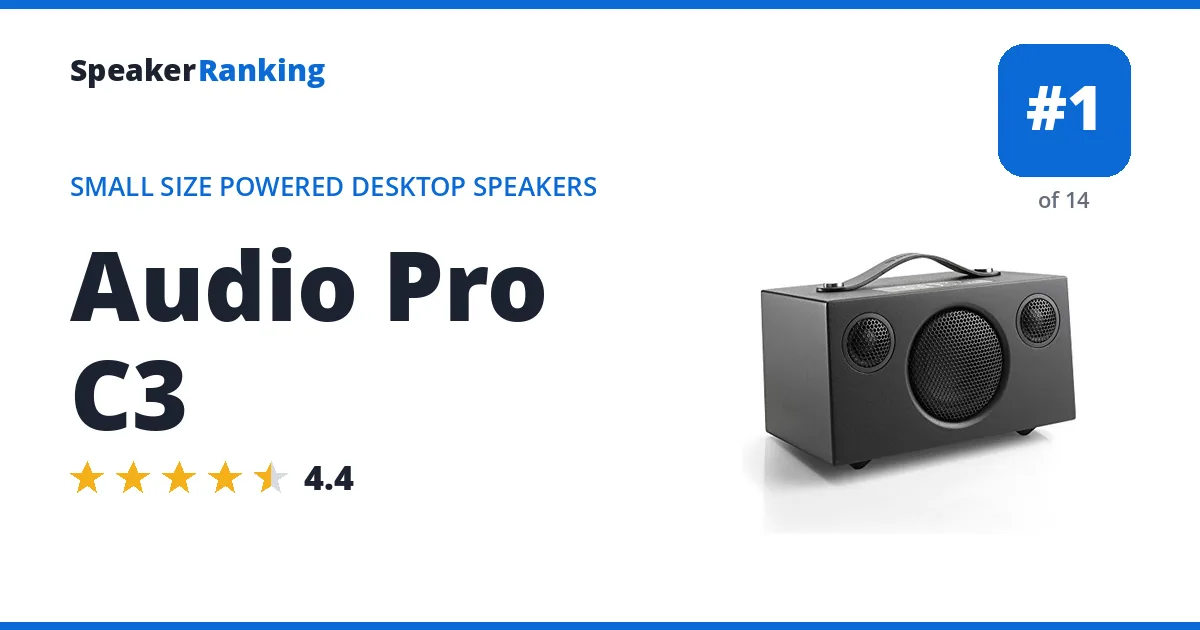
Pros: Audio Pro C3 uses 2” driver + 0.5” tweeter. Its 2.1 kg, claimed 15 hours (Manufacturer specified) battery life, aux input and limited-stereo playback make it a practical option for its intended room or portable use.
Cons: There is no companion app. No EQ adjustment. Discontinued.
Full Audio Pro C3 review and specifications →
| AES Input | No |
|---|---|
| Amplifier Power | 25W (Class D) |
| App | No |
| Aux Input | Yes |
| Battery Life | 15 hours (Manufacturer specified) |
| Bluetooth | Yes |
| Bluetooth Codecs | SBC |
| Built-in Microphone | Yes |
| Coaxial Input | No |
| Dimensions | 4.5” x 8.5” x 5.3” (115 x 215 x 135 mm) (H x W x D) |
| Drivers | 2” driver + 0.5” tweeter |
| EQ | No |
| Frequency Response | 60Hz - 20kHz (Manufacturer specified) |
| HDMI Input | No |
| IP Rating | None |
| Inputs | Bluetooth, Aux, Wi-Fi, AirPlay, Spotify Connect |
| Optical Input | No |
| Party Mode | Yes (AirPlay 2 multi-room) |
| Power Bank | No |
| Power Input | AC Power cable |
| RCA Input | No |
| Stereo | Partially (1 woofer) |
| TRS Input | No |
| TWS | Yes |
| USB Input | No |
| Weight | 4.6 lbs (2.1 kg) |
| Wi-Fi | Yes |
| XLR Input | No |
- Reviews, Comparisons and Sound Samples
- Head-to-Head Comparisons
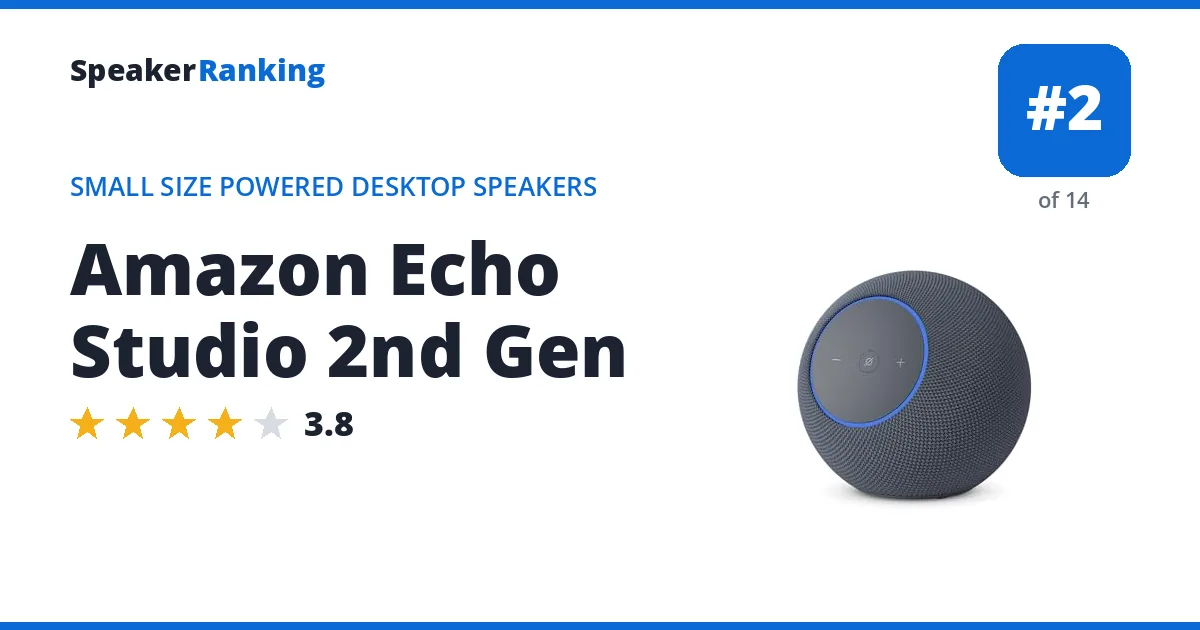
 #2 Amazon Echo Studio 2nd Gen: $219.99 each Amazon $219.99 eBay
Same family: the Amazon Echo Dot Max (smaller model, ranked lower, rated 3.5/5).
Pros: SoundGuys called it the best-sounding Amazon speaker they have tested, scoring it 7.8 of 10. A 3.75-inch high-excursion woofer and three 2.25-inch full-range drivers fire left, right and upward, giving a real sense of width and instrument separation from a single enclosure, with vocals sitting forward and clean cymbals even at moderate volume. It supports Dolby Atmos and spatial audio on compatible content, stays distortion-free up to about 70% volume, and includes a built-in Zigbee, Matter and Thread smart home hub plus a 3-band EQ with a Dolby Virtualizer toggle.
Cons: SoundGuys still marked it down on Value (4.0 of 10) given the $219.99 list price, and it is explicitly not true left-right stereo from one cabinet, so a stereo pair is needed for real width in a larger room. There are no wired audio inputs of any kind and no battery, so it must stay plugged in, and Bluetooth is limited to the SBC codec. Voice recognition wasn’t perfectly reliable in testing, occasionally playing the wrong track for a specific artist-title request.
Full Amazon Echo Studio 2nd Gen review and specifications →
| Released | Oct 2025 (1 year ago) |
|---|---|
| AES Input | No |
| App | Yes (Alexa) |
| Aux Input | No |
| Battery Life | No Battery |
| Bluetooth | Yes |
| Bluetooth Codecs | SBC |
| Bluetooth Version | 5.3 |
| Built-in Microphone | Yes (mic mute button, far-field) |
| Coaxial Input | No |
| Dimensions | 6.1” x 5.6” x 5.8” (155 x 142 x 147 mm) |
| Drivers | 3.75in high-excursion woofer, 3x 2.25in full-range drivers (L/R/up) |
| EQ | Yes (Bass/Mid/Treble + Dolby Virtualizer, via Alexa app) |
| HDMI Input | No |
| IP Rating | None |
| Inputs | Wi-Fi, Bluetooth |
| Optical Input | No |
| Party Mode | Yes (Wi-Fi multi-room, Alexa Home Theater) |
| Power Bank | No |
| Power Input | External AC adapter |
| RCA Input | No |
| Stereo | No |
| Streaming Services | Amazon Music, Apple Music, Spotify, SiriusXM |
| TRS Input | No |
| TWS | Yes (Wi-Fi stereo pairing via Alexa app) |
| USB Input | No |
| Voice Assistants | Amazon Alexa / Alexa+ |
| Weight | 3.6 lbs (1.632 kg) |
| Wi-Fi | Yes (Wi-Fi 6E) |
| XLR Input | No |
- Links
- Reviews, Comparisons and Sound Samples
- Head-to-Head Comparisons
- Amazon Echo Studio 2nd Gen vs Marshall Acton IV
- Amazon Echo Studio 2nd Gen vs Amazon Echo Dot Max
- Amazon Echo Studio 2nd Gen vs Denon Home 150
- Amazon Echo Studio 2nd Gen vs Google Nest Audio
- Amazon Echo Studio 2nd Gen vs Apple HomePod Mini
- Amazon Echo Studio 2nd Gen vs Amazon Echo Dot 5th Gen
- Amazon Echo Studio 2nd Gen vs Google Home Speaker
- Amazon Echo Studio 2nd Gen vs Google Nest Mini 2nd Gen
- See all 30 comparisons
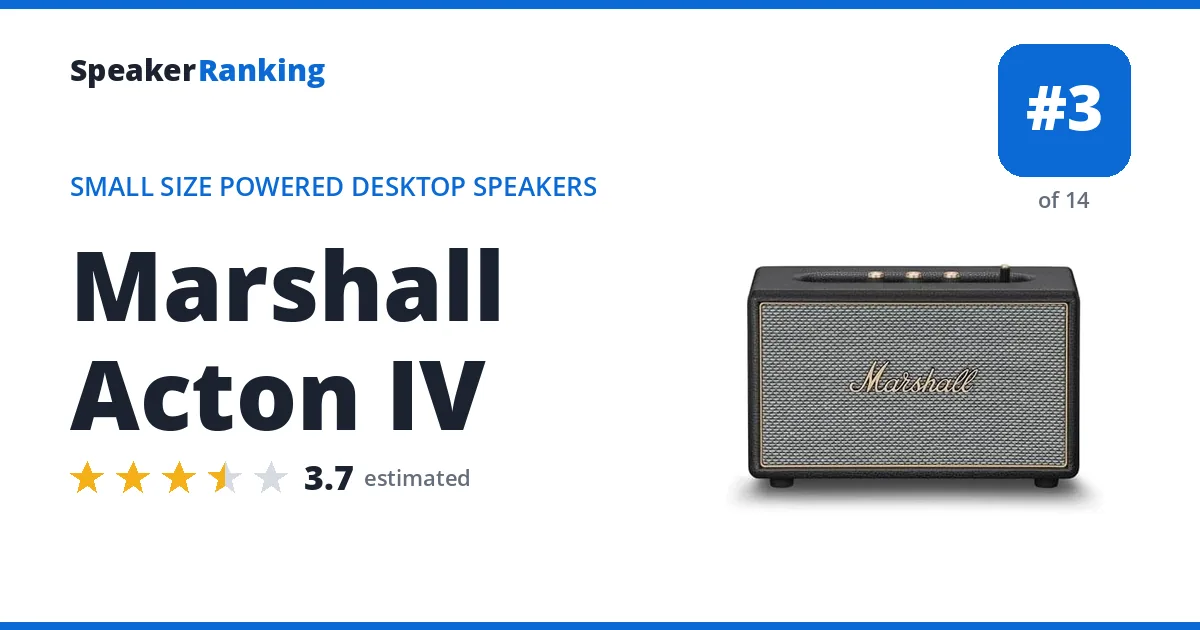
 #3 Marshall Acton IV: $329.99 each Amazon $329.99 eBay
Older models: the Marshall Acton III (rated 3.7/5) and the Marshall Acton II (rated 3.5/5). See every Marshall home speakers generation.
Same family: the Marshall Stanmore IV (larger model, estimated 3.8/5).
Pros: A 4 inch woofer on a 60W amplifier and two 0.75 inch tweeters on 25W each, now with waveguides and a redesigned bass port, and Marshall rates it down to 37Hz. Bluetooth 5.3 with SBC, AAC, LDAC and LC3, multipoint, Auracast for linking more speakers, and a 3.5 mm aux input. The Marshall app adds EQ and room calibration, and the new M-button jumps to a saved EQ or Spotify Tap.
Cons: No independent measurements or side by side comparisons against speakers we rank have been published yet, so it can’t be ranked. One woofer serves both channels, so its stereo is limited to the tweeters. It needs mains power, has no RCA input (the Marshall Stanmore IV adds one), no Wi-Fi streaming and no microphone for voice control.
Full Marshall Acton IV review and specifications →
| Released | Jul 2026 (3 months ago) |
|---|---|
| AES Input | No |
| Amplifier Power | 110W (woofer 60W, tweeters 2x 25W) |
| App | Yes (Marshall) |
| Aux Input | Yes |
| Battery Life | No Battery |
| Bluetooth | Yes |
| Bluetooth Codecs | SBC, AAC, LDAC, LC3 |
| Bluetooth Version | 5.3 |
| Built-in Microphone | No |
| Cabinet Color | black, cream |
| Coaxial Input | No |
| Dimensions | 6.7”H x 10.2”W x 5.9”D (171 x 260 x 150 mm) |
| Drivers | 1x 4” woofer + 2x 0.75” tweeters with waveguides |
| EQ | Yes (bass/treble knobs, app EQ, room calibration) |
| Frequency Response | 37Hz - 38kHz (Manufacturer specified) |
| HDMI Input | No |
| IP Rating | None |
| Inputs | Bluetooth, 3.5mm aux |
| Maximum SPL | 95dB at 1m (Manufacturer specified) |
| Optical Input | No |
| Party Mode | Yes (Auracast) |
| Power Bank | No |
| Power Input | AC Power cord |
| RCA Input | No |
| Stereo | Partially (1 woofer) |
| TRS Input | No |
| TWS | No |
| USB Input | No |
| Weight | 5.8 lbs (2.65 kg) |
| Wi-Fi | No |
| Woofer Cabinet | ported |
| XLR Input | No |
- Links
- Reviews, Comparisons and Sound Samples
- No independent measurement review is linked for this model; it is ranked from hands-on listening and comparison against similarly priced speakers.
- Head-to-Head Comparisons
- Marshall Acton IV vs Amazon Echo Studio 2nd Gen
- Marshall Acton IV vs Amazon Echo Dot Max
- Marshall Acton IV vs Denon Home 150
- Marshall Acton IV vs Google Nest Audio
- Marshall Acton IV vs Apple HomePod Mini
- Marshall Acton IV vs Amazon Echo Dot 5th Gen
- Marshall Acton IV vs Google Home Speaker
- Marshall Acton IV vs Marshall Acton II
- See all 11 comparisons
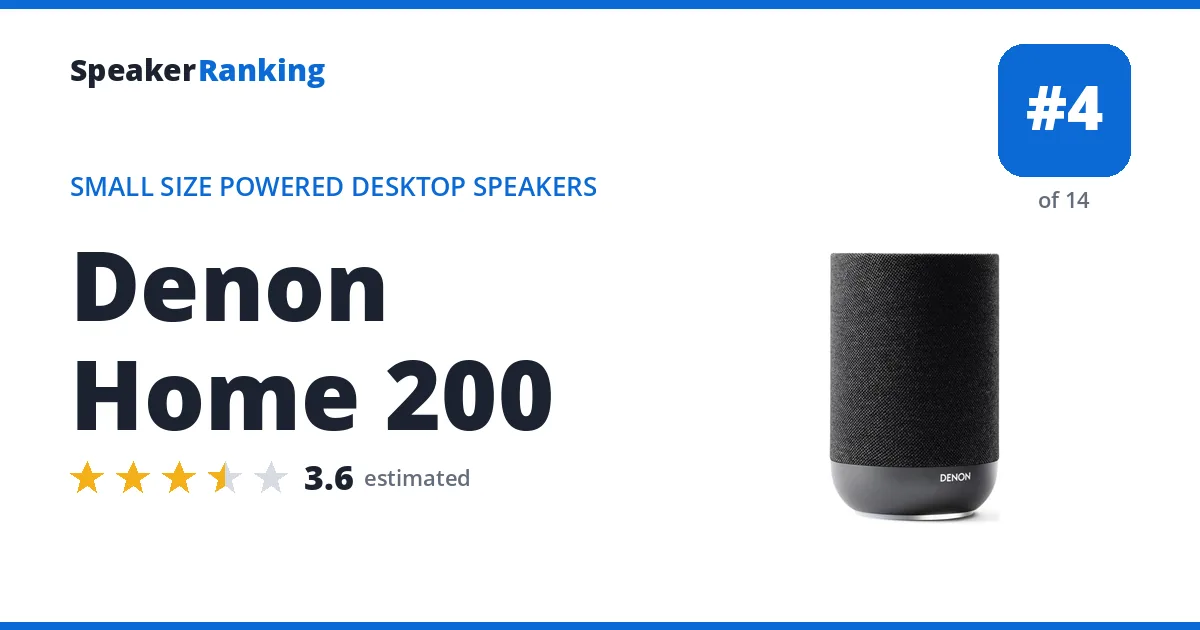
 #4 Denon Home 200: $399.00 each Amazon $399.00 eBay
Older model: the Denon Home 150 (ranked lower, rated 3.5/5). See every Denon Home generation.
Same family: the Denon Home 400 (larger model, estimated 3.8/5) and the Denon Home 600 (larger model, estimated 3.7/5).
Pros: The compact model in Denon’s 2026 Home range, replacing the measured Denon Home 150. A 102mm woofer and two 25mm tweeters each get their own Class D amplifier, giving it stereo sound from one speaker, and it plays Dolby Atmos Music. HEOS multi-room, AirPlay 2, Bluetooth, USB-C and 3.5mm inputs are built in.
Cons: No independent measurements yet, so its tonal balance and directivity can’t be compared directly with measured speakers; the rating is estimated from the measured Denon Home 150 it replaces. A single 102mm woofer limits bass and output in larger rooms.
Full Denon Home 200 review and specifications →
| Released | Mar 2026 (7 months ago) |
|---|---|
| AES Input | No |
| Amplifier Power | 3 x Class D |
| App | Yes (HEOS) |
| Aux Input | Yes |
| Battery Life | No Battery |
| Bluetooth | Yes |
| Coaxial Input | No |
| Dimensions | 8.5”H x 5.5”W x 5.5”D (216 x 140 x 140 mm) |
| Dolby Atmos | Yes (Dolby Atmos Music) |
| Drivers | 102mm woofer, 2 x 25mm tweeters |
| HDMI Input | No |
| IP Rating | None |
| Optical Input | No |
| Party Mode | Yes (HEOS multi-room) |
| Power Bank | No |
| RCA Input | No |
| Stereo | Partially |
| Streaming Services | HEOS app streaming, AirPlay 2 |
| TRS Input | No |
| USB Input | Yes |
| Weight | 4.9 lbs (2.2 kg) |
| Wi-Fi | Yes (2.4/5/6GHz) |
| XLR Input | No |
- Reviews, Comparisons and Sound Samples
- No independent measurement review is linked for this model; it is ranked from hands-on listening and comparison against similarly priced speakers.
- Head-to-Head Comparisons
 #5 Amazon Echo Dot Max: $119.99 each Amazon $119.99 eBay
Same family: the Amazon Echo Studio 2nd Gen (larger model, ranked higher, rated 3.8/5).
Pros: Engadget’s direct verdict against the base Echo Dot: “it’s worth stepping up to the Dot Max over the standard Dot” for sound, since it’s louder and bassier from a 2.5-inch woofer plus a dedicated tweeter rather than one small full-range driver. RTINGS names it their best budget Alexa speaker, finding the microphone excellent at picking up commands from a distance or in noise, with a balanced midrange for accurate voices, consistent sound across listening angles, and sound quality it calls good for the price. It supports Alexa+ and Alexa Home Theater pairing with a Fire TV Stick.
Cons: Engadget’s main complaint was that it is a real step down from the discontinued Amazon Echo (4th Gen) it effectively replaces at the same price: that older speaker paired a 3-inch woofer with dual 0.8-inch tweeters, against the Dot Max’s single 2.5-inch woofer and one tweeter, and frequencies felt smushed together without a clean bass-to-treble separation. RTINGS’ one listed con is that the wired-only design means you cannot carry it around. There is no 3.5mm input, no battery, and Bluetooth is limited to SBC and AAC.
Full Amazon Echo Dot Max review and specifications →
| Released | Oct 2025 (1 year ago) |
|---|---|
| AES Input | No |
| App | Yes (Alexa) |
| Aux Input | No |
| Battery Life | No Battery |
| Bluetooth | Yes |
| Bluetooth Codecs | SBC, AAC |
| Built-in Microphone | Yes (far-field, mic mute) |
| Coaxial Input | No |
| Dimensions | 3.9” x 4.4” x 4.9” (99 x 112 x 124 mm) |
| Drivers | 2.5in woofer, 1x tweeter |
| EQ | No |
| HDMI Input | No |
| IP Rating | None |
| Inputs | Wi-Fi, Bluetooth |
| Optical Input | No |
| Party Mode | Yes (Wi-Fi multi-room, Alexa Home Theater) |
| Power Bank | No |
| Power Input | External AC adapter |
| RCA Input | No |
| Stereo | No |
| Streaming Services | Amazon Music, Spotify, Apple Music, Pandora, iHeartRadio, SiriusXM, TuneIn |
| TRS Input | No |
| TWS | Yes (Wi-Fi stereo pairing via Alexa app) |
| USB Input | No |
| Voice Assistants | Amazon Alexa / Alexa+ |
| Wi-Fi | Yes |
| XLR Input | No |
- Links
- Reviews, Comparisons and Sound Samples
- Head-to-Head Comparisons
- Amazon Echo Dot Max vs Denon Home 150
- Amazon Echo Dot Max vs Marshall Acton IV
- Amazon Echo Dot Max vs Amazon Echo Studio 2nd Gen
- Amazon Echo Dot Max vs Amazon Echo (4th Gen)
- Amazon Echo Dot Max vs Google Nest Audio
- Amazon Echo Dot Max vs Apple HomePod Mini
- Amazon Echo Dot Max vs Amazon Echo Dot 5th Gen
- Amazon Echo Dot Max vs Google Home Speaker
- See all 31 comparisons
 #6 Denon Home 150: $249 each Discontinued eBay
Newer model: the Denon Home 200, ranked higher, estimated 3.6/5, released Mar 2026. See every Denon Home generation.
Same family: the Denon Home 250 (larger model, rated 3.7/5) and the Denon Home 350 (larger model, rated 3.6/5).
Pros: A compact mono smart speaker with a 1-inch tweeter and a 3.5-inch mid/bass driver that Tom’s Guide called great-sounding, with bass performance that belies its size. The touch controls light up via a proximity sensor for quick-select presets, Wi-Fi setup through the HEOS app is straightforward, and Amazon Alexa is built directly into the speaker rather than relayed from another device. A second Home 150 can be paired for stereo.
Cons: Tom’s Guide’s own complaints are that it costs more than the Sonos One and has no automatic room tuning to correct for placement. It’s a single small driver plus tweeter, so it won’t fill a large room or go especially deep without pairing a Denon subwoofer. Discontinued.
Full Denon Home 150 review and specifications →
| Released | 2020 (6 years ago) |
|---|---|
| AES Input | No |
| App | Yes (HEOS) |
| Aux Input | Yes |
| Battery Life | No Battery |
| Bluetooth | Yes |
| Bluetooth Codecs | SBC |
| Bluetooth Version | 5.4 |
| Built-in Microphone | Yes |
| Coaxial Input | No |
| Dimensions | 4.7” x 7.4” x 4.7” (120 x 187 x 120 mm) |
| Drivers | 1x 1-inch tweeter, 1x 3.5-inch mid/bass driver |
| EQ | No |
| HDMI Input | No |
| IP Rating | None |
| Inputs | Wi-Fi, Bluetooth, Ethernet, USB, 3.5mm aux |
| Optical Input | No |
| Party Mode | Yes (HEOS multi-room, stereo pair with a second Home 150) |
| Power Bank | No |
| Power Input | External AC adapter |
| RCA Input | No |
| Stereo | No |
| Streaming Services | HEOS app streaming (Spotify, Apple Music, Amazon Music, Tidal, Deezer, SoundCloud, SiriusXM, TuneIn), AirPlay 2 |
| TRS Input | No |
| TWS | No |
| USB Input | Yes |
| Voice Assistants | Amazon Alexa |
| Weight | 3.7 lbs (1.7 kg) |
| Wi-Fi | Yes (2.4/5GHz) |
| XLR Input | No |
- Links
- Reviews, Comparisons and Sound Samples
- Head-to-Head Comparisons
- Denon Home 150 vs Amazon Echo Dot Max
- Denon Home 150 vs Denon Home 200
- Denon Home 150 vs Google Nest Audio
- Denon Home 150 vs Marshall Acton IV
- Denon Home 150 vs Amazon Echo Studio 2nd Gen
- Denon Home 150 vs Apple HomePod Mini
- Denon Home 150 vs Amazon Echo Dot 5th Gen
- Denon Home 150 vs Google Home Speaker
- See all 33 comparisons
 #7 Klipsch The One Plus: $239.99 each Amazon $239.99 eBay
Older model: the Klipsch The One II (rated 3.3/5). See every Klipsch The One and The Three generation.
Same family: the Klipsch The Three Plus (larger model, rated 3.4/5).
Pros: The One Plus updates Klipsch’s tabletop Heritage speaker with Bluetooth 5.3, Broadcast Mode for linking 10+ compatible units, and USB-C playback with 10W reverse charging. It features a biamplified 2.1 acoustic system rated at 60W continuous power driving two 2.25-inch full-range drivers and a 4.5-inch high-excursion woofer with dual opposing 4.5-inch passive radiators, delivering solid output down to a specified 55Hz (-3dB). App support via Klipsch Connect provides customizable three-band EQ.
Cons: Bass drops steeply below 55Hz and the single-cabinet design delivers limited stereo soundstage width. It requires AC power with no internal battery, lacks on-device track skip/pause controls, and omits the optical and phono inputs found on its larger sibling, the Klipsch The Three Plus.
Full Klipsch The One Plus review and specifications →
| Released | Sep 2023 (3 years ago) |
|---|---|
| Amplifier Power | 60W total |
| App | Yes (Klipsch Connect) |
| Aux Input | Yes |
| Bluetooth | Yes |
| Bluetooth Version | 5.3 |
| Dimensions | 6.1” x 12.5” x 6” (155 x 318 x 152 mm) |
| Drivers | 2x 2.25” full-range drivers, 4.5” high-excursion woofer, 2x 4.5” passive radiators |
| EQ | Yes |
| Frequency Response | 55Hz - 20kHz (-3dB, Manufacturer specified) |
| Maximum SPL | 103dB |
| Stereo | Yes |
| USB Input | Yes (USB-C) |
| Weight | 7.9 lbs (3.6 kg) |
- Links
- Reviews, Comparisons and Sound Samples
- Head-to-Head Comparisons
 #8 Amazon Echo (4th Gen): $99.99 each Amazon $99.99 eBay
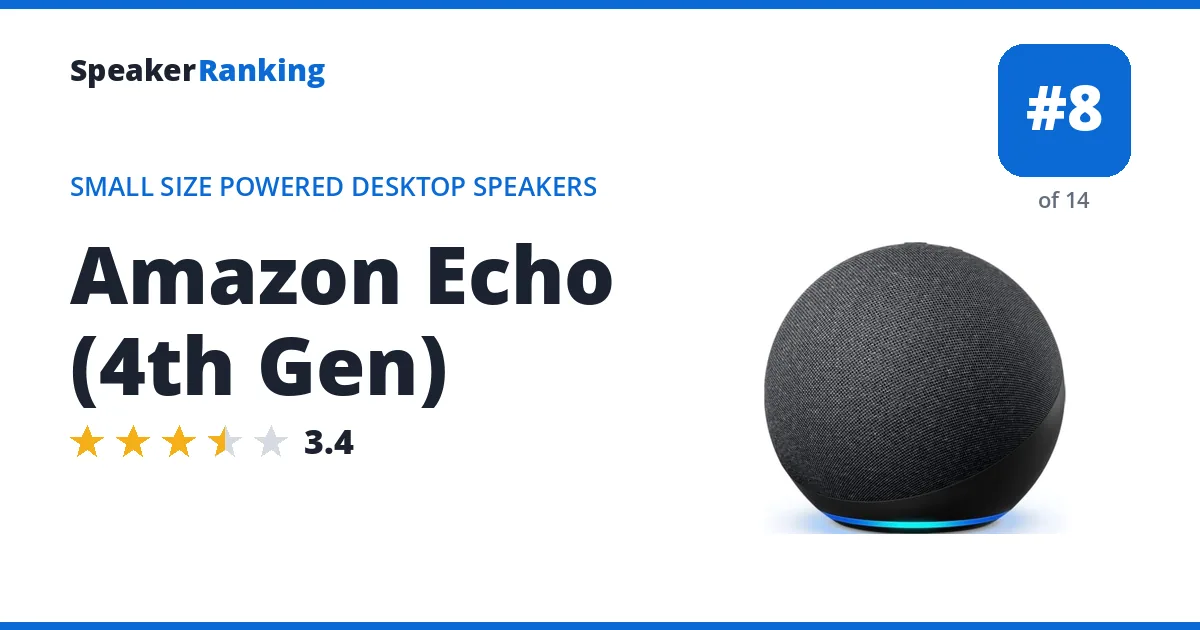
Pros: The full-size spherical smart speaker that represents the core audio anchor of Amazon’s Echo lineup. Houses a dedicated 3-inch neodymium woofer and dual 0.8-inch front-firing tweeters powered by Dolby processing and automatic acoustic room tuning that continuously senses the acoustics of the space to optimize playback. Produces surprisingly solid, punchy mid-bass down to approximately 55Hz with wide, pleasing stereo separation from a single compact orb. Includes built-in Zigbee smart home hub, temperature sensor, and lossless HD streaming support over Wi-Fi. Measured bass extension of 55Hz (-3dB).
Cons: The spherical design radiates sound primarily in a forward-facing direction, so off-axis treble rolls off compared to true 360-degree omnidirectional speakers. Pushed to maximum volume, the DSP aggressively limits deep bass to protect the 3-inch driver from over-excursion.
Full Amazon Echo (4th Gen) review and specifications →
| Released | Oct 2020 (6 years ago) |
|---|---|
| Amplifier Power | 30W total system power |
| App | Amazon Alexa app |
| Aux Input | Yes (3.5mm line in/out) |
| Bass Extension (-3dB) | 55Hz (measured, SoundGuys) |
| Bluetooth | Yes |
| Bluetooth Codecs | SBC, AAC |
| Bluetooth Version | 5.0 |
| Dimensions | 5.2” x 5.7” x 5.7” (133 x 144 x 144 mm) |
| Drivers | 3.0” neodymium woofer, dual 0.8” tweeters |
| Frequency Response | 55Hz - 20kHz (measured) |
| Inputs | 3.5mm line in/out, Wi-Fi, Bluetooth |
| Lights | Yes (bottom light ring) |
| Weight | 2.1 lbs (0.97 kg) |
- Links
- Reviews, Comparisons and Sound Samples
- Head-to-Head Comparisons
 #9 Google Nest Audio: $99.99 each Discontinued Amazon $99.99 eBay
Newer model: the Google Home Speaker, ranked lower, rated 3/5, released Jun 2026. It drops stereo pairing and AAC. See every Google Nest and Home Speakers generation.
Pros: Google Assistant is built in at no extra cost, and Chromecast lets you cast from almost any music app over Wi-Fi rather than only Bluetooth. Audio Science Review’s Klippel measurements put bass at 50Hz at -6dB and 60.4Hz at -3dB, respectable output for a single 75mm woofer at this price, and the predicted in-room response is unusually smooth for a compact single-box speaker. The Google Home app includes a two-band bass and treble EQ. Measured bass extension of 60.4Hz (-3dB).
Cons: Each unit is mono; a genuine left-right stereo pair means buying two and pairing them over Wi-Fi. On-axis measurements show more unevenness than a dedicated monitor, an average deviation of 0.569dB against roughly a tenth of that on the most neutral speakers measured this way. There is no 3.5mm or other analog input at all, no battery, and no IP rating, so it needs a stable Wi-Fi connection and a permanent outlet to work at its best. Discontinued.
Full Google Nest Audio review and specifications →
| Released | Sep 2020 (6 years ago) |
|---|---|
| AES Input | No |
| Amplifier Power | 30W (2x Class D) |
| App | Yes (Google Home) |
| Aux Input | No |
| Bass Extension (-10dB) | 44.3Hz (derived, log-interpolated between ASR’s spinorama -9dB/-12dB points) |
| Bass Extension (-3dB) | 60.4Hz (measured, Audio Science Review via spinorama.org) |
| Battery Life | No Battery |
| Bluetooth | Yes |
| Bluetooth Codecs | SBC, AAC |
| Bluetooth Version | 5.0 |
| Built-in Microphone | Yes (3 far-field mics, hardware mute switch) |
| Coaxial Input | No |
| Dimensions | 6.9” x 4.9” x 3.1” (175 x 124 x 78 mm) (H x W x D) |
| Drivers | 75mm woofer, 19mm tweeter |
| EQ | Yes (Bass/Treble, via Google Home app) |
| HDMI Input | No |
| IP Rating | None |
| Inputs | Wi-Fi, Bluetooth, Chromecast |
| Optical Input | No |
| Party Mode | Yes (Wi-Fi multi-room, Chromecast built-in) |
| Power Bank | No |
| Power Input | External AC adapter (30W, 24V, DC jack) |
| RCA Input | No |
| Spinorama Preference Score | 1.71 |
| Spinorama Preference Score with Perfect Sub | 4.06 |
| Stereo | No |
| Streaming Services | Chromecast built-in, Spotify Connect |
| TRS Input | No |
| TWS | Yes (Wi-Fi stereo pairing via Google Home app) |
| USB Input | No |
| Voice Assistants | Google Assistant |
| Weight | 2.6 lbs (1.2 kg) |
| Wi-Fi | Yes (802.11 b/g/n/ac, 2.4GHz/5GHz) |
| XLR Input | No |
- Links
- Reviews, Comparisons and Sound Samples
- Head-to-Head Comparisons
- Google Nest Audio vs Apple HomePod Mini
- Google Nest Audio vs Amazon Echo Dot 5th Gen
- Google Nest Audio vs Google Home Speaker
- Google Nest Audio vs Denon Home 150
- Google Nest Audio vs Amazon Echo Dot Max
- Google Nest Audio vs Google Nest Mini 2nd Gen
- Google Nest Audio vs Amazon Echo Pop
- Google Nest Audio vs Marshall Acton IV
- See all 28 comparisons
 #10 Apple HomePod Mini: $149.36 each Amazon $149.36 eBay
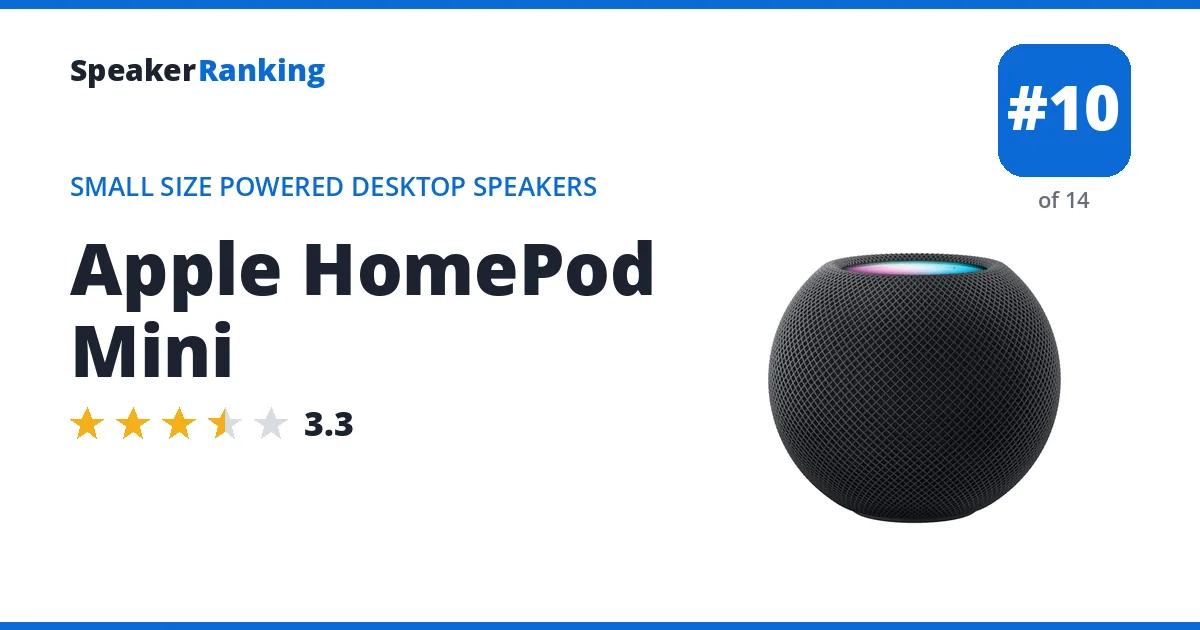
Pros: SoundGuys called it good sound for its size, with a full-range driver and dual passive bass radiators giving the bassline in Anderson .Paak’s “Come Down” a decent thump most speakers this small can’t manage. “Hey Siri” reliably hears the wake phrase even at full volume, it can distinguish different people’s voices for personalized requests, and setup with an iPhone nearby takes moments.
Cons: SoundGuys’ listed cons include no mute button at all, an occasionally annoying Handoff prompt, and no direct Spotify integration since Siri only launches Apple Music by voice. There is no way to stream to it over Bluetooth, only Apple’s AirPlay/Handoff, no battery, and no IP rating (Apple only claims humidity resistance, not a certified rating). It requires an iPhone or iPad to set up and get the most out of.
Full Apple HomePod Mini review and specifications →
| Released | Nov 2020 (5 years ago) |
|---|---|
| AES Input | No |
| App | Yes (Apple Home) |
| Aux Input | No |
| Battery Life | No Battery |
| Bluetooth | No |
| Built-in Microphone | Yes (4 far-field mics, no mute button) |
| Coaxial Input | No |
| Dimensions | 3.3” x 3.9” (84.3 x 97.9 mm) (H x diameter) |
| Drivers | Full-range driver + dual passive bass radiators |
| EQ | No |
| HDMI Input | No |
| IP Rating | None |
| Inputs | Wi-Fi, AirPlay 2 |
| Optical Input | No |
| Party Mode | Yes (AirPlay 2 multi-room) |
| Power Bank | No |
| Power Input | External AC adapter (USB-C) |
| RCA Input | No |
| Stereo | No |
| Streaming Services | AirPlay 2, Apple Music (direct voice control); other services via AirPlay only |
| TRS Input | No |
| TWS | Yes (stereo pairing via Home app) |
| USB Input | No |
| Voice Assistants | Apple Siri |
| Weight | 0.8 lbs (345 g) |
| Wi-Fi | Yes |
| XLR Input | No |
- Links
- Reviews, Comparisons and Sound Samples
- Head-to-Head Comparisons
- Apple HomePod Mini vs Amazon Echo Dot 5th Gen
- Apple HomePod Mini vs Google Nest Audio
- Apple HomePod Mini vs Google Home Speaker
- Apple HomePod Mini vs Google Nest Mini 2nd Gen
- Apple HomePod Mini vs Amazon Echo Pop
- Apple HomePod Mini vs Denon Home 150
- Apple HomePod Mini vs Amazon Echo Dot Max
- Apple HomePod Mini vs Marshall Acton IV
- See all 30 comparisons
 #11 Amazon Echo Dot 5th Gen: $79.99 each Amazon $79.99 eBay
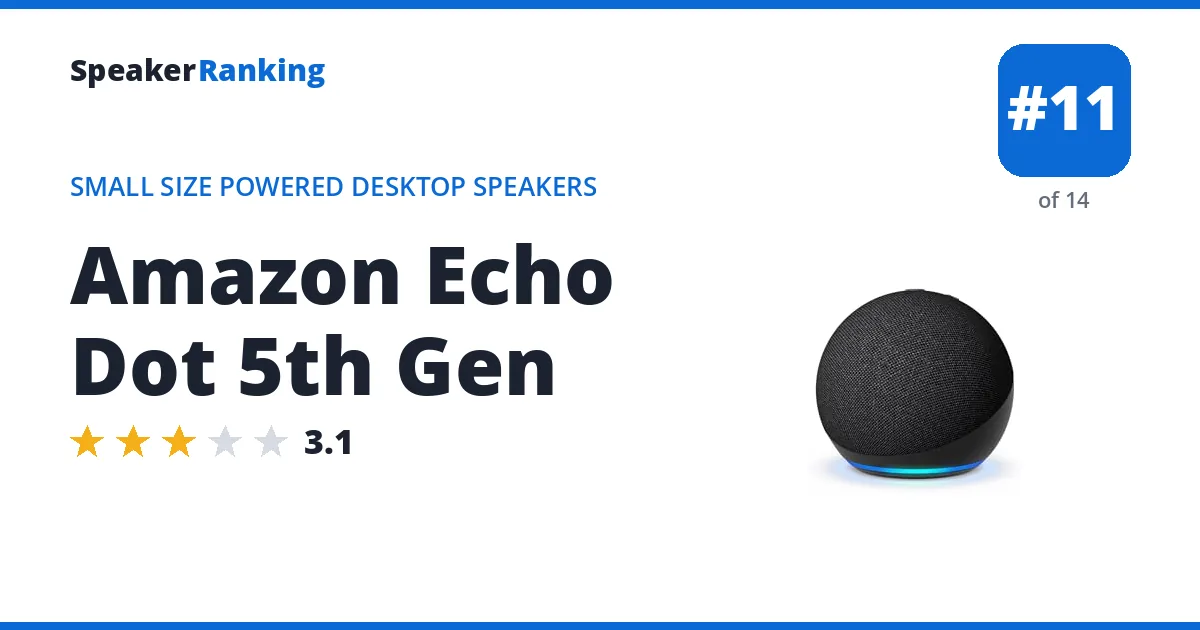
Pros: What Hi-Fi rated it 5 stars for sound, calling it expansive for its size with great Alexa integration and an understated look, from a single 44mm front-firing driver. It has a room temperature sensor, works as an eero Wi-Fi extender, and includes a mic mute switch alongside dedicated volume and action buttons.
Cons: What Hi-Fi’s one real complaint was distortion at higher volumes, and bass force and detail both fall off at the low end, typical for a speaker not much bigger than a hockey ball. Engadget’s own head-to-head against the step-up Amazon Echo Dot Max found that speaker louder and bassier, from a 2.5-inch woofer and dedicated tweeter versus this speaker’s single small full-range driver. It is mono in a single unit, has no 3.5mm output, no battery, and needs Wi-Fi and an Amazon account for its smart features.
Full Amazon Echo Dot 5th Gen review and specifications →
| Released | Oct 2022 (4 years ago) |
|---|---|
| AES Input | No |
| App | Yes (Alexa) |
| Aux Input | No |
| Battery Life | No Battery |
| Bluetooth | Yes |
| Bluetooth Codecs | SBC, AAC |
| Built-in Microphone | Yes (mic mute switch, temperature sensor) |
| Coaxial Input | No |
| Dimensions | 3.9” x 3.9” x 3.5” (100 x 100 x 89 mm) (H x W x D) |
| Drivers | 44mm front-firing driver |
| EQ | No |
| HDMI Input | No |
| IP Rating | None |
| Inputs | Wi-Fi, Bluetooth |
| Optical Input | No |
| Party Mode | Yes (Wi-Fi multi-room, Alexa) |
| Power Bank | No |
| Power Input | External AC adapter (DC jack) |
| RCA Input | No |
| Stereo | No |
| Streaming Services | Amazon Music, Spotify, Apple Music, Deezer, Pandora, iHeartRadio, SiriusXM, TuneIn |
| TRS Input | No |
| TWS | Yes (Wi-Fi stereo pairing via Alexa app) |
| USB Input | No |
| Voice Assistants | Amazon Alexa / Alexa+ |
| Weight | 0.7 lbs (340 g) |
| Wi-Fi | Yes (802.11 a/b/g/n/ac, 2.4GHz/5GHz) |
| XLR Input | No |
- Links
- Reviews, Comparisons and Sound Samples
- Head-to-Head Comparisons
- Amazon Echo Dot 5th Gen vs Google Home Speaker
- Amazon Echo Dot 5th Gen vs Apple HomePod Mini
- Amazon Echo Dot 5th Gen vs Google Nest Audio
- Amazon Echo Dot 5th Gen vs Google Nest Mini 2nd Gen
- Amazon Echo Dot 5th Gen vs Amazon Echo Pop
- Amazon Echo Dot 5th Gen vs Amazon Echo (4th Gen)
- Amazon Echo Dot 5th Gen vs Denon Home 150
- Amazon Echo Dot 5th Gen vs Amazon Echo Dot Max
- See all 30 comparisons
 #12 Google Home Speaker: $99.99 each Amazon $99.99 eBay

Older models: the Google Nest Audio (ranked higher, rated 3.3/5) and the Google Nest Mini 2nd Gen (ranked lower, rated 2.9/5). See every Google Nest and Home Speakers generation.
Pros: Built-in Gemini support makes it a capable smart home hub, with a Thread border router and Matter support, and the compact 107mm sphere fits almost anywhere. Vocals come through clearly on most tracks, which SoundGuys’ side-by-side listening called the one thing this speaker does well.
Cons: This is Google’s current speaker, and reviewers agree it is a downgrade in sound from the discontinued Google Nest Audio it replaces: SoundGuys measured its acoustic hardware directly against the Google Nest Audio and found a single 58mm full-range driver against the Google Nest Audio’s 75mm woofer plus dedicated 19mm tweeter, calling it ‘half the audio hardware for the same sticker price.’ In their listening test there was barely any bass, the sound turned thin and tinny outside the midrange, and pushing the volume up made high notes shrill. There is no aux input or any wired audio connection at all, the single USB-C port is power only, and Bluetooth is limited to the SBC codec with no AAC support. SoundGuys scored it 6.0 of 10 overall, with a Value score of 4.0.
Full Google Home Speaker review and specifications →
| Released | Jun 2026 (4 months ago) |
|---|---|
| AES Input | No |
| App | Yes (Google Home) |
| Aux Input | No |
| Battery Life | No Battery |
| Bluetooth | Yes |
| Bluetooth Codecs | SBC |
| Bluetooth Version | 5.4 |
| Built-in Microphone | Yes (3 far-field mics, hardware mute switch) |
| Coaxial Input | No |
| Dimensions | 3.4” x 4.2” x 4.2” (86.6 x 107 x 107 mm) (H x diameter) |
| Drivers | 58mm full-range driver |
| EQ | Yes (Bass/Treble, via Google Home app) |
| HDMI Input | No |
| IP Rating | None |
| Inputs | Wi-Fi, Bluetooth, Chromecast |
| Optical Input | No |
| Party Mode | Yes (Wi-Fi multi-room, Chromecast built-in) |
| Power Bank | No |
| Power Input | USB-C (30W adapter, power only, no USB Audio) |
| RCA Input | No |
| Stereo | No |
| Streaming Services | Chromecast built-in, Spotify Connect |
| TRS Input | No |
| TWS | No (two units pair only through a Google TV Streamer, not with each other directly) |
| USB Input | No |
| Voice Assistants | Google Assistant / Gemini for Home |
| Weight | 0.9 lbs (396 g) |
| Wi-Fi | Yes (Wi-Fi 6, dual-band) |
| XLR Input | No |
- Links
- Reviews, Comparisons and Sound Samples
- Head-to-Head Comparisons
- Google Home Speaker vs Amazon Echo Dot 5th Gen
- Google Home Speaker vs Google Nest Mini 2nd Gen
- Google Home Speaker vs Amazon Echo Pop
- Google Home Speaker vs Apple HomePod Mini
- Google Home Speaker vs Google Nest Audio
- Google Home Speaker vs Amazon Echo (4th Gen)
- Google Home Speaker vs Denon Home 150
- Google Home Speaker vs Amazon Echo Dot Max
- See all 31 comparisons
 #13 Google Nest Mini 2nd Gen: $114.95 each Discontinued Amazon $114.95 eBay
Newer model: the Google Home Speaker, ranked higher, rated 3/5, released Jun 2026. It drops stereo pairing and AAC. See every Google Nest and Home Speakers generation.
Pros: Digital Trends’ review found it responds quickly, automatically raises music and response volume over background noise, and is built from recycled plastic. Its 40mm driver is clearer through the midrange and treble than the larger-driver Amazon Echo Dot 3rd Gen it was tested against, though the Echo had more bass and outright volume. A physical microphone mute switch is on the side.
Cons: Digital Trends’ main complaint was that maximum volume could be louder, and RTINGS’ independent review agrees, naming it their one real weakness. There is no 3.5mm or other wired audio input of any kind. This model has been discontinued by Google in favor of the newer Google Home Speaker, so current retail listings run well above the original $49 launch price as remaining stock sells through resellers.
Full Google Nest Mini 2nd Gen review and specifications →
| Released | Oct 2019 (7 years ago) |
|---|---|
| AES Input | No |
| App | Yes (Google Home) |
| Aux Input | No |
| Battery Life | No Battery |
| Bluetooth | Yes |
| Bluetooth Codecs | SBC, AAC |
| Bluetooth Version | 5.0 |
| Built-in Microphone | Yes (3 far-field mics, hardware mute switch) |
| Coaxial Input | No |
| Dimensions | 1.7” x 3.9” x 3.9” (42 x 98 x 98 mm) (H x W x D) |
| Drivers | 40mm driver |
| EQ | Yes (Bass/Treble, via Google Home app) |
| HDMI Input | No |
| IP Rating | None |
| Inputs | Wi-Fi, Bluetooth, Chromecast |
| Optical Input | No |
| Party Mode | Yes (Wi-Fi multi-room, Chromecast built-in) |
| Power Bank | No |
| Power Input | External AC adapter (15W, DC jack) |
| RCA Input | No |
| Stereo | No |
| Streaming Services | Chromecast built-in, Spotify Connect |
| TRS Input | No |
| TWS | Yes (Wi-Fi stereo pairing via Google Home app) |
| USB Input | No |
| Voice Assistants | Google Assistant / Gemini for Home |
| Weight | 0.4 lbs (181 g) |
| Wi-Fi | Yes |
| XLR Input | No |
- Reviews, Comparisons and Sound Samples
- Head-to-Head Comparisons
- Google Nest Mini 2nd Gen vs Amazon Echo Pop
- Google Nest Mini 2nd Gen vs Google Home Speaker
- Google Nest Mini 2nd Gen vs Amazon Echo Dot 5th Gen
- Google Nest Mini 2nd Gen vs Apple HomePod Mini
- Google Nest Mini 2nd Gen vs Google Nest Audio
- Google Nest Mini 2nd Gen vs Denon Home 150
- Google Nest Mini 2nd Gen vs Amazon Echo Dot Max
- Google Nest Mini 2nd Gen vs Amazon Echo Studio 2nd Gen
- See all 27 comparisons
 #14 Amazon Echo Pop: $45.98 each Amazon $45.98 eBay
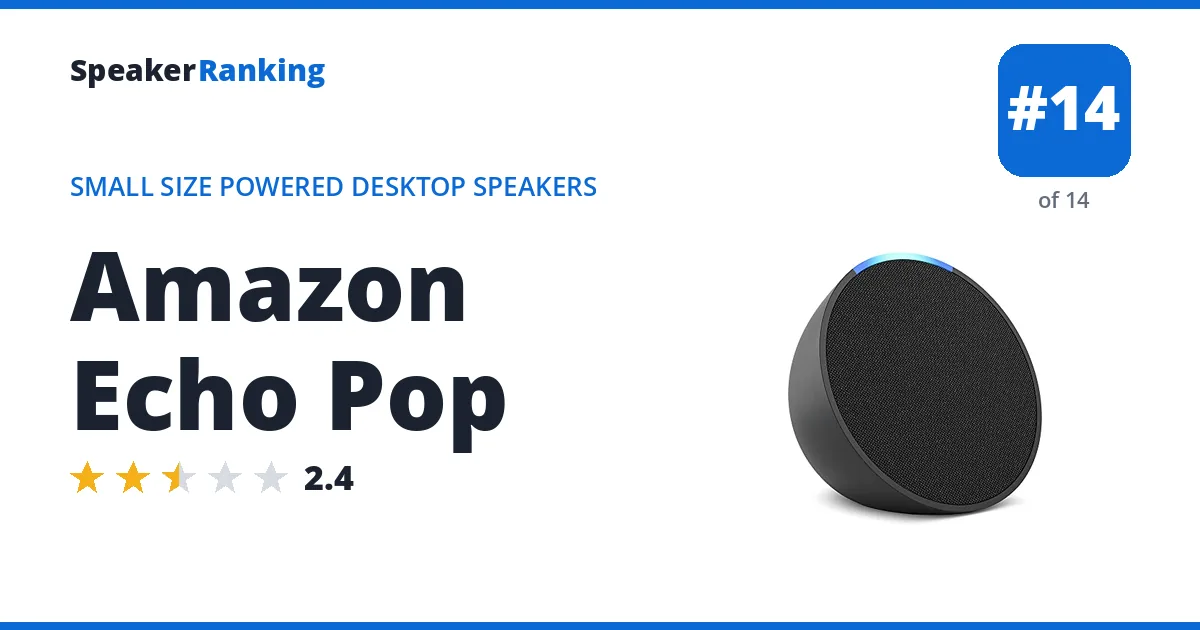
Pros: RTINGS’ 2026 testing found its Alexa performance rivals Amazon’s pricier speakers, easily understanding commands from a distance or in a noisy room, with a mic mute button and a balanced enough mid-range that voices sound true to life. The half-sphere design is compact and light at 195g, still gets the full Alexa feature set including Matter and Sidewalk support, and doubles as an eero Wi-Fi extender adding up to 1,000 square feet of mesh coverage.
Cons: PCWorld’s earlier review was blunt: despite a larger 1.95-inch driver on paper, it sounded flat and tinny with only a hint of bass next to the smaller-driver Echo Dot, and called the value proposition a hard no; RTINGS’ more recent test agrees on the underlying tradeoff, noting it can’t reproduce as much low bass as the Amazon Echo Dot Max and doesn’t get very loud. It also drops the motion and temperature sensors the Echo Dot has, has no Zigbee hub, and feels cheaper in the hand, being mostly plastic apart from the front fabric. It is mono, has no 3.5mm output or battery, and currently costs the same as the better-reviewed Echo Dot rather than being meaningfully cheaper.
Full Amazon Echo Pop review and specifications →
| Released | May 2023 (3 years ago) |
|---|---|
| AES Input | No |
| App | Yes (Alexa) |
| Aux Input | No |
| Battery Life | No Battery |
| Bluetooth | Yes |
| Bluetooth Codecs | SBC, AAC |
| Built-in Microphone | Yes (mic mute switch; no motion or temperature sensor) |
| Coaxial Input | No |
| Dimensions | 3.8” x 4.1” x 3.6” (96 x 104 x 91 mm) (H x W x D) |
| Drivers | 1.95in driver |
| EQ | No |
| HDMI Input | No |
| IP Rating | None |
| Inputs | Wi-Fi, Bluetooth |
| Optical Input | No |
| Party Mode | Yes (Wi-Fi multi-room, Alexa) |
| Power Bank | No |
| Power Input | External AC adapter |
| RCA Input | No |
| Stereo | No |
| Streaming Services | Amazon Music, Spotify, Apple Music, Deezer, Pandora, iHeartRadio, SiriusXM, TuneIn |
| TRS Input | No |
| TWS | Yes (Wi-Fi stereo pairing via Alexa app) |
| USB Input | No |
| Voice Assistants | Amazon Alexa / Alexa+ |
| Weight | 0.4 lbs (195 g) |
| Wi-Fi | Yes |
| XLR Input | No |
- Links
- Reviews, Comparisons and Sound Samples
- Head-to-Head Comparisons
- Amazon Echo Pop vs Google Nest Mini 2nd Gen
- Amazon Echo Pop vs Google Home Speaker
- Amazon Echo Pop vs Amazon Echo Dot 5th Gen
- Amazon Echo Pop vs Apple HomePod Mini
- Amazon Echo Pop vs Google Nest Audio
- Amazon Echo Pop vs Denon Home 150
- Amazon Echo Pop vs Amazon Echo Dot Max
- Amazon Echo Pop vs Amazon Echo Studio 2nd Gen
- See all 28 comparisons