Editor's top picks
Start with these speakers
Our leading recommendations at a glance. Each card links to its primary retailer.
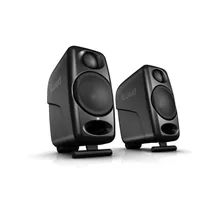 Best Compact Desktop Pair Under $300
IK Multimedia iLoud Micro Monitor
$299.99 per pair
See the full review →
Best Compact Desktop Pair Under $300
IK Multimedia iLoud Micro Monitor
$299.99 per pair
See the full review →
Looking for the best powered speakers under $300? This budget already buys genuinely accurate studio monitors. The catch is usually setup rather than sound: most of the best picks here are monitors with balanced inputs and no volume knob on the front, so they need an audio interface or another source with volume control. Prices are per pair unless a speaker is a single stereo unit.
Prices on this page were last checked September 24, 2026 at 10:28 PM UTC. Product prices and availability are accurate as of that date/time and are subject to change; the price and availability shown on Amazon at the time of purchase will apply to the purchase of this product.
As an eBay Partner, we may be compensated if you make a purchase.
What You Get Under $300
Real bass from a full-size monitor. A 6.5-inch or 5-inch studio monitor at this price reaches into the 40Hz to 50Hz range, deep enough for most music without a subwoofer.
Measured neutrality. The top picks here score well on Spinorama preference ratings, which means an even midrange rather than the scooped, bass-heavy tuning common in cheap computer speakers.
Fewer conveniences. Bluetooth, USB and a remote mostly belong to the smaller desktop pairs. If you want everything in one box, the compact picks below trade some bass for those features.
Best Overall Under $300
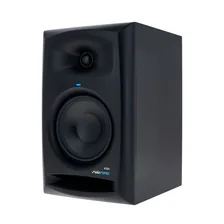 The deepest bass under $300, reaching about 43Hz (-3dB) from a 6.5-inch monitor, is the Thomann Swissonic A306: $250 per pair Thomann eBay
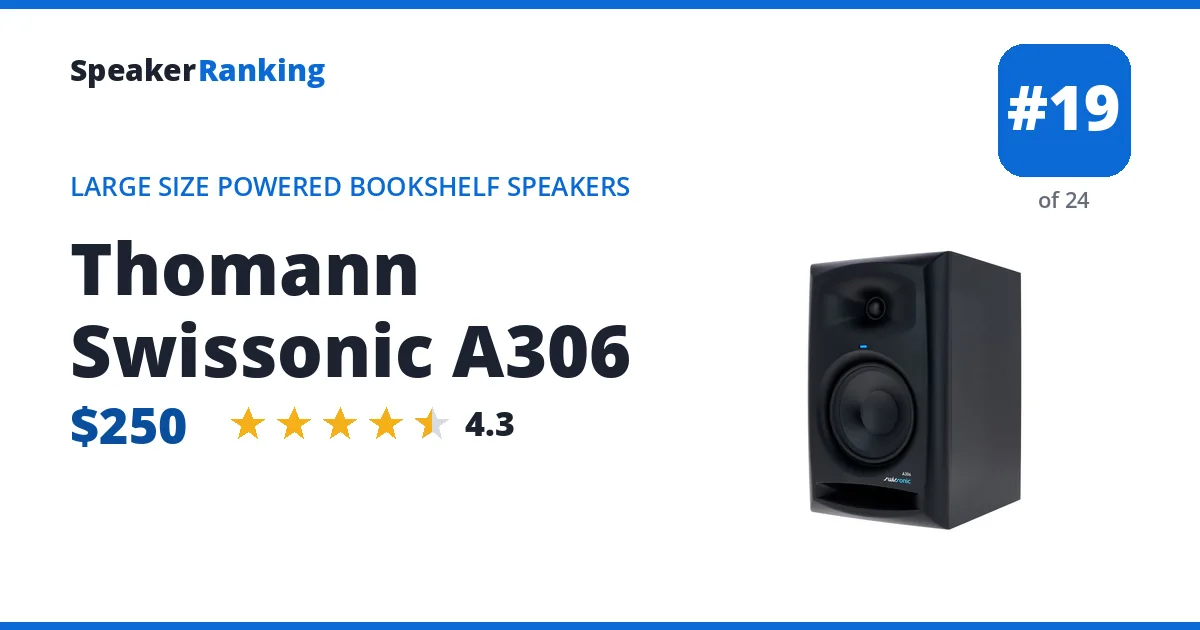
Pros: With the treble control set to -2dB, Erin measured a 7.29 ideal-subwoofer score and 43.9Hz -3dB bass extension. This is a useful affordable monitoring option when carefully set up, with onboard controls for basic tonal adjustment. Measured bass extension of 43Hz (-3dB), with a measured sensitivity of 89.9dB.
Cons: The published result is not the flat-control setting: it specifically uses -2dB treble. Even then, the response spans 2.8dB from 300Hz to 5kHz, so balance is not as even as the leaders. Bass output and vertical listening position remain practical limitations.
Full Thomann Swissonic A306 review and specifications →
| AES Input | No |
|---|---|
| Amplifier Power | 100W bi-amplified total (50W + 50W, Class D) |
| Aux Input | No |
| Bass Extension (-10dB) | 34Hz (measured, Erin's Audio Corner) |
| Bass Extension (-3dB) | 43Hz (measured, Erin's Audio Corner) |
| Bluetooth | No |
| Coaxial Input | No |
| Crossover Frequency | 2600Hz |
| DSP | Yes (rear-panel treble/bass trim, wall/near-wall placement switches) |
| Dimensions | 8.8"W x 14.2"H x 11.1"D (224 x 361 x 282 mm) |
| Drivers | 6.5" woofer, 1" silk dome tweeter with waveguide |
| Frequency Response | 43Hz - 20kHz (manufacturer specified) |
| HDMI Input | No |
| Inputs | XLR (balanced), RCA (unbalanced) |
| Optical Input | No |
| RCA Input | Yes |
| Sensitivity | 89.9dB (measured at 0.3V/1m, Erin's Audio Corner) |
| Spinorama Preference Score | 5.41 |
| Spinorama Preference Score with Perfect Sub | 7.29 |
| TRS Input | No |
| USB Input | No |
| Weight | 13.6 lbs (6.17 kg) each |
| XLR Input | Yes |
- Links
- Reviews, Comparisons and Sound Samples
- Head-to-Head Comparisons
- Thomann Swissonic A306 vs Kali Audio LP-6 V2
- Thomann Swissonic A306 vs Yamaha HS8
- Thomann Swissonic A306 vs SHIVAUDYO Point Zero
- Thomann Swissonic A306 vs JBL 4329P
- Thomann Swissonic A306 vs Kali Audio LP-8 V2
- Thomann Swissonic A306 vs M-Audio BX8 D3
- Thomann Swissonic A306 vs Focal Alpha 65 EVO
- Thomann Swissonic A306 vs Adam Audio T8V
- See all 12 comparisons
It ranks #31 of 68 large powered bookshelf speakers at $250. Set the treble control to -2dB: that is the setting its strong measured result applies to.
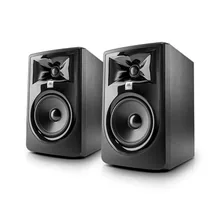 For a smaller 5-inch monitor with a more even measured response, the JBL 305P MKII: $299.00 per pair Amazon eBay
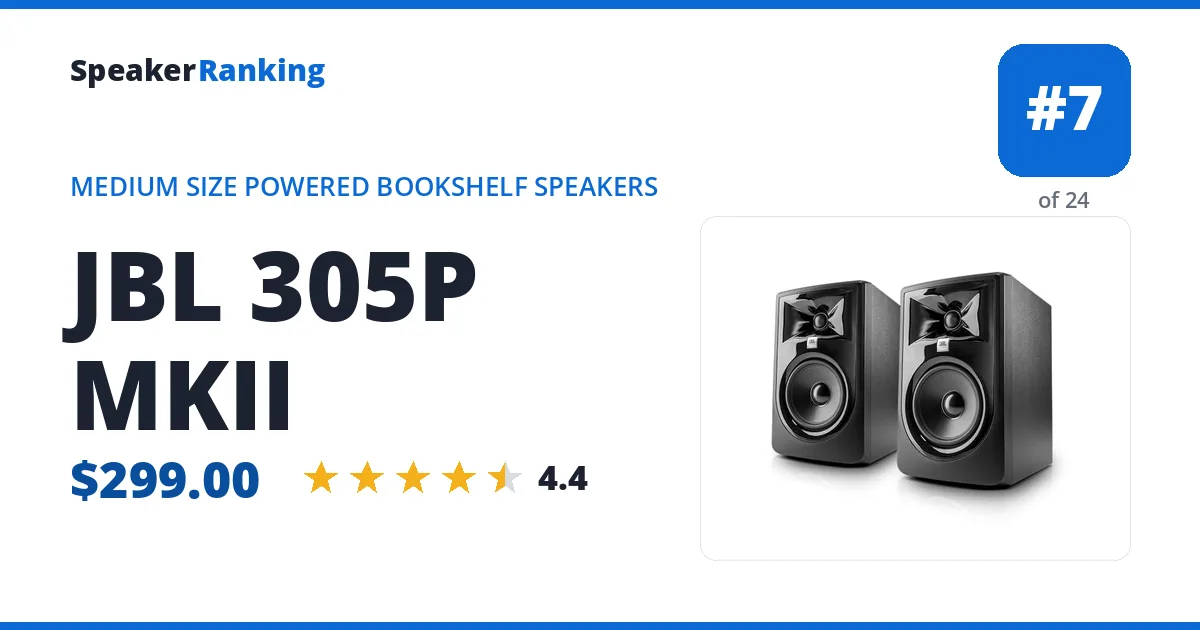
Pros: Erin’s Klippel data gives 5.38 standalone and 7.52 with an ideal subwoofer, with bass reaching -3dB around 51Hz. Broad horizontal coverage and reasonably smooth reflected sound support stable imaging across a desk. The existing review reports effective limiting and little sustained thermal compression, making it a strong budget-monitor option rather than just a speaker with a promising frequency curve. Measured bass extension of 50Hz (-3dB), with a measured sensitivity of 91.1dB.
Cons: The 3.3dB midrange span and rising response show it is not perfectly neutral. A port-related feature around 1.6kHz and some excess treble can be audible; the review recommends the treble-trim switch. Vertical crossover interference makes ear height important. Amplifier hiss may matter in very quiet nearfield use, and rear-port placement needs room-boundary adjustment.
Full JBL 305P MKII review and specifications →
| AES Input | No |
|---|---|
| Amplifier Power | 81w Per Speaker |
| App | No |
| Aux Input | No |
| Bass Extension (-10dB) | 43Hz (measured, Erin's Audio Corner) |
| Bass Extension (-3dB) | 50Hz (measured, Erin's Audio Corner) |
| Bluetooth | No |
| Coaxial Input | No |
| Dimensions | 11.7"H x 7.3"W x 9.1"D (297.2 x 185.4 x 231.1 mm) |
| Drivers | 5" (127mm) woofer |
| EQ | Yes (Room adjustment) |
| Frequency Response | 49 Hz - 20 kHz (+-3 dB) (Manufacturer specified) |
| HDMI Input | No |
| Inputs | XLR, TRS |
| Optical Input | No |
| RCA Input | No |
| Sensitivity | 91.1dB (measured at 0.3V/1m, Erin's Audio Corner) |
| Spinorama Preference Score | 5.38 |
| Spinorama Preference Score with Perfect Sub | 7.52 |
| TRS Input | Yes |
| USB Input | No |
| Weight | 10.4 lbs (4.7 kg) each |
| XLR Input | Yes |
- Links
- Reviews, Comparisons and Sound Samples
- Erin’s Audio Corner Review Measurements More from Erin’s Audio Corner →
- Audio Science Review Measurements More from Audio Science Review →
- Erin’s Audio Corner: LIVE! JBL 305P MkII Powered Studio Monitor Review
- DSAUDIO.review: DSAUDIO.review Focal Alpha 50 EVO vs JBL 305P MKII sound.DEMO More from DSAUDIOreview →
- DSAUDIO.review: JBL 305P MKII vs Yamaha HS5 6-Track Comparison
- DSAUDIO.review: DSAUDIO.review JBL 305P MKII vs KRK Classic 5 CL5G3 sound.DEMO
- DSAUDIO.review: JBL 305P MKII vs Adam Audio T5V 6-Track Comparison
- DSAUDIO.review: DSAUDIO.review Adam Audio A5X vs JBL 305P MKII sound.DEMO
- DSAUDIO.review: DSAUDIO.review Kali Audio LP-6 V2 (2nd Wave) vs JBL 305P MKII sound.DEMO
- DSAUDIO.review: DSAUDIO.review Edifier MR4 vs JBL 305P MKII sound.DEMO
- DSAUDIO.review: Kali Audio IN-5 vs JBL 305P MKII Sound & Frequency Response Comparison
- DSAUDIO.review: JBL 308P MKII vs JBL 305P MKII Sound & Frequency Response Comparison
- DSAUDIO.review: Neumann KH80 DSP vs JBL 305P MKII Sound & Frquency Response Comparison
- DSAUDIO.review: JBL 305P MKII vs PreSonus Eris E5 6-Track Comparison
- Erin’s Audio Corner Measurements (spinorama.org)
- Jasper Tech: Best Desktop Computer Speakers for Every Budget – 2026 More from Jasper Tech →
- Jasper Tech: Best Powered Bookshelf Speakers for Every Budget - 2025
- Jasper Tech: Are the iLoud Micro Monitor Pro the Best Studio Monitor Speakers for your Home Studio?
- Head-to-Head Comparisons
- JBL 305P MKII vs KEF LS50 Wireless II
- JBL 305P MKII vs Klipsch The Fives
- JBL 305P MKII vs Genelec 8020D
- JBL 305P MKII vs Vanatoo Transparent One Encore Plus
- JBL 305P MKII vs IK Multimedia iLoud MTM MKII
- JBL 305P MKII vs Topping MA4
- JBL 305P MKII vs Devialet Phantom II 98 dB
- JBL 305P MKII vs Sigberg Audio SBS Gen 2
- See all 66 comparisons
It ranks #13 of 67 medium powered bookshelf speakers, with bass reaching about 50Hz (-3dB) and broad horizontal coverage that keeps imaging stable across a desk. Use the treble trim switch to tame a little excess treble.
Best Compact Desktop Pair Under $300
The most bass from a tiny desktop pair, reaching about 55Hz (-3dB) from 3-inch woofers, is the IK Multimedia iLoud Micro Monitor: $299.99 per pair Amazon eBay
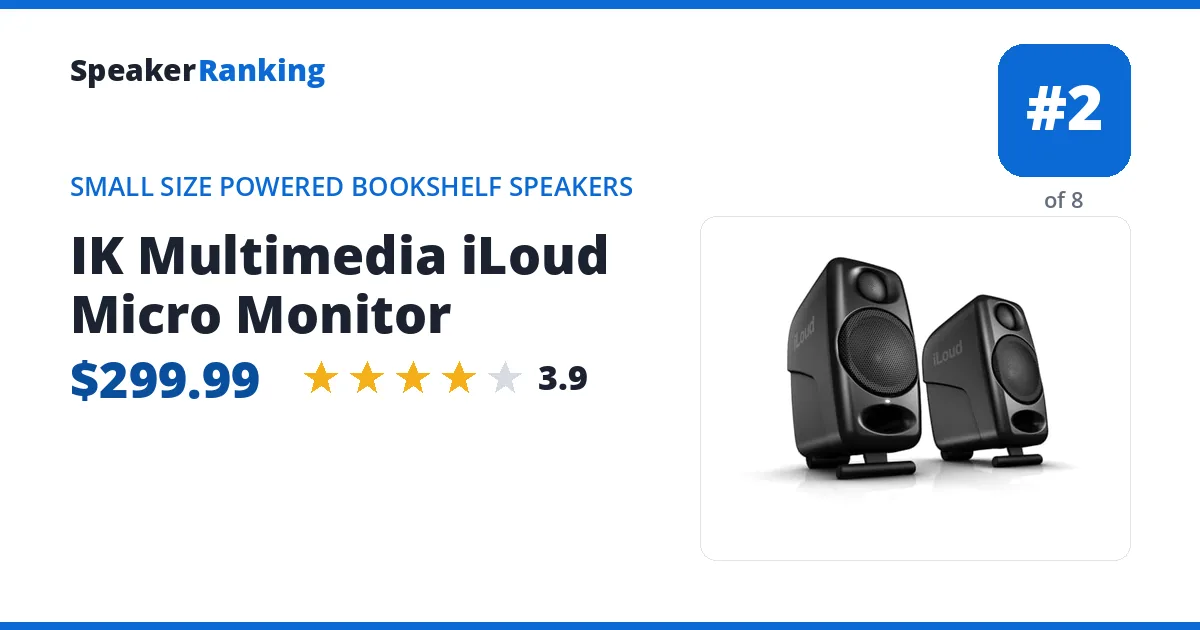
Pros: Unusually substantial bass for such a small desktop pair. The linked quasi-anechoic measurement review reports broad, reasonably consistent horizontal radiation and useful tolerance above the tweeter axis, helpful when the speakers sit below ear height. Its compact size and bass balance make it a practical close-listening alternative to small monitors that need a subwoofer. Measured bass extension of 55Hz (-3dB).
Cons: The existing review evidence indicates some bass emphasis and upper-treble rolloff rather than strict neutrality. Deep bass from tiny drivers does not establish loud-playback headroom; use these for close desktop listening, not as a substitute for larger room speakers.
Full IK Multimedia iLoud Micro Monitor review and specifications →
| AES Input | No |
|---|---|
| Amplifier Power | 50W total (combined) |
| App | No |
| Aux Input | Yes |
| Bass Extension (-10dB) | 45Hz (measured, Audio Science Review) |
| Bass Extension (-3dB) | 55Hz (measured, Audio Science Review) |
| Bluetooth | Yes (A2DP) |
| Coaxial Input | No |
| Dimensions | 7.1"H x 3.5"W x 5.3"D (180.3 x 88.9 x 134.6 mm) |
| Drivers | 3" woofer, 0.75" silk dome tweeter |
| EQ | Yes (Bass/Treble switches, Desktop/Free field) |
| Frequency Response | 55Hz - 20kHz (-3dB) (Manufacturer specified) |
| HDMI Input | No |
| Inputs | RCA, Aux |
| Maximum SPL | 96dB @ 1m (manufacturer specified) |
| Optical Input | No |
| RCA Input | Yes |
| TRS Input | No |
| USB Input | No |
| Weight | 2 lbs (0.9 kg) |
| XLR Input | No |
- Links
- Reviews, Comparisons and Sound Samples
- Audio Science Review Measurements More from Audio Science Review →
- DSAUDIO.review: DSAUDIO.review Edifier MR4 vs iLoud Micro Monitor sound.DEMO More from DSAUDIOreview →
- DSAUDIOreview: IK Multimedia iLoud MTM vs iLoud Micro Sound & Frequency Response Comparison
- Jasper Tech: Best Desktop Computer Speakers for Every Budget – 2026 More from Jasper Tech →
- Jasper Tech: Are the D3V The Best Studio Monitors For The Money?
- Jasper Tech: Best Premium Computer Speakers: Kanto ORA4 Review & Comparison
- Jasper Tech: Are the iLoud Micro Monitor Pro the Best Studio Monitor Speakers for your Home Studio?
- Jasper Tech: Best Desktop Computer Speakers for Every Budget
- Head-to-Head Comparisons
- IK Multimedia iLoud Micro Monitor vs Edifier M60
- IK Multimedia iLoud Micro Monitor vs Cambridge Audio L/R S
- IK Multimedia iLoud Micro Monitor vs Adam Audio D3v
- IK Multimedia iLoud Micro Monitor vs HiVi Swan X3
- IK Multimedia iLoud Micro Monitor vs Genelec 8010A
- IK Multimedia iLoud Micro Monitor vs Edifier MR3
- IK Multimedia iLoud Micro Monitor vs Audioengine A2+
- IK Multimedia iLoud Micro Monitor vs Klipsch ProMedia Lumina
- See all 15 comparisons
It adds Bluetooth to analog inputs, so it works without an interface. Keep it to near-field listening: deep bass from drivers this small does not come with high output.
 For USB-C and Bluetooth in the same small cabinet, the Edifier M60: $199.99 per pair Amazon eBay
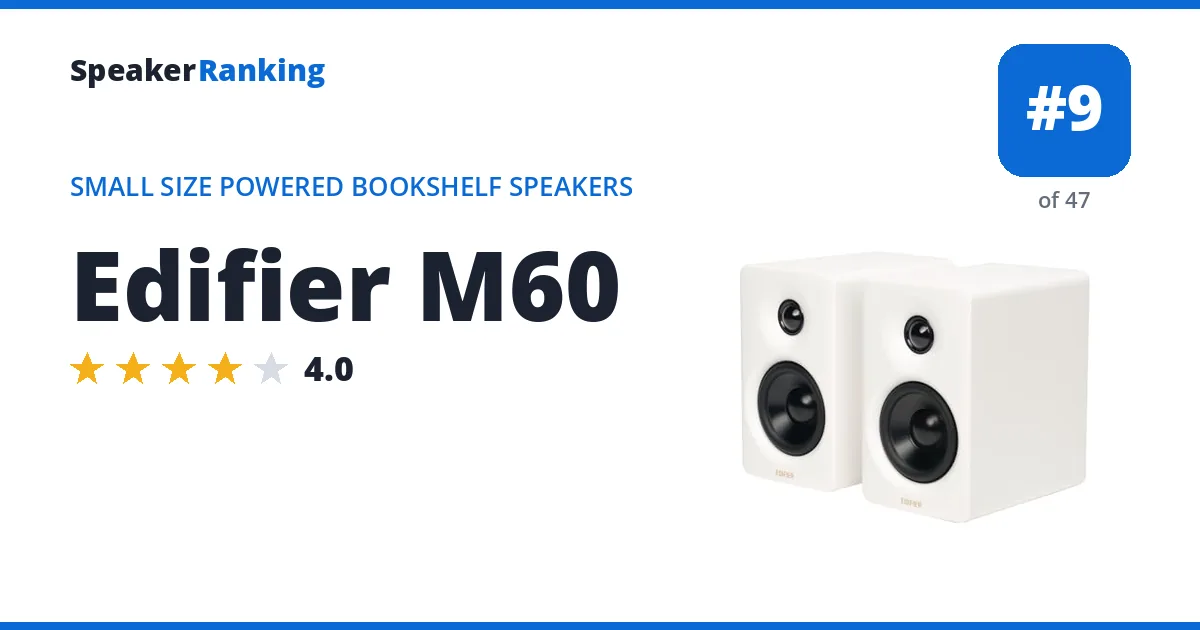
Pros: Erin’s Klippel data shows a reasonably even midrange, spanning 2.8dB from 300Hz to 5kHz, with broad horizontal coverage for desktop listening. Predicted preference scores are 4.60 standalone and 7.33 with an ideal subwoofer, a comparatively strong result in this compact category. USB-C, auxiliary input, Bluetooth and included angled stands make it easy to integrate into a small desk setup. Measured bass extension of 67Hz (-3dB), with a measured sensitivity of 87.5dB.
Cons: The on-axis response rises by about 0.57dB per octave, so the tonal balance becomes brighter toward the treble. Measured -3dB bass extension is about 70Hz; it cannot reproduce deep bass at full level. Sitting below the tweeter axis worsens the crossover-region response. Limiting and compression constrain louder playback, so use it nearfield rather than expecting room-filling output.
Full Edifier M60 review and specifications →
| AES Input | No |
|---|---|
| Amplifier Power | 66W total (33W per speaker) |
| App | Yes |
| Aux Input | Yes |
| Bass Extension (-10dB) | 57Hz (measured, Erin's Audio Corner) |
| Bass Extension (-3dB) | 67Hz (measured, Erin's Audio Corner) |
| Bluetooth | Yes |
| Bluetooth Codecs | SBC, LDAC |
| Bluetooth Version | 5.3 |
| Coaxial Input | No |
| Dimensions | 6.6"H x 3.9"W x 5.8"D (167.6 x 99.1 x 147.3 mm) |
| Drivers | 3" woofer, 1" silk dome tweeter |
| EQ | Yes |
| Frequency Response | 55Hz - 40kHz (Manufacturer specified) |
| HDMI Input | No |
| Inputs | Bluetooth, Aux, USB-C |
| Maximum SPL | 96dB @ 1m (manufacturer specified) |
| Optical Input | No |
| RCA Input | No |
| Sensitivity | 87.5dB (measured at 0.3V/1m, Erin's Audio Corner) |
| Spinorama Preference Score | 4.60 |
| Spinorama Preference Score with Perfect Sub | 7.33 |
| TRS Input | No |
| USB Input | Yes |
| Weight | 6.6 lbs (3 kg) |
| XLR Input | No |
- Links
- Reviews, Comparisons and Sound Samples
- Erin’s Audio Corner: Edifier M60 Desktop Speaker Delivers Big Fun! More from Erin’s Audio Corner →
- Erin’s Audio Corner: The Best Budget Desktop Speakers, Tested & Rated
- Erin’s Audio Corner Website: Edifier M60
- Erin’s Audio Corner Measurements (spinorama.org)
- Jasper Tech: Best Desktop Computer Speakers for Every Budget – 2026 More from Jasper Tech →
- Head-to-Head Comparisons
USB-C lets it double as a computer sound card, and Erin’s measurements show a reasonably even midrange with broad horizontal coverage. Bass rolls off around 67Hz (-3dB), so it sounds lighter than the iLoud.
Lowest-Cost Pick
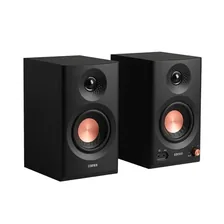 For the lowest price that still measures reasonably well, with balanced TRS inputs and Bluetooth, the Edifier MR3: $109.99 per pair Amazon eBay
Pros: Erin’s measurements show little overall tilt across the listening window, helping voices retain a broadly natural balance at a desk. Scores of 3.91 standalone and 6.53 with an ideal subwoofer support it as a useful budget nearfield option rather than a reference monitor. Tone controls and app-based EQ provide unusually flexible adjustment, and its bass extends farther than the Fostex PM03’s. Measured bass extension of 70Hz (-3dB), with a measured sensitivity of 83.3dB.
Cons: Local response ripples remain: the measured 300Hz-5kHz span is 4.5dB and listening-window narrow-band deviation is 0.538. Bass reaches -3dB at about 70Hz. The limiter protects the drivers but prevents much extra loudness when pushed; existing compression testing puts effective single-speaker output around 86-87dB at 1m. Vertical crossover interference makes tweeter height and tilt important.
Full Edifier MR3 review and specifications →
| AES Input | No |
|---|---|
| Amplifier Power | 36W total (18W per speaker) |
| App | Yes (Edifier ConneX) |
| Aux Input | Yes |
| Bass Extension (-10dB) | 53Hz (measured, Erin's Audio Corner) |
| Bass Extension (-3dB) | 70Hz (measured, Erin's Audio Corner) |
| Bluetooth | Yes |
| Bluetooth Codecs | SBC |
| Bluetooth Version | 5.4 |
| Coaxial Input | No |
| Dimensions | 8.7"H x 4.9"W x 7.3"D (220 x 125.5 x 185 mm) (active); 220H x 125.5W x 176D mm (passive) |
| Drivers | 3.5" mid-low driver, 1" silk dome tweeter |
| EQ | Yes (rear knobs and app room compensation) |
| Frequency Response | 52Hz - 40kHz (Manufacturer specified) |
| HDMI Input | No |
| Headphone Output | Yes |
| Inputs | Balanced TRS, RCA, Aux, Bluetooth |
| Maximum SPL | 93dB @ 1m (manufacturer specified) |
| Optical Input | No |
| Outputs | 3.5mm headphone |
| RCA Input | Yes |
| Sensitivity | 83.3dB (measured at 0.3V/1m, Erin's Audio Corner) |
| Spinorama Preference Score | 3.91 |
| Spinorama Preference Score with Perfect Sub | 6.53 |
| TRS Input | Yes |
| USB Input | No |
| Weight | 8.5 lbs (3.85 kg) |
| XLR Input | No |
- Links
- Reviews, Comparisons and Sound Samples
- Head-to-Head Comparisons
At $110 it is a sensible first monitor pair for a desk. Expect bass to roll off around 70Hz (-3dB) and a limiter that stops it well short of loud listening.
Best Single-Box Speaker Under $300
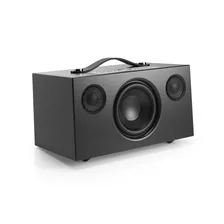 For one speaker with Wi-Fi streaming and Bluetooth rather than a stereo pair, the Audio Pro C5 MkII: $300 each Amazon eBay
Pros: At 2.4 kg, Audio Pro C5 MkII combines 4” woofer, 2x 0.75” tweeters with Bluetooth, Wifi, RCA. Ac-powered operation and limited-stereo playback make its feature set practical for its intended room or portable use.
Cons: Bass is limited by its 50Hz - 20kHz (Manufacturer specified) specification.
Full Audio Pro C5 MkII review and specifications →
| AES Input | No |
|---|---|
| Amplifier Power | 41W (2x8W + 25W) |
| App | Yes |
| Aux Input | No |
| Battery Life | No Battery |
| Bluetooth | Yes, 4.2 |
| Bluetooth Version | 4.2 |
| Coaxial Input | No |
| Dimensions | 9.8" x 5.1" x 5.9" (250 x 130 x 150 mm) |
| Drivers | 4" woofer, 2x 0.75" tweeters |
| EQ | Yes (Bass/Treble) |
| Frequency Response | 50Hz - 20kHz (Manufacturer specified) |
| HDMI Input | No |
| IP Rating | None |
| Inputs | Bluetooth, Wifi, RCA |
| Optical Input | No |
| Outputs | Subwoofer line out |
| Party Mode | Yes (AirPlay 2 multi-room) |
| Power Input | AC Power cord |
| RCA Input | Yes |
| Stereo | Partially |
| Streaming Services | Spotify Connect, Tidal Connect, AirPlay 2, Google Cast |
| Subwoofer Output | Yes |
| TRS Input | No |
| TWS | No |
| USB Input | No |
| Weight | 5.3 lbs (2.4 kg) |
| Wi-Fi | Yes (IEEE 802.11 b/g/n/ac (2.4/5GHz)) |
| Woofer Cabinet | ported |
| XLR Input | No |
- Links
- Reviews, Comparisons and Sound Samples
- Head-to-Head Comparisons
- Audio Pro C5 MkII vs Marshall Woburn III
- Audio Pro C5 MkII vs Marshall Woburn II
- Audio Pro C5 MkII vs Apple HomePod 2nd Gen
- Audio Pro C5 MkII vs Edifier D12
- Audio Pro C5 MkII vs JBL Authentics 200
- Audio Pro C5 MkII vs Marshall Acton III
- Audio Pro C5 MkII vs Marshall Stanmore II
- Audio Pro C5 MkII vs Denon Home 250
- See all 13 comparisons
It ranks #1 of 17 medium desktop speakers, and its price is for one speaker. Two can be paired for stereo, which doubles the cost.
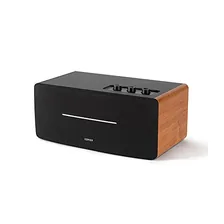 For a stereo pair of drivers in one cabinet at a lower price, with Bluetooth, aux and RCA inputs, the Edifier D12: $179.99 each Amazon eBay
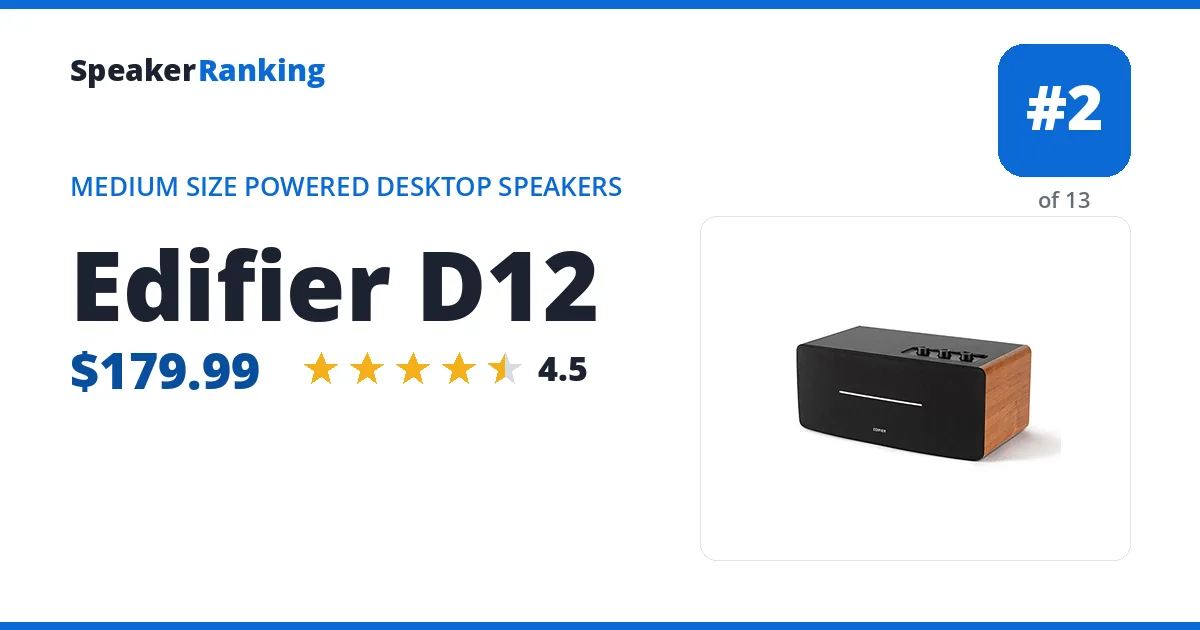
Pros: At 4.6 kg, Edifier D12 combines 2x 4” woofers, 2x 19mm silk dome tweeters with Bluetooth, Aux, RCA. Ac-powered operation and stereo playback make its feature set practical for its intended room or portable use. Measured bass extension of 57Hz (-10dB).
Cons: Bass is limited by its 57Hz specification. There is no companion app.
Full Edifier D12 review and specifications →
| AES Input | No |
|---|---|
| Amplifier Power | 70W (R/L treble: 15W+15W, R/L mid-bass: 20W+20W) |
| App | No |
| Aux Input | Yes |
| Bass Extension (-10dB) | 57Hz |
| Battery Life | No Battery |
| Bluetooth | Yes |
| Bluetooth Codecs | SBC (inferred; additional codecs unverified) |
| Bluetooth Version | 5.0 |
| Coaxial Input | No |
| Dimensions | 14.1" x 6.3" x 8" (359 x 159 x 203.5 mm) |
| Drivers | 2x 4" woofers, 2x 19mm silk dome tweeters |
| EQ | Yes (Bass/Treble controls) |
| Frequency Response | 54Hz - 20kHz (Manufacturer specified) |
| HDMI Input | No |
| IP Rating | None |
| Inputs | Bluetooth, Aux, RCA |
| Optical Input | No |
| Outputs | Subwoofer line out |
| Party Mode | No |
| Power Bank | No |
| Power Input | AC Power cable |
| RCA Input | Yes |
| Stereo | Yes |
| Subwoofer Output | Yes |
| TRS Input | No |
| TWS | No |
| USB Input | No |
| Weight | 10.1 lbs (4.6 kg) |
| Wi-Fi | No |
| Woofer Cabinet | ported |
| XLR Input | No |
- Links
- Reviews, Comparisons and Sound Samples
- DSAUDIO.review: DSAUDIO.review Edifier D12 vs Marshall Acton II sound.DEMO More from DSAUDIOreview →
- DSAUDIO.review: DSAUDIO.review Edifier D12 vs Edifier R1700BT sound.DEMO
- DSAUDIO.review: DSAUDIO.review Edifier D12 vs Edifier R1280DBs sound.DEMO
- DSAUDIO.review: DSAUDIO.review Edifier D12 vs Klipsch The Three II sound.DEMO
- Head-to-Head Comparisons
A single box keeps the desk tidy, at the cost of narrow stereo separation and bass that runs out around 57Hz (-10dB).
Where To Go Next
More budget: best powered speakers under $500 and best powered speakers under $1,000.
Full rankings: small, medium and large bookshelf, and the powered buyer’s guide.