This page ranks 74 large floorstanding speakers with woofers above 5.75”. These speakers deliver the deepest bass response available, ideal for serious music lovers and home theater enthusiasts.
Rankings are based on flat frequency response, directivity, dynamics, imaging, and detail retrieval. While the top-ranked speakers offer exceptional performance, the law of diminishing returns applies,many moderately-priced options provide outstanding value.
| Select to compare | |||||||
|---|---|---|---|---|---|---|---|
| 1 | GR-Research NX-Treme | $9662 per pair | 94.5dB | 8 ohms | <20Hz | (35.3 lbs | |
| 2 | KEF Blade Two Meta | $28,000 per pair | 86.8dB | 4 ohms nominal | 31Hz | 79.4 lbs | |
| 3 | MoFi SourcePoint V10 Master Edition | $7995 per pair | 88.8dB | 6 ohms nominal, 5.3 o… | 38Hz | 160.9 lbs | |
| 4 | MoFi SourcePoint 888 | $5495 per pair | 85.6dB | 6 ohms nominal, 5 ohm… | 34Hz | 94.8 lbs | |
| 5 | Revel F328Be | $19,359.90 per pair | 91dB | 8 ohms nominal | 74Hz | 112.4 lbs | |
| 6 | Radiant Acoustics Clarity 66 | $7,998 per pair | 85.9dB | 4 ohms nominal | 32.2Hz | 101.4 lbs | |
| 7 | Ascend Acoustics ELX Ribbon Tower | $5,698 per pair | 87.5dB @ 2.83V/1m ane… | 8 ohms nominal | 38.7Hz | 56 lbs | |
| 8 | Magico S5 2024 | $82,000 per pair | 88dB | 4 ohms nominal | 37Hz | 260.1 lbs | |
| 9 | KEF R5 Meta | $3,999.99 per pair | 86dB | 4 ohms nominal | 52Hz | 54 lbs | |
| 10 | Revel F226Be | $7700 per pair | 89.7dB | 8 ohms nominal | 56Hz | 58.2 lbs | |
| 11 | JBL 4367 | $16,500 per pair | 92.5dB | 4 ohms nominal | 43Hz | 119 lbs | |
| 12 | KEF Reference 203 | $5,000 per pair | 88dB | 8 ohms nominal | 51Hz | 58 lbs | |
| 13 | KEF Reference 3 Meta | $15,999.98 per pair | 86dB | 4 ohms nominal, 3.2 o… | 42.2Hz | - | |
| 14 | JBL HDI-3800 | $5,000 per pair | 92dB | 4 ohms nominal | 37Hz | 83.8 lbs | |
| 15 | Focal Chora 816 | $900 per pair | 91dB | 8 ohms nominal | 60Hz | 40.8 lbs | |
| 16 | Revel F208 | $4,800 per pair | 88.2dB | 8 ohms nominal, 3.5 o… | 47Hz | 79.4 lbs | |
| 17 | Revel F228Be | $9,000 per pair | 89.3dB | 8 ohms | 61Hz | 112.4 lbs | |
| 18 | Revel F206 | $2,000 per pair | 87dB | 4 ohms nominal | 60Hz | 57.3 lbs | |
| 19 | Revel Concerta2 F35 | $900 per pair | 89.4dB | 6 ohms nominal | 70Hz | 41 lbs | |
| 20 | Perlisten S7t | $21,990 per pair | 92.2dB @ 2.83V/1m | 4 ohms nominal, 3.2 o… | 56.4Hz | 122.8 lbs | |
| 21 | Perlisten R5t | $8,790 per pair | 89.0dB @ 2.83V/1m | 4 ohms nominal, 3.2 o… | 44.6Hz | 58.4 lbs | |
| 22 | KEF R5 | $2,999 per pair | Approximately 86dB/2.… | Approximately 3.5 ohm… | 77Hz | 59.5 lbs | |
| 23 | Arendal Sound 1610 Tower 8 | $7,600 per pair | 89.5dB @ 2.83V/1m | 4 ohms nominal | 41Hz | 100 lbs | |
| 24 | TAD Evolution 2 | $19,995 per pair | 87dB @ 2.83V/1m | 6 ohms nominal, 4.5 o… | 58.6Hz | 70.5 lbs | |
| 25 | Ascend Acoustics Sierra Titan Tower | $2,998 per pair | 88dB @ 2.83V/1m in-ro… | 8 ohms nominal | 58.6Hz | 45 lbs | |
| 26 | KEF R11 Meta | $6,999.98 per pair | 89.5dB | 4 ohms | 64Hz | 80.5 lbs | |
| 27 | Arendal 1961 Tower | $1,900 per pair | 86.5dB/2.83V/1m | 4 ohms nominal; dips… | 62Hz | 39.5 lbs | |
| 28 | Morel Avyra 633 | $2,000 per pair | 86.5dB | 4 ohms nominal | 50Hz | 48.5 lbs | |
| 29 | Magico A5 | $24,800 per pair | 88dB | 4 ohms nominal | 49.5Hz | 179.9 lbs | |
| 30 | JBL Studio 698 | $1,499.90 per pair | 90dB | 6 ohms nominal | 53Hz | 78.9 lbs | |
| 31 | JBL HDI-3600 | $3800 per pair | 89.5dB | 4 ohms nominal | 78Hz - the on-axis cu… | 61.7 lbs | |
| 32 | Perlisten R7t | $9,990 per pair | 90.0dB @ 2.83V/1m | 4 ohms nominal, 3.1 o… | 49.1Hz | 105.8 lbs | |
| 33 | Polk Audio Reserve R700 | $2,398 per pair | 87.5dB | 4 ohms nominal, 3.5 o… | 40Hz | 102.1 lbs | |
| 34 | PSB Imagine T65 | $2,699 per pair | 85.1dB | 8 ohms nominal | 47Hz | 44.1 lbs | |
| 35 | Emotiva Airmotiv T2+ | $999 per pair | Approximately 89.5dB/… | Approximately 3 ohms… | 62Hz | 56.9 lbs | |
| 36 | ELAC Debut 3.0 DF63 | $1,298 per pair | 86.6dB | 6 ohms nominal | 71Hz | 58.2 lbs | |
| 37 | Polk Reserve R500 | $1,259.98 per pair | 86.2dB | 4.1 ohms minimum abov… | 51Hz | 39.2 lbs | |
| 38 | Linkwitz Lab LXmini | $505.00 per pair | 85dB upper driver / 8… | 4 ohms upper driver /… | 50Hz | - | |
| 39 | PS Audio Aspen FR10 | $12000 per pair | 84.4dB | 4 ohms nominal, 3.6 o… | 47Hz | 119 lbs | |
| 40 | Infinity Primus 360 | $650 per pair | 89.4dB | 8 ohms nominal, 3.5 o… | 53Hz | 48.5 lbs | |
| 41 | Q Acoustics 5040 | $2,472.98 per pair | 91.5dB | 6 ohms nominal | 70Hz | 39.7 lbs | |
| 42 | Klipsch Forte IV | $5,499.98 per pair | 93.8dB | 8 ohms | 82Hz | 117.3 lbs | |
| 43 | Revival Audio Atalante 5 | $5000 per pair | 88.6dB | 4 ohms nominal | 42Hz | 72.8 lbs | |
| 44 | KEF Q11 Meta | $2,499.98 per pair | 88.6dB | 4 ohms nominal | 60Hz | 106.9 lbs | |
| 45 | KLH Model Five | $2,998.00 per pair | About 85dB @ 2.83V/1m | 6 ohms nominal, 3.5 o… | 52Hz | 44.1 lbs | |
| 46 | Klipsch RP-5000F II | $1,199.98 per pair | 90dB | 8 ohms nominal, 3.3 o… | 55Hz | 38.6 lbs | |
| 47 | Monolith Encore T6 | $800 per pair | 87.8dB/2.83V/1m | 4 ohms nominal | ~68Hz | 49.2 lbs | |
| 48 | Monolith THX-365T | $900 per pair | 88.6dB/2.83V/1m | 4 ohms nominal; nearl… | 84Hz | 28.4 lbs | |
| 49 | Klipsch RP-8000F II | $1,159.98 per pair | 92dB | 8 ohms nominal | 67Hz | 61.3 lbs | |
| 50 | Dynaudio Emit 30 | $1,274.25 per pair | 87dB | 4 ohms | 44Hz | 34.2 lbs | |
| 51 | Klipsch RP-6000F II | $1500 per pair | 90dB | 8 ohms nominal | 67Hz | 49.4 lbs | |
| 52 | Definitive Technology BP-9020 | $500 per pair | 87.7dB | 8 ohms nominal | 35Hz | 30 lbs | |
| 53 | SVS Ultra Evolution Pinnacle | $2,499.00 per pair | 88dB | 6 ohms nominal | 41.0Hz | 96.8 lbs | |
| 54 | Polk T50 | $498 per pair | 86.3dB | 4 ohms nominal | 47Hz | 75.4 lbs | |
| 55 | Vandersteen Treo CT | $11,090 per pair | 85dB | 6 ohms nominal, 4 ohm… | 43.9Hz | 80 lbs | |
| 56 | Aperion Audio Novus N5T | $1,048.50 per pair | 86dB measured | 4 ohms nominal | 51.3Hz | 37 lbs | |
| 57 | Focal Aria Evo X N°2 | $4,798 per pair | 88.2dB | 8 ohms nominal | 50Hz | 55.1 lbs | |
| 58 | Polk Audio XT70 | $698 per pair | 89dB @ 1W/1m | 4/8 ohm compatible | 43.9Hz | 35.1 lbs | |
| 59 | Polk Audio XT60 | $458 per pair | 86dB | 4/8-ohm compatible | 43.9Hz | 20 lbs | |
| 60 | Infinity Reference 253 | $400 per pair | 86.9dB | 6 ohms | 78Hz | 39.2 lbs | |
| 61 | Magnepan LRS+ | $1300 per pair | 85.1dB | 4 ohms nominal, 3 ohm… | 74Hz | 30 lbs | |
| 62 | Polk Signature Elite ES60 | $599 per pair | 90dB specified; 89.5d… | 8 ohms compatible | 51.3Hz | 52 lbs | |
| 63 | JBL Stage 2 280F | $1,319.90 per pair | 89.5dB | 6 ohms nominal, 3.9 o… | 48Hz | 55.1 lbs | |
| 64 | Dali Rubikore 6 | $8000 per pair | 86.4dB | 4 ohms nominal | 43Hz | 114.9 lbs | |
| 65 | Atlantic Technology 8600eLR | $5,700 per pair | 91dB | 6 ohms | 68.8Hz | 93.3 lbs | |
| 66 | Endow Audio Bravura 7 | $14,000 per pair | 81-82dB | 4 ohms nominal, 3.1 o… | 50Hz | 24.3 lbs | |
| 67 | Børresen X3 | $11,000 per pair | 88dB | 4 ohms | 50Hz | 121.3 lbs | |
| 68 | Sony SS-CS3 | $450 per pair | 88.6dB | 6 ohms nominal | 72Hz | 25.4 lbs | |
| 69 | JBL Studio 590 | $2,000 per pair | 90.3dB | 6 ohms nominal | 48Hz | 107.8 lbs | |
| 70 | Jamo S807 | $299.00 per pair | 84dB | 8 ohms nominal | 51.9Hz | 26 lbs | |
| 71 | Triangle Esprit Antal Ez | $1,799 per pair | 90.7dB | 8 ohms nominal | 85Hz | 98.5 lbs | |
| 72 | Klipsch Heresy IV | $3,198 per pair | 94.5dB/2.83V/1m | Approximately 4 ohms… | 77Hz | 45 lbs | |
| 73 | Rockville RockTower 68B | $234.90 per pair | 87dB | 8 ohms | 60.1Hz | 55.1 lbs | |
| 74 | Bose 901 Series V | - | Approximately 81dB/2.… | 6.2 ohms minimum | 55.8Hz | 35.3 lbs |
Prices on this page were last checked October 1, 2026 at 6:23 PM UTC. Product prices and availability are accurate as of that date/time and are subject to change; the price and availability shown on Amazon at the time of purchase will apply to the purchase of this product.
As an eBay Partner, we may be compensated if you make a purchase.
 #1 GR-Research NX-Treme: $9662 per pair for the kit with subs (assembly required) GR Research eBay
Pros: Amazing in terms of soundstage and imaging as the speaker can radiate in all directions and not have internal reflections due to there not being a speaker box. One of the highest sensitivity speakers around. Open baffle mids, highs and bass (using GR-Research Open baffle subs). If you have not heard open baffle bass, you must hear it in person, there’s no going back. Amazing in terms of imaging as the speaker can radiate in all directions and not have internal reflections due to there not being a speaker box. Can easily be driven by tube amps due to the mild impedance. Measured bass extension of <20Hz (-3dB).
Cons: Very tall and will require GR-Research open baffle subwoofers one on each side
Full GR-Research NX-Treme review and specifications →
| Bass Extension (-3dB) | <20Hz (With GR-Research open baffle subwoofers) |
|---|---|
| DIY Kit | Yes |
| Dimensions | 85”H x 17”W x 20”D (2159 x 431.8 x 508 mm) (plus a subwoofer on each side) |
| Drivers | Eight 6.5” M165 open baffle woofer, Two 6.5” M165NQ open baffle midrange, GR Neo 3 Magnetic planar open baffle tweeter; Three 12-inch Rythmik Audio servo-controlled subwoofers; Three 12-inch Rythmik Audio servo-controlled subwoofers; Three 12-inch Rythmik Audio servo-controlled subwoofers; Three 12-inch Rythmik Audio servo-controlled subwoofers |
| Impedance | 8 ohms |
| Sensitivity | 94.5dB |
| Weight | (35.3 lbs (16 kg)) |
| Woofer Cabinet | open baffle |
- Links
- Reviews, Comparisons and Sound Samples
- No independent measurement review is linked for this model; it is ranked from hands-on listening and comparison against similarly priced speakers.
- Head-to-Head Comparisons
- GR-Research NX-Treme vs KEF Blade Two Meta
- GR-Research NX-Treme vs MoFi SourcePoint V10 Master Edition
- GR-Research NX-Treme vs MoFi SourcePoint 888
- GR-Research NX-Treme vs Revel F328Be
- GR-Research NX-Treme vs Revel Concerta2 F35
- GR-Research NX-Treme vs JBL Studio 698
- GR-Research NX-Treme vs Klipsch Forte IV
- GR-Research NX-Treme vs Polk T50
 #2 KEF Blade Two Meta: $28,000 per pair only sold in stores eBay
Pros: True point-source coaxial design (four 6.5in mid-bass drivers flanking a coincident mid/tweeter) with matched ~50 degree horizontal and vertical dispersion, unusual for a multi-driver speaker. Fully rounded, edgeless cabinet eliminates baffle diffraction. Frequency response holds within about 2.5dB across the listening window. Extremely low harmonic and multitone distortion even at 96dB, with under 0.5dB of compression at full output, rivaling the Reference 1 Meta and JBL 4367 in dynamic range. Reviewer described the imaging and soundstage depth as revealing recording details other speakers he tested (PS Audio FR10, MoFi SourcePoint 8, Neumann KH80) masked. Available in any custom finish at no extra charge. Measured bass extension of 31Hz (-3dB), with a measured sensitivity of 86.8dB.
Cons: 2dB dip and slight resonance around 200Hz, also visible in KEF white paper and likely cabinet-related. Bass rolls off fairly quickly below its 31Hz F3. Horizontal dispersion (~50 degrees) is narrower than the reviewer preferred 70-80 degrees; benefits from toeing out 10-20 degrees to open soundstage without losing image focus. Needs a separate power amp, not AVR-friendly.
Full KEF Blade Two Meta review and specifications →
| Bass Extension (-10dB) | 26Hz (measured, Erin’s Audio Corner) |
|---|---|
| Bass Extension (-3dB) | 31Hz (measured, Erin’s Audio Corner) |
| DIY Kit | No |
| Dimensions | 46.6”H x 13.5”W x 14.8”D (1183.6 x 342.9 x 375.9 mm) |
| Drivers | 4 x 165 mm (6.5 in.) aluminium cone, force cancelling woofers, 125 mm (5 in.) aluminium cone midrange, 25 mm (1 in.) aluminium dome with MAT tweeter |
| Impedance | 4 ohms nominal (3.3 ohms minimum, measured, Erin’s Audio Corner) |
| Sensitivity | 86.8dB (measured, Erin’s Audio Corner) |
| Spinorama Preference Score | 6.99 |
| Spinorama Preference Score with Perfect Sub | 8.11 |
| Weight | 79.4 lbs (36 kg) each |
| Woofer Cabinet | ported, rear |
- Links
- Reviews, Comparisons and Sound Samples
- Head-to-Head Comparisons
- KEF Blade Two Meta vs GR-Research NX-Treme
- KEF Blade Two Meta vs MoFi SourcePoint V10 Master Edition
- KEF Blade Two Meta vs MoFi SourcePoint 888
- KEF Blade Two Meta vs Revel F328Be
- KEF Blade Two Meta vs Radiant Acoustics Clarity 66
- KEF Blade Two Meta vs Ascend Acoustics ELX Ribbon Tower
- KEF Blade Two Meta vs Magico S5 2024
- KEF Blade Two Meta vs KEF R5 Meta
- See all 38 comparisons
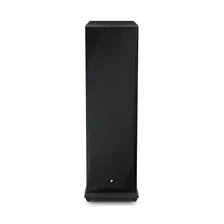 #3 MoFi SourcePoint V10 Master Edition: $7995 per pair Crutchfield eBay
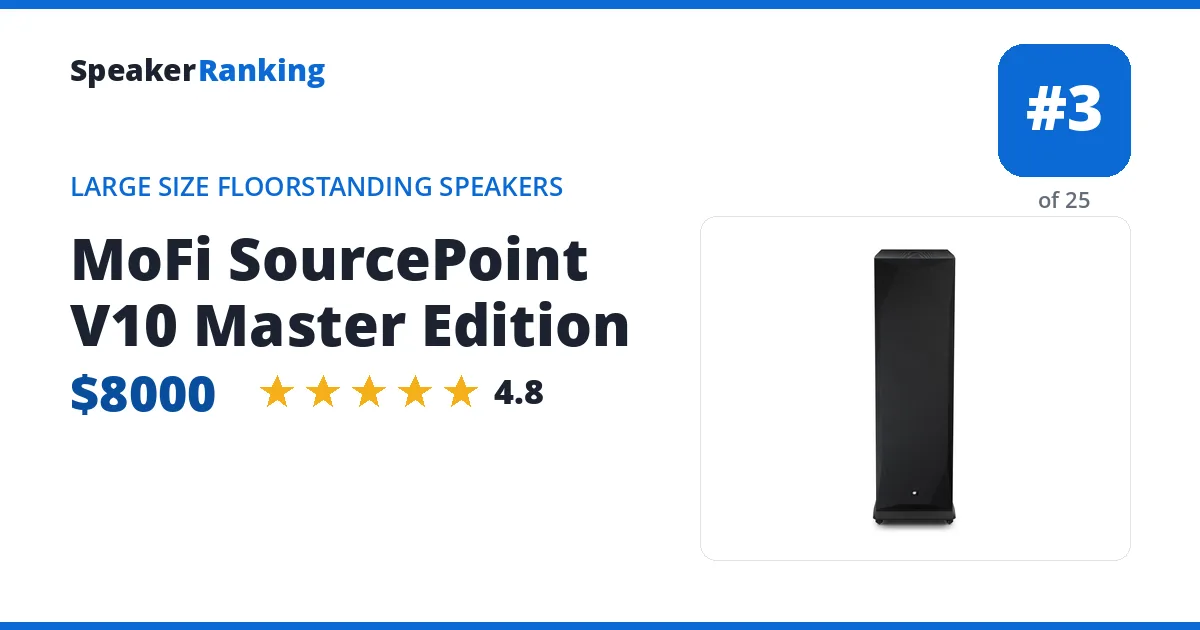
Pros: Extended bass to approximately 30 Hz in-room without subwoofer; images with excellent precision indicating tight frequency response matching between speakers. Integrated bass management with three-way treble attenuation switches for room tuning. New design from Andrew Jones represents reviewer personal second choice (behind only KEF Blade 2 Meta at 29k) among hundreds of systems auditioned; ranks above Dutch & Dutch 8C, JBL 4367, and JBL M2. Measured bass extension of 38Hz (-3dB), with a measured sensitivity of 88.8dB.
Cons: Moderate sensitivity (~89 dB) means amplifier power requirements higher than many alternatives. Deep bass extension ends above subsonic frequencies (pipe organ territory below 17 Hz requires subwoofer).
Full MoFi SourcePoint V10 Master Edition review and specifications →
| Bass Extension (-10dB) | 25Hz (measured, Erin’s Audio Corner) |
|---|---|
| Bass Extension (-3dB) | 38Hz (measured, Erin’s Audio Corner) |
| DIY Kit | No |
| Dimensions | 48.8”H x 15.5”W x 19.9”D (1239.5 x 393.7 x 505.5 mm) |
| Drivers | 10” woofer, 10” paper‑cone concentric midrange, 1.25” soft‑dome concentric tweeter |
| Impedance | 6 ohms nominal, 5.3 ohms minimum (measured, Erin’s Audio Corner) |
| Sensitivity | 88.8dB (measured, Erin’s Audio Corner) |
| Spinorama Preference Score | 5.00 |
| Spinorama Preference Score with Perfect Sub | 6.31 |
| Weight | 160.9 lbs (73 kg) |
| Woofer Cabinet | passive radiator |
- Links
- Reviews, Comparisons and Sound Samples
- Head-to-Head Comparisons
- MoFi SourcePoint V10 Master Edition vs KEF Blade Two Meta
- MoFi SourcePoint V10 Master Edition vs MoFi SourcePoint 888
- MoFi SourcePoint V10 Master Edition vs GR-Research NX-Treme
- MoFi SourcePoint V10 Master Edition vs Revel F328Be
- MoFi SourcePoint V10 Master Edition vs Radiant Acoustics Clarity 66
- MoFi SourcePoint V10 Master Edition vs Ascend Acoustics ELX Ribbon Tower
- MoFi SourcePoint V10 Master Edition vs Revel F226Be
- MoFi SourcePoint V10 Master Edition vs JBL 4367
- See all 29 comparisons
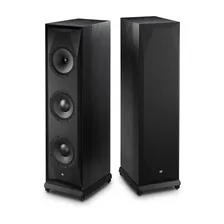 #4 MoFi SourcePoint 888: $5495 per pair Crutchfield eBay
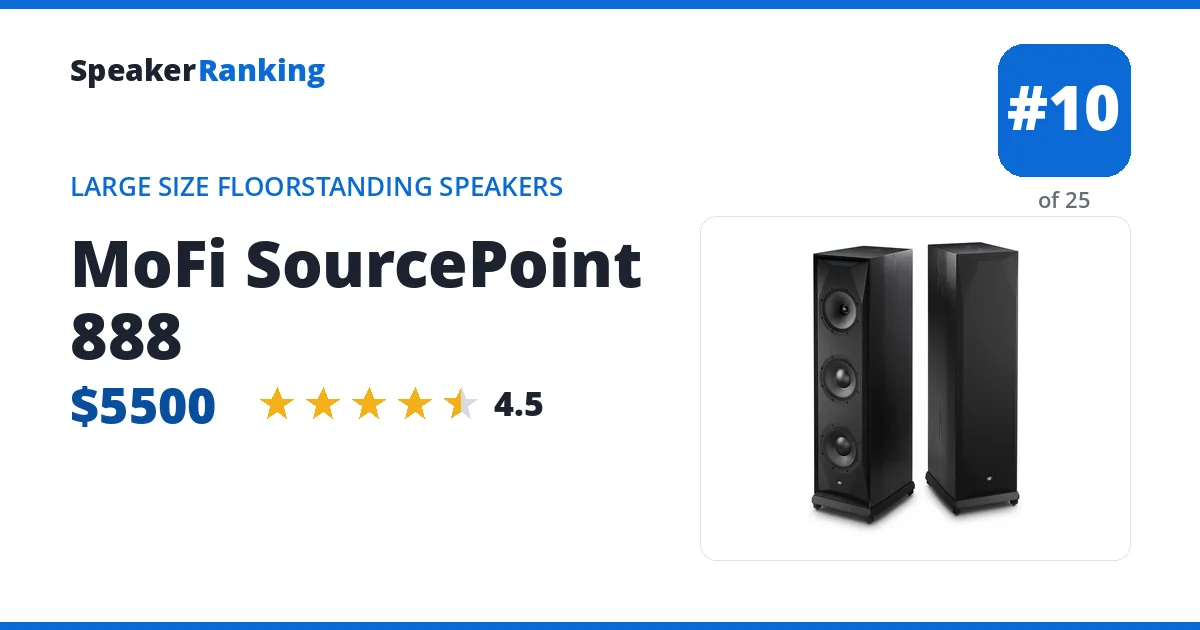
Pros: Three-way vented design: an 8” coaxial mid-range/1.25” dome tweeter driver plus two additional 8” woofers crossed at about 130Hz, giving genuinely full-range output (F3 34Hz, F10 26Hz) other than the deepest subsonic content. Ranked by the reviewer among his personal top three speakers out of roughly 200 tested, alongside the KEF Blade 2 Meta and Dutch & Dutch 8C, despite costing a small fraction of either. Excellent compression/dynamic-range linearity, holding its own against much pricier speakers like the March Audio Sointuva AWG, KEF Reference 1 Meta, and KEF Blade 2 Meta. On-axis (0°) and 30°-off-axis estimated in-room responses track within about 1-1.5dB of each other above 500Hz, so tonal balance barely changes with placement or listening angle: excellent for multi-seat home theater or entertaining. Wide horizontal dispersion of about ±60°. Distortion stays low: under 1% at 86dB, and under 1% above 200Hz even at 96dB, with multitone distortion mostly under 1% as well. Not a difficult amplifier load (5-ohm minimum impedance, 4.2-ohm minimum EPDR). Checks the three boxes the reviewer considers essential for a home theater speaker: low compression, low distortion, and excellent directivity. Measured bass extension of 34Hz (-3dB), with a measured sensitivity of 85.6dB.
Cons: A significant investment, best ordered from a dealer with a good return policy. Large and heavy floorstander (about 96 lbs, 42” tall) requiring real floor space and rear clearance. Positioning is fairly specific: needs about 2 feet from the rear wall. Closer causes boominess in the 40-50Hz region, farther loses bass extension. Vertical dispersion (about ±50°) is narrower than horizontal (about ±60°), since the two 8” woofers are spaced vertically apart on a tower cabinet, causing some vertical mismatch at lower frequencies. A small on-axis dip around 500Hz and a deliberately lower tweeter level (about 0.5dB below the midrange) are intentional design choices for smoother in-room response, but mean the raw on-axis measurement isn’t perfectly flat. A mild diffraction-related dip appears around 3kHz in directivity measurements. Toeing the speaker out more than about 10° starts to noticeably reduce top-end energy.
Full MoFi SourcePoint 888 review and specifications →
| Bass Extension (-10dB) | 26Hz (measured, Erin’s Audio Corner) |
|---|---|
| Bass Extension (-3dB) | 34Hz (measured, Erin’s Audio Corner) |
| DIY Kit | No |
| Dimensions | 41.2”H x 12.6”W x 16.1”D (1046.5 x 320 x 408.9 mm) |
| Drivers | Dual 8” paper cone woofers, 8” Paper Cone midrange, 1.25” wide roll soft dome tweeter |
| Impedance | 6 ohms nominal, 5 ohms minimum (measured, Erin’s Audio Corner) |
| Sensitivity | 85.6dB (measured, Erin’s Audio Corner) |
| Spinorama Preference Score | 6.09 |
| Spinorama Preference Score with Perfect Sub | 7.21 |
| Weight | 94.8 lbs (43 kg) each |
| Woofer Cabinet | ported, rear |
- Links
- Reviews, Comparisons and Sound Samples
- Head-to-Head Comparisons
- MoFi SourcePoint 888 vs MoFi SourcePoint V10 Master Edition
- MoFi SourcePoint 888 vs Revel F328Be
- MoFi SourcePoint 888 vs KEF Blade Two Meta
- MoFi SourcePoint 888 vs Radiant Acoustics Clarity 66
- MoFi SourcePoint 888 vs GR-Research NX-Treme
- MoFi SourcePoint 888 vs Ascend Acoustics ELX Ribbon Tower
- MoFi SourcePoint 888 vs KEF R5 Meta
- MoFi SourcePoint 888 vs Revel F226Be
- See all 36 comparisons
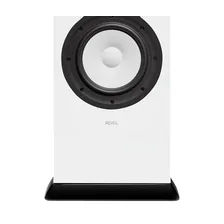 #5 Revel F328Be: $19,359.90 per pair Crutchfield eBay
Pros: CEA2034 spinorama shows a quite flat on-axis response with superb directivity and efficiency above 90dB. Predicted in-room response is extremely accurate, with a smooth ~5dB downward slope from bass to treble that suits typical rooms without correction. Early reflections sum very nicely with the direct sound. Horizontal beamwidth of about ±70 degrees is wide and quite smooth. At 96dB SPL/1m distortion stays easily below the reviewer’s audibility threshold across nearly the whole range. Measured bass extension of 74Hz (-3dB), with a measured sensitivity of 91dB.
Cons: Vertical directivity is asymmetric: the reviewer recommends staying between -20 and +40 degrees relative to the tweeter axis, reflecting the driver layout of this three-way tower. Impedance dips to a minimum of 3 ohms with an additional resonance-driven phase swing, calling for an amplifier comfortable with a demanding load. Very expensive and very heavy (51 kg each).
Full Revel F328Be review and specifications →
| Bass Extension (-10dB) | 39Hz (measured, Audio Science Review) |
|---|---|
| Bass Extension (-3dB) | 74Hz (measured, Audio Science Review) |
| DIY Kit | No |
| Dimensions | 50.9”H x 13.5”W x 17.6”D (1292.9 x 342.9 x 447 mm) |
| Drivers | Three 8” (200mm) Deep Ceramic Composite aluminum cones, with cast frames woofer, 5-1/4” (130mm) Deep Ceramic Composite aluminum cone, with cast frame midrange, 1” (25mm) Beryllium dome, with acoustic lens waveguide tweeter |
| Impedance | 8 ohms nominal (3 ohms minimum, measured by Audio Science Review) |
| Sensitivity | 91dB (measured, Audio Science Review) |
| Spinorama Preference Score | 6.40 |
| Spinorama Preference Score with Perfect Sub | 7.81 |
| Weight | 112.4 lbs (51 kg) each |
| Woofer Cabinet | ported, rear |
- Links
- Reviews, Comparisons and Sound Samples
- Head-to-Head Comparisons
- Revel F328Be vs MoFi SourcePoint 888
- Revel F328Be vs Radiant Acoustics Clarity 66
- Revel F328Be vs MoFi SourcePoint V10 Master Edition
- Revel F328Be vs Ascend Acoustics ELX Ribbon Tower
- Revel F328Be vs KEF Blade Two Meta
- Revel F328Be vs GR-Research NX-Treme
- Revel F328Be vs KEF R5 Meta
- Revel F328Be vs Revel F226Be
- See all 40 comparisons
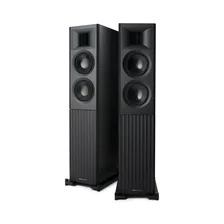 #6 Radiant Acoustics Clarity 66: $7,998 per pair Radiant Acoustics eBay
Pros: ASR’s revised Spinorama measurement shows bass reaching 32.2Hz at -3dB and 27.8Hz at -6dB, giving substantial low-end weight without a subwoofer. The response spans 2.3dB from 300Hz to 5kHz, with preference scores of 6.01 standalone and 7.03 with an ideal subwoofer. The review’s exceptionally low bass distortion at ordinary levels complements that extension, while dual 6.5-inch Purifi woofers provide a strong foundation for full-range listening. Measured bass extension of 32.2Hz (-3dB), with a measured sensitivity of 85.9dB.
Cons: Vertical directivity is narrow and horizontal coverage is uneven, so listening height and placement affect tonal balance. Treble resonances and response irregularities keep it from reference-level neutrality. Spinorama’s modeled EQ improves the scores to 6.85 standalone and 7.75 with an ideal subwoofer, but those are corrected results, not stock performance. Measured sensitivity is 85.9dB at 2.83V/1m with a nominal 4-ohm load; use an amplifier comfortable driving 4 ohms. Distortion rises at very high playback levels.
Full Radiant Acoustics Clarity 66 review and specifications →
| Bass Extension (-10dB) | 24.4Hz (measured, Audio Science Review) |
|---|---|
| Bass Extension (-3dB) | 32.2Hz (measured, Audio Science Review) |
| Crossover Frequency | 2.4kHz |
| DIY Kit | No |
| Dimensions | 40.4”H x 8.7”W x 14”D (1025 x 222 x 355 mm) |
| Drivers | Custom waveguide-loaded tweeter with beam-expansion fins, 2x 6.5” Purifi USHINDI aluminum-cone woofers |
| Impedance | 4 ohms nominal |
| Sensitivity | 85.9dB (2.83V/1m, measured, Audio Science Review; 86dB manufacturer specified) |
| Spinorama Preference Score | 6.01 |
| Spinorama Preference Score with Perfect Sub | 7.03 |
| Weight | 101.4 lbs (46 kg) each |
| Woofer Cabinet | ported, large rear port |
- Links
- Reviews, Comparisons and Sound Samples
- Head-to-Head Comparisons
- Radiant Acoustics Clarity 66 vs Ascend Acoustics ELX Ribbon Tower
- Radiant Acoustics Clarity 66 vs Revel F328Be
- Radiant Acoustics Clarity 66 vs MoFi SourcePoint 888
- Radiant Acoustics Clarity 66 vs MoFi SourcePoint V10 Master Edition
- Radiant Acoustics Clarity 66 vs KEF Blade Two Meta
- Radiant Acoustics Clarity 66 vs Revel F226Be
- Radiant Acoustics Clarity 66 vs JBL 4367
- Radiant Acoustics Clarity 66 vs KEF Reference 3 Meta
- See all 25 comparisons
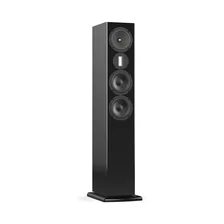 #7 Ascend Acoustics ELX Ribbon Tower: $5,698 per pair Ascend Acoustics eBay
Pros: A RAAL 70-20xram ribbon tweeter and dual SEAS Excel aluminum woofers in a 3-way, 4-driver bamboo tower measure a genuine 38.7Hz extension point with a nearly flat on axis slope of 0.05dB per octave, one of the flattest measured towers we list. The bass alignment Q of 0.62 keeps the low end well damped rather than peaky. Backed by a 7 year parts and labor warranty and hand assembled in Orange County, California, with each pair matched within +/-1.5dB. Measured bass extension of 38.7Hz (-3dB).
Cons: Listening window smoothness measures a moderate 0.40 and on axis deviation runs 0.286dB average, both trailing the tighter figures posted by some of the passive AsciLab and Ascend bookshelf models in this same batch. At $5698/pair it is Ascend’s most expensive tower, well above the Titan dome tweeter version of the same cabinet. The manufacturer’s own claimed sensitivity (87.5dB) runs nearly 1.5dB higher than the independently measured average (86.1dB), worth accounting for when matching an amplifier.
Full Ascend Acoustics ELX Ribbon Tower review and specifications →
| Bass Extension (-10dB) | 28.5Hz (measured, spinorama.org vendor data) |
|---|---|
| Bass Extension (-3dB) | 38.7Hz (measured, spinorama.org vendor data) |
| Country | United States |
| DIY Kit | No |
| Dimensions | 43”H x 7.5”W x 10.5”D (1092 x 190 x 267 mm) |
| Drivers | RAAL 70-20xram ribbon tweeter, 6” SEAS Excel Curv midrange (sealed sub-chamber), 2x 6” SEAS Excel aluminum woofers |
| Enclosure | ported |
| Frequency Response | 36-27,000Hz +/-3dB anechoic (manufacturer) |
| Impedance | 8 ohms nominal |
| Power Handling | 400W continuous, 600W peak |
| Sensitivity | 87.5dB @ 2.83V/1m anechoic (manufacturer) |
| Spinorama Preference Score | 6.97 |
| Spinorama Preference Score with Perfect Sub | 8.42 |
| Warranty | 7 years parts and labor |
| Weight | 56 lbs (25.4 kg) each |
- Links
- Reviews, Comparisons and Sound Samples
- Head-to-Head Comparisons
- Ascend Acoustics ELX Ribbon Tower vs Radiant Acoustics Clarity 66
- Ascend Acoustics ELX Ribbon Tower vs Revel F328Be
- Ascend Acoustics ELX Ribbon Tower vs MoFi SourcePoint 888
- Ascend Acoustics ELX Ribbon Tower vs Revel F226Be
- Ascend Acoustics ELX Ribbon Tower vs MoFi SourcePoint V10 Master Edition
- Ascend Acoustics ELX Ribbon Tower vs JBL 4367
- Ascend Acoustics ELX Ribbon Tower vs KEF Blade Two Meta
- Ascend Acoustics ELX Ribbon Tower vs JBL HDI-3800
- See all 25 comparisons
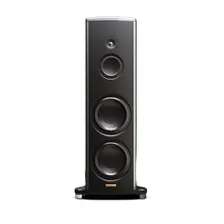 #8 Magico S5 2024: $82,000 per pair Audio Solutions eBay
Pros: Manufacturer Spinorama data shows exceptionally flat on-axis response, with just 0.15dB average absolute deviation and 0.89 listening-window smoothness inside a narrow 1.3dB reference band. Preference scores are 7.35 without a subwoofer and 8.52 with one. Bass reaches 37Hz at -3dB, 27.9Hz at -6dB and about 20.8Hz at -10dB from two 10-inch woofers, so most music needs no subwoofer. The diamond-coated beryllium tweeter, graphene midrange and heavily braced curved aluminum cabinet are built for high output with low coloration.
Cons: At $41000 per pair it is one of the most expensive speakers we list, and it is sold only through Magico dealers. The measurements are manufacturer supplied and digitized from published graphs rather than an independent ASR or Erin test. A 2.78 directivity-index deviation is less even than the flattest on-axis numbers suggest. The 4 ohm load, 88dB sensitivity and 118kg weight call for a powerful amplifier and careful placement.
Full Magico S5 2024 review and specifications →
| Bass Extension (-10dB) | approximately 20.8Hz (measured, manufacturer data on spinorama.org) |
|---|---|
| Bass Extension (-3dB) | 37Hz (measured, manufacturer data on spinorama.org) |
| DIY Kit | No |
| Dimensions | 48”H x 19.1”W x 19.3”D (1220 x 485 x 490 mm) |
| Drivers | Two 10” graphene Nano-Tec woofers; 6” graphene Nano-Tec midrange; 28mm diamond-coated beryllium tweeter |
| Enclosure | Curved aluminum |
| Frequency Response | 20Hz-50kHz (manufacturer, in-room) |
| Impedance | 4 ohms nominal |
| Power Handling | 50-1000W recommended amplifier power |
| Sensitivity | 88dB (manufacturer specified) |
| Spinorama Preference Score | 7.35 |
| Spinorama Preference Score with Perfect Sub | 8.52 |
| Weight | 260.1 lbs (118 kg) each |
- Links
- Reviews, Comparisons and Sound Samples
- Head-to-Head Comparisons
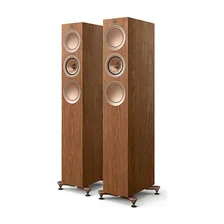 #9 KEF R5 Meta: $3,999.99 per pair Discontinued eBay
Pros: 12th generation 5” Uni-Q coaxial driver array with Metamaterial Absorption Technology (MAT) delivers remarkably smooth, controlled horizontal (±50°) and vertical directivity with near-identical off-axis tracking. Exceptional frequency response linearity through the midrange and treble that takes extremely well to minor parametric EQ adjustments. Constrained Layer Damping cabinet construction and flexible rear ports minimize enclosure resonances and port turbulence. Deliberately tuned low-frequency roll-off profile permits boundary-adjacent room placement near front walls without boomy acoustic buildup. Measured bass extension of 52Hz (-3dB), with a measured sensitivity of 86dB.
Cons: Low-frequency extension (F3 of 52Hz, F10 of 38Hz) requires pairing with a dedicated subwoofer crossed over at 80Hz for high-output home theater or bass-heavy music performance. High-frequency radiation above 7kHz shows a mild on-axis taper (1-2dB downward slope), performing best when listened to 10-20° off-axis. Moderate sensitivity (~86dB SPL average) requires a clean, robust 4-ohm capable amplifier to drive high dynamic peaks without clipping. Discontinued.
Full KEF R5 Meta review and specifications →
| Bass Extension (-10dB) | 38Hz (measured, Erin’s Audio Corner) |
|---|---|
| Bass Extension (-3dB) | 52Hz (measured, Erin’s Audio Corner) |
| DIY Kit | No |
| Dimensions | 42.2”H x 10.7”W x 13.6”D (1073 x 273 x 346 mm) |
| Drivers | 1 in. vented aluminum dome tweeter with MAT, 5 in. aluminum cone midrange, two 5.25 in. hybrid aluminum cone woofers |
| Impedance | 4 ohms nominal |
| Sensitivity | 86dB (measured average, Erin’s Audio Corner) |
| Spinorama Preference Score | 6.33 |
| Spinorama Preference Score with Perfect Sub | 8.07 |
| Weight | 54 lbs (24.5 kg) each |
| Woofer Cabinet | ported, rear |
- Links
- Reviews, Comparisons and Sound Samples
- Head-to-Head Comparisons
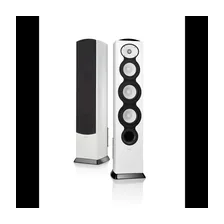 #10 Revel F226Be: $7700 per pair Crutchfield eBay
Older model: the Revel F206 (ranked lower, rated 4.5/5).
Pros: Compact three-way tower with a beryllium dome tweeter in an acoustic lens waveguide, a dedicated 5.25” mid-range, and dual 6.5” woofers (not a coaxial layout): all Deep Ceramic Composite aluminum cones engineered specifically to avoid breakup outside their crossover bands, and it measures that way: neither the woofers nor the mid-range show breakup spikes even well outside their intended pass bands, and even the front port measures unusually clean (only a mild ~3dB bump around 150Hz, well controlled versus the resonances the reviewer typically sees from ports). On-axis frequency response holds within about ±1.5dB above roughly 65Hz (excellent linearity) and off-axis behavior tracks it closely, with only mild, subdued peaking around 4-6kHz that doesn’t show up as real resonance in the spinorama data. Average sensitivity around 90dB (2.83V/1m), notably higher than some competing three-way designs and most bookshelf speakers, translating directly into better dynamic range at both low and high listening levels: one reviewer specifically praised its ability to deliver full transient impact (snare hits, kick drum) even at quiet, conversational volumes rather than needing to be cranked up to feel dynamic. Wide, consistent horizontal radiation of about ±60-70° at the -6dB point, landing right in the reviewer’s preferred range for an enveloping soundstage without excess diffusion, and exceptionally wide vertical dispersion: roughly ±80° up to 10kHz and still ±70° above that, which one reviewer called the widest vertical radiation pattern he had measured to date. Distortion stays under 3% even at 104dB SPL, and in real-world testing up to 105dB from 12-14 feet away, full-range with no crossover, the reviewer heard no audible mechanical noise, port chuffing, or compression at all. Flat enough on- and off-axis response that toeing the speaker 10-15° away from the listener preserves the same tonal balance rather than changing it, and the wide, well-controlled directivity lets sidewall reflections reinforce rather than smear the soundstage. Measured bass extension of 56Hz (-3dB), with a measured sensitivity of 89.7dB.
Cons: Minimum impedance dips to about 3.7-4 ohms below roughly 500Hz despite the 8-ohm nominal rating, so it wants a genuine 4-ohm-capable two-channel amplifier; budget AVRs rated only for 6 or 8 ohms may struggle. F3 of 56Hz and F10 of 36Hz mean it doesn’t extend nearly as low as some three-way rivals with larger woofers: a dedicated subwoofer (10-12”, or 15” for content below 30Hz) is recommended for home theater or bass-heavy music, even though the speaker itself can play surprisingly loud without one. Vertical directivity tolerance is tighter in the crossover handoff region than a true coaxial design would offer, since the tweeter, midrange, and woofers are physically separated: a mild directivity bump appears around 2-2.5kHz that’s typical of non-coaxial multi-way speakers, though not audibly problematic within about ±10° vertically. On-axis, the top end reads as a bit bright according to one reviewer’s subjective impression, generally benefiting from some toe-out. High-gloss cabinet finish can create distracting reflections if used behind a projector screen in a home theater setup. Front-ported, so it can technically sit close to a wall, but doing so makes the bass boomier.
Full Revel F226Be review and specifications →
| Bass Extension (-10dB) | 36Hz (measured, Erin’s Audio Corner) |
|---|---|
| Bass Extension (-3dB) | 56Hz (measured, Erin’s Audio Corner) |
| DIY Kit | No |
| Dimensions | 41.3”H x 9.8”W x 13.7”D (1049 x 248.9 x 348 mm) |
| Drivers | Two 6.5” (165mm) Deep Ceramic Composite aluminum cones, with cast frames woofer, 5-1/4” (130mm) Deep Ceramic Composite aluminum cone, with cast frame midrange, 1” (25mm) Beryllium dome, with acoustic lens waveguide tweeter |
| Impedance | 8 ohms nominal (3.7 ohms minimum, measured, Erin’s Audio Corner) |
| Sensitivity | 89.7dB (measured, Erin’s Audio Corner) |
| Spinorama Preference Score | 5.96 (spinorama.org) |
| Spinorama Preference Score with Perfect Sub | 8.15 (spinorama.org) |
| Weight | 58.2 lbs (26.4 kg) each |
| Woofer Cabinet | ported, front |
- Links
- Reviews, Comparisons and Sound Samples
- Erin’s Audio Corner: Revel PerformaBe F226Be Floorstanding Loudspeaker Review. I love this speaker. More from Erin’s Audio Corner →
- Erin’s Audio Corner: Should You Buy the Revel F226Be or the MoFi 888?
- Erin’s Audio Review Website Revel F226B
- Erin’s Audio Corner: My Top 5 Speakers at Any Price
- Erin’s Audio Corner Measurements (spinorama.org)
- Head-to-Head Comparisons
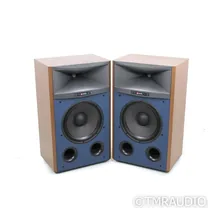 #11 JBL 4367: $16,500 per pair Discontinued eBay
Newer model: the JBL 4369. It’s likely to perform similarly, though we don’t have measurements to confirm that yet.
Pros: Three-way design pairing a 15” front-ported woofer with a compression driver on a controlled-dispersion horn/waveguide, crossed over at 700Hz. On-axis frequency response is nearly dead flat, holding within about ±1.5dB, with the listening window tracking it closely except right at the crossover. Distortion stays below 1% THD across the entire audible band at both 86dB and 96dB. Compression/dynamic-range linearity is exceptional: within about a quarter of a dB from 76dB to 102dB, among the best the reviewer has measured. High sensitivity (about 92.6dB average) eases the amplifier match despite the speaker’s size. Minimal rear radiation thanks to the 15” woofer’s directivity and front-firing ports: rear energy runs about 20dB down from the primary wavefront, giving it a near-cardioid radiation pattern. Well-controlled horn directivity keeps the soundstage from noticeably shifting in width across the 700Hz crossover region. A natural high-frequency rolloff above about 7-8kHz gives it an easy, non-fatiguing character for extended listening sessions. Measured bass extension of 43Hz (-3dB), with a measured sensitivity of 92.5dB.
Cons: At roughly $16500/pair, this is a major investment: the reviewer recommends buying from a dealer with a liberal return policy. Vertical response shows dips beyond about ±10-20°, with a larger null further out: an inherent trade-off of mating a 15” woofer to a horn compression driver at a 700Hz crossover, since crossing lower would hurt power handling and dynamic range. Horizontal directivity isn’t perfectly consistent with frequency: narrow (about ±20°) through 200-800Hz, briefly widening to near ±50° above the crossover, then narrowing again at high frequency. An unusual, non-constant pattern. The high-frequency rolloff that gives it an easy-listening character also reduces the sense of air and space in the soundstage when listening from off-center seats. Massive and heavy (about 120 lbs, roughly 36-37” tall): needs to be raised on a stand to bring the horn to ear level, and isn’t something one person easily moves alone. Only modest EQ adjustment is available on the speaker itself (about ±1-2dB bass/treble trim). Discontinued.
Full JBL 4367 review and specifications →
| Bass Extension (-10dB) | 31Hz (measured, Erin’s Audio Corner) |
|---|---|
| Bass Extension (-3dB) | 43Hz (measured, Erin’s Audio Corner) |
| DIY Kit | No |
| Dimensions | 37.2”H x 22.2”W x 16.8”D (944.9 x 563.9 x 426.7 mm) |
| Drivers | 15” (380mm) 2216Nd-1 Dual Differential Drive® woofer, 3” (75mm) D2430K dual compression tweeter |
| Impedance | 4 ohms nominal (5.3 ohms minimum above 80Hz, measured by Erin’s Audio Corner) |
| Sensitivity | 92.5dB (measured average, Erin’s Audio Corner) |
| Spinorama Preference Score | 5.07 |
| Spinorama Preference Score with Perfect Sub | 6.88 |
| Weight | 119 lbs (54 kg) each |
| Woofer Cabinet | ported, front |
- Links
- Reviews, Comparisons and Sound Samples
- Head-to-Head Comparisons
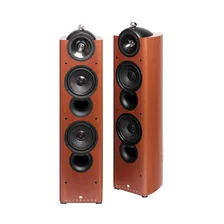 #12 KEF Reference 203: $5,000 per pair Discontinued eBay
Newer model: the KEF Reference 3 Meta, ranked lower, rated 4.6/5.
Pros: An unusually accomplished 4-way design for its era: excellent on-axis linearity (within about +/-3dB), genuinely good directivity both horizontally (~55 degrees) and vertically (~40-50 degrees), and an estimated in-room response that closely matches what the reviewer actually heard. Distortion is excellent: under 1% harmonic above 80Hz at both 86dB and 96dB, and multitone stays around 1% even at 96dB. Bass reaches a real F3 of 51Hz (F10 37Hz), with in-room extension into the low-mid-40s. The reviewer’s overall listening notes were essentially “nothing stood out bad or good”: a genuinely neutral, accurate speaker with a distinctive rounded-baffle look that avoids the diffraction issues a flat baffle this wide would normally have. Measured bass extension of 51Hz (-3dB), with a measured sensitivity of 88dB.
Cons: This is a 20+ year old, long-discontinued speaker only findable secondhand (Facebook Marketplace, Craigslist, audio forums): condition, driver matching, and component aging vary by unit, so audition before buying if at all possible. Demands a robust amplifier: impedance dips to about 3.6 ohms with an EPDR of 2.2 ohms. The small supertweeter shows minor breakup artifacts at the extremes of the vertical polar plot and some compression at very high output in the top octave, though neither was audible in normal listening.
Full KEF Reference 203 review and specifications →
| Bass Extension (-10dB) | 37Hz (measured, Erin’s Audio Corner) |
|---|---|
| Bass Extension (-3dB) | 51Hz (measured, Erin’s Audio Corner) |
| Crossover Frequency | 400Hz, 2.7kHz, 15kHz |
| DIY Kit | No |
| Dimensions | 42”H (1067H mm) |
| Drivers | 1x 0.75” supertweeter, coaxial 1” dome tweeter + 6.5” midrange, 2x 6.5” woofers |
| Frequency Response | 55Hz - 55kHz ±3dB (Manufacturer specified) |
| Impedance | 8 ohms nominal (3.6 ohms minimum, measured, Erin’s Audio Corner; 3.2 ohms per manufacturer spec) |
| Recommended Power | 50-200W |
| Sensitivity | 88dB (2.83V/1m, measured by Erin’s Audio Corner) |
| Spinorama Preference Score | 5.83 |
| Spinorama Preference Score with Perfect Sub | 7.84 |
| Weight | 58 lbs (26.3 kg) |
| Woofer Cabinet | Bass reflex, with switchable flat/cut/lifted bass ports for wall placement |
- Links
- Reviews, Comparisons and Sound Samples
- Head-to-Head Comparisons
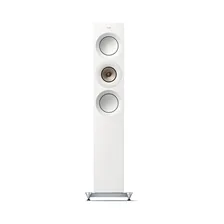 #13 KEF Reference 3 Meta: $15,999.98 per pair KEF eBay
Older model: the KEF Reference 203 (ranked higher, rated 4.6/5).
Pros: Three-way bass reflex tower built around KEF’s 12th generation Uni-Q driver, a 125mm aluminium midrange with a 25mm aluminium dome tweeter and MAT at its centre, plus two 165mm aluminium woofers. KEF’s own Spinorama measurements, published on spinorama.org, hold the 300Hz to 5kHz response within 1.4dB, one of the flattest results in this category, and the listening window is very smooth (0.90), so tonal balance stays even across a normal seating area. Measured bass reaches 42Hz (-3dB) and about 31Hz (-10dB), deep enough that many rooms won’t need a subwoofer for music. Measured bass extension of 42.2Hz (-3dB).
Cons: The only measurements are KEF’s own, not independently verified, and spinorama.org computes no preference score for them. Sound power directivity is good but not class leading (3.15dB index deviation). Sensitivity is a moderate 86dB and impedance drops to 3.2 ohms, so it needs a capable amplifier (KEF recommends 50 to 300W).
Full KEF Reference 3 Meta review and specifications →
| Bass Extension (-10dB) | about 31.1Hz (measured, KEF vendor data via spinorama.org) |
|---|---|
| Bass Extension (-3dB) | 42.2Hz (measured, KEF vendor data via spinorama.org) |
| Country | United Kingdom |
| Crossover Frequency | 450Hz, 2.1kHz |
| Dimensions | 45.5”H x 8.1”W x 18.2”D (1155 x 205 x 462 mm) |
| Drivers | Uni-Q: 125mm aluminium cone midrange, 25mm aluminium dome tweeter with MAT; 2x 165mm aluminium cone woofers |
| Frequency Response | 43Hz-35kHz ±3dB (manufacturer specified) |
| Impedance | 4 ohms nominal, 3.2 ohms minimum (manufacturer specified) |
| Maximum SPL | 113.5dB (manufacturer specified) |
| Recommended Power | 50-300W |
| Sensitivity | 86dB (2.83V/1m, manufacturer specified) |
| Woofer Cabinet | ported |
- Links
- Reviews, Comparisons and Sound Samples
- Head-to-Head Comparisons
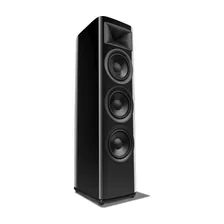 #14 JBL HDI-3800: $5,000 per pair Discontinued eBay
Pros: 2410H-2 1” Teonex compression driver matched to a custom High-Definition Imaging (HDI) horn geometry achieves exceptional horizontal directivity control, high output capability, and effortless transient response. Triple 8” Advanced Aluminum Matrix woofers deliver deep, authoritative bass extension down to an F3 of 37Hz and F10 of 28Hz with minimal low-frequency compression. Outstanding sensitivity (92dB SPL at 2.83V/1m) and ultra-low THD/multitone distortion allow extremely high undistorted SPL output in large home theater spaces. Measured bass extension of 37Hz (-3dB), with a measured sensitivity of 92dB.
Cons: On-axis frequency response features a narrow upper-frequency elevation around 8-10kHz, performing noticeably smoother when toed out 10-20° off-axis. Vertical directivity handoff across the triple woofer layout creates vertical soundstage height tilt depending on listening distance and ear height. Minimum impedance dips to 3.8 ohms, requiring high-current amplifier stability. Substantial cabinet dimensions and 38kg weight require significant room real estate. Discontinued.
Full JBL HDI-3800 review and specifications →
| Bass Extension (-10dB) | 28Hz (measured, Erin’s Audio Corner) |
|---|---|
| Bass Extension (-3dB) | 37Hz (measured, Erin’s Audio Corner) |
| DIY Kit | No |
| Dimensions | 43.3”H x 11.8”W x 16.4”D (1100.5 x 300.0 x 417.8 mm) |
| Drivers | 1 in. 2410H-2 Teonex compression driver with HDI horn, triple 8 in. Advanced Aluminum Matrix cone woofers |
| Impedance | 4 ohms nominal (3.8 ohms minimum, measured by Erin’s Audio Corner) |
| Sensitivity | 92dB (measured average, Erin’s Audio Corner) |
| Spinorama Preference Score | 5.62 |
| Spinorama Preference Score with Perfect Sub | 7.03 |
| Weight | 83.8 lbs (38.0 kg) each |
| Woofer Cabinet | ported, rear |
- Links
- Reviews, Comparisons and Sound Samples
- Head-to-Head Comparisons
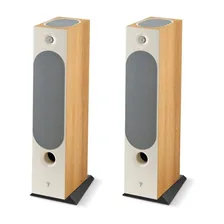 #15 Focal Chora 816: $900 per pair used Discontinued eBay
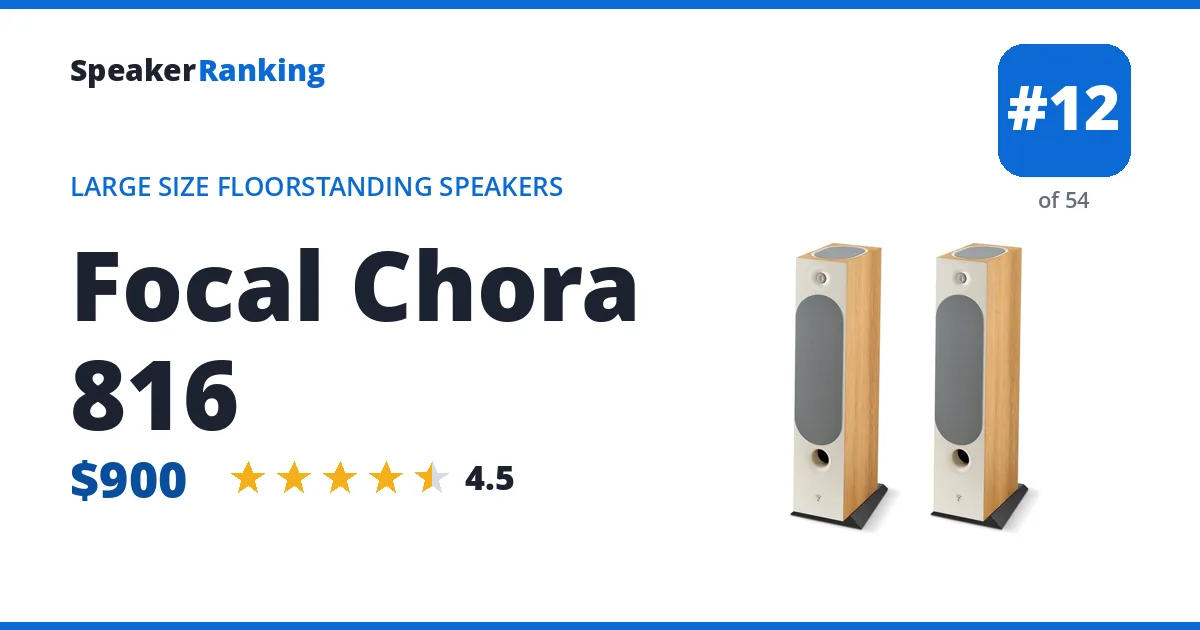
Newer model: the Focal Theva N°2. It’s likely to perform similarly, though we don’t have measurements to confirm that yet.
Pros: CEA2034 spinorama shows a generally even on-axis response with nice bass extension and high sensitivity. Predicted in-room response is very good aside from a peak around 8kHz. Horizontal beamwidth of about ±60 degrees is typical and fairly controlled. Distortion is very low at 86dB SPL/1m and still usable at 96dB SPL/1m. Measured bass extension of 60Hz (-3dB), with a measured sensitivity of 91dB.
Cons: Some messiness appears between 500Hz-2kHz on-axis, including a dip around 550Hz. Vertical directivity narrows a little, so listening height matters more than with a coincident design. Cumulative spectral decay (waterfall) shows a fair bit of resonances lingering across the midrange. Distortion rises substantially in the 1-2kHz region at 96dB SPL/1m. Minimum impedance dips to about 3.9 ohms. Discontinued.
Full Focal Chora 816 review and specifications →
| Bass Extension (-10dB) | 35Hz (measured, Audio Science Review) |
|---|---|
| Bass Extension (-3dB) | 60Hz (measured, Audio Science Review) |
| DIY Kit | No |
| Dimensions | 40.7”H x 11.8”W x 15.3”D (1033.8 x 299.7 x 388.6 mm) |
| Drivers | 6.5” (16.5cm) Slatefiber woofer, 6.5” (16.5cm) Slatefiber midrange, 1” (25mm) TNF Al/Mg inverted dome tweeter |
| Impedance | 8 ohms nominal (3.9 ohms minimum, measured, Audio Science Review) |
| Sensitivity | 91dB (measured, Audio Science Review) |
| Spinorama Preference Score | 4.30 |
| Spinorama Preference Score with Perfect Sub | 6.37 |
| Weight | 40.8 lbs (18.5 kg) each |
| Woofer Cabinet | ported, front |
- Links
- Reviews, Comparisons and Sound Samples
- Head-to-Head Comparisons
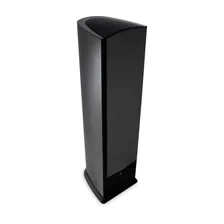 #16 Revel F208: $4,800 per pair used Discontinued eBay
Newer model: the Revel F228Be, ranked lower, rated 4.5/5.
Pros: CEA2034 spinorama shows a fairly even on-axis response with sensitivity matching spec at ~87-88dB. Predicted in-room response is a smooth, textbook-quality downward slope that should translate well to most rooms without correction. Early reflections sum so cleanly with the direct sound that side-wall absorption isn’t recommended: it would work against the speaker’s naturally well-integrated off-axis behavior. Distortion stays below 0.5% from 100Hz up at 96dB/1m, with all distortion components falling below audible threshold above 200Hz. Very wide horizontal directivity of about ±75 degrees. Measured performance was judged very close to Revel’s own flagship Salon2, and Revel’s speakers (including this one) are developed using Harman’s double-blind listening test methodology. Preference score of 7.4 (7.7 with a subwoofer added). Measured bass extension of 47Hz (-3dB), with a measured sensitivity of 88.2dB.
Cons: Some directivity error and tweeter-response ripple right at the 2.2kHz crossover point. A notable on-axis dip at about 4kHz, attributed to probable cabinet diffraction. Cumulative spectral decay (waterfall) shows an unexplained resonance around 4-5kHz that the reviewer couldn’t pin down a clear cause for. Vertical directivity shows narrowband interference nulls just above and below the tweeter axis (roughly 2-3kHz), typical of a non-coaxial tower with vertically separated drivers, so listening height matters more than it would with a coincident design. Minimum impedance dips to 3.4 ohms, calling for a robust, high-current amplifier. Distortion climbs substantially below about 80-100Hz (up to ~5% in the deep bass) when driven hard, an excursion-limited trade-off typical of towers at high output. Isolating the woofers alone shows their usable range ending around 500-700Hz at the crossover, with somewhat elevated (though still low in absolute terms) 2nd/3rd harmonic distortion in the 100-300Hz region. Discontinued.
Full Revel F208 review and specifications →
| Bass Extension (-10dB) | 24Hz (measured, Audio Science Review) |
|---|---|
| Bass Extension (-3dB) | 47Hz (measured, Audio Science Review) |
| DIY Kit | No |
| Dimensions | 46.6”H x 13.5”W x 14.8”D (1183.6 x 342.9 x 375.9 mm) |
| Drivers | Dual 8” (20 cm) Aluminum Cone, Cast-frame Woofers, 5.25” (13.3 cm) Aluminum Cone, Cast-frame Midrange, 1” (2.5 cm) Aluminum Tweeter with Acoustic Lens Waveguide |
| Impedance | 8 ohms nominal, 3.5 ohms minimum (measured, Audio Science Review) |
| Sensitivity | 88.2dB (measured by Audio Science Review; 88.5dB manufacturer specified) |
| Spinorama Preference Score | 6.35 |
| Spinorama Preference Score with Perfect Sub | 7.67 |
| Weight | 79.4 lbs (36 kg) each |
| Woofer Cabinet | ported, front |
- Links
- Reviews, Comparisons and Sound Samples
- Head-to-Head Comparisons
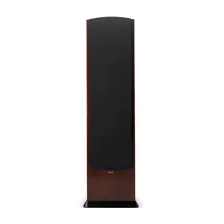 #17 Revel F228Be: $9,000 per pair Crutchfield eBay
Older model: the Revel F208 (ranked higher, rated 4.5/5).
Pros: CEA2034 spinorama shows an essentially flat on-axis response with very nice directivity. Predicted in-room response is nearly perfect, with a smooth slope down from bass to treble. Horizontal beamwidth of about ±70 degrees is wide and holds up well until narrowing above 8kHz. Vertical directivity offers more degrees of listening-height freedom than a typical bookshelf design, a benefit of this tower’s driver layout. Distortion is extremely low across the full audio range at 86dB SPL/1m and stays comfortable even at 96dB SPL/1m. Near-field measurements of the individual drivers show nice, well-integrated crossover behavior with only low-level resonances. Measured bass extension of 61Hz (-3dB), with a measured sensitivity of 89.3dB.
Cons: Minimum impedance dips to 3.4 ohms with a secondary rise around 2kHz, calling for an amplifier comfortable with a demanding load. Very expensive and very heavy (51 kg each).
Full Revel F228Be review and specifications →
| Bass Extension (-10dB) | 25Hz (measured, Audio Science Review) |
|---|---|
| Bass Extension (-3dB) | 61Hz (measured, Audio Science Review) |
| DIY Kit | No |
| Dimensions | 50.9”H x 13.5”W x 17.6”D (1292.9 x 342.9 x 447 mm) |
| Drivers | Dual 8” (200mm) Deep Ceramic Composite aluminum cones, with cast frames woofers, 5-1/4” (130mm) Deep Ceramic Composite aluminum cone, with cast frame midrange, 1” (25mm) Beryllium dome, with acoustic lens waveguide tweeter |
| Impedance | 8 ohms |
| Sensitivity | 89.3dB (300Hz-3kHz @ 2.83V/1m, measured by Audio Science Review; 90dB manufacturer specified) |
| Spinorama Preference Score | 6.01 |
| Spinorama Preference Score with Perfect Sub | 7.51 |
| Weight | 112.4 lbs (51 kg) each |
| Woofer Cabinet | ported, front |
- Links
- Reviews, Comparisons and Sound Samples
- Head-to-Head Comparisons
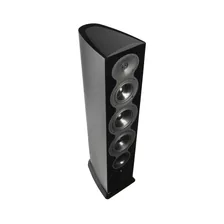 #18 Revel F206: $2,000 per pair used Discontinued eBay
Newer model: the Revel F226Be, ranked higher, rated 4.6/5.
Pros: CEA2034 spinorama shows a pretty even on-axis response. Predicted in-room response is excellent, with a smooth downward slope. Horizontal beamwidth of about ±65 degrees is wide, if a bit uneven. Distortion is very nice at 86dB SPL/1m, falling below the frequency range where human hearing is most sensitive, and stays excellent even at 96dB SPL/1m. Near-field measurements of the individual drivers show nice suppression of port and woofer resonances. Really amazing value for the performance. Measured bass extension of 60Hz (-3dB), with a measured sensitivity of 87dB.
Cons: Some directivity error and a small peak around 4.5kHz show up alongside the directivity error around 3kHz. Vertical directivity means listening position needs to stay within the tweeter axis, though the reviewer notes there is some leeway. Minimum impedance dips to 3.3 ohms, calling for an amplifier comfortable with a demanding load. Discontinued.
Full Revel F206 review and specifications →
| Bass Extension (-10dB) | 34Hz (measured, Audio Science Review) |
|---|---|
| Bass Extension (-3dB) | 60Hz (measured, Audio Science Review) |
| DIY Kit | No |
| Dimensions | 40.3”H x 8.4”W x 12.2”D (1023.6 x 213.4 x 309.9 mm) |
| Drivers | Dual 6.5” (16.5 cm) Aluminum Cone, Cast-frame Woofers, 5.25” (13.3 cm) Aluminum Cone, Cast-frame Midrange, 1” (2.5 cm) Aluminum Tweeter with Acoustic Lens Waveguide |
| Impedance | 4 ohms nominal (3.3 ohms minimum, measured by Audio Science Review) |
| Sensitivity | 87dB (measured, Audio Science Review) |
| Spinorama Preference Score | 5.51 |
| Spinorama Preference Score with Perfect Sub | 7.52 |
| Weight | 57.3 lbs (26 kg) each |
| Woofer Cabinet | ported, front |
- Links
- Reviews, Comparisons and Sound Samples
- Head-to-Head Comparisons
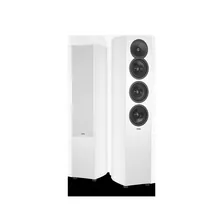 #19 Revel Concerta2 F35: $900 per pair Crutchfield eBay
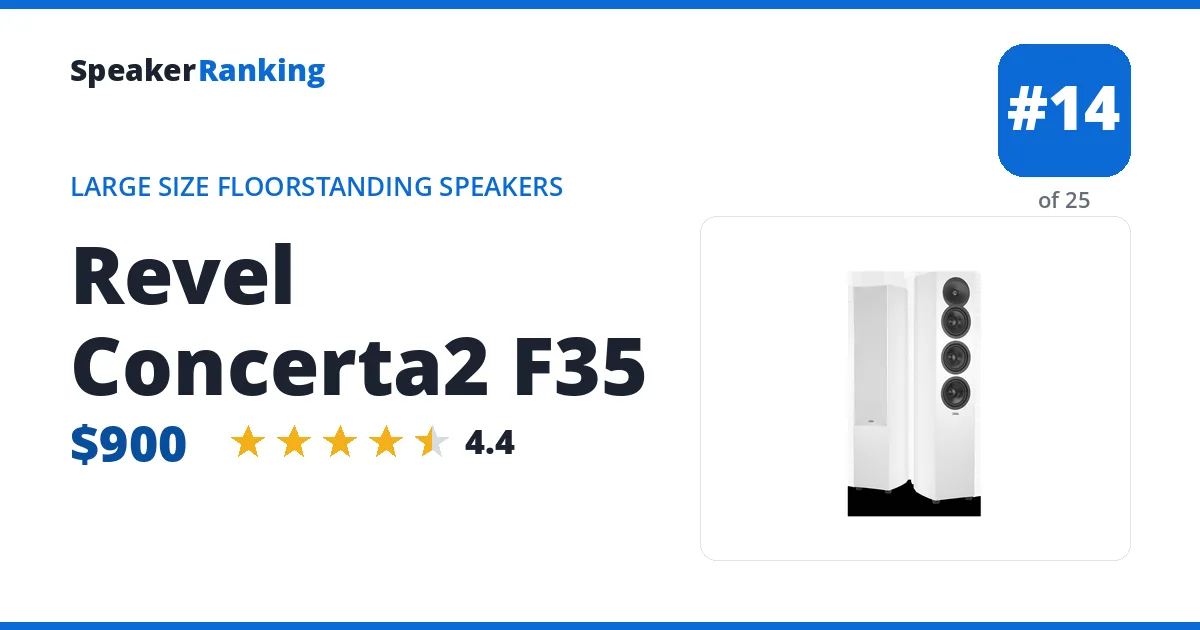
Pros: Two-and-a-half-way, four-driver design: a 1” aluminum dome tweeter on a waveguide, a 5.25” mid-range, and dual 5.25” mid-bass drivers in a rear-ported cabinet. Measured sensitivity of 89.4dB closely matches the 90dB spec, and distortion looks good at both 86dB and 96dB, holding up well even with a high-pass filter applied. At its sale price of $900/pair, down from full retail, the reviewer calls it a “no-brainer,” undercutting comparable budget floorstanders like the ELAC DF63. Frequency response and directivity mismatches are largely EQ-able, since most of what shows up in measurements traces to physical tweeter/mid-range separation rather than a fundamental flaw. Compression is fairly well controlled for the price: about 1dB of loss around 100Hz under long-term compression, described as “par for the course” at this cost. Measured bass extension of 70Hz (-3dB), with a measured sensitivity of 89.4dB.
Cons: F3 of 61Hz and F10 of 39Hz mean a subwoofer is needed for real bass extension. A dip in the lower midrange/2-3kHz region reduces attack and detail, and a peak around 5kHz adds some edge and sibilance in the lower treble. A peak in off-axis energy around 3kHz reflects off sidewalls at roughly 60-70° off-axis and arrives louder than the direct sound: this specific issue can’t be fixed with EQ (boosting the direct sound would boost the stronger reflection too) and would need acoustic absorption to properly address, though the reviewer considers it a minor, optional fix at this price. A couple of minor resonances appear in the impedance plot, including one around 300Hz that may partly explain a subtle sense of vocal warmth noticed in listening, though it’s more likely room-related. Minimum impedance around 3.8 ohms. Short-term compression testing shows some increased distortion in the tweeter and higher-frequency compression at loud output.
Full Revel Concerta2 F35 review and specifications →
| Bass Extension (-10dB) | 50Hz (measured, Erin’s Audio Corner) |
|---|---|
| Bass Extension (-3dB) | 70Hz (measured, Erin’s Audio Corner) |
| DIY Kit | No |
| Dimensions | 40.3”H x 8.4”W x 12.2”D (1023.6 x 213.4 x 309.9 mm) |
| Drivers | 3x 5.25” deep anodized aluminum cone woofers, 1” Aluminum Tweeter |
| Impedance | 6 ohms nominal (3.8 ohms minimum, measured by Erin’s Audio Corner) |
| Sensitivity | 89.4dB (measured, Erin’s Audio Corner; 90dB manufacturer specified) |
| Spinorama Preference Score | 5.35 |
| Spinorama Preference Score with Perfect Sub | 7.30 |
| Weight | 41 lbs (18.6 kg) each |
| Woofer Cabinet | ported, rear |
- Links
- Reviews, Comparisons and Sound Samples
- Audio Science Review Revel Concerta2 F35 More from Audio Science Review →
- Erin’s Audio Corner: Revel F35 Review: Great Sound, Lower Price! More from Erin’s Audio Corner →
- Erin’s Audio Review Website Revel Concerta2 F35
- Audio Science Review Measurements (spinorama.org)
- Erin’s Audio Corner: You’ve Never Seen a Review Like This. Revel F35 Review (Part 1).
- Head-to-Head Comparisons
- Revel Concerta2 F35 vs Revel F206
- Revel Concerta2 F35 vs Perlisten S7t
- Revel Concerta2 F35 vs Revel F228Be
- Revel Concerta2 F35 vs Revel F208
- Revel Concerta2 F35 vs KEF R5
- Revel Concerta2 F35 vs Focal Chora 816
- Revel Concerta2 F35 vs JBL HDI-3800
- Revel Concerta2 F35 vs KEF R11 Meta
- See all 57 comparisons
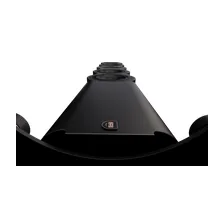 #20 Perlisten S7t: $21,990 per pair The Music Room eBay
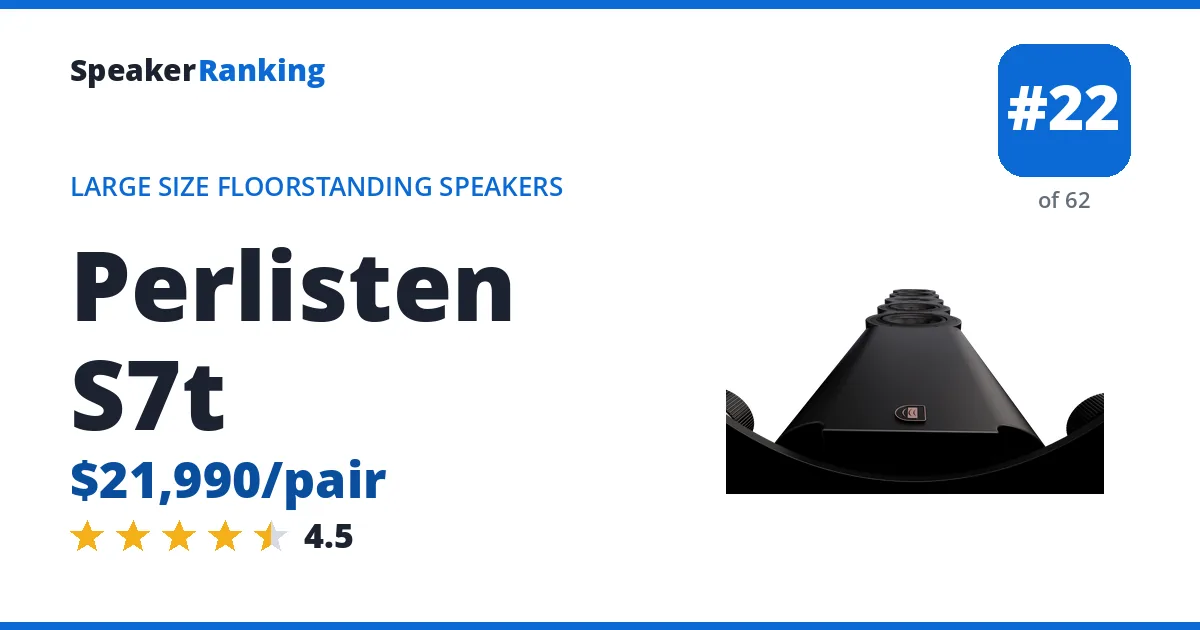
Pros: Measures a genuine -3dB extension point of 56.4Hz and a Harman-style -6dB in-room extension of 45Hz, with a strong 0.80 listening-window smoothness score and a mild, slightly warm on-axis tonal tilt (-0.13dB per octave) rather than a bright or forward balance. It was the first speaker in Perlisten’s S-Series to earn THX Dominus certification, and independent reviewers took notice: Audioholics called it one of the finest loudspeakers it has ever reviewed, with Stereophile, Hi-Fi News and The Absolute Sound all adding favorable coverage. Measured bass extension of 22Hz (-10dB).
Cons: On-axis deviation of 0.178dB and a directivity-index standard deviation of 3.16 are solid without being exceptional, and a bass-alignment Q of 3.41 suggests a somewhat resonant, less tightly damped low-frequency rolloff. Pricing runs $19,990 to $23,990/pair depending on finish and dealer, since Perlisten has no fixed published price and sells only through specialty AV dealers rather than mainstream retail.
Full Perlisten S7t review and specifications →
| Bass Extension (-10dB) | 22Hz (bass reflex) / 32Hz (acoustic suspension) |
|---|---|
| Bass Extension (-3dB) | 56.4Hz (manufacturer spinorama data) |
| Certification | THX Dominus |
| Country | Designed in the United States (Verona, Wisconsin) |
| DIY Kit | No |
| Dimensions | 51”H x 9.4”W x 15.7”D (1295 x 240 x 400 mm) |
| Drivers | 28mm beryllium dome tweeter, 2x 28mm Textreme TPCD dome midranges, 4x 180mm (7”) Textreme TPCD woofers |
| Enclosure | 4-way, switchable bass reflex / acoustic suspension |
| Frequency Response | 80Hz-20kHz +/-1.5dB |
| Impedance | 4 ohms nominal, 3.2 ohms minimum |
| Maximum SPL | 117dB peak (manufacturer specified) |
| Power Handling | 100-600W RMS recommended amplifier power |
| Sensitivity | 92.2dB @ 2.83V/1m |
| Spinorama Preference Score | 6.58 |
| Spinorama Preference Score with Perfect Sub | 8.72 |
| Warranty | 5 years, extendable to 6 with product registration |
| Weight | 122.8 lbs (55.7 kg) each |
- Links
- Reviews, Comparisons and Sound Samples
- Head-to-Head Comparisons
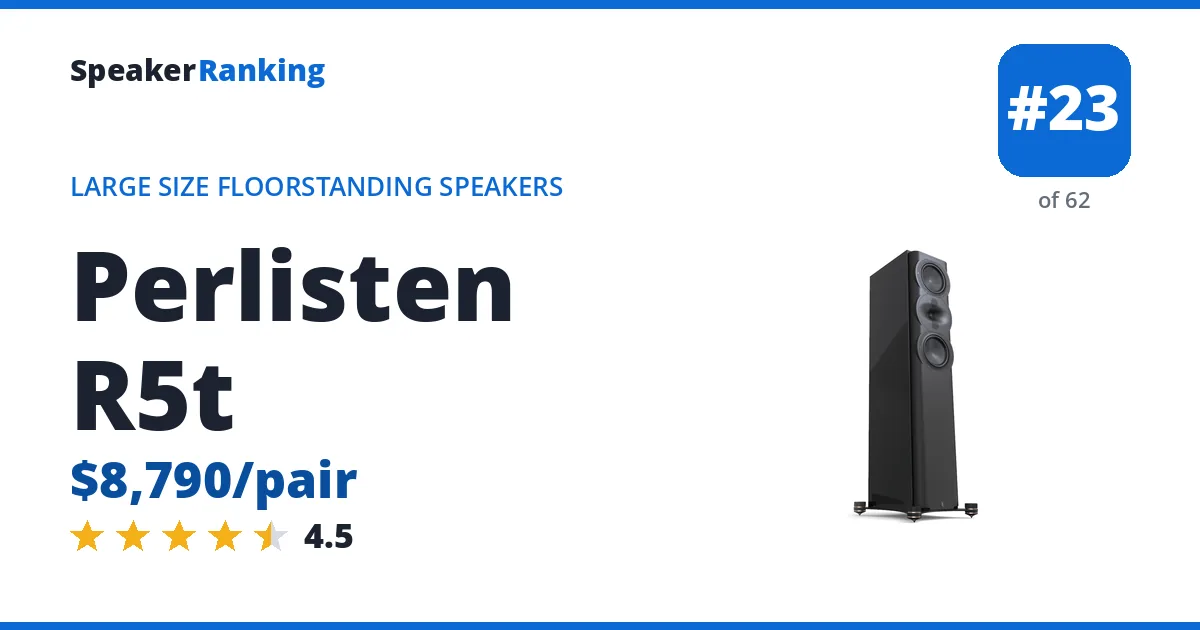
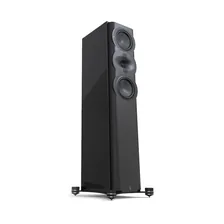 #21 Perlisten R5t: $8,790 per pair Audio Advice eBay
Pros: Measures a -3dB extension point of 44.6Hz and a Harman-style -6dB in-room extension (lfx) of 29Hz, deep for a mid-size tower, with a strong 0.82 listening-window smoothness score and a predicted in-room smoothness of 0.63. THX Dominus and THX Ultra certified at a fraction of Perlisten’s S7t flagship price, and reviewers across Sound & Vision, Audiograde, SoundStage Ultra and HiFiReport all rated it highly for its class, with Audiograde naming it a Best of 2023 pick. Measured bass extension of 24Hz (-10dB).
Cons: On-axis deviation of 0.277dB and a pronounced -0.28dB per octave downward slope point to a warmer, less forward tonal balance, consistent with Sound & Vision’s review finding it leans analytical rather than warm and wanting more air in larger rooms. It’s sold only in Piano Black through specialty AV dealers, with per-unit pricing that varies noticeably by retailer.
Full Perlisten R5t review and specifications →
| Bass Extension (-10dB) | 24Hz (bass reflex) / 38Hz (acoustic suspension) |
|---|---|
| Bass Extension (-3dB) | 44.6Hz (manufacturer spinorama data) |
| Certification | THX Dominus, THX Ultra |
| Country | Designed in the United States (Verona, Wisconsin) |
| DIY Kit | No |
| Dimensions | 43.3”H x 9.1”W x 13.8”D (1100 x 230 x 350 mm) |
| Drivers | 3x 26mm silk dome (tweeter + 2 midrange), 2x 165mm (6.5”) HPF woofers |
| Enclosure | 3-way, switchable bass reflex / acoustic suspension |
| Frequency Response | 80Hz-20kHz +/-1.5dB |
| Impedance | 4 ohms nominal, 3.2 ohms minimum |
| Maximum SPL | 113.0dB peak (manufacturer specified) |
| Power Handling | 100-250W RMS recommended amplifier power |
| Sensitivity | 89.0dB @ 2.83V/1m |
| Spinorama Preference Score | 7.16 |
| Spinorama Preference Score with Perfect Sub | 8.50 |
| Warranty | 5 years, extendable to 6 with product registration |
| Weight | 58.4 lbs (26.5 kg) each |
- Links
- Reviews, Comparisons and Sound Samples
- Head-to-Head Comparisons
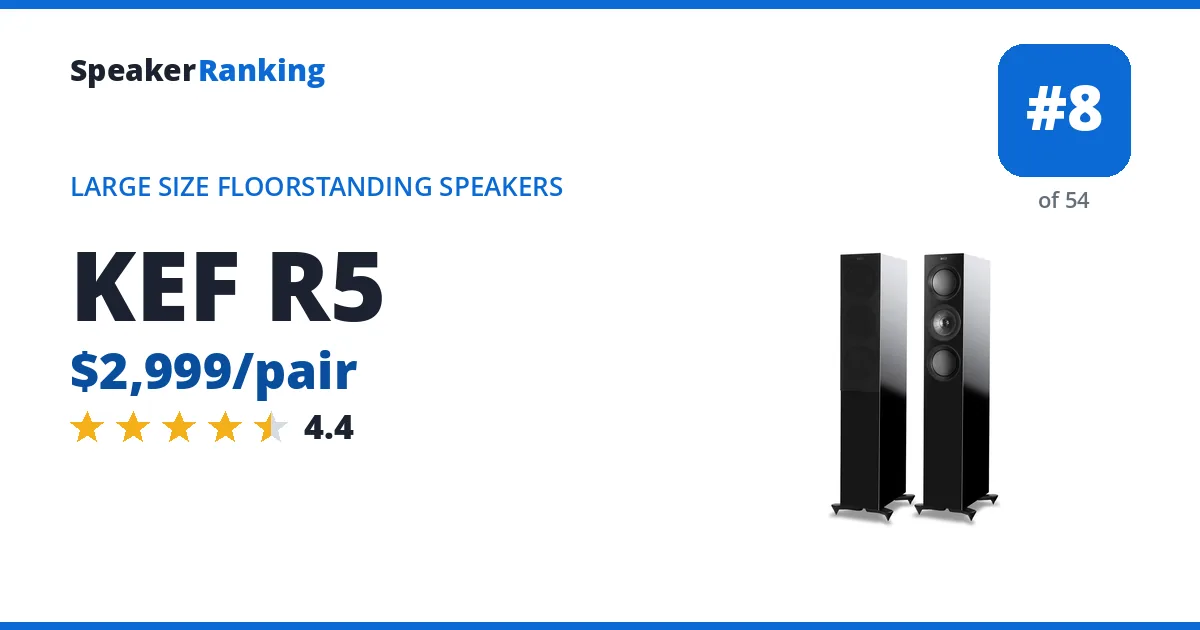
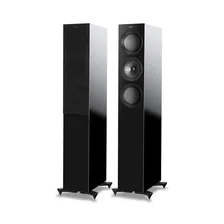 #22 KEF R5: $2,999 per pair Discontinued eBay
Pros: Slim three-way tower with the acoustic advantages of KEF’s coincident Uni-Q midrange/tweeter: horizontal and vertical off-axis responses track the direct sound smoothly, producing stable imaging and a well-behaved directivity index. Erin measured deep low-frequency reach for the cabinet width (77Hz F3 but 33Hz F10) and less than 1% harmonic distortion at 86dB. At 96dB it remains clean when high-passed, and its mild response deviations are suitable for equalization because the radiation pattern stays orderly. Measured bass extension of 77Hz (-3dB), with a measured sensitivity of 86dB.
Cons: The unusual gap between 77Hz F3 and 33Hz F10 indicates a gradual bass contour rather than flat deep-bass output; a subwoofer and roughly 80Hz high-pass are recommended for high-level playback. Erin measured a minimum near 3.5 ohms around 150Hz, although most of the curve remains above 4 ohms, so amplifier quality still matters. Sensitivity is approximately 86dB/2.83V/1m. At 102dB, compression reaches roughly 1dB around 150Hz, showing the limits of the twin 5.25-inch woofers. This original model lacks the Meta version’s MAT rear-wave absorption. Discontinued.
Full KEF R5 review and specifications →
| Bass Extension (-10dB) | 33Hz (measured, Erin’s Audio Corner) |
|---|---|
| Bass Extension (-3dB) | 77Hz (measured, Erin’s Audio Corner) |
| DIY Kit | No |
| Dimensions | 40.4”H x 6.9”W x 13.5”D |
| Drivers | 1” aluminum tweeter coaxial with 5” midrange; dual 5.25” woofers |
| Impedance | Approximately 3.5 ohms minimum near 150Hz (measured, Erin’s Audio Corner) |
| Sensitivity | Approximately 86dB/2.83V/1m (measured, Erin’s Audio Corner) |
| Spinorama Preference Score | 5.78 |
| Spinorama Preference Score with Perfect Sub | 7.40 |
| Weight | 59.5 lbs (27 kg) each |
| Woofer Cabinet | ported, rear |
- Links
- Reviews, Comparisons and Sound Samples
- Head-to-Head Comparisons
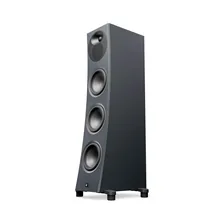 #23 Arendal Sound 1610 Tower 8: $7,600 per pair Arendal Sound eBay
Pros: Arendal’s flagship passive tower, a 5-driver 3-way design with a dedicated carbon-cone midrange in its own sealed sub-enclosure and triple 8” aluminum woofers, measuring a -3dB extension point of 42.8Hz (manufacturer measurement); Erin’s Audio Corner independently measured F3 at 41Hz and F10 at 27Hz, with sensitivity of about 88dB at 2.83V/1m. Listening-window smoothness of 0.687 is strong for a tower this size. Erin’s Audio Corner also measured about plus or minus 60 degrees of horizontal dispersion, a wide-but-focused soundstage the reviewer specifically liked, plus a roughly 2-3dB mid-bass bump around 80Hz that adds real punch and weight to kick drum and low male vocals versus flatter competitors, and lower multi-tone distortion in the higher frequencies than two similarly priced coaxial rivals tested alongside it. Measured bass extension of 27Hz (-10dB), with a measured sensitivity of 89.5dB.
Cons: At 45.4kg each and nearly 4 feet tall, it’s a serious room commitment, and sound-power smoothness (0.378) is more middling than the on-axis figures suggest. Directivity-index standard deviation of 3.69, on the higher side, and a -0.22dB per octave downward tilt both point to a moderately dark tonal character, and predicted in-room smoothness (0.45) is only middling. Erin’s Audio Corner found the same 80Hz mid-bass bump pulls the F3 higher than a flatter tuning would, so bass appears to roll off more sharply below that point, and content under about 40Hz will need a subwoofer. Because it’s a 3-way design with a vertical gap between the tweeter and midrange, there’s a lobing null around 3kHz that causes an audible suck-out just below the tweeter’s axis, worth noting for home theater rows with more than one seating height. A dip through the upper mid-range to lower treble crossover softens the bite of brass and other transient-heavy instruments compared to a flatter response.
Full Arendal Sound 1610 Tower 8 review and specifications →
| Bass Extension (-10dB) | 27Hz (measured, Erin’s Audio Corner) |
|---|---|
| Bass Extension (-3dB) | 41Hz (measured, Erin’s Audio Corner); 42.8Hz (manufacturer measurement) |
| Country | Norway (designed); manufactured overseas |
| DIY Kit | No |
| Dimensions | 115.0H x 26.5W x 45.0D cm (119.8cm tall with feet) |
| Drivers | 28mm Al-Mg dome tweeter, 5” carbon-cone midrange (sealed sub-enclosure), 3x 8” aluminum-cone woofers |
| Enclosure | 3-way, ported (optional sealed configuration) |
| Impedance | 4 ohms nominal |
| Sensitivity | 89.5dB @ 2.83V/1m (manufacturer); 88dB @ 2.83V/1m (measured, Erin’s Audio Corner) |
| Spinorama Preference Score | 7.03 |
| Spinorama Preference Score with Perfect Sub | 8.20 |
| Weight | 100 lbs (45.37 kg) each |
- Links
- Reviews, Comparisons and Sound Samples
- Head-to-Head Comparisons
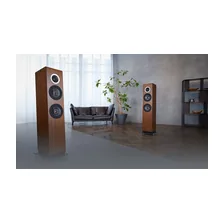 #24 TAD Evolution 2: $19,995 per pair House of Stereo eBay
Pros: Independently measured by ASR (not vendor-supplied data) with an excellent on-axis smoothness score of 0.182 and a nearly flat tonal balance (a slope of just -0.01dB per octave), from a beryllium tweeter on a cast-aluminum waveguide paired with dual MACC-diaphragm woofers. Alpha Audio’s review called it a “competition killer.”. Measured bass extension of 58.6Hz (-3dB).
Cons: Its directivity-index standard deviation of 3.70 and predicted in-room smoothness of 0.25 are both unremarkable, not matching the excellent on-axis smoothness, and it’s priced at $19995/pair, sold only through a small dealer network, with one dealer showing it temporarily sold out.
Full TAD Evolution 2 review and specifications →
| Bass Extension (-10dB) | 30.3Hz (derived, log-interpolated between spinorama.org -9dB/-12dB points) |
|---|---|
| Bass Extension (-3dB) | 58.6Hz (measured, ASR via spinorama.org) |
| Country | Japan |
| DIY Kit | No |
| Dimensions | 12.6”W x 42.7”H x 15.9”D (320 x 1085 x 405 mm) (1113mm tall with spikes) |
| Drivers | 1” beryllium dome tweeter (cast-aluminum waveguide), 2x 6.5” MACC-diaphragm woofers |
| Enclosure | 2.5-way, bass-reflex, SILENT laminated cabinet |
| Impedance | 6 ohms nominal, 4.5 ohms minimum |
| Sensitivity | 87dB @ 2.83V/1m |
| Spinorama Preference Score | 5.55 |
| Spinorama Preference Score with Perfect Sub | 6.96 |
| Weight | 70.5 lbs (32 kg) each |
- Links
- Reviews, Comparisons and Sound Samples
- Head-to-Head Comparisons
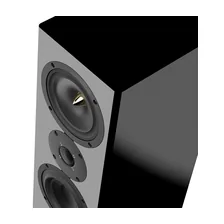 #25 Ascend Acoustics Sierra Titan Tower: $2,998 per pair Ascend Acoustics eBay
Pros: A SEAS Titan dome tweeter and dual 5.25 inch long throw woofers in a bamboo V-LAM tower reach a measured 58.6Hz extension point at a more accessible price than Ascend’s ribbon tweeter ELX line. The bass alignment Q of 0.72 keeps the low end reasonably well controlled. Backed by the same 7 year parts and labor warranty and hand matched +/-1.5dB pairs, each shipped with its own production line frequency response printout. Measured bass extension of 58.6Hz (-3dB).
Cons: Its listening window response is the least smooth of Ascend’s measured towers, trailing the pricier ELX Ribbon Tower. Sound power response falls off more steeply above the crossover than the ribbon version, so off axis and in room treble energy rolls off faster. Ascend sells direct only, with no dealer network or third party retailers for an in person audition.
Full Ascend Acoustics Sierra Titan Tower review and specifications →
| Bass Extension (-10dB) | 34.6Hz (measured, spinorama.org vendor data) |
|---|---|
| Bass Extension (-3dB) | 58.6Hz (measured, spinorama.org vendor data) |
| Country | United States |
| DIY Kit | No |
| Dimensions | 43”H x 7.5”W x 10.5”D (1092 x 190 x 267 mm) |
| Drivers | SEAS Titan dome tweeter, 1x 5.25” midrange (sealed sub-chamber), 2x 5.25” mineral filled polypropylene woofers |
| Enclosure | ported |
| Frequency Response | 32-27,000Hz typical in-room (manufacturer) |
| Impedance | 8 ohms nominal |
| Power Handling | 300W continuous, 500W peak |
| Sensitivity | 88dB @ 2.83V/1m in-room (manufacturer) |
| Spinorama Preference Score | 6.05 |
| Spinorama Preference Score with Perfect Sub | 8.00 |
| Warranty | 7 years parts and labor |
| Weight | 45 lbs (20.4 kg) each |
- Links
- Reviews, Comparisons and Sound Samples
- Head-to-Head Comparisons
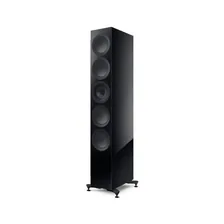 #26 KEF R11 Meta: $6,999.98 per pair Amazon eBay
Pros: CEA2034 spinorama shows a generally flat on-axis response with good directivity and very deep bass extension (F10 of 30Hz). Predicted in-room response is very smooth aside from the small 1-1.5kHz dip. The coaxial Uni-Q driver gives excellent, symmetric vertical directivity, unusual for a tower speaker. Distortion is incredibly low even down to 30Hz at 86dB SPL/1m, and stays low even at 96dB and 102dB SPL/1m: the reviewer found essentially no audible tonality change across that whole output range. Measured bass extension of 64Hz (-3dB).
Cons: A dip around 1-1.2kHz on-axis is attributed to a diffraction effect, and shows up as a smaller dip in the predicted in-room response. Horizontal beamwidth of about ±40 degrees is on the narrower side, though the transition from wide to constant directivity is smooth. Minimum impedance dips to 3.2 ohms around 580Hz, calling for an amplifier comfortable with a demanding load. 4-ohm nominal impedance overall.
Full KEF R11 Meta review and specifications →
| Bass Extension (-10dB) | 31Hz (measured, Audio Science Review) |
|---|---|
| Bass Extension (-3dB) | 64Hz (measured, Audio Science Review) |
| DIY Kit | No |
| Dimensions | 51”H x 12.2”W x 15.1”D (1295.4 x 309.9 x 383.5 mm) |
| Drivers | 4 x 165 mm (6.5 in.) hybrid aluminium cone woofers, 125 mm (5 in.) aluminium cone midrange, 25 mm (1 in.) vented aluminium dome with MAT tweeter |
| Impedance | 4 ohms |
| Sensitivity | 89.5dB |
| Spinorama Preference Score | 5.91 |
| Spinorama Preference Score with Perfect Sub | 7.32 |
| Weight | 80.5 lbs (36.5 kg) each |
| Woofer Cabinet | ported, rear |
- Links
- Reviews, Comparisons and Sound Samples
- Head-to-Head Comparisons
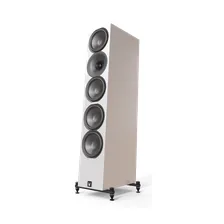 #27 Arendal 1961 Tower: $1,900 per pair Arendal Sound eBay
Pros: Exceptional output cleanliness for a slim tower: Erin measured under 1% THD to about 100Hz at 96dB/1m and only crossed 3% near 80Hz, while compression was better than several physically larger competitors. The response and listening window are broadly neutral, early-reflections and sound-power directivity are well controlled, and the waveguided dome supports stable imaging. A sealed HDF cabinet, four 5.5-inch woofers and a ten-year warranty provide serious theater-grade engineering in a tiny footprint. Measured bass extension of 62Hz (-3dB), with a measured sensitivity of 86.5dB.
Cons: Erin measured F3 at 62Hz and F10 at 43Hz, so the four woofers prioritize clean output over deep extension; a subwoofer remains necessary. Sensitivity is a moderate 86.5dB and impedance dips below four ohms, which may challenge budget AVRs even though a competent power amplifier has no issue. The optimal axis is roughly 5° above the tweeter and radiation begins narrowing around 1.3kHz, so seat height and toe-in deserve attention.
Full Arendal 1961 Tower review and specifications →
| Bass Extension (-10dB) | 43Hz (measured, Erin’s Audio Corner) |
|---|---|
| Bass Extension (-3dB) | 62Hz (measured, Erin’s Audio Corner) |
| DIY Kit | No |
| Dimensions | 33”H x 6.4”W x 11.2”D (837.5 x 163 x 285 mm) (without feet) |
| Drivers | Four 5.5-inch woofers; 28mm waveguided soft dome |
| Enclosure | Sealed HDF |
| Impedance | 4 ohms nominal; dips below 4 ohms (measured, Erin’s Audio Corner) |
| Sensitivity | 86.5dB/2.83V/1m (measured, Erin’s Audio Corner) |
| Spinorama Preference Score | 4.83 |
| Spinorama Preference Score with Perfect Sub | 7.25 |
| Weight | 39.5 lbs (17.9 kg) each |
- Links
- Reviews, Comparisons and Sound Samples
- Head-to-Head Comparisons
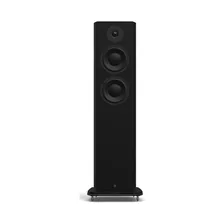 #28 Morel Avyra 633: $2,000 per pair eBay
Pros: A 2.5-way floorstanding tower with two 6” mid-woofers (each with an unusually large 3” voice coil for better power handling) and a dome tweeter; the bottom woofer only covers up to about 250Hz while the top woofer runs all the way to the 2.2kHz crossover point. Easy to drive at a nominal 4 ohms (minimum 3.8 ohms). On-axis linearity measures within about ±2.25dB: genuinely impressive for a tower in this class, enough that the reviewer said he’d have guessed a $4,000-5,000 per pair price just from the look and the data alone. F3 of about 50Hz and F10 of about 32Hz give reasonable kick-drum-level bass without a subwoofer. Wide horizontal radiation around ±70° with good continuity outside the treble region. Harmonic distortion stays under 1% THD to about 100Hz at both 86dB and 96dB, and using an 80Hz subwoofer crossover barely changes midrange distortion: a sign the drive units themselves are good quality rather than excursion-limited. About 20dB of usable dynamic range. No through-holes for spikes, so no risk of dropped hardware during setup. Measured bass extension of 50Hz (-3dB), with a measured sensitivity of 86.5dB.
Cons: A bit bright out of the box: extra tweeter energy in the 4-7kHz region (which also shows up as nonlinearity in the early-reflections directivity data, making it harder to fully correct with EQ) reflects off nearby sidewalls and can sound tipped-up or edgy; a single EQ band (about 4.4kHz, -2dB, Q of 1) or absorption panels placed 60-80° off-axis on the sidewalls resolves it. Best aimed directly at the listener rather than toed out, since the top end already rolls off a little at wider angles. Imaging loses a bit of precision specifically in that lower-treble region. Multitone distortion exceeds the reviewer’s 3% comfort threshold at higher output. Real bass extension below 50Hz still needs a subwoofer. Not the same speaker as the Parts Express “Solstice” DIY kit despite surface similarities: different tweeter, different (ported vs. transmission line) enclosure, and measurably different woofers.
Full Morel Avyra 633 review and specifications →
| Bass Extension (-10dB) | 32Hz (measured, Erin’s Audio Corner) |
|---|---|
| Bass Extension (-3dB) | 50Hz (measured, Erin’s Audio Corner) |
| Country | Israel |
| Crossover Frequency | 250Hz, 2.2kHz |
| DIY Kit | No |
| Dimensions | 38.7”H x 12.8”W x 12.2”D (982 x 326 x 310 mm) |
| Drivers | Dome tweeter, two 6” mid-woofers (3” voice coil) |
| Frequency Response | 25Hz - 20kHz (±3dB, manufacturer specified) |
| Impedance | 4 ohms nominal (3.8 ohms minimum, measured, Erin’s Audio Corner) |
| Recommended Power | 200-1000W |
| Sensitivity | 86.5dB (measured, Erin’s Audio Corner) |
| Spinorama Preference Score | 5.43 |
| Spinorama Preference Score with Perfect Sub | 7.20 |
| Weight | 48.5 lbs (22 kg) each |
| Woofer Cabinet | ported |
- Links
- Reviews, Comparisons and Sound Samples
- Head-to-Head Comparisons
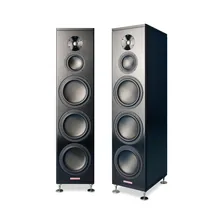 #29 Magico A5: $24,800 per pair Magico Dealer Network eBay
Pros: Manufacturer Spinorama data shows a narrow 1.7dB reference band, 0.524 listening-window smoothness, 0.324dB on-axis average absolute deviation, and a 2.92 sound-power directivity-index standard deviation. Bass measures 49.5Hz at -3dB, 39.1Hz at -6dB, and 25.1Hz at -12dB; preference scores are 5.65 without a subwoofer and 7.49 with one. The rigid sealed aluminum enclosure, dedicated midrange, three 9-inch woofers, and beryllium tweeter support high output without ports. Measured bass extension of 49.5Hz (-3dB).
Cons: Despite three 9-inch woofers, the measured -3dB point is only 49.5Hz and the 1.17 low-frequency Q indicates a pronounced sealed alignment, so subwoofers still help with the deepest bass. The $24800/pair price is extremely high, the data is manufacturer supplied rather than an independent ASR or Erin measurement, and the design needs substantial amplifier power.
Full Magico A5 review and specifications →
| Bass Extension (-10dB) | approximately 30Hz (measured, spinorama.org) |
|---|---|
| Bass Extension (-3dB) | 49.5Hz (measured, spinorama.org) |
| DIY Kit | No |
| Dimensions | 44.8”H x 10.5”W x 14.9”D (1137 x 267 x 378.5 mm) |
| Drivers | Three 9-inch woofers; 5-inch midrange; 28mm beryllium tweeter |
| Enclosure | Sealed aluminum |
| Impedance | 4 ohms nominal |
| Sensitivity | 88dB (manufacturer specified, 2.83V/1m) |
| Spinorama Preference Score | 5.65 |
| Spinorama Preference Score with Perfect Sub | 7.49 |
| Weight | 179.9 lbs (81.6 kg) each |
- Links
- Reviews, Comparisons and Sound Samples
- Head-to-Head Comparisons
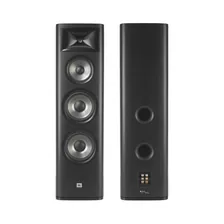 #30 JBL Studio 698: $1,499.90 per pair Crutchfield eBay
Older model: the JBL Studio 590 (ranked lower, rated 2.8/5).
Pros: High-Definition Imaging (HDI) horn waveguide paired with a 1” compression driver provides excellent high-frequency directivity control and seamless acoustic handoff to the 6” PolyPlas midrange. Dual 8” PolyPlas woofers deliver robust low-end authority with solid bass extension down to an F3 of 53Hz and F10 of 34Hz. High voltage sensitivity (90dB SPL at 2.83V/1m) and clean power handling provide effortless dynamic headroom and low distortion for home theater and music listening. Measured bass extension of 53Hz (-3dB), with a measured sensitivity of 90dB.
Cons: Measured response exhibits a prominent mid-bass emphasis bump around 80Hz that can sound overly thick or chesty in smaller rooms without DSP EQ. Treble response lacks top-octave ‘air’ above 12kHz compared to high-end dome or ribbon tweeters. Physically large, heavy cabinet (35.8 kg per speaker) requires careful room placement and a wide acoustic footprint.
Full JBL Studio 698 review and specifications →
| Bass Extension (-10dB) | 34Hz (measured, Erin’s Audio Corner) |
|---|---|
| Bass Extension (-3dB) | 53Hz (measured, Erin’s Audio Corner) |
| DIY Kit | No |
| Dimensions | 41.7”H x 11.8”W x 15.7”D (1058 x 300 x 400 mm) |
| Drivers | 1 in. High-Definition Imaging compression driver, 6 in. PolyPlas midrange, dual 8 in. PolyPlas woofers |
| Impedance | 6 ohms nominal (4.1 ohms minimum above 80Hz, measured by Erin’s Audio Corner) |
| Sensitivity | 90dB (measured average, Erin’s Audio Corner) |
| Spinorama Preference Score | 4.20 |
| Spinorama Preference Score with Perfect Sub | 6.14 |
| Weight | 78.9 lbs (35.8 kg) each |
| Woofer Cabinet | ported, rear |
- Links
- Reviews, Comparisons and Sound Samples
- Head-to-Head Comparisons
- JBL Studio 698 vs JBL HDI-3600
- JBL Studio 698 vs Morel Avyra 633
- JBL Studio 698 vs Polk Audio Reserve R700
- JBL Studio 698 vs Arendal 1961 Tower
- JBL Studio 698 vs KEF R11 Meta
- JBL Studio 698 vs PSB Imagine T65
- JBL Studio 698 vs Emotiva Airmotiv T2+
- JBL Studio 698 vs Ascend Acoustics Sierra Titan Tower
- See all 52 comparisons
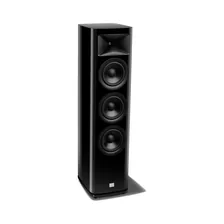 #31 JBL HDI-3600: $3800 per pair Audio Advice eBay
Pros: CEA2034 spinorama shows a fairly even on-axis response and flat overall frequency response, with high 90dB sensitivity and very low distortion through the midrange. Triple 6.5” Advanced Aluminum Matrix woofers and a 1” compression driver in JBL’s HDI waveguide. Measured bass extension of 78Hz (-3dB), with a measured sensitivity of 89.5dB.
Cons: A wide shelving-down above 2kHz affects the in-room response, and vertical dispersion is a bigger issue than horizontal: the reviewer noted the dip is wider here than on the smaller HDI-1600, making it more audible. Narrow vertical sweet spot means careful listener-height positioning matters more than usual.
Full JBL HDI-3600 review and specifications →
| Bass Extension (-10dB) | 62Hz - the on-axis curve also shows an unusual step/dip around 40-55Hz that may be a near-field-scan artifact for this tower (measured, Audio Science Review) |
|---|---|
| Bass Extension (-3dB) | 78Hz - the on-axis curve also shows an unusual step/dip around 40-55Hz that may be a near-field-scan artifact for this tower (measured, Audio Science Review) |
| DIY Kit | No |
| Dimensions | 40.5”H x 10.2”W x 13.5”D (1029 x 260 x 343 mm) |
| Drivers | 2410H-2 1” compression driver, 3x 6.5” Advanced Aluminum Matrix woofers |
| Frequency Response | 38Hz - 30kHz (+/-3dB) (Manufacturer specified) |
| Impedance | 4 ohms nominal |
| Sensitivity | 89.5dB (2.83V/1m, measured, Audio Science Review) |
| Spinorama Preference Score | 4.64 (spinorama.org) |
| Spinorama Preference Score with Perfect Sub | 6.95 (spinorama.org) |
| Weight | 61.7 lbs (28 kg) each |
| Woofer Cabinet | ported, dual rear-firing |
- Links
- Reviews, Comparisons and Sound Samples
- Head-to-Head Comparisons
 #32 Perlisten R7t: $9,990 per pair Audio Advice eBay
Pros: The flagship of Perlisten’s R-series towers, a 4-way design with four 165mm woofers reaching a measured -3dB extension point of 49.1Hz. The Harman in-room extension estimate (lfx) is a deeper 38Hz, since that metric accounts for room gain the anechoic -3dB figure doesn’t. Sensitivity of 90.0dB makes it easy to drive at high output.
Cons: Listening-window smoothness (0.567) and sound-power smoothness (0.380) are middling for a flagship-tier tower, with on-axis deviation of 0.341dB, a fairly pronounced -0.29dB per octave downward tilt, and a predicted in-room smoothness of just 0.44. It’s sold only through specialty AV dealers at a per-unit price.
Full Perlisten R7t review and specifications →
| Bass Extension | 27Hz in bass-reflex mode |
|---|---|
| Bass Extension (-3dB) | 49.1Hz (manufacturer spinorama data, vented configuration) |
| Country | Designed in the United States (Verona, Wisconsin) |
| DIY Kit | No |
| Dimensions | 49.9”H x 9.1”W x 13.8”D (1268 x 230 x 350 mm) |
| Drivers | 3x 26mm silk dome (tweeter + 2 midrange), 4x 165mm (6.5”) HPF woofers |
| Enclosure | 4-way, bass-reflex / acoustic-suspension convertible |
| Impedance | 4 ohms nominal, 3.1 ohms minimum |
| Sensitivity | 90.0dB @ 2.83V/1m |
| Spinorama Preference Score | 6.31 |
| Spinorama Preference Score with Perfect Sub | 8.12 |
| Weight | 105.8 lbs (48.0 kg) each |
- Links
- Reviews, Comparisons and Sound Samples
- Head-to-Head Comparisons
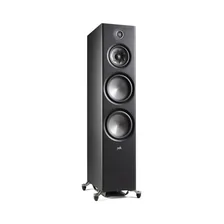 #33 Polk Audio Reserve R700: $2,398 per pair Amazon eBay
Pros: Three-way design with a 1” ring radiator tweeter, 6.5” mid-range, and dual 8” mid-bass drivers in a ported, down-firing cabinet. On-axis frequency response holds within about ±2dB across most of its range, with genuinely deep bass extension (F3 40Hz) reaching into the mid-30s Hz in-room. Wide horizontal radiation of about ±70°, giving a strong, enveloping stereo width and stage-extension effect on well-recorded tracks. Good low-level dynamics: solid bass thump at quiet listening volumes without over-accentuation. Strong distortion and compression control through the bass and midrange. Real nominal impedance closer to 4 ohms than the marketed 8 ohms, so with the right amplifier it can be driven hard: a $3,000 two-channel integrated brought out significantly more life than a budget $300 unit could. Excellent value at its roughly $1199/pair, ranking among the reviewer’s top picks under $2,500; outperforms the similarly-priced Klipsch RP-8000F II in bass extension and overall smoothness. Measured bass extension of 40Hz (-3dB), with a measured sensitivity of 87.5dB.
Cons: Compression in the high frequencies rises sharply between 96dB and 102dB output: a real limitation only at very high volumes (around 100dB at 3 meters), but a clear step down from pricier ($5,000+) towers. Horizontal directivity mismatch around 4-5kHz, where the tweeter flares wider than the midrange, can sound a bit forward, especially noticeable when toed out further into the room; sidewall absorption or curtains help tame it. Harmonic distortion crosses the reviewer’s 3% threshold around 7kHz at 96dB output, possibly contributing to that same forward quality at high volume. Narrow vertical sweet spot (about ±15° from the tweeter axis), typical of non-coaxial tower designs: more of a consideration for multi-row home theater seating than single-row listening. The ring-radiator tweeter narrows noticeably above about 7-8kHz, and toeing the speaker out more than about 20° causes the top end to fall off quickly. Needs at least 2 feet of clearance from the rear wall to avoid boomy, exaggerated bass, since it lacks the bass-shelf tuning some rivals use to allow closer wall placement. Compared to the pricier KEF R5 Meta, has narrower horizontal (and much narrower vertical) directivity, so seating flexibility is more limited.
Full Polk Audio Reserve R700 review and specifications →
| Bass Extension (-10dB) | 31Hz (measured, Erin’s Audio Corner) |
|---|---|
| Bass Extension (-3dB) | 40Hz (measured, Erin’s Audio Corner) |
| DIY Kit | No |
| Dimensions | 45”H x 12.6”W x 16.9”D (1143.8 x 320.7 x 428.3 mm) |
| Drivers | 2x 8” polypropylene cone woofers, 1x 6.5” turbine cone midrange, 1x 1” Pinnacle ring radiator tweeter |
| Impedance | 4 ohms nominal, 3.5 ohms minimum (measured above 80Hz, Erin’s Audio Corner) |
| Sensitivity | 87.5dB (measured average 300Hz-3kHz @ 2.83V/1m, Erin’s Audio Corner) |
| Spinorama Preference Score | 6.38 |
| Spinorama Preference Score with Perfect Sub | 7.83 |
| Weight | 102.1 lbs (46.3 kg) |
| Woofer Cabinet | ported, down-firing |
- Links
- Reviews, Comparisons and Sound Samples
- Head-to-Head Comparisons
- Polk Audio Reserve R700 vs PSB Imagine T65
- Polk Audio Reserve R700 vs Emotiva Airmotiv T2+
- Polk Audio Reserve R700 vs JBL HDI-3600
- Polk Audio Reserve R700 vs ELAC Debut 3.0 DF63
- Polk Audio Reserve R700 vs JBL Studio 698
- Polk Audio Reserve R700 vs Polk Reserve R500
- Polk Audio Reserve R700 vs KEF R11 Meta
- Polk Audio Reserve R700 vs Infinity Primus 360
- See all 46 comparisons
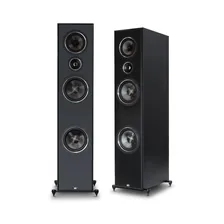 #34 PSB Imagine T65: $2,699 per pair PSB Speakers eBay
Pros: Three-way design with dual 6.5” woven carbon fiber woofers delivers genuinely strong, extended low end for a $2699 tower: among the better performers Erin has measured in this price class. Distortion shows a clean second-order character with clear separation from third-order all the way up to 96 dB, indicating a well-controlled motor. Compression data shows enhancement rather than compression below about 50-60 Hz, so the bass can sound louder as you turn it up rather than choking off. Wide, forgiving vertical listening window (about ±25°) thanks to the 3-way layout, giving more seating and placement flexibility than most towers. Plenty of dynamic headroom for home theater use or a two-channel system: 100W drove it comfortably in Erin’s room. Measured bass extension of 47Hz (-3dB), with a measured sensitivity of 85.1dB.
Cons: Noticeable dip in the midrange/crossover region that Erin flagged as affecting dialogue and vocal clarity, though he notes a couple bands of EQ smooths it out. Some horizontal dispersion mismatch (about 10-15° of ballooning between 1-3 kHz) between the midrange and tweeter can add extra perceived attack or detail if your room’s sidewalls are reflective. Dips to 4 ohms, so it wants an amplifier comfortable driving a 4-ohm load. Distortion climbs above 3% around 60 Hz at 96 dB, though it’s benign second-order distortion.
Full PSB Imagine T65 review and specifications →
| Bass Extension (-10dB) | 26Hz (measured average, Erin’s Audio Corner) |
|---|---|
| Bass Extension (-3dB) | 47Hz (measured average, Erin’s Audio Corner) |
| Crossover Frequency | 600Hz & 2000Hz, 4th-order Linkwitz-Riley |
| DIY Kit | No |
| Dimensions | 38.8” x 8.4” x 13.5” (986 x 213 x 343 mm) |
| Drivers | 1” titanium dome tweeter, 5.25” woven carbon fiber midrange, 2x 6.5” woven carbon fiber woofers |
| Enclosure | Vented: dual rear slot ports, individual woofer chambers |
| Frequency Response | 28Hz - 20kHz (±1.5dB, manufacturer specified) |
| Impedance | 8 ohms nominal (3.3 ohms minimum measured by Erin’s Audio Corner; manufacturer specifies 4 ohms minimum) |
| Recommended Power | 20-200W |
| Sensitivity | 85.1dB (measured average, Erin’s Audio Corner) |
| Spinorama Preference Score | 5.29 |
| Spinorama Preference Score with Perfect Sub | 6.51 |
| Weight | 44.1 lbs (20 kg) each |
- Links
- Reviews, Comparisons and Sound Samples
- Head-to-Head Comparisons
- PSB Imagine T65 vs Polk Audio Reserve R700
- PSB Imagine T65 vs Emotiva Airmotiv T2+
- PSB Imagine T65 vs ELAC Debut 3.0 DF63
- PSB Imagine T65 vs Polk Reserve R500
- PSB Imagine T65 vs JBL HDI-3600
- PSB Imagine T65 vs JBL Studio 698
- PSB Imagine T65 vs Infinity Primus 360
- PSB Imagine T65 vs Arendal 1961 Tower
- See all 42 comparisons
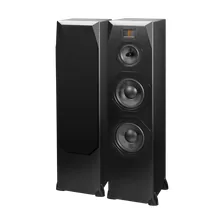 #35 Emotiva Airmotiv T2+: $999 per pair Discontinued Emotiva eBay
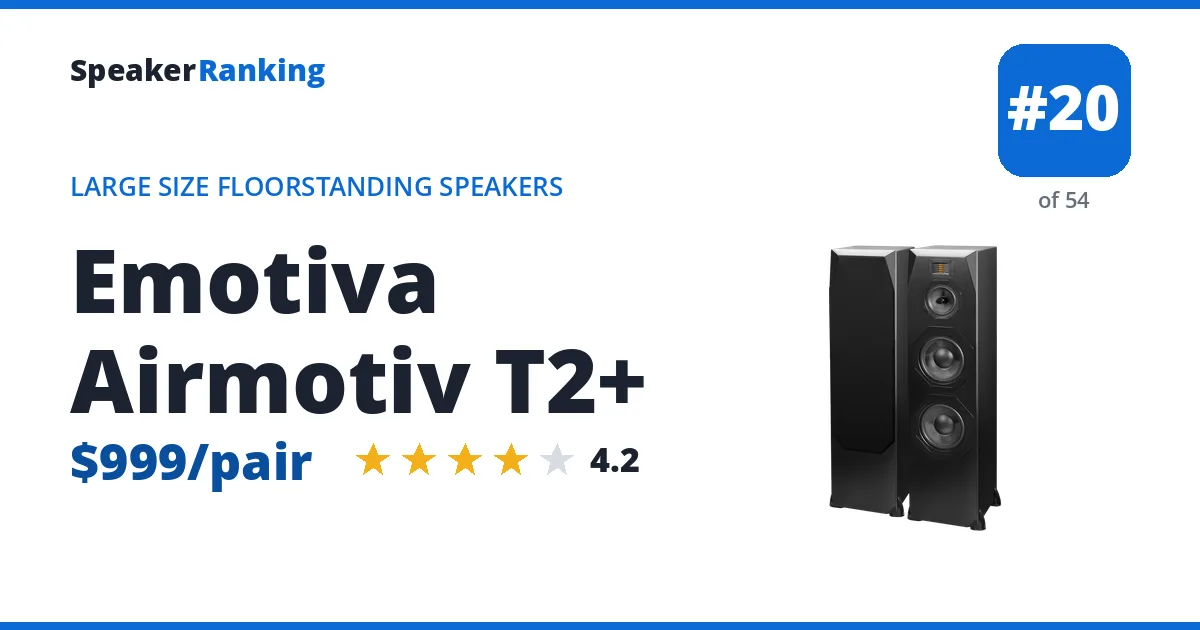
Newer model: the Emotiva Airmotiv XT2. It’s likely to perform similarly, though we don’t have measurements to confirm that yet.
Pros: High-value three-way tower with strong output and unusually deep usable sealed-room bass for the price. Erin measured F3 at 62Hz and F10 at 32Hz, with sensitivity just under 90dB/2.83V/1m. Dual 8-inch woven-fiber woofers relieve the 5.25-inch midrange, and the 32mm folded-ribbon tweeter provides broad horizontal coverage. Approximately +/-2.5dB response linearity, solid cabinet bracing and low compression allow substantial playback levels; the gradual low-frequency roll-off integrates well with either room gain or a subwoofer. Measured bass extension of 62Hz (-3dB), with a measured sensitivity of 89.5dB.
Cons: The nominal 4-ohm system approaches 3 ohms near 100Hz in Erin’s measurement, so a high-current amplifier is preferable. Horizontal and especially vertical directivity through the midrange/tweeter transition is less uniform than the best waveguided or coaxial designs; listener height and nearby reflections matter, and EQ cannot correct the narrowing mismatch. The large rear-ported cabinet needs placement clearance, and its deep F10 should not be confused with flat 30Hz output at cinema levels. Discontinued.
Full Emotiva Airmotiv T2+ review and specifications →
| Bass Extension (-10dB) | 32Hz (measured, Erin’s Audio Corner) |
|---|---|
| Bass Extension (-3dB) | 62Hz (measured, Erin’s Audio Corner) |
| DIY Kit | No |
| Dimensions | 42.7”H x 12.2”W x 12.3”D |
| Drivers | 32mm folded-ribbon tweeter; 5.25” midrange; dual 8” woofers |
| Impedance | Approximately 3 ohms minimum near 100Hz (measured, Erin’s Audio Corner) |
| Sensitivity | Approximately 89.5dB/2.83V/1m (measured, Erin’s Audio Corner) |
| Spinorama Preference Score | 5.56 |
| Spinorama Preference Score with Perfect Sub | 7.14 |
| Weight | 56.9 lbs (25.8 kg) each |
| Woofer Cabinet | ported, rear |
- Links
- Reviews, Comparisons and Sound Samples
- Head-to-Head Comparisons
- Emotiva Airmotiv T2+ vs PSB Imagine T65
- Emotiva Airmotiv T2+ vs ELAC Debut 3.0 DF63
- Emotiva Airmotiv T2+ vs Polk Audio Reserve R700
- Emotiva Airmotiv T2+ vs Polk Reserve R500
- Emotiva Airmotiv T2+ vs JBL HDI-3600
- Emotiva Airmotiv T2+ vs JBL Studio 698
- Emotiva Airmotiv T2+ vs Infinity Primus 360
- Emotiva Airmotiv T2+ vs Q Acoustics 5040
- See all 26 comparisons
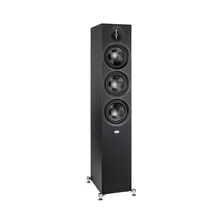 #36 ELAC Debut 3.0 DF63: $1,298 per pair Amazon eBay
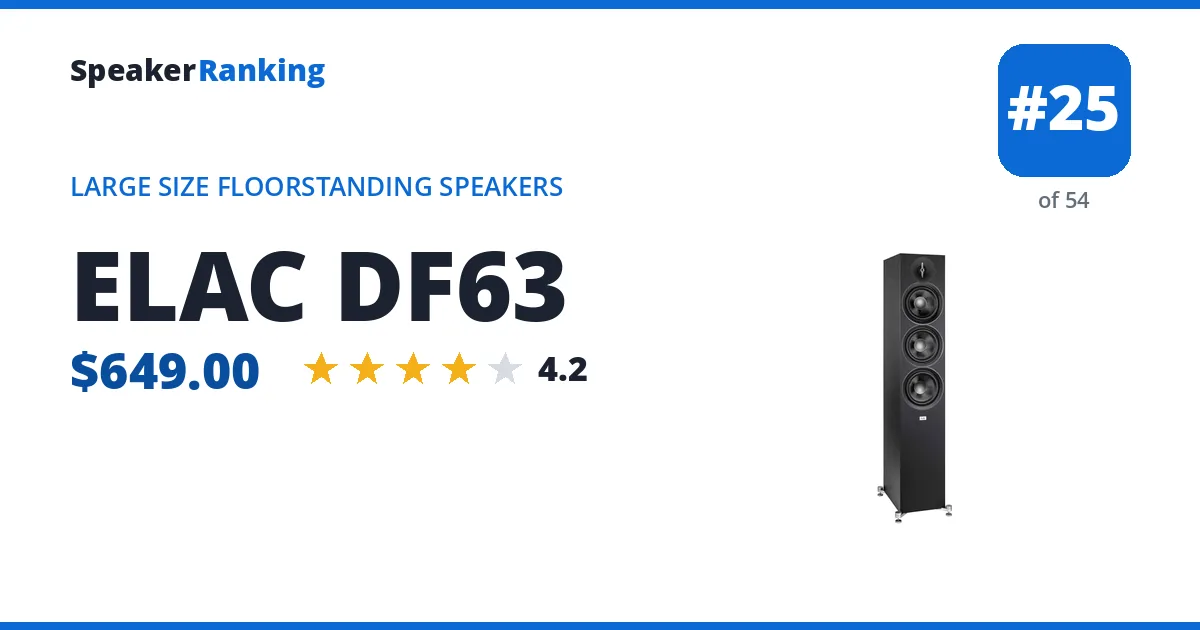
Pros: Three-driver floorstanding layout: two 6” dedicated midbase drivers plus a separate 6” mid-range driver (confirmed by measuring different driver impedance/inductance) and a 1” dome tweeter, each woofer given its own stuffed chamber inside the cabinet. The dedicated midrange driver keeps distortion low even at higher output, avoiding the intermodulation grain typical of two-way bookshelf designs. The waveguide keeps high-frequency directivity well controlled, and overall horizontal directivity is good up to about 2kHz. Harmonic distortion looks good at both 86dB and 96dB, and multitone distortion stays below the reviewer’s 3% threshold. A shallow bass rolloff (F3 71Hz, F10 29Hz) lets it extend fairly low without a hard cutoff. Preferred by the reviewer over the similarly-priced Polk R500 (too much high-frequency narrowing, less neutral) and considered ahead of the Polk R700 as well. Measured bass extension of 71Hz (-3dB), with a measured sensitivity of 86.6dB.
Cons: A genuine measured resonance around 200-300Hz (visible in frequency response, impedance, and group delay) causes an audible “droning” coloration on female vocals. A mild peak around 10kHz makes shakers and similar high-frequency percussion jump too far forward in the mix; needed about 2dB of EQ to tame in testing. A dip in the 1-3kHz range gives the speaker a warm, slightly veiled character: the reviewer suspects the tweeter crossover point (around 2-3kHz) is set a bit high and could be lowered to fill this in. Directivity shows a noticeable handoff mismatch around 2.5kHz where the midrange driver hands off to the tweeter, though it’s minor at the -6dB point. Vertical directivity is narrower than horizontal, so listeners need to stay close to the tweeter axis. Low EPDR (about 1.5 ohms minimum) means a Class AB amplifier should be well-ventilated. Best positioned pointed directly at the listener and closer to the front wall: toeing it out into the room causes too much high-frequency rolloff.
Full ELAC Debut 3.0 DF63 review and specifications →
| Bass Extension (-10dB) | 29Hz (measured, Erin’s Audio Corner) |
|---|---|
| Bass Extension (-3dB) | 71Hz (measured, Erin’s Audio Corner) |
| DIY Kit | No |
| Dimensions | 43.1”H x 7.7”W x 10.6”D (1094.7 x 195.6 x 269.2 mm) |
| Drivers | Two 6.5” Aramid Fiber woofer, 6.5” Aramid Fiber midrange, 1” Aluminum Dome tweeter |
| Impedance | 6 ohms nominal (3.4 ohms minimum, measured, Erin’s Audio Corner) |
| Sensitivity | 86.6dB (measured, Erin’s Audio Corner) |
| Spinorama Preference Score | 5.83 |
| Spinorama Preference Score with Perfect Sub | 7.33 |
| Weight | 58.2 lbs (26.4 kg) each |
| Woofer Cabinet | ported, rear |
- Links
- Reviews, Comparisons and Sound Samples
- Head-to-Head Comparisons
- ELAC Debut 3.0 DF63 vs Polk Reserve R500
- ELAC Debut 3.0 DF63 vs Emotiva Airmotiv T2+
- ELAC Debut 3.0 DF63 vs Linkwitz Lab LXmini
- ELAC Debut 3.0 DF63 vs PSB Imagine T65
- ELAC Debut 3.0 DF63 vs Polk Audio Reserve R700
- ELAC Debut 3.0 DF63 vs Infinity Primus 360
- ELAC Debut 3.0 DF63 vs Q Acoustics 5040
- ELAC Debut 3.0 DF63 vs JBL HDI-3600
- See all 42 comparisons
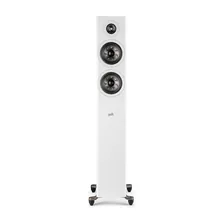 #37 Polk Reserve R500: $1,259.98 per pair Amazon eBay
Pros: Dual 5.25” midwoofers paired with a ring radiator tweeter in a floorstanding tower design. Surprisingly neutral overall compared to Polk’s smaller bookshelf models: notably more even-handed than the brighter-sounding R200 the reviewer tested previously. Good linearity on-axis, within about -3/+2dB. Sensitivity close to 86dB, easily driven to adequate levels in a small-to-medium room with a 100W-capable amplifier. Takes very well to EQ: a single band of correction (about a 2dB cut around 4-5kHz) resolves the main tonal issue and transforms the sound. Dynamic range and compression performance is solidly “medium,” holding up fine through about 20dB of level increase before higher-frequency and bass output start to taper at extreme volumes. Measured bass extension of 51Hz (-3dB), with a measured sensitivity of 86.2dB.
Cons: A bump around 4-6kHz gives a “shouty,” mildly sibilant quality in the lower treble. Counterintuitively, toeing the speaker out to reduce brightness makes this worse rather than better, since the ring-radiator tweeter’s directivity narrows rapidly above about 6-7kHz: pointed on-axis retains enough top-end air to balance the bump, but toed away that air drops off and the shoutiness stands out more. Bass is adequate for its 5.25” woofers but lacks real weight below about 40-50Hz; a subwoofer is still needed for movies and bass-heavy music. A cabinet resonance around 160-170Hz subtracts from rather than adds boom to the mid-bass region. Vertical listening window is fairly narrow: sitting more than about 10-20° above or below the tweeter axis causes a suckout in the 2-5kHz range, reducing clarity and attack. Multitone distortion ramps up noticeably around 1kHz, and crossing over to a subwoofer at 80Hz doesn’t meaningfully reduce it: likely a surround-related effect rather than excursion-related. Without applying corrective EQ, the reviewer says the 4-6kHz brightness would make it harder to live with day to day.
Full Polk Reserve R500 review and specifications →
| Bass Extension (-10dB) | 33Hz (measured, Erin’s Audio Corner) |
|---|---|
| Bass Extension (-3dB) | 51Hz (measured, Erin’s Audio Corner) |
| DIY Kit | No |
| Dimensions | 40.3”H x 6.8”W x 12.4”D (1023.6 x 172.7 x 315 mm) |
| Drivers | Two 5.25” Turbine Cone woofer, 1” Pinnacle Ring Radiator tweeter |
| Impedance | 4.1 ohms minimum above 80Hz (measured, Erin’s Audio Corner; 8 ohms nominal per manufacturer) |
| Sensitivity | 86.2dB (measured, Erin’s Audio Corner) |
| Spinorama Preference Score | 5.86 |
| Spinorama Preference Score with Perfect Sub | 7.44 |
| Weight | 39.2 lbs (17.8 kg) each |
| Woofer Cabinet | ported, rear |
- Links
- Reviews, Comparisons and Sound Samples
- Head-to-Head Comparisons
- Polk Reserve R500 vs ELAC Debut 3.0 DF63
- Polk Reserve R500 vs Linkwitz Lab LXmini
- Polk Reserve R500 vs Emotiva Airmotiv T2+
- Polk Reserve R500 vs PSB Imagine T65
- Polk Reserve R500 vs Infinity Primus 360
- Polk Reserve R500 vs Polk Audio Reserve R700
- Polk Reserve R500 vs Q Acoustics 5040
- Polk Reserve R500 vs Klipsch Forte IV
- See all 35 comparisons
 #38 Linkwitz Lab LXmini: $505.00 per pair Madisound LXmini Kit eBay
Pros: Open-baffle/dipole upper driver and cylindrical woofer enclosure create a very large, open soundstage with unusually little cabinet signature. Erin praised the stable, well-controlled directivity: despite using a nominal full-range upper driver, off-axis response retains composure beyond its beaming region and the directivity index is smooth enough for reliable DSP voicing. Imaging can be precisely adjusted through placement and toe angle. Erin measured F3 at 50Hz and F10 at 33Hz, impressive for the narrow footprint, and found the system satisfying for much music without a subwoofer. The supplied miniDSP configuration is readily editable; broad shelf correction near 550Hz and a handful of narrow filters can make the response substantially more linear. The kit is mechanically simple, highly customizable and based on well-documented Linkwitz engineering. Measured bass extension of 50Hz (-3dB).
Cons: This is not a conventional passive pair: it requires a construction-plan license, assembly, miniDSP, four matched amplifier channels and careful gain/setup work, so the apparent kit price is not the complete system cost. Output below about 50Hz lacks kick-drum weight and benefits from subwoofers. Erin found rising second-order distortion near 1.5kHz on both samples, accompanied by an impedance blip that may indicate an enclosure reflection or driver-compliance effect. At high output the system behaves as if electronically limited even with miniDSP limiting bypassed, reducing bass and subjective dynamics. Default voicing is less linear than expected, with irregularities above roughly 2kHz, though its controlled directivity makes these correctable. Dipole rear radiation demands meaningful distance from the front wall and makes placement less flexible than a box speaker.
Full Linkwitz Lab LXmini review and specifications →
| Amplifier Power | Four channels, 50W/channel minimum with identical voltage gain |
|---|---|
| Bass Extension (-10dB) | 33Hz (measured, Erin’s Audio Corner) |
| Bass Extension (-3dB) | 50Hz (measured, Erin’s Audio Corner) |
| Crossover Frequency | 700Hz LR2, active DSP |
| DIY Kit | Yes |
| Drivers | 6.5” SEAS woofer in sealed tube, 4” SEAS full-range dipole driver |
| Impedance | 4 ohms upper driver / 8 ohms woofer nominal (separate actively bi-amplified loads; manufacturer specified) |
| Sensitivity | 85dB upper driver / 87dB woofer @ 1W/1m (individual driver specifications; complete active-DSP system sensitivity is not directly specified) |
| Spinorama Preference Score | 3.89 (measured, spinorama.org) |
| Spinorama Preference Score with Perfect Sub | 5.77 (measured, spinorama.org) |
| Woofer Cabinet | sealed cylindrical enclosure; open-baffle upper driver |
- Links
- Reviews, Comparisons and Sound Samples
- Head-to-Head Comparisons
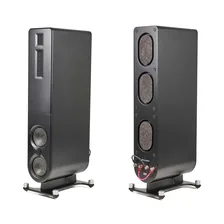 #39 PS Audio Aspen FR10: $12000 per pair PS Audio eBay
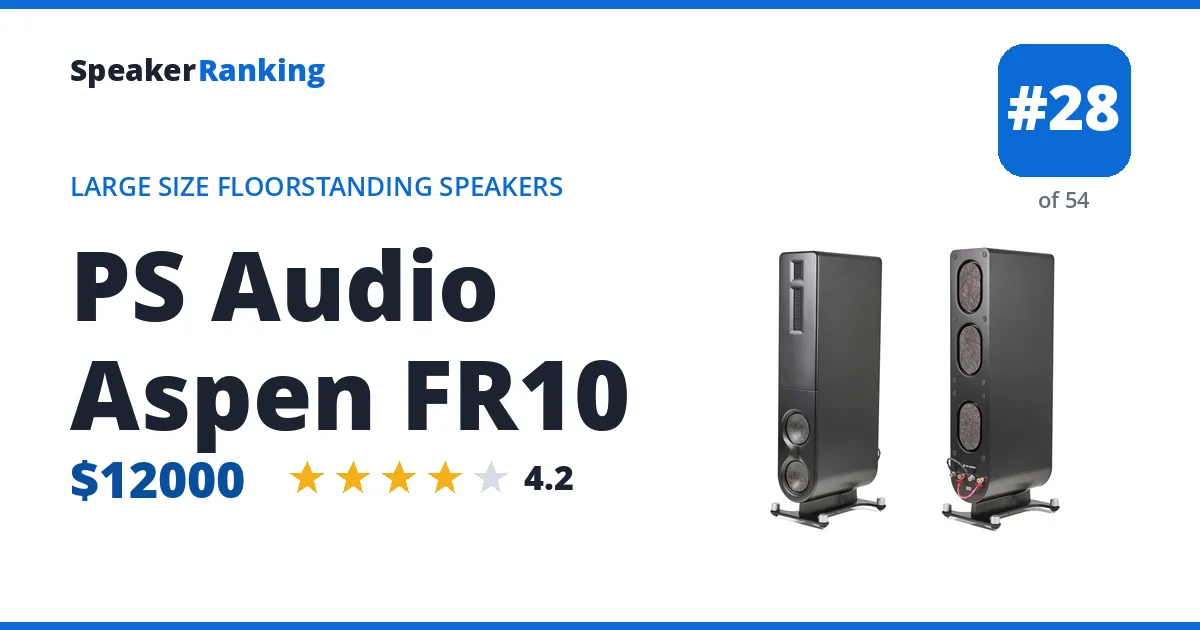
Pros: Distinctive driver layout: two 6” mid-bass drivers plus three 6x9” passive radiators, an 8” planar ribbon mid-range, and a 2.5” planar ribbon tweeter, with the woofers placed low near the floor to counteract typical floor-bounce cancellation in the mid-bass/lower-midrange handoff. Deliberately shelved bass response around 150Hz allows placement closer to the rear wall than typical, without the usual boominess. Extremely wide horizontal dispersion (the -6dB point isn’t reached until about 80-85° off-axis), giving a wide, enveloping soundstage that stays consistent rather than narrowing unevenly at different frequencies. Passed multiple stereo-imaging tests with precise placement despite the wide radiation, keeping instruments distinctly separated even in complex, heavily panned tracks. Exceptionally low multitone distortion at high frequency: among the best the reviewer has measured on any speaker. Bass extends smoothly to an F3 of 47Hz and F10 of 28Hz, potentially usable without a subwoofer for material that doesn’t dig much below 40Hz. Shows output enhancement rather than compression below about 50Hz even at high volume, adding extra punch and attack to bass transients. Measured bass extension of 47Hz (-3dB), with a measured sensitivity of 84.4dB.
Cons: At roughly $12000/pair, expectations are high, and the reviewer found some measured shortfalls relative to that price. A scoop around 600Hz slightly thins out vocal fullness; EQ can restore some body there. A narrow but pronounced dip around 6-7kHz shows up in measurements, though EQ didn’t meaningfully improve it in testing and the reviewer says he’d rather have a dip than a peak in that sibilance-prone region. On-axis, the treble reads as mildly elevated (though far less than some rivals like Martin Logan or Focal); needs about 20° of toe-out, per the manufacturer’s own recommendation, to sound properly balanced and take on a warmer character. Sidewall acoustic treatment should be avoided, since the speaker’s wide, room-filling sound depends on that sidewall interaction, limiting setup flexibility in treated rooms. A minor resonance-like anomaly appears around 800Hz, and some compression shows up at the highest frequencies (around 12kHz) under extreme output testing, though unlikely to be audible in real listening. Large and heavy floorstander (about 76 lbs each, 41” tall).
Full PS Audio Aspen FR10 review and specifications →
| Bass Extension (-10dB) | 28Hz (measured, Erin’s Audio Corner) |
|---|---|
| Bass Extension (-3dB) | 47Hz (measured, Erin’s Audio Corner) |
| DIY Kit | No |
| Dimensions | 41.5”H x 11.8”W x 16.3”D (1054.1 x 298.5 x 412.8 mm) |
| Drivers | 2x 6.5” carbon fiber cone woofers, 1x 8” planar magnetic ribbon midrange, 1x 2.5” planar magnetic ribbon tweeter + 3x passive radiators |
| Impedance | 4 ohms nominal, 3.6 ohms minimum (measured, Erin’s Audio Corner) |
| Sensitivity | 84.4dB (measured, Erin’s Audio Corner) |
| Spinorama Preference Score | 4.08 |
| Spinorama Preference Score with Perfect Sub | 5.40 |
| Weight | 119 lbs (54 kg) |
| Woofer Cabinet | passive radiator |
- Links
- Reviews, Comparisons and Sound Samples
- Head-to-Head Comparisons
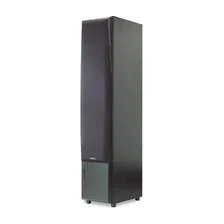 #40 Infinity Primus 360: $650 per pair Discontinued eBay
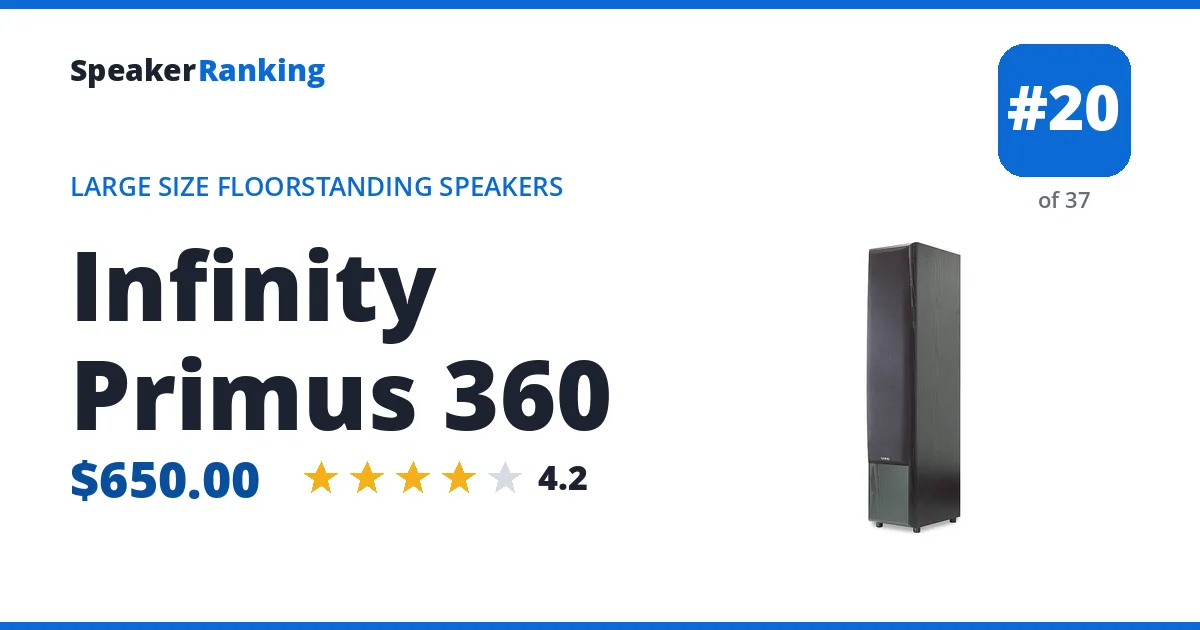
Pros: A three-way tower from 2005 (two 6.5” mid-woofers, a 4” mid-range, and a 0.75” dome tweeter, 8 ohms nominal) that holds up remarkably well by modern measurement standards: on-axis linearity is within about ±2dB, and the listening window stays consistent out to roughly ±30° horizontal and ±10° vertical off the mid-range axis. Horizontal directivity is well controlled out to about ±75° before tonality starts to drift, meaning the reflected sound in a room stays close in character to the direct sound: a speaker that takes EQ well without fighting itself. Harmonic distortion measures low at both 86dB and 96dB, and multitone distortion stays under the reviewer’s 3% threshold. Silky, smooth midrange with a rich lower-midrange/upper-bass character. No mechanical issues or surround degradation found in a 20-year-old pair, and a second unit measured within about 1-1.5dB of the first, suggesting good long-term consistency for the design. Measured bass extension of 53Hz (-3dB), with a measured sensitivity of 89.4dB.
Cons: Manufacturer-spec sensitivity of 93dB runs about 3-4dB optimistic versus the measured 89.4dB average. Bass output drops off fairly quickly below about 50Hz in-room (F3 53Hz, F10 37Hz), so a subwoofer is needed for real low-end extension. Resonances show up around 170Hz, 220Hz, and 350Hz. On-axis, the lower treble can sound a bit bright or sibilant when the speaker is aimed directly at the listener; toeing out about 10-15° (rather than the more extreme 30°) gave the best balance, and some sidewall acoustic absorption further tamed a 4-5kHz peak. Placed close to the rear wall, bass gets boomy: pulling the speakers out about a foot resolves most of it, with roughly 1.5 feet from the wall as a good compromise between bass character and typical room aesthetics. Straying beyond about 25° above or below the mid-range axis introduces audible suckout. No longer in production, so it’s a used/secondhand purchase only.
Full Infinity Primus 360 review and specifications →
| Bass Extension (-10dB) | 37Hz (measured, Erin’s Audio Corner) |
|---|---|
| Bass Extension (-3dB) | 53Hz (measured, Erin’s Audio Corner) |
| Crossover Frequency | 350Hz & 3.3kHz, 24dB/octave |
| DIY Kit | No |
| Dimensions | 39” x 8.2” x 13” (990 x 208 x 330 mm) |
| Drivers | Two 6.5” mid-woofers, 4” mid-range, 0.75” dome tweeter |
| Frequency Response | 38Hz - 20kHz (±3dB, Manufacturer specified) |
| Impedance | 8 ohms nominal, 3.5 ohms minimum (measured, Erin’s Audio Corner) |
| Recommended Power | 10-200W |
| Sensitivity | 89.4dB (measured, Erin’s Audio Corner; 93dB manufacturer specified) |
| Spinorama Preference Score | 4.97 |
| Spinorama Preference Score with Perfect Sub | 7.10 |
| Weight | 48.5 lbs (22 kg) each |
- Reviews, Comparisons and Sound Samples
- Head-to-Head Comparisons
- Infinity Primus 360 vs Q Acoustics 5040
- Infinity Primus 360 vs Linkwitz Lab LXmini
- Infinity Primus 360 vs Klipsch Forte IV
- Infinity Primus 360 vs Polk Reserve R500
- Infinity Primus 360 vs ELAC Debut 3.0 DF63
- Infinity Primus 360 vs KEF Q11 Meta
- Infinity Primus 360 vs Emotiva Airmotiv T2+
- Infinity Primus 360 vs Klipsch RP-5000F II
- See all 31 comparisons
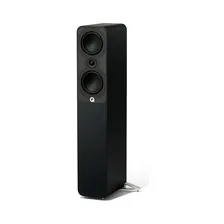 #41 Q Acoustics 5040: $2,472.98 per pair Amazon eBay
Pros: C3 (Continuous Curved Cone) driver profile technology provides smooth midrange integration, controlled cone breakup, and improved bass damping. High voltage sensitivity (91.5dB SPL at 2.83V/1m) allows loud listening with low-to-moderate amplifier wattage. Cabinet features Point-to-Point (P2P) internal bracing and Helmholtz Pressure Equalizer (HPE) tubes to suppress internal standing waves and panel vibrations. Measured bass extension of 70Hz (-3dB), with a measured sensitivity of 91.5dB.
Cons: Free-field frequency response exhibits a noticeable mid-bass scoop around 200Hz (~6dB lower than mean SPL), causing an F3 of 70Hz (F10 of 39Hz) in open space and requiring boundary placement (11-22 inches from front wall) to reinforce upper bass output. Measurements indicate an enclosure resonance near 300Hz visible in sound power data. Minimum impedance drops to 3.0 ohms, demanding a stable 4-ohm rated amplifier despite high sensitivity.
Full Q Acoustics 5040 review and specifications →
| Bass Extension (-10dB) | 39Hz (measured, Erin’s Audio Corner) |
|---|---|
| Bass Extension (-3dB) | 70Hz (measured, Erin’s Audio Corner) |
| DIY Kit | No |
| Dimensions | 38.1”H x 11.5”W x 14.2”D (967 x 293 x 361 mm) |
| Drivers | 0.88 in. decoupled dome tweeter, twin 5.0 in. C3 Continuous Curved Cone woofers |
| Impedance | 6 ohms nominal (3.0 ohms minimum, measured by Erin’s Audio Corner) |
| Sensitivity | 91.5dB (measured average, Erin’s Audio Corner) |
| Spinorama Preference Score | 3.80 |
| Spinorama Preference Score with Perfect Sub | 6.41 |
| Weight | 39.7 lbs (18.0 kg) each |
| Woofer Cabinet | ported, rear |
- Links
- Reviews, Comparisons and Sound Samples
- Head-to-Head Comparisons
- Q Acoustics 5040 vs Infinity Primus 360
- Q Acoustics 5040 vs Klipsch Forte IV
- Q Acoustics 5040 vs KEF Q11 Meta
- Q Acoustics 5040 vs Polk Reserve R500
- Q Acoustics 5040 vs ELAC Debut 3.0 DF63
- Q Acoustics 5040 vs Klipsch RP-5000F II
- Q Acoustics 5040 vs Emotiva Airmotiv T2+
- Q Acoustics 5040 vs PSB Imagine T65
- See all 42 comparisons
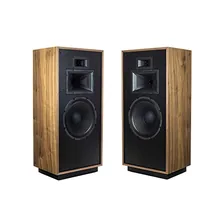 #42 Klipsch Forte IV: $5,499.98 per pair Amazon Crutchfield eBay
Pros: Three-way heritage design: a 1” titanium tweeter and 1.75” compression driver for the midrange mated to a 12” woofer, plus a 15” passive radiator for extra bass reinforcement. Genuinely resonance-free cabinet, a clear improvement over the notably boomy, resonant Heresy 4 in the same lineup. Surprisingly wide, expansive soundstage that beat both the Heresy 4 and a KEF LS50 Wireless 2 in direct comparison: images occasionally appeared several feet outside the physical speaker location. Deeper bass extension than the Heresy 4 (F3 of 82Hz, about 10Hz lower). Distortion measures well below 1% at 86dB and stays mostly within 1% even at 96dB. Comes as a factory-matched serial-numbered pair, backed by an unusually generous 10-year warranty. Mostly above 4 ohms impedance, so it’s compatible with AVRs, solid-state, or tube amplifiers. More neutral overall than other Klipsch models the reviewer has tested, making it a reasonable pick for listeners who already like the “Klipsch sound” but want something more balanced. Measured bass extension of 82Hz (-3dB), with a measured sensitivity of 93.8dB.
Cons: Contrary to the classic Klipsch reputation for being forward and bright, this model is actually somewhat recessed in the 1.5-4kHz “presence” region, which can make some tracks sound dull or lacking in detail. A peak around 6kHz reads as sibilant and “painful” when seated exactly on the tweeter axis; sitting a bit above that axis reduces it somewhat. Klipsch’s marketed 99dB sensitivity figure is an in-room rating that assumes 3-6dB of boundary gain: anechoic sensitivity measures closer to 94dB, which the manufacturer does disclose but can still mislead buyers comparing spec sheets. Radiation width isn’t consistent across all frequencies: a noticeable notch around 2-3kHz interrupts otherwise wide dispersion, which can cause a fundamental tone and its harmonics to image in slightly different places in the soundstage. Uses shallow low-pass crossover slopes (despite Klipsch’s steep-crossover marketing, which applies only to the high-pass side), likely contributing to some of the measured dips and possible cone-breakup artifacts. Some compression shows up around the midrange crossover point at very high output (102dB), though likely only audible at extreme volumes. At around $5500/pair, a significant investment, and still needs a subwoofer for material extending below about 50Hz.
Full Klipsch Forte IV review and specifications →
| Bass Extension (-10dB) | 39Hz (measured, Erin’s Audio Corner) |
|---|---|
| Bass Extension (-3dB) | 82Hz (measured, Erin’s Audio Corner) |
| DIY Kit | No |
| Dimensions | 36”H x 16.5”W x 13”D (914.4 x 419.1 x 330.2 mm) |
| Drivers | 1x 12” (305mm) fiber-composite woofer + 15” passive radiator, 1x 1.75” compression driver midrange on horn, 1x 1” titanium compression tweeter on horn |
| Impedance | 8 ohms |
| Sensitivity | 93.8dB (measured average, Erin’s Audio Corner; manufacturer rates 99dB in-room / ~94dB anechoic) |
| Spinorama Preference Score | 3.78 |
| Spinorama Preference Score with Perfect Sub | 5.72 |
| Weight | 117.3 lbs (53.2 kg) |
| Woofer Cabinet | passive radiator |
- Links
- Reviews, Comparisons and Sound Samples
- Head-to-Head Comparisons
- Klipsch Forte IV vs Q Acoustics 5040
- Klipsch Forte IV vs Infinity Primus 360
- Klipsch Forte IV vs KEF Q11 Meta
- Klipsch Forte IV vs Klipsch RP-5000F II
- Klipsch Forte IV vs Polk Reserve R500
- Klipsch Forte IV vs ELAC Debut 3.0 DF63
- Klipsch Forte IV vs Klipsch RP-8000F II
- Klipsch Forte IV vs Emotiva Airmotiv T2+
- See all 48 comparisons
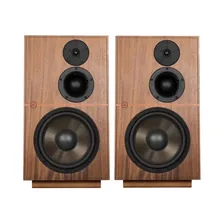 #43 Revival Audio Atalante 5: $5000 per pair Don Better Audio eBay
Pros: Strong, punchy mid-bass at moderate-to-loud volumes with no port chuffing or excursion strain even pushed hard: a rarity at this price. Good bass extension for the class (F3 42Hz, F10 30Hz), reaching about 40Hz in-room with authority. Distortion is very low (under 1% through most of the range) and compression is well controlled outside the extreme top octave. Striking build and looks, with a large 12” woofer and 3” dome midrange that give real visual presence. Measured bass extension of 42Hz (-3dB), with a measured sensitivity of 88.6dB.
Cons: A pronounced on-axis peak around 4kHz creates real glare/shoutiness on some material, and combined with a mid-bass emphasis that overshadows lower-midrange detail at higher volumes, tonal balance can feel inconsistent: the reviewer described some tracks as sounding notably different from the neutral mix. Imaging precision is looser than more directivity-controlled designs (coaxial or waveguide speakers), with instrument placement sounding a bit fuzzy rather than pinpoint. Horizontal directivity fluctuates between about 40-60 degrees rather than staying constant, worst right around the mid/tweeter crossover. Needs real room to breathe: at least 2-3 feet from the rear wall in ported mode (about a foot if sealed via the included port bungs), and benefits from 5-10 degrees of toe-out to tame the top end.
Full Revival Audio Atalante 5 review and specifications →
| Bass Extension (-10dB) | 30Hz (measured, Erin’s Audio Corner) |
|---|---|
| Bass Extension (-3dB) | 42Hz (measured, Erin’s Audio Corner) |
| Country | France |
| Crossover Frequency | 450Hz, 3.5kHz |
| DIY Kit | No |
| Dimensions | 28” x 16.5” x 14” (710 x 420 x 355 mm) |
| Drivers | 1.1” (28mm) dome tweeter, 3” dome midrange, 12” woofer |
| Frequency Response | 28Hz - 22kHz -3dB (Manufacturer specified) |
| Impedance | 4 ohms nominal (3.2 ohms minimum, measured above 80Hz, Erin’s Audio Corner) |
| Power Handling | 30-200W recommended |
| Sensitivity | 88.6dB (2.83V/1m, measured by Erin’s Audio Corner) |
| Spinorama Preference Score | 5.11 |
| Spinorama Preference Score with Perfect Sub | 6.69 |
| Weight | 72.8 lbs (33 kg) |
| Woofer Cabinet | 3-way, switchable ported/sealed via port bungs |
- Links
- Reviews, Comparisons and Sound Samples
- Head-to-Head Comparisons
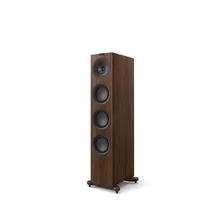 #44 KEF Q11 Meta: $2,499.98 per pair Amazon eBay
Pros: Three-way tower design with a coaxial layout: a 3/4” aluminum dome tweeter (with KEF’s Metamaterial Absorption Technology behind it) mounted at the center of a 4” mid-range, plus three 6.5” bass drivers. Extremely linear estimated in-room response when placed correctly, thanks to a deliberately declining on-axis response paired with well-controlled directivity: a technically sound design philosophy, even though it reads as “dark” in raw anechoic on-axis measurements. In-room bass extension to about 40-50Hz when placed near a wall, thanks to extended bass-shelf tuning. Sounds excellent whether pointed directly at the listener or toed out a full 30° parallel to the back wall: unusually flexible placement. More vertical listening leeway than standard non-coaxial two-way designs, thanks to the coincident tweeter/midrange. Distortion looks good at both 86dB and 96dB, and multitone distortion holds up well too. Comes with a plinth/outrigger kit for stability given its floorstanding height (about 43-44”). Measured bass extension of 60Hz (-3dB), with a measured sensitivity of 88.6dB.
Cons: Genuinely dark-sounding on raw on-axis measurement, and needs a typical room with sidewall reflections (within about 6 feet/2 meters) to sound properly neutral: in a large room with little sidewall interaction, it may sound too dull for some listeners. Must be placed close to a rear wall (about 1 foot) to get proper bass: pulling it out to the “standard” 3-foot audiophile recommendation causes bass output to drop off noticeably. Horizontal radiation of about ±50° is narrower than the reviewer’s preferred ±60°, giving a slightly less enveloping soundstage than some rivals. Notably darker than sibling KEF models in the same product family: measures 2-5dB less top-end energy than the R3 Meta and a few dB less than the Q Concerto Meta. Minor lingering resonances appear in burst decay measurements between 500Hz-1kHz. The tweeter shows some strain at very high output volumes, a limitation the reviewer notes is common even among more budget-friendly speakers generally.
Full KEF Q11 Meta review and specifications →
| Bass Extension (-10dB) | 29Hz (measured, Erin’s Audio Corner) |
|---|---|
| Bass Extension (-3dB) | 60Hz (measured, Erin’s Audio Corner) |
| DIY Kit | No |
| Dimensions | 43.8”H x 12.5”W x 15”D (1112.8 x 317.5 x 381.0 mm) |
| Drivers | 25mm tweeter + dual 165mm drivers |
| Impedance | 4 ohms nominal (3.2 ohms minimum, measured, Erin’s Audio Corner) |
| Sensitivity | 88.6dB (measured, Erin’s Audio Corner) |
| Spinorama Preference Score | 6.72 |
| Spinorama Preference Score with Perfect Sub | 8.03 |
| Weight | 106.9 lbs (48.5 kg) |
| Woofer Cabinet | ported, rear |
- Links
- Reviews, Comparisons and Sound Samples
- Head-to-Head Comparisons
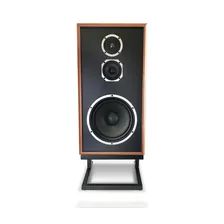 #45 KLH Model Five: $2,998.00 per pair Amazon Crutchfield eBay
Pros: Exceptionally wide and even horizontal radiation of roughly +/-70-80 degrees gives a spacious soundstage without sacrificing image focus when toed out about 10 degrees. Three rear-panel mid/high attenuation settings are genuinely useful for room and placement matching; Erin preferred Low in his room, with the grille fitted and slight toe-out. The sealed 10-inch acoustic-suspension woofer reaches an Erin-measured F3 near 52Hz and integrates gradually with a subwoofer. At 96dB/1m, harmonic distortion stays mostly below 1%, and multitone distortion is also well controlled. Compression is good at ordinary and high listening levels until the most extreme sweep, supporting convincing dynamics. The included slanted stands aim the unusually low tweeter toward seated ear height. Near-wall placement naturally fills the mild 200Hz baffle-step depression, as the manual intends. Measured bass extension of 52Hz (-3dB), with a measured sensitivity of 85dB.
Cons: On-axis response is visibly irregular because the wide vintage baffle creates diffraction, and the upper/lower midbass mismatch around 200Hz can sound lean away from the intended wall placement. Erin heard a mild 800-900Hz resonance that coincides with a clear impedance blip, plus occasional hardness around the 2-4kHz crossover region at elevated level. Vertical directivity is narrow; the included five-degree slant bases are important because the tweeter otherwise aims below seated ears. The top end rolls off relative to the midrange, producing a warm balance that may not suit listeners seeking maximum air. At the highest test level the tweeter develops substantial compression. Large size, 52lb weight with stand and roughly $2998/pair price are significant commitments, and subwoofers remain necessary for the lowest octave.
Full KLH Model Five review and specifications →
| Bass Extension (-10dB) | 32.2Hz (measured, Erin’s Audio Corner) |
|---|---|
| Bass Extension (-3dB) | 52Hz (measured, Erin’s Audio Corner) |
| DIY Kit | No |
| Dimensions | 26”H x 13.8”W x 11.5”D (660 x 350 x 292 mm) without stand |
| Drivers | 10” paper-cone woofer, 4” paper-cone midrange, 1” aluminum-dome tweeter |
| Impedance | 6 ohms nominal, 3.5 ohms minimum at 140Hz (manufacturer specified) |
| Sensitivity | About 85dB @ 2.83V/1m (measured, Erin’s Audio Corner; 87.5dB free-field manufacturer specified) |
| Spinorama Preference Score | 4.76 |
| Spinorama Preference Score with Perfect Sub | 6.71 |
| Weight | 44.1 lbs (20 kg) each without stand; 52 lbs (23.6 kg) with stand |
| Woofer Cabinet | sealed acoustic suspension |
- Links
- Reviews, Comparisons and Sound Samples
- Head-to-Head Comparisons
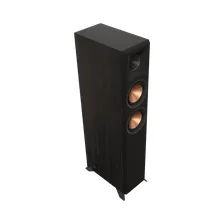 #46 Klipsch RP-5000F II: $1,199.98 per pair B&H Photo Video eBay
Pros: The most tonally coherent of the RP II floorstander line, with a mild baffle-step dip and treble tilt but no additional coloration issues beyond that. Precise imaging thanks to the controlled horn/waveguide directivity. Measured bass extension of 55Hz (-3dB), with a measured sensitivity of 90dB.
Cons: Bass extension is underwhelming for a floorstander (F3 at 55Hz, F10 at 41Hz) and needs a subwoofer. Narrow horizontal dispersion (~50-60 degrees) trades soundstage width for imaging precision. A mild high-frequency tilt and a slight lack of detail around 1-1.5kHz.
Full Klipsch RP-5000F II review and specifications →
| Bass Extension (-10dB) | 41Hz (measured, Erin’s Audio Corner) |
|---|---|
| Bass Extension (-3dB) | 55Hz (measured, Erin’s Audio Corner) |
| Crossover Frequency | 1900Hz |
| DIY Kit | No |
| Dimensions | 36.1” x 8.1” x 14.8” (917 x 207 x 375 mm) |
| Drivers | 1” titanium tweeter with Tractrix horn, dual 5.25” cerametallic woofers |
| Frequency Response | 40Hz - 25kHz (+-3dB, Manufacturer specified) |
| Impedance | 8 ohms nominal, 3.3 ohms minimum (measured above 80Hz, Erin’s Audio Corner) |
| Power Handling | 100W continuous, 400W peak |
| Sensitivity | 90dB (2.83V/1m, measured by Erin’s Audio Corner) |
| Spinorama Preference Score | 5.24 |
| Spinorama Preference Score with Perfect Sub | 7.25 |
| Weight | 38.6 lbs (17.5 kg) |
| Woofer Cabinet | ported, rear |
- Links
- Reviews, Comparisons and Sound Samples
- Head-to-Head Comparisons
- Klipsch RP-5000F II vs KEF Q11 Meta
- Klipsch RP-5000F II vs Monolith THX-365T
- Klipsch RP-5000F II vs Klipsch RP-8000F II
- Klipsch RP-5000F II vs Dynaudio Emit 30
- Klipsch RP-5000F II vs Klipsch Forte IV
- Klipsch RP-5000F II vs Klipsch RP-6000F II
- Klipsch RP-5000F II vs Q Acoustics 5040
- Klipsch RP-5000F II vs Infinity Primus 360
- See all 45 comparisons
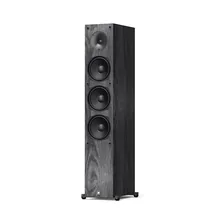 #47 Monolith Encore T6: $800 per pair Amazon Monoprice eBay
Pros: Three 6.5-inch pulp-cone drivers provide more displacement and cleaner cinema output than the B6, with good compression behavior at normal levels. Erin found the revised waveguided tweeter’s horizontal radiation consistent enough for predictable EQ, while the gloss-capped, heavily braced 49lb cabinet feels far above its price. The tower can produce useful midbass impact when crossed to a subwoofer. Measured bass extension of ~68Hz (-3dB).
Cons: Despite its size, Erin measured F3 around 68Hz, so the tower does not eliminate the need for a subwoofer. The native response needs equalization: crossover-region unevenness and excess top-octave energy prevent a fully neutral presentation. The four-ohm load and low-frequency phase angle warrant a robust amplifier, and the tall multi-driver array creates a narrower vertical listening window than a compact two-way.
Full Monolith Encore T6 review and specifications →
| Bass Extension (-10dB) | 31.1Hz (measured, Erin’s Audio Corner) |
|---|---|
| Bass Extension (-3dB) | ~68Hz (measured, Erin’s Audio Corner) |
| DIY Kit | No |
| Dimensions | 40H x 7.9W x 13.8D inches |
| Drivers | Three 6.5-inch pulp woofers; 25mm waveguided silk dome |
| Impedance | 4 ohms nominal |
| Sensitivity | 87.8dB/2.83V/1m (manufacturer) |
| Spinorama Preference Score | 4.57 |
| Spinorama Preference Score with Perfect Sub | 6.45 |
| Weight | 49.2 lbs (22.3 kg) each |
- Links
- Reviews, Comparisons and Sound Samples
- Head-to-Head Comparisons
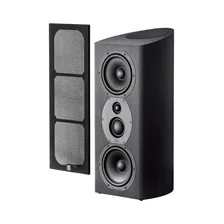 #48 Monolith THX-365T: $900 per pair Amazon Monoprice eBay
Pros: The coaxial midrange/tweeter produces coherent horizontal and vertical coverage through most of the vocal band, while twin 6.5-inch woofers deliver good 88.6dB measured sensitivity. Erin found low distortion above the bass and useful dynamic capacity for home theater; the sealed enclosure also makes the intended 80Hz THX crossover predictable. An integrated up-firing Atmos module and THX Ultra certification make this a compact, unusually versatile LCR/tower. Measured bass extension of 84Hz (-3dB), with a measured sensitivity of 88.6dB.
Cons: Erin measured F3 at 84Hz (F10 roughly 40Hz), so it categorically needs a subwoofer. Native response has enough upper-mid/treble irregularity that Erin recommended it only with EQ. Although mostly above four ohms, impedance falls to nearly 3 ohms with an adverse phase angle, potentially stressing an AVR; a separate four-ohm-capable amplifier is prudent. The Atmos module adds cost and height but cannot substitute for properly placed ceiling speakers.
Full Monolith THX-365T review and specifications →
| Bass Extension (-10dB) | ~40Hz (measured, Erin’s Audio Corner) |
|---|---|
| Bass Extension (-3dB) | 84Hz (measured, Erin’s Audio Corner) |
| DIY Kit | No |
| Dimensions | 22.9”H x 9.7”W x 10.8”D (581 x 246 x 275 mm) (without grille) |
| Drivers | Dual 6.5-inch woofers; 2-inch coaxial midrange/1-inch dome; 5.25-inch Atmos coaxial |
| Enclosure | Sealed |
| Impedance | 4 ohms nominal; nearly 3 ohms minimum (measured, Erin’s Audio Corner) |
| Sensitivity | 88.6dB/2.83V/1m (measured, Erin’s Audio Corner) |
| Spinorama Preference Score | 3.83 |
| Spinorama Preference Score with Perfect Sub | 6.90 |
| Weight | 28.4 lbs (12.9 kg) each |
- Links
- Reviews, Comparisons and Sound Samples
- Head-to-Head Comparisons
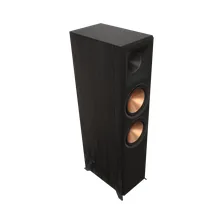 #49 Klipsch RP-8000F II: $1,159.98 per pair Amazon eBay
Pros: Highest sensitivity of the RP II floorstander line (~92dB measured) and the best dynamics/compression behavior of the three under load: the cleanest at high output. Dual 8-inch woofers and the highest power handling in the line. Measured bass extension of 67Hz (-3dB), with a measured sensitivity of 92dB.
Cons: Mid-bass sounds lean despite the dual 8-inch woofers, and bass extension disappointed for its size: expected to reach 50Hz, didn’t get there in-room. Has its own edgy upper-mid bump (2-6kHz) that’s harder to EQ out than the other two models’ issues, since it stems from the vertical horn/woofer offset rather than simple tonal balance. The most placement-critical of the three, with the narrowest horizontal (~40-50 degrees) and vertical (+5/-10 degrees) dispersion.
Full Klipsch RP-8000F II review and specifications →
| Bass Extension (-10dB) | 33Hz (measured, Erin’s Audio Corner) |
|---|---|
| Bass Extension (-3dB) | 67Hz (measured, Erin’s Audio Corner) |
| Crossover Frequency | 1630Hz |
| DIY Kit | No |
| Dimensions | 43.1” x 10.8” x 18.3” (1095 x 275 x 464 mm) |
| Drivers | 1” titanium tweeter with 90x90 Tractrix horn, dual 8” cerametallic woofers |
| Frequency Response | 35Hz - 25kHz (+-3dB, Manufacturer specified) |
| Impedance | 8 ohms nominal (3.7 ohms minimum above 80Hz, measured by Erin’s Audio Corner) |
| Power Handling | 150W continuous, 600W peak |
| Sensitivity | 92dB (2.83V/1m, measured by Erin’s Audio Corner) |
| Spinorama Preference Score | 5.39 |
| Spinorama Preference Score with Perfect Sub | 7.12 |
| Weight | 61.3 lbs (27.8 kg) |
| Woofer Cabinet | ported, rear |
- Links
- Reviews, Comparisons and Sound Samples
- Head-to-Head Comparisons
- Klipsch RP-8000F II vs Dynaudio Emit 30
- Klipsch RP-8000F II vs Klipsch RP-6000F II
- Klipsch RP-8000F II vs Klipsch RP-5000F II
- Klipsch RP-8000F II vs Definitive Technology BP-9020
- Klipsch RP-8000F II vs KLH Model Five
- Klipsch RP-8000F II vs SVS Ultra Evolution Pinnacle
- Klipsch RP-8000F II vs KEF Q11 Meta
- Klipsch RP-8000F II vs Polk T50
- See all 45 comparisons
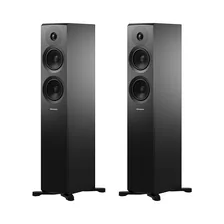 #50 Dynaudio Emit 30: $1,274.25 per pair Amazon eBay
Pros: A 2.5-way floorstander: two 5.25” mid-woofers paired with a roughly 1” dome tweeter, driven through dual rear bass-reflex ports. The two woofers hand off at staggered crossover points (around 1kHz and 3.5kHz) rather than sharing one, which avoids the acoustic lobing a shared crossover point would cause between the tweeter and the lower woofer, and adds a few dB of sensitivity in the process. Genuinely deep bass for a speaker around this price: measured F3 near 44Hz and extends audibly down to about 40Hz in-room without much difficulty. Harmonic distortion measures clean and low at both 86dB and 96dB SPL/1m. Good CTA-2034 sound power and uniform directivity mean the speaker takes EQ correction well if a listener wants to dial in its one tonal weak point. Dynamic range and compression performance are strong overall, with only a minor, high-Q compression artifact tied to a cone-edge resonance that’s unlikely to be audible. Wide, consistent horizontal dispersion around ±70° with just a small ~10° narrowing between 1-3kHz, and a reasonably forgiving ±20° vertical window centered on the tweeter axis. Measured bass extension of 44Hz (-3dB).
Cons: A dip and inconsistency in the lower-treble presence region (roughly 2-5kHz) makes the top end sound uneven (sometimes soft, sometimes forward) depending on the specific instrument or frequency being reproduced; male vocals can lack presence and cymbals can lack sizzle as a result. A cone-edge surround resonance shows up around 1-1.3kHz in burst-decay measurements (a trait the reviewer has also seen on other Dynaudio models) and lines up with elevated multitone distortion across roughly 600Hz-1.5kHz. An enclosure resonance appears around 350Hz in the impedance curve. Placed too close to a rear wall, the dual ports make the bass noticeably boomy: pulling the speaker out is needed to keep the low end from overloading the room. Fully resolving the top-end inconsistency needs a modest EQ correction (roughly +2dB with a Q of about 1, centered 3-6kHz), so out-of-the-box tonal accuracy in that band isn’t quite class-leading despite otherwise strong measured performance.
Full Dynaudio Emit 30 review and specifications →
| Bass Extension (-10dB) | 36Hz (measured, Erin’s Audio Corner) |
|---|---|
| Bass Extension (-3dB) | 44Hz (measured, Erin’s Audio Corner) |
| Country | Denmark |
| DIY Kit | No |
| Dimensions | 35.4”H x 6.7”W x 10.7”D (900.0 x 170.0 x 272.0 mm) |
| Drivers | Dual 5.25” mid-woofers, 1” soft dome tweeter |
| Frequency Response | 44Hz - 25kHz (±3dB, manufacturer specified) |
| Impedance | 4 ohms |
| Power Handling | 180W (IEC rated) |
| Sensitivity | 87dB |
| Spinorama Preference Score | 3.84 |
| Spinorama Preference Score with Perfect Sub | 5.69 |
| Weight | 34.2 lbs (15.5 kg) |
| Woofer Cabinet | ported, rear (dual) |
- Links
- Reviews, Comparisons and Sound Samples
- Head-to-Head Comparisons
- Dynaudio Emit 30 vs Klipsch RP-6000F II
- Dynaudio Emit 30 vs Klipsch RP-8000F II
- Dynaudio Emit 30 vs Definitive Technology BP-9020
- Dynaudio Emit 30 vs SVS Ultra Evolution Pinnacle
- Dynaudio Emit 30 vs Polk T50
- Dynaudio Emit 30 vs Klipsch RP-5000F II
- Dynaudio Emit 30 vs KEF Q11 Meta
- Dynaudio Emit 30 vs Focal Aria Evo X N°2
- See all 44 comparisons
 #51 Klipsch RP-6000F II: $1500 per pair Amazon eBay
Pros: Highest power handling and clean, well-behaved compression at typical volumes. Precise imaging from the controlled horn directivity. Measured bass extension of 67Hz (-3dB), with a measured sensitivity of 90dB.
Cons: Worse baffle-step coloration than the smaller RP-5000F II (3-4dB swing vs 2dB), plus a sibilance issue the 5000F doesn’t have: a real regression in tonal balance despite the higher price. Bass extension is mixed (less deep at -3dB (67Hz) than the 5000F) and needs a subwoofer regardless. Narrow horizontal dispersion (~50-60 degrees).
Full Klipsch RP-6000F II review and specifications →
| Bass Extension (-10dB) | 33Hz (measured, Erin’s Audio Corner) |
|---|---|
| Bass Extension (-3dB) | 67Hz (measured, Erin’s Audio Corner) |
| Crossover Frequency | 1770Hz |
| DIY Kit | No |
| Dimensions | 39.6” x 9.3” x 17.6” (1006 x 236 x 446 mm) |
| Drivers | 1” titanium tweeter with Tractrix horn, dual 6.5” cerametallic woofers |
| Frequency Response | 38Hz - 25kHz (+-3dB, Manufacturer specified) |
| Impedance | 8 ohms nominal (3.7 ohms minimum, measured, Erin’s Audio Corner) |
| Power Handling | 125W continuous, 500W peak |
| Sensitivity | 90dB (2.83V/1m, measured by Erin’s Audio Corner) |
| Spinorama Preference Score | 5.74 |
| Spinorama Preference Score with Perfect Sub | 7.47 |
| Weight | 49.4 lbs (22.4 kg) |
| Woofer Cabinet | ported, rear |
- Links
- Reviews, Comparisons and Sound Samples
- Head-to-Head Comparisons
- Klipsch RP-6000F II vs Dynaudio Emit 30
- Klipsch RP-6000F II vs Definitive Technology BP-9020
- Klipsch RP-6000F II vs Klipsch RP-8000F II
- Klipsch RP-6000F II vs SVS Ultra Evolution Pinnacle
- Klipsch RP-6000F II vs Polk T50
- Klipsch RP-6000F II vs Klipsch RP-5000F II
- Klipsch RP-6000F II vs Focal Aria Evo X N°2
- Klipsch RP-6000F II vs KEF Q11 Meta
- See all 42 comparisons
 #52 Definitive Technology BP-9020: $500 per pair Discontinued eBay
Pros: Integrated powered 8” side-firing subwoofer with a 150-watt Class D amplifier provides exceptional sub-bass extension down to an F3 of 35Hz and F10 of 29Hz without requiring a standalone subwoofer enclosure. Forward-Focused Bipolar Array technology (dual 3.5” front midrange drivers + 1” annealed aluminum dome tweeter, plus a 3.5” rear-firing midrange driver) creates a remarkably wide, spacious soundstage with broad room envelopment. On-axis frequency response stays smooth and relatively neutral when listened to directly aligned with the tweeter. Measured average sensitivity of 87.7dB SPL (2.83V/1m) allows comfortable drive from standard multi-channel receivers. Measured bass extension of 35Hz (-3dB), with a measured sensitivity of 87.7dB.
Cons: Significant high-frequency boost creates notable treble brightness and noticeable sibilance on vocal s-sounds. Bipolar rear driver radiation creates a diffuse soundstage that compromises razor-sharp imaging focus and pinpoint instrument placement. DSP-based internal limiter aggressively compresses output below 80Hz at higher listening levels, causing lower mid-bass and sub-bass impact to diminish as volume increases. Midrange clarity shows slight ‘cuppiness’ and upper-frequency directivity irregularities due to front/rear driver interaction. Discontinued.
Full Definitive Technology BP-9020 review and specifications →
| Bass Extension (-10dB) | 29Hz (measured, Erin’s Audio Corner) |
|---|---|
| Bass Extension (-3dB) | 35Hz (measured, Erin’s Audio Corner) |
| DIY Kit | No |
| Dimensions | 35.3”H x 11”W x 13”D (895.4 x 279.4 x 330.2 mm) |
| Drivers | 1 in. annealed aluminum dome tweeter, two 3.5 in. BDSS midrange (front), one 3.5 in. BDSS midrange (rear), 8 in. powered subwoofer |
| Impedance | 8 ohms nominal |
| Sensitivity | 87.7dB (measured average, Erin’s Audio Corner) |
| Spinorama Preference Score | 5.08 |
| Spinorama Preference Score with Perfect Sub | 6.53 |
| Weight | 30 lbs (13.6 kg) each |
| Woofer Cabinet | ported, slot |
- Links
- Reviews, Comparisons and Sound Samples
- Head-to-Head Comparisons
- Definitive Technology BP-9020 vs SVS Ultra Evolution Pinnacle
- Definitive Technology BP-9020 vs Klipsch RP-6000F II
- Definitive Technology BP-9020 vs Dynaudio Emit 30
- Definitive Technology BP-9020 vs Polk T50
- Definitive Technology BP-9020 vs Klipsch RP-8000F II
- Definitive Technology BP-9020 vs Focal Aria Evo X N°2
- Definitive Technology BP-9020 vs Klipsch RP-5000F II
- Definitive Technology BP-9020 vs Polk Audio XT60
- See all 37 comparisons
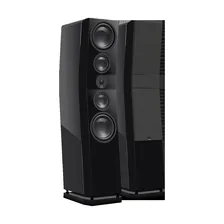 #53 SVS Ultra Evolution Pinnacle: $2,499.00 per pair Amazon SVS eBay
Pros: Flagship three-way tower with a diamond-coated tweeter, dual midranges and four force-balanced 8-inch woofers. Erin measured exceptional 27Hz extension, broad roughly +/-75-degree horizontal coverage, an 88.1dB sensitivity and a 4.91 preference score even without a subwoofer. Measured bass extension of 41.0Hz (-3dB).
Cons: The 5.25-to-8-inch transitions and complex array do not produce class-leading smoothness: 0.184 on-axis, 0.226 predicted in-room and 3.64 directivity-index consistency. At 96.7 pounds each, these are difficult to position, and their Q of 1.25 indicates some bass emphasis. A dip in the upper midrange followed closely by a peak around 2 to 3kHz gives vocals a shouty, forward quality that toe-out alone does not resolve.
Full SVS Ultra Evolution Pinnacle review and specifications →
| Bass Extension (-3dB) | 41.0Hz (measured, Erin’s Audio Corner via spinorama.org) |
|---|---|
| DIY Kit | No |
| Dimensions | 50.2H x 11.8W x 18.1D in |
| Drivers | 1” diamond-coated tweeter, dual 5.25” midranges, quad 8” woofers |
| Enclosure | 3-way passive, dual rear ports |
| Impedance | 6 ohms nominal |
| Sensitivity | 88dB |
| Spinorama Preference Score | 4.91 |
| Spinorama Preference Score with Perfect Sub | 6.13 |
| Weight | 96.8 lbs (43.9 kg) each |
- Links
- Reviews, Comparisons and Sound Samples
- Head-to-Head Comparisons
- SVS Ultra Evolution Pinnacle vs Polk T50
- SVS Ultra Evolution Pinnacle vs Definitive Technology BP-9020
- SVS Ultra Evolution Pinnacle vs Klipsch RP-6000F II
- SVS Ultra Evolution Pinnacle vs Dynaudio Emit 30
- SVS Ultra Evolution Pinnacle vs Klipsch RP-8000F II
- SVS Ultra Evolution Pinnacle vs Focal Aria Evo X N°2
- SVS Ultra Evolution Pinnacle vs Klipsch RP-5000F II
- SVS Ultra Evolution Pinnacle vs Infinity Reference 253
- See all 24 comparisons
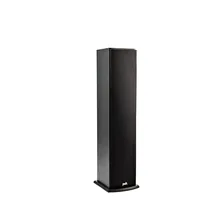 #54 Polk T50: $498 per pair Amazon eBay
Pros: Pretty deep bass for the price. Distortion at 86dB SPL/1m is reasonably controlled outside a narrow spike around 250Hz. The reviewer notes performance is “not too bad for a budget speaker” once the two main tonal issues are addressed with EQ. Measured bass extension of 47Hz (-3dB), with a measured sensitivity of 86.3dB.
Cons: 5dB peak at 1kHz, 4dB bright top end from 11kHz on up. Just okay vertical off axis. Impedance and phase show several resonances between 200Hz-1kHz, with a minimum impedance of 4.2 ohms. Distortion rises substantially at 96dB SPL/1m across the midrange, with repeated peaks between 100Hz-2kHz.
Full Polk T50 review and specifications →
| Bass Extension (-10dB) | 38Hz (measured, Audio Science Review) |
|---|---|
| Bass Extension (-3dB) | 47Hz (measured, Audio Science Review) |
| DIY Kit | No |
| Dimensions | 40.4”H x 9.3”W x 12.5”D (1026.2 x 235.0 x 317.5 mm) |
| Drivers | 2x 6.5” bi-laminate paper cone woofers, 1x 1” Terylene dome tweeter + 2x 8” passive bass radiators |
| Impedance | 4 ohms nominal (4.2 ohms minimum, measured by Audio Science Review) |
| Sensitivity | 86.3dB (2.83V/1m, measured by Audio Science Review) |
| Spinorama Preference Score | 4.14 |
| Spinorama Preference Score with Perfect Sub | 6.15 |
| Weight | 75.4 lbs (34.2 kg) |
| Woofer Cabinet | passive radiator |
- Links
- Reviews, Comparisons and Sound Samples
- Head-to-Head Comparisons
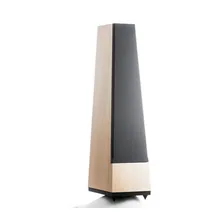 #55 Vandersteen Treo CT: $11,090 per pair Audio Connection eBay
Pros: A time-aligned four-driver floorstander with carbon tweeter, first-order crossovers and exceptional measured bass reach. Erin’s data predicts 27Hz in-room extension, a 4.95 standalone preference score, smooth 0.106 sound power and a 6.17 score with a subwoofer. Measured bass extension of 43.9Hz (-3dB).
Cons: At $11090 per pair, 80 lb each and only 85dB sensitivity, it is costly and amplifier-demanding. The response rises about +0.62dB per octave, horizontal coverage narrows to roughly +/-40 degrees, and on-axis smoothness is only 0.170.
Full Vandersteen Treo CT review and specifications →
| Bass Extension (-10dB) | 22.4Hz (derived, log-interpolated between spinorama.org -9dB/-12dB points) |
|---|---|
| Bass Extension (-3dB) | 43.9Hz (measured, Erin’s Audio Corner via spinorama.org) |
| Country | United States |
| DIY Kit | No |
| Dimensions | 43H x 10W x 15D in |
| Drivers | 1” carbon tweeter, 4.5” midrange, 6.5” woofer, 8” acoustic coupler |
| Enclosure | 4-driver, floorstanding bass-reflex |
| Impedance | 6 ohms nominal, 4 ohms minimum |
| Sensitivity | 85dB |
| Spinorama Preference Score | 4.95 |
| Spinorama Preference Score with Perfect Sub | 6.17 |
| Weight | 80 lbs (36.3 kg) each |
- Links
- Reviews, Comparisons and Sound Samples
- Head-to-Head Comparisons
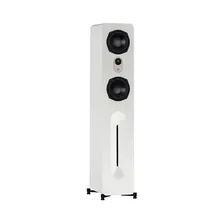 #56 Aperion Audio Novus N5T: $1,048.50 per pair Aperion Audio eBay
Pros: A compact direct-sale tower with dual 5.25-inch aramid-fiber woofers, a silk-dome tweeter, free shipping and a 30-day home trial. ASR found excellent sound-power smoothness of 0.122, controlled directivity, and deep 36Hz estimated in-room extension. Measured bass extension of 51.3Hz (-3dB), with a measured sensitivity of 86dB.
Cons: The -0.31dB-per-octave response tilt makes it moderately warm/dark, while on-axis smoothness of 0.267 is merely average. The measured 86dB sensitivity is lower than the maker’s 89dB specification.
Full Aperion Audio Novus N5T review and specifications →
| Bass Extension (-10dB) | 32.7Hz (derived, log-interpolated between spinorama.org -9dB/-12dB points) |
|---|---|
| Bass Extension (-3dB) | 51.3Hz (measured, ASR via spinorama.org) |
| Country | United States (design) |
| DIY Kit | No |
| Dimensions | 39H x 7.5W x 10.6D in |
| Drivers | 1” silk-dome tweeter, 2x 5.25” aramid-fiber woofers |
| Enclosure | 2.5-way, rear-ported |
| Impedance | 4 ohms nominal |
| Sensitivity | 86dB measured |
| Spinorama Preference Score | 4.88 |
| Spinorama Preference Score with Perfect Sub | 6.62 |
| Weight | 37 lbs (16.8 kg) each |
- Links
- Reviews, Comparisons and Sound Samples
- Head-to-Head Comparisons
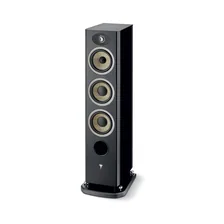 #57 Focal Aria Evo X N°2: $4,798 per pair Amazon eBay
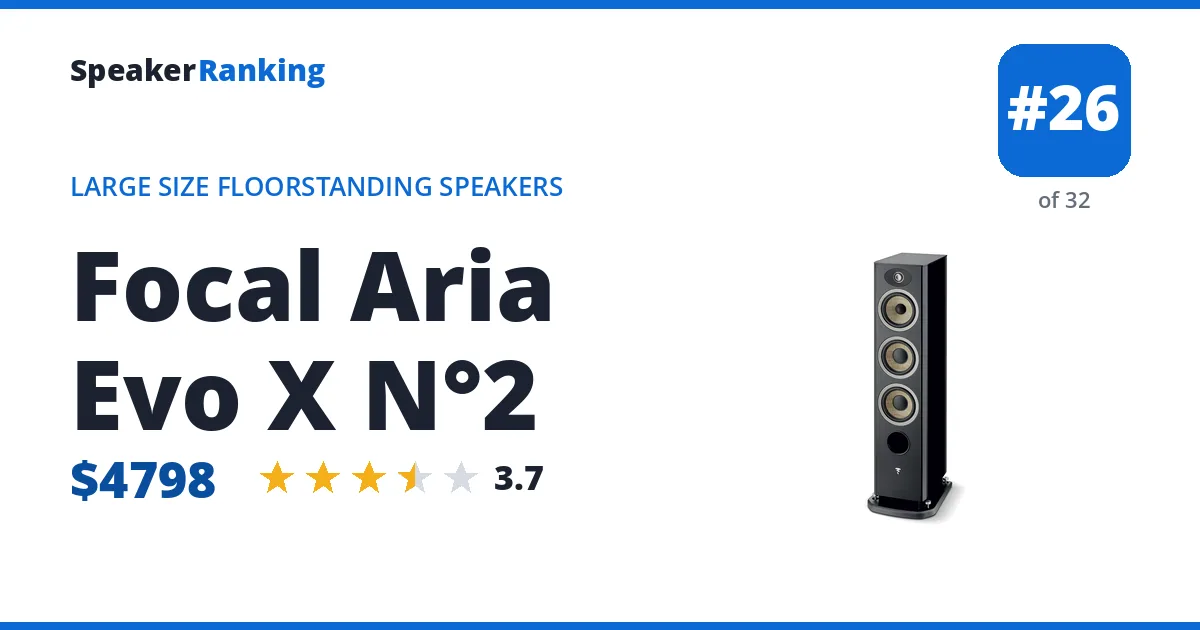
Pros: Solid bass with a deliberate mid-bass bump (80-120Hz) that gives extra thump and weight, extending to about 40-50Hz in-room. High sensitivity (measured 88.2dB) makes it easy to drive, and distortion is low throughout the range even at high output: the reviewer found only a minor compression “glare” around 4.5kHz at very high volumes, not a real concern. Directivity components (mid-range and tweeter) transition smoothly rather than abruptly, and the overall soundstage is wide and enveloping. Measured bass extension of 50Hz (-3dB), with a measured sensitivity of 88.2dB.
Cons: Sounds very bright pointed directly at the listener: the tweeter comes in 5-6dB above the midrange with an unusually wide, roughly two-octave dip (1kHz-4kHz) leading into it, giving a laid-back, low-attack character even after toeing out ~20 degrees. Fixing this properly requires real EQ (a mini DSP or similar), not just toe-out or absorption alone; without EQ, expect it to sound bright for stereo listening. A mild dip around 200Hz makes male vocals sound slightly subdued. Narrow vertical directivity (about +/-15 degrees) means you need to stay close to tweeter-axis height. Impedance dips to 3.4 ohms (EPDR 1.4 ohms), so it wants a 4-ohm-capable amplifier, and requires a plinth for floor clearance since it’s bottom-ported.
Full Focal Aria Evo X N°2 review and specifications →
| Bass Extension (-10dB) | 38Hz (measured, Erin’s Audio Corner) |
|---|---|
| Bass Extension (-3dB) | 50Hz (measured, Erin’s Audio Corner) |
| DIY Kit | No |
| Dimensions | 40.7”H x 14.6”W x 11.6”D (1035 x 371 x 294 mm) |
| Drivers | Aluminum-magnesium inverted dome tweeter with waveguide, 6.5” flax midrange, dual 6.5” flax midbass woofers |
| Frequency Response | 45Hz - 30kHz (Manufacturer specified) |
| Impedance | 8 ohms nominal (2.9 ohms minimum, Manufacturer specified; 3.4 ohms minimum measured by Erin’s Audio Corner) |
| Recommended Power | 40-250W |
| Sensitivity | 88.2dB (2.83V/1m, measured by Erin’s Audio Corner; 91.5dB Manufacturer specified) |
| Spinorama Preference Score | 4.88 |
| Spinorama Preference Score with Perfect Sub | 6.82 |
| Weight | 55.1 lbs (25 kg) each |
| Woofer Cabinet | 3-way, bass reflex (bottom-firing port, requires plinth) |
- Links
- Reviews, Comparisons and Sound Samples
- Head-to-Head Comparisons
- Focal Aria Evo X N°2 vs Polk Audio XT60
- Focal Aria Evo X N°2 vs Polk T50
- Focal Aria Evo X N°2 vs Infinity Reference 253
- Focal Aria Evo X N°2 vs Magnepan LRS+
- Focal Aria Evo X N°2 vs SVS Ultra Evolution Pinnacle
- Focal Aria Evo X N°2 vs Definitive Technology BP-9020
- Focal Aria Evo X N°2 vs Klipsch RP-6000F II
- Focal Aria Evo X N°2 vs JBL Stage 2 280F
- See all 47 comparisons
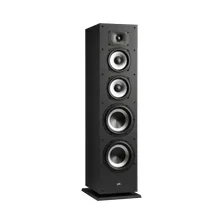 #58 Polk Audio XT70: $698 per pair Amazon eBay
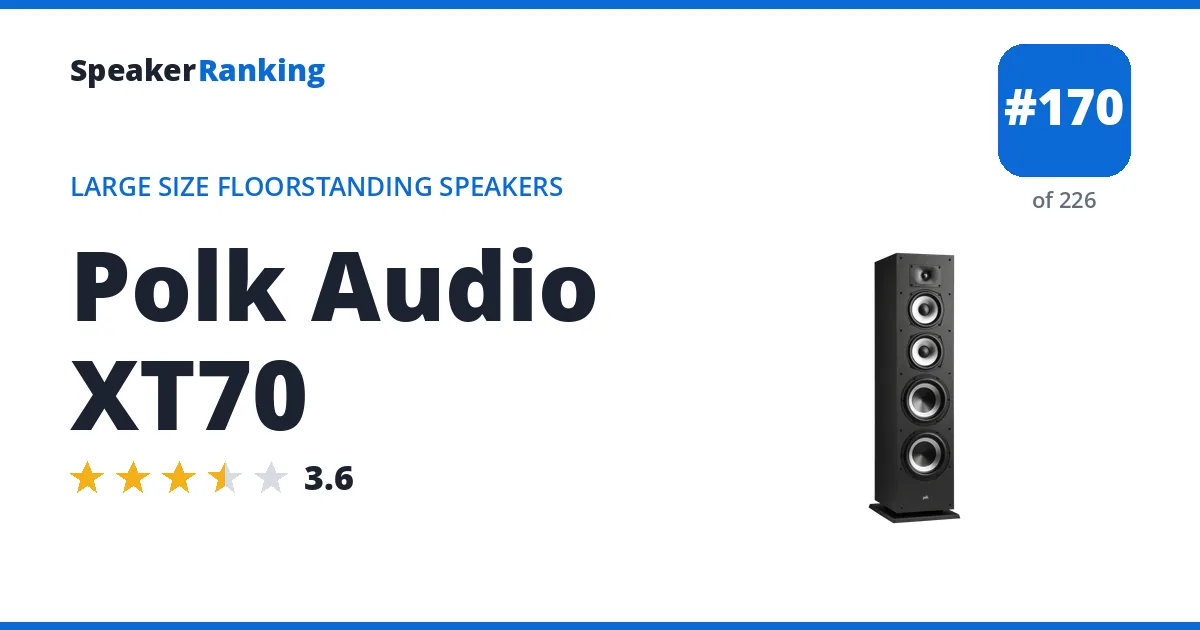
Pros: The flagship tower in Polk’s current Monitor XT lineup, sitting above the XT60 and XT15 in the same series, adding a second 6.5” woofer and dual 8” passive radiators for more low-end output. Rated for both 4 and 8 ohm operation. Measured bass extension of 43.9Hz (-3dB).
Cons: On-axis smoothness (0.274) and listening-window smoothness (0.303) are unremarkable for a tower this size, with a pronounced +0.28dB per octave upward tonal tilt giving it a brighter-leaning balance and a predicted in-room smoothness of just 0.31. Directivity-index standard deviation of 3.33 is unremarkable either way.
Full Polk Audio XT70 review and specifications →
| Bass Extension (-10dB) | 37.7Hz (derived, sustained-crossing interpolation, Erin’s Audio Corner via spinorama.org) |
|---|---|
| Bass Extension (-3dB) | 43.9Hz (measured, Erin’s Audio Corner via spinorama.org) |
| Country | China |
| DIY Kit | No |
| Dimensions | 40.4H x 9.25W x 12.5D in |
| Drivers | 1” Terylene dome tweeter, 2x 6.5” Dynamic Balance woofers, 2x 8” passive radiators |
| Enclosure | Ported, critically-braced MDF |
| Impedance | 4/8 ohm compatible |
| Sensitivity | 89dB @ 1W/1m |
| Spinorama Preference Score | 5.16 |
| Spinorama Preference Score with Perfect Sub | 7.10 |
| Weight | 35.1 lbs (15.9 kg) each |
- Links
- Reviews, Comparisons and Sound Samples
- Head-to-Head Comparisons
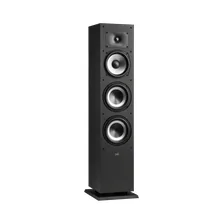 #59 Polk Audio XT60: $458 per pair Amazon B&H Photo Video Crutchfield eBay
Pros: Passive-radiator-loaded design (6.5” woofer plus two 6.5” passive radiators) gives deeper bass than the driver size alone would suggest: 43.9Hz at -3dB / 38.1Hz at -10dB, genuinely competitive extension for a budget tower. Hi-Res Audio certified, Dolby Atmos/DTS:X compatible, and works with either 4- or 8-ohm amplifier outputs. Measured bass extension of 43.9Hz (-3dB).
Cons: Bass alignment Q (lfq 0.96) is the highest, least-controlled figure in this entire batch, consistent with owner reports of a slightly loose, boomy low end at higher volumes. On-axis response is also relatively uneven, with narrow-band deviation of about 0.51dB. The vinyl-wrapped (not wood veneer) cabinet reads as budget up close per owner reviews, and at least one owner reported blowing a driver under sustained heavy bass: some caution is warranted with bass-heavy source material at volume.
Full Polk Audio XT60 review and specifications →
| Bass Extension (-10dB) | 38.1Hz (measured, spinorama.org) |
|---|---|
| Bass Extension (-3dB) | 43.9Hz (measured, spinorama.org) |
| DIY Kit | No |
| Dimensions | 19.05 x 92.5 x 23.09cm (7.5 x 36.4 x 9.09 in) each |
| Drivers | 1” Terylene dome tweeter, 6.5” bilaminate polypropylene woofer, 2x 6.5” passive radiators |
| Impedance | 4/8-ohm compatible |
| Sensitivity | 86dB (1W/1m) |
| Spinorama Preference Score | 5.19 |
| Spinorama Preference Score with Perfect Sub | 7.13 |
| Weight | 20 lbs (9.07 kg) each |
| Woofer Cabinet | Passive radiator-loaded |
- Links
- Reviews, Comparisons and Sound Samples
- Head-to-Head Comparisons
- Polk Audio XT60 vs Polk Audio XT70
- Polk Audio XT60 vs Focal Aria Evo X N°2
- Polk Audio XT60 vs Magnepan LRS+
- Polk Audio XT60 vs Polk Signature Elite ES60
- Polk Audio XT60 vs JBL Stage 2 280F
- Polk Audio XT60 vs Polk T50
- Polk Audio XT60 vs Definitive Technology BP-9020
- Polk Audio XT60 vs Klipsch RP-6000F II
- See all 40 comparisons
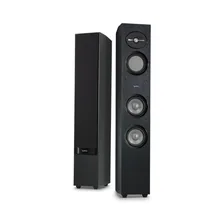 #60 Infinity Reference 253: $400 per pair used Discontinued eBay
Pros: Horizontal beamwidth of about ±60 degrees is fairly smooth and well controlled. Really amazing value for the performance. Measured bass extension of 78Hz (-3dB), with a measured sensitivity of 86.9dB.
Cons: CEA2034 spinorama and predicted in-room response both show elevated treble above 4kHz (“too hot”), a dip around 2kHz, and bass shelved down relative to the midrange. Vertical directivity requires staying at or below the tweeter axis for accurate tonal balance. Distortion at 96dB SPL/1m is broadly elevated above the reviewer’s audibility threshold across much of the midrange. Minimum impedance dips to 4.2 ohms. Discontinued.
Full Infinity Reference 253 review and specifications →
| Bass Extension (-10dB) | 38Hz (measured, Audio Science Review) |
|---|---|
| Bass Extension (-3dB) | 78Hz (measured, Audio Science Review) |
| DIY Kit | No |
| Dimensions | 40.3”H x 6.8”W x 12.4”D (1023.6 x 172.7 x 315 mm) |
| Drivers | Dual 5.25” (130mm) CMMD™ woofers, 5.25” (130mm) flat-piston CMMD™ midrange, 1” (25mm) CMMD™ tweeter |
| Impedance | 6 ohms |
| Sensitivity | 86.9dB (measured by Audio Science Review; 88dB manufacturer specified) |
| Spinorama Preference Score | 5.43 (spinorama.org) |
| Spinorama Preference Score with Perfect Sub | 7.31 (spinorama.org) |
| Weight | 39.2 lbs (17.8 kg) each |
| Woofer Cabinet | ported, rear |
- Links
- Reviews, Comparisons and Sound Samples
- Head-to-Head Comparisons
- Infinity Reference 253 vs Magnepan LRS+
- Infinity Reference 253 vs Polk Signature Elite ES60
- Infinity Reference 253 vs JBL Stage 2 280F
- Infinity Reference 253 vs Focal Aria Evo X N°2
- Infinity Reference 253 vs Polk T50
- Infinity Reference 253 vs SVS Ultra Evolution Pinnacle
- Infinity Reference 253 vs Definitive Technology BP-9020
- Infinity Reference 253 vs Sony SS-CS3
- See all 35 comparisons
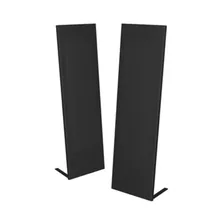 #61 Magnepan LRS+: $1300 per pair Magnepan eBay
Pros: Thin, two-way planar-magnetic open-baffle/dipole panel design (about 48” tall, just 1” deep). Delivers a uniquely dramatic and enveloping soundstage with genuinely three-dimensional depth effects that work across all music genres, not just classical or orchestral material as commonly assumed. Extremely tight, locked-in center-phantom imaging when set up correctly. Open-baffle design avoids the “boxy” enclosure coloration of conventional cabinet speakers. Multitone distortion is remarkably consistent from low to high frequency, a characteristic the reviewer hasn’t observed in conventional cone-and-dome speakers. Compression at high output stays modest (about 0.5-1dB) through the midrange and treble, giving roughly 20-26dB of usable dynamic range in that region. At its price, a strong contender for a dedicated secondary listening room, even if not a main-system replacement. Measured bass extension of 74Hz (-3dB), with a measured sensitivity of 85.1dB.
Cons: Extremely current-hungry and power-hungry: even a pair of 600W Macintosh monoblock amplifiers only averaged about 90dB output. A robust, high-power amplifier is essentially mandatory, and budget amps won’t cut it. Bass rolls off very quickly (F3 74Hz, F10 67Hz, described as falling off “like a rock”), making a subwoofer an absolute requirement for any low-end content. A roughly 3dB dip in the mid-bass (100-300Hz) region thins out vocal body and fullness compared to a conventional bookshelf speaker. A resonance/bump around 400Hz adds a mild boxy quality, though it responds well to about 2dB of EQ correction. Extraordinarily fussy about exact positioning: both seating height (must align with the acoustic reference point between the panel’s lower tie-down points) and horizontal aiming are unusually critical; moving just a couple of inches can cause treble content above roughly 500-600Hz to nearly vanish. Distinct off-axis cancellation zones exist directly to the sides of the panel, where very little sound is audible at all. Fails badly under extreme dynamic-transient testing in the bass, and the reviewer blew fuses pushing the speaker during testing: not built for high-volume or highly dynamic playback. A genuinely different category from conventional hi-fi speakers, requiring more setup patience and experimentation than a typical monopole design.
Full Magnepan LRS+ review and specifications →
| Bass Extension (-10dB) | 67Hz (measured, Erin’s Audio Corner) |
|---|---|
| Bass Extension (-3dB) | 74Hz (measured, Erin’s Audio Corner) |
| DIY Kit | No |
| Dimensions | 48”H x 13.5”W x 1”D (1219.2 x 342.9 x 25.4 mm) |
| Drivers | Full-range planar magnetic dipole panel (48” tall x 13.5” wide); quasi-ribbon design, two-way with separate mid/bass and tweeter ribbon sections |
| Impedance | 4 ohms nominal, 3 ohms minimum (measured, Erin’s Audio Corner) |
| Sensitivity | 85.1dB (measured, Erin’s Audio Corner) |
| Spinorama Preference Score | 1.27 |
| Spinorama Preference Score with Perfect Sub | 4.32 |
| Weight | 30 lbs (13.6 kg) |
| Woofer Cabinet | open baffle |
- Links
- Reviews, Comparisons and Sound Samples
- Head-to-Head Comparisons
- Magnepan LRS+ vs Infinity Reference 253
- Magnepan LRS+ vs JBL Stage 2 280F
- Magnepan LRS+ vs Polk Audio XT60
- Magnepan LRS+ vs Focal Aria Evo X N°2
- Magnepan LRS+ vs Sony SS-CS3
- Magnepan LRS+ vs Polk T50
- Magnepan LRS+ vs JBL Studio 590
- Magnepan LRS+ vs Definitive Technology BP-9020
- See all 39 comparisons
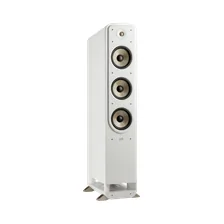 #62 Polk Signature Elite ES60: $599 per pair Crutchfield eBay
Pros: Three 6.5-inch woofers deliver strong output, 39Hz measured extension and about 89.5dB measured sensitivity. Its local Spinorama scores of 3.69 raw and 5.57 with subwoofer are respectable for a large value-oriented tower, with reasonably smooth listening-window behavior. Measured bass extension of 51.3Hz (-3dB), with a measured sensitivity of 90dB.
Cons: The measured data show enough directivity and response unevenness to keep it below the strongest neutral towers, and its large cabinet needs room. Polk’s 32Hz lower-limit claim is optimistic relative to the independent anechoic result.
Full Polk Signature Elite ES60 review and specifications →
| Bass Extension (-10dB) | 37.1Hz (derived, log-interpolated between spinorama.org -9dB/-12dB points) |
|---|---|
| Bass Extension (-3dB) | 51.3Hz (measured, ASR via spinorama.org) |
| DIY Kit | No |
| Dimensions | 44.5H x 8.5W x 15.7D in |
| Drivers | 1” Terylene tweeter, three 6.5” woofers |
| Enclosure | 2-way floorstander with Power Port |
| Frequency Response | 32Hz-40kHz (manufacturer) |
| Impedance | 8 ohms compatible |
| Sensitivity | 90dB specified; 89.5dB measured |
| Spinorama Preference Score | 3.69 |
| Spinorama Preference Score with Perfect Sub | 5.57 |
| Weight | 52 lbs (23.6 kg) each |
- Links
- Reviews, Comparisons and Sound Samples
- Head-to-Head Comparisons
 #63 JBL Stage 2 280F: $1,319.90 per pair Amazon eBay
Pros: Genuinely impressive output capability and low compression/distortion for the price, courtesy of the dual 8” woofers: the reviewer’s standout praise for this pair. High sensitivity (89.5dB measured) and low impedance make it easy to drive. Decent bass extension (F3 48Hz, F10 30Hz) reaches about 50Hz in-room. Horizontal dispersion is reasonably consistent (~55 degrees), meaning the speaker takes reasonably well to EQ correction. Measured bass extension of 48Hz (-3dB), with a measured sensitivity of 89.5dB.
Cons: Explicitly called out as disappointing relative to expectations for the JBL name and this price point: lacks native linearity compared to similarly-priced alternatives like the Polk Reserve R500, which the reviewer recommends instead for anyone who doesn’t want to rely on EQ. Treble falls off a cliff above about 10-12kHz, giving a notable lack of air/space that needs real correction (a wide +Q0.5 boost from 10-20kHz) to fix. A sharp impedance resonance around 900Hz-1.1kHz is nearly impossible to EQ out cleanly even with narrow filters. Elevated multitone distortion in the 600Hz-2.5kHz range, tied to the midwoofer rather than the tweeter. Compared to the similarly-priced Klipsch RP-6000F II/RP-8000F II, this JBL is less directive and native-flat but does extend roughly 20Hz deeper in the bass: a real tradeoff either way, not a clean win.
Full JBL Stage 2 280F review and specifications →
| Bass Extension (-10dB) | 30Hz (measured, Erin’s Audio Corner) |
|---|---|
| Bass Extension (-3dB) | 48Hz (measured, Erin’s Audio Corner) |
| Crossover Frequency | 1.1kHz, 2.1kHz |
| DIY Kit | No |
| Dimensions | 43.8” x 14.1” x 16.5” (1113 x 358 x 419 mm) |
| Drivers | 1” anodized aluminum dome tweeter with HDI waveguide, dual 8” polycellulose woofers |
| Impedance | 6 ohms nominal, 3.9 ohms minimum (measured, Erin’s Audio Corner) |
| Power Handling | 125W RMS |
| Sensitivity | 89.5dB (2.83V/1m, measured by Erin’s Audio Corner) |
| Spinorama Preference Score | 4.69 |
| Spinorama Preference Score with Perfect Sub | 6.14 |
| Weight | 55.1 lbs (25 kg) each |
| Woofer Cabinet | ported, rear |
- Links
- Reviews, Comparisons and Sound Samples
- Head-to-Head Comparisons
- JBL Stage 2 280F vs Polk Signature Elite ES60
- JBL Stage 2 280F vs Magnepan LRS+
- JBL Stage 2 280F vs Infinity Reference 253
- JBL Stage 2 280F vs Polk Audio XT60
- JBL Stage 2 280F vs Sony SS-CS3
- JBL Stage 2 280F vs Polk Audio XT70
- JBL Stage 2 280F vs Focal Aria Evo X N°2
- JBL Stage 2 280F vs JBL Studio 590
- See all 40 comparisons
 #64 Dali Rubikore 6: $8000 per pair Safe and Sound HQ eBay
Pros: Unusual 2.5-plus-half-way, four-driver configuration: two woofers overlap up to 800Hz, then one continues alone to about 2600Hz where the tweeter takes over, followed by a supertweeter engaging at 14kHz. A design layout the reviewer says he’d never encountered before. Bass extension reaches a solid 40-45Hz in-room. Distortion is quite low overall, with an especially impressive gap between second- and third-order harmonic distortion in the midwoofers. Wide horizontal radiation of about ±75°, close to the reviewer’s preferred range for an enveloping soundstage. Very good dynamic range, holding up to about 26dB of level increase (70dB to 102dB) with distortion staying within the reviewer’s 3% threshold even at full output. Multiple attractive finish options, including bi-wireable connections. Measured bass extension of 43Hz (-3dB), with a measured sensitivity of 86.4dB.
Cons: On-axis, the treble sits 3-5dB above the midrange (especially around 4kHz), giving a sibilant, hot top end that the manufacturer itself recommends compensating for with 30° of toe-out (firing the speakers straight into the room rather than at the listener). Even with that toe-out, the midrange still reads as somewhat scooped and recessed: the reviewer needed a wide, +2dB EQ boost around 2.5kHz to bring vocals back into proper balance. A high-Q resonance appears around 590Hz, and another shows up around 800Hz in burst decay measurements. Best combined with sidewall absorption to help tame the elevated 4-5kHz energy, adding to setup complexity. Needs specific listening-height positioning: ears should be at the tweeter (not supertweeter) level for the most accurate sound. Without EQ or acoustic treatment, the reviewer found the combination of a hot tweeter and recessed midrange a “tough sale” despite otherwise strong measured performance.
Full Dali Rubikore 6 review and specifications →
| Bass Extension (-10dB) | 31Hz (measured, Erin’s Audio Corner) |
|---|---|
| Bass Extension (-3dB) | 43Hz (measured, Erin’s Audio Corner) |
| DIY Kit | No |
| Dimensions | 39”H x 7.9”W x 15”D (990.0 x 200.0 x 380.0 mm) |
| Drivers | 28mm tweeter + dual 180mm woofers |
| Impedance | 4 ohms nominal (4.3 ohms minimum above 80Hz, measured, Erin’s Audio Corner) |
| Sensitivity | 86.4dB (measured, Erin’s Audio Corner; 88.5dB manufacturer specified) |
| Spinorama Preference Score | 5.27 |
| Spinorama Preference Score with Perfect Sub | 6.96 |
| Weight | 114.9 lbs (52.1 kg) |
| Woofer Cabinet | ported, rear |
- Links
- Reviews, Comparisons and Sound Samples
- Head-to-Head Comparisons
- Dali Rubikore 6 vs Atlantic Technology 8600eLR
- Dali Rubikore 6 vs Endow Audio Bravura 7
- Dali Rubikore 6 vs Børresen X3
- Dali Rubikore 6 vs Focal Aria Evo X N°2
- Dali Rubikore 6 vs PS Audio Aspen FR10
- Dali Rubikore 6 vs JBL Studio 698
- Dali Rubikore 6 vs Revel Concerta2 F35
- Dali Rubikore 6 vs Revel F226Be
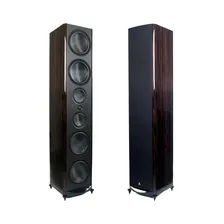 #65 Atlantic Technology 8600eLR: $5,700 per pair Atlantic Technology eBay
Pros: A sealed high-output flagship tower with four 8-inch woofers, dual 5.25-inch midranges, 91dB sensitivity and boundary/HF adjustment controls. The local snapshot measures 58Hz extension and scores 5.26 with a subwoofer. Measured bass extension of 68.8Hz (-3dB).
Cons: The raw preference score is only 2.65, making a subwoofer and correction essential despite the massive cabinet. Each tower weighs over 90 pounds, and value is weak if two-channel neutrality is the main goal.
Full Atlantic Technology 8600eLR review and specifications →
| Bass Extension (-3dB) | 68.8Hz (measured, Erin’s Audio Corner via spinorama.org) |
|---|---|
| DIY Kit | No |
| Dimensions | 51.7H x 10.9W x 11.4D in |
| Drivers | 1-inch aluminum-magnesium tweeter, dual 5.25-inch midranges, four 8-inch woofers |
| Enclosure | Sealed 3-way floorstander |
| Frequency Response | 50Hz-25kHz +/-2dB |
| Impedance | 6 ohms |
| Sensitivity | 91dB |
| Spinorama Preference Score | 2.65 |
| Spinorama Preference Score with Perfect Sub | 5.26 |
| Weight | 93.3 lbs (42.3 kg) each |
- Links
- Reviews, Comparisons and Sound Samples
- Head-to-Head Comparisons
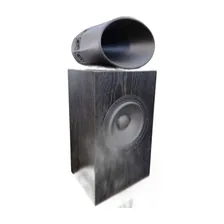 #66 Endow Audio Bravura 7: $14,000 per pair Discontinued eBay
Pros: A genuinely unusual radiation concept: nine small midrange drivers radiate nearly omnidirectionally from roughly 300Hz to 6kHz, producing an exceptionally large, enveloping soundstage and illuminating the sidewalls, floor and ceiling much more evenly than a conventional box. Erin found solid, snappy midbass and measured F3 at 50Hz and F10 at 36Hz. On-axis response below the tweeter transition is broadly linear for such an unconventional array. Multitone distortion remains comparatively well controlled at ordinary levels. The rear passive radiator and 7-inch woofer give useful extension, and the system’s room-filling spatial presentation is unlike a standard forward radiator. Measured bass extension of 50Hz (-3dB), with a measured sensitivity of 82dB.
Cons: The radiation pattern changes abruptly at 6kHz: below it the array is nearly omnidirectional, but the waveguided tweeter collapses to about +/-20 degrees horizontally and less than +/-10 degrees vertically. Ears must remain almost exactly on tweeter axis or the top octave largely disappears. Erin measured very low 81-82dB sensitivity despite the nine-driver array, so substantial amplifier power is required. A 7-8dB high-frequency peak suggests tweeter breakup or diffraction. The small midranges show notable compression at high level; 96dB is acceptable but the 102dB sweep loses significant midrange output, while the woofer compresses below about 60Hz. Harmonic distortion is high around 100Hz at 96dB. Its huge reflected-sound contribution makes results unusually room-dependent, and its price is extremely high for its sensitivity, output limits and discontinuous treble directivity. Discontinued.
Full Endow Audio Bravura 7 review and specifications →
| Bass Extension (-10dB) | 36Hz (measured, Erin’s Audio Corner) |
|---|---|
| Bass Extension (-3dB) | 50Hz (measured, Erin’s Audio Corner) |
| DIY Kit | No |
| Dimensions | 21”H x 9”W x 11”D (533 x 229 x 279 mm) |
| Drivers | 7” woofer, nine 1.5” omnidirectional midrange drivers, waveguided tweeter, rear passive radiator |
| Impedance | 4 ohms nominal, 3.1 ohms minimum above 80Hz; 1.5 ohms minimum EPDR (measured, Erin’s Audio Corner) |
| Sensitivity | 81-82dB (measured, Erin’s Audio Corner) |
| Spinorama Preference Score | 2.67 |
| Spinorama Preference Score with Perfect Sub | 4.62 |
| Weight | 24.3 lbs (11 kg) each |
| Woofer Cabinet | passive radiator, rear |
- Links
- Reviews, Comparisons and Sound Samples
- Head-to-Head Comparisons
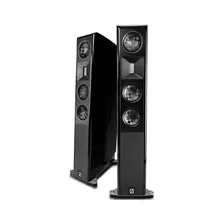 #67 Børresen X3: $11,000 per pair eBay
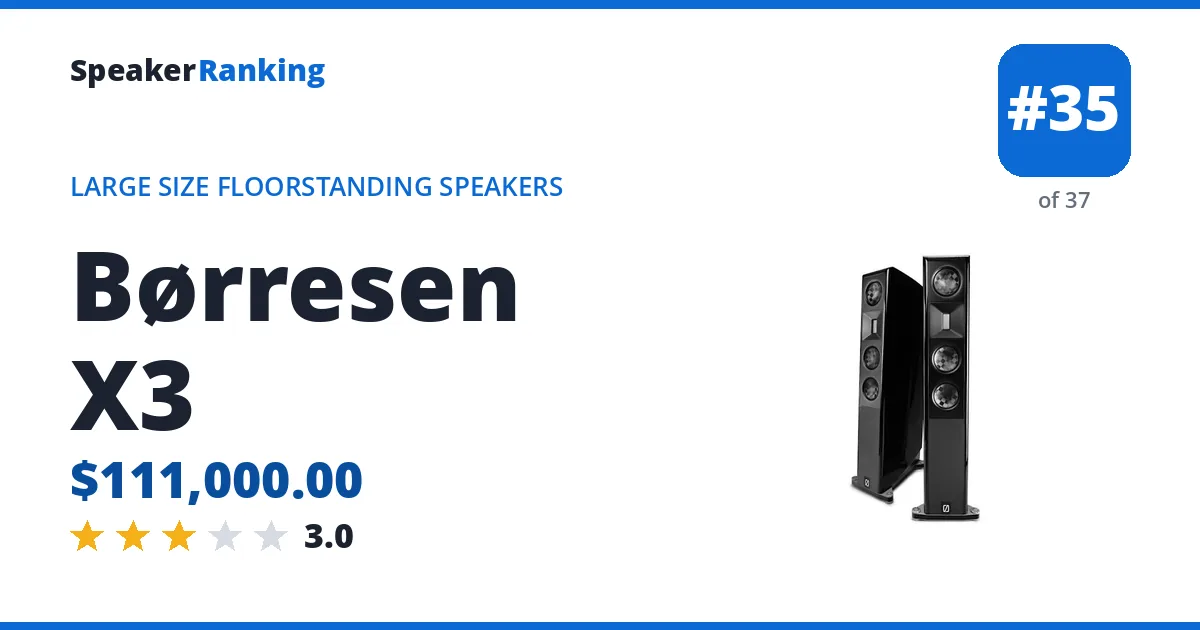
Pros: A 2.5-way tower built around a planar ribbon tweeter, a 4.5” mid-range driver, and dual 4.5” bass drivers, spec’d at 88dB/1W sensitivity into a 4-ohm nominal load (measured minimum impedance stays a friendly 6.1 ohms above 80Hz, so it doesn’t actually need much power despite the sub-90dB rating). Very wide, remarkably consistent horizontal directivity around ±70° gives an expansive, enveloping soundstage, helped by the reviewer’s pair measuring essentially identically to each other for tight image precision. A pronounced high-Q bass shelf centered around 80Hz (roughly 8dB above the mean level) delivers a punchy, attention-grabbing low-end thump at moderate volumes. Harmonic distortion is clean through the midrange at 86dB, and multitone distortion stays under about 3% even though the low end is handled by relatively small 4.5” drivers rather than something larger. Detailed, extended high frequencies when seated on the tweeter’s intended axis. Measured bass extension of 50Hz (-3dB).
Cons: A significant midrange suckout centered around 200-300Hz measures 8-11dB below the mean SPL, creating an audible hole in the mid-range that multiple independent listeners also flagged unprompted. The 80Hz bass shelf comes with the worst low-frequency ringing the reviewer says he has measured to date on a waterfall plot: it lingers well after the surrounding frequencies have decayed, giving kick drum and bass notes a boomy, one-note quality. Significant dynamic compression sets in as volume rises: bass output near 90Hz drops only about 1.5dB at 86dB SPL, but the loss grows substantially by 96dB and 102dB (around 26dB of total dynamic range), so the appealing bass punch measurably fades at higher listening levels. The upper-midrange and lower treble (2-4kHz) read soft and recessed unless the listener sits almost exactly on the tweeter’s reference axis, within about 15°: the manufacturer’s recommended setup (tweeter aimed above ear height, per their design intent) makes this worse rather than better for a seated listener at normal height. A crossover-related directivity kink between the tweeter and mid-range driver, visible in the vertical response, trades some pinpoint image precision for a more diffuse sense of envelopment compared to smaller two-way designs. Resonances appear in the impedance curve near 300Hz and 2kHz, coinciding with the measured midrange dip.
Full Børresen X3 review and specifications →
| Bass Extension (-10dB) | 25Hz (measured, Erin’s Audio Corner) |
|---|---|
| Bass Extension (-3dB) | 50Hz (measured, Erin’s Audio Corner) |
| Country | Denmark |
| DIY Kit | No |
| Dimensions | 50.8”H x 13.6”W x 23.9”D (1290.0 x 345.0 x 607.0 mm) |
| Drivers | Planar ribbon tweeter, 4.5” mid-range driver, dual 4.5” bass drivers |
| Frequency Response | 35Hz - 50kHz (Manufacturer specified) |
| Impedance | 4 ohms |
| Recommended Power | 50W minimum |
| Sensitivity | 88dB |
| Spinorama Preference Score | 2.38 |
| Spinorama Preference Score with Perfect Sub | 3.50 |
| Weight | 121.3 lbs (55 kg) |
- Links
- Reviews, Comparisons and Sound Samples
- Head-to-Head Comparisons
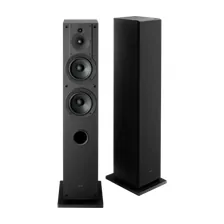 #68 Sony SS-CS3: $450 per pair Discontinued eBay
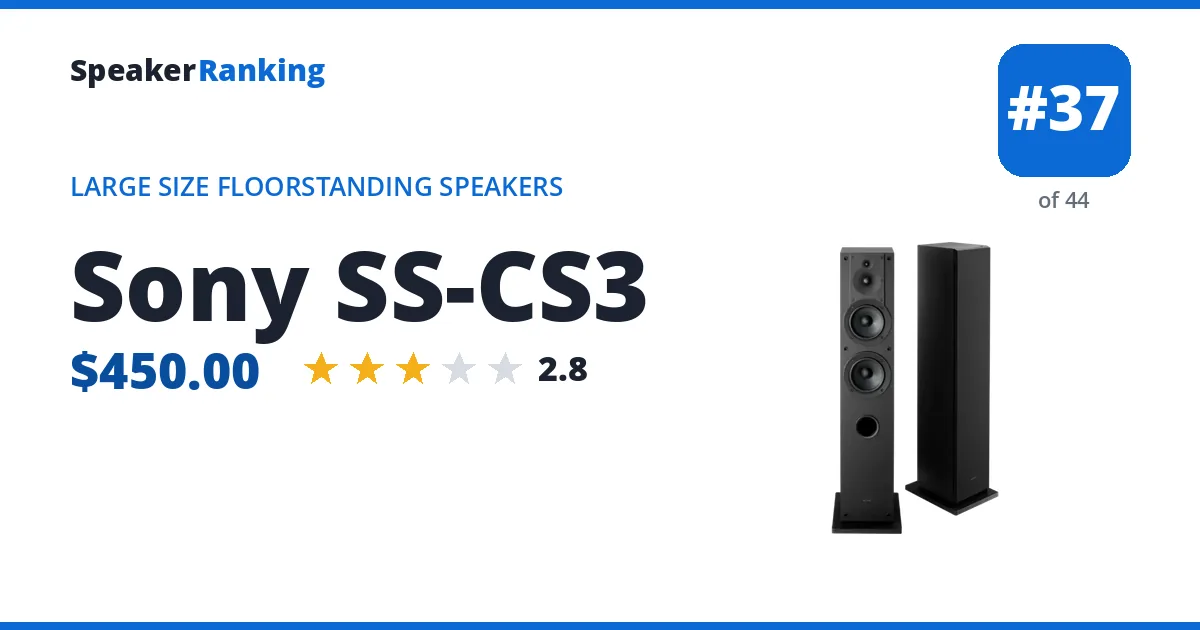
Pros: Affordable entry-level floorstanding tower offering solid sensitivity (88.6dB SPL at 2.83V/1m), making it easy to power with standard budget AVRs. Harmonic distortion remains reasonably low at moderate listening levels (86dB SPL) when high-pass filtered above 80-100Hz with a dedicated subwoofer. Front-ported design allows relatively close placement to front boundaries without excessive port occlusion. Measured bass extension of 72Hz (-3dB), with a measured sensitivity of 88.6dB.
Cons: Severe cabinet and driver resonances plague the passband between 100Hz and 600Hz, imparting audible coloration and chesty resonances to male vocals and acoustic instruments. Irregular frequency response peaks and dips make automated receiver room correction difficult to equalize effectively. Poor low-frequency extension (F3 of 72Hz, F10 of 39Hz) for a floorstander, combined with rapid distortion escalation below 80Hz at higher SPLs (96dB+). Supertweeter driver adds crossover complexity without providing audible high-frequency benefit within the human hearing spectrum. Discontinued.
Full Sony SS-CS3 review and specifications →
| Bass Extension (-10dB) | 39Hz (measured, Erin’s Audio Corner) |
|---|---|
| Bass Extension (-3dB) | 72Hz (measured, Erin’s Audio Corner) |
| DIY Kit | No |
| Dimensions | 36.3”H x 9.1”W x 10.2”D (922 x 230 x 260 mm) |
| Drivers | 0.75 in. supertweeter, 0.98 in. polyester main tweeter, dual 5.12 in. MRC woofers |
| Impedance | 6 ohms nominal |
| Sensitivity | 88.6dB (measured average, Erin’s Audio Corner) |
| Spinorama Preference Score | 4.11 |
| Spinorama Preference Score with Perfect Sub | 6.65 |
| Weight | 25.4 lbs (11.5 kg) each |
| Woofer Cabinet | ported, front |
- Links
- Reviews, Comparisons and Sound Samples
- Head-to-Head Comparisons
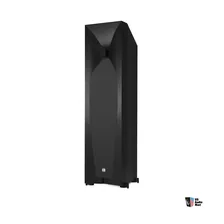 #69 JBL Studio 590: $2,000 per pair Discontinued eBay
Newer model: the JBL Studio 698, ranked higher, rated 4.3/5.
Pros: Pretty deep bass. CEA2034 spinorama is flat on-axis at a high level, with high sensitivity around 89-90dB. Predicted in-room response is good aside from a dip between 800Hz-1.5kHz. Distortion at 86dB SPL/1m is good outside of the 8.5kHz resonance. Measured bass extension of 48Hz (-3dB), with a measured sensitivity of 90.3dB.
Cons: 3dB peak at 1.7kHz, about a 4dB peak from 8k to 13k, going to be bright up top. Just okay vertical off axis. Really bad resonance at 8.5kHz, which shows up as a sharp distortion spike at both 86dB and 96dB SPL/1m. Cumulative spectral decay (waterfall) reveals many fine resonances across the midrange and treble. At 96dB SPL/1m the midrange and treble get notably messier, with broad distortion elevation from 2-8kHz. Discontinued.
Full JBL Studio 590 review and specifications →
| Bass Extension (-10dB) | 32Hz (measured, Audio Science Review) |
|---|---|
| Bass Extension (-3dB) | 48Hz (measured, Audio Science Review) |
| DIY Kit | No |
| Dimensions | 49.7”H x 12.7”W x 16.3”D (1263.0 x 322.0 x 413.0 mm) |
| Drivers | 2x 8” (200mm) PolyPlas cone woofers, 1x 1” (25mm) Teonex dome tweeter on Bi-Radial horn (2.5-way) |
| Impedance | 6 ohms nominal (5 ohms measured minimum, Audio Science Review) |
| Sensitivity | 90.3dB (2.83V/1m, measured by Audio Science Review) |
| Spinorama Preference Score | 4.49 |
| Spinorama Preference Score with Perfect Sub | 6.22 |
| Weight | 107.8 lbs (48.9 kg) |
| Woofer Cabinet | ported, rear |
- Links
- Reviews, Comparisons and Sound Samples
- Head-to-Head Comparisons
- JBL Studio 590 vs Sony SS-CS3
- JBL Studio 590 vs Triangle Esprit Antal Ez
- JBL Studio 590 vs Bose 901 Series V
- JBL Studio 590 vs JBL Stage 2 280F
- JBL Studio 590 vs Magnepan LRS+
- JBL Studio 590 vs Infinity Reference 253
- JBL Studio 590 vs Focal Aria Evo X N°2
- JBL Studio 590 vs Polk T50
- See all 25 comparisons
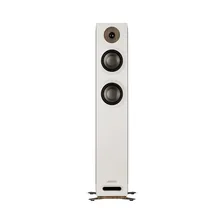 #70 Jamo S807: $299.00 per pair Discontinued Amazon eBay
Pros: A slim 2.5-way tower with two 5-inch woofers and a 1-inch tweeter in a shallow waveguide, with a front slot port so it can sit closer to a wall. Its 8-ohm load stays close to 8 ohms across the range in Erin’s Audio Corner’s measurements, so any receiver drives it easily, and harmonic distortion stays under 0.5% above 200Hz at an 85dB level. Metal fasteners on top accept Jamo’s S8 ATM Dolby Atmos elevation module. Measured bass extension of 51.9Hz (-3dB), with a measured sensitivity of 84dB.
Cons: Erin’s Audio Corner’s measurements show a smiley-face tuning: boosted bass around 80Hz and boosted treble with the dialogue range sitting 3 to 5dB lower, plus a resonance near 400Hz. The listening window spans 4.6dB between 300Hz and 5kHz, the predicted in-room response is rough (0.39 smoothness) and the preference score is 3.84 (5.94 with an ideal subwoofer). Measured sensitivity is about 84dB against the 90dB claim, and it loses about 2dB to compression at 40Hz at loud listening levels. Erin’s verdict was not to buy it. Jamo has phased out the Studio 8 series it belongs to, so it is mainly a used buy. Discontinued.
Full Jamo S807 review and specifications →
| Bass Extension (-10dB) | 36.2Hz (measured, Erin’s Audio Corner) |
|---|---|
| Bass Extension (-3dB) | 51.9Hz (measured, Erin’s Audio Corner) |
| DIY Kit | No |
| Dimensions | 36”H x 7.5”W x 9.9”D (915 x 191 x 252 mm) |
| Drivers | 2x 5” woofer, 1” tweeter with waveguide (2.5-way) |
| Impedance | 8 ohms nominal (manufacturer specified) |
| Power Handling | 100W rated, 200W peak (manufacturer specified) |
| Sensitivity | 84dB (measured average 300Hz-3kHz, Erin’s Audio Corner; 90dB manufacturer specified) |
| Spinorama Preference Score | 3.84 |
| Spinorama Preference Score with Perfect Sub | 5.94 |
| Weight | 26 lbs (11.8 kg) each |
| Woofer Cabinet | ported, front slot |
- Links
- Reviews, Comparisons and Sound Samples
- Head-to-Head Comparisons
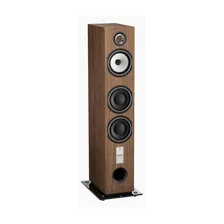 #71 Triangle Esprit Antal Ez: $1,799 per pair Discontinued eBay
Pros: Predicted in-room response sums rather nicely aside from the resonance and bass issues. Horizontal beamwidth of about ±50 degrees is reasonably controlled. Measured bass extension of 85Hz (-3dB), with a measured sensitivity of 90.7dB.
Cons: Resonance around 260Hz and a number of other resonances show up on-axis, along with a dip in bass response. Two distinct distortion sources (one around 250-300Hz, another around 3-4kHz) already cross the reviewer’s audibility threshold even at moderate output, and get much worse at 96dB SPL/1m, where distortion broadly exceeds 50% relative level across large parts of the spectrum. Directivity is not great overall. The reviewer does not recommend it. Discontinued.
Full Triangle Esprit Antal Ez review and specifications →
| Bass Extension (-10dB) | 62Hz (measured, Audio Science Review) - low confidence - on-axis curve shows an unusual notch/dip around 250-300Hz for this floorstanding tower |
|---|---|
| Bass Extension (-3dB) | 85Hz (measured, Audio Science Review) - low confidence - on-axis curve shows an unusual notch/dip around 250-300Hz for this floorstanding tower |
| DIY Kit | No |
| Dimensions | 43.9”H x 11.8”W x 15.7”D (1115.0 x 300.0 x 400.0 mm) |
| Drivers | 2x 6.5” (160mm) fiberglass cone woofers, 1x 6.5” (160mm) natural cellulose midrange, 1x 1” (25mm) titanium dome tweeter |
| Impedance | 8 ohms nominal (2.7 ohms minimum, measured by Audio Science Review) |
| Sensitivity | 90.7dB (2.83V/1m, measured by Audio Science Review) |
| Spinorama Preference Score | 2.76 |
| Spinorama Preference Score with Perfect Sub | 5.37 |
| Weight | 98.5 lbs (44.7 kg) |
| Woofer Cabinet | ported, front |
- Links
- Reviews, Comparisons and Sound Samples
- Head-to-Head Comparisons
- Triangle Esprit Antal Ez vs JBL Studio 590
- Triangle Esprit Antal Ez vs Rockville RockTower 68B
- Triangle Esprit Antal Ez vs Bose 901 Series V
- Triangle Esprit Antal Ez vs Sony SS-CS3
- Triangle Esprit Antal Ez vs JBL Stage 2 280F
- Triangle Esprit Antal Ez vs Magnepan LRS+
- Triangle Esprit Antal Ez vs Infinity Reference 253
- Triangle Esprit Antal Ez vs Focal Aria Evo X N°2
- See all 13 comparisons
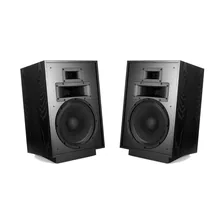 #72 Klipsch Heresy IV: $3,198 per pair Amazon Crutchfield eBay
Pros: Very high 94.5dB/2.83V/1m sensitivity in Erin’s anechoic measurement (well below Klipsch’s 99dB in-room claim, but still excellent) and strong short-term output from a 12-inch woofer plus horn-loaded midrange and tweeter. The compact, furniture-grade Heritage cabinet is easier to place than most high-efficiency designs, and dynamics at moderate levels can sound lively. A stable four-ohm-capable amplifier can produce substantial SPL with relatively little voltage. Measured bass extension of 77Hz (-3dB), with a measured sensitivity of 94.5dB.
Cons: Erin measured a 77Hz F3 and response rolling away near 100Hz in-room, so a subwoofer is required for modern full-range reproduction. The impedance dips to about 4 ohms, reducing the practical amplifier advantage implied by its sensitivity. Pronounced directivity mismatch at the driver transitions, impedance/response resonances and elevated distortion spikes around the crossover remain audible concerns that EQ cannot fully solve. At 102dB Erin measured roughly 1.5dB midband compression; at 96dB distortion rises around crossover. Performance is difficult to justify at the price, and Erin explicitly did not recommend it.
Full Klipsch Heresy IV review and specifications →
| Bass Extension (-10dB) | 50.0Hz (measured, Erin’s Audio Corner) |
|---|---|
| Bass Extension (-3dB) | 77Hz (measured, Erin’s Audio Corner) |
| DIY Kit | No |
| Dimensions | 24.8”H x 15.6”W x 13.3”D |
| Drivers | 1” horn-loaded tweeter; 1.75” horn-loaded midrange; 12” woofer |
| Impedance | Approximately 4 ohms minimum (measured, Erin’s Audio Corner) |
| Sensitivity | 94.5dB/2.83V/1m (measured, Erin’s Audio Corner) |
| Spinorama Preference Score | 2.27 |
| Spinorama Preference Score with Perfect Sub | 5.02 |
| Weight | 45 lbs (20.4 kg) each |
| Woofer Cabinet | ported, rear |
- Links
- Reviews, Comparisons and Sound Samples
- Head-to-Head Comparisons
- Klipsch Heresy IV vs Rockville RockTower 68B
- Klipsch Heresy IV vs Sony SS-CS3
- Klipsch Heresy IV vs Atlantic Technology 8600eLR
- Klipsch Heresy IV vs JBL Stage 2 280F
- Klipsch Heresy IV vs Magnepan LRS+
- Klipsch Heresy IV vs Infinity Reference 253
- Klipsch Heresy IV vs Polk Audio XT60
- Klipsch Heresy IV vs Focal Aria Evo X N°2
- See all 44 comparisons
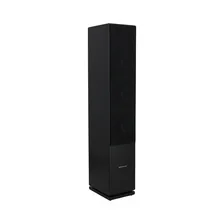 #73 Rockville RockTower 68B: $234.90 per pair Amazon Rockville eBay
Pros: An unusually inexpensive current 3-way tower with dual 6.5-inch woofers, a dedicated 6.5-inch midrange and silk-dome tweeter. Erin’s high-quality Spinorama data measures useful 54Hz extension, and the manufacturer sells each tower directly with free shipping. Measured bass extension of 60.1Hz (-3dB).
Cons: Objective performance is weak: its preference score is only 0.96 without a subwoofer and 3.42 with one, placing it near the bottom of the measured floorstanders. The large cabinet is lightly priced and specified sensitivity is only 87dB despite the multi-driver layout.
Full Rockville RockTower 68B review and specifications →
| Bass Extension (-10dB) | 43.1Hz (derived, log-interpolated between spinorama.org -9dB/-12dB points) |
|---|---|
| Bass Extension (-3dB) | 60.1Hz (measured, Erin’s Audio Corner via spinorama.org) |
| Bass Extension (-6dB) | 54Hz (measured, Spinorama) |
| DIY Kit | No |
| Dimensions | 41.7”H x 7.9”W x 10.4”D (1060 x 200 x 265 mm) |
| Drivers | 1-inch silk-dome tweeter, 6.5-inch midrange, dual 6.5-inch woofers |
| Enclosure | Passive 3-way vented floorstander |
| Frequency Response | 30Hz-20kHz (manufacturer specified) |
| Impedance | 8 ohms |
| Power Handling | 125W RMS / 500W peak |
| Sensitivity | 87dB |
| Spinorama Preference Score | 0.96 |
| Spinorama Preference Score with Perfect Sub | 3.42 |
| Weight | 55.1 lbs (25.0 kg) each |
- Links
- Reviews, Comparisons and Sound Samples
- Head-to-Head Comparisons
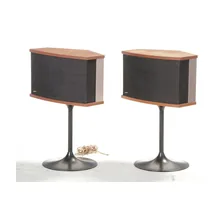 #74 Bose 901 Series V Discontinued Amazon eBay
Pros: Historically distinctive direct/reflecting architecture uses eight rear-firing and one front-firing full-range drivers to create a very large, room-filling presentation. Erin measured a benign 6.2-ohm minimum impedance, so the raw electrical load is easier than many modern four-ohm speakers. The supplied active equalizer offers user-adjustable tonal balance and is integral to obtaining usable bandwidth. Measured bass extension of 55.8Hz (-3dB), with a measured sensitivity of 81dB.
Cons: Even with the required EQ, Erin measured only about 81dB sensitivity, grossly non-flat response, numerous impedance/resonance irregularities and very high distortion. Output above roughly 90-95dB at his seat became audibly poor; multitone testing reached only about 98dB before the distortion limit. The reflection-dominant radiation prevents precise imaging and makes results strongly room-dependent. It requires the proprietary equalizer and substantial amplifier power despite its benign impedance. Discontinued.
Full Bose 901 Series V review and specifications →
| Bass Extension | Strongly dependent on supplied active equalizer and room (measured, Erin’s Audio Corner) |
|---|---|
| Bass Extension (-10dB) | 34.5Hz (measured, Erin’s Audio Corner) |
| Bass Extension (-3dB) | 55.8Hz (measured, Erin’s Audio Corner) |
| DIY Kit | No |
| DSP | External analog active equalizer required |
| Dimensions | 21”H x 21”W x 12.6”D (533.4 x 533.4 x 320.7 mm) |
| Drivers | Nine full-range drivers: eight rear-firing, one front-firing |
| Impedance | 6.2 ohms minimum (measured, Erin’s Audio Corner) |
| Sensitivity | Approximately 81dB/2.83V/1m with tested EQ setting (measured, Erin’s Audio Corner) |
| Spinorama Preference Score | 0.43 |
| Spinorama Preference Score with Perfect Sub | 2.11 |
| Weight | 35.3 lbs (16 kg) each |
- Reviews, Comparisons and Sound Samples
- Head-to-Head Comparisons
- Bose 901 Series V vs Triangle Esprit Antal Ez
- Bose 901 Series V vs JBL Studio 590
- Bose 901 Series V vs Sony SS-CS3
- Bose 901 Series V vs Børresen X3
- Bose 901 Series V vs JBL Stage 2 280F
- Bose 901 Series V vs Magnepan LRS+
- Bose 901 Series V vs Infinity Reference 253
- Bose 901 Series V vs Focal Aria Evo X N°2
- See all 25 comparisons