These are the headphones for listeners who want more bass, with extra weight and rumble below 100 Hz while vocals and treble stay balanced. It’s the sound many people prefer for hip hop, electronic music, films and games.
The ranking measures how closely each model matches a bass-boosted target: the Harman target with about 4 dB more low-end shelf. That’s different from a headphone that is simply boomy, since bass that bleeds into the midrange or comes with harsh treble scores poorly here. Each class shows its 15 closest matches, out of the models with a full published measurement.
Prices on this page were last checked October 10, 2026 at 5:37 PM UTC. Product prices and availability are accurate as of that date/time and are subject to change; the price and availability shown on Amazon at the time of purchase will apply to the purchase of this product.
As an eBay Partner, we may be compensated if you make a purchase.
Quick Navigation
| Select to compare | |||||||
|---|---|---|---|---|---|---|---|
| 11 | Dyson Zone | $349.99 | 90 | Closed | Wireless and wired | Over-ear | |
| 6 | Dan Clark Audio Noire X | $1,099.99 | 92 | Closed | Wired | Over-ear | |
| 4 | Philips Fidelio X2HR | $159.95 | 94 | Open | Wired | Over-ear | |
| 28 | AKG K371 | $144.95 | 85 | Closed | Wired | Over-ear | |
| 55 | Audio-Technica ATH-M40x | $109.00 | 79 | Closed | Wired | Over-ear | |
| 1 | Dan Clark Audio E3 | $2,179.00 | 101 | Closed | Wired | Over-ear | |
| 38 | Mackie MC-250 | $89.99 | 83 | Closed | Wired | Over-ear | |
| 57 | Audio-Technica ATH-M50x | $158.00 | 78 | Closed | Wired | Over-ear | |
| 77 | Shure SRH840A | $169.00 | 71 | Closed | Wired | Over-ear | |
| 54 | Sivga Luan | $299.00 | 80 | Open | Wired | Over-ear | |
| 56 | Meze 105 Aer | $299.00 | 79 | Open | Wired | Over-ear | |
| 66 | Focal Bathys | $799.00 | 76 | Closed | Wireless and wired | Over-ear | |
| 42 | Audio-Technica ATH-R70x | $379.00 | 82 | Open | Wired | Over-ear | |
| 70 | Sennheiser HD 620S | $259.19 | 74 | Closed | Wired | Over-ear | |
| 8 | Austrian Audio Hi-X60 | $303.69 | 91 | Closed | Wired | Over-ear | |
| 1 | Truthear Nova | $169.99 | 90 | Closed | Wired | In-ear | |
| 35 | TFZ T2 Galaxy | $59.00 | 69 | Closed | Wired | In-ear | |
| 2 | AKG N5005 | $399.99 | 87 | Closed | Wired | In-ear | |
| 5 | Truthear Gate | $21.99 | 83 | Closed | Wired | In-ear | |
| 4 | 7Hz Salnotes Zero | $22.99 | 84 | Closed | Wired | In-ear | |
| 47 | FiiO FH3 | $119.99 | 65 | Closed | Wired | In-ear | |
| 3 | Truthear x Crinacle Zero RED | $64.99 | 86 | Closed | Wired | In-ear | |
| 7 | Shuoer S12 | $129.00 | 80 | Closed | Wired | In-ear | |
| 17 | Beats Powerbeats Pro | $189.99 | 75 | Closed | True wireless | In-ear | |
| 33 | KZ ZST | $21.99 | 70 | Closed | Wired | In-ear | |
| 44 | Sennheiser Momentum True Wireless 3 | $111.99 | 66 | Closed | True wireless | In-ear | |
| 52 | Sennheiser IE 900 | $1,299.95 | 63 | Closed | Wired | In-ear | |
| 11 | Sony WF-1000XM5 | $198.00 | 78 | Closed | True wireless | In-ear | |
| 21 | Shuoer S12 Pro | $169.00 | 74 | Closed | Wired | In-ear | |
| 19 | KZ ZSN Pro X | $23.99 | 74 | Closed | Wired | In-ear |
Over-Ear Headphones
 Ranked #11 of 134 in Over-Ear Headphones - Dyson Zone: $349.99 Amazon eBay
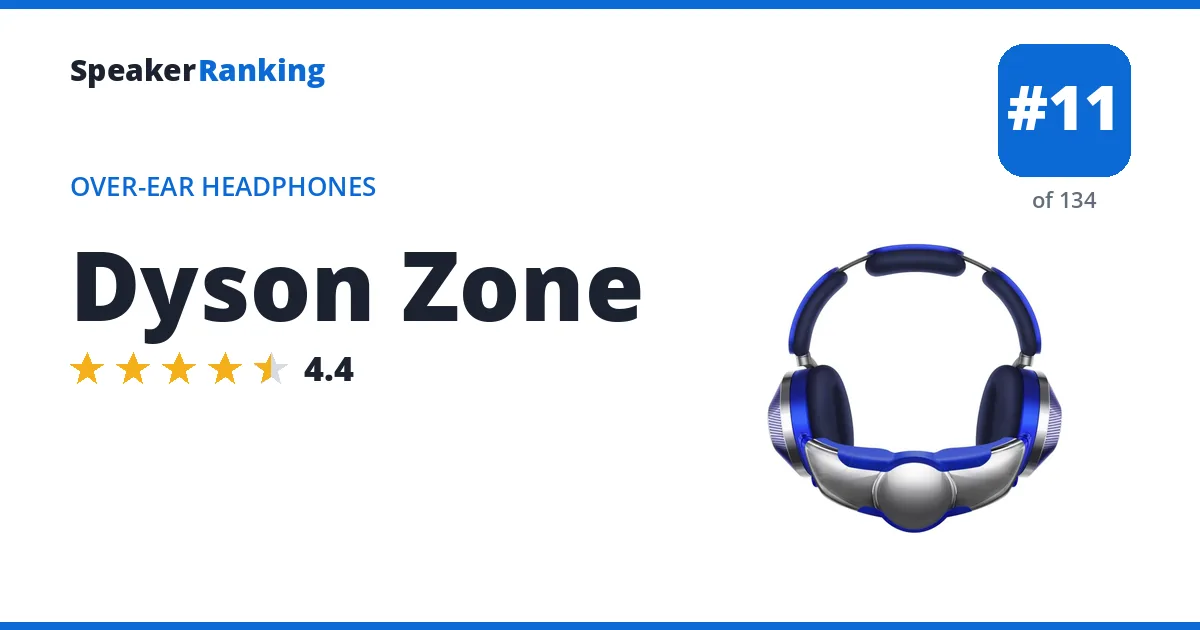
Pros: A preference score of 90 and a smooth 1.49 dB deviation put the tuning close to the Harman target, with sub-bass about 2 dB above target for extra rumble on kick drums and bass lines. It is a closed, wireless design with active noise cancelling, Bluetooth 5.0, a built-in microphone and a claimed 50 hours of battery, and it also works wired. Its rating matches the Austrian Audio Hi-X60 and Sennheiser HD 600.
Cons: A 3.3 dB dip near 3.4 kHz and a 2.1 dB shortfall across the presence region pull some bite and clarity out of vocals and guitars. The treble is lifted by about 2 to 3.5 dB above 6 kHz, with a peak near 7.8 dB at 11.2 kHz that can make cymbals and sibilance sound sharp. The warm lean may feel slightly full for listeners who prefer a strictly neutral sound.
Full Dyson Zone review and specifications →
| Released | Oct 2023 (3 years ago) |
|---|---|
| Active Noise Cancelling | Yes |
| Back | Closed |
| Battery Life | 50 hours (Manufacturer specified) |
| Bluetooth Version | 5.0 |
| Built-in Microphone | Yes |
| Connection | Wireless and wired |
| Deviation From Target | 1.49 dB standard deviation |
| Driver Type | Dynamic |
| Form Factor | Over-ear |
| Frequency Response | 6Hz - 20kHz (Manufacturer specified) |
| Harman Preference Score | 90 (measured by oratory1990, via AutoEQ) |
| Impedance | 16 ohms |
| Sensitivity | 94 dB |
| Tonal Tilt | -0.34 (negative is warmer, positive brighter) |
EQ preset to match the Harman target
Set a preamp of -3.4 dB, then add these filters in any parametric equalizer (Wavelet, Equalizer APO, Peace, or a player with parametric EQ). Calculated by AutoEQ from its measured frequency response.
| Filter | Frequency | Gain | Q |
|---|---|---|---|
| Low shelf | 105 Hz | +4.4 dB | 0.70 |
| Peak | 3,632 Hz | +3.4 dB | 1.95 |
| Peak | 42 Hz | -7.0 dB | 0.53 |
| Peak | 964 Hz | +1.3 dB | 2.85 |
| Peak | 1,841 Hz | -1.3 dB | 1.77 |
| High shelf | 10,000 Hz | -5.6 dB | 0.70 |
| Peak | 6,856 Hz | -2.8 dB | 4.04 |
| Peak | 4,879 Hz | +2.6 dB | 4.77 |
| Peak | 1,194 Hz | +0.2 dB | 3.03 |
| Peak | 10,000 Hz | -0.8 dB | 4.50 |
- Reviews, Comparisons and Sound Samples
- Head-to-Head Comparisons
 Ranked #6 of 134 in Over-Ear Headphones - Dan Clark Audio Noire X: $1,099.99 Amazon eBay
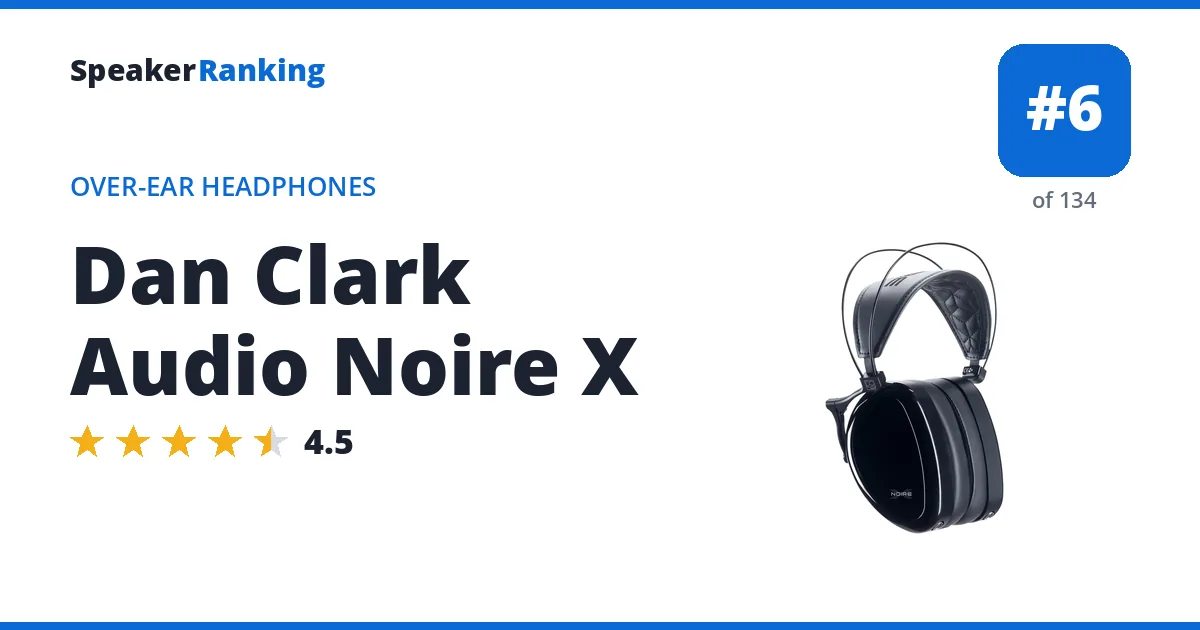
Pros: A preference score of 92 with only 1.3 dB of deviation from target keeps the response smooth, and bass sits slightly above target, with sub-bass 0.6 dB and 60 to 200 Hz 1.2 dB over. That gives kick drums and bass lines a full, warm foundation. Impedance of 13 ohms and sensitivity of 90 dB/mW work from a headphone amp, and the closed back isolates from surroundings.
Cons: Treble is uneven, with the 6 to 10 kHz band about 2.5 dB low and a 3.9 dB dip near 6.4 kHz, followed by a 4.2 dB peak near 11.9 kHz. That can make cymbals sound slightly dull then suddenly airy. The 403 g weight is heavy, and the high price is difficult to justify next to the HIFIMAN Arya Organic.
Full Dan Clark Audio Noire X review and specifications →
| Back | Closed |
|---|---|
| Connection | Wired |
| Deviation From Target | 1.33 dB standard deviation |
| Driver Type | Planar magnetic |
| Form Factor | Over-ear |
| Harman Preference Score | 92 (measured by oratory1990, via AutoEQ) |
| Impedance | 13 ohms |
| Sensitivity | 90 dB/mW |
| Tonal Tilt | -0.38 (negative is warmer, positive brighter) |
| Weight | 0.9 lbs (403 g) |
EQ preset to match the Harman target
Set a preamp of -3.3 dB, then add these filters in any parametric equalizer (Wavelet, Equalizer APO, Peace, or a player with parametric EQ). Calculated by AutoEQ from its measured frequency response.
| Filter | Frequency | Gain | Q |
|---|---|---|---|
| Low shelf | 105 Hz | -0.3 dB | 0.70 |
| Peak | 116 Hz | -1.8 dB | 1.71 |
| Peak | 5,274 Hz | +3.7 dB | 0.76 |
| Peak | 4,808 Hz | -6.3 dB | 3.05 |
| Peak | 2,137 Hz | -3.1 dB | 3.41 |
| High shelf | 10,000 Hz | -4.3 dB | 0.70 |
| Peak | 611 Hz | +1.4 dB | 2.67 |
| Peak | 294 Hz | -0.6 dB | 1.94 |
| Peak | 62 Hz | +0.6 dB | 2.74 |
| Peak | 6,601 Hz | +1.7 dB | 6.00 |
- Reviews, Comparisons and Sound Samples
 Ranked #4 of 134 in Over-Ear Headphones - Philips Fidelio X2HR: $159.95 Discontinued Amazon eBay
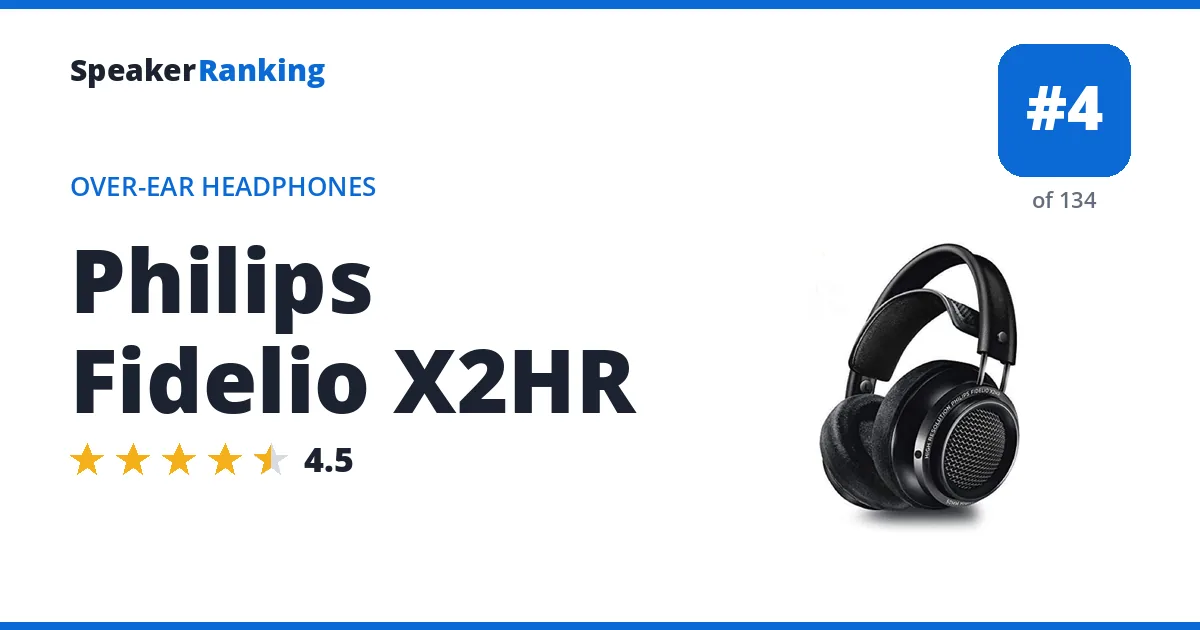
Pros: Its preference score of 94 comes from a smooth response within about 1.3 dB of the Harman target, with bass from 60 to 200 Hz and the midrange all within a dB of target. The slightly warm tilt suits listeners who find bright headphones fatiguing. At 30 ohms and 100 dB/mW it runs from a phone without a separate amp, and the 50 mm dynamic driver delivers it at a modest price compared with the Sennheiser HD 560S.
Cons: Sub-bass is about 4.6 dB below target, so the lowest notes in electronic and hip hop tracks lack impact. Treble from 6 kHz up is slightly recessed, with a 5 dB dip near 11.9 kHz, which takes some sparkle off cymbals. The open back leaks sound and offers no isolation, and at 380 g it is on the heavier side. Discontinued.
Full Philips Fidelio X2HR review and specifications →
| Back | Open |
|---|---|
| Connection | Wired |
| Deviation From Target | 1.27 dB standard deviation |
| Driver Type | Dynamic |
| Drivers | 1 x 50mm dynamic |
| Form Factor | Over-ear |
| Frequency Response | 5Hz - 40kHz (Manufacturer specified) |
| Harman Preference Score | 94 (measured by oratory1990, via AutoEQ) |
| Impedance | 30 ohms |
| Sensitivity | 100 dB/mW |
| Tonal Tilt | -0.29 (negative is warmer, positive brighter) |
| Weight | 0.8 lbs (380 g) |
EQ preset to match the Harman target
Set a preamp of -6.4 dB, then add these filters in any parametric equalizer (Wavelet, Equalizer APO, Peace, or a player with parametric EQ). Calculated by AutoEQ from its measured frequency response.
| Filter | Frequency | Gain | Q |
|---|---|---|---|
| Low shelf | 105 Hz | +7.8 dB | 0.70 |
| Peak | 64 Hz | -7.1 dB | 0.68 |
| Peak | 4,982 Hz | +4.2 dB | 0.79 |
| Peak | 5,096 Hz | -8.2 dB | 2.97 |
| Peak | 29 Hz | +1.2 dB | 4.24 |
| High shelf | 10,000 Hz | -1.2 dB | 0.70 |
| Peak | 1,660 Hz | -2.7 dB | 4.61 |
| Peak | 261 Hz | -1.0 dB | 5.02 |
| Peak | 2,026 Hz | +0.9 dB | 4.49 |
| Peak | 2,996 Hz | +1.2 dB | 6.00 |
- Reviews, Comparisons and Sound Samples
- Head-to-Head Comparisons
 Ranked #28 of 134 in Over-Ear Headphones - AKG K371: $144.95 Amazon eBay
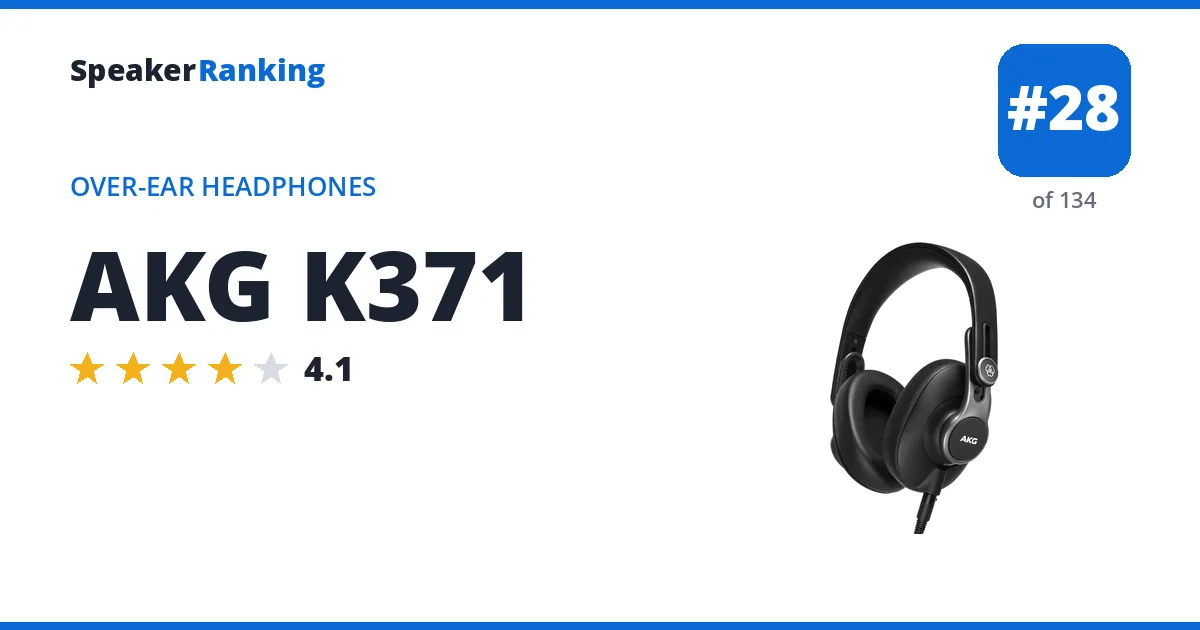
Pros: A preference score of 85 with only 1.66 dB of deviation makes it one of the smoother closed-back models, and sub-bass runs about 1.6 dB above target for a full, extended low end. At 32 ohms and 114 dB per volt it is easy to drive from a phone, and the closed design isolates reasonably well. The warm tilt suits listeners who want bass without harshness.
Cons: A 7 dB dip near 3.9 kHz and presence about 2.6 dB low push vocals and instrument detail back, while air above 10 kHz is roughly 3.5 dB low, so the sound is dark and lacks sparkle. Fans of a bright or highly detailed presentation will find it veiled.
Full AKG K371 review and specifications →
| Released | Aug 2019 (7 years ago) |
|---|---|
| Back | Closed |
| Connection | Wired |
| Deviation From Target | 1.66 dB standard deviation |
| Driver Type | Dynamic |
| Drivers | 1 x 50mm dynamic |
| Form Factor | Over-ear |
| Frequency Response | 5Hz - 40kHz (Manufacturer specified) |
| Harman Preference Score | 85 (measured by oratory1990, via AutoEQ) |
| Impedance | 32 ohms |
| Sensitivity | 114 dB SPL/V |
| Tonal Tilt | -0.57 (negative is warmer, positive brighter) |
| Weight | 0.6 lbs (255 g) |
EQ preset to match the Harman target
Set a preamp of -5.6 dB, then add these filters in any parametric equalizer (Wavelet, Equalizer APO, Peace, or a player with parametric EQ). Calculated by AutoEQ from its measured frequency response.
| Filter | Frequency | Gain | Q |
|---|---|---|---|
| Low shelf | 105 Hz | -2.7 dB | 0.70 |
| Peak | 182 Hz | -2.3 dB | 1.23 |
| Peak | 4,038 Hz | +5.0 dB | 3.60 |
| Peak | 67 Hz | +3.1 dB | 1.41 |
| Peak | 1,066 Hz | -0.8 dB | 2.57 |
| High shelf | 10,000 Hz | +2.4 dB | 0.70 |
| Peak | 5,564 Hz | -1.6 dB | 3.89 |
| Peak | 4,232 Hz | +0.9 dB | 5.03 |
| Peak | 524 Hz | +0.3 dB | 1.66 |
| Peak | 2,048 Hz | +0.5 dB | 4.67 |
- Reviews, Comparisons and Sound Samples
 Ranked #55 of 134 in Over-Ear Headphones - Audio-Technica ATH-M40x: $109.00 Amazon eBay
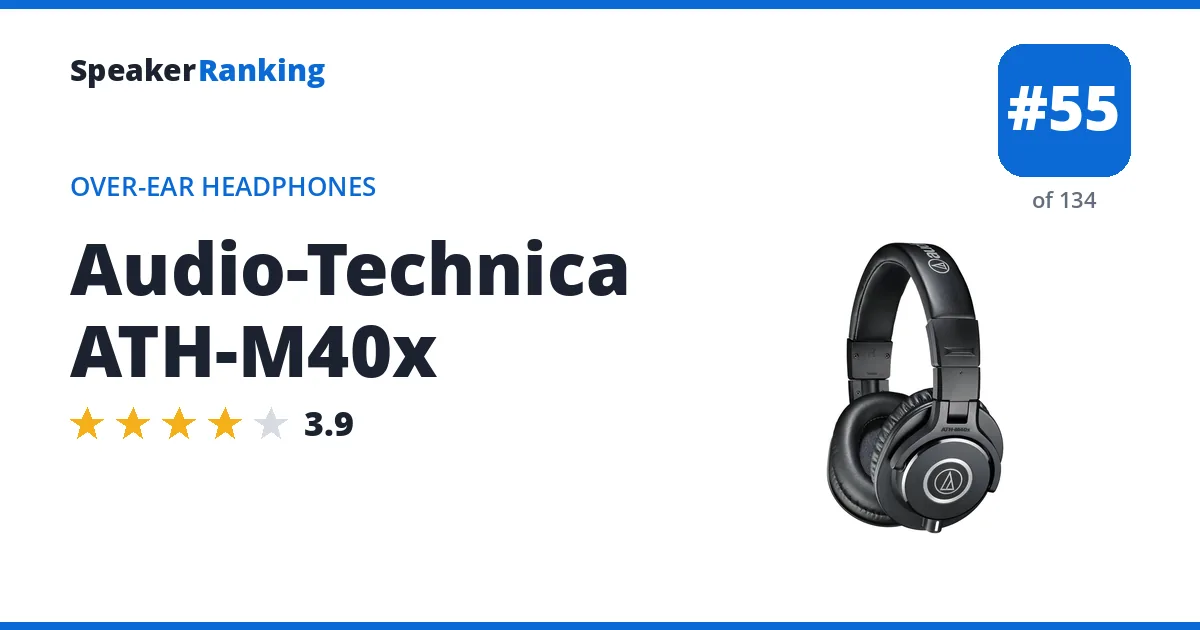
Pros: The closed back keeps outside noise down and sound in, and at 240 g it is the lightest closed back in this group. Bass from 60 to 200 Hz sits about 3 dB above target while sub-bass is nearly on target, giving punchy, full low end with a preference score of 79. At 35 ohms and 98 dB sensitivity a phone drives it without an amp, and it ties the Philips SHP9500 on rating at a slightly higher street price.
Cons: Treble from 6 to 10 kHz is about 2 dB hot and the top octave 4.5 dB above target, with a 5.5 dB peak near 8.3 kHz, so cymbals and sibilants can sound sharp and splashy. A 3 dB dip near 5 kHz can blur vocal detail slightly. The bass emphasis is too much for listeners who want a neutral balance.
Full Audio-Technica ATH-M40x review and specifications →
| Released | Feb 2014 (12 years ago) |
|---|---|
| Back | Closed |
| Connection | Wired |
| Deviation From Target | 2.14 dB standard deviation |
| Driver Type | Dynamic |
| Form Factor | Over-ear |
| Frequency Response | 15Hz - 24kHz (Manufacturer specified) |
| Harman Preference Score | 79 (measured by oratory1990, via AutoEQ) |
| Impedance | 35 ohms |
| Sensitivity | 98 dB |
| Tonal Tilt | -0.57 (negative is warmer, positive brighter) |
| Weight | 0.5 lbs (240 g) |
EQ preset to match the Harman target
Set a preamp of -5.6 dB, then add these filters in any parametric equalizer (Wavelet, Equalizer APO, Peace, or a player with parametric EQ). Calculated by AutoEQ from its measured frequency response.
| Filter | Frequency | Gain | Q |
|---|---|---|---|
| Low shelf | 105 Hz | +17.6 dB | 0.70 |
| Peak | 48 Hz | -16.9 dB | 0.29 |
| Peak | 348 Hz | +6.0 dB | 0.87 |
| Peak | 5,150 Hz | +3.3 dB | 4.10 |
| Peak | 2,979 Hz | +1.8 dB | 1.99 |
| High shelf | 10,000 Hz | -6.9 dB | 0.70 |
| Peak | 1,378 Hz | -1.4 dB | 2.13 |
| Peak | 796 Hz | +0.6 dB | 1.67 |
| Peak | 6,306 Hz | +1.6 dB | 5.10 |
| Peak | 2,225 Hz | +0.8 dB | 3.70 |
- Reviews, Comparisons and Sound Samples
- Head-to-Head Comparisons
 Ranked #1 of 134 in Over-Ear Headphones - Dan Clark Audio E3: $2,179.00 Amazon eBay
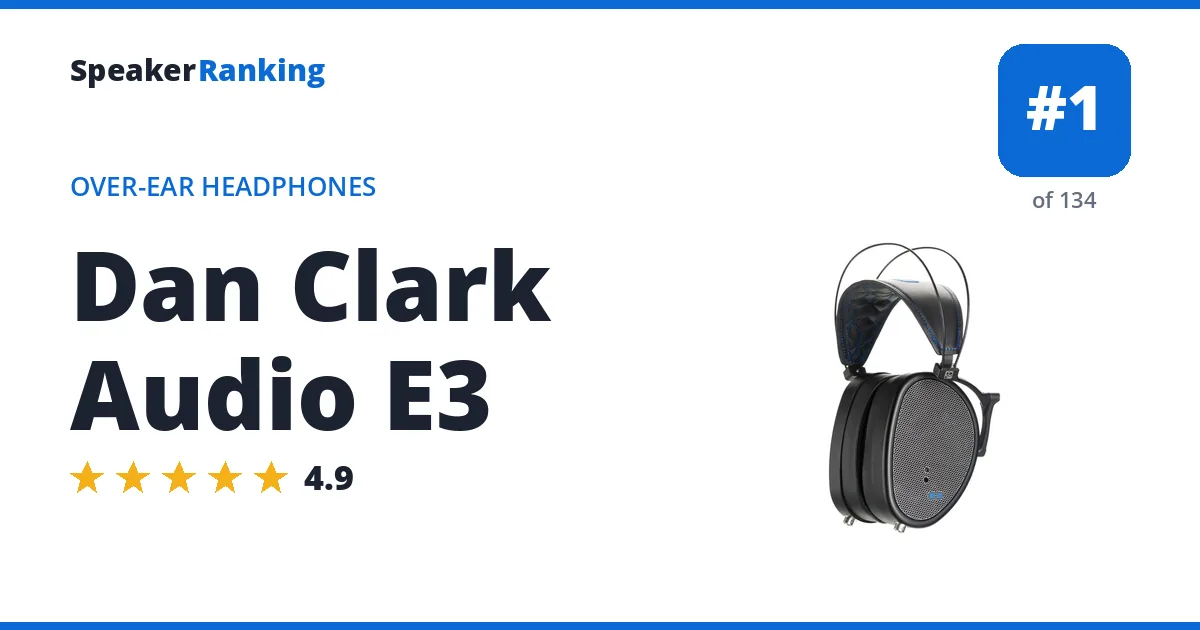
Pros: In oratory1990’s measurement it earns a preference score of 101, with response held within about 1 dB of the Harman target from sub-bass through the upper mids. Bass from 20 to 200 Hz sits less than 1 dB above target, so kick drums and bass guitar have full weight without bloom. A 27 ohm impedance and 90 dB/mW sensitivity are easy enough for a decent headphone amp, and the closed back keeps sound in and outside noise down.
Cons: The upper treble is uneven, with a 5.6 dB dip near 9.9 kHz followed by a 5 dB peak near 11.9 kHz, which can make cymbals and sibilance sound slightly uneven. At 455 g it is heavy for long sessions, and planar drivers at this sensitivity perform best from a proper amp rather than a phone.
Full Dan Clark Audio E3 review and specifications →
| Back | Closed |
|---|---|
| Connection | Wired |
| Deviation From Target | 1.05 dB standard deviation |
| Driver Type | Planar magnetic |
| Form Factor | Over-ear |
| Harman Preference Score | 101 (measured by oratory1990, via AutoEQ) |
| Impedance | 27 ohms |
| Sensitivity | 90 dB/mW |
| Tonal Tilt | -0.04 (negative is warmer, positive brighter) |
| Weight | 1 lbs (455 g) |
EQ preset to match the Harman target
Set a preamp of -1.0 dB, then add these filters in any parametric equalizer (Wavelet, Equalizer APO, Peace, or a player with parametric EQ). Calculated by AutoEQ from its measured frequency response.
| Filter | Frequency | Gain | Q |
|---|---|---|---|
| Low shelf | 105 Hz | -0.2 dB | 0.70 |
| Peak | 1,224 Hz | +1.1 dB | 0.87 |
| Peak | 2,683 Hz | -2.0 dB | 3.34 |
| Peak | 471 Hz | -0.6 dB | 2.01 |
| Peak | 91 Hz | -0.5 dB | 2.36 |
| High shelf | 10,000 Hz | -1.8 dB | 0.70 |
| Peak | 167 Hz | +0.8 dB | 2.72 |
| Peak | 3,979 Hz | -0.6 dB | 4.28 |
| Peak | 5,845 Hz | -1.1 dB | 6.00 |
| Peak | 112 Hz | -0.3 dB | 2.53 |
- Reviews, Comparisons and Sound Samples
 Ranked #38 of 134 in Over-Ear Headphones - Mackie MC-250: $89.99 Amazon eBay
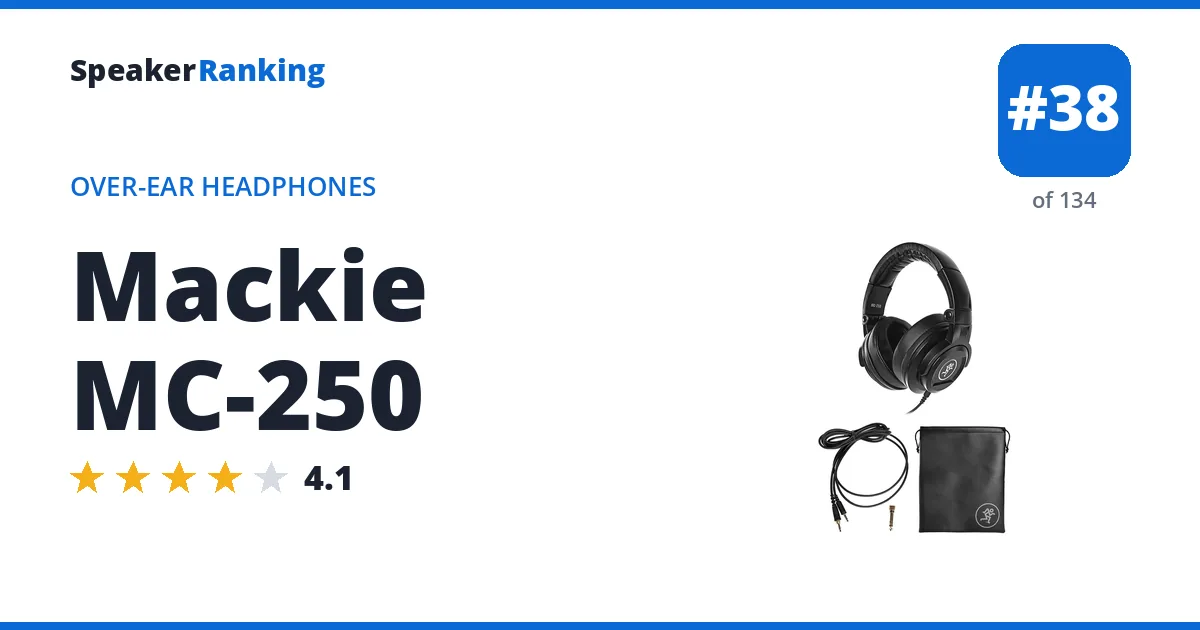
Pros: A preference score of 83 for a closed-back headphone is strong, and bass from 60 to 200 Hz is about 1 dB above target for a slightly warm, full low end. Treble from 6 to 16 kHz is within 0.1 dB of target. At 38 ohms and 100 dB sensitivity it runs fine from a phone, and the closed back keeps leakage down. It is a wired design at 265 g.
Cons: A 5 dB dip near 4.8 kHz and presence about 2.5 dB under target make vocals and snare snap sound a little recessed. Sub-bass is about 4 dB under target under 60 Hz. The warm tilt of minus 0.45 may sound dull for listeners who prefer a brighter sound.
Full Mackie MC-250 review and specifications →
| Back | Closed |
|---|---|
| Connection | Wired |
| Deviation From Target | 1.95 dB standard deviation |
| Driver Type | Dynamic |
| Drivers | 1 x 50mm |
| Form Factor | Over-ear |
| Frequency Response | 10Hz - 20kHz (Manufacturer specified) |
| Harman Preference Score | 83 (measured by oratory1990, via AutoEQ) |
| Impedance | 38 ohms |
| Sensitivity | 100 dB |
| Tonal Tilt | -0.45 (negative is warmer, positive brighter) |
| Weight | 0.6 lbs (265 g) |
EQ preset to match the Harman target
Set a preamp of -7.7 dB, then add these filters in any parametric equalizer (Wavelet, Equalizer APO, Peace, or a player with parametric EQ). Calculated by AutoEQ from its measured frequency response.
| Filter | Frequency | Gain | Q |
|---|---|---|---|
| Low shelf | 105 Hz | +15.9 dB | 0.70 |
| Peak | 50 Hz | -14.8 dB | 0.42 |
| Peak | 419 Hz | +5.7 dB | 1.71 |
| Peak | 905 Hz | -2.0 dB | 1.42 |
| Peak | 4,207 Hz | +4.5 dB | 4.10 |
| High shelf | 10,000 Hz | +0.3 dB | 0.70 |
| Peak | 8,939 Hz | -1.7 dB | 3.53 |
| Peak | 5,862 Hz | -2.6 dB | 6.00 |
| Peak | 1,892 Hz | +1.7 dB | 4.71 |
| Peak | 1,370 Hz | -0.7 dB | 3.02 |
- Reviews, Comparisons and Sound Samples
- Head-to-Head Comparisons
 Ranked #57 of 134 in Over-Ear Headphones - Audio-Technica ATH-M50x: $158.00 Amazon eBay
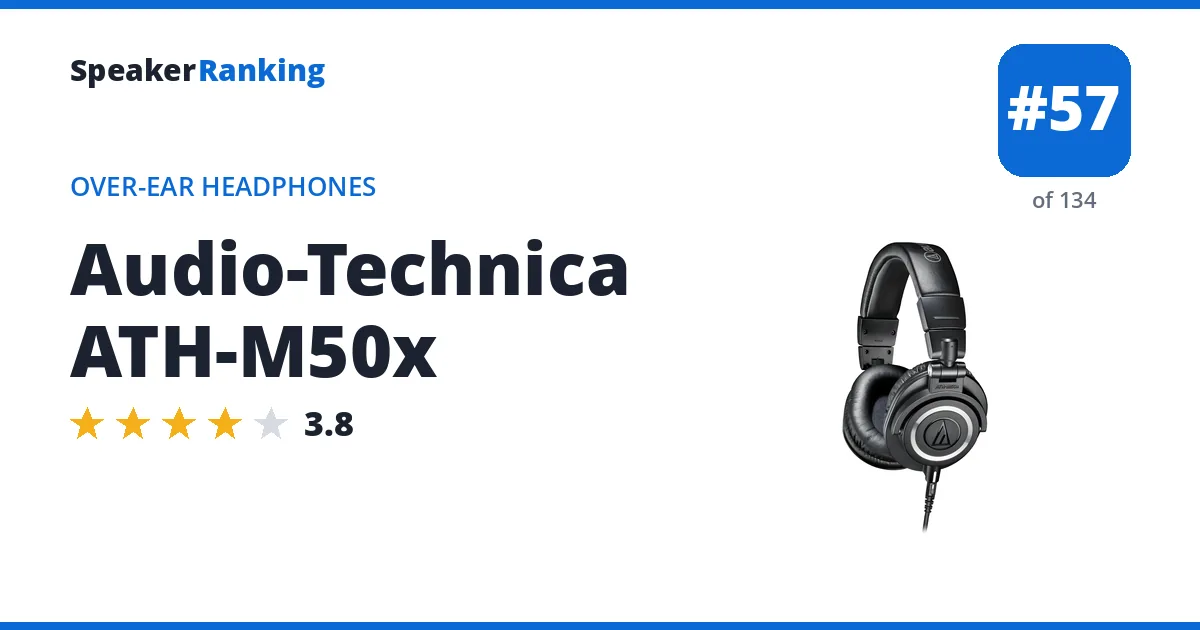
Pros: This closed back has a very smooth response, with a deviation of 2.0 dB and the largest peak only 1.2 dB near 4.3 kHz, so it avoids harshness. Sub-bass is on target and bass from 60 to 200 Hz is about 3 dB above, which gives clean, punchy bass, and the preference score is 78. At 38 ohms and 99 dB/mW it is easy to drive from a phone, it weighs 285 g and it isolates from noise.
Cons: Treble from 6 to 10 kHz is about 1.7 dB low and a 3.5 dB dip near 6.8 kHz softens cymbals and sibilance, while the top octave runs about 2 dB hot, a slightly uneven treble. The warm, bass lifted balance is not neutral enough for critical listening. It is a closed back, so bass has less airiness than the open backs in this class.
Full Audio-Technica ATH-M50x review and specifications →
| Back | Closed |
|---|---|
| Connection | Wired |
| Deviation From Target | 2.01 dB standard deviation |
| Driver Type | Dynamic |
| Drivers | 1 x 45mm dynamic |
| Form Factor | Over-ear |
| Frequency Response | 15Hz - 28kHz (Manufacturer specified) |
| Harman Preference Score | 78 (measured by oratory1990, via AutoEQ) |
| Impedance | 38 ohms |
| Sensitivity | 99 dB/mW |
| Tonal Tilt | -0.75 (negative is warmer, positive brighter) |
| Weight | 0.6 lbs (285 g) |
EQ preset to match the Harman target
Set a preamp of -3.1 dB, then add these filters in any parametric equalizer (Wavelet, Equalizer APO, Peace, or a player with parametric EQ). Calculated by AutoEQ from its measured frequency response.
| Filter | Frequency | Gain | Q |
|---|---|---|---|
| Low shelf | 105 Hz | +0.6 dB | 0.70 |
| Peak | 156 Hz | -5.2 dB | 0.73 |
| Peak | 326 Hz | +5.3 dB | 1.59 |
| Peak | 7,077 Hz | +2.8 dB | 2.22 |
| Peak | 3,483 Hz | +2.1 dB | 5.82 |
| High shelf | 10,000 Hz | -4.1 dB | 0.70 |
| Peak | 45 Hz | -1.1 dB | 1.90 |
| Peak | 66 Hz | +1.4 dB | 3.59 |
| Peak | 787 Hz | -0.5 dB | 1.79 |
| Peak | 1,640 Hz | +0.9 dB | 3.41 |
- Reviews, Comparisons and Sound Samples
- Head-to-Head Comparisons
 Ranked #77 of 134 in Over-Ear Headphones - Shure SRH840A: $169.00 Amazon eBay
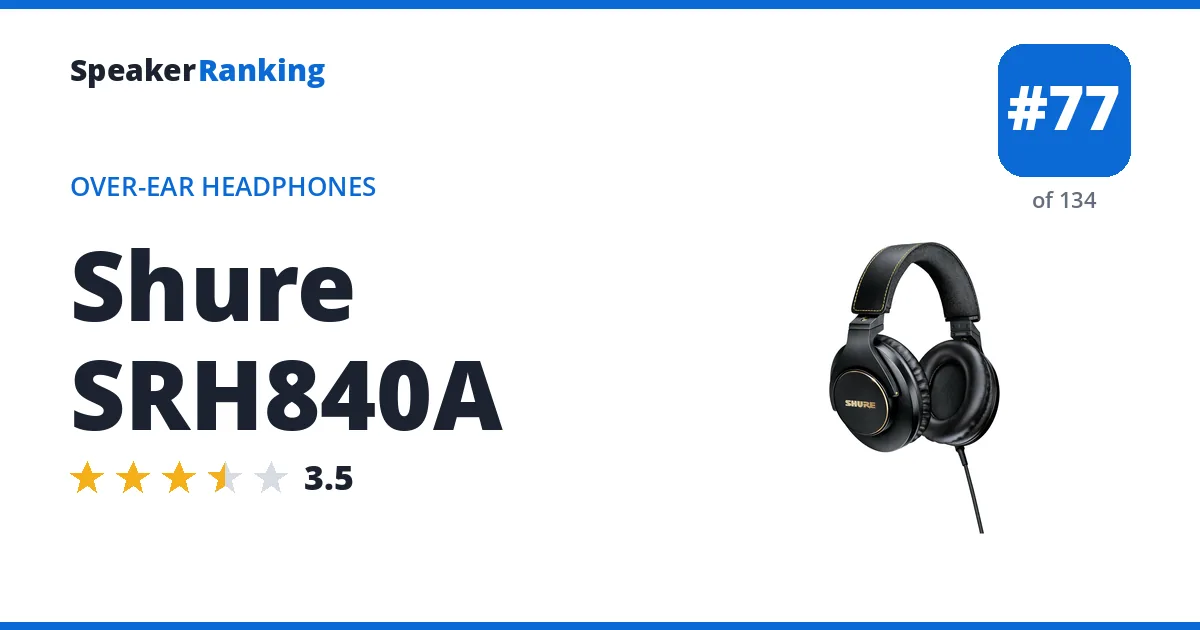
Older model: the Shure SRH840 (ranked higher, rated 4.3/5). See every Shure SRH840 generation.
Pros: Bass is big, with sub-bass about 3.9 dB and bass about 5.3 dB above target, which suits hip hop, EDM and pop where weight matters. Treble and air are lifted too, about 2 dB and 4.5 dB over target, adding sparkle and a sense of detail. At 44 ohms and 102 dB/mW sensitivity it runs well from a phone, and the closed 273 g design isolates.
Cons: The bass boost of 5.3 dB can bleed into the low mids and cloud vocals and bass guitar. A 4 dB peak near 11.9 kHz can make cymbals and sibilance a little splashy. Overall tilt is warm, so listeners who want an accurate, neutral balance will find it colored.
Full Shure SRH840A review and specifications →
| Back | Closed |
|---|---|
| Connection | Wired |
| Deviation From Target | 2.25 dB standard deviation |
| Driver Type | Dynamic |
| Drivers | 1 x 40mm dynamic |
| Form Factor | Over-ear |
| Frequency Response | 5Hz - 25kHz (Manufacturer specified) |
| Harman Preference Score | 71 (measured by oratory1990, via AutoEQ) |
| Impedance | 44 ohms |
| Sensitivity | 102 dB/mW |
| Tonal Tilt | -0.99 (negative is warmer, positive brighter) |
| Weight | 0.6 lbs (273 g) |
EQ preset to match the Harman target
Set a preamp of -3.3 dB, then add these filters in any parametric equalizer (Wavelet, Equalizer APO, Peace, or a player with parametric EQ). Calculated by AutoEQ from its measured frequency response.
| Filter | Frequency | Gain | Q |
|---|---|---|---|
| Low shelf | 105 Hz | -1.4 dB | 0.70 |
| Peak | 1,254 Hz | +2.3 dB | 0.60 |
| Peak | 121 Hz | -3.6 dB | 0.71 |
| Peak | 5,403 Hz | -3.1 dB | 2.76 |
| Peak | 4,270 Hz | +3.9 dB | 4.65 |
| High shelf | 10,000 Hz | -4.6 dB | 0.70 |
| Peak | 46 Hz | -0.4 dB | 1.73 |
| Peak | 251 Hz | +1.2 dB | 3.63 |
| Peak | 170 Hz | -0.7 dB | 3.14 |
| Peak | 418 Hz | -0.6 dB | 2.84 |
- Reviews, Comparisons and Sound Samples
 Ranked #54 of 134 in Over-Ear Headphones - Sivga Luan: $299.00 Amazon eBay
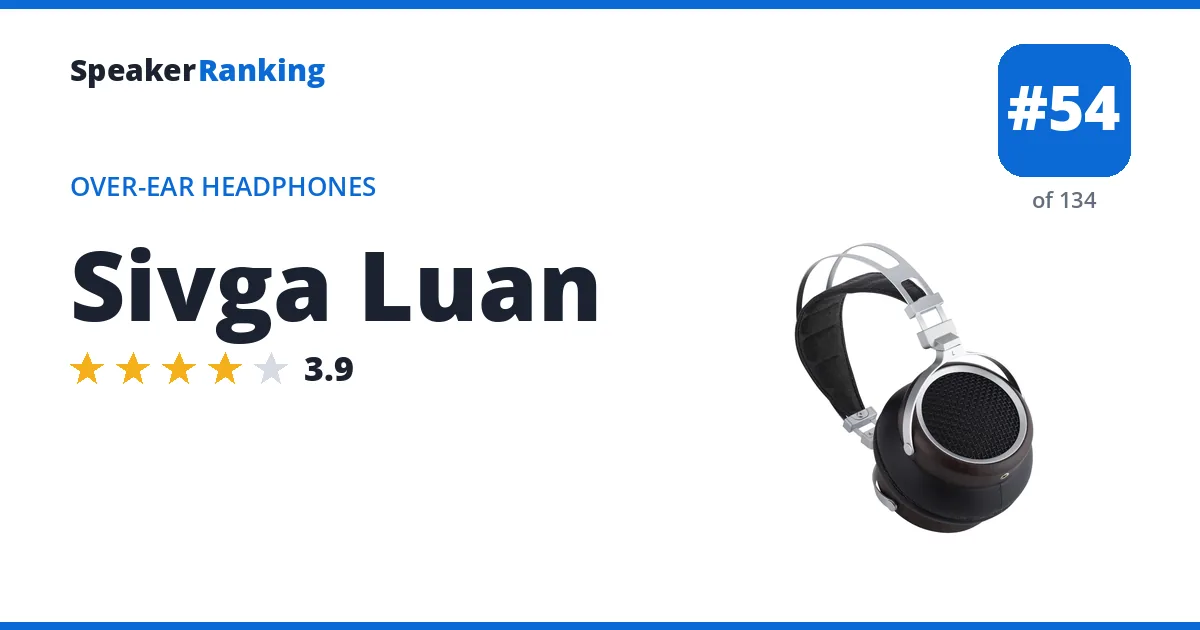
Pros: The open back tuning leans warm, with bass from 60 to 200 Hz about 3 dB above target and the lows and mids around 1.5 dB above, which gives music body and weight that suits rock, pop and hip hop. A deviation of 2.0 dB is among the smoothest in this group, and the preference score is 80. At 38 ohms and 100 dB sensitivity a phone or dongle can drive it, and it weighs 354 g.
Cons: A 5 dB peak near 2.8 kHz can make vocals and guitars sound forward or slightly shouty at higher volume, and a 5.8 dB dip near 9.3 kHz takes the edge off cymbals while the top octave runs 6 dB above target. Listeners who want a neutral balance will find the bass and low mids heavy. The open back leaks sound and has no isolation, and there is no built in microphone.
Full Sivga Luan review and specifications →
| Back | Open |
|---|---|
| Built-in Microphone | No |
| Connection | Wired |
| Deviation From Target | 2.04 dB standard deviation |
| Driver Type | Dynamic |
| Drivers | 1 x 50mm dynamic |
| Form Factor | Over-ear |
| Frequency Response | 20Hz - 40kHz (Manufacturer specified) |
| Harman Preference Score | 80 (measured by oratory1990, via AutoEQ) |
| Impedance | 38 ohms |
| Sensitivity | 100 dB |
| Tonal Tilt | -0.58 (negative is warmer, positive brighter) |
| Weight | 0.8 lbs (354 g) |
EQ preset to match the Harman target
Set a preamp of -7.0 dB, then add these filters in any parametric equalizer (Wavelet, Equalizer APO, Peace, or a player with parametric EQ). Calculated by AutoEQ from its measured frequency response.
| Filter | Frequency | Gain | Q |
|---|---|---|---|
| Low shelf | 105 Hz | +13.5 dB | 0.70 |
| Peak | 54 Hz | -11.3 dB | 0.36 |
| Peak | 1,033 Hz | +2.6 dB | 0.39 |
| Peak | 2,697 Hz | -5.0 dB | 2.19 |
| Peak | 7,643 Hz | +2.9 dB | 1.41 |
| High shelf | 10,000 Hz | -7.5 dB | 0.70 |
| Peak | 4,022 Hz | -2.2 dB | 6.00 |
| Peak | 5,210 Hz | +2.7 dB | 5.98 |
| Peak | 3,497 Hz | +1.7 dB | 6.00 |
| Peak | 4,281 Hz | -0.8 dB | 4.36 |
- Reviews, Comparisons and Sound Samples
 Ranked #56 of 134 in Over-Ear Headphones - Meze 105 Aer: $299.00 Amazon eBay
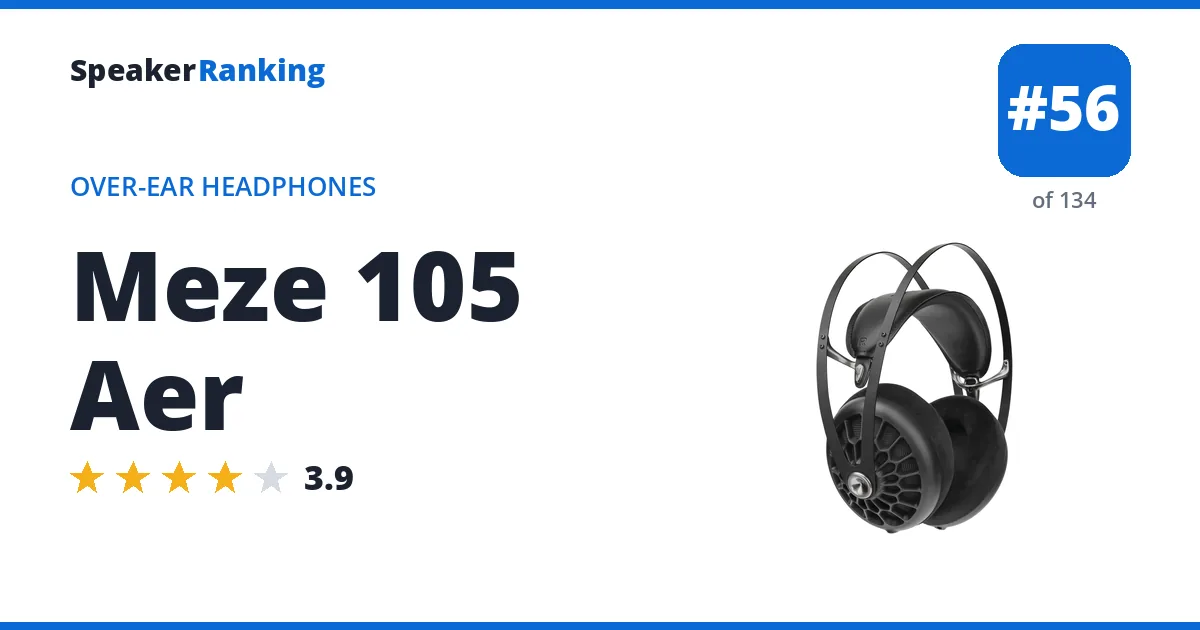
Pros: The open back tuning is warm, with bass from 60 to 200 Hz about 2 dB above target and the low mids about 1.6 dB above, so voices and instruments sound full and relaxed. Presence from 3 to 6 kHz is lifted about 2.8 dB, which adds clarity to vocals, and the preference score is 79. It uses a single 50 mm dynamic driver and matches the Sivga Luan on rating at the same price.
Cons: An 8 dB dip near 8.8 kHz and treble about 2.6 dB below target take the shimmer off cymbals and sibilance, so the top end can sound dull and veiled. A 4.4 dB peak near 4 kHz adds some forwardness to vocals. The open back leaks sound and offers no isolation.
Full Meze 105 Aer review and specifications →
| Back | Open |
|---|---|
| Connection | Wired |
| Deviation From Target | 2.15 dB standard deviation |
| Driver Type | Dynamic |
| Drivers | 1 x 50mm dynamic |
| Form Factor | Over-ear |
| Harman Preference Score | 79 (measured by oratory1990, via AutoEQ) |
| Tonal Tilt | -0.51 (negative is warmer, positive brighter) |
EQ preset to match the Harman target
Set a preamp of -4.9 dB, then add these filters in any parametric equalizer (Wavelet, Equalizer APO, Peace, or a player with parametric EQ). Calculated by AutoEQ from its measured frequency response.
| Filter | Frequency | Gain | Q |
|---|---|---|---|
| Low shelf | 105 Hz | +10.0 dB | 0.70 |
| Peak | 51 Hz | -8.2 dB | 0.36 |
| Peak | 1,943 Hz | +4.9 dB | 1.54 |
| Peak | 8,128 Hz | +5.6 dB | 1.84 |
| Peak | 5,283 Hz | -3.8 dB | 0.58 |
| High shelf | 10,000 Hz | -2.1 dB | 0.70 |
| Peak | 470 Hz | +0.8 dB | 2.44 |
| Peak | 4,703 Hz | +3.1 dB | 5.89 |
| Peak | 5,659 Hz | -1.5 dB | 5.63 |
| Peak | 4,063 Hz | -1.3 dB | 6.00 |
- Reviews, Comparisons and Sound Samples
 Ranked #66 of 134 in Over-Ear Headphones - Focal Bathys: $799.00 Amazon eBay
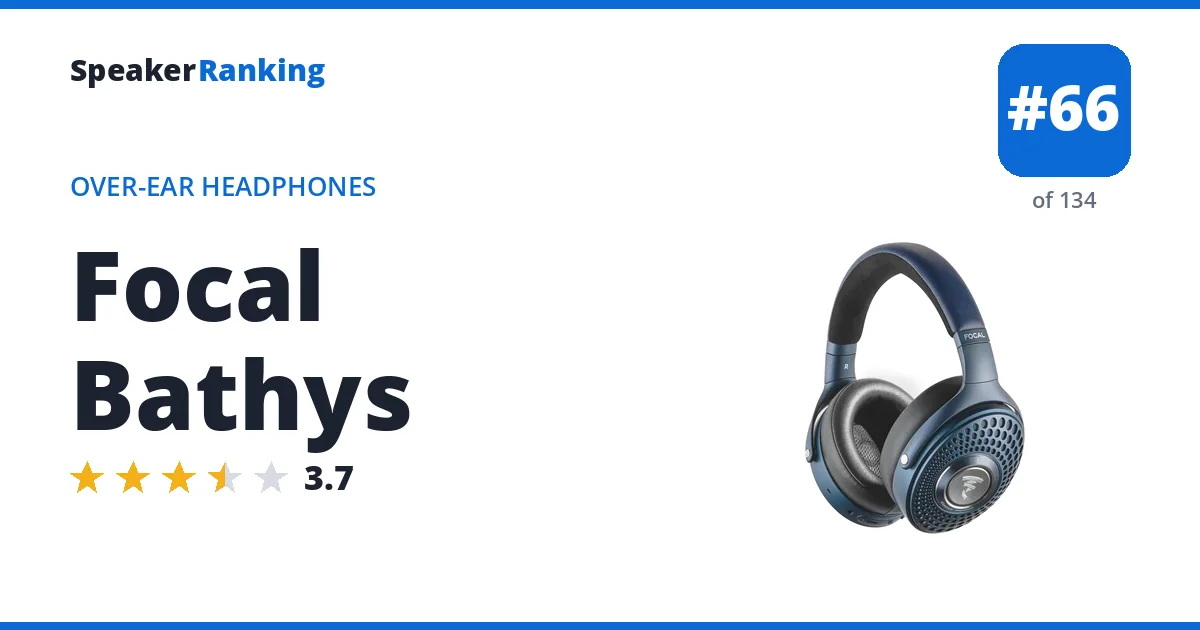
Pros: Bluetooth 5.1 with SBC, AAC, aptX and aptX Adaptive, active noise cancelling and a rated 30 hours of battery make it a full wireless travel headphone, and a wired connection is still available. Bass is slightly boosted, about 1 dB at sub-bass and 2 dB from 60 to 200 Hz, for a warm, punchy low end. The 2.0 dB deviation is smooth, and a 76 preference score is respectable for a wireless model.
Cons: A 6.3 dB dip near 9.4 kHz and mild treble reduction soften cymbals and sibilance. The tilt is on the warm side, so brightness and detail are subdued. The HIFIMAN Audivina holds a higher rating for a lower price, though the Bathys is the one with ANC and a battery.
Full Focal Bathys review and specifications →
| Released | Oct 2022 (4 years ago) |
|---|---|
| Active Noise Cancelling | Yes |
| Back | Closed |
| Battery Life | 30 hours (Manufacturer specified) |
| Bluetooth Codecs | SBC, AAC, aptX, aptX Adaptive |
| Bluetooth Version | 5.1 |
| Built-in Microphone | Yes |
| Connection | Wireless and wired |
| Deviation From Target | 2.04 dB standard deviation |
| Driver Type | Dynamic |
| Drivers | 1 x 40mm dynamic |
| Form Factor | Over-ear |
| Harman Preference Score | 76 (measured by oratory1990, via AutoEQ) |
| Impedance | 80 ohms |
| Sensitivity | 104 dB SPL/mW |
| Tonal Tilt | -0.84 (negative is warmer, positive brighter) |
| Weight | 0.8 lbs (350 g) |
EQ preset to match the Harman target
Set a preamp of -3.9 dB, then add these filters in any parametric equalizer (Wavelet, Equalizer APO, Peace, or a player with parametric EQ). Calculated by AutoEQ from its measured frequency response.
| Filter | Frequency | Gain | Q |
|---|---|---|---|
| Low shelf | 105 Hz | -0.3 dB | 0.70 |
| Peak | 642 Hz | -3.5 dB | 0.24 |
| Peak | 831 Hz | +7.1 dB | 1.99 |
| Peak | 4,157 Hz | +3.6 dB | 1.67 |
| Peak | 2,185 Hz | +4.3 dB | 3.03 |
| High shelf | 10,000 Hz | +0.7 dB | 0.70 |
| Peak | 86 Hz | -0.3 dB | 0.96 |
| Peak | 199 Hz | +0.5 dB | 1.78 |
| Peak | 2,995 Hz | -0.6 dB | 4.09 |
| Peak | 381 Hz | -0.4 dB | 2.53 |
- Reviews, Comparisons and Sound Samples
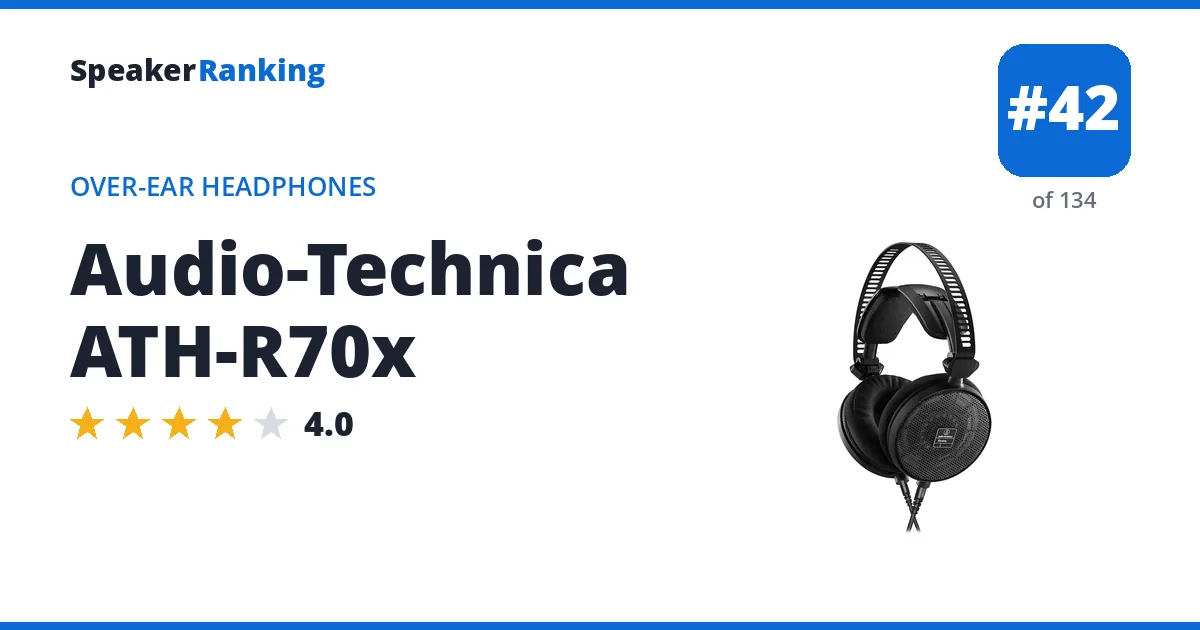
 Ranked #42 of 134 in Over-Ear Headphones - Audio-Technica ATH-R70x: $379.00 Discontinued Amazon eBay
Newer model: the Audio-Technica ATH-R70xa, ranked higher, rated 4.2/5. See every Audio-Technica ATH-R70x generation.
Pros: A preference score of 82 with a deviation of 1.9 dB shows a smooth, well-controlled response in oratory1990’s measurement. Bass from 60 to 200 Hz and the midrange sit almost exactly on target, giving natural vocals and instruments with a slightly warm tilt. At 210 g with an open back, it is light and airy for long sessions at home.
Cons: Sub-bass below 60 Hz is about 6.5 dB under target, so kick drums and synth bass lack deep rumble. A dip of nearly 7 dB near 9.9 kHz and a treble that sits about 2.7 dB low soften cymbals and detail. The 470 ohm impedance calls for a dedicated headphone amp, and the open back leaks sound. Discontinued.
Full Audio-Technica ATH-R70x review and specifications →
| Back | Open |
|---|---|
| Connection | Wired |
| Deviation From Target | 1.94 dB standard deviation |
| Driver Type | Dynamic |
| Drivers | 1 x 45mm dynamic |
| Form Factor | Over-ear |
| Frequency Response | 5Hz - 40kHz (Manufacturer specified) |
| Harman Preference Score | 82 (measured by oratory1990, via AutoEQ) |
| Impedance | 470 ohms |
| Tonal Tilt | -0.52 (negative is warmer, positive brighter) |
| Weight | 0.5 lbs (210 g) |
EQ preset to match the Harman target
Set a preamp of -6.6 dB, then add these filters in any parametric equalizer (Wavelet, Equalizer APO, Peace, or a player with parametric EQ). Calculated by AutoEQ from its measured frequency response.
| Filter | Frequency | Gain | Q |
|---|---|---|---|
| Low shelf | 105 Hz | +7.5 dB | 0.70 |
| Peak | 4,308 Hz | +4.8 dB | 0.51 |
| Peak | 93 Hz | -4.4 dB | 0.43 |
| Peak | 3,519 Hz | -3.2 dB | 4.05 |
| Peak | 2,149 Hz | -3.1 dB | 0.96 |
| High shelf | 10,000 Hz | -1.5 dB | 0.70 |
| Peak | 4,518 Hz | +1.3 dB | 6.00 |
| Peak | 58 Hz | -0.6 dB | 2.31 |
| Peak | 34 Hz | +0.7 dB | 3.60 |
| Peak | 106 Hz | +0.3 dB | 1.84 |
- Reviews, Comparisons and Sound Samples
 Ranked #70 of 134 in Over-Ear Headphones - Sennheiser HD 620S: $259.19 Amazon eBay
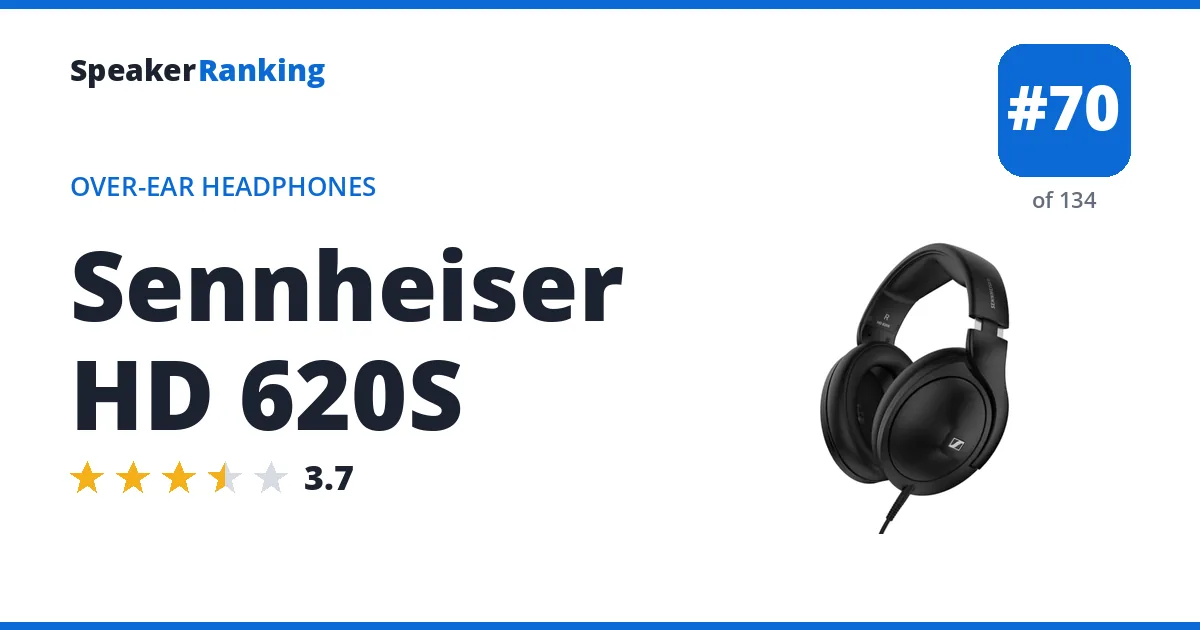
Pros: Bass from 60 to 200 Hz is lifted about 2.6 dB while sub-bass sits within half a dB of target, giving a punchy, well extended low end. The upper mids and presence stay close to the target, so vocals sound natural and clear. The closed back isolates well for private listening.
Cons: At 150 ohms and 110 dB SPL/V it is more demanding than most headphones here and benefits from a headphone amp rather than a phone. Treble from 6 to 10 kHz is about 2.6 dB low with a 6.9 dB dip near 9.5 kHz, which softens cymbals and sibilance. The Audio-Technica ATH-M50x holds a higher rating for a much lower price.
Full Sennheiser HD 620S review and specifications →
| Back | Closed |
|---|---|
| Connection | Wired |
| Deviation From Target | 2.19 dB standard deviation |
| Driver Type | Dynamic |
| Drivers | 1 x 42mm dynamic |
| Form Factor | Over-ear |
| Frequency Response | 6Hz - 30kHz (Manufacturer specified) |
| Harman Preference Score | 74 (measured by oratory1990, via AutoEQ) |
| Impedance | 150 ohms |
| Sensitivity | 110 dB SPL/V |
| Tonal Tilt | -0.80 (negative is warmer, positive brighter) |
EQ preset to match the Harman target
Set a preamp of -1.8 dB, then add these filters in any parametric equalizer (Wavelet, Equalizer APO, Peace, or a player with parametric EQ). Calculated by AutoEQ from its measured frequency response.
| Filter | Frequency | Gain | Q |
|---|---|---|---|
| Low shelf | 105 Hz | +0.4 dB | 0.70 |
| Peak | 112 Hz | -5.7 dB | 1.93 |
| Peak | 8,995 Hz | +3.2 dB | 1.57 |
| Peak | 49 Hz | +0.9 dB | 1.25 |
| Peak | 1,644 Hz | +2.0 dB | 3.09 |
| High shelf | 10,000 Hz | -4.3 dB | 0.70 |
| Peak | 615 Hz | -1.9 dB | 1.75 |
| Peak | 234 Hz | +2.0 dB | 3.58 |
| Peak | 2,761 Hz | -2.7 dB | 6.00 |
| Peak | 843 Hz | +1.6 dB | 4.59 |
- Reviews, Comparisons and Sound Samples
 Ranked #8 of 134 in Over-Ear Headphones - Austrian Audio Hi-X60: $303.69 Amazon eBay
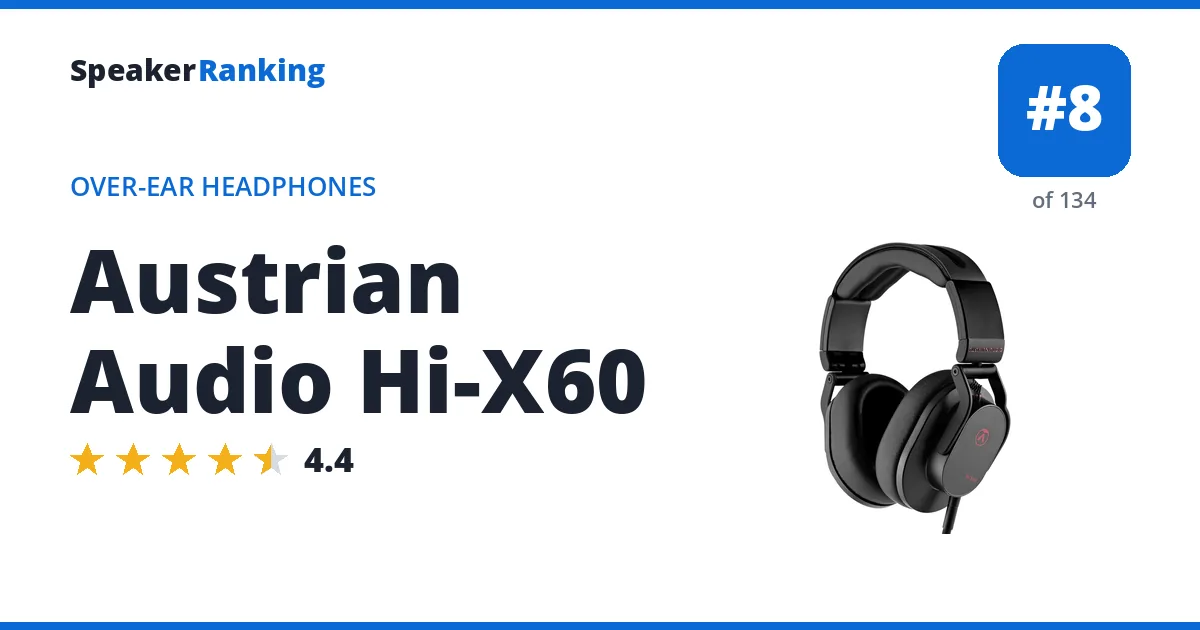
Pros: A preference score of 91 comes from a response within about 1.7 dB of the Harman target, with sub-bass 1.4 dB and bass 1.0 dB above target for a full, slightly warm foundation. At 25 ohms and 110 dB SPL/V it plays loudly from a phone, and the closed back isolates from outside noise. The 320 g weight is moderate.
Cons: There is a 3.9 dB dip near 2 kHz, which can pull some vocals and snare detail slightly back, and a 3.1 dB peak near 5.6 kHz adds a touch of edge. It has no built-in microphone, unlike the Beyerdynamic MMX 300, so it is less suited to calls and gaming.
Full Austrian Audio Hi-X60 review and specifications →
| Back | Closed |
|---|---|
| Built-in Microphone | No |
| Connection | Wired |
| Deviation From Target | 1.65 dB standard deviation |
| Driver Type | Dynamic |
| Form Factor | Over-ear |
| Frequency Response | 5Hz - 28kHz (Manufacturer specified) |
| Harman Preference Score | 91 (measured by oratory1990, via AutoEQ) |
| Impedance | 25 ohms |
| Sensitivity | 110 dB SPL/V |
| Tonal Tilt | -0.20 (negative is warmer, positive brighter) |
| Weight | 0.7 lbs (320 g) |
EQ preset to match the Harman target
Set a preamp of -4.7 dB, then add these filters in any parametric equalizer (Wavelet, Equalizer APO, Peace, or a player with parametric EQ). Calculated by AutoEQ from its measured frequency response.
| Filter | Frequency | Gain | Q |
|---|---|---|---|
| Low shelf | 105 Hz | -9.8 dB | 0.70 |
| Peak | 138 Hz | -14.9 dB | 0.60 |
| Peak | 81 Hz | +18.3 dB | 0.36 |
| Peak | 1,919 Hz | +4.6 dB | 3.37 |
| Peak | 1,025 Hz | -2.1 dB | 2.33 |
| High shelf | 10,000 Hz | -3.2 dB | 0.70 |
| Peak | 9,712 Hz | +2.5 dB | 2.24 |
| Peak | 3,637 Hz | +1.6 dB | 1.17 |
| Peak | 2,676 Hz | -3.1 dB | 5.21 |
| Peak | 5,733 Hz | -3.6 dB | 5.64 |
- Reviews, Comparisons and Sound Samples
- Head-to-Head Comparisons
In-Ear Headphones
 Ranked #1 of 68 in In-Ear Headphones - Truthear Nova: $169.99 Amazon eBay
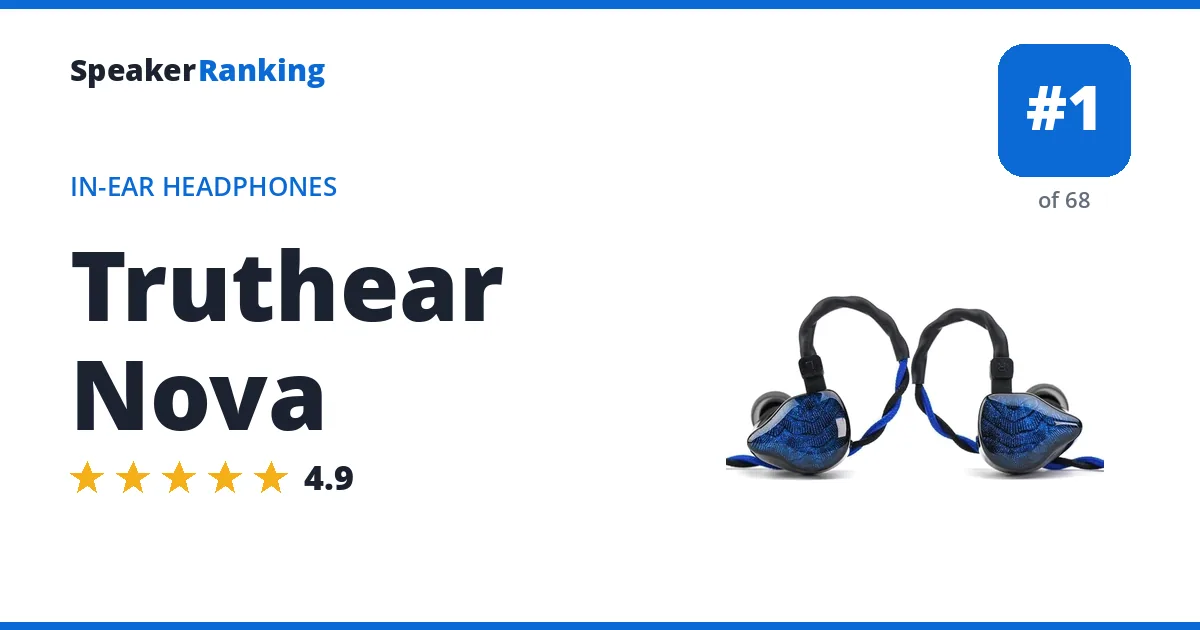
Pros: A Harman score of 90 puts it among the best-tuned in-ears measured, with every band from sub-bass to presence within about 1.5 dB of the target. The deviation of only 0.86 dB means vocals, guitars and drums sound natural and evenly balanced. The hybrid design pairs a dynamic driver with four balanced armatures, and the 14.8 ohm impedance with 123 dB sensitivity lets a phone drive it easily. Sub-bass sits about 1.5 dB above target, adding a touch of rumble without muddying the mids.
Cons: A 2.7 dB peak near 8 kHz can make bright cymbals and sibilant vocals slightly edgy on poorly mastered tracks. Treble and air run about 1.3 to 1.4 dB hot, so listeners sensitive to brightness may find extended sessions a little sharp. It is wired only, with no microphone or wireless features listed.
Full Truthear Nova review and specifications →
| Released | 2023 (3 years ago) |
|---|---|
| Back | Closed |
| Connection | Wired |
| Deviation From Target | 0.86 dB standard deviation |
| Driver Type | Hybrid (1 dynamic + 4 balanced armature) |
| Drivers | 1 x 10mm dynamic + 4 x balanced armature |
| Form Factor | In-ear |
| Frequency Response | 8Hz - 40kHz (Manufacturer specified) |
| Harman Preference Score | 90 (measured by oratory1990, via AutoEQ) |
| Impedance | 14.8 ohms |
| Sensitivity | 123 dB/Vrms @1kHz |
| Tonal Tilt | -0.14 (negative is warmer, positive brighter) |
EQ preset to match the Harman target
Set a preamp of -1.2 dB, then add these filters in any parametric equalizer (Wavelet, Equalizer APO, Peace, or a player with parametric EQ). Calculated by AutoEQ from its measured frequency response.
| Filter | Frequency | Gain | Q |
|---|---|---|---|
| Low shelf | 105 Hz | -4.2 dB | 0.70 |
| Peak | 313 Hz | +0.4 dB | 0.95 |
| Peak | 63 Hz | +3.6 dB | 0.80 |
| Peak | 4,404 Hz | -1.2 dB | 0.51 |
| Peak | 560 Hz | +1.1 dB | 0.85 |
| High shelf | 10,000 Hz | -2.5 dB | 0.70 |
| Peak | 9,390 Hz | +1.0 dB | 2.26 |
| Peak | 2,126 Hz | +1.1 dB | 3.14 |
| Peak | 2,987 Hz | -1.0 dB | 3.83 |
| Peak | 1,281 Hz | -0.5 dB | 2.65 |
- Reviews, Comparisons and Sound Samples
 Ranked #35 of 68 in In-Ear Headphones - TFZ T2 Galaxy: $59.00 Amazon eBay
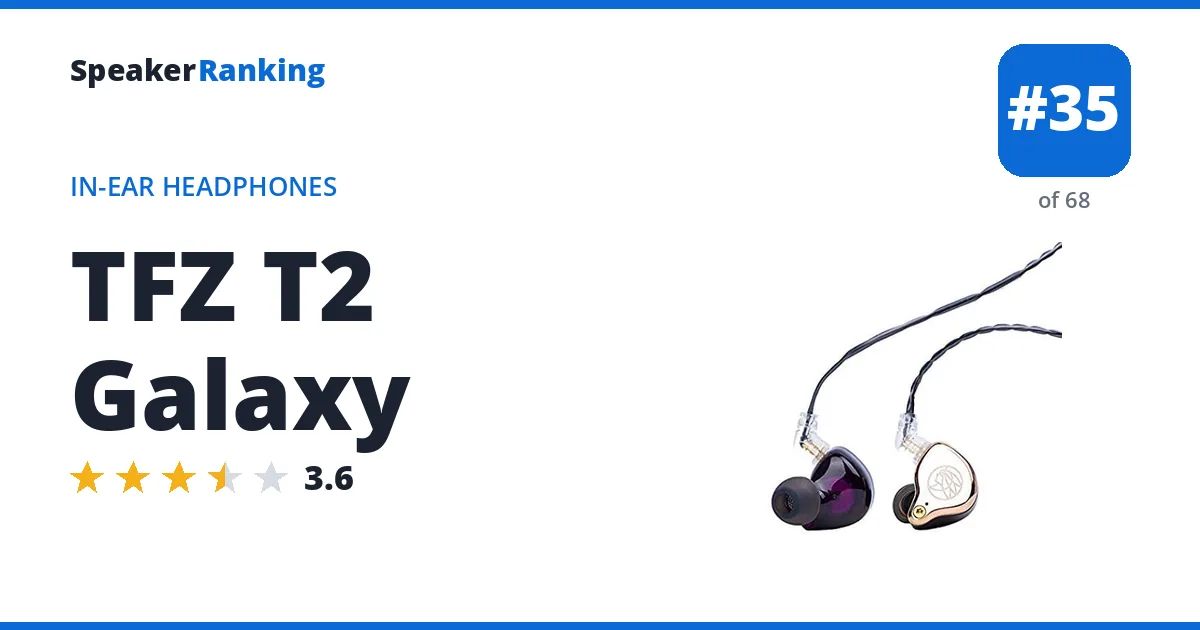
Pros: Oratory1990’s measurement shows sub-bass about 3.7 dB and bass about 3.5 dB above the Harman target, which gives kick drums and bass lines a solid, punchy foundation that suits bassy and V-shaped tastes. The 16 ohm impedance and 110 dB/mW sensitivity mean it plays loud from a phone without an amp. The preference score of 69 is respectable for a budget wired in-ear, and its 12 mm dynamic driver stays simple and easy to drive.
Cons: A peak of 4.9 dB near 8 kHz can make cymbals and sibilant vocals sound sharp. Output above 10 kHz sits roughly 4.3 dB under target, with a 6.2 dB dip near 11.9 kHz, so the top end loses air and sparkle. The bass boost of more than 3 dB can also make male vocals and low instruments sound heavier than they should. There is no built-in microphone.
Full TFZ T2 Galaxy review and specifications →
| Back | Closed |
|---|---|
| Built-in Microphone | No |
| Connection | Wired |
| Deviation From Target | 2.12 dB standard deviation |
| Driver Type | Dynamic |
| Drivers | 1 x 12mm dynamic |
| Form Factor | In-ear |
| Frequency Response | 5Hz - 40kHz (Manufacturer specified) |
| Harman Preference Score | 69 (measured by oratory1990, via AutoEQ) |
| Impedance | 16 ohms |
| Sensitivity | 110 dB/mW |
| Tonal Tilt | -0.77 (negative is warmer, positive brighter) |
EQ preset to match the Harman target
Set a preamp of -3.4 dB, then add these filters in any parametric equalizer (Wavelet, Equalizer APO, Peace, or a player with parametric EQ). Calculated by AutoEQ from its measured frequency response.
| Filter | Frequency | Gain | Q |
|---|---|---|---|
| Low shelf | 105 Hz | -3.4 dB | 0.70 |
| Peak | 750 Hz | +3.0 dB | 0.89 |
| Peak | 178 Hz | -2.3 dB | 1.50 |
| Peak | 1,788 Hz | -2.0 dB | 1.39 |
| Peak | 3,012 Hz | +2.5 dB | 3.09 |
| High shelf | 10,000 Hz | +3.4 dB | 0.70 |
| Peak | 4,584 Hz | -3.9 dB | 5.24 |
| Peak | 5,910 Hz | +3.5 dB | 5.10 |
| Peak | 70 Hz | +1.0 dB | 1.75 |
| Peak | 124 Hz | -0.7 dB | 2.97 |
- Reviews, Comparisons and Sound Samples
 Ranked #2 of 68 in In-Ear Headphones - AKG N5005: $399.99 Amazon eBay
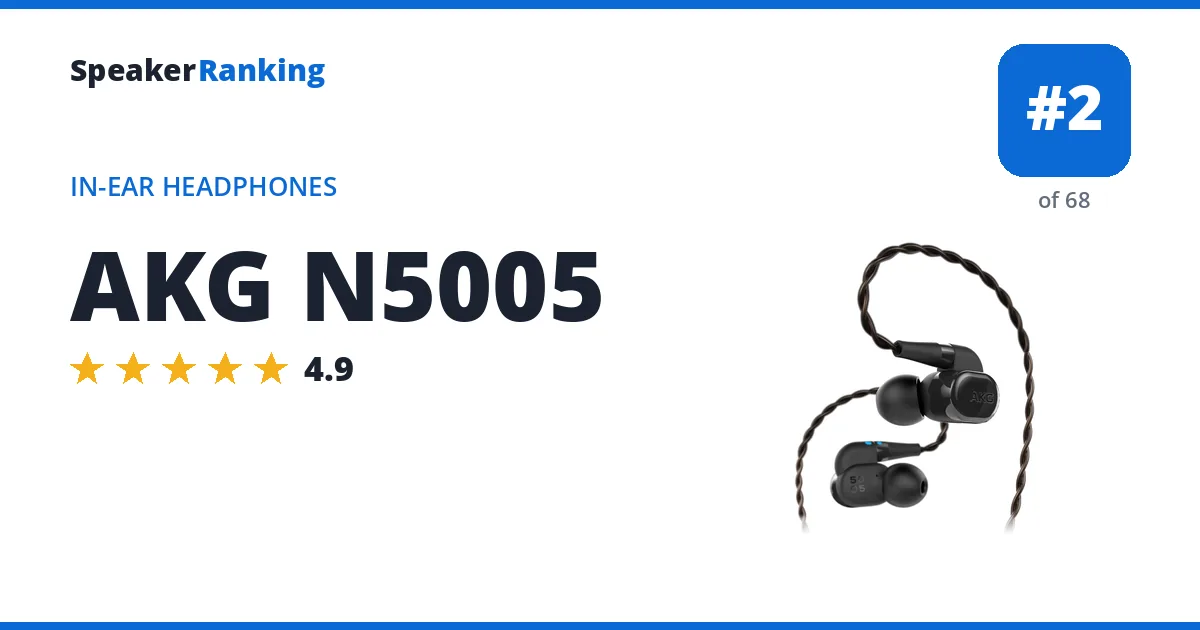
Pros: Bass, mids and presence all land within about 0.6 dB of the Harman target, giving a Harman score of 87 and a very smooth 1.11 dB deviation. Sub-bass is essentially on target at 0.1 dB below, so kick drums and bass lines have natural weight without bloat. The five-driver hybrid layout and 18 ohm impedance with 116 dB per volt sensitivity run fine from a phone. At 11.4 g per earbud it is light in the ear.
Cons: A 5.8 dB dip near 10 kHz and a 3.4 dB peak near 7.8 kHz leave the top end slightly uneven, taking some sparkle off cymbals and air. Treble from 6 to 10 kHz runs about 0.6 dB under target, so it can sound a touch laid back. It costs far more than the Truthear x Crinacle Zero RED, which has the same rating, so the premium buys refinement rather than a better rating.
Full AKG N5005 review and specifications →
| Back | Closed |
|---|---|
| Connection | Wired |
| Deviation From Target | 1.11 dB standard deviation |
| Driver Type | Hybrid (1 dynamic + 4 balanced armature) |
| Drivers | 1 x 9.2mm dynamic + 4 x balanced armature |
| Form Factor | In-ear |
| Frequency Response | 10Hz - 40kHz (Manufacturer specified) |
| Harman Preference Score | 87 (measured by oratory1990, via AutoEQ) |
| Impedance | 18 ohms |
| Sensitivity | 116 dB SPL/V |
| Tonal Tilt | -0.09 (negative is warmer, positive brighter) |
| Weight | 0 lbs (11.4 g) per earbud |
EQ preset to match the Harman target
Set a preamp of -1.8 dB, then add these filters in any parametric equalizer (Wavelet, Equalizer APO, Peace, or a player with parametric EQ). Calculated by AutoEQ from its measured frequency response.
| Filter | Frequency | Gain | Q |
|---|---|---|---|
| Low shelf | 105 Hz | -0.8 dB | 0.70 |
| Peak | 9,406 Hz | +3.0 dB | 1.31 |
| Peak | 892 Hz | +2.7 dB | 1.01 |
| Peak | 1,593 Hz | -1.4 dB | 0.18 |
| Peak | 77 Hz | +1.4 dB | 1.19 |
| High shelf | 10,000 Hz | -3.6 dB | 0.70 |
| Peak | 4,702 Hz | -2.0 dB | 5.51 |
| Peak | 3,571 Hz | +1.3 dB | 2.99 |
| Peak | 6,150 Hz | +2.2 dB | 5.73 |
| Peak | 4,894 Hz | -0.7 dB | 4.27 |
- Reviews, Comparisons and Sound Samples
 Ranked #5 of 68 in In-Ear Headphones - Truthear Gate: $21.99 Amazon eBay
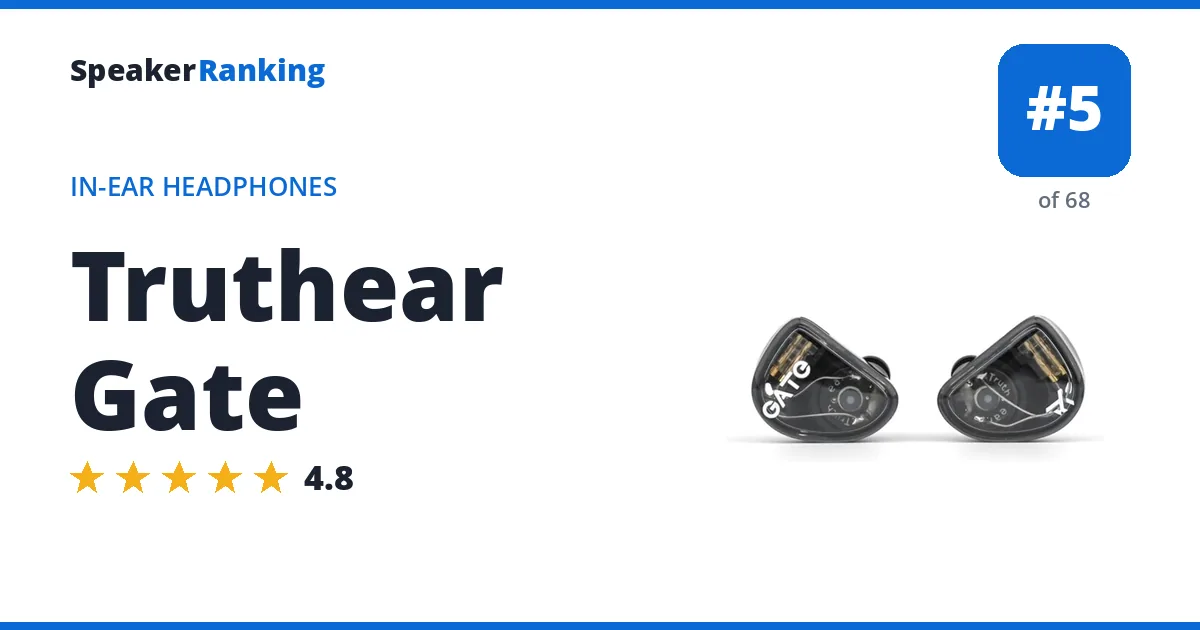
Pros: A Harman score of 83 from a single dynamic driver at a very low price gives accurate bass and mids, with bass and upper mids within about 0.2 dB of target. The 28 ohm impedance with 122 dB per volt sensitivity makes it easy to drive from any phone. The warm tilt suits listeners who want a smooth, non-fatiguing sound. It earns the same rating as the 7Hz Salnotes Zero at a similar cost.
Cons: Treble is the weak point, with a deep 10.8 dB dip near 11 kHz and air about 3 dB under target. Cymbals, hi-hats and the sense of space on recordings sound dulled as a result. Presence from 3 to 6 kHz is also about 1.9 dB down, which takes a little bite off vocals.
Full Truthear Gate review and specifications →
| Back | Closed |
|---|---|
| Connection | Wired |
| Deviation From Target | 1.39 dB standard deviation |
| Driver Type | Dynamic |
| Drivers | 1 x 10mm dynamic |
| Form Factor | In-ear |
| Frequency Response | 10Hz - 45kHz (Manufacturer specified) |
| Harman Preference Score | 83 (measured by oratory1990, via AutoEQ) |
| Impedance | 28 ohms |
| Sensitivity | 122 dB/Vrms |
| Tonal Tilt | -0.23 (negative is warmer, positive brighter) |
EQ preset to match the Harman target
Set a preamp of -4.9 dB, then add these filters in any parametric equalizer (Wavelet, Equalizer APO, Peace, or a player with parametric EQ). Calculated by AutoEQ from its measured frequency response.
| Filter | Frequency | Gain | Q |
|---|---|---|---|
| Low shelf | 105 Hz | +0.1 dB | 0.70 |
| Peak | 9,538 Hz | +4.7 dB | 0.99 |
| Peak | 2,074 Hz | -1.3 dB | 0.65 |
| Peak | 196 Hz | -1.1 dB | 1.34 |
| Peak | 698 Hz | +1.2 dB | 1.31 |
| High shelf | 10,000 Hz | -2.1 dB | 0.70 |
| Peak | 72 Hz | +0.8 dB | 1.77 |
| Peak | 4,992 Hz | +0.3 dB | 2.04 |
| Peak | 126 Hz | -0.4 dB | 2.34 |
| Peak | 8,647 Hz | +1.3 dB | 5.95 |
- Reviews, Comparisons and Sound Samples
- Head-to-Head Comparisons
 Ranked #4 of 68 in In-Ear Headphones - 7Hz Salnotes Zero: $22.99 Discontinued Amazon eBay
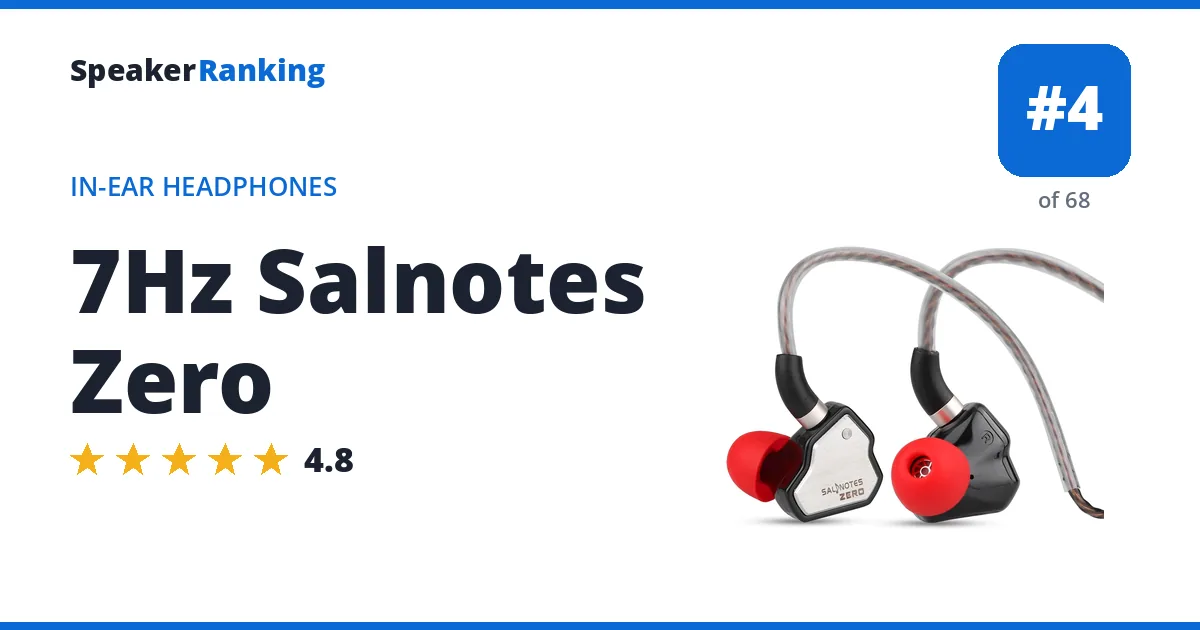
Newer model: the 7Hz x Crinacle Zero 2, ranked lower, rated 3.9/5, released Nov 2023. See every 7Hz Zero generation.
Pros: A Harman score of 84 from a single 10 mm dynamic driver at a bargain price is remarkable. Bass and mids sit within about 0.3 dB of the target, so vocals and instruments are balanced naturally with a 1.31 dB deviation. It runs from a phone without difficulty at 32 ohms and 108 dB per volt. It beats the 7Hz x Crinacle Zero 2 on rating at a similar cost.
Cons: Presence and treble run about 2.1 to 2.2 dB under target, and a 6.2 dB dip near 10 kHz leaves cymbals and breath detail muted. Sub-bass is about 1.5 dB light, so the deepest rumble in electronic music is understated. The sensitivity is lower than many rivals, so it needs a bit more volume headroom from weak sources. Discontinued.
Full 7Hz Salnotes Zero review and specifications →
| Released | Jul 2022 (4 years ago) |
|---|---|
| Back | Closed |
| Connection | Wired |
| Deviation From Target | 1.31 dB standard deviation |
| Driver Type | Dynamic |
| Drivers | 1 x 10mm dynamic |
| Form Factor | In-ear |
| Frequency Response | 10Hz - 20kHz (Manufacturer specified) |
| Harman Preference Score | 84 (measured by oratory1990, via AutoEQ) |
| Impedance | 32 ohms |
| Sensitivity | 108 dB SPL/V |
| Tonal Tilt | -0.16 (negative is warmer, positive brighter) |
EQ preset to match the Harman target
Set a preamp of -2.5 dB, then add these filters in any parametric equalizer (Wavelet, Equalizer APO, Peace, or a player with parametric EQ). Calculated by AutoEQ from its measured frequency response.
| Filter | Frequency | Gain | Q |
|---|---|---|---|
| Low shelf | 105 Hz | -0.4 dB | 0.70 |
| Peak | 7,148 Hz | +2.5 dB | 1.39 |
| Peak | 186 Hz | -1.3 dB | 1.35 |
| Peak | 65 Hz | +1.7 dB | 1.11 |
| Peak | 1,677 Hz | -1.1 dB | 1.82 |
| High shelf | 10,000 Hz | -1.3 dB | 0.70 |
| Peak | 857 Hz | +0.9 dB | 1.64 |
| Peak | 9,824 Hz | +0.9 dB | 1.98 |
| Peak | 3,316 Hz | -0.6 dB | 2.50 |
| Peak | 1,261 Hz | -0.7 dB | 3.34 |
- Reviews, Comparisons and Sound Samples
- Head-to-Head Comparisons
 Ranked #47 of 68 in In-Ear Headphones - FiiO FH3: $119.99 Amazon eBay
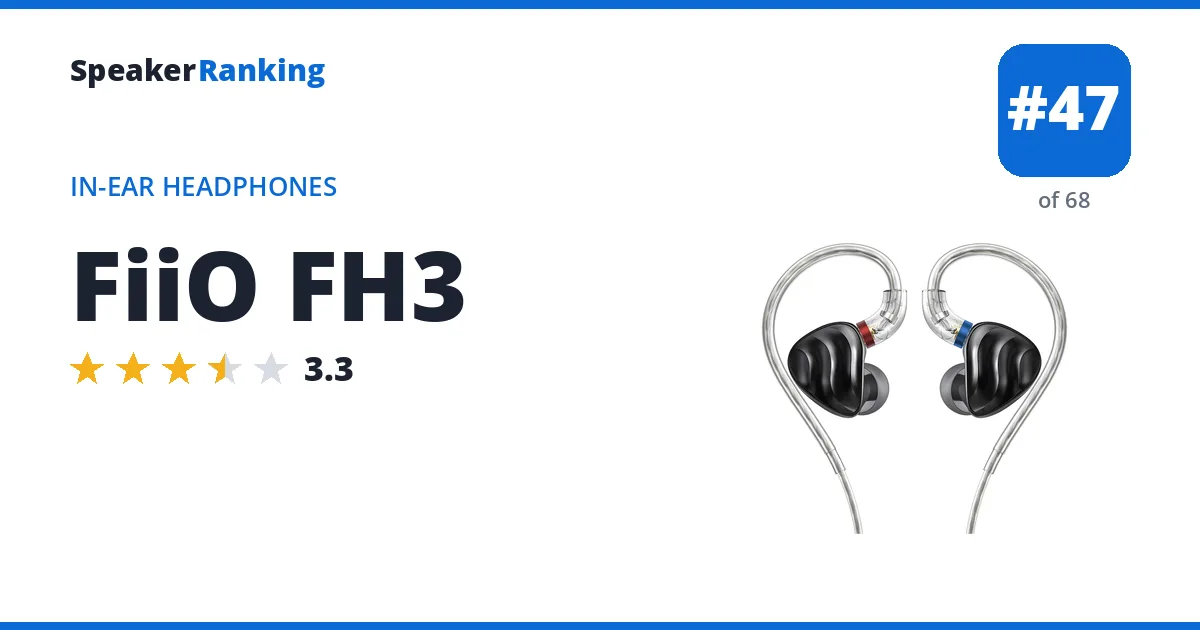
Pros: Bass and sub-bass sit within about 1 dB above the Harman target, giving kick drums and bass guitar a full, warm foundation without bloat. The hybrid design pairs a 10mm dynamic driver with two balanced armatures, and 114 dB/mW sensitivity at 24 ohms means a phone runs it easily. A preference score of 65 suits listeners who like a warm, bassy tilt.
Cons: The 3 to 6 kHz presence region sits about 5.7 dB below target, with a dip of 7.4 dB near 6.5 kHz, so vocals and cymbals lose bite and detail. Treble from 6 to 10 kHz is also about 2.2 dB low, which makes the sound dark and a little veiled. The KZ PR1 has a higher rating.
Full FiiO FH3 review and specifications →
| Back | Closed |
|---|---|
| Connection | Wired |
| Deviation From Target | 2.59 dB standard deviation |
| Driver Type | Hybrid (1 dynamic + 2 balanced armature) |
| Drivers | 1 x 10mm dynamic + 2 x balanced armature |
| Form Factor | In-ear |
| Frequency Response | 10Hz - 40kHz (Manufacturer specified) |
| Harman Preference Score | 65 (measured by HypetheSonics, via AutoEQ) |
| Impedance | 24 ohms |
| Sensitivity | 114 dB/mW |
| Tonal Tilt | -0.86 (negative is warmer, positive brighter) |
| Weight | 0 lbs (7.3 g) per earbud |
EQ preset to match the Harman target
Set a preamp of -4.3 dB, then add these filters in any parametric equalizer (Wavelet, Equalizer APO, Peace, or a player with parametric EQ). Calculated by AutoEQ from its measured frequency response.
| Filter | Frequency | Gain | Q |
|---|---|---|---|
| Low shelf | 105 Hz | -4.0 dB | 0.70 |
| Peak | 4,061 Hz | +4.3 dB | 1.02 |
| Peak | 178 Hz | -2.5 dB | 1.19 |
| Peak | 1,183 Hz | -3.9 dB | 2.64 |
| Peak | 60 Hz | +2.7 dB | 0.83 |
| High shelf | 10,000 Hz | -0.6 dB | 0.70 |
| Peak | 545 Hz | +1.1 dB | 2.57 |
| Peak | 2,365 Hz | -2.4 dB | 4.99 |
| Peak | 6,488 Hz | +2.3 dB | 6.00 |
| Peak | 2,972 Hz | +1.8 dB | 5.25 |
- Reviews, Comparisons and Sound Samples
- Head-to-Head Comparisons
 Ranked #3 of 68 in In-Ear Headphones - Truthear x Crinacle Zero RED: $64.99 Amazon eBay
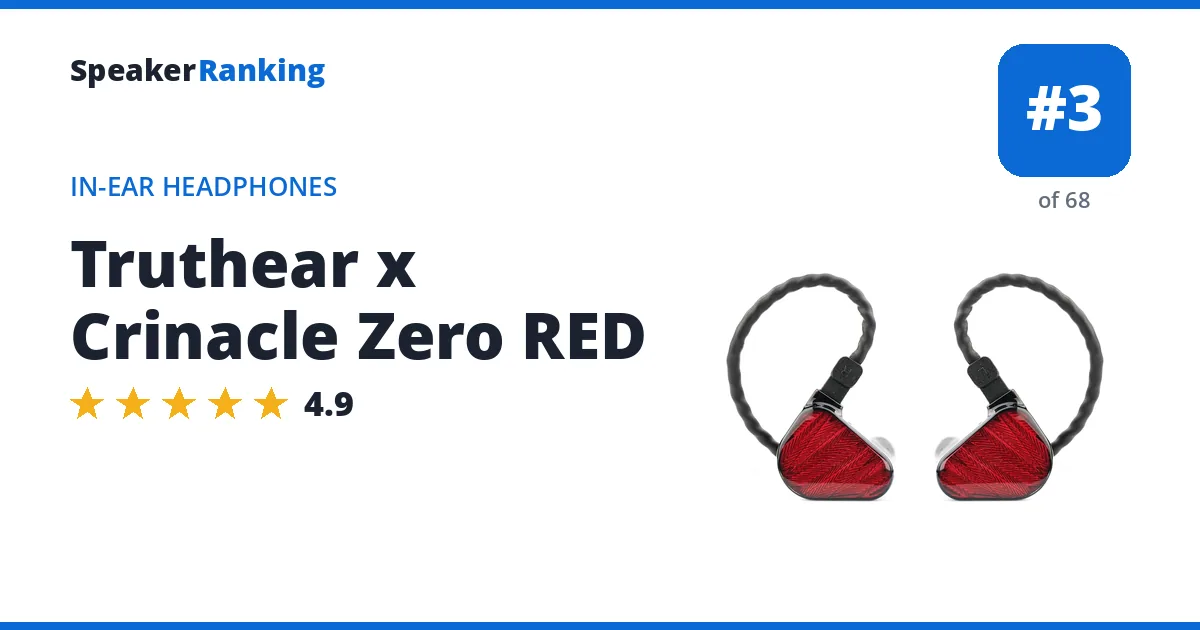
Pros: A Harman score of 86 at an entry-level price delivers a well-balanced response with a smooth 1.1 dB deviation. Bass and mids track the target closely, and the dual dynamic driver design runs easily from a phone at 17.5 ohms and 117.5 dB per volt. It outscores the Tin HiFi T3 Plus by a clear rating margin at a similar cost. It is a good fit for listeners who like a warm, bass-forward sound.
Cons: Presence from 3 to 6 kHz sits about 2.2 dB below target, so vocals and snare attack can sound a little recessed. A 3.9 dB dip near 10.3 kHz and sub-bass about 1.4 dB light mean cymbals lack some shimmer and the deepest bass has less rumble. It is wired only with no mic or remote listed.
Full Truthear x Crinacle Zero RED review and specifications →
| Back | Closed |
|---|---|
| Connection | Wired |
| Deviation From Target | 1.10 dB standard deviation |
| Driver Type | Dynamic |
| Drivers | 1 x 10mm + 1 x 7.8mm dynamic |
| Form Factor | In-ear |
| Frequency Response | 20Hz - 40.5kHz (Manufacturer specified) |
| Harman Preference Score | 86 (measured by oratory1990, via AutoEQ) |
| Impedance | 17.5 ohms |
| Sensitivity | 117.5 dB/Vrms |
| Tonal Tilt | -0.08 (negative is warmer, positive brighter) |
EQ preset to match the Harman target
Set a preamp of -2.1 dB, then add these filters in any parametric equalizer (Wavelet, Equalizer APO, Peace, or a player with parametric EQ). Calculated by AutoEQ from its measured frequency response.
| Filter | Frequency | Gain | Q |
|---|---|---|---|
| Low shelf | 105 Hz | -0.5 dB | 0.70 |
| Peak | 6,163 Hz | +2.2 dB | 2.44 |
| Peak | 341 Hz | -1.0 dB | 1.46 |
| Peak | 70 Hz | +1.0 dB | 0.61 |
| Peak | 1,284 Hz | -0.6 dB | 2.04 |
| High shelf | 10,000 Hz | -1.8 dB | 0.70 |
| Peak | 2,432 Hz | +0.7 dB | 2.98 |
| Peak | 3,588 Hz | -0.6 dB | 3.06 |
| Peak | 8,541 Hz | +1.1 dB | 3.84 |
| Peak | 769 Hz | +0.2 dB | 3.01 |
- Reviews, Comparisons and Sound Samples
- Head-to-Head Comparisons
 Ranked #7 of 68 in In-Ear Headphones - Shuoer S12: $129.00 Amazon eBay
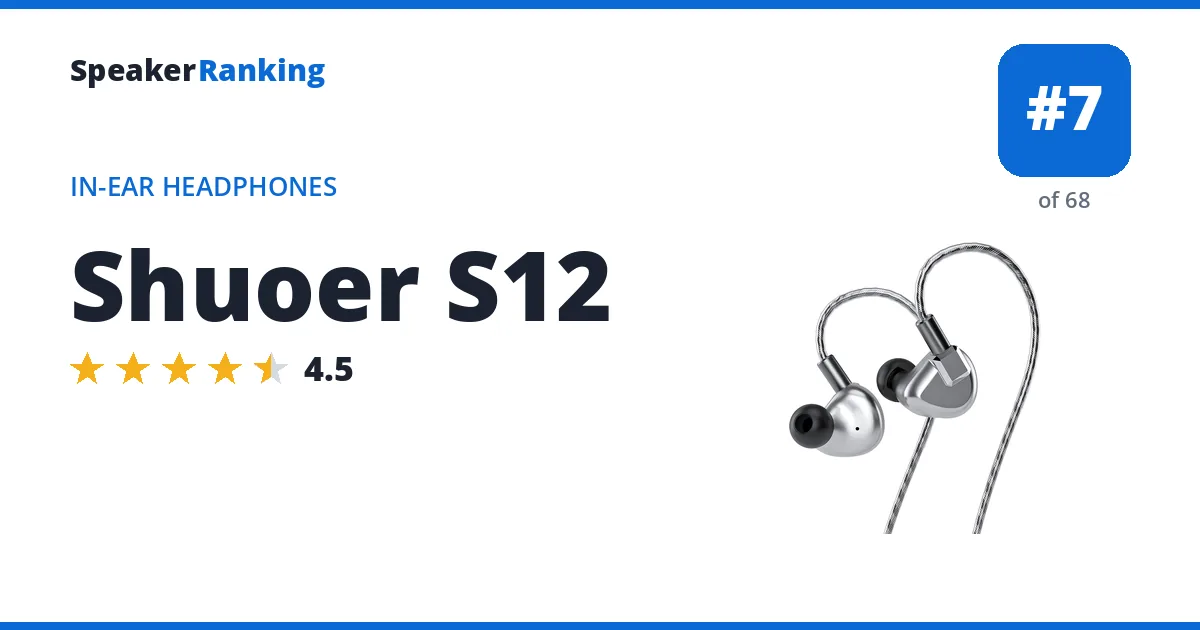
Pros: A planar magnetic driver is unusual in an in-ear and gives a Harman score of 80 with a smooth 1.62 dB deviation. Bass is lifted about 1.9 dB, adding warmth and punch, while the upper mids and treble stay close to target. The 16 ohm impedance is easy to drive from a phone, and it matches the Final Audio A4000 on rating.
Cons: A 4.2 dB peak near 8.2 kHz can make cymbals and sibilants slightly sharp, and treble from 6 to 10 kHz runs about 1.6 dB hot. Presence from 3 to 6 kHz sits 2.4 dB under target with a 3.3 dB dip near 3.75 kHz, so vocals can lose some forwardness. The 102 dB per mW sensitivity asks for a bit more volume than efficient rivals.
Full Shuoer S12 review and specifications →
| Released | 2022 (4 years ago) |
|---|---|
| Back | Closed |
| Connection | Wired |
| Deviation From Target | 1.62 dB standard deviation |
| Driver Type | Planar magnetic |
| Drivers | 1 x 14.8mm planar magnetic |
| Form Factor | In-ear |
| Frequency Response | 10Hz - 30kHz (Manufacturer specified) |
| Harman Preference Score | 80 (measured by oratory1990, via AutoEQ) |
| Impedance | 16 ohms |
| Sensitivity | 102 dB/mW |
| Tonal Tilt | -0.11 (negative is warmer, positive brighter) |
EQ preset to match the Harman target
Set a preamp of -2.5 dB, then add these filters in any parametric equalizer (Wavelet, Equalizer APO, Peace, or a player with parametric EQ). Calculated by AutoEQ from its measured frequency response.
| Filter | Frequency | Gain | Q |
|---|---|---|---|
| Low shelf | 105 Hz | +0.4 dB | 0.70 |
| Peak | 776 Hz | +2.9 dB | 0.76 |
| Peak | 162 Hz | -2.3 dB | 0.89 |
| Peak | 2,097 Hz | -3.4 dB | 0.90 |
| Peak | 3,690 Hz | +3.8 dB | 1.44 |
| High shelf | 10,000 Hz | -3.6 dB | 0.70 |
| Peak | 6,122 Hz | +1.6 dB | 5.71 |
| Peak | 7,230 Hz | -0.7 dB | 6.00 |
| Peak | 37 Hz | -0.3 dB | 2.35 |
| Peak | 65 Hz | +0.2 dB | 2.13 |
- Reviews, Comparisons and Sound Samples
 Ranked #17 of 68 in In-Ear Headphones - Beats Powerbeats Pro: $189.99 Discontinued Amazon eBay

Pros: Bass and midrange follow the Harman target closely, with 60 to 200 Hz within 0.2 dB and upper mids 0.7 dB above, so voices and bass lines sound natural and warm for a preference score of 75. The true wireless design adds Bluetooth 5.0 with SBC and AAC, a built-in microphone and an IPX4 rating. Battery lasts about 9 hours per charge, 24 with the case.
Cons: Treble is well under target, about 5.2 dB low from 6 to 10 kHz, with an 8.5 dB dip near 6.8 kHz, so cymbals, hi-hats and sibilance sound muted. The air band above 10 kHz is another 4.4 dB low, which adds to a dark, closed-in sound. It has no active noise cancelling, and the Etymotic EVO has a higher rating. Discontinued.
Full Beats Powerbeats Pro review and specifications →
| Released | May 2019 (7 years ago) |
|---|---|
| Active Noise Cancelling | No |
| Back | Closed |
| Battery Life | 9 hours (24 with case, Manufacturer specified) |
| Bluetooth Codecs | SBC, AAC |
| Bluetooth Version | 5.0 |
| Built-in Microphone | Yes |
| Connection | True wireless |
| Deviation From Target | 2.09 dB standard deviation |
| Form Factor | In-ear |
| Harman Preference Score | 75 (measured by oratory1990, via AutoEQ) |
| IP Rating | IPX4 |
| Tonal Tilt | -0.37 (negative is warmer, positive brighter) |
EQ preset to match the Harman target
Set a preamp of -6.4 dB, then add these filters in any parametric equalizer (Wavelet, Equalizer APO, Peace, or a player with parametric EQ). Calculated by AutoEQ from its measured frequency response.
| Filter | Frequency | Gain | Q |
|---|---|---|---|
| Low shelf | 105 Hz | -0.8 dB | 0.70 |
| Peak | 6,596 Hz | +6.1 dB | 2.51 |
| Peak | 2,703 Hz | -4.4 dB | 2.80 |
| Peak | 1,362 Hz | -2.1 dB | 1.94 |
| Peak | 3,607 Hz | +3.7 dB | 4.72 |
| High shelf | 10,000 Hz | +3.7 dB | 0.70 |
| Peak | 143 Hz | -1.2 dB | 1.56 |
| Peak | 374 Hz | +0.7 dB | 1.21 |
| Peak | 4,688 Hz | -2.2 dB | 6.00 |
| Peak | 60 Hz | +0.4 dB | 1.34 |
- Reviews, Comparisons and Sound Samples
- Head-to-Head Comparisons
 Ranked #33 of 68 in In-Ear Headphones - KZ ZST: $21.99 Amazon eBay
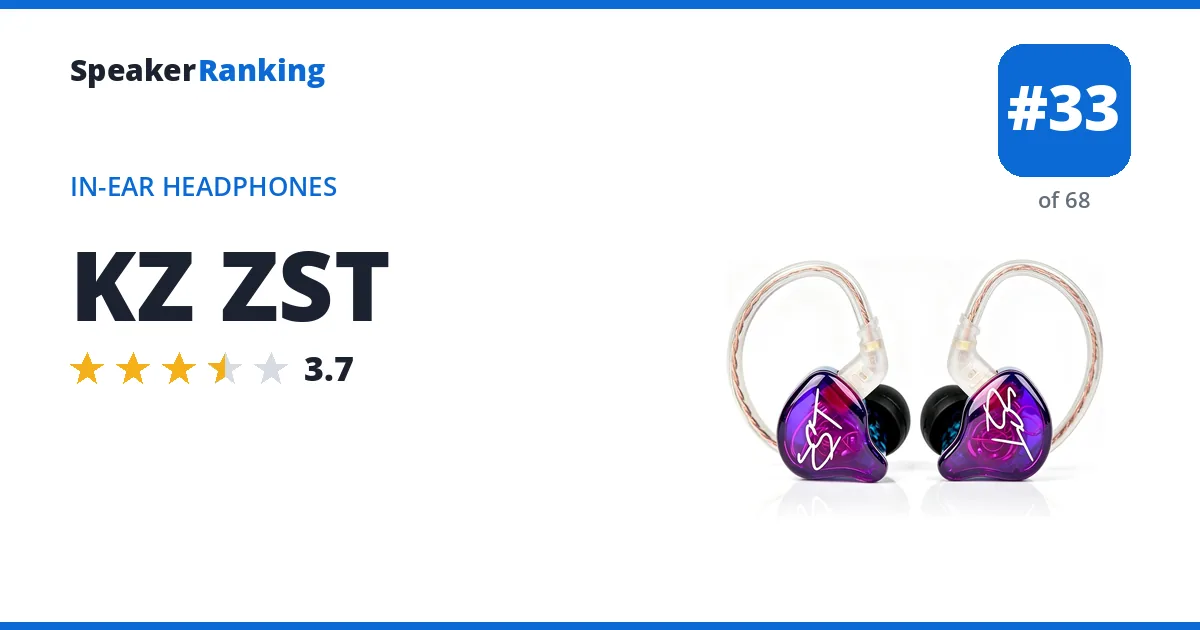
Pros: In oratory1990’s measurement the preference score is 70, with bass about 2.3 dB above target from 60 to 200 Hz for extra warmth and punch, and sub-bass tracking the target within 0.1 dB. The low mids and upper mids stay within about 1 dB, so vocals and instruments sit naturally. The warm and bassy profiles fit it best, and the hybrid pairing of one dynamic and one balanced armature driver costs very little.
Cons: A 9.4 dB dip near 4.4 kHz and 3.7 dB lower presence from 3 to 6 kHz pull back vocal clarity and the attack of snares and guitars. Above 10 kHz the response runs about 6.5 dB hot, with a 10 dB peak near 11 kHz that adds sharpness to cymbals. The TANGZU Wan’er S.G rates higher.
Full KZ ZST review and specifications →
| Released | 2016 (10 years ago) |
|---|---|
| Back | Closed |
| Connection | Wired |
| Deviation From Target | 2.31 dB standard deviation |
| Driver Type | Hybrid (1 dynamic + 1 balanced armature) |
| Drivers | 1 x 10mm dynamic + 1 x balanced armature |
| Form Factor | In-ear |
| Frequency Response | 20Hz - 20kHz (Manufacturer specified) |
| Harman Preference Score | 70 (measured by oratory1990, via AutoEQ) |
| Tonal Tilt | -0.47 (negative is warmer, positive brighter) |
EQ preset to match the Harman target
Set a preamp of -4.5 dB, then add these filters in any parametric equalizer (Wavelet, Equalizer APO, Peace, or a player with parametric EQ). Calculated by AutoEQ from its measured frequency response.
| Filter | Frequency | Gain | Q |
|---|---|---|---|
| Low shelf | 105 Hz | -0.2 dB | 0.70 |
| Peak | 182 Hz | -3.0 dB | 0.62 |
| Peak | 620 Hz | +2.4 dB | 0.63 |
| Peak | 9,298 Hz | -3.1 dB | 3.37 |
| Peak | 1,878 Hz | -4.1 dB | 3.05 |
| High shelf | 10,000 Hz | -0.3 dB | 0.70 |
| Peak | 4,253 Hz | +4.7 dB | 4.05 |
| Peak | 1,321 Hz | -0.6 dB | 2.60 |
| Peak | 3,462 Hz | -1.0 dB | 6.00 |
| Peak | 358 Hz | -0.0 dB | 5.65 |
- Reviews, Comparisons and Sound Samples
- Head-to-Head Comparisons
 Ranked #44 of 68 in In-Ear Headphones - Sennheiser Momentum True Wireless 3: $111.99 Discontinued Amazon eBay
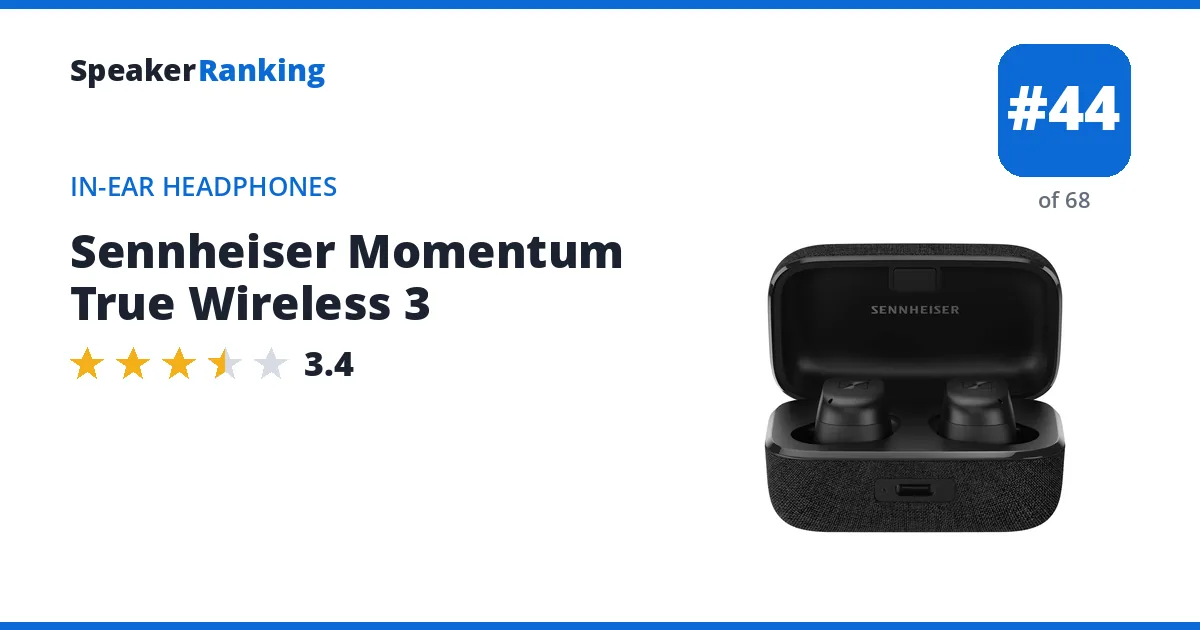
Newer model: the Sennheiser MOMENTUM True Wireless 4, ranked lower, rated 3.3/5, released Feb 2024. It adds LC3. See every Sennheiser Momentum True Wireless generation.
Pros: Active noise cancelling, Bluetooth 5.2 and aptX Adaptive support (alongside SBC, AAC and aptX) add real convenience, and battery life is 7 hours per charge with up to 28 hours using the case. At 5.8 g per earbud with an IPX4 rating, it handles workouts and light rain. Oratory1990’s measurement shows bass and sub-bass within 1 dB of target, giving a clean, warm foundation that suits warm and bassy tastes.
Cons: Presence between 3 and 6 kHz is 6.9 dB under target with a 7.6 dB dip near 4.4 kHz, so vocals, snare and guitar edges sound distant and veiled. Air above 10 kHz runs 5.4 dB hot, with a peak of 4.9 dB near 10.5 kHz, which adds a hissy edge on top of the recessed mids. The preference score of 66 and deviation of 2.59 dB confirm the response sits well off the target. The KZ PR1 is rated higher at a similar cost, though it lacks wireless and ANC. Discontinued.
Full Sennheiser Momentum True Wireless 3 review and specifications →
| Released | Apr 2022 (4 years ago) |
|---|---|
| Active Noise Cancelling | Yes |
| Back | Closed |
| Battery Life | 7 hours (28 with case, Manufacturer specified) |
| Bluetooth Codecs | SBC, AAC, aptX, aptX Adaptive |
| Bluetooth Version | 5.2 |
| Built-in Microphone | Yes |
| Connection | True wireless |
| Deviation From Target | 2.59 dB standard deviation |
| Driver Type | Dynamic |
| Drivers | 1 x 7mm dynamic |
| Form Factor | In-ear |
| Frequency Response | 5Hz - 21kHz (Manufacturer specified) |
| Harman Preference Score | 66 (measured by oratory1990, via AutoEQ) |
| IP Rating | IPX4 |
| Sensitivity | 107 dB SPL (1 kHz / 1 mW) |
| Tonal Tilt | -0.85 (negative is warmer, positive brighter) |
| Weight | 0 lbs (5.8 g) per earbud |
EQ preset to match the Harman target
Set a preamp of -5.3 dB, then add these filters in any parametric equalizer (Wavelet, Equalizer APO, Peace, or a player with parametric EQ). Calculated by AutoEQ from its measured frequency response.
| Filter | Frequency | Gain | Q |
|---|---|---|---|
| Low shelf | 105 Hz | -2.6 dB | 0.70 |
| Peak | 4,231 Hz | +5.9 dB | 1.39 |
| Peak | 209 Hz | -2.2 dB | 0.78 |
| Peak | 1,433 Hz | -2.6 dB | 1.99 |
| Peak | 69 Hz | +1.5 dB | 1.35 |
| High shelf | 10,000 Hz | -5.4 dB | 0.70 |
| Peak | 5,556 Hz | +1.7 dB | 5.29 |
| Peak | 759 Hz | +0.5 dB | 2.36 |
| Peak | 335 Hz | -0.4 dB | 3.16 |
| Peak | 4,230 Hz | -0.6 dB | 5.10 |
- Reviews, Comparisons and Sound Samples
- Head-to-Head Comparisons
 Ranked #52 of 68 in In-Ear Headphones - Sennheiser IE 900: $1,299.95 Amazon eBay
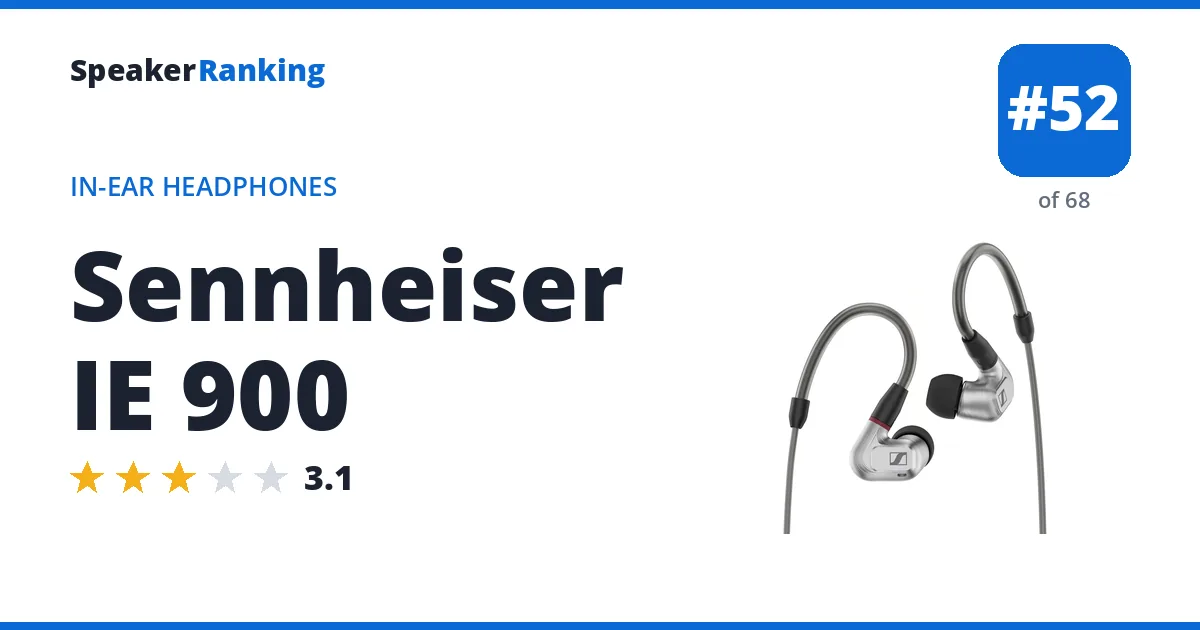
Pros: Oratory1990 measured sub-bass and bass within about 1.2 dB of target, so the low end is tidy and controlled. Sensitivity of 123 dB SPL/V and a 16 ohm impedance make it easy to drive from a phone, and the 7mm dynamic driver is rated to reach from 5 Hz to 48 kHz. Top-octave air sits about 3.6 dB above target for an open, detailed treble.
Cons: Presence from 3 to 6 kHz is about 6.7 dB below the Harman target, with an 8.8 dB dip near 3.6 kHz, which recesses vocals and removes some bite. A preference score of 63 is modest for such a premium product, and the HIFIMAN RE2000 has a higher rating at a lower price.
Full Sennheiser IE 900 review and specifications →
| Released | 2021 (5 years ago) |
|---|---|
| Back | Closed |
| Connection | Wired |
| Deviation From Target | 2.82 dB standard deviation |
| Driver Type | Dynamic |
| Drivers | 1 x 7mm dynamic |
| Form Factor | In-ear |
| Frequency Response | 5Hz - 48kHz (Manufacturer specified) |
| Harman Preference Score | 63 (measured by oratory1990, via AutoEQ) |
| Impedance | 16 ohms |
| Sensitivity | 123 dB SPL/V |
| Tonal Tilt | -0.92 (negative is warmer, positive brighter) |
EQ preset to match the Harman target
Set a preamp of -6.3 dB, then add these filters in any parametric equalizer (Wavelet, Equalizer APO, Peace, or a player with parametric EQ). Calculated by AutoEQ from its measured frequency response.
| Filter | Frequency | Gain | Q |
|---|---|---|---|
| Low shelf | 105 Hz | -2.3 dB | 0.70 |
| Peak | 4,081 Hz | +5.0 dB | 2.86 |
| Peak | 204 Hz | -2.6 dB | 1.13 |
| Peak | 1,472 Hz | -2.7 dB | 2.33 |
| Peak | 2,956 Hz | +5.2 dB | 2.42 |
| High shelf | 10,000 Hz | -4.4 dB | 0.70 |
| Peak | 67 Hz | +0.6 dB | 1.76 |
| Peak | 26 Hz | -0.9 dB | 3.19 |
| Peak | 729 Hz | +0.4 dB | 2.54 |
| Peak | 376 Hz | -0.4 dB | 2.69 |
- Reviews, Comparisons and Sound Samples
- Head-to-Head Comparisons
 Ranked #11 of 68 in In-Ear Headphones - Sony WF-1000XM5: $198.00 Amazon eBay
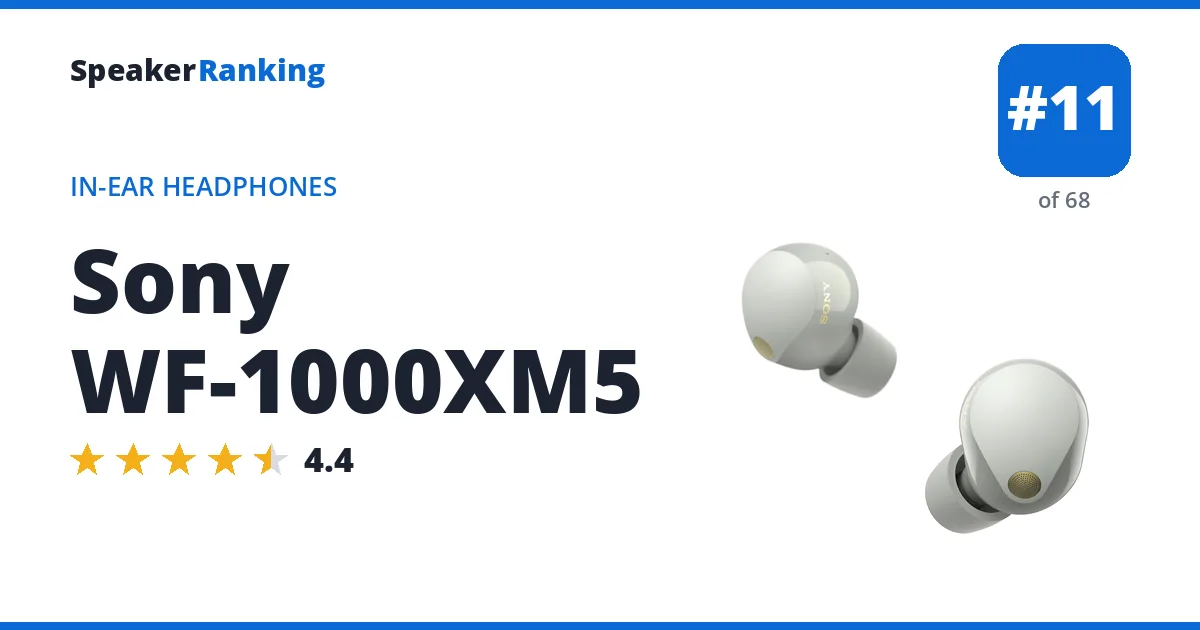
Pros: Mild bass emphasis, about 1.9 dB above target from 60 to 200 Hz, adds warmth without muddying the midrange, which stays within 0.8 dB of the target for a preference score of 78. Active noise cancelling, LDAC, AAC and SBC support, Bluetooth 5.3 and an IPX4 rating make it a full-featured true wireless set. Battery lasts about 8 hours per charge, 24 with the case, and each bud weighs 5.9 g.
Cons: Treble from 6 to 10 kHz runs about 2.2 dB low, with a 4.9 dB dip near 8 kHz, so cymbals and sibilance lose some bite. A 2.9 dB peak near 10.6 kHz can add a touch of artificial shimmer. Sub-bass sits about 1.9 dB below target, so the bass is punchy more than deep. The wired Sennheiser IE 200 matches its rating at a lower price and without charging.
Full Sony WF-1000XM5 review and specifications →
| Released | Jul 2023 (3 years ago) |
|---|---|
| Active Noise Cancelling | Yes |
| Back | Closed |
| Battery Life | 8 hours (24 with case, Manufacturer specified) |
| Bluetooth Codecs | SBC, AAC, LDAC |
| Bluetooth Version | 5.3 |
| Built-in Microphone | Yes |
| Connection | True wireless |
| Deviation From Target | 1.87 dB standard deviation |
| Driver Type | Dynamic |
| Drivers | 1 x 8.4mm dynamic |
| Form Factor | In-ear |
| Frequency Response | 20Hz - 20kHz (Manufacturer specified) |
| Harman Preference Score | 78 (measured by oratory1990, via AutoEQ) |
| IP Rating | IPX4 |
| Tonal Tilt | -0.18 (negative is warmer, positive brighter) |
| Weight | 0 lbs (5.9 g) per earbud |
EQ preset to match the Harman target
Set a preamp of -2.6 dB, then add these filters in any parametric equalizer (Wavelet, Equalizer APO, Peace, or a player with parametric EQ). Calculated by AutoEQ from its measured frequency response.
| Filter | Frequency | Gain | Q |
|---|---|---|---|
| Low shelf | 105 Hz | +5.4 dB | 0.70 |
| Peak | 68 Hz | -4.8 dB | 0.27 |
| Peak | 1,377 Hz | +2.6 dB | 0.31 |
| Peak | 1,806 Hz | -3.5 dB | 1.16 |
| Peak | 6,875 Hz | +1.8 dB | 3.49 |
| High shelf | 10,000 Hz | +2.3 dB | 0.70 |
| Peak | 3,757 Hz | +0.3 dB | 2.56 |
| Peak | 5,057 Hz | -0.7 dB | 5.70 |
| Peak | 449 Hz | +0.3 dB | 4.15 |
| Peak | 677 Hz | -0.2 dB | 2.75 |
- Reviews, Comparisons and Sound Samples
- Head-to-Head Comparisons
 Ranked #21 of 68 in In-Ear Headphones - Shuoer S12 Pro: $169.00 Amazon eBay
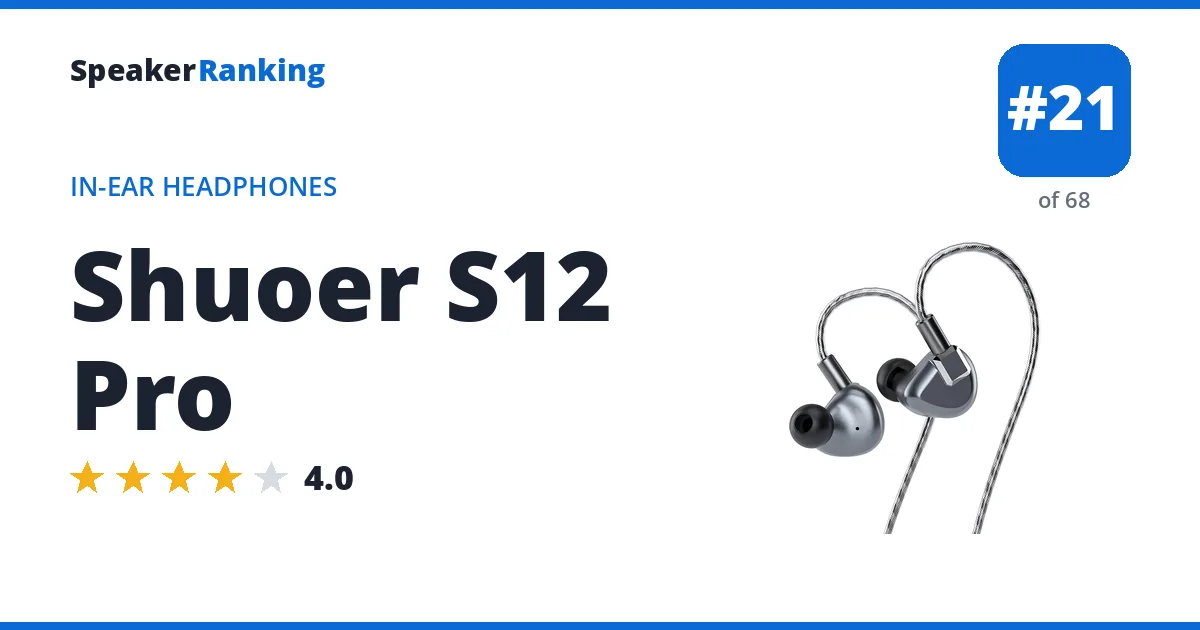
Pros: A 14.8mm planar magnetic driver delivers a gentle bass lift, about 2 dB above target from 60 to 200 Hz, with sub-bass nearly on target, for a preference score of 74. At 16 ohms and 102 dB sensitivity it runs fine from a phone. The wired design suits warm and v-shaped tastes, with extra treble sparkle.
Cons: Treble from 6 to 16 kHz runs 3 dB or more above target, with a 6 dB peak near 8.2 kHz, so cymbals and sibilance can sound bright at volume. A 5.5 dB dip near 3.7 kHz pulls back vocal presence. The Beats Powerbeats Pro and AUNE Jasper carry higher ratings.
Full Shuoer S12 Pro review and specifications →
| Released | 2022 (4 years ago) |
|---|---|
| Back | Closed |
| Connection | Wired |
| Deviation From Target | 2.18 dB standard deviation |
| Driver Type | Planar magnetic |
| Drivers | 1 x 14.8mm planar magnetic |
| Form Factor | In-ear |
| Frequency Response | 20Hz - 20kHz (Manufacturer specified) |
| Harman Preference Score | 74 (measured by oratory1990, via AutoEQ) |
| Impedance | 16 ohms |
| Sensitivity | 102 dB |
| Tonal Tilt | -0.19 (negative is warmer, positive brighter) |
EQ preset to match the Harman target
Set a preamp of -4.6 dB, then add these filters in any parametric equalizer (Wavelet, Equalizer APO, Peace, or a player with parametric EQ). Calculated by AutoEQ from its measured frequency response.
| Filter | Frequency | Gain | Q |
|---|---|---|---|
| Low shelf | 105 Hz | +0.2 dB | 0.70 |
| Peak | 3,538 Hz | +5.0 dB | 2.19 |
| Peak | 163 Hz | -2.5 dB | 0.79 |
| Peak | 679 Hz | +2.1 dB | 0.90 |
| Peak | 1,695 Hz | -2.2 dB | 2.26 |
| High shelf | 10,000 Hz | -7.4 dB | 0.70 |
| Peak | 7,429 Hz | -1.6 dB | 4.48 |
| Peak | 4,686 Hz | +0.9 dB | 3.26 |
| Peak | 3,610 Hz | -0.5 dB | 6.00 |
| Peak | 4,104 Hz | +0.5 dB | 4.93 |
- Reviews, Comparisons and Sound Samples
- Head-to-Head Comparisons
 Ranked #19 of 68 in In-Ear Headphones - KZ ZSN Pro X: $23.99 Amazon eBay
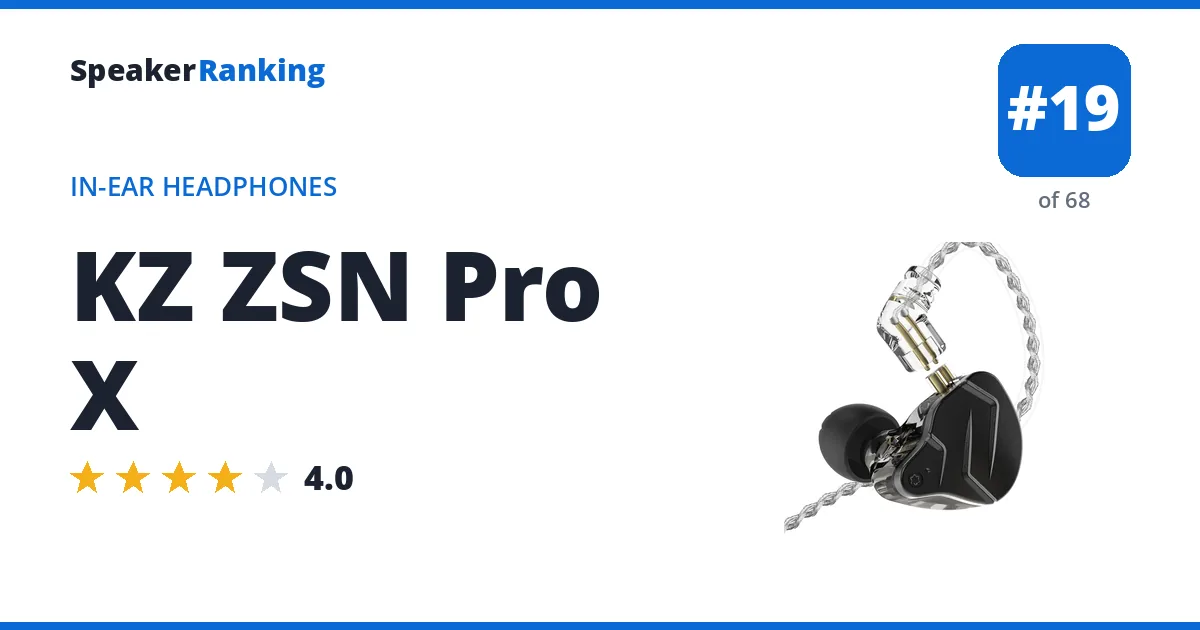
Pros: The hybrid design with a 10mm dynamic driver and a balanced armature gives bass about 3.6 dB above target at 60 to 200 Hz, which adds punch and warmth for pop and hip hop. A preference score of 74 at an inexpensive price is strong, and the 25 ohm impedance with 112 dB/mW sensitivity makes it easy to drive from a phone. It also suits a warm or v-shaped taste.
Cons: A 7.2 dB peak near 8.1 kHz and an air band about 5.8 dB above target can make cymbals and s sounds sharp or hissy at higher volume. The 3 to 4 kHz region dips about 2.9 dB, so vocals can sound a little distant. It has no wireless features or noise cancelling.
Full KZ ZSN Pro X review and specifications →
| Released | Jul 2020 (6 years ago) |
|---|---|
| Back | Closed |
| Connection | Wired |
| Deviation From Target | 2.09 dB standard deviation |
| Driver Type | Hybrid (1 dynamic + 1 balanced armature) |
| Drivers | 1 x 10mm dynamic + 1 x balanced armature |
| Form Factor | In-ear |
| Frequency Response | 7Hz - 40kHz (Manufacturer specified) |
| Harman Preference Score | 74 (measured by oratory1990, via AutoEQ) |
| Impedance | 25 ohms |
| Sensitivity | 112 dB/mW |
| Tonal Tilt | -0.17 (negative is warmer, positive brighter) |
EQ preset to match the Harman target
Set a preamp of -3.8 dB, then add these filters in any parametric equalizer (Wavelet, Equalizer APO, Peace, or a player with parametric EQ). Calculated by AutoEQ from its measured frequency response.
| Filter | Frequency | Gain | Q |
|---|---|---|---|
| Low shelf | 105 Hz | +0.8 dB | 0.70 |
| Peak | 928 Hz | +5.3 dB | 0.66 |
| Peak | 166 Hz | -3.4 dB | 0.67 |
| Peak | 2,193 Hz | -4.4 dB | 0.61 |
| Peak | 3,392 Hz | +6.1 dB | 2.82 |
| High shelf | 10,000 Hz | -4.4 dB | 0.70 |
| Peak | 6,459 Hz | +3.5 dB | 5.25 |
| Peak | 4,968 Hz | -3.5 dB | 5.59 |
| Peak | 4,039 Hz | +1.3 dB | 6.00 |
| Peak | 5,964 Hz | +0.9 dB | 5.91 |
- Reviews, Comparisons and Sound Samples
- Head-to-Head Comparisons