Editor's top picks
Start with these speakers
Our leading recommendations at a glance. Each card links to its primary retailer.
Looking for the best passive speakers under $2,000? This budget buys some of the most neutral speakers measured anywhere, bookshelf or tower. The bookshelf picks here post preference scores above 6, a level most speakers never reach at any price, and the towers add real bass reaching into the low 30Hz range. Prices are per pair, and every speaker here needs a separate amplifier or receiver.
Prices on this page were last checked September 26, 2026 at 12:12 AM UTC. Product prices and availability are accurate as of that date/time and are subject to change; the price and availability shown on Amazon at the time of purchase will apply to the purchase of this product.
As an eBay Partner, we may be compensated if you make a purchase.
What Changes At $2,000
Top-tier measured neutrality. Above about $1,000 a pair, the best designs combine a flat on-axis response with smooth off-axis behavior, so the sound stays consistent across a sofa rather than only in one seat.
Towers that can skip the subwoofer for music. The floorstanders below reach roughly 30 to 35Hz (-10dB), deep enough for most music without a subwoofer. Movies still benefit from one.
More demanding electrical loads. Several of the most accurate picks here are low in sensitivity or dip well below 4 ohms. Budget a capable amplifier rather than relying on an entry-level receiver. See speaker sensitivity explained.
Best Bookshelf Under $2,000
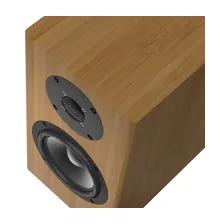 The most neutral bookshelf speaker under $2,000, with a 6.63 preference score (8.44 with a subwoofer), is the Ascend Acoustics Sierra-LX: $1598 per pair Ascend Acoustics eBay
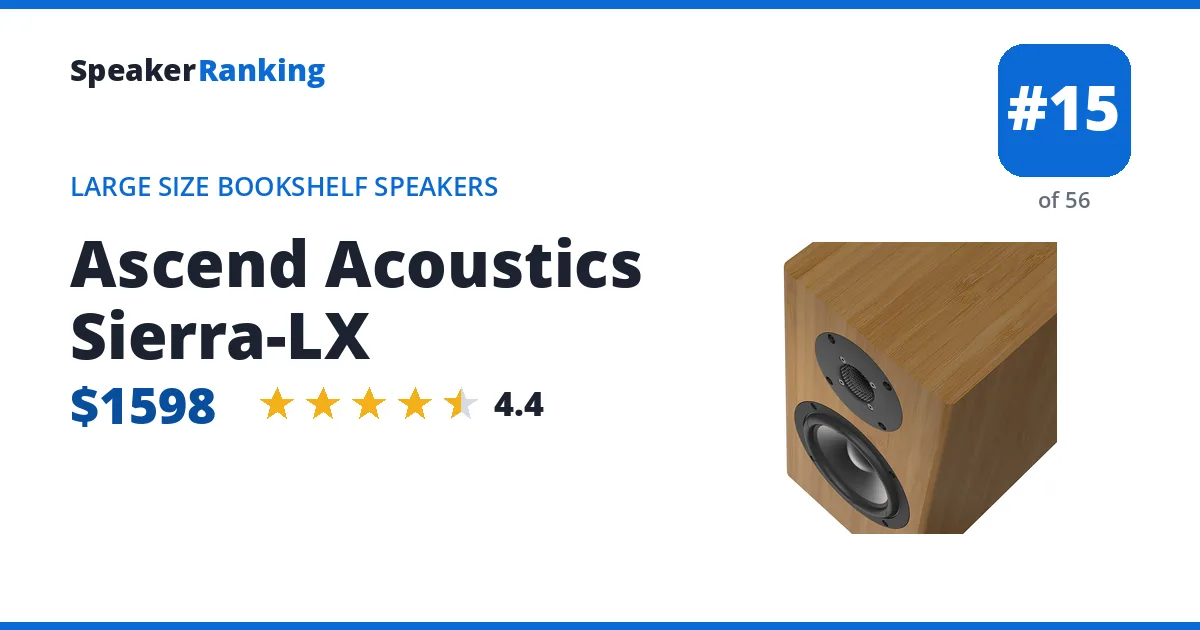
Pros: Very neutral, flat frequency response - within about plus or minus 1.5dB ignoring one narrow dip. Bass extension down to about 40Hz in-room despite the compact size. Wide, well-balanced soundstage (~60 degrees). Solid build quality with a laminated bamboo cabinet. Measured bass extension of 47Hz (-3dB), with a measured sensitivity of 81dB.
Cons: Very low sensitivity at about 81dB, so it needs a genuinely powerful amplifier to reach normal listening levels. Noticeable midrange distortion becomes audible above about 82-83dB SPL. A narrow dip around 3.5kHz on-axis in larger rooms without sidewall reflections - toeing the speakers out 10-20 degrees fills it in, but adds some brightness to the treble. Sensitive to listening height - sitting even slightly above or below tweeter level noticeably shifts the tonal balance.
Full Ascend Acoustics Sierra-LX review and specifications →
| Bass Extension (-10dB) | 38Hz (measured, Erin’s Audio Corner) |
|---|---|
| Bass Extension (-3dB) | 47Hz (measured, Erin’s Audio Corner) |
| Country | USA |
| DIY Kit | No |
| Dimensions | 14.3” x 7.5” x 10.5” (362 x 191 x 267 mm) |
| Drivers | 6” aluminum cone woofer, 26mm dome tweeter |
| Frequency Response | 28Hz - 23kHz (in-room, manufacturer specified) |
| Impedance | 8 ohms nominal (5.5 ohms minimum) |
| Power Handling | 350W continuous, 500W peak |
| Sensitivity | 81dB (2.83V/1m, measured by Erin’s Audio Corner) |
| Spinorama Preference Score | 6.63 |
| Spinorama Preference Score with Perfect Sub | 8.44 |
| Weight | 20.9 lbs (9.5 kg) |
| Woofer Cabinet | Bass reflex, flared rear port |
- Links
- Reviews, Comparisons and Sound Samples
- Head-to-Head Comparisons
- Ascend Acoustics Sierra-LX vs Wharfedale Linton 85
- Ascend Acoustics Sierra-LX vs Philharmonic BMR (v1)
- Ascend Acoustics Sierra-LX vs Ascend Acoustics Sierra-2EX V2
- Ascend Acoustics Sierra-LX vs Dynaudio Heritage Special
- Ascend Acoustics Sierra-LX vs Radiant Acoustics Clarity 6.2
- Ascend Acoustics Sierra-LX vs MoFi SourcePoint 10
- Ascend Acoustics Sierra-LX vs Emotiva Airmotiv XB2
- Ascend Acoustics Sierra-LX vs ELAC Debut 3.0 DB63
- See all 48 comparisons
It holds within about ±1.5dB on-axis and reaches about 47Hz (-3dB), deep for its size. Sensitivity is very low at about 81dB, so it needs a genuinely powerful amplifier, and midrange distortion becomes audible above about 82 to 83dB SPL.
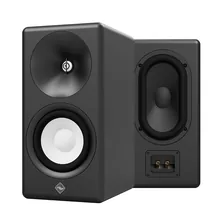 For consistent sound across a wide listening area, at a lower price, the AsciLab C6B: $1145 per pair Ascilab eBay
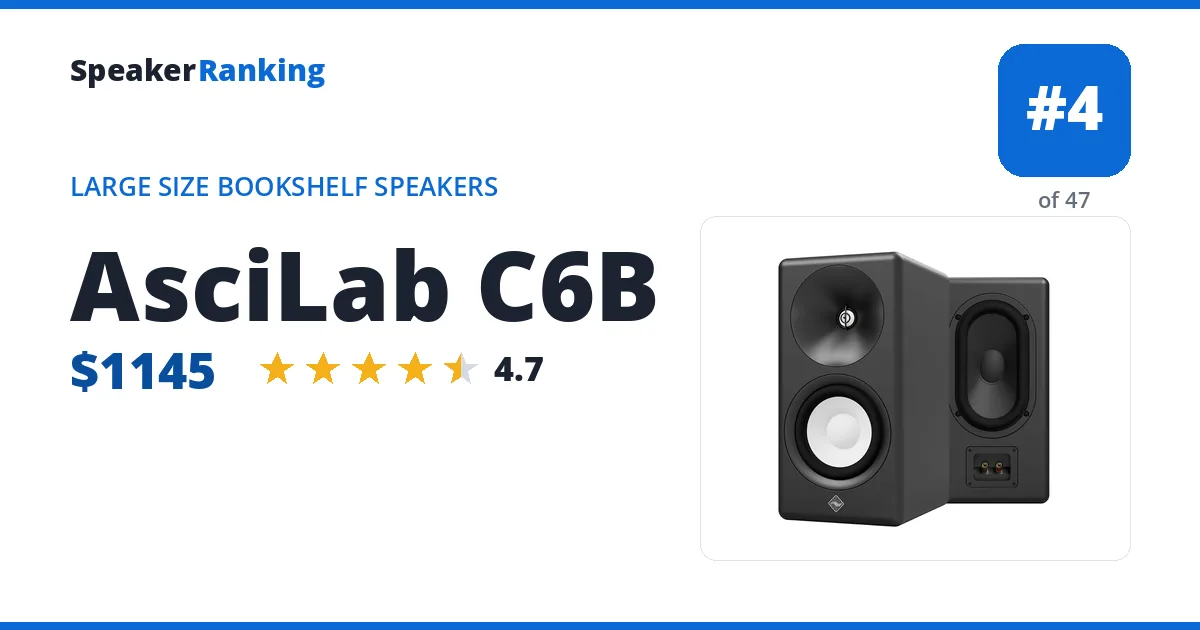
Pros: Two-way design pairing a 1” aluminum ceramic dome tweeter on a large waveguide with a 6” aluminum ceramic cone woofer, crossed over at 1.1kHz, plus a rear passive radiator. Unusual trait: horizontal radiation actually widens at higher frequencies instead of narrowing like most two-way designs, which keeps image focus and soundstage depth consistent whether you toe the speakers in or out (5-10° off-axis was the sweet spot in testing). Vertical radiation also stays wide straight through the 2kHz crossover region, so the sound doesn’t collapse when standing up - unusual at this price. CA2034 measurements show strong on-axis linearity, listening window, early reflections, and directivity. Midrange and tweeter distortion stay very low even at 96dB, holding up against a $5,900 Arendal speaker in that regard despite roughly a 5x price gap. At $935 (about $1,135 shipped to the US), the reviewer calls it the best-value bookshelf speaker he’s tested, rivaling speakers 2-5x the price. Measured bass extension of 54Hz (-3dB), with a measured sensitivity of 85.6dB.
Cons: Bass rolls off around 50Hz in-room (F3 54Hz, F10 35Hz), so a subwoofer is needed for real extension below that. Low-frequency harmonic distortion increases substantially at 96dB versus 86dB, though it’s second-order and less audible than it looks on paper. Minimum impedance dips to 2.6 ohms (EPDR as low as 1.2 ohms), so it wants an amplifier comfortable driving 4-ohm loads, ideally 100W or more. At 102dB, compression noticeably eats into midrange, bass, and some treble output. Shipping to the US adds roughly $200 on top of the $935 price. Against the reviewer’s reference Audiofirst Fidelia at a similar price, has slightly less lower-midrange body (about 1dB difference) and a smaller perceived soundstage size.
Full AsciLab C6B review and specifications →
| Bass Extension (-10dB) | 35Hz (measured, Erin’s Audio Corner) |
|---|---|
| Bass Extension (-3dB) | 54Hz (measured, Erin’s Audio Corner) |
| DIY Kit | No |
| Dimensions | 15.7”H x 8”W x 10.4”D (398.8 x 203.2 x 264.2 mm) |
| Drivers | 6” Aluminium Ceramic Cone with cast Aluminium Chassis woofer, 1” Aluminium Ceramic Dome tweeter |
| Impedance | 4 ohms nominal, 2.6 ohms minimum (measured, Erin’s Audio Corner) |
| Sensitivity | 85.6dB (measured, Erin’s Audio Corner) |
| Spinorama Preference Score | 6.33 |
| Spinorama Preference Score with Perfect Sub | 8.28 |
| Weight | 18.5 lbs (8.4 kg) each |
| Woofer Cabinet | passive radiator |
- Links
- Reviews, Comparisons and Sound Samples
- Head-to-Head Comparisons
It scores 6.33 (8.28 with a subwoofer) and its horizontal dispersion stays wide into the treble, so imaging holds whether you toe it in or out. Impedance falls to 2.6 ohms, so pair it with an amplifier that is comfortable with 4 ohm loads.
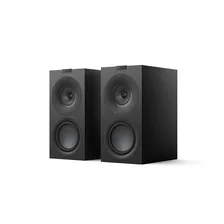 For the most even directivity from a well-known brand, the KEF Q Concerto Meta: $1,399.99 per pair Amazon Crutchfield eBay
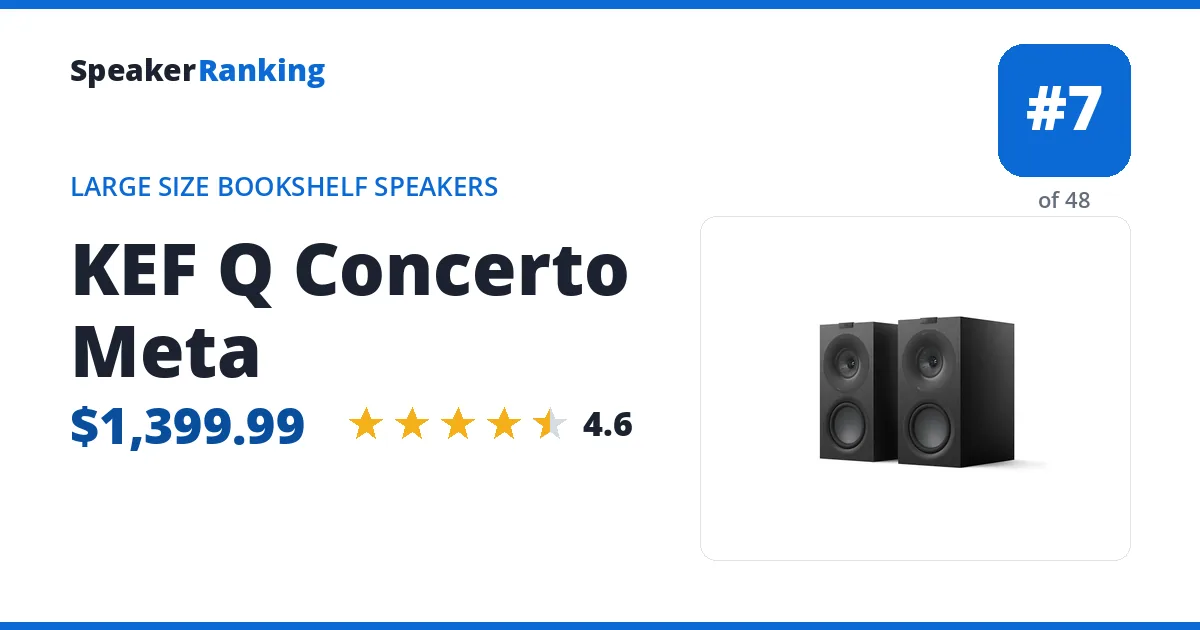
Pros: Really good in-room neutrality with consistent horizontal directivity from seat to seat. Directivity holds remarkably steady from lower treble into upper treble, where many similarly-priced speakers narrow sharply as frequency rises - one of the reviewer’s top 10 picks under $1,500. Measured bass extension of 53Hz (-3dB), with a measured sensitivity of 84.2dB.
Cons: Radiation pattern measures about ±50°, narrower than the reviewer’s preferred ±60° for a stronger sense of envelopment. Needs to be pointed closer to on-axis rather than heavily toed out - combined with its rolled-off, shelved-down top end, too much toe-out makes it sound noticeably dark.
Full KEF Q Concerto Meta review and specifications →
| Bass Extension (-10dB) | 35Hz (measured, Erin’s Audio Corner) |
|---|---|
| Bass Extension (-3dB) | 53Hz (measured, Erin’s Audio Corner) |
| DIY Kit | No |
| Dimensions | 16.3”H x 8.3”W x 12.4”D (414 x 210.8 x 315 mm) |
| Drivers | 165 mm (6.5 in.) hybrid aluminium cone woofer, 100 mm (4 in.) aluminium cone midrange, 19 mm (0.75 in.) vented aluminium dome with MAT tweeter |
| Impedance | 4 ohms nominal (3.3 ohms minimum above 80Hz, measured by Erin’s Audio Corner) |
| Sensitivity | 84.2dB (measured average, Erin’s Audio Corner) |
| Spinorama Preference Score | 6.01 |
| Spinorama Preference Score with Perfect Sub | 7.71 |
| Weight | 20.9 lbs (9.5 kg) each |
| Woofer Cabinet | ported, rear |
- Links
- Reviews, Comparisons and Sound Samples
- Erin’s Audio Corner: HiFi Perfection? KEF CONCERTO META Delivers! More from Erin’s Audio Corner →
- Erin’s Audio Corner Website KEF Q Concerto Meta
- Erin’s Audio Corner: I Tested 250 Speakers So You Don’t Have To!
- Erin’s Audio Corner: HiFi Perfection? KEF CONCERTO META Delivers!
- Erin’s Audio Corner: My Absolute Favorite Products of 2024 Revealed
- Erin’s Audio Corner Measurements (spinorama.org)
- Head-to-Head Comparisons
- KEF Q Concerto Meta vs KEF R3 Meta
- KEF Q Concerto Meta vs Wharfedale Aura 2
- KEF Q Concerto Meta vs Revel M106
- KEF Q Concerto Meta vs KEF R3
- KEF Q Concerto Meta vs Audio First Cadentia 3
- KEF Q Concerto Meta vs AsciLab C6B
- KEF Q Concerto Meta vs Buchardt Audio E50
- KEF Q Concerto Meta vs MoFi SourcePoint 8
- See all 67 comparisons
It scores 6.01 (7.71 with a subwoofer), with bass reaching about 53Hz (-3dB) and directivity that stays steady through the treble. Keep it pointed close to the listener: toed out, it sounds dark.
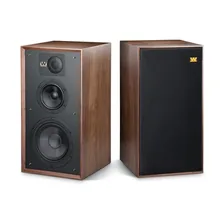 For a large standmount with deeper bass from an 8-inch woofer, the Wharfedale Linton 85: $1999 per pair Crutchfield eBay
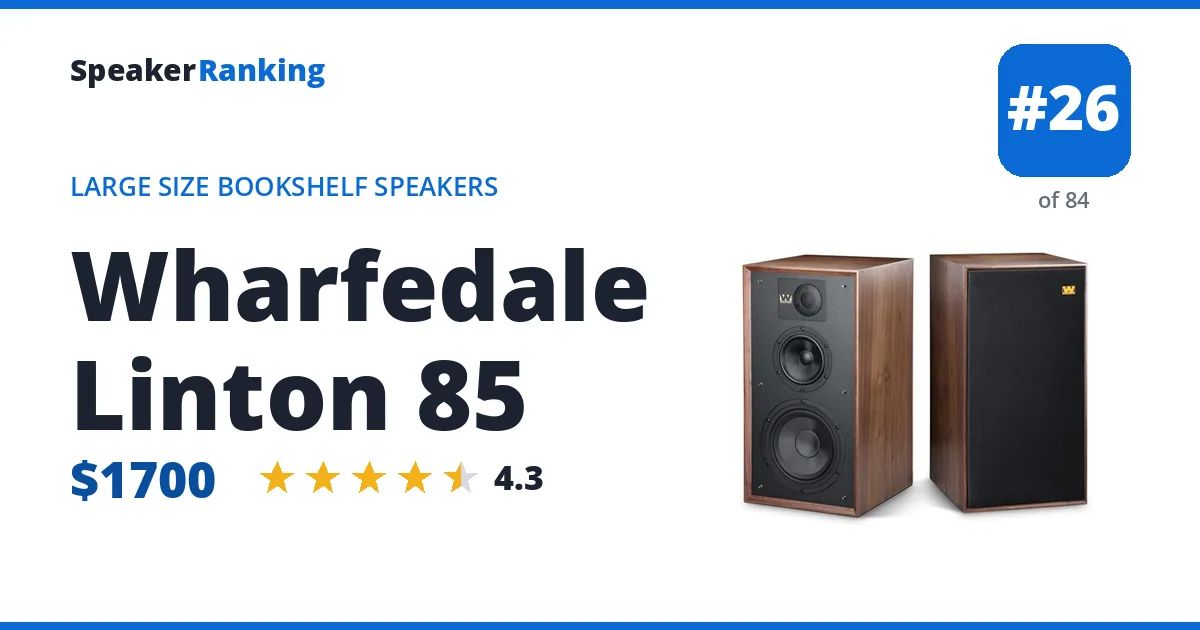
Pros: Very neutral frequency response and good bass extension. Measured bass extension of 52Hz (-3dB), with a measured sensitivity of 85.1dB.
Cons: The spacing of the drivers makes the vertical off axis not very good
Full Wharfedale Linton 85 review and specifications →
| Bass Extension (-10dB) | 35Hz (measured, Erin’s Audio Corner) |
|---|---|
| Bass Extension (-3dB) | 52Hz (measured, Erin’s Audio Corner) |
| DIY Kit | No |
| Dimensions | 22.2”H x 11.8”W x 13”D (563.9 x 299.7 x 330.2 mm) |
| Drivers | 8”(200mm) black woven Kevlar® cone woofer, 5”(135mm) black woven Kevlar® cone midrange, 1” (25mm) soft dome tweeter |
| Impedance | 6 ohms nominal, 3.5 ohms minimum (measured above 80Hz, Erin’s Audio Corner) |
| Sensitivity | 85.1dB (measured average 300Hz-3kHz @ 2.83V/1m, Erin’s Audio Corner) |
| Spinorama Preference Score | 6.07 |
| Spinorama Preference Score with Perfect Sub | 7.87 |
| Weight | 40.6 lbs (18.4 kg) each |
| Woofer Cabinet | ported, rear |
- Links
- Reviews, Comparisons and Sound Samples
- Erin’s Audio Corner: Discover Why I Can’t Stop Raving About the Wharfedale Linton 85th Anniversary Speaker More from Erin’s Audio Corner →
- Erin’s Audio Corner Website Wharfedale Linton 85 Review
- Erin’s Audio Corner: My Top 5 Speakers at Any Price
- Erin’s Audio Corner: Upgrade Your Sound with These 6 Surprisingly Affordable Speakers!
- Erin’s Audio Corner: My Personal Favorite Speakers Under $2500
- Erin’s Audio Corner Measurements (spinorama.org)
- Head-to-Head Comparisons
- Wharfedale Linton 85 vs Ascend Acoustics Sierra-LX
- Wharfedale Linton 85 vs Revel M126Be
- Wharfedale Linton 85 vs ELAC VELA BS 403
- Wharfedale Linton 85 vs Dynaudio Heritage Special
- Wharfedale Linton 85 vs Philharmonic BMR (v1)
- Wharfedale Linton 85 vs Radiant Acoustics Clarity 6.2
- Wharfedale Linton 85 vs Ascend Acoustics Sierra-2EX V2
- Wharfedale Linton 85 vs MoFi SourcePoint 10
- See all 63 comparisons
It scores 6.07 (7.87 with a subwoofer) and reaches about 52Hz (-3dB) and 35Hz (-10dB), near tower territory. The widely spaced drivers make it sensitive to listening height, so sit close to tweeter level.
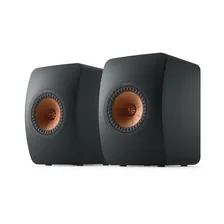 For the most compact high-end pick, with precise imaging, the KEF LS50 Meta: $1,599.00 per pair Amazon Crutchfield eBay
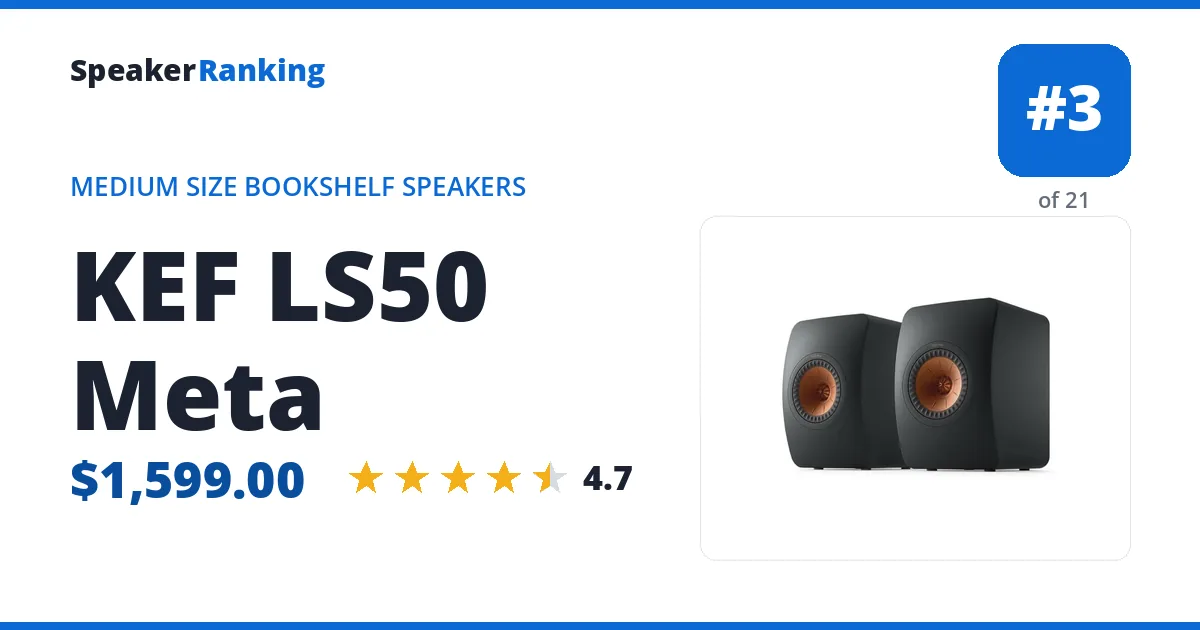
Pros: Uni-Q concentric driver mounts a 1” vented aluminum dome tweeter at the center of a 5.25” aluminum cone woofer, rated 79Hz-20kHz+. Speaker-to-speaker matching measured tight at roughly 0.5dB deviation between the pair tested, versus 2-3dB seen on some other speakers - likely why imaging stayed so precise. Imaging stays tight and focused even toed out, unlike most coincident designs where toe-out typically diffuses the image, giving more of an oval-shaped soundstage than a hard rectangular boundary. Horizontal and vertical directivity both hold to about ±50° at the -6dB point, so tonality stays consistent across roughly a 100° listening cone. The extended bass shelf is deliberately tuned for near-wall/boundary placement rather than the usual “pull it 3 feet into the room” advice, playing lower without excess boominess when placed close to a wall. At $1,000 (a frequent sale price versus $1,600 list), called a no-brainer for a compact stand-mount speaker. Independent ASR Klippel measurements corroborate this: very good directivity with the on- and off-axis curves tracking closely, and a predicted in-room response the reviewer called “very close to ideal.”. Measured bass extension of 68Hz (-3dB), with a measured sensitivity of 83dB.
Cons: F3 of 67Hz and F10 of 42Hz mean it doesn’t get much below 50Hz in-room; a subwoofer is recommended for real bass. A 2-3dB scoop around 2-4kHz shows up in both the listening window and sound power measurements, matching a subjectively noticed lack of attack and vocal clarity that the reviewer wanted to correct with about 2dB of EQ. An on-axis diffraction dip around 8kHz smooths out with about 15° of toe-out (typical for concentric designs, but still present at 0°). Distortion is elevated at low frequencies since the single 5.25” cone shares surface area with the tweeter housing, reducing effective radiating area; multitone distortion crosses the 3% threshold at 96dB/1m, making roughly 88dB or below the safer output ceiling. Moderate sensitivity (~83dB average) needed 2-3dB more amplifier gain than typical in testing. Adding a subwoofer at an 80Hz crossover only helps lower-midrange distortion, not the elevated distortion in the 1-2kHz and above-5kHz regions. ASR’s own Klippel testing found the same pattern in starker terms: THD is very good at 86dB SPL/1m but climbs past 100% in the bass at 96dB SPL/1m, confirming this is not a near-field speaker for high-output bass-heavy material. Cumulative spectral decay (waterfall) also shows a couple of resonances lingering in the 1-2kHz region.
Full KEF LS50 Meta review and specifications →
| Bass Extension (-10dB) | 43Hz (measured, Erin’s Audio Corner) |
|---|---|
| Bass Extension (-3dB) | 68Hz (measured, Erin’s Audio Corner) |
| DIY Kit | No |
| Dimensions | 11.9”H x 7.9”W x 11”D (302 x 200 x 280.5 mm) |
| Drivers | 130 mm (5.25 in.) aluminium cone woofer, 25 mm (1 in.) vented aluminium dome with Metamaterial Absorption tweeter |
| Impedance | 8 ohms nominal (3.7 ohms minimum above 80Hz, measured by Erin’s Audio Corner) |
| Sensitivity | 83dB (measured average, Erin’s Audio Corner; 85dB manufacturer specified) |
| Spinorama Preference Score | 5.74 |
| Spinorama Preference Score with Perfect Sub | 7.88 |
| Weight | 17.2 lbs (7.8 kg) each |
| Woofer Cabinet | ported, rear |
- Links
- Reviews, Comparisons and Sound Samples
- Erin’s Audio Corner: Unveiling the KEF LS50 Meta: The Truth Behind the Hype More from Erin’s Audio Corner →
- Erin’s Audio Corner Website KEF LS50 Meta
- Audio Science Review KEF LS50 Meta More from Audio Science Review →
- GR-Research: KEF LS50 Meta! Worthy of HYPE? More from GR-Research →
- Erin’s Audio Corner: My Top Picks of 2023: Must-Haves Under $3000
- Erin’s Audio Corner Measurements (spinorama.org)
- Head-to-Head Comparisons
- KEF LS50 Meta vs Ascend Sierra 1 v2
- KEF LS50 Meta vs Ascend Acoustics Luna V2 Mini-Monitor Ribbon
- KEF LS50 Meta vs Philharmonic Ceramic Mini
- KEF LS50 Meta vs XMechanik Mechano23 DIY
- KEF LS50 Meta vs Audio First Fidelia
- KEF LS50 Meta vs Ascend Acoustics HTM-200SE2
- KEF LS50 Meta vs Arendal 1961 Monitor
- KEF LS50 Meta vs SunAudio Purified 4
- See all 86 comparisons
Its concentric driver keeps imaging tight even when toed out, and the review pair matched each other within about 0.5dB. Bass stops around 68Hz (-3dB), so plan on a subwoofer, and expect a small presence dip around 2 to 4kHz.
Best Floorstanding Under $2,000
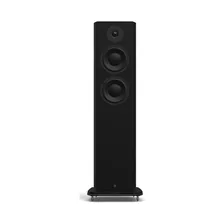 For a tower with unusually linear sound and bass reaching about 32Hz (-10dB), the Morel Avyra 633: $2,000.00 per pair eBay
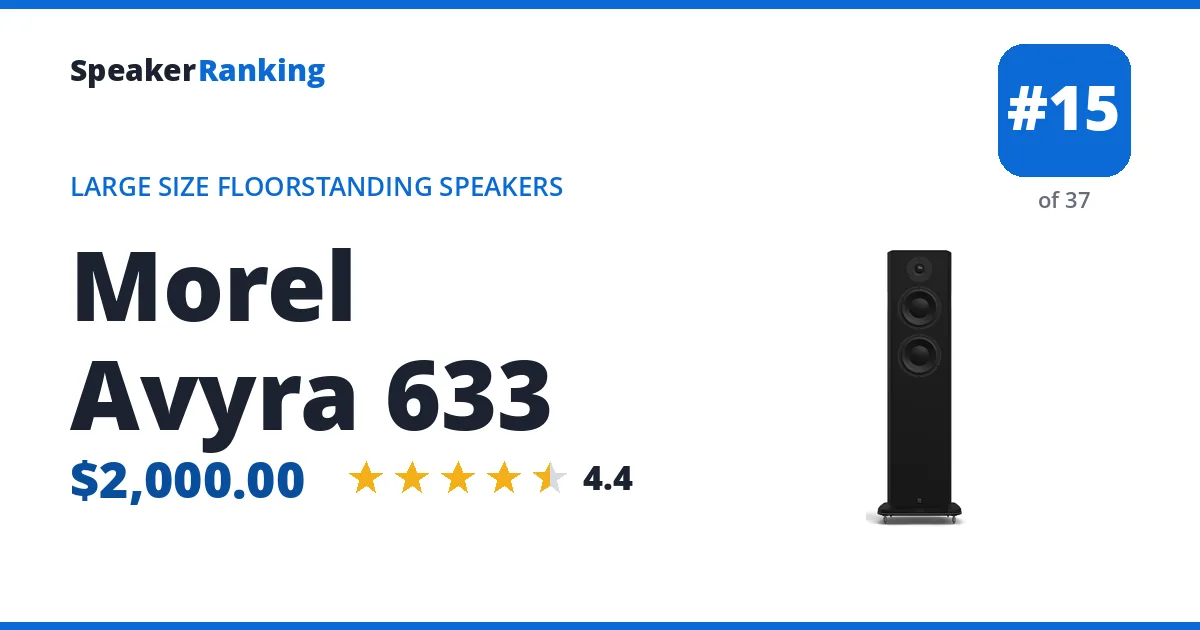
Pros: A 2.5-way floorstanding tower with two 6” mid-woofers (each with an unusually large 3” voice coil for better power handling) and a dome tweeter; the bottom woofer only covers up to about 250Hz while the top woofer runs all the way to the 2.2kHz crossover point. Easy to drive at a nominal 4 ohms (minimum 3.8 ohms). On-axis linearity measures within about ±2.25dB - genuinely impressive for a tower in this class, enough that the reviewer said he’d have guessed a $4,000-5,000 per pair price just from the look and the data alone. F3 of about 50Hz and F10 of about 32Hz give reasonable kick-drum-level bass without a subwoofer. Wide horizontal radiation around ±70° with good continuity outside the treble region. Harmonic distortion stays under 1% THD to about 100Hz at both 86dB and 96dB, and using an 80Hz subwoofer crossover barely changes midrange distortion - a sign the drive units themselves are good quality rather than excursion-limited. About 20dB of usable dynamic range. No through-holes for spikes, so no risk of dropped hardware during setup. Measured bass extension of 50Hz (-3dB), with a measured sensitivity of 86.5dB.
Cons: A bit bright out of the box - extra tweeter energy in the 4-7kHz region (which also shows up as nonlinearity in the early-reflections directivity data, making it harder to fully correct with EQ) reflects off nearby sidewalls and can sound tipped-up or edgy; a single EQ band (about 4.4kHz, -2dB, Q of 1) or absorption panels placed 60-80° off-axis on the sidewalls resolves it. Best aimed directly at the listener rather than toed out, since the top end already rolls off a little at wider angles. Imaging loses a bit of precision specifically in that lower-treble region. Multitone distortion exceeds the reviewer’s 3% comfort threshold at higher output. Real bass extension below 50Hz still needs a subwoofer. Not the same speaker as the Parts Express “Solstice” DIY kit despite surface similarities - different tweeter, different (ported vs. transmission line) enclosure, and measurably different woofers.
Full Morel Avyra 633 review and specifications →
| Bass Extension (-10dB) | 32Hz (measured, Erin’s Audio Corner) |
|---|---|
| Bass Extension (-3dB) | 50Hz (measured, Erin’s Audio Corner) |
| Country | Israel |
| Crossover Frequency | 250Hz, 2.2kHz |
| DIY Kit | No |
| Dimensions | 38.7”H x 12.8”W x 12.2”D (982 x 326 x 310 mm) |
| Drivers | Dome tweeter, two 6” mid-woofers (3” voice coil) |
| Frequency Response | 25Hz - 20kHz (±3dB, manufacturer specified) |
| Impedance | 4 ohms nominal (3.8 ohms minimum, measured, Erin’s Audio Corner) |
| Recommended Power | 200-1000W |
| Sensitivity | 86.5dB (measured, Erin’s Audio Corner) |
| Spinorama Preference Score | 5.43 |
| Spinorama Preference Score with Perfect Sub | 7.20 |
| Weight | 48.5 lbs (22 kg) each |
| Woofer Cabinet | ported |
- Links
- Reviews, Comparisons and Sound Samples
- Head-to-Head Comparisons
On-axis response holds within about ±2.25dB, rare for a tower at this price. It is a little bright out of the box in the 4 to 7kHz region; a single EQ band or sidewall absorption fixes it.
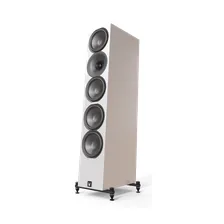 For the cleanest output from a slim tower, the Arendal 1961 Tower: $1,900 per pair Arendal Sound eBay
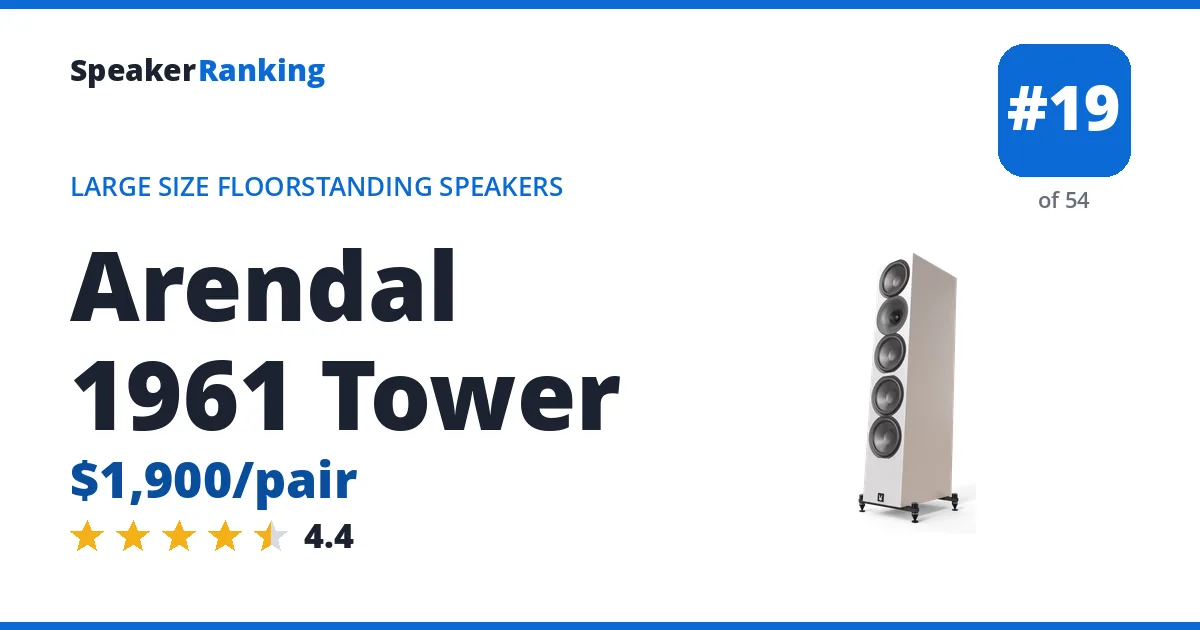
Pros: Exceptional output cleanliness for a slim tower: Erin measured under 1% THD to about 100Hz at 96dB/1m and only crossed 3% near 80Hz, while compression was better than several physically larger competitors. The response and listening window are broadly neutral, early-reflections and sound-power directivity are well controlled, and the waveguided dome supports stable imaging. A sealed HDF cabinet, four 5.5-inch woofers and a ten-year warranty provide serious theater-grade engineering in a tiny footprint. Measured bass extension of 62Hz (-3dB), with a measured sensitivity of 86.5dB.
Cons: Erin measured F3 at 62Hz and F10 at 43Hz, so the four woofers prioritize clean output over deep extension; a subwoofer remains necessary. Sensitivity is a moderate 86.5dB and impedance dips below four ohms, which may challenge budget AVRs even though a competent power amplifier has no issue. The optimal axis is roughly 5° above the tweeter and radiation begins narrowing around 1.3kHz, so seat height and toe-in deserve attention.
Full Arendal 1961 Tower review and specifications →
| Bass Extension (-10dB) | 43Hz (measured, Erin’s Audio Corner) |
|---|---|
| Bass Extension (-3dB) | 62Hz (measured, Erin’s Audio Corner) |
| DIY Kit | No |
| Dimensions | 33”H x 6.4”W x 11.2”D (837.5 x 163 x 285 mm) (without feet) |
| Drivers | Four 5.5-inch woofers; 28mm waveguided soft dome |
| Enclosure | Sealed HDF |
| Impedance | 4 ohms nominal; dips below 4 ohms (measured, Erin’s Audio Corner) |
| Sensitivity | 86.5dB/2.83V/1m (measured, Erin’s Audio Corner) |
| Spinorama Preference Score | 4.83 |
| Spinorama Preference Score with Perfect Sub | 7.25 |
| Weight | 39.5 lbs (17.9 kg) each |
- Links
- Reviews, Comparisons and Sound Samples
- Head-to-Head Comparisons
Four 5.5-inch woofers in a sealed cabinet stay under 1% distortion to about 100Hz at 96dB. That favors clean output over depth: bass reaches about 62Hz (-3dB) and 43Hz (-10dB), so it pairs best with a subwoofer.
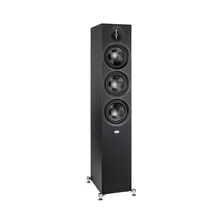 For a three-way tower that reaches about 29Hz (-10dB) for far less, the ELAC Debut 3.0 DF63: $1,298 per pair Amazon eBay
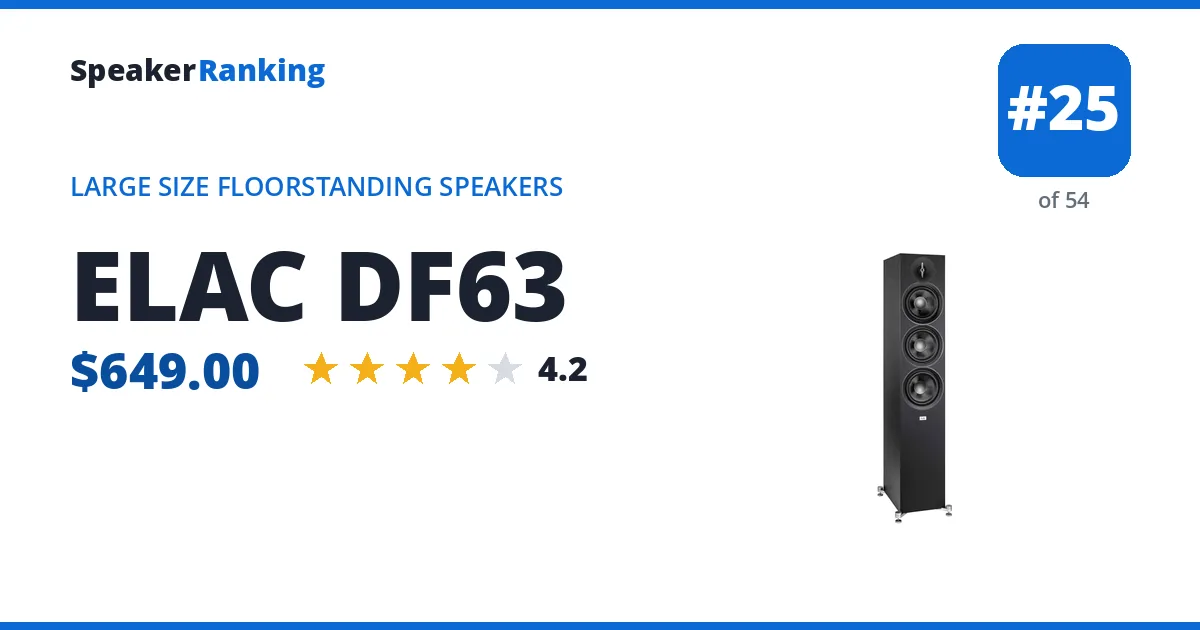
Pros: Three-driver floorstanding layout: two 6” dedicated midbase drivers plus a separate 6” mid-range driver (confirmed by measuring different driver impedance/inductance) and a 1” dome tweeter, each woofer given its own stuffed chamber inside the cabinet. The dedicated midrange driver keeps distortion low even at higher output, avoiding the intermodulation grain typical of two-way bookshelf designs. The waveguide keeps high-frequency directivity well controlled, and overall horizontal directivity is good up to about 2kHz. Harmonic distortion looks good at both 86dB and 96dB, and multitone distortion stays below the reviewer’s 3% threshold. A shallow bass rolloff (F3 71Hz, F10 29Hz) lets it extend fairly low without a hard cutoff. Preferred by the reviewer over the similarly-priced Polk R500 (too much high-frequency narrowing, less neutral) and considered ahead of the Polk R700 as well. Measured bass extension of 71Hz (-3dB), with a measured sensitivity of 86.6dB.
Cons: A genuine measured resonance around 200-300Hz (visible in frequency response, impedance, and group delay) causes an audible “droning” coloration on female vocals. A mild peak around 10kHz makes shakers and similar high-frequency percussion jump too far forward in the mix; needed about 2dB of EQ to tame in testing. A dip in the 1-3kHz range gives the speaker a warm, slightly veiled character - the reviewer suspects the tweeter crossover point (around 2-3kHz) is set a bit high and could be lowered to fill this in. Directivity shows a noticeable handoff mismatch around 2.5kHz where the midrange driver hands off to the tweeter, though it’s minor at the -6dB point. Vertical directivity is narrower than horizontal, so listeners need to stay close to the tweeter axis. Low EPDR (about 1.5 ohms minimum) means a Class AB amplifier should be well-ventilated. Best positioned pointed directly at the listener and closer to the front wall - toeing it out into the room causes too much high-frequency rolloff.
Full ELAC Debut 3.0 DF63 review and specifications →
| Bass Extension (-10dB) | 29Hz (measured, Erin’s Audio Corner) |
|---|---|
| Bass Extension (-3dB) | 71Hz (measured, Erin’s Audio Corner) |
| DIY Kit | No |
| Dimensions | 43.1”H x 7.7”W x 10.6”D (1094.7 x 195.6 x 269.2 mm) |
| Drivers | Two 6.5” Aramid Fiber woofer, 6.5” Aramid Fiber midrange, 1” Aluminum Dome tweeter |
| Impedance | 6 ohms nominal (3.4 ohms minimum, measured, Erin’s Audio Corner) |
| Sensitivity | 86.6dB (measured, Erin’s Audio Corner) |
| Spinorama Preference Score | 5.83 |
| Spinorama Preference Score with Perfect Sub | 7.33 |
| Weight | 58.2 lbs (26.4 kg) each |
| Woofer Cabinet | ported, rear |
- Links
- Reviews, Comparisons and Sound Samples
- Head-to-Head Comparisons
- ELAC Debut 3.0 DF63 vs Polk Reserve R500
- ELAC Debut 3.0 DF63 vs Emotiva Airmotiv T2+
- ELAC Debut 3.0 DF63 vs Linkwitz Lab LXmini
- ELAC Debut 3.0 DF63 vs PSB Imagine T65
- ELAC Debut 3.0 DF63 vs Polk Audio Reserve R700
- ELAC Debut 3.0 DF63 vs Infinity Primus 360
- ELAC Debut 3.0 DF63 vs Q Acoustics 5040
- ELAC Debut 3.0 DF63 vs JBL HDI-3600
- See all 42 comparisons
It scores 5.83 (7.33 with a subwoofer) and leaves most of the budget for an amplifier. A resonance around 200 to 300Hz can color female vocals.
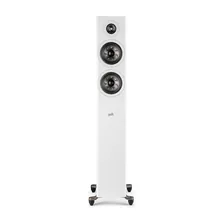 For a neutral tower that is easy to drive, the Polk Reserve R500: $1,259.98 per pair Amazon eBay
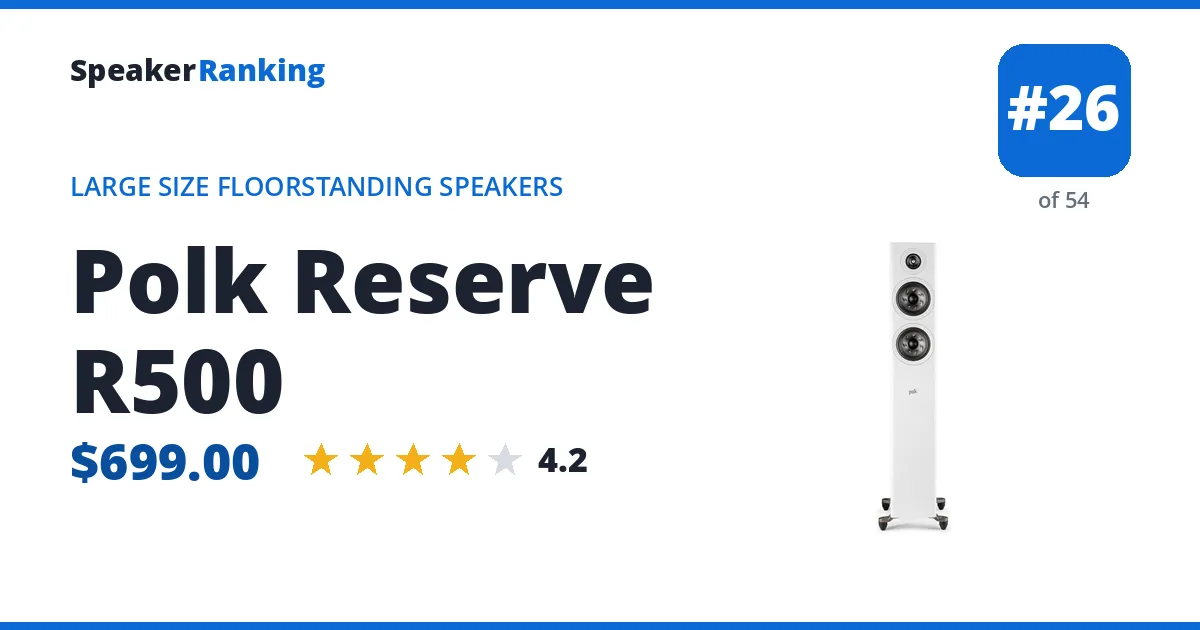
Pros: Dual 5.25” midwoofers paired with a ring radiator tweeter in a floorstanding tower design. Surprisingly neutral overall compared to Polk’s smaller bookshelf models - notably more even-handed than the brighter-sounding R200 the reviewer tested previously. Good linearity on-axis, within about -3/+2dB. Sensitivity close to 86dB, easily driven to adequate levels in a small-to-medium room with a 100W-capable amplifier. Takes very well to EQ - a single band of correction (about a 2dB cut around 4-5kHz) resolves the main tonal issue and transforms the sound. Dynamic range and compression performance is solidly “medium,” holding up fine through about 20dB of level increase before higher-frequency and bass output start to taper at extreme volumes. Measured bass extension of 51Hz (-3dB), with a measured sensitivity of 86.2dB.
Cons: A bump around 4-6kHz gives a “shouty,” mildly sibilant quality in the lower treble. Counterintuitively, toeing the speaker out to reduce brightness makes this worse rather than better, since the ring-radiator tweeter’s directivity narrows rapidly above about 6-7kHz - pointed on-axis retains enough top-end air to balance the bump, but toed away that air drops off and the shoutiness stands out more. Bass is adequate for its 5.25” woofers but lacks real weight below about 40-50Hz; a subwoofer is still needed for movies and bass-heavy music. A cabinet resonance around 160-170Hz subtracts from rather than adds boom to the mid-bass region. Vertical listening window is fairly narrow - sitting more than about 10-20° above or below the tweeter axis causes a suckout in the 2-5kHz range, reducing clarity and attack. Multitone distortion ramps up noticeably around 1kHz, and crossing over to a subwoofer at 80Hz doesn’t meaningfully reduce it - likely a surround-related effect rather than excursion-related. Without applying corrective EQ, the reviewer says the 4-6kHz brightness would make it harder to live with day to day.
Full Polk Reserve R500 review and specifications →
| Bass Extension (-10dB) | 33Hz (measured, Erin’s Audio Corner) |
|---|---|
| Bass Extension (-3dB) | 51Hz (measured, Erin’s Audio Corner) |
| DIY Kit | No |
| Dimensions | 40.3”H x 6.8”W x 12.4”D (1023.6 x 172.7 x 315 mm) |
| Drivers | Two 5.25” Turbine Cone woofer, 1” Pinnacle Ring Radiator tweeter |
| Impedance | 4.1 ohms minimum above 80Hz (measured, Erin’s Audio Corner; 8 ohms nominal per manufacturer) |
| Sensitivity | 86.2dB (measured, Erin’s Audio Corner) |
| Spinorama Preference Score | 5.86 |
| Spinorama Preference Score with Perfect Sub | 7.44 |
| Weight | 39.2 lbs (17.8 kg) each |
| Woofer Cabinet | ported, rear |
- Links
- Reviews, Comparisons and Sound Samples
- Head-to-Head Comparisons
- Polk Reserve R500 vs ELAC Debut 3.0 DF63
- Polk Reserve R500 vs Linkwitz Lab LXmini
- Polk Reserve R500 vs Emotiva Airmotiv T2+
- Polk Reserve R500 vs PSB Imagine T65
- Polk Reserve R500 vs Infinity Primus 360
- Polk Reserve R500 vs Polk Audio Reserve R700
- Polk Reserve R500 vs Q Acoustics 5040
- Polk Reserve R500 vs Klipsch Forte IV
- See all 35 comparisons
It scores 5.86 (7.44 with a subwoofer), reaches about 51Hz (-3dB), and its 86dB sensitivity suits a typical receiver. A lift around 4 to 6kHz can sound a little shouty, and a single EQ cut corrects it.
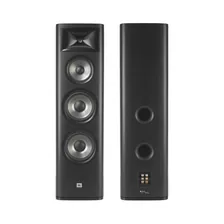 For high sensitivity and home theater dynamics, the JBL Studio 698: $1,398 per pair Crutchfield eBay
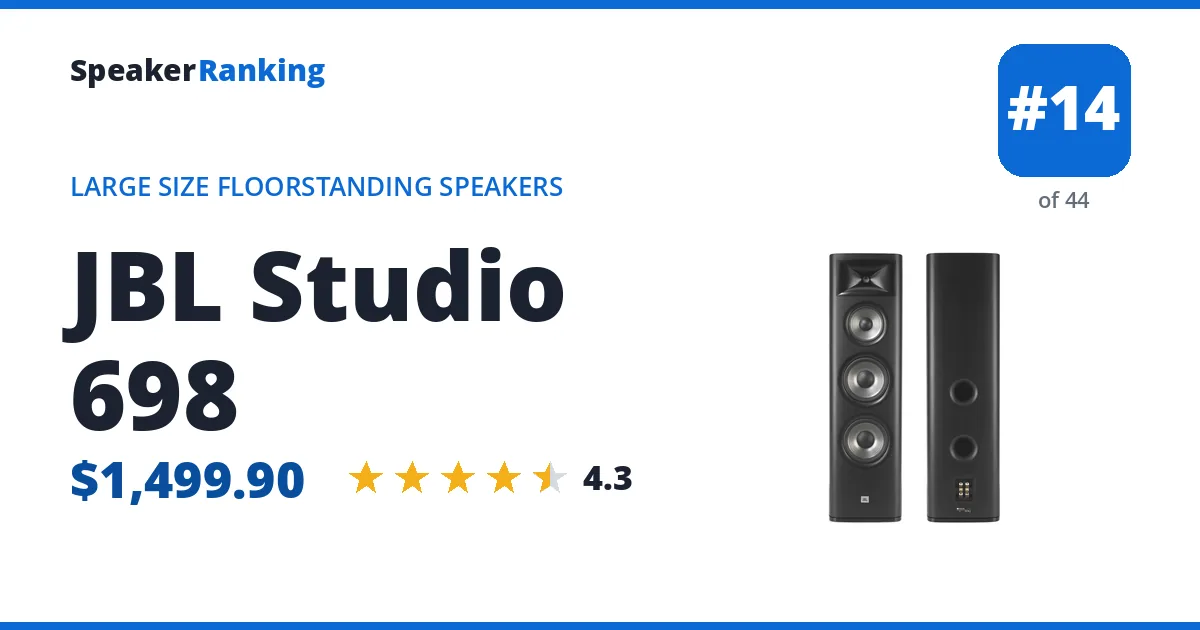
Pros: High-Definition Imaging (HDI) horn waveguide paired with a 1” compression driver provides excellent high-frequency directivity control and seamless acoustic handoff to the 6” PolyPlas midrange. Dual 8” PolyPlas woofers deliver robust low-end authority with solid bass extension down to an F3 of 53Hz and F10 of 34Hz. High voltage sensitivity (90dB SPL at 2.83V/1m) and clean power handling provide effortless dynamic headroom and low distortion for home theater and music listening. Measured bass extension of 53Hz (-3dB), with a measured sensitivity of 90dB.
Cons: Measured response exhibits a prominent mid-bass emphasis bump around 80Hz that can sound overly thick or chesty in smaller rooms without DSP EQ. Treble response lacks top-octave ‘air’ above 12kHz compared to high-end dome or ribbon tweeters. Physically large, heavy cabinet (35.8 kg per speaker) requires careful room placement and a wide acoustic footprint.
Full JBL Studio 698 review and specifications →
| Bass Extension (-10dB) | 34Hz (measured, Erin’s Audio Corner) |
|---|---|
| Bass Extension (-3dB) | 53Hz (measured, Erin’s Audio Corner) |
| DIY Kit | No |
| Dimensions | 41.7”H x 11.8”W x 15.7”D (1058 x 300 x 400 mm) |
| Drivers | 1 in. High-Definition Imaging compression driver, 6 in. PolyPlas midrange, dual 8 in. PolyPlas woofers |
| Impedance | 6 ohms nominal (4.1 ohms minimum above 80Hz, measured by Erin’s Audio Corner) |
| Sensitivity | 90dB (measured average, Erin’s Audio Corner) |
| Spinorama Preference Score | 4.20 |
| Spinorama Preference Score with Perfect Sub | 6.14 |
| Weight | 78.9 lbs (35.8 kg) each |
| Woofer Cabinet | ported, rear |
- Links
- Reviews, Comparisons and Sound Samples
- Head-to-Head Comparisons
- JBL Studio 698 vs JBL HDI-3600
- JBL Studio 698 vs Morel Avyra 633
- JBL Studio 698 vs Polk Audio Reserve R700
- JBL Studio 698 vs Arendal 1961 Tower
- JBL Studio 698 vs KEF R11 Meta
- JBL Studio 698 vs PSB Imagine T65
- JBL Studio 698 vs Emotiva Airmotiv T2+
- JBL Studio 698 vs Ascend Acoustics Sierra Titan Tower
- See all 52 comparisons
At about 90dB it needs far less amplifier power than the other picks, and dual 8-inch woofers reach about 34Hz (-10dB). A bump around 80Hz can sound thick in a small room.
Where To Go Next
Lower budgets: best passive speakers under $1,000 and under $500.
Full rankings with specs and measurements: medium and large bookshelf, large floorstanding, and the passive buyer’s guide. Low-power or tube amplifier? See best passive speakers for tube and low-power amps.