This page ranks 68 in-ear headphones and IEMs by measured sound quality. Each one is scored against the Harman in-ear target, the response most listeners prefer in blind tests, using independent measurements collected by AutoEQ. The best match is at the top.
| Select to compare | |||||||
|---|---|---|---|---|---|---|---|
| 1 | Truthear Nova | $169.99 | 90 | Closed | Wired | In-ear | |
| 2 | AKG N5005 | $399.99 | 87 | Closed | Wired | In-ear | |
| 3 | Truthear x Crinacle Zero RED | $64.99 | 86 | Closed | Wired | In-ear | |
| 4 | 7Hz Salnotes Zero | $22.99 | 84 | Closed | Wired | In-ear | |
| 5 | Truthear Gate | $21.99 | 83 | Closed | Wired | In-ear | |
| 6 | Final Audio A4000 | $119.00 | 80 | Closed | Wired | In-ear | |
| 7 | Shuoer S12 | $129.00 | 80 | Closed | Wired | In-ear | |
| 8 | Moondrop Blessing 3 | $359.99 | 79 | Closed | Wired | In-ear | |
| 9 | Sennheiser IE 200 | $129.95 | 79 | Closed | Wired | In-ear | |
| 10 | Etymotic EVO | $298.98 | 78 | Closed | Wired | In-ear | |
| 11 | Sony WF-1000XM5 | $198.00 | 78 | Closed | True wireless | In-ear | |
| 12 | Tin HiFi T3 Plus | $59.00 | 77 | Closed | Wired | In-ear | |
| 13 | Kiwi Ears Orchestra Lite | $249.00 | 76 | Closed | Wired | In-ear | |
| 14 | Moondrop Quarks | $17.99 | 76 | Closed | Wired | In-ear | |
| 15 | SoftEars RSV | $729.00 | 76 | Closed | Wired | In-ear | |
| 16 | AUNE Jasper | $239.00 | 75 | Closed | Wired | In-ear | |
| 17 | Beats Powerbeats Pro | $189.99 | 75 | Closed | True wireless | In-ear | |
| 18 | FiiO FH5s | $254.99 | 75 | Closed | Wired | In-ear | |
| 19 | KZ ZSN Pro X | $23.99 | 74 | Closed | Wired | In-ear | |
| 20 | Samsung Galaxy Buds2 | $199.00 | 74 | Closed | True wireless | In-ear | |
| 21 | Shuoer S12 Pro | $169.00 | 74 | Closed | Wired | In-ear | |
| 22 | 7Hz x Crinacle Zero 2 | $24.99 | 73 | Closed | Wired | In-ear | |
| 23 | KZ ZSN Pro | $24.99 | 73 | Closed | Wired | In-ear | |
| 24 | Tin HiFi T4 | $89.00 | 73 | Closed | Wired | In-ear | |
| 25 | CCA CRA | $20.99 | 72 | Closed | Wired | In-ear | |
| 26 | CCA C12 | $48.99 | 71 | Closed | Wired | In-ear | |
| 27 | KZ ZAX | $65.99 | 71 | Closed | Wired | In-ear | |
| 28 | MEE Audio M6 Pro | $39.99 | 71 | Closed | Wired | In-ear | |
| 29 | TANGZU Wan’er S.G | $18.00 | 71 | Closed | Wired | In-ear | |
| 30 | SoftEars Twilight | $930.00 | 71 | Closed | Wired | In-ear | |
| 31 | CCA C10 | $40.99 | 70 | Closed | Wired | In-ear | |
| 32 | FiiO FD5 | $505.28 | 70 | Closed | Wired | In-ear | |
| 33 | KZ ZST | $21.99 | 70 | Closed | Wired | In-ear | |
| 34 | HIFIMAN RE2000 | $799.00 | 69 | Closed | Wired | In-ear | |
| 35 | TFZ T2 Galaxy | $59.00 | 69 | Closed | Wired | In-ear | |
| 36 | TRN MT1 | $13.95 | 69 | Closed | Wired | In-ear | |
| 37 | Tin HiFi P1 Max | $219.00 | 69 | Closed | Wired | In-ear | |
| 38 | KZ ZS10 Pro | $44.99 | 69 | Closed | Wired | In-ear | |
| 39 | iBasso IT04 | $499.00 | 69 | Closed | Wired | In-ear | |
| 40 | KZ PR1 | $87.99 | 67 | Closed | Wired | In-ear | |
| 41 | Sennheiser IE 40 Pro | $109.00 | 67 | Closed | Wired | In-ear | |
| 42 | CCA CSN | $25.99 | 67 | Closed | Wired | In-ear | |
| 43 | JVC HA-FW1500 | $766.28 | 66 | Closed | Wired | In-ear | |
| 44 | Sennheiser Momentum True Wireless 3 | $111.99 | 66 | Closed | True wireless | In-ear | |
| 45 | Whizzer HE01 | $45.00 | 66 | Closed | Wired | In-ear | |
| 46 | iBasso IT01S | $89.95 | 66 | Closed | Wired | In-ear | |
| 47 | FiiO FH3 | $119.99 | 65 | Closed | Wired | In-ear | |
| 48 | Sennheiser MOMENTUM True Wireless 4 | $249.95 | 65 | Closed | True wireless | In-ear | |
| 49 | FiiO FH7S | $299.99 | 64 | Closed | Wired | In-ear | |
| 50 | SoundMAGIC E50C | $32.99 | 64 | Closed | Wired | In-ear | |
| 51 | KZ ATE | $17.99 | 63 | Closed | Wired | In-ear | |
| 52 | Sennheiser IE 900 | $1,299.95 | 63 | Closed | Wired | In-ear | |
| 53 | Shure SE215 | $109.00 | 63 | Closed | Wired | In-ear | |
| 54 | Etymotic ER4XR | $299.00 | 62 | Closed | Wired | In-ear | |
| 55 | FiiO FH5 | $1,127.26 | 61 | Closed | Wired | In-ear | |
| 56 | Audio-Technica ATH-CK2000Ti | $750.00 | 60 | Closed | Wired | In-ear | |
| 57 | HIFIMAN RE400 | $19.99 | 60 | Closed | Wired | In-ear | |
| 58 | KZ AS10 | $59.99 | 60 | Closed | Wired | In-ear | |
| 59 | KZ DQ6S | $28.99 | 60 | Closed | Wired | In-ear | |
| 60 | Jabra Elite Active 65t | $156.45 | 58 | Closed | True wireless | In-ear | |
| 61 | KZ EDX Pro | $17.99 | 58 | Closed | Wired | In-ear | |
| 62 | Sennheiser CX 3.00 | $79.99 | 58 | Closed | Wired | In-ear | |
| 63 | 1MORE Triple Driver | $69.99 | 57 | Closed | Wired | In-ear | |
| 64 | Final Audio E3000 | $46.60 | 57 | Closed | Wired | In-ear | |
| 65 | BASN Bmaster | $91.99 | 49 | Closed | Wired | In-ear | |
| 66 | 1MORE Quad Driver | $119.69 | 45 | Closed | Wired | In-ear | |
| 67 | Sennheiser Momentum True Wireless 2 | $237.45 | 44 | Closed | True wireless | In-ear | |
| 68 | Panasonic RP-HJE120 | $10.99 | 40 | Closed | Wired | In-ear |
Prices on this page were last checked October 10, 2026 at 5:37 PM UTC. Product prices and availability are accurate as of that date/time and are subject to change; the price and availability shown on Amazon at the time of purchase will apply to the purchase of this product.
As an eBay Partner, we may be compensated if you make a purchase.
 #1 Truthear Nova: $169.99 Amazon eBay
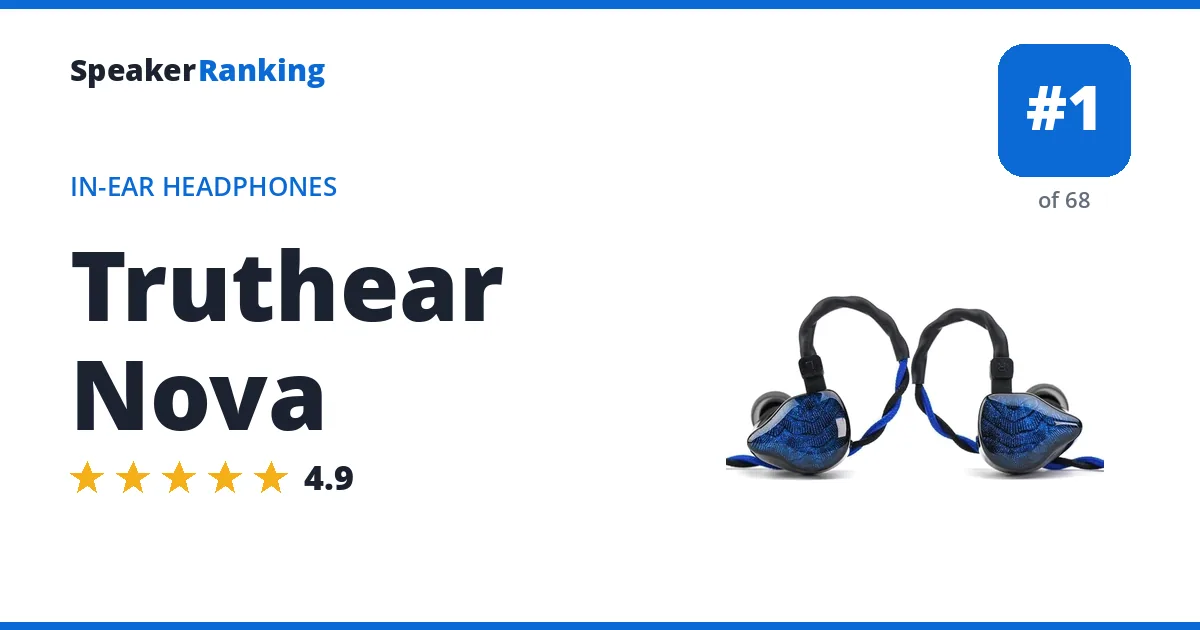
Pros: A Harman score of 90 puts it among the best-tuned in-ears measured, with every band from sub-bass to presence within about 1.5 dB of the target. The deviation of only 0.86 dB means vocals, guitars and drums sound natural and evenly balanced. The hybrid design pairs a dynamic driver with four balanced armatures, and the 14.8 ohm impedance with 123 dB sensitivity lets a phone drive it easily. Sub-bass sits about 1.5 dB above target, adding a touch of rumble without muddying the mids.
Cons: A 2.7 dB peak near 8 kHz can make bright cymbals and sibilant vocals slightly edgy on poorly mastered tracks. Treble and air run about 1.3 to 1.4 dB hot, so listeners sensitive to brightness may find extended sessions a little sharp. It is wired only, with no microphone or wireless features listed.
Full Truthear Nova review and specifications →
| Released | 2023 (3 years ago) |
|---|---|
| Back | Closed |
| Connection | Wired |
| Deviation From Target | 0.86 dB standard deviation |
| Driver Type | Hybrid (1 dynamic + 4 balanced armature) |
| Drivers | 1 x 10mm dynamic + 4 x balanced armature |
| Form Factor | In-ear |
| Frequency Response | 8Hz - 40kHz (Manufacturer specified) |
| Harman Preference Score | 90 (measured by oratory1990, via AutoEQ) |
| Impedance | 14.8 ohms |
| Sensitivity | 123 dB/Vrms @1kHz |
| Tonal Tilt | -0.14 (negative is warmer, positive brighter) |
EQ preset to match the Harman target
Set a preamp of -1.2 dB, then add these filters in any parametric equalizer (Wavelet, Equalizer APO, Peace, or a player with parametric EQ). Calculated by AutoEQ from its measured frequency response.
| Filter | Frequency | Gain | Q |
|---|---|---|---|
| Low shelf | 105 Hz | -4.2 dB | 0.70 |
| Peak | 313 Hz | +0.4 dB | 0.95 |
| Peak | 63 Hz | +3.6 dB | 0.80 |
| Peak | 4,404 Hz | -1.2 dB | 0.51 |
| Peak | 560 Hz | +1.1 dB | 0.85 |
| High shelf | 10,000 Hz | -2.5 dB | 0.70 |
| Peak | 9,390 Hz | +1.0 dB | 2.26 |
| Peak | 2,126 Hz | +1.1 dB | 3.14 |
| Peak | 2,987 Hz | -1.0 dB | 3.83 |
| Peak | 1,281 Hz | -0.5 dB | 2.65 |
- Reviews, Comparisons and Sound Samples
 #2 AKG N5005: $399.99 Amazon eBay
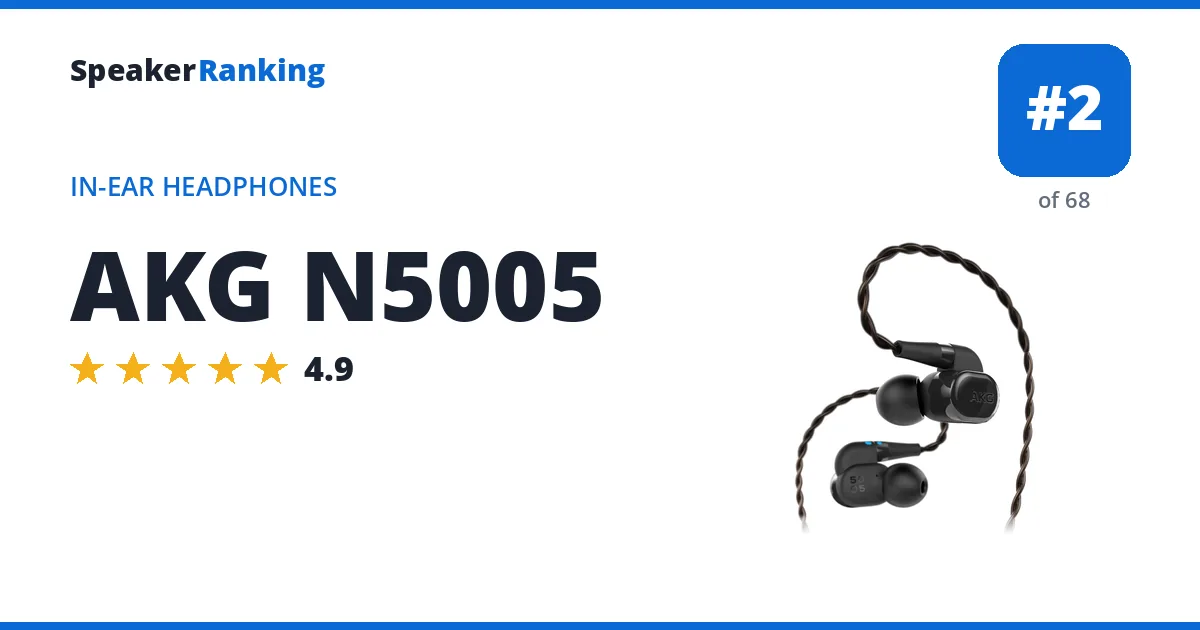
Pros: Bass, mids and presence all land within about 0.6 dB of the Harman target, giving a Harman score of 87 and a very smooth 1.11 dB deviation. Sub-bass is essentially on target at 0.1 dB below, so kick drums and bass lines have natural weight without bloat. The five-driver hybrid layout and 18 ohm impedance with 116 dB per volt sensitivity run fine from a phone. At 11.4 g per earbud it is light in the ear.
Cons: A 5.8 dB dip near 10 kHz and a 3.4 dB peak near 7.8 kHz leave the top end slightly uneven, taking some sparkle off cymbals and air. Treble from 6 to 10 kHz runs about 0.6 dB under target, so it can sound a touch laid back. It costs far more than the Truthear x Crinacle Zero RED, which has the same rating, so the premium buys refinement rather than a better rating.
Full AKG N5005 review and specifications →
| Back | Closed |
|---|---|
| Connection | Wired |
| Deviation From Target | 1.11 dB standard deviation |
| Driver Type | Hybrid (1 dynamic + 4 balanced armature) |
| Drivers | 1 x 9.2mm dynamic + 4 x balanced armature |
| Form Factor | In-ear |
| Frequency Response | 10Hz - 40kHz (Manufacturer specified) |
| Harman Preference Score | 87 (measured by oratory1990, via AutoEQ) |
| Impedance | 18 ohms |
| Sensitivity | 116 dB SPL/V |
| Tonal Tilt | -0.09 (negative is warmer, positive brighter) |
| Weight | 0 lbs (11.4 g) per earbud |
EQ preset to match the Harman target
Set a preamp of -1.8 dB, then add these filters in any parametric equalizer (Wavelet, Equalizer APO, Peace, or a player with parametric EQ). Calculated by AutoEQ from its measured frequency response.
| Filter | Frequency | Gain | Q |
|---|---|---|---|
| Low shelf | 105 Hz | -0.8 dB | 0.70 |
| Peak | 9,406 Hz | +3.0 dB | 1.31 |
| Peak | 892 Hz | +2.7 dB | 1.01 |
| Peak | 1,593 Hz | -1.4 dB | 0.18 |
| Peak | 77 Hz | +1.4 dB | 1.19 |
| High shelf | 10,000 Hz | -3.6 dB | 0.70 |
| Peak | 4,702 Hz | -2.0 dB | 5.51 |
| Peak | 3,571 Hz | +1.3 dB | 2.99 |
| Peak | 6,150 Hz | +2.2 dB | 5.73 |
| Peak | 4,894 Hz | -0.7 dB | 4.27 |
- Reviews, Comparisons and Sound Samples
 #3 Truthear x Crinacle Zero RED: $64.99 Amazon eBay
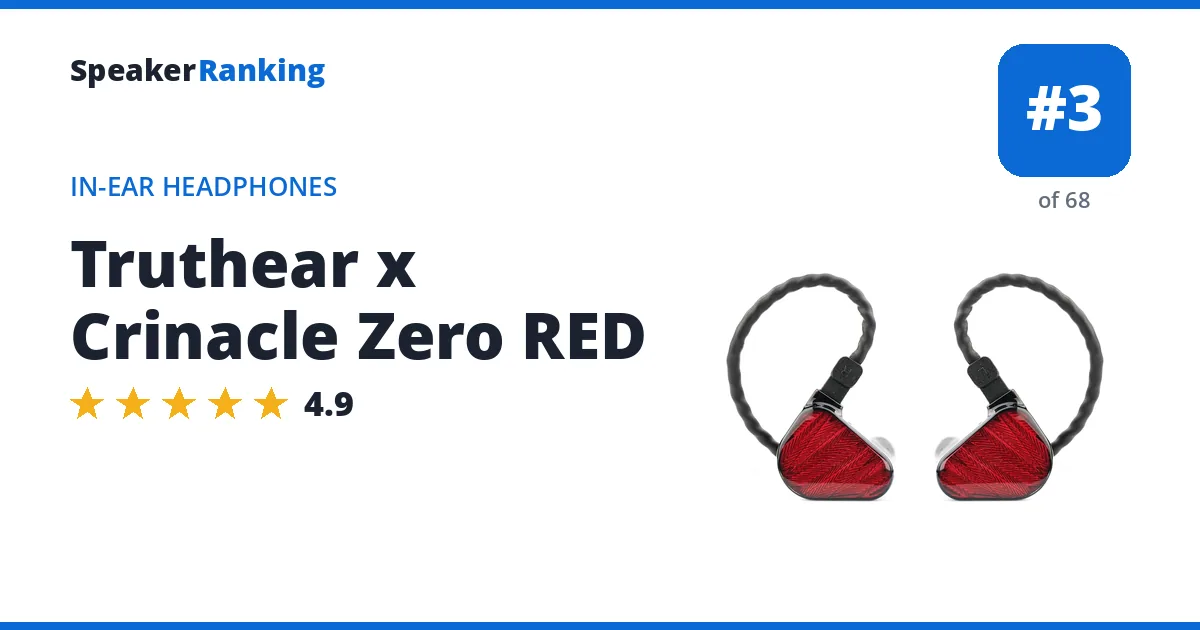
Pros: A Harman score of 86 at an entry-level price delivers a well-balanced response with a smooth 1.1 dB deviation. Bass and mids track the target closely, and the dual dynamic driver design runs easily from a phone at 17.5 ohms and 117.5 dB per volt. It outscores the Tin HiFi T3 Plus by a clear rating margin at a similar cost. It is a good fit for listeners who like a warm, bass-forward sound.
Cons: Presence from 3 to 6 kHz sits about 2.2 dB below target, so vocals and snare attack can sound a little recessed. A 3.9 dB dip near 10.3 kHz and sub-bass about 1.4 dB light mean cymbals lack some shimmer and the deepest bass has less rumble. It is wired only with no mic or remote listed.
Full Truthear x Crinacle Zero RED review and specifications →
| Back | Closed |
|---|---|
| Connection | Wired |
| Deviation From Target | 1.10 dB standard deviation |
| Driver Type | Dynamic |
| Drivers | 1 x 10mm + 1 x 7.8mm dynamic |
| Form Factor | In-ear |
| Frequency Response | 20Hz - 40.5kHz (Manufacturer specified) |
| Harman Preference Score | 86 (measured by oratory1990, via AutoEQ) |
| Impedance | 17.5 ohms |
| Sensitivity | 117.5 dB/Vrms |
| Tonal Tilt | -0.08 (negative is warmer, positive brighter) |
EQ preset to match the Harman target
Set a preamp of -2.1 dB, then add these filters in any parametric equalizer (Wavelet, Equalizer APO, Peace, or a player with parametric EQ). Calculated by AutoEQ from its measured frequency response.
| Filter | Frequency | Gain | Q |
|---|---|---|---|
| Low shelf | 105 Hz | -0.5 dB | 0.70 |
| Peak | 6,163 Hz | +2.2 dB | 2.44 |
| Peak | 341 Hz | -1.0 dB | 1.46 |
| Peak | 70 Hz | +1.0 dB | 0.61 |
| Peak | 1,284 Hz | -0.6 dB | 2.04 |
| High shelf | 10,000 Hz | -1.8 dB | 0.70 |
| Peak | 2,432 Hz | +0.7 dB | 2.98 |
| Peak | 3,588 Hz | -0.6 dB | 3.06 |
| Peak | 8,541 Hz | +1.1 dB | 3.84 |
| Peak | 769 Hz | +0.2 dB | 3.01 |
- Reviews, Comparisons and Sound Samples
- Head-to-Head Comparisons
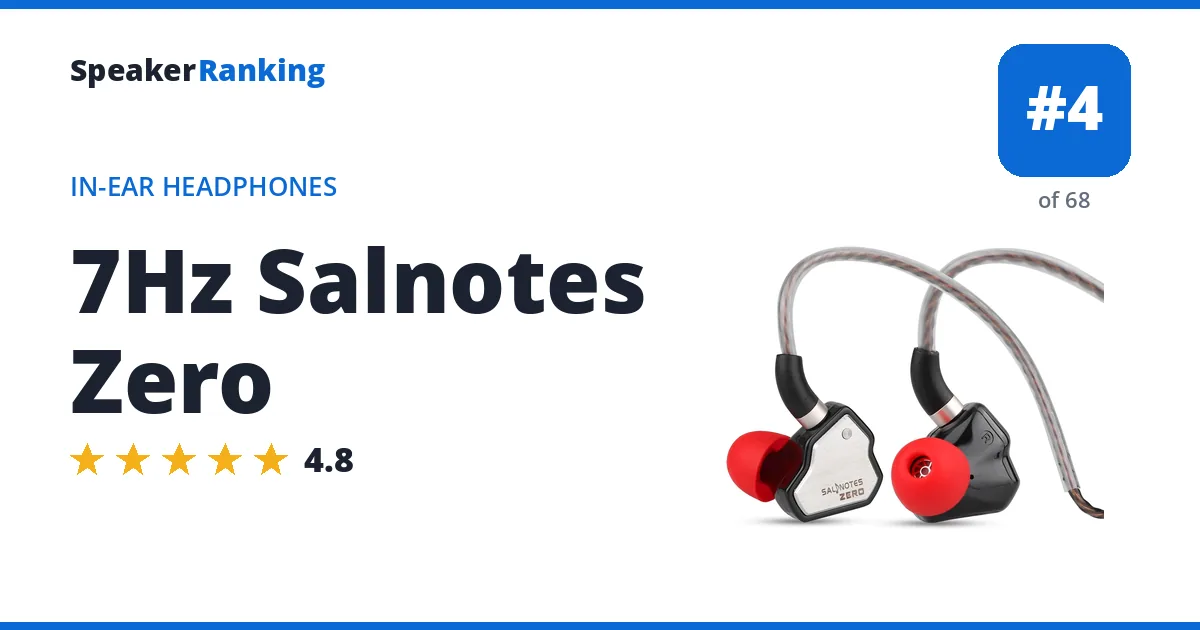
 #4 7Hz Salnotes Zero: $22.99 Discontinued Amazon eBay
Newer model: the 7Hz x Crinacle Zero 2, ranked lower, rated 3.9/5, released Nov 2023. See every 7Hz Zero generation.
Pros: A Harman score of 84 from a single 10 mm dynamic driver at a bargain price is remarkable. Bass and mids sit within about 0.3 dB of the target, so vocals and instruments are balanced naturally with a 1.31 dB deviation. It runs from a phone without difficulty at 32 ohms and 108 dB per volt. It beats the 7Hz x Crinacle Zero 2 on rating at a similar cost.
Cons: Presence and treble run about 2.1 to 2.2 dB under target, and a 6.2 dB dip near 10 kHz leaves cymbals and breath detail muted. Sub-bass is about 1.5 dB light, so the deepest rumble in electronic music is understated. The sensitivity is lower than many rivals, so it needs a bit more volume headroom from weak sources. Discontinued.
Full 7Hz Salnotes Zero review and specifications →
| Released | Jul 2022 (4 years ago) |
|---|---|
| Back | Closed |
| Connection | Wired |
| Deviation From Target | 1.31 dB standard deviation |
| Driver Type | Dynamic |
| Drivers | 1 x 10mm dynamic |
| Form Factor | In-ear |
| Frequency Response | 10Hz - 20kHz (Manufacturer specified) |
| Harman Preference Score | 84 (measured by oratory1990, via AutoEQ) |
| Impedance | 32 ohms |
| Sensitivity | 108 dB SPL/V |
| Tonal Tilt | -0.16 (negative is warmer, positive brighter) |
EQ preset to match the Harman target
Set a preamp of -2.5 dB, then add these filters in any parametric equalizer (Wavelet, Equalizer APO, Peace, or a player with parametric EQ). Calculated by AutoEQ from its measured frequency response.
| Filter | Frequency | Gain | Q |
|---|---|---|---|
| Low shelf | 105 Hz | -0.4 dB | 0.70 |
| Peak | 7,148 Hz | +2.5 dB | 1.39 |
| Peak | 186 Hz | -1.3 dB | 1.35 |
| Peak | 65 Hz | +1.7 dB | 1.11 |
| Peak | 1,677 Hz | -1.1 dB | 1.82 |
| High shelf | 10,000 Hz | -1.3 dB | 0.70 |
| Peak | 857 Hz | +0.9 dB | 1.64 |
| Peak | 9,824 Hz | +0.9 dB | 1.98 |
| Peak | 3,316 Hz | -0.6 dB | 2.50 |
| Peak | 1,261 Hz | -0.7 dB | 3.34 |
- Reviews, Comparisons and Sound Samples
- Head-to-Head Comparisons
 #5 Truthear Gate: $21.99 Amazon eBay
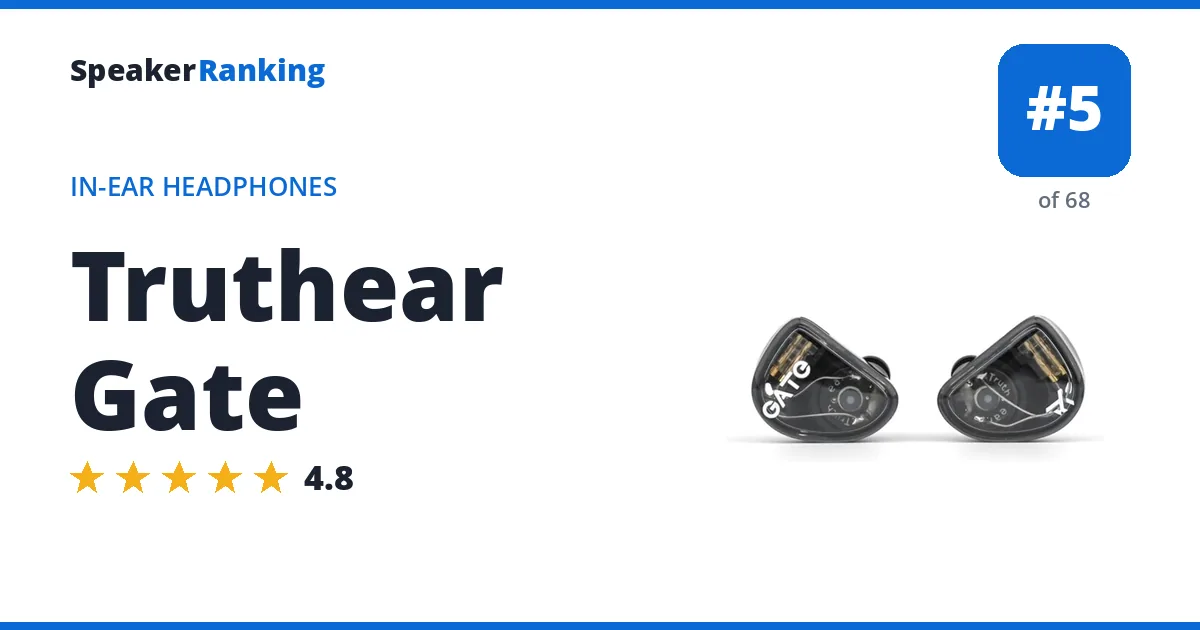
Pros: A Harman score of 83 from a single dynamic driver at a very low price gives accurate bass and mids, with bass and upper mids within about 0.2 dB of target. The 28 ohm impedance with 122 dB per volt sensitivity makes it easy to drive from any phone. The warm tilt suits listeners who want a smooth, non-fatiguing sound. It earns the same rating as the 7Hz Salnotes Zero at a similar cost.
Cons: Treble is the weak point, with a deep 10.8 dB dip near 11 kHz and air about 3 dB under target. Cymbals, hi-hats and the sense of space on recordings sound dulled as a result. Presence from 3 to 6 kHz is also about 1.9 dB down, which takes a little bite off vocals.
Full Truthear Gate review and specifications →
| Back | Closed |
|---|---|
| Connection | Wired |
| Deviation From Target | 1.39 dB standard deviation |
| Driver Type | Dynamic |
| Drivers | 1 x 10mm dynamic |
| Form Factor | In-ear |
| Frequency Response | 10Hz - 45kHz (Manufacturer specified) |
| Harman Preference Score | 83 (measured by oratory1990, via AutoEQ) |
| Impedance | 28 ohms |
| Sensitivity | 122 dB/Vrms |
| Tonal Tilt | -0.23 (negative is warmer, positive brighter) |
EQ preset to match the Harman target
Set a preamp of -4.9 dB, then add these filters in any parametric equalizer (Wavelet, Equalizer APO, Peace, or a player with parametric EQ). Calculated by AutoEQ from its measured frequency response.
| Filter | Frequency | Gain | Q |
|---|---|---|---|
| Low shelf | 105 Hz | +0.1 dB | 0.70 |
| Peak | 9,538 Hz | +4.7 dB | 0.99 |
| Peak | 2,074 Hz | -1.3 dB | 0.65 |
| Peak | 196 Hz | -1.1 dB | 1.34 |
| Peak | 698 Hz | +1.2 dB | 1.31 |
| High shelf | 10,000 Hz | -2.1 dB | 0.70 |
| Peak | 72 Hz | +0.8 dB | 1.77 |
| Peak | 4,992 Hz | +0.3 dB | 2.04 |
| Peak | 126 Hz | -0.4 dB | 2.34 |
| Peak | 8,647 Hz | +1.3 dB | 5.95 |
- Reviews, Comparisons and Sound Samples
- Head-to-Head Comparisons
 #6 Final Audio A4000: $119.00 Amazon eBay
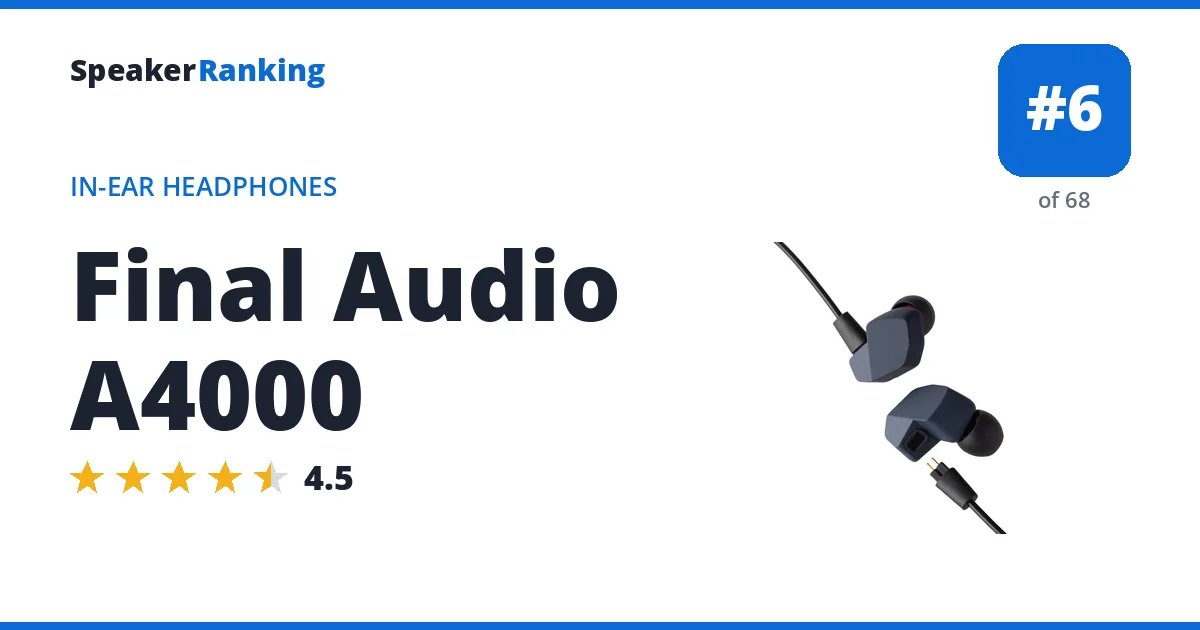
Pros: A Harman score of 80 shows it sits close to the target most listeners prefer, with a slightly bright tilt in crinacle’s measurement. It uses a compact 6 mm dynamic driver and weighs 18 g, so it is light in the ear. The 18 ohm impedance and 100 dB per mW sensitivity are manageable from a phone.
Cons: The 100 dB per mW sensitivity is lower than many in-ears, so it needs more volume from weak sources. No built-in microphone is offered, which limits it for calls. It is wired only, so it lacks the wireless convenience of the Sony WF-1000XM5, which has a lower rating.
Full Final Audio A4000 review and specifications →
| Back | Closed |
|---|---|
| Built-in Microphone | No |
| Connection | Wired |
| Deviation From Target | 1.67 dB standard deviation |
| Driver Type | Dynamic |
| Drivers | 1 x 6mm dynamic |
| Form Factor | In-ear |
| Harman Preference Score | 80 (measured by crinacle, via AutoEQ) |
| Impedance | 18 ohms |
| Sensitivity | 100 dB/mW |
| Tonal Tilt | +0.11 (negative is warmer, positive brighter) |
| Weight | 0 lbs (18 g) |
EQ preset to match the Harman target
Set a preamp of -2.9 dB, then add these filters in any parametric equalizer (Wavelet, Equalizer APO, Peace, or a player with parametric EQ). Calculated by AutoEQ from its measured frequency response.
| Filter | Frequency | Gain | Q |
|---|---|---|---|
| Low shelf | 105 Hz | +0.5 dB | 0.70 |
| Peak | 831 Hz | +3.0 dB | 1.09 |
| Peak | 177 Hz | -1.6 dB | 1.02 |
| Peak | 6,348 Hz | -3.7 dB | 2.04 |
| Peak | 2,022 Hz | +2.0 dB | 3.11 |
| High shelf | 10,000 Hz | -3.9 dB | 0.70 |
| Peak | 9,639 Hz | +2.1 dB | 2.54 |
| Peak | 3,246 Hz | -2.0 dB | 3.75 |
| Peak | 4,630 Hz | +0.9 dB | 3.78 |
| Peak | 2,482 Hz | +0.9 dB | 5.02 |
- Reviews, Comparisons and Sound Samples
 #7 Shuoer S12: $129.00 Amazon eBay
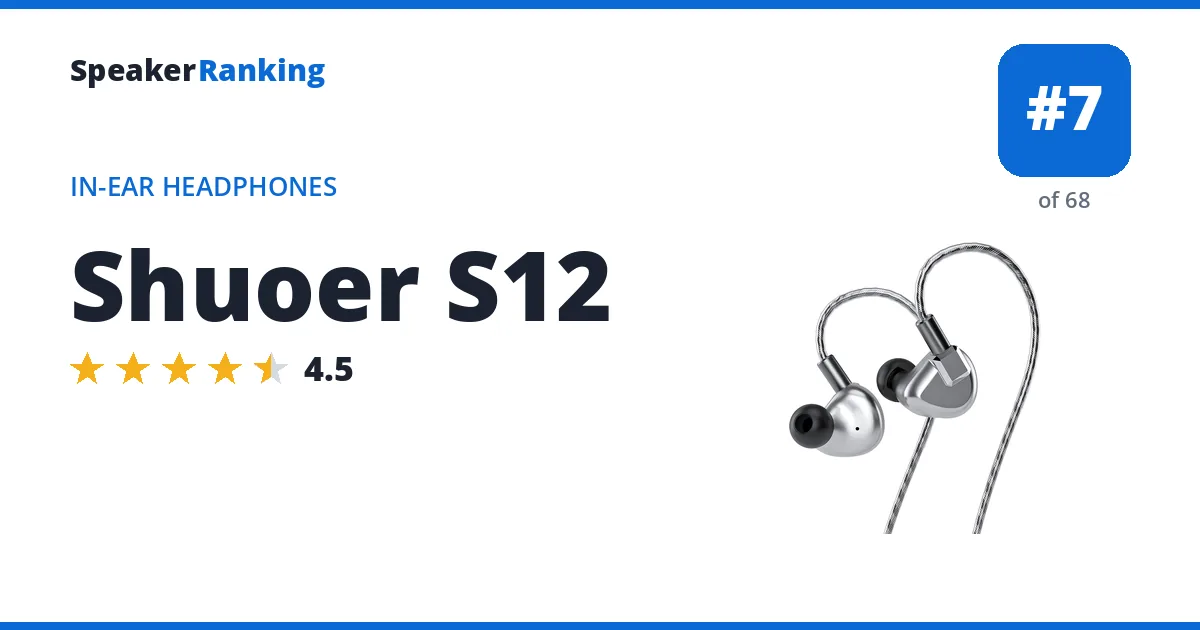
Pros: A planar magnetic driver is unusual in an in-ear and gives a Harman score of 80 with a smooth 1.62 dB deviation. Bass is lifted about 1.9 dB, adding warmth and punch, while the upper mids and treble stay close to target. The 16 ohm impedance is easy to drive from a phone, and it matches the Final Audio A4000 on rating.
Cons: A 4.2 dB peak near 8.2 kHz can make cymbals and sibilants slightly sharp, and treble from 6 to 10 kHz runs about 1.6 dB hot. Presence from 3 to 6 kHz sits 2.4 dB under target with a 3.3 dB dip near 3.75 kHz, so vocals can lose some forwardness. The 102 dB per mW sensitivity asks for a bit more volume than efficient rivals.
Full Shuoer S12 review and specifications →
| Released | 2022 (4 years ago) |
|---|---|
| Back | Closed |
| Connection | Wired |
| Deviation From Target | 1.62 dB standard deviation |
| Driver Type | Planar magnetic |
| Drivers | 1 x 14.8mm planar magnetic |
| Form Factor | In-ear |
| Frequency Response | 10Hz - 30kHz (Manufacturer specified) |
| Harman Preference Score | 80 (measured by oratory1990, via AutoEQ) |
| Impedance | 16 ohms |
| Sensitivity | 102 dB/mW |
| Tonal Tilt | -0.11 (negative is warmer, positive brighter) |
EQ preset to match the Harman target
Set a preamp of -2.5 dB, then add these filters in any parametric equalizer (Wavelet, Equalizer APO, Peace, or a player with parametric EQ). Calculated by AutoEQ from its measured frequency response.
| Filter | Frequency | Gain | Q |
|---|---|---|---|
| Low shelf | 105 Hz | +0.4 dB | 0.70 |
| Peak | 776 Hz | +2.9 dB | 0.76 |
| Peak | 162 Hz | -2.3 dB | 0.89 |
| Peak | 2,097 Hz | -3.4 dB | 0.90 |
| Peak | 3,690 Hz | +3.8 dB | 1.44 |
| High shelf | 10,000 Hz | -3.6 dB | 0.70 |
| Peak | 6,122 Hz | +1.6 dB | 5.71 |
| Peak | 7,230 Hz | -0.7 dB | 6.00 |
| Peak | 37 Hz | -0.3 dB | 2.35 |
| Peak | 65 Hz | +0.2 dB | 2.13 |
- Reviews, Comparisons and Sound Samples
 #8 Moondrop Blessing 3: $359.99 Amazon eBay
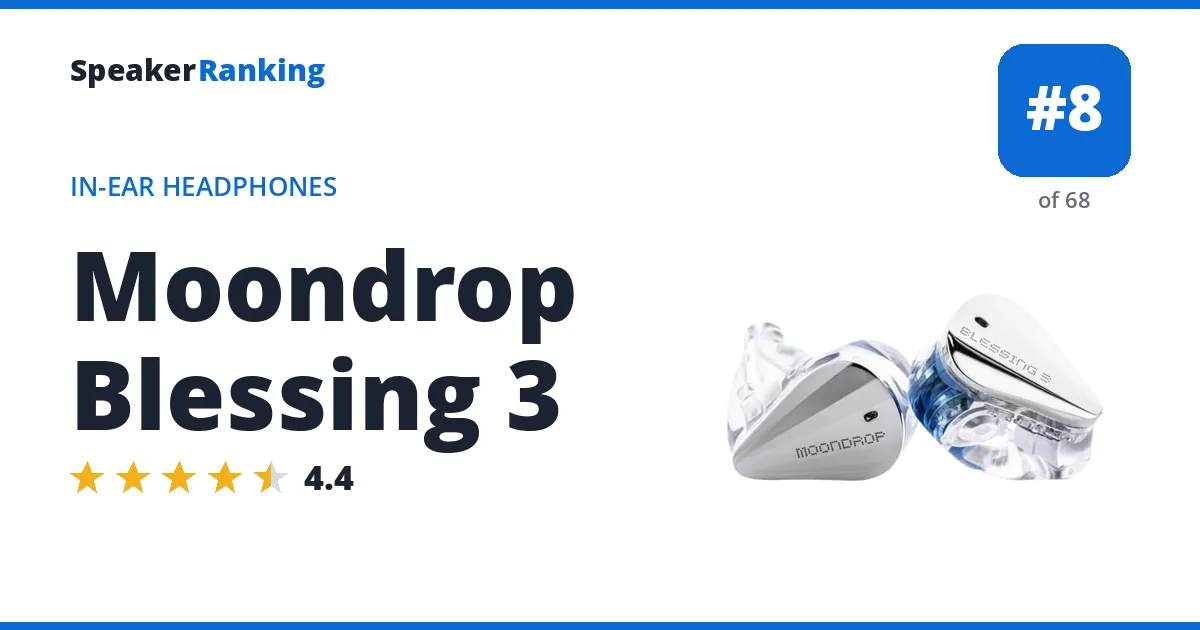
Pros: A Harman score of 79 in crinacle’s measurement shows a tuning that lands close to what most listeners prefer, with a slightly bright tilt. Six drivers, two dynamic and four balanced armature, handle bass and treble separately. The 14.8 ohm impedance and 120 dB per volt sensitivity let a phone drive it comfortably. It rates the same as the Etymotic EVO and higher than the AUNE Jasper.
Cons: It costs noticeably more than the Etymotic EVO, which has an equal rating, so the extra money does not buy a better score. The AKG N5005 rates higher still, with a better Harman score. Wired only, with no microphone listed.
Full Moondrop Blessing 3 review and specifications →
| Back | Closed |
|---|---|
| Connection | Wired |
| Deviation From Target | 1.65 dB standard deviation |
| Driver Type | Hybrid (2 dynamic + 4 balanced armature) |
| Drivers | 2 x dynamic + 4 x balanced armature |
| Form Factor | In-ear |
| Frequency Response | 10Hz - 30kHz (Manufacturer specified) |
| Harman Preference Score | 79 (measured by crinacle, via AutoEQ) |
| Impedance | 14.8 ohms |
| Sensitivity | 120 dB/Vrms |
| Tonal Tilt | +0.34 (negative is warmer, positive brighter) |
EQ preset to match the Harman target
Set a preamp of -2.9 dB, then add these filters in any parametric equalizer (Wavelet, Equalizer APO, Peace, or a player with parametric EQ). Calculated by AutoEQ from its measured frequency response.
| Filter | Frequency | Gain | Q |
|---|---|---|---|
| Low shelf | 105 Hz | +2.5 dB | 0.70 |
| Peak | 10,000 Hz | +2.8 dB | 0.97 |
| Peak | 3,076 Hz | -2.1 dB | 3.52 |
| Peak | 237 Hz | -0.5 dB | 1.04 |
| Peak | 1,479 Hz | -1.1 dB | 3.10 |
| High shelf | 10,000 Hz | -8.7 dB | 0.70 |
| Peak | 9,596 Hz | +3.9 dB | 2.54 |
| Peak | 863 Hz | +0.8 dB | 2.44 |
| Peak | 451 Hz | -0.2 dB | 1.54 |
| Peak | 6,947 Hz | +1.4 dB | 5.99 |
- Reviews, Comparisons and Sound Samples
 #9 Sennheiser IE 200: $129.95 Amazon eBay
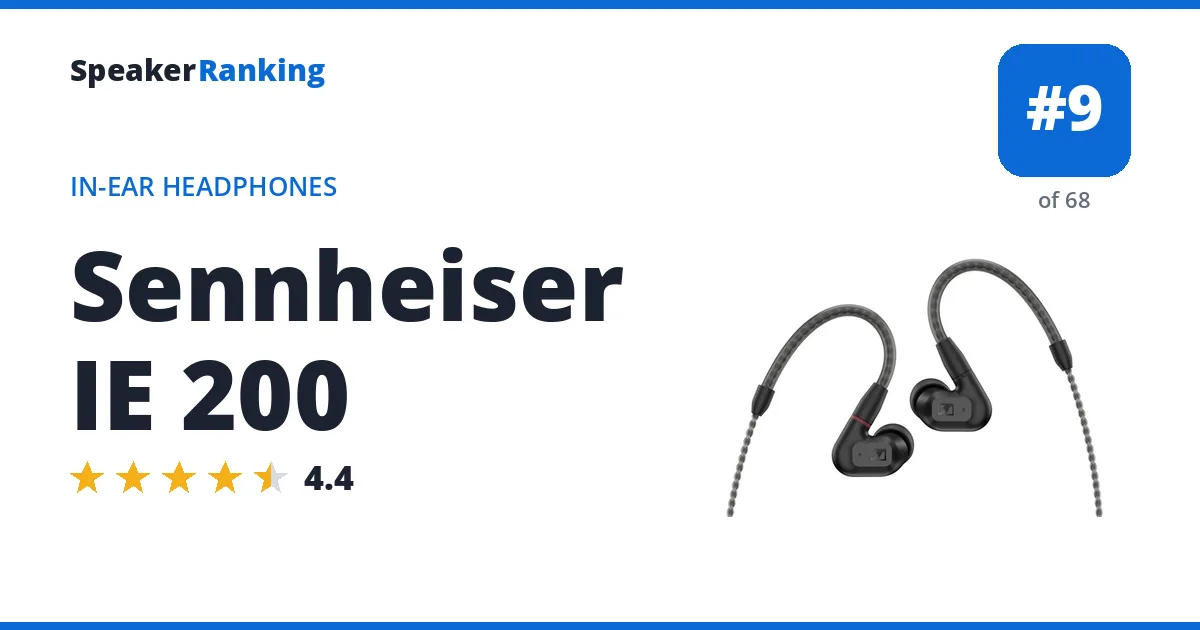
Pros: Bass and midrange land almost exactly on the Harman target in oratory1990’s measurement, within about 0.5 dB from 60 Hz to 3 kHz, which gives a natural tonal balance and a preference score of 79. At 16 ohms and 119 dB SPL/V sensitivity it plays loud straight from a phone with no amp. Each earpiece weighs only 4 g, and the single 7mm dynamic driver is a simple, wired design with no battery to charge.
Cons: The presence region from 3 to 6 kHz sits about 5 dB under target, with a 5.7 dB dip near 4.4 kHz, so vocals and snare attacks sound a little recessed. The top octave runs about 5.8 dB hot, which adds sparkle that can read as thin or bright on some recordings. The Final Audio A4000 and Shuoer S12 carry higher ratings at lower prices.
Full Sennheiser IE 200 review and specifications →
| Back | Closed |
|---|---|
| Connection | Wired |
| Deviation From Target | 1.86 dB standard deviation |
| Driver Type | Dynamic |
| Drivers | 1 x 7mm dynamic |
| Form Factor | In-ear |
| Frequency Response | 6Hz - 20kHz (Manufacturer specified) |
| Harman Preference Score | 79 (measured by oratory1990, via AutoEQ) |
| Impedance | 16 ohms |
| Sensitivity | 119 dB SPL/V |
| Tonal Tilt | -0.02 (negative is warmer, positive brighter) |
| Weight | 0 lbs (4 g) per earphone |
EQ preset to match the Harman target
Set a preamp of -4.3 dB, then add these filters in any parametric equalizer (Wavelet, Equalizer APO, Peace, or a player with parametric EQ). Calculated by AutoEQ from its measured frequency response.
| Filter | Frequency | Gain | Q |
|---|---|---|---|
| Low shelf | 105 Hz | +0.3 dB | 0.70 |
| Peak | 4,135 Hz | +4.3 dB | 1.83 |
| Peak | 1,520 Hz | -1.9 dB | 1.99 |
| Peak | 180 Hz | -1.2 dB | 1.14 |
| Peak | 67 Hz | +1.0 dB | 1.34 |
| High shelf | 10,000 Hz | -6.1 dB | 0.70 |
| Peak | 727 Hz | +0.8 dB | 1.79 |
| Peak | 5,480 Hz | +1.2 dB | 3.96 |
| Peak | 1,154 Hz | -0.6 dB | 3.44 |
| Peak | 2,978 Hz | +0.4 dB | 3.96 |
- Reviews, Comparisons and Sound Samples
- Head-to-Head Comparisons
 #10 Etymotic EVO: $298.98 Amazon eBay
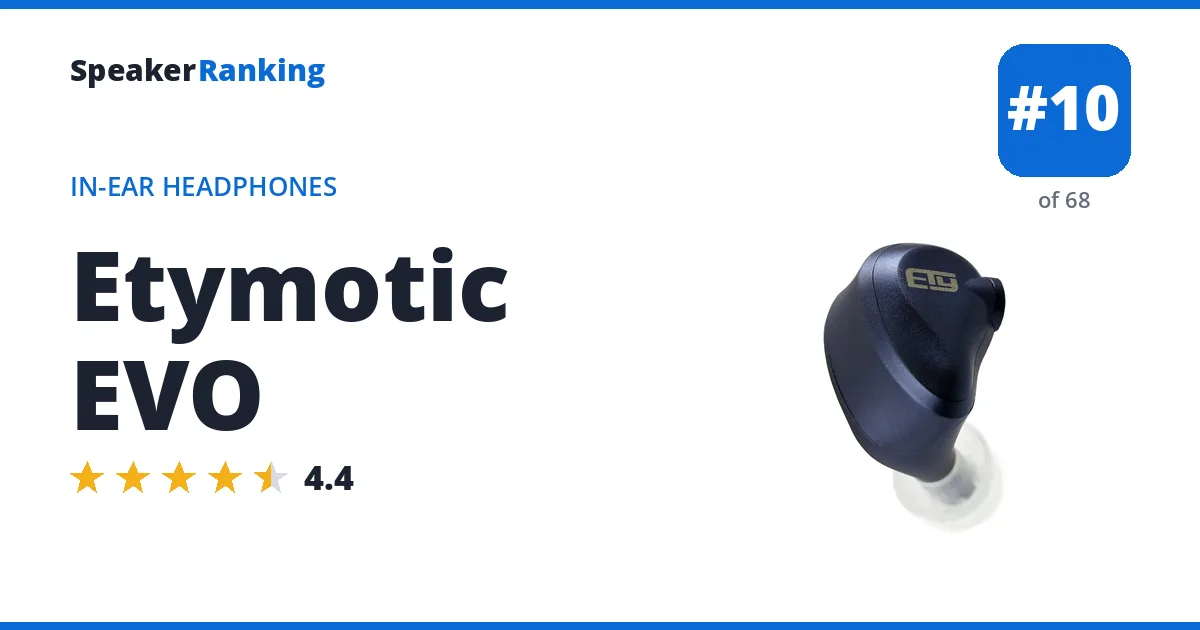
Pros: Three balanced armature drivers deliver a flat, uncolored midrange, with the 1 to 3 kHz region within 0.5 dB of the Harman target and a preference score of 78. Response is smooth, with a standard deviation of 1.89 dB around target. The deep-insertion wired design is passive noise isolating, and the 47 ohm impedance still works from a phone or dongle.
Cons: Bass is lean, with sub-bass about 3.3 dB under target and the 60 to 200 Hz region 1.5 dB under, so kick drums and bass lines have less weight than most listeners prefer. Treble from 6 to 10 kHz is about 3.5 dB low and the response drops 7.4 dB near 11.9 kHz, which makes cymbals and air sound dull. Sensitivity of 99 dB at 0.1V is modest, so volume needs more headroom than the most efficient earphones.
Full Etymotic EVO review and specifications →
| Released | Jun 2021 (5 years ago) |
|---|---|
| Back | Closed |
| Connection | Wired |
| Deviation From Target | 1.89 dB standard deviation |
| Driver Type | Balanced armature |
| Drivers | 3 x balanced armature |
| Form Factor | In-ear |
| Frequency Response | 20Hz - 16kHz (Manufacturer specified) |
| Harman Preference Score | 78 (measured by oratory1990, via AutoEQ) |
| Impedance | 47 ohms |
| Sensitivity | 99 dB SPL at 0.1V, 1kHz |
| Tonal Tilt | +0.08 (negative is warmer, positive brighter) |
EQ preset to match the Harman target
Set a preamp of -4.5 dB, then add these filters in any parametric equalizer (Wavelet, Equalizer APO, Peace, or a player with parametric EQ). Calculated by AutoEQ from its measured frequency response.
| Filter | Frequency | Gain | Q |
|---|---|---|---|
| Low shelf | 105 Hz | +0.7 dB | 0.70 |
| Peak | 1,788 Hz | -3.1 dB | 1.61 |
| Peak | 6,507 Hz | +4.6 dB | 1.49 |
| Peak | 197 Hz | -1.4 dB | 1.38 |
| Peak | 64 Hz | +1.9 dB | 0.98 |
| High shelf | 10,000 Hz | +4.1 dB | 0.70 |
| Peak | 819 Hz | +1.2 dB | 1.66 |
| Peak | 1,255 Hz | -0.9 dB | 3.19 |
| Peak | 4,378 Hz | -0.7 dB | 4.42 |
| Peak | 7,270 Hz | -1.7 dB | 5.95 |
- Reviews, Comparisons and Sound Samples
- Head-to-Head Comparisons
 #11 Sony WF-1000XM5: $198.00 Amazon eBay
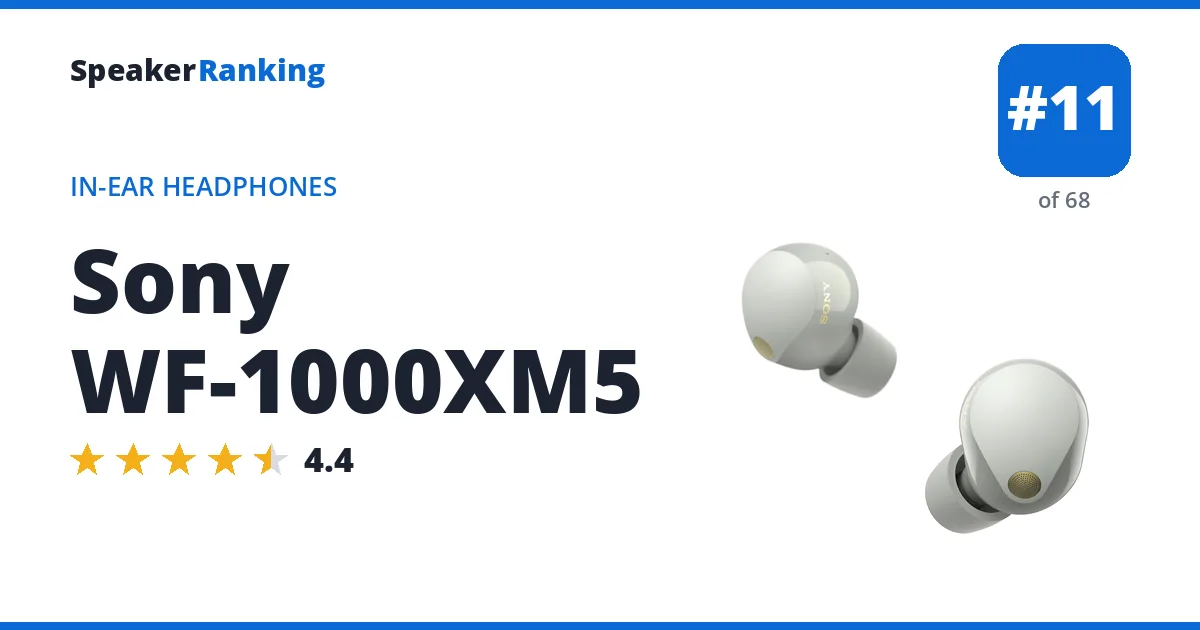
Pros: Mild bass emphasis, about 1.9 dB above target from 60 to 200 Hz, adds warmth without muddying the midrange, which stays within 0.8 dB of the target for a preference score of 78. Active noise cancelling, LDAC, AAC and SBC support, Bluetooth 5.3 and an IPX4 rating make it a full-featured true wireless set. Battery lasts about 8 hours per charge, 24 with the case, and each bud weighs 5.9 g.
Cons: Treble from 6 to 10 kHz runs about 2.2 dB low, with a 4.9 dB dip near 8 kHz, so cymbals and sibilance lose some bite. A 2.9 dB peak near 10.6 kHz can add a touch of artificial shimmer. Sub-bass sits about 1.9 dB below target, so the bass is punchy more than deep. The wired Sennheiser IE 200 matches its rating at a lower price and without charging.
Full Sony WF-1000XM5 review and specifications →
| Released | Jul 2023 (3 years ago) |
|---|---|
| Active Noise Cancelling | Yes |
| Back | Closed |
| Battery Life | 8 hours (24 with case, Manufacturer specified) |
| Bluetooth Codecs | SBC, AAC, LDAC |
| Bluetooth Version | 5.3 |
| Built-in Microphone | Yes |
| Connection | True wireless |
| Deviation From Target | 1.87 dB standard deviation |
| Driver Type | Dynamic |
| Drivers | 1 x 8.4mm dynamic |
| Form Factor | In-ear |
| Frequency Response | 20Hz - 20kHz (Manufacturer specified) |
| Harman Preference Score | 78 (measured by oratory1990, via AutoEQ) |
| IP Rating | IPX4 |
| Tonal Tilt | -0.18 (negative is warmer, positive brighter) |
| Weight | 0 lbs (5.9 g) per earbud |
EQ preset to match the Harman target
Set a preamp of -2.6 dB, then add these filters in any parametric equalizer (Wavelet, Equalizer APO, Peace, or a player with parametric EQ). Calculated by AutoEQ from its measured frequency response.
| Filter | Frequency | Gain | Q |
|---|---|---|---|
| Low shelf | 105 Hz | +5.4 dB | 0.70 |
| Peak | 68 Hz | -4.8 dB | 0.27 |
| Peak | 1,377 Hz | +2.6 dB | 0.31 |
| Peak | 1,806 Hz | -3.5 dB | 1.16 |
| Peak | 6,875 Hz | +1.8 dB | 3.49 |
| High shelf | 10,000 Hz | +2.3 dB | 0.70 |
| Peak | 3,757 Hz | +0.3 dB | 2.56 |
| Peak | 5,057 Hz | -0.7 dB | 5.70 |
| Peak | 449 Hz | +0.3 dB | 4.15 |
| Peak | 677 Hz | -0.2 dB | 2.75 |
- Reviews, Comparisons and Sound Samples
- Head-to-Head Comparisons
 #12 Tin HiFi T3 Plus: $59.00 Amazon eBay
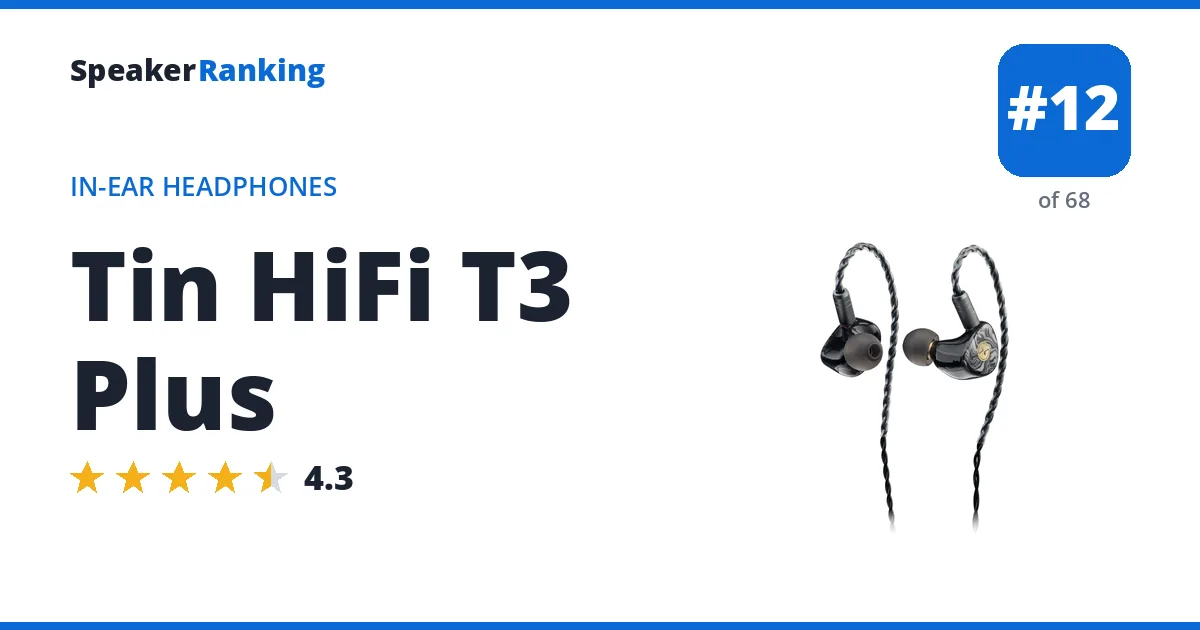
Pros: Crinacle’s measurement gives a preference score of 77 with a smooth response, a standard deviation of only 1.78 dB around the target. A single 10mm dynamic driver at 32 ohms and 105 dB sensitivity runs easily from a phone or dongle. It scores well above the Tin HiFi T4, which has a lower rating at a higher price.
Cons: The tilt of negative 0.41 means a slightly warm balance, so listeners who want a brighter, airier sound may find it relaxed. It has no built-in microphone, so it cannot take calls. It is wired only, with no wireless or noise cancelling features.
Full Tin HiFi T3 Plus review and specifications →
| Back | Closed |
|---|---|
| Built-in Microphone | No |
| Connection | Wired |
| Deviation From Target | 1.78 dB standard deviation |
| Driver Type | Dynamic |
| Drivers | 1 x 10mm dynamic |
| Form Factor | In-ear |
| Frequency Response | 10Hz - 20kHz (Manufacturer specified) |
| Harman Preference Score | 77 (measured by crinacle, via AutoEQ) |
| Impedance | 32 ohms |
| Sensitivity | 105 dB @ 1kHz, 0.179V |
| Tonal Tilt | -0.41 (negative is warmer, positive brighter) |
EQ preset to match the Harman target
Set a preamp of -5.1 dB, then add these filters in any parametric equalizer (Wavelet, Equalizer APO, Peace, or a player with parametric EQ). Calculated by AutoEQ from its measured frequency response.
| Filter | Frequency | Gain | Q |
|---|---|---|---|
| Low shelf | 105 Hz | -0.1 dB | 0.70 |
| Peak | 6,867 Hz | +5.9 dB | 1.01 |
| Peak | 163 Hz | -2.4 dB | 0.78 |
| Peak | 683 Hz | +2.7 dB | 0.84 |
| Peak | 3,057 Hz | -2.6 dB | 0.39 |
| High shelf | 10,000 Hz | -4.1 dB | 0.70 |
| Peak | 6,000 Hz | +2.0 dB | 5.50 |
| Peak | 4,522 Hz | -1.6 dB | 4.73 |
| Peak | 3,143 Hz | +0.9 dB | 3.42 |
| Peak | 1,530 Hz | -0.3 dB | 2.49 |
- Reviews, Comparisons and Sound Samples
- Head-to-Head Comparisons
 #13 Kiwi Ears Orchestra Lite: $249.00 Amazon eBay
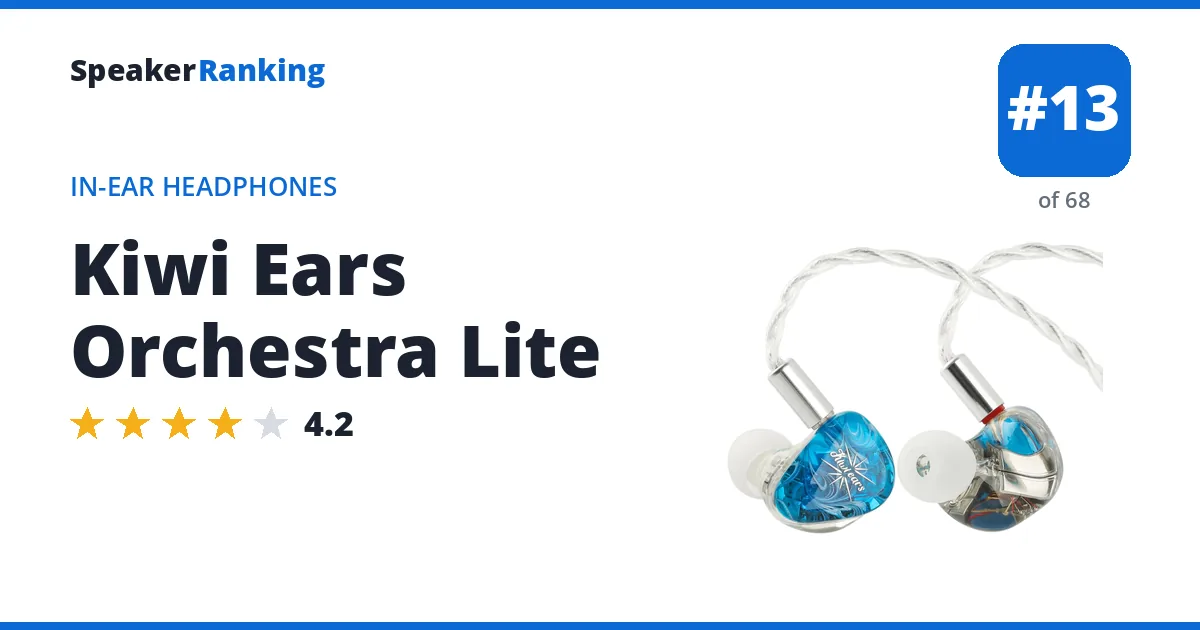
Pros: Bass and lower midrange land within about 0.2 dB of the Harman target from 60 Hz to 1 kHz, so vocals and instruments sound natural and unboosted. The response is smooth, with a deviation of only about 2 dB around the target and a preference score of 76. Eight balanced armature drivers and 112 dB sensitivity make it easy to drive from a phone or portable player, and it suits warm and bass leaning tastes.
Cons: Presence from 3 to 6 kHz runs about 5.6 dB under target, with a 6.7 dB dip near 3.6 kHz, so voices and guitars sound recessed and a little veiled. Treble from 6 to 10 kHz is about 2.8 dB low, which softens cymbals and reduces sparkle. It is rated below the Etymotic EVO, and there is no built in microphone.
Full Kiwi Ears Orchestra Lite review and specifications →
| Released | 2023 (3 years ago) |
|---|---|
| Back | Closed |
| Built-in Microphone | No |
| Connection | Wired |
| Deviation From Target | 2.03 dB standard deviation |
| Driver Type | Balanced armature |
| Drivers | 8 x balanced armature |
| Form Factor | In-ear |
| Frequency Response | 20Hz - 20kHz (Manufacturer specified) |
| Harman Preference Score | 76 (measured by oratory1990, via AutoEQ) |
| Sensitivity | 112 dB SPL/mW |
| Tonal Tilt | -0.26 (negative is warmer, positive brighter) |
EQ preset to match the Harman target
Set a preamp of -4.1 dB, then add these filters in any parametric equalizer (Wavelet, Equalizer APO, Peace, or a player with parametric EQ). Calculated by AutoEQ from its measured frequency response.
| Filter | Frequency | Gain | Q |
|---|---|---|---|
| Low shelf | 105 Hz | +1.1 dB | 0.70 |
| Peak | 128 Hz | -2.0 dB | 0.87 |
| Peak | 5,834 Hz | +3.8 dB | 2.20 |
| Peak | 1,508 Hz | -1.9 dB | 1.09 |
| Peak | 3,467 Hz | +4.0 dB | 2.99 |
| High shelf | 10,000 Hz | -0.7 dB | 0.70 |
| Peak | 8,847 Hz | +0.8 dB | 4.64 |
| Peak | 45 Hz | -0.2 dB | 2.08 |
| Peak | 4,617 Hz | -1.0 dB | 6.00 |
| Peak | 5,106 Hz | +0.8 dB | 6.00 |
- Reviews, Comparisons and Sound Samples
 #14 Moondrop Quarks: $17.99 Amazon eBay
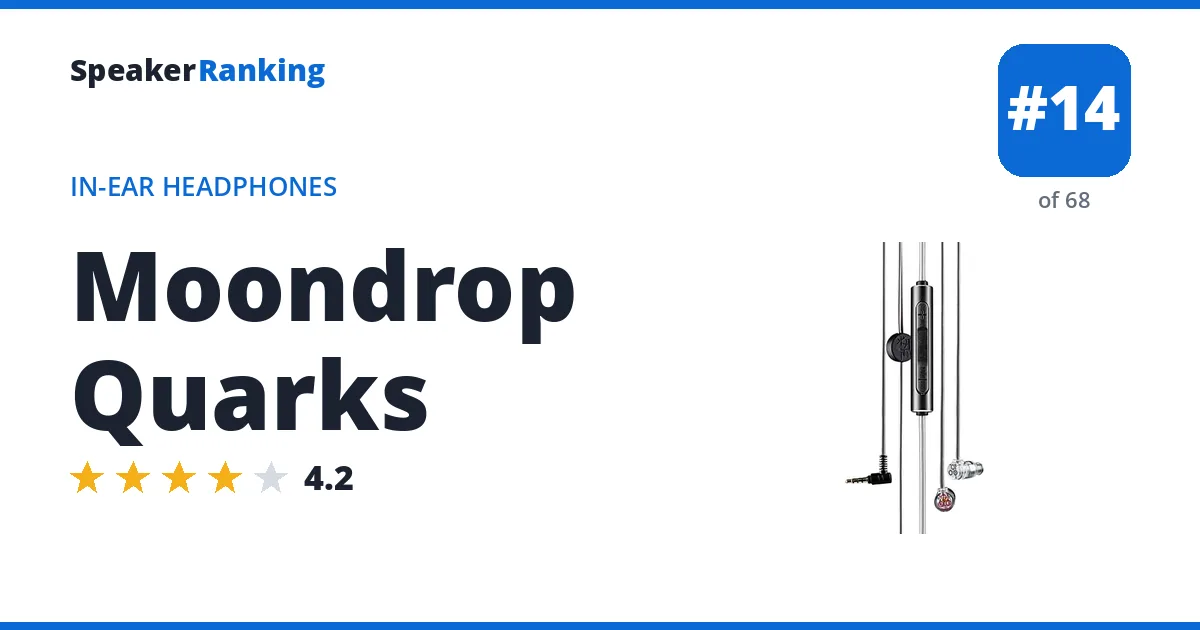
Pros: A preference score of 76 from a very inexpensive wired in-ear is hard to beat, and it is rated above the KZ ZSN Pro X and the CCA CRA. Bass from 60 to 200 Hz is lifted about 2.2 dB over target and the low mids about 1.6 dB, giving a warm, full sound that fits warm and bass leaning tastes. At 16 ohms and 116 dB sensitivity it plays loud straight from a phone.
Cons: A 4 dB peak near 2.9 kHz can make female vocals and snare hits sound forward or slightly shouty at higher volumes. Air above 10 kHz is about 2.5 dB low and there is a 5.4 dB dip near 11.9 kHz, so the top end sounds less open and airy. Sub-bass under 60 Hz is about 1.8 dB below target, so the deepest notes lack a little rumble.
Full Moondrop Quarks review and specifications →
| Released | 2021 (5 years ago) |
|---|---|
| Back | Closed |
| Built-in Microphone | Yes |
| Connection | Wired |
| Deviation From Target | 2.04 dB standard deviation |
| Driver Type | Dynamic |
| Drivers | 1 x 6mm dynamic |
| Form Factor | In-ear |
| Frequency Response | 20Hz - 20kHz (Manufacturer specified) |
| Harman Preference Score | 76 (measured by oratory1990, via AutoEQ) |
| Impedance | 16 ohms |
| Sensitivity | 116 dB/Vrms |
| Tonal Tilt | -0.06 (negative is warmer, positive brighter) |
EQ preset to match the Harman target
Set a preamp of -2.6 dB, then add these filters in any parametric equalizer (Wavelet, Equalizer APO, Peace, or a player with parametric EQ). Calculated by AutoEQ from its measured frequency response.
| Filter | Frequency | Gain | Q |
|---|---|---|---|
| Low shelf | 105 Hz | +2.5 dB | 0.70 |
| Peak | 170 Hz | -3.1 dB | 0.65 |
| Peak | 10,000 Hz | +2.9 dB | 0.24 |
| Peak | 767 Hz | +2.5 dB | 1.26 |
| Peak | 2,855 Hz | -5.9 dB | 3.31 |
| High shelf | 10,000 Hz | -1.9 dB | 0.70 |
| Peak | 4,604 Hz | +0.9 dB | 3.27 |
| Peak | 6,302 Hz | -1.1 dB | 4.61 |
| Peak | 1,492 Hz | -0.2 dB | 2.76 |
| Peak | 60 Hz | +0.1 dB | 1.86 |
- Reviews, Comparisons and Sound Samples
 #15 SoftEars RSV: $729.00 Amazon eBay
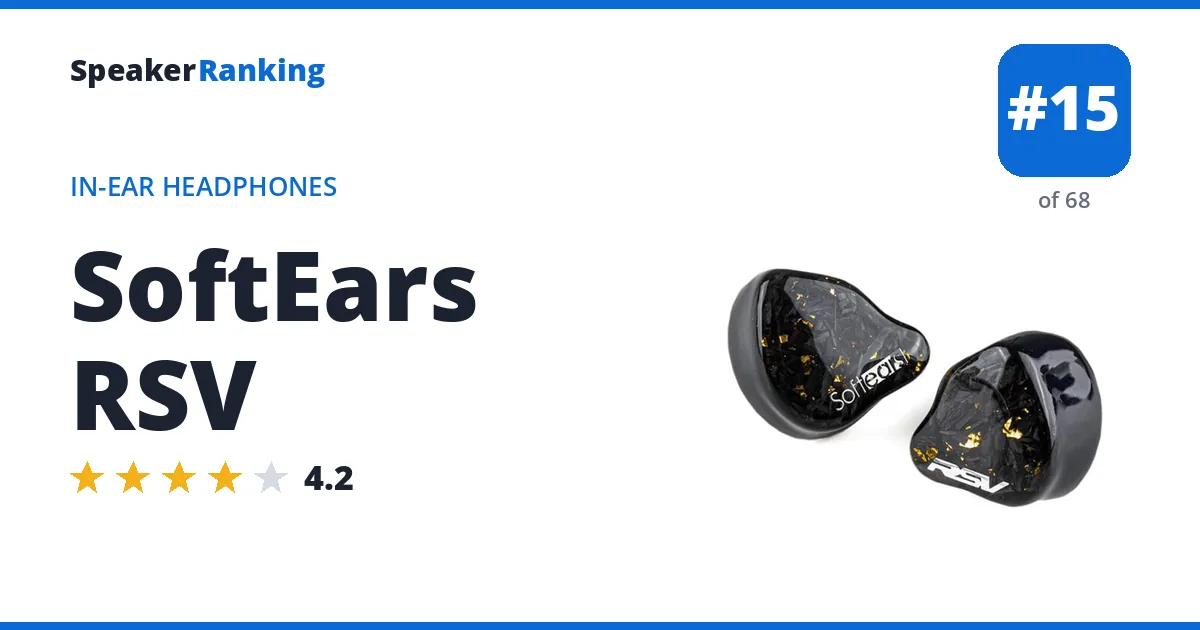
Pros: A preference score of 76 in crinacle’s measurement shows a response that sits close to the Harman target, and it is rated above the FiiO FD5 and the HIFIMAN RE2000. Five balanced armature drivers with 8 ohms impedance and 125 dB sensitivity mean it runs easily from a phone or dongle. The wired design suits home or portable listening with a source of your choice.
Cons: It sits at a premium price for an in-ear, and a preference score of 76 is no higher than far cheaper wired sets achieve. The very low 8 ohm impedance can interact with sources that have a high output impedance, and 125 dB sensitivity can make hiss from noisy sources audible. It is wired only, with no built in microphone.
Full SoftEars RSV review and specifications →
| Released | 2021 (5 years ago) |
|---|---|
| Back | Closed |
| Built-in Microphone | No |
| Connection | Wired |
| Deviation From Target | 1.76 dB standard deviation |
| Driver Type | Balanced armature |
| Drivers | 5 x balanced armature |
| Form Factor | In-ear |
| Frequency Response | 5Hz - 40kHz (Manufacturer specified) |
| Harman Preference Score | 76 (measured by crinacle, via AutoEQ) |
| Impedance | 8 ohms |
| Sensitivity | 125 dB/Vrms |
| Tonal Tilt | -0.39 (negative is warmer, positive brighter) |
EQ preset to match the Harman target
Set a preamp of -4.4 dB, then add these filters in any parametric equalizer (Wavelet, Equalizer APO, Peace, or a player with parametric EQ). Calculated by AutoEQ from its measured frequency response.
| Filter | Frequency | Gain | Q |
|---|---|---|---|
| Low shelf | 105 Hz | +0.5 dB | 0.70 |
| Peak | 9,429 Hz | +5.8 dB | 1.27 |
| Peak | 350 Hz | -1.4 dB | 0.18 |
| Peak | 862 Hz | +1.8 dB | 2.03 |
| Peak | 4,128 Hz | +1.5 dB | 4.48 |
| High shelf | 10,000 Hz | -3.5 dB | 0.70 |
| Peak | 2,856 Hz | -1.3 dB | 4.73 |
| Peak | 2,096 Hz | +0.9 dB | 3.23 |
| Peak | 40 Hz | -0.4 dB | 2.22 |
| Peak | 80 Hz | +0.3 dB | 1.97 |
- Reviews, Comparisons and Sound Samples
 #16 AUNE Jasper: $239.00 Amazon eBay
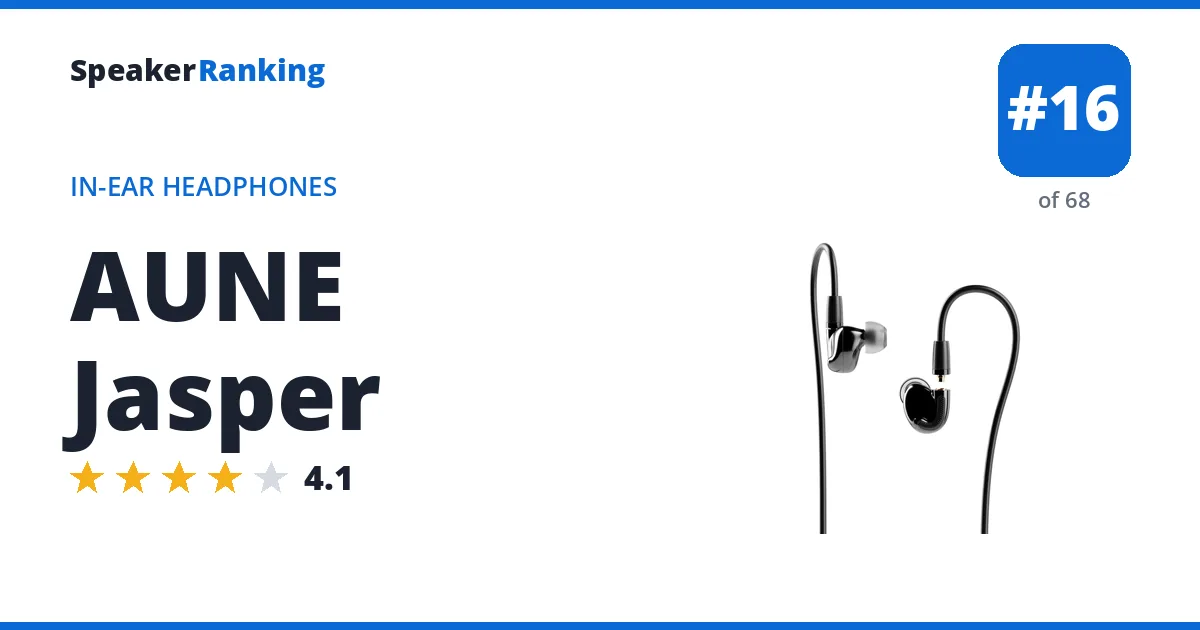
Pros: A single 10mm dynamic driver reaches a preference score of 75 in crinacle’s measurement, with a nearly neutral tilt of 0.01. At 32 ohms and 102 dB/mW it is easy to drive from a phone or small dongle. The manufacturer quotes a frequency range of 5 Hz to 40 kHz, and the wired design needs no charging.
Cons: Response is less even than the best in its class, with a standard deviation of 2.29 dB around the target, so some peaks and dips color vocals and treble. The Etymotic EVO has a higher rating and a smoother measurement, though at a higher price. It has no wireless features, noise cancelling or listed microphone.
Full AUNE Jasper review and specifications →
| Released | Jan 2021 (5 years ago) |
|---|---|
| Back | Closed |
| Connection | Wired |
| Deviation From Target | 2.29 dB standard deviation |
| Driver Type | Dynamic |
| Drivers | 1 x 10mm dynamic |
| Form Factor | In-ear |
| Frequency Response | 5Hz - 40kHz (Manufacturer specified) |
| Harman Preference Score | 75 (measured by crinacle, via AutoEQ) |
| Impedance | 32 ohms |
| Sensitivity | 102 dB/mW |
| Tonal Tilt | +0.01 (negative is warmer, positive brighter) |
EQ preset to match the Harman target
Set a preamp of -4.9 dB, then add these filters in any parametric equalizer (Wavelet, Equalizer APO, Peace, or a player with parametric EQ). Calculated by AutoEQ from its measured frequency response.
| Filter | Frequency | Gain | Q |
|---|---|---|---|
| Low shelf | 105 Hz | +3.1 dB | 0.70 |
| Peak | 8,520 Hz | +7.5 dB | 0.86 |
| Peak | 155 Hz | -2.7 dB | 0.52 |
| Peak | 801 Hz | +3.1 dB | 0.84 |
| Peak | 3,153 Hz | -3.0 dB | 0.40 |
| High shelf | 10,000 Hz | -4.4 dB | 0.70 |
| Peak | 6,182 Hz | +2.1 dB | 5.90 |
| Peak | 4,821 Hz | -1.4 dB | 5.25 |
| Peak | 3,710 Hz | +0.8 dB | 4.25 |
| Peak | 38 Hz | -0.3 dB | 2.66 |
- Reviews, Comparisons and Sound Samples
- Head-to-Head Comparisons
 #17 Beats Powerbeats Pro: $189.99 Discontinued Amazon eBay

Pros: Bass and midrange follow the Harman target closely, with 60 to 200 Hz within 0.2 dB and upper mids 0.7 dB above, so voices and bass lines sound natural and warm for a preference score of 75. The true wireless design adds Bluetooth 5.0 with SBC and AAC, a built-in microphone and an IPX4 rating. Battery lasts about 9 hours per charge, 24 with the case.
Cons: Treble is well under target, about 5.2 dB low from 6 to 10 kHz, with an 8.5 dB dip near 6.8 kHz, so cymbals, hi-hats and sibilance sound muted. The air band above 10 kHz is another 4.4 dB low, which adds to a dark, closed-in sound. It has no active noise cancelling, and the Etymotic EVO has a higher rating. Discontinued.
Full Beats Powerbeats Pro review and specifications →
| Released | May 2019 (7 years ago) |
|---|---|
| Active Noise Cancelling | No |
| Back | Closed |
| Battery Life | 9 hours (24 with case, Manufacturer specified) |
| Bluetooth Codecs | SBC, AAC |
| Bluetooth Version | 5.0 |
| Built-in Microphone | Yes |
| Connection | True wireless |
| Deviation From Target | 2.09 dB standard deviation |
| Form Factor | In-ear |
| Harman Preference Score | 75 (measured by oratory1990, via AutoEQ) |
| IP Rating | IPX4 |
| Tonal Tilt | -0.37 (negative is warmer, positive brighter) |
EQ preset to match the Harman target
Set a preamp of -6.4 dB, then add these filters in any parametric equalizer (Wavelet, Equalizer APO, Peace, or a player with parametric EQ). Calculated by AutoEQ from its measured frequency response.
| Filter | Frequency | Gain | Q |
|---|---|---|---|
| Low shelf | 105 Hz | -0.8 dB | 0.70 |
| Peak | 6,596 Hz | +6.1 dB | 2.51 |
| Peak | 2,703 Hz | -4.4 dB | 2.80 |
| Peak | 1,362 Hz | -2.1 dB | 1.94 |
| Peak | 3,607 Hz | +3.7 dB | 4.72 |
| High shelf | 10,000 Hz | +3.7 dB | 0.70 |
| Peak | 143 Hz | -1.2 dB | 1.56 |
| Peak | 374 Hz | +0.7 dB | 1.21 |
| Peak | 4,688 Hz | -2.2 dB | 6.00 |
| Peak | 60 Hz | +0.4 dB | 1.34 |
- Reviews, Comparisons and Sound Samples
- Head-to-Head Comparisons
 #18 FiiO FH5s: $254.99 Amazon eBay
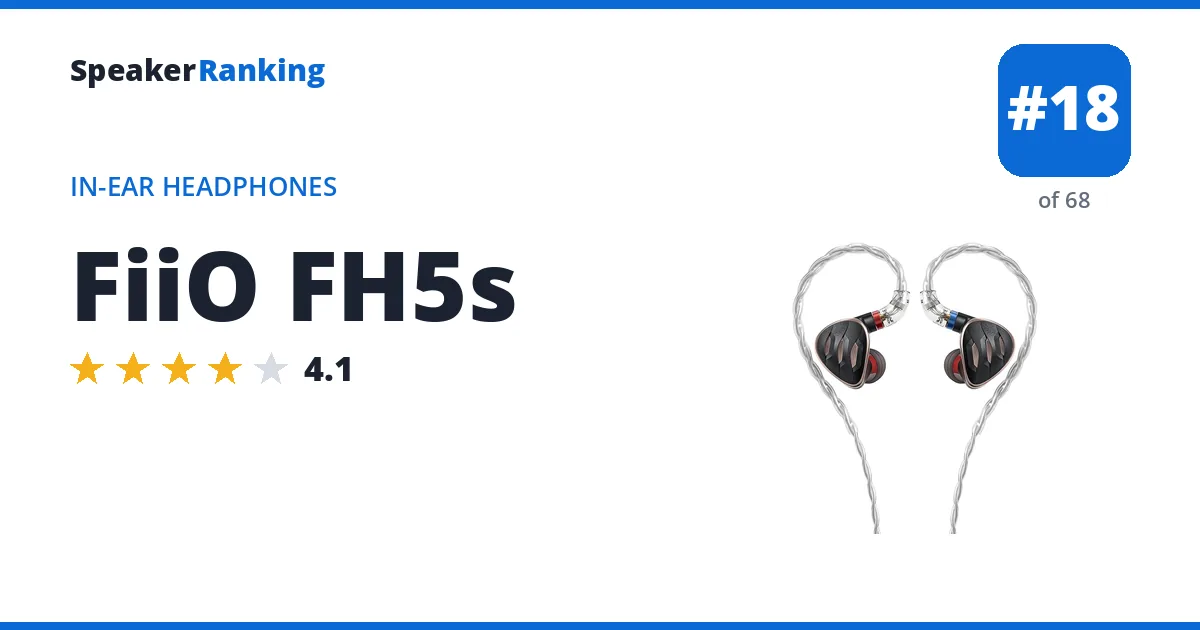
Pros: A preference score of 75 in crinacle’s measurement points to a response close to the Harman target, and it is rated above the Samsung Galaxy Buds2 and the Shuoer S12 Pro. The hybrid design pairs a 12 mm and a 6 mm dynamic driver with two balanced armature drivers. At 40 ohms and 106 dB sensitivity it is easy to drive from a phone, and each earbud weighs 8.8 g.
Cons: Its score and rating are about the same as the AUNE Jasper and the Beats Powerbeats Pro, so it does not stand out in its class. The tilt leans slightly bright, which may not suit listeners who prefer a warm sound. It is wired only, with no built in microphone.
Full FiiO FH5s review and specifications →
| Released | Apr 2021 (5 years ago) |
|---|---|
| Back | Closed |
| Built-in Microphone | No |
| Connection | Wired |
| Deviation From Target | 2.01 dB standard deviation |
| Driver Type | Hybrid (2 dynamic + 2 balanced armature) |
| Drivers | 2 x dynamic (12mm + 6mm) + 2 x balanced armature |
| Form Factor | In-ear |
| Frequency Response | 10Hz - 40kHz (Manufacturer specified) |
| Harman Preference Score | 75 (measured by crinacle, via AutoEQ) |
| Impedance | 40 ohms |
| Sensitivity | 106 dB/mW |
| Tonal Tilt | +0.34 (negative is warmer, positive brighter) |
| Weight | 0 lbs (8.8 g) per earbud |
EQ preset to match the Harman target
Set a preamp of -3.2 dB, then add these filters in any parametric equalizer (Wavelet, Equalizer APO, Peace, or a player with parametric EQ). Calculated by AutoEQ from its measured frequency response.
| Filter | Frequency | Gain | Q |
|---|---|---|---|
| Low shelf | 105 Hz | +2.3 dB | 0.70 |
| Peak | 883 Hz | +3.4 dB | 0.35 |
| Peak | 1,614 Hz | -7.4 dB | 1.64 |
| Peak | 196 Hz | -2.0 dB | 0.64 |
| Peak | 10,000 Hz | +1.7 dB | 0.65 |
| High shelf | 10,000 Hz | -2.6 dB | 0.70 |
| Peak | 6,307 Hz | +2.5 dB | 5.92 |
| Peak | 4,444 Hz | -1.6 dB | 5.97 |
| Peak | 3,652 Hz | +1.2 dB | 6.00 |
| Peak | 7,146 Hz | -1.1 dB | 6.00 |
- Reviews, Comparisons and Sound Samples
 #19 KZ ZSN Pro X: $23.99 Amazon eBay
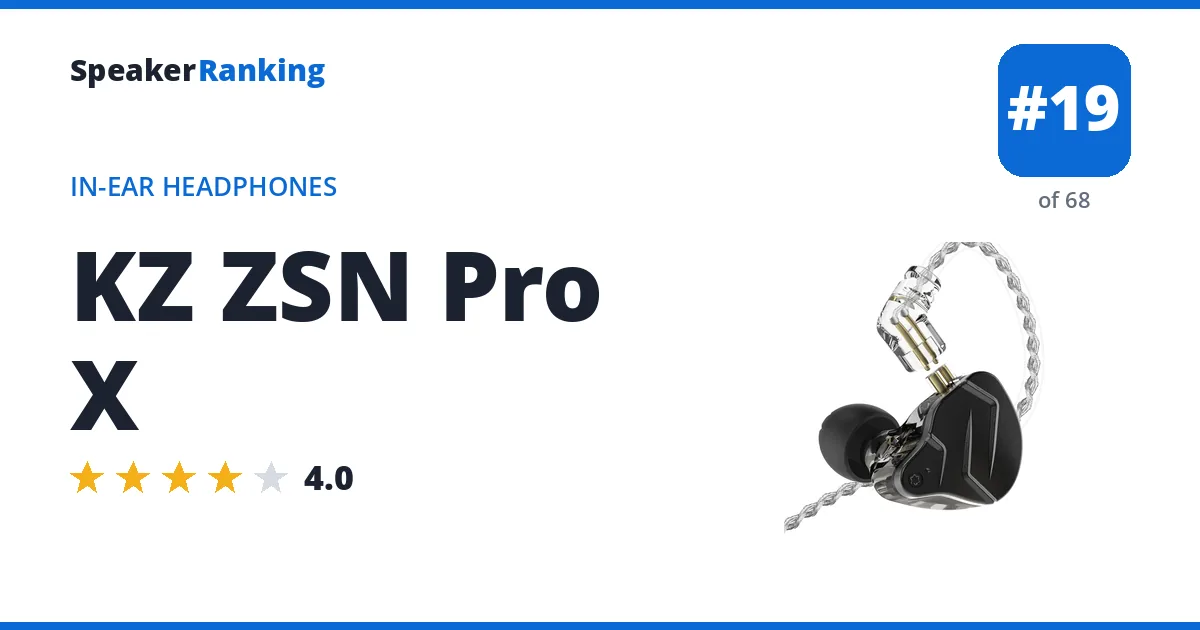
Pros: The hybrid design with a 10mm dynamic driver and a balanced armature gives bass about 3.6 dB above target at 60 to 200 Hz, which adds punch and warmth for pop and hip hop. A preference score of 74 at an inexpensive price is strong, and the 25 ohm impedance with 112 dB/mW sensitivity makes it easy to drive from a phone. It also suits a warm or v-shaped taste.
Cons: A 7.2 dB peak near 8.1 kHz and an air band about 5.8 dB above target can make cymbals and s sounds sharp or hissy at higher volume. The 3 to 4 kHz region dips about 2.9 dB, so vocals can sound a little distant. It has no wireless features or noise cancelling.
Full KZ ZSN Pro X review and specifications →
| Released | Jul 2020 (6 years ago) |
|---|---|
| Back | Closed |
| Connection | Wired |
| Deviation From Target | 2.09 dB standard deviation |
| Driver Type | Hybrid (1 dynamic + 1 balanced armature) |
| Drivers | 1 x 10mm dynamic + 1 x balanced armature |
| Form Factor | In-ear |
| Frequency Response | 7Hz - 40kHz (Manufacturer specified) |
| Harman Preference Score | 74 (measured by oratory1990, via AutoEQ) |
| Impedance | 25 ohms |
| Sensitivity | 112 dB/mW |
| Tonal Tilt | -0.17 (negative is warmer, positive brighter) |
EQ preset to match the Harman target
Set a preamp of -3.8 dB, then add these filters in any parametric equalizer (Wavelet, Equalizer APO, Peace, or a player with parametric EQ). Calculated by AutoEQ from its measured frequency response.
| Filter | Frequency | Gain | Q |
|---|---|---|---|
| Low shelf | 105 Hz | +0.8 dB | 0.70 |
| Peak | 928 Hz | +5.3 dB | 0.66 |
| Peak | 166 Hz | -3.4 dB | 0.67 |
| Peak | 2,193 Hz | -4.4 dB | 0.61 |
| Peak | 3,392 Hz | +6.1 dB | 2.82 |
| High shelf | 10,000 Hz | -4.4 dB | 0.70 |
| Peak | 6,459 Hz | +3.5 dB | 5.25 |
| Peak | 4,968 Hz | -3.5 dB | 5.59 |
| Peak | 4,039 Hz | +1.3 dB | 6.00 |
| Peak | 5,964 Hz | +0.9 dB | 5.91 |
- Reviews, Comparisons and Sound Samples
- Head-to-Head Comparisons
 #20 Samsung Galaxy Buds2: $199.00 Discontinued Amazon eBay
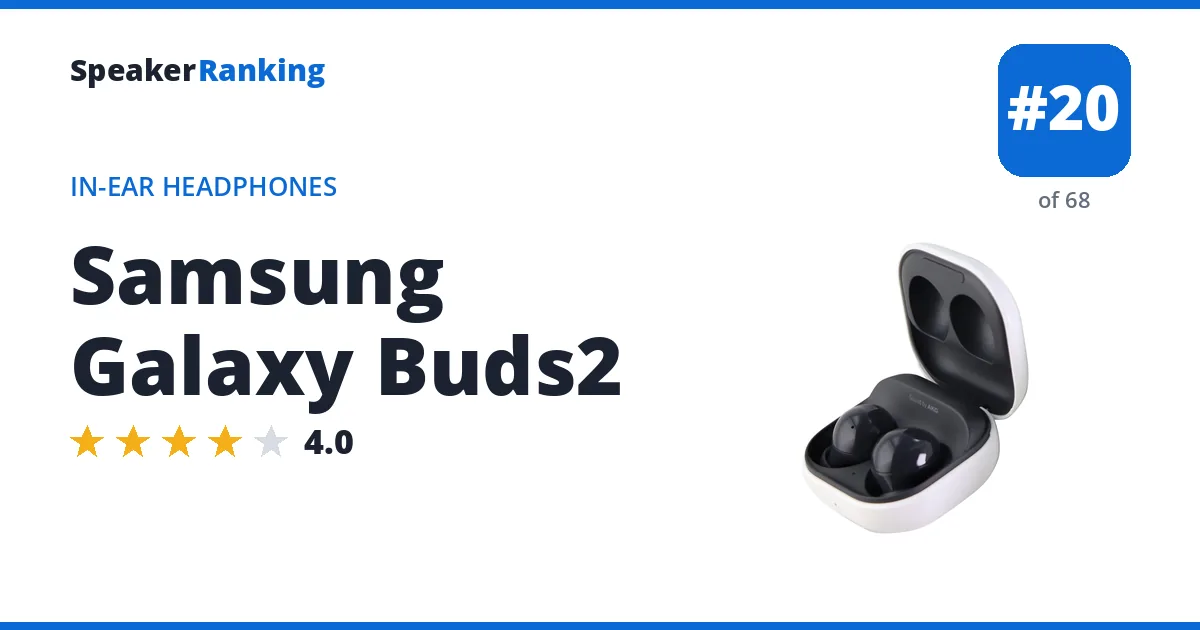
Pros: Bass and low mids sit slightly above target, about 0.9 dB at 60 to 200 Hz, which gives a warm, easy tonal balance for a preference score of 74. The set offers active noise cancelling, Bluetooth 5.2, a microphone, and SBC, AAC and Scalable codec support. Each bud weighs 5 g, and a dual driver layout pairs an 11mm woofer with a 6.3mm tweeter.
Cons: Treble is uneven, with a 5.8 dB peak near 8 kHz, a 4.8 dB dip across 3 to 6 kHz, and the air band 6.5 dB low, which blurs vocal detail and makes cymbals sound splashy and then rolled off. Battery lasts about 5 hours with noise cancelling on. The IPX2 rating gives only basic splash protection, and the AUNE Jasper has a higher rating. Discontinued.
Full Samsung Galaxy Buds2 review and specifications →
| Released | Aug 2021 (5 years ago) |
|---|---|
| Active Noise Cancelling | Yes |
| Back | Closed |
| Battery Life | 5 hours (20 with case, ANC on; 7.5 hours, 29 with case, ANC off, Manufacturer specified) |
| Bluetooth Codecs | SBC, AAC, Scalable |
| Bluetooth Version | 5.2 |
| Built-in Microphone | Yes |
| Connection | True wireless |
| Deviation From Target | 2.18 dB standard deviation |
| Driver Type | Dynamic |
| Drivers | 1 x 11mm dynamic woofer + 1 x 6.3mm dynamic tweeter |
| Form Factor | In-ear |
| Harman Preference Score | 74 (measured by oratory1990, via AutoEQ) |
| IP Rating | IPX2 |
| Tonal Tilt | -0.24 (negative is warmer, positive brighter) |
| Weight | 0 lbs (5 g) per earbud |
EQ preset to match the Harman target
Set a preamp of -4.6 dB, then add these filters in any parametric equalizer (Wavelet, Equalizer APO, Peace, or a player with parametric EQ). Calculated by AutoEQ from its measured frequency response.
| Filter | Frequency | Gain | Q |
|---|---|---|---|
| Low shelf | 105 Hz | +1.7 dB | 0.70 |
| Peak | 4,739 Hz | +4.8 dB | 1.27 |
| Peak | 88 Hz | -1.9 dB | 0.26 |
| Peak | 6,935 Hz | -3.8 dB | 4.18 |
| Peak | 827 Hz | +0.9 dB | 2.57 |
| High shelf | 10,000 Hz | +3.1 dB | 0.70 |
| Peak | 1,484 Hz | -1.0 dB | 2.64 |
| Peak | 7,930 Hz | -1.3 dB | 5.82 |
| Peak | 1,026 Hz | +0.5 dB | 4.03 |
| Peak | 41 Hz | -0.2 dB | 1.94 |
- Reviews, Comparisons and Sound Samples
- Head-to-Head Comparisons
 #21 Shuoer S12 Pro: $169.00 Amazon eBay
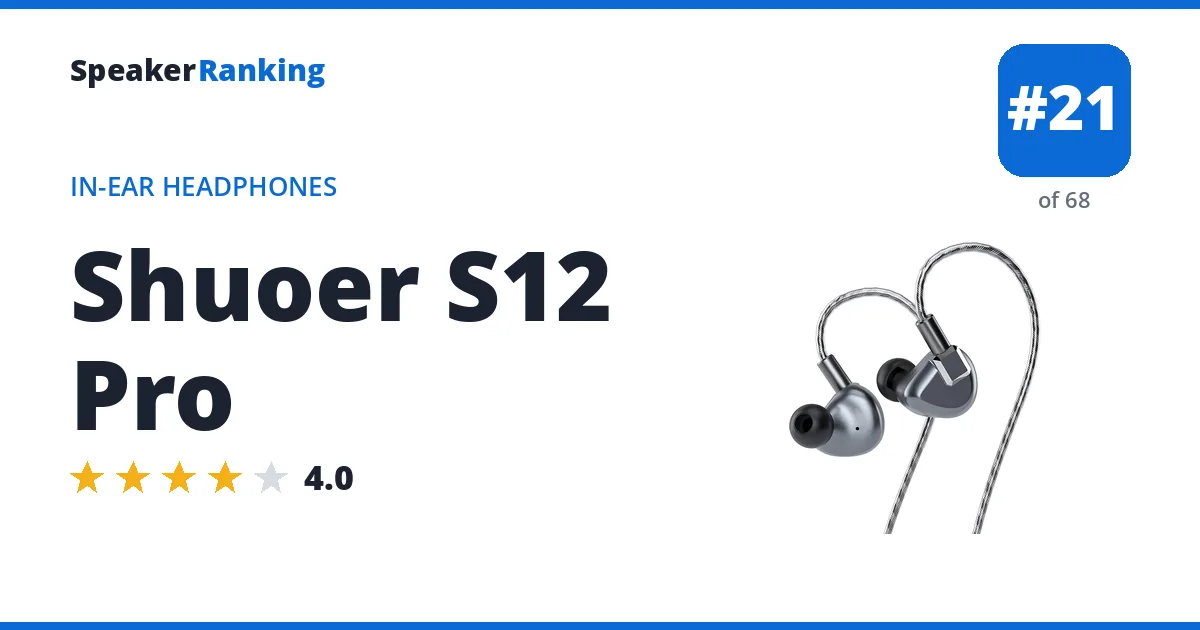
Pros: A 14.8mm planar magnetic driver delivers a gentle bass lift, about 2 dB above target from 60 to 200 Hz, with sub-bass nearly on target, for a preference score of 74. At 16 ohms and 102 dB sensitivity it runs fine from a phone. The wired design suits warm and v-shaped tastes, with extra treble sparkle.
Cons: Treble from 6 to 16 kHz runs 3 dB or more above target, with a 6 dB peak near 8.2 kHz, so cymbals and sibilance can sound bright at volume. A 5.5 dB dip near 3.7 kHz pulls back vocal presence. The Beats Powerbeats Pro and AUNE Jasper carry higher ratings.
Full Shuoer S12 Pro review and specifications →
| Released | 2022 (4 years ago) |
|---|---|
| Back | Closed |
| Connection | Wired |
| Deviation From Target | 2.18 dB standard deviation |
| Driver Type | Planar magnetic |
| Drivers | 1 x 14.8mm planar magnetic |
| Form Factor | In-ear |
| Frequency Response | 20Hz - 20kHz (Manufacturer specified) |
| Harman Preference Score | 74 (measured by oratory1990, via AutoEQ) |
| Impedance | 16 ohms |
| Sensitivity | 102 dB |
| Tonal Tilt | -0.19 (negative is warmer, positive brighter) |
EQ preset to match the Harman target
Set a preamp of -4.6 dB, then add these filters in any parametric equalizer (Wavelet, Equalizer APO, Peace, or a player with parametric EQ). Calculated by AutoEQ from its measured frequency response.
| Filter | Frequency | Gain | Q |
|---|---|---|---|
| Low shelf | 105 Hz | +0.2 dB | 0.70 |
| Peak | 3,538 Hz | +5.0 dB | 2.19 |
| Peak | 163 Hz | -2.5 dB | 0.79 |
| Peak | 679 Hz | +2.1 dB | 0.90 |
| Peak | 1,695 Hz | -2.2 dB | 2.26 |
| High shelf | 10,000 Hz | -7.4 dB | 0.70 |
| Peak | 7,429 Hz | -1.6 dB | 4.48 |
| Peak | 4,686 Hz | +0.9 dB | 3.26 |
| Peak | 3,610 Hz | -0.5 dB | 6.00 |
| Peak | 4,104 Hz | +0.5 dB | 4.93 |
- Reviews, Comparisons and Sound Samples
- Head-to-Head Comparisons
 #22 7Hz x Crinacle Zero 2: $24.99 Amazon eBay
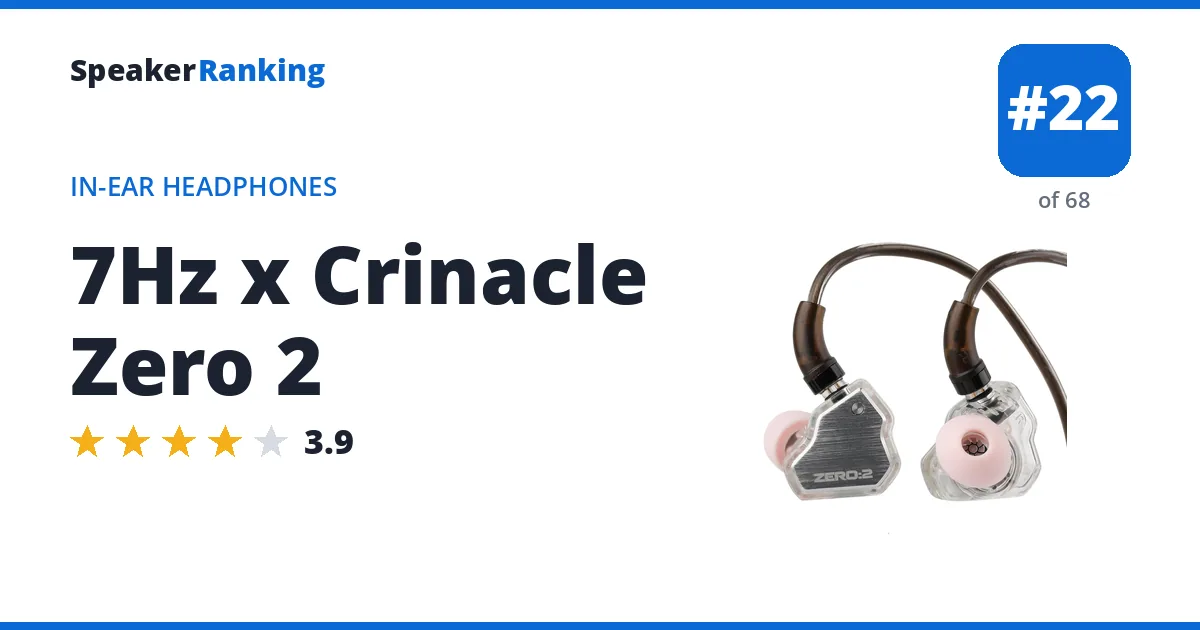
Older model: the 7Hz Salnotes Zero (ranked higher, rated 4.8/5). See every 7Hz Zero generation.
Pros: Crinacle’s measurement gives a preference score of 73 with a response that stays fairly even, a standard deviation of 1.99 dB around target. A 10mm dynamic driver at 32 ohms and 108 dB SPL/V sensitivity runs from a phone with no amp. The low cost makes it an easy entry into wired in-ears.
Cons: The tilt of negative 0.71 is the warmest in this group, so treble detail and air can sound subdued. It has no wireless features, noise cancelling or listed microphone. The KZ ZSN Pro X has a higher rating at a similar price.
Full 7Hz x Crinacle Zero 2 review and specifications →
| Released | Nov 2023 (2 years ago) |
|---|---|
| Back | Closed |
| Connection | Wired |
| Deviation From Target | 1.99 dB standard deviation |
| Driver Type | Dynamic |
| Drivers | 1 x 10mm dynamic |
| Form Factor | In-ear |
| Frequency Response | 10Hz - 20kHz (Manufacturer specified) |
| Harman Preference Score | 73 (measured by crinacle, via AutoEQ) |
| Impedance | 32 ohms |
| Sensitivity | 108 dB SPL/V |
| Tonal Tilt | -0.71 (negative is warmer, positive brighter) |
EQ preset to match the Harman target
Set a preamp of -4.4 dB, then add these filters in any parametric equalizer (Wavelet, Equalizer APO, Peace, or a player with parametric EQ). Calculated by AutoEQ from its measured frequency response.
| Filter | Frequency | Gain | Q |
|---|---|---|---|
| Low shelf | 105 Hz | -1.1 dB | 0.70 |
| Peak | 6,290 Hz | +4.3 dB | 0.72 |
| Peak | 182 Hz | -2.3 dB | 1.03 |
| Peak | 1,916 Hz | -1.7 dB | 0.50 |
| Peak | 855 Hz | +1.8 dB | 1.59 |
| High shelf | 10,000 Hz | +0.9 dB | 0.70 |
| Peak | 67 Hz | +0.4 dB | 2.53 |
| Peak | 7,224 Hz | -1.2 dB | 5.84 |
| Peak | 5,811 Hz | +0.8 dB | 5.07 |
| Peak | 3,871 Hz | -0.3 dB | 2.41 |
- Reviews, Comparisons and Sound Samples
- Head-to-Head Comparisons
 #23 KZ ZSN Pro: $24.99 Amazon eBay
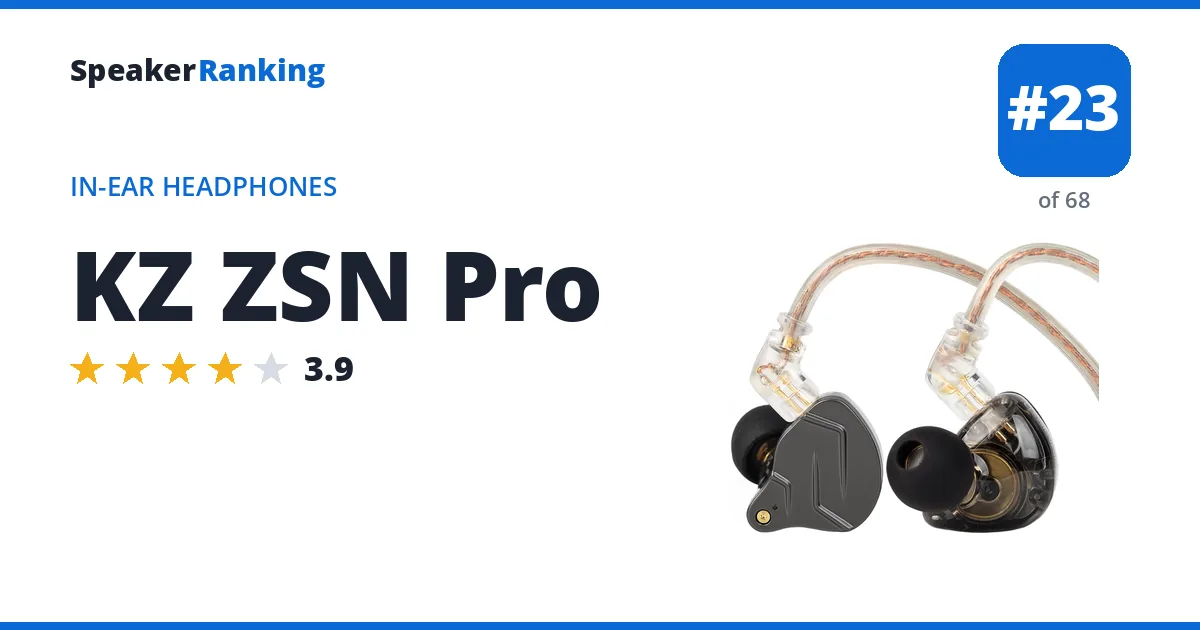
Pros: A preference score of 73 in HypetheSonics’ measurement is solid for a wired set this cheap, with a response that stays within about 2.2 dB of the Harman target. Bass sits roughly 3 dB above target from 60 to 200 Hz, adding punch to kick drums and bass guitar without muddying the lower midrange, which stays within 1 dB. At 25 ohms and 104 dB/mW it runs loudly from a phone, and the hybrid dynamic plus balanced armature design suits v-shaped and warm tastes. It also rates higher than the MEE Audio M6 Pro.
Cons: Treble above 10 kHz runs about 6 dB hot, with a sharp 9.4 dB peak near 11 kHz that can make cymbals and hi-hats sound glassy or hissy. A 3.7 dB dip near 3.4 kHz pulls vocals and snare snap slightly back. Listeners who want a flat, neutral tuning will find the bass and treble both exaggerated.
Full KZ ZSN Pro review and specifications →
| Released | 2019 (7 years ago) |
|---|---|
| Back | Closed |
| Connection | Wired |
| Deviation From Target | 2.23 dB standard deviation |
| Driver Type | Hybrid (1 dynamic + 1 balanced armature) |
| Drivers | 1 x 10mm dynamic + 1 x balanced armature |
| Form Factor | In-ear |
| Frequency Response | 20Hz - 40kHz (Manufacturer specified) |
| Harman Preference Score | 73 (measured by HypetheSonics, via AutoEQ) |
| Impedance | 25 ohms |
| Sensitivity | 104 dB/mW |
| Tonal Tilt | -0.11 (negative is warmer, positive brighter) |
EQ preset to match the Harman target
Set a preamp of -4.2 dB, then add these filters in any parametric equalizer (Wavelet, Equalizer APO, Peace, or a player with parametric EQ). Calculated by AutoEQ from its measured frequency response.
| Filter | Frequency | Gain | Q |
|---|---|---|---|
| Low shelf | 105 Hz | +0.5 dB | 0.70 |
| Peak | 750 Hz | +3.7 dB | 0.88 |
| Peak | 160 Hz | -3.1 dB | 0.79 |
| Peak | 3,264 Hz | +4.4 dB | 3.80 |
| Peak | 2,073 Hz | -3.5 dB | 2.04 |
| High shelf | 10,000 Hz | -5.0 dB | 0.70 |
| Peak | 4,840 Hz | -4.2 dB | 6.00 |
| Peak | 6,161 Hz | +3.4 dB | 4.50 |
| Peak | 3,841 Hz | +1.8 dB | 5.81 |
| Peak | 4,626 Hz | -1.0 dB | 5.62 |
- Reviews, Comparisons and Sound Samples
- Head-to-Head Comparisons
 #24 Tin HiFi T4: $89.00 Amazon eBay
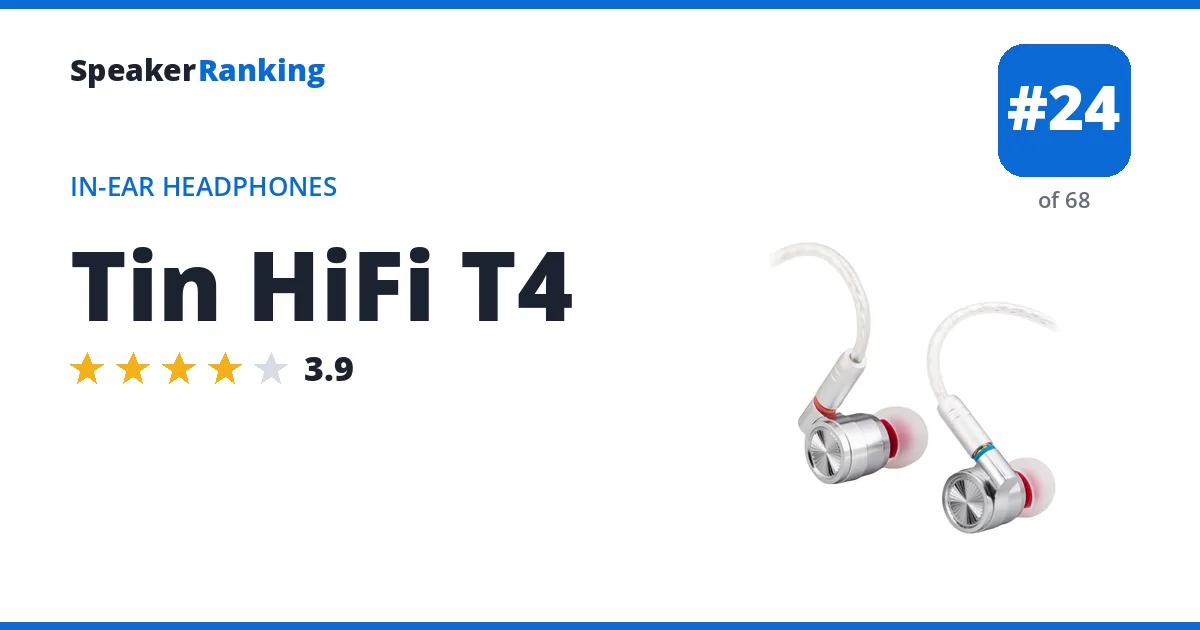
Pros: A preference score of 73 in crinacle’s measurement puts the response well within the range most listeners find pleasing, with a nearly neutral tilt. A single 10mm dynamic driver at 32 ohms and 102 dB is easy to power from a phone or dongle, and it rates a little higher than the KZ ZAX at a similar level of price.
Cons: The score still leaves room for audible deviations from the target, so some tonal coloration is likely. A single dynamic driver also gives up the added detail that multi-driver sets in this class aim for.
Full Tin HiFi T4 review and specifications →
| Released | Nov 2019 (6 years ago) |
|---|---|
| Back | Closed |
| Connection | Wired |
| Deviation From Target | 2.44 dB standard deviation |
| Driver Type | Dynamic |
| Drivers | 1 x 10mm dynamic |
| Form Factor | In-ear |
| Frequency Response | 10Hz - 20kHz (Manufacturer specified) |
| Harman Preference Score | 73 (measured by crinacle, via AutoEQ) |
| Impedance | 32 ohms |
| Sensitivity | 102 dB |
| Tonal Tilt | +0.10 (negative is warmer, positive brighter) |
EQ preset to match the Harman target
Set a preamp of -4.2 dB, then add these filters in any parametric equalizer (Wavelet, Equalizer APO, Peace, or a player with parametric EQ). Calculated by AutoEQ from its measured frequency response.
| Filter | Frequency | Gain | Q |
|---|---|---|---|
| Low shelf | 105 Hz | +2.8 dB | 0.70 |
| Peak | 9,358 Hz | +4.2 dB | 2.59 |
| Peak | 149 Hz | -2.1 dB | 0.84 |
| Peak | 1,877 Hz | -3.4 dB | 2.54 |
| Peak | 3,450 Hz | +4.1 dB | 3.07 |
| High shelf | 10,000 Hz | -0.1 dB | 0.70 |
| Peak | 853 Hz | +1.7 dB | 1.24 |
| Peak | 5,343 Hz | -3.7 dB | 5.41 |
| Peak | 1,332 Hz | -1.5 dB | 2.76 |
| Peak | 6,775 Hz | +1.3 dB | 3.54 |
- Reviews, Comparisons and Sound Samples
- Head-to-Head Comparisons
 #25 CCA CRA: $20.99 Amazon eBay
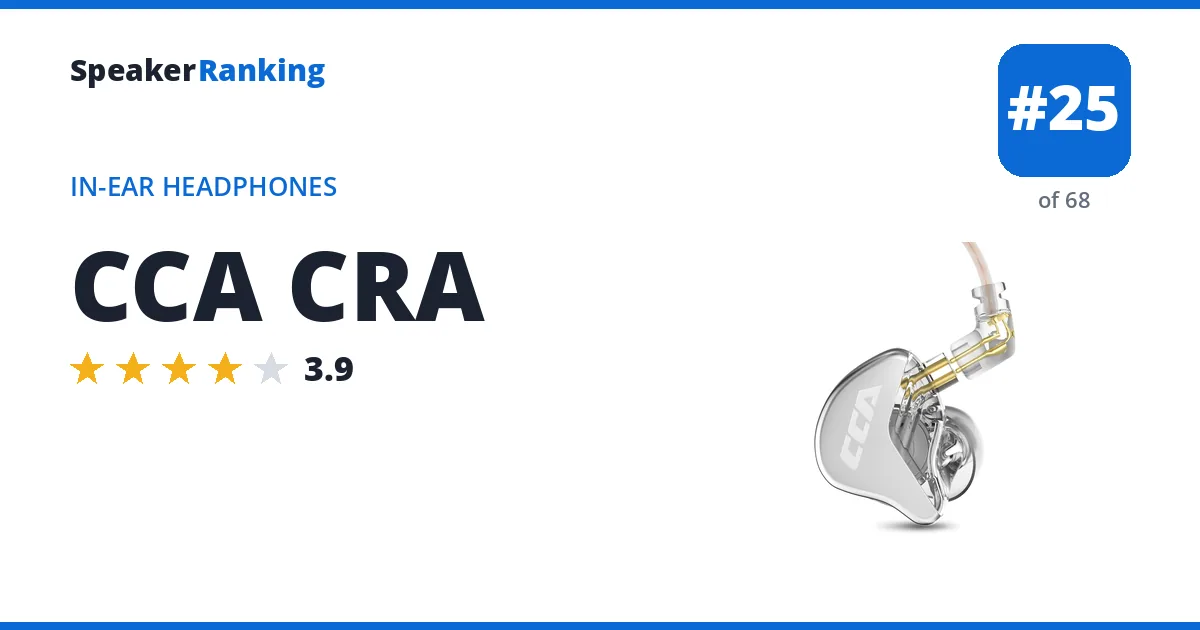
Pros: A preference score of 72 in crinacle’s measurement is strong for one of the least expensive wired sets in its class, and the 1.98 dB deviation from target is among the smoothest in this group. The 111 dB sensitivity and 23.5 ohm impedance mean a phone drives it to high volume with ease. The slightly warm tilt suits listeners who like a touch of extra bass.
Cons: The tuning is a notch below the best sets in the class, and the slightly warm lean can soften treble detail for those who prefer a brighter sound. It has no listed frequency range or other extras, so the case for it rests on the tuning and low cost.
Full CCA CRA review and specifications →
| Back | Closed |
|---|---|
| Connection | Wired |
| Deviation From Target | 1.98 dB standard deviation |
| Driver Type | Dynamic |
| Drivers | 1 x 10mm dynamic |
| Form Factor | In-ear |
| Harman Preference Score | 72 (measured by crinacle, via AutoEQ) |
| Impedance | 23.5 ohms |
| Sensitivity | 111 dB |
| Tonal Tilt | -0.71 (negative is warmer, positive brighter) |
EQ preset to match the Harman target
Set a preamp of -2.7 dB, then add these filters in any parametric equalizer (Wavelet, Equalizer APO, Peace, or a player with parametric EQ). Calculated by AutoEQ from its measured frequency response.
| Filter | Frequency | Gain | Q |
|---|---|---|---|
| Low shelf | 105 Hz | -2.5 dB | 0.70 |
| Peak | 183 Hz | -2.3 dB | 1.19 |
| Peak | 818 Hz | +2.3 dB | 1.03 |
| Peak | 3,058 Hz | +2.5 dB | 2.13 |
| Peak | 1,484 Hz | -1.5 dB | 1.88 |
| High shelf | 10,000 Hz | -5.7 dB | 0.70 |
| Peak | 9,654 Hz | +2.4 dB | 2.57 |
| Peak | 6,044 Hz | +3.0 dB | 5.11 |
| Peak | 66 Hz | +0.7 dB | 2.30 |
| Peak | 4,821 Hz | -2.0 dB | 5.10 |
- Reviews, Comparisons and Sound Samples
- Head-to-Head Comparisons
 #26 CCA C12: $48.99 Amazon eBay
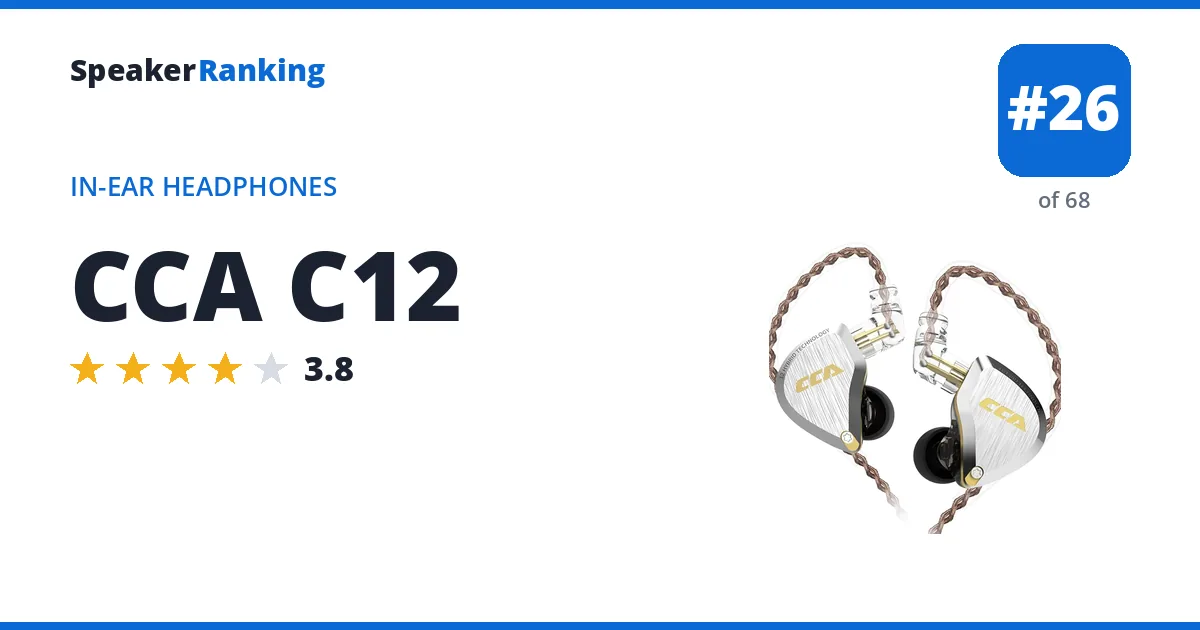
Pros: A preference score of 71 in crinacle’s measurement is respectable for a hybrid with one dynamic driver and five balanced armatures. The 24 ohm impedance and 112 dB/mW sensitivity make it easy to drive from any phone. A slightly warm tilt gives it a fuller, more relaxed presentation than a bright set.
Cons: The 2.2 dB deviation from the target shows the response still wanders, so tonal balance will not be fully natural. Crowding six drivers into one housing does not translate into a score above cheaper single-driver sets like the CCA CRA, which has a higher rating.
Full CCA C12 review and specifications →
| Back | Closed |
|---|---|
| Connection | Wired |
| Deviation From Target | 2.22 dB standard deviation |
| Driver Type | Hybrid (1 dynamic + 5 balanced armature) |
| Drivers | 1 x 10mm dynamic + 5 x balanced armature |
| Form Factor | In-ear |
| Frequency Response | 7Hz - 40kHz (Manufacturer specified) |
| Harman Preference Score | 71 (measured by crinacle, via AutoEQ) |
| Impedance | 24 ohms |
| Sensitivity | 112 dB/mW |
| Tonal Tilt | -0.38 (negative is warmer, positive brighter) |
EQ preset to match the Harman target
Set a preamp of -3.4 dB, then add these filters in any parametric equalizer (Wavelet, Equalizer APO, Peace, or a player with parametric EQ). Calculated by AutoEQ from its measured frequency response.
| Filter | Frequency | Gain | Q |
|---|---|---|---|
| Low shelf | 105 Hz | +0.9 dB | 0.70 |
| Peak | 161 Hz | -3.6 dB | 0.61 |
| Peak | 677 Hz | +3.8 dB | 1.07 |
| Peak | 2,181 Hz | -3.3 dB | 3.04 |
| Peak | 7,371 Hz | +3.4 dB | 3.04 |
| High shelf | 10,000 Hz | -5.1 dB | 0.70 |
| Peak | 9,487 Hz | +2.8 dB | 2.05 |
| Peak | 3,358 Hz | +3.0 dB | 3.37 |
| Peak | 5,217 Hz | -3.3 dB | 6.00 |
| Peak | 2,530 Hz | -1.7 dB | 5.25 |
- Reviews, Comparisons and Sound Samples
- Head-to-Head Comparisons
 #27 KZ ZAX: $65.99 Amazon eBay
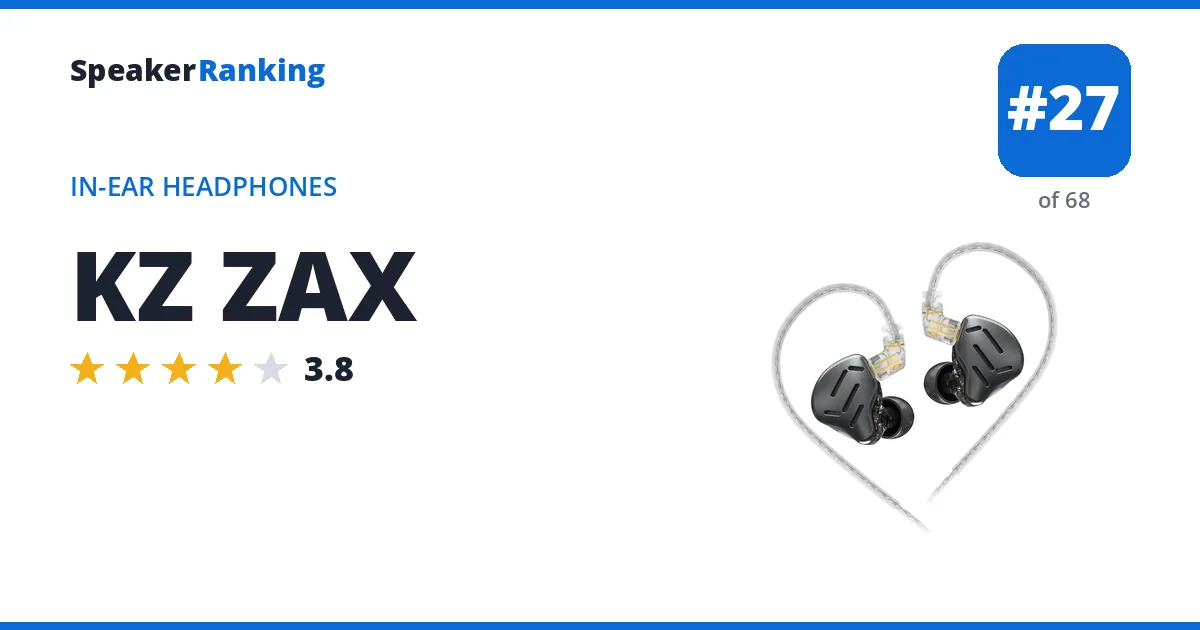
Pros: A preference score of 71 in crinacle’s measurement comes from a hybrid design with one dynamic driver and seven balanced armatures. At 24 ohms and 113 dB the sensitivity is very high, so any phone or dongle drives it easily. The slightly warm tilt keeps treble from turning harsh.
Cons: The response sits 2.3 dB from the target on average, so some coloration remains despite the eight drivers. It also costs noticeably more than the CCA C12 for the same rating, and the Tin HiFi T4 rates higher with a single dynamic driver.
Full KZ ZAX review and specifications →
| Back | Closed |
|---|---|
| Connection | Wired |
| Deviation From Target | 2.29 dB standard deviation |
| Driver Type | Hybrid (1 dynamic + 7 balanced armature) |
| Drivers | 1 x dynamic + 7 x balanced armature |
| Form Factor | In-ear |
| Frequency Response | 10Hz - 40kHz (Manufacturer specified) |
| Harman Preference Score | 71 (measured by crinacle, via AutoEQ) |
| Impedance | 24 ohms |
| Sensitivity | 113 dB |
| Tonal Tilt | -0.43 (negative is warmer, positive brighter) |
EQ preset to match the Harman target
Set a preamp of -4.5 dB, then add these filters in any parametric equalizer (Wavelet, Equalizer APO, Peace, or a player with parametric EQ). Calculated by AutoEQ from its measured frequency response.
| Filter | Frequency | Gain | Q |
|---|---|---|---|
| Low shelf | 105 Hz | +1.0 dB | 0.70 |
| Peak | 197 Hz | -3.9 dB | 0.41 |
| Peak | 639 Hz | +3.6 dB | 0.62 |
| Peak | 2,128 Hz | -6.0 dB | 1.80 |
| Peak | 4,125 Hz | +2.9 dB | 0.42 |
| High shelf | 10,000 Hz | +0.0 dB | 0.70 |
| Peak | 4,387 Hz | -3.1 dB | 5.67 |
| Peak | 9,739 Hz | -1.1 dB | 2.42 |
| Peak | 3,351 Hz | +1.7 dB | 4.33 |
| Peak | 6,468 Hz | +2.5 dB | 6.00 |
- Reviews, Comparisons and Sound Samples
- Head-to-Head Comparisons
 #28 MEE Audio M6 Pro: $39.99 Amazon eBay
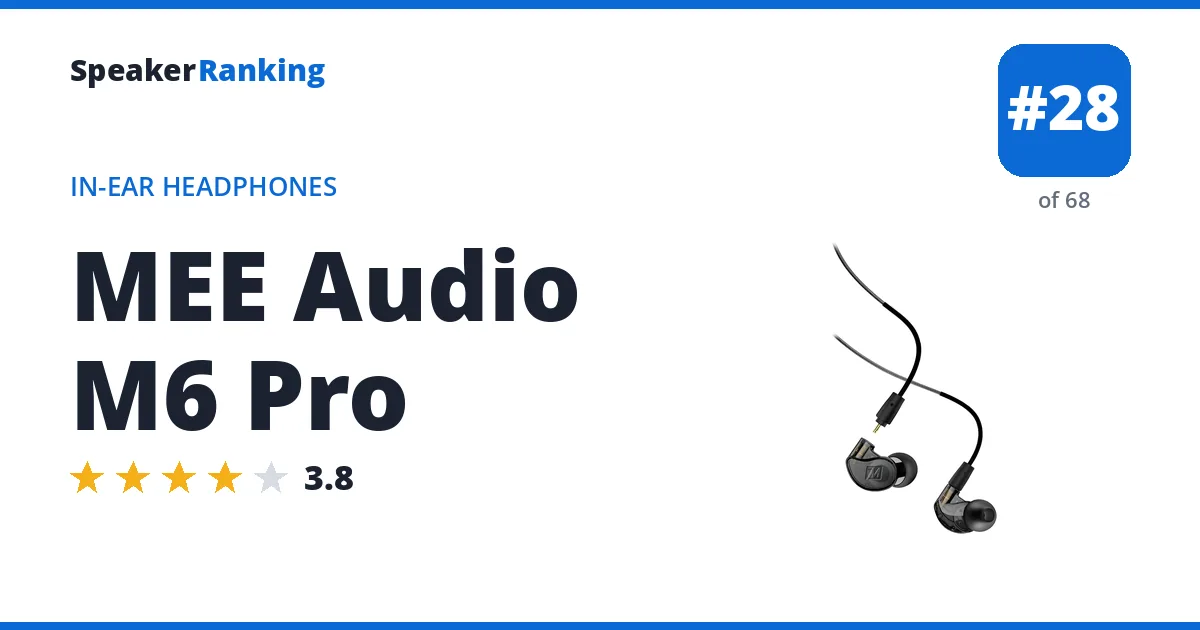
Pros: A preference score of 71 in crinacle’s measurement is a decent result for a single 10mm dynamic driver. At 16 ohms and 100 dB/mW it is simple to drive from a phone, and the slightly warm tilt gives a smooth, easy listen. Its rating matches the CCA C12 and KZ ZAX.
Cons: The 100 dB/mW sensitivity is the lowest in this group, so it needs a little more volume than the hybrids. The 2.2 dB deviation from the target leaves audible coloration, and the 7Hz x Crinacle Zero 2 rates higher at a lower price.
Full MEE Audio M6 Pro review and specifications →
| Back | Closed |
|---|---|
| Connection | Wired |
| Deviation From Target | 2.20 dB standard deviation |
| Driver Type | Dynamic |
| Drivers | 1 x 10mm dynamic |
| Form Factor | In-ear |
| Frequency Response | 20Hz - 20kHz (Manufacturer specified) |
| Harman Preference Score | 71 (measured by crinacle, via AutoEQ) |
| Impedance | 16 ohms |
| Sensitivity | 100 dB/mW |
| Tonal Tilt | -0.39 (negative is warmer, positive brighter) |
EQ preset to match the Harman target
Set a preamp of -3.6 dB, then add these filters in any parametric equalizer (Wavelet, Equalizer APO, Peace, or a player with parametric EQ). Calculated by AutoEQ from its measured frequency response.
| Filter | Frequency | Gain | Q |
|---|---|---|---|
| Low shelf | 105 Hz | +3.2 dB | 0.70 |
| Peak | 721 Hz | +4.8 dB | 0.62 |
| Peak | 92 Hz | -4.5 dB | 0.22 |
| Peak | 2,434 Hz | -4.4 dB | 2.44 |
| Peak | 6,340 Hz | +3.1 dB | 5.50 |
| High shelf | 10,000 Hz | +3.4 dB | 0.70 |
| Peak | 9,270 Hz | +2.2 dB | 1.90 |
| Peak | 7,139 Hz | -1.9 dB | 4.63 |
| Peak | 4,980 Hz | -1.9 dB | 5.48 |
| Peak | 4,087 Hz | +0.6 dB | 3.54 |
- Reviews, Comparisons and Sound Samples
- Head-to-Head Comparisons
 #29 TANGZU Wan’er S.G: $18.00 Amazon eBay
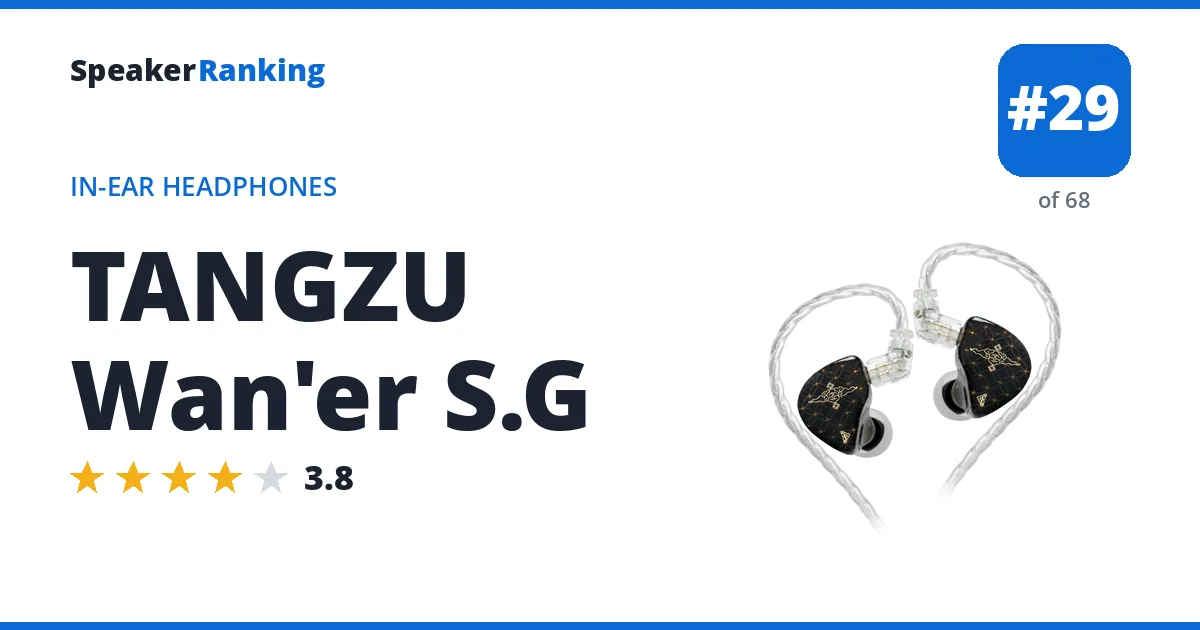
Pros: A preference score of 71 in crinacle’s measurement at a very low cost is good value, with a mildly warm tilt that keeps treble from becoming harsh. Each earbud weighs only 4.2 g, and a built-in microphone makes it usable for calls. It rates higher than the KZ ZST and costs less.
Cons: The 2.5 dB deviation from the target is the least smooth of this group, so tonal accuracy trails the CCA CRA and KZ ZSN Pro, both of which rate higher. A single 10mm dynamic driver and no listed impedance or sensitivity leave less to go on for matching it with a source.
Full TANGZU Wan’er S.G review and specifications →
| Released | 2023 (3 years ago) |
|---|---|
| Back | Closed |
| Built-in Microphone | Yes |
| Connection | Wired |
| Deviation From Target | 2.48 dB standard deviation |
| Driver Type | Dynamic |
| Drivers | 1 x 10mm dynamic |
| Form Factor | In-ear |
| Frequency Response | 20Hz - 20kHz (Manufacturer specified) |
| Harman Preference Score | 71 (measured by crinacle, via AutoEQ) |
| Tonal Tilt | -0.32 (negative is warmer, positive brighter) |
| Weight | 0 lbs (4.2 g) per earbud |
EQ preset to match the Harman target
Set a preamp of -5.4 dB, then add these filters in any parametric equalizer (Wavelet, Equalizer APO, Peace, or a player with parametric EQ). Calculated by AutoEQ from its measured frequency response.
| Filter | Frequency | Gain | Q |
|---|---|---|---|
| Low shelf | 105 Hz | +1.8 dB | 0.70 |
| Peak | 6,638 Hz | +5.1 dB | 1.36 |
| Peak | 145 Hz | -2.6 dB | 0.76 |
| Peak | 1,930 Hz | -2.9 dB | 1.79 |
| Peak | 9,431 Hz | +3.0 dB | 2.56 |
| High shelf | 10,000 Hz | -1.1 dB | 0.70 |
| Peak | 894 Hz | +1.2 dB | 1.34 |
| Peak | 1,321 Hz | -1.2 dB | 2.81 |
| Peak | 275 Hz | -0.4 dB | 1.71 |
| Peak | 570 Hz | +0.5 dB | 2.18 |
- Reviews, Comparisons and Sound Samples
- Head-to-Head Comparisons
 #30 SoftEars Twilight: $930.00 Amazon eBay
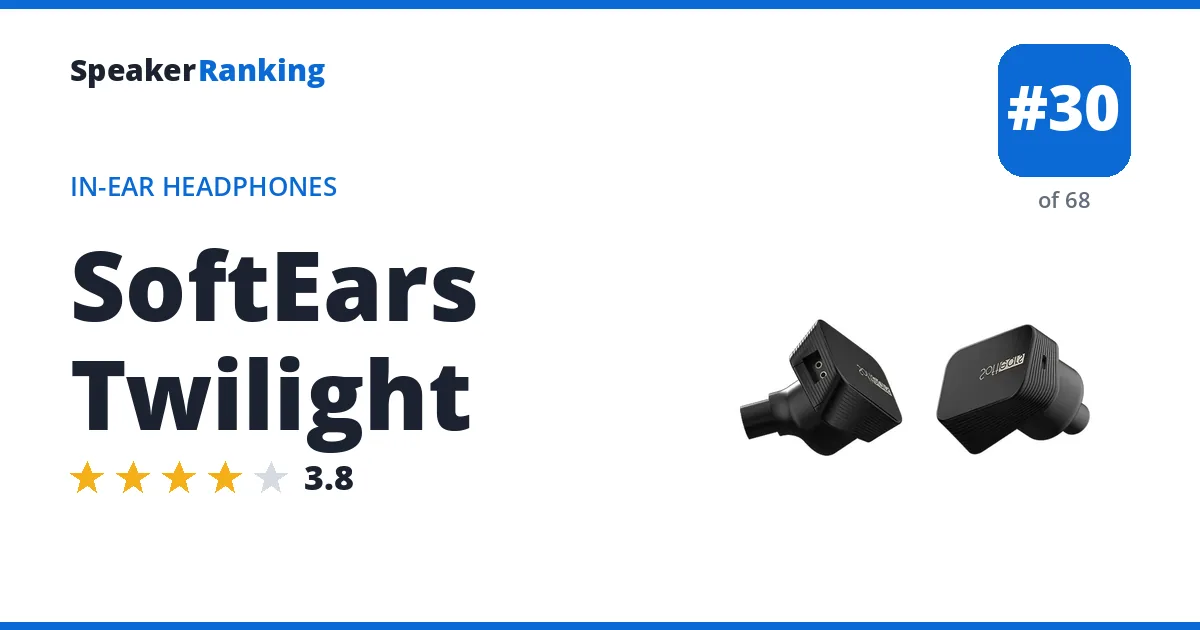
Pros: A preference score of 71 with a deviation of 2.42 dB from target is a respectable result for a single-dynamic-driver in-ear. A 16 ohm impedance and 116 dB/V sensitivity let it run loudly and cleanly from a phone or portable player without extra amplification. It weighs only 6 g per earbud, and its tilt of -0.1 means it is close to tonally balanced rather than skewed warm or bright. It has a higher rating than the HIFIMAN RE2000 and the JVC HA-FW1500.
Cons: The score of 71 is well short of the best in-ears, so some tuning errors remain against the Harman target. The SoftEars RSV from the same brand has a higher rating. It is a wired design only.
Full SoftEars Twilight review and specifications →
| Back | Closed |
|---|---|
| Connection | Wired |
| Deviation From Target | 2.42 dB standard deviation |
| Driver Type | Dynamic |
| Drivers | 1 x 10mm dynamic |
| Form Factor | In-ear |
| Frequency Response | 20Hz - 20kHz (Manufacturer specified) |
| Harman Preference Score | 71 (measured by crinacle, via AutoEQ) |
| Impedance | 16 ohms |
| Sensitivity | 116 dB/V |
| Tonal Tilt | -0.10 (negative is warmer, positive brighter) |
| Weight | 0 lbs (6 g) per earbud |
EQ preset to match the Harman target
Set a preamp of -3.5 dB, then add these filters in any parametric equalizer (Wavelet, Equalizer APO, Peace, or a player with parametric EQ). Calculated by AutoEQ from its measured frequency response.
| Filter | Frequency | Gain | Q |
|---|---|---|---|
| Low shelf | 105 Hz | +3.5 dB | 0.70 |
| Peak | 176 Hz | -3.8 dB | 0.48 |
| Peak | 7,545 Hz | +3.4 dB | 0.90 |
| Peak | 866 Hz | +2.8 dB | 1.07 |
| Peak | 4,388 Hz | -1.1 dB | 2.46 |
| High shelf | 10,000 Hz | +0.8 dB | 0.70 |
| Peak | 2,853 Hz | -0.9 dB | 4.10 |
| Peak | 2,069 Hz | +0.5 dB | 3.38 |
| Peak | 7,411 Hz | -1.0 dB | 5.97 |
| Peak | 6,202 Hz | +0.9 dB | 6.00 |
- Reviews, Comparisons and Sound Samples
 #31 CCA C10: $40.99 Amazon eBay
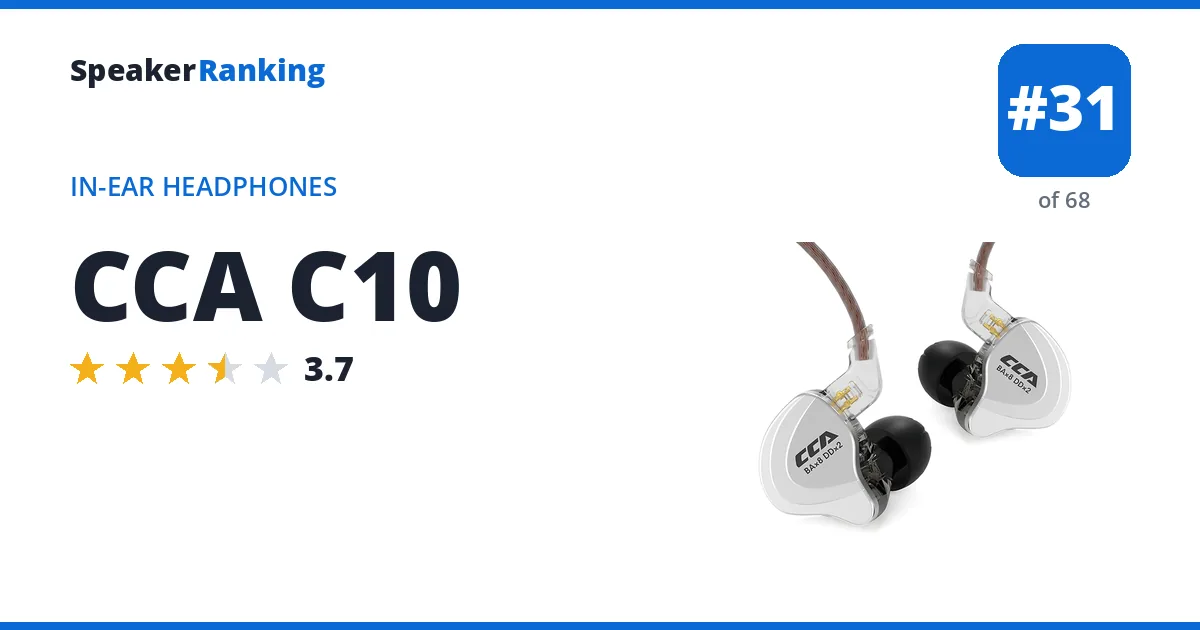
Pros: A preference score of 70 in crinacle’s measurement comes from a hybrid with one dynamic driver and four balanced armatures. At 32 ohms and 108 dB/mW it works comfortably from phones, and the slightly warm tilt makes for a relaxed sound.
Cons: The 2.3 dB deviation from the target leaves noticeable coloration, and the preference score trails the CCA C12 and MEE Audio M6 Pro, both of which rate higher. The extra balanced armatures do not lift it above simpler single-driver sets.
Full CCA C10 review and specifications →
| Back | Closed |
|---|---|
| Connection | Wired |
| Deviation From Target | 2.31 dB standard deviation |
| Driver Type | Hybrid (1 dynamic + 4 balanced armature) |
| Drivers | 1 x 10mm dynamic + 4 x balanced armature |
| Form Factor | In-ear |
| Frequency Response | 7Hz - 40kHz (Manufacturer specified) |
| Harman Preference Score | 70 (measured by crinacle, via AutoEQ) |
| Impedance | 32 ohms |
| Sensitivity | 108 dB/mW |
| Tonal Tilt | -0.40 (negative is warmer, positive brighter) |
EQ preset to match the Harman target
Set a preamp of -4.1 dB, then add these filters in any parametric equalizer (Wavelet, Equalizer APO, Peace, or a player with parametric EQ). Calculated by AutoEQ from its measured frequency response.
| Filter | Frequency | Gain | Q |
|---|---|---|---|
| Low shelf | 105 Hz | +0.6 dB | 0.70 |
| Peak | 163 Hz | -3.5 dB | 0.68 |
| Peak | 795 Hz | +3.6 dB | 0.90 |
| Peak | 2,002 Hz | -3.7 dB | 2.10 |
| Peak | 3,348 Hz | +3.9 dB | 4.47 |
| High shelf | 10,000 Hz | +3.9 dB | 0.70 |
| Peak | 6,105 Hz | +3.6 dB | 5.09 |
| Peak | 4,532 Hz | -3.7 dB | 6.00 |
| Peak | 8,636 Hz | +1.0 dB | 4.78 |
| Peak | 5,236 Hz | +1.0 dB | 5.28 |
- Reviews, Comparisons and Sound Samples
 #32 FiiO FD5: $505.28 Amazon eBay
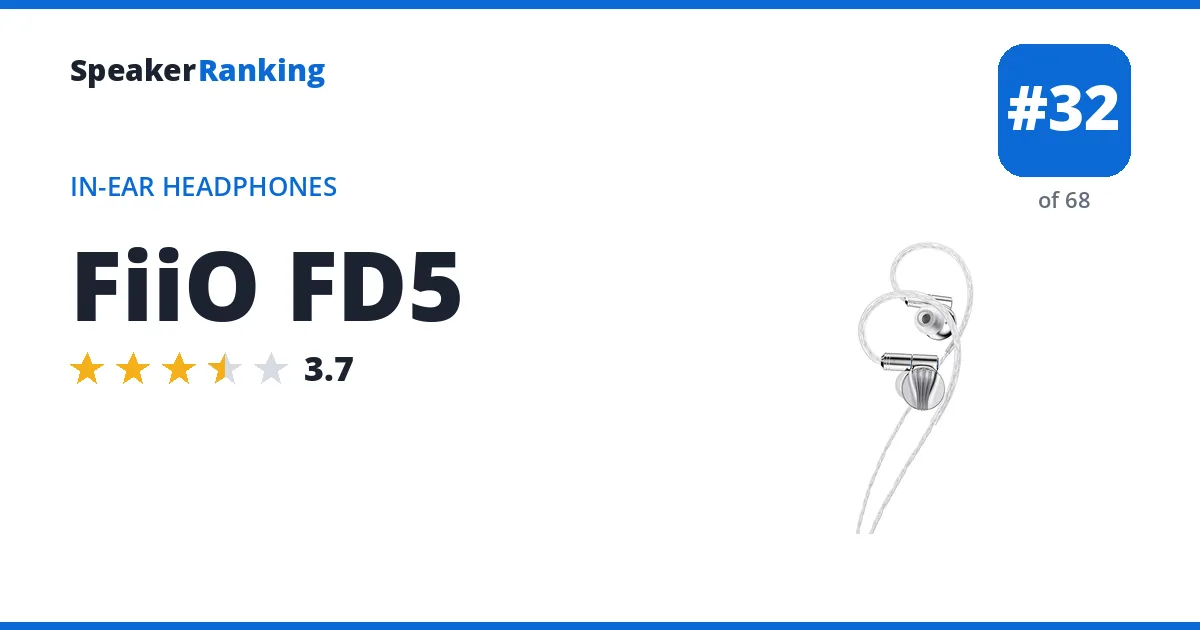
Pros: A preference score of 70 in crinacle’s measurement comes from a single large 12mm dynamic driver. At 32 ohms and 109 dB/mW it needs no dedicated amp, and the slightly warm tilt gives a full, smooth presentation. It also rates higher than the Audio-Technica ATH-CK2000Ti.
Cons: The 2.4 dB deviation from the target is no better than far cheaper sets in this class, which makes the high price hard to justify on tuning alone. The Moondrop Blessing 3 rates much higher for substantially less, and at 11 g per earbud it is on the heavier side for an in-ear.
Full FiiO FD5 review and specifications →
| Back | Closed |
|---|---|
| Connection | Wired |
| Deviation From Target | 2.40 dB standard deviation |
| Driver Type | Dynamic |
| Drivers | 1 x 12mm dynamic |
| Form Factor | In-ear |
| Frequency Response | 10Hz - 40kHz (Manufacturer specified) |
| Harman Preference Score | 70 (measured by crinacle, via AutoEQ) |
| Impedance | 32 ohms |
| Sensitivity | 109 dB/mW |
| Tonal Tilt | -0.45 (negative is warmer, positive brighter) |
| Weight | 0 lbs (11 g) per earbud |
EQ preset to match the Harman target
Set a preamp of -3.8 dB, then add these filters in any parametric equalizer (Wavelet, Equalizer APO, Peace, or a player with parametric EQ). Calculated by AutoEQ from its measured frequency response.
| Filter | Frequency | Gain | Q |
|---|---|---|---|
| Low shelf | 105 Hz | +1.2 dB | 0.70 |
| Peak | 155 Hz | -3.6 dB | 0.58 |
| Peak | 815 Hz | +2.7 dB | 1.04 |
| Peak | 3,920 Hz | +3.3 dB | 2.56 |
| Peak | 5,234 Hz | -3.2 dB | 5.78 |
| High shelf | 10,000 Hz | +0.4 dB | 0.70 |
| Peak | 10,000 Hz | +3.6 dB | 1.21 |
| Peak | 2,540 Hz | -1.4 dB | 4.19 |
| Peak | 40 Hz | -0.4 dB | 2.74 |
| Peak | 5,496 Hz | -1.7 dB | 6.00 |
- Reviews, Comparisons and Sound Samples
 #33 KZ ZST: $21.99 Amazon eBay
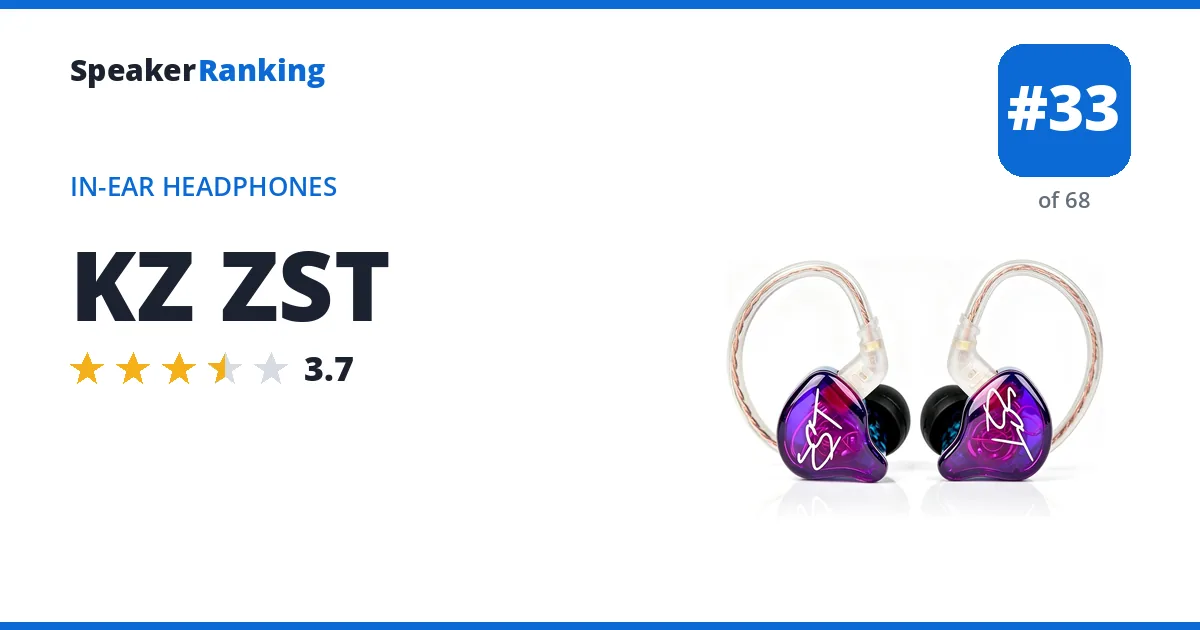
Pros: In oratory1990’s measurement the preference score is 70, with bass about 2.3 dB above target from 60 to 200 Hz for extra warmth and punch, and sub-bass tracking the target within 0.1 dB. The low mids and upper mids stay within about 1 dB, so vocals and instruments sit naturally. The warm and bassy profiles fit it best, and the hybrid pairing of one dynamic and one balanced armature driver costs very little.
Cons: A 9.4 dB dip near 4.4 kHz and 3.7 dB lower presence from 3 to 6 kHz pull back vocal clarity and the attack of snares and guitars. Above 10 kHz the response runs about 6.5 dB hot, with a 10 dB peak near 11 kHz that adds sharpness to cymbals. The TANGZU Wan’er S.G rates higher.
Full KZ ZST review and specifications →
| Released | 2016 (10 years ago) |
|---|---|
| Back | Closed |
| Connection | Wired |
| Deviation From Target | 2.31 dB standard deviation |
| Driver Type | Hybrid (1 dynamic + 1 balanced armature) |
| Drivers | 1 x 10mm dynamic + 1 x balanced armature |
| Form Factor | In-ear |
| Frequency Response | 20Hz - 20kHz (Manufacturer specified) |
| Harman Preference Score | 70 (measured by oratory1990, via AutoEQ) |
| Tonal Tilt | -0.47 (negative is warmer, positive brighter) |
EQ preset to match the Harman target
Set a preamp of -4.5 dB, then add these filters in any parametric equalizer (Wavelet, Equalizer APO, Peace, or a player with parametric EQ). Calculated by AutoEQ from its measured frequency response.
| Filter | Frequency | Gain | Q |
|---|---|---|---|
| Low shelf | 105 Hz | -0.2 dB | 0.70 |
| Peak | 182 Hz | -3.0 dB | 0.62 |
| Peak | 620 Hz | +2.4 dB | 0.63 |
| Peak | 9,298 Hz | -3.1 dB | 3.37 |
| Peak | 1,878 Hz | -4.1 dB | 3.05 |
| High shelf | 10,000 Hz | -0.3 dB | 0.70 |
| Peak | 4,253 Hz | +4.7 dB | 4.05 |
| Peak | 1,321 Hz | -0.6 dB | 2.60 |
| Peak | 3,462 Hz | -1.0 dB | 6.00 |
| Peak | 358 Hz | -0.0 dB | 5.65 |
- Reviews, Comparisons and Sound Samples
- Head-to-Head Comparisons
 #34 HIFIMAN RE2000: $799.00 Amazon eBay
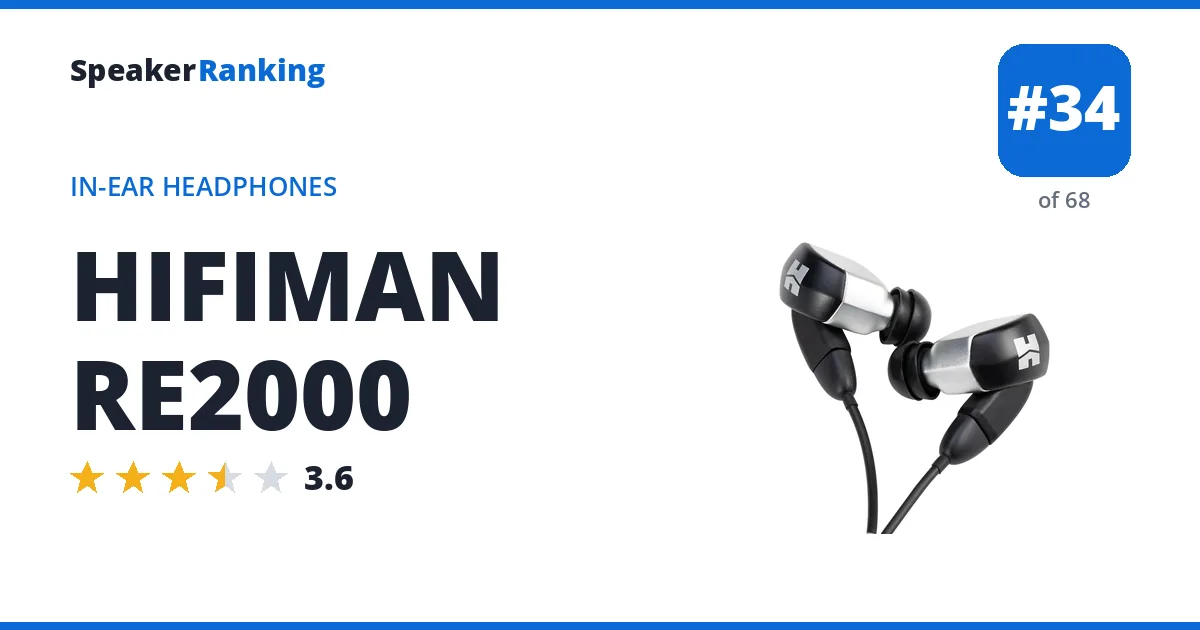
Pros: Crinacle’s measurement gives a Harman preference score of 69 with a deviation of 2.63 dB, a respectable match to the target most listeners prefer. The tonal balance is close to neutral, with a tilt of only 0.32 dB toward brightness, so it avoids sounding either dark or harsh.
Cons: A score of 69 is only middling for a flagship in-ear, and a response that deviates from the target by 2.63 dB leaves audible coloration. The wired-only design has no built-in mic or wireless option. The FiiO FD5 carries a higher rating at a notably lower cost, which makes this model a hard sell on sound value.
Full HIFIMAN RE2000 review and specifications →
| Back | Closed |
|---|---|
| Connection | Wired |
| Deviation From Target | 2.63 dB standard deviation |
| Form Factor | In-ear |
| Harman Preference Score | 69 (measured by crinacle, via AutoEQ) |
| Tonal Tilt | +0.32 (negative is warmer, positive brighter) |
EQ preset to match the Harman target
Set a preamp of -4.8 dB, then add these filters in any parametric equalizer (Wavelet, Equalizer APO, Peace, or a player with parametric EQ). Calculated by AutoEQ from its measured frequency response.
| Filter | Frequency | Gain | Q |
|---|---|---|---|
| Low shelf | 105 Hz | +7.5 dB | 0.70 |
| Peak | 76 Hz | -4.7 dB | 0.24 |
| Peak | 916 Hz | +5.3 dB | 0.86 |
| Peak | 4,638 Hz | -5.1 dB | 5.93 |
| Peak | 1,592 Hz | -2.1 dB | 1.01 |
| High shelf | 10,000 Hz | -4.6 dB | 0.70 |
| Peak | 6,553 Hz | +3.5 dB | 5.51 |
| Peak | 8,895 Hz | +3.3 dB | 2.20 |
| Peak | 5,174 Hz | -1.3 dB | 5.99 |
| Peak | 7,469 Hz | -0.3 dB | 5.72 |
- Reviews, Comparisons and Sound Samples
 #35 TFZ T2 Galaxy: $59.00 Amazon eBay
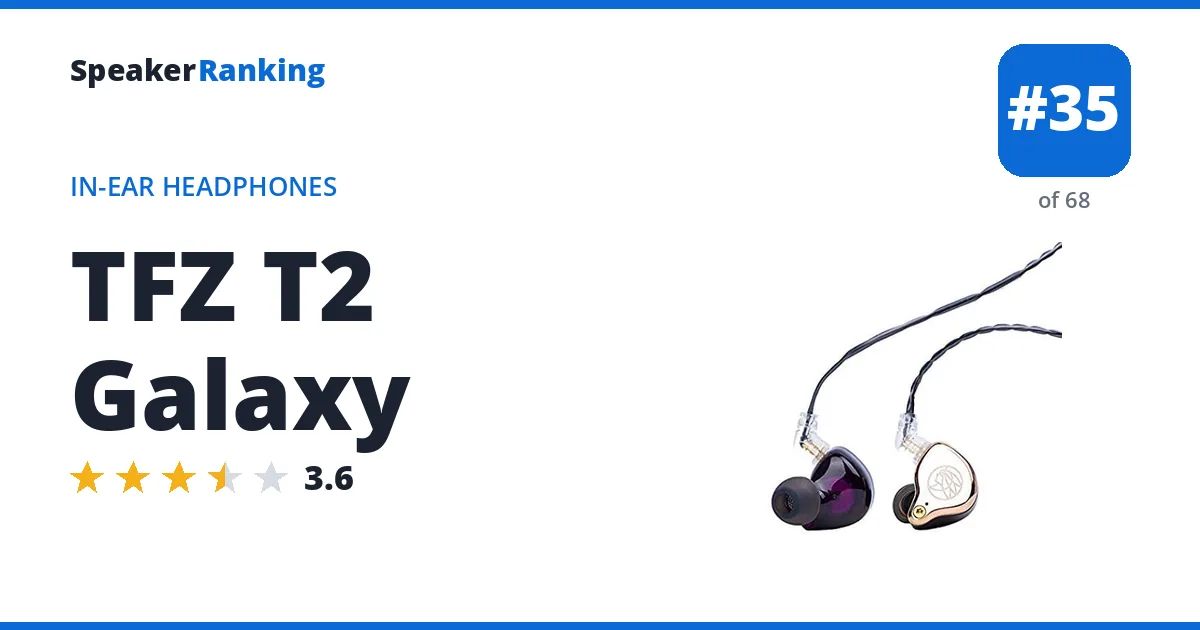
Pros: Oratory1990’s measurement shows sub-bass about 3.7 dB and bass about 3.5 dB above the Harman target, which gives kick drums and bass lines a solid, punchy foundation that suits bassy and V-shaped tastes. The 16 ohm impedance and 110 dB/mW sensitivity mean it plays loud from a phone without an amp. The preference score of 69 is respectable for a budget wired in-ear, and its 12 mm dynamic driver stays simple and easy to drive.
Cons: A peak of 4.9 dB near 8 kHz can make cymbals and sibilant vocals sound sharp. Output above 10 kHz sits roughly 4.3 dB under target, with a 6.2 dB dip near 11.9 kHz, so the top end loses air and sparkle. The bass boost of more than 3 dB can also make male vocals and low instruments sound heavier than they should. There is no built-in microphone.
Full TFZ T2 Galaxy review and specifications →
| Back | Closed |
|---|---|
| Built-in Microphone | No |
| Connection | Wired |
| Deviation From Target | 2.12 dB standard deviation |
| Driver Type | Dynamic |
| Drivers | 1 x 12mm dynamic |
| Form Factor | In-ear |
| Frequency Response | 5Hz - 40kHz (Manufacturer specified) |
| Harman Preference Score | 69 (measured by oratory1990, via AutoEQ) |
| Impedance | 16 ohms |
| Sensitivity | 110 dB/mW |
| Tonal Tilt | -0.77 (negative is warmer, positive brighter) |
EQ preset to match the Harman target
Set a preamp of -3.4 dB, then add these filters in any parametric equalizer (Wavelet, Equalizer APO, Peace, or a player with parametric EQ). Calculated by AutoEQ from its measured frequency response.
| Filter | Frequency | Gain | Q |
|---|---|---|---|
| Low shelf | 105 Hz | -3.4 dB | 0.70 |
| Peak | 750 Hz | +3.0 dB | 0.89 |
| Peak | 178 Hz | -2.3 dB | 1.50 |
| Peak | 1,788 Hz | -2.0 dB | 1.39 |
| Peak | 3,012 Hz | +2.5 dB | 3.09 |
| High shelf | 10,000 Hz | +3.4 dB | 0.70 |
| Peak | 4,584 Hz | -3.9 dB | 5.24 |
| Peak | 5,910 Hz | +3.5 dB | 5.10 |
| Peak | 70 Hz | +1.0 dB | 1.75 |
| Peak | 124 Hz | -0.7 dB | 2.97 |
- Reviews, Comparisons and Sound Samples
 #36 TRN MT1: $13.95 Amazon eBay
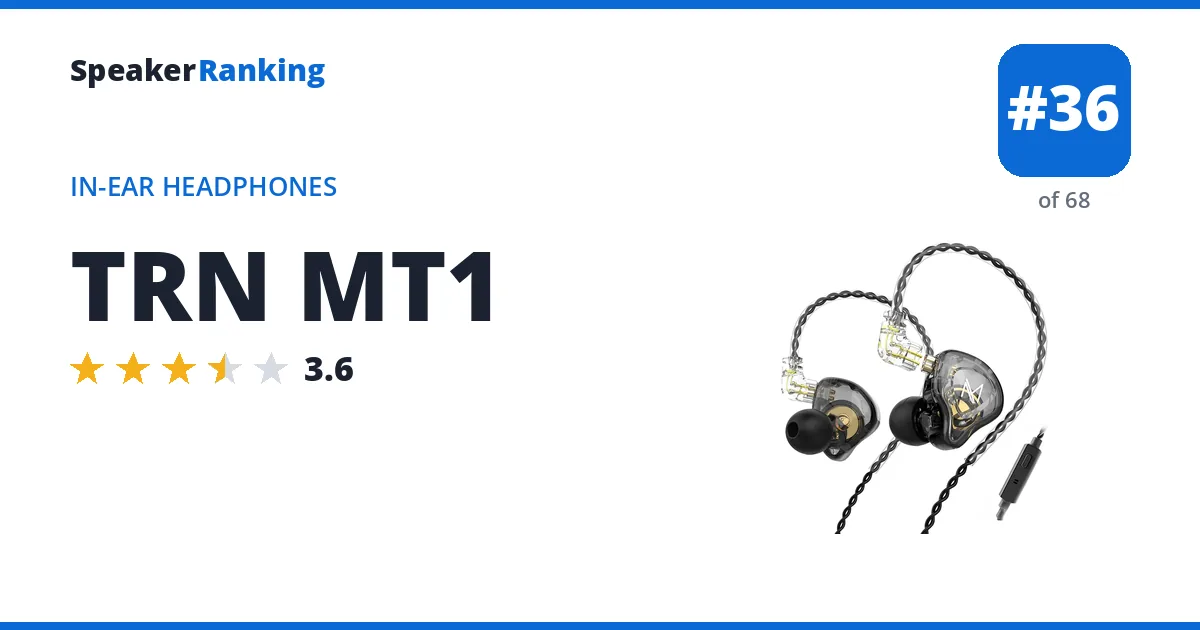
Pros: Crinacle’s measurement gives a Harman preference score of 69, a solid result for such an inexpensive wired in-ear. A 22 ohm impedance and 106 dB sensitivity let it run loudly from any phone or laptop without an amp. It includes an inline microphone for calls, and the single 10 mm dynamic driver keeps the sound coherent.
Cons: A deviation of 2.46 dB from the target means some coloration remains in the midrange and treble. The wired connection means no wireless freedom, and the CCA CRA is rated higher at a similar cost.
Full TRN MT1 review and specifications →
| Back | Closed |
|---|---|
| Built-in Microphone | Yes |
| Connection | Wired |
| Deviation From Target | 2.46 dB standard deviation |
| Driver Type | Dynamic |
| Drivers | 1 x 10mm dynamic |
| Form Factor | In-ear |
| Frequency Response | 20Hz - 20kHz (Manufacturer specified) |
| Harman Preference Score | 69 (measured by crinacle, via AutoEQ) |
| Impedance | 22 ohms |
| Sensitivity | 106 dB |
| Tonal Tilt | -0.34 (negative is warmer, positive brighter) |
EQ preset to match the Harman target
Set a preamp of -4.6 dB, then add these filters in any parametric equalizer (Wavelet, Equalizer APO, Peace, or a player with parametric EQ). Calculated by AutoEQ from its measured frequency response.
| Filter | Frequency | Gain | Q |
|---|---|---|---|
| Low shelf | 105 Hz | +0.1 dB | 0.70 |
| Peak | 838 Hz | +4.1 dB | 0.67 |
| Peak | 9,762 Hz | +6.7 dB | 0.47 |
| Peak | 156 Hz | -2.7 dB | 0.78 |
| Peak | 3,174 Hz | -6.2 dB | 0.55 |
| High shelf | 10,000 Hz | -7.6 dB | 0.70 |
| Peak | 3,444 Hz | +3.5 dB | 3.06 |
| Peak | 4,523 Hz | -6.4 dB | 2.49 |
| Peak | 6,251 Hz | +3.6 dB | 0.84 |
| Peak | 2,461 Hz | -2.8 dB | 4.84 |
- Reviews, Comparisons and Sound Samples
- Head-to-Head Comparisons
 #37 Tin HiFi P1 Max: $219.00 Amazon eBay
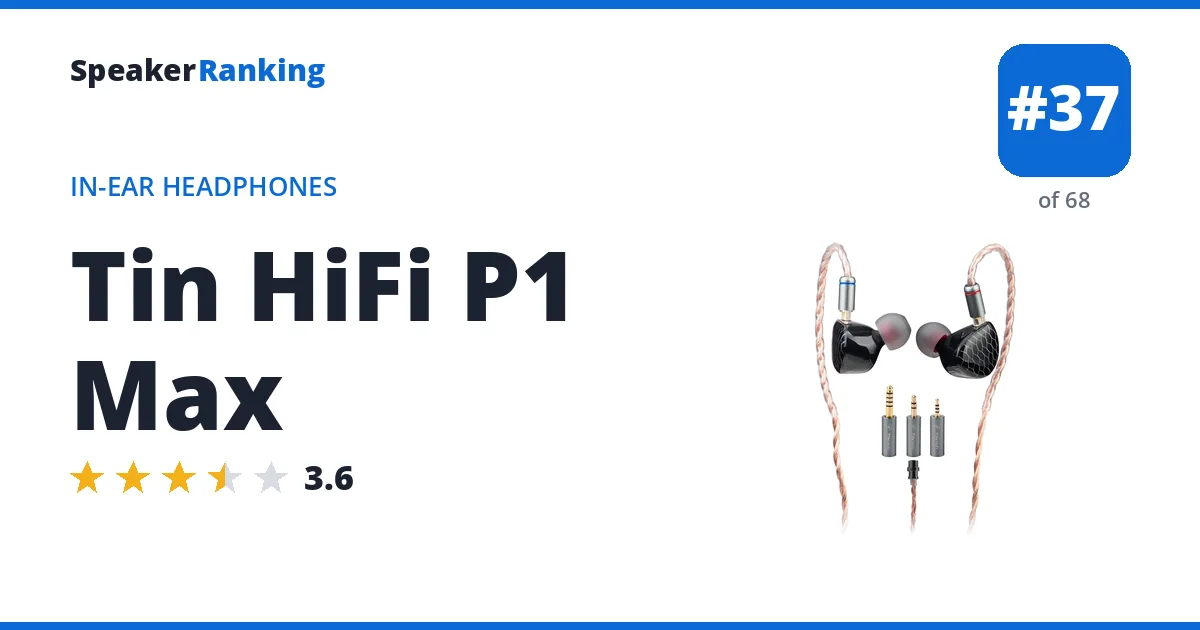
Pros: The 14.2 mm planar magnetic driver is an uncommon design at this size, and Crinacle’s measurement gives a Harman preference score of 69 with an almost flat tilt of 0.05 dB, so the balance is neither warm nor bright. Its 16 ohm impedance and claimed 10 Hz to 20 kHz response suit a wide range of sources.
Cons: The 98 dB sensitivity is on the low side for an in-ear, so it benefits from a stronger source than a basic phone dongle. A deviation of 2.79 dB around the target is the roughest of its group, which means audible peaks and dips remain. The Samsung Galaxy Buds2 and Shuoer S12 Pro are both rated higher at a lower cost. There is no listed microphone or wireless connection.
Full Tin HiFi P1 Max review and specifications →
| Back | Closed |
|---|---|
| Connection | Wired |
| Deviation From Target | 2.79 dB standard deviation |
| Driver Type | Planar magnetic |
| Drivers | 1 x 14.2mm planar magnetic |
| Form Factor | In-ear |
| Frequency Response | 10Hz - 20kHz (Manufacturer specified) |
| Harman Preference Score | 69 (measured by crinacle, via AutoEQ) |
| Impedance | 16 ohms |
| Sensitivity | 98 dB @ 1kHz |
| Tonal Tilt | +0.05 (negative is warmer, positive brighter) |
EQ preset to match the Harman target
Set a preamp of -5.5 dB, then add these filters in any parametric equalizer (Wavelet, Equalizer APO, Peace, or a player with parametric EQ). Calculated by AutoEQ from its measured frequency response.
| Filter | Frequency | Gain | Q |
|---|---|---|---|
| Low shelf | 105 Hz | +3.6 dB | 0.70 |
| Peak | 4,217 Hz | +5.8 dB | 1.42 |
| Peak | 124 Hz | -2.9 dB | 0.65 |
| Peak | 1,773 Hz | -2.6 dB | 1.13 |
| Peak | 2,792 Hz | +1.7 dB | 3.50 |
| High shelf | 10,000 Hz | -4.7 dB | 0.70 |
| Peak | 434 Hz | +1.1 dB | 2.30 |
| Peak | 228 Hz | -0.5 dB | 1.92 |
| Peak | 6,433 Hz | +1.6 dB | 5.31 |
| Peak | 43 Hz | -0.4 dB | 2.18 |
- Reviews, Comparisons and Sound Samples
 #38 KZ ZS10 Pro: $44.99 Amazon eBay
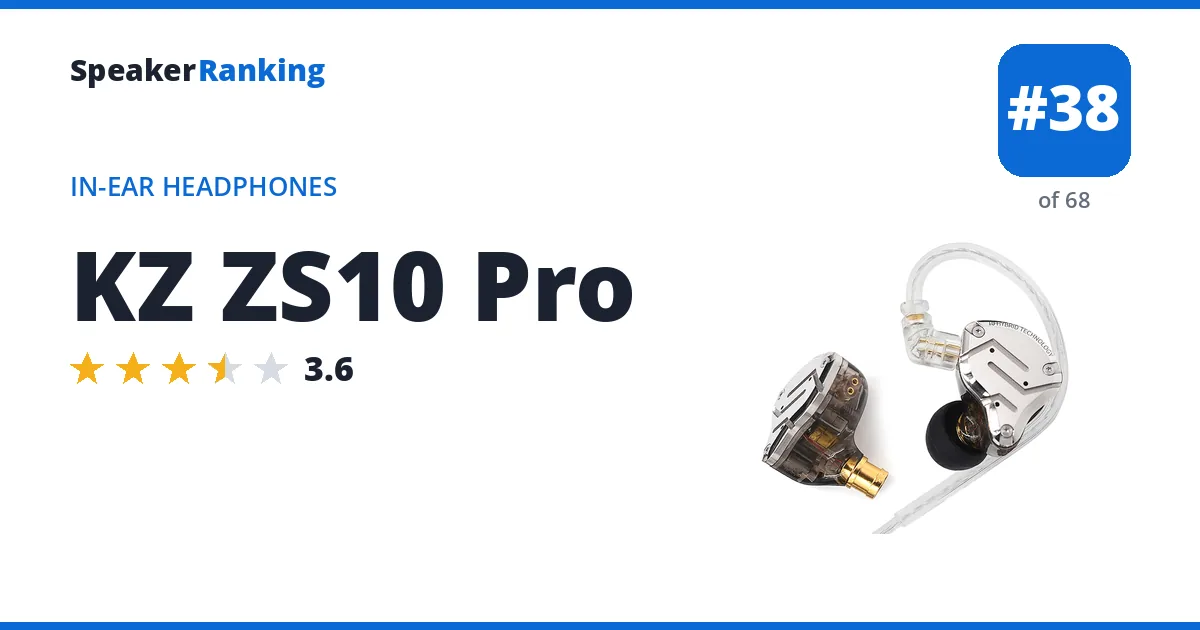
Pros: Five drivers per side, one dynamic and four balanced armature, give a hybrid layout rare at this price, and Crinacle’s measurement returns a Harman preference score of 69. The 24 ohm impedance and 111 dB sensitivity make it easy to drive from a phone. The slight warm tilt of 0.43 dB below neutral keeps the balance relaxed.
Cons: A deviation of 2.44 dB from the target leaves some uneven spots across the frequency range. The hybrid design is wired only and lists no microphone. The CCA C12 is rated higher at a similar cost.
Full KZ ZS10 Pro review and specifications →
| Back | Closed |
|---|---|
| Connection | Wired |
| Deviation From Target | 2.44 dB standard deviation |
| Driver Type | Hybrid (1 dynamic + 4 balanced armature) |
| Drivers | 1 x dynamic + 4 x balanced armature |
| Form Factor | In-ear |
| Frequency Response | 7Hz - 40kHz (Manufacturer specified) |
| Harman Preference Score | 69 (measured by crinacle, via AutoEQ) |
| Impedance | 24 ohms |
| Sensitivity | 111 dB |
| Tonal Tilt | -0.43 (negative is warmer, positive brighter) |
EQ preset to match the Harman target
Set a preamp of -5.0 dB, then add these filters in any parametric equalizer (Wavelet, Equalizer APO, Peace, or a player with parametric EQ). Calculated by AutoEQ from its measured frequency response.
| Filter | Frequency | Gain | Q |
|---|---|---|---|
| Low shelf | 105 Hz | +1.1 dB | 0.70 |
| Peak | 164 Hz | -3.7 dB | 0.62 |
| Peak | 772 Hz | +3.3 dB | 1.02 |
| Peak | 2,169 Hz | -4.3 dB | 2.52 |
| Peak | 3,267 Hz | +3.7 dB | 2.93 |
| High shelf | 10,000 Hz | +0.9 dB | 0.70 |
| Peak | 6,415 Hz | +4.7 dB | 3.96 |
| Peak | 4,521 Hz | -3.6 dB | 6.00 |
| Peak | 8,356 Hz | +1.6 dB | 4.13 |
| Peak | 4,784 Hz | +0.6 dB | 5.93 |
- Reviews, Comparisons and Sound Samples
 #39 iBasso IT04: $499.00 Amazon eBay
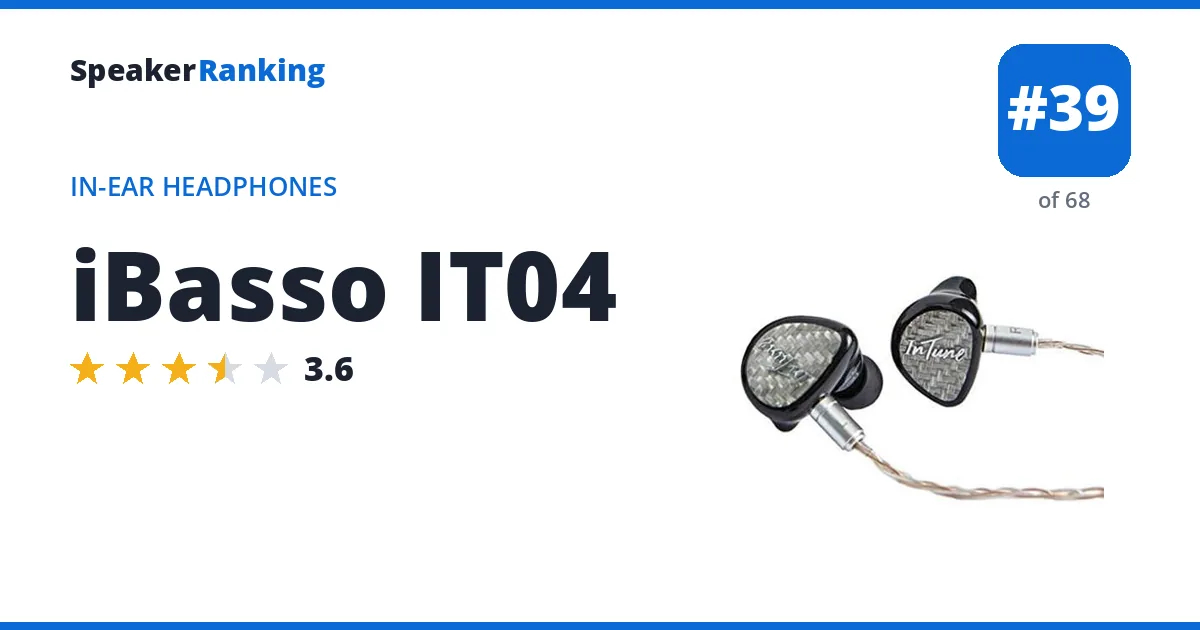
Pros: A preference score of 69 in crinacle’s measurement puts the IT04 in solid, listenable territory for an in-ear. The 110 dB sensitivity means it is easy to drive from a phone or dongle without a dedicated amp. At 13 g with a hybrid of one 10mm dynamic driver and three balanced armatures, it is light and uses a driver mix aimed at bass weight plus detail.
Cons: A score of 69 trails the best in-ears, so the tuning is noticeably off the Harman target in places. The FiiO FD5 has a higher rating at a similar price, which makes it the safer pick if the Harman fit matters most. It is wired only, with no wireless option.
Full iBasso IT04 review and specifications →
| Back | Closed |
|---|---|
| Connection | Wired |
| Deviation From Target | 2.79 dB standard deviation |
| Driver Type | Hybrid (1 dynamic + 3 balanced armature) |
| Drivers | 1 x 10mm dynamic + 3 x balanced armature |
| Form Factor | In-ear |
| Frequency Response | 5Hz - 40kHz (Manufacturer specified) |
| Harman Preference Score | 69 (measured by crinacle, via AutoEQ) |
| Sensitivity | 110 dB |
| Tonal Tilt | +0.02 (negative is warmer, positive brighter) |
| Weight | 0 lbs (13 g) |
EQ preset to match the Harman target
Set a preamp of -6.2 dB, then add these filters in any parametric equalizer (Wavelet, Equalizer APO, Peace, or a player with parametric EQ). Calculated by AutoEQ from its measured frequency response.
| Filter | Frequency | Gain | Q |
|---|---|---|---|
| Low shelf | 105 Hz | +2.9 dB | 0.70 |
| Peak | 230 Hz | -5.1 dB | 0.53 |
| Peak | 4,860 Hz | +5.6 dB | 2.87 |
| Peak | 770 Hz | +3.6 dB | 0.27 |
| Peak | 1,536 Hz | -4.0 dB | 1.44 |
| High shelf | 10,000 Hz | +3.7 dB | 0.70 |
| Peak | 8,235 Hz | -2.5 dB | 1.65 |
| Peak | 5,832 Hz | +1.4 dB | 4.39 |
| Peak | 2,978 Hz | +1.5 dB | 5.39 |
| Peak | 3,642 Hz | -0.9 dB | 6.00 |
- Reviews, Comparisons and Sound Samples
 #40 KZ PR1: $87.99 Amazon eBay
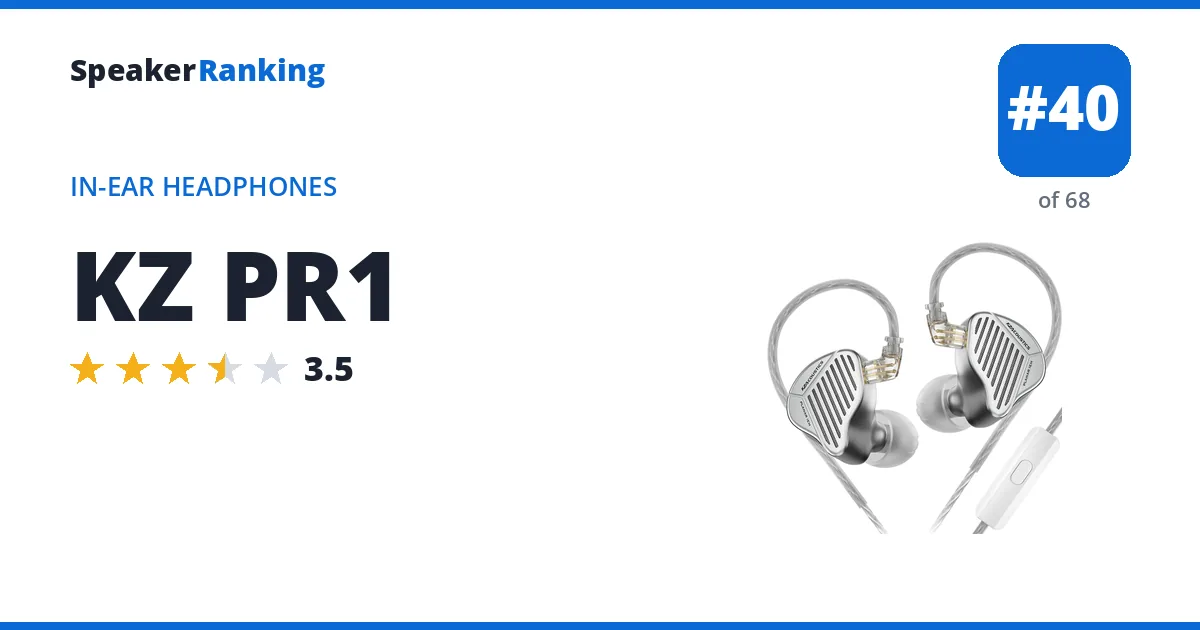
Pros: The 13.2 mm planar magnetic driver is an unusual choice at this size, and Crinacle’s measurement gives a Harman preference score of 67 with a deviation of 2.36 dB. The 16 ohm impedance suits portable sources, and the 20 Hz to 40 kHz claimed range is wide.
Cons: Sensitivity of 96 dB is low for an in-ear, so volume headroom from a phone can be limited and a stronger source helps. A tilt of 0.76 dB toward the warm side gives a darker balance than the target. The TFZ T2 Galaxy is rated higher and costs less. No microphone is listed.
Full KZ PR1 review and specifications →
| Back | Closed |
|---|---|
| Connection | Wired |
| Deviation From Target | 2.36 dB standard deviation |
| Driver Type | Planar magnetic |
| Drivers | 1 x 13.2mm planar magnetic |
| Form Factor | In-ear |
| Frequency Response | 20Hz - 40kHz (Manufacturer specified) |
| Harman Preference Score | 67 (measured by crinacle, via AutoEQ) |
| Impedance | 16 ohms |
| Sensitivity | 96 dB |
| Tonal Tilt | -0.76 (negative is warmer, positive brighter) |
EQ preset to match the Harman target
Set a preamp of -3.4 dB, then add these filters in any parametric equalizer (Wavelet, Equalizer APO, Peace, or a player with parametric EQ). Calculated by AutoEQ from its measured frequency response.
| Filter | Frequency | Gain | Q |
|---|---|---|---|
| Low shelf | 105 Hz | -1.7 dB | 0.70 |
| Peak | 171 Hz | -3.5 dB | 0.86 |
| Peak | 819 Hz | +3.1 dB | 1.02 |
| Peak | 4,351 Hz | +4.0 dB | 1.33 |
| Peak | 2,387 Hz | -2.6 dB | 1.15 |
| High shelf | 10,000 Hz | -15.5 dB | 0.70 |
| Peak | 6,790 Hz | +4.5 dB | 2.11 |
| Peak | 5,647 Hz | -2.4 dB | 4.34 |
| Peak | 9,447 Hz | +3.7 dB | 2.87 |
| Peak | 65 Hz | +0.2 dB | 2.39 |
- Reviews, Comparisons and Sound Samples
 #41 Sennheiser IE 40 Pro: $109.00 Amazon eBay
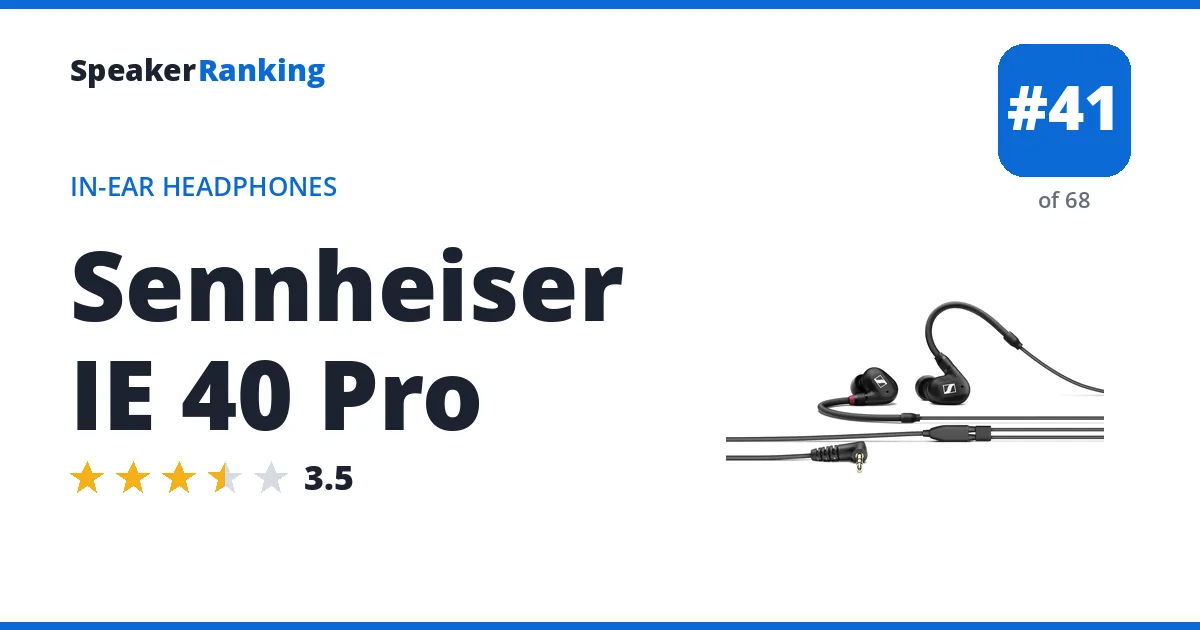
Pros: Oratory1990’s measurement shows bass 1.0 dB and low mids 1.4 dB above target, a gentle warmth that suits relaxed listening, and the preference score of 67 is acceptable. A 20 ohm impedance and 115 dB SPL/V sensitivity mean a phone drives it with ease, which suits monitoring and portable use. The balance leans toward warm and V-shaped tastes.
Cons: Presence is 4.5 dB under target across 3 to 6 kHz, with a 6.4 dB dip near 3.1 kHz, so vocals and guitars sound recessed and detail is dulled. Sub-bass is 3.6 dB light, so deep rumble is absent. Then the top end swings the opposite way, with a peak of 8.3 dB at 11.9 kHz and air 5.7 dB over target, which can add a brittle sheen. Tonal balance is clearly uneven, with a deviation of 2.94 dB.
Full Sennheiser IE 40 Pro review and specifications →
| Back | Closed |
|---|---|
| Connection | Wired |
| Deviation From Target | 2.94 dB standard deviation |
| Driver Type | Dynamic |
| Drivers | 1 x 10mm dynamic |
| Form Factor | In-ear |
| Frequency Response | 20Hz - 18kHz (Manufacturer specified) |
| Harman Preference Score | 67 (measured by oratory1990, via AutoEQ) |
| Impedance | 20 ohms |
| Sensitivity | 115 dB SPL/V |
| Tonal Tilt | +0.03 (negative is warmer, positive brighter) |
EQ preset to match the Harman target
Set a preamp of -5.6 dB, then add these filters in any parametric equalizer (Wavelet, Equalizer APO, Peace, or a player with parametric EQ). Calculated by AutoEQ from its measured frequency response.
| Filter | Frequency | Gain | Q |
|---|---|---|---|
| Low shelf | 105 Hz | +5.6 dB | 0.70 |
| Peak | 2,997 Hz | +5.7 dB | 1.48 |
| Peak | 75 Hz | -4.1 dB | 0.38 |
| Peak | 1,267 Hz | -0.8 dB | 2.09 |
| Peak | 261 Hz | -1.1 dB | 1.70 |
| High shelf | 10,000 Hz | -3.7 dB | 0.70 |
| Peak | 9,787 Hz | -3.3 dB | 1.71 |
| Peak | 4,341 Hz | +1.1 dB | 3.77 |
| Peak | 6,644 Hz | +2.1 dB | 5.97 |
| Peak | 7,958 Hz | -1.2 dB | 5.41 |
- Reviews, Comparisons and Sound Samples
 #42 CCA CSN: $25.99 Amazon eBay
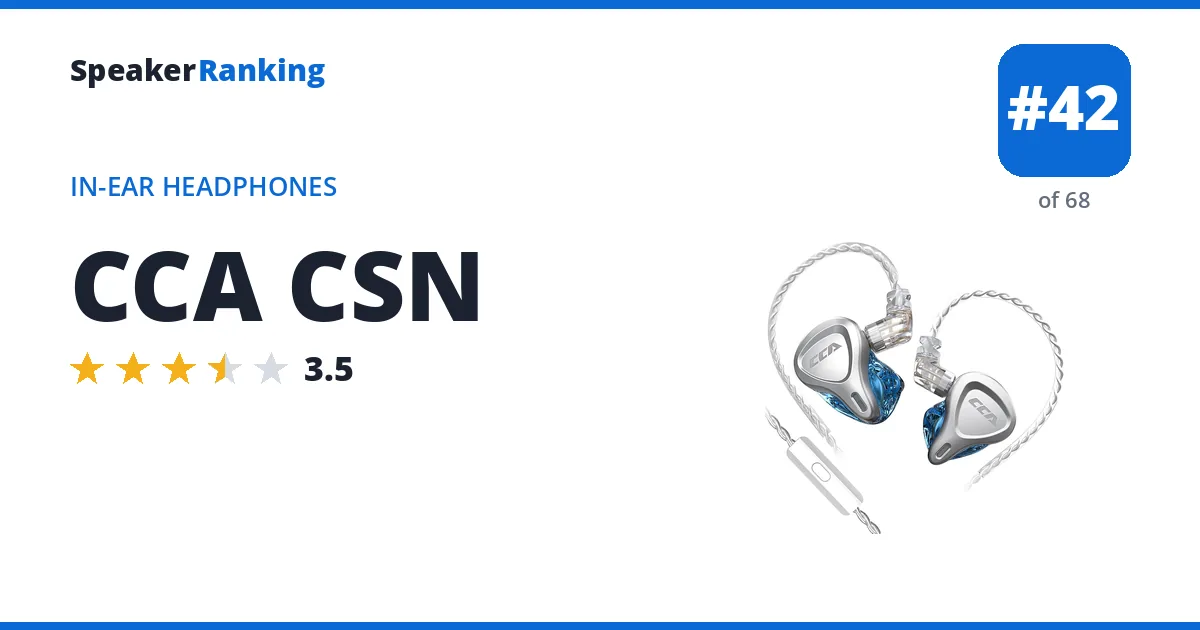
Pros: A hybrid pairing of a 10 mm dynamic driver and a balanced armature gives Crinacle’s measurement a Harman preference score of 67, which is solid for a very inexpensive wired set. With 22.5 ohms and 112 dB/mW sensitivity it plays loud from a phone. The slight warm tilt of 0.46 dB keeps it from sounding harsh.
Cons: A deviation of 2.64 dB from the target leaves clear coloration in places. It is wired only with no microphone listed. The MEE Audio M6 Pro, CCA C10 and KZ ZST are all rated higher at close to the same cost.
Full CCA CSN review and specifications →
| Back | Closed |
|---|---|
| Connection | Wired |
| Deviation From Target | 2.64 dB standard deviation |
| Driver Type | Hybrid (1 dynamic + 1 balanced armature) |
| Drivers | 1 x 10mm dynamic + 1 x balanced armature |
| Form Factor | In-ear |
| Frequency Response | 20Hz - 40kHz |
| Harman Preference Score | 67 (measured by crinacle, via AutoEQ) |
| Impedance | 22.5 ohms |
| Sensitivity | 112 dB/mW |
| Tonal Tilt | -0.46 (negative is warmer, positive brighter) |
EQ preset to match the Harman target
Set a preamp of -5.7 dB, then add these filters in any parametric equalizer (Wavelet, Equalizer APO, Peace, or a player with parametric EQ). Calculated by AutoEQ from its measured frequency response.
| Filter | Frequency | Gain | Q |
|---|---|---|---|
| Low shelf | 105 Hz | +0.8 dB | 0.70 |
| Peak | 164 Hz | -3.5 dB | 0.59 |
| Peak | 3,200 Hz | +7.0 dB | 1.48 |
| Peak | 1,878 Hz | -6.0 dB | 1.38 |
| Peak | 809 Hz | +2.8 dB | 0.77 |
| High shelf | 10,000 Hz | +3.1 dB | 0.70 |
| Peak | 5,170 Hz | -4.2 dB | 5.86 |
| Peak | 6,353 Hz | +2.7 dB | 6.00 |
| Peak | 4,393 Hz | +1.6 dB | 6.00 |
| Peak | 37 Hz | -0.2 dB | 2.04 |
- Reviews, Comparisons and Sound Samples
 #43 JVC HA-FW1500: $766.28 Amazon eBay
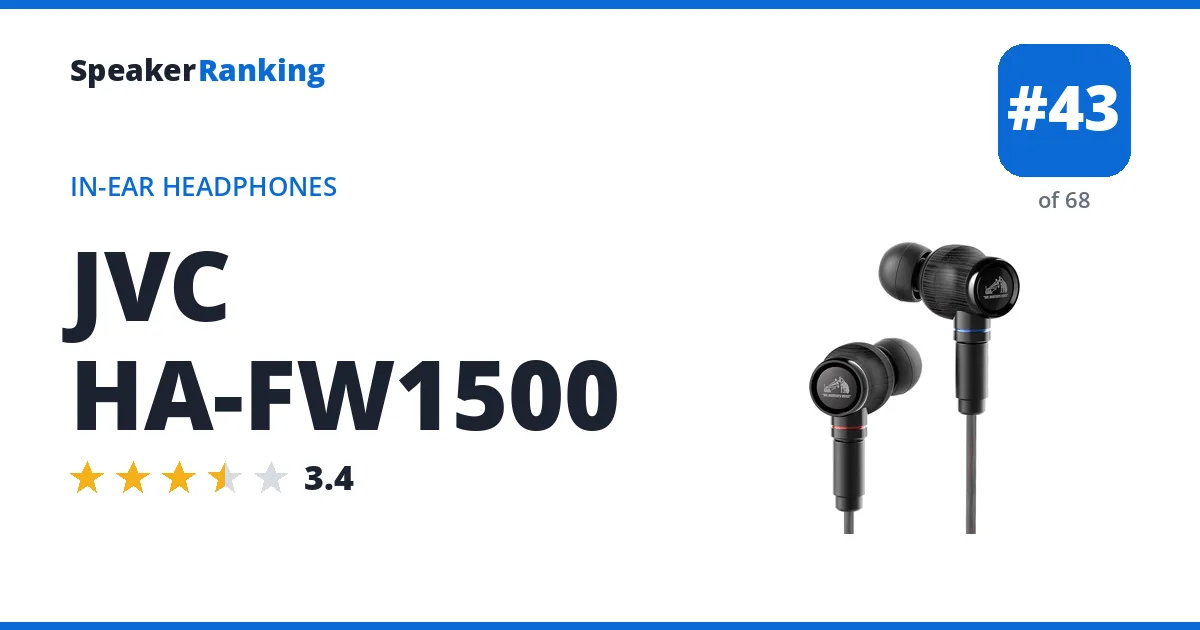
Pros: The 11 mm dynamic driver rates a manufacturer specified 6 Hz to 52 kHz, and Crinacle’s measurement shows a Harman preference score of 66 with a mild warm tilt of 0.53 dB. The 16 ohm impedance and 103 dB/mW sensitivity make it easy for a phone to drive. It has been out since late 2019.
Cons: A score of 66 is middling and a deviation of 2.69 dB means audible coloration, which is hard to justify at a flagship price. The HIFIMAN RE2000 and FiiO FD5 are both rated higher, and the FiiO costs far less. It is wired only and lists no microphone.
Full JVC HA-FW1500 review and specifications →
| Released | Nov 2019 (6 years ago) |
|---|---|
| Back | Closed |
| Connection | Wired |
| Deviation From Target | 2.69 dB standard deviation |
| Driver Type | Dynamic |
| Drivers | 1 x 11mm dynamic |
| Form Factor | In-ear |
| Frequency Response | 6Hz - 52kHz (Manufacturer specified) |
| Harman Preference Score | 66 (measured by crinacle, via AutoEQ) |
| Impedance | 16 ohms |
| Sensitivity | 103 dB/mW |
| Tonal Tilt | -0.53 (negative is warmer, positive brighter) |
EQ preset to match the Harman target
Set a preamp of -6.5 dB, then add these filters in any parametric equalizer (Wavelet, Equalizer APO, Peace, or a player with parametric EQ). Calculated by AutoEQ from its measured frequency response.
| Filter | Frequency | Gain | Q |
|---|---|---|---|
| Low shelf | 105 Hz | +1.3 dB | 0.70 |
| Peak | 163 Hz | -4.2 dB | 0.59 |
| Peak | 9,088 Hz | +6.3 dB | 1.23 |
| Peak | 895 Hz | +3.7 dB | 1.07 |
| Peak | 4,924 Hz | -4.1 dB | 3.58 |
| High shelf | 10,000 Hz | +1.0 dB | 0.70 |
| Peak | 42 Hz | -0.2 dB | 1.53 |
| Peak | 3,050 Hz | -0.7 dB | 4.21 |
| Peak | 2,204 Hz | +0.8 dB | 4.04 |
| Peak | 1,609 Hz | -0.5 dB | 3.41 |
- Reviews, Comparisons and Sound Samples
 #44 Sennheiser Momentum True Wireless 3: $111.99 Discontinued Amazon eBay
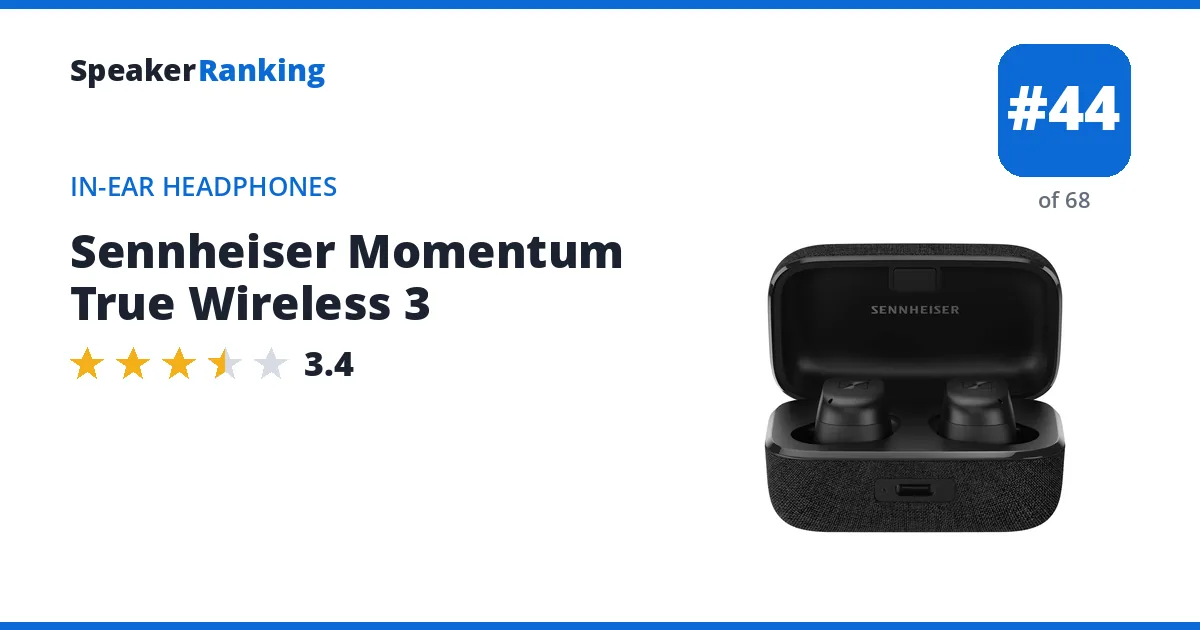
Newer model: the Sennheiser MOMENTUM True Wireless 4, ranked lower, rated 3.3/5, released Feb 2024. It adds LC3. See every Sennheiser Momentum True Wireless generation.
Pros: Active noise cancelling, Bluetooth 5.2 and aptX Adaptive support (alongside SBC, AAC and aptX) add real convenience, and battery life is 7 hours per charge with up to 28 hours using the case. At 5.8 g per earbud with an IPX4 rating, it handles workouts and light rain. Oratory1990’s measurement shows bass and sub-bass within 1 dB of target, giving a clean, warm foundation that suits warm and bassy tastes.
Cons: Presence between 3 and 6 kHz is 6.9 dB under target with a 7.6 dB dip near 4.4 kHz, so vocals, snare and guitar edges sound distant and veiled. Air above 10 kHz runs 5.4 dB hot, with a peak of 4.9 dB near 10.5 kHz, which adds a hissy edge on top of the recessed mids. The preference score of 66 and deviation of 2.59 dB confirm the response sits well off the target. The KZ PR1 is rated higher at a similar cost, though it lacks wireless and ANC. Discontinued.
Full Sennheiser Momentum True Wireless 3 review and specifications →
| Released | Apr 2022 (4 years ago) |
|---|---|
| Active Noise Cancelling | Yes |
| Back | Closed |
| Battery Life | 7 hours (28 with case, Manufacturer specified) |
| Bluetooth Codecs | SBC, AAC, aptX, aptX Adaptive |
| Bluetooth Version | 5.2 |
| Built-in Microphone | Yes |
| Connection | True wireless |
| Deviation From Target | 2.59 dB standard deviation |
| Driver Type | Dynamic |
| Drivers | 1 x 7mm dynamic |
| Form Factor | In-ear |
| Frequency Response | 5Hz - 21kHz (Manufacturer specified) |
| Harman Preference Score | 66 (measured by oratory1990, via AutoEQ) |
| IP Rating | IPX4 |
| Sensitivity | 107 dB SPL (1 kHz / 1 mW) |
| Tonal Tilt | -0.85 (negative is warmer, positive brighter) |
| Weight | 0 lbs (5.8 g) per earbud |
EQ preset to match the Harman target
Set a preamp of -5.3 dB, then add these filters in any parametric equalizer (Wavelet, Equalizer APO, Peace, or a player with parametric EQ). Calculated by AutoEQ from its measured frequency response.
| Filter | Frequency | Gain | Q |
|---|---|---|---|
| Low shelf | 105 Hz | -2.6 dB | 0.70 |
| Peak | 4,231 Hz | +5.9 dB | 1.39 |
| Peak | 209 Hz | -2.2 dB | 0.78 |
| Peak | 1,433 Hz | -2.6 dB | 1.99 |
| Peak | 69 Hz | +1.5 dB | 1.35 |
| High shelf | 10,000 Hz | -5.4 dB | 0.70 |
| Peak | 5,556 Hz | +1.7 dB | 5.29 |
| Peak | 759 Hz | +0.5 dB | 2.36 |
| Peak | 335 Hz | -0.4 dB | 3.16 |
| Peak | 4,230 Hz | -0.6 dB | 5.10 |
- Reviews, Comparisons and Sound Samples
- Head-to-Head Comparisons
 #45 Whizzer HE01: $45.00 Amazon eBay
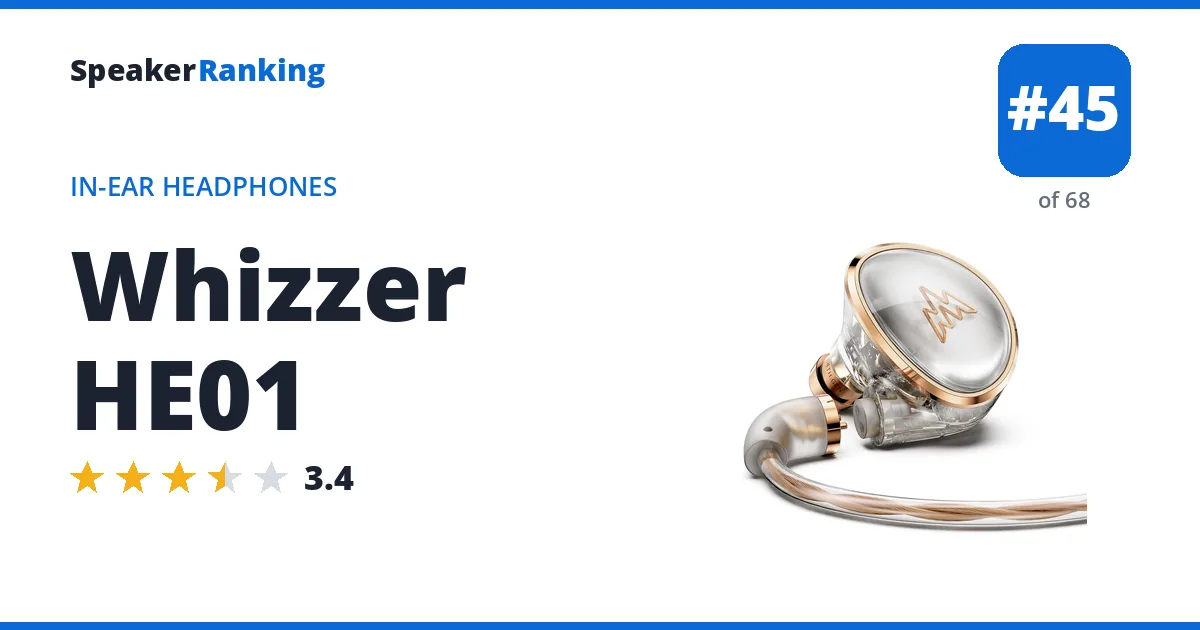
Pros: Crinacle’s measurement gives a Harman preference score of 66, which puts the tuning in decent territory for a budget in-ear. The 18 ohm impedance and 112 dB/mW sensitivity make it easy to drive from a phone or dongle without an amp. A single dynamic driver and a slightly warm tilt suit relaxed, bass-forward listening.
Cons: The response is uneven, with a standard deviation of 2.78 dB around the target, so some instruments will sound tonally off. There is no built-in microphone, so it only works for music and not for calls.
Full Whizzer HE01 review and specifications →
| Back | Closed |
|---|---|
| Built-in Microphone | No |
| Connection | Wired |
| Deviation From Target | 2.78 dB standard deviation |
| Driver Type | Dynamic |
| Form Factor | In-ear |
| Frequency Response | 15Hz - 40kHz (Manufacturer specified) |
| Harman Preference Score | 66 (measured by crinacle, via AutoEQ) |
| Impedance | 18 ohms |
| Sensitivity | 112 dB/mW |
| Tonal Tilt | -0.49 (negative is warmer, positive brighter) |
EQ preset to match the Harman target
Set a preamp of -5.8 dB, then add these filters in any parametric equalizer (Wavelet, Equalizer APO, Peace, or a player with parametric EQ). Calculated by AutoEQ from its measured frequency response.
| Filter | Frequency | Gain | Q |
|---|---|---|---|
| Low shelf | 105 Hz | +1.4 dB | 0.70 |
| Peak | 5,768 Hz | +6.2 dB | 1.56 |
| Peak | 147 Hz | -4.0 dB | 0.85 |
| Peak | 4,048 Hz | -4.4 dB | 1.31 |
| Peak | 8,692 Hz | +3.8 dB | 1.09 |
| High shelf | 10,000 Hz | -3.5 dB | 0.70 |
| Peak | 855 Hz | +3.1 dB | 1.21 |
| Peak | 1,897 Hz | -1.5 dB | 1.05 |
| Peak | 277 Hz | -0.9 dB | 1.84 |
| Peak | 3,401 Hz | +1.1 dB | 3.63 |
- Reviews, Comparisons and Sound Samples
 #46 iBasso IT01S: $89.95 Amazon eBay
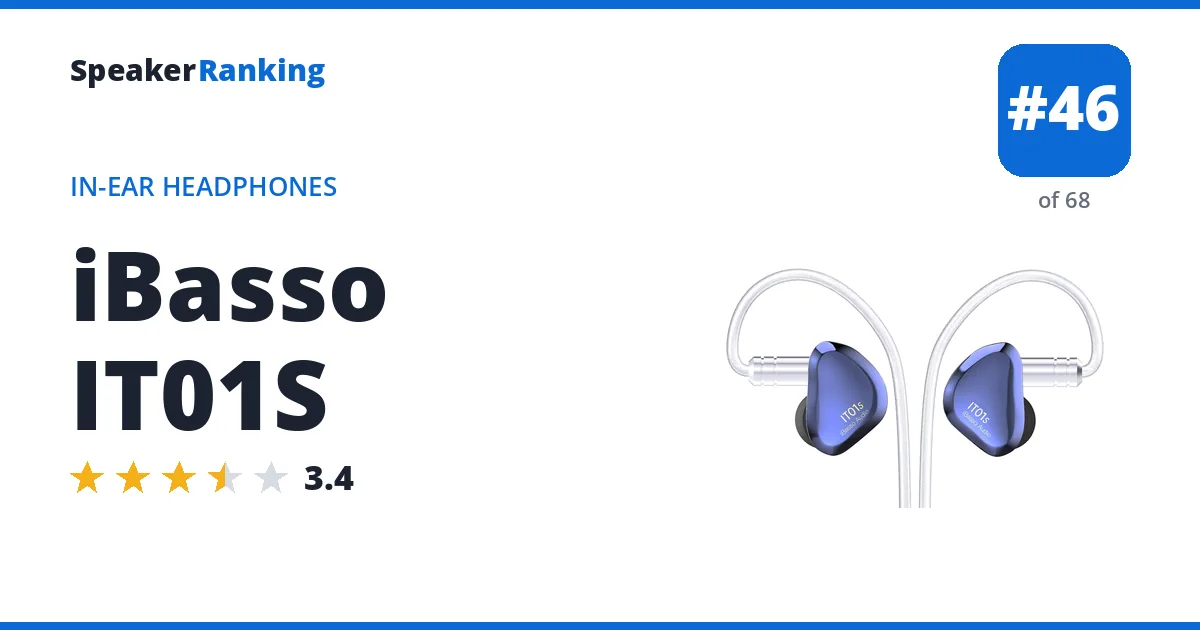
Pros: A Harman score of 66 in Crinacle’s measurement shows the tuning lands reasonably close to what most listeners prefer. The 16 ohm impedance and 109 dB/mW sensitivity mean a phone can drive it to loud levels. At 8 g per earbud with a 10mm dynamic driver, it is a light, simple wired set.
Cons: Deviation from the target averages 2.84 dB, so the response is not especially smooth. Without an inline microphone it cannot be used for calls, and the KZ PR1 has a higher rating.
Full iBasso IT01S review and specifications →
| Back | Closed |
|---|---|
| Built-in Microphone | No |
| Connection | Wired |
| Deviation From Target | 2.84 dB standard deviation |
| Driver Type | Dynamic |
| Drivers | 1 x 10mm dynamic |
| Form Factor | In-ear |
| Frequency Response | 10Hz - 43kHz (Manufacturer specified) |
| Harman Preference Score | 66 (measured by crinacle, via AutoEQ) |
| Impedance | 16 ohms |
| Sensitivity | 109 dB/mW |
| Tonal Tilt | -0.22 (negative is warmer, positive brighter) |
| Weight | 0 lbs (8 g) per earbud |
EQ preset to match the Harman target
Set a preamp of -3.7 dB, then add these filters in any parametric equalizer (Wavelet, Equalizer APO, Peace, or a player with parametric EQ). Calculated by AutoEQ from its measured frequency response.
| Filter | Frequency | Gain | Q |
|---|---|---|---|
| Low shelf | 105 Hz | +3.1 dB | 0.70 |
| Peak | 169 Hz | -4.1 dB | 0.49 |
| Peak | 918 Hz | +3.6 dB | 1.10 |
| Peak | 9,169 Hz | +3.5 dB | 2.61 |
| Peak | 3,523 Hz | +2.8 dB | 4.61 |
| High shelf | 10,000 Hz | +0.4 dB | 0.70 |
| Peak | 5,075 Hz | -6.1 dB | 5.81 |
| Peak | 6,349 Hz | +3.1 dB | 5.89 |
| Peak | 4,021 Hz | +2.0 dB | 5.78 |
| Peak | 2,467 Hz | -0.5 dB | 5.37 |
- Reviews, Comparisons and Sound Samples
- Head-to-Head Comparisons
 #47 FiiO FH3: $119.99 Amazon eBay
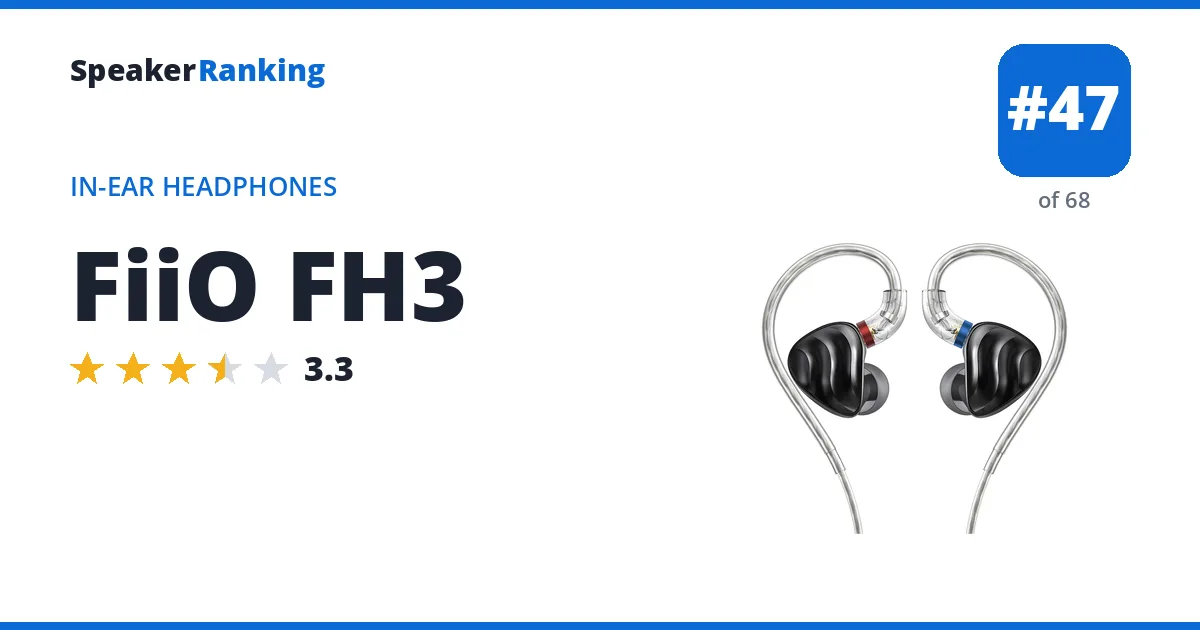
Pros: Bass and sub-bass sit within about 1 dB above the Harman target, giving kick drums and bass guitar a full, warm foundation without bloat. The hybrid design pairs a 10mm dynamic driver with two balanced armatures, and 114 dB/mW sensitivity at 24 ohms means a phone runs it easily. A preference score of 65 suits listeners who like a warm, bassy tilt.
Cons: The 3 to 6 kHz presence region sits about 5.7 dB below target, with a dip of 7.4 dB near 6.5 kHz, so vocals and cymbals lose bite and detail. Treble from 6 to 10 kHz is also about 2.2 dB low, which makes the sound dark and a little veiled. The KZ PR1 has a higher rating.
Full FiiO FH3 review and specifications →
| Back | Closed |
|---|---|
| Connection | Wired |
| Deviation From Target | 2.59 dB standard deviation |
| Driver Type | Hybrid (1 dynamic + 2 balanced armature) |
| Drivers | 1 x 10mm dynamic + 2 x balanced armature |
| Form Factor | In-ear |
| Frequency Response | 10Hz - 40kHz (Manufacturer specified) |
| Harman Preference Score | 65 (measured by HypetheSonics, via AutoEQ) |
| Impedance | 24 ohms |
| Sensitivity | 114 dB/mW |
| Tonal Tilt | -0.86 (negative is warmer, positive brighter) |
| Weight | 0 lbs (7.3 g) per earbud |
EQ preset to match the Harman target
Set a preamp of -4.3 dB, then add these filters in any parametric equalizer (Wavelet, Equalizer APO, Peace, or a player with parametric EQ). Calculated by AutoEQ from its measured frequency response.
| Filter | Frequency | Gain | Q |
|---|---|---|---|
| Low shelf | 105 Hz | -4.0 dB | 0.70 |
| Peak | 4,061 Hz | +4.3 dB | 1.02 |
| Peak | 178 Hz | -2.5 dB | 1.19 |
| Peak | 1,183 Hz | -3.9 dB | 2.64 |
| Peak | 60 Hz | +2.7 dB | 0.83 |
| High shelf | 10,000 Hz | -0.6 dB | 0.70 |
| Peak | 545 Hz | +1.1 dB | 2.57 |
| Peak | 2,365 Hz | -2.4 dB | 4.99 |
| Peak | 6,488 Hz | +2.3 dB | 6.00 |
| Peak | 2,972 Hz | +1.8 dB | 5.25 |
- Reviews, Comparisons and Sound Samples
- Head-to-Head Comparisons
 #48 Sennheiser MOMENTUM True Wireless 4: $249.95 Amazon eBay
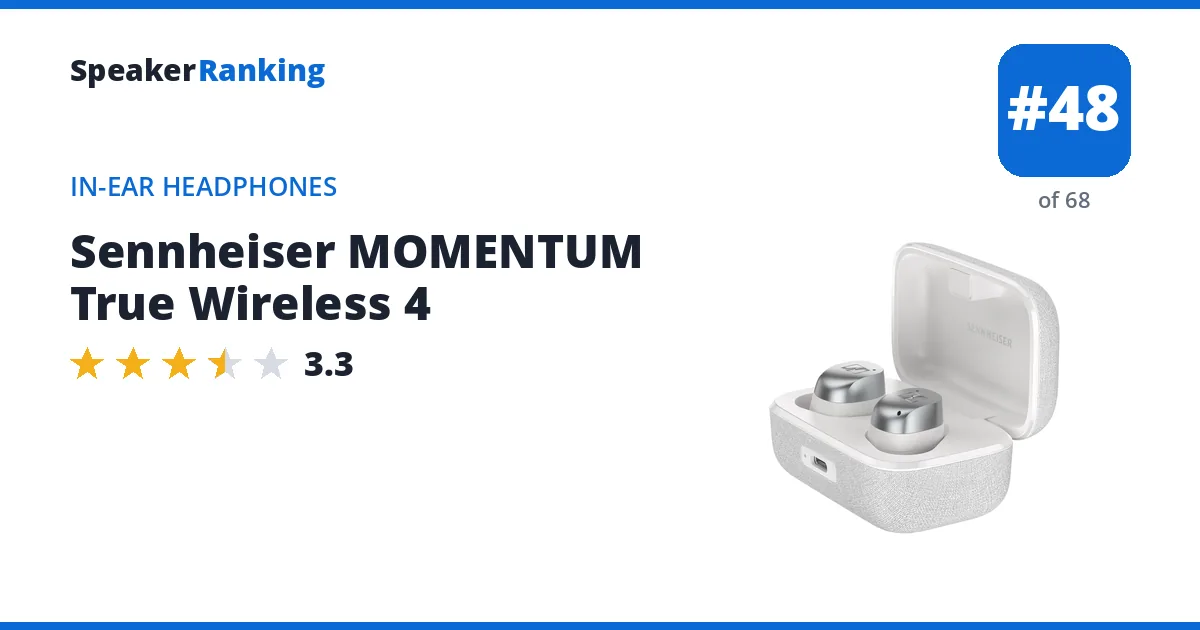
Older model: the Sennheiser Momentum True Wireless 3 (ranked higher, rated 3.4/5). See every Sennheiser Momentum True Wireless generation.
Pros: This true wireless set adds active noise cancelling, Bluetooth 5.4 and a codec list that runs from SBC and AAC up to aptX Lossless and LC3. Battery life is 7.5 hours per charge and 30 hours with the case, and IP54 resistance covers sweat and light rain. Oratory1990’s measurement shows bass about 0.6 dB above target, so low end is full without being overdone.
Cons: Presence from 3 to 6 kHz is about 6.9 dB under target, with an 8.2 dB dip near 5.7 kHz, so voices and guitars sound recessed. Air above 10 kHz runs 5 dB hot with a peak of 4.2 dB near 10.6 kHz, which can add a thin, sparkly edge. The Tin HiFi P1 Max has a higher rating, for a lower price.
Full Sennheiser MOMENTUM True Wireless 4 review and specifications →
| Released | Feb 2024 (2 years ago) |
|---|---|
| Active Noise Cancelling | Yes |
| Back | Closed |
| Battery Life | 7.5 hours (30 with case, Manufacturer specified) |
| Bluetooth Codecs | SBC, AAC, aptX, aptX Adaptive, aptX Lossless, LC3 |
| Bluetooth Version | 5.4 |
| Built-in Microphone | Yes |
| Connection | True wireless |
| Deviation From Target | 2.63 dB standard deviation |
| Driver Type | Dynamic |
| Drivers | 1 x 7mm dynamic |
| Form Factor | In-ear |
| Harman Preference Score | 65 (measured by oratory1990, via AutoEQ) |
| IP Rating | IP54 |
| Tonal Tilt | -0.74 (negative is warmer, positive brighter) |
| Weight | 0 lbs (6.2 g) per earbud |
EQ preset to match the Harman target
Set a preamp of -6.5 dB, then add these filters in any parametric equalizer (Wavelet, Equalizer APO, Peace, or a player with parametric EQ). Calculated by AutoEQ from its measured frequency response.
| Filter | Frequency | Gain | Q |
|---|---|---|---|
| Low shelf | 105 Hz | -0.1 dB | 0.70 |
| Peak | 5,605 Hz | +5.8 dB | 2.82 |
| Peak | 123 Hz | -2.8 dB | 0.23 |
| Peak | 3,977 Hz | +3.9 dB | 2.27 |
| Peak | 70 Hz | +2.1 dB | 0.97 |
| High shelf | 10,000 Hz | -5.2 dB | 0.70 |
| Peak | 1,511 Hz | -1.3 dB | 1.73 |
| Peak | 877 Hz | +0.8 dB | 2.46 |
| Peak | 7,841 Hz | +2.1 dB | 5.59 |
| Peak | 3,002 Hz | +0.7 dB | 3.65 |
- Reviews, Comparisons and Sound Samples
- Head-to-Head Comparisons
 #49 FiiO FH7S: $299.99 Amazon eBay
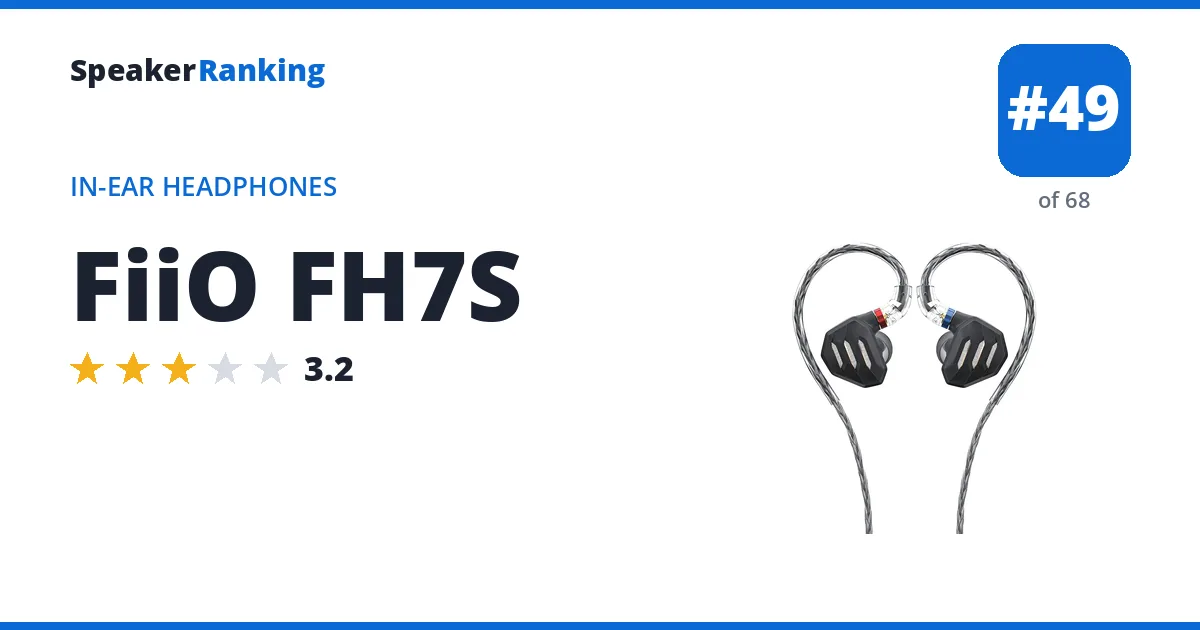
Pros: Oratory1990 measured bass about 4.6 dB above the Harman target, so kick drums and bass lines hit with real weight for a hybrid built around a 13.6mm dynamic driver and four balanced armatures. Treble is close to target, and an 18 ohm impedance makes it easy to drive from a phone despite the 104 dB/mW sensitivity. It suits warm, bassy tastes.
Cons: Low mids run 2.4 dB hot on top of the bass lift, which can make male vocals and bass instruments thick. A 6.1 dB peak near 8 kHz can make cymbals and sibilants sharp. The Tin HiFi P1 Max and FiiO FD5 both have higher ratings.
Full FiiO FH7S review and specifications →
| Back | Closed |
|---|---|
| Connection | Wired |
| Deviation From Target | 2.76 dB standard deviation |
| Driver Type | Hybrid (1 dynamic + 4 balanced armature) |
| Drivers | 1 x 13.6mm dynamic + 4 x balanced armature |
| Form Factor | In-ear |
| Frequency Response | 10Hz - 40kHz (Manufacturer specified) |
| Harman Preference Score | 64 (measured by oratory1990, via AutoEQ) |
| Impedance | 18 ohms |
| Sensitivity | 104 dB/mW |
| Tonal Tilt | -0.63 (negative is warmer, positive brighter) |
| Weight | 0 lbs (9 g) per earbud |
EQ preset to match the Harman target
Set a preamp of -5.4 dB, then add these filters in any parametric equalizer (Wavelet, Equalizer APO, Peace, or a player with parametric EQ). Calculated by AutoEQ from its measured frequency response.
| Filter | Frequency | Gain | Q |
|---|---|---|---|
| Low shelf | 105 Hz | +0.5 dB | 0.70 |
| Peak | 174 Hz | -4.7 dB | 0.67 |
| Peak | 5,596 Hz | +4.4 dB | 1.65 |
| Peak | 779 Hz | +3.3 dB | 1.24 |
| Peak | 2,065 Hz | +1.6 dB | 3.03 |
| High shelf | 10,000 Hz | -3.5 dB | 0.70 |
| Peak | 3,961 Hz | +1.5 dB | 3.23 |
| Peak | 3,138 Hz | -1.8 dB | 4.83 |
| Peak | 6,273 Hz | +2.3 dB | 5.99 |
| Peak | 5,471 Hz | -1.8 dB | 6.00 |
- Reviews, Comparisons and Sound Samples
- Head-to-Head Comparisons
 #50 SoundMAGIC E50C: $32.99 Amazon eBay
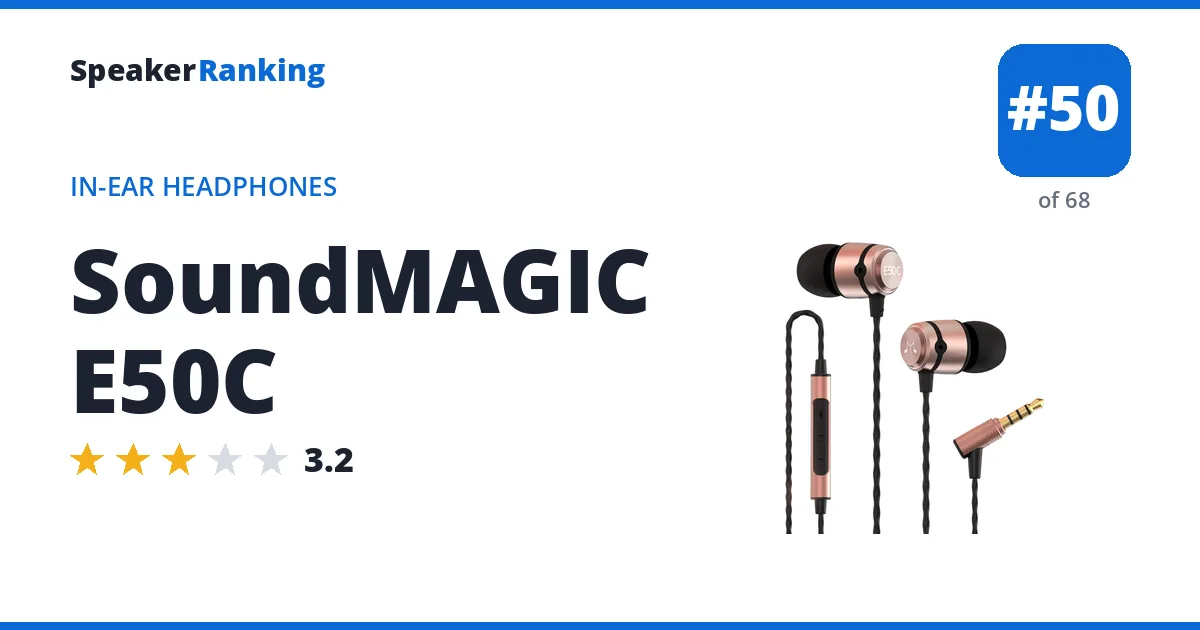
Pros: Bass from 60 to 200 Hz sits within 0.3 dB of target, so the low end is balanced rather than boomy. The inline microphone makes it usable for calls, and the 51 ohm impedance with 102 dB/mW sensitivity works with most phones. It is a very low-cost way into a warm tuning, with a preference score of 64.
Cons: Presence from 3 to 6 kHz is about 6.7 dB under target, with an 8.7 dB dip near 3.3 kHz, so vocals lose clarity and sound set back. Sub-bass is 2.8 dB low and the top octave is about 3.8 dB down, which limits both rumble and air. The Whizzer HE01 has a higher rating.
Full SoundMAGIC E50C review and specifications →
| Back | Closed |
|---|---|
| Built-in Microphone | Yes |
| Connection | Wired |
| Deviation From Target | 2.96 dB standard deviation |
| Driver Type | Dynamic |
| Drivers | 1 x 10mm dynamic |
| Form Factor | In-ear |
| Frequency Response | 15Hz - 22kHz (Manufacturer specified) |
| Harman Preference Score | 64 (measured by oratory1990, via AutoEQ) |
| Impedance | 51 ohms |
| Sensitivity | 102 dB/mW |
| Tonal Tilt | -0.38 (negative is warmer, positive brighter) |
| Weight | 0 lbs (13 g) |
EQ preset to match the Harman target
Set a preamp of -6.2 dB, then add these filters in any parametric equalizer (Wavelet, Equalizer APO, Peace, or a player with parametric EQ). Calculated by AutoEQ from its measured frequency response.
| Filter | Frequency | Gain | Q |
|---|---|---|---|
| Low shelf | 105 Hz | +1.3 dB | 0.70 |
| Peak | 3,391 Hz | +6.0 dB | 1.16 |
| Peak | 187 Hz | -2.7 dB | 0.60 |
| Peak | 1,404 Hz | -2.6 dB | 1.38 |
| Peak | 2,537 Hz | +1.6 dB | 2.71 |
| High shelf | 10,000 Hz | +0.4 dB | 0.70 |
| Peak | 9,380 Hz | +0.8 dB | 2.09 |
| Peak | 7,025 Hz | -0.9 dB | 4.59 |
| Peak | 71 Hz | +0.2 dB | 2.12 |
| Peak | 116 Hz | -0.2 dB | 2.33 |
- Reviews, Comparisons and Sound Samples
 #51 KZ ATE: $17.99 Amazon eBay
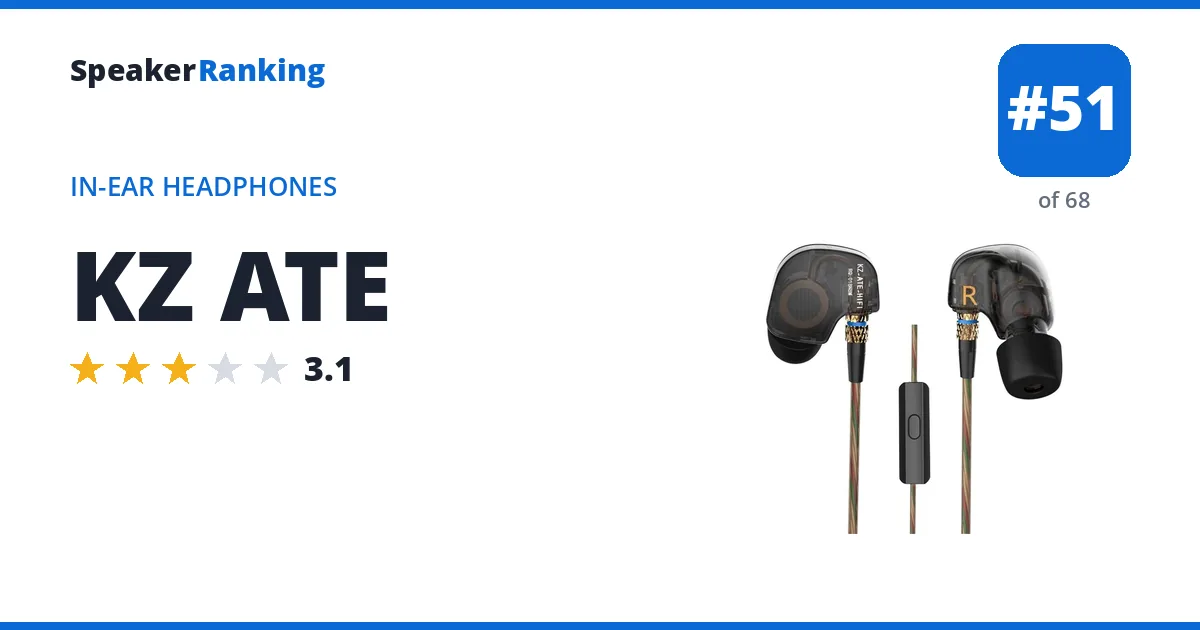
Pros: Bass from 60 to 200 Hz runs about 6.8 dB above target, with sub-bass up 2.8 dB, which delivers punchy, energetic low end for the money. The 16 ohm impedance and 106 dB sensitivity make it easy to power from a phone, and the V-shaped balance with a lift up to 4.3 dB in the 6 to 10 kHz range gives a lively, sparkling sound.
Cons: A 9 dB peak near 8.3 kHz makes cymbals and sibilants splashy and fatiguing at higher volumes. The bass lift of nearly 7 dB can overwhelm the low mids, adding 3.1 dB of thickness to male vocals. The CCA CSN has a higher rating at a similar budget.
Full KZ ATE review and specifications →
| Back | Closed |
|---|---|
| Connection | Wired |
| Deviation From Target | 2.88 dB standard deviation |
| Driver Type | Dynamic |
| Drivers | 1 x 8.2mm dynamic |
| Form Factor | In-ear |
| Frequency Response | 15Hz - 29kHz (Manufacturer specified) |
| Harman Preference Score | 63 (measured by oratory1990, via AutoEQ) |
| Impedance | 16 ohms |
| Sensitivity | 106 dB |
| Tonal Tilt | -0.45 (negative is warmer, positive brighter) |
EQ preset to match the Harman target
Set a preamp of -4.0 dB, then add these filters in any parametric equalizer (Wavelet, Equalizer APO, Peace, or a player with parametric EQ). Calculated by AutoEQ from its measured frequency response.
| Filter | Frequency | Gain | Q |
|---|---|---|---|
| Low shelf | 105 Hz | +4.4 dB | 0.70 |
| Peak | 736 Hz | +6.6 dB | 0.43 |
| Peak | 119 Hz | -6.6 dB | 0.18 |
| Peak | 8,831 Hz | -1.6 dB | 3.38 |
| Peak | 4,548 Hz | -4.0 dB | 5.04 |
| High shelf | 10,000 Hz | +0.3 dB | 0.70 |
| Peak | 6,150 Hz | +3.2 dB | 6.00 |
| Peak | 2,920 Hz | -1.3 dB | 3.23 |
| Peak | 2,035 Hz | +0.8 dB | 3.13 |
| Peak | 7,523 Hz | -1.3 dB | 5.99 |
- Reviews, Comparisons and Sound Samples
- Head-to-Head Comparisons
 #52 Sennheiser IE 900: $1,299.95 Amazon eBay
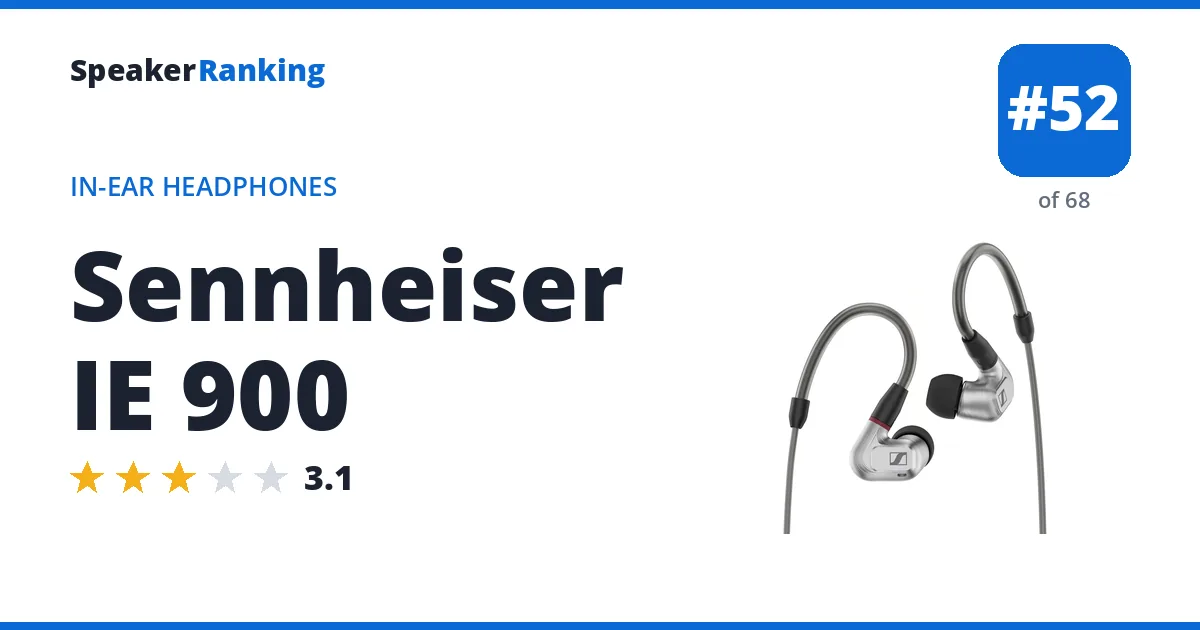
Pros: Oratory1990 measured sub-bass and bass within about 1.2 dB of target, so the low end is tidy and controlled. Sensitivity of 123 dB SPL/V and a 16 ohm impedance make it easy to drive from a phone, and the 7mm dynamic driver is rated to reach from 5 Hz to 48 kHz. Top-octave air sits about 3.6 dB above target for an open, detailed treble.
Cons: Presence from 3 to 6 kHz is about 6.7 dB below the Harman target, with an 8.8 dB dip near 3.6 kHz, which recesses vocals and removes some bite. A preference score of 63 is modest for such a premium product, and the HIFIMAN RE2000 has a higher rating at a lower price.
Full Sennheiser IE 900 review and specifications →
| Released | 2021 (5 years ago) |
|---|---|
| Back | Closed |
| Connection | Wired |
| Deviation From Target | 2.82 dB standard deviation |
| Driver Type | Dynamic |
| Drivers | 1 x 7mm dynamic |
| Form Factor | In-ear |
| Frequency Response | 5Hz - 48kHz (Manufacturer specified) |
| Harman Preference Score | 63 (measured by oratory1990, via AutoEQ) |
| Impedance | 16 ohms |
| Sensitivity | 123 dB SPL/V |
| Tonal Tilt | -0.92 (negative is warmer, positive brighter) |
EQ preset to match the Harman target
Set a preamp of -6.3 dB, then add these filters in any parametric equalizer (Wavelet, Equalizer APO, Peace, or a player with parametric EQ). Calculated by AutoEQ from its measured frequency response.
| Filter | Frequency | Gain | Q |
|---|---|---|---|
| Low shelf | 105 Hz | -2.3 dB | 0.70 |
| Peak | 4,081 Hz | +5.0 dB | 2.86 |
| Peak | 204 Hz | -2.6 dB | 1.13 |
| Peak | 1,472 Hz | -2.7 dB | 2.33 |
| Peak | 2,956 Hz | +5.2 dB | 2.42 |
| High shelf | 10,000 Hz | -4.4 dB | 0.70 |
| Peak | 67 Hz | +0.6 dB | 1.76 |
| Peak | 26 Hz | -0.9 dB | 3.19 |
| Peak | 729 Hz | +0.4 dB | 2.54 |
| Peak | 376 Hz | -0.4 dB | 2.69 |
- Reviews, Comparisons and Sound Samples
- Head-to-Head Comparisons
 #53 Shure SE215: $109.00 Amazon eBay
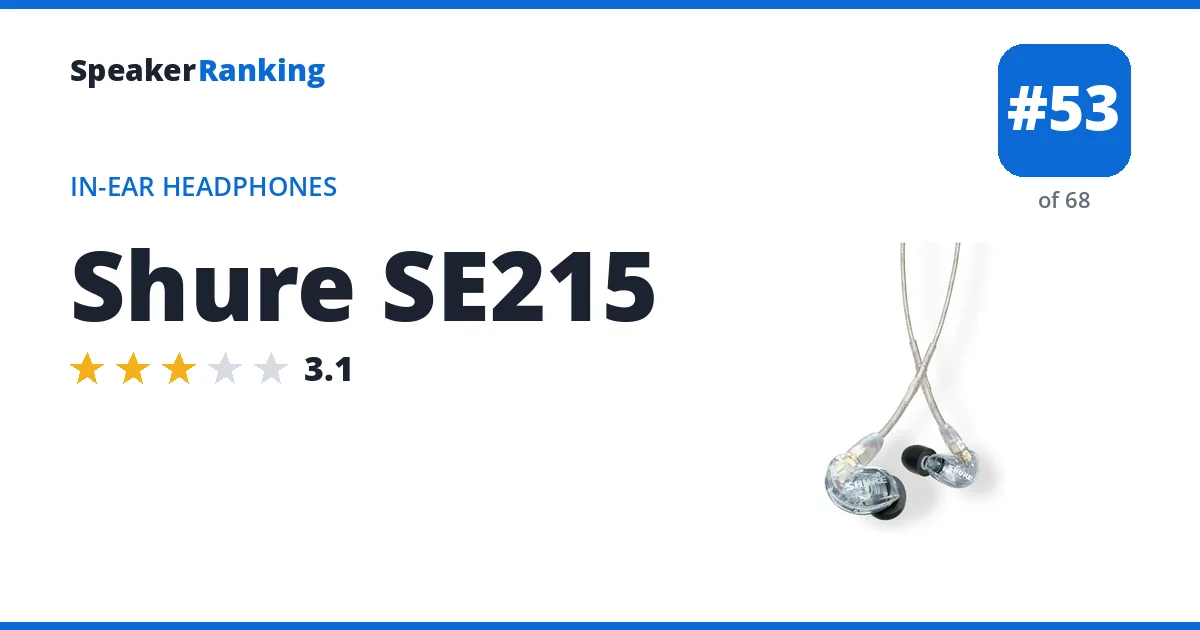
Pros: Bass from 60 to 200 Hz is lifted by about 4.2 dB with low mids up 2.2 dB, giving a warm, full sound that suits rock, pop and hip hop. A 17 ohm impedance and 107 dB SPL/mW sensitivity make it easy to drive from a phone, and the single dynamic driver keeps the design simple. Upper mids sit right on target, so vocals are not pushed back.
Cons: Treble from 6 to 10 kHz is about 3 dB low with a 5.9 dB dip near 6.7 kHz, and the top octave is down 2.7 dB, so cymbals and air sound dull. The warm balance can make the mix feel thick. The iBasso IT01S and the FiiO FH3 both have higher ratings.
Full Shure SE215 review and specifications →
| Released | Jan 2011 (15 years ago) |
|---|---|
| Back | Closed |
| Connection | Wired |
| Deviation From Target | 2.78 dB standard deviation |
| Driver Type | Dynamic |
| Drivers | 1 x dynamic |
| Form Factor | In-ear |
| Frequency Response | 22Hz - 17.5kHz (Manufacturer specified) |
| Harman Preference Score | 63 (measured by oratory1990, via AutoEQ) |
| Impedance | 17 ohms |
| Sensitivity | 107 dB SPL/mW |
| Tonal Tilt | -0.78 (negative is warmer, positive brighter) |
EQ preset to match the Harman target
Set a preamp of -5.7 dB, then add these filters in any parametric equalizer (Wavelet, Equalizer APO, Peace, or a player with parametric EQ). Calculated by AutoEQ from its measured frequency response.
| Filter | Frequency | Gain | Q |
|---|---|---|---|
| Low shelf | 105 Hz | +0.3 dB | 0.70 |
| Peak | 174 Hz | -4.6 dB | 0.68 |
| Peak | 811 Hz | +3.1 dB | 1.42 |
| Peak | 3,430 Hz | +3.8 dB | 4.37 |
| Peak | 6,943 Hz | +5.4 dB | 2.76 |
| High shelf | 10,000 Hz | +3.8 dB | 0.70 |
| Peak | 5,725 Hz | +8.1 dB | 1.13 |
| Peak | 5,056 Hz | -10.9 dB | 2.93 |
| Peak | 7,269 Hz | -6.3 dB | 3.47 |
| Peak | 2,278 Hz | -2.1 dB | 2.94 |
- Reviews, Comparisons and Sound Samples
- Head-to-Head Comparisons
 #54 Etymotic ER4XR: $299.00 Amazon eBay
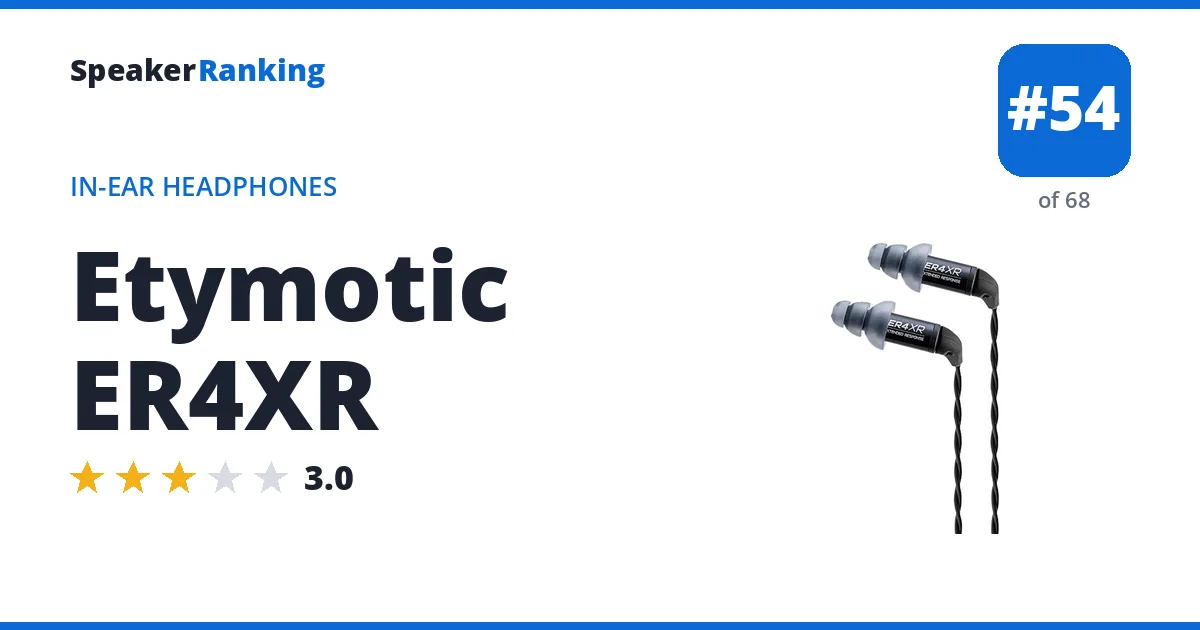
Pros: Upper mids sit within 0.5 dB of the Harman target and low mids within 0.4 dB, so vocals and instruments come through clearly and naturally. Oratory1990’s measurement gives a preference score of 62, and the single balanced armature driver suits listeners who want a neutral, analytical presentation without added bass.
Cons: Sub-bass is about 7.2 dB under target and bass is 2.6 dB low, so kick drums and bass lines lack weight and rumble. Treble from 6 to 10 kHz is 5.4 dB low, with an 8.6 dB dip near 6.7 kHz, which dulls cymbals. A 45 ohm impedance makes it a bit harder to drive than most phone-friendly earphones, and the FiiO FH7S has a higher rating.
Full Etymotic ER4XR review and specifications →
| Back | Closed |
|---|---|
| Connection | Wired |
| Deviation From Target | 3.06 dB standard deviation |
| Driver Type | Balanced armature |
| Drivers | 1 x balanced armature |
| Form Factor | In-ear |
| Frequency Response | 20Hz - 16kHz (Manufacturer specified) |
| Harman Preference Score | 62 (measured by oratory1990, via AutoEQ) |
| Impedance | 45 ohms |
| Tonal Tilt | +0.61 (negative is warmer, positive brighter) |
EQ preset to match the Harman target
Set a preamp of -6.0 dB, then add these filters in any parametric equalizer (Wavelet, Equalizer APO, Peace, or a player with parametric EQ). Calculated by AutoEQ from its measured frequency response.
| Filter | Frequency | Gain | Q |
|---|---|---|---|
| Low shelf | 105 Hz | +5.4 dB | 0.70 |
| Peak | 6,978 Hz | +6.4 dB | 1.06 |
| Peak | 1,623 Hz | -3.6 dB | 0.52 |
| Peak | 164 Hz | -1.4 dB | 0.59 |
| Peak | 806 Hz | +2.6 dB | 1.14 |
| High shelf | 10,000 Hz | +1.3 dB | 0.70 |
| Peak | 7,344 Hz | -1.2 dB | 6.00 |
| Peak | 6,183 Hz | +1.0 dB | 5.99 |
| Peak | 4,894 Hz | -0.6 dB | 4.37 |
| Peak | 1,333 Hz | -0.2 dB | 4.02 |
- Reviews, Comparisons and Sound Samples
- Head-to-Head Comparisons
 #55 FiiO FH5: $1,127.26 Amazon eBay
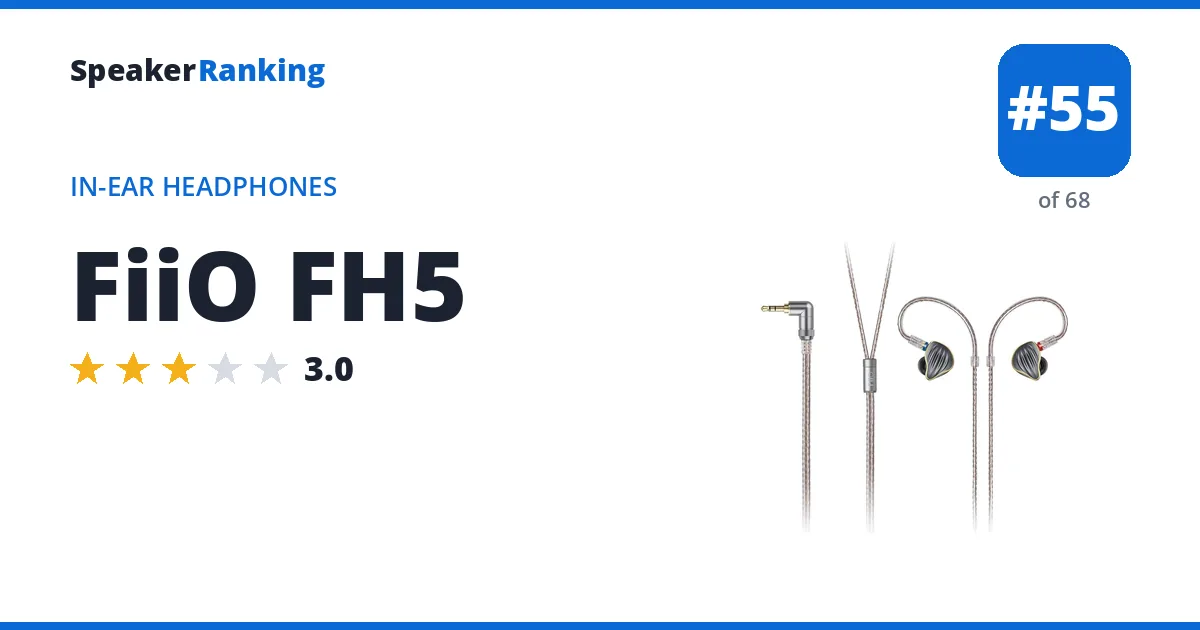
Pros: In oratory1990’s measurement the bass and low mids sit only 0.6 to 1.4 dB above the Harman target, so kick drums and bass guitar have a warm, full body without bloating. The hybrid design pairs a 10mm dynamic driver with 3 balanced armatures, and the 19 ohm impedance and 112 dB/mW sensitivity mean a phone or dongle drives it easily. Sub-bass is slightly lifted by 0.8 dB, which suits warm and bassy tastes.
Cons: Presence between 3 and 6 kHz runs about 7.3 dB under target, with a 9.6 dB dip near 4.7 kHz, so vocals, snare and guitar attack sound recessed and distant. Air above 10 kHz is down about 3.2 dB, which takes some sparkle off cymbals. A preference score of 61 and an uneven response with a 2.96 dB deviation leave it behind the HIFIMAN RE2000 for tonal accuracy.
Full FiiO FH5 review and specifications →
| Back | Closed |
|---|---|
| Connection | Wired |
| Deviation From Target | 2.96 dB standard deviation |
| Driver Type | Hybrid (1 dynamic + 3 balanced armature) |
| Drivers | 1 x 10mm dynamic + 3 x balanced armature |
| Form Factor | In-ear |
| Frequency Response | 15Hz - 40kHz (Manufacturer specified) |
| Harman Preference Score | 61 (measured by oratory1990, via AutoEQ) |
| Impedance | 19 ohms |
| Sensitivity | 112 dB/mW |
| Tonal Tilt | -1.08 (negative is warmer, positive brighter) |
| Weight | 0 lbs (8 g) per earbud |
EQ preset to match the Harman target
Set a preamp of -6.5 dB, then add these filters in any parametric equalizer (Wavelet, Equalizer APO, Peace, or a player with parametric EQ). Calculated by AutoEQ from its measured frequency response.
| Filter | Frequency | Gain | Q |
|---|---|---|---|
| Low shelf | 105 Hz | -2.4 dB | 0.70 |
| Peak | 3,870 Hz | +6.6 dB | 1.63 |
| Peak | 191 Hz | -2.7 dB | 1.11 |
| Peak | 1,347 Hz | -1.8 dB | 1.19 |
| Peak | 9,899 Hz | +2.5 dB | 2.75 |
| High shelf | 10,000 Hz | -1.8 dB | 0.70 |
| Peak | 69 Hz | +0.9 dB | 1.61 |
| Peak | 122 Hz | -0.6 dB | 2.38 |
| Peak | 6,634 Hz | -1.7 dB | 6.00 |
| Peak | 5,997 Hz | +1.5 dB | 6.00 |
- Reviews, Comparisons and Sound Samples
 #56 Audio-Technica ATH-CK2000Ti: $750.00 Amazon eBay
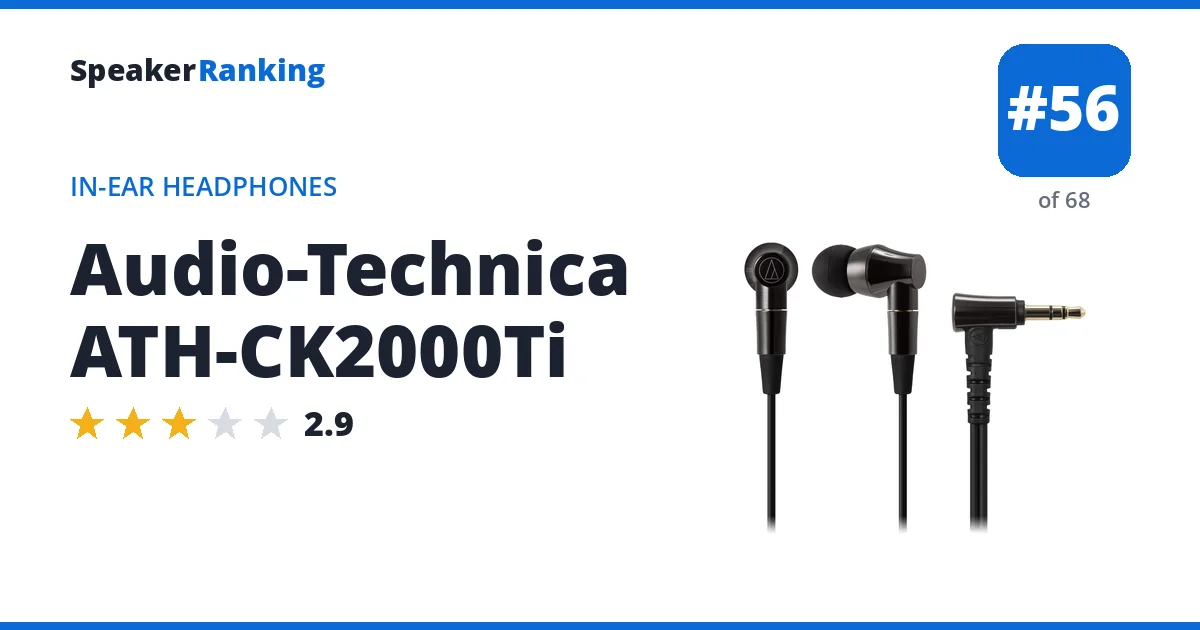
Pros: The dual phase push-pull design uses two dynamic drivers (9.8mm and 8.8mm) per side, and the manufacturer quotes a very wide 5 Hz to 45 kHz range. At 10 ohms and 100 dB/mW it works from a phone or portable player without a dedicated amp. Crinacle’s measurement gives a preference score of 60, with a mild warm tilt of about 0.8 dB.
Cons: A preference score of 60 and a 2.97 dB deviation from the target mean the tonal balance is noticeably off for most listeners. It is rated below the FiiO FH5 and well below the HIFIMAN RE2000, which offer more accurate tuning at similar money. No inline microphone or other convenience features are listed.
Full Audio-Technica ATH-CK2000Ti review and specifications →
| Back | Closed |
|---|---|
| Connection | Wired |
| Deviation From Target | 2.97 dB standard deviation |
| Driver Type | Dynamic |
| Drivers | 2 x dynamic (9.8mm + 8.8mm, dual phase push-pull) |
| Form Factor | In-ear |
| Frequency Response | 5Hz - 45kHz (Manufacturer specified) |
| Harman Preference Score | 60 (measured by crinacle, via AutoEQ) |
| Impedance | 10 ohms |
| Sensitivity | 100 dB/mW |
| Tonal Tilt | -0.77 (negative is warmer, positive brighter) |
EQ preset to match the Harman target
Set a preamp of -6.5 dB, then add these filters in any parametric equalizer (Wavelet, Equalizer APO, Peace, or a player with parametric EQ). Calculated by AutoEQ from its measured frequency response.
| Filter | Frequency | Gain | Q |
|---|---|---|---|
| Low shelf | 105 Hz | -1.7 dB | 0.70 |
| Peak | 172 Hz | -3.8 dB | 0.82 |
| Peak | 2,043 Hz | +6.0 dB | 2.32 |
| Peak | 788 Hz | +2.4 dB | 0.92 |
| Peak | 5,869 Hz | -6.2 dB | 4.43 |
| High shelf | 10,000 Hz | +0.4 dB | 0.70 |
| Peak | 9,575 Hz | +4.0 dB | 1.76 |
| Peak | 3,866 Hz | -4.4 dB | 4.04 |
| Peak | 2,847 Hz | +1.6 dB | 3.89 |
| Peak | 6,549 Hz | -1.4 dB | 6.00 |
- Reviews, Comparisons and Sound Samples
 #57 HIFIMAN RE400: $19.99 Amazon eBay
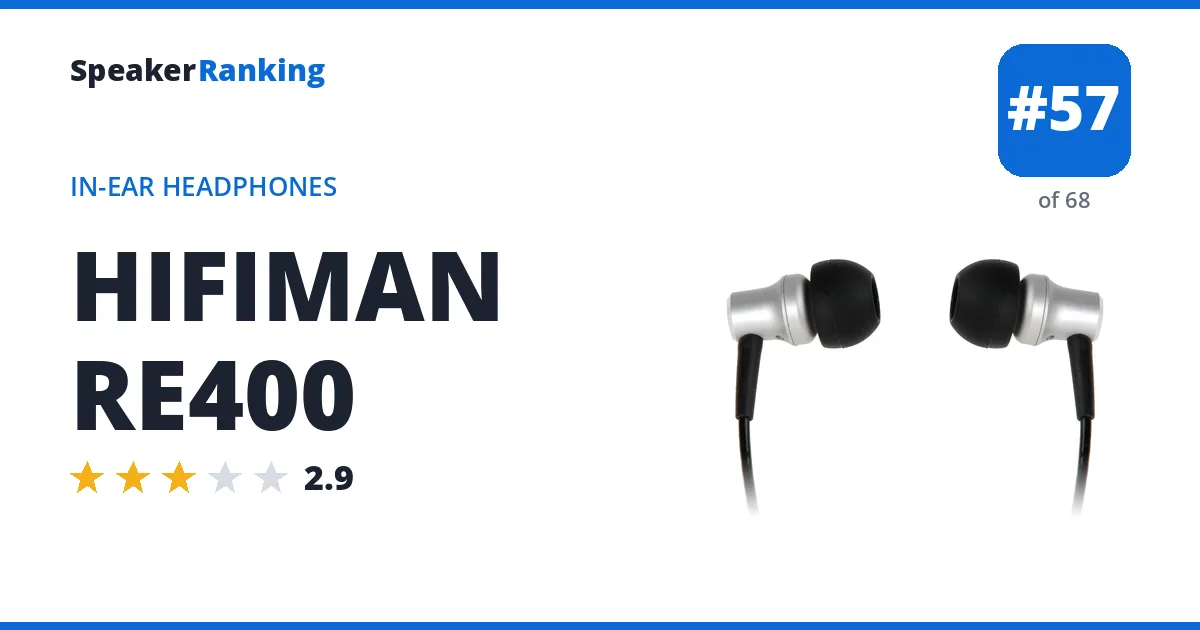
Pros: A very low price makes it an easy backup pair or first wired earphone. The single 8.5mm dynamic driver, 32 ohm impedance and 102 dB/mW sensitivity work fine straight from a phone or laptop. Crinacle’s measurement shows a slightly bright tilt of about 0.6 dB, which gives a lean, light presentation for those who dislike bass-heavy sound.
Cons: A preference score of 60 with a 3.29 dB deviation from the target means the response is quite uneven, so some instruments and vocals will sound colored. There is no built-in microphone, so it cannot take calls. The KZ ATE and SoundMAGIC E50C are rated higher at a similar price.
Full HIFIMAN RE400 review and specifications →
| Back | Closed |
|---|---|
| Built-in Microphone | No |
| Connection | Wired |
| Deviation From Target | 3.29 dB standard deviation |
| Driver Type | Dynamic |
| Drivers | 1 x 8.5mm dynamic |
| Form Factor | In-ear |
| Harman Preference Score | 60 (measured by crinacle, via AutoEQ) |
| Impedance | 32 ohms |
| Sensitivity | 102 dB/mW |
| Tonal Tilt | +0.63 (negative is warmer, positive brighter) |
EQ preset to match the Harman target
Set a preamp of -6.0 dB, then add these filters in any parametric equalizer (Wavelet, Equalizer APO, Peace, or a player with parametric EQ). Calculated by AutoEQ from its measured frequency response.
| Filter | Frequency | Gain | Q |
|---|---|---|---|
| Low shelf | 105 Hz | +6.0 dB | 0.70 |
| Peak | 3,850 Hz | +7.0 dB | 2.19 |
| Peak | 170 Hz | -2.3 dB | 0.43 |
| Peak | 2,033 Hz | -3.6 dB | 1.58 |
| Peak | 801 Hz | +1.9 dB | 1.59 |
| High shelf | 10,000 Hz | +1.7 dB | 0.70 |
| Peak | 6,033 Hz | -4.6 dB | 6.00 |
| Peak | 4,799 Hz | +2.1 dB | 4.73 |
| Peak | 3,186 Hz | +0.9 dB | 6.00 |
| Peak | 3,794 Hz | -1.0 dB | 6.00 |
- Reviews, Comparisons and Sound Samples
- Head-to-Head Comparisons
 #58 KZ AS10: $59.99 Amazon eBay
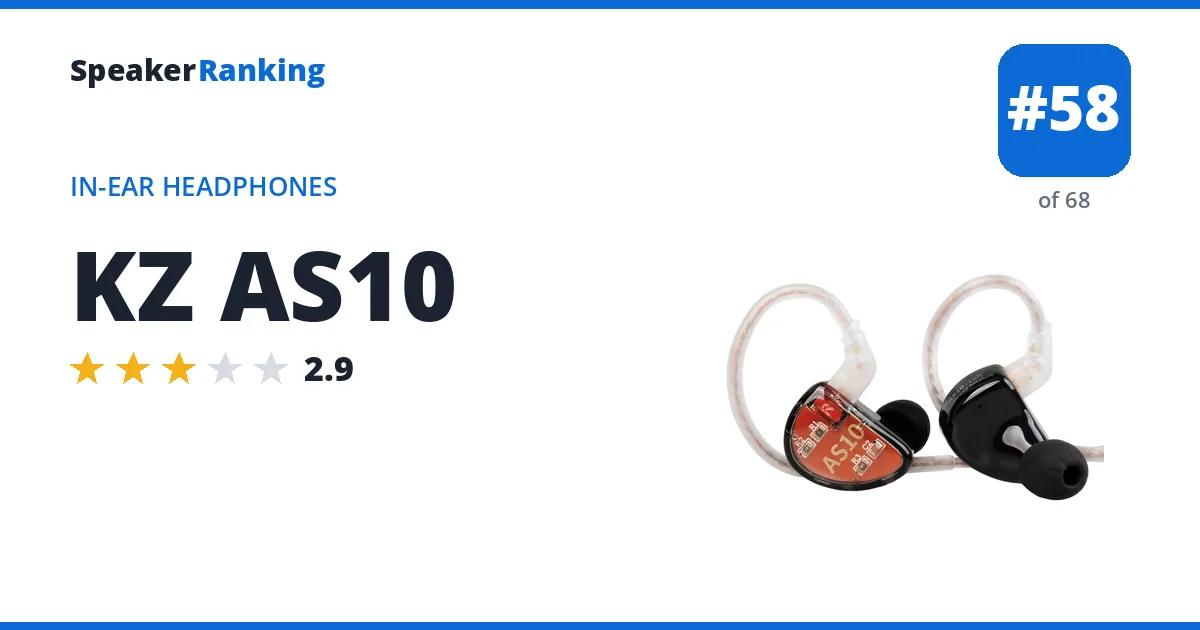
Pros: Five balanced armature drivers per side at a modest price is an unusual configuration for a wired earphone. The 14 ohm impedance and 105 dB/mW sensitivity make it easy to drive from a phone or dongle. Crinacle’s preference score of 60 with a 2.91 dB deviation puts its tonal balance ahead of the Sennheiser CX 3.00 and 1MORE Triple Driver in rating.
Cons: A preference score of 60 means the tuning is still well off the target most listeners prefer, with a slightly warm tilt of about 0.9 dB. No microphone is listed, so it is for music only. The iBasso IT01S is rated clearly higher for a modest step up in cost.
Full KZ AS10 review and specifications →
| Released | 2019 (7 years ago) |
|---|---|
| Back | Closed |
| Connection | Wired |
| Deviation From Target | 2.91 dB standard deviation |
| Driver Type | Balanced armature |
| Drivers | 5 x balanced armature |
| Form Factor | In-ear |
| Frequency Response | 20Hz - 40kHz (Manufacturer specified) |
| Harman Preference Score | 60 (measured by crinacle, via AutoEQ) |
| Impedance | 14 ohms |
| Sensitivity | 105 dB/mW |
| Tonal Tilt | -0.89 (negative is warmer, positive brighter) |
EQ preset to match the Harman target
Set a preamp of -5.0 dB, then add these filters in any parametric equalizer (Wavelet, Equalizer APO, Peace, or a player with parametric EQ). Calculated by AutoEQ from its measured frequency response.
| Filter | Frequency | Gain | Q |
|---|---|---|---|
| Low shelf | 105 Hz | -1.0 dB | 0.70 |
| Peak | 157 Hz | -4.3 dB | 0.67 |
| Peak | 1,285 Hz | +4.5 dB | 0.47 |
| Peak | 3,019 Hz | -6.4 dB | 2.71 |
| Peak | 298 Hz | -1.2 dB | 1.07 |
| High shelf | 10,000 Hz | +5.0 dB | 0.70 |
| Peak | 5,029 Hz | -5.0 dB | 5.86 |
| Peak | 6,215 Hz | +2.7 dB | 5.38 |
| Peak | 2,075 Hz | +1.1 dB | 3.28 |
| Peak | 1,354 Hz | -0.8 dB | 3.11 |
- Reviews, Comparisons and Sound Samples
- Head-to-Head Comparisons
 #59 KZ DQ6S: $28.99 Amazon eBay
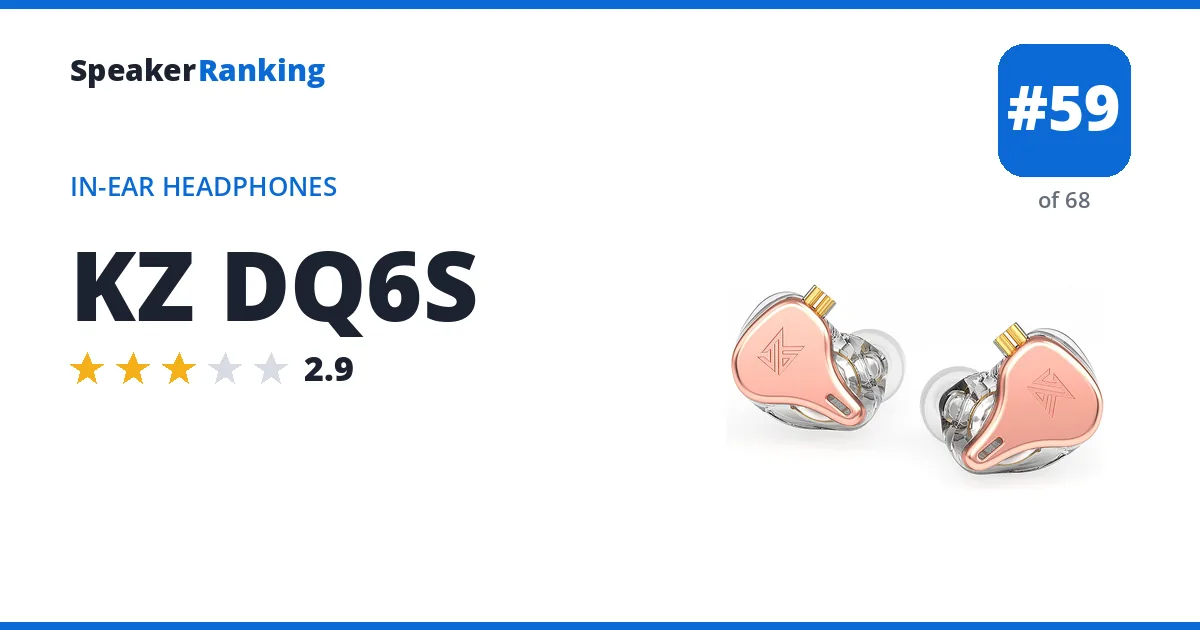
Pros: Very inexpensive, with a 25 ohm impedance and 116 dB sensitivity that make it loud and easy to drive from any phone or laptop. Crinacle measured a mild warm tilt of about 1.1 dB, which gives a smooth, laid-back character suited to bass-leaning tastes. Its rating is higher than the KZ EDX Pro and the Final Audio E3000.
Cons: A preference score of 60 and a 2.83 dB deviation from target show the tonal balance is not accurate, so voices and instruments will not sound natural. There is no built-in microphone, so it cannot be used for calls. The KZ ATE is rated higher at a lower price.
Full KZ DQ6S review and specifications →
| Back | Closed |
|---|---|
| Built-in Microphone | No |
| Connection | Wired |
| Deviation From Target | 2.83 dB standard deviation |
| Driver Type | Dynamic |
| Form Factor | In-ear |
| Frequency Response | 20Hz - 40kHz (Manufacturer specified) |
| Harman Preference Score | 60 (measured by crinacle, via AutoEQ) |
| Impedance | 25 ohms |
| Sensitivity | 116 dB |
| Tonal Tilt | -1.12 (negative is warmer, positive brighter) |
EQ preset to match the Harman target
Set a preamp of -4.8 dB, then add these filters in any parametric equalizer (Wavelet, Equalizer APO, Peace, or a player with parametric EQ). Calculated by AutoEQ from its measured frequency response.
| Filter | Frequency | Gain | Q |
|---|---|---|---|
| Low shelf | 105 Hz | -3.0 dB | 0.70 |
| Peak | 175 Hz | -3.2 dB | 1.13 |
| Peak | 3,170 Hz | +5.1 dB | 1.14 |
| Peak | 10,000 Hz | +4.6 dB | 2.04 |
| Peak | 1,762 Hz | -3.5 dB | 2.30 |
| High shelf | 10,000 Hz | -0.9 dB | 0.70 |
| Peak | 833 Hz | +1.6 dB | 1.64 |
| Peak | 6,050 Hz | +2.8 dB | 5.68 |
| Peak | 1,295 Hz | -1.2 dB | 3.09 |
| Peak | 4,847 Hz | -1.8 dB | 5.26 |
- Reviews, Comparisons and Sound Samples
- Head-to-Head Comparisons
 #60 Jabra Elite Active 65t: $156.45 Discontinued Amazon eBay
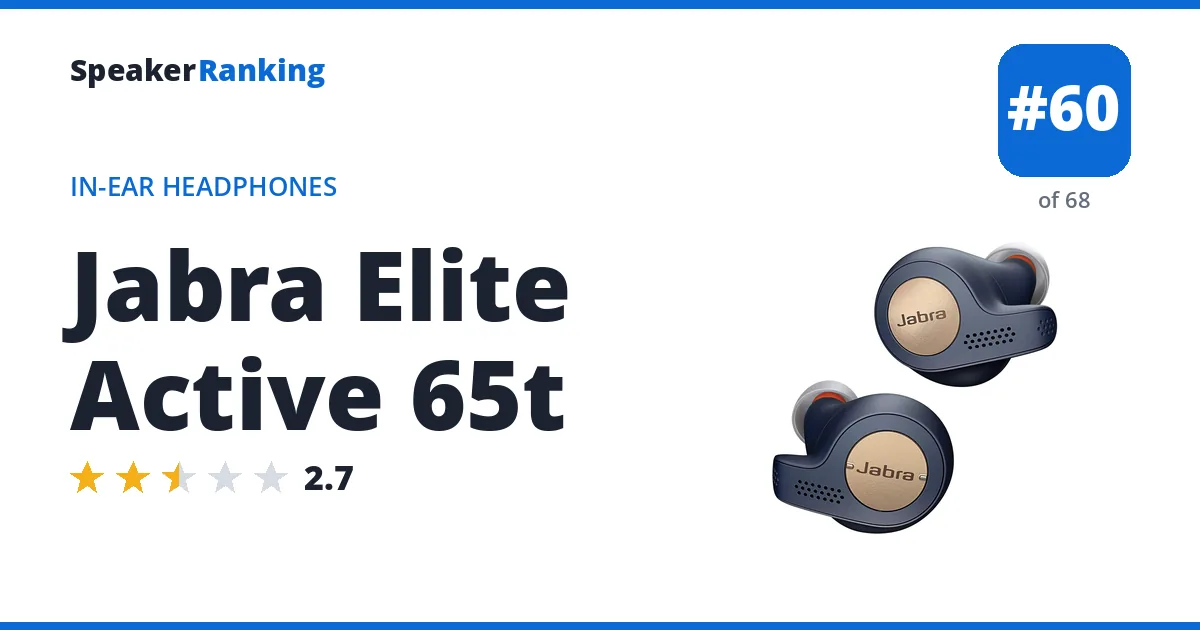
Pros: A true wireless design with an IP56 rating gives dust and sweat resistance suited to workouts. Battery life is 5 hours per charge and 15 hours with the case, and the earbuds weigh only 6.5 g each. Bluetooth 5.0 and a built-in microphone cover calls and everyday listening.
Cons: Only the SBC codec is supported, so there is no higher quality Bluetooth option. There is no active noise cancelling, and Crinacle’s measurement gives a preference score of 58 with a 3.41 dB deviation from target, so the tuning is uneven. The Shure SE215 and FiiO FH3 are rated higher and cheaper, though both are wired. Discontinued.
Full Jabra Elite Active 65t review and specifications →
| Released | Jul 2018 (8 years ago) |
|---|---|
| Active Noise Cancelling | No |
| Back | Closed |
| Battery Life | 5 hours (15 with case, Manufacturer specified) |
| Bluetooth Codecs | SBC |
| Bluetooth Version | 5.0 |
| Built-in Microphone | Yes |
| Connection | True wireless |
| Deviation From Target | 3.41 dB standard deviation |
| Drivers | 1 x 6mm |
| Form Factor | In-ear |
| Harman Preference Score | 58 (measured by crinacle, via AutoEQ) |
| IP Rating | IP56 |
| Tonal Tilt | -0.49 (negative is warmer, positive brighter) |
| Weight | 0 lbs (6.5 g) per earbud |
EQ preset to match the Harman target
Set a preamp of -6.9 dB, then add these filters in any parametric equalizer (Wavelet, Equalizer APO, Peace, or a player with parametric EQ). Calculated by AutoEQ from its measured frequency response.
| Filter | Frequency | Gain | Q |
|---|---|---|---|
| Low shelf | 105 Hz | +16.6 dB | 0.70 |
| Peak | 49 Hz | -16.0 dB | 0.34 |
| Peak | 5,403 Hz | +4.1 dB | 0.56 |
| Peak | 839 Hz | +2.4 dB | 1.86 |
| Peak | 8,608 Hz | -3.4 dB | 3.08 |
| High shelf | 10,000 Hz | +6.9 dB | 0.70 |
| Peak | 10,000 Hz | -3.1 dB | 1.06 |
| Peak | 5,115 Hz | -1.1 dB | 5.14 |
| Peak | 3,623 Hz | +1.0 dB | 3.53 |
| Peak | 6,391 Hz | +2.1 dB | 6.00 |
- Reviews, Comparisons and Sound Samples
- Head-to-Head Comparisons
 #61 KZ EDX Pro: $17.99 Amazon eBay
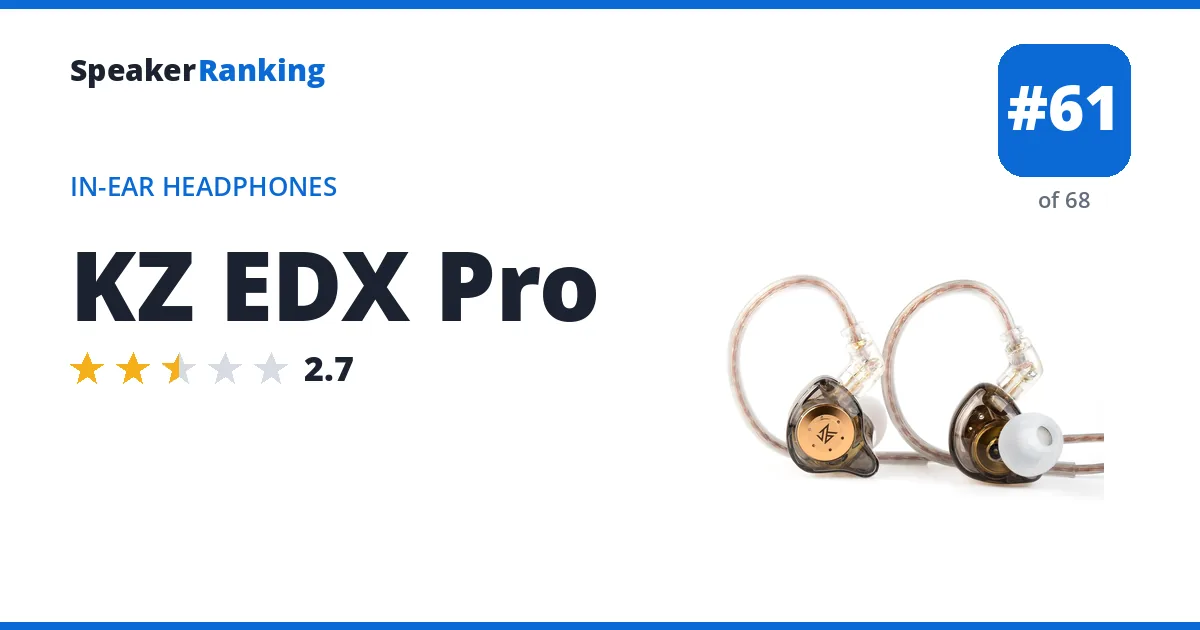
Pros: Priced among the lowest in the class, which makes it a throwaway-friendly spare pair. The 10mm dynamic driver, 24 ohm impedance and 112 dB sensitivity are easy for any phone to drive to loud levels. Crinacle measured a warm tilt of about 1.1 dB, a good match for those who prefer a gentle, bass-leaning sound.
Cons: A preference score of 58 and a 2.91 dB deviation from the target indicate an uneven balance that colors vocals and instruments. No microphone is listed, so calls are not an option. The KZ DQ6S, KZ ATE and CCA CSN are all rated higher at a similar cost.
Full KZ EDX Pro review and specifications →
| Released | Sep 2021 (5 years ago) |
|---|---|
| Back | Closed |
| Connection | Wired |
| Deviation From Target | 2.91 dB standard deviation |
| Driver Type | Dynamic |
| Drivers | 1 x 10mm dynamic |
| Form Factor | In-ear |
| Frequency Response | 10Hz - 20kHz (Manufacturer specified) |
| Harman Preference Score | 58 (measured by crinacle, via AutoEQ) |
| Impedance | 24 ohms |
| Sensitivity | 112 dB |
| Tonal Tilt | -1.10 (negative is warmer, positive brighter) |
EQ preset to match the Harman target
Set a preamp of -5.1 dB, then add these filters in any parametric equalizer (Wavelet, Equalizer APO, Peace, or a player with parametric EQ). Calculated by AutoEQ from its measured frequency response.
| Filter | Frequency | Gain | Q |
|---|---|---|---|
| Low shelf | 105 Hz | -2.3 dB | 0.70 |
| Peak | 169 Hz | -4.0 dB | 0.82 |
| Peak | 9,836 Hz | +2.9 dB | 0.18 |
| Peak | 783 Hz | +3.2 dB | 1.23 |
| Peak | 2,062 Hz | -4.8 dB | 2.53 |
| High shelf | 10,000 Hz | -6.1 dB | 0.70 |
| Peak | 9,508 Hz | +3.3 dB | 2.86 |
| Peak | 4,965 Hz | -5.7 dB | 5.27 |
| Peak | 3,516 Hz | +2.7 dB | 3.58 |
| Peak | 6,291 Hz | +3.2 dB | 5.44 |
- Reviews, Comparisons and Sound Samples
- Head-to-Head Comparisons
 #62 Sennheiser CX 3.00: $79.99 Amazon eBay
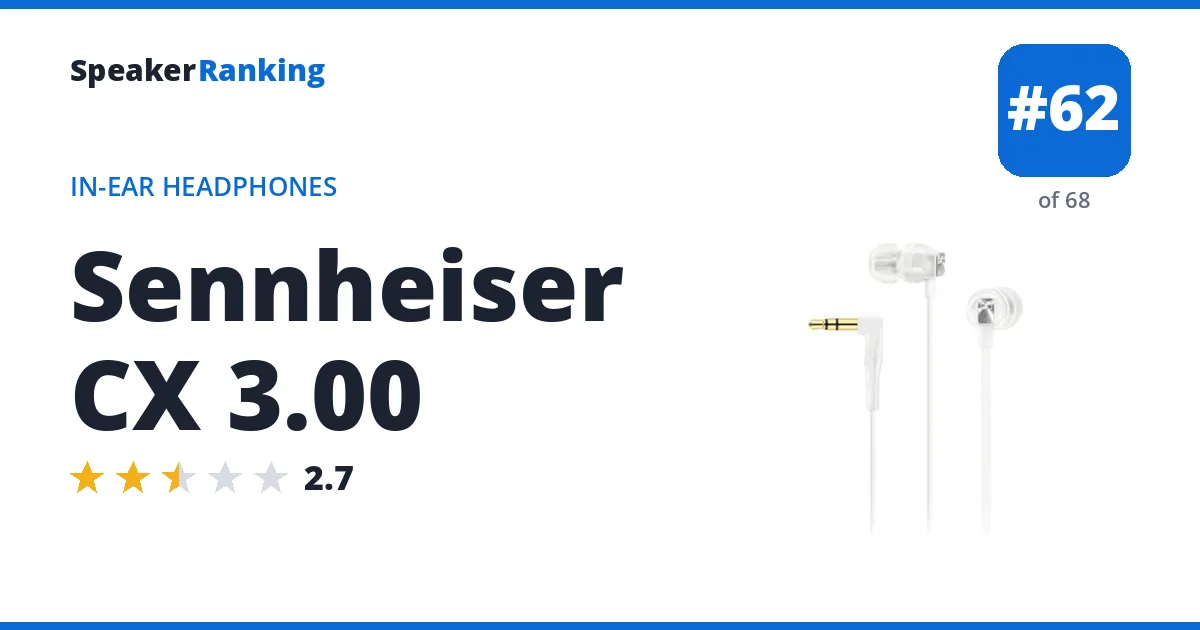
Pros: Bass is boosted about 4 dB at 60 to 200 Hz and 2.5 dB below that in oratory1990’s measurement, so kick drums and bass lines hit with extra weight. Treble from 6 to 10 kHz is lifted about 6 dB, which adds a bright edge to cymbals and gives it a V-shaped character some listeners enjoy. The 18 ohm impedance and 118 dB SPL/V sensitivity let a phone drive it easily.
Cons: A sharp 8.6 dB peak near 7.6 kHz can make hi-hats and sibilants harsh, and presence between 3 and 6 kHz is down about 4.3 dB, with a 5.7 dB dip near 3.5 kHz that pushes vocals back. A preference score of 58 and a 3.19 dB deviation mean the balance is far from the target. The Shure SE215 and FiiO FH3 are rated higher.
Full Sennheiser CX 3.00 review and specifications →
| Released | 2015 (11 years ago) |
|---|---|
| Back | Closed |
| Connection | Wired |
| Deviation From Target | 3.19 dB standard deviation |
| Driver Type | Dynamic |
| Form Factor | In-ear |
| Frequency Response | 17Hz - 21kHz (Manufacturer specified) |
| Harman Preference Score | 58 (measured by oratory1990, via AutoEQ) |
| Impedance | 18 ohms |
| Sensitivity | 118 dB SPL/V |
| Tonal Tilt | -0.74 (negative is warmer, positive brighter) |
EQ preset to match the Harman target
Set a preamp of -5.3 dB, then add these filters in any parametric equalizer (Wavelet, Equalizer APO, Peace, or a player with parametric EQ). Calculated by AutoEQ from its measured frequency response.
| Filter | Frequency | Gain | Q |
|---|---|---|---|
| Low shelf | 105 Hz | -2.1 dB | 0.70 |
| Peak | 3,874 Hz | +7.0 dB | 0.66 |
| Peak | 7,101 Hz | -10.4 dB | 0.77 |
| Peak | 167 Hz | -3.4 dB | 1.15 |
| Peak | 4,954 Hz | +4.9 dB | 1.44 |
| High shelf | 10,000 Hz | +0.3 dB | 0.70 |
| Peak | 736 Hz | +1.5 dB | 1.33 |
| Peak | 1,412 Hz | -1.1 dB | 2.20 |
| Peak | 55 Hz | +0.4 dB | 1.63 |
| Peak | 314 Hz | -1.0 dB | 3.41 |
- Reviews, Comparisons and Sound Samples
- Head-to-Head Comparisons
 #63 1MORE Triple Driver: $69.99 Amazon eBay
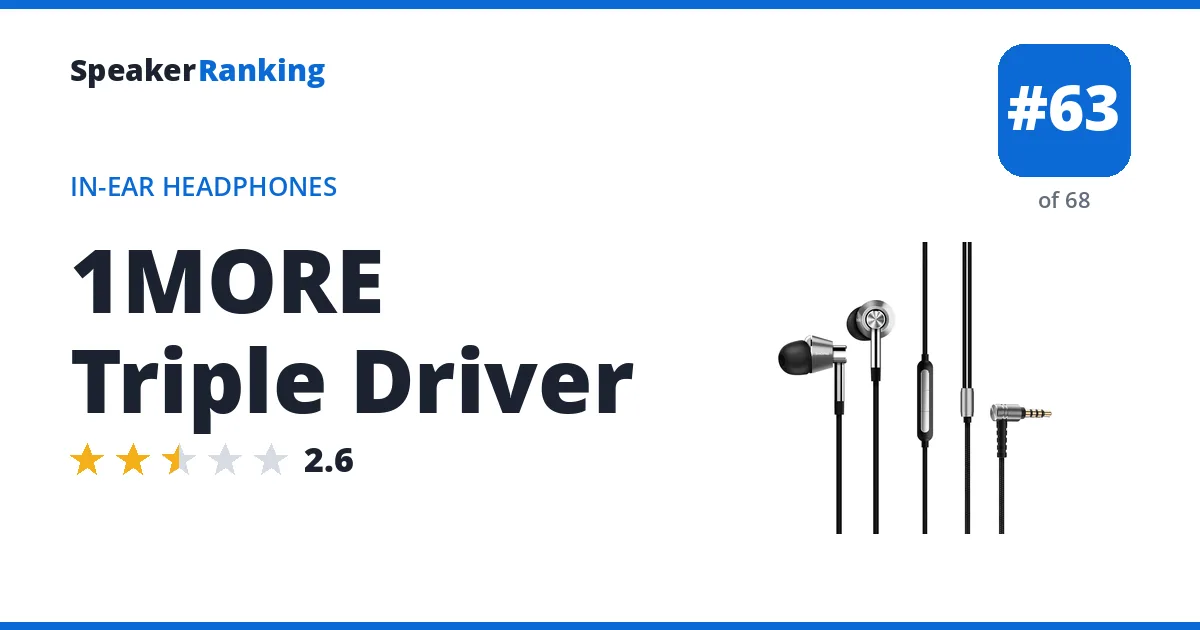
Pros: A hybrid design with 1 dynamic and 2 balanced armature drivers, plus a built-in microphone for calls. It was released in 2017 and the 32 ohm impedance suits a phone or portable player. Crinacle measured a mild warm tilt of about 0.8 dB.
Cons: A preference score of 57 and a 3.28 dB deviation from the target put the tonal balance among the weaker in its class. Sensitivity of 99 dB is on the low side, so it needs more volume than most earphones. The KZ AS10 and Sennheiser CX 3.00 are rated higher, and the Shure SE215 is higher still.
Full 1MORE Triple Driver review and specifications →
| Released | Mar 2017 (9 years ago) |
|---|---|
| Back | Closed |
| Built-in Microphone | Yes |
| Connection | Wired |
| Deviation From Target | 3.28 dB standard deviation |
| Driver Type | Hybrid (1 dynamic + 2 balanced armature) |
| Drivers | 1 x dynamic + 2 x balanced armature |
| Form Factor | In-ear |
| Frequency Response | 20Hz - 40kHz (Manufacturer specified) |
| Harman Preference Score | 57 (measured by crinacle, via AutoEQ) |
| Impedance | 32 ohms |
| Sensitivity | 99 dB |
| Tonal Tilt | -0.81 (negative is warmer, positive brighter) |
EQ preset to match the Harman target
Set a preamp of -5.3 dB, then add these filters in any parametric equalizer (Wavelet, Equalizer APO, Peace, or a player with parametric EQ). Calculated by AutoEQ from its measured frequency response.
| Filter | Frequency | Gain | Q |
|---|---|---|---|
| Low shelf | 105 Hz | +8.5 dB | 0.70 |
| Peak | 57 Hz | -8.9 dB | 0.25 |
| Peak | 9,119 Hz | +6.0 dB | 0.81 |
| Peak | 830 Hz | +3.7 dB | 1.07 |
| Peak | 4,495 Hz | -5.7 dB | 5.76 |
| High shelf | 10,000 Hz | -5.3 dB | 0.70 |
| Peak | 5,986 Hz | +3.0 dB | 5.26 |
| Peak | 2,527 Hz | -1.3 dB | 3.64 |
| Peak | 6,792 Hz | -1.1 dB | 6.00 |
| Peak | 440 Hz | +0.2 dB | 2.11 |
- Reviews, Comparisons and Sound Samples
- Head-to-Head Comparisons
 #64 Final Audio E3000: $46.60 Amazon eBay
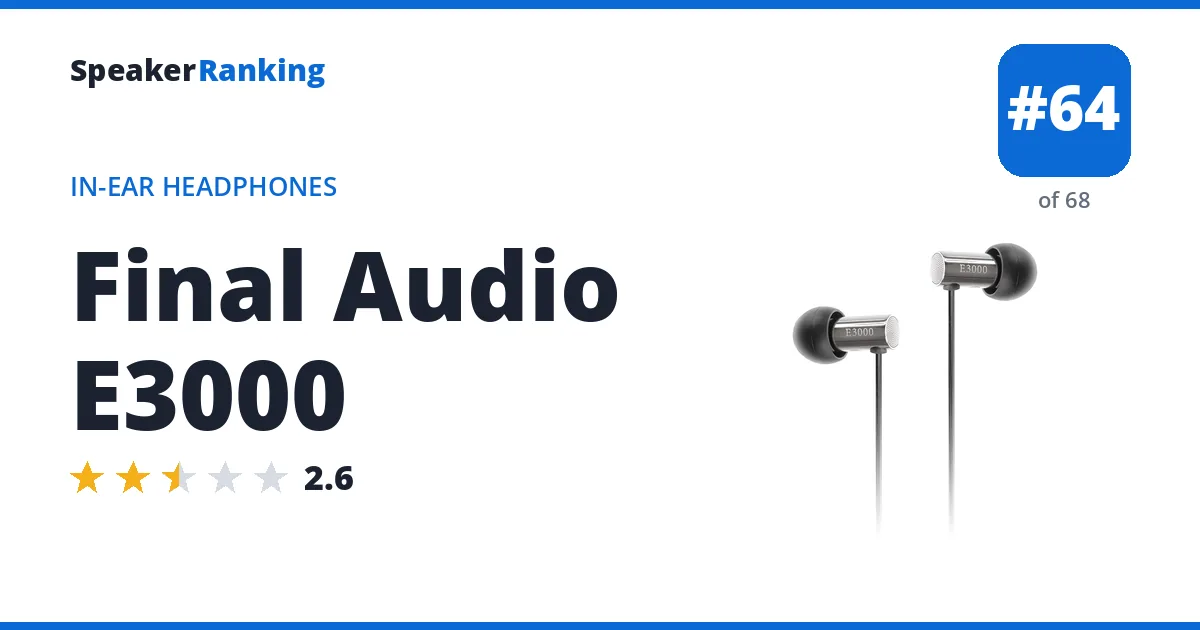
Pros: Bass at 60 to 200 Hz sits about 5.5 dB above the Harman target in oratory1990’s measurement, and the low mids are lifted about 3.2 dB, giving a warm, full and weighty sound. Treble from 6 to 10 kHz is only 1.6 dB over target, so highs stay fairly gentle and non-fatiguing. The single 6.4mm dynamic driver is easy to drive at 16 ohms and 100 dB/mW, and the price is low.
Cons: The strong bass and low mid lift can muddy vocals, and presence from 3 to 6 kHz is down about 3 dB with a 3.7 dB dip near 4.5 kHz, so voices lack clarity. A preference score of 57 with a 3.4 dB deviation shows the balance is far from target. The KZ AS10, KZ DQ6S and SoundMAGIC E50C are all rated higher.
Full Final Audio E3000 review and specifications →
| Released | 2017 (9 years ago) |
|---|---|
| Back | Closed |
| Connection | Wired |
| Deviation From Target | 3.40 dB standard deviation |
| Driver Type | Dynamic |
| Drivers | 1 x 6.4mm dynamic |
| Form Factor | In-ear |
| Harman Preference Score | 57 (measured by oratory1990, via AutoEQ) |
| Impedance | 16 ohms |
| Sensitivity | 100 dB/mW |
| Tonal Tilt | -0.57 (negative is warmer, positive brighter) |
EQ preset to match the Harman target
Set a preamp of -4.9 dB, then add these filters in any parametric equalizer (Wavelet, Equalizer APO, Peace, or a player with parametric EQ). Calculated by AutoEQ from its measured frequency response.
| Filter | Frequency | Gain | Q |
|---|---|---|---|
| Low shelf | 105 Hz | +14.3 dB | 0.70 |
| Peak | 53 Hz | -13.7 dB | 0.28 |
| Peak | 5,187 Hz | +4.0 dB | 1.54 |
| Peak | 1,381 Hz | +2.9 dB | 0.32 |
| Peak | 6,770 Hz | -2.0 dB | 1.49 |
| High shelf | 10,000 Hz | +0.3 dB | 0.70 |
| Peak | 1,242 Hz | -0.9 dB | 2.59 |
| Peak | 810 Hz | +0.7 dB | 2.40 |
| Peak | 361 Hz | -0.2 dB | 1.45 |
| Peak | 2,087 Hz | +0.5 dB | 3.04 |
- Reviews, Comparisons and Sound Samples
- Head-to-Head Comparisons
 #65 BASN Bmaster: $91.99 Amazon eBay
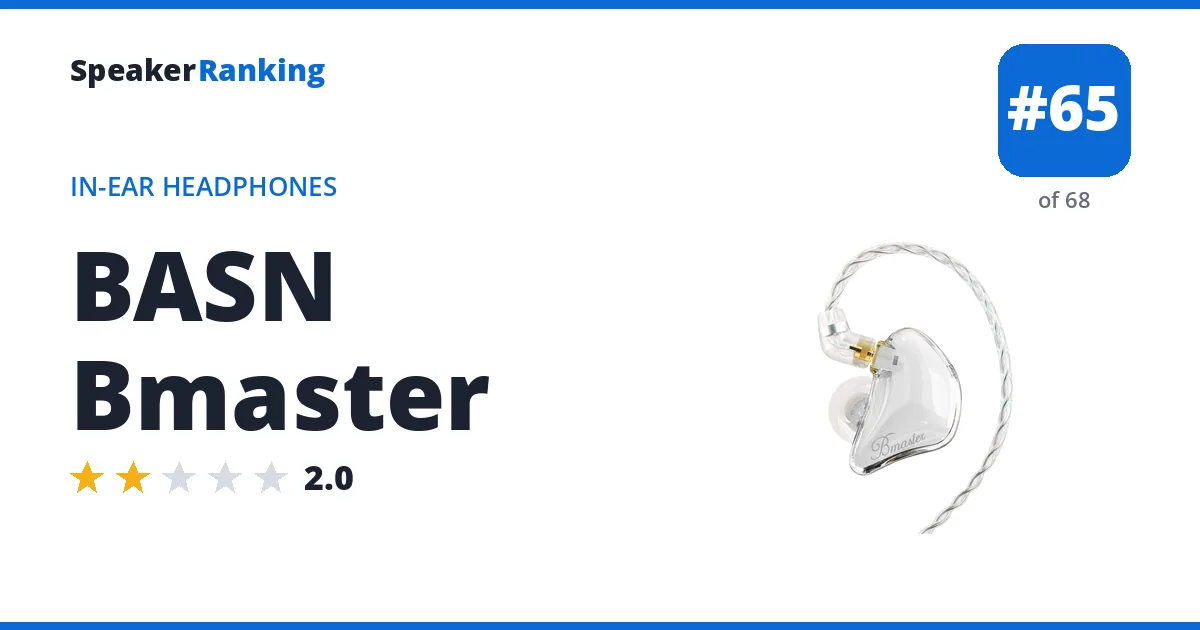
Pros: The hybrid driver setup pairs two dynamic drivers with a balanced armature, and the wired connection means no battery or pairing to manage. In HypetheSonics’ measurement bass sits about 2.6 dB above the Harman target and sub-bass is close to target, so the tuning suits listeners who want a warm, bass-forward sound. It also rates higher than the 1MORE Quad Driver at a lower price.
Cons: Presence from 3 to 6 kHz runs about 8.8 dB under target, with a 9.5 dB dip near 4 kHz, so vocals and guitars lose bite and sound recessed. Treble and air are also down by roughly 3.7 dB and 8.1 dB, which leaves cymbals dull and the overall sound closed in. The preference score of 49 is well below what most listeners prefer.
Full BASN Bmaster review and specifications →
| Back | Closed |
|---|---|
| Connection | Wired |
| Deviation From Target | 3.69 dB standard deviation |
| Driver Type | Hybrid (2 dynamic + 1 balanced armature) |
| Drivers | 2 x dynamic + 1 x balanced armature |
| Form Factor | In-ear |
| Harman Preference Score | 49 (measured by HypetheSonics, via AutoEQ) |
| Tonal Tilt | -1.43 (negative is warmer, positive brighter) |
EQ preset to match the Harman target
Set a preamp of -6.6 dB, then add these filters in any parametric equalizer (Wavelet, Equalizer APO, Peace, or a player with parametric EQ). Calculated by AutoEQ from its measured frequency response.
| Filter | Frequency | Gain | Q |
|---|---|---|---|
| Low shelf | 105 Hz | -2.6 dB | 0.70 |
| Peak | 3,536 Hz | +6.0 dB | 0.95 |
| Peak | 178 Hz | -4.1 dB | 0.82 |
| Peak | 1,707 Hz | -5.4 dB | 1.07 |
| Peak | 4,911 Hz | +1.8 dB | 0.18 |
| High shelf | 10,000 Hz | +1.5 dB | 0.70 |
| Peak | 7,135 Hz | -3.6 dB | 5.21 |
| Peak | 9,859 Hz | +2.0 dB | 2.95 |
| Peak | 5,469 Hz | +1.4 dB | 4.91 |
| Peak | 62 Hz | +0.4 dB | 2.03 |
- Reviews, Comparisons and Sound Samples
- Head-to-Head Comparisons
 #66 1MORE Quad Driver: $119.69 Amazon eBay
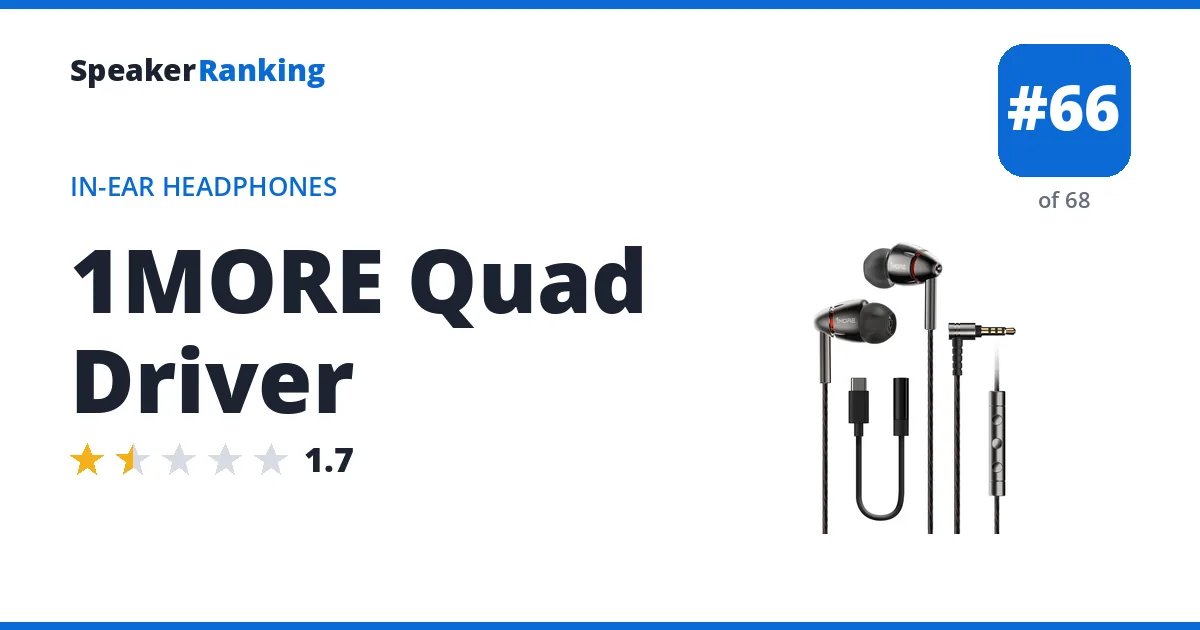
Pros: The hybrid design combines one dynamic driver with three balanced armatures, and the 32 ohm impedance and 99 dB sensitivity let it run easily from a phone. It includes a built-in microphone for calls. The tuning leans warm, with bass about 4.3 dB above target, which suits listeners who like a thick low end.
Cons: Treble from 6 to 10 kHz sits about 6 dB under target and a 10.5 dB dip near 8.8 kHz dulls cymbals and detail, while the air region is boosted by 4.2 dB, which makes the top end uneven. Low mids run about 3.9 dB hot, adding bloat to male vocals and bass guitar, and sub-bass is down 4.5 dB so the deepest rumble is thin. The preference score of 45 and a rating below the BASN Bmaster show the tuning is a poor match for most tastes.
Full 1MORE Quad Driver review and specifications →
| Released | Mar 2017 (9 years ago) |
|---|---|
| Back | Closed |
| Built-in Microphone | Yes |
| Connection | Wired |
| Deviation From Target | 4.49 dB standard deviation |
| Driver Type | Hybrid (1 dynamic + 3 balanced armature) |
| Drivers | 1 x dynamic + 3 x balanced armature |
| Form Factor | In-ear |
| Frequency Response | 20Hz - 40kHz (Manufacturer specified) |
| Harman Preference Score | 45 (measured by oratory1990, via AutoEQ) |
| Impedance | 32 ohms |
| Sensitivity | 99 dB |
| Tonal Tilt | -0.40 (negative is warmer, positive brighter) |
EQ preset to match the Harman target
Set a preamp of -6.6 dB, then add these filters in any parametric equalizer (Wavelet, Equalizer APO, Peace, or a player with parametric EQ). Calculated by AutoEQ from its measured frequency response.
| Filter | Frequency | Gain | Q |
|---|---|---|---|
| Low shelf | 105 Hz | +8.2 dB | 0.70 |
| Peak | 105 Hz | -6.9 dB | 0.37 |
| Peak | 8,263 Hz | +6.3 dB | 1.29 |
| Peak | 1,031 Hz | +3.4 dB | 0.57 |
| Peak | 346 Hz | -2.1 dB | 0.61 |
| High shelf | 10,000 Hz | -6.4 dB | 0.70 |
| Peak | 4,463 Hz | -1.7 dB | 5.45 |
| Peak | 6,085 Hz | +2.5 dB | 5.92 |
| Peak | 2,047 Hz | +0.7 dB | 3.71 |
| Peak | 1,391 Hz | -0.3 dB | 2.85 |
- Reviews, Comparisons and Sound Samples
- Head-to-Head Comparisons
 #67 Sennheiser Momentum True Wireless 2: $237.45 Amazon eBay
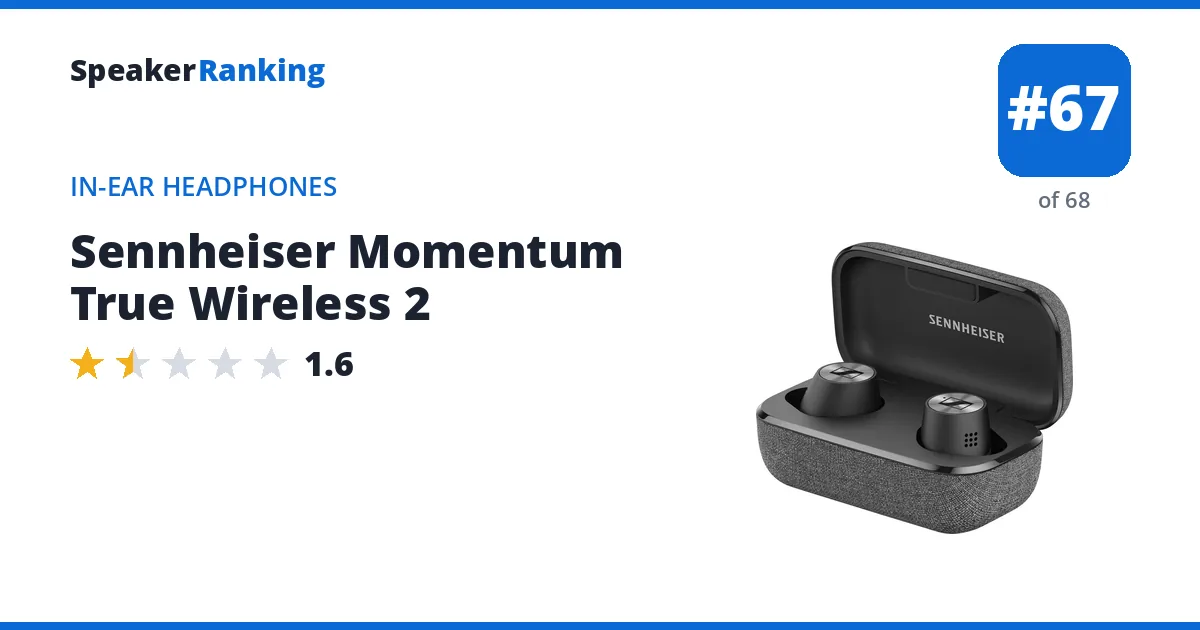
Pros: Active noise cancelling, Bluetooth 5.1 with SBC, AAC and aptX, and an IPX4 rating cover the features commuters and gym users want. Battery life is rated at 7 hours per charge and 28 with the case, and each earbud weighs only 6 g. Bass is lifted by about 3.1 dB over target, which suits listeners who want a warm, punchy sound.
Cons: In oratory1990’s measurement the presence region from 3 to 6 kHz is about 9.6 dB below target, with a 10.7 dB dip near 4 kHz, so vocals and instrument attack sound pushed back and hazy. A 5.2 dB peak near 10.8 kHz and boosted air then add an uneven sparkle on top, and sub-bass is down 2.3 dB. The preference score of 44 is low, and the rating sits below the Jabra Elite Active 65t.
Full Sennheiser Momentum True Wireless 2 review and specifications →
| Released | Apr 2020 (6 years ago) |
|---|---|
| Active Noise Cancelling | Yes |
| Back | Closed |
| Battery Life | 7 hours (28 with case, Manufacturer specified) |
| Bluetooth Codecs | SBC, AAC, aptX |
| Bluetooth Version | 5.1 |
| Built-in Microphone | Yes |
| Connection | True wireless |
| Deviation From Target | 4.39 dB standard deviation |
| Driver Type | Dynamic |
| Drivers | 1 x 7mm dynamic |
| Form Factor | In-ear |
| Frequency Response | 5Hz - 21kHz (Manufacturer specified) |
| Harman Preference Score | 44 (measured by oratory1990, via AutoEQ) |
| IP Rating | IPX4 |
| Tonal Tilt | -0.89 (negative is warmer, positive brighter) |
| Weight | 0 lbs (6 g) per earbud |
EQ preset to match the Harman target
Set a preamp of -7.0 dB, then add these filters in any parametric equalizer (Wavelet, Equalizer APO, Peace, or a player with parametric EQ). Calculated by AutoEQ from its measured frequency response.
| Filter | Frequency | Gain | Q |
|---|---|---|---|
| Low shelf | 105 Hz | +6.4 dB | 0.70 |
| Peak | 85 Hz | -6.9 dB | 0.26 |
| Peak | 3,202 Hz | +6.5 dB | 1.25 |
| Peak | 1,638 Hz | -1.6 dB | 2.70 |
| Peak | 5,340 Hz | +4.9 dB | 3.93 |
| High shelf | 10,000 Hz | -3.3 dB | 0.70 |
| Peak | 736 Hz | +1.0 dB | 1.92 |
| Peak | 334 Hz | -0.6 dB | 2.45 |
| Peak | 4,354 Hz | +1.0 dB | 4.95 |
| Peak | 199 Hz | -0.5 dB | 3.18 |
- Reviews, Comparisons and Sound Samples
- Head-to-Head Comparisons
 #68 Panasonic RP-HJE120: $10.99 Amazon eBay
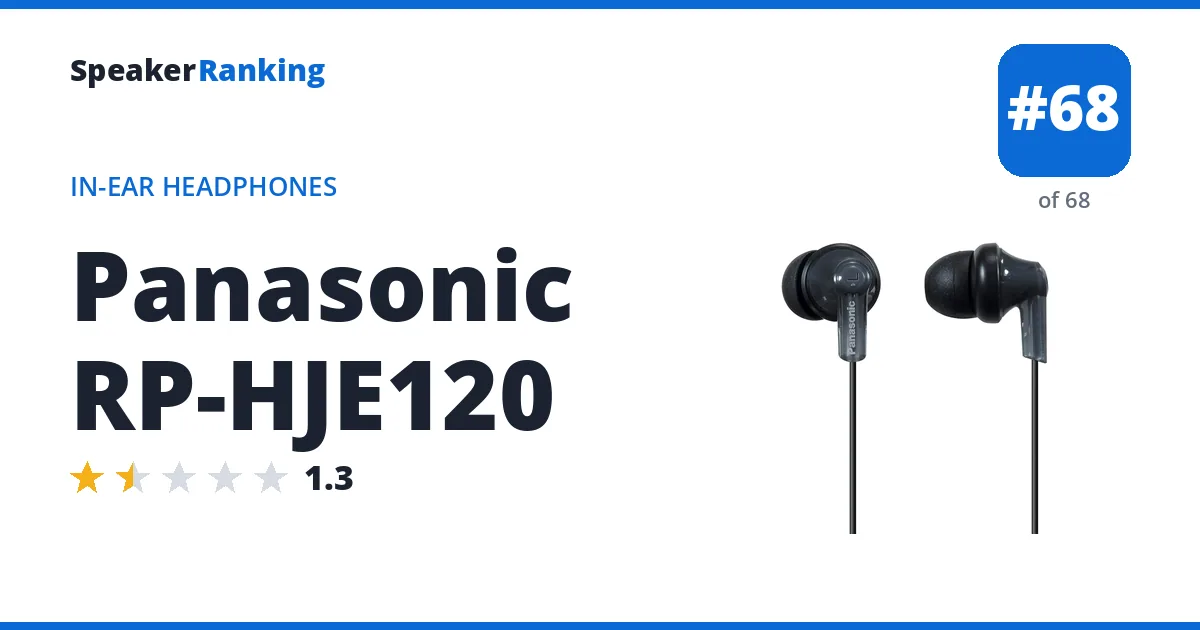
Pros: It is a very cheap wired earphone with a 9 mm dynamic driver, 16 ohm impedance and 95 dB/mW sensitivity, so it plays loud from any phone or laptop. Bass is lifted about 8 dB over target in oratory1990’s measurement and sub-bass is up 2.3 dB, which suits listeners who simply want a big, thumpy low end.
Cons: That bass boost spills into the low mids, which are 4.8 dB over target, so vocals and instruments sound thick and muddy. Treble is rolled off by about 2.2 dB and air by 4.3 dB, with an 8.7 dB dip near 11.9 kHz, so cymbals lack sparkle. The preference score of 40 is the lowest among its rivals, and each of those rivals has a higher rating, including the TRN MT1 at a similar cost.
Full Panasonic RP-HJE120 review and specifications →
| Back | Closed |
|---|---|
| Connection | Wired |
| Deviation From Target | 4.26 dB standard deviation |
| Driver Type | Dynamic |
| Drivers | 1 x 9mm dynamic |
| Form Factor | In-ear |
| Frequency Response | 20Hz - 20kHz (Manufacturer specified) |
| Harman Preference Score | 40 (measured by oratory1990, via AutoEQ) |
| Impedance | 16 ohms |
| Sensitivity | 95 dB/mW |
| Tonal Tilt | -1.39 (negative is warmer, positive brighter) |
EQ preset to match the Harman target
Set a preamp of -7.5 dB, then add these filters in any parametric equalizer (Wavelet, Equalizer APO, Peace, or a player with parametric EQ). Calculated by AutoEQ from its measured frequency response.
| Filter | Frequency | Gain | Q |
|---|---|---|---|
| Low shelf | 105 Hz | +6.9 dB | 0.70 |
| Peak | 69 Hz | -5.4 dB | 0.19 |
| Peak | 8,905 Hz | +6.2 dB | 1.77 |
| Peak | 127 Hz | -4.1 dB | 0.23 |
| Peak | 1,128 Hz | +5.1 dB | 0.41 |
| High shelf | 10,000 Hz | +2.8 dB | 0.70 |
| Peak | 5,414 Hz | -3.7 dB | 5.69 |
| Peak | 3,853 Hz | +2.0 dB | 3.18 |
| Peak | 2,384 Hz | -0.9 dB | 2.73 |
| Peak | 6,454 Hz | +1.0 dB | 6.00 |
- Reviews, Comparisons and Sound Samples
- Head-to-Head Comparisons