This page ranks 28 passive in-wall and in-ceiling speakers. Unlike a bookshelf pair, these mount flush inside a wall or ceiling cavity behind a paintable grille, so they disappear from the room instead of sitting on a stand. They have no built-in amp, so a receiver or external amplifier drives them, and they’re normally sold and priced per unit rather than per pair.
They’re a common choice for whole-home background audio, a home theater’s surround and height channels, or any room where floor space for a speaker isn’t available. Because the driver sits recessed behind drywall, installation depth, mounting cutout size, and the wall or ceiling cavity itself all affect the sound more than they would with a free-standing speaker, so check those dimensions against the space before buying.
| Select to compare | |||||||
|---|---|---|---|---|---|---|---|
| 1 | KEF Ci3160RLM-THX | $4,579.98 per pair | 89dB | 4 ohms | 58.6Hz | 26.5 lbs | |
| 2 | Revel W553L | $1,089.90 per pair | 90dB | - | 64.5Hz | 7.7 lbs | |
| 3 | Revel W126Be | $3,849.90 per pair | 89dB | 6 ohms nominal | 89.7Hz | 10.4 lbs | |
| 4 | KEF Ci3160RL-THX | $2,800 per pair | 90dB | 4 ohms nominal | 51.3Hz | 25.8 lbs | |
| 5 | Revel W226Be | $4,949.90 per pair | 90dB | 6 ohms nominal | 48.1Hz | 15.7 lbs | |
| 6 | Revel W228Be | $7,699.90 per pair | 90dB | 6 ohms nominal | 43.4Hz | 31.5 lbs | |
| 7 | KEF CI250RRM-THX | $5,978 per pair | 89dB | 8 ohms | 51.3Hz | 13.2 lbs | |
| 8 | Monolith THX-365IW | $999.98 per pair | 89.5dB | 4 ohms nominal | 54.6Hz | 19.6 lbs | |
| 9 | Revel W893 | $2,200 per pair | - | - | 39.6Hz | 10.8 lbs | |
| 10 | JBL Synthesis SCL-6 | $3,629.90 per pair | 91dB | 4 ohms | 67.4Hz | 22.2 lbs | |
| 11 | Monolith THX-LCR | - | 88.5dB | 4 ohms nominal | - | 14.1 lbs | |
| 12 | KEF CI200RR-THX | $2,399.98 per pair | 90dB | 4 ohms | 82.5Hz | 7.9 lbs | |
| 13 | JBL Synthesis SCL-3 | $7,259.90 per pair | 91dB | 6 ohms | 72.4Hz | 24.3 lbs | |
| 14 | JBL Synthesis SCL-7 | $2,419.90 per pair | 88dB | 4 ohms | 67.4Hz | 12.6 lbs | |
| 15 | JBL Synthesis SCL-1 | $36,299.90 per pair | 94dB | 4 ohms | 53.0Hz | 177.5 lbs | |
| 16 | JBL Synthesis SCL-4 | $7,259.90 per pair | 91dB | 6 ohms | 83.7Hz | 27.6 lbs | |
| 17 | Miller & Kreisel IW150 | $4,998 per pair | 90dB | 4 ohms | 95.2Hz | 18.7 lbs | |
| 18 | KEF CI130.2CR | $599.98 per pair | 87dB | 8 ohms | 100Hz | 2.9 lbs | |
| 19 | Revel W990 | $4,239.90 per pair | 85.9dB | - | 32.2Hz | 17 lbs | |
| 20 | Grimani Systems Rixos-L | $16,400 per pair | 96dB | 8 ohms | 87.9Hz | 32 lbs | |
| 21 | Focal 1000 IWLCR6 | $5,400 per pair | 91dB | 8 ohms nominal | 51.3Hz | 24.1 lbs | |
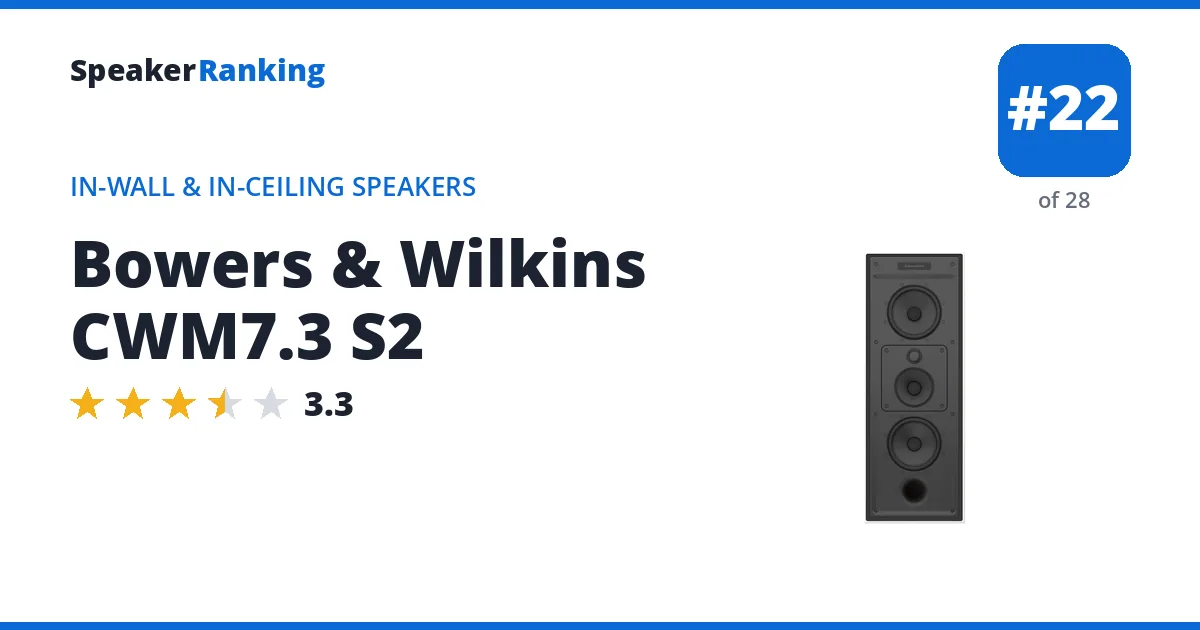
| 22 | Bowers & Wilkins CWM7.3 S2 | $5,600 per pair | 90dB | 8 ohms nominal | 63.0Hz | 27.3 lbs | |
| 23 | MartinLogan Tribute 5XW | $6,999.98 per pair | 94dB | 4 ohms | 74.7Hz | 25.6 lbs | |
| 24 | Bowers & Wilkins CWM 7.5 S2 | $2,700 per pair | 86dB | 8 ohms nominal, 3.8 o… | 45Hz | 8.4 lbs | |
| 25 | KEF CI50R | - | 82dB | 6 ohms | 170Hz | 2.2 lbs | |
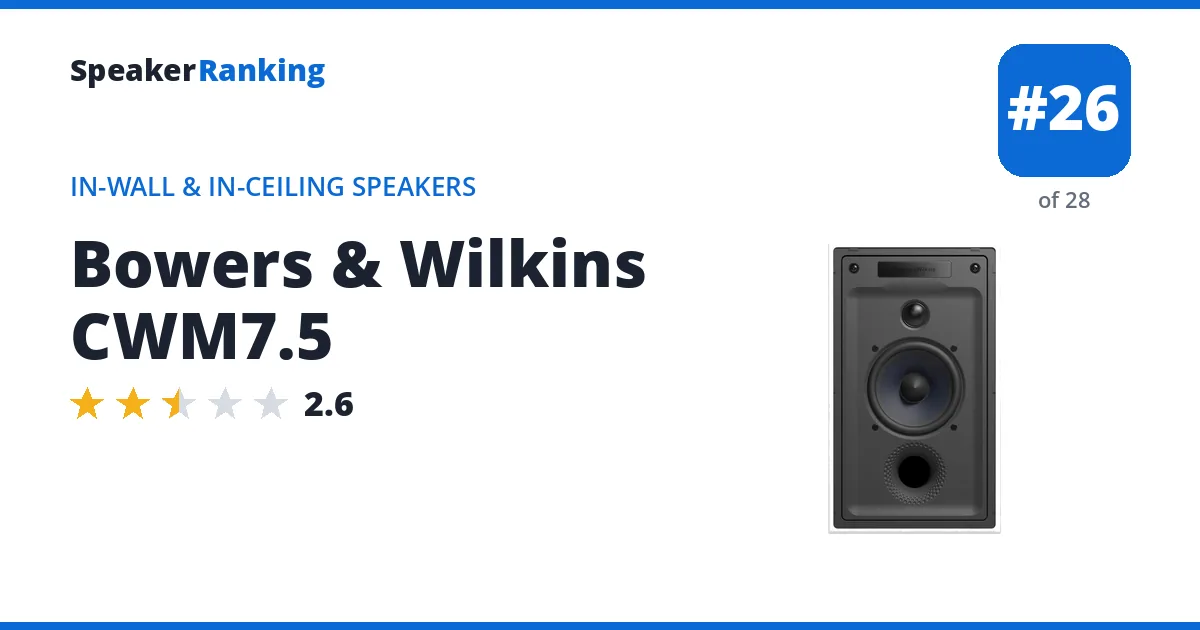
| 26 | Bowers & Wilkins CWM7.5 | $1,600 per pair | - | - | 69.0Hz | - | |
| 27 | JBL Synthesis SCL-5 | $4,400 per pair | 86dB | 6 ohms nominal | 74.7Hz | 8.6 lbs | |
| 28 | SpeakerCraft AIM8 One | - | 88dB | 8 ohms nominal | 60.5Hz | 11 lbs |
Prices on this page were last checked October 12, 2026 at 4:13 PM UTC. Product prices and availability are accurate as of that date/time and are subject to change; the price and availability shown on Amazon at the time of purchase will apply to the purchase of this product.
As an eBay Partner, we may be compensated if you make a purchase.
 #1 KEF Ci3160RLM-THX: $4,579.98 per pair Amazon $2,289.99 eBay
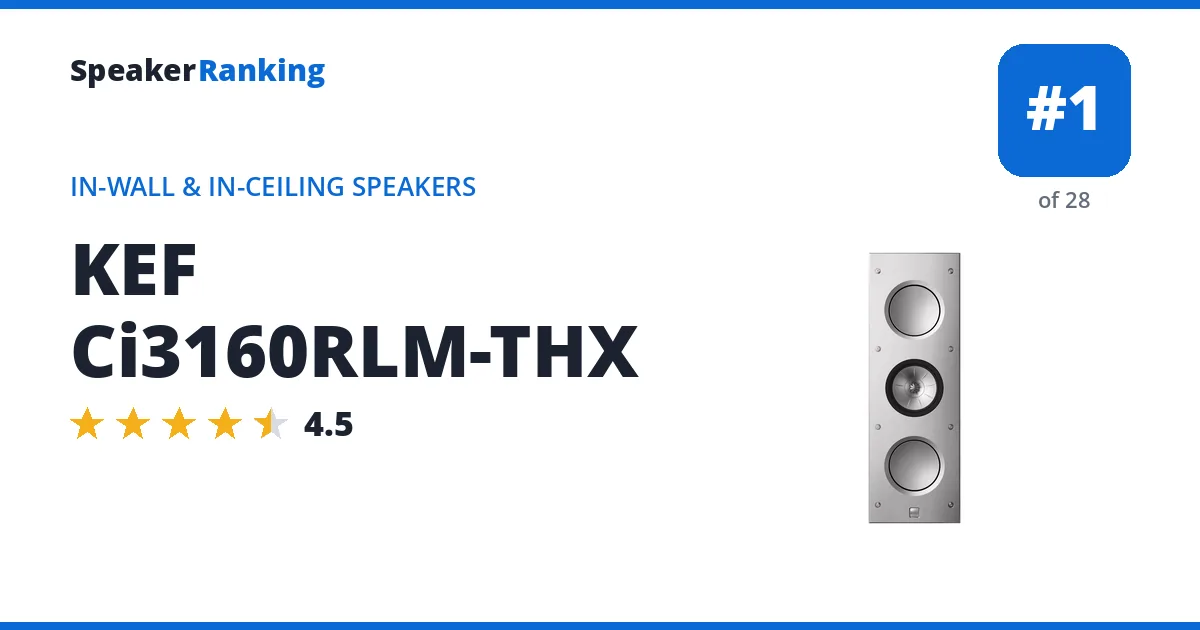
Older model: the KEF Ci3160RL-THX (ranked lower, rated 4.3/5). See every KEF Ci THX In-Wall generation.
Same family: the KEF CI250RRM-THX (smaller in-wall, ranked lower, rated 4.1/5).
Pros: Independently measured by Audio Science Review on a Klippel rig to a genuine 58.6Hz at -3dB and roughly 36Hz at -10dB, with an on-axis slope of just -0.02dB per octave, essentially flat. Directivity is the most consistent of any in-wall or in-ceiling speaker in this category, with the tightest spread in its sound-power directivity index across the measured band. The rotatable, tiltable driver module (the RLM in its name) lets the tweeter and midrange aim toward the listening area even when the cabinet itself has to be installed off to one side. THX Ultra2 certified, with a 4-driver, 3-way layout: dual 6.5” woofers flanking a 6.5” Uni-Q coaxial midrange/tweeter. Measured bass extension of 58.6Hz (-3dB).
Cons: At $2290 each, a stereo pair costs twice that, among the most expensive options in this category. Listening-window and sound-power smoothness are moderate rather than class-leading, meaning some unevenness remains once you move off the main listening axis despite the flat on-axis trace. The 660 x 209mm cutout and 106mm mounting depth are large enough that they won’t fit inside a standard 2x4 wall stud bay without modification.
Full KEF Ci3160RLM-THX review and specifications →
| Released | Nov 2023 (2 years ago) |
|---|---|
| Bass Extension (-10dB) | 36Hz (measured, spinorama.org ASR data) |
| Bass Extension (-3dB) | 58.6Hz (measured, spinorama.org ASR data) |
| Certification | THX Ultra2 |
| DIY Kit | No |
| Dimensions | 26.8” x 9.1” x 4.2” (680 x 230 x 105.7 mm) |
| Drivers | 2x 6.5” LF woofers, 6.5” Uni-Q coaxial midrange, 1” vented aluminum dome tweeter with MAT (rotatable/tiltable module) |
| Enclosure | Open-backed, in-wall |
| Frequency Response | 43Hz-28kHz +/-6dB (manufacturer, open-backed) |
| Impedance | 4 ohms |
| Mounting Cutout | 660mm (H) x 209mm (W) |
| Power Handling | 50-350W recommended amplifier power |
| Sensitivity | 89dB |
| Spinorama Preference Score | 5.32 |
| Spinorama Preference Score with Perfect Sub | 7.83 |
| Weight | 26.5 lbs (12 kg) |
- Links
- Reviews, Comparisons and Sound Samples
- Head-to-Head Comparisons
 #2 Revel W553L: $1,089.90 per pair Crutchfield $544.95 eBay
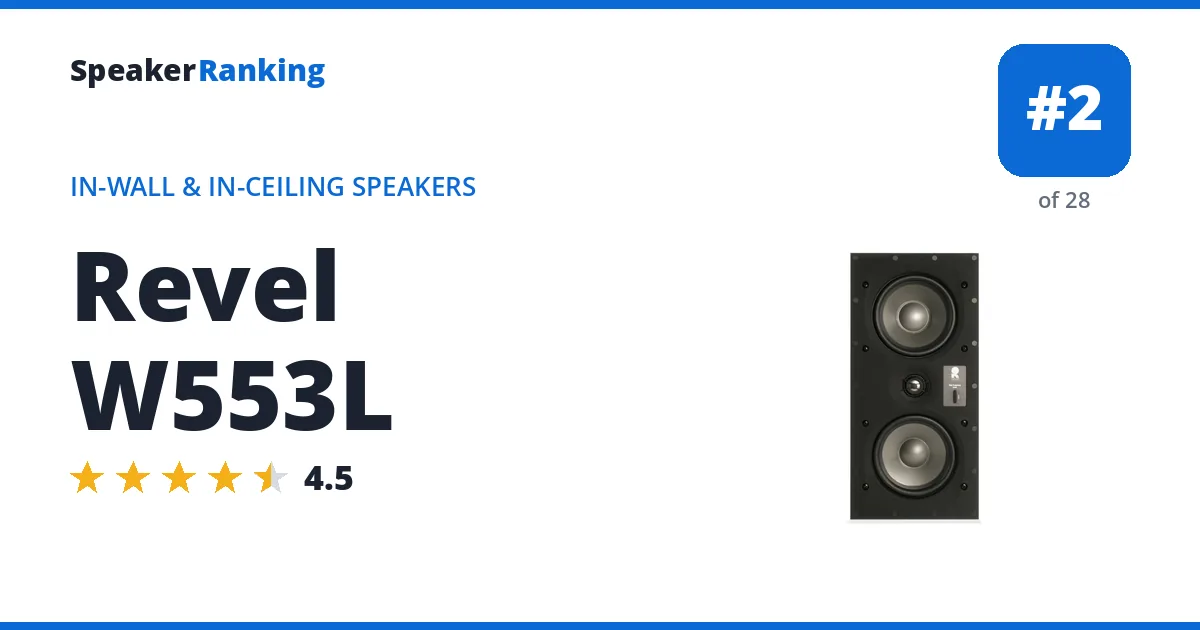
Pros: Erin’s Audio Corner’s Klippel measurement gives a preference score of 4.84, or 7.50 with a perfect subwoofer, a strong result for an in-wall speaker at this price. On-axis response is smooth (0.68 smoothness) and directivity is well controlled (SPDI deviation 2.35dB), so the sound off to the sides stays close to the sound you hear straight on. Bass measures to 64.5Hz at -3dB and 51.3Hz at -6dB. The 1” aluminum dome tweeter swivels toward the listening seat, a three-position switch trims treble to suit the room, and the cabinet mounts vertically or horizontally, so it works as a left, right or center channel. Measured bass extension of 64.5Hz (-3dB).
Cons: At $545 each a stereo pair costs twice that, and a separate amplifier is required. Bass ends early for a main speaker, with -3dB at 64.5Hz, so a subwoofer is needed for music and movies. Audio Science Review’s own measurement was less flattering (preference score 4.04, -3dB at 82Hz), so results differ between test benches. Two 5.25” woofers give less output headroom than the larger Revel in-wall models.
Full Revel W553L review and specifications →
| Bass Extension (-10dB) | 39.3Hz (measured, Erin’s Audio Corner) |
|---|---|
| Bass Extension (-3dB) | 64.5Hz (measured, Erin’s Audio Corner) |
| DIY Kit | No |
| Dimensions | 15.1”H x 7.4”W (384 x 188 mm) (74mm mounting depth) |
| Drivers | 2x 5.25” micro-ceramic composite (MCC) woofers, 1” swiveling aluminum dome tweeter with waveguide |
| Enclosure | In-wall, LCR (vertical or horizontal mounting) |
| Mounting Cutout | 163W x 359H mm |
| Power Handling | 10-150W recommended amplifier power |
| Sensitivity | 90dB |
| Spinorama Preference Score | 4.84 |
| Spinorama Preference Score with Perfect Sub | 7.50 |
| Warranty | Lifetime |
| Weight | 7.7 lbs (3.5 kg) |
- Links
- Reviews, Comparisons and Sound Samples
- Erin’s Audio Corner: HiFi In-Wall Speaker Shootout! The results will floor (wall?) you!!! More from Erin’s Audio Corner →
- Erin’s Audio Corner Website: Revel W553L
- Erin’s Audio Corner Measurements (spinorama.org)
- Audio Science Review: Revel W553L Measurements (In-Wall Speaker) More from Audio Science Review →
- Head-to-Head Comparisons
 #3 Revel W126Be: $3,849.90 per pair Crutchfield $1,924.95 eBay
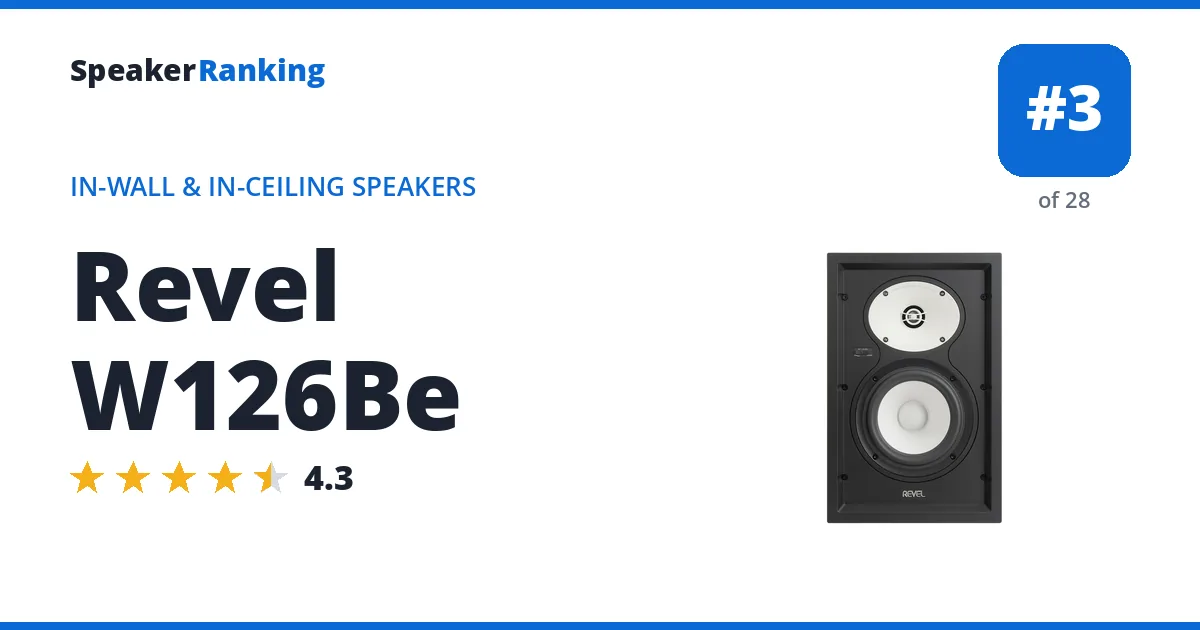
Same family: the Revel W226Be (larger in-wall, ranked lower, rated 4.2/5) and the Revel W228Be (larger in-wall, ranked lower, rated 4.2/5).
Pros: Revel’s own measurement, published on spinorama.org, gives a preference score of 5.39, or 7.97 with a perfect subwoofer, with a smooth predicted in-room response (0.85 smoothness). Directivity is tightly controlled (SPDI deviation 2.01dB) and on-axis deviation averages only 0.34dB. Bass measures to 62.6Hz at -6dB. It pairs a 1” beryllium dome tweeter and acoustic lens waveguide with a 6.5” aluminum cone woofer, rated at 89dB sensitivity and 105dB maximum output. Measured bass extension of 89.7Hz (-3dB).
Cons: The measurement comes from Revel, digitized from its published curves, and has no independent second test, so treat the figures as manufacturer supplied. Bass is limited, with -3dB at 89.7Hz, so a subwoofer is needed for full range sound. At $1925 each a stereo pair costs twice that, and the optional back box is sold separately. A single 6.5” woofer gives less output than the dual-woofer Revel W226Be.
Full Revel W126Be review and specifications →
| Released | Sep 2023 (3 years ago) |
|---|---|
| Bass Extension (-10dB) | 42.5Hz (measured, Revel vendor data on spinorama.org) |
| Bass Extension (-3dB) | 89.7Hz (measured, Revel vendor data on spinorama.org) |
| Crossover Frequency | 2,100Hz |
| DIY Kit | No |
| Dimensions | 15.6”H x 10.2”W x 3.8”D (395 x 260 x 97 mm) (88.7mm mounting depth) |
| Drivers | 6.5” Deep Ceramic Composite (DCC) aluminum cone woofer, 1” beryllium dome tweeter with acoustic lens waveguide (2-way) |
| Enclosure | In-wall, 9-18L enclosure (optional W126BEBB back box sold separately) |
| Frequency Response | 55Hz-40kHz (-6dB, manufacturer) |
| Impedance | 6 ohms nominal (4 ohm minimum) |
| Maximum SPL | 105dB (manufacturer specified) |
| Mounting Cutout | 226W x 357H mm |
| Power Handling | 50-150W RMS at 4 ohms |
| Sensitivity | 89dB |
| Spinorama Preference Score | 5.39 |
| Spinorama Preference Score with Perfect Sub | 7.97 |
| Weight | 10.4 lbs (4.7 kg) |
- Links
- Reviews, Comparisons and Sound Samples
- Head-to-Head Comparisons
 #4 KEF Ci3160RL-THX: $2,800 per pair Discontinued eBay
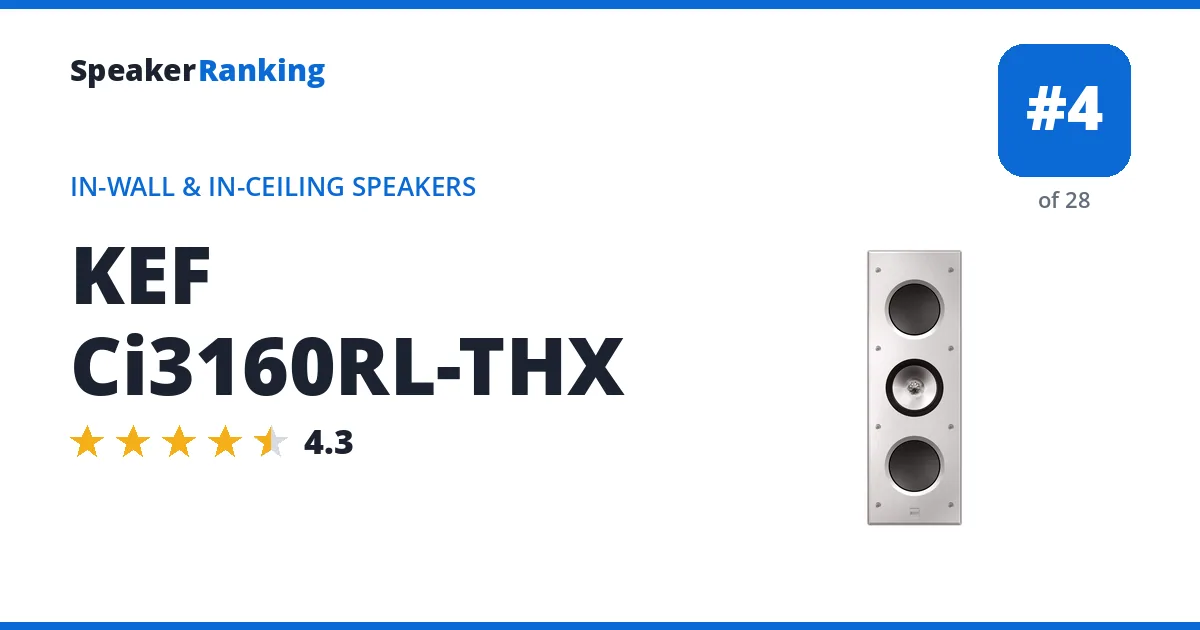
Newer model: the KEF Ci3160RLM-THX, ranked higher, rated 4.5/5, released Nov 2023. See every KEF Ci THX In-Wall generation.
Pros: A THX Ultra2 in-wall with a Uni-Q coaxial driver (1” aluminium tweeter inside a 6.5” midrange) and two 6.5” woofers, rated at 90dB. Erin’s Audio Corner measured very consistent directivity (2.29dB directivity index deviation), a listening window within 2.4dB from 300Hz to 5kHz and bass to 51.3Hz (-3dB), for a preference score of 5.24. Measured bass extension of 51.3Hz (-3dB).
Cons: The 4 ohm load needs a capable amplifier. Replaced by the KEF Ci3160RLM-THX. Discontinued.
Full KEF Ci3160RL-THX review and specifications →
| Released | Dec 2020 (5 years ago) |
|---|---|
| Bass Extension (-10dB) | about 31.6Hz (measured, Erin’s Audio Corner) |
| Bass Extension (-3dB) | 51.3Hz (measured, Erin’s Audio Corner) |
| Certification | THX Ultra2 |
| DIY Kit | No |
| Dimensions | 26.8”H x 9.1”W x 4.2”D (680 x 230 x 106 mm) |
| Drivers | Uni-Q: 1” vented aluminium tweeter in 6.5” midrange; 2x 6.5” woofers |
| Frequency Response | 45Hz-28kHz (manufacturer specified) |
| Impedance | 4 ohms nominal (manufacturer specified) |
| Sensitivity | 90dB (2.83V/1m, manufacturer specified) |
| Spinorama Preference Score | 5.24 |
| Spinorama Preference Score with Perfect Sub | 7.49 |
| Weight | 25.8 lbs (11.7 kg) |
- Reviews, Comparisons and Sound Samples
 #5 Revel W226Be: $4,949.90 per pair Crutchfield $2,474.95 eBay
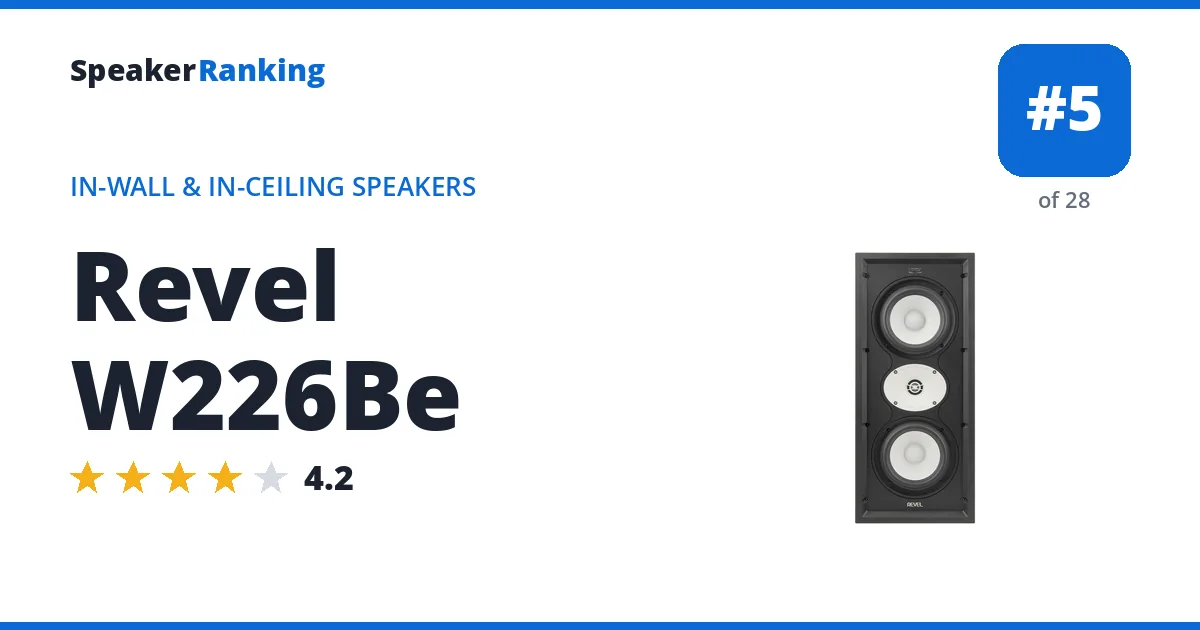
Same family: the Revel W126Be (smaller in-wall, ranked higher, rated 4.3/5) and the Revel W228Be (larger in-wall, ranked lower, rated 4.2/5).
Pros: Revel’s own measurement, published on spinorama.org, gives a preference score of 5.51, or 7.60 with a perfect subwoofer. Bass measures to 48.1Hz at -3dB and 43.7Hz at -6dB, deeper than the single-woofer Revel W126Be, and directivity is well controlled (SPDI deviation 1.95dB). Dual 6.5” aluminum cone woofers and a 1” beryllium dome tweeter behind an acoustic lens waveguide give 90dB sensitivity and a rated 110dB maximum output, and it accepts 50-200W of amplifier power. Measured bass extension of 48.1Hz (-3dB).
Cons: The measurement comes from Revel, digitized from its published curves, and has no independent second test, so treat the figures as manufacturer supplied. At $2475 each a stereo pair costs twice that, and the back box is not included and is sold separately. Predicted in-room smoothness (0.81) and on-axis deviation (0.33dB) are good but not ahead of the cheaper Revel W126Be, so the extra cost buys bass and output rather than a cleaner midrange.
Full Revel W226Be review and specifications →
| Released | Sep 2023 (3 years ago) |
|---|---|
| Bass Extension (-10dB) | 36.4Hz (measured, Revel vendor data on spinorama.org) |
| Bass Extension (-3dB) | 48.1Hz (measured, Revel vendor data on spinorama.org) |
| Crossover Frequency | 2,000Hz |
| DIY Kit | No |
| Dimensions | 23”H x 10.2”W x 3.8”D (583 x 259 x 96 mm) (88mm mounting depth) |
| Drivers | 2x 6.5” Deep Ceramic Composite (DCC) aluminum cone woofers, 1” beryllium dome tweeter with acoustic lens waveguide (2-way) |
| Enclosure | In-wall, 18-36L enclosure (optional W226BEBB back box sold separately) |
| Frequency Response | 43Hz-40kHz (-6dB, manufacturer) |
| Impedance | 6 ohms nominal (4 ohm minimum) |
| Maximum SPL | 110dB (manufacturer specified) |
| Mounting Cutout | 226W x 549H mm |
| Power Handling | 50-200W RMS at 4 ohms |
| Sensitivity | 90dB |
| Spinorama Preference Score | 5.51 |
| Spinorama Preference Score with Perfect Sub | 7.60 |
| Weight | 15.7 lbs (7.1 kg) |
- Links
- Reviews, Comparisons and Sound Samples
- Head-to-Head Comparisons
 #6 Revel W228Be: $7,699.90 per pair Crutchfield $3,849.95 eBay
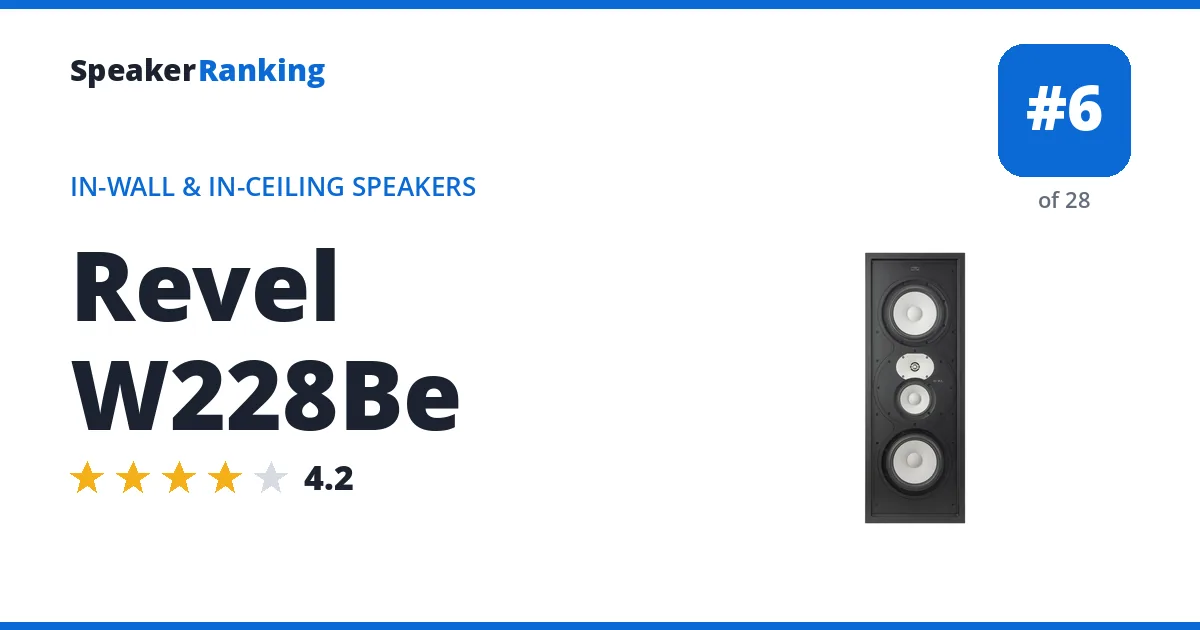
Same family: the Revel W126Be (smaller in-wall, ranked higher, rated 4.3/5) and the Revel W226Be (smaller in-wall, ranked higher, rated 4.2/5).
Pros: Revel’s own measurement, published on spinorama.org, gives a preference score of 6.79, or 8.33 with a perfect subwoofer. Bass measures to 43.4Hz at -3dB and 34.3Hz at -6dB, exceptional for an in-wall, and predicted in-room response is very smooth (0.91 smoothness) with tightly controlled directivity (SPDI deviation 1.89dB). Its three-way design uses dual 8” aluminum woofers, a 5.25” midrange and a 1” beryllium tweeter, rated for 115dB output, and the midrange and tweeter module rotates for vertical or horizontal mounting. Measured bass extension of 43.4Hz (-3dB).
Cons: Audio Science Review’s independent Klippel measurement was far weaker than Revel’s own (preference score 2.31, or 6.15 with a subwoofer, and -3dB at 108Hz), so real bass depends heavily on the installation and enclosure. The Revel figures are manufacturer supplied and digitized. At $3850 each a stereo pair costs twice that, and the speaker is about 939mm tall and 14.3kg with a 27 to 54 liter enclosure requirement, with the back box sold separately.
Full Revel W228Be review and specifications →
| Released | Sep 2023 (3 years ago) |
|---|---|
| Bass Extension (-10dB) | 26.9Hz (measured, Revel vendor data on spinorama.org) |
| Bass Extension (-3dB) | 43.4Hz (measured, Revel vendor data on spinorama.org) |
| Crossover Frequency | 220Hz, 2,500Hz |
| DIY Kit | No |
| Dimensions | 37”H x 13.9”W x 4.1”D (939 x 353 x 105 mm) (96mm mounting depth) |
| Drivers | 2x 8” DCC aluminum woofers, 5.25” DCC aluminum midrange, 1” beryllium dome tweeter with acoustic lens waveguide (3-way) |
| Enclosure | In-wall, 27-54L enclosure (optional W228BEBB back box sold separately) |
| Frequency Response | 35Hz-40kHz (-6dB, manufacturer) |
| Impedance | 6 ohms nominal (4 ohm minimum) |
| Maximum SPL | 115dB (manufacturer specified) |
| Mounting Cutout | 309W x 896H mm |
| Power Handling | 50-400W RMS at 4 ohms |
| Sensitivity | 90dB |
| Spinorama Preference Score | 6.79 |
| Spinorama Preference Score with Perfect Sub | 8.33 |
| Weight | 31.5 lbs (14.3 kg) |
- Links
- Reviews, Comparisons and Sound Samples
- Head-to-Head Comparisons
 #7 KEF CI250RRM-THX: $5,978 per pair Amazon $2,989.00 Abt Electronics $2,999.99 eBay
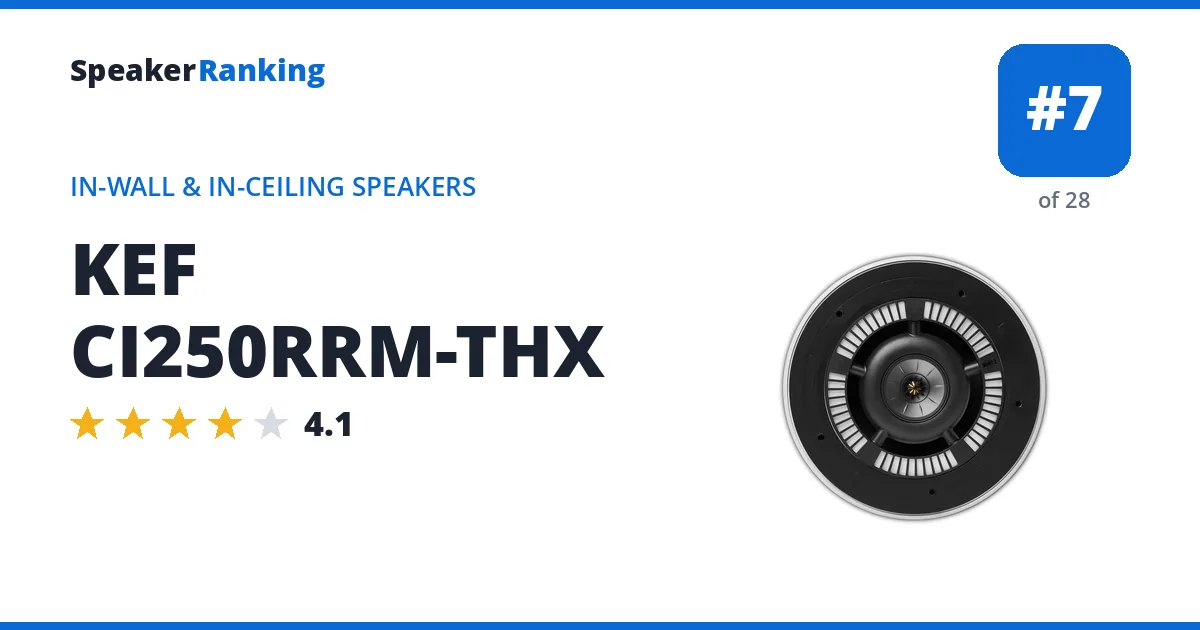
Same family: the KEF Ci3160RLM-THX (larger in-wall, ranked higher, rated 4.5/5). See every KEF Ci THX In-Wall generation.
Pros: Independently measured by Audio Science Review to a genuine 51.3Hz at -3dB and roughly 23.3Hz at -10dB, the deepest bass extension of any in-wall or in-ceiling speaker in this category. It’s a THX-certified 3-way coaxial design, a 10” woofer built around a 4” Uni-Q midrange and 1” aluminum dome tweeter, deliberately voiced for the 30-60 degree off-axis angle typical of a ceiling-mounted Dolby Atmos height or surround channel rather than a straight-down listening position. Run through a receiver’s automated room correction, spinorama’s EQ-adjusted figures show its preference score climbing from 4.67 to 5.68, so it responds well to correction. Measured bass extension of 51.3Hz (-3dB).
Cons: At $2989 each, this is the most expensive speaker in this category. Its raw on-axis measurement trails the KEF Ci3160RLM-THX (preference score 4.67 vs. 4.62) since the driver array is tuned for off-axis dispersion rather than a flat straight-ahead response, and its on-axis deviation averages 1.14dB, one of the roughest of the batch measured on-axis.
Full KEF CI250RRM-THX review and specifications →
| Released | Sep 2022 (4 years ago) |
|---|---|
| Bass Extension (-10dB) | 23.3Hz (measured, spinorama.org ASR data) |
| Bass Extension (-3dB) | 51.3Hz (measured, spinorama.org ASR data) |
| Certification | THX |
| DIY Kit | No |
| Dimensions | 13.6” x 13.6” x 6.9” (346 x 346 x 175 mm) (168mm mounting depth) |
| Drivers | 10” LF woofer, 4” Uni-Q midrange, 1” vented aluminum dome tweeter with MAT (3-way coaxial) |
| Enclosure | Open-backed, in-ceiling |
| Frequency Response | 28Hz-20kHz +/-6dB (manufacturer, open-backed) |
| Impedance | 8 ohms |
| Mounting Cutout | 300mm (11.81 in) |
| Power Handling | 50-250W recommended amplifier power |
| Sensitivity | 89dB |
| Spinorama Preference Score | 4.67 |
| Spinorama Preference Score with Perfect Sub | 6.68 |
| Weight | 13.2 lbs (6 kg) |
- Links
- Reviews, Comparisons and Sound Samples
- Head-to-Head Comparisons
 #8 Monolith THX-365IW: $999.98 per pair Amazon $499.99 Monoprice $499.99 eBay
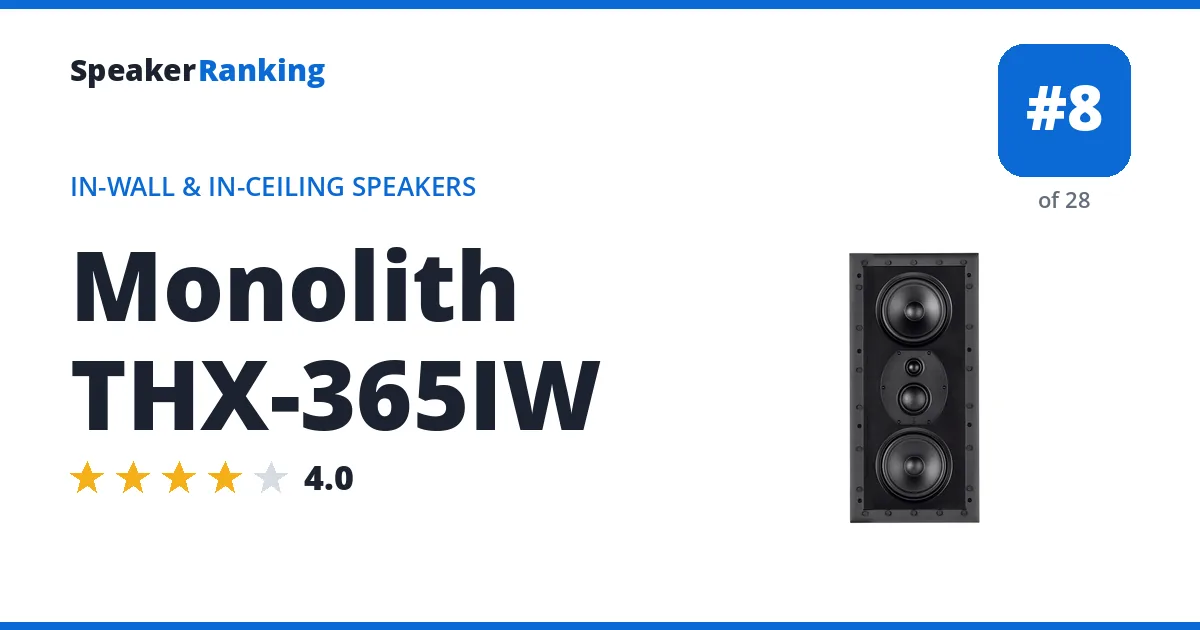
Same family: the Monolith THX-365T (floorstanding, rated 3.9/5), the Monolith THX-365C (center, rated 4.1/5) and the Monolith THX-LCR (larger in-wall, ranked lower, estimated 3.9/5).
Pros: Audio Science Review’s retest measured a preference score of 5.23, or 7.64 with a perfect subwoofer, with -3dB at 54.6Hz and -6dB at 42.8Hz, deep bass for an in-wall speaker. Directivity is well controlled (SPDI deviation 2.09dB) and on-axis smoothness is 0.70. It is a THX Ultra certified three-way, with two 6.5” woofers, a dedicated 2” silk dome midrange and a 1” silk dome tweeter, rated at 89.5dB sensitivity, which ASR’s measurement confirmed at 89.4dB. The 5-year warranty is longer than most in-wall speakers get. Measured bass extension of 54.6Hz (-3dB).
Cons: ASR’s first measurement of this speaker scored far lower (preference score 1.33, or 5.10 with a subwoofer, with -3dB at 108Hz), so results depend heavily on how it is installed and enclosed. Monoprice positions it for rear and surround channels and suggests in-room speakers up front, and the ASR reviewer said he would pick something better for a front left or right. Impedance dips to about 2.9 ohms, so the amplifier needs to be comfortable with a low load. At $500 each a stereo pair costs twice that.
Full Monolith THX-365IW review and specifications →
| Bass Extension (-10dB) | 31.1Hz (measured, Audio Science Review) |
|---|---|
| Bass Extension (-3dB) | 54.6Hz (measured, Audio Science Review) |
| Certification | THX Ultra |
| Crossover Frequency | 550Hz, 1,900Hz (4th-order Linkwitz-Riley) |
| DIY Kit | No |
| Dimensions | 22.7”H x 11.1”W x 3.8”D (577 x 282 x 97 mm) |
| Drivers | 2x 6.5” high-excursion long-fiber pulp cone woofers, 2” silk dome midrange, 1” silk dome tweeter (3-way) |
| Enclosure | In-wall, passive 3-way with dog-ear mounting tabs |
| Impedance | 4 ohms nominal (about 2.9 ohm minimum) |
| Power Handling | 160W maximum |
| Sensitivity | 89.5dB |
| Spinorama Preference Score | 5.23 |
| Spinorama Preference Score with Perfect Sub | 7.64 |
| Warranty | 5 years |
| Weight | 19.6 lbs (8.9 kg) |
- Links
- Reviews, Comparisons and Sound Samples
- Head-to-Head Comparisons
 #9 Revel W893: $2,200 per pair Discontinued eBay
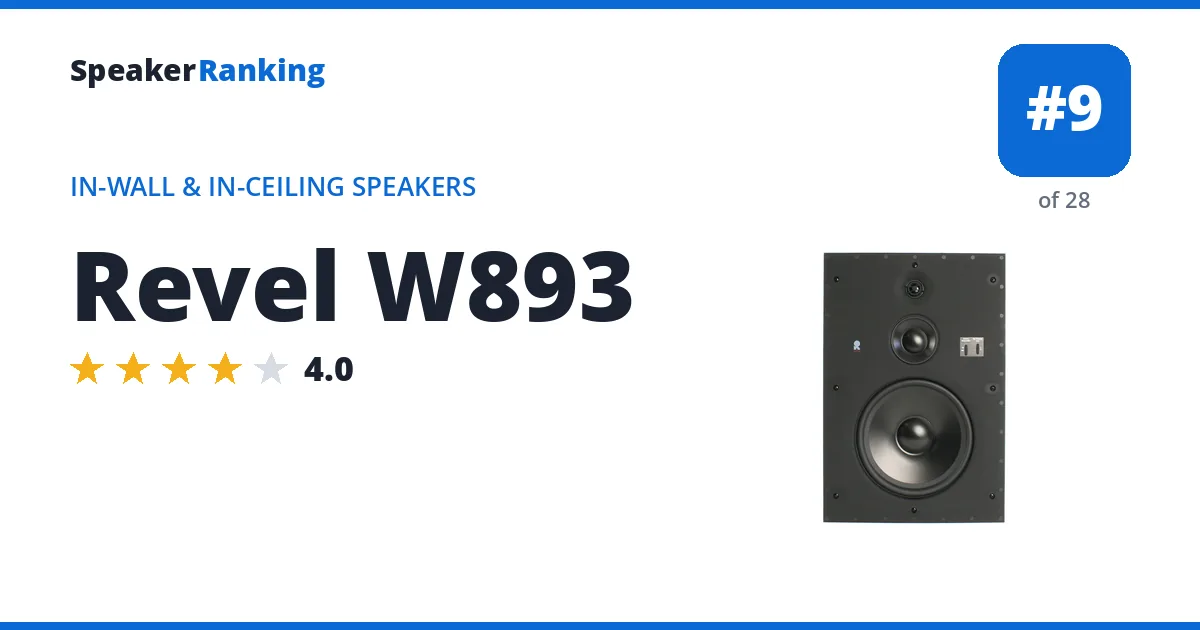
Pros: A three-way in-wall speaker from Revel’s Architectural line with an 8” woofer, a midrange and an aluminium dome tweeter, with level controls for each. Erin measured a preference score of 5.38 that reaches 7.19 with an ideal subwoofer, with 0.37 listening window deviation. Measured bass extension of 39.6Hz (-3dB).
Cons: The on-axis response is less even (0.91 average deviation) than the listening window. Revel no longer sells it. Bass reaches 39.6Hz (-3dB) and about 30Hz (-10dB). Discontinued.
Full Revel W893 review and specifications →
| Bass Extension (-10dB) | about 30.3Hz (measured, Erin’s Audio Corner) |
|---|---|
| Bass Extension (-3dB) | 39.6Hz (measured, Erin’s Audio Corner) |
| DIY Kit | No |
| Drivers | 8” woofer, midrange, aluminium dome tweeter |
| Spinorama Preference Score | 5.38 |
| Spinorama Preference Score with Perfect Sub | 7.19 |
| Weight | 10.8 lbs (4.9 kg) |
- Reviews, Comparisons and Sound Samples
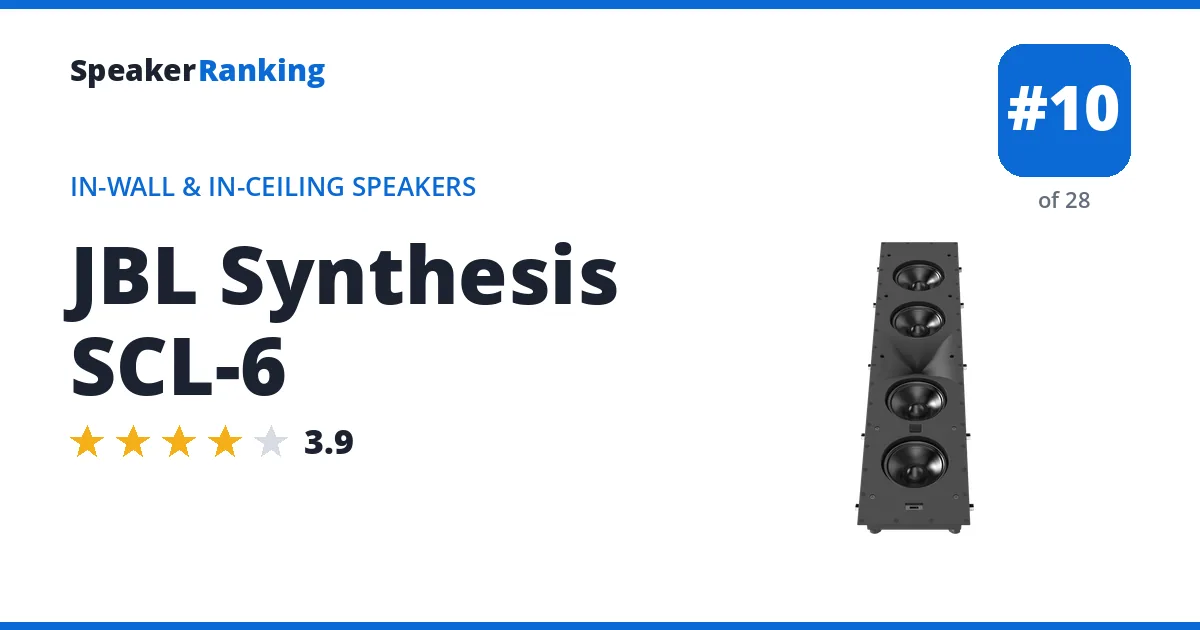
 #10 JBL Synthesis SCL-6: $3,629.90 per pair Audio Advice $1,814.95 eBay
Same family: the JBL Synthesis SCL-4 (smaller in-wall, ranked lower, rated 3.6/5), the JBL Synthesis SCL-3 (larger in-wall, ranked lower, rated 3.7/5), the JBL Synthesis SCL-7 (larger in-wall, ranked lower, rated 3.7/5), the JBL Synthesis SCL-1 (larger in-wall, ranked lower, rated 3.7/5) and the JBL Synthesis SCL-5 (larger in-wall, ranked lower, rated 2.5/5).
Pros: Erin’s Audio Corner measured it with a very tight 1.2dB reference band and 0.67 listening-window smoothness, and its preference score rises from 3.92 to 6.71 with a subwoofer. Four 5.25-inch aluminum woofers around a 2410H-2 compression driver on JBL’s imaging horn give 91dB sensitivity and high output, with an 80 degree by 80 degree treble coverage pattern that keeps directivity consistent. Bass measures 67.4Hz at -3dB and about 40.8Hz at -10dB in free air, before the extra wall reinforcement of an in-wall install. Measured bass extension of 67.4Hz (-3dB).
Cons: Bass is limited without a subwoofer, and a 3.92 standard score trails the best in-wall speakers here. Average on-axis deviation of 0.49dB is rougher than the Revel in-walls. The 4 ohm load and 766mm tall cutout need a capable amplifier and a tall wall cavity, and at $1815 each it is sold mainly through custom-installation dealers.
Full JBL Synthesis SCL-6 review and specifications →
| Bass Extension (-10dB) | 40.8Hz (measured, spinorama.org Erin’s Audio Corner data) |
|---|---|
| Bass Extension (-3dB) | 67.4Hz (measured, spinorama.org Erin’s Audio Corner data) |
| Crossover Frequency | 1.8kHz |
| DIY Kit | No |
| Dimensions | 31.3”H x 7.3”W x 3.8”D (796 x 185 x 97 mm) (92mm mounting depth) |
| Drivers | Four 5.25” aluminum matrix cone woofers, 1” 2410H-2 compression driver on HDI horn (2.5-way) |
| Enclosure | In-wall, open back |
| Frequency Response | 50Hz-30kHz -6dB (manufacturer, 2pi) |
| Impedance | 4 ohms |
| Mounting Cutout | 157 x 766mm (6.18 x 30.18 in) |
| Power Handling | 25-200W recommended amplifier power |
| Sensitivity | 91dB (2.83V/1m, 2pi anechoic) |
| Spinorama Preference Score | 3.92 |
| Spinorama Preference Score with Perfect Sub | 6.71 |
| Weight | 22.2 lbs (10.07 kg) |
- Links
- Reviews, Comparisons and Sound Samples
- Head-to-Head Comparisons
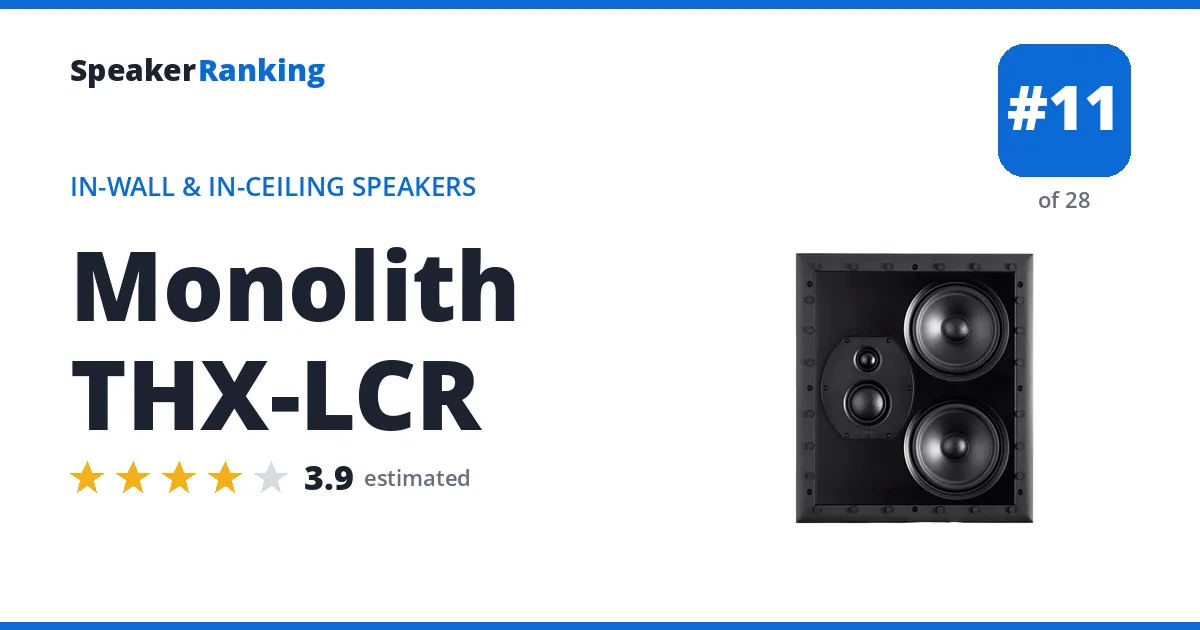
 #11 Monolith THX-LCR Discontinued eBay
Same family: the Monolith THX-365T (floorstanding, rated 3.9/5), the Monolith THX-365C (center, rated 4.1/5) and the Monolith THX-365IW (smaller in-wall, ranked higher, rated 4/5).
Pros: A three-way THX Ultra in-wall LCR with two 6.5” woofers, a 2” silk dome midrange and a 1” silk tweeter, rated at 88.5dB. A review found strong dynamics, wide off-axis response and a neutral tone.
Cons: No independent measurements yet, so its tonal balance and directivity can’t be compared with ranked speakers. The review measured bass to about 65Hz in a wall, and its 14.4” width is awkward for 16” stud bays. It is discontinued.
Full Monolith THX-LCR review and specifications →
| Drivers | 2x 6.5” pulp fiber woofer, 1x 2” silk dome midrange, 1x 1” silk dome tweeter |
|---|---|
| Enclosure | In-wall; cutout template 13-3/4” W x 15-5/8” H |
| Frequency Response | 35Hz - 24kHz (manufacturer specified) |
| Impedance | 4 ohms nominal (manufacturer specified) |
| Sensitivity | 88.5dB (manufacturer specified) |
| Weight | 14.1 lbs (6.4 kg) |
- Links
- Reviews, Comparisons and Sound Samples
 #12 KEF CI200RR-THX: $2,399.98 per pair Amazon $1,199.99 eBay
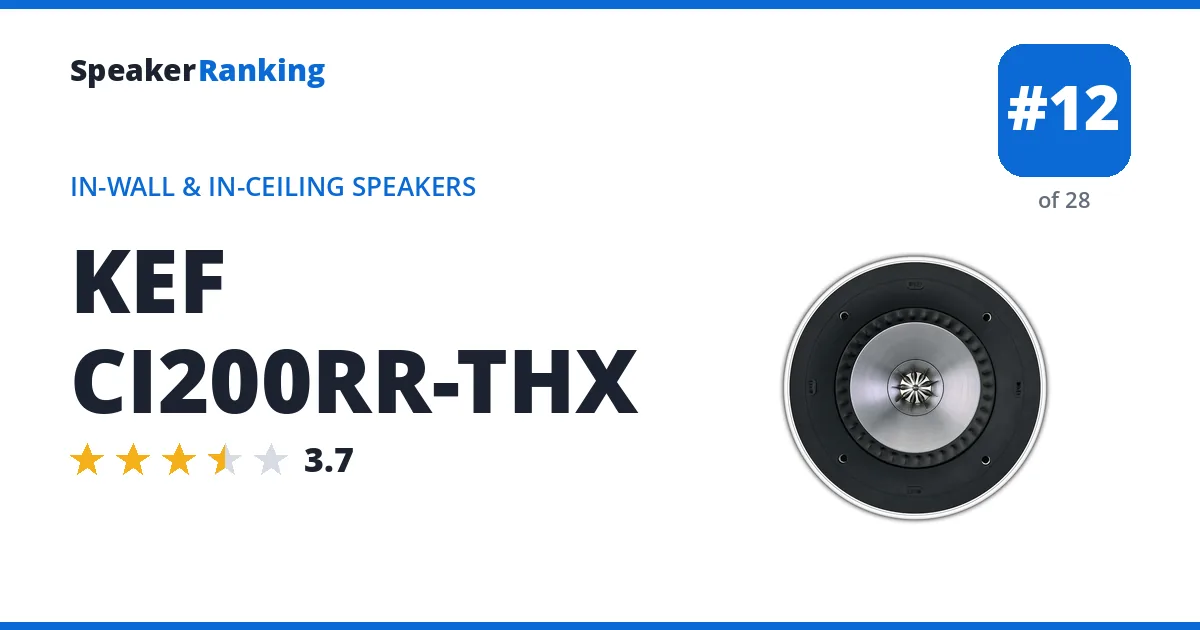
Pros: An 8” woofer paired with a 1.5” Uni-Q tweeter (crossing over at 2.2kHz) measures a genuine 82.5Hz at -3dB and roughly 30.5Hz at -10dB, respectable low-end reach for a mid-priced in-ceiling speaker. The 238mm cutout accepts a large enough driver to move real air in a family room or media room. At $1200 each, it costs about half of the flagship KEF Ci3160RLM-THX while carrying the same THX certification. Measured bass extension of 82.5Hz (-3dB).
Cons: Spinorama’s measurement of this model is a lower-confidence manufacturer curve rather than an independently verified Klippel scan, so treat the extension figures as directionally useful rather than as precise as the ASR-measured entries in this category. No Harman-style preference score has been published for it.
Full KEF CI200RR-THX review and specifications →
| Bass Extension (-10dB) | 30.5Hz (measured, spinorama.org vendor data) |
|---|---|
| Bass Extension (-3dB) | 82.5Hz (measured, spinorama.org vendor data) |
| Certification | THX |
| DIY Kit | No |
| Dimensions | 11.4” x 11.4” x 5.2” (290 x 290 x 132.6 mm) (126.5mm mounting depth) |
| Drivers | 8” woofer, 1.5” Uni-Q tweeter (2.2kHz crossover) |
| Enclosure | Open-backed, in-ceiling |
| Frequency Response | 33Hz-28kHz +/-6dB (manufacturer, open-backed) |
| Impedance | 4 ohms |
| Mounting Cutout | 238mm (9.37 in) |
| Power Handling | 10-190W recommended amplifier power |
| Sensitivity | 90dB |
| Weight | 7.9 lbs (3.6kg) |
- Links
- Reviews, Comparisons and Sound Samples
- Head-to-Head Comparisons
 #13 JBL Synthesis SCL-3: $7,259.90 per pair Audio Advice $3,629.95 eBay
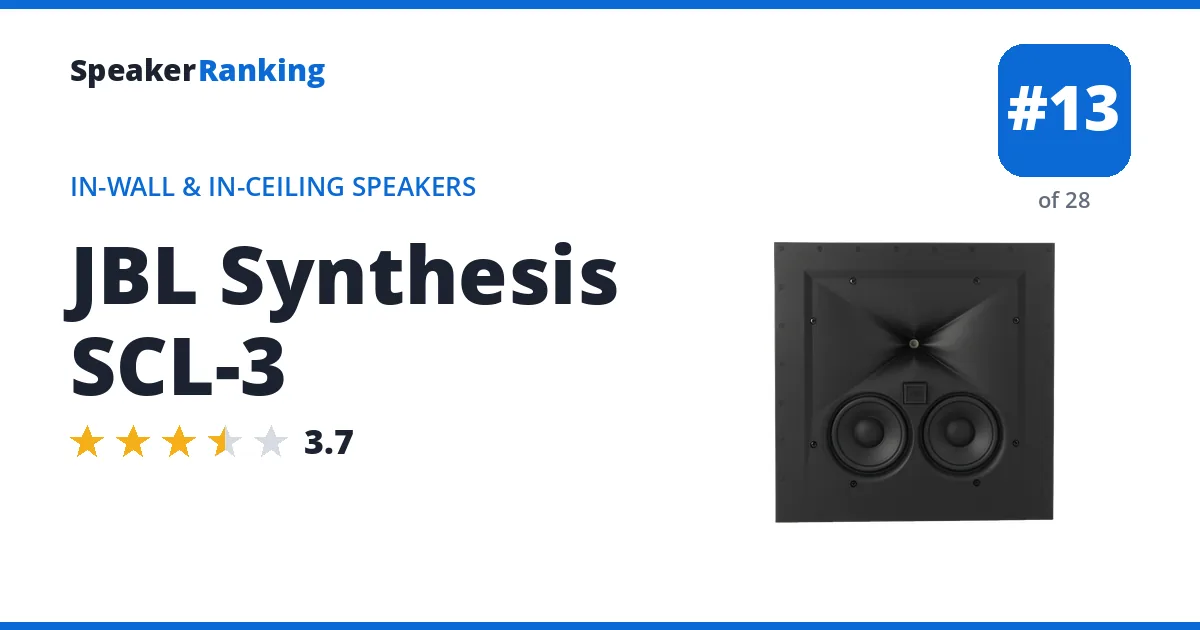
Same family: the JBL Synthesis SCL-4 (smaller in-wall, ranked lower, rated 3.6/5), the JBL Synthesis SCL-6 (smaller in-wall, ranked higher, rated 3.9/5), the JBL Synthesis SCL-7 (larger in-wall, ranked lower, rated 3.7/5), the JBL Synthesis SCL-1 (larger in-wall, ranked lower, rated 3.7/5) and the JBL Synthesis SCL-5 (larger in-wall, ranked lower, rated 2.5/5).
Pros: JBL’s own measurements show 0.32dB average on-axis deviation and a 2.28 directivity-index deviation, and the preference score rises from 3.80 to 6.42 with a subwoofer. Two 5.25-inch aluminum woofers and a 2409H compression driver on JBL’s imaging horn give 91dB sensitivity, and the square baffle works in walls or ceilings. Bi-wire and bi-amp terminals and a paintable magnetic grille suit custom home theaters. Measured bass extension of 72.4Hz (-3dB).
Cons: Bass rolls off early, at 72.4Hz for -3dB and about 45.8Hz for -10dB in free air, so it needs a subwoofer. Listening-window smoothness is only 0.43 inside a 3.1dB reference band, rougher than the other JBL Synthesis in-walls. The data is manufacturer supplied and digitized from graphs. At $3630 each it costs twice as much as the better-measuring JBL Synthesis SCL-6.
Full JBL Synthesis SCL-3 review and specifications →
| Bass Extension (-10dB) | 45.8Hz (measured, JBL data on spinorama.org) |
|---|---|
| Bass Extension (-3dB) | 72.4Hz (measured, JBL data on spinorama.org) |
| Crossover Frequency | 1.3kHz |
| DIY Kit | No |
| Dimensions | 16.5”H x 16.5”W x 6”D (418 x 418 x 153 mm) |
| Drivers | Two 5.25” aluminum matrix cone woofers, 1” 2409H compression driver on HDI horn (2-way) |
| Enclosure | In-wall/in-ceiling, integrated MDF back box |
| Frequency Response | 65Hz-33kHz -6dB (manufacturer, on-axis) |
| Impedance | 6 ohms |
| Power Handling | 200W RMS maximum recommended amplifier power |
| Sensitivity | 91dB (2.83V/1m) |
| Spinorama Preference Score | 3.80 |
| Spinorama Preference Score with Perfect Sub | 6.42 |
| Weight | 24.3 lbs (11.02 kg) |
- Links
- Reviews, Comparisons and Sound Samples
- Head-to-Head Comparisons
- JBL Synthesis SCL-3 vs JBL Synthesis SCL-7
- JBL Synthesis SCL-3 vs JBL Synthesis SCL-1
- JBL Synthesis SCL-3 vs JBL Synthesis SCL-4
- JBL Synthesis SCL-3 vs Miller & Kreisel IW150
- JBL Synthesis SCL-3 vs Revel W990
- JBL Synthesis SCL-3 vs Revel W228Be
- JBL Synthesis SCL-3 vs Grimani Systems Rixos-L
- JBL Synthesis SCL-3 vs MartinLogan Tribute 5XW
 #14 JBL Synthesis SCL-7: $2,419.90 per pair Audio Advice $1,209.95 eBay
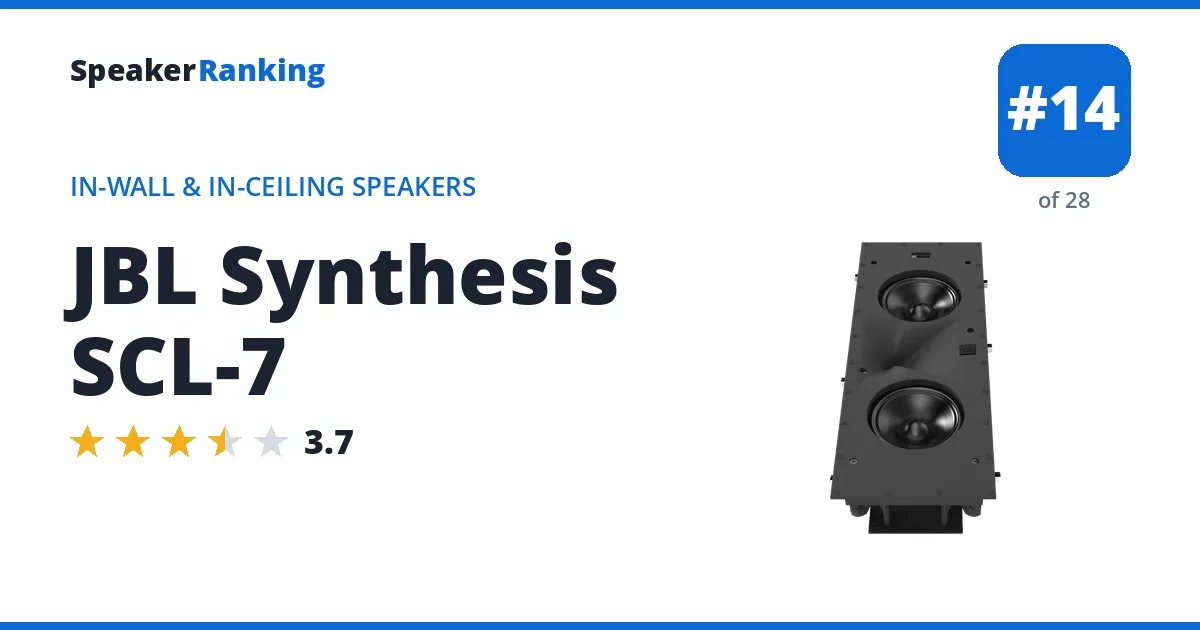
Same family: the JBL Synthesis SCL-4 (smaller in-wall, ranked lower, rated 3.6/5), the JBL Synthesis SCL-6 (smaller in-wall, ranked higher, rated 3.9/5), the JBL Synthesis SCL-3 (smaller in-wall, ranked higher, rated 3.7/5), the JBL Synthesis SCL-1 (larger in-wall, ranked lower, rated 3.7/5) and the JBL Synthesis SCL-5 (larger in-wall, ranked lower, rated 2.5/5).
Pros: Audio Science Review measured a 1.88 directivity-index deviation, among the most consistent off-axis behavior of the JBL Synthesis in-walls, and 0.60 listening-window smoothness. The preference score rises from 3.46 to 6.21 with a subwoofer. Two 5.25-inch aluminum woofers and a 2410H-2 compression driver on JBL’s imaging horn give bass to 67.4Hz at -3dB and about 42.3Hz at -10dB in free air, and at $1210 each it is the least expensive way into the JBL Synthesis in-wall range. Measured bass extension of 67.4Hz (-3dB).
Cons: The response sits in a wide 4.1dB reference band with 0.43dB average on-axis deviation, so tonal balance is less even than the JBL Synthesis SCL-6. The 3.46 standard score is low without a subwoofer. At 88dB it is 3dB less sensitive than its siblings, and the 4 ohm load needs a capable amplifier.
Full JBL Synthesis SCL-7 review and specifications →
| Bass Extension (-10dB) | 42.3Hz (measured, spinorama.org ASR data) |
|---|---|
| Bass Extension (-3dB) | 67.4Hz (measured, spinorama.org ASR data) |
| Crossover Frequency | 2.0kHz |
| DIY Kit | No |
| Dimensions | 19.1”H x 7.3”W x 3.9”D (486 x 186 x 99 mm) (93mm mounting depth) |
| Drivers | Two 5.25” aluminum matrix cone woofers, 1” 2410H-2 compression driver on HDI horn (2-way) |
| Enclosure | In-wall, open back |
| Frequency Response | 55Hz-30kHz -6dB (manufacturer, 2pi) |
| Impedance | 4 ohms |
| Mounting Cutout | 157 x 458mm (6.18 x 18.03 in) |
| Power Handling | 25-150W recommended amplifier power |
| Sensitivity | 88dB (2.83V/1m, 2pi anechoic) |
| Spinorama Preference Score | 3.46 |
| Spinorama Preference Score with Perfect Sub | 6.21 |
| Weight | 12.6 lbs (5.72 kg) |
- Links
- Reviews, Comparisons and Sound Samples
- Head-to-Head Comparisons
 #15 JBL Synthesis SCL-1: $36,299.90 per pair Audio Advice $18,149.95 eBay

Same family: the JBL Synthesis SCL-4 (smaller in-wall, ranked lower, rated 3.6/5), the JBL Synthesis SCL-6 (smaller in-wall, ranked higher, rated 3.9/5), the JBL Synthesis SCL-3 (smaller in-wall, ranked higher, rated 3.7/5), the JBL Synthesis SCL-7 (smaller in-wall, ranked higher, rated 3.7/5) and the JBL Synthesis SCL-5 (larger in-wall, ranked lower, rated 2.5/5).
Pros: JBL Synthesis’s flagship in-wall left, center and right speaker with two 12” woofers and a D2 dual-diaphragm compression driver on a large HDI horn. Sensitivity is very high at 94dB, and JBL rates it to 133dB peak. JBL’s measurements show a preference score of 4.03 that reaches 6.35 with an ideal subwoofer, with 0.39 listening window deviation.
Cons: It needs a large wall cavity and at least 500W of amplification, and it is sold through JBL Synthesis custom installers. Bass reaches 53.0Hz (-3dB) and about 46Hz (-10dB).
Full JBL Synthesis SCL-1 review and specifications →
| Bass Extension (-10dB) | about 45.6Hz (measured, manufacturer data via spinorama.org) |
|---|---|
| Bass Extension (-3dB) | 53.0Hz (measured, manufacturer data via spinorama.org) |
| DIY Kit | No |
| Dimensions | 48”H x 19”W x 14.5”D (1218 x 482 x 368 mm) |
| Drivers | 2x 12” C4 woofers, D2430K dual 3” compression driver on HDI horn |
| Frequency Response | 40Hz-24kHz -6dB (manufacturer specified) |
| Impedance | 4 ohms |
| Maximum SPL | 133dB peak (manufacturer specified) |
| Sensitivity | 94dB (manufacturer specified) |
| Spinorama Preference Score | 4.03 |
| Spinorama Preference Score with Perfect Sub | 6.35 |
| Weight | 177.5 lbs (80.5 kg) |
- Reviews, Comparisons and Sound Samples
- Head-to-Head Comparisons
 #16 JBL Synthesis SCL-4: $7,259.90 per pair Audio Advice $3,629.95 eBay

Same family: the JBL Synthesis SCL-6 (larger in-wall, ranked higher, rated 3.9/5), the JBL Synthesis SCL-3 (larger in-wall, ranked higher, rated 3.7/5), the JBL Synthesis SCL-7 (larger in-wall, ranked higher, rated 3.7/5), the JBL Synthesis SCL-1 (larger in-wall, ranked higher, rated 3.7/5) and the JBL Synthesis SCL-5 (larger in-wall, ranked lower, rated 2.5/5).
Pros: JBL’s own measurements show a 1.85 directivity-index deviation, the most even directivity of the JBL Synthesis in-walls, with 0.35dB average on-axis deviation. The preference score rises from 3.56 to 6.55 with a subwoofer. A 7-inch aluminum woofer and 2409H compression driver on JBL’s imaging horn give 91dB sensitivity, and bi-wire and bi-amp terminals suit custom home theaters. Measured bass extension of 83.7Hz (-3dB).
Cons: Bass is the weakest here, at 83.7Hz for -3dB and about 61.9Hz for -10dB in free air, so it needs a subwoofer. Listening-window smoothness is 0.59 inside a 3.1dB reference band, and the data is manufacturer supplied and digitized from graphs. At $3630 each it costs twice as much as the better-measuring JBL Synthesis SCL-6.
Full JBL Synthesis SCL-4 review and specifications →
| Bass Extension (-10dB) | 61.9Hz (measured, JBL data on spinorama.org) |
|---|---|
| Bass Extension (-3dB) | 83.7Hz (measured, JBL data on spinorama.org) |
| Crossover Frequency | 1.3kHz |
| DIY Kit | No |
| Dimensions | 25”H x 16.1”W x 3.7”D (636 x 409 x 93 mm) |
| Drivers | 7” aluminum matrix cone woofer, 1” 2409H compression driver on HDI horn (2-way) |
| Enclosure | In-wall, integrated MDF back box |
| Frequency Response | 45Hz-33kHz -6dB (manufacturer, on-axis) |
| Impedance | 6 ohms |
| Power Handling | 200W RMS maximum recommended amplifier power |
| Sensitivity | 91dB (2.83V/1m) |
| Spinorama Preference Score | 3.56 |
| Spinorama Preference Score with Perfect Sub | 6.55 |
| Weight | 27.6 lbs (12.51 kg) |
- Links
- Reviews, Comparisons and Sound Samples
- Head-to-Head Comparisons
 #17 Miller & Kreisel IW150: $4,998 per pair Audiolab (authorized M&K dealer) $2,499 eBay
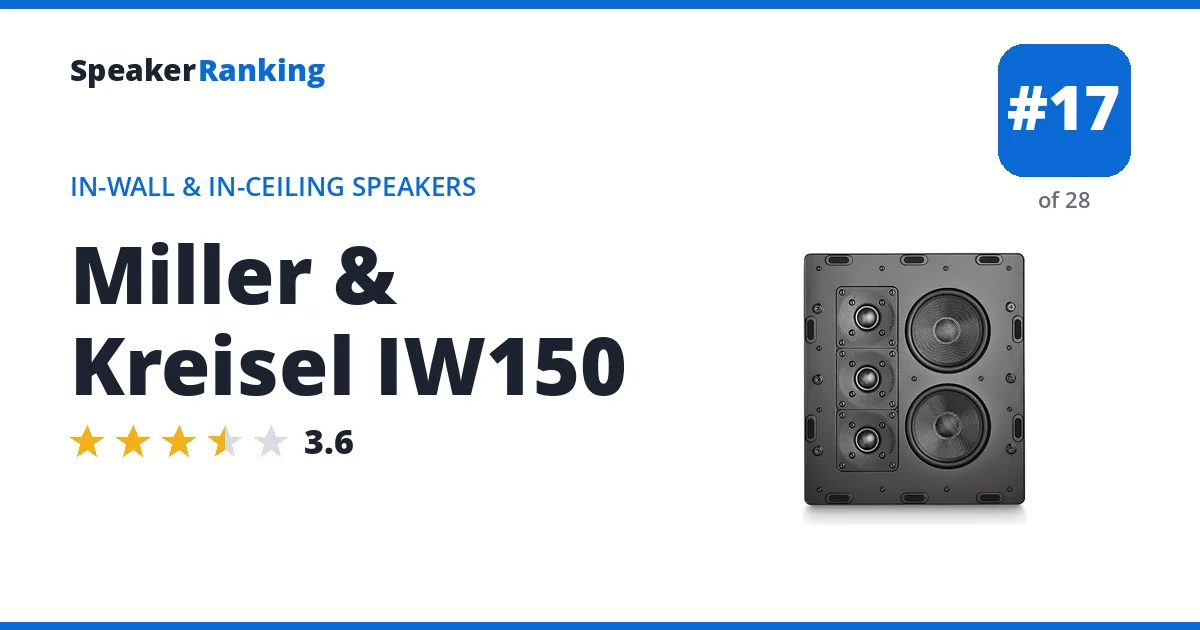
Pros: Erin’s Audio Corner’s Klippel measurement shows well controlled directivity (SPDI deviation 2.43dB) and a smooth predicted in-room response, with a preference score of 2.88, or 6.32 with a perfect subwoofer. The unusual layout puts two 5.25” polypropylene woofers beside a column of three 1” soft dome tweeters, a design meant to give even coverage across a room from a single wall opening. It is rated at 90dB sensitivity, and Erin’s measurement computed a real 88.2dB, and it accepts 25-400W of amplifier power. Measured bass extension of 95.2Hz (-3dB).
Cons: Bass is thin: measured -3dB is 95.2Hz and -6dB is 82.0Hz, and Miller & Kreisel rates it only to 80Hz, so a subwoofer is required, and even with a perfect subwoofer the score reaches only 6.32. On-axis smoothness is 0.48 and on-axis deviation averages 0.62dB, so the midrange is rougher than the better in-wall designs. At $2499 each a stereo pair costs twice that. Erin describes it as discontinued from what he can tell, so stock may be limited to remaining inventory.
Full Miller & Kreisel IW150 review and specifications →
| Bass Extension (-10dB) | 68.7Hz (measured, Erin’s Audio Corner) |
|---|---|
| Bass Extension (-3dB) | 95.2Hz (measured, Erin’s Audio Corner) |
| DIY Kit | No |
| Dimensions | 13.9”H x 12.2”W (354 x 311 mm) baffle (95mm mounting depth) |
| Drivers | 2x 5.25” polypropylene bass/midrange drivers, 3x 1” soft fabric dome tweeters |
| Enclosure | In-wall |
| Frequency Response | 80Hz-20kHz +/-3dB (manufacturer) |
| Impedance | 4 ohms |
| Mounting Cutout | 288W x 331H mm |
| Power Handling | 25-400W recommended amplifier power |
| Sensitivity | 90dB |
| Spinorama Preference Score | 2.88 |
| Spinorama Preference Score with Perfect Sub | 6.32 |
| Weight | 18.7 lbs (8.5 kg) |
- Links
- Reviews, Comparisons and Sound Samples
- Head-to-Head Comparisons
- Miller & Kreisel IW150 vs JBL Synthesis SCL-4
- Miller & Kreisel IW150 vs Revel W990
- Miller & Kreisel IW150 vs JBL Synthesis SCL-7
- Miller & Kreisel IW150 vs JBL Synthesis SCL-3
- Miller & Kreisel IW150 vs Focal 1000 IWLCR6
- Miller & Kreisel IW150 vs Bowers & Wilkins CWM7.3 S2
- Miller & Kreisel IW150 vs MartinLogan Tribute 5XW
- Miller & Kreisel IW150 vs JBL Synthesis SCL-6
- See all 9 comparisons
 #18 KEF CI130.2CR: $599.98 per pair World Wide Stereo $299.99 eBay
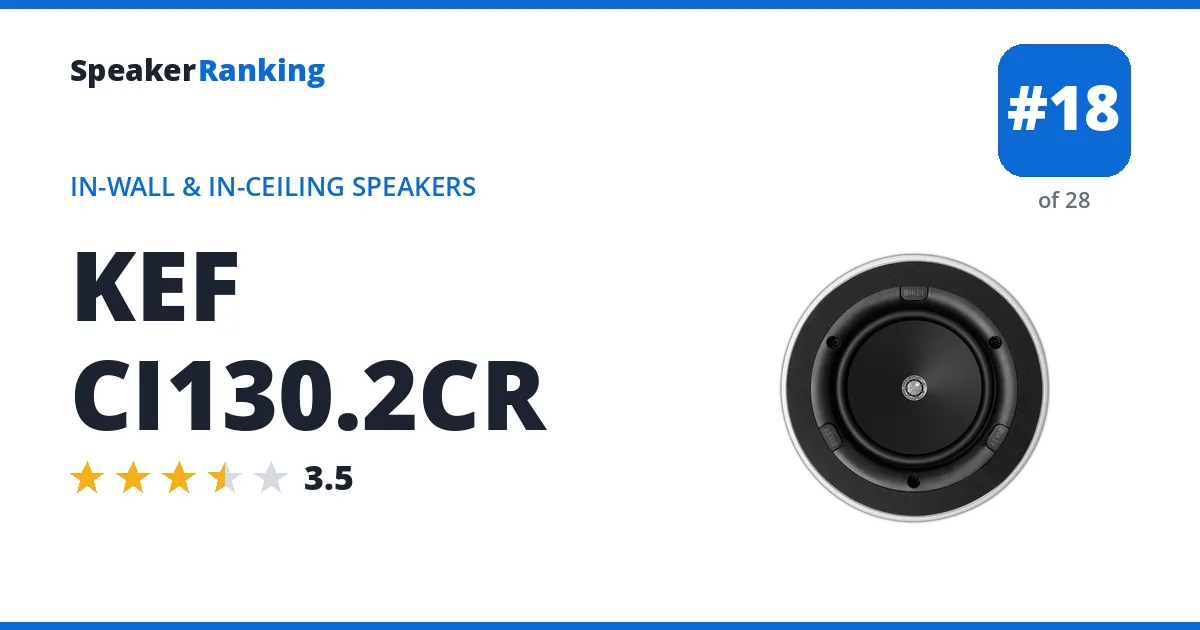
Pros: A compact 158 x 158mm cutout and 82.3mm depth fit tight joist bays and shallow ceiling cavities where the larger Ci-THX models in this category won’t. At $300 each it’s the most affordable speaker in this category by a wide margin. The 5.25” Uni-Q driver keeps its 16mm aluminum dome tweeter coaxially centered on the woofer, so the two acoustic centers stay aligned regardless of listening position. Measured bass extension of 100Hz (-3dB).
Cons: KEF’s own frequency response spec bottoms out at 52Hz, and the measured curve reaches only about 100Hz at -3dB and roughly 53.5Hz at -10dB, the shallowest low end among the models in this category with a THX certification, so pairing it with a subwoofer is worth planning for. It’s open-backed with only medium-quality vendor measurement data behind it, not an independently verified Klippel scan.
Full KEF CI130.2CR review and specifications →
| Bass Extension (-10dB) | 53.5Hz (measured, spinorama.org vendor data) |
|---|---|
| Bass Extension (-3dB) | 100Hz (measured, spinorama.org vendor data) |
| DIY Kit | No |
| Dimensions | 7.6” x 7.6” x 3.2” (193.4 x 193.4 x 82.3 mm) (77.7mm mounting depth) |
| Drivers | 5.25” Uni-Q coaxial woofer with 16mm aluminum dome tweeter |
| Enclosure | Open-backed, in-ceiling |
| Frequency Response | 52Hz-20kHz +/-6dB (manufacturer, open-backed) |
| Impedance | 8 ohms |
| Mounting Cutout | 158 x 158mm |
| Power Handling | 10-80W recommended amplifier power |
| Sensitivity | 87dB |
| Weight | 2.9 lbs (1.3kg) |
- Links
- Reviews, Comparisons and Sound Samples
- Head-to-Head Comparisons
 #19 Revel W990: $4,239.90 per pair Crutchfield $2,119.95 eBay

Pros: Audio Science Review’s Klippel measurement shows some of the deepest bass of any in-wall speaker, with -3dB at 32.2Hz and -6dB at 27.8Hz, so it can carry music without a subwoofer better than most. Directivity is well controlled (SPDI deviation 1.95dB). It is a three-way with a 9” woofer, a 3.5” midrange and a 1” aluminum dome tweeter, accepts 10-200W of amplifier power, and offers high frequency level, tilt, boundary compensation and listener axis controls to tune it to the room. Measured bass extension of 32.2Hz (-3dB), with a measured sensitivity of 85.9dB.
Cons: Its measured preference score is only 3.6, or 5.09 with a perfect subwoofer, because the midrange is uneven: on-axis deviation is high (0.86 normalized deviation on axis, 0.69 in the listening window) and on-axis smoothness is just 0.34. ASR’s computed sensitivity is about 85.9dB, so it needs more amplifier power than most speakers to play loud. At $2120 each a stereo pair costs twice that, which is a high price for the measured performance.
Full Revel W990 review and specifications →
| Bass Extension (-10dB) | 22.4Hz (measured, Audio Science Review) |
|---|---|
| Bass Extension (-3dB) | 32.2Hz (measured, Audio Science Review) |
| DIY Kit | No |
| Dimensions | 20.7”H x 13.9”W x 4.1”D (527 x 352 x 103 mm) (95mm mounting depth) |
| Drivers | 9” micro-ceramic composite (MCC) woofer, 3.5” midrange, 1” aluminum dome tweeter with waveguide (3-way) |
| Enclosure | In-wall, passive |
| Mounting Cutout | 318W x 486H mm |
| Power Handling | 10-200W RMS recommended amplifier power |
| Sensitivity | 85.9dB (measured, Audio Science Review) |
| Spinorama Preference Score | 3.60 |
| Spinorama Preference Score with Perfect Sub | 5.09 |
| Warranty | 5 years |
| Weight | 17 lbs (7.7 kg) |
- Links
- Reviews, Comparisons and Sound Samples
- Head-to-Head Comparisons
 #20 Grimani Systems Rixos-L: $16,400 per pair Grimani Systems $8,200 eBay

Pros: Directivity is well controlled (SPDI deviation 1.77dB), with a rated 100 degree by 150 degree coverage pattern that keeps the sound even across a wide seating area. Two 8” woofers and a 1” compression driver on a waveguide are rated at 96dB sensitivity with output up to 117dB at 1 meter, and 600W of supplied DSP amplification with room correction over Ethernet lets an installer tune it precisely. It mounts in the wall or on the wall, including behind an acoustically transparent screen, and is made in the USA with a 2 year warranty. Measured bass extension of 87.9Hz (-3dB).
Cons: Audio Science Review measured a preference score of only 2.16, or 5.53 with a perfect subwoofer, because on-axis response is uneven (0.64 smoothness, 0.55dB average deviation). Bass measured -3dB at 87.9Hz, so a subwoofer is required. ASR also heard tweeter hiss at 2 to 3 feet, which matters for close listening. At $8200 each a stereo pair costs twice that, it needs the supplied rack amplifier and network setup, and it is sold through custom installation dealers.
Full Grimani Systems Rixos-L review and specifications →
| Released | Sep 2021 (5 years ago) |
|---|---|
| Amplifier Power | 600W recommended (supplied 4-channel DSP amplifier) |
| Bass Extension (-10dB) | 70.3Hz (measured, Audio Science Review) |
| Bass Extension (-3dB) | 87.9Hz (measured, Audio Science Review) |
| Country | United States |
| Crossover Frequency | 350Hz, 1,000Hz |
| DIY Kit | No |
| Dimensions | 36”H x 13”W x 6”D (914 x 330 x 152 mm) |
| Drivers | 2x 8” mid-bass woofers, 1” compression driver on a Conic Section Array waveguide (2.5-way) |
| Enclosure | In-wall or on-wall |
| Frequency Response | 80Hz-20kHz (-6dB, manufacturer) |
| Impedance | 8 ohms (tweeter), 4 ohms (woofers) |
| Maximum SPL | 113dB continuous, 117dB peak at 1m (manufacturer specified) |
| Sensitivity | 96dB |
| Spinorama Preference Score | 2.16 |
| Spinorama Preference Score with Perfect Sub | 5.53 |
| Warranty | 2 years |
| Weight | 32 lbs (14.5 kg) |
- Links
- Reviews, Comparisons and Sound Samples
- Head-to-Head Comparisons
 #21 Focal 1000 IWLCR6: $5,400 per pair Focal eBay
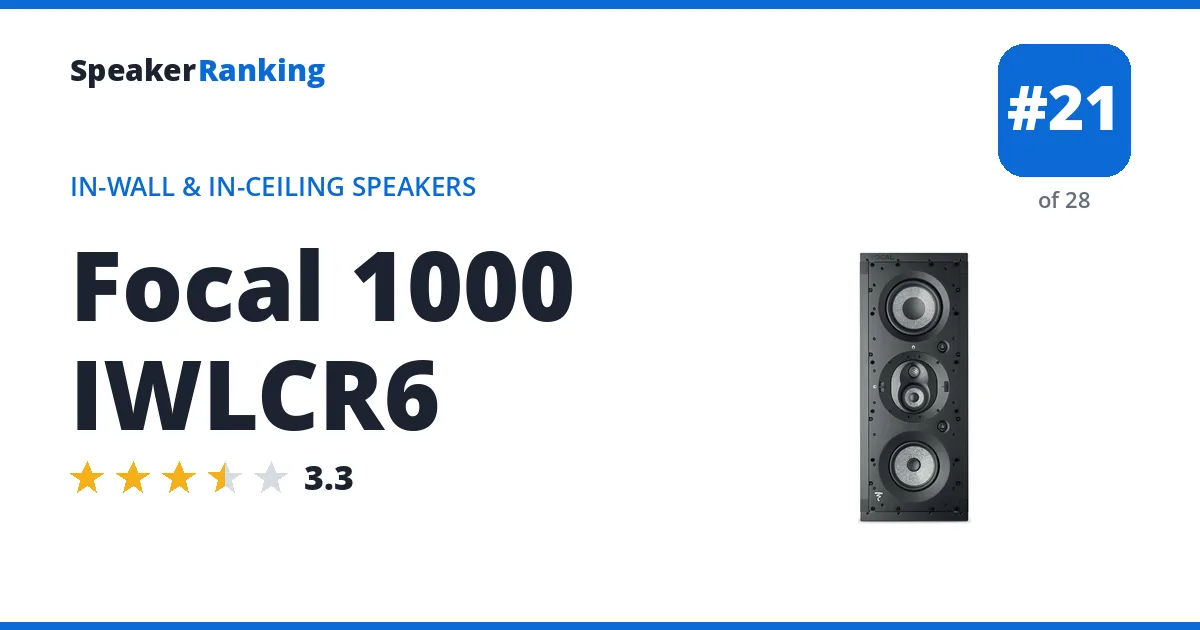
Pros: A three-way in-wall left, center or right speaker from Focal’s 1000 line with two 6.5” woofers, a midrange and an inverted dome tweeter. Erin measured a preference score of 3.08 that reaches 5.44 with an ideal subwoofer, with 0.50 listening window deviation. Measured bass extension of 51.3Hz (-3dB).
Cons: The on-axis response is uneven (1.78 average deviation). Bass reaches 51.3Hz (-3dB) and about 39Hz (-10dB).
Full Focal 1000 IWLCR6 review and specifications →
| Bass Extension (-10dB) | about 38.6Hz (measured, Erin’s Audio Corner) |
|---|---|
| Bass Extension (-3dB) | 51.3Hz (measured, Erin’s Audio Corner) |
| DIY Kit | No |
| Dimensions | 29.7”H x 12”W x 4”D (755 x 305 x 102 mm) |
| Drivers | 2x 6.5” woofers, midrange, inverted dome tweeter |
| Impedance | 8 ohms nominal (manufacturer specified) |
| Sensitivity | 91dB (manufacturer specified) |
| Spinorama Preference Score | 3.08 |
| Spinorama Preference Score with Perfect Sub | 5.44 |
| Weight | 24.1 lbs (10.95 kg) |
- Reviews, Comparisons and Sound Samples
- Head-to-Head Comparisons
 #22 Bowers & Wilkins CWM7.3 S2: $5,600 per pair B&H Photo Video eBay
Same family: the Bowers & Wilkins CWM 7.5 S2 (smaller in-wall, ranked lower, estimated 3/5). See every Bowers & Wilkins CWM In-Wall generation.
Pros: A three-way in-wall speaker from B&W’s Reference series with two 6” Aerofoil bass drivers, a 4” Continuum midrange and a 1” Carbon Dome tweeter. Erin measured a preference score of 2.57 that reaches 5.36 with an ideal subwoofer, with 0.59 listening window deviation. Measured bass extension of 63.0Hz (-3dB).
Cons: The on-axis response is uneven (1.66 average deviation) in Erin’s measurements. Bass reaches 63.0Hz (-3dB) and about 43Hz (-10dB).
Full Bowers & Wilkins CWM7.3 S2 review and specifications →
| Released | 2019 (7 years ago) |
|---|---|
| Bass Extension (-10dB) | about 43.4Hz (measured, Erin’s Audio Corner) |
| Bass Extension (-3dB) | 63.0Hz (measured, Erin’s Audio Corner) |
| DIY Kit | No |
| Dimensions | 29”H x 10.9”W x 4”D (736 x 276 x 102 mm) |
| Drivers | 2x 6” Aerofoil bass drivers, 4” Continuum midrange, 1” Carbon Dome tweeter |
| Impedance | 8 ohms nominal (manufacturer specified) |
| Sensitivity | 90dB (manufacturer specified) |
| Spinorama Preference Score | 2.57 |
| Spinorama Preference Score with Perfect Sub | 5.36 |
| Weight | 27.3 lbs (12.4 kg) |
- Reviews, Comparisons and Sound Samples
- Head-to-Head Comparisons
 #23 MartinLogan Tribute 5XW: $6,999.98 per pair Audio Advice $3,499.99 eBay

Pros: Erin’s Audio Corner’s Klippel measurement shows a rated 94dB sensitivity that measured a still efficient 88.1dB at 1 meter, so it plays loudly for its size. The folded thin-film Folded Motion XT Obsidian tweeter rotates for horizontal or vertical mounting, and it pairs two carbon fiber woofers with two 6.5” passive radiators in a sealed box. It accepts 20-250W of amplifier power and mounts with a slim 3.8” depth behind the wall. Measured bass extension of 74.7Hz (-3dB), with a measured sensitivity of 94dB.
Cons: The measurement is the weakest of the in-wall speakers here: a preference score of 1.84, or just 4.91 with a perfect subwoofer, with on-axis smoothness of 0.30, an average on-axis deviation of 1.56dB and wide directivity swings (SPDI deviation 3.25dB). Bass measured -3dB at only 74.7Hz, so a subwoofer is required, and MartinLogan rates it to 71Hz. At $3500 each a stereo pair costs twice that and MartinLogan sells it through dealers.
Full MartinLogan Tribute 5XW review and specifications →
| Bass Extension (-10dB) | 68.3Hz (measured, Erin’s Audio Corner) |
|---|---|
| Bass Extension (-3dB) | 74.7Hz (measured, Erin’s Audio Corner) |
| Crossover Frequency | 2,250Hz |
| DIY Kit | No |
| Dimensions | 31.1”H x 10.6”W x 4.1”D (791 x 269 x 104 mm) (97mm mounting depth) |
| Drivers | 1.25 x 2.4” Folded Motion XT Obsidian tweeter, 2x 5.25” carbon fiber woofers, 2x 6.5” passive radiators |
| Enclosure | Sealed back box, in-wall |
| Frequency Response | 71Hz-25kHz +/-3dB (manufacturer) |
| Impedance | 4 ohms |
| Mounting Cutout | 236W x 757H mm |
| Power Handling | 20-250W recommended amplifier power |
| Sensitivity | 94dB (manufacturer), 88.1dB (measured, Erin’s Audio Corner) |
| Spinorama Preference Score | 1.84 |
| Spinorama Preference Score with Perfect Sub | 4.91 |
| Weight | 25.6 lbs (11.6 kg) |
- Links
- Reviews, Comparisons and Sound Samples
- Head-to-Head Comparisons
- MartinLogan Tribute 5XW vs Bowers & Wilkins CWM7.3 S2
- MartinLogan Tribute 5XW vs Focal 1000 IWLCR6
- MartinLogan Tribute 5XW vs Grimani Systems Rixos-L
- MartinLogan Tribute 5XW vs Revel W990
- MartinLogan Tribute 5XW vs Miller & Kreisel IW150
- MartinLogan Tribute 5XW vs JBL Synthesis SCL-4
- MartinLogan Tribute 5XW vs JBL Synthesis SCL-3
- MartinLogan Tribute 5XW vs KEF CI250RRM-THX
- See all 9 comparisons
 #24 Bowers & Wilkins CWM 7.5 S2: $2,700 per pair Audio Advice $1,350.00 eBay

Older model: the Bowers & Wilkins CWM7.5 (ranked lower, rated 2.6/5). See every Bowers & Wilkins CWM In-Wall generation.
Same family: the Bowers & Wilkins CWM7.3 S2 (larger in-wall, ranked higher, rated 3.3/5).
Pros: A Reference Series in-wall with a 1” Carbon Dome tweeter and a 5” Continuum cone, a forward-firing Flowport and a retrofittable integrated back box, rated 45Hz to 28kHz. Mounting depth is only 4 1/16”.
Cons: No independent measurements yet, so its tonal balance and directivity can’t be compared directly with measured speakers; the rating is estimated from its measured predecessor. Its predecessor measured poorly on axis, so the range is wide. Sensitivity is 86dB.
Full Bowers & Wilkins CWM 7.5 S2 review and specifications →
| Released | 2019 (7 years ago) |
|---|---|
| Bass Extension (-3dB) | 45Hz (manufacturer specified) |
| DIY Kit | No |
| Dimensions | 14”H x 8.3”W x 4”D (356 x 212 x 102 mm) |
| Drivers | 1” Carbon Dome tweeter, 5” Continuum cone mid/bass |
| Frequency Response | 45Hz-28kHz (manufacturer specified) |
| Impedance | 8 ohms nominal, 3.8 ohms minimum (manufacturer specified) |
| Sensitivity | 86dB (2.83V/1m, manufacturer specified) |
| Weight | 8.4 lbs (3.8 kg) each |
| Woofer Cabinet | ported (front Flowport), integrated back box |
- Links
- Reviews, Comparisons and Sound Samples
- No independent measurement review is linked for this model; it is ranked from hands-on listening and comparison against similarly priced speakers.
- Head-to-Head Comparisons
 #25 KEF CI50R Discontinued eBay
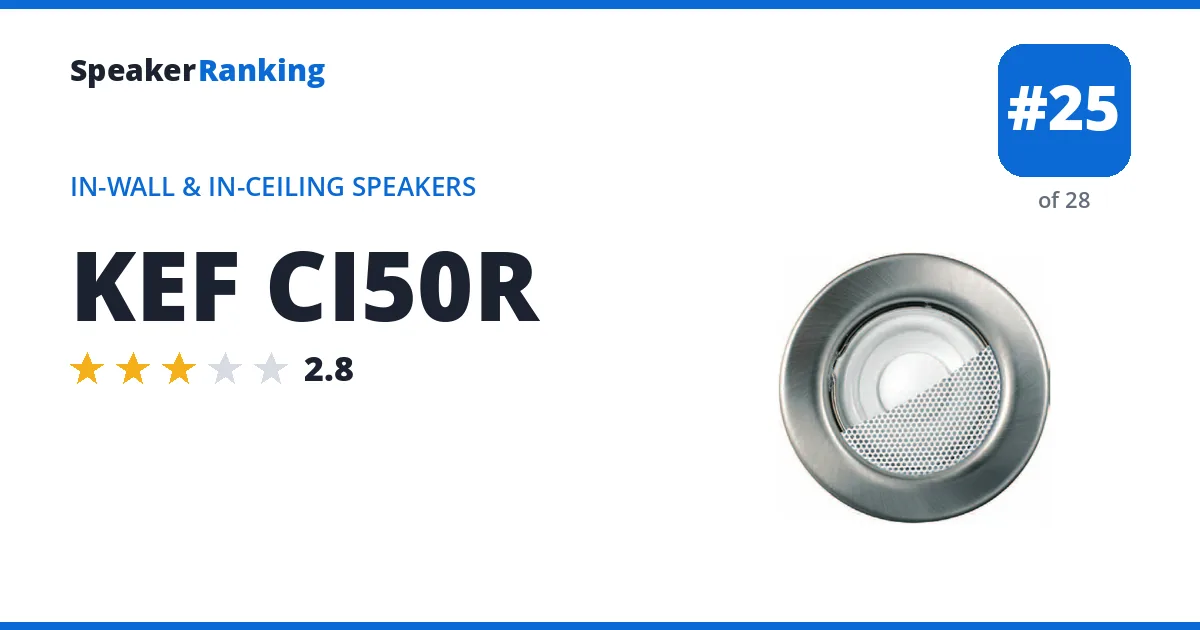
Pros: At just 80 x 80mm and 55mm deep, this is by far the smallest speaker in this category, small enough to fit into spaces, tight closets, cabinetry, shallow ceiling cavities, that none of the other in-wall or in-ceiling models here can reach. Measured bass extension of 170Hz (-3dB).
Cons: No longer sold as a current KEF product; dealer listings mark it a legacy item replaced in KEF’s lineup, so buying one now means used or leftover new-old stock rather than a current retail purchase. It measures the shallowest bass extension of any speaker in this category by a wide margin, reaching only about 170Hz at -3dB and roughly 113Hz at -10dB, consistent with a small background or ambient-audio speaker rather than one built for full-range listening.
Full KEF CI50R review and specifications →
| Bass Extension (-10dB) | 113Hz (measured, spinorama.org vendor data) |
|---|---|
| Bass Extension (-3dB) | 170Hz (measured, spinorama.org vendor data) |
| DIY Kit | No |
| Dimensions | 3.1” x 3.1” x 2.2” (80 x 80 x 55 mm) |
| Drivers | 2” full-range driver |
| Enclosure | Open-backed (optional rear enclosure), in-ceiling |
| Frequency Response | 125Hz-20kHz +/-6dB (manufacturer, open-backed) |
| Impedance | 6 ohms |
| Mounting Cutout | 70mm (2.76 in) with rear enclosure |
| Power Handling | 10-30W recommended amplifier power |
| Sensitivity | 82dB |
| Weight | 2.2 lbs (1.0kg) |
- Reviews, Comparisons and Sound Samples
- Head-to-Head Comparisons
 #26 Bowers & Wilkins CWM7.5: $1,600 per pair Discontinued eBay
Newer model: the Bowers & Wilkins CWM 7.5 S2, ranked higher, estimated 3/5, released 2019. See every Bowers & Wilkins CWM In-Wall generation.
Pros: A two-way in-wall speaker with a 5” mid/bass driver, a 1” tweeter and an integrated back box, so it does not depend on the wall cavity. The only Spinorama data shows very consistent directivity (2.49dB directivity index deviation) and bass to about 59Hz (-10dB). Measured bass extension of 69.0Hz (-3dB).
Cons: That data is low quality and shows a very uneven on-axis response (1.99dB average deviation) and a rough predicted in-room response (0.17), for a preference score of 1.63. Replaced by the Bowers & Wilkins CWM 7.5 S2. Discontinued.
Full Bowers & Wilkins CWM7.5 review and specifications →
| Released | Dec 2009 (16 years ago) |
|---|---|
| Bass Extension (-10dB) | about 58.9Hz (measured, third-party data via spinorama.org) |
| Bass Extension (-3dB) | 69.0Hz (measured, third-party data via spinorama.org) |
| DIY Kit | No |
| Drivers | 1” tweeter, 5” mid/bass driver, integrated back box |
| Spinorama Preference Score | 1.63 |
| Spinorama Preference Score with Perfect Sub | 4.38 |
- Reviews, Comparisons and Sound Samples
 #27 JBL Synthesis SCL-5: $4,400 per pair eBay
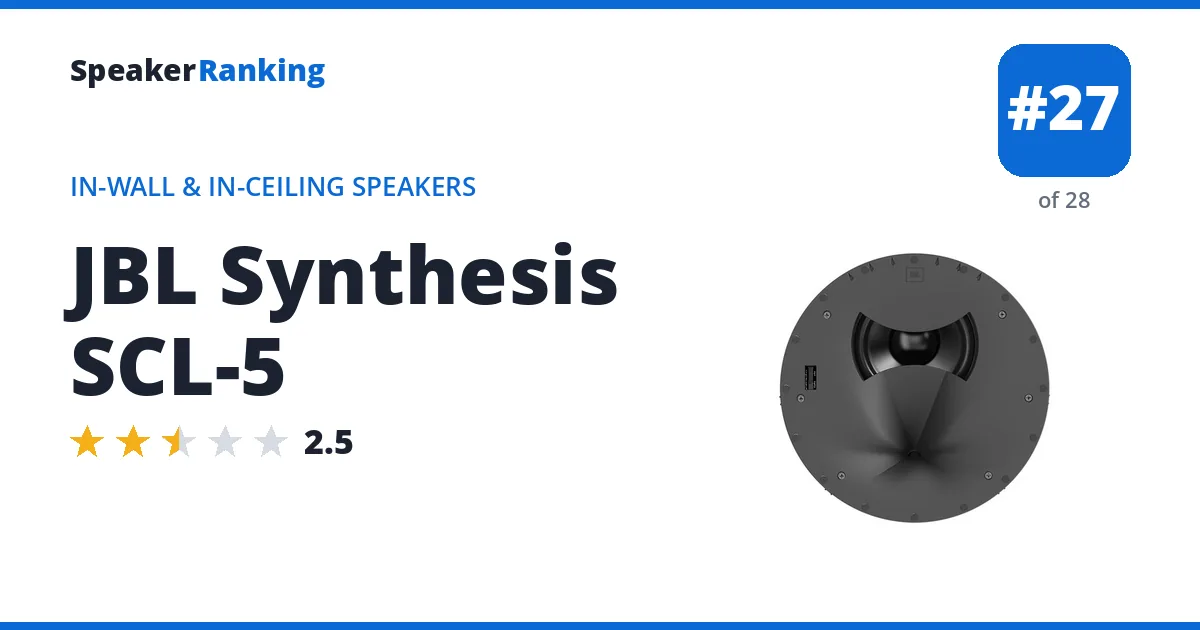
Same family: the JBL Synthesis SCL-4 (smaller in-wall, ranked higher, rated 3.6/5), the JBL Synthesis SCL-6 (smaller in-wall, ranked higher, rated 3.9/5), the JBL Synthesis SCL-3 (smaller in-wall, ranked higher, rated 3.7/5), the JBL Synthesis SCL-7 (smaller in-wall, ranked higher, rated 3.7/5) and the JBL Synthesis SCL-1 (smaller in-wall, ranked higher, rated 3.7/5).
Pros: A round in-ceiling speaker from JBL Synthesis with a waveguide-loaded tweeter, made to match the SCL in-wall range. Audio Science Review measured a preference score of 0.43 that reaches 3.31 with an ideal subwoofer, with 1.00 listening window deviation. Measured bass extension of 74.7Hz (-3dB).
Cons: Bass is limited and the in-room balance is uneven, for a low standalone preference score. It is sold through JBL Synthesis custom installers. Bass reaches 74.7Hz (-3dB) and about 34Hz (-10dB).
Full JBL Synthesis SCL-5 review and specifications →
| Bass Extension (-10dB) | about 34.0Hz (measured, Audio Science Review) |
|---|---|
| Bass Extension (-3dB) | 74.7Hz (measured, Audio Science Review) |
| DIY Kit | No |
| Dimensions | 12.5”H x 12.5”W x 6”D (318 x 318 x 152 mm) |
| Drivers | woofer, tweeter with waveguide |
| Impedance | 6 ohms nominal (manufacturer specified) |
| Sensitivity | 86dB (manufacturer specified) |
| Spinorama Preference Score | 0.43 |
| Spinorama Preference Score with Perfect Sub | 3.31 |
| Weight | 8.6 lbs (3.9 kg) |
- Reviews, Comparisons and Sound Samples
 #28 SpeakerCraft AIM8 One eBay
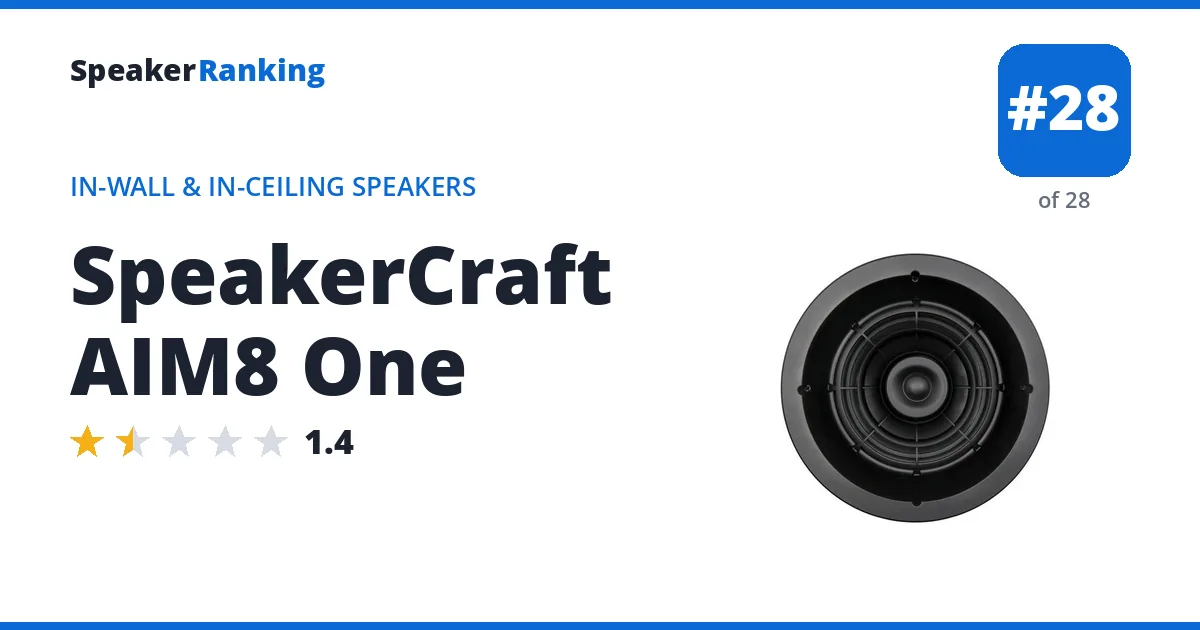
Pros: An in-ceiling speaker from SpeakerCraft’s AIM line with an 8” woofer and a pivoting tweeter that can be aimed toward the listening position. Measurements show a preference score of -1.5 that reaches 0.55 with an ideal subwoofer, with 1.41 listening window deviation. Measured bass extension of 60.5Hz (-3dB).
Cons: The response is very uneven, for a preference score of -1.50 that reaches only 0.55 with an ideal subwoofer, and that data is low quality. Bass reaches 60.5Hz (-3dB) and about 22Hz (-10dB). That data is low quality.
Full SpeakerCraft AIM8 One review and specifications →
| Bass Extension (-10dB) | about 21.5Hz (measured, third-party data via spinorama.org) |
|---|---|
| Bass Extension (-3dB) | 60.5Hz (measured, third-party data via spinorama.org) |
| DIY Kit | No |
| Drivers | 8” woofer, aimable tweeter |
| Impedance | 8 ohms nominal (manufacturer specified) |
| Sensitivity | 88dB (manufacturer specified) |
| Spinorama Preference Score | -1.5 |
| Spinorama Preference Score with Perfect Sub | 0.55 |
| Weight | 11 lbs (5 kg) |
- Reviews, Comparisons and Sound Samples