The KEF CI250RRM-THX ranks #7 out of 28 total In-Wall & In-Ceiling Speakers for sound quality. See all Passive Home rankings for every top pick.
Brand: KEF
Prices on this page were last checked October 21, 2026 at 9:52 PM UTC. Product prices and availability are accurate as of that date/time and are subject to change; the price and availability shown on Amazon at the time of purchase will apply to the purchase of this product.
As an eBay Partner, we may be compensated if you make a purchase.
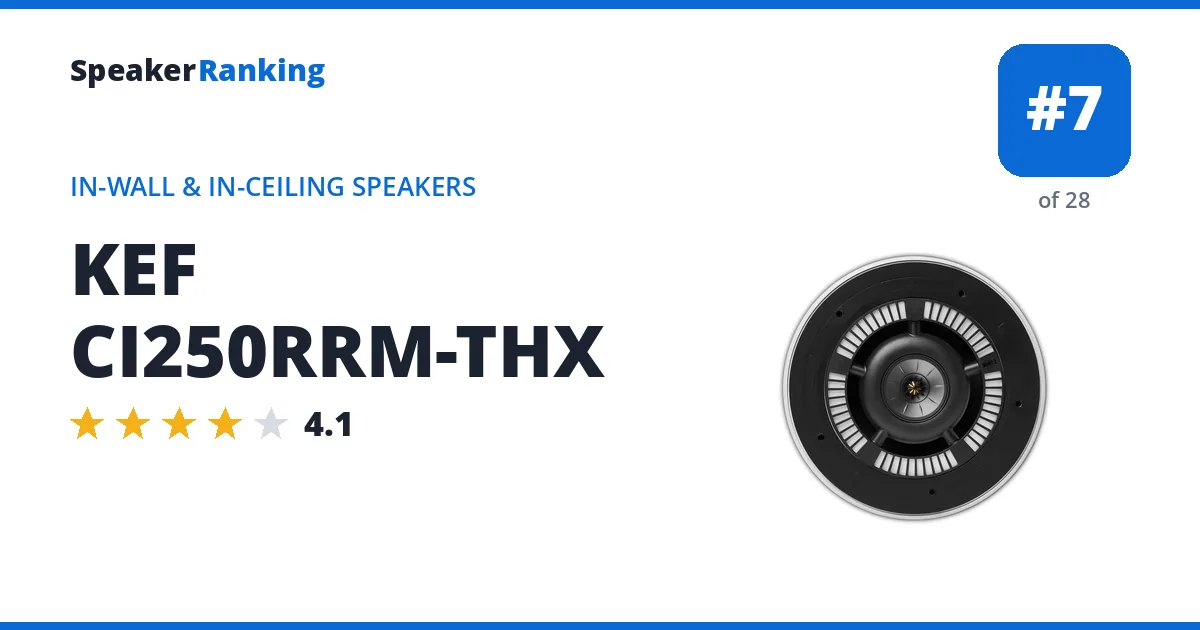
#7 KEF CI250RRM-THX: $4,397.90 per pair Amazon $2,198.95 Abt Electronics $2,999.99 eBay
Same family: the KEF Ci3160RLM-THX (larger in-wall, ranked higher, rated 4.5/5). See every KEF Ci THX In-Wall generation.
Pros: An in-ceiling speaker with very deep bass for its type, voiced for Atmos height or surround channels and great with room correction. Independently measured by Audio Science Review to a genuine 51.3Hz at -3dB and roughly 23.3Hz at -10dB, the deepest bass extension of any in-wall or in-ceiling speaker in this category. It’s a THX-certified 3-way coaxial design, a 10” woofer built around a 4” Uni-Q midrange and 1” aluminum dome tweeter, deliberately voiced for the 30-60 degree off-axis angle typical of a ceiling-mounted Dolby Atmos height or surround channel rather than a straight-down listening position. Run through a receiver’s automated room correction, spinorama’s EQ-adjusted figures show its preference score climbing from 4.67 to 5.68, so it responds well to correction. Measured bass extension of 51.3Hz (-3dB).
Cons: At $2199 each, this is the most expensive speaker in this category. Its raw on-axis measurement trails the KEF Ci3160RLM-THX (preference score 4.67 vs. 4.62) since the driver array is tuned for off-axis dispersion rather than a flat straight-ahead response, and its on-axis deviation averages 1.14dB, a notably rough figure on-axis due to that off-axis optimization.
| Released | Sep 2022 (4 years ago) |
|---|---|
| Bass Extension (-10dB) | 23.3Hz (measured, spinorama.org ASR data) |
| Bass Extension (-3dB) | 51.3Hz (measured, spinorama.org ASR data) |
| Certification | THX |
| DIY Kit | No |
| Dimensions | 13.6” x 13.6” x 6.9” (346 x 346 x 175 mm) (168mm mounting depth) |
| Drivers | 10” LF woofer, 4” Uni-Q midrange, 1” vented aluminum dome tweeter with MAT (3-way coaxial) |
| Enclosure | Open-backed, in-ceiling |
| Frequency Response | 28Hz-20kHz +/-6dB (manufacturer, open-backed) |
| Impedance | 8 ohms |
| Mounting Cutout | 300mm (11.81 in) |
| Power Handling | 50-250W recommended amplifier power |
| Sensitivity | 89dB |
| Spinorama Preference Score | 4.67 |
| Spinorama Preference Score with Perfect Sub | 6.68 |
| Weight | 13.2 lbs (6 kg) |
Price history (per pair)
$4,397.90 is the lowest price we have tracked since Sep 2026.
- Links
- Reviews, Comparisons and Sound Samples
Frequency Response
How the KEF CI250RRM-THX measures across the audible range. A flatter listening window (the sound arriving straight at you) is more neutral: peaks sound forward or harsh, dips sound recessed. The estimated in-room response adds what a typical room does, and there a gentle, even tilt down toward the treble is ideal. Both curves are shifted so their 300 Hz to 3 kHz average sits at 0 dB.
Measurement data: spinorama.org, measured by Audio Science Review.
EQ for a Neutral Response
Flattens the measured listening window from the KEF CI250RRM-THX's own bass extension up to 16 kHz. Set a preamp of -1.6 dB, then add these filters to any parametric equalizer in the signal path: the speaker's app or DSP if it has parametric EQ, a miniDSP, Equalizer APO or Wavelet. Boosts are kept to 3 dB, and EQ cannot fix how evenly the speaker spreads sound off-axis, which is why some speakers gain more than others. Predicted preference score with this EQ: 6.3, up from 4.7 (7.0 with an ideal subwoofer, up from 6.7). Calculated by Speaker Ranking from the spinorama measurements above.
| Filter | Frequency | Gain | Q |
|---|---|---|---|
| Peak | 548 Hz | +1.6 dB | 0.90 |
| Peak | 1,023 Hz | -1.6 dB | 3.07 |
| Peak | 1,552 Hz | -2.5 dB | 2.45 |