Editor's top picks
Start with these speakers
Our leading recommendations at a glance. Each card links to its primary retailer.
Looking for the best passive speakers under $1,000? This is where passive speakers start measuring like high-end designs. Several bookshelf picks here have more even responses than towers costing twice as much, and the towers add real bass. Prices are per pair, and every speaker here needs a separate amplifier or receiver.
Prices on this page were last checked September 24, 2026 at 10:28 PM UTC. Product prices and availability are accurate as of that date/time and are subject to change; the price and availability shown on Amazon at the time of purchase will apply to the purchase of this product.
As an eBay Partner, we may be compensated if you make a purchase.
What Changes At $1,000
Measured neutrality at the top of the rankings. The best bookshelf picks here are among the highest-rated passive speakers on the site at any price, not just at this budget.
Real towers. Floorstanders under $1,000 bring dual woofers and bass reaching the low 30Hz range (-10dB), so a subwoofer becomes optional for music.
Check the sensitivity. Some of the most accurate picks here are also among the least efficient. A speaker around 82dB needs noticeably more amplifier power for the same volume than one around 90dB. See speaker sensitivity explained.
Best Bookshelf Under $1,000
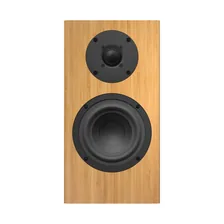 The most neutral bookshelf speaker here, with an extremely linear in-room response, is the Ascend Sierra 1 v2: $1000 per pair Ascendacoustics eBay
Pros: Formaldehyde-free layered bamboo ply cabinet with a 1” dome tweeter over a 5.25” midwoofer, mated by a 4th-order acoustic crossover rather than a stock textbook design. In-room response is extremely linear - the reviewer called it “textbook” - a clear step up from the earlier V1, which had boxiness around 700Hz-1kHz and sibilance around 4-6kHz. Preference score of 8.4 with a subwoofer (6.8 without), which the reviewer calls topnotch. Wide, even horizontal radiation of about ±70° up to 6kHz. Better vertical directivity than its tweeter-to-woofer spacing would suggest, thanks to the steep 4th-order crossover slopes. No mechanical noise, port chuffing, or woofer bottoming even driven to 96dB/1m. In a three-way comparison against the Dynaudio Emit 20 and a Revel bookshelf model (all around $1,000/pair), measured as the most linear of the three and was the reviewer’s personal pick over both, despite the Dynaudio’s deeper bass and higher output capability. Independent ASR Klippel measurements corroborate Erin’s findings: superb off-axis response with only slight on-axis variations, and an in-room response the reviewer called “incredibly smooth and accurate - amazing for a non-DSP speaker.” Distortion above 200Hz at 86dB/1m is very low for the class. Measured bass extension of 55Hz (-3dB), with a measured sensitivity of 81.5dB.
Cons: F3 of 55Hz and F10 of 39Hz mean in-room extension tops out in the mid-40s Hz; the reviewer still recommends a subwoofer for full-range material. Diffraction dips appear around 3kHz and 5-6kHz, and the 1” dome tweeter starts beaming above roughly 6.7kHz, narrowing the soundstage radiation in the top octave - a straightforward consequence of dome size rather than a design flaw. At 96dB/1m the 5.25” midwoofer shows increased distortion in the midrange, likely tied to motor topology; high-passing to a subwoofer around 80Hz largely clears it up. Moderate sensitivity (~81-82dB average) with a 7-ohm minimum impedance. ASR’s power-sweep testing found response holds steady up to 96dB SPL/1m, but pushing to 102dB causes midbass below 400Hz to sag with distortion “through the roof” - a harder output ceiling than the 96dB tests alone suggest. Vertical directivity also narrows above about 1kHz, so the reviewer recommends staying at tweeter-axis height for best results.
Full Ascend Sierra 1 v2 review and specifications →
| Bass Extension (-10dB) | 39Hz (measured, Erin's Audio Corner) |
|---|---|
| Bass Extension (-3dB) | 55Hz (measured, Erin's Audio Corner) |
| DIY Kit | No |
| Dimensions | 14.2"H x 7.5"W x 10.5"D (361.9 x 190.5 x 266.7 mm) |
| Drivers | 5.25" proprietary mineral-filled polypropylene cone with cast aluminum frame woofer, 26mm aluminum/magnesium alloy dome tweeter with titanium former (SEAS Titan) |
| Impedance | 8 ohms nominal, 7 ohms minimum (measured, Erin's Audio Corner) |
| Sensitivity | 81.5dB (measured, Erin's Audio Corner) |
| Spinorama Preference Score | 6.65 |
| Spinorama Preference Score with Perfect Sub | 8.61 |
| Weight | 18.5 lbs (8.4 kg) each |
| Woofer Cabinet | ported |
- Links
- Reviews, Comparisons and Sound Samples
- Erin’s Audio Corner: NEW! Ascend Acoustics Sierra-1 V2 Review More from Erin’s Audio Corner →
- Erin’s Audio Corner Website Ascend Sierra 1 v2
- Audio Science Review Ascend Sierra 1 v2 More from Audio Science Review →
- Erin’s Audio Corner: 5 AWESOME SPEAKERS Under $1000 You Won’t Regret
- Erin’s Audio Corner: I Tested 250 Speakers So You Don’t Have To!
- Erin’s Audio Corner: My Top Picks of 2023: Must-Haves Under $3000
- Manufacturer Measurements (spinorama.org)
- Head-to-Head Comparisons
- Ascend Sierra 1 v2 vs KEF LS50 Meta
- Ascend Sierra 1 v2 vs Philharmonic Ceramic Mini
- Ascend Sierra 1 v2 vs Audio First Fidelia
- Ascend Sierra 1 v2 vs XMechanik Mechano23 DIY
- Ascend Sierra 1 v2 vs Ascend Acoustics HTM-200SE2
- Ascend Sierra 1 v2 vs Arendal 1961 Monitor
- Ascend Sierra 1 v2 vs Ascend Acoustics Luna V2 Mini-Monitor Titan
- Ascend Sierra 1 v2 vs Aalto Speakers Aalto 1 EVO
- See all 50 comparisons
It ranks #3 of 88 medium passive bookshelf speakers, right at the top of this budget. Sensitivity is low at about 81.5dB, so give it a capable amplifier, and add a subwoofer for full-range material.
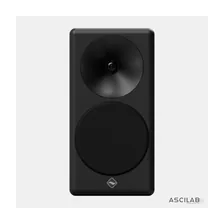 For a larger 6-inch woofer and a strong measured result, the AsciLab F6B: $980 per pair Ascilab eBay
Pros: Called by the reviewer the best sub-$1000 pair of speakers he’s come across to date. Very good on-axis linearity and directivity for the price, with a large waveguide-loaded 1” aluminum dome tweeter that keeps a two-way design well-behaved through the crossover. Nice midbass punch from a slightly undersized enclosure alignment that gives kick drums extra impact. Solid, unfussy tonal balance overall. Measured bass extension of 56Hz (-3dB), with a measured sensitivity of 85dB.
Cons: A mild sibilance-inducing lift around 6-8kHz, most noticeable on female vocals, paired with a shallow dip in the upper midrange - correctable with a simple 3-band EQ the reviewer provided. In-room bass extension is only about 50-60Hz despite a 6” woofer, trading some low-end reach for that extra midbass punch. Compression and graininess creep in at higher volumes (upper 80s to low 90s dB at 10ft), and directivity (~50-60 degrees horizontal) is narrower than the reviewer’s other current favorite, the Audio First Cadentia 3.
Full AsciLab F6B review and specifications →
| Bass Extension (-10dB) | 38Hz (measured, Erin's Audio Corner) |
|---|---|
| Bass Extension (-3dB) | 56Hz (measured, Erin's Audio Corner) |
| Crossover Frequency | 1000Hz |
| DIY Kit | No |
| Dimensions | 15.7" x 8" x 10.4" (400 x 203 x 265 mm) |
| Drivers | 1" aluminum dome tweeter, 6" fiber cone woofer |
| Impedance | 4 ohms nominal (3.5 ohms minimum above 80Hz, measured by Erin's Audio Corner) |
| Recommended Power | up to 125W |
| Sensitivity | 85dB (2.83V/1m, measured by Erin's Audio Corner) |
| Spinorama Preference Score | 6.32 |
| Spinorama Preference Score with Perfect Sub | 8.26 |
| Weight | 16.5 lbs (7.5 kg) each |
| Woofer Cabinet | Passive radiator loaded |
- Links
- Reviews, Comparisons and Sound Samples
- Head-to-Head Comparisons
It ranks #12 of 130 large passive bookshelf speakers. A mild lift around 6kHz to 8kHz can make some vocals sibilant; a simple EQ corrects it.
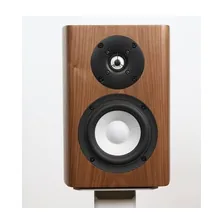 For standout looks and very low midrange distortion, the Philharmonic Ceramic Mini: $900 per pair Philharmonic Audio eBay
Pros: Gorgeous looks and finish options for the price. Very low midrange distortion for the size, well under 1% above about 400-500Hz. Excellent on-axis linearity. Mild, pleasant bass bump around 100Hz that adds welcome warmth without being excessive. Wide soundstage and dispersion (~70-80 degrees horizontally). Clean cabinet and port with no measured resonances. A great value combination of looks and performance at this price. Measured bass extension of 51Hz (-3dB), with a measured sensitivity of 82dB.
Cons: Somewhat limited output capability for its size - audible woofer compression (“flopping”) around 95dB at 3 meters for a stereo pair, so keep to moderate levels or pair with a subwoofer for home theater use. A mild diffraction-related dip around 4-6kHz can cause occasional sibilance on some vocal tracks. Measured sensitivity (82.2dB average) runs a bit below the manufacturer’s claimed 84dB, so it needs more amp power than the spec alone suggests. Needs a subwoofer for real bass authority below about 40Hz.
Full Philharmonic Ceramic Mini review and specifications →
| Bass Extension (-10dB) | 36Hz (measured, Erin's Audio Corner) |
|---|---|
| Bass Extension (-3dB) | 51Hz (measured, Erin's Audio Corner) |
| Country | USA (Vienna, Virginia) |
| Crossover Frequency | 2kHz (Linkwitz-Riley 4th order) |
| DIY Kit | No |
| Dimensions | 12" x 8.5" x 11.3" (305 x 216 x 286 mm) |
| Drivers | 5.25" ceramic woofer, 1" ceramic dome tweeter |
| Frequency Response | 55Hz - 20kHz (+1.5/-3dB, Manufacturer specified, ported) |
| Impedance | 4 ohms nominal (3.2 ohms min, 15 ohms max) (measured, Erin's Audio Corner) |
| Sensitivity | 82dB (2.83V/1m, measured by Erin's Audio Corner) |
| Spinorama Preference Score | 5.77 |
| Spinorama Preference Score with Perfect Sub | 7.78 |
| Weight | 17 lbs (7.7 kg) |
| Woofer Cabinet | ported, rear |
- Links
- Reviews, Comparisons and Sound Samples
- Head-to-Head Comparisons
- Philharmonic Ceramic Mini vs Ascend Sierra 1 v2
- Philharmonic Ceramic Mini vs Audio First Fidelia
- Philharmonic Ceramic Mini vs KEF LS50 Meta
- Philharmonic Ceramic Mini vs XMechanik Mechano23 DIY
- Philharmonic Ceramic Mini vs Ascend Acoustics HTM-200SE2
- Philharmonic Ceramic Mini vs Arendal 1961 Monitor
- Philharmonic Ceramic Mini vs Ascend Acoustics Luna V2 Mini-Monitor Titan
- Philharmonic Ceramic Mini vs Aalto Speakers Aalto 1 EVO
- See all 22 comparisons
It has excellent on-axis linearity with a mild warmth around 100Hz. Output is limited for its size and sensitivity is about 82dB, so keep it to moderate levels or pair it with a subwoofer.
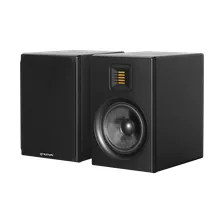 For the lowest price among the strongest measurers, with better directivity than the ELAC DB63, the Emotiva Airmotiv XB2: $549 per pair Emotiva eBay
Pros: Very neutral, linear frequency response at the recommended toe-out angle, with better directivity than the similarly-priced ELAC DB63. Decent bass extension for a bookshelf (F3 at 62Hz). AMT folded-ribbon tweeter with a rotating waveguide for placement flexibility. Great value - rated a top-three performer for the money by Erin’s Audio Corner. Measured bass extension of 62Hz (-3dB).
Cons: Slight recessed upper-midrange around 2kHz from the tweeter-to-woofer handoff. Sounds noticeably bright pointed directly at the listener - needs toeing out 10-20 degrees, crossfiring behind the head, for the most linear result. Elevated multi-tone distortion at higher output leads to some grainy, compressed mids when pushed. Irregular compression deviations affect dynamics at higher volume. Needs a subwoofer for real bass authority.
Full Emotiva Airmotiv XB2 review and specifications →
| Bass Extension (-10dB) | 43Hz (measured, Erin's Audio Corner) |
|---|---|
| Bass Extension (-3dB) | 62Hz (measured, Erin's Audio Corner) |
| Crossover Frequency | 2.6kHz |
| DIY Kit | No |
| Dimensions | 12.8" x 8.5" x 11.5" (325 x 216 x 292 mm) |
| Drivers | 1x 6" woven cone woofer, 1x 25x32mm AMT folded ribbon tweeter |
| Frequency Response | 48Hz - 27kHz (+3/-3dB, Manufacturer specified) |
| Impedance | 4 ohms nominal (safe with 8-ohm rated amps) |
| Power Handling | 125W continuous, 200W peak |
| Sensitivity | 86dB (2.83V/1m, Manufacturer specified) |
| Spinorama Preference Score | 5.65 |
| Spinorama Preference Score with Perfect Sub | 7.93 |
| Weight | 18.1 lbs (8.2 kg) |
| Woofer Cabinet | Bass reflex, rear ported |
- Links
- Reviews, Comparisons and Sound Samples
- Head-to-Head Comparisons
- Emotiva Airmotiv XB2 vs ELAC Debut 3.0 DB63
- Emotiva Airmotiv XB2 vs Ascend Acoustics Sierra-2EX V2
- Emotiva Airmotiv XB2 vs Perlisten A3m
- Emotiva Airmotiv XB2 vs JBL HDI-1600
- Emotiva Airmotiv XB2 vs Philharmonic BMR (v1)
- Emotiva Airmotiv XB2 vs ELAC VELA BS 403
- Emotiva Airmotiv XB2 vs Aalto Speakers Aalto 3 Passive
- Emotiva Airmotiv XB2 vs StarkSound Beta 5
- See all 52 comparisons
At $549 it leaves room in the budget for an amplifier. Toe it out 10 to 20 degrees: pointed straight at the listener it sounds bright.
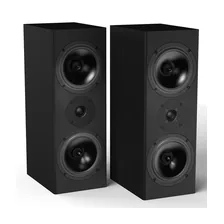 For high sensitivity and a strong score with a subwoofer, the Ascend Acoustics CMT-340 SE2: $798 per pair Ascend Acoustics eBay
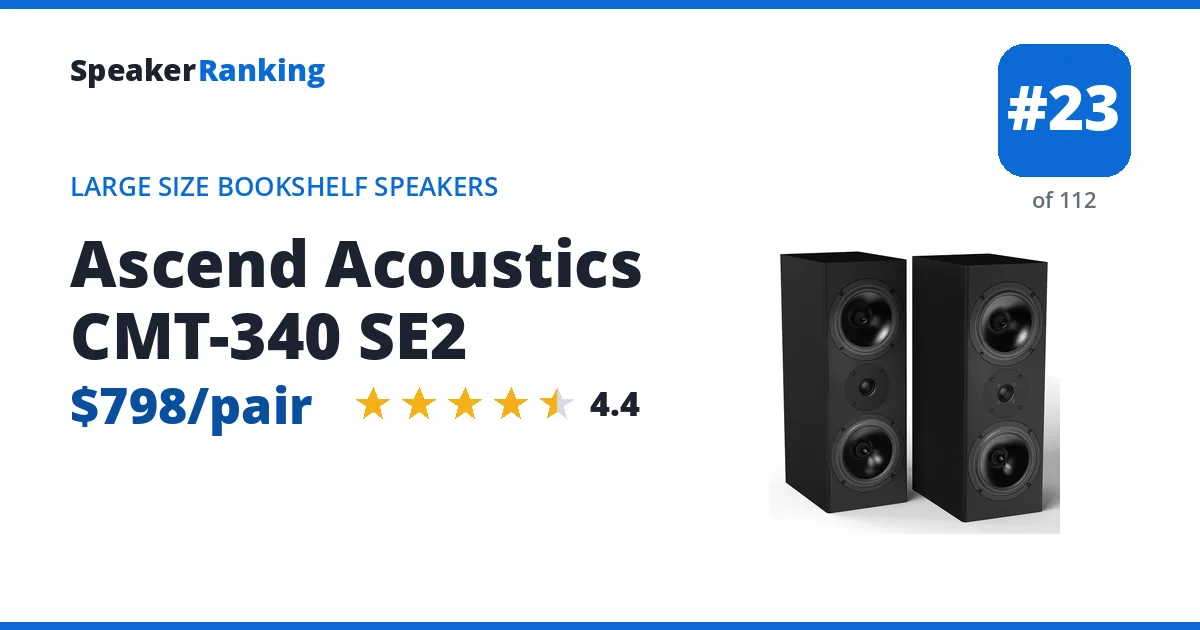
Pros: High-quality manufacturer Klippel NFS data shows 0.295dB on-axis average absolute deviation, 0.531 listening-window smoothness, and a strong 7.99 preference score with a subwoofer. Its dual 6.5-inch woofers, 92dB anechoic sensitivity, and 240W continuous power rating support high output and dynamics. Measured bass extension of 77.6Hz (-3dB).
Cons: Bass rolls off early for the cabinet size, measuring 77.6Hz at -3dB, 64.5Hz at -6dB, and 48.3Hz at -12dB; the preference score without a subwoofer is only 5.33. The 4.35 sound-power directivity-index standard deviation also indicates more off-axis variation than the strongest designs, and the rear port needs placement clearance.
Full Ascend Acoustics CMT-340 SE2 review and specifications →
| Bass Extension (-10dB) | approximately 53Hz (measured, spinorama.org) |
|---|---|
| Bass Extension (-3dB) | 77.6Hz (measured, spinorama.org) |
| DIY Kit | No |
| Dimensions | 21 x 7.5 x 10.5 in each |
| Drivers | Two 6.5-inch woofers; 27mm soft-dome tweeter |
| Impedance | 8 ohms nominal |
| Power Handling | 240W continuous; 400W short-term peak |
| Sensitivity | 92dB at 2.83V/1m anechoic |
| Spinorama Preference Score | 5.33 |
| Spinorama Preference Score with Perfect Sub | 7.99 |
| Weight | 29.1 lbs (13.2 kg) each |
- Links
- Reviews, Comparisons and Sound Samples
- Head-to-Head Comparisons
- Ascend Acoustics CMT-340 SE2 vs Arendal 1528 Monitor 8
- Ascend Acoustics CMT-340 SE2 vs Wharfedale Super Linton
- Ascend Acoustics CMT-340 SE2 vs AsciLab F6Bs
- Ascend Acoustics CMT-340 SE2 vs MoFi SourcePoint 10
- Ascend Acoustics CMT-340 SE2 vs Radiant Acoustics Clarity 6.2
- Ascend Acoustics CMT-340 SE2 vs Dynaudio Heritage Special
- Ascend Acoustics CMT-340 SE2 vs MoFi SourcePoint 8
- Ascend Acoustics CMT-340 SE2 vs Buchardt Audio E50
- See all 45 comparisons
Its 92dB sensitivity suits low-power amplifiers, and the dual 6.5-inch woofers suit a center-and-mains setup. Bass rolls off early, around 78Hz (-3dB), so plan on a subwoofer.
Best Floorstanding Under $1,000
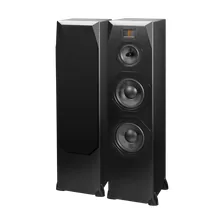 For deep bass from dual 8-inch woofers, reaching about 32Hz (-10dB), the Emotiva Airmotiv T2+: $999 per pair Emotiva eBay
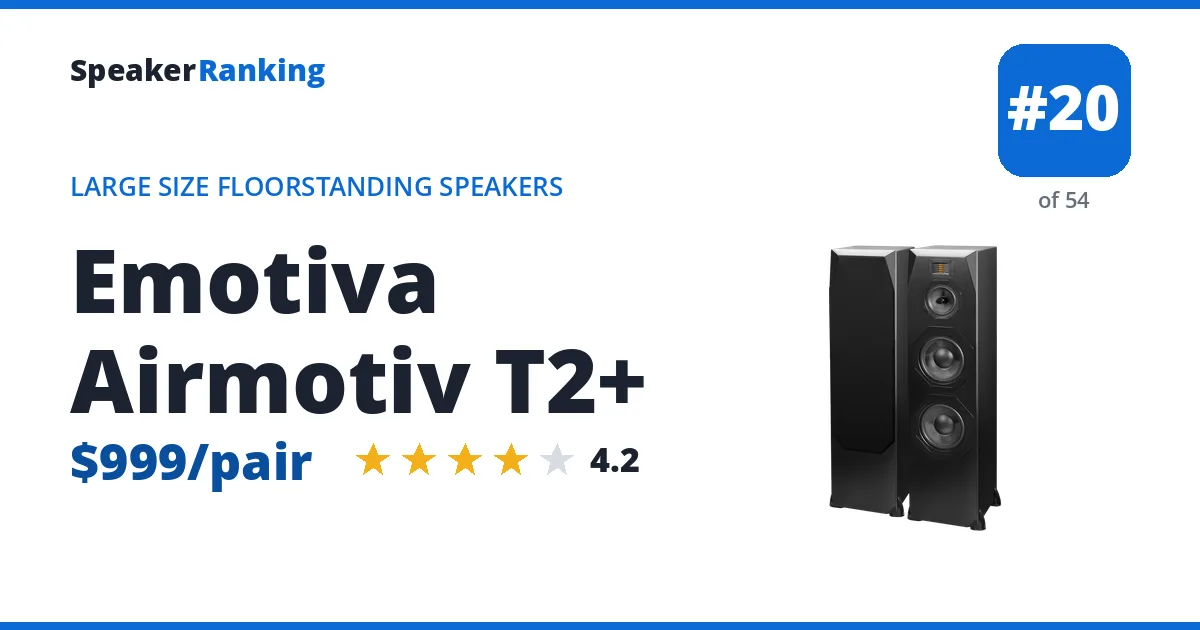
Pros: High-value three-way tower with strong output and unusually deep usable sealed-room bass for the price. Erin measured F3 at 62Hz and F10 at 32Hz, with sensitivity just under 90dB/2.83V/1m. Dual 8-inch woven-fiber woofers relieve the 5.25-inch midrange, and the 32mm folded-ribbon tweeter provides broad horizontal coverage. Approximately +/-2.5dB response linearity, solid cabinet bracing and low compression allow substantial playback levels; the gradual low-frequency roll-off integrates well with either room gain or a subwoofer. Measured bass extension of 62Hz (-3dB), with a measured sensitivity of 89.5dB.
Cons: The nominal 4-ohm system approaches 3 ohms near 100Hz in Erin’s measurement, so a high-current amplifier is preferable. Horizontal and especially vertical directivity through the midrange/tweeter transition is less uniform than the best waveguided or coaxial designs; listener height and nearby reflections matter, and EQ cannot correct the narrowing mismatch. The large rear-ported cabinet needs placement clearance, and its deep F10 should not be confused with flat 30Hz output at cinema levels.
Full Emotiva Airmotiv T2+ review and specifications →
| Bass Extension (-10dB) | 32Hz (measured, Erin's Audio Corner) |
|---|---|
| Bass Extension (-3dB) | 62Hz (measured, Erin's Audio Corner) |
| DIY Kit | No |
| Dimensions | 42.7"H x 12.2"W x 12.3"D |
| Drivers | 32mm folded-ribbon tweeter; 5.25" midrange; dual 8" woofers |
| Impedance | Approximately 3 ohms minimum near 100Hz (measured, Erin's Audio Corner) |
| Sensitivity | Approximately 89.5dB/2.83V/1m (measured, Erin's Audio Corner) |
| Spinorama Preference Score | 5.56 |
| Spinorama Preference Score with Perfect Sub | 7.14 |
| Weight | 56.9 lbs (25.8 kg) each |
| Woofer Cabinet | ported, rear |
- Links
- Reviews, Comparisons and Sound Samples
- Head-to-Head Comparisons
- Emotiva Airmotiv T2+ vs Polk Audio Reserve R700
- Emotiva Airmotiv T2+ vs JBL HDI-3600
- Emotiva Airmotiv T2+ vs Q Acoustics 5040
- Emotiva Airmotiv T2+ vs KEF R11 Meta
- Emotiva Airmotiv T2+ vs PSB Imagine T65
- Emotiva Airmotiv T2+ vs ELAC Debut 3.0 DF63
- Emotiva Airmotiv T2+ vs Polk Reserve R500
- Emotiva Airmotiv T2+ vs Revel Concerta2 F35
- See all 25 comparisons
The impedance approaches 3 ohms near 100Hz, so use a high-current amplifier.
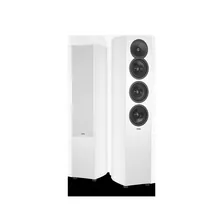 For a more neutral tower with lower distortion, the Revel Concerta2 F35: $900 per pair Crutchfield eBay
Pros: Two-and-a-half-way, four-driver design: a 1” aluminum dome tweeter on a waveguide, a 5.25” mid-range, and dual 5.25” mid-bass drivers in a rear-ported cabinet. Measured sensitivity of 89.4dB closely matches the 90dB spec, and distortion looks good at both 86dB and 96dB, holding up well even with a high-pass filter applied. At its sale price (around $900/pair, down from full retail), the reviewer calls it a “no-brainer,” undercutting comparable budget floorstanders like the ELAC DF63. Frequency response and directivity mismatches are largely EQ-able, since most of what shows up in measurements traces to physical tweeter/mid-range separation rather than a fundamental flaw. Compression is fairly well controlled for the price - about 1dB of loss around 100Hz under long-term compression, described as “par for the course” at this cost. Measured bass extension of 70Hz (-3dB), with a measured sensitivity of 89.4dB.
Cons: F3 of 61Hz and F10 of 39Hz mean a subwoofer is needed for real bass extension. A dip in the lower midrange/2-3kHz region reduces attack and detail, and a peak around 5kHz adds some edge and sibilance in the lower treble. A peak in off-axis energy around 3kHz reflects off sidewalls at roughly 60-70° off-axis and arrives louder than the direct sound - this specific issue can’t be fixed with EQ (boosting the direct sound would boost the stronger reflection too) and would need acoustic absorption to properly address, though the reviewer considers it a minor, optional fix at this price. A couple of minor resonances appear in the impedance plot, including one around 300Hz that may partly explain a subtle sense of vocal warmth noticed in listening, though it’s more likely room-related. Minimum impedance around 3.8 ohms. Short-term compression testing shows some increased distortion in the tweeter and higher-frequency compression at loud output.
Full Revel Concerta2 F35 review and specifications →
| Bass Extension (-10dB) | 50Hz (measured, Erin's Audio Corner) |
|---|---|
| Bass Extension (-3dB) | 70Hz (measured, Erin's Audio Corner) |
| DIY Kit | No |
| Dimensions | 40.3"H x 8.4"W x 12.2"D (1023.6 x 213.4 x 309.9 mm) |
| Drivers | 3x 5.25" deep anodized aluminum cone woofers, 1" Aluminum Tweeter |
| Impedance | 6 ohms nominal (3.8 ohms minimum, measured by Erin's Audio Corner) |
| Sensitivity | 89.4dB (measured, Erin's Audio Corner; 90dB manufacturer specified) |
| Spinorama Preference Score | 5.35 |
| Spinorama Preference Score with Perfect Sub | 7.30 |
| Weight | 41 lbs (18.6 kg) each |
| Woofer Cabinet | ported, rear |
- Links
- Reviews, Comparisons and Sound Samples
- Head-to-Head Comparisons
- Revel Concerta2 F35 vs Revel F206
- Revel Concerta2 F35 vs Perlisten S7t
- Revel Concerta2 F35 vs JBL Studio 698
- Revel Concerta2 F35 vs KEF R11 Meta
- Revel Concerta2 F35 vs Arendal 1961 Tower
- Revel Concerta2 F35 vs JBL HDI-3600
- Revel Concerta2 F35 vs Emotiva Airmotiv T2+
- Revel Concerta2 F35 vs Revel F228Be
- See all 56 comparisons
It ranks #23 of 71 large passive floorstanders. Bass is modest for a tower, so a subwoofer still helps.
Where To Go Next
Lower budget: best budget passive speakers.
Full rankings: medium and large bookshelf, large floorstanding, and the passive buyer’s guide.