This page ranks 38 compact active and passive PA speakers built around 5 to 6.5-inch woofers, including dual 5 and dual 6-inch designs. They are the smallest portable and rigged tops in this series: at home in bars, meeting rooms, small venues, houses of worship, and near-field monitor duty, where a discreet cabinet matters more than raw output. Wall and ceiling speakers for background music are ranked separately as surface-mount and background music speakers. Prices are per speaker unless stated otherwise.
Small woofers give up bass reach and headroom, so plan on a subwoofer for anything beyond speech and light background music. Ranking weighs measured sound quality alongside the things that matter on the job: maximum volume, coverage, weight, mounting options, inputs, and onboard DSP.
Manufacturer maximum-SPL claims are measured under different conditions from one brand to the next, so treat them as a rough guide rather than a precise comparison. Passive designs on this page need an external amplifier or amplified controller to work.
| Select to compare | |||||||
|---|---|---|---|---|---|---|---|
| 1 | DAS Audio ARTEC 526A | - | 125dB | 500W | Dual 6" woofers, M-34… | 24.3 lbs | |
| 2 | DAS Audio ARTEC 506A | $2,180.25 | 118dB | 500W | 6" woofer with 2" voi… | 19.8 lbs | |
| 3 | Alcons Audio VR5 V1 | - | 127dB peak | Passive speaker; requ… | 5" mid-bass with Acti… | 13.2 lbs | |
| 4 | L-Acoustics X6i | - | 123dB | Passive speaker; requ… | 6.5" low-frequency dr… | 13.9 lbs | |
| 5 | Meyer Sound Ultra X22 | - | 128.5dB peak | 860W total peak | Dual 5" low-frequency… | 27.1 lbs | |
| 6 | EAW MKC60 | $627.00 each | 125dB | Passive speaker; requ… | 6.5" low-frequency dr… | 10.8 lbs | |
| 7 | Coda Audio HOPS5 | - | 124dB peak | Passive speaker; requ… | Double 5" coaxial sys… | 14.1 lbs | |
| 8 | Fulcrum Acoustic RX6 | - | 118dB peak / 112dB co… | Passive speaker; requ… | 6.5" woofer with 2" v… | 10.8 lbs | |
| 9 | EAW MKC50 | $375.00 each | 121dB | Passive speaker; requ… | 5.25" low-frequency d… | 7.3 lbs | |
| 10 | d&b audiotechnik 44S | - | 123dB | Passive speaker; requ… | Dual 4.5" neodymium w… | 7.9 lbs | |
| 11 | Meyer Sound Ultra X20 | - | 123.5dB peak | 860W peak, 3-channel… | 2x 5" cone woofers, c… | 27.1 lbs | |
| 12 | Turbosound NuQ62 | - | 116dB peak | Passive speaker; requ… | 6.5" low-frequency dr… | 13.9 lbs | |
| 13 | L-Acoustics X4i | - | 116dB | Passive speaker; requ… | 4" woofer, coaxial 1.… | 2.2 lbs | |
| 14 | Vue Audiotechnik H-5 | $3,195 | 130dB peak | 315W long-term | 2x 5" woofers, 1" ber… | 27.2 lbs | |
| 15 | KV2 Audio EX6 | - | 123dB peak / 117dB lo… | - | 6" woofer, 1" compres… | 26.5 lbs | |
| 16 | KV2 Audio EX26 | - | 130dB peak / 124dB lo… | - | 2x 6" woofers, 1" com… | 35.3 lbs | |
| 17 | Fulcrum Acoustic RX699 | - | 118dB peak / 112dB co… | Passive speaker; requ… | 6.5" woofer with 2" v… | 11.9 lbs | |
| 18 | Kling Freitag CA 106 Pro | - | 125dB peak | Passive speaker; requ… | 6.5" woofer, 1" exit… | 14.8 lbs | |
| 19 | Seeburg X1 | $866 | 120dB peak | Passive speaker; requ… | 6.5" neodymium woofer | 12.1 lbs | |
| 20 | Meyer Sound Ultra X23 | - | 123.5dB peak | 860W peak, 3-channel… | 2x 5" cone woofers, c… | 27.1 lbs | |
| 21 | Fulcrum Acoustic RX599 | - | 115dB | Passive speaker; requ… | 5.25" woofer with coa… | 8.6 lbs | |
| 22 | Fulcrum Acoustic RX5 | - | 117dB peak | Passive speaker; requ… | 5.25" woofer with coa… | 9 lbs | |
| 23 | L-Acoustics 5XT | - | 121dB | Passive speaker; requ… | 5" woofer, coaxial 1"… | 7.7 lbs | |
| 24 | Axiom ED60P | $815 each | 114dB peak | - | 6" woofer, horn-loade… | 11 lbs | |
| 25 | EAW MKD526 | - | 127dB | Passive speaker; requ… | 2x 5.25" woofers, com… | 16.8 lbs | |
| 26 | Alcons Audio SR9 | - | 124dB peak | Passive speaker; requ… | Dual 5" sealed woofer… | 18.7 lbs | |
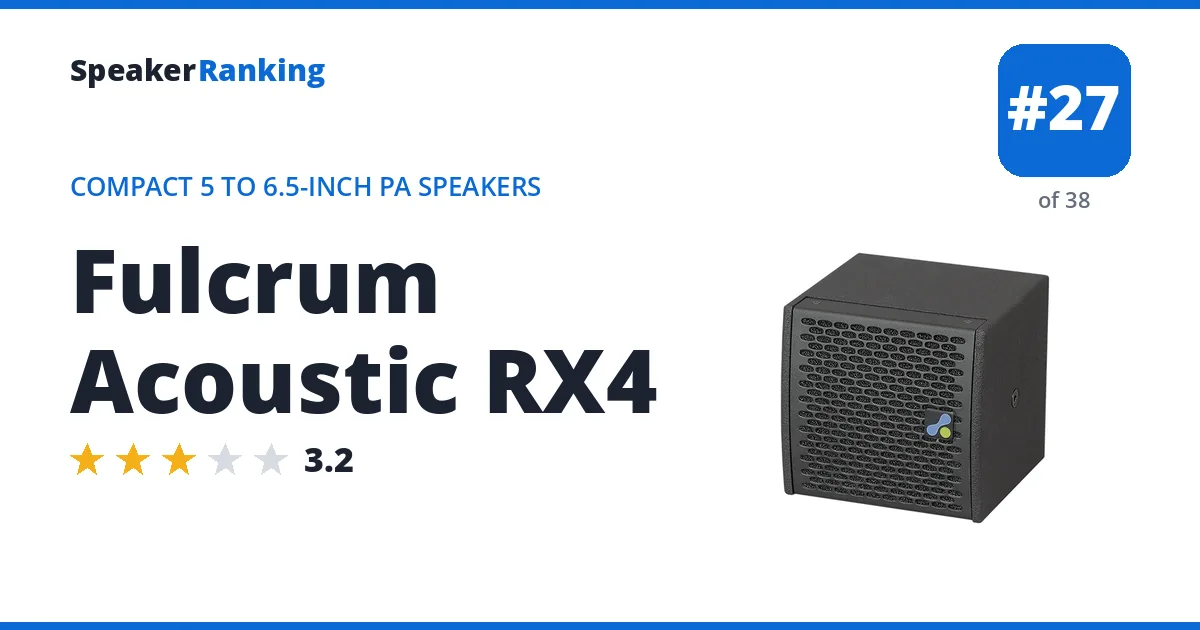
| 27 | Fulcrum Acoustic RX4 | - | 111dB peak / 105dB co… | Passive speaker; requ… | 4" coaxial driver | 3.1 lbs | |
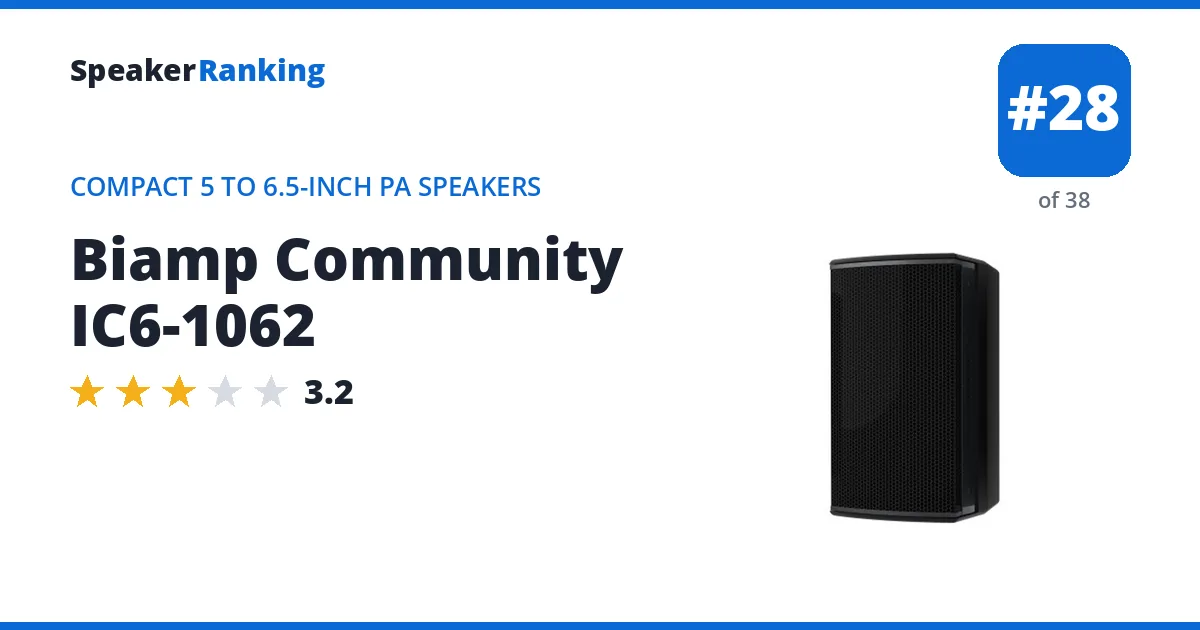
| 28 | Biamp Community IC6-1062 | - | 120dB peak / 114dB co… | Passive speaker; requ… | 6.5" woofer, compress… | 16.1 lbs | |
| 29 | Martin Audio FlexPoint FP4 | - | 108dB peak / 102dB co… | Passive speaker; requ… | 4" woofer, tweeter | 4.2 lbs | |
| 30 | Martin Audio FlexPoint FP6 | - | 119dB peak / 113dB co… | Passive speaker; requ… | 6.5" woofer, compress… | 12.1 lbs | |
| 31 | FBT J5A | - | 117dB peak | 120W RMS | 5" woofer, 1" tweeter | 7.1 lbs | |
| 32 | Meyer Sound MM-4XP | - | 111.5dB peak | 440W Class D | 4" full-range driver | 4.2 lbs | |
| 33 | Tannoy VX6 | $778.00 per pair | 117dB peak / 111dB av… | Passive speaker; requ… | 6" Dual Concentric dr… | 12.1 lbs | |
| 34 | Biamp Community V2-6 | - | 118dB peak | Passive speaker; requ… | 6.5" woofer, compress… | 19.6 lbs | |
| 35 | Biamp Community V2-26 | - | 121dB peak | Passive speaker; requ… | 2 x 6.5" woofers, com… | 28 lbs | |
| 36 | Attack Audio VSH206 | - | 129dB peak | 765W RMS | 2 x 6" woofers, compr… | 44.8 lbs | |
| 37 | Novacoustic KIRA 5 | - | 117dB peak | Passive speaker; requ… | 5" coaxial driver | 6.6 lbs | |
| 38 | Turbosound TCS62 | - | 118.5dB peak | Passive speaker; requ… | 6.5" woofer, compress… | 15.2 lbs |
Prices on this page were last checked October 12, 2026 at 4:13 PM UTC. Product prices and availability are accurate as of that date/time and are subject to change; the price and availability shown on Amazon at the time of purchase will apply to the purchase of this product.
As an eBay Partner, we may be compensated if you make a purchase.
 #1 DAS Audio ARTEC 526A eBay
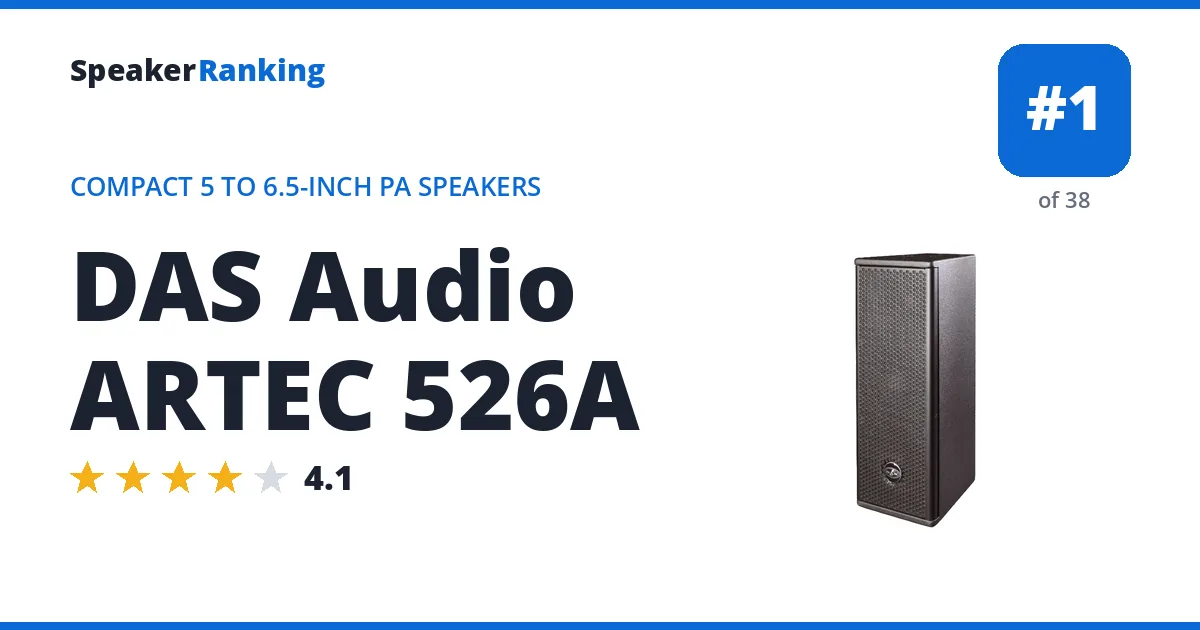
Same family: the DAS Audio ARTEC 506A (smaller model, ranked lower, rated 4/5), the DAS Audio ARTEC 508A (larger model, rated 3.8/5) and the DAS Audio ARTEC 510A (larger model, rated 3.6/5).
Pros: Vendor Spinorama data gives preference scores of 4.57 standalone and 7.70 with an ideal subwoofer, the best in this ranking. Twin 6-inch woofers and a 500W amplifier reach 125dB with 93dB sensitivity in an 11kg cabinet. The 80° x 80° pattern is wide and even, with predicted in-room smoothness of 0.816. Measured bass extension of 85Hz (-3dB).
Cons: Bass reaches only about 85Hz (-3dB), with 60Hz at -10dB, so a subwoofer is needed for music. Listening-window narrow-band deviation is 0.33, less even than the coaxial competition. It is an installation styled box with no mixer or wireless features.
Full DAS Audio ARTEC 526A review and specifications →
| Released | Jun 2012 (14 years ago) |
|---|---|
| AES Input | No |
| Amplifier Power | 500W (Class D) |
| Aux Input | No |
| Bass Extension (-3dB) | 85Hz (measured, vendor Spinorama data) |
| Bluetooth | No |
| Cabinet Material | Birch plywood |
| Coaxial Input | No |
| Configuration | Active 2-way full-range PA speaker |
| Coverage | 80° x 80° |
| DSP | Yes |
| Dimensions | 21.7”H x 7.7”W x 10.2”D (550 x 195 x 260 mm) |
| Drivers | Dual 6” woofers, M-34 compression driver on BC-88 80° x 80° horn |
| Frequency Response | 60Hz - 20kHz (-10dB, manufacturer specified) |
| Guitar Input | No |
| HDMI Input | No |
| Inputs | Balanced XLR input, Speakon NL4 connector |
| Maximum SPL | 125dB (manufacturer specified) |
| Microphone Input | No |
| Optical Input | No |
| Passive | No |
| RCA Input | No |
| Rigging | M10 flying points, AXW-1 and AXU-AR526 bracket compatible |
| Sensitivity | 93dB |
| Spinorama Preference Score | 4.57 |
| Spinorama Preference Score with Perfect Sub | 7.70 |
| TRS Input | No |
| USB Input | No |
| Weight | 24.3 lbs (11.0 kg) |
| XLR Input | Yes |
- Links
- Reviews, Comparisons and Sound Samples
- Head-to-Head Comparisons
 #2 DAS Audio ARTEC 506A: $2,180.25 SoundPro $2,180.25 eBay
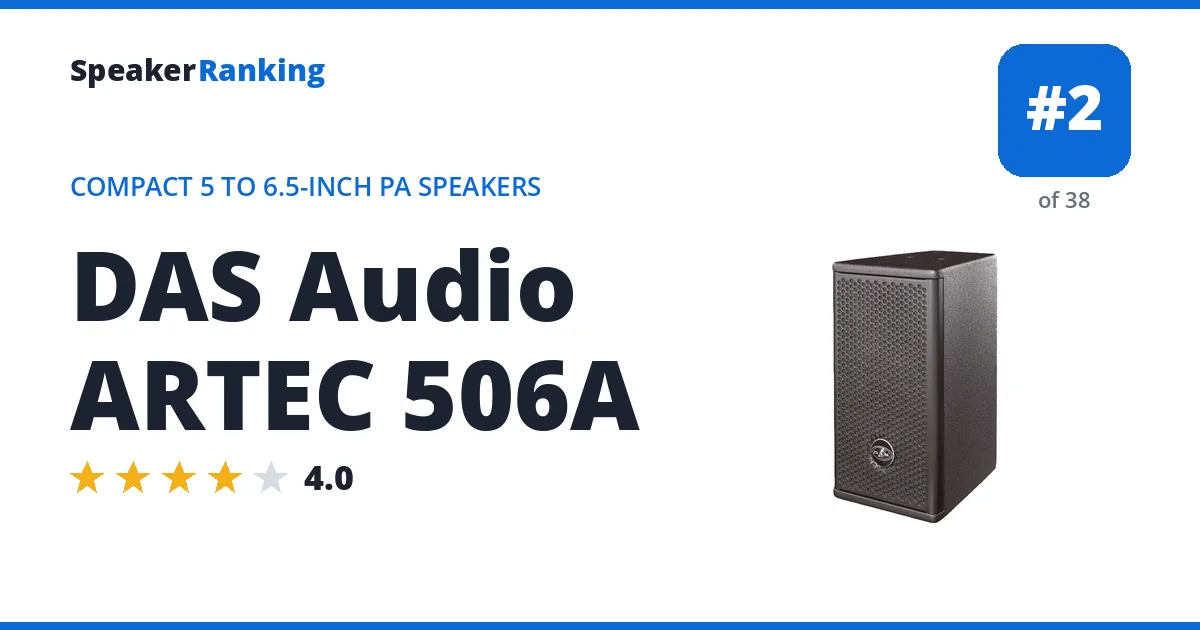
Same family: the DAS Audio ARTEC 526A (larger model, ranked higher, rated 4.1/5), the DAS Audio ARTEC 508A (larger model, rated 3.8/5) and the DAS Audio ARTEC 510A (larger model, rated 3.6/5).
Pros: Vendor Spinorama data gives preference scores of 4.56 standalone and 7.76 with an ideal subwoofer, the highest ideal-subwoofer score in this ranking. A 500W amplifier reaches 118dB from a single 6-inch woofer in a 9kg birch cabinet. The 80° x 80° horn holds coverage in either orientation, with predicted in-room smoothness of 0.833. Measured bass extension of 88Hz (-3dB).
Cons: Bass reaches only about 88Hz (-3dB), with 65Hz at -10dB, so it needs a subwoofer for anything but speech and background music. Listening-window narrow-band deviation is 0.31, and the price is high for a compact 6-inch installation speaker.
Full DAS Audio ARTEC 506A review and specifications →
| Released | Jun 2012 (14 years ago) |
|---|---|
| AES Input | No |
| Amplifier Power | 500W (Class D), 720W peak |
| Aux Input | No |
| Bass Extension (-3dB) | 88Hz (measured, vendor Spinorama data) |
| Bluetooth | No |
| Cabinet Material | Birch plywood |
| Coaxial Input | No |
| Configuration | Active 2-way full-range PA speaker |
| Coverage | 80° x 80° |
| DSP | Yes |
| Dimensions | 15.2”H x 7.7”W x 10.2”D (385 x 195 x 260 mm) |
| Drivers | 6” woofer with 2” voice coil, M-34 compression driver on BC-88 80° x 80° horn |
| Frequency Response | 65Hz - 20kHz (-10dB, manufacturer specified) |
| Guitar Input | No |
| HDMI Input | No |
| Inputs | Balanced XLR input with loop-through, Speakon NL4 connector |
| Maximum SPL | 118dB (manufacturer specified) |
| Microphone Input | No |
| Optical Input | No |
| Passive | No |
| RCA Input | No |
| Rigging | M10 flying points |
| Sensitivity | 90dB |
| Spinorama Preference Score | 4.56 |
| Spinorama Preference Score with Perfect Sub | 7.76 |
| TRS Input | No |
| USB Input | No |
| Weight | 19.8 lbs (9.0 kg) |
| XLR Input | Yes |
- Links
- Reviews, Comparisons and Sound Samples
- Head-to-Head Comparisons
 #3 Alcons Audio VR5 V1 Passive eBay
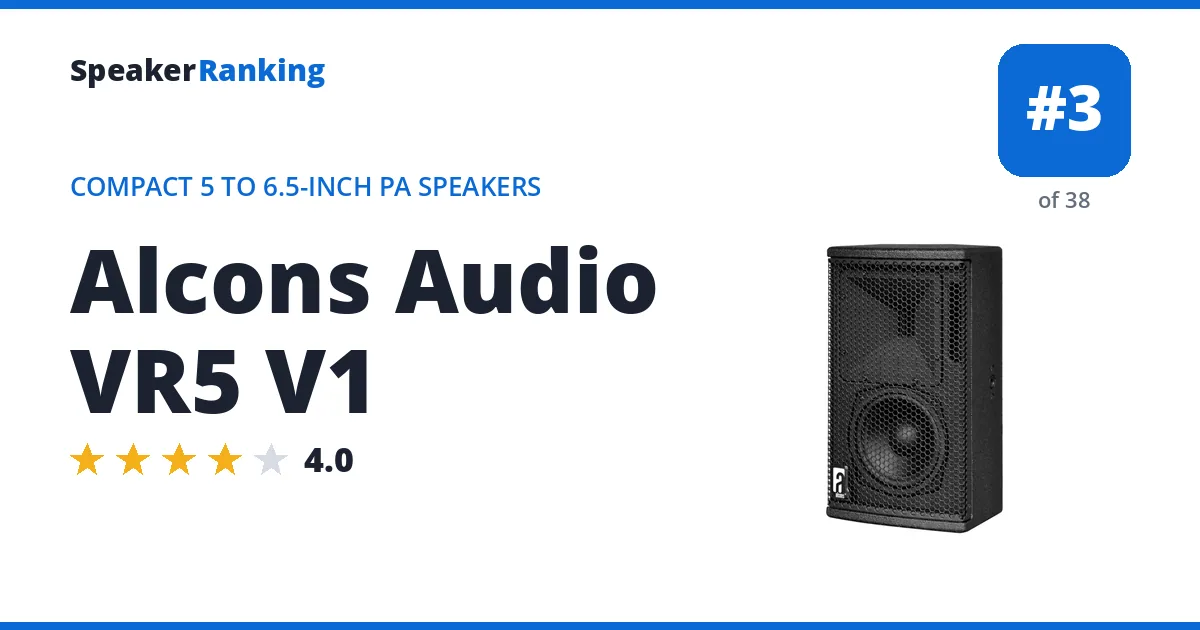
Same family: the Alcons Audio VR8 (larger model, estimated 3.9/5) and the Alcons Audio VR12 (larger model, estimated 4/5).
Pros: High-quality vendor Spinorama data gives preference scores of 4.04 standalone and 7.06 with an ideal subwoofer, and predicted in-room smoothness is 0.73. The pro-ribbon high-frequency driver stays linear at any level, and the compact cabinet suits near-field and stage monitor duty. Measured bass extension of 80Hz (-3dB).
Cons: Bass reaches only about 80Hz (-3dB), and listening-window narrow-band deviation is 0.408, so a subwoofer is needed for music. It is passive and priced by dealers well above ordinary compact monitors.
Full Alcons Audio VR5 V1 review and specifications →
| AES Input | No |
|---|---|
| Amplifier Power | Passive speaker; requires external amplification (500W peak input to the ribbon section) |
| Aux Input | No |
| Bass Extension (-3dB) | 80Hz (measured, vendor Spinorama data) |
| Bluetooth | No |
| Coaxial Input | No |
| Configuration | Passive 2-way compact monitor |
| DSP | No (passive) |
| Drivers | 5” mid-bass with Active Coil, RBN202 pro-ribbon |
| Guitar Input | No |
| HDMI Input | No |
| Maximum SPL | 127dB peak (manufacturer specified) |
| Microphone Input | No |
| Optical Input | No |
| Passive | Yes |
| RCA Input | No |
| Rigging | 5 x M10 mounting points |
| Spinorama Preference Score | 4.04 |
| Spinorama Preference Score with Perfect Sub | 7.06 |
| TRS Input | No |
| USB Input | No |
| Weight | 13.2 lbs (6 kg) |
| XLR Input | No |
- Links
- Reviews, Comparisons and Sound Samples
- Head-to-Head Comparisons
 #4 L-Acoustics X6i Passive eBay
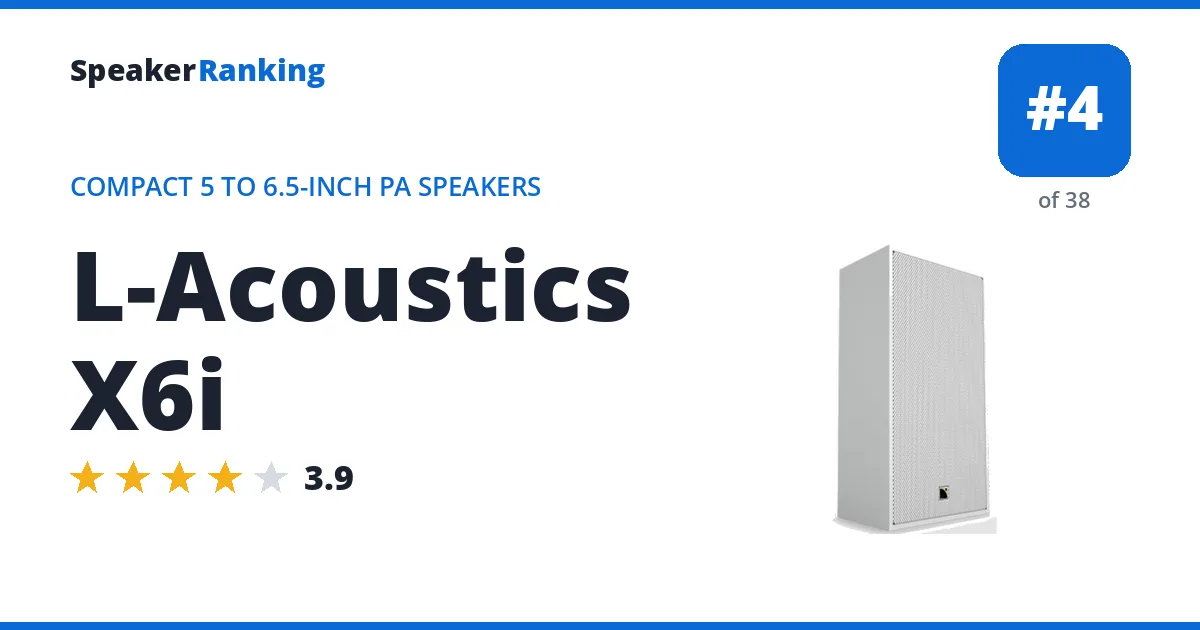
Same family: the L-Acoustics X4i (smaller model, ranked lower, rated 3.6/5), the L-Acoustics X8 (larger model, rated 4/5), the L-Acoustics X12 (larger model, rated 4.6/5) and the L-Acoustics X15 HiQ (larger model, rated 4.4/5).
Pros: Vendor Spinorama data gives preference scores of 4.20 standalone and 7.34 with an ideal subwoofer. The 90° axisymmetric coaxial pattern is even, with listening-window narrow-band deviation of 0.23 and predicted in-room smoothness of 0.572. It is an IP55 rated 6.3kg cabinet that reaches 123dB, which suits weather-exposed installs and near-field monitoring. Measured bass extension of 90Hz (-3dB).
Cons: A passive cabinet that needs an L-Acoustics amplified controller such as the LA2Xi, LA4X or LA7.16i. Bass reaches only about 90Hz (-3dB), so a subwoofer is required for anything beyond speech and light music. Pricing is dealer quoted and high for a 6.5-inch box.
Full L-Acoustics X6i review and specifications →
| Released | Apr 2024 (2 years ago) |
|---|---|
| AES Input | No |
| Amplifier Power | Passive speaker; requires an L-Acoustics amplified controller (LA2Xi, LA4X or LA7.16i) |
| Aux Input | No |
| Bass Extension (-3dB) | 90Hz (measured, vendor Spinorama data) |
| Bluetooth | No |
| Cabinet Material | Baltic beech and birch plywood |
| Coaxial Input | No |
| Configuration | Passive 2-way coaxial PA speaker |
| Coverage | 90° axisymmetric |
| DSP | No (passive; processing and protection come from the amplified controller) |
| Dimensions | 14.3”H x 7.4”W x 6.7”D (362 x 187 x 170 mm) |
| Drivers | 6.5” low-frequency driver, 1.5” compression driver (coaxial) |
| Frequency Response | 69Hz - 20kHz (manufacturer specified) |
| Guitar Input | No |
| HDMI Input | No |
| IP Rating | IP55 |
| Inputs | 2-point terminal block input and link |
| Maximum SPL | 123dB (manufacturer specified) |
| Microphone Input | No |
| Optical Input | No |
| Passive | Yes |
| RCA Input | No |
| Spinorama Preference Score | 4.20 |
| Spinorama Preference Score with Perfect Sub | 7.34 |
| TRS Input | No |
| USB Input | No |
| Weight | 13.9 lbs (6.3 kg) |
| XLR Input | No |
- Links
- Reviews, Comparisons and Sound Samples
- Head-to-Head Comparisons
 #5 Meyer Sound Ultra X22 eBay
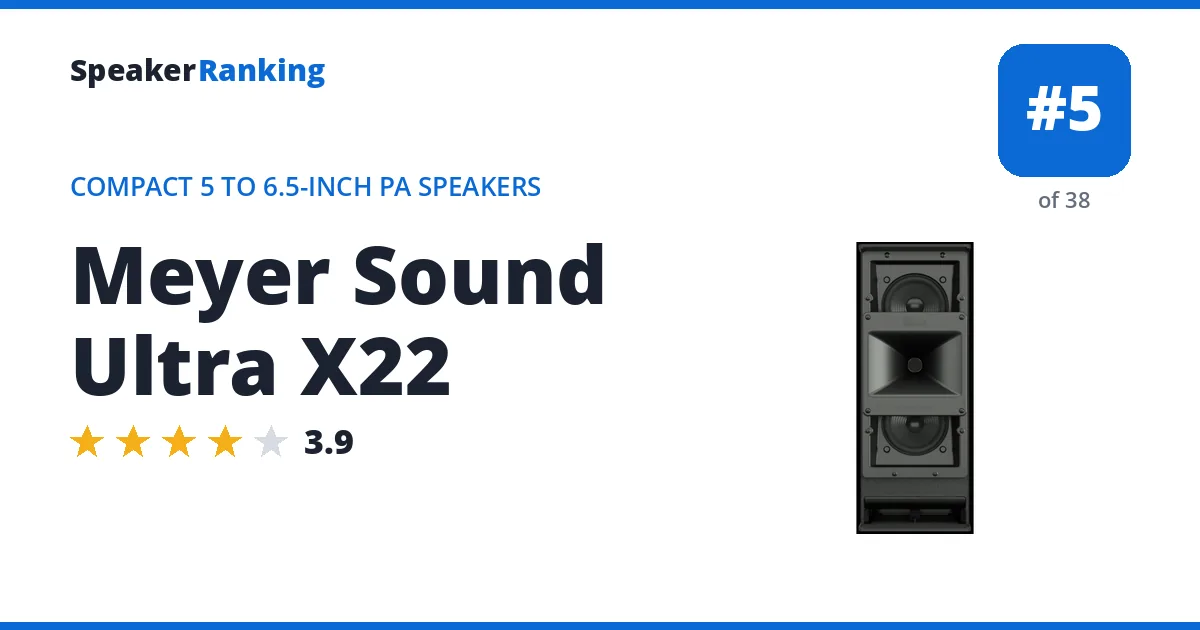
Same family: the Meyer Sound Ultra X20 (smaller model, ranked lower, rated 3.6/5), the Meyer Sound Ultra X23 (larger model, ranked lower, rated 3.3/5), the Meyer Sound Ultra X40 (larger model, rated 3.8/5) and the Meyer Sound Ultra X80 (larger model, estimated 3.9/5).
Pros: A self-powered coaxial design with a rotatable 80° x 50° horn, dual 5-inch drivers and 860W of total power, reaching 128.5dB peak. Vendor Spinorama data gives preference scores of 3.44 standalone and 6.25 with an ideal subwoofer, and bass reaches about 71Hz (-3dB). Measured bass extension of 71Hz (-3dB).
Cons: On-axis narrow-band deviation is 0.478 and predicted in-room smoothness is 0.51, less even than the best compact boxes here. Pricing is high for a compact box, and it is built as an installation loudspeaker rather than a grab-and-go monitor.
Full Meyer Sound Ultra X22 review and specifications →
| Released | 2020 (6 years ago) |
|---|---|
| AES Input | No |
| Amplifier Power | 860W total peak |
| Aux Input | No |
| Bass Extension (-3dB) | 71Hz (measured, vendor Spinorama data) |
| Bluetooth | No |
| Coaxial Input | No |
| Configuration | Active 2-way coaxial PA speaker |
| Coverage | 80° x 50° (rotatable constant-Q horn) |
| DSP | Yes |
| Drivers | Dual 5” low-frequency drivers, 2” compression driver (concentric) |
| Guitar Input | No |
| HDMI Input | No |
| IP Rating | Weather-protected version available |
| Maximum SPL | 128.5dB peak (manufacturer specified, M-noise) |
| Microphone Input | No |
| Optical Input | No |
| Passive | No |
| RCA Input | No |
| Rigging | 4 x M8 inserts; 4 x M6 wall-mount holes; optional pole adapter |
| Spinorama Preference Score | 3.44 |
| Spinorama Preference Score with Perfect Sub | 6.25 |
| TRS Input | No |
| USB Input | No |
| Weight | 27.1 lbs (12.3 kg) |
| XLR Input | Yes |
- Links
- Reviews, Comparisons and Sound Samples
- Head-to-Head Comparisons
 #6 EAW MKC60: $627.00 each Passive Full Compass $627.00 eBay
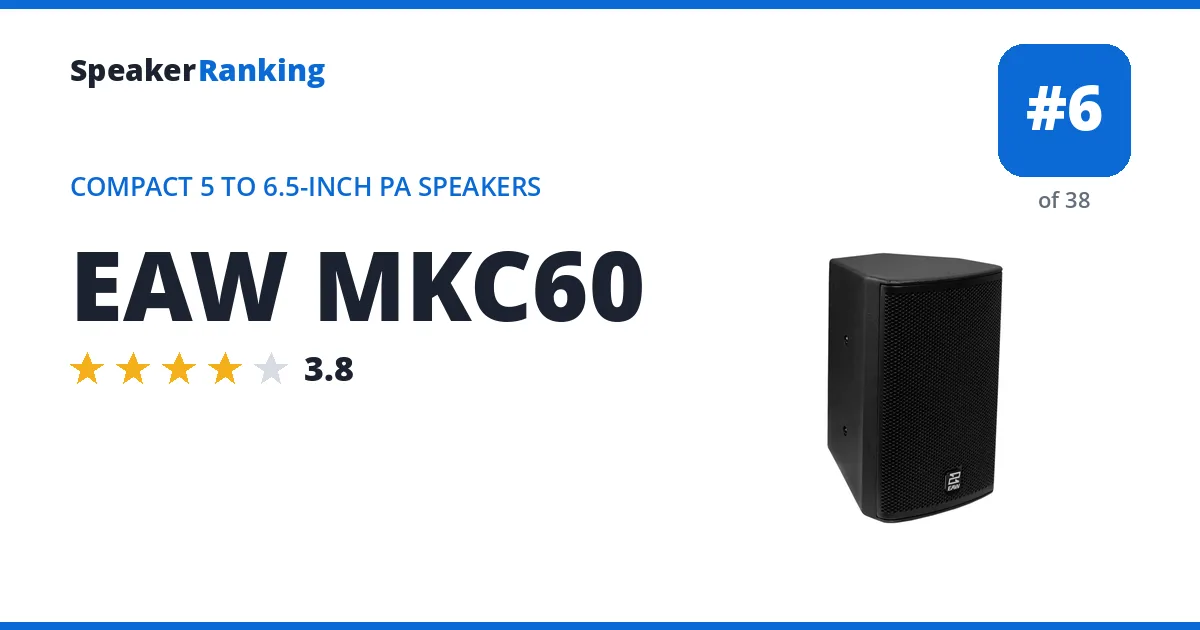
Same family: the EAW MKC50 (smaller model, ranked lower, rated 3.6/5), the EAW MKC80 (larger model, rated 3.9/5) and the EAW MKC120 (larger model, rated 4.3/5).
Pros: The 4.9kg coaxial cabinet has very wide 110° x 110° coverage and reaches 125dB. Vendor Spinorama data gives preference scores of 3.64 standalone and 6.90 with an ideal subwoofer, and listening-window narrow-band deviation is a low 0.29. Measured bass extension of 90Hz (-3dB).
Cons: Bass reaches only about 90Hz (-3dB), so it needs a subwoofer for music, and it is passive, so an external amplifier is required. Predicted in-room smoothness of 0.569 is average, and the price is high for a small cabinet.
Full EAW MKC60 review and specifications →
| Released | 2023 (3 years ago) |
|---|---|
| AES Input | No |
| Amplifier Power | Passive speaker; requires external amplification within the 250W handling rating |
| Aux Input | No |
| Bass Extension (-3dB) | 90Hz (measured, vendor Spinorama data) |
| Bluetooth | No |
| Coaxial Input | No |
| Configuration | Passive 2-way coaxial PA speaker |
| Coverage | 110° x 110° |
| DSP | No (passive) |
| Dimensions | 12.8”H x 8.2”W x 8.1”D (324 x 208 x 206 mm) |
| Drivers | 6.5” low-frequency driver, 1” dome tweeter (coaxial) |
| Frequency Response | 70Hz - 20kHz (manufacturer specified) |
| Guitar Input | No |
| HDMI Input | No |
| Maximum SPL | 125dB (manufacturer specified) |
| Microphone Input | No |
| Optical Input | No |
| Passive | Yes |
| Power Handling | 250W (manufacturer specified) |
| RCA Input | No |
| Rigging | 3 pairs of M6 points for pole/stand adapters; M5 bracket pattern |
| Sensitivity | 89dB |
| Spinorama Preference Score | 3.64 |
| Spinorama Preference Score with Perfect Sub | 6.90 |
| TRS Input | No |
| USB Input | No |
| Weight | 10.8 lbs (4.9 kg) |
| XLR Input | No |
- Links
- Reviews, Comparisons and Sound Samples
- Head-to-Head Comparisons
 #7 Coda Audio HOPS5 Passive eBay
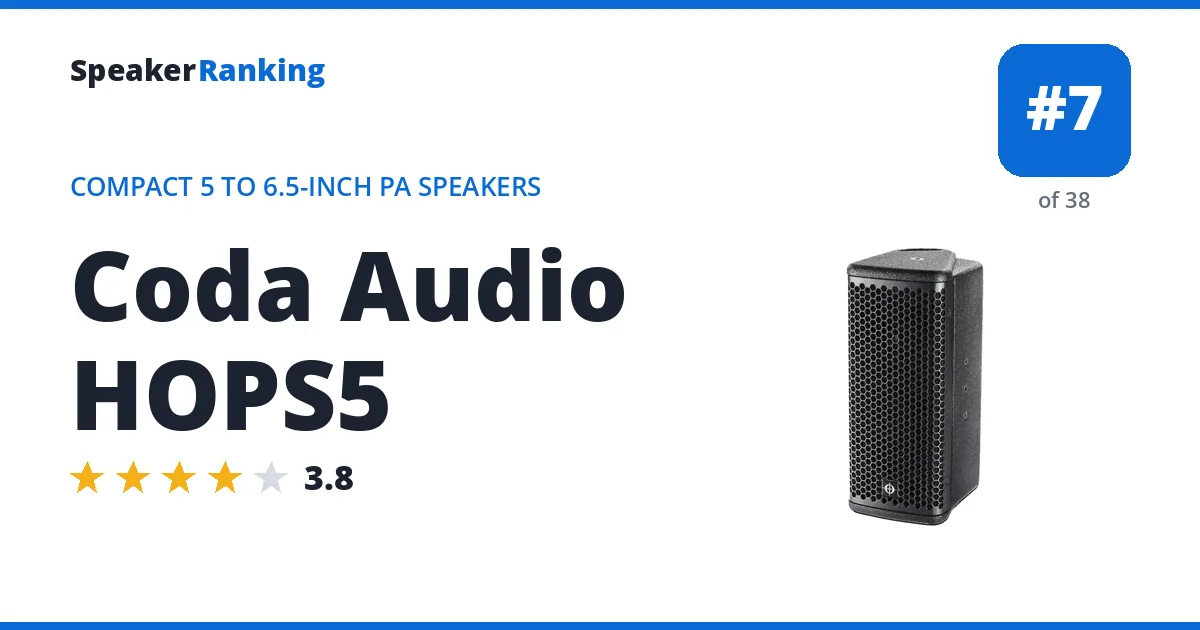
Same family: the Coda Audio HOPS8 (larger model, rated 3.7/5) and the Coda Audio HOPS12i-Pro (larger model, estimated 3/5). See every Coda Audio HOPS generation.
Pros: High-quality vendor Spinorama data gives preference scores of 3.60 standalone and 6.80 with an ideal subwoofer, and predicted in-room smoothness is a good 0.774. The IP54 rated 6.4kg cabinet has wide 100° x 100° coverage and reaches 124dB. Measured bass extension of 90Hz (-3dB).
Cons: Bass reaches only about 90Hz (-3dB), and listening-window narrow-band deviation is 0.478, so it sounds thin and slightly uneven without a subwoofer. It is passive and needs an external amplifier and processor.
Full Coda Audio HOPS5 review and specifications →
| AES Input | No |
|---|---|
| Amplifier Power | Passive speaker; requires external amplification within the 300W AES handling rating |
| Aux Input | No |
| Bass Extension (-3dB) | 90Hz (measured, vendor Spinorama data) |
| Bluetooth | No |
| Coaxial Input | No |
| Configuration | Passive 2-way coaxial PA speaker |
| Coverage | 100° x 100° |
| DSP | No (passive) |
| Drivers | Double 5” coaxial system |
| Frequency Response | 80Hz - 20kHz (-6dB, manufacturer specified) |
| Guitar Input | No |
| HDMI Input | No |
| IP Rating | IP54 |
| Maximum SPL | 124dB peak (manufacturer specified) |
| Microphone Input | No |
| Optical Input | No |
| Passive | Yes |
| Power Handling | 300W AES (manufacturer specified) |
| RCA Input | No |
| Rigging | 2 x M6, 2 x M8, 2 x M10 fixing points |
| Spinorama Preference Score | 3.60 |
| Spinorama Preference Score with Perfect Sub | 6.80 |
| TRS Input | No |
| USB Input | No |
| Weight | 14.1 lbs (6.4 kg) |
| XLR Input | No |
- Links
- Reviews, Comparisons and Sound Samples
- Head-to-Head Comparisons
 #8 Fulcrum Acoustic RX6 Passive eBay
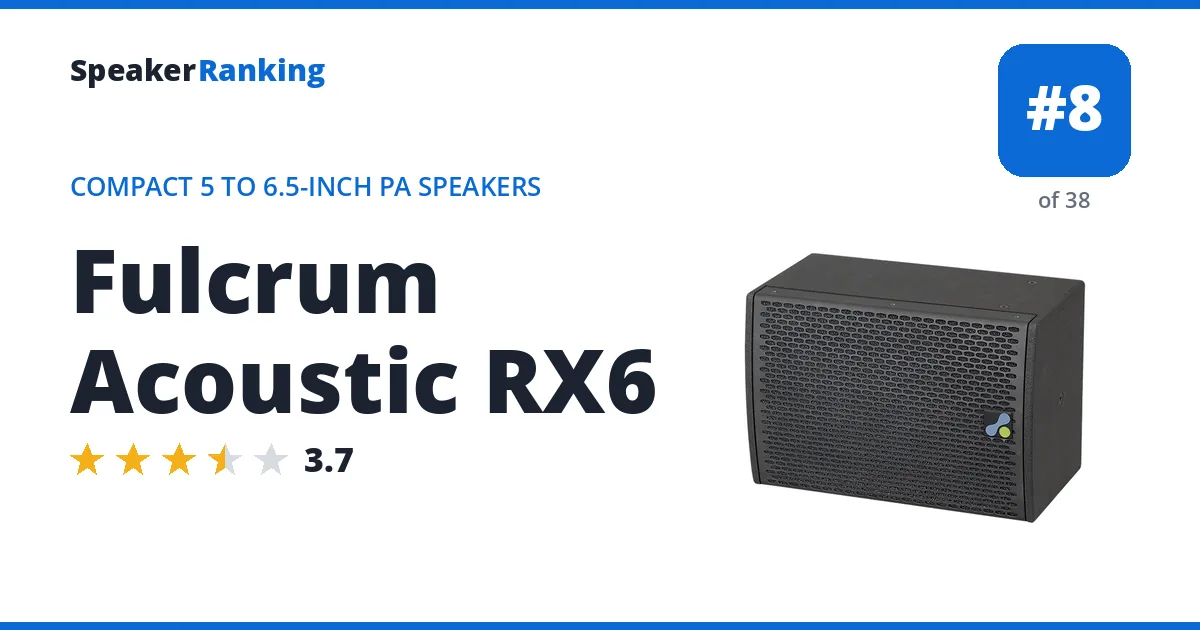
Older model: the Fulcrum Acoustic RX699 (ranked lower, rated 3.5/5). See every Fulcrum Acoustic RX generation.
Same family: the Fulcrum Acoustic RX4 (smaller model, ranked lower, rated 3.2/5), the Fulcrum Acoustic RX5 (smaller model, ranked lower, rated 3.3/5) and the Fulcrum Acoustic RX8 (larger model, rated 3.6/5).
Pros: Vendor measurements give preference scores of 2.14 standalone and 5.92 with an ideal subwoofer, with a very smooth on-axis response (0.96dB average deviation). The coaxial driver keeps the tone consistent across its 90° x 75° pattern, and the 16 ohm load lets several speakers share one amplifier channel. Measured bass extension of 118Hz (-3dB).
Cons: Bass reaches only about 118Hz at -3dB and 95Hz at -10dB, so it needs a subwoofer for anything beyond speech and background music. Maximum output is 118dB peak. It is passive and sold through pro dealers with no published price.
Full Fulcrum Acoustic RX6 review and specifications →
| Released | 2024 (2 years ago) |
|---|---|
| AES Input | No |
| Amplifier Power | Passive speaker; requires external amplification |
| Aux Input | No |
| Bass Extension (-10dB) | about 94.9Hz (measured, vendor Spinorama data) |
| Bass Extension (-3dB) | 118Hz (measured, vendor Spinorama data) |
| Bluetooth | No |
| Coaxial Input | No |
| Configuration | Passive 2-way coaxial PA speaker |
| Coverage | 90° x 75° |
| DSP | No (passive) |
| Dimensions | 7.2”H x 10.7”W x 6.1”D (184 x 273 x 154 mm) |
| Drivers | 6.5” woofer with 2” voice coil, coaxial 1” compression driver |
| Guitar Input | No |
| HDMI Input | No |
| Impedance | 16 ohms |
| Maximum SPL | 118dB peak / 112dB continuous (manufacturer specified) |
| Microphone Input | No |
| Optical Input | No |
| Passive | Yes |
| Power Handling | 175W at 16 ohms |
| RCA Input | No |
| Sensitivity | 90dB |
| Spinorama Preference Score | 2.14 |
| Spinorama Preference Score with Perfect Sub | 5.92 |
| TRS Input | No |
| USB Input | No |
| Weight | 10.8 lbs (4.9 kg) |
| XLR Input | No |
- Links
- Reviews, Comparisons and Sound Samples
 #9 EAW MKC50: $375.00 each Passive Full Compass $375.00 eBay
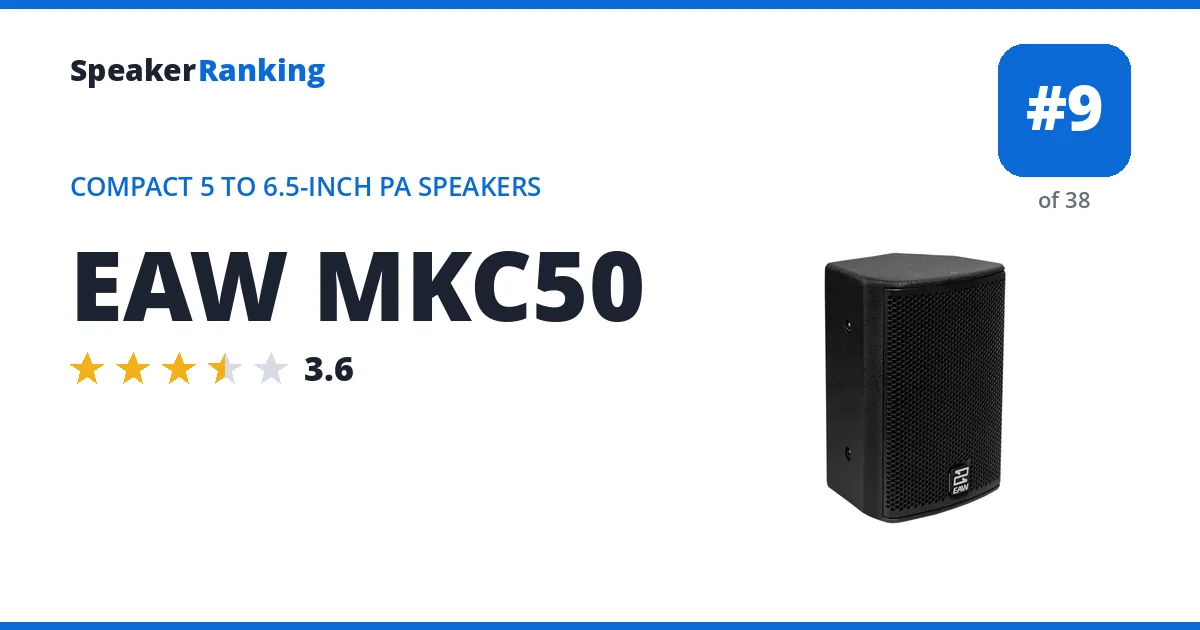
Same family: the EAW MKC60 (larger model, ranked higher, rated 3.8/5), the EAW MKC80 (larger model, rated 3.9/5) and the EAW MKC120 (larger model, rated 4.3/5).
Pros: A 3.3kg coaxial cabinet with wide 110° x 110° coverage and a 121dB rating, small enough to hide in a wall or corner. Vendor Spinorama data gives preference scores of 3.37 standalone and 6.89 with an ideal subwoofer, with listening-window narrow-band deviation of 0.288. Measured bass extension of 103Hz (-3dB).
Cons: Bass reaches only about 103Hz (-3dB), so it needs a subwoofer for anything but speech, and predicted in-room smoothness of 0.469 is modest. It is passive, and the price is high for a 5-inch box.
Full EAW MKC50 review and specifications →
| Released | 2023 (3 years ago) |
|---|---|
| AES Input | No |
| Amplifier Power | Passive speaker; requires external amplification within the 150W handling rating |
| Aux Input | No |
| Bass Extension (-3dB) | 103Hz (measured, vendor Spinorama data) |
| Bluetooth | No |
| Coaxial Input | No |
| Configuration | Passive 2-way coaxial PA speaker |
| Coverage | 110° x 110° |
| DSP | No (passive) |
| Dimensions | 9.3”H x 6.5”W x 5.6”D (235 x 165 x 141 mm) |
| Drivers | 5.25” low-frequency driver, 1” dome tweeter (coaxial) |
| Frequency Response | 80Hz - 20kHz (manufacturer specified) |
| Guitar Input | No |
| HDMI Input | No |
| Maximum SPL | 121dB (manufacturer specified) |
| Microphone Input | No |
| Optical Input | No |
| Passive | Yes |
| Power Handling | 150W (manufacturer specified) |
| RCA Input | No |
| Rigging | 4 x M5 threaded pattern for wall or ceiling bracket |
| Sensitivity | 87dB |
| Spinorama Preference Score | 3.37 |
| Spinorama Preference Score with Perfect Sub | 6.89 |
| TRS Input | No |
| USB Input | No |
| Weight | 7.3 lbs (3.3 kg) |
| XLR Input | No |
- Links
- Reviews, Comparisons and Sound Samples
- Head-to-Head Comparisons
 #10 d&b audiotechnik 44S Passive eBay
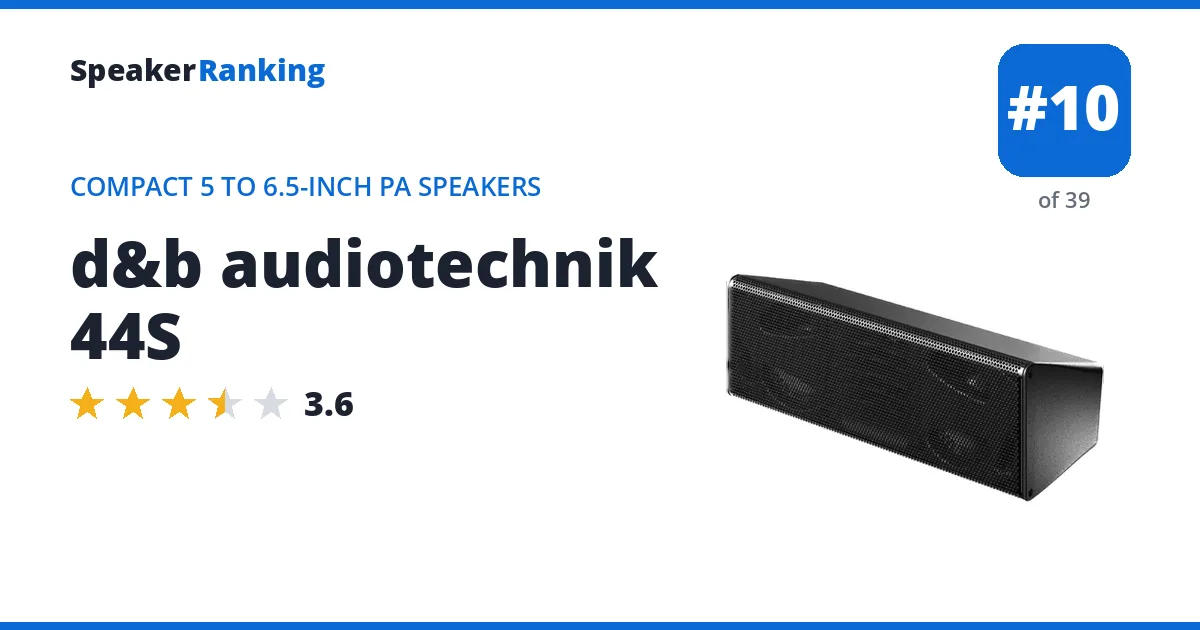
Same family: the d&b audiotechnik 4S (smaller model, estimated 3.2/5), the d&b audiotechnik 42S (smaller model, estimated 3.5/5), the d&b audiotechnik 5S (larger model, estimated 3.3/5), the d&b audiotechnik 8S (larger model, rated 3.1/5), the d&b audiotechnik 10S (larger model, rated 3.7/5), the d&b audiotechnik 12S (larger model, rated 3.8/5) and the d&b audiotechnik 24S (larger model, rated 3.8/5).
Pros: A 3.6kg cabinet with dual 4.5-inch drivers and a rotatable horn that reaches 123dB, with a low on-axis deviation (narrow-band 0.37). Vendor Spinorama data gives preference scores of 3.14 standalone and 6.61 with an ideal subwoofer. Measured bass extension of 122Hz (-3dB).
Cons: Bass reaches only about 122Hz (-3dB), so it works as a speech and fill box that needs a subwoofer for music. It is passive and works properly only with d&b amplifiers, and pricing is dealer quoted.
Full d&b audiotechnik 44S review and specifications →
| Released | 2020 (6 years ago) |
|---|---|
| AES Input | No |
| Amplifier Power | Passive speaker; requires external amplification within the 150W RMS / 500W peak handling rating |
| Aux Input | No |
| Bass Extension (-3dB) | 122Hz (measured, vendor Spinorama data) |
| Bluetooth | No |
| Coaxial Input | No |
| Configuration | Passive 2-way compact PA speaker |
| Coverage | Rotatable CD horn (measured 90° x 30°) |
| DSP | No (passive; used with d&b amplifiers for presets) |
| Drivers | Dual 4.5” neodymium woofers, dual 1.25” dome tweeters on a rotatable CD horn |
| Frequency Response | 90Hz - 17kHz (-5dB, manufacturer specified) |
| Guitar Input | No |
| HDMI Input | No |
| Maximum SPL | 123dB (manufacturer specified) |
| Microphone Input | No |
| Optical Input | No |
| Passive | Yes |
| Power Handling | 150W RMS / 500W peak (manufacturer specified) |
| RCA Input | No |
| Rigging | 2 x M8 inserts on rear panel |
| Spinorama Preference Score | 3.14 |
| Spinorama Preference Score with Perfect Sub | 6.61 |
| TRS Input | No |
| USB Input | No |
| Weight | 7.9 lbs (3.6 kg) (13.7 lbs (6.2 kg) with backbox) |
| XLR Input | No |
- Links
- Reviews, Comparisons and Sound Samples
- Head-to-Head Comparisons
 #11 Meyer Sound Ultra X20 eBay
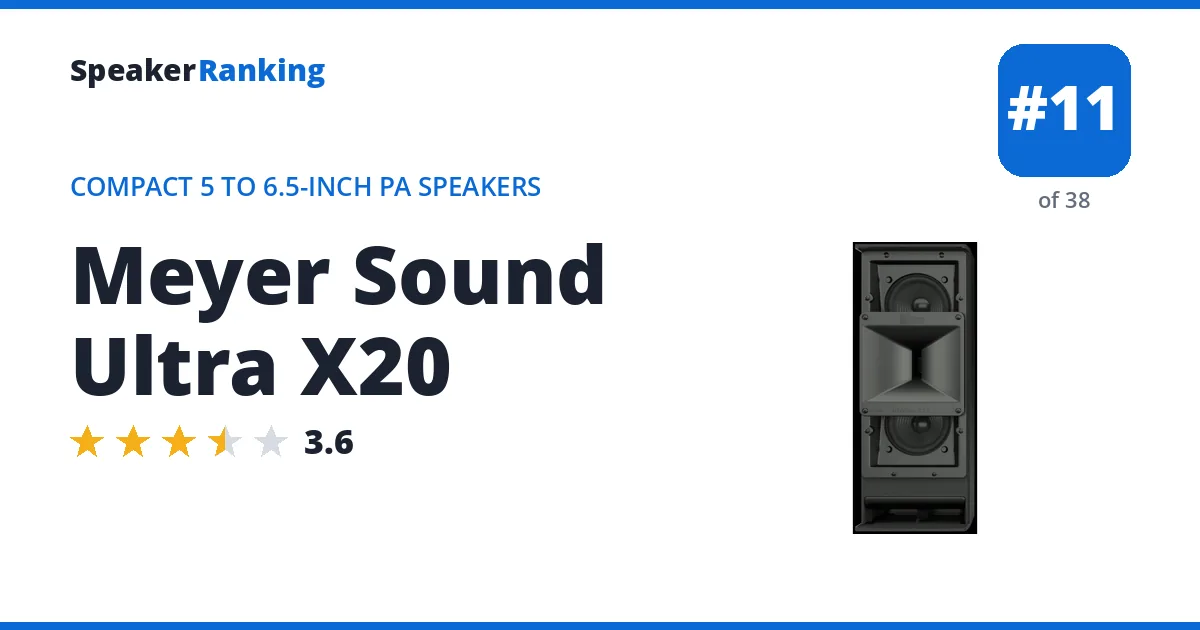
Same family: the Meyer Sound Ultra X22 (larger model, ranked higher, rated 3.9/5), the Meyer Sound Ultra X23 (larger model, ranked lower, rated 3.3/5), the Meyer Sound Ultra X40 (larger model, rated 3.8/5) and the Meyer Sound Ultra X80 (larger model, estimated 3.9/5).
Pros: Manufacturer measurements give preference scores of 2.88 standalone and 5.68 with an ideal subwoofer, and bass reaches 69Hz at -3dB, deep for two 5-inch woofers. The concentric 2-inch compression driver keeps coverage consistent across its 110° x 50° horn, and a built-in 860W peak amplifier with Meyer’s processing makes it a complete self-powered system. At 7.5 inches wide it suits fills, theaters and discreet installs. Measured bass extension of 69Hz (-3dB).
Cons: Its standalone score trails its narrower-coverage Meyer Sound Ultra X22 sibling. A 123.5dB peak rating limits it to small and medium spaces, and a 3.73 directivity-index deviation means off-axis tone varies. It is sold through pro dealers with no published price.
Full Meyer Sound Ultra X20 review and specifications →
| Released | 2020 (6 years ago) |
|---|---|
| AES Input | No |
| Amplifier Power | 860W peak, 3-channel Class D |
| Aux Input | No |
| Bass Extension (-10dB) | about 61Hz (measured, vendor Spinorama data) |
| Bass Extension (-3dB) | 69Hz (measured, vendor Spinorama data) |
| Bluetooth | No |
| Coaxial Input | No |
| Configuration | Self-powered 2-way concentric compact loudspeaker |
| Coverage | 110° x 50° (rotatable horn) |
| DSP | Yes |
| Dimensions | 19.1”H x 7.5”W x 8.6”D (484 x 191 x 218 mm) |
| Drivers | 2x 5” cone woofers, concentric 2” compression driver |
| Guitar Input | No |
| HDMI Input | No |
| Maximum SPL | 123.5dB peak (M-Noise, manufacturer specified) |
| Microphone Input | No |
| Optical Input | No |
| Passive | No |
| RCA Input | No |
| Rigging | 4 x M8 inserts; 4 x M6 wall-mount holes; optional pole adapter |
| Spinorama Preference Score | 2.88 |
| Spinorama Preference Score with Perfect Sub | 5.68 |
| TRS Input | No |
| USB Input | No |
| Weight | 27.1 lbs (12.3 kg) |
| XLR Input | Yes |
- Links
- Reviews, Comparisons and Sound Samples
- Head-to-Head Comparisons
 #12 Turbosound NuQ62 Passive Discontinued eBay
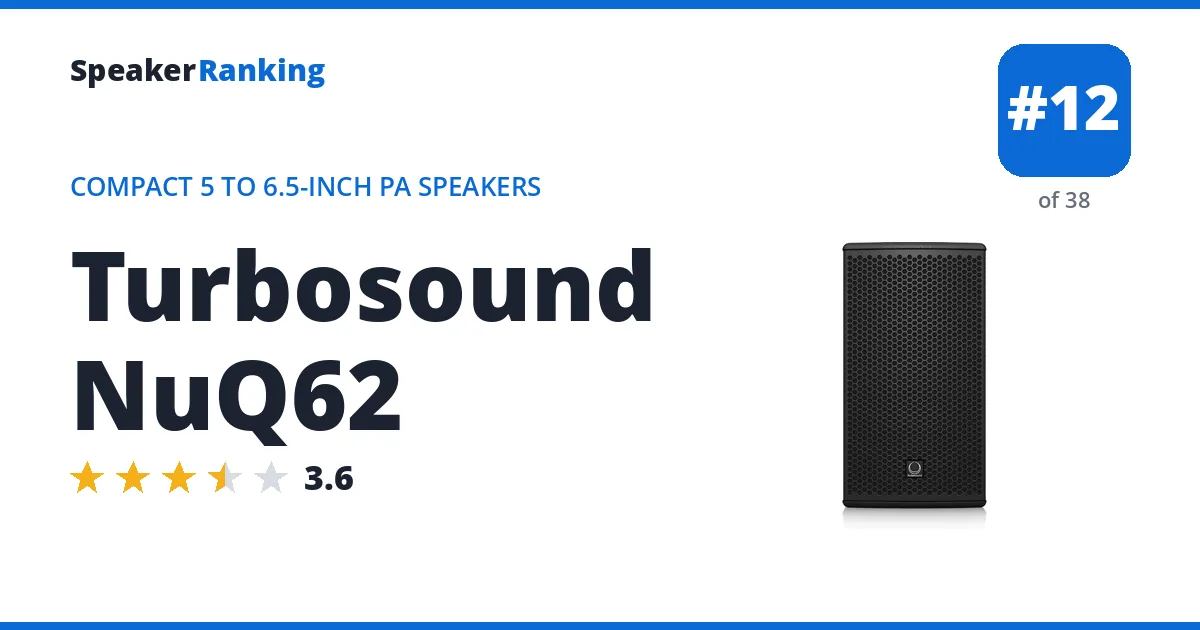
Same family: the Turbosound NuQ82 (larger model, rated 4.1/5), the Turbosound NuQ102 (larger model, rated 4/5), the Turbosound NuQ122 (larger model, rated 3.5/5) and the Turbosound NuQ152 (larger model, rated 3.7/5).
Pros: The lowest price in this ranking for a two-way 6.5-inch box from a major PA brand, with a 6.3kg cabinet and 100° x 60° coverage. Bass reaches about 73Hz (-3dB) in vendor Spinorama data, with preference scores of 3.39 standalone and 6.14 with an ideal subwoofer. Measured bass extension of 73Hz (-3dB).
Cons: The Spinorama data is low quality, and predicted in-room smoothness of 0.356 is the weakest of the group. Maximum output of 116dB is modest, and it is passive, so an amplifier is required. Discontinued.
Full Turbosound NuQ62 review and specifications →
| AES Input | No |
|---|---|
| Amplifier Power | Passive speaker; requires external amplification |
| Aux Input | No |
| Bass Extension (-3dB) | 73Hz (measured, vendor Spinorama data) |
| Bluetooth | No |
| Coaxial Input | No |
| Configuration | Passive 2-way bass-reflex PA speaker |
| Coverage | 100° x 60° |
| DSP | No (passive) |
| Dimensions | 13.8”H x 7.5”W x 8.3”D (350 x 190 x 210 mm) |
| Drivers | 6.5” low-frequency driver, 1” neodymium compression driver |
| Guitar Input | No |
| HDMI Input | No |
| Maximum SPL | 116dB peak (manufacturer specified) |
| Microphone Input | No |
| Optical Input | No |
| Passive | Yes |
| RCA Input | No |
| Rigging | 6 x M8 inserts |
| Sensitivity | 88dB |
| Spinorama Preference Score | 3.39 |
| Spinorama Preference Score with Perfect Sub | 6.14 |
| TRS Input | No |
| USB Input | No |
| Weight | 13.9 lbs (6.3 kg) |
| XLR Input | No |
- Links
- Reviews, Comparisons and Sound Samples
- Head-to-Head Comparisons
 #13 L-Acoustics X4i Passive eBay
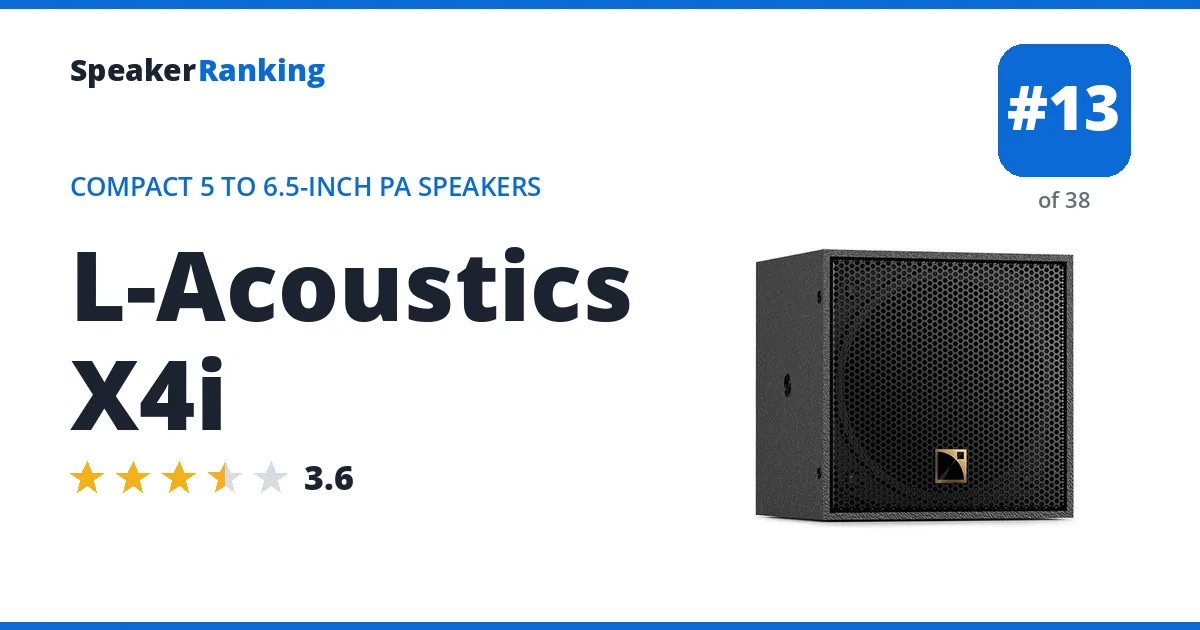
Same family: the L-Acoustics X6i (larger model, ranked higher, rated 3.9/5), the L-Acoustics X8 (larger model, rated 4/5), the L-Acoustics X12 (larger model, rated 4.6/5) and the L-Acoustics X15 HiQ (larger model, rated 4.4/5).
Pros: Vendor measurements give a preference score of 5.88 with an ideal subwoofer, high for a speaker this small, thanks to a listening window held within a tight 0.8dB band. The 1kg, IP55 cabinet gives 110° conical coverage for discreet fills, delays and immersive systems. Measured bass extension of 190Hz (-3dB).
Cons: Bass reaches only about 190Hz at -3dB, so on its own it scores 1.51 and needs a subwoofer for any full range use. Maximum output is 116dB. It is passive, needs L-Acoustics amplifier presets, and is sold through dealers with no published price.
Full L-Acoustics X4i review and specifications →
| Released | Mar 2019 (7 years ago) |
|---|---|
| AES Input | No |
| Amplifier Power | Passive speaker; requires external amplification |
| Aux Input | No |
| Bass Extension (-10dB) | about 122.4Hz (measured, vendor Spinorama data) |
| Bass Extension (-3dB) | 190Hz (measured, vendor Spinorama data) |
| Bluetooth | No |
| Coaxial Input | No |
| Configuration | Passive 2-way coaxial PA speaker, IP55 weather rated |
| Coverage | 110° conical |
| DSP | No (passive) |
| Dimensions | 4.6”H x 4.6”W x 3.9”D (116 x 116 x 99 mm) |
| Drivers | 4” woofer, coaxial 1.4” diaphragm compression driver |
| Frequency Response | 120Hz - 20kHz (manufacturer specified) |
| Guitar Input | No |
| HDMI Input | No |
| Maximum SPL | 116dB (manufacturer specified) |
| Microphone Input | No |
| Optical Input | No |
| Passive | Yes |
| RCA Input | No |
| Spinorama Preference Score | 1.51 |
| Spinorama Preference Score with Perfect Sub | 5.88 |
| TRS Input | No |
| USB Input | No |
| Weight | 2.2 lbs (1 kg) |
| XLR Input | No |
- Links
- Reviews, Comparisons and Sound Samples
 #14 Vue Audiotechnik H-5: $3,195 eBay
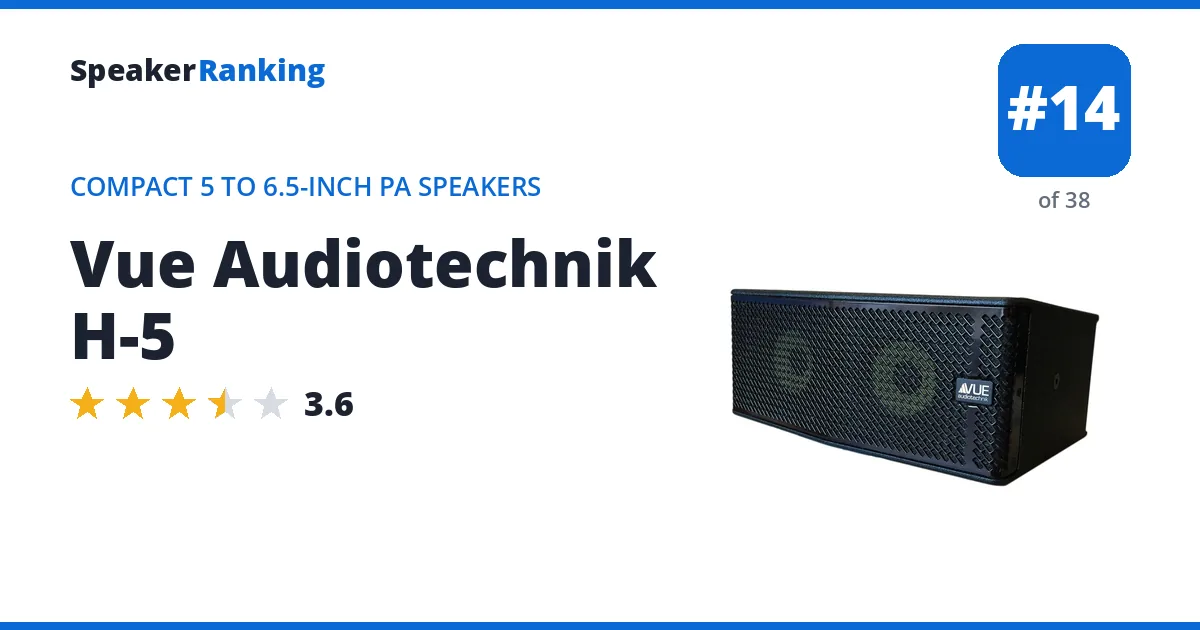
Same family: the Vue Audiotechnik H-8 (larger model, rated 3.6/5), the Vue Audiotechnik h-12 (larger model, rated 3.8/5) and the Vue Audiotechnik H-15 (larger model, rated 4.3/5).
Pros: The smallest h-Class box packs two 5 inch woofers and a beryllium-diaphragm compression driver on a wide 120° x 40° horn, with built-in amplification, Dante network audio and Ethernet remote control. Low-quality vendor data shows a 5.66 preference score with an ideal subwoofer and a listening window deviation of 0.52. Measured bass extension of 109.0Hz (-3dB).
Cons: Bass rolls off early, at about 90Hz (-6dB), so it needs a subwoofer for anything beyond speech and fill duty; its standalone preference score is only 2.24. At roughly $3195 each it is very expensive for a 5 inch speaker.
Full Vue Audiotechnik H-5 review and specifications →
| Released | Jan 2015 (11 years ago) |
|---|---|
| AES Input | Yes |
| Amplifier Power | 315W long-term (275W LF + 40W HF) |
| Aux Input | No |
| Bass Extension (-3dB) | 109.0Hz (measured, vendor Spinorama data) |
| Bluetooth | No |
| Cabinet Material | Multi-ply birch hardwood |
| Coaxial Input | No |
| Configuration | Active 2-way PA speaker |
| Coverage | 120° x 40° |
| DSP | Yes |
| Dimensions | 7.6”H x 18”W x 11.7”D (194 x 458 x 298 mm) |
| Drivers | 2x 5” woofers, 1” beryllium-diaphragm compression driver |
| Frequency Response | 80Hz - 21kHz (±2.5dB, manufacturer specified); 60Hz - 26kHz (-10dB) |
| Guitar Input | No |
| HDMI Input | No |
| Inputs | XLR analog/AES input with XLR loop output, Dante |
| Maximum SPL | 130dB peak (manufacturer specified) |
| Microphone Input | No |
| Network Control | Ethernet/IP remote monitoring and control |
| Optical Input | No |
| Passive | No |
| RCA Input | No |
| Rigging | Pole mount and integrated hanging points |
| Spinorama Preference Score | 2.24 |
| Spinorama Preference Score with Perfect Sub | 5.66 |
| TRS Input | No |
| USB Input | No |
| Weight | 27.2 lbs (12.33 kg) |
| XLR Input | Yes |
- Links
- Reviews, Comparisons and Sound Samples
 #15 KV2 Audio EX6 eBay
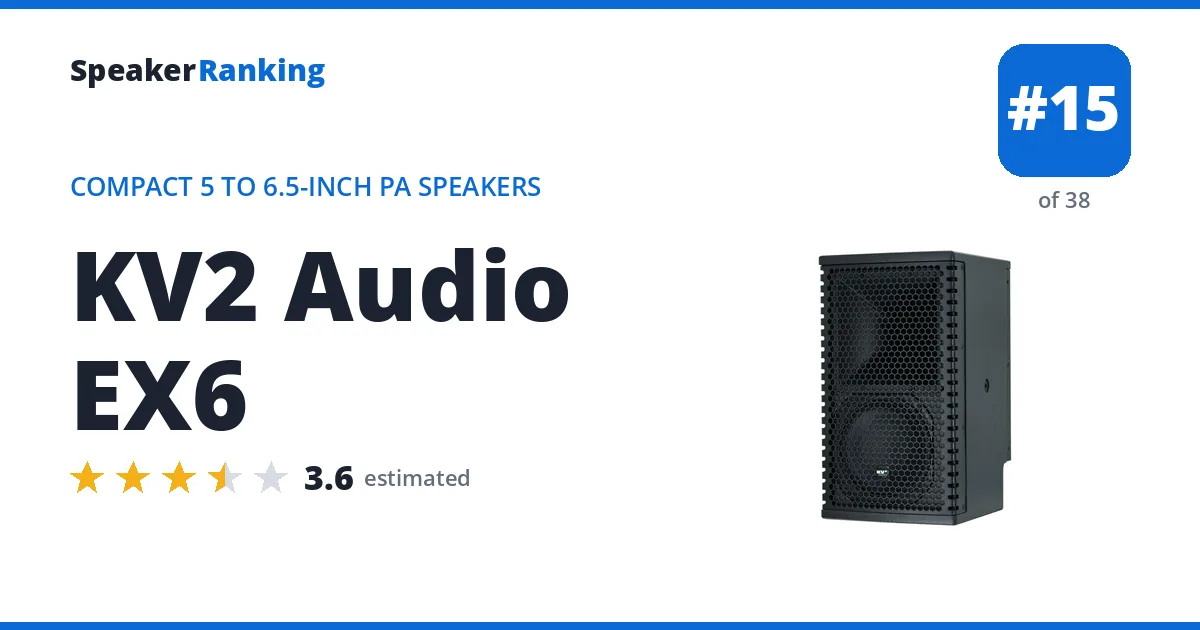
Same family: the KV2 Audio EX26 (larger model, ranked lower, estimated 3.6/5), the KV2 Audio EX10 (larger model, rated 3.7/5), the KV2 Audio EX28 (larger model, estimated 3.8/5), the KV2 Audio EX12 (larger model, rated 4.4/5) and the KV2 Audio EX15 (larger model, rated 4/5).
Pros: A self-powered model from KV2’s EX range alongside the measured KV2 Audio EX10 and KV2 Audio EX12: the smallest model, a 6” two-way with wide 100° x 100° coverage for fills and small rooms. KV2 pairs a switched-rail Class D woofer amplifier with a Class AB tweeter amplifier and rates it at 123dB peak / 117dB long-term with a 68Hz - 20kHz (-3dB), 62Hz (-10dB) response.
Cons: No independent measurements yet, so it can’t be compared with ranked PA speakers. KV2 sells through specialist dealers, so there is no retail price, and it is heavy for its size at 12 kg.
Full KV2 Audio EX6 review and specifications →
| Bass Extension (-3dB) | 68Hz (manufacturer specified) |
|---|---|
| Bluetooth | No |
| Configuration | Active 2-way PA speaker |
| Coverage | 100° x 100° |
| DSP | Yes |
| Drivers | 6” woofer, 1” compression driver |
| Frequency Response | 68Hz - 20kHz (-3dB), 62Hz (-10dB) (manufacturer specified) |
| Maximum SPL | 123dB peak / 117dB long-term (manufacturer specified) |
| Passive | No |
| Rigging | M10 and 4 x M6 points; optional 35mm pole adapter |
| Weight | 26.5 lbs (12 kg) |
| XLR Input | Yes |
- Links
- Reviews, Comparisons and Sound Samples
- No independent measurement review is linked for this model; it is ranked from hands-on listening and comparison against similarly priced speakers.
 #16 KV2 Audio EX26 eBay
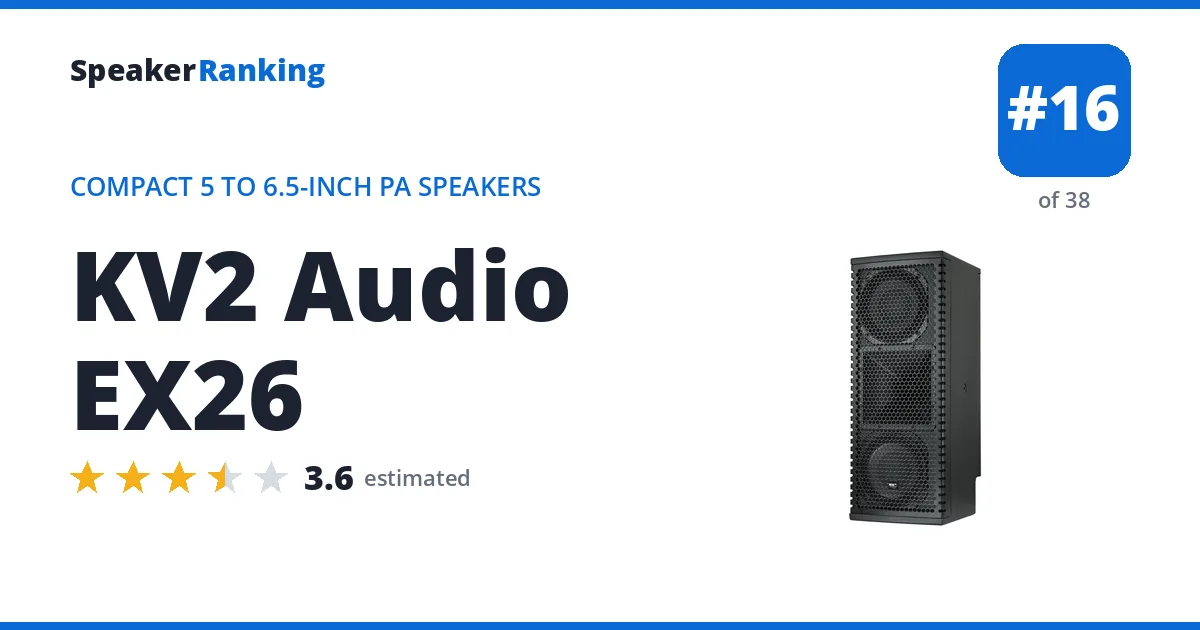
Same family: the KV2 Audio EX6 (smaller model, ranked higher, estimated 3.6/5), the KV2 Audio EX10 (larger model, rated 3.7/5), the KV2 Audio EX28 (larger model, estimated 3.8/5), the KV2 Audio EX12 (larger model, rated 4.4/5) and the KV2 Audio EX15 (larger model, rated 4/5).
Pros: A self-powered model from KV2’s EX range alongside the measured KV2 Audio EX10 and KV2 Audio EX12: two 6” woofers around a compression driver, about 7dB louder than the EX6 with the same wide horn. KV2 pairs a switched-rail Class D woofer amplifier with a Class AB tweeter amplifier and rates it at 130dB peak / 124dB long-term with a 80Hz - 20kHz (-3dB), 65Hz (-10dB) response.
Cons: No independent measurements yet, so it can’t be compared with ranked PA speakers. KV2 sells through specialist dealers, so there is no retail price, and it is heavy for its size at 16 kg.
Full KV2 Audio EX26 review and specifications →
| Bass Extension (-3dB) | 80Hz (manufacturer specified) |
|---|---|
| Bluetooth | No |
| Configuration | Active 2-way PA speaker |
| Coverage | 100° x 100° |
| DSP | Yes |
| Drivers | 2x 6” woofers, 1” compression driver |
| Frequency Response | 80Hz - 20kHz (-3dB), 65Hz (-10dB) (manufacturer specified) |
| Maximum SPL | 130dB peak / 124dB long-term (manufacturer specified) |
| Passive | No |
| Rigging | M10 and 4 x M6 points; 35mm pole mount |
| Weight | 35.3 lbs (16 kg) |
| XLR Input | Yes |
- Links
- Reviews, Comparisons and Sound Samples
- No independent measurement review is linked for this model; it is ranked from hands-on listening and comparison against similarly priced speakers.
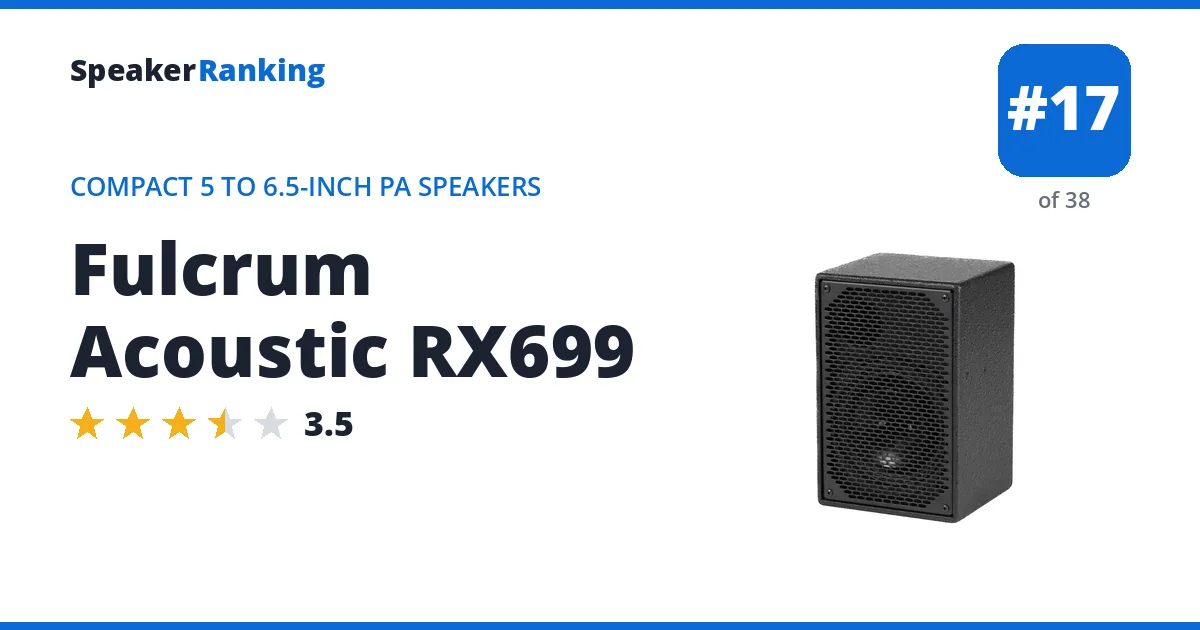
 #17 Fulcrum Acoustic RX699 Passive Discontinued eBay
Newer model: the Fulcrum Acoustic RX6, ranked higher, rated 3.7/5, released 2024. See every Fulcrum Acoustic RX generation.
Pros: A 5.4kg coaxial cabinet with a 90° x 90° pattern and a 16 ohm load that lets many speakers share one amplifier channel. Vendor Spinorama data gives preference scores of 2.98 standalone and 6.54 with an ideal subwoofer. Measured bass extension of 109Hz (-3dB).
Cons: Bass reaches only about 109Hz (-3dB) and maximum output is 118dB, so it suits speech and background music rather than loud programs. Listening-window narrow-band deviation is 0.406, and it is passive, so an amplifier is required. Discontinued.
Full Fulcrum Acoustic RX699 review and specifications →
| Released | Feb 2012 (14 years ago) |
|---|---|
| AES Input | No |
| Amplifier Power | Passive speaker; requires external amplification within the 175W handling rating at 16 ohms |
| Aux Input | No |
| Bass Extension (-3dB) | 109Hz (measured, vendor Spinorama data) |
| Bluetooth | No |
| Coaxial Input | No |
| Configuration | Passive 2-way coaxial PA speaker |
| Coverage | 90° x 90° |
| DSP | No (passive) |
| Dimensions | 10.8”H x 7.1”W x 6.5”D (274 x 180 x 165 mm) |
| Drivers | 6.5” woofer with 2” voice coil, horn-loaded compression driver (coaxial) |
| Guitar Input | No |
| HDMI Input | No |
| Maximum SPL | 118dB peak / 112dB continuous (manufacturer specified) |
| Microphone Input | No |
| Optical Input | No |
| Passive | Yes |
| Power Handling | 175W at 16 ohms (manufacturer specified) |
| RCA Input | No |
| Rigging | 2 x M6 yoke points; 2 x M6 nut plates for pan/tilt mounts |
| Sensitivity | 89dB |
| Spinorama Preference Score | 2.98 |
| Spinorama Preference Score with Perfect Sub | 6.54 |
| TRS Input | No |
| USB Input | No |
| Weight | 11.9 lbs (5.4 kg) |
| XLR Input | No |
- Links
- Reviews, Comparisons and Sound Samples
 #18 Kling Freitag CA 106 Pro Passive eBay
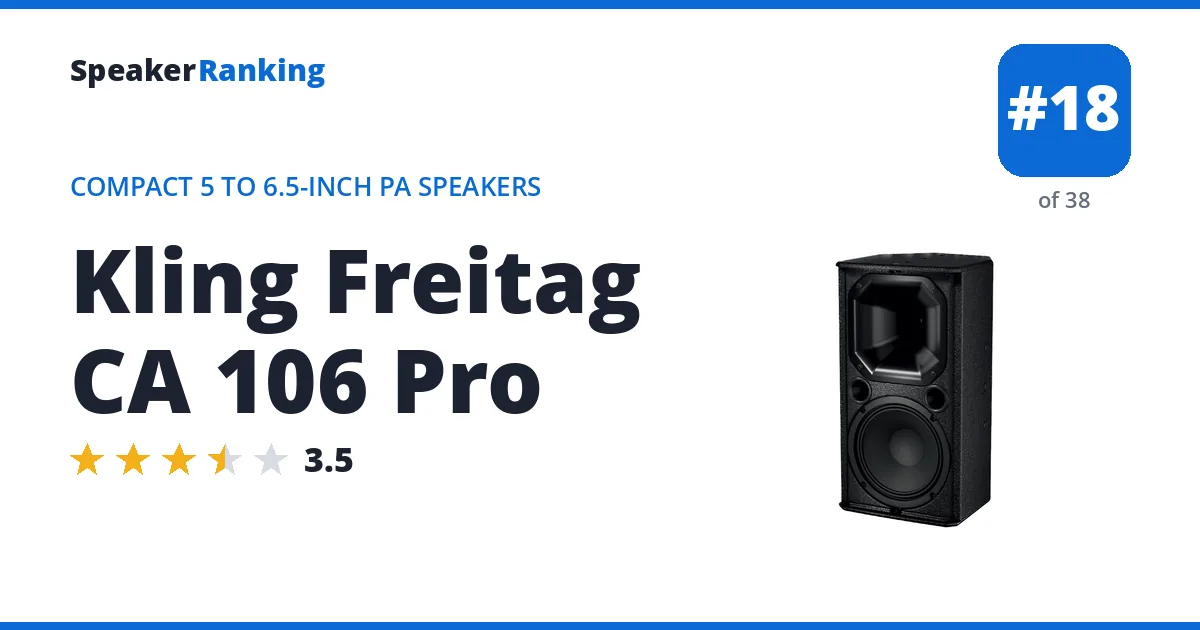
Pros: High-quality manufacturer measurements give a 5.73 preference score with an ideal subwoofer, with a 2.5dB reference band and even 90° x 60° coverage from a rotatable constant-directivity horn. The 6.5-inch woofer and 1-inch compression driver sit in a 6.7kg multiplex cabinet, and the 16 ohm load lets several cabinets share one amplifier channel for distributed systems. Measured bass extension of 132Hz (-3dB).
Cons: Bass rolls off early, about 69Hz at -10dB, so it needs a subwoofer for music, and its 125dB peak output suits near-field and moderate-distance use rather than large rooms. A 4.71 directivity-index deviation means off-axis tone varies. It is passive and sold only through pro dealers with no published price.
Full Kling Freitag CA 106 Pro review and specifications →
| AES Input | No |
|---|---|
| Amplifier Power | Passive speaker; requires external amplification |
| Aux Input | No |
| Bass Extension (-10dB) | about 68.9Hz (measured, vendor Spinorama data) |
| Bass Extension (-3dB) | 132Hz (measured, vendor Spinorama data) |
| Bluetooth | No |
| Cabinet Material | 12mm multiplex |
| Coaxial Input | No |
| Configuration | Passive 2-way compact PA speaker |
| Coverage | 90° x 60° (rotatable) |
| DSP | No (passive) |
| Drivers | 6.5” woofer, 1” exit compression driver on rotatable CD horn |
| Frequency Response | 73Hz - 20kHz (±3dB, manufacturer specified) |
| Guitar Input | No |
| HDMI Input | No |
| Impedance | 16 ohms |
| Maximum SPL | 125dB peak (manufacturer specified) |
| Microphone Input | No |
| Optical Input | No |
| Passive | Yes |
| Power Handling | 200W nominal / 400W program / 600W peak |
| RCA Input | No |
| Rigging | 12 x M8 and 2 x M6 threaded inserts |
| Spinorama Preference Score | 2.53 |
| Spinorama Preference Score with Perfect Sub | 5.73 |
| TRS Input | No |
| USB Input | No |
| Weight | 14.8 lbs (6.7 kg) |
| XLR Input | No |
- Links
- Reviews, Comparisons and Sound Samples
- Head-to-Head Comparisons
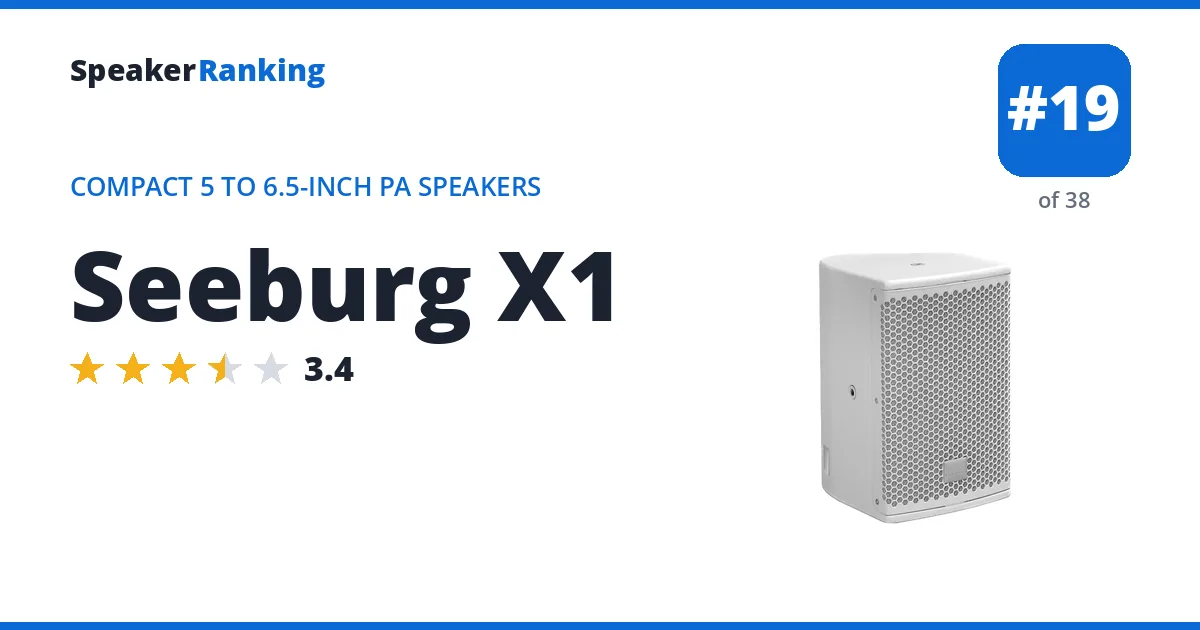
 #19 Seeburg X1: $866 Passive Thomann $866 eBay
Same family: the Seeburg X2 (larger model, rated 3.6/5), the Seeburg X4 (larger model, rated 3.9/5), the Seeburg X6 (larger model, rated 3.9/5) and the Seeburg X8 (larger model, rated 3.5/5).
Pros: A 5.99 preference score with an ideal subwoofer and a 2.0dB reference band give an even tonal balance from a 5.5kg box. The coaxial 6.5-inch and 1-inch neodymium drivers keep sound consistent across the 90° x 60° pattern, which suits fills, small rooms and speech. It reaches a 120dB peak and has M10 points for wall and ceiling mounting. Measured bass extension of 97.5Hz (-3dB).
Cons: Bass is very limited, at 97.5Hz for -3dB and about 85Hz for -10dB, so it needs a subwoofer for any music at volume. The standalone preference score is only 2.52. It is passive and needs an external amplifier with Seeburg presets unless you buy the self-powered X1 dp.
Full Seeburg X1 review and specifications →
| AES Input | No |
|---|---|
| Amplifier Power | Passive speaker; requires external amplification (self-powered X1 dp version available) |
| Aux Input | No |
| Bass Extension (-10dB) | about 84.9Hz (measured, vendor Spinorama data) |
| Bass Extension (-3dB) | 97.5Hz (measured, vendor Spinorama data) |
| Bluetooth | No |
| Coaxial Input | No |
| Configuration | Passive 2-way coaxial compact speaker |
| Coverage | 90° x 60° (rotatable) |
| DSP | No (passive) |
| Dimensions | 12.2”H x 7.9”W x 8.7”D (310 x 200 x 220 mm) |
| Drivers | 6.5” neodymium woofer (2” voice coil), coaxial 1” neodymium compression driver |
| Frequency Response | 80Hz - 19kHz (-6dB, manufacturer specified) |
| Guitar Input | No |
| HDMI Input | No |
| Impedance | 8 ohms |
| Maximum SPL | 120dB peak (manufacturer specified) |
| Microphone Input | No |
| Optical Input | No |
| Passive | Yes |
| Power Handling | 200W AES / 600W peak |
| RCA Input | No |
| Rigging | 4x M10 points |
| Sensitivity | 92dB (1W/1m) |
| Spinorama Preference Score | 2.52 |
| Spinorama Preference Score with Perfect Sub | 5.99 |
| TRS Input | No |
| USB Input | No |
| Weight | 12.1 lbs (5.5 kg) |
| XLR Input | No |
- Links
- Reviews, Comparisons and Sound Samples
- Head-to-Head Comparisons
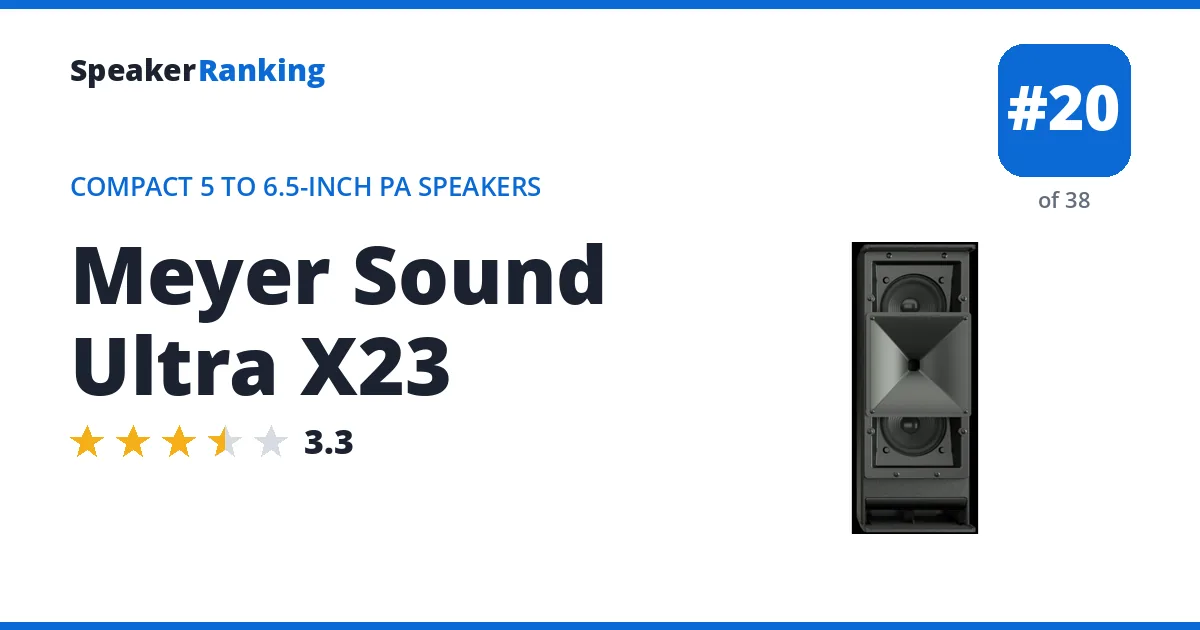
 #20 Meyer Sound Ultra X23 eBay
Same family: the Meyer Sound Ultra X20 (smaller model, ranked higher, rated 3.6/5), the Meyer Sound Ultra X22 (smaller model, ranked higher, rated 3.9/5), the Meyer Sound Ultra X40 (larger model, rated 3.8/5) and the Meyer Sound Ultra X80 (larger model, estimated 3.9/5).
Pros: The widest-coverage member of Meyer’s ULTRA-X20 family, with a 110° x 110° horn for close-in fill where listeners sit far off to the sides. Bass reaches 71Hz at -3dB from two 5-inch woofers around a concentric 2-inch compression driver, and a built-in 860W peak amplifier with Meyer processing makes it self-powered. Measured bass extension of 71Hz (-3dB).
Cons: Manufacturer measurements give a 1.73 standalone and 4.53 ideal-subwoofer preference score, well below its narrower-coverage Meyer Sound Ultra X20 and Meyer Sound Ultra X22 siblings, with a 4.1dB reference band. Output tops out around 123.5dB, and it is sold only through Meyer dealers.
Full Meyer Sound Ultra X23 review and specifications →
| Released | 2020 (6 years ago) |
|---|---|
| AES Input | No |
| Amplifier Power | 860W peak, 3-channel Class D |
| Aux Input | No |
| Bass Extension (-10dB) | about 62.5Hz (measured, vendor Spinorama data) |
| Bass Extension (-3dB) | 71Hz (measured, vendor Spinorama data) |
| Bluetooth | No |
| Coaxial Input | No |
| Configuration | Self-powered 2-way concentric compact loudspeaker |
| Coverage | 110° x 110° |
| DSP | Yes |
| Dimensions | 19.1”H x 7.5”W x 8.6”D (484 x 191 x 218 mm) |
| Drivers | 2x 5” cone woofers, concentric 2” compression driver |
| Guitar Input | No |
| HDMI Input | No |
| Maximum SPL | 123.5dB peak (M-Noise, ULTRA-X20 family, manufacturer specified) |
| Microphone Input | No |
| Optical Input | No |
| Passive | No |
| RCA Input | No |
| Rigging | 4 x M8 inserts; 4 x M6 wall-mount holes; optional pole adapter |
| Spinorama Preference Score | 1.73 |
| Spinorama Preference Score with Perfect Sub | 4.53 |
| TRS Input | No |
| USB Input | No |
| Weight | 27.1 lbs (12.3 kg) |
| XLR Input | Yes |
- Links
- Reviews, Comparisons and Sound Samples
- Head-to-Head Comparisons
 #21 Fulcrum Acoustic RX599 Passive Discontinued eBay
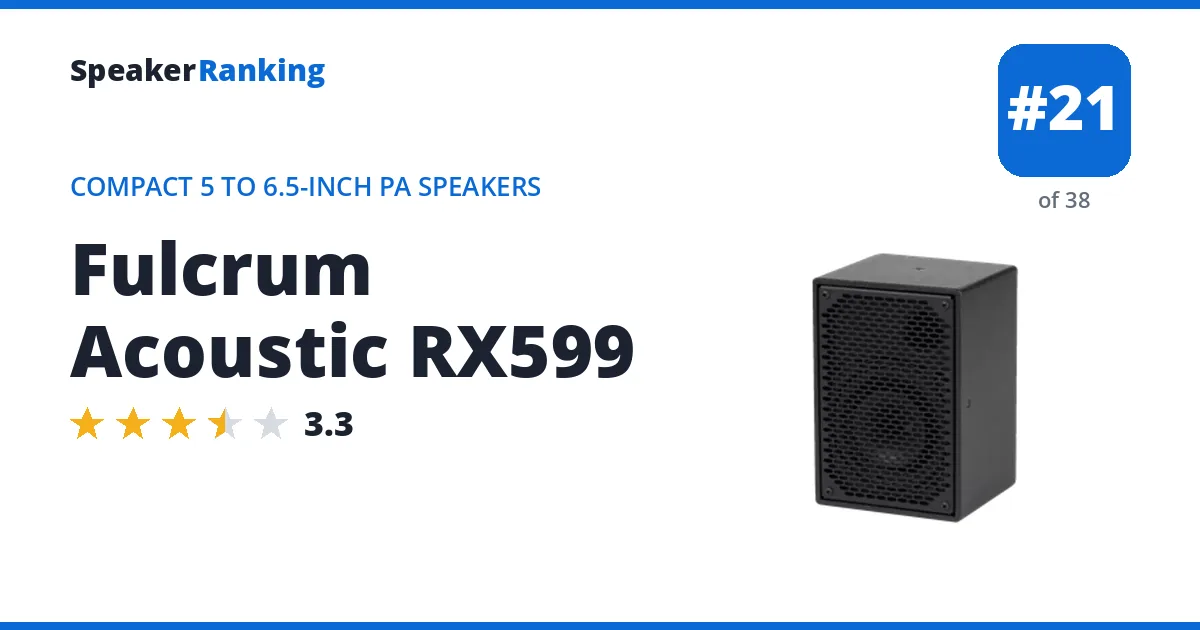
Newer model: the Fulcrum Acoustic RX5, ranked lower, rated 3.3/5, released 2024. See every Fulcrum Acoustic RX generation.
Pros: A compact coaxial installation speaker with a 1” compression driver at the center of a 5.25” woofer, rated at 93dB and 115dB maximum. Fulcrum’s measurements hold the listening window within 0.9dB from 300Hz to 5kHz, and the score reaches 5.91 with an ideal subwoofer.
Cons: Bass stops early, about 125Hz (-3dB), so it needs a subwoofer, and on-axis response is uneven (1.09dB average deviation), for a preference score of 2.13 alone. The measurements are Fulcrum’s own. Replaced by the Fulcrum Acoustic RX5. Discontinued.
Full Fulcrum Acoustic RX599 review and specifications →
| Released | 2012 (14 years ago) |
|---|---|
| AES Input | No |
| Amplifier Power | Passive speaker; requires external amplification |
| Aux Input | No |
| Bass Extension (-10dB) | about 104.0Hz (measured, manufacturer data via spinorama.org) |
| Bass Extension (-3dB) | 125.0Hz (measured, manufacturer data via spinorama.org) |
| Bluetooth | No |
| Coaxial Input | No |
| Configuration | Passive 2-way coaxial PA speaker |
| Coverage | 90 x 90 degrees |
| DSP | No (passive) |
| Dimensions | 8.7”H x 5.9”W x 5.6”D (220 x 151 x 142 mm) |
| Drivers | 5.25” woofer with coaxial 1” compression driver |
| Frequency Response | 100Hz-20kHz (manufacturer specified) |
| Guitar Input | No |
| HDMI Input | No |
| Maximum SPL | 115dB (manufacturer specified) |
| Microphone Input | No |
| Optical Input | No |
| Passive | Yes |
| Power Handling | 150W |
| RCA Input | No |
| Rigging | 2 x M6 yoke points; 2 x M6 nut plates for pan/tilt mounts |
| Sensitivity | 93dB |
| Spinorama Preference Score | 2.13 |
| Spinorama Preference Score with Perfect Sub | 5.91 |
| TRS Input | No |
| USB Input | No |
| Weight | 8.6 lbs (3.9 kg) |
| XLR Input | No |
- Reviews, Comparisons and Sound Samples
 #22 Fulcrum Acoustic RX5 Passive eBay
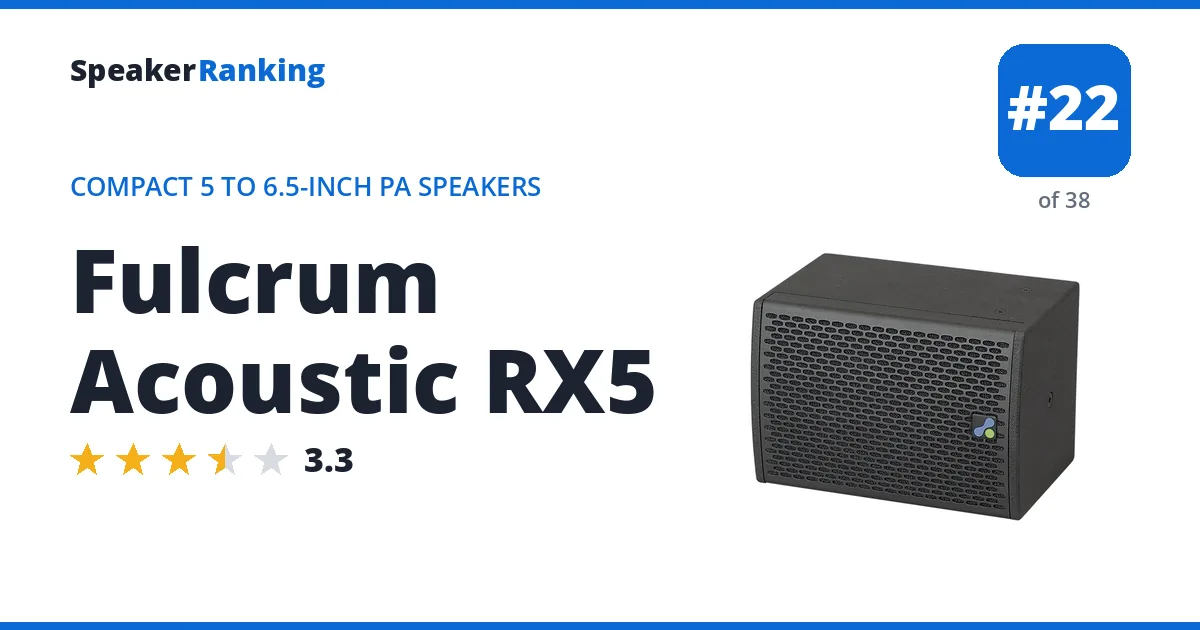
Older model: the Fulcrum Acoustic RX599 (ranked higher, rated 3.3/5). See every Fulcrum Acoustic RX generation.
Same family: the Fulcrum Acoustic RX4 (smaller model, ranked lower, rated 3.2/5), the Fulcrum Acoustic RX6 (larger model, ranked higher, rated 3.7/5) and the Fulcrum Acoustic RX8 (larger model, rated 3.6/5).
Pros: The updated 5.25” coaxial RX speaker, with a new crossover and horn for better off-axis response and 90 x 75 degree coverage. Fulcrum’s own measurements on spinorama.org hold the listening window within 1.5dB from 300Hz to 5kHz.
Cons: Bass stops early, about 128Hz (-3dB), so it needs a subwoofer, and on-axis response is uneven (1.15dB average deviation), for a preference score of 1.76 alone and 5.64 with an ideal subwoofer. The measurements are Fulcrum’s own, and it is sold through installers only.
Full Fulcrum Acoustic RX5 review and specifications →
| Released | 2024 (2 years ago) |
|---|---|
| AES Input | No |
| Amplifier Power | Passive speaker; requires external amplification |
| Aux Input | No |
| Bass Extension (-10dB) | about 104.0Hz (measured, manufacturer data via spinorama.org) |
| Bass Extension (-3dB) | 128.0Hz (measured, manufacturer data via spinorama.org) |
| Bluetooth | No |
| Coaxial Input | No |
| Configuration | Passive 2-way coaxial PA speaker |
| Coverage | 90 x 75 degrees |
| DSP | No (passive) |
| Drivers | 5.25” woofer with coaxial compression driver |
| Guitar Input | No |
| HDMI Input | No |
| Maximum SPL | 117dB peak (manufacturer specified) |
| Microphone Input | No |
| Optical Input | No |
| Passive | Yes |
| RCA Input | No |
| Spinorama Preference Score | 1.76 |
| Spinorama Preference Score with Perfect Sub | 5.64 |
| TRS Input | No |
| USB Input | No |
| Weight | 9 lbs (4.1 kg) |
| XLR Input | No |
- Links
- Reviews, Comparisons and Sound Samples
 #23 L-Acoustics 5XT Passive eBay
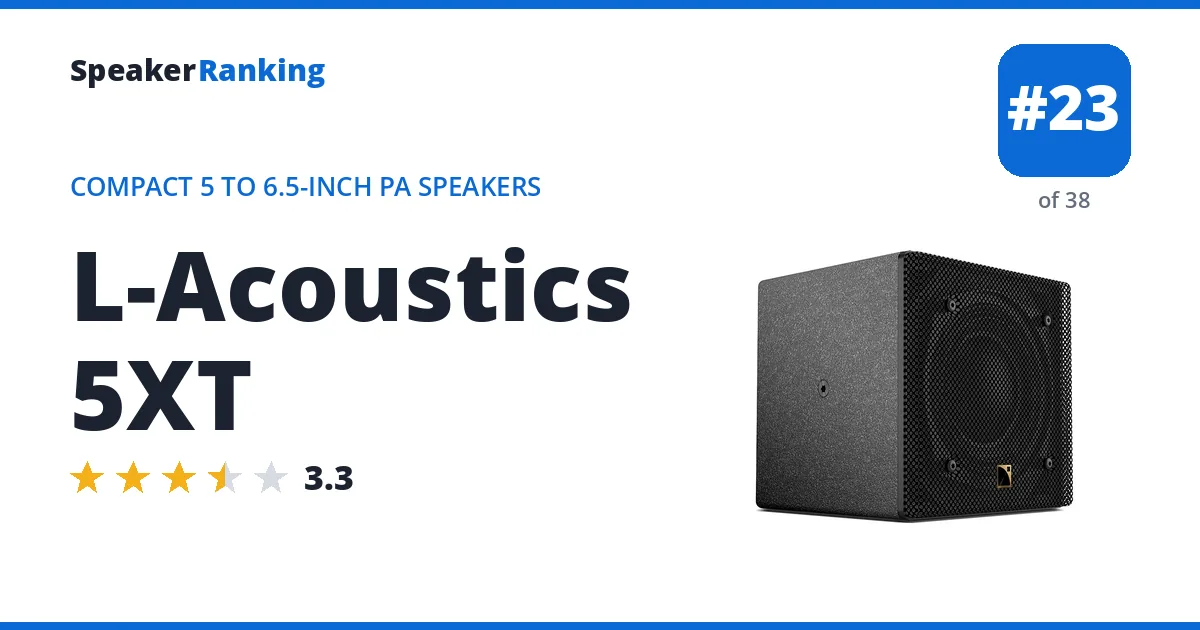
Pros: A 3.5kg cube with 110° conical coverage and a 121dB peak, more output than most speakers this size, with a very smooth on-axis response (0.71dB average deviation) in vendor measurements. Measured bass extension of 115Hz (-3dB).
Cons: Preference scores of 0.91 standalone and 4.63 with an ideal subwoofer trail better compact models, because bass stops near 115Hz (-3dB) and the listening window drifts across a 3.2dB band. It is passive, needs L-Acoustics presets, and is sold through dealers with no published price.
Full L-Acoustics 5XT review and specifications →
| Released | 2012 (14 years ago) |
|---|---|
| AES Input | No |
| Amplifier Power | Passive speaker; requires external amplification |
| Aux Input | No |
| Bass Extension (-10dB) | about 97.4Hz (measured, vendor Spinorama data) |
| Bass Extension (-3dB) | 115Hz (measured, vendor Spinorama data) |
| Bluetooth | No |
| Coaxial Input | No |
| Configuration | Passive 2-way coaxial PA speaker |
| Coverage | 110° conical |
| DSP | No (passive) |
| Dimensions | 6.5”H x 6.5”W x 6.5”D (165 x 165 x 165 mm) |
| Drivers | 5” woofer, coaxial 1” compression driver |
| Frequency Response | 95Hz - 20kHz (manufacturer specified) |
| Guitar Input | No |
| HDMI Input | No |
| Maximum SPL | 121dB (manufacturer specified) |
| Microphone Input | No |
| Optical Input | No |
| Passive | Yes |
| RCA Input | No |
| Rigging | M6 inserts for ETR5 brackets; mic stand adapter |
| Spinorama Preference Score | 0.91 |
| Spinorama Preference Score with Perfect Sub | 4.63 |
| TRS Input | No |
| USB Input | No |
| Weight | 7.7 lbs (3.5 kg) |
| XLR Input | No |
- Links
- Reviews, Comparisons and Sound Samples
 #24 Axiom ED60P: $815 each Passive eBay
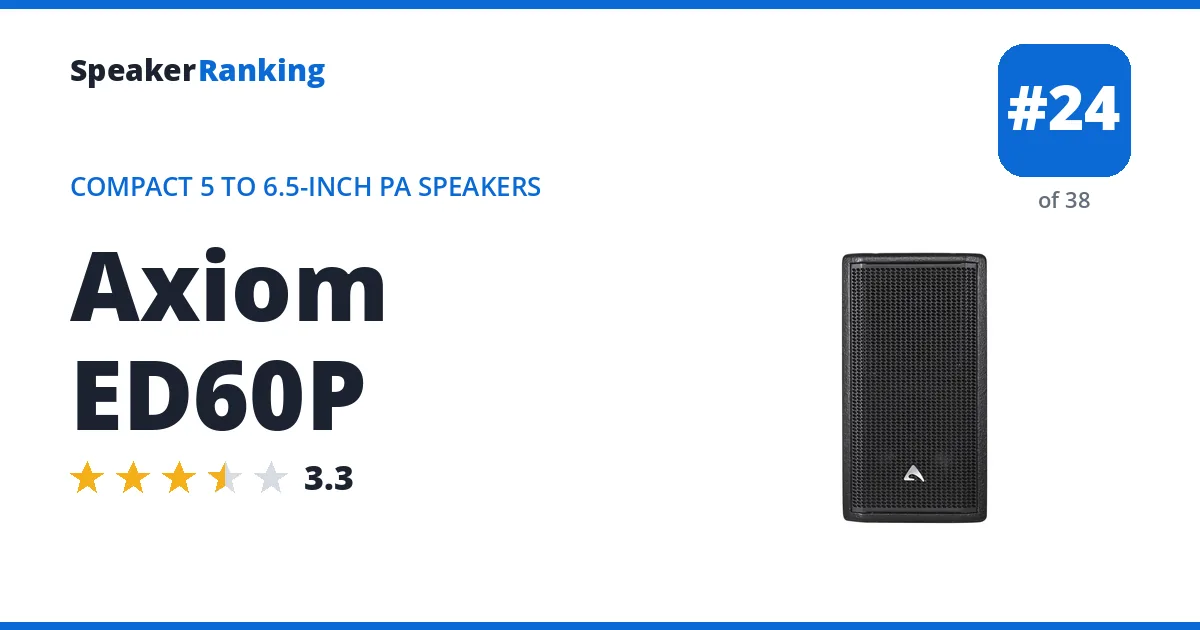
Same family: the Axiom ED80P (larger model, rated 3.4/5), the Axiom ED120A (larger model, rated 4/5) and the Axiom ED150A (larger model, rated 3.8/5).
Pros: A compact passive PA and stage speaker from Axiom with a 6” woofer and a horn-loaded tweeter. Axiom’s data shows a flat on-axis response (0.48 average deviation). Axiom’s measurements show a preference score of 3.39 that reaches 4.96 with an ideal subwoofer, with 0.60 listening window deviation.
Cons: Axiom’s data shows bass to about 40Hz, which is implausible for a 6” box Axiom itself rates at 85Hz (-6dB), so treat the bass figures with caution.
Full Axiom ED60P review and specifications →
| Bluetooth | No |
|---|---|
| DIY Kit | No |
| Drivers | 6” woofer, horn-loaded tweeter |
| Maximum SPL | 114dB peak (manufacturer specified) |
| Passive | Yes |
| Rigging | 2 x M8 flying points; 35mm pole mount |
| Spinorama Preference Score | 3.39 |
| Spinorama Preference Score with Perfect Sub | 4.96 |
| Weight | 11 lbs (5 kg) |
- Reviews, Comparisons and Sound Samples
 #25 EAW MKD526 Passive eBay
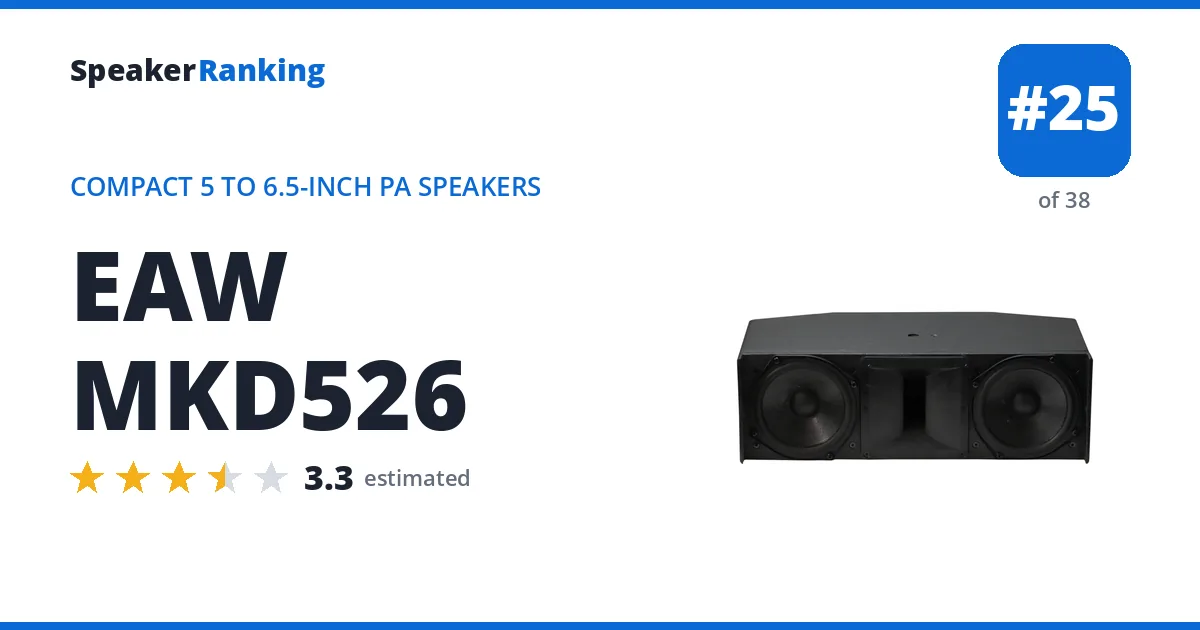
Same family: the EAW MKD1000 (larger model, rated 2.9/5) and the EAW MKD1200 (larger model, rated 4/5).
Pros: The ultra-compact model of EAW’s MKD installation range alongside the measured EAW MKD1000 and EAW MKD1200, with two 5.25” woofers around a compression driver on a rotatable 120° x 60° horn. EAW rates it at 250W, 127dB maximum and 75Hz to 20kHz in a 7.6 kg cabinet, sized for fills and small rooms.
Cons: No independent measurements yet, so it can’t be compared with ranked PA speakers. Bass stops around 75Hz, so it needs a subwoofer for music, and it is sold through installation dealers.
Full EAW MKD526 review and specifications →
| Released | 2023 (3 years ago) |
|---|---|
| Amplifier Power | Passive speaker; requires external amplification |
| Bluetooth | No |
| Configuration | Passive 2-way installation speaker |
| Coverage | 120° x 60°, rotatable |
| DSP | No (passive) |
| Drivers | 2x 5.25” woofers, compression driver |
| Frequency Response | 75Hz - 20kHz (manufacturer specified) |
| Maximum SPL | 127dB (manufacturer specified) |
| Passive | Yes |
| Power Handling | 250W |
| Rigging | 12 x M6 threaded points for mounting accessories |
| Weight | 16.8 lbs (7.6 kg) |
| XLR Input | No |
- Links
- Reviews, Comparisons and Sound Samples
- No independent measurement review is linked for this model; it is ranked from hands-on listening and comparison against similarly priced speakers.
 #26 Alcons Audio SR9 Passive eBay
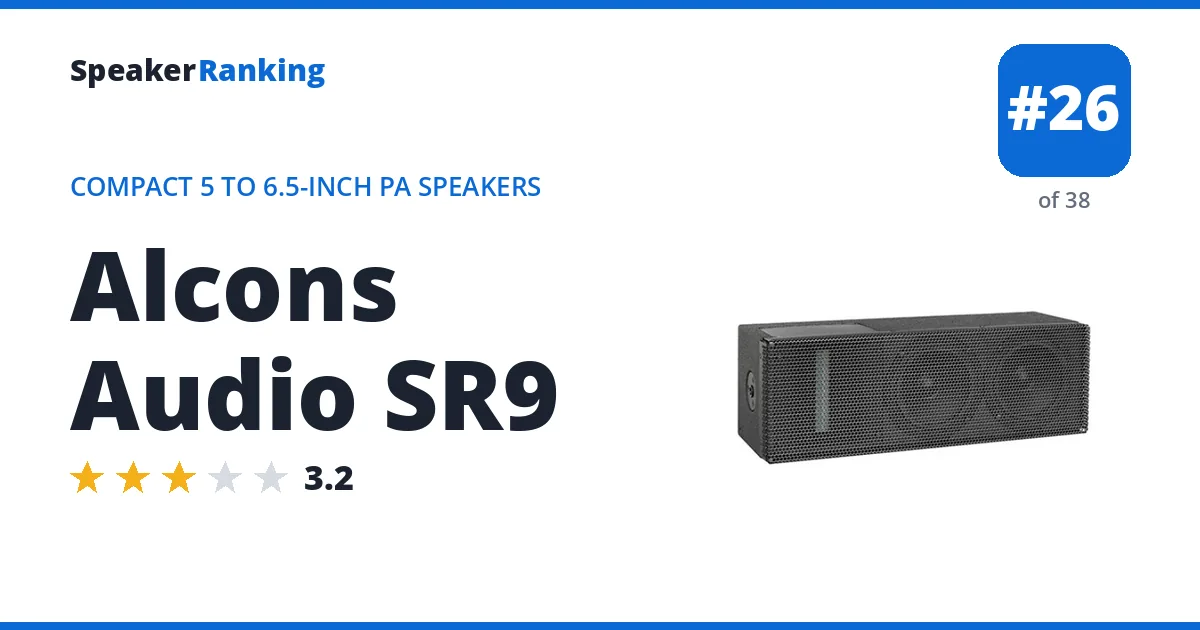
Pros: High-quality vendor Spinorama data gives preference scores of 2.46 standalone and 6.18 with an ideal subwoofer. The RBN401 pro-ribbon and 120° horizontal pattern make it a discreet ribbon-fill and front-fill box, and the sealed woofers give a smooth roll-off. Measured bass extension of 150Hz (-3dB).
Cons: Bass reaches only about 150Hz (-3dB), the shallowest of the group, so it is a fill and speech box that depends on a subwoofer. It is passive, listening-window narrow-band deviation is 0.463, and the very narrow 15° vertical pattern limits placement.
Full Alcons Audio SR9 review and specifications →
| AES Input | No |
|---|---|
| Amplifier Power | Passive speaker; requires external amplification within the 800W peak handling rating |
| Aux Input | No |
| Bass Extension (-3dB) | 150Hz (measured, vendor Spinorama data) |
| Bluetooth | No |
| Coaxial Input | No |
| Configuration | Passive 2-way ribbon-fill PA speaker |
| Coverage | 120° horizontal x 15° vertical |
| DSP | No (passive) |
| Drivers | Dual 5” sealed woofers, RBN401 pro-ribbon |
| Guitar Input | No |
| HDMI Input | No |
| Maximum SPL | 124dB peak (manufacturer specified) |
| Microphone Input | No |
| Optical Input | No |
| Passive | Yes |
| Power Handling | 800W peak (manufacturer specified) |
| RCA Input | No |
| Spinorama Preference Score | 2.46 |
| Spinorama Preference Score with Perfect Sub | 6.18 |
| TRS Input | No |
| USB Input | No |
| Weight | 18.7 lbs (8.5 kg) |
| XLR Input | No |
- Links
- Reviews, Comparisons and Sound Samples
- Head-to-Head Comparisons
 #27 Fulcrum Acoustic RX4 Passive eBay
Same family: the Fulcrum Acoustic RX5 (larger model, ranked higher, rated 3.3/5), the Fulcrum Acoustic RX6 (larger model, ranked higher, rated 3.7/5) and the Fulcrum Acoustic RX8 (larger model, rated 3.6/5). See every Fulcrum Acoustic RX generation.
Pros: A 1.4kg coaxial speaker small enough to hide under balconies or in architectural details, with wide 100° conical coverage for short throw fills. Measured bass extension of 165Hz (-3dB).
Cons: Vendor measurements give weak preference scores of -0.17 standalone and 4.13 with an ideal subwoofer, with an uneven on-axis response (3.53dB average deviation). Bass stops near 165Hz (-3dB), so it needs a subwoofer for anything but speech. Low 85dB sensitivity and a 111dB peak limit output. It is sold through pro dealers with no published price.
Full Fulcrum Acoustic RX4 review and specifications →
| Released | 2024 (2 years ago) |
|---|---|
| AES Input | No |
| Amplifier Power | Passive speaker; requires external amplification |
| Aux Input | No |
| Bass Extension (-10dB) | about 128.6Hz (measured, vendor Spinorama data) |
| Bass Extension (-3dB) | 165Hz (measured, vendor Spinorama data) |
| Bluetooth | No |
| Coaxial Input | No |
| Configuration | Passive 2-way coaxial PA speaker |
| Coverage | 100° x 100° |
| DSP | No (passive) |
| Dimensions | 5”H x 5.3”W x 5.2”D (127 x 135 x 132 mm) |
| Drivers | 4” coaxial driver |
| Guitar Input | No |
| HDMI Input | No |
| Maximum SPL | 111dB peak / 105dB continuous (manufacturer specified) |
| Microphone Input | No |
| Optical Input | No |
| Passive | Yes |
| RCA Input | No |
| Rigging | 2 x M6 yoke points; optional UB-RX4 yoke bracket |
| Sensitivity | 85dB |
| Spinorama Preference Score | -0.17 |
| Spinorama Preference Score with Perfect Sub | 4.13 |
| TRS Input | No |
| USB Input | No |
| Weight | 3.1 lbs (1.4 kg) |
| XLR Input | No |
- Links
- Reviews, Comparisons and Sound Samples
 #28 Biamp Community IC6-1062 Passive eBay
Same family: the Biamp Community IC6-1082 (larger model, rated 3.2/5).
Pros: Bass reaches 80Hz at -3dB and about 65Hz at -10dB in vendor measurements, deep for a 6.5-inch speaker, and wide 100° coverage suits meeting rooms and small venues. Measured bass extension of 80Hz (-3dB).
Cons: Preference scores of 1.09 standalone and 4.12 with an ideal subwoofer are among the lowest here, with an uneven on-axis response (1.55dB average deviation) and a listening window spread across 3.7dB. Maximum output is 120dB peak. It is passive and sold through installation dealers with no published price.
Full Biamp Community IC6-1062 review and specifications →
| Released | 2016 (10 years ago) |
|---|---|
| AES Input | No |
| Amplifier Power | Passive speaker; requires external amplification |
| Aux Input | No |
| Bass Extension (-10dB) | about 65.1Hz (measured, vendor Spinorama data) |
| Bass Extension (-3dB) | 80Hz (measured, vendor Spinorama data) |
| Bluetooth | No |
| Coaxial Input | No |
| Configuration | Passive 2-way installation PA speaker |
| Coverage | 100° x 100° |
| DSP | No (passive) |
| Drivers | 6.5” woofer, compression driver |
| Guitar Input | No |
| HDMI Input | No |
| Impedance | 8 ohms |
| Maximum SPL | 120dB peak / 114dB continuous (manufacturer specified) |
| Microphone Input | No |
| Optical Input | No |
| Passive | Yes |
| RCA Input | No |
| Rigging | 9 x M6 threaded rigging points |
| Sensitivity | 92dB |
| Spinorama Preference Score | 1.09 |
| Spinorama Preference Score with Perfect Sub | 4.12 |
| TRS Input | No |
| USB Input | No |
| Weight | 16.1 lbs (7.3 kg) |
| XLR Input | No |
- Reviews, Comparisons and Sound Samples
 #29 Martin Audio FlexPoint FP4 Passive eBay
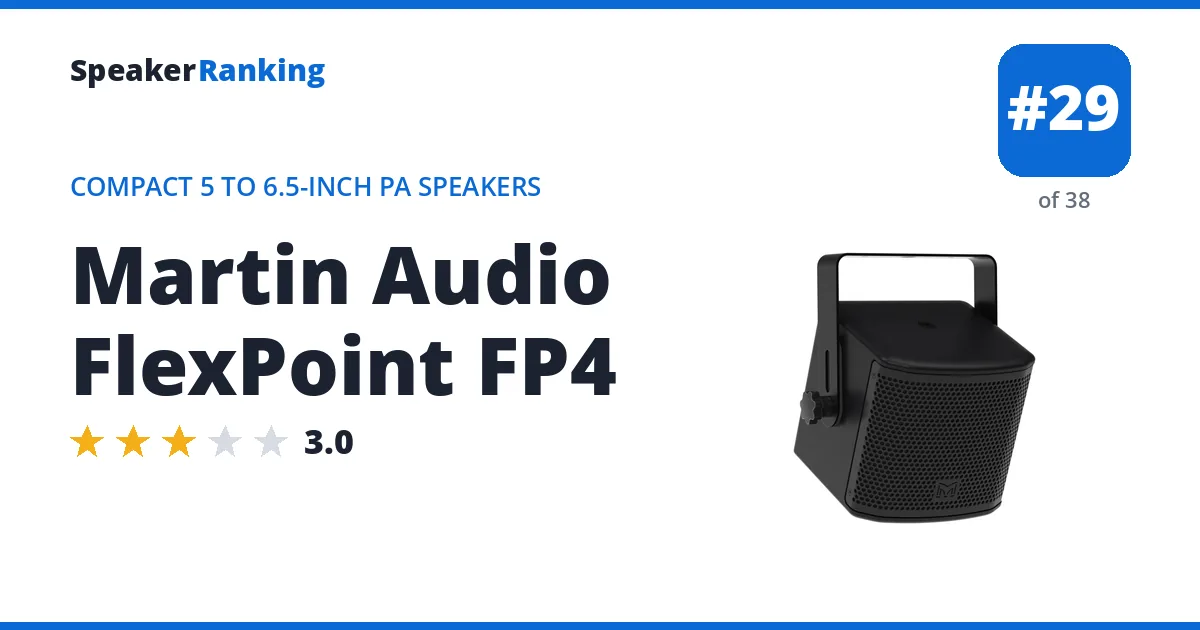
Same family: the Martin Audio FlexPoint FP6 (larger model, ranked lower, rated 3/5), the Martin Audio FlexPoint FP8 (larger model, rated 3/5), the Martin Audio FlexPoint FP12 (larger model, rated 3/5) and the Martin Audio FlexPoint FP15 (larger model, rated 2.7/5).
Pros: A 1.9kg cabinet with a yoke mount for discreet fills, and vendor measurements give a preference score of 3.71 with an ideal subwoofer, wide even coverage helping it. Measured bass extension of 145Hz (-3dB).
Cons: Bass stops near 145Hz (-3dB), so on its own it scores -0.31 and needs a subwoofer for anything but speech. Low 84dB sensitivity and a 108dB peak limit output, and the on-axis response is uneven (2.66dB average deviation). It is passive.
Full Martin Audio FlexPoint FP4 review and specifications →
| Released | 2023 (3 years ago) |
|---|---|
| AES Input | No |
| Amplifier Power | Passive speaker; requires external amplification |
| Aux Input | No |
| Bass Extension (-10dB) | about 108.9Hz (measured, vendor Spinorama data) |
| Bass Extension (-3dB) | 145Hz (measured, vendor Spinorama data) |
| Bluetooth | No |
| Coaxial Input | No |
| Configuration | Passive 2-way PA speaker |
| DSP | No (passive) |
| Drivers | 4” woofer, tweeter |
| Guitar Input | No |
| HDMI Input | No |
| Maximum SPL | 108dB peak / 102dB continuous (manufacturer specified) |
| Microphone Input | No |
| Optical Input | No |
| Passive | Yes |
| RCA Input | No |
| Rigging | 4 x M6 inserts; 3/8” mic stand mount |
| Sensitivity | 84dB |
| Spinorama Preference Score | -0.31 |
| Spinorama Preference Score with Perfect Sub | 3.71 |
| TRS Input | No |
| USB Input | No |
| Weight | 4.2 lbs (1.9 kg) |
| XLR Input | No |
- Links
- Reviews, Comparisons and Sound Samples
 #30 Martin Audio FlexPoint FP6 Passive eBay
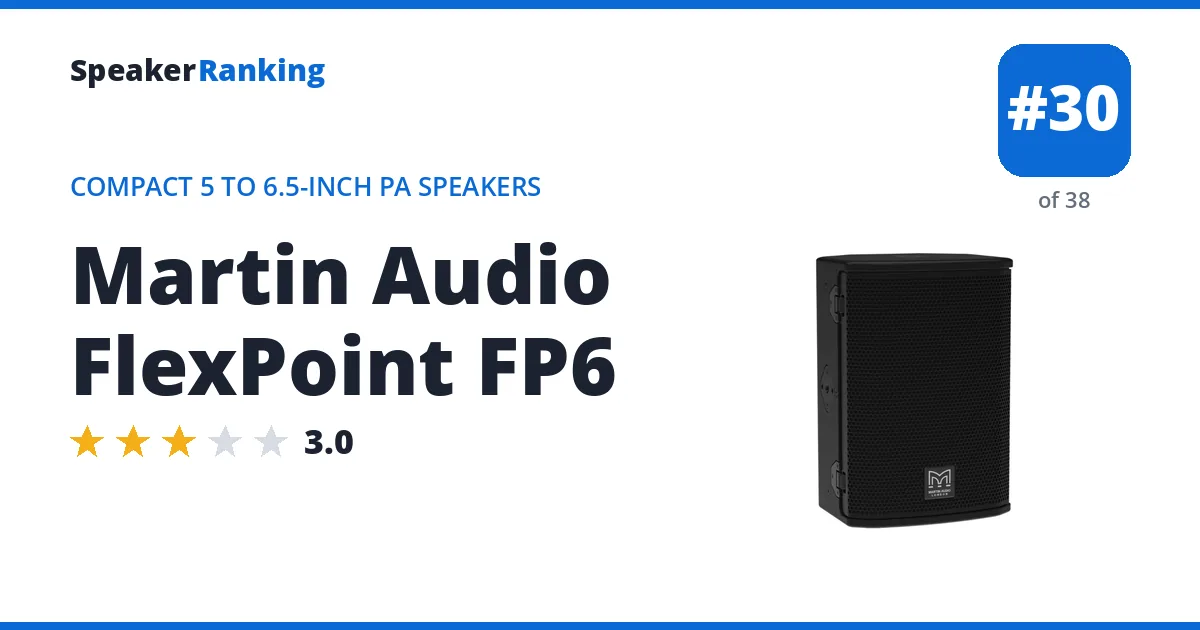
Same family: the Martin Audio FlexPoint FP4 (smaller model, ranked higher, rated 3/5), the Martin Audio FlexPoint FP8 (larger model, rated 3/5), the Martin Audio FlexPoint FP12 (larger model, rated 3/5) and the Martin Audio FlexPoint FP15 (larger model, rated 2.7/5).
Pros: Bass reaches 73Hz at -3dB and about 60Hz at -10dB in vendor measurements, deep for a 6.5-inch speaker, and the on-axis response is smooth (0.37dB average deviation). Measured bass extension of 73Hz (-3dB).
Cons: Preference scores of 0.87 standalone and 3.68 with an ideal subwoofer are low because the listening window spreads across 5.1dB, so tonal balance shifts off axis. Maximum output is 119dB peak, and it is passive.
Full Martin Audio FlexPoint FP6 review and specifications →
| Released | 2023 (3 years ago) |
|---|---|
| AES Input | No |
| Amplifier Power | Passive speaker; requires external amplification |
| Aux Input | No |
| Bass Extension (-10dB) | about 59.6Hz (measured, vendor Spinorama data) |
| Bass Extension (-3dB) | 73Hz (measured, vendor Spinorama data) |
| Bluetooth | No |
| Coaxial Input | No |
| Configuration | Passive 2-way PA speaker |
| DSP | No (passive) |
| Drivers | 6.5” woofer, compression driver |
| Guitar Input | No |
| HDMI Input | No |
| Maximum SPL | 119dB peak / 113dB continuous (manufacturer specified) |
| Microphone Input | No |
| Optical Input | No |
| Passive | Yes |
| RCA Input | No |
| Rigging | 4 x M10 and 15 x M6 inserts; 3/8” mic stand mount |
| Sensitivity | 91dB |
| Spinorama Preference Score | 0.87 |
| Spinorama Preference Score with Perfect Sub | 3.68 |
| TRS Input | No |
| USB Input | No |
| Weight | 12.1 lbs (5.5 kg) |
| XLR Input | No |
- Links
- Reviews, Comparisons and Sound Samples
 #31 FBT J5A eBay
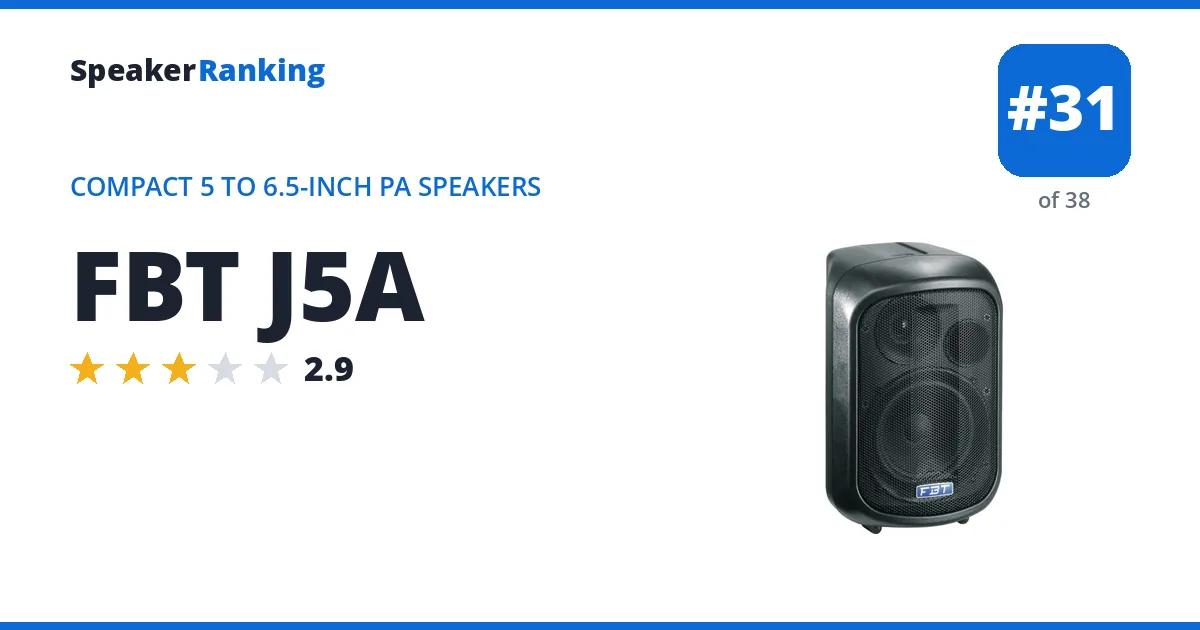
Same family: the FBT J15A (larger model, rated 3.3/5).
Pros: A small powered speaker with a smooth on-axis response (0.42dB average deviation in vendor measurements) for background music, small rooms and stage fills. Measured bass extension of 87.5Hz (-3dB).
Cons: Bass stops near 88Hz (-3dB), so on its own it scores only 0.16, and the listening window spreads across 4.8dB. With 120W it is meant for speech and background levels, not loud events.
Full FBT J5A review and specifications →
| Released | 2013 (13 years ago) |
|---|---|
| AES Input | No |
| Amplifier Power | 120W RMS (80W LF + 40W HF) |
| Aux Input | No |
| Bass Extension (-10dB) | about 73.6Hz (measured, vendor Spinorama data) |
| Bass Extension (-3dB) | 87.5Hz (measured, vendor Spinorama data) |
| Bluetooth | No |
| Coaxial Input | No |
| Configuration | Active 2-way PA speaker |
| DSP | Yes |
| Drivers | 5” woofer, 1” tweeter |
| Guitar Input | No |
| HDMI Input | No |
| Maximum SPL | 117dB peak (manufacturer specified) |
| Microphone Input | No |
| Optical Input | No |
| Passive | No |
| RCA Input | No |
| Rigging | M6 fly points; 35mm pole mount |
| Spinorama Preference Score | 0.16 |
| Spinorama Preference Score with Perfect Sub | 3.36 |
| TRS Input | No |
| USB Input | No |
| Weight | 7.1 lbs (3.2 kg) |
| XLR Input | Yes |
- Links
- Reviews, Comparisons and Sound Samples
 #32 Meyer Sound MM-4XP eBay
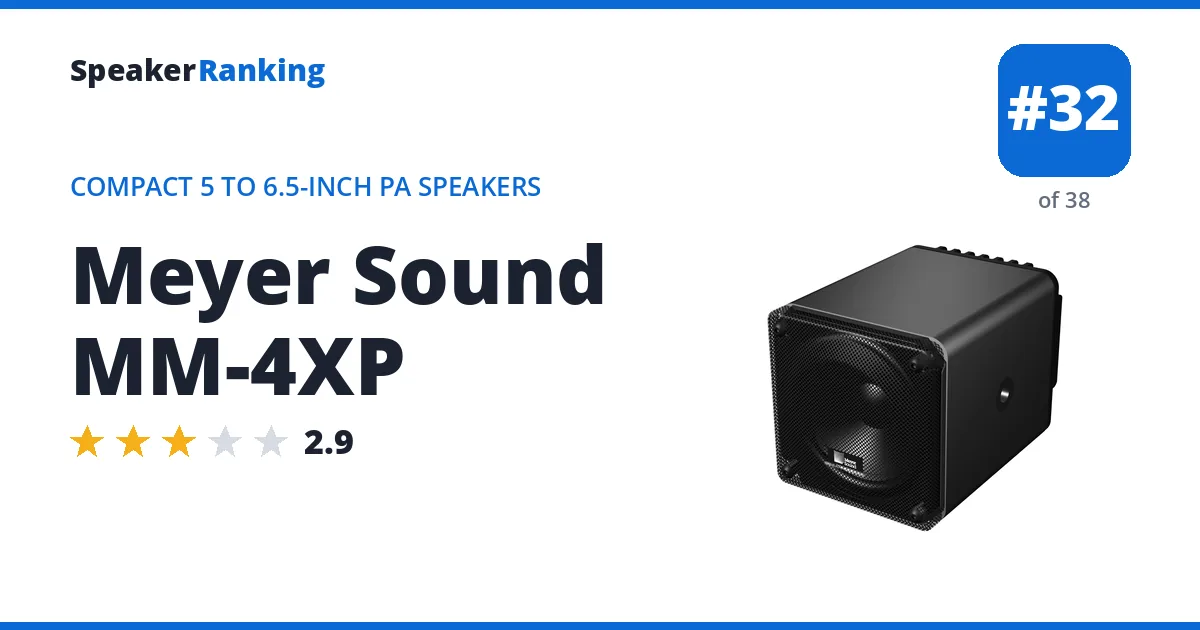
Pros: A 1.9kg self-powered speaker with a weatherproof aluminum body, made for hidden fills and under-balcony delays, with a smooth predicted in-room response for its size. Measured bass extension of 159.7Hz (-3dB).
Cons: High-quality manufacturer measurements give preference scores of -1.0 standalone and 3.23 with an ideal subwoofer: bass stops near 160Hz (-3dB) and the single 4-inch driver beams in the treble, so the on-axis response is uneven (3.4dB average deviation). Maximum output is 111.5dB.
Full Meyer Sound MM-4XP review and specifications →
| Released | Sep 2007 (19 years ago) |
|---|---|
| AES Input | No |
| Amplifier Power | 440W Class D |
| Aux Input | No |
| Bass Extension (-10dB) | about 120.5Hz (measured, vendor Spinorama data) |
| Bass Extension (-3dB) | 159.7Hz (measured, vendor Spinorama data) |
| Bluetooth | No |
| Coaxial Input | No |
| Configuration | Self-powered full-range miniature loudspeaker |
| DSP | Yes |
| Drivers | 4” full-range driver |
| Frequency Response | 120Hz - 18kHz (manufacturer specified) |
| Guitar Input | No |
| HDMI Input | No |
| Maximum SPL | 111.5dB peak (M-Noise, manufacturer specified) |
| Microphone Input | No |
| Optical Input | No |
| Passive | No |
| RCA Input | No |
| Rigging | 2 x 3/8-16 side inserts |
| Spinorama Preference Score | -1.00 |
| Spinorama Preference Score with Perfect Sub | 3.23 |
| TRS Input | No |
| USB Input | No |
| Weight | 4.2 lbs (1.9 kg) |
| XLR Input | Yes |
- Links
- Reviews, Comparisons and Sound Samples
 #33 Tannoy VX6: $778.00 per pair Passive B&H Photo Video $778.00 eBay
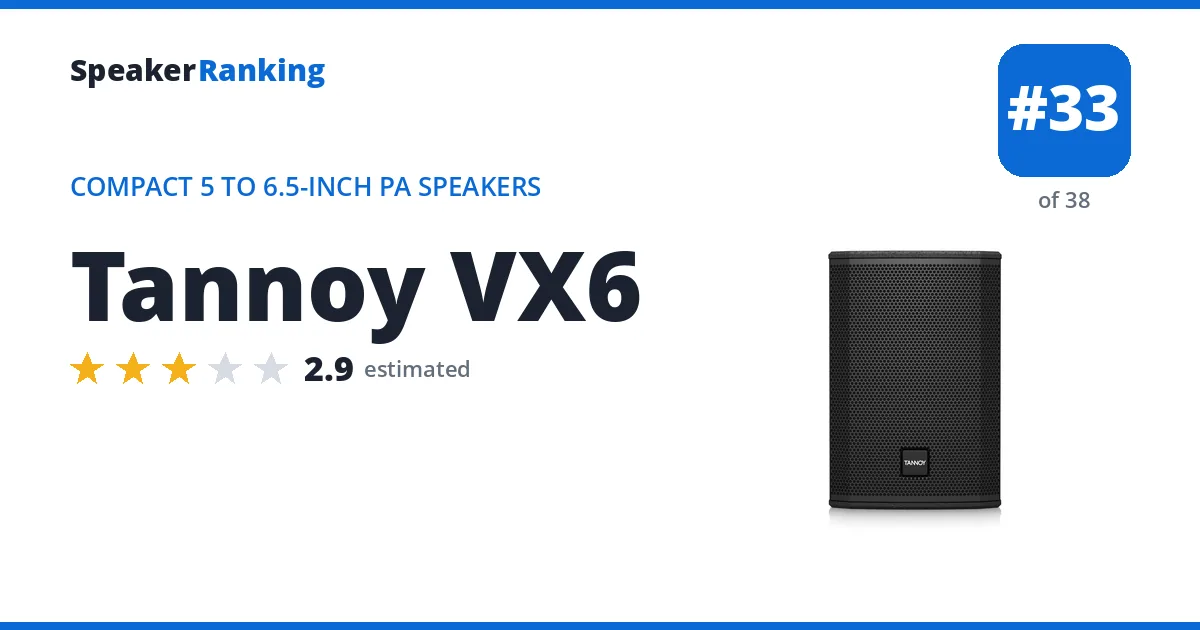
Same family: the Tannoy VX8 (larger model, estimated 3/5), the Tannoy VX12 (larger model, rated 3.1/5) and the Tannoy VX15HP (larger model, estimated 3.1/5).
Pros: A passive model from Tannoy’s VX range alongside the measured Tannoy VX12: the 6” model, for background music, speech and small stages. Every VX uses a Dual Concentric driver with the tweeter in the center of the woofer, so the sound comes from one point and stays consistent off axis. Tannoy rates it at 91dB sensitivity and 117dB peak / 111dB average.
Cons: No independent measurements yet, so it can’t be compared with ranked PA speakers. It needs an external amplifier, ideally with Tannoy’s recommended EQ, and US dealers list it as a special order with long lead times.
Full Tannoy VX6 review and specifications →
| Amplifier Power | Passive speaker; requires external amplification |
|---|---|
| Bass Extension (-3dB) | 80Hz (manufacturer specified) |
| Bluetooth | No |
| Configuration | Passive Dual Concentric PA speaker |
| DSP | No (passive) |
| Drivers | 6” Dual Concentric driver |
| Frequency Response | 80Hz - 45kHz (-3dB), 65Hz (-10dB) (manufacturer specified) |
| Impedance | 8 ohms |
| Maximum SPL | 117dB peak / 111dB average (manufacturer specified) |
| Passive | Yes |
| Power Handling | 100W average / 520W peak |
| Rigging | 2 x M6 yoke and 4 x M6 inserts; pole mount |
| Sensitivity | 91dB |
| Weight | 12.1 lbs (5.5 kg) |
| XLR Input | No |
- Links
- Reviews, Comparisons and Sound Samples
- No independent measurement review is linked for this model; it is ranked from hands-on listening and comparison against similarly priced speakers.
- Head-to-Head Comparisons
 #34 Biamp Community V2-6 Passive eBay
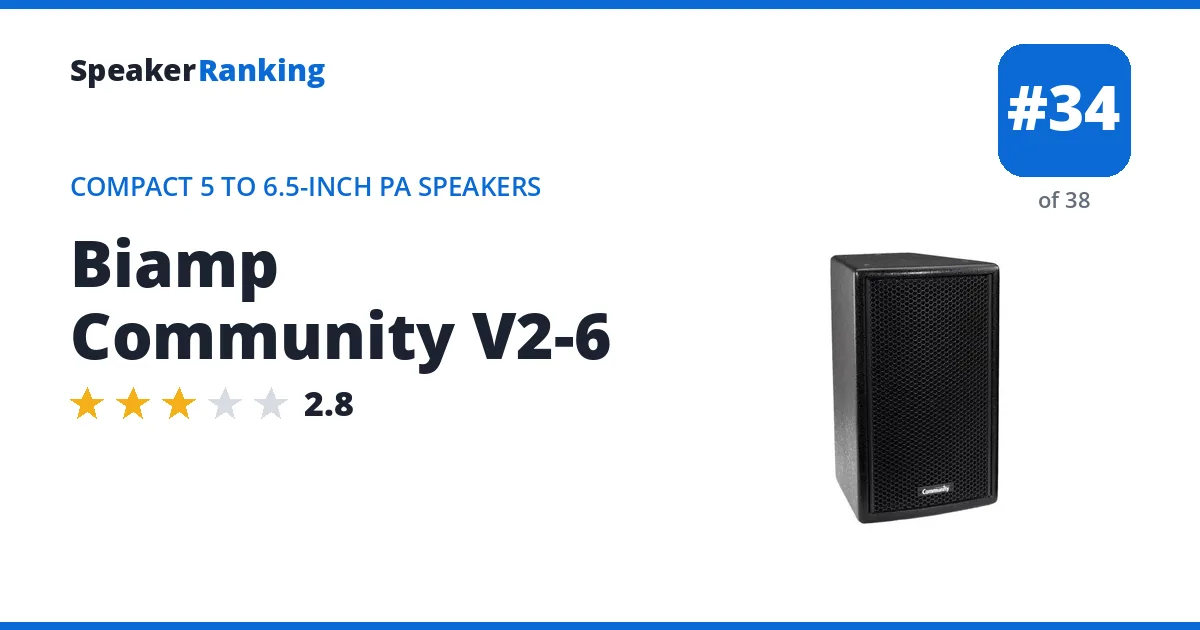
Same family: the Biamp Community V2-26 (larger model, ranked lower, rated 2.8/5), the Biamp Community V2-8 (larger model, rated 2.7/5), the Biamp Community V2-28 (larger model, rated 2.4/5), the Biamp Community V2-3294 (larger model, rated 2.7/5) and the Biamp Community V2-3594 (larger model, rated 2.7/5).
Pros: A compact installation speaker with a smooth on-axis response (0.79dB average deviation in vendor measurements) and 92dB sensitivity for speech and background music. Measured bass extension of 118Hz (-3dB).
Cons: Bass stops near 118Hz (-3dB), so it scores -0.53 standalone and 3.08 with an ideal subwoofer, and the listening window spreads across 6.2dB. Power handling is only 100W. It is passive and sold through installation dealers.
Full Biamp Community V2-6 review and specifications →
| AES Input | No |
|---|---|
| Amplifier Power | Passive speaker; requires external amplification |
| Aux Input | No |
| Bass Extension (-10dB) | about 80.8Hz (measured, vendor Spinorama data) |
| Bass Extension (-3dB) | 118Hz (measured, vendor Spinorama data) |
| Bluetooth | No |
| Coaxial Input | No |
| Configuration | Passive 2-way installation PA speaker |
| DSP | No (passive) |
| Drivers | 6.5” woofer, compression driver |
| Frequency Response | 90Hz - 18kHz (operating range) |
| Guitar Input | No |
| HDMI Input | No |
| Impedance | 8 ohms |
| Maximum SPL | 118dB peak (manufacturer specified) |
| Microphone Input | No |
| Optical Input | No |
| Passive | Yes |
| Power Handling | 100W continuous at 8 ohms |
| RCA Input | No |
| Rigging | 9 x M6 rigging points; 4 x M6 points for V-HSS suspension |
| Sensitivity | 92dB |
| Spinorama Preference Score | -0.53 |
| Spinorama Preference Score with Perfect Sub | 3.08 |
| TRS Input | No |
| USB Input | No |
| Weight | 19.6 lbs (8.9 kg) |
| XLR Input | No |
- Reviews, Comparisons and Sound Samples
 #35 Biamp Community V2-26 Passive eBay
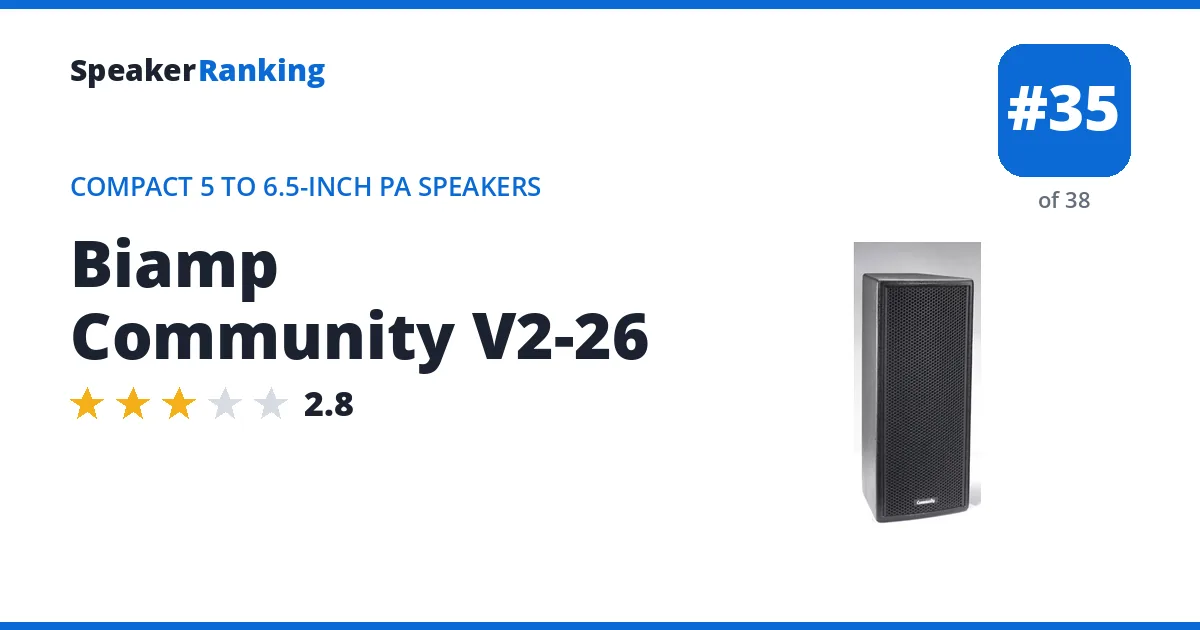
Same family: the Biamp Community V2-6 (smaller model, ranked higher, rated 2.8/5), the Biamp Community V2-8 (larger model, rated 2.7/5), the Biamp Community V2-28 (larger model, rated 2.4/5), the Biamp Community V2-3294 (larger model, rated 2.7/5) and the Biamp Community V2-3594 (larger model, rated 2.7/5).
Pros: Two 6.5-inch woofers reach 98Hz at -3dB and about 67Hz at -10dB in vendor measurements, with a smooth on-axis response (0.45dB average deviation) and a listening window within 3.8dB. Measured bass extension of 97.5Hz (-3dB).
Cons: Preference scores of -0.46 standalone and 2.95 with an ideal subwoofer are low, and the narrow vertical pattern suits only speakers aimed straight at the audience. It is passive, needs a 4 ohm capable amplifier, and is sold through installation dealers.
Full Biamp Community V2-26 review and specifications →
| AES Input | No |
|---|---|
| Amplifier Power | Passive speaker; requires external amplification |
| Aux Input | No |
| Bass Extension (-10dB) | about 67.1Hz (measured, vendor Spinorama data) |
| Bass Extension (-3dB) | 97.5Hz (measured, vendor Spinorama data) |
| Bluetooth | No |
| Coaxial Input | No |
| Configuration | Passive 2-way installation PA speaker |
| DSP | No (passive) |
| Drivers | 2 x 6.5” woofers, compression driver |
| Frequency Response | 70Hz - 18kHz (operating range) |
| Guitar Input | No |
| HDMI Input | No |
| Impedance | 4 ohms |
| Maximum SPL | 121dB peak (manufacturer specified) |
| Microphone Input | No |
| Optical Input | No |
| Passive | Yes |
| Power Handling | 200W continuous at 4 ohms |
| RCA Input | No |
| Rigging | 9 x M6 rigging points; 4 x M6 points for V-HSS suspension |
| Sensitivity | 92dB |
| Spinorama Preference Score | -0.46 |
| Spinorama Preference Score with Perfect Sub | 2.95 |
| TRS Input | No |
| USB Input | No |
| Weight | 28 lbs (12.7 kg) |
| XLR Input | No |
- Reviews, Comparisons and Sound Samples
 #36 Attack Audio VSH206 eBay
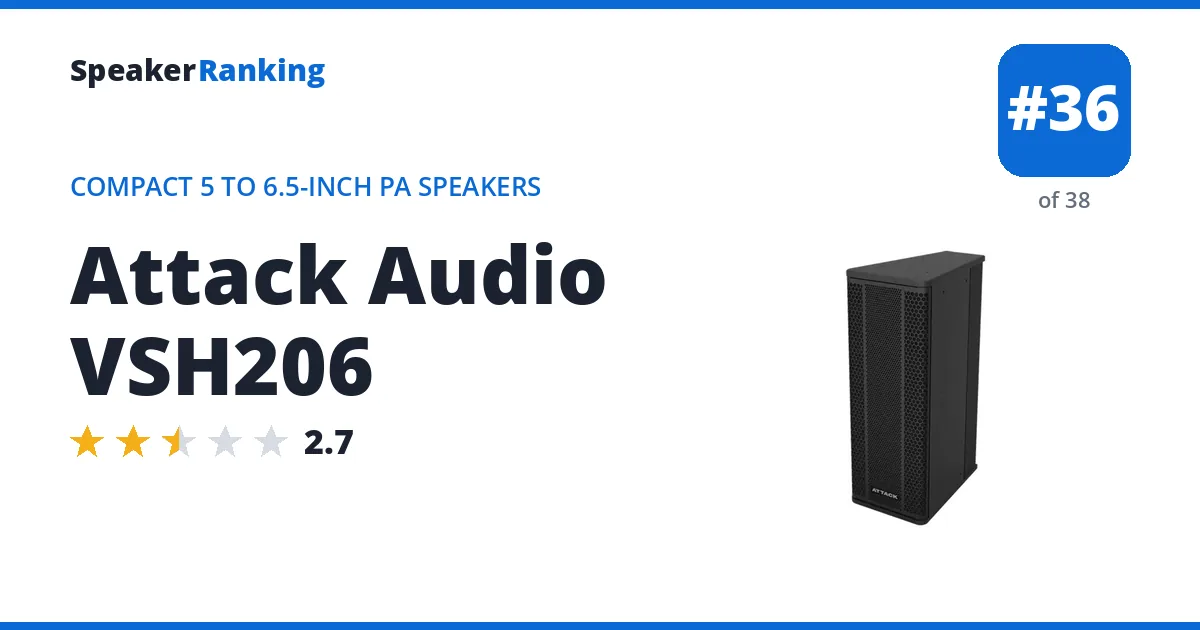
Pros: A 129dB peak from two 6-inch woofers and 765W of built-in power, with a smooth on-axis response (0.6dB average deviation in vendor measurements) and wide 100° horizontal coverage. Measured bass extension of 115Hz (-3dB).
Cons: Bass rolls off at 115Hz (-3dB), so it scores -0.98 standalone and 2.68 with an ideal subwoofer and needs a subwoofer for music. The narrow 15° vertical pattern needs careful aiming. It is sold mainly in Brazil.
Full Attack Audio VSH206 review and specifications →
| AES Input | No |
|---|---|
| Amplifier Power | 765W RMS |
| Aux Input | No |
| Bass Extension (-10dB) | about 87.4Hz (measured, vendor Spinorama data) |
| Bass Extension (-3dB) | 115Hz (measured, vendor Spinorama data) |
| Bluetooth | No |
| Coaxial Input | No |
| Configuration | Active 2-way PA speaker |
| Coverage | 100° x 15° |
| DSP | Yes |
| Dimensions | 24.4”H x 9.3”W x 14.7”D (620 x 236 x 373 mm) |
| Drivers | 2 x 6” woofers, compression driver |
| Frequency Response | 100Hz - 20kHz (-6dB, manufacturer specified) |
| Guitar Input | No |
| HDMI Input | No |
| Maximum SPL | 129dB peak (manufacturer specified) |
| Microphone Input | No |
| Optical Input | No |
| Passive | No |
| RCA Input | No |
| Spinorama Preference Score | -0.98 |
| Spinorama Preference Score with Perfect Sub | 2.68 |
| TRS Input | No |
| USB Input | No |
| Weight | 44.8 lbs (20.3 kg) |
| XLR Input | Yes |
- Links
- Reviews, Comparisons and Sound Samples
 #37 Novacoustic KIRA 5 Passive eBay
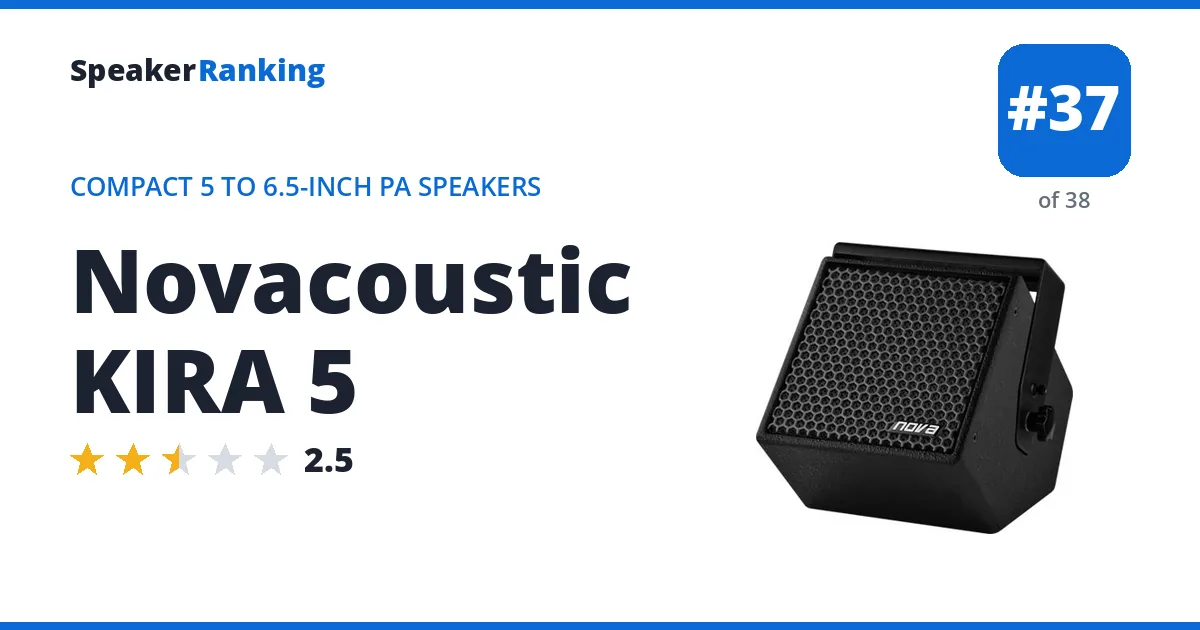
Same family: the Novacoustic KIRA 8 (larger model, rated 2.5/5), the Novacoustic KIRA 10 (larger model, rated 2/5) and the Novacoustic KIRA 12 (larger model, rated 2.7/5).
Pros: A 3kg coaxial speaker with wide 90° conical coverage and a 16 ohm load that lets several share an amplifier channel. Measured bass extension of 145Hz (-3dB).
Cons: Bass stops near 145Hz (-3dB) and the on-axis response is uneven (1.36dB average deviation), so vendor measurements give preference scores of -1.81 standalone and 2.17 with an ideal subwoofer. It needs a subwoofer and is passive.
Full Novacoustic KIRA 5 review and specifications →
| AES Input | No |
|---|---|
| Amplifier Power | Passive speaker; requires external amplification |
| Aux Input | No |
| Bass Extension (-10dB) | about 105.0Hz (measured, vendor Spinorama data) |
| Bass Extension (-3dB) | 145Hz (measured, vendor Spinorama data) |
| Bluetooth | No |
| Coaxial Input | No |
| Configuration | Passive 2-way coaxial PA speaker |
| Coverage | 90° x 90° |
| DSP | No (passive) |
| Dimensions | 6.3”H x 6.3”W x 7.1”D (160 x 160 x 180 mm) |
| Drivers | 5” coaxial driver |
| Frequency Response | 95Hz - 18kHz (±3dB, manufacturer specified) |
| Guitar Input | No |
| HDMI Input | No |
| Impedance | 16 ohms |
| Maximum SPL | 117dB peak (manufacturer specified) |
| Microphone Input | No |
| Optical Input | No |
| Passive | Yes |
| Power Handling | 150W RMS |
| RCA Input | No |
| Rigging | 2 x M10 inserts with U-bracket; optional stand adapter |
| Sensitivity | 92dB |
| Spinorama Preference Score | -1.81 |
| Spinorama Preference Score with Perfect Sub | 2.17 |
| TRS Input | No |
| USB Input | No |
| Weight | 6.6 lbs (3 kg) |
| XLR Input | No |
- Links
- Reviews, Comparisons and Sound Samples
- Head-to-Head Comparisons
 #38 Turbosound TCS62 Passive Discontinued eBay
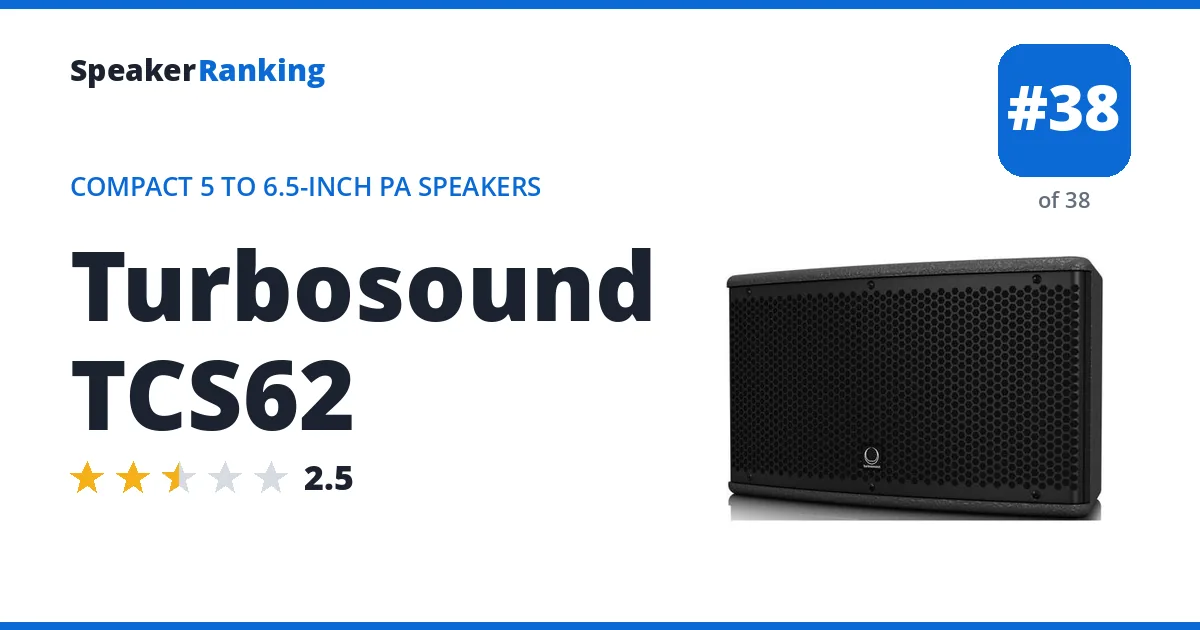
Same family: the Turbosound TCS122 (larger model, rated 2.6/5) and the Turbosound TCS152 (larger model, rated 3.2/5).
Pros: Bass reaches about 45Hz at -3dB in vendor measurements, unusually deep for a 6.5-inch speaker, in a 6.9kg cabinet. Measured bass extension of 45Hz (-3dB).
Cons: Preference scores of 0.43 standalone and 2.05 with an ideal subwoofer are low, with an uneven on-axis response (2.13dB average deviation) and inconsistent off-axis tone. It is passive and discontinued, so it is mainly found used.
Full Turbosound TCS62 review and specifications →
| AES Input | No |
|---|---|
| Amplifier Power | Passive speaker; requires external amplification |
| Aux Input | No |
| Bass Extension (-10dB) | about 33.2Hz (measured, vendor Spinorama data) |
| Bass Extension (-3dB) | 45Hz (measured, vendor Spinorama data) |
| Bluetooth | No |
| Coaxial Input | No |
| Configuration | Passive 2-way PA speaker |
| Coverage | 100° x 60° (rotatable) |
| DSP | No (passive) |
| Dimensions | 15.8”H x 8.8”W x 7.8”D (402 x 224 x 198 mm) |
| Drivers | 6.5” woofer, compression driver on a rotatable waveguide |
| Frequency Response | 60Hz - 20kHz (±3dB, manufacturer specified) |
| Guitar Input | No |
| HDMI Input | No |
| Maximum SPL | 118.5dB peak (manufacturer specified) |
| Microphone Input | No |
| Optical Input | No |
| Passive | Yes |
| RCA Input | No |
| Rigging | 8 x M8 and 2 x M6 inserts |
| Sensitivity | 90dB |
| Spinorama Preference Score | 0.43 |
| Spinorama Preference Score with Perfect Sub | 2.05 |
| TRS Input | No |
| USB Input | No |
| Weight | 15.2 lbs (6.9 kg) |
| XLR Input | No |
- Reviews, Comparisons and Sound Samples