Editor's top picks
Start with these speakers
Our leading recommendations at a glance. Each card links to its primary retailer.
Not sure which powered speakers to buy? Powered (active) speakers have the amplifier built in, which removes a whole layer of decisions and usually gets you more performance per dollar. This guide covers the four that remain: what job they’re doing, which inputs you need, whether active is right at all, and budget. These picks come from the 194 powered speakers ranked here.
Prices on this page were last checked September 22, 2026 at 5:11 AM UTC. Product prices and availability are accurate as of that date/time and are subject to change; the price and availability shown on Amazon at the time of purchase will apply to the purchase of this product.
As an eBay Partner, we may be compensated if you make a purchase.
Step 1: Pick The Job First
“Powered speaker” covers three quite different products, and the right pick for one is the wrong pick for another.
A computer desk. Nearfield listening at arm’s length. You want compact cabinets, a front volume knob, and clean output at low levels far more than deep bass. See best powered speakers for a desk.
A room, as an all-in-one system. One box or a stereo pair that streams over Wi-Fi and plays without a computer. Convenience and app support matter as much as measurements. See best Wi-Fi and streaming powered speakers.
Mixing, mastering, or critical listening. You want the flattest measured response you can afford, balanced inputs, and no flattery. See best studio monitors.
Buying a studio monitor for a kitchen or a lifestyle speaker for a mixing desk is the most common mismatch in this category, and both are expensive ways to be disappointed.
Step 2: Check The Inputs Before Anything Else
Inputs are pass or fail, and powered speakers vary far more than people expect. From the specs across the powered speakers ranked here:
- RCA is the most common line input and what most sources expect.
- XLR and TRS are balanced connections, standard on studio monitors and rare elsewhere. They reject noise over long cable runs.
- Bluetooth is on roughly three-quarters of the non-studio models and almost none of the studio ones.
- Wi-Fi is on 27 of them, and is what you need for AirPlay, Chromecast or multi-room.
- Optical and coaxial digital show up on a handful, mostly the Edifier and lifestyle models, and are the simplest way to connect a TV.
- HDMI is genuinely rare, only a small group of models have it. If you want one box for a TV with ARC, that constraint alone decides your shortlist; see the best powered speakers for TV with HDMI ARC.
- A genuine built-in voice assistant is rare too, and mostly limited to Google’s own Nest and Home lineup plus a handful of Wi-Fi lifestyle speakers. Most “smart” claims on other speakers just mean Bluetooth from a phone that has an assistant, not a microphone on the speaker itself. See every powered speaker with a built-in voice assistant.
- A headphone output is also uncommon. If you want to plug headphones into the speaker and mute the desktop pair without rewiring your source, see the best powered speakers with a headphone output.
- No powered speaker ranked here has a phono input. Connecting a turntable means a phono preamp somewhere in the chain, see best powered speakers for a turntable.
Step 3: Decide Whether Powered Is Right At All
Powered speakers win on value and simplicity. The amplifier is matched to the drivers, there’s active crossover and DSP correction in most modern designs, and you buy one thing instead of three.
They lose on upgradeability and lifespan. The amplifier and DSP are inside the cabinet, so a failed amp is a dead speaker and there’s no path to a better one later. Passive speakers separate those concerns, and a good passive pair can outlive several amplifiers.
Choose powered if you want the best sound per dollar with the least fuss, especially under $1,000. Choose passive if you already own an amplifier, want to upgrade in stages, or want something you’ll keep for twenty years. See the passive speaker buyer’s guide.
Step 4: Set The Budget
The value curve here is steep at the bottom and flat after about $600 a pair. Under $150 you can get genuinely accurate desktop sound. Between $250 and $500 you reach studio monitors that measure well enough for professional work. Past roughly $2,000 you’re buying diminishing refinements, larger drivers and better cabinets.
Start at best budget powered speakers if price is the constraint.
The Picks, In Short
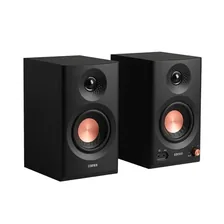 The best powered speaker for most people who want great sound without spending much is the Edifier MR3: $109.99 per pair Amazon eBay
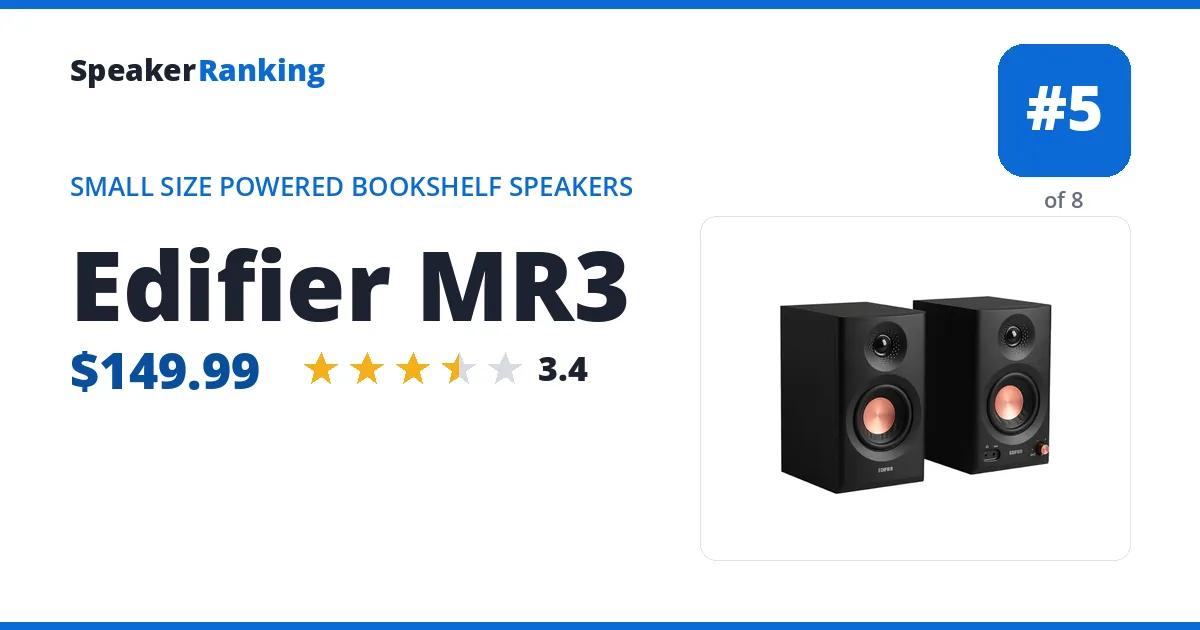
Pros: Erin’s measurements show little overall tilt across the listening window, helping voices retain a broadly natural balance at a desk. Scores of 3.01 standalone and 5.63 with an ideal subwoofer support it as a useful budget nearfield option rather than a reference monitor. Tone controls and app-based EQ provide unusually flexible adjustment, and its bass extends farther than the Fostex PM03’s. Measured bass extension of 60Hz (-3dB), with a measured sensitivity of 83.3dB.
Cons: Local response ripples remain: the measured 300Hz-5kHz span is 4.5dB and listening-window narrow-band deviation is 0.538. Bass reaches -3dB at about 70Hz. The limiter protects the drivers but prevents much extra loudness when pushed; existing compression testing puts effective single-speaker output around 86-87dB at 1m. Vertical crossover interference makes tweeter height and tilt important.
Full Edifier MR3 review and specifications →
| AES Input | No |
|---|---|
| Amplifier Power | 36W total (18W per speaker) |
| App | No |
| Aux Input | Yes |
| Bass Extension (-10dB) | 52Hz (measured, Erin's Audio Corner) |
| Bass Extension (-3dB) | 60Hz (measured, Erin's Audio Corner) |
| Bluetooth | Yes |
| Bluetooth Codecs | SBC |
| Bluetooth Version | 5.4 |
| Coaxial Input | No |
| Dimensions | 5.9"H x 3.7"W x 5.9"D (149.9 x 94 x 149.9 mm) |
| Drivers | 3" woofer, 0.75" silk dome tweeter |
| EQ | Yes (Bass/Treble) |
| Frequency Response | 60Hz - 20kHz (Manufacturer specified) |
| HDMI Input | No |
| Inputs | Bluetooth, Aux, RCA |
| Maximum SPL | 93dB @ 1m (manufacturer specified) |
| Optical Input | No |
| RCA Input | Yes |
| Sensitivity | 83.3dB (measured at 0.3V/1m, Erin's Audio Corner) |
| Spinorama Preference Score | 3.01 |
| Spinorama Preference Score with Perfect Sub | 5.63 |
| TRS Input | No |
| USB Input | No |
| Weight | 6.6 lbs (3 kg) |
| XLR Input | No |
- Links
- Reviews, Comparisons and Sound Samples
- Head-to-Head Comparisons
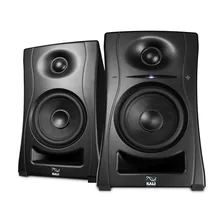 The best value studio monitor, and the pick for a desk if you have a little more room, is the Kali LP-UNF: $349.00 per pair Amazon eBay
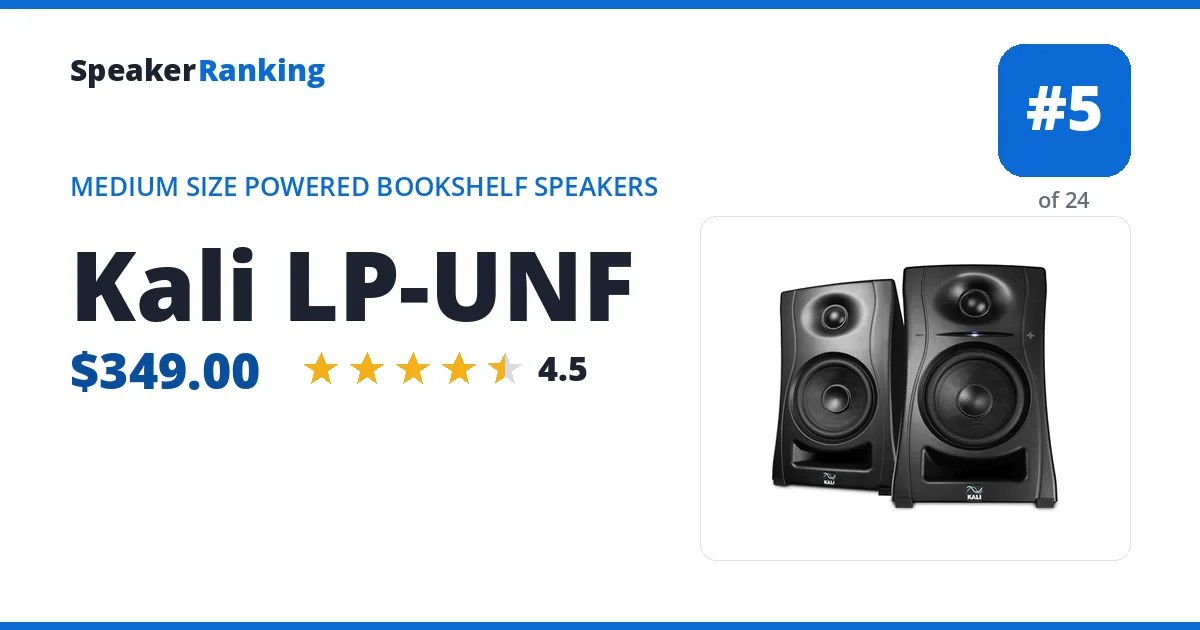
Pros: A practical compact desktop system with USB-C, analog inputs and Bluetooth, plus extensive placement switches. Erin’s Klippel data gives -3dB bass around 54Hz and scores of 3.68 standalone and 5.76 with an ideal subwoofer. The low crossover and waveguide provide useful freedom of listening height for a two-way design, and moderate-level distortion is well controlled in the review. Measured bass extension of 54Hz (-3dB), with a measured sensitivity of 88.1dB.
Cons: The 2.9dB midrange span masks local response ripples; listening-window narrow-band deviation of 0.467 is behind the best monitors. The review finds limiting around 91dB/1m per speaker. No dedicated subwoofer output means integration requires suitable external routing or bass management. Its strength is affordable close listening, not top-tier tonal accuracy or high-output room playback.
Full Kali LP-UNF review and specifications →
| AES Input | No |
|---|---|
| Amplifier Power | 160W total (Class D, 2-channel bi-amped) |
| App | No |
| Aux Input | No |
| Bass Extension (-10dB) | 39Hz (measured, Erin's Audio Corner) |
| Bass Extension (-3dB) | 54Hz (measured, Erin's Audio Corner) |
| Bluetooth | No |
| Coaxial Input | No |
| Dimensions | 10"H x 6.5"W x 7.4"D (254 x 165 x 188 mm) |
| Drivers | 4.5" woofer, 1" Textile Dome tweeter |
| EQ | No |
| Frequency Response | 39Hz - 25kHz (-10dB) (Manufacturer specified) |
| HDMI Input | No |
| Inputs | Bluetooth, USB-C (digital), RCA, TRS |
| Optical Input | No |
| RCA Input | Yes |
| Sensitivity | 88.1dB (measured at 0.3V/1m, Erin's Audio Corner) |
| Spinorama Preference Score | 3.68 |
| Spinorama Preference Score with Perfect Sub | 5.76 |
| TRS Input | Yes |
| USB Input | Yes |
| Weight | 17.2 lbs (7.8 kg) |
| XLR Input | No |
- Links
- Reviews, Comparisons and Sound Samples
- Erin’s Audio Corner Review Measurements More from Erin’s Audio Corner →
- Erin’s Audio Corner: The Perfect Desktop Speaker? Kali LP-UNF.
- Erin’s Audio Corner: The Best Budget Desktop Speakers, Tested & Rated
- Erin’s Audio Corner: My Absolute Favorite Products of 2024 Revealed
- Erin’s Audio Corner: 10 Great (and Terrible) Speakers Under $300!
- Erin’s Audio Corner Measurements (spinorama.org)
- Jasper Tech: Best Desktop Computer Speakers for Every Budget – 2026 More from Jasper Tech →
- Jasper Tech: Are the iLoud Micro Monitor Pro the Best Studio Monitor Speakers for your Home Studio?
- Head-to-Head Comparisons
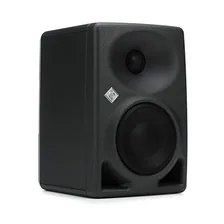 The best studio monitor for critical work at a sane price is the Neumann KH80 DSP: $598.98 per pair Amazon B&H Photo Video eBay
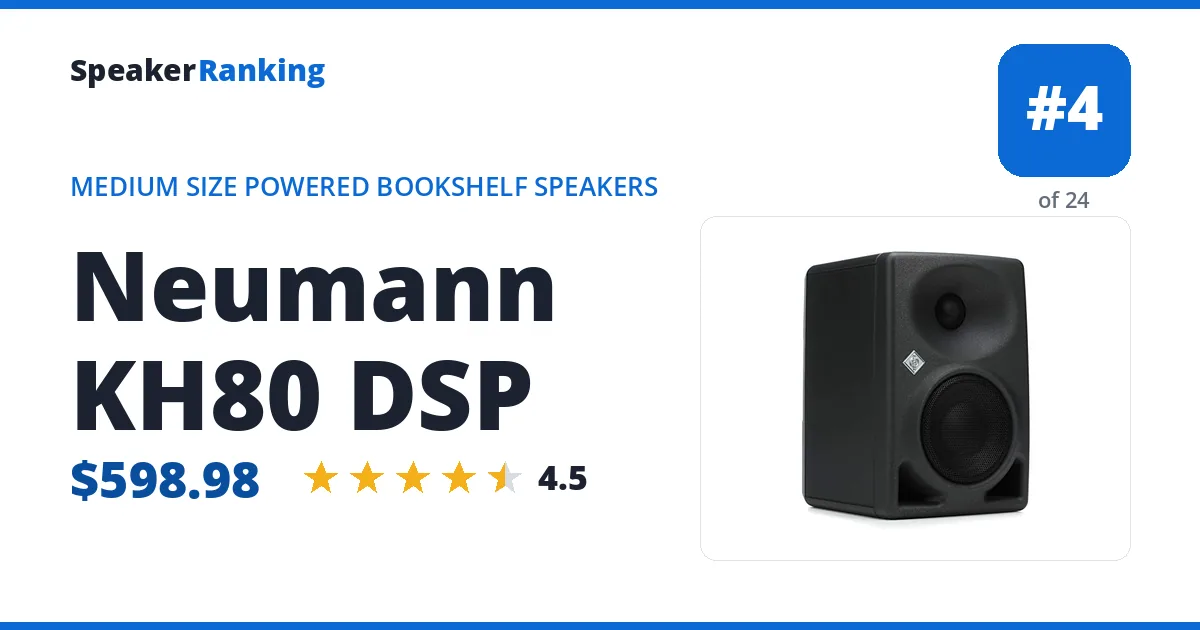
Pros: ASR’s selected Klippel measurement has a 1.4dB midrange response span and virtually no overall on-axis tilt. Scores of 5.03 standalone and 7.39 with an ideal subwoofer indicate excellent tonal accuracy in a compact monitor. The waveguide and steep crossover provide useful control of reflected sound, while placement filters help compensate for a desk or nearby boundaries. Existing multitone testing supports good moderate-level clarity. Measured bass extension of 57Hz (-3dB), with a measured sensitivity of 91.9dB.
Cons: Bass reaches -3dB around 59Hz in this measurement, less deep than the KH120 II. Output protection and increasing multitone distortion limit loud listening, especially in the bass. Room reflections and listening distance can alter perceived treble balance despite its flat direct response. Calibration equipment adds to the cost; the preference score is not a measurement of maximum clean output.
Full Neumann KH80 DSP review and specifications →
| AES Input | No |
|---|---|
| Amplifier Power | 140W (90W woofer + 50W tweeter) |
| App | Yes (MA 1 alignment) |
| Aux Input | No |
| Bass Extension (-10dB) | 51Hz (measured, Erin's Audio Corner) |
| Bass Extension (-3dB) | 57Hz (measured, Erin's Audio Corner) |
| Bluetooth | No |
| Coaxial Input | No |
| DSP | Yes |
| Dimensions | 13.6"H x 10.8"W x 9.6"D (345.4 x 274.3 x 243.8 mm) |
| Drivers | 4.1" woofer, 1" fabric dome tweeter |
| EQ | Yes (via DSP) |
| Frequency Response | 57 Hz - 25 kHz (+-3 dB) (Manufacturer specified) |
| HDMI Input | No |
| Inputs | XLR |
| Maximum SPL | 110.7dB @ 1m (manufacturer specified) |
| Optical Input | No |
| RCA Input | No |
| Sensitivity | 91.9dB (measured at 0.3V/1m, Erin's Audio Corner) |
| Spinorama Preference Score | 5.03 |
| Spinorama Preference Score with Perfect Sub | 7.39 |
| TRS Input | No |
| USB Input | No |
| Weight | 9 lbs (4.1 kg) each |
| XLR Input | Yes |
- Links
- Reviews, Comparisons and Sound Samples
- Erin’s Audio Corner: Neumann KH 80 Studio Monitor Review. Excellent Performance. Small Size. More from Erin’s Audio Corner →
- Erin’s Audio Corner Review Measurements
- Audio Science Review Measurements More from Audio Science Review →
- DSAUDIO.review: Neumann KH80 DSP vs Genelec 8020D Sound & Frequency Response Comparison More from DSAUDIOreview →
- DSAUDIO.review: Neumann KH80 DSP vs Yamaha HS8 Sound & Frequency Response Comparison
- DSAUDIO.review: Neumann KH80 DSP vs Focal Shape 40 Sound & Frequency Response Comparison
- DSAUDIO.review: Neumann KH80 DSP vs IK Multimedia iLoud MTM Sound & Frequency Response Comparison
- DSAUDIO.review: Neumann KH80 DSP vs JBL 305P MKII Sound & Frquency Response Comparison
- DSAUDIO.review: KEF LSX vs Neumann KH80 DSP Sound & Frequency Response Comparison
- DSAUDIO.review: Adam Audio A3X vs Neumann KH80 DSP Sound & Frequency Response Comparison
- DSAUDIO.review: Neumann KH80 DSP vs KRK Rokit 5 G4 RP5G4 Sound & Frequency Response Comparison
- Joy & Oluv’Sone: 🎃🔥 UBoom X - Halloween Rock Special 🎸🤘 More from Oluv’Sone →
- Audio Science Review Measurements (spinorama.org)
- Head-to-Head Comparisons
- Neumann KH80 DSP vs Genelec 8030C
- Neumann KH80 DSP vs Reflector Audio Square Two
- Neumann KH80 DSP vs Neumann KH120 MKII
- Neumann KH80 DSP vs Dynaudio LYD 5
- Neumann KH80 DSP vs Genelec 8331A
- Neumann KH80 DSP vs Genelec 8330A
- Neumann KH80 DSP vs Genelec 8320A
- Neumann KH80 DSP vs Devialet Phantom II 98 dB
- See all 64 comparisons
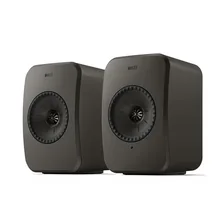 The best all-in-one powered speaker with Wi-Fi streaming for a room is the KEF LSX II LT: $549.99 per pair Amazon eBay
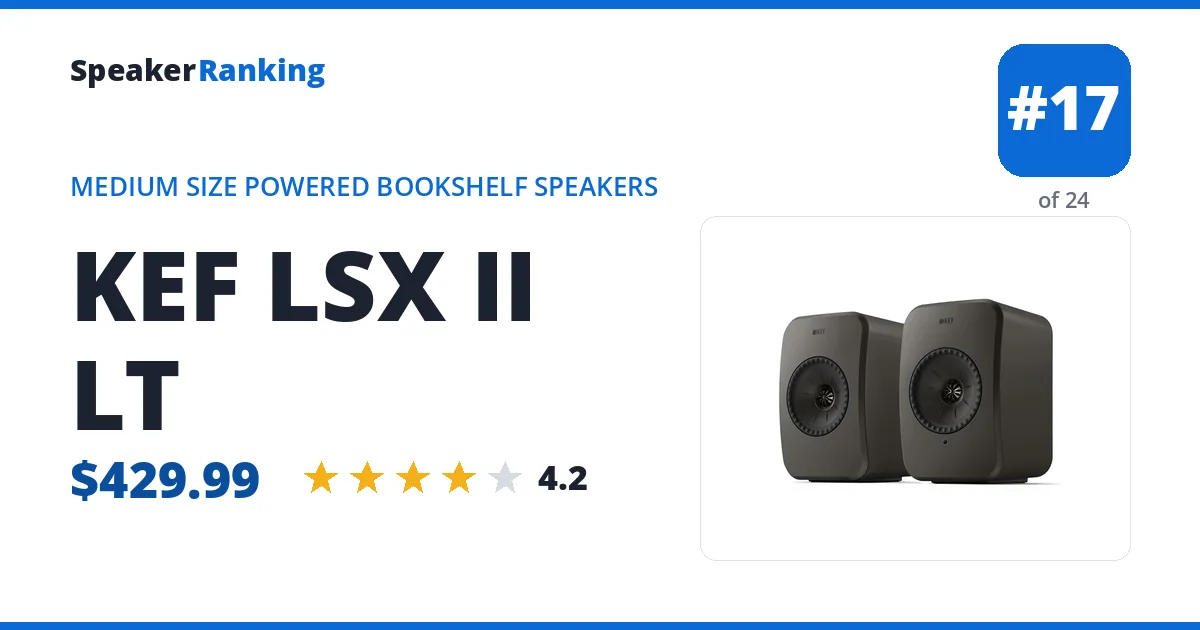
Pros: The coincident driver provides useful consistency across listening positions, and the app offers placement and subwoofer adjustments. Erin’s measurements give preference scores of 3.93 standalone and 6.16 with an ideal subwoofer, with -3dB bass around 56Hz. HDMI and USB connectivity make it convenient for a small TV or desktop system. Measured bass extension of 55Hz (-3dB), with a measured sensitivity of 84dB.
Cons: The 3.4dB midrange response span and treble-region dips keep it below more neutral monitors. The existing review finds bass compression around 88-92dB/1m and rising distortion at higher levels, so the small drivers suit close listening rather than a large room. This LT version has no analog input; a turntable cannot plug straight into it.
Full KEF LSX II LT review and specifications →
| AES Input | No |
|---|---|
| Amplifier Power | 100w RMS Per Speaker |
| App | No |
| Aux Input | No |
| Bass Extension (-10dB) | 46Hz (measured, Erin's Audio Corner) |
| Bass Extension (-3dB) | 55Hz (measured, Erin's Audio Corner) |
| Bluetooth | No |
| Coaxial Input | No |
| Dimensions | 9.5"H x 6.1"W x 7.1"D (241.3 x 154.9 x 180.3 mm) |
| Drivers | 115mm (4.5in.) magnesium/aluminium alloy cone woofer, 19mm (0.75in.) aluminium dome tweeter |
| EQ | No |
| Frequency Response | 54Hz - 28kHz (±3dB) (Manufacturer specified) |
| HDMI Input | Yes |
| Inputs | Wifi, USB-C, HDMI, Optical, Bluetooth |
| Optical Input | Yes |
| Outputs | RCA Subwoofer |
| RCA Input | No |
| Sensitivity | 84dB (measured at 0.3V/1m, Erin's Audio Corner) |
| Spinorama Preference Score | 3.26 |
| Spinorama Preference Score with Perfect Sub | 5.62 |
| Subwoofer Output | Yes |
| TRS Input | No |
| USB Input | Yes |
| Weight | 15 lbs (6.8 kg) |
| XLR Input | No |
- Links
- Reviews, Comparisons and Sound Samples
- Erin’s Audio Corner: Transform Your Sound System with the KEF LSX II LT Speaker More from Erin’s Audio Corner →
- Erin’s Audio Corner Website: KEF LSX II LT
- Erin’s Audio Corner Measurements (spinorama.org)
- Jasper Tech: Best Desktop Computer Speakers for Every Budget – 2026 More from Jasper Tech →
- Jasper Tech: Best Bookshelf Speakers For TV & Gaming - 2025
- Jasper Tech: Best Powered Bookshelf Speakers for Every Budget - 2025
- Head-to-Head Comparisons
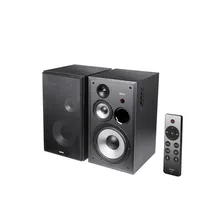 If you don't have size constraints and want the most speaker for the money, get the Edifier R2850DB: $499.99 per pair Amazon eBay
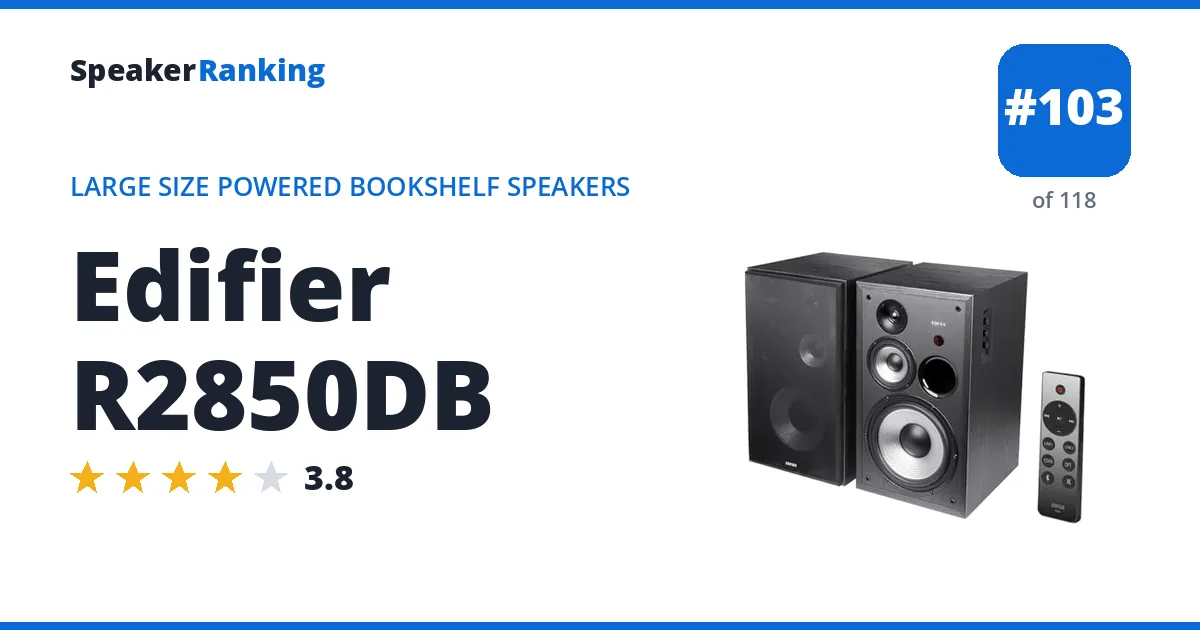
Pros: A large self-powered three-way pair with digital and analog source switching and proper left/right separation. Consumer Reports found accurate, detailed sound with strong, deep bass, a broad enough soundfield and enough clean output for a large room. It is a compelling simple system for TV, desktop or living-room music without buying a separate amplifier.
Cons: The big cabinets need real stand or furniture space, and their bass is slightly boomy. Consumer Reports also hears mildly grainy/hazy mids, subdued treble and a two-dimensional image despite the two cabinets. As an integrated system it is less upgradeable than separate passive speakers and an amplifier.
Full Edifier R2850DB review and specifications →
| AES Input | No |
|---|---|
| Amplifier Power | 75w RMS Per Speaker |
| App | No |
| Aux Input | No |
| Bluetooth | Yes, 5.1 |
| Bluetooth Codecs | SBC, aptX |
| Coaxial Input | Yes |
| DSP | No |
| Dimensions | 18.1"H x 10.1"W x 12.4"D (459.7 x 256.5 x 315 mm) |
| Drivers | 8" (203mm) woofer |
| EQ | No |
| Frequency Response | 42Hz-20kHz (-3dB) (Manufacturer specified) |
| HDMI Input | No |
| Inputs | Bluetooth, 2x RCA Input, Digital Optical, Digital Coax |
| Optical Input | Yes |
| RCA Input | Yes |
| TRS Input | No |
| USB Input | No |
| Weight | 50.7 lbs (23 kg) |
| XLR Input | No |
- Links
- Reviews, Comparisons and Sound Samples
- Head-to-Head Comparisons
- Edifier R2850DB vs Focal Twin6 Be
- Edifier R2850DB vs Presonus Eris Studio 8
- Edifier R2850DB vs Klipsch The Sevens
- Edifier R2850DB vs Kali Audio LP-8
- Edifier R2850DB vs Adam Audio T7V
- Edifier R2850DB vs Adam Audio T8V
- Edifier R2850DB vs Focal Alpha 65 EVO
- Edifier R2850DB vs Emotiva Airmotiv 6s
- See all 40 comparisons
Mistakes That Cost People Money
Buying on wattage. Amplifier power in a powered speaker is matched to the drivers by the designer, and the numbers aren’t comparable between brands. A 40 W active monitor routinely plays louder and cleaner than a 100 W passive pair on a cheap amp.
Forgetting the input you actually own. A turntable, a TV, and a laptop all want different connections. Check the spec table before you check the review.
Buying studio monitors for background listening. They’re designed to be unflattering at close range. In a large room at low volume, a lifestyle speaker with DSP loudness compensation is often the more enjoyable choice.
Ignoring the desk itself. Reflections off a desk surface and a nearby wall do more damage at a computer than the difference between two good monitors. Stands, angling, and a little space behind the speakers are free.
Where To Go Next
Full rankings with specs and measurements: powered bookshelf small, medium, large, desktop small, medium, large, and floorstanding.
By use: desk, headphone output, studio monitors, streaming, turntable, budget, plus the general top recommended powered speakers. Adding low end? See the subwoofer buyer’s guide.