Editor's top picks
Start with these speakers
Our leading recommendations at a glance. Each card links to its primary retailer.
Looking for powered speakers with a headphone output? A front headphone jack lets one desktop system handle both private and speaker listening without moving cables behind the desk. Every model below has a verified headphone output and built-in amplification; the recommendations are ordered by sound quality and overall usefulness, not by the presence of the jack alone.
This is a small category. A headphone jack is common on computers and audio interfaces but surprisingly uncommon on powered speakers. Also note the direction of the connection: a jack labeled headphone output sends sound from the speaker to headphones. It is different from a 3.5mm aux input, which accepts sound into the speaker.
Quick Navigation
- Best Overall
- Best Upgrade
- Best Under $100
- Best With Bluetooth Under $150
- Other Powered Speakers With Headphone Output
- What To Check Before Buying
- Where To Go Next
Prices on this page were last checked September 14, 2026 at 1:47 AM UTC. Product prices and availability are accurate as of that date/time and are subject to change; the price and availability shown on Amazon at the time of purchase will apply to the purchase of this product.
As an eBay Partner, we may be compensated if you make a purchase.
Best Overall
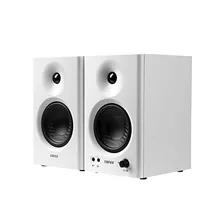 The best powered speakers with a headphone output for most desks are the Edifier MR4: $169.99 per pair Amazon eBay
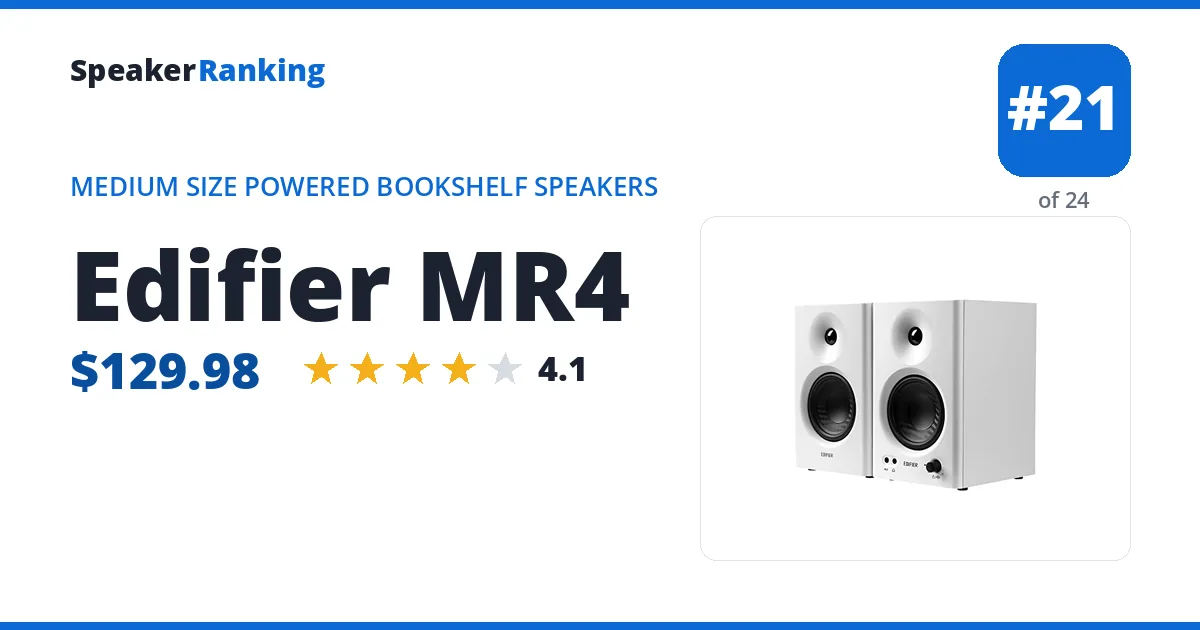
Pros: Erin’s data supports a useful budget desktop monitor: a 3.0dB midrange span, little overall on-axis tilt, and preference scores of 2.48 standalone and 5.23 with an ideal subwoofer. Balanced TRS inputs and tone controls are practical at its price, and its response is more balanced than the measured R1280T. Measured bass extension of 109Hz (-3dB), with a measured sensitivity of 78dB.
Cons: Bass reaches -3dB around 79Hz, so deep extension should not be inferred from the overall flat trend. Listening-window response still has local irregularities, including lower-treble unevenness. The existing review reports rapidly increasing distortion and audible distress when pushed well above moderate desktop levels. No Bluetooth, and adding a subwoofer does not cure every output or tonal limitation.
Full Edifier MR4 review and specifications →
| Amplifier Power | 42w RMS Per Speaker |
|---|---|
| App | No |
| Bass Extension (-10dB) | 58Hz (measured, Erin's Audio Corner) |
| Bass Extension (-3dB) | 109Hz (measured, Erin's Audio Corner) |
| Bluetooth | No |
| Dimensions | 9"H x 5.5"W x 7.6"D (228.6 x 139.7 x 193 mm) |
| Drivers | 4" (102mm) woofer |
| EQ | No |
| Frequency Response | 60 Hz-20 kHz (-3dB) (Manufacturer specified) |
| Headphone Output | Yes |
| Inputs | TRS Balanced, RCA, Aux |
| Outputs | Headphone |
| Sensitivity | 78dB (measured at 0.3V/1m, Erin's Audio Corner) |
| Spinorama Preference Score | 2.48 |
| Spinorama Preference Score with Perfect Sub | 5.23 |
| Weight | 9.9 lbs (4.5 kg) |
- Links
- Reviews, Comparisons and Sound Samples
- Erin’s Audio Corner Review Measurements More from Erin’s Audio Corner →
- Audio Science Review Measurements More from Audio Science Review →
- DSAUDIO.review: DSAUDIO.review Edifier MR4 vs Edifier R1280DBs sound.DEMO More from DSAUDIOreview →
- DSAUDIO.review: DSAUDIO.review Edifier MR4 vs Edifier R1700BT sound.DEMO
- DSAUDIO.review: DSAUDIO.review Edifier MR4 vs JBL 305P MKII sound.DEMO
- DSAUDIO.review: DSAUDIO.review Edifier MR4 vs Presonus Eris E3.5 sound.DEMO
- DSAUDIO.review: DSAUDIO.review Edifier MR4 vs iLoud Micro Monitor sound.DEMO
- DSAUDIO.review: DSAUDIO.review Edifier MR4 vs Presonus Eris E4.5 sound.DEMO
- DSAUDIO.review: DSAUDIO.review Edifier MR4 vs Mackie CR4-X sound.DEMO
- Erin’s Audio Corner Measurements (spinorama.org)
- Jasper Tech: Best Desktop Computer Speakers for Every Budget – 2026 More from Jasper Tech →
- Jasper Tech: Are the iLoud Micro Monitor Pro the Best Studio Monitor Speakers for your Home Studio?
- Head-to-Head Comparisons
The MR4 has the best measured tonal performance of the qualifying budget models. Its 2.48 Spinorama Preference Score rises to 5.23 with an ideal subwoofer, while balanced TRS, RCA and front aux connections cover both an audio interface and ordinary consumer sources. The front headphone output and volume control make the everyday switch to private listening convenient.
The important limitation is bass and output. Measured bass extension is modest, and distortion rises when the small system is pushed much beyond normal nearfield levels. Choose it for a desk at moderate volume, not for filling a large room. It also has no Bluetooth.
Best Upgrade
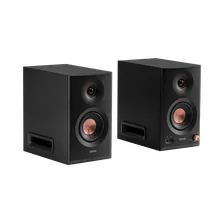 For deeper bass, Bluetooth and more connection options, choose the Edifier MR5: $349.99 per pair Amazon eBay
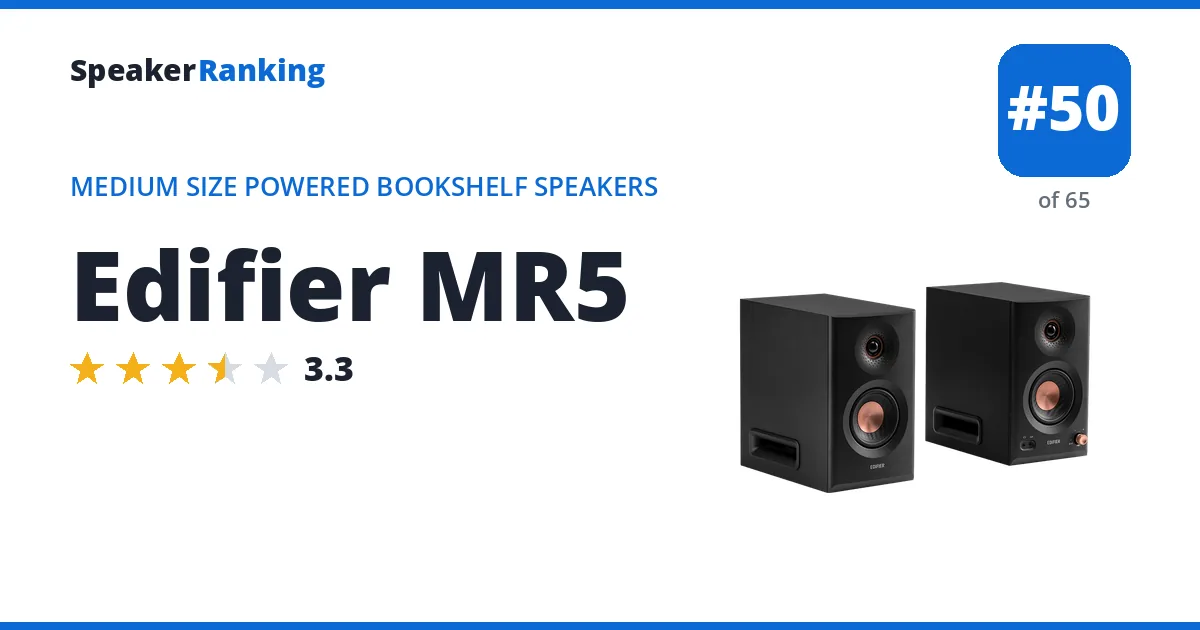
Pros: Erin’s Audio Corner measured useful bass for a compact 5-inch monitor, with F3 around 51Hz. The three-way active design adds a dedicated 3.75-inch midrange, and the 110W RMS system, app EQ, room-compensation controls, LDAC, balanced XLR/TRS inputs, and front headphone output make it unusually well equipped at $350 per pair. Measured bass extension of 51Hz (-3dB), with a measured sensitivity of 85dB.
Cons: Erin’s CTA-2034 data shows upper-midrange and treble irregularities, while off-axis response narrows more quickly than ideal above about 2–3kHz. Bass output is level-limited below about 70Hz and distortion/compression rise at higher levels, so it suits moderate nearfield use better than loud mid-field playback.
Full Edifier MR5 review and specifications →
| Amplifier Power | 110W RMS total (Manufacturer specified) |
|---|---|
| App | Yes (Edifier ConneX) |
| Bass Extension (-3dB) | 51Hz (measured, Erin's Audio Corner) |
| Bluetooth Codecs | LDAC, SBC |
| Bluetooth Version | 5.4 |
| Dimensions | 6.3"W x 10.4"H x 11"D (159 x 264 x 280 mm) (active); 159W x 264H x 257D mm (passive) |
| Drivers | 5-inch woofer + 3.75-inch midrange + 1-inch silk-dome tweeter (each) |
| EQ | Yes (app EQ and rear high/low controls) |
| Frequency Response | 46Hz-40kHz (Manufacturer specified) |
| Headphone Output | Yes |
| Inputs | Balanced XLR, balanced 6.35mm TRS, RCA, 3.5mm Aux |
| Maximum SPL | 101dB (Manufacturer specified, 1m) |
| Measurement Source | Erin's Audio Corner |
| Outputs | 3.5mm headphone |
| Sensitivity | 85dB (measured at 0.3V/1m, Erin's Audio Corner) |
| Weight | 22.9 lbs (10.38 kg) |
- Links
- Reviews, Comparisons and Sound Samples
The larger MR5 reaches about 51Hz at -3dB in Erin’s Audio Corner measurements, substantially deeper than the smaller choices here. Its active three-way design also adds balanced XLR and TRS, RCA, aux, Bluetooth with LDAC, app EQ and room-compensation controls. The headphone jack remains on the front, where it is useful.
This is the most capable all-in-one system on the page, but not the most neutral. Measurements show upper-midrange and treble irregularities, narrowing off-axis response and rising bass compression at higher levels. It is the feature and bass upgrade, while the MR4 remains the value-first recommendation.
Best Under $100
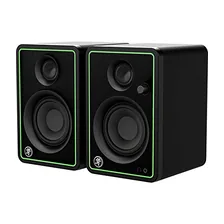 The best approximately $100 powered speakers with a headphone jack are the Mackie CR3-X: $99.99 per pair Amazon eBay
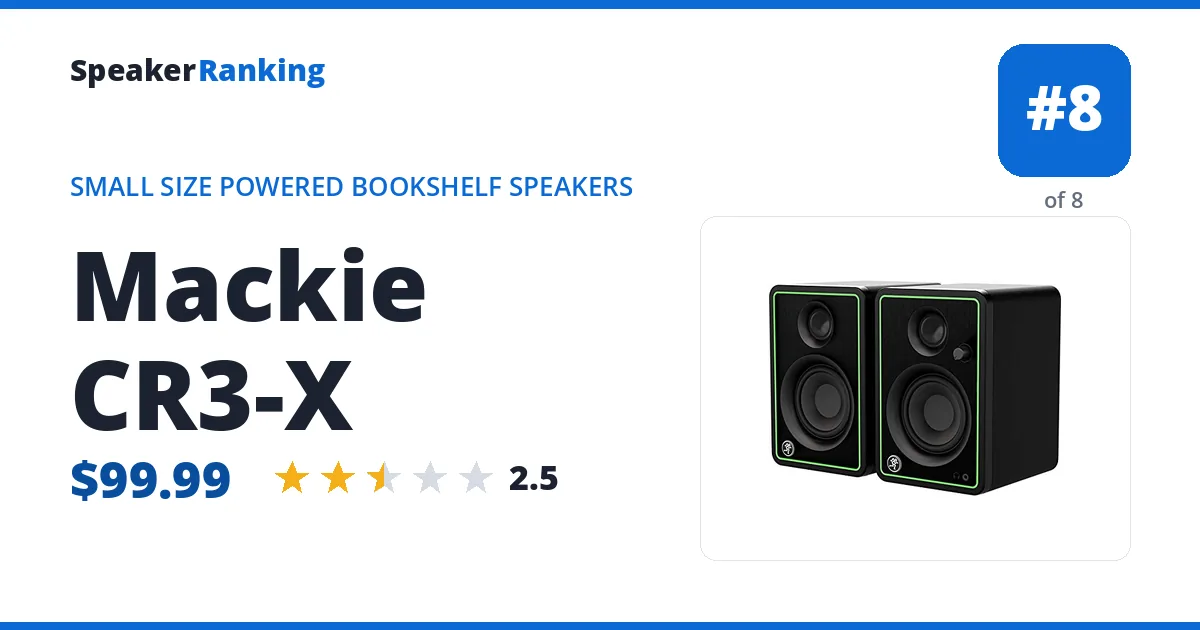
Pros: Erin’s Klippel data predicts 1.95 standalone and 4.87 with an ideal subwoofer. The existing comparative review found less exaggerated tonal shaping and better sustained-output behavior than the original PreSonus E3.5 tested alongside it. Midrange distortion was reasonably controlled for inexpensive desktop speakers at moderate listening levels. Measured bass extension of 80Hz (-3dB), with a measured sensitivity of 96dB.
Cons: The response spans 4.4dB from 300Hz to 5kHz, with substantial narrow-band irregularities and bass rolloff reaching -3dB around 75Hz. Bass peaking and crossover-region changes with listening height prevent neutral monitoring. Limiting becomes intrusive above modest desktop levels, and there are no tone controls. Comparisons with the original E3.5 should not be treated as measurements of its second generation.
Full Mackie CR3-X review and specifications →
| Amplifier Power | 50W total (25W per speaker) |
|---|---|
| App | No |
| Bass Extension (-10dB) | 70Hz (measured, Erin's Audio Corner) |
| Bass Extension (-3dB) | 80Hz (measured, Erin's Audio Corner) |
| Bluetooth | No |
| Dimensions | 8.1"H x 5.5"W x 7.1"D (205.7 x 139.7 x 180.3 mm) |
| Drivers | 3" woofer, 0.75" silk dome tweeter |
| EQ | No |
| Frequency Response | 80 Hz-20 kHz (-3dB) (Manufacturer specified) |
| Headphone Output | Yes |
| Inputs | RCA, Aux |
| Maximum SPL | 92dB @ 1m (manufacturer specified) |
| Outputs | 1/8" headphone jack |
| Sensitivity | 96dB (measured at 0.3V/1m, Erin's Audio Corner) |
| Spinorama Preference Score | 1.95 |
| Spinorama Preference Score with Perfect Sub | 4.87 |
| Weight | 7.7 lbs (3.5 kg) |
- Links
- Reviews, Comparisons and Sound Samples
- Erin’s Audio Corner Review Measurements More from Erin’s Audio Corner →
- Audio Science Review Measurements More from Audio Science Review →
- DSAUDIO.review: Presonus Eris E3.5 vs Mackie CR3 Sound Demo w/ Bass Test More from DSAUDIOreview →
- DSAUDIO.review: Mackie CR3-X vs Edifier R1280T Sound, Distortion & Frequency Response Comparison
- Erin’s Audio Corner: Mackie CR3-X vs PreSonus E3.5 Budget Monitor Showdown!
- Erin’s Audio Corner Measurements (spinorama.org)
- Head-to-Head Comparisons
Among the lowest-priced qualifying pairs, the CR3-X has the strongest measured preference score and better sustained-output behavior than the original PreSonus Eris E3.5 in the comparative testing cited on its product page. Its front volume control and headphone jack are easy to reach.
The low price buys real compromises: response irregularities, limited bass extension and intrusive limiting above modest desktop volume. It is a convenience-driven budget pick rather than a neutral studio monitor.
Best With Bluetooth Under $150
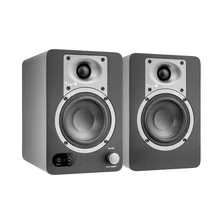 For an inexpensive pair that adds Bluetooth and tone controls, consider the Fluid Audio C35BT: $139 per pair Amazon eBay
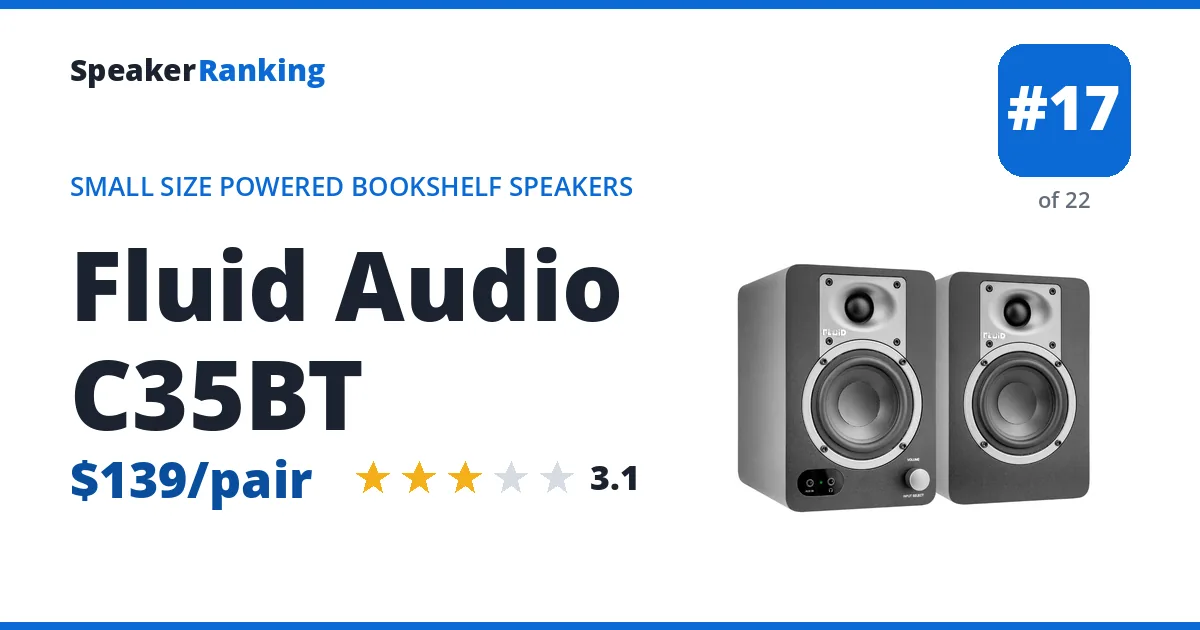
Pros: Balanced TRS inputs, Bluetooth, front volume control and a headphone output make this inexpensive pair practical for a basic desktop setup. ASR’s measured -3dB point is about 78Hz, so it covers more upper bass than the shallowest-reaching mini speakers.
Cons: Preference scores of 1.80 standalone and 4.79 with an ideal subwoofer indicate that the limitations are not just missing bass. Listening-window narrow-band deviation of 0.555 and sound-power deviation of 0.657 show that response irregularities affect both direct and room-reflected sound. A subwoofer cannot correct those tonal problems, and the small drivers are not a basis for expecting high clean output.
Full Fluid Audio C35BT review and specifications →
| Amplifier Power | 64W total |
|---|---|
| Dimensions | 7.3H x 4.9W x 5.9D in |
| Drivers | 0.8" silk-dome tweeter, 3.5" composite woofer |
| Enclosure | Powered 2-way, front-ported |
| Headphone Output | Yes |
| Inputs | Bluetooth, RCA, 3.5mm, balanced TRS |
| Outputs | Headphone |
| Spinorama Preference Score | 1.80 |
| Spinorama Preference Score with Perfect Sub | 4.79 |
- Links
- Reviews, Comparisons and Sound Samples
- Head-to-Head Comparisons
The C35BT combines Bluetooth, balanced TRS, RCA and 3.5mm inputs with a front volume control and headphone output. Its measured preference score is slightly behind the Mackie, but the broader connection set can be more useful on a mixed work-and-personal desk.
Its tonal irregularities affect both direct and reflected sound, so a subwoofer will not solve its main accuracy limitations. Buy it when Bluetooth and connectivity matter more than strict neutrality.
Other Powered Speakers With Headphone Output
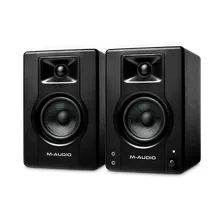 The M-Audio BX3: $99.99 per pair Amazon eBay
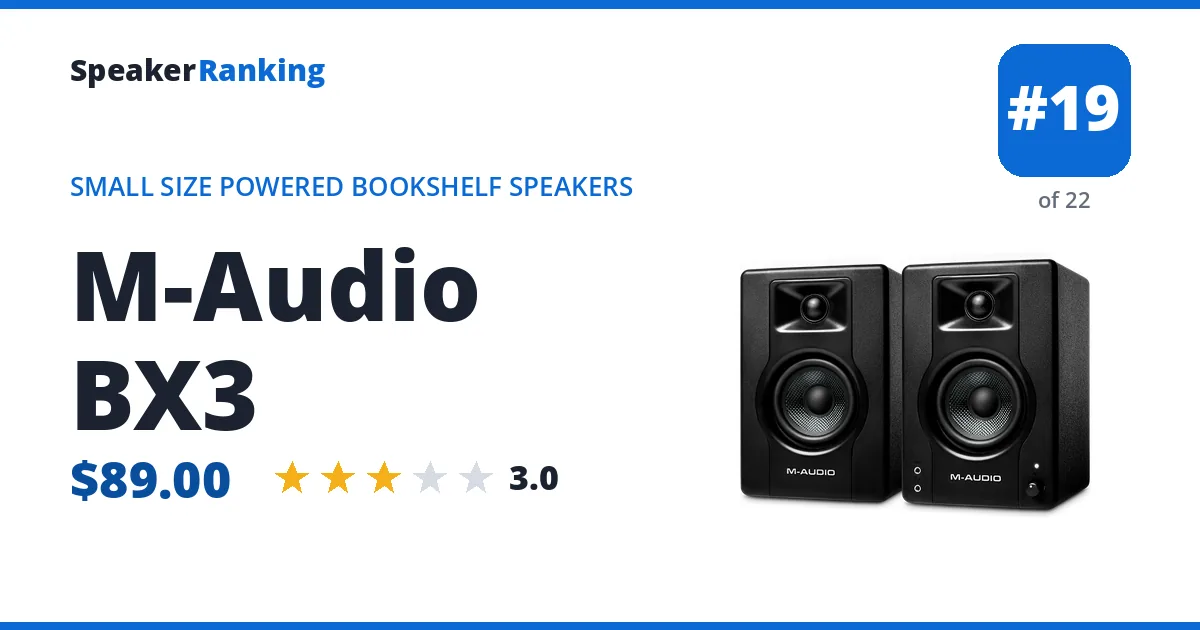
Pros: Balanced TRS, RCA and auxiliary inputs, headphone output and high/low tone controls offer useful flexibility for an inexpensive desktop pair. The controls give some scope to adjust broad tonal balance for placement.
Cons: ASR’s data gives only 1.42 standalone and 4.56 with an ideal subwoofer. Listening-window narrow-band deviation of 0.580 indicates persistent tonal irregularities, while bass reaches -3dB at about 88Hz. The limited bass and uneven response make it a weak choice for accurate monitoring even with a subwoofer. Broad tone controls cannot precisely fix crossover or dispersion problems.
Full M-Audio BX3 review and specifications →
| Amplifier Power | 50W RMS per pair |
|---|---|
| Dimensions | 8.2H x 5.5W x 5.7D in |
| Drivers | 1-inch silk tweeter, 3.5-inch Kevlar woofer |
| Enclosure | Powered 2-way rear-ported |
| Frequency Response | 80Hz-22kHz |
| Headphone Output | Yes |
| Inputs | TRS, RCA, 3.5mm aux |
| Outputs | Headphone |
| Spinorama Preference Score | 1.42 |
| Spinorama Preference Score with Perfect Sub | 4.56 |
- Links
- Reviews, Comparisons and Sound Samples
- Head-to-Head Comparisons
Its flexible connections are useful, but its measured tonal irregularities and limited bass make the Mackie CR3-X the stronger sound-quality choice around the same price.
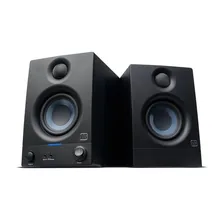 The Presonus Eris E3.5 2nd Gen: $99.99 per pair Amazon eBay
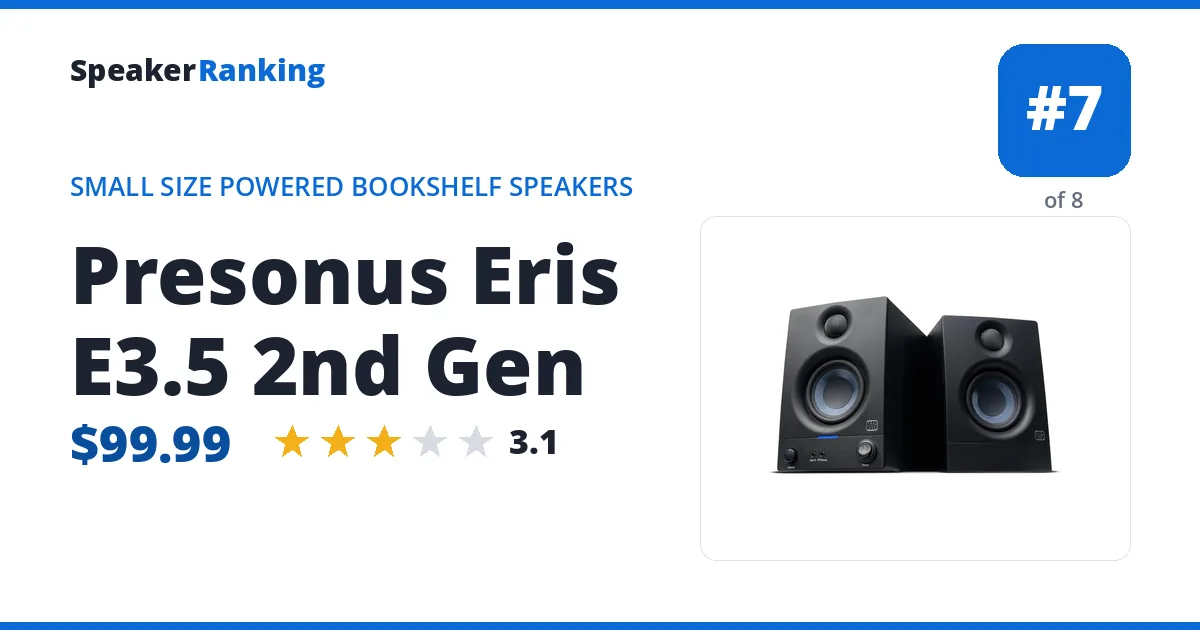
Pros: Rear-panel bass and treble controls allow broad correction for desk and wall placement. Erin’s second-generation Klippel measurements give a -3dB point around 69Hz, so the speaker has useful upper-bass reach for its size. Its adjustable balance is more flexible than a fixed-response budget desktop pair. Measured bass extension of 80Hz (-3dB), with a measured sensitivity of 87.4dB.
Cons: The stock response spans 7.2dB from 300Hz to 5kHz and has a strong rising trend of about 1.27dB per octave, emphasizing treble over the midrange. Preference scores of 1.15 standalone and 3.81 with an ideal subwoofer indicate major tonal problems beyond bass extension. EQ may help, but a subwoofer alone will not make it neutral. Output and port-modification results from reviews of the original E3.5 should not be assumed to apply to this second-generation model.
Full Presonus Eris E3.5 2nd Gen review and specifications →
| Amplifier Power | 50W total (25W per speaker) |
|---|---|
| App | No |
| Bass Extension (-10dB) | 70Hz (measured, Erin's Audio Corner) |
| Bass Extension (-3dB) | 80Hz (measured, Erin's Audio Corner) |
| Bluetooth | No |
| Dimensions | 8.3"H x 6"W x 5.5"D (210.8 x 152.4 x 139.7 mm) |
| Drivers | 3.5" woofer, 1" silk dome tweeter |
| EQ | Yes (Acoustic space) |
| Frequency Response | 80 Hz-20 kHz (-3dB) (Manufacturer specified) |
| Headphone Output | Yes |
| Inputs | RCA, 1/4" Balanced |
| Maximum SPL | 95dB @ 1m (manufacturer specified) |
| Outputs | 1/8" headphone jack |
| Sensitivity | 87.4dB (measured at 0.3V/1m, Erin's Audio Corner) |
| Spinorama Preference Score | 1.15 |
| Spinorama Preference Score with Perfect Sub | 3.81 |
| Weight | 8.6 lbs (3.9 kg) |
- Links
- Reviews, Comparisons and Sound Samples
- Erin’s Audio Corner Review Measurements More from Erin’s Audio Corner →
- Audio Science Review Measurements More from Audio Science Review →
- DSAUDIO.review: DSAUDIO.review Edifier MR4 vs Presonus Eris E3.5 sound.DEMO More from DSAUDIOreview →
- DSAUDIO.review: Presonus Eris E3.5 vs Edifier R1280T Sound Demo w/ Bass Test
- DSAUDIO.review: Presonus Eris E3.5 vs Mackie CR3 Sound Demo w/ Bass Test
- Erin’s Audio Corner: Mackie CR3-X vs PreSonus E3.5 Budget Monitor Showdown!
- Erin’s Audio Corner: 10 Great (and Terrible) Speakers Under $300!
- Erin’s Audio Corner Measurements (spinorama.org)
- Jasper Tech: Are the iLoud Micro Monitor Pro the Best Studio Monitor Speakers for your Home Studio? More from Jasper Tech →
- Jasper Tech: Best Desktop Computer Speakers for Every Budget
- Head-to-Head Comparisons
- Presonus Eris E3.5 2nd Gen vs Midiplus MI3 II
- Presonus Eris E3.5 2nd Gen vs Fiio SP3
- Presonus Eris E3.5 2nd Gen vs Mackie CR3-X
- Presonus Eris E3.5 2nd Gen vs Audioengine HD3
- Presonus Eris E3.5 2nd Gen vs Klipsch ProMedia Lumina
- Presonus Eris E3.5 2nd Gen vs Audioengine A2+
- Presonus Eris E3.5 2nd Gen vs Edifier MR3
- Presonus Eris E3.5 2nd Gen vs Edifier M60
- See all 11 comparisons
The controls can help with broad desk or wall-placement effects. They cannot fully correct its steep tonal trend and response irregularities, and its measured preference score trails the better options above.
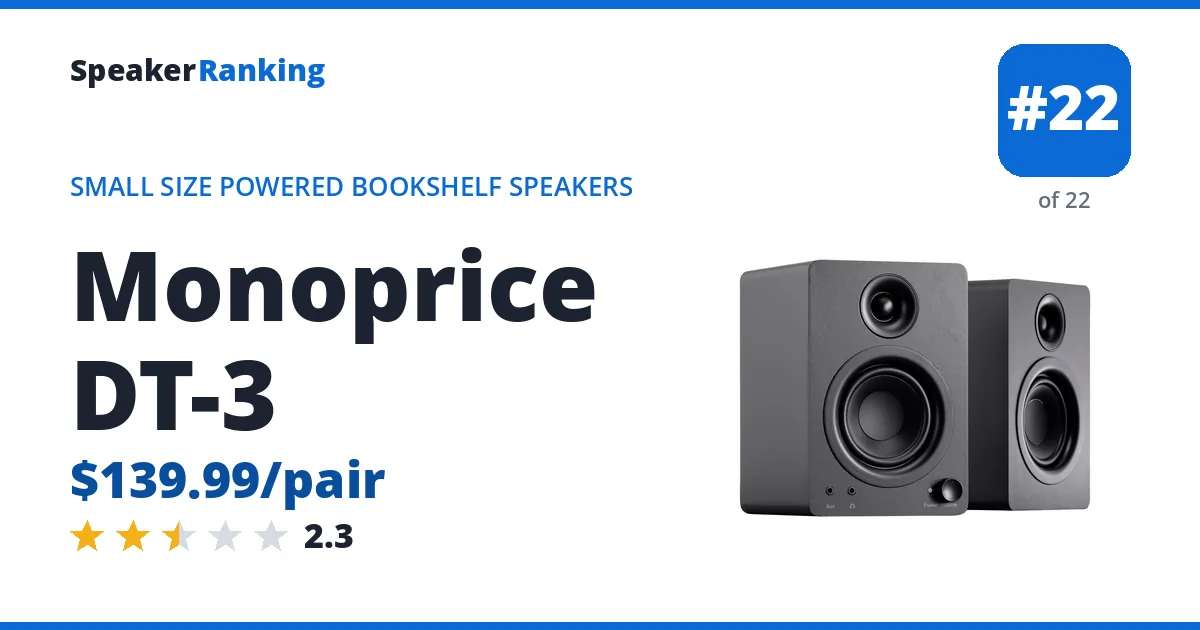
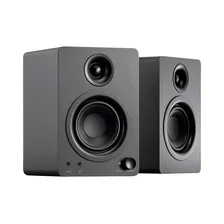 The compact Monoprice DT-3: $139.99 per pair Monoprice eBay
Pros: An inexpensive, compact powered pair with front volume control, auxiliary input and headphone output. Erin’s Klippel measurements put the -3dB bass point around 74Hz, sufficient for some upper-bass content at a desk.
Cons: The measured response spans 7.6dB from 300Hz to 5kHz, with large irregularities both on-axis and across the listening window. Preference scores are -0.17 standalone and only 2.76 with an ideal subwoofer, the weakest comparable result in this group. That means adding bass support does not remove its major tonal problems. It offers little reason to choose it for accurate listening over better-measuring budget alternatives.
Full Monoprice DT-3 review and specifications →
| Amplifier Power | 50W system |
|---|---|
| Bass Extension (-6dB) | 69Hz (measured, Spinorama) |
| Dimensions | 8H x 5.5W x 5.9D in each |
| Drivers | 0.75-inch tweeter, 3.5-inch woofer |
| Enclosure | Powered 2-way stereo pair, rear-ported |
| Headphone Output | Yes |
| Inputs | Rear stereo RCA and front 3.5mm auxiliary |
| Outputs | Front headphone |
| Spinorama Preference Score | -0.17 |
| Spinorama Preference Score with Perfect Sub | 2.76 |
- Links
- Reviews, Comparisons and Sound Samples
- Head-to-Head Comparisons
It is easy to operate, but its measured response is the weakest in this group. Large on-axis and listening-window irregularities remain even when bass is handled by an ideal subwoofer, so it is difficult to recommend over the similarly priced alternatives.
What To Check Before Buying
Automatic speaker muting: most desktop systems mute their speakers when headphones are plugged in, but confirm this behavior in the manual if it matters to your workflow. Product specifications do not always state it clearly.
Headphone power and noise: the presence of a jack does not establish how well it drives demanding headphones. Manufacturers rarely publish useful output-power, output-impedance or noise measurements for these built-in headphone stages. High-impedance or unusually insensitive headphones may still benefit from a dedicated audio interface or headphone amplifier.
Control placement: a front jack and volume knob are much more useful than rear controls on a desk. Check whether the same knob controls headphone level and whether you can reach it without moving a speaker.
The right alternative: if headphone performance is the priority, an audio interface or DAC/headphone amplifier feeding any powered speakers gives you a much wider speaker choice. If the convenient built-in jack is the priority, the verified models above avoid that extra box.
Where To Go Next
See the best powered speakers for a computer desk for recommendations without the headphone-jack requirement, or compare every model in the powered bookshelf rankings: small and medium.
Related guides: powered speaker inputs explained, best budget powered speakers, best studio monitors, and the powered speaker buyer’s guide.