This page ranks 23 column and line source PA systems: slim arrays that throw sound evenly across a room, built for houses of worship, lecture halls, lobbies, conference rooms, and other fixed installs, plus a few large purpose-built install systems. Prices are per speaker unless stated otherwise.
Line sources trade a very wide horizontal pattern for a narrow vertical one, which keeps sound off ceilings and floors and evens out level from the front row to the back. That makes speech clearer in reverberant rooms. Most of these systems are passive and rely on matched amplified controllers, and many need a companion low-frequency cabinet for full-range sound. Ranking weighs measured sound quality alongside coverage, output, bass extension, and weight.
Small speakers for background music in restaurants, shops and offices are ranked separately as surface-mount and background music speakers.
Manufacturer maximum-SPL claims are measured under different conditions from one brand to the next, so treat them as a rough guide rather than a precise comparison.
| Select to compare | |||||||
|---|---|---|---|---|---|---|---|
| 1 | L-Acoustics SYVA-low+top | - | 137dB | Passive speaker; requ… | 6x 5" cone drivers an… | 110.2 lbs | |
| 2 | JBL CBT 1000 + CBT 1000E | $4,945.00 | 130dB peak | Passive speaker; requ… | CBT 1000: 6x 6.5" woo… | 104.1 lbs | |
| 3 | JBL CBT 1000 | $3,075.00 | 130dB peak | Passive speaker; requ… | 6x 6.5" neodymium woo… | 54 lbs | |
| 4 | Kling Freitag PIA M | - | 132dB | Passive speaker; requ… | 4x 0.75" compression… | 26.9 lbs | |
| 5 | L-Acoustics SYVA | - | 137dB | Passive speaker; requ… | 6x 5" cone drivers, 3… | 46.3 lbs | |
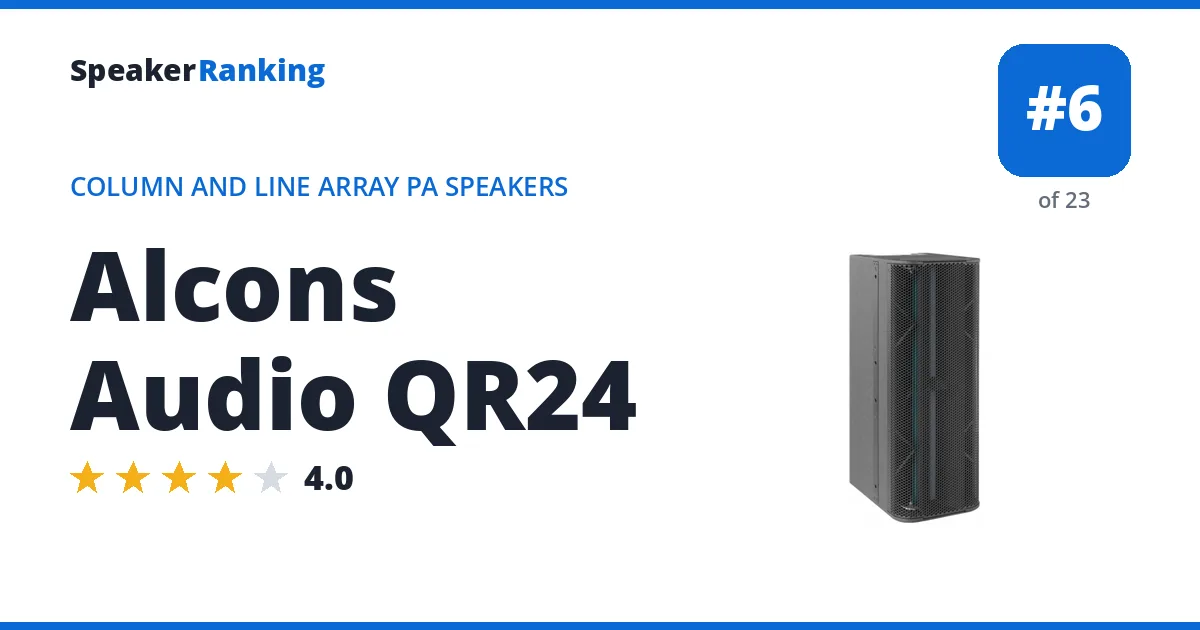
| 6 | Alcons Audio QR24 | - | 135dB peak | Passive speaker; requ… | 2x 12" RBN1203 pro-ri… | 48.5 lbs | |
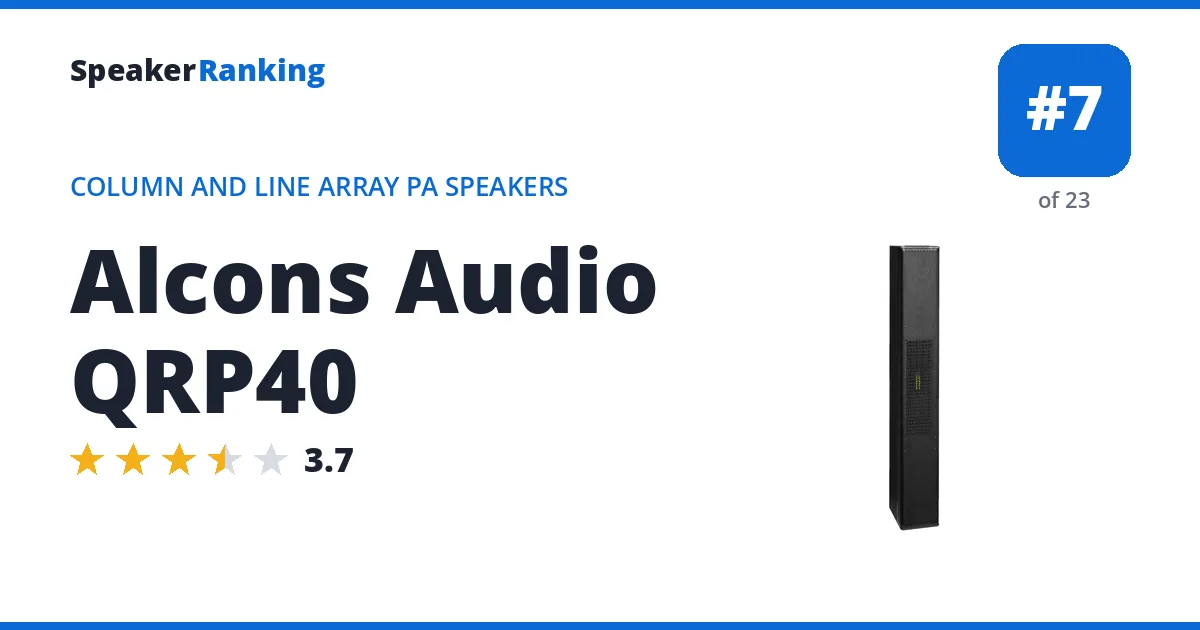
| 7 | Alcons Audio QRP40 | - | 131dB peak | Passive speaker; requ… | 1x 12" RBN1203 pro-ri… | 48.5 lbs | |
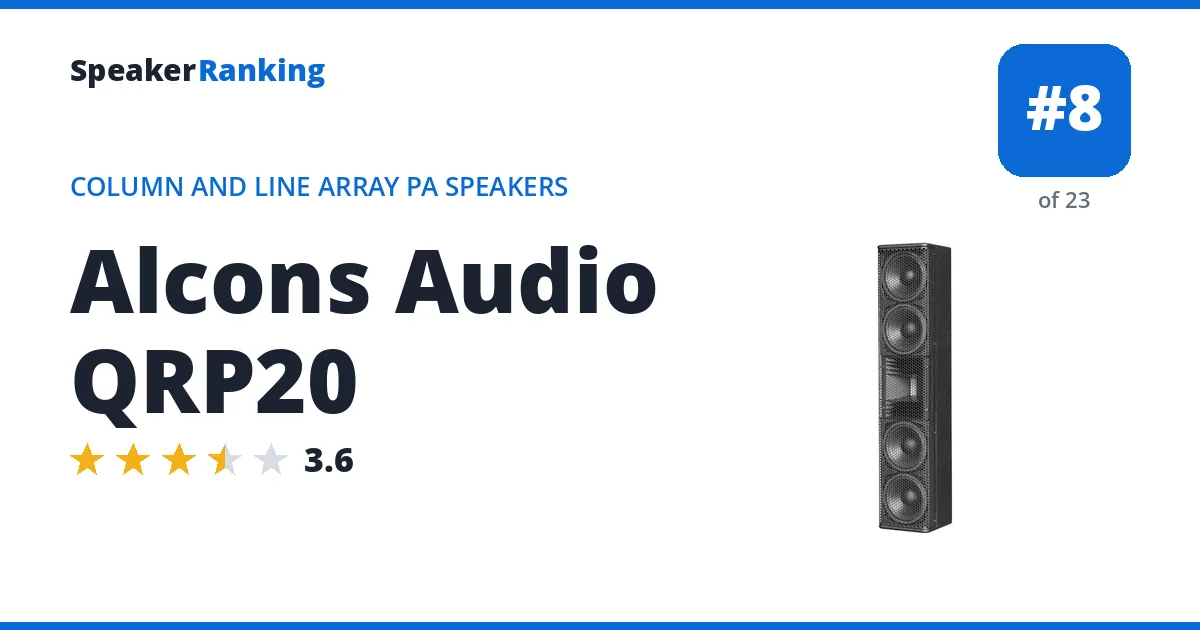
| 8 | Alcons Audio QRP20 | - | 128dB peak | Passive speaker; requ… | 1x 4" RBN401 pro-ribb… | 26.5 lbs | |
| 9 | L-Acoustics SOKA | - | 133dB peak | Passive speaker; requ… | 9x 3.5" neodymium con… | 20.7 lbs | |
| 10 | JBL CBT 70J-1 | $1,480.00 | 131dB peak | Passive speaker; requ… | 4x 5" neodymium woofe… | 20.9 lbs | |
| 11 | JBL COL800 | $577.00 | 116dB peak | Passive speaker; requ… | 4x 5" x 2.25" racetra… | 11.5 lbs | |
| 12 | Danley ILE3 | $37,000 per pair | 125dB peak | 1,400W | 4x 10" woofers, 5x co… | - | |
| 13 | JBL COL600 | $386.00 | 111dB peak | Passive speaker; requ… | 2x 5" x 2.25" racetra… | 7.7 lbs | |
| 14 | Danley HRE1 | $46,150 per pair | 132dB peak | - | multiple woofers and… | - | |
| 15 | JBL CBT 200LA-1 | $2,449.16 each | 129dB peak | Passive speaker; requ… | 32x 2" full-range dri… | 32.2 lbs | |
| 16 | FBT Vertus CS1000 | - | 129dB peak / 125dB co… | 1,000W RMS | 6 x 2.75" column driv… | 7.7 lbs | |
| 17 | JBL CBT 50LA-1 | $585.00 each | 115dB continuous | Passive speaker; requ… | 8x 2" full-range driv… | 9 lbs | |
| 18 | JBL CBT 100LA-1 | $1,055.00 each | 121dB | Passive speaker; requ… | 16x 2" full-range dri… | 15.9 lbs | |
| 19 | Coda Audio CoRay4 | - | 144dB peak | Passive speaker; requ… | 2x 4" neodymium plana… | 34.6 lbs | |
| 20 | KME ICS4 | - | 113dB | - | 4x 4" woofers, 1" dom… | 13.2 lbs | |
| 21 | Yamaha VXL1-8 | $444.99 each | 111dB peak | - | 8x 1.5" full-range dr… | 4.6 lbs | |
| 22 | Yamaha VXL1-16 | $807.99 each | 116dB peak | Passive speaker; requ… | 16x 1.5" full-range d… | 8.6 lbs | |
| 23 | Yamaha VXL1-24 | $1,340 each | 117dB peak | - | 24x 1.5" full-range d… | 12.1 lbs |
Prices on this page were last checked October 12, 2026 at 4:13 PM UTC. Product prices and availability are accurate as of that date/time and are subject to change; the price and availability shown on Amazon at the time of purchase will apply to the purchase of this product.
As an eBay Partner, we may be compensated if you make a purchase.
 #1 L-Acoustics SYVA-low+top Passive eBay
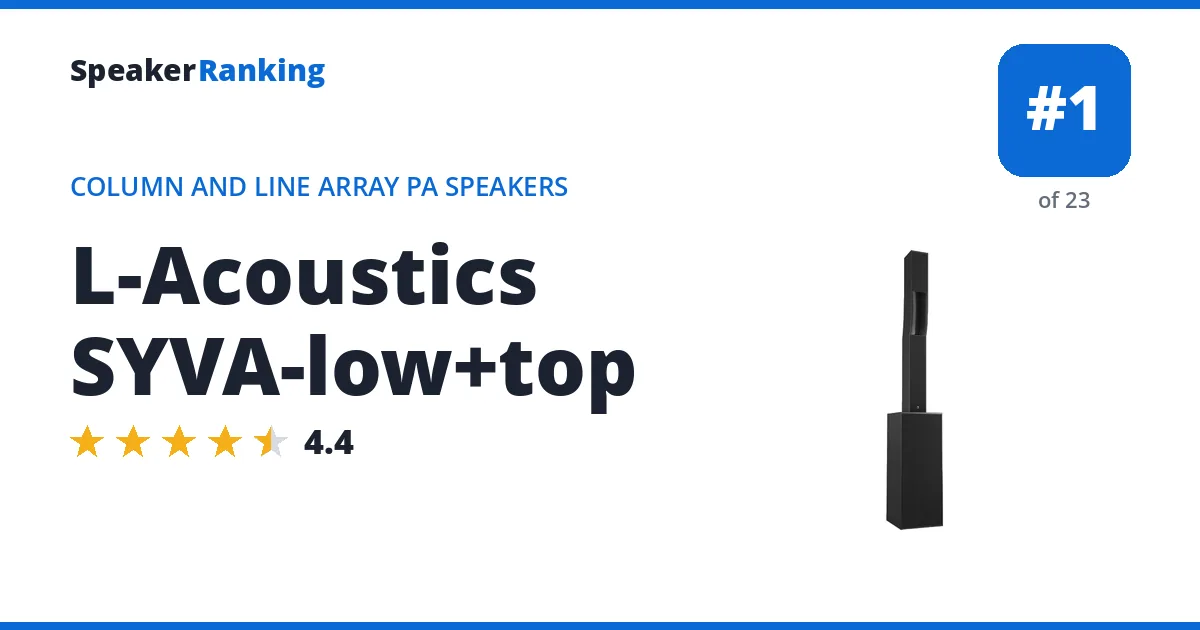
Pros: Vendor Spinorama data gives preference scores of 6.05 standalone and 8.11 with an ideal subwoofer, the best in this ranking. Pairing the SYVA line source with SYVA Low adds two 12-inch drivers, extending bass to about 50Hz (-3dB) and 137dB peak SPL. Listening-window narrow-band deviation is 0.188, and the 140° horizontal pattern covers wide rooms from one slim column. Measured bass extension of 50Hz (-3dB).
Cons: A passive system that needs L-Acoustics amplified controllers (LA4X, LA12X or LA8). The two-element stack is 2.15m tall and about 50kg, so it is an installed or touring system rather than a grab-and-go box. Vertical coverage is only about 25°, which suits seated audiences but limits use on steep or multi-tier rooms.
Full L-Acoustics SYVA-low+top review and specifications →
| Released | 2017 (9 years ago) |
|---|---|
| AES Input | No |
| Amplifier Power | Passive speaker; requires an L-Acoustics amplified controller (LA4X, LA12X or LA8) |
| Aux Input | No |
| Bass Extension (-3dB) | 50Hz (measured, vendor Spinorama data) |
| Bluetooth | No |
| Cabinet Material | Baltic beech and birch plywood |
| Coaxial Input | No |
| Configuration | Passive 2-way line source with dual 12” low extension (SYVA plus SYVA Low) |
| Coverage | 140° horizontal, about 25° vertical |
| DSP | No (passive; processing and protection come from the amplified controller) |
| Dimensions | 84.6”H x 13.1”W x 13.8”D (2150 x 334 x 350 mm) (measured stack) |
| Drivers | 6x 5” cone drivers and 3x 1.75” compression drivers (SYVA), dual 12” cone drivers (SYVA Low) |
| Frequency Response | 40Hz - 20kHz (manufacturer specified) |
| Guitar Input | No |
| HDMI Input | No |
| Inputs | Speakon (via L-Acoustics amplified controller) |
| Maximum SPL | 137dB (manufacturer specified) |
| Microphone Input | No |
| Optical Input | No |
| Passive | Yes |
| RCA Input | No |
| Spinorama Preference Score | 6.05 |
| Spinorama Preference Score with Perfect Sub | 8.11 |
| TRS Input | No |
| USB Input | No |
| Weight | 110.2 lbs (50 kg) |
| XLR Input | No |
- Links
- Reviews, Comparisons and Sound Samples
- Head-to-Head Comparisons
 #2 JBL CBT 1000 + CBT 1000E: $4,945.00 Passive B&H Photo Video $4,945.00 eBay
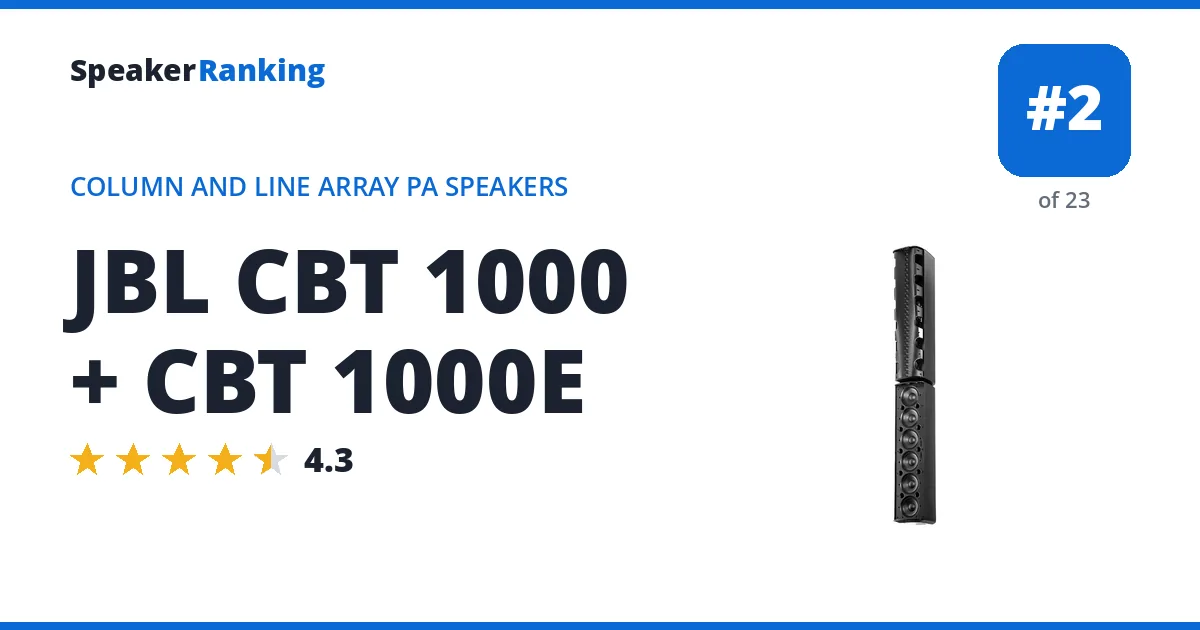
Pros: Adding the CBT 1000E extension below the JBL CBT 1000 gives a 5.70 standalone preference score, one of the highest of any PA speaker we list, and 7.96 with an ideal subwoofer. Bass reaches 51.5Hz at -3dB and about 40Hz at -10dB, so the pair can run full range without a subwoofer, and a 1.4dB reference band keeps the tonal balance very even. JBL’s Constant Beamwidth Technology gives switchable vertical coverage for long rooms. Measured bass extension of 51.5Hz (-3dB).
Cons: The measurements are manufacturer supplied and spinorama rates their quality as low. At $4945 the combination is expensive, stands about 2m tall and weighs around 50kg, and it needs an external amplifier.
Full JBL CBT 1000 + CBT 1000E review and specifications →
| Released | 2016 (10 years ago) |
|---|---|
| AES Input | No |
| Amplifier Power | Passive speaker; requires external amplification |
| Aux Input | No |
| Bass Extension (-10dB) | about 39.6Hz (measured, vendor Spinorama data) |
| Bass Extension (-3dB) | 51.5Hz (measured, vendor Spinorama data) |
| Bluetooth | No |
| Coaxial Input | No |
| Configuration | Passive 2-way Constant Beamwidth Technology column with matching extension |
| Coverage | Switchable vertical patterns, wide horizontal |
| DSP | No (passive) |
| Drivers | CBT 1000: 6x 6.5” woofers, 24x 1” tweeters; CBT 1000E adds a matching extension array |
| Frequency Response | 45Hz - 20kHz (-10dB, CBT 1000 alone, manufacturer specified) |
| Guitar Input | No |
| HDMI Input | No |
| Impedance | 4 ohms (CBT 1000) |
| Maximum SPL | 130dB peak (manufacturer specified) |
| Microphone Input | No |
| Optical Input | No |
| Passive | Yes |
| Power Handling | 1,500W (6,000W peak), CBT 1000 |
| RCA Input | No |
| Rigging | 14 rear threaded points; 4 on each end-cap; wall bracket included |
| Sensitivity | 102dB (highest setting, CBT 1000) |
| Spinorama Preference Score | 5.70 |
| Spinorama Preference Score with Perfect Sub | 7.96 |
| TRS Input | No |
| USB Input | No |
| Weight | 104.1 lbs (47.2 kg) |
| XLR Input | No |
- Links
- Reviews, Comparisons and Sound Samples
- Head-to-Head Comparisons
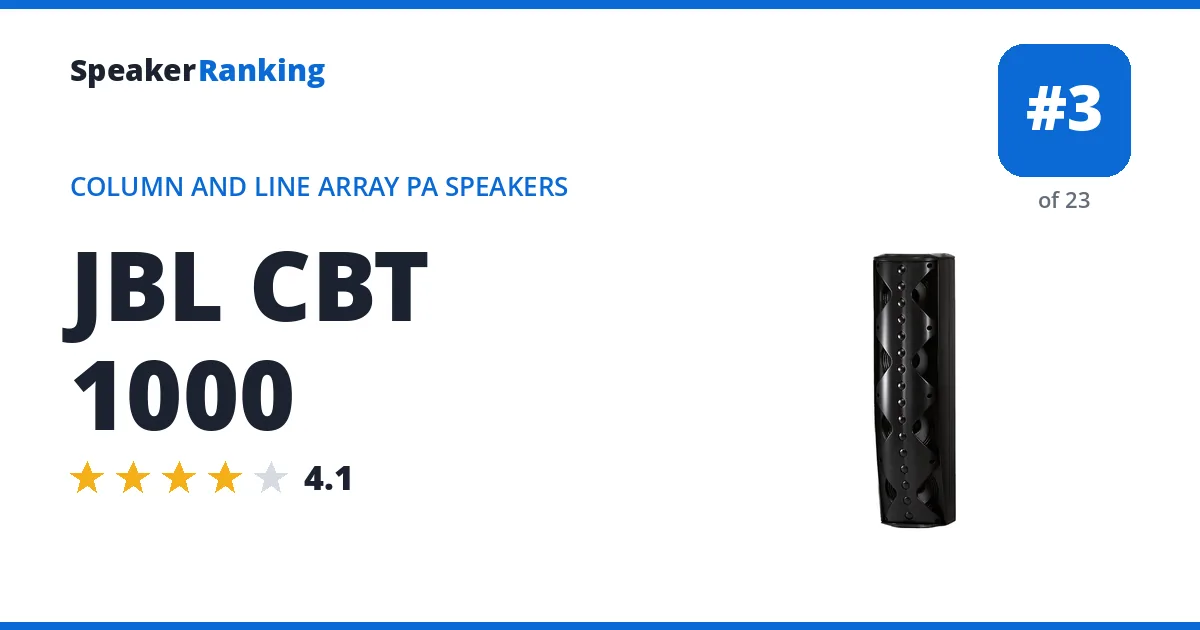
 #3 JBL CBT 1000: $3,075.00 Passive Amazon $3,075.00 B&H Photo Video $3,075.00 eBay
Same family: the JBL CBT 50LA-1 (smaller model, ranked lower, estimated 3.1/5), the JBL CBT 70J-1 (smaller model, ranked lower, rated 3.4/5), the JBL CBT 100LA-1 (smaller model, ranked lower, estimated 3.1/5) and the JBL CBT 200LA-1 (smaller model, ranked lower, estimated 3.2/5).
Pros: Its 8.13 preference score with an ideal subwoofer is one of the highest of any PA speaker we list, and a 0.168 listening-window deviation shows a very even tonal balance for listeners across the coverage area. Six 6.5-inch woofers and 24 one-inch tweeters in JBL’s Constant Beamwidth design give switchable vertical coverage, 102dB sensitivity and a 1,500W rating. The optional CBT 1000E extension adds bass and throw. Measured bass extension of 115Hz (-3dB).
Cons: The measurements are manufacturer supplied and spinorama rates their quality as low. On its own the standalone score is 4.67, and the measured bass response is uneven, reaching 115Hz at -3dB but about 48Hz at -10dB, so a subwoofer or the CBT 1000E helps. It is passive, weighs 24.5kg and needs an external amplifier.
Full JBL CBT 1000 review and specifications →
| Released | 2016 (10 years ago) |
|---|---|
| AES Input | No |
| Amplifier Power | Passive speaker; requires external amplification |
| Aux Input | No |
| Bass Extension (-10dB) | about 48.3Hz (measured, vendor Spinorama data) |
| Bass Extension (-3dB) | 115Hz (measured, vendor Spinorama data) |
| Bluetooth | No |
| Coaxial Input | No |
| Configuration | Passive 2-way Constant Beamwidth Technology column |
| Coverage | Switchable vertical patterns, wide horizontal |
| DSP | No (passive) |
| Dimensions | 40.2”H x 9.8”W x 13.6”D (1020 x 250 x 345 mm) |
| Drivers | 6x 6.5” neodymium woofers, 24x 1” neodymium tweeters |
| Frequency Response | 45Hz - 20kHz (-10dB, manufacturer specified) |
| Guitar Input | No |
| HDMI Input | No |
| Impedance | 4 ohms |
| Maximum SPL | 130dB peak (manufacturer specified) |
| Microphone Input | No |
| Optical Input | No |
| Passive | Yes |
| Power Handling | 1,500W (6,000W peak) |
| RCA Input | No |
| Rigging | 14 x M8 rear inserts; 4 x M8 top and bottom; wall bracket included |
| Sensitivity | 102dB (highest setting) |
| Spinorama Preference Score | 4.67 |
| Spinorama Preference Score with Perfect Sub | 8.13 |
| TRS Input | No |
| USB Input | No |
| Weight | 54 lbs (24.5 kg) |
| XLR Input | No |
- Links
- Reviews, Comparisons and Sound Samples
- Head-to-Head Comparisons
 #4 Kling Freitag PIA M Passive eBay
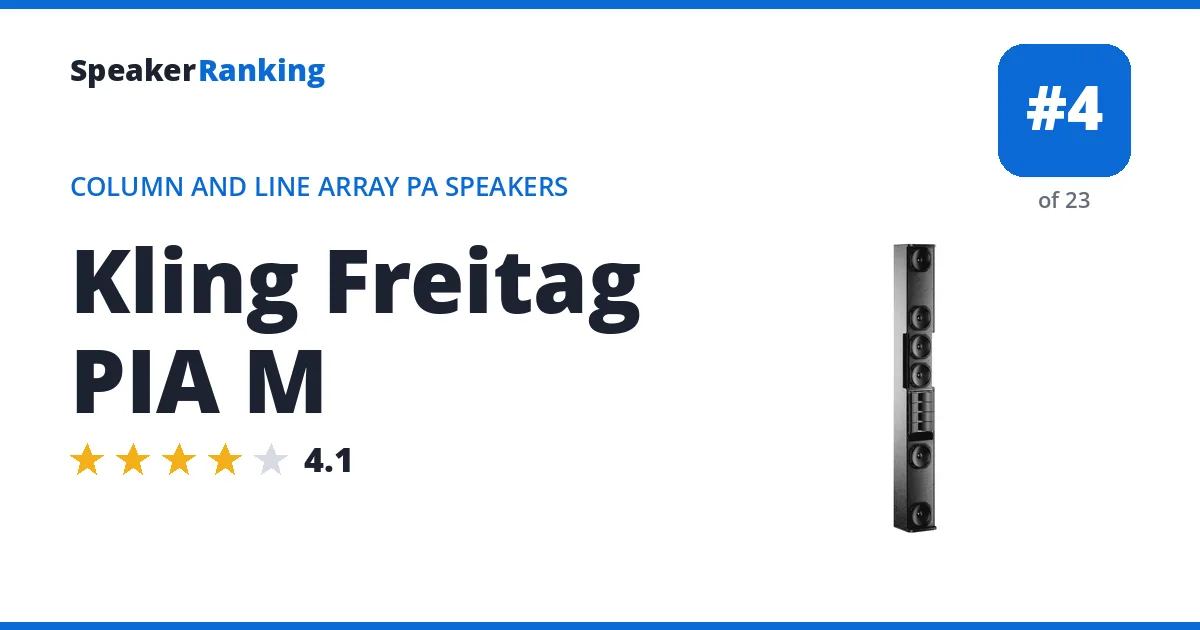
Pros: High-quality manufacturer measurements give preference scores of 4.50 standalone and 7.92 with an ideal subwoofer, with a 1.7dB reference band and 0.82 predicted in-room smoothness. The 3-way column has an adjustable tweeter array (5°, 15° or 25° vertical), a cardioid midrange and a woofer section switchable between bass reflex and cardioid to cut sound behind the speaker. It reaches 132dB from a slim 12.2kg cabinet. Measured bass extension of 95Hz (-3dB).
Cons: Bass is limited, at 95Hz for -3dB and about 82Hz for -10dB in bass-reflex mode, so it needs a subwoofer for music. It is passive and meant for Kling & Freitag amplifiers, and it is sold only through pro dealers with no published price.
Full Kling Freitag PIA M review and specifications →
| AES Input | No |
|---|---|
| Amplifier Power | Passive speaker; requires external amplification |
| Aux Input | No |
| Bass Extension (-10dB) | about 81.7Hz (measured, vendor Spinorama data) |
| Bass Extension (-3dB) | 95Hz (measured, vendor Spinorama data) |
| Bluetooth | No |
| Coaxial Input | No |
| Configuration | Passive 3-way column loudspeaker |
| Coverage | 100° x 5° to 25° (adjustable) |
| DSP | No (passive) |
| Dimensions | 47.1”H x 5.5”W x 6.6”D (1196 x 139 x 168 mm) |
| Drivers | 4x 0.75” compression drivers on adjustable horn, 2x 4” midrange (cardioid chamber), 4x 4” woofers (switchable bass-reflex/cardioid) |
| Frequency Response | 85Hz - 23kHz (±10dB, bass-reflex mode, manufacturer specified) |
| Guitar Input | No |
| HDMI Input | No |
| Impedance | 8 ohms |
| Maximum SPL | 132dB (manufacturer specified) |
| Microphone Input | No |
| Optical Input | No |
| Passive | Yes |
| Power Handling | 150W nominal / 325W program / 650W peak |
| RCA Input | No |
| Rigging | 2 x M10 inserts in base and lid; 4 x M10 rear inserts |
| Spinorama Preference Score | 4.50 |
| Spinorama Preference Score with Perfect Sub | 7.92 |
| TRS Input | No |
| USB Input | No |
| Weight | 26.9 lbs (12.2 kg) |
| XLR Input | No |
- Links
- Reviews, Comparisons and Sound Samples
- Head-to-Head Comparisons
 #5 L-Acoustics SYVA Passive eBay
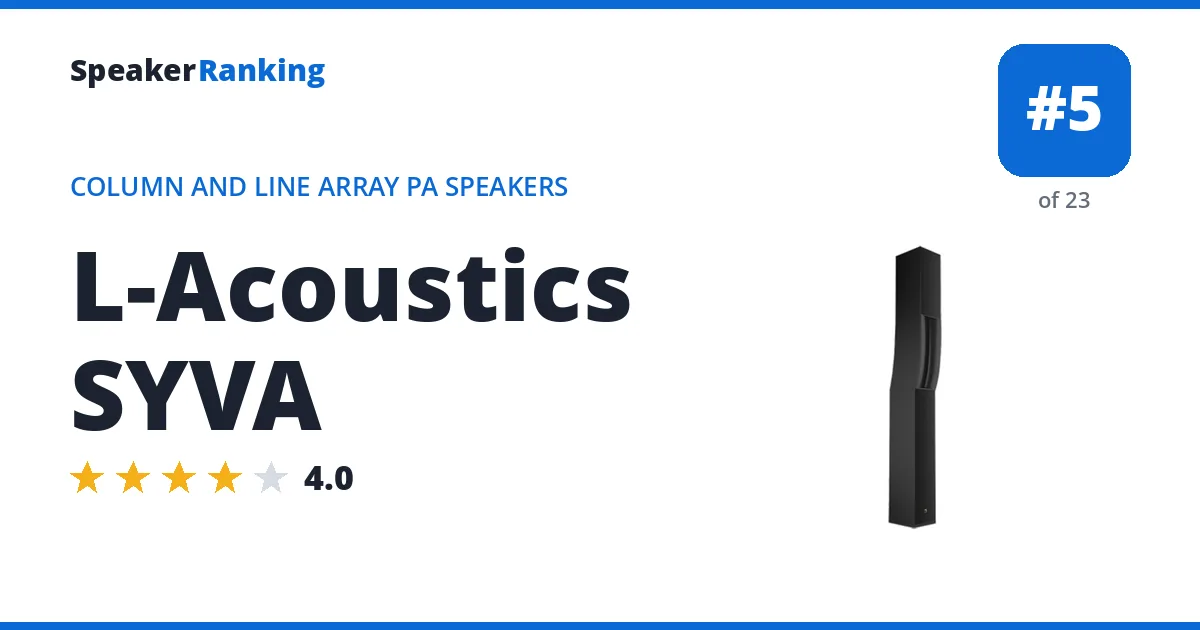
Pros: Vendor Spinorama data gives preference scores of 4.01 standalone and 7.58 with an ideal subwoofer. Six 5-inch drivers and three compression drivers form a slim 21kg line source with 140° horizontal coverage and 137dB peak SPL. It is intended to be paired with SYVA Low or a subwoofer, which is where the system’s bass comes from. Measured bass extension of 106Hz (-3dB).
Cons: On its own it reaches only about 106Hz (-3dB), so it cannot be used without a subwoofer. It is a passive line source that needs L-Acoustics amplified controllers, and the narrow 25° vertical coverage limits placement flexibility. Listening-window narrow-band deviation is 0.319 and on-axis deviation is higher than the coaxial competition.
Full L-Acoustics SYVA review and specifications →
| Released | 2017 (9 years ago) |
|---|---|
| AES Input | No |
| Amplifier Power | Passive speaker; requires an L-Acoustics amplified controller (LA4X, LA12X or LA7.16i) |
| Aux Input | No |
| Bass Extension (-3dB) | 106Hz (measured, vendor Spinorama data) |
| Bluetooth | No |
| Cabinet Material | Baltic beech and birch plywood |
| Coaxial Input | No |
| Configuration | Passive 2-way line source |
| Coverage | 140° horizontal, +5°/-21° vertical |
| DSP | No (passive; processing and protection come from the amplified controller) |
| Dimensions | 51.2”H x 5.7”W x 8.2”D (1301 x 144 x 209 mm) |
| Drivers | 6x 5” cone drivers, 3x 1.75” compression drivers |
| Frequency Response | 87Hz - 20kHz (manufacturer specified) |
| Guitar Input | No |
| HDMI Input | No |
| Inputs | Speakon (via L-Acoustics amplified controller) |
| Maximum SPL | 137dB (manufacturer specified) |
| Microphone Input | No |
| Optical Input | No |
| Passive | Yes |
| RCA Input | No |
| Spinorama Preference Score | 4.01 |
| Spinorama Preference Score with Perfect Sub | 7.58 |
| TRS Input | No |
| USB Input | No |
| Weight | 46.3 lbs (21 kg) |
| XLR Input | No |
- Links
- Reviews, Comparisons and Sound Samples
- Head-to-Head Comparisons
 #6 Alcons Audio QR24 Passive eBay
Same family: the Alcons Audio QRP20 (smaller model, ranked lower, rated 3.6/5) and the Alcons Audio QRP40 (larger model, ranked lower, rated 3.7/5).
Pros: High-quality manufacturer measurements give preference scores of 4.38 standalone and 7.25 with an ideal subwoofer, with a tight 1.4dB reference band and 0.279 listening-window deviation. Two 12-inch pro-ribbon drivers above four 6.5-inch woofers give 109dB sensitivity and a 135dB peak, and bass reaches 71Hz at -3dB. It works alone or stacked with more modules as a vertical array, in 80° or 110° horizontal versions. Measured bass extension of 71Hz (-3dB).
Cons: Bass drops quickly below about 70Hz, so a subwoofer is needed for full-range music. It needs Alcons Sentinel amplification for its presets, weighs 22kg, and is sold only through pro dealers with no published price.
Full Alcons Audio QR24 review and specifications →
| AES Input | No |
|---|---|
| Amplifier Power | Passive speaker; requires external amplification (Alcons Sentinel) |
| Aux Input | No |
| Bass Extension (-10dB) | about 62.5Hz (measured, vendor Spinorama data) |
| Bass Extension (-3dB) | 71Hz (measured, vendor Spinorama data) |
| Bluetooth | No |
| Coaxial Input | No |
| Configuration | Passive 2-way modular column (pro-ribbon) |
| Coverage | 80° or 110° horizontal x 3.6° per module |
| DSP | No (passive) |
| Dimensions | 25.9”H x 9.8”W x 13.2”D (658 x 248 x 336 mm) |
| Drivers | 2x 12” RBN1203 pro-ribbon drivers, 4x 6.5” neodymium woofers (vented) |
| Frequency Response | 74Hz - 20kHz (±3dB, manufacturer specified) |
| Guitar Input | No |
| HDMI Input | No |
| Impedance | 8 ohms |
| Maximum SPL | 135dB peak (manufacturer specified) |
| Microphone Input | No |
| Optical Input | No |
| Passive | Yes |
| RCA Input | No |
| Sensitivity | 109dB (200Hz - 10kHz) |
| Spinorama Preference Score | 4.38 |
| Spinorama Preference Score with Perfect Sub | 7.25 |
| TRS Input | No |
| USB Input | No |
| Weight | 48.5 lbs (22 kg) |
| XLR Input | No |
- Links
- Reviews, Comparisons and Sound Samples
- Head-to-Head Comparisons
 #7 Alcons Audio QRP40 Passive eBay
Same family: the Alcons Audio QRP20 (smaller model, ranked lower, rated 3.6/5) and the Alcons Audio QR24 (smaller model, ranked higher, rated 4/5).
Pros: High-quality manufacturer measurements give preference scores of 3.80 standalone and 6.67 with an ideal subwoofer. A 12-inch pro-ribbon driver sits coaxially within eight sealed 5-inch woofers, giving 103dB sensitivity and a 131dB peak with 90° or 120° horizontal coverage. Bass reaches 73Hz at -3dB, and the shallow 236mm cabinet is easy to hide on a wall. Measured bass extension of 73Hz (-3dB).
Cons: A 4.22 directivity-index deviation means off-axis tone varies more than its Alcons Audio QR24 sibling, and it needs a subwoofer below about 70Hz. It needs Alcons Sentinel amplification and is sold only through pro dealers with no published price.
Full Alcons Audio QRP40 review and specifications →
| AES Input | No |
|---|---|
| Amplifier Power | Passive speaker; requires external amplification (Alcons Sentinel) |
| Aux Input | No |
| Bass Extension (-10dB) | about 63.8Hz (measured, vendor Spinorama data) |
| Bass Extension (-3dB) | 73Hz (measured, vendor Spinorama data) |
| Bluetooth | No |
| Coaxial Input | No |
| Configuration | Passive 2-way point-source column (pro-ribbon) |
| Coverage | 90° x 20° (120° version available) |
| DSP | No (passive) |
| Dimensions | 44”H x 6.3”W x 9.3”D (1118 x 161 x 236 mm) |
| Drivers | 1x 12” RBN1203 pro-ribbon driver, 8x 5” woofers (sealed) |
| Frequency Response | 71Hz - 20kHz (±3dB, manufacturer specified) |
| Guitar Input | No |
| HDMI Input | No |
| Impedance | 4 ohms |
| Maximum SPL | 131dB peak (manufacturer specified) |
| Microphone Input | No |
| Optical Input | No |
| Passive | Yes |
| RCA Input | No |
| Sensitivity | 103dB (200Hz - 10kHz) |
| Spinorama Preference Score | 3.80 |
| Spinorama Preference Score with Perfect Sub | 6.67 |
| TRS Input | No |
| USB Input | No |
| Weight | 48.5 lbs (22 kg) |
| XLR Input | No |
- Links
- Reviews, Comparisons and Sound Samples
- Head-to-Head Comparisons
 #8 Alcons Audio QRP20 Passive eBay
Same family: the Alcons Audio QR24 (larger model, ranked higher, rated 4/5) and the Alcons Audio QRP40 (larger model, ranked higher, rated 3.7/5).
Pros: High-quality manufacturer measurements of the 90° version give preference scores of 3.38 standalone and 6.69 with an ideal subwoofer. A 4-inch pro-ribbon driver on a Morpher lens above four sealed 5-inch woofers gives 99dB sensitivity and a 128dB peak from a slim 150mm-square, 12kg column, with 90° or 120° horizontal versions. Measured bass extension of 90Hz (-3dB).
Cons: Bass reaches only 90Hz at -3dB and about 81Hz at -10dB, so it needs a subwoofer for music. The 120° version measures slightly worse, at 3.00 standalone. It needs Alcons Sentinel amplification and is sold only through pro dealers with no published price.
Full Alcons Audio QRP20 review and specifications →
| AES Input | No |
|---|---|
| Amplifier Power | Passive speaker; requires external amplification (Alcons Sentinel) |
| Aux Input | No |
| Bass Extension (-10dB) | about 80.8Hz (measured, vendor Spinorama data) |
| Bass Extension (-3dB) | 90Hz (measured, vendor Spinorama data) |
| Bluetooth | No |
| Coaxial Input | No |
| Configuration | Passive 2-way point-source column (pro-ribbon) |
| Coverage | 90° x 15° (120° version available) |
| DSP | No (passive) |
| Dimensions | 29.2”H x 5.9”W x 5.9”D (742 x 150 x 150 mm) |
| Drivers | 1x 4” RBN401 pro-ribbon driver, 4x 5” woofers (sealed) |
| Frequency Response | 72Hz - 20kHz (±3dB, manufacturer specified) |
| Guitar Input | No |
| HDMI Input | No |
| Impedance | 4 ohms |
| Maximum SPL | 128dB peak (manufacturer specified) |
| Microphone Input | No |
| Optical Input | No |
| Passive | Yes |
| RCA Input | No |
| Rigging | M10 inserts top and bottom; M6 bracket pattern on back |
| Sensitivity | 99dB (200Hz - 10kHz) |
| Spinorama Preference Score | 3.38 |
| Spinorama Preference Score with Perfect Sub | 6.69 |
| TRS Input | No |
| USB Input | No |
| Weight | 26.5 lbs (12 kg) |
| XLR Input | No |
- Links
- Reviews, Comparisons and Sound Samples
- Head-to-Head Comparisons
 #9 L-Acoustics SOKA Passive eBay
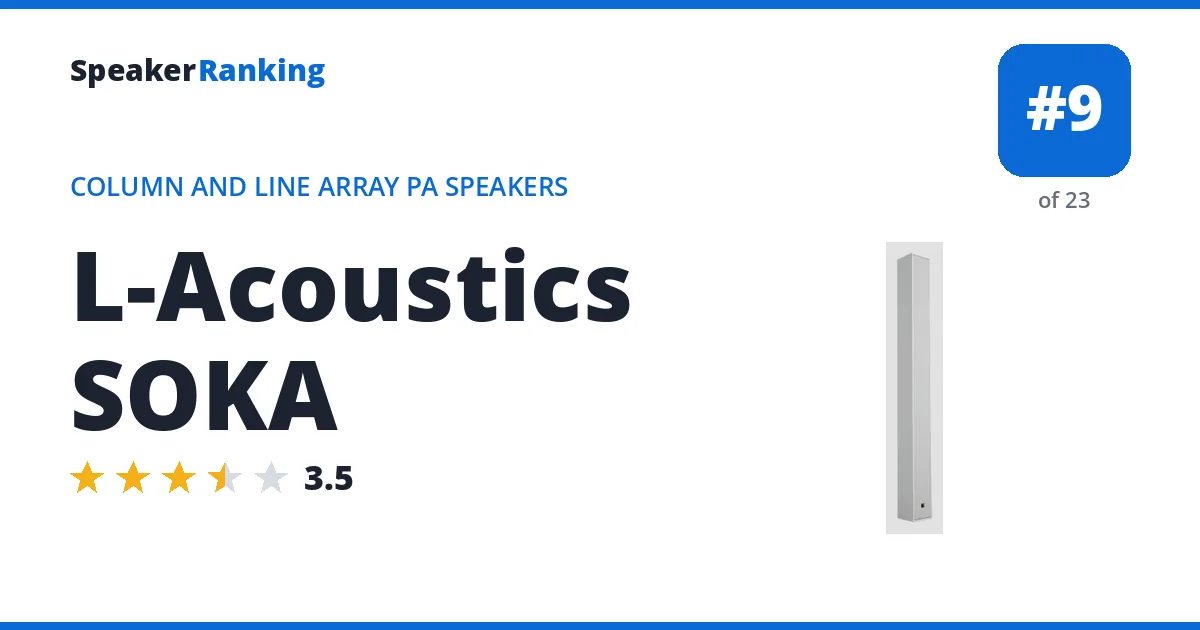
Pros: An ultra-shallow line source only about 10cm deep and 9.4kg that reaches 133dB with 140° horizontal coverage, which lets it hide against a wall or column. Vendor Spinorama data gives preference scores of 3.21 standalone and 6.99 with an ideal subwoofer. Measured bass extension of 128Hz (-3dB).
Cons: Bass reaches only about 128Hz (-3dB), so it needs a subwoofer or a bass companion, and it is passive, so it requires L-Acoustics amplified controllers. Listening-window narrow-band deviation is 0.348 and pricing is dealer quoted.
Full L-Acoustics SOKA review and specifications →
| Released | 2022 (4 years ago) |
|---|---|
| AES Input | No |
| Amplifier Power | Passive speaker; requires external amplification (L-Acoustics amplified controller) |
| Aux Input | No |
| Bass Extension (-3dB) | 128Hz (measured, vendor Spinorama data) |
| Bluetooth | No |
| Coaxial Input | No |
| Configuration | Passive 2-way ultra-shallow line source |
| Coverage | 140° horizontal, +5°/-21° vertical |
| DSP | No (passive; processing comes from the amplified controller) |
| Dimensions | 41.9”H x 3.9”W x 4.1”D (1065 x 99 x 104 mm) |
| Drivers | 9x 3.5” neodymium cone drivers, 3x 1” neodymium compression drivers |
| Frequency Response | 70Hz - 20kHz (-10dB, manufacturer specified) |
| Guitar Input | No |
| HDMI Input | No |
| Maximum SPL | 133dB peak (manufacturer specified) |
| Microphone Input | No |
| Optical Input | No |
| Passive | Yes |
| RCA Input | No |
| Rigging | 6 x M6 inserts |
| Spinorama Preference Score | 3.21 |
| Spinorama Preference Score with Perfect Sub | 6.99 |
| TRS Input | No |
| USB Input | No |
| Weight | 20.7 lbs (9.4 kg) |
| XLR Input | No |
- Links
- Reviews, Comparisons and Sound Samples
- Head-to-Head Comparisons
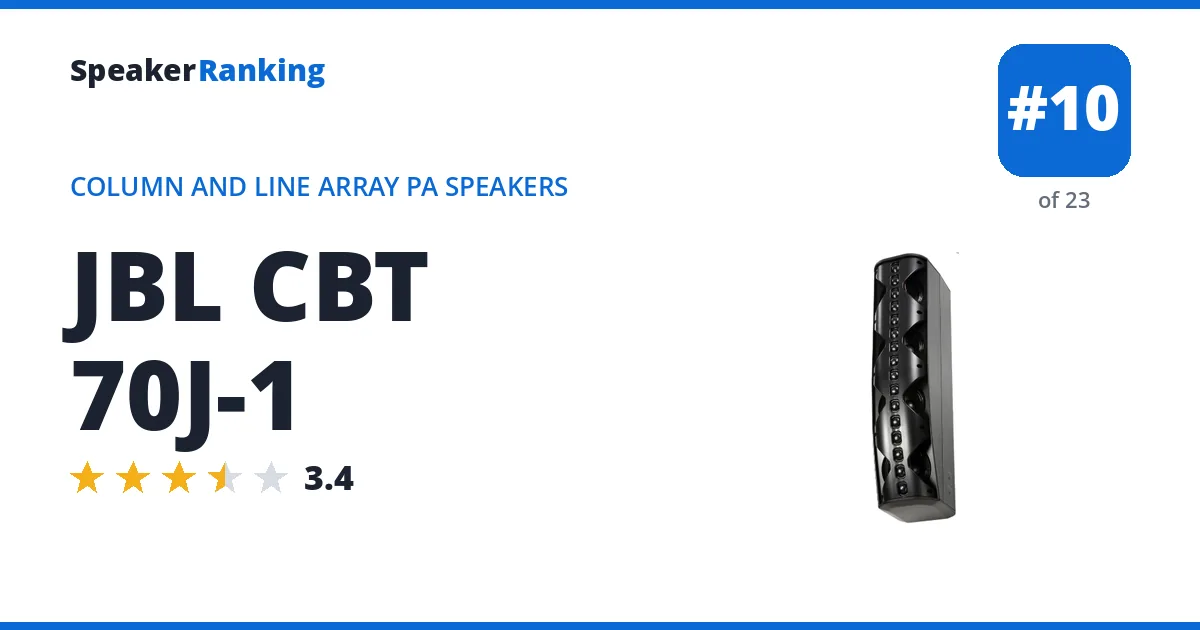
 #10 JBL CBT 70J-1: $1,480.00 Passive Amazon $1,480.00 B&H Photo Video $1,480.00 eBay
Same family: the JBL CBT 50LA-1 (smaller model, ranked lower, estimated 3.1/5), the JBL CBT 100LA-1 (larger model, ranked lower, estimated 3.1/5), the JBL CBT 200LA-1 (larger model, ranked lower, estimated 3.2/5) and the JBL CBT 1000 (larger model, ranked higher, rated 4.1/5).
Pros: Independently measured by Audio Science Review, with a 5.87 preference score with an ideal subwoofer and a 3.20 directivity-index deviation. Sixteen 1-inch tweeters and four 5-inch woofers give switchable 25° or 45° vertical coverage for long-throw or medium rooms, with a 131dB peak and a speech or music voicing switch. A pan and tilt wall bracket is included. Measured bass extension of 120.1Hz (-3dB).
Cons: Bass measures 120Hz at -3dB and about 62Hz at -10dB, and the standalone score is only 2.95, so it needs a subwoofer for music. A 4.0dB reference band and 0.573 listening-window deviation mean tonal balance is uneven. It is passive and needs an external amplifier.
Full JBL CBT 70J-1 review and specifications →
| AES Input | No |
|---|---|
| Amplifier Power | Passive speaker; requires external amplification |
| Aux Input | No |
| Bass Extension (-10dB) | about 61.5Hz (measured, Audio Science Review data on spinorama.org) |
| Bass Extension (-3dB) | 120.1Hz (measured, Audio Science Review data on spinorama.org) |
| Bluetooth | No |
| Coaxial Input | No |
| Configuration | Passive 2-way Constant Beamwidth Technology column |
| Coverage | Switchable 25° or 45° vertical |
| DSP | No (passive) |
| Dimensions | 27.3”H x 6.7”W x 9.3”D (694 x 170 x 237 mm) |
| Drivers | 4x 5” neodymium woofers, 16x 1” neodymium tweeters |
| Frequency Response | 60Hz - 20kHz (-10dB, manufacturer specified) |
| Guitar Input | No |
| HDMI Input | No |
| Impedance | 8 ohms |
| Maximum SPL | 131dB peak (narrow, speech mode, manufacturer specified) |
| Microphone Input | No |
| Optical Input | No |
| Passive | Yes |
| Power Handling | 500W (2,000W peak) |
| RCA Input | No |
| Rigging | 10 x M6 rear inserts; swivel/tilt wall bracket included |
| Spinorama Preference Score | 2.95 |
| Spinorama Preference Score with Perfect Sub | 5.87 |
| TRS Input | No |
| USB Input | No |
| Weight | 20.9 lbs (9.5 kg) |
| XLR Input | No |
- Links
- Reviews, Comparisons and Sound Samples
- Head-to-Head Comparisons
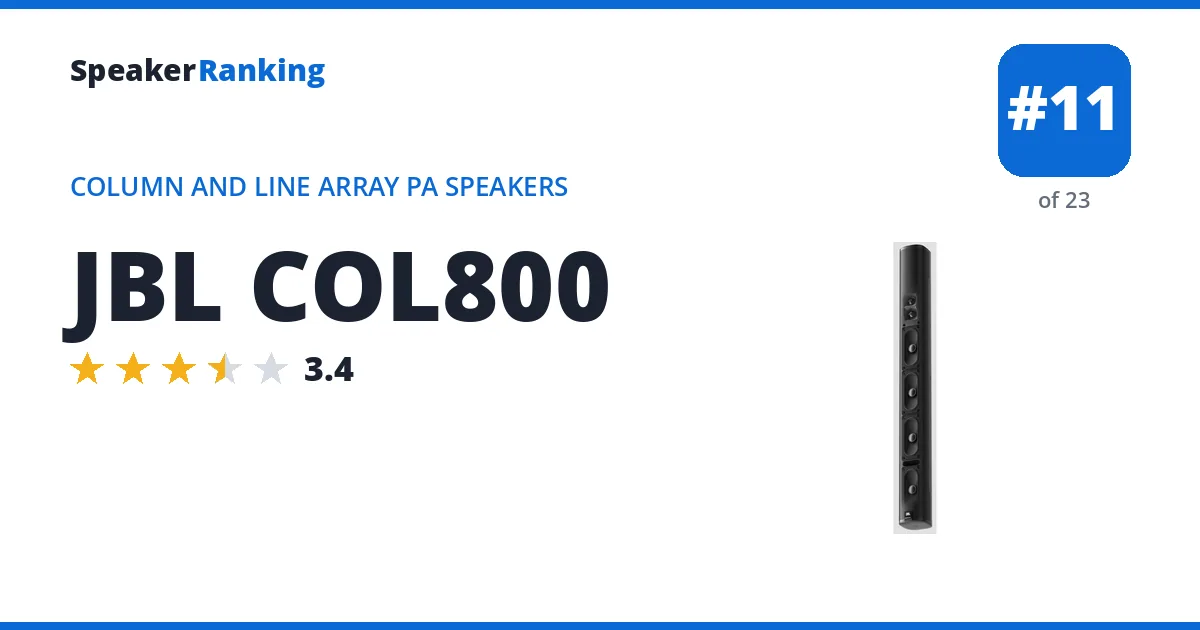
 #11 JBL COL800: $577.00 Passive B&H Photo Video $577.00 eBay
Same family: the JBL COL600 (smaller model, ranked lower, rated 3.3/5).
Pros: Manufacturer measurements give a 6.34 preference score with an ideal subwoofer from a slim 93mm-deep column that blends into a wall. Four racetrack woofers and two tweeters give wide 160° horizontal coverage with a built-in 10° downward tilt, and a 70V/100V transformer or 8 ohm direct mode suits distributed systems. Measured bass extension of 115Hz (-3dB).
Cons: Bass measures 115Hz at -3dB and about 86Hz at -10dB, and output tops out at 116dB, so it suits speech and background music rather than loud programs. The data is manufacturer supplied, rated low quality, and the standalone score is 2.67.
Full JBL COL800 review and specifications →
| Released | 2023 (3 years ago) |
|---|---|
| AES Input | No |
| Amplifier Power | Passive speaker; requires external amplification |
| Aux Input | No |
| Bass Extension (-10dB) | about 85.6Hz (measured, vendor Spinorama data) |
| Bass Extension (-3dB) | 115Hz (measured, vendor Spinorama data) |
| Bluetooth | No |
| Coaxial Input | No |
| Configuration | Passive slim column (8 ohm or 70V/100V) |
| Coverage | 160° x 60°, 10° down-tilt |
| DSP | No (passive) |
| Dimensions | 31.5”H x 4”W x 3.7”D (800 x 102 x 93 mm) |
| Drivers | 4x 5” x 2.25” racetrack woofers, 2x 0.8” tweeters |
| Frequency Response | 85Hz - 20kHz (-10dB, manufacturer specified) |
| Guitar Input | No |
| HDMI Input | No |
| Impedance | 8 ohms |
| Maximum SPL | 116dB peak (manufacturer specified) |
| Microphone Input | No |
| Optical Input | No |
| Passive | Yes |
| Power Handling | 150W continuous pink noise (600W peak) |
| RCA Input | No |
| Rigging | M6 inserts on back, top, bottom and sides; wall and L-brackets included |
| Sensitivity | 88dB (2.83V/1m) |
| Spinorama Preference Score | 2.67 |
| Spinorama Preference Score with Perfect Sub | 6.34 |
| TRS Input | No |
| USB Input | No |
| Weight | 11.5 lbs (5.2 kg) |
| XLR Input | No |
- Links
- Reviews, Comparisons and Sound Samples
- Head-to-Head Comparisons
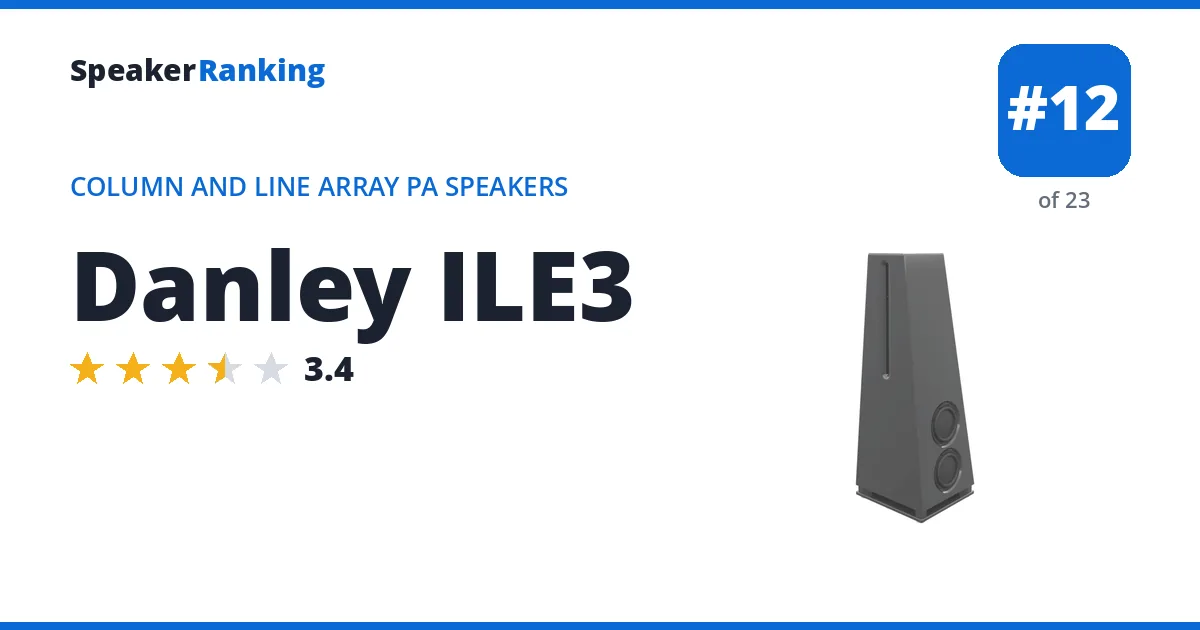
 #12 Danley ILE3: $37,000 per pair Sweetwater eBay
Same family: the Danley HRE1 (larger model, ranked lower, rated 3.3/5).
Pros: A 3-way powered speaker from Tom Danley’s Signature Series with four 10” woofers and five coaxial 5” mid/1” high drivers on a Paraline lens for a wide 140 degree by narrow 20 degree pattern, driven by a 1,400W amplifier. Danley’s measurements show a preference score of 5.18 that reaches 5.99 with an ideal subwoofer, with 0.42 listening window deviation.
Cons: It is very large and expensive, and the on-axis response is less even (0.85 average deviation). The data comes from Danley. That data is low quality.
Full Danley ILE3 review and specifications →
| AES Input | No |
|---|---|
| Amplifier Power | 1,400W (2 channels) |
| Aux Input | No |
| Bluetooth | No |
| Coaxial Input | No |
| DIY Kit | No |
| Drivers | 4x 10” woofers, 5x coaxial 5” mid / 1” HF drivers on Paraline lens |
| HDMI Input | No |
| Maximum SPL | 125dB peak (manufacturer specified) |
| Optical Input | No |
| Passive | No |
| RCA Input | No |
| Spinorama Preference Score | 5.18 |
| Spinorama Preference Score with Perfect Sub | 5.99 |
| TRS Input | No |
| USB Input | No |
| XLR Input | Yes |
- Reviews, Comparisons and Sound Samples
- Head-to-Head Comparisons
 #13 JBL COL600: $386.00 Passive B&H Photo Video $386.00 eBay
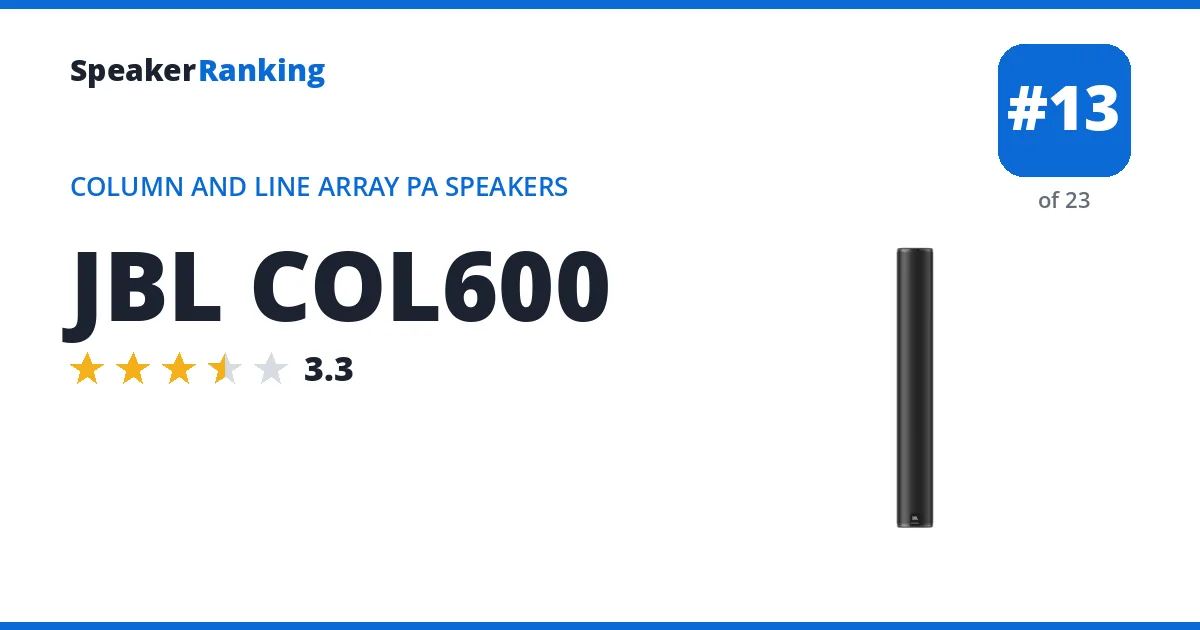
Same family: the JBL COL800 (larger model, ranked higher, rated 3.4/5).
Pros: Manufacturer measurements give a 6.11 preference score with an ideal subwoofer and a 2.1dB reference band from a 598mm column only 93mm deep. Two racetrack woofers and a 1-inch tweeter give 160° x 110° coverage with a 10° downward tilt, and a 70V/100V transformer or 8 ohm direct mode suits restaurants, shops and meeting rooms. Measured bass extension of 106Hz (-3dB).
Cons: Bass measures 106Hz at -3dB and about 78Hz at -10dB, and output tops out at 111dB, so it is for speech and background music. The data is manufacturer supplied, rated low quality, and the standalone score is 2.64.
Full JBL COL600 review and specifications →
| Released | 2023 (3 years ago) |
|---|---|
| AES Input | No |
| Amplifier Power | Passive speaker; requires external amplification |
| Aux Input | No |
| Bass Extension (-10dB) | about 77.7Hz (measured, vendor Spinorama data) |
| Bass Extension (-3dB) | 106Hz (measured, vendor Spinorama data) |
| Bluetooth | No |
| Coaxial Input | No |
| Configuration | Passive slim column (8 ohm or 70V/100V) |
| Coverage | 160° x 110°, 10° down-tilt |
| DSP | No (passive) |
| Dimensions | 23.5”H x 4”W x 3.7”D (598 x 102 x 93 mm) |
| Drivers | 2x 5” x 2.25” racetrack woofers, 1x 1” tweeter |
| Frequency Response | 70Hz - 20kHz (-10dB, manufacturer specified) |
| Guitar Input | No |
| HDMI Input | No |
| Impedance | 8 ohms |
| Maximum SPL | 111dB peak (manufacturer specified) |
| Microphone Input | No |
| Optical Input | No |
| Passive | Yes |
| Power Handling | 80W continuous pink noise (320W peak) |
| RCA Input | No |
| Rigging | M6 inserts on top, bottom and sides; wall and L-brackets included |
| Sensitivity | 86dB (2.83V/1m) |
| Spinorama Preference Score | 2.64 |
| Spinorama Preference Score with Perfect Sub | 6.11 |
| TRS Input | No |
| USB Input | No |
| Weight | 7.7 lbs (3.5 kg) |
| XLR Input | No |
- Links
- Reviews, Comparisons and Sound Samples
- Head-to-Head Comparisons
 #14 Danley HRE1: $46,150 per pair eBay
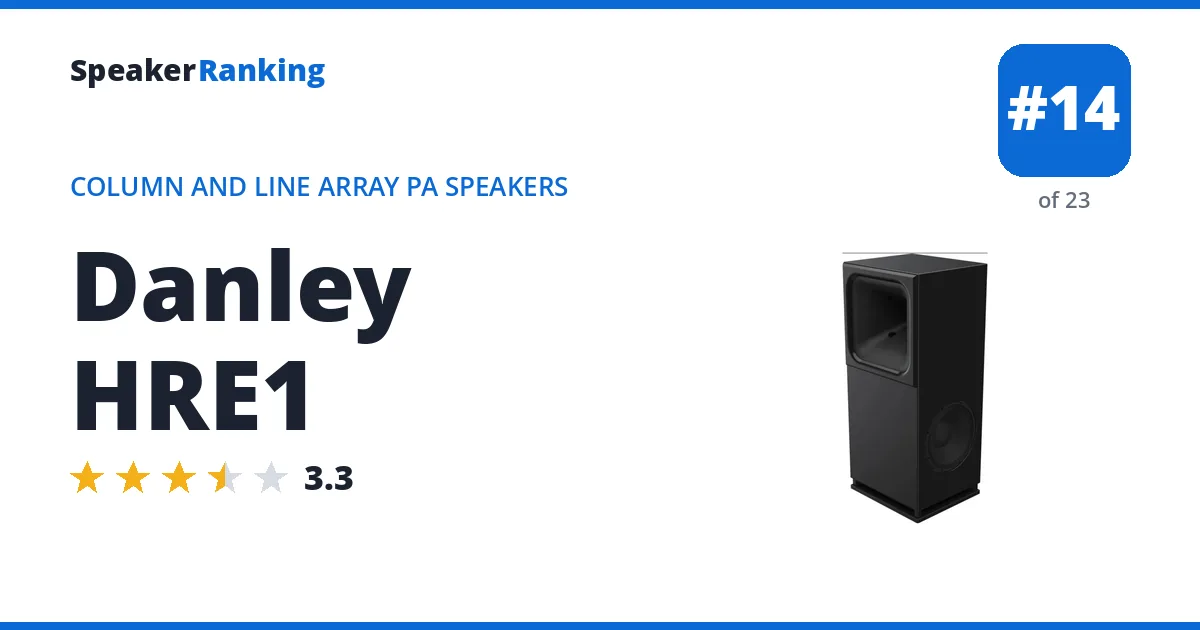
Same family: the Danley ILE3 (smaller model, ranked higher, rated 3.4/5).
Pros: A large powered speaker from Danley’s high-output Signature Series, built for very loud, low-distortion playback in large rooms. Danley’s measurements show a preference score of 4.27 that reaches 5.09 with an ideal subwoofer, with 0.64 listening window deviation.
Cons: It is very large and expensive. The data comes from Danley.
Full Danley HRE1 review and specifications →
| Released | 2022 (4 years ago) |
|---|---|
| AES Input | No |
| Aux Input | No |
| Bluetooth | No |
| Coaxial Input | No |
| DIY Kit | No |
| Drivers | multiple woofers and mid/high drivers in a Danley horn |
| HDMI Input | No |
| Maximum SPL | 132dB peak (manufacturer specified) |
| Optical Input | No |
| Passive | No |
| RCA Input | No |
| Spinorama Preference Score | 4.27 |
| Spinorama Preference Score with Perfect Sub | 5.09 |
| TRS Input | No |
| USB Input | No |
| XLR Input | Yes |
- Reviews, Comparisons and Sound Samples
 #15 JBL CBT 200LA-1: $2,449.16 each Passive Amazon $2,449.16 eBay
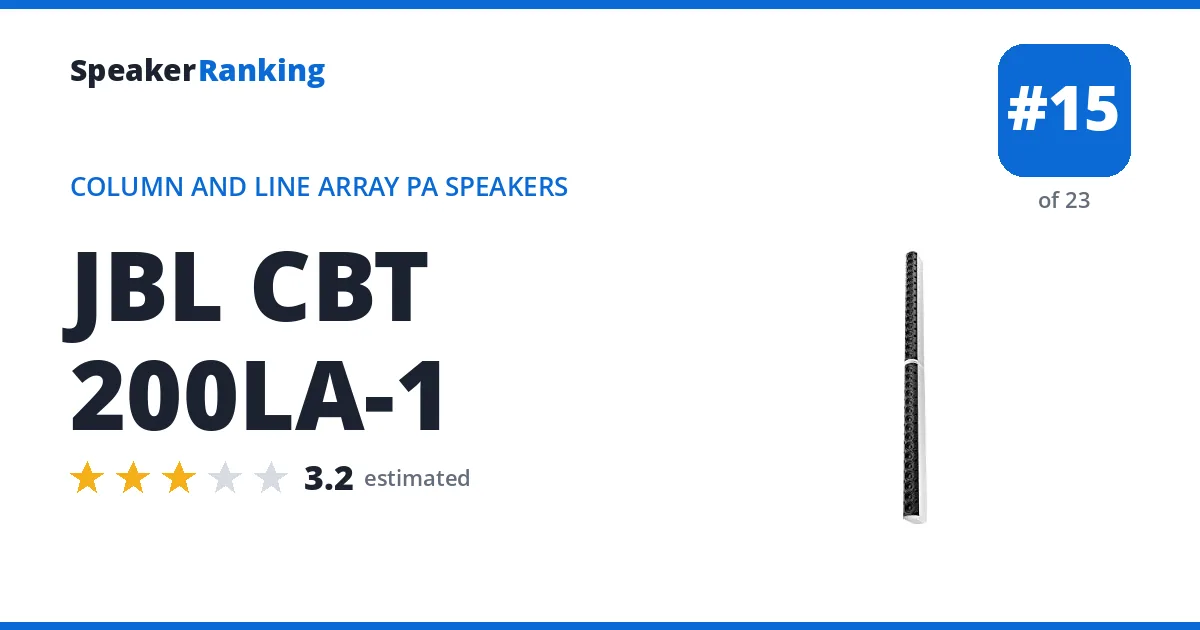
Same family: the JBL CBT 50LA-1 (smaller model, ranked lower, estimated 3.1/5), the JBL CBT 70J-1 (smaller model, ranked higher, rated 3.4/5), the JBL CBT 100LA-1 (smaller model, ranked lower, estimated 3.1/5) and the JBL CBT 1000 (larger model, ranked higher, rated 4.1/5).
Pros: A Constant Beamwidth Technology column from the same JBL CBT range as the measured JBL CBT 70J-1 and JBL CBT 1000, with thirty-two 2” full-range drivers in a 2000mm tall cabinet. It keeps a steady 150° horizontal and switchable 15° or 30° vertical pattern across frequency, which helps speech intelligibility in reverberant rooms, and JBL rates it at 129dB peak.
Cons: No independent measurements yet, so it can’t be compared with ranked PA speakers. Its 2” drivers have no separate woofer or tweeter and roll off below 80Hz, so music needs a subwoofer, and it requires an external amplifier.
Full JBL CBT 200LA-1 review and specifications →
| Amplifier Power | Passive speaker; requires external amplification |
|---|---|
| Bluetooth | No |
| Configuration | Passive Constant Beamwidth Technology line array column |
| Coverage | 150° horizontal, switchable 15° or 30° vertical |
| DSP | No (passive) |
| Dimensions | 78.7” (2000 mm) tall |
| Drivers | 32x 2” full-range drivers |
| Frequency Response | 80Hz - 20kHz (manufacturer specified) |
| Maximum SPL | 129dB peak (manufacturer specified) |
| Passive | Yes |
| Power Handling | 650W continuous |
| Rigging | 28 x M6 rear inserts; swivel/tilt wall bracket included |
| Weight | 32.2 lbs (14.6 kg) |
| XLR Input | No |
- Links
- Reviews, Comparisons and Sound Samples
- No independent measurement review is linked for this model; it is ranked from hands-on listening and comparison against similarly priced speakers.
- Head-to-Head Comparisons
 #16 FBT Vertus CS1000 eBay
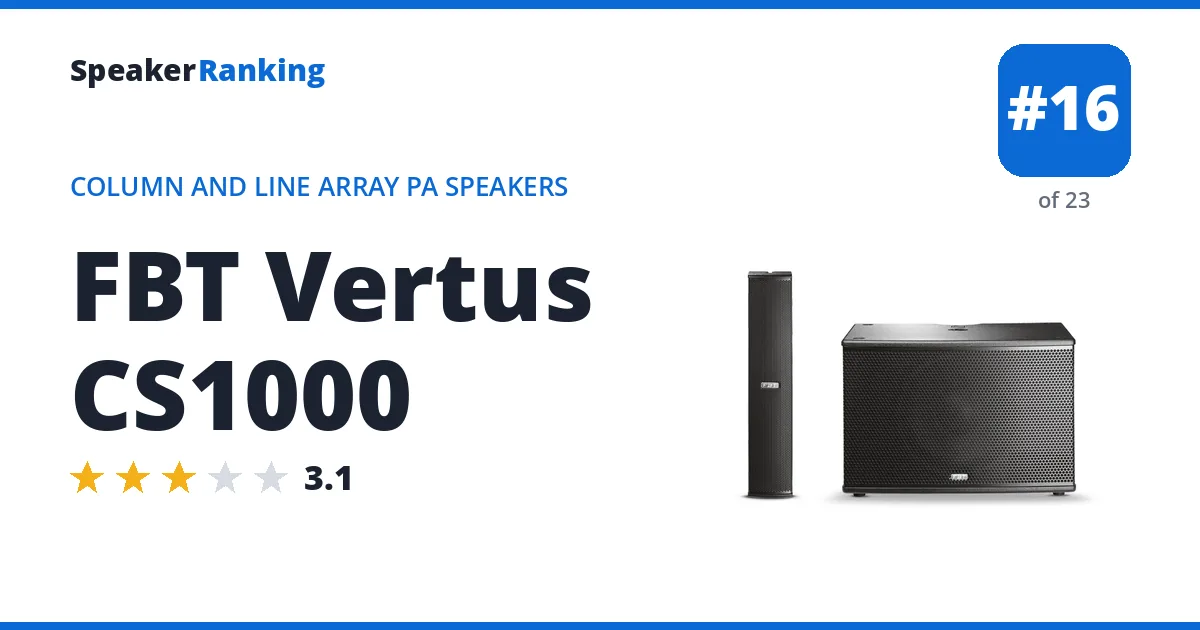
Pros: The matched 12-inch subwoofer takes bass to 53Hz at -3dB and about 45Hz at -10dB in vendor measurements, deep for a portable column system, with a 129dB peak. The 3.5kg column covers a wide 110° horizontally for bands, DJs and presentations. Measured bass extension of 53Hz (-3dB).
Cons: Preference scores of 1.62 standalone and 3.84 with an ideal subwoofer are low, because the on-axis response is uneven (3.6dB average deviation) and tonal balance shifts off axis (4.58dB directivity-index deviation).
Full FBT Vertus CS1000 review and specifications →
| Released | 2016 (10 years ago) |
|---|---|
| AES Input | No |
| Amplifier Power | 1,000W RMS (600W LF + 400W HF) |
| Aux Input | No |
| Bass Extension (-10dB) | about 44.9Hz (measured, vendor Spinorama data) |
| Bass Extension (-3dB) | 53Hz (measured, vendor Spinorama data) |
| Bluetooth | No |
| Coaxial Input | No |
| Configuration | Active 2-way column PA system with 12-inch subwoofer |
| Coverage | 110° x 30° |
| DSP | Yes |
| Drivers | 6 x 2.75” column drivers, 12” subwoofer |
| Frequency Response | 40Hz - 20kHz (manufacturer specified) |
| Guitar Input | No |
| HDMI Input | No |
| Maximum SPL | 129dB peak / 125dB continuous (manufacturer specified) |
| Microphone Input | No |
| Optical Input | No |
| Passive | No |
| RCA Input | No |
| Rigging | M20 satellite pole on subwoofer; optional flying bar and wall bracket |
| Spinorama Preference Score | 1.62 |
| Spinorama Preference Score with Perfect Sub | 3.84 |
| TRS Input | No |
| USB Input | No |
| Weight | 7.7 lbs (3.5 kg) column, 49.4 lbs (22.4 kg) subwoofer |
| XLR Input | Yes |
- Links
- Reviews, Comparisons and Sound Samples
 #17 JBL CBT 50LA-1: $585.00 each Passive Amazon $585.00 eBay
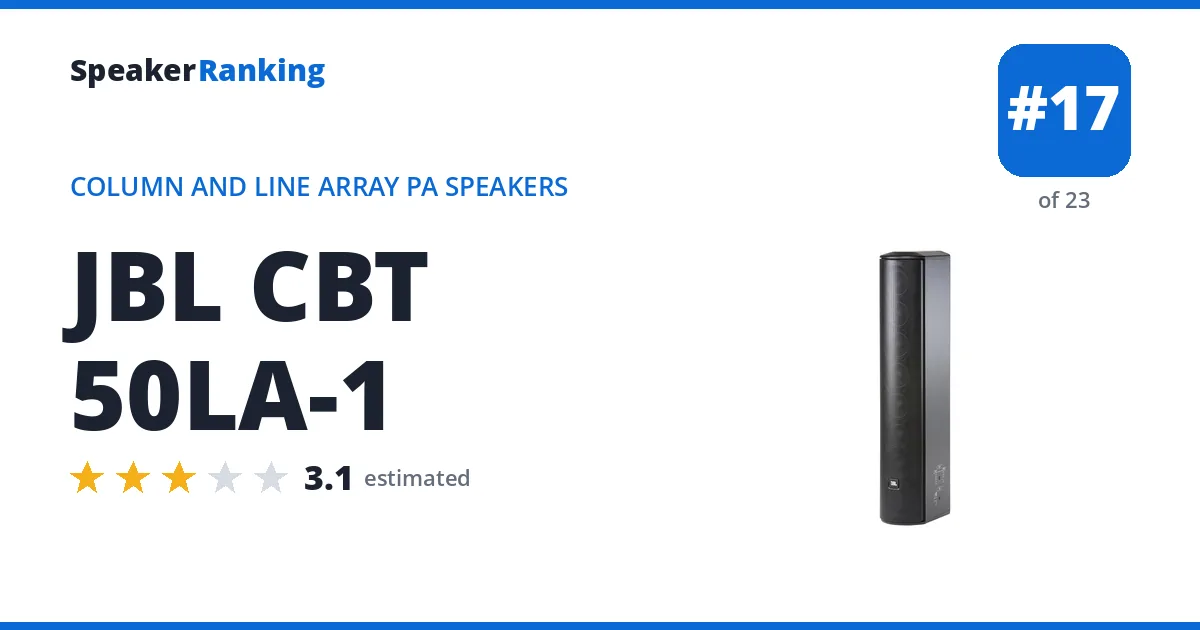
Same family: the JBL CBT 70J-1 (larger model, ranked higher, rated 3.4/5), the JBL CBT 100LA-1 (larger model, ranked lower, estimated 3.1/5), the JBL CBT 200LA-1 (larger model, ranked higher, estimated 3.2/5) and the JBL CBT 1000 (larger model, ranked higher, rated 4.1/5).
Pros: A Constant Beamwidth Technology column from the same JBL CBT range as the measured JBL CBT 70J-1 and JBL CBT 1000, with eight 2” full-range drivers in a 528mm tall cabinet. It keeps a steady 150° horizontal and 20° vertical pattern across frequency, which helps speech intelligibility in reverberant rooms, and JBL rates it at 115dB continuous.
Cons: No independent measurements yet, so it can’t be compared with ranked PA speakers. Its 2” drivers have no separate woofer or tweeter and roll off below 80Hz, so music needs a subwoofer, and it requires an external amplifier.
Full JBL CBT 50LA-1 review and specifications →
| Amplifier Power | Passive speaker; requires external amplification |
|---|---|
| Bluetooth | No |
| Configuration | Passive Constant Beamwidth Technology line array column |
| Coverage | 150° horizontal, 20° vertical |
| DSP | No (passive) |
| Dimensions | 20.8” (528 mm) tall |
| Drivers | 8x 2” full-range drivers |
| Frequency Response | 80Hz - 20kHz (manufacturer specified) |
| Maximum SPL | 115dB continuous (manufacturer specified) |
| Passive | Yes |
| Power Handling | 150W continuous |
| Rigging | 10 x M6 rear inserts; swivel/tilt wall bracket included |
| Weight | 9 lbs (4.1 kg) |
| XLR Input | No |
- Links
- Reviews, Comparisons and Sound Samples
- No independent measurement review is linked for this model; it is ranked from hands-on listening and comparison against similarly priced speakers.
- Head-to-Head Comparisons
 #18 JBL CBT 100LA-1: $1,055.00 each Passive Amazon $1,055.00 eBay
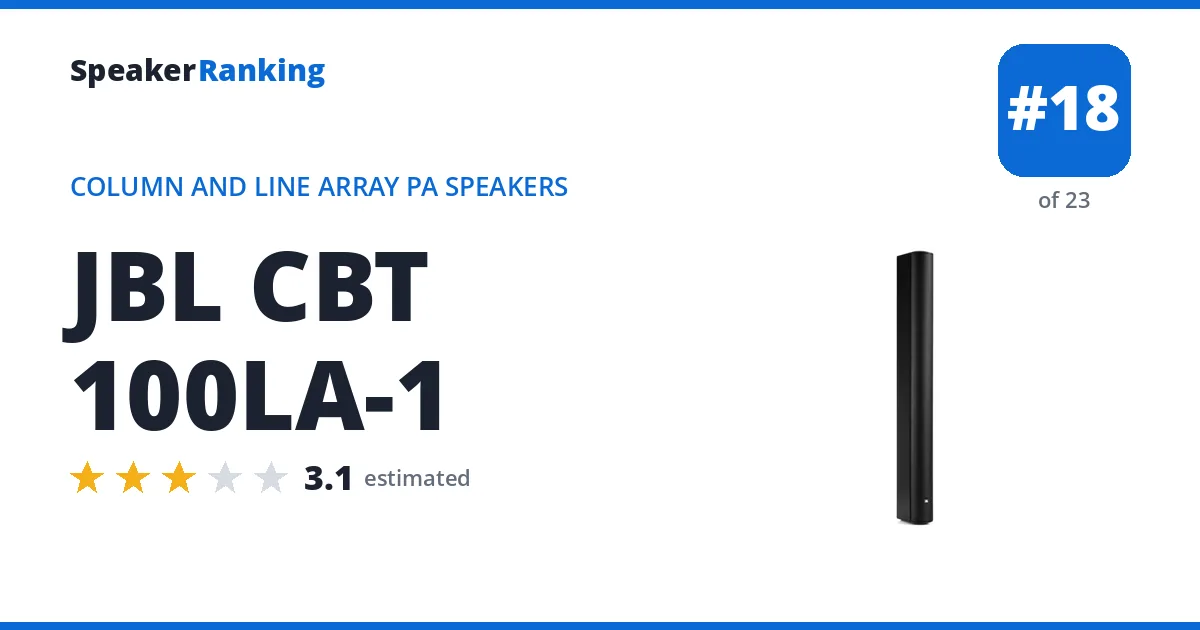
Same family: the JBL CBT 50LA-1 (smaller model, ranked higher, estimated 3.1/5), the JBL CBT 70J-1 (smaller model, ranked higher, rated 3.4/5), the JBL CBT 200LA-1 (larger model, ranked higher, estimated 3.2/5) and the JBL CBT 1000 (larger model, ranked higher, rated 4.1/5).
Pros: A Constant Beamwidth Technology column from the same JBL CBT range as the measured JBL CBT 70J-1 and JBL CBT 1000, with sixteen 2” full-range drivers in a 1000mm tall cabinet. It keeps a steady 150° horizontal and switchable 15° or 40° vertical pattern across frequency, which helps speech intelligibility in reverberant rooms, and JBL rates it at 121dB (narrow mode).
Cons: No independent measurements yet, so it can’t be compared with ranked PA speakers. Its 2” drivers have no separate woofer or tweeter and roll off below 80Hz, so music needs a subwoofer, and it requires an external amplifier.
Full JBL CBT 100LA-1 review and specifications →
| Amplifier Power | Passive speaker; requires external amplification |
|---|---|
| Bluetooth | No |
| Configuration | Passive Constant Beamwidth Technology line array column |
| Coverage | 150° horizontal, switchable 15° or 40° vertical |
| DSP | No (passive) |
| Dimensions | 39.4” (1000 mm) tall |
| Drivers | 16x 2” full-range drivers |
| Frequency Response | 80Hz - 20kHz (manufacturer specified) |
| Maximum SPL | 121dB (narrow mode) (manufacturer specified) |
| Passive | Yes |
| Power Handling | 325W continuous |
| Rigging | 18 x M6 inserts (OmniMount pattern); swivel/tilt wall bracket included |
| Weight | 15.9 lbs (7.2 kg) |
| XLR Input | No |
- Links
- Reviews, Comparisons and Sound Samples
- No independent measurement review is linked for this model; it is ranked from hands-on listening and comparison against similarly priced speakers.
- Head-to-Head Comparisons
 #19 Coda Audio CoRay4 Passive eBay
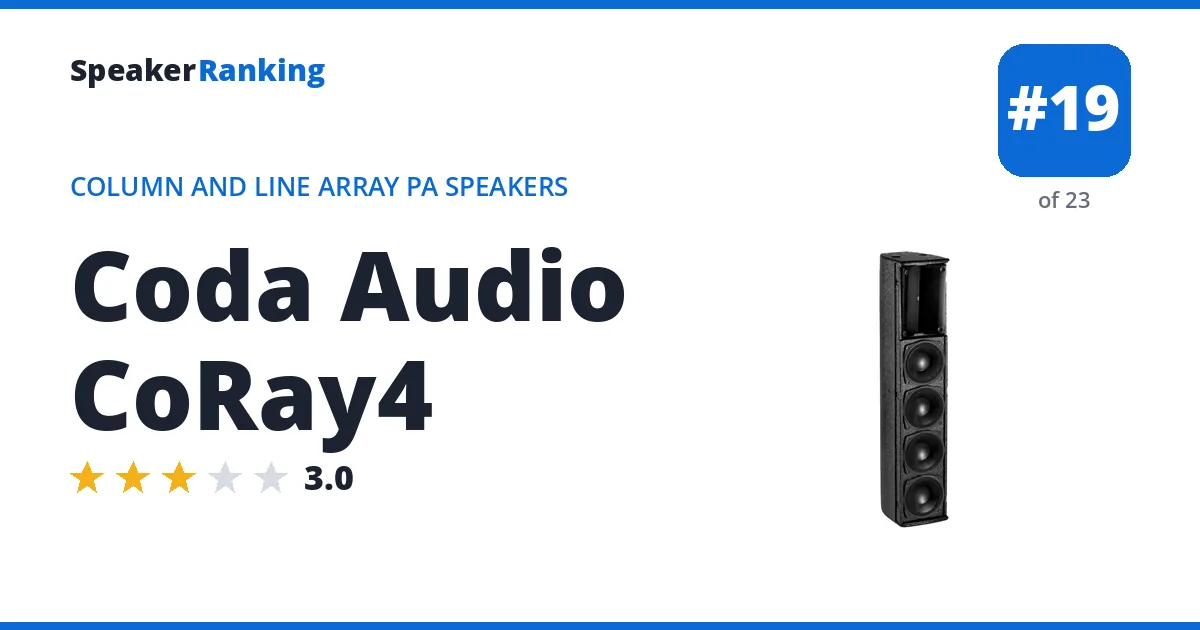
Pros: Two 4-inch planar wave drivers above four 5-inch woofers give 97dB sensitivity and a very high 144dB peak, with 120°, 60° or asymmetric 90° horizontal coverage and an asymmetric 12° vertical pattern. Bass reaches 82.5Hz at -3dB, and columns can be linked into a longer array for touring or installation. Measured bass extension of 82.5Hz (-3dB).
Cons: High-quality manufacturer measurements give a low 1.96 standalone preference score and 5.04 with an ideal subwoofer, with a 0.619 listening-window deviation, so tonal balance is uneven. It will not work without a Coda Audio system controller, weighs 15.7kg and is sold only through pro dealers with no published price.
Full Coda Audio CoRay4 review and specifications →
| AES Input | No |
|---|---|
| Amplifier Power | Passive speaker; requires a Coda Audio LINUS amplifier/controller |
| Aux Input | No |
| Bass Extension (-10dB) | about 71.6Hz (measured, vendor Spinorama data) |
| Bass Extension (-3dB) | 82.5Hz (measured, vendor Spinorama data) |
| Bluetooth | No |
| Coaxial Input | No |
| Configuration | Passive 2-way line source column (requires Coda controller) |
| Coverage | 120°, 60° or 90° asymmetric horizontal x 12° vertical |
| DSP | No (passive) |
| Dimensions | 29.8”H x 6”W x 8.4”D (758 x 152 x 214 mm) |
| Drivers | 2x 4” neodymium planar wave drivers, 4x 5” woofers |
| Frequency Response | 80Hz - 20kHz (-6dB, manufacturer specified) |
| Guitar Input | No |
| HDMI Input | No |
| Impedance | 4 ohms |
| Maximum SPL | 144dB peak (manufacturer specified) |
| Microphone Input | No |
| Optical Input | No |
| Passive | Yes |
| Power Handling | 700W AES / 2,800W peak |
| RCA Input | No |
| Rigging | CODA mobile suspension and flange adapter; optional CF4 flying frame |
| Sensitivity | 97dB |
| Spinorama Preference Score | 1.96 |
| Spinorama Preference Score with Perfect Sub | 5.04 |
| TRS Input | No |
| USB Input | No |
| Weight | 34.6 lbs (15.7 kg) |
| XLR Input | No |
- Links
- Reviews, Comparisons and Sound Samples
- Head-to-Head Comparisons
 #20 KME ICS4 Passive eBay
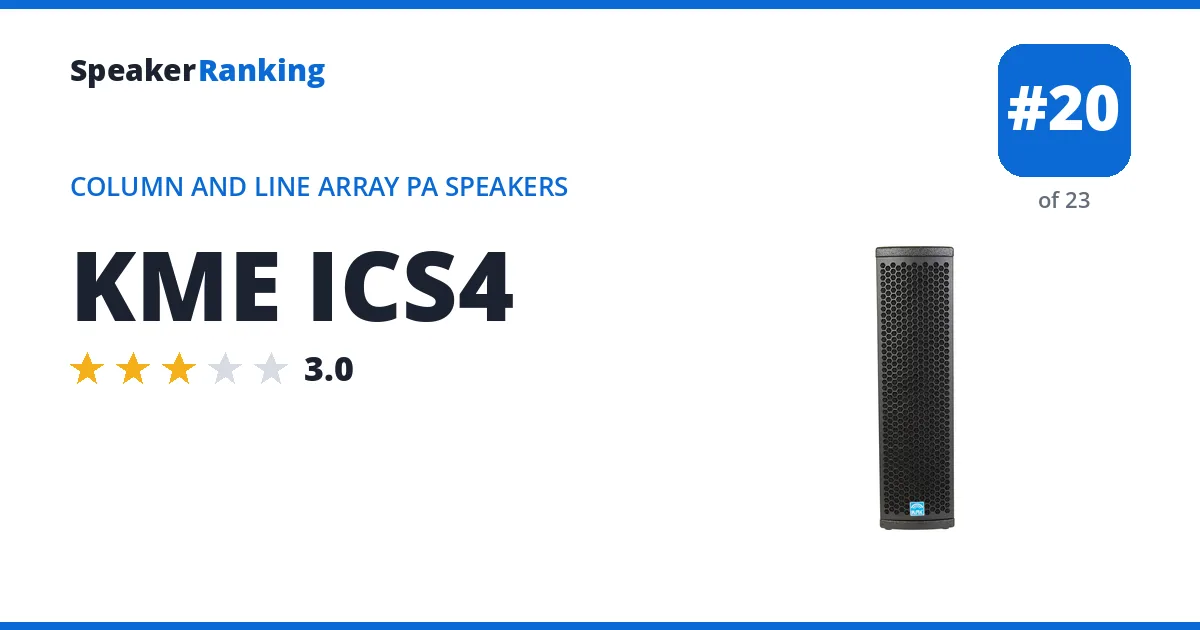
Pros: A slim passive column with four 4 inch woofers and a 1 inch dome tweeter in an IP44 rated cabinet, built for installation in churches, theatres and conference rooms. Its 80° x 40° pattern keeps sound off ceilings and floors, and it weighs just 6 kg. Measured bass extension of 155.0Hz (-3dB).
Cons: Vendor data shows an uneven response, with 0.97 on-axis and 0.86 listening window deviation, for a standalone preference score of -0.24 that only reaches 3.67 with an ideal subwoofer. Bass rolls off at about 118Hz (-6dB), so it must be paired with a subwoofer, and it needs an external amplifier.
Full KME ICS4 review and specifications →
| AES Input | No |
|---|---|
| Aux Input | No |
| Bass Extension (-3dB) | 155.0Hz (measured, vendor Spinorama data) |
| Bluetooth | No |
| Coaxial Input | No |
| Configuration | Passive 2.5-way column speaker |
| Coverage | 80° x 40° |
| Dimensions | 19.7”H x 5.3”W x 6.5”D (500 x 135 x 166 mm) |
| Drivers | 4x 4” woofers, 1” dome tweeter |
| Frequency Response | 100Hz - 20kHz (-10dB, manufacturer specified) |
| Guitar Input | No |
| HDMI Input | No |
| IP Rating | IP44 |
| Impedance | 8 ohms |
| Inputs | 2x Speakon NL4, Phoenix in/out |
| Maximum SPL | 113dB (manufacturer specified) |
| Microphone Input | No |
| Optical Input | No |
| Passive | Yes |
| Power Handling | 200W AES, 400W program |
| RCA Input | No |
| Sensitivity | 90dB (1W/1m, manufacturer specified) |
| Spinorama Preference Score | -0.24 |
| Spinorama Preference Score with Perfect Sub | 3.67 |
| TRS Input | No |
| USB Input | No |
| Weight | 13.2 lbs (6 kg) |
| XLR Input | No |
- Links
- Reviews, Comparisons and Sound Samples
 #21 Yamaha VXL1-8: $444.99 each Passive Amazon $444.99 eBay
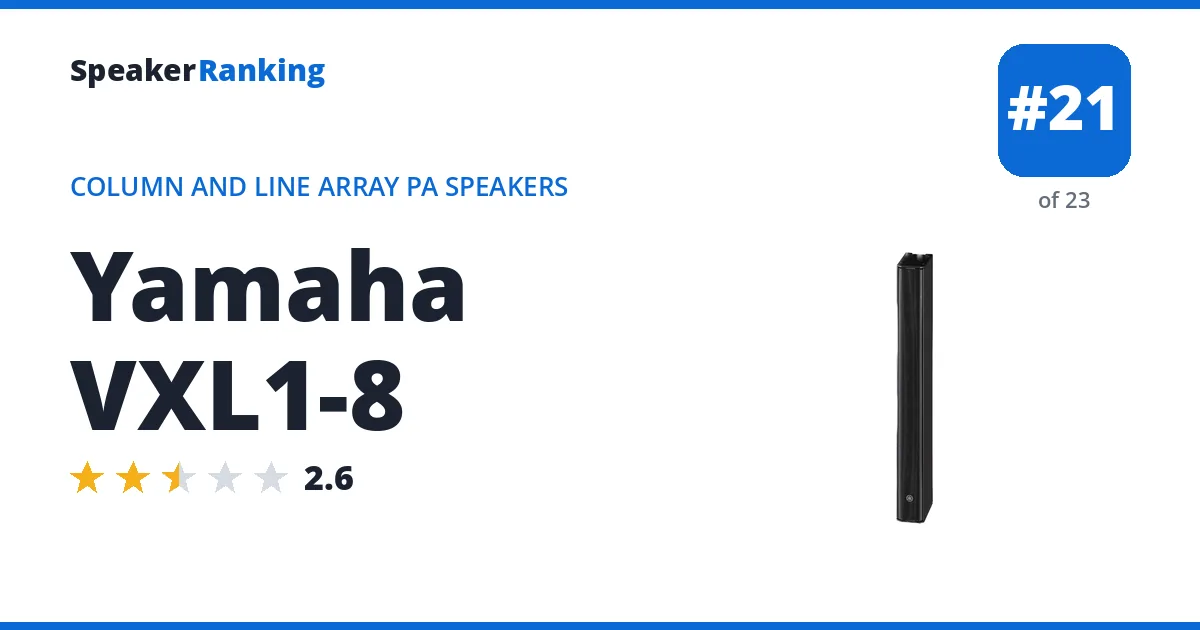
Same family: the Yamaha VXL1-16 (larger model, ranked lower, estimated 2.6/5) and the Yamaha VXL1-24 (larger model, ranked lower, rated 2.5/5).
Pros: A slim column speaker for commercial installations with eight 1.5” drivers in a line array. Yamaha’s measurements show a preference score of -0.38 that reaches 4.48 with an ideal subwoofer, with 0.69 listening window deviation.
Cons: Bass is very limited, so it needs a subwoofer, and the on-axis response is very uneven (2.37 average deviation). The data comes from Yamaha.
Full Yamaha VXL1-8 review and specifications →
| Released | Jun 2017 (9 years ago) |
|---|---|
| Bluetooth | No |
| DIY Kit | No |
| Drivers | 8x 1.5” full-range drivers (line array) |
| Maximum SPL | 111dB peak (manufacturer specified) |
| Passive | Yes |
| Rigging | Wall mount bracket included |
| Spinorama Preference Score | -0.38 |
| Spinorama Preference Score with Perfect Sub | 4.48 |
| Weight | 4.6 lbs (2.1 kg) |
- Reviews, Comparisons and Sound Samples
- Head-to-Head Comparisons
 #22 Yamaha VXL1-16: $807.99 each Passive Full Compass $807.99 eBay
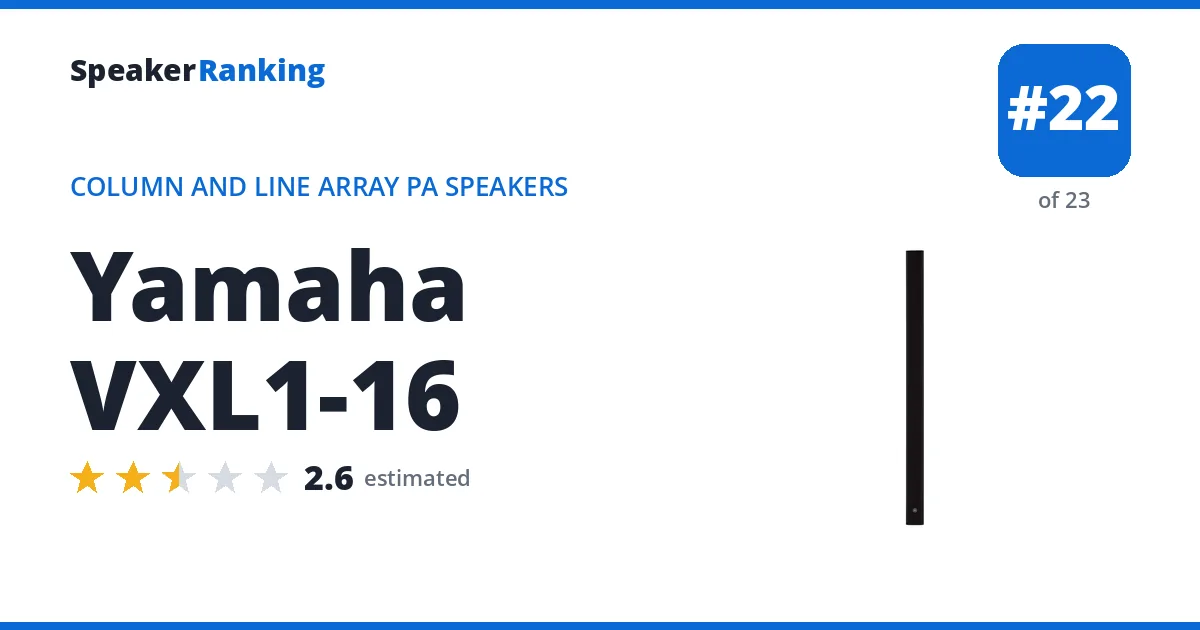
Same family: the Yamaha VXL1-8 (smaller model, ranked higher, rated 2.6/5) and the Yamaha VXL1-24 (larger model, ranked lower, rated 2.5/5).
Pros: The middle model of Yamaha’s VXL slim line arrays, with sixteen 1.5” full-range drivers in a 54mm wide column between the measured Yamaha VXL1-8 and Yamaha VXL1-24. A rear switch picks 20° or 30° vertical coverage, which helps speech intelligibility in reflective rooms.
Cons: No independent measurements yet, so it can’t be compared with ranked PA speakers. Small full-range drivers limit bass and output, so it is built for speech and background music, and it needs an external amplifier.
Full Yamaha VXL1-16 review and specifications →
| Released | Jun 2017 (9 years ago) |
|---|---|
| Amplifier Power | Passive speaker; requires external amplification |
| Bluetooth | No |
| Configuration | Passive slim line array column |
| Coverage | Switchable 20° or 30° vertical |
| DSP | No (passive) |
| Drivers | 16x 1.5” full-range drivers |
| Maximum SPL | 116dB peak (manufacturer specified) |
| Passive | Yes |
| Power Handling | 80W |
| Rigging | Wall mount bracket included |
| Weight | 8.6 lbs (3.9 kg) |
| XLR Input | No |
- Links
- Reviews, Comparisons and Sound Samples
- No independent measurement review is linked for this model; it is ranked from hands-on listening and comparison against similarly priced speakers.
- Head-to-Head Comparisons
 #23 Yamaha VXL1-24: $1,340 each Passive eBay
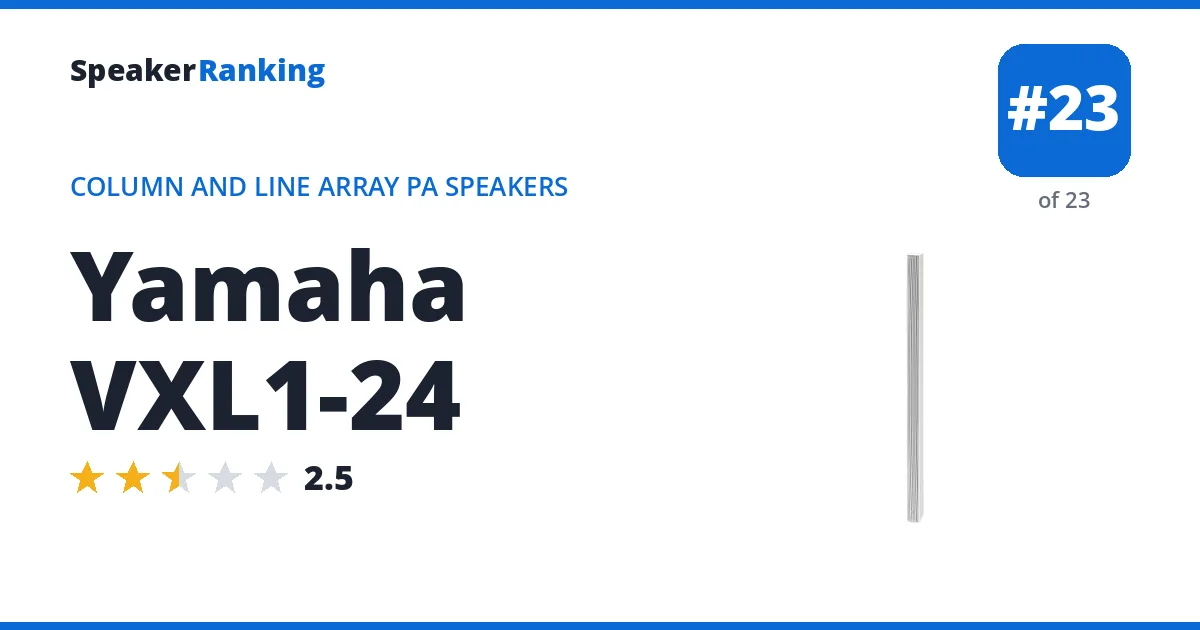
Same family: the Yamaha VXL1-8 (smaller model, ranked higher, rated 2.6/5) and the Yamaha VXL1-16 (smaller model, ranked higher, estimated 2.6/5).
Pros: A tall column speaker for commercial installations with 24 1.5” drivers in a line array. Yamaha’s measurements show a preference score of -0.75 that reaches 4.27 with an ideal subwoofer, with 0.68 listening window deviation. Measured bass extension of 272.0Hz (-3dB).
Cons: Bass is very limited, so it needs a subwoofer, and the on-axis response is very uneven (2.73 average deviation). The data comes from Yamaha.
Full Yamaha VXL1-24 review and specifications →
| Released | Jun 2017 (9 years ago) |
|---|---|
| Bass Extension (-3dB) | 272.0Hz (measured, vendor Spinorama data) |
| Bluetooth | No |
| DIY Kit | No |
| Drivers | 24x 1.5” full-range drivers (line array) |
| Maximum SPL | 117dB peak (manufacturer specified) |
| Passive | Yes |
| Rigging | Wall mount bracket included; optional pole and wall bracket |
| Spinorama Preference Score | -0.75 |
| Spinorama Preference Score with Perfect Sub | 4.27 |
| Weight | 12.1 lbs (5.5 kg) |
- Reviews, Comparisons and Sound Samples