56 open-back headphones made our rankings. Open-back cups let air and sound pass through, which gives a wider, more natural sense of space and avoids the boxy resonance of many closed designs. The tradeoff is that they leak sound to anyone nearby and block almost no outside noise, so they’re best for quiet rooms at home.
Many open-back models are planar magnetic or high-impedance designs that need a dedicated headphone amp; the impedance and sensitivity on each card tell you whether a phone will do. For travel, the office or recording, see the closed-back page instead.
This is every match, sorted by measured sound quality.
Prices on this page were last checked October 10, 2026 at 5:37 PM UTC. Product prices and availability are accurate as of that date/time and are subject to change; the price and availability shown on Amazon at the time of purchase will apply to the purchase of this product.
As an eBay Partner, we may be compensated if you make a purchase.
Over-Ear Headphones
 Ranked #3 of 134 in Over-Ear Headphones - HIFIMAN Ananda Nano: $319.00 Amazon eBay
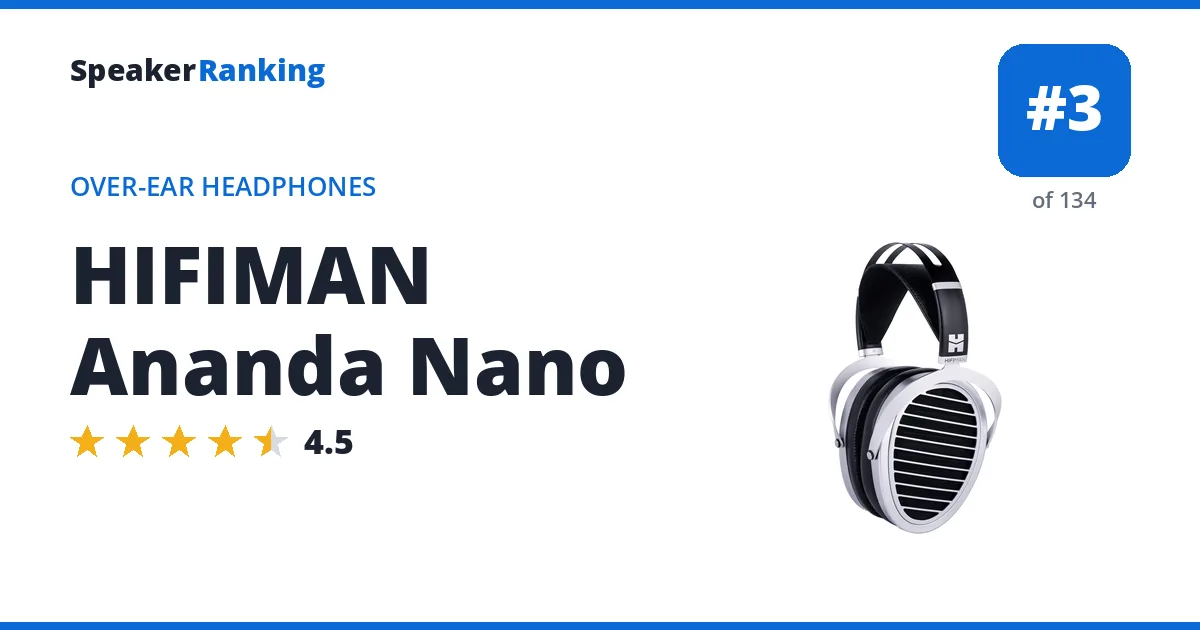
Pros: A preference score of 94 puts it close to the Harman target, with bass from 60 to 200 Hz within 0.1 dB of target and the midrange within about 1 dB. Impedance of just 14 ohms makes it simple to drive from a phone or dongle, and the open planar design gives a spacious presentation. Sub-bass is only moderately light, about 2.8 dB under target.
Cons: The top end is the weak spot, with the air region above 10 kHz running about 4.6 dB hot and a 10.8 dB peak near 11.9 kHz, preceded by a 4.4 dB dip near 9.6 kHz. That can make cymbals and strings sound bright or sharp on some recordings. At 420 g it is heavy, and the open back leaks sound and gives no isolation.
Full HIFIMAN Ananda Nano review and specifications →
| Released | Aug 2023 (3 years ago) |
|---|---|
| Back | Open |
| Connection | Wired |
| Deviation From Target | 1.43 dB standard deviation |
| Driver Type | Planar magnetic |
| Form Factor | Over-ear |
| Frequency Response | 5Hz - 55kHz (Manufacturer specified) |
| Harman Preference Score | 94 (measured by oratory1990, via AutoEQ) |
| Impedance | 14 ohms |
| Sensitivity | 94 dB |
| Tonal Tilt | +0.14 (negative is warmer, positive brighter) |
| Weight | 0.9 lbs (420 g) |
EQ preset to match the Harman target
Set a preamp of -3.9 dB, then add these filters in any parametric equalizer (Wavelet, Equalizer APO, Peace, or a player with parametric EQ). Calculated by AutoEQ from its measured frequency response.
| Filter | Frequency | Gain | Q |
|---|---|---|---|
| Low shelf | 105 Hz | +4.1 dB | 0.70 |
| Peak | 1,884 Hz | +2.9 dB | 2.00 |
| Peak | 84 Hz | -2.2 dB | 1.06 |
| Peak | 343 Hz | -0.7 dB | 1.30 |
| Peak | 2,910 Hz | -1.8 dB | 3.07 |
| High shelf | 10,000 Hz | -6.5 dB | 0.70 |
| Peak | 969 Hz | -1.0 dB | 4.06 |
| Peak | 170 Hz | +1.0 dB | 3.86 |
| Peak | 129 Hz | -0.7 dB | 3.65 |
| Peak | 752 Hz | +0.9 dB | 5.09 |
- Reviews, Comparisons and Sound Samples
- Head-to-Head Comparisons
 Ranked #4 of 134 in Over-Ear Headphones - Philips Fidelio X2HR: $159.95 Discontinued Amazon eBay
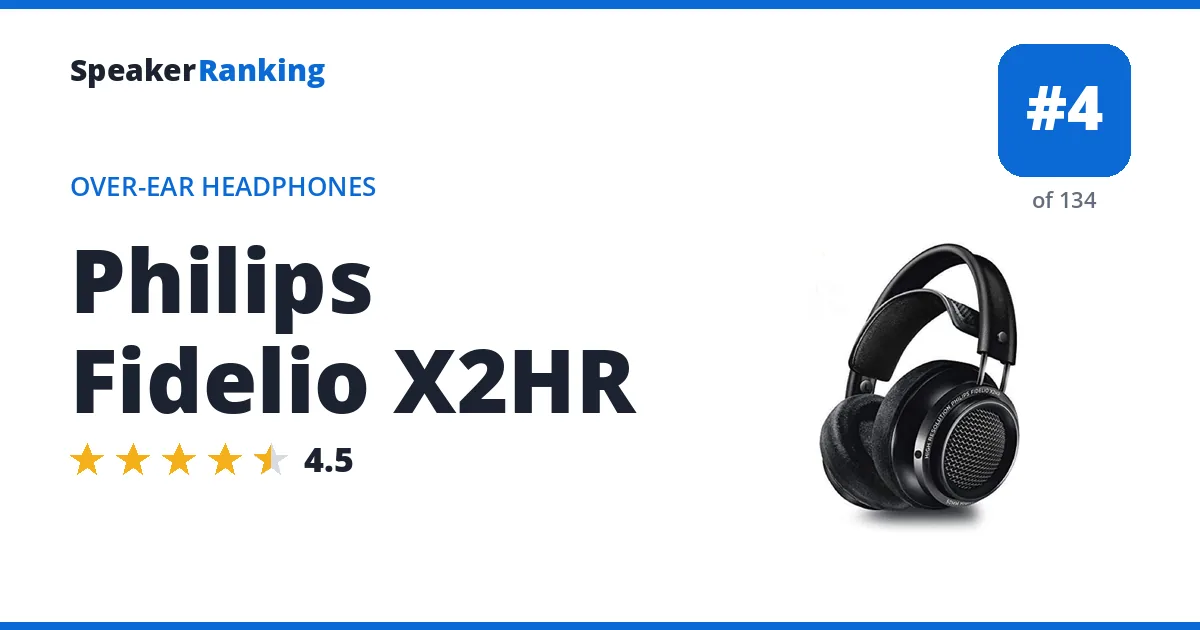
Pros: Its preference score of 94 comes from a smooth response within about 1.3 dB of the Harman target, with bass from 60 to 200 Hz and the midrange all within a dB of target. The slightly warm tilt suits listeners who find bright headphones fatiguing. At 30 ohms and 100 dB/mW it runs from a phone without a separate amp, and the 50 mm dynamic driver delivers it at a modest price compared with the Sennheiser HD 560S.
Cons: Sub-bass is about 4.6 dB below target, so the lowest notes in electronic and hip hop tracks lack impact. Treble from 6 kHz up is slightly recessed, with a 5 dB dip near 11.9 kHz, which takes some sparkle off cymbals. The open back leaks sound and offers no isolation, and at 380 g it is on the heavier side. Discontinued.
Full Philips Fidelio X2HR review and specifications →
| Back | Open |
|---|---|
| Connection | Wired |
| Deviation From Target | 1.27 dB standard deviation |
| Driver Type | Dynamic |
| Drivers | 1 x 50mm dynamic |
| Form Factor | Over-ear |
| Frequency Response | 5Hz - 40kHz (Manufacturer specified) |
| Harman Preference Score | 94 (measured by oratory1990, via AutoEQ) |
| Impedance | 30 ohms |
| Sensitivity | 100 dB/mW |
| Tonal Tilt | -0.29 (negative is warmer, positive brighter) |
| Weight | 0.8 lbs (380 g) |
EQ preset to match the Harman target
Set a preamp of -6.4 dB, then add these filters in any parametric equalizer (Wavelet, Equalizer APO, Peace, or a player with parametric EQ). Calculated by AutoEQ from its measured frequency response.
| Filter | Frequency | Gain | Q |
|---|---|---|---|
| Low shelf | 105 Hz | +7.8 dB | 0.70 |
| Peak | 64 Hz | -7.1 dB | 0.68 |
| Peak | 4,982 Hz | +4.2 dB | 0.79 |
| Peak | 5,096 Hz | -8.2 dB | 2.97 |
| Peak | 29 Hz | +1.2 dB | 4.24 |
| High shelf | 10,000 Hz | -1.2 dB | 0.70 |
| Peak | 1,660 Hz | -2.7 dB | 4.61 |
| Peak | 261 Hz | -1.0 dB | 5.02 |
| Peak | 2,026 Hz | +0.9 dB | 4.49 |
| Peak | 2,996 Hz | +1.2 dB | 6.00 |
- Reviews, Comparisons and Sound Samples
- Head-to-Head Comparisons
 Ranked #5 of 134 in Over-Ear Headphones - Sennheiser HD 560S: $199.95 Amazon eBay
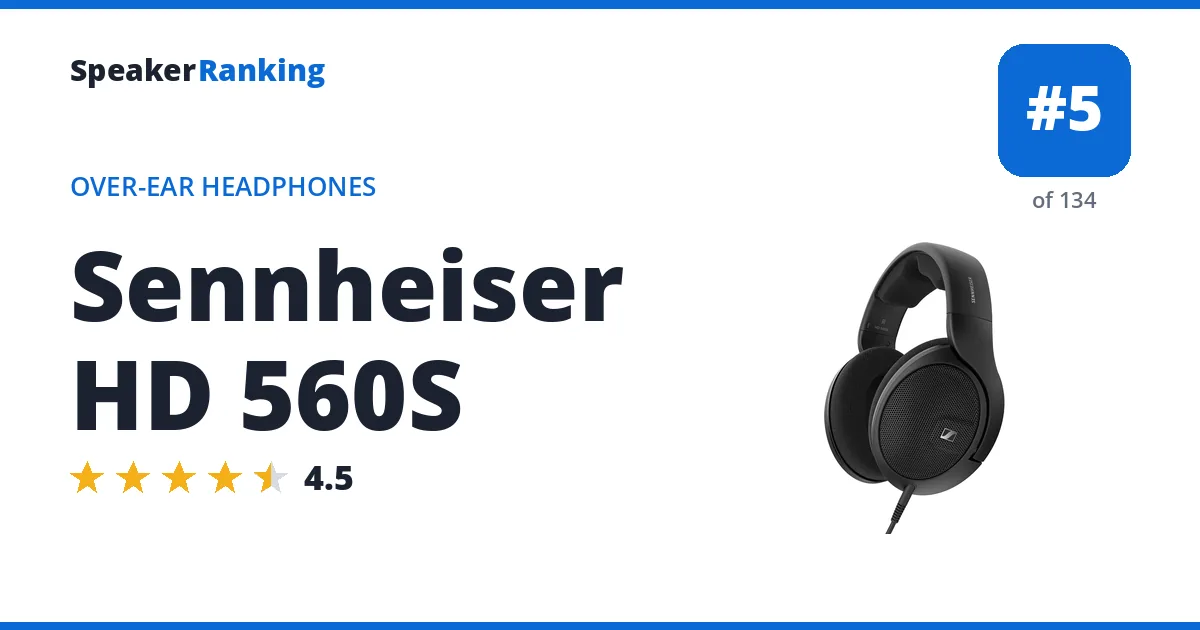
Pros: It scores 93 on the Harman preference model, with the midrange and presence region (200 Hz to 6 kHz) within about 0.2 dB of target, so vocals and instruments sound very natural. At 240 g it is the lightest of the top group, and the open design gives a wide soundstage. Its 120 ohm impedance is still manageable from most modern sources.
Cons: Bass is lean, with sub-bass about 5 dB under target and 60 to 200 Hz about 1.2 dB under, which can sound thin on pop, hip hop and electronic music. Treble is also pulled back, with a deep 8.5 dB dip near 9.8 kHz that softens cymbals and sibilance. The open back leaks sound and provides no isolation.
Full Sennheiser HD 560S review and specifications →
| Released | Sep 2020 (6 years ago) |
|---|---|
| Back | Open |
| Connection | Wired |
| Deviation From Target | 1.58 dB standard deviation |
| Driver Type | Dynamic |
| Form Factor | Over-ear |
| Frequency Response | 6Hz - 38kHz (Manufacturer specified) |
| Harman Preference Score | 93 (measured by oratory1990, via AutoEQ) |
| Impedance | 120 ohms |
| Sensitivity | 110 dB SPL (1 kHz, 1 V) |
| Tonal Tilt | +0.08 (negative is warmer, positive brighter) |
| Weight | 0.5 lbs (240 g) |
EQ preset to match the Harman target
Set a preamp of -6.6 dB, then add these filters in any parametric equalizer (Wavelet, Equalizer APO, Peace, or a player with parametric EQ). Calculated by AutoEQ from its measured frequency response.
| Filter | Frequency | Gain | Q |
|---|---|---|---|
| Low shelf | 105 Hz | +9.0 dB | 0.70 |
| Peak | 8,983 Hz | +4.4 dB | 2.63 |
| Peak | 54 Hz | -5.4 dB | 0.48 |
| Peak | 1,148 Hz | -1.5 dB | 2.38 |
| Peak | 491 Hz | +0.6 dB | 1.23 |
| High shelf | 10,000 Hz | -3.9 dB | 0.70 |
| Peak | 7,451 Hz | +2.0 dB | 3.91 |
| Peak | 4,502 Hz | -1.7 dB | 6.00 |
| Peak | 1,937 Hz | +0.9 dB | 3.93 |
| Peak | 5,639 Hz | -0.9 dB | 6.00 |
- Reviews, Comparisons and Sound Samples
- Head-to-Head Comparisons
 Ranked #7 of 134 in Over-Ear Headphones - Sennheiser HD 600: $272.36 Amazon eBay
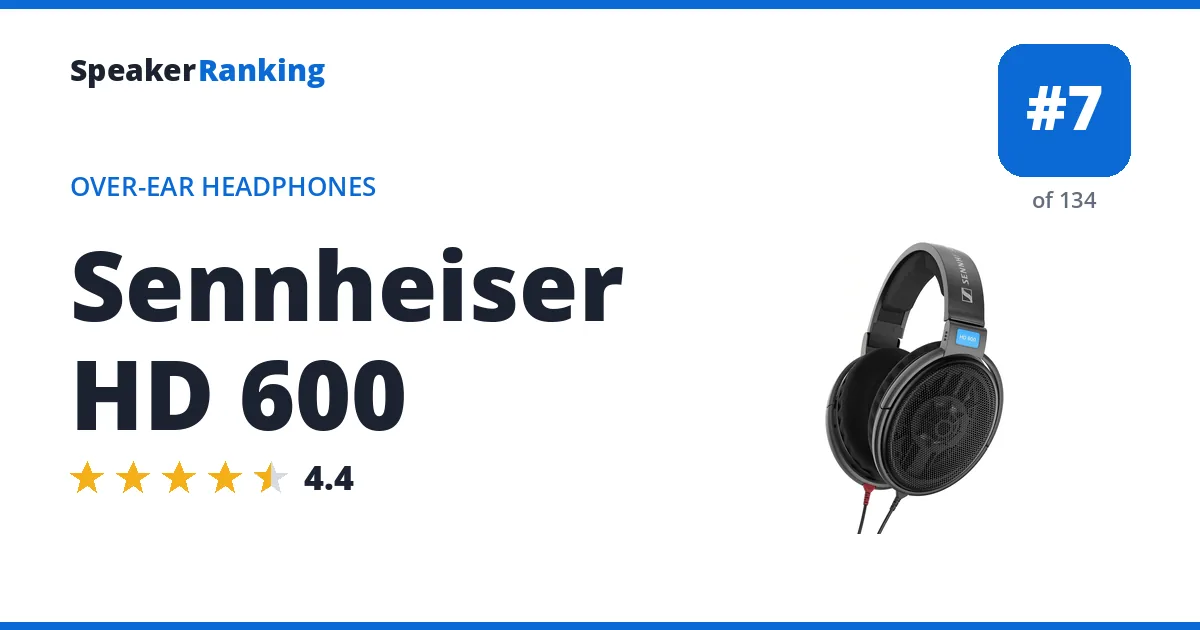
Pros: It earns a preference score of 91, with the midrange from 200 Hz to 6 kHz within about 0.1 dB of target, giving vocals and acoustic instruments a very natural tone. At 260 g it is light, and the long-running design from 1997 remains a reference for neutral midrange tuning. The warm and neutral tilt suits listeners who dislike bright treble.
Cons: Sub-bass is about 7.9 dB below target, so bass lacks rumble and weight on electronic and hip hop tracks. Treble from 6 to 10 kHz is about 3.6 dB low, with a 7.5 dB dip near 9.6 kHz that softens cymbals. At 300 ohms and 97 dB SPL/V it needs a dedicated headphone amp for proper volume, and the open back leaks sound.
Full Sennheiser HD 600 review and specifications →
| Released | 1997 (29 years ago) |
|---|---|
| Back | Open |
| Connection | Wired |
| Deviation From Target | 1.88 dB standard deviation |
| Driver Type | Dynamic |
| Drivers | 1 x 42mm dynamic |
| Form Factor | Over-ear |
| Frequency Response | 12Hz - 40.5kHz (Manufacturer specified) |
| Harman Preference Score | 91 (measured by oratory1990, via AutoEQ) |
| Impedance | 300 ohms |
| Sensitivity | 97 dB SPL/V |
| Tonal Tilt | +0.02 (negative is warmer, positive brighter) |
| Weight | 0.6 lbs (260 g) |
EQ preset to match the Harman target
Set a preamp of -6.3 dB, then add these filters in any parametric equalizer (Wavelet, Equalizer APO, Peace, or a player with parametric EQ). Calculated by AutoEQ from its measured frequency response.
| Filter | Frequency | Gain | Q |
|---|---|---|---|
| Low shelf | 105 Hz | +6.5 dB | 0.70 |
| Peak | 125 Hz | -2.7 dB | 0.55 |
| Peak | 8,445 Hz | +3.3 dB | 1.61 |
| Peak | 522 Hz | +0.7 dB | 1.02 |
| Peak | 1,298 Hz | -1.2 dB | 2.14 |
| High shelf | 10,000 Hz | -3.1 dB | 0.70 |
| Peak | 3,158 Hz | -1.8 dB | 3.67 |
| Peak | 2,166 Hz | +0.9 dB | 3.32 |
| Peak | 6,639 Hz | +2.2 dB | 5.82 |
| Peak | 5,433 Hz | -1.2 dB | 5.70 |
- Reviews, Comparisons and Sound Samples
- Head-to-Head Comparisons
 Ranked #10 of 134 in Over-Ear Headphones - HIFIMAN Arya Organic: $769.00 Amazon eBay
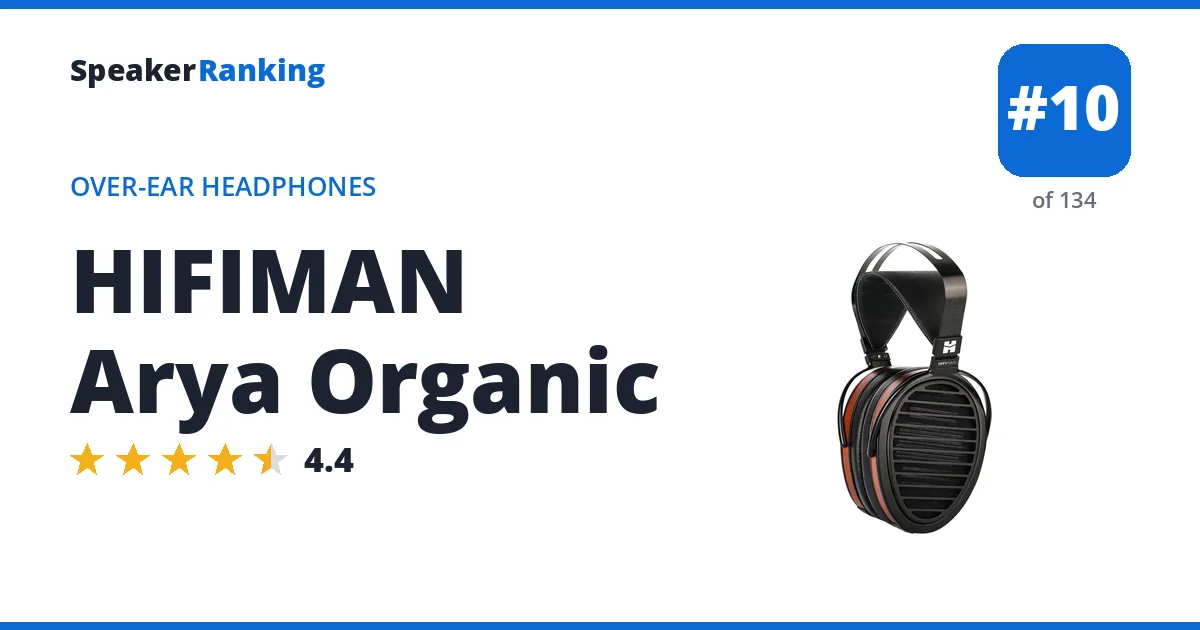
Pros: A preference score of 91 in oratory1990’s measurement means the overall balance sits very close to the Harman target, with a nearly neutral tilt and a smooth 1.77 dB deviation. Bass between 60 and 200 Hz runs only about 1 dB above target and the upper mids are within 1 dB, so vocals and instruments sound natural and unforced. At 16 ohms and 94 dB sensitivity it is easy to drive, and it rates higher than the Audeze LCD-XC and HIFIMAN HE1000 Stealth.
Cons: Sub-bass below 60 Hz sits about 2 dB under target and the air band above 10 kHz runs about 6 dB hot, with a peak of nearly 10 dB near 11.9 kHz that can add a bright sparkle to cymbals. A 4.5 dB dip around 9.5 kHz makes that treble region uneven. The open back leaks sound and offers no isolation, so it suits quiet rooms, and the 440 g weight is on the heavy side.
Full HIFIMAN Arya Organic review and specifications →
| Released | Aug 2023 (3 years ago) |
|---|---|
| Back | Open |
| Connection | Wired |
| Deviation From Target | 1.77 dB standard deviation |
| Driver Type | Planar magnetic |
| Form Factor | Over-ear |
| Frequency Response | 8Hz - 65kHz (Manufacturer specified) |
| Harman Preference Score | 91 (measured by oratory1990, via AutoEQ) |
| Impedance | 16 ohms |
| Sensitivity | 94 dB |
| Tonal Tilt | +0.06 (negative is warmer, positive brighter) |
| Weight | 1 lbs (440 g) |
EQ preset to match the Harman target
Set a preamp of -4.4 dB, then add these filters in any parametric equalizer (Wavelet, Equalizer APO, Peace, or a player with parametric EQ). Calculated by AutoEQ from its measured frequency response.
| Filter | Frequency | Gain | Q |
|---|---|---|---|
| Low shelf | 105 Hz | +4.3 dB | 0.70 |
| Peak | 1,866 Hz | +6.2 dB | 1.75 |
| Peak | 89 Hz | -2.6 dB | 0.82 |
| Peak | 3,082 Hz | -2.8 dB | 0.68 |
| Peak | 404 Hz | -0.5 dB | 1.49 |
| High shelf | 10,000 Hz | -6.9 dB | 0.70 |
| Peak | 5,536 Hz | +2.1 dB | 6.00 |
| Peak | 2,960 Hz | -0.6 dB | 4.64 |
| Peak | 3,567 Hz | +1.4 dB | 5.97 |
| Peak | 3,221 Hz | -0.9 dB | 6.00 |
- Reviews, Comparisons and Sound Samples
 Ranked #12 of 134 in Over-Ear Headphones - HIFIMAN Edition XS: $209.00 Amazon eBay
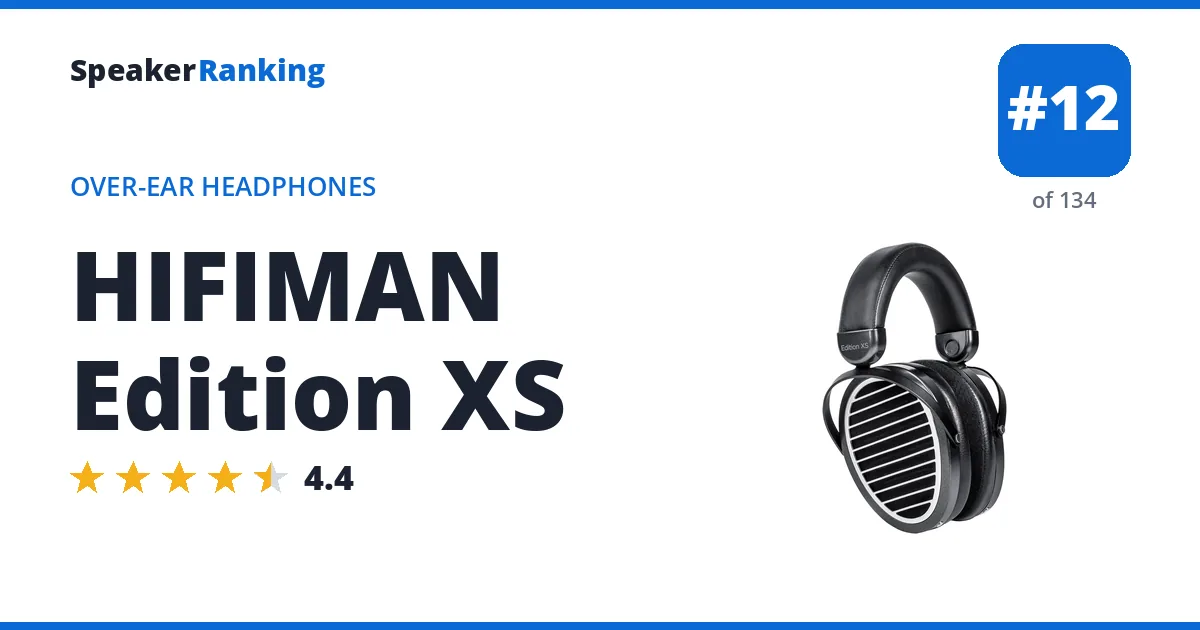
Pros: A preference score of 90 with a nearly flat tilt shows a well balanced tuning, and bass from 60 to 200 Hz is only about 1 dB above target. Presence and treble stay within about 1 dB of target, which keeps vocals and guitars clear. The planar drivers are 18 ohms and 92 dB, so it works with most amplifiers, and its rating matches the Sennheiser HD 600 and Austrian Audio Hi-X60.
Cons: A 6 dB dip near 9.4 kHz sits next to a roughly 9 dB peak at 11.9 kHz, and the air band runs about 5.5 dB above target, so the top end can sound uneven and sharp on bright recordings. Sub-bass is about 3 dB light under 60 Hz, which trims deep rumble. The open back leaks sound and gives no isolation, and at 405 g it is not especially light.
Full HIFIMAN Edition XS review and specifications →
| Released | Oct 2021 (5 years ago) |
|---|---|
| Back | Open |
| Connection | Wired |
| Deviation From Target | 1.83 dB standard deviation |
| Driver Type | Planar magnetic |
| Form Factor | Over-ear |
| Frequency Response | 8Hz - 50kHz (Manufacturer specified) |
| Harman Preference Score | 90 (measured by oratory1990, via AutoEQ) |
| Impedance | 18 ohms |
| Sensitivity | 92 dB |
| Tonal Tilt | -0.07 (negative is warmer, positive brighter) |
| Weight | 0.9 lbs (405 g) |
EQ preset to match the Harman target
Set a preamp of -4.8 dB, then add these filters in any parametric equalizer (Wavelet, Equalizer APO, Peace, or a player with parametric EQ). Calculated by AutoEQ from its measured frequency response.
| Filter | Frequency | Gain | Q |
|---|---|---|---|
| Low shelf | 105 Hz | +5.8 dB | 0.70 |
| Peak | 87 Hz | -2.8 dB | 0.33 |
| Peak | 1,896 Hz | +4.0 dB | 1.92 |
| Peak | 2,896 Hz | -3.7 dB | 3.11 |
| Peak | 1,420 Hz | +1.3 dB | 3.89 |
| High shelf | 10,000 Hz | -5.8 dB | 0.70 |
| Peak | 5,585 Hz | +1.7 dB | 6.00 |
| Peak | 70 Hz | -0.4 dB | 2.12 |
| Peak | 111 Hz | +0.4 dB | 1.64 |
| Peak | 927 Hz | -0.9 dB | 6.00 |
- Reviews, Comparisons and Sound Samples
- Head-to-Head Comparisons
 Ranked #14 of 134 in Over-Ear Headphones - Audio-Technica ATH-ADX5000: $2,199.00 Amazon eBay
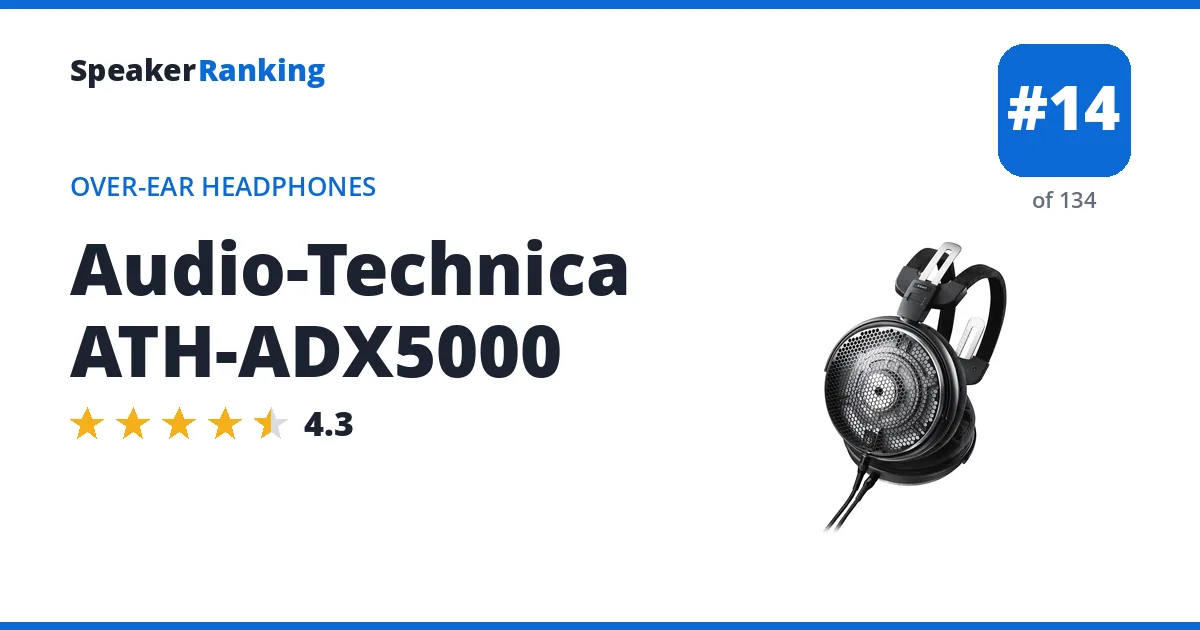
Pros: A preference score of 89 with a perfectly neutral tilt reflects a balanced tuning, with bass and low mids within about 0.7 dB of target. Treble from 6 to 10 kHz lands right on target, giving cymbals and vocals a natural level. It weighs only 270 g for an open back flagship, and it rates higher than the Sennheiser HD 800 S and HIFIMAN HE6.
Cons: The 420 ohm impedance calls for a dedicated headphone amplifier, because a phone or dongle will struggle to drive it to a satisfying volume. Sub-bass is about 6 dB under target below 60 Hz, a 4.4 dB dip near 2.2 kHz thins some vocals, and the air region above 10 kHz runs about 3.6 dB hot with a 6 dB peak near 11.9 kHz. The open back leaks sound and offers no isolation.
Full Audio-Technica ATH-ADX5000 review and specifications →
| Released | Nov 2017 (8 years ago) |
|---|---|
| Back | Open |
| Connection | Wired |
| Deviation From Target | 1.99 dB standard deviation |
| Driver Type | Dynamic |
| Drivers | 1 x 58mm dynamic |
| Form Factor | Over-ear |
| Frequency Response | 5Hz - 50kHz (Manufacturer specified) |
| Harman Preference Score | 89 (measured by oratory1990, via AutoEQ) |
| Impedance | 420 ohms |
| Sensitivity | 100 dB/mW |
| Tonal Tilt | -0.01 (negative is warmer, positive brighter) |
| Weight | 0.6 lbs (270 g) |
EQ preset to match the Harman target
Set a preamp of -6.5 dB, then add these filters in any parametric equalizer (Wavelet, Equalizer APO, Peace, or a player with parametric EQ). Calculated by AutoEQ from its measured frequency response.
| Filter | Frequency | Gain | Q |
|---|---|---|---|
| Low shelf | 105 Hz | +7.4 dB | 0.70 |
| Peak | 97 Hz | -4.1 dB | 0.44 |
| Peak | 2,345 Hz | +5.6 dB | 2.03 |
| Peak | 449 Hz | +2.4 dB | 1.99 |
| Peak | 4,171 Hz | -3.6 dB | 1.46 |
| High shelf | 10,000 Hz | -5.7 dB | 0.70 |
| Peak | 1,070 Hz | -1.9 dB | 2.30 |
| Peak | 643 Hz | +0.6 dB | 2.45 |
| Peak | 1,798 Hz | +0.9 dB | 3.35 |
| Peak | 5,950 Hz | -0.4 dB | 6.00 |
- Reviews, Comparisons and Sound Samples
 Ranked #15 of 134 in Over-Ear Headphones - HIFIMAN HE400se: $109.00 Amazon eBay
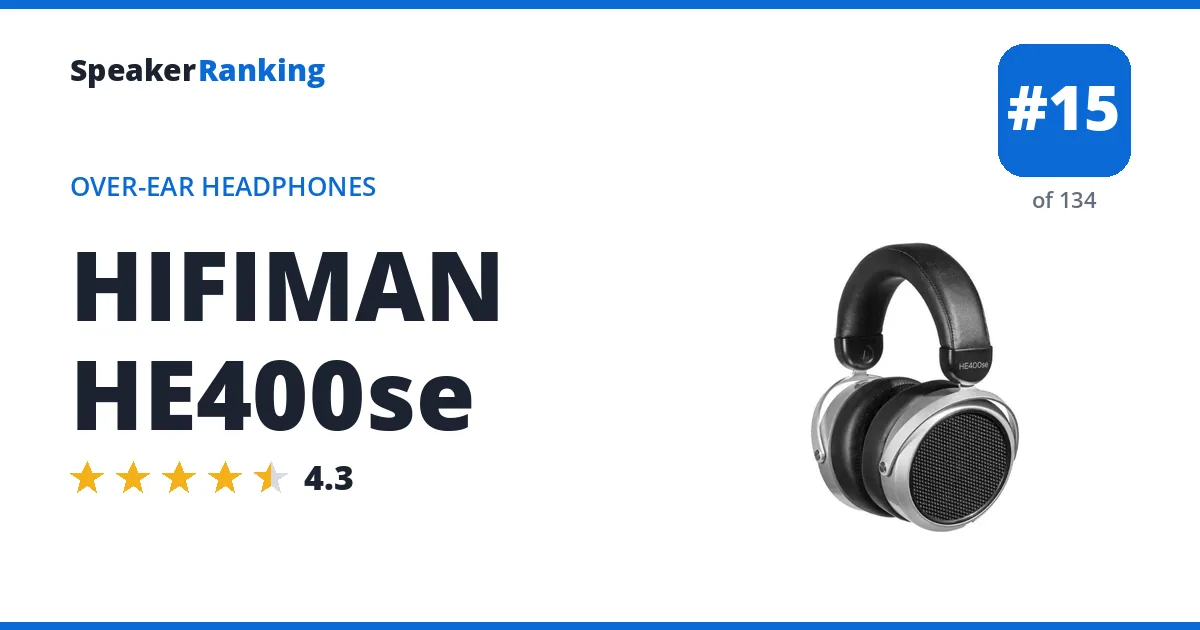
Pros: A preference score of 89 and a neutral tilt make this an accurate sounding planar for the money. Treble is within a fraction of a dB of target and the air band is only 1 dB high, so the top end is smooth and free of sharp peaks, with the largest at about 2.4 dB near 11.9 kHz. It matches the rating of the Beyerdynamic DT 880 at a lower price, with a modest 396 g weight.
Cons: Sub-bass is about 5 dB light and bass from 60 to 200 Hz is about 1 dB under target, so low end impact is limited. The low mids are about 1.6 dB elevated while a 4.8 dB dip near 2 kHz and a 2 dB upper mid shortfall can push vocals slightly back. At 91 dB/mW sensitivity it benefits from a headphone amp, and the open back leaks sound and provides no isolation.
Full HIFIMAN HE400se review and specifications →
| Released | Mar 2021 (5 years ago) |
|---|---|
| Back | Open |
| Connection | Wired |
| Deviation From Target | 1.98 dB standard deviation |
| Driver Type | Planar magnetic |
| Drivers | 1 x planar magnetic |
| Form Factor | Over-ear |
| Frequency Response | 20Hz - 20kHz (Manufacturer specified) |
| Harman Preference Score | 89 (measured by oratory1990, via AutoEQ) |
| Sensitivity | 91 dB/mW |
| Tonal Tilt | +0.05 (negative is warmer, positive brighter) |
| Weight | 0.9 lbs (396 g) |
EQ preset to match the Harman target
Set a preamp of -6.0 dB, then add these filters in any parametric equalizer (Wavelet, Equalizer APO, Peace, or a player with parametric EQ). Calculated by AutoEQ from its measured frequency response.
| Filter | Frequency | Gain | Q |
|---|---|---|---|
| Low shelf | 105 Hz | +6.7 dB | 0.70 |
| Peak | 1,968 Hz | +5.1 dB | 2.37 |
| Peak | 861 Hz | -2.3 dB | 1.86 |
| Peak | 101 Hz | -2.4 dB | 0.32 |
| Peak | 1,619 Hz | +1.1 dB | 3.53 |
| High shelf | 10,000 Hz | -2.6 dB | 0.70 |
| Peak | 138 Hz | +0.7 dB | 1.98 |
| Peak | 64 Hz | -0.7 dB | 1.95 |
| Peak | 251 Hz | -0.4 dB | 2.33 |
| Peak | 29 Hz | +0.5 dB | 2.63 |
- Reviews, Comparisons and Sound Samples
 Ranked #18 of 134 in Over-Ear Headphones - Beyerdynamic DT 900 Pro X: $279.99 Amazon eBay
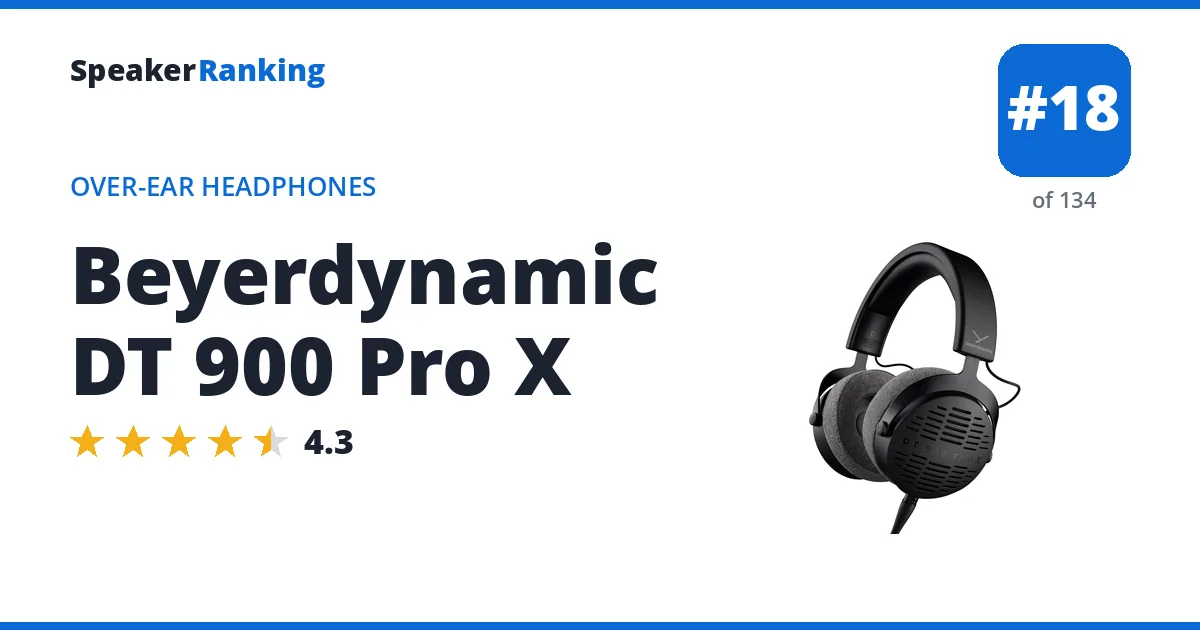
Pros: A preference score of 88 with a warm-leaning, near neutral tilt means most of the spectrum sits close to target, with bass within 0.3 dB and treble within 0.5 dB. At 48 ohms it plays loudly from most sources and its 345 g weight is moderate. It is rated the same as the Sennheiser HD 505 and Shure SRH840 and higher than the Audio-Technica ATH-M70x.
Cons: A 9.5 dB dip near 4 kHz is the largest deviation in this group and can pull the bite out of vocals, snares and guitars. The air band above 10 kHz is about 2 dB under target and sub-bass is about 3.5 dB light, so highs lack sparkle and deep bass lacks rumble. The open back leaks sound and gives no isolation.
Full Beyerdynamic DT 900 Pro X review and specifications →
| Released | Oct 2021 (5 years ago) |
|---|---|
| Back | Open |
| Connection | Wired |
| Deviation From Target | 2.08 dB standard deviation |
| Driver Type | Dynamic |
| Form Factor | Over-ear |
| Frequency Response | 5Hz - 40kHz (Manufacturer specified) |
| Harman Preference Score | 88 (measured by oratory1990, via AutoEQ) |
| Impedance | 48 ohms |
| Sensitivity | 100 dB SPL (1mW/500Hz) |
| Tonal Tilt | -0.04 (negative is warmer, positive brighter) |
| Weight | 0.8 lbs (345 g) |
EQ preset to match the Harman target
Set a preamp of -4.5 dB, then add these filters in any parametric equalizer (Wavelet, Equalizer APO, Peace, or a player with parametric EQ). Calculated by AutoEQ from its measured frequency response.
| Filter | Frequency | Gain | Q |
|---|---|---|---|
| Low shelf | 105 Hz | +5.7 dB | 0.70 |
| Peak | 94 Hz | -2.3 dB | 0.22 |
| Peak | 6,103 Hz | -5.3 dB | 1.81 |
| Peak | 4,103 Hz | +3.8 dB | 4.69 |
| Peak | 6,339 Hz | +1.5 dB | 0.18 |
| High shelf | 10,000 Hz | -1.2 dB | 0.70 |
| Peak | 2,503 Hz | -0.8 dB | 3.03 |
| Peak | 59 Hz | -0.3 dB | 1.39 |
| Peak | 82 Hz | +0.7 dB | 3.97 |
| Peak | 2,966 Hz | +1.0 dB | 6.00 |
- Reviews, Comparisons and Sound Samples
 Ranked #19 of 134 in Over-Ear Headphones - HIFIMAN Ananda Stealth: $249.00 Amazon eBay
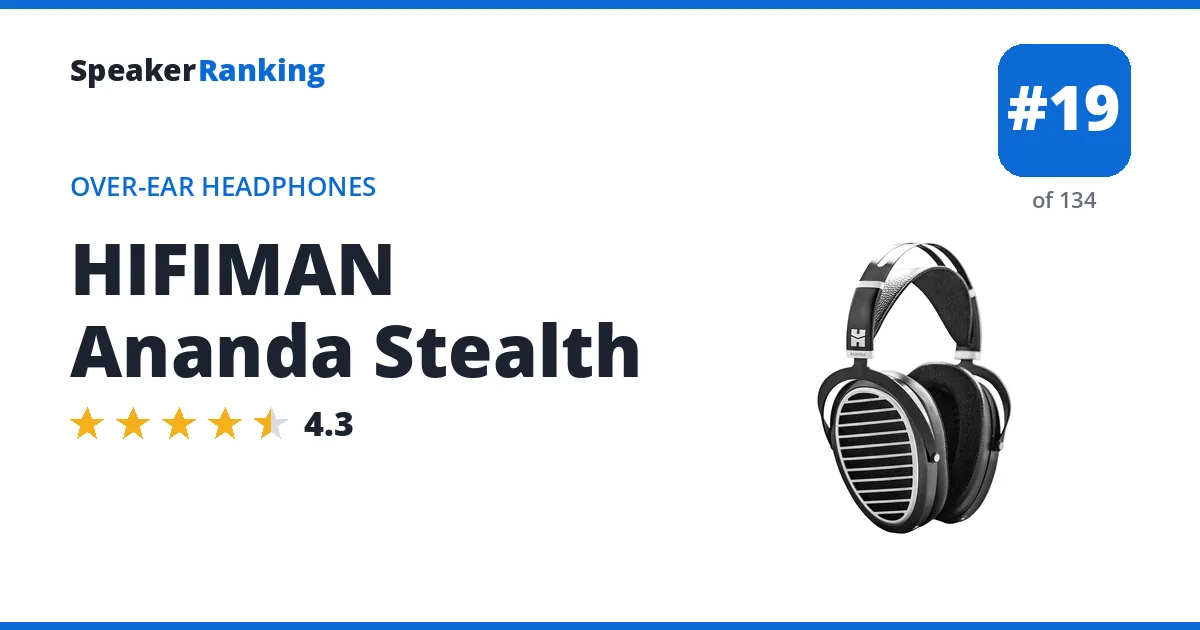
Pros: A preference score of 88 and a neutral tilt show a tuning that tracks the Harman target well, with bass from 60 to 200 Hz about 1 dB above target and presence about 1.6 dB above for added clarity. It is easy to drive at 16 ohms and 93 dB, so a phone or laptop can power it. It has the same rating as the Beyerdynamic DT 880 and Sennheiser HD 505.
Cons: An 8.8 dB dip near 9.5 kHz sits beside a 6.6 dB peak at 11.9 kHz, and the air band is about 4 dB high, so the treble can sound uneven and bright. Low mids are lifted about 1.7 dB and sub-bass is about 3 dB light under 60 Hz. The open back leaks sound and gives no isolation, and it weighs 399 g.
Full HIFIMAN Ananda Stealth review and specifications →
| Back | Open |
|---|---|
| Connection | Wired |
| Deviation From Target | 2.09 dB standard deviation |
| Driver Type | Planar magnetic |
| Form Factor | Over-ear |
| Frequency Response | 8Hz - 55kHz (Manufacturer specified) |
| Harman Preference Score | 88 (measured by oratory1990, via AutoEQ) |
| Impedance | 16 ohms |
| Sensitivity | 93 dB |
| Tonal Tilt | -0.03 (negative is warmer, positive brighter) |
| Weight | 0.9 lbs (399 g) |
EQ preset to match the Harman target
Set a preamp of -4.6 dB, then add these filters in any parametric equalizer (Wavelet, Equalizer APO, Peace, or a player with parametric EQ). Calculated by AutoEQ from its measured frequency response.
| Filter | Frequency | Gain | Q |
|---|---|---|---|
| Low shelf | 105 Hz | +5.7 dB | 0.70 |
| Peak | 84 Hz | -2.7 dB | 0.32 |
| Peak | 2,044 Hz | +4.1 dB | 2.00 |
| Peak | 3,064 Hz | -3.3 dB | 2.02 |
| Peak | 1,428 Hz | +2.0 dB | 3.19 |
| High shelf | 10,000 Hz | -4.7 dB | 0.70 |
| Peak | 6,231 Hz | -2.0 dB | 6.00 |
| Peak | 5,374 Hz | +2.1 dB | 6.00 |
| Peak | 965 Hz | -1.1 dB | 5.99 |
| Peak | 119 Hz | +0.3 dB | 2.44 |
- Reviews, Comparisons and Sound Samples
 Ranked #20 of 134 in Over-Ear Headphones - Sennheiser HD 505: $199.95 Amazon eBay
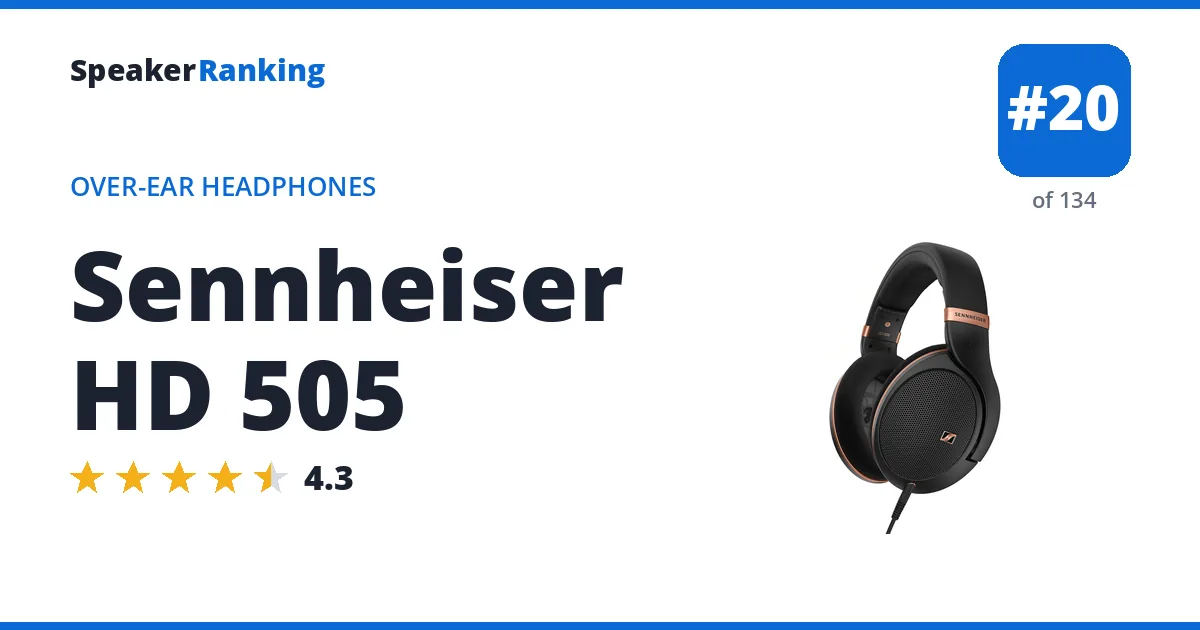
Pros: A preference score of 88 in oratory1990’s measurement puts it among the closest to the Harman target, with the midrange from 200 Hz to 6 kHz within about 0.5 dB of target, so vocals and instruments sound natural and unforced. The 120 ohm impedance and 107.9 dB per volt sensitivity let it run from a decent DAC or portable amp, and at 237 g the open-back design is light.
Cons: Sub-bass under 60 Hz sits about 6 dB below target, so deep synth bass and kick drum weight are thin. A narrow 9 dB dip near 9.9 kHz and treble running about 2.7 dB low soften cymbals and make it a little dark on airy recordings. Being open-back it leaks sound and offers no isolation.
Full Sennheiser HD 505 review and specifications →
| Back | Open |
|---|---|
| Connection | Wired |
| Deviation From Target | 1.85 dB standard deviation |
| Driver Type | Dynamic |
| Form Factor | Over-ear |
| Frequency Response | 12Hz - 38.5kHz (Manufacturer specified) |
| Harman Preference Score | 88 (measured by oratory1990, via AutoEQ) |
| Impedance | 120 ohms |
| Sensitivity | 107.9 dB SPL/V |
| Tonal Tilt | +0.17 (negative is warmer, positive brighter) |
| Weight | 0.5 lbs (237 g) |
EQ preset to match the Harman target
Set a preamp of -6.3 dB, then add these filters in any parametric equalizer (Wavelet, Equalizer APO, Peace, or a player with parametric EQ). Calculated by AutoEQ from its measured frequency response.
| Filter | Frequency | Gain | Q |
|---|---|---|---|
| Low shelf | 105 Hz | +7.0 dB | 0.70 |
| Peak | 9,030 Hz | +3.9 dB | 2.25 |
| Peak | 84 Hz | -2.7 dB | 0.44 |
| Peak | 560 Hz | +1.1 dB | 1.13 |
| Peak | 1,256 Hz | -1.5 dB | 1.71 |
| High shelf | 10,000 Hz | -2.5 dB | 0.70 |
| Peak | 3,218 Hz | -1.8 dB | 2.89 |
| Peak | 5,479 Hz | -2.6 dB | 4.99 |
| Peak | 4,145 Hz | +2.5 dB | 5.93 |
| Peak | 6,870 Hz | +2.4 dB | 5.70 |
- Reviews, Comparisons and Sound Samples
- Head-to-Head Comparisons
 Ranked #22 of 134 in Over-Ear Headphones - HIFIMAN Shangri-La Jr: $8,000.00 Amazon eBay
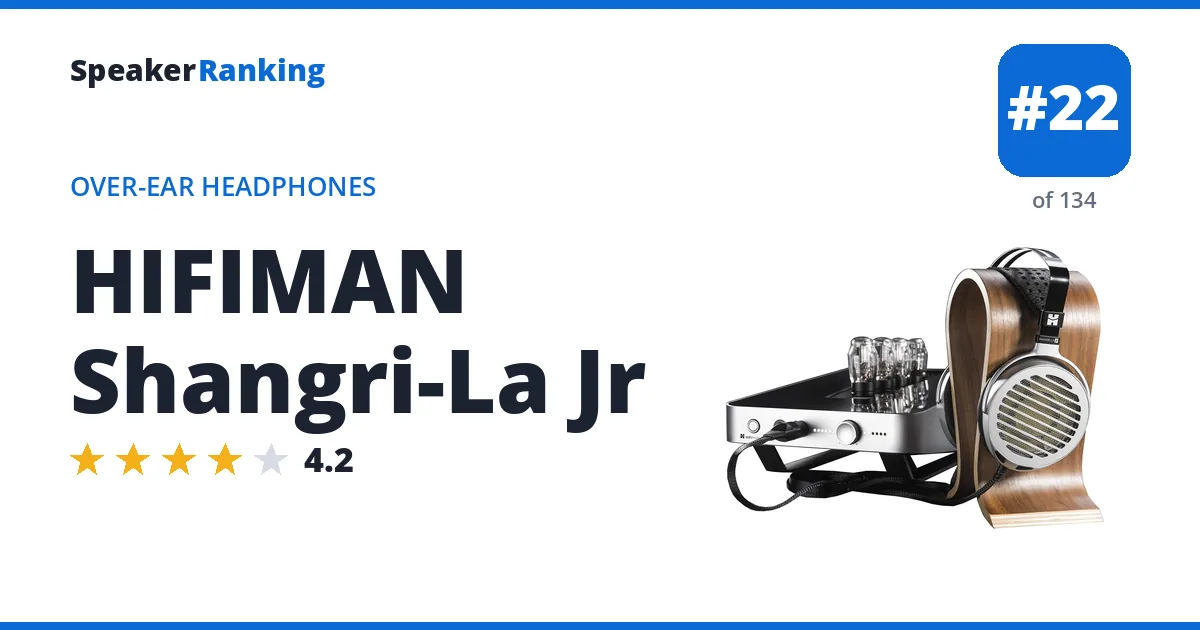
Pros: An electrostatic driver with a preference score of 87 and an unusually even response, with every band from 60 Hz to 10 kHz within about 1.4 dB of the Harman target. The air region above 10 kHz runs about 1 dB above target, giving a sense of space and fine detail. Its rating sits just above the HIFIMAN Susvara and well above the Focal Utopia 2022.
Cons: Sub-bass below 60 Hz is about 5 dB under target, so deep rumble is understated. A 7 dB dip near 9.7 kHz is followed by a 5 dB peak near 11.9 kHz, which reshapes the top end into something slightly uneven. As an electrostatic design it needs a dedicated energizer, and at 374 g it is not a casual portable option.
Full HIFIMAN Shangri-La Jr review and specifications →
| Back | Open |
|---|---|
| Connection | Wired |
| Deviation From Target | 1.99 dB standard deviation |
| Driver Type | Electrostatic |
| Form Factor | Over-ear |
| Frequency Response | 7Hz - 120kHz (Manufacturer specified) |
| Harman Preference Score | 87 (measured by oratory1990, via AutoEQ) |
| Tonal Tilt | +0.14 (negative is warmer, positive brighter) |
| Weight | 0.8 lbs (374 g) |
EQ preset to match the Harman target
Set a preamp of -6.1 dB, then add these filters in any parametric equalizer (Wavelet, Equalizer APO, Peace, or a player with parametric EQ). Calculated by AutoEQ from its measured frequency response.
| Filter | Frequency | Gain | Q |
|---|---|---|---|
| Low shelf | 105 Hz | +6.7 dB | 0.70 |
| Peak | 115 Hz | -2.2 dB | 0.29 |
| Peak | 1,885 Hz | +3.2 dB | 1.89 |
| Peak | 4,399 Hz | -2.3 dB | 4.81 |
| Peak | 3,089 Hz | -2.7 dB | 4.82 |
| High shelf | 10,000 Hz | -3.8 dB | 0.70 |
| Peak | 9,190 Hz | +2.2 dB | 2.17 |
| Peak | 5,753 Hz | +2.3 dB | 6.00 |
| Peak | 76 Hz | -0.7 dB | 3.00 |
| Peak | 139 Hz | +0.5 dB | 2.04 |
- Reviews, Comparisons and Sound Samples
 Ranked #23 of 134 in Over-Ear Headphones - HIFIMAN HE1000 Stealth: $949.00 Amazon eBay
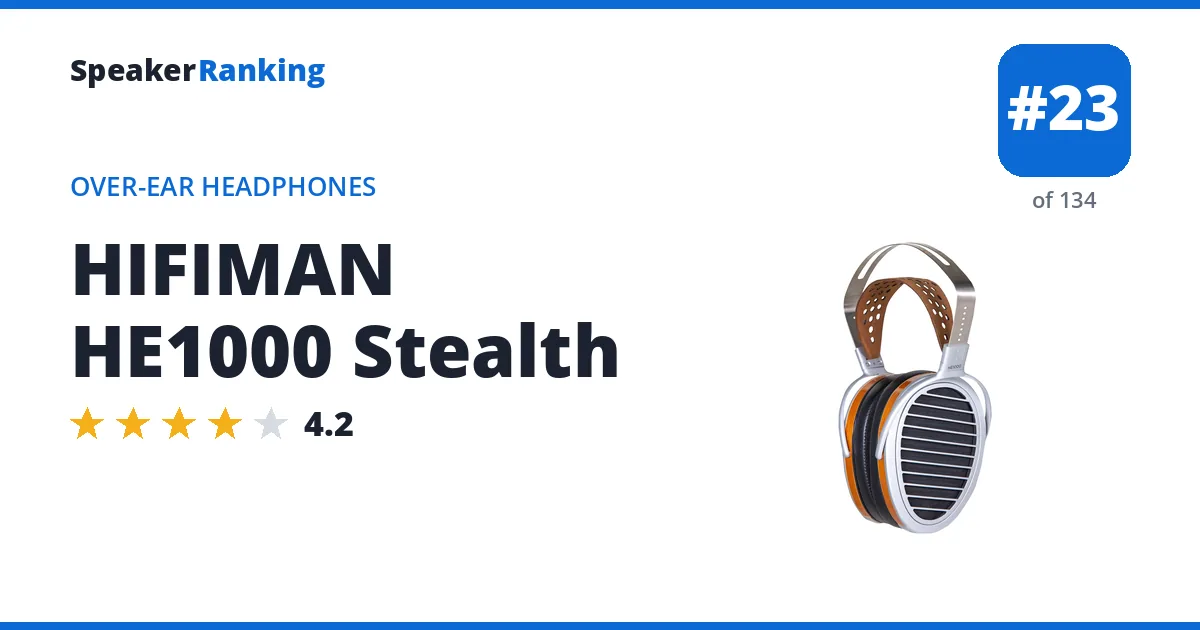
Pros: Planar magnetic drivers deliver a preference score of 87 with bass from 60 to 200 Hz about 1 dB above target and sub-bass only about 2 dB light, so low end has solid weight and extension. A 32 ohm impedance is easy to drive, although the 93 dB sensitivity still rewards a capable amp. Its rating matches the Sennheiser HD 800 S at a lower price.
Cons: The treble is uneven, with an 8 dB dip near 9.4 kHz followed by a 7 dB peak near 11.9 kHz and air above 10 kHz about 5 dB over target. That gives a sparkly, somewhat bright top end that can sound splashy or sibilant on certain recordings. At 458 g it is heavy for long sessions, and the open back leaks sound.
Full HIFIMAN HE1000 Stealth review and specifications →
| Back | Open |
|---|---|
| Connection | Wired |
| Deviation From Target | 2.10 dB standard deviation |
| Driver Type | Planar magnetic |
| Form Factor | Over-ear |
| Frequency Response | 8Hz - 65kHz (Manufacturer specified) |
| Harman Preference Score | 87 (measured by oratory1990, via AutoEQ) |
| Impedance | 32 ohms |
| Sensitivity | 93 dB |
| Tonal Tilt | +0.04 (negative is warmer, positive brighter) |
| Weight | 1 lbs (458 g) |
EQ preset to match the Harman target
Set a preamp of -5.3 dB, then add these filters in any parametric equalizer (Wavelet, Equalizer APO, Peace, or a player with parametric EQ). Calculated by AutoEQ from its measured frequency response.
| Filter | Frequency | Gain | Q |
|---|---|---|---|
| Low shelf | 105 Hz | +5.7 dB | 0.70 |
| Peak | 1,887 Hz | +5.8 dB | 2.36 |
| Peak | 74 Hz | -2.9 dB | 0.36 |
| Peak | 2,903 Hz | -4.1 dB | 3.38 |
| Peak | 5,261 Hz | -2.4 dB | 4.29 |
| High shelf | 10,000 Hz | -5.5 dB | 0.70 |
| Peak | 994 Hz | -1.1 dB | 2.91 |
| Peak | 646 Hz | +0.7 dB | 2.43 |
| Peak | 244 Hz | -0.4 dB | 1.71 |
| Peak | 135 Hz | +0.3 dB | 1.72 |
- Reviews, Comparisons and Sound Samples
 Ranked #24 of 134 in Over-Ear Headphones - Audio-Technica ATH-R70xa: $379.00 Amazon eBay
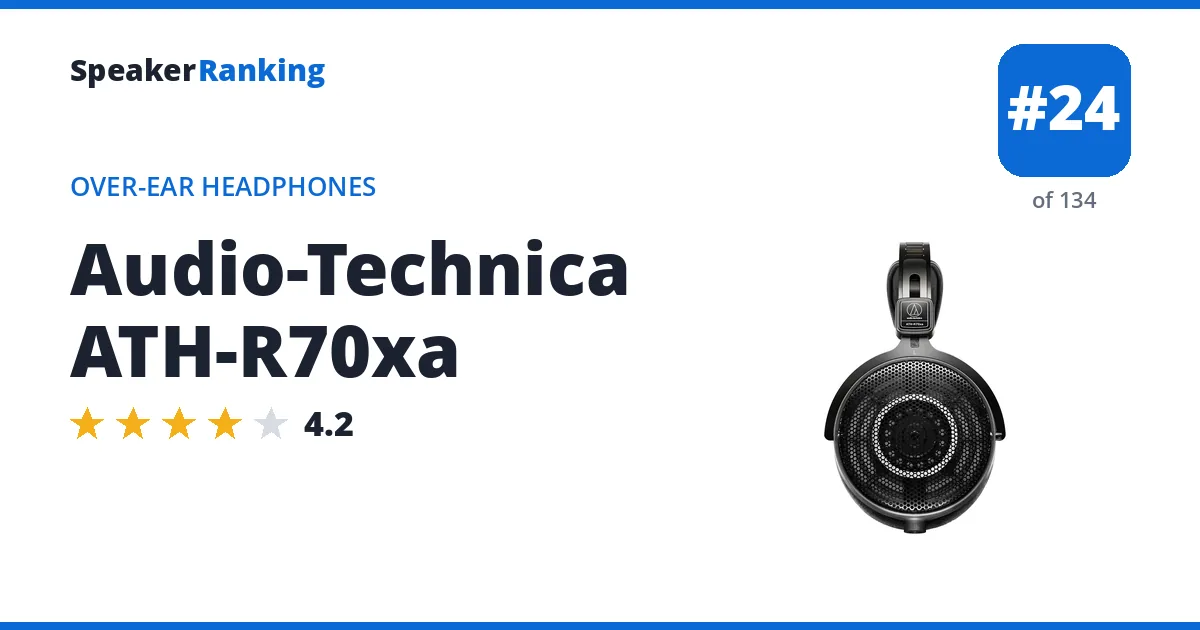
Older model: the Audio-Technica ATH-R70x (ranked lower, rated 4/5). See every Audio-Technica ATH-R70x generation.
Pros: A preference score of 86 comes from a well balanced midrange, with upper mids within 0.1 dB of target and low mids only 0.8 dB under. At 199 g it is a very light open-back design. The warm tilt and slightly relaxed top suit listeners who find bright headphones tiring.
Cons: Sub-bass below 60 Hz is about 6.5 dB under target, so bass is clean but lacks rumble. An 8.8 dB dip near 4.2 kHz and presence about 3.4 dB low pull some clarity out of vocals and instrument attack, making it sound recessed. The 470 ohm impedance means it needs a dedicated headphone amp, and the open back leaks sound.
Full Audio-Technica ATH-R70xa review and specifications →
| Back | Open |
|---|---|
| Connection | Wired |
| Deviation From Target | 2.11 dB standard deviation |
| Driver Type | Dynamic |
| Drivers | 1 x 45mm dynamic |
| Form Factor | Over-ear |
| Frequency Response | 5Hz - 40kHz (Manufacturer specified) |
| Harman Preference Score | 86 (measured by oratory1990, via AutoEQ) |
| Impedance | 470 ohms |
| Sensitivity | 97 dB/mW |
| Tonal Tilt | -0.12 (negative is warmer, positive brighter) |
| Weight | 0.4 lbs (199 g) |
EQ preset to match the Harman target
Set a preamp of -6.4 dB, then add these filters in any parametric equalizer (Wavelet, Equalizer APO, Peace, or a player with parametric EQ). Calculated by AutoEQ from its measured frequency response.
| Filter | Frequency | Gain | Q |
|---|---|---|---|
| Low shelf | 105 Hz | +7.2 dB | 0.70 |
| Peak | 90 Hz | -4.2 dB | 0.50 |
| Peak | 4,752 Hz | +4.6 dB | 3.09 |
| Peak | 1,292 Hz | -1.7 dB | 1.42 |
| Peak | 365 Hz | +2.3 dB | 1.73 |
| High shelf | 10,000 Hz | -3.2 dB | 0.70 |
| Peak | 3,469 Hz | -1.8 dB | 5.37 |
| Peak | 5,813 Hz | +1.6 dB | 5.98 |
| Peak | 6,423 Hz | -1.2 dB | 6.00 |
| Peak | 4,177 Hz | +1.1 dB | 6.00 |
- Reviews, Comparisons and Sound Samples
 Ranked #25 of 134 in Over-Ear Headphones - Beyerdynamic TYGR 300 R: $159.99 Amazon eBay
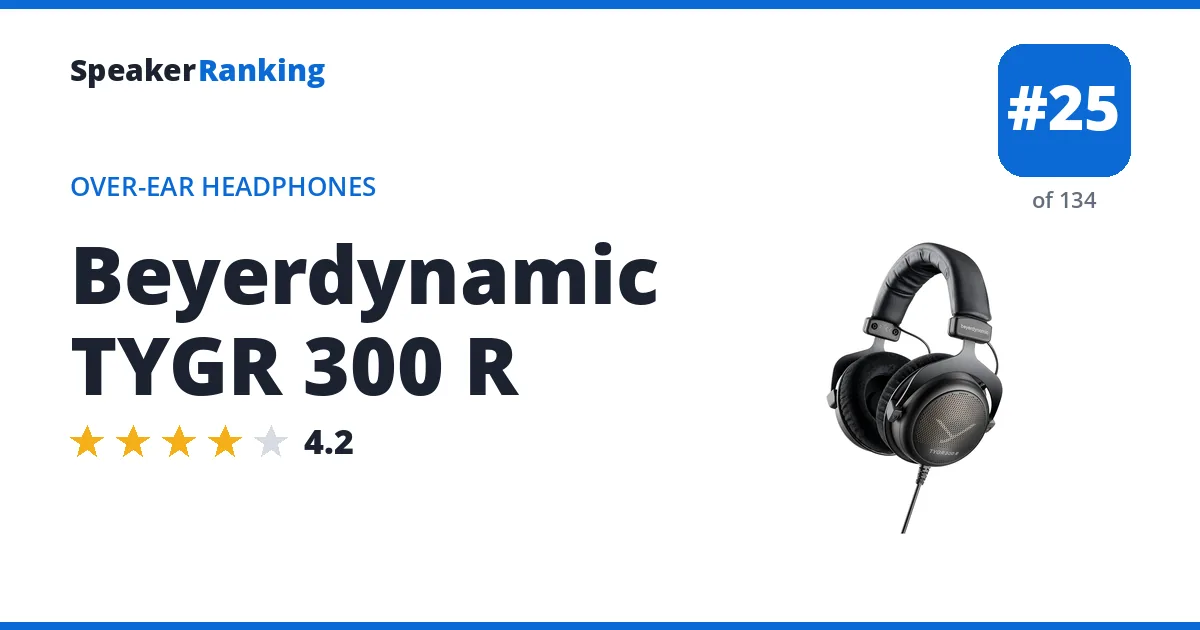
Pros: A preference score of 86 in crinacle’s measurement shows it tracks the Harman target closely, with a smoothness of 1.9 dB. The 32 ohm impedance and 96 dB sensitivity mean it runs fine from a phone or laptop, and 290 g is manageable for an open-back design. It shares its rating with the FiiO FT1 Pro at a lower price.
Cons: Only the overall score is available, so there is no band by band breakdown of where it deviates from target. The open back leaks sound and offers no isolation, and there is no built-in microphone, so it suits quiet listening and desk use rather than commuting or calls.
Full Beyerdynamic TYGR 300 R review and specifications →
| Released | 2019 (7 years ago) |
|---|---|
| Back | Open |
| Built-in Microphone | No |
| Connection | Wired |
| Deviation From Target | 1.90 dB standard deviation |
| Form Factor | Over-ear |
| Frequency Response | 5Hz - 35kHz (Manufacturer specified) |
| Harman Preference Score | 86 (measured by crinacle, via AutoEQ) |
| Impedance | 32 ohms |
| Sensitivity | 96 dB SPL |
| Tonal Tilt | -0.30 (negative is warmer, positive brighter) |
| Weight | 0.6 lbs (290 g) |
EQ preset to match the Harman target
Set a preamp of -5.9 dB, then add these filters in any parametric equalizer (Wavelet, Equalizer APO, Peace, or a player with parametric EQ). Calculated by AutoEQ from its measured frequency response.
| Filter | Frequency | Gain | Q |
|---|---|---|---|
| Low shelf | 105 Hz | +16.5 dB | 0.70 |
| Peak | 43 Hz | -14.1 dB | 0.32 |
| Peak | 2,772 Hz | +2.4 dB | 1.07 |
| Peak | 626 Hz | +2.7 dB | 1.03 |
| Peak | 5,621 Hz | -6.0 dB | 5.22 |
| High shelf | 10,000 Hz | -6.3 dB | 0.70 |
| Peak | 4,679 Hz | +1.3 dB | 6.00 |
| Peak | 23 Hz | -0.5 dB | 4.16 |
| Peak | 30 Hz | +0.3 dB | 2.29 |
| Peak | 6,882 Hz | +1.3 dB | 5.99 |
- Reviews, Comparisons and Sound Samples
 Ranked #26 of 134 in Over-Ear Headphones - FiiO FT1 Pro: $219.99 Amazon eBay
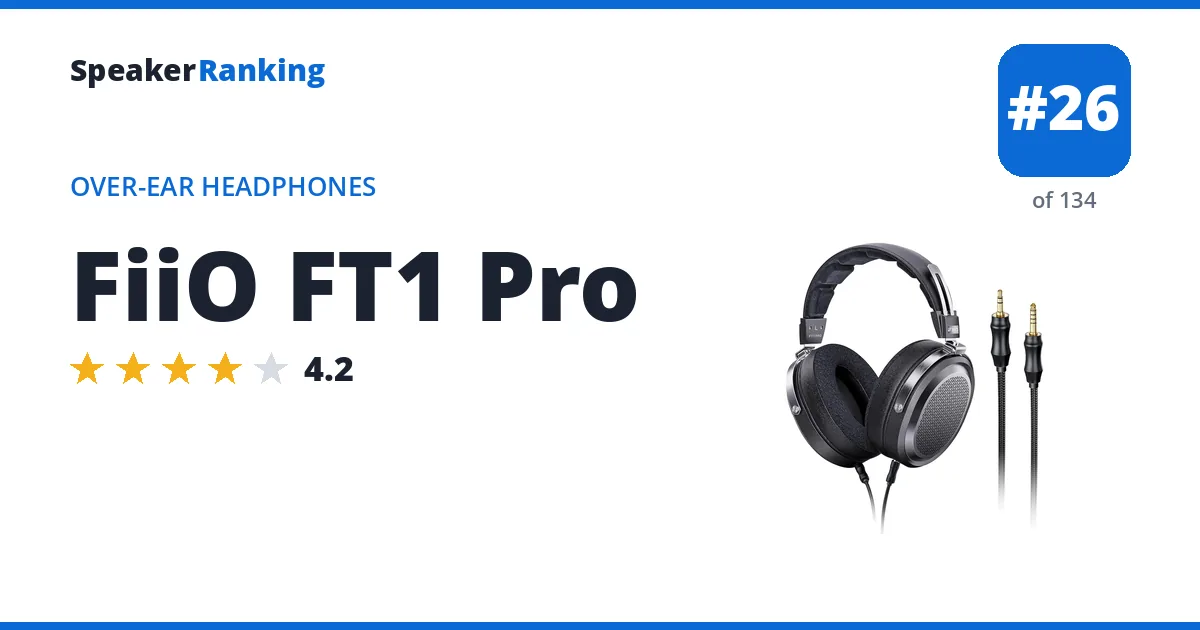
Pros: Planar magnetic drivers with a 20 ohm impedance and 95 dB per milliwatt sensitivity make it easy to drive from a dongle or phone while delivering a preference score of 86. Bass from 60 to 200 Hz is essentially on target and sub-bass is only about 2.5 dB light, giving clean, controlled low end. Its rating matches the Audio-Technica ATH-M70x and Beyerdynamic TYGR 300 R, with a lower price than the M70x.
Cons: A 10 dB dip near 9.6 kHz and treble about 1 dB low soften cymbals and the upper edge of vocals, while a 3.5 dB peak near 2.9 kHz can add some forwardness. Low mids run about 1.6 dB above target, which adds a touch of thickness. At 374 g it is fairly heavy, and the open back leaks sound.
Full FiiO FT1 Pro review and specifications →
| Released | Nov 2024 (1 year ago) |
|---|---|
| Back | Open |
| Connection | Wired |
| Deviation From Target | 2.16 dB standard deviation |
| Driver Type | Planar magnetic |
| Drivers | 1 x 95x86mm planar magnetic |
| Form Factor | Over-ear |
| Frequency Response | 7Hz - 40kHz (Manufacturer specified) |
| Harman Preference Score | 86 (measured by oratory1990, via AutoEQ) |
| Impedance | 20 ohms |
| Sensitivity | 95 dB/mW |
| Tonal Tilt | -0.07 (negative is warmer, positive brighter) |
| Weight | 0.8 lbs (374 g) |
EQ preset to match the Harman target
Set a preamp of -4.1 dB, then add these filters in any parametric equalizer (Wavelet, Equalizer APO, Peace, or a player with parametric EQ). Calculated by AutoEQ from its measured frequency response.
| Filter | Frequency | Gain | Q |
|---|---|---|---|
| Low shelf | 105 Hz | +4.2 dB | 0.70 |
| Peak | 162 Hz | -1.5 dB | 0.18 |
| Peak | 1,818 Hz | +4.7 dB | 2.03 |
| Peak | 2,815 Hz | -3.9 dB | 3.58 |
| Peak | 9,183 Hz | +1.7 dB | 2.62 |
| High shelf | 10,000 Hz | -1.4 dB | 0.70 |
| Peak | 5,731 Hz | -2.5 dB | 5.92 |
| Peak | 35 Hz | -0.6 dB | 2.36 |
| Peak | 100 Hz | +0.3 dB | 1.53 |
| Peak | 3,839 Hz | +1.7 dB | 6.00 |
- Reviews, Comparisons and Sound Samples
 Ranked #27 of 134 in Over-Ear Headphones - Sennheiser HD 800 S: $1,599.95 Amazon eBay
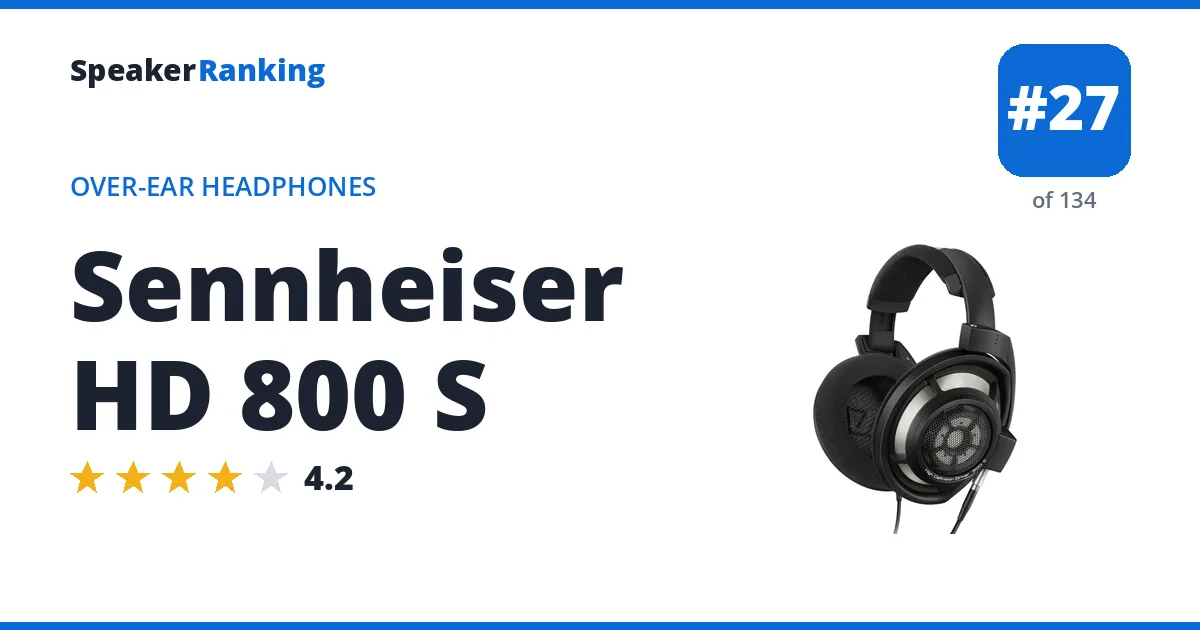
Pros: A preference score of 86 with a near neutral tilt and bands from 60 Hz to 10 kHz mostly within about 1.7 dB of target gives a natural, spacious presentation with good tonal balance. Air above 10 kHz runs about 4 dB above target, adding openness and perceived detail. It rates the same as the HIFIMAN HE1000 Stealth.
Cons: A 6 dB dip near 9.1 kHz followed by a 5.4 dB peak near 11.4 kHz makes the treble uneven. Sub-bass is about 5 dB under target, so rumble is limited. The 300 ohm impedance and 102 dB per volt sensitivity call for a dedicated headphone amp, and the open back leaks sound.
Full Sennheiser HD 800 S review and specifications →
| Back | Open |
|---|---|
| Connection | Wired |
| Deviation From Target | 2.19 dB standard deviation |
| Driver Type | Dynamic |
| Drivers | 1 x 56mm dynamic |
| Form Factor | Over-ear |
| Frequency Response | 4Hz - 51kHz (Manufacturer specified) |
| Harman Preference Score | 86 (measured by oratory1990, via AutoEQ) |
| Impedance | 300 ohms |
| Sensitivity | 102 dB SPL/V |
| Tonal Tilt | +0.07 (negative is warmer, positive brighter) |
| Weight | 0.7 lbs (330 g) |
EQ preset to match the Harman target
Set a preamp of -6.2 dB, then add these filters in any parametric equalizer (Wavelet, Equalizer APO, Peace, or a player with parametric EQ). Calculated by AutoEQ from its measured frequency response.
| Filter | Frequency | Gain | Q |
|---|---|---|---|
| Low shelf | 105 Hz | +6.6 dB | 0.70 |
| Peak | 142 Hz | -2.3 dB | 0.30 |
| Peak | 1,959 Hz | +2.5 dB | 0.88 |
| Peak | 5,679 Hz | -4.4 dB | 4.36 |
| Peak | 212 Hz | -0.5 dB | 2.36 |
| High shelf | 10,000 Hz | -4.3 dB | 0.70 |
| Peak | 1,043 Hz | -1.0 dB | 2.89 |
| Peak | 1,445 Hz | +1.0 dB | 3.43 |
| Peak | 2,640 Hz | -0.9 dB | 4.01 |
| Peak | 3,421 Hz | +1.3 dB | 5.47 |
- Reviews, Comparisons and Sound Samples
 Ranked #29 of 134 in Over-Ear Headphones - AKG K702: $259.99 Amazon eBay
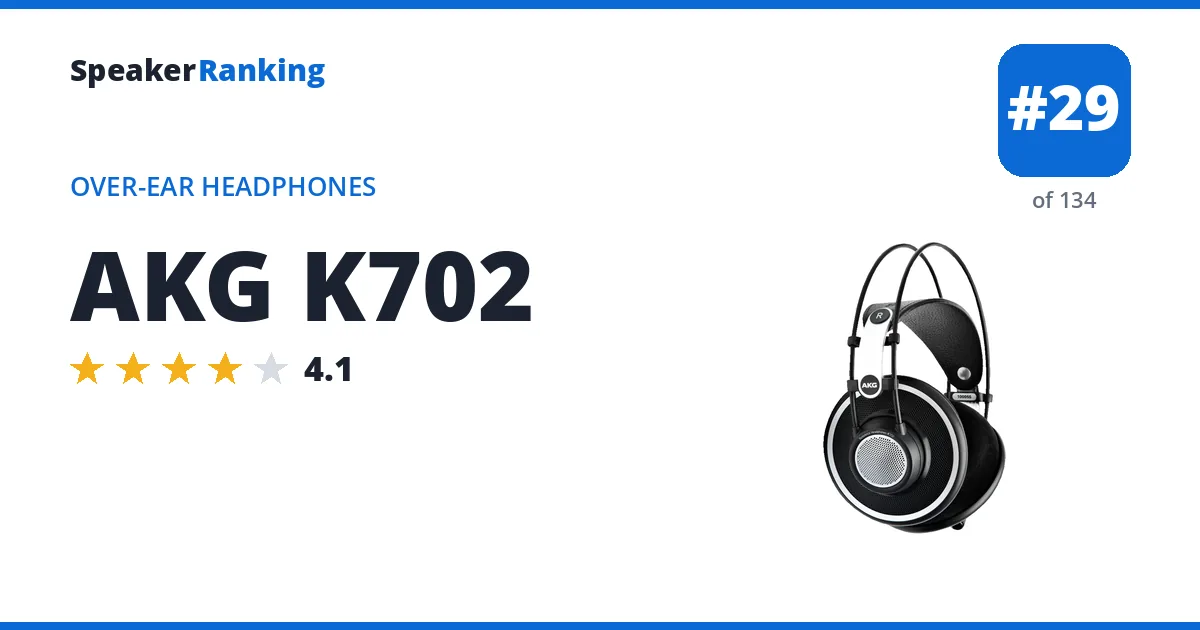
Pros: A preference score of 85 with a neutral to warm balance, with bass from 60 to 200 Hz essentially on target and low mids within 1 dB. At 235 g it is a light open-back design, and the 62 ohm impedance with 105 dB per volt sensitivity runs from most sources. It rates the same as the AKG K701.
Cons: A 7.3 dB dip near 9.5 kHz combined with a 4.3 dB peak near 5.6 kHz makes the treble uneven, so some sibilance and a slightly forward upper mid range are possible. Sub-bass is about 5 dB under target, limiting rumble. The open back leaks sound and offers no isolation.
Full AKG K702 review and specifications →
| Back | Open |
|---|---|
| Connection | Wired |
| Deviation From Target | 2.24 dB standard deviation |
| Driver Type | Dynamic |
| Drivers | 1 x 45mm dynamic |
| Form Factor | Over-ear |
| Frequency Response | 10Hz - 39.8kHz (Manufacturer specified) |
| Harman Preference Score | 85 (measured by oratory1990, via AutoEQ) |
| Impedance | 62 ohms |
| Sensitivity | 105 dB SPL/V |
| Tonal Tilt | +0.10 (negative is warmer, positive brighter) |
| Weight | 0.5 lbs (235 g) |
EQ preset to match the Harman target
Set a preamp of -6.1 dB, then add these filters in any parametric equalizer (Wavelet, Equalizer APO, Peace, or a player with parametric EQ). Calculated by AutoEQ from its measured frequency response.
| Filter | Frequency | Gain | Q |
|---|---|---|---|
| Low shelf | 105 Hz | +7.1 dB | 0.70 |
| Peak | 119 Hz | -2.7 dB | 0.23 |
| Peak | 9,459 Hz | +3.2 dB | 3.19 |
| Peak | 730 Hz | +3.2 dB | 1.22 |
| Peak | 2,241 Hz | -3.5 dB | 3.80 |
| High shelf | 10,000 Hz | -1.7 dB | 0.70 |
| Peak | 3,721 Hz | +3.4 dB | 2.02 |
| Peak | 5,483 Hz | -4.7 dB | 4.79 |
| Peak | 2,633 Hz | -2.0 dB | 5.29 |
| Peak | 56 Hz | -0.6 dB | 2.62 |
- Reviews, Comparisons and Sound Samples
- Head-to-Head Comparisons
 Ranked #30 of 134 in Over-Ear Headphones - HIFIMAN Arya Stealth Magnet Version: $599.00 Amazon eBay
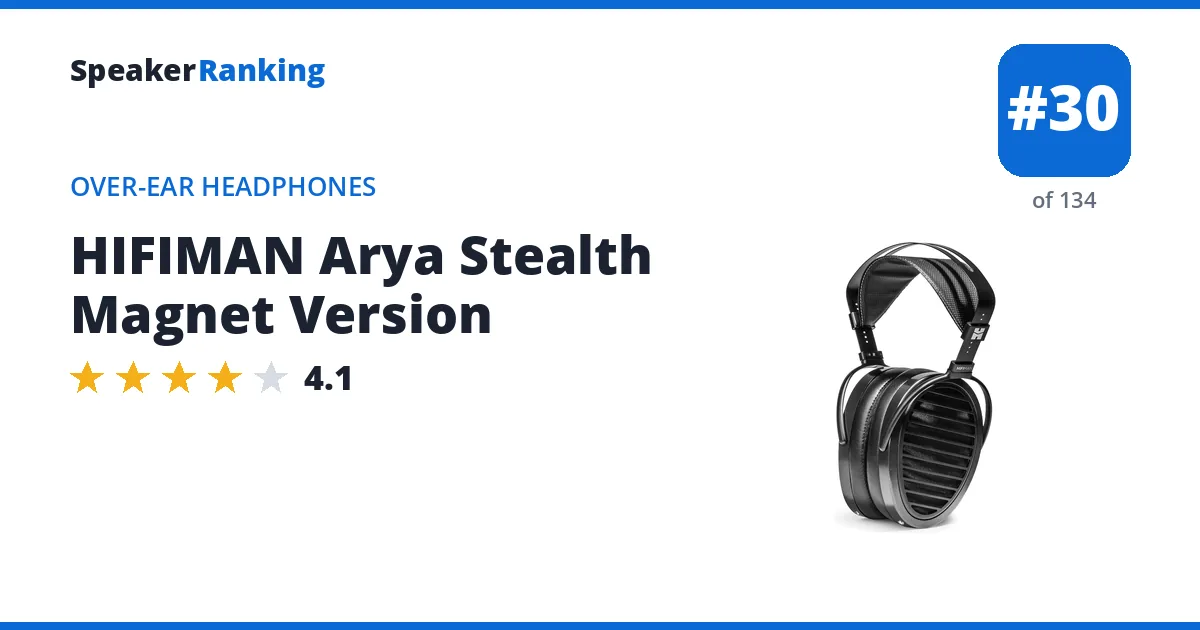
Pros: A preference score of 85 in oratory1990’s measurement and a near flat tilt of 0.02 give it a balanced overall tonality. Bass from 60 to 200 Hz sits within 1 dB of target and the upper mids are only about 1 dB low, so vocals and instruments sound natural. At 32 ohms and 94 dB sensitivity it is easier to drive than most planar headphones, and 404 g is moderate for the type.
Cons: An 8 dB dip near 9.3 kHz followed by a 7 dB peak near 11.9 kHz makes the treble uneven, so cymbals can sound recessed one moment and sharp the next. Presence is about 3 dB hot and the air band about 3 dB elevated, which adds edge to bright recordings. Sub-bass runs about 3 dB under target, and the open back leaks sound and offers no isolation.
Full HIFIMAN Arya Stealth Magnet Version review and specifications →
| Back | Open |
|---|---|
| Connection | Wired |
| Deviation From Target | 2.29 dB standard deviation |
| Driver Type | Planar magnetic |
| Form Factor | Over-ear |
| Frequency Response | 8Hz - 65kHz (Manufacturer specified) |
| Harman Preference Score | 85 (measured by oratory1990, via AutoEQ) |
| Impedance | 32 ohms |
| Sensitivity | 94 dB |
| Tonal Tilt | +0.02 (negative is warmer, positive brighter) |
| Weight | 0.9 lbs (404 g) |
EQ preset to match the Harman target
Set a preamp of -5.1 dB, then add these filters in any parametric equalizer (Wavelet, Equalizer APO, Peace, or a player with parametric EQ). Calculated by AutoEQ from its measured frequency response.
| Filter | Frequency | Gain | Q |
|---|---|---|---|
| Low shelf | 105 Hz | +5.9 dB | 0.70 |
| Peak | 1,825 Hz | +5.1 dB | 1.78 |
| Peak | 99 Hz | -2.5 dB | 0.31 |
| Peak | 4,828 Hz | -3.9 dB | 4.18 |
| Peak | 3,009 Hz | -2.8 dB | 3.29 |
| High shelf | 10,000 Hz | -3.1 dB | 0.70 |
| Peak | 969 Hz | -1.3 dB | 3.17 |
| Peak | 1,373 Hz | +0.9 dB | 4.21 |
| Peak | 652 Hz | +0.8 dB | 4.18 |
| Peak | 150 Hz | +0.2 dB | 1.75 |
- Reviews, Comparisons and Sound Samples
 Ranked #31 of 134 in Over-Ear Headphones - HIFIMAN HE6: $1,899.00 Amazon eBay
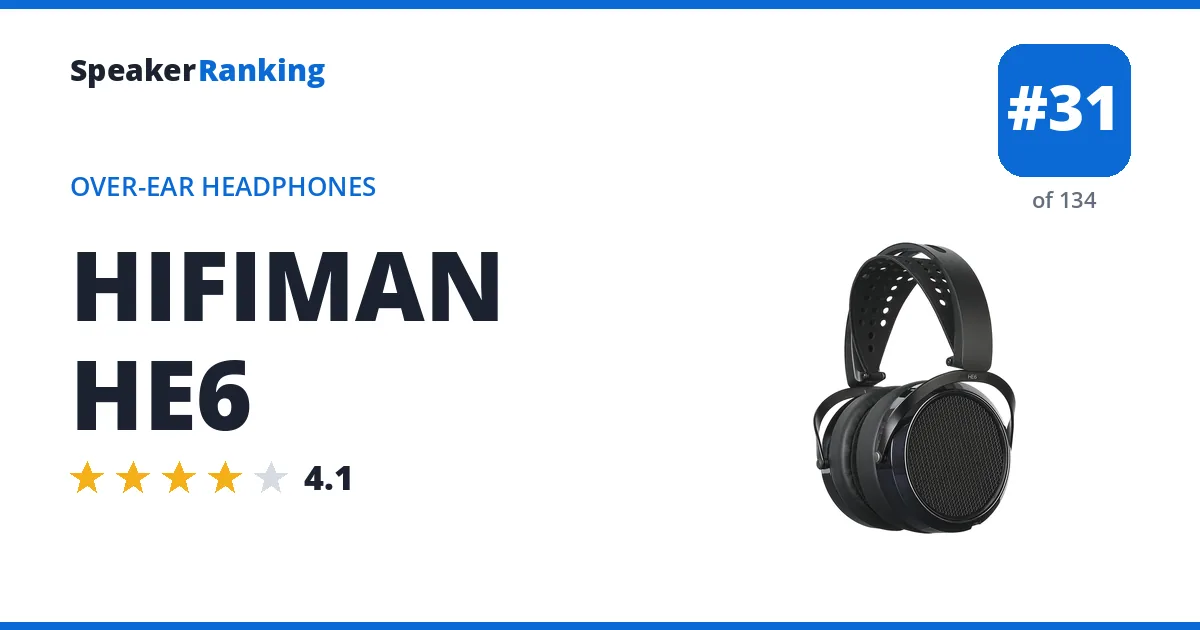
Pros: A preference score of 85 and a smooth deviation of 2.2 dB around the target show a well-controlled response, with low mids within 0.5 dB of target for natural male vocals and guitars. Presence and air sit about 1.5 dB above target, adding some openness. Its tilt is almost perfectly neutral at 0.14.
Cons: Sub-bass falls about 5 dB short under 60 Hz and the bass region is nearly 2 dB light, so kick drums and bass synths lack weight. Treble from 6 to 10 kHz is around 3.5 dB low, with a 6 dB dip near 9.8 kHz and a 6 dB peak near 11.9 kHz. At 50 ohms and 83.5 dB sensitivity it is hard to drive and needs a powerful dedicated headphone amp, and the open back leaks sound.
Full HIFIMAN HE6 review and specifications →
| Released | 2010 (16 years ago) |
|---|---|
| Back | Open |
| Connection | Wired |
| Deviation From Target | 2.20 dB standard deviation |
| Driver Type | Planar magnetic |
| Form Factor | Over-ear |
| Frequency Response | 8Hz - 65kHz (Manufacturer specified) |
| Harman Preference Score | 85 (measured by oratory1990, via AutoEQ) |
| Impedance | 50 ohms |
| Sensitivity | 83.5 dB |
| Tonal Tilt | +0.14 (negative is warmer, positive brighter) |
EQ preset to match the Harman target
Set a preamp of -4.3 dB, then add these filters in any parametric equalizer (Wavelet, Equalizer APO, Peace, or a player with parametric EQ). Calculated by AutoEQ from its measured frequency response.
| Filter | Frequency | Gain | Q |
|---|---|---|---|
| Low shelf | 105 Hz | +4.3 dB | 0.70 |
| Peak | 2,082 Hz | +6.7 dB | 1.71 |
| Peak | 1,368 Hz | -2.7 dB | 0.46 |
| Peak | 4,783 Hz | -5.9 dB | 2.45 |
| Peak | 6,698 Hz | +4.7 dB | 1.96 |
| High shelf | 10,000 Hz | -3.4 dB | 0.70 |
| Peak | 185 Hz | -0.9 dB | 0.85 |
| Peak | 698 Hz | +0.8 dB | 0.87 |
| Peak | 1,027 Hz | -1.0 dB | 2.16 |
| Peak | 71 Hz | -0.4 dB | 1.83 |
- Reviews, Comparisons and Sound Samples
 Ranked #32 of 134 in Over-Ear Headphones - HIFIMAN Susvara: $5,999.00 Amazon eBay
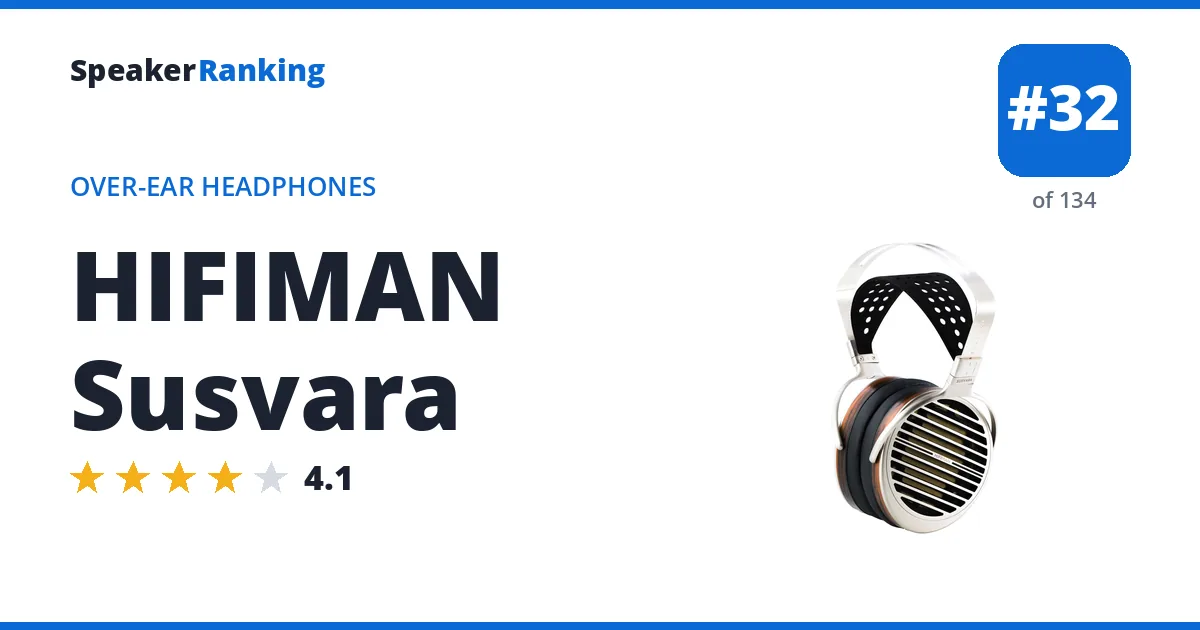
Pros: A preference score of 85 in crinacle’s measurement puts it among the closest to the Harman target in its class. The planar magnetic driver is rated down to 6 Hz and up to 75 kHz. It is a wired open-back design at 450 g.
Cons: At 60 ohms and only 83 dB sensitivity it needs a very powerful dedicated headphone amp and will sound quiet and thin from a phone or laptop. The open back leaks sound and gives no isolation. The price is far above rivals such as the HIFIMAN Shangri-La Jr, which has a slightly higher rating.
Full HIFIMAN Susvara review and specifications →
| Released | 2018 (8 years ago) |
|---|---|
| Back | Open |
| Connection | Wired |
| Deviation From Target | 2.24 dB standard deviation |
| Driver Type | Planar magnetic |
| Form Factor | Over-ear |
| Frequency Response | 6Hz - 75kHz (Manufacturer specified) |
| Harman Preference Score | 85 (measured by crinacle, via AutoEQ) |
| Impedance | 60 ohms |
| Sensitivity | 83 dB |
| Tonal Tilt | -0.07 (negative is warmer, positive brighter) |
| Weight | 1 lbs (450 g) |
EQ preset to match the Harman target
Set a preamp of -5.5 dB, then add these filters in any parametric equalizer (Wavelet, Equalizer APO, Peace, or a player with parametric EQ). Calculated by AutoEQ from its measured frequency response.
| Filter | Frequency | Gain | Q |
|---|---|---|---|
| Low shelf | 105 Hz | +5.7 dB | 0.70 |
| Peak | 1,876 Hz | +5.7 dB | 2.54 |
| Peak | 123 Hz | -2.1 dB | 0.26 |
| Peak | 485 Hz | -0.5 dB | 2.51 |
| Peak | 896 Hz | -1.1 dB | 3.26 |
| High shelf | 10,000 Hz | -1.5 dB | 0.70 |
| Peak | 4,945 Hz | -1.7 dB | 5.84 |
| Peak | 207 Hz | -0.6 dB | 2.66 |
| Peak | 121 Hz | +0.5 dB | 1.56 |
| Peak | 62 Hz | -0.3 dB | 1.77 |
- Reviews, Comparisons and Sound Samples
 Ranked #33 of 134 in Over-Ear Headphones - HIFIMAN HE6se V2: $792.24 Amazon eBay
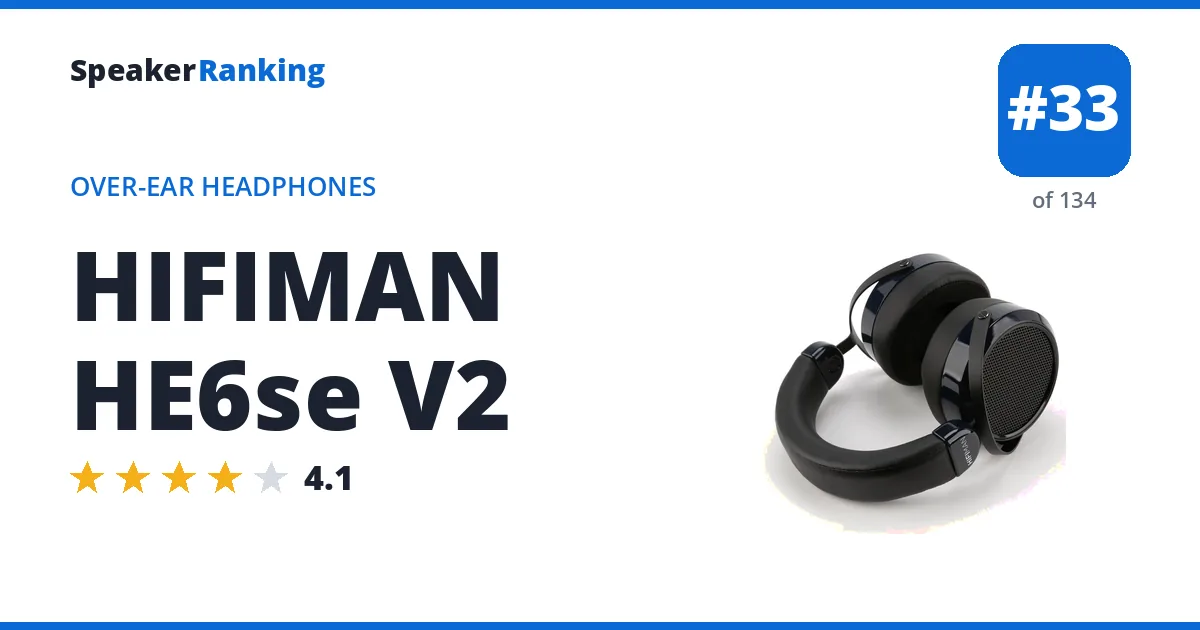
Pros: A preference score of 84 with a deviation of only 2.19 dB shows a smooth, well-controlled response, and low mids sit within 2 dB of target. Bass from 60 to 200 Hz is within 1 dB of target, so bass notes keep their body. It costs noticeably less than the HIFIMAN HE1000 Stealth, though that model carries a higher rating.
Cons: Sub-bass is roughly 4 dB under target below 60 Hz, so the lowest rumble is missing. Presence is about 2.5 dB hot with a 3.7 dB peak near 3.75 kHz, and a 5 dB dip near 9.6 kHz softens cymbals. At 83.5 dB sensitivity it needs a dedicated headphone amp, and the open back leaks sound.
Full HIFIMAN HE6se V2 review and specifications →
| Back | Open |
|---|---|
| Connection | Wired |
| Deviation From Target | 2.19 dB standard deviation |
| Driver Type | Planar magnetic |
| Form Factor | Over-ear |
| Frequency Response | 8Hz - 65kHz (Manufacturer specified) |
| Harman Preference Score | 84 (measured by oratory1990, via AutoEQ) |
| Impedance | 50 ohms |
| Sensitivity | 83.5 dB |
| Tonal Tilt | +0.18 (negative is warmer, positive brighter) |
| Weight | 1 lbs (470 g) |
EQ preset to match the Harman target
Set a preamp of -5.0 dB, then add these filters in any parametric equalizer (Wavelet, Equalizer APO, Peace, or a player with parametric EQ). Calculated by AutoEQ from its measured frequency response.
| Filter | Frequency | Gain | Q |
|---|---|---|---|
| Low shelf | 105 Hz | +5.2 dB | 0.70 |
| Peak | 340 Hz | -1.5 dB | 0.18 |
| Peak | 1,902 Hz | +6.8 dB | 1.60 |
| Peak | 3,470 Hz | -3.7 dB | 1.05 |
| Peak | 9,114 Hz | +3.4 dB | 2.07 |
| High shelf | 10,000 Hz | -3.3 dB | 0.70 |
| Peak | 970 Hz | -1.0 dB | 4.33 |
| Peak | 62 Hz | -0.4 dB | 1.81 |
| Peak | 119 Hz | +0.3 dB | 1.64 |
| Peak | 1,386 Hz | +0.6 dB | 3.74 |
- Reviews, Comparisons and Sound Samples
 Ranked #34 of 134 in Over-Ear Headphones - Sennheiser HD 650: $329.80 Amazon eBay
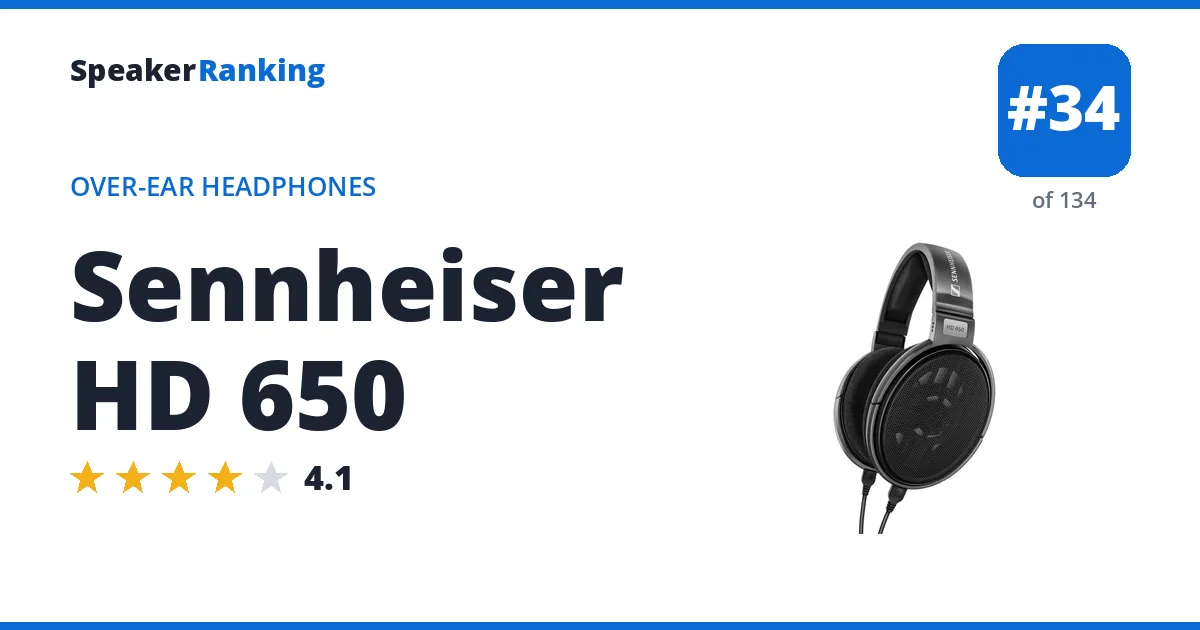
Pros: A preference score of 84 and a warm tilt of minus 0.27 give a relaxed, smooth sound, with bass from 60 to 200 Hz, mids and presence all within about 0.6 dB of target. The largest peak in the upper range is just 1.1 dB, so it avoids harshness on vocals and guitars. At 260 g it is fairly light, and it is a good match for listeners who like a warm tonality.
Cons: Sub-bass is about 7 dB under target and the 6 to 10 kHz treble is nearly 5 dB low, with a 9 dB dip near 9.3 kHz, so cymbals and air sound dull and rumble is missing. At 300 ohms it wants a dedicated headphone amp to reach its potential, and the open back leaks sound.
Full Sennheiser HD 650 review and specifications →
| Released | 2003 (23 years ago) |
|---|---|
| Back | Open |
| Connection | Wired |
| Deviation From Target | 2.10 dB standard deviation |
| Driver Type | Dynamic |
| Drivers | 1 x 42mm dynamic |
| Form Factor | Over-ear |
| Frequency Response | 10Hz - 41kHz (Manufacturer specified) |
| Harman Preference Score | 84 (measured by oratory1990, via AutoEQ) |
| Impedance | 300 ohms |
| Sensitivity | 103 dB SPL/V |
| Tonal Tilt | -0.27 (negative is warmer, positive brighter) |
| Weight | 0.6 lbs (260 g) |
EQ preset to match the Harman target
Set a preamp of -6.1 dB, then add these filters in any parametric equalizer (Wavelet, Equalizer APO, Peace, or a player with parametric EQ). Calculated by AutoEQ from its measured frequency response.
| Filter | Frequency | Gain | Q |
|---|---|---|---|
| Low shelf | 105 Hz | +6.4 dB | 0.70 |
| Peak | 8,800 Hz | +5.1 dB | 1.42 |
| Peak | 118 Hz | -3.1 dB | 0.50 |
| Peak | 37 Hz | +0.7 dB | 3.96 |
| Peak | 3,169 Hz | -1.7 dB | 3.89 |
| High shelf | 10,000 Hz | -2.1 dB | 0.70 |
| Peak | 1,227 Hz | -1.2 dB | 2.53 |
| Peak | 2,055 Hz | +1.2 dB | 3.23 |
| Peak | 587 Hz | +0.4 dB | 1.19 |
| Peak | 5,332 Hz | -1.1 dB | 5.75 |
- Reviews, Comparisons and Sound Samples
- Head-to-Head Comparisons
 Ranked #35 of 134 in Over-Ear Headphones - AKG K701: $249.99 Amazon eBay
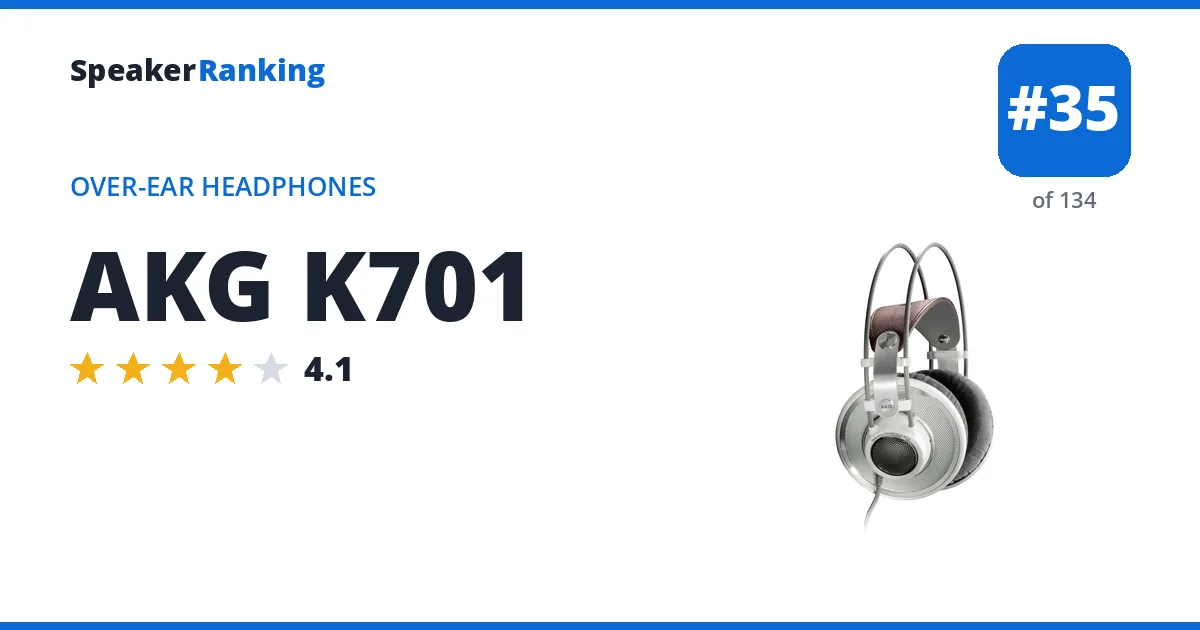
Pros: A preference score of 83 with a deviation of 2.14 dB shows a smooth response. Bass from 60 to 200 Hz is about 1.6 dB above target and low mids about 2.3 dB above, giving warm, full vocals and bass guitar, while treble from 6 to 10 kHz lands within 0.2 dB of target. At 62 ohms and 105 dB/mW sensitivity it runs fine from most sources, and 235 g is light. It costs less than the AKG K702 at the same rating.
Cons: A 4.2 dB peak near 5.9 kHz can add some edge to vocals and sibilants. Sub-bass is about 3.5 dB under target, and the low mids may sound slightly thick on busy mixes. The open back leaks sound and offers no isolation.
Full AKG K701 review and specifications →
| Back | Open |
|---|---|
| Connection | Wired |
| Deviation From Target | 2.14 dB standard deviation |
| Driver Type | Dynamic |
| Form Factor | Over-ear |
| Frequency Response | 10Hz - 39.8kHz (Manufacturer specified) |
| Harman Preference Score | 83 (measured by oratory1990, via AutoEQ) |
| Impedance | 62 ohms |
| Sensitivity | 105 dB/mW |
| Tonal Tilt | -0.31 (negative is warmer, positive brighter) |
| Weight | 0.5 lbs (235 g) |
EQ preset to match the Harman target
Set a preamp of -6.1 dB, then add these filters in any parametric equalizer (Wavelet, Equalizer APO, Peace, or a player with parametric EQ). Calculated by AutoEQ from its measured frequency response.
| Filter | Frequency | Gain | Q |
|---|---|---|---|
| Low shelf | 105 Hz | +7.5 dB | 0.70 |
| Peak | 131 Hz | -4.1 dB | 0.21 |
| Peak | 937 Hz | +3.7 dB | 0.65 |
| Peak | 2,378 Hz | -3.3 dB | 2.56 |
| Peak | 3,536 Hz | +3.6 dB | 3.04 |
| High shelf | 10,000 Hz | -0.6 dB | 0.70 |
| Peak | 5,837 Hz | -2.9 dB | 5.42 |
| Peak | 55 Hz | -0.9 dB | 1.90 |
| Peak | 116 Hz | +1.2 dB | 3.55 |
| Peak | 27 Hz | +0.7 dB | 3.27 |
- Reviews, Comparisons and Sound Samples
- Head-to-Head Comparisons
 Ranked #36 of 134 in Over-Ear Headphones - Audio-Technica ATH-R50x: $169.00 Amazon eBay
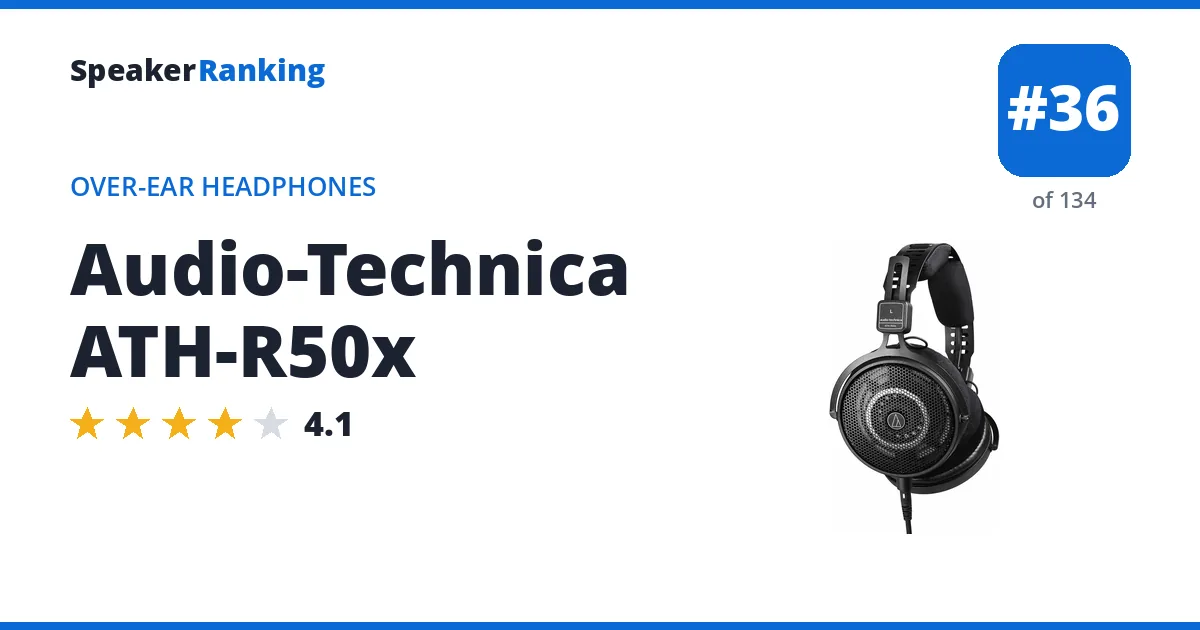
Pros: A preference score of 83 and the smoothest deviation in this group at 1.67 dB make for a very even response, with bass from 60 to 200 Hz and low mids within 0.6 dB of target. At 50 ohms and 93.3 dB/mW sensitivity it can be driven by most portable sources, and at 207 g it is light. It costs less than the AKG K701 and AKG K702 while holding the same rating.
Cons: Sub-bass is about 6 dB low under 60 Hz, so deep rumble is lacking. Treble is slightly forward, with presence about 2 dB high, 6 to 10 kHz about 2.6 dB high and a 4.8 dB peak near 6.3 kHz, which can make vocals and cymbals bright. Its tilt of 0.64 leans bright, and the open back leaks sound.
Full Audio-Technica ATH-R50x review and specifications →
| Released | Jan 2025 (1 year ago) |
|---|---|
| Back | Open |
| Connection | Wired |
| Deviation From Target | 1.67 dB standard deviation |
| Driver Type | Dynamic |
| Drivers | 1 x 45mm dynamic |
| Form Factor | Over-ear |
| Frequency Response | 5Hz - 40kHz (Manufacturer specified) |
| Harman Preference Score | 83 (measured by oratory1990, via AutoEQ) |
| Impedance | 50 ohms |
| Sensitivity | 93.3 dB/mW |
| Tonal Tilt | +0.64 (negative is warmer, positive brighter) |
| Weight | 0.5 lbs (207 g) |
EQ preset to match the Harman target
Set a preamp of -6.2 dB, then add these filters in any parametric equalizer (Wavelet, Equalizer APO, Peace, or a player with parametric EQ). Calculated by AutoEQ from its measured frequency response.
| Filter | Frequency | Gain | Q |
|---|---|---|---|
| Low shelf | 105 Hz | +7.2 dB | 0.70 |
| Peak | 482 Hz | +2.4 dB | 0.92 |
| Peak | 60 Hz | -4.8 dB | 0.60 |
| Peak | 6,204 Hz | -3.3 dB | 1.70 |
| Peak | 38 Hz | +2.3 dB | 1.60 |
| High shelf | 10,000 Hz | -2.1 dB | 0.70 |
| Peak | 1,497 Hz | -1.4 dB | 3.40 |
| Peak | 851 Hz | +0.5 dB | 2.04 |
| Peak | 4,628 Hz | +1.6 dB | 4.12 |
| Peak | 3,874 Hz | -2.5 dB | 6.00 |
- Reviews, Comparisons and Sound Samples
- Head-to-Head Comparisons
 Ranked #37 of 134 in Over-Ear Headphones - Grado Hemp: $495.00 Amazon eBay
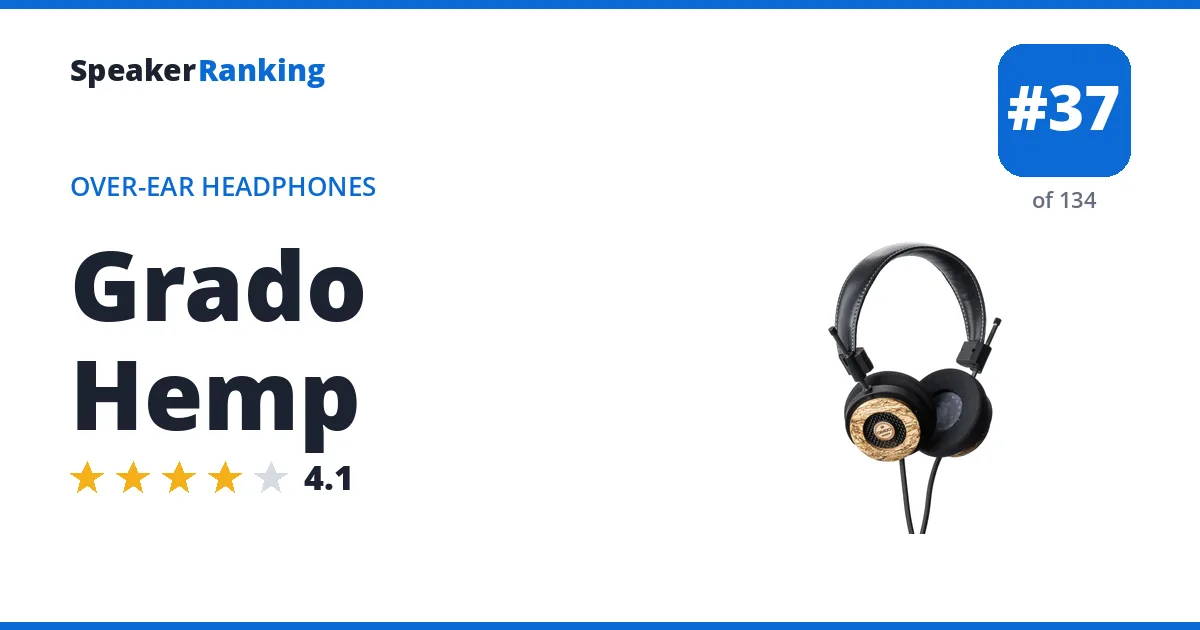
Pros: A preference score of 83 with mids within about 1 dB of target (upper mids 1.1 dB above, low mids 0.2 dB above) gives vocals and instruments a natural presence. Bass from 60 to 200 Hz is within 1 dB of target, and the neutral tilt of 0.09 fits listeners who want a balanced tonality. At 38 ohms and 99.8 dB sensitivity it is easy to drive from a phone or laptop.
Cons: Sub-bass is about 10 dB below target under 60 Hz, a large loss that removes most deep rumble. A 5 dB peak near 2.2 kHz can add forwardness to voices, and a 6 dB dip near 5.3 kHz takes some bite from cymbals and consonants. The open back leaks sound and gives no isolation.
Full Grado Hemp review and specifications →
| Back | Open |
|---|---|
| Connection | Wired |
| Deviation From Target | 2.41 dB standard deviation |
| Driver Type | Dynamic |
| Form Factor | Over-ear |
| Frequency Response | 13Hz - 28kHz (Manufacturer specified) |
| Harman Preference Score | 83 (measured by oratory1990, via AutoEQ) |
| Impedance | 38 ohms |
| Sensitivity | 99.8 dB SPL |
| Tonal Tilt | +0.09 (negative is warmer, positive brighter) |
EQ preset to match the Harman target
Set a preamp of -6.5 dB, then add these filters in any parametric equalizer (Wavelet, Equalizer APO, Peace, or a player with parametric EQ). Calculated by AutoEQ from its measured frequency response.
| Filter | Frequency | Gain | Q |
|---|---|---|---|
| Low shelf | 105 Hz | +6.7 dB | 0.70 |
| Peak | 5,779 Hz | +5.8 dB | 3.08 |
| Peak | 103 Hz | -3.0 dB | 0.63 |
| Peak | 2,201 Hz | -5.7 dB | 3.90 |
| Peak | 3,309 Hz | +4.0 dB | 4.69 |
| High shelf | 10,000 Hz | +0.5 dB | 0.70 |
| Peak | 627 Hz | +0.5 dB | 1.53 |
| Peak | 276 Hz | -1.0 dB | 4.28 |
| Peak | 4,235 Hz | -1.5 dB | 6.00 |
| Peak | 45 Hz | +0.7 dB | 4.16 |
- Reviews, Comparisons and Sound Samples
 Ranked #41 of 134 in Over-Ear Headphones - HIFIMAN Sundara: $179.00 Amazon eBay
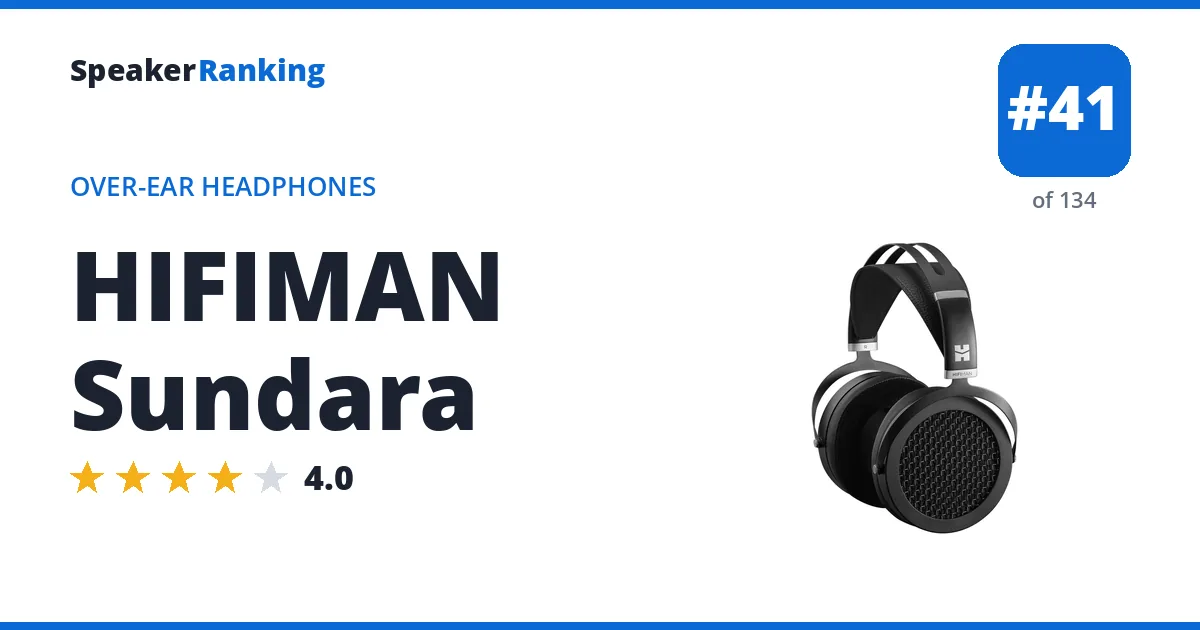
Pros: A preference score of 82 in crinacle’s measurement puts the response close to what most listeners prefer, with a deviation of 2.4 dB from target and an essentially neutral tilt. The planar magnetic driver is easy to run at 37 ohms and 94 dB/mW, so a phone dongle or modest amp is enough. The open back gives a wide, airy presentation for home listening.
Cons: Open construction leaks sound and offers no isolation, so it suits quiet rooms rather than commutes or shared spaces. At 372 g it is on the heavier side of the over-ear class, and the low sensitivity means volume headroom from a phone alone is limited.
Full HIFIMAN Sundara review and specifications →
| Released | 2018 (8 years ago) |
|---|---|
| Back | Open |
| Connection | Wired |
| Deviation From Target | 1.54 dB standard deviation |
| Driver Type | Planar magnetic |
| Drivers | 1 x planar magnetic |
| Form Factor | Over-ear |
| Frequency Response | 6Hz - 75kHz (Manufacturer specified) |
| Harman Preference Score | 82 (measured by crinacle, via AutoEQ) |
| Impedance | 37 ohms |
| Sensitivity | 94 dB/mW |
| Tonal Tilt | -0.01 (negative is warmer, positive brighter) |
| Weight | 0.8 lbs (372 g) |
EQ preset to match the Harman target
Set a preamp of -6.1 dB, then add these filters in any parametric equalizer (Wavelet, Equalizer APO, Peace, or a player with parametric EQ). Calculated by AutoEQ from its measured frequency response.
| Filter | Frequency | Gain | Q |
|---|---|---|---|
| Low shelf | 105 Hz | +6.5 dB | 0.70 |
| Peak | 127 Hz | -2.0 dB | 0.29 |
| Peak | 2,009 Hz | +6.5 dB | 2.96 |
| Peak | 4,085 Hz | -4.4 dB | 1.19 |
| Peak | 7,580 Hz | +2.3 dB | 0.66 |
| High shelf | 10,000 Hz | -1.6 dB | 0.70 |
| Peak | 63 Hz | -1.2 dB | 2.40 |
| Peak | 38 Hz | +0.9 dB | 2.27 |
| Peak | 789 Hz | -1.6 dB | 4.10 |
| Peak | 5,821 Hz | +1.9 dB | 6.00 |
- Reviews, Comparisons and Sound Samples
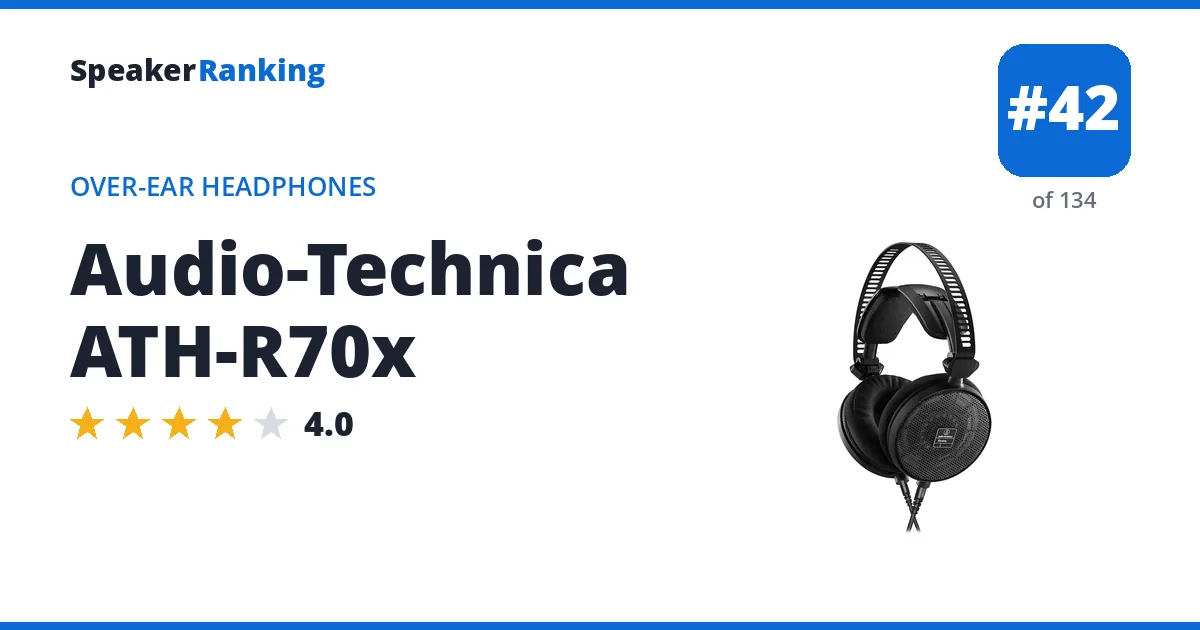
 Ranked #42 of 134 in Over-Ear Headphones - Audio-Technica ATH-R70x: $379.00 Discontinued Amazon eBay
Newer model: the Audio-Technica ATH-R70xa, ranked higher, rated 4.2/5. See every Audio-Technica ATH-R70x generation.
Pros: A preference score of 82 with a deviation of 1.9 dB shows a smooth, well-controlled response in oratory1990’s measurement. Bass from 60 to 200 Hz and the midrange sit almost exactly on target, giving natural vocals and instruments with a slightly warm tilt. At 210 g with an open back, it is light and airy for long sessions at home.
Cons: Sub-bass below 60 Hz is about 6.5 dB under target, so kick drums and synth bass lack deep rumble. A dip of nearly 7 dB near 9.9 kHz and a treble that sits about 2.7 dB low soften cymbals and detail. The 470 ohm impedance calls for a dedicated headphone amp, and the open back leaks sound. Discontinued.
Full Audio-Technica ATH-R70x review and specifications →
| Back | Open |
|---|---|
| Connection | Wired |
| Deviation From Target | 1.94 dB standard deviation |
| Driver Type | Dynamic |
| Drivers | 1 x 45mm dynamic |
| Form Factor | Over-ear |
| Frequency Response | 5Hz - 40kHz (Manufacturer specified) |
| Harman Preference Score | 82 (measured by oratory1990, via AutoEQ) |
| Impedance | 470 ohms |
| Tonal Tilt | -0.52 (negative is warmer, positive brighter) |
| Weight | 0.5 lbs (210 g) |
EQ preset to match the Harman target
Set a preamp of -6.6 dB, then add these filters in any parametric equalizer (Wavelet, Equalizer APO, Peace, or a player with parametric EQ). Calculated by AutoEQ from its measured frequency response.
| Filter | Frequency | Gain | Q |
|---|---|---|---|
| Low shelf | 105 Hz | +7.5 dB | 0.70 |
| Peak | 4,308 Hz | +4.8 dB | 0.51 |
| Peak | 93 Hz | -4.4 dB | 0.43 |
| Peak | 3,519 Hz | -3.2 dB | 4.05 |
| Peak | 2,149 Hz | -3.1 dB | 0.96 |
| High shelf | 10,000 Hz | -1.5 dB | 0.70 |
| Peak | 4,518 Hz | +1.3 dB | 6.00 |
| Peak | 58 Hz | -0.6 dB | 2.31 |
| Peak | 34 Hz | +0.7 dB | 3.60 |
| Peak | 106 Hz | +0.3 dB | 1.84 |
- Reviews, Comparisons and Sound Samples
 Ranked #44 of 134 in Over-Ear Headphones - Beyerdynamic DT 990 Pro: $149.99 Amazon eBay
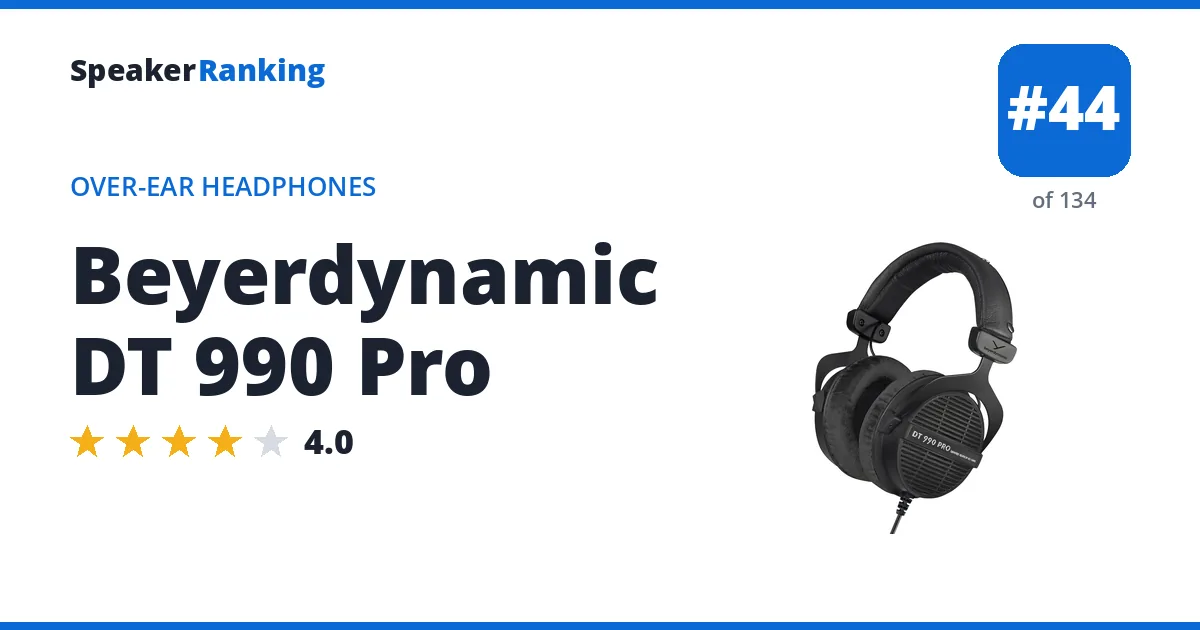
Pros: A preference score of 82 comes from a lively, bass-forward tuning, with bass from 60 to 200 Hz about 2.4 dB above target for punch and drive. The open back gives a spacious, airy soundstage, and the presence and treble lift adds a sense of detail on bright recordings.
Cons: Treble runs about 5 dB above target and air above 10 kHz is nearly 9 dB hot, with a peak near 10.9 dB at 11.9 kHz, so cymbals and sibilance can sound harsh, especially at high volume. Sub-bass is about 2.5 dB low. The 250 ohm impedance needs a headphone amp, and the open back leaks sound.
Full Beyerdynamic DT 990 Pro review and specifications →
| Back | Open |
|---|---|
| Connection | Wired |
| Deviation From Target | 2.08 dB standard deviation |
| Driver Type | Dynamic |
| Form Factor | Over-ear |
| Frequency Response | 5Hz - 35kHz (Manufacturer specified) |
| Harman Preference Score | 82 (measured by oratory1990, via AutoEQ) |
| Impedance | 250 ohms |
| Sensitivity | 96 dB SPL |
| Tonal Tilt | +0.40 (negative is warmer, positive brighter) |
| Weight | 0.6 lbs (250 g) |
EQ preset to match the Harman target
Set a preamp of -6.7 dB, then add these filters in any parametric equalizer (Wavelet, Equalizer APO, Peace, or a player with parametric EQ). Calculated by AutoEQ from its measured frequency response.
| Filter | Frequency | Gain | Q |
|---|---|---|---|
| Low shelf | 105 Hz | +10.1 dB | 0.70 |
| Peak | 541 Hz | +3.1 dB | 0.52 |
| Peak | 64 Hz | -7.4 dB | 0.38 |
| Peak | 7,731 Hz | -4.6 dB | 1.06 |
| Peak | 640 Hz | +0.6 dB | 2.47 |
| High shelf | 10,000 Hz | -9.8 dB | 0.70 |
| Peak | 7,136 Hz | +3.1 dB | 2.08 |
| Peak | 5,897 Hz | -4.8 dB | 5.30 |
| Peak | 4,193 Hz | +1.1 dB | 1.51 |
| Peak | 9,436 Hz | +2.7 dB | 3.53 |
- Reviews, Comparisons and Sound Samples
- Head-to-Head Comparisons
 Ranked #47 of 134 in Over-Ear Headphones - AKG K612 Pro: $209.95 Amazon eBay
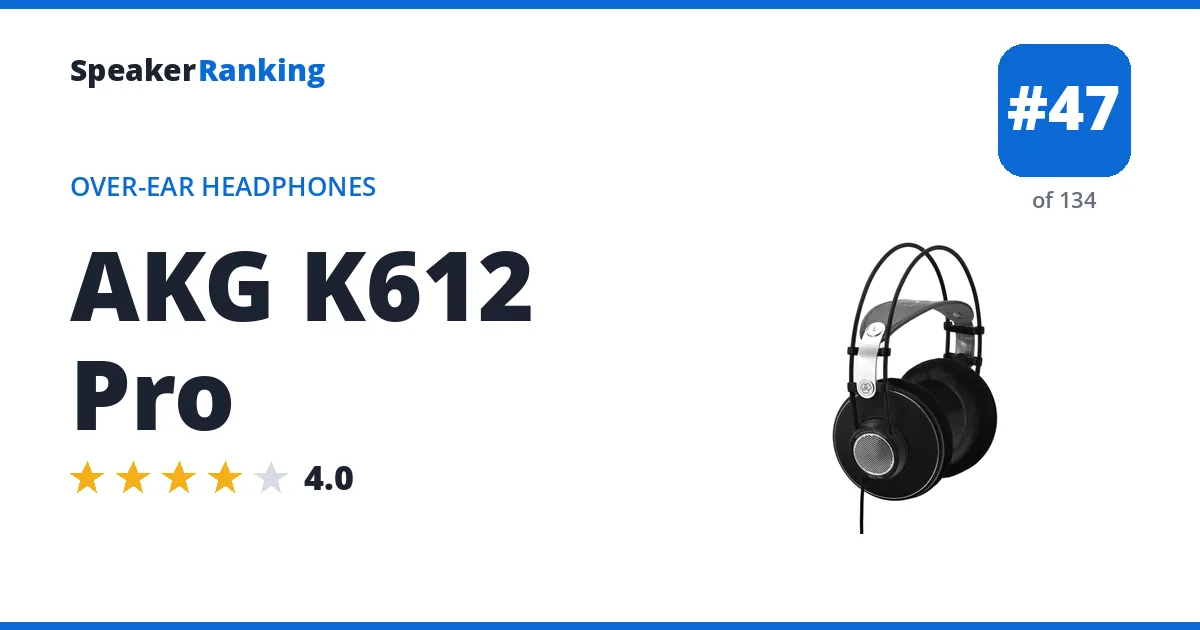
Pros: A preference score of 81 in crinacle’s measurement shows a response that sits reasonably close to the Harman target with a slightly bright tilt. The open back gives an airy, spacious presentation at 238 g. At 120 ohms and 101 dB SPL/V it is workable from a good source.
Cons: The open back leaks sound and gives no isolation, so it is best for quiet rooms. The 120 ohm impedance benefits from a dedicated headphone amp rather than a phone.
Full AKG K612 Pro review and specifications →
| Back | Open |
|---|---|
| Connection | Wired |
| Deviation From Target | 2.27 dB standard deviation |
| Driver Type | Dynamic |
| Drivers | 1 x 50mm dynamic |
| Form Factor | Over-ear |
| Frequency Response | 12Hz - 39.5kHz (Manufacturer specified) |
| Harman Preference Score | 81 (measured by crinacle, via AutoEQ) |
| Impedance | 120 ohms |
| Sensitivity | 101 dB SPL/V |
| Tonal Tilt | +0.33 (negative is warmer, positive brighter) |
| Weight | 0.5 lbs (238 g) |
EQ preset to match the Harman target
Set a preamp of -5.9 dB, then add these filters in any parametric equalizer (Wavelet, Equalizer APO, Peace, or a player with parametric EQ). Calculated by AutoEQ from its measured frequency response.
| Filter | Frequency | Gain | Q |
|---|---|---|---|
| Low shelf | 105 Hz | +6.0 dB | 0.70 |
| Peak | 175 Hz | -1.9 dB | 0.45 |
| Peak | 744 Hz | +2.9 dB | 1.70 |
| Peak | 2,519 Hz | -2.4 dB | 3.07 |
| Peak | 5,923 Hz | -2.8 dB | 6.00 |
| High shelf | 10,000 Hz | +1.1 dB | 0.70 |
| Peak | 67 Hz | -1.2 dB | 2.17 |
| Peak | 85 Hz | +2.2 dB | 6.00 |
| Peak | 1,518 Hz | +0.7 dB | 4.54 |
| Peak | 4,342 Hz | +0.9 dB | 6.00 |
- Reviews, Comparisons and Sound Samples
- Head-to-Head Comparisons
 Ranked #49 of 134 in Over-Ear Headphones - HIFIMAN Deva Pro: $199.00 Amazon eBay
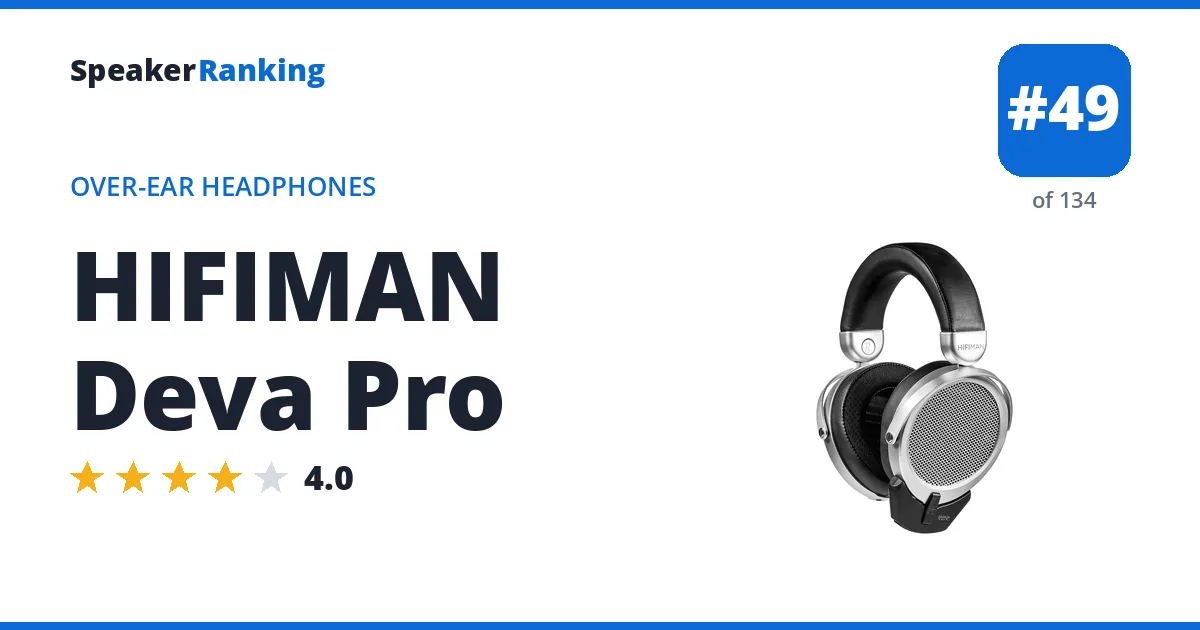
Pros: A preference score of 81 with a deviation of 2.2 dB in oratory1990’s measurement shows a smooth, slightly warm response with the midrange close to target. The planar magnetic driver is easy to drive at 18 ohms and 93.5 dB, and it can connect wirelessly or by cable. The open back gives a roomy sound.
Cons: Sub-bass is about 7.5 dB under target, so deep bass lacks rumble. Treble from 6 to 10 kHz is about 4.1 dB low with a 9.4 dB dip near 9.2 kHz, which dulls cymbals and detail. At 360 g it is heavy, and the open back leaks sound with no isolation.
Full HIFIMAN Deva Pro review and specifications →
| Released | Oct 2021 (5 years ago) |
|---|---|
| Back | Open |
| Built-in Microphone | No |
| Connection | Wireless and wired |
| Deviation From Target | 2.18 dB standard deviation |
| Driver Type | Planar magnetic |
| Form Factor | Over-ear |
| Frequency Response | 20Hz - 20kHz (Manufacturer specified) |
| Harman Preference Score | 81 (measured by oratory1990, via AutoEQ) |
| Impedance | 18 ohms |
| Sensitivity | 93.5 dB |
| Tonal Tilt | -0.38 (negative is warmer, positive brighter) |
| Weight | 0.8 lbs (360 g) |
EQ preset to match the Harman target
Set a preamp of -6.5 dB, then add these filters in any parametric equalizer (Wavelet, Equalizer APO, Peace, or a player with parametric EQ). Calculated by AutoEQ from its measured frequency response.
| Filter | Frequency | Gain | Q |
|---|---|---|---|
| Low shelf | 105 Hz | +7.3 dB | 0.70 |
| Peak | 87 Hz | -3.8 dB | 0.49 |
| Peak | 7,039 Hz | +3.6 dB | 1.30 |
| Peak | 1,960 Hz | +4.9 dB | 2.77 |
| Peak | 1,160 Hz | -2.6 dB | 0.94 |
| High shelf | 10,000 Hz | +0.9 dB | 0.70 |
| Peak | 308 Hz | -0.8 dB | 1.53 |
| Peak | 140 Hz | +0.6 dB | 2.02 |
| Peak | 439 Hz | +1.0 dB | 4.16 |
| Peak | 5,992 Hz | +1.2 dB | 6.00 |
- Reviews, Comparisons and Sound Samples
 Ranked #50 of 134 in Over-Ear Headphones - HIFIMAN HE1000se: $1,699.00 Amazon eBay
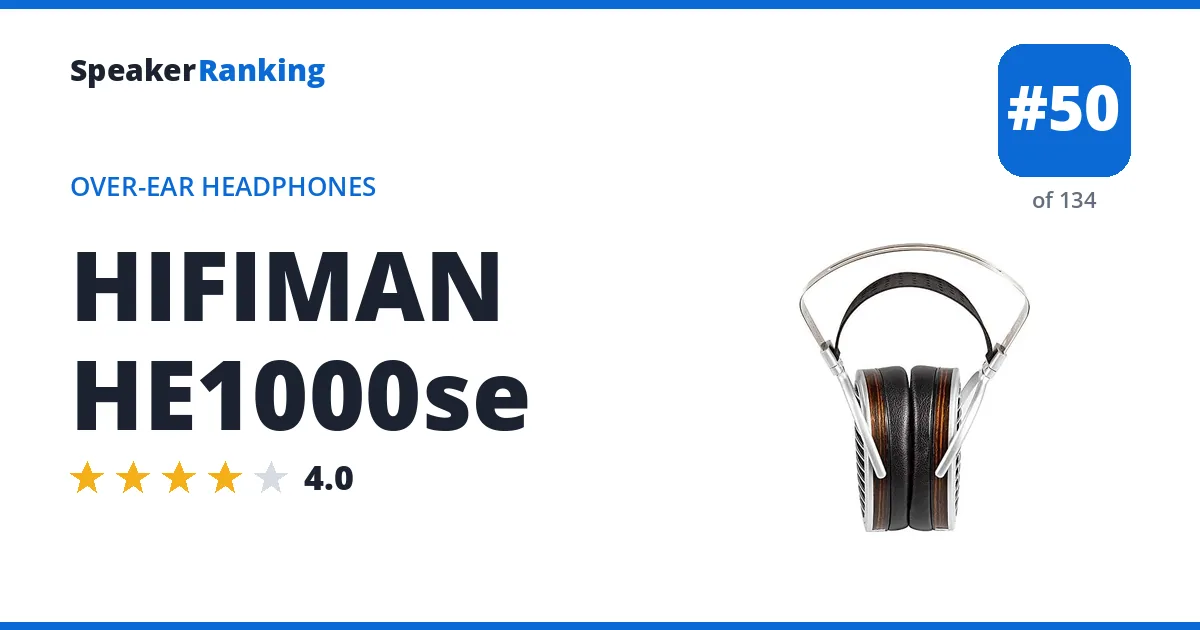
Pros: In oratory1990’s measurement the planar drivers land close to the Harman target, with a preference score of 81 and bass and midrange within about 2 dB of target. That keeps vocals and instruments natural, and the bass from 60 to 200 Hz is essentially on target, so kick and bass guitar have the right weight. At 35 ohms and 96 dB sensitivity it is easier to drive than many flagship planars, though it still benefits from a proper headphone amp. At 440 g it is moderately light for a planar.
Cons: A 9 dB dip near 9.5 kHz sits right beside an 11 dB peak near 11.9 kHz, so cymbals and sibilants can sound uneven and sparkly rather than smooth. The top octave runs about 6 dB hot and the 3 to 6 kHz presence region about 3.6 dB above target, which can sound edgy on bright recordings. Sub-bass is about 3.6 dB light under 60 Hz, and the open back leaks sound and offers no isolation.
Full HIFIMAN HE1000se review and specifications →
| Back | Open |
|---|---|
| Connection | Wired |
| Deviation From Target | 2.31 dB standard deviation |
| Driver Type | Planar magnetic |
| Form Factor | Over-ear |
| Frequency Response | 8Hz - 65kHz (Manufacturer specified) |
| Harman Preference Score | 81 (measured by oratory1990, via AutoEQ) |
| Impedance | 35 ohms |
| Sensitivity | 96 dB |
| Tonal Tilt | +0.29 (negative is warmer, positive brighter) |
| Weight | 1 lbs (440 g) |
EQ preset to match the Harman target
Set a preamp of -6.6 dB, then add these filters in any parametric equalizer (Wavelet, Equalizer APO, Peace, or a player with parametric EQ). Calculated by AutoEQ from its measured frequency response.
| Filter | Frequency | Gain | Q |
|---|---|---|---|
| Low shelf | 105 Hz | +8.5 dB | 0.70 |
| Peak | 1,847 Hz | +6.2 dB | 1.59 |
| Peak | 58 Hz | -4.7 dB | 0.49 |
| Peak | 2,978 Hz | -4.6 dB | 0.69 |
| Peak | 2,077 Hz | +2.3 dB | 2.21 |
| High shelf | 10,000 Hz | -5.8 dB | 0.70 |
| Peak | 4,160 Hz | +1.4 dB | 5.48 |
| Peak | 692 Hz | +1.2 dB | 5.75 |
| Peak | 294 Hz | -0.3 dB | 2.04 |
| Peak | 3,110 Hz | -0.7 dB | 4.39 |
- Reviews, Comparisons and Sound Samples
 Ranked #51 of 134 in Over-Ear Headphones - Stax SR-X1: $571.79 Amazon eBay
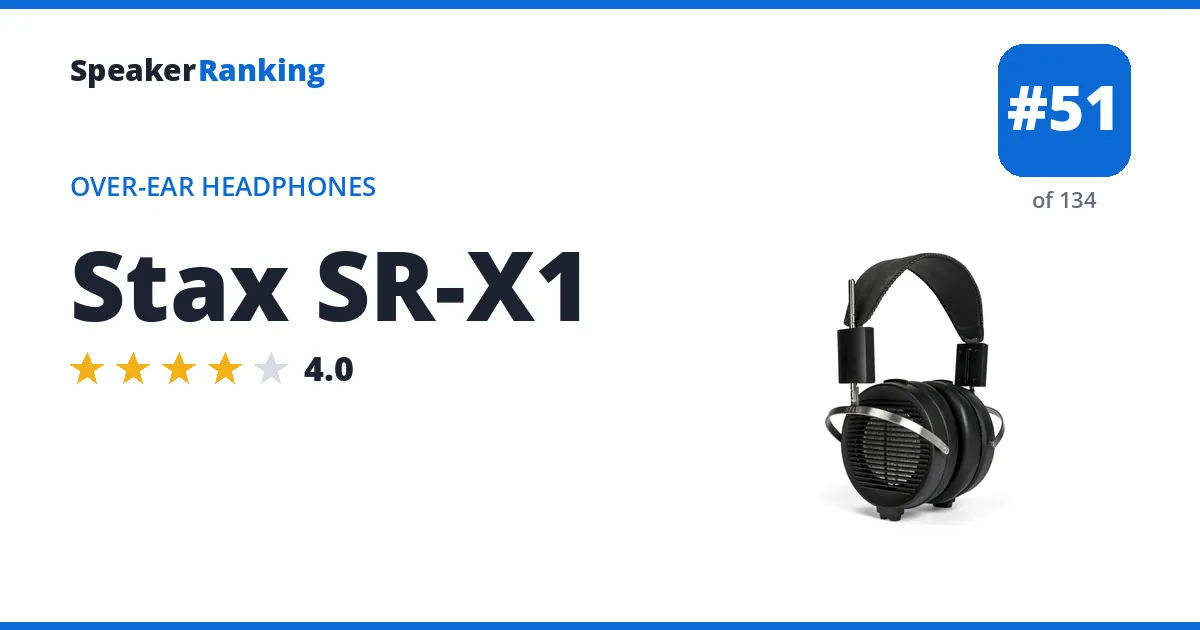
Pros: A preference score of 81 in oratory1990’s measurement is excellent for an electrostatic headphone, with a smoothness of 2.62 dB and a neutral tilt of 0.06. Midrange from 1 to 3 kHz sits within 0.1 dB of target, so vocals and instruments sound natural, and air above 10 kHz is on target at +0.6 dB. It is open back and light at 234 g, a good match for the warm and neutral taste profiles.
Cons: Sub-bass under 60 Hz is about 8 dB below target and the bass range is 4 dB low, so kick drums and bass synths lack rumble and weight. A 9.4 dB dip near 6.5 kHz and treble 7 dB under target soften cymbals and make the sound dull. It needs a dedicated electrostatic energizer, since it cannot run from a phone, and the open back leaks sound and offers no isolation.
Full Stax SR-X1 review and specifications →
| Back | Open |
|---|---|
| Connection | Wired |
| Deviation From Target | 2.62 dB standard deviation |
| Driver Type | Electrostatic |
| Form Factor | Over-ear |
| Frequency Response | 7Hz - 41kHz (Manufacturer specified) |
| Harman Preference Score | 81 (measured by oratory1990, via AutoEQ) |
| Sensitivity | 101 dB SPL/100V |
| Tonal Tilt | +0.06 (negative is warmer, positive brighter) |
| Weight | 0.5 lbs (234 g) |
EQ preset to match the Harman target
Set a preamp of -6.3 dB, then add these filters in any parametric equalizer (Wavelet, Equalizer APO, Peace, or a player with parametric EQ). Calculated by AutoEQ from its measured frequency response.
| Filter | Frequency | Gain | Q |
|---|---|---|---|
| Low shelf | 105 Hz | +7.5 dB | 0.70 |
| Peak | 1,236 Hz | -4.1 dB | 1.22 |
| Peak | 7,163 Hz | +5.4 dB | 2.20 |
| Peak | 4,125 Hz | +2.9 dB | 4.23 |
| Peak | 55 Hz | -2.4 dB | 0.43 |
| High shelf | 10,000 Hz | -6.0 dB | 0.70 |
| Peak | 233 Hz | -0.5 dB | 2.53 |
| Peak | 553 Hz | +0.3 dB | 1.42 |
| Peak | 6,608 Hz | +1.9 dB | 5.85 |
| Peak | 5,454 Hz | -1.1 dB | 6.00 |
- Reviews, Comparisons and Sound Samples
 Ranked #53 of 134 in Over-Ear Headphones - Philips SHP9500: $94.99 Amazon eBay
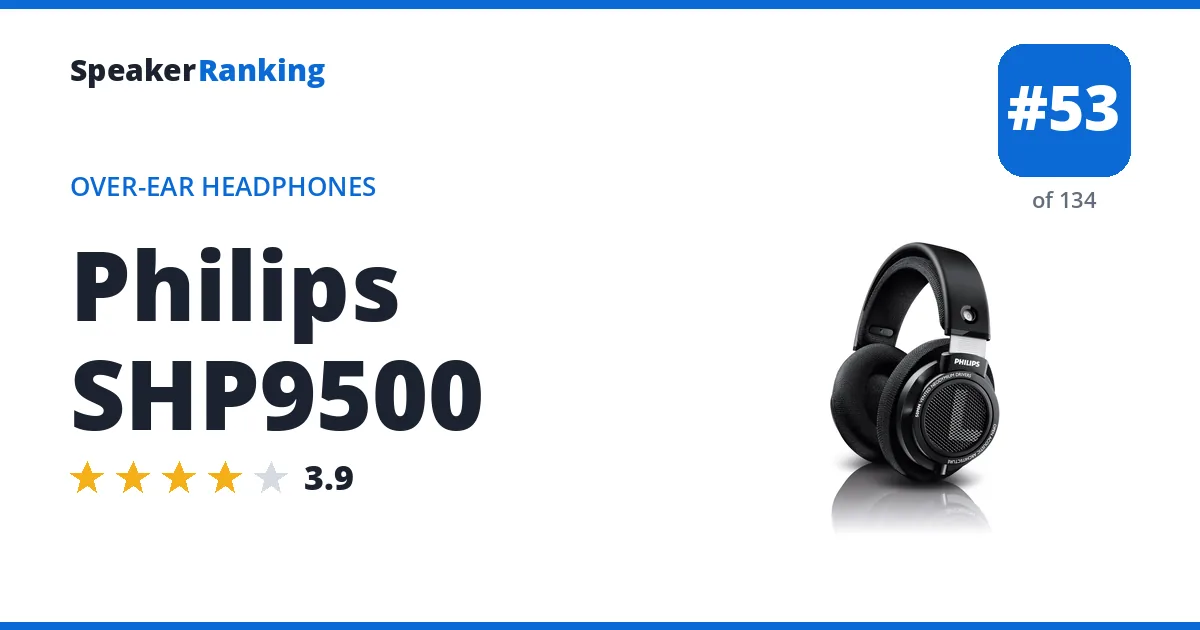
Pros: A preference score of 80 and a deviation of only 2.2 dB make the open back response smooth for the money, with bass from 60 to 200 Hz and the lower mids within half a dB of target. It is very easy to drive at 32 ohms and 101 dB sensitivity, so a phone runs it fine, and it weighs just 320 g. It costs far less than most headphones with a comparable score.
Cons: Sub-bass is about 9 dB below target under 60 Hz, so electronic and cinematic bass lacks rumble and slam. Presence is lifted about 2.3 dB, and a 6.7 dB peak near 6.2 kHz followed by a 4 dB dip near 7.7 kHz adds some edge to vocals and cymbals. The open back leaks sound and gives no isolation.
Full Philips SHP9500 review and specifications →
| Back | Open |
|---|---|
| Connection | Wired |
| Deviation From Target | 2.17 dB standard deviation |
| Driver Type | Dynamic |
| Drivers | 1 x 50mm dynamic |
| Form Factor | Over-ear |
| Frequency Response | 12Hz - 35kHz (Manufacturer specified) |
| Harman Preference Score | 80 (measured by oratory1990, via AutoEQ) |
| Impedance | 32 ohms |
| Sensitivity | 101 dB |
| Tonal Tilt | +0.47 (negative is warmer, positive brighter) |
| Weight | 0.7 lbs (320 g) |
EQ preset to match the Harman target
Set a preamp of -6.4 dB, then add these filters in any parametric equalizer (Wavelet, Equalizer APO, Peace, or a player with parametric EQ). Calculated by AutoEQ from its measured frequency response.
| Filter | Frequency | Gain | Q |
|---|---|---|---|
| Low shelf | 105 Hz | +6.5 dB | 0.70 |
| Peak | 5,734 Hz | -5.7 dB | 2.84 |
| Peak | 110 Hz | -3.0 dB | 0.81 |
| Peak | 2,130 Hz | +3.7 dB | 2.76 |
| Peak | 412 Hz | +1.0 dB | 1.39 |
| High shelf | 10,000 Hz | -2.4 dB | 0.70 |
| Peak | 1,113 Hz | -0.6 dB | 2.07 |
| Peak | 7,370 Hz | +2.1 dB | 5.98 |
| Peak | 4,477 Hz | -1.7 dB | 6.00 |
| Peak | 3,566 Hz | +1.3 dB | 6.00 |
- Reviews, Comparisons and Sound Samples
- Head-to-Head Comparisons
 Ranked #54 of 134 in Over-Ear Headphones - Sivga Luan: $299.00 Amazon eBay
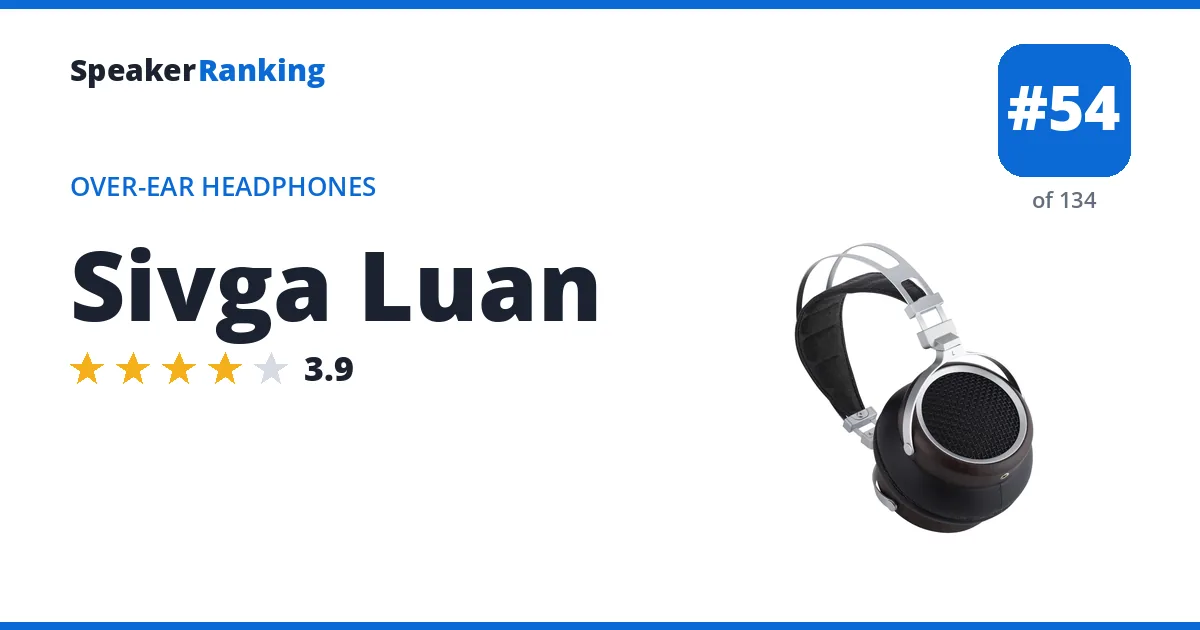
Pros: The open back tuning leans warm, with bass from 60 to 200 Hz about 3 dB above target and the lows and mids around 1.5 dB above, which gives music body and weight that suits rock, pop and hip hop. A deviation of 2.0 dB is among the smoothest in this group, and the preference score is 80. At 38 ohms and 100 dB sensitivity a phone or dongle can drive it, and it weighs 354 g.
Cons: A 5 dB peak near 2.8 kHz can make vocals and guitars sound forward or slightly shouty at higher volume, and a 5.8 dB dip near 9.3 kHz takes the edge off cymbals while the top octave runs 6 dB above target. Listeners who want a neutral balance will find the bass and low mids heavy. The open back leaks sound and has no isolation, and there is no built in microphone.
Full Sivga Luan review and specifications →
| Back | Open |
|---|---|
| Built-in Microphone | No |
| Connection | Wired |
| Deviation From Target | 2.04 dB standard deviation |
| Driver Type | Dynamic |
| Drivers | 1 x 50mm dynamic |
| Form Factor | Over-ear |
| Frequency Response | 20Hz - 40kHz (Manufacturer specified) |
| Harman Preference Score | 80 (measured by oratory1990, via AutoEQ) |
| Impedance | 38 ohms |
| Sensitivity | 100 dB |
| Tonal Tilt | -0.58 (negative is warmer, positive brighter) |
| Weight | 0.8 lbs (354 g) |
EQ preset to match the Harman target
Set a preamp of -7.0 dB, then add these filters in any parametric equalizer (Wavelet, Equalizer APO, Peace, or a player with parametric EQ). Calculated by AutoEQ from its measured frequency response.
| Filter | Frequency | Gain | Q |
|---|---|---|---|
| Low shelf | 105 Hz | +13.5 dB | 0.70 |
| Peak | 54 Hz | -11.3 dB | 0.36 |
| Peak | 1,033 Hz | +2.6 dB | 0.39 |
| Peak | 2,697 Hz | -5.0 dB | 2.19 |
| Peak | 7,643 Hz | +2.9 dB | 1.41 |
| High shelf | 10,000 Hz | -7.5 dB | 0.70 |
| Peak | 4,022 Hz | -2.2 dB | 6.00 |
| Peak | 5,210 Hz | +2.7 dB | 5.98 |
| Peak | 3,497 Hz | +1.7 dB | 6.00 |
| Peak | 4,281 Hz | -0.8 dB | 4.36 |
- Reviews, Comparisons and Sound Samples
 Ranked #56 of 134 in Over-Ear Headphones - Meze 105 Aer: $299.00 Amazon eBay
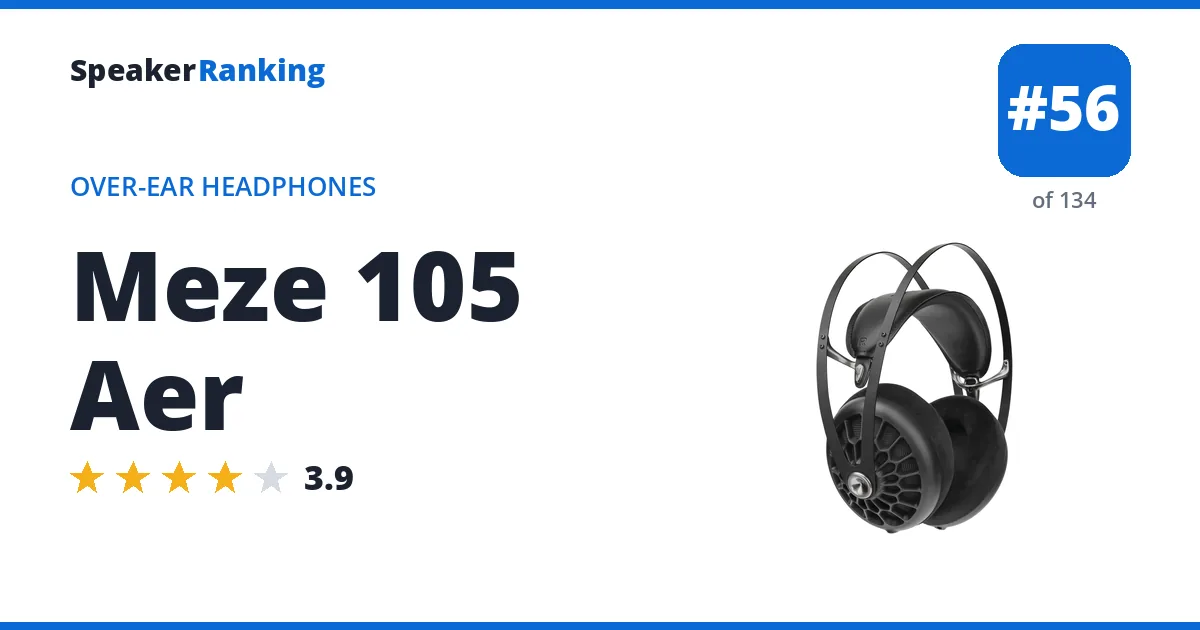
Pros: The open back tuning is warm, with bass from 60 to 200 Hz about 2 dB above target and the low mids about 1.6 dB above, so voices and instruments sound full and relaxed. Presence from 3 to 6 kHz is lifted about 2.8 dB, which adds clarity to vocals, and the preference score is 79. It uses a single 50 mm dynamic driver and matches the Sivga Luan on rating at the same price.
Cons: An 8 dB dip near 8.8 kHz and treble about 2.6 dB below target take the shimmer off cymbals and sibilance, so the top end can sound dull and veiled. A 4.4 dB peak near 4 kHz adds some forwardness to vocals. The open back leaks sound and offers no isolation.
Full Meze 105 Aer review and specifications →
| Back | Open |
|---|---|
| Connection | Wired |
| Deviation From Target | 2.15 dB standard deviation |
| Driver Type | Dynamic |
| Drivers | 1 x 50mm dynamic |
| Form Factor | Over-ear |
| Harman Preference Score | 79 (measured by oratory1990, via AutoEQ) |
| Tonal Tilt | -0.51 (negative is warmer, positive brighter) |
EQ preset to match the Harman target
Set a preamp of -4.9 dB, then add these filters in any parametric equalizer (Wavelet, Equalizer APO, Peace, or a player with parametric EQ). Calculated by AutoEQ from its measured frequency response.
| Filter | Frequency | Gain | Q |
|---|---|---|---|
| Low shelf | 105 Hz | +10.0 dB | 0.70 |
| Peak | 51 Hz | -8.2 dB | 0.36 |
| Peak | 1,943 Hz | +4.9 dB | 1.54 |
| Peak | 8,128 Hz | +5.6 dB | 1.84 |
| Peak | 5,283 Hz | -3.8 dB | 0.58 |
| High shelf | 10,000 Hz | -2.1 dB | 0.70 |
| Peak | 470 Hz | +0.8 dB | 2.44 |
| Peak | 4,703 Hz | +3.1 dB | 5.89 |
| Peak | 5,659 Hz | -1.5 dB | 5.63 |
| Peak | 4,063 Hz | -1.3 dB | 6.00 |
- Reviews, Comparisons and Sound Samples
 Ranked #58 of 134 in Over-Ear Headphones - Austrian Audio Hi-X65: $295.36 Amazon eBay
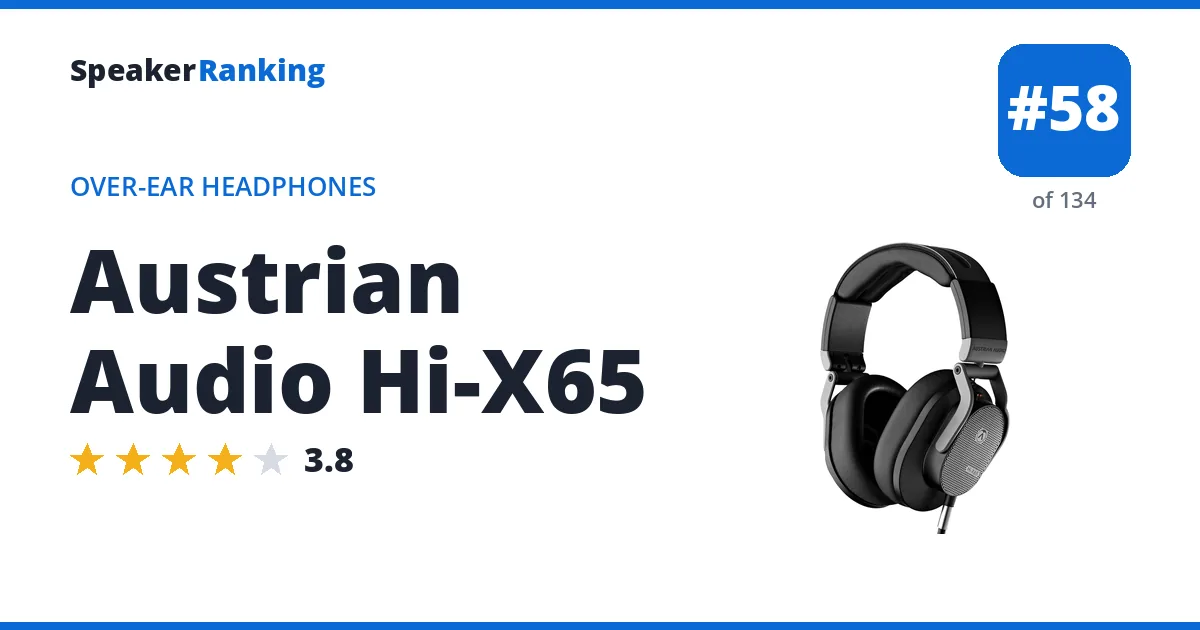
Pros: The open back response is bright and airy, with presence and treble about 1.5 to 1.7 dB above target and the top octave about 3 dB above, which brings out detail and space in recordings. Bass from 60 to 200 Hz is on target, so it avoids bloat. It is very easy to drive at 25 ohms and 110 dB SPL per volt, it weighs 310 g and it ties the Sony MDR-MV1 on rating.
Cons: This is the least smooth model in this group, with a deviation of 2.8 dB. The low mids are about 3.4 dB above target while upper mids are 1.9 dB below, and a 5.1 dB dip near 1.7 kHz recesses vocals and a 5 dB peak near 5.9 kHz adds edge. Sub-bass is about 3.7 dB light under 60 Hz, and the open back leaks sound.
Full Austrian Audio Hi-X65 review and specifications →
| Back | Open |
|---|---|
| Connection | Wired |
| Deviation From Target | 2.77 dB standard deviation |
| Driver Type | Dynamic |
| Drivers | 1 x 44mm dynamic |
| Form Factor | Over-ear |
| Frequency Response | 5Hz - 28kHz (Manufacturer specified) |
| Harman Preference Score | 78 (measured by oratory1990, via AutoEQ) |
| Impedance | 25 ohms |
| Sensitivity | 110 dB SPL/V |
| Tonal Tilt | +0.09 (negative is warmer, positive brighter) |
| Weight | 0.7 lbs (310 g) |
EQ preset to match the Harman target
Set a preamp of -6.5 dB, then add these filters in any parametric equalizer (Wavelet, Equalizer APO, Peace, or a player with parametric EQ). Calculated by AutoEQ from its measured frequency response.
| Filter | Frequency | Gain | Q |
|---|---|---|---|
| Low shelf | 105 Hz | +5.4 dB | 0.70 |
| Peak | 236 Hz | -2.4 dB | 0.53 |
| Peak | 1,659 Hz | +6.9 dB | 1.76 |
| Peak | 592 Hz | -1.5 dB | 1.17 |
| Peak | 5,982 Hz | -4.0 dB | 3.16 |
| High shelf | 10,000 Hz | -1.5 dB | 0.70 |
| Peak | 3,426 Hz | +2.9 dB | 5.91 |
| Peak | 2,858 Hz | -1.9 dB | 5.45 |
| Peak | 4,145 Hz | -1.5 dB | 6.00 |
| Peak | 54 Hz | -0.2 dB | 1.78 |
- Reviews, Comparisons and Sound Samples
 Ranked #59 of 134 in Over-Ear Headphones - Meze 109 Pro: $799.00 Amazon eBay
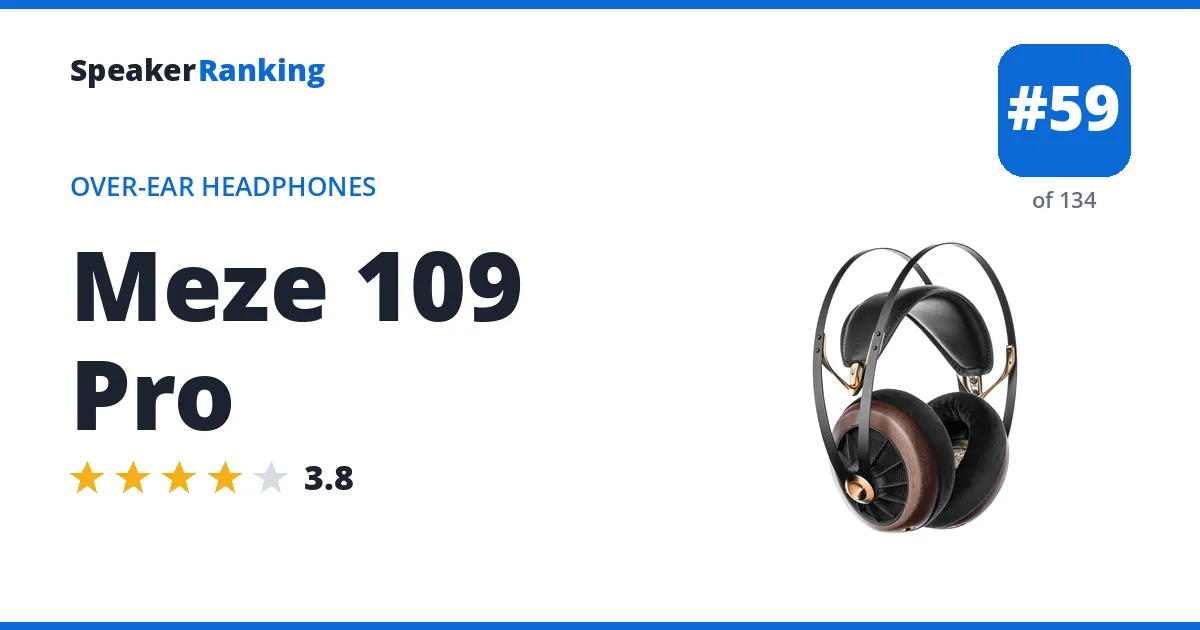
Pros: The open back has a warm, full tuning, with bass from 60 to 200 Hz about 2 dB above target and low mids 2.2 dB above, giving music weight and body. Treble and air are lifted, with the top octave about 4.7 dB above target, which adds some openness. It uses a single 50 mm dynamic driver, runs at 40 ohms and 112 dB SPL per milliwatt so a phone can drive it, and the preference score is 78.
Cons: A 6.3 dB dip near 9.5 kHz sits next to a 4.5 dB peak near 7.4 kHz, so cymbals and sibilants sound uneven. The upper mids are about 1.8 dB low, which pulls vocals back slightly. It costs well above the HIFIMAN Audivina yet rates lower, and at 375 g it is heavier than some alternatives.
Full Meze 109 Pro review and specifications →
| Back | Open |
|---|---|
| Connection | Wired |
| Deviation From Target | 2.25 dB standard deviation |
| Driver Type | Dynamic |
| Drivers | 1 x 50mm dynamic |
| Form Factor | Over-ear |
| Frequency Response | 5Hz - 30kHz (Manufacturer specified) |
| Harman Preference Score | 78 (measured by oratory1990, via AutoEQ) |
| Impedance | 40 ohms |
| Sensitivity | 112 dB SPL/mW |
| Tonal Tilt | -0.50 (negative is warmer, positive brighter) |
| Weight | 0.8 lbs (375 g) |
EQ preset to match the Harman target
Set a preamp of -5.3 dB, then add these filters in any parametric equalizer (Wavelet, Equalizer APO, Peace, or a player with parametric EQ). Calculated by AutoEQ from its measured frequency response.
| Filter | Frequency | Gain | Q |
|---|---|---|---|
| Low shelf | 105 Hz | +7.4 dB | 0.70 |
| Peak | 72 Hz | -4.2 dB | 0.25 |
| Peak | 2,028 Hz | +5.6 dB | 1.63 |
| Peak | 2,856 Hz | -1.9 dB | 4.04 |
| Peak | 83 Hz | -1.2 dB | 1.11 |
| High shelf | 10,000 Hz | -4.7 dB | 0.70 |
| Peak | 8,692 Hz | +1.6 dB | 2.63 |
| Peak | 825 Hz | -0.9 dB | 2.44 |
| Peak | 475 Hz | +0.4 dB | 1.32 |
| Peak | 4,705 Hz | +1.3 dB | 6.00 |
- Reviews, Comparisons and Sound Samples
 Ranked #60 of 134 in Over-Ear Headphones - Sony MDR-MV1: $328.00 Amazon eBay
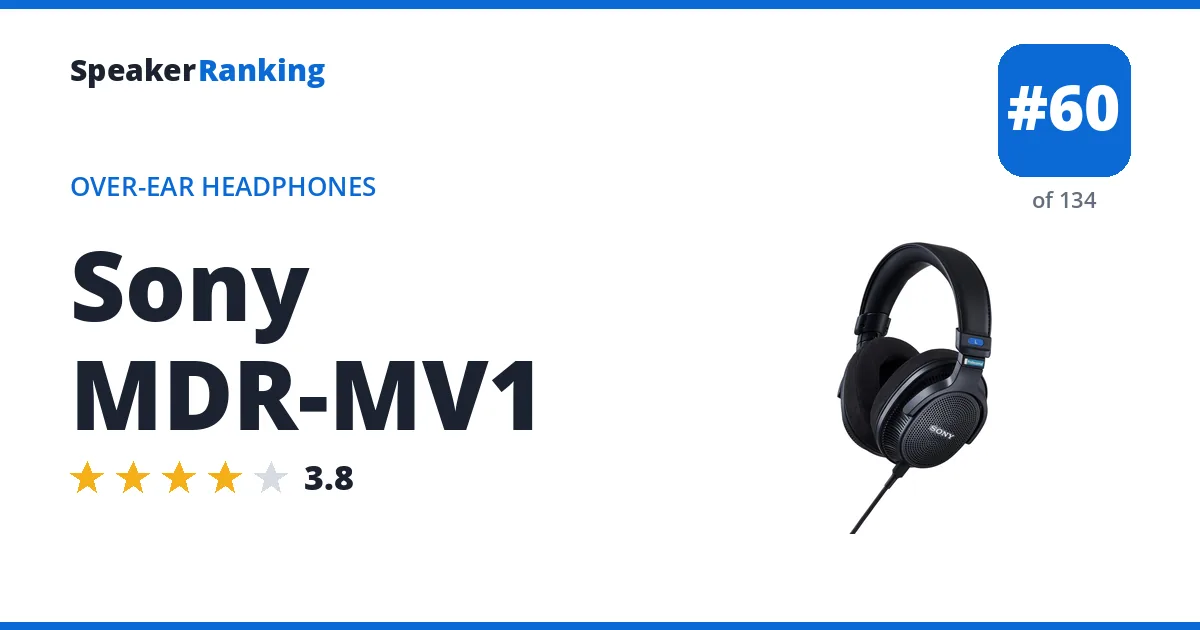
Pros: The open back has lively, extended treble and a full low end, with sub-bass on target and bass from 60 to 200 Hz about 2.7 dB above, so it delivers real punch for an open design. At 24 ohms and 100 dB/mW it is easy to drive from a phone, and at 223 g it is the lightest headphone in this group. The preference score is 78, and it ties the Austrian Audio Hi-X65 on rating.
Cons: Treble from 6 to 10 kHz is about 4.4 dB above target, with a 6.9 dB peak near 6.2 kHz, so cymbals, sibilance and hi hats can sound sharp or fatiguing. A 4.1 dB dip near 4.6 kHz can leave vocals less natural. The bass and low mids add warmth that moves it away from neutral, and the open back leaks sound with no isolation.
Full Sony MDR-MV1 review and specifications →
| Released | May 2023 (3 years ago) |
|---|---|
| Back | Open |
| Connection | Wired |
| Deviation From Target | 2.34 dB standard deviation |
| Driver Type | Dynamic |
| Drivers | 1 x 40mm dynamic |
| Form Factor | Over-ear |
| Frequency Response | 5Hz - 80kHz (Manufacturer specified) |
| Harman Preference Score | 78 (measured by oratory1990, via AutoEQ) |
| Impedance | 24 ohms |
| Sensitivity | 100 dB/mW |
| Tonal Tilt | -0.42 (negative is warmer, positive brighter) |
| Weight | 0.5 lbs (223 g) |
EQ preset to match the Harman target
Set a preamp of -4.1 dB, then add these filters in any parametric equalizer (Wavelet, Equalizer APO, Peace, or a player with parametric EQ). Calculated by AutoEQ from its measured frequency response.
| Filter | Frequency | Gain | Q |
|---|---|---|---|
| Low shelf | 105 Hz | +9.7 dB | 0.70 |
| Peak | 46 Hz | -9.2 dB | 0.37 |
| Peak | 1,722 Hz | +2.8 dB | 0.95 |
| Peak | 4,643 Hz | +9.2 dB | 1.99 |
| Peak | 5,779 Hz | -9.2 dB | 1.50 |
| High shelf | 10,000 Hz | -2.2 dB | 0.70 |
| Peak | 705 Hz | +0.8 dB | 2.45 |
| Peak | 242 Hz | -0.7 dB | 2.04 |
| Peak | 128 Hz | +0.5 dB | 2.09 |
| Peak | 2,955 Hz | -0.9 dB | 4.58 |
- Reviews, Comparisons and Sound Samples
 Ranked #64 of 134 in Over-Ear Headphones - AKG K712: $469.99 Amazon eBay
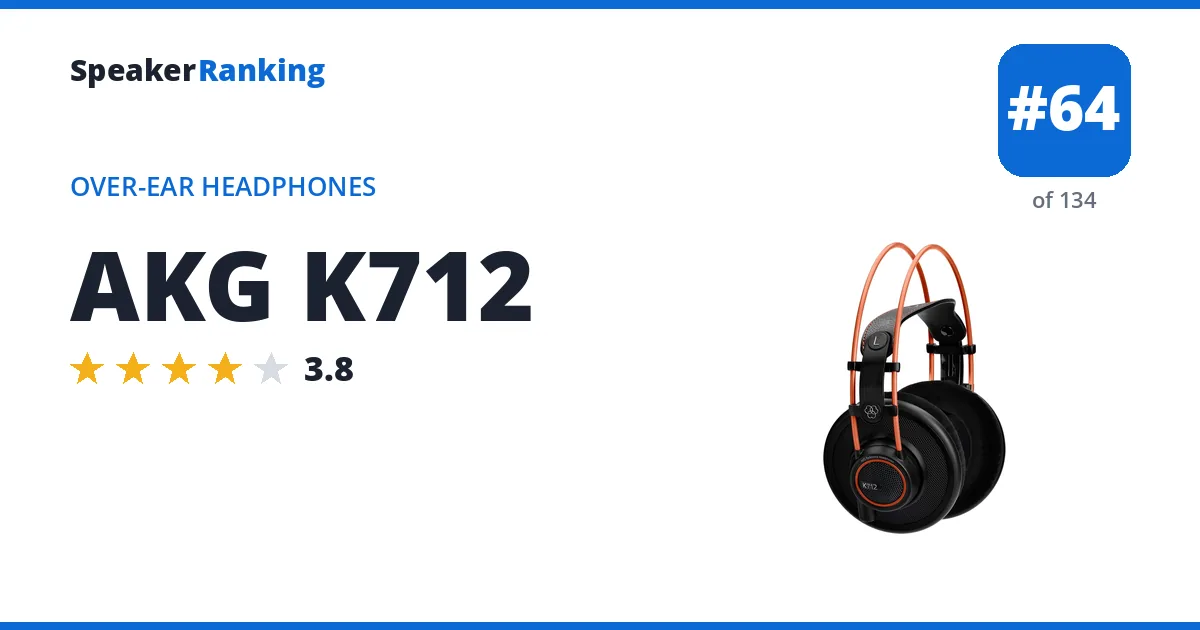
Pros: The open back gives a wide, airy presentation with a flat midrange, presence and treble within about 0.3 dB of the target between 3 and 10 kHz. Bass from 60 to 200 Hz is about 1.4 dB warm, which adds a little body. At 235 g it is light, and 105 dB/mW sensitivity is high for a 62 ohm design.
Cons: Sub-bass is about 3.7 dB under target and the low mids are about 3 dB hot, so music sounds a touch thick in the midrange while the deepest bass lacks rumble. A 6 dB dip near 9.4 kHz and a 3.8 dB peak near 5.9 kHz make treble slightly uneven. The open design leaks sound and offers no isolation, and the Austrian Audio Hi-X65 matches its rating for a lower price.
Full AKG K712 review and specifications →
| Back | Open |
|---|---|
| Connection | Wired |
| Deviation From Target | 2.51 dB standard deviation |
| Driver Type | Dynamic |
| Form Factor | Over-ear |
| Frequency Response | 10Hz - 39.8kHz |
| Harman Preference Score | 77 (measured by oratory1990, via AutoEQ) |
| Impedance | 62 ohms |
| Sensitivity | 105 dB/mW |
| Tonal Tilt | -0.40 (negative is warmer, positive brighter) |
| Weight | 0.5 lbs (235 g) |
EQ preset to match the Harman target
Set a preamp of -5.8 dB, then add these filters in any parametric equalizer (Wavelet, Equalizer APO, Peace, or a player with parametric EQ). Calculated by AutoEQ from its measured frequency response.
| Filter | Frequency | Gain | Q |
|---|---|---|---|
| Low shelf | 105 Hz | +6.9 dB | 0.70 |
| Peak | 143 Hz | -3.6 dB | 0.23 |
| Peak | 1,217 Hz | +5.0 dB | 1.43 |
| Peak | 3,049 Hz | +4.8 dB | 3.18 |
| Peak | 2,178 Hz | -3.4 dB | 3.30 |
| High shelf | 10,000 Hz | -0.3 dB | 0.70 |
| Peak | 5,868 Hz | -2.6 dB | 5.87 |
| Peak | 67 Hz | -0.6 dB | 1.75 |
| Peak | 157 Hz | +0.9 dB | 1.87 |
| Peak | 243 Hz | -0.5 dB | 2.27 |
- Reviews, Comparisons and Sound Samples
 Ranked #67 of 134 in Over-Ear Headphones - Koss KPH30i: $23.99 Amazon eBay
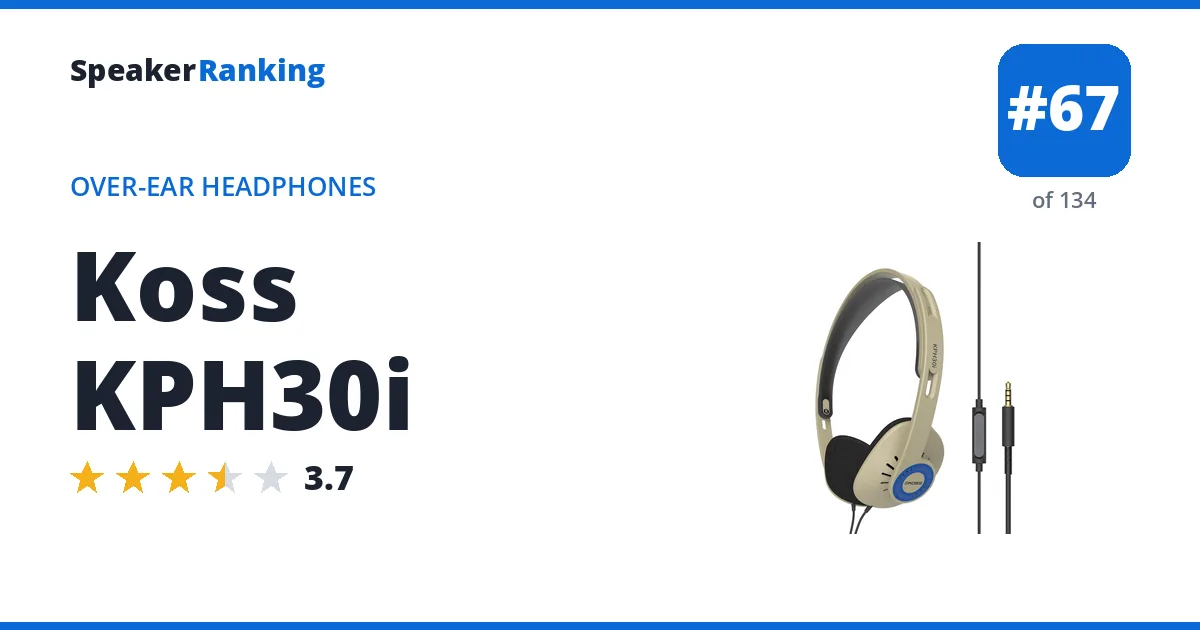
Pros: A very low price makes it an easy disposable or backup pair, and the 60 ohm, 101 dB sensitivity runs from any phone. It has an inline microphone for calls and the open on-ear design is light and airy. Bass from 60 Hz to the upper mids stays within about 0.6 dB of the Harman target, which gives a fairly balanced core.
Cons: Sub-bass is nearly 12 dB under target below 60 Hz, so there is no rumble and deep bass is essentially missing. An 11.8 dB dip near 4.2 kHz makes vocals and detail recede, and treble from 3 to 10 kHz is about 2.8 dB low. The open back leaks sound and offers no isolation, so it suits quiet rooms only.
Full Koss KPH30i review and specifications →
| Back | Open |
|---|---|
| Built-in Microphone | Yes |
| Connection | Wired |
| Deviation From Target | 2.62 dB standard deviation |
| Driver Type | Dynamic |
| Drivers | 1 x 35mm dynamic |
| Form Factor | Over-ear |
| Frequency Response | 15Hz - 25kHz (Manufacturer specified) |
| Harman Preference Score | 76 (measured by oratory1990, via AutoEQ) |
| Impedance | 60 ohms |
| Sensitivity | 101 dB SPL/1mW |
| Tonal Tilt | -0.38 (negative is warmer, positive brighter) |
EQ preset to match the Harman target
Set a preamp of -6.3 dB, then add these filters in any parametric equalizer (Wavelet, Equalizer APO, Peace, or a player with parametric EQ). Calculated by AutoEQ from its measured frequency response.
| Filter | Frequency | Gain | Q |
|---|---|---|---|
| Low shelf | 105 Hz | +6.8 dB | 0.70 |
| Peak | 109 Hz | -4.7 dB | 0.47 |
| Peak | 2,979 Hz | +1.7 dB | 0.18 |
| Peak | 1,956 Hz | -4.1 dB | 2.01 |
| Peak | 49 Hz | +2.5 dB | 2.08 |
| High shelf | 10,000 Hz | +0.1 dB | 0.70 |
| Peak | 5,070 Hz | -5.0 dB | 5.22 |
| Peak | 3,844 Hz | +2.9 dB | 5.95 |
| Peak | 6,348 Hz | +2.6 dB | 5.99 |
| Peak | 502 Hz | +0.3 dB | 1.44 |
- Reviews, Comparisons and Sound Samples
- Head-to-Head Comparisons
 Ranked #71 of 134 in Over-Ear Headphones - Sennheiser HD 599: $239.95 Amazon eBay
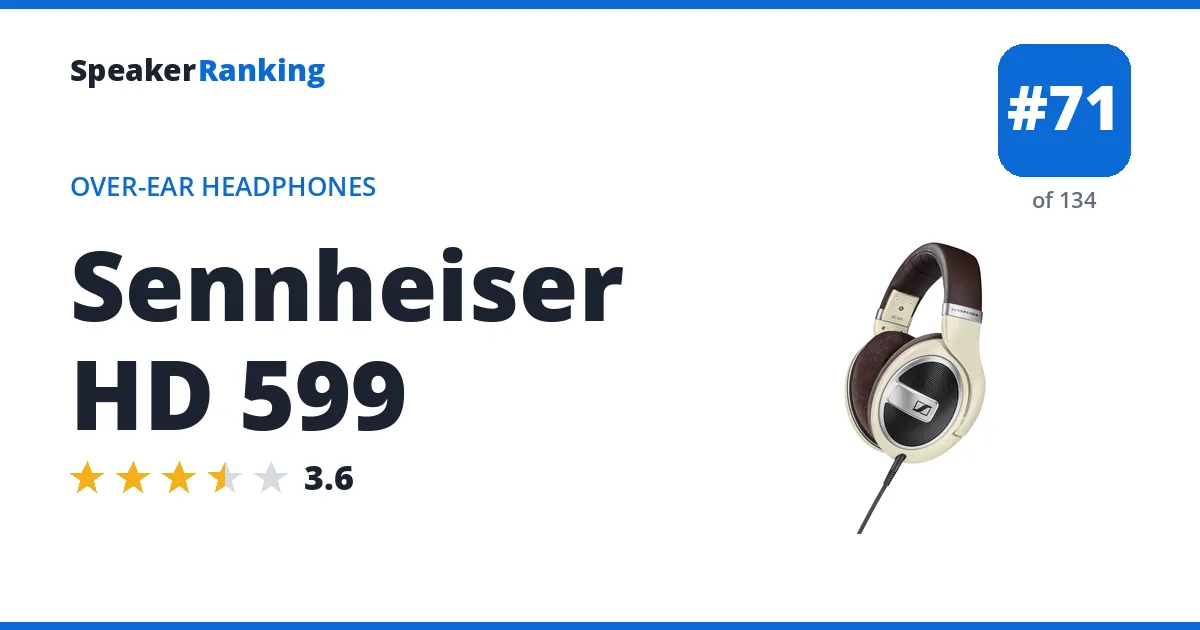
Pros: A preference score of 73 and a modest 2.74 dB deviation from the Harman target in oratory1990’s measurement make this a fairly smooth open back. Bass runs about 2 dB above target and the lows through the low mids are about 2.7 dB up, which gives vocals and guitars a full, warm body. At 50 ohms and 106 dB sensitivity it is easy to drive, and at 250 g it is light.
Cons: Sub-bass falls about 6 dB under target below 60 Hz, so the extra warmth sits higher up and the deepest rumble is missing. A 9.6 dB dip near 9.8 kHz and about 3.5 dB less air above 10 kHz take the sparkle off cymbals, while a 3.7 dB peak near 5.7 kHz can add some edge to vocals. The open back leaks sound and offers no isolation.
Full Sennheiser HD 599 review and specifications →
| Released | Sep 2016 (10 years ago) |
|---|---|
| Back | Open |
| Connection | Wired |
| Deviation From Target | 2.74 dB standard deviation |
| Driver Type | Dynamic |
| Form Factor | Over-ear |
| Frequency Response | 12Hz - 38.5kHz (Manufacturer specified) |
| Harman Preference Score | 73 (measured by oratory1990, via AutoEQ) |
| Impedance | 50 ohms |
| Sensitivity | 106 dB SPL (1 kHz, 1 Vrms) |
| Tonal Tilt | -0.42 (negative is warmer, positive brighter) |
| Weight | 0.6 lbs (250 g) |
EQ preset to match the Harman target
Set a preamp of -6.2 dB, then add these filters in any parametric equalizer (Wavelet, Equalizer APO, Peace, or a player with parametric EQ). Calculated by AutoEQ from its measured frequency response.
| Filter | Frequency | Gain | Q |
|---|---|---|---|
| Low shelf | 105 Hz | +6.1 dB | 0.70 |
| Peak | 152 Hz | -4.3 dB | 0.59 |
| Peak | 1,751 Hz | +4.4 dB | 1.45 |
| Peak | 4,485 Hz | -1.9 dB | 2.72 |
| Peak | 40 Hz | +1.0 dB | 3.06 |
| High shelf | 10,000 Hz | -0.7 dB | 0.70 |
| Peak | 9,629 Hz | +6.0 dB | 1.71 |
| Peak | 5,771 Hz | -2.8 dB | 5.56 |
| Peak | 3,175 Hz | -2.0 dB | 4.70 |
| Peak | 3,690 Hz | +0.7 dB | 4.38 |
- Reviews, Comparisons and Sound Samples
- Head-to-Head Comparisons
 Ranked #75 of 134 in Over-Ear Headphones - Focal Utopia 2022: $4,999.00 Amazon eBay
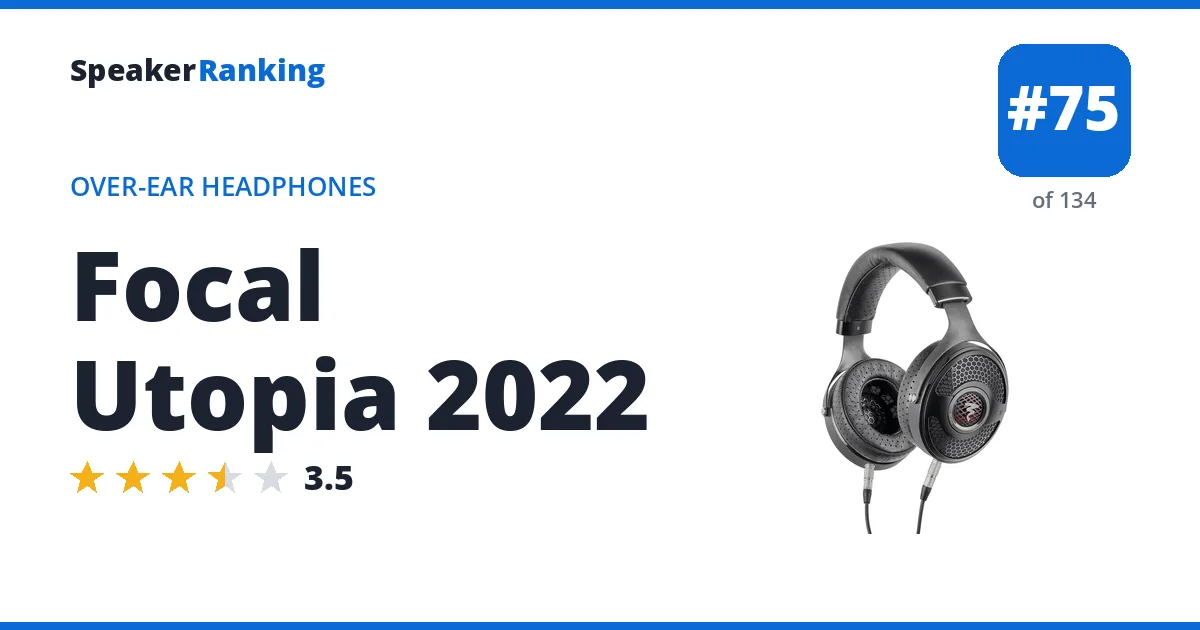
Pros: The midrange is very close to target, within about 0.7 dB from 60 Hz through 3 kHz, so vocals and instruments sit naturally. A 2.62 dB deviation and a preference score of 71 show a smooth profile with no large peaks, the biggest being only 0.3 dB near 1.5 kHz. An 80 ohm, 104 dB/mW design is manageable from a decent amplifier, and the open back gives a spacious presentation.
Cons: Sub-bass is about 5.5 dB under target and treble is about 5.4 dB low from 6 to 10 kHz, with a 12.6 dB dip near 10 kHz, so cymbals and air sound muted and deep bass lacks rumble. Presence is also about 3 dB low, which makes the sound dark and veiled. It weighs 490 g, the open back leaks sound, and it sits well below higher rated rivals like the HIFIMAN Susvara.
Full Focal Utopia 2022 review and specifications →
| Released | Sep 2022 (4 years ago) |
|---|---|
| Back | Open |
| Built-in Microphone | No |
| Connection | Wired |
| Deviation From Target | 2.62 dB standard deviation |
| Driver Type | Dynamic |
| Drivers | 1 x 40mm dynamic |
| Form Factor | Over-ear |
| Frequency Response | 5Hz - 50kHz (Manufacturer specified) |
| Harman Preference Score | 71 (measured by oratory1990, via AutoEQ) |
| Impedance | 80 ohms |
| Sensitivity | 104 dB SPL/mW |
| Tonal Tilt | -0.70 (negative is warmer, positive brighter) |
| Weight | 1.1 lbs (490 g) |
EQ preset to match the Harman target
Set a preamp of -6.3 dB, then add these filters in any parametric equalizer (Wavelet, Equalizer APO, Peace, or a player with parametric EQ). Calculated by AutoEQ from its measured frequency response.
| Filter | Frequency | Gain | Q |
|---|---|---|---|
| Low shelf | 105 Hz | +9.1 dB | 0.70 |
| Peak | 65 Hz | -5.4 dB | 0.33 |
| Peak | 1,227 Hz | -3.1 dB | 1.92 |
| Peak | 10,000 Hz | +6.3 dB | 0.87 |
| Peak | 1,980 Hz | +2.9 dB | 3.30 |
| High shelf | 10,000 Hz | -3.1 dB | 0.70 |
| Peak | 5,018 Hz | +2.9 dB | 4.42 |
| Peak | 5,972 Hz | -3.2 dB | 6.00 |
| Peak | 3,000 Hz | -1.7 dB | 4.41 |
| Peak | 3,578 Hz | +1.5 dB | 6.00 |
- Reviews, Comparisons and Sound Samples
 Ranked #76 of 134 in Over-Ear Headphones - Shure SRH1840: $549.00 Amazon eBay
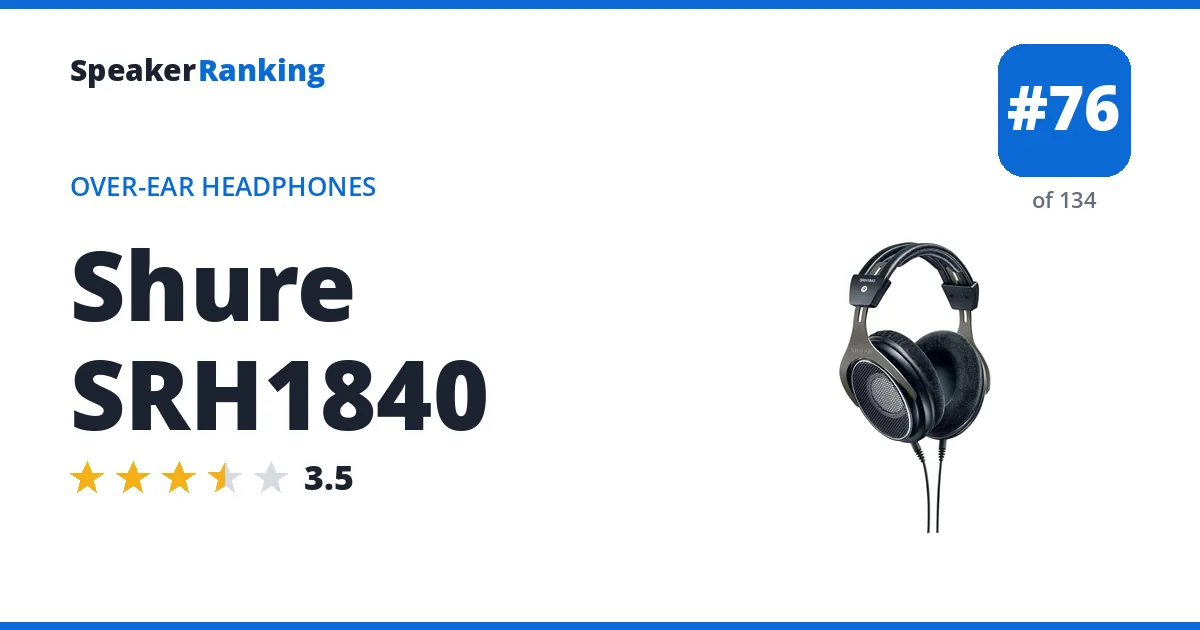
Pros: The response leans neutral to slightly bright, with upper mids about 1.8 dB above target and presence and treble within about 1 dB, which makes vocals and instrument detail clear. The preference score of 71 and 2.29 dB deviation reflect a smooth, even midrange and treble. It is an open back at 268 g.
Cons: Sub-bass is about 7.5 dB under target and bass is about 1.8 dB low, so kick drums and bass guitar are thin and lack rumble. A 4.4 dB peak near 3.1 kHz can make voices and strings sound forward or slightly harsh at higher volumes. At 65 ohms and 96 dB/mW sensitivity it benefits from a proper headphone amplifier, and the open back leaks sound. The Denon AH-D5200 earns a higher rating among its rivals.
Full Shure SRH1840 review and specifications →
| Back | Open |
|---|---|
| Connection | Wired |
| Deviation From Target | 2.29 dB standard deviation |
| Driver Type | Dynamic |
| Drivers | 1 x 40mm dynamic |
| Form Factor | Over-ear |
| Frequency Response | 10Hz - 30kHz (Manufacturer specified) |
| Harman Preference Score | 71 (measured by oratory1990, via AutoEQ) |
| Impedance | 65 ohms |
| Sensitivity | 96 dB/mW |
| Tonal Tilt | +0.91 (negative is warmer, positive brighter) |
| Weight | 0.6 lbs (268 g) |
EQ preset to match the Harman target
Set a preamp of -6.2 dB, then add these filters in any parametric equalizer (Wavelet, Equalizer APO, Peace, or a player with parametric EQ). Calculated by AutoEQ from its measured frequency response.
| Filter | Frequency | Gain | Q |
|---|---|---|---|
| Low shelf | 105 Hz | +6.2 dB | 0.70 |
| Peak | 3,060 Hz | -4.5 dB | 1.40 |
| Peak | 581 Hz | +2.0 dB | 0.95 |
| Peak | 4,732 Hz | +4.2 dB | 3.22 |
| Peak | 180 Hz | -1.2 dB | 0.82 |
| High shelf | 10,000 Hz | -1.1 dB | 0.70 |
| Peak | 59 Hz | +0.5 dB | 2.87 |
| Peak | 89 Hz | -0.2 dB | 2.05 |
| Peak | 6,333 Hz | -1.0 dB | 6.00 |
| Peak | 7,292 Hz | +1.3 dB | 5.96 |
- Reviews, Comparisons and Sound Samples
 Ranked #79 of 134 in Over-Ear Headphones - Philips Fidelio X3: $149.99 Discontinued Amazon eBay
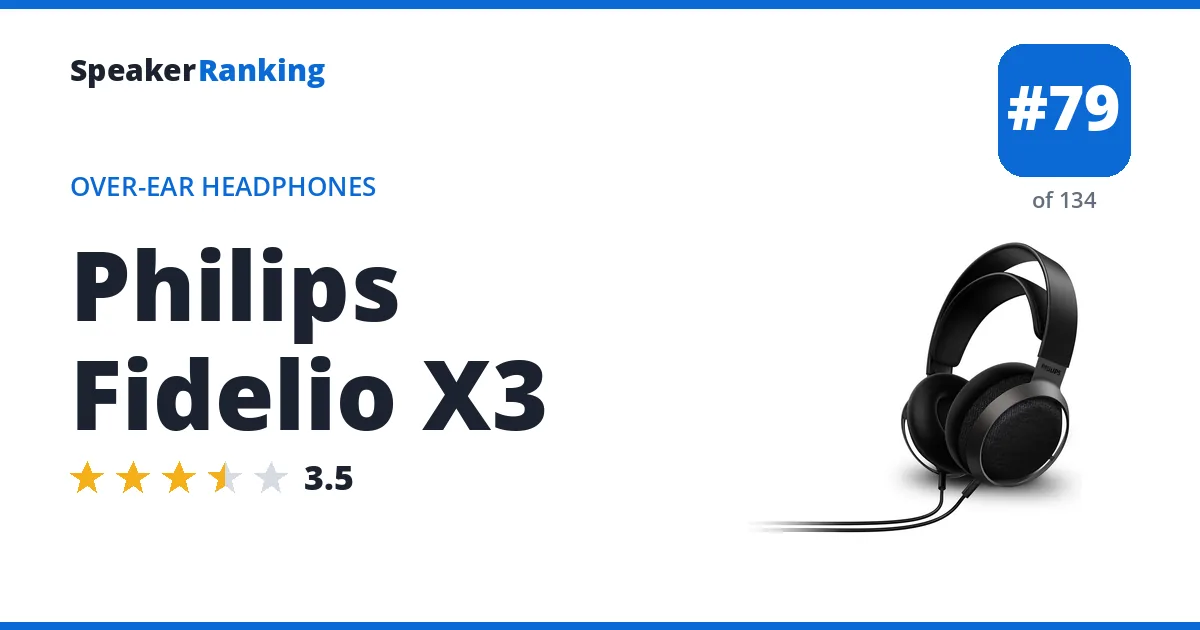
Pros: Bass is full, about 1.9 dB over target with the low mids up about 2 dB, giving a warm, weighty sound for rock and vocals. Treble from 6 to 10 kHz is about 2.8 dB over target, which adds detail and airiness. At 30 ohms and 98 dB/mW sensitivity it can be driven by a phone, and the open back gives a wide soundstage.
Cons: Sub-bass is about 5 dB under target, so the deepest rumble is missing despite the fuller bass. It has the least smooth response here at 3.0 dB deviation, with a 5.7 dB peak near 6.2 kHz and a 7.7 dB dip near 2.3 kHz that can make vocals recessed and then edgy. At 380 g the open back leaks sound and gives no isolation. Discontinued.
Full Philips Fidelio X3 review and specifications →
| Back | Open |
|---|---|
| Connection | Wired |
| Deviation From Target | 3.00 dB standard deviation |
| Driver Type | Dynamic |
| Drivers | 1 x 50mm dynamic |
| Form Factor | Over-ear |
| Frequency Response | 5Hz - 40kHz (Manufacturer specified) |
| Harman Preference Score | 70 (measured by oratory1990, via AutoEQ) |
| Impedance | 30 ohms |
| Sensitivity | 98 dB/mW |
| Tonal Tilt | -0.46 (negative is warmer, positive brighter) |
| Weight | 0.8 lbs (380 g) |
EQ preset to match the Harman target
Set a preamp of -6.9 dB, then add these filters in any parametric equalizer (Wavelet, Equalizer APO, Peace, or a player with parametric EQ). Calculated by AutoEQ from its measured frequency response.
| Filter | Frequency | Gain | Q |
|---|---|---|---|
| Low shelf | 105 Hz | +8.6 dB | 0.70 |
| Peak | 83 Hz | -6.1 dB | 0.41 |
| Peak | 2,357 Hz | +7.0 dB | 1.78 |
| Peak | 6,084 Hz | -5.7 dB | 1.84 |
| Peak | 4,444 Hz | +4.5 dB | 3.89 |
| High shelf | 10,000 Hz | -1.0 dB | 0.70 |
| Peak | 131 Hz | +0.6 dB | 1.28 |
| Peak | 62 Hz | -0.7 dB | 2.01 |
| Peak | 34 Hz | +0.9 dB | 3.36 |
| Peak | 251 Hz | -0.8 dB | 3.40 |
- Reviews, Comparisons and Sound Samples
 Ranked #82 of 134 in Over-Ear Headphones - Audeze MM-500: $1,699.00 Amazon eBay
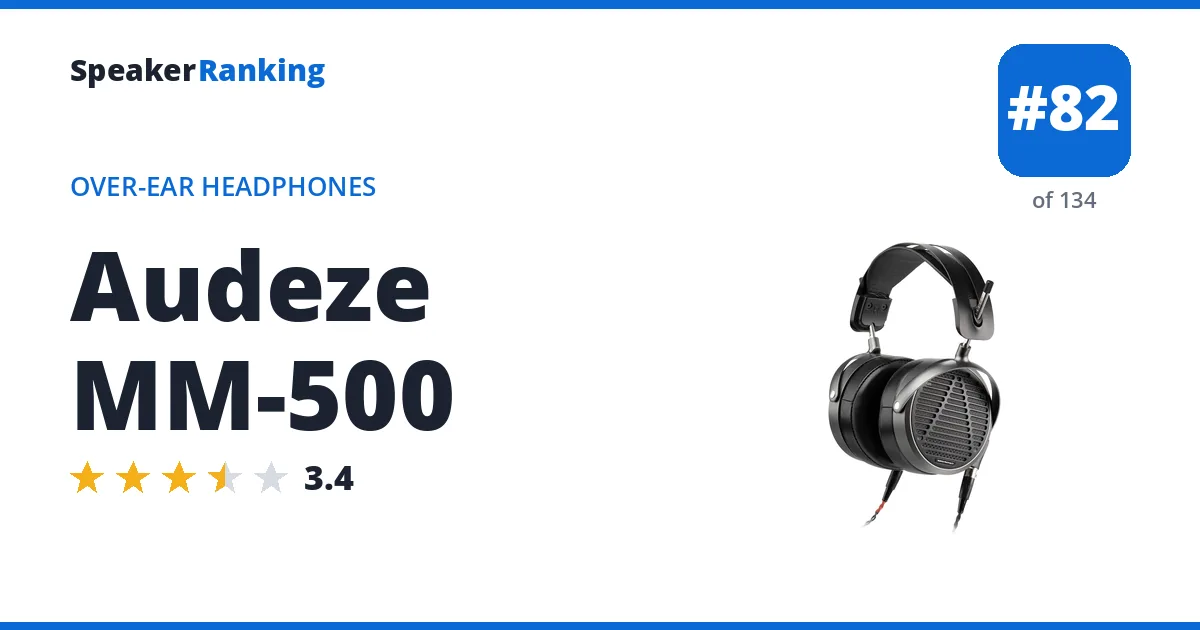
Pros: The midrange from 200 Hz to 3 kHz tracks the Harman target within about 0.3 dB, so voices and instruments in the core of the music sound accurate. The planar magnetic driver is easy to power at 18 ohms and 100 dB per mW, so a phone or basic dongle can drive it. The open back gives a wide, airy presentation for critical listening at home.
Cons: Treble from 6 to 10 kHz sits about 7.3 dB under target, with a 15 dB dip near 9.6 kHz, so cymbals, hi-hats and vocal air sound dark and muffled. Sub-bass is about 5.8 dB light, which loses rumble in electronic and cinematic music. At 495 g it is heavy for long sessions, the open back leaks sound and offers no isolation, and the Denon AH-D7200 has a higher rating at a much lower price.
Full Audeze MM-500 review and specifications →
| Back | Open |
|---|---|
| Connection | Wired |
| Deviation From Target | 2.98 dB standard deviation |
| Driver Type | Planar magnetic |
| Form Factor | Over-ear |
| Frequency Response | 5Hz - 50kHz (Manufacturer specified) |
| Harman Preference Score | 69 (measured by oratory1990, via AutoEQ) |
| Impedance | 18 ohms |
| Sensitivity | 100 dB/mW |
| Tonal Tilt | -0.52 (negative is warmer, positive brighter) |
| Weight | 1.1 lbs (495 g) |
EQ preset to match the Harman target
Set a preamp of -5.3 dB, then add these filters in any parametric equalizer (Wavelet, Equalizer APO, Peace, or a player with parametric EQ). Calculated by AutoEQ from its measured frequency response.
| Filter | Frequency | Gain | Q |
|---|---|---|---|
| Low shelf | 105 Hz | +5.6 dB | 0.70 |
| Peak | 8,516 Hz | +7.3 dB | 1.16 |
| Peak | 2,405 Hz | -1.6 dB | 0.21 |
| Peak | 109 Hz | -1.9 dB | 0.31 |
| Peak | 4,306 Hz | +4.4 dB | 4.44 |
| High shelf | 10,000 Hz | -3.6 dB | 0.70 |
| Peak | 1,954 Hz | +2.2 dB | 3.28 |
| Peak | 2,899 Hz | -2.3 dB | 3.50 |
| Peak | 1,242 Hz | -1.1 dB | 2.48 |
| Peak | 2,185 Hz | +0.7 dB | 2.52 |
- Reviews, Comparisons and Sound Samples
 Ranked #91 of 134 in Over-Ear Headphones - Focal Elear: $999.00 Amazon eBay
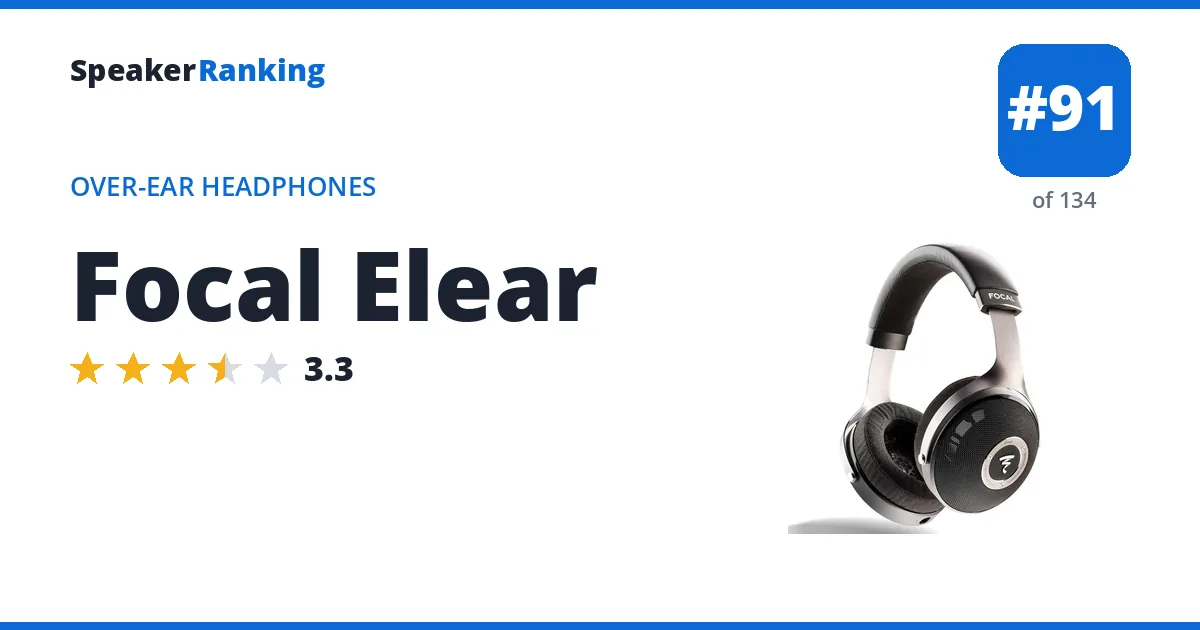
Pros: The open back gives a spacious, airy presentation, and the 40 mm dynamic driver offers 104 dB per mW sensitivity. Mids from 200 Hz to 3 kHz stay within about 0.6 dB of target, so vocals and instruments sound natural. Bass from 60 to 200 Hz is within 1 dB of target.
Cons: Presence at 3 to 6 kHz is about 5.3 dB under and treble at 6 to 10 kHz about 6.1 dB under, with a 9 dB dip near 7.2 kHz, so detail and cymbals sound dull. Sub-bass is about 5.3 dB light, losing rumble. At 80 ohms and 450 g with an open back that leaks sound, it suits quiet home use, and the Dan Clark Audio Aeon 2 Noire matches its rating at a lower price.
Full Focal Elear review and specifications →
| Back | Open |
|---|---|
| Connection | Wired |
| Deviation From Target | 2.77 dB standard deviation |
| Driver Type | Dynamic |
| Drivers | 1 x 40mm dynamic |
| Form Factor | Over-ear |
| Frequency Response | 5Hz - 23kHz (Manufacturer specified) |
| Harman Preference Score | 66 (measured by oratory1990, via AutoEQ) |
| Impedance | 80 ohms |
| Sensitivity | 104 dB SPL/mW |
| Tonal Tilt | -0.90 (negative is warmer, positive brighter) |
| Weight | 1 lbs (450 g) |
EQ preset to match the Harman target
Set a preamp of -6.6 dB, then add these filters in any parametric equalizer (Wavelet, Equalizer APO, Peace, or a player with parametric EQ). Calculated by AutoEQ from its measured frequency response.
| Filter | Frequency | Gain | Q |
|---|---|---|---|
| Low shelf | 105 Hz | +6.7 dB | 0.70 |
| Peak | 89 Hz | -4.0 dB | 0.30 |
| Peak | 8,570 Hz | +4.6 dB | 1.63 |
| Peak | 4,461 Hz | +6.2 dB | 3.05 |
| Peak | 1,228 Hz | -2.4 dB | 1.79 |
| High shelf | 10,000 Hz | -2.2 dB | 0.70 |
| Peak | 2,156 Hz | +1.5 dB | 4.18 |
| Peak | 2,859 Hz | -1.0 dB | 3.87 |
| Peak | 6,120 Hz | -1.8 dB | 6.00 |
| Peak | 7,146 Hz | +2.1 dB | 5.93 |
- Reviews, Comparisons and Sound Samples
 Ranked #95 of 134 in Over-Ear Headphones - Sendy Peacock: $1,499.00 Amazon eBay
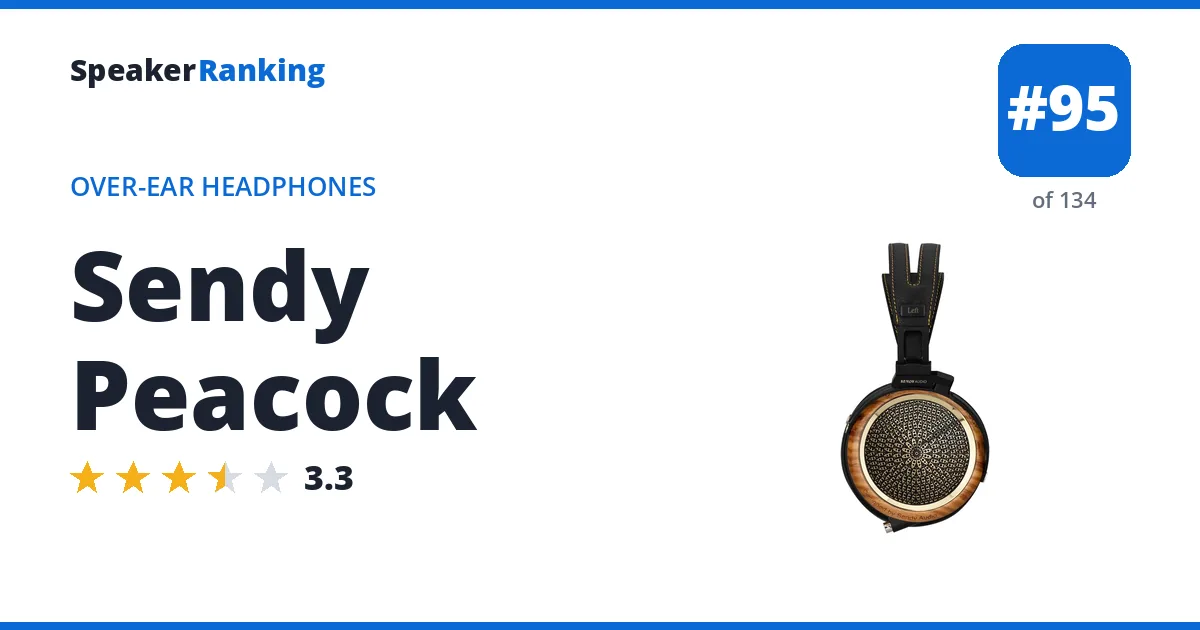
Pros: The open-back 88mm planar driver gives a spacious presentation, and at 50 ohms and 103 dB sensitivity it is easy enough to drive from a modest amp or dongle. Bass from 60 to 200 Hz lands almost exactly on target, and low mids are slightly full at about 1.6 dB above it, giving a warm, smooth tone.
Cons: Presence is about 4 dB low and a 8.7 dB dip near 9.9 kHz softens cymbals and string detail, so the top end sounds subdued. Sub-bass is roughly 5 dB under target. At 578 g it is heavy, and the open back leaks sound and offers no isolation.
Full Sendy Peacock review and specifications →
| Released | Aug 2023 (3 years ago) |
|---|---|
| Back | Open |
| Connection | Wired |
| Deviation From Target | 2.78 dB standard deviation |
| Driver Type | Planar magnetic |
| Drivers | 1 x 88mm planar magnetic |
| Form Factor | Over-ear |
| Frequency Response | 20Hz - 40kHz (Manufacturer specified) |
| Harman Preference Score | 65 (measured by oratory1990, via AutoEQ) |
| Impedance | 50 ohms |
| Sensitivity | 103 dB |
| Tonal Tilt | -0.90 (negative is warmer, positive brighter) |
| Weight | 1.3 lbs (578 g) |
EQ preset to match the Harman target
Set a preamp of -5.7 dB, then add these filters in any parametric equalizer (Wavelet, Equalizer APO, Peace, or a player with parametric EQ). Calculated by AutoEQ from its measured frequency response.
| Filter | Frequency | Gain | Q |
|---|---|---|---|
| Low shelf | 105 Hz | +6.3 dB | 0.70 |
| Peak | 127 Hz | -3.6 dB | 0.26 |
| Peak | 4,272 Hz | +3.4 dB | 0.39 |
| Peak | 10,000 Hz | +1.2 dB | 1.54 |
| Peak | 974 Hz | -3.5 dB | 2.18 |
| High shelf | 10,000 Hz | -4.5 dB | 0.70 |
| Peak | 4,260 Hz | +2.8 dB | 3.45 |
| Peak | 2,978 Hz | -2.7 dB | 2.66 |
| Peak | 1,869 Hz | +2.6 dB | 4.50 |
| Peak | 64 Hz | -0.6 dB | 2.10 |
- Reviews, Comparisons and Sound Samples
 Ranked #99 of 134 in Over-Ear Headphones - Yamaha HPH-200: $160.00 Amazon eBay
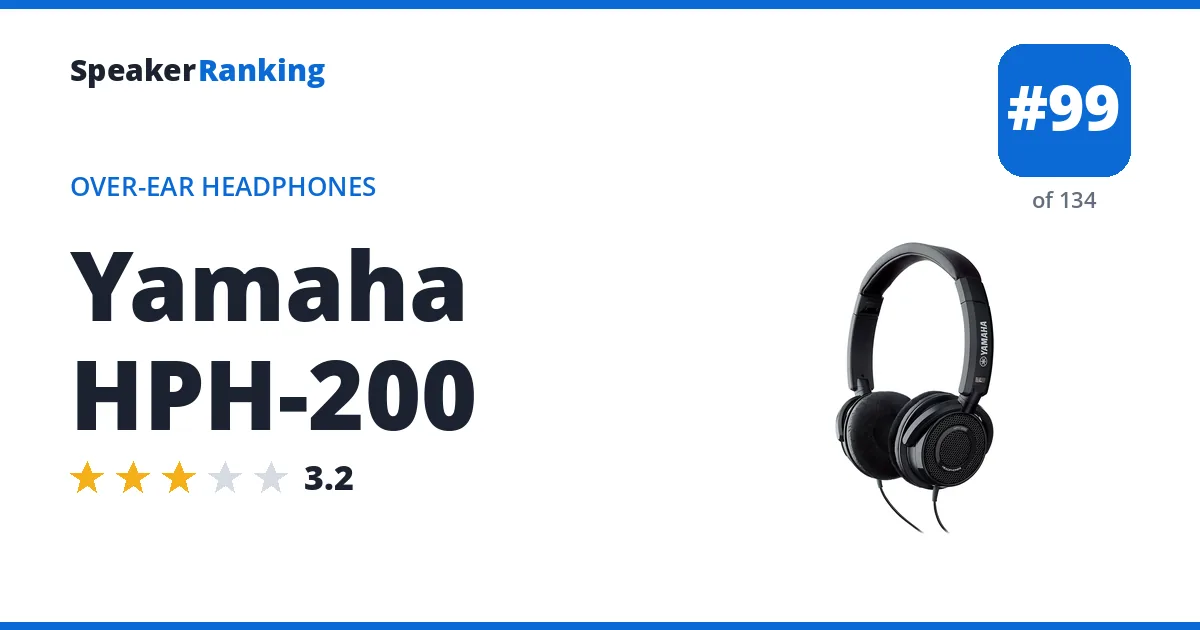
Pros: The open 40mm dynamic design has an airy, speaker-like staging, and at 48 ohms and 98.5 dB/mW it runs fine from a phone or laptop. Bass from 60 to 200 Hz is about 1.6 dB above target and the midrange sits close to it, giving voices a natural body.
Cons: Sub-bass is roughly 9 dB under target, so deep bass is largely absent. A 12.3 dB dip near 4.8 kHz and presence about 6 dB low are paired with a 4.8 dB peak near 7.4 kHz, which makes vocals recede while hi-hats and sibilants stand out. The open back leaks sound and gives no isolation.
Full Yamaha HPH-200 review and specifications →
| Back | Open |
|---|---|
| Connection | Wired |
| Deviation From Target | 3.20 dB standard deviation |
| Driver Type | Dynamic |
| Drivers | 1 x 40mm dynamic |
| Form Factor | Over-ear |
| Frequency Response | 20Hz - 20kHz (Manufacturer specified) |
| Harman Preference Score | 64 (measured by oratory1990, via AutoEQ) |
| Impedance | 48 ohms |
| Sensitivity | 98.5 dB/mW |
| Tonal Tilt | -0.64 (negative is warmer, positive brighter) |
EQ preset to match the Harman target
Set a preamp of -6.3 dB, then add these filters in any parametric equalizer (Wavelet, Equalizer APO, Peace, or a player with parametric EQ). Calculated by AutoEQ from its measured frequency response.
| Filter | Frequency | Gain | Q |
|---|---|---|---|
| Low shelf | 105 Hz | +5.8 dB | 0.70 |
| Peak | 83 Hz | -6.4 dB | 0.54 |
| Peak | 4,730 Hz | +6.7 dB | 1.88 |
| Peak | 41 Hz | +3.8 dB | 0.94 |
| Peak | 6,680 Hz | -5.1 dB | 4.60 |
| High shelf | 10,000 Hz | +1.2 dB | 0.70 |
| Peak | 518 Hz | +1.1 dB | 1.05 |
| Peak | 1,328 Hz | -1.1 dB | 2.04 |
| Peak | 8,923 Hz | -2.3 dB | 4.29 |
| Peak | 243 Hz | -0.7 dB | 1.68 |
- Reviews, Comparisons and Sound Samples
 Ranked #100 of 134 in Over-Ear Headphones - Audeze LCD-GX: $899.00 Amazon eBay
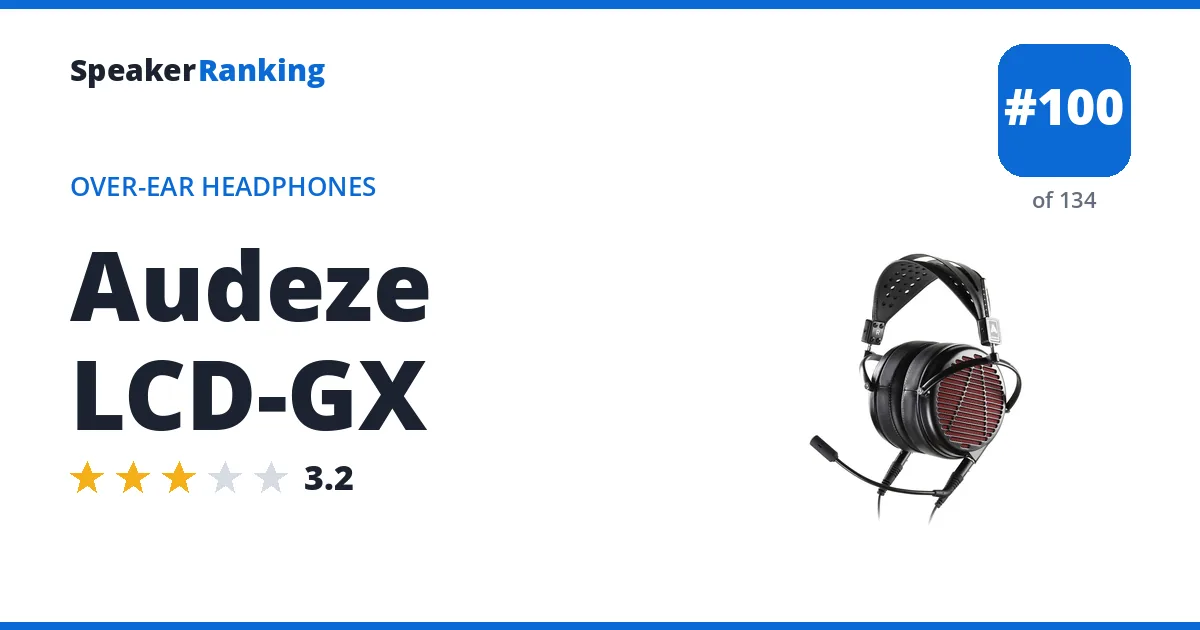
Pros: The open-back 106mm planar magnetic driver offers a large, spacious presentation. At 20 ohms and 100 dB/mW it can run from a phone or portable dongle, and the midrange stays close to target, with low mids about 0.7 dB above it.
Cons: Sub-bass is about 7 dB below target and presence is roughly 7 dB low, with a 10 dB dip near 4.9 kHz, so vocals and snare lack clarity and bass lacks rumble. Treble from 6 to 10 kHz is about 5 dB down, making the overall sound dark. The open back leaks sound and offers no isolation.
Full Audeze LCD-GX review and specifications →
| Released | Jul 2019 (7 years ago) |
|---|---|
| Back | Open |
| Connection | Wired |
| Deviation From Target | 3.10 dB standard deviation |
| Driver Type | Planar magnetic |
| Drivers | 1 x 106mm planar magnetic |
| Form Factor | Over-ear |
| Frequency Response | 10Hz - 50kHz (Manufacturer specified) |
| Harman Preference Score | 63 (measured by oratory1990, via AutoEQ) |
| Impedance | 20 ohms |
| Sensitivity | 100 dB/mW |
| Tonal Tilt | -0.82 (negative is warmer, positive brighter) |
EQ preset to match the Harman target
Set a preamp of -6.5 dB, then add these filters in any parametric equalizer (Wavelet, Equalizer APO, Peace, or a player with parametric EQ). Calculated by AutoEQ from its measured frequency response.
| Filter | Frequency | Gain | Q |
|---|---|---|---|
| Low shelf | 105 Hz | +7.1 dB | 0.70 |
| Peak | 4,232 Hz | +6.1 dB | 1.97 |
| Peak | 100 Hz | -3.6 dB | 0.29 |
| Peak | 825 Hz | -2.9 dB | 1.38 |
| Peak | 7,329 Hz | +2.6 dB | 1.27 |
| High shelf | 10,000 Hz | -6.9 dB | 0.70 |
| Peak | 130 Hz | +0.7 dB | 1.72 |
| Peak | 59 Hz | -0.6 dB | 1.94 |
| Peak | 242 Hz | -0.5 dB | 1.99 |
| Peak | 2,773 Hz | -0.7 dB | 4.21 |
- Reviews, Comparisons and Sound Samples
 Ranked #101 of 134 in Over-Ear Headphones - Audio-Technica ATH-AD700X: $149.99 Amazon eBay
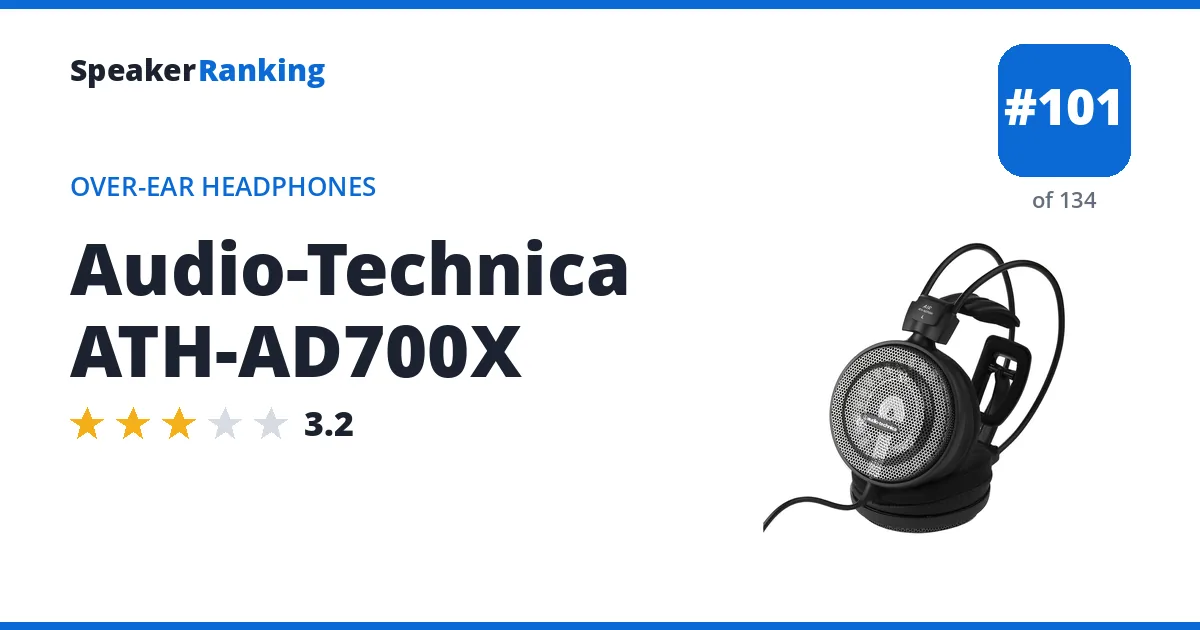
Pros: The open-back 53mm driver gives a wide, airy sound, and the air region above 10 kHz is nearly on target. At 38 ohms and 100 dB/mW it runs directly from a phone, and it weighs only 265 g.
Cons: Sub-bass sits about 11 dB below target and bass from 60 to 200 Hz is roughly 3 dB low, so kick drums and bass lines sound thin. A 11.8 dB dip near 7.2 kHz, with presence about 6 dB low, dulls vocals and cymbals, and a 3.47 dB deviation makes it less even than most. The open back leaks sound and offers no isolation.
Full Audio-Technica ATH-AD700X review and specifications →
| Released | 2012 (14 years ago) |
|---|---|
| Back | Open |
| Connection | Wired |
| Deviation From Target | 3.47 dB standard deviation |
| Driver Type | Dynamic |
| Drivers | 1 x 53mm dynamic |
| Form Factor | Over-ear |
| Frequency Response | 5Hz - 30kHz (Manufacturer specified) |
| Harman Preference Score | 63 (measured by oratory1990, via AutoEQ) |
| Impedance | 38 ohms |
| Sensitivity | 100 dB/mW |
| Tonal Tilt | -0.48 (negative is warmer, positive brighter) |
| Weight | 0.6 lbs (265 g) |
EQ preset to match the Harman target
Set a preamp of -6.5 dB, then add these filters in any parametric equalizer (Wavelet, Equalizer APO, Peace, or a player with parametric EQ). Calculated by AutoEQ from its measured frequency response.
| Filter | Frequency | Gain | Q |
|---|---|---|---|
| Low shelf | 105 Hz | +6.7 dB | 0.70 |
| Peak | 1,422 Hz | -4.8 dB | 0.87 |
| Peak | 2,626 Hz | +6.9 dB | 1.24 |
| Peak | 157 Hz | -3.2 dB | 0.48 |
| Peak | 6,954 Hz | +5.0 dB | 3.00 |
| High shelf | 10,000 Hz | -4.2 dB | 0.70 |
| Peak | 4,990 Hz | +3.5 dB | 5.55 |
| Peak | 4,063 Hz | -2.6 dB | 6.00 |
| Peak | 51 Hz | +0.9 dB | 3.36 |
| Peak | 77 Hz | -0.6 dB | 2.81 |
- Reviews, Comparisons and Sound Samples
- Head-to-Head Comparisons
 Ranked #106 of 134 in Over-Ear Headphones - Fostex TH909: $1,263.98 Amazon eBay
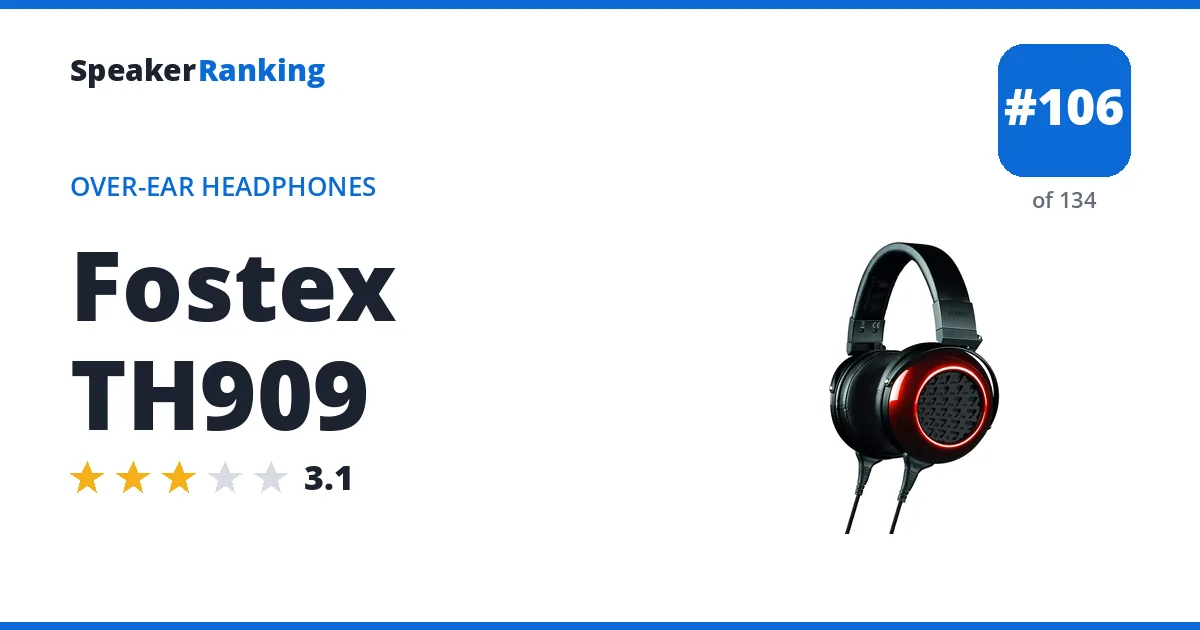
Pros: An open-back wired design with a 50mm driver, 25 ohms and 100 dB/mW sensitivity, so it runs from most sources without a dedicated amplifier. Bass is generous, about 2 to 4 dB over target from the sub-bass up through the low mids, which gives a warm and full presentation. The airy open design gives a spacious soundstage feel, and the range above 10 kHz sits about 2 dB over target.
Cons: Open back means sound leaks out and outside noise leaks in, so it only suits quiet rooms. Presence is lifted about 2.4 dB, with a 6.4 dB peak near 5.6 kHz and a 6.3 dB dip near 9.5 kHz, which can make voices and cymbals sound uneven. The warm low mids and uneven treble keep it well short of the target curve for the price.
Full Fostex TH909 review and specifications →
| Back | Open |
|---|---|
| Built-in Microphone | No |
| Connection | Wired |
| Deviation From Target | 2.82 dB standard deviation |
| Driver Type | Dynamic |
| Drivers | 1 x 50mm dynamic |
| Form Factor | Over-ear |
| Frequency Response | 5Hz - 45kHz (Manufacturer specified) |
| Harman Preference Score | 62 (measured by oratory1990, via AutoEQ) |
| Impedance | 25 ohms |
| Sensitivity | 100 dB/mW |
| Tonal Tilt | -1.08 (negative is warmer, positive brighter) |
EQ preset to match the Harman target
Set a preamp of -4.8 dB, then add these filters in any parametric equalizer (Wavelet, Equalizer APO, Peace, or a player with parametric EQ). Calculated by AutoEQ from its measured frequency response.
| Filter | Frequency | Gain | Q |
|---|---|---|---|
| Low shelf | 105 Hz | -0.4 dB | 0.70 |
| Peak | 304 Hz | -4.1 dB | 0.45 |
| Peak | 1,426 Hz | +4.2 dB | 0.54 |
| Peak | 5,590 Hz | -6.2 dB | 4.31 |
| Peak | 9,044 Hz | +3.2 dB | 1.56 |
| High shelf | 10,000 Hz | -4.1 dB | 0.70 |
| Peak | 2,533 Hz | +2.0 dB | 4.27 |
| Peak | 3,371 Hz | -2.4 dB | 4.80 |
| Peak | 1,696 Hz | -1.0 dB | 3.46 |
| Peak | 2,300 Hz | +0.6 dB | 3.30 |
- Reviews, Comparisons and Sound Samples
 Ranked #115 of 134 in Over-Ear Headphones - Koss KPH40: $32.99 Amazon eBay
Pros: It is one of the cheapest options in its class, and the open-back design gives a more airy, spacious feel than most closed budget headsets. Bass between 60 and 200 Hz sits about 2 dB above target and the lower mids are slightly full, which suits a warm, relaxed listener. Sensitivity of 101 dB at 60 ohms means a phone can drive it.
Cons: Sub-bass rolls off about 7 dB below target under 60 Hz, so kick drums and synth bass lack rumble. A 14.5 dB dip near 4.4 kHz makes vocals and instrument detail sound distant, and treble is about 4 dB low overall, so the sound is dark and muffled. Open backs also leak sound and offer no isolation.
Full Koss KPH40 review and specifications →
| Back | Open |
|---|---|
| Connection | Wired |
| Deviation From Target | 3.35 dB standard deviation |
| Driver Type | Dynamic |
| Form Factor | Over-ear |
| Frequency Response | 15Hz - 25kHz (Manufacturer specified) |
| Harman Preference Score | 54 (measured by oratory1990, via AutoEQ) |
| Impedance | 60 ohms |
| Sensitivity | 101 dB SPL/1mW |
| Tonal Tilt | -1.21 (negative is warmer, positive brighter) |
EQ preset to match the Harman target
Set a preamp of -6.1 dB, then add these filters in any parametric equalizer (Wavelet, Equalizer APO, Peace, or a player with parametric EQ). Calculated by AutoEQ from its measured frequency response.
| Filter | Frequency | Gain | Q |
|---|---|---|---|
| Low shelf | 105 Hz | +7.5 dB | 0.70 |
| Peak | 79 Hz | -7.6 dB | 0.37 |
| Peak | 3,725 Hz | +4.9 dB | 3.94 |
| Peak | 614 Hz | +1.5 dB | 2.05 |
| Peak | 37 Hz | +3.9 dB | 1.16 |
| High shelf | 10,000 Hz | +1.9 dB | 0.70 |
| Peak | 7,429 Hz | +4.0 dB | 0.78 |
| Peak | 5,445 Hz | -7.7 dB | 4.24 |
| Peak | 1,941 Hz | -2.0 dB | 2.35 |
| Peak | 1,012 Hz | +0.3 dB | 1.84 |
- Reviews, Comparisons and Sound Samples
- Head-to-Head Comparisons
 Ranked #116 of 134 in Over-Ear Headphones - Koss KSC75: $19.99 Amazon eBay
Pros: An extremely low cost and a featherweight 43 g clip-on design make it easy to carry and wear for long stretches. The midrange is close to target, with the low mids within 0.2 dB, so voices sound natural, and the slightly lifted treble of about 2 to 3 dB adds clarity. The open back gives an airy sound, and 101 dB sensitivity at 60 ohms works from a phone.
Cons: Sub-bass is about 17 dB below target under 60 Hz, so there is almost no rumble and bass-heavy music sounds thin. Bass in the 60 to 200 Hz range is also about 2 dB low, and a 4 dB peak near 5.3 kHz can add some edge. The open design leaks sound and gives no noise isolation.
Full Koss KSC75 review and specifications →
| Back | Open |
|---|---|
| Connection | Wired |
| Deviation From Target | 3.33 dB standard deviation |
| Driver Type | Dynamic |
| Drivers | 1 x 35mm dynamic |
| Form Factor | Over-ear |
| Frequency Response | 15Hz - 25kHz (Manufacturer specified) |
| Harman Preference Score | 54 (measured by oratory1990, via AutoEQ) |
| Impedance | 60 ohms |
| Sensitivity | 101 dB SPL/1mW |
| Tonal Tilt | +1.22 (negative is warmer, positive brighter) |
| Weight | 0.1 lbs (43 g) |
EQ preset to match the Harman target
Set a preamp of -6.3 dB, then add these filters in any parametric equalizer (Wavelet, Equalizer APO, Peace, or a player with parametric EQ). Calculated by AutoEQ from its measured frequency response.
| Filter | Frequency | Gain | Q |
|---|---|---|---|
| Low shelf | 105 Hz | +6.2 dB | 0.70 |
| Peak | 610 Hz | +2.2 dB | 0.63 |
| Peak | 2,358 Hz | -3.4 dB | 1.92 |
| Peak | 169 Hz | -2.3 dB | 0.77 |
| Peak | 74 Hz | +2.0 dB | 2.94 |
| High shelf | 10,000 Hz | -3.0 dB | 0.70 |
| Peak | 4,033 Hz | +3.3 dB | 5.88 |
| Peak | 5,191 Hz | -3.4 dB | 5.53 |
| Peak | 7,220 Hz | -1.5 dB | 2.25 |
| Peak | 4,517 Hz | +0.7 dB | 4.34 |
- Reviews, Comparisons and Sound Samples
- Head-to-Head Comparisons
 Ranked #122 of 134 in Over-Ear Headphones - Audio-Technica ATH-AD500X: $119.00 Amazon eBay
Pros: The open-back design gives a spacious, airy presentation, and the 48 ohm impedance with 100 dB sensitivity works directly from a phone or laptop. At 235 g it is light for a full-size headphone. The lower midrange is within half a dB of target, so the body of voices and guitars sounds natural.
Cons: Treble from 6 to 10 kHz is about 9 dB below target and a 16 dB dip near 7.2 kHz removes cymbal and sibilance detail, so the sound is dark and veiled. Sub-bass is about 9 dB low under 60 Hz, so deep bass lacks rumble. Open backs leak sound and give no isolation. The Anker Soundcore Space One has a higher rating at a lower price.
Full Audio-Technica ATH-AD500X review and specifications →
| Released | 2012 (14 years ago) |
|---|---|
| Back | Open |
| Connection | Wired |
| Deviation From Target | 3.75 dB standard deviation |
| Driver Type | Dynamic |
| Drivers | 1 x 53mm dynamic |
| Form Factor | Over-ear |
| Frequency Response | 5Hz - 25kHz (Manufacturer specified) |
| Harman Preference Score | 50 (measured by oratory1990, via AutoEQ) |
| Impedance | 48 ohms |
| Sensitivity | 100 dB/mW |
| Tonal Tilt | -1.10 (negative is warmer, positive brighter) |
| Weight | 0.5 lbs (235 g) |
EQ preset to match the Harman target
Set a preamp of -6.5 dB, then add these filters in any parametric equalizer (Wavelet, Equalizer APO, Peace, or a player with parametric EQ). Calculated by AutoEQ from its measured frequency response.
| Filter | Frequency | Gain | Q |
|---|---|---|---|
| Low shelf | 105 Hz | +7.0 dB | 0.70 |
| Peak | 132 Hz | -4.4 dB | 0.44 |
| Peak | 8,349 Hz | +6.5 dB | 1.37 |
| Peak | 1,295 Hz | -3.9 dB | 1.00 |
| Peak | 2,506 Hz | +4.7 dB | 1.39 |
| High shelf | 10,000 Hz | -2.0 dB | 0.70 |
| Peak | 4,177 Hz | -3.9 dB | 5.95 |
| Peak | 3,282 Hz | +3.3 dB | 5.84 |
| Peak | 2,773 Hz | -1.6 dB | 6.00 |
| Peak | 4,931 Hz | +1.7 dB | 6.00 |
- Reviews, Comparisons and Sound Samples
- Head-to-Head Comparisons
 Ranked #126 of 134 in Over-Ear Headphones - Koss Porta Pro: $32.99 Amazon eBay
Pros: A very cheap, lightweight open-back design dating from 1984. At 60 ohms and 101 dB sensitivity it runs easily from a phone. The warm tilt and a mild 2.6 dB bass lift suit listeners who like a relaxed, bassy sound.
Cons: A 16.8 dB dip near 3.6 kHz hollows out vocals and instrument detail, and treble from 6 to 10 kHz is about 6 dB low. Sub-bass below 60 Hz sits about 6 dB under target. The open back leaks sound and provides no isolation, and the HyperX Cloud Alpha is rated clearly higher at a similar price.
Full Koss Porta Pro review and specifications →
| Released | 1984 (42 years ago) |
|---|---|
| Back | Open |
| Connection | Wired |
| Deviation From Target | 3.55 dB standard deviation |
| Driver Type | Dynamic |
| Form Factor | Over-ear |
| Frequency Response | 15Hz - 25kHz (Manufacturer specified) |
| Harman Preference Score | 46 (measured by oratory1990, via AutoEQ) |
| Impedance | 60 ohms |
| Sensitivity | 101 dB SPL/1mW |
| Tonal Tilt | -1.50 (negative is warmer, positive brighter) |
EQ preset to match the Harman target
Set a preamp of -7.9 dB, then add these filters in any parametric equalizer (Wavelet, Equalizer APO, Peace, or a player with parametric EQ). Calculated by AutoEQ from its measured frequency response.
| Filter | Frequency | Gain | Q |
|---|---|---|---|
| Low shelf | 105 Hz | +9.2 dB | 0.70 |
| Peak | 83 Hz | -8.7 dB | 0.47 |
| Peak | 3,336 Hz | +4.3 dB | 4.55 |
| Peak | 8,898 Hz | +5.8 dB | 2.75 |
| Peak | 6,711 Hz | +4.5 dB | 4.32 |
| High shelf | 10,000 Hz | +4.5 dB | 0.70 |
| Peak | 4,725 Hz | -3.8 dB | 6.00 |
| Peak | 1,892 Hz | -1.6 dB | 2.53 |
| Peak | 658 Hz | +0.6 dB | 1.45 |
| Peak | 2,756 Hz | +1.5 dB | 4.62 |
- Reviews, Comparisons and Sound Samples
- Head-to-Head Comparisons