This page ranks 90 medium passive bookshelf speakers with woofers between 4” and 5.75”. Larger woofers provide deeper bass but result in a bigger, heavier cabinet.
Rankings are based on flat frequency response, directivity, dynamics, imaging, and detail retrieval. Others may prioritize these traits differently.
The law of diminishing returns applies, many moderately-priced options here provide outstanding value. I would not hesitate to recommend the majority of speakers on this page. Just note the ones labeled not recommended.
| Select to compare | |||||||
|---|---|---|---|---|---|---|---|
| 1 | Audio First Fidelia | £950 per pair | 84dB | 4 ohms | 53Hz | 15 lbs | |
| 2 | Philharmonic Ceramic Mini | $900 per pair | 82dB | 4 ohms nominal | 51Hz | 17 lbs | |
| 3 | Ascend Sierra 1 v2 | $1000 per pair | 81.5dB | 8 ohms nominal, 7 ohm… | 55Hz | 18.5 lbs | |
| 4 | KEF LS50 Meta | $1,599.00 per pair | 83dB | 8 ohms nominal | 68Hz | 17.2 lbs | |
| 5 | Ascend Acoustics Luna V2 Mini-Monitor Ribbon | $1,248 per pair | 82dB @ 2.83V/1m anech… | 8 ohms nominal | 74.7Hz | 8.3 lbs | |
| 6 | XMechanik Mechano23 DIY | $200 per pair | 85.1dB @ 2.83V/1m | 4.1 ohms nominal | 77.6Hz | - | |
| 7 | Ascend Acoustics HTM-200SE2 | $368 per pair | 86.0dB | 8 ohms nominal | 87.9Hz | 9.9 lbs | |
| 8 | Arendal 1961 Monitor | $1150 per pair | 85.9dB | 4 ohms nominal | 84Hz | 16 lbs | |
| 9 | SunAudio Purified 4 | $3,650 per pair | 84.4dB | 4 ohms | 71Hz | - | |
| 10 | Ascend Acoustics Luna V2 Mini-Monitor Titan | $898 per pair | 82dB @ 2.83V/1m anech… | 8 ohms nominal | 74.7Hz | 8.3 lbs | |
| 11 | Aalto Speakers Aalto 1 EVO | €599 per pair | 81.5dB/2.83V/1m | 4 ohms nominal, 3.3 o… | 53.4Hz | 5.3 lbs | |
| 12 | Moondrop M4P MTM | $920 per pair | 85dB | 4 ohms nominal, 3.7 o… | 69Hz | 13.7 lbs | |
| 13 | Revel M105 | $1500 per pair | 85dB | 8 ohms nominal, low m… | 63Hz | 15.4 lbs | |
| 14 | Monitor Audio Silver 50 7G | $799 per pair | 86dB @ 2.83V/1m | 8 ohms nominal, 3.9 o… | 87.9Hz | 12.3 lbs | |
| 15 | Arendal Sound 1961 Bookshelf | $900 per pair | 84dB | 4 ohms nominal | 108.4Hz | 10.8 lbs | |
| 16 | Elac Carina BS243.4 | $1,199 per pair | 85dB | 6 ohm nominal, 4.8 oh… | 55.7Hz | 14.8 lbs | |
| 17 | Emotiva B1+ | $250 per pair | 85dB | 8 ohms | 70Hz | 8.8 lbs | |
| 18 | Klipsch RP-500M II | $389.99 per pair | 85dB | 8 ohms nominal, 3.3 o… | 67Hz | 13 lbs | |
| 19 | Wharfedale Super Denton | $1499 per pair | 86.6dB | 6 ohms nominal, 3 ohm… | 61Hz | 20.3 lbs | |
| 20 | Carmody S2000 | $251.06 per pair | 84dB | below 4 ohms minimum | 64.5Hz | 11 lbs | |
| 21 | Wharfedale Diamond 12.1 | $599 per pair | 84dB | 8 ohms nominal | 61Hz | 15 lbs | |
| 22 | Neumi BS5 | $139.99 per pair | Approximately 84dB/2.… | 4.6 ohms minimum; app… | 64Hz | 7.1 lbs | |
| 23 | Radiant Acoustics Clarity 4.2 | $2,998 per pair | 78 dB | 4 ohms | 44 Hz | 28.7 lbs | |
| 24 | Tekton Troubadour | $1,000 per pair | 88dB | 4 ohms nominal, 3.6 o… | 51Hz | 32 lbs | |
| 25 | Amphion Argon1 | $1,919 per pair | 86dB | 8 ohms | 55.3Hz | 15.4 lbs | |
| 26 | KEF Q150 | $350 per pair | ~85dB | 8 ohms nominal, about… | 51Hz | 12.3 lbs | |
| 27 | Parts Express C-Note | $100 per pair | 83dB | 8 ohms | 90Hz | - | |
| 28 | Wharfedale Diamond 220 | $299 per pair | 86.9dB | 8 ohms | 117.2Hz | 11.7 lbs | |
| 29 | Polk Audio XT15 | $179.00 per pair | 86dB | 4/8-ohm compatible | 77.6Hz | 9 lbs | |
| 30 | PSB Imagine B50 | $999 per pair | 85dB anechoic / 87dB… | 8 ohms nominal, 4 ohm… | 69.6Hz | approx. 11.2 lbs | |
| 31 | Jamo S7-15B | $299.00 per pair | 86.3dB | 4 ohms | 69.6Hz | 13 lbs | |
| 32 | Neumi Silk 4 | $199.99 per pair | 82.6dB | 6 ohms nominal, 5.7 o… | 83Hz | 6.2 lbs | |
| 33 | Dayton Audio OPAL1 | $1,038.99 per pair | 75.7dB | 8 ohms nominal | 55Hz | 20.7 lbs | |
| 34 | Boston Acoustics A25 | $299.98 per pair | 85dB | 8 ohms nominal | 90Hz | 10.1 lbs | |
| 35 | MartinLogan Motion B10 | $1,299.98 per pair | 92dB | 5 ohms nominal | 74.7Hz | 14.6 lbs | |
| 36 | PSB Alpha P5 | $549 per pair | 87dB specified; about… | 8 ohms | 58.6Hz | 10.1 lbs | |
| 37 | Triangle Esprit Titus EZ | $1,099 per pair | 90dB | 8 ohms nominal, 3.8 o… | 73.4Hz | 13 lbs | |
| 38 | Micca MB42X G2 | $99.99 per pair | 82.7dB | 4-8 ohms | 68.8Hz | 11.2 lbs | |
| 39 | KEF Q1 Meta | $399.99 per pair | 86dB | 4 ohms nominal, 3.2 o… | 65.1Hz | 13.4 lbs | |
| 40 | Aperion Audio Novus N5B | $449.25 per pair | 85dB specified; 81.6d… | 4 ohms | 58.6Hz | 9.9 lbs | |
| 41 | ELAC BS41 | $180.00 per pair | 84.5dB | 6 ohms nominal | 54.2Hz | - | |
| 42 | Klipsch RP-500M | $299.00 per pair | 93dB | 8 ohms nominal | - | 11.9 lbs | |
| 43 | Dayton Audio MK402X | $97.99 per pair | 84dB | 4 ohms | 63.0Hz | approx. 5.1 lbs | |
| 44 | JBL Studio 530 | $399 per pair | ~85dB | 6 ohms nominal | 73.2Hz | 17 lbs | |
| 45 | NHT SuperZero 2.1 | $124.99 per pair | 86dB | 8 ohms nominal | 101.1Hz | approx. 6 lbs | |
| 46 | Monitor Audio Apex A10 | $1,698 per pair | 87dB | 8 ohms nominal | 95.2Hz | 8.6 lbs | |
| 47 | PSB Alpha P3 | $349.00 per pair | 85dB specified | 8 ohms nominal, 4 ohm… | 63.0Hz | 10.1 lbs | |
| 48 | ELAC Debut 2.0 B5.2 | $269.00 per pair | About 83dB after reco… | 6 ohms nominal | 60Hz | 13 lbs | |
| 49 | Sony SS-CS5 M2 | $278.00 per pair | 82.5dB | 6 ohms | 80Hz | 9.5 lbs | |
| 50 | Paradigm Monitor SE Atom | $399.98 per pair | 85dB | 8 ohms | 58.6Hz | 11.9 lbs | |
| 51 | Micca MB42X Mark III | $99.99 per pair | 85dB | 4-8 ohms | 101.6Hz | approx. 4 lbs | |
| 52 | Wharfedale Denton 80th Anniversary | $599 per pair | 86dB | 6 ohms | 71.8Hz | 17.4 lbs | |
| 53 | JBL Stage 250B | $439.95 per pair | 86dB/2.83V/1m | 6 ohms | 64.5Hz | 12.3 lbs | |
| 54 | Monoprice Monolith THX Compact Satellite | $249.99 per pair | 81dB | 4 ohms nominal | 82Hz | 4.2 lbs | |
| 55 | XSA Labs Vanguard | $995 per pair | 83dB specified | 7 ohms minimum | 87.9Hz | 11.2 lbs | |
| 56 | Totem Kin One | $600 per pair | 83.4dB | 6 ohms nominal, 4.4 o… | 91Hz | 6.2 lbs | |
| 57 | Rogers LS3/5A Classic | $3,500 per pair | 82.5dB | 15 ohms nominal | 90.8Hz | 10.8 lbs | |
| 58 | Vandersteen VLR Wood | $2,060 per pair | 86dB | 8 ohms nominal, 5 ohm… | 124.5Hz | 22 lbs | |
| 59 | Dynaudio Emit M10 | $800 per pair | 83.5dB | 6 ohms nominal | 60.1Hz | 12.3 lbs | |
| 60 | ELAC BS U5 | $856 per pair | 83dB | 4 ohms nominal | 63Hz | 13.2 lbs | |
| 61 | Acoustic Energy AE100 Mk2 | $399 per pair | 84dB | 6 ohms nominal, 4.7 o… | 63Hz | 20.1 lbs | |
| 62 | Dynaudio X14 | $1500 per pair | 82dB | 8 ohms nominal | 67.4Hz | 14.3 lbs | |
| 63 | Pioneer SP-BS22-LR (Philharmonic AAM Mod) | $168 per pair | 83dB | 8 ohms nominal | 78Hz | 9 lbs | |
| 64 | MartinLogan Motion 4i | $461.82 per pair | 87.5dB | 4 ohms nominal | 159.7Hz | 6 lbs | |
| 65 | Avantone Pro CLA-10 | $1,100 per pair | 90dB | 8 ohms | 159.7Hz | 13.2 lbs | |
| 66 | Wilson Audio TuneTot | $10,000 per pair | 86dB | 8 ohms nominal | 85.0Hz | 29.1 lbs | |
| 67 | JBL L52 Classic | $999.00 per pair | 85dB | 4 ohms nominal, 3.7 o… | 62Hz | 11 lbs | |
| 68 | Parts Express Copperhead Desktop Kit | $119.98 per pair | 81dB @ 1W/1m | 8 ohms | 98.1Hz | - | |
| 69 | JBL Stage A120 | $299 per pair | 83dB | 6 ohms | 71Hz | 10.6 lbs | |
| 70 | ELAC Uni-Fi 2.0 UB52 | $599.00 per pair | 83.3dB | 6 ohms | 55.7Hz | 7.7 lbs | |
| 71 | KEF Q100 | $550 per pair | 85dB | 8 ohms nominal | 85Hz | 13 lbs | |
| 72 | Q Acoustics 3020i | $314.99 per pair | 86dB | 6 ohms nominal, 4 ohm… | 82.0Hz | 10.6 lbs | |
| 73 | Role Audio Skiff | $495 per pair | 88dB | 8 ohms | 143.6Hz | 4 lbs | |
| 74 | Zaph Audio ZA5.2 TM | $383 per pair | 82dB | 8 ohms | 70.3Hz | 9.3 lbs | |
| 75 | Micca RB42 | $159.99 per pair | 80dB | 4-8 ohms | 85Hz | 6 lbs | |
| 76 | Q Acoustics 5020 | $1,199.00 per pair | 87.1dB | 6 ohms nominal, 3.3 o… | 103Hz | 15.4 lbs | |
| 77 | Verdant Audio Bambusa AL-1 | $7000 per pair | 86.1dB | 8 ohms nominal, 6.3 o… | 70.3Hz | 31.3 lbs | |
| 78 | JBL Stage A130 | $399 per pair | 85.2dB | 6 ohms nominal, about… | 66Hz | 12 lbs | |
| 79 | Fluance Signature HFS | $199.99 per pair | 86dB | 8 ohms | 78Hz | 9.7 lbs | |
| 80 | JBL Control 1 Pro | $164 per pair | 87dB | 4 ohms | 78Hz | 4 lbs | |
| 81 | Polk T15 | $149.00 per pair | 89dB | 8 ohms nominal | 88.6Hz | 8.2 lbs | |
| 82 | Definitive Technology ProMonitor 1000 | $498 per pair | 86dB | 8 ohms nominal | 95Hz | 7.3 lbs | |
| 83 | Sehlin Helium | $140 per pair | approx. 82dB | 4 ohms | approx. 170Hz | - | |
| 84 | Ascend Sierra Luna | $1,176 per pair | 80.9dB | 8 ohms nominal | 88.9Hz | 9 lbs | |
| 85 | Pioneer Elite SP-EBS73-LR | $749 per pair | 85dB | below 4 ohms minimum | 64.5Hz | 15.7 lbs | |
| 86 | Jamo C 93 II | $299.00 per pair | 84dB | 6 ohms nominal | 68.8Hz | 14.1 lbs | |
| 87 | Jamo S 803 | $119.99 per pair | 81dB | 8 ohms nominal | 60.1Hz | 13 lbs | |
| 88 | Klipsch R-41M | $199.00 per pair | 85dB | 8 ohms nominal | 80Hz | 7 lbs | |
| 89 | PMC twenty.21 | $2,000 per pair | 83dB | 8 ohms | 68.8Hz | 11 lbs | |
| 90 | Ascend Sierra Luna Duo | $1,624 per pair | 84.9dB | - | 85.0Hz | - |
Prices on this page were last checked September 30, 2026 at 2:57 PM UTC. Product prices and availability are accurate as of that date/time and are subject to change; the price and availability shown on Amazon at the time of purchase will apply to the purchase of this product.
As an eBay Partner, we may be compensated if you make a purchase.
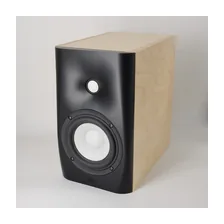 #1 Audio First Fidelia: £950 per pair for the flatpack kit (assembly required) Audio First Designs eBay
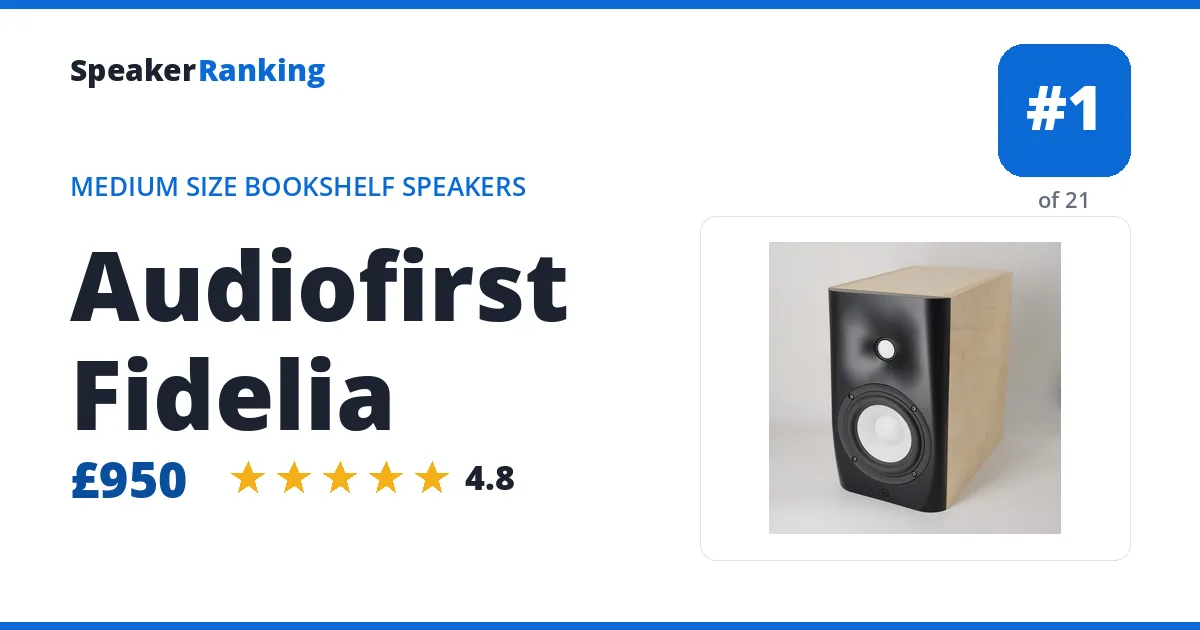
Pros: Kit speaker offering exceptional value and tonal accuracy; chosen by reviewer as reference standard for future speaker tonality comparisons despite 1,250 USD price point. Achieves bass extension to 53 Hz (F3) and 38 Hz (F10) from compact cabinet. Direct-from-manufacturer availability eliminates retailer markup. Measured bass extension of 53Hz (-3dB).
Cons: Kit assembly required; lower sensitivity (~83-85 dB vs. typical 85 dB average) demands adequate amplifier power. Only available direct from UK manufacturer with associated shipping costs and lead times. Trade-off between compact driver configuration and maximum dynamic output.
Full Audio First Fidelia review and specifications →
| Bass Extension (-10dB) | 38Hz (measured, Erin’s Audio Corner) |
|---|---|
| Bass Extension (-3dB) | 53Hz (measured, Erin’s Audio Corner) |
| Crossover Frequency | 1560Hz |
| DIY Kit | Yes |
| Dimensions | 11.8”H x 7.1”W x 11.7”D (300 x 180 x 297.6 mm) |
| Drivers | 5” ceramic-aluminum cone woofer, 1” ceramic-aluminum tweeter |
| Impedance | 4 ohms |
| Sensitivity | 84dB |
| Spinorama Preference Score | 6.45 |
| Spinorama Preference Score with Perfect Sub | 8.46 |
| Weight | 15 lbs (6.8 kg) each |
| Woofer Cabinet | ported, rear |
- Links
- Reviews, Comparisons and Sound Samples
- Erin’s Audio Corner: The #1 Reason audiophiles Are Raving About Fidelia’s Sound Quality More from Erin’s Audio Corner →
- Erin’s Audio Corner: I Tested 250 Speakers So You Don’t Have To!
- Erin’s Audio Corner: My Absolute Favorite Products of 2024 Revealed
- Erin’s Audio Corner Measurements (spinorama.org)
- Erin’s Audio Corner Website: Audio First Fidelia
- Head-to-Head Comparisons
- Audio First Fidelia vs Philharmonic Ceramic Mini
- Audio First Fidelia vs Ascend Sierra 1 v2
- Audio First Fidelia vs KEF LS50 Meta
- Audio First Fidelia vs XMechanik Mechano23 DIY
- Audio First Fidelia vs Ascend Acoustics HTM-200SE2
- Audio First Fidelia vs Arendal 1961 Monitor
- Audio First Fidelia vs Ascend Acoustics Luna V2 Mini-Monitor Titan
- Audio First Fidelia vs Aalto Speakers Aalto 1 EVO
- See all 26 comparisons
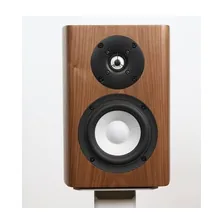 #2 Philharmonic Ceramic Mini: $900 per pair Philharmonic Audio eBay
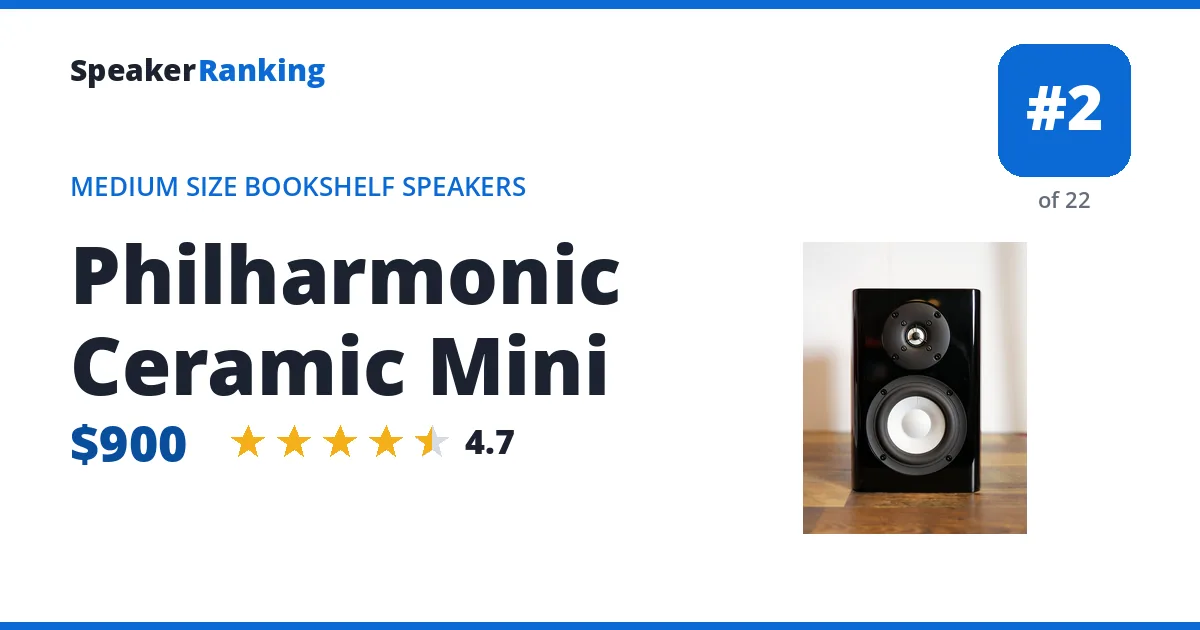
Pros: Gorgeous looks and finish options for the price. Very low midrange distortion for the size, well under 1% above about 400-500Hz. Excellent on-axis linearity. Mild, pleasant bass bump around 100Hz that adds welcome warmth without being excessive. Wide soundstage and dispersion (~70-80 degrees horizontally). Clean cabinet and port with no measured resonances. A great value combination of looks and performance at this price. Measured bass extension of 51Hz (-3dB), with a measured sensitivity of 82dB.
Cons: Somewhat limited output capability for its size: audible woofer compression (“flopping”) around 95dB at 3 meters for a stereo pair, so keep to moderate levels or pair with a subwoofer for home theater use. A mild diffraction-related dip around 4-6kHz can cause occasional sibilance on some vocal tracks. Measured sensitivity (82.2dB average) runs a bit below the manufacturer’s claimed 84dB, so it needs more amp power than the spec alone suggests. Needs a subwoofer for real bass authority below about 40Hz.
Full Philharmonic Ceramic Mini review and specifications →
| Bass Extension (-10dB) | 36Hz (measured, Erin’s Audio Corner) |
|---|---|
| Bass Extension (-3dB) | 51Hz (measured, Erin’s Audio Corner) |
| Country | USA (Vienna, Virginia) |
| Crossover Frequency | 2kHz (Linkwitz-Riley 4th order) |
| DIY Kit | No |
| Dimensions | 12” x 8.5” x 11.3” (305 x 216 x 286 mm) |
| Drivers | 5.25” ceramic woofer, 1” ceramic dome tweeter |
| Frequency Response | 55Hz - 20kHz (+1.5/-3dB, Manufacturer specified, ported) |
| Impedance | 4 ohms nominal (3.2 ohms min, 15 ohms max) (measured, Erin’s Audio Corner) |
| Sensitivity | 82dB (2.83V/1m, measured by Erin’s Audio Corner) |
| Spinorama Preference Score | 5.77 |
| Spinorama Preference Score with Perfect Sub | 7.78 |
| Weight | 17 lbs (7.7 kg) |
| Woofer Cabinet | ported, rear |
- Links
- Reviews, Comparisons and Sound Samples
- Head-to-Head Comparisons
- Philharmonic Ceramic Mini vs Ascend Sierra 1 v2
- Philharmonic Ceramic Mini vs Audio First Fidelia
- Philharmonic Ceramic Mini vs KEF LS50 Meta
- Philharmonic Ceramic Mini vs XMechanik Mechano23 DIY
- Philharmonic Ceramic Mini vs Ascend Acoustics HTM-200SE2
- Philharmonic Ceramic Mini vs Arendal 1961 Monitor
- Philharmonic Ceramic Mini vs Ascend Acoustics Luna V2 Mini-Monitor Titan
- Philharmonic Ceramic Mini vs Aalto Speakers Aalto 1 EVO
- See all 24 comparisons
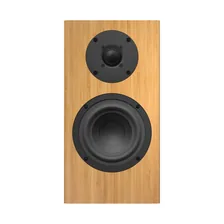 #3 Ascend Sierra 1 v2: $1000 per pair Ascend Acoustics eBay
Pros: Formaldehyde-free layered bamboo ply cabinet with a 1” dome tweeter over a 5.25” midwoofer, mated by a 4th-order acoustic crossover rather than a stock textbook design. In-room response is extremely linear (the reviewer called it “textbook”) a clear step up from the earlier V1, which had boxiness around 700Hz-1kHz and sibilance around 4-6kHz. Preference score of 8.4 with a subwoofer (6.8 without), which the reviewer calls topnotch. Wide, even horizontal radiation of about ±70° up to 6kHz. Better vertical directivity than its tweeter-to-woofer spacing would suggest, thanks to the steep 4th-order crossover slopes. No mechanical noise, port chuffing, or woofer bottoming even driven to 96dB/1m. In a three-way comparison against the Dynaudio Emit 20 and a Revel bookshelf model (all around $1,000/pair), measured as the most linear of the three and was the reviewer’s personal pick over both, despite the Dynaudio’s deeper bass and higher output capability. Independent ASR Klippel measurements corroborate Erin’s findings: superb off-axis response with only slight on-axis variations, and an in-room response the reviewer called “incredibly smooth and accurate. Amazing for a non-DSP speaker.” Distortion above 200Hz at 86dB/1m is very low for the class. Measured bass extension of 55Hz (-3dB), with a measured sensitivity of 81.5dB.
Cons: F3 of 55Hz and F10 of 39Hz mean in-room extension tops out in the mid-40s Hz; the reviewer still recommends a subwoofer for full-range material. Diffraction dips appear around 3kHz and 5-6kHz, and the 1” dome tweeter starts beaming above roughly 6.7kHz, narrowing the soundstage radiation in the top octave: a straightforward consequence of dome size rather than a design flaw. At 96dB/1m the 5.25” midwoofer shows increased distortion in the midrange, likely tied to motor topology; high-passing to a subwoofer around 80Hz largely clears it up. Moderate sensitivity (~81-82dB average) with a 7-ohm minimum impedance. ASR’s power-sweep testing found response holds steady up to 96dB SPL/1m, but pushing to 102dB causes midbass below 400Hz to sag with distortion “through the roof”: a harder output ceiling than the 96dB tests alone suggest. Vertical directivity also narrows above about 1kHz, so the reviewer recommends staying at tweeter-axis height for best results.
Full Ascend Sierra 1 v2 review and specifications →
| Bass Extension (-10dB) | 39Hz (measured, Erin’s Audio Corner) |
|---|---|
| Bass Extension (-3dB) | 55Hz (measured, Erin’s Audio Corner) |
| DIY Kit | No |
| Dimensions | 14.2”H x 7.5”W x 10.5”D (361.9 x 190.5 x 266.7 mm) |
| Drivers | 5.25” proprietary mineral-filled polypropylene cone with cast aluminum frame woofer, 26mm aluminum/magnesium alloy dome tweeter with titanium former (SEAS Titan) |
| Impedance | 8 ohms nominal, 7 ohms minimum (measured, Erin’s Audio Corner) |
| Sensitivity | 81.5dB (measured, Erin’s Audio Corner) |
| Spinorama Preference Score | 6.65 |
| Spinorama Preference Score with Perfect Sub | 8.61 |
| Weight | 18.5 lbs (8.4 kg) each |
| Woofer Cabinet | ported |
- Links
- Reviews, Comparisons and Sound Samples
- Erin’s Audio Corner: NEW! Ascend Acoustics Sierra-1 V2 Review More from Erin’s Audio Corner →
- Erin’s Audio Corner Website Ascend Sierra 1 v2
- Audio Science Review Ascend Sierra 1 v2 More from Audio Science Review →
- Erin’s Audio Corner: 5 AWESOME SPEAKERS Under $1000 You Won’t Regret
- Erin’s Audio Corner: I Tested 250 Speakers So You Don’t Have To!
- Erin’s Audio Corner: My Top Picks of 2023: Must-Haves Under $3000
- Manufacturer Measurements (spinorama.org)
- Head-to-Head Comparisons
- Ascend Sierra 1 v2 vs KEF LS50 Meta
- Ascend Sierra 1 v2 vs Philharmonic Ceramic Mini
- Ascend Sierra 1 v2 vs Audio First Fidelia
- Ascend Sierra 1 v2 vs XMechanik Mechano23 DIY
- Ascend Sierra 1 v2 vs Ascend Acoustics HTM-200SE2
- Ascend Sierra 1 v2 vs Arendal 1961 Monitor
- Ascend Sierra 1 v2 vs Ascend Acoustics Luna V2 Mini-Monitor Titan
- Ascend Sierra 1 v2 vs Aalto Speakers Aalto 1 EVO
- See all 50 comparisons
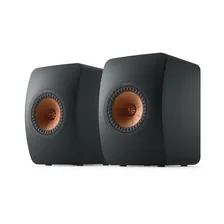 #4 KEF LS50 Meta: $1,599.00 per pair Amazon Crutchfield eBay
Pros: Uni-Q concentric driver mounts a 1” vented aluminum dome tweeter at the center of a 5.25” aluminum cone woofer, rated 79Hz-20kHz+. Speaker-to-speaker matching measured tight at roughly 0.5dB deviation between the pair tested, versus 2-3dB seen on some other speakers: likely why imaging stayed so precise. Imaging stays tight and focused even toed out, unlike most coincident designs where toe-out typically diffuses the image, giving more of an oval-shaped soundstage than a hard rectangular boundary. Horizontal and vertical directivity both hold to about ±50° at the -6dB point, so tonality stays consistent across roughly a 100° listening cone. The extended bass shelf is deliberately tuned for near-wall/boundary placement rather than the usual “pull it 3 feet into the room” advice, playing lower without excess boominess when placed close to a wall. At its frequent sale price, well below list, called a no-brainer for a compact stand-mount speaker. Independent ASR Klippel measurements corroborate this: very good directivity with the on- and off-axis curves tracking closely, and a predicted in-room response the reviewer called “very close to ideal.”. Measured bass extension of 68Hz (-3dB), with a measured sensitivity of 83dB.
Cons: F3 of 67Hz and F10 of 42Hz mean it doesn’t get much below 50Hz in-room; a subwoofer is recommended for real bass. A 2-3dB scoop around 2-4kHz shows up in both the listening window and sound power measurements, matching a subjectively noticed lack of attack and vocal clarity that the reviewer wanted to correct with about 2dB of EQ. An on-axis diffraction dip around 8kHz smooths out with about 15° of toe-out (typical for concentric designs, but still present at 0°). Distortion is elevated at low frequencies since the single 5.25” cone shares surface area with the tweeter housing, reducing effective radiating area; multitone distortion crosses the 3% threshold at 96dB/1m, making roughly 88dB or below the safer output ceiling. Moderate sensitivity (~83dB average) needed 2-3dB more amplifier gain than typical in testing. Adding a subwoofer at an 80Hz crossover only helps lower-midrange distortion, not the elevated distortion in the 1-2kHz and above-5kHz regions. ASR’s own Klippel testing found the same pattern in starker terms: THD is very good at 86dB SPL/1m but climbs past 100% in the bass at 96dB SPL/1m, confirming this is not a near-field speaker for high-output bass-heavy material. Cumulative spectral decay (waterfall) also shows a couple of resonances lingering in the 1-2kHz region.
Full KEF LS50 Meta review and specifications →
| Bass Extension (-10dB) | 43Hz (measured, Erin’s Audio Corner) |
|---|---|
| Bass Extension (-3dB) | 68Hz (measured, Erin’s Audio Corner) |
| DIY Kit | No |
| Dimensions | 11.9”H x 7.9”W x 11”D (302 x 200 x 280.5 mm) |
| Drivers | 130 mm (5.25 in.) aluminium cone woofer, 25 mm (1 in.) vented aluminium dome with Metamaterial Absorption tweeter |
| Impedance | 8 ohms nominal (3.7 ohms minimum above 80Hz, measured by Erin’s Audio Corner) |
| Sensitivity | 83dB (measured average, Erin’s Audio Corner; 85dB manufacturer specified) |
| Spinorama Preference Score | 5.74 |
| Spinorama Preference Score with Perfect Sub | 7.88 |
| Weight | 17.2 lbs (7.8 kg) each |
| Woofer Cabinet | ported, rear |
- Links
- Reviews, Comparisons and Sound Samples
- Erin’s Audio Corner: Unveiling the KEF LS50 Meta: The Truth Behind the Hype More from Erin’s Audio Corner →
- Erin’s Audio Corner Website KEF LS50 Meta
- Audio Science Review KEF LS50 Meta More from Audio Science Review →
- GR-Research: KEF LS50 Meta! Worthy of HYPE? More from GR-Research →
- Erin’s Audio Corner: My Top Picks of 2023: Must-Haves Under $3000
- Erin’s Audio Corner Measurements (spinorama.org)
- Head-to-Head Comparisons
- KEF LS50 Meta vs Ascend Sierra 1 v2
- KEF LS50 Meta vs Ascend Acoustics Luna V2 Mini-Monitor Ribbon
- KEF LS50 Meta vs Philharmonic Ceramic Mini
- KEF LS50 Meta vs XMechanik Mechano23 DIY
- KEF LS50 Meta vs Audio First Fidelia
- KEF LS50 Meta vs Ascend Acoustics HTM-200SE2
- KEF LS50 Meta vs Arendal 1961 Monitor
- KEF LS50 Meta vs SunAudio Purified 4
- See all 85 comparisons
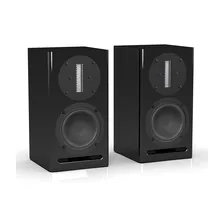 #5 Ascend Acoustics Luna V2 Mini-Monitor Ribbon: $1,248 per pair Ascend Acoustics eBay
Older model: the Ascend Sierra Luna (ranked lower, rated 1.6/5).
Pros: The same compact V-LAM bamboo cabinet and proprietary 4.5 inch glass fiber woofer as the Titan dome version, upgraded with a custom RAAL true ribbon tweeter that has roughly 1/50th the moving mass of a dome for faster transient response and more top end air. The sound power directivity index has a standard deviation of just 2.88, the tightest of any speaker added to this catalog from spinorama.org’s current measurement set, a real directivity benefit from the ribbon over the dome tweeter’s 3.14. Same 7 year warranty and hand matched pairs as the rest of Ascend’s lineup. Measured bass extension of 74.7Hz (-3dB).
Cons: On axis deviation still measures 0.573dB average, nearly as rough as the Titan dome version’s 0.599, so the ribbon upgrade mainly helps directivity consistency and top end extension rather than fixing on axis evenness. Costs about 39 percent more than the Titan dome version of this exact cabinet for what measures as very similar bass extension and sensitivity. Bass extension is still limited to a measured 74.7Hz at -3dB by the small woofer, and Ascend sells direct only with no dealer network for an in person audition.
Full Ascend Acoustics Luna V2 Mini-Monitor Ribbon review and specifications →
| Bass Extension (-10dB) | 44.3Hz (measured, spinorama.org vendor data) |
|---|---|
| Bass Extension (-3dB) | 74.7Hz (measured, spinorama.org vendor data) |
| Country | United States |
| DIY Kit | No |
| Dimensions | 10.6”H x 5.7”W x 6”D (270 x 146 x 152 mm) |
| Drivers | Custom RAAL 10mm true ribbon tweeter, 4.5” long throw glass fiber cone woofer |
| Enclosure | ported |
| Frequency Response | 75-27,000Hz +/-3dB anechoic (manufacturer) |
| Impedance | 8 ohms nominal |
| Power Handling | 100W continuous, 150W peak |
| Sensitivity | 82dB @ 2.83V/1m anechoic (manufacturer) |
| Spinorama Preference Score | 4.89 |
| Spinorama Preference Score with Perfect Sub | 7.50 |
| Warranty | 7 years parts and labor |
| Weight | 8.3 lbs (3.75 kg) each |
- Links
- Reviews, Comparisons and Sound Samples
- Head-to-Head Comparisons
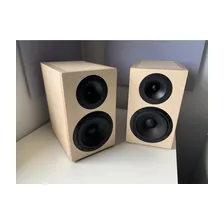 #6 XMechanik Mechano23 DIY: $200 per pair DIY parts Madisound (Tweeter) Madisound (Woofer) eBay
Pros: The bass alignment is unusually well damped, with a measured Q of 0.336, among the lowest of any speaker in this catalog, so the -3dB point at 77.6Hz rolls off cleanly instead of building into a resonant bump the way many small ported designs do. On axis deviation measures a tight 0.195dB average, and Audio Science Review’s independent Klippel NFS review called the predicted in room response nearly perfect, with directivity matching that beats some commercial designs costing many times more, all from about $48 in parts. Measured bass extension of 77.6Hz (-3dB), with a measured sensitivity of 85.1dB.
Cons: This is a true DIY project. There is no assembled unit to buy, drivers come from Madisound, the crossover kit comes separately from EZ Speaker Solutions, and the birch plywood cabinet has to be built and finished by hand. Listening window smoothness measures a moderate 0.47 and the sound power directivity index has more variation (standard deviation 4.02) than the tightest speakers in this catalog, so off axis energy isn’t quite as evenly controlled as the excellent on axis figures suggest.
Full XMechanik Mechano23 DIY review and specifications →
| Bass Extension (-10dB) | 42.4Hz (measured, Audio Science Review) |
|---|---|
| Bass Extension (-3dB) | 77.6Hz (measured, Audio Science Review) |
| Cabinet Material | 18mm Baltic birch plywood |
| Country | Design origin: United States (ASR forum); assembled by buyer |
| DIY Kit | Yes |
| Dimensions | 11.4”H x 6.9”W x 10.4”D (290 x 174 x 263 mm) |
| Drivers | Scan-Speak Discovery H2606/9200 1” horn loaded textile dome tweeter, SB Acoustics SB13PFCR25-4 5” fiber cone woofer |
| Enclosure | ported |
| Impedance | 4.1 ohms nominal (measured, ASR) |
| Port Tuning | Approximately 45Hz |
| Sensitivity | 85.1dB @ 2.83V/1m (measured, Audio Science Review) |
| Spinorama Preference Score | 5.42 |
| Spinorama Preference Score with Perfect Sub | 7.88 |
- Links
- Reviews, Comparisons and Sound Samples
- Head-to-Head Comparisons
- XMechanik Mechano23 DIY vs Ascend Acoustics HTM-200SE2
- XMechanik Mechano23 DIY vs Arendal 1961 Monitor
- XMechanik Mechano23 DIY vs KEF LS50 Meta
- XMechanik Mechano23 DIY vs Ascend Sierra 1 v2
- XMechanik Mechano23 DIY vs Philharmonic Ceramic Mini
- XMechanik Mechano23 DIY vs Ascend Acoustics Luna V2 Mini-Monitor Titan
- XMechanik Mechano23 DIY vs Aalto Speakers Aalto 1 EVO
- XMechanik Mechano23 DIY vs Audio First Fidelia
- See all 24 comparisons
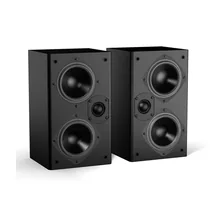 #7 Ascend Acoustics HTM-200SE2: $368 per pair Ascend Acoustics eBay
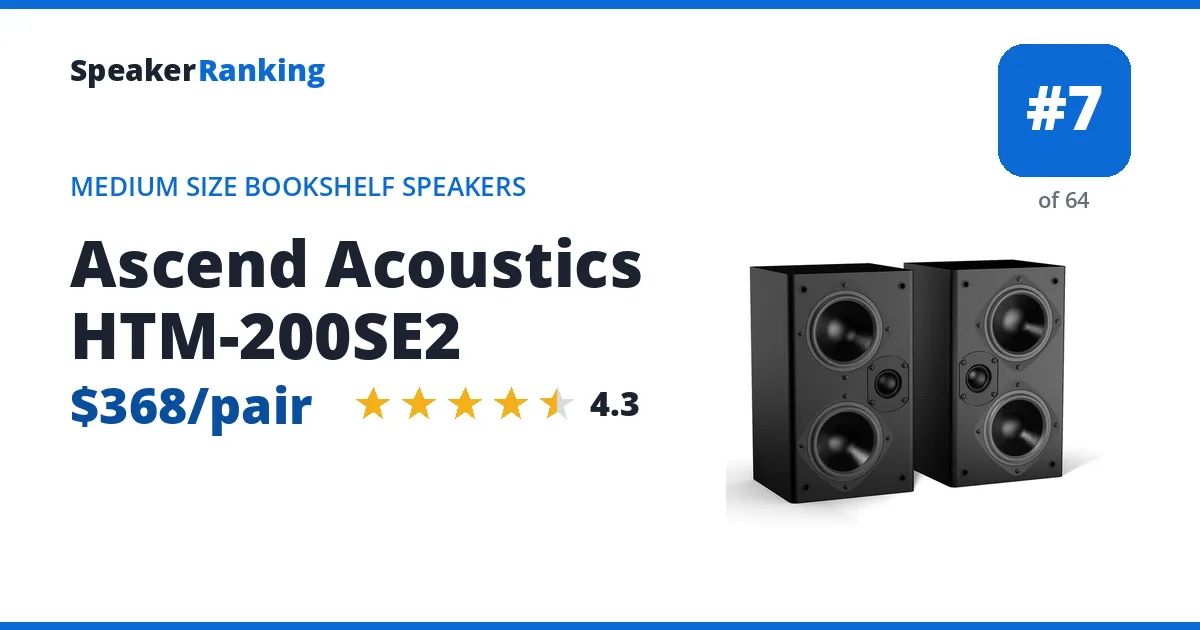
Pros: High-quality manufacturer NFS data shows 0.385dB on-axis average absolute deviation, 0.428 listening-window smoothness, and unusually even 80-degree dispersion in both planes. The compact sealed cabinet is easy to place, while the preference score reaches 7.90 with a subwoofer. Measured bass extension of 87.9Hz (-3dB), with a measured sensitivity of 86.0dB.
Cons: Limited bass is the main tradeoff, measuring 87.9Hz at -3dB, 71.8Hz at -6dB, and 51.3Hz at -12dB; its preference score falls to 4.98 without a subwoofer. The 3.62 sound-power directivity-index standard deviation is respectable rather than exceptional, and the small woofers limit deep-bass output.
Full Ascend Acoustics HTM-200SE2 review and specifications →
| Bass Extension (-10dB) | approximately 56Hz (measured, spinorama.org) |
|---|---|
| Bass Extension (-3dB) | 87.9Hz (measured, spinorama.org) |
| DIY Kit | No |
| Dimensions | 11”H x 6.5”W x 6.4”D (279 x 165 x 162 mm) |
| Drivers | Two 4-inch woofers; soft-dome tweeter |
| Enclosure | Sealed |
| Impedance | 8 ohms nominal |
| Sensitivity | 86.0dB (manufacturer specified); 85.2dB (measured, spinorama.org) |
| Spinorama Preference Score | 4.98 |
| Spinorama Preference Score with Perfect Sub | 7.90 |
| Weight | 9.9 lbs (4.5 kg) each |
- Links
- Reviews, Comparisons and Sound Samples
- Head-to-Head Comparisons
- Ascend Acoustics HTM-200SE2 vs XMechanik Mechano23 DIY
- Ascend Acoustics HTM-200SE2 vs Arendal 1961 Monitor
- Ascend Acoustics HTM-200SE2 vs KEF LS50 Meta
- Ascend Acoustics HTM-200SE2 vs Ascend Acoustics Luna V2 Mini-Monitor Titan
- Ascend Acoustics HTM-200SE2 vs Ascend Sierra 1 v2
- Ascend Acoustics HTM-200SE2 vs Aalto Speakers Aalto 1 EVO
- Ascend Acoustics HTM-200SE2 vs Philharmonic Ceramic Mini
- Ascend Acoustics HTM-200SE2 vs Audio First Fidelia
- See all 23 comparisons
 #8 Arendal 1961 Monitor: $1150 per pair Arendal Sound eBay
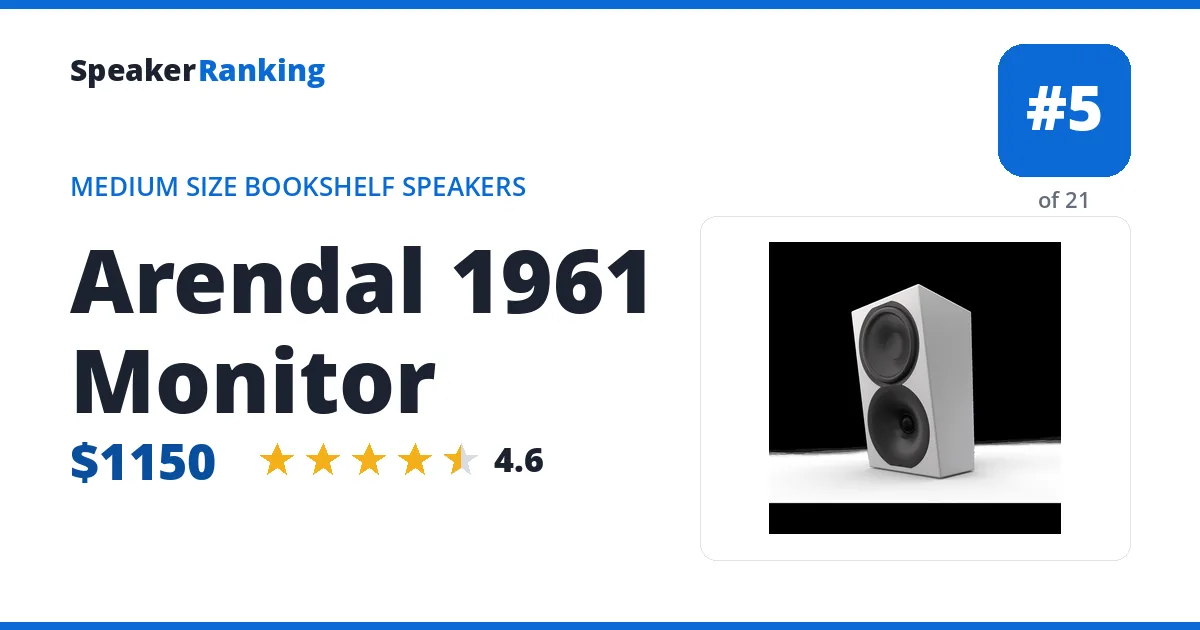
Pros: A physically robust build the reviewer calls “a little bit of a tank,” delivering low compression, low distortion, and overall really good neutrality: one of the reviewer’s top 10 picks under $1,500 across roughly 250 speakers tested. Works well both as home theater mains and as surrounds. Independent ASR Klippel measurements corroborate the low-distortion finding: THD at 86dB SPL/1m stays well below the reviewer’s audibility threshold, and even at 96dB SPL/1m it stays “far better than most bookshelves” thanks to the built-in high-pass filter that protects the woofers. Measured bass extension of 84Hz (-3dB), with a measured sensitivity of 85.9dB.
Cons: Bass rolls off around 70-80Hz, so it cannot be used as full-range mains for music without a subwoofer, and a sub is recommended for home theater use as well. Vertical radiation window is narrow, typical of MTM (mid-tweeter-mid) layouts (tighter than a standard two-way’s roughly ±20°) so a second home theater row sitting above or below the tweeter axis will hear a noticeably different tonal balance. ASR’s CEA2034 measurements show the response is elevated above 2kHz with resonant peaks around 3kHz and 9kHz, leading the reviewer to predict it will “likely sound bright.” Those same resonances show up as lingering ridges in the cumulative spectral decay (waterfall) at 96dB SPL/1m.
Full Arendal 1961 Monitor review and specifications →
| Bass Extension (-10dB) | 60Hz (measured, Erin’s Audio Corner) |
|---|---|
| Bass Extension (-3dB) | 84Hz (measured, Erin’s Audio Corner) |
| Crossover Frequency | 1500Hz |
| DIY Kit | No |
| Dimensions | 16.6”H x 6.4”W x 5.9”D (421.6 x 162.6 x 149.9 mm) |
| Drivers | 2 x 5.5” woofers, 28mm tweeter |
| Impedance | 4 ohms nominal (4.1 ohms minimum above 80Hz, measured by Erin’s Audio Corner) |
| Sensitivity | 85.9dB (measured average, Erin’s Audio Corner) |
| Spinorama Preference Score | 3.38 |
| Spinorama Preference Score with Perfect Sub | 6.69 |
| Weight | 16 lbs (7.25 kg) each |
| Woofer Cabinet | sealed |
- Links
- Reviews, Comparisons and Sound Samples
- Head-to-Head Comparisons
- Arendal 1961 Monitor vs SunAudio Purified 4
- Arendal 1961 Monitor vs Ascend Acoustics HTM-200SE2
- Arendal 1961 Monitor vs XMechanik Mechano23 DIY
- Arendal 1961 Monitor vs Ascend Acoustics Luna V2 Mini-Monitor Titan
- Arendal 1961 Monitor vs Aalto Speakers Aalto 1 EVO
- Arendal 1961 Monitor vs Moondrop M4P MTM
- Arendal 1961 Monitor vs KEF LS50 Meta
- Arendal 1961 Monitor vs Ascend Sierra 1 v2
- See all 56 comparisons
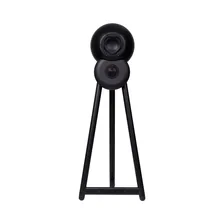 #9 SunAudio Purified 4: $3,650 per pair as tested; modular kit, pricing varies by driver/finish configuration SunAudio eBay
Pros: On-axis response is essentially dead flat from 100Hz to 20kHz, staying within about ±1dB through most of the band and widening only to a gentle +1.5dB rise in the top octave. The listening window curve tracks on-axis almost exactly, meaning off-axis output stays consistent rather than diverging. Both directivity index curves rise smoothly and monotonically from the bass straight through to 20kHz with no bumps, dips, or discontinuities: a sign of very well-integrated driver-to-driver handoff from the beryllium-dome tweeter. Early reflections and sound power both decline smoothly with frequency, with no resonant peaks anywhere in the response. The manufacturer’s own preference-score modeling comes out to 6.65 unequalized (rising to 9.36 with an ideal subwoofer) with a frequency deviation of just 0.8dB across 300Hz-5kHz: genuinely flagship-tier numbers for a 4-inch woofer design. Distinctive modular build: separate CNC-machined aluminum enclosures for the Purifi 4” woofer and BlieSMa T25A beryllium-dome tweeter, mounted on their own tripod stand, with cone-material and finish options. Measured sensitivity of 84.4dB.
Cons: A 4-inch woofer means real bass extension is limited (-3dB around 71Hz and -10dB around 53Hz) so a subwoofer is needed for anything below the low-100s. Measured sensitivity of 84.4dB is on the low side, meaning it needs more amplifier power than more efficient designs to reach the same volume. This is manufacturer self-measured data with no independent third-party review, so there’s no outside verification of distortion, unit-to-unit consistency, or how the reference crossover performs outside SunAudio’s own lab. The modular two-sphere design and tripod stand is unconventional, and pricing is steep for such a small woofer given the niche, boutique nature of the brand.
Full SunAudio Purified 4 review and specifications →
| Bass Extension (-10dB) | 53Hz (measured, manufacturer spinorama data) |
|---|---|
| Bass Extension (-3dB) | 71Hz (measured, manufacturer spinorama data) |
| DIY Kit | No |
| Dimensions | 34.6” x 12.2” x 11” (880 x 310 x 280 mm) |
| Drivers | BlieSMa T25A beryllium-dome tweeter (own CNC aluminum enclosure), Purifi 4” Ultra Low Distortion Extended woofer (PP-coated paper/fiber cone) |
| Impedance | 4 ohms |
| Power Handling | 200W long-term max (woofer) |
| Sensitivity | 84.4dB (2.83V/1m, measured, manufacturer spinorama data) |
| Spinorama Preference Score | 6.73 (manufacturer spinorama data) |
| Spinorama Preference Score with Perfect Sub | 9.44 (manufacturer spinorama data) |
| Woofer Cabinet | sealed, separate spherical driver modules on tripod stand |
- Links
- Reviews, Comparisons and Sound Samples
- Head-to-Head Comparisons
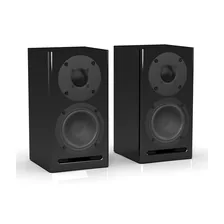 #10 Ascend Acoustics Luna V2 Mini-Monitor Titan: $898 per pair Ascend Acoustics eBay
Pros: A Klippel NFS optimized crossover and proprietary 4.5 inch long throw glass fiber woofer give this compact mini-monitor a large soundstage for its size, at Ascend’s most accessible price point. Backed by the same 7 year parts and labor warranty and hand matched pairs as Ascend’s larger models, with each unit shipped with its own production line frequency response printout. Measured bass extension of 74.7Hz (-3dB).
Cons: On axis deviation measures 0.599dB average, the roughest figure of any speaker added to this catalog from spinorama.org’s current measurement set, so a listener sitting dead center is more likely to notice unevenness than with the RAAL ribbon version of this same cabinet. Bass extension is limited by the small 4.5 inch woofer to a measured 74.7Hz at -3dB, so it needs a subwoofer for full range listening. Ascend sells direct only, with no dealer network for an in person audition.
Full Ascend Acoustics Luna V2 Mini-Monitor Titan review and specifications →
| Bass Extension (-10dB) | 45.7Hz (measured, spinorama.org vendor data) |
|---|---|
| Bass Extension (-3dB) | 74.7Hz (measured, spinorama.org vendor data) |
| Country | United States |
| DIY Kit | No |
| Dimensions | 10.6”H x 5.7”W x 6”D (270 x 146 x 152 mm) |
| Drivers | SEAS Titan 26mm aluminum/magnesium dome tweeter, 4.5” long throw glass fiber cone woofer |
| Enclosure | ported |
| Frequency Response | 75-27,000Hz +/-3dB anechoic (manufacturer) |
| Impedance | 8 ohms nominal |
| Power Handling | 100W continuous, 150W peak |
| Sensitivity | 82dB @ 2.83V/1m anechoic (manufacturer) |
| Spinorama Preference Score | 5.17 |
| Spinorama Preference Score with Perfect Sub | 7.78 |
| Warranty | 7 years parts and labor |
| Weight | 8.3 lbs (3.75 kg) each |
- Links
- Reviews, Comparisons and Sound Samples
- Head-to-Head Comparisons
- Ascend Acoustics Luna V2 Mini-Monitor Titan vs Aalto Speakers Aalto 1 EVO
- Ascend Acoustics Luna V2 Mini-Monitor Titan vs Moondrop M4P MTM
- Ascend Acoustics Luna V2 Mini-Monitor Titan vs Arendal 1961 Monitor
- Ascend Acoustics Luna V2 Mini-Monitor Titan vs Ascend Acoustics HTM-200SE2
- Ascend Acoustics Luna V2 Mini-Monitor Titan vs XMechanik Mechano23 DIY
- Ascend Acoustics Luna V2 Mini-Monitor Titan vs Monitor Audio Silver 50 7G
- Ascend Acoustics Luna V2 Mini-Monitor Titan vs KEF LS50 Meta
- Ascend Acoustics Luna V2 Mini-Monitor Titan vs Elac Carina BS243.4
- See all 22 comparisons
 #11 Aalto Speakers Aalto 1 EVO: €599 per pair Aalto Speakers eBay
Pros: Excellent local Spinorama results for a very compact passive speaker: 5.92 raw and 8.25 with a subwoofer. Its redesigned crossover, waveguided titanium tweeter and controlled directivity support neutral in-room response, while the recyclable Finnish composite enclosure is unusually compact.
Cons: Low 81.5dB sensitivity and a 3.3-ohm minimum impedance demand a capable amplifier. The measured 50Hz extension is respectable for the size but a subwoofer is still strongly recommended, and US distribution is limited.
Full Aalto Speakers Aalto 1 EVO review and specifications →
| Bass Extension (-10dB) | 47.4Hz (derived, log-interpolated between manufacturer spinorama -9dB/-12dB points) |
|---|---|
| Bass Extension (-3dB) | 53.4Hz (manufacturer spinorama data) |
| Country | Finland |
| DIY Kit | No |
| Dimensions | 9.5”H x 5.2”W x 8.2”D (242 x 132 x 208 mm) |
| Drivers | 1-inch titanium tweeter, 4-inch woofer |
| Enclosure | Passive 2-way bass reflex |
| Frequency Response | 53Hz-30kHz |
| Impedance | 4 ohms nominal, 3.3 ohms minimum |
| Power Handling | 15-100W |
| Sensitivity | 81.5dB/2.83V/1m |
| Spinorama Preference Score | 5.92 |
| Spinorama Preference Score with Perfect Sub | 8.25 |
| Weight | 5.3 lbs (2.4 kg) each |
- Links
- Reviews, Comparisons and Sound Samples
- Head-to-Head Comparisons
- Aalto Speakers Aalto 1 EVO vs Ascend Acoustics Luna V2 Mini-Monitor Titan
- Aalto Speakers Aalto 1 EVO vs Monitor Audio Silver 50 7G
- Aalto Speakers Aalto 1 EVO vs Arendal 1961 Monitor
- Aalto Speakers Aalto 1 EVO vs Ascend Acoustics HTM-200SE2
- Aalto Speakers Aalto 1 EVO vs XMechanik Mechano23 DIY
- Aalto Speakers Aalto 1 EVO vs Elac Carina BS243.4
- Aalto Speakers Aalto 1 EVO vs KEF LS50 Meta
- Aalto Speakers Aalto 1 EVO vs Ascend Sierra 1 v2
- See all 21 comparisons
 #12 Moondrop M4P MTM: $920 per pair Shenzhen Audio eBay
Pros: MTM (mid-tweeter-mid) two-way layout with dual 4” carbon-cone woofers flanking a 1” aluminum-magnesium dome tweeter, crossed over at 1.8kHz. Wide horizontal radiation of about ±60° through the midrange and still around ±50° near the tweeter, giving an expansive, enveloping soundstage on well-recorded stereo material. Noticeable mid-bass “thump” around 100-160Hz that adds a sense of punch and kick-drum impact, more pronounced than the reviewer’s Audiofirst Fidelia reference. Rolled-off, laid-back treble (roughly 1-2dB below linear) rather than the 2-5dB high-frequency boost common on speakers marketed as “detailed”: a plus for listeners who find brighter speakers fatiguing. Tonal balance stays consistent whether pointed straight on or toed out about 30°, so side-to-side seating position doesn’t change the sound much. At $920/pair in a compact monitor cabinet (13-14 lbs), reasonably priced for the format. Measured bass extension of 69Hz (-3dB), with a measured sensitivity of 85dB.
Cons: Vertical placement is very fussy: staying within about ±20° of the tweeter axis is essential, because the two woofers cancel each other through the crossover region (classic MTM lobing). Sit above or below that window and the upper midrange loses clarity and detail. SPL-limited: noticeable compression showed up both subjectively (thinner-sounding transients at 80-85dB/10 feet) and in measurements, with roughly 1.5dB of dynamic-range loss and about 3dB of added distortion under instantaneous compression testing. Harmonic distortion jumps substantially at 96dB versus 86dB (mostly second-order, so less audible than it looks on paper), and multitone distortion rides right at the reviewer’s 3% threshold at full output. Low impedance (3.7-ohm minimum, 1.7-ohm minimum EPDR) means a Class AB amp may run hot over longer sessions; a Class D amp is recommended for better thermal headroom. Designed primarily for nearfield use (about 1 meter); farfield listening is more of a gamble since dynamic range drops off noticeably at distance. Slight sibilance and a mild upper-midrange dip give a touch of a recessed, warm character alongside the bass emphasis. Bass reaches only about 50-60Hz in-room, and not with much volume before running into the SPL limits noted above.
Full Moondrop M4P MTM review and specifications →
| Bass Extension (-10dB) | 46Hz (measured, Erin’s Audio Corner) |
|---|---|
| Bass Extension (-3dB) | 69Hz (measured, Erin’s Audio Corner) |
| Crossover Frequency | 1800Hz |
| DIY Kit | No |
| Dimensions | 15”H x 6.1”W x 7.3”D (380 x 155 x 185 mm) |
| Drivers | 2x 4” (87mm) carbon cone woofer, 1” (25mm) aluminum/magnesium dome tweeter |
| Impedance | 4 ohms nominal, 3.7 ohms minimum (measured above 80Hz, Erin’s Audio Corner) |
| Power Handling | 75W rated / 150W max |
| Sensitivity | 85dB (measured average 300Hz-3kHz @ 2.83V/1m, Erin’s Audio Corner) |
| Spinorama Preference Score | 5.05 |
| Spinorama Preference Score with Perfect Sub | 7.59 |
| Weight | 13.7 lbs (6.2 kg) each |
| Woofer Cabinet | ported |
- Links
- Reviews, Comparisons and Sound Samples
- Head-to-Head Comparisons
- Moondrop M4P MTM vs Ascend Acoustics Luna V2 Mini-Monitor Titan
- Moondrop M4P MTM vs Arendal 1961 Monitor
- Moondrop M4P MTM vs Klipsch RP-500M II
- Moondrop M4P MTM vs KEF LS50 Meta
- Moondrop M4P MTM vs Ascend Sierra 1 v2
- Moondrop M4P MTM vs Wharfedale Diamond 12.1
- Moondrop M4P MTM vs Radiant Acoustics Clarity 4.2
- Moondrop M4P MTM vs KEF Q150
- See all 11 comparisons
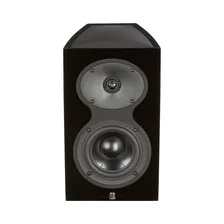 #13 Revel M105: $1500 per pair Discontinued eBay
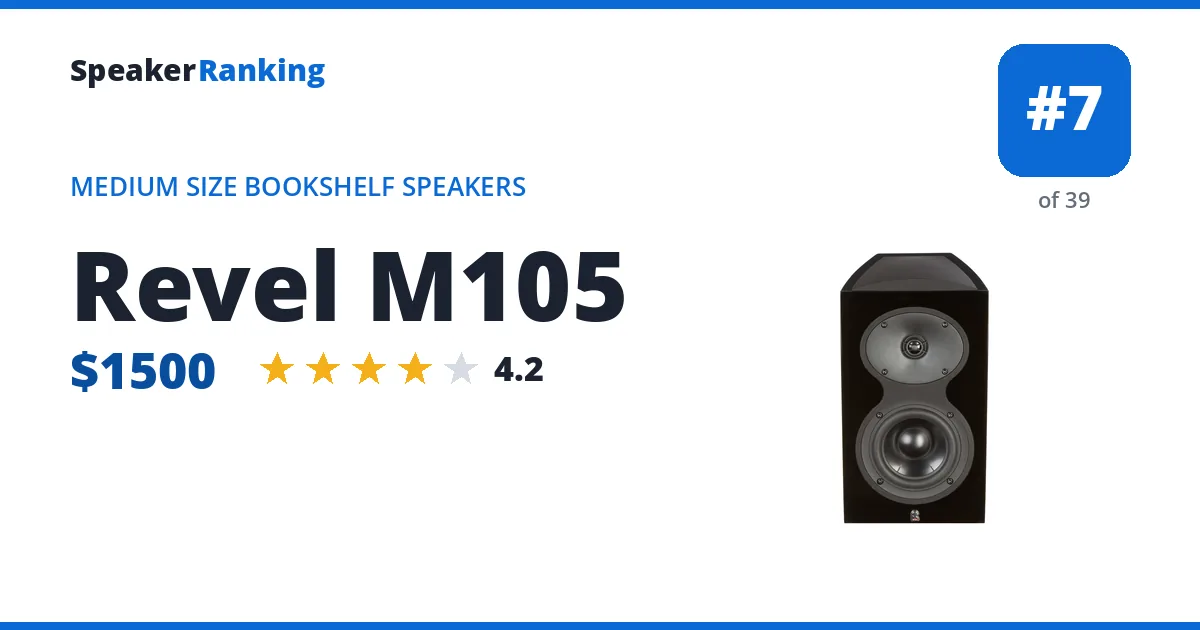
Pros: CEA2034 spinorama shows an essentially flat on-axis response with only a small 5kHz peak, a smooth listening window, and clean waterfall decay. Wide horizontal dispersion gives flexibility with toe-in. The reviewer called it reference-quality performance with minor EQ correction applied. Measured bass extension of 63Hz (-3dB), with a measured sensitivity of 85dB.
Cons: Low nominal impedance demands a capable amplifier that can handle low-impedance loads. Bass distortion runs high in the 80-250Hz range from woofer displacement, and maximum output is limited compared to larger designs. Discontinued.
Full Revel M105 review and specifications →
| Bass Extension (-10dB) | 49.8Hz (derived, log-interpolated between spinorama.org -9dB/-12dB points) |
|---|---|
| Bass Extension (-3dB) | 63Hz (measured, Audio Science Review) |
| DIY Kit | No |
| Dimensions | 14”H x 7.9”W x 9.8”D (355.6 x 200.7 x 248.9 mm) |
| Drivers | 5.25” aluminum cone woofer, 1” aluminum tweeter with acoustic lens waveguide |
| Frequency Response | 60Hz - 44kHz (+/-3dB) (Manufacturer specified) |
| Impedance | 8 ohms nominal, low minimum |
| Sensitivity | 85dB (2.83V/1m, measured, Audio Science Review) |
| Spinorama Preference Score | 5.76 |
| Spinorama Preference Score with Perfect Sub | 8.18 |
| Weight | 15.4 lbs (7 kg) each |
| Woofer Cabinet | ported, rear |
- Links
- Reviews, Comparisons and Sound Samples
- Head-to-Head Comparisons
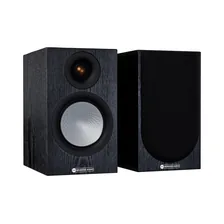 #14 Monitor Audio Silver 50 7G: $799 per pair Crutchfield eBay
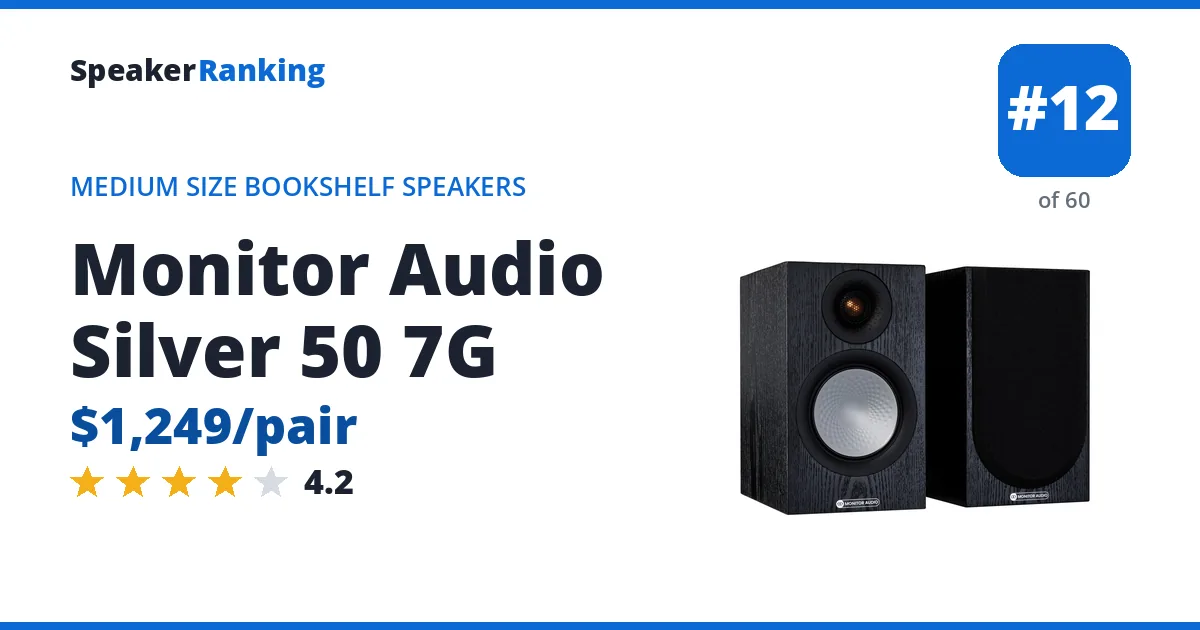
Pros: The 7th generation C-CAM Gold Dome tweeter with UD Waveguide II and RST II mid bass driver produce a listening window smoothness score of 0.50 at an accessible price, earning a Hi-Fi News Outstanding Product Award. A HiVe II reflex port system is tuned to 58Hz for real bass weight from a compact 5.25 inch two way. Measured bass extension of 87.9Hz (-3dB).
Cons: The on axis response trends noticeably upward toward the treble (rising about 0.5dB per octave, a steep tilt), which can read as bright on already bright recordings. Off axis sound also tracks the on axis response less consistently than most speakers here. Bass extension is limited to a measured 87.9Hz at -3dB, so a subwoofer is recommended for full range use, and minimum impedance dips to 3.9 ohms at 250Hz.
Full Monitor Audio Silver 50 7G review and specifications →
| Bass Extension (-10dB) | 50.7Hz (measured, Erin’s Audio Corner) |
|---|---|
| Bass Extension (-3dB) | 87.9Hz (measured, Erin’s Audio Corner) |
| Country | China |
| Crossover Frequency | 2.6kHz |
| DIY Kit | No |
| Dimensions | 11.1”H x 6.5”W x 10.7”D (282 x 165 x 272 mm) |
| Drivers | 1” C-CAM Gold Dome tweeter, 5.25” C-CAM RST II mid bass driver |
| Enclosure | ported |
| Impedance | 8 ohms nominal, 3.9 ohms minimum |
| Maximum SPL | 104dB (manufacturer specified) |
| Port Tuning | 58Hz |
| Power Handling | 100W RMS handling, 40-100W recommended amplifier power |
| Sensitivity | 86dB @ 2.83V/1m |
| Spinorama Preference Score | 5.40 |
| Spinorama Preference Score with Perfect Sub | 8.01 |
| Warranty | Lifetime, parts and labor |
| Weight | 12.3 lbs (5.6 kg) each |
- Links
- Reviews, Comparisons and Sound Samples
- Head-to-Head Comparisons
- Monitor Audio Silver 50 7G vs Revel M105
- Monitor Audio Silver 50 7G vs Elac Carina BS243.4
- Monitor Audio Silver 50 7G vs Aalto Speakers Aalto 1 EVO
- Monitor Audio Silver 50 7G vs Klipsch RP-500M II
- Monitor Audio Silver 50 7G vs Ascend Acoustics Luna V2 Mini-Monitor Titan
- Monitor Audio Silver 50 7G vs Wharfedale Super Denton
- Monitor Audio Silver 50 7G vs Arendal 1961 Monitor
- Monitor Audio Silver 50 7G vs Wharfedale Diamond 12.1
- See all 30 comparisons
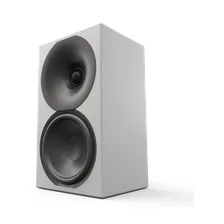 #15 Arendal Sound 1961 Bookshelf: $900 per pair Arendal Sound eBay
Pros: Direct-to-consumer pricing at $900/pair backed by a 10-year speaker warranty (5-year on electronics) and a 60-day home audition with free return shipping. On-axis response is close to flat for a compact sealed design, tilting by only about 0.09dB per octave. Compact sealed 5.5” woofer + 28mm tweeter 2-way layout in a small 28.7 x 16.3 x 15cm, 4.9kg cabinet. Measured bass extension of 108.4Hz (-3dB).
Cons: The sealed cabinet and compact 5.5” woofer cap bass extension at 108.4Hz (-3dB) / 54.9Hz (-10dB): the shallowest-extending speaker in this entire batch, a real tradeoff for the small footprint. On-axis response is somewhat uneven, with an average deviation of about 0.53dB, so it is less smooth than pricier active speakers. Direct-to-consumer model means no local dealer for an in-person audition before buying (mitigated by the 60-day home trial).
Full Arendal Sound 1961 Bookshelf review and specifications →
| Bass Extension (-10dB) | 54.9Hz (measured, spinorama.org) |
|---|---|
| Bass Extension (-3dB) | 108.4Hz (measured, spinorama.org) |
| DIY Kit | No |
| Dimensions | 28.7 x 16.3 x 15cm (11.3 x 6.4 x 5.9 in) each |
| Drivers | 28mm tweeter, 5.5” woofer |
| Impedance | 4 ohms nominal |
| Sensitivity | 84dB (2.83V/1m) |
| Spinorama Preference Score | 4.15 |
| Spinorama Preference Score with Perfect Sub | 7.14 |
| Weight | 10.8 lbs (4.9 kg) each |
| Woofer Cabinet | Sealed |
- Links
- Reviews, Comparisons and Sound Samples
- Head-to-Head Comparisons
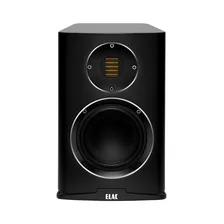 #16 Elac Carina BS243.4: $1,199 per pair B&H Photo Video ELAC eBay
Pros: JET folded-ribbon tweeter (ELAC’s signature technology, normally reserved for its pricier lines) mounted over a 5.25” aluminum-cone woofer, a genuinely differentiated tweeter for a sub-$1,200/pair stand-mount. Positively reviewed by Stereophile and The Absolute Sound for fatigue-free treble detail. Measured bass extension of 55.7Hz (-3dB).
Cons: On-axis response shows more ripple than pricier active speakers, with an average deviation of about 0.53dB, and its listening window is only middling in smoothness. Moderate 85dB sensitivity paired with a 4.8-ohm minimum impedance wants a reasonably powerful amp. Bass extension is average for a 5.25” 2-way at 55.7Hz (-3dB) / 41.5Hz (-10dB).
Full Elac Carina BS243.4 review and specifications →
| Bass Extension (-10dB) | 41.5Hz (measured, spinorama.org) |
|---|---|
| Bass Extension (-3dB) | 55.7Hz (measured, spinorama.org) |
| DIY Kit | No |
| Dimensions | 8.5” x 12.6” x 9.6” (216 x 319 x 245 mm) each |
| Drivers | JET folded-ribbon tweeter, 5.25” aluminum cone woofer |
| Impedance | 6 ohm nominal, 4.8 ohm minimum |
| Sensitivity | 85dB (2.83V/1m) |
| Spinorama Preference Score | 4.85 |
| Spinorama Preference Score with Perfect Sub | 6.99 |
| Weight | 14.8 lbs (6.7 kg) each |
| Woofer Cabinet | Bass reflex |
- Links
- Reviews, Comparisons and Sound Samples
- Head-to-Head Comparisons
- Elac Carina BS243.4 vs Arendal Sound 1961 Bookshelf
- Elac Carina BS243.4 vs Monitor Audio Silver 50 7G
- Elac Carina BS243.4 vs Wharfedale Super Denton
- Elac Carina BS243.4 vs Aalto Speakers Aalto 1 EVO
- Elac Carina BS243.4 vs Ascend Acoustics Luna V2 Mini-Monitor Titan
- Elac Carina BS243.4 vs Arendal 1961 Monitor
- Elac Carina BS243.4 vs Ascend Acoustics HTM-200SE2
- Elac Carina BS243.4 vs KEF Q150
- See all 22 comparisons
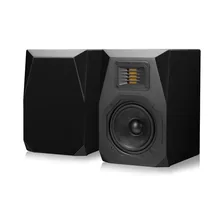 #17 Emotiva B1+: $250 per pair Discontinued eBay
Newer model: the Emotiva Airmotiv XB2, rated 4.2/5.
Pros: Emotiva B1+ uses 5.25” woven fiber cone with SBR surround woofer, 25x32 mm Airmotiv folded ribbon tweeter in a conventional wired-speaker design. Its form factor and driver layout make it a sensible match for a properly chosen amplifier and room. Measured bass extension of 70Hz (-3dB), with a measured sensitivity of 85dB.
Cons: It needs an external amplifier and thoughtful placement. Speaker performance will depend heavily on the partnering electronics and room acoustics. Discontinued.
Full Emotiva B1+ review and specifications →
| Bass Extension (-10dB) | 49Hz (measured, Erin’s Audio Corner) |
|---|---|
| Bass Extension (-3dB) | 70Hz (measured, Erin’s Audio Corner) |
| DIY Kit | No |
| Dimensions | 10.8”H x 7.1”W x 8.3”D (274 x 181 x 210 mm) |
| Drivers | 5.25” woven fiber cone with SBR surround woofer, 25x32 mm Airmotiv folded ribbon tweeter |
| Impedance | 8 ohms |
| Sensitivity | 85dB (measured, Erin’s Audio Corner) |
| Spinorama Preference Score | 5.34 (spinorama.org) |
| Spinorama Preference Score with Perfect Sub | 7.86 (spinorama.org) |
| Weight | 8.8 lbs (4.0 kg) each |
| Woofer Cabinet | ported, rear |
- Reviews, Comparisons and Sound Samples
- Head-to-Head Comparisons
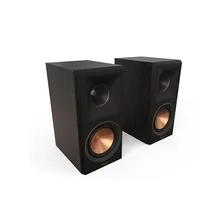 #18 Klipsch RP-500M II: $389.99 per pair Amazon eBay
Older model: the Klipsch RP-500M (ranked lower, rated 3.4/5).
Pros: Major mid-range clarity improvement over the original RP-500M: about a 5dB fill-in between 1-3kHz in the estimated in-room response, giving a noticeably more resolved, detailed midrange. More neutral and linear overall than its sibling RP-600M II, which carries about 2-3dB more high-frequency energy and a touch more bass but less overall balance. Very precise soundstage imaging and instrument placement. Distortion through the midrange is cleaner than the previous generation. Measured bass extension of 67Hz (-3dB), with a measured sensitivity of 85dB.
Cons: Klipsch’s quoted sensitivity (around 92-93dB) uses an unconventional in-room-based rating rather than the standard anechoic measurement; on an anechoic basis it measures closer to about 85dB, in line with typical bookshelf speakers this size, so it isn’t the outlier in efficiency the spec sheet implies. Horizontal dispersion of about ±40-50° is narrower and more directive than the reviewer’s preference for a wider, more enveloping soundstage. Toeing the speaker out to widen the soundstage or soften on-axis brightness comes at some cost to imaging precision. Slightly less clean in the tweeter region than the midrange, likely tied to crossover placement, though not considered a dealbreaker. Low-frequency output is limited: measured around 95dB at 4 meters for the pair before the woofers started to unload, so a subwoofer is recommended for anyone wanting real bass rather than stepping up to a larger model.
Full Klipsch RP-500M II review and specifications →
| Bass Extension (-10dB) | 53Hz (measured, Erin’s Audio Corner) |
|---|---|
| Bass Extension (-3dB) | 67Hz (measured, Erin’s Audio Corner) |
| Crossover Frequency | 1530Hz |
| DIY Kit | No |
| Dimensions | 13.6”H x 6.8”W x 10.6”D (344.4 x 173 x 270.5 mm) |
| Drivers | 5.25” Cerametallic™ cone woofer with Faraday rings, 1” LTS Titanium diaphragm tweeter with Hybrid Cross-Section Expanded Tractrix® horn |
| Impedance | 8 ohms nominal, 3.3 ohms minimum (measured, Erin’s Audio Corner) |
| Sensitivity | 85dB (measured, Erin’s Audio Corner) |
| Spinorama Preference Score | 5.22 |
| Spinorama Preference Score with Perfect Sub | 7.84 |
| Weight | 13 lbs (5.9 kg) each |
| Woofer Cabinet | ported, rear |
- Links
- Reviews, Comparisons and Sound Samples
- Head-to-Head Comparisons
- Klipsch RP-500M II vs Wharfedale Super Denton
- Klipsch RP-500M II vs Wharfedale Diamond 12.1
- Klipsch RP-500M II vs Monitor Audio Silver 50 7G
- Klipsch RP-500M II vs Radiant Acoustics Clarity 4.2
- Klipsch RP-500M II vs Revel M105
- Klipsch RP-500M II vs Moondrop M4P MTM
- Klipsch RP-500M II vs KEF Q150
- Klipsch RP-500M II vs Arendal 1961 Monitor
- See all 40 comparisons
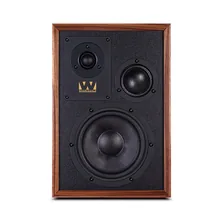 #19 Wharfedale Super Denton: $1499 per pair Crutchfield eBay
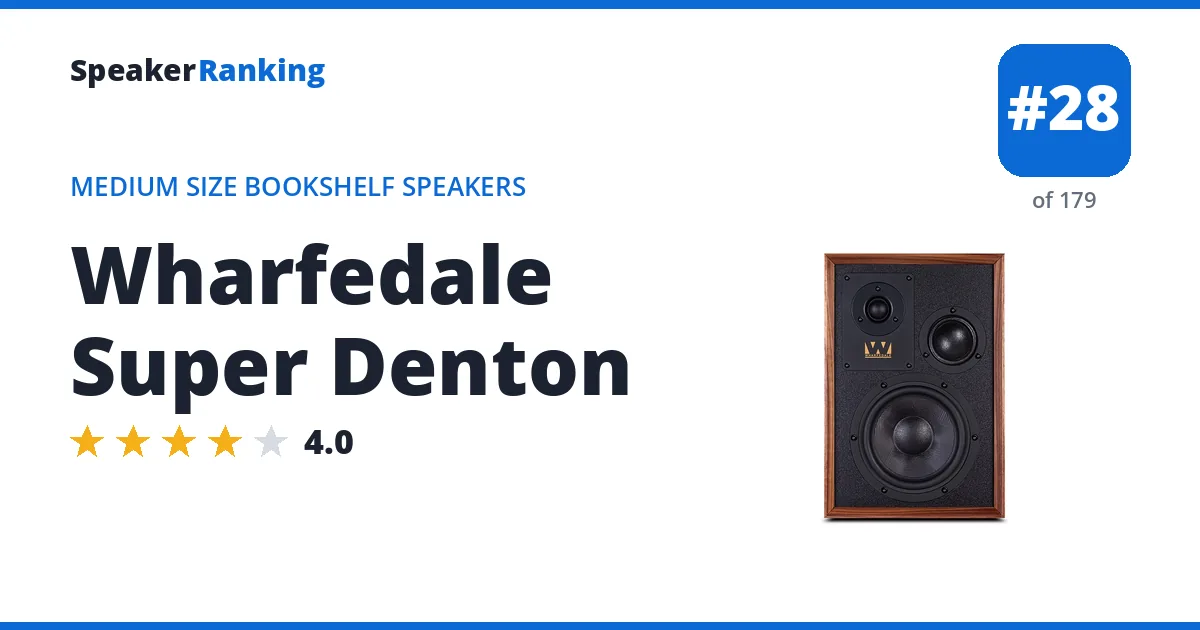
Pros: A 3-way design with a 1” soft dome tweeter, a 2” soft dome midrange offset to the side of a centered 6.5” woven Kevlar woofer: a more compact alternative to Wharfedale’s own Linton 85 with a similar overall character. Measured sensitivity around 86.6-87dB with on-axis linearity within about ±3dB. No cabinet or box resonances turned up in impedance testing, and there are no spike feet to install. Harmonic distortion looks good at both 86dB and 96dB, with about 20dB of usable dynamic range up to 96dB before compression starts to affect the midrange more noticeably near 102dB. Because bass rolls off starting around 60Hz, placing it closer to a wall (about 1-2 feet) than usual boosts low-end punch without the midbass bloat a deeper-extending speaker would get from the same placement. In the reviewer’s own comparison, its estimated in-room response actually measured more linear than the pricier Linton 85’s, despite being a bit less linear on-axis. Measured bass extension of 61Hz (-3dB), with a measured sensitivity of 86.6dB.
Cons: A mid-range scoop from about 200-800Hz and a separate upper-midrange scoop were both audible in direct ABX comparison against a reference-neutral speaker, giving aggressive-sounding material a more subdued character. A resonance around 660-700Hz shows up in measurement, though the reviewer couldn’t reliably hear it with real music in his own blind-ish A/B testing. The offset tweeter-and-midrange layout makes horizontal off-axis response noticeably asymmetric (response drops as much as 8dB more to one side than the other at wider angles) so the reviewer recommends aiming the speakers directly at the listener (not toed out, which loses upper treble) and suggests sidewall absorption to control uneven reflections. Must be listened to with the grille on: measurements are noticeably worse with it off (wider 2-4kHz dip, extra treble bump). Horizontal soundstage width felt a bit narrower than the reviewer personally prefers, likely related to the same offset driver layout. Multitone distortion gets high in the midrange at 96dB/1m, a concern mainly in larger rooms where you’d need to play louder.
Full Wharfedale Super Denton review and specifications →
| Bass Extension (-10dB) | 41Hz (measured, Erin’s Audio Corner) |
|---|---|
| Bass Extension (-3dB) | 61Hz (measured, Erin’s Audio Corner) |
| Crossover Frequency | 940Hz, 4.6kHz |
| DIY Kit | No |
| Dimensions | 14.2”H x 9.7”W x 10.8”D (360 x 246 x 275 mm) |
| Drivers | 1” soft dome tweeter, 2” soft dome midrange, 6.5” woven Kevlar woofer |
| Frequency Response | 52Hz - 20kHz (±3dB, manufacturer specified); -6dB to 40Hz |
| Impedance | 6 ohms nominal, 3 ohms minimum (measured, Erin’s Audio Corner) |
| Sensitivity | 86.6dB (measured by Erin’s Audio Corner) |
| Spinorama Preference Score | 5.9 (Erin’s Audio Corner) |
| Weight | 20.3 lbs (9.2 kg) each |
| Woofer Cabinet | ported |
- Links
- Reviews, Comparisons and Sound Samples
- Head-to-Head Comparisons
- Wharfedale Super Denton vs Klipsch RP-500M II
- Wharfedale Super Denton vs Wharfedale Diamond 12.1
- Wharfedale Super Denton vs Elac Carina BS243.4
- Wharfedale Super Denton vs Radiant Acoustics Clarity 4.2
- Wharfedale Super Denton vs Monitor Audio Silver 50 7G
- Wharfedale Super Denton vs Revel M105
- Wharfedale Super Denton vs KEF Q150
- Wharfedale Super Denton vs Aalto Speakers Aalto 1 EVO
- See all 43 comparisons
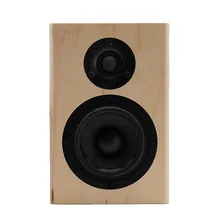 #20 Carmody S2000: $251.06 per pair Cinergy Audio eBay
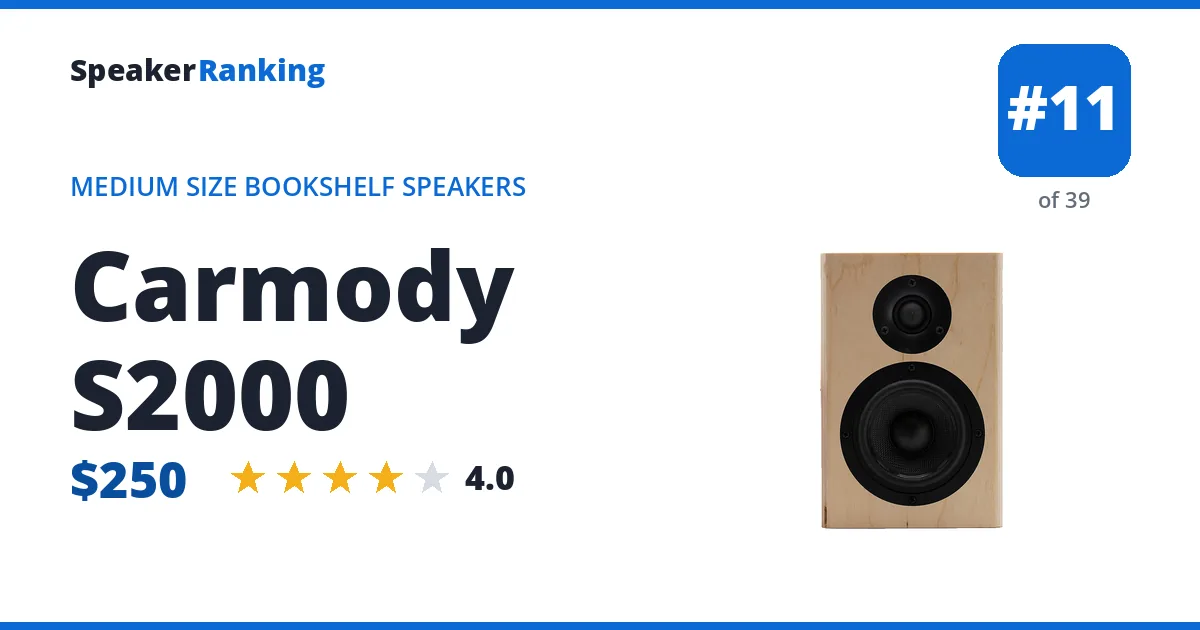
Pros: CEA2034 spinorama shows good response between 100Hz and 3kHz with low room dependency thanks to smooth early-window reflections, plus reasonably wide horizontal beamwidth and directivity. A DIY kit built around a small woofer and tweeter with a 3kHz crossover, priced around $126 per pair before assembly labor. Measured bass extension of 64.5Hz (-3dB), with a measured sensitivity of 84dB.
Cons: Energy falls off above 3kHz with a resonance around 11kHz, and directivity errors show up around the 4-5kHz crossover region. Low 84dB efficiency and an impedance that dips below 4 ohms both call for a capable amplifier. Vertical listening angle is sensitive: move off axis and you fall into a response “ditch” that loses energy.
Full Carmody S2000 review and specifications →
| Bass Extension (-10dB) | 49.8Hz (derived, log-interpolated between spinorama.org -9dB/-12dB points) |
|---|---|
| Bass Extension (-3dB) | 64.5Hz (measured, Audio Science Review) |
| DIY Kit | Yes |
| Dimensions | 6” x 15” x 9” (152 x 381 x 229 mm) |
| Drivers | small woofer + tweeter, 3kHz crossover (DIY kit) |
| Frequency Response | 50Hz - 20kHz (+/-5.9dB); 80Hz - 20kHz (+/-4.1dB) (measured, Audio Science Review) |
| Impedance | below 4 ohms minimum |
| Sensitivity | 84dB (measured, Audio Science Review) |
| Spinorama Preference Score | 4.42 (spinorama.org) |
| Spinorama Preference Score with Perfect Sub | 6.89 (spinorama.org) |
| Weight | 11 lbs (5.0 kg) |
| Woofer Cabinet | Baltic Birch plywood |
- Links
- Reviews, Comparisons and Sound Samples
- Head-to-Head Comparisons
 #21 Wharfedale Diamond 12.1: $599 per pair Discontinued eBay
Newer model: the Wharfedale Diamond 12.1i. It’s likely to perform similarly, though we don’t have measurements to confirm that yet.
Pros: A budget two-way bookshelf speaker (5” polypropylene woofer, 1” textile dome tweeter) that measures well for its price: harmonic distortion at 86dB stays under 1% THD down to about 60Hz, genuinely good for a 5” mid-woofer. Wide horizontal radiation of about ±60° up to roughly 5kHz before the tweeter starts to beam. Tonally smooth and easy to listen to at moderate volumes, with a pleasant, non-fatiguing character the reviewer said he’d happily recommend to someone who wants noticeably better fit, finish and looks than typical speakers in the $300-400 range. A high-pass crossover around 80Hz meaningfully cleans up midrange multitone distortion, so pairing it with a subwoofer helps more than usual for a speaker this size. Measured bass extension of 61Hz (-3dB), with a measured sensitivity of 84dB.
Cons: A dip of about 3dB in the 1-3kHz crossover region (on-axis, in the predicted in-room response, and even off-axis) gives the speaker a soft, “laid-back” character that noticeably saps attack and transient bite from drums, guitar and other percussive material: possibly an intentional BBC-style dip, but one the reviewer would still prefer tuned flat. Vertical directivity is unusually tight for this class of speaker, holding together only within about ±5° of the tweeter axis before a real hole opens up in the response, so seating height matters a lot more than on most bookshelf designs. Diffraction artifacts around 3kHz and 5kHz show up as differences between the listening-window and on-axis curves. Distortion climbs well past acceptable levels at higher output: harmonic distortion exceeds 3% around 150Hz at 96dB (versus under 1% at 86dB), multitone distortion tops 10% at 96dB/1m, and real compression sets in between 96-102dB (about 1.5dB of lost dynamic range around 300Hz at 102dB/1m, roughly equivalent to 92dB for a pair at 4m in a room). A genuine limitation on how loud or how far away this speaker can be pushed. Measured average sensitivity (84dB) runs a few dB below the 87dB spec. Only a 5” woofer, so a subwoofer is required for real bass. Discontinued.
Full Wharfedale Diamond 12.1 review and specifications →
| Bass Extension (-10dB) | 46Hz (measured, Erin’s Audio Corner) |
|---|---|
| Bass Extension (-3dB) | 61Hz (measured, Erin’s Audio Corner) |
| Crossover Frequency | 2.6kHz |
| DIY Kit | No |
| Dimensions | 12.2”H x 7”W x 10.9”D (310 x 178 x 277 mm) |
| Drivers | 5” advanced polypropylene cone woofer, 1” textile dome tweeter |
| Impedance | 8 ohms nominal (3.9 ohms minimum above 80Hz, measured, Erin’s Audio Corner) |
| Sensitivity | 84dB (measured by Erin’s Audio Corner; 87dB manufacturer specified) |
| Spinorama Preference Score | 5.01 |
| Spinorama Preference Score with Perfect Sub | 7.42 |
| Weight | 15 lbs (6.8 kg) each |
| Woofer Cabinet | ported |
- Links
- Reviews, Comparisons and Sound Samples
- Erin’s Audio Corner: Wharfedale 12.1 Budget Bookshelf Speaker with “Laid Back” sound but output limited. More from Erin’s Audio Corner →
- Audio Science Review Wharfedale Diamond 12.1 More from Audio Science Review →
- Erin’s Audio Corner Website: Wharfedale Diamond 12.1
- Audio Science Review Measurements (spinorama.org)
- Head-to-Head Comparisons
- Wharfedale Diamond 12.1 vs Carmody S2000
- Wharfedale Diamond 12.1 vs Radiant Acoustics Clarity 4.2
- Wharfedale Diamond 12.1 vs Wharfedale Super Denton
- Wharfedale Diamond 12.1 vs Klipsch RP-500M II
- Wharfedale Diamond 12.1 vs KEF Q150
- Wharfedale Diamond 12.1 vs Wharfedale Diamond 220
- Wharfedale Diamond 12.1 vs Monitor Audio Silver 50 7G
- Wharfedale Diamond 12.1 vs Revel M105
- See all 39 comparisons
 #22 Neumi BS5: $139.99 per pair Amazon eBay
Pros: Exceptional budget value: Erin measured approximately +/-1.5dB on-axis linearity through most of the mid/treble, 84dB/2.83V/1m sensitivity and a manageable 4.6-ohm minimum. The 5-inch fiberglass woofer and 1-inch silk dome provide good horizontal directivity for the price; a mild upper-bass rise adds punch, and ordinary modern AVRs can generally drive the mostly six-ohm load at sensible levels. Measured bass extension of 64Hz (-3dB), with a measured sensitivity of 84dB.
Cons: Erin measured F3 at 64Hz, so kick-drum punch should not be mistaken for deep-bass extension. Output around 90dB began to reveal distortion and compression, limiting farfield/high-volume use. A narrow dip near 800Hz, port/cabinet resonances and imperfect crossover directivity remain visible; the tweeter itself is approximately four ohms even though the system is sold as nominal six ohms. A subwoofer is strongly preferred.
Full Neumi BS5 review and specifications →
| Bass Extension (-10dB) | 41.0Hz (measured, Erin’s Audio Corner) |
|---|---|
| Bass Extension (-3dB) | 64Hz (measured, Erin’s Audio Corner) |
| DIY Kit | No |
| Dimensions | 10.6”H x 7.2”W x 8.5”D (269.2 x 182.9 x 215.9 mm) |
| Drivers | 1” silk-dome tweeter; 5” fiberglass woofer |
| Impedance | 4.6 ohms minimum; approximately 6 ohms nominal (measured, Erin’s Audio Corner) |
| Sensitivity | Approximately 84dB/2.83V/1m (measured, Erin’s Audio Corner) |
| Spinorama Preference Score | 3.60 |
| Spinorama Preference Score with Perfect Sub | 6.12 |
| Weight | 7.1 lbs (3.2 kg) each |
| Woofer Cabinet | ported, front |
- Links
- Reviews, Comparisons and Sound Samples
- Head-to-Head Comparisons
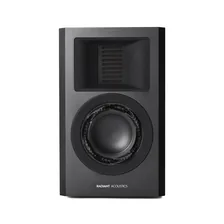 #23 Radiant Acoustics Clarity 4.2: $2,998 per pair Radiant Acoustics eBay
Pros: Compact bookshelf design using a 4” Purifi mid-woofer with matching Purifi passive radiators and an AMT tweeter on a purpose-designed waveguide, built with genuine heft: aluminum baffle, extensive internal bracing and damping. Surprisingly wide horizontal dispersion (about ±70° through the midrange and into the treble), more enveloping than its larger 6.2 sibling despite the smaller cabinet. More linear on-axis than the bigger Clarity 6.2, which needs 15-20° of toe-out to tame a rising treble; the 4.2 can be listened to closer to on-axis without that same correction. Wider-than-typical vertical dispersion (roughly +30°/-20°) for a two-way design, since its smaller woofer keeps the tweeter-to-woofer distance short. Genuinely deep bass extension for its size (F3 44Hz, reaching about 40Hz in-room), though it comes at a real cost to sensitivity. No resonance issues visible in impedance measurements. Measured bass extension of 44 Hz (-3dB).
Cons: Low sensitivity (rated 78dB, measured 78.5dB) is the trade-off for its bass extension: needs a fair amount of amplifier power, around 100W recommended for small-to-medium rooms versus the manufacturer’s own 60W baseline. Designed specifically for smaller rooms; the reviewer had to move testing out of his open-plan living room and into a smaller bedroom to avoid running into compression. A dip in the upper midrange gives a mild lack of attack and clarity, and a peak around 5kHz occasionally added a touch of extra sibilance. Multitone distortion crosses the reviewer’s 3% threshold at 96dB, making about 88dB a better average listening level; a slight upper-midrange bump persists even with an 80Hz high-pass filter applied. Dynamic range is limited: fine at 86dB, but the woofer starts giving up headroom by 96dB and drops off significantly by 102dB. Compared to its pricier sibling Clarity 6.2, has notably less dynamic range and higher multitone distortion, reflecting the smaller driver complement. A niche product size-wise: the reviewer couldn’t identify a clear direct competitor in the same size/price/SPL class.
Full Radiant Acoustics Clarity 4.2 review and specifications →
| Amplifier Power | External amplifier required |
|---|---|
| Bass Extension (-10dB) | 35 Hz (measured, Erin’s Audio Corner) |
| Bass Extension (-3dB) | 44 Hz (measured, Erin’s Audio Corner) |
| DIY Kit | No |
| Dimensions | 9.5”H x 6.3”W x 9.4”D (241 x 160 x 239 mm) |
| Drivers | (2) 4” (102mm) woofer + AMT tweeter |
| Frequency Response | 40 Hz - 25 kHz |
| Impedance | 4 ohms |
| Recommended Power | 50-200W |
| Sensitivity | 78 dB |
| Weight | 28.7 lbs (13 kg) (per pair: 57.3 lbs (26 kg)) |
| Woofer Cabinet | passive radiator |
- Links
- Reviews, Comparisons and Sound Samples
- Head-to-Head Comparisons
- Radiant Acoustics Clarity 4.2 vs Wharfedale Diamond 12.1
- Radiant Acoustics Clarity 4.2 vs KEF Q150
- Radiant Acoustics Clarity 4.2 vs Wharfedale Super Denton
- Radiant Acoustics Clarity 4.2 vs Klipsch RP-500M II
- Radiant Acoustics Clarity 4.2 vs Polk Audio XT15
- Radiant Acoustics Clarity 4.2 vs Moondrop M4P MTM
- Radiant Acoustics Clarity 4.2 vs Arendal 1961 Monitor
- Radiant Acoustics Clarity 4.2 vs KEF LS50 Meta
- See all 24 comparisons
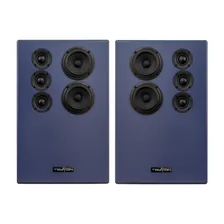 #24 Tekton Troubadour: $1,000 per pair Discontinued eBay
Pros: Offset in-phase array of 2x 5.25” mid-woofers and 3x 1” dome tweeters gives good on-axis linearity (within about ±2.5 dB) and a wide vertical listening window (about ±20°), so seating height isn’t fussy. Bass extension is solid for a stand-mount this size: F3 around 51 Hz, F10 around 39 Hz, with distortion staying below 3% THD down to about 40 Hz at 96 dB. Made in the USA. Asymmetrical tweeter/mid-woofer placement broadens horizontal dispersion versus a conventional symmetric layout. Measured bass extension of 51Hz (-3dB), with a measured sensitivity of 88dB.
Cons: Forward, elevated upper-midrange presentation from increased off-axis energy in the 2-8 kHz range, centered around 4 kHz, that can read as hot or aggressive depending on the room and listener; a couple bands of EQ can tame it. Multitone distortion climbs to about 10% around 1 kHz at higher output, attributed to the 4-inch mid-range drivers. Because the driver layout is offset rather than mirror-imaged, left/right placement and toe-in matter more than with a standard symmetric bookshelf design. Discontinued.
Full Tekton Troubadour review and specifications →
| Bass Extension (-10dB) | 39Hz (measured, Erin’s Audio Corner) |
|---|---|
| Bass Extension (-3dB) | 51Hz (measured, Erin’s Audio Corner) |
| Country | USA |
| DIY Kit | No |
| Dimensions | 21” x 13.5” x 9” (533 x 343 x 229 mm) |
| Drivers | 2x 5.25” mid-woofers, 3x 1” dome tweeters (offset in-phase array) |
| Impedance | 4 ohms nominal, 3.6 ohms minimum (measured above 80Hz, Erin’s Audio Corner) |
| Sensitivity | 88dB (measured average 300Hz-3kHz @ 2.83V/1m, Erin’s Audio Corner) |
| Spinorama Preference Score | 5.50 |
| Spinorama Preference Score with Perfect Sub | 7.52 |
| Weight | 32 lbs (14.5 kg) each |
- Reviews, Comparisons and Sound Samples
- Head-to-Head Comparisons
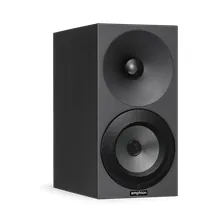 #25 Amphion Argon1: $1,919 per pair Amphion eBay
Pros: A well-regarded Finnish audiophile design praised by What Hi-Fi?, HomeTheaterReview, Audiophilia and The Ear for reference-quality midrange and surprisingly deep bass for its size. Compact at 7kg and 316mm tall, with a titanium tweeter and aluminum woofer in a two-way ported cabinet. Measured bass extension of 55.3Hz (-3dB).
Cons: The independent measurement tells a rougher story than the reviews suggest: on-axis deviation of 0.896dB and on-axis smoothness of just 0.154, with a moderate -0.11dB per octave downward tilt, consistent with a deliberately voiced rather than neutral-flat tuning. Directivity-index standard deviation of 3.33 and predicted in-room smoothness of 0.29 are both unremarkable, though a well-damped bass-alignment Q of 0.24, the tightest measured here, suggests a controlled low-end rolloff.
Full Amphion Argon1 review and specifications →
| Bass Extension (-10dB) | 41.2Hz (derived, log-interpolated between spinorama.org -9dB/-12dB points) |
|---|---|
| Bass Extension (-3dB) | 55.3Hz (measured, spinorama.org) |
| Country | Finland |
| DIY Kit | No |
| Dimensions | 12.4”H x 6.3”W x 10.4”D (316 x 160 x 265 mm) |
| Drivers | 1” titanium dome tweeter, 5.25” aluminum woofer |
| Enclosure | 2-way, ported |
| Frequency Response | 45-25,000Hz (-6dB) |
| Impedance | 8 ohms |
| Sensitivity | 86dB |
| Spinorama Preference Score | 4.79 |
| Spinorama Preference Score with Perfect Sub | 7.01 |
| Weight | 15.4 lbs (7 kg) each |
- Links
- Reviews, Comparisons and Sound Samples
- Head-to-Head Comparisons
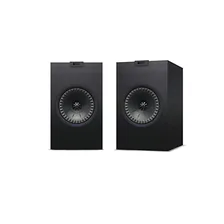 #26 KEF Q150: $350 per pair Discontinued Amazon eBay
Newer model: the KEF Q1 Meta, ranked lower, rated 3.6/5.
Pros: Two-way coaxial (Uni-Q) design with a 1” dome tweeter and 5.25” mid-range time-aligned in a single driver assembly, available in ported or sealed configuration. Exceptional soundstage depth, a hallmark of KEF’s coaxial designs that the reviewer says few other speakers match. Bass extension reaches into kick-drum territory, respectable for a compact bookshelf speaker. Resonances present in measurements are consistent across on- and off-axis readings, meaning they can be effectively corrected with EQ. Distortion profile is essentially the same whether run sealed or ported, since a subwoofer crossover point sits above where the differences would matter anyway. At its sale price (around $300, sometimes seen at $400), the reviewer considers it a clear step up from his previous budget favorite in this range, the Emotiva B1+, mainly due to the superior soundstage depth. Measured bass extension of 51Hz (-3dB), with a measured sensitivity of 85dB.
Cons: A high-frequency lift in the estimated in-room response makes it sound noticeably brighter in an untreated room than in a heavily acoustically-treated one: a real preference factor depending on your room’s furnishings. A mild dip in the 1-2kHz region reduces vocal fullness somewhat. Unexplained resonances appear in measurements and persist in both sealed and ported configurations, pointing to enclosure or panel vibration rather than the port. Horizontal radiation is narrower than the reviewer generally prefers from KEF’s lineup, with directivity that widens somewhat around 1.2kHz (near a resonance) and again above about 5kHz. Compression testing at high output (102dB) shows significant nonlinearity, especially at lower frequencies: noticeably worse than a comparable Arendal bookshelf speaker costing over twice as much, which held up better until 80Hz. Not intended for loud listening without a subwoofer: the woofer will over-exert itself without a high-pass filter, and the reviewer recommends crossing over at 80-120Hz. At full retail price (around $600/pair), the value proposition is far less certain than at sale pricing. Discontinued.
Full KEF Q150 review and specifications →
| Bass Extension (-10dB) | 44Hz (measured, Erin’s Audio Corner) |
|---|---|
| Bass Extension (-3dB) | 51Hz (measured, Erin’s Audio Corner) |
| DIY Kit | No |
| Dimensions | 11.9”H x 7.1”W x 10.9”D (303 x 180 x 278 mm) |
| Drivers | 130mm (5.25”) aluminium Uni-Q woofer, 25mm (1”) vented aluminium dome tweeter |
| Impedance | 8 ohms nominal, about 4.7 ohms minimum (measured, Erin’s Audio Corner) |
| Sensitivity | ~85dB (300Hz-3kHz on-axis, measured, Erin’s Audio Corner) |
| Spinorama Preference Score | 4.86 |
| Spinorama Preference Score with Perfect Sub | 7.06 |
| Weight | 12.3 lbs (5.6 kg) each |
| Woofer Cabinet | ported, rear |
- Links
- Reviews, Comparisons and Sound Samples
- Erin’s Audio Corner: Kef’s Cheapest Bookshelf. Is the Q150 worth your money? More from Erin’s Audio Corner →
- Erin’s Audio Corner Website KEF Q150
- GR-Research: KEF Q150… can it get any BETTER? More from GR-Research →
- Erin’s Audio Corner: 5 AWESOME SPEAKERS Under $1000 You Won’t Regret
- Erin’s Audio Corner: Budget Stereo Systems You Will Love
- Erin’s Audio Corner Measurements (spinorama.org)
- Head-to-Head Comparisons
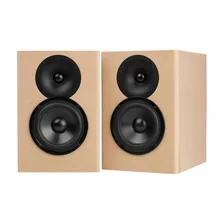 #27 Parts Express C-Note: $100 per pair Parts Express eBay
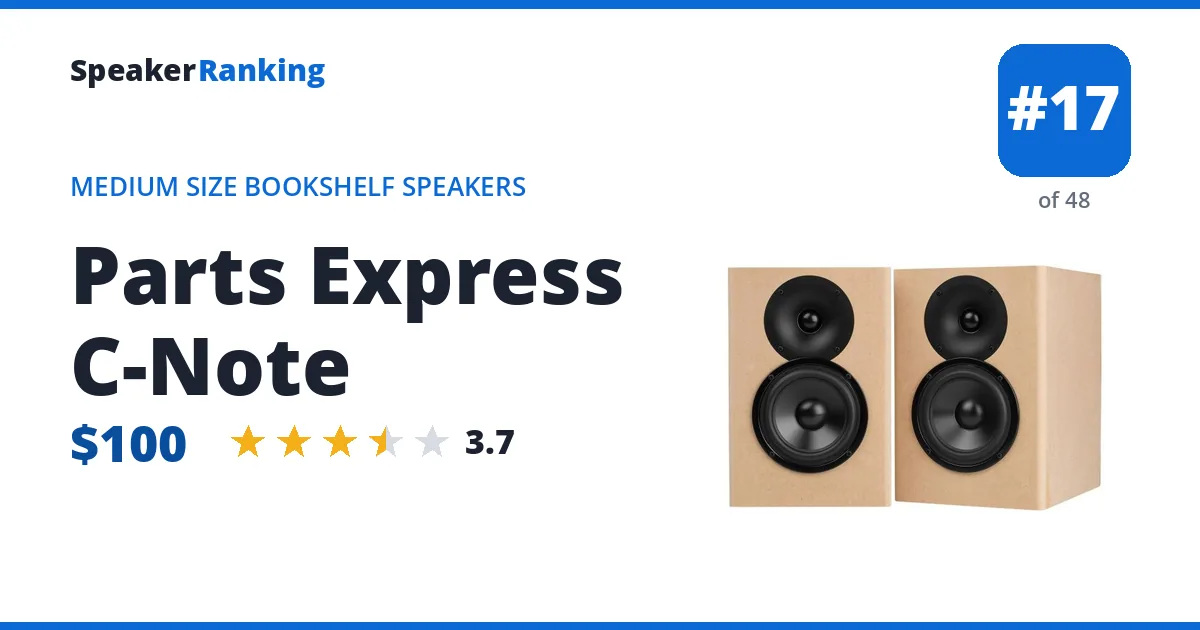
Pros: CEA2034 spinorama shows a reasonably flat response in the critical midrange with good directivity control near the crossover point, courtesy of a waveguide-integrated tweeter. High power handling let it play very loud in a large room with no sign of bottoming out: unusual for a $160 pair. The MDF cabinet felt stout in hand despite the unfinished, DIY flat-pack construction. Measured bass extension of 90Hz (-3dB), with a measured sensitivity of 83dB.
Cons: Reduced bass output and a resonance peak around 700Hz both show up clearly in the measurements; worst-case distortion above 1kHz sits about 40dB below listening level. Ships as unfinished MDF flat-pack cabinets, requiring assembly and finishing (gluing, painting or veneering) before use.
Full Parts Express C-Note review and specifications →
| Bass Extension (-3dB) | 90Hz (measured, Audio Science Review) - the reviewer explicitly flagged this measurement as unreliable below 70Hz, so no -10dB figure is given |
|---|---|
| DIY Kit | Yes |
| Dimensions | 11H x 7.5W x 9.5D in (unfinished MDF flat-pack) |
| Drivers | Dayton Audio DSA135-8 5” woofer, Dayton ND25FW-4 1” soft dome tweeter (waveguide-loaded) |
| Frequency Response | 43Hz - 20kHz +/-3dB (Manufacturer specified) |
| Impedance | 8 ohms |
| Power Handling | 60W RMS / 120W max |
| Sensitivity | 83dB (2.83V/1m, measured, Audio Science Review) |
| Spinorama Preference Score | 4.07 (spinorama.org) |
| Spinorama Preference Score with Perfect Sub | 6.78 (spinorama.org) |
| Woofer Cabinet | ported |
- Links
- Reviews, Comparisons and Sound Samples
- Head-to-Head Comparisons
 #28 Wharfedale Diamond 220: $299 per pair Discontinued eBay
Newer model: the Wharfedale Diamond 12.1i. It’s likely to perform similarly, though we don’t have measurements to confirm that yet.
Pros: Amir found the on-axis response smooth once the grille is removed, calling grille removal “a huge improvement” since the stock grille caused unusually strong comb filtering around 5kHz. Good horizontal dispersion from the waveguide-loaded tweeter and controlled distortion. After some EQ (a room mode filter and treble shelf), the reviewer called it “a truly hifi speaker” where “every audiophile track..sounded very good,” and said he was “happy to recommend” it for the budget class. Measured bass extension of 117.2Hz (-3dB), with a measured sensitivity of 86.9dB.
Cons: Response rolls off below 200Hz, so a subwoofer is recommended for full-range use. Some port rattling was noted at high volumes, traced to vibration rather than the woofer itself. Best performance requires removing the grille and applying the reviewer’s EQ filters. Discontinued, with only limited remaining stock available direct from Wharfedale.
Full Wharfedale Diamond 220 review and specifications →
| Bass Extension (-10dB) | 58.0Hz (measured, Audio Science Review) |
|---|---|
| Bass Extension (-3dB) | 117.2Hz (measured, Audio Science Review) |
| DIY Kit | No |
| Dimensions | 12.4”H x 6.9”W x 8.9”D (315 x 174 x 227 mm) |
| Drivers | 5” (130mm) woven Kevlar woofer, 1” (25mm) tweeter |
| Impedance | 8 ohms |
| Sensitivity | 86.9dB (2.83V/1m, measured, Audio Science Review; 86dB manufacturer specified) |
| Spinorama Preference Score | 3.40 |
| Spinorama Preference Score with Perfect Sub | 6.64 |
| Weight | 11.7 lbs (5.3 kg) each |
| Woofer Cabinet | ported, bottom-firing into secondary enclosure |
- Links
- Reviews, Comparisons and Sound Samples
- Head-to-Head Comparisons
- Wharfedale Diamond 220 vs Polk Audio XT15
- Wharfedale Diamond 220 vs KEF Q150
- Wharfedale Diamond 220 vs Boston Acoustics A25
- Wharfedale Diamond 220 vs Wharfedale Diamond 12.1
- Wharfedale Diamond 220 vs Wharfedale Super Denton
- Wharfedale Diamond 220 vs Klipsch RP-500M II
- Wharfedale Diamond 220 vs Monitor Audio Silver 50 7G
- Wharfedale Diamond 220 vs Revel M105
- See all 34 comparisons
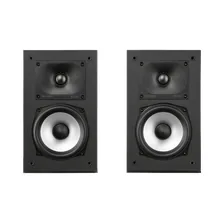 #29 Polk Audio XT15: $179.00 per pair Amazon B&H Photo Video Crutchfield eBay
Pros: Very low $179/pair entry price for a Hi-Res Audio Certified 2-way design that’s Dolby Atmos and DTS:X compatible, and works with either 4- or 8-ohm amplifier outputs so it drops into almost any AVR without matching concerns. Off axis sound tracks the on axis response reasonably consistently for the price. Measured bass extension of 77.6Hz (-3dB).
Cons: Bass rolls off early, at 77.6Hz (-3dB) and 54.2Hz (-10dB). On-axis response is relatively uneven, with an average deviation of about 0.45dB, and its listening window is less smooth than pricier speakers. Modest 86dB sensitivity wants a reasonably powered amp channel. The 5.25” bi-laminate paper woofer is Polk’s entry-tier driver, not the polypropylene/Turbine cones used in its pricier Signature Elite/Reserve lines.
Full Polk Audio XT15 review and specifications →
| Bass Extension (-10dB) | 54.2Hz (measured, spinorama.org) |
|---|---|
| Bass Extension (-3dB) | 77.6Hz (measured, spinorama.org) |
| DIY Kit | No |
| Dimensions | 16.51 x 18.24cm (6.5 x 7.18 in), 4.08kg (9 lb) each |
| Drivers | 1” Terylene dome tweeter, 5.25” bi-laminate paper woofer |
| Impedance | 4/8-ohm compatible |
| Sensitivity | 86dB (1W/1m) |
| Spinorama Preference Score | 4.56 |
| Spinorama Preference Score with Perfect Sub | 7.31 |
| Weight | 9 lbs (4.08 kg) each |
| Woofer Cabinet | Ported |
- Links
- Reviews, Comparisons and Sound Samples
- Head-to-Head Comparisons
- Polk Audio XT15 vs Wharfedale Diamond 220
- Polk Audio XT15 vs Neumi Silk 4
- Polk Audio XT15 vs KEF Q150
- Polk Audio XT15 vs Boston Acoustics A25
- Polk Audio XT15 vs Radiant Acoustics Clarity 4.2
- Polk Audio XT15 vs Neumi BS5
- Polk Audio XT15 vs Wharfedale Diamond 12.1
- Polk Audio XT15 vs Wharfedale Super Denton
- See all 43 comparisons
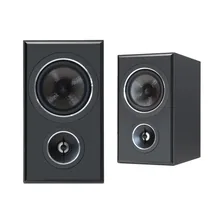 #30 PSB Imagine B50: $999 per pair PSB Speakers eBay
Pros: The standmount sibling to PSB’s Imagine T65 tower, from PSB’s current 2023-refreshed Imagine line, using the same titanium-dome tweeter and woven-carbon-fiber woofer platform. Measured bass extension of 69.6Hz (-3dB).
Cons: On-axis smoothness of just 0.235 and a deviation of 0.368dB are unremarkable for the price, with a +0.22dB per octave upward tilt giving it a brighter-leaning balance, a predicted in-room smoothness of just 0.35, and a Harman in-room bass extension estimate of only 49Hz. Current retail pricing ($999/pair) has risen well above the ~$700 figure recorded in the spinorama snapshot.
Full PSB Imagine B50 review and specifications →
| Bass Extension (-10dB) | 44.4Hz (derived, log-interpolated between spinorama.org -9dB/-12dB points) |
|---|---|
| Bass Extension (-3dB) | 69.6Hz (measured, Erin’s Audio Corner via spinorama.org) |
| Country | Canada (design) |
| DIY Kit | No |
| Dimensions | 6.75W x 11.8H x 9.875D in |
| Drivers | 1” titanium dome tweeter (ferrofluid neodymium magnet), 5.25” woven carbon-fiber woofer |
| Enclosure | 2-way, bass-reflex with rear slot port |
| Impedance | 8 ohms nominal, 4 ohms minimum |
| Sensitivity | 85dB anechoic / 87dB in-room |
| Spinorama Preference Score | 4.63 |
| Spinorama Preference Score with Perfect Sub | 6.92 |
| Weight | approx. 11.2 lbs (5.1 kg) each |
- Links
- Reviews, Comparisons and Sound Samples
- Head-to-Head Comparisons
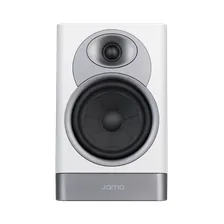 #31 Jamo S7-15B: $299.00 per pair Amazon eBay
Pros: Distinctive 7-degree tilted cabinetry, fabric-dome tweeter and a solid 4.52 raw local Spinorama score. With a subwoofer it reaches 6.66, while the compact format and magnetic grilles suit living-room use. Measured bass extension of 69.6Hz (-3dB).
Cons: Despite the 45Hz snapshot extension metric, Jamo specifies a conservative 71Hz +/-3dB bandwidth, so deep bass needs support. The four-ohm load and modest 86.3dB sensitivity require a capable amplifier.
Full Jamo S7-15B review and specifications →
| Bass Extension (-3dB) | 69.6Hz (measured, Erin’s Audio Corner via spinorama.org) |
|---|---|
| DIY Kit | No |
| Dimensions | 12.6H x 7.9W x 13.4D in |
| Drivers | 1-inch fabric tweeter, 5.5-inch paper woofer |
| Enclosure | 2-way bass reflex |
| Frequency Response | 71Hz-22kHz +/-3dB |
| Impedance | 4 ohms |
| Sensitivity | 86.3dB |
| Spinorama Preference Score | 4.52 |
| Spinorama Preference Score with Perfect Sub | 6.66 |
| Weight | 13 lbs (5.9 kg) each |
- Links
- Reviews, Comparisons and Sound Samples
- Head-to-Head Comparisons
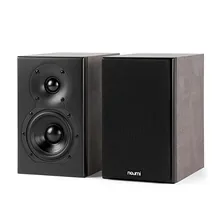 #32 Neumi Silk 4: $199.99 per pair Amazon eBay
Pros: A 4” midwoofer paired with a 1” dome tweeter and waveguide, with a second-order crossover, achieving an impressively high preference score of 4.4 for the price. Distortion stays below 1% up to about 120Hz and below 3% above roughly 50-60Hz at 86dB. High-frequency compression is surprisingly good (better than some speakers costing 2-3x as much) and at 96dB/1m for a pair, output still reaches about 93dB at 3 meters, plenty loud for most listeners. F3 of 83Hz and F10 of 55Hz with in-room extension to about 70Hz. Takes very well to EQ correction, and the reviewer provides a specific fix (a notch around 650Hz, Q of about 6) that cleans up its main resonance. Measured bass extension of 83Hz (-3dB), with a measured sensitivity of 82.6dB.
Cons: Very low sensitivity (measured 82.6dB), meaning it isn’t suited for large rooms, far-field listening, or high volume. A resonance around 650Hz (likely port- or cabinet-related) creates an audible 1-2dB midrange thickness/boxiness on certain tracks, tied to a probable baffle-step compensation shortfall: about 1dB more energy in the midrange from the factory would likely have resolved it. Multitone distortion becomes audible around the same 600Hz-1kHz region at 96dB. Horizontal radiation narrows to about ±50° with the waveguide, on the narrower side of what the reviewer prefers. A diffraction-related dip around 5kHz at 5° below the tweeter axis creates a small hole in the response if placed on a desk below ear level. Nominal impedance of about 6 ohms with a low sensitivity means it benefits from a subwoofer pairing (the reviewer suggests an 80Hz crossover) for a complete small-room or surround setup.
Full Neumi Silk 4 review and specifications →
| Bass Extension (-10dB) | 55Hz (measured, Erin’s Audio Corner) |
|---|---|
| Bass Extension (-3dB) | 83Hz (measured, Erin’s Audio Corner) |
| DIY Kit | No |
| Dimensions | 8.9”H x 5.5”W x 8.2”D (226.1 x 139.7 x 208.3 mm) |
| Drivers | 4” treated paper cone, rubber surround, cast aluminum basket, vented pole woofer, 1” silk dome, dispersion-optimized waveguide, neodymium magnet tweeter |
| Impedance | 6 ohms nominal, 5.7 ohms minimum (measured, Erin’s Audio Corner) |
| Sensitivity | 82.6dB (measured, Erin’s Audio Corner) |
| Spinorama Preference Score | 4.44 |
| Spinorama Preference Score with Perfect Sub | 7.10 |
| Weight | 6.2 lbs (2.8 kg) each |
| Woofer Cabinet | ported, rear |
- Links
- Reviews, Comparisons and Sound Samples
- Head-to-Head Comparisons
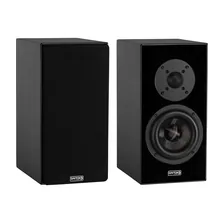 #33 Dayton Audio OPAL1: $1,038.99 per pair Dayton Audio eBay
Pros: A 2-way bookshelf speaker with a 5.25” mid-woofer (large surround) and a 1” dome tweeter, plus two passive radiators on the rear panel. A bass shelf in its response lets it sit closer to a wall than many speakers without sounding overly boomy, a similar design trait to the KEF R3 Meta. Measured F3 of about 55Hz and F10 of about 30Hz. Harmonic distortion is good for a 5.25” mid-woofer at both 86dB and 96dB output, and dynamic range/compression is reasonably well controlled up to about 96dB. Horizontal radiation of about ±60° lands right in the reviewer’s personally preferred range for soundstage width. On-axis, the sound is a little forward-leaning rather than dull, and EQ can bring back midrange fullness and a bigger sense of image spread if the stock tuning’s slightly recessed midrange isn’t to your taste. Measured bass extension of 55Hz (-3dB), with a measured sensitivity of 75.7dB.
Cons: Measured average sensitivity is notably low at about 75.7dB (well under the 78dB spec) due to a nearly 3dB dip through the midrange, and the reviewer needed serious amplification (monoblock power amps, not just a compact streaming amp) to drive them to real listening levels for bass testing. On-axis response is within only about ±3dB (a 6dB window) (not very linear) with a mid-range scoop and a bump around 1kHz that makes the sound a bit forward and less full than a neutral reference; EQ can address most of this but makes the image slightly more diffuse in exchange for added fullness. A roughly one-octave-wide diffraction dip between 3-5kHz can’t be corrected with EQ, since boosting it raises reflected energy in a band that’s already elevated off-axis. Top end rolls off fairly quickly above about 10kHz on-axis, and toeing the speakers out more than about 10° loses noticeable air and cymbal/hi-hat detail: best kept close to on-axis. Multitone distortion jumps substantially between 87dB and 96dB SPL/1m, so headroom for loud listening is limited. Vertical window is tight at about ±20°.
Full Dayton Audio OPAL1 review and specifications →
| Bass Extension (-10dB) | 30Hz (measured, Erin’s Audio Corner) |
|---|---|
| Bass Extension (-3dB) | 55Hz (measured, Erin’s Audio Corner) |
| Crossover Frequency | 2,200Hz |
| DIY Kit | No |
| Dimensions | 14”H x 7”W x 9.5”D |
| Drivers | 5.25” mid-woofer, 1” dome tweeter, dual rear passive radiators |
| Frequency Response | 32Hz - 20kHz (-3dB, half-space, manufacturer specified) |
| Impedance | 8 ohms nominal (4.3 ohms minimum @ 4.4kHz, measured, Erin’s Audio Corner) |
| Power Handling | 200W RMS (75-200W recommended amplifier power) |
| Sensitivity | 75.7dB (measured by Erin’s Audio Corner; 78dB manufacturer specified) |
| Spinorama Preference Score | 5.08 |
| Spinorama Preference Score with Perfect Sub | 6.58 |
| Weight | 20.7 lbs (9.4 kg) each |
| Woofer Cabinet | passive radiator, rear (dual) |
- Links
- Reviews, Comparisons and Sound Samples
- Head-to-Head Comparisons
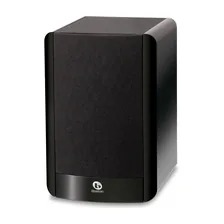 #34 Boston Acoustics A25: $299.98 per pair Discontinued eBay
Pros: CEA2034 spinorama is decent once you ignore a peak around 900Hz and a dip around 3kHz: directivity is good enough that the response can be EQed and won’t be too room-dependent. Cabinet fit and finish is well above its price class, and dynamics were strong with no distortion audible even at high volume on well-recorded material. Discontinued, but the reviewer suggests hunting for clearance pricing on remaining stock. Measured bass extension of 90Hz (-3dB), with a measured sensitivity of 85dB.
Cons: A crazy port resonance and a tweeter with a steeper rolloff than the woofer both show up in the near-field driver measurements, creating the 900Hz peak and the crossover-region dip. The rear port itself measured audibly distorted up close, though it wasn’t noticeable from normal listening distance in the reviewer’s room. Discontinued.
Full Boston Acoustics A25 review and specifications →
| Bass Extension (-10dB) | 55Hz (measured, Audio Science Review) |
|---|---|
| Bass Extension (-3dB) | 90Hz (measured, Audio Science Review) |
| DIY Kit | No |
| Dimensions | 10.7H x 7.25W x 8.9D in |
| Drivers | 1” Kortec soft dome tweeter, 5.25” ceramic/glass-fiber polymer mid/woofer |
| Frequency Response | 55Hz - 25kHz (Manufacturer specified) |
| Impedance | 8 ohms nominal |
| Power Handling | 10-150W recommended |
| Sensitivity | 85dB (2.83V/1m, measured, Audio Science Review) |
| Spinorama Preference Score | 3.53 |
| Spinorama Preference Score with Perfect Sub | 6.19 |
| Weight | 10.1 lbs (4.58 kg) each |
| Woofer Cabinet | ported, rear |
- Reviews, Comparisons and Sound Samples
- Head-to-Head Comparisons
- Boston Acoustics A25 vs Polk Audio XT15
- Boston Acoustics A25 vs Wharfedale Diamond 220
- Boston Acoustics A25 vs KEF Q150
- Boston Acoustics A25 vs JBL Studio 530
- Boston Acoustics A25 vs Wharfedale Diamond 12.1
- Boston Acoustics A25 vs ELAC Debut 2.0 B5.2
- Boston Acoustics A25 vs Sony SS-CS5 M2
- Boston Acoustics A25 vs Wharfedale Super Denton
- See all 31 comparisons
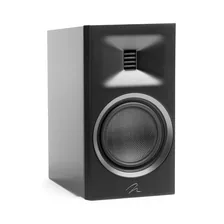 #35 MartinLogan Motion B10: $1,299.98 per pair Crutchfield eBay
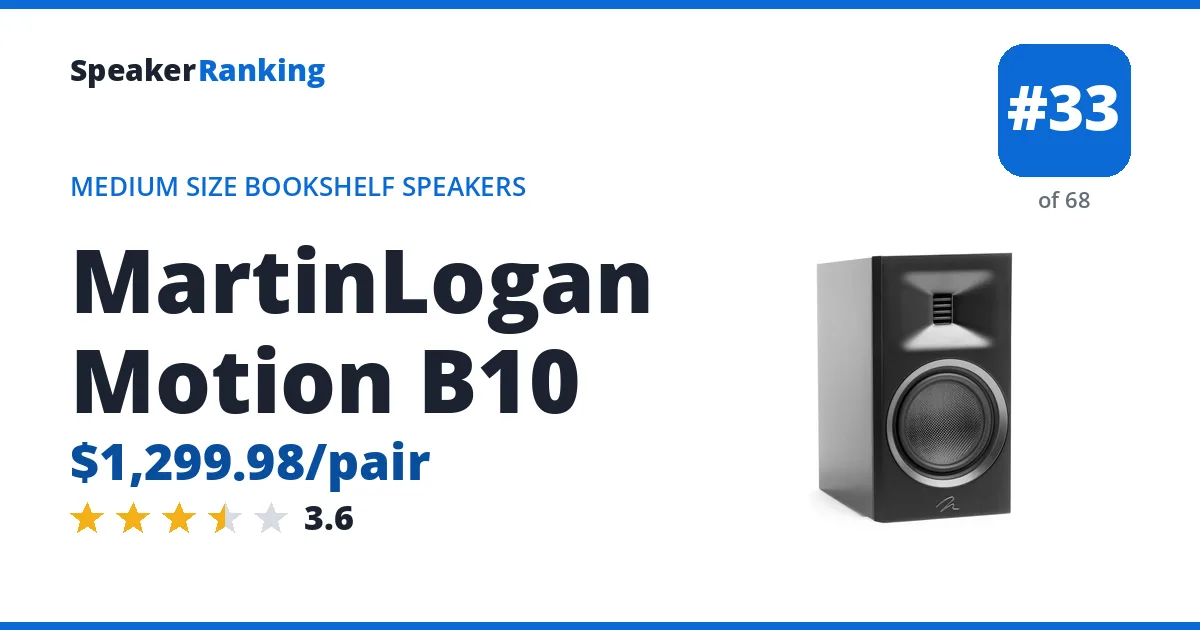
Pros: MartinLogan’s folded-motion tweeter technology (a 9.2 sq in diaphragm, larger than a typical dome) reaches this price point, with an excellent sound-power smoothness score of 0.111, meaning its off-axis output tracks its on-axis response unusually well. Sensitivity of 92dB makes it easy to drive. Measured bass extension of 74.7Hz (-3dB).
Cons: On-axis deviation of 0.669dB is rough for the price, with a pronounced +0.32dB per octave upward tilt giving it a notably bright balance, and predicted in-room smoothness of just 0.16, the roughest of any speaker measured here. Bass extension is shallow too, a Harman in-room estimate of just 62Hz.
Full MartinLogan Motion B10 review and specifications →
| Bass Extension (-10dB) | 56.1Hz (derived, log-interpolated between spinorama.org -9dB/-12dB points) |
|---|---|
| Bass Extension (-3dB) | 74.7Hz (measured, Erin’s Audio Corner via spinorama.org) |
| Country | United States (design) |
| DIY Kit | No |
| Dimensions | 12.5H x 7W x 9.75D in |
| Drivers | 1” x 1.4” Gen2 Obsidian Folded Motion tweeter, 5.5” woven fiberglass midrange |
| Enclosure | Rear-ported, 2-way |
| Impedance | 5 ohms nominal |
| Sensitivity | 92dB |
| Spinorama Preference Score | 4.01 |
| Spinorama Preference Score with Perfect Sub | 6.76 |
| Weight | 14.6 lbs (6.6 kg) each |
- Links
- Reviews, Comparisons and Sound Samples
- Head-to-Head Comparisons
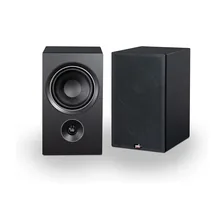 #36 PSB Alpha P5: $549 per pair PSB Speakers eBay
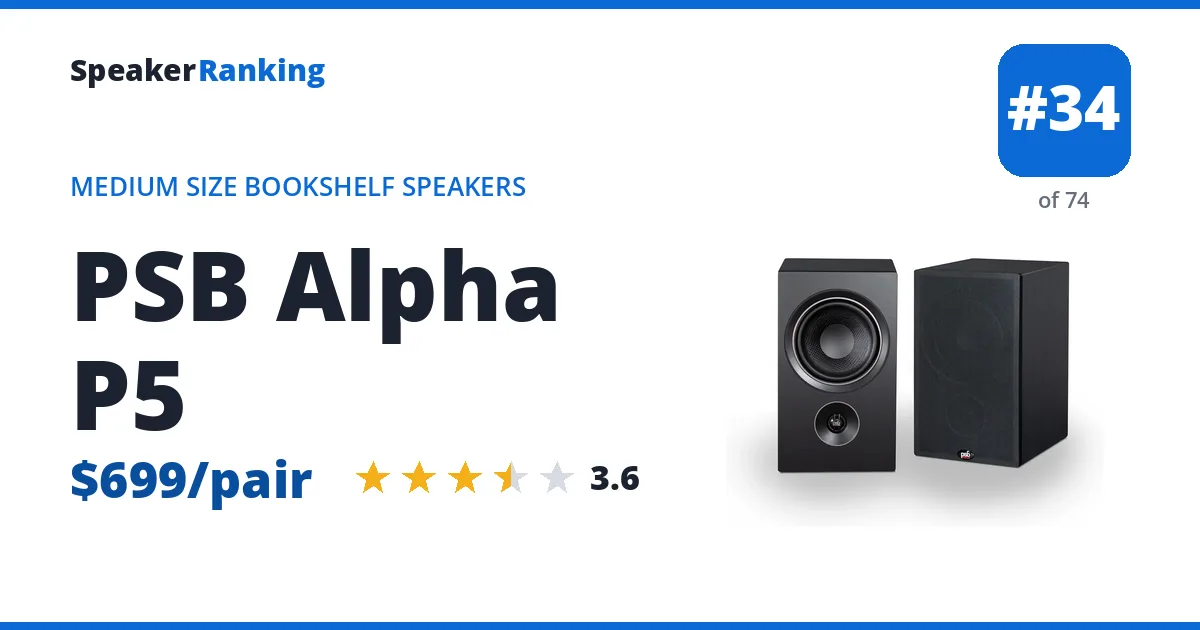
Pros: Well-behaved 5.25-inch bookshelf design with excellent 0.113 on-axis smoothness, a nearly flat +0.12dB/octave slope and broad roughly +/-60-degree horizontal coverage. ASR data predicts a 6.25 preference score with a subwoofer and 48Hz in-room extension. Measured bass extension of 58.6Hz (-3dB), with a measured sensitivity of 87dB.
Cons: Measured sensitivity is low at roughly 84dB, and the underdamped bass alignment (Q 0.42) trades some weight for control. Directivity-index consistency is middling at 3.67 and the raw no-subwoofer preference score is only 3.99.
Full PSB Alpha P5 review and specifications →
| Bass Extension (-3dB) | 58.6Hz (measured, ASR via spinorama.org) |
|---|---|
| DIY Kit | No |
| Dimensions | 11.4H x 6.7W x 9.5D in |
| Drivers | 0.75” dome tweeter, 5.25” woofer |
| Enclosure | 2-way passive, rear-ported |
| Impedance | 8 ohms |
| Sensitivity | 87dB specified; about 84dB measured |
| Spinorama Preference Score | 3.99 |
| Spinorama Preference Score with Perfect Sub | 6.25 |
| Weight | 10.1 lbs (4.6 kg) each |
- Links
- Reviews, Comparisons and Sound Samples
- Head-to-Head Comparisons
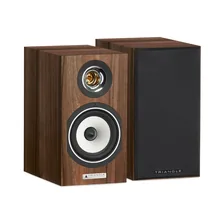 #37 Triangle Esprit Titus EZ: $1,099 per pair Triangle Hi-Fi eBay
Pros: High 90dB specified sensitivity, a lively horn-loaded titanium tweeter and compact real hi-fi cabinetry. Its local Spinorama scores are 4.24 raw and 6.98 with a subwoofer, supporting a capable small-room system. Measured bass extension of 73.4Hz (-3dB).
Cons: The 62Hz measured extension still calls for a subwoofer, while the 3.8-ohm minimum impedance demands a competent amplifier. Horn/directivity behavior makes setup and toe-in more consequential.
Full Triangle Esprit Titus EZ review and specifications →
| Bass Extension (-10dB) | 56.0Hz (derived, log-interpolated between spinorama.org -9dB/-12dB points) |
|---|---|
| Bass Extension (-3dB) | 73.4Hz (measured, spinorama.org) |
| DIY Kit | No |
| Dimensions | 12H x 6.6W x 10.5D in |
| Drivers | 1-inch titanium horn tweeter, 5-inch paper midwoofer |
| Enclosure | 2-way rear-ported |
| Frequency Response | 55Hz-22kHz |
| Impedance | 8 ohms nominal, 3.8 ohms minimum |
| Sensitivity | 90dB |
| Spinorama Preference Score | 4.24 |
| Spinorama Preference Score with Perfect Sub | 6.98 |
| Weight | 13 lbs (5.9 kg) each |
- Links
- Reviews, Comparisons and Sound Samples
- Head-to-Head Comparisons
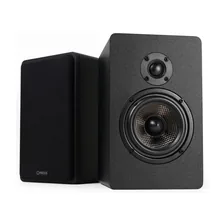 #38 Micca MB42X G2: $99.99 per pair Amazon eBay
Pros: An inexpensive compact passive speaker with a proper crossover and broad, useful dispersion. Its local Spinorama result reaches 6.80 with a subwoofer from a 4.18 raw score, excellent value when paired with basic amplification. Measured bass extension of 68.8Hz (-3dB), with a measured sensitivity of 82.7dB.
Cons: The 58Hz measured extension and small woofer limit deep bass and maximum output. Four-ohm loading can be demanding for the cheapest mini amplifiers, and the vinyl cabinet is plainly finished.
Full Micca MB42X G2 review and specifications →
| Bass Extension (-3dB) | 68.8Hz (measured, spinorama.org) |
|---|---|
| Bass Extension (-6dB) | 58Hz (measured, Spinorama) |
| Cabinet Color | Black vinyl |
| DIY Kit | No |
| Dimensions | 9.4”H x 5.8”W x 6.5”D (240 x 147 x 165 mm) |
| Drivers | 0.75-inch silk tweeter, 4-inch carbon-fiber woofer |
| Enclosure | 2-way rear-ported |
| Grille | Magnetic |
| Impedance | 4-8 ohms |
| Sensitivity | 82.7dB (measured average 300Hz-3kHz @ 2.83V/1m, spinorama.org); 86dB manufacturer specified |
| Spinorama Preference Score | 4.18 |
| Spinorama Preference Score with Perfect Sub | 6.80 |
| Weight | 11.2 lbs (5.1 kg) each |
- Links
- Reviews, Comparisons and Sound Samples
- Head-to-Head Comparisons
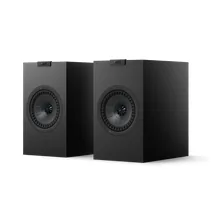 #39 KEF Q1 Meta: $399.99 per pair Amazon eBay
Older models: the KEF Q150 (ranked higher, rated 3.7/5) and the KEF Q100 (ranked lower, rated 2.4/5).
Pros: 12th generation Uni-Q coaxial driver places the 1” vented aluminium dome tweeter at the centre of the 5.25” aluminium woofer, with KEF’s Metamaterial Absorption Technology behind the tweeter. KEF’s own Spinorama measurements, published on spinorama.org, hold the 300Hz to 5kHz response within 2.3dB with a flat on-axis trend, so the tonal balance is even. Measured bass reaches 65Hz (-3dB) and about 43Hz (-10dB), respectable for a compact bookshelf. Same cabinet size as the Q150 it replaces. Measured bass extension of 65.1Hz (-3dB).
Cons: The only measurements are KEF’s own, not independently verified, and spinorama.org computes no preference score for them because the data is truncated at low frequencies. Sound power directivity is less even than the best in this class (3.16dB index deviation), so off-axis listeners and room reflections shift the balance more. Minimum impedance of 3.2 ohms is a harder load than the Q150’s, and rated maximum output is a modest 108dB, so plan on a subwoofer for loud listening.
Full KEF Q1 Meta review and specifications →
| Bass Extension (-10dB) | about 43.4Hz (measured, KEF vendor data via spinorama.org) |
|---|---|
| Bass Extension (-3dB) | 65.1Hz (measured, KEF vendor data via spinorama.org) |
| Cabinet Color | Satin Black, Satin White, Walnut |
| Crossover Frequency | 2.1kHz |
| Dimensions | 11.9”H x 7.1”W x 10.9”D (302 x 180 x 277 mm) |
| Drivers | Uni-Q: 130mm (5.25”) aluminium cone woofer, 25mm (1”) vented aluminium dome tweeter with MAT |
| Frequency Response | 51Hz-20kHz ±3dB (manufacturer specified) |
| Impedance | 4 ohms nominal, 3.2 ohms minimum (manufacturer specified) |
| Maximum SPL | 108dB (manufacturer specified) |
| Recommended Power | 10-150W |
| Sensitivity | 86dB (2.83V/1m, manufacturer specified) |
| Weight | 13.4 lbs (6.1 kg) each |
| Woofer Cabinet | ported |
- Links
- Reviews, Comparisons and Sound Samples
- Head-to-Head Comparisons
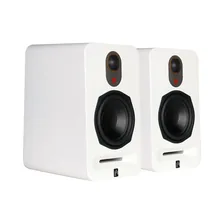 #40 Aperion Audio Novus N5B: $449.25 per pair Aperion Audio eBay
Pros: Compact front-ported bookshelf pair with a silk-dome tweeter, 5.25-inch aramid woofer and wall-mount inserts. Erin’s data shows a nearly flat +0.02dB/octave tonal slope, 47Hz extension and a 5.98 preference score with a subwoofer. Measured bass extension of 58.6Hz (-3dB), with a measured sensitivity of 85dB.
Cons: Measured sensitivity is very low at about 81.6dB and the 4-ohm load benefits from a capable amplifier. On-axis smoothness (0.221) is only fair, predicted in-room smoothness is poor at 0.160, and the raw no-subwoofer preference score is 3.76.
Full Aperion Audio Novus N5B review and specifications →
| Bass Extension (-3dB) | 58.6Hz (measured, Erin’s Audio Corner via spinorama.org) |
|---|---|
| DIY Kit | No |
| Dimensions | 11.8H x 7.1W x 7.9D in |
| Drivers | 1” silk-dome tweeter, 5.25” aramid-fiber woofer |
| Enclosure | 2-way passive, front-ported |
| Impedance | 4 ohms |
| Sensitivity | 85dB specified; 81.6dB measured |
| Spinorama Preference Score | 3.76 |
| Spinorama Preference Score with Perfect Sub | 5.98 |
| Weight | 9.9 lbs (4.5 kg) each |
- Links
- Reviews, Comparisons and Sound Samples
- Head-to-Head Comparisons
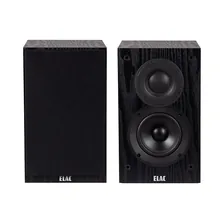 #41 ELAC BS41: $180.00 per pair Discontinued Amazon eBay
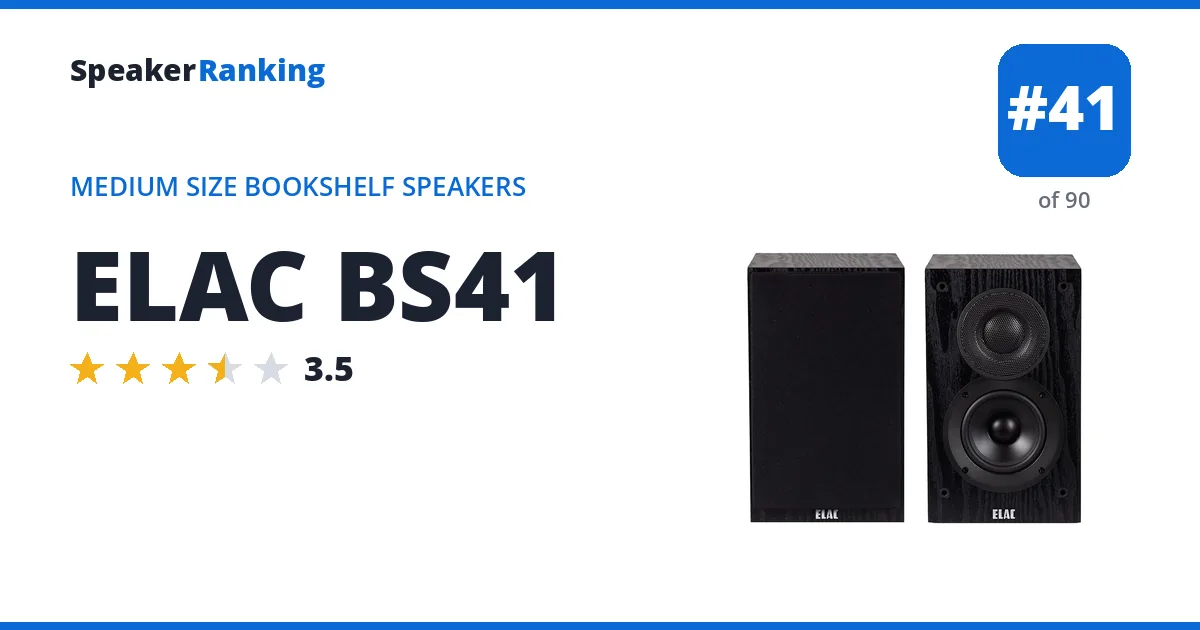
Pros: A small sealed two-way with a 4-inch woofer and a 1-inch tweeter that measures more evenly than its low price suggests. Erin’s Audio Corner found the listening window within a 2.5dB span from 300Hz to 5kHz and a predicted in-room response smoothness of 0.60, for a preference score of 4.29 (6.57 with an ideal subwoofer). Bass reaches about 54Hz (-3dB) and 47Hz (-10dB), and the sealed box makes it easy to place near a wall. Measured bass extension of 54.2Hz (-3dB).
Cons: The sealed 4-inch woofer limits output and deep bass, so it suits small rooms or pairing with a subwoofer. Sensitivity is a modest 84.5dB. It is discontinued and mostly found used.
Full ELAC BS41 review and specifications →
| Bass Extension (-10dB) | 46.9Hz (measured, Erin’s Audio Corner) |
|---|---|
| Bass Extension (-3dB) | 54.2Hz (measured, Erin’s Audio Corner) |
| DIY Kit | No |
| Drivers | 4” woofer, 1” tweeter |
| Frequency Response | 48Hz-20kHz (manufacturer specified) |
| Impedance | 6 ohms nominal (manufacturer specified) |
| Sensitivity | 84.5dB (manufacturer specified) |
| Spinorama Preference Score | 4.29 |
| Spinorama Preference Score with Perfect Sub | 6.57 |
| Woofer Cabinet | sealed |
- Reviews, Comparisons and Sound Samples
- Head-to-Head Comparisons
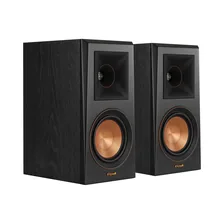 #42 Klipsch RP-500M: $299.00 per pair Amazon eBay
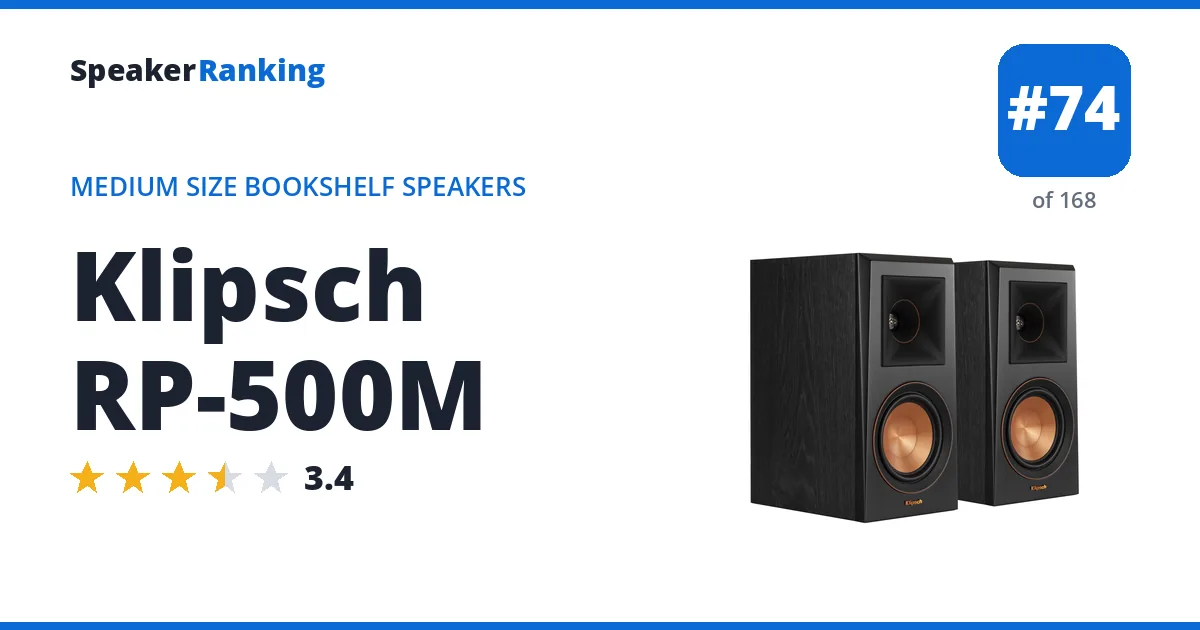
Newer model: the Klipsch RP-500M II, ranked higher, rated 4/5.
Pros: The original Reference Premiere 2-way bookshelf, still sold new alongside the newer RP-500M II at a lower price. Klipsch’s signature Hybrid Tractrix Horn tweeter loading is unmistakable and the price has dropped from its original $579/pair MSRP to roughly $299/pair.
Cons: Independently measured by Erin’s Audio Corner with a very rough response: on-axis deviation of 0.961dB and on-axis smoothness of just 0.216, well behind the revised tuning Klipsch gave the newer RP-500M II. Directivity-index standard deviation of 4.24, a pronounced +0.26dB per octave upward tilt, and a predicted in-room smoothness of just 0.16, the worst of any speaker measured here, all point to an inconsistent, brighter-leaning presentation. Full sensitivity and impedance specs aren’t published on Klipsch’s own product page.
Full Klipsch RP-500M review and specifications →
| Country | United States (Klipsch design) |
|---|---|
| DIY Kit | No |
| Dimensions | 13.50H x 6.81W x 9.50D in |
| Drivers | 1” Titanium LTS tweeter (Hybrid Tractrix Horn), 5.25” Spun Copper Cerametallic woofer |
| Enclosure | 2-way, ported |
| Impedance | 8 ohms nominal |
| Sensitivity | 93dB (manufacturer specified, 2.83V/1m) |
| Spinorama Preference Score | 4.38 |
| Spinorama Preference Score with Perfect Sub | 7.00 |
| Weight | 11.9 lbs (5.4 kg) each |
- Links
- Reviews, Comparisons and Sound Samples
- Head-to-Head Comparisons
 #43 Dayton Audio MK402X: $97.99 per pair Discontinued Parts Express eBay
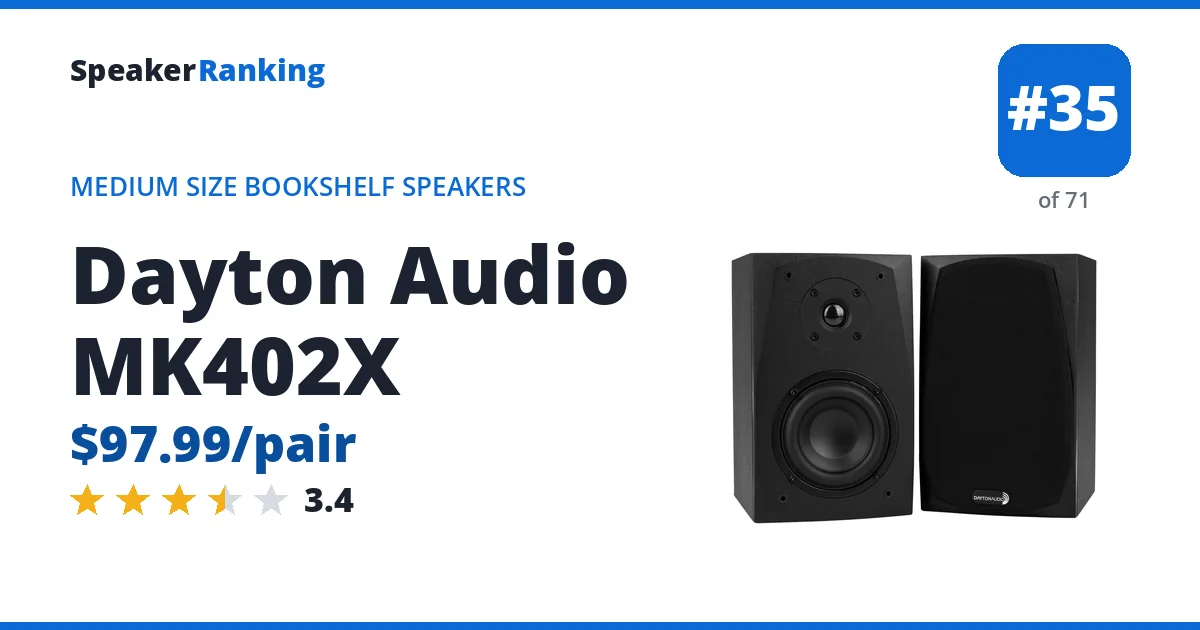
Pros: A compact, inexpensive 4-inch passive pair with an upgraded crossover over the original MK402. ASR measured good on-axis smoothness of 0.193, excellent sound-power smoothness of 0.125, broad horizontal coverage to about +/-60 degrees, and a very well-damped bass alignment Q of 0.24. Measured bass extension of 63.0Hz (-3dB).
Cons: The response tilts bright at +0.20dB per octave and predicted in-room smoothness is a poor 0.18. Estimated in-room extension is 52Hz, sensitivity is low for a passive speaker, and the 4-ohm impedance asks more of a small budget amplifier. Discontinued.
Full Dayton Audio MK402X review and specifications →
| Bass Extension (-3dB) | 63.0Hz (measured, spinorama.org) |
|---|---|
| Country | United States (design) |
| DIY Kit | No |
| Dimensions | 9.5H x 5.75W x 6.5D in |
| Drivers | 0.75” dome tweeter, 4” treated-paper woofer |
| Enclosure | 2-way, bass-reflex |
| Impedance | 4 ohms |
| Sensitivity | 84dB |
| Spinorama Preference Score | 4.01 |
| Spinorama Preference Score with Perfect Sub | 6.42 |
| Weight | approx. 5.1 lbs (2.3 kg) each |
- Links
- Reviews, Comparisons and Sound Samples
- Head-to-Head Comparisons
 #44 JBL Studio 530: $399 per pair Discontinued eBay
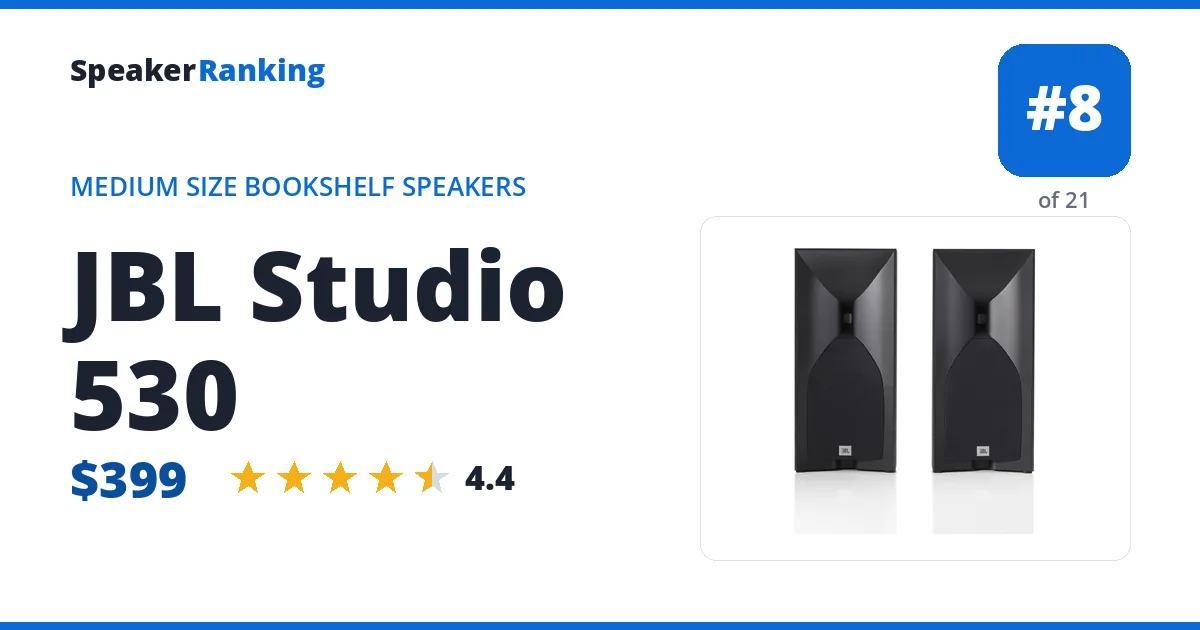
Pros: CEA2034 spinorama shows a fairly flat on-axis response. Predicted in-room response is very smooth aside from the high-frequency roll-off. Measured bass extension of 73.2Hz (-3dB), with a measured sensitivity of 85dB.
Cons: A peak around 1.4kHz is attributed to a tweeter resonance, and shows up as a distinct spike in harmonic distortion at that frequency along with a second resonance-driven bump around 2kHz. Response rolls off in the high frequencies and the tuning is a bit bass-shy overall. Cumulative spectral decay (waterfall) shows the same 1kHz-region resonances lingering in time. Discontinued.
Full JBL Studio 530 review and specifications →
| Bass Extension (-10dB) | 40Hz (derived, log-interpolated between spinorama.org -9dB/-12dB points) |
|---|---|
| Bass Extension (-3dB) | 73.2Hz (measured, Audio Science Review) |
| Crossover Frequency | 1.5kHz |
| DIY Kit | No |
| Dimensions | 18.4”H x 8.4”W x 8.7”D (467 x 214 x 222 mm) |
| Drivers | 5.25” (130mm) PolyPlas™ cone woofer with SFG magnet, 1” (25mm) compression driver with Teonex® diaphragm on Bi-Radial® horn |
| Impedance | 6 ohms nominal (4 ohms minimum, measured by Audio Science Review) |
| Sensitivity | ~85dB (measured by Audio Science Review) |
| Spinorama Preference Score | 5.21 (spinorama.org) |
| Spinorama Preference Score with Perfect Sub | 7.29 (spinorama.org) |
| Weight | 17 lbs (7.7 kg) each |
| Woofer Cabinet | ported |
- Links
- Reviews, Comparisons and Sound Samples
- Head-to-Head Comparisons
- JBL Studio 530 vs ELAC Debut 2.0 B5.2
- JBL Studio 530 vs Sony SS-CS5 M2
- JBL Studio 530 vs Paradigm Monitor SE Atom
- JBL Studio 530 vs JBL Stage 250B
- JBL Studio 530 vs Boston Acoustics A25
- JBL Studio 530 vs Dynaudio Emit M10
- JBL Studio 530 vs Polk Audio XT15
- JBL Studio 530 vs Wharfedale Diamond 220
- See all 38 comparisons
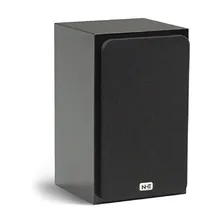 #45 NHT SuperZero 2.1: $124.99 per pair Amazon NHT Audio eBay
Pros: A tiny, affordable acoustic-suspension speaker that is easy to place near a wall. ASR measured a 6.34 preference score with a subwoofer, broad horizontal coverage to roughly +/-60 degrees and good 0.111 sound-power smoothness. Measured bass extension of 101.1Hz (-3dB).
Cons: This is intentionally a satellite: estimated in-room extension is only 84Hz and the standalone preference score falls to 3.03. Sensitivity and maximum output are limited, while on-axis smoothness of 0.220 and directivity-index consistency of 3.43 are merely average.
Full NHT SuperZero 2.1 review and specifications →
| Bass Extension (-10dB) | 70.6Hz (derived, log-interpolated between spinorama.org -9dB/-12dB points) |
|---|---|
| Bass Extension (-3dB) | 101.1Hz (measured, ASR via spinorama.org) |
| Country | United States (design) |
| DIY Kit | No |
| Dimensions | 9H x 5W x 5.5D in |
| Drivers | 1” silk-dome tweeter, 4.5” woofer |
| Enclosure | 2-way acoustic suspension |
| Impedance | 8 ohms nominal |
| Sensitivity | 86dB |
| Spinorama Preference Score | 3.03 |
| Spinorama Preference Score with Perfect Sub | 6.34 |
| Weight | approx. 6 lbs (2.7 kg) each |
- Links
- Reviews, Comparisons and Sound Samples
- Head-to-Head Comparisons
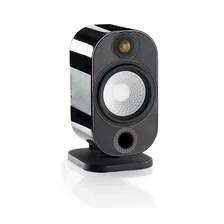 #46 Monitor Audio Apex A10: $1,698 per pair Amazon Crutchfield eBay
Pros: Compact aluminum-cabinet speaker with a 5.5-inch RST woofer, C-CAM gold-dome tweeter, front HiVe II port and included wall bracket. ASR data shows good 0.153 on-axis smoothness and a 5.92 preference score when crossed to a subwoofer. Measured bass extension of 95.2Hz (-3dB).
Cons: Measured bass extension is only 79Hz and the raw preference score drops to 2.75 without a subwoofer, making one effectively mandatory. The +0.53dB/octave slope is bright-leaning, predicted in-room smoothness is poor at 0.161, and $849/pair is expensive for the measured performance.
Full Monitor Audio Apex A10 review and specifications →
| Bass Extension (-3dB) | 95.2Hz (measured, spinorama.org) |
|---|---|
| DIY Kit | No |
| Dimensions | 11H x 5.9W x 7.1D in with stand |
| Drivers | 1” C-CAM gold-dome tweeter, 5.5” RST woofer |
| Enclosure | 2-way passive aluminum cabinet, front-ported |
| Impedance | 8 ohms nominal |
| Sensitivity | 87dB |
| Spinorama Preference Score | 2.75 |
| Spinorama Preference Score with Perfect Sub | 5.92 |
| Weight | 8.6 lbs (3.9 kg) each |
- Links
- Reviews, Comparisons and Sound Samples
- Head-to-Head Comparisons
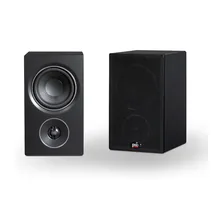 #47 PSB Alpha P3: $349.00 per pair Amazon PSB Speakers eBay
Pros: Very compact cabinets still reach about 55Hz in the local Spinorama snapshot, while the 5.64 sub-assisted score and relatively smooth sound-power behavior make this a sensible small-room speaker. Magnetic grilles and binding posts add practical polish. Measured bass extension of 63.0Hz (-3dB).
Cons: Low measured sensitivity around 81dB restricts clean output and asks more of the amplifier. The raw 3.12 preference score and some response/directivity irregularity keep it behind the best modern compact monitors, and a subwoofer is strongly recommended.
Full PSB Alpha P3 review and specifications →
| Bass Extension (-10dB) | 51.2Hz (derived, log-interpolated between spinorama.org -9dB/-12dB points) |
|---|---|
| Bass Extension (-3dB) | 63.0Hz (measured, ASR via spinorama.org) |
| DIY Kit | No |
| Dimensions | 8.625H x 5.125W x 6.875D in |
| Drivers | 0.75” aluminum-dome tweeter, 4” polypropylene woofer |
| Enclosure | 2-way bass reflex |
| Frequency Response | 57Hz-21kHz |
| Impedance | 8 ohms nominal, 4 ohms minimum |
| Sensitivity | 85dB specified |
| Spinorama Preference Score | 3.12 |
| Spinorama Preference Score with Perfect Sub | 5.64 |
| Weight | 10.1 lbs (4.6 kg)/pair |
- Links
- Reviews, Comparisons and Sound Samples
- Head-to-Head Comparisons
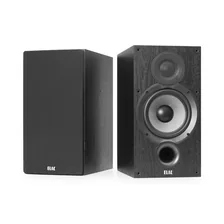 #48 ELAC Debut 2.0 B5.2: $269.00 per pair Amazon eBay
Pros: Good horizontal directivity: the off-axis curves track the on-axis response closely, so the broad tonal error responds predictably to EQ. Erin demonstrated that a single high-shelf filter centered near 1.6kHz, about -2dB with Q near 2, substantially improves linearity. Moderate roughly +/-50-60 degree horizontal coverage balances room interaction and image focus. The front port makes close-to-wall placement practical. Erin measured F3 near 60Hz and F10 near 40Hz, useful extension for a compact 5.25-inch two-way. Harmonic distortion is mostly below 1% at 86dB/1m, and low-frequency distortion is better than its size might suggest. Compact cabinet and inexpensive pair pricing make it a workable EQ-assisted desktop or small-room system. Measured bass extension of 60Hz (-3dB), with a measured sensitivity of 83dB.
Cons: Erin measured a broad +3dB step beginning around 1.5kHz; the resulting elevated upper range sounds tonally uneven even though it is not a narrow, sharp resonance. Native response spans roughly -2.6 to +4dB around the mean, so this is not a neutral speaker without correction. Sensitivity is only about 83dB after correcting the shelf, demanding materially more amplifier voltage than ELAC’s 86dB specification implies. Vertical response changes substantially outside roughly +/-10 degrees of tweeter height. Dynamic compression is the larger limitation: at the highest sweep level it loses roughly 1-1.5dB through the midrange, and even the 86dB trace shows unusual nonlinearity that may involve crossover heating. At about 96dB, multitone distortion rises audibly around 600Hz; an 80-120Hz subwoofer crossover helps but does not turn it into a high-output design. Erin recommends the larger B6.2 instead when EQ is unavailable.
Full ELAC Debut 2.0 B5.2 review and specifications →
| Bass Extension (-10dB) | 40Hz (measured, Erin’s Audio Corner) |
|---|---|
| Bass Extension (-3dB) | 60Hz (measured, Erin’s Audio Corner) |
| DIY Kit | No |
| Dimensions | 13.4”H x 7.1”W x 9.2”D (341 x 180 x 234 mm) |
| Drivers | 5.25” aramid-fiber woofer, 1” cloth-dome tweeter |
| Impedance | 6 ohms nominal (manufacturer specified) |
| Sensitivity | About 83dB after recommended EQ (measured, Erin’s Audio Corner; 86dB manufacturer specified) |
| Spinorama Preference Score | 5.02 |
| Spinorama Preference Score with Perfect Sub | 7.27 |
| Weight | 13 lbs (5.9 kg) each |
| Woofer Cabinet | ported, front |
- Links
- Reviews, Comparisons and Sound Samples
- Head-to-Head Comparisons
- ELAC Debut 2.0 B5.2 vs Sony SS-CS5 M2
- ELAC Debut 2.0 B5.2 vs Paradigm Monitor SE Atom
- ELAC Debut 2.0 B5.2 vs JBL Studio 530
- ELAC Debut 2.0 B5.2 vs JBL Stage 250B
- ELAC Debut 2.0 B5.2 vs Monoprice Monolith THX Compact Satellite
- ELAC Debut 2.0 B5.2 vs Dynaudio Emit M10
- ELAC Debut 2.0 B5.2 vs ELAC BS U5
- ELAC Debut 2.0 B5.2 vs Boston Acoustics A25
- See all 45 comparisons
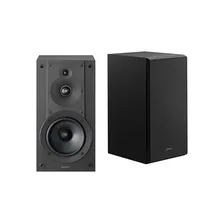 #49 Sony SS-CS5 M2: $278.00 per pair Amazon eBay
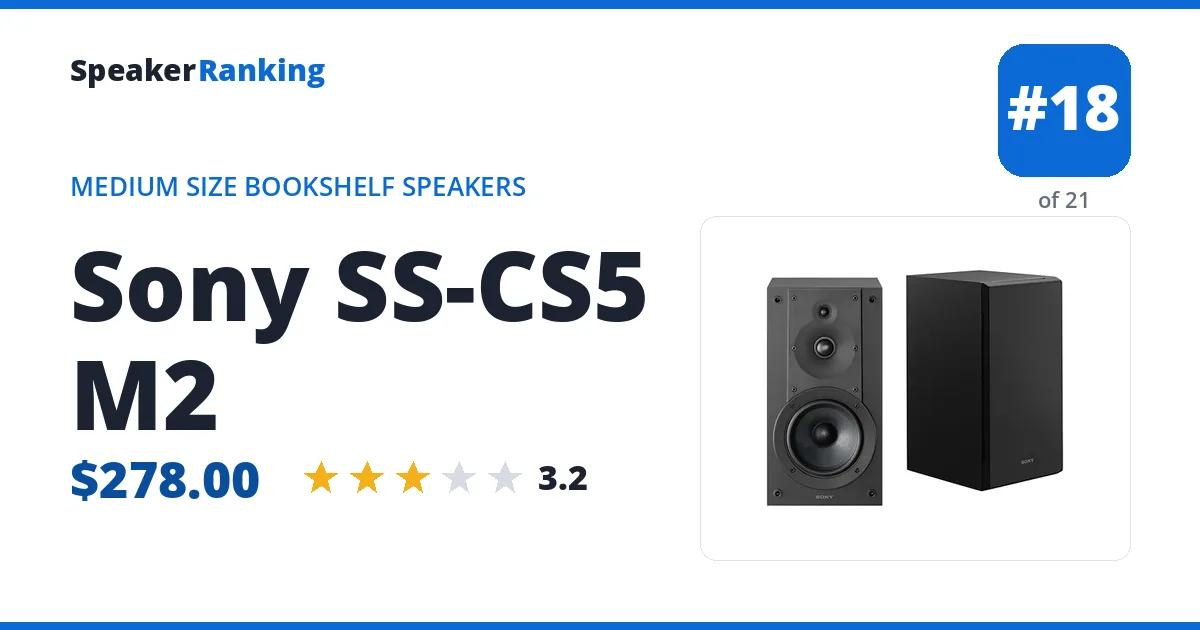
Pros: Added internal bracing (corners, sides, front baffle) plus an updated crossover meaningfully reduce the resonance issues that plagued the original SS-CS5, giving a smoother, more neutral character overall. A modest mid-range dip (about 1-2dB) is present but tolerable, and the reviewer would rather have this dip than a peak in that region. Slightly deeper bass than the previous version, measuring about 2dB more output around 60Hz. Distortion drops noticeably when crossed to a subwoofer around 80-120Hz, meaningfully improving midrange clarity and detail versus running full-range. Easy to drive on a standard AVR: no need for a dedicated high-power amplifier. More modern, understated waveguide look compared to the previous version’s glossy trim. Measured bass extension of 80Hz (-3dB).
Cons: Mild sibilance in the 3-5kHz range stands out on S and T sounds in vocals. Some forwardness in the midrange noticeable on certain vocal recordings. Soundstage and sense of envelopment are comparatively flat and two-dimensional, especially next to reference-quality speakers with strong 3D imaging. Marketed as a “three-way” design mainly due to an added super-tweeter that the reviewer considers largely superfluous: it engages only at very high frequencies and adds complexity without a clearly audible benefit, when that cost might have been better spent on the main crossover. Output-limited: realistic ceiling is around the mid-90s dB SPL at a few meters, with comfortable listening closer to 75-85dB at 3-4 meters before distortion and compression become audible. Bass noticeably compresses/shelves below about 120Hz as volume increases, softening kick-drum impact at higher output. Smaller drivers and a lighter motor structure than rivals like the Polk XT20, which the reviewer generally prefers for its better directivity and higher SPL capability. Still needs a subwoofer for any real bass extension.
Full Sony SS-CS5 M2 review and specifications →
| Bass Extension (-10dB) | 54Hz (measured, Erin’s Audio Corner) |
|---|---|
| Bass Extension (-3dB) | 80Hz (measured, Erin’s Audio Corner) |
| DIY Kit | No |
| Dimensions | 13.2”H x 7”W x 8.7”D (335 x 178 x 220 mm) |
| Drivers | 5.12” woofer, 0.98 in tweeter; 0.75-inch supertweeter; 0.75-inch supertweeter; 0.75-inch supertweeter; 0.75-inch supertweeter |
| Impedance | 6 ohms |
| Sensitivity | 82.5dB |
| Weight | 9.5 lbs (4.3 kg) each |
| Woofer Cabinet | ported, rear |
- Links
- Reviews, Comparisons and Sound Samples
- Head-to-Head Comparisons
- Sony SS-CS5 M2 vs ELAC Debut 2.0 B5.2
- Sony SS-CS5 M2 vs Paradigm Monitor SE Atom
- Sony SS-CS5 M2 vs JBL Stage 250B
- Sony SS-CS5 M2 vs JBL Studio 530
- Sony SS-CS5 M2 vs Monoprice Monolith THX Compact Satellite
- Sony SS-CS5 M2 vs Totem Kin One
- Sony SS-CS5 M2 vs Dynaudio Emit M10
- Sony SS-CS5 M2 vs ELAC BS U5
- See all 46 comparisons
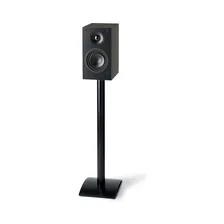 #50 Paradigm Monitor SE Atom: $399.98 per pair Paradigm eBay
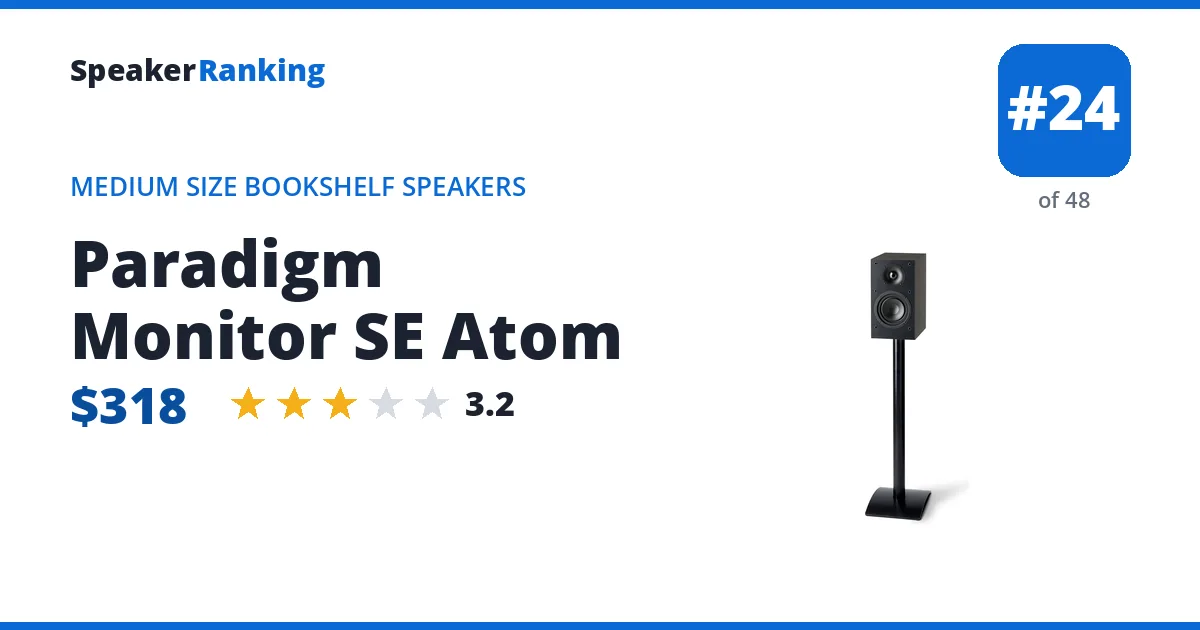
Pros: Good, consistent directivity across the on-axis, listening-window, and off-axis curves makes the Atom easier to equalize and less room-dependent than many budget speakers. Bass tuning is well judged, letting the woofer play loud on demanding tracks without bottoming out even without a subwoofer. Paradigm’s NRC research pedigree shows in the horizontal and vertical dispersion measurements. Measured bass extension of 58.6Hz (-3dB), with a measured sensitivity of 85dB.
Cons: On-axis response is uneven out of the box, with a 2-4kHz dip followed by a peak and a resonance around 15kHz that the reviewer said gives it a bright, “showroom” voicing without EQ correction. There’s no meaningful bass extension for full-range use, so a subwoofer is effectively required for anything beyond desktop or near-field listening.
Full Paradigm Monitor SE Atom review and specifications →
| Bass Extension (-10dB) | 49.8Hz (derived, log-interpolated between spinorama.org -9dB/-12dB points) |
|---|---|
| Bass Extension (-3dB) | 58.6Hz (measured, Audio Science Review) |
| DIY Kit | No |
| Dimensions | 12.75H x 7.125W x 11D in |
| Drivers | 1” X-PAL aluminum dome tweeter (ferrofluid, PPA lens), 5.5” mineral-filled polypropylene mid/bass |
| Frequency Response | 61Hz - 21kHz +/-3dB (Manufacturer specified) |
| Impedance | 8 ohms |
| Power Handling | 15-100W recommended |
| Sensitivity | 85dB (2.83V/1m, measured, Audio Science Review) |
| Spinorama Preference Score | 4.13 |
| Spinorama Preference Score with Perfect Sub | 6.50 |
| Weight | 11.9 lbs (5.4 kg) each |
| Woofer Cabinet | ported, rear |
- Links
- Reviews, Comparisons and Sound Samples
- Head-to-Head Comparisons
- Paradigm Monitor SE Atom vs Sony SS-CS5 M2
- Paradigm Monitor SE Atom vs ELAC Debut 2.0 B5.2
- Paradigm Monitor SE Atom vs JBL Stage 250B
- Paradigm Monitor SE Atom vs JBL Studio 530
- Paradigm Monitor SE Atom vs Dynaudio Emit M10
- Paradigm Monitor SE Atom vs ELAC BS U5
- Paradigm Monitor SE Atom vs Dynaudio X14
- Paradigm Monitor SE Atom vs Pioneer SP-BS22-LR (Philharmonic AAM Mod)
- See all 38 comparisons
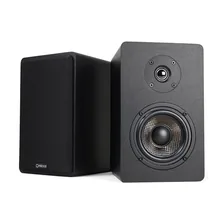 #51 Micca MB42X Mark III: $99.99 per pair Amazon eBay
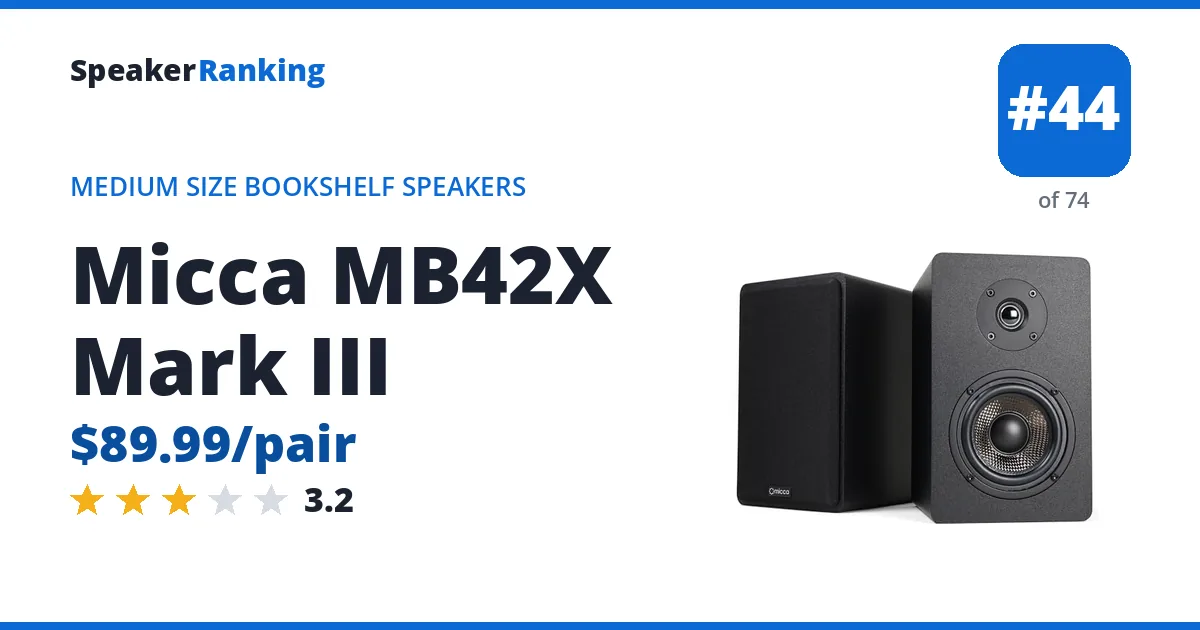
Pros: A very inexpensive, compact 4-inch passive pair with a real crossover and removable grilles. Erin’s data predicts a respectable 6.27 preference score when crossed to a subwoofer, low 0.099 on-axis roughness and broad horizontal coverage. Measured bass extension of 101.6Hz (-3dB).
Cons: Bass extension is limited to about 81Hz in-room and the response rises steeply at +0.81dB per octave, so it can sound bright without EQ. The measurement’s provenance is not fully documented, sensitivity is low, and output is limited by the small woofer.
Full Micca MB42X Mark III review and specifications →
| Bass Extension (-10dB) | 61.7Hz (derived, log-interpolated between spinorama.org -9dB/-12dB points) |
|---|---|
| Bass Extension (-3dB) | 101.6Hz (measured, Erin’s Audio Corner via spinorama.org) |
| Country | United States (design) |
| DIY Kit | No |
| Dimensions | 9.5H x 5.8W x 6.5D in |
| Drivers | 0.75” silk-dome tweeter, 4” carbon-fiber woofer |
| Enclosure | 2-way, rear-ported |
| Impedance | 4-8 ohms |
| Sensitivity | 85dB |
| Spinorama Preference Score | 3.04 |
| Spinorama Preference Score with Perfect Sub | 6.27 |
| Weight | approx. 4 lbs (1.8 kg) each |
- Links
- Reviews, Comparisons and Sound Samples
- Head-to-Head Comparisons
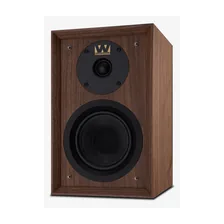 #52 Wharfedale Denton 80th Anniversary: $599 per pair Wharfedale USA eBay
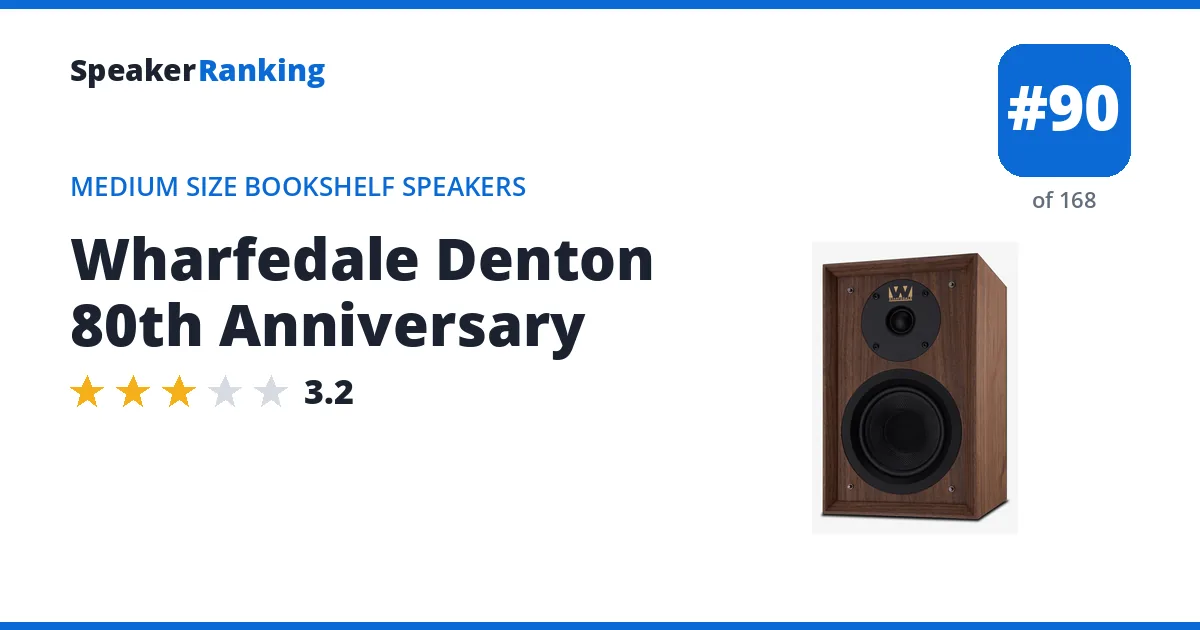
Pros: Handsome real-wood cabinetry and a relaxed compact-speaker format are backed by useful 55Hz measured extension. Its local Spinorama score improves from 2.48 to 5.00 with a subwoofer, and the broad dispersion is friendly to more than one listener. Measured bass extension of 71.8Hz (-3dB).
Cons: Response smoothness and directivity consistency are only average, limiting how completely EQ can correct it. At 86dB specified sensitivity it also needs more amplifier power than its vintage appearance may suggest, and deeper bass still benefits from a subwoofer.
Full Wharfedale Denton 80th Anniversary review and specifications →
| Bass Extension (-10dB) | 44.8Hz (derived, log-interpolated between spinorama.org -9dB/-12dB points) |
|---|---|
| Bass Extension (-3dB) | 71.8Hz (measured, ASR via spinorama.org) |
| DIY Kit | No |
| Dimensions | 12.6H x 7.9W x 12D in |
| Drivers | 1” textile-dome tweeter, 5” woven-Kevlar woofer |
| Enclosure | 2-way bass reflex |
| Frequency Response | 44Hz-24kHz |
| Impedance | 6 ohms |
| Sensitivity | 86dB |
| Spinorama Preference Score | 2.48 |
| Spinorama Preference Score with Perfect Sub | 5.00 |
| Weight | 17.4 lbs (7.9 kg) each |
- Links
- Reviews, Comparisons and Sound Samples
- Head-to-Head Comparisons
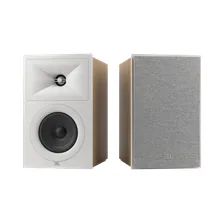 #53 JBL Stage 250B: $439.95 per pair Amazon JBL eBay
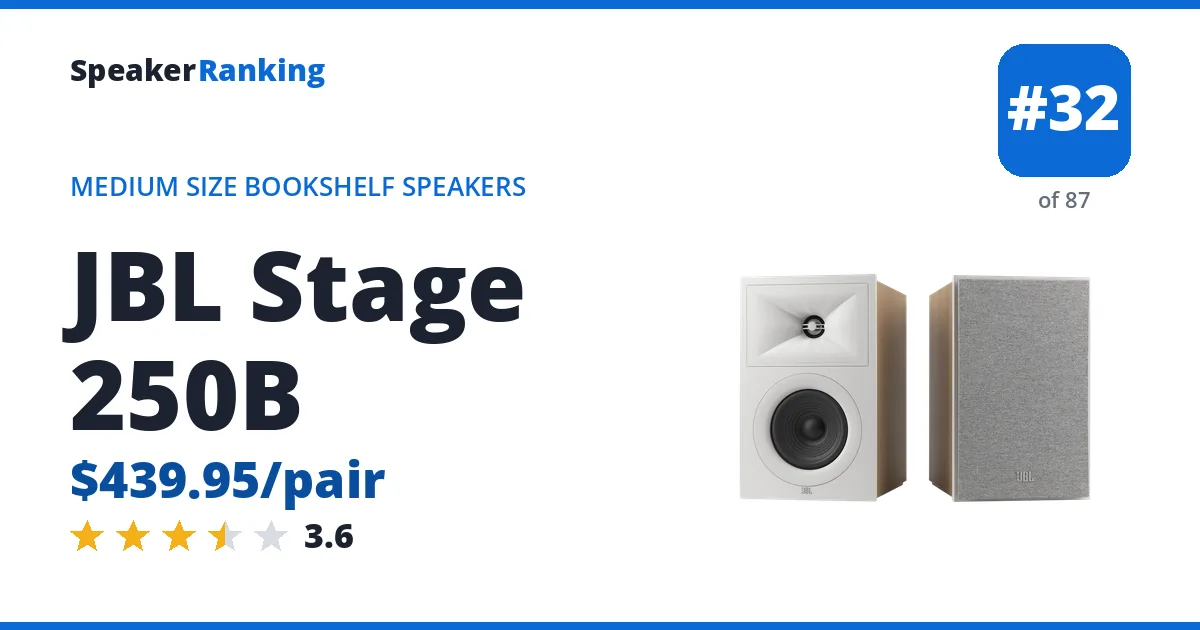
Older model: the JBL Stage A130 (ranked lower, rated 2.1/5).
Pros: Good local Spinorama scores of 4.06 raw and 6.60 with a subwoofer, with smooth horizontal directivity from JBL’s next-generation HDI waveguide. The current Stage 2 model offers solid build details, magnetic grilles and useful 56Hz measured extension at an accessible price. Measured bass extension of 64.5Hz (-3dB).
Cons: Its objective score is good rather than class-leading, and the rear port needs some wall clearance. At 86dB sensitivity and six-ohm nominal impedance it is not especially easy to drive, while the compact woofer limits deep-bass output.
Full JBL Stage 250B review and specifications →
| Bass Extension (-10dB) | 50Hz (measured, Erin’s Audio Corner) |
|---|---|
| Bass Extension (-3dB) | 64.5Hz (measured, Erin’s Audio Corner via spinorama.org) |
| DIY Kit | No |
| Dimensions | 12.6H x 7.9W x 9.5D in |
| Drivers | 1-inch aluminum tweeter, 5.25-inch polycellulose woofer |
| Enclosure | Passive 2-way rear-ported |
| Frequency Response | 50Hz-25kHz (-6dB) |
| Impedance | 6 ohms |
| Power Handling | 75W RMS |
| Recommended Power | 20-150W |
| Sensitivity | 86dB/2.83V/1m |
| Spinorama Preference Score | 4.06 |
| Spinorama Preference Score with Perfect Sub | 6.60 |
| Weight | 12.3 lbs (5.6 kg) each |
| Woofer Cabinet | ported, rear |
- Links
- Reviews, Comparisons and Sound Samples
- Head-to-Head Comparisons
- JBL Stage 250B vs Paradigm Monitor SE Atom
- JBL Stage 250B vs Sony SS-CS5 M2
- JBL Stage 250B vs ELAC Debut 2.0 B5.2
- JBL Stage 250B vs Dynaudio Emit M10
- JBL Stage 250B vs ELAC BS U5
- JBL Stage 250B vs Dynaudio X14
- JBL Stage 250B vs JBL Studio 530
- JBL Stage 250B vs Pioneer SP-BS22-LR (Philharmonic AAM Mod)
- See all 42 comparisons
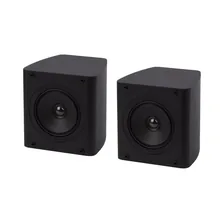 #54 Monoprice Monolith THX Compact Satellite: $249.99 per pair Amazon Monoprice eBay
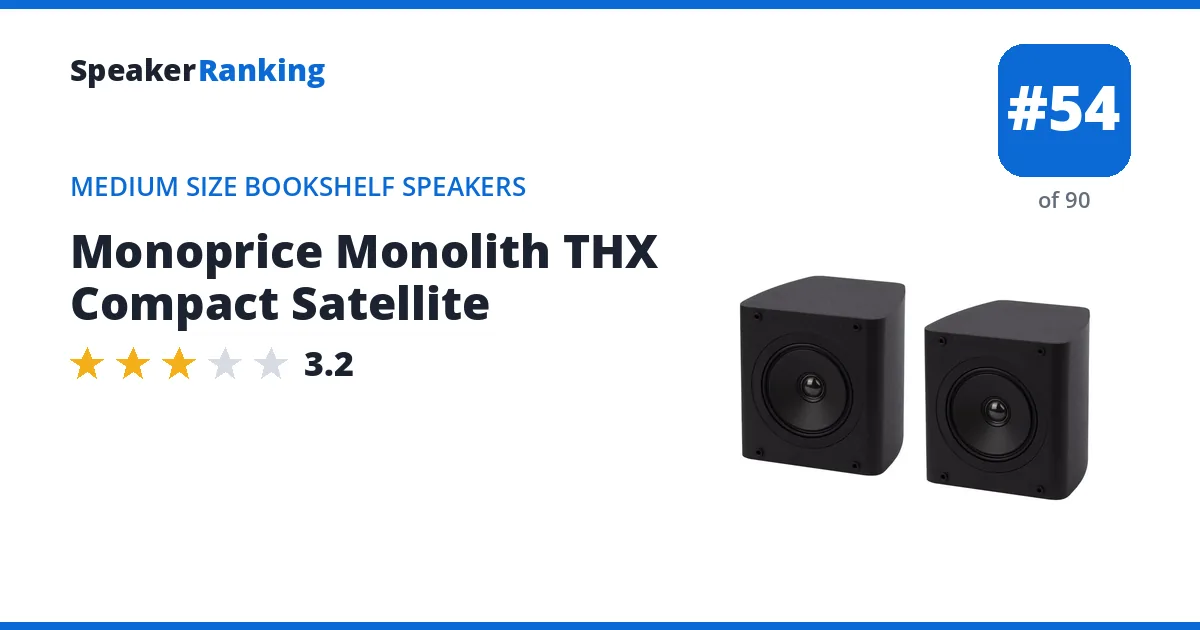
Pros: A compact sealed satellite with a 4.5-inch coaxial driver and a 20mm silk-dome tweeter mounted at its center, THX certified and built to sit with a subwoofer crossed over at 80Hz. Erin’s Audio Corner measured a listening window within a 4.0dB span from 300Hz to 5kHz, a smooth predicted in-room response (0.61 smoothness) and wide, even dispersion (about 60 degrees horizontally and 55 degrees vertically), and its preference score rises to 6.56 with an ideal subwoofer. A keyhole slot makes wall mounting easy. Measured bass extension of 82Hz (-3dB).
Cons: Bass stops at about 82Hz (-3dB) and 62Hz (-10dB), so it needs a subwoofer for any full-range use, and without one its preference score is only 3.57. Sensitivity is a low 81dB into a 4-ohm load, so it needs a capable amplifier to play loud. Out of stock at Monoprice and Amazon, with Monoprice quoting a restock date well into 2027.
Full Monoprice Monolith THX Compact Satellite review and specifications →
| Bass Extension (-10dB) | 61.5Hz (measured, Erin’s Audio Corner) |
|---|---|
| Bass Extension (-3dB) | 82Hz (measured, Erin’s Audio Corner) |
| DIY Kit | No |
| Dimensions | 6.3”H x 6”W x 5.9”D (160 x 153 x 150 mm) |
| Drivers | 4.5” polypropylene woofer with coaxial 20mm silk-dome tweeter |
| Frequency Response | 80Hz-20kHz ±3dB (manufacturer specified) |
| Impedance | 4 ohms nominal (manufacturer specified) |
| Sensitivity | 81dB (manufacturer specified) |
| Spinorama Preference Score | 3.57 |
| Spinorama Preference Score with Perfect Sub | 6.56 |
| Weight | 4.2 lbs (1.9 kg) each |
| Woofer Cabinet | sealed |
- Links
- Reviews, Comparisons and Sound Samples
- Head-to-Head Comparisons
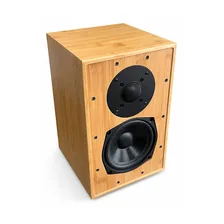 #55 XSA Labs Vanguard: $995 per pair Discontinued XSA Labs eBay
Pros: A compact US-made stand-mount with quality Scandinavian drivers and a benign 7-ohm minimum impedance. The local snapshot’s 5.48 sub-assisted score suggests a credible small-room system once its limited bass is handed off to a subwoofer. Measured bass extension of 87.9Hz (-3dB).
Cons: The 2.73 raw score, 62Hz measured extension and roughly 82dB measured sensitivity are modest at this price. Frequency-response deviation is high and the design needs both careful placement and correction to approach neutral reproduction. Discontinued.
Full XSA Labs Vanguard review and specifications →
| Bass Extension (-10dB) | 50.5Hz (derived, log-interpolated between spinorama.org -9dB/-12dB points) |
|---|---|
| Bass Extension (-3dB) | 87.9Hz (measured, ASR via spinorama.org) |
| Country | United States |
| DIY Kit | No |
| Dimensions | 12H x 7.5W x 8D in |
| Drivers | 28mm silk-dome tweeter, 130mm paper-cone woofer |
| Enclosure | 2-way rear-ported |
| Frequency Response | 82Hz-22kHz |
| Impedance | 7 ohms minimum |
| Sensitivity | 83dB specified |
| Spinorama Preference Score | 2.73 |
| Spinorama Preference Score with Perfect Sub | 5.48 |
| Weight | 11.2 lbs (5.1 kg) each |
- Links
- Reviews, Comparisons and Sound Samples
- Head-to-Head Comparisons
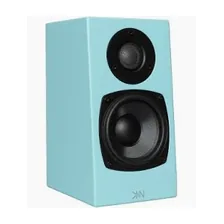 #56 Totem Kin One: $600 per pair Sky by Gramophone eBay
Pros: Compact two-way design with a 1” titanium-infused soft dome tweeter and 4” MHex cone woofer, available in distinctive colorways beyond the usual black/white. Surprisingly spacious, wide sound for its tiny size: horizontal dispersion of about ±75° through the midrange gives real envelopment and soundstage width. Reasonably good overall directivity, meaning it takes well to EQ correction. Pairs well with an EQ-capable streaming amp (the reviewer specifically suggests something like a WiiM Amp), which can smooth out its main tonal issues with just a few bands of correction. Crossing over to a subwoofer around 80Hz measurably reduces midrange distortion and improves resolution. For a 4” woofer, distortion performance up to about 88dB is reasonable and shouldn’t be judged against larger-driver speakers. Measured bass extension of 91Hz (-3dB), with a measured sensitivity of 83.4dB.
Cons: Real-world sensitivity measured significantly below the manufacturer’s spec (about 83.4dB measured versus 89dB claimed). Treble rolls off sharply above about 8kHz, an unusually attenuated top end that the reviewer wasn’t sure was even an intentional design choice. A dip around 600Hz-1kHz paired with a nearby resonance (likely port-related) gives a combination of hollow and forward character depending on the exact frequency. Bass rolls off around 80-90Hz (F3 91Hz, F10 59Hz), typical for a compact 4” woofer, so a subwoofer is essential for any real bass. Vertical placement has a real sweet spot: going too far above or especially below the tweeter axis noticeably changes the tonal balance. Distortion rises substantially at 96dB and the port/woofer begin struggling at extreme low frequencies and volumes. Best aimed directly at the listener given how quickly the treble rolls off; toeing it out requires EQ compensation to avoid sounding dull.
Full Totem Kin One review and specifications →
| Bass Extension (-10dB) | 59Hz (measured, Erin’s Audio Corner) |
|---|---|
| Bass Extension (-3dB) | 91Hz (measured, Erin’s Audio Corner) |
| DIY Kit | No |
| Dimensions | 9.5”H x 5”W x 6.3”D (241 x 127 x 159 mm) |
| Drivers | 4” MHEX cone woofer, 1” titanium infused soft dome tweeter |
| Impedance | 6 ohms nominal, 4.4 ohms minimum (measured above 80Hz, Erin’s Audio Corner) |
| Power Handling | 20-100W RMS |
| Sensitivity | 83.4dB (measured average 300Hz-3kHz @ 2.83V/1m, Erin’s Audio Corner; 89dB manufacturer specified) |
| Spinorama Preference Score | 3.68 |
| Spinorama Preference Score with Perfect Sub | 6.61 |
| Weight | 6.2 lbs (2.83 kg) each |
| Woofer Cabinet | ported, rear |
- Links
- Reviews, Comparisons and Sound Samples
- Head-to-Head Comparisons
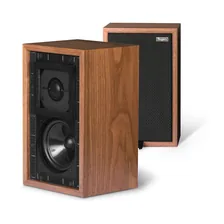 #57 Rogers LS3/5A Classic: $3,500 per pair Rogers Hi-Fi eBay
Pros: A licensed British-made LS3/5A with the classic sealed-box voicing, excellent cabinetry and an amplifier-friendly 15-ohm nominal load. The local Spinorama snapshot rises from 1.99 to 5.06 with a subwoofer, making its best case as a compact midrange specialist in a sub-assisted system. Measured bass extension of 90.8Hz (-3dB).
Cons: The 74Hz measured extension, roughly 81dB measured sensitivity and low raw preference score impose real output and bass limits. Directivity and room-response smoothness are weak by modern standards, while the price is exceptionally high for the measured performance.
Full Rogers LS3/5A Classic review and specifications →
| Bass Extension (-10dB) | 54.9Hz (derived, log-interpolated between spinorama.org -9dB/-12dB points) |
|---|---|
| Bass Extension (-3dB) | 90.8Hz (measured, ASR via spinorama.org) |
| Country | United Kingdom |
| DIY Kit | No |
| Dimensions | 12H x 7.5W x 6.5D in |
| Drivers | 19mm Mylar tweeter, 110mm Bextrene woofer |
| Enclosure | Sealed 2-way |
| Frequency Response | 80Hz-20kHz |
| Impedance | 15 ohms nominal |
| Sensitivity | 82.5dB |
| Spinorama Preference Score | 1.99 |
| Spinorama Preference Score with Perfect Sub | 5.06 |
| Weight | 10.8 lbs (4.9 kg) each |
- Links
- Reviews, Comparisons and Sound Samples
- Head-to-Head Comparisons
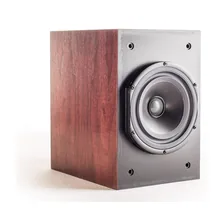 #58 Vandersteen VLR Wood: $2,060 per pair Audio Connection eBay
Pros: A current US-made compact speaker with a coaxial driver for consistent geometry and multiple real-wood finishes. Its local Spinorama snapshot climbs from 2.58 to 5.65 with a subwoofer, and the 8-ohm nominal, 5-ohm minimum load is amplifier-friendly. Measured bass extension of 124.5Hz (-3dB).
Cons: The 74Hz measured extension, 86dB specified sensitivity and low raw preference score make a subwoofer and EQ important. First-order crossover behavior produces response/directivity compromises, and the price is high relative to the measured neutrality and output.
Full Vandersteen VLR Wood review and specifications →
| Bass Extension (-10dB) | 54.9Hz (derived, log-interpolated between spinorama.org -9dB/-12dB points) |
|---|---|
| Bass Extension (-3dB) | 124.5Hz (measured, ASR via spinorama.org) |
| Country | United States |
| DIY Kit | No |
| Dimensions | 12H x 8W x 11.5D in |
| Drivers | 1” alloy-dome tweeter coaxially mounted in 6.5” mineral-filled woofer |
| Enclosure | 2-way coaxial |
| Frequency Response | 64Hz-21kHz +/-3dB |
| Impedance | 8 ohms nominal, 5 ohms minimum |
| Sensitivity | 86dB |
| Spinorama Preference Score | 2.58 |
| Spinorama Preference Score with Perfect Sub | 5.65 |
| Weight | 22 lbs (10 kg) each |
- Links
- Reviews, Comparisons and Sound Samples
- Head-to-Head Comparisons
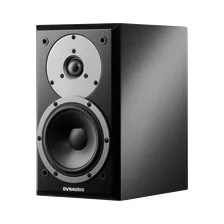 #59 Dynaudio Emit M10: $800 per pair Discontinued eBay
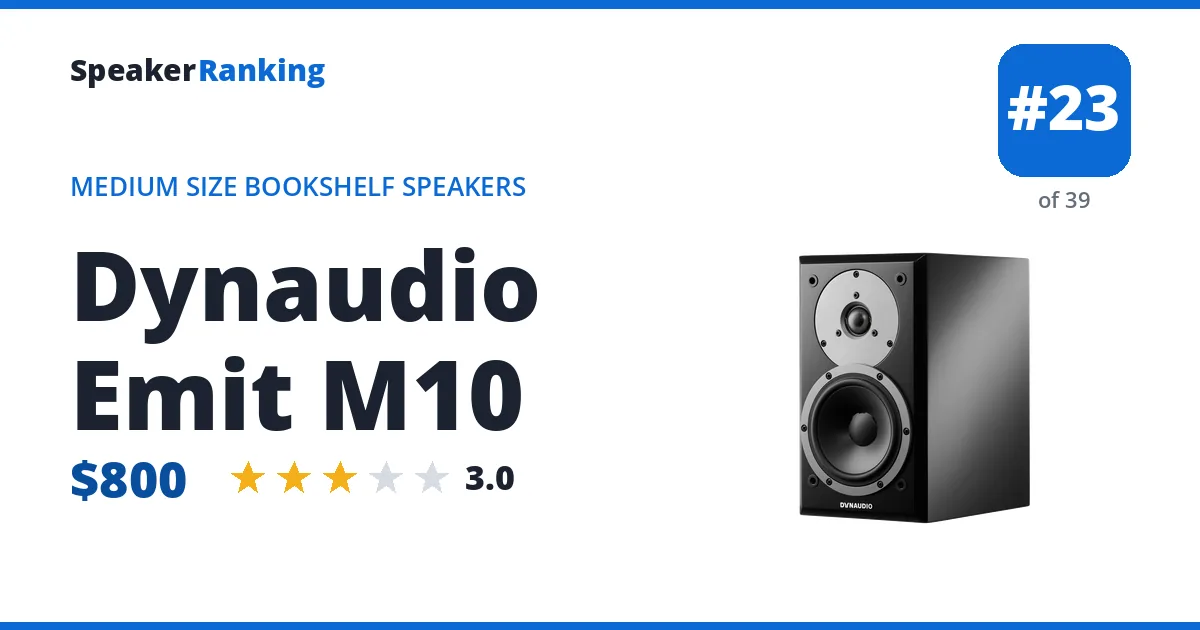
Newer model: the Dynaudio Emit 10. It’s likely to perform similarly, though we don’t have measurements to confirm that yet.
Pros: CEA2034 spinorama shows impressive, headphone-level distortion through the midrange and tweeter at 86dB SPL, with a well-executed port that keeps resonance low below the crossover. 28mm soft dome tweeter and 14cm MSP mid/bass driver. Measured bass extension of 60.1Hz (-3dB), with a measured sensitivity of 83.5dB.
Cons: Tuned toward a mild showroom sound with boosted upper bass and treble and a recessed midrange: the reviewer prefers speakers that get the 100Hz-3kHz range right, which this doesn’t. His verdict: cheaper speakers deliver much more balanced tonality, so he wouldn’t buy it for himself. Discontinued.
Full Dynaudio Emit M10 review and specifications →
| Bass Extension (-10dB) | 46.8Hz (derived, log-interpolated between spinorama.org -9dB/-12dB points) |
|---|---|
| Bass Extension (-3dB) | 60.1Hz (measured, Audio Science Review) |
| DIY Kit | No |
| Dimensions | 11.5”H x 6.7”W x 9.4”D (292 x 170 x 240 mm) |
| Drivers | 28mm soft dome tweeter, 14cm MSP mid/bass driver |
| Frequency Response | 50Hz - 23kHz (+/-3dB) (Manufacturer specified) |
| Impedance | 6 ohms nominal |
| Sensitivity | 83.5dB (2.83V/1m, measured, Audio Science Review) |
| Spinorama Preference Score | 4.56 (spinorama.org) |
| Spinorama Preference Score with Perfect Sub | 6.93 (spinorama.org) |
| Weight | 12.3 lbs (5.6 kg) each |
| Woofer Cabinet | ported |
- Links
- Reviews, Comparisons and Sound Samples
- Head-to-Head Comparisons
- Dynaudio Emit M10 vs ELAC BS U5
- Dynaudio Emit M10 vs Dynaudio X14
- Dynaudio Emit M10 vs Pioneer SP-BS22-LR (Philharmonic AAM Mod)
- Dynaudio Emit M10 vs JBL Stage 250B
- Dynaudio Emit M10 vs JBL L52 Classic
- Dynaudio Emit M10 vs Paradigm Monitor SE Atom
- Dynaudio Emit M10 vs Sony SS-CS5 M2
- Dynaudio Emit M10 vs JBL Stage A120
- See all 40 comparisons
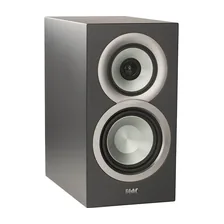 #60 ELAC BS U5: $856 per pair Discontinued eBay
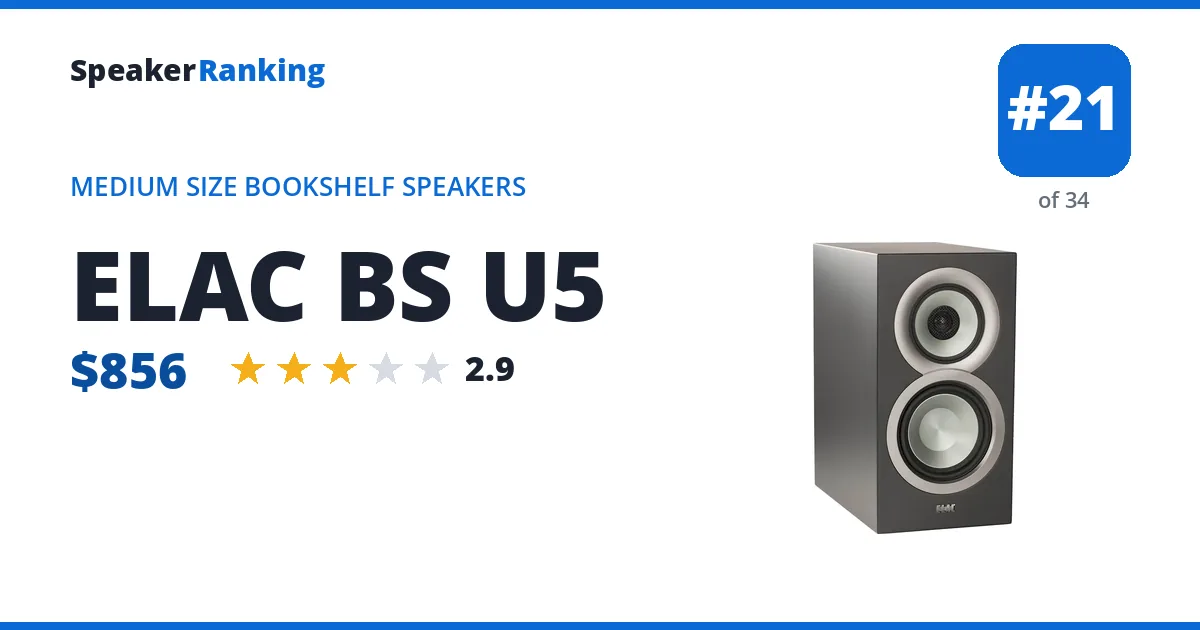
Pros: This slim three-way coaxial design (an Andrew Jones creation) shows a fairly even on-axis response up to 3kHz, with off-axis behavior notably smoother than the on-axis curve. Predicted in-room response looks like it should give good tonality. Vertical directivity is better than average, a benefit of the coaxial layout. Measured bass extension of 63Hz (-3dB), with a measured sensitivity of 83dB.
Cons: Distortion is very high right at both crossover points (around 270Hz (mid-range) and 2700Hz (tweeter)) at both 86dB and 96dB SPL/1m, exceeding 3% at the mid-range crossover. Minimum impedance dips to 3.4 ohms with a possible resonance around 500Hz visible in the impedance/phase curve. Discontinued.
Full ELAC BS U5 review and specifications →
| Bass Extension (-10dB) | 41Hz (derived, log-interpolated between spinorama.org -9dB/-12dB points) |
|---|---|
| Bass Extension (-3dB) | 63Hz (measured, Audio Science Review) |
| DIY Kit | No |
| Dimensions | 13.4”H x 7”W x 11.5”D (339.1 x 178.0 x 293.1 mm) |
| Drivers | 1” tweeter + 5.25” woofer |
| Impedance | 4 ohms nominal (3.4 ohms minimum) |
| Sensitivity | 83dB (2.83V/1m, measured, Audio Science Review) |
| Spinorama Preference Score | 4.71 (spinorama.org) |
| Spinorama Preference Score with Perfect Sub | 6.79 (spinorama.org) |
| Weight | 13.2 lbs (6 kg) |
| Woofer Cabinet | ported, rear |
- Reviews, Comparisons and Sound Samples
- Head-to-Head Comparisons
- ELAC BS U5 vs Acoustic Energy AE100 Mk2
- ELAC BS U5 vs Dynaudio Emit M10
- ELAC BS U5 vs Dynaudio X14
- ELAC BS U5 vs Pioneer SP-BS22-LR (Philharmonic AAM Mod)
- ELAC BS U5 vs JBL L52 Classic
- ELAC BS U5 vs JBL Stage 250B
- ELAC BS U5 vs JBL Stage A120
- ELAC BS U5 vs Paradigm Monitor SE Atom
- See all 33 comparisons
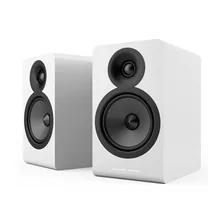 #61 Acoustic Energy AE100 Mk2: $399 per pair Discontinued Amazon eBay
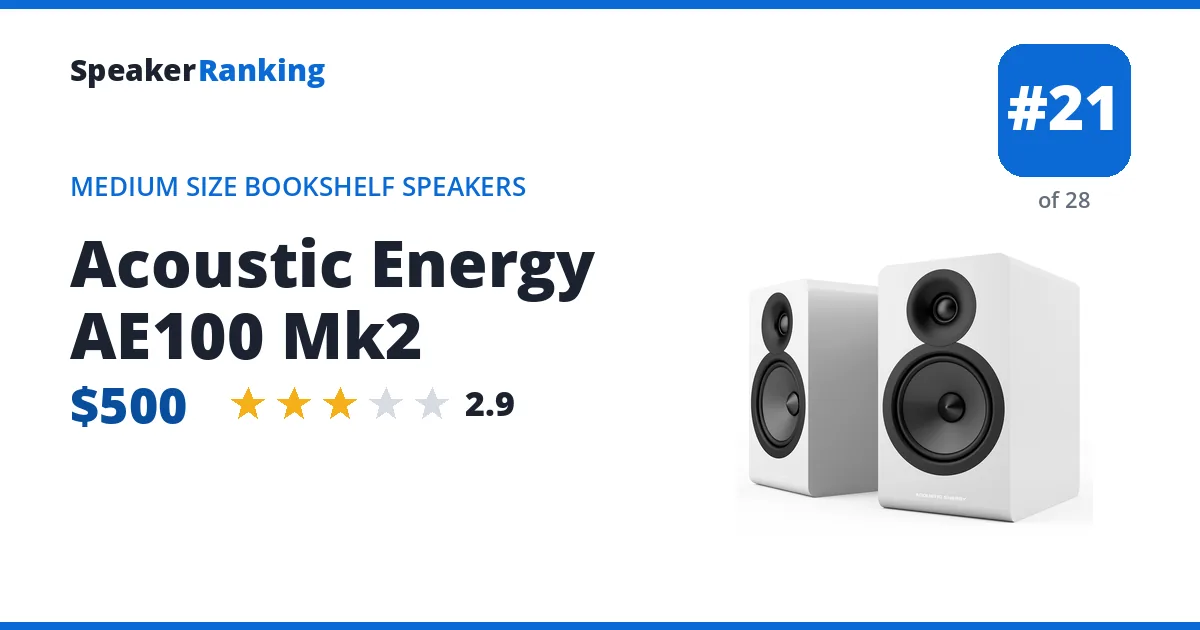
Pros: Good directivity linearity: on-axis and off-axis response track each other well despite an otherwise uneven overall response, which means the tonal problems can be EQ’d out with reasonably good success. Wide horizontal radiation, about ±50°. Nicely finished cabinet: the reviewer specifically called out the fit and finish as a genuine positive. Both units of the review pair measured closely matched to each other. Measured bass extension of 63Hz (-3dB), with a measured sensitivity of 84dB.
Cons: High-frequency level runs noticeably too hot regardless of placement: the reviewer tried four different setups (near/far from wall, on-axis, 30° off-axis) at two listening distances and couldn’t get it to sound right at any of them. A mid-range dip that the reviewer attributes to internal cabinet resonance rather than intentional baffle-step compensation, reinforced by an internal inspection showing no cross-bracing and a slot port that may itself be resonating when tapped. Small tweeter waveguide magnet suggests limited power handling headroom. At this price and radiation pattern, the reviewer would pick the ELAC DBR62 (more neutral, similar ±60° pattern) or, for less money, the ELAC Debut 2.0 B6.2 over this speaker; the KEF Q150 and SVS Prime Bookshelf are also called out as more linear alternatives nearby in price. Discontinued.
Full Acoustic Energy AE100 Mk2 review and specifications →
| Bass Extension (-10dB) | 42Hz (measured, Erin’s Audio Corner) |
|---|---|
| Bass Extension (-3dB) | 63Hz (measured, Erin’s Audio Corner) |
| Crossover Frequency | 2.9kHz |
| DIY Kit | No |
| Dimensions | 11.4”H x 6.5”W x 9.8”D (290 x 165 x 250 mm) |
| Drivers | 5.25” midwoofer, 1” soft fabric dome tweeter with waveguide |
| Impedance | 6 ohms nominal, 4.7 ohms minimum (measured, Erin’s Audio Corner) |
| Sensitivity | 84dB (measured average, Erin’s Audio Corner) |
| Spinorama Preference Score | 4.96 |
| Spinorama Preference Score with Perfect Sub | 7.18 |
| Weight | 20.1 lbs (9.1 kg) each |
| Woofer Cabinet | ported, rear slot port |
- Links
- Reviews, Comparisons and Sound Samples
- Head-to-Head Comparisons
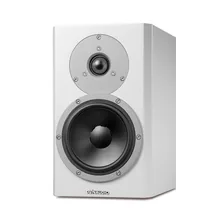 #62 Dynaudio X14: $1500 per pair Discontinued eBay
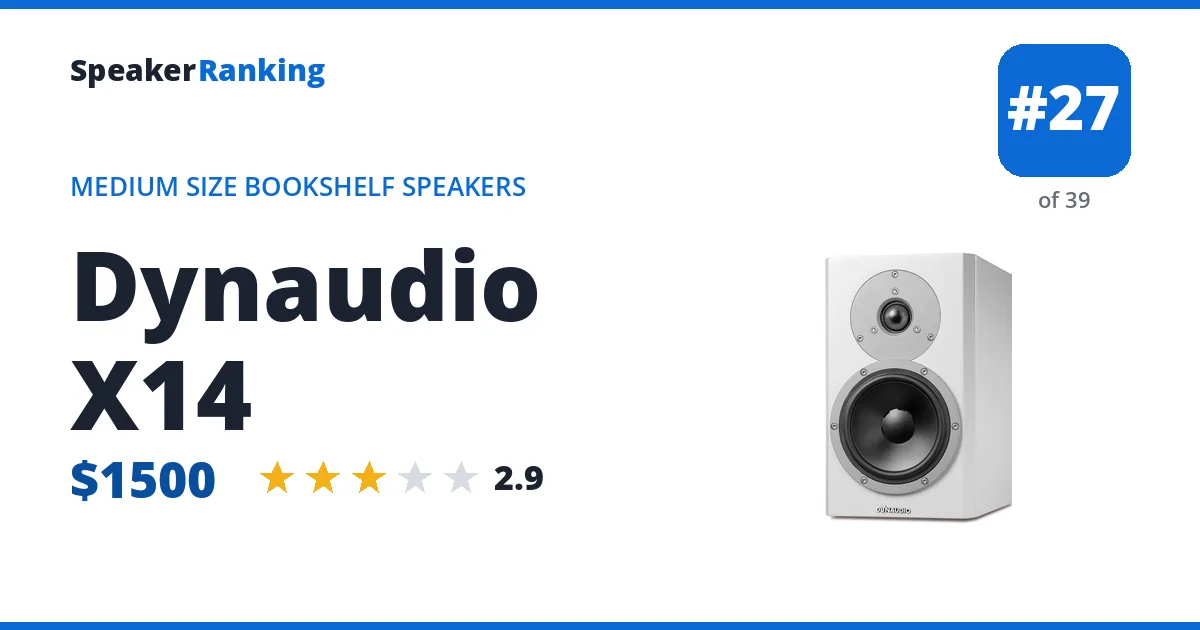
Pros: 1” silk-dome tweeter and 5.7” magnesium-silicate-polymer woofer in a compact two-way stand-mount, rated at 85dB sensitivity. Measured bass extension of 67.4Hz (-3dB), with a measured sensitivity of 82dB.
Cons: CEA2034 spinorama shows an uneven on-axis response from the lack of a waveguide to control tweeter beam width, plus a port resonance that boosts the lower midrange and imperfect crossover matching between the drivers. Too much energy in the lower and upper treble reads as bright, and directivity narrows at higher frequencies rather than staying controlled. The reviewer’s verdict: out of the box, the objective performance isn’t that great, though EQ can make it a satisfying speaker. Discontinued.
Full Dynaudio X14 review and specifications →
| Bass Extension (-10dB) | 43.9Hz (derived, log-interpolated between spinorama.org -9dB/-12dB points) |
|---|---|
| Bass Extension (-3dB) | 67.4Hz (measured, Audio Science Review) |
| DIY Kit | No |
| Dimensions | 11.2”H x 6.7”W x 10”D (285 x 170 x 255 mm) |
| Drivers | 1” silk dome tweeter, 5.7” magnesium-silicate-polymer woofer |
| Frequency Response | 50Hz - 23kHz (+/-3dB) (Manufacturer specified) |
| Impedance | 8 ohms nominal |
| Sensitivity | 82dB (2.83V/1m, measured, Audio Science Review) |
| Spinorama Preference Score | 4.57 (spinorama.org) |
| Spinorama Preference Score with Perfect Sub | 6.94 (spinorama.org) |
| Weight | 14.3 lbs (6.5 kg) each |
| Woofer Cabinet | ported |
- Reviews, Comparisons and Sound Samples
- Head-to-Head Comparisons
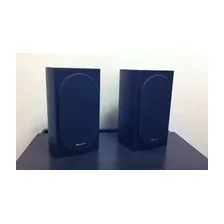 #63 Pioneer SP-BS22-LR (Philharmonic AAM Mod): $168 per pair Discontinued eBay
Pros: This is Dennis Murphy’s “Affordable Accuracy Monitor” (AAM) mod of the discontinued, budget Pioneer SP-BS22-LR: the stock tweeter is swapped for a Peerless BC25TG15 dome and a redesigned 3rd-order crossover is built to match it to the stock 4” woofer. CEA2034 spinorama shows only small variations from a flat on-axis response with some directivity error near the crossover, a marked improvement over the unmodified Pioneer, which the reviewer notes shows much more variation from flat. Distortion at 86dB SPL/1m is reasonably controlled above 200Hz, and tweeter distortion barely rises even at 96dB SPL/1m. Measured bass extension of 78Hz (-3dB), with a measured sensitivity of 83dB.
Cons: Some directivity error appears near the crossover frequency. Distortion climbs in the woofer’s range (below 200Hz) at both 86dB and 96dB SPL/1m. Minimum impedance dips to about 5 ohms with a couple of resonance peaks. This is a DIY project, not a finished retail product: Murphy sold ~$168 pre-built pairs for a while but no longer does, so it now requires sourcing a used/discontinued Pioneer SP-BS22-LR pair plus building the crossover and swapping the tweeter yourself. The mod itself is public domain, but there is no current turnkey way to buy this speaker.
Full Pioneer SP-BS22-LR (Philharmonic AAM Mod) review and specifications →
| Bass Extension (-10dB) | 60Hz (measured, Audio Science Review) |
|---|---|
| Bass Extension (-3dB) | 78Hz (measured, Audio Science Review) |
| Crossover Frequency | 3000Hz |
| DIY Kit | Yes |
| Dimensions | 12.6”H x 7.1”W x 8.5”D (320.0 x 180.0 x 215.0 mm) |
| Drivers | 1x 4” curvilinear-cone woofer (stock Pioneer), 1x Peerless BC25TG15 1” silk dome tweeter (replacement) |
| Impedance | 8 ohms nominal (approx. 5 ohms minimum, measured by Audio Science Review) |
| Sensitivity | 83dB (2.83V/1m, measured by Audio Science Review) |
| Spinorama Preference Score | 5.07 |
| Spinorama Preference Score with Perfect Sub | 7.82 |
| Weight | 9 lbs (4.1 kg) |
| Woofer Cabinet | ported, rear |
- Links
- Reviews, Comparisons and Sound Samples
- Head-to-Head Comparisons
- Pioneer SP-BS22-LR (Philharmonic AAM Mod) vs Dynaudio X14
- Pioneer SP-BS22-LR (Philharmonic AAM Mod) vs MartinLogan Motion 4i
- Pioneer SP-BS22-LR (Philharmonic AAM Mod) vs ELAC BS U5
- Pioneer SP-BS22-LR (Philharmonic AAM Mod) vs JBL L52 Classic
- Pioneer SP-BS22-LR (Philharmonic AAM Mod) vs Dynaudio Emit M10
- Pioneer SP-BS22-LR (Philharmonic AAM Mod) vs Parts Express Copperhead Desktop Kit
- Pioneer SP-BS22-LR (Philharmonic AAM Mod) vs JBL Stage A120
- Pioneer SP-BS22-LR (Philharmonic AAM Mod) vs ELAC Uni-Fi 2.0 UB52
- See all 37 comparisons
 #64 MartinLogan Motion 4i: $461.82 per pair Amazon Crutchfield eBay
Pros: Best treated as a satellite: crossing it to a subwoofer lifts its predicted preference score from 2.73 to 6.36, so the shallow bass matters far less in a 2.1 or home-theater setup. Directivity is the strong point, with sound-power deviation (NBD 0.426) lower than its on-axis figure (0.547), meaning the off-axis output tracks the front more evenly than most budget cabinets and the image stays stable around the room. The Folded Motion tweeter measures cleanly for the price, and 87.5dB measured sensitivity (2.83V/1m) means modest amplifiers drive it easily. Measured bass extension of 159.7Hz (-3dB), with a measured sensitivity of 87.5dB.
Cons: Bass-shy to the point of needing a subwoofer: the measured -3dB point is 159.7Hz, so on its own it produces almost nothing below roughly 160Hz. The balance is bright and uneven, deviating 2.7dB across 300Hz-5kHz with a clear upward tilt, and the review’s verdict is a “bass-shy, bright” speaker. A port resonance near 850Hz and high woofer distortion add audible roughness through the midrange, and impedance dips below 3 ohms, so it wants an amplifier comfortable with low-impedance loads.
Full MartinLogan Motion 4i review and specifications →
| Bass Extension (-3dB) | 159.7Hz (measured, Audio Science Review via spinorama.org) |
|---|---|
| Configuration | Passive 2-way bookshelf speaker |
| Country | United States (design) |
| Coverage | 80° x 80° |
| Crossover Frequency | 2,900 Hz |
| DIY Kit | No |
| Dimensions | 12.6” x 5.6” x 5.7” (320 x 143 x 145 mm) (H x W x D) |
| Drivers | 1” x 1.4” Folded Motion tweeter, 4” paper cone woofer |
| Enclosure | ported, rear |
| Frequency Response | 70Hz - 23kHz (±3dB, Manufacturer specified) |
| Impedance | 4 ohms nominal |
| Measurement Source | Audio Science Review |
| Recommended Power | 20-150W |
| Sensitivity | 87.5dB (2.83V/1m, measured, Audio Science Review) |
| Spinorama Preference Score | 2.73 |
| Spinorama Preference Score with Perfect Sub | 6.36 |
| Weight | 6 lbs (2.72 kg) |
- Links
- Reviews, Comparisons and Sound Samples
- Head-to-Head Comparisons
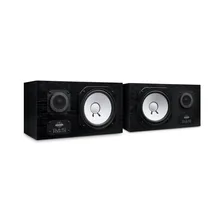 #65 Avantone Pro CLA-10: $1,100 per pair B&H Photo Video eBay
Pros: A current passive recreation of the familiar sealed nearfield studio monitor, useful when compatibility with established NS-10-based workflows matters. The sealed cabinet and simple electrical interface are practical and rugged. Measured bass extension of 159.7Hz (-3dB).
Cons: The local Spinorama score is only 2.23 raw and 5.87 with a subwoofer, with 101Hz extension: objectively bass-light and far from neutral. It is a specialized mix-check tool rather than a strong general-listening value.
Full Avantone Pro CLA-10 review and specifications →
| Bass Extension (-10dB) | 78.4Hz (derived, log-interpolated between spinorama.org -9dB/-12dB points) |
|---|---|
| Bass Extension (-3dB) | 159.7Hz (measured, ASR via spinorama.org) |
| DIY Kit | No |
| Dimensions | 15H x 8.5W x 7.8D in |
| Drivers | 1.4-inch soft-dome tweeter, 7-inch paper woofer |
| Enclosure | Passive sealed 2-way |
| Frequency Response | 60Hz-20kHz |
| Impedance | 8 ohms |
| Power Handling | 120W program |
| Sensitivity | 90dB |
| Spinorama Preference Score | 2.23 |
| Spinorama Preference Score with Perfect Sub | 5.87 |
| Weight | 13.2 lbs (6 kg) each |
- Links
- Reviews, Comparisons and Sound Samples
- Head-to-Head Comparisons
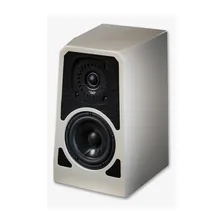 #66 Wilson Audio TuneTot: $10,000 per pair eBay
Pros: Exceptional cabinet construction, premium finish choices and a compact form intended for difficult shelf or desktop locations. The current product has a broad accessory ecosystem and manufacturer support. Measured bass extension of 85.0Hz (-3dB).
Cons: The local Spinorama scores are just 1.89 raw and 4.96 with a subwoofer, with 74Hz extension, a very poor measured value at $10000 per pair. Optional isolation bases and stands add still more cost.
Full Wilson Audio TuneTot review and specifications →
| Bass Extension (-10dB) | 64.3Hz (derived, log-interpolated between spinorama.org -9dB/-12dB points) |
|---|---|
| Bass Extension (-3dB) | 85.0Hz (measured, ASR via spinorama.org) |
| Country | United States |
| DIY Kit | No |
| Dimensions | 14.8H x 8.6W x 11.2D in |
| Drivers | 1-inch soft-dome tweeter, 5.75-inch woofer |
| Enclosure | Passive 2-way rear-ported |
| Frequency Response | 65Hz-23kHz |
| Impedance | 8 ohms nominal |
| Sensitivity | 86dB |
| Spinorama Preference Score | 1.89 |
| Spinorama Preference Score with Perfect Sub | 4.96 |
| Weight | 29.1 lbs (13.2 kg) each |
- Links
- Reviews, Comparisons and Sound Samples
- Head-to-Head Comparisons
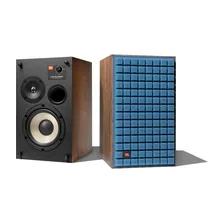 #67 JBL L52 Classic: $999.00 per pair Amazon eBay
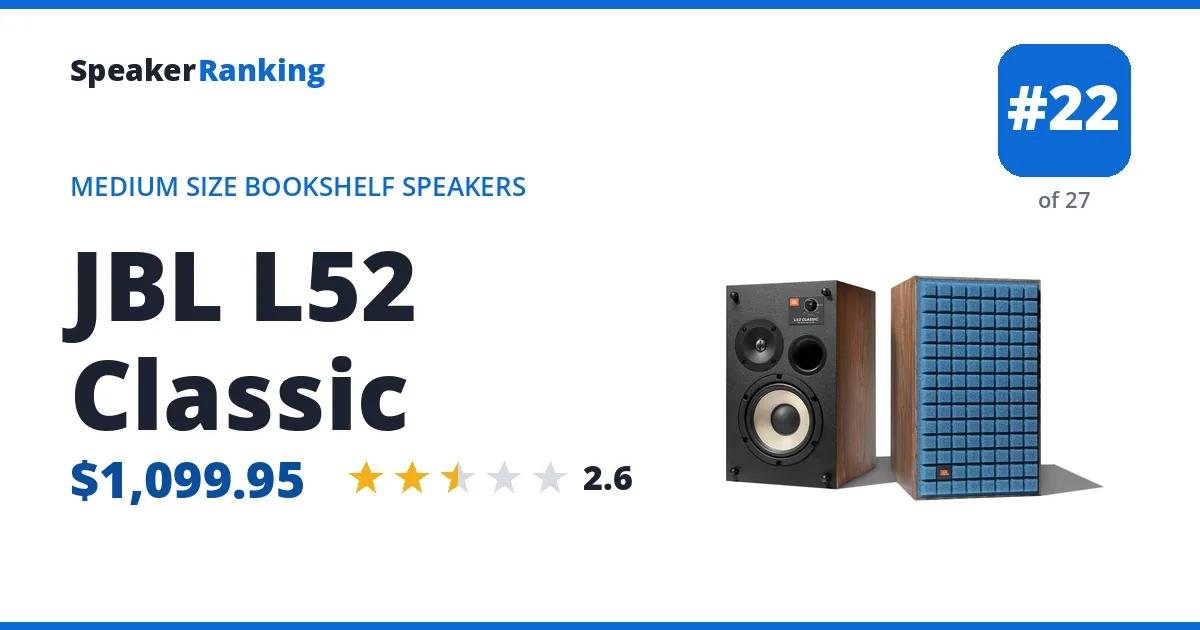
Pros: Genuine walnut wood veneer cabinet with a retro Quadrex foam grille (black, orange, or dark blue) reviving JBL’s classic L-series look. 5.25” pure pulp cone woofer and 0.75” titanium dome tweeter on a waveguide, front-firing bass reflex port, in a compact stand-mount cabinet. A pronounced upper-bass bump around 100 Hz gives kick drums a punchy, textured character. Measured bass extension of 62Hz (-3dB), with a measured sensitivity of 85dB.
Cons: Measured compression and distortion behavior from about 1-5 kHz was inconsistent (“wonky”) across output levels, and didn’t clean up even at lower volume; adding a subwoofer high-pass didn’t fix the high-frequency distortion either. Response rolls off quickly above the upper-bass bump, so there’s punch and impact but not real low-end rumble or fundamental weight below about 60 Hz without a subwoofer. Soundstage width was inconsistent track to track, with imaging not staying locked to where instruments should be. Vocals could sound hot and slightly grainy in the 2.5-5 kHz region; pointing the speakers off-axis reduced that sharpness but also killed high-frequency air.
Full JBL L52 Classic review and specifications →
| Bass Extension (-10dB) | 45Hz (measured average, Erin’s Audio Corner) |
|---|---|
| Bass Extension (-3dB) | 62Hz (measured average, Erin’s Audio Corner) |
| Crossover Frequency | 2.8kHz |
| DIY Kit | No |
| Dimensions | 13-1/16”H x 7-13/16”W x 8-11/16”D |
| Drivers | 5.25” pure pulp cone woofer, 0.75” titanium dome tweeter with waveguide |
| Frequency Response | 47Hz - 24kHz (-6dB, manufacturer specified) |
| Impedance | 4 ohms nominal, 3.7 ohms minimum (measured, Erin’s Audio Corner) |
| Power Handling | 10-75W RMS |
| Sensitivity | 85dB (measured average, Erin’s Audio Corner) |
| Spinorama Preference Score | 4.54 |
| Spinorama Preference Score with Perfect Sub | 6.96 |
| Weight | 11 lbs (5 kg) each |
- Links
- Reviews, Comparisons and Sound Samples
- Head-to-Head Comparisons
- JBL L52 Classic vs JBL Stage A120
- JBL L52 Classic vs ELAC Uni-Fi 2.0 UB52
- JBL L52 Classic vs Pioneer SP-BS22-LR (Philharmonic AAM Mod)
- JBL L52 Classic vs KEF Q100
- JBL L52 Classic vs Dynaudio X14
- JBL L52 Classic vs Q Acoustics 3020i
- JBL L52 Classic vs ELAC BS U5
- JBL L52 Classic vs Dynaudio Emit M10
- See all 35 comparisons
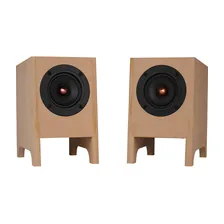 #68 Parts Express Copperhead Desktop Kit: $119.98 per pair Parts Express eBay
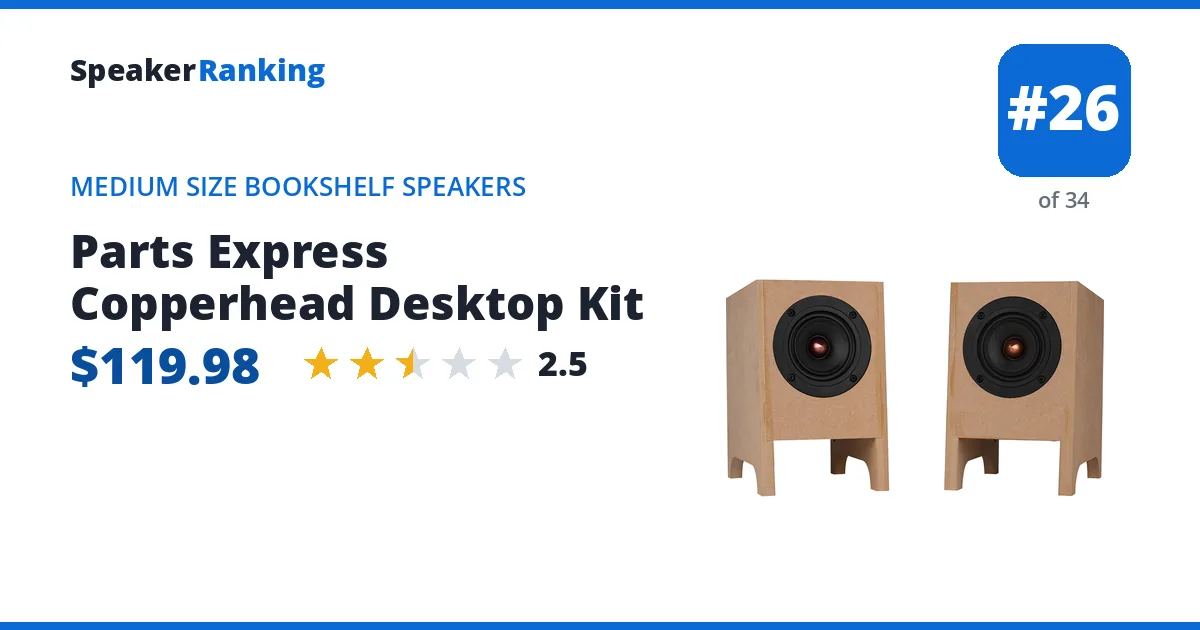
Pros: Inexpensive, beginner-friendly CNC flat-pack kit with a compact 8 x 5-inch desktop footprint and only one 3.5-inch full-range driver per channel. The point-source layout avoids a conventional woofer/tweeter crossover and, when listened to around 20 degrees above the driver as intended, can produce precise near-field imaging. Erin measured roughly 81dB sensitivity, consistent with Parts Express’s specification. The included baffle-step network improves lower-midrange balance, while the optional series inductor reduces the driver’s rising top end; Erin recommends retaining it. Several remaining narrow peaks can be corrected with desktop software EQ. Bottom porting conserves desk space, and unfinished MDF invites custom finishing. Measured bass extension of 98.1Hz (-3dB), with a measured sensitivity of 81dB.
Cons: Despite the ‘full-range’ label, output rolls off around 120-150Hz and a subwoofer with an unusually high 100-200Hz crossover is effectively mandatory. Native response has resonances near roughly 2.1kHz and 8kHz plus a broad 14-20kHz rise of 5-8dB, so it is not smooth without the supplied network and additional EQ. Distortion already exceeds 3% in places at 86dB/1m and becomes extreme at 96dB. Erin’s multitone test approached -10dB distortion (roughly 30%) full-range at the highest level, accompanied by 3-4dB compression; even a 200Hz high-pass leaves roughly 3-5% distortion and 2-3dB compression. The angled cabinet demands a specific near-field ear height, and its very low sensitivity plus 10W RMS power rating leave almost no clean-output headroom for room listening.
Full Parts Express Copperhead Desktop Kit review and specifications →
| Bass Extension (-10dB) | 69.3Hz (measured, Erin’s Audio Corner) |
|---|---|
| Bass Extension (-3dB) | 98.1Hz (measured, Erin’s Audio Corner) |
| DIY Kit | Yes |
| Dimensions | 8”H x 5”W x 6.5”D (203 x 127 x 165 mm) |
| Drivers | 3.5” Dayton Audio PS95-8 full-range driver |
| Frequency Response | 120Hz-20kHz +/-3dB (manufacturer specified) |
| Impedance | 8 ohms (manufacturer specified) |
| Power Handling | 10W RMS / 20W maximum; 25W RMS with 50Hz high-pass |
| Sensitivity | 81dB @ 1W/1m (measured by Erin’s Audio Corner and manufacturer specified) |
| Spinorama Preference Score | 2.11 (spinorama.org) |
| Spinorama Preference Score with Perfect Sub | 5.35 (spinorama.org) |
| Woofer Cabinet | ported, bottom |
- Links
- Reviews, Comparisons and Sound Samples
- Head-to-Head Comparisons
- Parts Express Copperhead Desktop Kit vs JBL Stage A120
- Parts Express Copperhead Desktop Kit vs Pioneer SP-BS22-LR (Philharmonic AAM Mod)
- Parts Express Copperhead Desktop Kit vs Jamo S 803
- Parts Express Copperhead Desktop Kit vs JBL Studio 530
- Parts Express Copperhead Desktop Kit vs KEF Q150
- Parts Express Copperhead Desktop Kit vs Neumi BS5
- Parts Express Copperhead Desktop Kit vs Arendal 1961 Monitor
- Parts Express Copperhead Desktop Kit vs KEF LS50 Meta
 #69 JBL Stage A120: $299 per pair Discontinued eBay
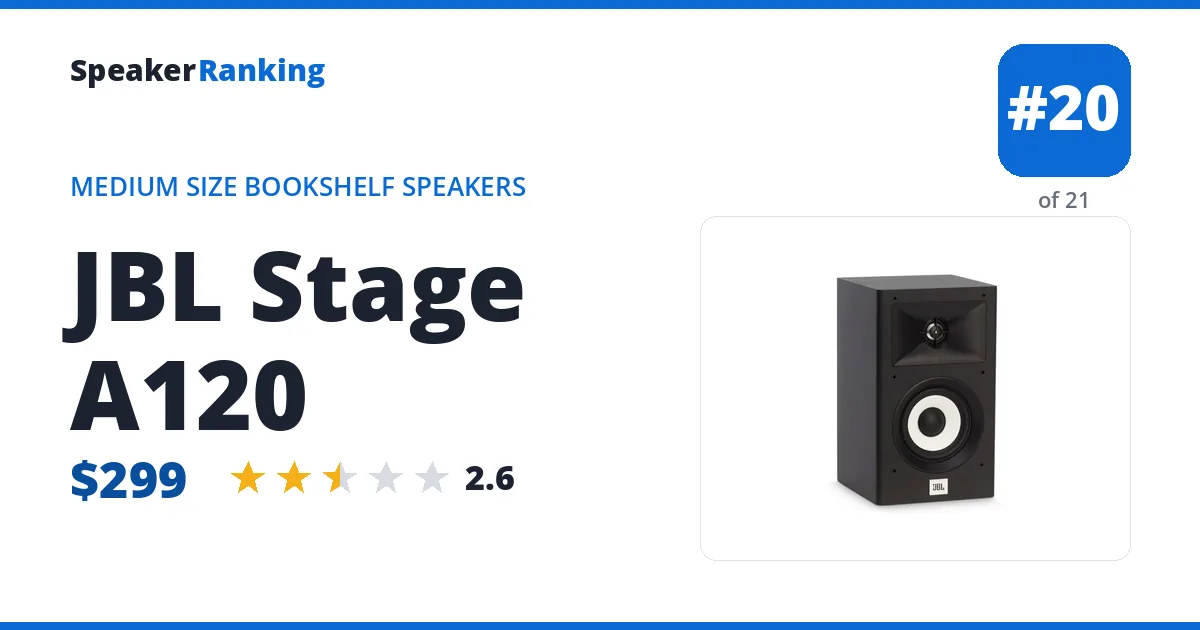
Newer model: the JBL Stage 2 240B. It’s likely to perform similarly, though we don’t have measurements to confirm that yet.
Pros: Comes with a port bung, letting you experiment between ported and sealed configurations: the reviewer found the sound improved somewhat with the port sealed. Distortion at 96dB is broadly comparable to competitors in this price range outside of some elevated low-end THD. Wide horizontal radiation pattern for a compact bookshelf speaker in the low-to-midrange. Measured bass extension of 71Hz (-3dB), with a measured sensitivity of 83dB.
Cons: A pronounced “Batman”-shaped frequency response: boosted bass, a scooped midrange, and elevated treble (about 3-4dB above the midrange), driven partly by confirmed cabinet panel resonance around 800Hz-1.7kHz. Directivity shows significant back-to-back peaks and dips, making the speaker harder to correct with EQ since the off-axis sound doesn’t track the direct sound cleanly. Elevated treble that some might call “detailed” reads as an unwelcome boost to the reviewer rather than genuine resolution. Compression testing shows the low end degrading substantially at high output (102dB). Overall considered one of the weaker speakers the reviewer has tested in this class, with a competing model (Emotiva Airmotiv B1+) recommended instead at a similar price. Discontinued.
Full JBL Stage A120 review and specifications →
| Bass Extension (-10dB) | 53Hz (measured, Erin’s Audio Corner) |
|---|---|
| Bass Extension (-3dB) | 71Hz (measured, Erin’s Audio Corner) |
| DIY Kit | No |
| Dimensions | 11.3”H x 6.8”W x 7.4”D (285.8 x 171.5 x 188.9 mm) |
| Drivers | 0.75” tweeter + 5” woofer |
| Impedance | 6 ohms |
| Sensitivity | 83dB (measured, Erin’s Audio Corner) |
| Spinorama Preference Score | 3.50 |
| Spinorama Preference Score with Perfect Sub | 6.24 |
| Weight | 10.6 lbs (4.8 kg) |
| Woofer Cabinet | ported |
- Reviews, Comparisons and Sound Samples
- Head-to-Head Comparisons
- JBL Stage A120 vs Parts Express Copperhead Desktop Kit
- JBL Stage A120 vs ELAC Uni-Fi 2.0 UB52
- JBL Stage A120 vs KEF Q100
- JBL Stage A120 vs JBL L52 Classic
- JBL Stage A120 vs Q Acoustics 3020i
- JBL Stage A120 vs Pioneer SP-BS22-LR (Philharmonic AAM Mod)
- JBL Stage A120 vs Micca RB42
- JBL Stage A120 vs Dynaudio X14
- See all 37 comparisons
 #70 ELAC Uni-Fi 2.0 UB52: $599.00 per pair Amazon eBay
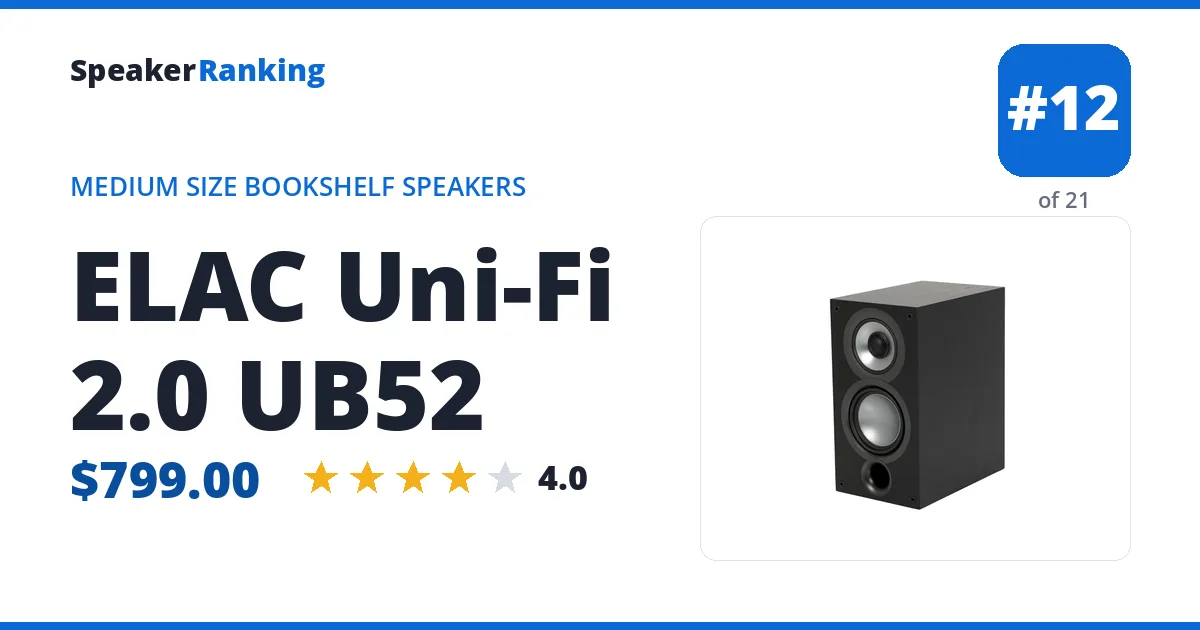
Pros: Wide, smooth horizontal directivity: beamwidth holds to about ±60 degrees up to 8kHz before narrowing. Vertical directivity is substantially better than average, giving more listening-height leeway than most two-way bookshelf speakers. Measured bass extension of 55.7Hz (-3dB), with a measured sensitivity of 83.3dB.
Cons: Dipped 3db from 1.5-3kHz. On-axis response shelves down above 1.5kHz along with multiple resonances, leading the reviewer to predict it will “likely sound dull.” Nasty resonance at 600Hz: audible as an actual buzzing artifact on some recordings (the reviewer demonstrated it with an Eva Cassidy track), and it shows up as a sharp distortion spike exceeding 4% at 585Hz when driven to 96dB SPL/1m. Not recommended.
Full ELAC Uni-Fi 2.0 UB52 review and specifications →
| Bass Extension (-10dB) | 38.6Hz (measured, Audio Science Review) |
|---|---|
| Bass Extension (-3dB) | 55.7Hz (measured, Audio Science Review) |
| Crossover Frequency | 200Hz / 2000Hz |
| DIY Kit | No |
| Dimensions | 13.6”H x 7.3”W x 10.8”D (346 x 185 x 275 mm) |
| Drivers | 5.25” aluminum woofer, 4” aluminum midrange, 1” soft dome tweeter |
| Impedance | 6 ohms |
| Power Handling | 140W max |
| Sensitivity | 83.3dB (measured by Audio Science Review; 85dB manufacturer specified) |
| Spinorama Preference Score | 5.32 (spinorama.org) |
| Spinorama Preference Score with Perfect Sub | 7.34 (spinorama.org) |
| Weight | 7.7 lbs (3.5 kg) |
| Woofer Cabinet | ported |
- Links
- Reviews, Comparisons and Sound Samples
- Head-to-Head Comparisons
- ELAC Uni-Fi 2.0 UB52 vs KEF Q100
- ELAC Uni-Fi 2.0 UB52 vs JBL Stage A120
- ELAC Uni-Fi 2.0 UB52 vs Q Acoustics 3020i
- ELAC Uni-Fi 2.0 UB52 vs JBL L52 Classic
- ELAC Uni-Fi 2.0 UB52 vs Micca RB42
- ELAC Uni-Fi 2.0 UB52 vs Q Acoustics 5020
- ELAC Uni-Fi 2.0 UB52 vs Pioneer SP-BS22-LR (Philharmonic AAM Mod)
- ELAC Uni-Fi 2.0 UB52 vs Dynaudio X14
- See all 42 comparisons
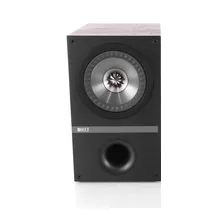 #71 KEF Q100: $550 per pair Discontinued eBay
Newer model: the KEF Q1 Meta, ranked higher, rated 3.6/5.
Pros: 5.25” Uni-Q coaxial driver keeps the tweeter and woofer point-source aligned for consistent imaging. 86dB sensitivity is reasonably easy to drive. Measured bass extension of 85Hz (-3dB), with a measured sensitivity of 85dB.
Cons: CEA2034 spinorama shows broad, audible deviations from flat rather than narrow peaks: a lift from 700Hz-1.5kHz and again from 5kHz up, plus a cancellation notch around 1.4kHz from port/cabinet interaction. Bass sensitivity drops to about 80dB and impedance falls below 4 ohms in the bass, demanding a capable amplifier. The reviewer heard boomy, buzzing bass that improved somewhat with the port plugged, and could not recommend it, calling the famous reputation more about looks than sound. Discontinued.
Full KEF Q100 review and specifications →
| Bass Extension (-10dB) | 65Hz (measured, Audio Science Review) |
|---|---|
| Bass Extension (-3dB) | 85Hz (measured, Audio Science Review) |
| DIY Kit | No |
| Dimensions | 11.8”H x 7.1”W x 10.7”D (300 x 180 x 272 mm) |
| Drivers | 5.25” Uni-Q aluminum coaxial driver, 1” aluminum dome tweeter |
| Frequency Response | 49Hz - 40kHz (+/-3dB) (Manufacturer specified) |
| Impedance | 8 ohms nominal |
| Sensitivity | 85dB (2.83V/1m, measured, Audio Science Review) |
| Spinorama Preference Score | 4.96 (spinorama.org) |
| Spinorama Preference Score with Perfect Sub | 7.24 (spinorama.org) |
| Weight | 13 lbs (5.9 kg) each |
| Woofer Cabinet | ported, rear |
- Reviews, Comparisons and Sound Samples
- Head-to-Head Comparisons
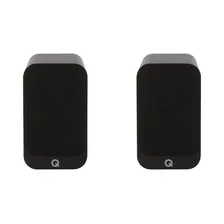 #72 Q Acoustics 3020i: $314.99 per pair Discontinued eBay
Newer model: the Q Acoustics 3020c. It’s likely to perform similarly, though we don’t have measurements to confirm that yet.
Pros: UK-designed (Finkteam) with attractive styling, including recessed binding posts and custom connectors. Vertical directivity is good enough that the tweeter doesn’t need to be exactly at ear level. With EQ correction, especially high-frequency shelving and a sub-40Hz high-pass filter, Amir found performance “improves substantially.”. Measured bass extension of 82.0Hz (-3dB).
Cons: On-axis response shows a rising upper-frequency trend and a dip in the 2-4kHz crossover region alongside two resonance-related dips; a significant resonance appears at 366Hz in the waterfall plot. Horizontal directivity is narrow and uneven due to a woofer/tweeter beamwidth mismatch. Amir cautions the speaker is “merely a distortion generator” if played too low, and its low impedance demands a quality amplifier. Without EQ, Amir “can’t recommend the Q Acoustics 3020i.”. Discontinued; Q Acoustics now sells the 3030i and 3010c in its place.
Full Q Acoustics 3020i review and specifications →
| Bass Extension (-10dB) | 49.8Hz (measured, Audio Science Review) |
|---|---|
| Bass Extension (-3dB) | 82.0Hz (measured, Audio Science Review) |
| Crossover Frequency | 2.4kHz |
| DIY Kit | No |
| Dimensions | 10.9”H x 6.7”W x 11.1”D (278 x 170 x 282 mm) |
| Drivers | 125mm (5”) bass driver, 22mm (0.9”) tweeter |
| Impedance | 6 ohms nominal, 4 ohms minimum |
| Sensitivity | 86dB (2.83V/1m, manufacturer specified) |
| Spinorama Preference Score | 3.86 |
| Spinorama Preference Score with Perfect Sub | 6.38 |
| Weight | 10.6 lbs (4.8 kg) each |
| Woofer Cabinet | ported, reflex |
- Reviews, Comparisons and Sound Samples
- Head-to-Head Comparisons
- Q Acoustics 3020i vs KEF Q100
- Q Acoustics 3020i vs ELAC Uni-Fi 2.0 UB52
- Q Acoustics 3020i vs Micca RB42
- Q Acoustics 3020i vs JBL Stage A120
- Q Acoustics 3020i vs Q Acoustics 5020
- Q Acoustics 3020i vs JBL L52 Classic
- Q Acoustics 3020i vs JBL Stage A130
- Q Acoustics 3020i vs Fluance Signature HFS
- See all 35 comparisons
 #73 Role Audio Skiff: $495 per pair Role Audio eBay
Pros: Extremely compact US-made sealed cabinets with a crossoverless full-range driver, simple eight-ohm load and five-year warranty. Current direct pricing includes shipping and the design can disappear into a desktop or small room. Measured bass extension of 143.6Hz (-3dB).
Cons: The local Spinorama score is -0.47 raw and only 3.61 with a subwoofer, with 128Hz measured extension, among the weakest measured results we list. Narrow bandwidth and uneven response make it a niche space-saving choice.
Full Role Audio Skiff review and specifications →
| Bass Extension (-10dB) | 106.6Hz (derived, log-interpolated between spinorama.org -9dB/-12dB points) |
|---|---|
| Bass Extension (-3dB) | 143.6Hz (measured, ASR via spinorama.org) |
| Country | United States |
| DIY Kit | No |
| Dimensions | 6H x 4W x 5D in |
| Drivers | 3-inch cast-frame full-range |
| Enclosure | Sealed single-driver |
| Frequency Response | 100Hz-20kHz |
| Impedance | 8 ohms |
| Sensitivity | 88dB |
| Spinorama Preference Score | -0.47 |
| Spinorama Preference Score with Perfect Sub | 3.61 |
| Weight | 4 lbs (1.8 kg) each |
- Links
- Reviews, Comparisons and Sound Samples
- Head-to-Head Comparisons
 #74 Zaph Audio ZA5.2 TM: $383 per pair Madisound eBay
Pros: CEA2034 spinorama shows a fairly smooth on-axis response. Cumulative spectral decay (waterfall) is clean overall, with only minor lingering energy around 400-700Hz. Measured bass extension of 70.3Hz (-3dB).
Cons: Predicted in-room response is tilted upward toward the treble, which the reviewer flagged as a likely audible brightness. Low sensitivity of about 82dB requires more amplifier gain than typical. Relative harmonic distortion is excessive in the low frequencies, climbing to 6-8% under a 10-volt test signal in the 60-150Hz region: notably worse than typical two-way designs in this price range. Impedance runs close to 7 ohms through much of the audible range, with additional peaks that make it a moderately demanding load for a low-sensitivity design. Vertical directivity narrows unevenly above about 1kHz, typical of this MTM-adjacent tweeter/woofer spacing.
Full Zaph Audio ZA5.2 TM review and specifications →
| Bass Extension (-10dB) | 42.9Hz (derived, log-interpolated between spinorama.org -9dB/-12dB points) |
|---|---|
| Bass Extension (-3dB) | 70.3Hz (measured, Audio Science Review) |
| DIY Kit | Yes |
| Dimensions | 14”H x 8”W x 9.5”D (355.6 x 203.2 x 241.3 mm) |
| Drivers | 5” ZA14W08 aluminum cone woofer, 1” DQ25SC16-04 titanium dome tweeter |
| Impedance | 8 ohms |
| Sensitivity | 82dB |
| Spinorama Preference Score | 5.41 |
| Spinorama Preference Score with Perfect Sub | 7.60 |
| Weight | 9.3 lbs (4.2 kg) |
| Woofer Cabinet | ported, front |
- Links
- Reviews, Comparisons and Sound Samples
- Head-to-Head Comparisons
 #75 Micca RB42: $159.99 per pair Amazon eBay
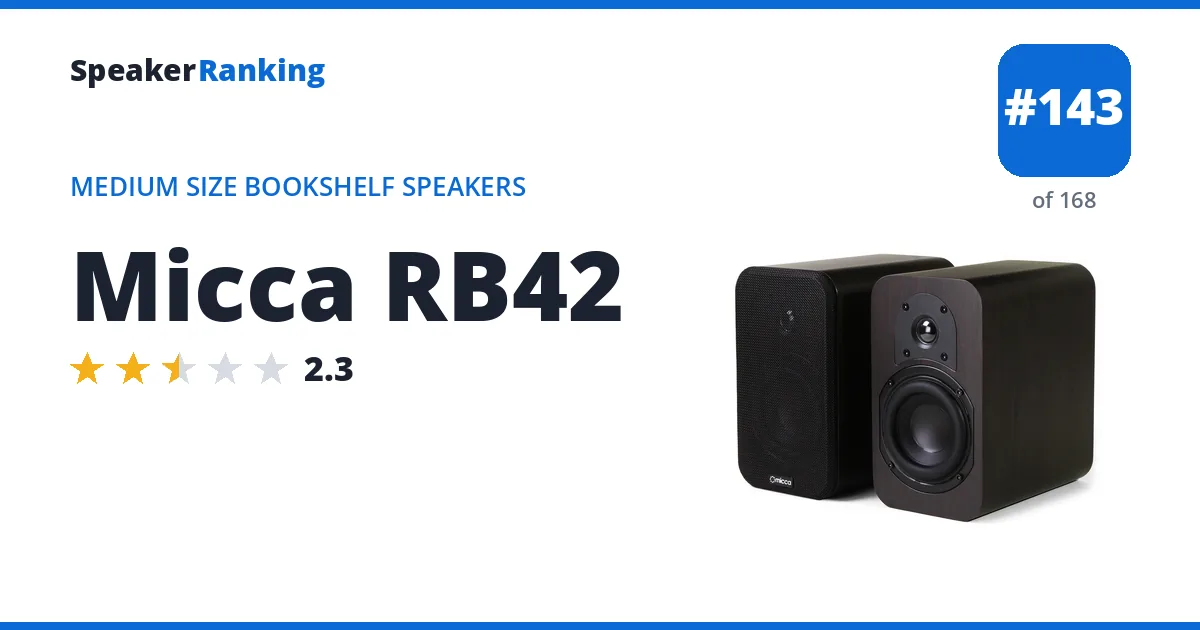
Pros: Curved cabinet fit and finish look closer to a speaker costing three times as much. Rated for a wide 15-100W amplifier range with 4-8 ohm compatibility, giving flexibility with modest amplification. Measured bass extension of 85Hz (-3dB), with a measured sensitivity of 80dB.
Cons: CEA2034 spinorama shows significant peaks and valleys in the on-axis and listening-window response starting a few kHz up, with excess high-frequency energy the reviewer found fatiguing over time despite an initial impression of “detail.” Off-axis response diverges heavily from on-axis, meaning tonality shifts with room and listening position in ways EQ can’t correct. Distorts and the woofer visibly flaps under moderate volume; low 83dB sensitivity makes it a harder amplifier load than its size suggests.
Full Micca RB42 review and specifications →
| Bass Extension (-10dB) | 62Hz (measured, Audio Science Review) - the reviewer noted an artificial boost around 100-300Hz, so true extension may be worse than this on-axis reading suggests |
|---|---|
| Bass Extension (-3dB) | 85Hz (measured, Audio Science Review) - the reviewer noted an artificial boost around 100-300Hz, so true extension may be worse than this on-axis reading suggests |
| DIY Kit | No |
| Dimensions | 8.7H x 4.9W x 7.9D in |
| Drivers | 4” coated paper woofer, 0.75” silk dome tweeter |
| Frequency Response | 50Hz - 20kHz (Manufacturer specified, typical in-room) |
| Impedance | 4-8 ohms |
| Power Handling | 15-100W each |
| Sensitivity | 80dB (2.83V/1m, measured, Audio Science Review) |
| Spinorama Preference Score | 4.59 |
| Spinorama Preference Score with Perfect Sub | 6.87 |
| Weight | 6 lbs (2.7 kg) each (per retailer listing) |
| Woofer Cabinet | ported, front |
- Links
- Reviews, Comparisons and Sound Samples
- Head-to-Head Comparisons
 #76 Q Acoustics 5020: $1,199.00 per pair Amazon eBay
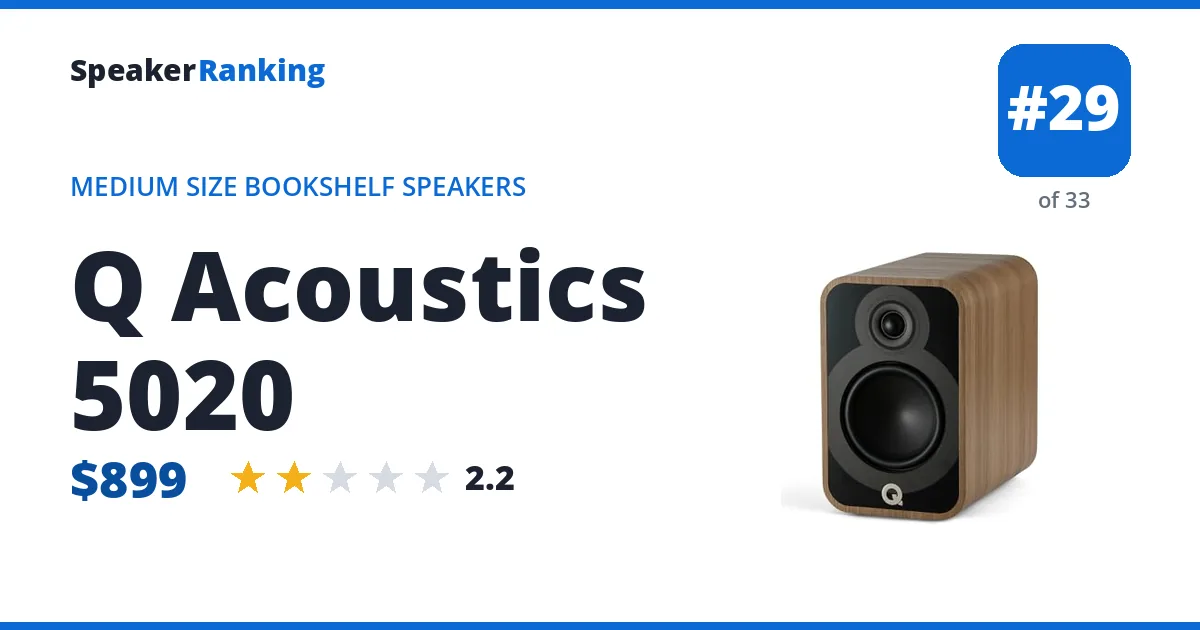
Pros: Attractively finished compact standmount with a 5-inch Continuous Curved Cone woofer and carefully engineered cabinet details. Erin found distortion well controlled at normal levels: below 1% down to about 50Hz at 86dB/1m. Its 87dB measured sensitivity is unremarkable rather than hard to drive, and it maintains acceptable output for typical 80-85dB listening. The rear port can be plugged for placement flexibility. Measured bass extension of 103Hz (-3dB), with a measured sensitivity of 87.1dB.
Cons: Erin found the tonal balance distinctly too crisp, forward and treble-heavy: the top end is roughly 3-5dB elevated while the 1-3kHz region is recessed, so vocals change level unnaturally as they move through their range. The shallow woofer crossover and steeper tweeter slope contribute to the off-axis discontinuity, while the port has a strong 1kHz resonance. Bass is limited: Erin measured F3 103Hz and F10 48Hz; at 96dB distortion reaches about 3% by 100Hz, and he bottomed the woofer when pushed hard. He preferred the less-expensive 3020i’s linearity and did not recommend the 5020 for neutral listening without EQ.
Full Q Acoustics 5020 review and specifications →
| Bass Extension (-10dB) | 48Hz (measured, Erin’s Audio Corner) |
|---|---|
| Bass Extension (-3dB) | 103Hz (measured, Erin’s Audio Corner) |
| Crossover Frequency | 2.5kHz (manufacturer specified) |
| DIY Kit | No |
| Dimensions | 11.2”H x 7.1”W x 11.5”D |
| Drivers | 5” (125mm) C3 mid/bass driver, 1” (25mm) tweeter |
| Frequency Response | 53Hz - 30kHz (-6dB, manufacturer specified) |
| Impedance | 6 ohms nominal, 3.3 ohms minimum (manufacturer specified) |
| Recommended Power | 25W - 100W (manufacturer specified) |
| Sensitivity | 87.1dB (2.83V/1m, measured, Erin’s Audio Corner; 87.9dB manufacturer specified) |
| Spinorama Preference Score | 3.63 |
| Spinorama Preference Score with Perfect Sub | 6.55 |
| Weight | 15.4 lbs (7.0 kg) each |
| Woofer Cabinet | rear-ported |
- Links
- Reviews, Comparisons and Sound Samples
- Head-to-Head Comparisons
- Q Acoustics 5020 vs Micca RB42
- Q Acoustics 5020 vs Verdant Audio Bambusa AL-1
- Q Acoustics 5020 vs JBL Stage A130
- Q Acoustics 5020 vs Fluance Signature HFS
- Q Acoustics 5020 vs Q Acoustics 3020i
- Q Acoustics 5020 vs JBL Control 1 Pro
- Q Acoustics 5020 vs KEF Q100
- Q Acoustics 5020 vs Polk T15
- See all 43 comparisons
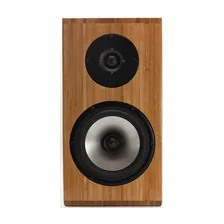 #77 Verdant Audio Bambusa AL-1: $7000 per pair Discontinued eBay
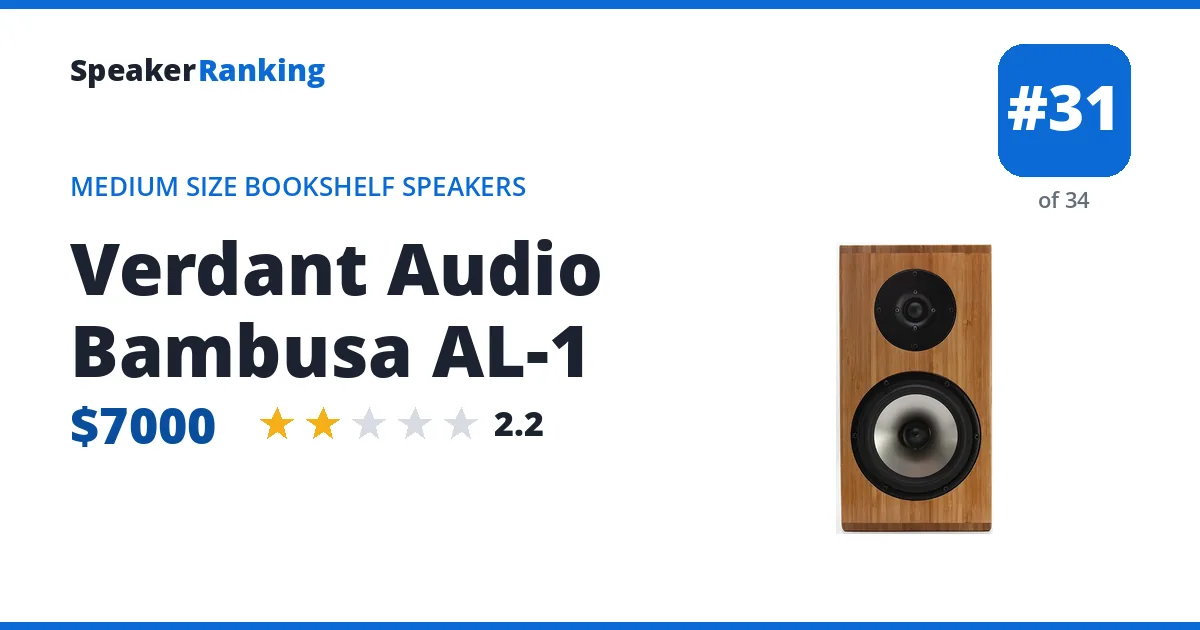
Pros: Distortion above 100Hz stays close to the noise floor at 96dB SPL/1m, quite low for a compact two-way. Measured bass extension of 70.3Hz (-3dB), with a measured sensitivity of 86.1dB.
Cons: CEA2034 spinorama and predicted in-room response both show too little bass output for its small 3” woofer, a real limitation for a $7000/pair speaker. Cumulative spectral decay (waterfall, including room modes) shows a number of resonances lingering through the bass and lower midrange. Overpriced for the performance and not recommended. Discontinued.
Full Verdant Audio Bambusa AL-1 review and specifications →
| Bass Extension (-10dB) | 42.9Hz (measured, Audio Science Review) |
|---|---|
| Bass Extension (-3dB) | 70.3Hz (measured, Audio Science Review) |
| DIY Kit | No |
| Dimensions | 15.5”H x 9”W x 11.5”D (394 x 229 x 292 mm) |
| Drivers | 1” tweeter + 3” woofer |
| Impedance | 8 ohms nominal, 6.3 ohms minimum |
| Sensitivity | 86.1dB (2.83V/1m, measured by Audio Science Review) |
| Spinorama Preference Score | 5.05 |
| Spinorama Preference Score with Perfect Sub | 7.12 |
| Weight | 31.3 lbs (14.2 kg) |
- Reviews, Comparisons and Sound Samples
- Head-to-Head Comparisons
 #78 JBL Stage A130: $399 per pair Discontinued eBay
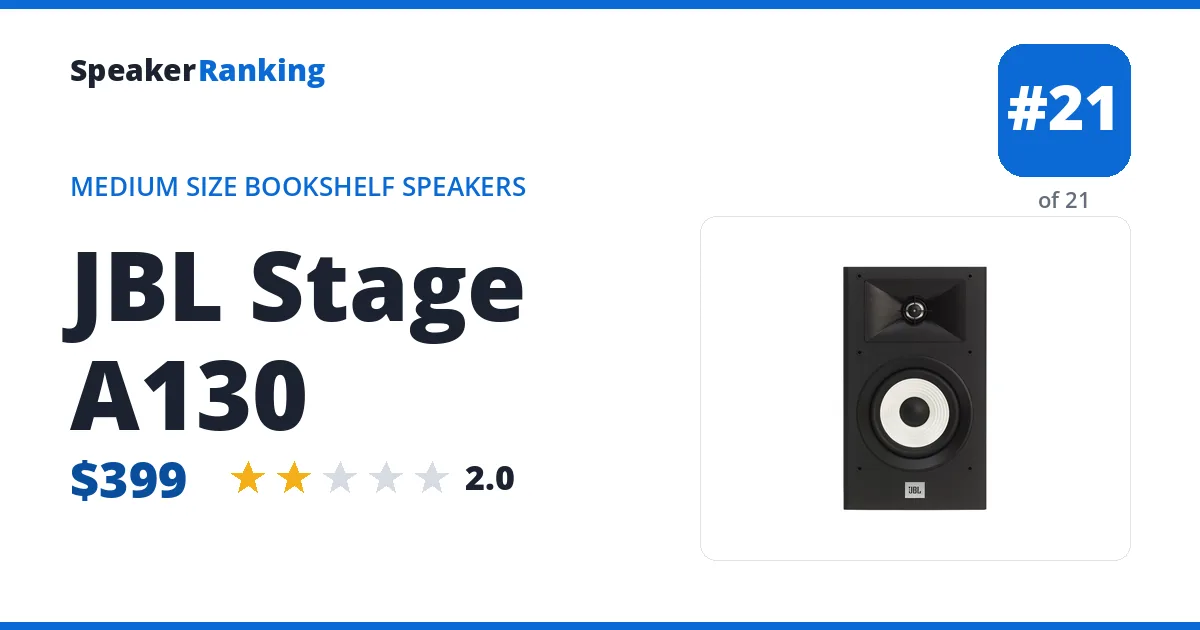
Newer model: the JBL Stage 250B, ranked higher, rated 3.2/5.
Pros: More constant, better-behaved directivity than the smaller A120 once past the tweeter crossover point, giving a more consistent radiation pattern that likely explains some of its positive reception among other reviewers. Distortion at 96dB measures slightly better than a direct competitor (Emotiva Airmotiv B1+) in the low end, though slightly worse at high frequencies. The tweeter itself sounded decent to the reviewer, who considers it a reasonable value at its price point despite other reservations. Wide, well-filled horizontal radiation through the midrange. Measured bass extension of 66Hz (-3dB), with a measured sensitivity of 85.2dB.
Cons: Still shows the same underlying “Batman”-shaped response pattern as the A120: a bass bump, a midrange dip, a cabinet-resonance peak around 800Hz-1.7kHz (confirmed via accelerometer testing on the cabinet panels), and roughly a 5dB treble bump around 10kHz. Does not include a port bung, so sealed-cabinet listening requires DIY stuffing rather than a proper factory solution. The reviewer’s own measurements notably diverge from another well-known publication’s results on this same model, possibly reflecting a running production change, though this couldn’t be confirmed. Overall sound quality struck the reviewer as not a good-sounding speaker despite the more favorable measurements relative to the A120. Output-limited at extreme volumes (102dB), similar to its smaller sibling. Loses to the similarly-priced Emotiva Airmotiv B1+ in overall linearity and neutrality, according to the reviewer’s direct comparison. Discontinued.
Full JBL Stage A130 review and specifications →
| Bass Extension (-10dB) | 50Hz (measured, Erin’s Audio Corner) |
|---|---|
| Bass Extension (-3dB) | 66Hz (measured, Erin’s Audio Corner) |
| Crossover Frequency | 3.2kHz |
| DIY Kit | No |
| Dimensions | 12.6”H x 7.5”W x 9.1”D (321 x 190 x 230 mm) |
| Drivers | 5.25” (133mm) polycellulose woofer, 1” (25mm) aluminum dome tweeter |
| Impedance | 6 ohms nominal, about 4.3 ohms minimum (measured, Erin’s Audio Corner) |
| Sensitivity | 85.2dB (measured, Erin’s Audio Corner) |
| Spinorama Preference Score | 4.04 |
| Spinorama Preference Score with Perfect Sub | 6.51 |
| Weight | 12 lbs (5.45 kg) each |
| Woofer Cabinet | ported |
- Links
- Reviews, Comparisons and Sound Samples
- Head-to-Head Comparisons
- JBL Stage A130 vs Fluance Signature HFS
- JBL Stage A130 vs JBL Control 1 Pro
- JBL Stage A130 vs Q Acoustics 5020
- JBL Stage A130 vs Micca RB42
- JBL Stage A130 vs Polk T15
- JBL Stage A130 vs Definitive Technology ProMonitor 1000
- JBL Stage A130 vs Q Acoustics 3020i
- JBL Stage A130 vs KEF Q100
- See all 36 comparisons
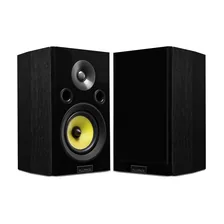 #79 Fluance Signature HFS: $199.99 per pair Amazon eBay
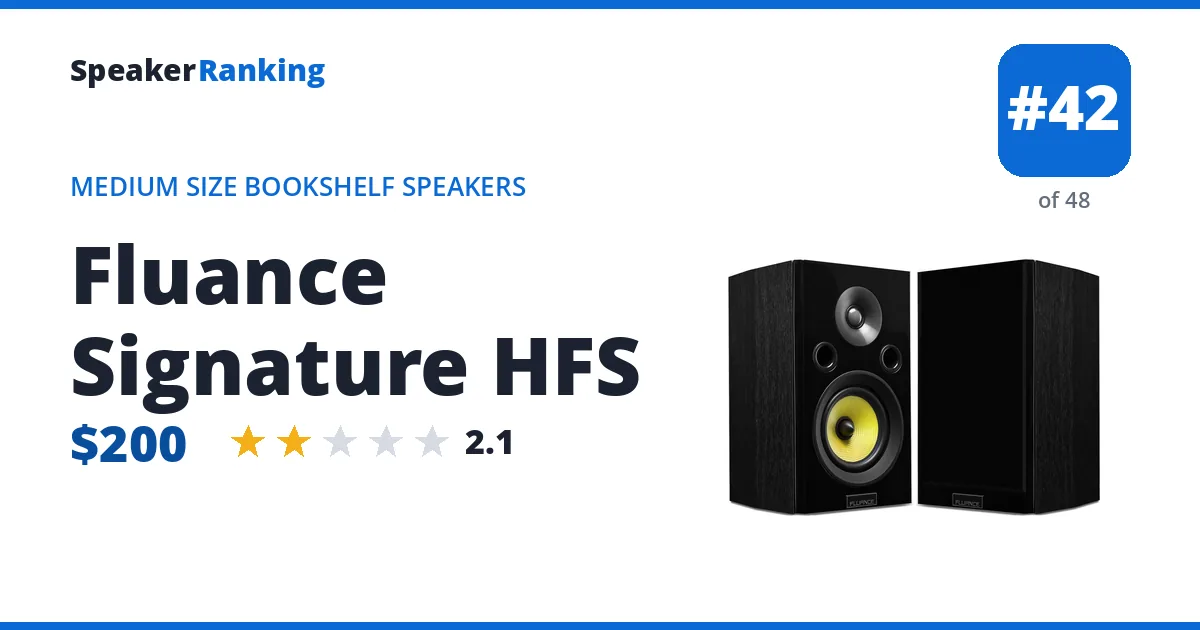
Pros: Front-facing port and pre-installed wall-mount brackets make it flexible for bookshelf or surround/height duty. Distortion in the low end is well controlled per the measurements, and the glossy front baffle adds a touch of style well beyond the budget price. Measured bass extension of 78Hz (-3dB), with a measured sensitivity of 86dB.
Cons: CEA2034 spinorama shows serious flaws in the midrange: both the direct sound and the directivity are compromised, a combination the reviewer flagged as poor for controlled listening tests. Multiple attempted EQ fixes “could not rescue” the sound, and the reviewer said the result was “close” to the lowest possible rating. Online reviews seeded by the company were positive; the reviewer’s measured and subjective experience was not.
Full Fluance Signature HFS review and specifications →
| Bass Extension (-10dB) | 60Hz (measured, Audio Science Review) |
|---|---|
| Bass Extension (-3dB) | 78Hz (measured, Audio Science Review) |
| DIY Kit | No |
| Dimensions | 12.8H x 7.87W x 8.22D in |
| Drivers | 1” neodymium silk dome tweeter (ferrofluid cooled), 5” glass-fiber-treated woofer (butyl rubber surround) |
| Impedance | 8 ohms |
| Power Handling | 30-120W recommended |
| Sensitivity | 86dB (2.83V/1m, measured, Audio Science Review) |
| Spinorama Preference Score | 2.92 (spinorama.org) |
| Spinorama Preference Score with Perfect Sub | 5.53 (spinorama.org) |
| Weight | 9.7 lbs (4.4 kg) each |
| Woofer Cabinet | ported, front |
- Links
- Reviews, Comparisons and Sound Samples
- Head-to-Head Comparisons
- Fluance Signature HFS vs JBL Control 1 Pro
- Fluance Signature HFS vs JBL Stage A130
- Fluance Signature HFS vs Polk T15
- Fluance Signature HFS vs Definitive Technology ProMonitor 1000
- Fluance Signature HFS vs Q Acoustics 5020
- Fluance Signature HFS vs Micca RB42
- Fluance Signature HFS vs Pioneer Elite SP-EBS73-LR
- Fluance Signature HFS vs Q Acoustics 3020i
- See all 32 comparisons
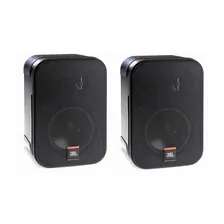 #80 JBL Control 1 Pro: $164 per pair Parts Express eBay
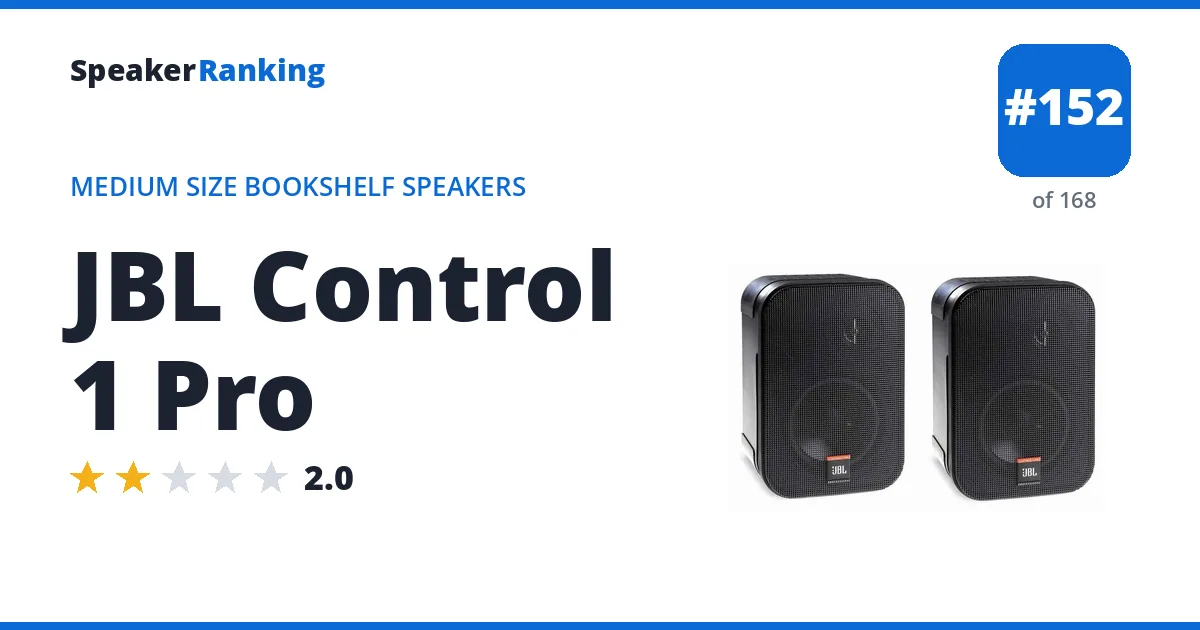
Pros: Magnetically shielded transducers and a rugged molded enclosure make it a durable choice for wall-mount or install use, with SonicGuard overload protection built into the crossover. Feels solidly built despite the low price, and the professional crossover network uses steep slopes. Measured bass extension of 78Hz (-3dB), with a measured sensitivity of 87dB.
Cons: Sound power and predicted in-room response measurements are badly uneven compared to the JBL 305P Mark II tested alongside it, with no waveguide to control directivity as the woofer beams before handing off to the tweeter. The reviewer performed no distortion or dedicated listening test on this unit and concluded he didn’t “think there is a reason to purchase it” over a proper studio monitor at a similar price.
Full JBL Control 1 Pro review and specifications →
| Bass Extension (-10dB) | 55Hz (measured, Audio Science Review) |
|---|---|
| Bass Extension (-3dB) | 78Hz (measured, Audio Science Review) |
| DIY Kit | No |
| Dimensions | 9.3H x 6.3W x 5.6D in |
| Drivers | 5.25” low frequency driver, 0.75” polycarbonate dome tweeter |
| Frequency Response | 80Hz - 20kHz -10dB (Manufacturer specified) |
| Impedance | 4 ohms |
| Power Handling | 150W |
| Sensitivity | 87dB (2.83V/1m, measured, Audio Science Review) |
| Spinorama Preference Score | 2.87 |
| Spinorama Preference Score with Perfect Sub | 6.37 |
| Weight | 4 lbs (1.8 kg) each |
| Woofer Cabinet | sealed |
- Links
- Reviews, Comparisons and Sound Samples
- Head-to-Head Comparisons
- JBL Control 1 Pro vs Polk T15
- JBL Control 1 Pro vs Fluance Signature HFS
- JBL Control 1 Pro vs Definitive Technology ProMonitor 1000
- JBL Control 1 Pro vs JBL Stage A130
- JBL Control 1 Pro vs Q Acoustics 5020
- JBL Control 1 Pro vs Micca RB42
- JBL Control 1 Pro vs Pioneer Elite SP-EBS73-LR
- JBL Control 1 Pro vs Q Acoustics 3020i
- See all 32 comparisons
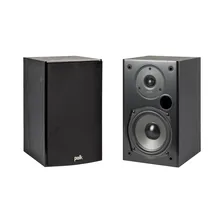 #81 Polk T15: $149.00 per pair Amazon eBay
Pros: Extremely affordable 2-way design that actually measured better at +/-20 degrees vertical off-axis than directly on-axis. In near-field desktop use, the reviewer found the T15 “didn’t sound that horrible,” partly because nearby desk reflections mask the frequency response dip. Measured bass extension of 88.6Hz (-3dB), with a measured sensitivity of 89dB.
Cons: Spinorama analysis reveals what Amir called a “horrific drop in upper mids/lower treble region of 3 to 6 kHz,” likely from tweeter-woofer phase cancellation directly on-axis. Measured impedance ranges from 4-8 ohms, contradicting the specified 6-8 ohm range, and there’s a distortion peak around 400Hz. On- and off-axis response “vary a ton,” making listening position unusually important. The reviewer recommends saving up for the Pioneer SP-BS22-LR instead: “I can’t justify recommending the Polk T15 even though subjective performance was not horrible.”
Full Polk T15 review and specifications →
| Bass Extension (-10dB) | 58.1Hz (measured, Audio Science Review) |
|---|---|
| Bass Extension (-3dB) | 88.6Hz (measured, Audio Science Review) |
| DIY Kit | No |
| Dimensions | 10.63H x 6.5W x 7.25D in |
| Drivers | 0.75” tweeter, 5.25” woofer |
| Frequency Response | 60Hz - 24kHz (Manufacturer specified) |
| Impedance | 8 ohms nominal |
| Sensitivity | 89dB (manufacturer specified, 1W/1m); 88.98dB measured, spinorama.org |
| Spinorama Preference Score | 0.34 |
| Spinorama Preference Score with Perfect Sub | 3.39 |
| Weight | 8.2 lbs (3.74 kg) each |
- Links
- Reviews, Comparisons and Sound Samples
- Head-to-Head Comparisons
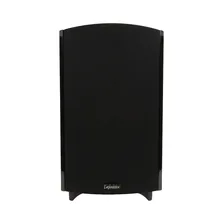 #82 Definitive Technology ProMonitor 1000: $498 per pair Amazon eBay
Pros: Bass distortion is well controlled per the measurements, and the slow bass rolloff means it can be pushed fairly hard for its size. Ships with a footer that keeps the small cabinet planted despite its light weight. Measured bass extension of 95Hz (-3dB), with a measured sensitivity of 86dB.
Cons: CEA2034 spinorama shows severely reduced bass energy between 40-120Hz, a directivity mismatch between the tweeter and woofer, and a severe resonance/interference issue around 14kHz. Distortion at 96dB SPL was so bad the reviewer limited testing to 86dB. Direct comparison to a $118/pair Pioneer SP-BS22-LR left the reviewer calling the $249/pair ProMonitor 1000 “a bad experiment that should be forgotten” and concluding “there is nothing Pro about it.”
Full Definitive Technology ProMonitor 1000 review and specifications →
| Bass Extension (-10dB) | 80Hz (measured, Audio Science Review) |
|---|---|
| Bass Extension (-3dB) | 95Hz (measured, Audio Science Review) |
| DIY Kit | No |
| Dimensions | 10.88H x 6.25W x 6.5D in |
| Drivers | 1” aluminum dome tweeter, 5.25” BDSS mid/woofer, 5.25” planar bass radiator |
| Frequency Response | 47Hz - 30kHz (Manufacturer specified) |
| Impedance | 8 ohms nominal |
| Sensitivity | 86dB (2.83V/1m, measured, Audio Science Review - reviewer noted this vs. a manufacturer spec of 91dB) |
| Spinorama Preference Score | 3.2 (spinorama.org) |
| Spinorama Preference Score with Perfect Sub | 6.58 (spinorama.org) |
| Weight | 7.3 lbs (3.29 kg) each |
| Woofer Cabinet | passive radiator |
- Links
- Reviews, Comparisons and Sound Samples
- Head-to-Head Comparisons
- Definitive Technology ProMonitor 1000 vs Polk T15
- Definitive Technology ProMonitor 1000 vs Sehlin Helium
- Definitive Technology ProMonitor 1000 vs JBL Control 1 Pro
- Definitive Technology ProMonitor 1000 vs Fluance Signature HFS
- Definitive Technology ProMonitor 1000 vs Pioneer Elite SP-EBS73-LR
- Definitive Technology ProMonitor 1000 vs JBL Stage A130
- Definitive Technology ProMonitor 1000 vs Klipsch R-41M
- Definitive Technology ProMonitor 1000 vs Q Acoustics 5020
- See all 33 comparisons
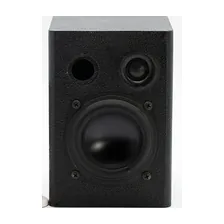 #83 Sehlin Helium: $140 per pair eBay
Pros: An entire pair of drivers and crossover parts costs about $140, with a Parts Express flat-pack enclosure keeping the build simple: genuinely small enough to fit in the palm of a hand. Measured bass extension of 170Hz (-3dB), with a measured sensitivity of 82dB.
Cons: CEA2034 spinorama shows an uneven response that the designer’s own re-measurements confirmed rather than explained away as error. The reviewer described the sound as muffled, boomy, and gritty even up close, concluding “this is a failing attempt” relative to larger designs. Maximum output is limited to about 80dB SPL, well below normal listening levels for most rooms.
Full Sehlin Helium review and specifications →
| Bass Extension (-10dB) | approx. 70Hz (measured, Audio Science Review) - low confidence - this tiny single-driver design has a highly irregular response with a deep notch around 30Hz, not a simple monotonic rolloff |
|---|---|
| Bass Extension (-3dB) | approx. 170Hz (measured, Audio Science Review) - low confidence - this tiny single-driver design has a highly irregular response with a deep notch around 30Hz, not a simple monotonic rolloff |
| DIY Kit | Yes |
| Dimensions | 6.5H x 4.5W x 5D in (0.04 cu. ft. enclosure) |
| Drivers | Dayton Audio ND91-4 3.5” full-range driver (single-driver design) |
| Impedance | 4 ohms (Dayton Audio ND91-4 driver) |
| Sensitivity | approx. 82dB (2.83V/1m, measured, Audio Science Review - low confidence, irregular response with no clear flat region) |
| Spinorama Preference Score | 2.58 (spinorama.org) |
| Spinorama Preference Score with Perfect Sub | 5.46 (spinorama.org) |
| Woofer Cabinet | sealed |
- Links
- Reviews, Comparisons and Sound Samples
- Head-to-Head Comparisons
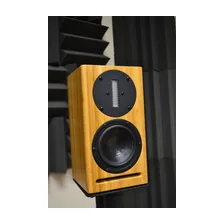 #84 Ascend Sierra Luna: $1,176 per pair superseded by Luna V2 Discontinued eBay
Newer model: the Ascend Acoustics Luna V2 Mini-Monitor Ribbon, ranked higher, rated 4.4/5.
Pros: Ribbon tweeter and a dense, low-resonance bamboo cabinet give it well-controlled horizontal directivity, since the driver sizes blend together effectively. Solid build quality and impressive power handling for such a compact enclosure. Measured bass extension of 88.9Hz (-3dB), with a measured sensitivity of 80.9dB.
Cons: Dramatic peaks in the bass region around 400Hz, 800Hz, and 1.2kHz: Amir questioned, “A woofer doesn’t dance up and down so sharply by itself in a few hundred hertz?” The port resonates excessively, actually exceeding the woofer’s own output and creating problematic bass “horns.” Measured sensitivity of 80.9dB falls well short of the 83dB spec, requiring about 6dB more amplifier gain than typical speakers. Vertical directivity is poor, making tweeter-height listening position critical. Initial impressions were bright and fatiguing; even after aggressive EQ, Amir called the result “still a bit too bright but much more manageable” and could not recommend the speaker standalone. Discontinued.
Full Ascend Sierra Luna review and specifications →
| Bass Extension (-10dB) | 52.1Hz (measured, Audio Science Review) |
|---|---|
| Bass Extension (-3dB) | 88.9Hz (measured, Audio Science Review) |
| DIY Kit | No |
| Dimensions | 10.5H x 5.75W x 6D in |
| Drivers | Custom RAAL true ribbon tweeter (10mm), 4.5” long-throw dual compliant CURV woofer |
| Frequency Response | 60Hz - 27kHz (+/-3dB) (Manufacturer specified) |
| Impedance | 8 ohms nominal |
| Sensitivity | 80.9dB (2.83V/1m, measured, Audio Science Review; 83dB manufacturer specified) |
| Spinorama Preference Score | 1.87 |
| Spinorama Preference Score with Perfect Sub | 4.94 |
| Weight | 9 lbs (4.1 kg) each |
| Woofer Cabinet | ported, front |
- Reviews, Comparisons and Sound Samples
- Head-to-Head Comparisons
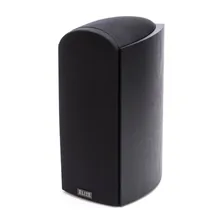 #85 Pioneer Elite SP-EBS73-LR: $749 per pair Discontinued eBay
Pros: Unique dual-driver design combines a front-facing 3-way speaker with an up-firing 2-way Dolby Atmos coaxial driver in one cabinet, designed by Andrew Jones. With corrective EQ applied, the reviewer found “substantially more brilliance and detail,” and the up-firing Atmos driver produced “remarkable” spatial effects from a single box. Measured bass extension of 64.5Hz (-3dB).
Cons: A wide dip between 3-10kHz makes the front speaker sound “somewhat dull” without EQ, and impedance dips below 4 ohms demand a capable amplifier. Distortion is elevated at the crossover points, around 180Hz and 2600Hz. Amir concluded: “The hole in frequency response and high distortion around the crossover point rule out this speaker for any kind of hifi use, certainly at these prices.” Long discontinued.
Full Pioneer Elite SP-EBS73-LR review and specifications →
| Bass Extension (-10dB) | 45.9Hz (measured, Audio Science Review) |
|---|---|
| Bass Extension (-3dB) | 64.5Hz (measured, Audio Science Review) |
| DIY Kit | No |
| Dimensions | 15.7H x 7.4W x 9.7D in |
| Drivers | 5.25” aluminum-cone woofer, 2x 4” aluminum-cone midrange, 2x 1” silk dome tweeter (front 3-way + up-firing 2-way Atmos coaxial) |
| Impedance | below 4 ohms minimum |
| Sensitivity | 85dB (manufacturer specified) |
| Spinorama Preference Score | 3.22 |
| Spinorama Preference Score with Perfect Sub | 5.53 |
| Weight | 15.7 lbs (7.1 kg) each |
- Reviews, Comparisons and Sound Samples
- Head-to-Head Comparisons
- Pioneer Elite SP-EBS73-LR vs Ascend Sierra Luna
- Pioneer Elite SP-EBS73-LR vs Definitive Technology ProMonitor 1000
- Pioneer Elite SP-EBS73-LR vs Klipsch R-41M
- Pioneer Elite SP-EBS73-LR vs Polk T15
- Pioneer Elite SP-EBS73-LR vs JBL Control 1 Pro
- Pioneer Elite SP-EBS73-LR vs Fluance Signature HFS
- Pioneer Elite SP-EBS73-LR vs JBL Stage A130
- Pioneer Elite SP-EBS73-LR vs Q Acoustics 5020
- See all 30 comparisons
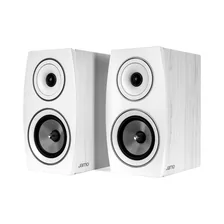 #86 Jamo C 93 II: $299.00 per pair Discontinued eBay
Pros: Attractive cabinet and finish for the price. The mild midbass rise can add subjectively enjoyable punch at modest playback levels, and the speaker is reasonably compact. Erin measured about 84dB sensitivity through the midrange. Harmonic distortion at moderate output is not the central problem; the much larger limitations are frequency-response accuracy, directivity and compression. Measured bass extension of 68.8Hz (-3dB), with a measured sensitivity of 84dB.
Cons: Extremely non-linear tonal balance: Erin measured treble averaging roughly 5dB above the midrange, with local swings from near the midrange level to +6dB by about 12kHz. The result is hollow midrange, exaggerated apparent detail and a bright, fatiguing balance. Multiple diffraction discontinuities around the crossover and waveguide prevent reliable EQ correction; turning the speakers 30 degrees outward does not fix the irregularity. Midwoofer directivity narrows before the tweeter abruptly widens, indicating poor crossover/directivity matching. Vertical listening position should remain near tweeter axis. Output behavior is exceptionally poor: Erin found compression running off the plotted scale at high level and multitone distortion crossing -20dB (10%) across roughly 200Hz-1.2kHz, which produces audible grain. The grille makes response still less linear. Erin judged the cheaper Emotiva B1+ better in accuracy, soundstage and output. Discontinued.
Full Jamo C 93 II review and specifications →
| Bass Extension (-10dB) | 53.2Hz (measured, Erin’s Audio Corner) |
|---|---|
| Bass Extension (-3dB) | 68.8Hz (measured, Erin’s Audio Corner) |
| DIY Kit | No |
| Dimensions | 13.8”H x 7.9”W x 10.2”D (350 x 200 x 260 mm) |
| Drivers | 6” HCCC cone woofer, 1” silk-dome tweeter with waveguide |
| Impedance | 6 ohms nominal (manufacturer specified) |
| Sensitivity | 84dB (measured average, Erin’s Audio Corner) |
| Spinorama Preference Score | 3.35 |
| Spinorama Preference Score with Perfect Sub | 5.97 |
| Weight | 14.1 lbs (6.4 kg) each |
| Woofer Cabinet | ported, rear |
- Links
- Reviews, Comparisons and Sound Samples
- Head-to-Head Comparisons
 #87 Jamo S 803: $119.99 per pair Discontinued Amazon Crutchfield eBay
Pros: Low pair price, compact dimensions and a front slot port suit inexpensive desktop or surround installations. The pronounced 80-100Hz hump supplies immediate punch and can sound impressive in a short demonstration. Harmonic distortion at 86dB is broadly typical for an inexpensive 5-inch two-way, and high-passing near 80Hz reduces some woofer-driven midrange distortion. The cabinet also accepts Jamo’s matching top-mounted Atmos module. Measured bass extension of 60.1Hz (-3dB), with a measured sensitivity of 81dB.
Cons: A textbook V-shaped response rather than accurate reproduction. Erin measured only about 81dB average sensitivity from 300Hz-3kHz, far below Jamo’s 87dB claim; bass around 80-100Hz and the treble are each roughly 5dB above that midrange reference. The bass is therefore resonant one-note punch rather than deep extension. Horizontal coverage is only about +/-50 degrees, while the midwoofer narrows before the tweeter widens abruptly, creating a directivity discontinuity that EQ cannot repair around 4kHz. Vertical tolerance is especially asymmetric: roughly 10 degrees above tweeter axis is usable, but moving below it rapidly damages the response. At high output, compression and multitone distortion become audible; an 80Hz crossover helps but does not correct the native tonality. Erin’s conclusion was an unequivocal pass in favor of a more neutral alternative. Discontinued.
Full Jamo S 803 review and specifications →
| Bass Extension (-10dB) | 48.7Hz (measured, Erin’s Audio Corner) |
|---|---|
| Bass Extension (-3dB) | 60.1Hz (measured, Erin’s Audio Corner) |
| DIY Kit | No |
| Dimensions | 13.9”H x 7.5”W x 9.9”D (353 x 191 x 252 mm) |
| Drivers | 5” polyfiber woofer, 1” soft-dome tweeter with waveguide |
| Frequency Response | 57Hz-26kHz (manufacturer specified) |
| Impedance | 8 ohms nominal (manufacturer specified) |
| Sensitivity | 81dB (measured average 300Hz-3kHz, Erin’s Audio Corner; 87dB manufacturer specified) |
| Spinorama Preference Score | 3.59 |
| Spinorama Preference Score with Perfect Sub | 6.10 |
| Weight | 13 lbs (5.9 kg) each |
| Woofer Cabinet | ported, front slot |
- Links
- Reviews, Comparisons and Sound Samples
- Head-to-Head Comparisons
 #88 Klipsch R-41M: $199.00 per pair Amazon eBay
Pros: Binding posts are unusually nice for the price point, and impedance is well controlled in the bass, easing the load on the amplifier. The horn-loaded tweeter can play loud without strain. Measured bass extension of 80Hz (-3dB), with a measured sensitivity of 85dB.
Cons: CEA2034 spinorama shows a sharp, prominent peak around 1kHz that the reviewer compared to “Pinocchio’s nose,” plus poor directivity that makes the off-axis sound diverge sharply from on-axis. Sensitivity is only 85dB through most of the music-energy range despite Klipsch’s horn-loaded reputation for efficiency. In an A/B against a $118/pair Pioneer SP-BS22-LR, the R-41M had “no bass” and all mid-to-treble energy; the reviewer’s verdict was “please avoid the Klipsch R-41M unless you just want a speaker as an ornament.”
Full Klipsch R-41M review and specifications →
| Bass Extension (-10dB) | 55Hz (measured, Audio Science Review) |
|---|---|
| Bass Extension (-3dB) | 80Hz (measured, Audio Science Review) |
| DIY Kit | No |
| Dimensions | 11.3H x 5.75W x 7.9D in |
| Drivers | 4” spun-copper IMG woofer, 1” Tractrix horn-loaded aluminum dome tweeter |
| Frequency Response | 68Hz - 21kHz (Manufacturer specified) |
| Impedance | 8 ohms nominal (per spec; measured lower) |
| Power Handling | 50W RMS / 200W peak |
| Sensitivity | 85dB (2.83V/1m, measured) |
| Spinorama Preference Score | 3.04 (spinorama.org) |
| Spinorama Preference Score with Perfect Sub | 6.03 (spinorama.org) |
| Weight | 7 lbs (3.18 kg) each |
| Woofer Cabinet | ported, rear |
- Links
- Reviews, Comparisons and Sound Samples
- Head-to-Head Comparisons
- Klipsch R-41M vs PMC twenty.21
- Klipsch R-41M vs Pioneer Elite SP-EBS73-LR
- Klipsch R-41M vs Definitive Technology ProMonitor 1000
- Klipsch R-41M vs Polk T15
- Klipsch R-41M vs JBL Control 1 Pro
- Klipsch R-41M vs Fluance Signature HFS
- Klipsch R-41M vs JBL Stage A130
- Klipsch R-41M vs Q Acoustics 5020
- See all 25 comparisons
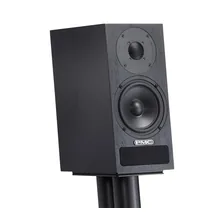 #89 PMC twenty.21: $2,000 per pair superseded by twenty5.21 Discontinued eBay
Pros: Transmission-line loaded design with a proprietary PMC/SEAS SONOLEX soft dome tweeter and doped mid/bass driver, reflecting PMC’s high-end British studio-monitor pedigree. Measured bass extension of 68.8Hz (-3dB).
Cons: Amir was blunt: “The PMC Twenty.21 is a failure in design,” asking, “Did different people design different parts of the speaker and never talked to each other?” On-axis response is highly problematic, and the lack of a tweeter waveguide causes severe beamwidth compression that makes the speaker highly room-sensitive. Dual bass peaks indicate improper port tuning, with the port bump at 100Hz compounding rather than compensating for existing woofer peaks. Distortion is elevated throughout, spiking further at 96dB SPL near 200Hz from port noise. Initial listening was “screechy bright” enough to trigger the reviewer’s tinnitus, with harsh, lispy vocals and tubby, unnatural bass; only heavy manual EQ made it acceptable. At $2000, Amir suspects the tuning was done “by ear” rather than with measurements. Discontinued.
Full PMC twenty.21 review and specifications →
| Bass Extension (-10dB) | 48.7Hz (measured, Audio Science Review) |
|---|---|
| Bass Extension (-3dB) | 68.8Hz (measured, Audio Science Review) |
| DIY Kit | No |
| Dimensions | 12.8”H x 6”W x 10.9”D (325 x 152 x 277 mm) (+6mm grille) |
| Drivers | 5.5” (140mm) doped mid/bass driver with cast alloy chassis, 27mm PMC/SEAS SONOLEX soft dome tweeter (ferrofluid cooled) |
| Frequency Response | 50Hz - 25kHz, +/-4.4dB (Manufacturer specified) |
| Impedance | 8 ohms |
| Sensitivity | 83dB (1W/1m, manufacturer specified) |
| Spinorama Preference Score | 3.05 |
| Spinorama Preference Score with Perfect Sub | 5.80 |
| Weight | 11 lbs (5 kg) each |
| Woofer Cabinet | transmission line, 1.72m effective length |
- Links
- Reviews, Comparisons and Sound Samples
- Head-to-Head Comparisons
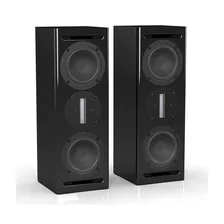 #90 Ascend Sierra Luna Duo: $1,624 per pair superseded by Luna Duo V2 Discontinued eBay
Newer model: the Ascend Acoustics Sierra Duo V2 Ribbon, rated 4.1/5.
Pros: Adding a second Luna woofer improves efficiency and reduces distortion versus the standard Sierra Luna, and the RAAL ribbon tweeter carries over. Flexible orientation lets it work vertically as a main/LCR speaker or horizontally as a center channel. Measured bass extension of 85.0Hz (-3dB), with a measured sensitivity of 84.9dB.
Cons: Amir called it “one of the worse measuring and sounding [speakers] I have tested out of near 100 this year” and stated he “can not in any form or fashion recommend the Ascend Sierra Luna Duo.” On-axis response shows significant midrange irregularities, off-axis performance is uneven, and the port design creates notable frequency response disturbances. Vertical directivity has an extremely narrow optimal listening window. The reviewer noted a stark contrast with the Revel M105, which showed clearly superior tonality and clarity. Discontinued.
Full Ascend Sierra Luna Duo review and specifications →
| Bass Extension (-10dB) | 52.2Hz (measured, Audio Science Review) |
|---|---|
| Bass Extension (-3dB) | 85.0Hz (measured, Audio Science Review) |
| DIY Kit | No |
| Drivers | Custom RAAL true ribbon tweeter, dual 4.5” long-throw dual compliant CURV woofers |
| Sensitivity | 84.9dB (2.83V/1m, measured, Audio Science Review) |
| Spinorama Preference Score | 1.03 (spinorama.org) |
| Spinorama Preference Score with Perfect Sub | 3.91 (spinorama.org) |
| Woofer Cabinet | ported, front |
- Reviews, Comparisons and Sound Samples
- Head-to-Head Comparisons