This page ranks 8 large powered floorstanding speakers, including slim multi-woofer towers and substantial active systems. Built-in amplification removes the need for a separate power amplifier, but source connections, streaming and volume-control requirements vary. Check the complete system’s footprint and connectivity before buying.
The order weighs tonal balance, directivity, bass reach, distortion and clean output. Spinorama’s ideal-subwoofer preference score is a starting reference for tonality, not a complete ranking or a promise that adding any subwoofer will achieve that result. Star ratings remain editorial recommendations. Deep bass, convenient setup and consistent sound across seats also matter.
Measurements describe the cited listening angle and DSP configuration. Bass modes, voicing profiles, room placement and playback level can change the response. The KEF LS60 is a strong all-round starting point; larger specialist systems offer different tradeoffs in room integration, scale and installation. See how the rankings work for the methodology.
| Select to compare | |||||||
|---|---|---|---|---|---|---|---|
| 1 | KEF LS60 | $5,999.99 per pair | 700W | 31Hz - 24kHz | Yes | 69 lbs | |
| 2 | GGNTKT M3 | $32,350 per pair | approx. 1000W total | 29Hz-20kHz | No | approx. 154.3 lbs | |
| 3 | Aalto Speakers Aalto 9 | €29,990 per pair | 1500W total per speak… | 20Hz-24kHz | No | - | |
| 4 | Pitt & Giblin Superwax | $16,500 per pair | 950W total | 27Hz-18kHz +/-1.5dB | No | 202.8 lbs | |
| 5 | Pitt & Giblin Superwax Mini | $9,800 per pair | 350W total | -3dB at 30.9Hz, -6dB… | No | 88.2 lbs | |
| 6 | Buchardt A700 | $6,600 per pair | 600W total | 19Hz - 29kHz | No | 61.7 lbs | |
| 7 | Grimm Audio LS1c + SB1 | $43,440 per pair | 240W woofer and 100W… | 20Hz-27kHz +0.5/-3dB… | No | 119 lbs | |
| 8 | B&O Beolab20 | $15000 per pair | 640W | 19.5Hz - 23.6kHz | No | 39.7 lbs |
Prices on this page were last checked September 30, 2026 at 2:57 PM UTC. Product prices and availability are accurate as of that date/time and are subject to change; the price and availability shown on Amazon at the time of purchase will apply to the purchase of this product.
As an eBay Partner, we may be compensated if you make a purchase.
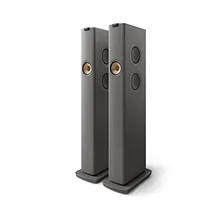 #1 KEF LS60: $5,999.99 per pair Crutchfield eBay
Pros: Erin’s on-axis measurement combines a 1.9dB response span from 300Hz to 5kHz with a 7.91 ideal-subwoofer preference score, supporting even vocal and instrumental balance. Extended-mode bass reaches roughly 25Hz at -3dB. The coaxial Uni-Q arrangement maintains unusually consistent tonality across listening positions, while HDMI, digital and analog inputs plus network streaming make this a convenient complete music and TV system. Measured bass extension of 23Hz (-3dB), with a measured sensitivity of 97.7dB.
Cons: A diffraction dip around 9kHz can soften cymbal shimmer when aimed directly at the listener; 10-20 degrees of toe-out helps. DSP limiting reduces bass reach and dynamic output at high volume, so its deep low-level extension is not a promise of the same performance on loud peaks. App placement and tone controls are less flexible than parametric room correction. Each roughly 31kg tower is awkward to move.
Full KEF LS60 review and specifications →
| AES Input | No |
|---|---|
| Amplifier Power | 700W (500W LF Class D + 100W MF Class D + 100W HF Class AB) |
| App | Yes (KEF Connect) |
| Aux Input | No |
| Bass Extension (-10dB) | <20Hz (measured, Erin’s Audio Corner) |
| Bass Extension (-3dB) | 23Hz (measured, Erin’s Audio Corner) |
| Bluetooth | Yes (5.0 with SBC, AAC) |
| Bluetooth Codecs | SBC, AAC |
| Coaxial Input | Yes |
| DSP | Yes (Music Integrity Engine) |
| Dimensions | 42.9”H x 8.3”W x 15.5”D (1089.7 x 210.8 x 393.7 mm) |
| Drivers | 4 x 135 mm (5.25 in.) Uni-Core Force Cancelling Driver: woofers, 100 mm (4in.) aluminium cone midrange, 19 mm (0.75 in.) vented aluminium dome with Metamaterial Absorption Technology tweeter |
| EQ | Yes (Normal and Expert modes, room adaptation) |
| Frequency Response | 31Hz - 24kHz (±3dB) (Manufacturer specified) |
| HDMI Input | Yes |
| Inputs | Wifi, Optical, Digital coaxial, RCA, HDMI eARC, Ethernet |
| Maximum SPL | 111dB @ 1m (pink noise) (manufacturer specified) |
| Optical Input | Yes |
| Outputs | Subwoofer RCA |
| RCA Input | Yes |
| Sensitivity | 97.7dB (measured at 0.3V/1m, Erin’s Audio Corner) |
| Spinorama Preference Score | 7.26 |
| Spinorama Preference Score with Perfect Sub | 7.91 |
| Streaming Services | Yes (AirPlay 2, Chromecast, Roon Ready, Spotify Connect, Tidal Connect, Amazon Music, Qobuz, Deezer) |
| Subwoofer Output | Yes |
| TRS Input | No |
| USB Input | No |
| Weight | 69 lbs (31.3 kg) each |
| Wi-Fi | Yes (dual-band) |
| XLR Input | No |
- Links
- Reviews, Comparisons and Sound Samples
- Head-to-Head Comparisons
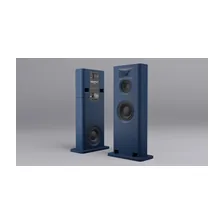 #2 GGNTKT M3: $32,350 per pair GGNTKT eBay
Pros: The manufacturer measurement shows a very tight 0.5dB response span from 300Hz to 5kHz and a 8.59 ideal-subwoofer preference score, supporting exceptionally even midrange balance. Cardioid radiation reduces rearward bass and low-midrange energy, helping with near-wall placement. A dedicated midrange, wide waveguide and DSP-controlled four-way architecture suit a large listening area without relying on a narrow on-axis sweet spot.
Cons: Measured -3dB extension of 35.5Hz is useful but does not match the deepest-reaching towers here. Cardioid operation reduces some boundary interaction rather than eliminating room modes. The broad, heavy cabinets and professional system setup demand space and planning; maximum-output claims should not be confused with equally low distortion at every frequency.
Full GGNTKT M3 review and specifications →
| AES Input | Yes |
|---|---|
| Amplifier Power | approx. 1000W total (PASCAL Class-D UMAC modules) |
| Aux Input | No |
| Bluetooth | No |
| Coaxial Input | No |
| Country | Germany |
| Coverage | 140 deg horizontal x 100 deg vertical (constant directivity waveguide) |
| Dimensions | 50.6”H x 19.6”W x 7.8”D (1286 x 499 x 199 mm) |
| Drivers | 56mm ring-diaphragm compression tweeter, 210mm (8”) paper-fiber midrange, 2x 260mm (10”) long-throw subwoofers |
| Enclosure | 4-way bass reflex, cardioid-loaded bass (opposed front/rear woofers) |
| Frequency Response | 29Hz-20kHz (-3dB), 24Hz-22kHz (-6dB) |
| HDMI Input | No |
| Inputs | XLR (balanced analog), XLR AES/EBU (digital), USB (calibration/control only, not an audio input) |
| Optical Input | No |
| RCA Input | No |
| Spinorama Preference Score | 6.61 |
| Spinorama Preference Score with Perfect Sub | 8.59 |
| TRS Input | No |
| USB Input | No |
| Warranty | 2 years, extendable to 3 with product registration |
| Weight | approx. 154.3 lbs (70 kg) each |
| XLR Input | Yes |
- Links
- Reviews, Comparisons and Sound Samples
- Head-to-Head Comparisons
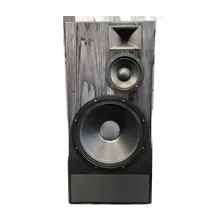 #3 Aalto Speakers Aalto 9: €29,990 per pair Aalto Speakers eBay
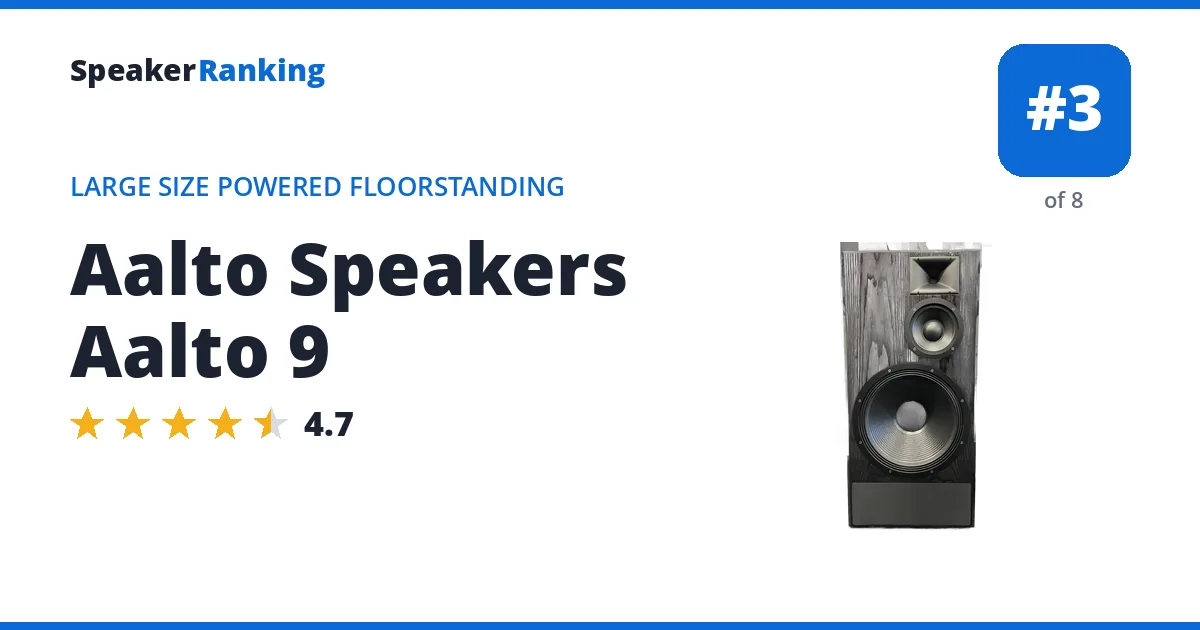
Pros: Manufacturer measurements give it a 8.24 preference score without a subwoofer and 8.84 with an ideal one, the highest standard score of any speaker we list. Bass is flat to 20.3Hz at -3dB, so it needs no subwoofer at all. The 1.3dB reference band, 0.96 listening-window smoothness and 0.36dB average on-axis deviation mean a very even tonal balance, and the horn-loaded compression driver with a 10-inch midrange keeps directivity controlled into the treble. Built-in 1500W amplification, AES/EBU and USB inputs, optional Dante and FourAudio room correction make it a complete active system.
Cons: The data is the manufacturer’s own and spinorama rates its quality as low, so the scores lack independent confirmation. At €29,990 per pair it is sold only by Aalto Speakers in Finland, made to order and currently on back order. The 21-inch woofer makes for a very large cabinet that needs a big room.
Full Aalto Speakers Aalto 9 review and specifications →
| AES Input | Yes |
|---|---|
| Amplifier Power | 1500W total per speaker |
| Bass Extension (-10dB) | below 20Hz (measured, manufacturer data on spinorama.org) |
| Bass Extension (-3dB) | 20.3Hz (measured, manufacturer data on spinorama.org) |
| Bluetooth | No |
| Coaxial Input | No |
| Country | Made in Finland |
| Crossover Frequency | 220Hz and 1.45kHz |
| DSP | FourAudio room correction software (Windows/Mac), touchscreen control |
| Drivers | 21” paper-cone woofer, 10” paper-cone midrange, 1” compression driver on horn |
| Enclosure | 3-way active, bass reflex |
| Frequency Response | 20Hz-24kHz (manufacturer) |
| HDMI Input | No |
| Inputs | Analogue XLR, AES/EBU XLR, USB, optional Dante |
| Optical Input | No |
| RCA Input | No |
| Spinorama Preference Score | 8.24 |
| Spinorama Preference Score with Perfect Sub | 8.84 |
| USB Input | Yes |
| XLR Input | Yes |
- Links
- Reviews, Comparisons and Sound Samples
- Head-to-Head Comparisons
 #4 Pitt & Giblin Superwax: $16,500 per pair Pitt & Giblin eBay
Pros: The published DSP-adjusted manufacturer measurement combines 26.2Hz -3dB extension with an 8.58 ideal-subwoofer preference score and a smooth predicted room-response trend. Dual 15-inch woofers and a separate 10-inch midrange provide a substantial full-range architecture. Digital and analog inputs, remote volume control and three voicing profiles make the active system flexible despite its size.
Cons: The measured 2.3dB response span from 300Hz to 5kHz leaves more local midrange variation than the Superwax Mini; a level overall slope is not a perfectly flat response. Results apply to the measured DSP tuning, not every profile. At about 92kg and one metre wide per speaker, installation and room space are major considerations.
Full Pitt & Giblin Superwax review and specifications →
| AES Input | Yes |
|---|---|
| Amplifier Power | 950W total (Hypex nCore, discrete per driver) |
| Aux Input | No |
| Bass Extension | 24Hz at -3dB, 20Hz at -10dB (half space) |
| Bluetooth | No |
| Coaxial Input | Yes |
| Country | Hand-built in Hobart, Tasmania, Australia |
| DSP | Profiles: Natural, Live, Clean (remote selectable) |
| Dimensions | 39.4”H x 39.4”W x 21.7”D (1000 x 1000 x 550 mm) (with stand) |
| Drivers | 1” compression driver on bronze waveguide, 10” sealed midrange, 2x 15” ported woofers |
| Enclosure | 3-way active, Birch plywood with separate HF waveguide and MF/LF cabinet, hardwood plinth |
| Frequency Response | 27Hz-18kHz +/-1.5dB |
| HDMI Input | No |
| Inputs | Analogue XLR/RCA, S/PDIF, AES, TOSLINK |
| Optical Input | Yes |
| RCA Input | Yes |
| Spinorama Preference Score | 7.74 |
| Spinorama Preference Score with Perfect Sub | 8.58 |
| TRS Input | No |
| USB Input | No |
| Weight | 202.8 lbs (92 kg) each |
| XLR Input | Yes |
- Links
- Reviews, Comparisons and Sound Samples
- Head-to-Head Comparisons
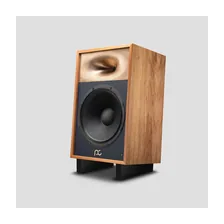 #5 Pitt & Giblin Superwax Mini: $9,800 per pair Pitt & Giblin eBay
Pros: The published DSP-adjusted manufacturer measurement shows a 1.2dB response span from 300Hz to 5kHz and a 8.60 ideal-subwoofer preference score, supporting natural vocal balance. Bass reaches 30.9Hz at -3dB. The 15-inch woofer, bronze waveguide and built-in amplification provide a substantial two-way system with both digital and analog connections.
Cons: The Mini gives up some deep-bass reach compared with the full Superwax. Its low cabinet height makes the supplied tilt feet and listening position important. At 40kg per speaker and 460mm wide, it is still a large installation. The quoted response describes the measured DSP tuning; alternate voicing profiles change the balance.
Full Pitt & Giblin Superwax Mini review and specifications →
| AES Input | No |
|---|---|
| Amplifier Power | 350W total (Hypex nCore/FusionAmp Class-D) |
| Aux Input | No |
| Bluetooth | No |
| Coaxial Input | Yes |
| Country | Hand-built in Hobart, Tasmania, Australia |
| DSP | Profiles: Natural, Live, Clean (remote selectable) |
| Dimensions | 28.1”H x 18.1”W x 15”D (715 x 460 x 380 mm) |
| Drivers | 15” cast-frame neodymium mid-bass woofer, 1” titanium compression driver on a hand-cast solid bronze waveguide |
| Enclosure | 2-way active, solid Birch plywood, hand-finished veneer |
| Frequency Response | -3dB at 30.9Hz, -6dB at 27.1Hz (measured, spinorama.org vendor data) |
| HDMI Input | No |
| Inputs | Analogue RCA/XLR, TOSLINK, S/PDIF coax, AES3 digital XLR, built-in DAC |
| Optical Input | Yes |
| RCA Input | Yes |
| Spinorama Preference Score | 7.59 |
| Spinorama Preference Score with Perfect Sub | 8.60 |
| TRS Input | No |
| USB Input | No |
| Weight | 88.2 lbs (40 kg) each |
| XLR Input | Yes |
- Links
- Reviews, Comparisons and Sound Samples
- Head-to-Head Comparisons
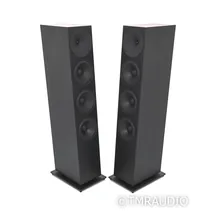 #6 Buchardt A700: $6,600 per pair Buchardt Audio eBay
Pros: The standard tuning measures a 1.8dB response span from 300Hz to 5kHz and scores 7.72 with an ideal subwoofer. Low midrange multitone distortion supports clean reproduction at ordinary listening levels. Selectable Master Tunings include cardioid operation for near-wall placement, while an optional Platin hub adds streaming and useful room and manual EQ. Measured bass extension of 51Hz (-3dB).
Cons: Standard-mode bass crosses -3dB around 51Hz but continues to -6dB around 26Hz; it is not flat to the deepest advertised frequencies. Cardioid tuning changes that balance and bass reach substantially. The roughly +/-50-degree horizontal presentation is more focused than wider-radiating alternatives, and vertical listening height needs care. DSP limiting constrains loud full-range playback; a subwoofer with high-pass filtering can improve headroom.
Full Buchardt A700 review and specifications →
| AES Input | No |
|---|---|
| Amplifier Power | 600W total (4x150W amplifier channels per speaker) |
| App | Yes (with Platin hub) |
| Aux Input | No |
| Bass Extension (-10dB) | 22Hz (measured, Erin’s Audio Corner) |
| Bass Extension (-3dB) | 51Hz (measured, Erin’s Audio Corner) |
| Bluetooth | No |
| Coaxial Input | No |
| DSP | Yes (multiple selectable Master Tuning profiles via USB, plus room/manual EQ via Platin hub app) |
| Dimensions | 40”H x 7”W x 11”D |
| Drivers | 3/4” tweeter with waveguide, 6” midwoofer, 2x 6” front woofers, 2x 6” rear woofers |
| Frequency Response | 19Hz - 29kHz (+/-3dB) (Manufacturer specified) |
| HDMI Input | No |
| Inputs | RCA, Optical, Platin wireless hub (streaming) |
| Optical Input | Yes |
| RCA Input | Yes |
| Spinorama Preference Score | 6.60 |
| Spinorama Preference Score with Perfect Sub | 7.72 |
| TRS Input | No |
| USB Input | No |
| Weight | 61.7 lbs (28 kg) each |
| XLR Input | No |
- Links
- Reviews, Comparisons and Sound Samples
- Head-to-Head Comparisons
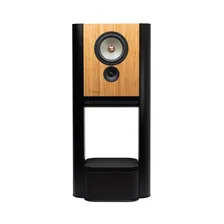 #7 Grimm Audio LS1c + SB1: $43,440 per pair The Listening Room eBay
Pros: Independently measured by Audio Science Review as a complete system with its SB1 subwoofers, with 0.83 listening-window smoothness and 0.38dB average on-axis deviation. ASR found the widest horizontal dispersion it had measured, very clean decay and distortion that stays low at 86 and 96dB. The -10dB point sits near 28.9Hz, and the SB1’s motional feedback controls the 10-inch woofer. It is a complete active system with Hypex NCore amplification, DSP crossovers and analog, AES/EBU and USB inputs. Measured bass extension of 28.9Hz (-10dB).
Cons: The standard preference score is only 5.73, rising to 7.54 with an ideal subwoofer, because spinorama puts the system’s -6dB point at 45.4Hz despite the subwoofers. At $28850 per pair with the SB1s, it costs far more than active systems that score higher. ASR measured a maximum of about 105dB, modest output for the price. Custom finishes add weeks to the dealer lead time.
Full Grimm Audio LS1c + SB1 review and specifications →
| AES Input | Yes |
|---|---|
| Amplifier Power | 240W woofer and 100W tweeter per speaker (Hypex NCore); 400W per SB1 subwoofer |
| Bass Extension (-10dB) | approximately 28.9Hz (measured, spinorama.org ASR data) |
| Bluetooth | No |
| Coaxial Input | No |
| Country | Made in the Netherlands |
| Dimensions | 45.3”H x 20.5”W x 6.3”D (1150 x 521 x 160 mm) |
| Drivers | TPCD carbon composite tweeter (Seas); 8” Seas midrange-woofer; 10” up-firing SB1 subwoofer |
| Enclosure | Active 2-way monitor on stand with integrated SB1 sealed subwoofer (3-way system) |
| Frequency Response | 20Hz-27kHz +0.5/-3dB with SB1 (manufacturer) |
| HDMI Input | No |
| Inputs | Analog XLR, 3x AES/EBU, USB |
| Maximum SPL | 105dB (measured by ASR) |
| Optical Input | No |
| RCA Input | No |
| Spinorama Preference Score | 5.73 |
| Spinorama Preference Score with Perfect Sub | 7.54 |
| USB Input | Yes |
| Weight | 119 lbs (54 kg) each with SB1 |
| XLR Input | Yes |
- Links
- Reviews, Comparisons and Sound Samples
- Head-to-Head Comparisons
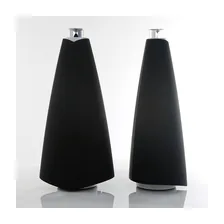 #8 B&O Beolab20: $15000 per pair Discontinued eBay
Pros: ASR measured bass reaching about 20Hz in a relatively compact enclosure, giving substantial low-end weight without a separate subwoofer. Distortion at ordinary listening levels is respectable for the size. Built-in amplification and Free/Wall/Corner adjustment simplify integration into a compatible home system. Measured bass extension of 20Hz (-3dB).
Cons: A 4.88 ideal-subwoofer preference score shows that deep bass does not compensate for the tonal flaws. A roughly 5dB dip near 7kHz and uneven vertical response make treble balance sensitive to ear height. Midrange distortion rises at higher playback levels, with resonance-related problems around 700-800Hz and 5kHz. Difficult to recommend for neutral monitoring at its premium price. Discontinued.
Full B&O Beolab20 review and specifications →
| AES Input | No |
|---|---|
| Amplifier Power | 640W (160W tweeter + 160W midrange + 320W dual woofer) |
| App | Yes (B&O app) |
| Aux Input | No |
| Bass Extension (-10dB) | <20Hz (measured, Audio Science Review) |
| Bass Extension (-3dB) | 20Hz (measured, Audio Science Review) |
| Bluetooth | No |
| Coaxial Input | No |
| DSP | Yes (Digital Sound Engine) |
| Dimensions | 15.5”W x 32.3”H x 12”D (393.7 x 820.4 x 304.8 mm) |
| Drivers | 10” driver woofer, 5” driver midrange, 0.75” Acoustic Lens tweeter |
| EQ | Yes (Room adaptation: Free/Wall/Corner) |
| Frequency Response | 19.5Hz - 23.6kHz (Manufacturer specified) |
| HDMI Input | No |
| Inputs | PowerLink (RJ45), RCA, TOSLINK optical, WiSA wireless |
| Maximum SPL | 108dB @ 1m (manufacturer specified) |
| Optical Input | Yes |
| Outputs | PowerLink, TOSLINK |
| RCA Input | Yes |
| TRS Input | No |
| USB Input | No |
| Weight | 39.7 lbs (18 kg) each |
| Wi-Fi | Yes (WiSA) |
| XLR Input | No |
- Links
- Reviews, Comparisons and Sound Samples
- Head-to-Head Comparisons