Editor's top picks
Start with these speakers
Our leading recommendations at a glance. Each card links to its primary retailer.
Looking for the best budget powered speakers? These picks from the 194 powered speakers ranked here balance measured tonal accuracy, bass extension and output against price and everyday usability. Prices below refer to a stereo pair; check whether a studio-monitor listing sells one speaker or two.
Prices on this page were last checked September 22, 2026 at 5:11 AM UTC. Product prices and availability are accurate as of that date/time and are subject to change; the price and availability shown on Amazon at the time of purchase will apply to the purchase of this product.
As an eBay Partner, we may be compensated if you make a purchase.
What You Give Up Under $500
Less than you’d expect, and the trade-offs are predictable:
Output and bass extension. Compact speakers can deliver useful bass at a desk, but limiting and distortion become more important with deep bass, higher volume or a longer listening distance.
Finish and size. Expect simpler finishes. Larger monitor cabinets often offer more bass and output for the money, but need more space.
Controls and connections. Some studio monitors need an audio interface or another source with volume control. USB, Bluetooth, a remote and automatic subwoofer filtering vary between models.
Tonal accuracy. Budget speakers are not equally neutral. Look at response and directivity rather than assuming that a studio-monitor label guarantees accuracy.
Budget for the complete system: a pair of monitors plus an interface, stands and cables can cost more than a compact USB pair. DSP can improve accuracy and bass extension; the measured result matters more than whether DSP is present.
Best Under $500
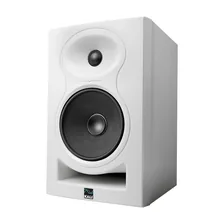 Our full-size monitor pick under $500 per pair, with good measured tonal balance and bass reaching about 42 Hz (-3 dB), is the Kali Audio LP-6 V2: $398 per pair Amazon B&H Photo Video eBay
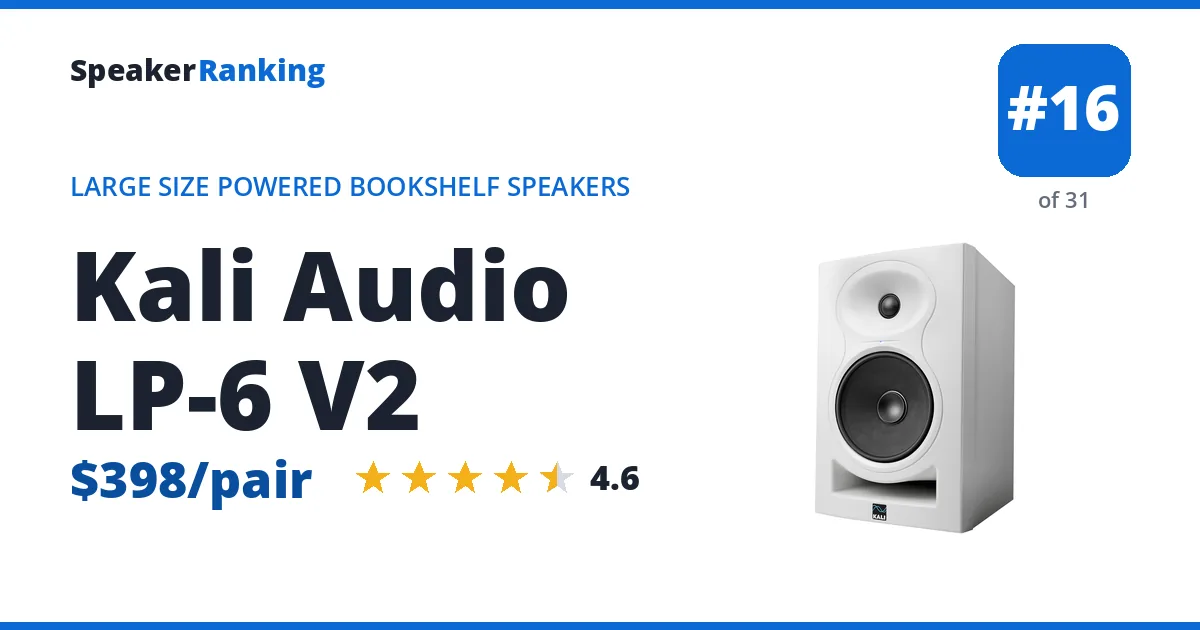
Pros: Erin’s measurements give a 6.62 ideal-subwoofer score and 42.5Hz -3dB bass extension, a strong combination for an affordable nearfield monitor. The waveguide and placement switches help with practical setup, and the second generation improves close-range noise behavior. Measured bass extension of 42Hz (-3dB).
Cons: The 2.5dB response span from 300Hz to 5kHz leaves some tonal unevenness. Vertical crossover behavior makes ear-height placement important, and compression limits loud bass playback. Its good tonal score is not evidence of the output capability of a much larger monitor.
Full Kali Audio LP-6 V2 review and specifications →
| AES Input | No |
|---|---|
| Amplifier Power | 40W LF + 40W HF per speaker; Bi-amplified Class D |
| Aux Input | No |
| Bass Extension (-10dB) | 39.1Hz (measured, Erin's Audio Corner) |
| Bass Extension (-3dB) | 42Hz (measured, Erin's Audio Corner) |
| Bluetooth | No |
| Coaxial Input | No |
| DSP | Yes; boundary presets and LF/HF trims |
| Dimensions | 14.1"H x 8.8"W x 10.2"D |
| Drivers | 1" soft-dome tweeter; 6.5" woofer |
| Frequency Response | 47Hz - 21kHz (±3dB) (Manufacturer specified) |
| HDMI Input | No |
| Inputs | XLR, balanced TRS and RCA |
| Maximum SPL | Approximately 102dB per pair with good measured linearity (Erin's Audio Corner) (manufacturer specified) |
| Optical Input | No |
| RCA Input | Yes |
| Spinorama Preference Score | 4.67 |
| Spinorama Preference Score with Perfect Sub | 6.62 |
| TRS Input | Yes |
| USB Input | No |
| Weight | 15.5 lbs (7.05 kg) each |
| XLR Input | Yes |
- Links
- Reviews, Comparisons and Sound Samples
- Head-to-Head Comparisons
- Kali Audio LP-6 V2 vs Kali Audio IN-8 V2
- Kali Audio LP-6 V2 vs Yamaha HS8
- Kali Audio LP-6 V2 vs Genelec 8050B
- Kali Audio LP-6 V2 vs JBL 4305P
- Kali Audio LP-6 V2 vs JBL 308P MKII
- Kali Audio LP-6 V2 vs SHIVAUDYO Point Zero
- Kali Audio LP-6 V2 vs Focal Solo6 ST6
- Kali Audio LP-6 V2 vs Thomann Swissonic A306
- See all 45 comparisons
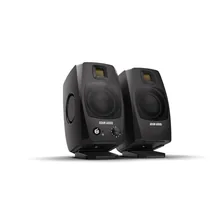 Our compact USB pick, with a very even midrange and bass reaching about 51 Hz (-3 dB), is the Adam Audio D3v: $349.99 per pair Amazon eBay
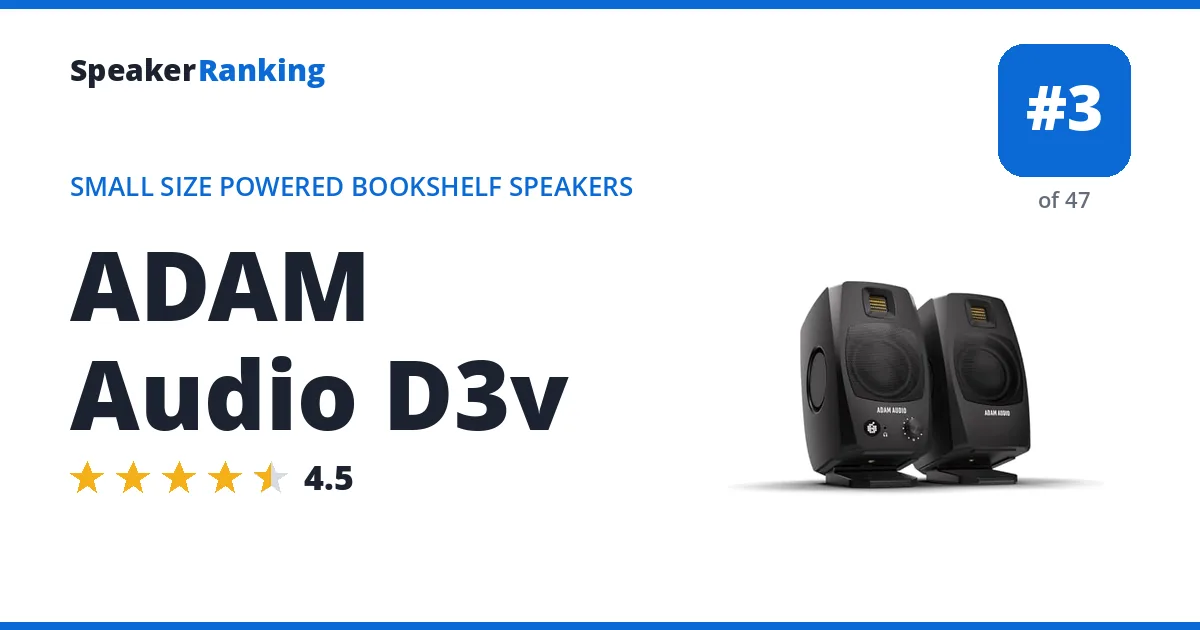
Pros: Excellent midrange linearity for a tiny desktop speaker: Erin’s Klippel data spans just 1.7dB from 300Hz to 5kHz. Side passive radiators help bass reach -3dB at about 51Hz, substantially deeper than the Genelec 8010A or Audio Smile LBM. Predicted preference scores of 4.47 standalone and 6.70 with an ideal subwoofer support it as a particularly useful compact system without a sub. USB-C, analog inputs and placement filters simplify desk setup. Measured bass extension of 50Hz (-3dB), with a measured sensitivity of 86.5dB.
Cons: A rising upper-frequency balance and vertical crossover interference keep it from being uniformly neutral at every angle; aim the tweeters toward ear height. The limiter reduces bass and midrange output as volume rises, with the existing review’s compression tests putting usable maximum output around 89-90dB at 1m. Deep bass at moderate volume should not be confused with high output capability.
Full Adam Audio D3v review and specifications →
| AES Input | No |
|---|---|
| Amplifier Power | 50W (30W woofer + 20W tweeter) |
| App | No |
| Aux Input | No |
| Bass Extension (-10dB) | 45Hz (measured, Erin's Audio Corner) |
| Bass Extension (-3dB) | 50Hz (measured, Erin's Audio Corner) |
| Bluetooth | No |
| Coaxial Input | No |
| Dimensions | 6.7"H x 4.3"W x 5.9"D (170.2 x 109.2 x 149.9 mm) |
| Drivers | 3.5" woofer, U-ART accelerated ribbon tweeter |
| EQ | Yes (Room adjustment filters) |
| Frequency Response | 50Hz - 50kHz (Manufacturer specified) |
| HDMI Input | No |
| Inputs | USB-C, balanced 1/4-inch TRS |
| Maximum SPL | 102dB @ 1m (manufacturer specified) |
| Optical Input | No |
| RCA Input | No |
| Sensitivity | 86.5dB (measured at 0.3V/1m, Erin's Audio Corner) |
| Spinorama Preference Score | 4.47 |
| Spinorama Preference Score with Perfect Sub | 6.70 |
| TRS Input | Yes |
| USB Input | Yes |
| Weight | 3.7 lbs (1.7 kg) |
| XLR Input | No |
- Links
- Reviews, Comparisons and Sound Samples
- Erin’s Audio Corner: ADAM Audio D3V: Mighty Small But Mighty Awesome Desktop Speaker More from Erin’s Audio Corner →
- Erin’s Audio Review Adam Audio D3v
- Erin’s Audio Corner Measurements (spinorama.org)
- Jasper Tech: Best Desktop Computer Speakers for Every Budget – 2026 More from Jasper Tech →
- Jasper Tech: Are the D3V The Best Studio Monitors For The Money?
- Erin’s Audio Corner: The Best Budget Desktop Speakers, Tested & Rated
- Head-to-Head Comparisons
- Adam Audio D3v vs Genelec 8010A
- Adam Audio D3v vs Cambridge Audio L/R S
- Adam Audio D3v vs IK Multimedia iLoud Micro Monitor
- Adam Audio D3v vs Audio Smile Little British Monitor
- Adam Audio D3v vs Edifier M60
- Adam Audio D3v vs HiVi Swan X3
- Adam Audio D3v vs Edifier MR3
- Adam Audio D3v vs Audioengine A2+
- See all 15 comparisons
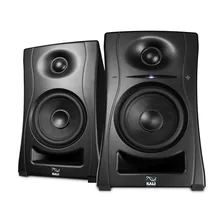 For a two-way desktop system with USB, Bluetooth, RCA and balanced TRS inputs, consider the Kali LP-UNF: $349.00 per pair Amazon eBay
Pros: A practical compact desktop system with USB-C, analog inputs and Bluetooth, plus extensive placement switches. Erin’s Klippel data gives -3dB bass around 54Hz and scores of 3.68 standalone and 5.76 with an ideal subwoofer. The low crossover and waveguide provide useful freedom of listening height for a two-way design, and moderate-level distortion is well controlled in the review. Measured bass extension of 54Hz (-3dB), with a measured sensitivity of 88.1dB.
Cons: The 2.9dB midrange span masks local response ripples; listening-window narrow-band deviation of 0.467 is behind the best monitors. The review finds limiting around 91dB/1m per speaker. No dedicated subwoofer output means integration requires suitable external routing or bass management. Its strength is affordable close listening, not top-tier tonal accuracy or high-output room playback.
Full Kali LP-UNF review and specifications →
| AES Input | No |
|---|---|
| Amplifier Power | 160W total (Class D, 2-channel bi-amped) |
| App | No |
| Aux Input | No |
| Bass Extension (-10dB) | 39Hz (measured, Erin's Audio Corner) |
| Bass Extension (-3dB) | 54Hz (measured, Erin's Audio Corner) |
| Bluetooth | No |
| Coaxial Input | No |
| Dimensions | 10"H x 6.5"W x 7.4"D (254 x 165 x 188 mm) |
| Drivers | 4.5" woofer, 1" Textile Dome tweeter |
| EQ | No |
| Frequency Response | 39Hz - 25kHz (-10dB) (Manufacturer specified) |
| HDMI Input | No |
| Inputs | Bluetooth, USB-C (digital), RCA, TRS |
| Optical Input | No |
| RCA Input | Yes |
| Sensitivity | 88.1dB (measured at 0.3V/1m, Erin's Audio Corner) |
| Spinorama Preference Score | 3.68 |
| Spinorama Preference Score with Perfect Sub | 5.76 |
| TRS Input | Yes |
| USB Input | Yes |
| Weight | 17.2 lbs (7.8 kg) |
| XLR Input | No |
- Links
- Reviews, Comparisons and Sound Samples
- Erin’s Audio Corner Review Measurements More from Erin’s Audio Corner →
- Erin’s Audio Corner: The Perfect Desktop Speaker? Kali LP-UNF.
- Erin’s Audio Corner: The Best Budget Desktop Speakers, Tested & Rated
- Erin’s Audio Corner: My Absolute Favorite Products of 2024 Revealed
- Erin’s Audio Corner: 10 Great (and Terrible) Speakers Under $300!
- Erin’s Audio Corner Measurements (spinorama.org)
- Jasper Tech: Best Desktop Computer Speakers for Every Budget – 2026 More from Jasper Tech →
- Jasper Tech: Are the iLoud Micro Monitor Pro the Best Studio Monitor Speakers for your Home Studio?
- Head-to-Head Comparisons
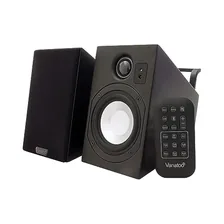 For an all-in-one consumer pair with USB, Bluetooth and extensive DSP instead of studio-monitor ergonomics, the Vanatoo Transparent Zero Plus: $499.99 per pair Amazon eBay
Pros: Erin’s data shows a small 1.7dB span from 300Hz to 5kHz and a broadly level midrange trend. Scores of 3.18 standalone and 5.84 with an ideal subwoofer support it as a useful compact desktop option. Flexible cabinet orientation, multiple inputs and automatic subwoofer crossover behavior help with setup. Measured bass extension of 92Hz (-3dB), with a measured sensitivity of 88.5dB.
Cons: The measured -3dB point is around 95Hz, with a much lower F10 in the original review; this is not flat bass to the low-50Hz region. Vertical listening angle changes the upper-midrange response. The review finds cleaner results at moderate levels than near maximum output, where multitone distortion increases. A subwoofer is particularly valuable here.
Full Vanatoo Transparent Zero Plus review and specifications →
| AES Input | No |
|---|---|
| Amplifier Power | 120W total (Class D) |
| Aux Input | Yes |
| Bass Extension (-10dB) | 53Hz (measured, Erin's Audio Corner) |
| Bass Extension (-3dB) | 92Hz (measured, Erin's Audio Corner) |
| Bluetooth | Yes |
| Bluetooth Codecs | SBC, AAC, aptX, aptX HD |
| Coaxial Input | No |
| DSP | Yes (8th-order Butterworth high-pass at 58Hz) |
| Dimensions | 8.5"H x 5.5"W x 6"D |
| Drivers | 4" aluminum cone woofer, 4" long-throw passive radiator, 1" soft dome tweeter |
| Frequency Response | 56Hz - 20kHz (+/-3dB) (Manufacturer specified) |
| HDMI Input | No |
| Inputs | Bluetooth (aptX HD), USB (24-bit/96kHz), Toslink Optical (24-bit/96kHz), 3.5mm Analog |
| Optical Input | Yes |
| Outputs | RCA subwoofer |
| RCA Input | No |
| Sensitivity | 88.5dB (measured at 0.3V/1m, Erin's Audio Corner) |
| Spinorama Preference Score | 3.18 |
| Spinorama Preference Score with Perfect Sub | 5.84 |
| Subwoofer Output | Yes |
| TRS Input | No |
| USB Input | Yes |
| Weight | 7.1 lbs (3.2 kg) each |
| XLR Input | No |
- Links
- Reviews, Comparisons and Sound Samples
- Erin’s Audio Corner: Vanatoo Transparent Zero Plus Review. More from Erin’s Audio Corner →
- Erin’s Audio Corner Website: Vanatoo Transparent Zero Plus
- Erin’s Audio Corner Measurements (spinorama.org)
- Jasper Tech: Best Desktop Computer Speakers for Every Budget – 2026 More from Jasper Tech →
- Jasper Tech: Are the D3V The Best Studio Monitors For The Money?
- Jasper Tech: Best Powered Bookshelf Speakers for Every Budget - 2025
- Jasper Tech: Best Premium Computer Speakers: Kanto ORA4 Review & Comparison
- Jasper Tech: Are the iLoud Micro Monitor Pro the Best Studio Monitor Speakers for your Home Studio?
- Jasper Tech: Best Desktop Computer Speakers for Every Budget
- Head-to-Head Comparisons
- Vanatoo Transparent Zero Plus vs Kali LP-UNF
- Vanatoo Transparent Zero Plus vs Neumi BS5P
- Vanatoo Transparent Zero Plus vs JBL 705P
- Vanatoo Transparent Zero Plus vs Focal Alpha 50 EVO
- Vanatoo Transparent Zero Plus vs M-Audio BX5 D3
- Vanatoo Transparent Zero Plus vs Dayton Audio M4
- Vanatoo Transparent Zero Plus vs Kanto YU6
- Vanatoo Transparent Zero Plus vs Adam Audio T5V
- See all 52 comparisons
Best Under $300 Per Pair
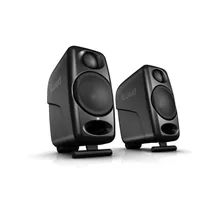 For a very small analog-input pair with useful bass and a higher acoustic ranking than the M60 or MR3, consider the IK Multimedia iLoud Micro Monitor: $299.99 per pair Amazon eBay
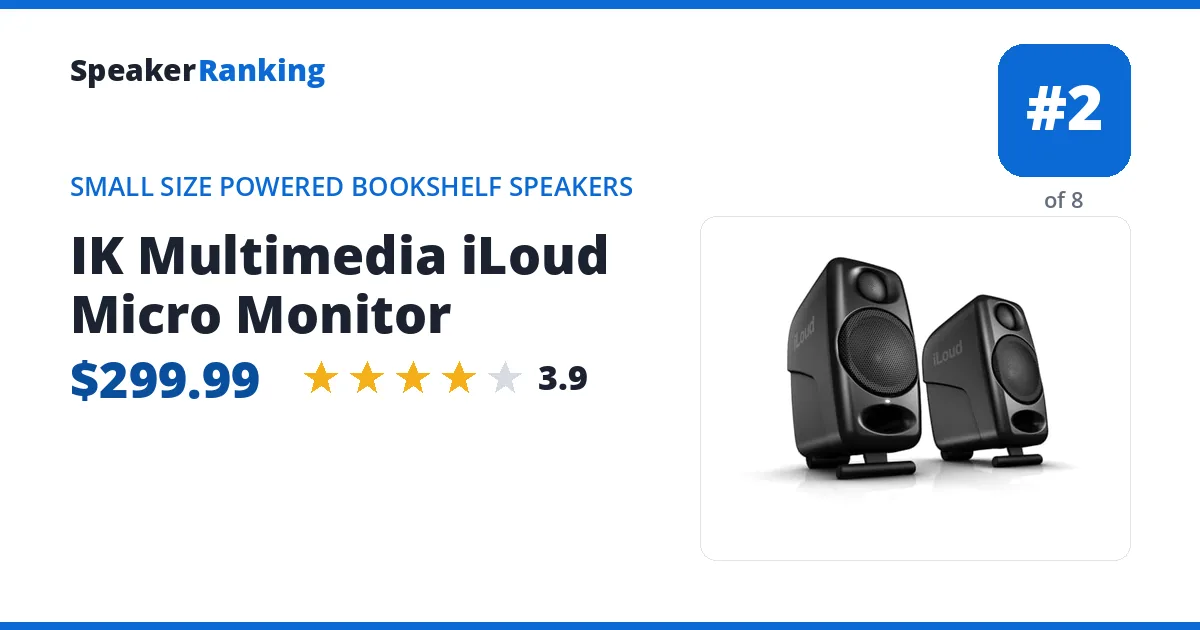
Pros: Unusually substantial bass for such a small desktop pair. The linked quasi-anechoic measurement review reports broad, reasonably consistent horizontal radiation and useful tolerance above the tweeter axis, helpful when the speakers sit below ear height. Its compact size and bass balance make it a practical close-listening alternative to small monitors that need a subwoofer. Measured bass extension of 55Hz (-3dB).
Cons: The existing review evidence indicates some bass emphasis and upper-treble rolloff rather than strict neutrality. Deep bass from tiny drivers does not establish loud-playback headroom; use these for close desktop listening, not as a substitute for larger room speakers.
Full IK Multimedia iLoud Micro Monitor review and specifications →
| AES Input | No |
|---|---|
| Amplifier Power | 50W total (combined) |
| App | No |
| Aux Input | Yes |
| Bass Extension (-10dB) | 45Hz (measured, Audio Science Review) |
| Bass Extension (-3dB) | 55Hz (measured, Audio Science Review) |
| Bluetooth | Yes (A2DP) |
| Coaxial Input | No |
| Dimensions | 7.1"H x 3.5"W x 5.3"D (180.3 x 88.9 x 134.6 mm) |
| Drivers | 3" woofer, 0.75" silk dome tweeter |
| EQ | Yes (Bass/Treble switches, Desktop/Free field) |
| Frequency Response | 55Hz - 20kHz (-3dB) (Manufacturer specified) |
| HDMI Input | No |
| Inputs | RCA, Aux |
| Maximum SPL | 96dB @ 1m (manufacturer specified) |
| Optical Input | No |
| RCA Input | Yes |
| TRS Input | No |
| USB Input | No |
| Weight | 2 lbs (0.9 kg) |
| XLR Input | No |
- Links
- Reviews, Comparisons and Sound Samples
- Audio Science Review Measurements More from Audio Science Review →
- DSAUDIO.review: DSAUDIO.review Edifier MR4 vs iLoud Micro Monitor sound.DEMO More from DSAUDIOreview →
- DSAUDIOreview: IK Multimedia iLoud MTM vs iLoud Micro Sound & Frequency Response Comparison
- Jasper Tech: Best Desktop Computer Speakers for Every Budget – 2026 More from Jasper Tech →
- Jasper Tech: Are the D3V The Best Studio Monitors For The Money?
- Jasper Tech: Best Premium Computer Speakers: Kanto ORA4 Review & Comparison
- Jasper Tech: Are the iLoud Micro Monitor Pro the Best Studio Monitor Speakers for your Home Studio?
- Jasper Tech: Best Desktop Computer Speakers for Every Budget
- Head-to-Head Comparisons
- IK Multimedia iLoud Micro Monitor vs Edifier M60
- IK Multimedia iLoud Micro Monitor vs Cambridge Audio L/R S
- IK Multimedia iLoud Micro Monitor vs Adam Audio D3v
- IK Multimedia iLoud Micro Monitor vs HiVi Swan X3
- IK Multimedia iLoud Micro Monitor vs Genelec 8010A
- IK Multimedia iLoud Micro Monitor vs Edifier MR3
- IK Multimedia iLoud Micro Monitor vs Audioengine A2+
- IK Multimedia iLoud Micro Monitor vs Klipsch ProMedia Lumina
- See all 15 comparisons
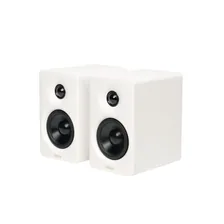 The best very compact pair, with USB-C so it doubles as a computer sound card, is the Edifier M60: $199.99 per pair Amazon eBay
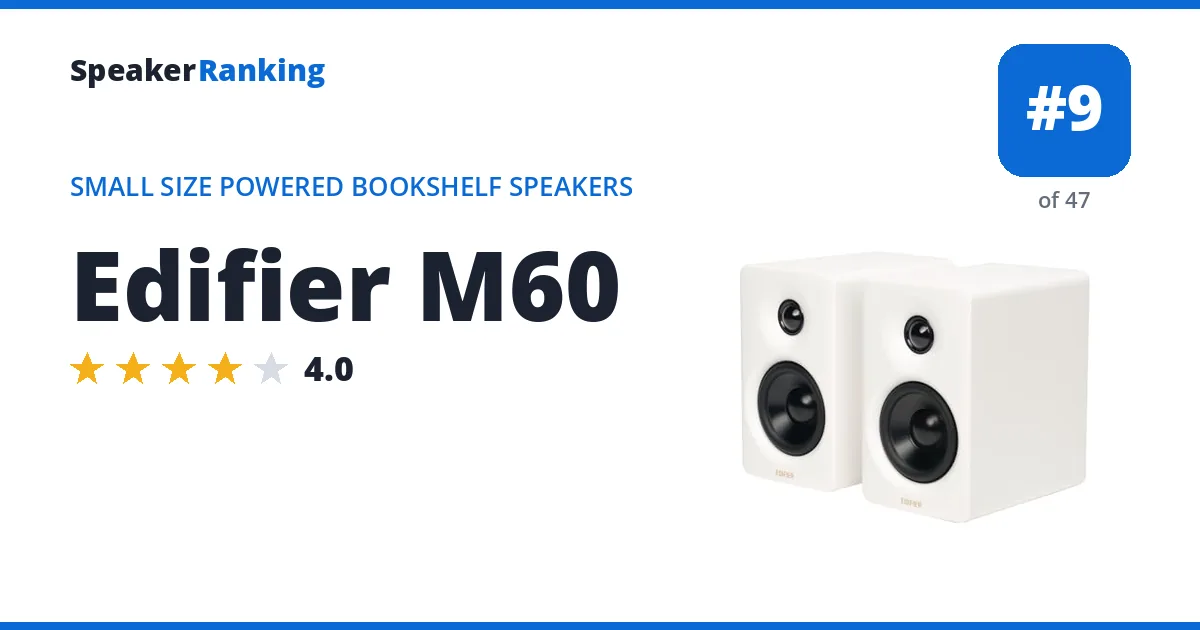
Pros: Erin’s Klippel data shows a reasonably even midrange, spanning 2.8dB from 300Hz to 5kHz, with broad horizontal coverage for desktop listening. Predicted preference scores are 3.69 standalone and 6.42 with an ideal subwoofer, a comparatively strong result in this compact category. USB-C, auxiliary input, Bluetooth and included angled stands make it easy to integrate into a small desk setup. Measured bass extension of 67Hz (-3dB), with a measured sensitivity of 87.5dB.
Cons: The on-axis response rises by about 0.57dB per octave, so the tonal balance becomes brighter toward the treble. Measured -3dB bass extension is about 70Hz; it cannot reproduce deep bass at full level. Sitting below the tweeter axis worsens the crossover-region response. Limiting and compression constrain louder playback, so use it nearfield rather than expecting room-filling output.
Full Edifier M60 review and specifications →
| AES Input | No |
|---|---|
| Amplifier Power | 66W total (33W per speaker) |
| App | Yes |
| Aux Input | Yes |
| Bass Extension (-10dB) | 57Hz (measured, Erin's Audio Corner) |
| Bass Extension (-3dB) | 67Hz (measured, Erin's Audio Corner) |
| Bluetooth | Yes |
| Bluetooth Codecs | SBC, LDAC |
| Bluetooth Version | 5.3 |
| Coaxial Input | No |
| Dimensions | 6.6"H x 3.9"W x 5.8"D (167.6 x 99.1 x 147.3 mm) |
| Drivers | 3" woofer, 1" silk dome tweeter |
| EQ | Yes |
| Frequency Response | 55Hz - 40kHz (Manufacturer specified) |
| HDMI Input | No |
| Inputs | Bluetooth, Aux, USB-C |
| Maximum SPL | 96dB @ 1m (manufacturer specified) |
| Optical Input | No |
| RCA Input | No |
| Sensitivity | 87.5dB (measured at 0.3V/1m, Erin's Audio Corner) |
| Spinorama Preference Score | 3.69 |
| Spinorama Preference Score with Perfect Sub | 6.42 |
| TRS Input | No |
| USB Input | Yes |
| Weight | 6.6 lbs (3 kg) |
| XLR Input | No |
- Links
- Reviews, Comparisons and Sound Samples
- Erin’s Audio Corner: Edifier M60 Desktop Speaker Delivers Big Fun! More from Erin’s Audio Corner →
- Erin’s Audio Corner: The Best Budget Desktop Speakers, Tested & Rated
- Erin’s Audio Corner Website: Edifier M60
- Erin’s Audio Corner Measurements (spinorama.org)
- Jasper Tech: Best Desktop Computer Speakers for Every Budget – 2026 More from Jasper Tech →
- Head-to-Head Comparisons
Lower-Cost Pick
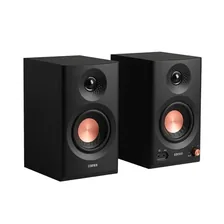 For an inexpensive pair with balanced TRS, RCA, Bluetooth and useful tone controls, consider the Edifier MR3: $109.99 per pair Amazon eBay
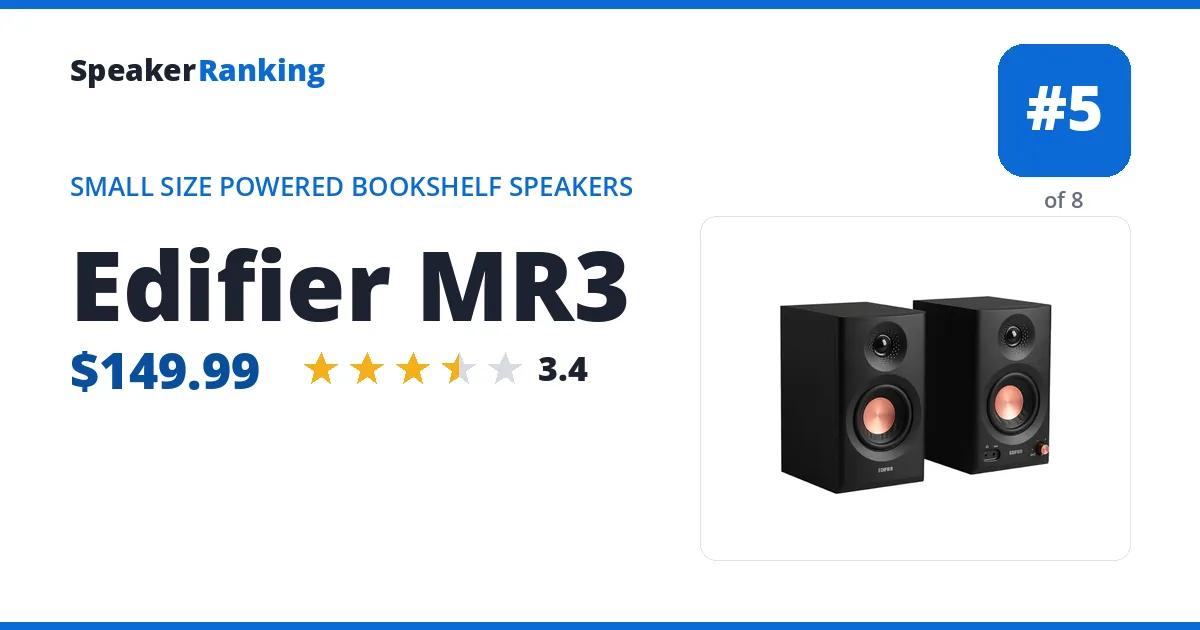
Pros: Erin’s measurements show little overall tilt across the listening window, helping voices retain a broadly natural balance at a desk. Scores of 3.01 standalone and 5.63 with an ideal subwoofer support it as a useful budget nearfield option rather than a reference monitor. Tone controls and app-based EQ provide unusually flexible adjustment, and its bass extends farther than the Fostex PM03’s. Measured bass extension of 60Hz (-3dB), with a measured sensitivity of 83.3dB.
Cons: Local response ripples remain: the measured 300Hz-5kHz span is 4.5dB and listening-window narrow-band deviation is 0.538. Bass reaches -3dB at about 70Hz. The limiter protects the drivers but prevents much extra loudness when pushed; existing compression testing puts effective single-speaker output around 86-87dB at 1m. Vertical crossover interference makes tweeter height and tilt important.
Full Edifier MR3 review and specifications →
| AES Input | No |
|---|---|
| Amplifier Power | 36W total (18W per speaker) |
| App | No |
| Aux Input | Yes |
| Bass Extension (-10dB) | 52Hz (measured, Erin's Audio Corner) |
| Bass Extension (-3dB) | 60Hz (measured, Erin's Audio Corner) |
| Bluetooth | Yes |
| Bluetooth Codecs | SBC |
| Bluetooth Version | 5.4 |
| Coaxial Input | No |
| Dimensions | 5.9"H x 3.7"W x 5.9"D (149.9 x 94 x 149.9 mm) |
| Drivers | 3" woofer, 0.75" silk dome tweeter |
| EQ | Yes (Bass/Treble) |
| Frequency Response | 60Hz - 20kHz (Manufacturer specified) |
| HDMI Input | No |
| Inputs | Bluetooth, Aux, RCA |
| Maximum SPL | 93dB @ 1m (manufacturer specified) |
| Optical Input | No |
| RCA Input | Yes |
| Sensitivity | 83.3dB (measured at 0.3V/1m, Erin's Audio Corner) |
| Spinorama Preference Score | 3.01 |
| Spinorama Preference Score with Perfect Sub | 5.63 |
| TRS Input | No |
| USB Input | No |
| Weight | 6.6 lbs (3 kg) |
| XLR Input | No |
- Links
- Reviews, Comparisons and Sound Samples
- Head-to-Head Comparisons
Where To Go Next
Full rankings with specs and measurements: powered bookshelf small, medium and large.
Related picks: best powered speakers for a desk, best studio monitors, best powered speakers for a turntable, and the powered speaker buyer’s guide. On a budget and open to passive? See best budget passive speakers.