This page ranks 78 popular active and passive PA speakers built around a 12-inch woofer and a high-frequency compression driver: the most common size for portable mains, stage monitors, and tops paired with a subwoofer. Prices are per speaker unless stated otherwise.
12-inch speakers are the sweet spot for bands, mobile DJs, and venues that need real output and low-end punch without stepping up to a bulkier 15-inch cabinet. Ranking weighs measured sound quality alongside the things that matter on the job: maximum volume, coverage, build quality, weight, inputs, and onboard DSP.
For full-range music at event levels, a subwoofer is usually the right partner even when a cabinet reaches into the 40–60Hz region on its own. Manufacturer maximum-SPL claims are measured under different conditions from one brand to the next, so treat them as a rough guide rather than a precise comparison.
| Select to compare | |||||||
|---|---|---|---|---|---|---|---|
| 1 | QSC K12.2 | $899.99 | 132dB peak | 2025W peak | 12" woofer, 1.4" comp… | 39 lbs | |
| 2 | L-Acoustics 112P | - | 133dB peak | 1,000W at 8Ω | 12" coaxial woofer, 1… | 70.5 lbs | |
| 3 | L-Acoustics X12 | - | 136dB | Passive speaker; requ… | 12" cone woofer, 3" n… | 44.1 lbs | |
| 4 | FBT ProMaxX 112A | $722 | 133dB peak / 126dB co… | 900W RMS | 12" woofer, compressi… | 39.9 lbs | |
| 5 | KV2 Audio EX12 | $3,480 | 133dB peak | 500W continuous | 12" neodymium woofer,… | 60.4 lbs | |
| 6 | JBL PRX912 | $899.00 | 132dB peak | 2000W peak / 1000W RMS | 12" woofer, 1.5" comp… | 43 lbs | |
| 7 | RCF KX 32-A | $4,198.50 | 134dB peak | 3200W peak | 12" neodymium woofer,… | 52 lbs | |
| 8 | EAW MKC120 | $1,555.00 | 135dB | Passive speaker; use… | 12" cone woofer with… | 36.2 lbs | |
| 9 | RCF ART 932-A | $1,399.00 | 132dB peak | 2100W peak | 12" woofer, 1.4" comp… | 41.4 lbs | |
| 10 | RCF NX 932-A | $1,799.00 | 132dB peak | 2100W peak | 12" woofer, 1.4" exit… | 50.5 lbs | |
| 11 | KV2 Audio ESR212 | - | 129dB continuous / 13… | - | Dual 12" woofers, 6"… | 99.2 lbs | |
| 12 | RCF ART 912-A | $913.11 | 130dB peak | 2,100W peak | 12" woofer, 1" compre… | 41.9 lbs | |
| 13 | Yamaha DXR12mkIII | $999.99 | 134dB peak | 2000W peak / 1000W RMS | 12" woofer, 1" throat… | 38.4 lbs | |
| 14 | HK Audio LINEAR 7 112 XA | $2,043.57 | 131dB peak | 2,000W peak | 12" woofer, 1" compre… | 46.3 lbs | |
| 15 | HK Audio LINEAR 9 112 XA | $1,965.54 | 131dB peak | 700W RMS | 12" woofer, 1" compre… | 45.2 lbs | |
| 16 | EAW MKD1200 | - | 147dB | Passive speaker; use… | Dual 12" cone woofers… | 104.1 lbs | |
| 17 | Yamaha DXR12mkII | $909.99 | 134dB peak | 1100W dynamic / 700W… | 12" woofer, 1.75" com… | 41 lbs | |
| 18 | Axiom ED120A | $1,790 | 132dB peak | 1,200W continuous | 12" woofer, 1.4" comp… | 41.9 lbs | |
| 19 | FBT Mitus 112A | $1,500 | 133dB peak | 900W RMS | 12" B&C neodymium woo… | 46.3 lbs | |
| 20 | RCF NX 912-A | $1,449.00 | 130dB peak | 2100W peak | 12" woofer, 1.75" com… | 45.9 lbs | |
| 21 | Alcons Audio VR12 | - | 134dB peak | Passive speaker; requ… | 12" woofer, RBN601 6"… | 39.7 lbs | |
| 22 | Yamaha DZR12 | $1,409.99 | 139dB peak | 2000W dynamic / 1100W… | 12" woofer, 2" compre… | 47.2 lbs | |
| 23 | Seeburg X6 | $1,975 | 131dB peak | Passive speaker; requ… | 12" neodymium woofer | 40.8 lbs | |
| 24 | dB Technologies Opera Reevo 212 | $1,192.00 | 133dB | 2,100W peak | 2x 12" neodymium woof… | 45 lbs | |
| 25 | Meyer Sound Ultra X80 | - | 140dB linear peak | - | 2x 12" neodymium woof… | 138 lbs | |
| 26 | HK Audio LINEAR 7 112 FA | $1,899.00 | 131dB peak / 128dB co… | 2,000W peak | 12" woofer, compressi… | 50.7 lbs | |
| 27 | RCF ART 732-A MK5 | $899.00 | 131dB peak | 1400W peak | 12" woofer, 1.4" comp… | 39.2 lbs | |
| 28 | LD Systems DDQ12 | $1,170 | 132dB peak | 800W RMS | 12" neodymium woofer,… | 37.5 lbs | |
| 29 | Vue Audiotechnik h-12 | $6,000 | 125dB measured peak;… | 1,105W long-term | 12" woofer, 4" beryll… | 77.6 lbs | |
| 30 | Coda Audio G712 | - | 143dB peak | Passive speaker; requ… | 12" neodymium woofer | 47.4 lbs | |
| 31 | d&b audiotechnik 24S | - | 138dB peak | Passive speaker; requ… | 2x 12" neodymium woof… | 72.8 lbs | |
| 32 | d&b audiotechnik 12S | - | 133dB peak | Passive speaker; requ… | 12" neodymium woofer,… | 37.5 lbs | |
| 33 | Yamaha CXR12mkIII | $699.00 | 124dB | Passive speaker; requ… | 12" woofer, 1.75" voi… | 34 lbs | |
| 34 | HK Audio Linear 5 MK2 112 FA | $1,235.92 | 135dB peak | 1200W | 12" woofer, 2-way | 48.3 lbs | |
| 35 | HK Audio Linear 5 MK2 112 XA | $1,508.02 | 136dB peak | 1200W | 12" woofer, 2-way | 38.8 lbs | |
| 36 | FBT J12A | $450 | 127dB peak / 123dB co… | 450W RMS | 12" woofer, compressi… | 32.8 lbs | |
| 37 | DAS Audio Vantec 12A | $1,645.99 | 135dB peak | 750W continuous / 1,5… | 12" woofer, 1" compre… | 47.4 lbs | |
| 38 | Coda Audio G512 | - | 132dB peak | Passive speaker; requ… | 12" neodymium woofer,… | 35.3 lbs | |
| 39 | Yamaha DBR12 | $459.99 | 131dB peak | 1000W dynamic / 465W… | 12" woofer, 1.4" comp… | 34.8 lbs | |
| 40 | RCF ART 712-A MK5 | $599.00 | 129dB peak | 1400W peak | 12" woofer, 1.75" com… | 39.2 lbs | |
| 41 | HK Audio LINEAR 5 112 FA | $955 | 135dB peak | 1,000W peak | 12" woofer, 1" compre… | 52.7 lbs | |
| 42 | HK Audio LINEAR 5 112 XA | $800 | 136dB peak | 1,000W peak | 12" woofer, 1" compre… | 46.5 lbs | |
| 43 | RCF HD 12-A MK5 | $600.00 | 130dB peak | 1400W peak / 700W RMS | 12" woofer, 1.4" comp… | 40.3 lbs | |
| 44 | Vue Audiotechnik A-12 | $1,945 | 122dB long-term | Passive speaker; requ… | 12" neodymium woofer | 45 lbs | |
| 45 | One Systems 312HC | - | - | Passive speaker; requ… | 3 x 12" woofers, 12"… | 93 lbs | |
| 46 | Yamaha CZR12 | $914.00 | 129dB | Passive speaker; requ… | 12" woofer, 2" voice… | 39.7 lbs | |
| 47 | PreSonus CDL12P | $949.99 | 130dB peak | 2,000W peak / 1,000W… | 12" woofer, eight 2"… | 63.1 lbs | |
| 48 | LD Systems Stinger 12 A G3 | $585.91 | 131dB peak | 1000W peak / 500W RMS | 12" woofer, compressi… | 45 lbs | |
| 49 | Martin Audio XP12 | - | 128dB peak | 1,300W peak | 12" woofer, 1" compre… | 39.7 lbs | |
| 50 | HK Audio LINEAR 5 112 X | $899.00 | 135dB peak | Passive speaker; requ… | 12" woofer | 43 lbs | |
| 51 | Turbosound NuQ122 | $800 each | 128dB peak | - | 12" woofer, compressi… | 43.2 lbs | |
| 52 | One Systems 212HC | - | - | Passive speaker; requ… | 12" woofer, 12" coaxi… | 72.3 lbs | |
| 53 | Yamaha CBR12 | $334.99 | 125dB | Passive speaker; requ… | 12" woofer, 1" voice… | 30.6 lbs | |
| 54 | PreSonus CDL12 | - | 131dB peak | 2,000W peak / 500W RMS | 12" woofer, eight 2"… | 65 lbs | |
| 55 | Electro-Voice MFX-12MC | $2,805.33 | 135dB peak with recom… | Passive/bi-amp speake… | 12" coaxial LF/MF dri… | 41.9 lbs | |
| 56 | JBL CV5012 | - | 138dB peak / 126dB co… | Passive speaker; requ… | 12" woofer with 3" vo… | 55.1 lbs | |
| 57 | Bose AMM112 | - | 131dB peak / 121dB co… | Passive speaker; requ… | 12" coaxial woofer an… | 48.5 lbs | |
| 58 | Amate Audio X12CLA | $4,150 | 132dB peak | 1,500W program | 12" neodymium woofer,… | 69.4 lbs | |
| 59 | RCF ART 732-A MK4 | - | 131dB peak | 1,400W peak / 700W RMS | 12" woofer, 1.4" comp… | 39.2 lbs | |
| 60 | HK Audio LINEAR 5 112 F | $666 | 135dB peak | Passive speaker; requ… | 12" woofer | 52.7 lbs | |
| 61 | Electro-Voice EVC-1122 | $1,309.95 | 126dB | Passive speaker; requ… | 12" EVS-12M woofer, c… | 48.1 lbs | |
| 62 | JBL CV3012 | - | 129dB peak / 123dB co… | Passive speaker; requ… | 12" woofer with 2.5"… | 41.6 lbs | |
| 63 | RCF ART 712-A MK4 | $509.00 | 129dB peak | 1,400W peak / 700W RMS | 12" woofer, 1" compre… | 39.2 lbs | |
| 64 | Martin Audio CDD-LIVE 12 | $3,000.00 | 128dB peak / 122dB co… | Class D, bi-amplified | 12" woofer with coaxi… | 61.7 lbs | |
| 65 | Tannoy VX12 | $860 each | 126dB peak | - | 12" Dual Concentric d… | 37.5 lbs | |
| 66 | Coda Audio HOPS12i-Pro | - | 144dB peak | Passive speaker; requ… | 2x 12" neodymium woof… | 75 lbs | |
| 67 | Martin Audio FlexPoint FP12 | - | 128dB peak / 122dB co… | Passive speaker; requ… | 12" woofer, compressi… | 38.6 lbs | |
| 68 | JBL SRX812P | $1,799.00 each | 129dB peak | 2,000W | 12" woofer, compressi… | 54.9 lbs | |
| 69 | Martin Audio CDD12 | - | 128dB peak | Passive speaker; requ… | 12" woofer with coaxi… | 41.9 lbs | |
| 70 | Audiofocus VENU 12a | $2,890 | 135dB peak | - | 12" woofer, 1" compre… | 40.8 lbs | |
| 71 | Biamp Community V2-3294 | - | 128dB peak / 122dB co… | Passive speaker; requ… | 12" woofer, midrange… | 56 lbs | |
| 72 | Novacoustic KIRA 12 | - | 131dB peak | Passive speaker; requ… | 12" coaxial driver | 40.8 lbs | |
| 73 | PreSonus ULT12 | - | 135dB | 1,300W peak / 650W co… | 12" woofer, compressi… | 52 lbs | |
| 74 | Coda Audio HOPS12 | - | - | Passive speaker; requ… | 2x 12" woofers, coaxi… | - | |
| 75 | Turbosound TCS122 | - | 130dB peak | Passive speaker; requ… | 12" woofer, compressi… | 58.4 lbs | |
| 76 | Behringer Eurolive B212XL | $219.00 each | - | Passive speaker; use… | 12" woofer, 1.75" tit… | 24 lbs | |
| 77 | K-array Dragon KX12 | - | 133dB peak | Passive speaker; requ… | 12" coaxial woofer wi… | 26.9 lbs | |
| 78 | K-array Dragon-KX12 I | - | 133dB peak | - | 1x 12" coaxial woofer… | 33.1 lbs |
Prices on this page were last checked October 12, 2026 at 4:13 PM UTC. Product prices and availability are accurate as of that date/time and are subject to change; the price and availability shown on Amazon at the time of purchase will apply to the purchase of this product.
As an eBay Partner, we may be compensated if you make a purchase.
 #1 QSC K12.2: $899.99 Amazon $899.99 B&H Photo Video $899.99 Guitar Center $899.99 eBay

Same family: the QSC K8.2 (smaller model, rated 4.8/5) and the QSC K10.2 (smaller model, rated 4.8/5).
Pros: The strongest all-round tonal result in this popular-model group: the vendor Spinorama data produces a 7.73 ideal-subwoofer preference score and 48Hz measured bass extension. Extensive onboard DSP, flexible main/monitor use and a long market track record make it an unusually safe general-purpose choice. Measured bass extension of 48Hz (-3dB).
Cons: The underlying Spinorama source is low quality, so its apparent measured lead deserves caution. It is not the cheapest 12-inch option, and serious dance music or high-output live use still benefits from a subwoofer.
Full QSC K12.2 review and specifications →
| Released | May 2017 (9 years ago) |
|---|---|
| AES Input | No |
| Amplifier Power | 2025W peak (1800W LF + 225W HF) |
| Aux Input | Yes |
| Bass Extension (-3dB) | 48Hz (measured, vendor Spinorama data) |
| Bluetooth | No |
| Cabinet Material | Impact-resistant ABS |
| Coaxial Input | No |
| Configuration | Active 2-way bass-reflex PA speaker |
| Coverage | 75° conical |
| DSP | Yes |
| Dimensions | 23.7”H x 14”W x 13.8”D (602 x 356 x 350 mm) |
| Drivers | 12” woofer, 1.4” compression driver |
| Frequency Response | 45Hz - 20kHz (-10dB, manufacturer specified) |
| Guitar Input | No |
| HDMI Input | No |
| Inputs | 2 x XLR/TRS combo, 3.5mm aux |
| Maximum SPL | 132dB peak (manufacturer specified) |
| Microphone Input | No |
| Optical Input | No |
| Passive | No |
| RCA Input | No |
| Rigging | 2 x M10 inserts and pull-back point; 35mm pole mount |
| Spinorama Preference Score | 5.46 |
| Spinorama Preference Score with Perfect Sub | 7.73 |
| TRS Input | Yes |
| USB Input | No |
| Weight | 39 lbs (17.7 kg) |
| XLR Input | Yes |
- Links
- Reviews, Comparisons and Sound Samples
- Head-to-Head Comparisons
 #2 L-Acoustics 112P Discontinued eBay
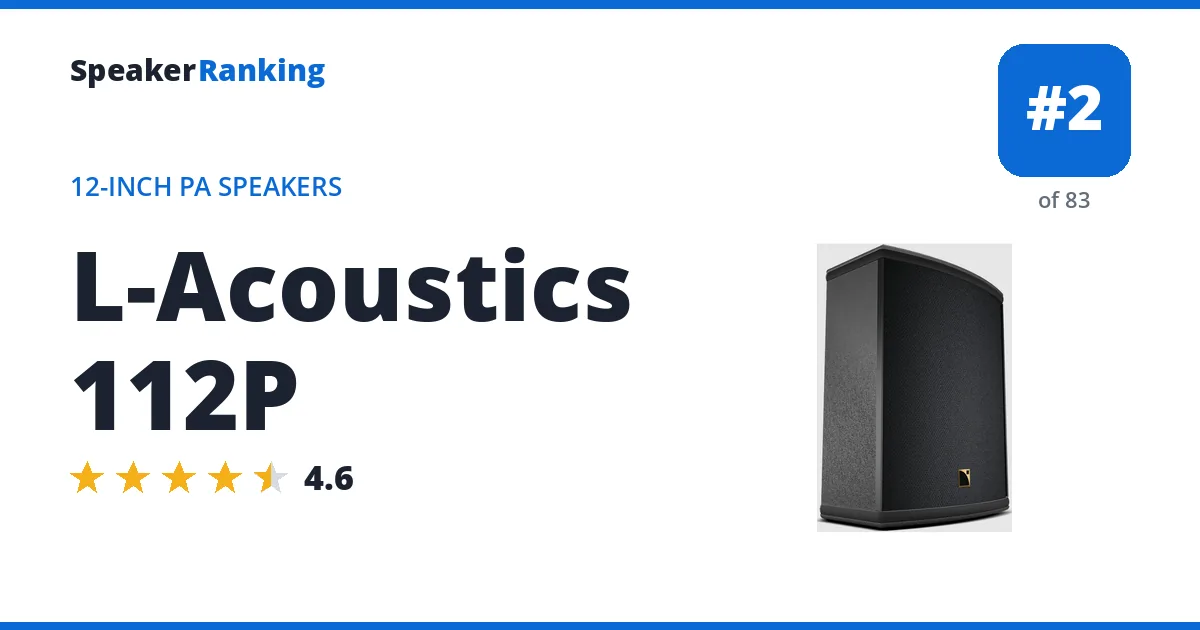
Pros: Its medium-quality vendor Spinorama data produces the category’s highest ideal-subwoofer preference score at 8.09, with 54Hz bass extension. The coaxial layout gives symmetric 90° coverage and strong feedback resistance for monitor and near-field work. Measured bass extension of 60Hz (-3dB).
Cons: This discontinued 32kg cabinet is difficult to source, very heavy for a portable 12-inch box and lacks modern networking or an onboard mixer. Its ranking reflects acoustic performance rather than present-day value or ownership convenience.
Full L-Acoustics 112P review and specifications →
| Released | 2005 (21 years ago) |
|---|---|
| AES Input | No |
| Amplifier Power | 1,000W at 8Ω (manufacturer specified) |
| Aux Input | No |
| Bass Extension (-3dB) | 60Hz (measured, vendor Spinorama data) |
| Bluetooth | No |
| Cabinet Material | 18/24/30mm Baltic birch plywood |
| Coaxial Input | No |
| Configuration | Self-powered 2-way coaxial PA speaker |
| Coverage | 90° conical |
| DSP | Yes, onboard presets and protection |
| Dimensions | 21.3”H x 16.1”W x 15.4”D (540 x 410 x 390 mm) |
| Drivers | 12” coaxial woofer, 1.4” exit/3” voice-coil compression driver |
| Frequency Response | 50Hz - 20kHz (-10dB, FRONT preset, manufacturer specified) |
| Guitar Input | No |
| HDMI Input | No |
| Inputs | Balanced XLR analog input |
| Maximum SPL | 133dB peak (manufacturer specified) |
| Microphone Input | No |
| Optical Input | No |
| Passive | No |
| RCA Input | No |
| Rigging | Integrated pole-mount socket; optional ETRI2-2 bracket and XTLIFTBAR |
| Spinorama Preference Score | 5.61 |
| Spinorama Preference Score with Perfect Sub | 8.09 |
| TRS Input | No |
| USB Input | No |
| Weight | 70.5 lbs (32 kg) |
| XLR Input | Yes |
- Links
- Reviews, Comparisons and Sound Samples
- Head-to-Head Comparisons
 #3 L-Acoustics X12 Passive eBay
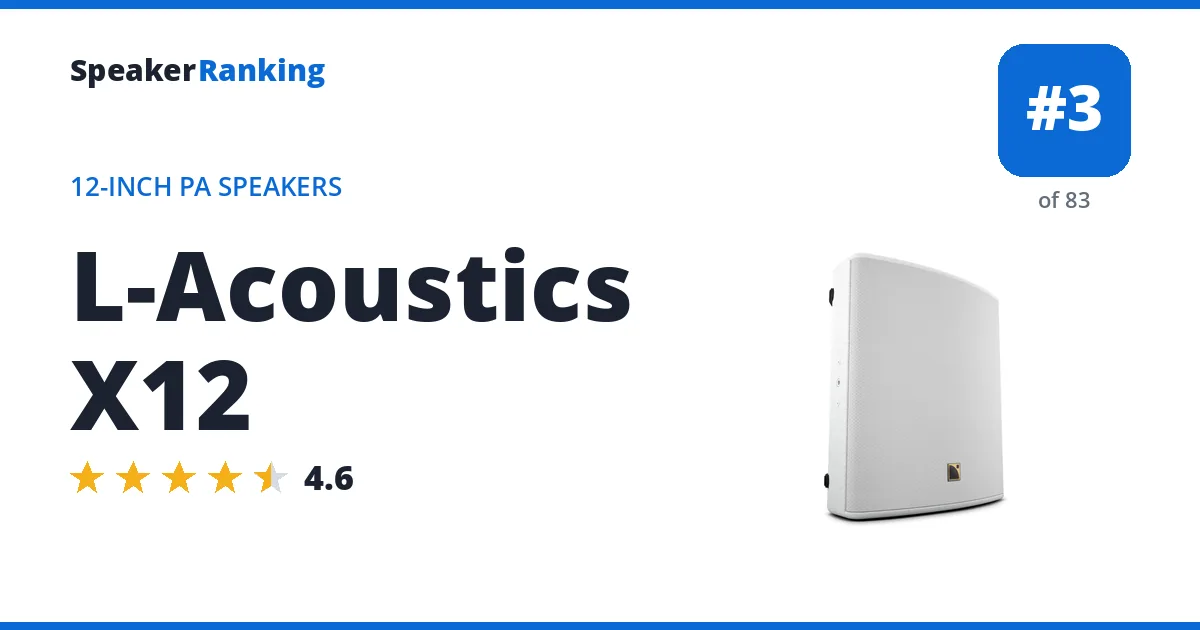
Same family: the L-Acoustics X4i (smaller model, rated 3.6/5), the L-Acoustics X6i (smaller model, rated 3.9/5), the L-Acoustics X8 (smaller model, rated 4/5) and the L-Acoustics X15 HiQ (larger model, rated 4.4/5).
Pros: Vendor Spinorama data gives the highest preference scores in the 12-inch ranking: 5.60 standalone and 8.52 with an ideal subwoofer. The listening-window response is very even (narrow-band deviation 0.158) and predicted in-room smoothness is 0.853, so tone stays consistent across the 90° x 60° coverage. Bass reaches about 78Hz (-3dB) in a 20kg coaxial cabinet with a 136dB maximum SPL. Measured bass extension of 78Hz (-3dB).
Cons: This is a passive cabinet that needs an L-Acoustics amplified controller such as the LA4X or LA12X, so the box alone will not play. Bass extension of about 78Hz (-3dB) is modest for a 12-inch box, and a subwoofer is needed for full-range music. Pricing is dealer quoted and typically well above self-powered 12-inch alternatives once the controller is included.
Full L-Acoustics X12 review and specifications →
| Released | 2015 (11 years ago) |
|---|---|
| AES Input | No |
| Amplifier Power | Passive speaker; requires an L-Acoustics amplified controller (LA2Xi, LA4X, LA8 or LA12X) |
| Aux Input | No |
| Bass Extension (-3dB) | 78Hz (measured, vendor Spinorama data) |
| Bluetooth | No |
| Cabinet Material | Baltic beech and birch plywood |
| Coaxial Input | No |
| Configuration | Passive 2-way coaxial PA speaker |
| Coverage | 90° x 60° |
| DSP | No (passive; processing and protection come from the amplified controller) |
| Dimensions | 19.5”H x 16.9”W x 14.8”D (496 x 430 x 375 mm) |
| Drivers | 12” cone woofer, 3” neodymium compression driver (coaxial) |
| Frequency Response | 59Hz - 20kHz (manufacturer specified) |
| Guitar Input | No |
| HDMI Input | No |
| Inputs | Speakon 4-pole input and link |
| Maximum SPL | 136dB (manufacturer specified) |
| Microphone Input | No |
| Optical Input | No |
| Passive | Yes |
| RCA Input | No |
| Rigging | M8 and M10 threaded inserts, 35mm pole socket, dual handles |
| Spinorama Preference Score | 5.60 |
| Spinorama Preference Score with Perfect Sub | 8.52 |
| TRS Input | No |
| USB Input | No |
| Weight | 44.1 lbs (20 kg) |
| XLR Input | No |
- Links
- Reviews, Comparisons and Sound Samples
- Head-to-Head Comparisons
 #4 FBT ProMaxX 112A: $722 Thomann $722 eBay
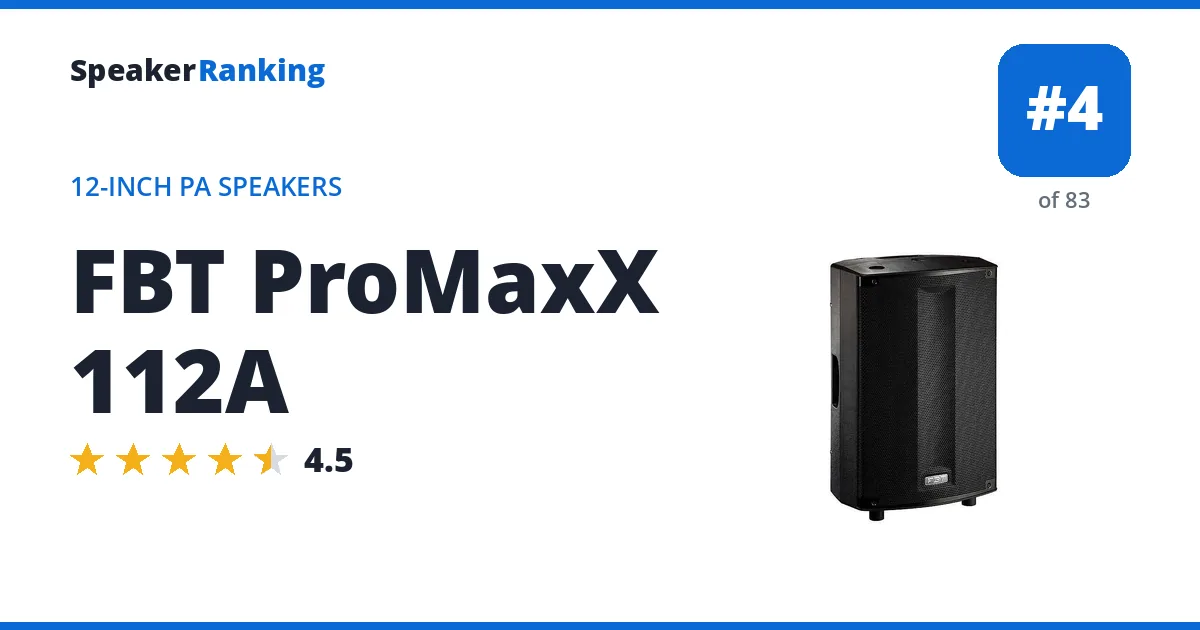
Same family: the FBT ProMaxX 110A (smaller model, rated 4.1/5) and the FBT Promaxx 114A (larger model, rated 3.9/5).
Pros: Medium-quality vendor data yields a strong 7.21 ideal-subwoofer preference score, second only to the QSC among the scored mainstream models here. Its smooth tonal result and high-output PA format make it a compelling value when it is available locally. Measured bass extension of 68Hz (-3dB).
Cons: Measured bass extension is only 68Hz, so it needs a subwoofer sooner than most 12-inch competitors. Distribution and service availability are less universal than QSC, JBL, Yamaha or RCF.
Full FBT ProMaxX 112A review and specifications →
| Released | 2016 (10 years ago) |
|---|---|
| AES Input | No |
| Amplifier Power | 900W RMS (700W LF + 200W HF); 1,800W peak (1,400W LF + 400W HF) |
| Aux Input | No |
| Bass Extension (-3dB) | 68Hz (measured, vendor Spinorama data) |
| Bluetooth | No |
| Cabinet Material | Polypropylene |
| Coaxial Input | No |
| Configuration | Active 2-way bass-reflex PA speaker |
| Coverage | 90° x 60° |
| DSP | Yes |
| Dimensions | 25.4”H x 15.8”W x 13.6”D (644 x 402 x 345 mm) |
| Drivers | 12” woofer, compression driver |
| Frequency Response | 48Hz - 20kHz (-6dB, manufacturer specified) |
| Guitar Input | No |
| HDMI Input | No |
| Inputs | XLR combo input, XLR male output, RCA stereo input |
| Maximum SPL | 133dB peak / 126dB continuous |
| Microphone Input | No |
| Optical Input | No |
| Passive | No |
| RCA Input | Yes |
| Rigging | 2x M10 suspension points, 35mm pole-mount socket, wall-bracket flange plate |
| Spinorama Preference Score | 4.30 |
| Spinorama Preference Score with Perfect Sub | 7.21 |
| TRS Input | No |
| USB Input | No |
| Weight | 39.9 lbs (18.1 kg) |
| XLR Input | Yes |
- Links
- Reviews, Comparisons and Sound Samples
- Head-to-Head Comparisons
 #5 KV2 Audio EX12: $3,480 eBay
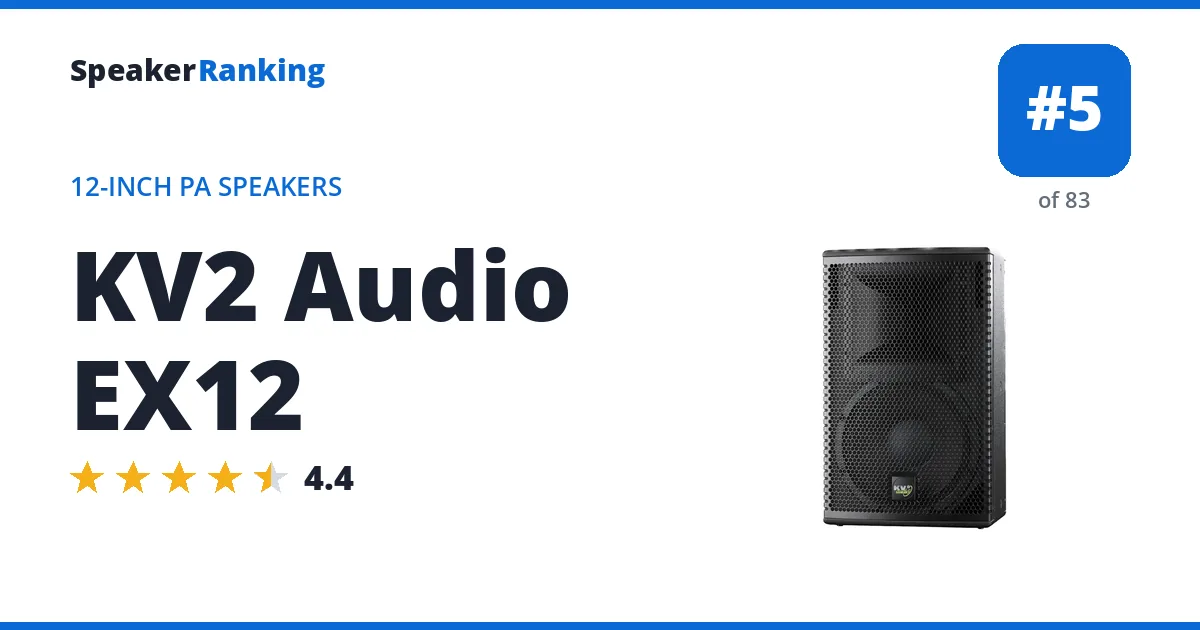
Same family: the KV2 Audio EX6 (smaller model, estimated 3.6/5), the KV2 Audio EX26 (smaller model, estimated 3.6/5), the KV2 Audio EX10 (smaller model, rated 3.7/5), the KV2 Audio EX28 (smaller model, estimated 3.8/5) and the KV2 Audio EX15 (larger model, rated 4/5).
Pros: A 6.62 ideal-subwoofer preference score and 52Hz bass extension from medium-quality vendor data make this one of the strongest measured specialist boxes. Its 3-inch-diaphragm compression driver, 133dB claimed peak and 80° x 40° horn target high vocal clarity and controlled throw. Measured bass extension of 60Hz (-3dB).
Cons: The 27.4kg enclosure and premium price make it much less portable and accessible than the mainstream leaders. User controls are comparatively spare, without an onboard mixer, app control or general-purpose parametric EQ.
Full KV2 Audio EX12 review and specifications →
| AES Input | No |
|---|---|
| Amplifier Power | 500W continuous (450W LF + 50W HF, manufacturer specified) |
| Aux Input | No |
| Bass Extension (-3dB) | 60Hz (measured, vendor Spinorama data) |
| Bluetooth | No |
| Cabinet Material | Baltic birch plywood |
| Coaxial Input | No |
| Configuration | Active 2-way bass-reflex PA speaker |
| Coverage | 80° x 40° |
| Crossover Frequency | 1.1kHz (manufacturer specified) |
| DSP | Integrated crossover, phase alignment, EQ and protection |
| Dimensions | 23.5”H x 14.5”W x 14.5”D (596 x 368 x 368 mm) |
| Drivers | 12” neodymium woofer, 1.4” exit/3” diaphragm compression driver |
| Frequency Response | 55Hz - 22kHz (-3dB, manufacturer specified) |
| Guitar Input | No |
| HDMI Input | No |
| Inputs | Balanced XLR input and output |
| Maximum SPL | 133dB peak (manufacturer specified) |
| Microphone Input | No |
| Optical Input | No |
| Passive | No |
| RCA Input | No |
| Rigging | M10 hang point, OmniMount bracket point, 4x M6 bracket points, 10x M10 suspension points; 35mm pole mount |
| Spinorama Preference Score | 4.19 |
| Spinorama Preference Score with Perfect Sub | 6.62 |
| TRS Input | No |
| USB Input | No |
| Weight | 60.4 lbs (27.4 kg) |
| XLR Input | Yes |
- Links
- Reviews, Comparisons and Sound Samples
- Head-to-Head Comparisons
 #6 JBL PRX912: $899.00 Amazon $899.00 B&H Photo Video $899.00 Guitar Center $999 eBay
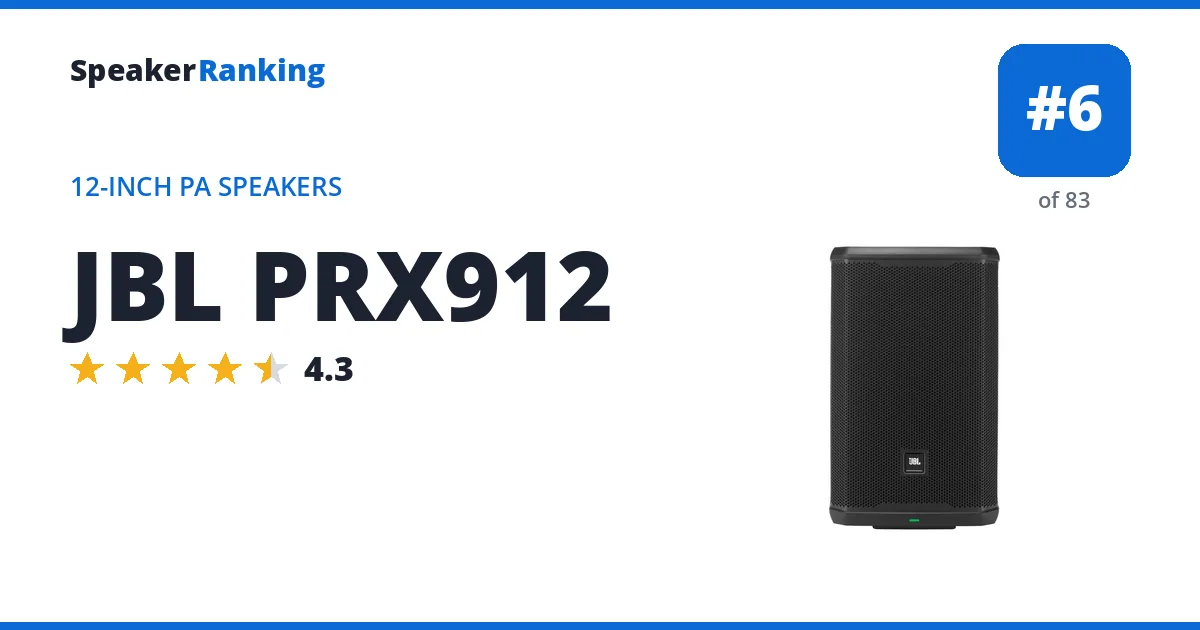
Same family: the JBL PRX908 (smaller model, rated 4/5) and the JBL PRX915 (larger model, rated 3.9/5).
Pros: High-quality manufacturer Spinorama data, 132dB claimed peak output, app control and unusually deep onboard processing make this one of the most versatile choices. The measured 54Hz bass extension is useful for speech and lighter music without a subwoofer. Measured bass extension of 54Hz (-3dB).
Cons: Its 6.05 ideal-subwoofer preference score trails the QSC and FBT ProMaxX, with less even sound-power behavior in the supplied data. At 19.5kg it is not especially light, and Bluetooth is for control rather than audio streaming.
Full JBL PRX912 review and specifications →
| Released | 2022 (4 years ago) |
|---|---|
| AES Input | No |
| Amplifier Power | 2000W peak / 1000W RMS |
| App | Yes (JBL Pro Connect) |
| Aux Input | Yes |
| Bass Extension (-3dB) | 54Hz (measured, vendor Spinorama data) |
| Bluetooth | Control only; no Bluetooth audio |
| Cabinet Material | Polypropylene/talc composite |
| Coaxial Input | No |
| Configuration | Active 2-way bass-reflex PA speaker |
| Coverage | 90° x 50° |
| Crossover Frequency | 1920Hz |
| DSP | Yes |
| Dimensions | 25”H x 15.5”W x 13.1”D (636 x 394 x 332 mm) |
| Drivers | 12” woofer, 1.5” compression driver |
| Frequency Response | 50Hz - 20kHz (-10dB, manufacturer specified) |
| Guitar Input | No |
| HDMI Input | No |
| Inputs | 2 x XLR/TRS combo, 3.5mm aux |
| Maximum SPL | 132dB peak (manufacturer specified) |
| Microphone Input | No |
| Optical Input | No |
| Passive | No |
| RCA Input | No |
| Rigging | 6 x M10 suspension points; dual 36mm pole sockets |
| Spinorama Preference Score | 3.57 |
| Spinorama Preference Score with Perfect Sub | 6.05 |
| TRS Input | Yes |
| USB Input | No |
| Weight | 43 lbs (19.5 kg) |
| XLR Input | Yes |
- Links
- Reviews, Comparisons and Sound Samples
- Head-to-Head Comparisons
 #7 RCF KX 32-A: $4,198.50 B&H Photo Video $4,198.50 Guitar Center eBay
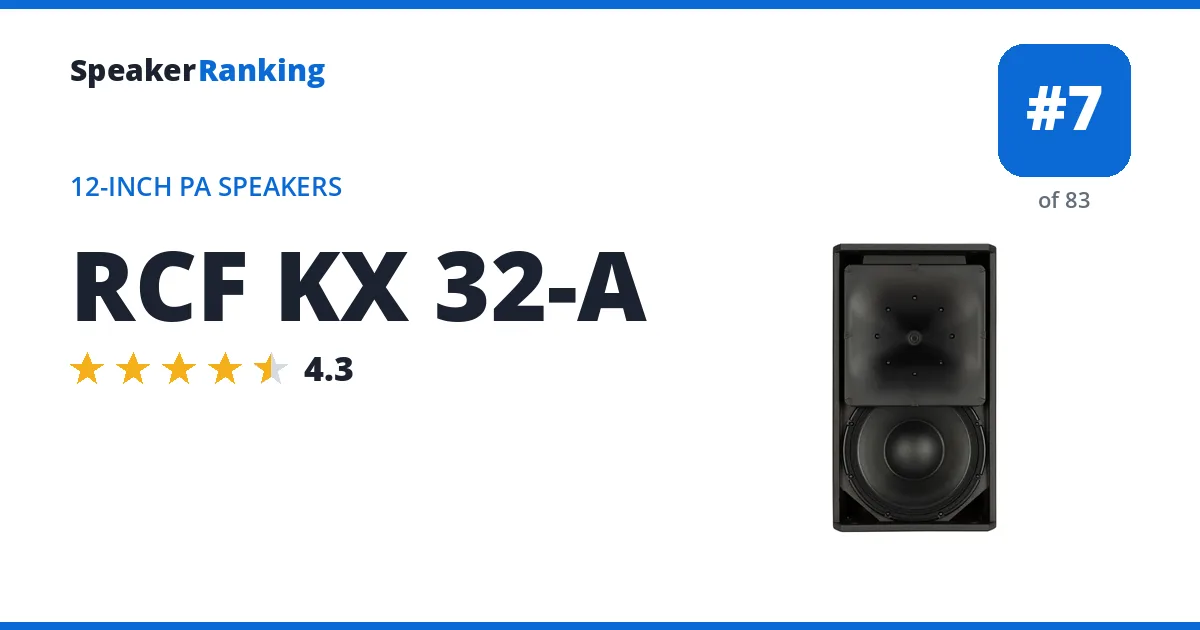
Same family: the RCF KX 08-A (smaller model, rated 3.9/5), the RCF KX 10-A (smaller model, rated 4/5) and the RCF KX 45-A (larger model, rated 4.2/5).
Pros: A 3200W amplifier, 3-inch titanium-dome compression driver, RDNet control and 134dB claimed peak output make this the most ambitious current RCF 12-inch point source here. Medium-quality data shows smooth core-band behavior and extension into the low 60Hz region. Measured bass extension of 61.5Hz (-3dB).
Cons: The measurement is truncated and cannot produce a preference score, while the 23.6kg plywood enclosure is heavier than mainstream molded alternatives. Pricing and broad retail availability are not yet established.
Full RCF KX 32-A review and specifications →
| AES Input | No |
|---|---|
| Amplifier Power | 3200W peak (2000W LF + 1200W HF) |
| Aux Input | No |
| Bass Extension (-3dB) | 61.5Hz (measured, vendor Spinorama data) |
| Bluetooth | No |
| Cabinet Material | Baltic birch plywood |
| Coaxial Input | No |
| Configuration | Active 2-way bass-reflex point-source PA speaker |
| Coverage | 100° x 70°, rotatable |
| Crossover Frequency | 750Hz |
| DSP | Yes, FiRPHASE, Bass Motion Control, presets and RDNet |
| Dimensions | 24.4”H x 14.2”W x 16.1”D (620 x 360 x 409.3 mm) |
| Drivers | 12” neodymium woofer, 1.4” exit/3” dome compression driver |
| Frequency Response | 50Hz - 20kHz (manufacturer specified) |
| Guitar Input | No |
| HDMI Input | No |
| Inputs | XLR audio input/link and EtherCON RDNet |
| Maximum SPL | 134dB peak (manufacturer specified) |
| Microphone Input | No |
| Network Control | RDNet |
| Optical Input | No |
| Passive | No |
| RCA Input | No |
| Rigging | Quick-lock rigging; 6 x M10 inserts; 35mm pole mount |
| TRS Input | No |
| USB Input | No |
| Weight | 52 lbs (23.6 kg) |
| XLR Input | Yes |
- Links
- Reviews, Comparisons and Sound Samples
- Head-to-Head Comparisons
 #8 EAW MKC120: $1,555.00 Passive SoundPro $1,555.00 eBay
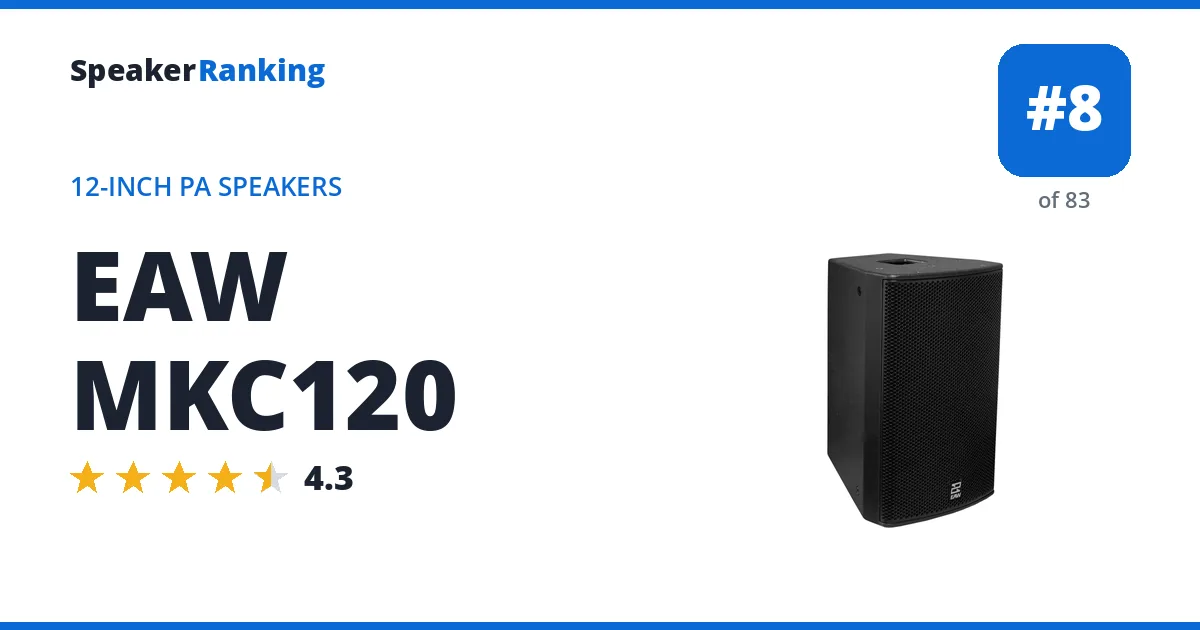
Same family: the EAW MKC50 (smaller model, rated 3.6/5), the EAW MKC60 (smaller model, rated 3.8/5) and the EAW MKC80 (smaller model, rated 3.9/5).
Pros: Vendor Spinorama data gives preference scores of 5.04 standalone and 7.57 with an ideal subwoofer. Bass reaches about 62Hz (-3dB), deeper than most 12-inch boxes here, and the 135dB maximum SPL and 600W handling suit small and mid-size rooms. It weighs 16.4kg, with a rotatable 90° x 60° horn, built-in handle and pole mount. Measured bass extension of 62Hz (-3dB).
Cons: A passive cabinet, so it needs a separate amplifier and processor with EAW presets. Listening-window narrow-band deviation is 0.239 and predicted in-room smoothness is 0.729, less even than the best coaxials in this ranking. Street pricing is high for a box that cannot play without extra gear.
Full EAW MKC120 review and specifications →
| Released | 2023 (3 years ago) |
|---|---|
| AES Input | No |
| Amplifier Power | Passive speaker; use external amplification within the 600W handling rating at 8 ohms |
| Aux Input | No |
| Bass Extension (-3dB) | 62Hz (measured, vendor Spinorama data) |
| Bluetooth | No |
| Coaxial Input | No |
| Configuration | Passive 2-way coaxial PA speaker |
| Coverage | 90° x 60° (rotatable) |
| DSP | No (passive; use with an amplifier that has EAW DSP presets) |
| Dimensions | 22.4”H x 14.4”W x 13.4”D (569 x 367 x 341 mm) |
| Drivers | 12” cone woofer with 2.5” voice coil, 1” exit compression driver with CSA coaxial loading |
| Frequency Response | 48Hz - 20kHz (manufacturer specified) |
| Guitar Input | No |
| HDMI Input | No |
| Inputs | Two Neutrik NL4 connectors and 2-pin barrier strip |
| Maximum SPL | 135dB (manufacturer specified) |
| Microphone Input | No |
| Optical Input | No |
| Passive | Yes |
| Power Handling | 600W at 8 ohms (manufacturer specified) |
| RCA Input | No |
| Rigging | Integrated M10 mounting points, built-in handle, pole mount |
| Sensitivity | 95dB |
| TRS Input | No |
| USB Input | No |
| Weight | 36.2 lbs (16.4 kg) |
| XLR Input | No |
- Links
- Reviews, Comparisons and Sound Samples
- Head-to-Head Comparisons
 #9 RCF ART 932-A: $1,399.00 Amazon $1,399.00 B&H Photo Video $1,399.00 Guitar Center $1,399.00 eBay
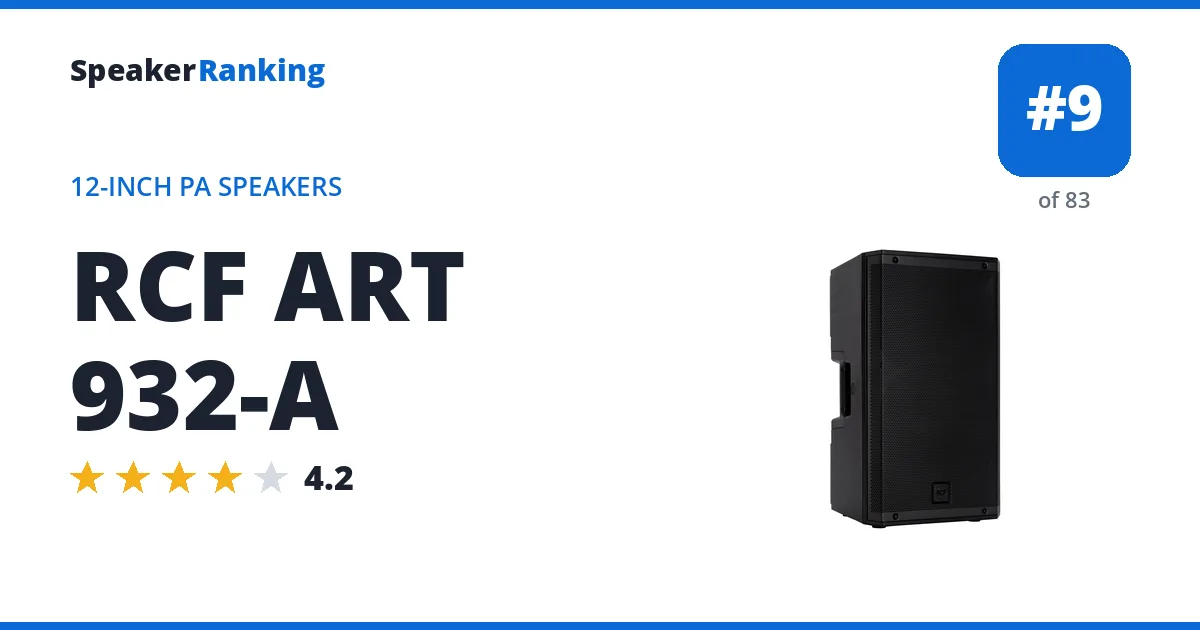
Same family: the RCF ART 910-A (smaller model, estimated 3.9/5), the RCF ART 912-A (smaller model, ranked lower, rated 4.1/5), the RCF ART 915-A (larger model, estimated 3.8/5), the RCF ART 935-A (larger model, rated 3.9/5) and the RCF ART 945-A (larger model, rated 4.4/5).
Pros: A large 3-inch compression-driver voice coil, broad 100° x 60° coverage and 132dB claimed maximum output make it attractive for clear vocals and live mains. RCF’s FiRPHASE and Bass Motion Control processing target phase consistency and useful low-frequency headroom. Measured bass extension of 54.5Hz (-3dB).
Cons: The local low-quality vendor data does not currently produce a preference score, so this position has lower measurement confidence than the QSC, JBL and scored FBT models. Its streamlined controls lack the app and deep user DSP of the JBL PRX912.
Full RCF ART 932-A review and specifications →
| Released | Jul 2021 (5 years ago) |
|---|---|
| AES Input | No |
| Amplifier Power | 2100W peak (1500W LF + 600W HF) |
| Aux Input | No |
| Bass Extension (-3dB) | 54.5Hz (measured, vendor Spinorama data) |
| Bluetooth | No |
| Cabinet Material | PP composite |
| Coaxial Input | No |
| Configuration | Active 2-way bass-reflex PA speaker |
| Coverage | 100° x 60° |
| Crossover Frequency | 700Hz |
| DSP | Yes |
| Dimensions | 25.3”H x 14.6”W x 14.3”D (642 x 370 x 363 mm) |
| Drivers | 12” woofer, 1.4” compression driver with 3” voice coil |
| Frequency Response | 50Hz - 20kHz (manufacturer specified) |
| Guitar Input | No |
| HDMI Input | No |
| Inputs | XLR/TRS combo |
| Maximum SPL | 132dB peak (manufacturer specified) |
| Microphone Input | No |
| Optical Input | No |
| Passive | No |
| RCA Input | No |
| Rigging | M10 inserts; 35mm pole mount |
| TRS Input | Yes |
| USB Input | No |
| Weight | 41.4 lbs (18.8 kg) |
| XLR Input | Yes |
- Links
- Reviews, Comparisons and Sound Samples
- Head-to-Head Comparisons
 #10 RCF NX 932-A: $1,799.00 Amazon $1,799.00 B&H Photo Video $1,999.00 Guitar Center $1,999.00 eBay
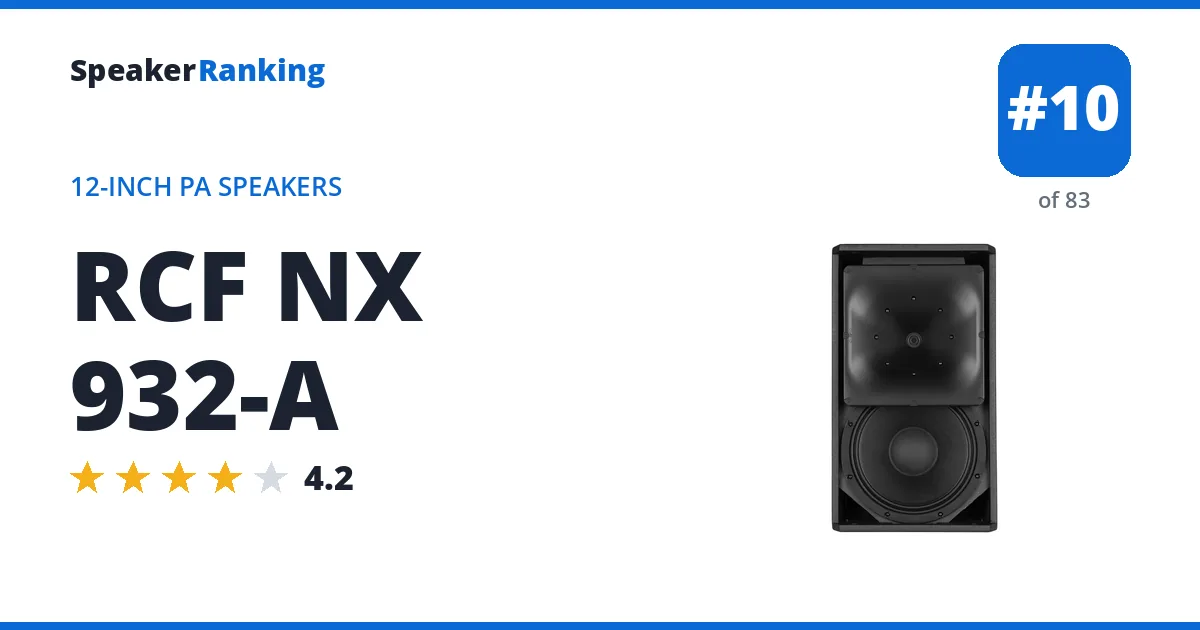
Same family: the RCF NX 910-A (smaller model, rated 3.5/5), the RCF NX 912-A (smaller model, ranked lower, rated 4/5), the RCF NX 915-A (larger model, rated 3.6/5) and the RCF NX 945-A (larger model, rated 4.1/5).
Pros: A 3-inch titanium compression-driver diaphragm, 100° x 70° coverage and plywood cabinet make it especially capable for clear vocals over wide areas. The 2100W amplifier, advanced RCF processing and 132dB peak claim support serious main-speaker use. Measured bass extension of 61.5Hz (-3dB).
Cons: The medium-quality Spinorama measurement is truncated and cannot generate a preference score, so its high position relies partly on response/directivity curves and published engineering. At 22.9kg it is significantly heavier than the RCF ART 932-A.
Full RCF NX 932-A review and specifications →
| AES Input | No |
|---|---|
| Amplifier Power | 2100W peak (1400W LF + 700W HF) |
| Aux Input | No |
| Bass Extension (-3dB) | 61.5Hz (measured, vendor Spinorama data) |
| Bluetooth | No |
| Cabinet Material | Plywood |
| Coaxial Input | No |
| Configuration | Active 2-way bass-reflex PA speaker |
| Coverage | 100° x 70° |
| Crossover Frequency | 700Hz |
| DSP | Yes, FiRPHASE and Bass Motion Control |
| Dimensions | 24.4”H x 14.3”W x 15.9”D (620 x 362 x 405 mm) |
| Drivers | 12” woofer, 1.4” exit/3” diaphragm compression driver |
| Frequency Response | 45Hz - 20kHz (manufacturer specified) |
| Guitar Input | No |
| HDMI Input | No |
| Inputs | XLR/TRS combo input and XLR output |
| Maximum SPL | 132dB peak (manufacturer specified) |
| Microphone Input | No |
| Optical Input | No |
| Passive | No |
| RCA Input | No |
| Rigging | 6 x M10 inserts, 4 quick-lock points; 35mm pole mount |
| TRS Input | Yes |
| USB Input | No |
| Weight | 50.5 lbs (22.9 kg) |
| XLR Input | Yes |
- Links
- Reviews, Comparisons and Sound Samples
- Head-to-Head Comparisons
 #11 KV2 Audio ESR212 eBay
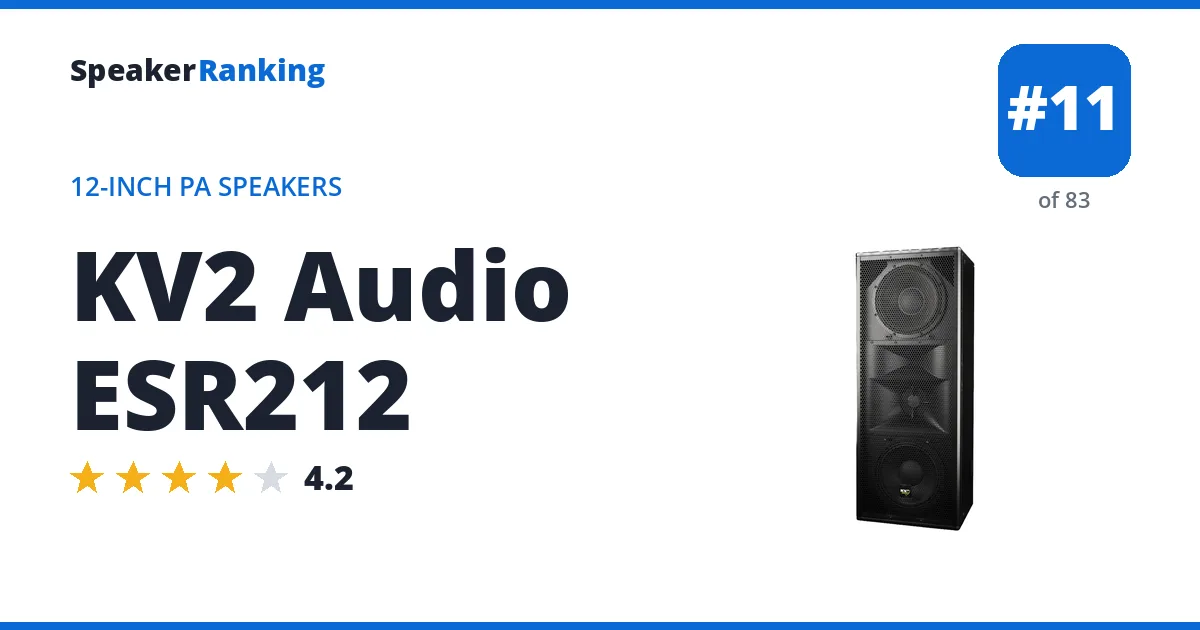
Pros: Vendor Spinorama data shows very deep bass for a 12-inch class box, about 40Hz (-3dB) with an ideal-subwoofer extension of 36Hz, and a standalone preference score of 4.94. Dual 12-inch woofers plus a dedicated 6-inch midrange give 129dB continuous and 135dB peak output, which lets one cabinet handle full-range music without a subwoofer. Measured bass extension of 40Hz (-3dB).
Cons: The dual-woofer, 3-way cabinet is bulkier than a conventional 12-inch top. Listening-window narrow-band deviation is 0.436 and the vertical coverage is very narrow, so aiming matters. Pricing is quoted by dealers and is high.
Full KV2 Audio ESR212 review and specifications →
| AES Input | No |
|---|---|
| Aux Input | No |
| Bass Extension (-3dB) | 40Hz (measured, vendor Spinorama data) |
| Bluetooth | No |
| Coaxial Input | No |
| Configuration | Active 3-way full-range PA speaker |
| Coverage | 90° x 40° (as measured) |
| DSP | Yes |
| Drivers | Dual 12” woofers, 6” midrange, 1” compression driver |
| Frequency Response | 38Hz - 22kHz (-3dB, manufacturer specified); 33Hz - 28kHz (-10dB) |
| Guitar Input | No |
| HDMI Input | No |
| Maximum SPL | 129dB continuous / 135dB peak (manufacturer specified) |
| Microphone Input | No |
| Optical Input | No |
| Passive | No |
| RCA Input | No |
| Rigging | M10 fly points; optional horizontal and vertical brackets |
| Spinorama Preference Score | 4.94 |
| Spinorama Preference Score with Perfect Sub | 6.67 |
| TRS Input | No |
| USB Input | No |
| Weight | 99.2 lbs (45 kg) |
| XLR Input | Yes |
- Links
- Reviews, Comparisons and Sound Samples
- Head-to-Head Comparisons
 #12 RCF ART 912-A: $913.11 Amazon $913.11 Lowest B&H Photo Video $949.00 Guitar Center $949.00 eBay
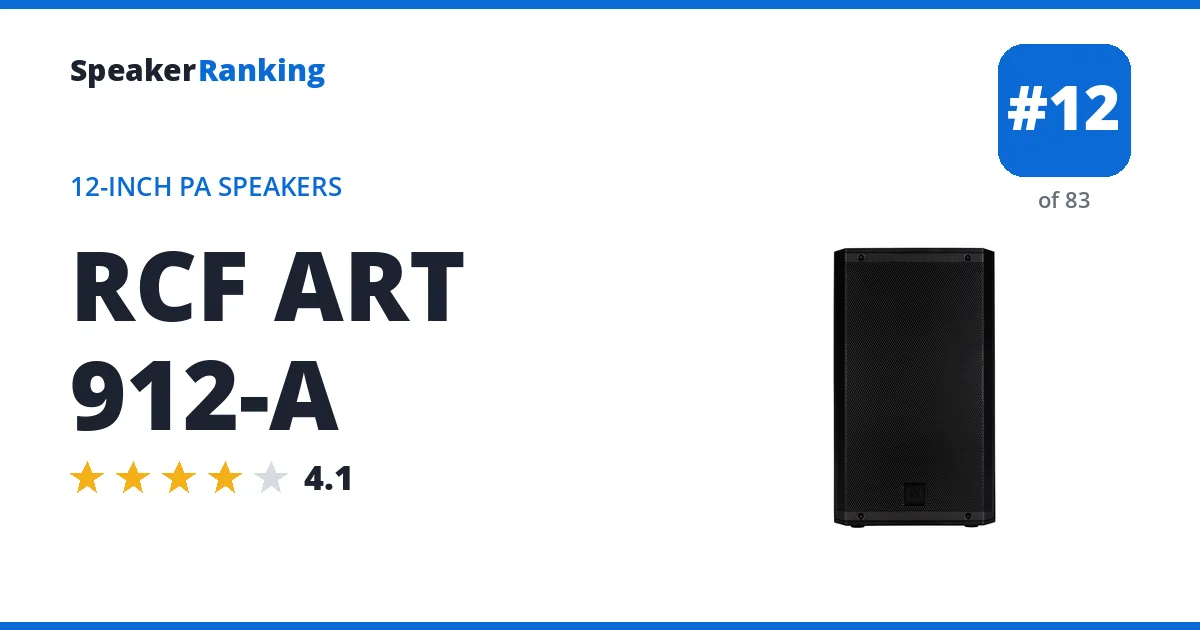
Same family: the RCF ART 910-A (smaller model, estimated 3.9/5), the RCF ART 932-A (larger model, ranked higher, rated 4.2/5), the RCF ART 915-A (larger model, estimated 3.8/5), the RCF ART 935-A (larger model, rated 3.9/5) and the RCF ART 945-A (larger model, rated 4.4/5).
Pros: A current, widely stocked 12-inch RCF with 130dB claimed output, 100° x 60° coverage and the same FiRPHASE/Bass Motion Control platform used higher in the ART 9 line. It is a straightforward choice for users who value simple setup over menu-heavy DSP. Measured bass extension of 65.0Hz (-3dB).
Cons: The available low-quality manufacturer directivity data has no computed preference score, limiting confidence in cross-brand tonal comparisons. It has only basic rear-panel presets and no wireless control or Bluetooth audio.
Full RCF ART 912-A review and specifications →
| Released | Jul 2021 (5 years ago) |
|---|---|
| AES Input | No |
| Amplifier Power | 2,100W peak (1,400W LF + 700W HF, manufacturer specified) |
| Aux Input | No |
| Bass Extension (-3dB) | 65.0Hz (measured, vendor Spinorama data) |
| Bluetooth | No |
| Cabinet Material | Polypropylene composite |
| Coaxial Input | No |
| Configuration | Active 2-way bass-reflex PA speaker |
| Coverage | 100° x 60° |
| Crossover Frequency | 1.7kHz (manufacturer specified) |
| DSP | Yes |
| Dimensions | 25.3”H x 14.6”W x 14.3”D (642 x 370 x 363 mm) |
| Drivers | 12” woofer, 1” compression driver with 1.75” voice coil |
| Frequency Response | 50Hz - 20kHz (manufacturer specified) |
| Guitar Input | No |
| HDMI Input | No |
| Inputs | XLR/TRS combo |
| Maximum SPL | 130dB peak (manufacturer specified) |
| Microphone Input | No |
| Optical Input | No |
| Passive | No |
| RCA Input | No |
| Rigging | M10 fly points; pole mount |
| TRS Input | Yes |
| USB Input | No |
| Weight | 41.9 lbs (19 kg) |
| XLR Input | Yes |
- Links
- Reviews, Comparisons and Sound Samples
- Head-to-Head Comparisons
 #13 Yamaha DXR12mkIII: $999.99 Amazon $999.99 B&H Photo Video $999.99 Guitar Center $999.99 eBay
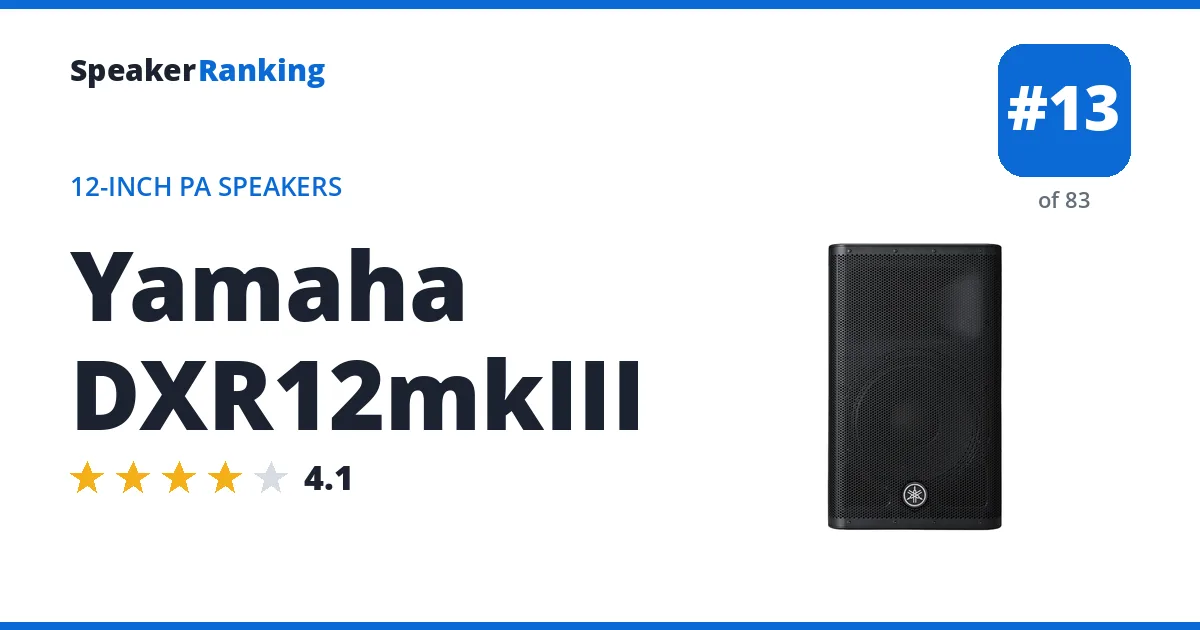
Older model: the Yamaha DXR12mkII (ranked lower, rated 4/5). See every Yamaha DXR and CXR generation.
Same family: the Yamaha DXR10mkIII (smaller powered model, rated 3.8/5), the Yamaha DXR15mkIII (larger powered model, rated 3.8/5), the Yamaha CXR10mkIII (smallest passive model, estimated 3.5/5), the Yamaha CXR12mkIII (passive model, ranked lower, estimated 3.8/5) and the Yamaha CXR15mkIII (largest passive model, estimated 3.5/5).
Pros: The third-generation DXR raises claimed output to 134dB and adds 2000W amplification, app-based control and more capable onboard DSP while staying light at 17.4kg. Medium-quality vendor data shows measured extension around 60Hz. Measured bass extension of 60Hz (-3dB).
Cons: The truncated Spinorama data does not produce a preference score, so its tonal advantage over the proven Yamaha DXR12mkII is not yet quantified. Wireless connectivity is for remote control, not a substitute for a wired production-audio input.
Full Yamaha DXR12mkIII review and specifications →
| Released | Jun 2026 (4 months ago) |
|---|---|
| AES Input | No |
| Amplifier Power | 2000W peak / 1000W RMS (1700W LF + 300W HF peak) |
| Aux Input | No |
| Bass Extension (-3dB) | 60Hz (measured, vendor Spinorama data) |
| Bluetooth | Yes |
| Bluetooth Version | 5.0 |
| Cabinet Material | PP plastic |
| Coaxial Input | No |
| Configuration | Active 2-way bass-reflex PA speaker |
| Coverage | 90° x 60° |
| Crossover Frequency | 1800Hz (FIR-X) |
| DSP | Yes, FIR-X tuning, Drive Motion Calibration and D-Remote |
| Dimensions | 23.6”H x 14.4”W x 13.8”D (600 x 366 x 350 mm) |
| Drivers | 12” woofer, 1” throat/1.75” diaphragm compression driver |
| Frequency Response | 50Hz - 20kHz (-10dB, manufacturer specified) |
| Guitar Input | No |
| HDMI Input | No |
| Inputs | Balanced mic/line inputs and link output |
| Maximum SPL | 134dB peak (manufacturer specified) |
| Microphone Input | Yes |
| Optical Input | No |
| Passive | No |
| RCA Input | No |
| Rigging | 3 x M10 points plus U-bracket points; 35mm dual-angle pole mount |
| TRS Input | No |
| USB Input | No |
| Weight | 38.4 lbs (17.4 kg) |
| XLR Input | No |
- Links
- Reviews, Comparisons and Sound Samples
- Head-to-Head Comparisons
- Yamaha DXR12mkIII vs RCF ART 912-A
- Yamaha DXR12mkIII vs HK Audio LINEAR 7 112 XA
- Yamaha DXR12mkIII vs RCF NX 932-A
- Yamaha DXR12mkIII vs RCF ART 932-A
- Yamaha DXR12mkIII vs Yamaha DXR12mkII
- Yamaha DXR12mkIII vs Axiom ED120A
- Yamaha DXR12mkIII vs RCF KX 32-A
- Yamaha DXR12mkIII vs RCF NX 912-A
- See all 25 comparisons
 #14 HK Audio LINEAR 7 112 XA: $2,043.57 Amazon $2,043.57 eBay
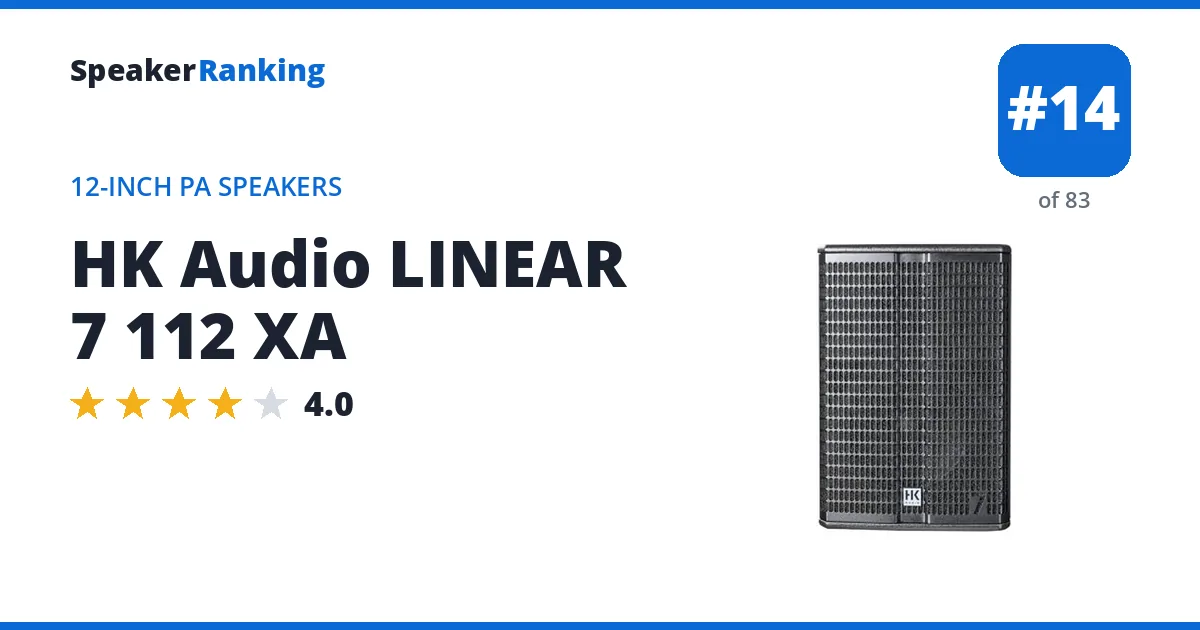
Same family: the HK Audio LINEAR 7 110 XA (smaller model, rated 4.2/5), the HK Audio LINEAR 7 112 FA (smaller model, ranked lower, rated 3.8/5) and the HK Audio LINEAR 7 115 FA (larger model, rated 4.1/5).
Pros: High-quality vendor data gives it a 5.66 ideal-subwoofer preference score, and networked 10-band parametric EQ, delay and filtering support sophisticated system tuning. Its rotatable horn and monitor enclosure are flexible for stage or main use. Measured bass extension of 90Hz (-3dB).
Cons: The measured 82Hz bass extension makes a subwoofer important for music, and its 131dB peak claim is lower than several similarly priced competitors. At 21kg it is manageable but not especially light.
Full HK Audio LINEAR 7 112 XA review and specifications →
| Released | Apr 2019 (7 years ago) |
|---|---|
| AES Input | No |
| Amplifier Power | 2,000W peak (Class D bi-amped, manufacturer specified) |
| Aux Input | No |
| Bass Extension (-3dB) | 90Hz (measured, vendor Spinorama data) |
| Bluetooth | No |
| Cabinet Material | Hybrid birch multiplex/MDF |
| Coaxial Input | No |
| Configuration | Active 2-way bass-reflex PA speaker/monitor |
| Coverage | 70° x 50°, rotatable |
| Crossover Frequency | 1.6kHz FIR (60dB/octave, manufacturer specified) |
| DSP | Yes, networked 10-band PEQ, filters, delay and limiter |
| Dimensions | 26.4”H x 14.6”W x 12.2”D (670 x 370 x 310 mm) |
| Drivers | 12” woofer, 1” compression driver |
| Frequency Response | 67Hz - 19kHz (±3dB, manufacturer specified); 62Hz - 20kHz (-10dB) |
| Guitar Input | No |
| HDMI Input | No |
| Inputs | XLR/TRS combo, XLR thru/DSP out, EtherCON network |
| Maximum SPL | 131dB peak (manufacturer specified) |
| Microphone Input | No |
| Network Control | EtherCON input/thru; DSP CONTROL software |
| Optical Input | No |
| Passive | No |
| RCA Input | No |
| Rigging | M8 rigging points; DuoTilt 3°/7° pole mount |
| Spinorama Preference Score | 2.40 |
| Spinorama Preference Score with Perfect Sub | 5.66 |
| TRS Input | Yes |
| USB Input | No |
| Weight | 46.3 lbs (21 kg) |
| XLR Input | Yes |
- Links
- Reviews, Comparisons and Sound Samples
- Head-to-Head Comparisons
 #15 HK Audio LINEAR 9 112 XA: $1,965.54 Amazon $1,965.54 eBay
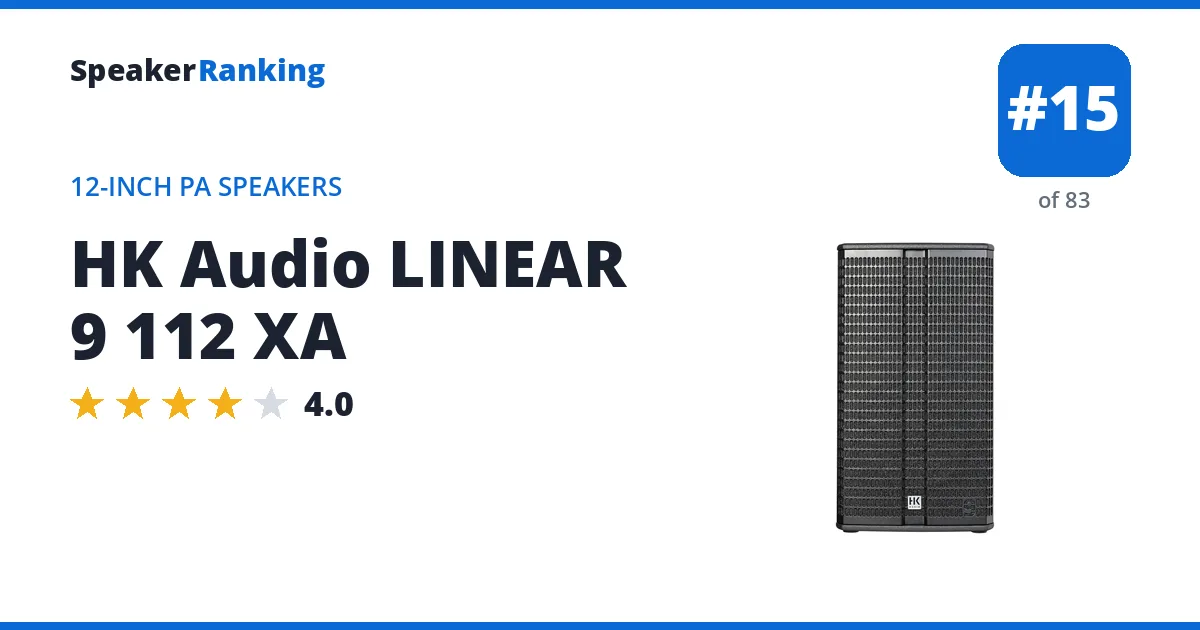
Same family: the HK Audio LINEAR 9 110 XA (smaller model, rated 4.2/5).
Pros: The high-quality vendor data returns a 5.66 ideal-subwoofer preference score. MILAN networking, comprehensive remote DSP and a durable plywood cabinet make it a strong systems-oriented choice for professional deployment. Measured bass extension of 90Hz (-3dB).
Cons: Its 82Hz measured bass extension and 131dB peak claim mean it depends more on a subwoofer than the strongest stand-alone boxes. Buyers who do not need networked audio may find better value in simpler mainstream models.
Full HK Audio LINEAR 9 112 XA review and specifications →
| Released | Nov 2021 (4 years ago) |
|---|---|
| AES Input | No |
| Amplifier Power | 700W RMS |
| Aux Input | No |
| Bass Extension (-3dB) | 90Hz (measured, vendor Spinorama data) |
| Bluetooth | No |
| Cabinet Material | Birch plywood with PU coating |
| Coaxial Input | No |
| Configuration | Active 2-way bass-reflex PA speaker/monitor |
| Coverage | 70° x 50°, rotatable |
| Crossover Frequency | 1600Hz |
| DSP | Yes, networked PEQ, filters, delay and limiter |
| Dimensions | 26.4”H x 14.6”W x 12.2”D (670 x 370 x 310 mm) |
| Drivers | 12” woofer, 1” compression driver |
| Frequency Response | 62Hz - 20kHz (-10dB, manufacturer specified) |
| Guitar Input | No |
| HDMI Input | No |
| Inputs | XLR/TRS combo, XLR thru/DSP out, dual EtherCON |
| Maximum SPL | 131dB peak (manufacturer specified) |
| Microphone Input | No |
| Network Control | Milan and HK Audio DSP Control |
| Optical Input | No |
| Passive | No |
| RCA Input | No |
| Rigging | 5 x M8 points; DuoTilt 3°/7° pole mount |
| Spinorama Preference Score | 2.40 |
| Spinorama Preference Score with Perfect Sub | 5.66 |
| TRS Input | Yes |
| USB Input | No |
| Weight | 45.2 lbs (20.5 kg) |
| XLR Input | Yes |
- Links
- Reviews, Comparisons and Sound Samples
- Head-to-Head Comparisons
 #16 EAW MKD1200 Passive eBay
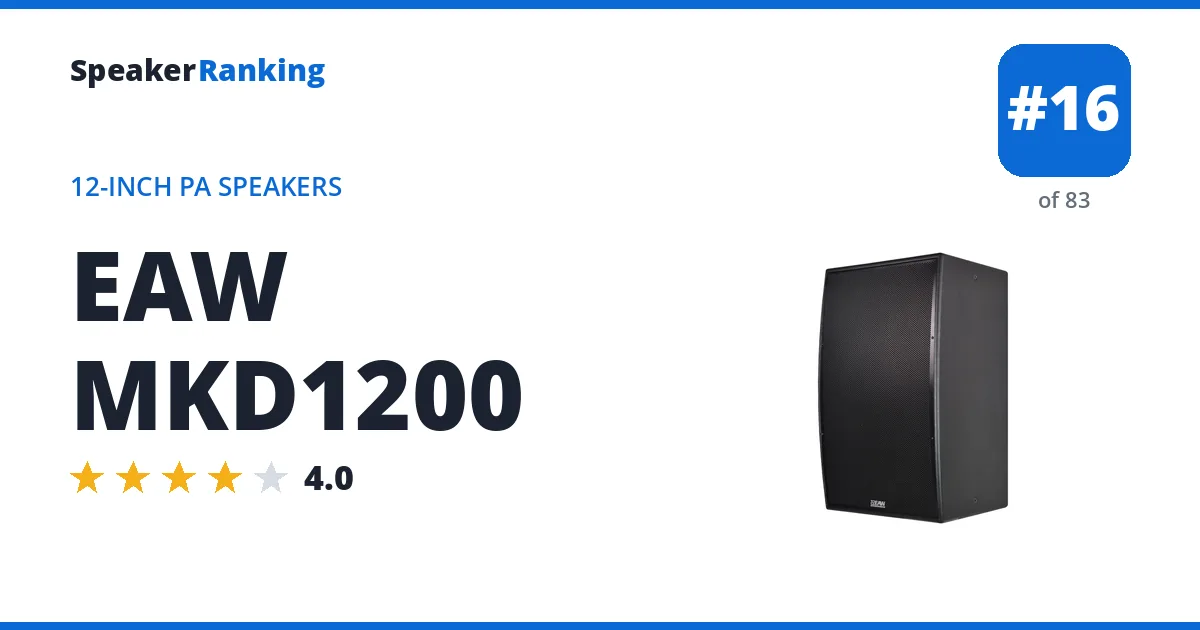
Same family: the EAW MKD526 (smaller model, estimated 3.3/5) and the EAW MKD1000 (smaller model, rated 2.9/5).
Pros: Vendor Spinorama data gives preference scores of 4.78 standalone and 7.20 with an ideal subwoofer. Dual 12-inch woofers reach about 58Hz (-3dB), with a 47Hz to 20kHz rated range and output up to 147dB depending on the horn pattern. On-axis narrow-band deviation is a low 0.156, and the three horn patterns (60° x 45°, 90° x 45° or 90° x 60°) fit venues of different shapes. Measured bass extension of 58Hz (-3dB).
Cons: A 47kg passive 3-way cabinet that needs an external amplifier and processor, so it is a fixed installation box rather than a portable 12-inch top. Sound-power narrow-band deviation is 0.546 and predicted in-room smoothness is 0.464, less even than the best 12-inch models. The Spinorama data is low quality, and pricing is quoted by dealers.
Full EAW MKD1200 review and specifications →
| Released | Nov 2020 (5 years ago) |
|---|---|
| AES Input | No |
| Amplifier Power | Passive speaker; use external amplification within the 1200W LF/MF and 140W HF/MF handling ratings at 8 ohms |
| Aux Input | No |
| Bass Extension (-3dB) | 58Hz (measured, vendor Spinorama data) |
| Bluetooth | No |
| Coaxial Input | No |
| Configuration | Passive or bi-amplified 3-way full-range PA speaker |
| Coverage | 60° x 45°, 90° x 45° or 90° x 60° (model dependent) |
| DSP | No (passive; use with an amplifier that has EAW DSP presets) |
| Dimensions | 32”H x 22.7”W x 20.6”D (813 x 577 x 523 mm) |
| Drivers | Dual 12” cone woofers with 3” voice coils, 2” exit midrange compression driver, 2” exit tweeter compression driver |
| Frequency Response | 47Hz - 20kHz (manufacturer specified) |
| Guitar Input | No |
| HDMI Input | No |
| Inputs | Terminal block connections |
| Maximum SPL | 147dB (MKD1264), 145dB (MKD1294), 139dB (MKD1296) |
| Microphone Input | No |
| Optical Input | No |
| Passive | Yes |
| Power Handling | 1200W at 8 ohms (LF/MF), 140W at 8 ohms (HF/MF) |
| RCA Input | No |
| Rigging | 12 x M10 mounting points; U-bracket and M10 kit accessories |
| Spinorama Preference Score | 4.78 |
| Spinorama Preference Score with Perfect Sub | 7.20 |
| TRS Input | No |
| USB Input | No |
| Weight | 104.1 lbs (47.2 kg) |
| XLR Input | No |
- Links
- Reviews, Comparisons and Sound Samples
- Head-to-Head Comparisons
 #17 Yamaha DXR12mkII: $909.99 Discontinued Amazon $909.99 Guitar Center $909.99 eBay
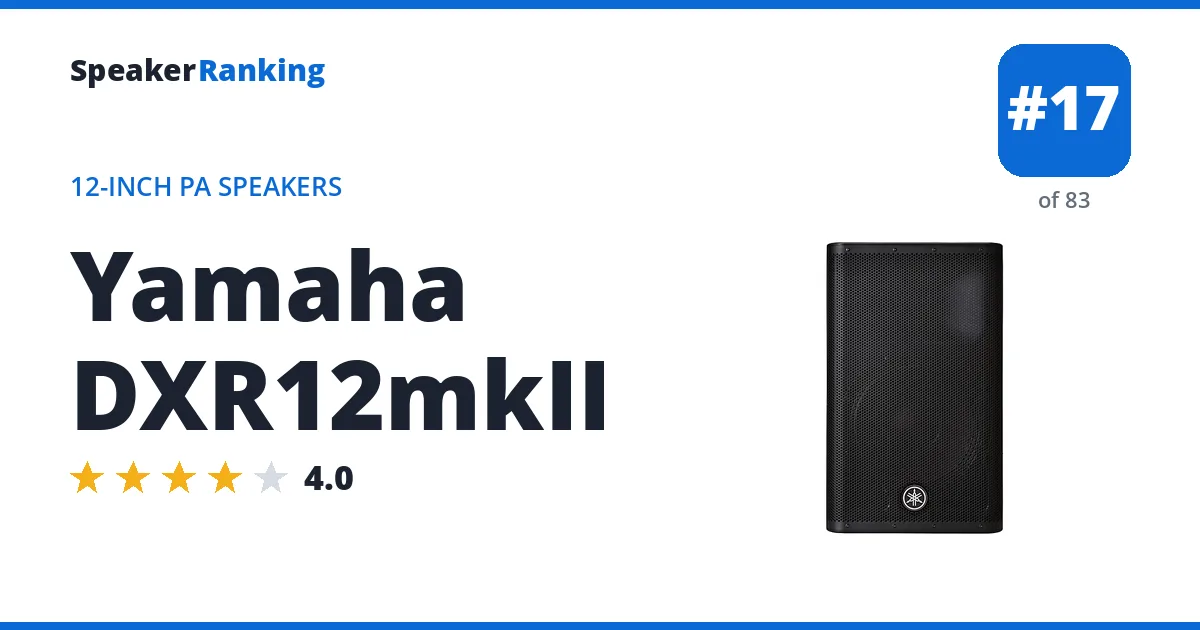
Newer model: the Yamaha DXR12mkIII, ranked higher, rated 4.1/5, released Jun 2026. It adds Bluetooth, but drops the XLR input and the RCA input. See every Yamaha DXR and CXR generation.
Same family: the Yamaha DXR8mkII (smaller model, rated 4/5), the Yamaha DXR10mkII (smaller model, rated 3.8/5) and the Yamaha DXR15mkII (larger model, rated 3.7/5).
Pros: A proven, broadly distributed workhorse with a flexible three-channel input section and 134dB claimed maximum output. Medium-quality vendor Spinorama data and 61Hz measured extension provide more evidence than many PA competitors, while Yamaha’s FIR-X processing and D-CONTOUR presets simplify setup. Measured bass extension of 61Hz (-3dB).
Cons: The 5.49 ideal-subwoofer preference score is only mid-pack, with meaningful response/directivity irregularity in the supplied data. It lacks app control and Bluetooth audio, and newer competitors offer more user-adjustable DSP. Discontinued.
Full Yamaha DXR12mkII review and specifications →
| Released | May 2022 (4 years ago) |
|---|---|
| AES Input | No |
| Amplifier Power | 1100W dynamic / 700W continuous (950W LF + 150W HF dynamic) |
| Aux Input | No |
| Bass Extension (-3dB) | 61Hz (measured, vendor Spinorama data) |
| Bluetooth | No |
| Cabinet Material | Matte-finish ABS |
| Coaxial Input | No |
| Configuration | Active 2-way bass-reflex PA speaker |
| Coverage | 90° x 60° |
| DSP | Yes |
| Dimensions | 23.7”H x 14.3”W x 13.8”D (601 x 362 x 350 mm) |
| Drivers | 12” woofer, 1.75” compression driver |
| Frequency Response | 52Hz - 20kHz (manufacturer specified) |
| Guitar Input | No |
| HDMI Input | No |
| Inputs | 2 x XLR/TRS combo, stereo RCA |
| Maximum SPL | 134dB peak (manufacturer specified) |
| Microphone Input | No |
| Optical Input | No |
| Passive | No |
| RCA Input | Yes |
| Rigging | 3 x M10 points; 35mm dual-angle pole mount |
| Spinorama Preference Score | 2.78 |
| Spinorama Preference Score with Perfect Sub | 5.49 |
| TRS Input | Yes |
| USB Input | No |
| Weight | 41 lbs (18.6 kg) |
| XLR Input | Yes |
- Links
- Reviews, Comparisons and Sound Samples
- Head-to-Head Comparisons
- Yamaha DXR12mkII vs Axiom ED120A
- Yamaha DXR12mkII vs EAW MKD1200
- Yamaha DXR12mkII vs HK Audio LINEAR 9 112 XA
- Yamaha DXR12mkII vs FBT Mitus 112A
- Yamaha DXR12mkII vs HK Audio LINEAR 7 112 XA
- Yamaha DXR12mkII vs RCF NX 912-A
- Yamaha DXR12mkII vs Yamaha DXR12mkIII
- Yamaha DXR12mkII vs RCF ART 912-A
- See all 23 comparisons
 #18 Axiom ED120A: $1,790 eBay
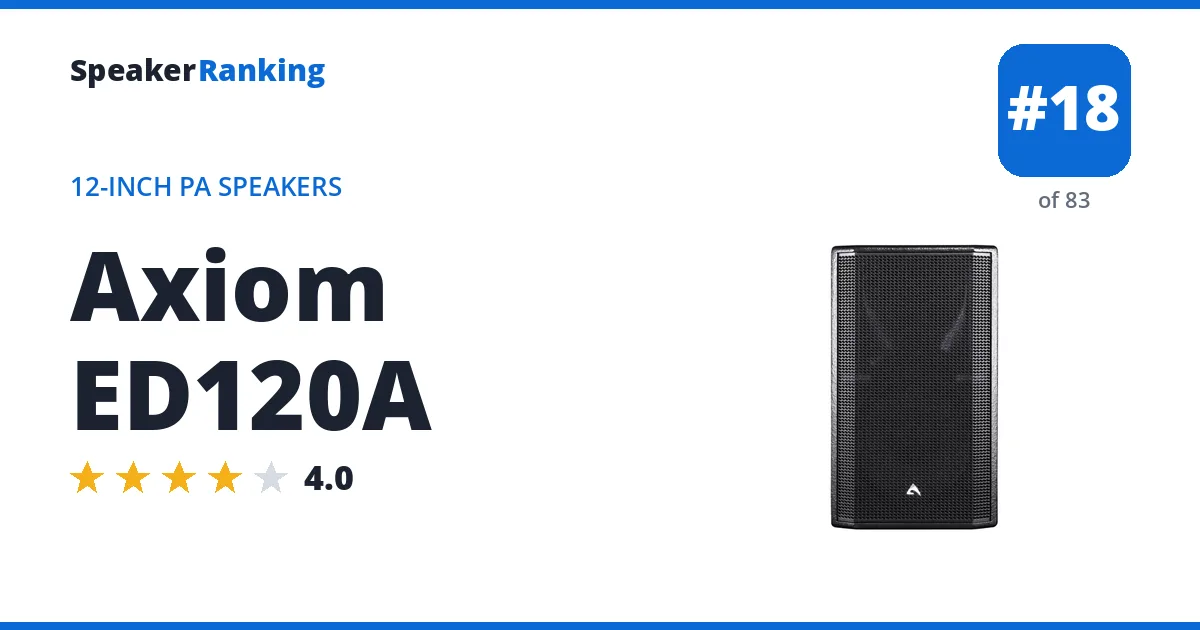
Same family: the Axiom ED60P (smaller model, rated 3.3/5), the Axiom ED80P (smaller model, rated 3.4/5) and the Axiom ED150A (larger model, rated 3.8/5).
Pros: High-quality vendor Spinorama data gives it a 5.73 ideal-subwoofer preference score and 52Hz bass extension, a solid tonal showing for a professional cabinet. CORE DSP, PRONET remote control and an asymmetric rotatable horn add useful installation flexibility. Measured bass extension of 60Hz (-3dB).
Cons: The 132dB claimed peak is competitive rather than class-leading, and the asymmetric 60°-to-100° pattern needs more deliberate aiming than a conventional symmetric horn. Availability and service coverage are less broad than the mainstream QSC, JBL, Yamaha and RCF choices.
Full Axiom ED120A review and specifications →
| Released | 2017 (9 years ago) |
|---|---|
| AES Input | No |
| Amplifier Power | 1,200W continuous (900W LF + 300W HF Class D, manufacturer specified) |
| Aux Input | No |
| Bass Extension (-3dB) | 60Hz (measured, vendor Spinorama data) |
| Bluetooth | No |
| Cabinet Material | 15mm reinforced phenolic birch plywood |
| Coaxial Input | No |
| Configuration | Active 2-way bass-reflex PA speaker |
| Coverage | 60°-100° asymmetric x 60° |
| DSP | Yes, CORE processing with PRONET control |
| Dimensions | 24”H x 14.2”W x 12.2”D (610 x 360 x 310 mm) |
| Drivers | 12” woofer, 1.4” compression driver |
| Frequency Response | 65Hz - 17kHz (-6dB, manufacturer specified) |
| Guitar Input | No |
| HDMI Input | No |
| Inputs | XLR input and link; EtherCON control network |
| Maximum SPL | 132dB peak (manufacturer specified) |
| Microphone Input | No |
| Network Control | PRONET control over EtherCON/CANBUS |
| Optical Input | No |
| Passive | No |
| RCA Input | No |
| Rigging | M10 and M6 fly points; pole-mount socket |
| Spinorama Preference Score | 3.30 |
| Spinorama Preference Score with Perfect Sub | 5.73 |
| TRS Input | No |
| USB Input | No |
| Weight | 41.9 lbs (19 kg) |
| XLR Input | Yes |
- Links
- Reviews, Comparisons and Sound Samples
- Head-to-Head Comparisons
 #19 FBT Mitus 112A: $1,500 Discontinued eBay
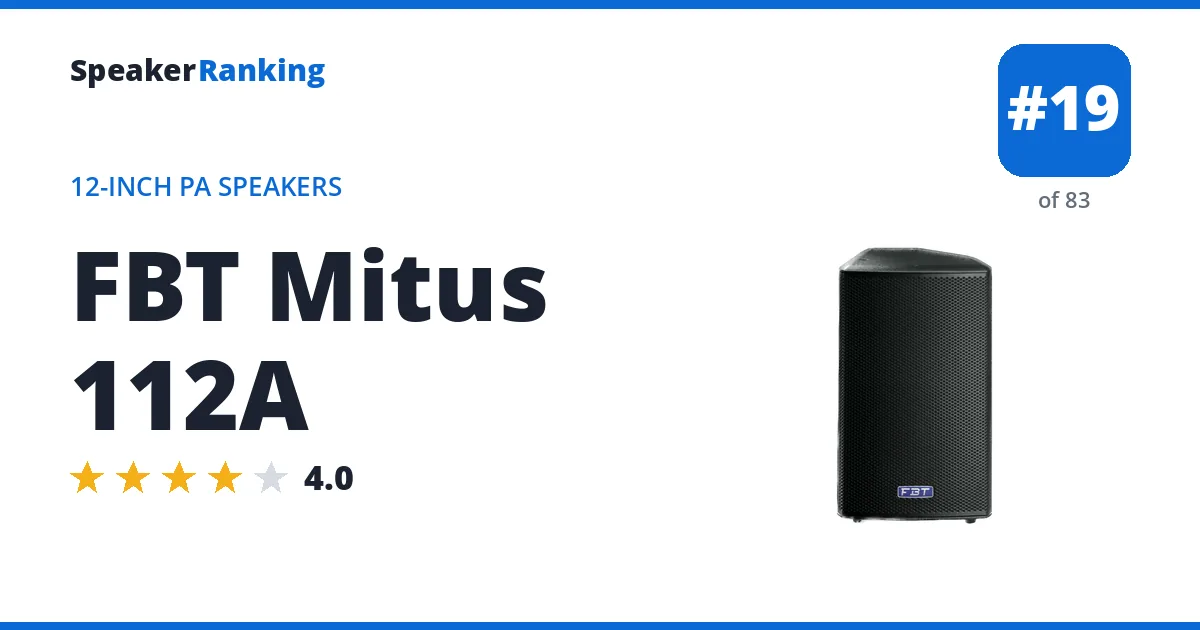
Pros: The medium-quality vendor data produces a 5.78 ideal-subwoofer preference score. A B&C neodymium woofer, rotatable 80° x 50° horn, plywood cabinet and 133dB claimed peak output form a capable professional package. Measured bass extension of 103Hz (-3dB).
Cons: Measured bass extension is about 79Hz despite the much deeper manufacturer response claim, so a subwoofer is advisable for full-range music. Controls are limited to presets and filters rather than the app-based mixing and remote DSP found on newer competitors. Discontinued.
Full FBT Mitus 112A review and specifications →
| AES Input | No |
|---|---|
| Amplifier Power | 900W RMS (600W LF + 300W HF); 1,800W peak (1,200W LF + 600W HF) |
| Aux Input | No |
| Bass Extension (-3dB) | 103Hz (measured, vendor Spinorama data) |
| Bluetooth | No |
| Cabinet Material | 15mm Baltic birch plywood |
| Coaxial Input | No |
| Configuration | Active 2-way bass-reflex PA speaker |
| Coverage | 80° x 50°, rotatable |
| Crossover Frequency | 1.5kHz (manufacturer specified) |
| DSP | Yes, 8 EQ presets and high-pass filter |
| Dimensions | 25.8”H x 15”W x 15”D (655 x 380 x 380 mm) |
| Drivers | 12” B&C neodymium woofer, 1” compression driver |
| Frequency Response | 50Hz - 20kHz (-6dB, manufacturer specified) |
| Guitar Input | No |
| HDMI Input | No |
| Inputs | XLR input and link |
| Maximum SPL | 133dB peak (manufacturer specified) |
| Microphone Input | No |
| Optical Input | No |
| Passive | No |
| RCA Input | No |
| Rigging | Twelve M10 fly points; 35mm pole socket |
| Spinorama Preference Score | 2.58 |
| Spinorama Preference Score with Perfect Sub | 5.78 |
| TRS Input | No |
| USB Input | No |
| Weight | 46.3 lbs (21 kg) |
| XLR Input | Yes |
- Links
- Reviews, Comparisons and Sound Samples
- Head-to-Head Comparisons
 #20 RCF NX 912-A: $1,449.00 Amazon $1,449.00 B&H Photo Video $1,449.00 Guitar Center $1,449.00 eBay
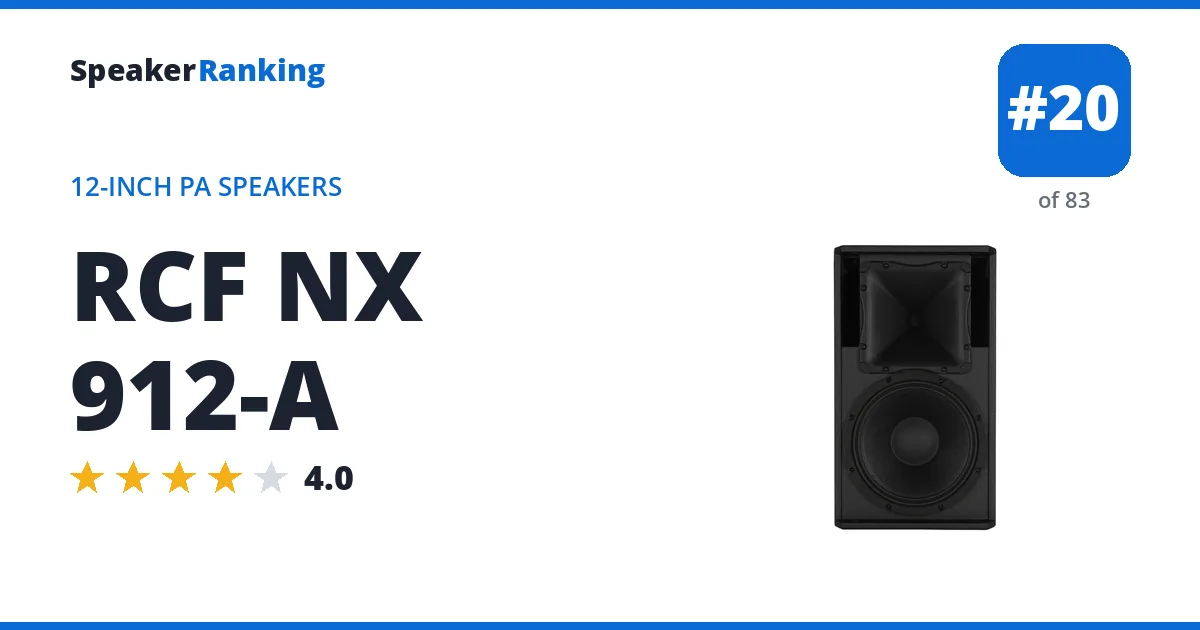
Same family: the RCF NX 910-A (smaller model, rated 3.5/5), the RCF NX 932-A (larger model, ranked higher, rated 4.2/5), the RCF NX 915-A (larger model, rated 3.6/5) and the RCF NX 945-A (larger model, rated 4.1/5).
Pros: The plywood enclosure, 2100W amplification, FiRPHASE/Bass Motion Control and flexible rigging make it a sturdier systems alternative to the RCF ART 912-A. Medium-quality data indicates extension to roughly 58Hz with broad 100° x 60° coverage. Measured bass extension of 58Hz (-3dB).
Cons: The truncated vendor measurement does not yield a preference score, preventing a confident tonal comparison with the scored leaders. Its 130dB peak claim matches the cheaper RCF ART 912-A rather than exceeding it.
Full RCF NX 912-A review and specifications →
| Released | Jul 2021 (5 years ago) |
|---|---|
| AES Input | No |
| Amplifier Power | 2100W peak (1400W LF + 700W HF) |
| Aux Input | No |
| Bass Extension (-3dB) | 58Hz (measured, vendor Spinorama data) |
| Bluetooth | No |
| Cabinet Material | Polyurea-coated plywood |
| Coaxial Input | No |
| Configuration | Active 2-way bass-reflex PA speaker |
| Coverage | 100° x 60° |
| Crossover Frequency | 1600Hz |
| DSP | Yes, FiRPHASE and Bass Motion Control |
| Dimensions | 24.4”H x 14.2”W x 15.9”D (620 x 361.4 x 404.5 mm) |
| Drivers | 12” woofer, 1.75” compression driver |
| Frequency Response | 50Hz - 20kHz (manufacturer specified) |
| Guitar Input | No |
| HDMI Input | No |
| Inputs | XLR/TRS combo input and XLR output |
| Maximum SPL | 130dB peak (manufacturer specified) |
| Microphone Input | No |
| Optical Input | No |
| Passive | No |
| RCA Input | No |
| Rigging | 6 x M10 inserts |
| TRS Input | Yes |
| USB Input | No |
| Weight | 45.9 lbs (20.8 kg) |
| XLR Input | Yes |
- Links
- Reviews, Comparisons and Sound Samples
- Head-to-Head Comparisons
 #21 Alcons Audio VR12 Passive eBay
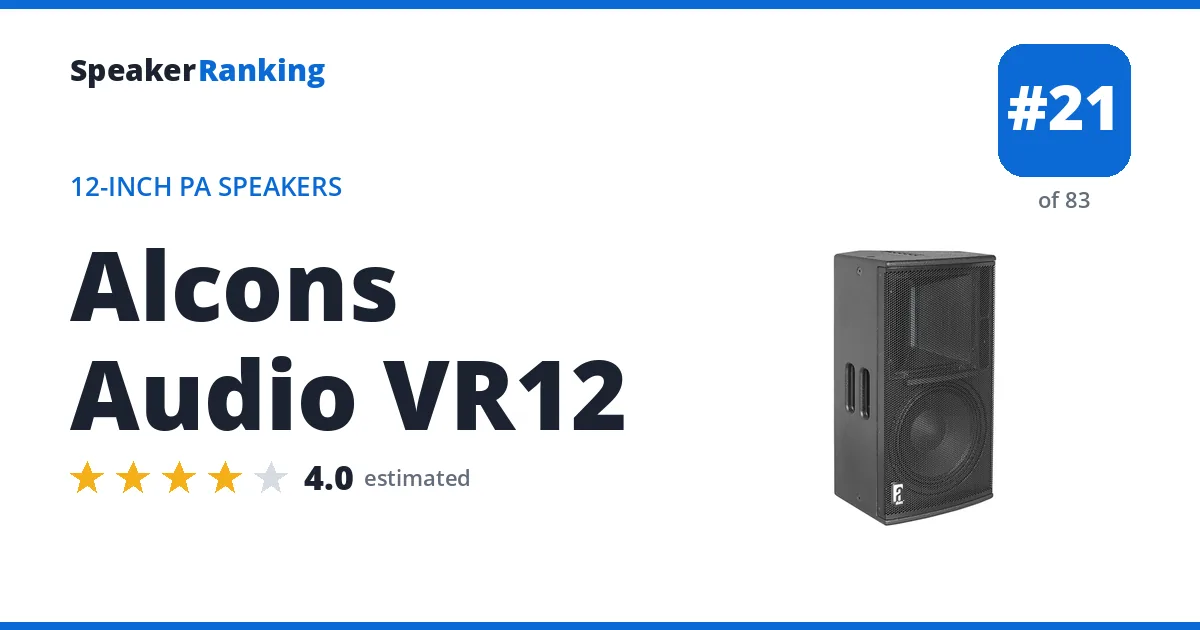
Same family: the Alcons Audio VR5 V1 (smaller model, rated 4/5) and the Alcons Audio VR8 (smaller model, estimated 3.9/5).
Pros: A passive pro-ribbon point source from Alcons’ VR series, a larger sibling of the measured Alcons Audio VR5 V1: a 12” woofer under the larger 6” RBN601 pro-ribbon with Real-90 horizontal dispersion, rated 60Hz to 20kHz (±3dB) and 134dB peak. The ribbon’s low distortion and controlled horizontal pattern are what lift the measured VR5 near the top of the compact class.
Cons: No independent measurements yet, so it can’t be compared with ranked PA speakers. It needs an Alcons Sentinel amplifier and controller preset for its rated response, and Alcons sells only through dealers, so there is no retail price.
Full Alcons Audio VR12 review and specifications →
| Amplifier Power | Passive speaker; requires external amplification |
|---|---|
| Bass Extension (-3dB) | 60Hz (manufacturer specified) |
| Bluetooth | No |
| Configuration | Passive 2-way pro-ribbon PA speaker |
| DSP | No (passive) |
| Drivers | 12” woofer, RBN601 6” pro-ribbon driver |
| Frequency Response | 60Hz - 20kHz (±3dB, manufacturer specified) |
| Maximum SPL | 134dB peak (manufacturer specified) |
| Passive | Yes |
| Rigging | 6-position fly track; stand mount adapter |
| Weight | 39.7 lbs (18 kg) |
| XLR Input | No |
- Links
- Reviews, Comparisons and Sound Samples
- No independent measurement review is linked for this model; it is ranked from hands-on listening and comparison against similarly priced speakers.
 #22 Yamaha DZR12: $1,409.99 Amazon $1,409.99 B&H Photo Video $1,198.49 Guitar Center $1,198.49 eBay
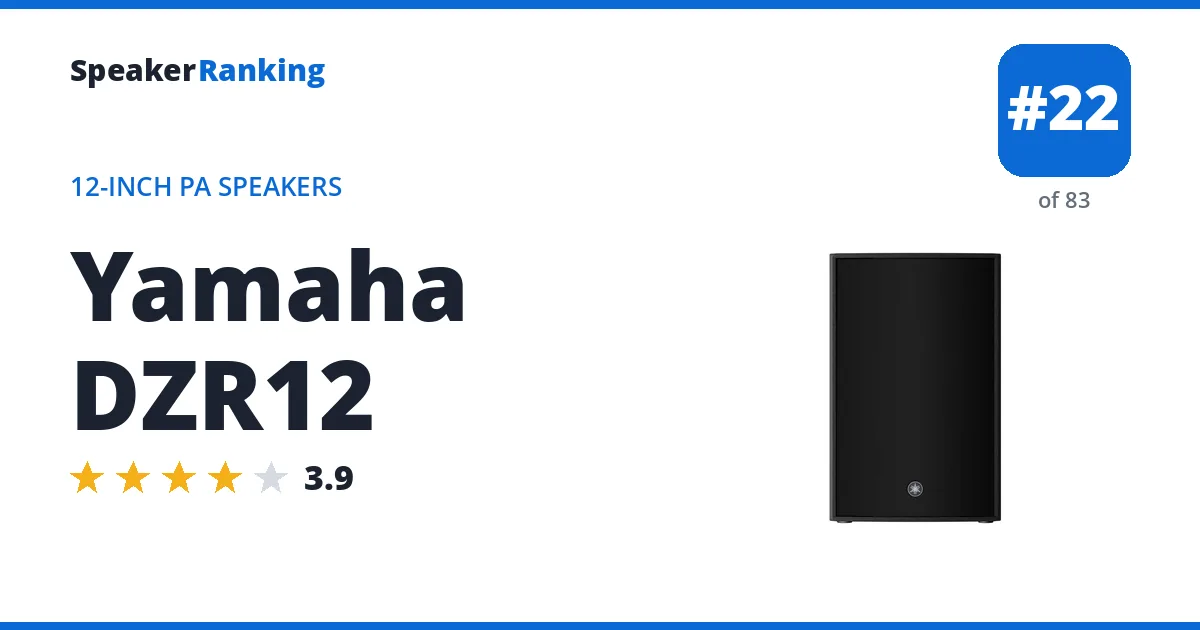
Same family: the Yamaha DZR10 (smaller powered model, rated 3.4/5), the Yamaha DZR15 (larger powered model, rated 4/5), the Yamaha DZR315 (larger powered model, rated 3.8/5), the Yamaha CZR10 (smallest passive model, estimated 3.2/5), the Yamaha CZR12 (passive model, ranked lower, estimated 3.6/5) and the Yamaha CZR15 (largest passive model, estimated 3.7/5).
Pros: Premium cabinet construction, 139dB claimed output and deep onboard 96kHz DSP suit demanding live work. The local vendor data shows useful 48Hz measured extension, the deepest result among the scored Yamaha models here. Measured bass extension of 48Hz (-3dB).
Cons: Its medium-quality vendor measurement produces only a 4.91 ideal-subwoofer preference score, so the price buys output, processing and build more than neutral tonality. It is heavy at roughly 21kg and has no Bluetooth audio.
Full Yamaha DZR12 review and specifications →
| Released | Jan 2019 (7 years ago) |
|---|---|
| AES Input | No |
| Amplifier Power | 2000W dynamic / 1100W burst / 950W continuous |
| Aux Input | No |
| Bass Extension (-3dB) | 48Hz (measured, vendor Spinorama data) |
| Bluetooth | No |
| Cabinet Material | Plywood with polyurea coating |
| Coaxial Input | No |
| Configuration | Active 2-way bass-reflex PA speaker |
| Coverage | 90° x 60° |
| Crossover Frequency | 1800Hz (FIR-X) |
| DSP | Yes |
| Dimensions | 25.4”H x 16.1”W x 15.5”D (646 x 410 x 394 mm) |
| Drivers | 12” woofer, 2” compression driver |
| Frequency Response | 39Hz - 20kHz (manufacturer specified) |
| Guitar Input | No |
| HDMI Input | No |
| Inputs | 2 x XLR/TRS combo |
| Maximum SPL | 139dB peak (manufacturer specified) |
| Microphone Input | No |
| Optical Input | No |
| Passive | No |
| RCA Input | No |
| Rigging | M10 points; dual 35mm pole mounts |
| Spinorama Preference Score | 2.64 |
| Spinorama Preference Score with Perfect Sub | 4.91 |
| TRS Input | Yes |
| USB Input | No |
| Weight | 47.2 lbs (21.4 kg) |
| XLR Input | Yes |
- Links
- Reviews, Comparisons and Sound Samples
- Head-to-Head Comparisons
 #23 Seeburg X6: $1,975 Passive Thomann $1,975 eBay
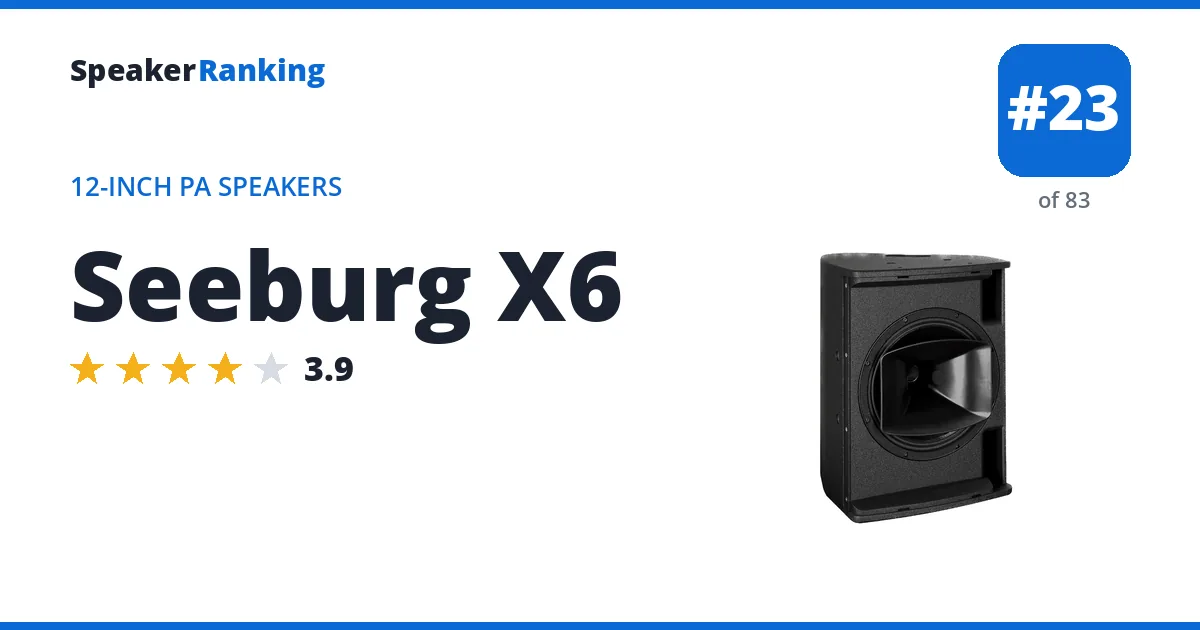
Same family: the Seeburg X1 (smaller model, rated 3.4/5), the Seeburg X2 (smaller model, rated 3.6/5), the Seeburg X4 (smaller model, rated 3.9/5) and the Seeburg X8 (larger model, rated 3.5/5).
Pros: Manufacturer measurements give preference scores of 3.07 standalone and 6.04 with an ideal subwoofer, on par with the JBL PRX912. The coaxial 12-inch woofer and 1.4-inch compression driver give a 2.2dB reference band and consistent sound across the 80° x 60° pattern. With 99dB sensitivity and a 131dB peak rating from an 18.5kg cabinet, it suits bands and venues that need output without bulk. Measured bass extension of 80Hz (-3dB).
Cons: Bass reaches 80Hz at -3dB and about 66Hz at -10dB, so a subwoofer is still needed for full-range music. It is passive, so you need an amplifier and a processor with Seeburg presets, or the self-powered X6 dp version. A 4.34 directivity-index deviation means off-axis balance shifts more than the flattest designs here.
Full Seeburg X6 review and specifications →
| AES Input | No |
|---|---|
| Amplifier Power | Passive speaker; requires external amplification (self-powered X6 dp version available) |
| Aux Input | No |
| Bass Extension (-10dB) | about 66.3Hz (measured, vendor Spinorama data) |
| Bass Extension (-3dB) | 80Hz (measured, vendor Spinorama data) |
| Bluetooth | No |
| Coaxial Input | No |
| Configuration | Passive 2-way coaxial PA speaker |
| Coverage | 80° x 60° (rotatable) |
| DSP | No (passive) |
| Dimensions | 19.7”H x 14.2”W x 13”D (500 x 360 x 330 mm) |
| Drivers | 12” neodymium woofer (3.5” voice coil), coaxial 1.4” neodymium compression driver (3” voice coil) |
| Frequency Response | 55Hz - 18kHz (-6dB, manufacturer specified) |
| Guitar Input | No |
| HDMI Input | No |
| Impedance | 8 ohms |
| Maximum SPL | 131dB peak (manufacturer specified) |
| Microphone Input | No |
| Optical Input | No |
| Passive | Yes |
| Power Handling | 500W AES / 1,500W peak |
| RCA Input | No |
| Rigging | 9x M10 points, 35mm pole mount |
| Sensitivity | 99dB (1W/1m) |
| Spinorama Preference Score | 3.07 |
| Spinorama Preference Score with Perfect Sub | 6.04 |
| TRS Input | No |
| USB Input | No |
| Weight | 40.8 lbs (18.5 kg) |
| XLR Input | No |
- Links
- Reviews, Comparisons and Sound Samples
- Head-to-Head Comparisons
 #24 dB Technologies Opera Reevo 212: $1,192.00 Full Compass $1,192.00 eBay
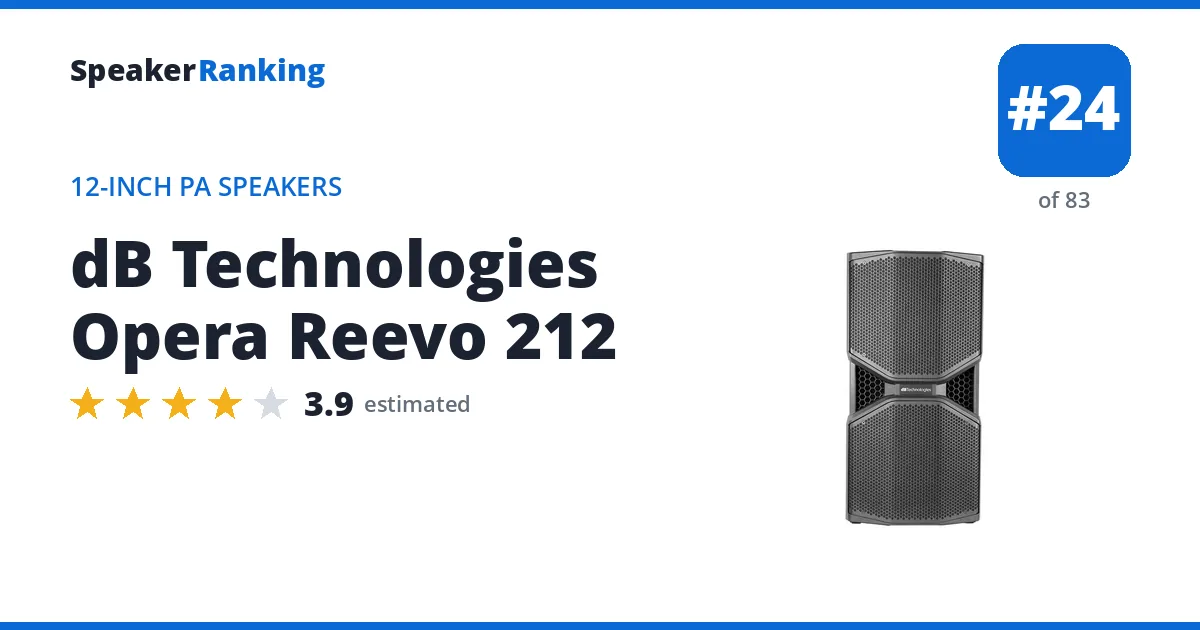
Same family: the dB Technologies Opera Reevo 210 (smaller model, rated 3.9/5).
Pros: The larger twin of the measured dB Technologies Opera Reevo 210, with two 12” neodymium woofers in the same quasi 3-way coaxial layout and the same 2,100W peak (1,050W RMS) Digipro G2 amplifier. dBTechnologies rates it at 133dB, half a decibel above the 210, with more low-end reach from the bigger woofers, at 20.4 kg.
Cons: No independent measurements yet, so it can’t be compared with ranked PA speakers. It is 3.2 kg heavier than the 210 for a small gain in rated output, so the 210 stays the better choice where weight matters.
Full dB Technologies Opera Reevo 212 review and specifications →
| Released | 2023 (3 years ago) |
|---|---|
| Amplifier Power | 2,100W peak (1,050W RMS) |
| Bluetooth | No |
| Configuration | Active quasi 3-way coaxial PA speaker |
| DSP | Yes |
| Drivers | 2x 12” neodymium woofers, coaxial compression driver |
| Maximum SPL | 133dB (manufacturer specified) |
| Passive | No |
| Rigging | 2 x M10 on top, 1 x M10 on back; 36mm pole mount |
| Weight | 45 lbs (20.4 kg) |
| XLR Input | Yes |
- Links
- Reviews, Comparisons and Sound Samples
- No independent measurement review is linked for this model; it is ranked from hands-on listening and comparison against similarly priced speakers.
- Head-to-Head Comparisons
 #25 Meyer Sound Ultra X80 eBay
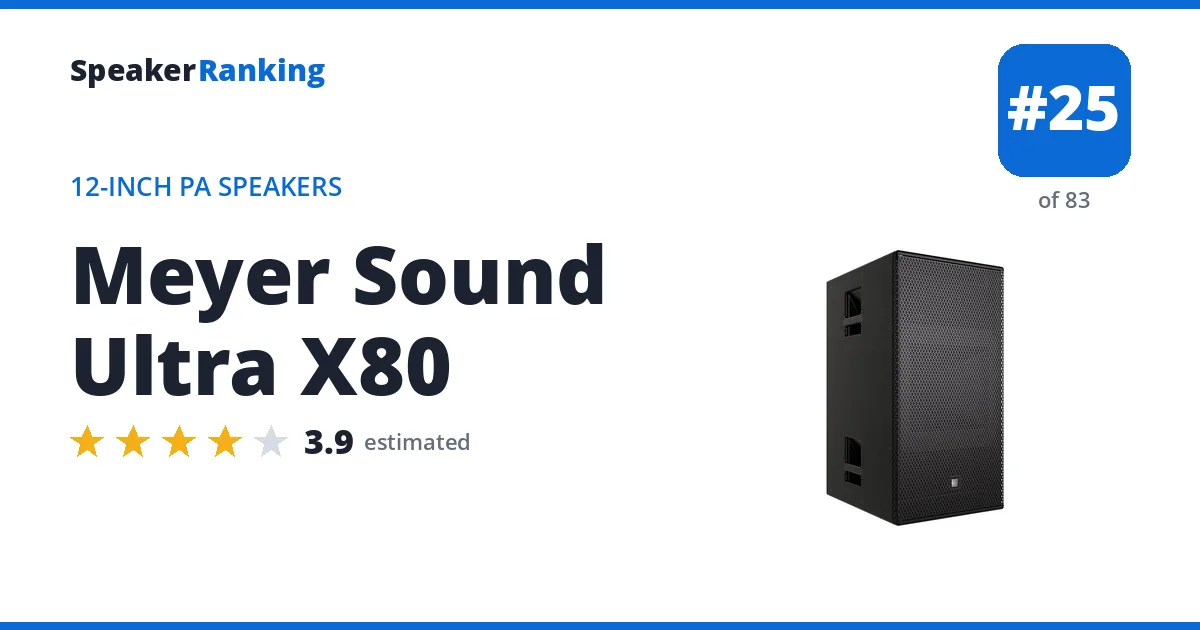
Same family: the Meyer Sound Ultra X20 (smaller model, rated 3.6/5), the Meyer Sound Ultra X22 (smaller model, rated 3.9/5), the Meyer Sound Ultra X23 (smaller model, rated 3.3/5) and the Meyer Sound Ultra X40 (smaller model, rated 3.8/5).
Pros: The largest of Meyer’s ULTRA point sources, built on the same platform as the measured Meyer Sound Ultra X40, with two 12” neodymium woofers and a 4” compression driver on a rotatable 95° x 40° waveguide. Meyer rates it at 140dB linear peak, its most powerful point source, aimed at replacing a small line array.
Cons: No independent measurements yet, so it can’t be compared with ranked PA speakers. At 62.6 kg it needs rigging or a lift rather than a pole mount, and Meyer sells only through dealers, so there is no retail price.
Full Meyer Sound Ultra X80 review and specifications →
| Released | 2025 (1 year ago) |
|---|---|
| Bluetooth | No |
| Configuration | Self-powered 2-way PA speaker |
| Coverage | 95° x 40°, rotatable |
| DSP | Yes |
| Drivers | 2x 12” neodymium woofers, 4” compression driver |
| Maximum SPL | 140dB linear peak (manufacturer specified) |
| Passive | No |
| Rigging | 12 x M8 inserts (6 top, 6 bottom) |
| Weight | 138 lbs (62.6 kg) |
| XLR Input | Yes |
- Links
- Reviews, Comparisons and Sound Samples
- No independent measurement review is linked for this model; it is ranked from hands-on listening and comparison against similarly priced speakers.
 #26 HK Audio LINEAR 7 112 FA: $1,899.00 Amazon $1,899.00 B&H Photo Video $1,899.00 eBay
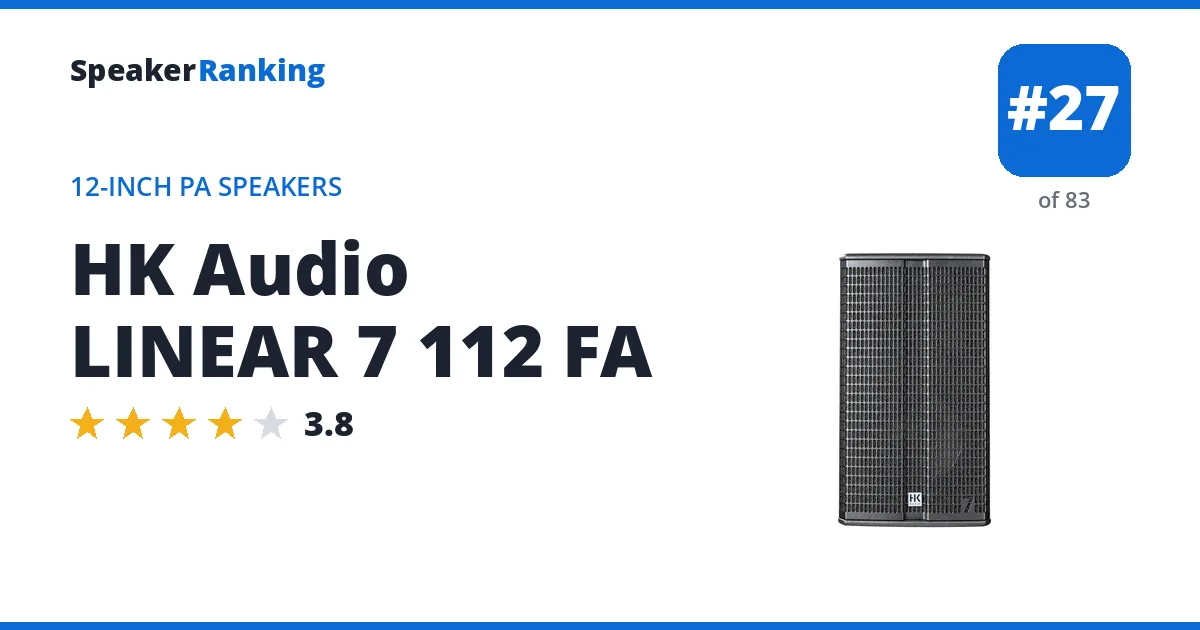
Same family: the HK Audio LINEAR 7 110 XA (smaller model, rated 4.2/5), the HK Audio LINEAR 7 112 XA (larger model, ranked higher, rated 4/5) and the HK Audio LINEAR 7 115 FA (larger model, rated 4.1/5).
Pros: High-quality manufacturer data yields a respectable 6.45 ideal-subwoofer preference score, and the networkable DSP is useful in larger systems. The 112 FA is designed as a full-range cabinet rather than the more monitor-focused XA variant. Measured bass extension of 63Hz (-3dB).
Cons: Measured bass extension is 63Hz and the value proposition depends on needing its system networking and professional rigging features. US availability is less consistent than QSC, JBL, Yamaha or RCF.
Full HK Audio LINEAR 7 112 FA review and specifications →
| Released | Apr 2019 (7 years ago) |
|---|---|
| AES Input | No |
| Amplifier Power | 2,000W peak (Class D bi-amped, manufacturer specified) |
| Aux Input | No |
| Bass Extension (-3dB) | 63Hz (measured, vendor Spinorama data) |
| Bluetooth | No |
| Cabinet Material | Hybrid birch multiplex/MDF |
| Coaxial Input | No |
| Configuration | Active 2-way bass-reflex PA speaker |
| Coverage | 70° x 50° |
| Crossover Frequency | 1.8kHz FIR (manufacturer specified) |
| DSP | Yes, network controllable |
| Dimensions | 26.4”H x 14.6”W x 11.8”D (670 x 370 x 300 mm) |
| Drivers | 12” woofer, compression driver |
| Frequency Response | 64Hz - 19kHz (±3dB, manufacturer specified); 55Hz - 20kHz (-10dB) |
| Guitar Input | No |
| HDMI Input | No |
| Inputs | XLR/jack combo input, XLR thru and XLR DSP output |
| Maximum SPL | 131dB peak / 128dB continuous |
| Microphone Input | No |
| Network Control | EtherCON input/thru; DSP CONTROL software |
| Optical Input | No |
| Passive | No |
| RCA Input | No |
| Rigging | Three M8 points; DuoTilt 3°/7° pole mount |
| Spinorama Preference Score | 3.70 |
| Spinorama Preference Score with Perfect Sub | 6.45 |
| TRS Input | Yes |
| USB Input | No |
| Weight | 50.7 lbs (23 kg) |
| XLR Input | Yes |
- Links
- Reviews, Comparisons and Sound Samples
- Head-to-Head Comparisons
- HK Audio LINEAR 7 112 FA vs RCF ART 732-A MK5
- HK Audio LINEAR 7 112 FA vs LD Systems DDQ12
- HK Audio LINEAR 7 112 FA vs Seeburg X6
- HK Audio LINEAR 7 112 FA vs Yamaha DZR12
- HK Audio LINEAR 7 112 FA vs d&b audiotechnik 12S
- HK Audio LINEAR 7 112 FA vs FBT Mitus 112A
- HK Audio LINEAR 7 112 FA vs Vue Audiotechnik A-12
- HK Audio LINEAR 7 112 FA vs QSC K12.2
 #27 RCF ART 732-A MK5: $899.00 Amazon $899.00 B&H Photo Video $899.00 Guitar Center $899.00 eBay
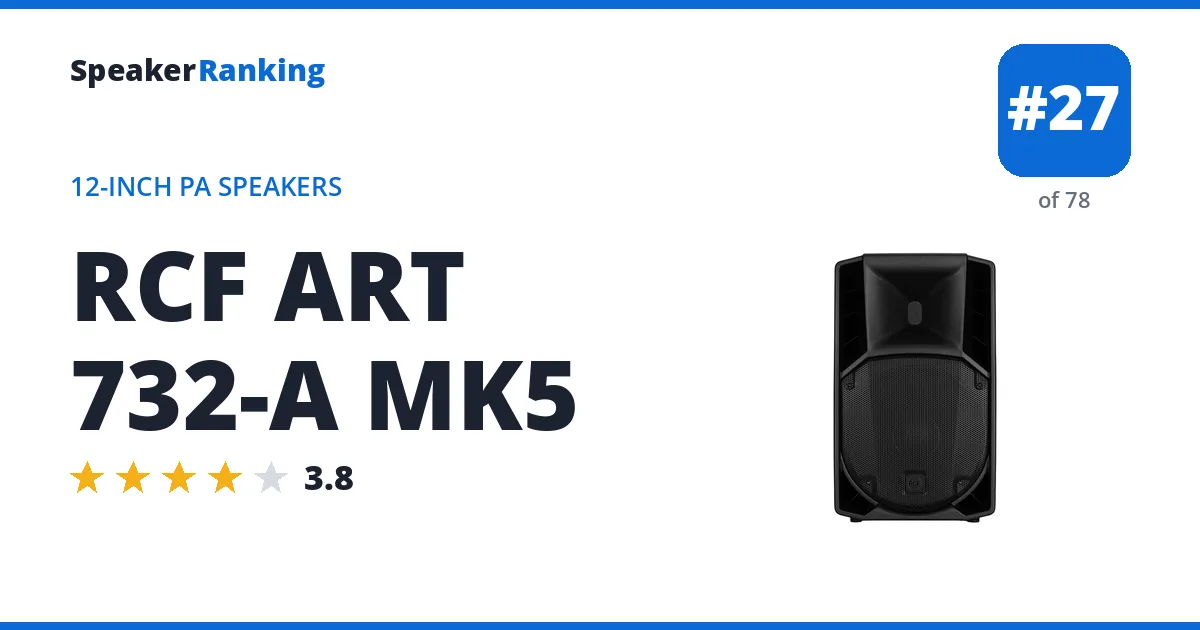
Older model: the RCF ART 732-A MK4 (ranked lower, rated 3.2/5). See every RCF ART 7 generation.
Same family: the RCF ART 708-A MK5 (smaller model, rated 3.4/5), the RCF ART 710-A MK5 (smaller model, rated 3.6/5), the RCF ART 712-A MK5 (smaller model, ranked lower, rated 3.6/5), the RCF ART 715-A MK5 (larger model, rated 3.6/5), the RCF ART 735-A MK5 (larger model, estimated 3.4/5) and the RCF ART 745-A MK5 (larger model, rated 3.5/5).
Pros: Its large 3-inch high-frequency voice coil is a meaningful advantage for vocal headroom and a lower crossover region, while 131dB claimed output and 90° x 60° coverage fit common portable-main work. It offers much of RCF’s high-frequency hardware at a lower price than the RCF ART 932-A. Measured bass extension of 53.0Hz (-3dB).
Cons: The local low-quality vendor data does not provide a computed preference score, so its tonal ranking is provisional. Controls are basic, with no app, display or Bluetooth audio.
Full RCF ART 732-A MK5 review and specifications →
| Released | Jan 2024 (2 years ago) |
|---|---|
| AES Input | No |
| Amplifier Power | 1400W peak (1000W LF + 400W HF) |
| Aux Input | No |
| Bass Extension (-3dB) | 53.0Hz (measured, vendor Spinorama data) |
| Bluetooth | No |
| Cabinet Material | PP composite |
| Coaxial Input | No |
| Configuration | Active 2-way bass-reflex PA speaker |
| Coverage | 90° x 60° |
| Crossover Frequency | 700Hz |
| DSP | Yes |
| Dimensions | 25.1”H x 15.2”W x 14.3”D (637 x 387 x 363 mm) |
| Drivers | 12” woofer, 1.4” compression driver with 3” voice coil |
| Frequency Response | 50Hz - 20kHz (manufacturer specified) |
| Guitar Input | No |
| HDMI Input | No |
| Inputs | XLR/TRS combo |
| Maximum SPL | 131dB peak (manufacturer specified) |
| Microphone Input | No |
| Optical Input | No |
| Passive | No |
| RCA Input | No |
| Rigging | 2 x M10 inserts; 35mm pole mount |
| TRS Input | Yes |
| USB Input | No |
| Weight | 39.2 lbs (17.8 kg) |
| XLR Input | Yes |
- Links
- Reviews, Comparisons and Sound Samples
- Head-to-Head Comparisons
- RCF ART 732-A MK5 vs HK Audio LINEAR 7 112 FA
- RCF ART 732-A MK5 vs LD Systems DDQ12
- RCF ART 732-A MK5 vs Vue Audiotechnik h-12
- RCF ART 732-A MK5 vs Coda Audio G712
- RCF ART 732-A MK5 vs Yamaha DZR12
- RCF ART 732-A MK5 vs d&b audiotechnik 12S
- RCF ART 732-A MK5 vs Yamaha CXR12mkIII
- RCF ART 732-A MK5 vs RCF NX 912-A
- See all 25 comparisons
 #28 LD Systems DDQ12: $1,170 Discontinued eBay
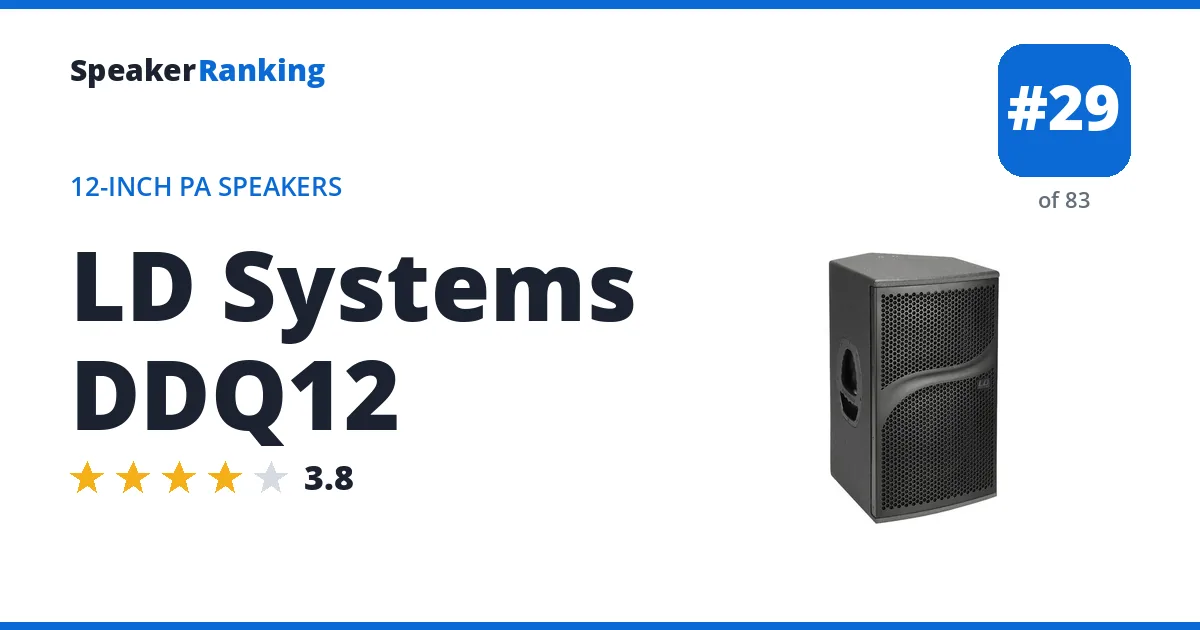
Pros: Medium-quality vendor data returns a strong 6.32 ideal-subwoofer preference score and 63Hz bass extension. The lightweight 17kg plywood enclosure and controlled 80° x 50° horn make it easy to deploy as a compact professional top. Measured bass extension of 67Hz (-3dB).
Cons: The discontinued DDQ platform is harder to buy and support than current LD, RCF, JBL or Yamaha ranges. Its controls and connectivity are basic by modern standards, with no app, networking or onboard mixer.
Full LD Systems DDQ12 review and specifications →
| AES Input | No |
|---|---|
| Amplifier Power | 800W RMS (manufacturer specified) |
| Aux Input | No |
| Bass Extension (-3dB) | 67Hz (measured, vendor Spinorama data) |
| Bluetooth | No |
| Cabinet Material | 15mm birch plywood with Polyurea finish |
| Coaxial Input | No |
| Configuration | Active 2-way bass-reflex PA speaker |
| Coverage | 80° x 50° |
| Crossover Frequency | 1.5kHz (manufacturer specified) |
| DSP | Yes, system processing and protection |
| Dimensions | 23.6”H x 14.2”W x 14.9”D (600 x 360 x 378 mm) |
| Drivers | 12” neodymium woofer, compression driver |
| Frequency Response | 54Hz - 20kHz (manufacturer specified) |
| Guitar Input | No |
| HDMI Input | No |
| Inputs | XLR input |
| Maximum SPL | 132dB peak (manufacturer specified) |
| Microphone Input | No |
| Optical Input | No |
| Outputs | XLR link output, XLR sub output |
| Passive | No |
| RCA Input | No |
| Rigging | Adjustable stand support |
| Spinorama Preference Score | 3.57 |
| Spinorama Preference Score with Perfect Sub | 6.32 |
| Subwoofer Output | Yes |
| TRS Input | No |
| USB Input | No |
| Weight | 37.5 lbs (17 kg) |
| XLR Input | Yes |
- Links
- Reviews, Comparisons and Sound Samples
- Head-to-Head Comparisons
 #29 Vue Audiotechnik h-12: $6,000 eBay
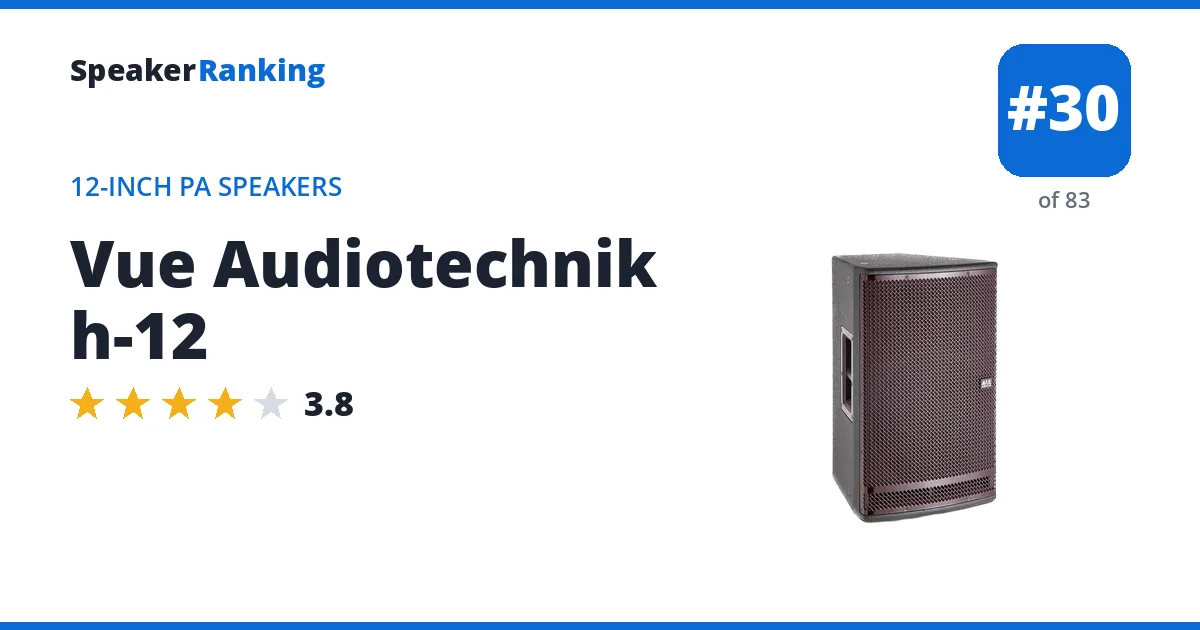
Same family: the Vue Audiotechnik H-5 (smaller model, rated 3.6/5), the Vue Audiotechnik H-8 (smaller model, rated 3.6/5) and the Vue Audiotechnik H-15 (larger model, rated 4.3/5).
Pros: The beryllium-diaphragm compression driver, Dante/AES connectivity and 96kHz networked DSP are genuinely premium features. Low-quality vendor data still produces a respectable 5.90 ideal-subwoofer preference score and about 63Hz bass extension. Measured bass extension of 87.5Hz (-3dB).
Cons: The 35.2kg cabinet is exceptionally heavy and its premium price is difficult to justify for portable use. The published 125dB measured peak is modest beside mainstream competitors, and the measurement directivity differs from current h-12W/h-12N literature.
Full Vue Audiotechnik h-12 review and specifications →
| Released | 2012 (14 years ago) |
|---|---|
| AES Input | Yes |
| Amplifier Power | 1,105W long-term (830W LF + 275W HF); 2,400W burst (2,000W LF + 400W HF) |
| Aux Input | No |
| Bass Extension (-3dB) | 87.5Hz (measured, vendor Spinorama data) |
| Bluetooth | No |
| Cabinet Material | Multi-ply birch hardwood |
| Coaxial Input | No |
| Configuration | Networked active 2-way bass-reflex PA speaker |
| Coverage | 120° x 50° in local measurement metadata |
| DSP | Yes, 96kHz networked processing and monitoring |
| Dimensions | 24”H x 14.5”W x 15.2”D (610 x 368 x 387 mm) |
| Drivers | 12” woofer, 4” beryllium-diaphragm compression driver |
| Frequency Response | 55Hz - 21kHz (±1.5dB, manufacturer specified) |
| Guitar Input | No |
| HDMI Input | No |
| Inputs | Analog XLR, AES/EBU and Dante network audio |
| Maximum SPL | 125dB measured peak; 134dB calculated peak |
| Microphone Input | No |
| Network Control | Ethernet/IP remote monitoring and control |
| Optical Input | No |
| Passive | No |
| RCA Input | No |
| Rigging | Built-in pole mount and M10 inserts for optional yoke and rigging hardware |
| Spinorama Preference Score | 3.15 |
| Spinorama Preference Score with Perfect Sub | 5.90 |
| TRS Input | No |
| USB Input | No |
| Weight | 77.6 lbs (35.2 kg) |
| XLR Input | Yes |
- Links
- Reviews, Comparisons and Sound Samples
- Head-to-Head Comparisons
 #30 Coda Audio G712 Passive eBay
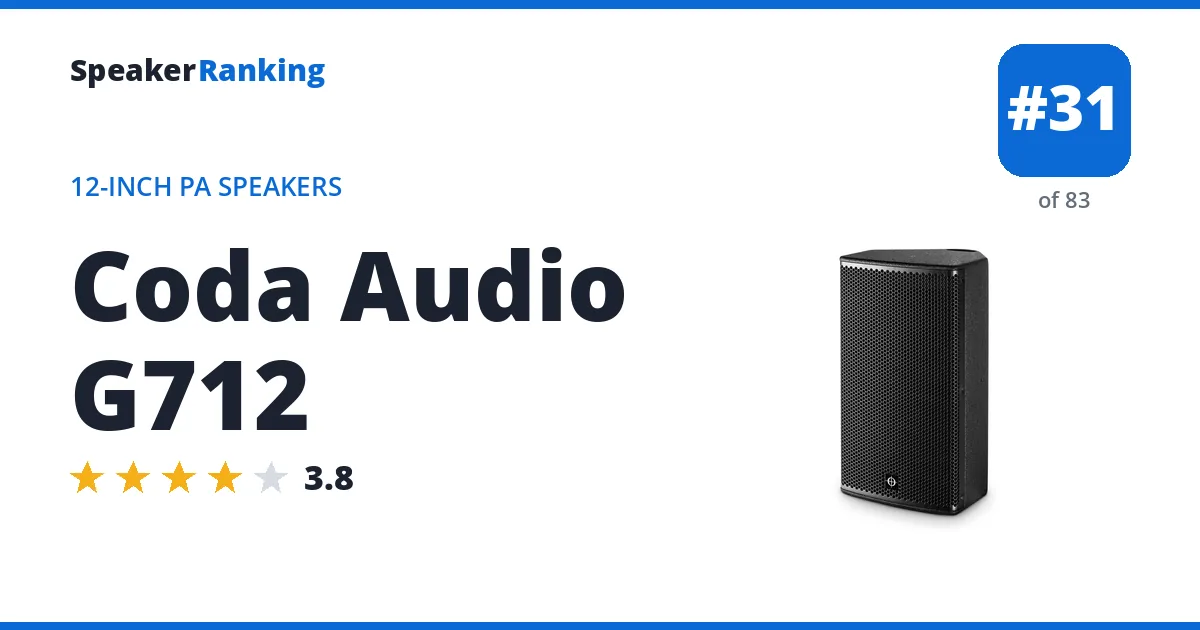
Same family: the Coda Audio G308 (smaller model, estimated 3.5/5), the Coda Audio G512 (smaller model, ranked lower, rated 3.6/5), the Coda Audio G515 (smaller model, rated 3.7/5) and the Coda Audio G715 (larger model, rated 3.8/5).
Pros: High-quality manufacturer measurements give preference scores of 3.14 standalone and 6.01 with an ideal subwoofer. It is a 3-way design with a coaxial 1.4-inch mid/high driver above a low-distortion 12-inch woofer, rated at 98dB sensitivity and a very high 143dB peak. A rotatable 90° x 60° waveguide and passive or bi-amp operation suit both portable and installed systems. Measured bass extension of 85Hz (-3dB).
Cons: Bass measures 85Hz at -3dB and about 52Hz at -10dB, so a subwoofer is needed for full-range music. A 3.4dB reference band and 4.40 directivity-index deviation mean tonal balance varies more than in the smoothest 12-inch cabinets here. It is passive, weighs 21.5kg and is sold through pro dealers with no published price.
Full Coda Audio G712 review and specifications →
| AES Input | No |
|---|---|
| Amplifier Power | Passive speaker; requires external amplification |
| Aux Input | No |
| Bass Extension (-10dB) | about 52.5Hz (measured, vendor Spinorama data) |
| Bass Extension (-3dB) | 85Hz (measured, vendor Spinorama data) |
| Bluetooth | No |
| Coaxial Input | No |
| Configuration | Passive 3-way PA speaker (passive or bi-amp) |
| Coverage | 90° x 60° (rotatable) |
| DSP | No (passive) |
| Dimensions | 24.8”H x 13.7”W x 12.6”D (630 x 348 x 320 mm) |
| Drivers | 12” neodymium woofer (4” voice coil), 1.4” neodymium coaxial mid/high driver |
| Frequency Response | 60Hz - 23kHz (-6dB, manufacturer specified) |
| Guitar Input | No |
| HDMI Input | No |
| Impedance | 8 ohms |
| Maximum SPL | 143dB peak (manufacturer specified) |
| Microphone Input | No |
| Optical Input | No |
| Passive | Yes |
| Power Handling | 1,000W AES / 4,000W peak |
| RCA Input | No |
| Rigging | M6 and M8 threaded points for U-bracket; GFA flying adapter |
| Sensitivity | 98dB |
| Spinorama Preference Score | 3.14 |
| Spinorama Preference Score with Perfect Sub | 6.01 |
| TRS Input | No |
| USB Input | No |
| Weight | 47.4 lbs (21.5 kg) |
| XLR Input | No |
- Links
- Reviews, Comparisons and Sound Samples
- Head-to-Head Comparisons
- Coda Audio G712 vs Vue Audiotechnik h-12
- Coda Audio G712 vs d&b audiotechnik 24S
- Coda Audio G712 vs d&b audiotechnik 12S
- Coda Audio G712 vs RCF ART 732-A MK5
- Coda Audio G712 vs Coda Audio G512
- Coda Audio G712 vs QSC K12.2
- Coda Audio G712 vs Coda Audio G515
- Coda Audio G712 vs Coda Audio G715
- See all 9 comparisons
 #31 d&b audiotechnik 24S Passive eBay
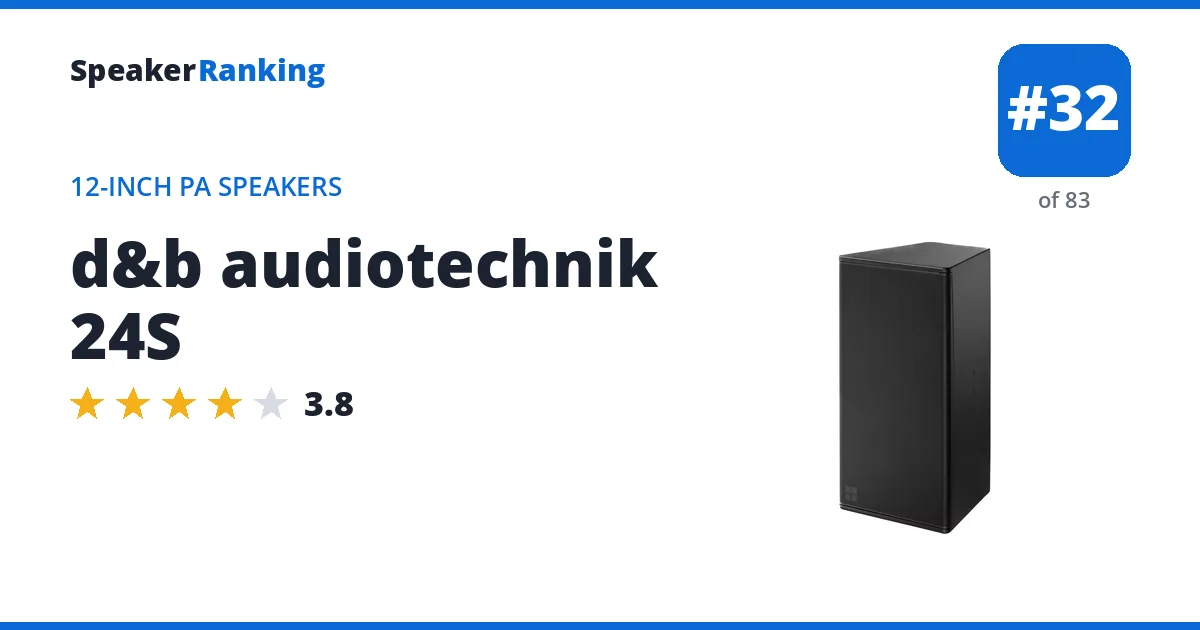
Same family: the d&b audiotechnik 4S (smaller model, estimated 3.2/5), the d&b audiotechnik 42S (smaller model, estimated 3.5/5), the d&b audiotechnik 44S (smaller model, rated 3.6/5), the d&b audiotechnik 5S (smaller model, estimated 3.3/5), the d&b audiotechnik 8S (smaller model, rated 3.1/5), the d&b audiotechnik 10S (smaller model, rated 3.7/5) and the d&b audiotechnik 12S (smaller model, ranked lower, rated 3.8/5).
Pros: Manufacturer measurements give preference scores of 3.11 standalone and 5.81 with an ideal subwoofer, and two 12-inch woofers reach 69Hz at -3dB and about 53Hz at -10dB. A 1.4-inch compression driver on a rotatable 75° x 45° horn and a 138dB peak rating give long throw for larger rooms. It can run full range on its own or pair with d&b xS subwoofers. Measured bass extension of 69Hz (-3dB).
Cons: The 3.4dB reference band means tonal balance is less even than the best 12-inch speakers here. It is a large 33kg passive cabinet meant for permanent installs, needing d&b amplifiers and presets. It is sold only through d&b dealers with no published price.
Full d&b audiotechnik 24S review and specifications →
| Released | 2016 (10 years ago) |
|---|---|
| AES Input | No |
| Amplifier Power | Passive speaker; requires external amplification (d&b amplifiers) |
| Aux Input | No |
| Bass Extension (-10dB) | about 53Hz (measured, vendor Spinorama data) |
| Bass Extension (-3dB) | 69Hz (measured, vendor Spinorama data) |
| Bluetooth | No |
| Coaxial Input | No |
| Configuration | Passive 2-way installation loudspeaker |
| Coverage | 75° x 45° (rotatable) |
| DSP | No (passive) |
| Dimensions | 31.5”H x 16.1”W x 16.5”D (800 x 410 x 420 mm) |
| Drivers | 2x 12” neodymium woofers, 1.4” exit compression driver |
| Frequency Response | 55Hz - 18kHz (-5dB, manufacturer specified) |
| Guitar Input | No |
| HDMI Input | No |
| Impedance | 4 ohms |
| Maximum SPL | 138dB peak (manufacturer specified) |
| Microphone Input | No |
| Optical Input | No |
| Passive | Yes |
| Power Handling | 500W RMS / 2,000W peak |
| RCA Input | No |
| Rigging | 8 x M10 inserts on top, bottom and sides |
| Spinorama Preference Score | 3.11 |
| Spinorama Preference Score with Perfect Sub | 5.81 |
| TRS Input | No |
| USB Input | No |
| Weight | 72.8 lbs (33 kg) |
| XLR Input | No |
- Links
- Reviews, Comparisons and Sound Samples
- Head-to-Head Comparisons
 #32 d&b audiotechnik 12S Passive eBay
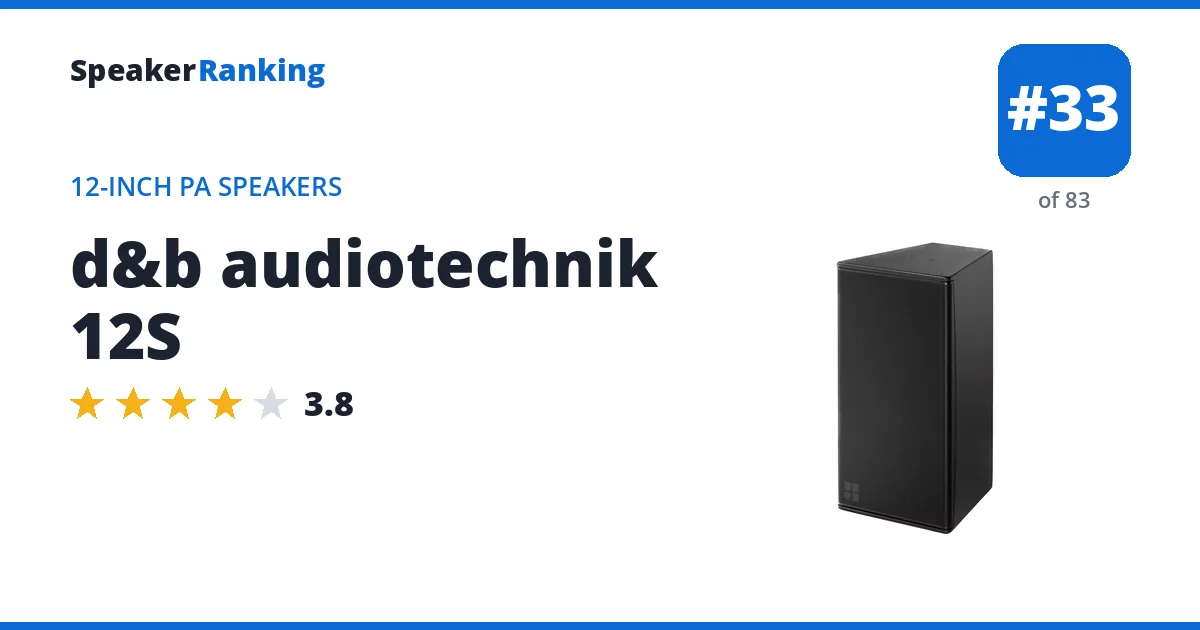
Same family: the d&b audiotechnik 4S (smaller model, estimated 3.2/5), the d&b audiotechnik 42S (smaller model, estimated 3.5/5), the d&b audiotechnik 44S (smaller model, rated 3.6/5), the d&b audiotechnik 5S (smaller model, estimated 3.3/5), the d&b audiotechnik 8S (smaller model, rated 3.1/5), the d&b audiotechnik 10S (smaller model, rated 3.7/5) and the d&b audiotechnik 24S (larger model, ranked higher, rated 3.8/5).
Pros: Its 3.20 standalone preference score is among the better passive 12-inch results here, and bass reaches 60Hz at -3dB and about 46Hz at -10dB, deep enough to run without a subwoofer for speech and background music. A 1.4-inch compression driver on a rotatable 75° x 50° horn gives a 133dB peak from a 17kg cabinet, and the 12S-D version offers 110° wide coverage. Measured bass extension of 60Hz (-3dB).
Cons: Listening-window deviation of 0.556 means the tonal balance is less even than the best 12-inch models. It is passive, needs d&b amplifiers and presets, and is aimed at permanent installs. It is sold only through d&b dealers with no published price.
Full d&b audiotechnik 12S review and specifications →
| AES Input | No |
|---|---|
| Amplifier Power | Passive speaker; requires external amplification (d&b amplifiers) |
| Aux Input | No |
| Bass Extension (-10dB) | about 46.2Hz (measured, vendor Spinorama data) |
| Bass Extension (-3dB) | 60Hz (measured, vendor Spinorama data) |
| Bluetooth | No |
| Coaxial Input | No |
| Configuration | Passive 2-way installation loudspeaker |
| Coverage | 75° x 50° (rotatable) |
| DSP | No (passive) |
| Dimensions | 25.1”H x 13.3”W x 14.4”D (638 x 338 x 365 mm) |
| Drivers | 12” neodymium woofer, 1.4” compression driver on CD horn |
| Frequency Response | 48Hz - 18kHz (-5dB, manufacturer specified) |
| Guitar Input | No |
| HDMI Input | No |
| Impedance | 8 ohms |
| Maximum SPL | 133dB peak (manufacturer specified) |
| Microphone Input | No |
| Optical Input | No |
| Passive | Yes |
| Power Handling | 300W RMS / 1,600W peak |
| RCA Input | No |
| Rigging | M10 inserts in top and bottom panels; 2 x M8 inserts on rear |
| Spinorama Preference Score | 3.20 |
| Spinorama Preference Score with Perfect Sub | 5.79 |
| TRS Input | No |
| USB Input | No |
| Weight | 37.5 lbs (17 kg) |
| XLR Input | No |
- Links
- Reviews, Comparisons and Sound Samples
- Head-to-Head Comparisons
 #33 Yamaha CXR12mkIII: $699.00 Passive B&H Photo Video $699.00 eBay

Same family: the Yamaha DXR10mkIII (smallest powered model, rated 3.8/5), the Yamaha DXR12mkIII (powered model, ranked higher, rated 4.1/5), the Yamaha DXR15mkIII (largest powered model, rated 3.8/5), the Yamaha CXR10mkIII (smaller passive model, estimated 3.5/5) and the Yamaha CXR15mkIII (larger passive model, estimated 3.5/5). See every Yamaha DXR and CXR generation.
Pros: The passive version of the measured Yamaha DXR12mkIII, with the same 12” woofer, 1.75” voice coil compression driver, horn and port design. Yamaha rates it at 94dB sensitivity, 124dB maximum SPL and bass to 51Hz (-10dB) with 90° x 60° coverage, and its PX and PC-D amplifiers carry a dedicated processing preset for it.
Cons: No independent measurements yet, so it can’t be compared with ranked PA speakers. It needs an external amplifier and, for its rated response, speaker processing; the powered model has that built in. Without Yamaha’s preset its tonal balance depends on the amplifier’s EQ.
Full Yamaha CXR12mkIII review and specifications →
| Released | 2026 (this year) |
|---|---|
| Amplifier Power | Passive speaker; requires external amplification |
| Bluetooth | No |
| Configuration | Passive 2-way bass-reflex PA speaker |
| Coverage | 90° x 60° |
| DSP | No (passive) |
| Drivers | 12” woofer, 1.75” voice coil compression driver |
| Frequency Response | 51Hz - 20kHz (-10dB, manufacturer specified) |
| Impedance | 8 ohms |
| Maximum SPL | 124dB (manufacturer specified) |
| Passive | Yes |
| Power Handling | 1,100W peak |
| Rigging | 3 x M10 eyebolt points; 4 x M8 points |
| Sensitivity | 94dB |
| Weight | 34 lbs (15.4 kg) |
| XLR Input | No |
- Links
- Reviews, Comparisons and Sound Samples
- No independent measurement review is linked for this model; it is ranked from hands-on listening and comparison against similarly priced speakers.
- Head-to-Head Comparisons
 #34 HK Audio Linear 5 MK2 112 FA: $1,235.92 Amazon $1,235.92 eBay

Older model: the HK Audio LINEAR 5 112 FA (ranked lower, rated 3.6/5). See every HK Audio Linear 5 generation.
Same family: the HK Audio Linear 5 MK2 110 XA (smaller model, estimated 3.6/5), the HK Audio Linear 5 MK2 112 XA (larger model, ranked lower, estimated 3.7/5), the HK Audio Linear 5 MK2 115 FA (larger model, estimated 3.6/5), the HK Audio Linear 5 MK2 115 XA (larger model, estimated 3.5/5) and the HK Audio Linear 5 MK2 308 LTA (larger model, estimated 3.3/5).
Pros: An active two-way 12-inch PA speaker rated at 1,200W, designed as a full-range unit for use with or without a subwoofer. HK Audio says the MK2 is smaller and lighter than the original Linear 5 at the same output. It has XLR connections and a steel grille with anticorrosive coating.
Cons: No independent measurements yet, so it can’t be compared with ranked PA speakers. It is a professional speaker with no Bluetooth or battery.
Full HK Audio Linear 5 MK2 112 FA review and specifications →
| Released | 2023 (3 years ago) |
|---|---|
| Amplifier Power | 1200W |
| Bluetooth | No |
| Drivers | 12” woofer, 2-way |
| Maximum SPL | 135dB peak (manufacturer specified) |
| Passive | No |
| Rigging | 3 x M8 rigging points; DuoTilt 3°/7° pole mount |
| Weight | 48.3 lbs (21.9 kg) |
| XLR Input | Yes |
- Links
- Reviews, Comparisons and Sound Samples
- No independent measurement review is linked for this model; it is ranked from hands-on listening and comparison against similarly priced speakers.
- Head-to-Head Comparisons
 #35 HK Audio Linear 5 MK2 112 XA: $1,508.02 Amazon $1,508.02 eBay
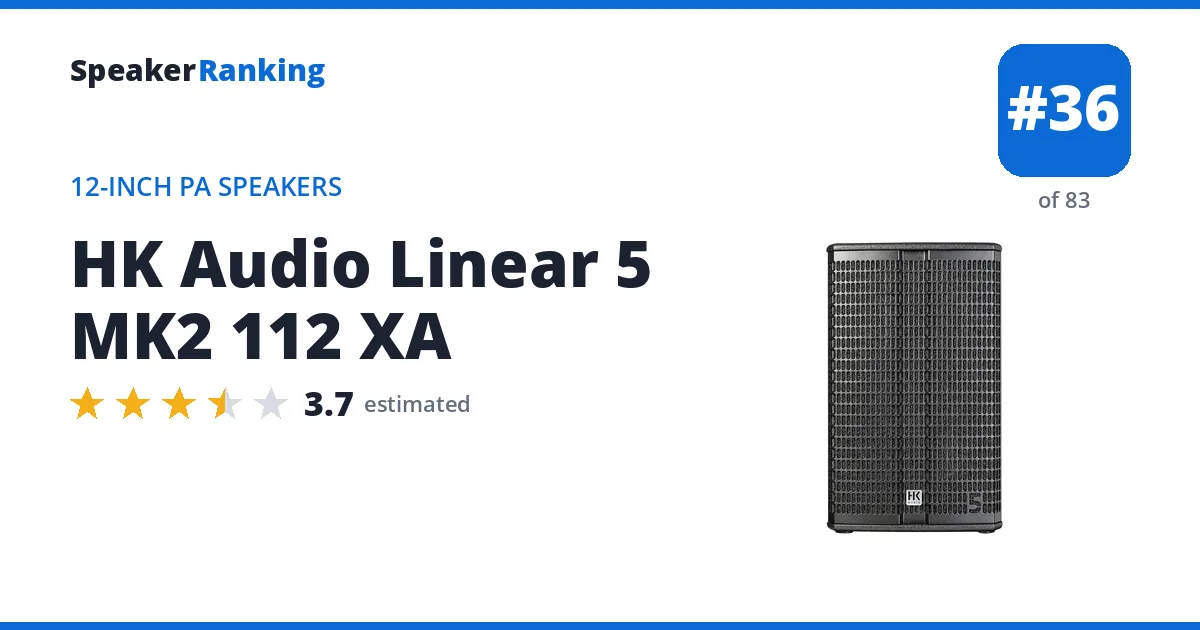
Older model: the HK Audio LINEAR 5 112 XA (ranked lower, rated 3.6/5). See every HK Audio Linear 5 generation.
Same family: the HK Audio Linear 5 MK2 110 XA (smaller model, estimated 3.6/5), the HK Audio Linear 5 MK2 112 FA (smaller model, ranked higher, estimated 3.7/5), the HK Audio Linear 5 MK2 115 FA (larger model, estimated 3.6/5), the HK Audio Linear 5 MK2 115 XA (larger model, estimated 3.5/5) and the HK Audio Linear 5 MK2 308 LTA (larger model, estimated 3.3/5).
Pros: An active two-way 12-inch PA speaker rated at 1,200W, designed as a multifunctional mid/high unit whose angled cabinet also works as a stage monitor. HK Audio says the MK2 is smaller and lighter than the original Linear 5 at the same output. It has XLR connections and a steel grille with anticorrosive coating.
Cons: No independent measurements yet, so it can’t be compared with ranked PA speakers. It is a professional speaker with no Bluetooth or battery.
Full HK Audio Linear 5 MK2 112 XA review and specifications →
| Released | 2023 (3 years ago) |
|---|---|
| Amplifier Power | 1200W |
| Bluetooth | No |
| Drivers | 12” woofer, 2-way |
| Maximum SPL | 136dB peak (manufacturer specified) |
| Passive | No |
| Rigging | 3 x M8 rigging points; DuoTilt 3°/7° pole mount |
| Weight | 38.8 lbs (17.6 kg) |
| XLR Input | Yes |
- Links
- Reviews, Comparisons and Sound Samples
- No independent measurement review is linked for this model; it is ranked from hands-on listening and comparison against similarly priced speakers.
- Head-to-Head Comparisons
 #36 FBT J12A: $450 Discontinued eBay
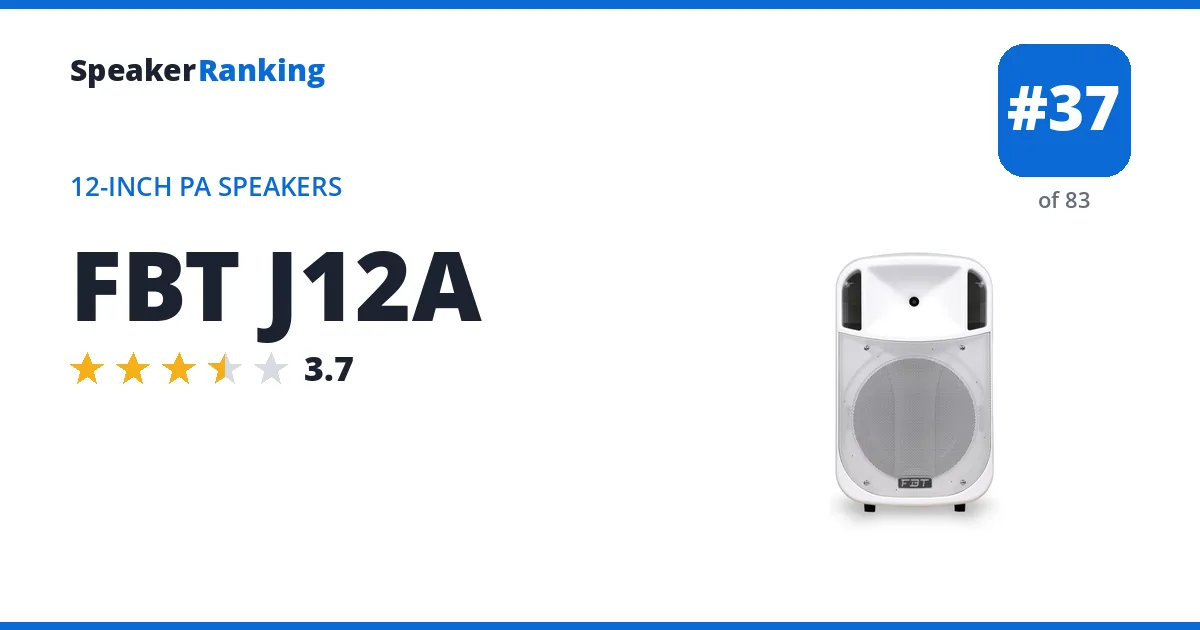
Pros: A light, affordable cabinet with medium-quality vendor Spinorama coverage and 54Hz measured bass extension. Its simple mixer and monitor angle suit small bands, speech systems and rehearsal spaces that value portability. Measured bass extension of 54Hz (-3dB).
Cons: The 5.20 ideal-subwoofer preference score and uneven supplied response keep it below the more refined choices. Output, processing and cabinet construction are oriented toward value rather than demanding touring use. Discontinued.
Full FBT J12A review and specifications →
| Released | 2013 (13 years ago) |
|---|---|
| AES Input | No |
| Amplifier Power | 450W RMS (350W LF + 100W HF, manufacturer specified) |
| Aux Input | No |
| Bass Extension (-3dB) | 54Hz (measured, vendor Spinorama data) |
| Bluetooth | No |
| Cabinet Material | Polypropylene |
| Coaxial Input | No |
| Configuration | Active 2-way bass-reflex PA speaker |
| Coverage | 90° x 60° |
| DSP | Yes |
| Dimensions | 26.1”H x 16.1”W x 15.2”D (663 x 410 x 387 mm) |
| Drivers | 12” woofer, compression driver |
| Frequency Response | 50Hz - 20kHz (-6dB, manufacturer specified) |
| Guitar Input | No |
| HDMI Input | No |
| Inputs | XLR/jack input with link output |
| Maximum SPL | 127dB peak / 123dB continuous |
| Microphone Input | No |
| Optical Input | No |
| Passive | No |
| RCA Input | No |
| Rigging | 35mm internal pole mount, 2x M10 anchoring points |
| Spinorama Preference Score | 2.72 |
| Spinorama Preference Score with Perfect Sub | 5.20 |
| TRS Input | Yes |
| USB Input | No |
| Weight | 32.8 lbs (14.9 kg) |
| XLR Input | Yes |
- Links
- Reviews, Comparisons and Sound Samples
- Head-to-Head Comparisons
 #37 DAS Audio Vantec 12A: $1,645.99 Amazon $1,645.99 B&H Photo Video $1,645.99 eBay
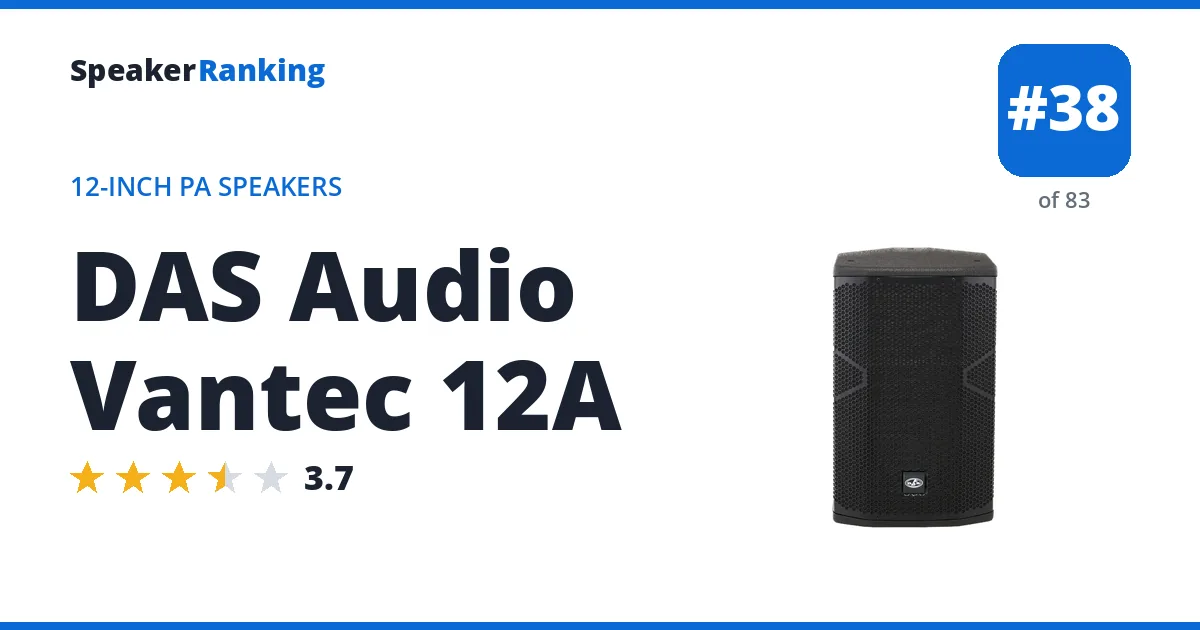
Same family: the DAS Audio Vantec 15A (larger model, rated 3.1/5).
Pros: The 135dB claimed peak, 90° x 50° coverage, FIR processing, onboard mixer and Bluetooth audio make this a feature-rich event cabinet. Medium-quality vendor data shows a 3.40 ideal-subwoofer score and about 68Hz bass extension. Measured bass extension of 71Hz (-3dB).
Cons: Its measured tonal score is below the category leaders and the 21.5kg plywood cabinet is not especially light. Bluetooth is useful for convenience playback, but wired inputs remain preferable for reliable low-latency production audio.
Full DAS Audio Vantec 12A review and specifications →
| Released | 2015 (11 years ago) |
|---|---|
| AES Input | No |
| Amplifier Power | 750W continuous / 1,500W peak (manufacturer specified) |
| Aux Input | Yes |
| Bass Extension (-3dB) | 71Hz (measured, vendor Spinorama data) |
| Bluetooth | Yes, audio streaming and DASlink control |
| Cabinet Material | Birch plywood |
| Coaxial Input | No |
| Configuration | Active 2-way bass-reflex PA speaker |
| Coverage | 90° x 50° |
| DSP | Yes, FIR filters, presets, EQ and delay |
| Dimensions | 24.4”H x 15”W x 15”D (620 x 380 x 380 mm) |
| Drivers | 12” woofer, 1” compression driver |
| Frequency Response | 60Hz - 20kHz (-10dB, manufacturer specified) |
| Guitar Input | No |
| HDMI Input | No |
| Inputs | 2 x XLR mic/line, 3.5mm aux, XLR loop |
| Maximum SPL | 135dB peak (manufacturer specified) |
| Microphone Input | Yes |
| Network Control | DAScontrol and DASlink app |
| Optical Input | No |
| Passive | No |
| RCA Input | No |
| Rigging | M10 rigging points |
| Spinorama Preference Score | 0.48 |
| Spinorama Preference Score with Perfect Sub | 3.40 |
| TRS Input | No |
| USB Input | No |
| Weight | 47.4 lbs (21.5 kg) |
| XLR Input | Yes |
- Links
- Reviews, Comparisons and Sound Samples
- Head-to-Head Comparisons
 #38 Coda Audio G512 Passive eBay
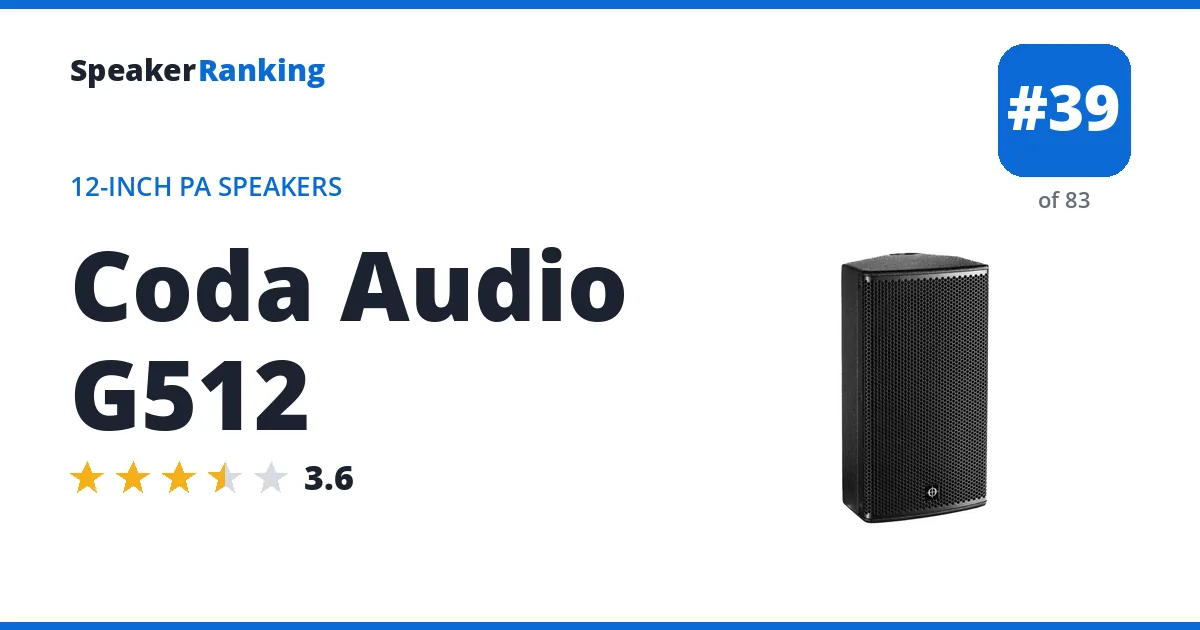
Same family: the Coda Audio G308 (smaller model, estimated 3.5/5), the Coda Audio G515 (larger model, rated 3.7/5), the Coda Audio G712 (larger model, ranked higher, rated 3.8/5) and the Coda Audio G715 (larger model, rated 3.8/5).
Pros: High-quality vendor Spinorama data gives preference scores of 3.04 standalone and 6.11 with an ideal subwoofer. A 98dB sensitivity and 132dB peak rating come from a 16kg cabinet, and the rotatable 90° x 60° waveguide fits horizontal or vertical placement. Measured bass extension of 112Hz (-3dB).
Cons: Measured bass reaches only about 112Hz (-3dB), and listening-window narrow-band deviation is 0.531, so the tonal balance is thin and uneven compared with the leaders in this ranking. It is passive, so an amplifier and processor with the maker’s presets are required.
Full Coda Audio G512 review and specifications →
| AES Input | No |
|---|---|
| Amplifier Power | Passive speaker; requires external amplification within the 600W handling rating |
| Aux Input | No |
| Bass Extension (-3dB) | 112Hz (measured, vendor Spinorama data) |
| Bluetooth | No |
| Coaxial Input | No |
| Configuration | Passive 2-way bass-reflex PA speaker |
| Coverage | 90° x 60° (rotatable) |
| DSP | No (passive) |
| Dimensions | 24.8”H x 13.7”W x 12.6”D (630 x 348 x 320 mm) |
| Drivers | 12” neodymium woofer, 1” compression driver on a rotatable elliptical waveguide |
| Frequency Response | 60Hz - 22kHz (-6dB, manufacturer specified) |
| Guitar Input | No |
| HDMI Input | No |
| Maximum SPL | 132dB peak (manufacturer specified) |
| Microphone Input | No |
| Optical Input | No |
| Passive | Yes |
| Power Handling | 600W (manufacturer specified) |
| RCA Input | No |
| Rigging | M6 and M8 threaded points for optional U-bracket |
| Sensitivity | 98dB |
| Spinorama Preference Score | 3.04 |
| Spinorama Preference Score with Perfect Sub | 6.11 |
| TRS Input | No |
| USB Input | No |
| Weight | 35.3 lbs (16.0 kg) |
| XLR Input | No |
- Links
- Reviews, Comparisons and Sound Samples
- Head-to-Head Comparisons
 #39 Yamaha DBR12: $459.99 Amazon $459.99 B&H Photo Video $459.99 Guitar Center $459.99 eBay
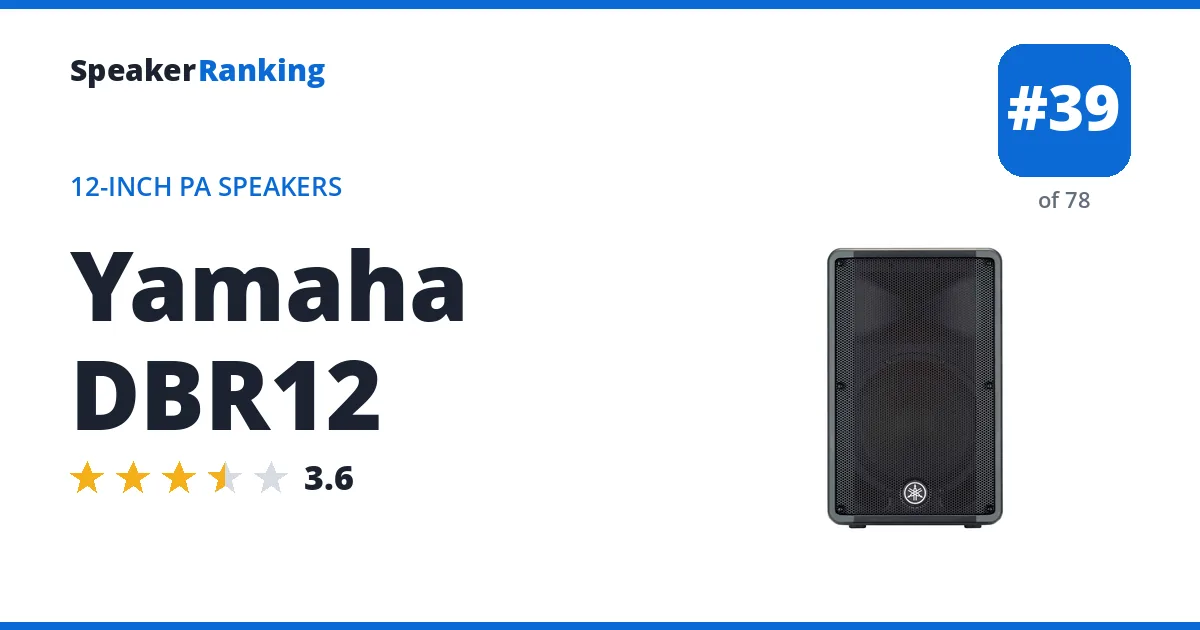
Same family: the Yamaha DBR10 (smaller powered model, rated 3.4/5), the Yamaha DBR15 (larger powered model, rated 2.9/5), the Yamaha CBR10 (smallest passive model, estimated 3.2/5), the Yamaha CBR12 (passive model, ranked lower, estimated 3.4/5) and the Yamaha CBR15 (largest passive model, estimated 2.7/5).
Pros: A lightweight, widely supported entry point with a useful two-channel mixer, FIR-X crossover processing and straightforward main/monitor presets. The 58Hz measured extension is adequate for speech and modest music playback without a subwoofer. Measured bass extension of 58Hz (-3dB).
Cons: Medium-quality vendor data produces a below-average 4.92 ideal-subwoofer preference score, indicating substantial tonal/directivity compromises. Its 131dB output claim and controls also sit below Yamaha’s DXR and DZR tiers.
Full Yamaha DBR12 review and specifications →
| Released | Sep 2014 (12 years ago) |
|---|---|
| AES Input | No |
| Amplifier Power | 1000W dynamic / 465W continuous (800W LF + 200W HF dynamic) |
| Aux Input | No |
| Bass Extension (-3dB) | 58Hz (measured, vendor Spinorama data) |
| Bluetooth | No |
| Cabinet Material | Plastic |
| Coaxial Input | No |
| Configuration | Active 2-way bass-reflex PA speaker |
| Coverage | 90° x 60° |
| DSP | Yes |
| Dimensions | 23.7”H x 14.8”W x 13.7”D (601 x 376 x 348 mm) |
| Drivers | 12” woofer, 1.4” compression driver |
| Frequency Response | 52Hz - 20kHz (manufacturer specified) |
| Guitar Input | No |
| HDMI Input | No |
| Inputs | 2 x XLR/TRS combo, stereo RCA |
| Maximum SPL | 131dB peak (manufacturer specified) |
| Microphone Input | No |
| Optical Input | No |
| Passive | No |
| RCA Input | Yes |
| Rigging | 3 x M8 points; 35mm pole mount |
| Spinorama Preference Score | 2.32 |
| Spinorama Preference Score with Perfect Sub | 4.92 |
| TRS Input | Yes |
| USB Input | No |
| Weight | 34.8 lbs (15.8 kg) |
| XLR Input | Yes |
- Links
- Reviews, Comparisons and Sound Samples
- Head-to-Head Comparisons
 #40 RCF ART 712-A MK5: $599.00 Amazon $599.00 B&H Photo Video $599.00 Guitar Center $599.00 eBay

Older model: the RCF ART 712-A MK4 (ranked lower, rated 3.1/5). See every RCF ART 7 generation.
Same family: the RCF ART 708-A MK5 (smaller model, rated 3.4/5), the RCF ART 710-A MK5 (smaller model, rated 3.6/5), the RCF ART 732-A MK5 (larger model, ranked higher, rated 3.8/5), the RCF ART 715-A MK5 (larger model, rated 3.6/5), the RCF ART 735-A MK5 (larger model, estimated 3.4/5) and the RCF ART 745-A MK5 (larger model, rated 3.5/5).
Pros: A compact, relatively affordable RCF with 129dB claimed output, FiRPHASE processing and familiar 90° x 60° coverage. It is an appealing simple top for buyers who plan to cross to a subwoofer and do not need app control. Measured bass extension of 65.0Hz (-3dB).
Cons: The local low-quality manufacturer data has no computed preference score, making its measured tonal position uncertain. The smaller compression-driver assembly offers less vocal headroom than the RCF ART 732-A MK5.
Full RCF ART 712-A MK5 review and specifications →
| Released | Jan 2024 (2 years ago) |
|---|---|
| AES Input | No |
| Amplifier Power | 1400W peak (1000W LF + 400W HF) |
| Aux Input | No |
| Bass Extension (-3dB) | 65.0Hz (measured, vendor Spinorama data) |
| Bluetooth | No |
| Cabinet Material | PP composite |
| Coaxial Input | No |
| Configuration | Active 2-way bass-reflex PA speaker |
| Coverage | 90° x 60° |
| Crossover Frequency | 1600Hz |
| DSP | Yes |
| Dimensions | 25.1”H x 15.2”W x 14.3”D (637 x 387 x 363 mm) |
| Drivers | 12” woofer, 1.75” compression driver |
| Frequency Response | 50Hz - 20kHz (manufacturer specified) |
| Guitar Input | No |
| HDMI Input | No |
| Inputs | XLR/TRS combo |
| Maximum SPL | 129dB peak (manufacturer specified) |
| Microphone Input | No |
| Optical Input | No |
| Passive | No |
| RCA Input | No |
| Rigging | 2 x M10 inserts; 35mm pole mount |
| TRS Input | Yes |
| USB Input | No |
| Weight | 39.2 lbs (17.8 kg) |
| XLR Input | Yes |
- Links
- Reviews, Comparisons and Sound Samples
- Head-to-Head Comparisons
- RCF ART 712-A MK5 vs Yamaha DBR12
- RCF ART 712-A MK5 vs HK Audio LINEAR 5 112 FA
- RCF ART 712-A MK5 vs HK Audio LINEAR 5 112 XA
- RCF ART 712-A MK5 vs Coda Audio G512
- RCF ART 712-A MK5 vs RCF HD 12-A MK5
- RCF ART 712-A MK5 vs Yamaha CXR12mkIII
- RCF ART 712-A MK5 vs Martin Audio XP12
- RCF ART 712-A MK5 vs HK Audio LINEAR 5 112 X
- See all 30 comparisons
 #41 HK Audio LINEAR 5 112 FA: $955 Discontinued eBay
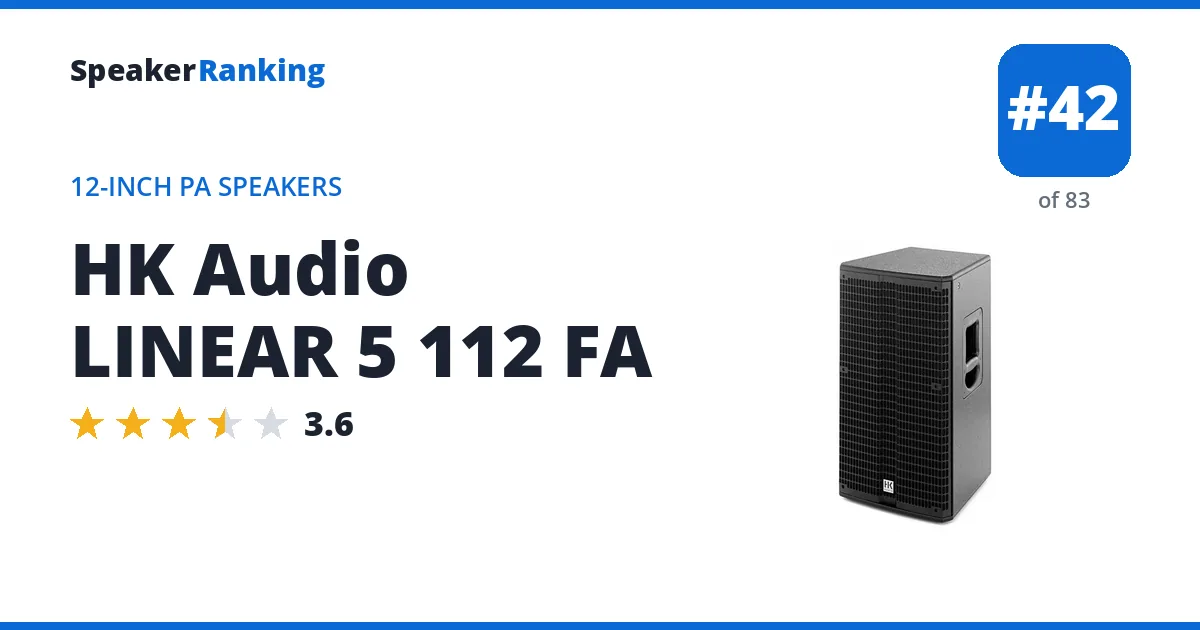
Newer model: the HK Audio Linear 5 MK2 112 FA, ranked higher, estimated 3.7/5, released 2023. See every HK Audio Linear 5 generation.
Pros: High-quality vendor data yields a 5.07 ideal-subwoofer preference score, while the asymmetric horn can cover wider near-field seating without wasting as much energy upward. The 135dB claimed peak gives it substantial headroom. Measured bass extension of 73Hz (-3dB).
Cons: The 70Hz measured bass extension points toward subwoofer use, and the 23.9kg cabinet is relatively heavy. This original LINEAR 5 generation lacks the deeper networked DSP and current support advantages of the newer MK2, LINEAR 7 and LINEAR 9 models. Discontinued.
Full HK Audio LINEAR 5 112 FA review and specifications →
| Released | Apr 2012 (14 years ago) |
|---|---|
| AES Input | No |
| Amplifier Power | 1,000W peak (Class D bi-amped, manufacturer specified) |
| Aux Input | No |
| Bass Extension (-3dB) | 73Hz (measured, vendor Spinorama data) |
| Bluetooth | No |
| Cabinet Material | Hybrid birch plywood construction |
| Coaxial Input | No |
| Configuration | Active 2-way bass-reflex PA speaker |
| Coverage | 60°-90° asymmetric x 55° |
| Crossover Frequency | 1.65kHz active (24dB/octave) |
| DSP | Yes, crossover, EQ and limiting |
| Dimensions | 26.3”H x 14.6”W x 14.4”D (668 x 370 x 365 mm) |
| Drivers | 12” woofer, 1” compression driver |
| Frequency Response | 64Hz - 18kHz (±3dB, manufacturer specified); 57Hz - 20kHz (-10dB) |
| Guitar Input | No |
| HDMI Input | No |
| Inputs | 2 x XLR input, 2 x XLR thru, XLR mix output |
| Maximum SPL | 135dB peak (manufacturer specified) |
| Microphone Input | No |
| Optical Input | No |
| Passive | No |
| RCA Input | No |
| Rigging | Three M8 points; DuoTilt 3°/7° pole mount |
| Spinorama Preference Score | 2.10 |
| Spinorama Preference Score with Perfect Sub | 5.07 |
| TRS Input | No |
| USB Input | No |
| Weight | 52.7 lbs (23.9 kg) |
| XLR Input | Yes |
- Links
- Reviews, Comparisons and Sound Samples
- Head-to-Head Comparisons
 #42 HK Audio LINEAR 5 112 XA: $800 Discontinued eBay
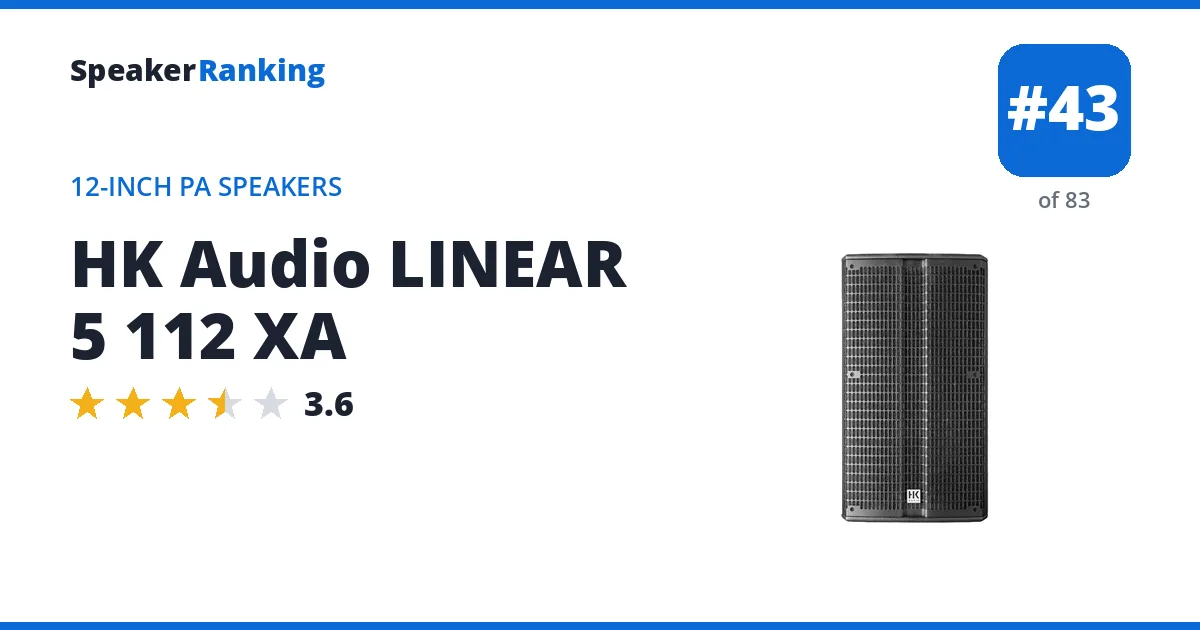
Newer model: the HK Audio Linear 5 MK2 112 XA, ranked higher, estimated 3.7/5, released 2023. See every HK Audio Linear 5 generation.
Pros: Its high-quality vendor data returns a 5.21 ideal-subwoofer preference score, and the compact monitor-capable enclosure reaches a claimed 136dB peak. The rotatable 60° x 40° horn helps concentrate output over longer distances. Measured bass extension of 95Hz (-3dB).
Cons: Measured bass extension is only about 87Hz, so this XA model is best treated as a mid/high cabinet over subwoofers rather than a stand-alone full-range main. It is an older discontinued generation with limited onboard user processing.
Full HK Audio LINEAR 5 112 XA review and specifications →
| Released | Apr 2012 (14 years ago) |
|---|---|
| AES Input | No |
| Amplifier Power | 1,000W peak (Class D bi-amped, manufacturer specified) |
| Aux Input | No |
| Bass Extension (-3dB) | 95Hz (measured, vendor Spinorama data) |
| Bluetooth | No |
| Cabinet Material | Hybrid birch plywood construction |
| Coaxial Input | No |
| Configuration | Active 2-way bass-reflex PA speaker/monitor |
| Coverage | 60° x 40°, rotatable |
| Crossover Frequency | 1.65kHz active (24dB/octave) |
| DSP | Yes, crossover, EQ and limiting |
| Dimensions | 26.3”H x 14.6”W x 11.8”D (668 x 370 x 300 mm) |
| Drivers | 12” woofer, 1” compression driver |
| Frequency Response | 100Hz - 18kHz (±3dB, manufacturer specified); 72Hz - 20kHz (-10dB) |
| Guitar Input | No |
| HDMI Input | No |
| Inputs | 2 x XLR input, 2 x XLR thru, XLR mix output |
| Maximum SPL | 136dB peak (manufacturer specified) |
| Microphone Input | No |
| Optical Input | No |
| Passive | No |
| RCA Input | No |
| Rigging | Three M8 points; DuoTilt 3°/7° pole mount |
| Spinorama Preference Score | 1.84 |
| Spinorama Preference Score with Perfect Sub | 5.21 |
| TRS Input | No |
| USB Input | No |
| Weight | 46.5 lbs (21.1 kg) |
| XLR Input | Yes |
- Links
- Reviews, Comparisons and Sound Samples
- Head-to-Head Comparisons
 #43 RCF HD 12-A MK5: $600.00 Discontinued Guitar Center $600.00 eBay
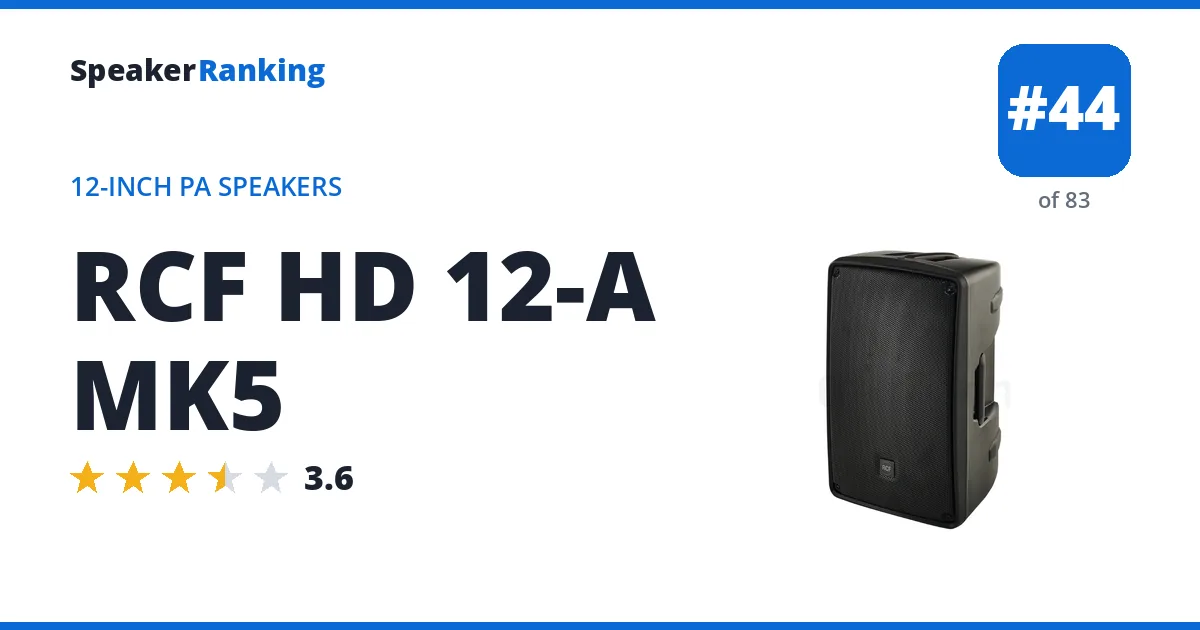
Same family: the RCF HD 10-A MK5 (smaller model, rated 3.3/5).
Pros: The current 18.3kg cabinet offers 130dB claimed peak output, 90° x 60° coverage and RCF FiRPHASE/Bass Motion Control processing at a comparatively accessible price. Medium-quality vendor data indicates useful extension into the low 60Hz region. Measured bass extension of 63Hz (-3dB).
Cons: The truncated Spinorama measurement cannot produce a preference score, so tonal confidence is lower than for the fully scored leaders. Controls are intentionally simple and omit app control, networking and a multi-input mixer. Discontinued.
Full RCF HD 12-A MK5 review and specifications →
| AES Input | No |
|---|---|
| Amplifier Power | 1400W peak / 700W RMS (1000W LF + 400W HF peak) |
| Aux Input | No |
| Bass Extension (-3dB) | 63Hz (measured, vendor Spinorama data) |
| Bluetooth | No |
| Cabinet Material | PP composite |
| Coaxial Input | No |
| Configuration | Active 2-way bass-reflex PA speaker |
| Coverage | 90° x 60° |
| Crossover Frequency | 1800Hz |
| DSP | Yes, FiRPHASE and Bass Motion Control |
| Dimensions | 25.5”H x 15”W x 15”D (647 x 380 x 380 mm) |
| Drivers | 12” woofer, 1.4” compression driver |
| Frequency Response | 45Hz - 20kHz (manufacturer specified) |
| Guitar Input | No |
| HDMI Input | No |
| Inputs | XLR/TRS combo input and XLR link |
| Maximum SPL | 130dB peak (manufacturer specified) |
| Microphone Input | No |
| Optical Input | No |
| Passive | No |
| RCA Input | No |
| Rigging | 2 x M10 inserts; 35mm pole mount |
| TRS Input | Yes |
| USB Input | No |
| Weight | 40.3 lbs (18.3 kg) |
| XLR Input | Yes |
- Links
- Reviews, Comparisons and Sound Samples
- Head-to-Head Comparisons
- RCF HD 12-A MK5 vs HK Audio LINEAR 5 112 XA
- RCF HD 12-A MK5 vs HK Audio LINEAR 5 112 FA
- RCF HD 12-A MK5 vs RCF ART 712-A MK5
- RCF HD 12-A MK5 vs Yamaha DBR12
- RCF HD 12-A MK5 vs LD Systems Stinger 12 A G3
- RCF HD 12-A MK5 vs Martin Audio XP12
- RCF HD 12-A MK5 vs RCF ART 732-A MK5
- RCF HD 12-A MK5 vs RCF ART 732-A MK4
- See all 25 comparisons
 #44 Vue Audiotechnik A-12: $1,945 Passive AVLGEAR $1,945 eBay
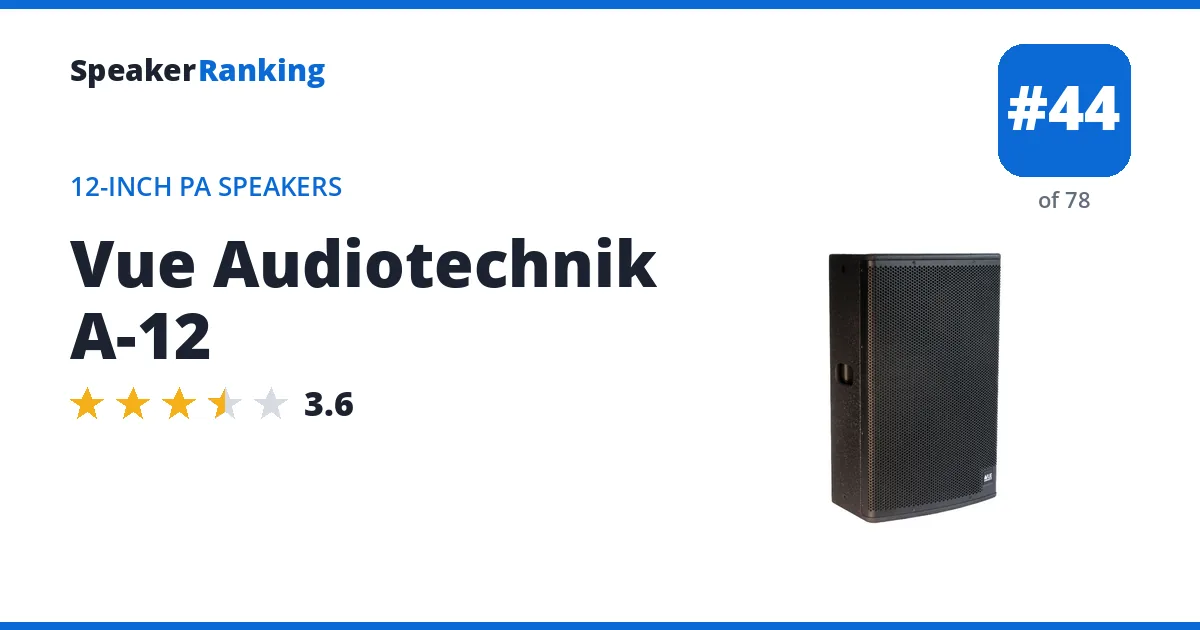
Same family: the Vue Audiotechnik A-8 (smaller model, rated 3.9/5), the Vue Audiotechnik A-10 (smaller model, rated 3.7/5) and the Vue Audiotechnik A-15 (larger model, rated 3.5/5).
Pros: Manufacturer measurements give a 5.46 preference score with an ideal subwoofer and a 2.1dB reference band, and bass reaches 80Hz at -3dB and about 60Hz at -10dB. A 12-inch neodymium woofer and 1.4-inch compression driver, both with 3-inch voice coils, sit in a braced birch cabinet with a rotatable 70° x 55° horn. A rear switch sets passive or bi-amp operation. Measured bass extension of 80Hz (-3dB).
Cons: Spinorama rates the data quality as low, and a 0.635 listening-window deviation means tonal balance is less even than the leaders in this ranking. Its 122dB long-term output rating is modest for the price. It is passive and needs an external amplifier and processor.
Full Vue Audiotechnik A-12 review and specifications →
| Released | 2012 (14 years ago) |
|---|---|
| AES Input | No |
| Amplifier Power | Passive speaker; requires external amplification |
| Aux Input | No |
| Bass Extension (-10dB) | about 60Hz (measured, vendor Spinorama data) |
| Bass Extension (-3dB) | 80Hz (measured, vendor Spinorama data) |
| Bluetooth | No |
| Cabinet Material | Multi-ply birch |
| Coaxial Input | No |
| Configuration | Passive 2-way PA speaker (passive or bi-amp) |
| Coverage | 70° x 55° (rotatable) |
| DSP | No (passive) |
| Drivers | 12” neodymium woofer (3” voice coil), 1.4” exit neodymium compression driver (3” voice coil) |
| Frequency Response | 55Hz - 18kHz (manufacturer specified) |
| Guitar Input | No |
| HDMI Input | No |
| Maximum SPL | 122dB long-term (manufacturer specified) |
| Microphone Input | No |
| Optical Input | No |
| Passive | Yes |
| Power Handling | 450W average / 900W program (passive mode) |
| RCA Input | No |
| Rigging | Integrated fly points; integrated pole cup |
| Spinorama Preference Score | 2.54 |
| Spinorama Preference Score with Perfect Sub | 5.46 |
| TRS Input | No |
| USB Input | No |
| Weight | 45 lbs (20.4 kg) |
| XLR Input | No |
- Links
- Reviews, Comparisons and Sound Samples
- Head-to-Head Comparisons
 #45 One Systems 312HC Passive eBay
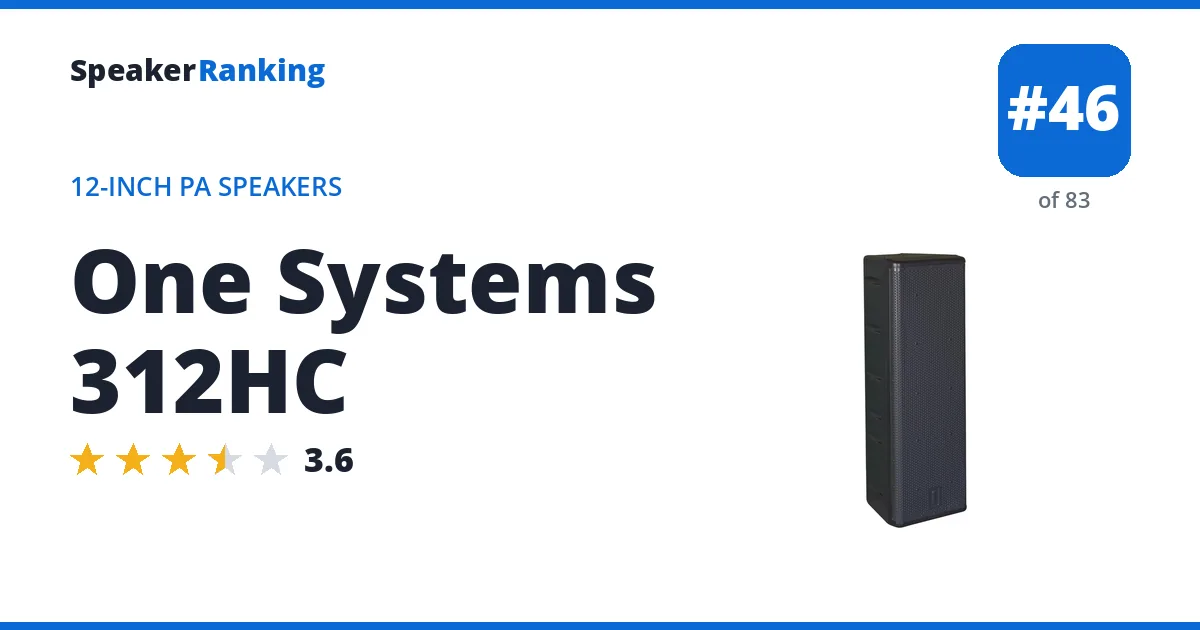
Pros: Manufacturer measurements give preference scores of 2.81 standalone and 5.62 with an ideal subwoofer, with a very flat on-axis response (0.61dB average deviation). Three 12-inch woofers take bass to 73Hz (-3dB) and about 42Hz (-10dB), and 99dB sensitivity with 1,200W handling suits stadiums and large outdoor venues. Measured bass extension of 73Hz (-3dB).
Cons: The 42kg cabinet needs rigging, and its narrow 60° pattern covers less audience than wider designs. Response is quoted only to 16kHz. It is passive, needs a 4 ohm capable amplifier, and is sold through pro dealers with no published price.
Full One Systems 312HC review and specifications →
| AES Input | No |
|---|---|
| Amplifier Power | Passive speaker; requires external amplification |
| Aux Input | No |
| Bass Extension (-10dB) | about 42.3Hz (measured, vendor Spinorama data) |
| Bass Extension (-3dB) | 73Hz (measured, vendor Spinorama data) |
| Bluetooth | No |
| Coaxial Input | No |
| Configuration | Passive 3-way PA column speaker, IP45 weather rated |
| Coverage | 60° conical |
| DSP | No (passive) |
| Dimensions | 43.3”H x 14.5”W x 16.3”D (1100 x 368 x 414 mm) |
| Drivers | 3 x 12” woofers, 12” coaxial with large format compression driver |
| Frequency Response | 75Hz - 16kHz (manufacturer specified) |
| Guitar Input | No |
| HDMI Input | No |
| Impedance | 4 ohms |
| Microphone Input | No |
| Optical Input | No |
| Passive | Yes |
| Power Handling | 1,200W continuous / 4,800W peak |
| RCA Input | No |
| Rigging | 19 x M10 suspension points; optional pole mount and pan/tilt brackets |
| Sensitivity | 99dB |
| Spinorama Preference Score | 2.81 |
| Spinorama Preference Score with Perfect Sub | 5.62 |
| TRS Input | No |
| USB Input | No |
| Weight | 93 lbs (42.2 kg) |
| XLR Input | No |
- Links
- Reviews, Comparisons and Sound Samples
 #46 Yamaha CZR12: $914.00 Passive B&H Photo Video $914.00 eBay

Same family: the Yamaha DZR10 (smallest powered model, rated 3.4/5), the Yamaha DZR12 (powered model, ranked higher, rated 3.9/5), the Yamaha DZR15 (powered model, rated 4/5), the Yamaha DZR315 (largest powered model, rated 3.8/5), the Yamaha CZR10 (smaller passive model, estimated 3.2/5) and the Yamaha CZR15 (larger passive model, estimated 3.7/5).
Pros: The passive version of the measured Yamaha DZR12, with a 12” woofer and a 2” voice coil compression driver in a plywood cabinet with 90° x 60° coverage. Yamaha rates it at 800W handling, 129dB maximum SPL and bass reaching 38Hz, and its PX and PC-D amplifiers carry a dedicated processing preset for it.
Cons: No independent measurements yet, so it can’t be compared with ranked PA speakers. It needs an external amplifier and speaker processing to match the powered DZR, which has its FIR-X tuning built in. It costs about as much as the powered model before the amplifier.
Full Yamaha CZR12 review and specifications →
| Released | Jan 2019 (7 years ago) |
|---|---|
| Amplifier Power | Passive speaker; requires external amplification |
| Bluetooth | No |
| Cabinet Material | Plywood |
| Configuration | Passive 2-way bass-reflex PA speaker |
| Coverage | 90° x 60° |
| DSP | No (passive) |
| Drivers | 12” woofer, 2” voice coil compression driver |
| Frequency Response | 38Hz - 20kHz (-10dB, manufacturer specified) |
| Impedance | 8 ohms |
| Maximum SPL | 129dB (manufacturer specified) |
| Passive | Yes |
| Power Handling | 800W |
| Rigging | 12 x M10 inserts |
| Weight | 39.7 lbs (18 kg) |
| XLR Input | No |
- Links
- Reviews, Comparisons and Sound Samples
- No independent measurement review is linked for this model; it is ranked from hands-on listening and comparison against similarly priced speakers.
- Head-to-Head Comparisons
 #47 PreSonus CDL12P: $949.99 Amazon $949.99 B&H Photo Video $949.99 eBay
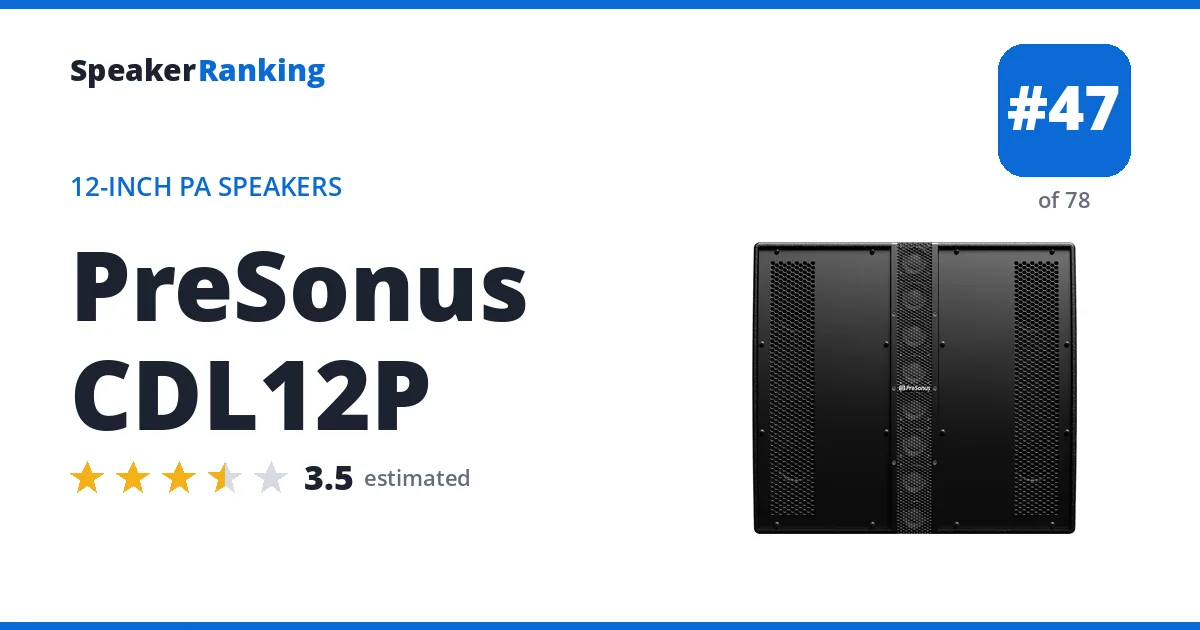
Older model: the PreSonus CDL12 (ranked lower, rated 3.3/5). See every PreSonus CDL12 generation.
Pros: An active two-way PA speaker that keeps the PreSonus CDL12’s hybrid point-source and line-array layout: a 12-inch woofer behind a curved column of eight 2-inch drivers, crossed over at 420Hz, with 120° by 15° coverage. PreSonus rates it at 2,000W peak (500W RMS) and 130dB peak SPL, with a 48Hz to 18kHz range (±3dB). Up to six can be flown with the integrated rigging, and onboard DSP has array and subwoofer presets. It moves to a lighter plastic enclosure with a steel grille for touring use.
Cons: No independent measurements yet, so it can’t be compared with ranked PA speakers, and the measured PreSonus CDL12’s results can’t be assumed to carry over to the new enclosure. It still weighs 28.6 kg (63 lb), and it is a professional speaker with no Bluetooth or battery.
Full PreSonus CDL12P review and specifications →
| Released | Oct 2020 (6 years ago) |
|---|---|
| Amplifier Power | 2,000W peak / 1,000W program / 500W RMS (250W RMS per band) |
| Bluetooth | No |
| Cabinet Material | Plastic enclosure with 1.2mm steel grille |
| Configuration | Active 2-way constant-directivity PA speaker |
| Coverage | 120° x 15° |
| Crossover Frequency | 420Hz |
| DSP | Yes |
| Dimensions | 18.7”H x 20.6”W x 18.4”D (473.8 x 522.3 x 467.9 mm) |
| Drivers | 12” woofer, eight 2” high-frequency drivers |
| Frequency Response | 48Hz - 18kHz (±3dB, manufacturer specified) |
| Inputs | XLR line input and direct XLR line output |
| Maximum SPL | 130dB peak |
| Passive | No |
| Rigging | Integrated flyware for arrays of up to six; 35mm pole socket with 7.5° downtilt |
| Weight | 63.1 lbs (28.6 kg) |
| XLR Input | Yes |
- Links
- Reviews, Comparisons and Sound Samples
- No independent measurement review is linked for this model; it is ranked from hands-on listening and comparison against similarly priced speakers.
- Head-to-Head Comparisons
 #48 LD Systems Stinger 12 A G3: $585.91 Amazon $585.91 eBay
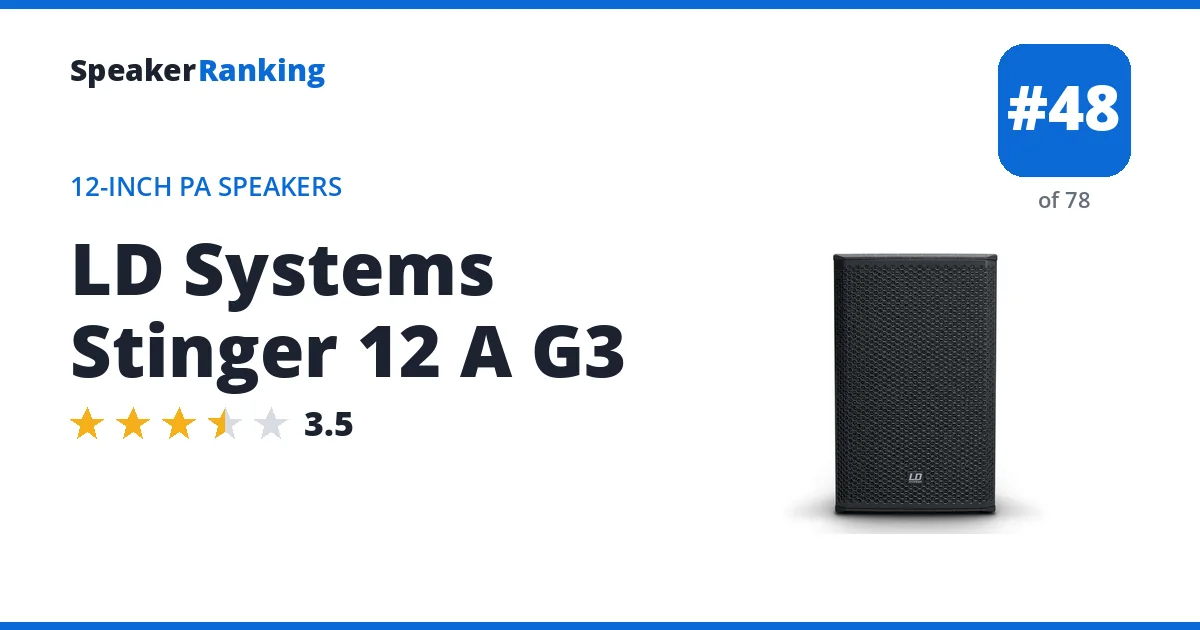
Same family: the LD Systems Stinger 8-A-G3 (smaller model, rated 3.7/5), the LD Systems Stinger 28-A-G3 (smaller model, rated 3.5/5), the LD Systems Stinger 10-A-G3 (smaller model, rated 4.1/5) and the LD Systems Stinger 15-A-G3 (larger model, rated 3.4/5).
Pros: A rugged birch-plywood cabinet, dual-tilt pole socket and two-channel input section make it practical for repeated live work. Its 42Hz measured bass extension is unusually deep for a 12-inch PA speaker, and the manufacturer claims 131dB peak output. Measured bass extension of 42Hz (-3dB).
Cons: Despite the bass reach, medium-quality vendor data gives only a 4.97 ideal-subwoofer preference score because the broader response/directivity behavior is uneven. At 20.4kg it is heavier than several molded-cabinet alternatives.
Full LD Systems Stinger 12 A G3 review and specifications →
| AES Input | No |
|---|---|
| Amplifier Power | 1000W peak / 500W RMS |
| Aux Input | No |
| Bass Extension (-3dB) | 42Hz (measured, vendor Spinorama data) |
| Bluetooth | No |
| Cabinet Material | 15mm plywood with polyurea coating |
| Coaxial Input | No |
| Configuration | Active 2-way bass-reflex PA speaker |
| Coverage | 90° x 50° |
| DSP | Yes |
| Dimensions | 24.7”H x 15.4”W x 14.8”D (627 x 390 x 377 mm) |
| Drivers | 12” woofer, compression driver |
| Frequency Response | 58Hz - 20kHz (manufacturer specified) |
| Guitar Input | No |
| HDMI Input | No |
| Inputs | 2 x XLR/TRS combo |
| Maximum SPL | 131dB peak (manufacturer specified) |
| Microphone Input | No |
| Optical Input | No |
| Passive | No |
| RCA Input | No |
| Rigging | M10 suspension points; 36mm Dual-Tilt pole mount |
| Spinorama Preference Score | 2.96 |
| Spinorama Preference Score with Perfect Sub | 4.97 |
| TRS Input | Yes |
| USB Input | No |
| Weight | 45 lbs (20.4 kg) |
| XLR Input | Yes |
- Links
- Reviews, Comparisons and Sound Samples
- Head-to-Head Comparisons
 #49 Martin Audio XP12 eBay
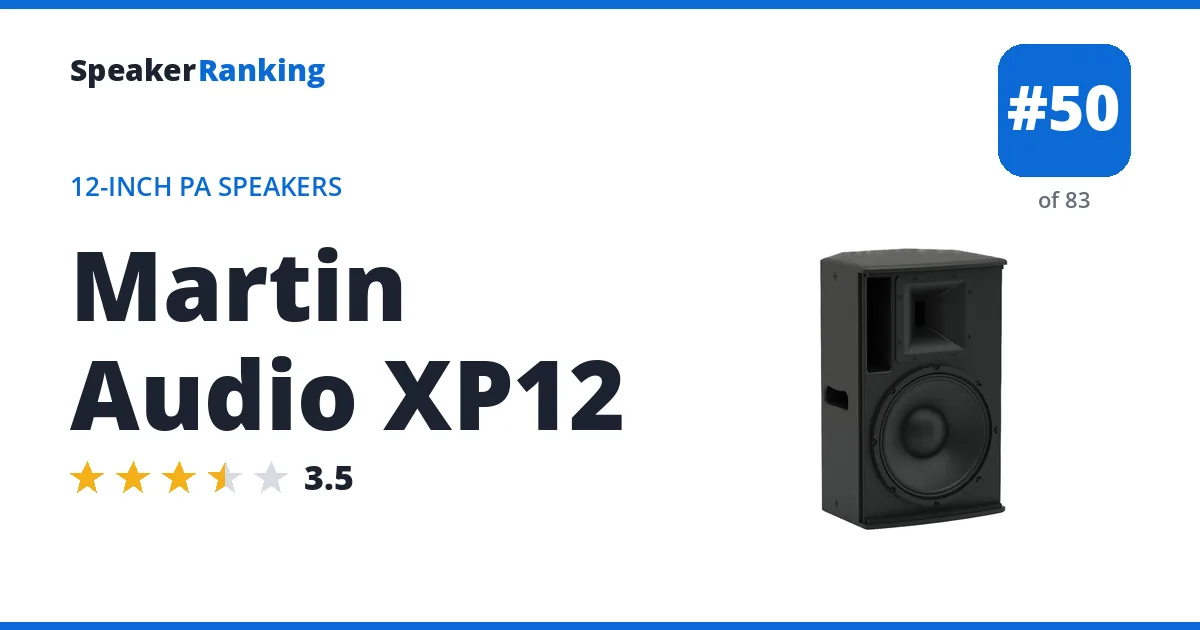
Same family: the Martin Audio XP15 (larger model, rated 3.2/5).
Pros: The vendor Spinorama data gives it a 5.70 ideal-subwoofer preference score and 56Hz bass extension. A three-channel mixer, channel EQ, 80° x 50° rotatable horn and 18kg plywood cabinet make it unusually versatile. Measured bass extension of 61.5Hz (-3dB).
Cons: The Spinorama source has unknown quality, limiting confidence in the score. Its 128dB claimed peak output is modest for this category, and Bluetooth requires an optional control/streaming module rather than being standard.
Full Martin Audio XP12 review and specifications →
| Released | Jul 2019 (7 years ago) |
|---|---|
| AES Input | No |
| Amplifier Power | 1,300W peak (1,000W LF + 300W HF, manufacturer specified) |
| Aux Input | No |
| Bass Extension (-3dB) | 61.5Hz (measured, vendor Spinorama data) |
| Bluetooth | Optional control and audio module |
| Cabinet Material | Multi-angle birch/poplar plywood |
| Coaxial Input | No |
| Configuration | Active 2-way bass-reflex PA speaker |
| Coverage | 80° x 50°, rotatable |
| Crossover Frequency | 2.3kHz active (24dB/octave) |
| DSP | Yes, 3-channel mixer, channel EQ and voicing presets |
| Dimensions | 22.6”H x 14.1”W x 12.5”D (574 x 358 x 318 mm) |
| Drivers | 12” woofer, 1” compression driver |
| Frequency Response | 62Hz - 20kHz (±3dB, manufacturer specified); 50Hz (-10dB) |
| Guitar Input | No |
| HDMI Input | No |
| Inputs | 2 x XLR/TRS combo plus mix output |
| Maximum SPL | 128dB peak (manufacturer specified) |
| Microphone Input | No |
| Optical Input | No |
| Passive | No |
| RCA Input | No |
| Rigging | 17 M8 inserts; pole-mount socket |
| Spinorama Preference Score | 3.17 |
| Spinorama Preference Score with Perfect Sub | 5.70 |
| TRS Input | Yes |
| USB Input | No |
| Weight | 39.7 lbs (18 kg) |
| XLR Input | Yes |
- Links
- Reviews, Comparisons and Sound Samples
- Head-to-Head Comparisons
- Martin Audio XP12 vs LD Systems Stinger 12 A G3
- Martin Audio XP12 vs PreSonus CDL12
- Martin Audio XP12 vs RCF HD 12-A MK5
- Martin Audio XP12 vs Electro-Voice MFX-12MC
- Martin Audio XP12 vs RCF ART 712-A MK5
- Martin Audio XP12 vs RCF ART 732-A MK4
- Martin Audio XP12 vs Yamaha DBR12
- Martin Audio XP12 vs RCF ART 712-A MK4
- See all 20 comparisons
 #50 HK Audio LINEAR 5 112 X: $899.00 Passive B&H Photo Video $899.00 eBay
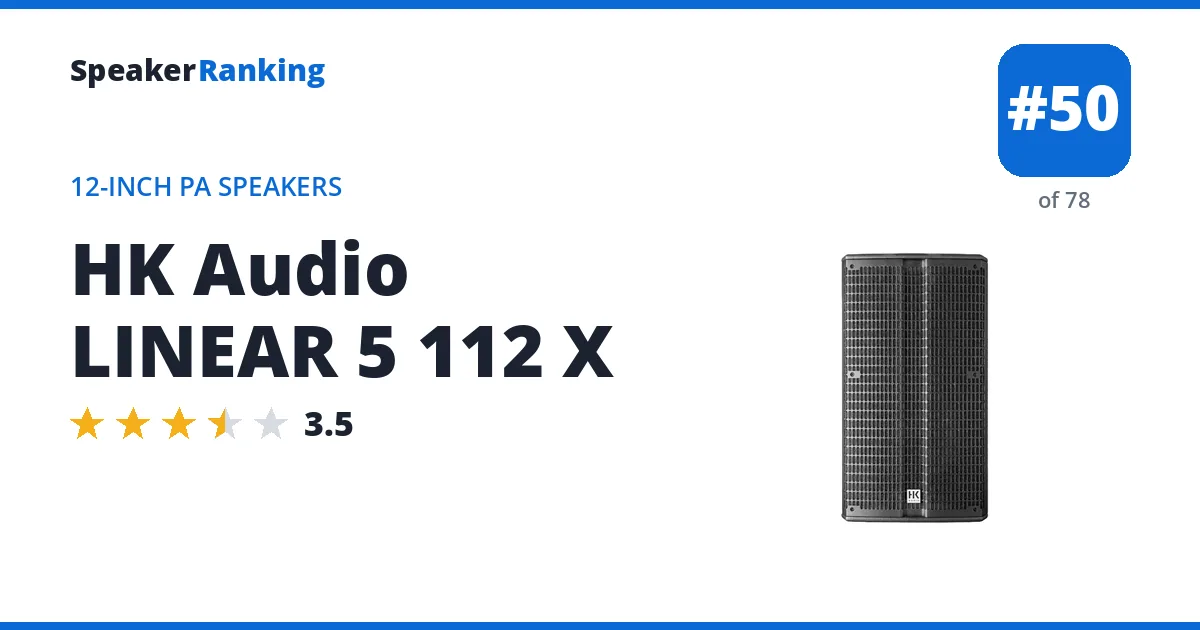
Same family: the HK Audio LINEAR 5 112 F (smaller model, ranked lower, rated 3.2/5) and the HK Audio LINEAR 5 115 F (larger model, estimated 3.1/5).
Pros: High-quality manufacturer measurements give a 5.51 preference score with an ideal subwoofer and 0.63 predicted in-room smoothness. A 12-inch woofer and 1-inch compression driver on a rotatable 60° x 40° CD horn give a 135dB peak and long throw, and the birch and MDF cabinet doubles as a floor monitor. Measured bass extension of 103Hz (-3dB).
Cons: It is designed as a top for use with a subwoofer: bass measures 103Hz at -3dB and about 67Hz at -10dB, and the standalone preference score is only 2.20. A 3.1dB reference band and 0.625 listening-window deviation mean tonal balance is uneven. It is passive and needs an external amplifier, and B&H lists it as special order.
Full HK Audio LINEAR 5 112 X review and specifications →
| AES Input | No |
|---|---|
| Amplifier Power | Passive speaker; requires external amplification |
| Aux Input | No |
| Bass Extension (-10dB) | about 67.1Hz (measured, vendor Spinorama data) |
| Bass Extension (-3dB) | 103Hz (measured, vendor Spinorama data) |
| Bluetooth | No |
| Cabinet Material | Birch/MDF hybrid |
| Coaxial Input | No |
| Configuration | Passive 2-way PA speaker and floor monitor |
| Coverage | 60° x 40° (rotatable) |
| DSP | No (passive) |
| Dimensions | 26.4”H x 14.6”W x 11.8”D (670 x 370 x 300 mm) |
| Drivers | 12” woofer (2.5” voice coil), 1” compression driver (1.75” voice coil) |
| Frequency Response | 100Hz - 18kHz (-6dB, manufacturer specified) |
| Guitar Input | No |
| HDMI Input | No |
| Maximum SPL | 135dB peak (manufacturer specified) |
| Microphone Input | No |
| Optical Input | No |
| Passive | Yes |
| Power Handling | 500W RMS / 1,000W program |
| RCA Input | No |
| Rigging | 3 x M8 rigging points; DuoTilt 3°/7° pole mount |
| Spinorama Preference Score | 2.20 |
| Spinorama Preference Score with Perfect Sub | 5.51 |
| TRS Input | No |
| USB Input | No |
| Weight | 43 lbs (19.5 kg) |
| XLR Input | No |
- Links
- Reviews, Comparisons and Sound Samples
- Head-to-Head Comparisons
 #51 Turbosound NuQ122: $800 each Passive Discontinued eBay
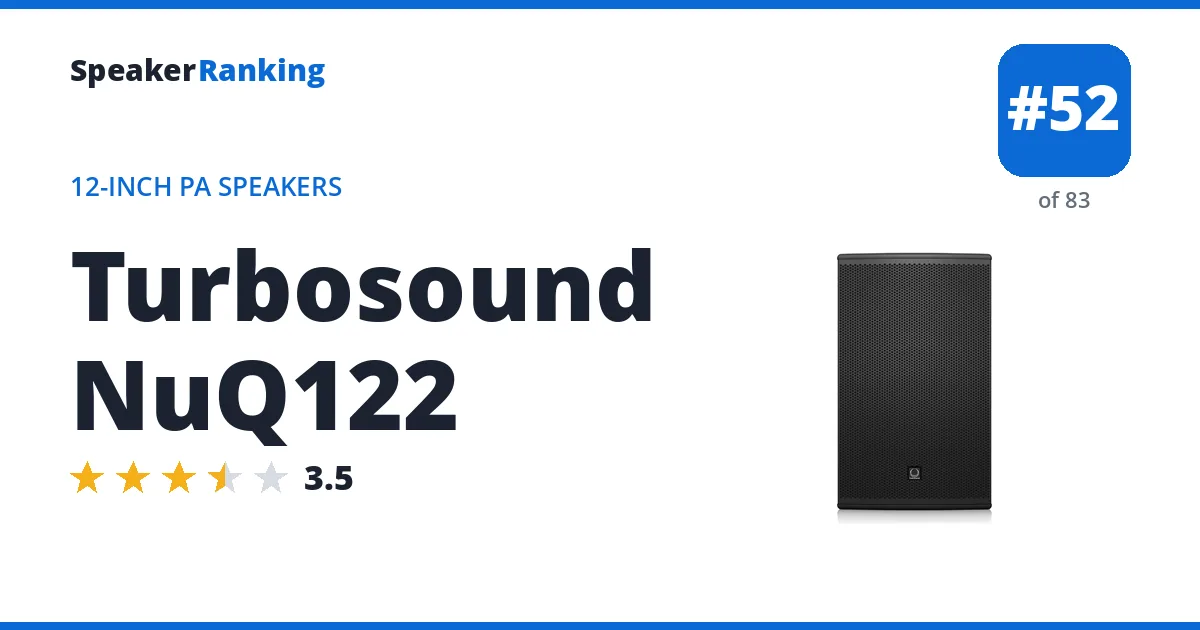
Same family: the Turbosound NuQ62 (smaller model, rated 3.6/5), the Turbosound NuQ82 (smaller model, rated 4.1/5), the Turbosound NuQ102 (smaller model, rated 4/5) and the Turbosound NuQ152 (larger model, rated 3.7/5).
Pros: A passive 12” two-way installation and touring speaker from Turbosound with a compression driver on a rotatable horn. Turbosound’s measurements show a preference score of 2.78 that reaches 5.59 with an ideal subwoofer, with 0.54 listening window deviation.
Cons: That data is low quality and comes from Turbosound. Retailers list it as no longer available. Bass reaches 71.0Hz (-3dB) and about 50Hz (-10dB). That data is low quality. Discontinued.
Full Turbosound NuQ122 review and specifications →
| Bass Extension (-10dB) | about 49.7Hz (measured, manufacturer data via spinorama.org) |
|---|---|
| Bass Extension (-3dB) | 71.0Hz (measured, manufacturer data via spinorama.org) |
| Bluetooth | No |
| DIY Kit | No |
| Drivers | 12” woofer, compression driver on rotatable horn |
| Maximum SPL | 128dB peak (manufacturer specified) |
| Passive | Yes |
| Rigging | 12 x M10 and 4 x M6 inserts; 35mm pole mount |
| Spinorama Preference Score | 2.78 |
| Spinorama Preference Score with Perfect Sub | 5.59 |
| Weight | 43.2 lbs (19.6 kg) |
- Reviews, Comparisons and Sound Samples
 #52 One Systems 212HC Passive eBay
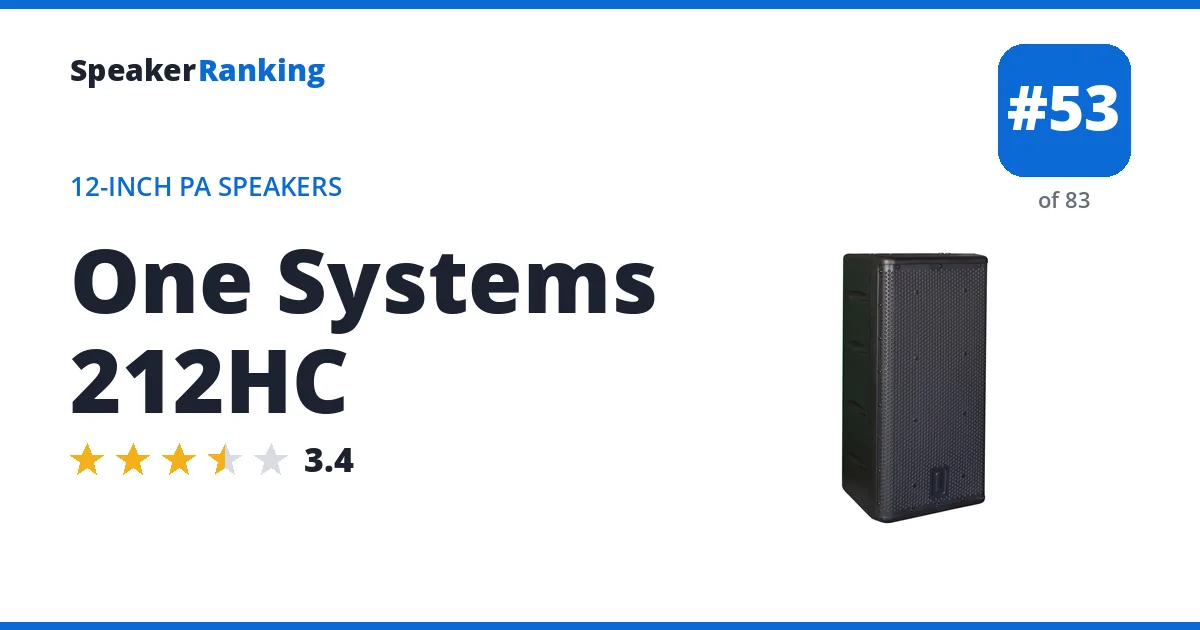
Pros: The flattest on-axis response in this group (0.36dB average deviation in manufacturer measurements), with bass to 73Hz (-3dB) and about 51Hz (-10dB). Sensitivity of 99dB and 1,200W handling give high output for outdoor venues. Measured bass extension of 73Hz (-3dB).
Cons: Preference scores of 2.23 standalone and 4.88 with an ideal subwoofer trail its three-woofer One Systems 312HC sibling, and off-axis tone is less consistent. The 32.8kg cabinet has a narrow 60° pattern. It is passive and sold through pro dealers with no published price.
Full One Systems 212HC review and specifications →
| AES Input | No |
|---|---|
| Amplifier Power | Passive speaker; requires external amplification |
| Aux Input | No |
| Bass Extension (-10dB) | about 51.1Hz (measured, vendor Spinorama data) |
| Bass Extension (-3dB) | 73Hz (measured, vendor Spinorama data) |
| Bluetooth | No |
| Coaxial Input | No |
| Configuration | Passive 2-way PA speaker, IP45 weather rated |
| Coverage | 60° conical |
| DSP | No (passive) |
| Dimensions | 29.5”H x 14.5”W x 16.3”D (749 x 368 x 414 mm) |
| Drivers | 12” woofer, 12” coaxial with large format compression driver |
| Frequency Response | 75Hz - 16kHz (manufacturer specified) |
| Guitar Input | No |
| HDMI Input | No |
| Impedance | 4 ohms |
| Microphone Input | No |
| Optical Input | No |
| Passive | Yes |
| Power Handling | 1,200W continuous / 4,800W peak |
| RCA Input | No |
| Rigging | 15 x M10 suspension points; optional pole mount and pan/tilt brackets |
| Sensitivity | 99dB |
| Spinorama Preference Score | 2.23 |
| Spinorama Preference Score with Perfect Sub | 4.88 |
| TRS Input | No |
| USB Input | No |
| Weight | 72.3 lbs (32.8 kg) |
| XLR Input | No |
- Links
- Reviews, Comparisons and Sound Samples
 #53 Yamaha CBR12: $334.99 Passive Amazon $334.99 eBay
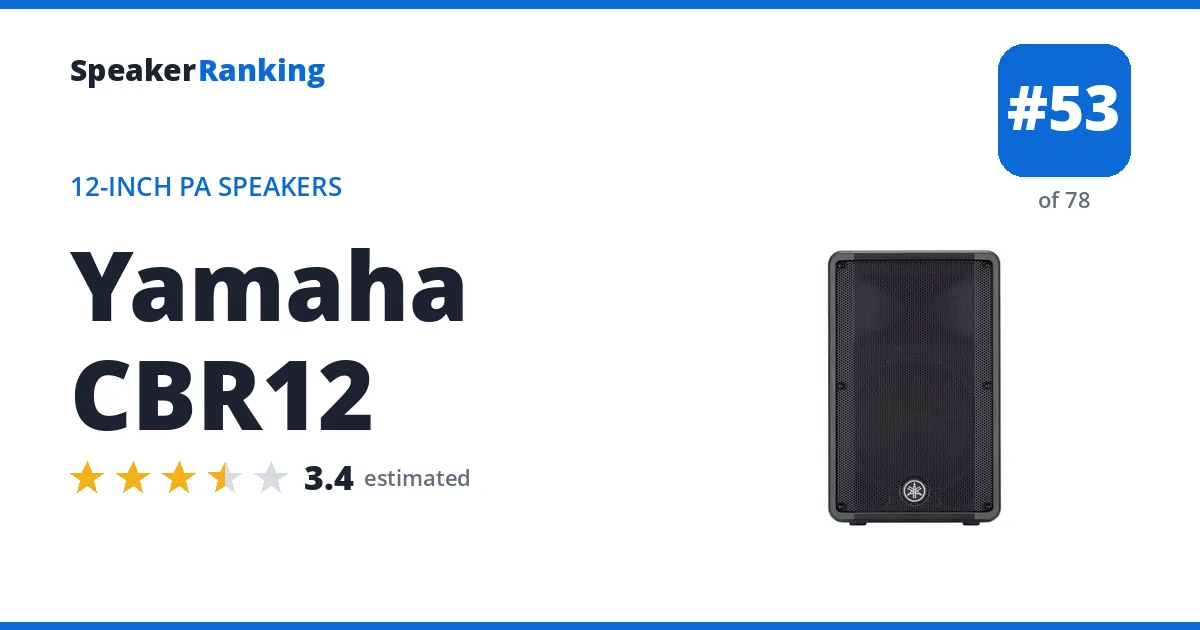
Same family: the Yamaha DBR10 (smallest powered model, rated 3.4/5), the Yamaha DBR12 (powered model, ranked higher, rated 3.6/5), the Yamaha DBR15 (largest powered model, rated 2.9/5), the Yamaha CBR10 (smaller passive model, estimated 3.2/5) and the Yamaha CBR15 (larger passive model, estimated 2.7/5).
Pros: The passive version of the measured Yamaha DBR12, sharing its 12” woofer, compression driver and lightweight polypropylene cabinet with 90° x 60° coverage. Yamaha rates it at 96dB sensitivity, 125dB maximum SPL and bass to 48Hz (-10dB), and at 13.9 kg it is one of the lighter 12-inch boxes.
Cons: No independent measurements yet, so it can’t be compared with ranked PA speakers. It needs an external amplifier, and without the powered model’s DSP its response depends on the amplifier’s EQ. The measured powered version is a budget design, so expect the same limits on output and smoothness.
Full Yamaha CBR12 review and specifications →
| Released | Dec 2014 (11 years ago) |
|---|---|
| Amplifier Power | Passive speaker; requires external amplification |
| Bluetooth | No |
| Configuration | Passive 2-way bass-reflex PA speaker |
| Coverage | 90° x 60° |
| DSP | No (passive) |
| Drivers | 12” woofer, 1” voice coil compression driver |
| Frequency Response | 48Hz - 20kHz (-10dB, manufacturer specified) |
| Impedance | 8 ohms |
| Maximum SPL | 125dB (calculated, manufacturer specified) |
| Passive | Yes |
| Power Handling | 700W peak |
| Rigging | 3 x M8 eyebolt points; 35mm pole mount |
| Sensitivity | 96dB |
| Weight | 30.6 lbs (13.9 kg) |
| XLR Input | No |
- Links
- Reviews, Comparisons and Sound Samples
- No independent measurement review is linked for this model; it is ranked from hands-on listening and comparison against similarly priced speakers.
- Head-to-Head Comparisons
 #54 PreSonus CDL12 Discontinued eBay
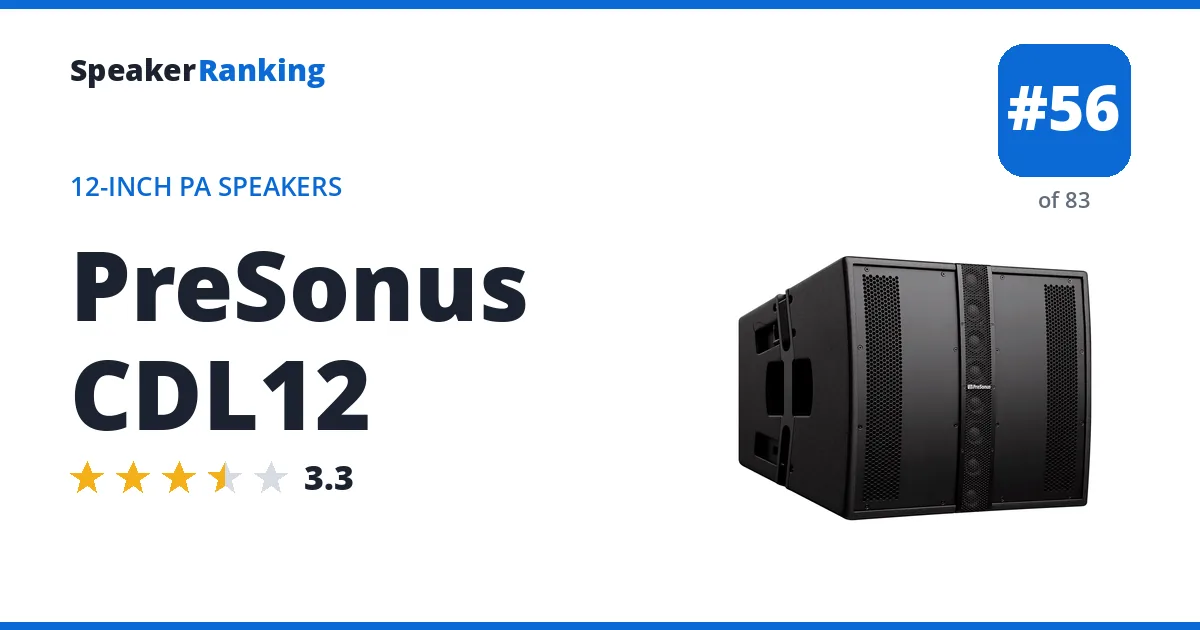
Newer model: the PreSonus CDL12P, ranked higher, estimated 3.5/5, released Oct 2020. See every PreSonus CDL12 generation.
Pros: Its constant-directivity high-frequency array is designed for controlled coverage and scalable deployments rather than a conventional single horn. The medium-quality vendor data provides a 4.79 ideal-subwoofer preference score and 58Hz measured extension. Measured bass extension of 58Hz (-3dB).
Cons: This is a specialized, heavier cabinet whose rigging and array behavior add complexity for ordinary portable-PA buyers. The measured tonal score is modest, and availability is less consistent than the mainstream QSC, JBL, Yamaha and RCF choices. Discontinued.
Full PreSonus CDL12 review and specifications →
| Released | Sep 2018 (8 years ago) |
|---|---|
| AES Input | No |
| Amplifier Power | 2,000W peak / 500W RMS (1,000W peak / 250W RMS per band, manufacturer specified) |
| Aux Input | No |
| Bass Extension (-3dB) | 58Hz (measured, vendor Spinorama data) |
| Bluetooth | No |
| Cabinet Material | 15mm eucalyptus plywood |
| Coaxial Input | No |
| Configuration | Active 2-way constant-directivity PA speaker |
| Coverage | 120° x 20° per enclosure (-6dB) |
| Crossover Frequency | 420Hz (manufacturer specified) |
| DSP | Yes |
| Dimensions | 18.6”H x 20.8”W x 17.5”D (473 x 529 x 444.5 mm) |
| Drivers | 12” woofer, eight 2” high-frequency drivers |
| Guitar Input | No |
| HDMI Input | No |
| Inputs | XLR input and direct XLR line output |
| Maximum SPL | 131dB peak |
| Microphone Input | No |
| Network Control | Worx Control remote control (compression, polarity, limiting, delay, EQ and presets) |
| Optical Input | No |
| Passive | No |
| RCA Input | No |
| Rigging | Integrated array rigging; dual-position 35mm pole mount |
| Spinorama Preference Score | 2.20 |
| Spinorama Preference Score with Perfect Sub | 4.79 |
| TRS Input | No |
| USB Input | No |
| Weight | 65 lbs (29.5 kg) |
| XLR Input | Yes |
- Links
- Reviews, Comparisons and Sound Samples
- Head-to-Head Comparisons
 #55 Electro-Voice MFX-12MC: $2,805.33 Passive Amazon $2,805.33 Lowest B&H Photo Video $2,829.95 eBay

Same family: the Electro-Voice MFX-15MC (larger model, rated 3.6/5).
Pros: The coaxial 12-inch design provides compact 60° x 40° coverage and reaches a claimed 135dB peak with the recommended amplification. Medium-quality vendor data returns a 3.78 ideal-subwoofer preference score. Measured bass extension of 82.5Hz (-3dB).
Cons: This is not self-powered: it requires an external amplifier and can be run passive or externally bi-amplified, so it is less convenient than every conventional powered cabinet here. Measured bass extension is about 75Hz and the narrow pattern is aimed primarily at stage-monitor and fill use.
Full Electro-Voice MFX-12MC review and specifications →
| AES Input | No |
|---|---|
| Amplifier Power | Passive/bi-amp speaker; use external amplification within the 450W continuous / 3,000W peak handling rating |
| Aux Input | No |
| Bass Extension (-3dB) | 82.5Hz (measured, vendor Spinorama data) |
| Bluetooth | No |
| Cabinet Material | 12-18mm Baltic birch plywood with EVCoat finish |
| Coaxial Input | No |
| Configuration | Passive or externally bi-amplified 2-way coaxial PA monitor |
| Coverage | 60° x 40°, rotatable |
| DSP | Requires external amplifier/DSP settings |
| Dimensions | 19.7”H x 16.5”W x 11.7”D (500 x 420 x 298 mm) |
| Drivers | 12” coaxial LF/MF driver, 3” HF compression driver |
| Frequency Response | 62Hz - 18kHz (-3dB, manufacturer specified); 50Hz - 19kHz (-10dB) |
| Guitar Input | No |
| HDMI Input | No |
| Inputs | NL4 speakON input and link |
| Maximum SPL | 135dB peak with recommended amplification |
| Microphone Input | No |
| Optical Input | No |
| Passive | Yes |
| Power Handling | 450W continuous / 3,000W peak (manufacturer specified) |
| RCA Input | No |
| Rigging | Four M10 suspension points; integrated 35mm pole cup |
| TRS Input | No |
| USB Input | No |
| Weight | 41.9 lbs (19 kg) |
| XLR Input | No |
- Links
- Reviews, Comparisons and Sound Samples
- Head-to-Head Comparisons
 #56 JBL CV5012 Passive eBay
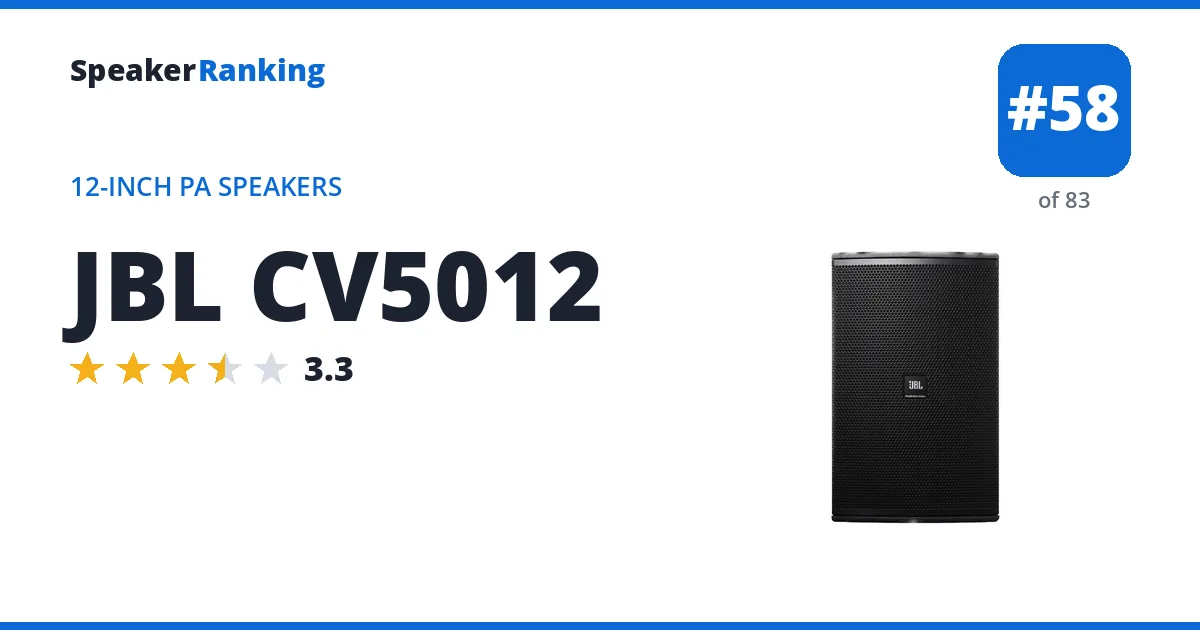
Same family: the JBL CV5015 (larger model, rated 3.3/5).
Pros: The flattest on-axis response of the JBL CV models (0.31dB average deviation in vendor measurements), with bass to about 56Hz at -10dB. A 138dB peak and 98dB sensitivity give big output, and the IP55 birch cabinet suits outdoor venues. Measured bass extension of 92.5Hz (-3dB).
Cons: Preference scores of 1.46 standalone and 4.71 with an ideal subwoofer are modest, because the narrow 60° x 40° pattern makes the off-axis and in-room balance less even. It is passive and weighs 25kg.
Full JBL CV5012 review and specifications →
| AES Input | No |
|---|---|
| Amplifier Power | Passive speaker; requires external amplification |
| Aux Input | No |
| Bass Extension (-10dB) | about 56.3Hz (measured, vendor Spinorama data) |
| Bass Extension (-3dB) | 92.5Hz (measured, vendor Spinorama data) |
| Bluetooth | No |
| Coaxial Input | No |
| Configuration | Passive 2-way PA speaker, IP55 weather rated |
| Coverage | 60° x 40° |
| DSP | No (passive) |
| Dimensions | 24.8”H x 15.5”W x 16.9”D (630 x 394 x 429 mm) |
| Drivers | 12” woofer with 3” voice coil, JBL 2432H-1 compression driver |
| Frequency Response | 80Hz - 20kHz (±3dB, manufacturer specified) |
| Guitar Input | No |
| HDMI Input | No |
| Impedance | 8 ohms |
| Maximum SPL | 138dB peak / 126dB continuous (manufacturer specified) |
| Microphone Input | No |
| Optical Input | No |
| Passive | Yes |
| Power Handling | 600W continuous / 2,400W peak |
| RCA Input | No |
| Rigging | 13 x M10 inserts on top, bottom, back and sides |
| Sensitivity | 98dB |
| Spinorama Preference Score | 1.46 |
| Spinorama Preference Score with Perfect Sub | 4.71 |
| TRS Input | No |
| USB Input | No |
| Weight | 55.1 lbs (25 kg) |
| XLR Input | No |
- Links
- Reviews, Comparisons and Sound Samples
 #57 Bose AMM112 Passive B&H eBay

Same family: the Bose AMM108 (smaller model, rated 3.2/5).
Pros: High-quality manufacturer measurements show a smooth on-axis response (0.87dB average deviation), and the wedge-shaped cabinet works as a main, fill or floor monitor with wide 110° x 60° coverage and a 131dB peak. Measured bass extension of 87.5Hz (-3dB).
Cons: Preference scores of 1.38 standalone and 4.58 with an ideal subwoofer are modest, with bass to 88Hz at -3dB and only about 74Hz at -10dB, shallow for a 12-inch woofer. It is passive and weighs 22kg.
Full Bose AMM112 review and specifications →
| Released | Apr 2021 (5 years ago) |
|---|---|
| AES Input | No |
| Amplifier Power | Passive speaker; requires external amplification |
| Aux Input | No |
| Bass Extension (-10dB) | about 73.6Hz (measured, vendor Spinorama data) |
| Bass Extension (-3dB) | 87.5Hz (measured, vendor Spinorama data) |
| Bluetooth | No |
| Coaxial Input | No |
| Configuration | Passive 2-way coaxial PA speaker |
| Coverage | 110° x 60° |
| DSP | No (passive) |
| Dimensions | 18”H x 18”W x 15.1”D (457 x 457 x 383 mm) |
| Drivers | 12” coaxial woofer and compression driver |
| Frequency Response | 70Hz - 18kHz (-3dB, manufacturer specified) |
| Guitar Input | No |
| HDMI Input | No |
| Maximum SPL | 131dB peak / 121dB continuous (manufacturer specified) |
| Microphone Input | No |
| Optical Input | No |
| Passive | Yes |
| RCA Input | No |
| Rigging | 2 x 35mm pole cups; 6 x M10 inserts |
| Sensitivity | 96dB |
| Spinorama Preference Score | 1.38 |
| Spinorama Preference Score with Perfect Sub | 4.58 |
| TRS Input | No |
| USB Input | No |
| Weight | 48.5 lbs (22 kg) |
| XLR Input | No |
- Links
- Reviews, Comparisons and Sound Samples
- Head-to-Head Comparisons
 #58 Amate Audio X12CLA: $4,150 Discontinued eBay
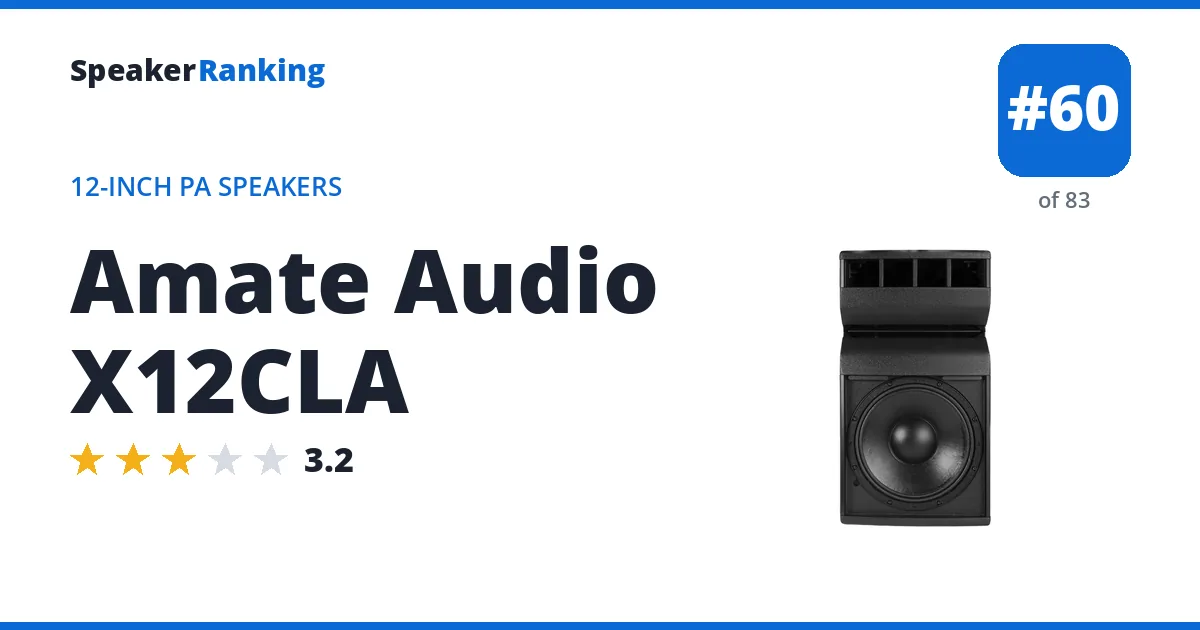
Pros: Its medium-quality vendor Spinorama data yields a 4.07 ideal-subwoofer preference score and 58Hz bass extension. The 100° x 15° constant-curvature pattern, 132dB claimed peak output and networked DSP suit tightly controlled flown clusters. Measured bass extension of 71Hz (-3dB).
Cons: The very narrow 15° vertical pattern is specialized rather than broadly useful as a single portable main, and the 31.5kg enclosure is the heaviest cabinet near this part of the ranking. It is discontinued and expensive, while the measured tonal score trails the stronger point-source options.
Full Amate Audio X12CLA review and specifications →
| AES Input | No |
|---|---|
| Amplifier Power | 1,500W program (1,000W LF + 500W HF, manufacturer specified) |
| Aux Input | No |
| Bass Extension (-3dB) | 71Hz (measured, vendor Spinorama data) |
| Bluetooth | No |
| Cabinet Material | Multilayer birch plywood with weatherproof polyurea finish |
| Coaxial Input | No |
| Configuration | Active 2-way constant-curvature PA speaker |
| Coverage | 100° x 15° |
| DSP | Yes, with Ethernet/Wi-Fi control |
| Dimensions | 13.9”H x 25.2”W x 19.1”D (352 x 640 x 485 mm) |
| Drivers | 12” neodymium woofer, 2.5” compression driver |
| Frequency Response | 58Hz - 19kHz (-10dB, manufacturer specified) |
| Guitar Input | No |
| HDMI Input | No |
| Inputs | Balanced XLR input and link |
| Maximum SPL | 132dB peak (manufacturer specified) |
| Microphone Input | No |
| Network Control | EtherCON Ethernet connection/link |
| Optical Input | No |
| Passive | No |
| RCA Input | No |
| Rigging | M8 flying points (multiple combinations for horizontal/vertical arrays via integrated rigging frame), plus optional pole-mount adaptor for tripod/sub-top use |
| Spinorama Preference Score | 1.48 |
| Spinorama Preference Score with Perfect Sub | 4.07 |
| TRS Input | No |
| USB Input | No |
| Weight | 69.4 lbs (31.5 kg) |
| XLR Input | Yes |
- Links
- Reviews, Comparisons and Sound Samples
- Head-to-Head Comparisons
 #59 RCF ART 732-A MK4 Discontinued Guitar Center eBay
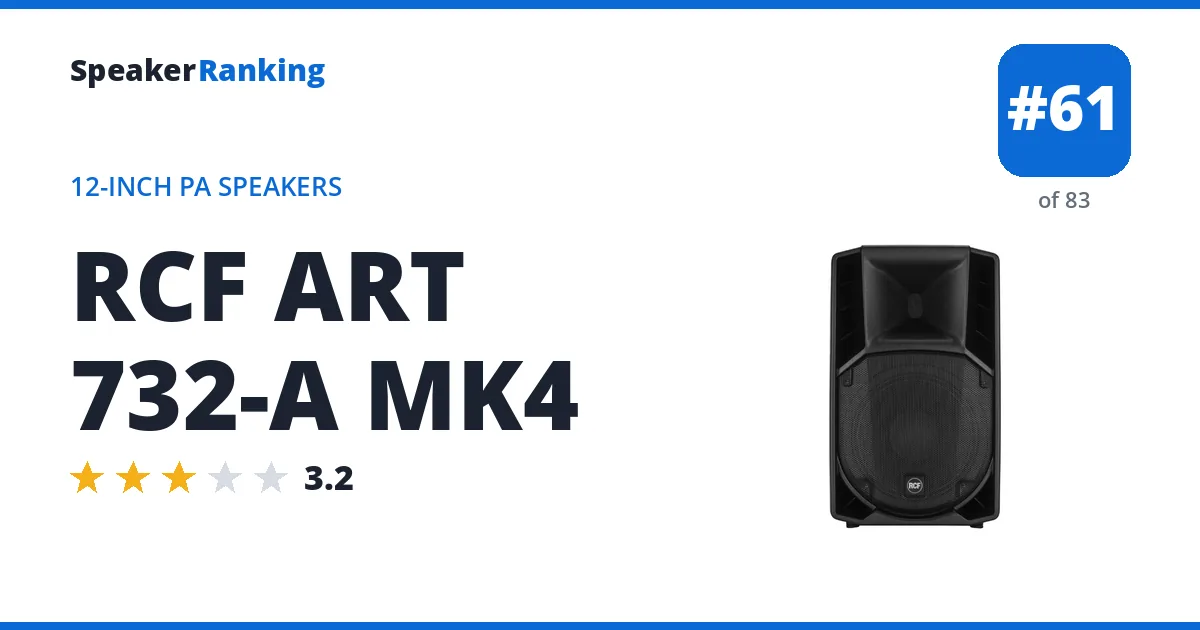
Newer model: the RCF ART 732-A MK5, ranked higher, rated 3.8/5, released Jan 2024. See every RCF ART 7 generation.
Pros: Its large 3-inch compression-driver voice coil, 131dB claimed peak and roughly 53Hz measured extension give it useful vocal headroom and more bass reach than the RCF ART 712-A MK4. The 17.8kg enclosure remains easy to carry. Measured bass extension of 53Hz (-3dB).
Cons: The low-quality vendor data is truncated and does not yield a preference score. It is discontinued, lacks modern remote control and is eclipsed by the better-supported RCF ART 732-A MK5 and current 9-series models.
Full RCF ART 732-A MK4 review and specifications →
| Released | Jul 2019 (7 years ago) |
|---|---|
| AES Input | No |
| Amplifier Power | 1,400W peak / 700W RMS (1,000W LF + 400W HF peak, manufacturer specified) |
| Aux Input | No |
| Bass Extension (-3dB) | 53Hz (measured, vendor Spinorama data) |
| Bluetooth | No |
| Cabinet Material | Polypropylene composite |
| Coaxial Input | No |
| Configuration | Active 2-way bass-reflex PA speaker |
| Coverage | 90° x 60° |
| Crossover Frequency | 700Hz (manufacturer specified) |
| DSP | Yes, FiRPHASE, EQ, limiting and protection |
| Dimensions | 25.1”H x 15.2”W x 14.3”D (637 x 387 x 363 mm) |
| Drivers | 12” woofer, 1.4” compression driver with 3” voice coil |
| Frequency Response | 50Hz - 20kHz (manufacturer specified) |
| Guitar Input | No |
| HDMI Input | No |
| Inputs | XLR/TRS combo input and XLR link |
| Maximum SPL | 131dB peak (manufacturer specified) |
| Microphone Input | No |
| Optical Input | No |
| Passive | No |
| RCA Input | No |
| Rigging | Two M10 fly points; pole mount |
| TRS Input | Yes |
| USB Input | No |
| Weight | 39.2 lbs (17.8 kg) |
| XLR Input | Yes |
- Links
- Reviews, Comparisons and Sound Samples
- Head-to-Head Comparisons
- RCF ART 732-A MK4 vs Amate Audio X12CLA
- RCF ART 732-A MK4 vs RCF ART 712-A MK4
- RCF ART 732-A MK4 vs Electro-Voice MFX-12MC
- RCF ART 732-A MK4 vs Martin Audio XP12
- RCF ART 732-A MK4 vs Audiofocus VENU 12a
- RCF ART 732-A MK4 vs PreSonus ULT12
- RCF ART 732-A MK4 vs RCF HD 12-A MK5
- RCF ART 732-A MK4 vs RCF ART 712-A MK5
- See all 25 comparisons
 #60 HK Audio LINEAR 5 112 F: $666 Passive Thomann $666 eBay
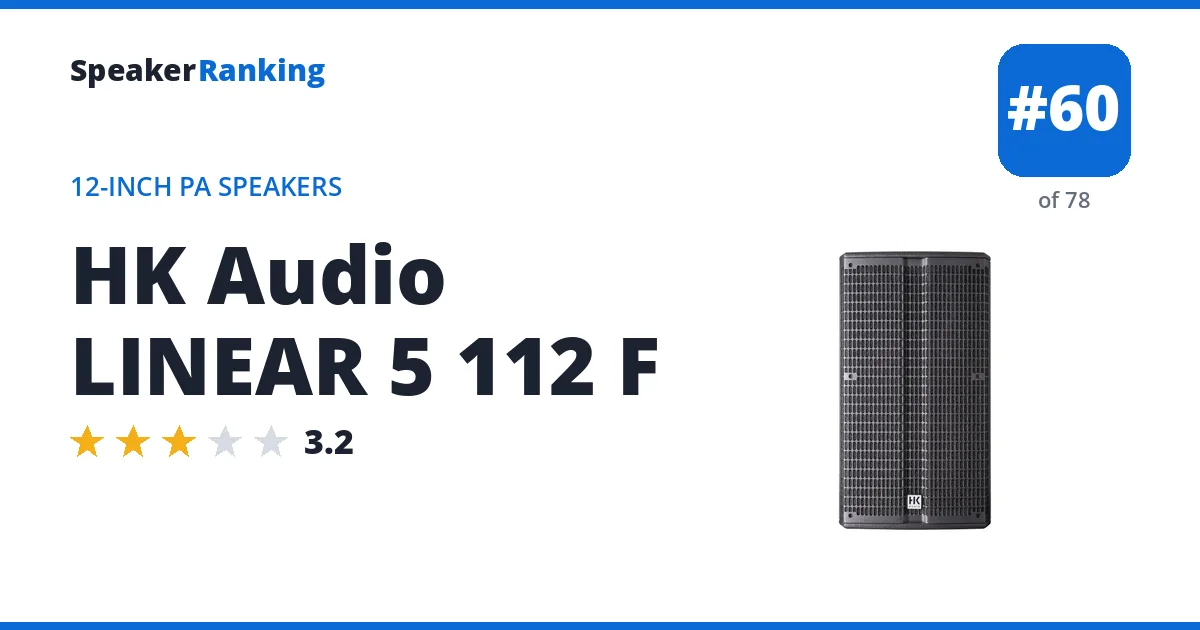
Same family: the HK Audio LINEAR 5 112 X (larger model, ranked higher, rated 3.5/5) and the HK Audio LINEAR 5 115 F (larger model, estimated 3.1/5).
Pros: The passive version of the HK Audio LINEAR 5 112 FA, with a 12-inch woofer and 1-inch compression driver on a rotatable asymmetric horn that widens from 60° to 90°, rated to 135dB peak. High-quality manufacturer measurements give a 4.21 preference score with an ideal subwoofer, and bass reaches about 60Hz at -10dB. Measured bass extension of 82.5Hz (-3dB).
Cons: The standalone preference score is only 1.13, with a 0.806 listening-window deviation and bass measuring 82.5Hz at -3dB, so tonal balance is uneven and it needs a subwoofer. It is passive and needs an external amplifier; B&H no longer carries it.
Full HK Audio LINEAR 5 112 F review and specifications →
| AES Input | No |
|---|---|
| Amplifier Power | Passive speaker; requires external amplification |
| Aux Input | No |
| Bass Extension (-10dB) | about 60Hz (measured, vendor Spinorama data) |
| Bass Extension (-3dB) | 82.5Hz (measured, vendor Spinorama data) |
| Bluetooth | No |
| Coaxial Input | No |
| Configuration | Passive 2-way PA speaker |
| Coverage | 60°-90° asymmetric x 55° (rotatable) |
| DSP | No (passive) |
| Dimensions | 26.3”H x 14.6”W x 14.4”D (668 x 370 x 365 mm) |
| Drivers | 12” woofer (2.5” voice coil), 1” compression driver (1.75” voice coil) |
| Frequency Response | 79Hz - 18kHz (-6dB, manufacturer specified) |
| Guitar Input | No |
| HDMI Input | No |
| Maximum SPL | 135dB peak (manufacturer specified) |
| Microphone Input | No |
| Optical Input | No |
| Passive | Yes |
| Power Handling | 500W RMS / 1,000W program |
| RCA Input | No |
| Rigging | 3 x M8 rigging points; DuoTilt 3°/7° pole mount |
| Spinorama Preference Score | 1.13 |
| Spinorama Preference Score with Perfect Sub | 4.21 |
| TRS Input | No |
| USB Input | No |
| Weight | 52.7 lbs (23.9 kg) |
| XLR Input | No |
- Links
- Reviews, Comparisons and Sound Samples
- Head-to-Head Comparisons
 #61 Electro-Voice EVC-1122: $1,309.95 Passive B&H $1,309.95 eBay

Same family: the Electro-Voice EVC-1082 (smaller model, rated 3.4/5) and the Electro-Voice EVC-1152 (larger model, rated 3.3/5).
Pros: Bass reaches 67Hz at -3dB and about 51Hz at -10dB in vendor measurements, with 95dB sensitivity and a 126dB maximum for halls and gyms. The rotatable waveguide allows vertical or horizontal mounting. Measured bass extension of 67Hz (-3dB).
Cons: Preference scores of 1.55 standalone and 4.21 with an ideal subwoofer are low for a 12-inch speaker, with the listening window spread across 3dB and inconsistent off-axis tone. It is passive and weighs 21.8kg.
Full Electro-Voice EVC-1122 review and specifications →
| AES Input | No |
|---|---|
| Amplifier Power | Passive speaker; requires external amplification |
| Aux Input | No |
| Bass Extension (-10dB) | about 50.5Hz (measured, vendor Spinorama data) |
| Bass Extension (-3dB) | 67Hz (measured, vendor Spinorama data) |
| Bluetooth | No |
| Coaxial Input | No |
| Configuration | Passive 2-way installation PA speaker |
| Coverage | 90° x 55° (rotatable) |
| DSP | No (passive) |
| Drivers | 12” EVS-12M woofer, compression driver on a rotatable waveguide |
| Frequency Response | 70Hz - 22kHz (manufacturer specified) |
| Guitar Input | No |
| HDMI Input | No |
| Impedance | 8 ohms |
| Maximum SPL | 126dB (manufacturer calculated) |
| Microphone Input | No |
| Optical Input | No |
| Passive | Yes |
| Power Handling | 300W continuous |
| RCA Input | No |
| Rigging | 12 x M10 threaded inserts; 36mm pole socket |
| Sensitivity | 95dB |
| Spinorama Preference Score | 1.55 |
| Spinorama Preference Score with Perfect Sub | 4.21 |
| TRS Input | No |
| USB Input | No |
| Weight | 48.1 lbs (21.8 kg) |
| XLR Input | No |
- Links
- Reviews, Comparisons and Sound Samples
- Head-to-Head Comparisons
 #62 JBL CV3012 Passive eBay
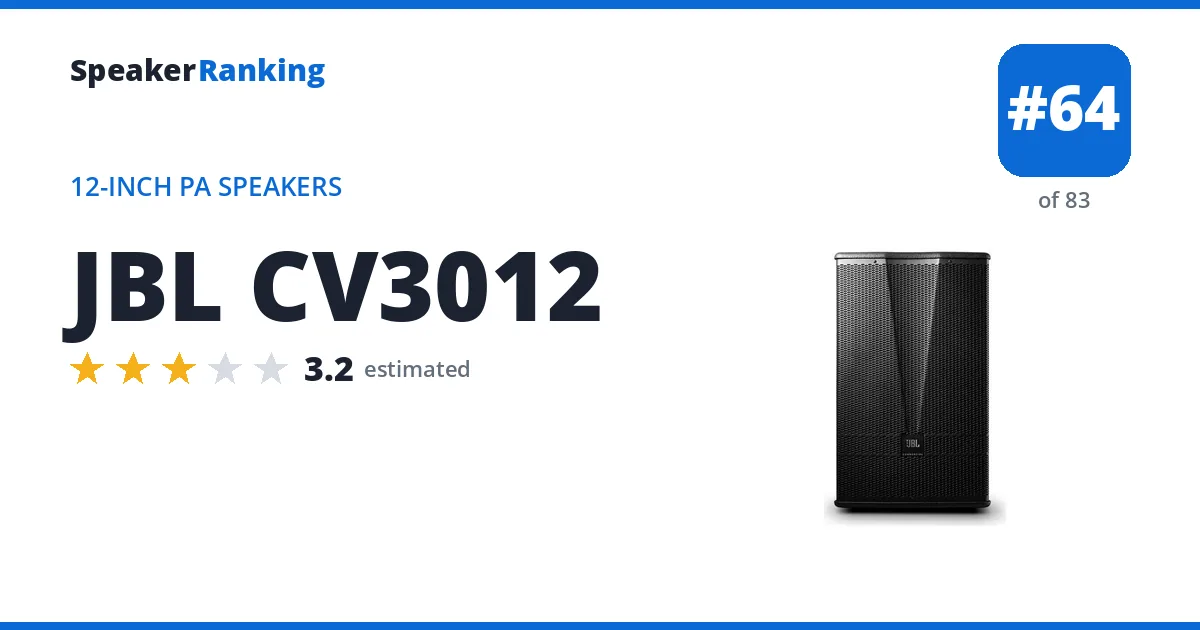
Same family: the JBL CV3010 (smaller model, estimated 3.2/5), the JBL CV3015 (larger model, rated 3.2/5) and the JBL CV3025 (larger model, estimated 3.1/5).
Pros: A passive installation speaker from JBL’s CV3000 range alongside the measured JBL CV3015: a 12” woofer with the same compression driver. JBL rates it at 97.5dB sensitivity and 129dB peak / 123dB continuous with 90° x 90° coverage, so modest amplifier power fills a restaurant, ballroom or event space.
Cons: No independent measurements yet, so it can’t be compared with ranked PA speakers. It is sold through installation dealers rather than general retailers, and it needs an external amplifier with JBL’s recommended EQ for its rated response.
Full JBL CV3012 review and specifications →
| Amplifier Power | Passive speaker; requires external amplification |
|---|---|
| Bluetooth | No |
| Configuration | Passive 2-way PA speaker |
| Coverage | 90° x 90° |
| DSP | No (passive) |
| Dimensions | 23.6”H x 14.4”W x 15.4”D (600 x 365 x 392 mm) |
| Drivers | 12” woofer with 2.5” voice coil, JBL 2408-2 compression driver |
| Frequency Response | 47Hz - 20kHz (-10dB, manufacturer specified) |
| Maximum SPL | 129dB peak / 123dB continuous (manufacturer specified) |
| Passive | Yes |
| Power Handling | 350W continuous / 1,400W peak |
| Rigging | 13 x M10 inserts; 35mm pole socket |
| Sensitivity | 97.5dB |
| Weight | 41.6 lbs (18.85 kg) |
| XLR Input | No |
- Links
- Reviews, Comparisons and Sound Samples
- No independent measurement review is linked for this model; it is ranked from hands-on listening and comparison against similarly priced speakers.
 #63 RCF ART 712-A MK4: $509.00 Discontinued Guitar Center $509.00 eBay
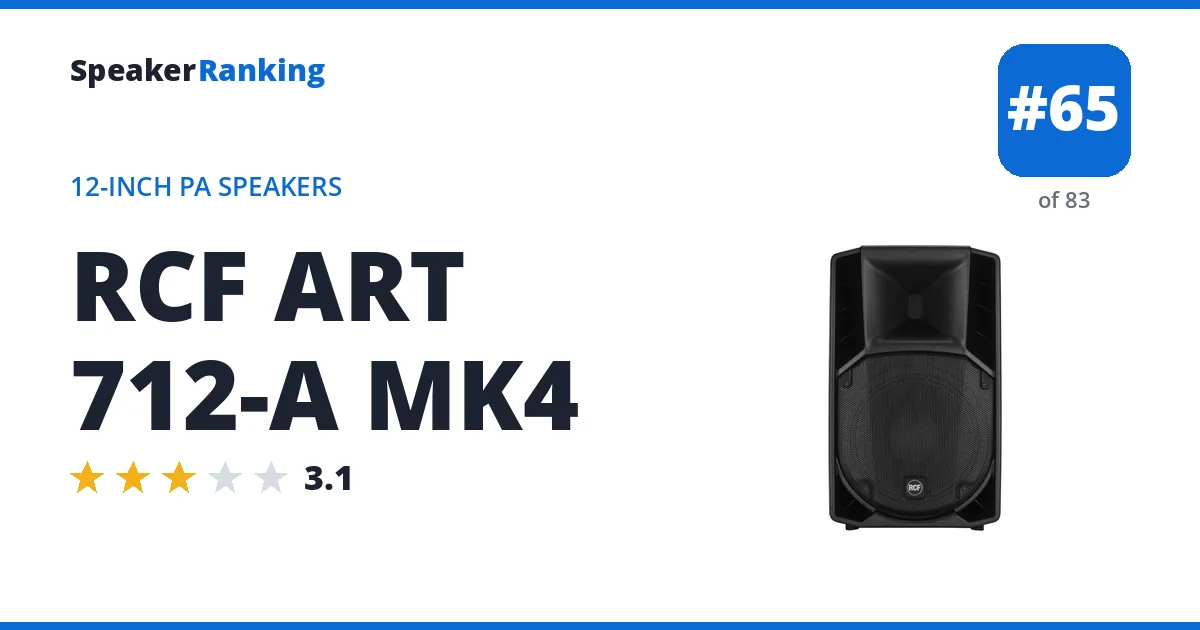
Newer model: the RCF ART 712-A MK5, ranked higher, rated 3.6/5, released Jan 2024. See every RCF ART 7 generation.
Pros: The 17.8kg cabinet combines 129dB claimed peak output, a broad horn and RCF’s FiRPHASE processing in a straightforward package. Its measured response extends to roughly 65Hz before the first major roll-off. Measured bass extension of 65Hz (-3dB).
Cons: The low-quality vendor measurement is truncated and cannot produce a reliable preference score. This discontinued MK4 offers little reason to choose it over the newer RCF ART 712-A MK5 unless the used price is substantially lower.
Full RCF ART 712-A MK4 review and specifications →
| Released | Aug 2017 (9 years ago) |
|---|---|
| AES Input | No |
| Amplifier Power | 1,400W peak / 700W RMS (1,000W LF + 400W HF peak, manufacturer specified) |
| Aux Input | No |
| Bass Extension (-3dB) | 65Hz (measured, vendor Spinorama data) |
| Bluetooth | No |
| Cabinet Material | Polypropylene composite |
| Coaxial Input | No |
| Configuration | Active 2-way bass-reflex PA speaker |
| Coverage | 90° x 60° |
| Crossover Frequency | 1.6kHz (manufacturer specified) |
| DSP | Yes, FiRPHASE, EQ, limiting and protection |
| Dimensions | 25.1”H x 15.2”W x 14.3”D (637 x 387 x 363 mm) |
| Drivers | 12” woofer, 1” compression driver |
| Frequency Response | 50Hz - 20kHz (manufacturer specified) |
| Guitar Input | No |
| HDMI Input | No |
| Inputs | XLR/TRS combo input and XLR link |
| Maximum SPL | 129dB peak (manufacturer specified) |
| Microphone Input | No |
| Optical Input | No |
| Passive | No |
| RCA Input | No |
| Rigging | Two M10 fly points; pole mount |
| TRS Input | Yes |
| USB Input | No |
| Weight | 39.2 lbs (17.8 kg) |
| XLR Input | Yes |
- Links
- Reviews, Comparisons and Sound Samples
- Head-to-Head Comparisons
- RCF ART 712-A MK4 vs RCF ART 732-A MK4
- RCF ART 712-A MK4 vs Amate Audio X12CLA
- RCF ART 712-A MK4 vs Audiofocus VENU 12a
- RCF ART 712-A MK4 vs PreSonus ULT12
- RCF ART 712-A MK4 vs Martin Audio XP12
- RCF ART 712-A MK4 vs RCF HD 12-A MK5
- RCF ART 712-A MK4 vs RCF ART 712-A MK5
- RCF ART 712-A MK4 vs Yamaha DBR12
- See all 24 comparisons
 #64 Martin Audio CDD-LIVE 12: $3,000.00 Full Compass $3,000.00 eBay

Same family: the Martin Audio CDD-LIVE 8 (smaller powered model, estimated 3.4/5), the Martin Audio CDD-LIVE 15 (larger powered model, estimated 3.5/5), the Martin Audio CDD5 (smallest passive model, estimated 3/5), the Martin Audio CDD6 (passive model, estimated 3.1/5), the Martin Audio CDD8 (passive model, rated 3.2/5), the Martin Audio CDD10 (passive model, rated 3.1/5), the Martin Audio CDD12 (passive model, ranked lower, rated 2.9/5) and the Martin Audio CDD15 (largest passive model, rated 3.3/5).
Pros: The self-powered version of the measured Martin Audio CDD12, with the same 12” Coaxial Differential Dispersion driver plus built-in Class D amplification, DSP tuning and Dante networking. Martin rates it at 128dB peak / 122dB continuous with bass to 50Hz (-10dB), and the coaxial driver rotates for horizontal or vertical mounting.
Cons: No independent measurements yet, so it can’t be compared with ranked PA speakers. It costs far more than most powered PA speakers of its size, and the CDD design favors even coverage over maximum throw.
Full Martin Audio CDD-LIVE 12 review and specifications →
| Released | 2016 (10 years ago) |
|---|---|
| Amplifier Power | Class D, bi-amplified |
| Bass Extension (-3dB) | 62Hz (manufacturer specified) |
| Bluetooth | No |
| Configuration | Active 2-way coaxial PA speaker |
| DSP | Yes |
| Drivers | 12” woofer with coaxial 1” exit HF driver |
| Frequency Response | 62Hz - 20kHz (±3dB), 50Hz (-10dB) (manufacturer specified) |
| Maximum SPL | 128dB peak / 122dB continuous (manufacturer specified) |
| Network Control | Dante |
| Passive | No |
| Rigging | 15 x M8 inserts; top hat pole mount |
| Weight | 61.7 lbs (28 kg) |
| XLR Input | Yes |
- Links
- Reviews, Comparisons and Sound Samples
- No independent measurement review is linked for this model; it is ranked from hands-on listening and comparison against similarly priced speakers.
- Head-to-Head Comparisons
 #65 Tannoy VX12: $860 each Passive eBay
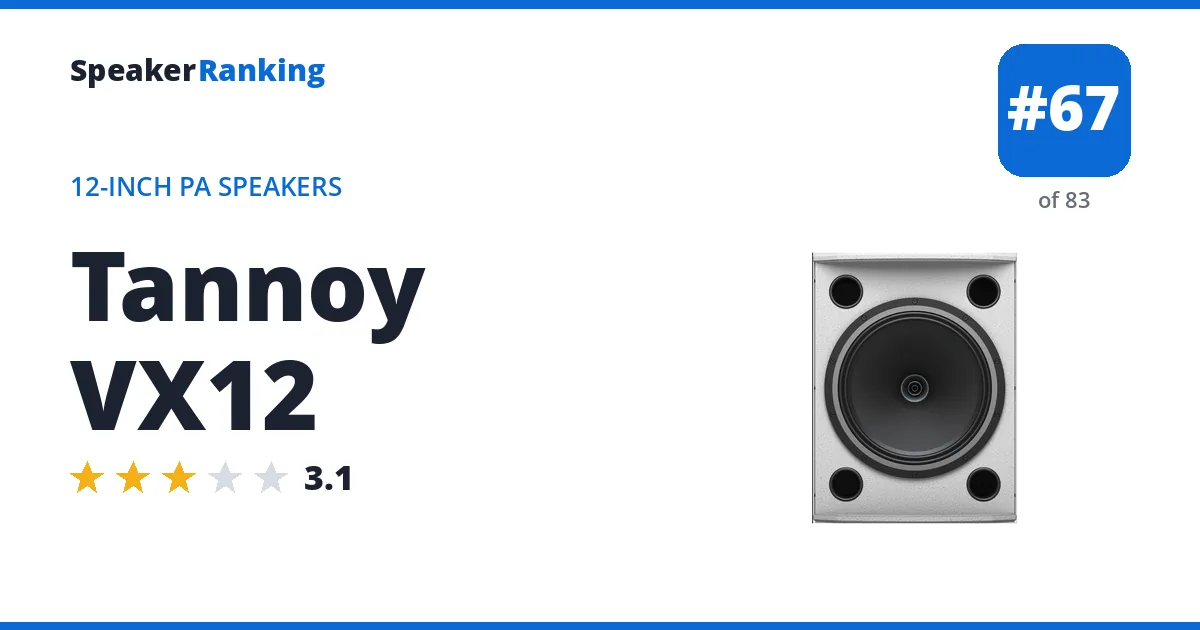
Same family: the Tannoy VX6 (smaller model, estimated 2.9/5), the Tannoy VX8 (smaller model, estimated 3/5) and the Tannoy VX15HP (larger model, estimated 3.1/5).
Pros: A passive installation speaker from Tannoy with a 12” Dual Concentric driver, its tweeter mounted in the center of the woofer. Tannoy’s data shows a flat on-axis response (0.46 average deviation). Tannoy’s measurements show a preference score of 1.94 that reaches 5.02 with an ideal subwoofer, with 0.62 listening window deviation.
Cons: Bass is limited for its size, so it is meant to be used with subwoofers. Bass reaches 90.0Hz (-3dB) and about 61Hz (-10dB).
Full Tannoy VX12 review and specifications →
| Bass Extension (-10dB) | about 60.6Hz (measured, manufacturer data via spinorama.org) |
|---|---|
| Bass Extension (-3dB) | 90.0Hz (measured, manufacturer data via spinorama.org) |
| Bluetooth | No |
| DIY Kit | No |
| Drivers | 12” Dual Concentric driver |
| Maximum SPL | 126dB peak (manufacturer specified) |
| Passive | Yes |
| Rigging | 8 x M10 flying and 8 x M10 yoke inserts; 4 x M6 inserts; pole mount |
| Spinorama Preference Score | 1.94 |
| Spinorama Preference Score with Perfect Sub | 5.02 |
| Weight | 37.5 lbs (17 kg) |
- Reviews, Comparisons and Sound Samples
 #66 Coda Audio HOPS12i-Pro Passive eBay
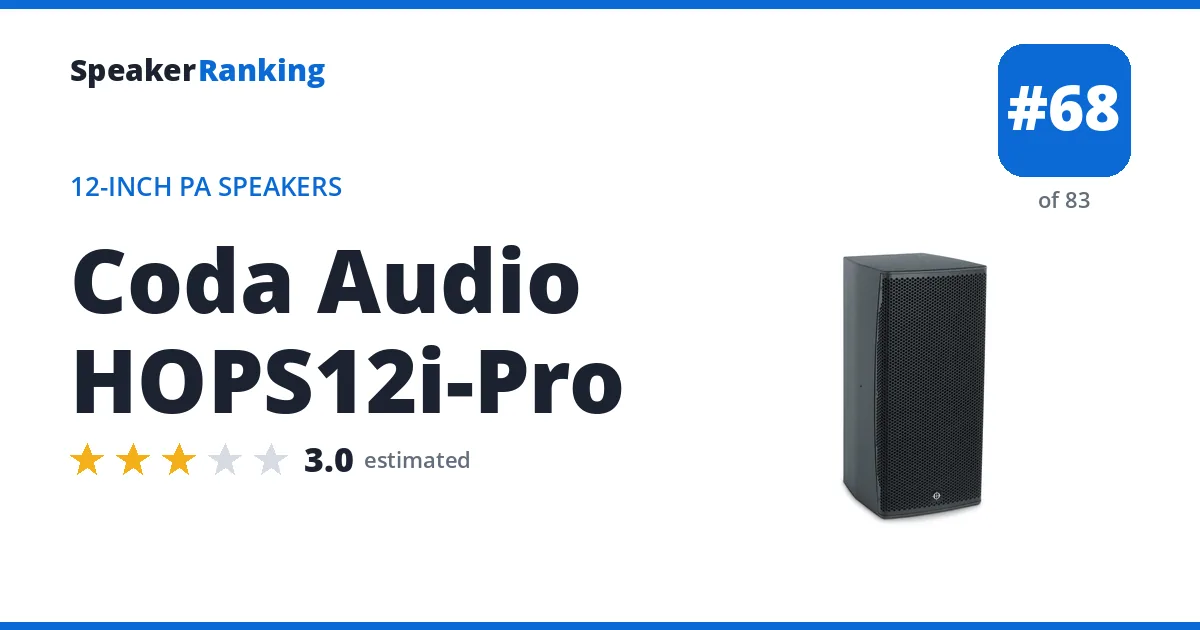
Older model: the Coda Audio HOPS12 (ranked lower, rated 2.6/5). See every Coda Audio HOPS generation.
Same family: the Coda Audio HOPS5 (smaller model, rated 3.8/5) and the Coda Audio HOPS8 (smaller model, rated 3.7/5).
Pros: The current HOPS12 with two 12” neodymium woofers and a 1.4” coaxial neodymium mid/high driver, rotatable 90 x 60 or 60 x 40 degree coverage, 2000W AES power handling and a 144dB peak rating. Rated 44Hz to 22kHz (-6dB).
Cons: No independent measurements yet, so its tonal balance and directivity can’t be compared directly with measured speakers; the rating is estimated from its measured predecessor. Its predecessor measured poorly on axis, so the range is wide. It weighs 34kg and is sold through pro audio dealers only.
Full Coda Audio HOPS12i-Pro review and specifications →
| AES Input | No |
|---|---|
| Amplifier Power | Passive speaker; requires external amplification |
| Aux Input | No |
| Bluetooth | No |
| Coaxial Input | No |
| Configuration | Passive 3-way point source PA speaker |
| Coverage | 90 x 60 or 60 x 40 degrees (rotatable) |
| DSP | No (passive) |
| Dimensions | 31.1”H x 14.5”W x 16.5”D (790 x 368 x 420 mm) |
| Drivers | 2x 12” neodymium woofers, 1.4” coaxial neodymium mid/high driver |
| Frequency Response | 44Hz-22kHz -6dB (manufacturer specified) |
| Guitar Input | No |
| HDMI Input | No |
| Maximum SPL | 144dB peak (manufacturer specified) |
| Microphone Input | No |
| Optical Input | No |
| Passive | Yes |
| Power Handling | 2000W AES |
| RCA Input | No |
| Rigging | 11 x M8 threaded points |
| TRS Input | No |
| USB Input | No |
| Weight | 75 lbs (34 kg) |
| XLR Input | No |
- Links
- Reviews, Comparisons and Sound Samples
- No independent measurement review is linked for this model; it is ranked from hands-on listening and comparison against similarly priced speakers.
 #67 Martin Audio FlexPoint FP12 Passive eBay
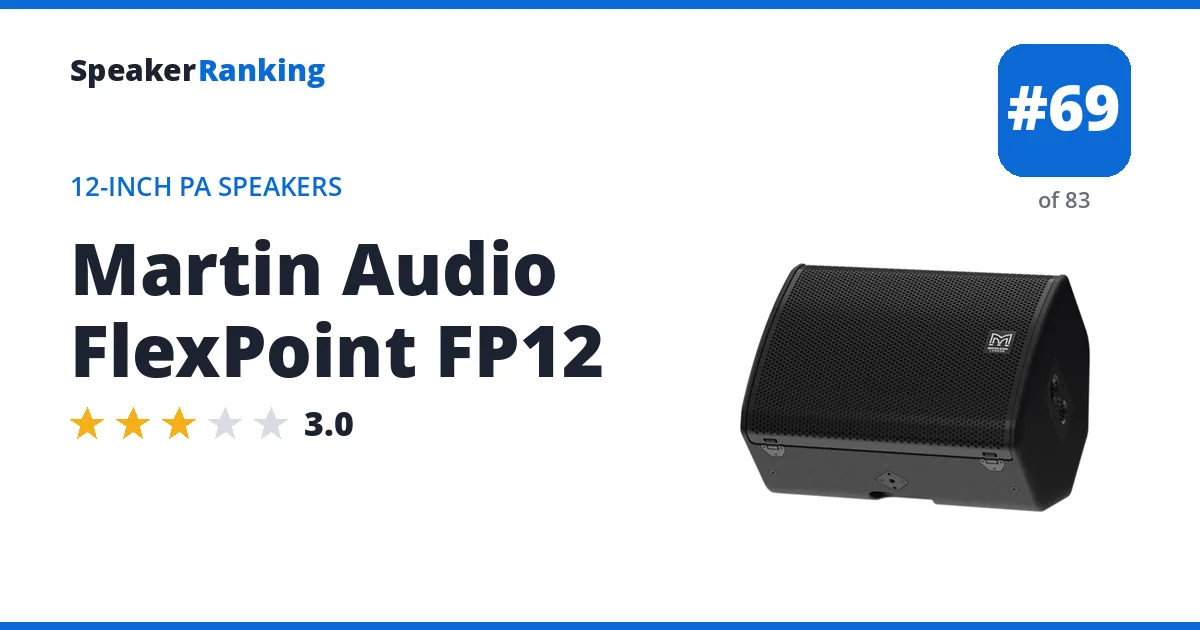
Same family: the Martin Audio FlexPoint FP4 (smaller model, rated 3/5), the Martin Audio FlexPoint FP6 (smaller model, rated 3/5), the Martin Audio FlexPoint FP8 (smaller model, rated 3/5) and the Martin Audio FlexPoint FP15 (larger model, rated 2.7/5).
Pros: Bass reaches 60Hz at -3dB and about 47Hz at -10dB in vendor measurements with a smooth on-axis response (0.5dB average deviation), and 97dB sensitivity gives a 128dB peak. Measured bass extension of 60Hz (-3dB).
Cons: Preference scores of 1.25 standalone and 3.62 with an ideal subwoofer are low because the listening window spreads across 4.8dB and off-axis tone varies. It is passive and weighs 17.5kg.
Full Martin Audio FlexPoint FP12 review and specifications →
| Released | 2023 (3 years ago) |
|---|---|
| AES Input | No |
| Amplifier Power | Passive speaker; requires external amplification |
| Aux Input | No |
| Bass Extension (-10dB) | about 47.4Hz (measured, vendor Spinorama data) |
| Bass Extension (-3dB) | 60Hz (measured, vendor Spinorama data) |
| Bluetooth | No |
| Coaxial Input | No |
| Configuration | Passive 2-way PA speaker |
| DSP | No (passive) |
| Drivers | 12” woofer, compression driver |
| Guitar Input | No |
| HDMI Input | No |
| Maximum SPL | 128dB peak / 122dB continuous (manufacturer specified) |
| Microphone Input | No |
| Optical Input | No |
| Passive | Yes |
| RCA Input | No |
| Rigging | 17 x M8 and 4 x M10 inserts; dual-angle pole socket |
| Sensitivity | 97dB |
| Spinorama Preference Score | 1.25 |
| Spinorama Preference Score with Perfect Sub | 3.62 |
| TRS Input | No |
| USB Input | No |
| Weight | 38.6 lbs (17.5 kg) |
| XLR Input | No |
- Links
- Reviews, Comparisons and Sound Samples
 #68 JBL SRX812P: $1,799.00 each Amazon $1,799.00 eBay

Same family: the JBL SRX815P (larger model, estimated 3/5) and the JBL SRX835P (larger model, rated 3/5).
Pros: A powered two-way PA speaker from JBL’s SRX800 tour-grade line with a 12” woofer and a compression driver on a waveguide, rated at 2,000W, with onboard DSP presets and XLR/TRS combo inputs.
Cons: No independent measurements yet, so its tonal balance and directivity can’t be compared directly with measured speakers; the rating is estimated from its measured three-way sibling, the JBL SRX835P, which Audio Science Review found uneven.
Full JBL SRX812P review and specifications →
| Released | 2015 (11 years ago) |
|---|---|
| AES Input | No |
| Amplifier Power | 2,000W |
| Aux Input | No |
| Bass Extension (-3dB) | 57Hz (manufacturer specified) |
| Bluetooth | No |
| Coaxial Input | No |
| DIY Kit | No |
| DSP | Yes |
| Drivers | 12” woofer, compression driver on waveguide |
| HDMI Input | No |
| Inputs | XLR/TRS combo |
| Maximum SPL | 129dB peak (manufacturer specified) |
| Optical Input | No |
| Passive | No |
| RCA Input | No |
| Rigging | 12 x M10 inserts; dual 36mm pole sockets |
| TRS Input | Yes |
| USB Input | No |
| Weight | 54.9 lbs (24.9 kg) |
| XLR Input | Yes |
- Reviews, Comparisons and Sound Samples
- No independent measurement review is linked for this model; it is ranked from hands-on listening and comparison against similarly priced speakers.
- Head-to-Head Comparisons
 #69 Martin Audio CDD12 Passive eBay
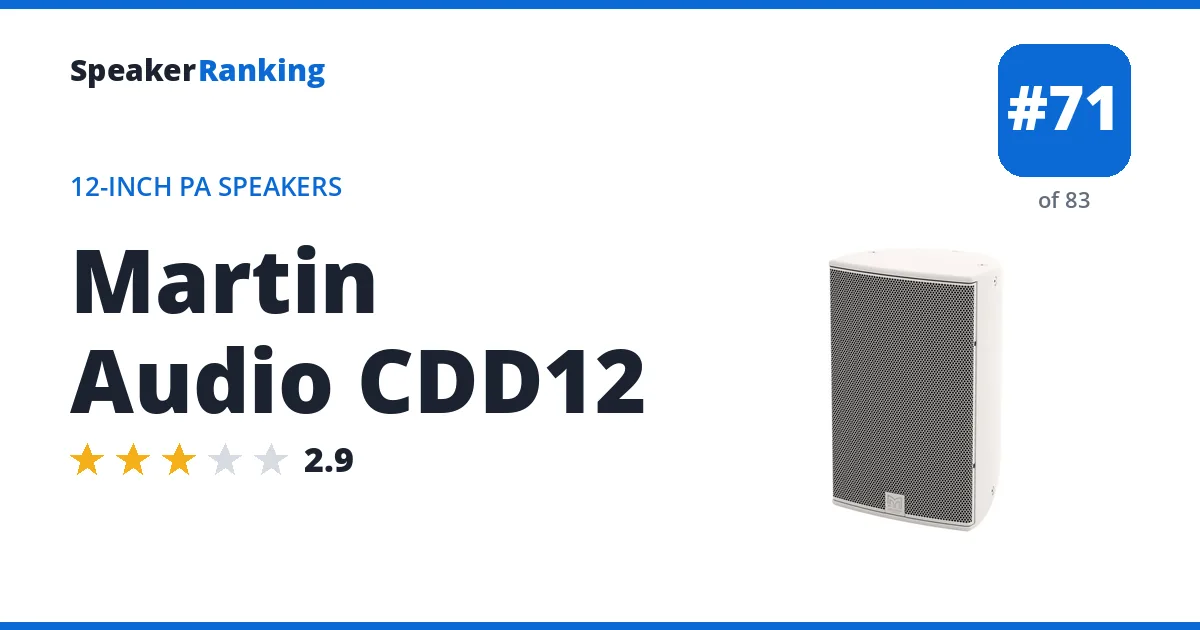
Same family: the Martin Audio CDD-LIVE 8 (smallest powered model, estimated 3.4/5), the Martin Audio CDD-LIVE 12 (powered model, ranked higher, estimated 3.1/5), the Martin Audio CDD-LIVE 15 (largest powered model, estimated 3.5/5), the Martin Audio CDD5 (smaller passive model, estimated 3/5), the Martin Audio CDD6 (smaller passive model, estimated 3.1/5), the Martin Audio CDD8 (smaller passive model, rated 3.2/5), the Martin Audio CDD10 (smaller passive model, rated 3.1/5) and the Martin Audio CDD15 (larger passive model, rated 3.3/5).
Pros: Martin Audio’s Coaxial Differential Dispersion driver widens horizontal coverage from 60° far away to 110° up close, so level stays more even from front row to back. A 12-inch woofer shares its motor with a 1-inch compression driver in a 19kg birch cabinet, available in any RAL color for installs. Measured bass extension of 95Hz (-3dB).
Cons: Manufacturer measurements give a very low 0.82 standalone preference score and 3.80 with an ideal subwoofer, with a wide 4.0dB reference band and 0.821 listening-window deviation, so its tonal balance is very uneven. Bass measures 95Hz at -3dB. It is passive, aimed at installs, and sold only through dealers.
Full Martin Audio CDD12 review and specifications →
| Released | Jun 2015 (11 years ago) |
|---|---|
| AES Input | No |
| Amplifier Power | Passive speaker; requires external amplification |
| Aux Input | No |
| Bass Extension (-10dB) | about 55.7Hz (measured, vendor Spinorama data) |
| Bass Extension (-3dB) | 95Hz (measured, vendor Spinorama data) |
| Bluetooth | No |
| Cabinet Material | Birch plywood |
| Coaxial Input | No |
| Configuration | Passive 2-way coaxial on-wall PA speaker |
| Coverage | 110° to 60° horizontal x 60° (rotatable) |
| DSP | No (passive) |
| Dimensions | 22”H x 14.2”W x 13.8”D (560 x 360 x 350 mm) |
| Drivers | 12” woofer with coaxial 1” exit compression driver (Coaxial Differential Dispersion) |
| Guitar Input | No |
| HDMI Input | No |
| Impedance | 8 ohms |
| Maximum SPL | 128dB peak (manufacturer specified) |
| Microphone Input | No |
| Optical Input | No |
| Passive | Yes |
| RCA Input | No |
| Rigging | 10 x M8 fly points; 6 x M8 wall bracket inserts |
| Spinorama Preference Score | 0.82 |
| Spinorama Preference Score with Perfect Sub | 3.80 |
| TRS Input | No |
| USB Input | No |
| Weight | 41.9 lbs (19 kg) |
| XLR Input | No |
- Links
- Reviews, Comparisons and Sound Samples
- Head-to-Head Comparisons
 #70 Audiofocus VENU 12a: $2,890 eBay
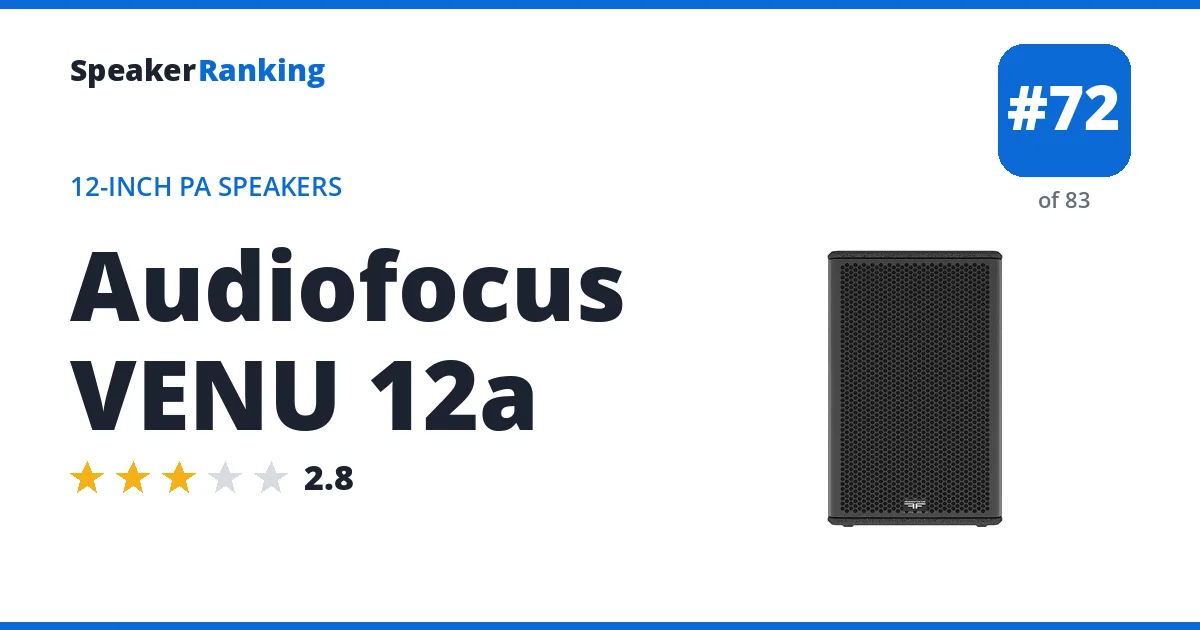
Same family: the Audiofocus VENU 8a (smaller model, rated 1.9/5) and the Audiofocus VENU 15a (larger model, rated 2.1/5).
Pros: A light 18.5kg plywood cabinet, very broad 110° x 60° coverage and 135dB claimed peak output make it convenient for wide rooms and rental work. Four onboard presets simplify use as a main or monitor. Measured bass extension of 112Hz (-3dB).
Cons: The low-quality vendor Spinorama data is the weakest tonal result in this category: a 1.13 ideal-subwoofer preference score and roughly 102Hz measured bass extension conflict sharply with the claimed 50Hz lower limit. A subwoofer and careful EQ are strongly recommended.
Full Audiofocus VENU 12a review and specifications →
| AES Input | No |
|---|---|
| Amplifier Power | Self-powered Class D amplifier; output rating not published by AUDIOFOCUS in the current specification |
| Aux Input | No |
| Bass Extension (-3dB) | 112Hz (measured, vendor Spinorama data) |
| Bluetooth | No |
| Cabinet Material | High-grade birch plywood with polyurea coating |
| Coaxial Input | No |
| Configuration | Active 2-way bass-reflex PA speaker |
| Coverage | 110° x 60° |
| DSP | Yes, 4 presets |
| Dimensions | 22.3”H x 14.3”W x 14.1”D (566 x 362 x 357 mm) |
| Drivers | 12” woofer, 1” compression driver |
| Frequency Response | 50Hz - 20kHz (-6dB, manufacturer specified) |
| Guitar Input | No |
| HDMI Input | No |
| Inputs | XLR input and link |
| Maximum SPL | 135dB peak (manufacturer specified) |
| Microphone Input | No |
| Optical Input | No |
| Passive | No |
| RCA Input | No |
| Rigging | Adjustable pole mount and M8 threaded inserts |
| Spinorama Preference Score | -2.54 |
| Spinorama Preference Score with Perfect Sub | 1.13 |
| TRS Input | No |
| USB Input | No |
| Weight | 40.8 lbs (18.5 kg) |
| XLR Input | Yes |
- Links
- Reviews, Comparisons and Sound Samples
- Head-to-Head Comparisons
 #71 Biamp Community V2-3294 Passive eBay
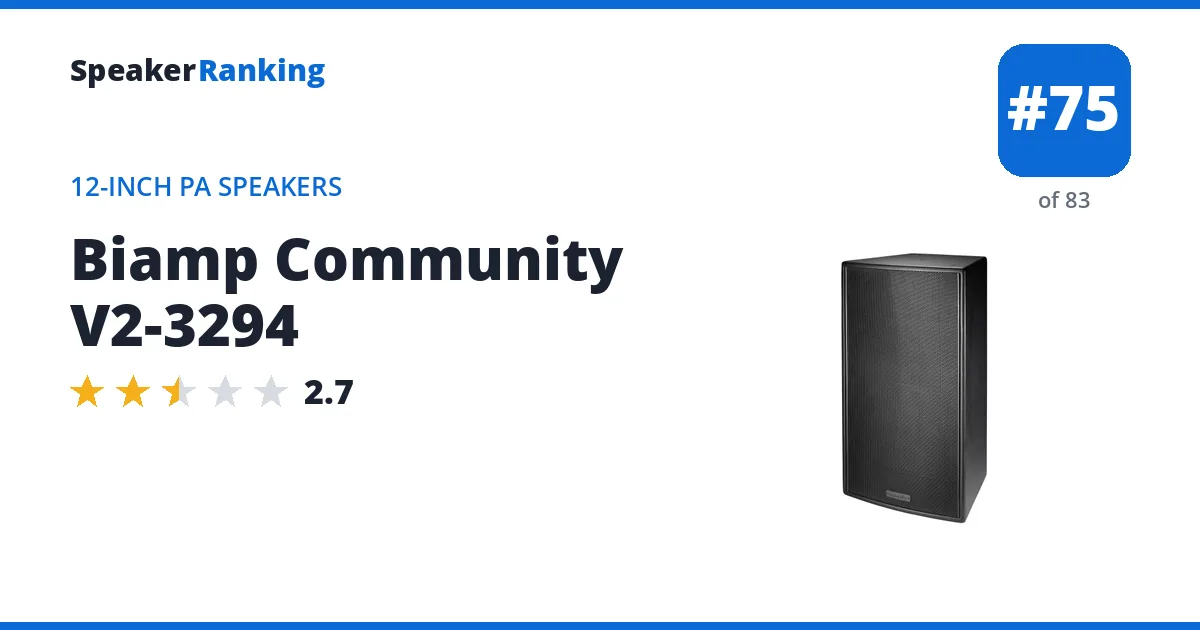
Same family: the Biamp Community V2-6 (smaller model, rated 2.8/5), the Biamp Community V2-26 (smaller model, rated 2.8/5), the Biamp Community V2-8 (smaller model, rated 2.7/5), the Biamp Community V2-28 (smaller model, rated 2.4/5) and the Biamp Community V2-3594 (larger model, rated 2.7/5).
Pros: High 99dB sensitivity and a 128dB peak, bass to about 53Hz at -10dB, and a smooth on-axis response (0.39dB average deviation in vendor measurements). Measured bass extension of 85Hz (-3dB).
Cons: Preference scores of -0.17 standalone and 2.74 with an ideal subwoofer are low, because off-axis tone changes a lot (4.2dB directivity-index deviation). It is passive and weighs 25.4kg.
Full Biamp Community V2-3294 review and specifications →
| AES Input | No |
|---|---|
| Amplifier Power | Passive speaker; requires external amplification |
| Aux Input | No |
| Bass Extension (-10dB) | about 52.5Hz (measured, vendor Spinorama data) |
| Bass Extension (-3dB) | 85Hz (measured, vendor Spinorama data) |
| Bluetooth | No |
| Coaxial Input | No |
| Configuration | Passive 3-way installation PA speaker |
| Coverage | 90° x 40° (rotatable) |
| DSP | No (passive) |
| Drivers | 12” woofer, midrange horn, compression driver on a rotatable horn |
| Guitar Input | No |
| HDMI Input | No |
| Maximum SPL | 128dB peak / 122dB continuous (manufacturer specified) |
| Microphone Input | No |
| Optical Input | No |
| Passive | Yes |
| RCA Input | No |
| Rigging | M10 threaded rigging points |
| Sensitivity | 99dB |
| Spinorama Preference Score | -0.17 |
| Spinorama Preference Score with Perfect Sub | 2.74 |
| TRS Input | No |
| USB Input | No |
| Weight | 56 lbs (25.4 kg) |
| XLR Input | No |
- Reviews, Comparisons and Sound Samples
 #72 Novacoustic KIRA 12 Passive eBay
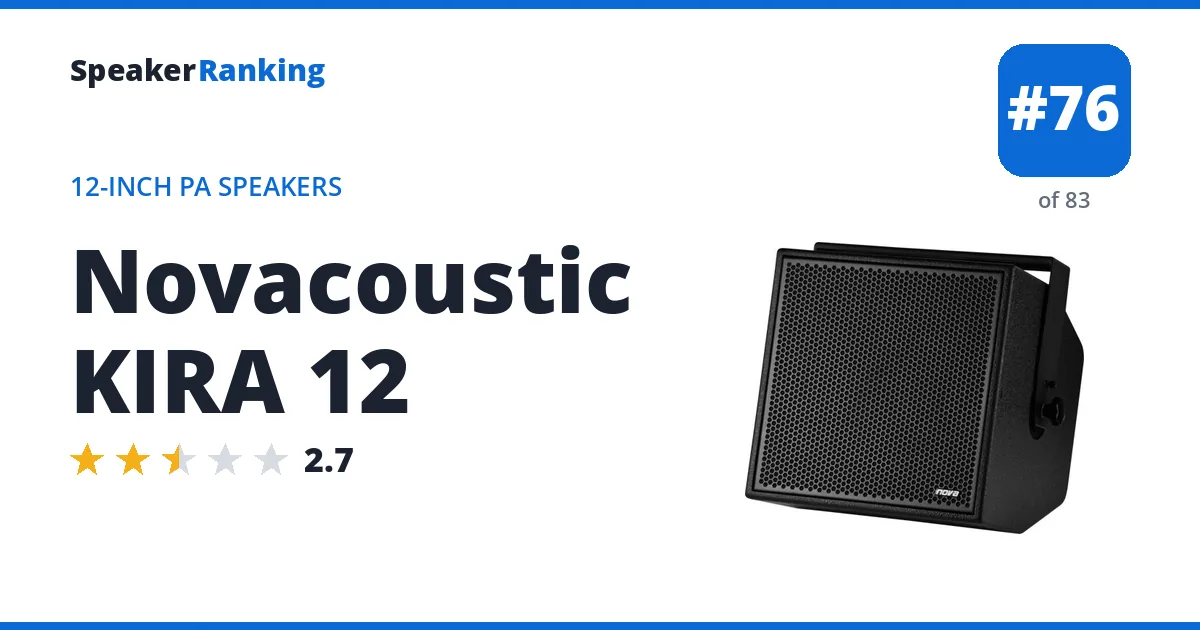
Same family: the Novacoustic KIRA 5 (smaller model, rated 2.5/5), the Novacoustic KIRA 8 (smaller model, rated 2.5/5) and the Novacoustic KIRA 10 (smaller model, rated 2/5).
Pros: High 98.5dB sensitivity and a 131dB peak with wide 90° conical coverage from a coaxial driver. Measured bass extension of 90Hz (-3dB).
Cons: Preference scores of -0.63 standalone and 2.62 with an ideal subwoofer are low, because the listening window spreads across 10.5dB and off-axis tone varies (4.35dB directivity-index deviation). Bass reaches only 90Hz at -3dB. It is passive.
Full Novacoustic KIRA 12 review and specifications →
| AES Input | No |
|---|---|
| Amplifier Power | Passive speaker; requires external amplification |
| Aux Input | No |
| Bass Extension (-10dB) | about 76.0Hz (measured, vendor Spinorama data) |
| Bass Extension (-3dB) | 90Hz (measured, vendor Spinorama data) |
| Bluetooth | No |
| Coaxial Input | No |
| Configuration | Passive 2-way coaxial PA speaker |
| Coverage | 90° x 90° |
| DSP | No (passive) |
| Drivers | 12” coaxial driver |
| Frequency Response | 50Hz - 20kHz (manufacturer specified) |
| Guitar Input | No |
| HDMI Input | No |
| Impedance | 8 ohms |
| Maximum SPL | 131dB peak (manufacturer specified) |
| Microphone Input | No |
| Optical Input | No |
| Passive | Yes |
| Power Handling | 450W RMS |
| RCA Input | No |
| Rigging | 2 x M10 inserts with U-bracket; 4 x M6 points; optional stand adapter |
| Sensitivity | 98.5dB |
| Spinorama Preference Score | -0.63 |
| Spinorama Preference Score with Perfect Sub | 2.62 |
| TRS Input | No |
| USB Input | No |
| Weight | 40.8 lbs (18.5 kg) |
| XLR Input | No |
- Links
- Reviews, Comparisons and Sound Samples
- Head-to-Head Comparisons
 #73 PreSonus ULT12 Discontinued eBay
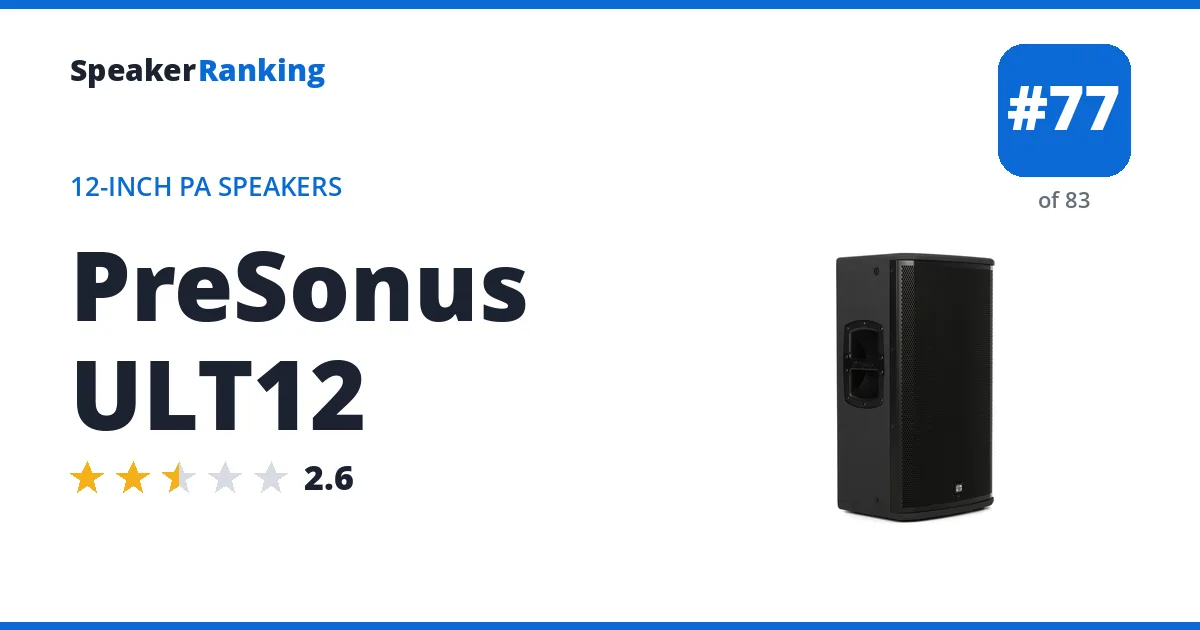
Same family: the PreSonus ULT10 (smaller model, rated 3/5) and the PreSonus ULT15 (larger model, estimated 2.7/5).
Pros: Very broad 110° x 50° nominal coverage can be useful in shallow rooms, and the plywood cabinet, rotatable horn and onboard mixer are practical live-sound features. Measured bass extension reaches 60Hz in the medium-quality vendor data. Measured bass extension of 60Hz (-3dB).
Cons: The 3.50 ideal-subwoofer preference score is the weakest in this 15-model group, reflecting major response/directivity irregularity. It is difficult to recommend for sound quality when stronger measured alternatives are available at similar prices. Discontinued.
Full PreSonus ULT12 review and specifications →
| Released | 2016 (10 years ago) |
|---|---|
| AES Input | No |
| Amplifier Power | 1,300W peak / 650W continuous (1,000W / 500W LF; 300W / 150W HF, manufacturer specified) |
| Aux Input | No |
| Bass Extension (-3dB) | 60Hz (measured, vendor Spinorama data) |
| Bluetooth | No |
| Cabinet Material | 15mm eucalyptus plywood |
| Coaxial Input | No |
| Configuration | Active 2-way bass-reflex PA speaker |
| Coverage | 110° x 50° |
| Crossover Frequency | 1.6kHz (manufacturer specified) |
| DSP | Yes |
| Dimensions | 25.2”H x 14”W x 13.9”D (641 x 356 x 353 mm) |
| Drivers | 12” woofer, compression driver |
| Frequency Response | 55Hz - 20kHz (Manufacturer specified) |
| Guitar Input | No |
| HDMI Input | No |
| Inputs | 2 x XLR/TRS combo |
| Maximum SPL | 135dB (1300W peak power) |
| Microphone Input | No |
| Optical Input | No |
| Passive | No |
| RCA Input | No |
| Rigging | M10 suspension points; two-position 35mm pole socket |
| Spinorama Preference Score | 0.84 |
| Spinorama Preference Score with Perfect Sub | 3.50 |
| TRS Input | Yes |
| USB Input | No |
| Weight | 52 lbs (23.6 kg) |
| XLR Input | Yes |
- Links
- Reviews, Comparisons and Sound Samples
- Head-to-Head Comparisons
- PreSonus ULT12 vs Audiofocus VENU 12a
- PreSonus ULT12 vs RCF ART 712-A MK4
- PreSonus ULT12 vs HK Audio LINEAR 5 112 F
- PreSonus ULT12 vs RCF ART 732-A MK4
- PreSonus ULT12 vs Martin Audio XP12
- PreSonus ULT12 vs RCF HD 12-A MK5
- PreSonus ULT12 vs RCF ART 712-A MK5
- PreSonus ULT12 vs Yamaha DBR12
- See all 20 comparisons
 #74 Coda Audio HOPS12 Passive Discontinued eBay
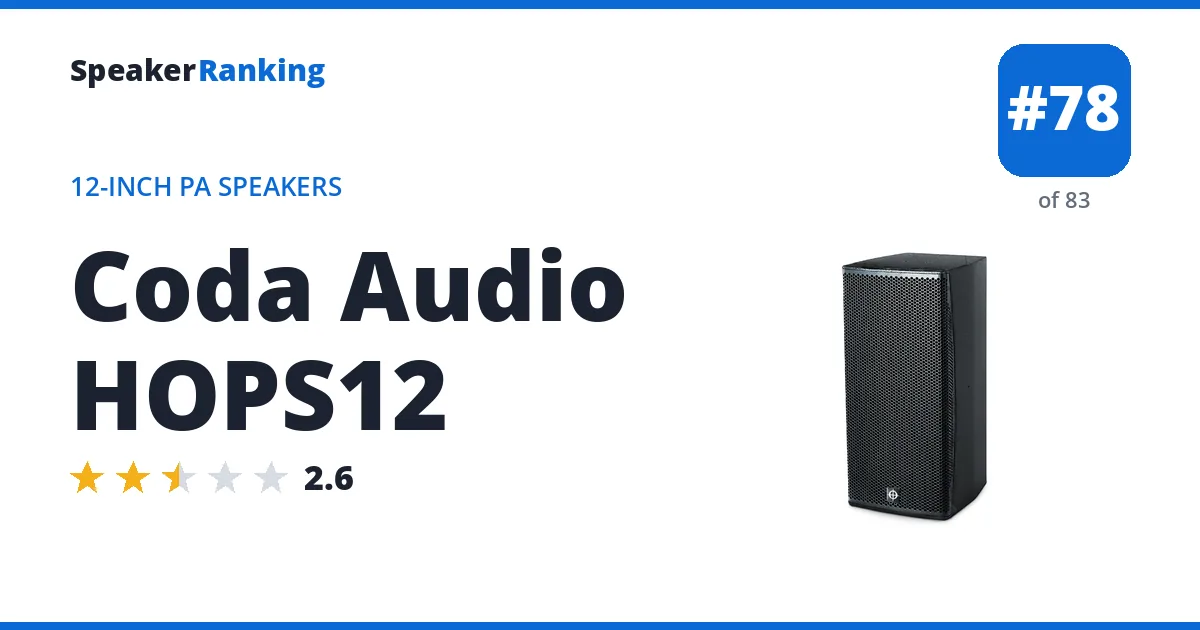
Newer model: the Coda Audio HOPS12i-Pro, ranked higher, estimated 3/5. See every Coda Audio HOPS generation.
Pros: A three-way point source touring and installation speaker with two 12” woofers and a coaxial mid/high driver. Coda’s measurements show bass to 47.5Hz (-3dB) and about 43Hz (-10dB).
Cons: Coda’s own data shows a very uneven on-axis response (2.37dB average deviation) and a rough predicted in-room response (0.24), for a preference score of 1.65 alone and 3.82 with an ideal subwoofer. Coda now sells the revised Coda Audio HOPS12i-Pro. Discontinued.
Full Coda Audio HOPS12 review and specifications →
| Released | May 2021 (5 years ago) |
|---|---|
| AES Input | No |
| Amplifier Power | Passive speaker; requires external amplification |
| Aux Input | No |
| Bass Extension (-10dB) | about 42.9Hz (measured, manufacturer data via spinorama.org) |
| Bass Extension (-3dB) | 47.5Hz (measured, manufacturer data via spinorama.org) |
| Bluetooth | No |
| Coaxial Input | No |
| Configuration | Passive 3-way point source PA speaker |
| DSP | No (passive) |
| Drivers | 2x 12” woofers, coaxial mid/high driver |
| Guitar Input | No |
| HDMI Input | No |
| Microphone Input | No |
| Optical Input | No |
| Passive | Yes |
| RCA Input | No |
| Spinorama Preference Score | 1.65 |
| Spinorama Preference Score with Perfect Sub | 3.82 |
| TRS Input | No |
| USB Input | No |
| XLR Input | No |
- Reviews, Comparisons and Sound Samples
 #75 Turbosound TCS122 Passive Discontinued eBay
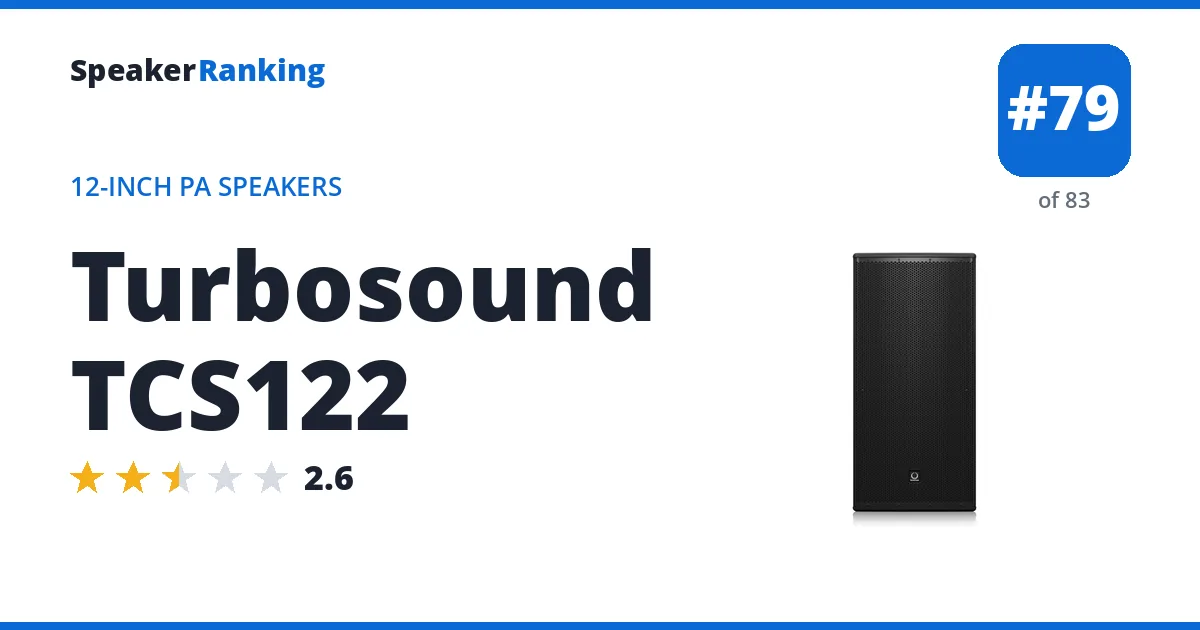
Same family: the Turbosound TCS62 (smaller model, rated 2.5/5) and the Turbosound TCS152 (larger model, rated 3.2/5).
Pros: Deep bass for a 12-inch speaker, about 45Hz at -3dB and 36Hz at -10dB in vendor measurements, with 96dB sensitivity. Measured bass extension of 45Hz (-3dB).
Cons: Preference scores of 0.47 standalone and 2.37 with an ideal subwoofer are low because the listening window spreads across 5.2dB and off-axis tone varies. It is passive, weighs 26.5kg, and is discontinued, so it is mainly found used.
Full Turbosound TCS122 review and specifications →
| AES Input | No |
|---|---|
| Amplifier Power | Passive speaker; requires external amplification |
| Aux Input | No |
| Bass Extension (-10dB) | about 35.8Hz (measured, vendor Spinorama data) |
| Bass Extension (-3dB) | 45Hz (measured, vendor Spinorama data) |
| Bluetooth | No |
| Coaxial Input | No |
| Configuration | Passive 2-way PA speaker |
| Coverage | 60° x 40° (other waveguides available) |
| DSP | No (passive) |
| Dimensions | 32.8”H x 15.7”W x 16.7”D (834 x 399 x 425 mm) |
| Drivers | 12” woofer, compression driver on a rotatable dendritic waveguide |
| Frequency Response | 50Hz - 18kHz (±3dB, manufacturer specified) |
| Guitar Input | No |
| HDMI Input | No |
| Impedance | 8 ohms |
| Maximum SPL | 130dB peak (manufacturer specified) |
| Microphone Input | No |
| Optical Input | No |
| Passive | Yes |
| RCA Input | No |
| Rigging | 9 x M10 and 8 x M8 inserts |
| Sensitivity | 96dB |
| Spinorama Preference Score | 0.47 |
| Spinorama Preference Score with Perfect Sub | 2.37 |
| TRS Input | No |
| USB Input | No |
| Weight | 58.4 lbs (26.5 kg) |
| XLR Input | No |
- Reviews, Comparisons and Sound Samples
 #76 Behringer Eurolive B212XL: $219.00 each Passive Amazon $219.00 eBay
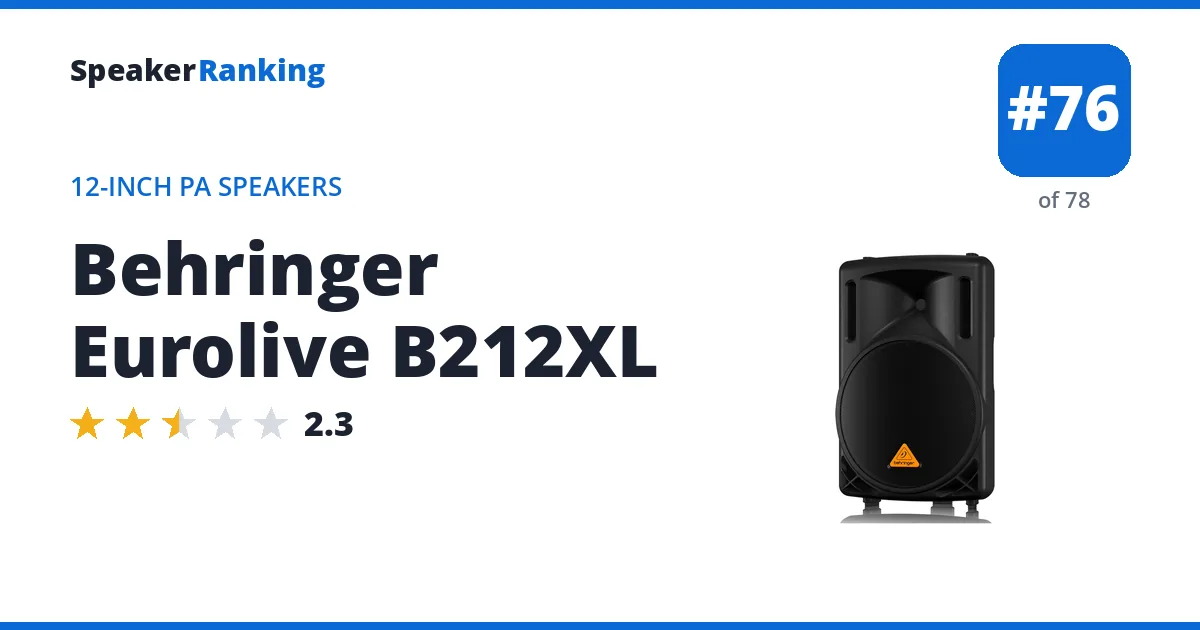
Same family: the Behringer Eurolive B215XL (larger model, rated 3/5).
Pros: A low-cost passive 12-inch two-way with a 1.75-inch titanium compression driver, rated at 95dB sensitivity so a modest amplifier drives it loud, and light at 10.9kg. Parallel speakON and quarter-inch inputs let you daisy-chain a second box, and it fits a standard speaker pole. Measured bass extension of 95Hz (-3dB).
Cons: Erin’s Audio Corner’s measurements are among the weakest in this class: the listening window spans 8.5dB between 300Hz and 5kHz, the predicted in-room response is rough (0.32 smoothness), and the preference score is -1.01 (2.30 with an ideal subwoofer). Bass rolls off early, around 95Hz at -3dB, so it needs a subwoofer for music, and being passive it also needs an external amplifier. Erin’s verdict was not to buy it for home theater.
Full Behringer Eurolive B212XL review and specifications →
| AES Input | No |
|---|---|
| Amplifier Power | Passive speaker; use external amplification within the 800W peak handling rating |
| Aux Input | No |
| Bass Extension (-3dB) | 95Hz (measured, Erin’s Audio Corner) |
| Bluetooth | No |
| Cabinet Material | Molded enclosure |
| Coaxial Input | No |
| Configuration | Passive 2-way bass-reflex PA speaker |
| Coverage | 90° x 60° |
| DSP | No (passive) |
| Dimensions | 21.7”H x 13.6”W x 10.6”D (550 x 345 x 270 mm) |
| Drivers | 12” woofer, 1.75” titanium-diaphragm compression driver |
| Frequency Response | 65Hz - 18kHz (manufacturer specified) |
| Guitar Input | No |
| HDMI Input | No |
| Impedance | 8 ohms nominal (manufacturer specified) |
| Inputs | Parallel professional twist-lock and quarter-inch inputs |
| Microphone Input | No |
| Optical Input | No |
| Passive | Yes |
| Power Handling | 200W continuous, 800W peak (manufacturer specified) |
| RCA Input | No |
| Rigging | Standard speaker-pole mount; optional wall bracket |
| Sensitivity | 95dB (manufacturer specified) |
| Spinorama Preference Score | -1.01 |
| Spinorama Preference Score with Perfect Sub | 2.30 |
| TRS Input | Yes |
| USB Input | No |
| Weight | 24 lbs (10.9 kg) |
| XLR Input | No |
- Links
- Reviews, Comparisons and Sound Samples
- Head-to-Head Comparisons
 #77 K-array Dragon KX12 Passive Discontinued eBay
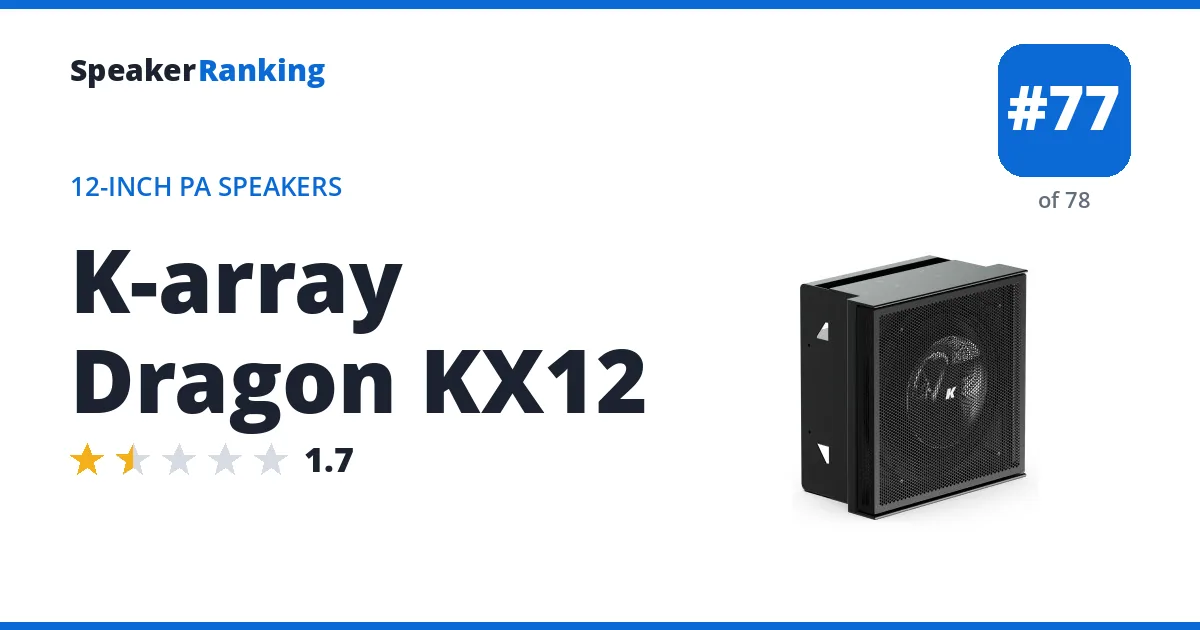
Newer model: the K-array Dragon-KX12 I, ranked lower, estimated 1.7/5, released 2025. See every K-array Dragon KX12 generation.
Pros: A slim 201mm deep stainless steel cabinet with a 133dB peak, and the most consistent off-axis tone in this group (2.26dB directivity-index deviation). Measured bass extension of 109Hz (-3dB).
Cons: Vendor measurements give the lowest preference scores here, -4.28 standalone and -0.41 with an ideal subwoofer, because bass stops near 109Hz (-3dB) and the response tilts strongly. It is passive and discontinued, so it is mainly found used.
Full K-array Dragon KX12 review and specifications →
| Released | 2015 (11 years ago) |
|---|---|
| AES Input | No |
| Amplifier Power | Passive speaker; requires external amplification |
| Aux Input | No |
| Bass Extension (-10dB) | about 80.8Hz (measured, vendor Spinorama data) |
| Bass Extension (-3dB) | 109Hz (measured, vendor Spinorama data) |
| Bluetooth | No |
| Coaxial Input | No |
| Configuration | Passive 2-way coaxial PA speaker, IP54 stainless steel enclosure |
| DSP | No (passive) |
| Dimensions | 13.4”H x 12.6”W x 7.9”D (340 x 320 x 201 mm) |
| Drivers | 12” coaxial woofer with compression driver |
| Frequency Response | 120Hz - 18kHz (manufacturer specified) |
| Guitar Input | No |
| HDMI Input | No |
| Impedance | 8 ohms |
| Maximum SPL | 133dB peak (manufacturer specified) |
| Microphone Input | No |
| Optical Input | No |
| Passive | Yes |
| RCA Input | No |
| Spinorama Preference Score | -4.28 |
| Spinorama Preference Score with Perfect Sub | -0.41 |
| TRS Input | No |
| USB Input | No |
| Weight | 26.9 lbs (12.2 kg) |
| XLR Input | No |
- Reviews, Comparisons and Sound Samples
 #78 K-array Dragon-KX12 I eBay
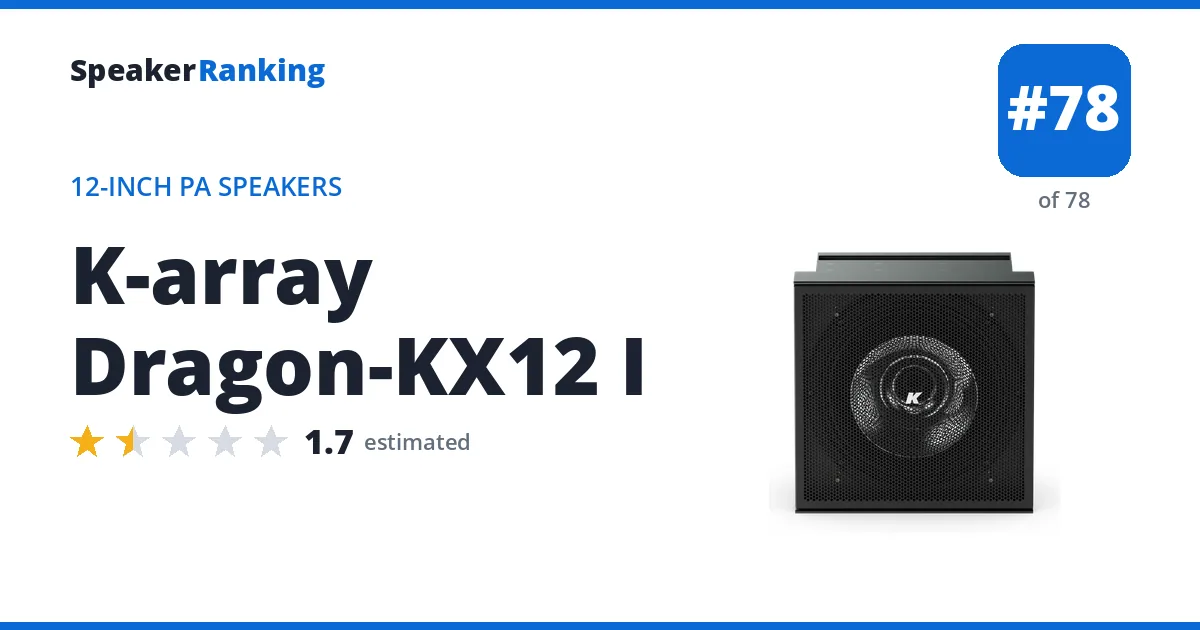
Older model: the K-array Dragon KX12 (ranked higher, rated 1.7/5). See every K-array Dragon KX12 generation.
Pros: The updated K-array Dragon KX12 with software control and support for K-array’s electronic beam steering, keeping its coaxial 12” woofer and 1.7” compression driver in a stainless steel IP54 cabinet rated at 133dB peak.
Cons: No independent measurements yet, so it can’t be compared with ranked PA speakers. Rated only down to 120Hz (-6dB), it needs subwoofers for any full-range use, and it is sold only through professional dealers.
Full K-array Dragon-KX12 I review and specifications →
| Released | 2025 (1 year ago) |
|---|---|
| Bluetooth | No |
| Coverage | 40° x 60°, rotatable |
| Dimensions | 13.8”H x 13.8”W x 8”D (350 x 350 x 203 mm) |
| Drivers | 1x 12” coaxial woofer, 1x 1.7” compression driver |
| Frequency Response | 120Hz - 18kHz (-6dB, manufacturer specified) |
| Impedance | 8 ohms nominal (manufacturer specified) |
| Maximum SPL | 133dB peak (manufacturer specified) |
| Rigging | M10 inserts; pole mount; K-FLY2B fly bar; K-WALL2 wall brackets; U-bracket |
| Weight | 33.1 lbs (15 kg) |
- Links
- Reviews, Comparisons and Sound Samples
- No independent measurement review is linked for this model; it is ranked from hands-on listening and comparison against similarly priced speakers.