Editor's top picks
Start with these speakers
Our leading recommendations at a glance. Each card links to its primary retailer.
Not sure which passive speakers to buy? Passive speakers need a separate amplifier, which is the whole point: you can upgrade either half independently, and a good pair will outlive several amplifiers. This guide covers bookshelf or floorstanding, matching an amplifier, how to split the budget, and whether you need a subwoofer. Picks come from the 294 passive speakers ranked here.
Prices on this page were last checked September 22, 2026 at 5:11 AM UTC. Product prices and availability are accurate as of that date/time and are subject to change; the price and availability shown on Amazon at the time of purchase will apply to the purchase of this product.
As an eBay Partner, we may be compensated if you make a purchase.
Step 1: Bookshelf Or Floorstanding
Unless they have to sit on a desk or a shelf, buy floorstanding. A floorstander gives you more bass extension and more output for the same money, because cabinet volume is cheap and drivers are not. Many bookshelf models here have a floorstanding sibling using the same drivers and crossover, which performs similarly but reaches lower.
Buy bookshelf when placement genuinely requires it, when the room is small enough that a floorstander would overload it, or when you’re planning to add a subwoofer anyway and would rather put the money into that.
Step 2: Match The Amplifier With Sensitivity And Impedance
This is the step that has no equivalent in powered speakers, and the one people get wrong. Two specs do most of the work, and both are in every spec table here.
Sensitivity is how loud a speaker plays with one watt at one metre, in dB. It’s a logarithmic scale, so the differences are larger than they look: every 3 dB of sensitivity halves the amplifier power you need. An 87 dB speaker needs roughly twice the power of a 90 dB one for the same volume, and four times an 93 dB one. Most passive speakers ranked here land between 82 and 88 dB, which is why “why is my amp not loud enough” is usually a sensitivity problem, not an amplifier fault. Full detail on speaker sensitivity explained.
Impedance is the electrical load, nominally 4, 6, or 8 ohms. Lower impedance draws more current and is harder work. Most solid-state amplifiers handle 4 ohms fine; many budget receivers, and most tube amplifiers, do not. See speaker impedance explained for why the nominal figure hides the dips that actually stress an amplifier.
If you own a tube amplifier or a low-power class A amp, sensitivity and impedance stop being details and become the buying criteria. See best passive speakers for tube and low-power amplifiers.
If you own a normal solid-state amp or AV receiver, almost anything here works, and you can ignore this step beyond checking that a 4 ohm speaker won’t upset a budget receiver.
Step 3: Split The Budget Correctly
The speakers determine what you hear. The amplifier, provided it has enough power and is not distorting, contributes far less than the hobby suggests.
A reasonable split is roughly 70% speakers, 30% amplification and source. A $1,000 pair on a $300 amp comfortably beats a $500 pair on an $800 amp. The main thing you’re buying past “enough clean watts” is more clean watts.
Work out how much power you need from the sensitivity figure and the size of your room before you shop for an amp, not after.
Step 4: Decide About A Subwoofer Now, Not Later
A subwoofer changes what you should buy. If you’re adding one, you don’t need bookshelf speakers that reach deep, and you shouldn’t pay for it, because the sub will do that job better below the crossover point.
This is why bookshelf speakers plus a subwoofer often beats floorstanders at the same total price: you get deeper, more even bass, and you can place the sub where the room likes it instead of where the stereo image demands. See the subwoofer buyer’s guide.
The Picks, In Short
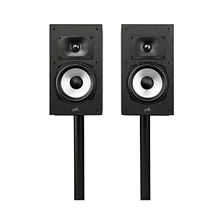 The best budget passive speakers, and startling value at the price, are the Polk Monitor XT20: $279.00 per pair Amazon Crutchfield eBay
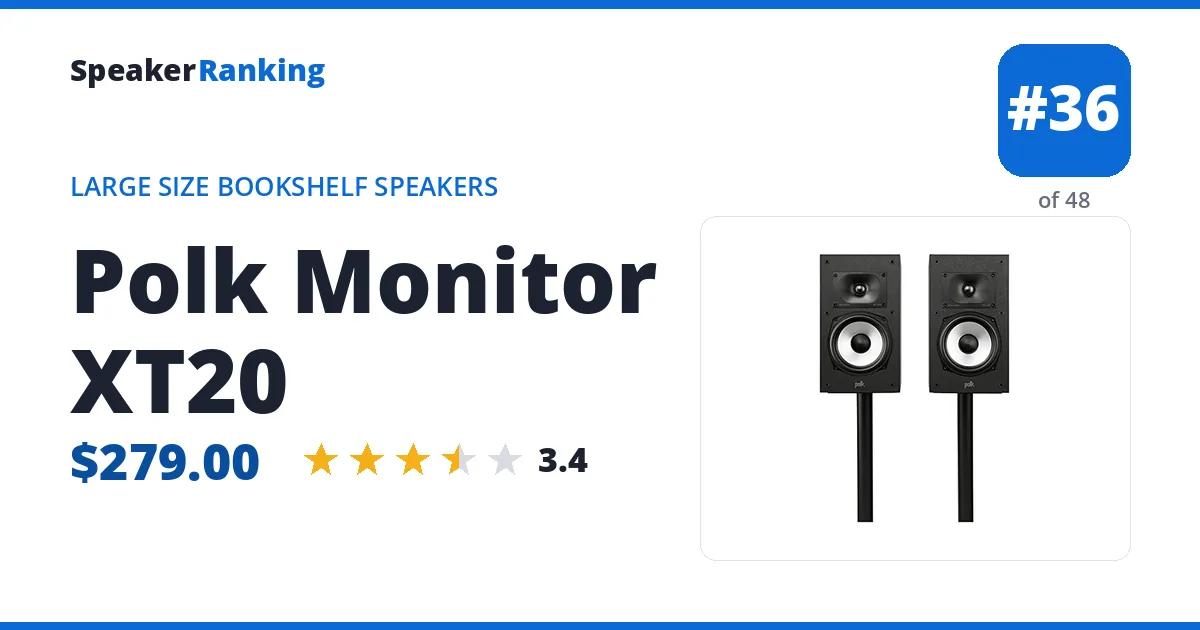
Pros: Two-way bookshelf design with a 1” tweeter and 6.5” woofer, part of Polk’s budget-friendly XT lineup (spanning roughly $200-700 across the series). Measures more linear and has fewer/smaller cabinet resonances than its smaller sibling, the XT15, making it - by the reviewer’s own assessment - probably the better of the two based on data alone. Reasonably good bass output for the price and size, with an F3 of 63Hz. Horizontal radiation of about ±50° gives a respectable, enjoyable soundstage width. Takes well to EQ correction - the early-reflections directivity trend is decently linear, meaning tonal adjustments can meaningfully improve the sound. Provides usable, respectable volume when paired with a subwoofer crossover, even though it isn’t intended to play extremely loud on its own. Measured bass extension of 75Hz (-3dB), with a measured sensitivity of 86dB.
Cons: Notably bright treble, elevated roughly 1-5dB above the midrange depending on frequency - a characteristic shared across the whole Polk XT lineup, requiring either EQ or toe-out to tame. Small resonances appear around 300Hz and 800Hz, with some of that energy leaking from the port area. Vertical listening window is narrow - best kept close to the tweeter axis, with only a couple of degrees of tolerance above or below before the sound changes. Still needs a subwoofer for real low-end extension despite the decent F3. Overall linearity isn’t state-of-the-art flat, and while the reviewer found it pleasant, some artificial brightness remains even after basic EQ correction in the crossover region.
Full Polk Monitor XT20 review and specifications →
| Bass Extension (-10dB) | 50Hz (measured, Erin's Audio Corner) |
|---|---|
| Bass Extension (-3dB) | 75Hz (measured, Erin's Audio Corner) |
| Dimensions | 13"H x 7.5"W x 11"D (330.2 x 190.5 x 279.4 mm) |
| Drivers | 6.5" bilaminate paper cone woofer, 1" Terylene dome tweeter |
| Impedance | 8 ohms nominal (measured, Erin's Audio Corner) |
| Sensitivity | 86dB (measured by Erin's Audio Corner; 87dB manufacturer specified) |
| Spinorama Preference Score | 3.79 |
| Spinorama Preference Score with Perfect Sub | 6.16 |
| Weight | 11.9 lbs (5.4 kg) each |
| Woofer Cabinet | ported |
- Links
- Reviews, Comparisons and Sound Samples
- Erin’s Audio Corner: Polk’s new budget XT Speakers. Reviewed! More from Erin’s Audio Corner →
- Erin’s Audio Corner Website Polk Monitor XT20
- Erin’s Audio Corner: 10 Great (and Terrible) Speakers Under $300!
- Erin’s Audio Corner: Budget Stereo Systems You Will Love
- Erin’s Audio Corner Measurements (spinorama.org)
- Head-to-Head Comparisons
- Polk Monitor XT20 vs KEF Q3 Meta
- Polk Monitor XT20 vs Sonus Faber Lumina II
- Polk Monitor XT20 vs SVS Prime Bookshelf
- Polk Monitor XT20 vs ELAC Debut 2.0 B6.2
- Polk Monitor XT20 vs Focal Aria 906
- Polk Monitor XT20 vs Revel Performa M22
- Polk Monitor XT20 vs Dynaudio Special Forty
- Polk Monitor XT20 vs Infinity IL10
- See all 40 comparisons
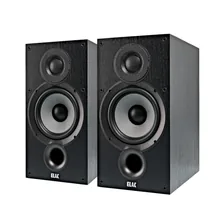 The best passive bookshelf speakers under $500 with a well-measured, neutral response are the ELAC Debut 2.0 B6.2: $329.00 per pair Amazon Crutchfield eBay
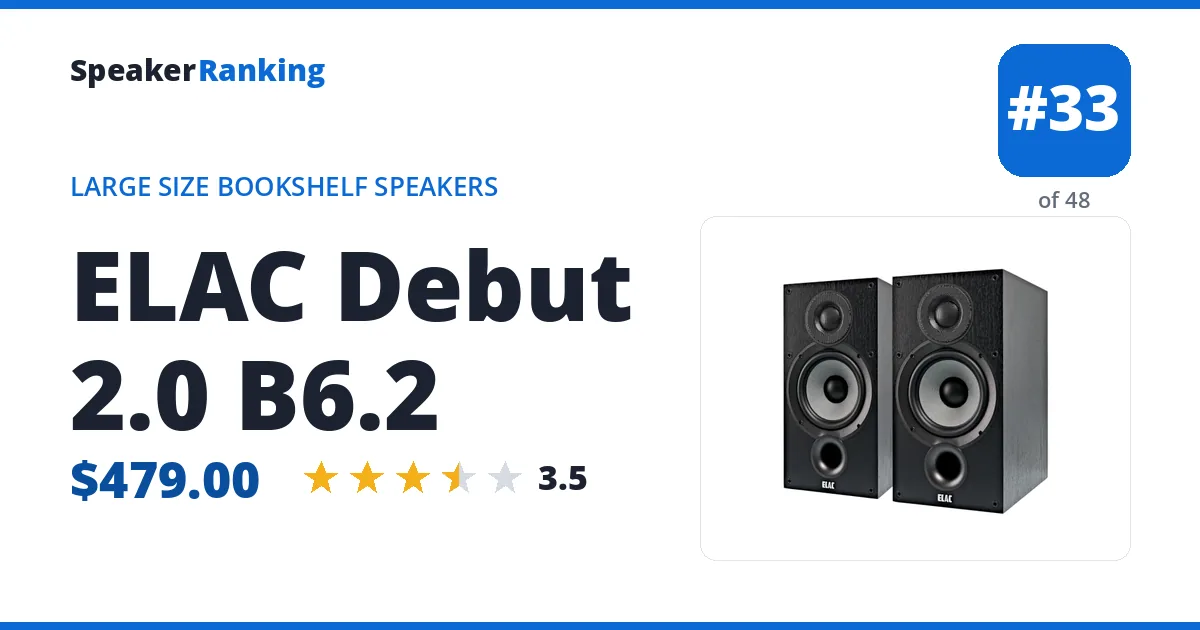
Pros: Reasonably flat on-axis and listening-window response with reasonably even horizontal directivity, holding about ±60° up to roughly 8kHz for consistent stereo width whether aimed directly at the listener or toed out. Its larger-than-typical woofer lets it play very loud with minimal distortion, staying under about 1% THD down to 50Hz at 86dB, and minimum impedance stays a comfortable 5-6 ohms. In-room bass extension reaches about 50Hz without much trouble, enough for a solid kick-drum sound. Takes equalization very well - correcting the on-axis response doesn’t cost sensitivity through the midrange, and the underlying directivity behavior (diffraction, vertical mismatch) is mild enough that EQ alone gets most of the way to a well-balanced sound. Vertical tolerance is asymmetric and fairly forgiving: about 10° above the tweeter axis and 20° below it before tonal balance meaningfully shifts. One reviewer called it “a good speaker” with “a good price” rather than just good-for-the-price, and found it fairly neutral overall in-room. Measured bass extension of 64Hz (-3dB), with a measured sensitivity of 86.5dB.
Cons: A good size resonant peak around 700Hz stands out from an otherwise smooth response and lingers in cumulative spectral decay (waterfall) measurements - in one reviewer’s sighted A/B test, reducing it by about 5dB via EQ made a noticeable but not dramatic difference. Directivity error shows up around 3.3kHz, and the upper-midrange around 4-6kHz stood out as edgy and sharp, almost sibilant at times, in casual listening - the predicted in-room response shows a lack of energy between 1-2kHz and a bit too much above that, which one reviewer thought would sound bright. Distortion at 96dB SPL/1m shows two harmonic peaks the reviewer says “should not be there,” one from woofer breakup around 400Hz and another around 7-8kHz from the tweeter, and multitone distortion approaches 10% in the 500-800Hz range at that output level. Real compression shows up even at moderate volume and worsens at 96dB and above, with the woofer clearly giving up around 60-70Hz - a subwoofer is recommended for anyone wanting to listen loud, since running it full-range at high output costs real dynamic range in the midbass and bass. Don’t place it close to a wall - boundary reinforcement adds a midbass bump that undoes the otherwise smooth, linear response. Getting the best out of it takes EQ (taming the 700Hz peak, filling in the 1-2kHz dip, and trimming the highs).
Full ELAC Debut 2.0 B6.2 review and specifications →
| Bass Extension (-10dB) | 40Hz (measured, Erin's Audio Corner) |
|---|---|
| Bass Extension (-3dB) | 64Hz (measured, Erin's Audio Corner) |
| Dimensions | 14.8"H x 7.7"W x 10.6"D (375.0 x 195.0 x 268.0 mm) |
| Drivers | 25mm tweeter + 165mm woofer |
| Impedance | 6 ohms nominal, 5.2 ohms minimum (measured, Erin's Audio Corner) |
| Sensitivity | 86.5dB (measured, Audio Science Review) |
| Spinorama Preference Score | 4.75 (spinorama.org) |
| Spinorama Preference Score with Perfect Sub | 7.0 (spinorama.org) |
| Weight | 29.1 lbs (13.2 kg) |
| Woofer Cabinet | ported, front |
- Links
- Reviews, Comparisons and Sound Samples
- Head-to-Head Comparisons
- ELAC Debut 2.0 B6.2 vs SVS Prime Bookshelf
- ELAC Debut 2.0 B6.2 vs Dynaudio Special Forty
- ELAC Debut 2.0 B6.2 vs KEF Q3 Meta
- ELAC Debut 2.0 B6.2 vs Polk Monitor XT20
- ELAC Debut 2.0 B6.2 vs Infinity IL10
- ELAC Debut 2.0 B6.2 vs GR-Research X-LS Encore
- ELAC Debut 2.0 B6.2 vs Sonus Faber Lumina II
- ELAC Debut 2.0 B6.2 vs XTZ Spirit 4
- See all 60 comparisons
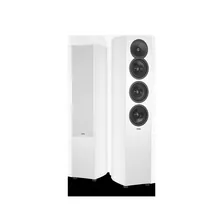 The best value floorstanding speakers, easy to drive and deep enough to skip a subwoofer, are the Revel Concerta2 F35: $900 per pair Crutchfield eBay
Pros: Two-and-a-half-way, four-driver design: a 1” aluminum dome tweeter on a waveguide, a 5.25” mid-range, and dual 5.25” mid-bass drivers in a rear-ported cabinet. Measured sensitivity of 89.4dB closely matches the 90dB spec, and distortion looks good at both 86dB and 96dB, holding up well even with a high-pass filter applied. At its sale price (around $900/pair, down from full retail), the reviewer calls it a “no-brainer,” undercutting comparable budget floorstanders like the ELAC DF63. Frequency response and directivity mismatches are largely EQ-able, since most of what shows up in measurements traces to physical tweeter/mid-range separation rather than a fundamental flaw. Compression is fairly well controlled for the price - about 1dB of loss around 100Hz under long-term compression, described as “par for the course” at this cost. Measured bass extension of 70Hz (-3dB), with a measured sensitivity of 89.4dB.
Cons: F3 of 61Hz and F10 of 39Hz mean a subwoofer is needed for real bass extension. A dip in the lower midrange/2-3kHz region reduces attack and detail, and a peak around 5kHz adds some edge and sibilance in the lower treble. A peak in off-axis energy around 3kHz reflects off sidewalls at roughly 60-70° off-axis and arrives louder than the direct sound - this specific issue can’t be fixed with EQ (boosting the direct sound would boost the stronger reflection too) and would need acoustic absorption to properly address, though the reviewer considers it a minor, optional fix at this price. A couple of minor resonances appear in the impedance plot, including one around 300Hz that may partly explain a subtle sense of vocal warmth noticed in listening, though it’s more likely room-related. Minimum impedance around 3.8 ohms. Short-term compression testing shows some increased distortion in the tweeter and higher-frequency compression at loud output.
Full Revel Concerta2 F35 review and specifications →
| Bass Extension (-10dB) | 50Hz (measured, Erin's Audio Corner) |
|---|---|
| Bass Extension (-3dB) | 70Hz (measured, Erin's Audio Corner) |
| Dimensions | 40.3"H x 8.4"W x 12.2"D (1023.6 x 213.4 x 309.9 mm) |
| Drivers | 3x 5.25" deep anodized aluminum cone woofers, 1" Aluminum Tweeter |
| Impedance | 6 ohms nominal (3.8 ohms minimum, measured by Erin's Audio Corner) |
| Sensitivity | 89.4dB (measured, Erin's Audio Corner; 90dB manufacturer specified) |
| Spinorama Preference Score | 4.44 |
| Spinorama Preference Score with Perfect Sub | 6.38 |
| Weight | 41 lbs (18.6 kg) each |
| Woofer Cabinet | ported, rear |
- Links
- Reviews, Comparisons and Sound Samples
- Head-to-Head Comparisons
- Revel Concerta2 F35 vs Revel F206
- Revel Concerta2 F35 vs Perlisten S7t
- Revel Concerta2 F35 vs JBL Studio 698
- Revel Concerta2 F35 vs KEF R11 Meta
- Revel Concerta2 F35 vs Arendal 1961 Tower
- Revel Concerta2 F35 vs JBL HDI-3600
- Revel Concerta2 F35 vs Emotiva Airmotiv T2+
- Revel Concerta2 F35 vs Revel F228Be
- See all 56 comparisons
Mistakes That Cost People Money
Buying speakers your amplifier can’t drive. An 82 dB, 4 ohm bookshelf speaker on a modest receiver will sound thin and distort early, and it isn’t the speaker’s fault or the amp’s. See why wattage doesn’t tell you much.
Spending on the amplifier instead of the speakers. Above the point where it’s clean and powerful enough, an amplifier’s contribution is small. The speaker and the room dominate.
Buying bookshelf speakers for deep bass. A 5” woofer in a small cabinet cannot reach 30 Hz at useful volume. If you want that, buy floorstanders or add a subwoofer.
Ignoring the room. Placement, distance from the wall behind, and the first reflection points change the result more than a component upgrade. See how room acoustics affects speakers.
Forgetting stands. A bookshelf speaker on a desk or a bookshelf is a bookshelf speaker with a boundary problem. Stands are the cheapest real improvement available.
Where To Go Next
Full rankings with specs and measurements: passive bookshelf medium and large, plus large floorstanding.
By use: budget passive speakers, high sensitivity for tube amps, and the general top recommended passive speakers. If you’d rather not buy an amplifier at all, see the powered speaker buyer’s guide.