Editor's top picks
Start with these speakers
Our leading recommendations at a glance. Each card links to its primary retailer.
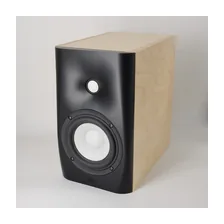 Best Overall
Audio First Fidelia
£950 per pair for the flatpack kit (assembly required)
See the full review →
Best Overall
Audio First Fidelia
£950 per pair for the flatpack kit (assembly required)
See the full review →
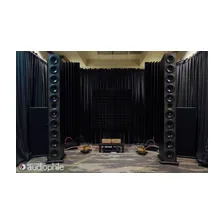 Best Flagship Kits
GR-Research NX-Treme
$9662 per pair for the kit with subs (assembly required)
See the full review →
Best Flagship Kits
GR-Research NX-Treme
$9662 per pair for the kit with subs (assembly required)
See the full review →
Looking for a DIY speaker kit? A kit gives you the drivers, a designed crossover and usually a flat-pack or cut-it-yourself cabinet, and you do the assembly, soldering and finishing. Because there is no retail markup or factory finishing, the best kits measure alongside finished speakers that cost several times as much. These picks are ranked on measured sound quality, not on how satisfying the build is, from the 294 passive speakers ranked here.
Want every match, not just the top pick per category? See every passive DIY speaker kit →
Prices on this page were last checked September 23, 2026 at 11:24 PM UTC. Product prices and availability are accurate as of that date/time and are subject to change; the price and availability shown on Amazon at the time of purchase will apply to the purchase of this product.
As an eBay Partner, we may be compensated if you make a purchase.
What A Kit Actually Asks Of You
Build effort varies a lot. Flat-pack cabinets like the Parts Express C-Note go together with glue and clamps in an afternoon. Others, like the XMechanik Mechano23, expect you to source drivers and the crossover from separate vendors and cut the cabinet yourself. The Linkwitz LXmini is not a passive pair at all once built: it needs a miniDSP and four amplifier channels.
The crossover is where the design lives. Most kits ship crossover parts for you to solder onto a board or point-to-point. Building it exactly to the published schematic matters more than any other step; see crossovers explained for what the network is doing.
Budget for the whole system. Several kits here are low-sensitivity designs around 82 to 85 dB, so they want a reasonably powerful amplifier; see speaker sensitivity explained. The open-baffle designs also need dedicated subwoofers for full-range bass.
Best Overall
The best-measuring DIY kit for most listeners, and the top-ranked medium bookshelf speaker on this site, is the Audio First Fidelia: £950 per pair for the flatpack kit (assembly required) Audio First Designs eBay
Pros: Kit speaker offering exceptional value and tonal accuracy; chosen by reviewer as reference standard for future speaker tonality comparisons despite 1,250 USD price point. Achieves bass extension to 53 Hz (F3) and 38 Hz (F10) from compact cabinet. Direct-from-manufacturer availability eliminates retailer markup. Measured bass extension of 53Hz (-3dB).
Cons: Kit assembly required; lower sensitivity (~83-85 dB vs. typical 85 dB average) demands adequate amplifier power. Only available direct from UK manufacturer with associated shipping costs and lead times. Trade-off between compact driver configuration and maximum dynamic output.
Full Audio First Fidelia review and specifications →
| Bass Extension (-10dB) | 38Hz (measured, Erin's Audio Corner) |
|---|---|
| Bass Extension (-3dB) | 53Hz (measured, Erin's Audio Corner) |
| Crossover Frequency | 1560Hz |
| DIY Kit | Yes |
| Dimensions | 11.8"H x 7.1"W x 11.7"D (300 x 180 x 297.6 mm) |
| Drivers | 5" ceramic-aluminum cone woofer, 1" ceramic-aluminum tweeter |
| Impedance | 4 ohms |
| Sensitivity | 84dB |
| Spinorama Preference Score | 5.85 |
| Spinorama Preference Score with Perfect Sub | 7.86 |
| Weight | 15 lbs (6.8 kg) each |
| Woofer Cabinet | ported, rear |
- Links
- Reviews, Comparisons and Sound Samples
- Erin’s Audio Corner: The #1 Reason audiophiles Are Raving About Fidelia’s Sound Quality More from Erin’s Audio Corner →
- Erin’s Audio Corner: I Tested 250 Speakers So You Don’t Have To!
- Erin’s Audio Corner: My Absolute Favorite Products of 2024 Revealed
- Erin’s Audio Corner Measurements (spinorama.org)
- Head-to-Head Comparisons
- Audio First Fidelia vs Philharmonic Ceramic Mini
- Audio First Fidelia vs Ascend Sierra 1 v2
- Audio First Fidelia vs KEF LS50 Meta
- Audio First Fidelia vs XMechanik Mechano23 DIY
- Audio First Fidelia vs Ascend Acoustics HTM-200SE2
- Audio First Fidelia vs Arendal 1961 Monitor
- Audio First Fidelia vs Ascend Acoustics Luna V2 Mini-Monitor Titan
- Audio First Fidelia vs Aalto Speakers Aalto 1 EVO
- See all 26 comparisons
Erin’s Audio Corner chose it as a tonal reference, and the measurements back that up: a preference score of 7.86 with an ideal subwoofer and bass reaching 53 Hz (F3) from a compact cabinet. It ranks #1 of 88 medium bookshelf speakers. The catch is low sensitivity, around 84 dB, so pair it with a capable amplifier, and it ships direct from the UK at £950.
Best Flagship Kits
For the most spacious soundstage and highest sensitivity, the open-baffle GR-Research NX-Treme: $9662 per pair for the kit with subs (assembly required) Gr-research eBay
Pros: Amazing in terms of soundstage and imaging as the speaker can radiate in all directions and not have internal reflections due to there not being a speaker box. One of the highest sensitivity speakers around. Open baffle mids, highs and bass (using GR-Research Open baffle subs). If you have not heard open baffle bass, you must hear it in person, there’s no going back. Amazing in terms of imaging as the speaker can radiate in all directions and not have internal reflections due to there not being a speaker box. Can easily be driven by tube amps due to the mild impedance. Measured bass extension of <20Hz (-3dB).
Cons: Very tall and will require GR-Research open baffle subwoofers one on each side
Full GR-Research NX-Treme review and specifications →
| Bass Extension (-3dB) | <20Hz (With GR-Research open baffle subwoofers) |
|---|---|
| DIY Kit | Yes |
| Dimensions | 85"H x 17"W x 20"D (2159 x 431.8 x 508 mm) (plus a subwoofer on each side) |
| Drivers | Eight 6.5" M165 open baffle woofer, Two 6.5" M165NQ open baffle midrange, GR Neo 3 Magnetic planar open baffle tweeter; Three 12-inch Rythmik Audio servo-controlled subwoofers; Three 12-inch Rythmik Audio servo-controlled subwoofers; Three 12-inch Rythmik Audio servo-controlled subwoofers; Three 12-inch Rythmik Audio servo-controlled subwoofers |
| Impedance | 8 ohms |
| Sensitivity | 94.5dB |
| Weight | (35.3 lbs (16 kg)) |
| Woofer Cabinet | open baffle |
- Links
- Reviews, Comparisons and Sound Samples
- No independent measurement review is linked for this model; it is ranked from hands-on listening and comparison against similarly priced speakers.
- Head-to-Head Comparisons
- GR-Research NX-Treme vs KEF Blade Two Meta
- GR-Research NX-Treme vs MoFi SourcePoint V10 Master Edition
- GR-Research NX-Treme vs MoFi SourcePoint 888
- GR-Research NX-Treme vs Revel F328Be
- GR-Research NX-Treme vs JBL Studio 698
- GR-Research NX-Treme vs Revel Concerta2 F35
- GR-Research NX-Treme vs Klipsch Forte IV
- GR-Research NX-Treme vs Polk T50
With no box around the midrange and tweeter there are no cabinet reflections, and at 94.5 dB it is one of the most efficient speakers on the site, so even a low-power tube amp can drive it. It needs GR-Research open-baffle subwoofers on each side and a lot of floor space, and at $9662 it is a flagship project.
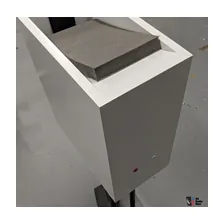 For a no-compromise bookshelf kit, the GR-Research NX-Studio: $3630 per pair Gr-research eBay
Pros: Ultra clean burst decay/waterfall plot. Amazingly open sounding due to the semi open baffle Neo3 ribbon tweeter, will image better than any other bookshelf speaker. Neo3 ribbon tweeter is one of the best ribbons around for detail. Bass will be very tight and fast due to the sealed enclosure, but may possibly need a sub.
Cons: Bass will be very tight but won’t be quite as deep as others due to the sealed woofer enclosure.
Full GR-Research NX-Studio review and specifications →
| DIY Kit | Yes |
|---|---|
| Dimensions | 18"H x 8.5"W x 15.5"D (457.2 x 215.9 x 393.7 mm) |
| Drivers | GR-Research M165NQ 6.5" paper cone, non-resonant polymer frame, copper shorting rings and aluminum phase plug sealed enclosure woofer, GR-Research Neo3 Planar Magnetic Ribbon open baffle tweeter |
| Impedance | 8 ohms |
| Sensitivity | 87dB |
| Weight | 20.5 lbs (9.3 kg) each |
| Woofer Cabinet | sealed |
- Links
- Reviews, Comparisons and Sound Samples
- Head-to-Head Comparisons
- GR-Research NX-Studio vs KEF Reference 1 Meta
- GR-Research NX-Studio vs March Audio Sointuva AWG
- GR-Research NX-Studio vs Perlisten S4b
- GR-Research NX-Studio vs AsciLab C6B
- GR-Research NX-Studio vs Audio First Cadentia 3
- GR-Research NX-Studio vs KEF R3 Meta
- GR-Research NX-Studio vs KEF Q Concerto Meta
- GR-Research NX-Studio vs Wharfedale Aura 2
- See all 49 comparisons
A Neo3 planar ribbon tweeter in a semi open baffle gives it an unusually open, detailed top end, and its waterfall shows very clean decay. The sealed woofer keeps bass tight but not especially deep, so plan on a subwoofer for full-range listening. It ranks #4 of 130 large bookshelf speakers.
Best Value
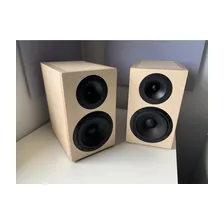 The best-measuring kit for the money is the XMechanik Mechano23 DIY: $200 per pair DIY parts Madisound (Tweeter) Madisound (Woofer) eBay
Pros: The bass alignment is unusually well damped, with a measured Q of 0.336, among the lowest of any speaker in this catalog, so the -3dB point at 77.6Hz rolls off cleanly instead of building into a resonant bump the way many small ported designs do. On axis deviation measures a tight 0.195dB average, and Audio Science Review’s independent Klippel NFS review called the predicted in room response nearly perfect, with directivity matching that beats some commercial designs costing many times more, all from about $48 in parts. Measured bass extension of 77.6Hz (-3dB), with a measured sensitivity of 85.1dB.
Cons: This is a true DIY project. There is no assembled unit to buy, drivers come from Madisound, the crossover kit comes separately from EZ Speaker Solutions, and the birch plywood cabinet has to be built and finished by hand. Listening window smoothness measures a moderate 0.47 and the sound power directivity index has more variation (standard deviation 4.02) than the tightest speakers in this catalog, so off axis energy isn’t quite as evenly controlled as the excellent on axis figures suggest.
Full XMechanik Mechano23 DIY review and specifications →
| Bass Extension (-10dB) | 42.4Hz (measured, Audio Science Review) |
|---|---|
| Bass Extension (-3dB) | 77.6Hz (measured, Audio Science Review) |
| Cabinet Material | 18mm Baltic birch plywood |
| Country | Design origin: United States (ASR forum); assembled by buyer |
| DIY Kit | Yes |
| Dimensions | 11.4"H x 6.9"W x 10.4"D (290 x 174 x 263 mm) |
| Drivers | Scan-Speak Discovery H2606/9200 1" horn loaded textile dome tweeter, SB Acoustics SB13PFCR25-4 5" fiber cone woofer |
| Enclosure | ported |
| Impedance | 4.1 ohms nominal (measured, ASR) |
| Port Tuning | Approximately 45Hz |
| Sensitivity | 85.1dB @ 2.83V/1m (measured, Audio Science Review) |
| Spinorama Preference Score | 4.70 |
| Spinorama Preference Score with Perfect Sub | 7.16 |
- Links
- Reviews, Comparisons and Sound Samples
- Head-to-Head Comparisons
- XMechanik Mechano23 DIY vs Ascend Acoustics HTM-200SE2
- XMechanik Mechano23 DIY vs Arendal 1961 Monitor
- XMechanik Mechano23 DIY vs KEF LS50 Meta
- XMechanik Mechano23 DIY vs Ascend Sierra 1 v2
- XMechanik Mechano23 DIY vs Philharmonic Ceramic Mini
- XMechanik Mechano23 DIY vs Ascend Acoustics Luna V2 Mini-Monitor Titan
- XMechanik Mechano23 DIY vs Aalto Speakers Aalto 1 EVO
- XMechanik Mechano23 DIY vs Audio First Fidelia
- See all 21 comparisons
Its bass alignment is unusually well damped, with a measured Q of 0.336, so it rolls off cleanly from 77.6 Hz instead of building a boomy bump, and it reaches a 7.16 preference score with an ideal subwoofer. This is a true scratch build: drivers from Madisound, crossover parts from a separate vendor, and a birch plywood cabinet you make yourself, all for about $48.
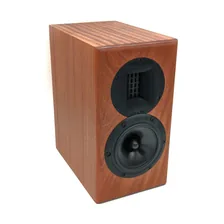 For wide dispersion that suits off-axis seating, the GR-Research NX-Bravo: $1540 per pair kit with finished cabinets (assembly required) Gr-research eBay
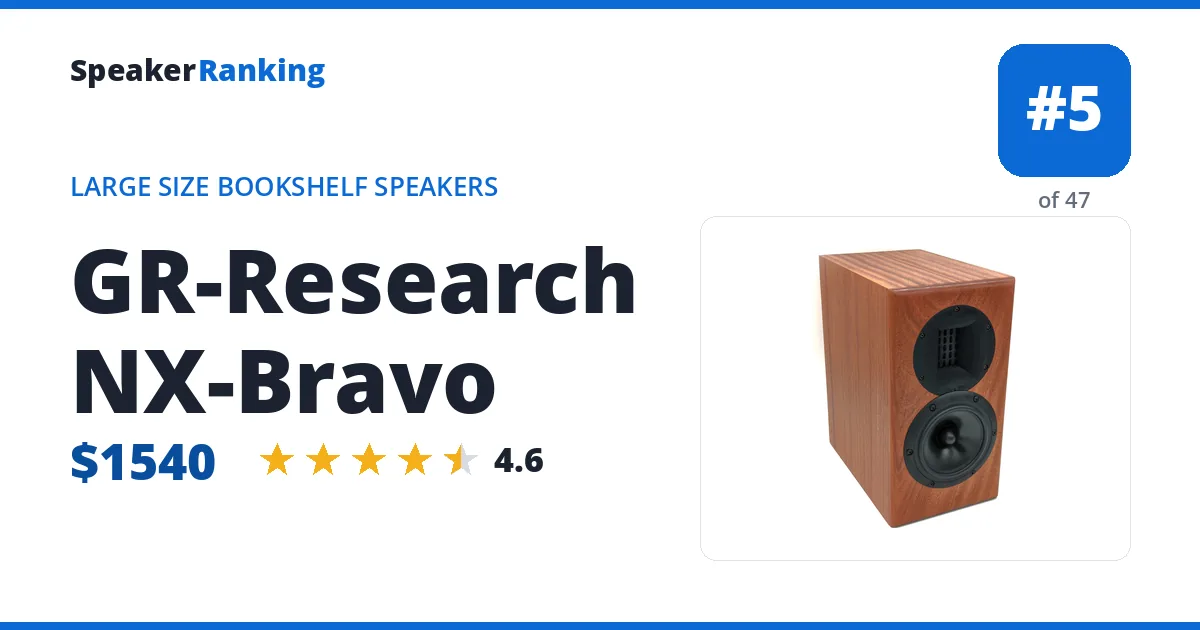
Pros: Vertical dispersion is unusually wide for a two-way bookshelf: tonal matching holds from about 50° above the tweeter axis down to 20° below it, well beyond the roughly ±10-20° typical of most two-ways. Horizontal dispersion is also wide at about ±70° through the midrange, widening further when toed out, so sidewall acoustic treatment isn’t really necessary. Burst decay is extremely clean with essentially no ringing - the reviewer compared it favorably to a $13,000/pair speaker that showed significant ringing at 120Hz and 500Hz. A deliberate dip around 7kHz reduces sibilance while the 1-4kHz upper-midrange stays neutral, so the sound doesn’t come across as laid-back or recessed. Easy to drive electrically, with a 5-ohm minimum impedance and 2.5-ohm minimum EPDR. Available from $700 as a kit up to about $2,500 fully finished, with the option of the designer’s flush-mount tube/banana-plug terminals for a cleaner look. Measured bass extension of 77Hz (-3dB), with a measured sensitivity of 84.8dB.
Cons: Pointed straight on-axis there’s a deliberate ~5dB high-frequency bump meant to compensate for narrowing dispersion off-axis; it needs about 15° of toe-out (aimed to cross behind the listener) to sound balanced, which won’t suit every room layout. Higher-than-normal high-frequency distortion becomes audible in sine-sweep testing at higher output, and multitone distortion crosses the reviewer’s 3% threshold around 96dB, making roughly 88dB the safer output ceiling. SPL-limited by the manufacturer’s own admission - not intended for loud, full-range playback and best paired with a subwoofer, as with most two-way bookshelf designs. F3 of 77Hz and F10 of 45Hz mean bass only reaches about 50-60Hz in-room. A minor enclosure or port resonance shows up in the frequency response (though not in burst decay), likely a non-issue but visible in measurements. Adding a subwoofer reduces midrange distortion but doesn’t address the elevated high-frequency distortion.
Full GR-Research NX-Bravo review and specifications →
| Bass Extension (-10dB) | 45Hz (measured, Erin's Audio Corner) |
|---|---|
| Bass Extension (-3dB) | 77Hz (measured, Erin's Audio Corner) |
| DIY Kit | Yes |
| Dimensions | 14"H x 7.5"W x 11.5"D (355.6 x 190.5 x 292.1 mm) |
| Drivers | GR-Research M165 6.5" paper cone, non-resonant polymer frame woofer, GR-Research Neo3 Planar Magnetic Ribbon deep rear cup tweeter |
| Impedance | 6 ohms nominal, 5 ohms minimum (measured, Erin's Audio Corner) |
| Sensitivity | 84.8dB (measured, Erin's Audio Corner) |
| Spinorama Preference Score | 4.33 |
| Spinorama Preference Score with Perfect Sub | 6.67 |
| Weight | 16.1 lbs (7.3 kg) each |
| Woofer Cabinet | ported |
- Links
- Reviews, Comparisons and Sound Samples
- Head-to-Head Comparisons
- GR-Research NX-Bravo vs Wharfedale Linton 85
- GR-Research NX-Bravo vs MoFi SourcePoint 8
- GR-Research NX-Bravo vs KEF Q Concerto Meta
- GR-Research NX-Bravo vs KEF R3 Meta
- GR-Research NX-Bravo vs ELAC Debut 3.0 DB63
- GR-Research NX-Bravo vs AsciLab C6B
- GR-Research NX-Bravo vs March Audio Sointuva AWG
- GR-Research NX-Bravo vs Klipsch RP-600M II
Tonal balance holds from about 50 degrees above the tweeter axis down to 20 below, far wider than most two-ways, with about ±70 degrees horizontally. On-axis it carries a deliberate treble lift, so toe it out about 15 degrees. GR-Research sells it both as a kit and fully finished.
Best For Home Theater
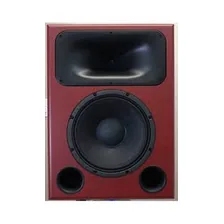 For a high-output cinema front stage, the DIYSG HTM-12 v2: $920 per pair per kit DIY Sound Group eBay
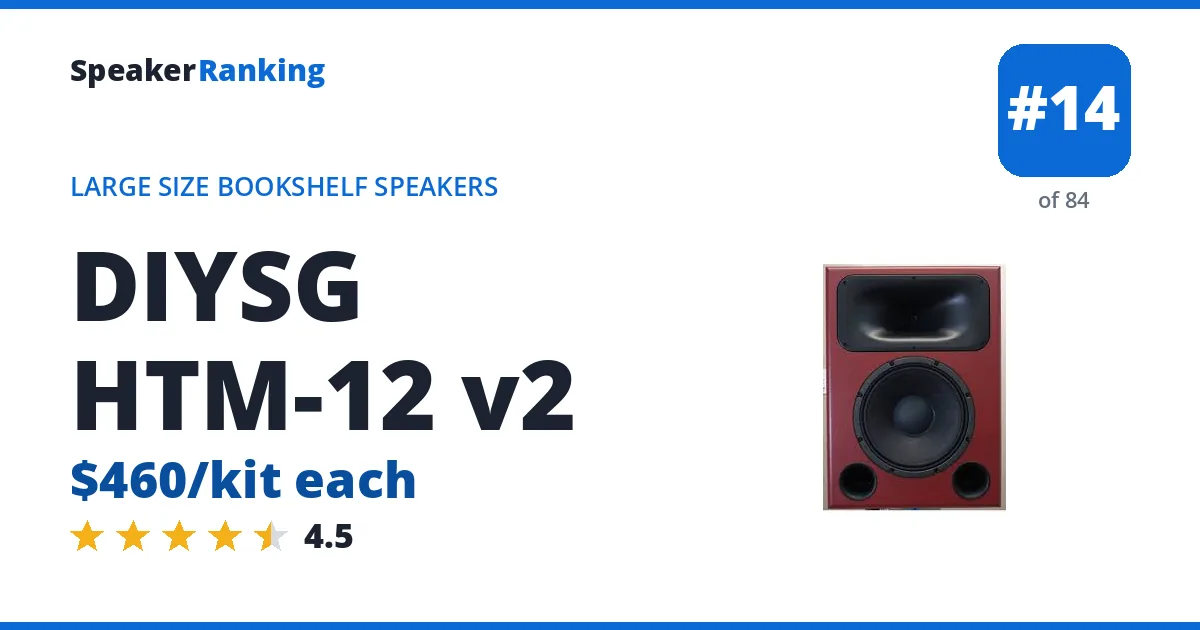
Pros: Purpose-built high-output cinema kit pairing a 12-inch woofer with a compression driver in a large SEOS waveguide. Erin measured 91dB/2.83V/1m sensitivity, extraordinarily low distortion (still below 1% to about 60Hz at 102dB) and only about 0.5dB tweeter compression at the same level. Horizontal directivity is consistent and crossover integration is unusually good, so response corrections remain EQ-friendly. The benign impedance curve can be driven by many capable AVRs. Measured bass extension of 67Hz (-3dB), with a measured sensitivity of 91dB.
Cons: Erin measured F3 at approximately 67Hz, the normal efficiency/bass-extension tradeoff of a high-sensitivity 12-inch design, so a subwoofer is mandatory. A few narrow resonances appear in the response, impedance and decay plots; Erin suggested crossover/component investigation could improve them. Vertical radiation narrows around the crossover, the unfinished kit requires cabinet assembly and finishing, and its broad baffle is visually and physically substantial.
Full DIYSG HTM-12 v2 review and specifications →
| Bass Extension (-10dB) | 45Hz (measured, Erin's Audio Corner) |
|---|---|
| Bass Extension (-3dB) | 67Hz (measured, Erin's Audio Corner) |
| DIY Kit | Yes |
| Dimensions | 25"H x 18"W x 9.5"D (635 x 457.2 x 241.3 mm) |
| Drivers | 12" woofer; compression driver in SEOS waveguide |
| Impedance | AVR-compatible impedance profile (measured, Erin's Audio Corner) |
| Sensitivity | 91dB/2.83V/1m (measured, Erin's Audio Corner) |
| Spinorama Preference Score | 2.41 |
| Spinorama Preference Score with Perfect Sub | 5.02 |
| Weight | 39.9 lbs (18.1 kg) assembled |
| Woofer Cabinet | ported |
- Links
- Reviews, Comparisons and Sound Samples
- Head-to-Head Comparisons
A 12-inch woofer and a compression driver in a large waveguide give it 91 dB measured sensitivity and extraordinarily low distortion, still under 1% to about 60 Hz at 102 dB. Its F3 of about 67 Hz makes a subwoofer mandatory, which is normal for a speaker built for a home theater system.
Best Open-Baffle Experiment
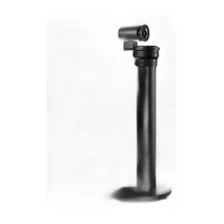 For a DSP-driven open-baffle design at a modest parts cost, the Linkwitz Lab LXmini: $610.00 per pair Madisound LXmini Kit eBay
Pros: Open-baffle/dipole upper driver and cylindrical woofer enclosure create a very large, open soundstage with unusually little cabinet signature. Erin praised the stable, well-controlled directivity: despite using a nominal full-range upper driver, off-axis response retains composure beyond its beaming region and the directivity index is smooth enough for reliable DSP voicing. Imaging can be precisely adjusted through placement and toe angle. Erin measured F3 at 50Hz and F10 at 33Hz, impressive for the narrow footprint, and found the system satisfying for much music without a subwoofer. The supplied miniDSP configuration is readily editable; broad shelf correction near 550Hz and a handful of narrow filters can make the response substantially more linear. The kit is mechanically simple, highly customizable and based on well-documented Linkwitz engineering. Measured bass extension of 50Hz (-3dB).
Cons: This is not a conventional passive pair: it requires a construction-plan license, assembly, miniDSP, four matched amplifier channels and careful gain/setup work, so the apparent kit price is not the complete system cost. Output below about 50Hz lacks kick-drum weight and benefits from subwoofers. Erin found rising second-order distortion near 1.5kHz on both samples, accompanied by an impedance blip that may indicate an enclosure reflection or driver-compliance effect. At high output the system behaves as if electronically limited even with miniDSP limiting bypassed, reducing bass and subjective dynamics. Default voicing is less linear than expected, with irregularities above roughly 2kHz, though its controlled directivity makes these correctable. Dipole rear radiation demands meaningful distance from the front wall and makes placement less flexible than a box speaker.
Full Linkwitz Lab LXmini review and specifications →
| Amplifier Power | Four channels, 50W/channel minimum with identical voltage gain |
|---|---|
| Bass Extension (-10dB) | 33Hz (measured, Erin's Audio Corner) |
| Bass Extension (-3dB) | 50Hz (measured, Erin's Audio Corner) |
| Crossover Frequency | 700Hz LR2, active DSP |
| DIY Kit | Yes |
| Drivers | 6.5" SEAS woofer in sealed tube, 4" SEAS full-range dipole driver |
| Impedance | 4 ohms upper driver / 8 ohms woofer nominal (separate actively bi-amplified loads; manufacturer specified) |
| Sensitivity | 85dB upper driver / 87dB woofer @ 1W/1m (individual driver specifications; complete active-DSP system sensitivity is not directly specified) |
| Spinorama Preference Score | 3.89 (measured, spinorama.org) |
| Spinorama Preference Score with Perfect Sub | 5.77 (measured, spinorama.org) |
| Woofer Cabinet | sealed cylindrical enclosure; open-baffle upper driver |
- Links
- Reviews, Comparisons and Sound Samples
- Head-to-Head Comparisons
A dipole upper driver above a sealed woofer tube creates a large, open soundstage with little cabinet signature, and Erin measured stable, well-controlled directivity and bass to 50 Hz. The $505 kit price is not the whole cost: it needs a construction-plan license, a miniDSP and four matched amplifier channels.
Best First Build
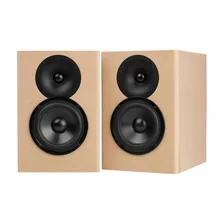 The easiest kit to start with is the Parts Express C-Note: $100 per pair Parts Express eBay
Pros: CEA2034 spinorama shows a reasonably flat response in the critical midrange with good directivity control near the crossover point, courtesy of a waveguide-integrated tweeter. High power handling let it play very loud in a large room with no sign of bottoming out - unusual for a $160 pair. The MDF cabinet felt stout in hand despite the unfinished, DIY flat-pack construction. Measured bass extension of 90Hz (-3dB), with a measured sensitivity of 83dB.
Cons: Reduced bass output and a resonance peak around 700Hz both show up clearly in the measurements; worst-case distortion above 1kHz sits about 40dB below listening level. Ships as unfinished MDF flat-pack cabinets, requiring assembly and finishing (gluing, painting or veneering) before use.
Full Parts Express C-Note review and specifications →
| Bass Extension (-3dB) | 90Hz (measured, Audio Science Review) - the reviewer explicitly flagged this measurement as unreliable below 70Hz, so no -10dB figure is given |
|---|---|
| DIY Kit | Yes |
| Dimensions | 11H x 7.5W x 9.5D in (unfinished MDF flat-pack) |
| Drivers | Dayton Audio DSA135-8 5" woofer, Dayton ND25FW-4 1" soft dome tweeter (waveguide-loaded) |
| Frequency Response | 43Hz - 20kHz +/-3dB (Manufacturer specified) |
| Impedance | 8 ohms |
| Power Handling | 60W RMS / 120W max |
| Sensitivity | 83dB (2.83V/1m, measured, Audio Science Review) |
| Spinorama Preference Score | 4.07 (spinorama.org) |
| Spinorama Preference Score with Perfect Sub | 6.78 (spinorama.org) |
| Woofer Cabinet | ported |
- Links
- Reviews, Comparisons and Sound Samples
- Head-to-Head Comparisons
It ships as an unfinished MDF flat-pack at about $160, measures reasonably flat through the midrange with good directivity near the crossover thanks to its waveguide tweeter, and handles high power. Expect reduced bass and a resonance near 700 Hz, and budget a subwoofer and a capable amplifier for its 83 dB sensitivity.
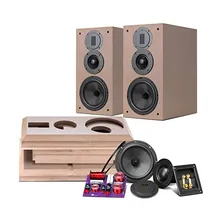 For a three-way first build, the HiVi Swans 3.1A Sehlin Sound Solutions mod: $364.99 per pair for the kit (assembly required) Amazon eBay
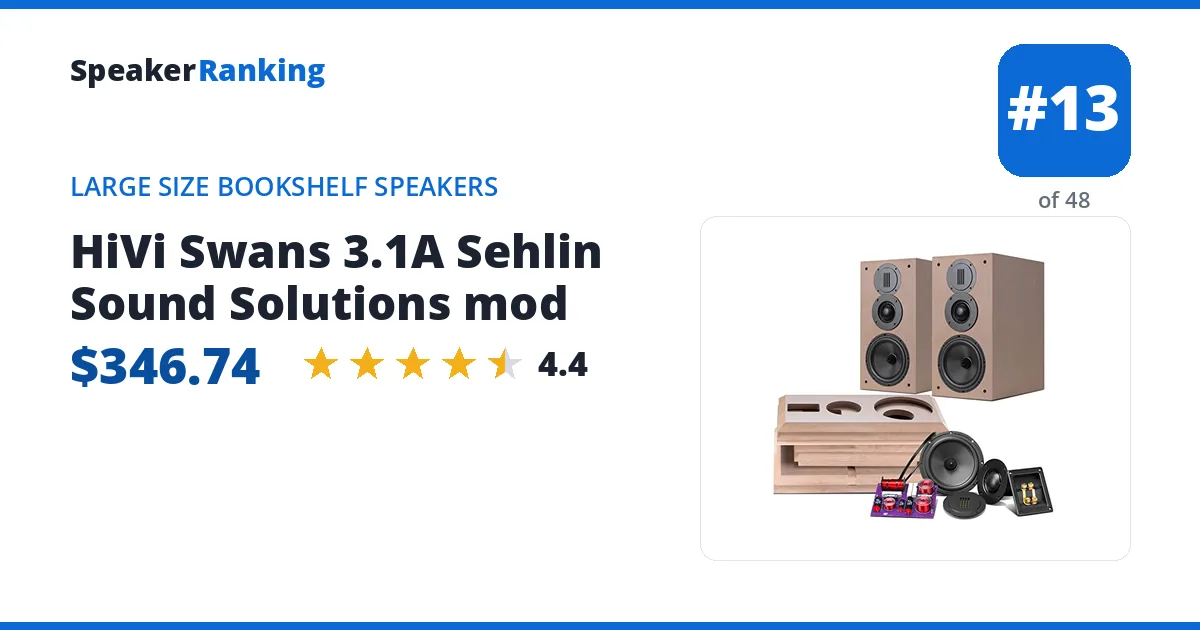
Pros: CEA2034 spinorama shows a mostly smooth on-axis response for a DIY three-way kit. Horizontal beamwidth of about ±70 degrees is wide and consistent. Distortion stays under control down to 40Hz at 96dB SPL/1m, a strong result for a 6.5” woofer in this class. Measured bass extension of 60Hz (-3dB), with a measured sensitivity of 86.5dB.
Cons: Some directivity error appears around 2.1kHz on-axis. Predicted in-room response needs about 1-2dB of correction to fit an ideal target curve. Vertical directivity is just okay, so listening height matters more than with a coincident design. Minimum impedance dips to 3.8 ohms with several peaks, a moderately demanding load. Requires DIY assembly (kit only), with additional Sehlin-mod parts and labor beyond the base kit price.
Full HiVi Swans 3.1A Sehlin Sound Solutions mod review and specifications →
| Bass Extension (-10dB) | 38Hz (measured, Audio Science Review) |
|---|---|
| Bass Extension (-3dB) | 60Hz (measured, Audio Science Review) |
| DIY Kit | Yes |
| Dimensions | 16.5"H x 8.5"W x 13"D (420.0 x 215.0 x 330.0 mm) |
| Drivers | 6.5" Kevlar woofer, 2" Dome midrange, 1" Soft Dome tweeter |
| Impedance | 4 ohms nominal, 3.8 ohms minimum (measured, Audio Science Review) |
| Sensitivity | 86.5dB (measured, Audio Science Review) |
| Spinorama Preference Score | 5.8 (derived from ASR thread measurement data) |
| Spinorama Preference Score with Perfect Sub | 7.6 (derived from ASR thread measurement data) |
| Weight | 13.7 lbs (6.2 kg) |
| Woofer Cabinet | ported, rear |
- Links
- Reviews, Comparisons and Sound Samples
- Head-to-Head Comparisons
- HiVi Swans 3.1A Sehlin Sound Solutions mod vs Klipsch RP-600M II
- HiVi Swans 3.1A Sehlin Sound Solutions mod vs ELAC Debut 3.0 DB63
- HiVi Swans 3.1A Sehlin Sound Solutions mod vs GR-Research X-LS Encore
- HiVi Swans 3.1A Sehlin Sound Solutions mod vs ELAC Debut 2.0 B6.2
- HiVi Swans 3.1A Sehlin Sound Solutions mod vs Polk Monitor XT20
- HiVi Swans 3.1A Sehlin Sound Solutions mod vs MoFi SourcePoint 10
- HiVi Swans 3.1A Sehlin Sound Solutions mod vs KEF Q Concerto Meta
- HiVi Swans 3.1A Sehlin Sound Solutions mod vs KEF R3 Meta
- See all 11 comparisons
A mostly smooth on-axis response, wide ±70 degree horizontal beamwidth and controlled distortion down to 40 Hz at 96 dB make this an unusually capable three-way for its price. Some directivity error around 2.1 kHz means listening height matters.
Where To Go Next
See every passive DIY speaker kit for the complete ranked list, or the passive speaker buyer’s guide for finished speakers. If you’re pairing a kit with a tube amp, see best passive speakers for tube and low-power amplifiers.