Editor's top picks
Start with these speakers
Our leading recommendations at a glance. Each card links to its primary retailer.
Looking for the best PA speaker under $1,000? This budget covers the most popular powered PA speakers made, the workhorse 8, 10 and 12-inch boxes used by bands, DJs, churches and rental companies. It is also where the top of the rankings sits: the best-measuring PA speakers on this site cost less than $1,000 each. Prices are per speaker, so a stereo pair costs twice as much.
Prices on this page were last checked September 26, 2026 at 11:14 PM UTC. Product prices and availability are accurate as of that date/time and are subject to change; the price and availability shown on Amazon at the time of purchase will apply to the purchase of this product.
As an eBay Partner, we may be compensated if you make a purchase.
What $1,000 Gets You
Measured tonal accuracy. The best picks here have vendor Spinorama data showing even on-axis and off-axis response, so the audience hears the same balance across the room.
Onboard DSP and a real mixer. Expect two XLR/TRS combo inputs, presets for main and monitor use, and limiters that protect the speaker when pushed.
Bass that still needs a subwoofer for dance music. Even 12-inch picks roll off around 48 to 68Hz (-3dB). For speech, acoustic sets and background music that is fine; for DJ sets and full bands, budget for a subwoofer.
Best Overall Under $1,000
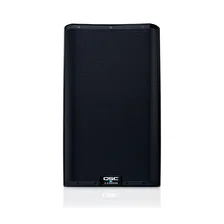 The best all-round PA speaker under $1,000, with 48Hz bass extension and a 7.73 preference score with a subwoofer, is the QSC K12.2: $899.99 Amazon B&H Photo Video Guitar Center eBay
Pros: The strongest all-round tonal result in this popular-model group: the vendor Spinorama data produces a 7.73 ideal-subwoofer preference score and 48Hz measured bass extension. Extensive onboard DSP, flexible main/monitor use and a long market track record make it an unusually safe general-purpose choice. Measured bass extension of 48Hz (-3dB).
Cons: The underlying Spinorama source is low quality, so its apparent measured lead deserves caution. It is not the cheapest 12-inch option, and serious dance music or high-output live use still benefits from a subwoofer.
Full QSC K12.2 review and specifications →
| AES Input | No |
|---|---|
| Amplifier Power | 2025W peak (1800W LF + 225W HF) |
| Aux Input | Yes |
| Bass Extension (-3dB) | 48Hz (measured, vendor Spinorama data) |
| Bluetooth | No |
| Cabinet Material | Impact-resistant ABS |
| Coaxial Input | No |
| Configuration | Active 2-way bass-reflex PA speaker |
| Coverage | 75° conical |
| DSP | Yes |
| Dimensions | 23.7”H x 14”W x 13.8”D (602 x 356 x 350 mm) |
| Drivers | 12” woofer, 1.4” compression driver |
| Frequency Response | 45Hz - 20kHz (-10dB, manufacturer specified) |
| Guitar Input | No |
| HDMI Input | No |
| Inputs | 2 x XLR/TRS combo, 3.5mm aux |
| Maximum SPL | 132dB peak (manufacturer specified) |
| Microphone Input | No |
| Optical Input | No |
| RCA Input | No |
| Rigging | 2 x M10 inserts and pull-back point; 35mm pole mount |
| Spinorama Preference Score | 5.46 |
| Spinorama Preference Score with Perfect Sub | 7.73 |
| TRS Input | Yes |
| USB Input | No |
| Weight | 39 lbs (17.7 kg) |
| XLR Input | Yes |
- Links
- Reviews, Comparisons and Sound Samples
- Head-to-Head Comparisons
It ranks #1 of 50 12-inch PA speakers. Extensive onboard DSP and flexible main or floor-monitor use make it a safe choice for almost any job. The vendor data is low quality, so treat its lead with some caution.
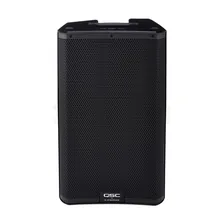 For a lighter 10-inch box with the strongest measured result here, 8.25 with a subwoofer, the QSC K10.2: $799.99 Amazon B&H Photo Video Guitar Center eBay
Pros: This is the standout measured result in this ranking: medium-quality vendor data returns a 8.25 ideal-subwoofer preference score, even higher than the well-regarded K12.2’s own result. Extensive onboard DSP, a 1.4-inch titanium compression driver and QSC’s long market track record make it an unusually safe general-purpose 10-inch pick. Measured bass extension of 56Hz (-3dB).
Cons: The underlying Spinorama source is low quality, so its apparent measured lead deserves some caution. Its 130dB peak claim is modest next to some 10-inch rivals, and a subwoofer still matters for full-range music at event levels.
Full QSC K10.2 review and specifications →
| AES Input | No |
|---|---|
| Amplifier Power | 2025W peak (1800W LF + 225W HF) |
| Aux Input | Yes |
| Bass Extension (-3dB) | 56Hz (measured, vendor Spinorama data) |
| Bluetooth | No |
| Cabinet Material | Impact-resistant ABS |
| Coaxial Input | No |
| Configuration | Active 2-way bass-reflex PA speaker |
| Coverage | 90° conical |
| DSP | Yes |
| Dimensions | 20.4”H x 12.6”W x 11.8”D (519 x 320 x 300 mm) |
| Drivers | 10” woofer, 1.4” titanium compression driver |
| Frequency Response | 56Hz - 20kHz (-6dB, manufacturer specified) |
| Guitar Input | No |
| HDMI Input | No |
| Inputs | 2 x XLR/TRS combo, 3.5mm aux; 2 x XLR thru and XLR mix outputs |
| Maximum SPL | 130dB peak (manufacturer specified) |
| Microphone Input | No |
| Optical Input | No |
| RCA Input | No |
| Rigging | 2 x M10 inserts and pull-back point; 35mm pole mount |
| Spinorama Preference Score | 5.88 |
| Spinorama Preference Score with Perfect Sub | 8.25 |
| TRS Input | Yes |
| USB Input | No |
| Weight | 32 lbs (14.5 kg) |
| XLR Input | Yes |
- Links
- Reviews, Comparisons and Sound Samples
- Head-to-Head Comparisons
It ranks #1 of 28 10-inch PA speakers and reaches about 56Hz (-3dB). At 14.5kg it is easier to lift onto a stand than the K12.2.
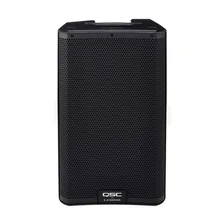 For the smallest top-tier pick, the QSC K8.2: $749.99 Amazon B&H Photo Video Guitar Center eBay
Pros: This is the standout measured result in this ranking: low-quality vendor data still returns a 7.74 ideal-subwoofer preference score, continuing the K.2 series’ strong showing at every driver size. Extensive onboard DSP, a titanium compression driver and QSC’s long market track record make it an unusually safe general-purpose 8-inch pick. Measured bass extension of 58Hz (-3dB).
Cons: The underlying Spinorama source is low quality, so its apparent measured lead deserves some caution. An 8-inch woofer means a subwoofer partner matters even more than with the larger K.2 models.
Full QSC K8.2 review and specifications →
| AES Input | No |
|---|---|
| Amplifier Power | 2025W peak (1800W LF + 225W HF) |
| Aux Input | Yes |
| Bass Extension (-3dB) | 58Hz (measured, vendor Spinorama data) |
| Bluetooth | No |
| Cabinet Material | Impact-resistant ABS |
| Coaxial Input | No |
| Configuration | Active 2-way bass-reflex PA speaker |
| Coverage | 105° conical |
| DSP | Yes |
| Dimensions | 17.7”H x 11”W x 10.6”D (449 x 280 x 269 mm) |
| Drivers | 8” woofer, 1.4” titanium compression driver |
| Frequency Response | 59Hz - 20kHz (-6dB, manufacturer specified) |
| Guitar Input | No |
| HDMI Input | No |
| Inputs | 2 x XLR/TRS combo, 3.5mm aux; 2 x XLR thru and XLR mix outputs |
| Maximum SPL | 128dB peak (manufacturer specified) |
| Microphone Input | No |
| Optical Input | No |
| RCA Input | No |
| Rigging | 2 x M10 inserts and pull-back point; 35mm pole mount |
| Spinorama Preference Score | 5.26 |
| Spinorama Preference Score with Perfect Sub | 7.74 |
| TRS Input | Yes |
| USB Input | No |
| Weight | 26.9 lbs (12.2 kg) |
| XLR Input | Yes |
- Links
- Reviews, Comparisons and Sound Samples
- Head-to-Head Comparisons
It ranks #1 of 22 8-inch PA speakers, scoring 7.74 with a subwoofer. At 12.2kg it suits a floor monitor or speech system; bass stops around 58Hz (-3dB).
Best Value Under $1,000
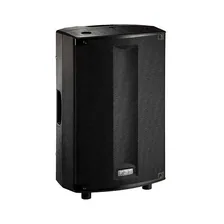 For a strong measured result at a much lower price, the FBT ProMaxX 112A: $722 Thomann eBay
Pros: Medium-quality vendor data yields a strong 7.21 ideal-subwoofer preference score, second only to the QSC among the scored mainstream models here. Its smooth tonal result and high-output PA format make it a compelling value when it is available locally. Measured bass extension of 68Hz (-3dB).
Cons: Measured bass extension is only 68Hz, so it needs a subwoofer sooner than most 12-inch competitors. Distribution and service availability are less universal than QSC, JBL, Yamaha or RCF.
Full FBT ProMaxX 112A review and specifications →
| AES Input | No |
|---|---|
| Amplifier Power | 900W RMS (700W LF + 200W HF); 1,800W peak (1,400W LF + 400W HF) |
| Aux Input | No |
| Bass Extension (-3dB) | 68Hz (measured, vendor Spinorama data) |
| Bluetooth | No |
| Cabinet Material | Polypropylene |
| Coaxial Input | No |
| Configuration | Active 2-way bass-reflex PA speaker |
| Coverage | 90° x 60° |
| DSP | Yes |
| Dimensions | 25.4”H x 15.8”W x 13.6”D (644 x 402 x 345 mm) |
| Drivers | 12” woofer, compression driver |
| Frequency Response | 48Hz - 20kHz (-6dB, manufacturer specified) |
| Guitar Input | No |
| HDMI Input | No |
| Inputs | XLR combo input, XLR male output, RCA stereo input |
| Maximum SPL | 133dB peak / 126dB continuous |
| Microphone Input | No |
| Optical Input | No |
| RCA Input | Yes |
| Rigging | 2x M10 suspension points, 35mm pole-mount socket, wall-bracket flange plate |
| Spinorama Preference Score | 4.30 |
| Spinorama Preference Score with Perfect Sub | 7.21 |
| TRS Input | No |
| USB Input | No |
| Weight | 39.9 lbs (18.1 kg) |
| XLR Input | Yes |
- Links
- Reviews, Comparisons and Sound Samples
- Head-to-Head Comparisons
It scores 7.21 with a subwoofer, second only to the QSC picks. Bass rolls off early, at 68Hz (-3dB), so pair it with a subwoofer sooner than most 12-inch boxes. Dealer support is thinner in the US than for QSC, JBL or Yamaha.
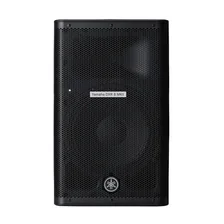 For a proven 8-inch at a mid-range price, the Yamaha DXR8mkII: $649.00 Amazon B&H Photo Video Guitar Center eBay
Pros: Medium-quality vendor data shows a 5.89 ideal-subwoofer preference score with 64Hz measured extension, among the strongest results here. Yamaha’s FIR-X processing, a 1.75-inch neodymium compression driver and a 90° x 60° constant-directivity horn carry over the larger DXR models’ engineering into a compact cabinet. Measured bass extension of 69Hz (-3dB).
Cons: No mkIII successor exists for this size yet, so it is the oldest design generation in this ranking’s Yamaha lineup, without app control or Bluetooth audio.
Full Yamaha DXR8mkII review and specifications →
| AES Input | No |
|---|---|
| Amplifier Power | 1100W dynamic / 700W continuous (950W LF + 150W HF dynamic) |
| Aux Input | No |
| Bass Extension (-3dB) | 69Hz (measured, vendor Spinorama data) |
| Bluetooth | No |
| Cabinet Material | Matte-finish ABS |
| Coaxial Input | No |
| Configuration | Active 2-way bass-reflex PA speaker |
| Coverage | 90° x 60° |
| DSP | Yes |
| Dimensions | 18”H x 11”W x 11”D (458 x 280 x 280 mm) |
| Drivers | 8” woofer, 1.75” compression driver |
| Frequency Response | 57Hz - 20kHz (-10dB, manufacturer specified) |
| Guitar Input | No |
| HDMI Input | No |
| Inputs | XLR, dual 1/4-inch, stereo RCA; XLR thru and link outputs |
| Maximum SPL | 130dB peak (manufacturer specified) |
| Microphone Input | No |
| Optical Input | No |
| RCA Input | Yes |
| Rigging | 3 x M8 points; 35mm dual-angle pole mount |
| Spinorama Preference Score | 3.08 |
| Spinorama Preference Score with Perfect Sub | 5.89 |
| TRS Input | Yes |
| USB Input | No |
| Weight | 28.2 lbs (12.8 kg) |
| XLR Input | Yes |
- Links
- Reviews, Comparisons and Sound Samples
- Head-to-Head Comparisons
It scores 5.89 with a subwoofer, and its 1.75-inch compression driver on a 90° x 60° horn covers a typical audience evenly. It has no app control or Bluetooth audio.
Best Features Under $1,000
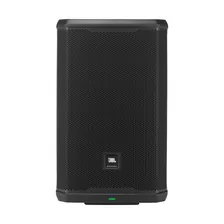 For app control, deep DSP and 54Hz bass extension, the JBL PRX912: $999.00 Amazon B&H Photo Video Guitar Center eBay
Pros: High-quality manufacturer Spinorama data, 132dB claimed peak output, app control and unusually deep onboard processing make this one of the most versatile choices. The measured 54Hz bass extension is useful for speech and lighter music without a subwoofer. Measured bass extension of 54Hz (-3dB).
Cons: Its 6.05 ideal-subwoofer preference score trails the QSC and FBT ProMaxX, with less even sound-power behavior in the supplied data. At 19.5kg it is not especially light, and Bluetooth is for control rather than audio streaming.
Full JBL PRX912 review and specifications →
| AES Input | No |
|---|---|
| Amplifier Power | 2000W peak / 1000W RMS |
| App | Yes (JBL Pro Connect) |
| Aux Input | Yes |
| Bass Extension (-3dB) | 54Hz (measured, vendor Spinorama data) |
| Bluetooth | Control only; no Bluetooth audio |
| Cabinet Material | Polypropylene/talc composite |
| Coaxial Input | No |
| Configuration | Active 2-way bass-reflex PA speaker |
| Coverage | 90° x 50° |
| Crossover Frequency | 1920Hz |
| DSP | Yes |
| Dimensions | 25”H x 15.5”W x 13.1”D (636 x 394 x 332 mm) |
| Drivers | 12” woofer, 1.5” compression driver |
| Frequency Response | 50Hz - 20kHz (-10dB, manufacturer specified) |
| Guitar Input | No |
| HDMI Input | No |
| Inputs | 2 x XLR/TRS combo, 3.5mm aux |
| Maximum SPL | 132dB peak (manufacturer specified) |
| Microphone Input | No |
| Optical Input | No |
| RCA Input | No |
| Rigging | 6 x M10 suspension points; dual 36mm pole sockets |
| Spinorama Preference Score | 3.57 |
| Spinorama Preference Score with Perfect Sub | 6.05 |
| TRS Input | Yes |
| USB Input | No |
| Weight | 43 lbs (19.5 kg) |
| XLR Input | Yes |
- Links
- Reviews, Comparisons and Sound Samples
- Head-to-Head Comparisons
Its manufacturer data is high quality and it claims 132dB peak output. The preference score, 6.05 with a subwoofer, trails the QSC picks, and Bluetooth handles control only, not audio.
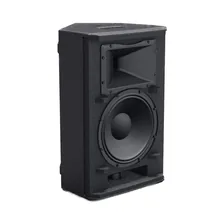 For a lightweight 10-inch with a deep 56Hz extension, the LD Systems Stinger 10-A-G3: $749.00 Amazon B&H Photo Video eBay
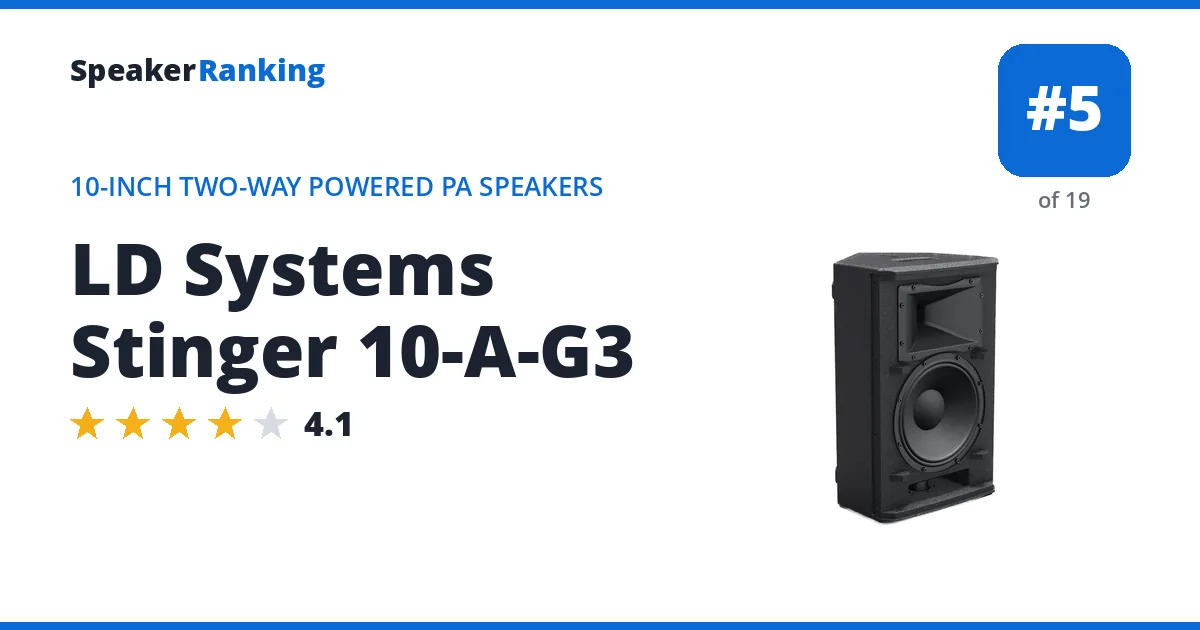
Pros: Medium-quality vendor data returns a 5.89 ideal-subwoofer preference score with 49Hz measured extension, a genuinely deep result for an affordable 10-inch box. At 12.7kg it is one of the lightest active speakers in this ranking. Measured bass extension of 56Hz (-3dB).
Cons: Its 127dB peak claim is modest next to the higher-output rivals here, and its 90° x 50° horn is on the narrower side.
Full LD Systems Stinger 10-A-G3 review and specifications →
| AES Input | No |
|---|---|
| Amplifier Power | 600W peak / 300W RMS |
| Aux Input | No |
| Bass Extension (-3dB) | 56Hz (measured, vendor Spinorama data) |
| Bluetooth | No |
| Cabinet Material | 12mm plywood with polyurea coating |
| Coaxial Input | No |
| Configuration | Active 2-way bass-reflex PA speaker |
| Coverage | 90° x 50° |
| DSP | Yes |
| Dimensions | 20.7”H x 12.8”W x 12.1”D (527 x 325 x 308 mm) |
| Drivers | 10” woofer, 1” compression driver |
| Frequency Response | 65Hz - 20kHz (manufacturer specified) |
| Guitar Input | No |
| HDMI Input | No |
| Inputs | 2 x XLR/TRS line/mic inputs; XLR mono mix output |
| Maximum SPL | 127dB peak (manufacturer specified) |
| Microphone Input | Yes |
| Optical Input | No |
| RCA Input | No |
| Rigging | M10 suspension points; 36mm Dual-Tilt pole mount |
| Spinorama Preference Score | 3.57 |
| Spinorama Preference Score with Perfect Sub | 5.89 |
| TRS Input | Yes |
| USB Input | No |
| Weight | 28 lbs (12.7 kg) |
| XLR Input | Yes |
- Links
- Reviews, Comparisons and Sound Samples
- Head-to-Head Comparisons
- LD Systems Stinger 10-A-G3 vs HK Audio LINEAR 9 110 XA
- LD Systems Stinger 10-A-G3 vs FBT ProMaxX 110A
- LD Systems Stinger 10-A-G3 vs Turbosound NuQ102
- LD Systems Stinger 10-A-G3 vs HK Audio LINEAR 7 110 XA
- LD Systems Stinger 10-A-G3 vs LD Systems DDQ10
- LD Systems Stinger 10-A-G3 vs dBTechnologies Opera Reevo 210
At 12.7kg it is one of the lightest 10-inch PAs ranked here, and it scores 5.89 with a subwoofer. Its 127dB peak claim is modest, so it suits smaller rooms and events.
Best Battery-Powered Under $1,000
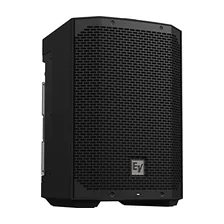 For outdoor gigs with no outlet, with 12 hours of claimed runtime and 60Hz bass extension, the Electro-Voice Everse 8: $799.00 Amazon eBay
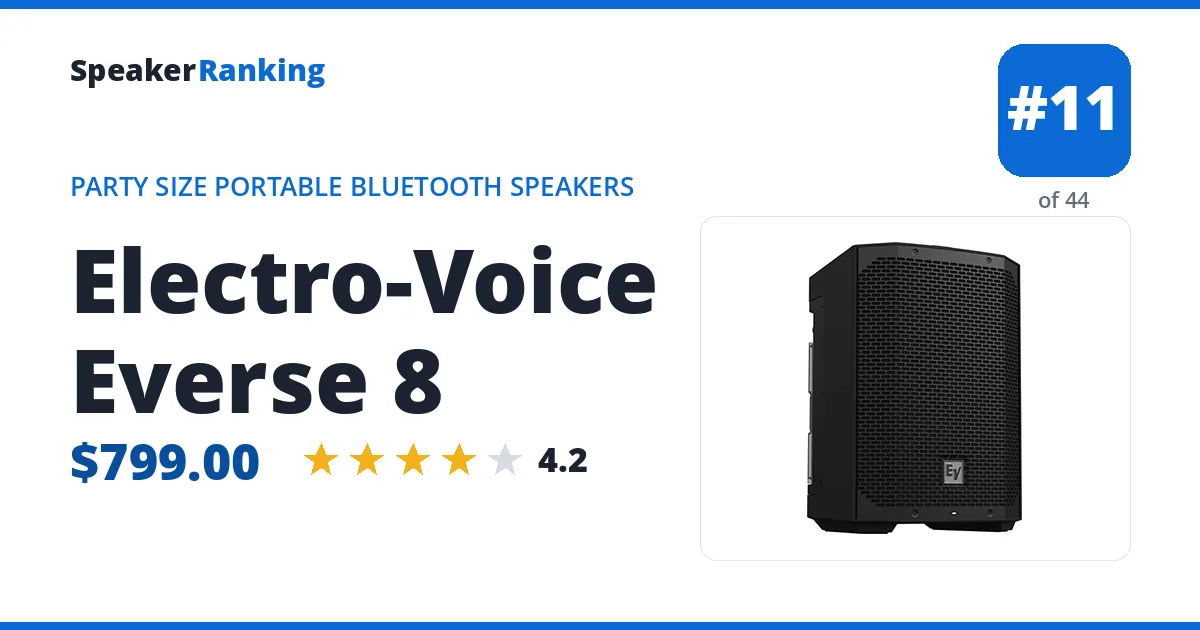
Pros: Good midrange and treble. High efficiency drivers reach 2-3x the volume of typical speakers for the same wattage. Measured bass extension of 60Hz (-3dB).
Cons: Not stereo. Designed for more loudness than deeper bass.
Full Electro-Voice Everse 8 review and specifications →
| Amplifier Power | 400W |
|---|---|
| App | Yes |
| Aux Input | Yes |
| Bass Extension (-10dB) | 50Hz |
| Bass Extension (-3dB) | 60Hz |
| Battery Life | 12 hours (Manufacturer specified) |
| Bluetooth | Yes |
| Bluetooth Codecs | aptX, SBC |
| Cabinet Material | Polypropylene |
| Configuration | Battery-powered 2-way active PA |
| Coverage | 100° H x 100° V |
| DSP | 4-channel digital mixer with EQ, effects and ducking |
| Digital Aux Input | No |
| Dimensions | 15.7” x 10.8” x 10.7” (400 x 275 x 272 mm) |
| Drivers | 8” woofer, 1” tweeter |
| EQ | Yes |
| Frequency Response | 60Hz - 20kHz (-3dB, Manufacturer specified) |
| Guitar Input | Yes |
| IP Rating | IP43 |
| Inputs | 2x XLR/TRS combo (mic/line), 3.5mm stereo, Bluetooth |
| Maximum SPL | 121dB |
| Microphone Input | Yes |
| Omnidirectional | No |
| Party Mode | Yes (Speaker Link, up to 6 speakers) |
| Power Bank | Yes (USB-C, 1.5A max) |
| Power Input | AC Power cord |
| Removable Battery | Yes |
| Rigging | 35mm pole mount; 30° or 55° monitor angle |
| Stereo | No |
| TWS | Yes |
| USB Playback | No |
| Weight | 17.6 lbs (8 kg) |
| XLR Input | Yes |
- Links
- Reviews, Comparisons and Sound Samples
- Head-to-Head Comparisons
- Electro-Voice Everse 8 vs Electrotec Stage One
- Electro-Voice Everse 8 vs Teufel Rockster Neo
- Electro-Voice Everse 8 vs Teufel Rockster Air 2
- Electro-Voice Everse 8 vs Electro-Voice Everse 12
- Electro-Voice Everse 8 vs Bose S1 Pro+
- Electro-Voice Everse 8 vs Mackie Thump Go
- Electro-Voice Everse 8 vs Soundboks 4
- Electro-Voice Everse 8 vs JBL Eon One Compact
- See all 19 comparisons
It has two XLR/TRS combo inputs, Bluetooth and weather resistance in an 8kg box. See best battery-powered PA speakers for more options.
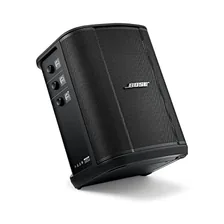 For the lightest battery PA, with a three-channel mixer, the Bose S1 Pro+: $699.00 Amazon eBay
Pros: Extremely compact and light with flexible placement options. Full sound with no lack of low-end output, crystal-clear audio quality. Three-channel mixer (2 XLR/quarter-inch combo mic-instrument + 1 line/Bluetooth), each with its own OLED display for quick treble/bass/reverb adjustment. Auto EQ adjusts sound based on orientation. Multiple angled surfaces for various positioning including tilted portrait mode, plus a line out to daisy-chain a second unit. Optional WT-XLR/WT-INST wireless transmitters dock, pair, and charge right in the speaker for a cable-free mic or instrument. Up to 11 hours battery life. Professional build quality. High efficiency drivers reach 2-3x the volume of typical speakers for the same wattage. Measured bass extension of 62Hz (-3dB).
Cons: With full range music, it becomes distorted above ⅔ volume, and reviewers describe it as screeching at max volume. Better suited for voice amplification. Not as much deep bass as the Everse 8, midrange sounds reasonably balanced. Treble is pretty boosted. Not stereo. Designed for more loudness than deeper bass. Ports are fully exposed with no water resistance. Charges via a less common three-prong AC cable instead of the two-prong barrel cable most rivals use.
Full Bose S1 Pro+ review and specifications →
| Amplifier Power | 150W |
|---|---|
| App | Yes |
| Aux Input | Yes |
| Bass Extension (-10dB) | 55Hz |
| Bass Extension (-3dB) | 62Hz |
| Battery Life | 11 hours (Manufacturer specified) |
| Bluetooth | Yes |
| Bluetooth Codecs | AAC, SBC |
| Bluetooth Version | 5.0 |
| Cabinet Material | Polypropylene |
| Charging Time | 5 hours |
| Configuration | Battery-powered 2-way active PA |
| Coverage | 120° H x 50° V |
| DSP | 3-channel mixer with EQ, reverb and Auto EQ |
| Digital Aux Input | No |
| Dimensions | 13.1” x 9.4” x 11” (332.7 x 238.8 x 279.4 mm) |
| Drivers | 1x 6” (152mm) woofer + 3x 2.25” (57mm) tweeters |
| EQ | Yes |
| Guitar Input | Yes |
| IP Rating | None |
| Inputs | 2x XLR/6.3mm combo (mic/line/instrument), 6.3mm line, 3.5mm stereo, Bluetooth |
| Maximum SPL | 109dB |
| Microphone Input | Yes |
| Omnidirectional | No |
| Party Mode | Yes (Bose Party mode) |
| Power Bank | No |
| Power Input | AC Power cord |
| Rigging | 35mm pole mount; multi-position cabinet |
| Stereo | No |
| TWS | Yes |
| USB Playback | No |
| Weight | 14.3 lbs (6.5 kg) |
| XLR Input | Yes |
- Links
- Reviews, Comparisons and Sound Samples
- Precision Drive Audio: Music test for BOSE S1 PRO& PD K8 & JBL EON ONE COMPACT
- Precision Drive Audio: Bose S1 pro VS PD K8 VS JBL EON ONE COMPACT
- HQ AUDIO Exchange: Bose S1 Pro vs. JBL PartyBox 100 Bass Sound Test 😱💥🔥
- briansredd: Electro-Voice Everse 8 VS Bose S1 Pro - Side By Side Shoot-Out (Attempt)
- briansredd: Q&A - Electro-Voice Everse 8 Vs Bose S1 Pro AND (Warning) My Opinion
- True Techy: BOSE S1 Pro vs JBLPartybox ENCORE This Comparison SHOCKED me!!!
- JPW Pro: EV Everse 8 vs JBL EON One Compact Review
- W. Weiss: Part 3 Shootout MACKIE THUMP GO vs BOSE S1 PRO vs JBL EON ONE COMPACT Max Volume Demo A New Winner!
- James from Canada: SOUND TESTS - Soundboks, Minirig 3, dB Technologies, Bose S1 Pro, etc - RAVE TEST
- GYMCADDY: Bose S1 Pro+ Review More from GYMCADDY →
- GYMCADDY: Bose S1 Pro Vs JBL Partybox 120 & Sony XV500
- GYMCADDY: Bose S1 Pro Vs JBL Partybox 320 & Sony XV800
- Aaron Strawn: The Battery Speaker Battle: QSC/EV/Mackie/LD/Bose
- GYMCADDY: Bose S1 Pro Vs JBL Boombox 3 & Sony ULT 7
- Head-to-Head Comparisons
At 6.5kg it is easy to carry and place, with reverb and tone controls per channel. It distorts with full-range music above about two thirds of full volume, so it is best for speech and acoustic performance.
Where To Go Next
Lower budget: best PA speakers under $500.
Full rankings with specs and measurements: 8-inch, 10-inch, 12-inch, 15-inch and battery-powered PA speakers, plus the PA buyer’s guide.