Editor's top picks
Start with these speakers
Our leading recommendations at a glance. Each card links to its primary retailer.
Not sure which subwoofer to buy? Subwoofers are the easiest speaker category to shop well, because the performance that matters is measurable and published. This guide covers the four decisions that determine what you end up with: how many, sealed or ported, how big, and how much.
Every subwoofer on this site is ranked by CEA-2010-A, a standardized burst test measuring how loud a sub plays each bass frequency before distortion becomes audible. Manufacturer frequency-response claims are close to meaningless by comparison: “down to 20 Hz” tells you nothing about how loud 20 Hz plays before the driver runs out of travel.
Prices on this page were last checked September 22, 2026 at 5:11 AM UTC. Product prices and availability are accurate as of that date/time and are subject to change; the price and availability shown on Amazon at the time of purchase will apply to the purchase of this product.
As an eBay Partner, we may be compensated if you make a purchase.
Step 1: Decide How Many, Before You Decide Which
This is the decision people skip and the one with the largest effect on what you actually hear.
A single subwoofer in a room produces a response full of peaks and nulls caused by room modes. Those are positional: a seat that sits in a null hears almost no bass at that frequency, and no amount of EQ fixes it, because you cannot boost energy that isn’t arriving. Two subwoofers in different positions average those modes out, flattening response across every seat rather than optimizing one.
The practical rule: if you’re choosing between one $1,500 subwoofer and two $750 subwoofers, take the pair. The exception is a very small room with one listening position, where a single well-placed sub is fine.
Step 2: Sealed Or Ported
This is the real fork in the road, and both answers are correct for different people.
Sealed rolls off gently at 12 dB per octave. That slope is roughly the mirror image of the bass gain a small or medium room already provides, so sealed subs often measure flatter in-room with no correction. They’re smaller, they stop when the signal stops, and they suit music. See best sealed subwoofers.
Ported uses a tuned port so the driver barely moves near tuning, buying 3-6 dB more output in the 20-40 Hz band from the same driver and amplifier. That’s the band movie effects live in. The costs are a larger cabinet, a steep 24 dB per octave cliff below tuning, and stored energy at tuning that shows up as group delay. See best ported subwoofers.
The short version: mostly movies, get ported. Mostly music or a small room, get sealed. Many subs let you plug the port and run either way, which is the best of both.
Step 3: Size It To The Room, Not To The Spec Sheet
Small rooms do a lot of the work for you. Below the frequency where the room’s longest dimension stops supporting a full wave, a sealed room reinforces bass at roughly 12 dB per octave. In a bedroom that transition happens high enough that a modest sub can measure flat to 20 Hz in-room while barely reaching 30 Hz on its own.
The corollary is that buying a huge subwoofer for a small room mostly buys distortion headroom you’ll never use, and creates a placement problem. See best subwoofers for small rooms and apartments.
Large rooms work the other way: room gain arrives lower and weaker, so you need real output, and this is where doubling up pays off most.
Step 4: Set The Budget
Subwoofers are the best value in audio, because there’s no tweeter, no crossover and no cabinet finish to pay for. A $375 sub that measures well genuinely outperforms a $1,200 one that doesn’t, and several budget picks here out-measure subs at three times the price. Start at best budget subwoofers under $500.
Spend the money in this order: enough output for the room → a second subwoofer → better control and app features → cabinet finish. Most people invert that list and buy one pretty sub with a nice app.
The Picks, In Short
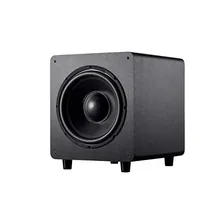 The best budget subwoofer, and the one most people should buy two of, is the Monoprice SW-15: $374.99 Amazon eBay
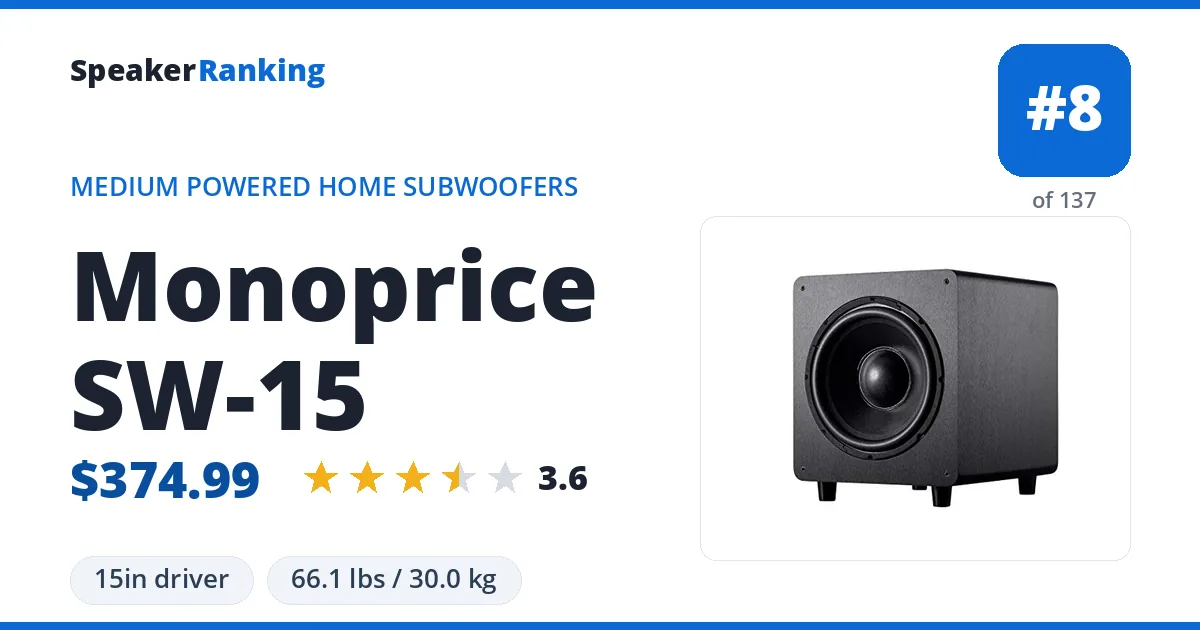
Pros: 15-inch ported with 600W RMS (800W peak) delivers Large-room Bassaholic rating. Unrivaled mid-bass punch for $375. Strong output with clean control. Dual speaker-level inputs and 40-150Hz crossover for flexible hookup.
Cons: Budget-tier design, ported room gain dependency, 30 kg mid-size, and limited dynamic headroom.
Notes: Product # 41499
Full Monoprice SW-15 review and specifications →
| Amplifier Power | 600W RMS / 800W peak |
|---|---|
| CEA-2010-A Average (40-80Hz) | 119.0 dB |
| Cabinet Color | black |
| Country | United States |
| Crossover Frequency | 40-150Hz, 18dB/octave |
| Dimensions | 18.1"H x 21"W x 22.7"D (459.7 x 533.4 x 576.6 mm) |
| Drivers | 15" (381mm) driver |
| Enclosure | ported, bottom |
| Frequency Response | 30-150Hz (-10dB) |
| Inputs | Stereo line level and speaker level |
| Measurement Source | Audioholics |
| Output SPL at 15 Hz | 90.0 dB |
| Output SPL at 20 Hz | 101.2 dB |
| Output SPL at 25 Hz | 106.3 dB |
| Output SPL at 31.5 Hz | 111.2 dB |
| Output SPL at 40 Hz | 116.0 dB |
| Output SPL at 50 Hz | 120.2 dB |
| Output SPL at 63 Hz | 120.5 dB |
| Output SPL at 80 Hz | 119.5 dB |
| Phase Control | 0° or 180° |
| Warranty | 1 |
| Weight | 66.1 lbs (30.0 kg) |
- Links
- Reviews, Comparisons and Sound Samples
- Independently measured by Audioholics; the published figures above come from this ASR subwoofer measurement thread.
- Head-to-Head Comparisons
- Monoprice SW-15 vs Power Sound Audio (PSA) XV15SEICE-BASE
- Monoprice SW-15 vs SVS SB-3000
- Monoprice SW-15 vs Power Sound Audio (PSA) XS15
- Monoprice SW-15 vs Power Sound Audio (PSA) XV15-BASE
- Monoprice SW-15 vs Paradigm Defiance X12
- Monoprice SW-15 vs Power Sound Audio (PSA) XS15-BASE
- Monoprice SW-15 vs Power Sound Audio (PSA) XV15
- Monoprice SW-15 vs Klipsch SPL-120
- See all 110 comparisons
 The best all-round subwoofer for a typical living room, sealed, with app control and room correction, is the SVS SB-3000: $1,099.00 Amazon eBay
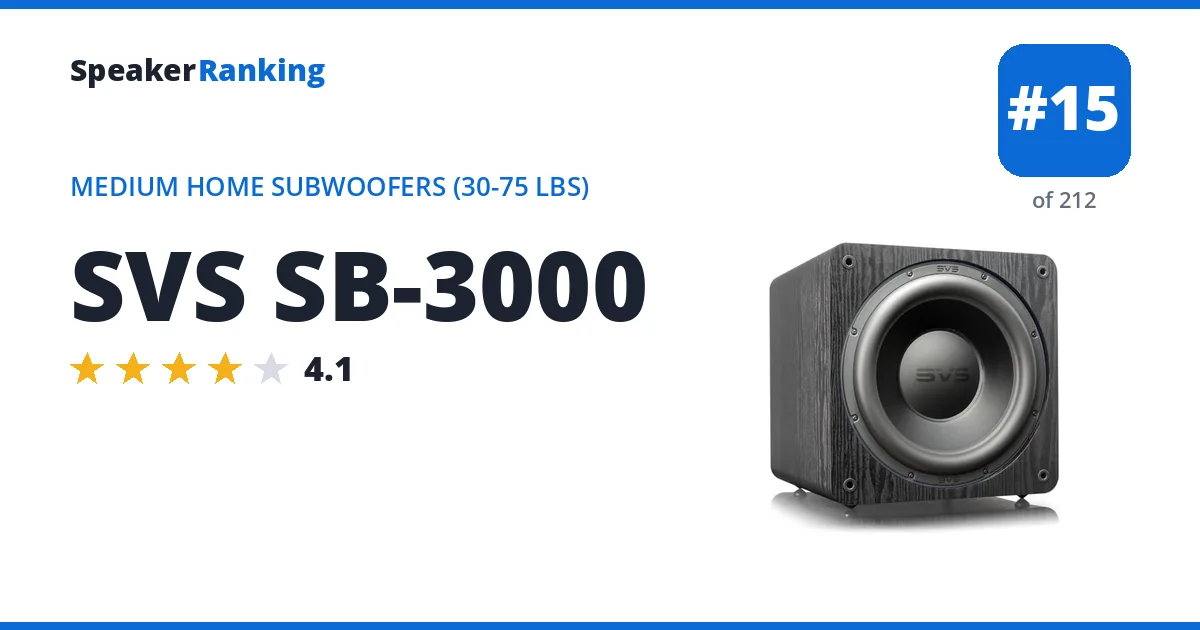
Pros: 13-inch sealed with 800W RMS (2500W peak) delivers 118.7dB average with exceptional accuracy. Beautifully made with pinpoint control and flawless tonal accuracy. Sweet spot performance-to-value ratio. Three-band parametric EQ with 1Hz precision adjustment.
Cons: Ported cabinet room-mode dependency, compact 25 kg size limits bass extension, and $1099 investment.
Full SVS SB-3000 review and specifications →
| Amplifier Power | 800W RMS / 2500W peak |
|---|---|
| CEA-2010-A Average (40-80Hz) | 118.7 dB |
| Cabinet Color | black |
| Country | United States |
| Crossover Frequency | 30-200Hz adjustable, 6/12/18/24dB slopes |
| Dimensions | 15.6"H x 15.2"W x 15.7"D (396.2 x 386.1 x 398.8 mm) |
| Drivers | 13" (330mm) driver |
| Enclosure | sealed |
| Features | Auto/On, 3-12V AC/DC trigger |
| Frequency Response | 18-270Hz, ±3dB |
| Inputs | RCA (unbalanced), USB |
| Measurement Source | Audioholics |
| Output SPL at 15 Hz | 90.3 dB |
| Output SPL at 20 Hz | 96.6 dB |
| Output SPL at 25 Hz | 101.7 dB |
| Output SPL at 31.5 Hz | 107.8 dB |
| Output SPL at 40 Hz | 114.6 dB |
| Output SPL at 50 Hz | 118.7 dB |
| Output SPL at 63 Hz | 120.7 dB |
| Output SPL at 80 Hz | 120.9 dB |
| Output SPL at 100 Hz | 120.8 dB |
| Output SPL at 125 Hz | 120.7 dB |
| Phase Control | 0°-180° |
| Warranty | 5 |
| Weight | 54.5 lbs (24.7 kg) |
- Links
- Reviews, Comparisons and Sound Samples
- Independently measured by Audioholics; the published figures above come from this ASR subwoofer measurement thread.
- Head-to-Head Comparisons
- SVS SB-3000 vs Monoprice SW-15
- SVS SB-3000 vs Power Sound Audio (PSA) XS15
- SVS SB-3000 vs Power Sound Audio (PSA) XV15SEICE-BASE
- SVS SB-3000 vs Power Sound Audio (PSA) XS15-BASE
- SVS SB-3000 vs Power Sound Audio (PSA) XV15-BASE
- SVS SB-3000 vs Paradigm Defiance X12
- SVS SB-3000 vs Klipsch SPL-120
- SVS SB-3000 vs Power Sound Audio (PSA) XV15
- See all 89 comparisons
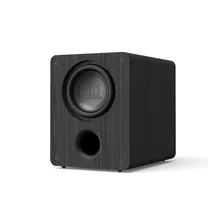 The best home theater subwoofer under $1000, remarkable for how deep it plays at the price, is the Monoprice Monolith M-10 V2: $753.97 Amazon eBay
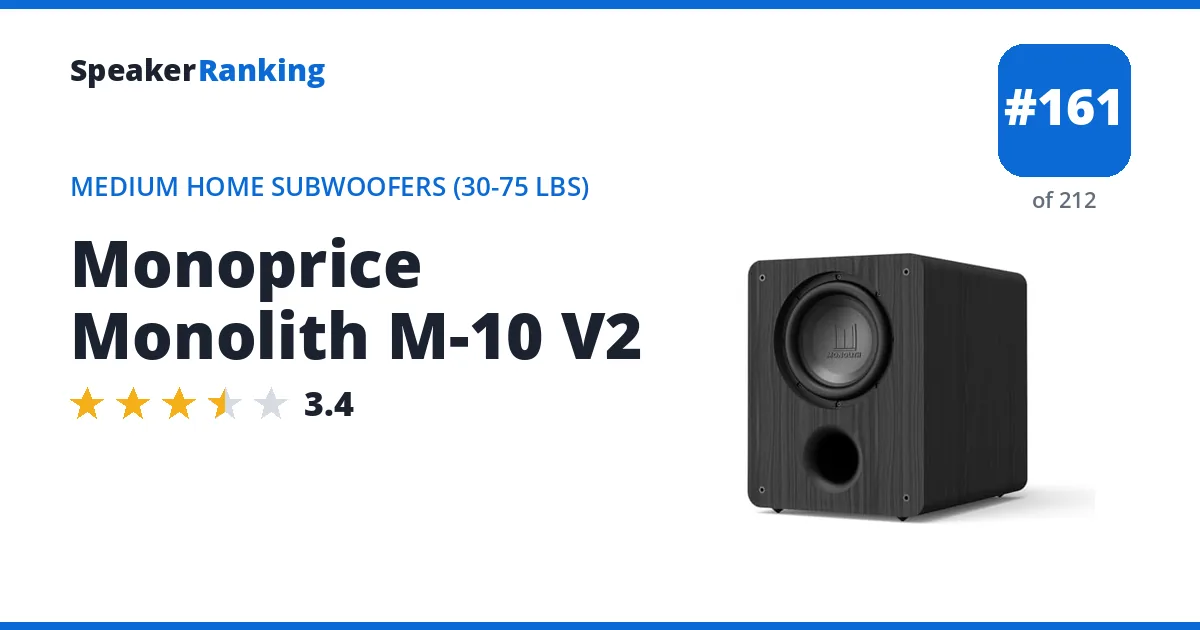
Pros: 10-inch THX-certified ported with 500W RMS reaches 17-20Hz. HDF cabinet eliminates resonance-induced coloration. Extended EQ and THX EQ modes for flexibility. Low distortion output. Best for rooms under 2500 cubic feet. Exceptional budget value at $754.
Notes: Product # 42843
Full Monoprice Monolith M-10 V2 review and specifications →
| AES Input | No |
|---|---|
| Amplifier Power | 500W RMS |
| Aux Input | No |
| CEA-2010-A Average (40-80Hz) | 110.3 dB |
| Cabinet Color | black |
| Coaxial Input | No |
| Country | United States |
| Dimensions | 20.9"H x 15"W x 18.9"D (530.9 x 381.0 x 480.1 mm) |
| Drivers | 10" (254mm) driver |
| Enclosure | ported, front |
| Frequency Response | 17-20Hz |
| HDMI Input | No |
| Inputs | XLR, RCA, XLR passthrough out |
| Measurement Source | Manufacturer |
| Optical Input | No |
| Output SPL at 15 Hz | 93.9 dB |
| Output SPL at 20 Hz | 104.8 dB |
| Output SPL at 25 Hz | 108.5 dB |
| Output SPL at 31.5 Hz | 109.3 dB |
| Output SPL at 40 Hz | 109.7 dB |
| Output SPL at 50 Hz | 110.1 dB |
| Output SPL at 63 Hz | 110.6 dB |
| Output SPL at 80 Hz | 110.9 dB |
| Output SPL at 100 Hz | 111.2 dB |
| Output SPL at 125 Hz | 111.5 dB |
| RCA Input | Yes |
| TRS Input | No |
| USB Input | No |
| Warranty | 5 |
| Weight | 72.5 lbs (32.9 kg) |
| XLR Input | Yes |
- Links
- Reviews, Comparisons and Sound Samples
- These figures are manufacturer-specified rather than independently measured.
- Head-to-Head Comparisons
- Monoprice Monolith M-10 V2 vs Klipsch R-121SW
- Monoprice Monolith M-10 V2 vs RSL (Rogersound Labs) Speedwoofer 10S MKII
- Monoprice Monolith M-10 V2 vs Kef KC62
- Monoprice Monolith M-10 V2 vs Monoprice SSW-10
- Monoprice Monolith M-10 V2 vs SVS PB-1000 PRO
- Monoprice Monolith M-10 V2 vs SVS SB-2000
- Monoprice Monolith M-10 V2 vs JBL HDI-1200P
- Monoprice Monolith M-10 V2 vs Power Sound Audio (PSA) XS15SE
- See all 17 comparisons
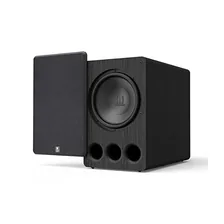 The best deep bass per dollar for a large room, and an easy sub to double up on, is the Monoprice Monolith M-15 V2: $1,500 Discontinued eBay
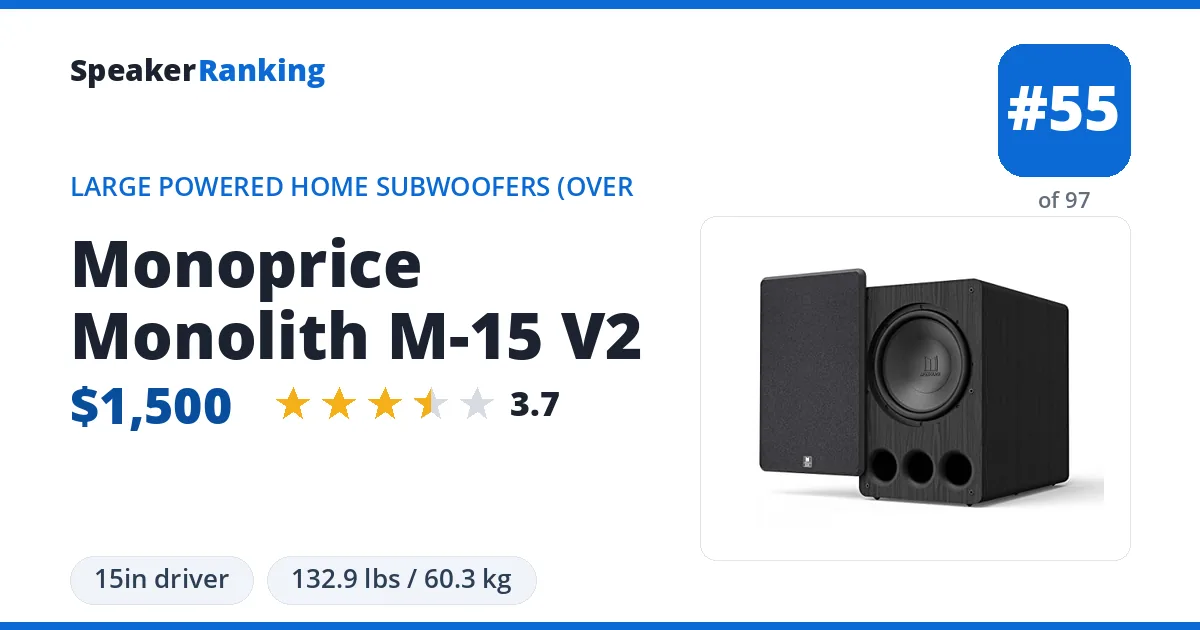
Pros: Published CEA-2010 specifications list 112.6 dB at 20 Hz and 120.0 dB through 40-80 Hz. Its front-ported 15-inch design has substantial deep-bass and midbass headroom for cinema playback.
Cons: Discontinued and no longer sold new. At 60.3 kg and 729.0H x 449.6W x 680.7D mm, it needs committed floor space and careful room integration. Discontinued.
Notes: Product # 42851
Full Monoprice Monolith M-15 V2 review and specifications →
| AES Input | No |
|---|---|
| Aux Input | No |
| CEA-2010-A Average (40-80Hz) | 120.0 dB |
| Cabinet Color | black |
| Coaxial Input | No |
| Country | United States |
| Dimensions | 28.7"H x 17.7"W x 26.8"D (729.0 x 449.6 x 680.7 mm) |
| Discontinued | Yes |
| Drivers | 15" (381mm) driver |
| Enclosure | ported, front |
| HDMI Input | No |
| Inputs | XLR, RCA |
| Measurement Source | Manufacturer |
| Optical Input | No |
| Output SPL at 12.5 Hz | 91.0 dB |
| Output SPL at 15 Hz | 106.3 dB |
| Output SPL at 20 Hz | 112.6 dB |
| Output SPL at 25 Hz | 116.6 dB |
| Output SPL at 31.5 Hz | 119.5 dB |
| Output SPL at 40 Hz | 120.9 dB |
| Output SPL at 50 Hz | 120.6 dB |
| Output SPL at 63 Hz | 120.0 dB |
| Output SPL at 80 Hz | 118.7 dB |
| Output SPL at 100 Hz | 120.1 dB |
| Output SPL at 125 Hz | 120.2 dB |
| RCA Input | Yes |
| TRS Input | No |
| USB Input | No |
| Warranty | 5 |
| Weight | 132.9 lbs (60.3 kg) |
| XLR Input | Yes |
- Reviews, Comparisons and Sound Samples
- These figures are manufacturer-specified rather than independently measured.
- Head-to-Head Comparisons
- Monoprice Monolith M-15 V2 vs SVS PB-4000
- Monoprice Monolith M-15 V2 vs Arendal 1723 Subwoofer 2S
- Monoprice Monolith M-15 V2 vs Rythmik F18
- Monoprice Monolith M-15 V2 vs Monoprice Monolith M15-S
- Monoprice Monolith M-15 V2 vs HSU Research VTF-3 MK5 HP
- Monoprice Monolith M-15 V2 vs HSU Research VTF-15H MK2
- Monoprice Monolith M-15 V2 vs Rythmik FV15HP
- Monoprice Monolith M-15 V2 vs Monoprice Monolith M-215
- See all 17 comparisons
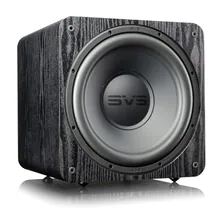 The best compact subwoofer for a small room or apartment is the SVS SB-1000 PRO: $599.00 Amazon eBay
Pros: 12-inch sealed driver delivers 113.9dB CEA-2010-A average, the highest output of any subwoofer in the under-30lb weight class. Sealed enclosure keeps bass tight and controlled for its compact footprint.
Cons: Compact ported design, room mode sensitivity, limited to 114 dB output, smaller than alternatives.
Full SVS SB-1000 PRO review and specifications →
| CEA-2010-A Average (40-80Hz) | 113.9 dB |
|---|---|
| Cabinet Color | black, white |
| Country | United States |
| Dimensions | 13.5"H x 13"W x 14.8"D (342.9 x 330.2 x 374.9 mm) |
| Drivers | 12" (305mm) driver |
| Enclosure | sealed |
| Measurement Source | Audioholics |
| Output SPL at 20 Hz | 91.0 dB |
| Output SPL at 25 Hz | 97.7 dB |
| Output SPL at 31.5 Hz | 104.2 dB |
| Output SPL at 40 Hz | 109.1 dB |
| Output SPL at 50 Hz | 114.5 dB |
| Output SPL at 63 Hz | 116.7 dB |
| Output SPL at 80 Hz | 115.2 dB |
| Output SPL at 100 Hz | 113.3 dB |
| Output SPL at 125 Hz | 111.5 dB |
| Warranty | 5 |
| Weight | 26 lbs (11.8 kg) |
- Links
- Reviews, Comparisons and Sound Samples
- Independently measured by Audioholics; the published figures above come from this ASR subwoofer measurement thread.
- Head-to-Head Comparisons
- SVS SB-1000 PRO vs Onkyo SKW-204
- SVS SB-1000 PRO vs SVS 3000 Micro
- SVS SB-1000 PRO vs SVS SB-1000
- SVS SB-1000 PRO vs Velodyne Acoustics SPL-1200 Series II
- SVS SB-1000 PRO vs Polk Audio PSW10
- SVS SB-1000 PRO vs GoldenEar ForceField 3
- SVS SB-1000 PRO vs MartinLogan Dynamo 700w
- SVS SB-1000 PRO vs ELAC IW-S10EQ in-wall
- See all 12 comparisons
Mistakes That Cost People Money
Buying one big sub instead of two smaller ones. Covered above, and it’s the most common expensive mistake in the category.
Trusting the frequency response spec. “20 Hz - 200 Hz” with no tolerance or output level attached is marketing, not a measurement. Use the CEA-2010-A figures in each spec table.
Ignoring placement. Moving a sub two feet changes its in-room response more than most upgrades do. Crawl the room, or at minimum try the corner and the front wall before deciding what you own.
Setting the crossover by ear at 80 Hz and walking away. Level, crossover point and phase all interact. Getting these right is free and matters more than the last 3 dB of output.
Paying for finish over output. Very small “lifestyle” subs measure well below conventional subs at the same price. Buy one because the size is a hard requirement, not because it’s better.
Where To Go Next
Full rankings with specs and measurements, powered and passive together: small, medium and large. For every enclosure type in the data, including passive radiator and horn-loaded designs, see subwoofer enclosure types explained.
By use case: home theater, music, sealed, ported, small rooms, under $500. Placement will make or break the result, see how room acoustics affects speakers.