Editor's top picks
Start with these speakers
Our leading recommendations at a glance. Each card links to its primary retailer.
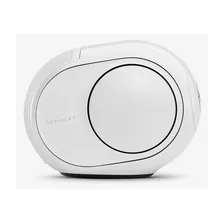 Other Powered Speakers With an Optical Input
Devialet Phantom II 98 dB
$2,998 per pair
See the full review →
Other Powered Speakers With an Optical Input
Devialet Phantom II 98 dB
$2,998 per pair
See the full review →
Looking for a powered speaker with an optical input? An optical (TOSLINK) digital input carries sound in as light through a fiber cable, feeding a TV, game console or streaming box directly without an analog stage in between and without the ground loop hum an analog cable run can pick up between two devices plugged into different outlets. Every pick below has a verified optical input; the recommendations are ordered by measured sound quality, not by the connector alone.
Want every match, not just the top pick per category? See every powered speaker with an optical input →
Quick Navigation
- Best Overall
- Best Budget
- Best For a TV Setup
- Other Powered Speakers With an Optical Input
- What To Check Before Buying
- Where To Go Next
Prices on this page were last checked September 17, 2026 at 12:43 AM UTC. Product prices and availability are accurate as of that date/time and are subject to change; the price and availability shown on Amazon at the time of purchase will apply to the purchase of this product.
As an eBay Partner, we may be compensated if you make a purchase.
Best Overall
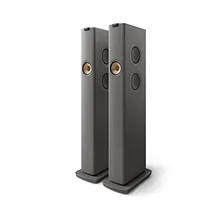 For a reference-tier wireless system with an optical input for a TV or disc player, the KEF LS60: $5,999.99 per pair Amazon Crutchfield eBay
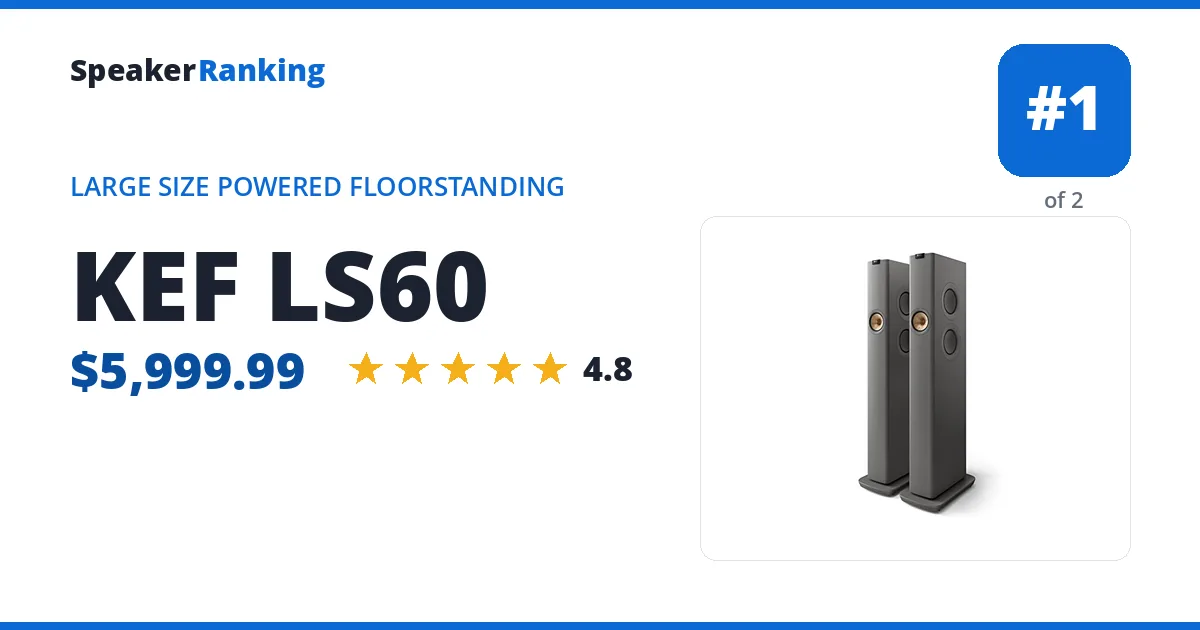
Pros: Erin’s on-axis measurement combines a 1.9dB response span from 300Hz to 5kHz with a 7.22 ideal-subwoofer preference score, supporting even vocal and instrumental balance. Extended-mode bass reaches roughly 25Hz at -3dB. The coaxial Uni-Q arrangement maintains unusually consistent tonality across listening positions, while HDMI, digital and analog inputs plus network streaming make this a convenient complete music and TV system. Measured bass extension of 23Hz (-3dB), with a measured sensitivity of 97.7dB.
Cons: A diffraction dip around 9kHz can soften cymbal shimmer when aimed directly at the listener; 10-20 degrees of toe-out helps. DSP limiting reduces bass reach and dynamic output at high volume, so its deep low-level extension is not a promise of the same performance on loud peaks. App placement and tone controls are less flexible than parametric room correction. Each roughly 31kg tower is awkward to move.
Full KEF LS60 review and specifications →
| AES Input | No |
|---|---|
| Amplifier Power | 700W (500W LF Class D + 100W MF Class D + 100W HF Class AB) |
| App | Yes (KEF Connect) |
| Aux Input | No |
| Bass Extension (-10dB) | <20Hz (measured, Erin's Audio Corner) |
| Bass Extension (-3dB) | 23Hz (measured, Erin's Audio Corner) |
| Bluetooth | Yes (5.0 with SBC, AAC) |
| Bluetooth Codecs | SBC, AAC |
| Coaxial Input | Yes |
| DSP | Yes (Music Integrity Engine) |
| Dimensions | 42.9"H x 8.3"W x 15.5"D (1089.7 x 210.8 x 393.7 mm) |
| Drivers | 4 x 135 mm (5.25 in.) Uni-Core Force Cancelling Driver: woofers, 100 mm (4in.) aluminium cone midrange, 19 mm (0.75 in.) vented aluminium dome with Metamaterial Absorption Technology tweeter |
| EQ | Yes (Normal and Expert modes, room adaptation) |
| Frequency Response | 31Hz - 24kHz (±3dB) (Manufacturer specified) |
| HDMI Input | Yes |
| Inputs | Wifi, Optical, Digital coaxial, RCA, HDMI, Ethernet |
| Maximum SPL | 111dB @ 1m (pink noise) (manufacturer specified) |
| Optical Input | Yes |
| Outputs | Subwoofer RCA |
| RCA Input | Yes |
| Sensitivity | 97.7dB (measured at 0.3V/1m, Erin's Audio Corner) |
| Spinorama Preference Score | 6.57 |
| Spinorama Preference Score with Perfect Sub | 7.22 |
| Streaming Services | Yes (AirPlay 2, Chromecast, Roon Ready, Spotify Connect, Tidal Connect, Amazon Music, Qobuz, Deezer) |
| Subwoofer Output | Yes |
| TRS Input | No |
| USB Input | No |
| Weight | 69 lbs (31.3 kg) each |
| Wi-Fi | Yes (dual-band) |
| XLR Input | No |
- Links
- Reviews, Comparisons and Sound Samples
- Head-to-Head Comparisons
Erin’s on-axis measurement combines a 1.9dB response span from 300Hz to 5kHz with a 7.22 ideal-subwoofer preference score, and extended-mode bass reaches roughly 25Hz at -3dB, deep enough to skip a separate subwoofer in most rooms. The optical input handles a TV or set-top box without an extra analog cable run.
A diffraction dip around 9kHz can soften cymbal shimmer when aimed directly at the listener, and DSP limiting reduces bass reach and dynamic output at high volume. It is also priced well above the rest of this page.
Best Budget
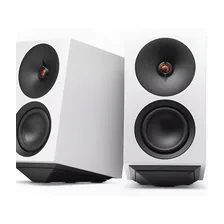 For a genuinely affordable pair with an optical input and a neutral measured response, the Cambridge Audio L/R S: $549.00 per pair Amazon eBay
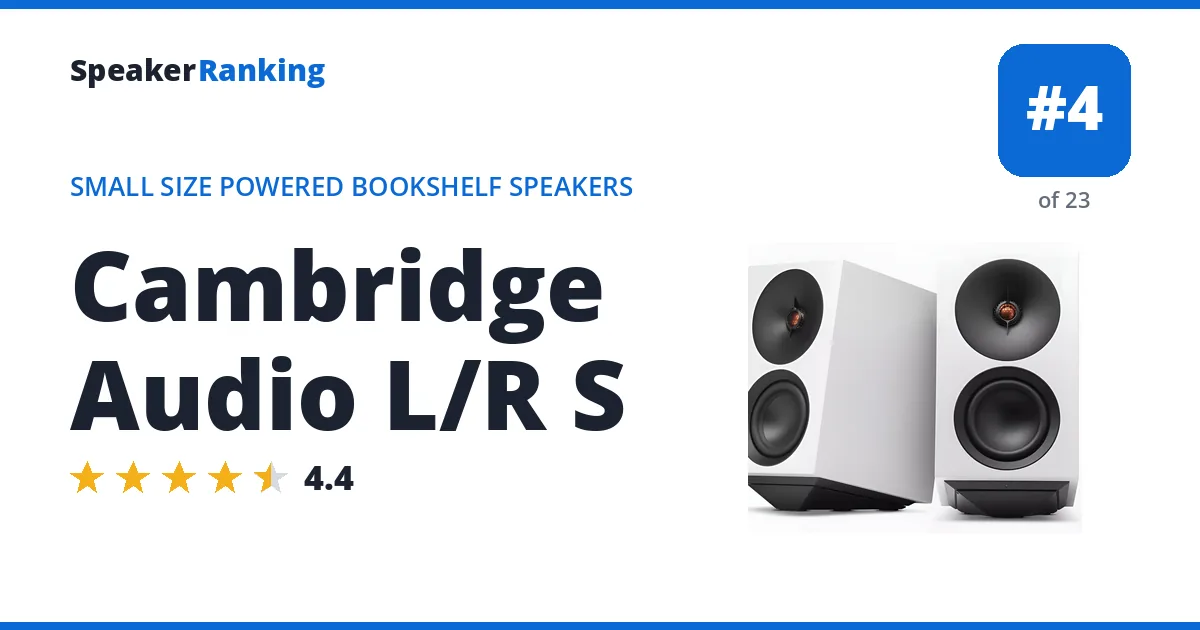
Pros: A 2-way active bookshelf pair built for near-field desktop use, with a 21mm aluminum tweeter and a 3-inch long-throw woofer on each speaker. Erin’s Audio Corner measured a very neutral on-axis response with good directivity control up through the 2-3kHz handoff to the tweeter, an F3 of about 57Hz and F10 of about 50Hz, and output held within roughly plus or minus 2.5dB from 80Hz to 20kHz. Horizontal dispersion of about plus or minus 60 degrees and a vertical window of about plus 30 to minus 20 degrees make it forgiving of off-center desktop seating. Two rear switches (a desktop-placement compensation switch and a near-wall/free-space switch) plus in-app DSP for room size, wall distance, and reflective surface type let you tune the in-room response rather than just hoping placement works out, and the reviewer noted an audible tightening of the bass moving between room-size settings. Rear connectivity includes RCA, optical digital, USB-C, and a dedicated subwoofer output. Measured bass extension of 57Hz (-3dB).
Cons: Maximum clean output is limited: Erin’s Audio Corner measured about 86dB before the onboard limiter engages around 96dB to protect the drivers, so this is a near-field or small-room speaker rather than one built to fill a living room. Each speaker’s Class D amplifier splits only 50W to the woofer and 50W to the tweeter, modest for the class. The DSP room-correction options are preset-based rather than a true microphone-measured calibration at the listening position, so results depend on picking settings that match your actual room.
Full Cambridge Audio L/R S review and specifications →
| AES Input | No |
|---|---|
| Amplifier Power | 100W total (50W to woofer, 50W to tweeter, per speaker) |
| App | Yes |
| Aux Input | No |
| Bass Extension (-10dB) | 50Hz (measured, Erin's Audio Corner) |
| Bass Extension (-3dB) | 57Hz (measured, Erin's Audio Corner) |
| Bluetooth Codecs | SBC, AAC, aptX, aptX HD |
| Coaxial Input | No |
| DSP | Yes, room size, wall distance, and reflective surface correction; desktop-placement and near-wall/free-space switches |
| Dimensions | 5.3" (134 mm) W x 226mm H x 180mm D (each) |
| Drivers | 21mm aluminum dome tweeter, 3" long-throw woofer |
| Frequency Response | 55Hz - 24kHz (±3dB, manufacturer specified) |
| HDMI Input | No |
| Inputs | RCA, optical digital, USB-C |
| Optical Input | Yes |
| Outputs | Subwoofer, wired speaker-to-speaker link |
| RCA Input | Yes |
| Subwoofer Output | Yes |
| TRS Input | No |
| USB Input | Yes |
| Weight | 6.6 lbs (3.0kg) primary speaker, 5.7 lbs (2.6kg) secondary speaker |
| XLR Input | No |
- Links
- Reviews, Comparisons and Sound Samples
- Head-to-Head Comparisons
- Cambridge Audio L/R S vs Adam Audio D3v
- Cambridge Audio L/R S vs IK Multimedia iLoud Micro Monitor
- Cambridge Audio L/R S vs Edifier M60
- Cambridge Audio L/R S vs Genelec 8010A
- Cambridge Audio L/R S vs HiVi Swan X3
- Cambridge Audio L/R S vs Edifier MR3
- Cambridge Audio L/R S vs Klipsch ProMedia Lumina
- Cambridge Audio L/R S vs Mackie CR3-X
- See all 10 comparisons
Erin’s Audio Corner measured a very neutral on-axis response with good directivity on this near-field pair, at a fraction of the price of the reference picks above. The optical input is a straightforward way to add a TV or streaming box without a receiver.
Maximum clean output is limited: about 86dB before the onboard limiter engages, so this is a near-field or small-room speaker rather than one built to fill a living room at party volume.
Best For a TV Setup
 For a compact system built around TV and soundbar-style use, with an optical input, the Klipsch The Fives: $699 per pair Amazon eBay
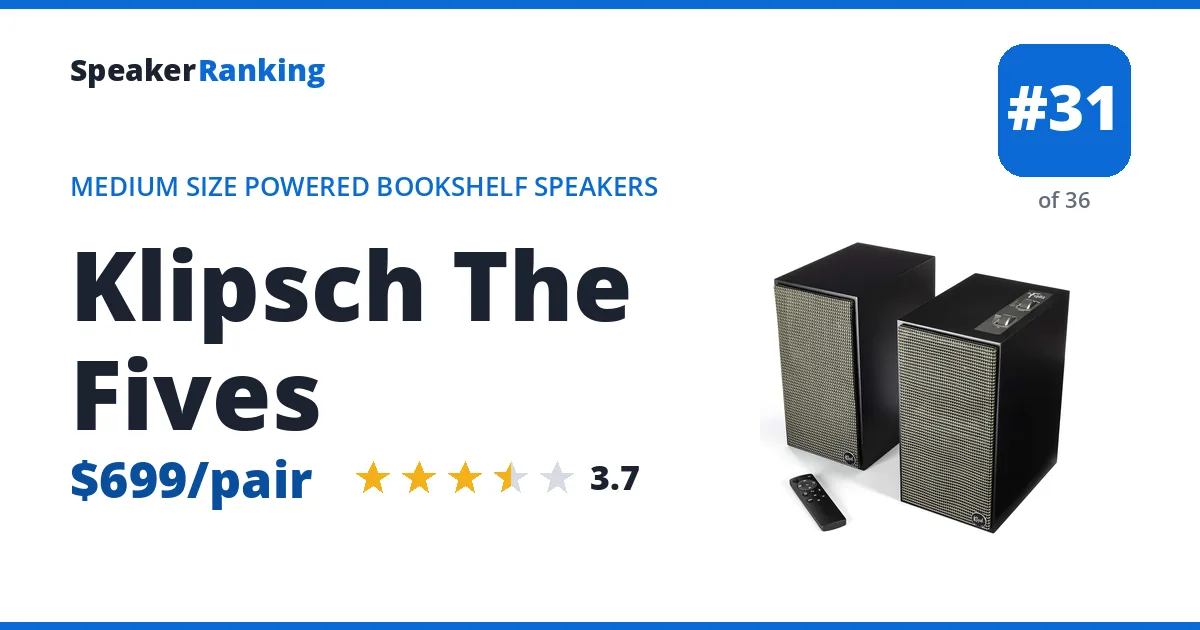
Pros: In the tested Bass Cut mode, Erin’s Klippel data gives preference scores of 4.62 standalone and 6.98 with an ideal subwoofer, with a 2.7dB midrange response span. That mode offers considerably better tonal balance than the bass-heavy default behavior. HDMI ARC, phono/line input, digital inputs and subwoofer output make it a versatile stereo alternative to a soundbar. Measured bass extension of 57Hz (-3dB).
Cons: The favorable score specifically requires Bass Cut mode; it does not describe every firmware or bass setting. Bass reaches -3dB around 59Hz in that configuration. The review reports increasing compression around 200Hz and below 80Hz as volume rises, reducing bass dynamics. Careful placement and a subwoofer remain useful, and the horn/woofer transition is not perfectly uniform off-axis.
Full Klipsch The Fives review and specifications →
| AES Input | No |
|---|---|
| Aux Input | No |
| Bass Extension (-10dB) | 47.3Hz (measured, Erin's Audio Corner) |
| Bass Extension (-3dB) | 57Hz (measured, Erin's Audio Corner) |
| Bluetooth Codecs | SBC, AAC, aptX, aptX HD |
| Coaxial Input | No |
| DSP | Dynamic Bass, Flat and Bass Cut profiles |
| Drivers | 1" horn-loaded tweeter; 4.5" woofer |
| HDMI Input | Yes |
| Inputs | HDMI ARC, USB, optical, Bluetooth, phono/line RCA |
| Optical Input | Yes |
| Outputs | Subwoofer |
| RCA Input | Yes |
| Sensitivity | Not applicable (active DSP loudspeaker) |
| Spinorama Preference Score | 4.62 |
| Spinorama Preference Score with Perfect Sub | 6.98 |
| Subwoofer Output | Yes |
| TRS Input | No |
| USB Input | Yes |
| XLR Input | No |
- Links
- Reviews, Comparisons and Sound Samples
- Erin’s Audio Corner: Klipsch The Fives Review More from Erin’s Audio Corner →
- Erin’s Audio Corner Website: Klipsch The Fives
- Erin’s Audio Corner Measurements (spinorama.org)
- Jasper Tech: Best Bookshelf Speakers For TV & Gaming - 2025 More from Jasper Tech →
- Jasper Tech: Best Powered Bookshelf Speakers for Every Budget - 2025
- Head-to-Head Comparisons
- Klipsch The Fives vs JBL 305P MKII
- Klipsch The Fives vs Genelec 8020D
- Klipsch The Fives vs Topping MA4
- Klipsch The Fives vs KEF LS50 Wireless II
- Klipsch The Fives vs Vanatoo Transparent One Encore Plus
- Klipsch The Fives vs Devialet Phantom II 98 dB
- Klipsch The Fives vs IK Multimedia iLoud MTM MKII
- Klipsch The Fives vs Genelec 8320A
- See all 51 comparisons
In its tested Bass Cut mode, Erin’s Klippel data gives preference scores of 4.62 standalone and 6.98 with an ideal subwoofer, considerably better tonal balance than its default setting. That mode is worth switching to specifically for the optical/TV use case.
The favorable score depends on using Bass Cut mode; other settings measure worse. Bass reaches -3dB around 59Hz in that configuration, and the review reports increasing compression around 200Hz at higher output.
Other Powered Speakers With an Optical Input
The Devialet Phantom II 98 dB: $2,998 per pair Devialet eBay
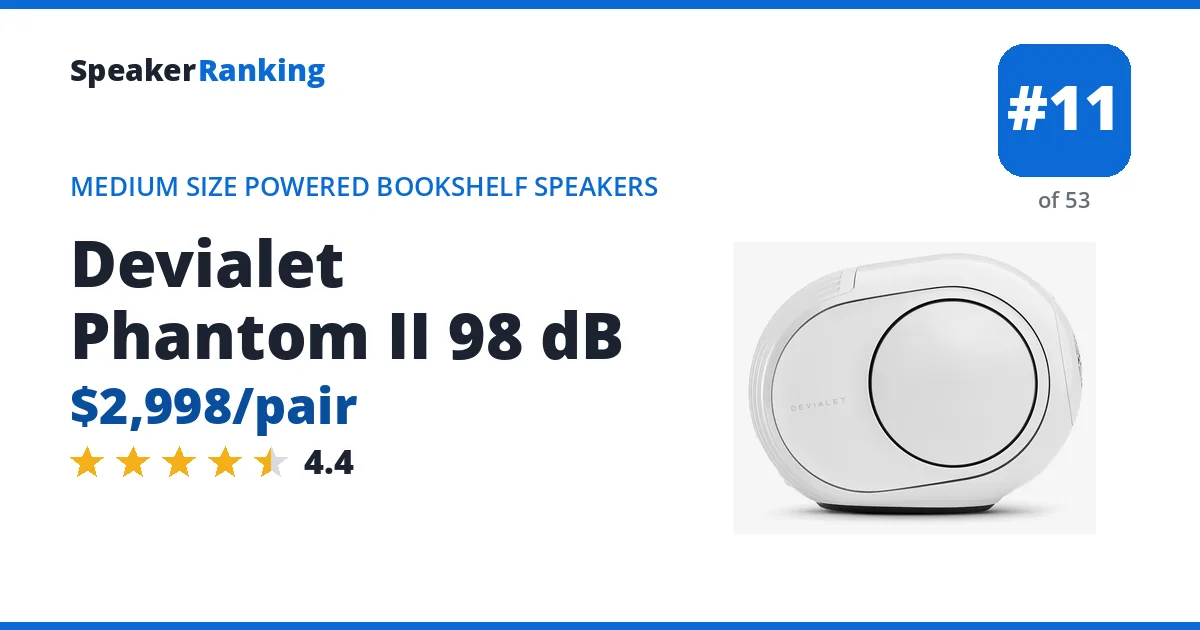
Pros: The manufacturer-supplied measurement shows unusually deep bass for the enclosure size: -3dB at 30Hz. Scores of 6.07 standalone and 7.15 with an ideal subwoofer suggest that its appeal is not limited to bass quantity. Integrated amplification and network playback can replace several components, and its 2.3dB midrange response span is reasonably even. Measured bass extension of 30Hz (-3dB).
Cons: Small-enclosure bass extension at the measurement level does not guarantee the same response at high volume. Stereo requires two units, and the integrated architecture offers less system flexibility than conventional monitors.
Full Devialet Phantom II 98 dB review and specifications →
| AES Input | No |
|---|---|
| Amplifier Power | 400W RMS each |
| Aux Input | No |
| Bass Extension (-10dB) | approximately 22.6Hz (measured, spinorama.org) |
| Bass Extension (-3dB) | 30Hz (measured, spinorama.org) |
| Bluetooth Codecs | SBC, AAC |
| Coaxial Input | No |
| Dimensions | 6.6 x 6.2 x 8.6 in each |
| Drivers | One aluminum full-range driver; two aluminum bass drivers |
| HDMI Input | No |
| Inputs | Wi-Fi, Ethernet, Bluetooth, AirPlay 2, Spotify Connect, UPnP, Roon Ready, analog/optical combo jack |
| Maximum SPL | 98dB at 1m each (manufacturer specified) |
| Optical Input | Yes |
| RCA Input | No |
| Spinorama Preference Score | 6.07 |
| Spinorama Preference Score with Perfect Sub | 7.15 |
| TRS Input | No |
| USB Input | No |
| Weight | 9.5 lbs (4.3 kg) each |
| XLR Input | No |
- Links
- Reviews, Comparisons and Sound Samples
- Head-to-Head Comparisons
- Devialet Phantom II 98 dB vs Genelec 8020D
- Devialet Phantom II 98 dB vs Genelec 8330A
- Devialet Phantom II 98 dB vs Klipsch The Fives
- Devialet Phantom II 98 dB vs Dynaudio LYD 5
- Devialet Phantom II 98 dB vs JBL 305P MKII
- Devialet Phantom II 98 dB vs Neumann KH80 DSP
- Devialet Phantom II 98 dB vs KEF LS50 Wireless II
- Devialet Phantom II 98 dB vs Genelec 8030C
- See all 38 comparisons
Manufacturer measurements show -3dB at 30Hz from a compact enclosure, though stereo requires buying two units and the integrated architecture offers less system flexibility than conventional monitors.
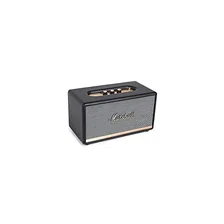 The Marshall Stanmore II: $300 each Discontinued eBay
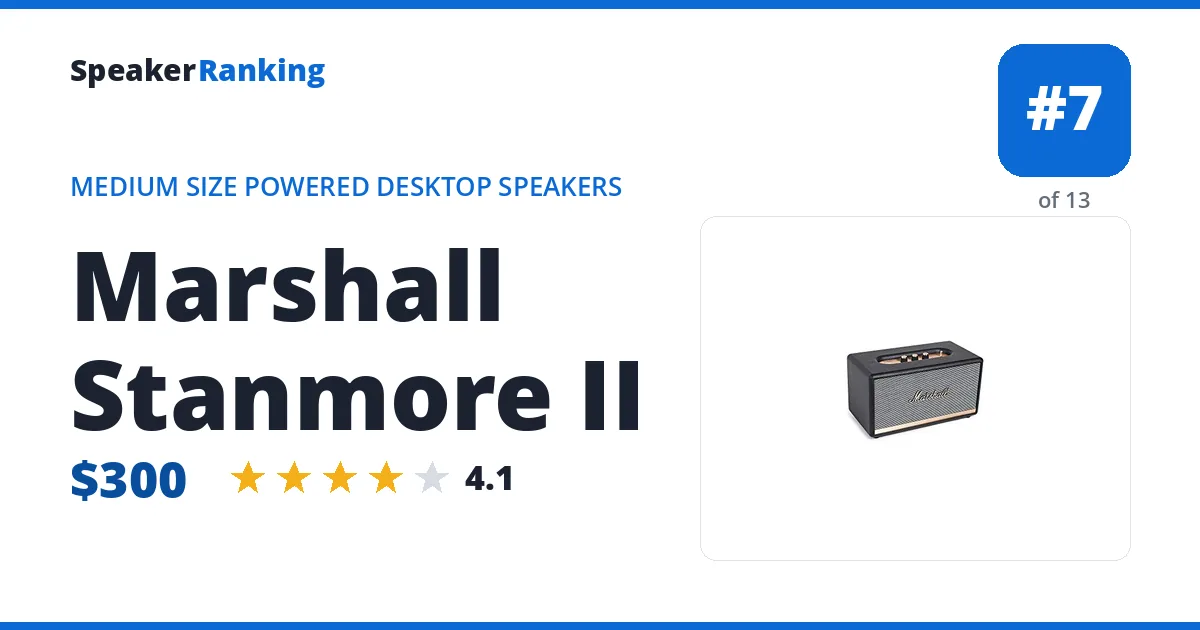
Pros: Marshall Stanmore II uses 5.25” woofer, 2x 2” midranges, 2x 0.75” Dome tweeters. Its 4.65 kg, aux input and limited-stereo playback make it a practical option for its intended room or portable use. Measured bass extension of 55Hz (-10dB).
Cons: Bass is limited by its 55Hz specification. Discontinued.
Full Marshall Stanmore II review and specifications →
| AES Input | No |
|---|---|
| Amplifier Power | 80W (Woofer: 50W, Tweeters: 2x15W) |
| App | Yes |
| Aux Input | Yes |
| Bass Extension (-10dB) | 55Hz |
| Battery Life | No Battery |
| Bluetooth Codecs | SBC, aptX |
| Bluetooth Version | 5.0 |
| Coaxial Input | No |
| Dimensions | 13.8" x 7.9" x 7.3" (350 x 200 x 185 mm) |
| Discontinued | Yes |
| Drivers | 5.25" woofer, 2x 2" midranges, 2x 0.75" Dome tweeters |
| EQ | Yes (Bass/Treble) |
| Frequency Response | 50Hz - 20kHz (Manufacturer specified) |
| HDMI Input | No |
| IP Rating | None |
| Inputs | Bluetooth, RCA, Aux, Optical |
| Optical Input | Yes |
| Party Mode | No |
| Power Bank | No |
| Power Input | AC Power brick |
| RCA Input | Yes |
| Stereo | Partially (1 woofer) |
| TRS Input | No |
| TWS | Yes |
| USB Input | No |
| Voice Assistants | Yes |
| Weight | 10.3 lbs (4.65 kg) |
| Wi-Fi | No |
| Woofer Cabinet | ported |
| XLR Input | No |
- Reviews, Comparisons and Sound Samples
- Head-to-Head Comparisons
- Marshall Stanmore II vs Marshall Acton II
- Marshall Stanmore II vs Marshall Acton III
- Marshall Stanmore II vs Klipsch The Three II
- Marshall Stanmore II vs Marshall Stanmore III
- Marshall Stanmore II vs Marshall Woburn I
- Marshall Stanmore II vs Klipsch The One II
- Marshall Stanmore II vs Marshall Woburn II
- Marshall Stanmore II vs Marshall Woburn III
- See all 10 comparisons
A practical option for its intended room, though its 55Hz bass specification limits low-end reach next to the other picks here.
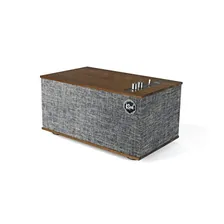 The Klipsch The Three II: $400 each Discontinued eBay

Pros: Klipsch The Three II uses 4.5” woofer, 2x 2.25” full-range midranges. Its 4.7 kg, aux input and limited-stereo playback make it a practical option for its intended room or portable use.
Cons: Its 45Hz - 20kHz (Manufacturer specified) specification points to limited deep-bass reach for the cabinet size. There is no companion app. Discontinued.
Full Klipsch The Three II review and specifications →
| AES Input | No |
|---|---|
| Amplifier Power | 60W (Woofer: 30W, Full-range: 2x15W) |
| App | No |
| Aux Input | Yes |
| Battery Life | No Battery |
| Bluetooth Codecs | SBC, aptX |
| Bluetooth Version | 4.2 |
| Coaxial Input | No |
| Dimensions | 11" x 7.3" x 7.3" (280 x 186 x 186 mm) |
| Discontinued | Yes |
| Drivers | 4.5" woofer, 2x 2.25" full-range midranges |
| EQ | Yes (Bass/Treble) |
| Frequency Response | 45Hz - 20kHz (Manufacturer specified) |
| HDMI Input | No |
| Inputs | Bluetooth, Aux, RCA, Optical, USB |
| Optical Input | Yes |
| Party Mode | No |
| RCA Input | Yes |
| Stereo | Partially (1 woofer) |
| TRS Input | No |
| TWS | No |
| USB Input | Yes |
| Weight | 10.4 lbs (4.7 kg) |
| Wi-Fi | No |
| Woofer Cabinet | ported |
| XLR Input | No |
- Links
- Reviews, Comparisons and Sound Samples
- Head-to-Head Comparisons
- Klipsch The Three II vs Klipsch The One II
- Klipsch The Three II vs Marshall Acton II
- Klipsch The Three II vs Marshall Stanmore II
- Klipsch The Three II vs Marshall Acton III
- Klipsch The Three II vs Edifier D12
- Klipsch The Three II vs Marshall Stanmore III
- Klipsch The Three II vs JBL Authentics 200
- Klipsch The Three II vs Audio Pro C5 MkII
- See all 9 comparisons
Its 45Hz-20kHz manufacturer specification points to limited deep-bass reach for the cabinet size, and there is no companion app for EQ or setup adjustments.
What To Check Before Buying
Optical vs. coaxial: a TV or disc player may only offer one of the two digital outputs. Confirm which your source actually has; see every powered speaker with a coaxial digital input if your source uses that connector instead.
Format support: optical carries stereo PCM and often compressed surround formats, but check both the source device’s output settings and the speaker’s supported input formats before assuming full compatibility with a game console’s audio mix.
Cable length: TOSLINK fiber cables are more length- and bend-sensitive than copper cable. Keep the run reasonably short and avoid sharp bends.
Where To Go Next
See the best powered speakers with a coaxial digital input for the other common digital connector, or every powered speaker with an optical input for the complete list.
Related guides: powered speaker inputs explained, best powered speakers for TVs, and the powered speaker buyer’s guide.