This page ranks 24 medium powered desktop speakers. These are stereo inside a single enclosure with woofers between 4” and 6”. They have no battery and no waterproofing. Larger woofers provide deeper bass but result in a bigger, heavier speaker. All include a built-in amp so you can play directly from your phone or laptop.
I generally recommend avoiding this class, they won’t have good imaging due to not having widely separated left and right channels like the Bookshelf class, and they generally aren’t tuned as neutral. These are more for someone who wants a speaker that is form over function and takes up as little space as possible. Also consider portable Bluetooth speakers with a battery and waterproofing.
| Select to compare | |||||||
|---|---|---|---|---|---|---|---|
| 1 | Audio Pro C5 MkII | $325 each | 41W | 50Hz - 20kHz | Yes | 5.3 lbs | |
| 2 | Marshall Woburn III | $449.99 each | 150W | 35Hz - 20kHz | Yes | 16.4 lbs | |
| 3 | Marshall Woburn II | $332.11 each | 110W | 30Hz - 20kHz | Yes | 18.9 lbs | |
| 4 | Marshall Woburn I | $500 each | 90W | 30Hz - 20kHz | Yes | 17.4 lbs | |
| 5 | Apple HomePod 2nd Gen | $297.71 each | - | - | No | 5.1 lbs | |
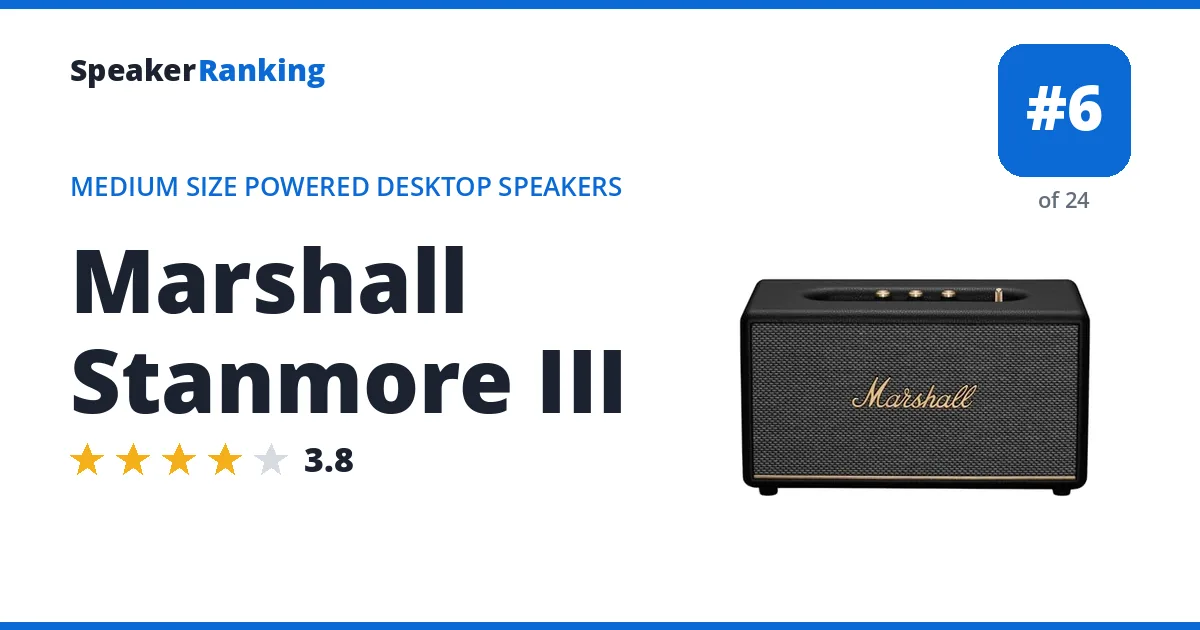
| 6 | Marshall Stanmore III | $249.18 each | 80W | 45Hz - 20kHz | Yes | 9.7 lbs | |
| 7 | Edifier D12 | $143.49 each | 70W | 54Hz - 20kHz | Yes | 10.1 lbs | |
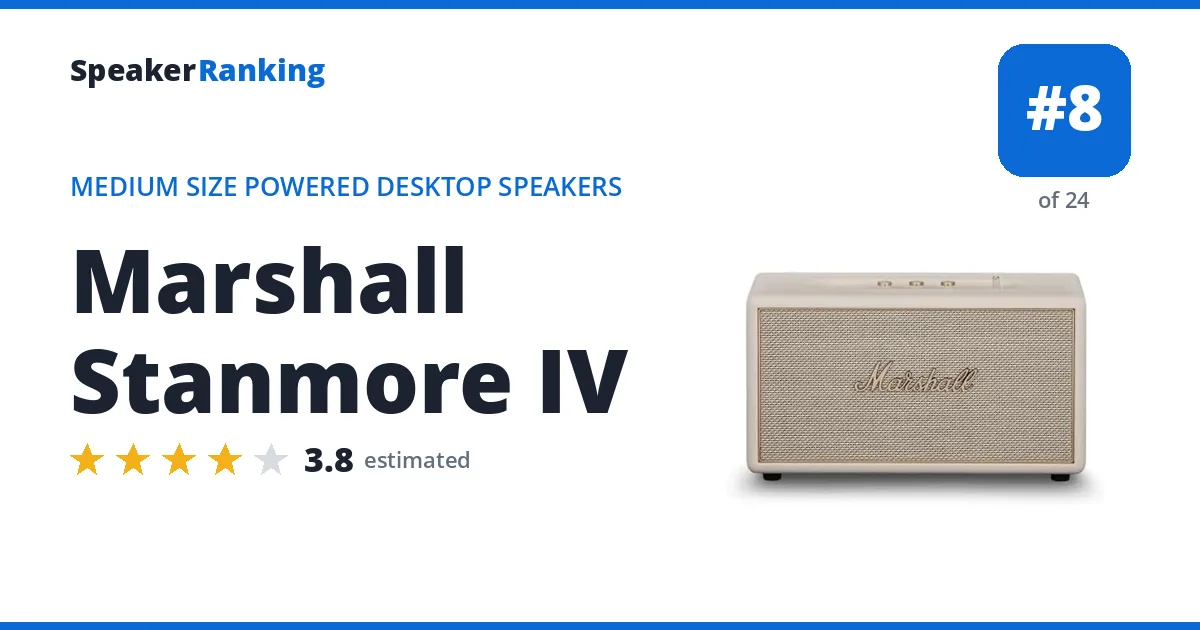
| 8 | Marshall Stanmore IV | $429.99 each | 110W | 36Hz - 38kHz | Yes | 8.8 lbs | |
| 9 | Denon Home 400 | $599.00 each | 6 x Class D | - | Yes | 9.3 lbs | |
| 10 | JBL Authentics 200 | $199.95 each | 90W | 50Hz - 20kHz | Yes | 9.3 lbs | |
| 11 | Marshall Acton III | $189.99 each | 60W | 45Hz - 20kHz | Yes | 6.3 lbs | |
| 12 | Marshall Stanmore II | $300 each | 80W | 50Hz - 20kHz | Yes | 10.3 lbs | |
| 13 | Denon Home 250 | $549.00 each | 80W | - | Yes | 8.2 lbs | |
| 14 | Bose Lifestyle Ultra Speaker | $299.00 each | - | - | Yes | 3.7 lbs | |
| 15 | Google Home Max | $399 each | 6x Class-D amplifiers | - | Yes | 11.7 lbs | |
| 16 | Sonos Era 100 | $219.00 each | - | - | Yes | 4.5 lbs | |
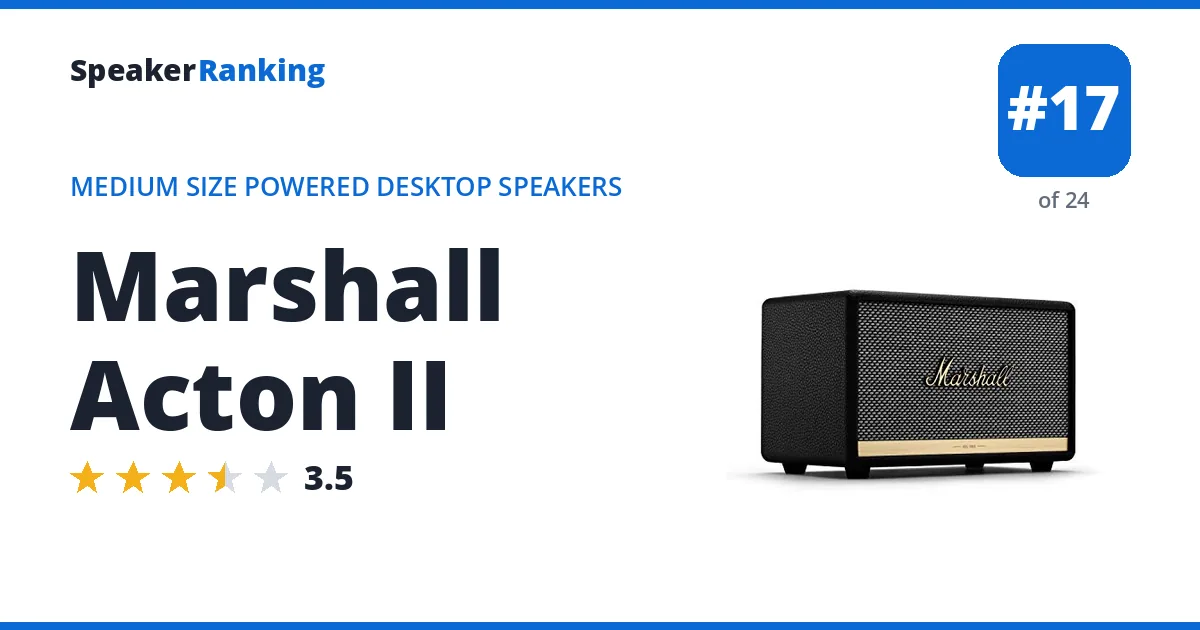
| 17 | Marshall Acton II | $195.60 each | 50W | 50Hz - 20kHz | Yes | 6.4 lbs | |
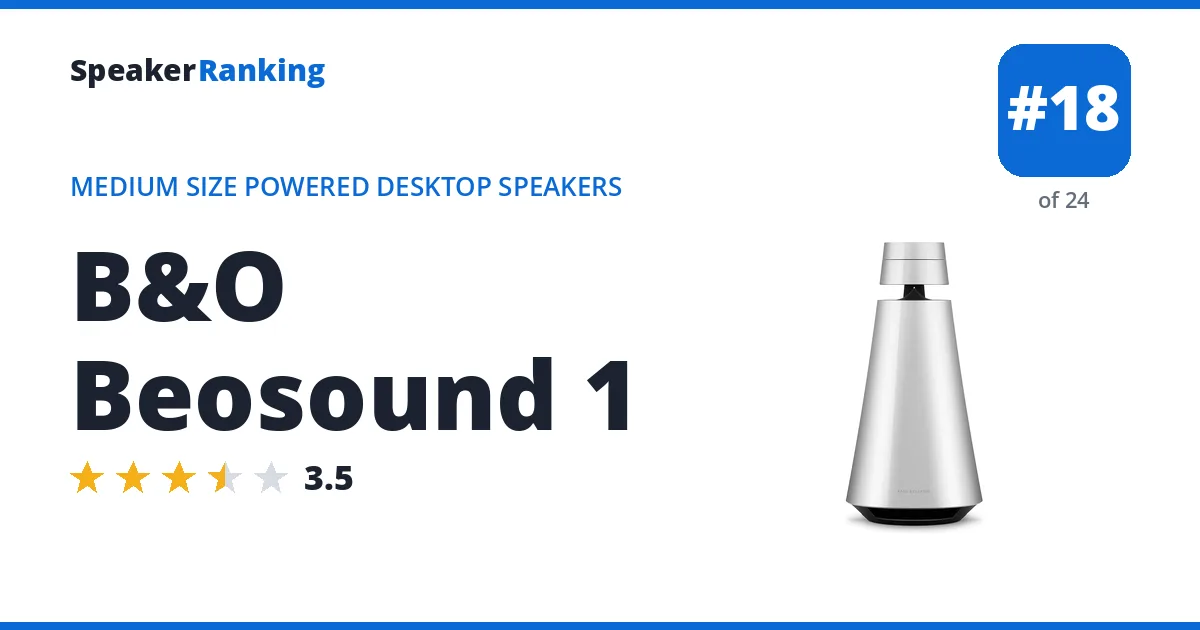
| 18 | B&O Beosound 1 | $2,000 each | 60W total | 35Hz - 24.3kHz | Yes | 7.7 lbs | |
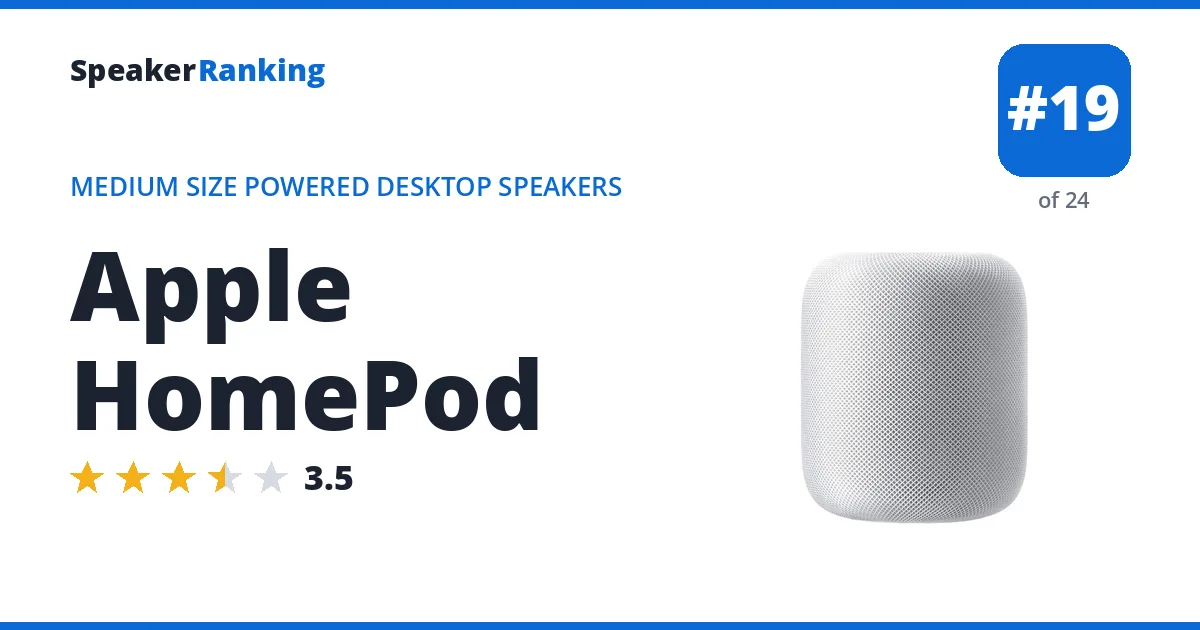
| 19 | Apple HomePod | $299 each | - | - | No | 5.5 lbs | |
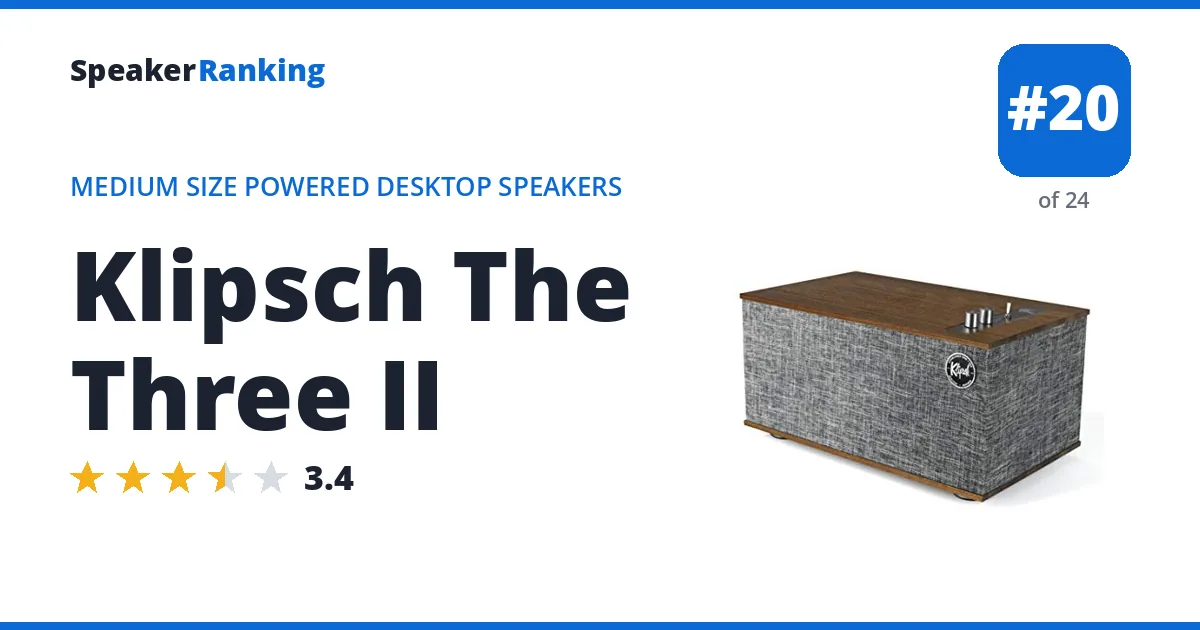
| 20 | Klipsch The Three II | $400 each | 60W | 45Hz - 20kHz | Yes | 10.4 lbs | |
| 21 | Klipsch The Three Plus | $269.99 each | 120W total | 45Hz - 20kHz | Yes | 10.6 lbs | |
| 22 | Klipsch The One II | $129.95 each | 50W | 50Hz - 20kHz | Yes | 8.6 lbs | |
| 23 | Klipsch The Three | $399 each | 60W continuous | - | Yes | 10.4 lbs | |
| 24 | IKEA SYMFONISK Table Lamp Speaker (1st gen) | $179 each | - | - | No | 11.4 lbs |
Prices on this page were last checked October 9, 2026 at 8:01 AM UTC. Product prices and availability are accurate as of that date/time and are subject to change; the price and availability shown on Amazon at the time of purchase will apply to the purchase of this product.
As an eBay Partner, we may be compensated if you make a purchase.
 #1 Audio Pro C5 MkII: $325 each Amazon eBay
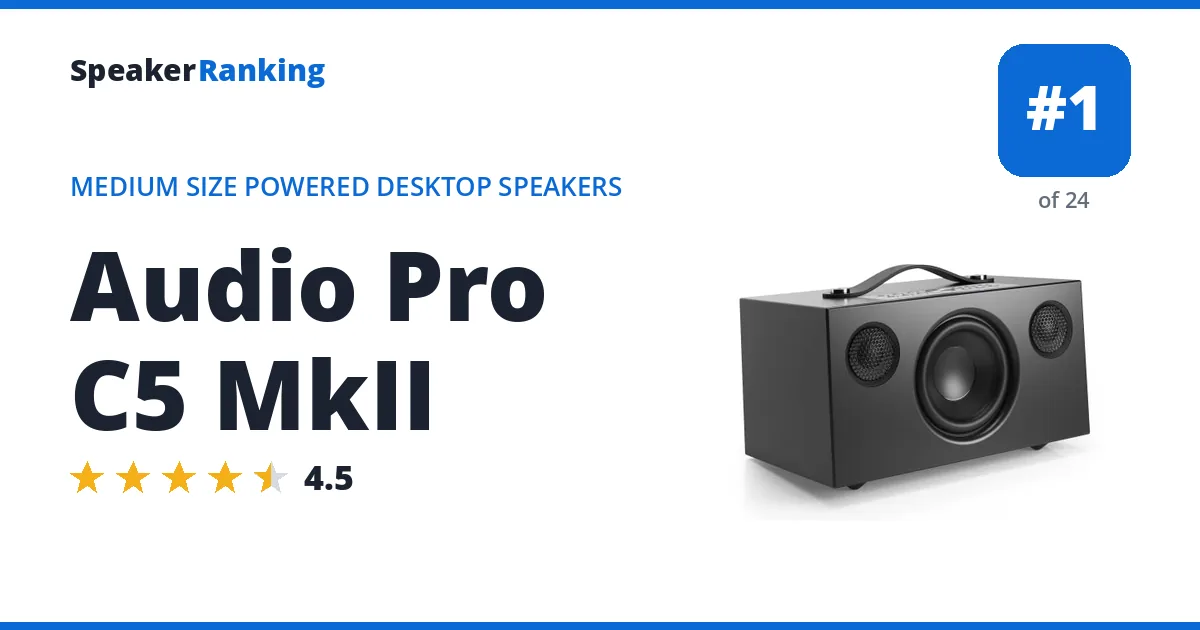
Same family: the Audio Pro C10 MkII (larger model, estimated 4.3/5).
Pros: At 2.4 kg, Audio Pro C5 MkII combines 4” woofer, 2x 0.75” tweeters with Bluetooth, Wifi, RCA. Ac-powered operation and limited-stereo playback make its feature set practical for its intended room or portable use. Reviews find the sound fairly neutral.
Cons: Bass is limited by its 50Hz to 20kHz (Manufacturer specified) specification. There is no battery, so it needs mains power.
Full Audio Pro C5 MkII review and specifications →
| AES Input | No |
|---|---|
| Amplifier Power | 41W (2x8W + 25W) |
| App | Yes |
| Aux Input | No |
| Battery Life | No Battery |
| Bluetooth | Yes |
| Bluetooth Version | 4.2 |
| Coaxial Input | No |
| Dimensions | 9.8” x 5.1” x 5.9” (250 x 130 x 150 mm) |
| Drivers | 4” woofer, 2x 0.75” tweeters |
| EQ | Yes (Bass/Treble) |
| Frequency Response | 50Hz - 20kHz (Manufacturer specified) |
| HDMI Input | No |
| IP Rating | None |
| Inputs | Bluetooth, Wifi, RCA |
| Optical Input | No |
| Outputs | Subwoofer line out |
| Party Mode | Yes (AirPlay 2 multi-room) |
| Power Input | AC Power cord |
| RCA Input | Yes |
| Stereo | Partially |
| Streaming Services | Spotify Connect, Tidal Connect, AirPlay 2, Google Cast |
| Subwoofer Output | Yes |
| TRS Input | No |
| TWS | No |
| USB Input | No |
| Weight | 5.3 lbs (2.4 kg) |
| Wi-Fi | Yes (IEEE 802.11 b/g/n/ac (2.4/5GHz)) |
| Woofer Cabinet | ported |
| XLR Input | No |
- Links
- Reviews, Comparisons and Sound Samples
- Head-to-Head Comparisons
- Audio Pro C5 MkII vs Marshall Woburn III
- Audio Pro C5 MkII vs Marshall Woburn II
- Audio Pro C5 MkII vs Apple HomePod 2nd Gen
- Audio Pro C5 MkII vs Marshall Stanmore III
- Audio Pro C5 MkII vs Edifier D12
- Audio Pro C5 MkII vs Marshall Stanmore IV
- Audio Pro C5 MkII vs JBL Authentics 200
- Audio Pro C5 MkII vs Marshall Acton III
- See all 16 comparisons
 #2 Marshall Woburn III: $449.99 each Amazon eBay
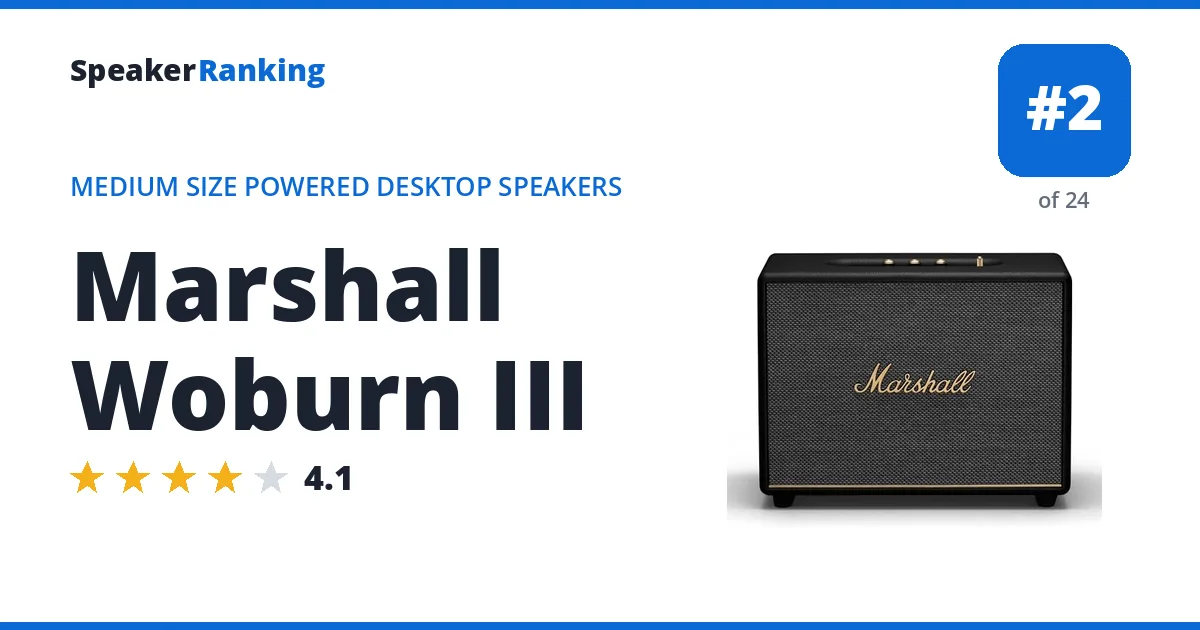
Older models: the Marshall Woburn II (ranked lower, rated 4/5) and the Marshall Woburn I (ranked lower, rated 4/5).
Same family: the Marshall Acton III (smaller model, ranked lower, rated 3.7/5) and the Marshall Stanmore III (smaller model, ranked lower, rated 3.8/5).
Pros: At 7.44 kg, Marshall Woburn III combines 6” woofer, 2x 2” midranges, 2x 0.75” Dome tweeters with Bluetooth, HDMI ARC, RCA, Aux. Up to 100.5db @ 1m and stereo playback make its feature set practical for its intended room or portable use. Measured bass extension of ~45Hz (-10dB).
Cons: Bass is limited by its ~45Hz specification.
Full Marshall Woburn III review and specifications →
| AES Input | No |
|---|---|
| Amplifier Power | 150W (Woofer: 90W, Midrange: 2x15W, Tweeters: 2x15W) |
| App | Yes |
| Aux Input | Yes |
| Bass Extension (-10dB) | ~45Hz |
| Battery Life | No Battery |
| Bluetooth | Yes |
| Bluetooth Codecs | SBC |
| Bluetooth Version | 5.2 |
| Coaxial Input | No |
| Dimensions | 15.7” x 12.5” x 8” (400 x 317 x 203 mm) |
| Drivers | 6” woofer, 2x 2” midranges, 2x 0.75” Dome tweeters |
| EQ | Yes (Bass/Treble) |
| Frequency Response | 35Hz - 20kHz (Manufacturer specified) |
| HDMI Input | Yes |
| IP Rating | None |
| Inputs | Bluetooth, HDMI ARC, RCA, Aux |
| Maximum SPL | 100.5dB @ 1m |
| Optical Input | No |
| Party Mode | No |
| Power Input | AC Power cord |
| RCA Input | Yes |
| Stereo | Yes |
| TRS Input | No |
| TWS | No |
| USB Input | No |
| Weight | 16.4 lbs (7.44 kg) |
| Wi-Fi | No |
| Woofer Cabinet | ported |
| XLR Input | No |
- Links
- Reviews, Comparisons and Sound Samples
- Head-to-Head Comparisons
- Marshall Woburn III vs Marshall Woburn II
- Marshall Woburn III vs Audio Pro C5 MkII
- Marshall Woburn III vs Marshall Woburn I
- Marshall Woburn III vs Apple HomePod 2nd Gen
- Marshall Woburn III vs Marshall Stanmore III
- Marshall Woburn III vs Edifier D12
- Marshall Woburn III vs Marshall Stanmore IV
- Marshall Woburn III vs JBL Authentics 200
- See all 16 comparisons
 #3 Marshall Woburn II: $332.11 each Discontinued Amazon eBay
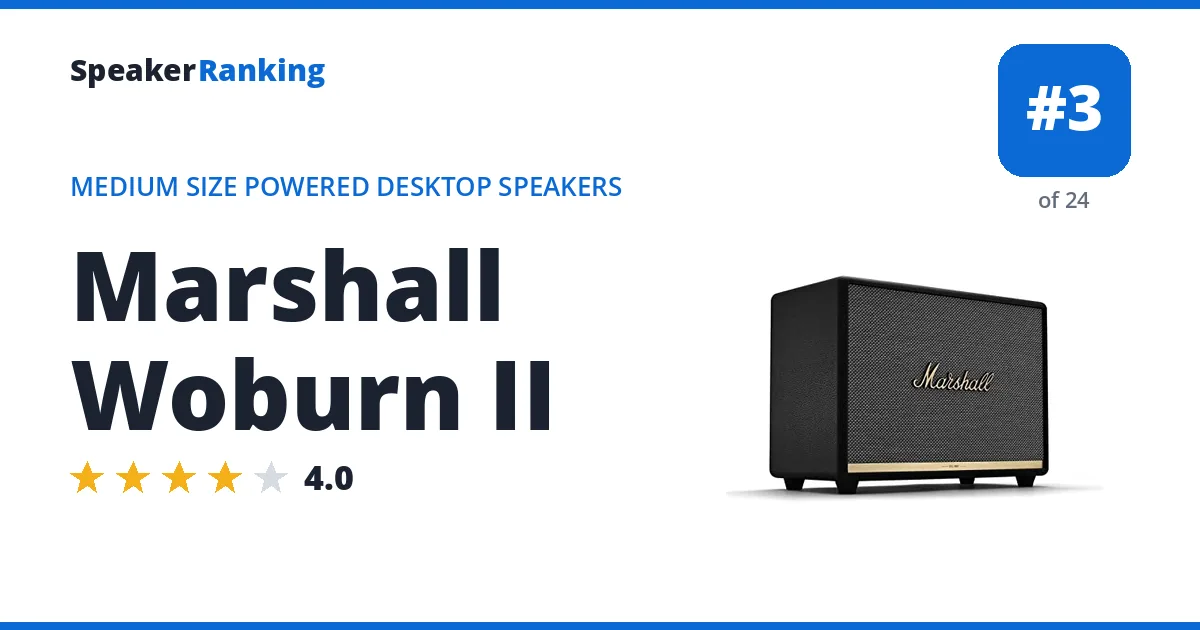
Newer model: the Marshall Woburn III, ranked higher, rated 4.1/5.
Older model: the Marshall Woburn I (ranked lower, rated 4/5).
Pros: Marshall Woburn II uses 2x 5.25” woofers, Integrated in woofers midrange, 2x 1” tweeters. Its 8.57 kg, aux input, up to 110dB and stereo playback make it a practical option for its intended room or portable use. Measured bass extension of ~47Hz (-10dB).
Cons: Bass is limited by its ~47Hz specification. Discontinued.
Full Marshall Woburn II review and specifications →
| AES Input | No |
|---|---|
| Amplifier Power | 110W (Woofers: 2x50W, Tweeters: 2x15W) |
| App | Yes |
| Aux Input | Yes |
| Bass Extension (-10dB) | ~47Hz |
| Battery Life | No Battery |
| Bluetooth | Yes |
| Bluetooth Codecs | AptX, SBC |
| Bluetooth Version | 5.0 |
| Coaxial Input | No |
| Dimensions | 15.7” x 12.1” x 7.9” (400 x 308 x 200 mm) |
| Drivers | 2x 5.25” woofers, Integrated in woofers midrange, 2x 1” tweeters |
| EQ | Yes (Bass/Treble) |
| Frequency Response | 30Hz - 20kHz (Manufacturer specified) |
| HDMI Input | Yes |
| IP Rating | None |
| Inputs | Bluetooth, HDMI, RCA, Aux |
| Maximum SPL | 110dB |
| Optical Input | No |
| Party Mode | No |
| Power Input | AC Power cord |
| RCA Input | Yes |
| Stereo | Yes |
| TRS Input | No |
| TWS | Yes |
| USB Input | No |
| Voice Assistants | None |
| Weight | 18.9 lbs (8.57 kg) |
| Wi-Fi | No |
| Woofer Cabinet | ported |
| XLR Input | No |
- Reviews, Comparisons and Sound Samples
- Head-to-Head Comparisons
- Marshall Woburn II vs Marshall Woburn III
- Marshall Woburn II vs Marshall Woburn I
- Marshall Woburn II vs Audio Pro C5 MkII
- Marshall Woburn II vs Marshall Stanmore III
- Marshall Woburn II vs Edifier D12
- Marshall Woburn II vs JBL Authentics 200
- Marshall Woburn II vs Marshall Acton III
- Marshall Woburn II vs Marshall Stanmore II
- See all 12 comparisons
 #4 Marshall Woburn I: $500 each Discontinued eBay
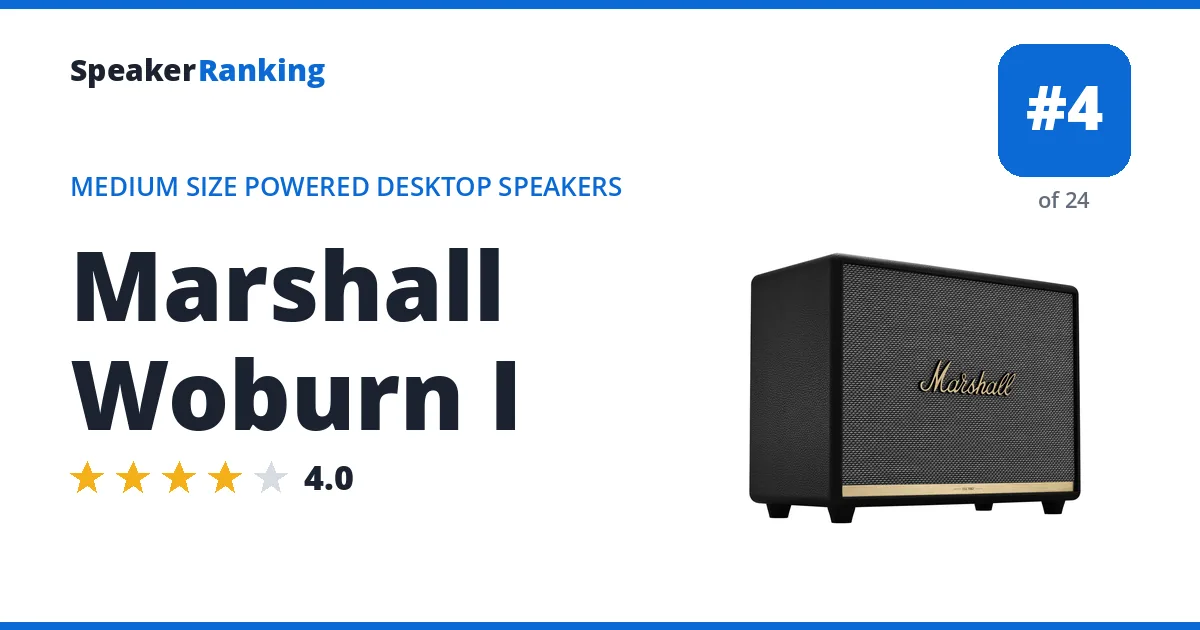
Newer model: the Marshall Woburn III, ranked higher, rated 4.1/5.
Pros: A substantial mains-powered stereo speaker with two 5.25-inch woofers, two tweeters, 90W output and physical bass and treble controls. It supports Bluetooth with aptX plus RCA and 3.5mm aux inputs, so it is a flexible single-box system for a desk, living room or turntable setup. Measured bass extension of ~50Hz (-10dB).
Cons: Its midrange can be peaky while the upper treble rolls off, and bass reaches only around 50Hz in practice rather than matching deeper modern speakers. At 7.9kg it is not portable, has no app, Wi-Fi or multi-speaker mode, and this discontinued first-generation model should be checked carefully before buying used.
Full Marshall Woburn I review and specifications →
| AES Input | No |
|---|---|
| Amplifier Power | 90W |
| App | No |
| Aux Input | Yes |
| Bass Extension (-10dB) | ~50Hz |
| Battery Life | No Battery |
| Bluetooth | Yes |
| Bluetooth Codecs | SBC, aptX |
| Bluetooth Version | 4.0 |
| Coaxial Input | No |
| Dimensions | 15.7” x 12.1” x 7.9” (400 x 308 x 200 mm) |
| Drivers | 2x 5.25” woofers, Integrated in woofers midrange, 2x 1” tweeters |
| EQ | Yes (Bass/Treble) |
| Frequency Response | 30Hz - 20kHz (Manufacturer specified) |
| HDMI Input | No |
| IP Rating | None |
| Inputs | Bluetooth, RCA, Aux |
| Optical Input | No |
| Party Mode | No |
| Power Input | AC Power cord |
| RCA Input | Yes |
| Stereo | Yes |
| TRS Input | No |
| TWS | No |
| USB Input | No |
| Weight | 17.4 lbs (7.9 kg) |
| Wi-Fi | No |
| Woofer Cabinet | ported |
| XLR Input | No |
- Reviews, Comparisons and Sound Samples
- Head-to-Head Comparisons
- Marshall Woburn I vs Marshall Woburn II
- Marshall Woburn I vs Marshall Woburn III
- Marshall Woburn I vs Marshall Stanmore III
- Marshall Woburn I vs JBL Authentics 200
- Marshall Woburn I vs Marshall Acton III
- Marshall Woburn I vs Marshall Stanmore II
- Marshall Woburn I vs Bose Lifestyle Ultra Speaker
- Marshall Woburn I vs Sonos Era 100
- See all 10 comparisons
 #5 Apple HomePod 2nd Gen: $297.71 each Amazon eBay
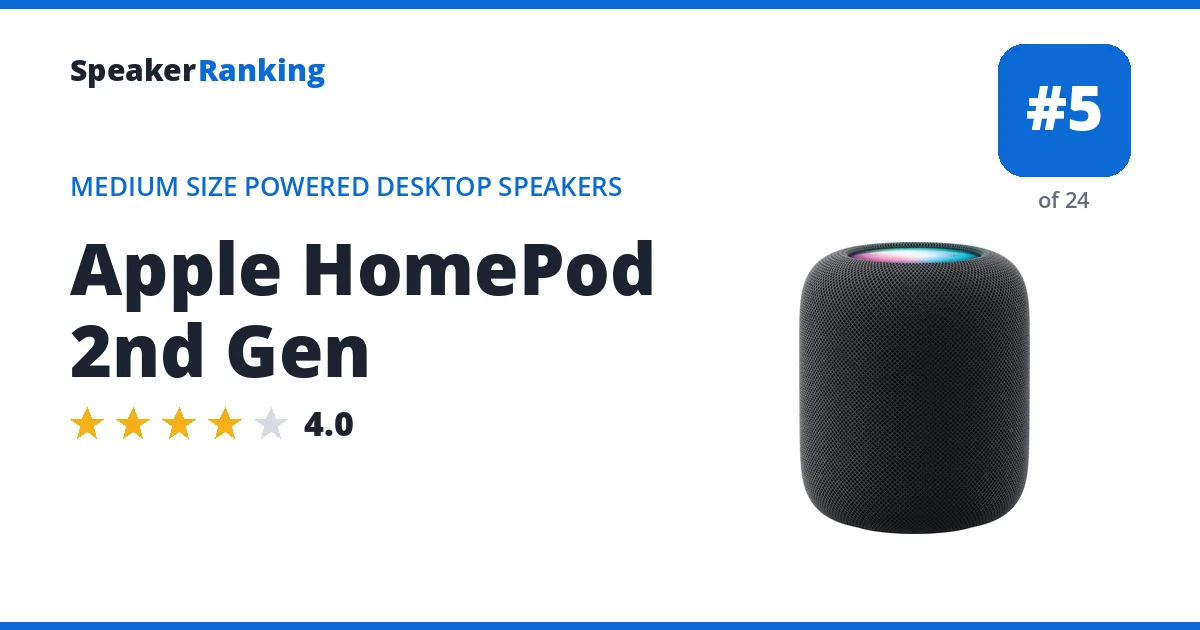
Older model: the Apple HomePod (ranked lower, rated 3.5/5).
Same family: the Apple HomePod Mini (smaller model, rated 3.3/5).
Pros: What Hi-Fi gave it a perfect 5 stars for sound and a What Hi-Fi Award, calling it natural, solid and energetic with a spacious, three-dimensional presentation on Dolby Atmos content. A 4-inch high-excursion woofer moves 20mm of travel, paired with five angled horn-loaded tweeters, and the S7 chip continuously measures the room and re-tunes the output in real time, even as you move the speaker. “Hey Siri” is reliably heard from across a room even at full volume, and two units can be stereo-paired for a genuinely bigger sound.
Cons: What Hi-Fi’s own comparison found the pricier Sonos Era 300 has more power, punch and detail, and Siri cannot launch Spotify, Tidal or other non-Apple services directly, only Apple Music by voice; everything else has to be sent over AirPlay from a phone. There is no way to stream to it over Bluetooth at all, no 3.5mm or other wired input, no battery, and no IP rating, so it’s an AC-only speaker for an already-committed Apple household.
Full Apple HomePod 2nd Gen review and specifications →
| AES Input | No |
|---|---|
| App | Yes (Apple Home) |
| Aux Input | No |
| Battery Life | No Battery |
| Bluetooth | No |
| Built-in Microphone | Yes (far-field array, no physical mute switch) |
| Coaxial Input | No |
| Dimensions | 6.7” x 5.6” x 5.6” (170 x 142 x 142 mm) |
| Drivers | 4in high-excursion woofer, 5x horn-loaded tweeters |
| EQ | Yes (Reduce Bass toggle + automatic room correction) |
| HDMI Input | No |
| IP Rating | None |
| Inputs | Wi-Fi, AirPlay 2 |
| Optical Input | No |
| Party Mode | Yes (AirPlay 2 multi-room) |
| Power Bank | No |
| Power Input | External AC adapter (detachable cable) |
| RCA Input | No |
| Stereo | No |
| Streaming Services | AirPlay 2, Apple Music (direct voice control); other services via AirPlay only |
| TRS Input | No |
| TWS | Yes (stereo pairing via Home app) |
| USB Input | No |
| Voice Assistants | Apple Siri |
| Weight | 5.1 lbs (2.3 kg) |
| Wi-Fi | Yes |
| XLR Input | No |
- Links
- Reviews, Comparisons and Sound Samples
- Head-to-Head Comparisons
- Apple HomePod 2nd Gen vs Marshall Stanmore III
- Apple HomePod 2nd Gen vs Edifier D12
- Apple HomePod 2nd Gen vs Marshall Woburn III
- Apple HomePod 2nd Gen vs Marshall Stanmore IV
- Apple HomePod 2nd Gen vs Audio Pro C5 MkII
- Apple HomePod 2nd Gen vs JBL Authentics 200
- Apple HomePod 2nd Gen vs Marshall Acton III
- Apple HomePod 2nd Gen vs Marshall Stanmore II
- See all 39 comparisons
 #6 Marshall Stanmore III: $249.18 each Amazon eBay
Newer model: the Marshall Stanmore IV, ranked lower, estimated 3.8/5.
Older model: the Marshall Stanmore II (ranked lower, rated 3.7/5).
Same family: the Marshall Acton III (smaller model, ranked lower, rated 3.7/5) and the Marshall Woburn III (larger model, ranked higher, rated 4.1/5).
Pros: At 4.4 kg, Marshall Stanmore III combines 5” (midrange/woofer), 1x 5” midrange, 2x 0.75” Dome tweeters with Bluetooth, RCA, Aux. Ac-powered operation and limited-stereo playback make its feature set practical for its intended room or portable use.
Cons: Bass is limited by its 45Hz to 20kHz (Manufacturer specified) specification.
Full Marshall Stanmore III review and specifications →
| AES Input | No |
|---|---|
| Amplifier Power | 80W (Woofer: 50W, Tweeters: 2x15W) |
| App | Yes |
| Aux Input | Yes |
| Battery Life | No Battery |
| Bluetooth | Yes |
| Bluetooth Codecs | SBC |
| Bluetooth Version | 5.2 |
| Coaxial Input | No |
| Dimensions | 13.8” x 8” x 7.4” (350 x 203 x 188 mm) |
| Drivers | 5” (midrange/woofer), 1x 5” midrange, 2x 0.75” Dome tweeters |
| EQ | Yes (Bass/Treble) |
| Frequency Response | 45Hz - 20kHz (Manufacturer specified) |
| HDMI Input | No |
| IP Rating | None |
| Inputs | Bluetooth, RCA, Aux |
| Optical Input | No |
| Party Mode | No |
| Power Bank | No |
| Power Input | AC Power cord |
| RCA Input | Yes |
| Stereo | Partially (1 woofer) |
| TRS Input | No |
| TWS | No |
| USB Input | No |
| Weight | 9.7 lbs (4.4 kg) |
| Wi-Fi | No |
| Woofer Cabinet | ported |
| XLR Input | No |
- Links
- Reviews, Comparisons and Sound Samples
- Head-to-Head Comparisons
- Marshall Stanmore III vs Edifier D12
- Marshall Stanmore III vs Apple HomePod 2nd Gen
- Marshall Stanmore III vs Marshall Woburn I
- Marshall Stanmore III vs Marshall Stanmore IV
- Marshall Stanmore III vs Marshall Woburn II
- Marshall Stanmore III vs Marshall Woburn III
- Marshall Stanmore III vs JBL Authentics 200
- Marshall Stanmore III vs Marshall Acton III
- See all 17 comparisons
 #7 Edifier D12: $143.49 each Amazon eBay
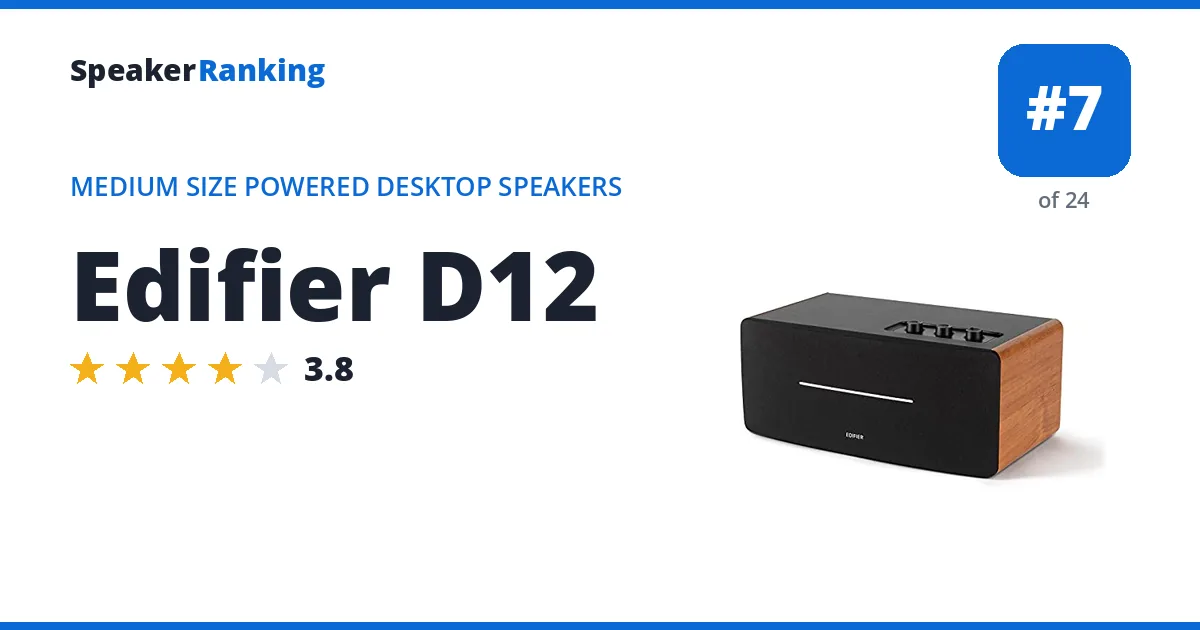
Pros: At 4.6 kg, Edifier D12 combines 2x 4” woofers, 2x 19mm silk dome tweeters with Bluetooth, Aux, RCA. Ac-powered operation and stereo playback make its feature set practical for its intended room or portable use. A very good value for a desktop speaker. Measured bass extension of 57Hz (-10dB).
Cons: Bass is limited by its 57Hz specification. There is no companion app.
Full Edifier D12 review and specifications →
| AES Input | No |
|---|---|
| Amplifier Power | 70W (R/L treble: 15W+15W, R/L mid-bass: 20W+20W) |
| App | No |
| Aux Input | Yes |
| Bass Extension (-10dB) | 57Hz |
| Battery Life | No Battery |
| Bluetooth | Yes |
| Bluetooth Codecs | SBC (inferred; additional codecs unverified) |
| Bluetooth Version | 5.0 |
| Coaxial Input | No |
| Dimensions | 14.1” x 6.3” x 8” (359 x 159 x 203.5 mm) |
| Drivers | 2x 4” woofers, 2x 19mm silk dome tweeters |
| EQ | Yes (Bass/Treble controls) |
| Frequency Response | 54Hz - 20kHz (Manufacturer specified) |
| HDMI Input | No |
| IP Rating | None |
| Inputs | Bluetooth, Aux, RCA |
| Optical Input | No |
| Outputs | Subwoofer line out |
| Party Mode | No |
| Power Bank | No |
| Power Input | AC Power cable |
| RCA Input | Yes |
| Stereo | Yes |
| Subwoofer Output | Yes |
| TRS Input | No |
| TWS | No |
| USB Input | No |
| Weight | 10.1 lbs (4.6 kg) |
| Wi-Fi | No |
| Woofer Cabinet | ported |
| XLR Input | No |
- Links
- Reviews, Comparisons and Sound Samples
- DSAUDIO.review: DSAUDIO.review Edifier D12 vs Marshall Acton II sound.DEMO More from DSAUDIOreview →
- DSAUDIO.review: DSAUDIO.review Edifier D12 vs Edifier R1700BT sound.DEMO
- DSAUDIO.review: DSAUDIO.review Edifier D12 vs Edifier R1280DBs sound.DEMO
- DSAUDIO.review: DSAUDIO.review Edifier D12 vs Klipsch The Three II sound.DEMO
- Head-to-Head Comparisons
- Edifier D12 vs Marshall Stanmore III
- Edifier D12 vs Marshall Stanmore IV
- Edifier D12 vs Apple HomePod 2nd Gen
- Edifier D12 vs JBL Authentics 200
- Edifier D12 vs Marshall Woburn II
- Edifier D12 vs Marshall Acton III
- Edifier D12 vs Marshall Woburn III
- Edifier D12 vs Marshall Stanmore II
- See all 29 comparisons
 #8 Marshall Stanmore IV: $429.99 each Estimated Amazon eBay
Older models: the Marshall Stanmore III (ranked higher, rated 3.8/5) and the Marshall Stanmore II (ranked lower, rated 3.7/5).
Same family: the Marshall Acton IV (smaller model, estimated 3.7/5).
Pros: A 5 inch woofer on a 60W amplifier and two 0.75 inch tweeters on 25W each, now with waveguides and a redesigned bass port, and Marshall rates it down to 36Hz. Bluetooth 5.3 with SBC, AAC, LDAC and LC3, multipoint, Auracast for linking more speakers, and both 3.5 mm aux and RCA inputs for a turntable. The Marshall app adds EQ and room calibration, and the new M-button jumps to a saved EQ or Spotify Tap.
Cons: No independent measurements or side by side comparisons against speakers we rank have been published yet, so it can’t be ranked. One woofer serves both channels, so its stereo is limited to the tweeters. It needs mains power, with no battery, and it has no Wi-Fi streaming and no microphone for voice control.
Full Marshall Stanmore IV review and specifications →
| AES Input | No |
|---|---|
| Amplifier Power | 110W (woofer 60W, tweeters 2x 25W) |
| App | Yes (Marshall) |
| Aux Input | Yes |
| Battery Life | No Battery |
| Bluetooth | Yes |
| Bluetooth Codecs | SBC, AAC, LDAC, LC3 |
| Bluetooth Version | 5.3 |
| Built-in Microphone | No |
| Cabinet Color | black, cream |
| Coaxial Input | No |
| Dimensions | 8”H x 13.8”W x 7.3”D (203 x 350 x 185 mm) |
| Drivers | 1x 5” woofer + 2x 0.75” tweeters with waveguides |
| EQ | Yes (bass/treble knobs, app EQ, room calibration) |
| Frequency Response | 36Hz - 38kHz (Manufacturer specified) |
| HDMI Input | No |
| IP Rating | None |
| Inputs | Bluetooth, RCA, 3.5mm aux |
| Maximum SPL | 97dB at 1m (Manufacturer specified) |
| Optical Input | No |
| Party Mode | Yes (Auracast) |
| Power Bank | No |
| Power Input | AC Power cord |
| RCA Input | Yes |
| Stereo | Partially (1 woofer) |
| TRS Input | No |
| TWS | No |
| USB Input | No |
| Weight | 8.8 lbs (3.99 kg) |
| Wi-Fi | No |
| Woofer Cabinet | ported |
| XLR Input | No |
- Links
- Reviews, Comparisons and Sound Samples
- No independent measurement review is linked for this model; it is ranked from hands-on listening and comparison against similarly priced speakers.
- Head-to-Head Comparisons
- Marshall Stanmore IV vs Edifier D12
- Marshall Stanmore IV vs Marshall Stanmore III
- Marshall Stanmore IV vs JBL Authentics 200
- Marshall Stanmore IV vs Marshall Acton III
- Marshall Stanmore IV vs Apple HomePod 2nd Gen
- Marshall Stanmore IV vs Marshall Stanmore II
- Marshall Stanmore IV vs Bose Lifestyle Ultra Speaker
- Marshall Stanmore IV vs Marshall Woburn III
- See all 12 comparisons
 #9 Denon Home 400: $599.00 each Estimated Amazon eBay
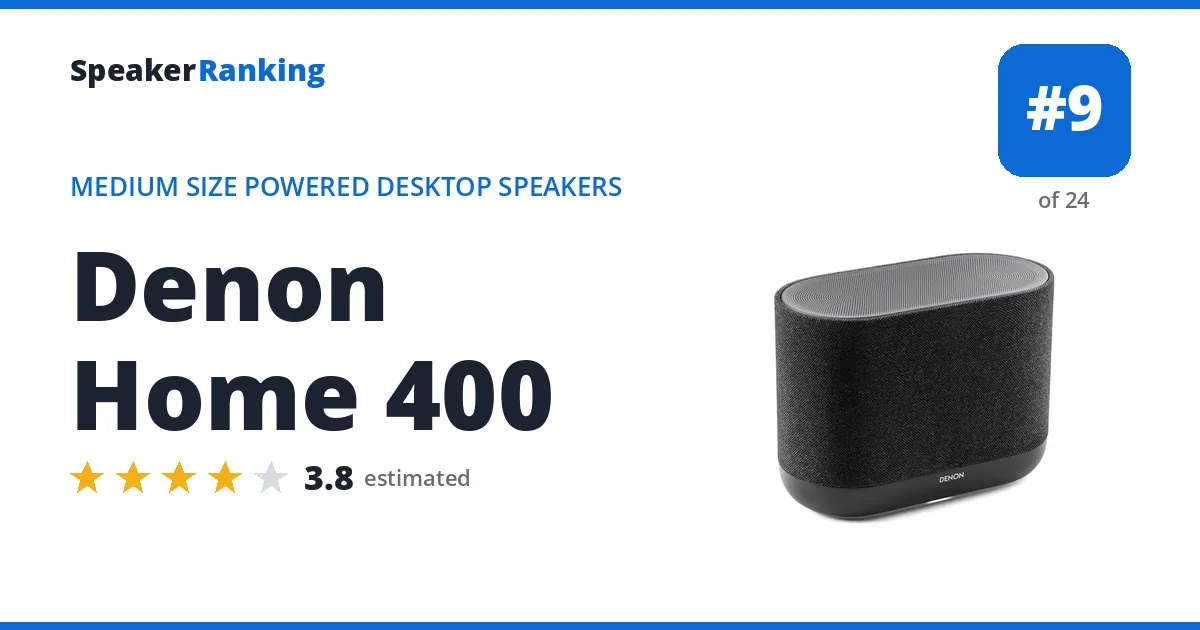
Older model: the Denon Home 250 (ranked lower, rated 3.7/5).
Same family: the Denon Home 200 (smaller model, estimated 3.6/5) and the Denon Home 600 (larger model, estimated 3.7/5).
Pros: The middle model in Denon’s 2026 Home range, replacing the measured Denon Home 250. Six drivers with their own Class D amplifiers (two 114mm woofers, two 19mm tweeters and two 25mm up-firing drivers) give wide stereo and height for Dolby Atmos Music. HEOS multi-room, AirPlay 2, Bluetooth, USB-C and 3.5mm inputs are built in.
Cons: No independent measurements yet, so its tonal balance and directivity can’t be compared directly with measured speakers; the rating is estimated from the measured Denon Home 250 it replaces. Its up-firing drivers need a reflective ceiling to add height, and it is 300mm wide.
Full Denon Home 400 review and specifications →
| AES Input | No |
|---|---|
| Amplifier Power | 6 x Class D |
| App | Yes (HEOS) |
| Aux Input | Yes |
| Battery Life | No Battery |
| Bluetooth | Yes |
| Coaxial Input | No |
| Dimensions | 8.6”H x 11.8”W x 5.9”D (219 x 300 x 150 mm) |
| Dolby Atmos | Yes (Dolby Atmos Music) |
| Drivers | 2 x 114mm woofers, 2 x 19mm tweeters, 2 x 25mm up-firing drivers |
| HDMI Input | No |
| IP Rating | None |
| Optical Input | No |
| Party Mode | Yes (HEOS multi-room) |
| Power Bank | No |
| RCA Input | No |
| Stereo | Yes |
| Streaming Services | HEOS app streaming, AirPlay 2 |
| TRS Input | No |
| USB Input | Yes |
| Weight | 9.3 lbs (4.2 kg) |
| Wi-Fi | Yes (2.4/5/6GHz) |
| XLR Input | No |
- Reviews, Comparisons and Sound Samples
- No independent measurement review is linked for this model; it is ranked from hands-on listening and comparison against similarly priced speakers.
- Head-to-Head Comparisons
 #10 JBL Authentics 200: $199.95 each Amazon eBay
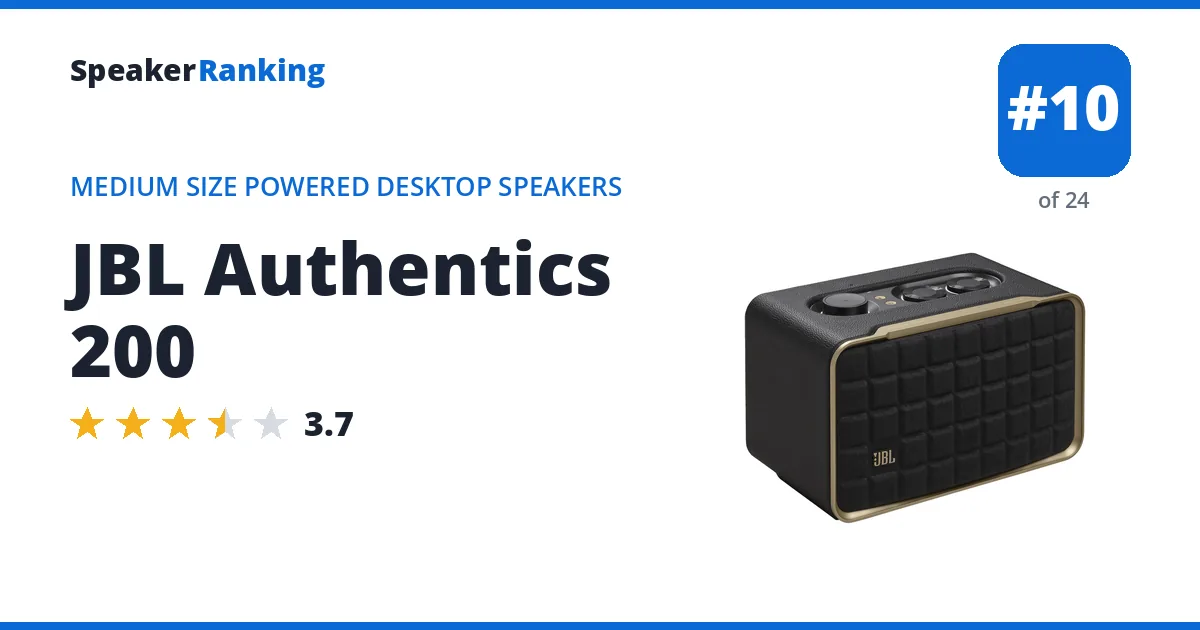
Same family: the JBL Authentics 300 (larger model, rated 3.5/5) and the JBL Authentics 500 (larger model, rated 4.1/5).
Pros: Wi-Fi streaming with simultaneous Alexa and Google Assistant support, rare at this size. Well balanced sound that reviewers rate close to the pricier JBL Authentics 300. Measured about 113dB at 1kHz on max volume, matching the bigger 300 despite the smaller cabinet. Measured bass extension of ~50Hz (-10dB).
Cons: Bass not as deep as others. No TWS. No IP rating. Not as loud as others. Not much battery life.
Full JBL Authentics 200 review and specifications →
| AES Input | No |
|---|---|
| Amplifier Power | 90W |
| App | Yes |
| Aux Input | Yes |
| Bass Extension (-10dB) | ~50Hz |
| Battery Life | No Battery |
| Bluetooth | Yes |
| Bluetooth Codecs | SBC |
| Bluetooth Version | 5.3 |
| Coaxial Input | No |
| Dimensions | 10.5” x 6.8” x 6.6” (266.3 x 171.7 x 167.4 mm) |
| Drivers | 5” full-range woofer, 2x 25mm tweeters; 6-inch down-firing passive radiator; 6-inch down-firing passive radiator; 6-inch down-firing passive radiator; 6-inch down-firing passive radiator |
| EQ | Yes |
| Frequency Response | 50Hz - 20kHz (-6dB) (Manufacturer specified) |
| HDMI Input | No |
| IP Rating | None |
| Inputs | Bluetooth, Wifi, Aux, USB (US only) |
| Optical Input | No |
| Party Mode | Yes (Wi-Fi multi-room) |
| Power Input | AC Power Cable (100-240V) |
| RCA Input | No |
| Stereo | Partially (1 woofer) |
| Streaming Services | AirPlay, Chromecast, Spotify Connect, Alexa MRM |
| TRS Input | No |
| TWS | No |
| USB Input | Yes |
| Voice Assistants | Amazon Alexa & Google Assistant (simultaneous) |
| Weight | 9.3 lbs (4.2 kg) |
| Wi-Fi | Yes (IEEE 802.11 a/b/g/n/ac/ax (2.4GHz/5GHz)) |
| Woofer Cabinet | ported |
| XLR Input | No |
- Links
- Reviews, Comparisons and Sound Samples
- Head-to-Head Comparisons
- JBL Authentics 200 vs Marshall Acton III
- JBL Authentics 200 vs Marshall Stanmore II
- JBL Authentics 200 vs Marshall Stanmore IV
- JBL Authentics 200 vs Edifier D12
- JBL Authentics 200 vs Denon Home 250
- JBL Authentics 200 vs Marshall Stanmore III
- JBL Authentics 200 vs Bose Lifestyle Ultra Speaker
- JBL Authentics 200 vs Google Home Max
- See all 43 comparisons
 #11 Marshall Acton III: $189.99 each Amazon eBay
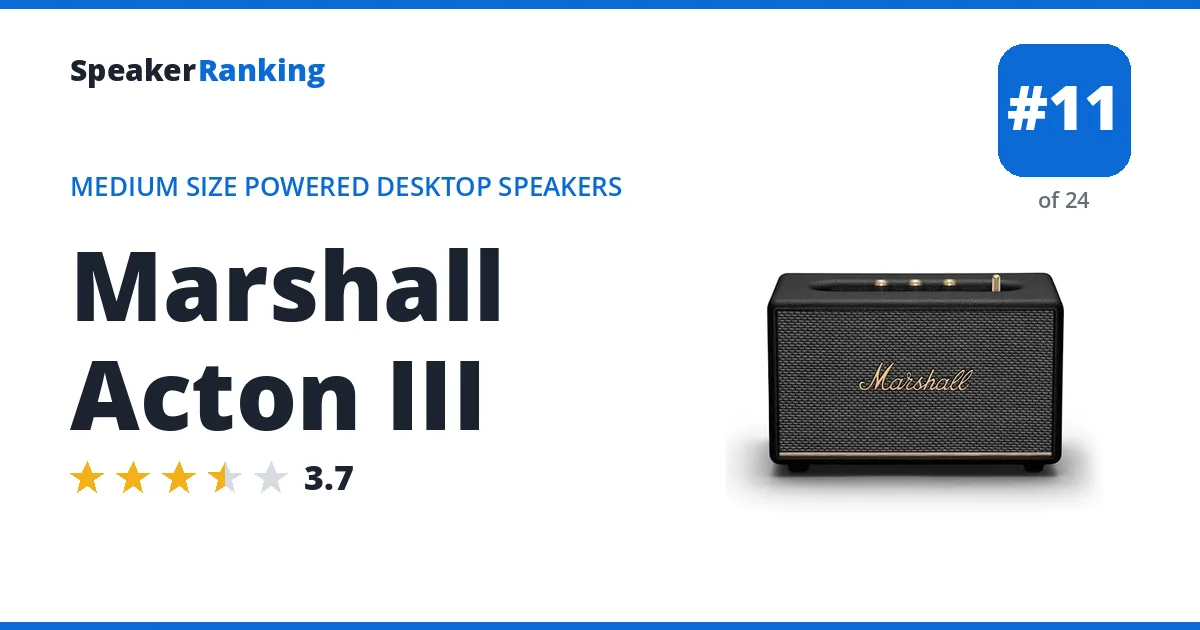
Newer model: the Marshall Acton IV, estimated 3.7/5.
Older model: the Marshall Acton II (ranked lower, rated 3.5/5).
Same family: the Marshall Stanmore III (larger model, ranked higher, rated 3.8/5) and the Marshall Woburn III (larger model, ranked higher, rated 4.1/5).
Pros: At 2.85 kg, Marshall Acton III combines 4” (midrange/woofer), 1x 4” midrange, 2x 0.75” Dome tweeters with Bluetooth, Aux. Ac-powered operation and limited-stereo playback make its feature set practical for its intended room or portable use.
Cons: Bass is limited by its 45Hz to 20kHz (Manufacturer specified) specification.
Full Marshall Acton III review and specifications →
| AES Input | No |
|---|---|
| Amplifier Power | 60W (Woofer: 30W, Tweeters: 2x15W) |
| App | Yes |
| Aux Input | Yes |
| Battery Life | No Battery |
| Bluetooth | Yes |
| Bluetooth Codecs | SBC |
| Bluetooth Version | 5.2 |
| Coaxial Input | No |
| Dimensions | 10.2” x 6.7” x 5.9” (260 x 170 x 150 mm) |
| Drivers | 4” (midrange/woofer), 1x 4” midrange, 2x 0.75” Dome tweeters |
| EQ | Yes (Bass/Treble) |
| Frequency Response | 45Hz - 20kHz (Manufacturer specified) |
| HDMI Input | No |
| IP Rating | None |
| Inputs | Bluetooth, Aux |
| Optical Input | No |
| Party Mode | No |
| Power Bank | No |
| RCA Input | No |
| Stereo | Partially (1 woofer) |
| TRS Input | No |
| TWS | No |
| USB Input | No |
| Weight | 6.3 lbs (2.85 kg) |
| Wi-Fi | No |
| Woofer Cabinet | ported |
| XLR Input | No |
- Links
- Reviews, Comparisons and Sound Samples
- Head-to-Head Comparisons
- Marshall Acton III vs Marshall Stanmore II
- Marshall Acton III vs JBL Authentics 200
- Marshall Acton III vs Denon Home 250
- Marshall Acton III vs Bose Lifestyle Ultra Speaker
- Marshall Acton III vs Marshall Stanmore IV
- Marshall Acton III vs Edifier D12
- Marshall Acton III vs Marshall Stanmore III
- Marshall Acton III vs Sonos Era 100
- See all 18 comparisons
 #12 Marshall Stanmore II: $300 each Discontinued eBay
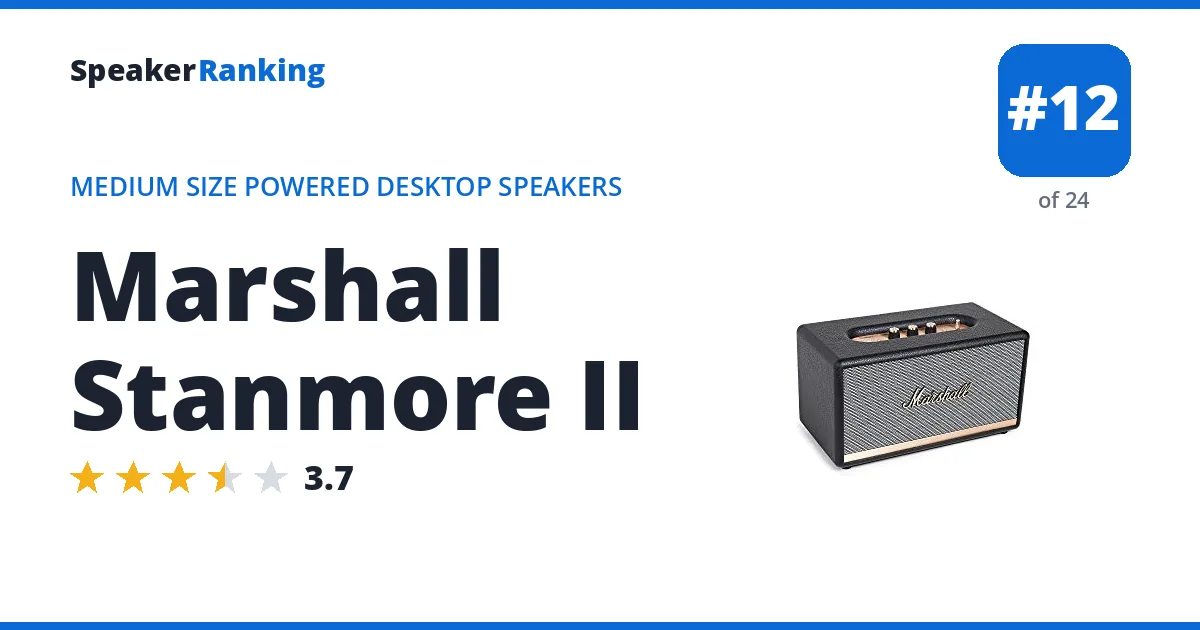
Newer model: the Marshall Stanmore IV, ranked higher, estimated 3.8/5.
Pros: Marshall Stanmore II uses 5.25” woofer, 2x 2” midranges, 2x 0.75” Dome tweeters. Its 4.65 kg, aux input and limited-stereo playback make it a practical option for its intended room or portable use. Measured bass extension of 55Hz (-10dB).
Cons: Bass is limited by its 55Hz specification. Discontinued.
Full Marshall Stanmore II review and specifications →
| AES Input | No |
|---|---|
| Amplifier Power | 80W (Woofer: 50W, Tweeters: 2x15W) |
| App | Yes |
| Aux Input | Yes |
| Bass Extension (-10dB) | 55Hz |
| Battery Life | No Battery |
| Bluetooth | Yes |
| Bluetooth Codecs | SBC, aptX |
| Bluetooth Version | 5.0 |
| Coaxial Input | No |
| Dimensions | 13.8” x 7.9” x 7.3” (350 x 200 x 185 mm) |
| Drivers | 5.25” woofer, 2x 2” midranges, 2x 0.75” Dome tweeters |
| EQ | Yes (Bass/Treble) |
| Frequency Response | 50Hz - 20kHz (Manufacturer specified) |
| HDMI Input | No |
| IP Rating | None |
| Inputs | Bluetooth, RCA, Aux, Optical |
| Optical Input | Yes |
| Party Mode | No |
| Power Bank | No |
| Power Input | AC Power brick |
| RCA Input | Yes |
| Stereo | Partially (1 woofer) |
| TRS Input | No |
| TWS | Yes |
| USB Input | No |
| Voice Assistants | None |
| Weight | 10.3 lbs (4.65 kg) |
| Wi-Fi | No |
| Woofer Cabinet | ported |
| XLR Input | No |
- Reviews, Comparisons and Sound Samples
- Head-to-Head Comparisons
- Marshall Stanmore II vs Marshall Acton III
- Marshall Stanmore II vs JBL Authentics 200
- Marshall Stanmore II vs Bose Lifestyle Ultra Speaker
- Marshall Stanmore II vs Marshall Stanmore IV
- Marshall Stanmore II vs Sonos Era 100
- Marshall Stanmore II vs Marshall Acton II
- Marshall Stanmore II vs Edifier D12
- Marshall Stanmore II vs Marshall Stanmore III
- See all 15 comparisons
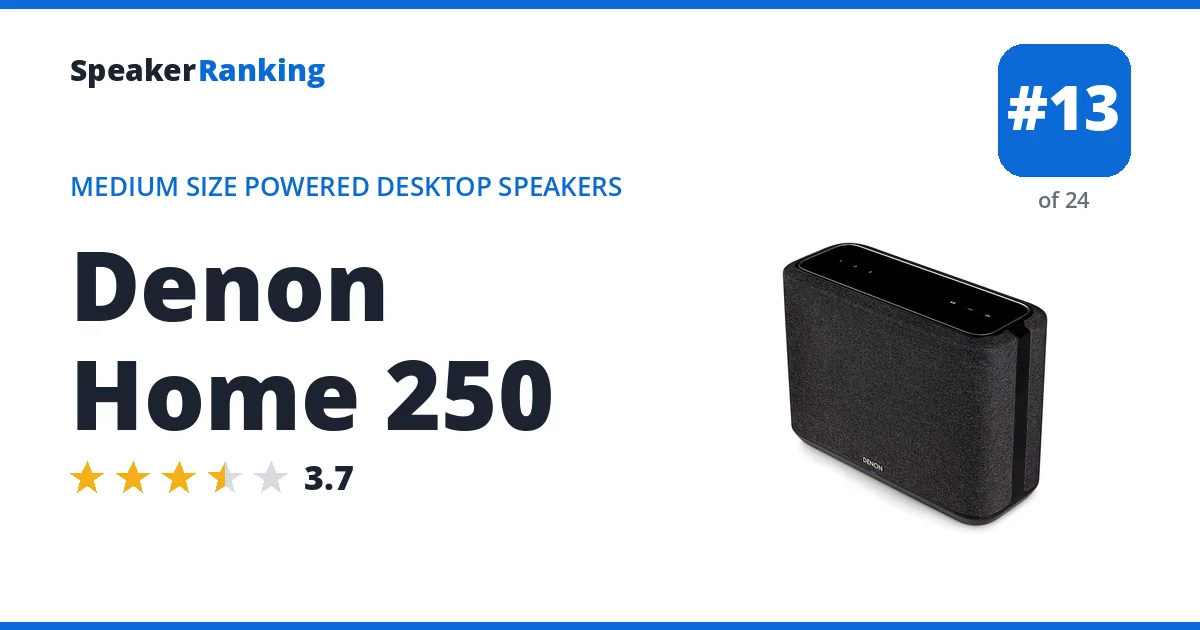
 #13 Denon Home 250: $549.00 each Amazon eBay
Newer model: the Denon Home 400, ranked higher, estimated 3.8/5.
Same family: the Denon Home 150 (smaller model, rated 3.5/5) and the Denon Home 350 (larger model, rated 3.6/5).
Pros: Two outward-angled tweeters plus two mid-bass drivers and a rear passive radiator give it true stereo separation from a single cabinet, each driven by its own Class D amp for a claimed combined 80 watts. Trusted Reviews called the sound confident and wide-ranging, with expansive, well-resolved detail and adequate low-end punch and substance. Amazon Alexa is built directly into the speaker via its own microphones, on top of AirPlay 2, Bluetooth and the HEOS multi-room app.
Cons: Trusted Reviews’ own complaints are a slightly disjointed hand-over between the bass and midrange, and a safety-first treble response that avoids sounding harsh at the cost of outright detail. Only network or USB-sourced audio gets full hi-res quality; MQA-powered Tidal Masters streamed through the HEOS app gets stepped down to 16-bit/44.1kHz.
Full Denon Home 250 review and specifications →
| AES Input | No |
|---|---|
| Amplifier Power | 80W (Class D, combined) |
| App | Yes (HEOS) |
| Aux Input | Yes |
| Battery Life | No Battery |
| Bluetooth | Yes |
| Bluetooth Codecs | SBC |
| Bluetooth Version | 5.4 |
| Built-in Microphone | Yes |
| Coaxial Input | No |
| Dimensions | 11.8” x 8.7” x 4.7” (300 x 220 x 120 mm) |
| Drivers | 2x 19mm tweeters, 2x 102mm mid-bass drivers, 133mm passive radiator |
| EQ | No |
| HDMI Input | No |
| IP Rating | None |
| Inputs | Wi-Fi, Bluetooth, Ethernet, USB, 3.5mm aux |
| Optical Input | No |
| Party Mode | Yes (HEOS multi-room, stereo pair with a second Home 250) |
| Power Bank | No |
| Power Input | External AC adapter |
| RCA Input | No |
| Stereo | Yes |
| Streaming Services | HEOS app streaming (Spotify, Amazon Music, Tidal, Deezer, SoundCloud, TuneIn), AirPlay 2 |
| TRS Input | No |
| TWS | No |
| USB Input | Yes |
| Voice Assistants | Amazon Alexa |
| Weight | 8.2 lbs (3.7 kg) |
| Wi-Fi | Yes (2.4/5GHz) |
| XLR Input | No |
- Links
- Reviews, Comparisons and Sound Samples
- Head-to-Head Comparisons
- Denon Home 250 vs Bose Lifestyle Ultra Speaker
- Denon Home 250 vs Google Home Max
- Denon Home 250 vs Marshall Acton III
- Denon Home 250 vs JBL Authentics 200
- Denon Home 250 vs Sonos Era 100
- Denon Home 250 vs Denon Home 400
- Denon Home 250 vs Edifier D12
- Denon Home 250 vs Marshall Stanmore III
- See all 37 comparisons
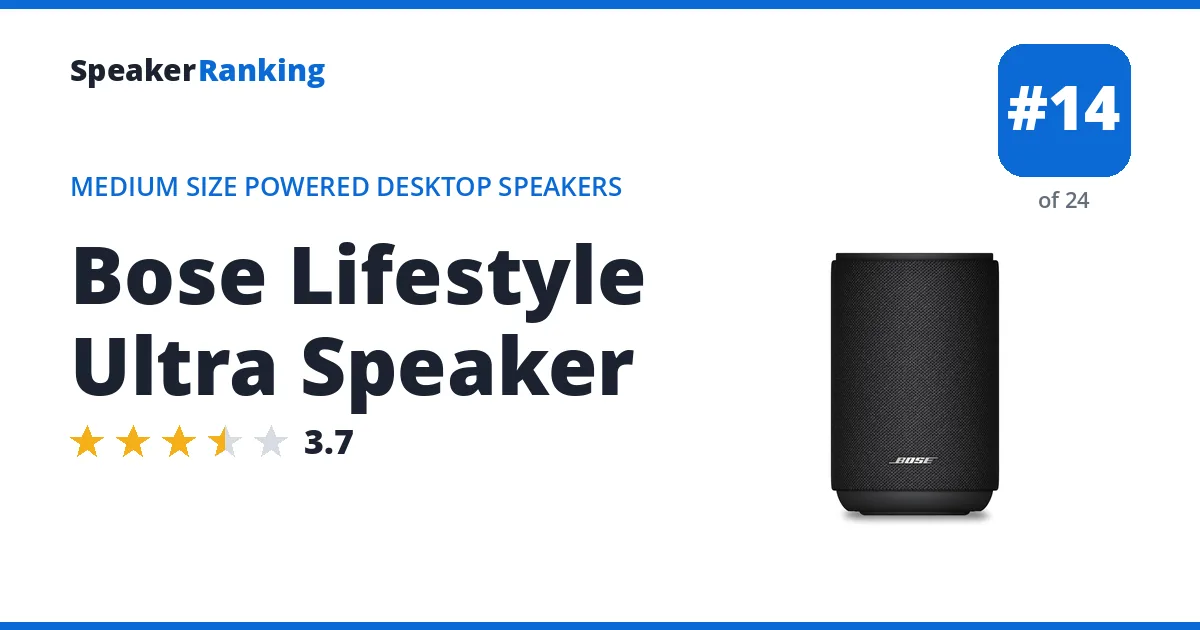
 #14 Bose Lifestyle Ultra Speaker: $299.00 each Amazon eBay
Same family: the Bose Lifestyle Ultra Subwoofer (subwoofer, rated 3.8/5).
Pros: Three drivers (a 3in woofer and 1in tweeter facing forward, plus a 1.5in driver firing upward) give it a noticeably taller sound than most compact home speakers. Stuff gave it the edge over the Sonos Era 100, and TechRadar called its tonal balance fairly neutral, with tight bass control and high detail. Alexa, including Alexa+, is built in, and RTINGS found its microphones picked up commands easily from across a noisy room. It streams over AirPlay 2, Google Cast, Spotify Connect and Bluetooth 5.3, keeps a 3.5mm aux input that the Sonos Era 100 lacks, and two units can be stereo paired or used as rear surrounds with the Lifestyle Ultra Soundbar.
Cons: RTINGS lists sub-par directivity as its main weakness, and reviewers agree a single unit sounds narrow from side to side, so it works best as a stereo pair. Deep bass is limited: Engadget found the low end restrained and preferred the Denon Home 200’s sound, Stuff noted it can’t separate sub-bass from the bassline and that DSP pulls bass back at maximum volume, and TechRadar heard a slight toothiness in the treble that needed EQ to calm. The EQ is only bass, mid and treble with no automatic room calibration. Bose warns the aux and Bluetooth inputs add lip sync delay for TV use, it has no battery or IP rating, and both SoundGuys and Engadget needed several restarts to get stereo pairing working.
Full Bose Lifestyle Ultra Speaker review and specifications →
| AES Input | No |
|---|---|
| App | Yes (Bose) |
| Aux Input | Yes |
| Battery Life | No Battery |
| Bluetooth | Yes |
| Bluetooth Version | 5.3 |
| Built-in Microphone | Yes (far-field, mic mute button) |
| Coaxial Input | No |
| Dimensions | 7.2” x 4.8” x 6.6” (184 x 121 x 167 mm) (H x W x D) |
| Drivers | 3in woofer, 1in tweeter, 1.5in up-firing mid/high driver |
| EQ | Yes (Bass/Mid/Treble + up-firing driver level) |
| HDMI Input | No |
| IP Rating | None |
| Inputs | Wi-Fi, Bluetooth, 3.5mm aux |
| Optical Input | No |
| Party Mode | Yes (Bose app multi-room, AirPlay 2, Google Cast) |
| Power Bank | No |
| Power Input | AC power cord |
| RCA Input | No |
| Stereo | No |
| Streaming Services | AirPlay 2, Google Cast, Spotify Connect |
| TRS Input | Yes (3.5mm) |
| TWS | Yes (stereo pairing via Bose app) |
| USB Input | No |
| Voice Assistants | Amazon Alexa / Alexa+ |
| Weight | 3.7 lbs (1.68 kg) |
| Wi-Fi | Yes |
| XLR Input | No |
- Links
- Reviews, Comparisons and Sound Samples
- Head-to-Head Comparisons
- Bose Lifestyle Ultra Speaker vs Denon Home 250
- Bose Lifestyle Ultra Speaker vs Sonos Era 100
- Bose Lifestyle Ultra Speaker vs Marshall Stanmore II
- Bose Lifestyle Ultra Speaker vs Marshall Acton III
- Bose Lifestyle Ultra Speaker vs Marshall Acton II
- Bose Lifestyle Ultra Speaker vs JBL Authentics 200
- Bose Lifestyle Ultra Speaker vs Marshall Stanmore IV
- Bose Lifestyle Ultra Speaker vs Klipsch The Three II
- See all 42 comparisons
 #15 Google Home Max: $399 each Discontinued eBay
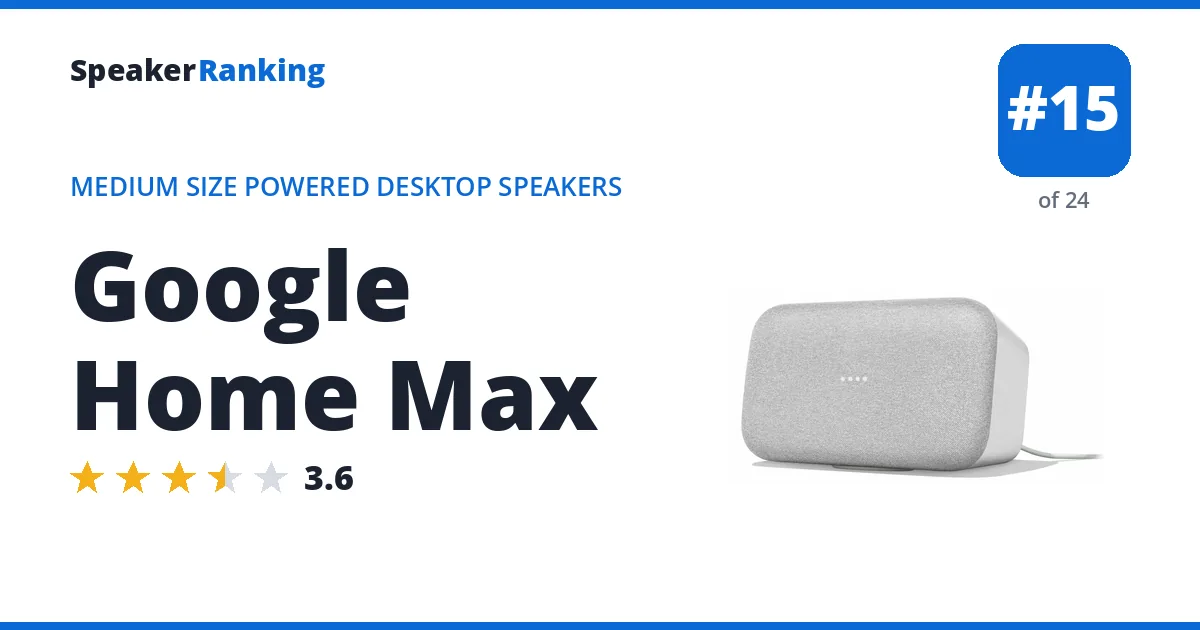
Pros: The most capable driver set of Google’s own smart speakers, with two 4.5-inch high-excursion woofers and two 0.7-inch tweeters across six Class-D amplifiers. Its Smart Sound feature uses six built-in microphones to measure the room and adjust the equalizer automatically. Owner reviews on Walmart consistently single out its bass depth and clarity, with one directly comparing it favorably to the Amazon Echo Studio and Apple HomePod. Two units can be wirelessly stereo-paired for left/right separation, and it can be grouped with other Google/Nest speakers for multi-room audio.
Cons: Discontinued by Google since 2020, so it can no longer be bought new; used and refurbished stock is what remains, and RTINGS calls its soundstage mediocre despite the driver count. It never gained Apple Music or Tidal support over Wi-Fi. At launch, voice commands could fail to register over loud music, and Bluetooth tops out at version 4.2 with no aptX. At 5.3kg it is heavy and needs real shelf space, and $399 was expensive even in 2017 next to the far cheaper Google Nest Audio.
Full Google Home Max review and specifications →
| AES Input | No |
|---|---|
| Amplifier Power | 6x Class-D amplifiers |
| App | Yes (Google Home) |
| Aux Input | Yes |
| Battery Life | No Battery |
| Bluetooth | Yes |
| Bluetooth Codecs | SBC, AAC |
| Bluetooth Version | 4.2 |
| Built-in Microphone | Yes (6 far-field mics for Smart Sound room correction) |
| Coaxial Input | No |
| Dimensions | 7.5” x 13.2” x 6.1” (190 x 336 x 154 mm) (H x W x D) |
| Drivers | 2x 4.5in high-excursion woofers, 2x 0.7in tweeters |
| EQ | Yes (Media EQ + Room EQ, automatic via Smart Sound) |
| HDMI Input | No |
| IP Rating | None |
| Inputs | Wi-Fi, Bluetooth, Aux, USB-C |
| Optical Input | No |
| Party Mode | Yes (Wi-Fi multi-room, Chromecast built-in) |
| Power Bank | No |
| Power Input | AC power cord |
| RCA Input | No |
| Stereo | No |
| Streaming Services | Chromecast built-in, Spotify Connect, Pandora, TuneIn, iHeartRadio |
| TRS Input | Yes (3.5mm) |
| TWS | Yes (Wi-Fi stereo pairing via Google Home app) |
| USB Input | Yes |
| Voice Assistants | Google Assistant |
| Weight | 11.7 lbs (5.3 kg) |
| Wi-Fi | Yes (2.4GHz/5GHz) |
| XLR Input | No |
- Reviews, Comparisons and Sound Samples
- Head-to-Head Comparisons
- Google Home Max vs Sonos Era 100
- Google Home Max vs Denon Home 250
- Google Home Max vs JBL Authentics 200
- Google Home Max vs Apple HomePod 2nd Gen
- Google Home Max vs Amazon Echo Dot 5th Gen
- Google Home Max vs Amazon Echo Dot Max
- Google Home Max vs Amazon Echo Pop
- Google Home Max vs Amazon Echo Studio 2nd Gen
- See all 27 comparisons
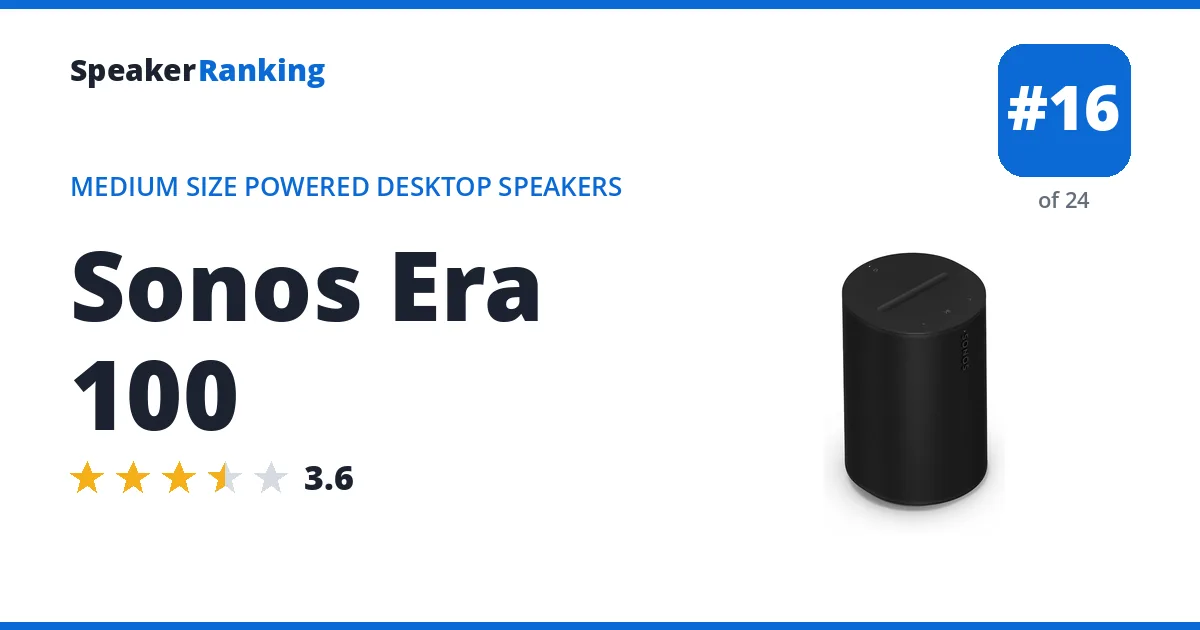
 #16 Sonos Era 100: $219.00 each Amazon eBay
Same family: the Sonos Era 300 (larger model, rated 4/5).
Pros: RTINGS lists room correction tools and bass/treble adjustments as its real strengths, and its balanced midrange suits a wide range of genres, with wider stereo separation than the mono Sonos One SL it replaced thanks to two angled tweeters plus a 25% larger mid-woofer than the original Sonos One. Alexa is built in with a far-field mic, and it ties into the wider Sonos S2 app ecosystem for multi-room audio.
Cons: RTINGS’ own two listed cons are not loud enough for larger rooms and very little low-bass thump, so genres like EDM and hip-hop lack rumble even with the tone adjustments. There’s no Google Assistant, the USB-C line-in needs a separately purchased adapter, and there’s no battery.
Full Sonos Era 100 review and specifications →
| AES Input | No |
|---|---|
| App | Yes (Sonos S2) |
| Aux Input | No |
| Battery Life | No Battery |
| Bluetooth | Yes |
| Bluetooth Codecs | SBC |
| Bluetooth Version | 5.0 |
| Built-in Microphone | Yes (far-field, mic mute button) |
| Coaxial Input | No |
| Dimensions | 7.2” x 4.7” x 5.1” (182.5 x 120 x 130.5 mm) |
| Drivers | 2x angled tweeters, 1x mid-woofer |
| EQ | Yes (Bass/Treble + Trueplay room correction) |
| HDMI Input | No |
| IP Rating | None |
| Inputs | Wi-Fi, Bluetooth, USB-C (line-in adapter sold separately) |
| Optical Input | No |
| Party Mode | Yes (Sonos multi-room, AirPlay 2) |
| Power Bank | No |
| Power Input | External AC adapter |
| RCA Input | No |
| Stereo | Yes |
| Streaming Services | Sonos app streaming (Spotify, Apple Music, Amazon Music and more), AirPlay 2 |
| TRS Input | No |
| TWS | Yes (stereo pairing via Sonos app) |
| USB Input | Yes (line-in adapter sold separately) |
| Voice Assistants | Amazon Alexa |
| Weight | 4.5 lbs (2.02 kg) |
| Wi-Fi | Yes (Wi-Fi 6) |
| XLR Input | No |
- Links
- Reviews, Comparisons and Sound Samples
- Head-to-Head Comparisons
- Sonos Era 100 vs Google Home Max
- Sonos Era 100 vs Marshall Acton II
- Sonos Era 100 vs Bose Lifestyle Ultra Speaker
- Sonos Era 100 vs Denon Home 250
- Sonos Era 100 vs Marshall Stanmore II
- Sonos Era 100 vs Klipsch The Three II
- Sonos Era 100 vs Marshall Acton III
- Sonos Era 100 vs Klipsch The Three Plus
- See all 42 comparisons
 #17 Marshall Acton II: $195.60 each Discontinued eBay
Newer model: the Marshall Acton IV, estimated 3.7/5.
Pros: Marshall Acton II uses 4” (midrange/woofer), 1x 4” midrange, 2x 0.75” Dome tweeters. Its 2.9 kg, aux input and limited-stereo playback make it a practical option for its intended room or portable use. Measured bass extension of 56Hz (-10dB).
Cons: Bass is limited by its 56Hz specification. Discontinued.
Full Marshall Acton II review and specifications →
| AES Input | No |
|---|---|
| Amplifier Power | 50W (Woofer: 25W, Tweeters: 2x12.5W) |
| App | Yes |
| Aux Input | Yes |
| Bass Extension (-10dB) | 56Hz |
| Battery Life | No Battery |
| Bluetooth | Yes |
| Bluetooth Codecs | SBC, aptX |
| Bluetooth Version | 5.0 |
| Coaxial Input | No |
| Dimensions | 10.2” x 6” x 5.9” (260 x 153 x 150 mm) |
| Drivers | 4” (midrange/woofer), 1x 4” midrange, 2x 0.75” Dome tweeters |
| EQ | Yes (Bass/Treble) |
| Frequency Response | 50Hz - 20kHz (Manufacturer specified) |
| HDMI Input | No |
| IP Rating | None |
| Inputs | Bluetooth, Aux |
| Optical Input | No |
| Party Mode | No |
| Power Bank | No |
| RCA Input | No |
| Stereo | Partially (1 woofer) |
| TRS Input | No |
| TWS | No |
| USB Input | No |
| Voice Assistants | None |
| Weight | 6.4 lbs (2.9 kg) |
| Wi-Fi | No |
| Woofer Cabinet | ported |
| XLR Input | No |
- Reviews, Comparisons and Sound Samples
- DSAUDIO.review: DSAUDIO.review Edifier D12 vs Marshall Acton II sound.DEMO More from DSAUDIOreview →
- DSAUDIO.review: DSAUDIO.review Marshall Stanmore II vs Marshall Acton II sound.DEMO
- Danny Pops: Marshall Acton 2 vs Klipsch The One 2 - which sounds better? More from DannyPops →
- One-month hobbyist: Klipsch The One ii vs Marshall Acton ii Sound Battle
- Storytripper HD: Marshall Acton 2 vs Marshall Kilburn 2 More from storytripperhd →
- Head-to-Head Comparisons
- Marshall Acton II vs Sonos Era 100
- Marshall Acton II vs Klipsch The Three II
- Marshall Acton II vs Bose Lifestyle Ultra Speaker
- Marshall Acton II vs Klipsch The One II
- Marshall Acton II vs Marshall Stanmore II
- Marshall Acton II vs Marshall Acton III
- Marshall Acton II vs JBL Authentics 200
- Marshall Acton II vs Marshall Stanmore IV
- See all 15 comparisons
 #18 B&O Beosound 1: $2,000 each Discontinued eBay
Same family: the B&O Beosound 2 (larger model, rated 3.7/5).
Pros: At 3.5 kg, B&O Beosound 1 combines 4” woofer, 1.5” full-range driver with Bluetooth and aux. Claimed 16 hours (manufacturer specified) battery life, up to 91db and stereo playback make its feature set practical for its intended room or portable use. Measured bass extension of ~53Hz (-10dB).
Cons: Bass is limited by its ~53Hz specification. There is no companion app. No EQ adjustment. Discontinued.
Full B&O Beosound 1 review and specifications →
| AES Input | No |
|---|---|
| Amplifier Power | 60W total (40W full-range, 20W woofer) |
| App | No |
| Aux Input | Yes |
| Bass Extension (-10dB) | ~53Hz |
| Battery Life | 16 hours (Manufacturer specified) |
| Bluetooth | Yes |
| Bluetooth Codecs | SBC |
| Bluetooth Version | 4.2 |
| Coaxial Input | No |
| Dimensions | 6.4” x 12.9” (162 x 327 mm) |
| Drivers | 4” woofer, 1.5” full-range driver |
| EQ | No |
| Frequency Response | 35Hz - 24.3kHz (Manufacturer specified) |
| HDMI Input | No |
| IP Rating | None |
| Inputs | Bluetooth, Wi-Fi, AirPlay, Chromecast |
| Maximum SPL | 91dB |
| Optical Input | No |
| Party Mode | No |
| Power Bank | No |
| Power Input | AC Power cord |
| RCA Input | No |
| Stereo | Yes |
| TRS Input | No |
| TWS | No |
| USB Input | No |
| USB Playback | No |
| Weight | 7.7 lbs (3.5 kg) |
| XLR Input | No |
- Links
- Reviews, Comparisons and Sound Samples
- Head-to-Head Comparisons
 #19 Apple HomePod: $299 each Discontinued eBay
Newer model: the Apple HomePod 2nd Gen, ranked higher, rated 4/5.
Pros: A Wi-Fi smart speaker with a 4” high-excursion woofer, seven horn-loaded tweeters arranged in a ring and a six-microphone array it uses to measure the room and adjust its sound. Audio Science Review’s measurements show remarkably deep bass for its size, 26.4Hz (-3dB), and very even sound in every direction, so where it sits in a room matters little. Measured bass extension of 26.4Hz (-3dB).
Cons: The on-axis response is uneven (1.15 average deviation), for a preference score of 4.09 that reaches 4.99 with an ideal subwoofer. Music arrives only over AirPlay 2 or from Apple Music by voice: Bluetooth is used for setup, and there is no wired input. Apple discontinued it in 2021 and later released the Apple HomePod 2nd Gen.
Full Apple HomePod review and specifications →
| AES Input | No |
|---|---|
| App | Yes (Apple Home) |
| Aux Input | No |
| Bass Extension (-10dB) | about 22.4Hz (measured, Audio Science Review) |
| Bass Extension (-3dB) | 26.4Hz (measured, Audio Science Review) |
| Battery Life | No Battery |
| Bluetooth | No |
| Built-in Microphone | Yes (six-microphone array) |
| Coaxial Input | No |
| Dimensions | 6.8”H x 5.6”W x 5.6”D (172 x 142 x 142 mm) |
| Drivers | 4” high-excursion woofer, 7x horn-loaded tweeters |
| EQ | Yes (automatic room correction) |
| HDMI Input | No |
| IP Rating | None |
| Inputs | Wi-Fi, AirPlay 2 |
| Optical Input | No |
| Party Mode | Yes (AirPlay 2 multi-room) |
| Power Bank | No |
| RCA Input | No |
| Spinorama Preference Score | 4.09 |
| Spinorama Preference Score with Perfect Sub | 4.99 |
| Stereo | No |
| Streaming Services | AirPlay 2, Apple Music (direct voice control); other services via AirPlay only |
| TRS Input | No |
| TWS | Yes (stereo pairing via Home app) |
| USB Input | No |
| Voice Assistants | Apple Siri |
| Weight | 5.5 lbs (2.5 kg) |
| Wi-Fi | Yes |
| XLR Input | No |
- Reviews, Comparisons and Sound Samples
- Head-to-Head Comparisons
 #20 Klipsch The Three II: $400 each Discontinued eBay
Newer model: the Klipsch The Three Plus, ranked lower, rated 3.4/5.
Older model: the Klipsch The Three (ranked lower, rated 2.6/5).
Pros: Klipsch The Three II uses 4.5” woofer, 2x 2.25” full-range midranges. Its 4.7 kg, aux input and limited-stereo playback make it a practical option for its intended room or portable use.
Cons: Its 45Hz to 20kHz (Manufacturer specified) specification points to limited deep-bass reach for the cabinet size. There is no companion app. Discontinued.
Full Klipsch The Three II review and specifications →
| AES Input | No |
|---|---|
| Amplifier Power | 60W (Woofer: 30W, Full-range: 2x15W) |
| App | No |
| Aux Input | Yes |
| Battery Life | No Battery |
| Bluetooth | Yes |
| Bluetooth Codecs | SBC, aptX |
| Bluetooth Version | 4.2 |
| Coaxial Input | No |
| Dimensions | 11” x 7.3” x 7.3” (280 x 186 x 186 mm) |
| Drivers | 4.5” woofer, 2x 2.25” full-range midranges |
| EQ | Yes (Bass/Treble) |
| Frequency Response | 45Hz - 20kHz (Manufacturer specified) |
| HDMI Input | No |
| Inputs | Bluetooth, Aux, RCA, Optical, USB |
| Optical Input | Yes |
| Party Mode | No |
| RCA Input | Yes |
| Stereo | Partially (1 woofer) |
| TRS Input | No |
| TWS | No |
| USB Input | Yes |
| Weight | 10.4 lbs (4.7 kg) |
| Wi-Fi | No |
| Woofer Cabinet | ported |
| XLR Input | No |
- Links
- Reviews, Comparisons and Sound Samples
- Head-to-Head Comparisons
- Klipsch The Three II vs Klipsch The One II
- Klipsch The Three II vs Marshall Acton II
- Klipsch The Three II vs Klipsch The Three
- Klipsch The Three II vs Sonos Era 100
- Klipsch The Three II vs Bose Lifestyle Ultra Speaker
- Klipsch The Three II vs Marshall Stanmore II
- Klipsch The Three II vs Marshall Acton III
- Klipsch The Three II vs JBL Authentics 200
- See all 13 comparisons
 #21 Klipsch The Three Plus: $269.99 each Amazon eBay
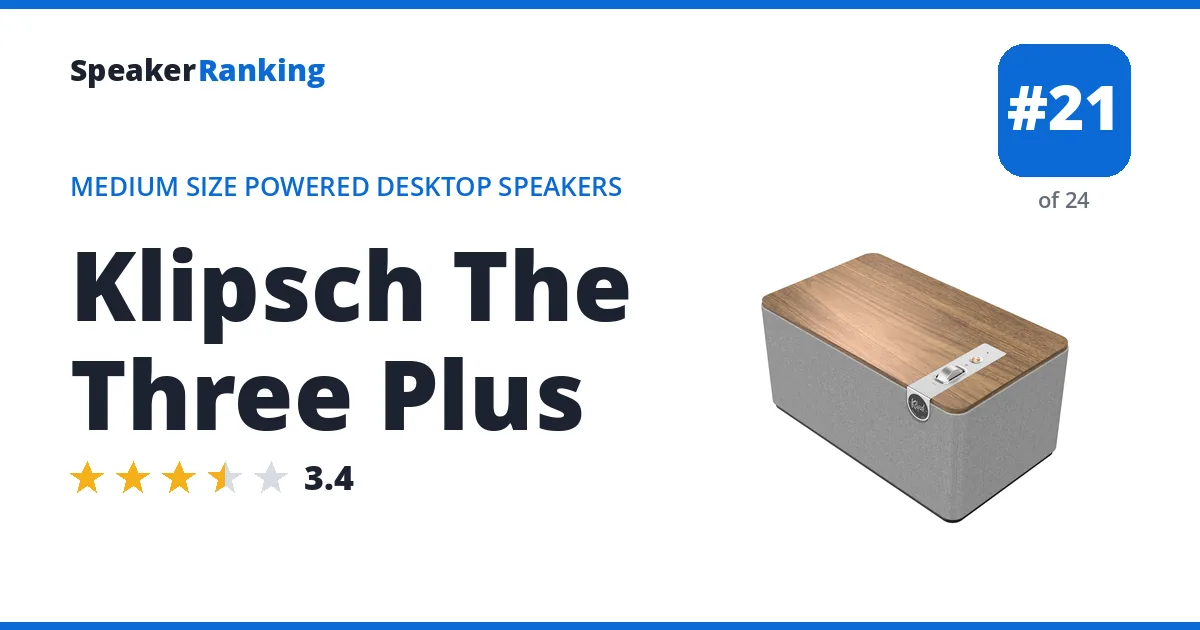
Older models: the Klipsch The Three II (ranked higher, rated 3.4/5) and the Klipsch The Three (ranked lower, rated 2.6/5).
Same family: the Klipsch The One Plus (smaller model, estimated 3.4/5).
Pros: Two 2.25in full-range drivers and a 5.25in woofer with two opposing passive radiators, biamplified with 120W, play far louder than the small tabletop cabinet suggests: TechRadar and Trusted Reviews both found it stayed composed and unstressed at very high volume, with controlled, textured bass and a fairly detailed, communicative midrange. Inputs cover Bluetooth 5.3, a switchable phono/line RCA input for a turntable, 24-bit/96kHz optical and USB-C playback, and the Klipsch Connect app adds a three-band EQ with presets and a night mode.
Cons: The tuning leans heavily on bass: TechRadar called it on the warm side of neutral with the treble only just holding its own, and HomeTheaterHifi found the treble turned sharp and piercing at higher volumes. Both TechRadar and Trusted Reviews found the built-in phono stage flat and less dynamic than the other inputs, so vinyl sounds its weakest here. Stereo separation is limited by the single cabinet, there is no 3.5mm aux or subwoofer output, and HomeTheaterHifi found the app and volume wheel laggy. ASR’s measurements of the original Klipsch The Three, which used the same driver layout, showed an uneven response, so treat its tonal balance with some caution.
Full Klipsch The Three Plus review and specifications →
| AES Input | No |
|---|---|
| Amplifier Power | 120W total |
| App | Yes (Klipsch Connect) |
| Aux Input | No (RCA line input) |
| Battery Life | No Battery |
| Bluetooth | Yes |
| Bluetooth Version | 5.3 |
| Built-in Microphone | No |
| Coaxial Input | No |
| Dimensions | 7”H x 14”W x 8.4”D (178 x 356 x 213 mm) |
| Drivers | 2x 2.25” full-range drivers, 5.25” long-throw woofer, 2x 5.25” passive radiators |
| EQ | Yes |
| Frequency Response | 45Hz - 20kHz (Manufacturer specified) |
| HDMI Input | No |
| Inputs | Bluetooth, Optical, Phono/RCA, USB-C |
| Maximum SPL | 106dB |
| Optical Input | Yes (24-bit/96kHz) |
| RCA Input | Yes |
| Stereo | Partially (1 woofer) |
| TRS Input | No |
| USB Input | Yes |
| Voice Assistants | None |
| Weight | 10.6 lbs (4.8 kg) |
| Wi-Fi | No |
| XLR Input | No |
- Links
- Reviews, Comparisons and Sound Samples
- Head-to-Head Comparisons
 #22 Klipsch The One II: $129.95 each Amazon eBay
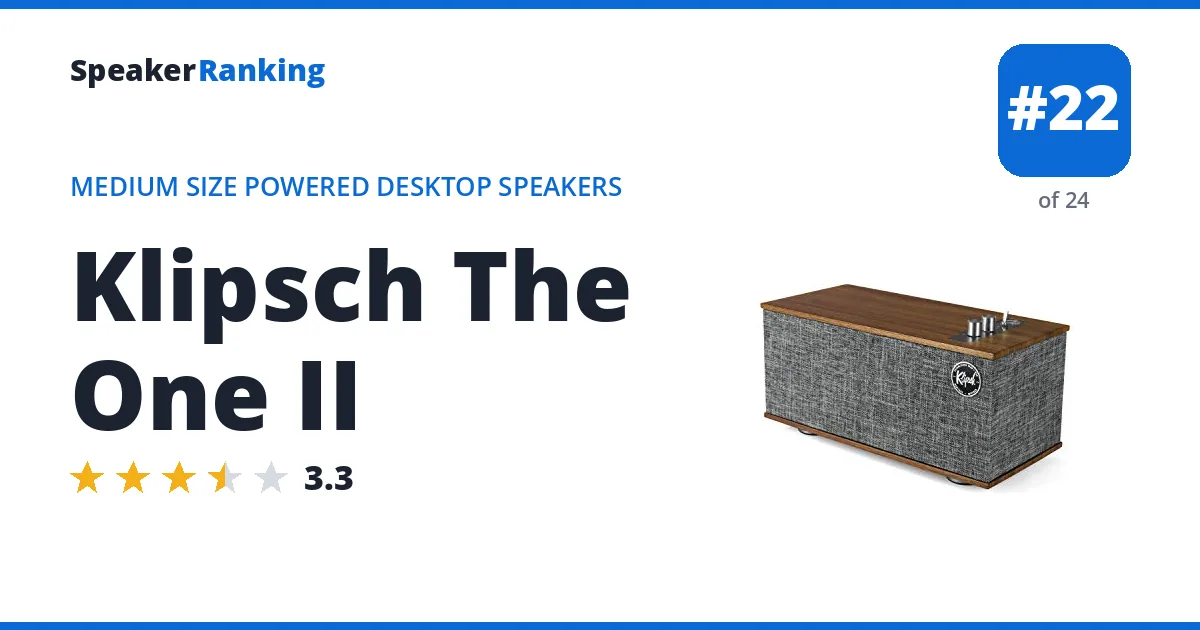
Newer model: the Klipsch The One Plus, estimated 3.4/5.
Pros: At 3.9 kg, Klipsch The One II combines 4.5” woofer, 2x 2.25” full-range midranges with Bluetooth, Aux, RCA, Optical, USB. Ac-powered operation and limited-stereo playback make its feature set practical for its intended room or portable use.
Cons: Bass is limited by its 50Hz to 20kHz (Manufacturer specified) specification. There is no companion app.
Full Klipsch The One II review and specifications →
| AES Input | No |
|---|---|
| Amplifier Power | 50W (Woofer: 30W, Full-range: 2x10W) |
| App | No |
| Aux Input | Yes |
| Battery Life | No Battery |
| Bluetooth | Yes |
| Bluetooth Codecs | SBC, aptX |
| Bluetooth Version | 4.0 |
| Coaxial Input | No |
| Dimensions | 9.1” x 5.9” x 5.9” (231 x 150 x 150 mm) |
| Drivers | 4.5” woofer, 2x 2.25” full-range midranges |
| EQ | Yes (Bass/Treble) |
| Frequency Response | 50Hz - 20kHz (Manufacturer specified) |
| HDMI Input | No |
| Inputs | Bluetooth, Aux, RCA, Optical, USB |
| Optical Input | Yes |
| Party Mode | No |
| RCA Input | Yes |
| Stereo | Partially (1 woofer) |
| TRS Input | No |
| TWS | No |
| USB Input | Yes |
| Weight | 8.6 lbs (3.9 kg) |
| Wi-Fi | No |
| Woofer Cabinet | ported |
| XLR Input | No |
- Links
- Reviews, Comparisons and Sound Samples
- Head-to-Head Comparisons
- Klipsch The One II vs Klipsch The Three II
- Klipsch The One II vs Marshall Acton II
- Klipsch The One II vs Sonos Era 100
- Klipsch The One II vs Bose Lifestyle Ultra Speaker
- Klipsch The One II vs Denon Home 250
- Klipsch The One II vs Marshall Stanmore II
- Klipsch The One II vs Marshall Acton III
- Klipsch The One II vs JBL Authentics 200
- See all 16 comparisons
 #23 Klipsch The Three: $399 each Discontinued eBay
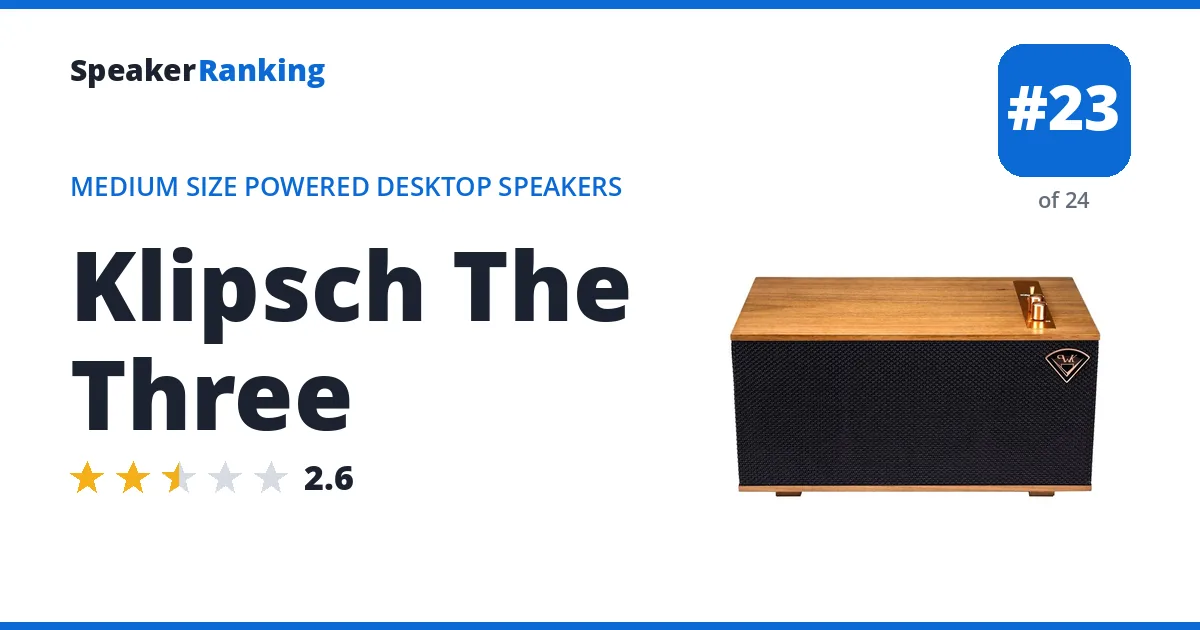
Newer model: the Klipsch The Three Plus, ranked higher, rated 3.4/5.
Pros: A one-box stereo music system with two 2.25” full-range drivers, a 5.25” long-throw woofer and two passive radiators in a walnut cabinet, 60W of power, Bluetooth and Wi-Fi streaming. Audio Science Review measured deep bass for a tabletop speaker, 42.5Hz (-3dB). Measured bass extension of 42.5Hz (-3dB).
Cons: The listening window spans 5.2dB from 300Hz to 5kHz, on-axis response is uneven (1.26dB average deviation) and the predicted in-room response is rough (0.22), for a preference score of 2.41. Klipsch replaced it with the Klipsch The Three II and then the Klipsch The Three Plus. Discontinued.
Full Klipsch The Three review and specifications →
| AES Input | No |
|---|---|
| Amplifier Power | 60W continuous |
| Aux Input | Yes |
| Bass Extension (-10dB) | about 34.2Hz (measured, Audio Science Review) |
| Bass Extension (-3dB) | 42.5Hz (measured, Audio Science Review) |
| Bluetooth | Yes |
| Coaxial Input | No |
| DIY Kit | No |
| Dimensions | 7”H x 13.7”W x 8”D (178 x 348 x 203 mm) |
| Drivers | 2x 2.25” full-range drivers, 5.25” woofer, 2x 5.25” passive radiators |
| HDMI Input | No |
| Maximum SPL | 106dB at 0.5m (manufacturer specified) |
| Optical Input | No |
| RCA Input | No |
| Spinorama Preference Score | 2.41 |
| Spinorama Preference Score with Perfect Sub | 4.22 |
| TRS Input | No |
| USB Input | No |
| Weight | 10.4 lbs (4.7 kg) |
| XLR Input | No |
- Reviews, Comparisons and Sound Samples
- Head-to-Head Comparisons
 #24 IKEA SYMFONISK Table Lamp Speaker (1st gen): $179 each Discontinued eBay
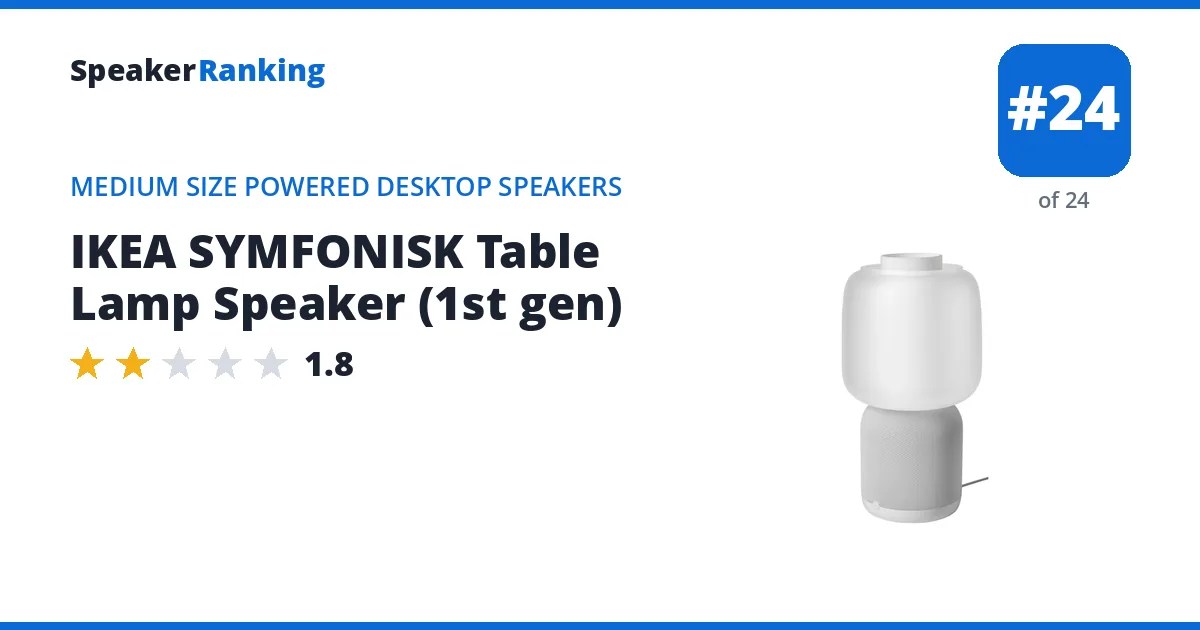
Pros: The first IKEA and Sonos table lamp with a built-in Wi-Fi speaker that joins a Sonos system, with a woofer and tweeter firing out from under the shade. Erin measured a preference score of -1.81 that reaches -0.08 with an ideal subwoofer, with 1.56 listening window deviation. Measured bass extension of 58.6Hz (-3dB).
Cons: Erin measured a very uneven response, for a preference score of -1.81 that reaches only -0.08 with an ideal subwoofer. It uses an E12 bulb. IKEA replaced it with a second generation in 2021. Bass reaches 58.6Hz (-3dB) and about 20Hz (-10dB). Discontinued.
Full IKEA SYMFONISK Table Lamp Speaker (1st gen) review and specifications →
| AES Input | No |
|---|---|
| App | Yes (Sonos) |
| Aux Input | No |
| Bass Extension (-10dB) | about 20.5Hz (measured, Erin’s Audio Corner) |
| Bass Extension (-3dB) | 58.6Hz (measured, Erin’s Audio Corner) |
| Bluetooth | No |
| Coaxial Input | No |
| DIY Kit | No |
| Dimensions | 15.8”H x 8.5”W x 8.5”D (401 x 216 x 216 mm) |
| Drivers | woofer, tweeter |
| HDMI Input | No |
| Optical Input | No |
| RCA Input | No |
| Spinorama Preference Score | -1.81 |
| Spinorama Preference Score with Perfect Sub | -0.08 |
| TRS Input | No |
| USB Input | No |
| Weight | 11.4 lbs (5.17 kg) |
| Wi-Fi | Yes |
| XLR Input | No |
- Reviews, Comparisons and Sound Samples