Editor's top picks
Start with these speakers
Our leading recommendations at a glance. Each card links to its primary retailer.
Looking for powered speakers for a turntable? A powered pair is the simplest way to build a record system: two boxes, one cable, no receiver. The one thing everybody gets wrong is the phono stage, so start there. These picks come from the 194 powered speakers ranked here.
Prices on this page were last checked September 22, 2026 at 5:11 AM UTC. Product prices and availability are accurate as of that date/time and are subject to change; the price and availability shown on Amazon at the time of purchase will apply to the purchase of this product.
As an eBay Partner, we may be compensated if you make a purchase.
Read This Before You Buy: Check For A Phono Preamp
A turntable cartridge puts out a tiny signal with the bass cut and the treble boosted, following the RIAA curve used to cut the record. A phono preamp amplifies it and reverses that curve. Skip it and you get a thin, quiet, unlistenable result.
Most powered speakers accept a normal line-level signal, not the much smaller cartridge-level output from a turntable. The original Klipsch Fives and the Nines below include switchable phono/line inputs. Your system needs exactly one phono stage, supplied by one of:
- The turntable itself. Many modern decks have a built-in preamp and a line/phono switch. If yours does, switch it to line and connect straight to the speakers. This is the simplest path and what most people should do.
-
A separate phono preamp. A $30-$100 box between the turntable and the speakers. Also the upgrade path if you move to a better cartridge later.
- The powered speaker. If the rear input is explicitly labeled Phono/Line, select Phono for a turntable without its own preamp. Never run two phono stages in series: if the turntable is set to Line, the speaker must also be set to Line.
After the phono stage, the signal is line level. Connect it to the speakers’ RCA or aux input using the appropriate cable. Check cartridge compatibility too: a built-in moving-magnet phono stage is not automatically suitable for a low-output moving-coil cartridge.
What Else Matters
A physical volume knob. With a turntable there’s no phone controlling anything. A front-panel knob is the difference between a system you use and one you fight.
Accurate bass, not automatic bass boost. Records can contain deep bass. Choose extension and output for your music and room, while addressing turntable rumble and acoustic feedback at the source.
Isolation. Powered speakers vibrate, and a turntable on the same surface will pick that up as feedback at high volume. Separate shelves, or at least some distance and a solid support.
Best Overall For A Turntable
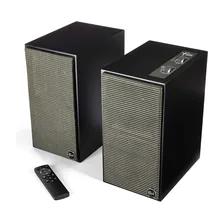 Our compact integrated phono pick, using the tested Bass Cut setting for better tonal balance, is the Klipsch The Fives: $699 per pair Amazon eBay
Pros: In the tested Bass Cut mode, Erin’s Klippel data gives preference scores of 4.62 standalone and 6.98 with an ideal subwoofer, with a 2.7dB midrange response span. That mode offers considerably better tonal balance than the bass-heavy default behavior. HDMI ARC, phono/line input, digital inputs and subwoofer output make it a versatile stereo alternative to a soundbar. Measured bass extension of 57Hz (-3dB).
Cons: The favorable score specifically requires Bass Cut mode; it does not describe every firmware or bass setting. Bass reaches -3dB around 59Hz in that configuration. The review reports increasing compression around 200Hz and below 80Hz as volume rises, reducing bass dynamics. Careful placement and a subwoofer remain useful, and the horn/woofer transition is not perfectly uniform off-axis.
Full Klipsch The Fives review and specifications →
| AES Input | No |
|---|---|
| Amplifier Power | 160W total system power (320W peak) |
| Aux Input | No |
| Bass Extension (-10dB) | 47.3Hz (measured, Erin's Audio Corner) |
| Bass Extension (-3dB) | 57Hz (measured, Erin's Audio Corner) |
| Bluetooth | Yes, 5.0 |
| Bluetooth Codecs | SBC, AAC, aptX, aptX HD |
| Coaxial Input | No |
| DSP | Dynamic Bass, Flat and Bass Cut profiles |
| Dimensions | 12"H x 6.5"W x 9.2"D (304.8 x 165.1 x 234.95 mm) |
| Drivers | 1" horn-loaded tweeter; 4.5" woofer |
| Frequency Response | 50Hz - 25kHz (Manufacturer specified) |
| HDMI Input | Yes |
| Inputs | HDMI ARC, USB, optical, Bluetooth, phono/line RCA |
| Optical Input | Yes |
| Outputs | Subwoofer |
| RCA Input | Yes |
| Spinorama Preference Score | 4.62 |
| Spinorama Preference Score with Perfect Sub | 6.98 |
| Subwoofer Output | Yes |
| TRS Input | No |
| USB Input | Yes |
| Weight | Primary 11.8 lbs (5.35 kg), Secondary 10.7 lbs (4.85 kg) |
| XLR Input | No |
- Links
- Reviews, Comparisons and Sound Samples
- Erin’s Audio Corner: Klipsch The Fives Review More from Erin’s Audio Corner →
- Erin’s Audio Corner Website: Klipsch The Fives
- Erin’s Audio Corner Measurements (spinorama.org)
- Jasper Tech: Best Bookshelf Speakers For TV & Gaming - 2025 More from Jasper Tech →
- Jasper Tech: Best Powered Bookshelf Speakers for Every Budget - 2025
- Head-to-Head Comparisons
- Klipsch The Fives vs JBL 305P MKII
- Klipsch The Fives vs Genelec 8020D
- Klipsch The Fives vs Topping MA4
- Klipsch The Fives vs KEF LS50 Wireless II
- Klipsch The Fives vs Vanatoo Transparent One Encore Plus
- Klipsch The Fives vs Devialet Phantom II 98 dB
- Klipsch The Fives vs IK Multimedia iLoud MTM MKII
- Klipsch The Fives vs Genelec 8320A
- See all 51 comparisons
This recommendation is for the original Fives, not the Fives II. The favorable measurements apply specifically to Bass Cut mode, with bass reaching about 59 Hz (-3 dB), rather than the bass-heavy default. Check firmware and bass settings before judging the balance. See Klipsch’s turntable connection instructions.
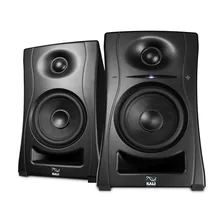 With a built-in or separate phono preamp, a practical desktop pair with RCA, Bluetooth and USB is the Kali LP-UNF: $349.00 per pair Amazon eBay
Pros: A practical compact desktop system with USB-C, analog inputs and Bluetooth, plus extensive placement switches. Erin’s Klippel data gives -3dB bass around 54Hz and scores of 3.68 standalone and 5.76 with an ideal subwoofer. The low crossover and waveguide provide useful freedom of listening height for a two-way design, and moderate-level distortion is well controlled in the review. Measured bass extension of 54Hz (-3dB), with a measured sensitivity of 88.1dB.
Cons: The 2.9dB midrange span masks local response ripples; listening-window narrow-band deviation of 0.467 is behind the best monitors. The review finds limiting around 91dB/1m per speaker. No dedicated subwoofer output means integration requires suitable external routing or bass management. Its strength is affordable close listening, not top-tier tonal accuracy or high-output room playback.
Full Kali LP-UNF review and specifications →
| AES Input | No |
|---|---|
| Amplifier Power | 160W total (Class D, 2-channel bi-amped) |
| App | No |
| Aux Input | No |
| Bass Extension (-10dB) | 39Hz (measured, Erin's Audio Corner) |
| Bass Extension (-3dB) | 54Hz (measured, Erin's Audio Corner) |
| Bluetooth | No |
| Coaxial Input | No |
| Dimensions | 10"H x 6.5"W x 7.4"D (254 x 165 x 188 mm) |
| Drivers | 4.5" woofer, 1" Textile Dome tweeter |
| EQ | No |
| Frequency Response | 39Hz - 25kHz (-10dB) (Manufacturer specified) |
| HDMI Input | No |
| Inputs | Bluetooth, USB-C (digital), RCA, TRS |
| Optical Input | No |
| RCA Input | Yes |
| Sensitivity | 88.1dB (measured at 0.3V/1m, Erin's Audio Corner) |
| Spinorama Preference Score | 3.68 |
| Spinorama Preference Score with Perfect Sub | 5.76 |
| TRS Input | Yes |
| USB Input | Yes |
| Weight | 17.2 lbs (7.8 kg) |
| XLR Input | No |
- Links
- Reviews, Comparisons and Sound Samples
- Erin’s Audio Corner Review Measurements More from Erin’s Audio Corner →
- Erin’s Audio Corner: The Perfect Desktop Speaker? Kali LP-UNF.
- Erin’s Audio Corner: The Best Budget Desktop Speakers, Tested & Rated
- Erin’s Audio Corner: My Absolute Favorite Products of 2024 Revealed
- Erin’s Audio Corner: 10 Great (and Terrible) Speakers Under $300!
- Erin’s Audio Corner Measurements (spinorama.org)
- Jasper Tech: Best Desktop Computer Speakers for Every Budget – 2026 More from Jasper Tech →
- Jasper Tech: Are the iLoud Micro Monitor Pro the Best Studio Monitor Speakers for your Home Studio?
- Head-to-Head Comparisons
Best Value
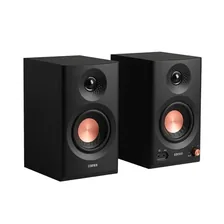 Our lower-cost turntable pick, with RCA, Bluetooth and a front volume knob, is the Edifier MR3: $109.99 per pair Amazon eBay
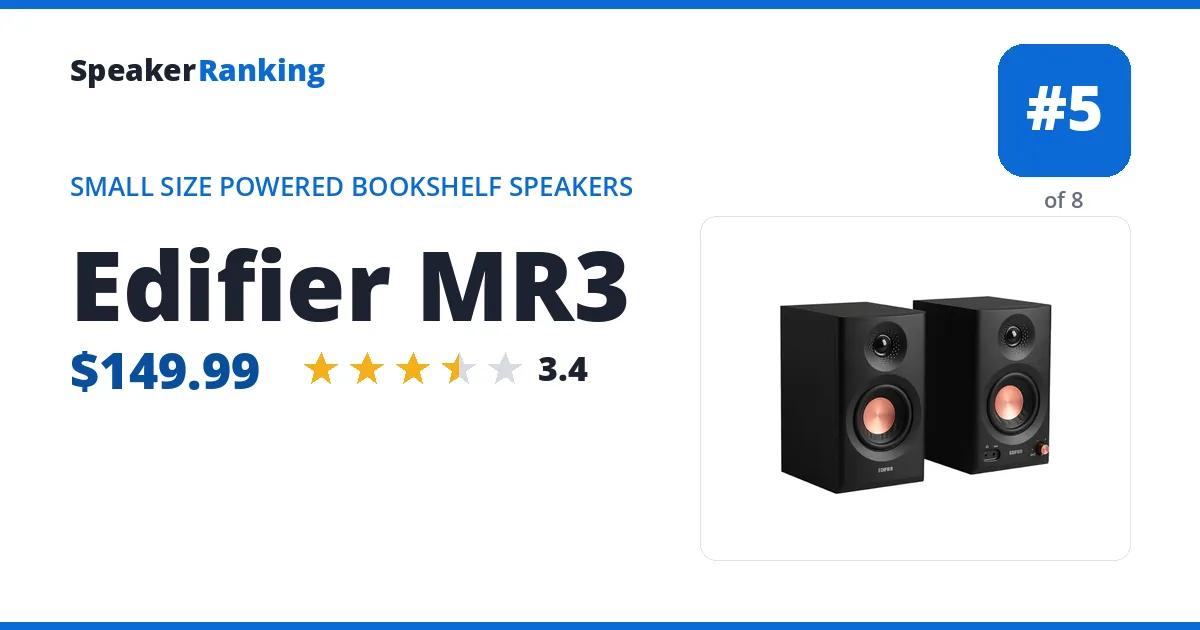
Pros: Erin’s measurements show little overall tilt across the listening window, helping voices retain a broadly natural balance at a desk. Scores of 3.01 standalone and 5.63 with an ideal subwoofer support it as a useful budget nearfield option rather than a reference monitor. Tone controls and app-based EQ provide unusually flexible adjustment, and its bass extends farther than the Fostex PM03’s. Measured bass extension of 60Hz (-3dB), with a measured sensitivity of 83.3dB.
Cons: Local response ripples remain: the measured 300Hz-5kHz span is 4.5dB and listening-window narrow-band deviation is 0.538. Bass reaches -3dB at about 70Hz. The limiter protects the drivers but prevents much extra loudness when pushed; existing compression testing puts effective single-speaker output around 86-87dB at 1m. Vertical crossover interference makes tweeter height and tilt important.
Full Edifier MR3 review and specifications →
| AES Input | No |
|---|---|
| Amplifier Power | 36W total (18W per speaker) |
| App | No |
| Aux Input | Yes |
| Bass Extension (-10dB) | 52Hz (measured, Erin's Audio Corner) |
| Bass Extension (-3dB) | 60Hz (measured, Erin's Audio Corner) |
| Bluetooth | Yes |
| Bluetooth Codecs | SBC |
| Bluetooth Version | 5.4 |
| Coaxial Input | No |
| Dimensions | 5.9"H x 3.7"W x 5.9"D (149.9 x 94 x 149.9 mm) |
| Drivers | 3" woofer, 0.75" silk dome tweeter |
| EQ | Yes (Bass/Treble) |
| Frequency Response | 60Hz - 20kHz (Manufacturer specified) |
| HDMI Input | No |
| Inputs | Bluetooth, Aux, RCA |
| Maximum SPL | 93dB @ 1m (manufacturer specified) |
| Optical Input | No |
| RCA Input | Yes |
| Sensitivity | 83.3dB (measured at 0.3V/1m, Erin's Audio Corner) |
| Spinorama Preference Score | 3.01 |
| Spinorama Preference Score with Perfect Sub | 5.63 |
| TRS Input | No |
| USB Input | No |
| Weight | 6.6 lbs (3 kg) |
| XLR Input | No |
- Links
- Reviews, Comparisons and Sound Samples
- Head-to-Head Comparisons
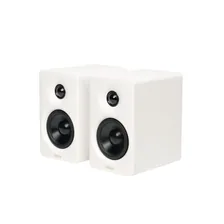 For a very compact pair with aux, Bluetooth and USB-C, using an RCA-to-3.5 mm cable from your phono preamp, consider the Edifier M60: $199.99 per pair Amazon eBay
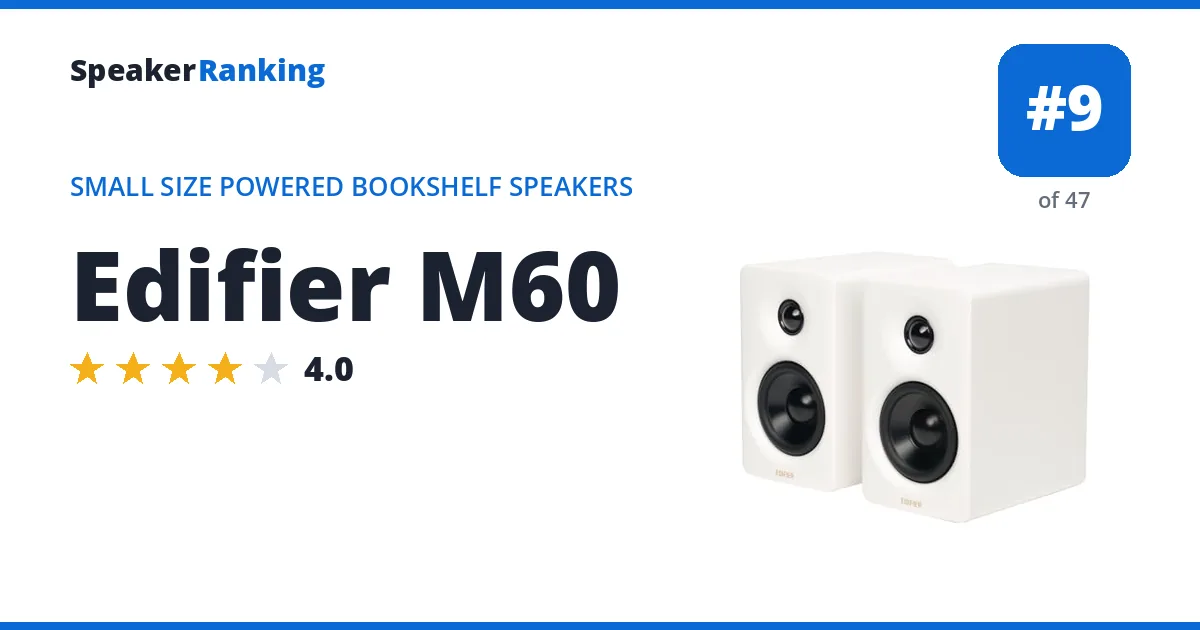
Pros: Erin’s Klippel data shows a reasonably even midrange, spanning 2.8dB from 300Hz to 5kHz, with broad horizontal coverage for desktop listening. Predicted preference scores are 3.69 standalone and 6.42 with an ideal subwoofer, a comparatively strong result in this compact category. USB-C, auxiliary input, Bluetooth and included angled stands make it easy to integrate into a small desk setup. Measured bass extension of 67Hz (-3dB), with a measured sensitivity of 87.5dB.
Cons: The on-axis response rises by about 0.57dB per octave, so the tonal balance becomes brighter toward the treble. Measured -3dB bass extension is about 70Hz; it cannot reproduce deep bass at full level. Sitting below the tweeter axis worsens the crossover-region response. Limiting and compression constrain louder playback, so use it nearfield rather than expecting room-filling output.
Full Edifier M60 review and specifications →
| AES Input | No |
|---|---|
| Amplifier Power | 66W total (33W per speaker) |
| App | Yes |
| Aux Input | Yes |
| Bass Extension (-10dB) | 57Hz (measured, Erin's Audio Corner) |
| Bass Extension (-3dB) | 67Hz (measured, Erin's Audio Corner) |
| Bluetooth | Yes |
| Bluetooth Codecs | SBC, LDAC |
| Bluetooth Version | 5.3 |
| Coaxial Input | No |
| Dimensions | 6.6"H x 3.9"W x 5.8"D (167.6 x 99.1 x 147.3 mm) |
| Drivers | 3" woofer, 1" silk dome tweeter |
| EQ | Yes |
| Frequency Response | 55Hz - 40kHz (Manufacturer specified) |
| HDMI Input | No |
| Inputs | Bluetooth, Aux, USB-C |
| Maximum SPL | 96dB @ 1m (manufacturer specified) |
| Optical Input | No |
| RCA Input | No |
| Sensitivity | 87.5dB (measured at 0.3V/1m, Erin's Audio Corner) |
| Spinorama Preference Score | 3.69 |
| Spinorama Preference Score with Perfect Sub | 6.42 |
| TRS Input | No |
| USB Input | Yes |
| Weight | 6.6 lbs (3 kg) |
| XLR Input | No |
- Links
- Reviews, Comparisons and Sound Samples
- Erin’s Audio Corner: Edifier M60 Desktop Speaker Delivers Big Fun! More from Erin’s Audio Corner →
- Erin’s Audio Corner: The Best Budget Desktop Speakers, Tested & Rated
- Erin’s Audio Corner Website: Edifier M60
- Erin’s Audio Corner Measurements (spinorama.org)
- Jasper Tech: Best Desktop Computer Speakers for Every Budget – 2026 More from Jasper Tech →
- Head-to-Head Comparisons
Best For A Larger Room
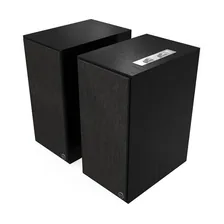 For a larger integrated phono system with deeper measured bass, reaching about 43 Hz (-3 dB), consider the Klipsch The Nines: $999.99 per pair Crutchfield eBay
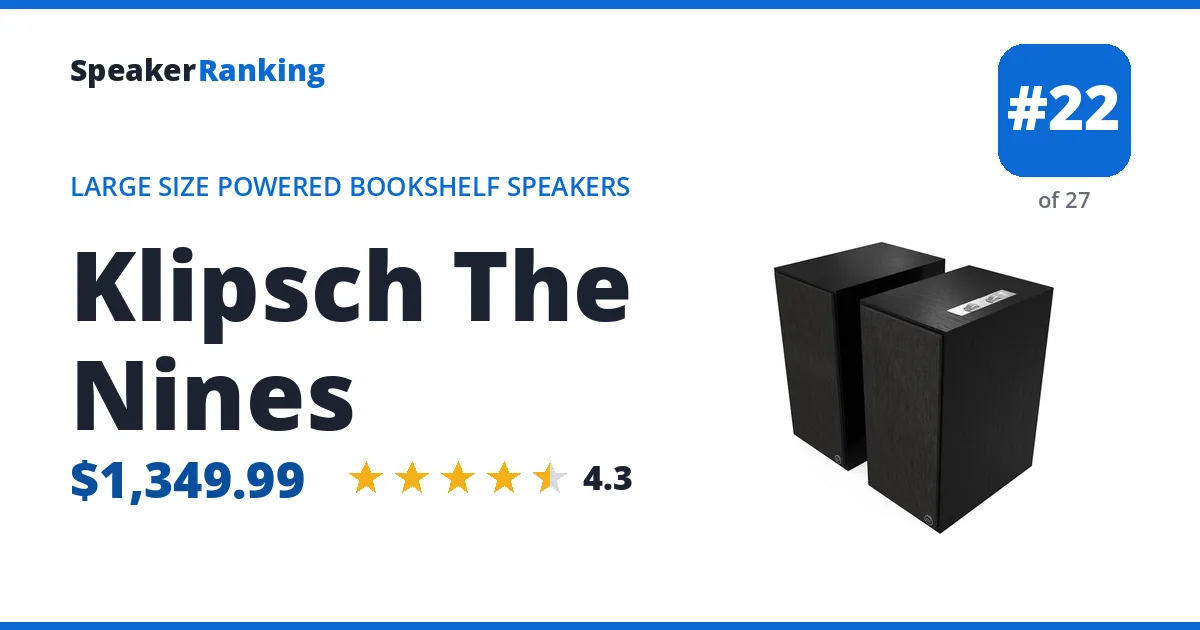
Pros: The 1.7dB response span from 300Hz to 5kHz supports even mids, and measured -3dB extension is 42.5Hz. Extensive consumer connections and app adjustment make it convenient for TV and music, while the horn provides a focused listening presentation. Measured bass extension of 41Hz (-3dB), with a measured sensitivity of 82.5dB.
Cons: The 5.99 ideal-subwoofer score reflects limitations beyond the narrow midband span. Horizontal coverage is relatively focused, so placement matters for multiple seats. The reviewer preferred reduced treble, and bass limiting at higher playback levels means the large woofer is not a guarantee of unlimited output.
Full Klipsch The Nines review and specifications →
| AES Input | No |
|---|---|
| Amplifier Power | 240W total (480W peak; 100W LF + 20W HF per powered speaker) |
| App | Klipsch Connect (bass/mid/treble EQ) |
| Aux Input | Yes |
| Bass Extension (-10dB) | 31Hz (measured, Erin's Audio Corner) |
| Bass Extension (-3dB) | 41Hz (measured, Erin's Audio Corner) |
| Bluetooth | Yes, 5.0 |
| Bluetooth Codecs | SBC, AAC, aptX, aptX HD |
| Coaxial Input | No |
| Dimensions | 19.13"H x 9.5"W x 13.38"D |
| Drivers | 8" high-excursion fiber-composite woofer, 1" titanium LTS vented tweeter with Tractrix horn |
| Frequency Response | 34Hz - 25kHz +/-3dB (manufacturer specified) |
| HDMI Input | Yes |
| Inputs | HDMI ARC, Bluetooth 5.0, phono/line RCA, 3.5mm, USB, optical |
| Maximum SPL | 115dB at 1m (stereo pair, manufacturer specified) |
| Optical Input | Yes |
| Outputs | Subwoofer |
| RCA Input | Yes |
| Sensitivity | 82.5dB (measured at 0.30V/1m, Erin's Audio Corner) |
| Spinorama Preference Score | 4.42 |
| Spinorama Preference Score with Perfect Sub | 5.99 |
| Subwoofer Output | Yes |
| TRS Input | No |
| USB Input | Yes |
| Weight | 28.4 lbs (12.9 kg) primary, 26.9 lbs (12.2 kg) secondary |
| Woofer Cabinet | rear-ported bass reflex |
| XLR Input | No |
- Links
- Reviews, Comparisons and Sound Samples
- Head-to-Head Comparisons
- Klipsch The Nines vs JBL 306P MKII
- Klipsch The Nines vs JBL 708P
- Klipsch The Nines vs JBL 4329P
- Klipsch The Nines vs JBL M2 Master Reference Monitor
- Klipsch The Nines vs APS Klasik 2020
- Klipsch The Nines vs Genelec 8040B
- Klipsch The Nines vs Kali Audio LP-6
- Klipsch The Nines vs Emotiva Airmotiv 6s
- See all 32 comparisons
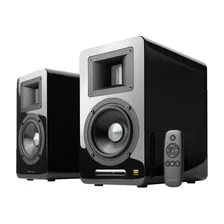 For a measurement-backed living-room pair with RCA, USB, optical and coaxial inputs, the Airpulse A100: $999.99 per pair Amazon B&H Photo Video eBay
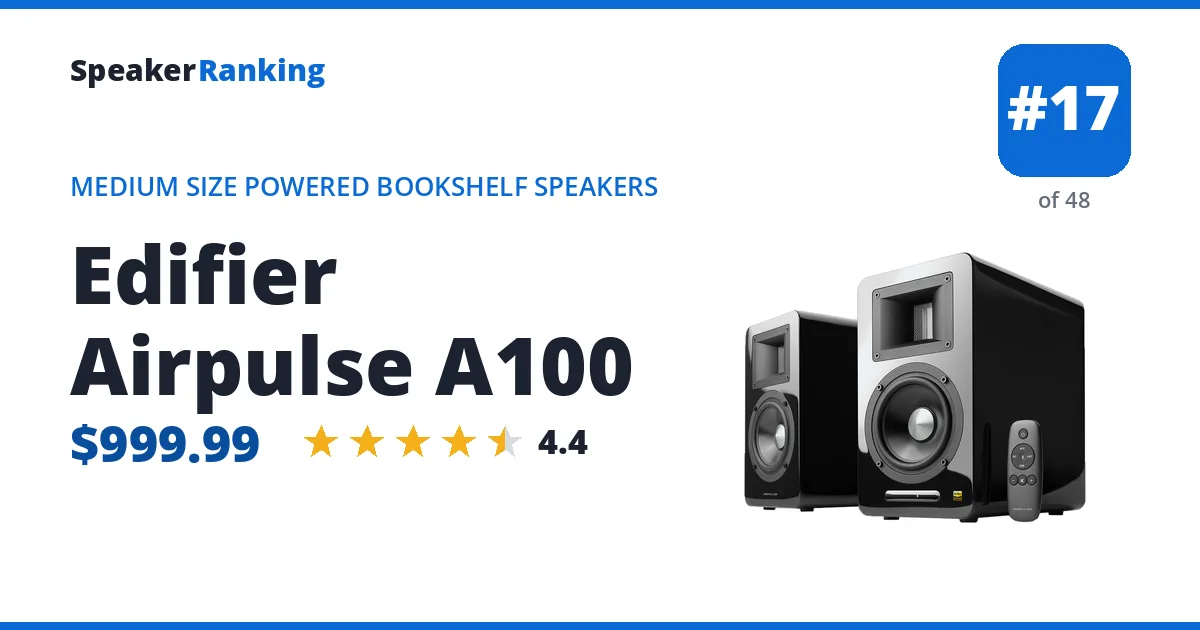
Pros: ASR’s Klippel data gives a 2.9dB midrange span and scores of 3.66 standalone and 6.18 with an ideal subwoofer. The ribbon tweeter and five-inch woofer provide a distinctive compact powered system, with remote control and a subwoofer output simplifying everyday use. Measured bass extension of 63.0Hz (-3dB).
Cons: Bass reaches -3dB around 63Hz, so lower notes need a subwoofer for full weight. Listening-window narrow-band deviation of 0.419 shows more local tonal variation than the leading monitors. Rear tone controls are less flexible than parametric EQ or room correction. Neither the ribbon tweeter nor a directivity-index summary establishes uniquely wide or perfectly controlled dispersion.
Full Airpulse A100 review and specifications →
| AES Input | No |
|---|---|
| Amplifier Power | 100W total (40W+40W woofer, 10W+10W tweeter) |
| App | None (physical bass/treble knobs, IR remote) |
| Aux Input | Yes |
| Bass Extension (-10dB) | 53.2Hz (measured, spinorama.org) |
| Bass Extension (-3dB) | 63.0Hz (measured, spinorama.org) |
| Bluetooth | Yes (SBC, aptX) |
| Bluetooth Codecs | SBC, aptX |
| Coaxial Input | Yes |
| Dimensions | 6.3" x 11.1" x 10" (160 x 283 x 255 mm) each |
| Drivers | Horn-loaded ribbon tweeter, 5" hard-anodized aluminum cone woofer |
| EQ | Yes, rear-panel bass/treble trim knobs |
| Frequency Response | 52Hz - 40kHz |
| HDMI Input | No |
| Inputs | RCA (aux), USB, optical, coaxial, Bluetooth aptX |
| Optical Input | Yes |
| RCA Input | Yes |
| Spinorama Preference Score | 3.66 |
| Spinorama Preference Score with Perfect Sub | 6.18 |
| TRS Input | No |
| USB Input | Yes |
| Weight | 24.3 lbs (11 kg) each |
| XLR Input | No |
- Links
- Reviews, Comparisons and Sound Samples
- Head-to-Head Comparisons
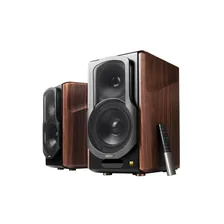 If you prioritize multiple line-level inputs and a larger cabinet over measured neutrality, consider the Edifier S2000MKIII: $594.98 per pair Amazon eBay
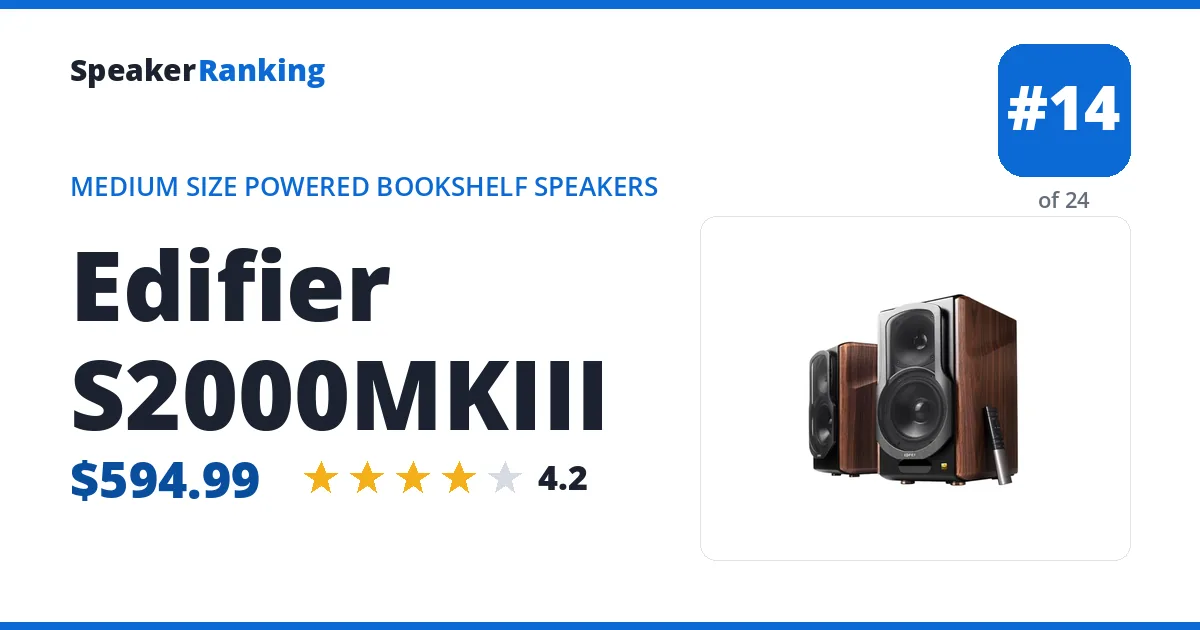
Pros: The available digitized response suggests substantial bass reach, with a -3dB estimate around 41Hz. Scores are 3.58 standalone and 5.34 with an ideal subwoofer. Digital inputs and a self-contained stereo-pair format are convenient for general music listening.
Cons: The 4.0dB midrange span and uneven predicted room response suggest meaningful coloration. Favorable modeled EQ results should not be treated as the sound of the stock speaker or as proof that all dispersion issues are correctable.
Full Edifier S2000MKIII review and specifications →
| AES Input | No |
|---|---|
| Amplifier Power | 65w RMS Per Speaker |
| App | No |
| Aux Input | No |
| Bluetooth | Yes, 5.0 |
| Bluetooth Codecs | SBC, aptX HD |
| Coaxial Input | Yes |
| Dimensions | 13.5"H x 7.8"W x 10.8"D (342.9 x 198.1 x 274.3 mm) |
| Drivers | 5.5" (140mm) woofer |
| EQ | No |
| Frequency Response | 40.5Hz at -3dB; 37Hz at -6dB (Spinorama) |
| HDMI Input | No |
| Inputs | Bluetooth, 2x RCA Input, Digital Optical, Digital Coax |
| Optical Input | Yes |
| Outputs | None |
| RCA Input | Yes |
| Spinorama Preference Score | 3.58 |
| Spinorama Preference Score with Perfect Sub | 5.34 |
| TRS Input | No |
| USB Input | No |
| Weight | 20.7 lbs (9.4 kg) |
| XLR Input | No |
- Links
- Reviews, Comparisons and Sound Samples
- DSAUDIO.review: DSAUDIO.review Edifier S1000MKII vs Edifier S2000MKIII sound.DEMO More from DSAUDIOreview →
- DSAUDIO.review: DSAUDIO.review Edifier S2000MKIII vs Klipsch The Three II sound.DEMO
- DSAUDIO.review: DSAUDIO.review Edifier R2850DB vs Edifier S2000MKIII sound.DEMO
- DSAUDIO.review: Edifier S2000MKIII vs Edifier S3000PRO Sound & Frequency Response Comparison
- Archimago Measurements (spinorama.org)
- Head-to-Head Comparisons
- Edifier S2000MKIII vs Edifier MR4
- Edifier S2000MKIII vs Presonus Eris E5 XT
- Edifier S2000MKIII vs KRK Classic 5
- Edifier S2000MKIII vs Palmer STUDIMON 5
- Edifier S2000MKIII vs Adam Audio A4V
- Edifier S2000MKIII vs M-Audio BX4 D3
- Edifier S2000MKIII vs Presonus Eris E5
- Edifier S2000MKIII vs Yamaha HS5
- See all 66 comparisons
Where To Go Next
Full rankings with specs and measurements: powered bookshelf small, medium and large.
Related picks: best powered speakers for a desk, best budget powered speakers, and the powered speaker buyer’s guide. Prefer to bring your own amplifier? See the passive speaker buyer’s guide.