Coverage note. Speaker Ranking currently covers 30 Klipsch models across portable bluetooth speakers, powered speakers, passive speakers and subwoofers. These are the products in our database, not a complete list of everything Klipsch makes.
This page lists all 30 Klipsch speakers ranked on this site, across portable, powered, passive and subwoofers, each showing where it places in its category.
The horn is the whole brand. Klipsch has built horn-loaded designs for eighty years, and the trade is consistent: high efficiency and excellent dynamics against a treble character that people either love or find fatiguing. There is no neutral position on this. It is a genuine matter of taste, and worth hearing before committing.
One thing to know before comparing spec sheets. Klipsch quotes sensitivity using an in-room method rather than the standard anechoic measurement everyone else uses. The RP-500M II is advertised at roughly 92-93 dB; measured anechoically it comes in around 85 dB. That is not a small discrepancy, and it matters if you are choosing an amplifier from the number, or comparing a Klipsch against another brand on paper. Every sensitivity figure in our spec tables is the measured one. If you are matching to a low-power or tube amplifier, use best passive speakers for tube and low-power amps, where the figures are directly comparable.
Where Klipsch is strongest here: subwoofers and passive bookshelves. The R-series and SPL subwoofers offer solid measured output at mainstream prices, and the RP-500M II is a well-measuring bookshelf speaker at $390.
The portable line is a different business. The Austin and the Groove are lifestyle products sold on styling; they place mid-pack and are priced accordingly.
Prices on this page were last checked September 23, 2026 at 11:24 PM UTC. Product prices and availability are accurate as of that date/time and are subject to change; the price and availability shown on Amazon at the time of purchase will apply to the purchase of this product.
As an eBay Partner, we may be compensated if you make a purchase.
Small Size Portable Bluetooth Speakers
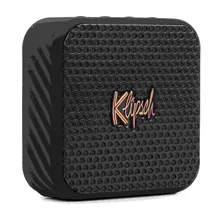 Ranked #15 of 47 in Small Size Portable Bluetooth Speakers - Klipsch Austin: $54.00 Amazon eBay
Pros: Dual passive radiators give more low-end presence than most mini speakers. Clear mids and crisp trebles. Rugged rubberized build with a metal grille; IP67. Supports TWS pairing with a second Austin. Measured bass extension of ~70Hz (-10dB).
Cons: Not as deep bass as higher ranked speakers
Full Klipsch Austin review and specifications →
| Amplifier Power | 10W RMS |
|---|---|
| App | Yes |
| Aux Input | No |
| Bass Extension (-10dB) | ~70Hz |
| Battery Life | 12 hours (Manufacturer specified) |
| Bluetooth Codecs | SBC |
| Bluetooth Version | 5.3 |
| Built-in Microphone | Yes |
| Charging Time | 2 hours |
| Digital Aux Input | No |
| Dimensions | 4.3" x 4.3" x 1.7" (109 x 109 x 43 mm) |
| Drivers | 1.5" (38mm) full-range with dual passive radiators |
| EQ | No |
| IP Rating | IP67 |
| Maximum SPL | 89dB (Manufacturer specified) |
| Omnidirectional | Pointing up |
| Party Mode | Yes (Broadcast Mode) |
| Power Bank | Yes (10W reverse USB-C charging) |
| Power Input | USB-C |
| Stereo | No |
| TWS | Yes |
| Weight | 0.9 lbs (397 g) |
- Links
- Reviews, Comparisons and Sound Samples
- Head-to-Head Comparisons
- Klipsch Austin vs Marshall Willen
- Klipsch Austin vs B&O Beoplay P2
- Klipsch Austin vs Anker Soundcore Mini
- Klipsch Austin vs Bose Soundlink Micro 2
- Klipsch Austin vs Ultimate Ears Miniroll
- Klipsch Austin vs Marshall Willen II
- Klipsch Austin vs Bose Soundlink Micro
- Klipsch Austin vs JBL Clip 5
- See all 33 comparisons
Medium Size Portable Bluetooth Speakers
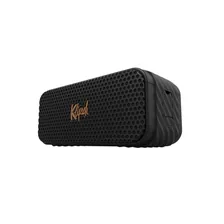 Ranked #68 of 142 in Medium Size Portable Bluetooth Speakers - Klipsch Nashville: $93.00 Amazon eBay
Pros: Sturdy rubber-coated build. ~24 hour battery life with fast 18W USB-C charging; can reverse-charge your phone. IP67 rated. Measured bass extension of ~64Hz (-10dB).
Cons: Upper bass boost. Bass not as deep as the top ranked speakers. Boosted lower treble, sounds a little harsh like most Klipsch speakers.
Full Klipsch Nashville review and specifications →
| Amplifier Power | 20W RMS |
|---|---|
| App | Yes |
| Aux Input | No |
| Bass Extension (-10dB) | ~64Hz |
| Battery Life | 24 hours (Manufacturer specified) |
| Bluetooth Codecs | SBC |
| Bluetooth Version | 5.3 |
| Built-in Microphone | Yes |
| Digital Aux Input | No |
| Dimensions | 7" x 3.1" x 3.2" (178 x 78 x 81 mm) |
| Drivers | 2x 57mm fullrange |
| EQ | Yes |
| Frequency Response | 60Hz - 20kHz (Manufacturer specified) |
| IP Rating | IP67 |
| Maximum SPL | 89dB (Manufacturer specified) |
| Omnidirectional | Yes |
| Party Mode | Yes (Broadcast Mode) |
| Power Bank | Yes (USB-C, 10W) |
| Power Input | USB-C |
| Stereo | No |
| TWS | Yes |
| Weight | 2.1 lbs (970 g) |
- Links
- Reviews, Comparisons and Sound Samples
- Head-to-Head Comparisons
- Klipsch Nashville vs Sony XB23
- Klipsch Nashville vs JBL Flip Essential
- Klipsch Nashville vs JBL Charge 3
- Klipsch Nashville vs JBL Flip 4
- Klipsch Nashville vs JBL Flip 5
- Klipsch Nashville vs JBL Charge Essential
- Klipsch Nashville vs Beats Pill 2024
- Klipsch Nashville vs JBL Charge 2
- See all 90 comparisons
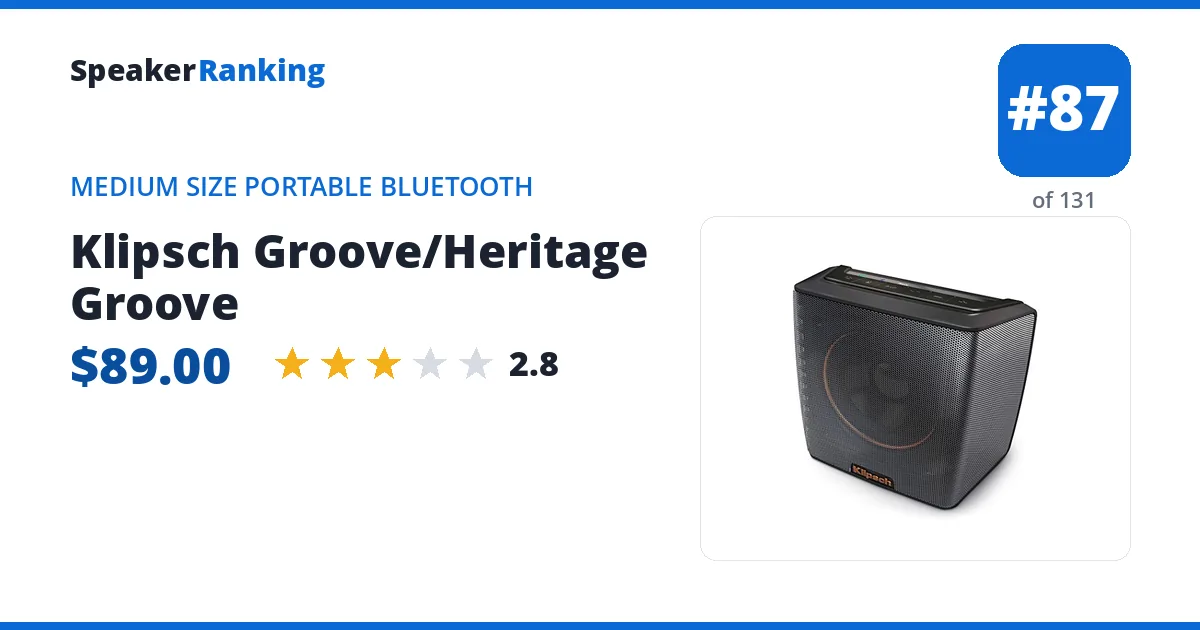
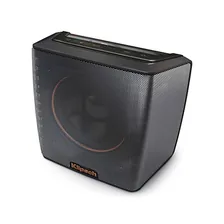 Ranked #93 of 142 in Medium Size Portable Bluetooth Speakers - Klipsch Groove/Heritage Groove: $89.00 Amazon eBay
Pros: Pretty balanced sound. Distinctive mid-century design with real wood veneer and a woven grille, unlike most plastic/rubber portables. ~8 hour battery life.
Cons: Not stereo. Bass doesn’t go as deep as others its size. Gets distorted at higher levels. Wouldn’t generally recommend these old speakers as they can’t compete with modern speakers for bass performance and features.
Full Klipsch Groove/Heritage Groove review and specifications →
| Amplifier Power | 10W RMS |
|---|---|
| App | No |
| Aux Input | Yes |
| Battery Life | 8 hours (Manufacturer specified) |
| Bluetooth Codecs | SBC, AAC |
| Bluetooth Version | 4.0 |
| Built-in Microphone | Yes |
| Digital Aux Input | No |
| Dimensions | 5" x 6" x 2.6" (127 x 152 x 67 mm) |
| Drivers | 1x 3" full-range driver + 2x side-firing passive radiators |
| EQ | No |
| IP Rating | IPX4 (Groove), none (Heritage Groove) |
| Omnidirectional | No |
| Party Mode | No |
| Power Bank | No |
| Power Input | Micro USB |
| Stereo | No |
| TWS | No |
| Weight | 1.7 lbs (770 g) |
- Links
- Reviews, Comparisons and Sound Samples
- No independent measurement review is linked for this model; it is ranked from hands-on listening and comparison against similarly priced speakers.
- Head-to-Head Comparisons
- Klipsch Groove/Heritage Groove vs Ultimate Ears Boom 3
- Klipsch Groove/Heritage Groove vs Ultimate Ears Boom 4
- Klipsch Groove/Heritage Groove vs Sony SRS-XE300
- Klipsch Groove/Heritage Groove vs Ultimate Ears Wonderboom
- Klipsch Groove/Heritage Groove vs Tribit Stormbox
- Klipsch Groove/Heritage Groove vs Ultimate Ears Wonderboom 2
- Klipsch Groove/Heritage Groove vs Sony SRS-XB20
- Klipsch Groove/Heritage Groove vs Ultimate Ears Wonderboom 3
- See all 72 comparisons
Large Size Portable Bluetooth Speakers
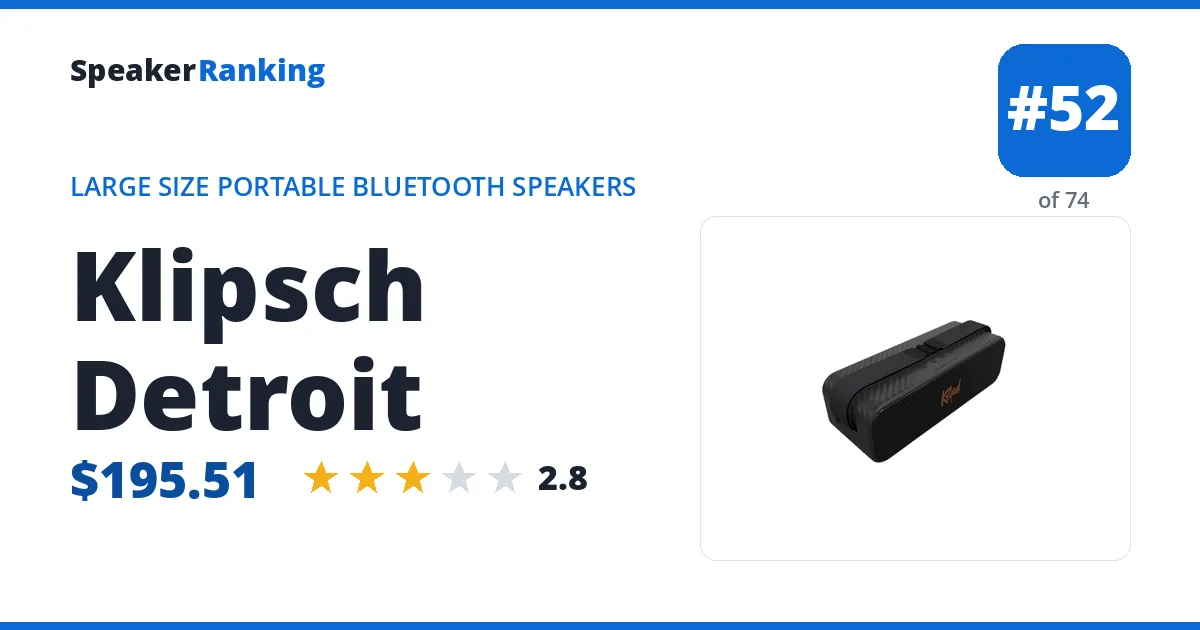
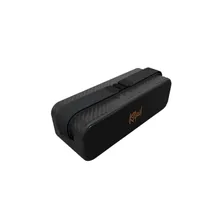 Ranked #54 of 78 in Large Size Portable Bluetooth Speakers - Klipsch Detroit: $235.15 Amazon eBay
Pros: Dual 1” tweeters + 3” woofers deliver excellent sound detail and robust bass. IP67 dust/waterproof rating submersible 1m for 30 min. 20-hour battery life at moderate volume (12-15 hours at high volume). USB-C fast-charge in 2 hours with two-way power for device charging. Measured bass extension of ~55Hz (-10dB).
Cons: Weird boosted upper bass, bass not very deep. Boosted lower treble, somewhat harsh sounding like most other Klipsch speakers. Not very loud.
Full Klipsch Detroit review and specifications →
| Amplifier Power | 30W RMS |
|---|---|
| App | Yes |
| Aux Input | Yes |
| Bass Extension (-10dB) | ~55Hz |
| Battery Life | 20 hours (Manufacturer specified) |
| Bluetooth Codecs | SBC |
| Bluetooth Version | 5.3 |
| Built-in Microphone | Yes |
| Digital Aux Input | No |
| Dimensions | 13.1" x 4.2" x 4.7" (334 x 107 x 119 mm) |
| Drivers | 2x 76mm fullrange, 2x 25mm tweeters |
| EQ | No |
| Frequency Response | 55Hz - 20kHz (Manufacturer specified) |
| IP Rating | IP67 |
| Maximum SPL | 93dB (Manufacturer specified) |
| Omnidirectional | No |
| Party Mode | Yes (Broadcast Mode) |
| Power Bank | Yes (USB-C, 10W) |
| Power Input | USB-C |
| Stereo | Yes |
| TWS | Yes |
| Weight | 5.5 lbs (2.5 kg) |
- Links
- Reviews, Comparisons and Sound Samples
- Walts TV: The Austin NEW Klipsch Bluetooth Speaker Review + Sound Test More from Williston Audio Labs →
- Audio Inside Scoop: Klipsch Detroit VS JBL Xtreme 3 Hear With Me!!
- Audio Inside Scoop: Klipsch Detroit VS JBL Charge Hear With Me!!
- Storytripper HD: Marshall Middleton vs Klipsch Detroit More from storytripperhd →
- Joy & Oluv’Sone: Klipsch Detroit - unboxing & first impressions More from Oluv’Sone →
- Joy & Oluv’Sone: Klipsch Detroid vs SoundCore Boom 2 - outdoor test
- Head-to-Head Comparisons
- Klipsch Detroit vs Sony SRS-XG300
- Klipsch Detroit vs Doss Soundbox XL
- Klipsch Detroit vs JBL Xtreme
- Klipsch Detroit vs Marshall Stockwell III
- Klipsch Detroit vs Xdobo X8 Max
- Klipsch Detroit vs Ultimate Ears Epicboom
- Klipsch Detroit vs Dali Katch G2
- Klipsch Detroit vs B&O Beosound Level
- See all 49 comparisons
Party Size Portable Bluetooth Speakers
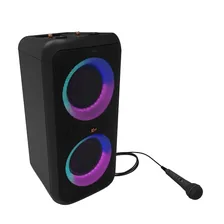 Ranked #20 of 39 in Party Size Portable Bluetooth Speakers - Klipsch Gig XXL: $79.99 Amazon eBay
Pros: A straightforward 8.2kg party speaker with a large 8-inch woofer, horn tweeter, aux and USB playback, guitar and microphone inputs, karaoke reverb, TWS pairing and a USB-A power bank. Independent testing confirms that it gets remarkably loud and gives EDM and hip-hop a lively, bass-forward character.
Cons: Bass is more warm than deep and can become muddy at high volume. There is no app or proper EQ beyond a Bass button, no water rating, and the claimed eight-hour battery life is short for an outdoor party speaker. It is a fun, simple option, but not the cleanest or most flexible choice.
Full Klipsch Gig XXL review and specifications →
| Amplifier Power | 80W RMS |
|---|---|
| App | No |
| Aux Input | Yes |
| Battery Life | 8 hours (Manufacturer specified) |
| Bluetooth Codecs | SBC |
| Bluetooth Version | 5.0 |
| Digital Aux Input | No |
| Dimensions | 21.7"H x 10.8"W x 11.4"D (551 x 275 x 290 mm) |
| Drivers | 8" (203mm) Cerametallic woofer + horn tweeter |
| EQ | No |
| Guitar Input | Yes |
| IP Rating | None |
| Lights | Yes |
| Microphone Input | Yes (Karaoke mode with reverb effect) |
| Omnidirectional | No |
| Party Mode | No |
| Power Bank | Yes (USB-A) |
| Power Input | AC Power cord |
| Stereo | No |
| TWS | Yes |
| USB Playback | Yes |
| Weight | 18.1 lbs (8.2 kg) |
- Reviews, Comparisons and Sound Samples
- Jay’s Straight Up Reviews & More: Klipsch Gig XXL vs JBL Partybox 110 🎉 Bluetooth Party Speaker Comparison. Is The Party Over For Gig? More from JaysStraightUpReviews →
- Jay’s Straight Up Reviews & More: Klipsch Gig XXL vs JBL Partybox Encore Essential (Pee-Wee) - Indoors, Plugged In🔌 Bluetooth Speakers
- Jay’s Straight Up Reviews & More: Klipsch Gig XXL vs ONN Large Party Speaker Gen 2 ⚔️ Budge Bluetooth Speaker Battle🔉 Bass Boost On
- Head-to-Head Comparisons
- Klipsch Gig XXL vs Samsung MX-ST50B
- Klipsch Gig XXL vs LG XL7
- Klipsch Gig XXL vs W-King T12
- Klipsch Gig XXL vs Ultimate Ears Hyperboom
- Klipsch Gig XXL vs Soundcore Rave 3S
- Klipsch Gig XXL vs Soundboks Mix
- Klipsch Gig XXL vs Onn Large Party gen 2
- Klipsch Gig XXL vs Sony SRS-XP500
- See all 39 comparisons
Small Size Powered Bookshelf Speakers
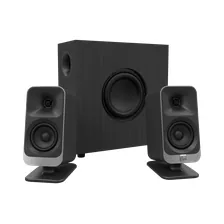 Ranked #15 of 24 in Small Size Powered Bookshelf Speakers - Klipsch ProMedia Lumina: $299.99 per pair Amazon eBay
Pros: The included powered subwoofer gives this compact desktop system a real low-bass advantage: the linked review reports F3 around 46Hz and F10 around 38Hz. Tiltable stands, app control and lighting add practical desktop features. The existing review reports reasonable distortion for the system’s size. Measured bass extension of 46Hz (-3dB).
Cons: The review reports treble elevated about 3-5dB when aimed straight at the listener; some toe-out can reduce the brightness. Fixed-band app EQ is less flexible than parametric correction. Its separate subwoofer also means the system occupies more space than the satellites alone suggest.
Full Klipsch ProMedia Lumina review and specifications →
| AES Input | No |
|---|---|
| Amplifier Power | 100W RMS, 200W peak |
| App | Klipsch Control app - EQ (fixed bands), RGB lighting control, night mode, music-reactive mode |
| Aux Input | Yes |
| Bass Extension (-10dB) | 38Hz (measured, Erin's Audio Corner) |
| Bass Extension (-3dB) | 46Hz (measured, Erin's Audio Corner) |
| Bluetooth | Yes, 5.3 |
| Bluetooth Codecs | SBC |
| Bluetooth Version | 5.3 |
| Coaxial Input | No |
| Crossover Frequency | Satellite: 3.5kHz, Subwoofer: 150Hz |
| Dimensions | Satellite: 248 x 165 x 102 mm, Subwoofer: 356 x 152 x 352 mm |
| Drivers | 1" tractrix horn tweeter, 3.5" mid, 6.5" powered subwoofer |
| EQ | Fixed-band EQ via app (not parametric) |
| Frequency Response | 40Hz - 20kHz (-6dB, Manufacturer specified) |
| HDMI Input | No |
| Inputs | USB-C, 3.5mm Aux, Bluetooth 5.3 |
| Maximum SPL | 98dB (manufacturer specified) |
| Optical Input | No |
| RCA Input | No |
| TRS Input | No |
| USB Input | Yes |
| Weight | Satellite: 2.1 lbs (0.95 kg) each, Subwoofer: 11 lbs (4.99 kg) |
| XLR Input | No |
- Links
- Reviews, Comparisons and Sound Samples
- Head-to-Head Comparisons
- Klipsch ProMedia Lumina vs Monoprice Monolith MM-3
- Klipsch ProMedia Lumina vs Kanto YU4
- Klipsch ProMedia Lumina vs Monacor SOUND-4BT
- Klipsch ProMedia Lumina vs Audioengine A2+
- Klipsch ProMedia Lumina vs Mackie CR3-X
- Klipsch ProMedia Lumina vs Bowers & Wilkins Formation Flex
- Klipsch ProMedia Lumina vs Fluid Audio C35BT
- Klipsch ProMedia Lumina vs Fiio SP3
- See all 18 comparisons
Medium Size Powered Bookshelf Speakers
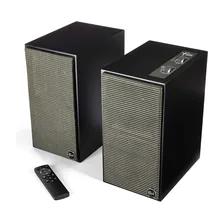 Ranked #12 of 67 in Medium Size Powered Bookshelf Speakers - Klipsch The Fives: $699 per pair Amazon eBay
Pros: In the tested Bass Cut mode, Erin’s Klippel data gives preference scores of 5.52 standalone and 7.89 with an ideal subwoofer, with a 2.7dB midrange response span. That mode offers considerably better tonal balance than the bass-heavy default behavior. HDMI ARC, phono/line input, digital inputs and subwoofer output make it a versatile stereo alternative to a soundbar. Measured bass extension of 57Hz (-3dB).
Cons: The favorable score specifically requires Bass Cut mode; it does not describe every firmware or bass setting. Bass reaches -3dB around 59Hz in that configuration. The review reports increasing compression around 200Hz and below 80Hz as volume rises, reducing bass dynamics. Careful placement and a subwoofer remain useful, and the horn/woofer transition is not perfectly uniform off-axis.
Full Klipsch The Fives review and specifications →
| AES Input | No |
|---|---|
| Amplifier Power | 160W total system power (320W peak) |
| Aux Input | No |
| Bass Extension (-10dB) | 47.3Hz (measured, Erin's Audio Corner) |
| Bass Extension (-3dB) | 57Hz (measured, Erin's Audio Corner) |
| Bluetooth | Yes, 5.0 |
| Bluetooth Codecs | SBC, AAC, aptX, aptX HD |
| Coaxial Input | No |
| DSP | Dynamic Bass, Flat and Bass Cut profiles |
| Dimensions | 12"H x 6.5"W x 9.2"D (304.8 x 165.1 x 234.95 mm) |
| Drivers | 1" horn-loaded tweeter; 4.5" woofer |
| Frequency Response | 50Hz - 25kHz (Manufacturer specified) |
| HDMI Input | Yes |
| Inputs | HDMI ARC, USB, optical, Bluetooth, phono/line RCA |
| Optical Input | Yes |
| Outputs | Subwoofer |
| RCA Input | Yes |
| Spinorama Preference Score | 5.52 |
| Spinorama Preference Score with Perfect Sub | 7.89 |
| Subwoofer Output | Yes |
| TRS Input | No |
| USB Input | Yes |
| Weight | Primary 11.8 lbs (5.35 kg), Secondary 10.7 lbs (4.85 kg) |
| XLR Input | No |
- Links
- Reviews, Comparisons and Sound Samples
- Erin’s Audio Corner: Klipsch The Fives Review More from Erin’s Audio Corner →
- Erin’s Audio Corner Website: Klipsch The Fives
- Erin’s Audio Corner Measurements (spinorama.org)
- Jasper Tech: Best Bookshelf Speakers For TV & Gaming - 2025 More from Jasper Tech →
- Jasper Tech: Best Powered Bookshelf Speakers for Every Budget - 2025
- Head-to-Head Comparisons
- Klipsch The Fives vs JBL 305P MKII
- Klipsch The Fives vs Genelec 8020D
- Klipsch The Fives vs Topping MA4
- Klipsch The Fives vs KEF LS50 Wireless II
- Klipsch The Fives vs Vanatoo Transparent One Encore Plus
- Klipsch The Fives vs Devialet Phantom II 98 dB
- Klipsch The Fives vs IK Multimedia iLoud MTM MKII
- Klipsch The Fives vs Genelec 8320A
- See all 51 comparisons
Medium Size Powered Desktop Speakers
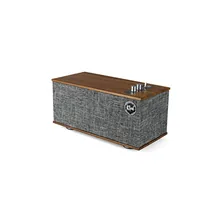 Ranked #17 of 17 in Medium Size Powered Desktop Speakers - Klipsch The One II: $129.95 each Amazon eBay
Pros: At 3.9 kg, Klipsch The One II combines 4.5” woofer, 2x 2.25” full-range midranges with Bluetooth, Aux, RCA, Optical, USB. Ac-powered operation and limited-stereo playback make its feature set practical for its intended room or portable use.
Cons: Bass is limited by its 50Hz - 20kHz (Manufacturer specified) specification. There is no companion app.
Full Klipsch The One II review and specifications →
| AES Input | No |
|---|---|
| Amplifier Power | 50W (Woofer: 30W, Full-range: 2x10W) |
| App | No |
| Aux Input | Yes |
| Battery Life | No Battery |
| Bluetooth | Yes, 4.0 |
| Bluetooth Codecs | SBC, aptX |
| Bluetooth Version | 4.0 |
| Coaxial Input | No |
| Dimensions | 9.1" x 5.9" x 5.9" (231 x 150 x 150 mm) |
| Drivers | 4.5" woofer, 2x 2.25" full-range midranges |
| EQ | Yes (Bass/Treble) |
| Frequency Response | 50Hz - 20kHz (Manufacturer specified) |
| HDMI Input | No |
| Inputs | Bluetooth, Aux, RCA, Optical, USB |
| Optical Input | Yes |
| Party Mode | No |
| RCA Input | Yes |
| Stereo | Partially (1 woofer) |
| TRS Input | No |
| TWS | No |
| USB Input | Yes |
| Weight | 8.6 lbs (3.9 kg) |
| Wi-Fi | No |
| Woofer Cabinet | ported |
| XLR Input | No |
- Links
- Reviews, Comparisons and Sound Samples
- Head-to-Head Comparisons
- Klipsch The One II vs Klipsch The Three II
- Klipsch The One II vs Marshall Acton II
- Klipsch The One II vs Sonos Era 100
- Klipsch The One II vs Denon Home 250
- Klipsch The One II vs Marshall Stanmore II
- Klipsch The One II vs Marshall Acton III
- Klipsch The One II vs JBL Authentics 200
- Klipsch The One II vs Edifier D12
- See all 14 comparisons
Large Size Powered Bookshelf Speakers
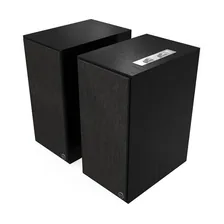 Ranked #40 of 68 in Large Size Powered Bookshelf Speakers - Klipsch The Nines: $999.99 per pair Crutchfield eBay
Pros: The 1.7dB response span from 300Hz to 5kHz supports even mids, and measured -3dB extension is 42.5Hz. Extensive consumer connections and app adjustment make it convenient for TV and music, while the horn provides a focused listening presentation. Measured bass extension of 41Hz (-3dB), with a measured sensitivity of 82.5dB.
Cons: The 6.90 ideal-subwoofer score reflects limitations beyond the narrow midband span. Horizontal coverage is relatively focused, so placement matters for multiple seats. The reviewer preferred reduced treble, and bass limiting at higher playback levels means the large woofer is not a guarantee of unlimited output.
Full Klipsch The Nines review and specifications →
| AES Input | No |
|---|---|
| Amplifier Power | 240W total (480W peak; 100W LF + 20W HF per powered speaker) |
| App | Klipsch Connect (bass/mid/treble EQ) |
| Aux Input | Yes |
| Bass Extension (-10dB) | 31Hz (measured, Erin's Audio Corner) |
| Bass Extension (-3dB) | 41Hz (measured, Erin's Audio Corner) |
| Bluetooth | Yes, 5.0 |
| Bluetooth Codecs | SBC, AAC, aptX, aptX HD |
| Coaxial Input | No |
| Dimensions | 19.13"H x 9.5"W x 13.38"D |
| Drivers | 8" high-excursion fiber-composite woofer, 1" titanium LTS vented tweeter with Tractrix horn |
| Frequency Response | 34Hz - 25kHz +/-3dB (manufacturer specified) |
| HDMI Input | Yes |
| Inputs | HDMI ARC, Bluetooth 5.0, phono/line RCA, 3.5mm, USB, optical |
| Maximum SPL | 115dB at 1m (stereo pair, manufacturer specified) |
| Optical Input | Yes |
| Outputs | Subwoofer |
| RCA Input | Yes |
| Sensitivity | 82.5dB (measured at 0.30V/1m, Erin's Audio Corner) |
| Spinorama Preference Score | 5.32 |
| Spinorama Preference Score with Perfect Sub | 6.90 |
| Subwoofer Output | Yes |
| TRS Input | No |
| USB Input | Yes |
| Weight | 28.4 lbs (12.9 kg) primary, 26.9 lbs (12.2 kg) secondary |
| Woofer Cabinet | rear-ported bass reflex |
| XLR Input | No |
- Links
- Reviews, Comparisons and Sound Samples
- Head-to-Head Comparisons
- Klipsch The Nines vs JBL 306P MKII
- Klipsch The Nines vs JBL 708P
- Klipsch The Nines vs JBL 4329P
- Klipsch The Nines vs JBL M2 Master Reference Monitor
- Klipsch The Nines vs APS Klasik 2020
- Klipsch The Nines vs Genelec 8040B
- Klipsch The Nines vs Kali Audio LP-6
- Klipsch The Nines vs Emotiva Airmotiv 6s
- See all 32 comparisons
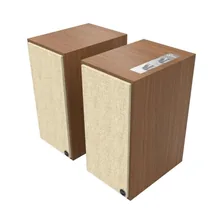 Ranked #65 of 68 in Large Size Powered Bookshelf Speakers - Klipsch The Sevens: $999.99 per pair Amazon eBay
Pros: Erin reported 49Hz -3dB extension, with useful bass for ordinary music listening. HDMI, phono, USB, optical and Bluetooth connections make the system convenient for TV and music, while app controls and a subwoofer output provide adjustment options. Measured bass extension of 49Hz (-3dB).
Cons: The review found a recessed 2-4kHz region and upper-treble emphasis, producing a scooped balance that a simple treble reduction did not fully fix. Relatively narrow horizontal coverage limits consistency across seats.
Full Klipsch The Sevens review and specifications →
| AES Input | No |
|---|---|
| Amplifier Power | 200W total (400W peak) |
| App | Yes (treble/mid/bass EQ, subwoofer output, dynamic bass mode) |
| Aux Input | Yes |
| Bass Extension (-10dB) | 36Hz (measured, Erin's Audio Corner) |
| Bass Extension (-3dB) | 49Hz (measured, Erin's Audio Corner) |
| Bluetooth | Yes, 5.0 |
| Bluetooth Codecs | SBC, AAC, aptX, aptX HD |
| Coaxial Input | No |
| Dimensions | 16.375"H x 8.125"W x 13.1875"D |
| Drivers | 6.5" high-excursion woofer, 1" titanium tweeter on Tractrix horn |
| Frequency Response | 39Hz - 25kHz (+/-3dB) (Manufacturer specified) |
| HDMI Input | Yes |
| Inputs | HDMI, Phono, 3.5mm, USB, Optical, Bluetooth |
| Optical Input | Yes |
| Outputs | Subwoofer |
| RCA Input | No |
| Subwoofer Output | Yes |
| TRS Input | No |
| USB Input | Yes |
| Weight | 22.3 lbs (10.1 kg) (primary), 19.8 lbs (9 kg) (secondary) |
| Woofer Cabinet | ported, rear flared port |
| XLR Input | No |
- Links
- Reviews, Comparisons and Sound Samples
- Head-to-Head Comparisons
- Klipsch The Sevens vs EVE Audio SC305
- Klipsch The Sevens vs Focal Twin6 Be
- Klipsch The Sevens vs Edifier R2850DB
- Klipsch The Sevens vs Edifier S3000Pro
- Klipsch The Sevens vs Presonus Eris Studio 8
- Klipsch The Sevens vs Kali Audio LP-8
- Klipsch The Sevens vs Adam Audio T7V
- Klipsch The Sevens vs Adam Audio T8V
- See all 36 comparisons
Medium Size Bookshelf Speakers
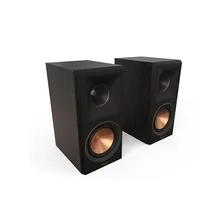 Ranked #18 of 88 in Medium Size Bookshelf Speakers - Klipsch RP-500M II: $389.99 per pair Amazon eBay
Pros: Major mid-range clarity improvement over the original RP-500M: about a 5dB fill-in between 1-3kHz in the estimated in-room response, giving a noticeably more resolved, detailed midrange. More neutral and linear overall than its sibling RP-600M II, which carries about 2-3dB more high-frequency energy and a touch more bass but less overall balance. Very precise soundstage imaging and instrument placement. Distortion through the midrange is cleaner than the previous generation. Measured bass extension of 67Hz (-3dB), with a measured sensitivity of 85dB.
Cons: Klipsch’s quoted sensitivity (around 92-93dB) uses an unconventional in-room-based rating rather than the standard anechoic measurement; on an anechoic basis it measures closer to about 85dB, in line with typical bookshelf speakers this size, so it isn’t the outlier in efficiency the spec sheet implies. Horizontal dispersion of about ±40-50° is narrower and more directive than the reviewer’s preference for a wider, more enveloping soundstage. Toeing the speaker out to widen the soundstage or soften on-axis brightness comes at some cost to imaging precision. Slightly less clean in the tweeter region than the midrange, likely tied to crossover placement, though not considered a dealbreaker. Low-frequency output is limited - measured around 95dB at 4 meters for the pair before the woofers started to unload, so a subwoofer is recommended for anyone wanting real bass rather than stepping up to a larger model.
Full Klipsch RP-500M II review and specifications →
| Bass Extension (-10dB) | 53Hz (measured, Erin's Audio Corner) |
|---|---|
| Bass Extension (-3dB) | 67Hz (measured, Erin's Audio Corner) |
| Crossover Frequency | 1530Hz |
| DIY Kit | No |
| Dimensions | 13.6"H x 6.8"W x 10.6"D (344.4 x 173 x 270.5 mm) |
| Drivers | 5.25" Cerametallic™ cone woofer with Faraday rings, 1" LTS Titanium diaphragm tweeter with Hybrid Cross-Section Expanded Tractrix® horn |
| Impedance | 8 ohms nominal, 3.3 ohms minimum (measured, Erin's Audio Corner) |
| Sensitivity | 85dB (measured, Erin's Audio Corner) |
| Spinorama Preference Score | 5.22 |
| Spinorama Preference Score with Perfect Sub | 7.84 |
| Weight | 13 lbs (5.9 kg) each |
| Woofer Cabinet | ported, rear |
- Links
- Reviews, Comparisons and Sound Samples
- Head-to-Head Comparisons
- Klipsch RP-500M II vs Wharfedale Super Denton
- Klipsch RP-500M II vs Wharfedale Diamond 12.1
- Klipsch RP-500M II vs Monitor Audio Silver 50 7G
- Klipsch RP-500M II vs Radiant Acoustics Clarity 4.2
- Klipsch RP-500M II vs Revel M105
- Klipsch RP-500M II vs Moondrop M4P MTM
- Klipsch RP-500M II vs KEF Q150
- Klipsch RP-500M II vs Arendal 1961 Monitor
- See all 39 comparisons
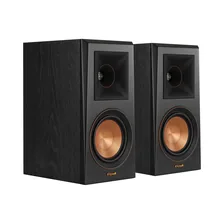 Ranked #41 of 88 in Medium Size Bookshelf Speakers - Klipsch RP-500M: $299.00 per pair Amazon eBay
Pros: The original Reference Premiere 2-way bookshelf, still sold new alongside the newer RP-500M II at a lower price. Klipsch’s signature Hybrid Tractrix Horn tweeter loading is unmistakable and the price has dropped from its original $579/pair MSRP to roughly $299/pair.
Cons: Independently measured by Erin’s Audio Corner with a very rough response: on-axis deviation of 0.961dB and on-axis smoothness of just 0.216, well behind the revised tuning Klipsch gave the newer RP-500M II. Directivity-index standard deviation of 4.24, a pronounced +0.26dB per octave upward tilt, and a predicted in-room smoothness of just 0.16, the worst of any speaker measured here, all point to an inconsistent, brighter-leaning presentation. Full sensitivity and impedance specs aren’t published on Klipsch’s own product page.
Full Klipsch RP-500M review and specifications →
| Country | United States (Klipsch design) |
|---|---|
| DIY Kit | No |
| Dimensions | 13.50H x 6.81W x 9.50D in |
| Drivers | 1" Titanium LTS tweeter (Hybrid Tractrix Horn), 5.25" Spun Copper Cerametallic woofer |
| Enclosure | 2-way, ported |
| Impedance | 8 ohms nominal |
| Sensitivity | 93dB (manufacturer specified, 2.83V/1m) |
| Spinorama Preference Score | 4.38 |
| Spinorama Preference Score with Perfect Sub | 7.00 |
| Weight | 11.9 lbs (5.4 kg) each |
- Links
- Reviews, Comparisons and Sound Samples
- Head-to-Head Comparisons
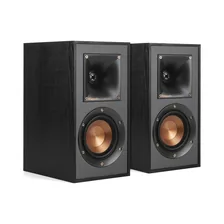 Ranked #86 of 88 in Medium Size Bookshelf Speakers - Klipsch R-41M: $147.77 per pair Amazon eBay
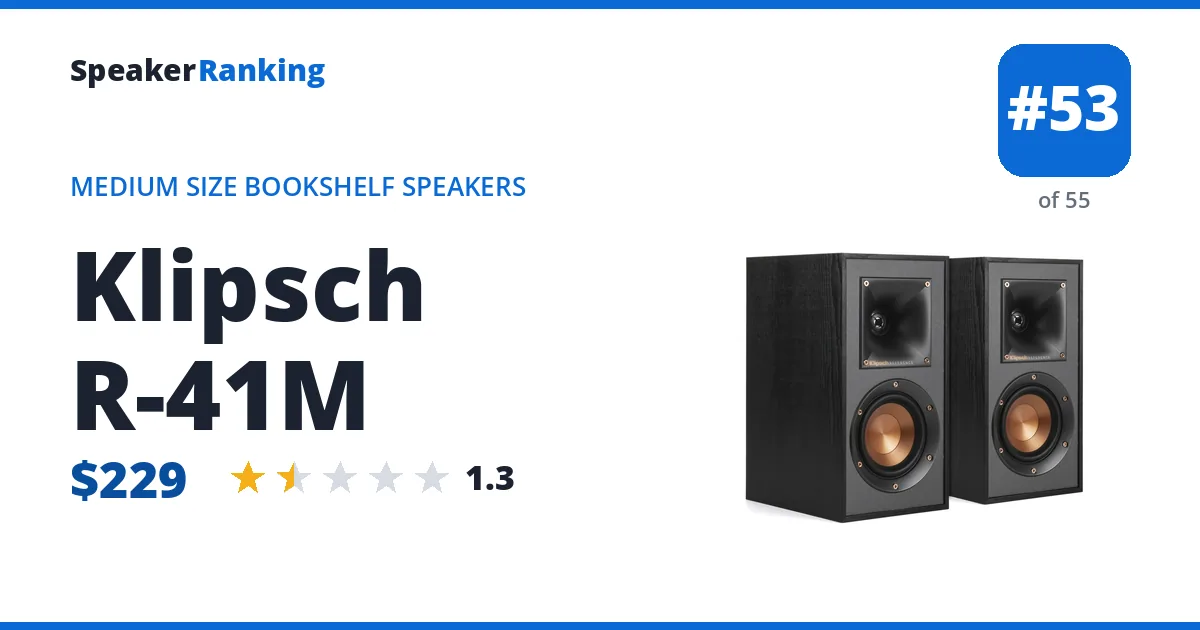
Pros: Binding posts are unusually nice for the price point, and impedance is well controlled in the bass, easing the load on the amplifier. The horn-loaded tweeter can play loud without strain. Measured bass extension of 80Hz (-3dB), with a measured sensitivity of 85dB.
Cons: CEA2034 spinorama shows a sharp, prominent peak around 1kHz that the reviewer compared to “Pinocchio’s nose,” plus poor directivity that makes the off-axis sound diverge sharply from on-axis. Sensitivity is only 85dB through most of the music-energy range despite Klipsch’s horn-loaded reputation for efficiency. In an A/B against a $118/pair Pioneer SP-BS22-LR, the R-41M had “no bass” and all mid-to-treble energy; the reviewer’s verdict was “please avoid the Klipsch R-41M unless you just want a speaker as an ornament.”
Full Klipsch R-41M review and specifications →
| Bass Extension (-10dB) | 55Hz (measured, Audio Science Review) |
|---|---|
| Bass Extension (-3dB) | 80Hz (measured, Audio Science Review) |
| DIY Kit | No |
| Dimensions | 11.3H x 5.75W x 7.9D in |
| Drivers | 4" spun-copper IMG woofer, 1" Tractrix horn-loaded aluminum dome tweeter |
| Frequency Response | 68Hz - 21kHz (Manufacturer specified) |
| Impedance | 8 ohms nominal (per spec; measured lower) |
| Power Handling | 50W RMS / 200W peak |
| Sensitivity | 85dB (2.83V/1m, measured) |
| Spinorama Preference Score | 3.04 (spinorama.org) |
| Spinorama Preference Score with Perfect Sub | 6.03 (spinorama.org) |
| Weight | 7 lbs (3.18 kg) each |
| Woofer Cabinet | ported, rear |
- Links
- Reviews, Comparisons and Sound Samples
- Head-to-Head Comparisons
- Klipsch R-41M vs PMC twenty.21
- Klipsch R-41M vs Pioneer Elite SP-EBS73-LR
- Klipsch R-41M vs Definitive Technology ProMonitor 1000
- Klipsch R-41M vs Polk T15
- Klipsch R-41M vs JBL Control 1 Pro
- Klipsch R-41M vs Fluance Signature HFS
- Klipsch R-41M vs JBL Stage A130
- Klipsch R-41M vs Q Acoustics 5020
- See all 25 comparisons
Large Size Bookshelf Speakers
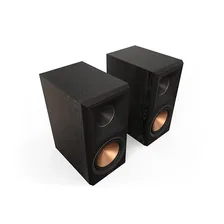 Ranked #74 of 130 in Large Size Bookshelf Speakers - Klipsch RP-600M II: $449.99 per pair Amazon eBay
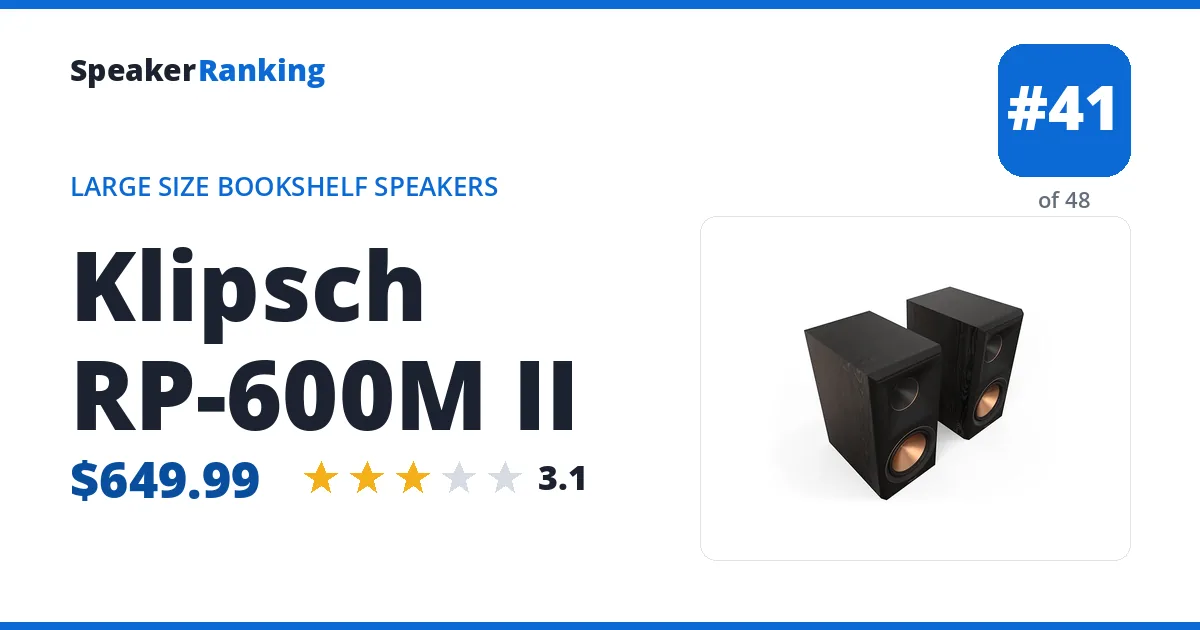
Pros: Redesigned waveguide extends flush to the baffle edge, reducing diffraction compared to the original RP-600M. Roughly 10-20° wider horizontal radiation than the original, giving more soundstage envelopment while retaining precise imaging. A major step up in overall tonal neutrality compared to the original RP-600M, largely eliminating that model’s midrange resonance issues. Unusually, sounds better with the grille on - the grille smooths out the elevated treble rather than degrading the sound, a rare trait among speakers the reviewer has tested. More refined back-panel hardware, including anodized binding posts and jumper cables for optional bi-amping. Responds well to EQ correction (verified using measurement software and a miniDSP), letting the on-axis response be made genuinely linear. Measured bass extension of 70Hz (-3dB), with a measured sensitivity of 86dB.
Cons: On-axis, the treble runs notably hot - even hotter than the original RP-600M in some respects - and needs about 20° of toe-out or the grille installed to sound balanced. Horizontal dispersion is very slightly less linear across angles than the original RP-600M, a minor trade-off for the wider overall radiation pattern. Klipsch’s marketed sensitivity (about 94.5dB) is, like the original, a half-space rating roughly 9dB above the anechoic reality (closer to 85-86dB). In-room bass rolls off around 60Hz in practice, and a 120Hz boost paired with a midrange scoop gives kick drums their “tambour” without real low-end weight - a subwoofer is still recommended. Vertical listening tolerance is limited to about ±10° from the tweeter axis. Toeing the speaker out for better on-axis tonality (rather than using the grille) introduces slightly more diffuse imaging from added sidewall reflections.
Full Klipsch RP-600M II review and specifications →
| Bass Extension (-10dB) | 41Hz (measured, Erin's Audio Corner) |
|---|---|
| Bass Extension (-3dB) | 70Hz (measured, Erin's Audio Corner) |
| DIY Kit | No |
| Dimensions | 15.7"H x 8"W x 12.5"D (398.8 x 203.2 x 317.5 mm) |
| Drivers | 6.5" Cerametallic cone woofer, 1" titanium LTS vented tweeter with Tractrix horn |
| Impedance | 8 ohms nominal (3.5 ohms minimum above 80Hz, measured by Erin's Audio Corner) |
| Sensitivity | 86dB (measured, Erin's Audio Corner) |
| Spinorama Preference Score | 5.64 |
| Spinorama Preference Score with Perfect Sub | 7.77 |
| Weight | 13 lbs (5.9 kg) each |
| Woofer Cabinet | ported |
- Links
- Reviews, Comparisons and Sound Samples
- Erin’s Audio Corner: The Truth about Klipsch’s “NEW” Sound. RP-600M Update. More from Erin’s Audio Corner →
- Erin’s Audio Corner Website Klipsch RP-600M II
- GR-Research: We Bought The "NEW" RP-600M II Is KLIPSCH Listening?! More from GR-Research →
- Erin’s Audio Corner: 5 AWESOME SPEAKERS Under $1000 You Won’t Regret
- Erin’s Audio Corner Measurements (spinorama.org)
- Head-to-Head Comparisons
- Klipsch RP-600M II vs Dynaudio Emit 20
- Klipsch RP-600M II vs Aoshida Audio Musician Knight I V2
- Klipsch RP-600M II vs Philharmonic BMR Monitor
- Klipsch RP-600M II vs JBL 708i
- Klipsch RP-600M II vs JBL Studio 630
- Klipsch RP-600M II vs PS Audio Aspen FR5
- Klipsch RP-600M II vs Behringer B2030P
- Klipsch RP-600M II vs Theory Audio sb25
- See all 117 comparisons
Large Size Floorstanding Speakers
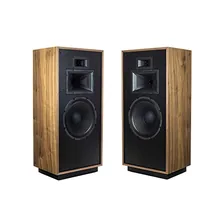 Ranked #41 of 71 in Large Size Floorstanding Speakers - Klipsch Forte IV: $5,499.98 per pair Amazon Crutchfield eBay
Pros: Three-way heritage design: a 1” titanium tweeter and 1.75” compression driver for the midrange mated to a 12” woofer, plus a 15” passive radiator for extra bass reinforcement. Genuinely resonance-free cabinet, a clear improvement over the notably boomy, resonant Heresy 4 in the same lineup. Surprisingly wide, expansive soundstage that beat both the Heresy 4 and a KEF LS50 Wireless 2 in direct comparison - images occasionally appeared several feet outside the physical speaker location. Deeper bass extension than the Heresy 4 (F3 of 82Hz, about 10Hz lower). Distortion measures well below 1% at 86dB and stays mostly within 1% even at 96dB. Comes as a factory-matched serial-numbered pair, backed by an unusually generous 10-year warranty. Mostly above 4 ohms impedance, so it’s compatible with AVRs, solid-state, or tube amplifiers. More neutral overall than other Klipsch models the reviewer has tested, making it a reasonable pick for listeners who already like the “Klipsch sound” but want something more balanced. Measured bass extension of 82Hz (-3dB), with a measured sensitivity of 93.8dB.
Cons: Contrary to the classic Klipsch reputation for being forward and bright, this model is actually somewhat recessed in the 1.5-4kHz “presence” region, which can make some tracks sound dull or lacking in detail. A peak around 6kHz reads as sibilant and “painful” when seated exactly on the tweeter axis; sitting a bit above that axis reduces it somewhat. Klipsch’s marketed 99dB sensitivity figure is an in-room rating that assumes 3-6dB of boundary gain - anechoic sensitivity measures closer to 94dB, which the manufacturer does disclose but can still mislead buyers comparing spec sheets. Radiation width isn’t consistent across all frequencies - a noticeable notch around 2-3kHz interrupts otherwise wide dispersion, which can cause a fundamental tone and its harmonics to image in slightly different places in the soundstage. Uses shallow low-pass crossover slopes (despite Klipsch’s steep-crossover marketing, which applies only to the high-pass side), likely contributing to some of the measured dips and possible cone-breakup artifacts. Some compression shows up around the midrange crossover point at very high output (102dB), though likely only audible at extreme volumes. At around $5500/pair, a significant investment, and still needs a subwoofer for material extending below about 50Hz.
Full Klipsch Forte IV review and specifications →
| Bass Extension (-10dB) | 39Hz (measured, Erin's Audio Corner) |
|---|---|
| Bass Extension (-3dB) | 82Hz (measured, Erin's Audio Corner) |
| DIY Kit | No |
| Dimensions | 36"H x 16.5"W x 13"D (914.4 x 419.1 x 330.2 mm) |
| Drivers | 1x 12" (305mm) fiber-composite woofer + 15" passive radiator, 1x 1.75" compression driver midrange on horn, 1x 1" titanium compression tweeter on horn |
| Impedance | 8 ohms |
| Sensitivity | 93.8dB (measured average, Erin's Audio Corner; manufacturer rates 99dB in-room / ~94dB anechoic) |
| Spinorama Preference Score | 3.78 |
| Spinorama Preference Score with Perfect Sub | 5.72 |
| Weight | 117.3 lbs (53.2 kg) |
| Woofer Cabinet | passive radiator |
- Links
- Reviews, Comparisons and Sound Samples
- Head-to-Head Comparisons
- Klipsch Forte IV vs Infinity Primus 360
- Klipsch Forte IV vs Polk Audio XT70
- Klipsch Forte IV vs Definitive Technology BP-9020
- Klipsch Forte IV vs Polk Audio XT60
- Klipsch Forte IV vs Klipsch Heresy IV
- Klipsch Forte IV vs KEF Q11 Meta
- Klipsch Forte IV vs Polk Reserve R500
- Klipsch Forte IV vs ELAC Debut 3.0 DF63
- See all 47 comparisons
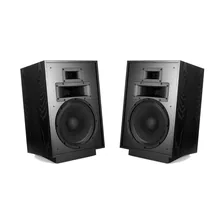 Ranked #44 of 71 in Large Size Floorstanding Speakers - Klipsch Heresy IV: $3,198 per pair Amazon Crutchfield eBay
Pros: Very high 94.5dB/2.83V/1m sensitivity in Erin’s anechoic measurement (well below Klipsch’s 99dB in-room claim, but still excellent) and strong short-term output from a 12-inch woofer plus horn-loaded midrange and tweeter. The compact, furniture-grade Heritage cabinet is easier to place than most high-efficiency designs, and dynamics at moderate levels can sound lively. A stable four-ohm-capable amplifier can produce substantial SPL with relatively little voltage. Measured bass extension of 77Hz (-3dB), with a measured sensitivity of 94.5dB.
Cons: Erin measured a 77Hz F3 and response rolling away near 100Hz in-room, so a subwoofer is required for modern full-range reproduction. The impedance dips to about 4 ohms, reducing the practical amplifier advantage implied by its sensitivity. Pronounced directivity mismatch at the driver transitions, impedance/response resonances and elevated distortion spikes around the crossover remain audible concerns that EQ cannot fully solve. At 102dB Erin measured roughly 1.5dB midband compression; at 96dB distortion rises around crossover. Performance is difficult to justify at the price, and Erin explicitly did not recommend it.
Full Klipsch Heresy IV review and specifications →
| Bass Extension (-10dB) | 50.0Hz (measured, Erin's Audio Corner) |
|---|---|
| Bass Extension (-3dB) | 77Hz (measured, Erin's Audio Corner) |
| DIY Kit | No |
| Dimensions | 24.8"H x 15.6"W x 13.3"D |
| Drivers | 1" horn-loaded tweeter; 1.75" horn-loaded midrange; 12" woofer |
| Impedance | Approximately 4 ohms minimum (measured, Erin's Audio Corner) |
| Sensitivity | 94.5dB/2.83V/1m (measured, Erin's Audio Corner) |
| Spinorama Preference Score | 2.27 |
| Spinorama Preference Score with Perfect Sub | 5.02 |
| Weight | 45 lbs (20.4 kg) each |
| Woofer Cabinet | ported, rear |
- Links
- Reviews, Comparisons and Sound Samples
- Head-to-Head Comparisons
- Klipsch Heresy IV vs Polk Audio XT60
- Klipsch Heresy IV vs KEF Q11 Meta
- Klipsch Heresy IV vs Klipsch Forte IV
- Klipsch Heresy IV vs Infinity Primus 360
- Klipsch Heresy IV vs Klipsch RP-5000F II
- Klipsch Heresy IV vs SVS Ultra Evolution Pinnacle
- Klipsch Heresy IV vs Definitive Technology BP-9020
- Klipsch Heresy IV vs Polk Reserve R500
- See all 42 comparisons
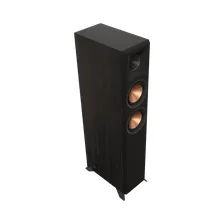 Ranked #48 of 71 in Large Size Floorstanding Speakers - Klipsch RP-5000F II: $1199.98 per pair Amazon eBay
Pros: The most tonally coherent of the RP II floorstander line, with a mild baffle-step dip and treble tilt but no additional coloration issues beyond that. Precise imaging thanks to the controlled horn/waveguide directivity. Measured bass extension of 55Hz (-3dB), with a measured sensitivity of 90dB.
Cons: Bass extension is underwhelming for a floorstander - F3 at 55Hz, F10 at 41Hz - and needs a subwoofer. Narrow horizontal dispersion (~50-60 degrees) trades soundstage width for imaging precision. A mild high-frequency tilt and a slight lack of detail around 1-1.5kHz.
Full Klipsch RP-5000F II review and specifications →
| Bass Extension (-10dB) | 41Hz (measured, Erin's Audio Corner) |
|---|---|
| Bass Extension (-3dB) | 55Hz (measured, Erin's Audio Corner) |
| Crossover Frequency | 1900Hz |
| DIY Kit | No |
| Dimensions | 36.1" x 8.1" x 14.8" (917 x 207 x 375 mm) |
| Drivers | 1" titanium tweeter with Tractrix horn, dual 5.25" cerametallic woofers |
| Frequency Response | 40Hz - 25kHz (+-3dB, Manufacturer specified) |
| Impedance | 8 ohms nominal, 3.3 ohms minimum (measured above 80Hz, Erin's Audio Corner) |
| Power Handling | 100W continuous, 400W peak |
| Sensitivity | 90dB (2.83V/1m, measured by Erin's Audio Corner) |
| Spinorama Preference Score | 5.24 |
| Spinorama Preference Score with Perfect Sub | 7.25 |
| Weight | 38.6 lbs (17.5 kg) |
| Woofer Cabinet | ported, rear |
- Links
- Reviews, Comparisons and Sound Samples
- Head-to-Head Comparisons
- Klipsch RP-5000F II vs SVS Ultra Evolution Pinnacle
- Klipsch RP-5000F II vs KEF Q11 Meta
- Klipsch RP-5000F II vs Monolith THX-365T
- Klipsch RP-5000F II vs Klipsch RP-8000F II
- Klipsch RP-5000F II vs Klipsch Heresy IV
- Klipsch RP-5000F II vs Dynaudio Emit 30
- Klipsch RP-5000F II vs Polk Audio XT60
- Klipsch RP-5000F II vs Klipsch RP-6000F II
- See all 45 comparisons
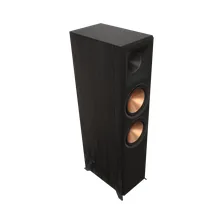 Ranked #52 of 71 in Large Size Floorstanding Speakers - Klipsch RP-8000F II: $1,159.98 per pair Amazon eBay
Pros: Highest sensitivity of the RP II floorstander line (~92dB measured) and the best dynamics/compression behavior of the three under load - the cleanest at high output. Dual 8-inch woofers and the highest power handling in the line. Measured bass extension of 67Hz (-3dB), with a measured sensitivity of 92dB.
Cons: Mid-bass sounds lean despite the dual 8-inch woofers, and bass extension disappointed for its size - expected to reach 50Hz, didn’t get there in-room. Has its own edgy upper-mid bump (2-6kHz) that’s harder to EQ out than the other two models’ issues, since it stems from the vertical horn/woofer offset rather than simple tonal balance. The most placement-critical of the three, with the narrowest horizontal (~40-50 degrees) and vertical (+5/-10 degrees) dispersion.
Full Klipsch RP-8000F II review and specifications →
| Bass Extension (-10dB) | 33Hz (measured, Erin's Audio Corner) |
|---|---|
| Bass Extension (-3dB) | 67Hz (measured, Erin's Audio Corner) |
| Crossover Frequency | 1630Hz |
| DIY Kit | No |
| Dimensions | 43.1" x 10.8" x 18.3" (1095 x 275 x 464 mm) |
| Drivers | 1" titanium tweeter with 90x90 Tractrix horn, dual 8" cerametallic woofers |
| Frequency Response | 35Hz - 25kHz (+-3dB, Manufacturer specified) |
| Impedance | 8 ohms nominal (3.7 ohms minimum above 80Hz, measured by Erin's Audio Corner) |
| Power Handling | 150W continuous, 600W peak |
| Sensitivity | 92dB (2.83V/1m, measured by Erin's Audio Corner) |
| Spinorama Preference Score | 5.39 |
| Spinorama Preference Score with Perfect Sub | 7.12 |
| Weight | 61.3 lbs (27.8 kg) |
| Woofer Cabinet | ported, rear |
- Links
- Reviews, Comparisons and Sound Samples
- Head-to-Head Comparisons
- Klipsch RP-8000F II vs Dynaudio Emit 30
- Klipsch RP-8000F II vs Klipsch RP-6000F II
- Klipsch RP-8000F II vs SVS Ultra Evolution Pinnacle
- Klipsch RP-8000F II vs Polk T50
- Klipsch RP-8000F II vs Klipsch RP-5000F II
- Klipsch RP-8000F II vs KLH Model Five
- Klipsch RP-8000F II vs KEF Q11 Meta
- Klipsch RP-8000F II vs Focal Aria Evo X N°2
- See all 45 comparisons
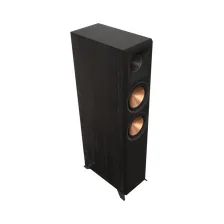 Ranked #54 of 71 in Large Size Floorstanding Speakers - Klipsch RP-6000F II: $1500 per pair Amazon eBay
Pros: Highest power handling and clean, well-behaved compression at typical volumes. Precise imaging from the controlled horn directivity. Measured bass extension of 67Hz (-3dB), with a measured sensitivity of 90dB.
Cons: Worse baffle-step coloration than the smaller RP-5000F II (3-4dB swing vs 2dB), plus a sibilance issue the 5000F doesn’t have - a real regression in tonal balance despite the higher price. Bass extension is mixed - less deep at -3dB (67Hz) than the 5000F - and needs a subwoofer regardless. Narrow horizontal dispersion (~50-60 degrees).
Full Klipsch RP-6000F II review and specifications →
| Bass Extension (-10dB) | 33Hz (measured, Erin's Audio Corner) |
|---|---|
| Bass Extension (-3dB) | 67Hz (measured, Erin's Audio Corner) |
| Crossover Frequency | 1770Hz |
| DIY Kit | No |
| Dimensions | 39.6" x 9.3" x 17.6" (1006 x 236 x 446 mm) |
| Drivers | 1" titanium tweeter with Tractrix horn, dual 6.5" cerametallic woofers |
| Frequency Response | 38Hz - 25kHz (+-3dB, Manufacturer specified) |
| Impedance | 8 ohms nominal (3.7 ohms minimum, measured, Erin's Audio Corner) |
| Power Handling | 125W continuous, 500W peak |
| Sensitivity | 90dB (2.83V/1m, measured by Erin's Audio Corner) |
| Spinorama Preference Score | 5.74 |
| Spinorama Preference Score with Perfect Sub | 7.47 |
| Weight | 49.4 lbs (22.4 kg) |
| Woofer Cabinet | ported, rear |
- Links
- Reviews, Comparisons and Sound Samples
- Head-to-Head Comparisons
- Klipsch RP-6000F II vs Dynaudio Emit 30
- Klipsch RP-6000F II vs Polk T50
- Klipsch RP-6000F II vs Klipsch RP-8000F II
- Klipsch RP-6000F II vs Focal Aria Evo X N°2
- Klipsch RP-6000F II vs Sony SS-CS3
- Klipsch RP-6000F II vs SVS Ultra Evolution Pinnacle
- Klipsch RP-6000F II vs Klipsch RP-5000F II
- Klipsch RP-6000F II vs Infinity Reference 253
- See all 42 comparisons
Small Home Subwoofers (Under 30 lbs)
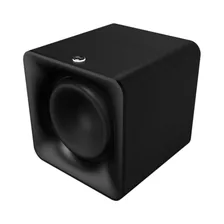 Ranked #16 of 48 in Small Home Subwoofers (Under 30 lbs) - Klipsch Flexus Sub 100: $349.99 Amazon eBay
Pros: Independent CEA-2010 testing records 90.2 dB at 20 Hz and 109.1 dB (avg of 3/4 bands) through 40-80 Hz. The sealed enclosure with a 10” driver suits a small room.
Cons: Only works with Klipsch Flexus soundbars, not as a standalone LFE sub. The 339.9H x 335.0W x 349.2D mm cabinet and 9.4 kg mass still need deliberate placement.
Full Klipsch Flexus Sub 100 review and specifications →
| CEA-2010-A Average (40-80Hz) | 109.1 dB (avg of 3/4 bands) |
|---|---|
| Dimensions | 13.4"H x 13.2"W x 13.7"D (339.9 x 335.0 x 349.2 mm) |
| Drivers | 10" (254mm) driver |
| Enclosure | sealed |
| Measurement Source | Brent Butterworth |
| Output SPL at 20 Hz | 90.2 dB |
| Output SPL at 25 Hz | 96.7 dB |
| Output SPL at 31.5 Hz | 101.2 dB |
| Output SPL at 40 Hz | 105.9 dB |
| Output SPL at 50 Hz | 109.0 dB |
| Output SPL at 63 Hz | 112.4 dB |
| Warranty | 2/5 |
| Weight | 20.7 lbs (9.4 kg) |
- Reviews, Comparisons and Sound Samples
- Independently measured by Brent Butterworth; the published figures above come from this ASR subwoofer measurement thread.
- Head-to-Head Comparisons
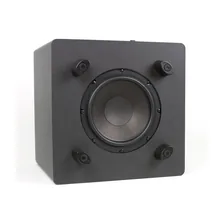 Ranked #25 of 48 in Small Home Subwoofers (Under 30 lbs) - Klipsch HD Theater 600: $399 eBay
Pros: Independent CEA-2010 testing records 108.2 dB (avg of 3/4 bands) through 40-80 Hz. The ported, rear enclosure with 8” (203mm) driver is a compact way to add useful midbass support to a modest system.
Cons: Without a published 20 Hz result, deep-bass capability is less certain than the midbass figure. The 353.1H x 317.5W x 317.5D mm cabinet and 7.7 kg mass still need careful placement and calibration.
Full Klipsch HD Theater 600 review and specifications →
| CEA-2010-A Average (40-80Hz) | 108.2 dB (avg of 3/4 bands) |
|---|---|
| Country | United States |
| Dimensions | 13.9"H x 12.5"W x 12.5"D (353.1 x 317.5 x 317.5 mm) |
| Drivers | 8" (203mm) driver |
| Enclosure | ported, rear |
| Measurement Source | Brent Butterworth |
| Output SPL at 25 Hz | 87.1 dB |
| Output SPL at 31.5 Hz | 98.4 dB |
| Output SPL at 40 Hz | 104.9 dB |
| Output SPL at 50 Hz | 107.6 dB |
| Output SPL at 63 Hz | 112.1 dB |
| Weight | 17 lbs (7.7 kg) |
- Links
- Reviews, Comparisons and Sound Samples
- Independently measured by Brent Butterworth; the published figures above come from this ASR subwoofer measurement thread.
- Head-to-Head Comparisons
- Klipsch HD Theater 600 vs ELAC SUB1010
- Klipsch HD Theater 600 vs ELAC IW-S10EQ in-wall
- Klipsch HD Theater 600 vs MartinLogan Dynamo 700w
- Klipsch HD Theater 600 vs Polk Audio PSW10
- Klipsch HD Theater 600 vs Monoprice Premium Select 8in 200-Watt
- Klipsch HD Theater 600 vs SVS 3000 Micro
- Klipsch HD Theater 600 vs Definitive Technology SuperCube 2000
- Klipsch HD Theater 600 vs SVS SB-1000 PRO
- See all 10 comparisons
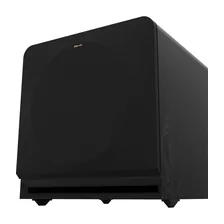 Ranked #32 of 48 in Small Home Subwoofers (Under 30 lbs) - Klipsch R-10SW: $399 eBay
Pros: Independent CEA-2010 testing records 106.8 dB through 40-80 Hz. The ported, rear enclosure with 10” (254mm) driver is a compact way to add useful midbass support to a modest system.
Cons: Without a published 20 Hz result, deep-bass capability is less certain than the midbass figure. The 355.6H x 317.5W x 398.8D mm cabinet and 11.6 kg mass still need careful placement and calibration.
Full Klipsch R-10SW review and specifications →
| CEA-2010-A Average (40-80Hz) | 106.8 dB |
|---|---|
| Cabinet Color | black |
| Country | United States |
| Dimensions | 14"H x 12.5"W x 15.7"D (355.6 x 317.5 x 398.8 mm) |
| Drivers | 10" (254mm) driver |
| Enclosure | ported, rear |
| Measurement Source | ErinsAudioCorner |
| Output SPL at 40 Hz | 103.0 dB |
| Output SPL at 50 Hz | 106.5 dB |
| Output SPL at 63 Hz | 109.0 dB |
| Output SPL at 80 Hz | 108.8 dB |
| Output SPL at 100 Hz | 107.0 dB |
| Output SPL at 125 Hz | 104.1 dB |
| Warranty | 5/2 |
| Weight | 25.6 lbs (11.6 kg) |
- Links
- Reviews, Comparisons and Sound Samples
- Independently measured by ErinsAudioCorner; the published figures above come from this ASR subwoofer measurement thread.
- Head-to-Head Comparisons
Medium Home Subwoofers (30-75 lbs)
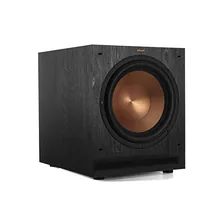 Ranked #18 of 145 in Medium Home Subwoofers (30-75 lbs) - Klipsch SPL-120: $429.99 Amazon eBay
Pros: 12-inch ported with 300W delivers room-filling bass hitting nearly 118dB max SPL. Clean accurate response across whole bass register with tight controlled response at high volumes. Wireless connectivity with optional WA-2 accessory.
Full Klipsch SPL-120 review and specifications →
| Amplifier Power | 300W RMS |
|---|---|
| CEA-2010-A Average (40-80Hz) | 119.7 dB |
| Cabinet Color | black |
| Country | United States |
| Dimensions | 17.7"H x 14.7"W x 19.9"D (450.8 x 372.9 x 504.7 mm) |
| Drivers | 12" (305mm) driver |
| Enclosure | ported, front |
| Frequency Response | 24-125Hz |
| Measurement Source | Brent Butterworth |
| Output SPL at 16 Hz | 87.2 dB |
| Output SPL at 20 Hz | 97.9 dB |
| Output SPL at 25 Hz | 108.2 dB |
| Output SPL at 31.5 Hz | 113.5 dB |
| Output SPL at 40 Hz | 116.8 dB |
| Output SPL at 50 Hz | 119.8 dB |
| Output SPL at 63 Hz | 120.9 dB |
| Output SPL at 80 Hz | 121.2 dB |
| Warranty | 5/2 |
| Weight | 45 lbs (20.4 kg) |
- Links
- Reviews, Comparisons and Sound Samples
- Independently measured by Brent Butterworth; the published figures above come from this ASR subwoofer measurement thread.
- Head-to-Head Comparisons
- Klipsch SPL-120 vs Rythmik F12
- Klipsch SPL-120 vs SVS SB-3000
- Klipsch SPL-120 vs Monoprice SW-15
- Klipsch SPL-120 vs Monoprice SW-12
- Klipsch SPL-120 vs HSU Research ULS-15 MK2
- Klipsch SPL-120 vs SVS SB-2000
- Klipsch SPL-120 vs MartinLogan Dynamo 1600X
- Klipsch SPL-120 vs SVS PB-1000 PRO
- See all 12 comparisons
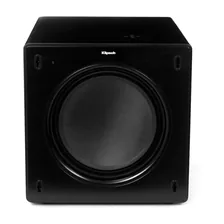 Ranked #80 of 145 in Medium Home Subwoofers (30-75 lbs) - Klipsch SW-311: $399 eBay
Pros: 10-inch with dual passive radiators and 500W delivers surprising output for compact 13-inch cube. Patented ARC II auto room correction with 12 active filters. Tight clean powerful bass with no distortion at limits.
Full Klipsch SW-311 review and specifications →
| Amplifier Power | 500W RMS |
|---|---|
| CEA-2010-A Average (40-80Hz) | 112.4 dB |
| Cabinet Color | black |
| Country | United States |
| Dimensions | 13"H x 13"W x 14"D (330.2 x 330.2 x 355.6 mm) |
| Drivers | 10" (254mm) driver |
| Enclosure | passive radiator |
| Frequency Response | 22-120Hz |
| Measurement Source | Audioholics |
| Output SPL at 20 Hz | 87.2 dB |
| Output SPL at 25 Hz | 100.9 dB |
| Output SPL at 31.5 Hz | 105.6 dB |
| Output SPL at 40 Hz | 108.3 dB |
| Output SPL at 50 Hz | 111.6 dB |
| Output SPL at 63 Hz | 114.4 dB |
| Output SPL at 80 Hz | 115.2 dB |
| Output SPL at 100 Hz | 114.5 dB |
| Output SPL at 125 Hz | 113.6 dB |
| Warranty | 5/2 |
| Weight | 37 lbs (16.8 kg) |
- Links
- Reviews, Comparisons and Sound Samples
- Independently measured by Audioholics; the published figures above come from this ASR subwoofer measurement thread.
- Head-to-Head Comparisons
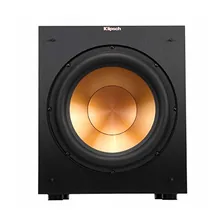 Ranked #95 of 145 in Medium Home Subwoofers (30-75 lbs) - Klipsch R-121SW: $249.00 Amazon eBay
Pros: 12-inch spun-copper driver with 200W RMS delivers controlled, musical bass with minimal distortion. Front-firing design maximizes placement flexibility. Excellent value with exceptional bang-for-buck.
Full Klipsch R-121SW review and specifications →
| Amplifier Power | 200W RMS |
|---|---|
| CEA-2010-A Average (40-80Hz) | 111.2 dB |
| Cabinet Color | black |
| Country | United States |
| Dimensions | 16.6"H x 16"W x 19.7"D (421.6 x 406.4 x 500.4 mm) |
| Drivers | 12" (305mm) driver |
| Enclosure | ported, rear |
| Frequency Response | 28-120Hz |
| Measurement Source | Audioholics |
| Output SPL at 15 Hz | 90.7 dB |
| Output SPL at 20 Hz | 96.0 dB |
| Output SPL at 25 Hz | 98.4 dB |
| Output SPL at 31.5 Hz | 102.3 dB |
| Output SPL at 40 Hz | 108.2 dB |
| Output SPL at 50 Hz | 112.4 dB |
| Output SPL at 63 Hz | 112.9 dB |
| Output SPL at 80 Hz | 111.3 dB |
| Output SPL at 100 Hz | 109.9 dB |
| Output SPL at 125 Hz | 108.3 dB |
| Warranty | 5/2 |
| Weight | 35.1 lbs (15.9 kg) |
- Links
- Reviews, Comparisons and Sound Samples
- Independently measured by Audioholics; the published figures above come from this ASR subwoofer measurement thread.
- Head-to-Head Comparisons
- Klipsch R-121SW vs RSL (Rogersound Labs) Speedwoofer 10S MKII
- Klipsch R-121SW vs Monoprice Monolith M-10 V2
- Klipsch R-121SW vs Monoprice SSW-10
- Klipsch R-121SW vs Kef KC62
- Klipsch R-121SW vs SVS PB-1000 PRO
- Klipsch R-121SW vs SVS SB-2000
- Klipsch R-121SW vs JBL HDI-1200P
- Klipsch R-121SW vs Power Sound Audio (PSA) XS15SE
- See all 18 comparisons
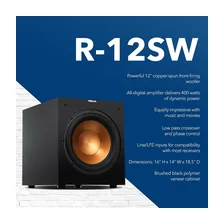 Ranked #120 of 145 in Medium Home Subwoofers (30-75 lbs) - Klipsch R-12SW: $299 eBay
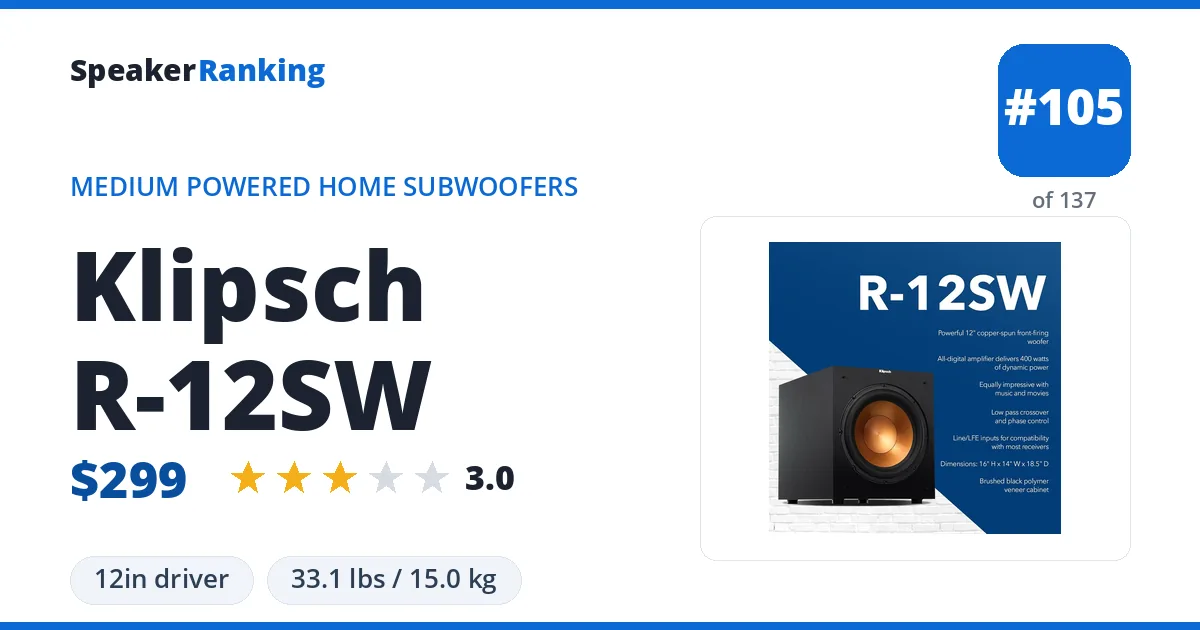
Pros: 12-inch copper-spun IMG driver provides low frequency with minimal breakup/distortion. 400W digital amplifier (200W RMS) with 29-120Hz frequency response. Unique copper diaphragm ensures durability while producing deep bass without distortion. Clean detailed bass at this price range stands out. Elegant cube design (14x18.5x16 inches, 30 lbs) with straightforward setup and easy connectivity via RCA inputs.
Full Klipsch R-12SW review and specifications →
| Amplifier Power | 200W RMS |
|---|---|
| CEA-2010-A Average (40-80Hz) | 108.5 dB |
| Cabinet Color | black |
| Country | United States |
| Dimensions | 16"H x 14"W x 18.5"D (406.4 x 355.6 x 469.9 mm) |
| Drivers | 12" (305mm) driver |
| Enclosure | ported, rear |
| Frequency Response | 29-120Hz |
| Measurement Source | ErinsAudioCorner |
| Output SPL at 15 Hz | 68.5 dB |
| Output SPL at 20 Hz | 86.9 dB |
| Output SPL at 25 Hz | 97.1 dB |
| Output SPL at 31.5 Hz | 100.0 dB |
| Output SPL at 40 Hz | 104.7 dB |
| Output SPL at 50 Hz | 109.0 dB |
| Output SPL at 63 Hz | 111.2 dB |
| Output SPL at 80 Hz | 109.3 dB |
| Output SPL at 100 Hz | 107.6 dB |
| Output SPL at 125 Hz | 105.8 dB |
| Warranty | 5/2 |
| Weight | 33.1 lbs (15.0 kg) |
- Links
- Reviews, Comparisons and Sound Samples
- Independently measured by ErinsAudioCorner; the published figures above come from this ASR subwoofer measurement thread.
- Head-to-Head Comparisons
Large Home Subwoofers (Over 75 lbs)
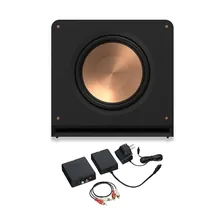 Ranked #60 of 110 in Large Home Subwoofers (Over 75 lbs) - Klipsch RP-1600SW: $1,599.99 Amazon eBay
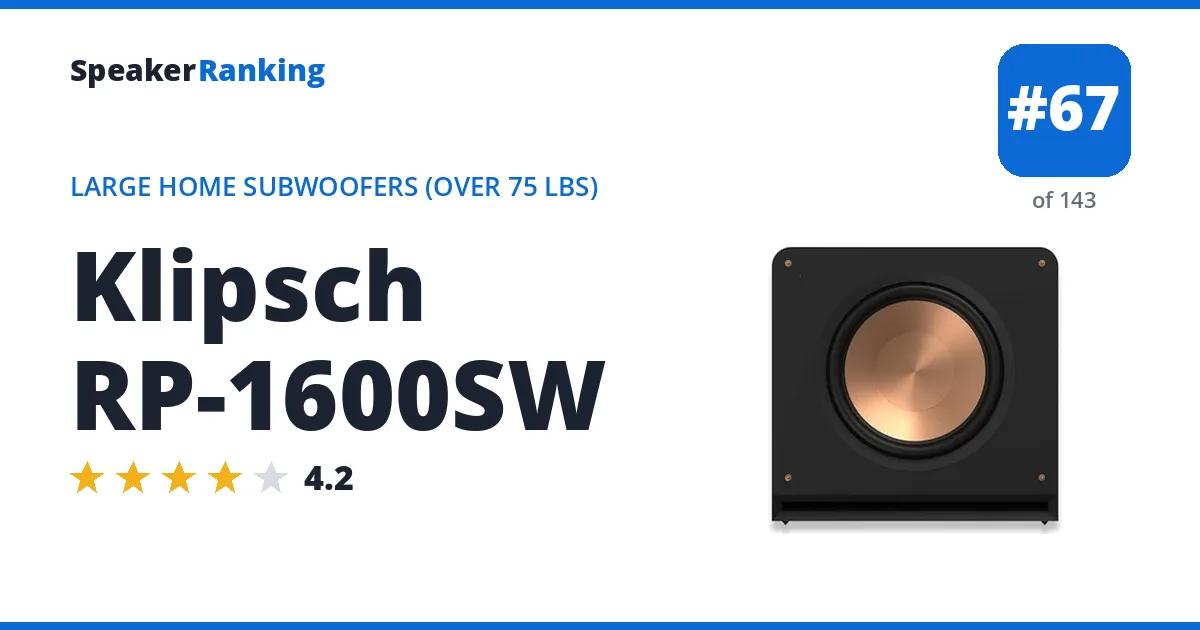
Pros: Independent CEA-2010 testing records 112.5 dB at 20 Hz and 120.4 dB through 40-80 Hz. The ported, front enclosure with 16” (406mm) driver has the headroom for demanding film bass in a large room.
Cons: The 594.1H x 596.9W x 694.7D mm cabinet and 50.3 kg mass make this a serious placement and moving commitment. Ported output does not solve room modes, so careful placement and calibration remain essential.
Full Klipsch RP-1600SW review and specifications →
| CEA-2010-A Average (40-80Hz) | 120.4 dB |
|---|---|
| Cabinet Color | black |
| Country | United States |
| Dimensions | 23.4"H x 23.5"W x 27.4"D (594.1 x 596.9 x 694.7 mm) |
| Drivers | 16" (406mm) driver |
| Enclosure | ported, front |
| Measurement Source | Audioholics |
| Output SPL at 10 Hz | 85.2 dB |
| Output SPL at 12.5 Hz | 101.0 dB |
| Output SPL at 15 Hz | 108.5 dB |
| Output SPL at 20 Hz | 112.5 dB |
| Output SPL at 25 Hz | 116.3 dB |
| Output SPL at 31.5 Hz | 120.5 dB |
| Output SPL at 40 Hz | 121.5 dB |
| Output SPL at 50 Hz | 120.6 dB |
| Output SPL at 63 Hz | 120.0 dB |
| Output SPL at 80 Hz | 119.6 dB |
| Output SPL at 100 Hz | 118.8 dB |
| Output SPL at 125 Hz | 118.5 dB |
| Warranty | 5 |
| Weight | 110.9 lbs (50.3 kg) |
- Links
- Reviews, Comparisons and Sound Samples
- Independently measured by Audioholics; the published figures above come from this ASR subwoofer measurement thread.
- Head-to-Head Comparisons
 Ranked #65 of 110 in Large Home Subwoofers (Over 75 lbs) - Klipsch R-115SW: $799 eBay
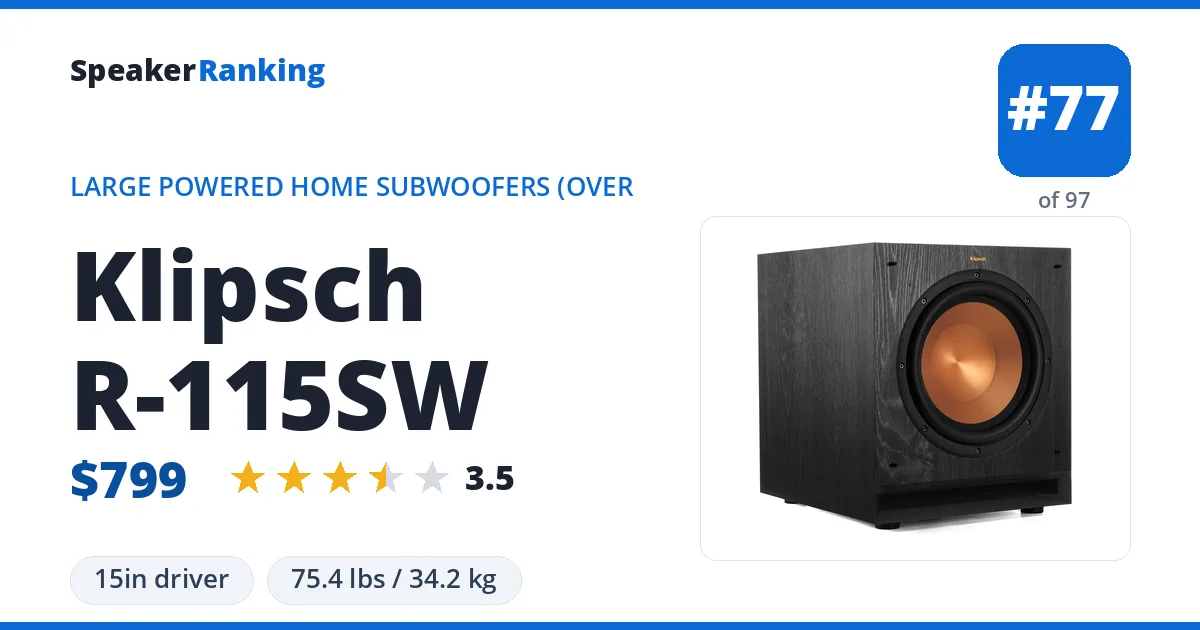
Pros: Independent CEA-2010 testing records 108.7 dB at 20 Hz and 123.1 dB (avg of 3/4 bands) through 40-80 Hz. The ported, front enclosure with 15” (381mm) driver delivers substantial upper-bass output for movie effects and music.
Cons: Deep-bass output is more limited than the strong 40-80 Hz result suggests, so it is not the right choice when the lowest movie effects are the priority. The 546.1H x 495.3W x 566.4D mm cabinet and 34.2 kg mass still require deliberate placement and calibration.
Full Klipsch R-115SW review and specifications →
| CEA-2010-A Average (40-80Hz) | 123.1 dB (avg of 3/4 bands) |
|---|---|
| Cabinet Color | black |
| Country | United States |
| Dimensions | 21.5"H x 19.5"W x 22.3"D (546.1 x 495.3 x 566.4 mm) |
| Drivers | 15" (381mm) driver |
| Enclosure | ported, front |
| Measurement Source | Brent Butterworth |
| Output SPL at 20 Hz | 108.7 dB |
| Output SPL at 25 Hz | 113.8 dB |
| Output SPL at 31.5 Hz | 118.6 dB |
| Output SPL at 40 Hz | 121.4 dB |
| Output SPL at 50 Hz | 124.7 dB |
| Output SPL at 63 Hz | 123.3 dB |
| Warranty | 5/2 |
| Weight | 75.4 lbs (34.2 kg) |
- Links
- Reviews, Comparisons and Sound Samples
- Independently measured by Brent Butterworth; the published figures above come from this ASR subwoofer measurement thread.
- Head-to-Head Comparisons
Discontinued Klipsch Models
Still ranked, and often still worth buying used, but no longer in production. Check availability before planning around one of these.
Medium Size Powered Desktop Speakers
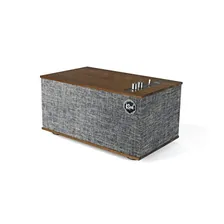 Ranked #16 of 17 in Medium Size Powered Desktop Speakers - Klipsch The Three II: $400 each Discontinued eBay
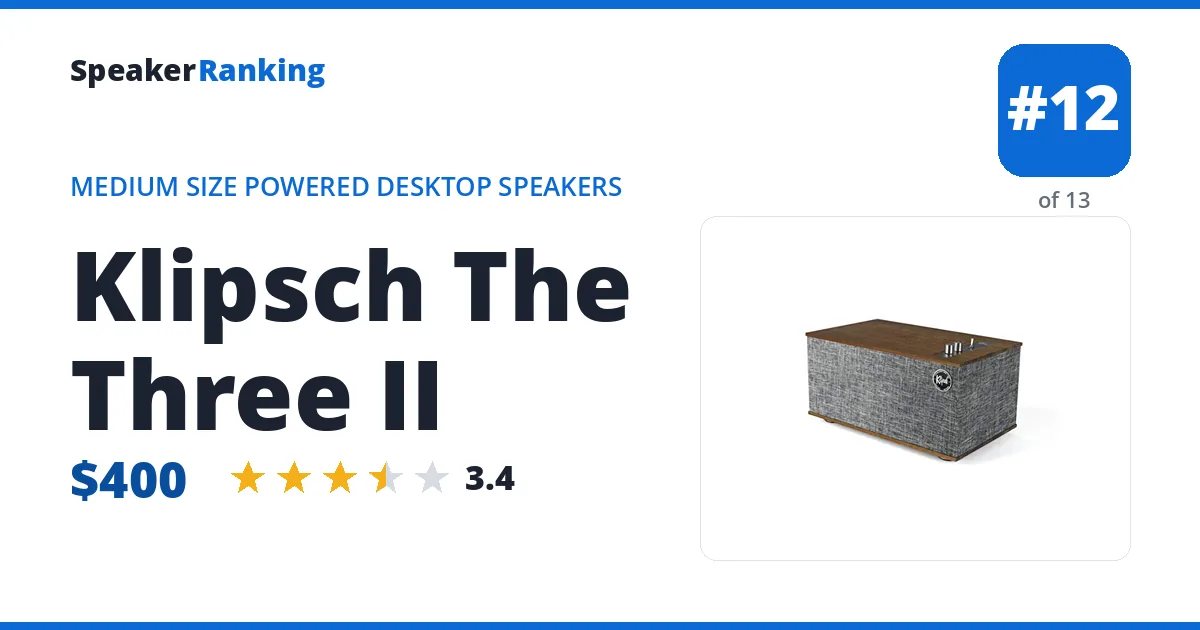
Pros: Klipsch The Three II uses 4.5” woofer, 2x 2.25” full-range midranges. Its 4.7 kg, aux input and limited-stereo playback make it a practical option for its intended room or portable use.
Cons: Its 45Hz - 20kHz (Manufacturer specified) specification points to limited deep-bass reach for the cabinet size. There is no companion app. Discontinued.
Full Klipsch The Three II review and specifications →
| AES Input | No |
|---|---|
| Amplifier Power | 60W (Woofer: 30W, Full-range: 2x15W) |
| App | No |
| Aux Input | Yes |
| Battery Life | No Battery |
| Bluetooth | Yes |
| Bluetooth Codecs | SBC, aptX |
| Bluetooth Version | 4.2 |
| Coaxial Input | No |
| Dimensions | 11" x 7.3" x 7.3" (280 x 186 x 186 mm) |
| Discontinued | Yes |
| Drivers | 4.5" woofer, 2x 2.25" full-range midranges |
| EQ | Yes (Bass/Treble) |
| Frequency Response | 45Hz - 20kHz (Manufacturer specified) |
| HDMI Input | No |
| Inputs | Bluetooth, Aux, RCA, Optical, USB |
| Optical Input | Yes |
| Party Mode | No |
| RCA Input | Yes |
| Stereo | Partially (1 woofer) |
| TRS Input | No |
| TWS | No |
| USB Input | Yes |
| Weight | 10.4 lbs (4.7 kg) |
| Wi-Fi | No |
| Woofer Cabinet | ported |
| XLR Input | No |
- Links
- Reviews, Comparisons and Sound Samples
- Head-to-Head Comparisons
- Klipsch The Three II vs Klipsch The One II
- Klipsch The Three II vs Marshall Acton II
- Klipsch The Three II vs Marshall Stanmore II
- Klipsch The Three II vs Marshall Acton III
- Klipsch The Three II vs JBL Authentics 200
- Klipsch The Three II vs Edifier D12
- Klipsch The Three II vs Marshall Stanmore III
- Klipsch The Three II vs Audio Pro C5 MkII
- See all 9 comparisons
Large Size Bookshelf Speakers
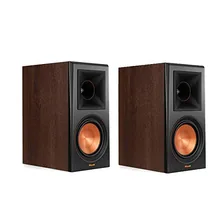 Ranked #107 of 130 in Large Size Bookshelf Speakers - Klipsch RP-600M: $377.99 per pair Discontinued Amazon eBay
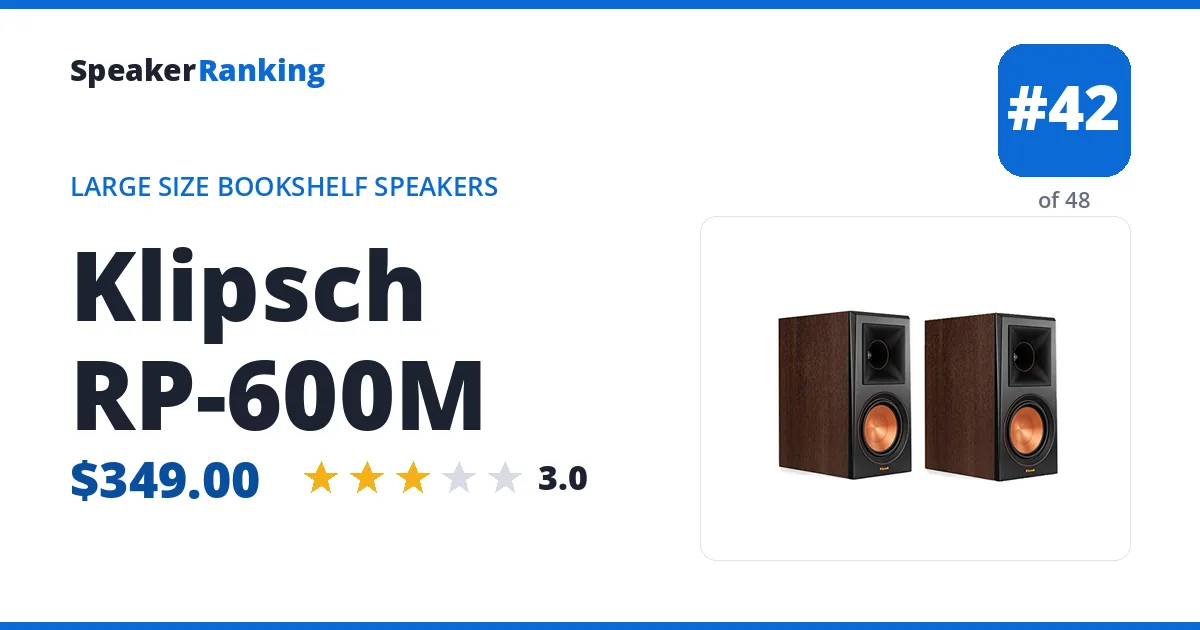
Pros: More linear horizontal dispersion than the updated RP-600M II - as you move side-to-side, the tonal character changes less, a genuine advantage for off-axis listening consistency. Takes exceptionally well to EQ correction (miniDSP or similar), letting a knowledgeable owner fix its tonal shortcomings without needing to upgrade. Standard 6.5” woofer/horn-tweeter two-way design with reasonably gradual bass rolloff (F3 ~70Hz, F10 ~40Hz) rather than a steep vented-enclosure cutoff. Measured bass extension of 73Hz (-3dB), with a measured sensitivity of 85.2dB.
Cons: A strong, annoying resonance in the lower vocal range around 300Hz stands out clearly (though it can be EQ’d out). Overall tonal balance is notably less neutral than the newer RP-600M II, with a roughly 3-4dB suckout in the estimated in-room response. The waveguide doesn’t extend flush to the baffle edge, increasing diffraction compared to the redesigned version. Klipsch’s marketed sensitivity spec (about 96dB) is a half-space, in-room-style rating roughly 9dB above the true anechoic figure (closer to 85-86dB), which can mislead buyers comparing spec sheets. Elevated treble on-axis, similar to its successor, benefits from toe-out or careful placement. Vertical listening tolerance is limited to about ±10° from the tweeter axis. Still needs a subwoofer for real bass weight; a boost around 120Hz gives kick drums their “tambour” without the underlying “meat.”. Discontinued.
Full Klipsch RP-600M review and specifications →
| Bass Extension (-10dB) | 40Hz (measured, Erin's Audio Corner) |
|---|---|
| Bass Extension (-3dB) | 73Hz (measured, Erin's Audio Corner) |
| DIY Kit | No |
| Dimensions | 15.7"H x 8"W x 11.9"D (398.8 x 203.2 x 302.3 mm) |
| Discontinued | Yes |
| Drivers | 6.5" Cerametallic cone woofer, 1" titanium LTS vented tweeter with Tractrix horn |
| Impedance | 8 ohms nominal, 3.5 ohms minimum (measured, Erin's Audio Corner) |
| Sensitivity | 85.2dB (measured, Erin's Audio Corner) |
| Spinorama Preference Score | 3.66 |
| Spinorama Preference Score with Perfect Sub | 5.61 |
| Weight | 16.1 lbs (7.3 kg) each |
| Woofer Cabinet | ported |
- Links
- Reviews, Comparisons and Sound Samples
- Erin’s Audio Corner: The Truth about Klipsch’s “NEW” Sound. RP-600M Update. More from Erin’s Audio Corner →
- Erin’s Audio Corner Website Klipsch RP-600M
- GR-Research: We Bought The "NEW" RP-600M II Is KLIPSCH Listening?! More from GR-Research →
- Audio Science Review Measurements More from Audio Science Review →
- Audio Science Review Measurements (spinorama.org)
- Head-to-Head Comparisons
- Klipsch RP-600M vs Sonus Faber Lumina II Amator
- Klipsch RP-600M vs Wharfedale Diamond 9.1
- Klipsch RP-600M vs Triangle Borea BR03
- Klipsch RP-600M vs KEF Q350
- Klipsch RP-600M vs B&W 805S
- Klipsch RP-600M vs Sonus Faber Sonetto II G2
- Klipsch RP-600M vs Emotiva Airmotiv B2+
- Klipsch RP-600M vs Aperion Audio Verus V8B
- See all 31 comparisons