42 headphones and earbuds in our rankings have a microphone, whether a boom mic on a gaming headset, an inline remote on the cable, or the beamforming mics in wireless models. They’re the picks for calls, video meetings and gaming chat.
The ratings measure how each model sounds for music and games, scored against the Harman target that most listeners prefer, not how good its microphone sounds to the other person. Wireless models, gaming headsets and wired earphones with an inline remote are all included.
This is every match, grouped by type and sorted by measured sound quality.
Prices on this page were last checked October 10, 2026 at 5:37 PM UTC. Product prices and availability are accurate as of that date/time and are subject to change; the price and availability shown on Amazon at the time of purchase will apply to the purchase of this product.
As an eBay Partner, we may be compensated if you make a purchase.
Quick Navigation
| Select to compare | |||||||
|---|---|---|---|---|---|---|---|
| 9 | Beyerdynamic MMX 300 | $325.00 | 91 | Closed | Wired | Over-ear | |
| 11 | Dyson Zone | $349.99 | 90 | Closed | Wireless and wired | Over-ear | |
| 61 | Thinksound ov21 | $97.00 | 78 | Closed | Wired | Over-ear | |
| 66 | Focal Bathys | $799.00 | 76 | Closed | Wireless and wired | Over-ear | |
| 67 | Koss KPH30i | $23.99 | 76 | Open | Wired | Over-ear | |
| 73 | Cooler Master MH752 | $189.00 | 71 | Closed | Wired | Over-ear | |
| 81 | Focal Azurys | $430.00 | 70 | Closed | Wired | Over-ear | |
| 83 | Bose QuietComfort 35 II | $359.99 | 69 | Closed | Wireless and wired | Over-ear | |
| 84 | Fairphone Fairbuds XL | $229.99 | 69 | Closed | Wireless and wired | Over-ear | |
| 86 | Sennheiser Amperior | $299.99 | 69 | Closed | Wired | Over-ear | |
| 87 | Sennheiser ACCENTUM Plus | $129.95 | 68 | Closed | Wireless and wired | Over-ear | |
| 93 | HyperX Cloud Alpha | $44.99 | 66 | Closed | Wired | Over-ear | |
| 104 | Anker Soundcore Space One | $84.99 | 62 | Closed | Wireless and wired | Over-ear | |
| 105 | Bang & Olufsen Beoplay H95 | $1,250.00 | 62 | Closed | Wireless and wired | Over-ear | |
| 110 | Razer BlackShark V2 Pro | $109.99 | 60 | Closed | Wireless | Over-ear | |
| 112 | Bose Noise Cancelling Headphones 700 | $369.00 | 58 | Closed | Wireless and wired | Over-ear | |
| 113 | HyperX Cloud II | $47.48 | 58 | Closed | Wired | Over-ear | |
| 117 | Beats Studio3 Wireless | $286.49 | 53 | Closed | Wireless and wired | Over-ear | |
| 118 | Bowers & Wilkins Px7 S2 | $230.00 | 53 | Closed | Wireless and wired | Over-ear | |
| 119 | Bowers & Wilkins Px7 S2e | $344.83 | 53 | Closed | Wireless and wired | Over-ear | |
| 120 | Logitech G930 | $229.99 | 52 | Closed | Wireless | Over-ear | |
| 121 | Sony WH-1000XM5 | $269.00 | 50 | Closed | Wireless and wired | Over-ear | |
| 123 | Jabra Evolve 40 | $142.73 | 50 | Closed | Wired | Over-ear | |
| 125 | Sennheiser Momentum 4 Wireless | $227.38 | 47 | Closed | Wireless and wired | Over-ear | |
| 127 | Sennheiser HD 450BT | $69.00 | 44 | Closed | Wireless and wired | Over-ear | |
| 128 | Logitech G Pro X | $92.23 | 34 | Closed | Wired | Over-ear | |
| 130 | Sennheiser HD 569 | $129.95 | 28 | Closed | Wired | Over-ear | |
| 132 | Razer Barracuda X | $69.00 | 7 | Closed | Wireless and wired | Over-ear | |
| 134 | Razer BlackShark V2 X | $34.99 | 1 | Closed | Wired | Over-ear | |
| 11 | Sony WF-1000XM5 | $198.00 | 78 | Closed | True wireless | In-ear | |
| 14 | Moondrop Quarks | $17.99 | 76 | Closed | Wired | In-ear | |
| 17 | Beats Powerbeats Pro | $189.99 | 75 | Closed | True wireless | In-ear | |
| 20 | Samsung Galaxy Buds2 | $199.00 | 74 | Closed | True wireless | In-ear | |
| 29 | TANGZU Wan’er S.G | $18.00 | 71 | Closed | Wired | In-ear | |
| 36 | TRN MT1 | $13.95 | 69 | Closed | Wired | In-ear | |
| 44 | Sennheiser Momentum True Wireless 3 | $111.99 | 66 | Closed | True wireless | In-ear | |
| 48 | Sennheiser MOMENTUM True Wireless 4 | $249.95 | 65 | Closed | True wireless | In-ear | |
| 50 | SoundMAGIC E50C | $32.99 | 64 | Closed | Wired | In-ear | |
| 60 | Jabra Elite Active 65t | $156.45 | 58 | Closed | True wireless | In-ear | |
| 63 | 1MORE Triple Driver | $69.99 | 57 | Closed | Wired | In-ear | |
| 66 | 1MORE Quad Driver | $119.69 | 45 | Closed | Wired | In-ear | |
| 67 | Sennheiser Momentum True Wireless 2 | $237.45 | 44 | Closed | True wireless | In-ear |
Over-Ear Headphones
 Ranked #9 of 134 in Over-Ear Headphones - Beyerdynamic MMX 300: $325.00 Amazon eBay
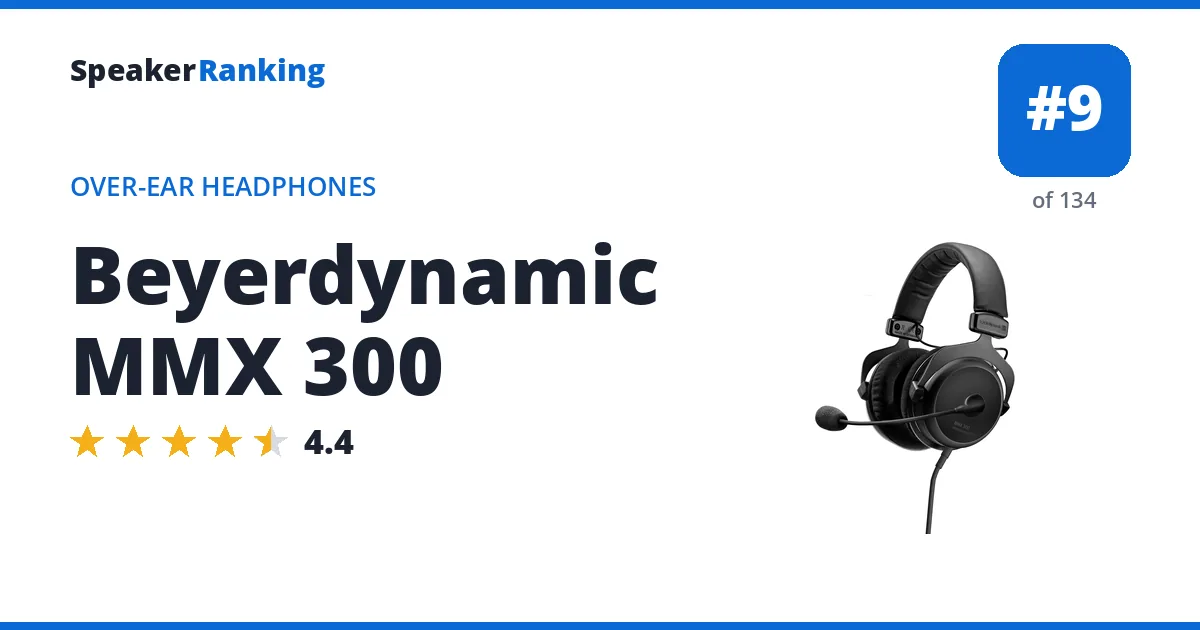
Pros: It scores 91 on the Harman model, with bass from 60 to 200 Hz and the whole midrange within about half a dB of target. A built-in microphone and closed back make it practical for calls, gaming and noisy rooms, and 32 ohms with 96 dB SPL sensitivity runs from a phone or laptop. Its tuning is slightly warm.
Cons: The top end is uneven, with a 4.3 dB dip near 9.5 kHz followed by a 6.1 dB peak near 11.9 kHz and air above 10 kHz about 5.3 dB hot. That can make cymbals and strings sound sharp or glassy. Sub-bass is about 3.2 dB under target, so the deepest bass notes lack some rumble.
Full Beyerdynamic MMX 300 review and specifications →
| Released | Feb 2017 (9 years ago) |
|---|---|
| Back | Closed |
| Built-in Microphone | Yes |
| Connection | Wired |
| Deviation From Target | 1.73 dB standard deviation |
| Driver Type | Dynamic |
| Form Factor | Over-ear |
| Frequency Response | 5Hz - 35kHz (Manufacturer specified) |
| Harman Preference Score | 91 (measured by oratory1990, via AutoEQ) |
| Impedance | 32 ohms |
| Sensitivity | 96 dB SPL |
| Tonal Tilt | -0.09 (negative is warmer, positive brighter) |
EQ preset to match the Harman target
Set a preamp of -5.8 dB, then add these filters in any parametric equalizer (Wavelet, Equalizer APO, Peace, or a player with parametric EQ). Calculated by AutoEQ from its measured frequency response.
| Filter | Frequency | Gain | Q |
|---|---|---|---|
| Low shelf | 105 Hz | +7.1 dB | 0.70 |
| Peak | 73 Hz | -7.9 dB | 0.69 |
| Peak | 3,829 Hz | +3.8 dB | 3.33 |
| Peak | 79 Hz | +6.7 dB | 2.65 |
| Peak | 5,667 Hz | -4.2 dB | 6.00 |
| High shelf | 10,000 Hz | -8.0 dB | 0.70 |
| Peak | 8,787 Hz | +3.1 dB | 1.63 |
| Peak | 216 Hz | +1.9 dB | 3.10 |
| Peak | 142 Hz | -1.4 dB | 2.61 |
| Peak | 1,207 Hz | +0.6 dB | 1.60 |
- Reviews, Comparisons and Sound Samples
- Head-to-Head Comparisons
 Ranked #11 of 134 in Over-Ear Headphones - Dyson Zone: $349.99 Amazon eBay
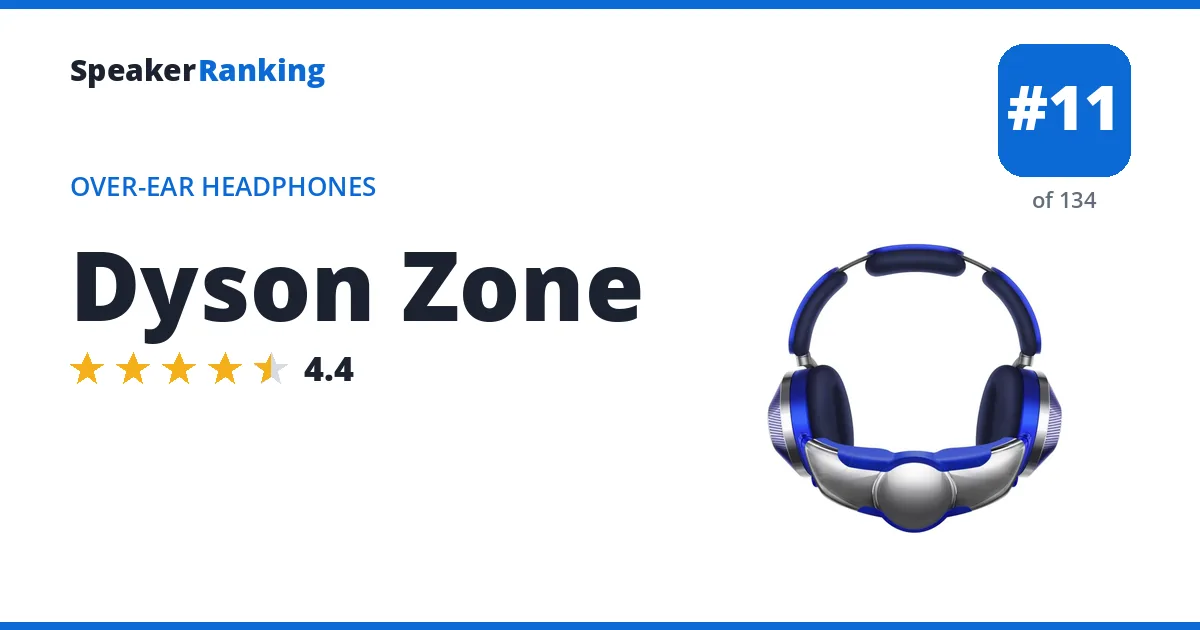
Pros: A preference score of 90 and a smooth 1.49 dB deviation put the tuning close to the Harman target, with sub-bass about 2 dB above target for extra rumble on kick drums and bass lines. It is a closed, wireless design with active noise cancelling, Bluetooth 5.0, a built-in microphone and a claimed 50 hours of battery, and it also works wired. Its rating matches the Austrian Audio Hi-X60 and Sennheiser HD 600.
Cons: A 3.3 dB dip near 3.4 kHz and a 2.1 dB shortfall across the presence region pull some bite and clarity out of vocals and guitars. The treble is lifted by about 2 to 3.5 dB above 6 kHz, with a peak near 7.8 dB at 11.2 kHz that can make cymbals and sibilance sound sharp. The warm lean may feel slightly full for listeners who prefer a strictly neutral sound.
Full Dyson Zone review and specifications →
| Released | Oct 2023 (3 years ago) |
|---|---|
| Active Noise Cancelling | Yes |
| Back | Closed |
| Battery Life | 50 hours (Manufacturer specified) |
| Bluetooth Version | 5.0 |
| Built-in Microphone | Yes |
| Connection | Wireless and wired |
| Deviation From Target | 1.49 dB standard deviation |
| Driver Type | Dynamic |
| Form Factor | Over-ear |
| Frequency Response | 6Hz - 20kHz (Manufacturer specified) |
| Harman Preference Score | 90 (measured by oratory1990, via AutoEQ) |
| Impedance | 16 ohms |
| Sensitivity | 94 dB |
| Tonal Tilt | -0.34 (negative is warmer, positive brighter) |
EQ preset to match the Harman target
Set a preamp of -3.4 dB, then add these filters in any parametric equalizer (Wavelet, Equalizer APO, Peace, or a player with parametric EQ). Calculated by AutoEQ from its measured frequency response.
| Filter | Frequency | Gain | Q |
|---|---|---|---|
| Low shelf | 105 Hz | +4.4 dB | 0.70 |
| Peak | 3,632 Hz | +3.4 dB | 1.95 |
| Peak | 42 Hz | -7.0 dB | 0.53 |
| Peak | 964 Hz | +1.3 dB | 2.85 |
| Peak | 1,841 Hz | -1.3 dB | 1.77 |
| High shelf | 10,000 Hz | -5.6 dB | 0.70 |
| Peak | 6,856 Hz | -2.8 dB | 4.04 |
| Peak | 4,879 Hz | +2.6 dB | 4.77 |
| Peak | 1,194 Hz | +0.2 dB | 3.03 |
| Peak | 10,000 Hz | -0.8 dB | 4.50 |
- Reviews, Comparisons and Sound Samples
- Head-to-Head Comparisons
 Ranked #61 of 134 in Over-Ear Headphones - Thinksound ov21: $97.00 Amazon eBay
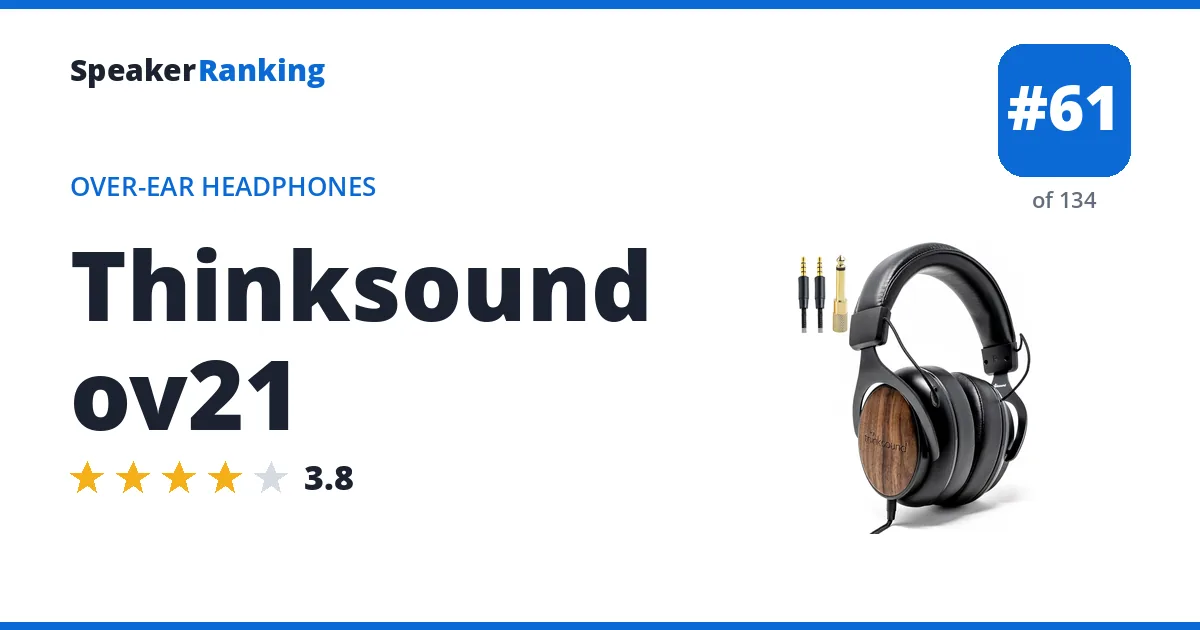
Pros: Sub-bass under 60 Hz sits about 4 dB above the Harman target and the 60 to 200 Hz bass about 2 dB above, so kick drums and bass lines have real weight and rumble. At 50 ohms and 99 dB/mW it runs loudly from a phone or laptop without an amp. The closed back isolates from room noise, and an inline microphone allows calls.
Cons: A dip of about 6 dB near 7 kHz followed by a 5 dB peak near 12 kHz leaves cymbals and sibilance uneven, dull in one place and glassy in another. Low mids are about 2.5 dB under target, which thins male vocals and guitar body. At 453 g it is the heaviest of its closest rivals, and the Audio-Technica ATH-M40x holds a higher rating at a similar price.
Full Thinksound ov21 review and specifications →
| Released | Nov 2021 (4 years ago) |
|---|---|
| Back | Closed |
| Built-in Microphone | Yes |
| Connection | Wired |
| Deviation From Target | 2.79 dB standard deviation |
| Driver Type | Dynamic |
| Drivers | 1 x 45mm dynamic |
| Form Factor | Over-ear |
| Frequency Response | 5Hz - 22kHz (Manufacturer specified) |
| Harman Preference Score | 78 (measured by oratory1990, via AutoEQ) |
| Impedance | 50 ohms |
| Sensitivity | 99 dB/mW |
| Tonal Tilt | -0.12 (negative is warmer, positive brighter) |
| Weight | 1 lbs (453 g) |
EQ preset to match the Harman target
Set a preamp of -4.4 dB, then add these filters in any parametric equalizer (Wavelet, Equalizer APO, Peace, or a player with parametric EQ). Calculated by AutoEQ from its measured frequency response.
| Filter | Frequency | Gain | Q |
|---|---|---|---|
| Low shelf | 105 Hz | -4.2 dB | 0.70 |
| Peak | 241 Hz | +5.0 dB | 0.79 |
| Peak | 122 Hz | -4.5 dB | 1.90 |
| Peak | 2,933 Hz | -4.2 dB | 1.60 |
| Peak | 5,637 Hz | -4.4 dB | 5.53 |
| High shelf | 10,000 Hz | -7.2 dB | 0.70 |
| Peak | 8,185 Hz | +3.2 dB | 2.20 |
| Peak | 1,045 Hz | -1.7 dB | 2.30 |
| Peak | 57 Hz | +1.3 dB | 3.71 |
| Peak | 498 Hz | +0.8 dB | 2.38 |
- Reviews, Comparisons and Sound Samples
 Ranked #66 of 134 in Over-Ear Headphones - Focal Bathys: $799.00 Amazon eBay
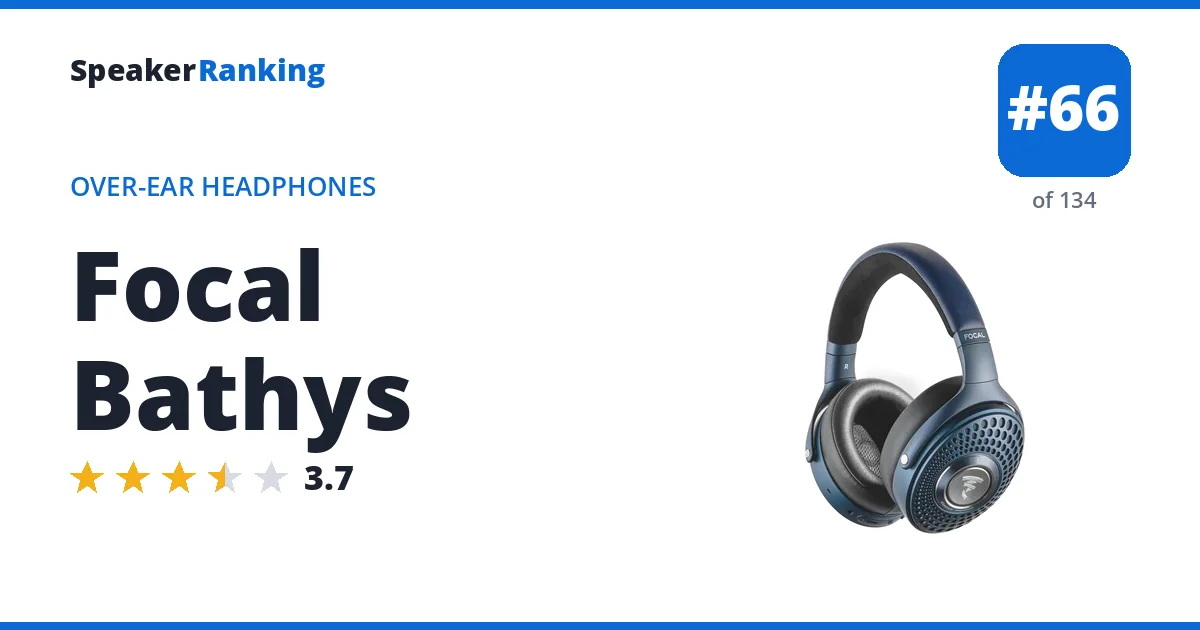
Pros: Bluetooth 5.1 with SBC, AAC, aptX and aptX Adaptive, active noise cancelling and a rated 30 hours of battery make it a full wireless travel headphone, and a wired connection is still available. Bass is slightly boosted, about 1 dB at sub-bass and 2 dB from 60 to 200 Hz, for a warm, punchy low end. The 2.0 dB deviation is smooth, and a 76 preference score is respectable for a wireless model.
Cons: A 6.3 dB dip near 9.4 kHz and mild treble reduction soften cymbals and sibilance. The tilt is on the warm side, so brightness and detail are subdued. The HIFIMAN Audivina holds a higher rating for a lower price, though the Bathys is the one with ANC and a battery.
Full Focal Bathys review and specifications →
| Released | Oct 2022 (4 years ago) |
|---|---|
| Active Noise Cancelling | Yes |
| Back | Closed |
| Battery Life | 30 hours (Manufacturer specified) |
| Bluetooth Codecs | SBC, AAC, aptX, aptX Adaptive |
| Bluetooth Version | 5.1 |
| Built-in Microphone | Yes |
| Connection | Wireless and wired |
| Deviation From Target | 2.04 dB standard deviation |
| Driver Type | Dynamic |
| Drivers | 1 x 40mm dynamic |
| Form Factor | Over-ear |
| Harman Preference Score | 76 (measured by oratory1990, via AutoEQ) |
| Impedance | 80 ohms |
| Sensitivity | 104 dB SPL/mW |
| Tonal Tilt | -0.84 (negative is warmer, positive brighter) |
| Weight | 0.8 lbs (350 g) |
EQ preset to match the Harman target
Set a preamp of -3.9 dB, then add these filters in any parametric equalizer (Wavelet, Equalizer APO, Peace, or a player with parametric EQ). Calculated by AutoEQ from its measured frequency response.
| Filter | Frequency | Gain | Q |
|---|---|---|---|
| Low shelf | 105 Hz | -0.3 dB | 0.70 |
| Peak | 642 Hz | -3.5 dB | 0.24 |
| Peak | 831 Hz | +7.1 dB | 1.99 |
| Peak | 4,157 Hz | +3.6 dB | 1.67 |
| Peak | 2,185 Hz | +4.3 dB | 3.03 |
| High shelf | 10,000 Hz | +0.7 dB | 0.70 |
| Peak | 86 Hz | -0.3 dB | 0.96 |
| Peak | 199 Hz | +0.5 dB | 1.78 |
| Peak | 2,995 Hz | -0.6 dB | 4.09 |
| Peak | 381 Hz | -0.4 dB | 2.53 |
- Reviews, Comparisons and Sound Samples
 Ranked #67 of 134 in Over-Ear Headphones - Koss KPH30i: $23.99 Amazon eBay
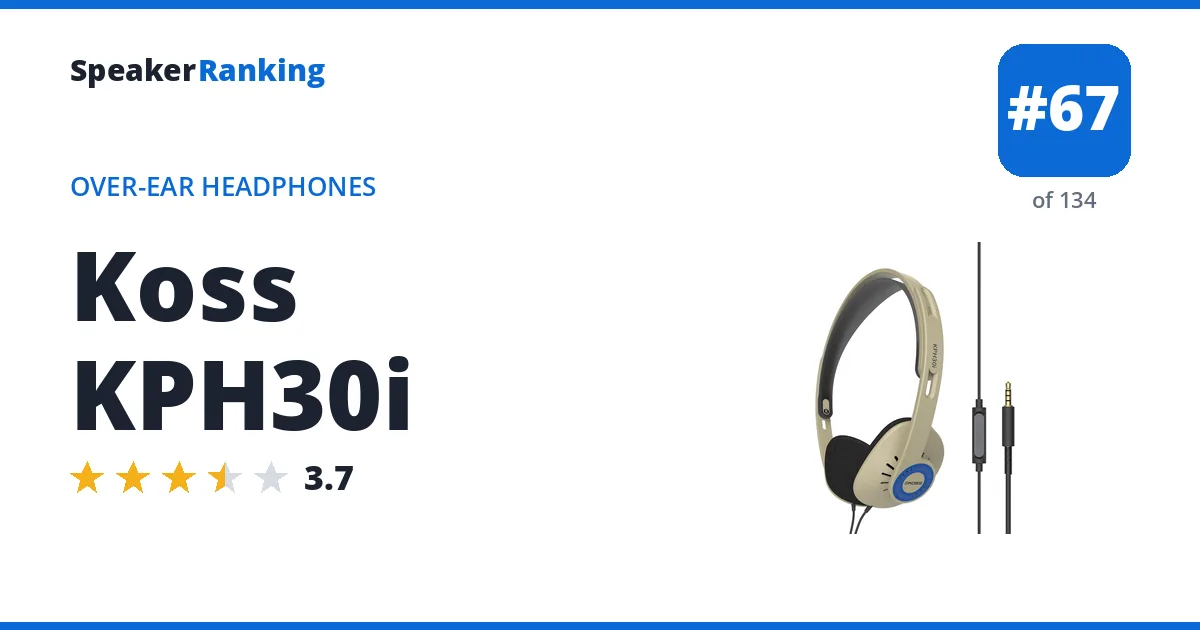
Pros: A very low price makes it an easy disposable or backup pair, and the 60 ohm, 101 dB sensitivity runs from any phone. It has an inline microphone for calls and the open on-ear design is light and airy. Bass from 60 Hz to the upper mids stays within about 0.6 dB of the Harman target, which gives a fairly balanced core.
Cons: Sub-bass is nearly 12 dB under target below 60 Hz, so there is no rumble and deep bass is essentially missing. An 11.8 dB dip near 4.2 kHz makes vocals and detail recede, and treble from 3 to 10 kHz is about 2.8 dB low. The open back leaks sound and offers no isolation, so it suits quiet rooms only.
Full Koss KPH30i review and specifications →
| Back | Open |
|---|---|
| Built-in Microphone | Yes |
| Connection | Wired |
| Deviation From Target | 2.62 dB standard deviation |
| Driver Type | Dynamic |
| Drivers | 1 x 35mm dynamic |
| Form Factor | Over-ear |
| Frequency Response | 15Hz - 25kHz (Manufacturer specified) |
| Harman Preference Score | 76 (measured by oratory1990, via AutoEQ) |
| Impedance | 60 ohms |
| Sensitivity | 101 dB SPL/1mW |
| Tonal Tilt | -0.38 (negative is warmer, positive brighter) |
EQ preset to match the Harman target
Set a preamp of -6.3 dB, then add these filters in any parametric equalizer (Wavelet, Equalizer APO, Peace, or a player with parametric EQ). Calculated by AutoEQ from its measured frequency response.
| Filter | Frequency | Gain | Q |
|---|---|---|---|
| Low shelf | 105 Hz | +6.8 dB | 0.70 |
| Peak | 109 Hz | -4.7 dB | 0.47 |
| Peak | 2,979 Hz | +1.7 dB | 0.18 |
| Peak | 1,956 Hz | -4.1 dB | 2.01 |
| Peak | 49 Hz | +2.5 dB | 2.08 |
| High shelf | 10,000 Hz | +0.1 dB | 0.70 |
| Peak | 5,070 Hz | -5.0 dB | 5.22 |
| Peak | 3,844 Hz | +2.9 dB | 5.95 |
| Peak | 6,348 Hz | +2.6 dB | 5.99 |
| Peak | 502 Hz | +0.3 dB | 1.44 |
- Reviews, Comparisons and Sound Samples
- Head-to-Head Comparisons
 Ranked #73 of 134 in Over-Ear Headphones - Cooler Master MH752: $189.00 Amazon eBay
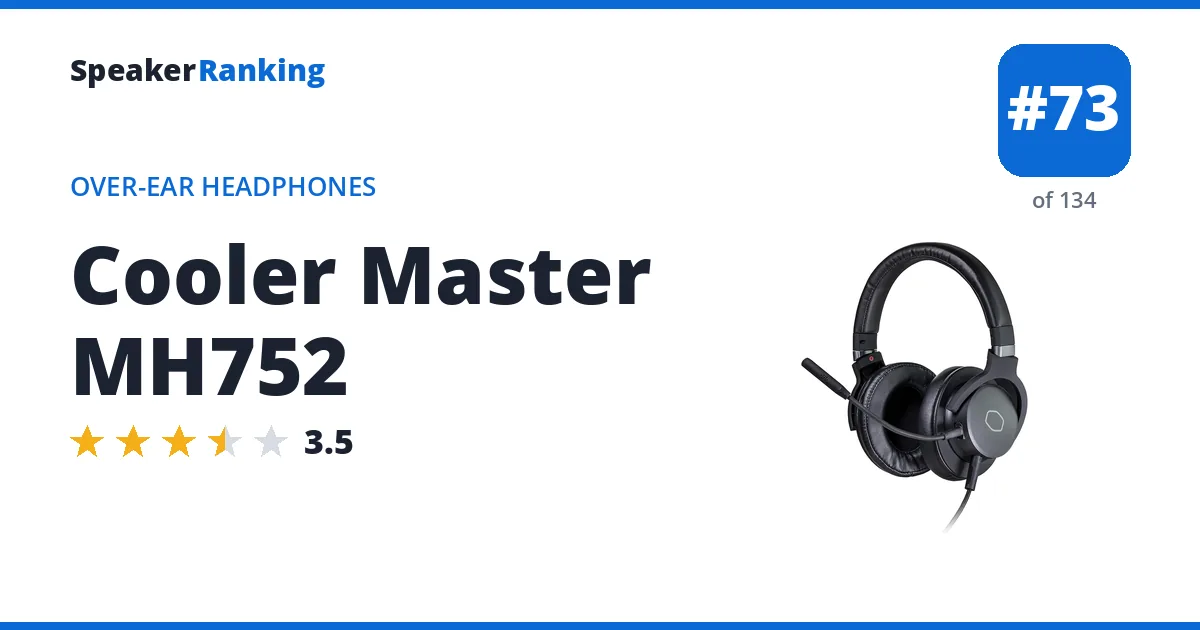
Pros: The bass is balanced and slightly full, about 1.8 dB over target, with sub-bass only about 1 dB under, so low notes keep some impact. Mids are close to target, within about half a dB through the vocal range. It is a closed 250 g design with a built in microphone and a 26 ohm impedance, so it works straight from a laptop or console.
Cons: Presence and lower treble are 3.9 dB and 3.1 dB below target, and a 9.2 dB dip near 9.3 kHz dulls cymbals and consonants. A 2.9 dB peak near 11.9 kHz and extra air above 10 kHz then bring back some fizz, so the top end sounds uneven rather than simply dark. Sensitivity of 97 dB means it needs a little more volume than the most efficient headphones.
Full Cooler Master MH752 review and specifications →
| Released | 2018 (8 years ago) |
|---|---|
| Back | Closed |
| Built-in Microphone | Yes |
| Connection | Wired |
| Deviation From Target | 2.37 dB standard deviation |
| Driver Type | Dynamic |
| Drivers | 1 x 40mm dynamic |
| Form Factor | Over-ear |
| Frequency Response | 20Hz - 20kHz (Manufacturer specified) |
| Harman Preference Score | 71 (measured by oratory1990, via AutoEQ) |
| Impedance | 26 ohms |
| Sensitivity | 97 dB |
| Tonal Tilt | -0.88 (negative is warmer, positive brighter) |
| Weight | 0.6 lbs (250 g) |
EQ preset to match the Harman target
Set a preamp of -4.4 dB, then add these filters in any parametric equalizer (Wavelet, Equalizer APO, Peace, or a player with parametric EQ). Calculated by AutoEQ from its measured frequency response.
| Filter | Frequency | Gain | Q |
|---|---|---|---|
| Low shelf | 105 Hz | +0.5 dB | 0.70 |
| Peak | 4,018 Hz | +4.9 dB | 1.74 |
| Peak | 2,707 Hz | -2.2 dB | 0.61 |
| Peak | 125 Hz | -5.3 dB | 1.92 |
| Peak | 6,555 Hz | +2.7 dB | 1.01 |
| High shelf | 10,000 Hz | -7.3 dB | 0.70 |
| Peak | 9,324 Hz | +3.2 dB | 2.01 |
| Peak | 511 Hz | +1.1 dB | 1.30 |
| Peak | 58 Hz | +1.1 dB | 3.43 |
| Peak | 1,025 Hz | -1.3 dB | 2.90 |
- Reviews, Comparisons and Sound Samples
- Head-to-Head Comparisons
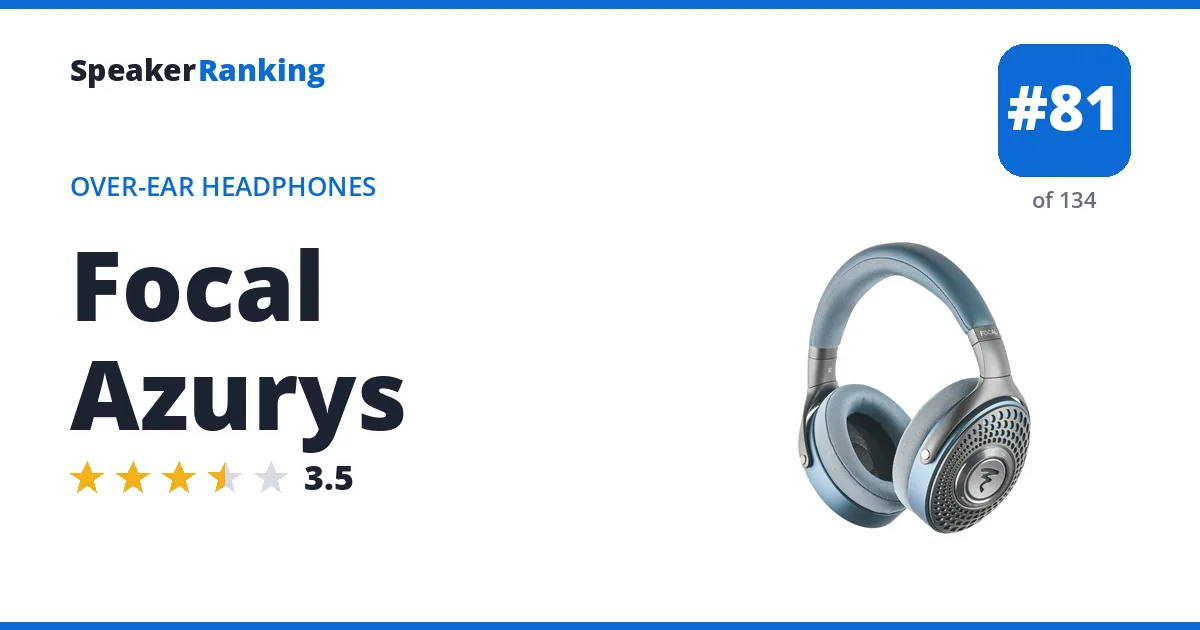
 Ranked #81 of 134 in Over-Ear Headphones - Focal Azurys: $430.00 Amazon eBay
Older models: the Focal Celestee (ranked lower, rated 3.4/5) and the Focal Elegia (ranked lower, rated 3/5). See every Focal Elegia, Celestee and Azurys generation.
Pros: A preference score of 70 with only 2.29 dB of deviation from the Harman target makes this a reasonably smooth closed-back, and the midrange from 200 Hz to 3 kHz sits within about 1 dB of target so vocals and guitars sound natural. Bass runs about 3.7 dB above target in the sub-bass and 2.6 dB in the upper bass, adding punch to kick drums and bass lines. At 26 ohms and 100 dB per mW it runs loud from a phone, and it weighs 306 g with a built-in microphone for calls.
Cons: A 11.9 dB dip near 9.7 kHz takes the edge off cymbals and sibilance, and treble overall sits about 1 dB under target, so the top end is a little dull and closed in. The extra low end leans warm, which can thicken male vocals and bass-heavy mixes. It is wired only, and the Sennheiser HD 620S has a higher rating for much less.
Full Focal Azurys review and specifications →
| Released | Jun 2024 (2 years ago) |
|---|---|
| Back | Closed |
| Built-in Microphone | Yes |
| Connection | Wired |
| Deviation From Target | 2.29 dB standard deviation |
| Driver Type | Dynamic |
| Drivers | 1 x 40mm dynamic |
| Form Factor | Over-ear |
| Frequency Response | 15Hz - 22kHz (Manufacturer specified) |
| Harman Preference Score | 70 (measured by oratory1990, via AutoEQ) |
| Impedance | 26 ohms |
| Sensitivity | 100 dB SPL/mW |
| Tonal Tilt | -1.00 (negative is warmer, positive brighter) |
| Weight | 0.7 lbs (306 g) |
EQ preset to match the Harman target
Set a preamp of -3.9 dB, then add these filters in any parametric equalizer (Wavelet, Equalizer APO, Peace, or a player with parametric EQ). Calculated by AutoEQ from its measured frequency response.
| Filter | Frequency | Gain | Q |
|---|---|---|---|
| Low shelf | 105 Hz | -3.1 dB | 0.70 |
| Peak | 185 Hz | -1.3 dB | 0.78 |
| Peak | 9,293 Hz | +2.5 dB | 1.66 |
| Peak | 4,836 Hz | +3.9 dB | 2.99 |
| Peak | 3,460 Hz | -2.8 dB | 3.99 |
| High shelf | 10,000 Hz | -0.7 dB | 0.70 |
| Peak | 1,331 Hz | +1.5 dB | 1.61 |
| Peak | 519 Hz | -0.6 dB | 2.00 |
| Peak | 74 Hz | +0.7 dB | 2.61 |
| Peak | 39 Hz | -0.4 dB | 1.54 |
- Reviews, Comparisons and Sound Samples
- Head-to-Head Comparisons
 Ranked #83 of 134 in Over-Ear Headphones - Bose QuietComfort 35 II: $359.99 Discontinued Amazon eBay
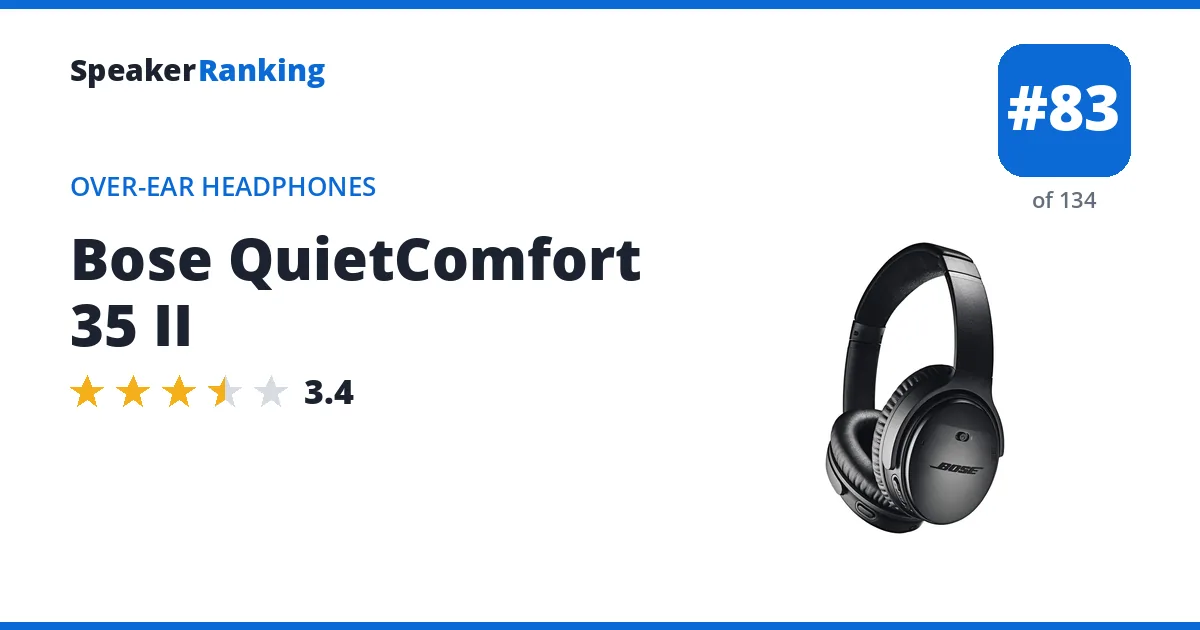
Pros: Active noise cancelling and a 20 hour battery make it a practical choice for commuting and flights. Bluetooth with SBC and AAC suits iPhones, and a wired connection is available when the battery runs out. At 240 g it is light for an over-ear with a built-in microphone, and its preference score of 69 in crinacle’s measurement is respectable for a noise cancelling model.
Cons: Bluetooth 4.0 and no aptX or LDAC support limit wireless audio quality and connection features compared with newer models. The Focal Azurys has a higher rating as a wired closed-back, though it lacks wireless and noise cancelling. The design dates from 2017, and the Fairphone Fairbuds XL offers newer Bluetooth, aptX HD and a longer battery at a lower price. Discontinued.
Full Bose QuietComfort 35 II review and specifications →
| Released | Oct 2017 (9 years ago) |
|---|---|
| Active Noise Cancelling | Yes |
| Back | Closed |
| Battery Life | 20 hours (Manufacturer specified) |
| Bluetooth Codecs | SBC, AAC |
| Bluetooth Version | 4.0 |
| Built-in Microphone | Yes |
| Connection | Wireless and wired |
| Deviation From Target | 2.61 dB standard deviation |
| Form Factor | Over-ear |
| Harman Preference Score | 69 (measured by crinacle, via AutoEQ) |
| Tonal Tilt | -0.81 (negative is warmer, positive brighter) |
| Weight | 0.5 lbs (240 g) |
EQ preset to match the Harman target
Set a preamp of -4.3 dB, then add these filters in any parametric equalizer (Wavelet, Equalizer APO, Peace, or a player with parametric EQ). Calculated by AutoEQ from its measured frequency response.
| Filter | Frequency | Gain | Q |
|---|---|---|---|
| Low shelf | 105 Hz | +2.4 dB | 0.70 |
| Peak | 99 Hz | -3.4 dB | 0.26 |
| Peak | 1,332 Hz | +3.2 dB | 0.62 |
| Peak | 2,633 Hz | -4.5 dB | 3.08 |
| Peak | 5,938 Hz | -5.2 dB | 6.00 |
| High shelf | 10,000 Hz | +1.4 dB | 0.70 |
| Peak | 9,646 Hz | +3.7 dB | 0.99 |
| Peak | 4,334 Hz | -2.3 dB | 3.66 |
| Peak | 7,076 Hz | +2.6 dB | 5.94 |
| Peak | 6,213 Hz | -3.9 dB | 6.00 |
- Reviews, Comparisons and Sound Samples
- Head-to-Head Comparisons
 Ranked #84 of 134 in Over-Ear Headphones - Fairphone Fairbuds XL: $229.99 Amazon eBay
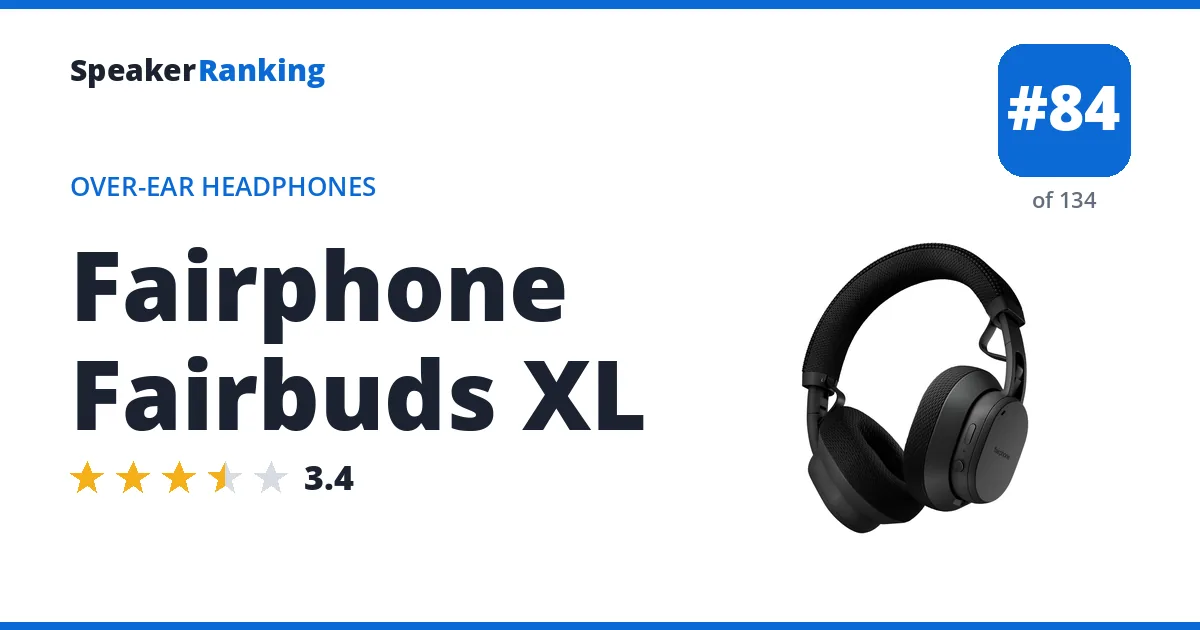
Pros: Wireless with active noise cancelling, Bluetooth 5.1 and aptX HD, plus a 30 hour battery (26 hours with ANC on), so it covers travel and desk use. An IP54 rating adds splash and dust resistance, which is uncommon among over-ears, and a wired connection at 32 ohms and 99 dB is available too. Mids and low bass track the target closely, within about 0.3 dB from 60 Hz to 1 kHz.
Cons: The presence region from 3 to 6 kHz sits about 5.3 dB under target, with a 10.2 dB dip near 3.4 kHz, which pushes vocals and instrument attack back and makes music sound recessed. A 2.8 dB peak near 6.4 kHz adds some sharpness on top of that. Sub-bass is lifted about 2.9 dB, and at 330 g it is heavier than most wireless rivals such as the Bose QuietComfort 35 II.
Full Fairphone Fairbuds XL review and specifications →
| Active Noise Cancelling | Yes |
|---|---|
| Back | Closed |
| Battery Life | 30 hours (26 with ANC on, Manufacturer specified) |
| Bluetooth Codecs | SBC, AAC, aptX HD |
| Bluetooth Version | 5.1 |
| Built-in Microphone | Yes |
| Connection | Wireless and wired |
| Deviation From Target | 2.74 dB standard deviation |
| Driver Type | Dynamic |
| Drivers | 1 x 40mm dynamic |
| Form Factor | Over-ear |
| Frequency Response | 20Hz - 20kHz (Manufacturer specified) |
| Harman Preference Score | 69 (measured by oratory1990, via AutoEQ) |
| IP Rating | IP54 |
| Impedance | 32 ohms |
| Sensitivity | 99 dB at 1kHz |
| Tonal Tilt | -0.70 (negative is warmer, positive brighter) |
| Weight | 0.7 lbs (330 g) |
EQ preset to match the Harman target
Set a preamp of -7.2 dB, then add these filters in any parametric equalizer (Wavelet, Equalizer APO, Peace, or a player with parametric EQ). Calculated by AutoEQ from its measured frequency response.
| Filter | Frequency | Gain | Q |
|---|---|---|---|
| Low shelf | 105 Hz | -7.6 dB | 0.70 |
| Peak | 3,409 Hz | +7.2 dB | 2.60 |
| Peak | 60 Hz | +7.1 dB | 1.03 |
| Peak | 979 Hz | -2.0 dB | 1.35 |
| Peak | 242 Hz | -1.8 dB | 1.04 |
| High shelf | 10,000 Hz | +0.9 dB | 0.70 |
| Peak | 6,413 Hz | -4.2 dB | 5.06 |
| Peak | 2,037 Hz | -2.5 dB | 4.81 |
| Peak | 1,598 Hz | +1.3 dB | 4.26 |
| Peak | 2,813 Hz | +1.6 dB | 5.68 |
- Reviews, Comparisons and Sound Samples
- Head-to-Head Comparisons
 Ranked #86 of 134 in Over-Ear Headphones - Sennheiser Amperior: $299.99 Discontinued Amazon eBay
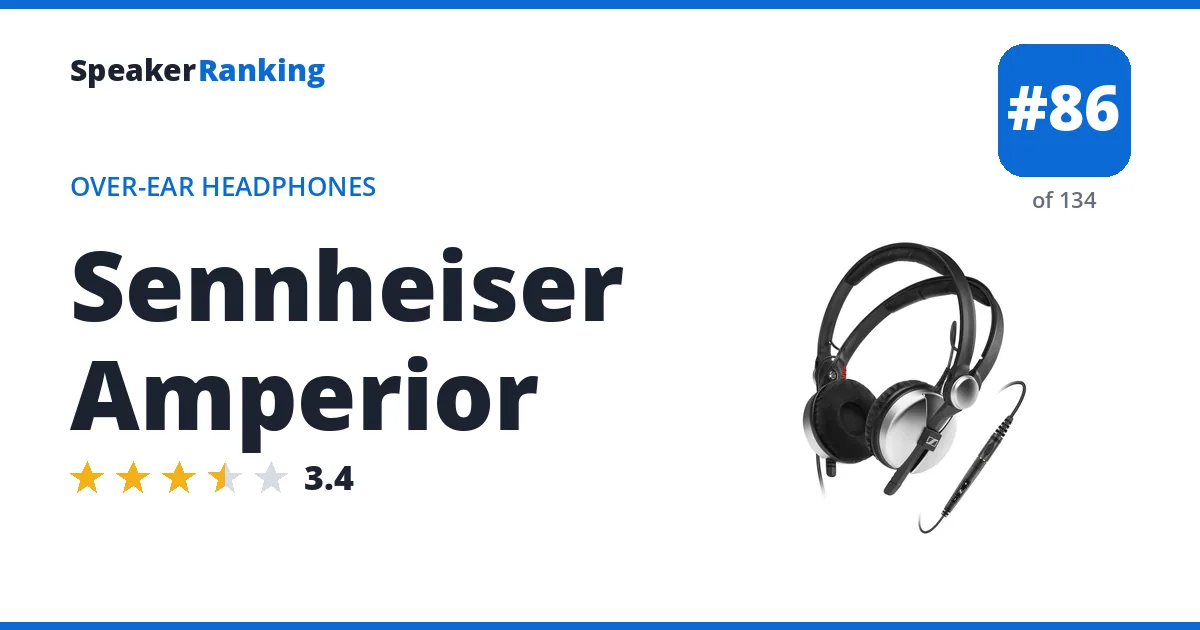
Pros: Closed back at 190 g with an 18 ohm impedance and 120 dB sensitivity, so it plays loudly from any phone or laptop with no amp. It has a built-in microphone for calls, which suits portable daily use. Crinacle’s preference score of 69 is a fair result for a closed headphone, and a slightly bright tilt of 0.71 suits listeners who like more clarity.
Cons: A score of 69 is only middling against the Harman target, and the bright tilt can make treble tiring at higher volume. The Focal Azurys and Cooler Master MH752 have higher ratings, and the Cooler Master is cheaper. It is discontinued and wired only.
Full Sennheiser Amperior review and specifications →
| Back | Closed |
|---|---|
| Built-in Microphone | Yes |
| Connection | Wired |
| Deviation From Target | 2.77 dB standard deviation |
| Form Factor | Over-ear |
| Frequency Response | 16Hz - 22kHz (Manufacturer specified) |
| Harman Preference Score | 69 (measured by crinacle, via AutoEQ) |
| Impedance | 18 ohms |
| Sensitivity | 120 dB |
| Tonal Tilt | +0.71 (negative is warmer, positive brighter) |
| Weight | 0.4 lbs (190 g) |
EQ preset to match the Harman target
Set a preamp of -6.3 dB, then add these filters in any parametric equalizer (Wavelet, Equalizer APO, Peace, or a player with parametric EQ). Calculated by AutoEQ from its measured frequency response.
| Filter | Frequency | Gain | Q |
|---|---|---|---|
| Low shelf | 105 Hz | +4.7 dB | 0.70 |
| Peak | 1,258 Hz | -4.5 dB | 1.00 |
| Peak | 329 Hz | +5.2 dB | 1.90 |
| Peak | 5,561 Hz | +5.4 dB | 1.78 |
| Peak | 8,369 Hz | -4.5 dB | 1.71 |
| High shelf | 10,000 Hz | +3.2 dB | 0.70 |
| Peak | 77 Hz | -3.2 dB | 0.82 |
| Peak | 218 Hz | +1.1 dB | 2.02 |
| Peak | 22 Hz | +1.0 dB | 4.82 |
| Peak | 39 Hz | +2.5 dB | 0.95 |
- Reviews, Comparisons and Sound Samples
 Ranked #87 of 134 in Over-Ear Headphones - Sennheiser ACCENTUM Plus: $129.95 Amazon eBay
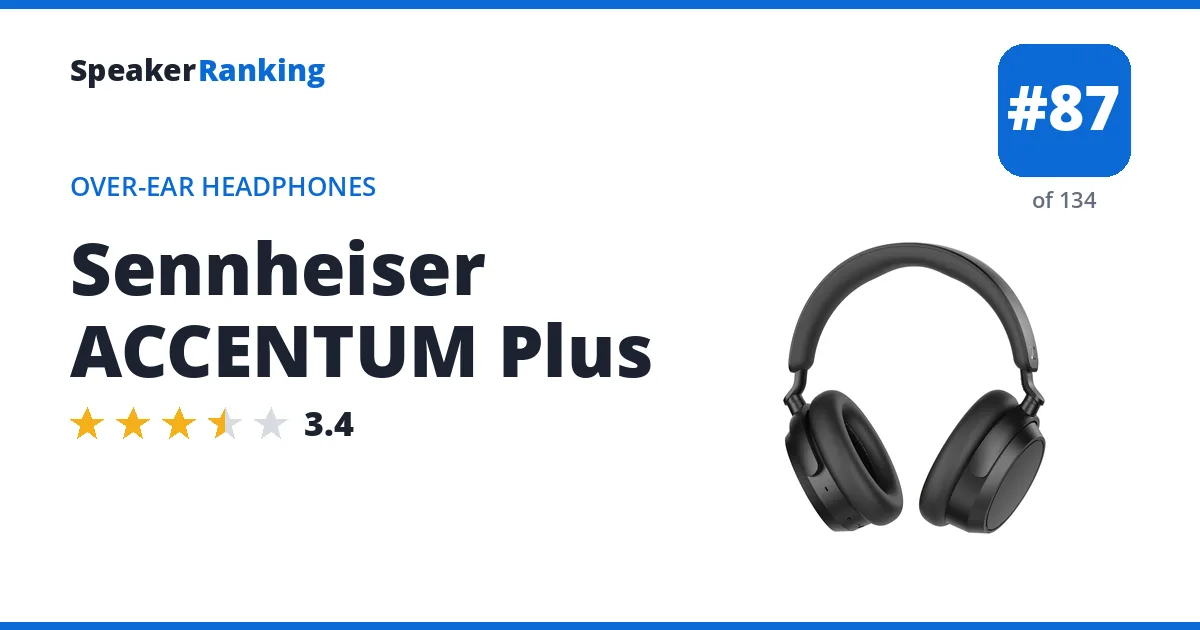
Pros: A 50 hour battery, active noise cancelling and a light 227 g body make this an easy all day travel headphone. Bluetooth 5.2 with SBC, AAC, aptX and aptX Adaptive covers most phones, and a built-in microphone handles calls. Bass is strong, with sub-bass about 7.4 dB above target, so electronic and pop tracks have plenty of weight.
Cons: The bass boost runs about 7.4 dB in the sub-bass and 3.8 dB in the upper bass, which can thicken vocals and mask detail. A 4.1 dB peak near 11.4 kHz adds some treble sizzle, and a 6.5 dB dip near 4.4 kHz pulls back vocal clarity. It has no weather rating, and the AKG K361 has a higher rating for less money if wireless is not needed.
Full Sennheiser ACCENTUM Plus review and specifications →
| Released | Feb 2024 (2 years ago) |
|---|---|
| Active Noise Cancelling | Yes |
| Back | Closed |
| Battery Life | 50 hours (Manufacturer specified) |
| Bluetooth Codecs | SBC, AAC, aptX, aptX Adaptive |
| Bluetooth Version | 5.2 |
| Built-in Microphone | Yes |
| Connection | Wireless and wired |
| Deviation From Target | 2.36 dB standard deviation |
| Driver Type | Dynamic |
| Drivers | 1 x 37mm dynamic |
| Form Factor | Over-ear |
| Frequency Response | 10Hz - 22kHz (Manufacturer specified) |
| Harman Preference Score | 68 (measured by oratory1990, via AutoEQ) |
| IP Rating | None |
| Sensitivity | 106 dB SPL |
| Tonal Tilt | -1.07 (negative is warmer, positive brighter) |
| Weight | 0.5 lbs (227 g) |
EQ preset to match the Harman target
Set a preamp of -4.3 dB, then add these filters in any parametric equalizer (Wavelet, Equalizer APO, Peace, or a player with parametric EQ). Calculated by AutoEQ from its measured frequency response.
| Filter | Frequency | Gain | Q |
|---|---|---|---|
| Low shelf | 105 Hz | -6.0 dB | 0.70 |
| Peak | 245 Hz | -1.8 dB | 1.27 |
| Peak | 1,884 Hz | +3.4 dB | 1.83 |
| Peak | 4,135 Hz | +4.7 dB | 4.12 |
| Peak | 2,934 Hz | -3.2 dB | 3.46 |
| High shelf | 10,000 Hz | -4.5 dB | 0.70 |
| Peak | 87 Hz | +2.3 dB | 2.24 |
| Peak | 146 Hz | -1.2 dB | 2.10 |
| Peak | 817 Hz | +0.8 dB | 3.06 |
| Peak | 5,714 Hz | -1.3 dB | 5.18 |
- Reviews, Comparisons and Sound Samples
 Ranked #93 of 134 in Over-Ear Headphones - HyperX Cloud Alpha: $44.99 Amazon eBay
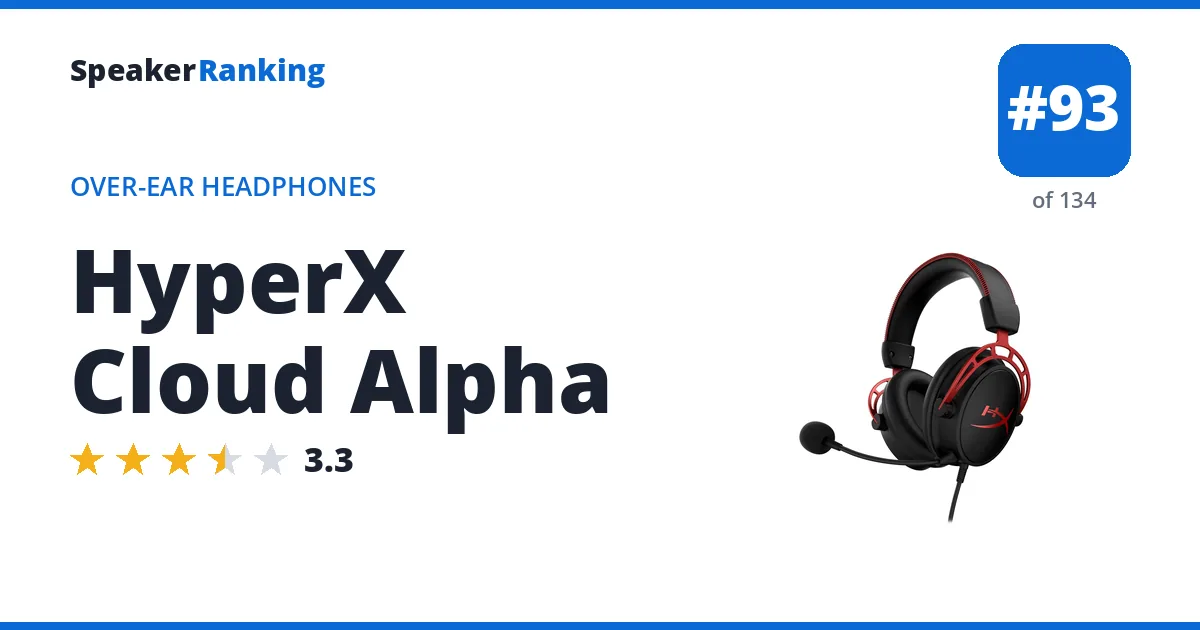
Pros: Bass from 60 to 200 Hz sits about 4 dB above the Harman target in oratory1990’s measurement, which gives kick drums and bass guitar extra weight for games and pop. The closed 50mm driver at 98 dB sensitivity and 65 ohms runs easily from a phone or console controller, and the built-in microphone suits voice chat.
Cons: Treble is uneven, with a 4.6 dB peak near 8 kHz that can make cymbals and sibilants sharp and a 5.8 dB dip near 4 kHz that pulls vocals slightly back. Air above 10 kHz runs about 4 dB hot, adding a hint of fizz on top of the warm tilt.
Full HyperX Cloud Alpha review and specifications →
| Released | Sep 2017 (9 years ago) |
|---|---|
| Back | Closed |
| Built-in Microphone | Yes |
| Connection | Wired |
| Deviation From Target | 2.80 dB standard deviation |
| Driver Type | Dynamic |
| Drivers | 1 x 50mm dynamic |
| Form Factor | Over-ear |
| Frequency Response | 13Hz - 27kHz (Manufacturer specified) |
| Harman Preference Score | 66 (measured by oratory1990, via AutoEQ) |
| Impedance | 65 ohms |
| Sensitivity | 98 dB SPL/mW |
| Tonal Tilt | -0.87 (negative is warmer, positive brighter) |
| Weight | 0.7 lbs (298 g) |
EQ preset to match the Harman target
Set a preamp of -6.3 dB, then add these filters in any parametric equalizer (Wavelet, Equalizer APO, Peace, or a player with parametric EQ). Calculated by AutoEQ from its measured frequency response.
| Filter | Frequency | Gain | Q |
|---|---|---|---|
| Low shelf | 105 Hz | +7.1 dB | 0.70 |
| Peak | 104 Hz | -5.9 dB | 0.23 |
| Peak | 733 Hz | +4.5 dB | 0.92 |
| Peak | 4,324 Hz | +6.7 dB | 2.87 |
| Peak | 6,110 Hz | -3.0 dB | 3.21 |
| High shelf | 10,000 Hz | -5.6 dB | 0.70 |
| Peak | 41 Hz | -0.4 dB | 2.00 |
| Peak | 159 Hz | +0.5 dB | 3.01 |
| Peak | 212 Hz | -0.5 dB | 3.66 |
| Peak | 1,964 Hz | +0.5 dB | 4.33 |
- Reviews, Comparisons and Sound Samples
- Head-to-Head Comparisons
 Ranked #104 of 134 in Over-Ear Headphones - Anker Soundcore Space One: $84.99 Amazon eBay
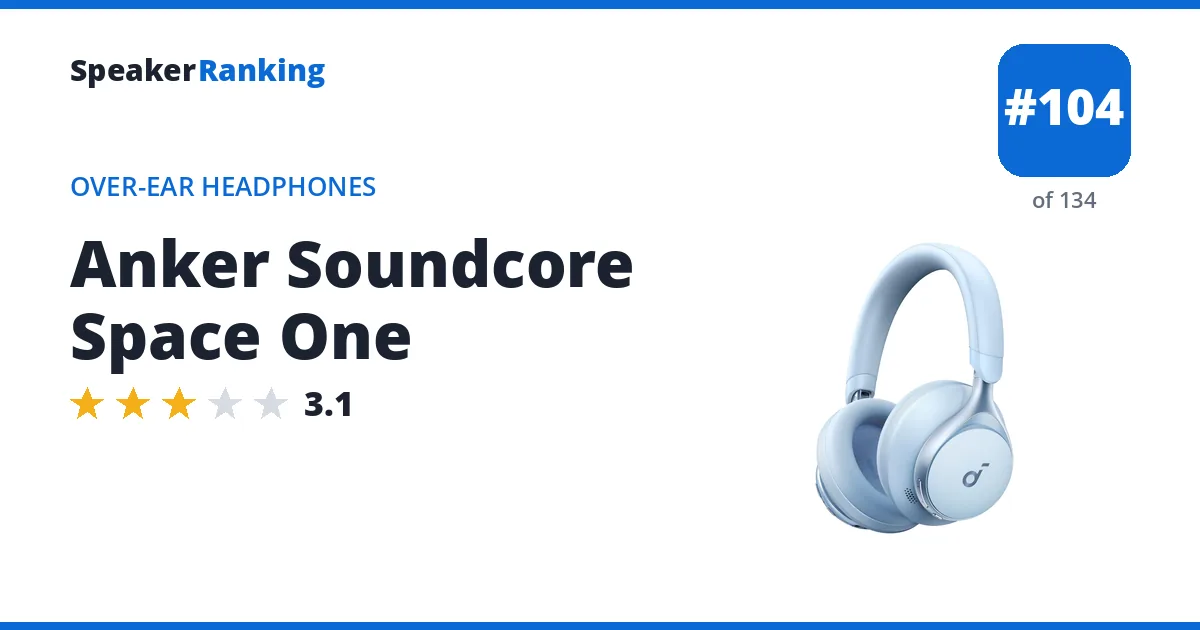
Pros: Wireless noise cancelling headphones with LDAC, AAC and SBC support, Bluetooth 5.3 and a rated 40 hours of battery (55 without ANC), plus a wired option and a built-in microphone. The bass lift of about 4 dB below 60 Hz and 3 dB through the upper bass gives kick drums and synth bass a strong rumble, which suits bassy and v-shaped tastes. At 260 g it is on the light side for an ANC over-ear.
Cons: The treble is far hotter than the target, about 6 dB over from 6 to 16 kHz with a sharp peak of 12.6 dB near 9 kHz, so cymbals and sibilant vocals turn bright and can sound harsh. A 5.6 dB dip near 3.3 kHz and a 3 dB hole in the low mids pull back vocal presence and body. The response is uneven overall, with a standard deviation near 4 dB.
Full Anker Soundcore Space One review and specifications →
| Released | Aug 2023 (3 years ago) |
|---|---|
| Active Noise Cancelling | Yes |
| Back | Closed |
| Battery Life | 40 hours (55 without ANC, Manufacturer specified) |
| Bluetooth Codecs | SBC, AAC, LDAC |
| Bluetooth Version | 5.3 |
| Built-in Microphone | Yes |
| Connection | Wireless and wired |
| Deviation From Target | 3.96 dB standard deviation |
| Driver Type | Dynamic |
| Drivers | 1 x 40mm dynamic |
| Form Factor | Over-ear |
| Frequency Response | 20Hz - 20kHz (Manufacturer specified) |
| Harman Preference Score | 62 (measured by oratory1990, via AutoEQ) |
| IP Rating | None |
| Impedance | 16 ohms |
| Tonal Tilt | -0.17 (negative is warmer, positive brighter) |
| Weight | 0.6 lbs (260 g) |
EQ preset to match the Harman target
Set a preamp of -4.7 dB, then add these filters in any parametric equalizer (Wavelet, Equalizer APO, Peace, or a player with parametric EQ). Calculated by AutoEQ from its measured frequency response.
| Filter | Frequency | Gain | Q |
|---|---|---|---|
| Low shelf | 105 Hz | -4.6 dB | 0.70 |
| Peak | 494 Hz | +4.5 dB | 0.46 |
| Peak | 1,335 Hz | -6.2 dB | 1.43 |
| Peak | 123 Hz | -3.7 dB | 1.54 |
| Peak | 3,318 Hz | +5.1 dB | 3.60 |
| High shelf | 10,000 Hz | -7.0 dB | 0.70 |
| Peak | 8,910 Hz | -5.2 dB | 1.18 |
| Peak | 5,539 Hz | +4.9 dB | 3.90 |
| Peak | 2,387 Hz | +2.3 dB | 6.00 |
| Peak | 382 Hz | -1.5 dB | 6.00 |
- Reviews, Comparisons and Sound Samples
- Head-to-Head Comparisons
 Ranked #105 of 134 in Over-Ear Headphones - Bang & Olufsen Beoplay H95: $1,250.00 Discontinued Amazon eBay
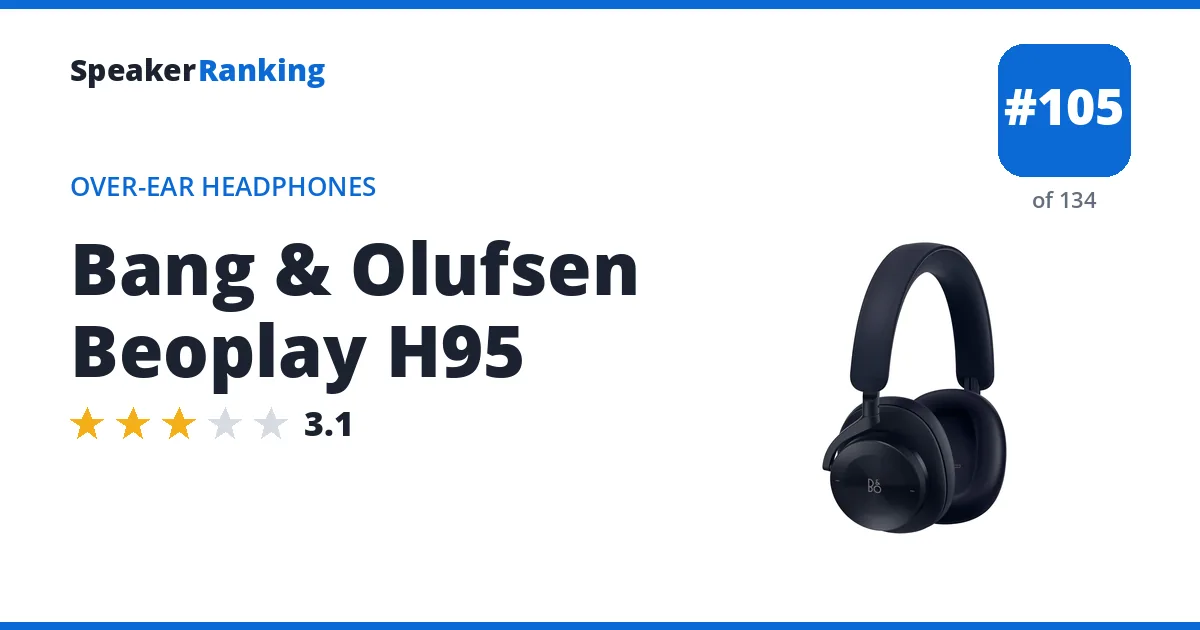
Pros: A full-featured wireless ANC headphone with aptX Adaptive, AAC and SBC, Bluetooth 5.1, a built-in microphone, a wired option and a rated 38 hours of battery (50 without ANC). Sub-bass sits about 6 dB over target and the upper bass about 3 dB over, so low notes have weight and warmth. The midrange stays close to target, within about 2 dB, and the overall curve is fairly smooth for a wireless model.
Cons: Treble is erratic, with a 9.6 dB peak near 11.9 kHz and a 6.7 dB dip near 10 kHz, which makes the top end uneven and slightly hot in places. The bass boost and a 1.9 dB lift in the low mids can make male vocals and bass guitar a little thick. At 323 g and a very high price, it asks a lot for sound that scores only 62 on the Harman preference scale. Discontinued.
Full Bang & Olufsen Beoplay H95 review and specifications →
| Active Noise Cancelling | Yes |
|---|---|
| Back | Closed |
| Battery Life | 38 hours (50 without ANC, Manufacturer specified) |
| Bluetooth Codecs | SBC, AAC, aptX Adaptive |
| Bluetooth Version | 5.1 |
| Built-in Microphone | Yes |
| Connection | Wireless and wired |
| Deviation From Target | 2.65 dB standard deviation |
| Driver Type | Dynamic |
| Drivers | 1 x 40mm dynamic |
| Form Factor | Over-ear |
| Frequency Response | 20Hz - 22kHz (Manufacturer specified) |
| Harman Preference Score | 62 (measured by oratory1990, via AutoEQ) |
| Impedance | 12 ohms |
| Sensitivity | 101.5 dB/mW |
| Tonal Tilt | -1.22 (negative is warmer, positive brighter) |
| Weight | 0.7 lbs (323 g) |
EQ preset to match the Harman target
Set a preamp of -3.6 dB, then add these filters in any parametric equalizer (Wavelet, Equalizer APO, Peace, or a player with parametric EQ). Calculated by AutoEQ from its measured frequency response.
| Filter | Frequency | Gain | Q |
|---|---|---|---|
| Low shelf | 105 Hz | -4.5 dB | 0.70 |
| Peak | 252 Hz | -3.8 dB | 1.28 |
| Peak | 2,644 Hz | +2.2 dB | 0.56 |
| Peak | 61 Hz | -2.0 dB | 0.66 |
| Peak | 93 Hz | +5.1 dB | 2.32 |
| High shelf | 10,000 Hz | -8.8 dB | 0.70 |
| Peak | 9,731 Hz | +3.6 dB | 1.42 |
| Peak | 1,253 Hz | -2.3 dB | 2.36 |
| Peak | 842 Hz | +2.1 dB | 3.42 |
| Peak | 1,919 Hz | +2.1 dB | 3.99 |
- Reviews, Comparisons and Sound Samples
 Ranked #110 of 134 in Over-Ear Headphones - Razer BlackShark V2 Pro: $109.99 Amazon eBay
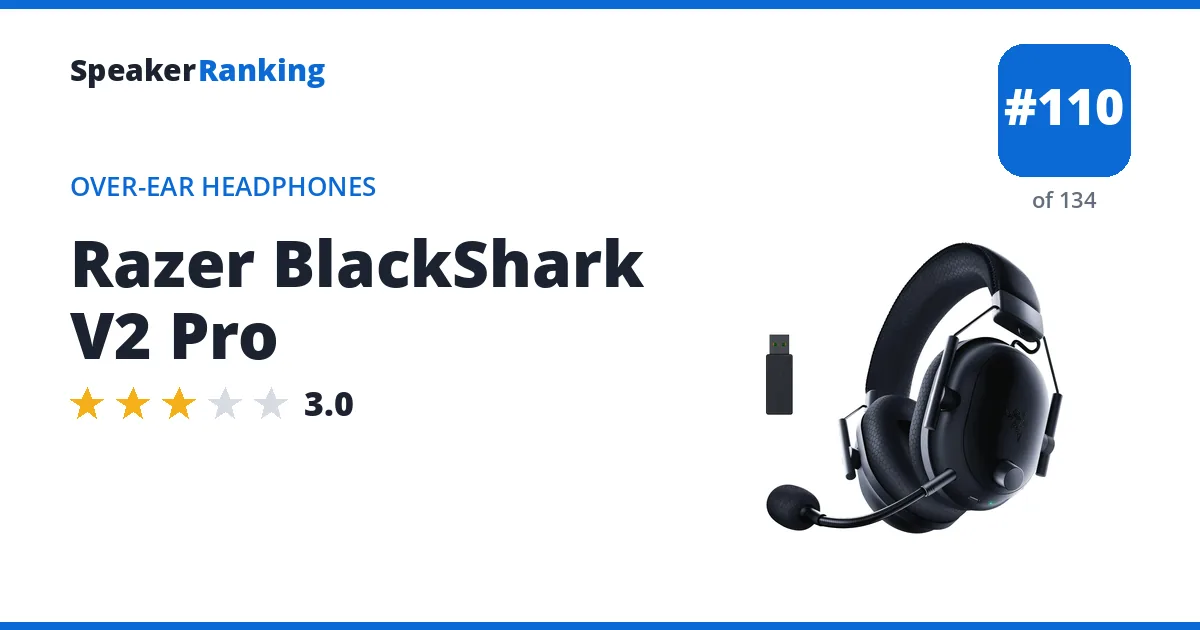
Pros: A wireless gaming headset with a built-in microphone, Bluetooth 5.2 and a rated 70 hours of battery, so it rarely needs charging. Its Harman preference score of 60 in crinacle’s measurement is fairly close to the target for a gaming headset. The 50mm driver at 32 ohms and 100 dB SPL/mW is easy to drive, and the price is low.
Cons: The response is uneven, with a standard deviation near 3.5 dB, so tonal balance drifts from the target in music. It has no active noise cancelling, and at 320 g it is on the heavy side. The Anker Soundcore Space One has a higher rating and offers ANC and LDAC for a lower price.
Full Razer BlackShark V2 Pro review and specifications →
| Released | Jun 2023 (3 years ago) |
|---|---|
| Active Noise Cancelling | No |
| Back | Closed |
| Battery Life | 70 hours (Manufacturer specified) |
| Bluetooth Version | 5.2 |
| Built-in Microphone | Yes |
| Connection | Wireless |
| Deviation From Target | 3.47 dB standard deviation |
| Driver Type | Dynamic |
| Drivers | 1 x 50mm dynamic |
| Form Factor | Over-ear |
| Frequency Response | 12Hz - 28kHz (Manufacturer specified) |
| Harman Preference Score | 60 (measured by crinacle, via AutoEQ) |
| IP Rating | None |
| Impedance | 32 ohms |
| Sensitivity | 100 dB SPL/mW |
| Tonal Tilt | -0.69 (negative is warmer, positive brighter) |
| Weight | 0.7 lbs (320 g) |
EQ preset to match the Harman target
Set a preamp of -5.4 dB, then add these filters in any parametric equalizer (Wavelet, Equalizer APO, Peace, or a player with parametric EQ). Calculated by AutoEQ from its measured frequency response.
| Filter | Frequency | Gain | Q |
|---|---|---|---|
| Low shelf | 105 Hz | +1.9 dB | 0.70 |
| Peak | 153 Hz | -7.6 dB | 0.72 |
| Peak | 625 Hz | +5.9 dB | 0.85 |
| Peak | 3,612 Hz | -4.0 dB | 4.82 |
| Peak | 398 Hz | +2.5 dB | 2.18 |
| High shelf | 10,000 Hz | -1.5 dB | 0.70 |
| Peak | 2,525 Hz | +2.7 dB | 3.01 |
| Peak | 1,373 Hz | -1.5 dB | 2.52 |
| Peak | 1,953 Hz | +1.0 dB | 3.23 |
| Peak | 3,166 Hz | -1.8 dB | 5.42 |
- Reviews, Comparisons and Sound Samples
- Head-to-Head Comparisons
 Ranked #112 of 134 in Over-Ear Headphones - Bose Noise Cancelling Headphones 700: $369.00 Discontinued Amazon eBay
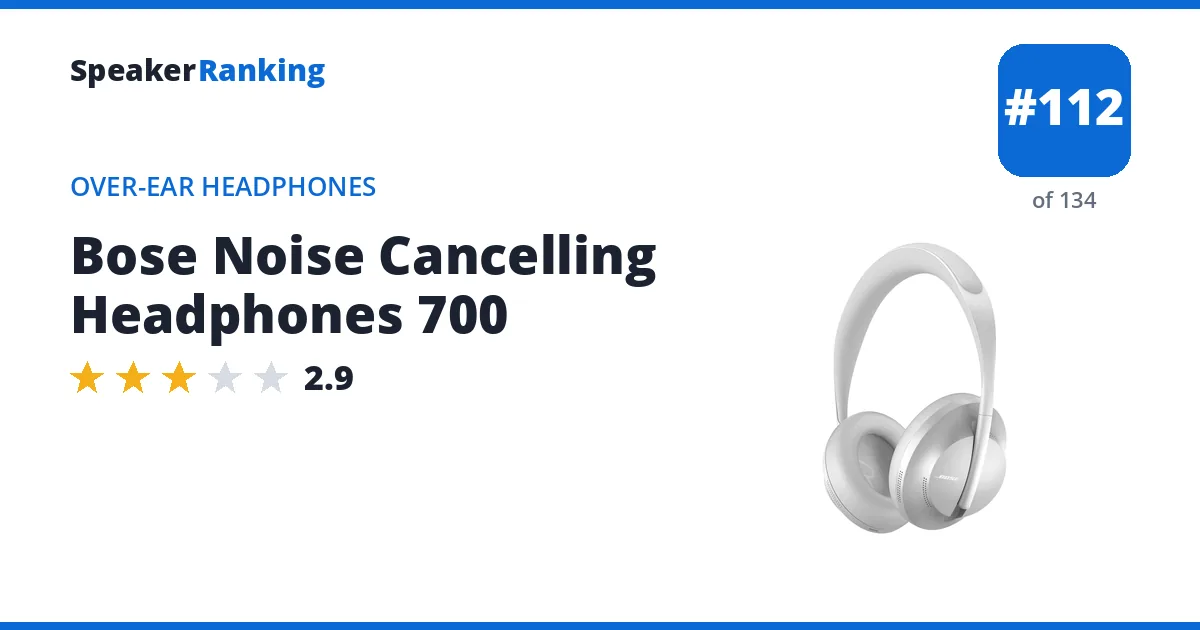
Pros: Wireless noise cancelling headphones with SBC and AAC, Bluetooth 5.0, a built-in microphone, a wired option, an IPX4 splash rating and a rated 20 hours of battery. At 250 g it is light for a full-size ANC headphone. The warm tuning, with the upper bass about 3 dB over target, suits listeners who like a smooth and relaxed sound.
Cons: Treble is rolled off, about 5.4 dB under target from 6 to 10 kHz and 3.5 dB under above that, with a 9 dB dip near 10.9 kHz, so cymbals and vocal detail sound dull. The Harman preference score of 58 shows a response well off the target. Battery life of 20 hours is short for a wireless ANC model, and there is no aptX or LDAC support. Discontinued.
Full Bose Noise Cancelling Headphones 700 review and specifications →
| Released | Apr 2019 (7 years ago) |
|---|---|
| Active Noise Cancelling | Yes |
| Back | Closed |
| Battery Life | 20 hours (Manufacturer specified) |
| Bluetooth Codecs | SBC, AAC |
| Bluetooth Version | 5.0 |
| Built-in Microphone | Yes |
| Connection | Wireless and wired |
| Deviation From Target | 2.75 dB standard deviation |
| Form Factor | Over-ear |
| Harman Preference Score | 58 (measured by oratory1990, via AutoEQ) |
| IP Rating | IPX4 |
| Tonal Tilt | -1.39 (negative is warmer, positive brighter) |
| Weight | 0.6 lbs (250 g) |
EQ preset to match the Harman target
Set a preamp of -7.0 dB, then add these filters in any parametric equalizer (Wavelet, Equalizer APO, Peace, or a player with parametric EQ). Calculated by AutoEQ from its measured frequency response.
| Filter | Frequency | Gain | Q |
|---|---|---|---|
| Low shelf | 105 Hz | -2.5 dB | 0.70 |
| Peak | 180 Hz | -3.8 dB | 0.99 |
| Peak | 1,236 Hz | +2.7 dB | 4.06 |
| Peak | 27 Hz | +3.7 dB | 0.98 |
| Peak | 8,335 Hz | +6.8 dB | 1.58 |
| High shelf | 10,000 Hz | +0.3 dB | 0.70 |
| Peak | 4,828 Hz | -4.2 dB | 5.68 |
| Peak | 3,430 Hz | +1.4 dB | 2.66 |
| Peak | 6,625 Hz | +1.8 dB | 6.00 |
| Peak | 816 Hz | -0.7 dB | 2.91 |
- Reviews, Comparisons and Sound Samples
- Head-to-Head Comparisons
 Ranked #113 of 134 in Over-Ear Headphones - HyperX Cloud II: $47.48 Amazon eBay
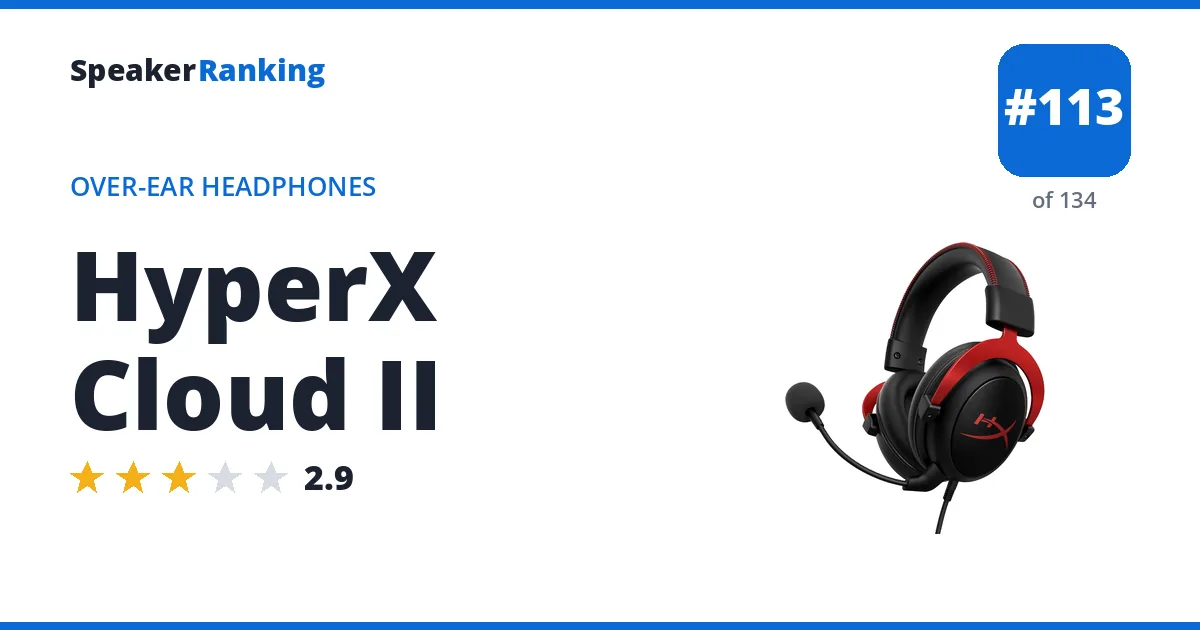
Pros: A built-in microphone and a closed-back design make it a ready-made gaming headset, and the 60 ohm impedance with 98 dB sensitivity means it runs easily from a PC or console. The large 53mm driver delivers bass about 4 dB above the Harman target, which suits listeners who want punchy explosions and a warm, bass-forward presentation. Sub-bass and the lower midrange sit close to target, so the low end is fuller without being muddy.
Cons: A deep dip of roughly 15 dB near 4.2 kHz hollows out presence, so voices and the attack of instruments sound recessed, while a peak of about 9 dB near 8.6 kHz adds a sharp, sizzly edge to cymbals and sibilance. Treble above 6 kHz runs about 4 to 5 dB hot, which can become fatiguing at higher volumes. The HyperX Cloud Alpha has a higher rating at a lower price.
Full HyperX Cloud II review and specifications →
| Released | Feb 2015 (11 years ago) |
|---|---|
| Back | Closed |
| Built-in Microphone | Yes |
| Connection | Wired |
| Deviation From Target | 3.60 dB standard deviation |
| Driver Type | Dynamic |
| Drivers | 1 x 53mm dynamic |
| Form Factor | Over-ear |
| Frequency Response | 15Hz - 25kHz (Manufacturer specified) |
| Harman Preference Score | 58 (measured by oratory1990, via AutoEQ) |
| Impedance | 60 ohms |
| Sensitivity | 98 dB SPL/mW |
| Tonal Tilt | -0.74 (negative is warmer, positive brighter) |
EQ preset to match the Harman target
Set a preamp of -6.4 dB, then add these filters in any parametric equalizer (Wavelet, Equalizer APO, Peace, or a player with parametric EQ). Calculated by AutoEQ from its measured frequency response.
| Filter | Frequency | Gain | Q |
|---|---|---|---|
| Low shelf | 105 Hz | +4.1 dB | 0.70 |
| Peak | 170 Hz | -7.0 dB | 1.06 |
| Peak | 271 Hz | +3.7 dB | 0.58 |
| Peak | 3,828 Hz | +5.4 dB | 3.60 |
| Peak | 57 Hz | -4.8 dB | 0.58 |
| High shelf | 10,000 Hz | -7.0 dB | 0.70 |
| Peak | 8,085 Hz | -3.0 dB | 3.98 |
| Peak | 2,378 Hz | -1.9 dB | 2.78 |
| Peak | 3,700 Hz | +1.3 dB | 2.71 |
| Peak | 1,123 Hz | +1.1 dB | 3.29 |
- Reviews, Comparisons and Sound Samples
- Head-to-Head Comparisons
 Ranked #117 of 134 in Over-Ear Headphones - Beats Studio3 Wireless: $286.49 Discontinued Amazon eBay
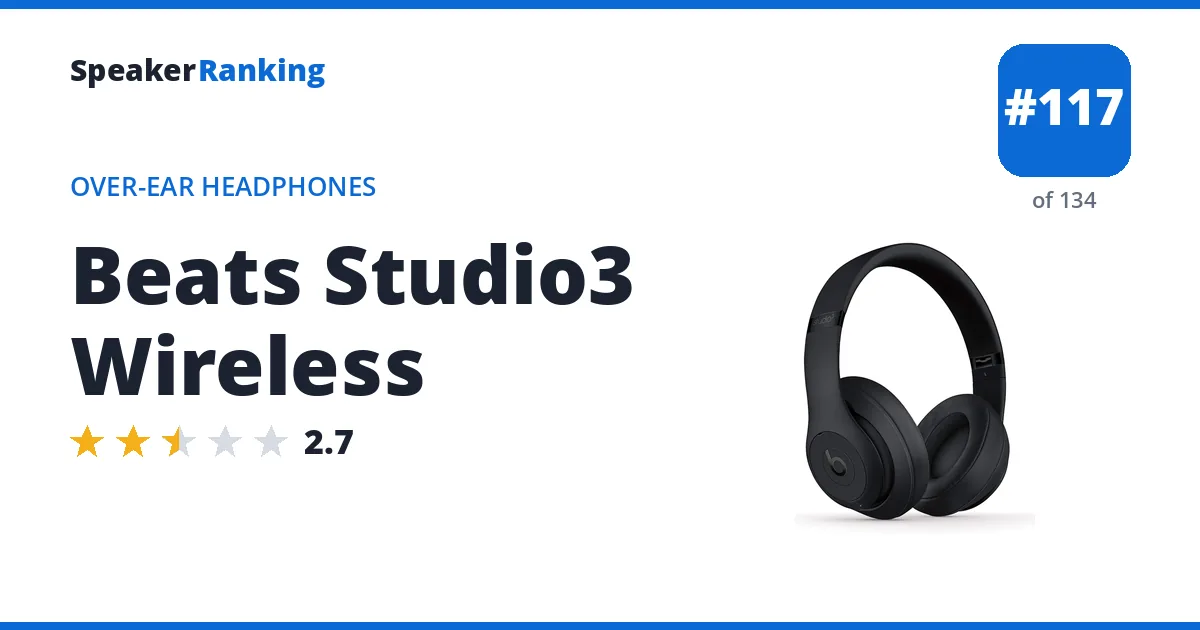
Pros: It combines Bluetooth with SBC and AAC, active noise cancelling and a built-in microphone, with about 22 hours of battery life with ANC on and up to 40 hours without. A 260 g weight and a wired option make it flexible for commuting. Bass between 60 and 200 Hz is about 3 dB above target, which gives a warm, punchy sound for pop and hip hop.
Cons: The low mids run about 3.6 dB over target, which thickens male vocals and can make the sound muddy, while presence from 3 to 6 kHz is about 3 dB low and a dip of about 8 dB near 4.8 kHz softens detail. A peak of nearly 7 dB near 11.9 kHz adds a sharp edge to the top end. The Bowers & Wilkins Px7 S2 has an equal rating at a lower price. Discontinued.
Full Beats Studio3 Wireless review and specifications →
| Released | Oct 2017 (9 years ago) |
|---|---|
| Active Noise Cancelling | Yes |
| Back | Closed |
| Battery Life | 22 hours (40 without ANC, Manufacturer specified) |
| Bluetooth Codecs | SBC, AAC |
| Built-in Microphone | Yes |
| Connection | Wireless and wired |
| Deviation From Target | 3.30 dB standard deviation |
| Form Factor | Over-ear |
| Frequency Response | 20Hz - 20kHz (Manufacturer specified) |
| Harman Preference Score | 53 (measured by oratory1990, via AutoEQ) |
| Impedance | 32 ohms |
| Tonal Tilt | -1.30 (negative is warmer, positive brighter) |
| Weight | 0.6 lbs (260 g) |
EQ preset to match the Harman target
Set a preamp of -6.9 dB, then add these filters in any parametric equalizer (Wavelet, Equalizer APO, Peace, or a player with parametric EQ). Calculated by AutoEQ from its measured frequency response.
| Filter | Frequency | Gain | Q |
|---|---|---|---|
| Low shelf | 105 Hz | +7.7 dB | 0.70 |
| Peak | 327 Hz | -5.9 dB | 1.56 |
| Peak | 5,209 Hz | +6.7 dB | 2.64 |
| Peak | 68 Hz | -8.1 dB | 0.78 |
| Peak | 1,978 Hz | +4.3 dB | 2.19 |
| High shelf | 10,000 Hz | -2.5 dB | 0.70 |
| Peak | 3,257 Hz | -1.9 dB | 4.42 |
| Peak | 666 Hz | +1.5 dB | 2.52 |
| Peak | 6,665 Hz | +1.5 dB | 3.92 |
| Peak | 428 Hz | -1.1 dB | 4.35 |
- Reviews, Comparisons and Sound Samples
- Head-to-Head Comparisons
 Ranked #118 of 134 in Over-Ear Headphones - Bowers & Wilkins Px7 S2: $230.00 Discontinued Amazon eBay
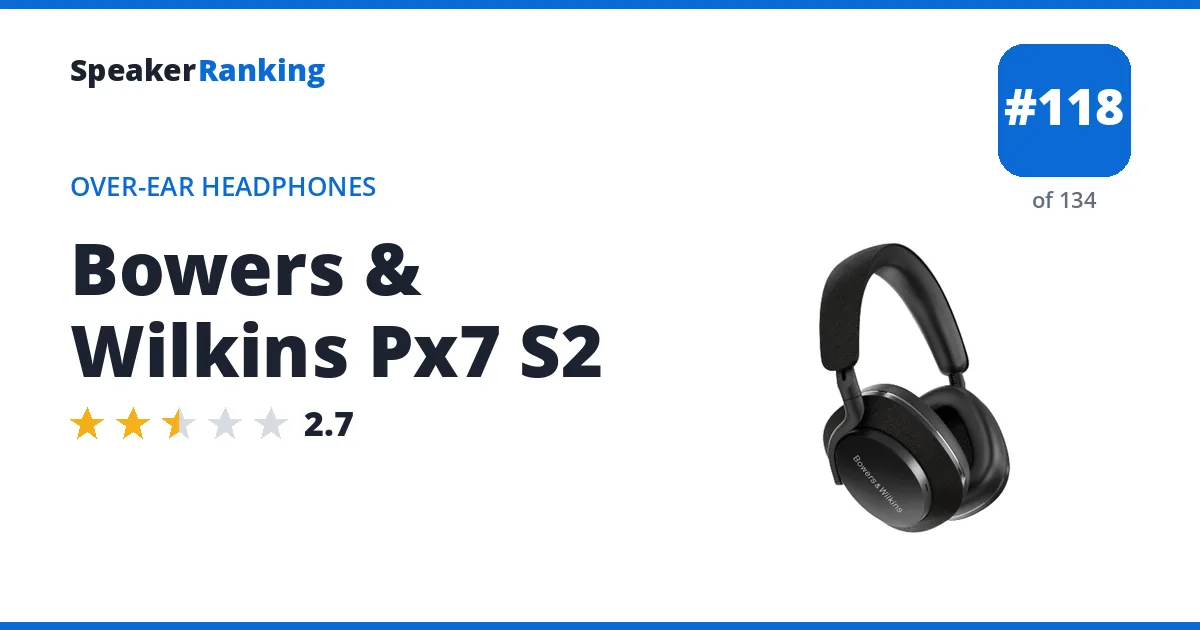
Newer model: the Bowers & Wilkins Px7 S2e, ranked lower, rated 2.7/5, released Sep 2023 (also discontinued). See every Bowers & Wilkins Px7 generation.
Pros: Wireless features are strong, with active noise cancelling, Bluetooth 5.2 and a wide codec list including aptX Adaptive and aptX HD, plus a built-in microphone and about 30 hours of battery life. Sub-bass is about 5 dB above target and bass about 7 dB above, which gives plenty of rumble for bass-heavy music. The midrange from 1 to 6 kHz stays within about 1 dB of target, so voices keep their natural place.
Cons: The bass boost is large enough to overwhelm the low mids on some tracks, and a peak of nearly 7 dB near 8.7 kHz plus treble about 4 dB hot adds a bright, splashy edge to cymbals. It weighs 307 g, on the heavier side for long wear. The Bowers & Wilkins Px7 S2e has an equal rating but a smoother response. Discontinued.
Full Bowers & Wilkins Px7 S2 review and specifications →
| Released | Jun 2022 (4 years ago) |
|---|---|
| Active Noise Cancelling | Yes |
| Back | Closed |
| Battery Life | 30 hours (Manufacturer specified) |
| Bluetooth Codecs | SBC, AAC, aptX, aptX HD, aptX Adaptive |
| Bluetooth Version | 5.2 |
| Built-in Microphone | Yes |
| Connection | Wireless and wired |
| Deviation From Target | 3.30 dB standard deviation |
| Driver Type | Dynamic |
| Drivers | 1 x 40mm dynamic |
| Form Factor | Over-ear |
| Frequency Response | 10Hz - 30kHz (Manufacturer specified) |
| Harman Preference Score | 53 (measured by oratory1990, via AutoEQ) |
| Tonal Tilt | -1.27 (negative is warmer, positive brighter) |
| Weight | 0.7 lbs (307 g) |
EQ preset to match the Harman target
Set a preamp of -4.6 dB, then add these filters in any parametric equalizer (Wavelet, Equalizer APO, Peace, or a player with parametric EQ). Calculated by AutoEQ from its measured frequency response.
| Filter | Frequency | Gain | Q |
|---|---|---|---|
| Low shelf | 105 Hz | -6.1 dB | 0.70 |
| Peak | 173 Hz | -7.1 dB | 0.55 |
| Peak | 2,124 Hz | +4.2 dB | 1.71 |
| Peak | 410 Hz | +4.7 dB | 0.65 |
| Peak | 50 Hz | +5.7 dB | 0.90 |
| High shelf | 10,000 Hz | +0.6 dB | 0.70 |
| Peak | 9,383 Hz | -2.8 dB | 2.33 |
| Peak | 5,503 Hz | +5.0 dB | 3.72 |
| Peak | 3,218 Hz | -2.1 dB | 5.97 |
| Peak | 6,714 Hz | -3.1 dB | 5.99 |
- Reviews, Comparisons and Sound Samples
- Head-to-Head Comparisons
 Ranked #119 of 134 in Over-Ear Headphones - Bowers & Wilkins Px7 S2e: $344.83 Discontinued Amazon eBay
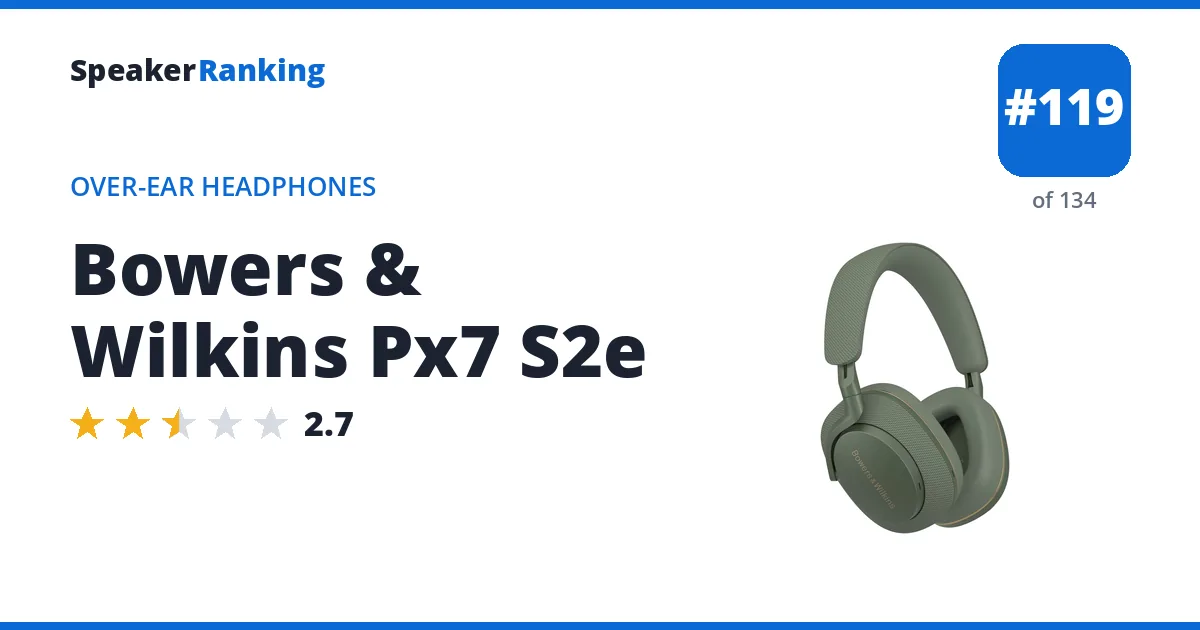
Older model: the Bowers & Wilkins Px7 S2 (ranked higher, rated 2.7/5). See every Bowers & Wilkins Px7 generation.
Pros: Active noise cancelling, Bluetooth 5.2 with SBC, AAC, aptX, aptX HD and aptX Adaptive, a built-in microphone and about 30 hours of battery cover the wireless essentials. The response is smoother than the Bowers & Wilkins Px7 S2, with the largest peak only about 3 dB near 11.9 kHz and treble within 1.5 dB of target. Presence and upper mids sit within about 1 dB of target, so voices sound natural.
Cons: Sub-bass is about 6 dB over target and bass about 5 dB over, so the low end is heavy and can mask the lower midrange, which is itself about 1.6 dB warm. A dip of nearly 7 dB near 9.7 kHz softens cymbals and sibilance. At 307 g it is on the heavier side. Discontinued.
Full Bowers & Wilkins Px7 S2e review and specifications →
| Released | Sep 2023 (3 years ago) |
|---|---|
| Active Noise Cancelling | Yes |
| Back | Closed |
| Battery Life | 30 hours (Manufacturer specified) |
| Bluetooth Codecs | SBC, AAC, aptX, aptX HD, aptX Adaptive |
| Bluetooth Version | 5.2 |
| Built-in Microphone | Yes |
| Connection | Wireless and wired |
| Deviation From Target | 2.90 dB standard deviation |
| Driver Type | Dynamic |
| Drivers | 1 x 40mm dynamic |
| Form Factor | Over-ear |
| Frequency Response | 10Hz - 30kHz (Manufacturer specified) |
| Harman Preference Score | 53 (measured by oratory1990, via AutoEQ) |
| Tonal Tilt | -1.59 (negative is warmer, positive brighter) |
| Weight | 0.7 lbs (307 g) |
EQ preset to match the Harman target
Set a preamp of -4.4 dB, then add these filters in any parametric equalizer (Wavelet, Equalizer APO, Peace, or a player with parametric EQ). Calculated by AutoEQ from its measured frequency response.
| Filter | Frequency | Gain | Q |
|---|---|---|---|
| Low shelf | 105 Hz | -5.6 dB | 0.70 |
| Peak | 202 Hz | -4.0 dB | 1.14 |
| Peak | 1,938 Hz | +4.6 dB | 1.74 |
| Peak | 473 Hz | +1.7 dB | 1.27 |
| Peak | 980 Hz | -1.6 dB | 1.67 |
| High shelf | 10,000 Hz | -0.1 dB | 0.70 |
| Peak | 43 Hz | +2.4 dB | 3.61 |
| Peak | 8,012 Hz | +2.1 dB | 2.17 |
| Peak | 3,528 Hz | +1.6 dB | 3.57 |
| Peak | 2,918 Hz | -2.0 dB | 5.25 |
- Reviews, Comparisons and Sound Samples
- Head-to-Head Comparisons
 Ranked #120 of 134 in Over-Ear Headphones - Logitech G930: $229.99 Discontinued Amazon eBay
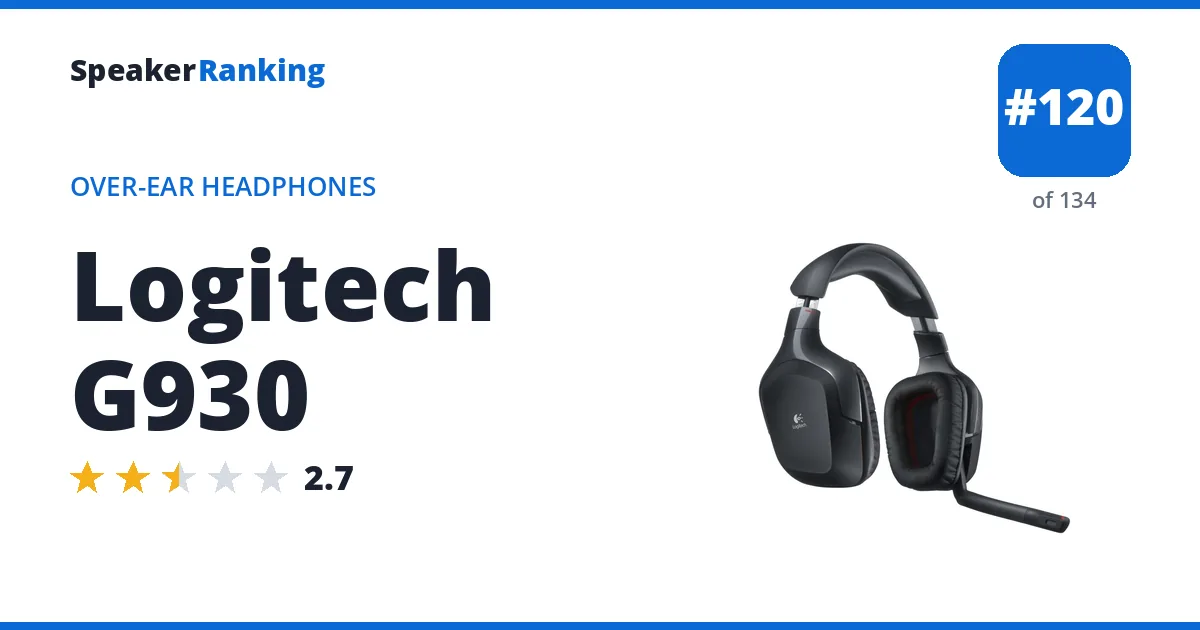
Pros: A wireless connection and a built-in microphone suit gaming and voice chat, and the closed-back design keeps sound contained. Bass is gently raised by about 2 dB, with sub-bass close to target, so the low end is warm without much bloat. The low mids and upper mids sit within about half a dB of target.
Cons: Treble runs about 4 to 5 dB below target above 6 kHz and presence is about 3 dB low, so the sound is dull and lacks sparkle. A huge dip of about 15 dB near 9.1 kHz removes cymbal detail, and a peak of about 6 dB near 6 kHz adds some harshness. At 326 g it is heavy, and it has no noise cancelling. It is a design from 2010 with dated sound. Discontinued.
Full Logitech G930 review and specifications →
| Released | Aug 2010 (16 years ago) |
|---|---|
| Active Noise Cancelling | No |
| Back | Closed |
| Built-in Microphone | Yes |
| Connection | Wireless |
| Deviation From Target | 3.61 dB standard deviation |
| Driver Type | Dynamic |
| Drivers | 1 x 40mm dynamic |
| Form Factor | Over-ear |
| Frequency Response | 20Hz - 20kHz (Manufacturer specified) |
| Harman Preference Score | 52 (measured by oratory1990, via AutoEQ) |
| Impedance | 32 ohms |
| Sensitivity | 90 dB SPL/mW |
| Tonal Tilt | -1.06 (negative is warmer, positive brighter) |
| Weight | 0.7 lbs (326 g) |
EQ preset to match the Harman target
Set a preamp of -6.6 dB, then add these filters in any parametric equalizer (Wavelet, Equalizer APO, Peace, or a player with parametric EQ). Calculated by AutoEQ from its measured frequency response.
| Filter | Frequency | Gain | Q |
|---|---|---|---|
| Low shelf | 105 Hz | +0.5 dB | 0.70 |
| Peak | 141 Hz | -5.7 dB | 1.78 |
| Peak | 3,198 Hz | +5.8 dB | 3.39 |
| Peak | 6,133 Hz | -8.4 dB | 1.55 |
| Peak | 7,571 Hz | +8.2 dB | 1.86 |
| High shelf | 10,000 Hz | +6.6 dB | 0.70 |
| Peak | 45 Hz | -1.7 dB | 2.96 |
| Peak | 288 Hz | +1.7 dB | 3.74 |
| Peak | 1,300 Hz | -1.9 dB | 3.72 |
| Peak | 8,842 Hz | -2.7 dB | 2.84 |
- Reviews, Comparisons and Sound Samples
- Head-to-Head Comparisons
 Ranked #121 of 134 in Over-Ear Headphones - Sony WH-1000XM5: $269.00 Amazon eBay
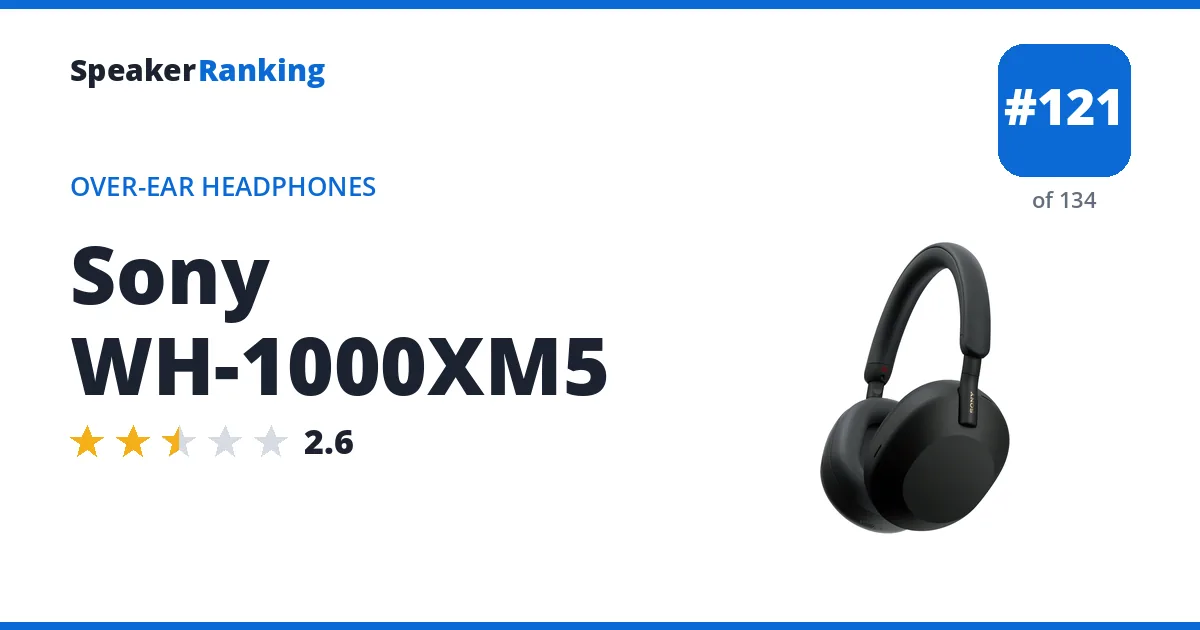
Pros: It offers active noise cancelling, Bluetooth 5.2 with SBC, AAC and LDAC for high-resolution streaming, a built-in microphone, and about 30 hours of battery life. At 250 g it is lighter than the other wireless over-ears at its level. Presence and treble are within about 3 dB of target, and the largest deviation in the upper range is a modest 4.6 dB peak near 6.2 kHz, so the top end is relatively smooth.
Cons: Bass sits about 7 dB over target and sub-bass about 6 dB over, with the low mids another 3 dB over, so the sound is bloated and bass-heavy for anyone wanting a balanced presentation. A 3.6 dB dip near 2.3 kHz pulls back vocals slightly, while air above 10 kHz is about 2 dB low. It has no IP rating for water or dust protection. The Beats Studio3 Wireless has a higher rating.
Full Sony WH-1000XM5 review and specifications →
| Released | May 2022 (4 years ago) |
|---|---|
| Active Noise Cancelling | Yes |
| Back | Closed |
| Battery Life | 30 hours (Manufacturer specified) |
| Bluetooth Codecs | SBC, AAC, LDAC |
| Bluetooth Version | 5.2 |
| Built-in Microphone | Yes |
| Connection | Wireless and wired |
| Deviation From Target | 3.33 dB standard deviation |
| Driver Type | Dynamic |
| Drivers | 1 x 30mm dynamic |
| Form Factor | Over-ear |
| Frequency Response | 4Hz - 40kHz (Manufacturer specified) |
| Harman Preference Score | 50 (measured by oratory1990, via AutoEQ) |
| IP Rating | None |
| Impedance | 48 ohms |
| Sensitivity | 102 dB/mW |
| Tonal Tilt | -1.47 (negative is warmer, positive brighter) |
| Weight | 0.6 lbs (250 g) |
EQ preset to match the Harman target
Set a preamp of -6.2 dB, then add these filters in any parametric equalizer (Wavelet, Equalizer APO, Peace, or a player with parametric EQ). Calculated by AutoEQ from its measured frequency response.
| Filter | Frequency | Gain | Q |
|---|---|---|---|
| Low shelf | 105 Hz | -3.2 dB | 0.70 |
| Peak | 2,448 Hz | +6.9 dB | 2.46 |
| Peak | 173 Hz | -5.6 dB | 0.96 |
| Peak | 3,028 Hz | -5.4 dB | 2.03 |
| Peak | 1,327 Hz | +3.3 dB | 0.58 |
| High shelf | 10,000 Hz | +4.9 dB | 0.70 |
| Peak | 6,110 Hz | -2.3 dB | 5.81 |
| Peak | 875 Hz | -1.2 dB | 4.07 |
| Peak | 1,197 Hz | +1.0 dB | 3.28 |
| Peak | 63 Hz | +0.4 dB | 2.13 |
- Reviews, Comparisons and Sound Samples
- Head-to-Head Comparisons
 Ranked #123 of 134 in Over-Ear Headphones - Jabra Evolve 40: $142.73 Discontinued Amazon eBay
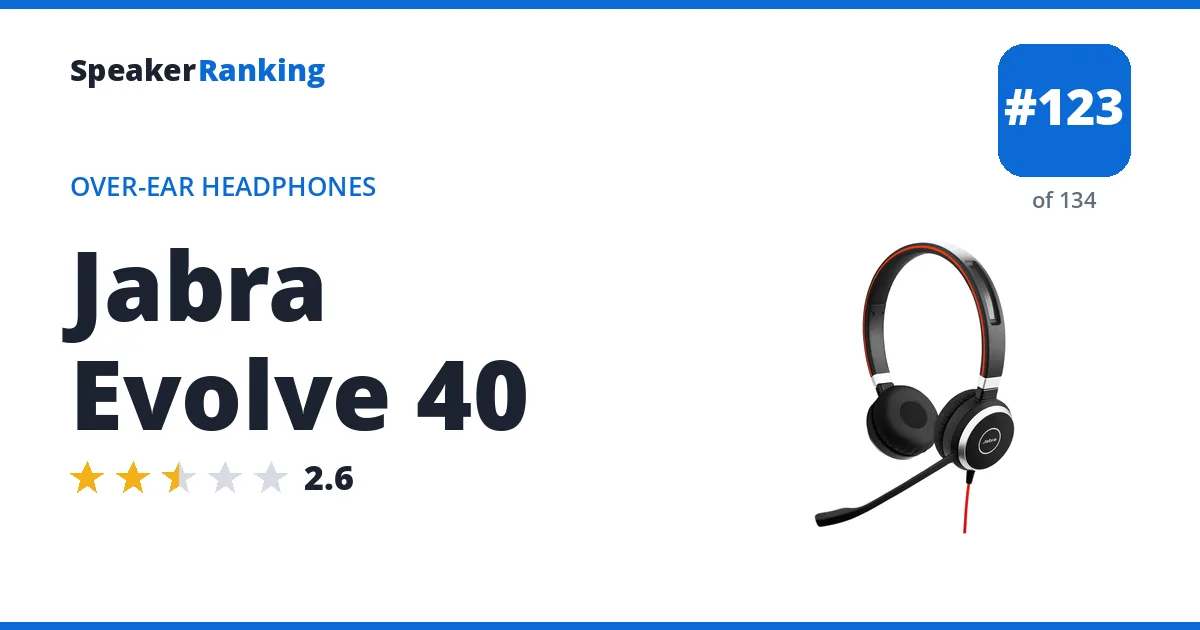
Pros: Closed-back, 113 g and a built-in microphone make this a light office headset that also works for calls. A 32 ohm impedance runs fine straight from a laptop or phone. Midrange and treble sit within about 2 dB of the Harman target from 1 kHz to 10 kHz, so voices are reasonably natural, and it suits neutral or bright tastes.
Cons: Sub-bass below 60 Hz sits about 20 dB under the target, so kick drums and bass synths have almost no rumble. A 9 dB dip near 11 kHz and air that is about 6 dB low make cymbals dull. Its preference score of 50 is middling for the class, and the Bowers & Wilkins Px7 S2 is rated higher at a similar price. Discontinued.
Full Jabra Evolve 40 review and specifications →
| Released | Nov 2014 (11 years ago) |
|---|---|
| Back | Closed |
| Built-in Microphone | Yes |
| Connection | Wired |
| Deviation From Target | 4.29 dB standard deviation |
| Drivers | 1 x 28mm |
| Form Factor | Over-ear |
| Frequency Response | 20Hz - 20kHz (Manufacturer specified) |
| Harman Preference Score | 50 (measured by oratory1990, via AutoEQ) |
| Impedance | 32 ohms |
| Sensitivity | 93.6 dB |
| Tonal Tilt | +0.69 (negative is warmer, positive brighter) |
| Weight | 0.2 lbs (113 g) |
EQ preset to match the Harman target
Set a preamp of -6.2 dB, then add these filters in any parametric equalizer (Wavelet, Equalizer APO, Peace, or a player with parametric EQ). Calculated by AutoEQ from its measured frequency response.
| Filter | Frequency | Gain | Q |
|---|---|---|---|
| Low shelf | 105 Hz | +6.1 dB | 0.70 |
| Peak | 200 Hz | -4.1 dB | 0.76 |
| Peak | 90 Hz | +3.4 dB | 1.81 |
| Peak | 1,208 Hz | +4.4 dB | 2.15 |
| Peak | 703 Hz | -2.5 dB | 1.74 |
| High shelf | 10,000 Hz | +2.7 dB | 0.70 |
| Peak | 2,662 Hz | +2.7 dB | 1.26 |
| Peak | 1,969 Hz | -3.8 dB | 3.23 |
| Peak | 9,699 Hz | +3.6 dB | 2.55 |
| Peak | 2,750 Hz | +0.8 dB | 4.49 |
- Reviews, Comparisons and Sound Samples
- Head-to-Head Comparisons
 Ranked #125 of 134 in Over-Ear Headphones - Sennheiser Momentum 4 Wireless: $227.38 Amazon eBay
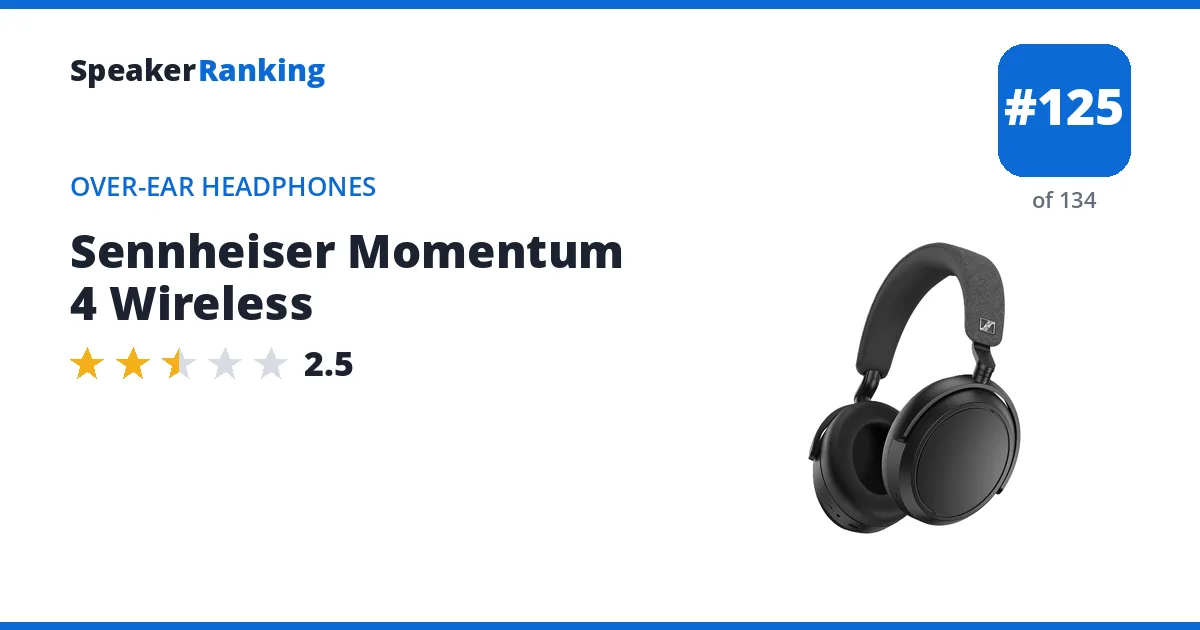
Pros: Feature set is strong: active noise cancelling, Bluetooth 5.2 with SBC, AAC, aptX and aptX Adaptive, and a rated 60 hours of battery. It also plays wired and has a built-in microphone. The deep bass lift, about 9 dB in the sub-bass and 6 dB in the bass, suits listeners who like a warm, bass-heavy sound.
Cons: That bass boost overshoots the Harman target by a clear margin and adds about 2 dB in the low mids, which can make vocals and bass guitar thick. A 4.7 dB dip near 2.4 kHz followed by a 3.5 dB peak near 6.8 kHz makes the upper midrange uneven. Its preference score of 47 trails the Beats Studio3 Wireless, which is rated higher.
Full Sennheiser Momentum 4 Wireless review and specifications →
| Released | Aug 2022 (4 years ago) |
|---|---|
| Active Noise Cancelling | Yes |
| Back | Closed |
| Battery Life | 60 hours (Manufacturer specified) |
| Bluetooth Codecs | SBC, AAC, aptX, aptX Adaptive |
| Bluetooth Version | 5.2 |
| Built-in Microphone | Yes |
| Connection | Wireless and wired |
| Deviation From Target | 3.31 dB standard deviation |
| Driver Type | Dynamic |
| Drivers | 1 x 42mm dynamic |
| Form Factor | Over-ear |
| Frequency Response | 6Hz - 22kHz (Manufacturer specified) |
| Harman Preference Score | 47 (measured by oratory1990, via AutoEQ) |
| IP Rating | None |
| Sensitivity | 106 dB SPL (1 kHz / 0 dB FS) |
| Tonal Tilt | -1.68 (negative is warmer, positive brighter) |
| Weight | 0.6 lbs (293 g) |
EQ preset to match the Harman target
Set a preamp of -6.4 dB, then add these filters in any parametric equalizer (Wavelet, Equalizer APO, Peace, or a player with parametric EQ). Calculated by AutoEQ from its measured frequency response.
| Filter | Frequency | Gain | Q |
|---|---|---|---|
| Low shelf | 105 Hz | -7.4 dB | 0.70 |
| Peak | 195 Hz | -3.6 dB | 1.22 |
| Peak | 2,393 Hz | +6.1 dB | 1.81 |
| Peak | 1,726 Hz | +1.6 dB | 1.71 |
| Peak | 2,893 Hz | -3.2 dB | 5.94 |
| High shelf | 10,000 Hz | +0.5 dB | 0.70 |
| Peak | 63 Hz | +1.7 dB | 2.86 |
| Peak | 652 Hz | +1.2 dB | 2.25 |
| Peak | 952 Hz | -1.0 dB | 3.69 |
| Peak | 316 Hz | -0.9 dB | 3.46 |
- Reviews, Comparisons and Sound Samples
- Head-to-Head Comparisons
 Ranked #127 of 134 in Over-Ear Headphones - Sennheiser HD 450BT: $69.00 Amazon eBay
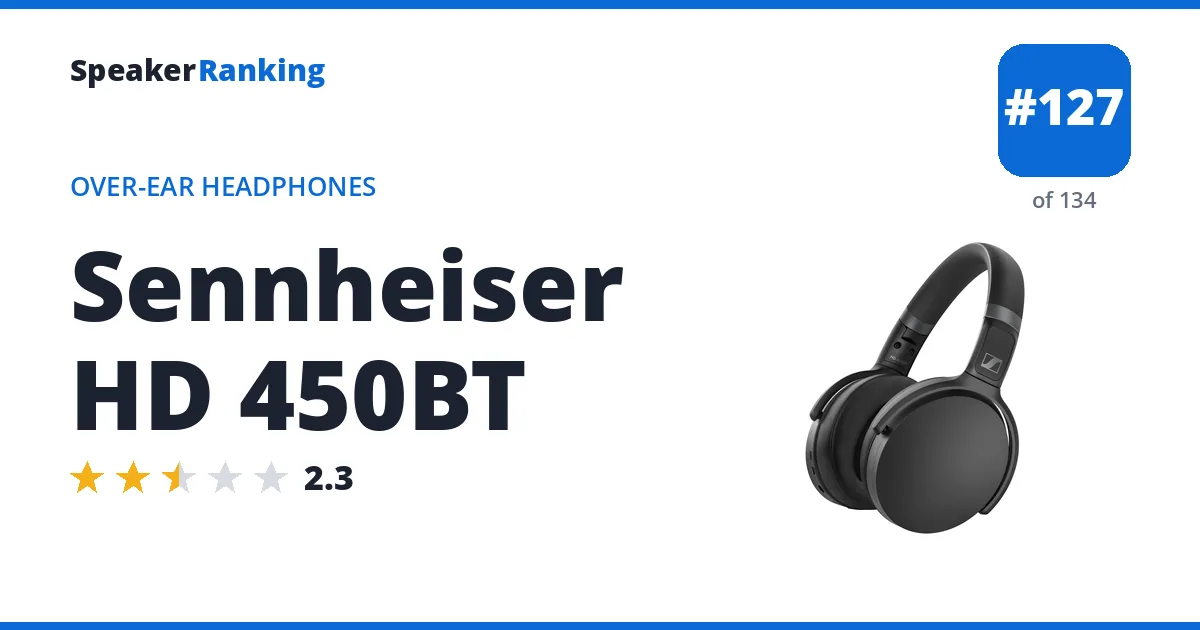
Pros: Wireless with active noise cancelling, about 30 hours of battery and Bluetooth 5.0 with SBC, AAC, aptX and aptX Low Latency. It also has a wired mode and a built-in microphone at a modest price. Bass from sub-bass through 200 Hz is within about 1 dB of the Harman target, which suits warm tastes.
Cons: A deep 15.7 dB dip near 4.4 kHz and presence about 8.5 dB low make vocals recessed and distant. Treble from 6 to 16 kHz is also 4 to 7 dB under target, so the sound is dark and lacks sparkle. The HyperX Cloud II is rated higher for less money.
Full Sennheiser HD 450BT review and specifications →
| Released | Feb 2020 (6 years ago) |
|---|---|
| Active Noise Cancelling | Yes |
| Back | Closed |
| Battery Life | 30 hours (Manufacturer specified) |
| Bluetooth Codecs | SBC, AAC, aptX, aptX Low Latency |
| Bluetooth Version | 5.0 |
| Built-in Microphone | Yes |
| Connection | Wireless and wired |
| Deviation From Target | 3.64 dB standard deviation |
| Driver Type | Dynamic |
| Form Factor | Over-ear |
| Frequency Response | 18Hz - 22kHz (Manufacturer specified) |
| Harman Preference Score | 44 (measured by oratory1990, via AutoEQ) |
| Sensitivity | 108 dB SPL (1 kHz, 0 dBFS) |
| Tonal Tilt | -1.56 (negative is warmer, positive brighter) |
| Weight | 0.5 lbs (238 g) |
EQ preset to match the Harman target
Set a preamp of -6.4 dB, then add these filters in any parametric equalizer (Wavelet, Equalizer APO, Peace, or a player with parametric EQ). Calculated by AutoEQ from its measured frequency response.
| Filter | Frequency | Gain | Q |
|---|---|---|---|
| Low shelf | 105 Hz | -2.7 dB | 0.70 |
| Peak | 2,417 Hz | -4.2 dB | 0.56 |
| Peak | 3,855 Hz | +8.3 dB | 1.65 |
| Peak | 151 Hz | -3.0 dB | 1.14 |
| Peak | 6,571 Hz | +3.5 dB | 1.15 |
| High shelf | 10,000 Hz | +5.6 dB | 0.70 |
| Peak | 8,215 Hz | -2.8 dB | 4.27 |
| Peak | 374 Hz | +0.9 dB | 2.79 |
| Peak | 656 Hz | -0.6 dB | 2.31 |
| Peak | 41 Hz | -0.2 dB | 1.75 |
- Reviews, Comparisons and Sound Samples
- Head-to-Head Comparisons
 Ranked #128 of 134 in Over-Ear Headphones - Logitech G Pro X: $92.23 Discontinued Amazon eBay
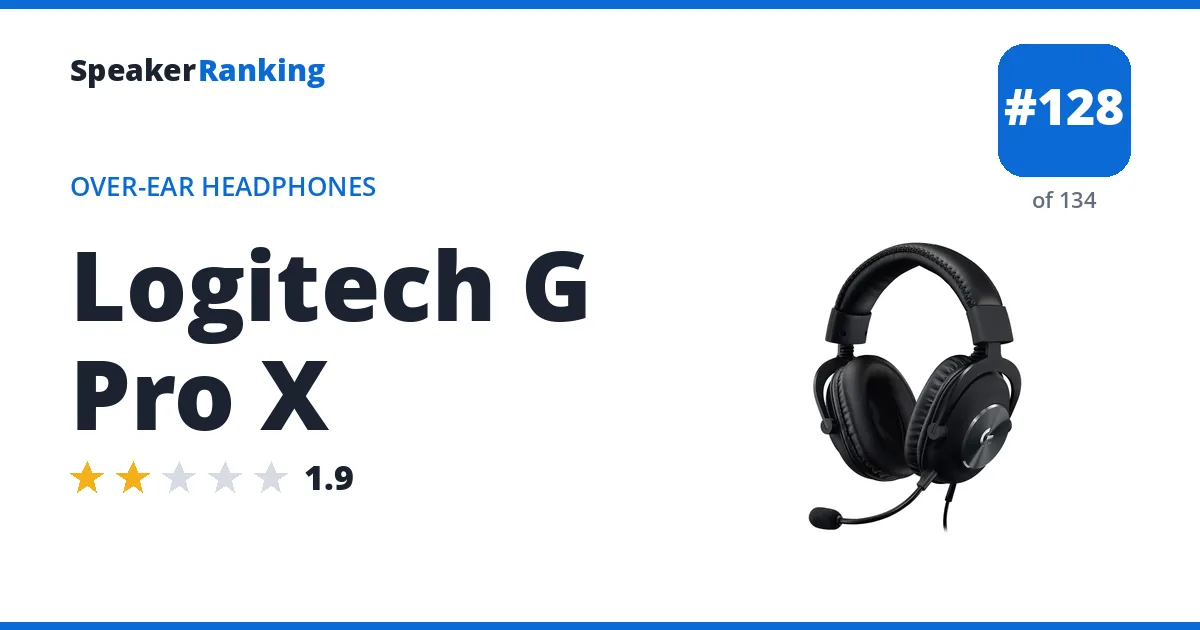
Pros: A closed-back gaming headset with a 50 mm driver, a built-in microphone and a 32 ohm impedance that runs from a console or PC without an amp. The warm tilt will suit listeners who want a mellow presentation.
Cons: Crinacle’s measurement gives a preference score of 34, a long way from the target most listeners prefer, with an uneven response around it. It is wired only and weighs 320 g. The Sennheiser HD 450BT is rated higher at a lower price and adds wireless. Discontinued.
Full Logitech G Pro X review and specifications →
| Released | Jul 2019 (7 years ago) |
|---|---|
| Back | Closed |
| Built-in Microphone | Yes |
| Connection | Wired |
| Deviation From Target | 4.05 dB standard deviation |
| Driver Type | Dynamic |
| Drivers | 1 x 50mm dynamic |
| Form Factor | Over-ear |
| Harman Preference Score | 34 (measured by crinacle, via AutoEQ) |
| Impedance | 32 ohms |
| Sensitivity | 91.7 dB SPL/mW |
| Tonal Tilt | -1.88 (negative is warmer, positive brighter) |
| Weight | 0.7 lbs (320 g) |
EQ preset to match the Harman target
Set a preamp of -6.5 dB, then add these filters in any parametric equalizer (Wavelet, Equalizer APO, Peace, or a player with parametric EQ). Calculated by AutoEQ from its measured frequency response.
| Filter | Frequency | Gain | Q |
|---|---|---|---|
| Low shelf | 105 Hz | -0.2 dB | 0.70 |
| Peak | 144 Hz | -8.3 dB | 0.63 |
| Peak | 8,189 Hz | +4.9 dB | 0.35 |
| Peak | 61 Hz | +5.7 dB | 2.16 |
| Peak | 371 Hz | +3.9 dB | 1.82 |
| High shelf | 10,000 Hz | +1.7 dB | 0.70 |
| Peak | 3,467 Hz | +3.8 dB | 3.72 |
| Peak | 1,520 Hz | -3.5 dB | 3.41 |
| Peak | 2,564 Hz | -1.9 dB | 4.85 |
| Peak | 1,011 Hz | +1.1 dB | 2.39 |
- Reviews, Comparisons and Sound Samples
- Head-to-Head Comparisons
 Ranked #130 of 134 in Over-Ear Headphones - Sennheiser HD 569: $129.95 Amazon eBay
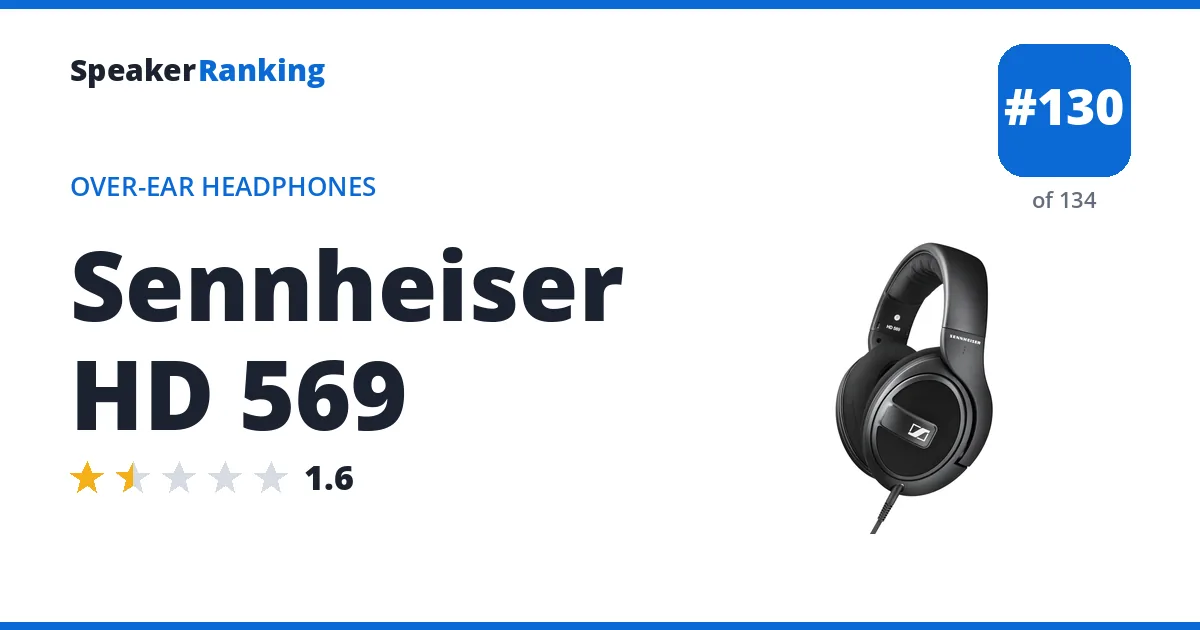
Pros: A wired closed-back headphone with a built-in microphone. A 23 ohm impedance and 115 dB sensitivity make it very easy to drive from a phone. A bass lift of about 5 dB suits listeners who prefer a warm, bassy sound.
Cons: Treble from 6 to 10 kHz is about 5 dB low and presence is down 4 dB, with an 11.7 dB dip near 10 kHz, so the sound is dull and veiled. The warm tilt and bass emphasis can make mixes sound heavy. At 300 g, wired only, it is rated below the Logitech G Pro X and the Jabra Evolve 40.
Full Sennheiser HD 569 review and specifications →
| Back | Closed |
|---|---|
| Built-in Microphone | Yes |
| Connection | Wired |
| Deviation From Target | 3.97 dB standard deviation |
| Driver Type | Dynamic |
| Drivers | 1 x 38mm dynamic |
| Form Factor | Over-ear |
| Frequency Response | 10Hz - 28kHz (Manufacturer specified) |
| Harman Preference Score | 28 (measured by oratory1990, via AutoEQ) |
| Impedance | 23 ohms |
| Sensitivity | 115 dB SPL/V |
| Tonal Tilt | -2.31 (negative is warmer, positive brighter) |
| Weight | 0.7 lbs (300 g) |
EQ preset to match the Harman target
Set a preamp of -6.2 dB, then add these filters in any parametric equalizer (Wavelet, Equalizer APO, Peace, or a player with parametric EQ). Calculated by AutoEQ from its measured frequency response.
| Filter | Frequency | Gain | Q |
|---|---|---|---|
| Low shelf | 105 Hz | -0.4 dB | 0.70 |
| Peak | 79 Hz | -7.0 dB | 0.60 |
| Peak | 10,000 Hz | +4.2 dB | 0.26 |
| Peak | 4,676 Hz | +3.2 dB | 5.65 |
| Peak | 818 Hz | -1.9 dB | 1.41 |
| High shelf | 10,000 Hz | -2.2 dB | 0.70 |
| Peak | 280 Hz | +1.7 dB | 2.28 |
| Peak | 2,195 Hz | +2.0 dB | 2.24 |
| Peak | 3,255 Hz | -3.5 dB | 4.88 |
| Peak | 154 Hz | -1.1 dB | 2.14 |
- Reviews, Comparisons and Sound Samples
- Head-to-Head Comparisons
 Ranked #132 of 134 in Over-Ear Headphones - Razer Barracuda X: $69.00 Amazon eBay
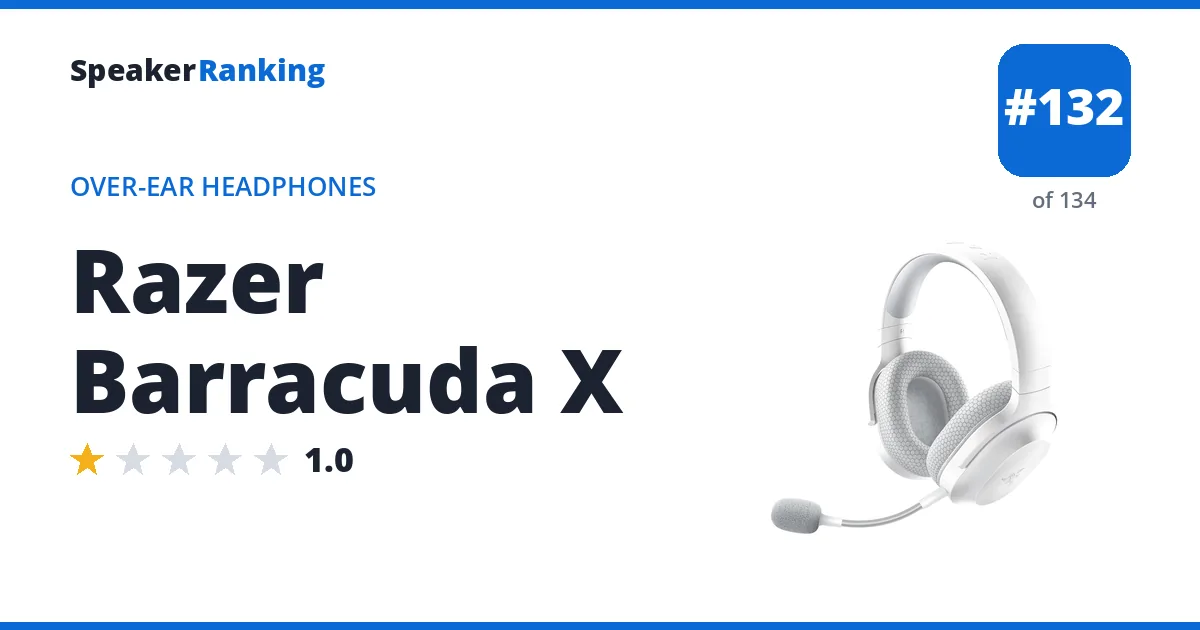
Pros: Wireless with a rated 50 hours of battery, Bluetooth 5.2, a built-in microphone and a wired option. At 250 g with 32 ohms and 96 dB sensitivity it is easy to drive. It has no active noise cancelling, so the battery goes a long way.
Cons: Crinacle’s measurement gives a preference score of just 7, among the furthest from the Harman target in the class, with a warm tilt and a very uneven response. Without noise cancelling it offers no real isolation from outside noise. The Logitech G Pro X is rated higher at a somewhat higher price.
Full Razer Barracuda X review and specifications →
| Released | Jul 2021 (5 years ago) |
|---|---|
| Active Noise Cancelling | No |
| Back | Closed |
| Battery Life | 50 hours (Manufacturer specified) |
| Bluetooth Version | 5.2 |
| Built-in Microphone | Yes |
| Connection | Wireless and wired |
| Deviation From Target | 5.15 dB standard deviation |
| Driver Type | Dynamic |
| Drivers | 1 x 40mm dynamic |
| Form Factor | Over-ear |
| Frequency Response | 20Hz - 20kHz (Manufacturer specified) |
| Harman Preference Score | 7 (measured by crinacle, via AutoEQ) |
| IP Rating | None |
| Impedance | 32 ohms |
| Sensitivity | 96 dB SPL/mW |
| Tonal Tilt | -2.74 (negative is warmer, positive brighter) |
| Weight | 0.6 lbs (250 g) |
EQ preset to match the Harman target
Set a preamp of -6.4 dB, then add these filters in any parametric equalizer (Wavelet, Equalizer APO, Peace, or a player with parametric EQ). Calculated by AutoEQ from its measured frequency response.
| Filter | Frequency | Gain | Q |
|---|---|---|---|
| Low shelf | 105 Hz | -2.4 dB | 0.70 |
| Peak | 4,094 Hz | +6.1 dB | 1.10 |
| Peak | 130 Hz | -9.0 dB | 1.11 |
| Peak | 607 Hz | -4.1 dB | 1.80 |
| Peak | 1,766 Hz | +4.0 dB | 1.64 |
| High shelf | 10,000 Hz | -2.5 dB | 0.70 |
| Peak | 286 Hz | +3.7 dB | 3.33 |
| Peak | 194 Hz | -2.2 dB | 2.83 |
| Peak | 440 Hz | -1.5 dB | 3.10 |
| Peak | 309 Hz | +0.8 dB | 2.49 |
- Reviews, Comparisons and Sound Samples
- Head-to-Head Comparisons
 Ranked #134 of 134 in Over-Ear Headphones - Razer BlackShark V2 X: $34.99 Amazon eBay
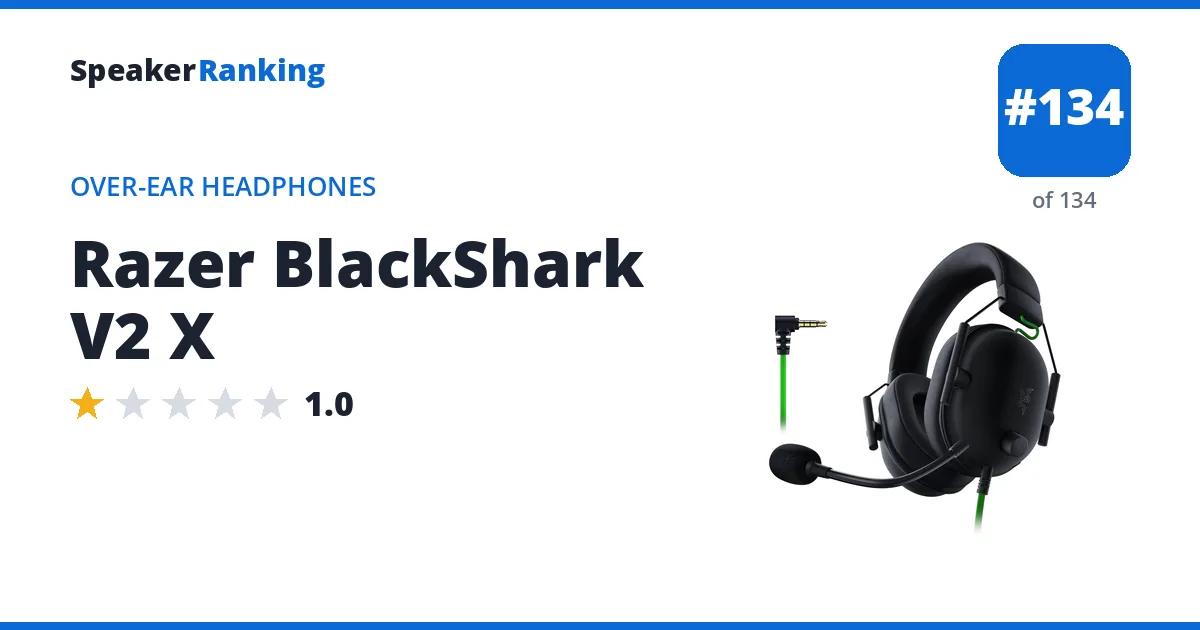
Pros: A built-in microphone makes it usable for voice chat without a separate headset. The 32 ohm impedance suits PC, console and phone outputs with no amp needed, and the closed back keeps game audio from leaking into the room. At 240 g with 50 mm drivers it is a straightforward wired gaming option at a low price.
Cons: Crinacle’s measurement gives a Harman score of just 1, so the tonal balance is a long way from what most listeners prefer. The response is uneven, with a deviation of about 5.4 dB and a warm tilt, which tends to cloud vocals and detail in music. It is better suited to casual gaming and chat than to critical listening.
Full Razer BlackShark V2 X review and specifications →
| Released | Aug 2020 (6 years ago) |
|---|---|
| Back | Closed |
| Built-in Microphone | Yes |
| Connection | Wired |
| Deviation From Target | 5.39 dB standard deviation |
| Driver Type | Dynamic |
| Drivers | 1 x 50mm dynamic |
| Form Factor | Over-ear |
| Frequency Response | 12Hz - 28kHz (Manufacturer specified) |
| Harman Preference Score | 1 (measured by crinacle, via AutoEQ) |
| Impedance | 32 ohms |
| Sensitivity | 100 dB SPL/mW |
| Tonal Tilt | -2.96 (negative is warmer, positive brighter) |
| Weight | 0.5 lbs (240 g) |
EQ preset to match the Harman target
Set a preamp of -5.6 dB, then add these filters in any parametric equalizer (Wavelet, Equalizer APO, Peace, or a player with parametric EQ). Calculated by AutoEQ from its measured frequency response.
| Filter | Frequency | Gain | Q |
|---|---|---|---|
| Low shelf | 105 Hz | -3.9 dB | 0.70 |
| Peak | 158 Hz | -13.0 dB | 0.91 |
| Peak | 825 Hz | +8.9 dB | 0.18 |
| Peak | 7,600 Hz | +3.5 dB | 3.10 |
| Peak | 808 Hz | -10.8 dB | 0.68 |
| High shelf | 10,000 Hz | +0.5 dB | 0.70 |
| Peak | 312 Hz | +3.1 dB | 3.28 |
| Peak | 477 Hz | -1.6 dB | 2.83 |
| Peak | 4,275 Hz | +1.7 dB | 4.98 |
| Peak | 216 Hz | -1.8 dB | 3.70 |
- Reviews, Comparisons and Sound Samples
- Head-to-Head Comparisons
In-Ear Headphones
 Ranked #11 of 68 in In-Ear Headphones - Sony WF-1000XM5: $198.00 Amazon eBay
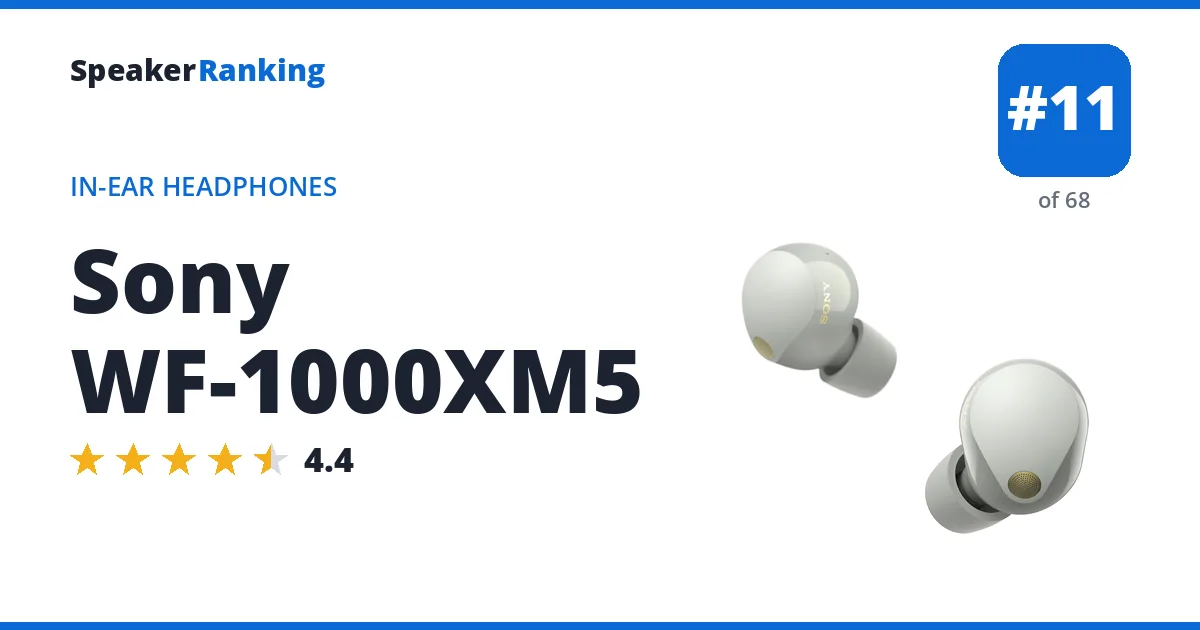
Pros: Mild bass emphasis, about 1.9 dB above target from 60 to 200 Hz, adds warmth without muddying the midrange, which stays within 0.8 dB of the target for a preference score of 78. Active noise cancelling, LDAC, AAC and SBC support, Bluetooth 5.3 and an IPX4 rating make it a full-featured true wireless set. Battery lasts about 8 hours per charge, 24 with the case, and each bud weighs 5.9 g.
Cons: Treble from 6 to 10 kHz runs about 2.2 dB low, with a 4.9 dB dip near 8 kHz, so cymbals and sibilance lose some bite. A 2.9 dB peak near 10.6 kHz can add a touch of artificial shimmer. Sub-bass sits about 1.9 dB below target, so the bass is punchy more than deep. The wired Sennheiser IE 200 matches its rating at a lower price and without charging.
Full Sony WF-1000XM5 review and specifications →
| Released | Jul 2023 (3 years ago) |
|---|---|
| Active Noise Cancelling | Yes |
| Back | Closed |
| Battery Life | 8 hours (24 with case, Manufacturer specified) |
| Bluetooth Codecs | SBC, AAC, LDAC |
| Bluetooth Version | 5.3 |
| Built-in Microphone | Yes |
| Connection | True wireless |
| Deviation From Target | 1.87 dB standard deviation |
| Driver Type | Dynamic |
| Drivers | 1 x 8.4mm dynamic |
| Form Factor | In-ear |
| Frequency Response | 20Hz - 20kHz (Manufacturer specified) |
| Harman Preference Score | 78 (measured by oratory1990, via AutoEQ) |
| IP Rating | IPX4 |
| Tonal Tilt | -0.18 (negative is warmer, positive brighter) |
| Weight | 0 lbs (5.9 g) per earbud |
EQ preset to match the Harman target
Set a preamp of -2.6 dB, then add these filters in any parametric equalizer (Wavelet, Equalizer APO, Peace, or a player with parametric EQ). Calculated by AutoEQ from its measured frequency response.
| Filter | Frequency | Gain | Q |
|---|---|---|---|
| Low shelf | 105 Hz | +5.4 dB | 0.70 |
| Peak | 68 Hz | -4.8 dB | 0.27 |
| Peak | 1,377 Hz | +2.6 dB | 0.31 |
| Peak | 1,806 Hz | -3.5 dB | 1.16 |
| Peak | 6,875 Hz | +1.8 dB | 3.49 |
| High shelf | 10,000 Hz | +2.3 dB | 0.70 |
| Peak | 3,757 Hz | +0.3 dB | 2.56 |
| Peak | 5,057 Hz | -0.7 dB | 5.70 |
| Peak | 449 Hz | +0.3 dB | 4.15 |
| Peak | 677 Hz | -0.2 dB | 2.75 |
- Reviews, Comparisons and Sound Samples
- Head-to-Head Comparisons
 Ranked #14 of 68 in In-Ear Headphones - Moondrop Quarks: $17.99 Amazon eBay
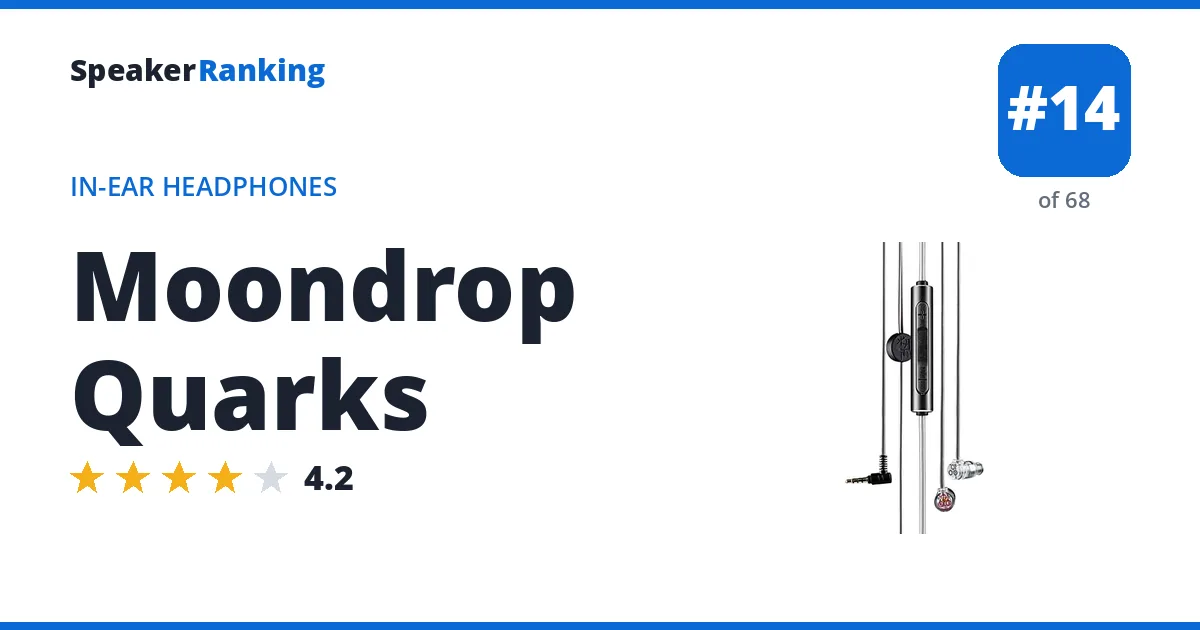
Pros: A preference score of 76 from a very inexpensive wired in-ear is hard to beat, and it is rated above the KZ ZSN Pro X and the CCA CRA. Bass from 60 to 200 Hz is lifted about 2.2 dB over target and the low mids about 1.6 dB, giving a warm, full sound that fits warm and bass leaning tastes. At 16 ohms and 116 dB sensitivity it plays loud straight from a phone.
Cons: A 4 dB peak near 2.9 kHz can make female vocals and snare hits sound forward or slightly shouty at higher volumes. Air above 10 kHz is about 2.5 dB low and there is a 5.4 dB dip near 11.9 kHz, so the top end sounds less open and airy. Sub-bass under 60 Hz is about 1.8 dB below target, so the deepest notes lack a little rumble.
Full Moondrop Quarks review and specifications →
| Released | 2021 (5 years ago) |
|---|---|
| Back | Closed |
| Built-in Microphone | Yes |
| Connection | Wired |
| Deviation From Target | 2.04 dB standard deviation |
| Driver Type | Dynamic |
| Drivers | 1 x 6mm dynamic |
| Form Factor | In-ear |
| Frequency Response | 20Hz - 20kHz (Manufacturer specified) |
| Harman Preference Score | 76 (measured by oratory1990, via AutoEQ) |
| Impedance | 16 ohms |
| Sensitivity | 116 dB/Vrms |
| Tonal Tilt | -0.06 (negative is warmer, positive brighter) |
EQ preset to match the Harman target
Set a preamp of -2.6 dB, then add these filters in any parametric equalizer (Wavelet, Equalizer APO, Peace, or a player with parametric EQ). Calculated by AutoEQ from its measured frequency response.
| Filter | Frequency | Gain | Q |
|---|---|---|---|
| Low shelf | 105 Hz | +2.5 dB | 0.70 |
| Peak | 170 Hz | -3.1 dB | 0.65 |
| Peak | 10,000 Hz | +2.9 dB | 0.24 |
| Peak | 767 Hz | +2.5 dB | 1.26 |
| Peak | 2,855 Hz | -5.9 dB | 3.31 |
| High shelf | 10,000 Hz | -1.9 dB | 0.70 |
| Peak | 4,604 Hz | +0.9 dB | 3.27 |
| Peak | 6,302 Hz | -1.1 dB | 4.61 |
| Peak | 1,492 Hz | -0.2 dB | 2.76 |
| Peak | 60 Hz | +0.1 dB | 1.86 |
- Reviews, Comparisons and Sound Samples
 Ranked #17 of 68 in In-Ear Headphones - Beats Powerbeats Pro: $189.99 Discontinued Amazon eBay
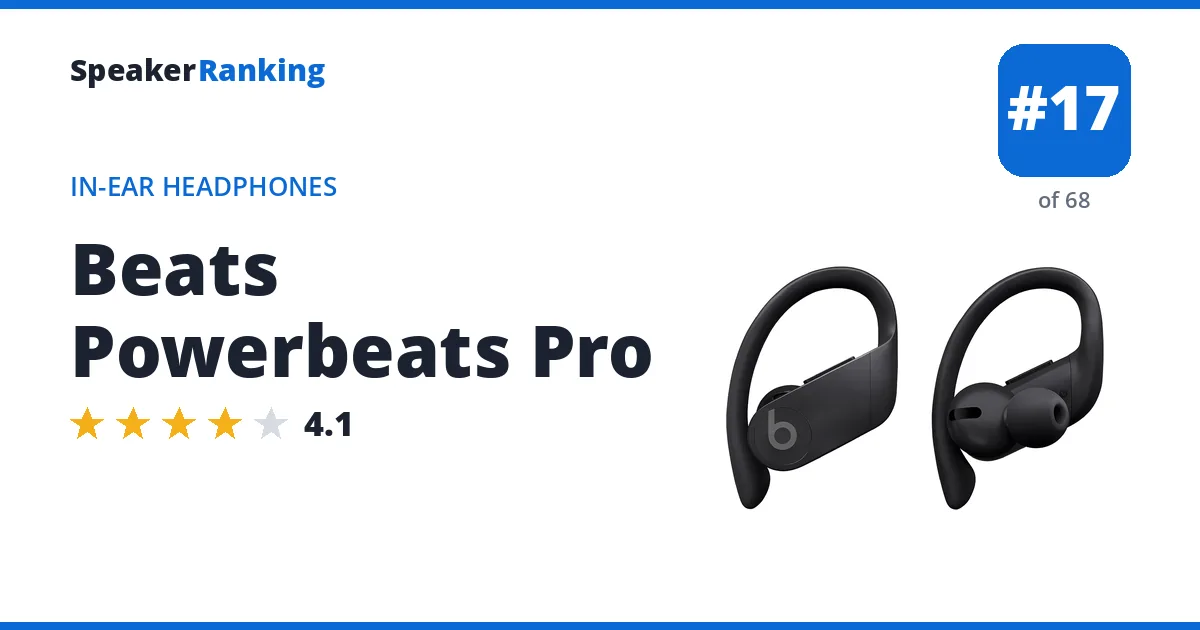
Pros: Bass and midrange follow the Harman target closely, with 60 to 200 Hz within 0.2 dB and upper mids 0.7 dB above, so voices and bass lines sound natural and warm for a preference score of 75. The true wireless design adds Bluetooth 5.0 with SBC and AAC, a built-in microphone and an IPX4 rating. Battery lasts about 9 hours per charge, 24 with the case.
Cons: Treble is well under target, about 5.2 dB low from 6 to 10 kHz, with an 8.5 dB dip near 6.8 kHz, so cymbals, hi-hats and sibilance sound muted. The air band above 10 kHz is another 4.4 dB low, which adds to a dark, closed-in sound. It has no active noise cancelling, and the Etymotic EVO has a higher rating. Discontinued.
Full Beats Powerbeats Pro review and specifications →
| Released | May 2019 (7 years ago) |
|---|---|
| Active Noise Cancelling | No |
| Back | Closed |
| Battery Life | 9 hours (24 with case, Manufacturer specified) |
| Bluetooth Codecs | SBC, AAC |
| Bluetooth Version | 5.0 |
| Built-in Microphone | Yes |
| Connection | True wireless |
| Deviation From Target | 2.09 dB standard deviation |
| Form Factor | In-ear |
| Harman Preference Score | 75 (measured by oratory1990, via AutoEQ) |
| IP Rating | IPX4 |
| Tonal Tilt | -0.37 (negative is warmer, positive brighter) |
EQ preset to match the Harman target
Set a preamp of -6.4 dB, then add these filters in any parametric equalizer (Wavelet, Equalizer APO, Peace, or a player with parametric EQ). Calculated by AutoEQ from its measured frequency response.
| Filter | Frequency | Gain | Q |
|---|---|---|---|
| Low shelf | 105 Hz | -0.8 dB | 0.70 |
| Peak | 6,596 Hz | +6.1 dB | 2.51 |
| Peak | 2,703 Hz | -4.4 dB | 2.80 |
| Peak | 1,362 Hz | -2.1 dB | 1.94 |
| Peak | 3,607 Hz | +3.7 dB | 4.72 |
| High shelf | 10,000 Hz | +3.7 dB | 0.70 |
| Peak | 143 Hz | -1.2 dB | 1.56 |
| Peak | 374 Hz | +0.7 dB | 1.21 |
| Peak | 4,688 Hz | -2.2 dB | 6.00 |
| Peak | 60 Hz | +0.4 dB | 1.34 |
- Reviews, Comparisons and Sound Samples
- Head-to-Head Comparisons
 Ranked #20 of 68 in In-Ear Headphones - Samsung Galaxy Buds2: $199.00 Discontinued Amazon eBay
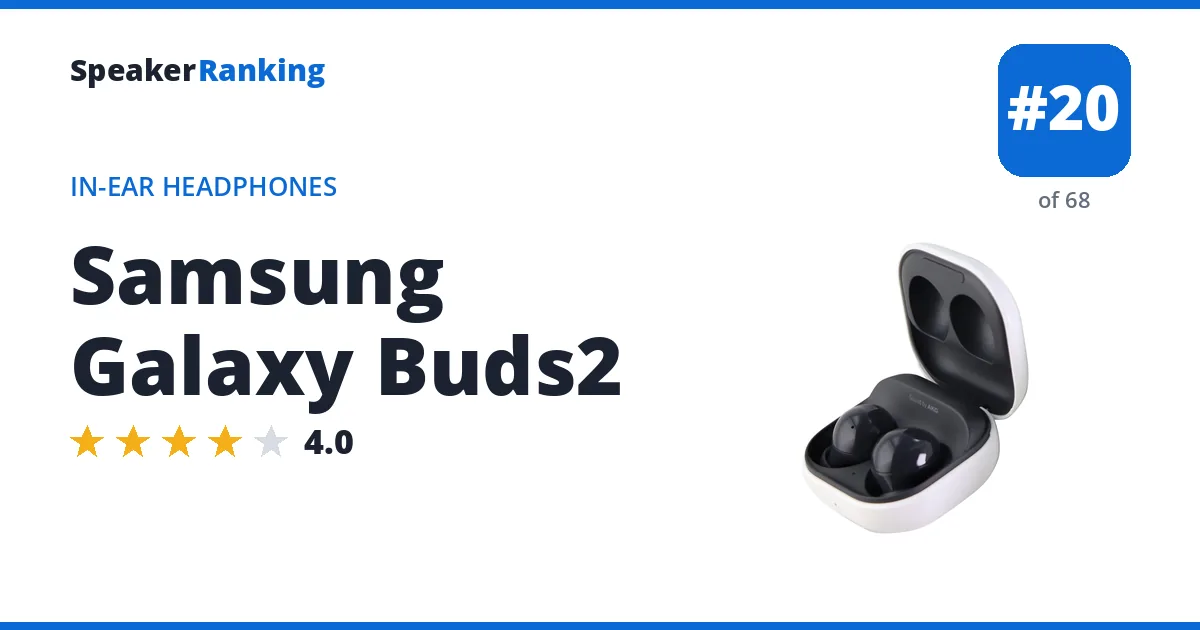
Pros: Bass and low mids sit slightly above target, about 0.9 dB at 60 to 200 Hz, which gives a warm, easy tonal balance for a preference score of 74. The set offers active noise cancelling, Bluetooth 5.2, a microphone, and SBC, AAC and Scalable codec support. Each bud weighs 5 g, and a dual driver layout pairs an 11mm woofer with a 6.3mm tweeter.
Cons: Treble is uneven, with a 5.8 dB peak near 8 kHz, a 4.8 dB dip across 3 to 6 kHz, and the air band 6.5 dB low, which blurs vocal detail and makes cymbals sound splashy and then rolled off. Battery lasts about 5 hours with noise cancelling on. The IPX2 rating gives only basic splash protection, and the AUNE Jasper has a higher rating. Discontinued.
Full Samsung Galaxy Buds2 review and specifications →
| Released | Aug 2021 (5 years ago) |
|---|---|
| Active Noise Cancelling | Yes |
| Back | Closed |
| Battery Life | 5 hours (20 with case, ANC on; 7.5 hours, 29 with case, ANC off, Manufacturer specified) |
| Bluetooth Codecs | SBC, AAC, Scalable |
| Bluetooth Version | 5.2 |
| Built-in Microphone | Yes |
| Connection | True wireless |
| Deviation From Target | 2.18 dB standard deviation |
| Driver Type | Dynamic |
| Drivers | 1 x 11mm dynamic woofer + 1 x 6.3mm dynamic tweeter |
| Form Factor | In-ear |
| Harman Preference Score | 74 (measured by oratory1990, via AutoEQ) |
| IP Rating | IPX2 |
| Tonal Tilt | -0.24 (negative is warmer, positive brighter) |
| Weight | 0 lbs (5 g) per earbud |
EQ preset to match the Harman target
Set a preamp of -4.6 dB, then add these filters in any parametric equalizer (Wavelet, Equalizer APO, Peace, or a player with parametric EQ). Calculated by AutoEQ from its measured frequency response.
| Filter | Frequency | Gain | Q |
|---|---|---|---|
| Low shelf | 105 Hz | +1.7 dB | 0.70 |
| Peak | 4,739 Hz | +4.8 dB | 1.27 |
| Peak | 88 Hz | -1.9 dB | 0.26 |
| Peak | 6,935 Hz | -3.8 dB | 4.18 |
| Peak | 827 Hz | +0.9 dB | 2.57 |
| High shelf | 10,000 Hz | +3.1 dB | 0.70 |
| Peak | 1,484 Hz | -1.0 dB | 2.64 |
| Peak | 7,930 Hz | -1.3 dB | 5.82 |
| Peak | 1,026 Hz | +0.5 dB | 4.03 |
| Peak | 41 Hz | -0.2 dB | 1.94 |
- Reviews, Comparisons and Sound Samples
- Head-to-Head Comparisons
 Ranked #29 of 68 in In-Ear Headphones - TANGZU Wan’er S.G: $18.00 Amazon eBay
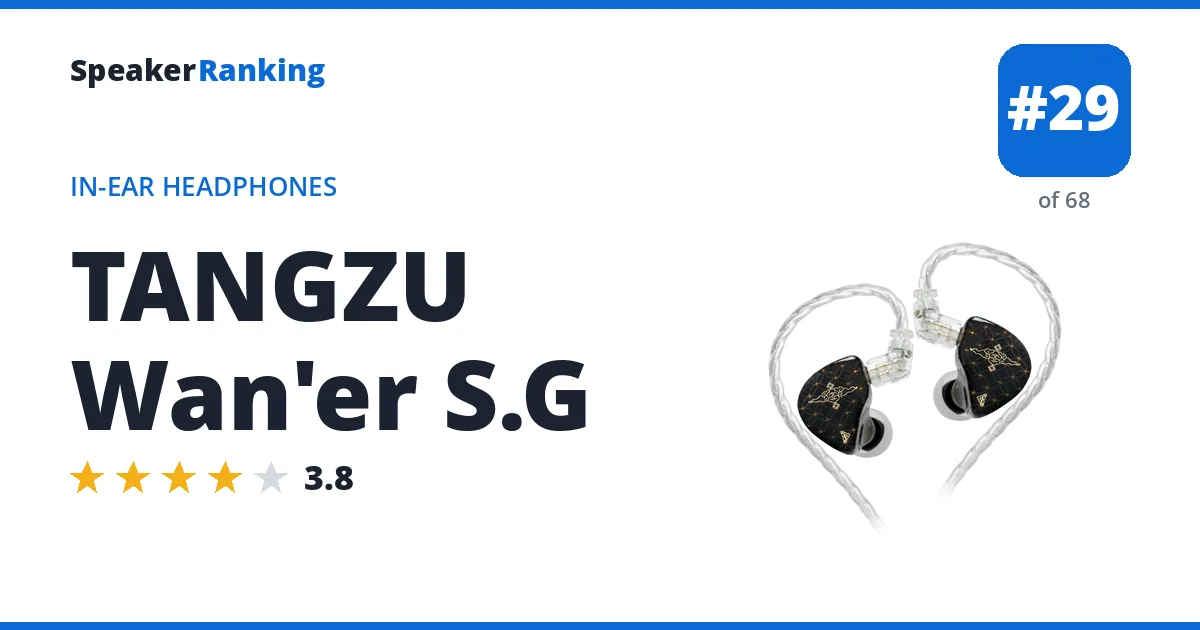
Pros: A preference score of 71 in crinacle’s measurement at a very low cost is good value, with a mildly warm tilt that keeps treble from becoming harsh. Each earbud weighs only 4.2 g, and a built-in microphone makes it usable for calls. It rates higher than the KZ ZST and costs less.
Cons: The 2.5 dB deviation from the target is the least smooth of this group, so tonal accuracy trails the CCA CRA and KZ ZSN Pro, both of which rate higher. A single 10mm dynamic driver and no listed impedance or sensitivity leave less to go on for matching it with a source.
Full TANGZU Wan’er S.G review and specifications →
| Released | 2023 (3 years ago) |
|---|---|
| Back | Closed |
| Built-in Microphone | Yes |
| Connection | Wired |
| Deviation From Target | 2.48 dB standard deviation |
| Driver Type | Dynamic |
| Drivers | 1 x 10mm dynamic |
| Form Factor | In-ear |
| Frequency Response | 20Hz - 20kHz (Manufacturer specified) |
| Harman Preference Score | 71 (measured by crinacle, via AutoEQ) |
| Tonal Tilt | -0.32 (negative is warmer, positive brighter) |
| Weight | 0 lbs (4.2 g) per earbud |
EQ preset to match the Harman target
Set a preamp of -5.4 dB, then add these filters in any parametric equalizer (Wavelet, Equalizer APO, Peace, or a player with parametric EQ). Calculated by AutoEQ from its measured frequency response.
| Filter | Frequency | Gain | Q |
|---|---|---|---|
| Low shelf | 105 Hz | +1.8 dB | 0.70 |
| Peak | 6,638 Hz | +5.1 dB | 1.36 |
| Peak | 145 Hz | -2.6 dB | 0.76 |
| Peak | 1,930 Hz | -2.9 dB | 1.79 |
| Peak | 9,431 Hz | +3.0 dB | 2.56 |
| High shelf | 10,000 Hz | -1.1 dB | 0.70 |
| Peak | 894 Hz | +1.2 dB | 1.34 |
| Peak | 1,321 Hz | -1.2 dB | 2.81 |
| Peak | 275 Hz | -0.4 dB | 1.71 |
| Peak | 570 Hz | +0.5 dB | 2.18 |
- Reviews, Comparisons and Sound Samples
- Head-to-Head Comparisons
 Ranked #36 of 68 in In-Ear Headphones - TRN MT1: $13.95 Amazon eBay
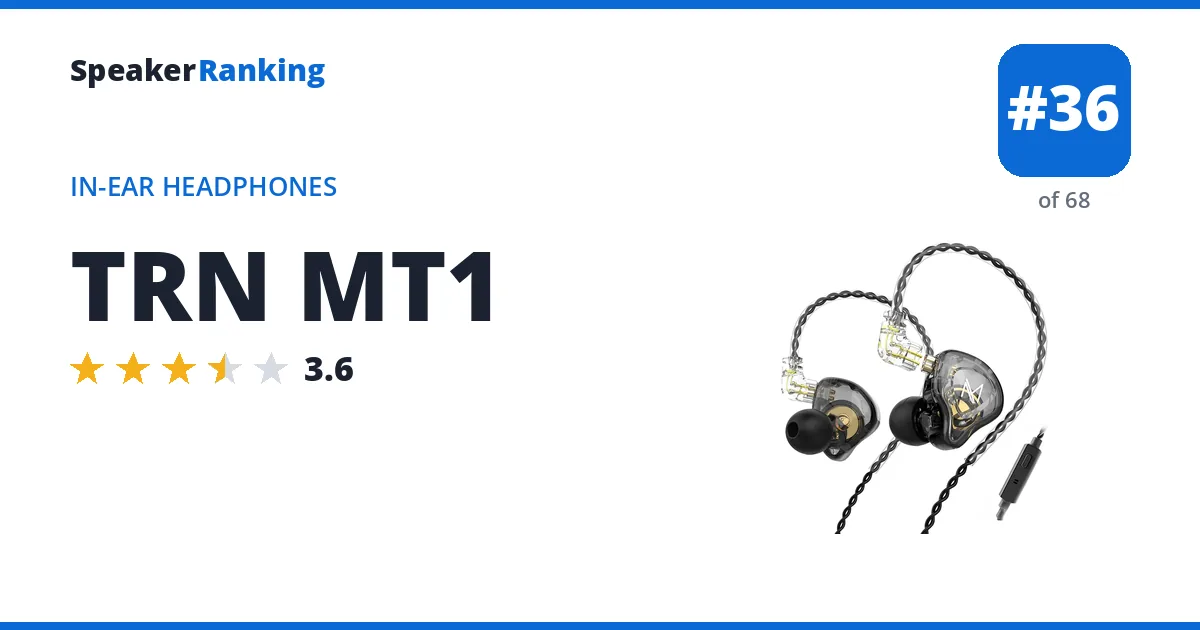
Pros: Crinacle’s measurement gives a Harman preference score of 69, a solid result for such an inexpensive wired in-ear. A 22 ohm impedance and 106 dB sensitivity let it run loudly from any phone or laptop without an amp. It includes an inline microphone for calls, and the single 10 mm dynamic driver keeps the sound coherent.
Cons: A deviation of 2.46 dB from the target means some coloration remains in the midrange and treble. The wired connection means no wireless freedom, and the CCA CRA is rated higher at a similar cost.
Full TRN MT1 review and specifications →
| Back | Closed |
|---|---|
| Built-in Microphone | Yes |
| Connection | Wired |
| Deviation From Target | 2.46 dB standard deviation |
| Driver Type | Dynamic |
| Drivers | 1 x 10mm dynamic |
| Form Factor | In-ear |
| Frequency Response | 20Hz - 20kHz (Manufacturer specified) |
| Harman Preference Score | 69 (measured by crinacle, via AutoEQ) |
| Impedance | 22 ohms |
| Sensitivity | 106 dB |
| Tonal Tilt | -0.34 (negative is warmer, positive brighter) |
EQ preset to match the Harman target
Set a preamp of -4.6 dB, then add these filters in any parametric equalizer (Wavelet, Equalizer APO, Peace, or a player with parametric EQ). Calculated by AutoEQ from its measured frequency response.
| Filter | Frequency | Gain | Q |
|---|---|---|---|
| Low shelf | 105 Hz | +0.1 dB | 0.70 |
| Peak | 838 Hz | +4.1 dB | 0.67 |
| Peak | 9,762 Hz | +6.7 dB | 0.47 |
| Peak | 156 Hz | -2.7 dB | 0.78 |
| Peak | 3,174 Hz | -6.2 dB | 0.55 |
| High shelf | 10,000 Hz | -7.6 dB | 0.70 |
| Peak | 3,444 Hz | +3.5 dB | 3.06 |
| Peak | 4,523 Hz | -6.4 dB | 2.49 |
| Peak | 6,251 Hz | +3.6 dB | 0.84 |
| Peak | 2,461 Hz | -2.8 dB | 4.84 |
- Reviews, Comparisons and Sound Samples
- Head-to-Head Comparisons
 Ranked #44 of 68 in In-Ear Headphones - Sennheiser Momentum True Wireless 3: $111.99 Discontinued Amazon eBay
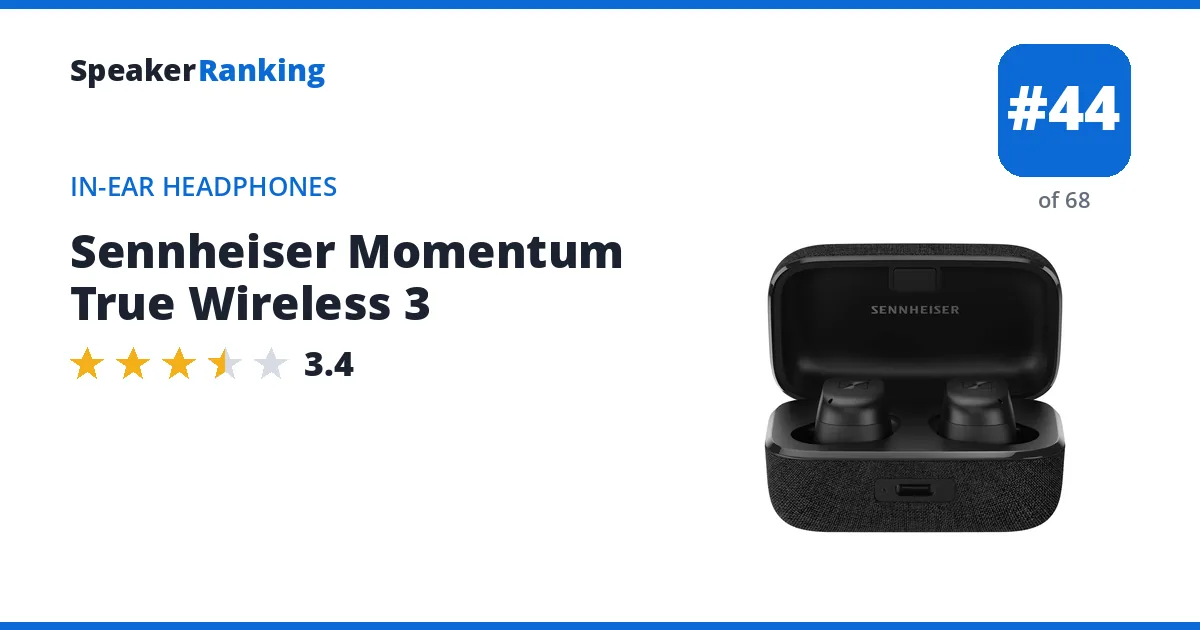
Newer model: the Sennheiser MOMENTUM True Wireless 4, ranked lower, rated 3.3/5, released Feb 2024. It adds LC3. See every Sennheiser Momentum True Wireless generation.
Pros: Active noise cancelling, Bluetooth 5.2 and aptX Adaptive support (alongside SBC, AAC and aptX) add real convenience, and battery life is 7 hours per charge with up to 28 hours using the case. At 5.8 g per earbud with an IPX4 rating, it handles workouts and light rain. Oratory1990’s measurement shows bass and sub-bass within 1 dB of target, giving a clean, warm foundation that suits warm and bassy tastes.
Cons: Presence between 3 and 6 kHz is 6.9 dB under target with a 7.6 dB dip near 4.4 kHz, so vocals, snare and guitar edges sound distant and veiled. Air above 10 kHz runs 5.4 dB hot, with a peak of 4.9 dB near 10.5 kHz, which adds a hissy edge on top of the recessed mids. The preference score of 66 and deviation of 2.59 dB confirm the response sits well off the target. The KZ PR1 is rated higher at a similar cost, though it lacks wireless and ANC. Discontinued.
Full Sennheiser Momentum True Wireless 3 review and specifications →
| Released | Apr 2022 (4 years ago) |
|---|---|
| Active Noise Cancelling | Yes |
| Back | Closed |
| Battery Life | 7 hours (28 with case, Manufacturer specified) |
| Bluetooth Codecs | SBC, AAC, aptX, aptX Adaptive |
| Bluetooth Version | 5.2 |
| Built-in Microphone | Yes |
| Connection | True wireless |
| Deviation From Target | 2.59 dB standard deviation |
| Driver Type | Dynamic |
| Drivers | 1 x 7mm dynamic |
| Form Factor | In-ear |
| Frequency Response | 5Hz - 21kHz (Manufacturer specified) |
| Harman Preference Score | 66 (measured by oratory1990, via AutoEQ) |
| IP Rating | IPX4 |
| Sensitivity | 107 dB SPL (1 kHz / 1 mW) |
| Tonal Tilt | -0.85 (negative is warmer, positive brighter) |
| Weight | 0 lbs (5.8 g) per earbud |
EQ preset to match the Harman target
Set a preamp of -5.3 dB, then add these filters in any parametric equalizer (Wavelet, Equalizer APO, Peace, or a player with parametric EQ). Calculated by AutoEQ from its measured frequency response.
| Filter | Frequency | Gain | Q |
|---|---|---|---|
| Low shelf | 105 Hz | -2.6 dB | 0.70 |
| Peak | 4,231 Hz | +5.9 dB | 1.39 |
| Peak | 209 Hz | -2.2 dB | 0.78 |
| Peak | 1,433 Hz | -2.6 dB | 1.99 |
| Peak | 69 Hz | +1.5 dB | 1.35 |
| High shelf | 10,000 Hz | -5.4 dB | 0.70 |
| Peak | 5,556 Hz | +1.7 dB | 5.29 |
| Peak | 759 Hz | +0.5 dB | 2.36 |
| Peak | 335 Hz | -0.4 dB | 3.16 |
| Peak | 4,230 Hz | -0.6 dB | 5.10 |
- Reviews, Comparisons and Sound Samples
- Head-to-Head Comparisons
 Ranked #48 of 68 in In-Ear Headphones - Sennheiser MOMENTUM True Wireless 4: $249.95 Amazon eBay
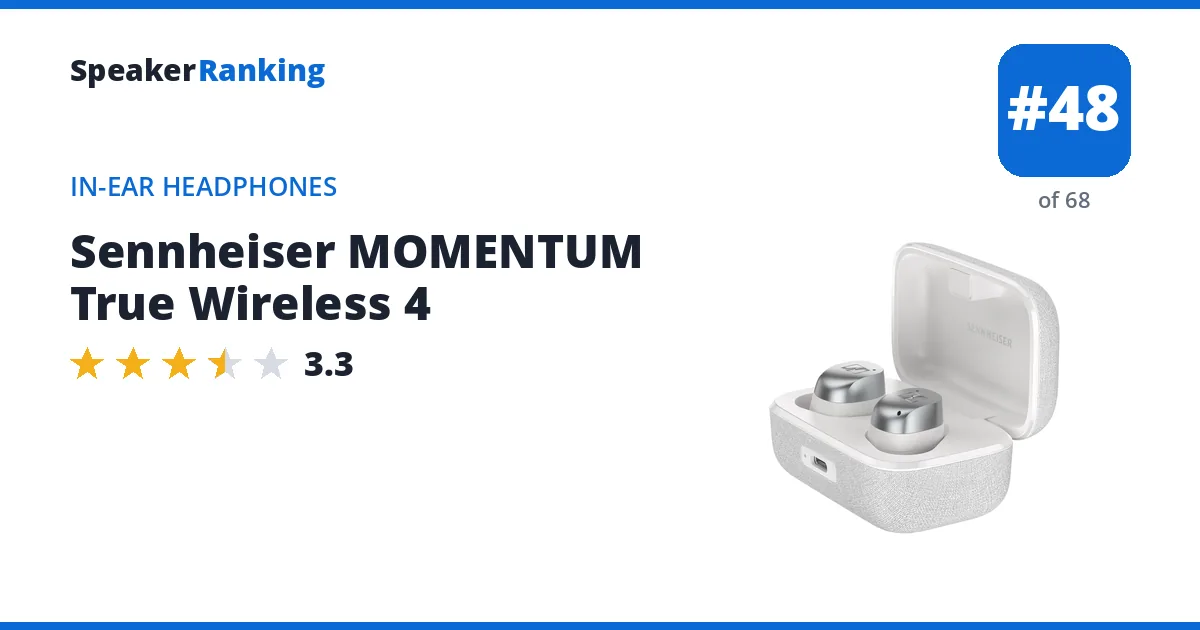
Older model: the Sennheiser Momentum True Wireless 3 (ranked higher, rated 3.4/5). See every Sennheiser Momentum True Wireless generation.
Pros: This true wireless set adds active noise cancelling, Bluetooth 5.4 and a codec list that runs from SBC and AAC up to aptX Lossless and LC3. Battery life is 7.5 hours per charge and 30 hours with the case, and IP54 resistance covers sweat and light rain. Oratory1990’s measurement shows bass about 0.6 dB above target, so low end is full without being overdone.
Cons: Presence from 3 to 6 kHz is about 6.9 dB under target, with an 8.2 dB dip near 5.7 kHz, so voices and guitars sound recessed. Air above 10 kHz runs 5 dB hot with a peak of 4.2 dB near 10.6 kHz, which can add a thin, sparkly edge. The Tin HiFi P1 Max has a higher rating, for a lower price.
Full Sennheiser MOMENTUM True Wireless 4 review and specifications →
| Released | Feb 2024 (2 years ago) |
|---|---|
| Active Noise Cancelling | Yes |
| Back | Closed |
| Battery Life | 7.5 hours (30 with case, Manufacturer specified) |
| Bluetooth Codecs | SBC, AAC, aptX, aptX Adaptive, aptX Lossless, LC3 |
| Bluetooth Version | 5.4 |
| Built-in Microphone | Yes |
| Connection | True wireless |
| Deviation From Target | 2.63 dB standard deviation |
| Driver Type | Dynamic |
| Drivers | 1 x 7mm dynamic |
| Form Factor | In-ear |
| Harman Preference Score | 65 (measured by oratory1990, via AutoEQ) |
| IP Rating | IP54 |
| Tonal Tilt | -0.74 (negative is warmer, positive brighter) |
| Weight | 0 lbs (6.2 g) per earbud |
EQ preset to match the Harman target
Set a preamp of -6.5 dB, then add these filters in any parametric equalizer (Wavelet, Equalizer APO, Peace, or a player with parametric EQ). Calculated by AutoEQ from its measured frequency response.
| Filter | Frequency | Gain | Q |
|---|---|---|---|
| Low shelf | 105 Hz | -0.1 dB | 0.70 |
| Peak | 5,605 Hz | +5.8 dB | 2.82 |
| Peak | 123 Hz | -2.8 dB | 0.23 |
| Peak | 3,977 Hz | +3.9 dB | 2.27 |
| Peak | 70 Hz | +2.1 dB | 0.97 |
| High shelf | 10,000 Hz | -5.2 dB | 0.70 |
| Peak | 1,511 Hz | -1.3 dB | 1.73 |
| Peak | 877 Hz | +0.8 dB | 2.46 |
| Peak | 7,841 Hz | +2.1 dB | 5.59 |
| Peak | 3,002 Hz | +0.7 dB | 3.65 |
- Reviews, Comparisons and Sound Samples
- Head-to-Head Comparisons
 Ranked #50 of 68 in In-Ear Headphones - SoundMAGIC E50C: $32.99 Amazon eBay
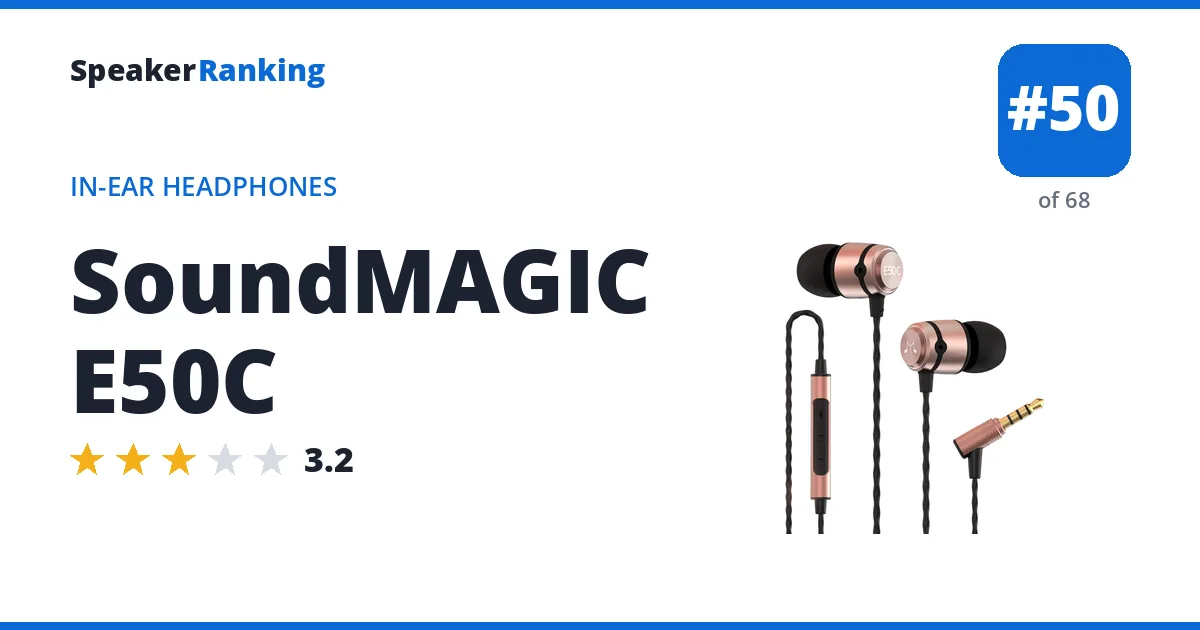
Pros: Bass from 60 to 200 Hz sits within 0.3 dB of target, so the low end is balanced rather than boomy. The inline microphone makes it usable for calls, and the 51 ohm impedance with 102 dB/mW sensitivity works with most phones. It is a very low-cost way into a warm tuning, with a preference score of 64.
Cons: Presence from 3 to 6 kHz is about 6.7 dB under target, with an 8.7 dB dip near 3.3 kHz, so vocals lose clarity and sound set back. Sub-bass is 2.8 dB low and the top octave is about 3.8 dB down, which limits both rumble and air. The Whizzer HE01 has a higher rating.
Full SoundMAGIC E50C review and specifications →
| Back | Closed |
|---|---|
| Built-in Microphone | Yes |
| Connection | Wired |
| Deviation From Target | 2.96 dB standard deviation |
| Driver Type | Dynamic |
| Drivers | 1 x 10mm dynamic |
| Form Factor | In-ear |
| Frequency Response | 15Hz - 22kHz (Manufacturer specified) |
| Harman Preference Score | 64 (measured by oratory1990, via AutoEQ) |
| Impedance | 51 ohms |
| Sensitivity | 102 dB/mW |
| Tonal Tilt | -0.38 (negative is warmer, positive brighter) |
| Weight | 0 lbs (13 g) |
EQ preset to match the Harman target
Set a preamp of -6.2 dB, then add these filters in any parametric equalizer (Wavelet, Equalizer APO, Peace, or a player with parametric EQ). Calculated by AutoEQ from its measured frequency response.
| Filter | Frequency | Gain | Q |
|---|---|---|---|
| Low shelf | 105 Hz | +1.3 dB | 0.70 |
| Peak | 3,391 Hz | +6.0 dB | 1.16 |
| Peak | 187 Hz | -2.7 dB | 0.60 |
| Peak | 1,404 Hz | -2.6 dB | 1.38 |
| Peak | 2,537 Hz | +1.6 dB | 2.71 |
| High shelf | 10,000 Hz | +0.4 dB | 0.70 |
| Peak | 9,380 Hz | +0.8 dB | 2.09 |
| Peak | 7,025 Hz | -0.9 dB | 4.59 |
| Peak | 71 Hz | +0.2 dB | 2.12 |
| Peak | 116 Hz | -0.2 dB | 2.33 |
- Reviews, Comparisons and Sound Samples
 Ranked #60 of 68 in In-Ear Headphones - Jabra Elite Active 65t: $156.45 Discontinued Amazon eBay
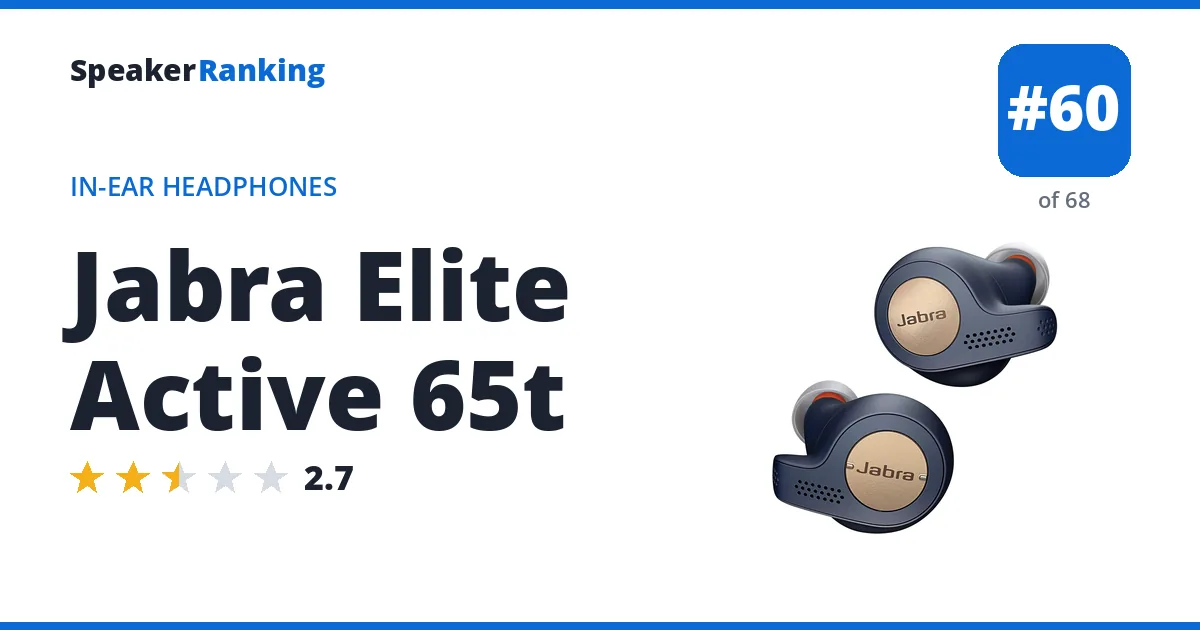
Pros: A true wireless design with an IP56 rating gives dust and sweat resistance suited to workouts. Battery life is 5 hours per charge and 15 hours with the case, and the earbuds weigh only 6.5 g each. Bluetooth 5.0 and a built-in microphone cover calls and everyday listening.
Cons: Only the SBC codec is supported, so there is no higher quality Bluetooth option. There is no active noise cancelling, and Crinacle’s measurement gives a preference score of 58 with a 3.41 dB deviation from target, so the tuning is uneven. The Shure SE215 and FiiO FH3 are rated higher and cheaper, though both are wired. Discontinued.
Full Jabra Elite Active 65t review and specifications →
| Released | Jul 2018 (8 years ago) |
|---|---|
| Active Noise Cancelling | No |
| Back | Closed |
| Battery Life | 5 hours (15 with case, Manufacturer specified) |
| Bluetooth Codecs | SBC |
| Bluetooth Version | 5.0 |
| Built-in Microphone | Yes |
| Connection | True wireless |
| Deviation From Target | 3.41 dB standard deviation |
| Drivers | 1 x 6mm |
| Form Factor | In-ear |
| Harman Preference Score | 58 (measured by crinacle, via AutoEQ) |
| IP Rating | IP56 |
| Tonal Tilt | -0.49 (negative is warmer, positive brighter) |
| Weight | 0 lbs (6.5 g) per earbud |
EQ preset to match the Harman target
Set a preamp of -6.9 dB, then add these filters in any parametric equalizer (Wavelet, Equalizer APO, Peace, or a player with parametric EQ). Calculated by AutoEQ from its measured frequency response.
| Filter | Frequency | Gain | Q |
|---|---|---|---|
| Low shelf | 105 Hz | +16.6 dB | 0.70 |
| Peak | 49 Hz | -16.0 dB | 0.34 |
| Peak | 5,403 Hz | +4.1 dB | 0.56 |
| Peak | 839 Hz | +2.4 dB | 1.86 |
| Peak | 8,608 Hz | -3.4 dB | 3.08 |
| High shelf | 10,000 Hz | +6.9 dB | 0.70 |
| Peak | 10,000 Hz | -3.1 dB | 1.06 |
| Peak | 5,115 Hz | -1.1 dB | 5.14 |
| Peak | 3,623 Hz | +1.0 dB | 3.53 |
| Peak | 6,391 Hz | +2.1 dB | 6.00 |
- Reviews, Comparisons and Sound Samples
- Head-to-Head Comparisons
 Ranked #63 of 68 in In-Ear Headphones - 1MORE Triple Driver: $69.99 Amazon eBay
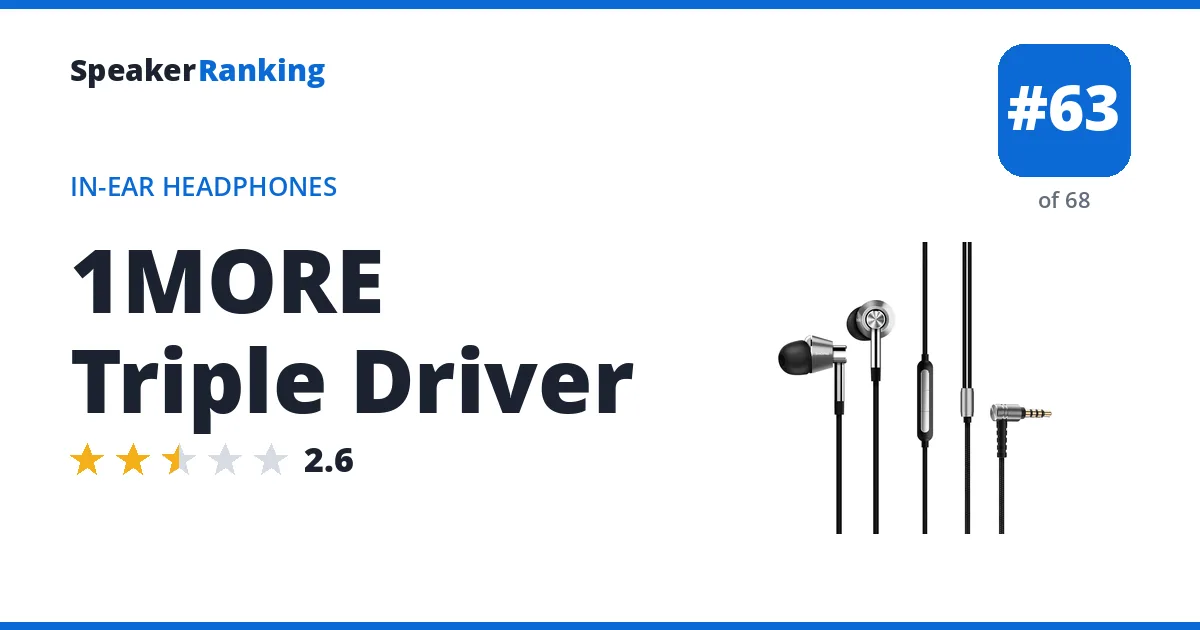
Pros: A hybrid design with 1 dynamic and 2 balanced armature drivers, plus a built-in microphone for calls. It was released in 2017 and the 32 ohm impedance suits a phone or portable player. Crinacle measured a mild warm tilt of about 0.8 dB.
Cons: A preference score of 57 and a 3.28 dB deviation from the target put the tonal balance among the weaker in its class. Sensitivity of 99 dB is on the low side, so it needs more volume than most earphones. The KZ AS10 and Sennheiser CX 3.00 are rated higher, and the Shure SE215 is higher still.
Full 1MORE Triple Driver review and specifications →
| Released | Mar 2017 (9 years ago) |
|---|---|
| Back | Closed |
| Built-in Microphone | Yes |
| Connection | Wired |
| Deviation From Target | 3.28 dB standard deviation |
| Driver Type | Hybrid (1 dynamic + 2 balanced armature) |
| Drivers | 1 x dynamic + 2 x balanced armature |
| Form Factor | In-ear |
| Frequency Response | 20Hz - 40kHz (Manufacturer specified) |
| Harman Preference Score | 57 (measured by crinacle, via AutoEQ) |
| Impedance | 32 ohms |
| Sensitivity | 99 dB |
| Tonal Tilt | -0.81 (negative is warmer, positive brighter) |
EQ preset to match the Harman target
Set a preamp of -5.3 dB, then add these filters in any parametric equalizer (Wavelet, Equalizer APO, Peace, or a player with parametric EQ). Calculated by AutoEQ from its measured frequency response.
| Filter | Frequency | Gain | Q |
|---|---|---|---|
| Low shelf | 105 Hz | +8.5 dB | 0.70 |
| Peak | 57 Hz | -8.9 dB | 0.25 |
| Peak | 9,119 Hz | +6.0 dB | 0.81 |
| Peak | 830 Hz | +3.7 dB | 1.07 |
| Peak | 4,495 Hz | -5.7 dB | 5.76 |
| High shelf | 10,000 Hz | -5.3 dB | 0.70 |
| Peak | 5,986 Hz | +3.0 dB | 5.26 |
| Peak | 2,527 Hz | -1.3 dB | 3.64 |
| Peak | 6,792 Hz | -1.1 dB | 6.00 |
| Peak | 440 Hz | +0.2 dB | 2.11 |
- Reviews, Comparisons and Sound Samples
- Head-to-Head Comparisons
 Ranked #66 of 68 in In-Ear Headphones - 1MORE Quad Driver: $119.69 Amazon eBay
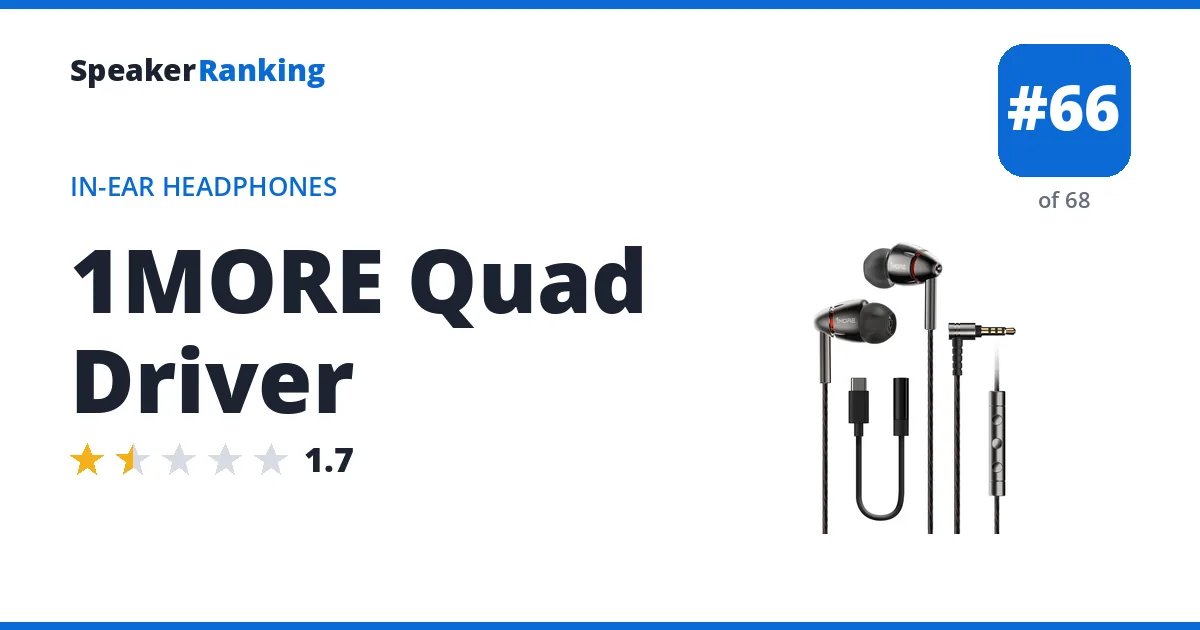
Pros: The hybrid design combines one dynamic driver with three balanced armatures, and the 32 ohm impedance and 99 dB sensitivity let it run easily from a phone. It includes a built-in microphone for calls. The tuning leans warm, with bass about 4.3 dB above target, which suits listeners who like a thick low end.
Cons: Treble from 6 to 10 kHz sits about 6 dB under target and a 10.5 dB dip near 8.8 kHz dulls cymbals and detail, while the air region is boosted by 4.2 dB, which makes the top end uneven. Low mids run about 3.9 dB hot, adding bloat to male vocals and bass guitar, and sub-bass is down 4.5 dB so the deepest rumble is thin. The preference score of 45 and a rating below the BASN Bmaster show the tuning is a poor match for most tastes.
Full 1MORE Quad Driver review and specifications →
| Released | Mar 2017 (9 years ago) |
|---|---|
| Back | Closed |
| Built-in Microphone | Yes |
| Connection | Wired |
| Deviation From Target | 4.49 dB standard deviation |
| Driver Type | Hybrid (1 dynamic + 3 balanced armature) |
| Drivers | 1 x dynamic + 3 x balanced armature |
| Form Factor | In-ear |
| Frequency Response | 20Hz - 40kHz (Manufacturer specified) |
| Harman Preference Score | 45 (measured by oratory1990, via AutoEQ) |
| Impedance | 32 ohms |
| Sensitivity | 99 dB |
| Tonal Tilt | -0.40 (negative is warmer, positive brighter) |
EQ preset to match the Harman target
Set a preamp of -6.6 dB, then add these filters in any parametric equalizer (Wavelet, Equalizer APO, Peace, or a player with parametric EQ). Calculated by AutoEQ from its measured frequency response.
| Filter | Frequency | Gain | Q |
|---|---|---|---|
| Low shelf | 105 Hz | +8.2 dB | 0.70 |
| Peak | 105 Hz | -6.9 dB | 0.37 |
| Peak | 8,263 Hz | +6.3 dB | 1.29 |
| Peak | 1,031 Hz | +3.4 dB | 0.57 |
| Peak | 346 Hz | -2.1 dB | 0.61 |
| High shelf | 10,000 Hz | -6.4 dB | 0.70 |
| Peak | 4,463 Hz | -1.7 dB | 5.45 |
| Peak | 6,085 Hz | +2.5 dB | 5.92 |
| Peak | 2,047 Hz | +0.7 dB | 3.71 |
| Peak | 1,391 Hz | -0.3 dB | 2.85 |
- Reviews, Comparisons and Sound Samples
- Head-to-Head Comparisons
 Ranked #67 of 68 in In-Ear Headphones - Sennheiser Momentum True Wireless 2: $237.45 Amazon eBay
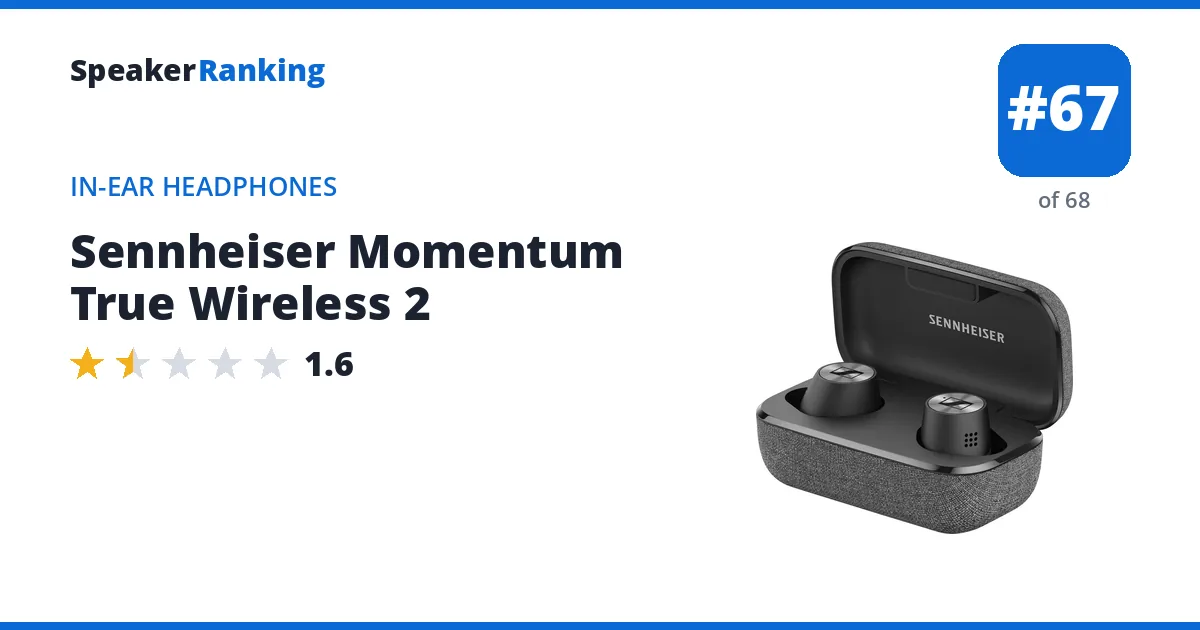
Pros: Active noise cancelling, Bluetooth 5.1 with SBC, AAC and aptX, and an IPX4 rating cover the features commuters and gym users want. Battery life is rated at 7 hours per charge and 28 with the case, and each earbud weighs only 6 g. Bass is lifted by about 3.1 dB over target, which suits listeners who want a warm, punchy sound.
Cons: In oratory1990’s measurement the presence region from 3 to 6 kHz is about 9.6 dB below target, with a 10.7 dB dip near 4 kHz, so vocals and instrument attack sound pushed back and hazy. A 5.2 dB peak near 10.8 kHz and boosted air then add an uneven sparkle on top, and sub-bass is down 2.3 dB. The preference score of 44 is low, and the rating sits below the Jabra Elite Active 65t.
Full Sennheiser Momentum True Wireless 2 review and specifications →
| Released | Apr 2020 (6 years ago) |
|---|---|
| Active Noise Cancelling | Yes |
| Back | Closed |
| Battery Life | 7 hours (28 with case, Manufacturer specified) |
| Bluetooth Codecs | SBC, AAC, aptX |
| Bluetooth Version | 5.1 |
| Built-in Microphone | Yes |
| Connection | True wireless |
| Deviation From Target | 4.39 dB standard deviation |
| Driver Type | Dynamic |
| Drivers | 1 x 7mm dynamic |
| Form Factor | In-ear |
| Frequency Response | 5Hz - 21kHz (Manufacturer specified) |
| Harman Preference Score | 44 (measured by oratory1990, via AutoEQ) |
| IP Rating | IPX4 |
| Tonal Tilt | -0.89 (negative is warmer, positive brighter) |
| Weight | 0 lbs (6 g) per earbud |
EQ preset to match the Harman target
Set a preamp of -7.0 dB, then add these filters in any parametric equalizer (Wavelet, Equalizer APO, Peace, or a player with parametric EQ). Calculated by AutoEQ from its measured frequency response.
| Filter | Frequency | Gain | Q |
|---|---|---|---|
| Low shelf | 105 Hz | +6.4 dB | 0.70 |
| Peak | 85 Hz | -6.9 dB | 0.26 |
| Peak | 3,202 Hz | +6.5 dB | 1.25 |
| Peak | 1,638 Hz | -1.6 dB | 2.70 |
| Peak | 5,340 Hz | +4.9 dB | 3.93 |
| High shelf | 10,000 Hz | -3.3 dB | 0.70 |
| Peak | 736 Hz | +1.0 dB | 1.92 |
| Peak | 334 Hz | -0.6 dB | 2.45 |
| Peak | 4,354 Hz | +1.0 dB | 4.95 |
| Peak | 199 Hz | -0.5 dB | 3.18 |
- Reviews, Comparisons and Sound Samples
- Head-to-Head Comparisons