Short answer: the 1MORE Quad Driver, if you are buying new, though neither ranks well in its class. The Jabra Elite Active 65t ranks higher than it (#60 vs #66 of 68 in-ear headphones, 2.7/5 vs 1.7/5) but is discontinued, so only consider it used; the 1MORE Quad Driver is still sold new at $119.69. Both are rated below 3.0/5 among the 68 in-ear headphones, and the Truthear Nova, ranked #1 at $169.99, is a better place to start if sound quality matters.
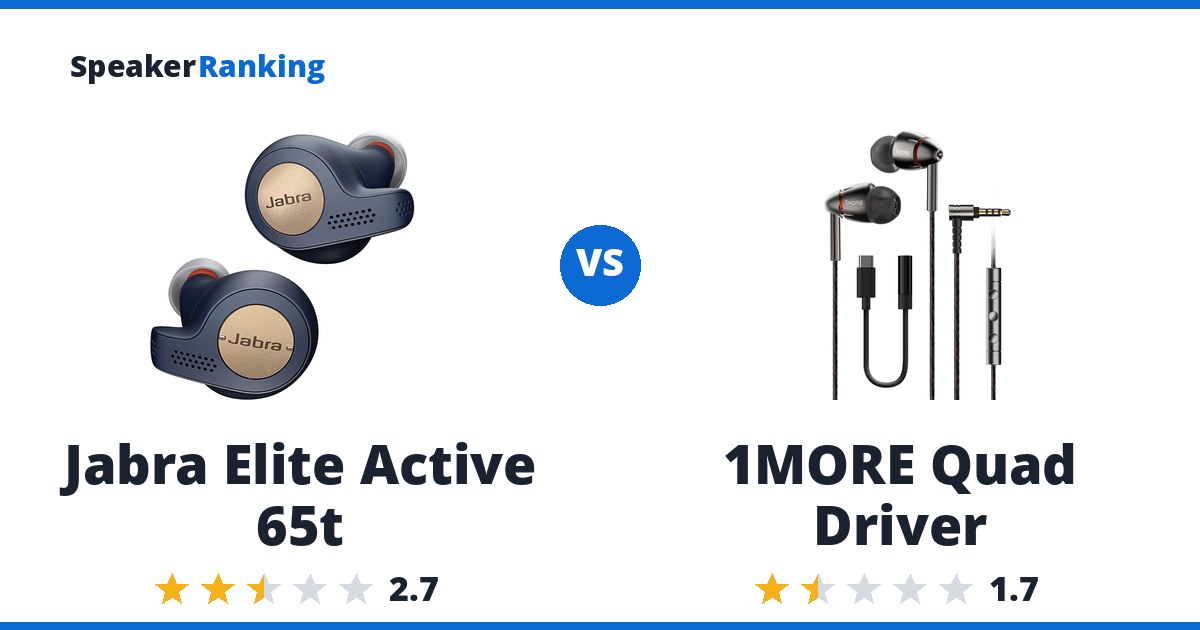
The Jabra Elite Active 65t is the better-sounding option. A true wireless design with an IP56 rating gives dust and sweat resistance suited to workouts. The tradeoff: Only the SBC codec is supported, so there is no higher quality Bluetooth option.
The case for the 1MORE Quad Driver: The hybrid design combines one dynamic driver with three balanced armatures, and the 32 ohm impedance and 99 dB sensitivity let it run easily from a phone. Watch for: Treble from 6 to 10 kHz sits about 6 dB under target and a 10.5 dB dip near 8.8 kHz dulls cymbals and detail, while the air region is boosted by 4.2 dB, which makes the top end uneven.
Buy the 1MORE Quad Driver if you want one new; the Jabra Elite Active 65t is discontinued, so only look for it used.
Looking for alternatives? See the complete Headphones rankings.
Specifications Side By Side
| Jabra Elite Active 65t | 1MORE Quad Driver | |
|---|---|---|
| Price | $156.45 Discontinued | $119.69 |
| Ranked | #60 of 68 in In-Ear Headphones | #66 of 68 in In-Ear Headphones |
| Form Factor | In-ear | In-ear |
| Harman Preference Score | 58 (measured by crinacle, via AutoEQ) | 45 (measured by oratory1990, via AutoEQ) |
| Deviation From Target | 3.41 dB standard deviation | 4.49 dB standard deviation |
| Tonal Tilt | -0.49 (negative is warmer, positive brighter) | -0.40 (negative is warmer, positive brighter) |
| Connection | True wireless | Wired |
| Drivers | 1 x 6mm | 1 x dynamic + 3 x balanced armature |
| Weight | 0 lbs (6.5 g) per earbud | - |
| Active Noise Cancelling | No | - |
| Battery Life | 5 hours (15 with case, Manufacturer specified) | - |
| Bluetooth Version | 5.0 | - |
| Bluetooth Codecs | SBC | - |
| Built-in Microphone | Yes | Yes |
| IP Rating | IP56 | - |
| Back | Closed | Closed |
| Driver Type | - | Hybrid (1 dynamic + 3 balanced armature) |
| Impedance | - | 32 ohms |
| Sensitivity | - | 99 dB |
| Frequency Response | - | 20Hz - 40kHz (Manufacturer specified) |
Related Headphone Comparisons
How Jabra Elite Active 65t compares with other leading options:
- FiiO FH3 vs Jabra Elite Active 65t
- Shure SE215 vs Jabra Elite Active 65t
- Jabra Elite Active 65t vs Sennheiser Momentum True Wireless 2
- BASN Bmaster vs 1MORE Quad Driver
- Sennheiser Momentum True Wireless 3 vs Sennheiser Momentum True Wireless 2
Prices on this page were last checked October 10, 2026 at 5:37 PM UTC. Product prices and availability are accurate as of that date/time and are subject to change; the price and availability shown on Amazon at the time of purchase will apply to the purchase of this product.
As an eBay Partner, we may be compensated if you make a purchase.
The Two Headphones In Full
 Jabra Elite Active 65t: $156.45 Discontinued Amazon eBay
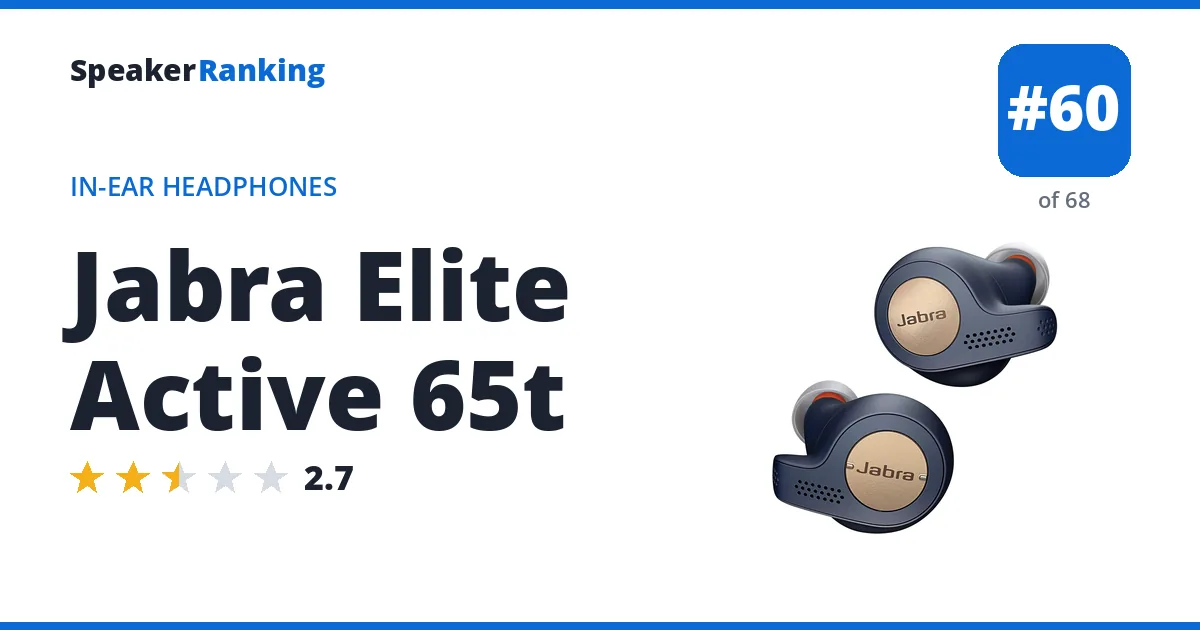
Pros: A true wireless design with an IP56 rating gives dust and sweat resistance suited to workouts. Battery life is 5 hours per charge and 15 hours with the case, and the earbuds weigh only 6.5 g each. Bluetooth 5.0 and a built-in microphone cover calls and everyday listening.
Cons: Only the SBC codec is supported, so there is no higher quality Bluetooth option. There is no active noise cancelling, and Crinacle’s measurement gives a preference score of 58 with a 3.41 dB deviation from target, so the tuning is uneven. The Shure SE215 and FiiO FH3 are rated higher and cheaper, though both are wired. Discontinued.
Full Jabra Elite Active 65t review and specifications →
| Released | Jul 2018 (8 years ago) |
|---|---|
| Active Noise Cancelling | No |
| Back | Closed |
| Battery Life | 5 hours (15 with case, Manufacturer specified) |
| Bluetooth Codecs | SBC |
| Bluetooth Version | 5.0 |
| Built-in Microphone | Yes |
| Connection | True wireless |
| Deviation From Target | 3.41 dB standard deviation |
| Drivers | 1 x 6mm |
| Form Factor | In-ear |
| Harman Preference Score | 58 (measured by crinacle, via AutoEQ) |
| IP Rating | IP56 |
| Tonal Tilt | -0.49 (negative is warmer, positive brighter) |
| Weight | 0 lbs (6.5 g) per earbud |
EQ preset to match the Harman target
Set a preamp of -6.9 dB, then add these filters in any parametric equalizer (Wavelet, Equalizer APO, Peace, or a player with parametric EQ). Calculated by AutoEQ from its measured frequency response.
| Filter | Frequency | Gain | Q |
|---|---|---|---|
| Low shelf | 105 Hz | +16.6 dB | 0.70 |
| Peak | 49 Hz | -16.0 dB | 0.34 |
| Peak | 5,403 Hz | +4.1 dB | 0.56 |
| Peak | 839 Hz | +2.4 dB | 1.86 |
| Peak | 8,608 Hz | -3.4 dB | 3.08 |
| High shelf | 10,000 Hz | +6.9 dB | 0.70 |
| Peak | 10,000 Hz | -3.1 dB | 1.06 |
| Peak | 5,115 Hz | -1.1 dB | 5.14 |
| Peak | 3,623 Hz | +1.0 dB | 3.53 |
| Peak | 6,391 Hz | +2.1 dB | 6.00 |
- Reviews, Comparisons and Sound Samples
- Head-to-Head Comparisons
 1MORE Quad Driver: $119.69 Amazon eBay
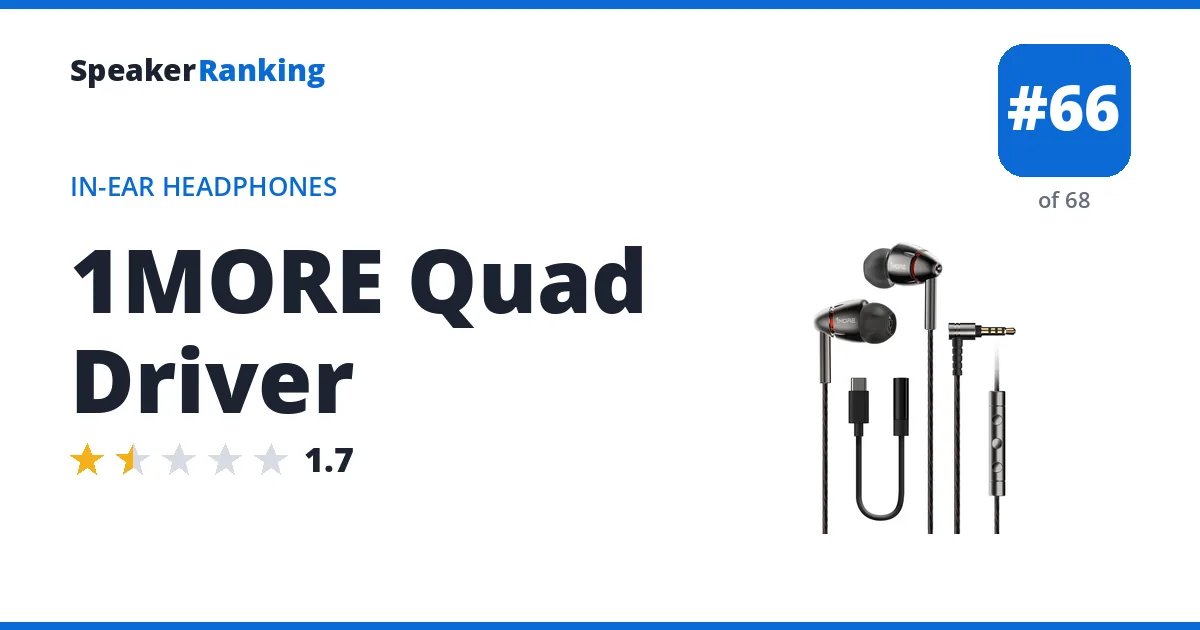
Pros: The hybrid design combines one dynamic driver with three balanced armatures, and the 32 ohm impedance and 99 dB sensitivity let it run easily from a phone. It includes a built-in microphone for calls. The tuning leans warm, with bass about 4.3 dB above target, which suits listeners who like a thick low end.
Cons: Treble from 6 to 10 kHz sits about 6 dB under target and a 10.5 dB dip near 8.8 kHz dulls cymbals and detail, while the air region is boosted by 4.2 dB, which makes the top end uneven. Low mids run about 3.9 dB hot, adding bloat to male vocals and bass guitar, and sub-bass is down 4.5 dB so the deepest rumble is thin. The preference score of 45 and a rating below the BASN Bmaster show the tuning is a poor match for most tastes.
Full 1MORE Quad Driver review and specifications →
| Released | Mar 2017 (9 years ago) |
|---|---|
| Back | Closed |
| Built-in Microphone | Yes |
| Connection | Wired |
| Deviation From Target | 4.49 dB standard deviation |
| Driver Type | Hybrid (1 dynamic + 3 balanced armature) |
| Drivers | 1 x dynamic + 3 x balanced armature |
| Form Factor | In-ear |
| Frequency Response | 20Hz - 40kHz (Manufacturer specified) |
| Harman Preference Score | 45 (measured by oratory1990, via AutoEQ) |
| Impedance | 32 ohms |
| Sensitivity | 99 dB |
| Tonal Tilt | -0.40 (negative is warmer, positive brighter) |
EQ preset to match the Harman target
Set a preamp of -6.6 dB, then add these filters in any parametric equalizer (Wavelet, Equalizer APO, Peace, or a player with parametric EQ). Calculated by AutoEQ from its measured frequency response.
| Filter | Frequency | Gain | Q |
|---|---|---|---|
| Low shelf | 105 Hz | +8.2 dB | 0.70 |
| Peak | 105 Hz | -6.9 dB | 0.37 |
| Peak | 8,263 Hz | +6.3 dB | 1.29 |
| Peak | 1,031 Hz | +3.4 dB | 0.57 |
| Peak | 346 Hz | -2.1 dB | 0.61 |
| High shelf | 10,000 Hz | -6.4 dB | 0.70 |
| Peak | 4,463 Hz | -1.7 dB | 5.45 |
| Peak | 6,085 Hz | +2.5 dB | 5.92 |
| Peak | 2,047 Hz | +0.7 dB | 3.71 |
| Peak | 1,391 Hz | -0.3 dB | 2.85 |
- Reviews, Comparisons and Sound Samples
- Head-to-Head Comparisons