Editor's top picks
Start with these speakers
Our leading recommendations at a glance. Each card links to its primary retailer.
Choose a battery-powered PA when you must perform or present away from an outlet. Choose a mains-powered PA when dependable sustained output, system expansion, and value matter more than operating untethered. Both are real live-sound tools; the power source determines the compromise.
Battery PAs bring rechargeable runtime, a mixer, and live inputs to parks, ceremonies, busking spots, fitness classes, and small mobile events. Mains-powered PA tops have no runtime ceiling and usually deliver more output, lower cost per watt, and easier expansion for a venue, band, or larger crowd. If the question is party speaker versus portable PA, read party speaker vs. battery-powered PA instead.
Prices on this page were last checked September 14, 2026 at 1:47 AM UTC. Product prices and availability are accurate as of that date/time and are subject to change; the price and availability shown on Amazon at the time of purchase will apply to the purchase of this product.
As an eBay Partner, we may be compensated if you make a purchase.
Choose A Battery-Powered PA When There Is No Reliable Outlet
Choose a battery-powered PA speaker when running a cable is impossible, unsafe, or impractical. A good battery PA still has the essentials: microphone or combo inputs, a small mixer, stand mounting, and a wired output or pairing option for expanding the system.
It is the right choice for:
- Busking, ceremonies, and presentations away from power.
- Fitness classes, markets, and small outdoor events.
- A mobile DJ or performer who needs one compact, self-contained box.
- A job where setting up a generator or power station is not worthwhile.
Runtime claims are best-case estimates. High volume, heavy bass, cold weather, and device charging reduce real runtime. For an all-day event, choose a removable battery or arrange a mains backup.
Choose A Mains PA For Output, Value, And Growth
Choose a mains-powered PA speaker when power is available. It does not need to reserve capacity for a battery, so it generally delivers more sustained output and headroom for the same price. It is also the more sensible base for two speakers, a subwoofer, monitors, and an external mixer.
It is the right choice for:
- Venues, rehearsal rooms, bars, houses of worship, and events with reliable power.
- Bands and DJs that need sustained level for a crowd.
- A system that will add a subwoofer, several microphones, monitors, or more speakers.
- Buyers who want the most output per dollar and can run a power cable safely.
Battery PA Vs. Mains PA At A Glance
| Need | Battery-powered PA | Mains-powered PA |
|---|---|---|
| Power source | Rechargeable battery | Wall power or a suitably sized power station |
| Sustained output | Limited by battery and thermal capacity | Usually higher for the price |
| Runtime | Finite; falls at high volume | No runtime limit while power is available |
| Portability | Easy to deploy away from outlets | Needs a safe power run |
| Cost per output | Higher | Usually lower |
| System growth | Good for small systems | Best for subs, multiple tops, monitors, and mixers |
| Best use | Busking, ceremonies, mobile classes, small outdoor events | Bands, DJs, venues, and larger powered events |
Driver Size Still Matters For Mains PA Speakers
For a conventional PA top, choose the speaker size for the room and system rather than assuming a larger woofer always sounds better. 8-inch and 10-inch models are easier to carry and pair well with a subwoofer. 12-inch is the all-purpose size for many small venues and bands. 15-inch provides more single-box low-end output and headroom, at a real weight penalty.
Battery PA models are not always organized around those same driver-size choices. Compare their actual output, weight, inputs, runtime, and mounting options instead of choosing by woofer diameter alone.
Good Starting Points
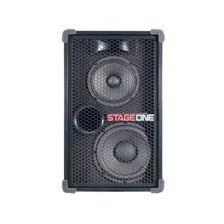 For a long-running battery PA with weather resistance and a full live-sound input set, consider the Electrotec Stage One: $1450 Electrotec Audio eBay
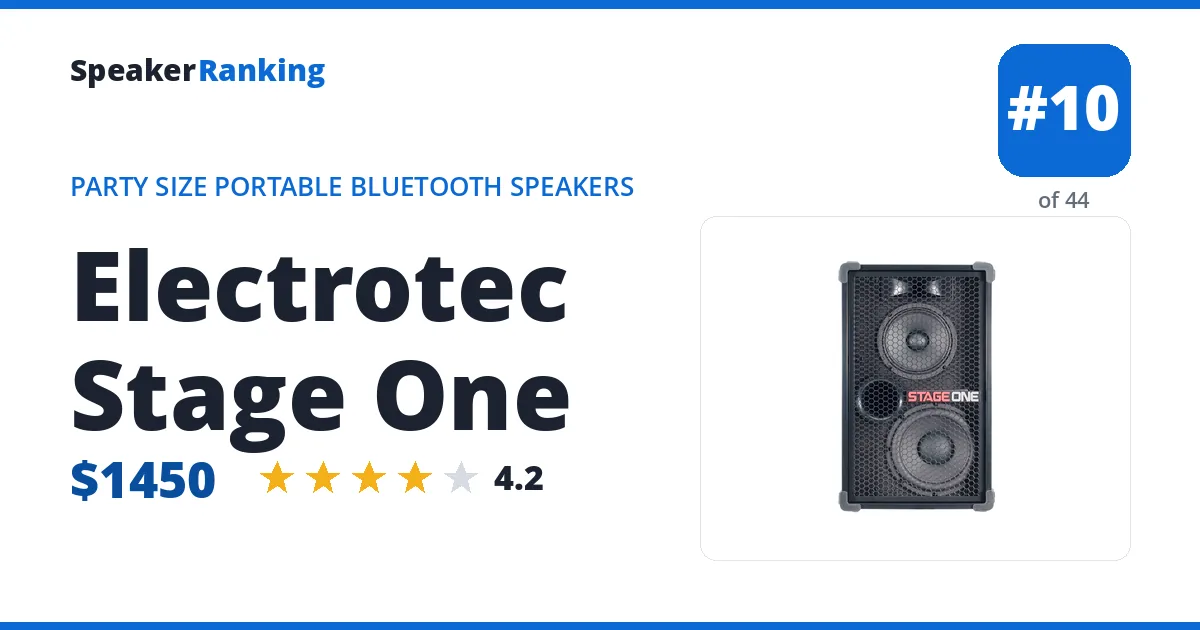
Pros: An exceptionally capable battery-powered PA: dual removable batteries deliver a claimed 100-hour runtime, and high-efficiency drivers deliver very high output with a measured 48Hz -10dB bass point. It adds app EQ, IPX6 protection, mic and XLR inputs/outputs, USB playback and low-latency SKAA linking, making it unusually flexible for events and performers. Measured bass extension of 48Hz (-10dB).
Cons: It prioritizes maximum output and endurance over truly deep bass, so it will not replace a dedicated subwoofer for low-frequency-heavy music. At 18.1kg it is a substantial carry, and its focused PA-style presentation is less suitable for wide, relaxed living-room listening.
Full Electrotec Stage One review and specifications →
| Amplifier Power | 400W |
|---|---|
| App | Yes |
| Aux Input | Yes |
| Aux Output | Yes |
| Bass Extension (-10dB) | 48Hz |
| Bass Extension (-3dB) | Not specified |
| Battery Life | 100 hours (Manufacturer specified) |
| Bluetooth | Yes |
| Bluetooth Codecs | SBC |
| Cabinet Material | Not specified |
| Configuration | Battery-powered active PA |
| Coverage | Not specified |
| DSP | App-controlled EQ |
| Digital Aux Input | No |
| Dimensions | Not specified |
| Drivers | Dual 1.5" compression drivers (tweeters) + 2x 4" woofers + passive radiators (PA system configuration) |
| EQ | Yes |
| Frequency Response | Not specified |
| IP Rating | IPX6 |
| Inputs | 2x XLR/6.3mm combo (mic/line), 3.5mm stereo, USB-C audio, USB media player, Bluetooth |
| Maximum SPL | Not specified |
| Microphone Input | Yes |
| Omnidirectional | No |
| Party Mode | Yes (SKAA) |
| Power Bank | Yes (USB-A + USB-C) |
| Power Input | AC Power cord |
| Removable Battery | Yes (dual) |
| Rigging | Not specified |
| SKAA | Yes |
| SKAA Latency | 19ms |
| Stereo | No |
| TWS | Yes |
| USB Playback | Yes |
| Weight | 39.9 lbs (18.1 kg) |
| XLR Input | Yes |
| XLR Output | Yes |
- Reviews, Comparisons and Sound Samples
- Head-to-Head Comparisons
- Electrotec Stage One vs Electro-Voice Everse 12
- Electrotec Stage One vs Electro-Voice Everse 8
- Electrotec Stage One vs Teufel Rockster Neo
- Electrotec Stage One vs Teufel Rockster Air 2
- Electrotec Stage One vs Soundboks 4
- Electrotec Stage One vs JBL Partybox 110
- Electrotec Stage One vs JBL Partybox 300
- Electrotec Stage One vs JBL Partybox 130
- See all 11 comparisons
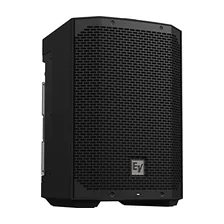 For a compact battery PA that suits a performer or presenter, consider the Electro-Voice Everse 8: $704.59 Amazon eBay
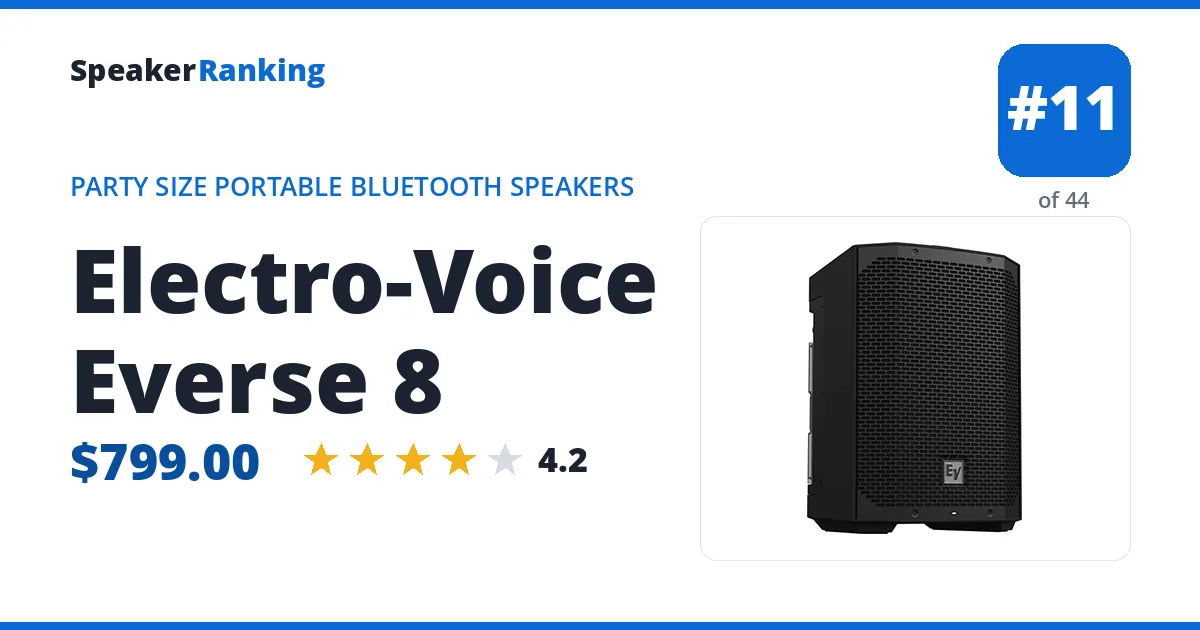
Pros: Good midrange and treble. High efficiency drivers reach 2-3x the volume of typical speakers for the same wattage. Measured bass extension of 50Hz (-10dB).
Cons: Not stereo. Designed for more loudness than deeper bass.
Full Electro-Voice Everse 8 review and specifications →
| Amplifier Power | 400W |
|---|---|
| App | Yes |
| Aux Input | Yes |
| Bass Extension (-10dB) | 50Hz |
| Bass Extension (-3dB) | Not specified |
| Battery Life | 12 hours (Manufacturer specified) |
| Bluetooth | Yes |
| Bluetooth Codecs | aptX, SBC |
| Cabinet Material | Polypropylene |
| Configuration | Battery-powered 2-way active PA |
| Coverage | 100° H x 100° V |
| DSP | 4-channel digital mixer with EQ, effects and ducking |
| Digital Aux Input | No |
| Dimensions | 15.7" x 10.8" x 10.7" (400 x 275 x 272 mm) |
| Drivers | 8" woofer, 1" tweeter |
| EQ | Yes |
| Frequency Response | Not specified |
| IP Rating | IP43 |
| Inputs | 2x XLR/TRS combo (mic/line), 3.5mm stereo, Bluetooth |
| Maximum SPL | 121dB |
| Microphone Input | Yes |
| Omnidirectional | No |
| Output Power | 400W |
| Party Mode | Yes (Speaker Link, up to 6 speakers) |
| Power Bank | Yes (USB-C, 1.5A max) |
| Power Input | AC Power cord |
| Removable Battery | Yes |
| Rigging | 35mm pole mount; 30° or 55° monitor angle |
| Stereo | No |
| TWS | Yes |
| USB Playback | No |
| Weight | 17.6 lbs (8 kg) |
| XLR Input | Yes |
- Links
- Reviews, Comparisons and Sound Samples
- Head-to-Head Comparisons
- Electro-Voice Everse 8 vs Electrotec Stage One
- Electro-Voice Everse 8 vs Teufel Rockster Air 2
- Electro-Voice Everse 8 vs Electro-Voice Everse 12
- Electro-Voice Everse 8 vs Soundboks 4
- Electro-Voice Everse 8 vs Bose S1 Pro+
- Electro-Voice Everse 8 vs JBL Eon One Compact
- Electro-Voice Everse 8 vs JBL Partybox 330
- Electro-Voice Everse 8 vs JBL Partybox 300
- See all 13 comparisons
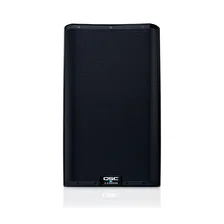 For an all-purpose mains-powered 12-inch PA, consider the QSC K12.2: $899.99 Amazon B&H Photo Video Guitar Center eBay
Pros: The strongest all-round tonal result in this popular-model group: the vendor Spinorama data produces a 6.82 ideal-subwoofer preference score and 48Hz measured bass extension. Extensive onboard DSP, flexible main/monitor use and a long market track record make it an unusually safe general-purpose choice. Measured bass extension of 48Hz (-3dB).
Cons: The underlying Spinorama source is low quality, so its apparent measured lead deserves caution. It is not the cheapest 12-inch option, and serious dance music or high-output live use still benefits from a subwoofer.
Full QSC K12.2 review and specifications →
| Amplifier Power | 2025W peak (1800W LF + 225W HF) |
|---|---|
| Bass Extension (-3dB) | 48Hz (measured, vendor Spinorama data) |
| Bluetooth | No |
| Cabinet Material | Impact-resistant ABS |
| Configuration | Active 2-way bass-reflex PA speaker |
| Coverage | 75° conical |
| DSP | Yes |
| Dimensions | 23.7"H x 14"W x 13.8"D (602 x 356 x 350 mm) |
| Drivers | 12" woofer, 1.4" compression driver |
| Frequency Response | 45Hz - 20kHz (-10dB, manufacturer specified) |
| Inputs | 2 x XLR/TRS combo, 3.5mm aux |
| Maximum SPL | 132dB peak (manufacturer specified) |
| Rigging | 2 x M10 inserts and pull-back point; 35mm pole mount |
| Weight | 39 lbs (17.7 kg) |
- Links
- Reviews, Comparisons and Sound Samples
- Head-to-Head Comparisons
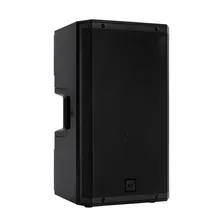 For maximum low-end headroom from one mains-powered top, consider the RCF ART 945-A: $1,999.00 B&H Photo Video Guitar Center eBay
Pros: This is the strongest-measuring 15-inch RCF here: medium-quality vendor data produces a 5.91 ideal-subwoofer preference score with roughly 50Hz extension. The top-tier compression driver and 18.8kg enclosure combine unusually high output with easy portability for a 15-inch box. Measured bass extension of 50.5Hz (-3dB).
Cons: Pricing and wide retail distribution are not yet well established for this model, and the RCF ART9 range above the 912/932-A pair has a shorter market track record. Coverage and full connector details were not confirmed in local data.
Full RCF ART 945-A review and specifications →
| Amplifier Power | 2100W peak (1400W LF + 700W HF) |
|---|---|
| Bass Extension (-3dB) | 50.5Hz (measured, vendor Spinorama data) |
| Bluetooth | No |
| Cabinet Material | PP composite |
| Configuration | Active 2-way bass-reflex PA speaker |
| Coverage | 100° x 60° |
| Crossover Frequency | 650Hz |
| DSP | Yes, FiRPHASE and Bass Motion Control |
| Dimensions | 28.2"H x 16.3"W x 16.1"D (717 x 415 x 410 mm) |
| Drivers | 15" woofer, 1.4" exit/3" diaphragm compression driver |
| Frequency Response | 45Hz - 20kHz (manufacturer specified) |
| Inputs | XLR and 1/4-inch jack input; XLR output |
| Maximum SPL | 135dB peak (manufacturer specified) |
| Rigging | M10 inserts; 35mm pole mount |
| Weight | 49.4 lbs (22.4 kg) |
- Links
- Reviews, Comparisons and Sound Samples
- Head-to-Head Comparisons
Use A Power Station Only When It Beats A Battery PA
A power station can run a mains PA at an outdoor event, but it adds cost, weight, charging time, and another component to manage. Use one when the needed output or system flexibility exceeds a battery PA’s limits. Size it from the speaker’s measured or documented power consumption, not its amplifier marketing watts; see how to power speakers from a power station.
Frequently Asked Questions
Is a battery-powered PA loud enough for a party? For a small event, speech, and moderate music levels, often yes. For a larger crowd, bass-heavy music, or a long event at high level, a mains PA normally has more headroom and no runtime risk.
Can a battery-powered PA replace a conventional PA? It can replace one for a small mobile job. It is a poor replacement when the event needs high sustained output, a subwoofer-based system, several performers, or dependable all-day operation near maximum volume.
Should I buy a 12-inch or 15-inch mains PA? Choose a 12-inch top for the broadest balance of output, portability, and subwoofer compatibility. Choose a 15-inch when a single box must supply more low end and headroom, and the extra size and weight are acceptable.