Editor's top picks
Start with these speakers
Our leading recommendations at a glance. Each card links to its primary retailer.
Looking for a PA speaker with network control? Networked control lets you adjust EQ, limiting, delay and other DSP settings, or monitor amplifier status, over an Ethernet connection instead of walking up to each cabinet. It matters most in a multi-zone venue or a permanent install with speakers mounted out of easy reach. Every pick below has verified network control; the recommendations are ordered by measured performance, not by the feature alone.
Want every match, not just the top pick per size? See every PA speaker with network control →
Prices on this page were last checked October 12, 2026 at 4:13 PM UTC. Product prices and availability are accurate as of that date/time and are subject to change; the price and availability shown on Amazon at the time of purchase will apply to the purchase of this product.
As an eBay Partner, we may be compensated if you make a purchase.
Best Overall
 For strong measured tonal balance with MILAN networked DSP control, the HK Audio LINEAR 9 110 XA: $2,166.07 Amazon $2,166.07 eBay
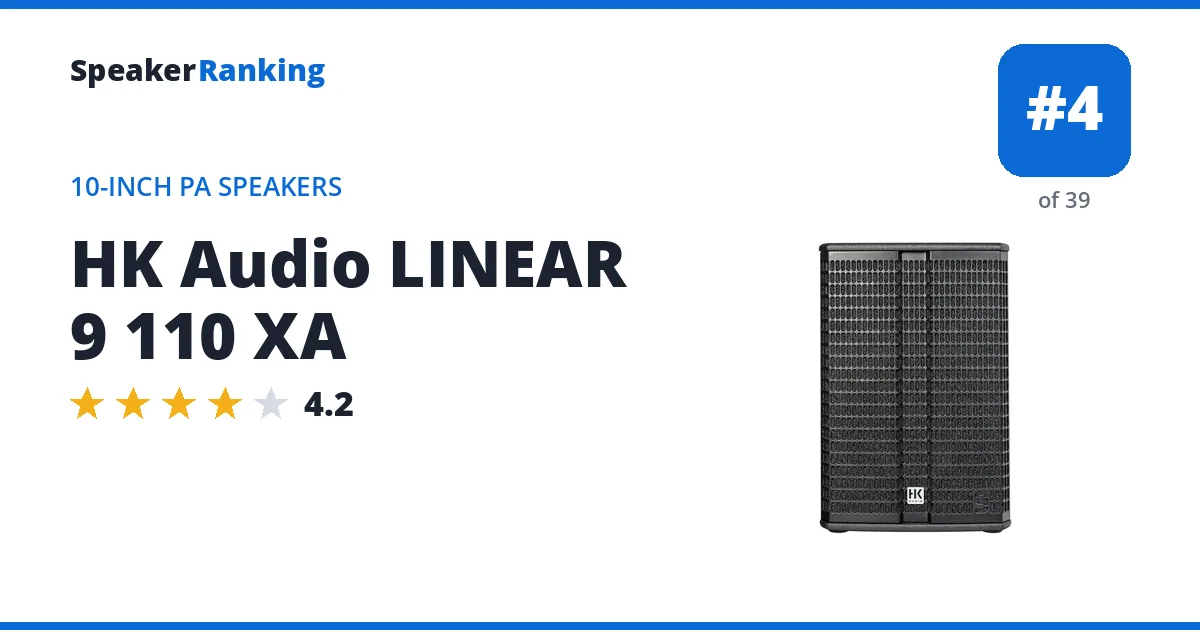
Same family: the HK Audio LINEAR 9 112 XA (larger model, rated 4/5).
Pros: High-quality vendor data returns a 6.34 ideal-subwoofer preference score with 75Hz measured extension, matching the HK Audio LINEAR 7 110 XA’s result. MILAN networking and comprehensive remote DSP make it a strong systems-oriented choice for professional deployment. Measured bass extension of 82.5Hz (-3dB).
Cons: Buyers who do not need networked audio may find better value in simpler mainstream 10-inch models, and its 129dB peak claim is unremarkable for the category.
Full HK Audio LINEAR 9 110 XA review and specifications →
| Released | Nov 2021 (4 years ago) |
|---|---|
| AES Input | No |
| Amplifier Power | 700W RMS |
| Aux Input | No |
| Bass Extension (-3dB) | 82.5Hz (measured, vendor Spinorama data) |
| Bluetooth | No |
| Cabinet Material | Birch plywood with PU coating |
| Coaxial Input | No |
| Configuration | Active 2-way bass-reflex PA speaker |
| Coverage | 80° x 60°, rotatable |
| Crossover Frequency | 2000Hz |
| DSP | Yes, networked 10-band PEQ, filters, delay and limiter |
| Dimensions | 21.3”H x 14.2”W x 12.2”D (540 x 360 x 310 mm) |
| Drivers | 10” woofer, 1” compression driver |
| Frequency Response | 70Hz - 19kHz (-6dB, manufacturer specified) |
| Guitar Input | No |
| HDMI Input | No |
| Inputs | XLR/TRS combo input; XLR analog and DSP outputs; EtherCON network input/output |
| Maximum SPL | 129dB peak (manufacturer specified) |
| Microphone Input | No |
| Network Control | Milan and HK Audio DSP Control |
| Optical Input | No |
| Passive | No |
| RCA Input | No |
| Rigging | 5 x M8 points; DuoTilt 3°/7° pole mount |
| Spinorama Preference Score | 3.26 |
| Spinorama Preference Score with Perfect Sub | 6.34 |
| TRS Input | Yes |
| USB Input | No |
| Weight | 36.4 lbs (16.5 kg) |
| XLR Input | Yes |
- Links
- Reviews, Comparisons and Sound Samples
- Head-to-Head Comparisons
High-quality vendor data returns a 6.34 ideal-subwoofer preference score with 75Hz measured extension, a genuinely strong result rather than just a spec-sheet claim. MILAN networking and comprehensive remote DSP make it a real systems-oriented choice for a multi-box install.
If you don’t need networked audio, a simpler mainstream 10-inch model can offer better value, and its 129dB peak claim is unremarkable for the category.
Best For Touring and Large Venues
 For flagship-tier output with RDNet remote control, the RCF KX 45-A: $4,618.50 B&H Photo Video $4,618.50 Lowest Guitar Center $4,620.00 eBay
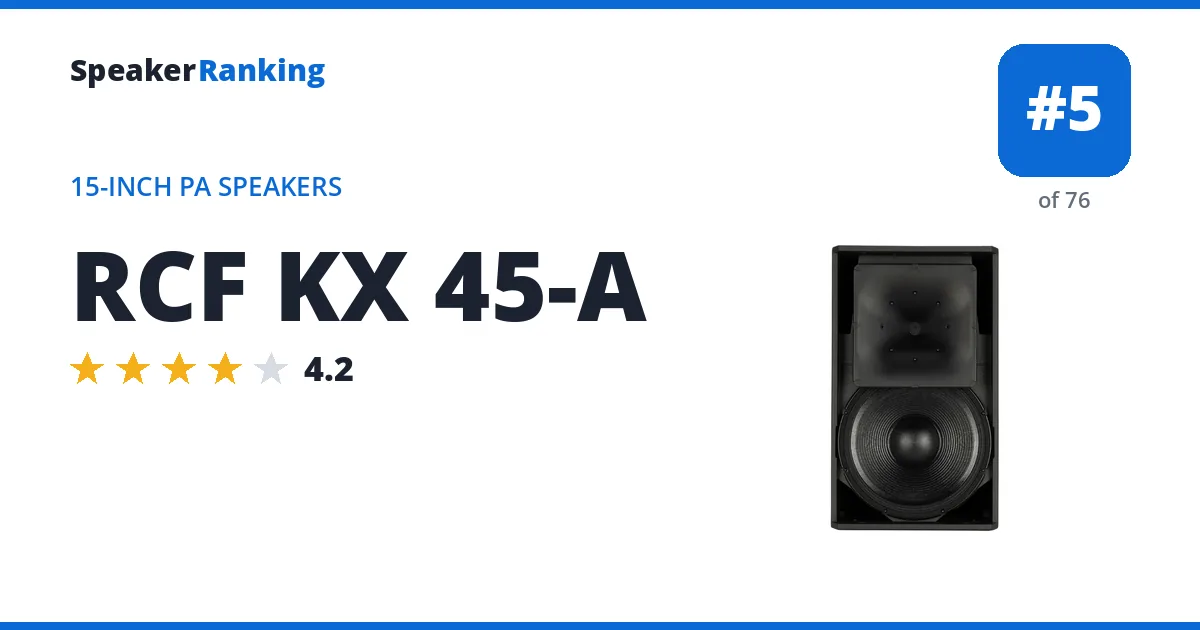
Same family: the RCF KX 08-A (smaller model, rated 3.9/5), the RCF KX 10-A (smaller model, rated 4/5) and the RCF KX 32-A (smaller model, rated 4.3/5).
Pros: RCF’s flagship 15-inch point source pairs a 3200W amplifier with a 3-inch titanium-dome compression driver, RDNet remote control and a 137dB claimed peak, the highest maximum-output claim in this ranking. Rotatable 100° x 70° coverage suits both main and monitor use.
Cons: The local measurement is truncated and cannot produce a preference score. At 28.4kg it is one of the heaviest boxes here, and pricing/retail availability are not yet established.
Full RCF KX 45-A review and specifications →
| AES Input | No |
|---|---|
| Amplifier Power | 3200W peak (2000W LF + 1200W HF) |
| Aux Input | No |
| Bass Extension (-3dB) | 54.5Hz (measured, manufacturer spinorama data) |
| Bluetooth | No |
| Cabinet Material | Baltic birch plywood |
| Coaxial Input | No |
| Configuration | Active 2-way bass-reflex point-source PA speaker |
| Coverage | 100° x 70°, rotatable |
| Crossover Frequency | 750Hz |
| DSP | Yes, FiRPHASE, Bass Motion Control, presets and RDNet |
| Dimensions | 27.8”H x 16.5”W x 16.9”D (705 x 419.6 x 430 mm) |
| Drivers | 15” neodymium woofer, 1.4” exit/3” dome compression driver |
| Frequency Response | 50Hz - 20kHz (manufacturer specified) |
| Guitar Input | No |
| HDMI Input | No |
| Inputs | XLR audio input/link and EtherCON RDNet |
| Maximum SPL | 137dB peak (manufacturer specified) |
| Microphone Input | No |
| Network Control | RDNet |
| Optical Input | No |
| Passive | No |
| RCA Input | No |
| Rigging | Quick-lock rigging; 6 x M10 inserts; 35mm pole mount |
| TRS Input | No |
| USB Input | No |
| Weight | 62.6 lbs (28.4 kg) |
| XLR Input | Yes |
- Links
- Reviews, Comparisons and Sound Samples
- Head-to-Head Comparisons
RCF’s flagship 15-inch point source pairs a 3200W amplifier with a 3-inch titanium-dome compression driver and RDNet remote control, plus a 137dB claimed peak, the highest maximum-output claim among PA speakers in these rankings. Rotatable coverage helps it adapt to different room shapes on tour.
The local measurement is truncated and can’t produce a full preference score, and at 28.4kg it’s one of the heaviest boxes here; pricing and retail availability are also not yet well established.
Best Value
 For solid measured tonal balance with PRONET remote control at a lower price, the Axiom ED120A: $1,790 eBay
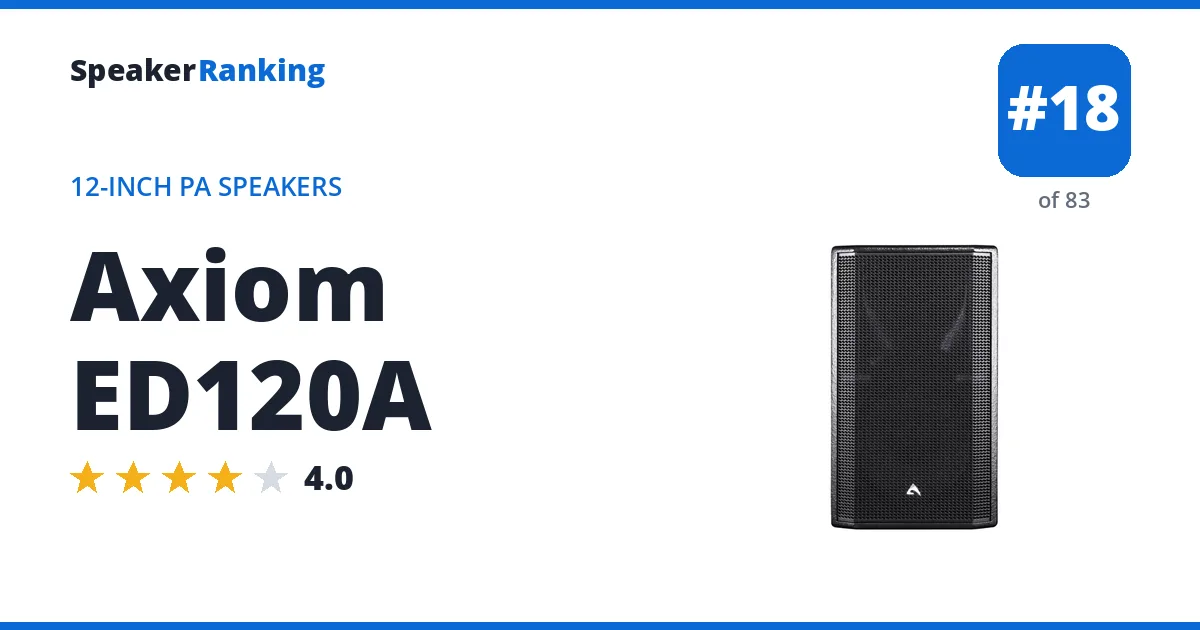
Same family: the Axiom ED60P (smaller model, rated 3.3/5), the Axiom ED80P (smaller model, rated 3.4/5) and the Axiom ED150A (larger model, rated 3.8/5).
Pros: High-quality vendor Spinorama data gives it a 5.73 ideal-subwoofer preference score and 52Hz bass extension, a solid tonal showing for a professional cabinet. CORE DSP, PRONET remote control and an asymmetric rotatable horn add useful installation flexibility. Measured bass extension of 60Hz (-3dB).
Cons: The 132dB claimed peak is competitive rather than class-leading, and the asymmetric 60°-to-100° pattern needs more deliberate aiming than a conventional symmetric horn. Availability and service coverage are less broad than the mainstream QSC, JBL, Yamaha and RCF choices.
Full Axiom ED120A review and specifications →
| Released | 2017 (9 years ago) |
|---|---|
| AES Input | No |
| Amplifier Power | 1,200W continuous (900W LF + 300W HF Class D, manufacturer specified) |
| Aux Input | No |
| Bass Extension (-3dB) | 60Hz (measured, vendor Spinorama data) |
| Bluetooth | No |
| Cabinet Material | 15mm reinforced phenolic birch plywood |
| Coaxial Input | No |
| Configuration | Active 2-way bass-reflex PA speaker |
| Coverage | 60°-100° asymmetric x 60° |
| DSP | Yes, CORE processing with PRONET control |
| Dimensions | 24”H x 14.2”W x 12.2”D (610 x 360 x 310 mm) |
| Drivers | 12” woofer, 1.4” compression driver |
| Frequency Response | 65Hz - 17kHz (-6dB, manufacturer specified) |
| Guitar Input | No |
| HDMI Input | No |
| Inputs | XLR input and link; EtherCON control network |
| Maximum SPL | 132dB peak (manufacturer specified) |
| Microphone Input | No |
| Network Control | PRONET control over EtherCON/CANBUS |
| Optical Input | No |
| Passive | No |
| RCA Input | No |
| Rigging | M10 and M6 fly points; pole-mount socket |
| Spinorama Preference Score | 3.30 |
| Spinorama Preference Score with Perfect Sub | 5.73 |
| TRS Input | No |
| USB Input | No |
| Weight | 41.9 lbs (19 kg) |
| XLR Input | Yes |
- Links
- Reviews, Comparisons and Sound Samples
- Head-to-Head Comparisons
High-quality vendor Spinorama data gives it a 5.73 ideal-subwoofer preference score and 52Hz bass extension, a solid tonal showing for a professional cabinet, and CORE DSP plus PRONET remote control bring real networked management well below flagship pricing.
The 132dB claimed peak is competitive rather than class-leading, and the asymmetric coverage pattern needs more deliberate aiming than a conventional symmetric horn; availability and service coverage are also less broad than the majors.
Other PA Speakers With Network Control
 The Vue Audiotechnik H-15: $6,500 eBay
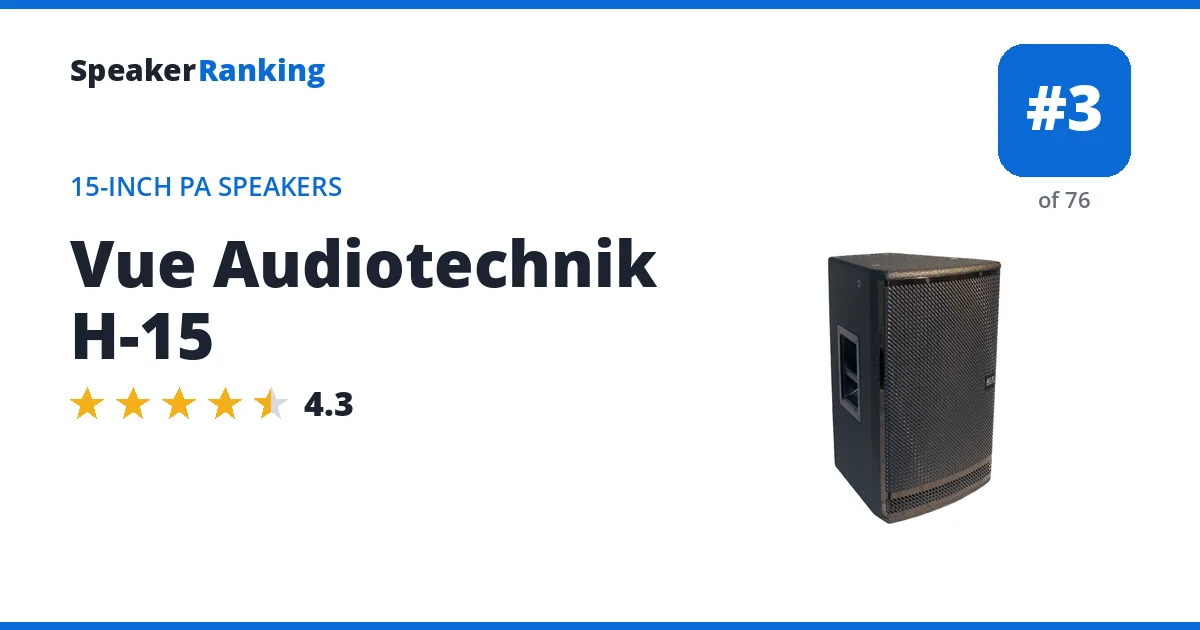
Same family: the Vue Audiotechnik H-5 (smaller model, rated 3.6/5), the Vue Audiotechnik H-8 (smaller model, rated 3.6/5) and the Vue Audiotechnik h-12 (smaller model, rated 3.8/5).
Pros: Low-quality vendor data still returns a strong 6.1 ideal-subwoofer preference score with roughly 70Hz extension, continuing the h-Class’s beryllium-diaphragm compression driver and narrow, feedback-resistant 60° x 40° pattern from the Vue Audiotechnik h-12. Measured bass extension of 90Hz (-3dB).
Cons: At 38kg and a $6500 asking price this is among the heaviest and most expensive 15-inch boxes here, aimed at rental and touring use rather than casual portability. The low-quality measurement source limits confidence in the exact result.
Full Vue Audiotechnik H-15 review and specifications →
| Released | 2012 (14 years ago) |
|---|---|
| AES Input | Yes |
| Amplifier Power | 1,105W long-term (830W LF + 275W HF); 2,400W burst (2,000W LF + 400W HF) |
| Aux Input | No |
| Bass Extension (-3dB) | 90Hz (measured, vendor Spinorama data) |
| Bluetooth | No |
| Cabinet Material | Multi-ply birch hardwood |
| Coaxial Input | No |
| Configuration | Active 2-way bass-reflex PA speaker |
| Coverage | 60° x 40° |
| DSP | Yes |
| Dimensions | 27.2”H x 17.2”W x 18”D (692 x 438 x 457 mm) |
| Drivers | 15” woofer, beryllium-diaphragm compression driver |
| Frequency Response | 42Hz - 21kHz (±1.5dB, manufacturer specified) |
| Guitar Input | No |
| HDMI Input | No |
| Inputs | XLR analog/AES input with XLR loop output |
| Maximum SPL | 136dB peak (manufacturer specified) |
| Microphone Input | No |
| Network Control | Ethernet/IP remote monitoring and control |
| Optical Input | No |
| Passive | No |
| RCA Input | No |
| Rigging | Integrated M10 fly points plus built-in pole mount; optional flying hardware for array/support configurations |
| Spinorama Preference Score | 3.10 |
| Spinorama Preference Score with Perfect Sub | 6.07 |
| TRS Input | No |
| USB Input | No |
| Weight | 83.8 lbs (38 kg) |
| XLR Input | Yes |
- Links
- Reviews, Comparisons and Sound Samples
- Head-to-Head Comparisons
A strong 5.2 ideal-subwoofer preference score with roughly 70Hz extension comes from low-quality vendor data, so treat the tonal result with more caution than the higher-confidence picks above; at 38kg and a high asking price, it’s aimed at rental and touring use.
 The RCF KX 10-A: $2,798.50 B&H Photo Video $2,798.50 Guitar Center $2,798.50 eBay
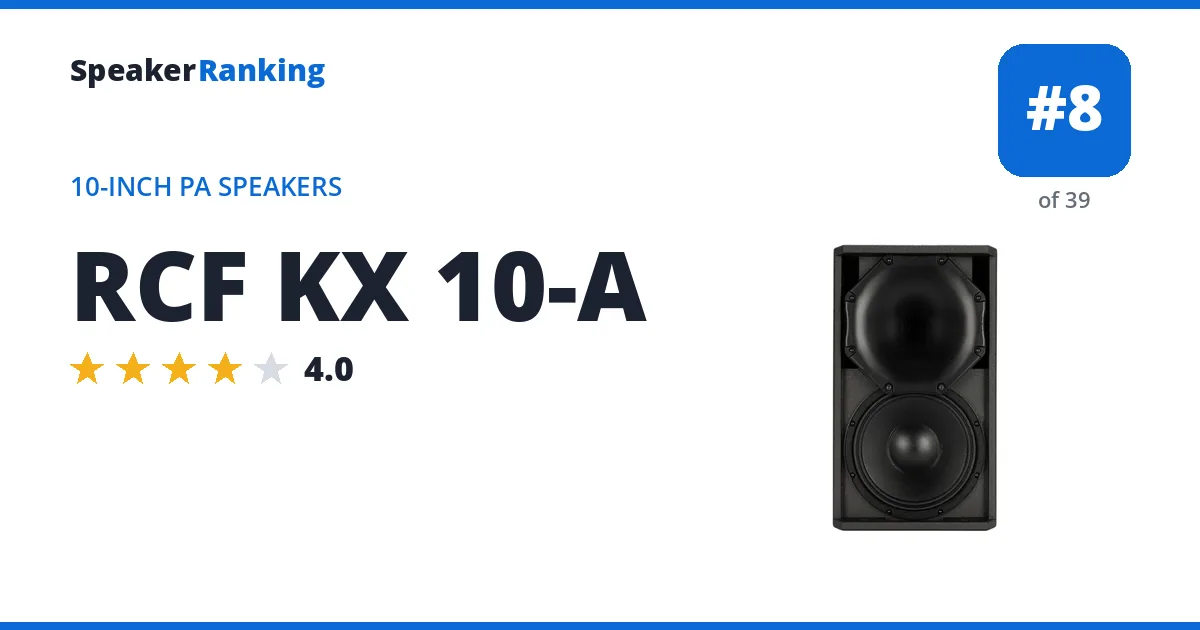
Same family: the RCF KX 08-A (smaller model, rated 3.9/5), the RCF KX 32-A (larger model, rated 4.3/5) and the RCF KX 45-A (larger model, rated 4.2/5).
Pros: The entry point into RCF’s flagship KX point-source range, with a 130dB claimed peak, a neodymium woofer and wide 100° x 50° coverage in a manageable 15.5kg cabinet. Measured bass extension of 73Hz (-3dB).
Cons: The local measurement is truncated and cannot produce a preference score, and pricing/retail availability are not yet well established for this model.
Full RCF KX 10-A review and specifications →
| AES Input | No |
|---|---|
| Amplifier Power | 2000W peak (1400W LF + 600W HF) |
| Aux Input | No |
| Bass Extension (-3dB) | 73Hz (measured, vendor Spinorama data) |
| Bluetooth | No |
| Cabinet Material | Baltic birch plywood |
| Coaxial Input | No |
| Configuration | Active 2-way bass-reflex point-source PA speaker |
| Coverage | 100° x 50° |
| Crossover Frequency | 1600Hz |
| DSP | Yes, FiRPHASE, Bass Motion Control and presets |
| Dimensions | 20.1”H x 11.8”W x 17.5”D (510 x 300 x 445 mm) |
| Drivers | 10” neodymium woofer, compression driver |
| Frequency Response | 60Hz - 20kHz (manufacturer specified) |
| Guitar Input | No |
| HDMI Input | No |
| Inputs | XLR and EtherCON RDNet input/link |
| Maximum SPL | 130dB peak (manufacturer specified) |
| Microphone Input | No |
| Network Control | RDNet |
| Optical Input | No |
| Passive | No |
| RCA Input | No |
| Rigging | M10 inserts; 35mm pole mount |
| TRS Input | No |
| USB Input | No |
| Weight | 34.2 lbs (15.5 kg) |
| XLR Input | Yes |
- Links
- Reviews, Comparisons and Sound Samples
- Head-to-Head Comparisons
A 130dB claimed peak, a neodymium woofer and wide coverage in a manageable 15.5kg cabinet, though the local measurement is truncated and pricing/retail availability aren’t yet well established.
 The Meyer Sound Ultra X40 eBay
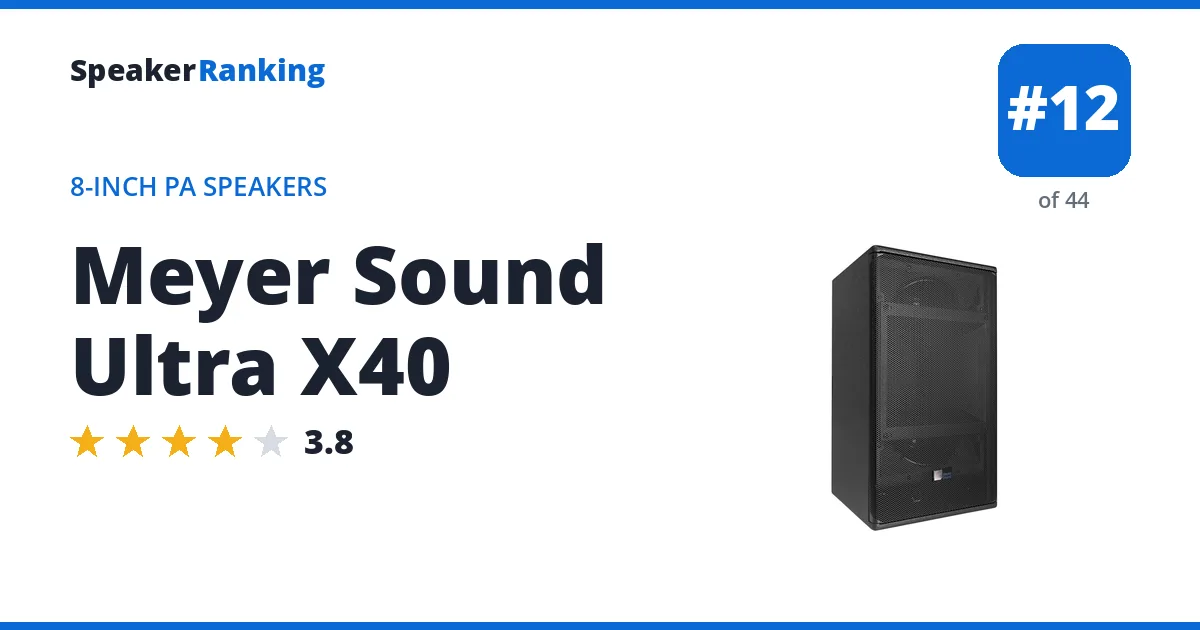
Same family: the Meyer Sound Ultra X20 (smaller model, rated 3.6/5), the Meyer Sound Ultra X22 (smaller model, rated 3.9/5), the Meyer Sound Ultra X23 (smaller model, rated 3.3/5) and the Meyer Sound Ultra X80 (larger model, estimated 3.9/5).
Pros: Bass reaches 65Hz at -3dB and about 57Hz at -10dB, deep for a pair of 8-inch woofers, and manufacturer measurements give a 5.43 preference score with an ideal subwoofer. The concentric 3-inch compression driver and 110° x 50° Constant-Q horn give wide, even coverage, and the built-in 1,950W peak amplifier reaches 127dB. Networked Galileo processing and a sub-25kg weight make it easy to fly or pole-mount. Measured bass extension of 65Hz (-3dB).
Cons: The 3.8dB reference band and 0.66 listening-window deviation make its tonal balance rougher than the Meyer Sound Ultra X20’s, with a 2.73 standalone score. It is sold through pro dealers with no published price, and Sweetwater requires a sales engineer to order it.
Full Meyer Sound Ultra X40 review and specifications →
| Released | 2019 (7 years ago) |
|---|---|
| AES Input | No |
| Amplifier Power | 1,950W peak, 3-channel Class D |
| Aux Input | No |
| Bass Extension (-10dB) | about 56.8Hz (measured, vendor Spinorama data) |
| Bass Extension (-3dB) | 65Hz (measured, vendor Spinorama data) |
| Bluetooth | No |
| Coaxial Input | No |
| Configuration | Self-powered 2-way concentric loudspeaker |
| Coverage | 110° x 50° Constant-Q horn |
| DSP | Yes, Galileo GEN-1 networked processing |
| Dimensions | 22.3”H x 12.5”W x 14”D (567 x 318 x 356 mm) |
| Drivers | 2x 8” cone woofers, concentric 3” compression driver |
| Frequency Response | 56Hz - 19kHz (manufacturer specified) |
| Guitar Input | No |
| HDMI Input | No |
| Maximum SPL | 127dB linear peak (manufacturer specified) |
| Microphone Input | No |
| Network Control | Galileo GEN-1 networked audio and DSP control |
| Optical Input | No |
| Passive | No |
| RCA Input | No |
| Rigging | 11 x M8 inserts; 35mm pole-mount receptacle |
| Spinorama Preference Score | 2.73 |
| Spinorama Preference Score with Perfect Sub | 5.43 |
| TRS Input | No |
| USB Input | No |
| Weight | Under 55.1 lbs (25 kg) |
| XLR Input | Yes |
- Links
- Reviews, Comparisons and Sound Samples
- Head-to-Head Comparisons
Two 8-inch woofers around a concentric 3-inch compression driver reach 127dB with a wide 110° x 50° horn, and bass to about 65Hz at -3dB. Its measured tonal balance is less even than the picks above, and it is sold only through Meyer dealers.
What To Check Before Buying
Protocol compatibility: the exact networking standard varies by brand (Dante, EtherCON/CANBUS, RDNet, MILAN, or a manufacturer’s own app). Confirm your control software, and any other speakers in the system, actually support the same one.
It doesn’t replace a proper network: networked audio and control both need real Ethernet infrastructure (switches, cabling, sometimes PoE) between boxes, not just a shared Wi-Fi network.
Most gigs don’t need it: for a single speaker or a small setup where you can reach every cabinet, front-panel controls are simpler and there’s nothing to configure.
Where To Go Next
See every PA speaker with network control for the complete list, or the battery-powered PA speakers and PA buyer’s guide for other starting points.