Editor's top picks
Start with these speakers
Our leading recommendations at a glance. Each card links to its primary retailer.
Looking for the best powered speakers under $1,000? This is the budget where measured accuracy stops improving much and the choice becomes about size, bass and features. The top monitors here measure about as evenly as anything on the site; spending more mostly buys more output and deeper bass. Prices are per pair unless a speaker is a single stereo unit.
Prices on this page were last checked September 24, 2026 at 10:28 PM UTC. Product prices and availability are accurate as of that date/time and are subject to change; the price and availability shown on Amazon at the time of purchase will apply to the purchase of this product.
As an eBay Partner, we may be compensated if you make a purchase.
What Changes At $1,000
Reference-grade accuracy. The best monitors here have midrange responses within about 2dB from 300Hz to 5kHz, the kind of evenness that used to cost far more.
Deeper bass from 8-inch monitors. Larger studio monitors reach the low 40Hz range, enough for most music without a subwoofer.
Better all-in-one options. HDMI ARC, streaming and Bluetooth speakers at this price finally measure well enough to recommend for music, not just convenience.
Best Overall Under $1,000
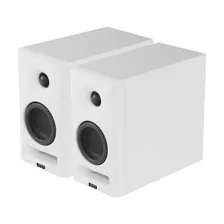 The most accurate monitor under $1,000 a pair, with a 1.6dB midrange span and bass reaching about 50Hz (-3dB), is the Topping MA4: $400 per pair Audiophonics eBay
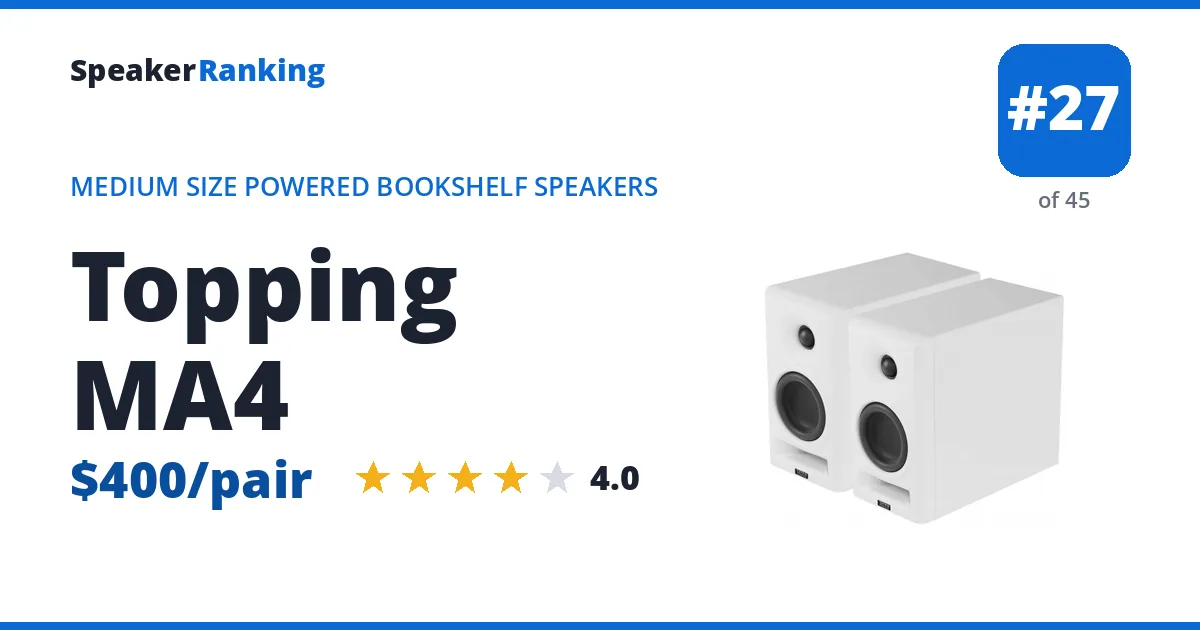
Pros: The selected manufacturer-supplied Klippel data shows a 1.6dB span from 300Hz to 5kHz, bass reaching -3dB around 50Hz, and preference scores of 5.64 standalone and 7.83 with an ideal subwoofer. That is strong measured tonal performance for a compact monitor. Its analog crossover and balanced XLR connection suit an existing audio interface. Measured bass extension of 49.8Hz (-3dB).
Cons: The native listening-window response is not as smooth as the leading Genelec and Neumann measurements. No USB, Bluetooth or built-in room-correction DSP: source control and correction need external equipment. Bass extension alone does not establish clean output capability.
Full Topping MA4 review and specifications →
| AES Input | No |
|---|---|
| Amplifier Power | 75W total (50W woofer, 25W tweeter, Class D) |
| Aux Input | No |
| Bass Extension (-10dB) | 42.9Hz (measured, spinorama.org vendor data) |
| Bass Extension (-3dB) | 49.8Hz (measured, spinorama.org vendor data) |
| Bluetooth | No |
| Coaxial Input | No |
| Country | China |
| Crossover Frequency | 1.3kHz |
| Dimensions | 10"H x 5.5"W x 11.3"D (255 x 140 x 288 mm) |
| Drivers | 1" soft dome tweeter with waveguide, 4" paper cone woofer |
| Enclosure | ported |
| Frequency Response | 49Hz-20kHz +/-3dB |
| HDMI Input | No |
| Inputs | XLR (balanced analog) |
| Maximum SPL | 105dB @ 1m (manufacturer specified) |
| Optical Input | No |
| RCA Input | No |
| Sensitivity | 92dB |
| Spinorama Preference Score | 5.64 |
| Spinorama Preference Score with Perfect Sub | 7.83 |
| TRS Input | No |
| USB Input | No |
| Warranty | 1-2 years (varies by region) |
| Weight | 8.3 lbs (3.78 kg) each |
| XLR Input | Yes |
- Links
- Reviews, Comparisons and Sound Samples
- Head-to-Head Comparisons
Its midrange is among the most even on the site. It has balanced analog inputs only, so it needs an interface or preamp for volume control.
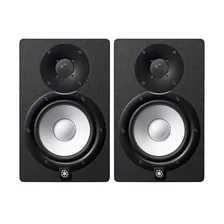 For deep bass without a subwoofer, reaching about 44Hz (-3dB) from an 8-inch woofer, the Yamaha HS8: $797.98 per pair Amazon eBay
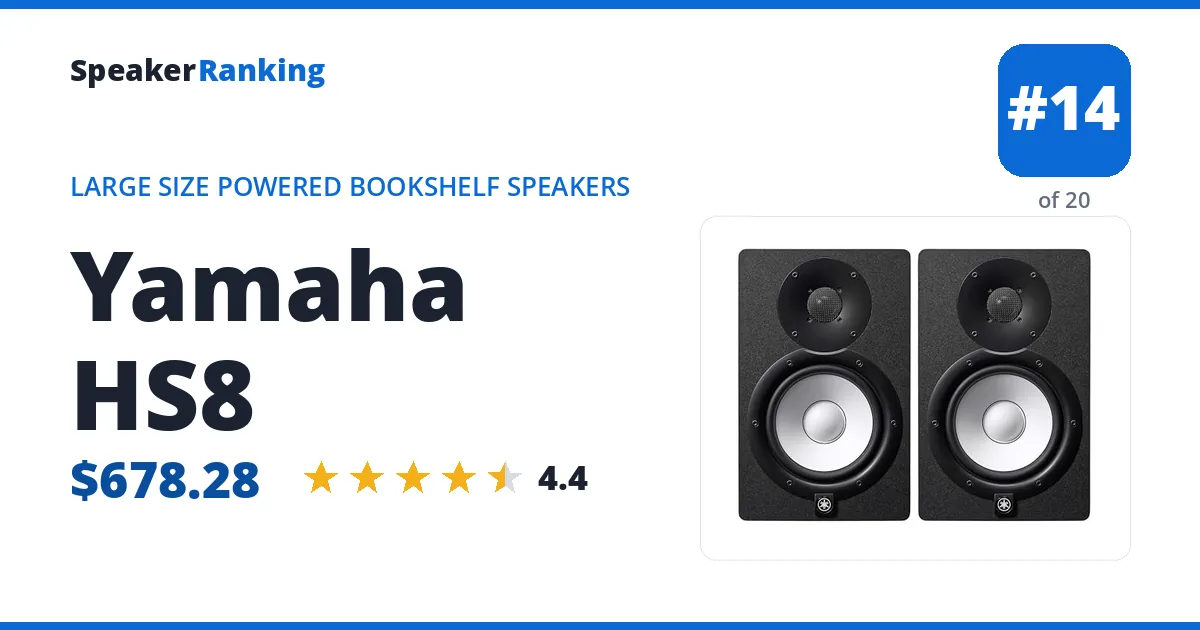
Pros: ASR measurements support broadly neutral sound: a 2.3dB response span from 300Hz to 5kHz and 7.58 ideal-subwoofer score. Measured -3dB bass extension of 43.9Hz gives useful weight for music, with straightforward analog connections and room-adjustment controls. Measured bass extension of 43.9Hz (-3dB).
Cons: Its response and off-axis behavior are not as refined as the leading monitors. Vertical positioning around the crossover matters, and a subwoofer remains useful for deep bass. Basic rear-panel controls do not replace measured room correction.
Full Yamaha HS8 review and specifications →
| AES Input | No |
|---|---|
| Amplifier Power | 120w Per Speaker |
| App | No |
| Aux Input | No |
| Bass Extension (-10dB) | 34.7Hz (measured, Audio Science Review) |
| Bass Extension (-3dB) | 43.9Hz (measured, Audio Science Review) |
| Bluetooth | No |
| Coaxial Input | No |
| DSP | No |
| Dimensions | 15.4"H x 9.8"W x 13.1"D (391.2 x 248.9 x 332.7 mm) |
| Drivers | 8" woofer, 1" dome tweeter |
| EQ | Yes (Room adjustment) |
| Frequency Response | 47Hz - 24kHz (-3dB) (Manufacturer specified) |
| HDMI Input | No |
| Inputs | XLR |
| Optical Input | No |
| RCA Input | No |
| Spinorama Preference Score | 5.85 |
| Spinorama Preference Score with Perfect Sub | 7.58 |
| TRS Input | No |
| USB Input | No |
| Weight | 22.5 lbs (10.2 kg) |
| XLR Input | Yes |
- Links
- Reviews, Comparisons and Sound Samples
- Audio Science Review: Yamaha HS8 Studio Monitor Review More from Audio Science Review →
- Sercan Solmaz: Adam Audio T8V vs Yamaha HS8 vs KRK Rokit 8 (STUDIO SPEAKER SOUND TEST)
- DSAUDIO.review: DSAUDIO.review Edifier R2850DB vs Yamaha HS8 sound.DEMO More from DSAUDIOreview →
- DSAUDIO.review: DSAUDIO.review Adam Audio A7X vs Yamaha HS8 sound.DEMO
- DSAUDIO.review: Yamaha HS7 vs Yamaha HS8 Sound & Frequency Response Comparison
- DSAUDIO.review: Yamaha HS8 vs Yamaha HS5 Sound & Frequency Response Comparison
- DSAUDIO.review: Genelec 8020D vs Yamaha HS8 Sound & Frequency Response Comparison
- DSAUDIO.review: DSAUDIO.review APS Klasik 2020 vs Yamaha HS8 sound.DEMO
- DSAUDIO.review: DSAUDIO.review Focal Alpha 65 EVO vs Yamaha HS8 sound.DEMO
- DSAUDIO.review: Yamaha HS8 vs PreSonus Eris E8 XT Sound & Frequency Response Comparison
- DSAUDIO.review: Yamaha HS8 vs Kali Audio LP-8 Sound & Frequency Response Comparison
- DSAUDIO.review: KRK Rokit 8 G4 RP8G4 vs Yamaha HS8 Sound & Frequency Response Comparison
- DSAUDIO.review: Neumann KH80 DSP vs Yamaha HS8 Sound & Frequency Response Comparison
- DSAUDIO.review: Yamaha HS8 vs IK Multimedia iLoud MTM Sound & Frequency Response Comparison
- Audio Science Review Measurements (spinorama.org)
- Head-to-Head Comparisons
Measured neutrality is close behind, with a 2.3dB midrange span. It needs the space and stands a large monitor calls for.
Best Value Under $1,000
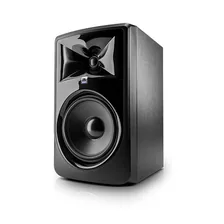 For an 8-inch monitor with a very even 1.8dB midrange span and bass reaching about 42.5Hz (-3dB), for about half the budget, the JBL 308P MKII: $498 per pair B&H Photo Video eBay
Pros: A 1.8dB response span from 300Hz to 5kHz and 7.69 ideal-subwoofer score support unusually good tonal balance for an accessible studio monitor. Measured -3dB extension of 42.5Hz supplies useful musical bass, and the waveguide helps maintain consistent horizontal coverage. Measured bass extension of 42.5Hz (-3dB).
Cons: Amplifier hiss may be noticeable in quiet, close-range use. Bass distortion and output limits matter when playing loudly, despite the 8-inch woofer. Keep the tweeter near ear height; vertical crossover behavior is less forgiving than the best coaxial designs.
Full JBL 308P MKII review and specifications →
| AES Input | No |
|---|---|
| Amplifier Power | 112W total |
| App | No |
| Aux Input | No |
| Bass Extension (-10dB) | 37.6Hz (derived, log-interpolated between spinorama.org -9dB/-12dB points) |
| Bass Extension (-3dB) | 42.5Hz (measured, Audio Science Review) |
| Bluetooth | No |
| Coaxial Input | No |
| DSP | No |
| Dimensions | 16.5"H x 10"W x 12.1"D (419.1 x 254 x 307.3 mm) |
| Drivers | 8" woofer, 1" neodymium tweeter |
| EQ | No |
| Frequency Response | 45Hz - 20kHz (+/-3dB) (Manufacturer specified) |
| HDMI Input | No |
| Inputs | XLR, 1/4" TRS |
| Optical Input | No |
| RCA Input | No |
| Spinorama Preference Score | 5.88 |
| Spinorama Preference Score with Perfect Sub | 7.69 |
| TRS Input | Yes |
| USB Input | No |
| Weight | 17.9 lbs (8.1 kg) each |
| XLR Input | Yes |
- Links
- Reviews, Comparisons and Sound Samples
- Head-to-Head Comparisons
It ranks #22 of 68 large powered bookshelf speakers. Amplifier hiss can be audible at very close range in a quiet room.
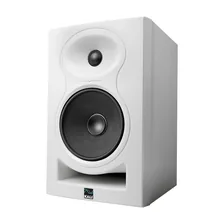 For a 6.5-inch monitor with bass reaching about 42Hz (-3dB) for well under half the budget, the Kali Audio LP-6 V2: $398 per pair Amazon B&H Photo Video eBay
Pros: Erin’s measurements give a 7.48 ideal-subwoofer score and 42.5Hz -3dB bass extension, a strong combination for an affordable nearfield monitor. The waveguide and placement switches help with practical setup, and the second generation improves close-range noise behavior. Measured bass extension of 42Hz (-3dB).
Cons: The 2.5dB response span from 300Hz to 5kHz leaves some tonal unevenness. Vertical crossover behavior makes ear-height placement important, and compression limits loud bass playback. Its good tonal score is not evidence of the output capability of a much larger monitor.
Full Kali Audio LP-6 V2 review and specifications →
| AES Input | No |
|---|---|
| Amplifier Power | 40W LF + 40W HF per speaker; Bi-amplified Class D |
| Aux Input | No |
| Bass Extension (-10dB) | 39.1Hz (measured, Erin's Audio Corner) |
| Bass Extension (-3dB) | 42Hz (measured, Erin's Audio Corner) |
| Bluetooth | No |
| Coaxial Input | No |
| DSP | Yes; boundary presets and LF/HF trims |
| Dimensions | 14.1"H x 8.8"W x 10.2"D |
| Drivers | 1" soft-dome tweeter; 6.5" woofer |
| Frequency Response | 47Hz - 21kHz (±3dB) (Manufacturer specified) |
| HDMI Input | No |
| Inputs | XLR, balanced TRS and RCA |
| Maximum SPL | Approximately 102dB per pair with good measured linearity (Erin's Audio Corner) (manufacturer specified) |
| Optical Input | No |
| RCA Input | Yes |
| Spinorama Preference Score | 5.53 |
| Spinorama Preference Score with Perfect Sub | 7.48 |
| TRS Input | Yes |
| USB Input | No |
| Weight | 15.5 lbs (7.05 kg) each |
| XLR Input | Yes |
- Links
- Reviews, Comparisons and Sound Samples
- Head-to-Head Comparisons
- Kali Audio LP-6 V2 vs Kali Audio IN-8 V2
- Kali Audio LP-6 V2 vs Yamaha HS8
- Kali Audio LP-6 V2 vs Genelec 8050B
- Kali Audio LP-6 V2 vs JBL 4305P
- Kali Audio LP-6 V2 vs JBL 308P MKII
- Kali Audio LP-6 V2 vs SHIVAUDYO Point Zero
- Kali Audio LP-6 V2 vs Focal Solo6 ST6
- Kali Audio LP-6 V2 vs Genelec S360
- See all 46 comparisons
Placement switches and a waveguide help at a desk. Keep the tweeter at ear height, and expect compression when playing bass loud.
Best Compact Desk Pair Under $1,000
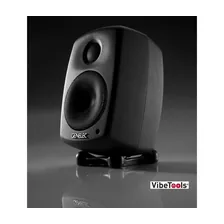 For a genuinely neutral tiny monitor with a 2.5dB midrange span, the Genelec 8010A: $900 per pair B&H Photo Video eBay
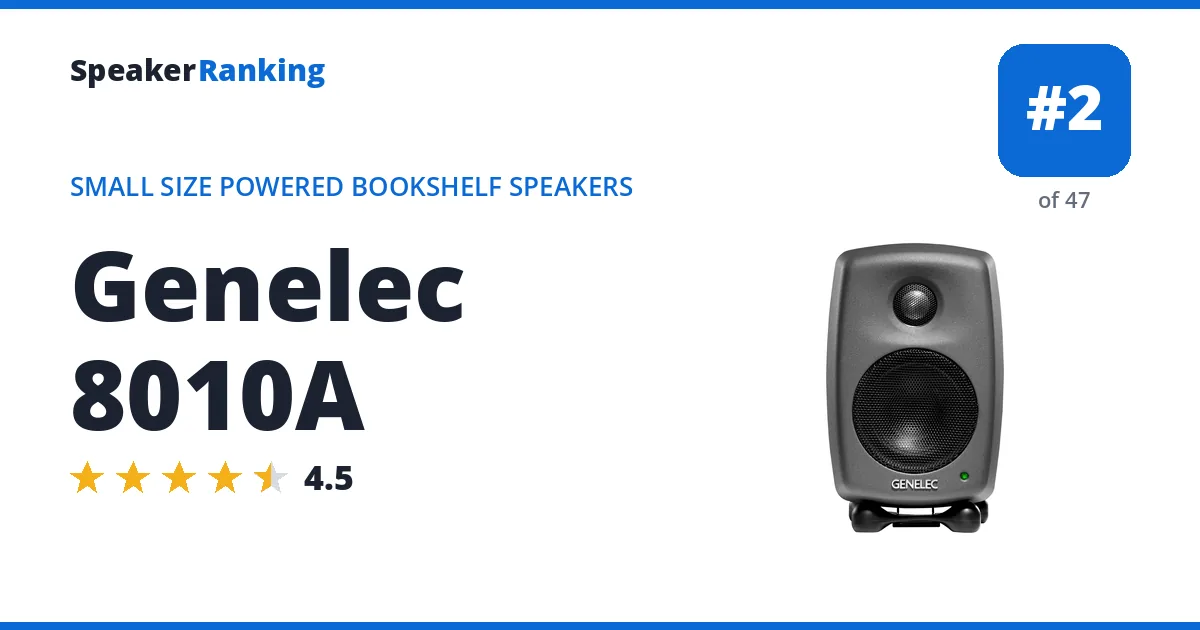
Pros: ASR’s Klippel measurements support a neutral compact monitor: the response spans 2.5dB from 300Hz to 5kHz, with lower narrow-band variation in the listening window than directly on-axis. Spinorama predicts 4.10 standalone and 7.01 with an ideal subwoofer, making it a strong choice when bass is handled separately. Its measured balance provides firmer evidence for critical listening than a recorded sound demonstration alone. Measured bass extension of 74Hz (-3dB).
Cons: The measured -3dB point is about 78Hz, so deep bass is missing without a subwoofer. The small enclosure and woofer are better suited to close listening than room-filling levels; the preference score does not measure headroom. The D3V offers substantially deeper measured bass in a similarly compact format, while the Genelec’s premium price is harder to justify for casual desktop use.
Full Genelec 8010A review and specifications →
| AES Input | No |
|---|---|
| Amplifier Power | 50W (25W woofer + 25W tweeter) |
| App | No |
| Aux Input | No |
| Bass Extension (-10dB) | 67Hz (measured, Audio Science Review) |
| Bass Extension (-3dB) | 74Hz (measured, Audio Science Review) |
| Bluetooth | No |
| Coaxial Input | No |
| Dimensions | 7.7"H x 4.8"W x 4.5"D (195.6 x 121.9 x 114.3 mm) |
| Drivers | 3" woofer, 0.75" metal dome tweeter |
| EQ | Yes (Bass tilt, Desk proximity) |
| Frequency Response | 67 Hz-25 kHz (-6dB) (Manufacturer specified) |
| HDMI Input | No |
| Inputs | XLR |
| Maximum SPL | 96dB @ 1m (manufacturer specified) |
| Optical Input | No |
| RCA Input | No |
| TRS Input | No |
| USB Input | No |
| Weight | 3.3 lbs (1.5 kg) |
| XLR Input | Yes |
- Links
- Reviews, Comparisons and Sound Samples
- Audio Science Review Measurements More from Audio Science Review →
- DSAUDIO.review: Genelec 8010A (Genelec G One) vs iLoud Micro Monitor Sound Demo w/ Bass Test More from DSAUDIOreview →
- DSAUDIO.review: Genelec 8010A (Genelec G One) vs Presonus Eris E4.5 Sound Demo w/ Bass Test
- DSAUDIO.review: Genelec 8010A (G One) vs JBL LSR305 Sound Demo w/ Bass Test
- DSAUDIO.review: Genelec 8010A (Genelec G One) vs Audioengine A2+ Sound Demo w/ Bass Test
- DSAUDIO.review: Genelec 8010A (Genelec G One) vs Yamaha HS5 Sound Demo w/ Bass Test
- Audio Science Review Measurements (spinorama.org)
- Head-to-Head Comparisons
- Genelec 8010A vs Adam Audio D3v
- Genelec 8010A vs Cambridge Audio L/R S
- Genelec 8010A vs IK Multimedia iLoud Micro Monitor
- Genelec 8010A vs Edifier M60
- Genelec 8010A vs HiVi Swan X3
- Genelec 8010A vs Edifier MR3
- Genelec 8010A vs Audioengine A2+
- Genelec 8010A vs Klipsch ProMedia Lumina
- See all 13 comparisons
Bass stops around 74Hz (-3dB), so it suits a desk or a system with a subwoofer rather than room-filling music.
 For USB-C input and deeper bass from side passive radiators, reaching about 50Hz (-3dB), the Adam Audio D3v: $339.99 per pair Amazon eBay
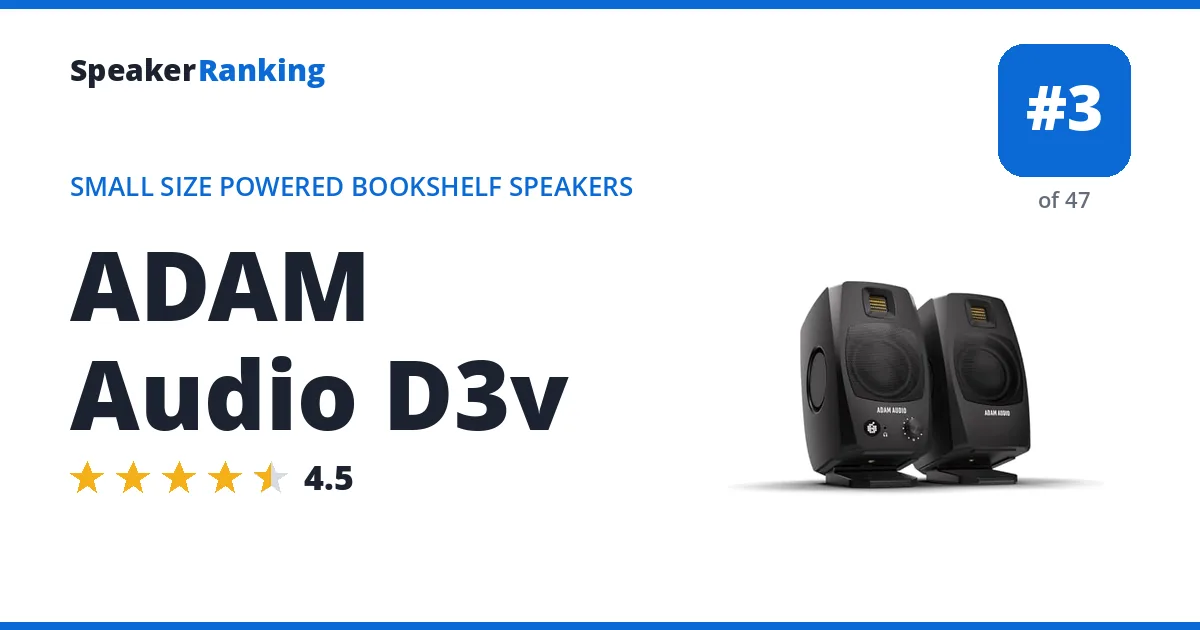
Pros: Excellent midrange linearity for a tiny desktop speaker: Erin’s Klippel data spans just 1.7dB from 300Hz to 5kHz. Side passive radiators help bass reach -3dB at about 51Hz, substantially deeper than the Genelec 8010A or Audio Smile LBM. Predicted preference scores of 5.37 standalone and 7.59 with an ideal subwoofer support it as a particularly useful compact system without a sub. USB-C, analog inputs and placement filters simplify desk setup. Measured bass extension of 50Hz (-3dB), with a measured sensitivity of 86.5dB.
Cons: A rising upper-frequency balance and vertical crossover interference keep it from being uniformly neutral at every angle; aim the tweeters toward ear height. The limiter reduces bass and midrange output as volume rises, with the existing review’s compression tests putting usable maximum output around 89-90dB at 1m. Deep bass at moderate volume should not be confused with high output capability.
Full Adam Audio D3v review and specifications →
| AES Input | No |
|---|---|
| Amplifier Power | 100W RMS per speaker (70W woofer + 30W tweeter) (Manufacturer specified) |
| App | No |
| Aux Input | No |
| Bass Extension (-10dB) | 45Hz (measured, Erin's Audio Corner) |
| Bass Extension (-3dB) | 50Hz (measured, Erin's Audio Corner) |
| Bluetooth | No |
| Coaxial Input | No |
| Dimensions | 200H (240H on included stand) x 115W x 150D mm |
| Drivers | 3.5" aluminium woofer, D-ART folded ribbon tweeter, 2 x 3.5" passive radiators (each) |
| EQ | Yes (Room adjustment filters) |
| Frequency Response | 48Hz - 22.6kHz (-3dB) (Manufacturer specified) |
| HDMI Input | No |
| Headphone Output | Yes |
| Inputs | USB-C, balanced 1/4-inch TRS |
| Maximum SPL | 98dB peak @ 1m (IEC-weighted noise, manufacturer specified) |
| Optical Input | No |
| Outputs | 3.5mm headphone |
| RCA Input | No |
| Sensitivity | 86.5dB (measured at 0.3V/1m, Erin's Audio Corner) |
| Spinorama Preference Score | 5.37 |
| Spinorama Preference Score with Perfect Sub | 7.59 |
| TRS Input | Yes |
| USB Input | Yes |
| Weight | 7.9 lbs (3.58 kg) (pair) |
| XLR Input | No |
- Links
- Reviews, Comparisons and Sound Samples
- Erin’s Audio Corner: ADAM Audio D3V: Mighty Small But Mighty Awesome Desktop Speaker More from Erin’s Audio Corner →
- Erin’s Audio Review Adam Audio D3v
- Erin’s Audio Corner Measurements (spinorama.org)
- Jasper Tech: Best Desktop Computer Speakers for Every Budget – 2026 More from Jasper Tech →
- Jasper Tech: Are the D3V The Best Studio Monitors For The Money?
- Erin’s Audio Corner: The Best Budget Desktop Speakers, Tested & Rated
- Head-to-Head Comparisons
- Adam Audio D3v vs Genelec 8010A
- Adam Audio D3v vs Cambridge Audio L/R S
- Adam Audio D3v vs IK Multimedia iLoud Micro Monitor
- Adam Audio D3v vs Audio Smile Little British Monitor
- Adam Audio D3v vs Edifier M60
- Adam Audio D3v vs HiVi Swan X3
- Adam Audio D3v vs Edifier MR3
- Adam Audio D3v vs Audioengine A2+
- See all 15 comparisons
Its 1.7dB midrange span is excellent for a desktop speaker at $340. Aim the tweeters at ear height.
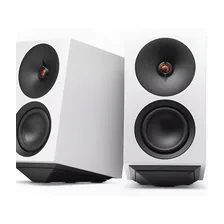 For Bluetooth, optical and USB-C inputs with a neutral measured response, the Cambridge Audio L/R S: $549.00 per pair Amazon eBay
Pros: A 2-way active bookshelf pair built for near-field desktop use, with a 21mm aluminum tweeter and a 3-inch long-throw woofer on each speaker. Erin’s Audio Corner measured a very neutral on-axis response with good directivity control up through the 2-3kHz handoff to the tweeter, an F3 of about 57Hz and F10 of about 50Hz, and output held within roughly plus or minus 2.5dB from 80Hz to 20kHz. Horizontal dispersion of about plus or minus 60 degrees and a vertical window of about plus 30 to minus 20 degrees make it forgiving of off-center desktop seating. Two rear switches (a desktop-placement compensation switch and a near-wall/free-space switch) plus in-app DSP for room size, wall distance, and reflective surface type let you tune the in-room response rather than just hoping placement works out, and the reviewer noted an audible tightening of the bass moving between room-size settings. Rear connectivity includes RCA, optical digital, USB-C, and a dedicated subwoofer output. Measured bass extension of 57Hz (-3dB).
Cons: Maximum clean output is limited: Erin’s Audio Corner measured about 86dB before the onboard limiter engages around 96dB to protect the drivers, so this is a near-field or small-room speaker rather than one built to fill a living room. Each speaker’s Class D amplifier splits only 50W to the woofer and 50W to the tweeter, modest for the class. The DSP room-correction options are preset-based rather than a true microphone-measured calibration at the listening position, so results depend on picking settings that match your actual room.
Full Cambridge Audio L/R S review and specifications →
| AES Input | No |
|---|---|
| Amplifier Power | 100W total (50W to woofer, 50W to tweeter, per speaker) |
| App | Yes |
| Aux Input | No |
| Bass Extension (-10dB) | 50Hz (measured, Erin's Audio Corner) |
| Bass Extension (-3dB) | 57Hz (measured, Erin's Audio Corner) |
| Bluetooth | Yes |
| Bluetooth Codecs | SBC, AAC, aptX, aptX HD |
| Coaxial Input | No |
| DSP | Yes, room size, wall distance, and reflective surface correction; desktop-placement and near-wall/free-space switches |
| Dimensions | 5.3" (134 mm) W x 226mm H x 180mm D (each) |
| Drivers | 21mm aluminum dome tweeter, 3" long-throw woofer |
| Frequency Response | 55Hz - 24kHz (±3dB, manufacturer specified) |
| HDMI Input | No |
| Inputs | RCA, optical digital, USB-C |
| Optical Input | Yes |
| Outputs | Subwoofer, wired speaker-to-speaker link |
| RCA Input | Yes |
| Subwoofer Output | Yes |
| TRS Input | No |
| USB Input | Yes |
| Weight | 6.6 lbs (3.0kg) primary speaker, 5.7 lbs (2.6kg) secondary speaker |
| XLR Input | No |
- Links
- Reviews, Comparisons and Sound Samples
- Head-to-Head Comparisons
- Cambridge Audio L/R S vs Adam Audio D3v
- Cambridge Audio L/R S vs IK Multimedia iLoud Micro Monitor
- Cambridge Audio L/R S vs Edifier M60
- Cambridge Audio L/R S vs Genelec 8010A
- Cambridge Audio L/R S vs HiVi Swan X3
- Cambridge Audio L/R S vs Audio Smile Little British Monitor
- Cambridge Audio L/R S vs Edifier MR3
- Cambridge Audio L/R S vs Sovox MiniMax3
- See all 17 comparisons
Output is the limit: the onboard limiter engages around 96dB, so keep it to near-field or small-room listening.
Best All-In-One Under $1,000
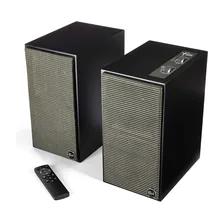 For a TV, with HDMI ARC, phono input and Bluetooth, the Klipsch The Fives: $699 per pair Amazon eBay
Pros: In the tested Bass Cut mode, Erin’s Klippel data gives preference scores of 5.52 standalone and 7.89 with an ideal subwoofer, with a 2.7dB midrange response span. That mode offers considerably better tonal balance than the bass-heavy default behavior. HDMI ARC, phono/line input, digital inputs and subwoofer output make it a versatile stereo alternative to a soundbar. Measured bass extension of 57Hz (-3dB).
Cons: The favorable score specifically requires Bass Cut mode; it does not describe every firmware or bass setting. Bass reaches -3dB around 59Hz in that configuration. The review reports increasing compression around 200Hz and below 80Hz as volume rises, reducing bass dynamics. Careful placement and a subwoofer remain useful, and the horn/woofer transition is not perfectly uniform off-axis.
Full Klipsch The Fives review and specifications →
| AES Input | No |
|---|---|
| Amplifier Power | 160W total system power (320W peak) |
| Aux Input | No |
| Bass Extension (-10dB) | 47.3Hz (measured, Erin's Audio Corner) |
| Bass Extension (-3dB) | 57Hz (measured, Erin's Audio Corner) |
| Bluetooth | Yes, 5.0 |
| Bluetooth Codecs | SBC, AAC, aptX, aptX HD |
| Coaxial Input | No |
| DSP | Dynamic Bass, Flat and Bass Cut profiles |
| Dimensions | 12"H x 6.5"W x 9.2"D (304.8 x 165.1 x 234.95 mm) |
| Drivers | 1" horn-loaded tweeter; 4.5" woofer |
| Frequency Response | 50Hz - 25kHz (Manufacturer specified) |
| HDMI Input | Yes |
| Inputs | HDMI ARC, USB, optical, Bluetooth, phono/line RCA |
| Optical Input | Yes |
| Outputs | Subwoofer |
| RCA Input | Yes |
| Spinorama Preference Score | 5.52 |
| Spinorama Preference Score with Perfect Sub | 7.89 |
| Subwoofer Output | Yes |
| TRS Input | No |
| USB Input | Yes |
| Weight | Primary 11.8 lbs (5.35 kg), Secondary 10.7 lbs (4.85 kg) |
| XLR Input | No |
- Links
- Reviews, Comparisons and Sound Samples
- Erin’s Audio Corner: Klipsch The Fives Review More from Erin’s Audio Corner →
- Erin’s Audio Corner Website: Klipsch The Fives
- Erin’s Audio Corner Measurements (spinorama.org)
- Jasper Tech: Best Bookshelf Speakers For TV & Gaming - 2025 More from Jasper Tech →
- Jasper Tech: Best Powered Bookshelf Speakers for Every Budget - 2025
- Head-to-Head Comparisons
- Klipsch The Fives vs JBL 305P MKII
- Klipsch The Fives vs Genelec 8020D
- Klipsch The Fives vs Topping MA4
- Klipsch The Fives vs KEF LS50 Wireless II
- Klipsch The Fives vs Vanatoo Transparent One Encore Plus
- Klipsch The Fives vs Devialet Phantom II 98 dB
- Klipsch The Fives vs IK Multimedia iLoud MTM MKII
- Klipsch The Fives vs Genelec 8320A
- See all 51 comparisons
Use Bass Cut mode: that is the configuration its strong measured result describes.
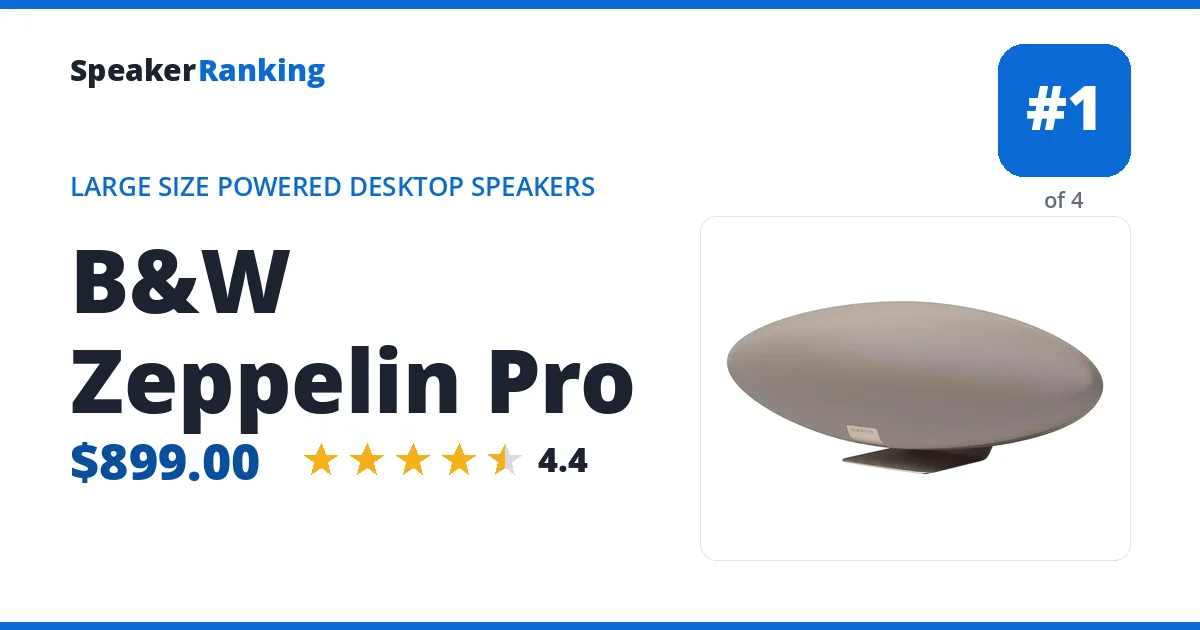
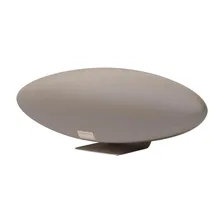 For a single streaming speaker with AirPlay 2 and Spotify Connect, the B&W Zeppelin Pro: $639.00 each Amazon eBay
Pros: Titanium dome tweeters and an improved 24-bit DAC over the standard Zeppelin for slightly better high-frequency detail on hi-res streams. Dynamic EQ DSP. Customizable downward-firing light. Same wide soundstage and deep bass extension as the standard Zeppelin.
Cons: Same price as the standard Zeppelin for a fairly modest tweeter/DAC upgrade. Nothing besides the lack of battery, lack of waterproofing, high cost and the Earfun Uboom X that’s so close to it in terms of sound quality for 7x less money. Basically an indoor only speaker. At this price point the Top Recommended Bookshelf Speakers are the better buy, with even better soundstage.
Full B&W Zeppelin Pro review and specifications →
| AES Input | No |
|---|---|
| Amplifier Power | 240W (80W woofer, 2x 40W midrange, 2x 40W tweeter) |
| App | No |
| Aux Input | No |
| Battery Life | No Battery |
| Bluetooth | Yes |
| Bluetooth Codecs | aptX Adaptive, AAC, SBC |
| Bluetooth Version | 5.0 |
| Coaxial Input | No |
| DSP | Yes |
| Dimensions | 25.6" x 8.3" x 7.6" (650 x 210 x 194 mm) |
| Drivers | 150mm woofer, 2x 90mm FST midrange drivers, 2x 25mm Titanium Dome tweeters |
| EQ | Yes (Dynamic EQ) |
| Frequency Response | 35Hz - 24kHz (Manufacturer specified) |
| HDMI Input | No |
| IP Rating | None |
| Inputs | Bluetooth, AirPlay 2, Spotify Connect |
| Optical Input | No |
| Party Mode | No |
| Power Bank | No |
| Power Input | AC Power cord |
| RCA Input | No |
| Stereo | Yes |
| Streaming Services | AirPlay 2, Spotify Connect |
| TRS Input | No |
| TWS | No |
| USB Input | No |
| Weight | 14.6 lbs (6.6 kg) |
| Wi-Fi | Yes |
| XLR Input | No |
- Links
- Reviews, Comparisons and Sound Samples
- Head-to-Head Comparisons
It ranks #1 of 6 large desktop speakers, and its price is for one speaker.
Where To Go Next
Lower budgets: best powered speakers under $300 and under $500.
Full rankings: small, medium and large bookshelf, large desktop, and the powered buyer’s guide.