Editor's top picks
Start with these speakers
Our leading recommendations at a glance. Each card links to its primary retailer.
Looking for a powered speaker with Bluetooth? Built-in Bluetooth lets a powered speaker play wirelessly from a phone or laptop without a separate receiver, useful when the speaker sits somewhere a wired source is inconvenient. It is far less common on powered speakers than on portable ones, since most powered speakers are designed to sit at a fixed desk or in a room already wired for a wired source. Every pick below has verified Bluetooth; the recommendations are ordered by measured sound quality, not by the feature alone.
Want every match, not just the top pick per category? See every powered speaker with Bluetooth →
Quick Navigation
- Best Overall
- Best Compact Desktop
- Best Measured Sound
- Best Budget
- Other Powered Speakers With Bluetooth
- What To Check Before Buying
- Where To Go Next
Prices on this page were last checked October 12, 2026 at 4:13 PM UTC. Product prices and availability are accurate as of that date/time and are subject to change; the price and availability shown on Amazon at the time of purchase will apply to the purchase of this product.
As an eBay Partner, we may be compensated if you make a purchase.
Best Overall
 For a wide-soundstage all-in-one system with Bluetooth and deep bass, the Bowers & Wilkins Zeppelin Pro: $899.00 each Amazon $899.00 eBay
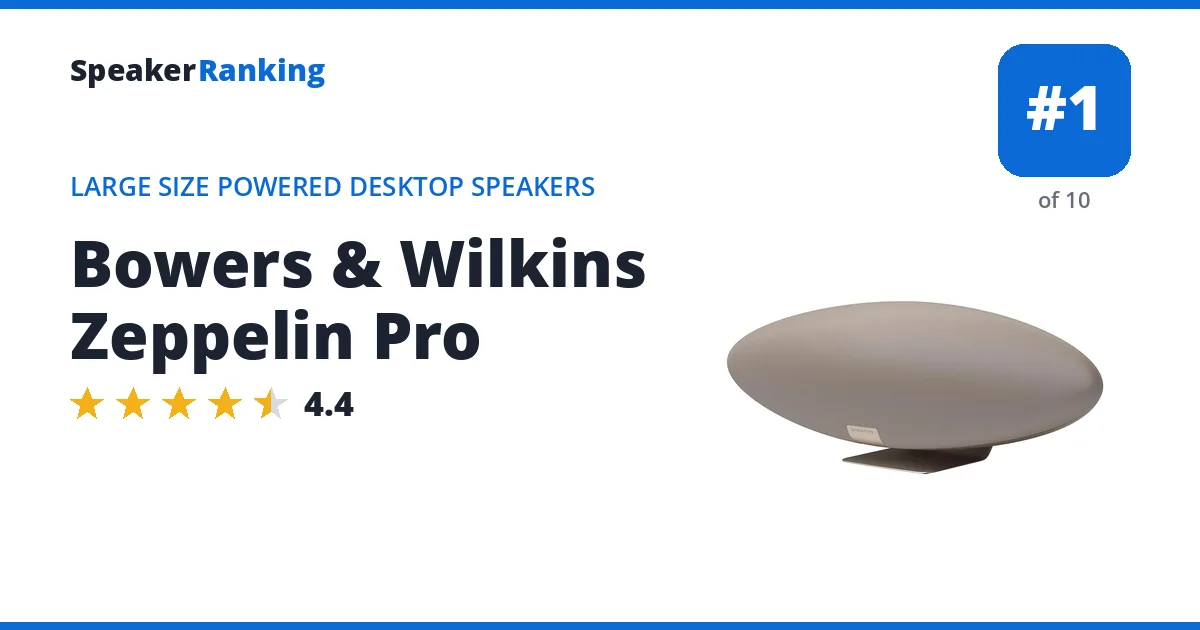
Older model: the Bowers & Wilkins Zeppelin (ranked lower, rated 4.3/5). See every Bowers & Wilkins Zeppelin generation.
Pros: Titanium dome tweeters and an improved 24-bit DAC over the standard Bowers & Wilkins Zeppelin for slightly better high-frequency detail on hi-res streams. Dynamic EQ DSP. Customizable downward-firing light. Same wide soundstage and deep bass extension as the standard Bowers & Wilkins Zeppelin.
Cons: Same price as the standard Bowers & Wilkins Zeppelin for a fairly modest tweeter/DAC upgrade. Nothing besides the lack of battery, lack of waterproofing, high cost and the EarFun Uboom X that’s so close to it in terms of sound quality for 7x less money. Basically an indoor only speaker. At this price point the Top Recommended Bookshelf Speakers are the better buy, with even better soundstage.
Full Bowers & Wilkins Zeppelin Pro review and specifications →
| Released | Oct 2024 (2 years ago) |
|---|---|
| AES Input | No |
| Amplifier Power | 240W (80W woofer, 2x 40W midrange, 2x 40W tweeter) |
| App | No |
| Aux Input | No |
| Battery Life | No Battery |
| Bluetooth | Yes |
| Bluetooth Codecs | aptX Adaptive, AAC, SBC |
| Bluetooth Version | 5.0 |
| Coaxial Input | No |
| DSP | Yes |
| Dimensions | 25.6” x 8.3” x 7.6” (650 x 210 x 194 mm) |
| Drivers | 150mm woofer, 2x 90mm FST midrange drivers, 2x 25mm Titanium Dome tweeters |
| EQ | Yes (Dynamic EQ) |
| Frequency Response | 35Hz - 24kHz (Manufacturer specified) |
| HDMI Input | No |
| IP Rating | None |
| Inputs | Bluetooth, AirPlay 2, Spotify Connect |
| Optical Input | No |
| Party Mode | No |
| Power Bank | No |
| Power Input | AC Power cord |
| RCA Input | No |
| Stereo | Yes |
| Streaming Services | AirPlay 2, Spotify Connect |
| TRS Input | No |
| TWS | No |
| USB Input | No |
| Weight | 14.6 lbs (6.6 kg) |
| Wi-Fi | Yes |
| XLR Input | No |
- Links
- Reviews, Comparisons and Sound Samples
- Head-to-Head Comparisons
- Bowers & Wilkins Zeppelin Pro vs Bowers & Wilkins Zeppelin
- Bowers & Wilkins Zeppelin Pro vs Sonos Five
- Bowers & Wilkins Zeppelin Pro vs JBL Authentics 500
- Bowers & Wilkins Zeppelin Pro vs Sonos Era 300
- Bowers & Wilkins Zeppelin Pro vs B&O Beosound 2
- Bowers & Wilkins Zeppelin Pro vs Denon Home 350
- Bowers & Wilkins Zeppelin Pro vs Devialet Mania
- Bowers & Wilkins Zeppelin Pro vs Sonos Move 2
- See all 10 comparisons
Titanium dome tweeters and an improved 24-bit DAC give it slightly better high-frequency detail on hi-res streams than the standard Zeppelin, and it retains the same wide soundstage and deep bass that make the Zeppelin line stand out among all-in-one systems. Bluetooth handles everyday wireless playback without a receiver.
It costs the same as the standard Zeppelin for a fairly modest tweeter and DAC upgrade, so the case for paying more over that model specifically is limited. It also has no battery and no waterproofing; it’s an indoor, mains-powered system.
Best Compact Desktop
 For unusually substantial bass from a tiny Bluetooth-equipped desktop pair, the IK Multimedia iLoud Micro Monitor: $199.99 per pair Amazon $199.99 eBay
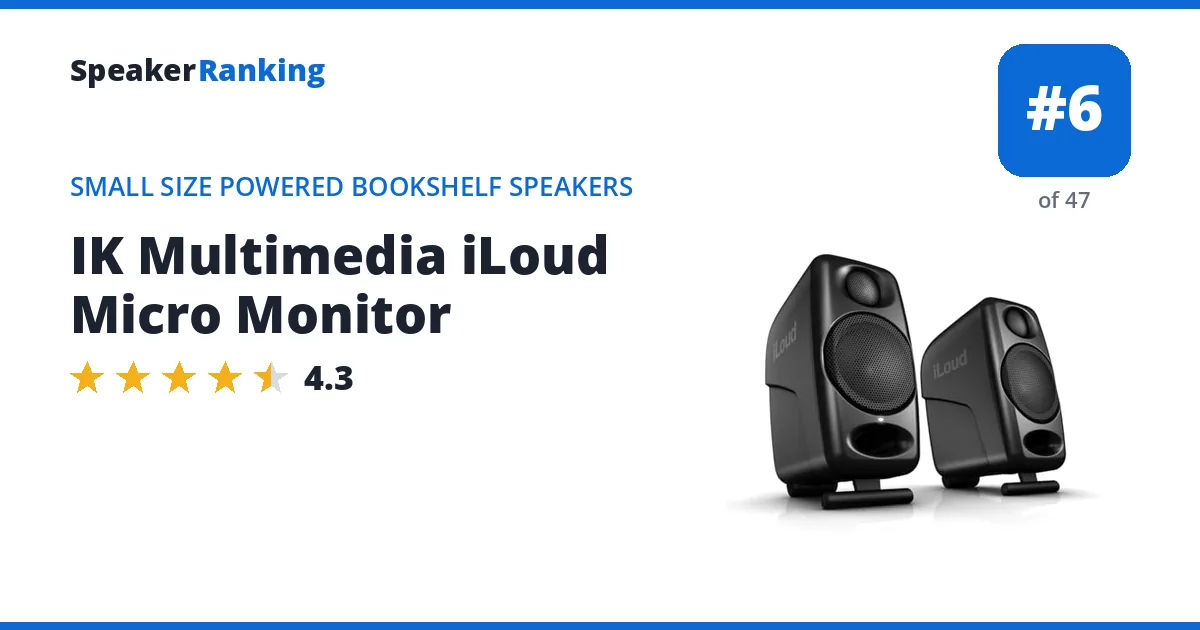
Newer model: the IK Multimedia iLoud Micro Monitor Pro, ranked lower, estimated 4.3/5, released Sep 2024. It adds XLR input, but drops the aux input and Bluetooth. See every IK Multimedia iLoud generation.
Pros: Unusually substantial bass for such a small desktop pair. The linked quasi-anechoic measurement review reports broad, reasonably consistent horizontal radiation and useful tolerance above the tweeter axis, helpful when the speakers sit below ear height. Its compact size and bass balance make it a practical close-listening alternative to small monitors that need a subwoofer. Measured bass extension of 55Hz (-3dB).
Cons: The existing review evidence indicates some bass emphasis and upper-treble rolloff rather than strict neutrality. Deep bass from tiny drivers does not establish loud-playback headroom; use these for close desktop listening, not as a substitute for larger room speakers.
Full IK Multimedia iLoud Micro Monitor review and specifications →
| Released | Oct 2016 (10 years ago) |
|---|---|
| AES Input | No |
| Amplifier Power | 50W total (combined) |
| App | No |
| Aux Input | Yes |
| Bass Extension (-10dB) | 45Hz (measured, Audio Science Review) |
| Bass Extension (-3dB) | 55Hz (measured, Audio Science Review) |
| Bluetooth | Yes (A2DP) |
| Coaxial Input | No |
| Dimensions | 7.1”H x 3.5”W x 5.3”D (180.3 x 88.9 x 134.6 mm) |
| Drivers | 3” woofer, 0.75” silk dome tweeter |
| EQ | Yes (Bass/Treble switches, Desktop/Free field) |
| Frequency Response | 55Hz - 20kHz (-3dB) (Manufacturer specified) |
| HDMI Input | No |
| Inputs | RCA, Aux |
| Maximum SPL | 96dB @ 1m (manufacturer specified) |
| Optical Input | No |
| RCA Input | Yes |
| TRS Input | No |
| USB Input | No |
| Weight | 2 lbs (0.9 kg) |
| XLR Input | No |
- Links
- Reviews, Comparisons and Sound Samples
- Audio Science Review Measurements More from Audio Science Review →
- DSAUDIO.review: DSAUDIO.review Edifier MR4 vs iLoud Micro Monitor sound.DEMO More from DSAUDIOreview →
- DSAUDIOreview: IK Multimedia iLoud MTM vs iLoud Micro Sound & Frequency Response Comparison
- Jasper Tech: Best Desktop Computer Speakers for Every Budget More from Jasper Tech →
- Jasper Tech: Best Premium Computer Speakers: Kanto ORA4 Review & Comparison
- Jasper Tech: Are the D3V The Best Studio Monitors For The Money?
- Jasper Tech: Are the iLoud Micro Monitor Pro the Best Studio Monitor Speakers for your Home Studio?
- Jasper Tech: Best Desktop Computer Speakers for Every Budget – 2026
- Head-to-Head Comparisons
- IK Multimedia iLoud Micro Monitor vs IK Multimedia iLoud Micro Monitor Pro
- IK Multimedia iLoud Micro Monitor vs Cambridge Audio L/R S
- IK Multimedia iLoud Micro Monitor vs ADAM Audio D3v
- IK Multimedia iLoud Micro Monitor vs Edifier M60
- IK Multimedia iLoud Micro Monitor vs Genelec 8010A
- IK Multimedia iLoud Micro Monitor vs HiVi Swan X3
- IK Multimedia iLoud Micro Monitor vs Edifier MR3
- IK Multimedia iLoud Micro Monitor vs Audioengine A2+
- See all 20 comparisons
The linked quasi-anechoic measurement review reports broad, reasonably consistent horizontal radiation and useful bass for the cabinet size, an unusual result for speakers this small. Bluetooth covers casual wireless listening on the same desk as a wired source.
Existing review evidence indicates some bass emphasis and upper-treble rolloff rather than strict neutrality, and deep bass from tiny drivers does not mean the pair can also play loud; treat these as a close-listening desktop pair.
Best Measured Sound
 For the most accurate measured sound in a compact Bluetooth pair, the Audio Smile Little British Monitor: £529 per pair Audio Smile eBay
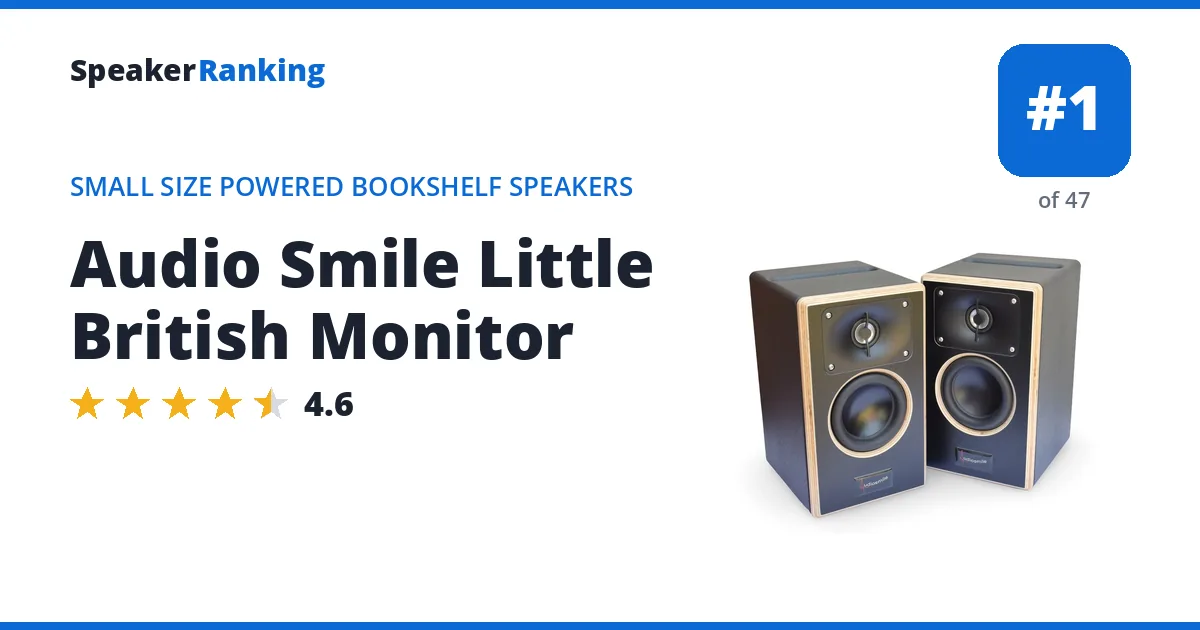
Pros: Among the strongest measured tonal performers in this size class: ASR’s Klippel data gives a 5.46 predicted preference score, or 8.21 with an ideal subwoofer. Low narrow-band response deviations on-axis and across the listening window support clear, relatively uncolored vocals and instruments. Broad horizontal coverage makes small changes of listening position less critical. Active DSP crossover and a very compact cabinet suit close desktop listening. Measured bass extension of 71.8Hz (-3dB).
Cons: Bass reaches -3dB at about 72Hz, so a subwoofer is important for the lowest notes. The measured response still spans 3.3dB from 300Hz to 5kHz; the small average-deviation statistic should not be mistaken for an almost perfectly flat response. Small drivers limit the intended application to nearfield listening, and the preference score does not establish maximum clean output. Its 50W Class A/B amplifiers and narrow ±1dB treble trim leave little headroom or adjustment next to larger active monitors.
Full Audio Smile Little British Monitor review and specifications →
| Released | 2016 (10 years ago) |
|---|---|
| AES Input | No |
| Amplifier Power | 100W total (50W LF, 50W HF, Class A/B) |
| Aux Input | Yes |
| Bass Extension (-10dB) | 56.6Hz (measured, Audio Science Review) |
| Bass Extension (-3dB) | 71.8Hz (measured, Audio Science Review) |
| Bluetooth | Yes |
| Bluetooth Codecs | SBC, aptX HD |
| Coaxial Input | No |
| Country | United Kingdom |
| Crossover Frequency | 1.5kHz |
| Dimensions | 8.1”H x 4.7”W x 5.3”D (205 x 120 x 135 mm) |
| Drivers | 0.75” wide band tweeter, 3” long throw mid woofer |
| Enclosure | ported |
| Frequency Response | 58Hz-20kHz -6dB |
| HDMI Input | No |
| Inputs | RCA, Aux, Bluetooth |
| Optical Input | No |
| RCA Input | Yes |
| Spinorama Preference Score | 5.46 |
| Spinorama Preference Score with Perfect Sub | 8.21 |
| TRS Input | No |
| USB Input | No |
| Warranty | 12 months |
| Weight | 3.7 lbs (1.7 kg) (Master unit) / 3.1 lbs (1.4 kg) (Slave unit) |
| XLR Input | No |
- Links
- Reviews, Comparisons and Sound Samples
- Head-to-Head Comparisons
- Audio Smile Little British Monitor vs ADAM Audio D3v
- Audio Smile Little British Monitor vs Cambridge Audio L/R S
- Audio Smile Little British Monitor vs Genelec G One
- Audio Smile Little British Monitor vs Edifier M60
- Audio Smile Little British Monitor vs Edifier MR3
- Audio Smile Little British Monitor vs Edifier M90
ASR’s Klippel data gives it a 5.46 preference score, or 8.21 with an ideal subwoofer, among the strongest results in its size class. Bass reaches -3dB at only about 72Hz, so add a subwoofer for the lowest notes.
 For a US-sold alternative with optical and USB-C inputs, the Cambridge Audio L/R S: $549.00 per pair Amazon $549.00 eBay
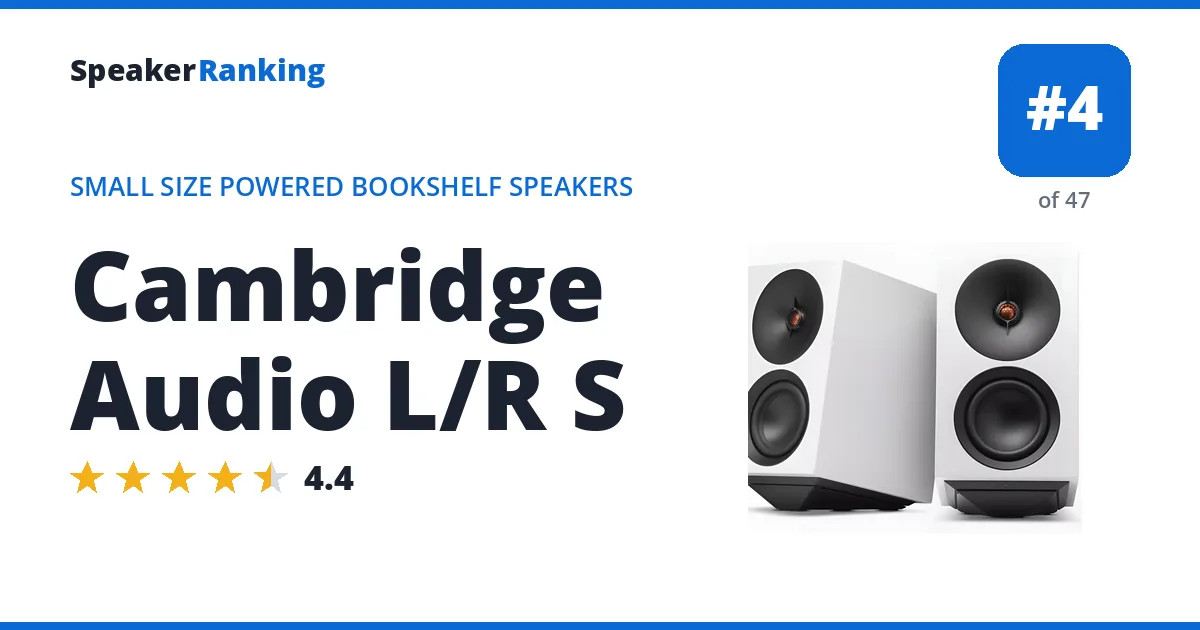
Same family: the Cambridge Audio L/R M (larger bookshelf, estimated 4.2/5) and the Cambridge Audio L/R X (larger bookshelf, rated 4.1/5).
Pros: A 2-way active bookshelf pair built for near-field desktop use, with a 21mm aluminum tweeter and a 3-inch long-throw woofer on each speaker. Erin’s Audio Corner measured a very neutral on-axis response with good directivity control up through the 2-3kHz handoff to the tweeter, an F3 of about 57Hz and F10 of about 50Hz, and output held within roughly plus or minus 2.5dB from 80Hz to 20kHz. Horizontal dispersion of about plus or minus 60 degrees and a vertical window of about plus 30 to minus 20 degrees make it forgiving of off-center desktop seating. Two rear switches (a desktop-placement compensation switch and a near-wall/free-space switch) plus in-app DSP for room size, wall distance, and reflective surface type let you tune the in-room response rather than just hoping placement works out, and the reviewer noted an audible tightening of the bass moving between room-size settings. Rear connectivity includes RCA, optical digital, USB-C, and a dedicated subwoofer output. Measured bass extension of 57Hz (-3dB).
Cons: Maximum clean output is limited: Erin’s Audio Corner measured about 86dB before the onboard limiter engages around 96dB to protect the drivers, so this is a near-field or small-room speaker rather than one built to fill a living room. Each speaker’s Class D amplifier splits only 50W to the woofer and 50W to the tweeter, modest for the class. The DSP room-correction options are preset-based rather than a true microphone-measured calibration at the listening position, so results depend on picking settings that match your actual room.
Full Cambridge Audio L/R S review and specifications →
| Released | Apr 2026 (6 months ago) |
|---|---|
| AES Input | No |
| Amplifier Power | 100W total (50W to woofer, 50W to tweeter, per speaker) |
| App | Yes |
| Aux Input | No |
| Bass Extension (-10dB) | 50Hz (measured, Erin’s Audio Corner) |
| Bass Extension (-3dB) | 57Hz (measured, Erin’s Audio Corner) |
| Bluetooth | Yes |
| Bluetooth Codecs | SBC, AAC, aptX, aptX HD |
| Coaxial Input | No |
| DSP | Yes, room size, wall distance, and reflective surface correction; desktop-placement and near-wall/free-space switches |
| Dimensions | 5.3” (134 mm) W x 226mm H x 180mm D (each) |
| Drivers | 21mm aluminum dome tweeter, 3” long-throw woofer |
| Frequency Response | 55Hz - 24kHz (±3dB, manufacturer specified) |
| HDMI Input | No |
| Inputs | RCA, optical digital, USB-C |
| Optical Input | Yes |
| Outputs | Subwoofer, wired speaker-to-speaker link |
| RCA Input | Yes |
| Subwoofer Output | Yes |
| TRS Input | No |
| USB Input | Yes |
| Weight | 6.6 lbs (3.0kg) primary speaker, 5.7 lbs (2.6kg) secondary speaker |
| XLR Input | No |
- Links
- Reviews, Comparisons and Sound Samples
- Head-to-Head Comparisons
- Cambridge Audio L/R S vs ADAM Audio D3v
- Cambridge Audio L/R S vs Genelec G One
- Cambridge Audio L/R S vs IK Multimedia iLoud Micro Monitor
- Cambridge Audio L/R S vs Genelec 8010A
- Cambridge Audio L/R S vs Audio Smile Little British Monitor
- Cambridge Audio L/R S vs Edifier M60
- Cambridge Audio L/R S vs HiVi Swan X3
- Cambridge Audio L/R S vs Edifier MR3
- See all 19 comparisons
Erin’s Audio Corner measured a very neutral on-axis response with good directivity control. Output is the limit: the onboard limiter engages around 96dB, so keep it to near-field or small-room listening.
 Cost no object, the best-measured powered speaker with Bluetooth on this site is the KEF LS60: $5,999.99 per pair Amazon $5,999.99 Crutchfield $5,999.99 eBay
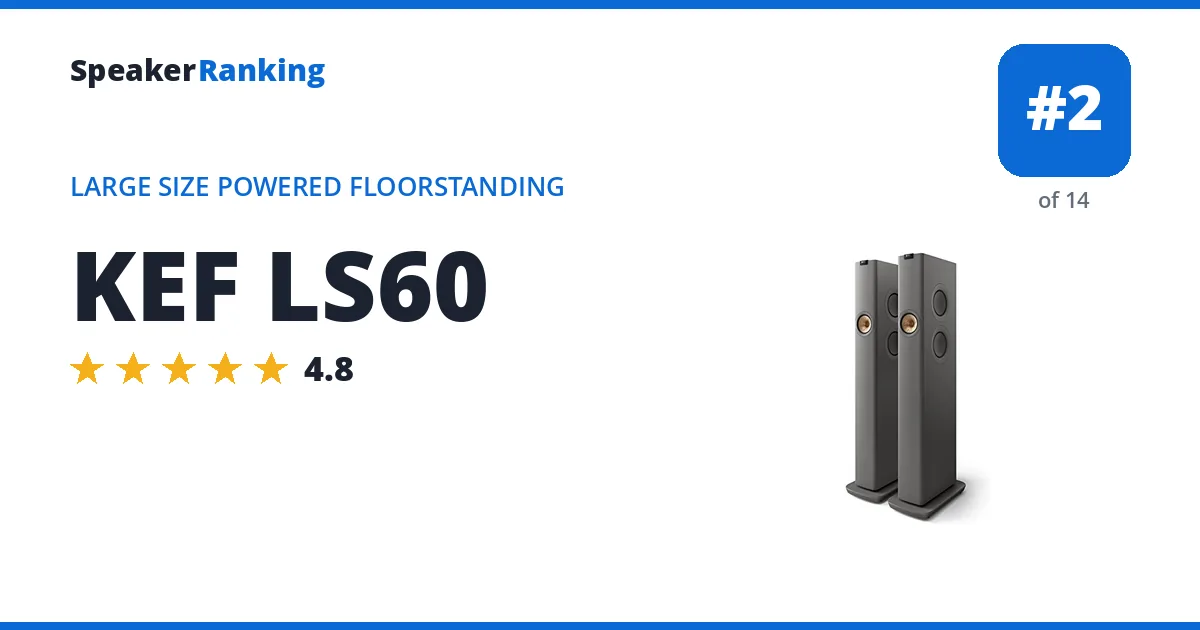
Same family: the KEF LSX II LT (smallest bookshelf, rated 4/5), the KEF LSX II (bookshelf, estimated 4.1/5) and the KEF LS50 Wireless II (largest bookshelf, rated 4.3/5).
Pros: Erin’s on-axis measurement combines a 1.9dB response span from 300Hz to 5kHz with a 7.91 ideal-subwoofer preference score, supporting even vocal and instrumental balance. Extended-mode bass reaches roughly 25Hz at -3dB. The coaxial Uni-Q arrangement maintains unusually consistent tonality across listening positions, while HDMI, digital and analog inputs plus network streaming make this a convenient complete music and TV system. Measured bass extension of 23Hz (-3dB), with a measured sensitivity of 97.7dB.
Cons: A diffraction dip around 9kHz can soften cymbal shimmer when aimed directly at the listener; 10-20 degrees of toe-out helps. DSP limiting reduces bass reach and dynamic output at high volume, so its deep low-level extension is not a promise of the same performance on loud peaks. App placement and tone controls are less flexible than parametric room correction. Each roughly 31kg tower is awkward to move.
Full KEF LS60 review and specifications →
| Released | Jun 2022 (4 years ago) |
|---|---|
| AES Input | No |
| Amplifier Power | 700W (500W LF Class D + 100W MF Class D + 100W HF Class AB) |
| App | Yes (KEF Connect) |
| Aux Input | No |
| Bass Extension (-10dB) | <20Hz (measured, Erin’s Audio Corner) |
| Bass Extension (-3dB) | 23Hz (measured, Erin’s Audio Corner) |
| Bluetooth | Yes |
| Bluetooth Codecs | SBC, AAC |
| Bluetooth Version | 5.0 |
| Coaxial Input | Yes |
| DSP | Yes (Music Integrity Engine) |
| Dimensions | 42.9”H x 8.3”W x 15.5”D (1089.7 x 210.8 x 393.7 mm) |
| Drivers | 4 x 135 mm (5.25 in.) Uni-Core Force Cancelling Driver: woofers, 100 mm (4in.) aluminium cone midrange, 19 mm (0.75 in.) vented aluminium dome with Metamaterial Absorption Technology tweeter |
| EQ | Yes (Normal and Expert modes, room adaptation) |
| Frequency Response | 31Hz - 24kHz (±3dB) (Manufacturer specified) |
| HDMI Input | Yes |
| Inputs | Wifi, Optical, Digital coaxial, RCA, HDMI eARC, Ethernet |
| Maximum SPL | 111dB @ 1m (pink noise) (manufacturer specified) |
| Optical Input | Yes |
| Outputs | Subwoofer RCA |
| RCA Input | Yes |
| Sensitivity | 97.7dB (measured at 0.3V/1m, Erin’s Audio Corner) |
| Spinorama Preference Score | 7.26 |
| Spinorama Preference Score with Perfect Sub | 7.91 |
| Streaming Services | Yes (AirPlay 2, Chromecast, Roon Ready, Spotify Connect, Tidal Connect, Amazon Music, Qobuz, Deezer) |
| Subwoofer Output | Yes |
| TRS Input | No |
| USB Input | No |
| Weight | 69 lbs (31.3 kg) each |
| Wi-Fi | Yes (dual-band) |
| XLR Input | No |
- Links
- Reviews, Comparisons and Sound Samples
- Head-to-Head Comparisons
A 1.9dB response span from 300Hz to 5kHz and a 7.91 ideal-subwoofer preference score, with extended-mode bass reaching roughly 25Hz at -3dB from a slim floorstanding cabinet.
Best Budget
 For an inexpensive Bluetooth desktop pair with a broadly natural balance, the Edifier MR3: $149.99 per pair Amazon $149.99 eBay
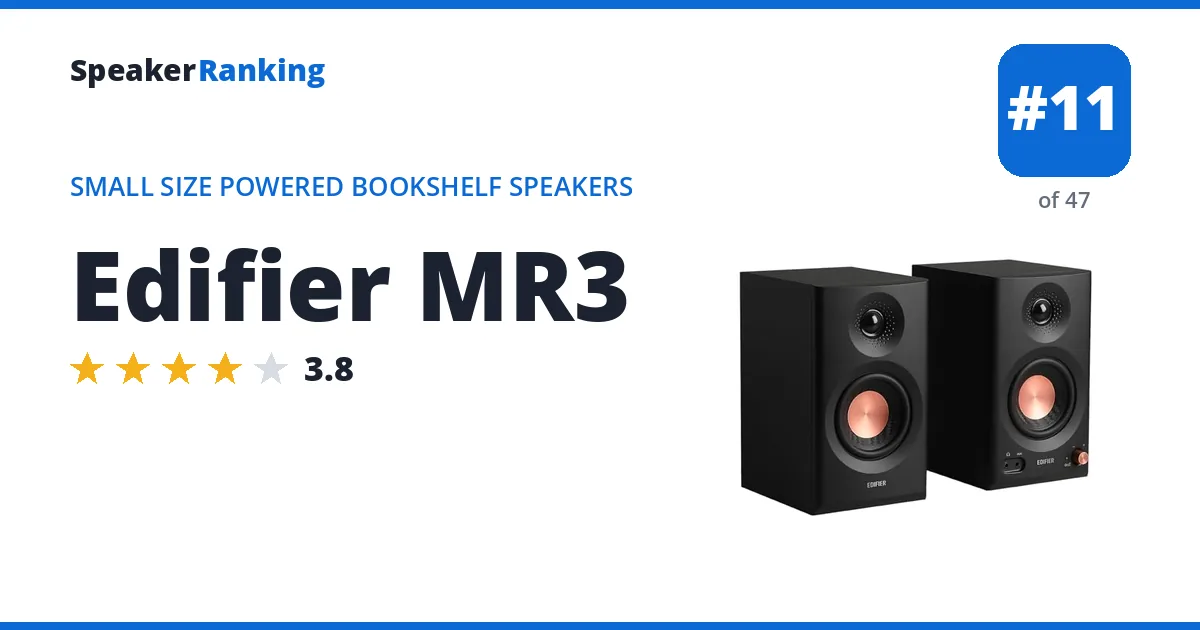
Same family: the Edifier MR4 (larger bookshelf, rated 3.5/5), the Edifier MR4.5 (larger bookshelf, rated 3.6/5) and the Edifier MR5 (larger bookshelf, rated 3.3/5).
Pros: Erin’s measurements show little overall tilt across the listening window, helping voices retain a broadly natural balance at a desk. Scores of 3.91 standalone and 6.53 with an ideal subwoofer support it as a useful budget nearfield option rather than a reference monitor. Tone controls and app-based EQ provide unusually flexible adjustment, and its bass extends farther than the Fostex PM03’s. Measured bass extension of 70Hz (-3dB), with a measured sensitivity of 83.3dB.
Cons: Local response ripples remain: the measured 300Hz-5kHz span is 4.5dB and listening-window narrow-band deviation is 0.538. Bass reaches -3dB at about 70Hz. The limiter protects the drivers but prevents much extra loudness when pushed; existing compression testing puts effective single-speaker output around 86-87dB at 1m. Vertical crossover interference makes tweeter height and tilt important.
Full Edifier MR3 review and specifications →
| Released | Oct 2024 (2 years ago) |
|---|---|
| AES Input | No |
| Amplifier Power | 36W total (18W per speaker) |
| App | Yes (Edifier ConneX) |
| Aux Input | Yes |
| Bass Extension (-10dB) | 53Hz (measured, Erin’s Audio Corner) |
| Bass Extension (-3dB) | 70Hz (measured, Erin’s Audio Corner) |
| Bluetooth | Yes |
| Bluetooth Codecs | SBC |
| Bluetooth Version | 5.4 |
| Coaxial Input | No |
| Dimensions | 8.7”H x 4.9”W x 7.3”D (220 x 125.5 x 185 mm) (active); 220H x 125.5W x 176D mm (passive) |
| Drivers | 3.5” mid-low driver, 1” silk dome tweeter |
| EQ | Yes (rear knobs and app room compensation) |
| Frequency Response | 52Hz - 40kHz (Manufacturer specified) |
| HDMI Input | No |
| Headphone Output | Yes |
| Inputs | Balanced TRS, RCA, Aux, Bluetooth |
| Maximum SPL | 93dB @ 1m (manufacturer specified) |
| Optical Input | No |
| Outputs | 3.5mm headphone |
| RCA Input | Yes |
| Sensitivity | 83.3dB (measured at 0.3V/1m, Erin’s Audio Corner) |
| Spinorama Preference Score | 3.91 |
| Spinorama Preference Score with Perfect Sub | 6.53 |
| TRS Input | Yes |
| USB Input | No |
| Weight | 8.5 lbs (3.85 kg) |
| XLR Input | No |
- Links
- Reviews, Comparisons and Sound Samples
- Head-to-Head Comparisons
Erin’s measurements show little overall tilt across the listening window, helping voices retain a broadly natural balance at a desk, with scores of 3.91 standalone and 6.53 with an ideal subwoofer that are respectable for the price.
Local response ripples remain, and bass reaches -3dB at only about 70Hz. The limiter protects the drivers but caps how loud the pair can get before compression sets in.
Other Powered Speakers With Bluetooth
 The Audioengine HD3: $359.00 per pair Amazon $359.00 eBay
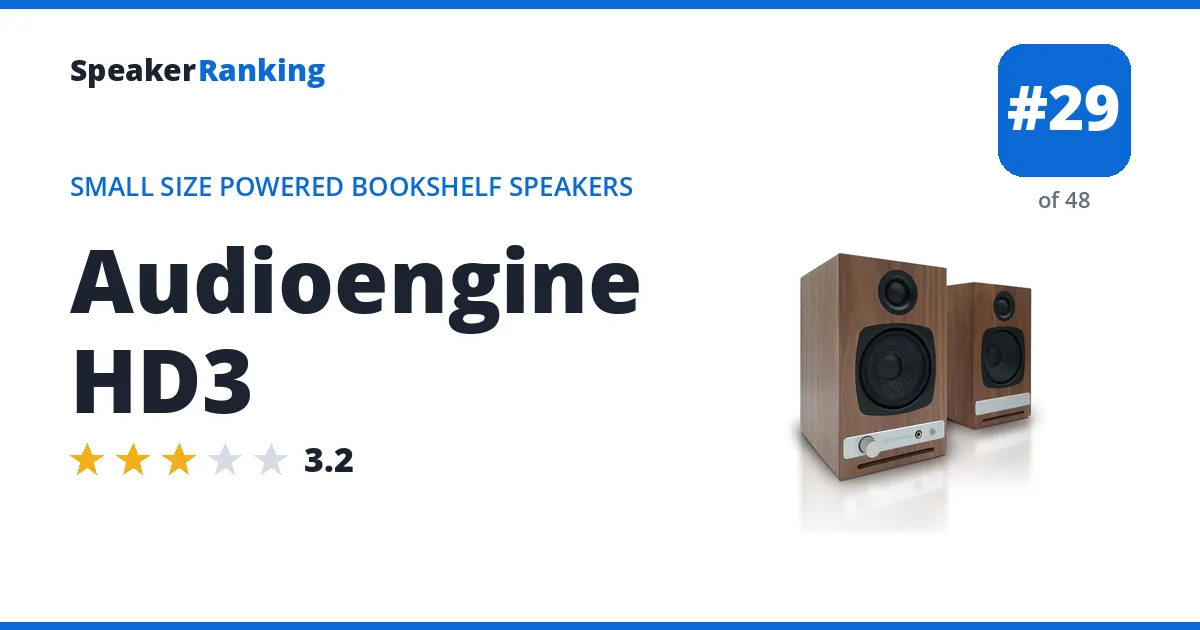
Same family: the Audioengine HD4 (larger bookshelf, rated 3.2/5), the Audioengine HD6 (larger bookshelf, rated 3.3/5) and the Audioengine HD5 (larger bookshelf, estimated 3.2/5).
Pros: A compact desktop stereo option when cabinet size is a priority. Measured bass extension of 65Hz (-3dB).
Cons: Limited bass makes a subwoofer useful for fuller music reproduction. Its compact format is better suited to close listening than filling a large room.
Full Audioengine HD3 review and specifications →
| Released | Nov 2015 (10 years ago) |
|---|---|
| AES Input | No |
| Amplifier Power | 30W total (15W per speaker) |
| App | No |
| Aux Input | Yes |
| Bass Extension (-10dB) | 58Hz |
| Bass Extension (-3dB) | 65Hz |
| Bluetooth | Yes |
| Bluetooth Codecs | SBC, aptX |
| Bluetooth Version | 5.0 |
| Coaxial Input | No |
| Dimensions | 9”H x 5.5”W x 6.5”D (228.6 x 139.7 x 165.1 mm) |
| Drivers | 2.75” woofer, 0.75” silk dome tweeter |
| EQ | No |
| Frequency Response | 65 Hz-20 kHz (-3dB) (Manufacturer specified) |
| HDMI Input | No |
| Inputs | Bluetooth, Aux, RCA Input |
| Maximum SPL | 90dB @ 1m (manufacturer specified) |
| Optical Input | No |
| Outputs | RCA variable output (subwoofer) |
| RCA Input | Yes |
| Subwoofer Output | Yes |
| TRS Input | No |
| USB Input | No |
| Weight | 7.3 lbs (3.3 kg) |
| XLR Input | No |
- Links
- Reviews, Comparisons and Sound Samples
- Head-to-Head Comparisons
- Audioengine HD3 vs Monoprice Monolith MM-3
- Audioengine HD3 vs Kanto YU4
- Audioengine HD3 vs Fluid Audio C35BT
- Audioengine HD3 vs Monacor SOUND-4BT
- Audioengine HD3 vs Bowers & Wilkins Formation Flex
- Audioengine HD3 vs M-Audio BX3
- Audioengine HD3 vs PreSonus Eris E3.5 2nd Gen
- Audioengine HD3 vs Edifier MR3
- See all 19 comparisons
A genuinely small footprint for a desk, though limited bass means a subwoofer is worth adding for fuller music reproduction, and its compact format suits close listening rather than filling a room.
 The Edifier S2000MKIII: $594.99 per pair Amazon $594.99 eBay
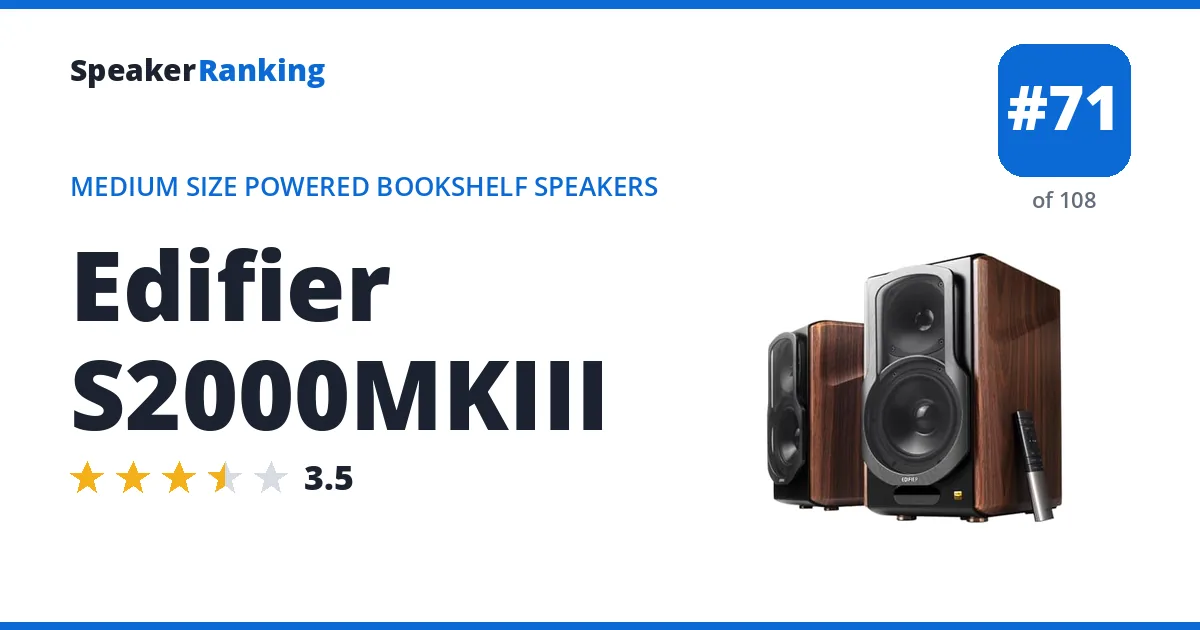
Older model: the Edifier S2000 Pro (ranked higher, rated 3.7/5). See every Edifier S2000 generation.
Pros: The available digitized response suggests substantial bass reach, with a -3dB estimate around 41Hz. Scores are 4.24 standalone and 5.99 with an ideal subwoofer. Digital inputs and a self-contained stereo-pair format are convenient for general music listening. Digital input handles high-resolution audio up to 192kHz/24-bit.
Cons: The 4.0dB midrange span and uneven predicted room response suggest meaningful coloration. Favorable modeled EQ results should not be treated as the sound of the stock speaker or as proof that all dispersion issues are correctable.
Full Edifier S2000MKIII review and specifications →
| Released | Apr 2020 (6 years ago) |
|---|---|
| AES Input | No |
| Amplifier Power | 65w RMS Per Speaker |
| App | No |
| Aux Input | No |
| Bluetooth | Yes |
| Bluetooth Codecs | SBC, aptX HD |
| Bluetooth Version | 5.0 |
| Coaxial Input | Yes |
| Dimensions | 13.5”H x 7.8”W x 10.8”D (342.9 x 198.1 x 274.3 mm) |
| Drivers | 5.5” (140mm) woofer |
| EQ | No |
| Frequency Response | 40.5Hz at -3dB; 37Hz at -6dB (Spinorama) |
| HDMI Input | No |
| Inputs | Bluetooth, 2x RCA Input, Digital Optical, Digital Coax |
| Optical Input | Yes |
| Outputs | None |
| RCA Input | Yes |
| Spinorama Preference Score | 4.24 |
| Spinorama Preference Score with Perfect Sub | 5.99 |
| TRS Input | No |
| USB Input | No |
| Weight | 20.7 lbs (9.4 kg) |
| XLR Input | No |
- Links
- Reviews, Comparisons and Sound Samples
- DSAUDIO.review: DSAUDIO.review Edifier S2000MKIII vs Klipsch The Three II sound.DEMO More from DSAUDIOreview →
- DSAUDIO.review: DSAUDIO.review Edifier R2850DB vs Edifier S2000MKIII sound.DEMO
- DSAUDIO.review: DSAUDIO.review Edifier S1000MKII vs Edifier S2000MKIII sound.DEMO
- DSAUDIO.review: Edifier S2000MKIII vs Edifier S3000PRO Sound & Frequency Response Comparison
- Archimago Measurements (spinorama.org)
- Head-to-Head Comparisons
- Edifier S2000MKIII vs Edifier MR4
- Edifier S2000MKIII vs PreSonus Eris E5 XT
- Edifier S2000MKIII vs Edifier MR4.5
- Edifier S2000MKIII vs KRK Classic 5
- Edifier S2000MKIII vs Palmer STUDIMON 5
- Edifier S2000MKIII vs ADAM Audio A4V
- Edifier S2000MKIII vs M-Audio BX4 D3
- Edifier S2000MKIII vs Yamaha HS5
- See all 75 comparisons
The available digitized response suggests substantial bass reach, but the measured midrange span and uneven predicted room response suggest meaningful coloration next to the more neutral picks above.
 The standard Bowers & Wilkins Zeppelin: $899 each Discontinued eBay
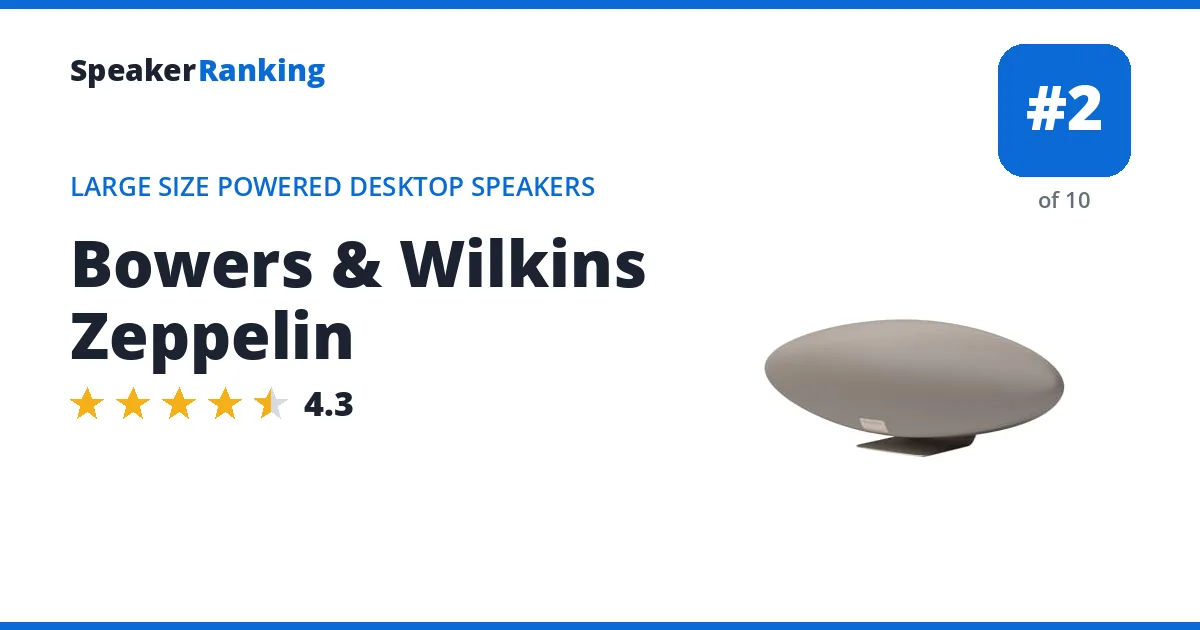
Newer model: the Bowers & Wilkins Zeppelin Pro, ranked higher, rated 4.4/5, released Oct 2024. It adds adjustable EQ. See every Bowers & Wilkins Zeppelin generation.
Pros: Amazingly neutral, quite a wide soundstage due to the width. Bass extension deeper than all others in category. Measured bass extension of ~32Hz (-10dB).
Cons: Nothing besides the lack of battery, lack of waterproofing, high cost and the EarFun Uboom X that’s so close to it in terms of sound quality for 7x less money. Basically an indoor only speaker. At this price point the Top Recommended Bookshelf Speakers are the better buy, with even better soundstage. Discontinued.
Full Bowers & Wilkins Zeppelin review and specifications →
| Released | Oct 2021 (5 years ago) |
|---|---|
| AES Input | No |
| Amplifier Power | 240W (80W woofer, 2x 40W midrange, 2x 40W tweeter) |
| App | No |
| Aux Input | No |
| Bass Extension (-10dB) | ~32Hz |
| Battery Life | No Battery |
| Bluetooth | Yes |
| Bluetooth Codecs | aptX Adaptive, AAC, SBC |
| Bluetooth Version | 5.0 |
| Coaxial Input | No |
| DSP | No |
| Dimensions | 25.6” x 8.3” x 7.6” (650 x 210 x 194 mm) |
| Drivers | 150mm woofer, 2x 90mm FST midrange drivers, 2x 25mm Decoupled Double-Dome aluminium tweeters |
| EQ | No |
| Frequency Response | 35Hz - 24kHz (Manufacturer specified) |
| HDMI Input | No |
| IP Rating | None |
| Inputs | Bluetooth, AirPlay 2, Spotify Connect |
| Optical Input | No |
| Party Mode | No |
| Power Bank | No |
| Power Input | AC Power cord |
| RCA Input | No |
| Stereo | Yes |
| Streaming Services | AirPlay 2, Spotify Connect |
| TRS Input | No |
| TWS | No |
| USB Input | No |
| Weight | 14.6 lbs (6.6 kg) |
| Wi-Fi | Yes |
| XLR Input | No |
- Links
- Reviews, Comparisons and Sound Samples
- Head-to-Head Comparisons
B&W replaced it with the Pro Edition above. Nothing about its Bluetooth playback or bass differs from the Pro; the Pro’s tweeter and DAC upgrade is the only real change, so a used or clearance standard Zeppelin is a reasonable way to save money.
What To Check Before Buying
Codec support: check which Bluetooth codecs a speaker supports (SBC is the universal baseline; AAC, aptX and LDAC add quality or lower latency on compatible sources). See Bluetooth codecs explained for what each one actually changes.
It’s a convenience feature, not a sound-quality one: Bluetooth doesn’t change a speaker’s measured frequency response, directivity, bass extension or output capability. Rank by the acoustic measurements first, and treat Bluetooth as a bonus.
The wired alternative: a powered speaker without Bluetooth can add it with an external Bluetooth receiver into any analog or digital input it already has, which is often the more capable choice than one built into the speaker.
Where To Go Next
See every powered speaker with Bluetooth for the complete list, or the best powered speakers for a computer desk for picks that don’t require the feature.
Related guides: powered speaker inputs explained, Bluetooth codecs explained, and the powered speaker buyer’s guide.