The Dyson Zone ranks #11 out of 134 total Over-Ear Headphones for sound quality. See all Headphones rankings for every top pick.
Prices on this page were last checked October 10, 2026 at 5:37 PM UTC. Product prices and availability are accurate as of that date/time and are subject to change; the price and availability shown on Amazon at the time of purchase will apply to the purchase of this product.
As an eBay Partner, we may be compensated if you make a purchase.
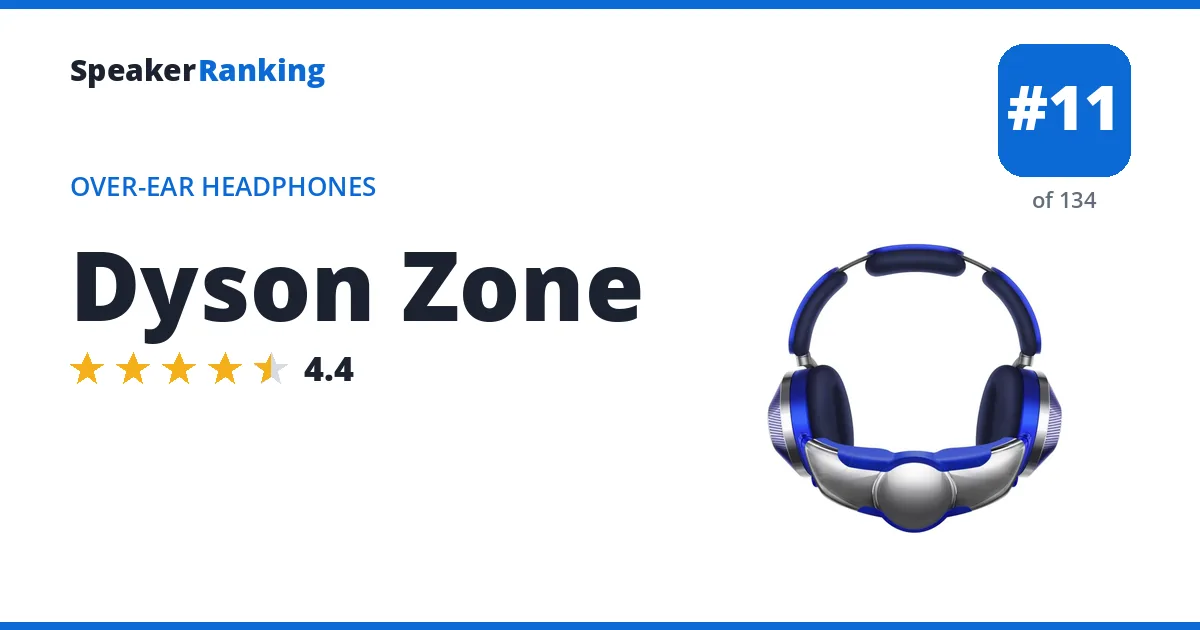
#11 Dyson Zone: $349.99 Amazon eBay
Pros: A preference score of 90 and a smooth 1.49 dB deviation put the tuning close to the Harman target, with sub-bass about 2 dB above target for extra rumble on kick drums and bass lines. It is a closed, wireless design with active noise cancelling, Bluetooth 5.0, a built-in microphone and a claimed 50 hours of battery, and it also works wired. Its rating matches the Austrian Audio Hi-X60 and Sennheiser HD 600.
Cons: A 3.3 dB dip near 3.4 kHz and a 2.1 dB shortfall across the presence region pull some bite and clarity out of vocals and guitars. The treble is lifted by about 2 to 3.5 dB above 6 kHz, with a peak near 7.8 dB at 11.2 kHz that can make cymbals and sibilance sound sharp. The warm lean may feel slightly full for listeners who prefer a strictly neutral sound.
| Released | Oct 2023 (3 years ago) |
|---|---|
| Active Noise Cancelling | Yes |
| Back | Closed |
| Battery Life | 50 hours (Manufacturer specified) |
| Bluetooth Version | 5.0 |
| Built-in Microphone | Yes |
| Connection | Wireless and wired |
| Deviation From Target | 1.49 dB standard deviation |
| Driver Type | Dynamic |
| Form Factor | Over-ear |
| Frequency Response | 6Hz - 20kHz (Manufacturer specified) |
| Harman Preference Score | 90 (measured by oratory1990, via AutoEQ) |
| Impedance | 16 ohms |
| Sensitivity | 94 dB |
| Tonal Tilt | -0.34 (negative is warmer, positive brighter) |
EQ preset to match the Harman target
Set a preamp of -3.4 dB, then add these filters in any parametric equalizer (Wavelet, Equalizer APO, Peace, or a player with parametric EQ). Calculated by AutoEQ from its measured frequency response.
| Filter | Frequency | Gain | Q |
|---|---|---|---|
| Low shelf | 105 Hz | +4.4 dB | 0.70 |
| Peak | 3,632 Hz | +3.4 dB | 1.95 |
| Peak | 42 Hz | -7.0 dB | 0.53 |
| Peak | 964 Hz | +1.3 dB | 2.85 |
| Peak | 1,841 Hz | -1.3 dB | 1.77 |
| High shelf | 10,000 Hz | -5.6 dB | 0.70 |
| Peak | 6,856 Hz | -2.8 dB | 4.04 |
| Peak | 4,879 Hz | +2.6 dB | 4.77 |
| Peak | 1,194 Hz | +0.2 dB | 3.03 |
| Peak | 10,000 Hz | -0.8 dB | 4.50 |
- Reviews, Comparisons and Sound Samples
Head-to-Head Comparisons
1 comparisonsNo comparisons match that search.