Short answer: the AKG K72, though neither ranks well in its class. Both are rated 1.0/5 for sound quality (#131 and #132 of 134 over-ear headphones), and the AKG K72 costs $61.86 against $69 for the Razer Barracuda X, so with nothing between them on sound quality, price settles it. Both are rated below 3.0/5 among the 134 over-ear headphones, so if sound quality matters, consider the Sony MDR-ZX310 instead, ranked #45 at $77.09.
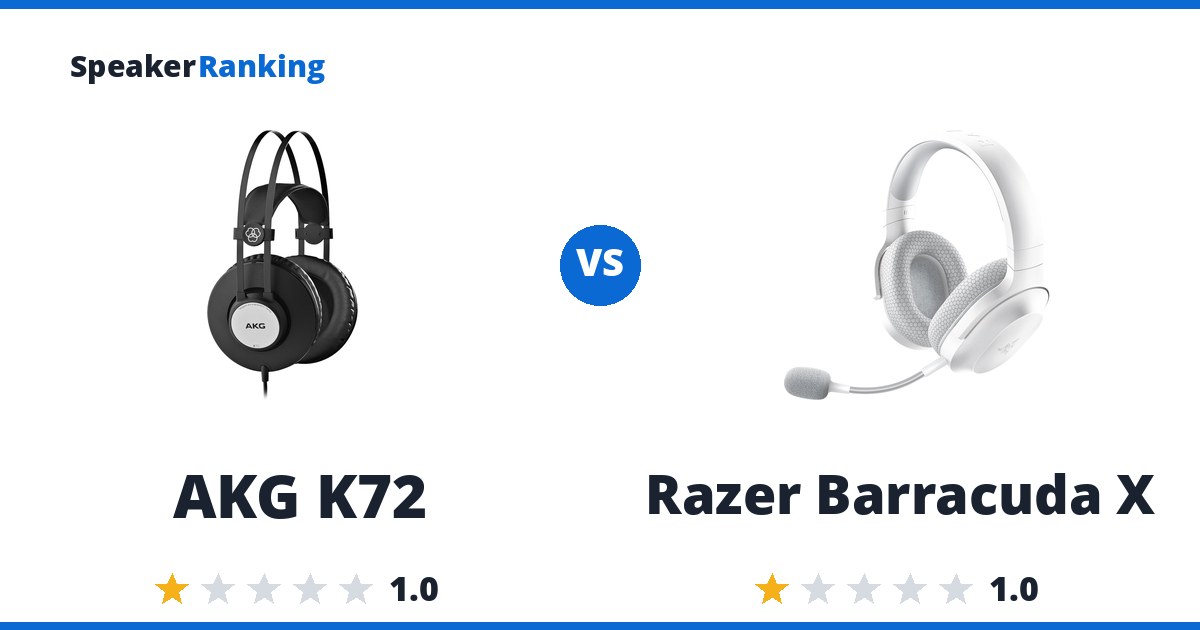
Why pick the AKG K72: A budget closed-back wired headphone at 0.4 lbs (200 g), light for its size. Watch for: The response is very uneven, with a standard deviation of 5.9 dB and a preference score of 13.
Why pick the Razer Barracuda X: Wireless with a rated 50 hours of battery, Bluetooth 5.2, a built-in microphone and a wired option. The catch: Crinacle’s measurement gives a preference score of just 7, among the furthest from the Harman target in the class, with a warm tilt and a very uneven response.
Buy the AKG K72. Both are rated the same for sound quality, and it costs $7.14 less than the Razer Barracuda X.
Want more options? Browse the full Headphones rankings.
Specifications Side By Side
| AKG K72 | Razer Barracuda X | |
|---|---|---|
| Price | $61.86 | $69.00 |
| Ranked | #131 of 134 in Over-Ear Headphones | #132 of 134 in Over-Ear Headphones |
| Form Factor | Over-ear | Over-ear |
| Harman Preference Score | 13 (measured by oratory1990, via AutoEQ) | 7 (measured by crinacle, via AutoEQ) |
| Deviation From Target | 5.93 dB standard deviation | 5.15 dB standard deviation |
| Tonal Tilt | -1.70 (negative is warmer, positive brighter) | -2.74 (negative is warmer, positive brighter) |
| Connection | Wired | Wireless and wired |
| Back | Closed | Closed |
| Driver Type | Dynamic | Dynamic |
| Drivers | 1 x 40mm dynamic | 1 x 40mm dynamic |
| Impedance | 32 ohms | 32 ohms |
| Sensitivity | 112 dB SPL/V | 96 dB SPL/mW |
| Frequency Response | 16Hz - 20kHz (Manufacturer specified) | 20Hz - 20kHz (Manufacturer specified) |
| Weight | 0.4 lbs (200 g) | 0.6 lbs (250 g) |
| Active Noise Cancelling | - | No |
| Battery Life | - | 50 hours (Manufacturer specified) |
| Bluetooth Version | - | 5.2 |
| Built-in Microphone | - | Yes |
| IP Rating | - | None |
Related Headphone Comparisons
More worthwhile head-to-heads for AKG K72:
- AKG K72 vs AKG K92
- AKG K92 vs Razer Barracuda X
- Logitech G Pro X vs Sennheiser HD 569
- Sennheiser HD 505 vs Sennheiser HD 569
- AKG K271 MKII vs Sennheiser HD 569
Prices on this page were last checked October 10, 2026 at 5:37 PM UTC. Product prices and availability are accurate as of that date/time and are subject to change; the price and availability shown on Amazon at the time of purchase will apply to the purchase of this product.
As an eBay Partner, we may be compensated if you make a purchase.
The Two Headphones In Full
 AKG K72: $61.86 Amazon eBay
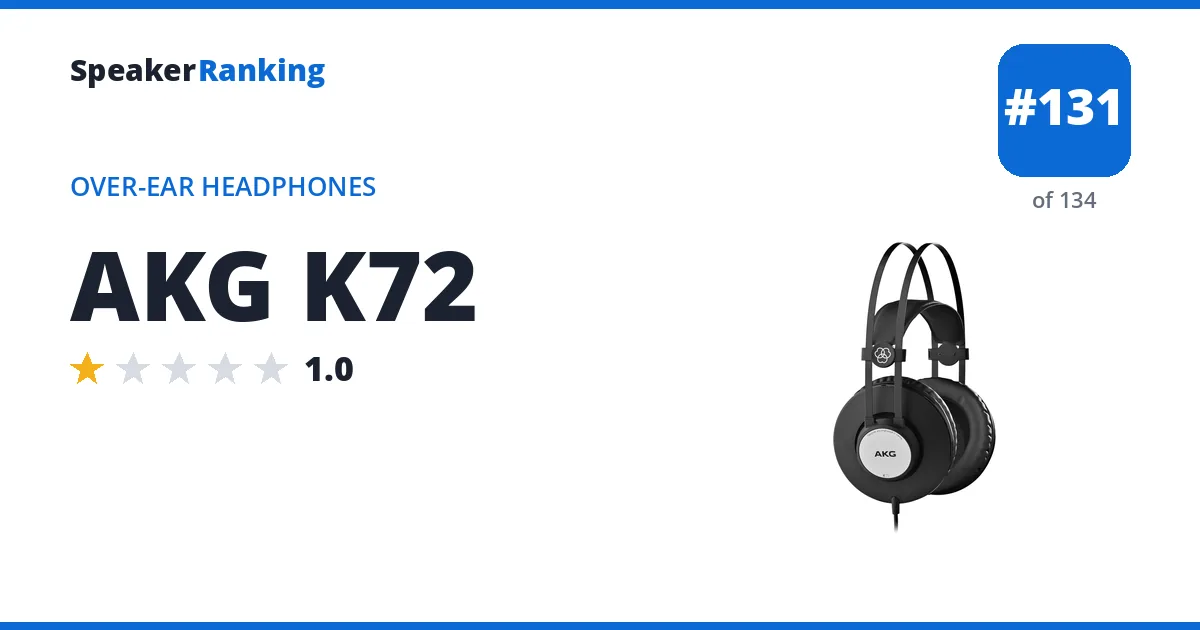
Pros: A budget closed-back wired headphone at 200 g, light for its size. The 32 ohm impedance and 112 dB sensitivity let any phone or laptop drive it. Bass is strongly boosted, about 7.6 dB from 60 to 200 Hz, for listeners who want maximum thump.
Cons: The response is very uneven, with a standard deviation of 5.9 dB and a preference score of 13. A 12.5 dB peak near 6.8 kHz makes cymbals and sibilance piercing, while the upper mids are 5 dB low and the low mids 6 dB high, so vocals sound boxy and distant. The Sennheiser HD 450BT is rated far higher at a similar price.
Full AKG K72 review and specifications →
| Back | Closed |
|---|---|
| Connection | Wired |
| Deviation From Target | 5.93 dB standard deviation |
| Driver Type | Dynamic |
| Drivers | 1 x 40mm dynamic |
| Form Factor | Over-ear |
| Frequency Response | 16Hz - 20kHz (Manufacturer specified) |
| Harman Preference Score | 13 (measured by oratory1990, via AutoEQ) |
| Impedance | 32 ohms |
| Sensitivity | 112 dB SPL/V |
| Tonal Tilt | -1.70 (negative is warmer, positive brighter) |
| Weight | 0.4 lbs (200 g) |
EQ preset to match the Harman target
Set a preamp of -6.8 dB, then add these filters in any parametric equalizer (Wavelet, Equalizer APO, Peace, or a player with parametric EQ). Calculated by AutoEQ from its measured frequency response.
| Filter | Frequency | Gain | Q |
|---|---|---|---|
| Low shelf | 105 Hz | -1.1 dB | 0.70 |
| Peak | 177 Hz | -8.6 dB | 1.25 |
| Peak | 1,488 Hz | +6.9 dB | 1.24 |
| Peak | 521 Hz | -3.1 dB | 1.21 |
| Peak | 2,817 Hz | +4.8 dB | 2.71 |
| High shelf | 10,000 Hz | +1.3 dB | 0.70 |
| Peak | 6,500 Hz | -8.9 dB | 4.44 |
| Peak | 73 Hz | +3.0 dB | 1.32 |
| Peak | 39 Hz | -1.6 dB | 0.85 |
| Peak | 123 Hz | -2.6 dB | 3.77 |
- Reviews, Comparisons and Sound Samples
- Head-to-Head Comparisons
 Razer Barracuda X: $69.00 Amazon eBay
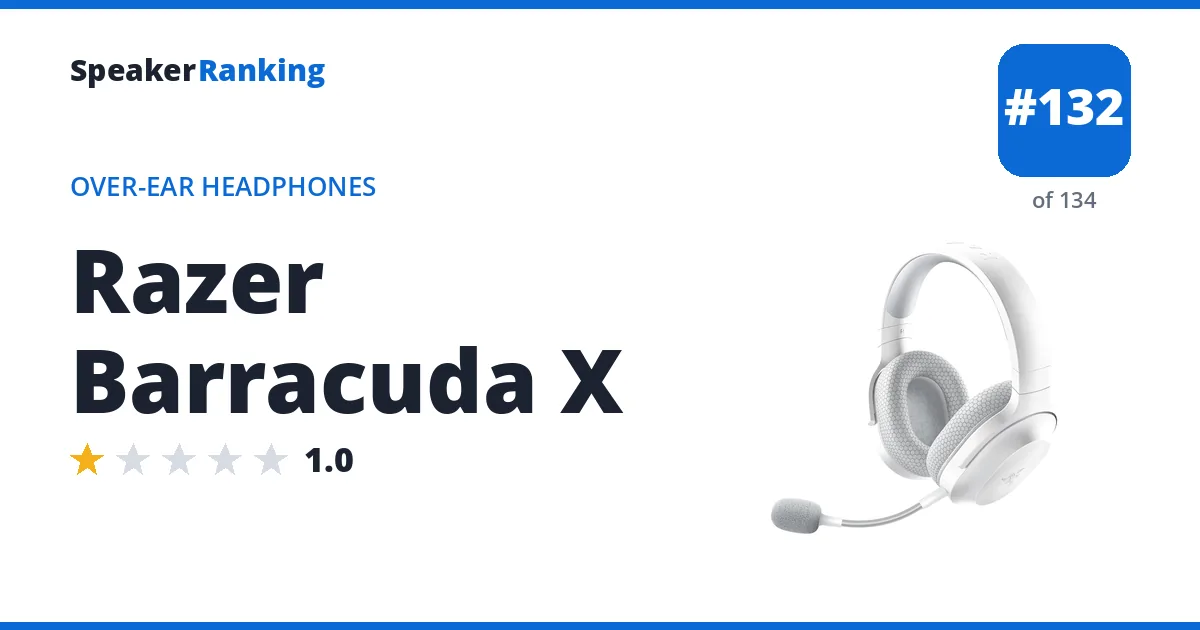
Pros: Wireless with a rated 50 hours of battery, Bluetooth 5.2, a built-in microphone and a wired option. At 250 g with 32 ohms and 96 dB sensitivity it is easy to drive. It has no active noise cancelling, so the battery goes a long way.
Cons: Crinacle’s measurement gives a preference score of just 7, among the furthest from the Harman target in the class, with a warm tilt and a very uneven response. Without noise cancelling it offers no real isolation from outside noise. The Logitech G Pro X is rated higher at a somewhat higher price.
Full Razer Barracuda X review and specifications →
| Released | Jul 2021 (5 years ago) |
|---|---|
| Active Noise Cancelling | No |
| Back | Closed |
| Battery Life | 50 hours (Manufacturer specified) |
| Bluetooth Version | 5.2 |
| Built-in Microphone | Yes |
| Connection | Wireless and wired |
| Deviation From Target | 5.15 dB standard deviation |
| Driver Type | Dynamic |
| Drivers | 1 x 40mm dynamic |
| Form Factor | Over-ear |
| Frequency Response | 20Hz - 20kHz (Manufacturer specified) |
| Harman Preference Score | 7 (measured by crinacle, via AutoEQ) |
| IP Rating | None |
| Impedance | 32 ohms |
| Sensitivity | 96 dB SPL/mW |
| Tonal Tilt | -2.74 (negative is warmer, positive brighter) |
| Weight | 0.6 lbs (250 g) |
EQ preset to match the Harman target
Set a preamp of -6.4 dB, then add these filters in any parametric equalizer (Wavelet, Equalizer APO, Peace, or a player with parametric EQ). Calculated by AutoEQ from its measured frequency response.
| Filter | Frequency | Gain | Q |
|---|---|---|---|
| Low shelf | 105 Hz | -2.4 dB | 0.70 |
| Peak | 4,094 Hz | +6.1 dB | 1.10 |
| Peak | 130 Hz | -9.0 dB | 1.11 |
| Peak | 607 Hz | -4.1 dB | 1.80 |
| Peak | 1,766 Hz | +4.0 dB | 1.64 |
| High shelf | 10,000 Hz | -2.5 dB | 0.70 |
| Peak | 286 Hz | +3.7 dB | 3.33 |
| Peak | 194 Hz | -2.2 dB | 2.83 |
| Peak | 440 Hz | -1.5 dB | 3.10 |
| Peak | 309 Hz | +0.8 dB | 2.49 |
- Reviews, Comparisons and Sound Samples
- Head-to-Head Comparisons