Short answer: the Stanmore II, and it’s cheaper too. It ranks #12 of 29 in its powered desktop class at $300; The Three II ranks #24 at $400, $100 more. The Klipsch The Three II has been replaced by the Klipsch The Three Plus. The Marshall Stanmore II has been replaced by the Marshall Stanmore IV. If you are buying new, get the Marshall Stanmore IV.
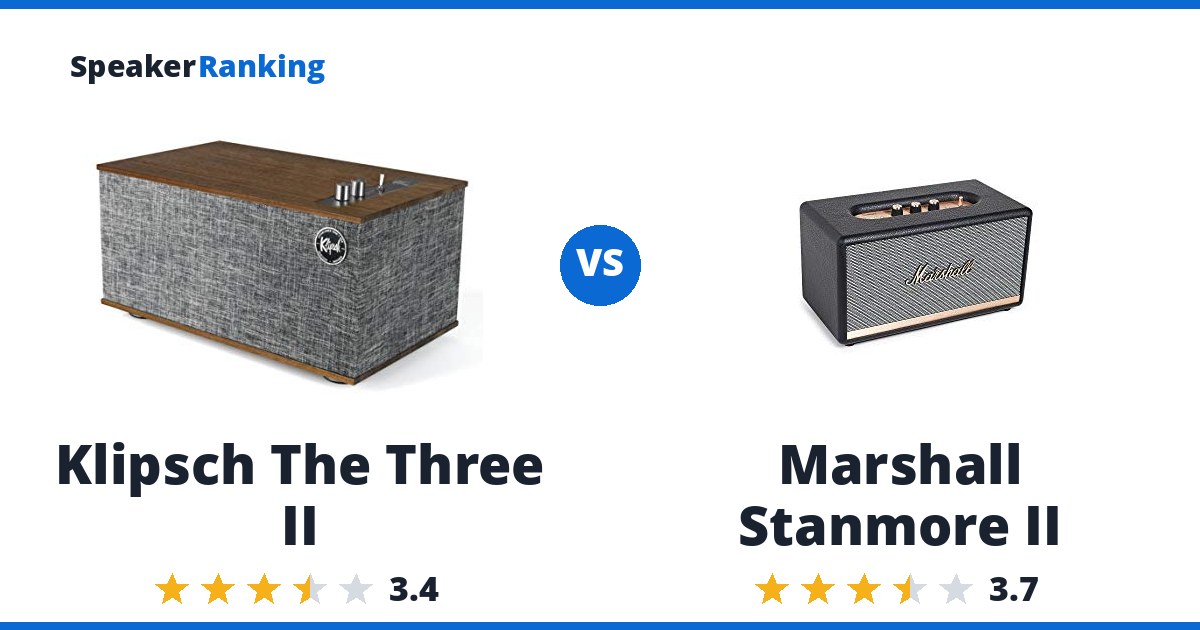
Neither review lists a single pro, which makes the cons the whole story. The Three II’s complaints are boosted treble and bass that doesn’t reach as deep as others; the Stanmore II’s are not very deep bass, no battery, and no water rating.
Both are styling-first purchases more than sound-first ones. Neither speaker’s review gives much reason to pick it purely on measured performance, so the ranking gap and the price difference both point the same direction.
Buy the Stanmore II if choosing between these two. Check the powered buyer’s guide for options with a stronger measured case at either price.
Still deciding? The full Powered Home rankings cover every ranked option.
Prices on this page were last checked November 7, 2026 at 7:34 PM UTC. Product prices and availability are accurate as of that date/time and are subject to change; the price and availability shown on Amazon at the time of purchase will apply to the purchase of this product.
As an eBay Partner, we may be compensated if you make a purchase.
Specifications Side By Side
| Klipsch The Three II | Marshall Stanmore II | |
|---|---|---|
| Price | $400 each Discontinued | $300 each Discontinued |
| Ranked | #24 of 29 in Medium Size Powered Desktop Speakers | #12 of 29 in Medium Size Powered Desktop Speakers |
| Aux Input | Yes | Yes |
| Battery Life | No Battery | No Battery |
| Stereo | Partially (1 woofer) | Partially (1 woofer) |
| Weight | 10.4 lbs (4.7 kg) | 10.3 lbs (4.65 kg) |
| App | No | Yes |
| Bluetooth Codecs | SBC, aptX | SBC, aptX |
| Bluetooth Version | 4.2 | 5.0 |
| Dimensions | 11” x 7.3” x 7.3” (280 x 186 x 186 mm) | 13.8” x 7.9” x 7.3” (350 x 200 x 185 mm) |
| EQ | Yes (Bass/Treble) | Yes (Bass/Treble) |
| Frequency Response | 45Hz - 20kHz (Manufacturer specified) | 50Hz - 20kHz (Manufacturer specified) |
| Inputs | Bluetooth, Aux, RCA, Optical, USB | Bluetooth, RCA, Aux, Optical |
| Drivers | 4.5” woofer, 2x 2.25” full-range midranges | 5.25” woofer, 2x 2” midranges, 2x 0.75” Dome tweeters |
| Party Mode | No | No |
| TWS | No | Yes |
| Wi-Fi | No | No |
| Woofer Cabinet | ported | ported |
| Amplifier Power | 60W (Woofer: 30W, Full-range: 2x15W) | 80W (Woofer: 50W, Tweeters: 2x15W) |
| XLR Input | No | No |
| RCA Input | Yes | Yes |
| TRS Input | No | No |
| Optical Input | Yes | Yes |
| Coaxial Input | No | No |
| USB Input | Yes | No |
| HDMI Input | No | No |
| AES Input | No | No |
| Bluetooth | Yes | Yes |
| Bass Extension (-10dB) | - | 55Hz |
| IP Rating | - | None |
| Power Bank | - | No |
| Power Input | - | AC Power brick |
| Voice Assistants | - | None |
Watch Them Compared
Videos and reviews that test both speakers side by side.
Related Speaker Comparisons
More worthwhile head-to-heads for Marshall Stanmore II: