DSAUDIOreview is ranked #6 of 49 in the speaker-review source reliability ranking. The ranking weighs measurement quality, repeatability, useful comparisons, disclosure, and editorial independence; it is an assessment of the work used for speaker decisions, not a claim about personal character.
Reliability assessment: Strong same-setup recordings and direct comparisons of passive and powered home speakers. The work is useful for relative tonal differences, but the recording method is less standardized and less independently repeatable than published anechoic measurements.
Prices on this page were last checked October 3, 2026 at 10:26 PM UTC. Product prices and availability are accurate as of that date/time and are subject to change; the price and availability shown on Amazon at the time of purchase will apply to the purchase of this product.
As an eBay Partner, we may be compensated if you make a purchase.
Quick Navigation
- Medium Size Powered Desktop Speakers
- Small Size Powered Bookshelf Speakers
- Medium Size Powered Bookshelf Speakers
- Large Size Powered Bookshelf Speakers
Every speaker on this site DSAUDIOreview has reviewed, highest-rated first, with a direct link to each review below its card.
Medium Size Powered Desktop Speakers
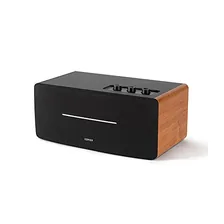 Ranked #7 of 20 in Medium Size Powered Desktop Speakers - Edifier D12: $178.99 each Amazon eBay
Pros: At 4.6 kg, Edifier D12 combines 2x 4” woofers, 2x 19mm silk dome tweeters with Bluetooth, Aux, RCA. Ac-powered operation and stereo playback make its feature set practical for its intended room or portable use. A very good value for a desktop speaker. Measured bass extension of 57Hz (-10dB).
Cons: Bass is limited by its 57Hz specification. There is no companion app.
Full Edifier D12 review and specifications →
| AES Input | No |
|---|---|
| Amplifier Power | 70W (R/L treble: 15W+15W, R/L mid-bass: 20W+20W) |
| App | No |
| Aux Input | Yes |
| Bass Extension (-10dB) | 57Hz |
| Battery Life | No Battery |
| Bluetooth | Yes |
| Bluetooth Codecs | SBC (inferred; additional codecs unverified) |
| Bluetooth Version | 5.0 |
| Coaxial Input | No |
| Dimensions | 14.1” x 6.3” x 8” (359 x 159 x 203.5 mm) |
| Drivers | 2x 4” woofers, 2x 19mm silk dome tweeters |
| EQ | Yes (Bass/Treble controls) |
| Frequency Response | 54Hz - 20kHz (Manufacturer specified) |
| HDMI Input | No |
| IP Rating | None |
| Inputs | Bluetooth, Aux, RCA |
| Optical Input | No |
| Outputs | Subwoofer line out |
| Party Mode | No |
| Power Bank | No |
| Power Input | AC Power cable |
| RCA Input | Yes |
| Stereo | Yes |
| Subwoofer Output | Yes |
| TRS Input | No |
| TWS | No |
| USB Input | No |
| Weight | 10.1 lbs (4.6 kg) |
| Wi-Fi | No |
| Woofer Cabinet | ported |
| XLR Input | No |
- Links
- Reviews, Comparisons and Sound Samples
- DSAUDIO.review: DSAUDIO.review Edifier D12 vs Marshall Acton II sound.DEMO More from DSAUDIOreview →
- DSAUDIO.review: DSAUDIO.review Edifier D12 vs Edifier R1700BT sound.DEMO
- DSAUDIO.review: DSAUDIO.review Edifier D12 vs Edifier R1280DBs sound.DEMO
- DSAUDIO.review: DSAUDIO.review Edifier D12 vs Klipsch The Three II sound.DEMO
- Head-to-Head Comparisons
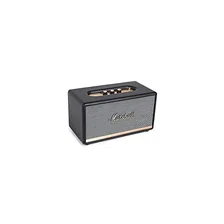 Ranked #11 of 20 in Medium Size Powered Desktop Speakers - Marshall Stanmore II: $300 each Discontinued eBay
Newer model: the Marshall Stanmore IV, ranked higher, estimated 3.8/5.
Pros: Marshall Stanmore II uses 5.25” woofer, 2x 2” midranges, 2x 0.75” Dome tweeters. Its 4.65 kg, aux input and limited-stereo playback make it a practical option for its intended room or portable use. Measured bass extension of 55Hz (-10dB).
Cons: Bass is limited by its 55Hz specification. Discontinued.
Full Marshall Stanmore II review and specifications →
| AES Input | No |
|---|---|
| Amplifier Power | 80W (Woofer: 50W, Tweeters: 2x15W) |
| App | Yes |
| Aux Input | Yes |
| Bass Extension (-10dB) | 55Hz |
| Battery Life | No Battery |
| Bluetooth | Yes |
| Bluetooth Codecs | SBC, aptX |
| Bluetooth Version | 5.0 |
| Coaxial Input | No |
| Dimensions | 13.8” x 7.9” x 7.3” (350 x 200 x 185 mm) |
| Drivers | 5.25” woofer, 2x 2” midranges, 2x 0.75” Dome tweeters |
| EQ | Yes (Bass/Treble) |
| Frequency Response | 50Hz - 20kHz (Manufacturer specified) |
| HDMI Input | No |
| IP Rating | None |
| Inputs | Bluetooth, RCA, Aux, Optical |
| Optical Input | Yes |
| Party Mode | No |
| Power Bank | No |
| Power Input | AC Power brick |
| RCA Input | Yes |
| Stereo | Partially (1 woofer) |
| TRS Input | No |
| TWS | Yes |
| USB Input | No |
| Voice Assistants | None |
| Weight | 10.3 lbs (4.65 kg) |
| Wi-Fi | No |
| Woofer Cabinet | ported |
| XLR Input | No |
- Reviews, Comparisons and Sound Samples
- Head-to-Head Comparisons
- Marshall Stanmore II vs Marshall Acton III
- Marshall Stanmore II vs JBL Authentics 200
- Marshall Stanmore II vs Marshall Stanmore IV
- Marshall Stanmore II vs Marshall Acton II
- Marshall Stanmore II vs Marshall Stanmore III
- Marshall Stanmore II vs Klipsch The Three II
- Marshall Stanmore II vs Marshall Woburn I
- Marshall Stanmore II vs Marshall Woburn II
- See all 11 comparisons
 Ranked #16 of 20 in Medium Size Powered Desktop Speakers - Marshall Acton II: $195.60 each Discontinued eBay
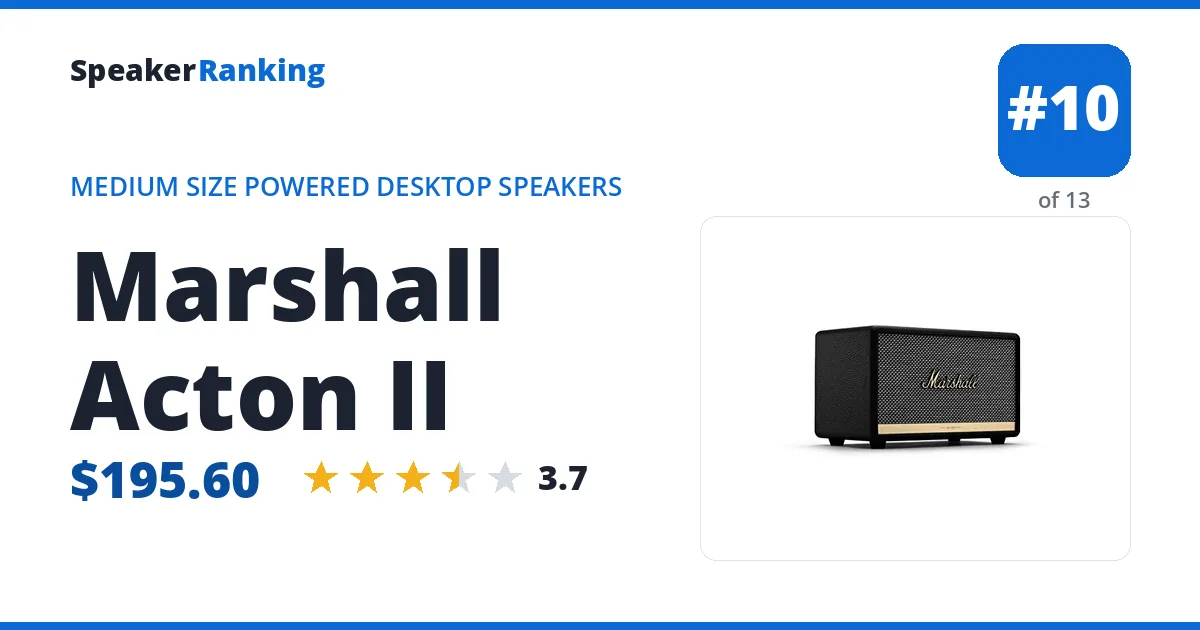
Newer model: the Marshall Acton IV, estimated 3.7/5.
Pros: Marshall Acton II uses 4” (midrange/woofer), 1x 4” midrange, 2x 0.75” Dome tweeters. Its 2.9 kg, aux input and limited-stereo playback make it a practical option for its intended room or portable use. Measured bass extension of 56Hz (-10dB).
Cons: Bass is limited by its 56Hz specification. Discontinued.
Full Marshall Acton II review and specifications →
| AES Input | No |
|---|---|
| Amplifier Power | 50W (Woofer: 25W, Tweeters: 2x12.5W) |
| App | Yes |
| Aux Input | Yes |
| Bass Extension (-10dB) | 56Hz |
| Battery Life | No Battery |
| Bluetooth | Yes, 5.0 |
| Bluetooth Codecs | SBC, aptX |
| Bluetooth Version | 5.0 |
| Coaxial Input | No |
| Dimensions | 10.2” x 6” x 5.9” (260 x 153 x 150 mm) |
| Drivers | 4” (midrange/woofer), 1x 4” midrange, 2x 0.75” Dome tweeters |
| EQ | Yes (Bass/Treble) |
| Frequency Response | 50Hz - 20kHz (Manufacturer specified) |
| HDMI Input | No |
| IP Rating | None |
| Inputs | Bluetooth, Aux |
| Optical Input | No |
| Party Mode | No |
| Power Bank | No |
| RCA Input | No |
| Stereo | Partially (1 woofer) |
| TRS Input | No |
| TWS | No |
| USB Input | No |
| Voice Assistants | None |
| Weight | 6.4 lbs (2.9 kg) |
| Wi-Fi | No |
| Woofer Cabinet | ported |
| XLR Input | No |
- Reviews, Comparisons and Sound Samples
- DSAUDIO.review: DSAUDIO.review Edifier D12 vs Marshall Acton II sound.DEMO More from DSAUDIOreview →
- DSAUDIO.review: DSAUDIO.review Marshall Stanmore II vs Marshall Acton II sound.DEMO
- Danny Pops: Marshall Acton 2 vs Klipsch The One 2 - which sounds better? More from DannyPops →
- One-month hobbyist: Klipsch The One ii vs Marshall Acton ii Sound Battle
- Storytripper HD: Marshall Acton 2 vs Marshall Kilburn 2 More from storytripperhd →
- Head-to-Head Comparisons
- Marshall Acton II vs Klipsch The Three II
- Marshall Acton II vs Klipsch The One II
- Marshall Acton II vs Marshall Stanmore II
- Marshall Acton II vs Marshall Acton III
- Marshall Acton II vs JBL Authentics 200
- Marshall Acton II vs Edifier D12
- Marshall Acton II vs Marshall Stanmore III
- Marshall Acton II vs Marshall Woburn II
- See all 11 comparisons
 Ranked #18 of 20 in Medium Size Powered Desktop Speakers - Klipsch The Three II: $400 each Discontinued eBay
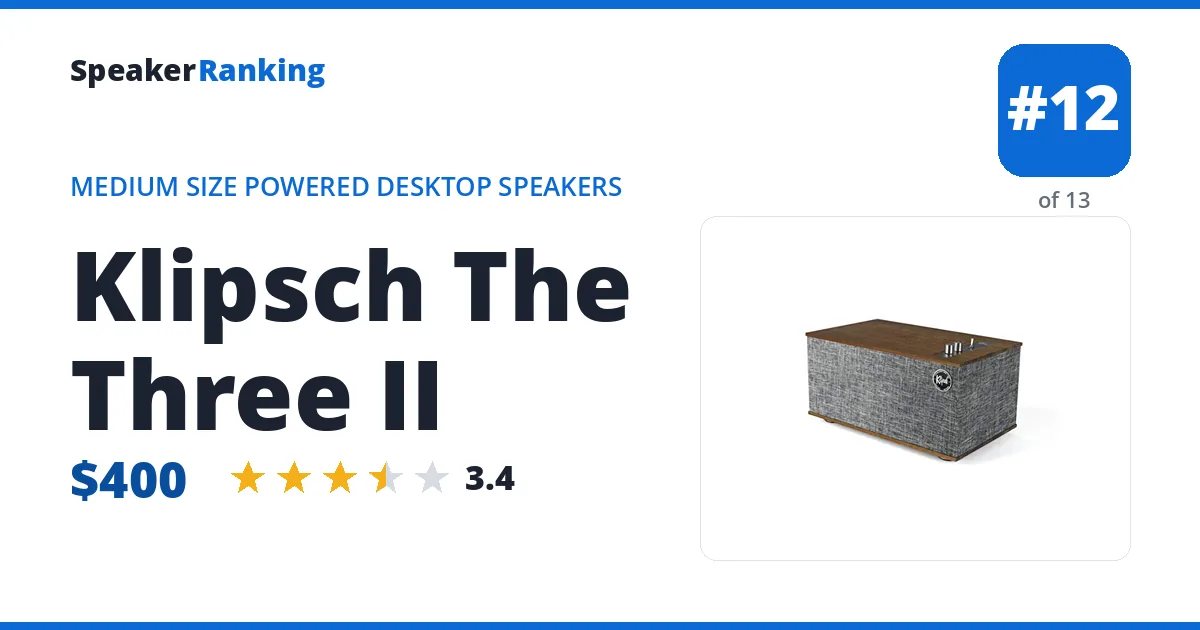
Newer model: the Klipsch The Three Plus, ranked lower, rated 3.4/5.
Pros: Klipsch The Three II uses 4.5” woofer, 2x 2.25” full-range midranges. Its 4.7 kg, aux input and limited-stereo playback make it a practical option for its intended room or portable use.
Cons: Its 45Hz to 20kHz (Manufacturer specified) specification points to limited deep-bass reach for the cabinet size. There is no companion app. Discontinued.
Full Klipsch The Three II review and specifications →
| AES Input | No |
|---|---|
| Amplifier Power | 60W (Woofer: 30W, Full-range: 2x15W) |
| App | No |
| Aux Input | Yes |
| Battery Life | No Battery |
| Bluetooth | Yes |
| Bluetooth Codecs | SBC, aptX |
| Bluetooth Version | 4.2 |
| Coaxial Input | No |
| Dimensions | 11” x 7.3” x 7.3” (280 x 186 x 186 mm) |
| Drivers | 4.5” woofer, 2x 2.25” full-range midranges |
| EQ | Yes (Bass/Treble) |
| Frequency Response | 45Hz - 20kHz (Manufacturer specified) |
| HDMI Input | No |
| Inputs | Bluetooth, Aux, RCA, Optical, USB |
| Optical Input | Yes |
| Party Mode | No |
| RCA Input | Yes |
| Stereo | Partially (1 woofer) |
| TRS Input | No |
| TWS | No |
| USB Input | Yes |
| Weight | 10.4 lbs (4.7 kg) |
| Wi-Fi | No |
| Woofer Cabinet | ported |
| XLR Input | No |
- Links
- Reviews, Comparisons and Sound Samples
- Head-to-Head Comparisons
- Klipsch The Three II vs Marshall Acton II
- Klipsch The Three II vs Klipsch The One II
- Klipsch The Three II vs Marshall Stanmore II
- Klipsch The Three II vs Marshall Acton III
- Klipsch The Three II vs JBL Authentics 200
- Klipsch The Three II vs Edifier D12
- Klipsch The Three II vs Marshall Stanmore III
- Klipsch The Three II vs Audio Pro C5 MkII
- See all 9 comparisons
Small Size Powered Bookshelf Speakers
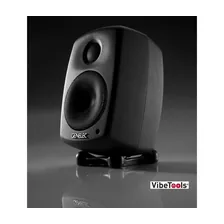 Ranked #2 of 34 in Small Size Powered Bookshelf Speakers - Genelec 8010A: $900 per pair B&H Photo Video eBay
Larger models: the Genelec 8020D (rated 4.4/5), the Genelec 8030C (rated 4.6/5), the Genelec 8040B (rated 4.3/5) and the Genelec 8050B (rated 4.4/5).
Pros: ASR’s Klippel measurements support a neutral compact monitor: the response spans 2.5dB from 300Hz to 5kHz, with lower narrow-band variation in the listening window than directly on-axis. Spinorama predicts 4.10 standalone and 7.01 with an ideal subwoofer, making it a strong choice when bass is handled separately. Its measured balance provides firmer evidence for critical listening than a recorded sound demonstration alone. Measured bass extension of 74Hz (-3dB).
Cons: The measured -3dB point is about 78Hz, so deep bass is missing without a subwoofer. The small enclosure and woofer are better suited to close listening than room-filling levels; the preference score does not measure headroom. The D3V offers substantially deeper measured bass in a similarly compact format, while the Genelec’s premium price is harder to justify for casual desktop use.
Full Genelec 8010A review and specifications →
| AES Input | No |
|---|---|
| Amplifier Power | 50W (25W woofer + 25W tweeter) |
| App | No |
| Aux Input | No |
| Bass Extension (-10dB) | 67Hz (measured, Audio Science Review) |
| Bass Extension (-3dB) | 74Hz (measured, Audio Science Review) |
| Bluetooth | No |
| Coaxial Input | No |
| Dimensions | 7.7”H x 4.8”W x 4.5”D (195.6 x 121.9 x 114.3 mm) |
| Drivers | 3” woofer, 0.75” metal dome tweeter |
| EQ | Yes (Bass tilt, Desk proximity) |
| Frequency Response | 67 Hz-25 kHz (-6dB) (Manufacturer specified) |
| HDMI Input | No |
| Inputs | XLR |
| Maximum SPL | 96dB @ 1m (manufacturer specified) |
| Optical Input | No |
| RCA Input | No |
| TRS Input | No |
| USB Input | No |
| Weight | 3.3 lbs (1.5 kg) |
| XLR Input | Yes |
- Links
- Reviews, Comparisons and Sound Samples
- Audio Science Review Measurements More from Audio Science Review →
- DSAUDIO.review: Genelec 8010A (Genelec G One) vs iLoud Micro Monitor Sound Demo w/ Bass Test More from DSAUDIOreview →
- DSAUDIO.review: Genelec 8010A (Genelec G One) vs Presonus Eris E4.5 Sound Demo w/ Bass Test
- DSAUDIO.review: Genelec 8010A (G One) vs JBL LSR305 Sound Demo w/ Bass Test
- DSAUDIO.review: Genelec 8010A (Genelec G One) vs Audioengine A2+ Sound Demo w/ Bass Test
- DSAUDIO.review: Genelec 8010A (Genelec G One) vs Yamaha HS5 Sound Demo w/ Bass Test
- Audio Science Review Measurements (spinorama.org)
- Head-to-Head Comparisons
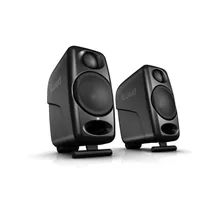 Ranked #5 of 34 in Small Size Powered Bookshelf Speakers - IK Multimedia iLoud Micro Monitor: $299.99 per pair Amazon eBay
Pros: Unusually substantial bass for such a small desktop pair. The linked quasi-anechoic measurement review reports broad, reasonably consistent horizontal radiation and useful tolerance above the tweeter axis, helpful when the speakers sit below ear height. Its compact size and bass balance make it a practical close-listening alternative to small monitors that need a subwoofer. Measured bass extension of 55Hz (-3dB).
Cons: The existing review evidence indicates some bass emphasis and upper-treble rolloff rather than strict neutrality. Deep bass from tiny drivers does not establish loud-playback headroom; use these for close desktop listening, not as a substitute for larger room speakers.
Full IK Multimedia iLoud Micro Monitor review and specifications →
| AES Input | No |
|---|---|
| Amplifier Power | 50W total (combined) |
| App | No |
| Aux Input | Yes |
| Bass Extension (-10dB) | 45Hz (measured, Audio Science Review) |
| Bass Extension (-3dB) | 55Hz (measured, Audio Science Review) |
| Bluetooth | Yes (A2DP) |
| Coaxial Input | No |
| Dimensions | 7.1”H x 3.5”W x 5.3”D (180.3 x 88.9 x 134.6 mm) |
| Drivers | 3” woofer, 0.75” silk dome tweeter |
| EQ | Yes (Bass/Treble switches, Desktop/Free field) |
| Frequency Response | 55Hz - 20kHz (-3dB) (Manufacturer specified) |
| HDMI Input | No |
| Inputs | RCA, Aux |
| Maximum SPL | 96dB @ 1m (manufacturer specified) |
| Optical Input | No |
| RCA Input | Yes |
| TRS Input | No |
| USB Input | No |
| Weight | 2 lbs (0.9 kg) |
| XLR Input | No |
- Links
- Reviews, Comparisons and Sound Samples
- Audio Science Review Measurements More from Audio Science Review →
- DSAUDIO.review: DSAUDIO.review Edifier MR4 vs iLoud Micro Monitor sound.DEMO More from DSAUDIOreview →
- DSAUDIOreview: IK Multimedia iLoud MTM vs iLoud Micro Sound & Frequency Response Comparison
- Jasper Tech: Best Desktop Computer Speakers for Every Budget – 2026 More from Jasper Tech →
- Jasper Tech: Are the D3V The Best Studio Monitors For The Money?
- Jasper Tech: Best Premium Computer Speakers: Kanto ORA4 Review & Comparison
- Jasper Tech: Are the iLoud Micro Monitor Pro the Best Studio Monitor Speakers for your Home Studio?
- Jasper Tech: Best Desktop Computer Speakers for Every Budget
- Head-to-Head Comparisons
- IK Multimedia iLoud Micro Monitor vs Cambridge Audio L/R S
- IK Multimedia iLoud Micro Monitor vs Adam Audio D3v
- IK Multimedia iLoud Micro Monitor vs Edifier M60
- IK Multimedia iLoud Micro Monitor vs Genelec 8010A
- IK Multimedia iLoud Micro Monitor vs HiVi Swan X3
- IK Multimedia iLoud Micro Monitor vs Edifier MR3
- IK Multimedia iLoud Micro Monitor vs Audioengine A2+
- IK Multimedia iLoud Micro Monitor vs Edifier M90
- See all 16 comparisons
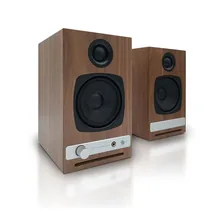 Ranked #21 of 34 in Small Size Powered Bookshelf Speakers - Audioengine HD3: $359.00 per pair Amazon eBay
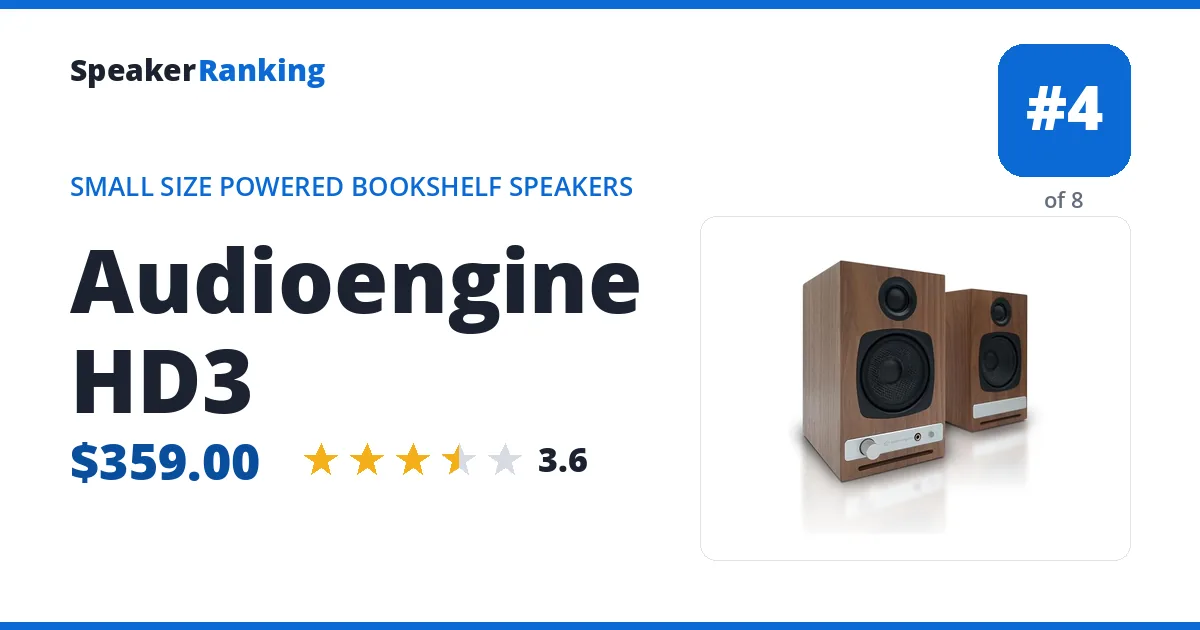
Pros: A compact desktop stereo option when cabinet size is a priority. Measured bass extension of 65Hz (-3dB).
Cons: Limited bass makes a subwoofer useful for fuller music reproduction. Its compact format is better suited to close listening than filling a large room.
Full Audioengine HD3 review and specifications →
| AES Input | No |
|---|---|
| Amplifier Power | 30W total (15W per speaker) |
| App | No |
| Aux Input | Yes |
| Bass Extension (-10dB) | 58Hz |
| Bass Extension (-3dB) | 65Hz |
| Bluetooth | Yes |
| Bluetooth Codecs | SBC, aptX |
| Bluetooth Version | 5.0 |
| Coaxial Input | No |
| Dimensions | 9”H x 5.5”W x 6.5”D (228.6 x 139.7 x 165.1 mm) |
| Drivers | 2.75” woofer, 0.75” silk dome tweeter |
| EQ | No |
| Frequency Response | 65 Hz-20 kHz (-3dB) (Manufacturer specified) |
| HDMI Input | No |
| Inputs | Bluetooth, Aux, RCA Input |
| Maximum SPL | 90dB @ 1m (manufacturer specified) |
| Optical Input | No |
| Outputs | RCA variable output (subwoofer) |
| RCA Input | Yes |
| Subwoofer Output | Yes |
| TRS Input | No |
| USB Input | No |
| Weight | 7.3 lbs (3.3 kg) |
| XLR Input | No |
- Links
- Reviews, Comparisons and Sound Samples
- Head-to-Head Comparisons
- Audioengine HD3 vs Monoprice Monolith MM-3
- Audioengine HD3 vs Kanto YU4
- Audioengine HD3 vs Monacor SOUND-4BT
- Audioengine HD3 vs Fluid Audio C35BT
- Audioengine HD3 vs Bowers & Wilkins Formation Flex
- Audioengine HD3 vs M-Audio BX3
- Audioengine HD3 vs Presonus Eris E3.5 2nd Gen
- Audioengine HD3 vs Edifier MR3
- See all 19 comparisons
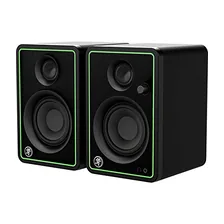 Ranked #24 of 34 in Small Size Powered Bookshelf Speakers - Mackie CR3-X: $99.99 per pair Amazon eBay
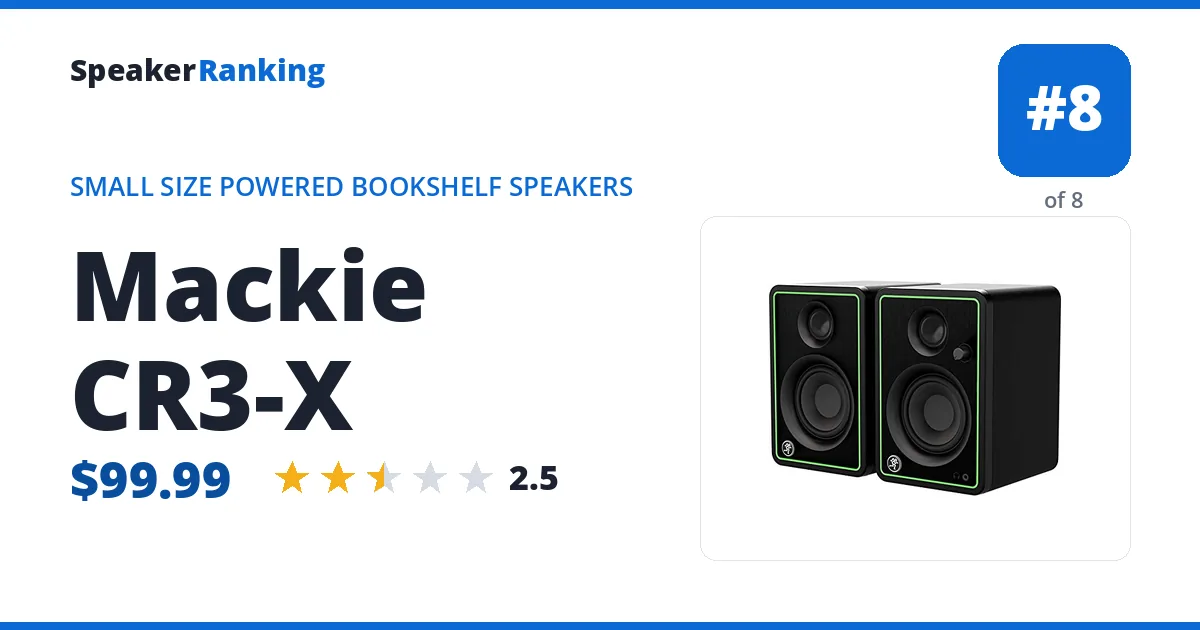
Pros: Erin’s Klippel data predicts 2.50 standalone and 5.42 with an ideal subwoofer. The existing comparative review found less exaggerated tonal shaping and better sustained-output behavior than the original PreSonus E3.5 tested alongside it. Midrange distortion was reasonably controlled for inexpensive desktop speakers at moderate listening levels. Measured bass extension of 80Hz (-3dB), with a measured sensitivity of 96dB.
Cons: The response spans 4.4dB from 300Hz to 5kHz, with substantial narrow-band irregularities and bass rolloff reaching -3dB around 75Hz. Bass peaking and crossover-region changes with listening height prevent neutral monitoring. Limiting becomes intrusive above modest desktop levels, and there are no tone controls. Comparisons with the original E3.5 should not be treated as measurements of its second generation.
Full Mackie CR3-X review and specifications →
| AES Input | No |
|---|---|
| Amplifier Power | 50W total (25W per speaker) |
| App | No |
| Aux Input | Yes |
| Bass Extension (-10dB) | 70Hz (measured, Erin’s Audio Corner) |
| Bass Extension (-3dB) | 80Hz (measured, Erin’s Audio Corner) |
| Bluetooth | No |
| Coaxial Input | No |
| Dimensions | 8.1”H x 5.5”W x 7.1”D (205.7 x 139.7 x 180.3 mm) |
| Drivers | 3” woofer, 0.75” silk dome tweeter |
| EQ | No |
| Frequency Response | 80 Hz-20 kHz (-3dB) (Manufacturer specified) |
| HDMI Input | No |
| Headphone Output | Yes |
| Inputs | RCA, Aux |
| Maximum SPL | 92dB @ 1m (manufacturer specified) |
| Optical Input | No |
| Outputs | 1/8” headphone jack |
| RCA Input | Yes |
| Sensitivity | 96dB (measured at 0.3V/1m, Erin’s Audio Corner) |
| Spinorama Preference Score | 2.50 |
| Spinorama Preference Score with Perfect Sub | 5.42 |
| TRS Input | No |
| USB Input | No |
| Weight | 7.7 lbs (3.5 kg) |
| XLR Input | No |
- Links
- Reviews, Comparisons and Sound Samples
- Erin’s Audio Corner Review Measurements More from Erin’s Audio Corner →
- Audio Science Review Measurements More from Audio Science Review →
- DSAUDIO.review: Presonus Eris E3.5 vs Mackie CR3 Sound Demo w/ Bass Test More from DSAUDIOreview →
- DSAUDIO.review: Mackie CR3-X vs Edifier R1280T Sound, Distortion & Frequency Response Comparison
- Erin’s Audio Corner: Mackie CR3-X vs PreSonus E3.5 Budget Monitor Showdown!
- Erin’s Audio Corner Measurements (spinorama.org)
- Head-to-Head Comparisons
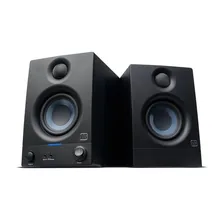 Ranked #31 of 34 in Small Size Powered Bookshelf Speakers - Presonus Eris E3.5 2nd Gen: $99.99 per pair Amazon eBay
Pros: Rear-panel bass and treble controls allow broad correction for desk and wall placement. Erin’s second-generation Klippel measurements give a -3dB point around 69Hz, so the speaker has useful upper-bass reach for its size. Its adjustable balance is more flexible than a fixed-response budget desktop pair. Measured bass extension of 80Hz (-3dB), with a measured sensitivity of 87.4dB.
Cons: The stock response spans 7.2dB from 300Hz to 5kHz and has a strong rising trend of about 1.27dB per octave, emphasizing treble over the midrange. Preference scores of 1.51 standalone and 4.17 with an ideal subwoofer indicate major tonal problems beyond bass extension. EQ may help, but a subwoofer alone will not make it neutral. Output and port-modification results from reviews of the original E3.5 should not be assumed to apply to this second-generation model.
Full Presonus Eris E3.5 2nd Gen review and specifications →
| AES Input | No |
|---|---|
| Amplifier Power | 50W total (25W per speaker) |
| App | No |
| Aux Input | No |
| Bass Extension (-10dB) | 70Hz (measured, Erin’s Audio Corner) |
| Bass Extension (-3dB) | 80Hz (measured, Erin’s Audio Corner) |
| Bluetooth | No |
| Coaxial Input | No |
| Dimensions | 8.3”H x 6”W x 5.5”D (210.8 x 152.4 x 139.7 mm) |
| Drivers | 3.5” woofer, 1” silk dome tweeter |
| EQ | Yes (Acoustic space) |
| Frequency Response | 80 Hz-20 kHz (-3dB) (Manufacturer specified) |
| HDMI Input | No |
| Headphone Output | Yes |
| Inputs | RCA, 1/4” Balanced |
| Maximum SPL | 95dB @ 1m (manufacturer specified) |
| Optical Input | No |
| Outputs | 1/8” headphone jack |
| RCA Input | Yes |
| Sensitivity | 87.4dB (measured at 0.3V/1m, Erin’s Audio Corner) |
| Spinorama Preference Score | 1.51 |
| Spinorama Preference Score with Perfect Sub | 4.17 |
| TRS Input | No |
| USB Input | No |
| Weight | 8.6 lbs (3.9 kg) |
| XLR Input | No |
- Links
- Reviews, Comparisons and Sound Samples
- Erin’s Audio Corner Review Measurements More from Erin’s Audio Corner →
- Audio Science Review Measurements More from Audio Science Review →
- DSAUDIO.review: DSAUDIO.review Edifier MR4 vs Presonus Eris E3.5 sound.DEMO More from DSAUDIOreview →
- DSAUDIO.review: Presonus Eris E3.5 vs Edifier R1280T Sound Demo w/ Bass Test
- DSAUDIO.review: Presonus Eris E3.5 vs Mackie CR3 Sound Demo w/ Bass Test
- Erin’s Audio Corner: Mackie CR3-X vs PreSonus E3.5 Budget Monitor Showdown!
- Erin’s Audio Corner: 10 Great (and Terrible) Speakers Under $300!
- Erin’s Audio Corner Measurements (spinorama.org)
- Jasper Tech: Are the iLoud Micro Monitor Pro the Best Studio Monitor Speakers for your Home Studio? More from Jasper Tech →
- Jasper Tech: Best Desktop Computer Speakers for Every Budget
- Head-to-Head Comparisons
- Presonus Eris E3.5 2nd Gen vs Midiplus MI3 II
- Presonus Eris E3.5 2nd Gen vs Monoprice DT-3
- Presonus Eris E3.5 2nd Gen vs M-Audio BX3
- Presonus Eris E3.5 2nd Gen vs Fiio SP3
- Presonus Eris E3.5 2nd Gen vs Fluid Audio C35BT
- Presonus Eris E3.5 2nd Gen vs Mackie CR3-X
- Presonus Eris E3.5 2nd Gen vs Audioengine HD3
- Presonus Eris E3.5 2nd Gen vs Audioengine A2+
- See all 16 comparisons
Medium Size Powered Bookshelf Speakers
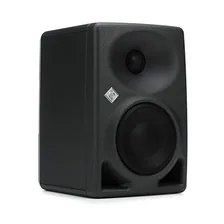 Ranked #4 of 76 in Medium Size Powered Bookshelf Speakers - Neumann KH80 DSP: $1,197.96 per pair Amazon B&H Photo Video eBay
Larger models: the Neumann KH120 MKII (ranked higher, rated 4.7/5) and the Neumann KH 150 (rated 4.8/5).
Pros: ASR’s selected Klippel measurement has a 1.4dB midrange response span and virtually no overall on-axis tilt. Scores of 5.89 standalone and 8.25 with an ideal subwoofer indicate excellent tonal accuracy in a compact monitor. The waveguide and steep crossover provide useful control of reflected sound, while placement filters help compensate for a desk or nearby boundaries. Existing multitone testing supports good moderate-level clarity. Measured bass extension of 57Hz (-3dB), with a measured sensitivity of 91.9dB.
Cons: Bass reaches -3dB around 59Hz in this measurement, less deep than the KH120 II. Output protection and increasing multitone distortion limit loud listening, especially in the bass. Room reflections and listening distance can alter perceived treble balance despite its flat direct response. Calibration equipment adds to the cost; the preference score is not a measurement of maximum clean output. It is expensive for its size.
Full Neumann KH80 DSP review and specifications →
| AES Input | No |
|---|---|
| Amplifier Power | 140W (90W woofer + 50W tweeter) |
| App | Yes (MA 1 alignment) |
| Aux Input | No |
| Bass Extension (-10dB) | 51Hz (measured, Erin’s Audio Corner) |
| Bass Extension (-3dB) | 57Hz (measured, Erin’s Audio Corner) |
| Bluetooth | No |
| Coaxial Input | No |
| DSP | Yes |
| Dimensions | 13.6”H x 10.8”W x 9.6”D (345.4 x 274.3 x 243.8 mm) |
| Drivers | 4.1” woofer, 1” fabric dome tweeter |
| EQ | Yes (via DSP) |
| Frequency Response | 57 Hz - 25 kHz (+-3 dB) (Manufacturer specified) |
| HDMI Input | No |
| Inputs | XLR |
| Maximum SPL | 110.7dB @ 1m (manufacturer specified) |
| Optical Input | No |
| RCA Input | No |
| Sensitivity | 91.9dB (measured at 0.3V/1m, Erin’s Audio Corner) |
| Spinorama Preference Score | 5.89 |
| Spinorama Preference Score with Perfect Sub | 8.25 |
| TRS Input | No |
| USB Input | No |
| Weight | 9 lbs (4.1 kg) each |
| XLR Input | Yes |
- Links
- Reviews, Comparisons and Sound Samples
- Erin’s Audio Corner: Neumann KH 80 Studio Monitor Review. Excellent Performance. Small Size. More from Erin’s Audio Corner →
- Erin’s Audio Corner Review Measurements
- Audio Science Review Measurements More from Audio Science Review →
- DSAUDIO.review: Neumann KH80 DSP vs Genelec 8020D Sound & Frequency Response Comparison More from DSAUDIOreview →
- DSAUDIO.review: Neumann KH80 DSP vs Yamaha HS8 Sound & Frequency Response Comparison
- DSAUDIO.review: Neumann KH80 DSP vs Focal Shape 40 Sound & Frequency Response Comparison
- DSAUDIO.review: Neumann KH80 DSP vs IK Multimedia iLoud MTM Sound & Frequency Response Comparison
- DSAUDIO.review: Neumann KH80 DSP vs JBL 305P MKII Sound & Frquency Response Comparison
- DSAUDIO.review: KEF LSX vs Neumann KH80 DSP Sound & Frequency Response Comparison
- DSAUDIO.review: Adam Audio A3X vs Neumann KH80 DSP Sound & Frequency Response Comparison
- DSAUDIO.review: Neumann KH80 DSP vs KRK Rokit 5 G4 RP5G4 Sound & Frequency Response Comparison
- Joy & Oluv’Sone: 🎃🔥 UBoom X - Halloween Rock Special 🎸🤘 More from Oluv’Sone →
- Audio Science Review Measurements (spinorama.org)
- Head-to-Head Comparisons
- Neumann KH80 DSP vs Genelec 8030C
- Neumann KH80 DSP vs Reflector Audio Square Two
- Neumann KH80 DSP vs Neumann KH120 MKII
- Neumann KH80 DSP vs Dynaudio LYD 5
- Neumann KH80 DSP vs Genelec 8331A
- Neumann KH80 DSP vs Genelec 8330A
- Neumann KH80 DSP vs Genelec 8320A
- Neumann KH80 DSP vs Devialet Phantom II 98 dB
- See all 66 comparisons
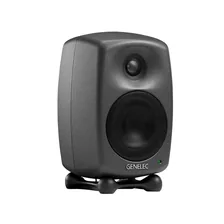 Ranked #11 of 76 in Medium Size Powered Bookshelf Speakers - Genelec 8020D: $1,390 per pair B&H Photo Video eBay
Smaller model: the Genelec 8010A (rated 4.5/5).
Larger models: the Genelec 8030C (ranked higher, rated 4.6/5), the Genelec 8040B (rated 4.3/5) and the Genelec 8050B (rated 4.4/5).
Pros: A compact waveguided monitor with balanced XLR input and placement filters, well suited to a small studio desk. Klippel measurements show a flat, well-behaved on-axis response from about 60Hz to 10kHz, with listening-window and early-reflection curves tracking closely, a sign of well-controlled directivity. Measured bass extension of 56Hz (-3dB).
Cons: Small size limits deep-bass reach and headroom. It lacks the GLM calibration of the SAM models, and the price is substantial for a compact analog-input monitor. Sound power starts rolling off around 500Hz to 1kHz as the small drivers begin to beam.
Full Genelec 8020D review and specifications →
| AES Input | No |
|---|---|
| Amplifier Power | 100W (50W woofer + 50W tweeter) |
| App | No |
| Aux Input | No |
| Bass Extension (-10dB) | 50Hz (measured, Audio Science Review) |
| Bass Extension (-3dB) | 56Hz (measured, Audio Science Review) |
| Bluetooth | No |
| Coaxial Input | No |
| Dimensions | 9.5”H x 5.8”W x 5.6”D (241.3 x 147.3 x 142.2 mm) |
| Drivers | 4.1” woofer, 0.75” metal dome tweeter |
| EQ | Yes (Bass tilt, desk proximity) |
| Frequency Response | 56 Hz - 25 kHz (-6 dB) (Manufacturer specified) |
| HDMI Input | No |
| Inputs | XLR |
| Maximum SPL | 103dB @ 1m (manufacturer specified) |
| Optical Input | No |
| RCA Input | No |
| TRS Input | No |
| USB Input | No |
| Weight | 7.1 lbs (3.2 kg) each |
| XLR Input | Yes |
- Links
- Reviews, Comparisons and Sound Samples
- Audio Science Review Measurements More from Audio Science Review →
- DSAUDIO.review: Genelec 8020D vs Yamaha HS5 Soun & Frequency Response Comparison More from DSAUDIOreview →
- DSAUDIO.review: Genelec 8020D vs Yamaha HS8 Sound & Frequency Response Comparison
- DSAUDIO.review: Neumann KH80 DSP vs Genelec 8020D Sound & Frequency Response Comparison
- DSAUDIO.review: IK Multimedia iLoud MTM vs Genelec 8020D Sound & Frequency Response Comparison
- DSAUDIO.review: KEF LSX vs Genelec 8020D Sound & Frequency Response Comparison
- DSAUDIO.review: Genelec 8020D vs Adam Audo T5V Sound & Frequency Response Comparison
- DSAUDIO.review: Genelec 8020D & KRK Rokit 5 G4 PR5G4 - Same, same, but different Sound & Response Comparison
- Head-to-Head Comparisons
- Genelec 8020D vs Klipsch The Fives
- Genelec 8020D vs Topping MA4
- Genelec 8020D vs JBL 305P MKII
- Genelec 8020D vs Devialet Phantom II 98 dB
- Genelec 8020D vs Genelec 8320A
- Genelec 8020D vs KEF LS50 Wireless II
- Genelec 8020D vs Genelec 8330A
- Genelec 8020D vs Vanatoo Transparent One Encore Plus
- See all 52 comparisons
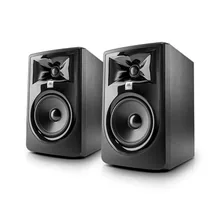 Ranked #13 of 76 in Medium Size Powered Bookshelf Speakers - JBL 305P MKII: $289.00 per pair Amazon eBay
Larger models: the JBL 306P MKII (rated 4.1/5) and the JBL 308P MKII (rated 4.4/5).
Pros: Erin’s Klippel data gives 5.38 standalone and 7.52 with an ideal subwoofer, with bass reaching -3dB around 51Hz. Broad horizontal coverage and reasonably smooth reflected sound support stable imaging across a desk. The existing review reports effective limiting and little sustained thermal compression, making it a strong budget-monitor option rather than just a speaker with a promising frequency curve. Measured bass extension of 50Hz (-3dB), with a measured sensitivity of 91.1dB.
Cons: The 3.3dB midrange span and rising response show it is not perfectly neutral. A port-related feature around 1.6kHz and some excess treble can be audible; the review recommends the treble-trim switch. Vertical crossover interference makes ear height important. Amplifier hiss may matter in very quiet nearfield use, and rear-port placement needs room-boundary adjustment.
Full JBL 305P MKII review and specifications →
| AES Input | No |
|---|---|
| Amplifier Power | 81w Per Speaker |
| App | No |
| Aux Input | No |
| Bass Extension (-10dB) | 43Hz (measured, Erin’s Audio Corner) |
| Bass Extension (-3dB) | 50Hz (measured, Erin’s Audio Corner) |
| Bluetooth | No |
| Coaxial Input | No |
| Dimensions | 11.7”H x 7.3”W x 9.1”D (297.2 x 185.4 x 231.1 mm) |
| Drivers | 5” (127mm) woofer |
| EQ | Yes (Room adjustment) |
| Frequency Response | 49 Hz - 20 kHz (+-3 dB) (Manufacturer specified) |
| HDMI Input | No |
| Inputs | XLR, TRS |
| Optical Input | No |
| RCA Input | No |
| Sensitivity | 91.1dB (measured at 0.3V/1m, Erin’s Audio Corner) |
| Spinorama Preference Score | 5.38 |
| Spinorama Preference Score with Perfect Sub | 7.52 |
| TRS Input | Yes |
| USB Input | No |
| Weight | 10.4 lbs (4.7 kg) each |
| XLR Input | Yes |
- Links
- Reviews, Comparisons and Sound Samples
- Erin’s Audio Corner Review Measurements More from Erin’s Audio Corner →
- Audio Science Review Measurements More from Audio Science Review →
- Erin’s Audio Corner: LIVE! JBL 305P MkII Powered Studio Monitor Review
- DSAUDIO.review: DSAUDIO.review Focal Alpha 50 EVO vs JBL 305P MKII sound.DEMO More from DSAUDIOreview →
- DSAUDIO.review: JBL 305P MKII vs Yamaha HS5 6-Track Comparison
- DSAUDIO.review: DSAUDIO.review JBL 305P MKII vs KRK Classic 5 CL5G3 sound.DEMO
- DSAUDIO.review: JBL 305P MKII vs Adam Audio T5V 6-Track Comparison
- DSAUDIO.review: DSAUDIO.review Adam Audio A5X vs JBL 305P MKII sound.DEMO
- DSAUDIO.review: DSAUDIO.review Kali Audio LP-6 V2 (2nd Wave) vs JBL 305P MKII sound.DEMO
- DSAUDIO.review: DSAUDIO.review Edifier MR4 vs JBL 305P MKII sound.DEMO
- DSAUDIO.review: Kali Audio IN-5 vs JBL 305P MKII Sound & Frequency Response Comparison
- DSAUDIO.review: JBL 308P MKII vs JBL 305P MKII Sound & Frequency Response Comparison
- DSAUDIO.review: Neumann KH80 DSP vs JBL 305P MKII Sound & Frquency Response Comparison
- DSAUDIO.review: JBL 305P MKII vs PreSonus Eris E5 6-Track Comparison
- Erin’s Audio Corner Measurements (spinorama.org)
- Jasper Tech: Best Desktop Computer Speakers for Every Budget – 2026 More from Jasper Tech →
- Jasper Tech: Best Powered Bookshelf Speakers for Every Budget - 2025
- Jasper Tech: Are the iLoud Micro Monitor Pro the Best Studio Monitor Speakers for your Home Studio?
- Head-to-Head Comparisons
- JBL 305P MKII vs KEF LS50 Wireless II
- JBL 305P MKII vs Klipsch The Fives
- JBL 305P MKII vs Genelec 8020D
- JBL 305P MKII vs Vanatoo Transparent One Encore Plus
- JBL 305P MKII vs Topping MA4
- JBL 305P MKII vs Devialet Phantom II 98 dB
- JBL 305P MKII vs IK Multimedia iLoud MTM MKII
- JBL 305P MKII vs Genelec 8320A
- See all 68 comparisons
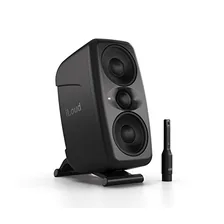 Ranked #23 of 76 in Medium Size Powered Bookshelf Speakers - IK Multimedia iLoud MTM: $1,600 per pair Discontinued Amazon eBay
Newer model: the IK Multimedia iLoud MTM MKII, ranked higher, rated 4.2/5.
Pros: ASR’s measurements of the original MTM give scores of 4.07 standalone and 6.26 with an ideal subwoofer, a 2.4dB midrange response span and a -3dB point around 53Hz. The small cabinet, balanced input and calibration capability make it useful for close listening where larger monitors would be impractical. Measured bass extension of 50Hz (-3dB).
Cons: The MTM arrangement makes listening height and orientation important, while bass below the low-50Hz region still needs support. The native response is not as smooth as the best compact reference monitors. Exact compression ceilings and correction examples from the MKII review should not be assigned to this original version; its score describes tonal response, not maximum clean volume. Treble runs about 3dB hot on-axis; the reviewer found the rear -3dB switch too aggressive and preferred about -1.5dB of external EQ. Discontinued.
Full IK Multimedia iLoud MTM review and specifications →
| AES Input | No |
|---|---|
| Amplifier Power | 100w Per Speaker |
| App | No |
| Aux Input | No |
| Bass Extension (-10dB) | 40Hz (measured, Audio Science Review) |
| Bass Extension (-3dB) | 50Hz (measured, Audio Science Review) |
| Bluetooth | No |
| Coaxial Input | No |
| Dimensions | 10.4”H x 5.1”W x 6.3”D (264.2 x 129.5 x 160 mm) |
| Drivers | 2x 3.5” (89mm) woofers |
| EQ | Yes (Room adjustment) |
| Frequency Response | 50 Hz - 24 kHz (-3dB) (Manufacturer specified) |
| HDMI Input | No |
| Inputs | XLR |
| Optical Input | No |
| RCA Input | No |
| TRS Input | No |
| USB Input | No |
| Weight | 5.5 lbs (2.5 kg) |
| XLR Input | Yes |
- Links
- Reviews, Comparisons and Sound Samples
- Audio Science Review Measurements More from Audio Science Review →
- DSAUDIO.review: IK Multimedia iLoud MTM vs Genelec 8020D Sound & Frequency Response Comparison More from DSAUDIOreview →
- DSAUDIOreview: IK Multimedia iLoud MTM vs iLoud Micro Sound & Frequency Response Comparison
- DSAUDIO.review: IK Multimedia iLoud MTM vs KRK Rokit 5 G4 Sound & Frequency Response Comparison
- DSAUDIO.review: IK Multimedia iLoud MTM vs Edifier S3000 Pro Sound & Frequency Response Comparison
- DSAUDIO.review: Neumann KH80 DSP vs IK Multimedia iLoud MTM Sound & Frequency Response Comparison
- DSAUDIO.review: Adam Audio A3X vs IK Multimedia iLoud MTM Sound & Frequency Response Comparison
- DSAUDIO.review: Yamaha HS8 vs IK Multimedia iLoud MTM Sound & Frequency Response Comparison
- Audio Science Review Measurements (spinorama.org)
- Head-to-Head Comparisons
- IK Multimedia iLoud MTM vs Kali Audio IN-5
- IK Multimedia iLoud MTM vs Kali Audio SM-5
- IK Multimedia iLoud MTM vs Pioneer DJ VM-50
- IK Multimedia iLoud MTM vs HEDD Type 05 A-CORE
- IK Multimedia iLoud MTM vs Airpulse A100
- IK Multimedia iLoud MTM vs IK Multimedia iLoud MTM MKII
- IK Multimedia iLoud MTM vs KEF LSX II LT
- IK Multimedia iLoud MTM vs Audioengine A5+ Classic
- See all 48 comparisons
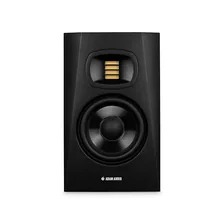 Ranked #30 of 76 in Medium Size Powered Bookshelf Speakers - Adam Audio T5V: $456 per pair Amazon eBay
Larger models: the Adam Audio T7V (rated 3.9/5) and the Adam Audio T8V (rated 3.9/5).
Pros: ASR’s data shows a small 2.0dB span from 300Hz to 5kHz, a -3dB point around 59Hz, and scores of 4.65 standalone and 7.02 with an ideal subwoofer. It offers useful bass and midrange performance for an affordable studio monitor. Rear tonal trims allow broad placement adjustment. Measured bass extension of 58.6Hz (-3dB).
Cons: The response rises toward the treble by about 0.56dB per octave, so the small midrange span should not be mistaken for flat full-band response. Upper-frequency unevenness remains, and a shelving control cannot precisely remove every peak. The existing review finds distortion reasonable for the price rather than reference-class; deeper bass and demanding levels still call for more capable hardware.
Full Adam Audio T5V review and specifications →
| AES Input | No |
|---|---|
| Amplifier Power | 70w Per Speaker |
| App | No |
| Aux Input | No |
| Bass Extension (-10dB) | 45.9Hz (derived, log-interpolated between spinorama.org -9dB/-12dB points) |
| Bass Extension (-3dB) | 58.6Hz (measured, Audio Science Review) |
| Bluetooth | No |
| Coaxial Input | No |
| Dimensions | 11.7”H x 7”W x 11.7”D (297.2 x 177.8 x 297.2 mm) |
| Drivers | 5” (127mm) woofer |
| EQ | Yes (Room adjustment) |
| Frequency Response | 58Hz - 24kHz (-3dB) (Manufacturer specified) |
| HDMI Input | No |
| Inputs | XLR, RCA |
| Optical Input | No |
| RCA Input | Yes |
| Spinorama Preference Score | 4.65 |
| Spinorama Preference Score with Perfect Sub | 7.02 |
| TRS Input | No |
| USB Input | No |
| Weight | 12.6 lbs (5.7 kg) each |
| XLR Input | Yes |
- Links
- Reviews, Comparisons and Sound Samples
- Audio Science Review Measurements More from Audio Science Review →
- DSAUDIO.review: JBL 305P MKII vs Adam Audio T5V 6-Track Comparison More from DSAUDIOreview →
- DSAUDIO.review: Kali LP-6 vs Adam Audio T5V Sound & Frequency Response Comparison
- DSAUDIO.review: Adam Audio T5V vs Yamaha HS5 5 Track Comparison
- DSAUDIO.review: DSAUDIO.review Adam Audio A5X vs Adam Audio T5V sound.DEMO
- DSAUDIO.review: DSAUDIO.review Focal Alpha 50 EVO vs Adam Audio T5V sound.DEMO
- DSAUDIO.review: Adam Audio T5V vs Presonus Eris E5 5 Track Comparison
- DSAUDIO.review: KRK Rokit 5 G4 RP5G4 vs Adam Audio T5V Sound & Frequency Response Comparison
- DSAUDIO.review: Bright and brighter. PreSonus E5 XT takes on Adam Audio T5V SOUND & FREQUENCY RESPONSE COMPARISON
- DSAUDIO.review: Adam Audio T5V vs Adam Audio T7V Sound & Frequency Response Comparison
- Audio Science Review Measurements (spinorama.org)
- Jasper Tech: Best Desktop Computer Speakers for Every Budget – 2026 More from Jasper Tech →
- Jasper Tech: Are the iLoud Micro Monitor Pro the Best Studio Monitor Speakers for your Home Studio?
- Head-to-Head Comparisons
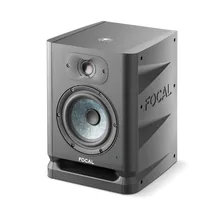 Ranked #41 of 76 in Medium Size Powered Bookshelf Speakers - Focal Alpha 50 EVO: $608 per pair Amazon eBay
Pros: Rear shelving controls and a conventional studio-monitor layout provide practical placement adjustment.
Cons: Basic shelving controls are less flexible than parametric room correction. Careful placement is still important, especially near walls or on a desk.
Full Focal Alpha 50 EVO review and specifications →
| AES Input | No |
|---|---|
| Amplifier Power | 60w Per Speaker |
| App | No |
| Aux Input | No |
| Bluetooth | No |
| Coaxial Input | No |
| Dimensions | 12.2”H x 9”W x 9.4”D (309.9 x 228.6 x 238.8 mm) |
| Drivers | 5” (127mm) woofer |
| EQ | Yes (Room adjustment) |
| Frequency Response | 45 Hz - 22 kHz (+-3 dB) (Manufacturer specified) |
| HDMI Input | No |
| Inputs | XLR, TRS, RCA |
| Optical Input | No |
| RCA Input | Yes |
| Spinorama Preference Score | 1.04 |
| Spinorama Preference Score with Perfect Sub | 5.70 |
| TRS Input | Yes |
| USB Input | No |
| Weight | 13.2 lbs (6.0 kg) each |
| XLR Input | Yes |
- Links
- Reviews, Comparisons and Sound Samples
- Independent Measurements (spinorama.org)
- DSAUDIO.review: DSAUDIO.review Focal Alpha 50 EVO vs Adam Audio T5V sound.DEMO More from DSAUDIOreview →
- DSAUDIO.review: DSAUDIO.review APS Klasik 2020 vs Focal Alpha 50 EVO sound.DEMO
- DSAUDIO.review: DSAUDIO.review Focal Alpha 50 EVO vs Focal Alpha 65 EVO sound.DEMO
- DSAUDIO.review: DSAUDIO.review Focal Alpha 50 EVO vs KRK Rokit 5 G4 RP5G4 sound.DEMO
- DSAUDIO.review: DSAUDIO.review Focal Alpha 50 EVO vs JBL 305P MKII sound.DEMO
- DSAUDIO.review: DSAUDIO.review Adam Audio A5X vs Focal Alpha 50 EVO sound.DEMO
- DSAUDIO.review: DSAUDIO.review Focal Alpha 50 EVO vs Eve Audio SC205 sound.DEMO
- DSAUDIO.review: DSAUDIO.review Kali Audio LP-6 V2 (2nd Wave) vs Focal Alpha 50 EVO sound.DEMO
- DSAUDIO.review: DSAUDIO.review Focal Alpha 50 EVO vs KRK Classic 5 CL5G3 sound.DEMO
- DSAUDIO.review: DSAUDIO.review Focal Alpha 50 EVO vs Yamaha HS5 sound.DEMO
- Head-to-Head Comparisons
- Focal Alpha 50 EVO vs Dayton Audio M4
- Focal Alpha 50 EVO vs Neumi BS5P
- Focal Alpha 50 EVO vs Neumi BS5P-ARC
- Focal Alpha 50 EVO vs Onkyo GX-30ARC
- Focal Alpha 50 EVO vs Vanatoo Transparent Zero Plus
- Focal Alpha 50 EVO vs Kanto YU
- Focal Alpha 50 EVO vs KRK Rokit 5 G4
- Focal Alpha 50 EVO vs Kali LP-UNF
- See all 64 comparisons
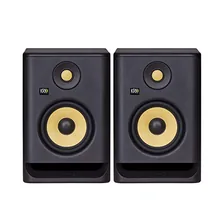 Ranked #46 of 76 in Medium Size Powered Bookshelf Speakers - KRK Rokit 5 G4: $337 per pair Discontinued eBay
Newer model: the KRK Rokit 5 G5, ranked higher, estimated 3.8/5.
Larger models: the KRK Rokit 7 G4 (rated 3.9/5) and the KRK Rokit 8 G4 (rated 3.9/5).
Pros: ASR’s data gives -3dB bass around 56Hz and scores of 3.92 standalone and 6.29 with an ideal subwoofer. The waveguide provides useful horizontal directivity control, while onboard adjustments help tailor broad balance. The existing review reports low distortion at 86dB and low audible hiss. Measured bass extension of 55.7Hz (-3dB).
Cons: The 3.6dB midrange span and listening-window narrow-band deviation of 0.502 show that native response is not reference-flat. A port-region resonance and other tonal irregularities remain. Its deeper bass does not establish greater detail or mixing accuracy than another monitor. EQ can help, but the unequalized measurements determine the starting recommendation. Discontinued.
Full KRK Rokit 5 G4 review and specifications →
| AES Input | No |
|---|---|
| Amplifier Power | 55w Per Speaker |
| App | No |
| Aux Input | No |
| Bass Extension (-10dB) | 44.4Hz (derived, log-interpolated between spinorama.org -9dB/-12dB points) |
| Bass Extension (-3dB) | 55.7Hz (measured, Audio Science Review) |
| Bluetooth | No |
| Coaxial Input | No |
| Dimensions | 11.2”H x 7.5”W x 9.5”D (284.5 x 190.5 x 241.3 mm) |
| Drivers | 5” (127mm) woofer |
| EQ | Yes (Room adjustment) |
| Frequency Response | 58Hz - 24kHz (-3dB) (Manufacturer specified) |
| HDMI Input | No |
| Inputs | TRS/XLR |
| Optical Input | No |
| RCA Input | No |
| Spinorama Preference Score | 3.92 |
| Spinorama Preference Score with Perfect Sub | 6.29 |
| TRS Input | Yes |
| USB Input | No |
| Weight | 10.8 lbs (4.9 kg) each |
| XLR Input | Yes |
- Links
- Reviews, Comparisons and Sound Samples
- Audio Science Review Measurements More from Audio Science Review →
- DSAUDIO.review: DSAUDIO.review Focal Alpha 50 EVO vs KRK Rokit 5 G4 RP5G4 sound.DEMO More from DSAUDIOreview →
- DSAUDIO.review: KRK Rokit 5 G4 RP5G4 vs Adam Audio T5V Sound & Frequency Response Comparison
- DSAUDIO.review: DSAUDIO.review KRK Classic 5 CL5G3 vs KRK Rokit 5 RP5G4 sound.DEMO
- DSAUDIO.review: KRK Rokit 5 G4 RP5G4 vs Yamaha HS5 Sound & Frequency Response Comparison
- DSAUDIO.review: KRK Rokit 5 G4 RP5G4 vs Presonus Eris E5 Sound & Frequency Response Comparison
- DSAUDIO.review: PreSonus E5 XT vs KRK Rokit 5 G4 Sound & Frequency Response Comparison
- DSAUDIO.review: Genelec 8020D & KRK Rokit 5 G4 PR5G4 - Same, same, but different Sound & Response Comparison
- DSAUDIO.review: Neumann KH80 DSP vs KRK Rokit 5 G4 RP5G4 Sound & Frequency Response Comparison
- DSAUDIO.review: Tannoy Gold 5 vs KRK Rokit 5 G4 RP5G4 Sound & Frequency Response Comparison
- DSAUDIO.review: IK Multimedia iLoud MTM vs KRK Rokit 5 G4 Sound & Frequency Response Comparison
- Audio Science Review Measurements (spinorama.org)
- Head-to-Head Comparisons
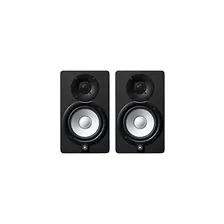 Ranked #49 of 76 in Medium Size Powered Bookshelf Speakers - Yamaha HS5: $399.98 per pair Amazon eBay
Larger models: the Yamaha HS7 (rated 3.9/5) and the Yamaha HS8 (rated 4.4/5).
Pros: ASR found reasonably smooth early-reflection directivity, which makes broad EQ correction more promising than on speakers whose off-axis response changes abruptly. Balanced inputs and placement controls suit studio use. The measured preference scores are 3.70 standalone and 6.32 with an ideal subwoofer. Measured bass extension of 88Hz (-3dB).
Cons: The measurements do not support describing it as very neutral: excess midrange and reduced lower-midrange/upper-bass weight produce a bass-light balance. The 300Hz-5kHz span is 4.3dB. Its automated -3dB crossing is affected by response shape, so it should not be treated as a simple bass-cutoff specification. A subwoofer adds low bass but does not fix the elevated midrange.
Full Yamaha HS5 review and specifications →
| AES Input | No |
|---|---|
| Amplifier Power | 45w Per Speaker |
| App | No |
| Aux Input | No |
| Bass Extension (-10dB) | 68Hz (measured, Audio Science Review) |
| Bass Extension (-3dB) | 88Hz (measured, Audio Science Review) |
| Bluetooth | No |
| Coaxial Input | No |
| Dimensions | 11.2”H x 6.7”W x 8.7”D (284.5 x 170.2 x 221 mm) |
| Drivers | 5” (127mm) woofer |
| EQ | Yes (Room adjustment) |
| Frequency Response | 58Hz - 24kHz (-3dB) (Manufacturer specified) |
| HDMI Input | No |
| Inputs | XLR |
| Optical Input | No |
| RCA Input | No |
| Spinorama Preference Score | 3.70 |
| Spinorama Preference Score with Perfect Sub | 6.32 |
| TRS Input | No |
| USB Input | No |
| Weight | 12.1 lbs (5.5 kg) each |
| XLR Input | Yes |
- Links
- Reviews, Comparisons and Sound Samples
- Audio Science Review Measurements More from Audio Science Review →
- DSAUDIO.review: DSAUDIO.review KRK Classic 5 CL5G3 vs Yamaha HS5 sound.DEMO More from DSAUDIOreview →
- DSAUDIO.review: DSAUDIO.review Focal Alpha 50 EVO vs Yamaha HS5 sound.DEMO
- DSAUDIO.review: Genelec 8020D vs Yamaha HS5 Soun & Frequency Response Comparison
- DSAUDIO.review: JBL 305P MKII vs Yamaha HS5 6-Track Comparison
- DSAUDIO.review: Adam Audio T5V vs Yamaha HS5 5 Track Comparison
- DSAUDIO.review: Yamaha HS5 vs Presonus Eris E5 Sound Demo
- DSAUDIO.review: KRK Rokit 5 G4 RP5G4 vs Yamaha HS5 Sound & Frequency Response Comparison
- DSAUDIO.review: New PreSonus E5 XT and Yamaha HS5 could not sound any more different! SOUND AND RESPONSE COMPARISON
- DSAUDIO.review: Yamaha HS8 vs Yamaha HS5 Sound & Frequency Response Comparison
- DSAUDIO.review: Genelec 8010A (Genelec G One) vs Yamaha HS5 Sound Demo w/ Bass Test
- Audio Science Review Measurements (spinorama.org)
- Head-to-Head Comparisons
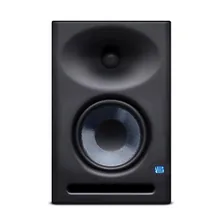 Ranked #53 of 76 in Medium Size Powered Bookshelf Speakers - Presonus Eris E5 XT: $239.98 per pair Discontinued eBay
Newer model: the PreSonus Eris Studio 5, ranked higher, estimated 3.6/5.
Pros: ASR’s measurements show reasonably consistent directivity through the crossover, so EQ changes are more likely to benefit both direct and reflected sound. Bass reaches -3dB around 56Hz. A standalone preference score of 3.58 rises to 6.00 with an ideal subwoofer, indicating useful bass reach but only moderate native tonal performance. Measured bass extension of 56.4Hz (-3dB).
Cons: The response has bass and treble emphasis with a recessed crossover region; smooth directivity carries that imbalance into room reflections rather than fixing it. Existing distortion testing shows problems across a broad range when pushed to 96dB. Tone correction and moderate levels help, but it is not a reference-flat monitor out of the box. Discontinued.
Full Presonus Eris E5 XT review and specifications →
| AES Input | No |
|---|---|
| Amplifier Power | 80w Per Speaker |
| App | No |
| Aux Input | No |
| Bass Extension (-10dB) | 46.9Hz (derived, log-interpolated between spinorama.org -9dB/-12dB points) |
| Bass Extension (-3dB) | 56.4Hz (measured, Audio Science Review) |
| Bluetooth | No |
| Coaxial Input | No |
| Dimensions | 10.2”H x 7”W x 7.7”D (259.1 x 177.8 x 195.6 mm) |
| Drivers | 5” (127mm) woofer |
| EQ | Yes (Room adjustment) |
| Frequency Response | 53Hz - 22kHz (Manufacturer specified) |
| HDMI Input | No |
| Inputs | TRS, XLR, RCA |
| Optical Input | No |
| RCA Input | Yes |
| Spinorama Preference Score | 3.58 |
| Spinorama Preference Score with Perfect Sub | 6.00 |
| TRS Input | Yes |
| USB Input | No |
| Weight | 10.1 lbs (4.6 kg) each |
| XLR Input | Yes |
- Links
- Reviews, Comparisons and Sound Samples
- DSAUDIO.review: New PreSonus E5 XT and Yamaha HS5 could not sound any more different! SOUND AND RESPONSE COMPARISON More from DSAUDIOreview →
- DSAUDIO.review: Bright and brighter. PreSonus E5 XT takes on Adam Audio T5V SOUND & FREQUENCY RESPONSE COMPARISON
- DSAUDIO.review: PreSonus Eris E5 XT vs PreSonus Eris E5 (new vs old) Sound & Frequency Response Comparison
- DSAUDIO.review: PreSonus E7 XT vs PreSonus E5 XT Sound & Frequency Response Comparison
- DSAUDIO.review: PreSonus Eris E8 XT vs PreSonus Eris E5 XT Sound & Frequency Response Comparison
- DSAUDIO.review: PreSonus E5 XT vs KRK Rokit 5 G4 Sound & Frequency Response Comparison
- Audio Science Review Measurements More from Audio Science Review →
- Audio Science Review Measurements (spinorama.org)
- Head-to-Head Comparisons
- Presonus Eris E5 XT vs Edifier S2000MKIII
- Presonus Eris E5 XT vs Edifier MR4.5
- Presonus Eris E5 XT vs Edifier MR4
- Presonus Eris E5 XT vs Palmer STUDIMON 5
- Presonus Eris E5 XT vs KRK Classic 5
- Presonus Eris E5 XT vs Adam Audio A4V
- Presonus Eris E5 XT vs Yamaha HS5
- Presonus Eris E5 XT vs M-Audio BX4 D3
- See all 56 comparisons
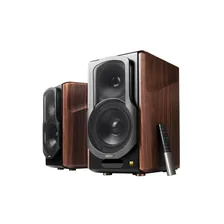 Ranked #54 of 76 in Medium Size Powered Bookshelf Speakers - Edifier S2000MKIII: $699.99 per pair Amazon eBay
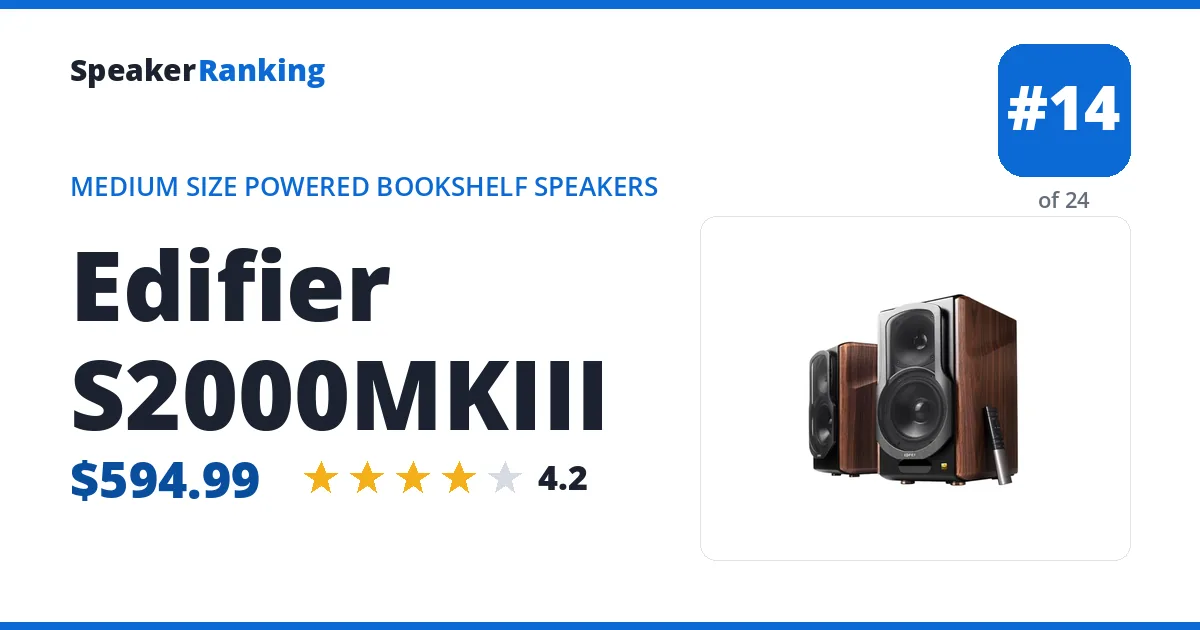
Pros: The available digitized response suggests substantial bass reach, with a -3dB estimate around 41Hz. Scores are 4.24 standalone and 5.99 with an ideal subwoofer. Digital inputs and a self-contained stereo-pair format are convenient for general music listening. Digital input handles high-resolution audio up to 192kHz/24-bit.
Cons: The 4.0dB midrange span and uneven predicted room response suggest meaningful coloration. Favorable modeled EQ results should not be treated as the sound of the stock speaker or as proof that all dispersion issues are correctable.
Full Edifier S2000MKIII review and specifications →
| AES Input | No |
|---|---|
| Amplifier Power | 65w RMS Per Speaker |
| App | No |
| Aux Input | No |
| Bluetooth | Yes, 5.0 |
| Bluetooth Codecs | SBC, aptX HD |
| Coaxial Input | Yes |
| Dimensions | 13.5”H x 7.8”W x 10.8”D (342.9 x 198.1 x 274.3 mm) |
| Drivers | 5.5” (140mm) woofer |
| EQ | No |
| Frequency Response | 40.5Hz at -3dB; 37Hz at -6dB (Spinorama) |
| HDMI Input | No |
| Inputs | Bluetooth, 2x RCA Input, Digital Optical, Digital Coax |
| Optical Input | Yes |
| Outputs | None |
| RCA Input | Yes |
| Spinorama Preference Score | 4.24 |
| Spinorama Preference Score with Perfect Sub | 5.99 |
| TRS Input | No |
| USB Input | No |
| Weight | 20.7 lbs (9.4 kg) |
| XLR Input | No |
- Links
- Reviews, Comparisons and Sound Samples
- DSAUDIO.review: DSAUDIO.review Edifier S1000MKII vs Edifier S2000MKIII sound.DEMO More from DSAUDIOreview →
- DSAUDIO.review: DSAUDIO.review Edifier S2000MKIII vs Klipsch The Three II sound.DEMO
- DSAUDIO.review: DSAUDIO.review Edifier R2850DB vs Edifier S2000MKIII sound.DEMO
- DSAUDIO.review: Edifier S2000MKIII vs Edifier S3000PRO Sound & Frequency Response Comparison
- Archimago Measurements (spinorama.org)
- Head-to-Head Comparisons
- Edifier S2000MKIII vs Edifier MR4
- Edifier S2000MKIII vs Presonus Eris E5 XT
- Edifier S2000MKIII vs KRK Classic 5
- Edifier S2000MKIII vs Edifier MR4.5
- Edifier S2000MKIII vs Palmer STUDIMON 5
- Edifier S2000MKIII vs M-Audio BX4 D3
- Edifier S2000MKIII vs Presonus Eris E5
- Edifier S2000MKIII vs Adam Audio A4V
- See all 73 comparisons
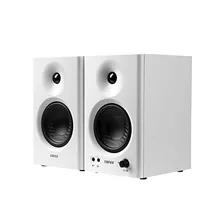 Ranked #55 of 76 in Medium Size Powered Bookshelf Speakers - Edifier MR4: $138.99 per pair Amazon eBay
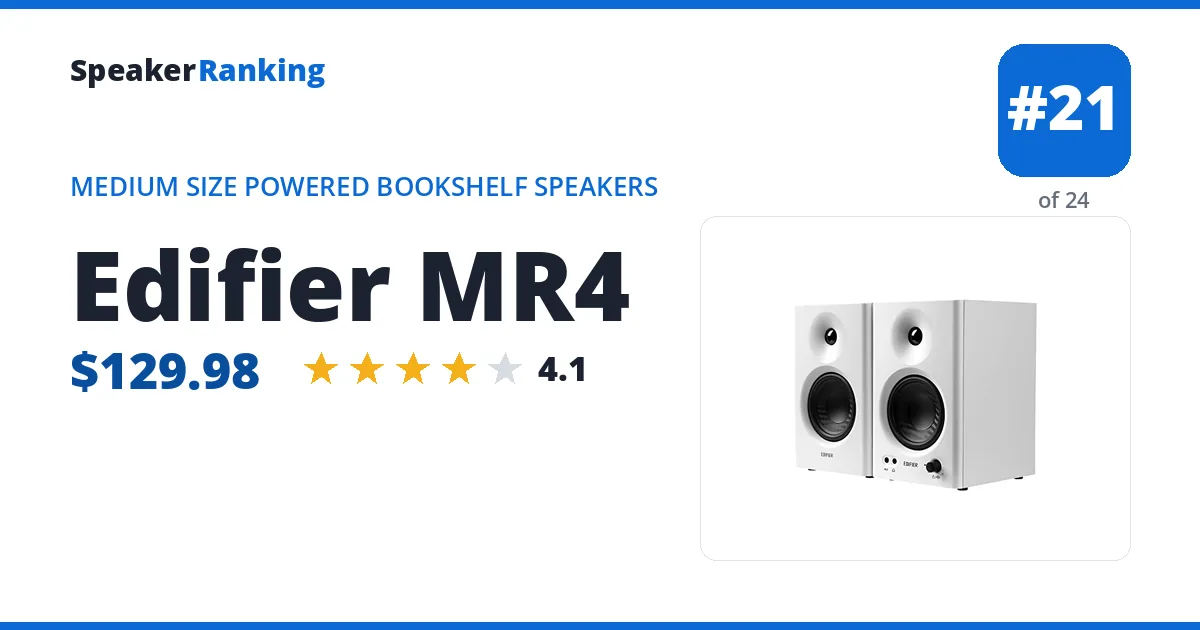
Pros: Erin’s data supports a useful budget desktop monitor: a 3.0dB midrange span, little overall on-axis tilt, and preference scores of 3.25 standalone and 6.00 with an ideal subwoofer. Balanced TRS inputs and tone controls are practical at its price, and its response is more balanced than the measured R1280T. Measured bass extension of 79Hz (-3dB), with a measured sensitivity of 78dB.
Cons: Bass reaches -3dB around 79Hz, so deep extension should not be inferred from the overall flat trend. Listening-window response still has local irregularities, including lower-treble unevenness. The existing review reports rapidly increasing distortion and audible distress when pushed well above moderate desktop levels. No Bluetooth, and adding a subwoofer does not cure every output or tonal limitation.
Full Edifier MR4 review and specifications →
| AES Input | No |
|---|---|
| Amplifier Power | 42W RMS total (21W per speaker) |
| App | No |
| Aux Input | Yes |
| Bass Extension (-10dB) | 59Hz (measured, Erin’s Audio Corner) |
| Bass Extension (-3dB) | 79Hz (measured, Erin’s Audio Corner) |
| Bluetooth | No |
| Coaxial Input | No |
| Dimensions | 9”H x 5.5”W x 7.6”D (228.6 x 139.7 x 193 mm) |
| Drivers | 4” (102mm) woofer, 1” silk dome tweeter |
| EQ | Yes (Monitor and Music modes) |
| Frequency Response | 60 Hz-20 kHz (-3dB) (Manufacturer specified) |
| HDMI Input | No |
| Headphone Output | Yes |
| Inputs | TRS Balanced, RCA, Aux |
| Optical Input | No |
| Outputs | Headphone |
| RCA Input | Yes |
| Sensitivity | 78dB (measured at 0.3V/1m, Erin’s Audio Corner) |
| Spinorama Preference Score | 3.25 |
| Spinorama Preference Score with Perfect Sub | 6.00 |
| TRS Input | Yes |
| USB Input | No |
| Weight | 9.9 lbs (4.5 kg) |
| XLR Input | No |
- Links
- Reviews, Comparisons and Sound Samples
- Erin’s Audio Corner Review Measurements More from Erin’s Audio Corner →
- Audio Science Review Measurements More from Audio Science Review →
- DSAUDIO.review: DSAUDIO.review Edifier MR4 vs Edifier R1280DBs sound.DEMO More from DSAUDIOreview →
- DSAUDIO.review: DSAUDIO.review Edifier MR4 vs Edifier R1700BT sound.DEMO
- DSAUDIO.review: DSAUDIO.review Edifier MR4 vs JBL 305P MKII sound.DEMO
- DSAUDIO.review: DSAUDIO.review Edifier MR4 vs Presonus Eris E3.5 sound.DEMO
- DSAUDIO.review: DSAUDIO.review Edifier MR4 vs iLoud Micro Monitor sound.DEMO
- DSAUDIO.review: DSAUDIO.review Edifier MR4 vs Presonus Eris E4.5 sound.DEMO
- DSAUDIO.review: DSAUDIO.review Edifier MR4 vs Mackie CR4-X sound.DEMO
- Erin’s Audio Corner Measurements (spinorama.org)
- Jasper Tech: Best Desktop Computer Speakers for Every Budget – 2026 More from Jasper Tech →
- Jasper Tech: Are the iLoud Micro Monitor Pro the Best Studio Monitor Speakers for your Home Studio?
- Erin’s Audio Corner: Edifier MR4 Powered Studio Monitors Review
- Head-to-Head Comparisons
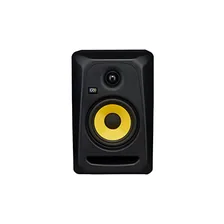 Ranked #56 of 76 in Medium Size Powered Bookshelf Speakers - KRK Classic 5: $319.99 per pair Amazon eBay
Pros: ASR’s Klippel data gives -3dB bass around 60Hz and a 5.99 preference score with an ideal subwoofer. Broad tonal correction can improve it, so it may be useful to someone willing to measure and EQ a basic studio setup. Measured bass extension of 60.1Hz (-3dB).
Cons: The native standalone score is 3.47 and the midrange span is a large 6.5dB. Excess treble and crossover/directivity errors keep it from being neutral out of the box, while low-bass distortion limits loud playback. Modeled EQ scores are not stock performance and do not demonstrate corrected distortion or dispersion.
Full KRK Classic 5 review and specifications →
| AES Input | No |
|---|---|
| Amplifier Power | 50w RMS Per Speaker |
| App | No |
| Aux Input | No |
| Bass Extension (-3dB) | 60.1Hz (Spinorama/Audio Science Review) |
| Bass Extension (-6dB) | 54.2Hz (Spinorama/Audio Science Review) |
| Bluetooth | No |
| Coaxial Input | No |
| Dimensions | 9.7”H x 7.4”W x 11.2”D (246.4 x 188 x 284.5 mm) |
| Drivers | 5” (127mm) woofer |
| EQ | Yes (Room adjustment) |
| Frequency Response | 56Hz-30kHz (+-3dB) (Manufacturer specified) |
| HDMI Input | No |
| Inputs | RCA, TRS, XLR |
| Optical Input | No |
| RCA Input | Yes |
| Spinorama Preference Score | 3.47 |
| Spinorama Preference Score with Perfect Sub | 5.99 |
| TRS Input | Yes |
| USB Input | No |
| Weight | 12.9 lbs (5.87 kg) |
| XLR Input | Yes |
- Links
- Reviews, Comparisons and Sound Samples
- Audio Science Review Measurements More from Audio Science Review →
- DSAUDIO.review: DSAUDIO.review Edifier S1000MKII vs Edifier S2000MKIII sound.DEMO More from DSAUDIOreview →
- DSAUDIO.review: Edifier S2000MKIII vs Edifier S3000PRO Sound & Frequency Response Comparison
- DSAUDIO.review: DSAUDIO.review Focal Alpha 50 EVO vs KRK Classic 5 CL5G3 sound.DEMO
- DSAUDIO.review: DSAUDIO.review JBL 305P MKII vs KRK Classic 5 CL5G3 sound.DEMO
- DSAUDIO.review: DSAUDIO.review KRK Classic 5 CL5G3 vs Yamaha HS5 sound.DEMO
- DSAUDIO.review: DSAUDIO.review KRK Classic 5 CL5G3 vs KRK Rokit 5 RP5G4 sound.DEMO
- Audio Science Review Measurements (spinorama.org)
- Head-to-Head Comparisons
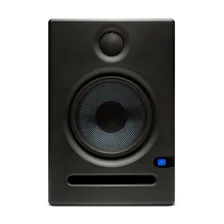 Ranked #58 of 76 in Medium Size Powered Bookshelf Speakers - Presonus Eris E5: $219.98 per pair Amazon eBay
Pros: Balanced XLR/TRS and RCA inputs plus placement adjustment make the original Eris E5 easy to connect to studio or consumer sources. Existing listening notes describe a fuller low end than some small, bass-light monitors, which may suit casual nearfield listening.
Cons: A fuller bass balance is not necessarily neutral. Placement adjustment is useful, but it does not replace a properly integrated subwoofer for deep-bass monitoring.
Full Presonus Eris E5 review and specifications →
| AES Input | No |
|---|---|
| Amplifier Power | 80w Per Speaker |
| App | No |
| Aux Input | No |
| Bluetooth | No |
| Coaxial Input | No |
| Dimensions | 10.2”H x 7”W x 7.7”D (259.1 x 177.8 x 195.6 mm) |
| Drivers | 5” (127mm) woofer |
| EQ | Yes (Room adjustment) |
| Frequency Response | 53Hz - 22kHz (Manufacturer specified) |
| HDMI Input | No |
| Inputs | TRS, XLR, RCA |
| Optical Input | No |
| RCA Input | Yes |
| TRS Input | Yes |
| USB Input | No |
| Weight | 10.1 lbs (4.6 kg) each |
| XLR Input | Yes |
- Links
- Reviews, Comparisons and Sound Samples
- DSAUDIO.review: Adam Audio T5V vs Presonus Eris E5 5 Track Comparison More from DSAUDIOreview →
- DSAUDIO.review: Yamaha HS5 vs Presonus Eris E5 Sound Demo
- DSAUDIO.review: Fluid Audio F5 vs Presonus Eris E5 Sound & Frequency Response Comparison
- DSAUDIO.review: M-Audio BX5 D3 vs Presonus Eris E5 5 Track Comparison
- DSAUDIO.review: PreSonus Eris E5 XT vs PreSonus Eris E5 (new vs old) Sound & Frequency Response Comparison
- DSAUDIO.review: JBL 305P MKII vs PreSonus Eris E5 6-Track Comparison
- DSAUDIO.review: Mackie CR5 BT vs Presonus Eris E5 Sound Demo w/ Bass Test
- DSAUDIO.review: KRK Rokit 5 RP5G3 vs Presonus E5 Sound Demo w/ Bass Test
- DSAUDIO.review: JBL LSR305 vs Presonus Eris E5 Sound Demo
- DSAUDIO.review: KRK Rokit 5 G4 RP5G4 vs Presonus Eris E5 Sound & Frequency Response Comparison
- Head-to-Head Comparisons
- Presonus Eris E5 vs Edifier MR5
- Presonus Eris E5 vs M-Audio BX4 D3
- Presonus Eris E5 vs KRK Classic 5
- Presonus Eris E5 vs Audioengine HD6
- Presonus Eris E5 vs Edifier MR4
- Presonus Eris E5 vs Edifier R2000DB
- Presonus Eris E5 vs Edifier S1000W
- Presonus Eris E5 vs Edifier S2000MKIII
- See all 50 comparisons
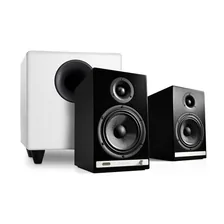 Ranked #60 of 76 in Medium Size Powered Bookshelf Speakers - Audioengine HD6: $817.44 per pair Amazon eBay
Pros: Analog and optical inputs, RCA output and built-in amplification provide a convenient self-contained stereo setup. The cabinet and driver size can be practical for general music listening without assembling a separate amplifier system.
Cons: Listening impressions describe bass and treble emphasis with a recessed midrange, which may suit casual listening better than neutral monitoring.
Full Audioengine HD6 review and specifications →
| AES Input | No |
|---|---|
| Amplifier Power | 50w RMS Per Speaker |
| App | No |
| Aux Input | Yes |
| Bluetooth | Yes, 5.0 |
| Bluetooth Codecs | SBC, AAC, aptX, aptX HD |
| Coaxial Input | No |
| Dimensions | 11.7”H x 7.2”W x 10”D (298.4 x 184.1 x 254 mm) |
| Drivers | 5.5” (140mm) woofer |
| EQ | No |
| Frequency Response | 45Hz-40kHz (-3dB) (Manufacturer specified) |
| HDMI Input | No |
| Inputs | Bluetooth, Aux, RCA Input, Digital Optical |
| Optical Input | Yes |
| Outputs | RCA variable output (subwoofer) |
| RCA Input | Yes |
| Subwoofer Output | Yes |
| TRS Input | No |
| USB Input | No |
| Weight | 17.4 lbs (7.9 kg) |
| XLR Input | No |
- Links
- Reviews, Comparisons and Sound Samples
- Head-to-Head Comparisons
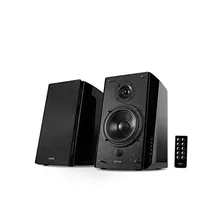 Ranked #61 of 76 in Medium Size Powered Bookshelf Speakers - Edifier R2000DB: $399.99 per pair Amazon eBay
Pros: Multiple analog inputs and optical connectivity make it convenient for a simple powered stereo system. It can suit general desktop listening when source flexibility matters more than professional monitoring functions.
Cons: Listening impressions suggest a midrange-forward presentation. It is better suited to a simple home stereo setup than a studio workflow requiring balanced inputs.
Full Edifier R2000DB review and specifications →
| AES Input | No |
|---|---|
| Amplifier Power | 60w RMS Per Speaker |
| App | No |
| Aux Input | No |
| Bluetooth | Yes |
| Bluetooth Codecs | SBC |
| Coaxial Input | No |
| Dimensions | 11.3”H x 7.5”W x 9.5”D (285.8 x 190.5 x 241.3 mm) |
| Drivers | 5” (127mm) woofer |
| EQ | No |
| Frequency Response | 55Hz-40kHz (-3dB) (Manufacturer specified) |
| HDMI Input | No |
| Inputs | Bluetooth, 2x RCA Input, Digital Optical |
| Optical Input | Yes |
| RCA Input | Yes |
| TRS Input | No |
| USB Input | No |
| Weight | 17.4 lbs (7.9 kg) |
| XLR Input | No |
- Links
- Reviews, Comparisons and Sound Samples
- Head-to-Head Comparisons
- Edifier R2000DB vs Edifier S1000W
- Edifier R2000DB vs Audioengine HD6
- Edifier R2000DB vs Edifier S1000MKII
- Edifier R2000DB vs Edifier MR5
- Edifier R2000DB vs Kali Audio IN-UNF
- Edifier R2000DB vs Presonus Eris E5
- Edifier R2000DB vs Audioengine HD4
- Edifier R2000DB vs Edifier R1700BT
- See all 59 comparisons
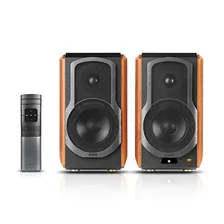 Ranked #62 of 76 in Medium Size Powered Bookshelf Speakers - Edifier S1000W: $599.99 per pair Amazon eBay
Pros: Network playback and multiple digital and analog connections make it a convenient all-in-one music system. Support for high-resolution input is useful for compatibility with different sources.
Cons: High-resolution input support does not itself improve acoustic accuracy. The all-in-one format offers less component flexibility than separate speakers and amplification. No independent measurements exist; reviews are limited to informal listening comparisons.
Full Edifier S1000W review and specifications →
| AES Input | No |
|---|---|
| Amplifier Power | 60w RMS Per Speaker |
| App | No |
| Aux Input | No |
| Bluetooth | Yes, 5.2 |
| Bluetooth Codecs | SBC (inferred; additional codecs unverified) |
| Coaxial Input | Yes |
| Dimensions | 13.6”H x 7.6”W x 11.6”D (345.4 x 193 x 294.6 mm) |
| Drivers | 5.5” (140mm) woofer |
| EQ | No |
| Frequency Response | 45Hz-40kHz (-3dB) (Manufacturer specified) |
| HDMI Input | No |
| Inputs | Bluetooth, Wifi, 2x RCA Input, Digital Optical, Digital Coax |
| Optical Input | Yes |
| Outputs | None |
| RCA Input | Yes |
| TRS Input | No |
| USB Input | No |
| Weight | 37 lbs (16.8 kg) |
| XLR Input | No |
- Links
- Reviews, Comparisons and Sound Samples
- Head-to-Head Comparisons
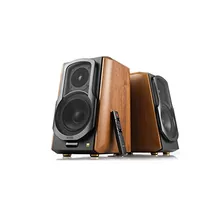 Ranked #63 of 76 in Medium Size Powered Bookshelf Speakers - Edifier S1000MKII: $499.99 per pair Amazon eBay
Pros: A self-powered stereo pair with optical, coaxial and analog inputs, plus high-resolution digital support, makes source switching unusually simple. Consumer Reports rates its sound accurate and detailed, so it is a strong one-box alternative to separate amplifier-and-speaker systems for nearfield or small-room listening.
Cons: High-resolution input support is not a guarantee of perfect tuning, and the fixed internal amplification prevents the gradual upgrades possible with separates. These are mains-powered speakers rather than portable wireless speakers, and their size and left/right cabling need a planned desktop or stand setup. No independent measurements exist; reviews are limited to informal listening comparisons.
Full Edifier S1000MKII review and specifications →
| AES Input | No |
|---|---|
| Amplifier Power | 60w RMS Per Speaker |
| App | No |
| Aux Input | No |
| Bluetooth | Yes |
| Bluetooth Codecs | SBC, aptX HD |
| Coaxial Input | Yes |
| Dimensions | 13.6”H x 7.6”W x 11.6”D (345.4 x 193 x 294.6 mm) |
| Drivers | 5.5” (140mm) woofer |
| EQ | No |
| Frequency Response | 45Hz - 40kHz (Manufacturer specified) |
| HDMI Input | No |
| Inputs | Bluetooth, 2x RCA Input, Digital Optical, Digital Coax |
| Optical Input | Yes |
| Outputs | None |
| RCA Input | Yes |
| TRS Input | No |
| USB Input | No |
| Weight | 37 lbs (16.8 kg) |
| XLR Input | No |
- Links
- Reviews, Comparisons and Sound Samples
- Head-to-Head Comparisons
- Edifier S1000MKII vs Kali Audio IN-UNF
- Edifier S1000MKII vs Edifier S1000W
- Edifier S1000MKII vs Audioengine HD4
- Edifier S1000MKII vs Edifier R2000DB
- Edifier S1000MKII vs Edifier R1700BT
- Edifier S1000MKII vs Audioengine HD6
- Edifier S1000MKII vs Edifier MR5
- Edifier S1000MKII vs Edifier R1280DB
- See all 71 comparisons
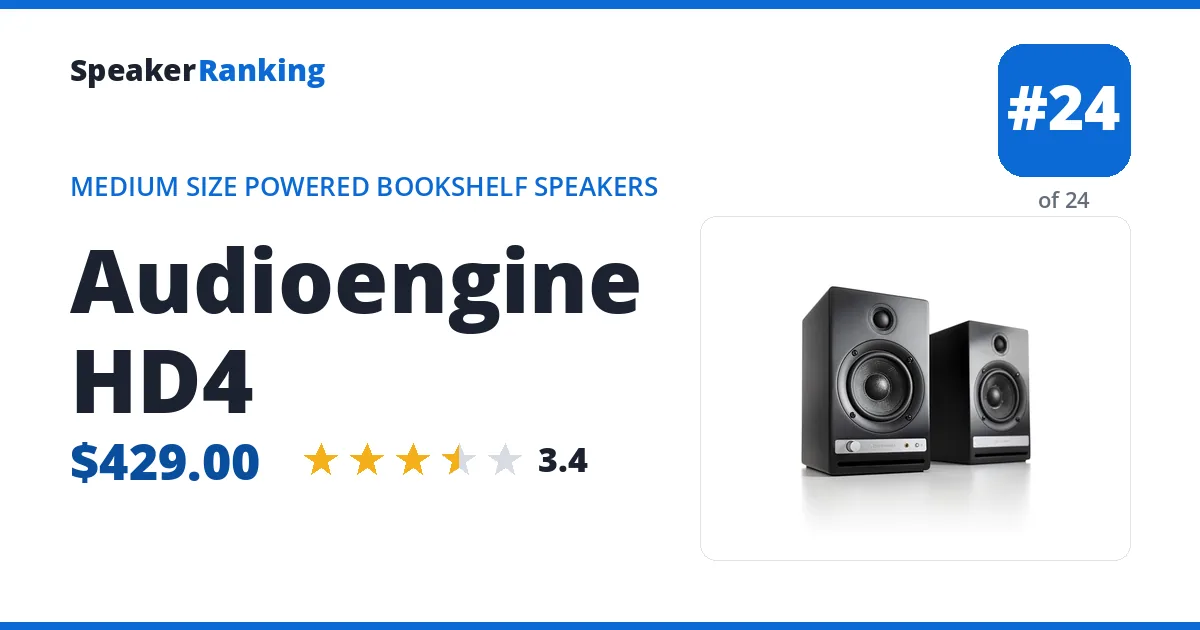
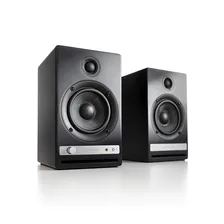 Ranked #65 of 76 in Medium Size Powered Bookshelf Speakers - Audioengine HD4: $429.00 per pair Amazon eBay
Pros: Compact powered cabinets, analog input options and RCA output can simplify a desktop stereo system. Its modest footprint is useful where larger studio monitors are impractical.
Cons: The compact cabinets suit close desktop listening rather than a large-room system. A separate subwoofer adds cost and space if deeper bass is a priority.
Full Audioengine HD4 review and specifications →
| AES Input | No |
|---|---|
| Amplifier Power | 50w RMS Per Speaker |
| App | No |
| Aux Input | Yes |
| Bluetooth | Yes |
| Bluetooth Codecs | SBC, AAC, aptX, aptX HD |
| Coaxial Input | No |
| Dimensions | 9”H x 5.5”W x 6.5”D (228.6 x 139.7 x 165.1 mm) |
| Drivers | 4” (102mm) woofer |
| EQ | No |
| Frequency Response | 60 Hz-20 kHz (-3dB) (Manufacturer specified) |
| HDMI Input | No |
| Inputs | Bluetooth, Aux, RCA Input |
| Optical Input | No |
| Outputs | RCA variable output (subwoofer) |
| RCA Input | Yes |
| Subwoofer Output | Yes |
| TRS Input | No |
| USB Input | No |
| Weight | 7.3 lbs (3.3 kg) |
| XLR Input | No |
- Links
- Reviews, Comparisons and Sound Samples
- Head-to-Head Comparisons
- Audioengine HD4 vs Kali Audio IN-UNF
- Audioengine HD4 vs Edifier R1700BT
- Audioengine HD4 vs Edifier S1000MKII
- Audioengine HD4 vs Edifier R1280DB
- Audioengine HD4 vs Edifier S1000W
- Audioengine HD4 vs Edifier R1280T
- Audioengine HD4 vs Edifier R2000DB
- Audioengine HD4 vs Audioengine HD6
- See all 46 comparisons
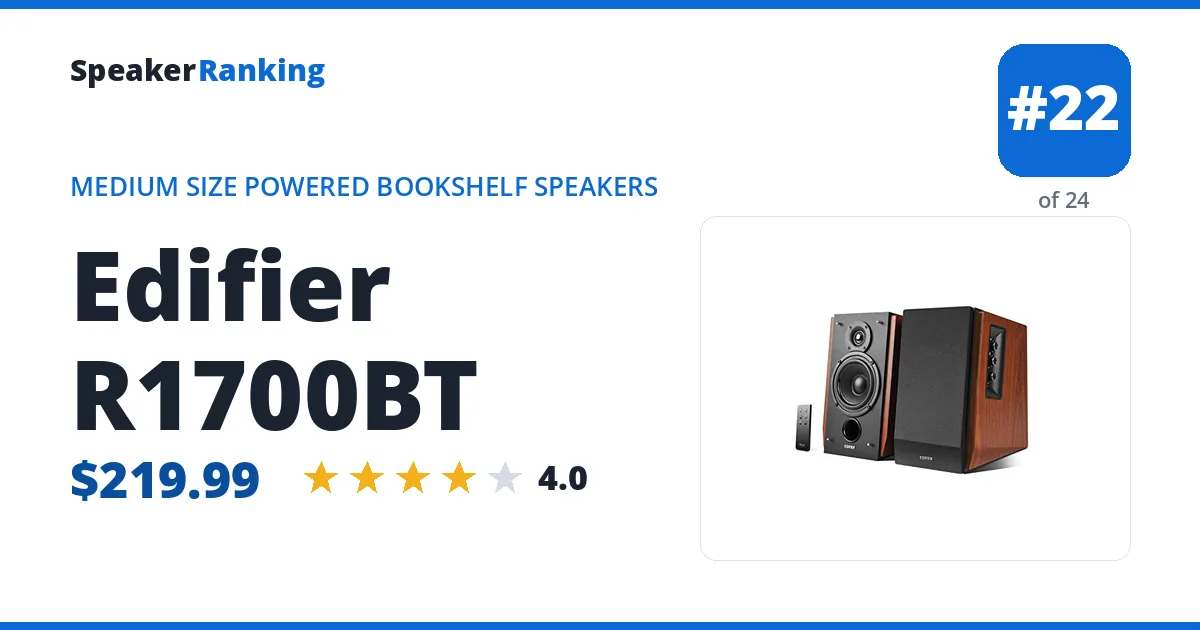
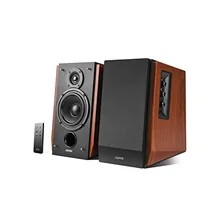 Ranked #66 of 76 in Medium Size Powered Bookshelf Speakers - Edifier R1700BT: $219.99 per pair Amazon eBay
Pros: A compact powered pair with analog and Bluetooth connectivity for uncomplicated desktop listening. Its self-contained design avoids the need for a separate amplifier.
Cons: Listening impressions suggest a bass-and-treble-forward balance rather than strict neutrality. Its analog and Bluetooth connections are less convenient for sources that require optical or HDMI input.
Full Edifier R1700BT review and specifications →
| AES Input | No |
|---|---|
| Amplifier Power | 66w RMS Per Speaker |
| App | No |
| Aux Input | No |
| Bluetooth | Yes, 5.1 |
| Bluetooth Codecs | SBC (inferred; additional codecs unverified) |
| Coaxial Input | No |
| Dimensions | 10”H x 6.1”W x 8.4”D (254 x 154.9 x 213.4 mm) |
| Drivers | 4” (102mm) woofer |
| EQ | No |
| Frequency Response | 60 Hz-20 kHz (-3dB) (Manufacturer specified) |
| HDMI Input | No |
| Inputs | Bluetooth, RCA Input |
| Optical Input | No |
| Outputs | None |
| RCA Input | Yes |
| TRS Input | No |
| USB Input | No |
| Weight | 14.6 lbs (6.6 kg) |
| XLR Input | No |
- Links
- Reviews, Comparisons and Sound Samples
- DSAUDIO.review: DSAUDIO.review Edifier MR4 vs Edifier R1700BT sound.DEMO More from DSAUDIOreview →
- DSAUDIO.review: DSAUDIO.review Audioengine HD3 vs Edifier R1700BT sound.DEMO
- DSAUDIO.review: Edifier R1280DB vs Edifier R1700BT Sound Demo w/ Bass Test
- DSAUDIO.review: Edifier R1280DBs vs Edifier R1700BTs Sound Comparison
- DSAUDIO.review: Edifier R1700BT vs Edifier R2000DB Sound Demo
- DSAUDIO.review: DSAUDIO.review Edifier D12 vs Edifier R1700BT sound.DEMO
- Head-to-Head Comparisons
- Edifier R1700BT vs Audioengine HD4
- Edifier R1700BT vs Edifier R1280DB
- Edifier R1700BT vs Kali Audio IN-UNF
- Edifier R1700BT vs Edifier S1000MKII
- Edifier R1700BT vs Edifier R1280T
- Edifier R1700BT vs Edifier S1000W
- Edifier R1700BT vs Midiplus MI5 II
- Edifier R1700BT vs Edifier R2000DB
- See all 63 comparisons
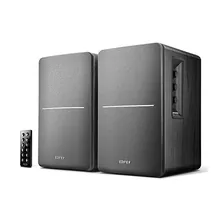 Ranked #68 of 76 in Medium Size Powered Bookshelf Speakers - Edifier R1280DB: $189.99 per pair Amazon eBay
Pros: Optical/coaxial inputs and Bluetooth add practical flexibility over the analog R1280T, while remote and tone controls simplify everyday listening. It is a convenient inexpensive stereo system rather than a separate amplifier-and-speaker setup. Measured bass extension of 63Hz (-3dB).
Cons: The compact format is better suited to nearfield listening than high-volume playback across a large room. Basic tone controls offer less flexibility than parametric equalization.
Full Edifier R1280DB review and specifications →
| AES Input | No |
|---|---|
| Amplifier Power | 42w RMS Total |
| App | No |
| Aux Input | No |
| Bass Extension (-10dB) | 53.2Hz (derived, log-interpolated between spinorama.org -9dB/-12dB points) |
| Bass Extension (-3dB) | 63Hz (measured, Audio Science Review) - shares the R1280T driver and cabinet; read from that measurement |
| Bluetooth | Yes, 5.1 |
| Bluetooth Codecs | SBC (inferred; additional codecs unverified) |
| Coaxial Input | Yes |
| Dimensions | 9.2”H x 5.7”W x 7.7”D (233.7 x 144.8 x 195.6 mm) |
| Drivers | 4” (102mm) woofer |
| EQ | No |
| Frequency Response | 55 Hz-20 kHz (-3dB) (Manufacturer specified) |
| HDMI Input | No |
| Inputs | Bluetooth, 2x RCA Input, Digital Optical, Digital Coax |
| Optical Input | Yes |
| Outputs | None |
| RCA Input | Yes |
| TRS Input | No |
| USB Input | No |
| Weight | 10.8 lbs (4.9 kg) |
| XLR Input | No |
- Links
- Reviews, Comparisons and Sound Samples
- Related-model measurements: Edifier R1280T (not R1280DB)
- DSAUDIO.review: Edifier R1280DB vs Edifier R1700BT Sound Demo w/ Bass Test More from DSAUDIOreview →
- DSAUDIO.review: Edifier R1280DBs vs Edifier R1700BTs Sound Comparison
- DSAUDIO.review: DSAUDIO.review Edifier MR4 vs Edifier R1280DBs sound.DEMO
- Related-model Spinorama: Edifier R1280T (not R1280DB)
- Head-to-Head Comparisons
- Edifier R1280DB vs Edifier R1280T
- Edifier R1280DB vs Edifier R1700BT
- Edifier R1280DB vs Midiplus MI5 II
- Edifier R1280DB vs JBL One Series 104
- Edifier R1280DB vs Audioengine HD4
- Edifier R1280DB vs Kali Audio IN-UNF
- Edifier R1280DB vs Fluid Audio FX50 V2
- Edifier R1280DB vs Edifier S1000MKII
- See all 71 comparisons
Large Size Powered Bookshelf Speakers
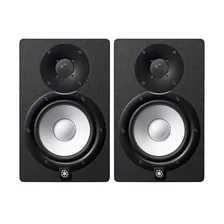 Ranked #28 of 79 in Large Size Powered Bookshelf Speakers - Yamaha HS8: $797.98 per pair Amazon eBay
Smaller models: the Yamaha HS7 (ranked lower, rated 3.9/5) and the Yamaha HS5 (rated 3.6/5).
Pros: ASR measurements support broadly neutral sound: a 2.3dB response span from 300Hz to 5kHz and 7.58 ideal-subwoofer score. Measured -3dB bass extension of 43.9Hz gives useful weight for music, with straightforward analog connections and room-adjustment controls. Measured bass extension of 43.9Hz (-3dB).
Cons: Its response and off-axis behavior are not as refined as the leading monitors. Vertical positioning around the crossover matters, and a subwoofer remains useful for deep bass. Basic rear-panel controls do not replace measured room correction.
Full Yamaha HS8 review and specifications →
| AES Input | No |
|---|---|
| Amplifier Power | 120w Per Speaker |
| App | No |
| Aux Input | No |
| Bass Extension (-10dB) | 34.7Hz (measured, Audio Science Review) |
| Bass Extension (-3dB) | 43.9Hz (measured, Audio Science Review) |
| Bluetooth | No |
| Coaxial Input | No |
| DSP | No |
| Dimensions | 15.4”H x 9.8”W x 13.1”D (391.2 x 248.9 x 332.7 mm) |
| Drivers | 8” woofer, 1” dome tweeter |
| EQ | Yes (Room adjustment) |
| Frequency Response | 47Hz - 24kHz (-3dB) (Manufacturer specified) |
| HDMI Input | No |
| Inputs | XLR |
| Optical Input | No |
| RCA Input | No |
| Spinorama Preference Score | 5.85 |
| Spinorama Preference Score with Perfect Sub | 7.58 |
| TRS Input | No |
| USB Input | No |
| Weight | 22.5 lbs (10.2 kg) |
| XLR Input | Yes |
- Links
- Reviews, Comparisons and Sound Samples
- Audio Science Review: Yamaha HS8 Studio Monitor Review More from Audio Science Review →
- Sercan Solmaz: Adam Audio T8V vs Yamaha HS8 vs KRK Rokit 8 (STUDIO SPEAKER SOUND TEST)
- DSAUDIO.review: DSAUDIO.review Edifier R2850DB vs Yamaha HS8 sound.DEMO More from DSAUDIOreview →
- DSAUDIO.review: DSAUDIO.review Adam Audio A7X vs Yamaha HS8 sound.DEMO
- DSAUDIO.review: Yamaha HS7 vs Yamaha HS8 Sound & Frequency Response Comparison
- DSAUDIO.review: Yamaha HS8 vs Yamaha HS5 Sound & Frequency Response Comparison
- DSAUDIO.review: Genelec 8020D vs Yamaha HS8 Sound & Frequency Response Comparison
- DSAUDIO.review: DSAUDIO.review APS Klasik 2020 vs Yamaha HS8 sound.DEMO
- DSAUDIO.review: DSAUDIO.review Focal Alpha 65 EVO vs Yamaha HS8 sound.DEMO
- DSAUDIO.review: Yamaha HS8 vs PreSonus Eris E8 XT Sound & Frequency Response Comparison
- DSAUDIO.review: Yamaha HS8 vs Kali Audio LP-8 Sound & Frequency Response Comparison
- DSAUDIO.review: KRK Rokit 8 G4 RP8G4 vs Yamaha HS8 Sound & Frequency Response Comparison
- DSAUDIO.review: Neumann KH80 DSP vs Yamaha HS8 Sound & Frequency Response Comparison
- DSAUDIO.review: Yamaha HS8 vs IK Multimedia iLoud MTM Sound & Frequency Response Comparison
- Audio Science Review Measurements (spinorama.org)
- Head-to-Head Comparisons
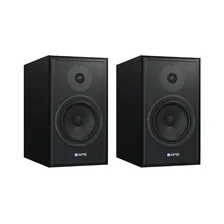 Ranked #39 of 79 in Large Size Powered Bookshelf Speakers - APS Klasik 2020: $1,800 per pair APS eBay
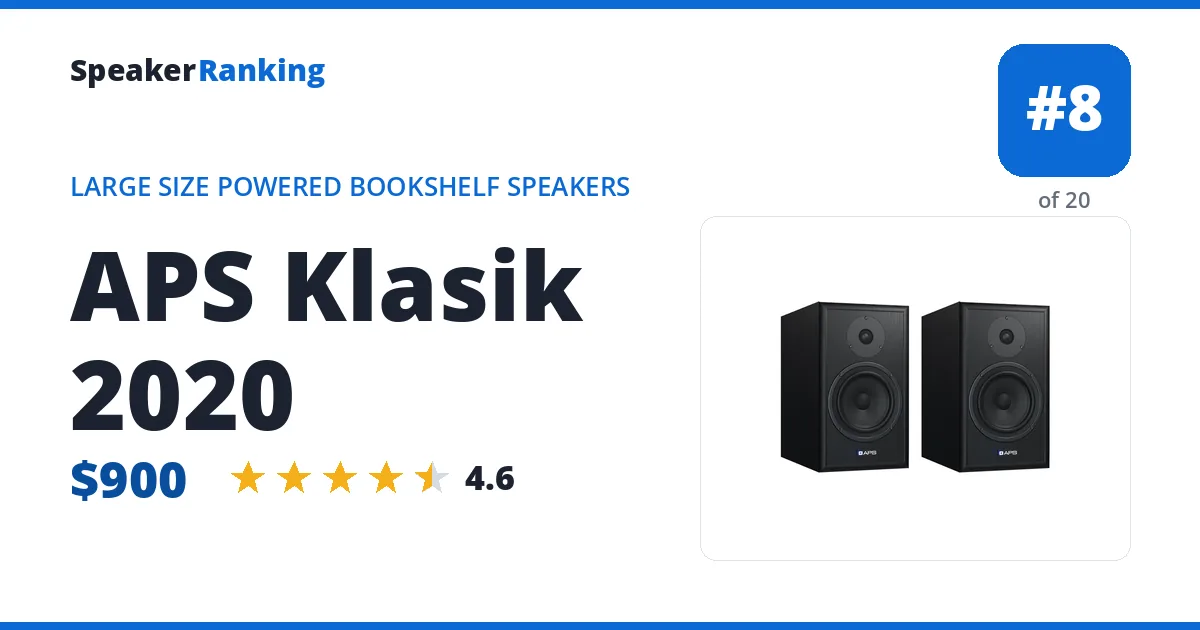
Pros: A remarkably capable analogue nearfield monitor with 100W amplification per speaker, balanced XLR and RCA inputs, and three low-frequency adjustment options. Independent review finds its response exceptionally even through the vocal range, with precise, tuneful bass, natural voices, pin-sharp imaging and unusually strong mix detail for the class.
Cons: Its all-analogue design means no streaming, Bluetooth, DSP or automatic room correction. The most extended bass setting loses some precision as volume rises, while the top end is competent rather than the system’s standout feature. It is built for a serious nearfield setup, not all-in-one convenience. It is hard to find for sale, with no dealers in the United States.
Full APS Klasik 2020 review and specifications →
| AES Input | No |
|---|---|
| Amplifier Power | 100w Per Speaker |
| App | No |
| Aux Input | No |
| Bluetooth | No |
| Coaxial Input | No |
| DSP | No |
| Dimensions | 14.2”H x 8.3”W x 12.6”D (360.7 x 210.8 x 320 mm) |
| Drivers | 7” (178mm) woofer |
| EQ | Yes (Room adjustment) |
| Frequency Response | 39Hz - 25kHz (-3dB) (Manufacturer specified) |
| HDMI Input | No |
| Inputs | XLR, RCA |
| Optical Input | No |
| RCA Input | Yes |
| TRS Input | No |
| USB Input | No |
| Weight | 22 lbs (10.0 kg) each |
| XLR Input | Yes |
- Links
- Reviews, Comparisons and Sound Samples
- Head-to-Head Comparisons
 Ranked #58 of 79 in Large Size Powered Bookshelf Speakers - Focal Alpha 65 EVO: $804 per pair Amazon eBay
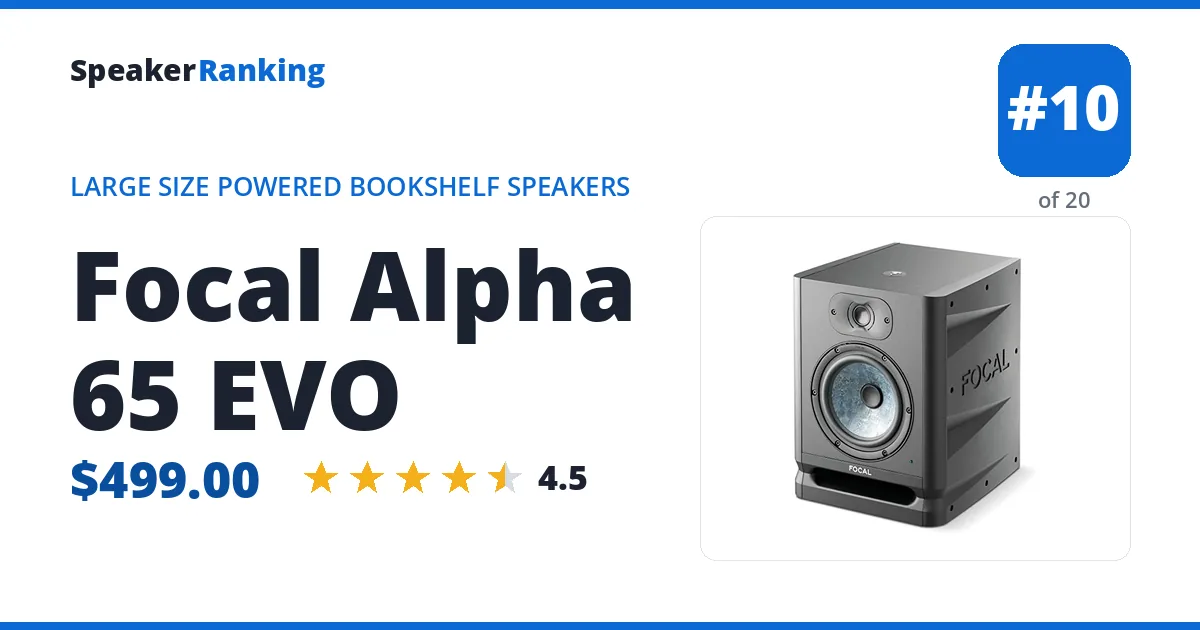
Pros: ASR measured 42.5Hz -3dB extension, providing useful low-end reach for music. Analog input options and tonal controls make it straightforward to integrate into a studio, with a 6.59 ideal-subwoofer score indicating respectable but not leading tonality. Measured bass extension of 45Hz (-3dB).
Cons: The measured 2.7dB response span from 300Hz to 5kHz and listening-window variation do not support a claim of reference-level neutrality. Placement and external correction may help. An anomalous distortion result from an individual sample should not be treated as a proven defect in every unit.
Full Focal Alpha 65 EVO review and specifications →
| AES Input | No |
|---|---|
| Amplifier Power | 85w Per Speaker |
| App | No |
| Aux Input | No |
| Bass Extension (-10dB) | 36Hz (measured, Audio Science Review) |
| Bass Extension (-3dB) | 45Hz (measured, Audio Science Review) |
| Bluetooth | No |
| Coaxial Input | No |
| DSP | No |
| Dimensions | 13.4”H x 10.3”W x 11.4”D (340.4 x 261.6 x 289.6 mm) |
| Drivers | 6.5” (165mm) woofer |
| EQ | Yes (Room adjustment) |
| Frequency Response | 40Hz - 22kHz (+-3dB) (Manufacturer specified) |
| HDMI Input | No |
| Inputs | TRS, XLR, RCA |
| Optical Input | No |
| RCA Input | Yes |
| Spinorama Preference Score | 4.71 |
| Spinorama Preference Score with Perfect Sub | 6.59 |
| TRS Input | Yes |
| USB Input | No |
| Weight | 16.8 lbs (7.6 kg) each |
| XLR Input | Yes |
- Links
- Reviews, Comparisons and Sound Samples
- Audio Science Review Measurements More from Audio Science Review →
- DSAUDIO.review: DSAUDIO.review Focal Alpha 65 EVO vs Yamaha HS8 sound.DEMO More from DSAUDIOreview →
- DSAUDIO.review: DSAUDIO.review Focal Alpha 65 EVO vs Focal Alpha 65 sound.DEMO
- DSAUDIO.review: DSAUDIO.review Focal Alpha 65 EVO vs Kali Audio IN-5 sound.DEMO
- DSAUDIO.review: DSAUDIO.review Focal Alpha 50 EVO vs Focal Alpha 65 EVO sound.DEMO
- DSAUDIO.review: DSAUDIO.review Focal Alpha 65 EVO vs Adam Audio A7X sound.DEMO
- DSAUDIO.review: DSAUDIO.review Focal Alpha 65 EVO vs Adam Audio T7V sound.DEMO
- Audio Science Review Measurements (spinorama.org)
- Head-to-Head Comparisons
- Focal Alpha 65 EVO vs Adam Audio A7V
- Focal Alpha 65 EVO vs Emotiva Airmotiv 6s
- Focal Alpha 65 EVO vs Edifier S3000MKII
- Focal Alpha 65 EVO vs Cambridge Audio L/R X
- Focal Alpha 65 EVO vs Adam Audio T8V
- Focal Alpha 65 EVO vs Adam Audio T7V
- Focal Alpha 65 EVO vs Kali Audio LP-8
- Focal Alpha 65 EVO vs JBL 4329P
- See all 48 comparisons
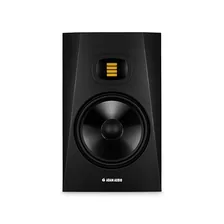 Ranked #63 of 79 in Large Size Powered Bookshelf Speakers - Adam Audio T8V: $719.98 per pair Amazon eBay
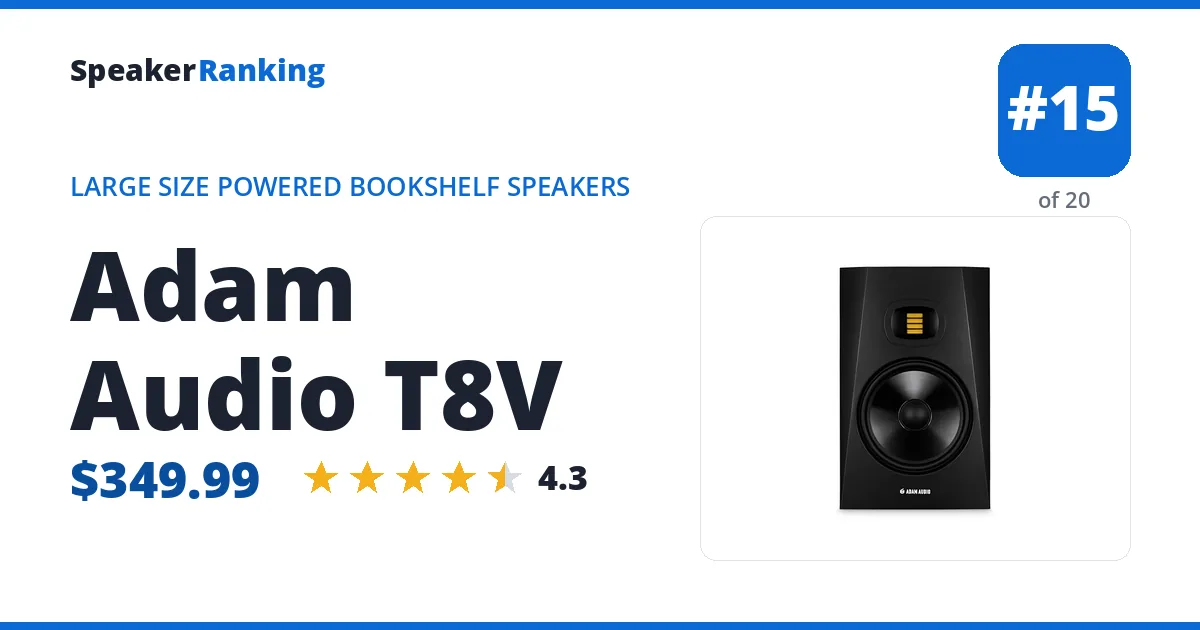
Smaller models: the Adam Audio T7V (ranked lower, rated 3.9/5) and the Adam Audio T5V (rated 4/5).
Pros: Measured -3dB extension of 39.6Hz gives useful bass depth for an affordable large monitor. Analog inputs and basic shelf controls offer uncomplicated studio integration. Measured bass extension of 39.6Hz (-3dB).
Cons: The 6.31 ideal-subwoofer score and 3.0dB response span from 300Hz to 5kHz show less even tonal balance than stronger budget alternatives. Treble emphasis and crossover-region vertical cancellation make listening height important. Deep bass and an AMT tweeter do not by themselves imply accurate sound. A notch around 4.6kHz, where tweeter and woofer interact, and a hole below the tweeter axis mean the tweeter should sit at or above ear height.
Full Adam Audio T8V review and specifications →
| AES Input | No |
|---|---|
| Amplifier Power | 90w Per Speaker |
| App | No |
| Aux Input | No |
| Bass Extension (-10dB) | 33.2Hz (derived, log-interpolated between spinorama.org -9dB/-12dB points) |
| Bass Extension (-3dB) | 39.6Hz (measured, Audio Science Review) |
| Bluetooth | No |
| Coaxial Input | No |
| DSP | No |
| Dimensions | 15.8”H x 9.8”W x 13.2”D (401.3 x 248.9 x 335.3 mm) |
| Drivers | 8” (203mm) woofer |
| EQ | Yes (Room adjustment) |
| Frequency Response | 33Hz - 25kHz (-6dB) (Manufacturer specified) |
| HDMI Input | No |
| Inputs | XLR, RCA |
| Optical Input | No |
| RCA Input | Yes |
| Spinorama Preference Score | 4.65 |
| Spinorama Preference Score with Perfect Sub | 6.31 |
| TRS Input | No |
| USB Input | No |
| Weight | 21.6 lbs (9.8 kg) |
| XLR Input | Yes |
- Links
- Reviews, Comparisons and Sound Samples
- Audio Science Review Measurements More from Audio Science Review →
- Sercan Solmaz: Adam Audio T8V vs Yamaha HS8 vs KRK Rokit 8 (STUDIO SPEAKER SOUND TEST)
- DSAUDIO.review: Adam Audio T8V vs KRK Rokit 8 G4 Sound & Frequency Response Comparison More from DSAUDIOreview →
- Audio Science Review Measurements (spinorama.org)
- Head-to-Head Comparisons
 Ranked #64 of 79 in Large Size Powered Bookshelf Speakers - Adam Audio T7V: $579.98 per pair Amazon eBay
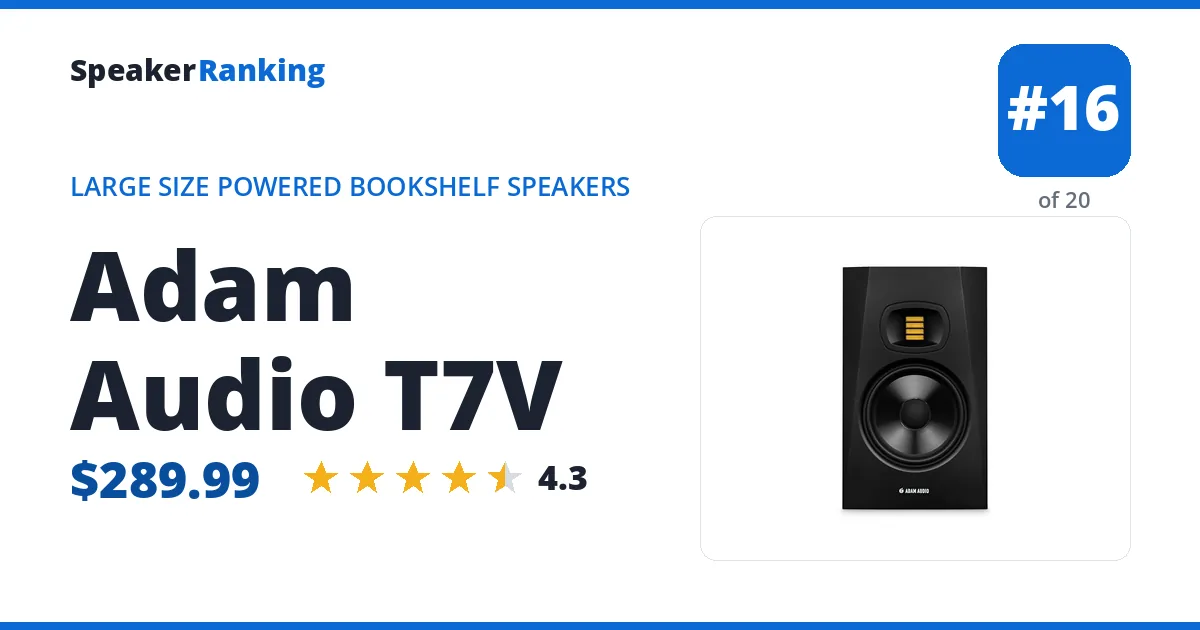
Smaller model: the Adam Audio T5V (rated 4/5).
Larger model: the Adam Audio T8V (ranked higher, rated 3.9/5).
Pros: Audioholics’ measurements provide useful evidence about the midrange and treble, with a digitized 2.4dB response span from 300Hz to 5kHz. Basic tonal controls and analog connections suit a straightforward nearfield system. Measured bass extension of 65Hz (-3dB).
Cons: Correct listening height is important for the two-way crossover. Basic shelf controls offer less adjustment flexibility than parametric room correction.
Full Adam Audio T7V review and specifications →
| AES Input | No |
|---|---|
| Amplifier Power | 70w Per Speaker |
| App | No |
| Aux Input | No |
| Bass Extension (-10dB) | approx. 45Hz, extrapolated from the reviewer’s directly-computed -6dB point of 45.4Hz (measured, Audio Science Review) |
| Bass Extension (-3dB) | approx. 65Hz, extrapolated from the reviewer’s directly-computed -6dB point of 45.4Hz (measured, Audio Science Review) |
| Bluetooth | No |
| Coaxial Input | No |
| DSP | No |
| Dimensions | 13.7”H x 8.3”W x 11.5”D (348 x 210.8 x 292.1 mm) |
| Drivers | 7” (178mm) woofer |
| EQ | Yes (Room adjustment) |
| Frequency Response | 39Hz - 25kHz (-6dB) (Manufacturer specified) |
| HDMI Input | No |
| Inputs | XLR, RCA |
| Optical Input | No |
| RCA Input | Yes |
| TRS Input | No |
| USB Input | No |
| Weight | 15.7 lbs (7.1 kg) |
| XLR Input | Yes |
- Links
- Reviews, Comparisons and Sound Samples
- Audio Science Review Measurements More from Audio Science Review →
- Audioholics Review Measurements
- DSAUDIO.review: Adam Audio T7V vs Yamaha HS7 Sound & Frequency Response Comparison More from DSAUDIOreview →
- DSAUDIO.review: DSAUDIO.review Adam Audio A7X vs Adam Audio T7V sound.DEMO
- DSAUDIO.review: Adam Audio T7V vs Yamaha HS7 Sound & Frequency Response Comparison
- DSAUDIO.review: DSAUDIO.review Focal Alpha 65 EVO vs Adam Audio T7V sound.DEMO
- DSAUDIO.review: DSAUDIO.review Adam Audio T7V vs Adam Audio A5X sound.DEMO
- DSAUDIO.review: DSAUDIO.review Tannoy Gold 7 vs Adam Audio T7V sound.DEMO
- DSAUDIO.review: Adam Audio T5V vs Adam Audio T7V Sound & Frequency Response Comparison
- DSAUDIO.review: Kali LP-6 vs Adam Audio T7V Sound & Frequency Response Comparison
- DSAUDIO.review: KRK Rokit 7 G4 RP7G4 vs Adam Audio T7V Sound & Frequency Response Comparison
- DSAUDIO.review: Adam Audio T7V vs JBL 306P MKII Sound & Frequency Response Comparison
- Audioholics Measurements (spinorama.org)
- Head-to-Head Comparisons
 Ranked #65 of 79 in Large Size Powered Bookshelf Speakers - Kali Audio LP-8: $598 per pair Discontinued eBay
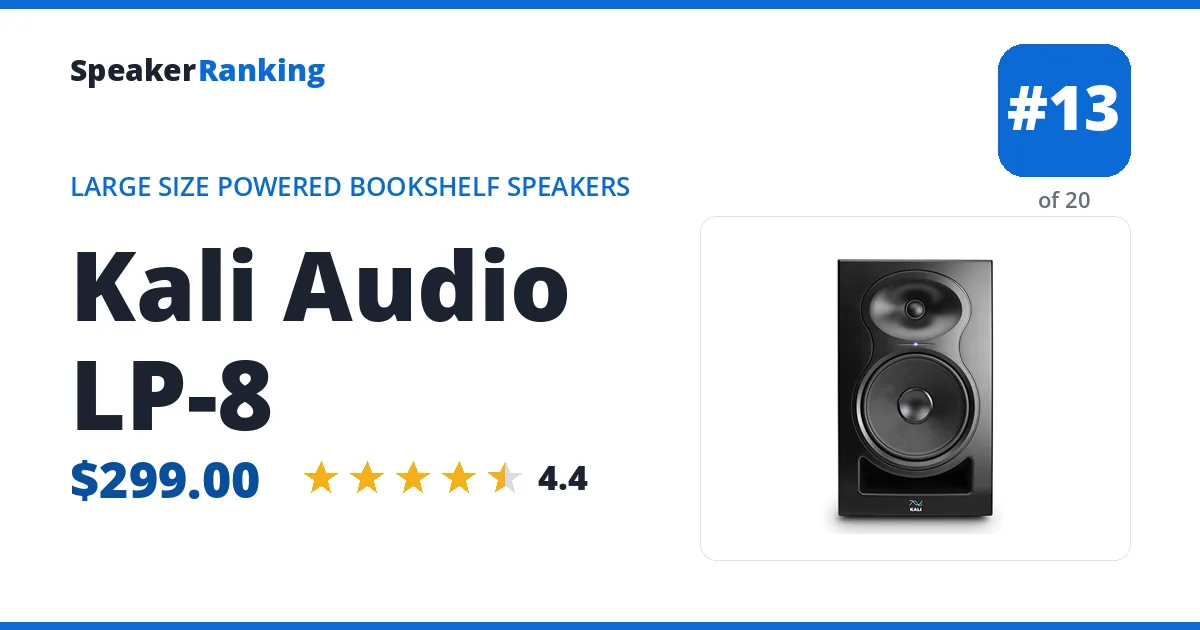
Newer model: the Kali Audio LP-8 V2, ranked higher, rated 4.1/5.
Smaller model: the Kali Audio LP-6 (ranked higher, rated 4.3/5).
Pros: The original LP-8 offers a large woofer, a waveguide and placement switches for affordable nearfield monitoring.
Cons: First-generation amplifier noise can be distracting at a quiet desk. The large cabinets need substantial space, and placement switches do not replace full room correction. The response sounds a bit hooded. Discontinued.
Full Kali Audio LP-8 review and specifications →
| AES Input | No |
|---|---|
| Amplifier Power | 100w Per Speaker |
| App | No |
| Aux Input | No |
| Bluetooth | No |
| Coaxial Input | No |
| DSP | No |
| Dimensions | 16.5”H x 10”W x 11.3”D (419.1 x 254 x 287 mm) |
| Drivers | 8” woofer, 1” soft dome tweeter |
| EQ | Yes (Room adjustment) |
| Frequency Response | 45Hz - 21kHz (+-3dB) (Manufacturer specified) |
| HDMI Input | No |
| Inputs | TRS, XLR, RCA |
| Optical Input | No |
| RCA Input | Yes |
| TRS Input | Yes |
| USB Input | No |
| Weight | 19.8 lbs (9.0 kg) each |
| XLR Input | Yes |
- Links
- Reviews, Comparisons and Sound Samples
- DSAUDIO.review: Tannoy Gold 8 vs Kali Audio LP-8 Sound & Frequency Response Comparison More from DSAUDIOreview →
- DSAUDIO.review: Focal Alpha 80 vs Kali Audio LP-8 Sound & Frequency Response Comparison
- DSAUDIO.review: Yamaha HS8 vs Kali Audio LP-8 Sound & Frequency Response Comparison
- DSAUDIO.review: Kali Audio LP-8 vs Presonus Eris E8 XT Sound & Frequency Response Comparison
- DSAUDIO.review: Kali Audio LP-8 vs JBL 306P MKII Sound & Frequency Response Comparison
- Audioholics Measurements (spinorama.org)
- Head-to-Head Comparisons
- Kali Audio LP-8 vs Adam Audio T7V
- Kali Audio LP-8 vs KRK Rokit 8 G4
- Kali Audio LP-8 vs Adam Audio T8V
- Kali Audio LP-8 vs KRK Rokit 7 G4
- Kali Audio LP-8 vs Presonus Eris Studio 8
- Kali Audio LP-8 vs Edifier S3000Pro
- Kali Audio LP-8 vs Edifier R2850DB
- Kali Audio LP-8 vs Focal Alpha 65 EVO
- See all 44 comparisons
 Ranked #66 of 79 in Large Size Powered Bookshelf Speakers - KRK Rokit 8 G4: $500 per pair Discontinued Amazon eBay
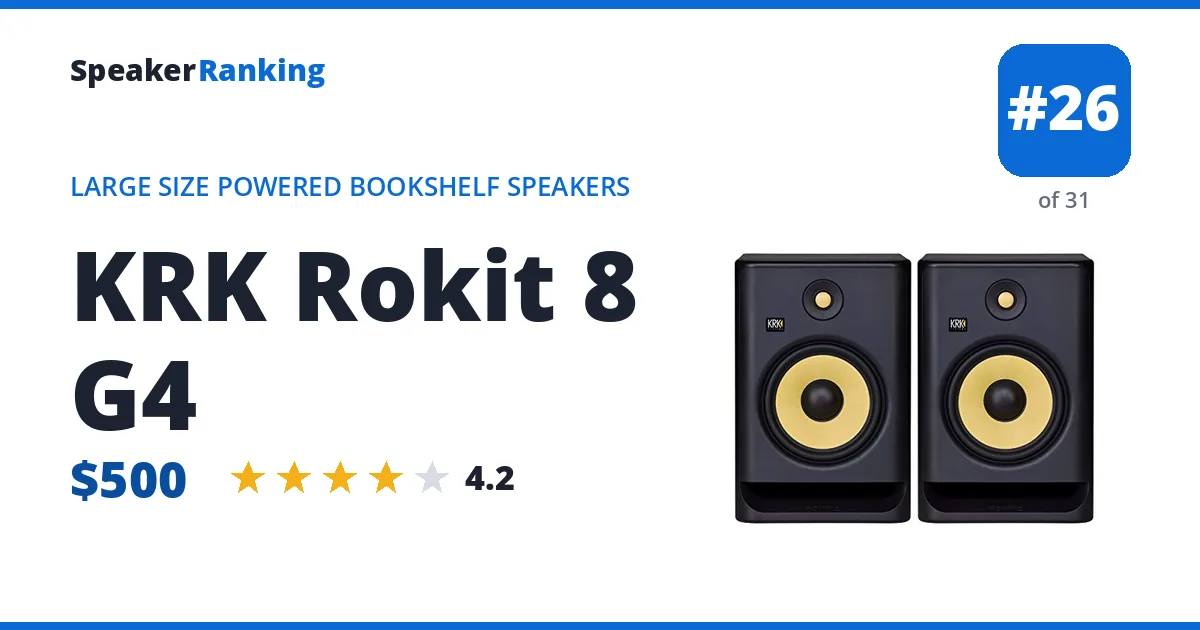
Newer model: the KRK Rokit 8 G5, ranked higher, estimated 4/5.
Smaller models: the KRK Rokit 7 G4 (ranked lower, rated 3.9/5) and the KRK Rokit 5 G4 (rated 3.7/5).
Pros: An 8-inch active monitor with balanced studio connections and room-adjustment controls, offering a practical basis for a desktop or small studio system. The larger format may suit listeners who want more scale than a compact monitor.
Cons: The large cabinet requires substantial desk or stand space. Its balanced studio inputs need a suitable source connection rather than offering built-in consumer streaming. Discontinued.
Full KRK Rokit 8 G4 review and specifications →
| AES Input | No |
|---|---|
| Amplifier Power | 100w Per Speaker |
| App | No |
| Aux Input | No |
| Bluetooth | No |
| Coaxial Input | No |
| DSP | No |
| Dimensions | 15.7”H x 10.5”W x 12.2”D (400 x 266.7 x 309.9 mm) |
| Drivers | 8” (203mm) woofer |
| EQ | Yes (Room adjustment) |
| Frequency Response | 36Hz - 40kHz (Manufacturer specified) |
| HDMI Input | No |
| Inputs | TRS, XLR |
| Optical Input | No |
| RCA Input | No |
| TRS Input | Yes |
| USB Input | No |
| Weight | 23.1 lbs (10.5 kg) |
| XLR Input | Yes |
- Links
- Reviews, Comparisons and Sound Samples
- Head-to-Head Comparisons
 Ranked #67 of 79 in Large Size Powered Bookshelf Speakers - KRK Rokit 7 G4: $334.00 per pair Amazon eBay
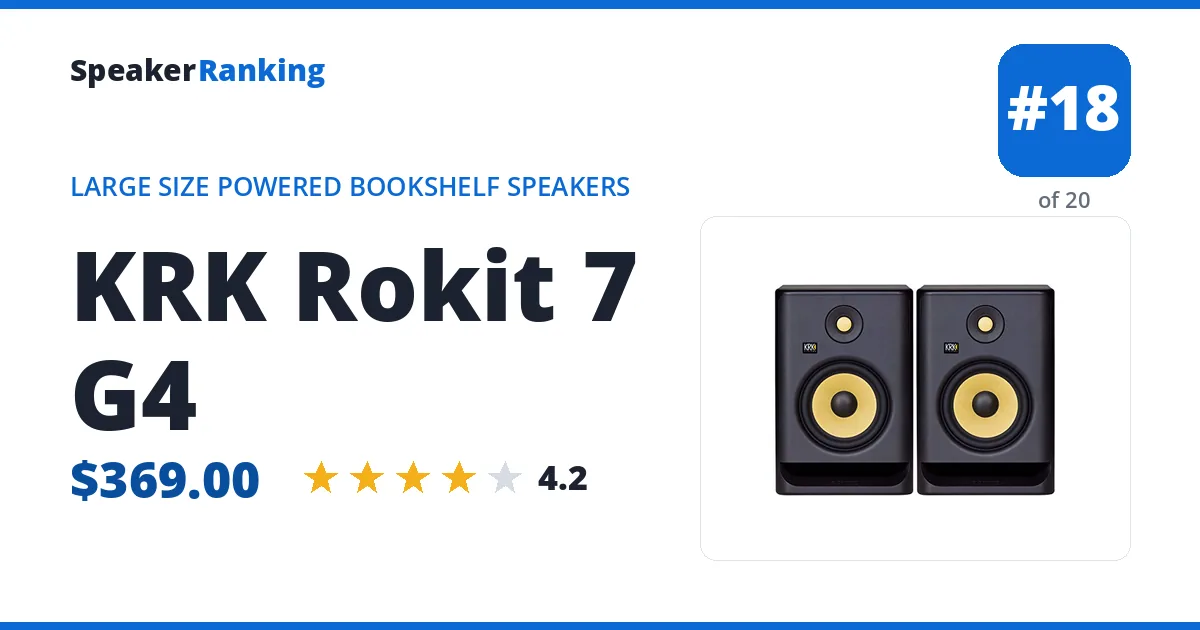
Smaller model: the KRK Rokit 5 G4 (rated 3.7/5).
Larger model: the KRK Rokit 8 G4 (ranked higher, rated 3.9/5).
Pros: The 7-inch format offers a middle ground between compact monitors and larger 8-inch cabinets. Balanced inputs and room-adjustment controls make it practical for a simple studio installation.
Cons: Its balanced studio inputs need a suitable source connection rather than offering built-in consumer streaming. The cabinet still occupies appreciably more desk space than a compact monitor.
Full KRK Rokit 7 G4 review and specifications →
| AES Input | No |
|---|---|
| Amplifier Power | 145w Per Speaker |
| App | No |
| Aux Input | No |
| Bluetooth | No |
| Coaxial Input | No |
| DSP | No |
| Dimensions | 13.4”H x 8.9”W x 11.2”D (340.4 x 226.1 x 284.5 mm) |
| Drivers | 7” (178mm) woofer |
| EQ | Yes (Room adjustment) |
| Frequency Response | 42Hz - 40kHz (Manufacturer specified) |
| HDMI Input | No |
| Inputs | TRS, XLR |
| Optical Input | No |
| RCA Input | No |
| TRS Input | Yes |
| USB Input | No |
| Weight | 16.8 lbs (7.6 kg) |
| XLR Input | Yes |
- Links
- Reviews, Comparisons and Sound Samples
- DSAUDIO.review: KRK Rokit 7 G4 RP7G4 vs Adam Audio T7V Sound & Frequency Response Comparison More from DSAUDIOreview →
- DSAUDIO.review: KRK Rokit 7 G4 RP7G4 vs Yamaha HS7 Sound & Frequency Response Comparison
- DSAUDIO.review: KRK Rokit 5 RP5G4 vs KRK Rokit 7 RP7G4 Sound & Frequency Comparison
- DSAUDIO.review: KRK Rokit 7 RP7G4 vs JBL 306P MKII Sound & Frequency Response Comparison
- Head-to-Head Comparisons
 Ranked #68 of 79 in Large Size Powered Bookshelf Speakers - Presonus Eris Studio 8: $419.98 per pair Amazon eBay
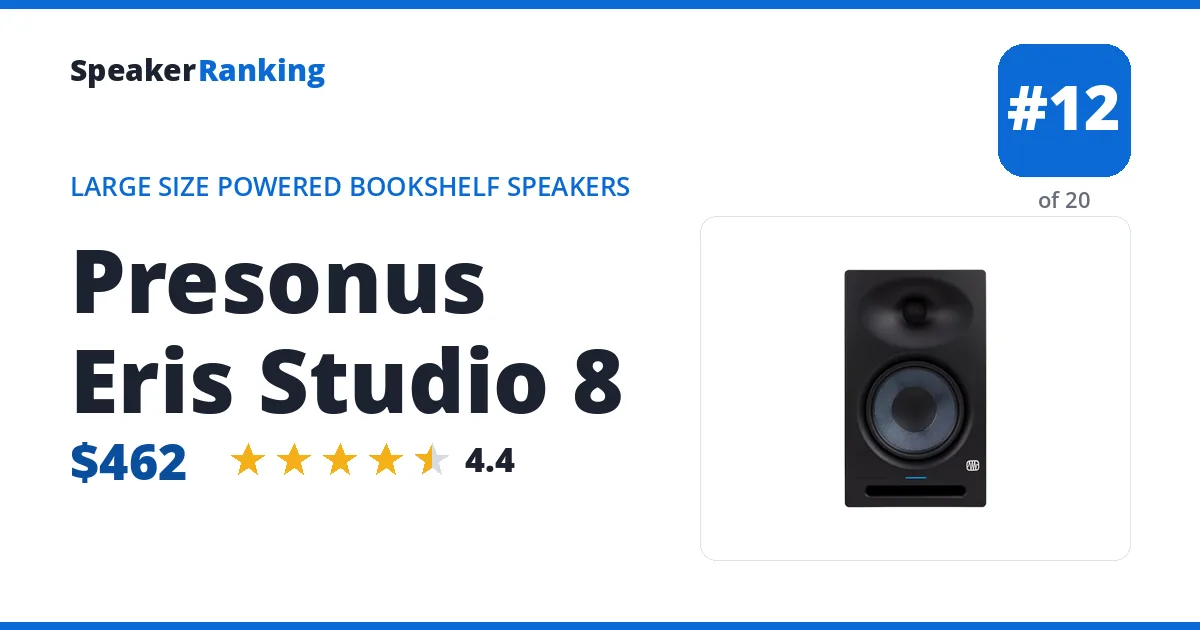
Pros: An 8-inch active monitor with XLR, TRS and RCA inputs and room-adjustment controls, providing flexible analog integration. Its cabinet and connection options suit a conventional studio setup.
Cons: The large cabinet requires substantial desk or stand space. Analog room-adjustment controls offer less flexibility than automatic calibration or parametric correction.
Full Presonus Eris Studio 8 review and specifications →
| AES Input | No |
|---|---|
| Amplifier Power | 140w Per Speaker |
| App | No |
| Aux Input | No |
| Bluetooth | No |
| Coaxial Input | No |
| DSP | No |
| Dimensions | 16.5”H x 9.8”W x 11.7”D (419.1 x 248.9 x 297.2 mm) |
| Drivers | 8” (203mm) woofer |
| EQ | Yes (Room adjustment) |
| Frequency Response | 35Hz - 20kHz (Manufacturer specified) |
| HDMI Input | No |
| Inputs | TRS, XLR, RCA |
| Optical Input | No |
| RCA Input | Yes |
| TRS Input | Yes |
| USB Input | No |
| Weight | 22.3 lbs (10.1 kg) each |
| XLR Input | Yes |
- Links
- Reviews, Comparisons and Sound Samples
- DSAUDIO.review: PreSonus Eris E8 XT vs PreSonus Eris E5 XT Sound & Frequency Response Comparison More from DSAUDIOreview →
- DSAUDIO.review: Yamaha HS8 vs PreSonus Eris E8 XT Sound & Frequency Response Comparison
- DSAUDIO.review: Kali Audio LP-8 vs Presonus Eris E8 XT Sound & Frequency Response Comparison
- DSAUDIO.review: Tannoy Gold 8 vs PreSonus Eris E8 XT Sound & Frequency Response Comparison
- DSAUDIO.review: Focal Alpha 80 vs PreSonus Eris E8 XT Sound & Frequency Response Comparison
- Head-to-Head Comparisons
- Presonus Eris Studio 8 vs KRK Rokit 8 G4
- Presonus Eris Studio 8 vs Kali Audio LP-8
- Presonus Eris Studio 8 vs Edifier R2850DB
- Presonus Eris Studio 8 vs Adam Audio T7V
- Presonus Eris Studio 8 vs Adam Audio T8V
- Presonus Eris Studio 8 vs Yamaha HS7
- Presonus Eris Studio 8 vs Klipsch The Sevens
- Presonus Eris Studio 8 vs Focal Alpha 65 EVO
- See all 27 comparisons
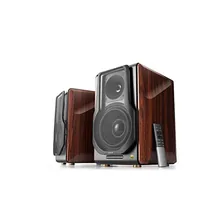 Ranked #70 of 79 in Large Size Powered Bookshelf Speakers - Edifier S3000Pro: $900 per pair Discontinued eBay
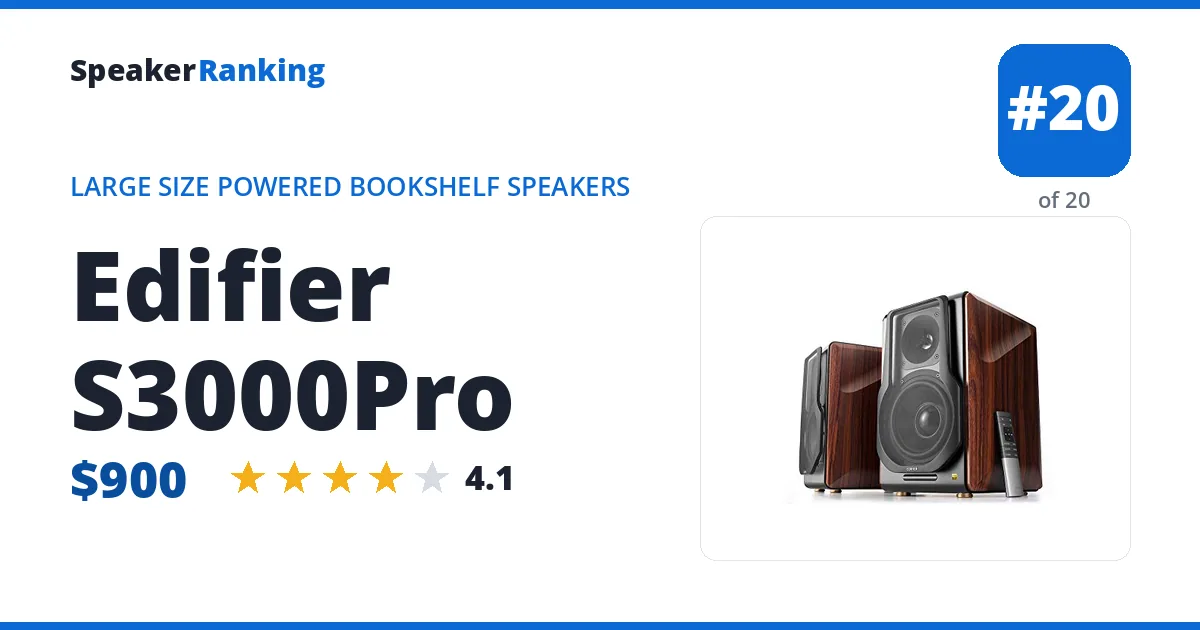
Newer model: the Edifier S3000MKII, ranked higher, estimated 3.9/5.
Pros: A convenient home-listening system with digital and analog input options, avoiding the need for a separate power amplifier. Its large cabinets and tone adjustments offer flexibility for a music-focused setup.
Cons: The substantial cabinet size requires more space than a typical desktop pair. High-resolution digital input support does not itself guarantee better sound. Discontinued.
Full Edifier S3000Pro review and specifications →
| AES Input | No |
|---|---|
| Amplifier Power | 78w RMS Per Speaker |
| App | No |
| Aux Input | No |
| Bluetooth | Yes, 5.0 |
| Bluetooth Codecs | SBC, aptX HD |
| Coaxial Input | Yes |
| DSP | No |
| Dimensions | 14.5”H x 9.1”W x 14”D (368.3 x 231.1 x 355.6 mm) |
| Drivers | 6.5” (165mm) woofer |
| EQ | Yes (Room adjustment) |
| Frequency Response | 38Hz-20kHz (-3dB) (Manufacturer specified) |
| HDMI Input | No |
| Inputs | Bluetooth, XLR, RCA Input, Digital Optical, Digital Coax, USB |
| Optical Input | Yes |
| Outputs | None |
| RCA Input | Yes |
| TRS Input | No |
| USB Input | Yes |
| Weight | 29.8 lbs (13.5 kg) |
| XLR Input | Yes |
- Links
- Reviews, Comparisons and Sound Samples
- Head-to-Head Comparisons
- Edifier S3000Pro vs Edifier R2850DB
- Edifier S3000Pro vs KRK Rokit 7 G4
- Edifier S3000Pro vs KRK Rokit 8 G4
- Edifier S3000Pro vs Klipsch The Sevens
- Edifier S3000Pro vs Kali Audio LP-8
- Edifier S3000Pro vs Adam Audio T8V
- Edifier S3000Pro vs Edifier S3000MKII
- Edifier S3000Pro vs Focal Alpha 65 EVO
- See all 25 comparisons
 Ranked #71 of 79 in Large Size Powered Bookshelf Speakers - Edifier R2850DB: $499.99 per pair Amazon eBay
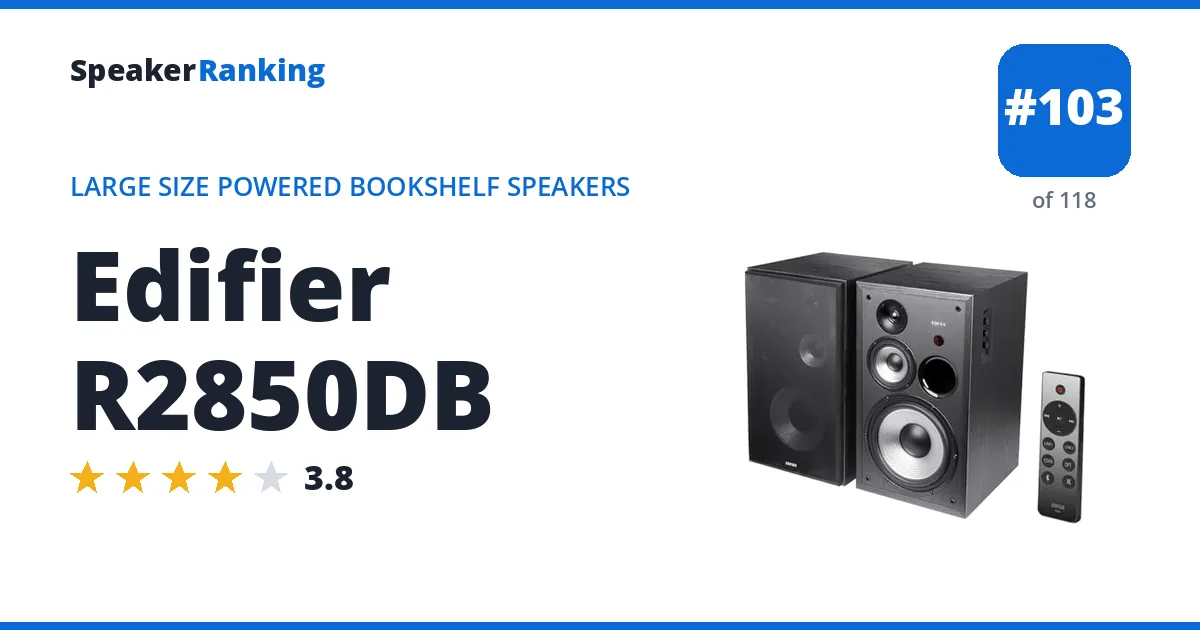
Pros: A large self-powered three-way pair with digital and analog source switching and proper left/right separation. Consumer Reports found accurate, detailed sound with strong, deep bass, a broad enough soundfield and enough clean output for a large room. It is a compelling simple system for TV, desktop or living-room music without buying a separate amplifier.
Cons: The big cabinets need real stand or furniture space, and their bass is slightly boomy. Consumer Reports also hears mildly grainy/hazy mids, subdued treble and a two-dimensional image despite the two cabinets. As an integrated system it is less upgradeable than separate passive speakers and an amplifier.
Full Edifier R2850DB review and specifications →
| AES Input | No |
|---|---|
| Amplifier Power | 75w RMS Per Speaker |
| App | No |
| Aux Input | No |
| Bluetooth | Yes, 5.1 |
| Bluetooth Codecs | SBC, aptX |
| Coaxial Input | Yes |
| DSP | No |
| Dimensions | 18.1”H x 10.1”W x 12.4”D (459.7 x 256.5 x 315 mm) |
| Drivers | 8” (203mm) woofer |
| EQ | No |
| Frequency Response | 42Hz-20kHz (-3dB) (Manufacturer specified) |
| HDMI Input | No |
| Inputs | Bluetooth, 2x RCA Input, Digital Optical, Digital Coax |
| Optical Input | Yes |
| RCA Input | Yes |
| TRS Input | No |
| USB Input | No |
| Weight | 50.7 lbs (23 kg) |
| XLR Input | No |
- Links
- Reviews, Comparisons and Sound Samples
- Head-to-Head Comparisons
- Edifier R2850DB vs Focal Twin6 Be
- Edifier R2850DB vs Edifier S3000Pro
- Edifier R2850DB vs Presonus Eris Studio 8
- Edifier R2850DB vs Klipsch The Sevens
- Edifier R2850DB vs Kali Audio LP-8
- Edifier R2850DB vs Adam Audio T7V
- Edifier R2850DB vs Adam Audio T8V
- Edifier R2850DB vs Yamaha HS7
- See all 54 comparisons