Short answer: the Mackie CR3-X for a more neutral on-axis balance, the Fostex PM0.3 for a cleaner crossover despite its size. The PM0.3’s spinorama stays smooth up to its 2.6kHz crossover point and it runs out of power rather than distorting harshly, but distortion at 96dB was unusable and even 6dB lower the mid-woofer sounded unhappy. The CR3-X is more neutral on-axis than its closest rival, the PreSonus Eris E3.5, though its ported design in too small a cabinet produces boosted, boomy bass.
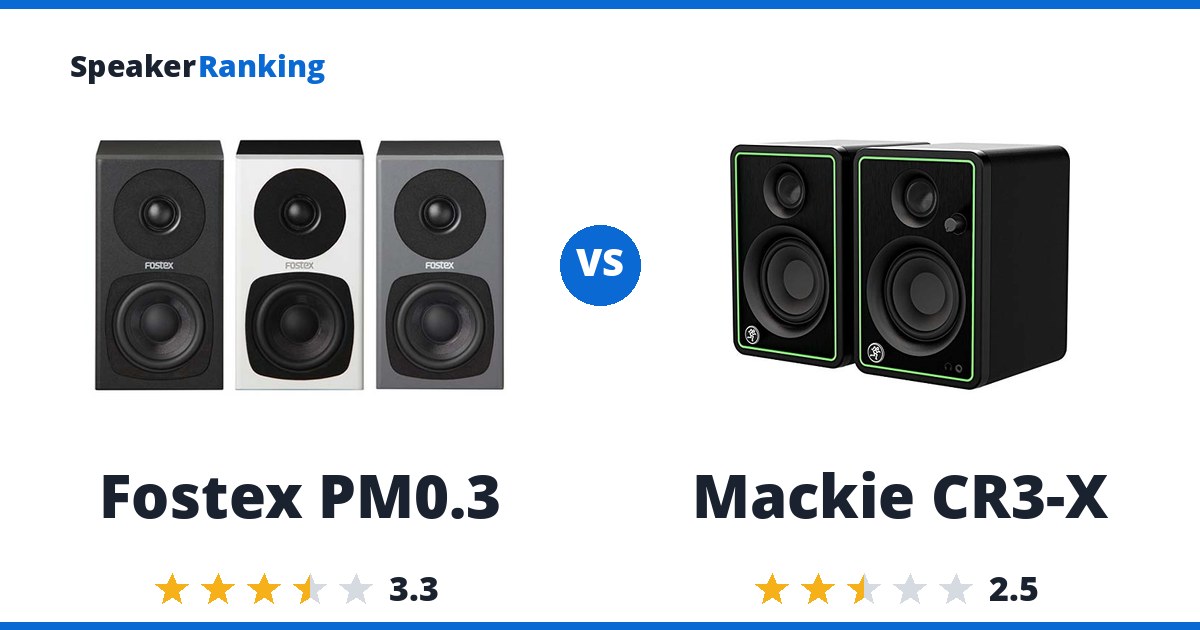
The case for the Fostex PM0.3: CEA2034 spinorama shows a smooth response up to its 2.6kHz crossover point despite the tiny size, and the reviewer was surprised it held up as well as it did against “junk plastic computer speakers.” The amplifier simply runs out of power under heavy stress rather than producing sudden harsh distortion. Watch for: Distortion measurements at 96dB SPL were unusable given the driver’s tiny size; even 6dB lower, the reviewer found the mid-woofer “unhappy.” Horizontal and especially vertical dispersion are uneven.
Buy the Mackie CR3-X if you want one new; the Fostex PM0.3 is discontinued, so only look for it used.
Still deciding? The full Powered Home rankings cover every ranked option.
Specifications Side By Side
| Fostex PM0.3 | Mackie CR3-X | |
|---|---|---|
| Price | $90 per pair Discontinued | $99.99 per pair |
| Ranked | #13 of 34 in Small Size Powered Bookshelf Speakers | #24 of 34 in Small Size Powered Bookshelf Speakers |
| Bass Extension (-3dB) | 108.4Hz (measured, Audio Science Review) | 80Hz (measured, Erin’s Audio Corner) |
| Bass Extension (-10dB) | 76.1Hz (derived, log-interpolated between spinorama.org -9dB/-12dB points) | 70Hz (measured, Erin’s Audio Corner) |
| Drivers | 3” cone woofer, 0.75” soft dome tweeter (master/slave powered pair) | 3” woofer, 0.75” silk dome tweeter |
| Dimensions | 7.3”H x 3.9”W x 5.1”D (185 x 100 x 130 mm) (per manufacturer) | 8.1”H x 5.5”W x 7.1”D (205.7 x 139.7 x 180.3 mm) |
| Weight | 6.4 lbs (2.9 kg) pair | 7.7 lbs (3.5 kg) |
| Frequency Response | 110Hz - 20kHz +/-3dB (Manufacturer specified) | 80 Hz-20 kHz (-3dB) (Manufacturer specified) |
| Amplifier Power | 15W + 15W RMS | 50W total (25W per speaker) |
| App | No | No |
| EQ | No | No |
| DSP | No | - |
| Spinorama Preference Score | 3.02 | 2.50 |
| Spinorama Preference Score with Perfect Sub | 6.46 | 5.42 |
| Inputs | RCA, 3.5mm Aux | RCA, Aux |
| XLR Input | No | No |
| RCA Input | Yes | Yes |
| TRS Input | No | No |
| Optical Input | No | No |
| Coaxial Input | No | No |
| USB Input | No | No |
| HDMI Input | No | No |
| AES Input | No | No |
| Aux Input | Yes | Yes |
| Bluetooth | No | No |
| Outputs | - | 1/8” headphone jack |
| Sensitivity | - | 96dB (measured at 0.3V/1m, Erin’s Audio Corner) |
| Maximum SPL | - | 92dB @ 1m (manufacturer specified) |
| Headphone Output | - | Yes |
Related Speaker Comparisons
How Fostex PM0.3 compares with other leading options:
- Bowers & Wilkins Formation Flex vs Fostex PM0.3
- M-Audio BX3 vs Mackie CR3-X
- Presonus Eris E3.5 2nd Gen vs Mackie CR3-X
- Edifier MR3 vs Mackie CR3-X
- Fluid Audio C35BT vs Mackie CR3-X
Prices on this page were last checked October 3, 2026 at 10:26 PM UTC. Product prices and availability are accurate as of that date/time and are subject to change; the price and availability shown on Amazon at the time of purchase will apply to the purchase of this product.
As an eBay Partner, we may be compensated if you make a purchase.
The Two Speakers In Full
 Fostex PM0.3: $90 per pair Discontinued eBay
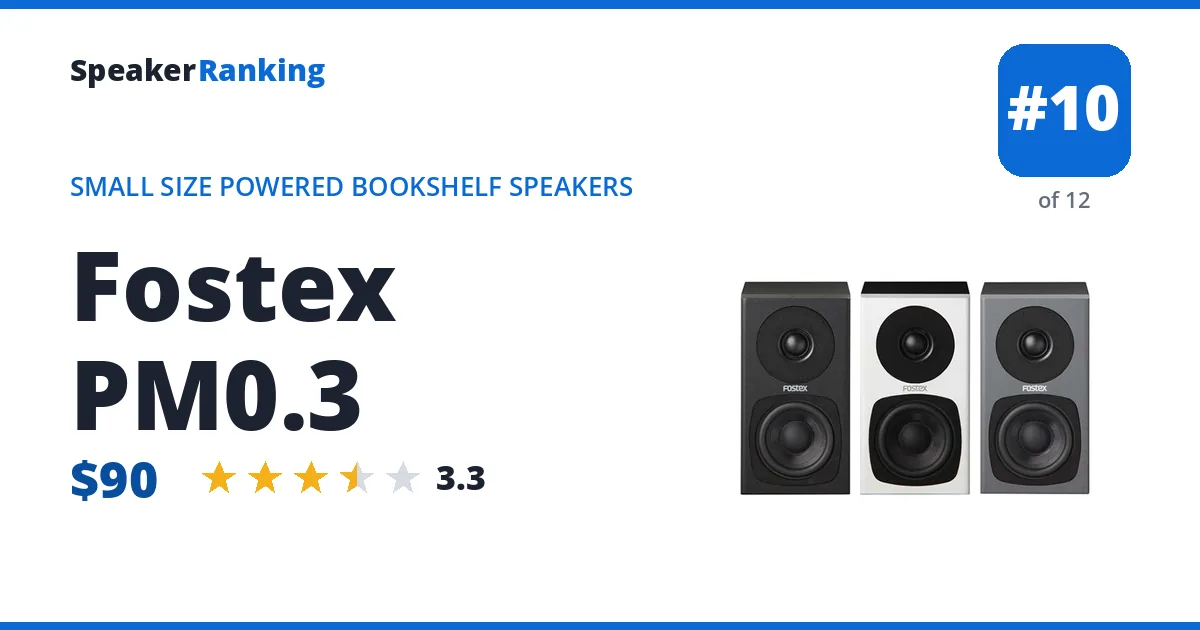
Pros: ASR’s Klippel measurements show relatively even midrange output, spanning 2.9dB from 300Hz to 5kHz. Its 6.46 predicted preference score with an ideal subwoofer is close to the Edifier MR3’s, so the small size does not rule out useful desktop sound when bass is handled separately. The review found that modest correction around the upper midrange could improve its balance. Measured bass extension of 108.4Hz (-3dB).
Cons: Very limited bass: the measured -3dB point is about 108Hz, and the standalone preference score falls to 3.02. Uneven off-axis response and substantial distortion when pushed prevent the respectable subwoofer-normalized score from translating into strong all-round performance. It belongs below the MR3 for standalone desktop use, and is unsuitable for loud playback. Discontinued.
Full Fostex PM0.3 review and specifications →
| AES Input | No |
|---|---|
| Amplifier Power | 15W + 15W RMS |
| App | No |
| Aux Input | Yes |
| Bass Extension (-10dB) | 76.1Hz (derived, log-interpolated between spinorama.org -9dB/-12dB points) |
| Bass Extension (-3dB) | 108.4Hz (measured, Audio Science Review) |
| Bluetooth | No |
| Coaxial Input | No |
| DSP | No |
| Dimensions | 7.3”H x 3.9”W x 5.1”D (185 x 100 x 130 mm) (per manufacturer) |
| Drivers | 3” cone woofer, 0.75” soft dome tweeter (master/slave powered pair) |
| EQ | No |
| Frequency Response | 110Hz - 20kHz +/-3dB (Manufacturer specified) |
| HDMI Input | No |
| Inputs | RCA, 3.5mm Aux |
| Optical Input | No |
| RCA Input | Yes |
| Spinorama Preference Score | 3.02 |
| Spinorama Preference Score with Perfect Sub | 6.46 |
| TRS Input | No |
| USB Input | No |
| Weight | 6.4 lbs (2.9 kg) pair |
| XLR Input | No |
- Links
- Reviews, Comparisons and Sound Samples
- Head-to-Head Comparisons
 Mackie CR3-X: $99.99 per pair Amazon eBay
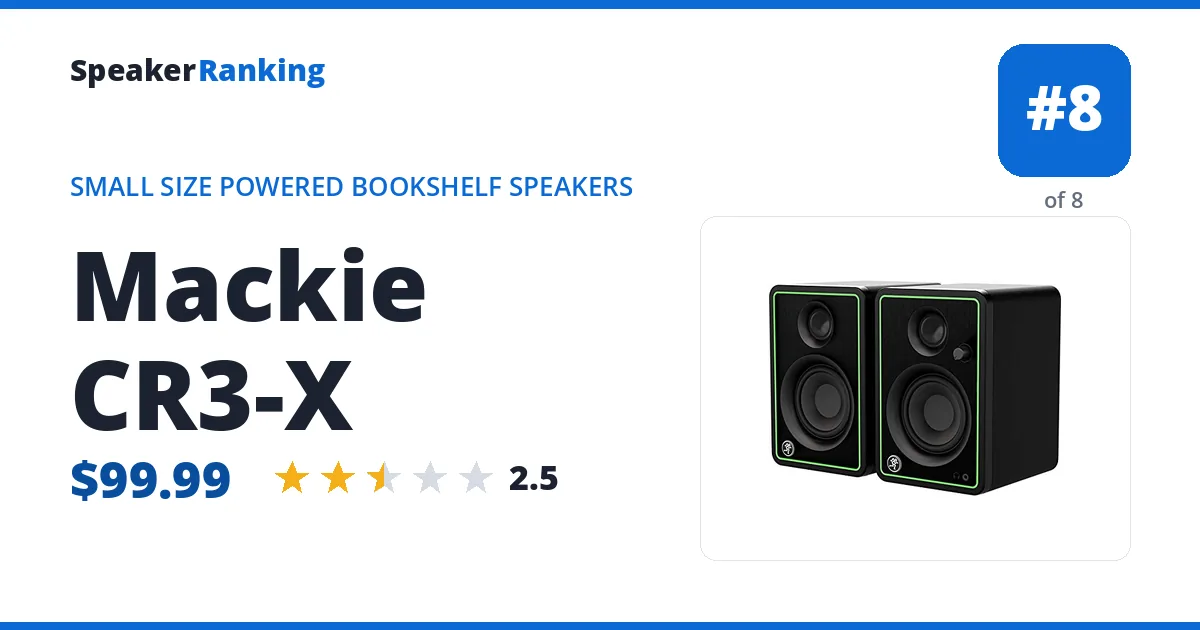
Pros: Erin’s Klippel data predicts 2.50 standalone and 5.42 with an ideal subwoofer. The existing comparative review found less exaggerated tonal shaping and better sustained-output behavior than the original PreSonus E3.5 tested alongside it. Midrange distortion was reasonably controlled for inexpensive desktop speakers at moderate listening levels. Measured bass extension of 80Hz (-3dB), with a measured sensitivity of 96dB.
Cons: The response spans 4.4dB from 300Hz to 5kHz, with substantial narrow-band irregularities and bass rolloff reaching -3dB around 75Hz. Bass peaking and crossover-region changes with listening height prevent neutral monitoring. Limiting becomes intrusive above modest desktop levels, and there are no tone controls. Comparisons with the original E3.5 should not be treated as measurements of its second generation.
Full Mackie CR3-X review and specifications →
| AES Input | No |
|---|---|
| Amplifier Power | 50W total (25W per speaker) |
| App | No |
| Aux Input | Yes |
| Bass Extension (-10dB) | 70Hz (measured, Erin’s Audio Corner) |
| Bass Extension (-3dB) | 80Hz (measured, Erin’s Audio Corner) |
| Bluetooth | No |
| Coaxial Input | No |
| Dimensions | 8.1”H x 5.5”W x 7.1”D (205.7 x 139.7 x 180.3 mm) |
| Drivers | 3” woofer, 0.75” silk dome tweeter |
| EQ | No |
| Frequency Response | 80 Hz-20 kHz (-3dB) (Manufacturer specified) |
| HDMI Input | No |
| Headphone Output | Yes |
| Inputs | RCA, Aux |
| Maximum SPL | 92dB @ 1m (manufacturer specified) |
| Optical Input | No |
| Outputs | 1/8” headphone jack |
| RCA Input | Yes |
| Sensitivity | 96dB (measured at 0.3V/1m, Erin’s Audio Corner) |
| Spinorama Preference Score | 2.50 |
| Spinorama Preference Score with Perfect Sub | 5.42 |
| TRS Input | No |
| USB Input | No |
| Weight | 7.7 lbs (3.5 kg) |
| XLR Input | No |
- Links
- Reviews, Comparisons and Sound Samples
- Erin’s Audio Corner Review Measurements More from Erin’s Audio Corner →
- Audio Science Review Measurements More from Audio Science Review →
- DSAUDIO.review: Presonus Eris E3.5 vs Mackie CR3 Sound Demo w/ Bass Test More from DSAUDIOreview →
- DSAUDIO.review: Mackie CR3-X vs Edifier R1280T Sound, Distortion & Frequency Response Comparison
- Erin’s Audio Corner: Mackie CR3-X vs PreSonus E3.5 Budget Monitor Showdown!
- Erin’s Audio Corner Measurements (spinorama.org)
- Head-to-Head Comparisons