Short answer: the Fostex PM0.3. It ranks #8 of 22 powered bookshelf speakers by sound quality; the Bowers & Wilkins Formation Flex ranks #9.
What the Bowers & Wilkins Formation Flex offers: ASR’s Klippel data gives a 5.53 predicted preference score with an ideal subwoofer and broad horizontal coverage. Its wireless stereo-pair capability and network streaming can suit a minimalist system without conventional source cables. The measured tonal result is more credible than judging sound quality from the compact wireless format alone. Watch for: Standalone preference is only 2.80. The response rises toward the treble, and the -3dB point is about 95Hz, so lower bass is substantially reduced even though the preference model’s separate LFX metric is 62Hz. Those two bass metrics are not interchangeable. A stereo pair is costly, and the lack of conventional analog input limits system flexibility.
What the Fostex PM0.3 offers: ASR’s Klippel measurements show relatively even midrange output, spanning 2.9dB from 300Hz to 5kHz. Its 5.66 predicted preference score with an ideal subwoofer is close to the Edifier MR3’s, so the small size does not rule out useful desktop sound when bass is handled separately. The review found that modest correction around the upper midrange could improve its balance. Watch for: Very limited bass: the measured -3dB point is about 108Hz, and the standalone preference score falls to 2.23. Uneven off-axis response and substantial distortion when pushed prevent the respectable subwoofer-normalized score from translating into strong all-round performance. It belongs below the MR3 for standalone desktop use, and is unsuitable for loud playback.
Buy the Bowers & Wilkins Formation Flex if the price is the priority over sound quality, or the Fostex PM0.3 if sound quality is the priority over the price.
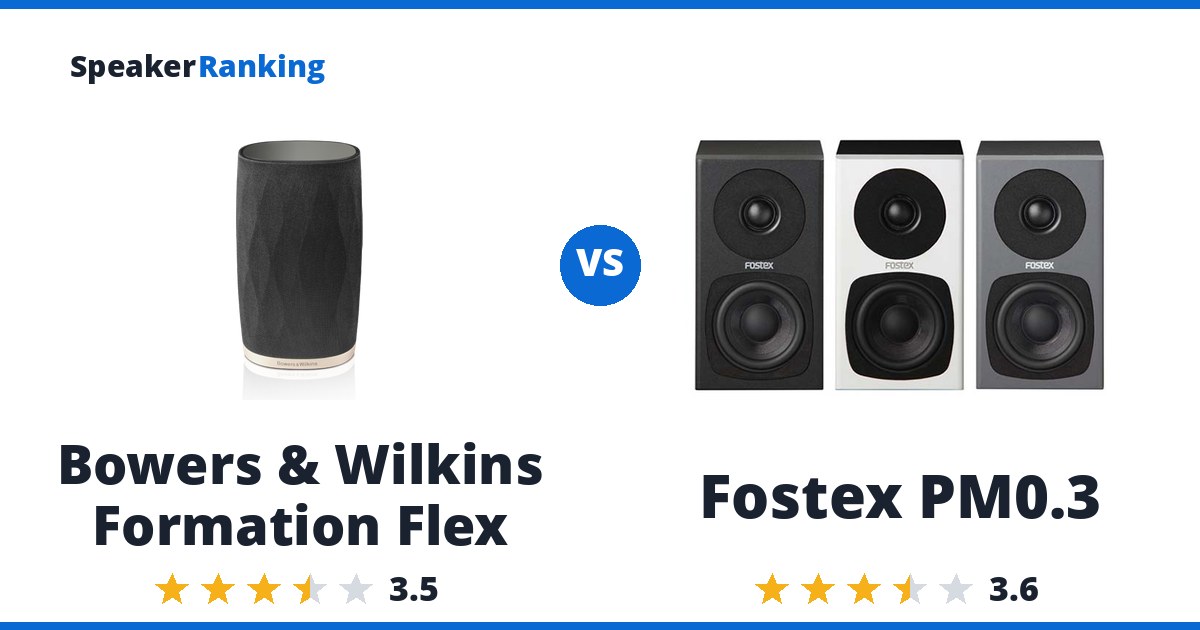
Specifications Side By Side
| Bowers & Wilkins Formation Flex | Fostex PM0.3 | |
|---|---|---|
| Price | £449 each | $90 Discontinued |
| Ranked | #9 of 22 in Small Size Powered Bookshelf Speakers | #8 of 22 in Small Size Powered Bookshelf Speakers |
| Enclosure | 2-way active wireless | - |
| Drivers | 1" decoupled double-dome tweeter, 4" woven-glass woofer | 3" cone woofer, 0.75" soft dome tweeter (master/slave powered pair) |
| Dimensions | 8.5H x 5.1W x 5.1D in | 7.3"H x 3.9"W x 5.1"D (185 x 100 x 130 mm) (per manufacturer) |
| Weight | 5.1 lbs each | 6.4 lbs / 2.9 kg pair |
| Power Output | 100W each (2 x 50W) | - |
| Wireless | AirPlay 2, Spotify Connect, Bluetooth, Formation mesh | - |
| Country | United Kingdom (design) | - |
| Bass Extension (-3dB) | - | 82Hz (measured, Audio Science Review) |
| Bass Extension (-10dB) | - | 65Hz (measured, Audio Science Review) |
| Discontinued | - | Yes |
| Frequency Response | - | 110Hz - 20kHz +/-3dB (Manufacturer specified) |
| Output Power | - | 15W + 15W RMS |
| App | - | No |
| EQ | - | No |
| DSP | - | No |
Related Speaker Comparisons
More useful head-to-heads from the same speaker class:
- Edifier MR3 vs Mackie CR3-X
- Edifier MR3 vs Presonus Eris E3.5 2nd Gen
- Edifier MR3 vs Presonus Eris E5
- Fostex PM0.3 vs Mackie CR3-X
- Edifier M60 vs Edifier MR3
Prices on this page were last checked September 8, 2026 at 6:02 PM UTC. Product prices and availability are accurate as of that date/time and are subject to change; the price and availability shown on Amazon at the time of purchase will apply to the purchase of this product.
As an eBay Partner, we may be compensated if you make a purchase.
The Two Speakers In Full
 Bowers & Wilkins Formation Flex: £449 each Bowers & Wilkins eBay
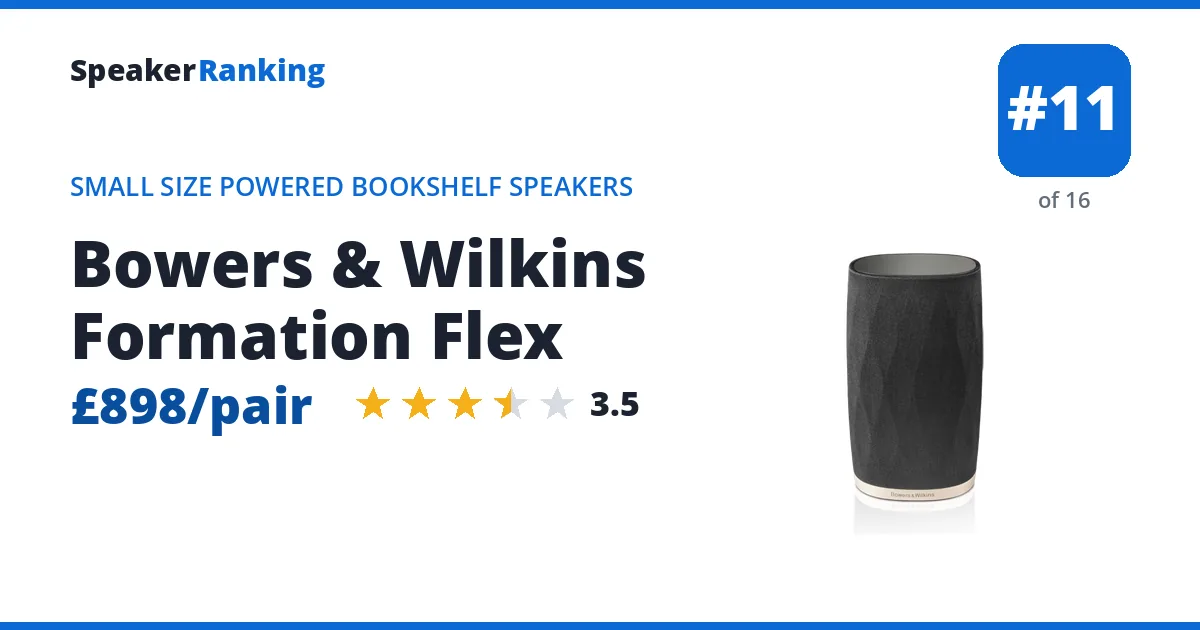
Pros: ASR’s Klippel data gives a 5.53 predicted preference score with an ideal subwoofer and broad horizontal coverage. Its wireless stereo-pair capability and network streaming can suit a minimalist system without conventional source cables. The measured tonal result is more credible than judging sound quality from the compact wireless format alone.
Cons: Standalone preference is only 2.80. The response rises toward the treble, and the -3dB point is about 95Hz, so lower bass is substantially reduced even though the preference model’s separate LFX metric is 62Hz. Those two bass metrics are not interchangeable. A stereo pair is costly, and the lack of conventional analog input limits system flexibility.
Full Bowers & Wilkins Formation Flex review and specifications →
| Country | United Kingdom (design) |
|---|---|
| Dimensions | 8.5H x 5.1W x 5.1D in |
| Drivers | 1" decoupled double-dome tweeter, 4" woven-glass woofer |
| Enclosure | 2-way active wireless |
| Power Output | 100W each (2 x 50W) |
| Weight | 5.1 lbs each |
| Wireless | AirPlay 2, Spotify Connect, Bluetooth, Formation mesh |
- Links
- Reviews, Comparisons and Sound Samples
 Fostex PM0.3: $90 Discontinued eBay
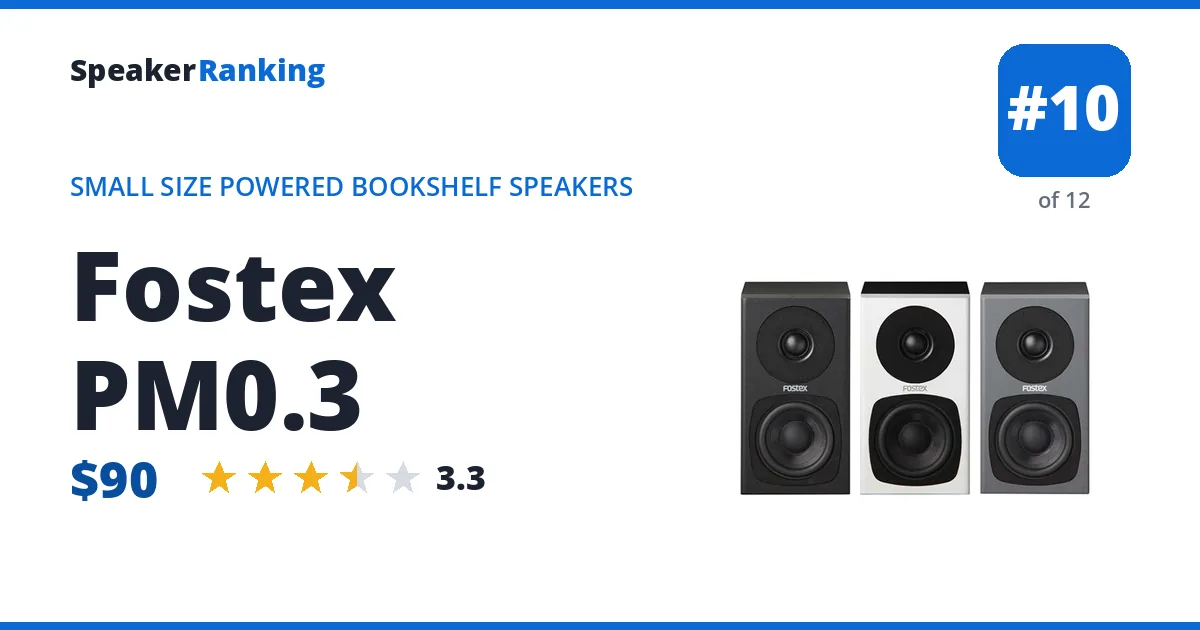
Pros: ASR’s Klippel measurements show relatively even midrange output, spanning 2.9dB from 300Hz to 5kHz. Its 5.66 predicted preference score with an ideal subwoofer is close to the Edifier MR3’s, so the small size does not rule out useful desktop sound when bass is handled separately. The review found that modest correction around the upper midrange could improve its balance.
Cons: Very limited bass: the measured -3dB point is about 108Hz, and the standalone preference score falls to 2.23. Uneven off-axis response and substantial distortion when pushed prevent the respectable subwoofer-normalized score from translating into strong all-round performance. It belongs below the MR3 for standalone desktop use, and is unsuitable for loud playback. Discontinued.
Full Fostex PM0.3 review and specifications →
| App | No |
|---|---|
| Bass Extension (-10dB) | 65Hz (measured, Audio Science Review) |
| Bass Extension (-3dB) | 82Hz (measured, Audio Science Review) |
| DSP | No |
| Dimensions | 7.3"H x 3.9"W x 5.1"D (185 x 100 x 130 mm) (per manufacturer) |
| Discontinued | Yes |
| Drivers | 3" cone woofer, 0.75" soft dome tweeter (master/slave powered pair) |
| EQ | No |
| Frequency Response | 110Hz - 20kHz +/-3dB (Manufacturer specified) |
| Output Power | 15W + 15W RMS |
| Weight | 6.4 lbs / 2.9 kg pair |
- Links
- Reviews, Comparisons and Sound Samples
- Head-to-Head Comparisons