Editor's top picks
Start with these speakers
Our leading recommendations at a glance. Each card links to its primary retailer.
Looking for the best passive home speaker for sound quality? Passive means the speaker has no amplifier of its own: you supply that separately, through a receiver or an outboard amp, which is the trade every buyer here is making in exchange for more of the budget going into drivers and cabinet instead of electronics. We’ve ranked 819 home bookshelf and floorstanding speakers by measured frequency response, tonal balance and bass extension, verified by expert reviewers like Erin’s Audio Corner and Audio Science Review, not by spec-sheet claims.
Unlike sponsored review sites, we provide complete transparency: honest pros and cons, detailed specs, sound samples, comparison videos, and links to measurements. Every ranking is backed by data from trusted, unbiased audio experts.
Unless you need them to sit on a desktop, shelf or other high surface, I highly recommend getting floorstanding speakers. Also of note, a lot of bookshelf size speakers also come in a floorstanding version which should perform similarly but with deeper bass.
Also consider Top Recommended Powered Bookshelf Speakers if you aren’t looking for something specifically passive.
Quick Navigation
Prices on this page were last checked October 15, 2026 at 5:41 PM UTC. Product prices and availability are accurate as of that date/time and are subject to change; the price and availability shown on Amazon at the time of purchase will apply to the purchase of this product.
As an eBay Partner, we may be compensated if you make a purchase.
Floorstanding
 The best budget large size passive floorstanding pick is the Polk T50: $498 per pair Amazon $249.00 eBay
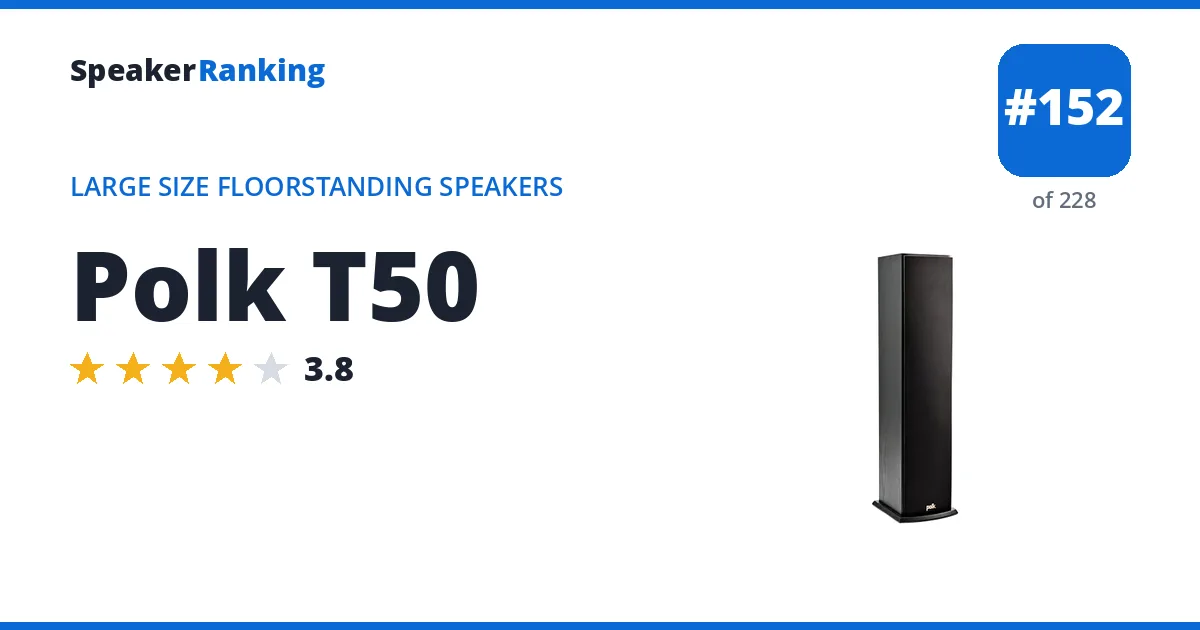
Same family: the Polk T15 (bookshelf, rated 1.9/5).
Pros: Pretty deep bass for the price. Distortion at 86dB SPL/1m is reasonably controlled outside a narrow spike around 250Hz. The reviewer notes performance is “not too bad for a budget speaker” once the two main tonal issues are addressed with EQ. Measured bass extension of 47Hz (-3dB), with a measured sensitivity of 86.3dB.
Cons: 5dB peak at 1kHz, 4dB bright top end from 11kHz on up. Just okay vertical off axis. Impedance and phase show several resonances between 200Hz-1kHz, with a minimum impedance of 4.2 ohms. Distortion rises substantially at 96dB SPL/1m across the midrange, with repeated peaks between 100Hz-2kHz.
Full Polk T50 review and specifications →
| Released | Sep 2015 (11 years ago) |
|---|---|
| Bass Extension (-10dB) | 38Hz (measured, Audio Science Review) |
| Bass Extension (-3dB) | 47Hz (measured, Audio Science Review) |
| DIY Kit | No |
| Dimensions | 40.4”H x 9.3”W x 12.5”D (1026.2 x 235.0 x 317.5 mm) |
| Drivers | 2x 6.5” bi-laminate paper cone woofers, 1x 1” Terylene dome tweeter + 2x 8” passive bass radiators |
| Impedance | 4 ohms nominal (4.2 ohms minimum, measured by Audio Science Review) |
| Sensitivity | 86.3dB (2.83V/1m, measured by Audio Science Review) |
| Spinorama Preference Score | 4.14 |
| Spinorama Preference Score with Perfect Sub | 6.15 |
| Weight | 75.4 lbs (34.2 kg) |
| Woofer Cabinet | passive radiator |
- Links
- Reviews, Comparisons and Sound Samples
- Head-to-Head Comparisons
- Polk T50 vs SVS Ultra Evolution Pinnacle
- Polk T50 vs Vandersteen Treo CT
- Polk T50 vs Definitive Technology BP-9020
- Polk T50 vs Polk Signature Elite ES50
- Polk T50 vs Klipsch RP-6000F II
- Polk T50 vs Focal Aria Evo X N°2
- Polk T50 vs Dynaudio Emit 30
- Polk T50 vs Klipsch RP-8000F II
- See all 53 comparisons
 The best value pick for most buyers, the Revel Concerta2 F35: $900 per pair Crutchfield $900 eBay
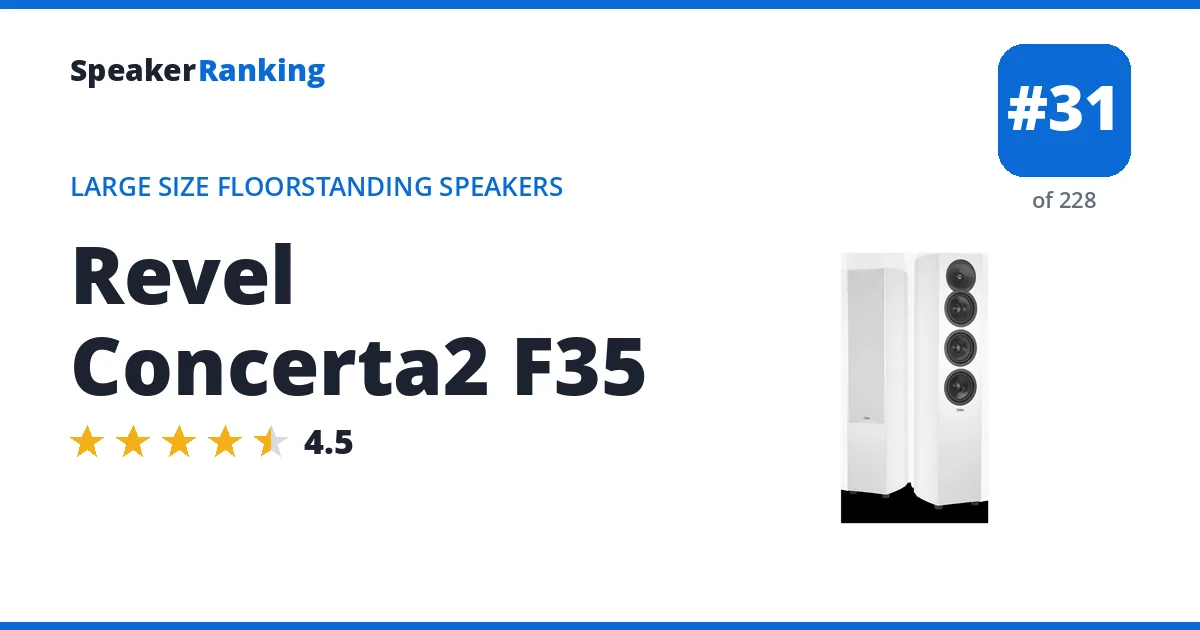
Same family: the Revel Concerta2 M16 (bookshelf, rated 4.1/5), the Revel Concerta2 F36 (larger floorstanding, ranked higher, estimated 4.6/5) and the Revel Concerta2 C25 (center, rated 4.1/5).
Pros: Two-and-a-half-way, four-driver design: a 1” aluminum dome tweeter on a waveguide, a 5.25” mid-range, and dual 5.25” mid-bass drivers in a rear-ported cabinet. Measured sensitivity of 89.4dB closely matches the 90dB spec, and distortion looks good at both 86dB and 96dB, holding up well even with a high-pass filter applied. At its sale price of $900/pair, down from full retail, the reviewer calls it a “no-brainer,” undercutting comparable budget floorstanders like the ELAC Debut 3.0 DF63. Frequency response and directivity mismatches are largely EQ-able, since most of what shows up in measurements traces to physical tweeter/mid-range separation rather than a fundamental flaw. Compression is fairly well controlled for the price: about 1dB of loss around 100Hz under long-term compression, described as “par for the course” at this cost. Measured bass extension of 70Hz (-3dB), with a measured sensitivity of 89.4dB.
Cons: F3 of 61Hz and F10 of 39Hz mean a subwoofer is needed for real bass extension. A dip in the lower midrange/2-3kHz region reduces attack and detail, and a peak around 5kHz adds some edge and sibilance in the lower treble. A peak in off-axis energy around 3kHz reflects off sidewalls at roughly 60-70° off-axis and arrives louder than the direct sound: this specific issue can’t be fixed with EQ (boosting the direct sound would boost the stronger reflection too) and would need acoustic absorption to properly address, though the reviewer considers it a minor, optional fix at this price. A couple of minor resonances appear in the impedance plot, including one around 300Hz that may partly explain a subtle sense of vocal warmth noticed in listening, though it’s more likely room-related. Minimum impedance around 3.8 ohms. Short-term compression testing shows some increased distortion in the tweeter and higher-frequency compression at loud output.
Full Revel Concerta2 F35 review and specifications →
| Released | 2015 (11 years ago) |
|---|---|
| Bass Extension (-10dB) | 50Hz (measured, Erin’s Audio Corner) |
| Bass Extension (-3dB) | 70Hz (measured, Erin’s Audio Corner) |
| DIY Kit | No |
| Dimensions | 40.3”H x 8.4”W x 12.2”D (1023.6 x 213.4 x 309.9 mm) |
| Drivers | 3x 5.25” deep anodized aluminum cone woofers, 1” Aluminum Tweeter |
| Impedance | 6 ohms nominal (3.8 ohms minimum, measured by Erin’s Audio Corner) |
| Sensitivity | 89.4dB (measured, Erin’s Audio Corner; 90dB manufacturer specified) |
| Spinorama Preference Score | 5.35 |
| Spinorama Preference Score with Perfect Sub | 7.30 |
| Weight | 41 lbs (18.6 kg) each |
| Woofer Cabinet | ported, rear |
- Links
- Reviews, Comparisons and Sound Samples
- Erin’s Audio Corner: Revel F35 Review: Great Sound, Lower Price! More from Erin’s Audio Corner →
- Erin’s Audio Corner: You’ve Never Seen a Review Like This. Revel F35 Review (Part 1).
- Audio Science Review Revel Concerta2 F35 More from Audio Science Review →
- Audio Science Review Measurements (spinorama.org)
- Erin’s Audio Review Website Revel Concerta2 F35
- Head-to-Head Comparisons
- Revel Concerta2 F35 vs Revel F206
- Revel Concerta2 F35 vs Perlisten S7t
- Revel Concerta2 F35 vs Revel F228Be
- Revel Concerta2 F35 vs Revel F208
- Revel Concerta2 F35 vs Focal Chora 816
- Revel Concerta2 F35 vs JBL HDI-3800
- Revel Concerta2 F35 vs KEF R5
- Revel Concerta2 F35 vs KEF Reference 203
- See all 57 comparisons
 For excellent sound quality a step up in price, the MoFi SourcePoint 888: $5495 per pair Crutchfield $5495 eBay
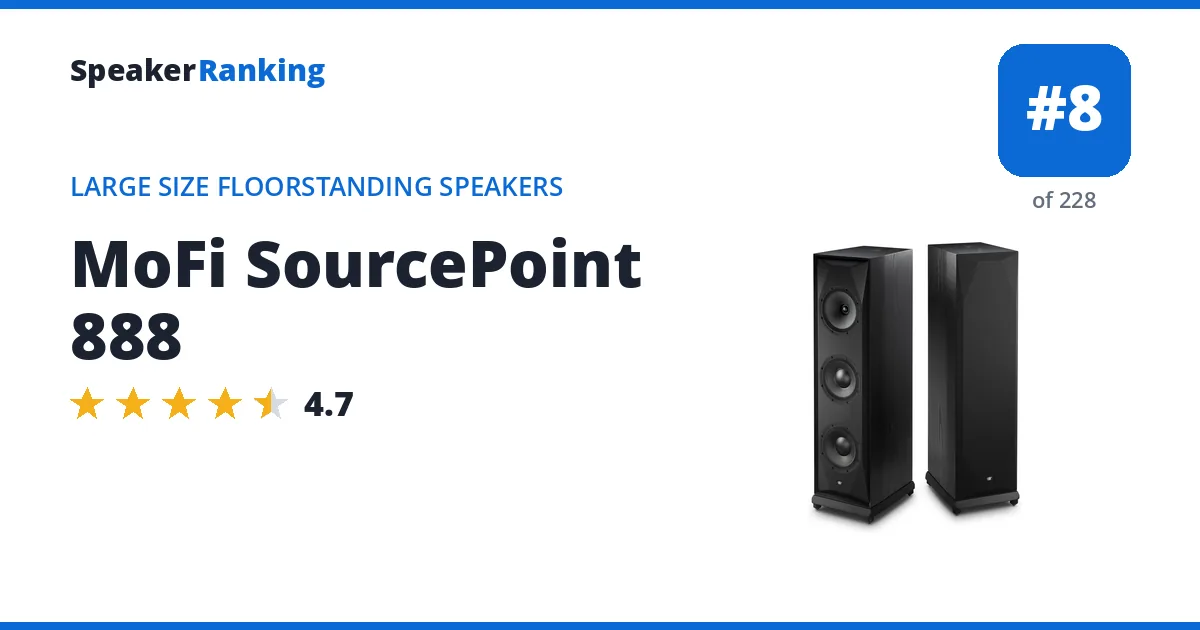
Same family: the MoFi SourcePoint 8 (smaller bookshelf, rated 4.5/5) and the MoFi SourcePoint 10 (larger bookshelf, rated 4.4/5). See every MoFi SourcePoint generation.
Pros: Three-way vented design: an 8” coaxial mid-range/1.25” dome tweeter driver plus two additional 8” woofers crossed at about 130Hz, giving genuinely full-range output (F3 34Hz, F10 26Hz) other than the deepest subsonic content. Ranked by the reviewer among his personal top three speakers out of roughly 200 tested, alongside the KEF Blade Two Meta and Dutch & Dutch 8C, despite costing a small fraction of either. Excellent compression/dynamic-range linearity, holding its own against much pricier speakers like the March Audio Sointuva AWG, KEF Reference 1 Meta, and KEF Blade Two Meta. On-axis (0°) and 30°-off-axis estimated in-room responses track within about 1-1.5dB of each other above 500Hz, so tonal balance barely changes with placement or listening angle: excellent for multi-seat home theater or entertaining. Wide horizontal dispersion of about ±60°. Distortion stays low: under 1% at 86dB, and under 1% above 200Hz even at 96dB, with multitone distortion mostly under 1% as well. Not a difficult amplifier load (5-ohm minimum impedance, 4.2-ohm minimum EPDR). Checks the three boxes the reviewer considers essential for a home theater speaker: low compression, low distortion, and excellent directivity. Measured bass extension of 34Hz (-3dB), with a measured sensitivity of 85.6dB.
Cons: A significant investment, best ordered from a dealer with a good return policy. Large and heavy floorstander (about 96 lbs, 42” tall) requiring real floor space and rear clearance. Positioning is fairly specific: needs about 2 feet from the rear wall. Closer causes boominess in the 40-50Hz region, farther loses bass extension. Vertical dispersion (about ±50°) is narrower than horizontal (about ±60°), since the two 8” woofers are spaced vertically apart on a tower cabinet, causing some vertical mismatch at lower frequencies. A small on-axis dip around 500Hz and a deliberately lower tweeter level (about 0.5dB below the midrange) are intentional design choices for smoother in-room response, but mean the raw on-axis measurement isn’t perfectly flat. A mild diffraction-related dip appears around 3kHz in directivity measurements. Toeing the speaker out more than about 10° starts to noticeably reduce top-end energy.
Full MoFi SourcePoint 888 review and specifications →
| Released | Apr 2024 (2 years ago) |
|---|---|
| Bass Extension (-10dB) | 26Hz (measured, Erin’s Audio Corner) |
| Bass Extension (-3dB) | 34Hz (measured, Erin’s Audio Corner) |
| DIY Kit | No |
| Dimensions | 41.2”H x 12.6”W x 16.1”D (1046.5 x 320 x 408.9 mm) |
| Drivers | Dual 8” paper cone woofers, 8” Paper Cone midrange, 1.25” wide roll soft dome tweeter |
| Impedance | 6 ohms nominal, 5 ohms minimum (measured, Erin’s Audio Corner) |
| Sensitivity | 85.6dB (measured, Erin’s Audio Corner) |
| Spinorama Preference Score | 6.09 |
| Spinorama Preference Score with Perfect Sub | 7.21 |
| Weight | 94.8 lbs (43 kg) each |
| Woofer Cabinet | ported, rear |
- Links
- Reviews, Comparisons and Sound Samples
- Erin’s Audio Corner: Why the MoFi SourcePoint 888 Could Be Your Last Speaker Purchase More from Erin’s Audio Corner →
- Erin’s Audio Corner: Should You Buy the Revel F226Be or the MoFi 888?
- Erin’s Audio Corner: My Absolute Favorite Products of 2024 Revealed
- Erin’s Audio Corner Website: MoFi SourcePoint 888
- Erin’s Audio Corner Measurements (spinorama.org)
- Head-to-Head Comparisons
- MoFi SourcePoint 888 vs Revel F328Be
- MoFi SourcePoint 888 vs Radiant Acoustics Clarity 66
- MoFi SourcePoint 888 vs MoFi SourcePoint V10 Master Edition
- MoFi SourcePoint 888 vs Ascend Acoustics ELX Ribbon Tower
- MoFi SourcePoint 888 vs KEF Blade Two Meta
- MoFi SourcePoint 888 vs GR-Research NX-Treme
- MoFi SourcePoint 888 vs KEF R5 Meta
- MoFi SourcePoint 888 vs Revel F226Be
- See all 38 comparisons
 Nearly reference-level sound at a step down from the flagship’s price, the MoFi SourcePoint V10 Master Edition: $7995 per pair Crutchfield $7995 eBay
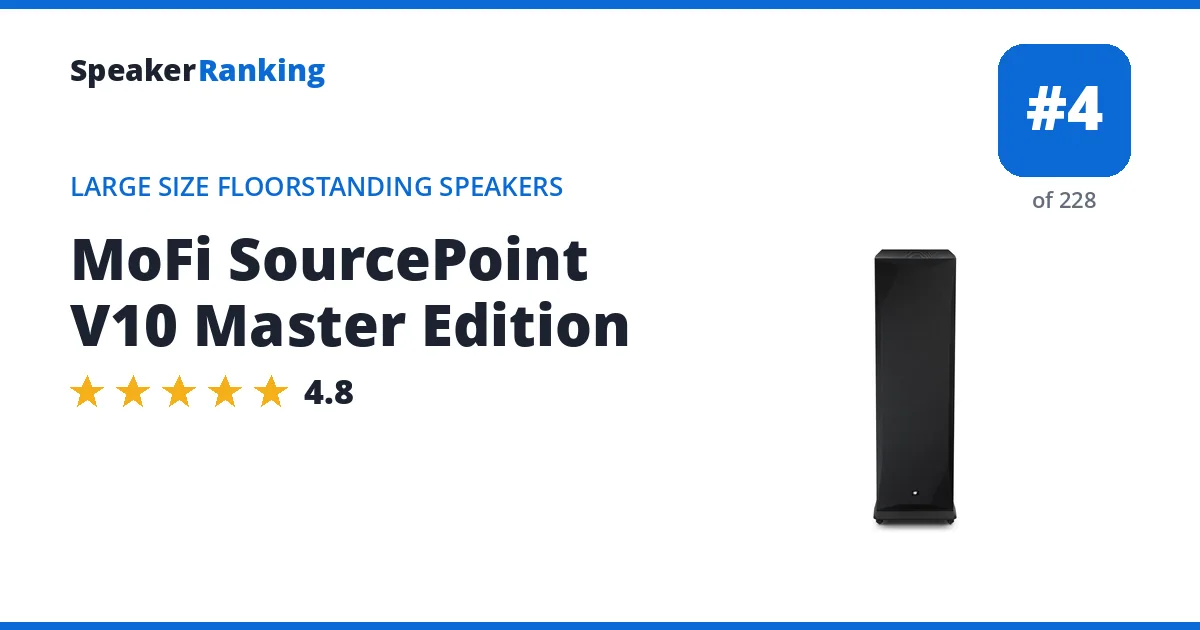
Pros: Extended bass to approximately 30 Hz in-room without subwoofer; images with excellent precision indicating tight frequency response matching between speakers. Integrated bass management with three-way treble attenuation switches for room tuning. New design from Andrew Jones represents reviewer personal second choice (behind only KEF Blade Two Meta at 29k) among hundreds of systems auditioned; ranks above Dutch & Dutch 8C, JBL 4367, and JBL M2 Master Reference Monitor. Measured bass extension of 38Hz (-3dB), with a measured sensitivity of 88.8dB.
Cons: Moderate sensitivity (~89 dB) means amplifier power requirements higher than many alternatives. Deep bass extension ends above subsonic frequencies (pipe organ territory below 17 Hz requires subwoofer).
Full MoFi SourcePoint V10 Master Edition review and specifications →
| Released | Apr 2025 (1 year ago) |
|---|---|
| Bass Extension (-10dB) | 25Hz (measured, Erin’s Audio Corner) |
| Bass Extension (-3dB) | 38Hz (measured, Erin’s Audio Corner) |
| DIY Kit | No |
| Dimensions | 48.8”H x 15.5”W x 19.9”D (1239.5 x 393.7 x 505.5 mm) |
| Drivers | 10” woofer, 10” paper‑cone concentric midrange, 1.25” soft‑dome concentric tweeter |
| Impedance | 6 ohms nominal, 5.3 ohms minimum (measured, Erin’s Audio Corner) |
| Sensitivity | 88.8dB (measured, Erin’s Audio Corner) |
| Spinorama Preference Score | 5.00 |
| Spinorama Preference Score with Perfect Sub | 6.31 |
| Weight | 160.9 lbs (73 kg) |
| Woofer Cabinet | passive radiator |
- Links
- Reviews, Comparisons and Sound Samples
- Head-to-Head Comparisons
- MoFi SourcePoint V10 Master Edition vs KEF Blade Two Meta
- MoFi SourcePoint V10 Master Edition vs GR-Research NX-Treme
- MoFi SourcePoint V10 Master Edition vs MoFi SourcePoint 888
- MoFi SourcePoint V10 Master Edition vs Revel F328Be
- MoFi SourcePoint V10 Master Edition vs Radiant Acoustics Clarity 66
- MoFi SourcePoint V10 Master Edition vs Ascend Acoustics ELX Ribbon Tower
- MoFi SourcePoint V10 Master Edition vs Revel F226Be
- MoFi SourcePoint V10 Master Edition vs JBL 4367
- See all 29 comparisons
 The best sound quality on this site, cost no object, is the KEF Blade Two Meta: $28,000 per pair only sold in stores eBay
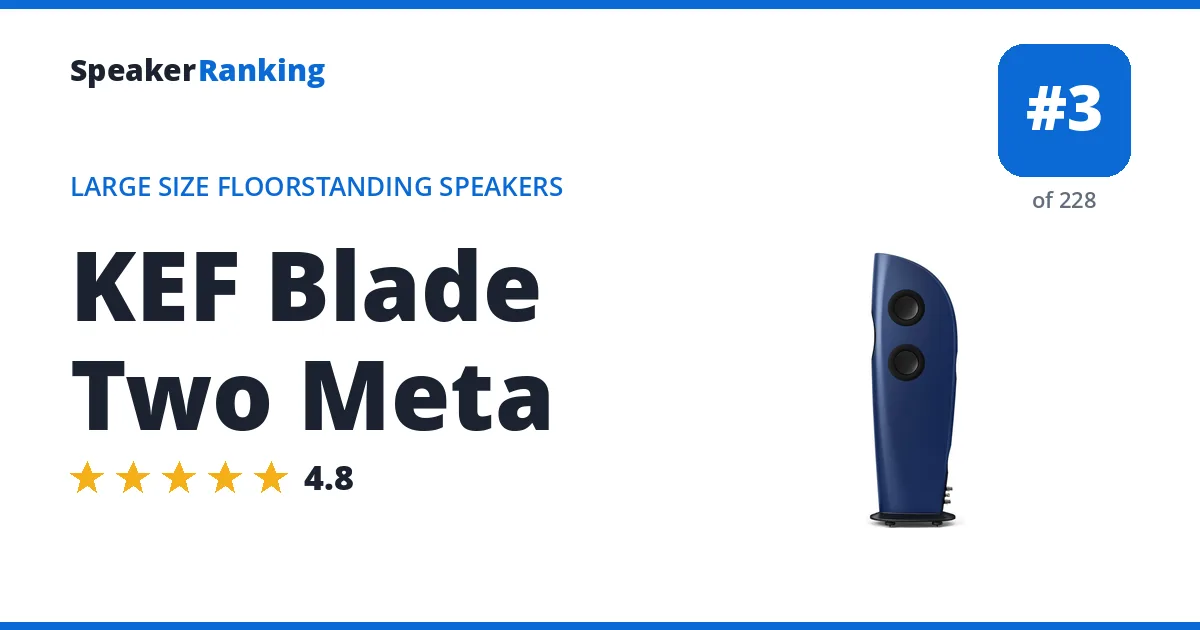
Same family: the KEF Blade One Meta (larger floorstanding, ranked higher, estimated 4.8/5).
Pros: True point-source coaxial design (four 6.5in mid-bass drivers flanking a coincident mid/tweeter) with matched ~50 degree horizontal and vertical dispersion, unusual for a multi-driver speaker. Fully rounded, edgeless cabinet eliminates baffle diffraction. Frequency response holds within about 2.5dB across the listening window. Extremely low harmonic and multitone distortion even at 96dB, with under 0.5dB of compression at full output, rivaling the KEF Reference 1 Meta and JBL 4367 in dynamic range. Reviewer described the imaging and soundstage depth as revealing recording details other speakers he tested (PS Audio Aspen FR10, MoFi SourcePoint 8, Neumann KH80) masked. Available in any custom finish at no extra charge. Measured bass extension of 31Hz (-3dB), with a measured sensitivity of 86.8dB.
Cons: 2dB dip and slight resonance around 200Hz, also visible in KEF white paper and likely cabinet-related. Bass rolls off fairly quickly below its 31Hz F3. Horizontal dispersion (~50 degrees) is narrower than the reviewer preferred 70-80 degrees; benefits from toeing out 10-20 degrees to open soundstage without losing image focus. Needs a separate power amp, not AVR-friendly.
Full KEF Blade Two Meta review and specifications →
| Released | Feb 2022 (4 years ago) |
|---|---|
| Bass Extension (-10dB) | 26Hz (measured, Erin’s Audio Corner) |
| Bass Extension (-3dB) | 31Hz (measured, Erin’s Audio Corner) |
| DIY Kit | No |
| Dimensions | 46.6”H x 13.5”W x 14.8”D (1183.6 x 342.9 x 375.9 mm) |
| Drivers | 4 x 165 mm (6.5 in.) aluminium cone, force cancelling woofers, 125 mm (5 in.) aluminium cone midrange, 25 mm (1 in.) aluminium dome with MAT tweeter |
| Impedance | 4 ohms nominal (3.3 ohms minimum, measured, Erin’s Audio Corner) |
| Sensitivity | 86.8dB (measured, Erin’s Audio Corner) |
| Spinorama Preference Score | 6.99 |
| Spinorama Preference Score with Perfect Sub | 8.11 |
| Weight | 79.4 lbs (36 kg) each |
| Woofer Cabinet | ported, rear |
- Links
- Reviews, Comparisons and Sound Samples
- Head-to-Head Comparisons
- KEF Blade Two Meta vs GR-Research NX-Treme
- KEF Blade Two Meta vs MoFi SourcePoint V10 Master Edition
- KEF Blade Two Meta vs JBL 4369
- KEF Blade Two Meta vs MoFi SourcePoint 888
- KEF Blade Two Meta vs Revel F328Be
- KEF Blade Two Meta vs Radiant Acoustics Clarity 66
- KEF Blade Two Meta vs Ascend Acoustics ELX Ribbon Tower
- KEF Blade Two Meta vs Magico S5 2024
- See all 38 comparisons
Bookshelf
 The best entry-level bookshelf pick, at roughly $110 per pair, is the Neumi BS5: $139.99 per pair Amazon $139.99 eBay
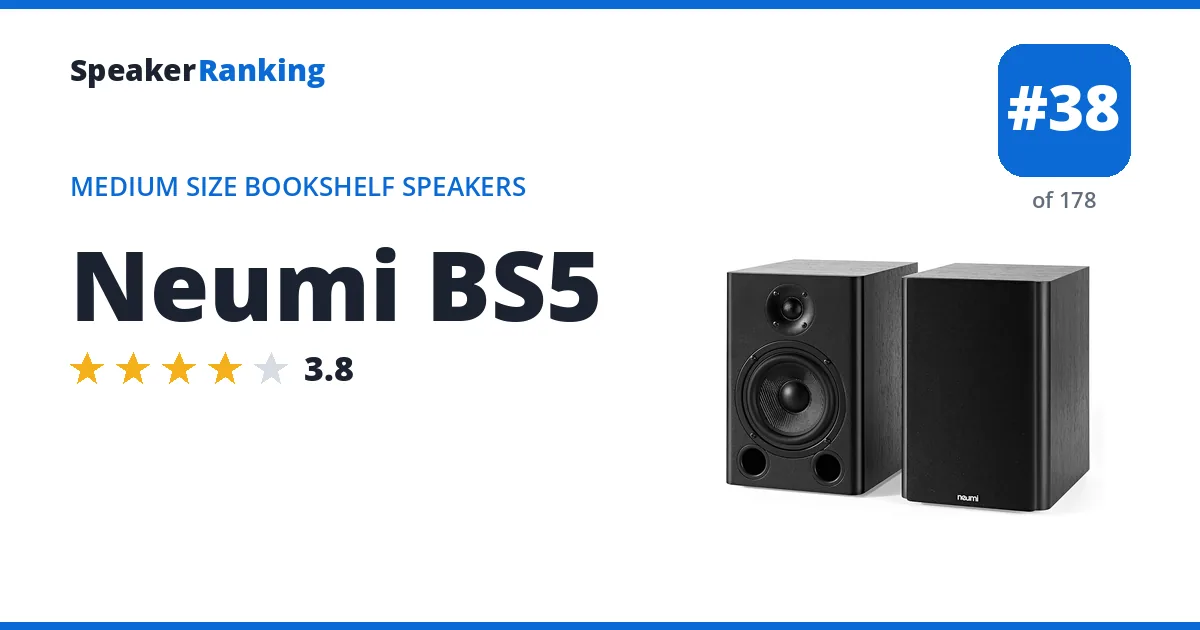
Pros: Exceptional budget value: Erin measured approximately +/-1.5dB on-axis linearity through most of the mid/treble, 84dB/2.83V/1m sensitivity and a manageable 4.6-ohm minimum. The 5-inch fiberglass woofer and 1-inch silk dome provide good horizontal directivity for the price; a mild upper-bass rise adds punch, and ordinary modern AVRs can generally drive the mostly six-ohm load at sensible levels. Measured bass extension of 64Hz (-3dB), with a measured sensitivity of 84dB.
Cons: Erin measured F3 at 64Hz, so kick-drum punch should not be mistaken for deep-bass extension. Output around 90dB began to reveal distortion and compression, limiting farfield/high-volume use. A narrow dip near 800Hz, port/cabinet resonances and imperfect crossover directivity remain visible; the tweeter itself is approximately four ohms even though the system is sold as nominal six ohms. A subwoofer is strongly preferred.
Full Neumi BS5 review and specifications →
| Released | Apr 2020 (6 years ago) |
|---|---|
| Bass Extension (-10dB) | 41.0Hz (measured, Erin’s Audio Corner) |
| Bass Extension (-3dB) | 64Hz (measured, Erin’s Audio Corner) |
| DIY Kit | No |
| Dimensions | 10.6”H x 7.2”W x 8.5”D (269.2 x 182.9 x 215.9 mm) |
| Drivers | 1” silk-dome tweeter; 5” fiberglass woofer |
| Impedance | 4.6 ohms minimum; approximately 6 ohms nominal (measured, Erin’s Audio Corner) |
| Sensitivity | Approximately 84dB/2.83V/1m (measured, Erin’s Audio Corner) |
| Spinorama Preference Score | 3.60 |
| Spinorama Preference Score with Perfect Sub | 6.12 |
| Weight | 7.1 lbs (3.2 kg) each |
| Woofer Cabinet | ported, front |
- Links
- Reviews, Comparisons and Sound Samples
- Erin’s Audio Corner: Neumi BS5 Review More from Erin’s Audio Corner →
- Erin’s Audio Corner: How good is cheap? Comparing/Contrasting Sony SS-CS5 and Neumi BS5.
- Erin’s Audio Corner: Budget Stereo Systems You Will Love
- Erin’s Audio Corner Website: Neumi BS5
- Erin’s Audio Corner Measurements (spinorama.org)
- Head-to-Head Comparisons
 For genuinely neutral sound at a lower price, the ELAC Debut 2.0 B6.2: $329.00 per pair Amazon $329.00 Crutchfield $329.00 eBay
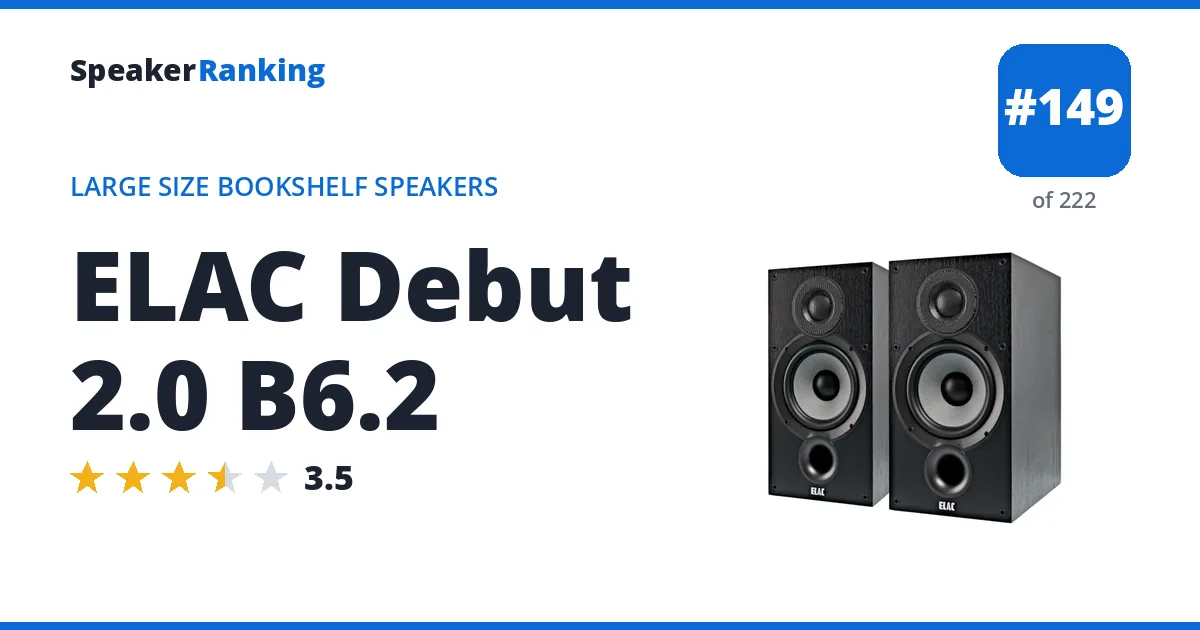
Newer model: the ELAC Debut 3.0 DB63, ranked higher, rated 4.2/5, released Sep 2024. See every ELAC Debut generation.
Same family: the ELAC Debut 2.0 B5.2 (smaller bookshelf, rated 3.2/5).
Pros: Reasonably flat on-axis and listening-window response with reasonably even horizontal directivity, holding about ±60° up to roughly 8kHz for consistent stereo width whether aimed directly at the listener or toed out. Its larger-than-typical woofer lets it play very loud with minimal distortion, staying under about 1% THD down to 50Hz at 86dB, and minimum impedance stays a comfortable 5-6 ohms. In-room bass extension reaches about 50Hz without much trouble, enough for a solid kick-drum sound. Takes equalization very well: correcting the on-axis response doesn’t cost sensitivity through the midrange, and the underlying directivity behavior (diffraction, vertical mismatch) is mild enough that EQ alone gets most of the way to a well-balanced sound. Vertical tolerance is asymmetric and fairly forgiving: about 10° above the tweeter axis and 20° below it before tonal balance meaningfully shifts. One reviewer called it “a good speaker” with “a good price” rather than just good-for-the-price, and found it fairly neutral overall in-room. Measured bass extension of 64Hz (-3dB), with a measured sensitivity of 86.5dB.
Cons: A good size resonant peak around 700Hz stands out from an otherwise smooth response and lingers in cumulative spectral decay (waterfall) measurements: in one reviewer’s sighted A/B test, reducing it by about 5dB via EQ made a noticeable but not dramatic difference. Directivity error shows up around 3.3kHz, and the upper-midrange around 4-6kHz stood out as edgy and sharp, almost sibilant at times, in casual listening: the predicted in-room response shows a lack of energy between 1-2kHz and a bit too much above that, which one reviewer thought would sound bright. Distortion at 96dB SPL/1m shows two harmonic peaks the reviewer says “should not be there,” one from woofer breakup around 400Hz and another around 7-8kHz from the tweeter, and multitone distortion approaches 10% in the 500-800Hz range at that output level. Real compression shows up even at moderate volume and worsens at 96dB and above, with the woofer clearly giving up around 60-70Hz: a subwoofer is recommended for anyone wanting to listen loud, since running it full-range at high output costs real dynamic range in the midbass and bass. Don’t place it close to a wall: boundary reinforcement adds a midbass bump that undoes the otherwise smooth, linear response. Getting the best out of it takes EQ (taming the 700Hz peak, filling in the 1-2kHz dip, and trimming the highs).
Full ELAC Debut 2.0 B6.2 review and specifications →
| Released | Jul 2018 (8 years ago) |
|---|---|
| Bass Extension (-10dB) | 40Hz (measured, Erin’s Audio Corner) |
| Bass Extension (-3dB) | 64Hz (measured, Erin’s Audio Corner) |
| DIY Kit | No |
| Dimensions | 14.8”H x 7.7”W x 10.6”D (375.0 x 195.0 x 268.0 mm) |
| Drivers | 25mm tweeter + 165mm woofer |
| Impedance | 6 ohms nominal, 5.2 ohms minimum (measured, Erin’s Audio Corner) |
| Sensitivity | 86.5dB (measured, Audio Science Review) |
| Spinorama Preference Score | 4.75 (spinorama.org) |
| Spinorama Preference Score with Perfect Sub | 7.0 (spinorama.org) |
| Weight | 29.1 lbs (13.2 kg) |
| Woofer Cabinet | ported, front |
- Links
- Reviews, Comparisons and Sound Samples
- Head-to-Head Comparisons
- ELAC Debut 2.0 B6.2 vs SVS Prime Bookshelf
- ELAC Debut 2.0 B6.2 vs Dynaudio Special Forty
- ELAC Debut 2.0 B6.2 vs Infinity IL10
- ELAC Debut 2.0 B6.2 vs GR-Research X-LS Encore
- ELAC Debut 2.0 B6.2 vs KEF Q3 Meta
- ELAC Debut 2.0 B6.2 vs Polk Monitor XT20
- ELAC Debut 2.0 B6.2 vs Parts Express Samba MT
- ELAC Debut 2.0 B6.2 vs Sonus Faber Lumina II
- See all 64 comparisons
 The highest-rated budget bookshelf speaker on this site, the ELAC Debut 3.0 DB63: $499.00 per pair Amazon $499.00 Crutchfield $499.00 eBay
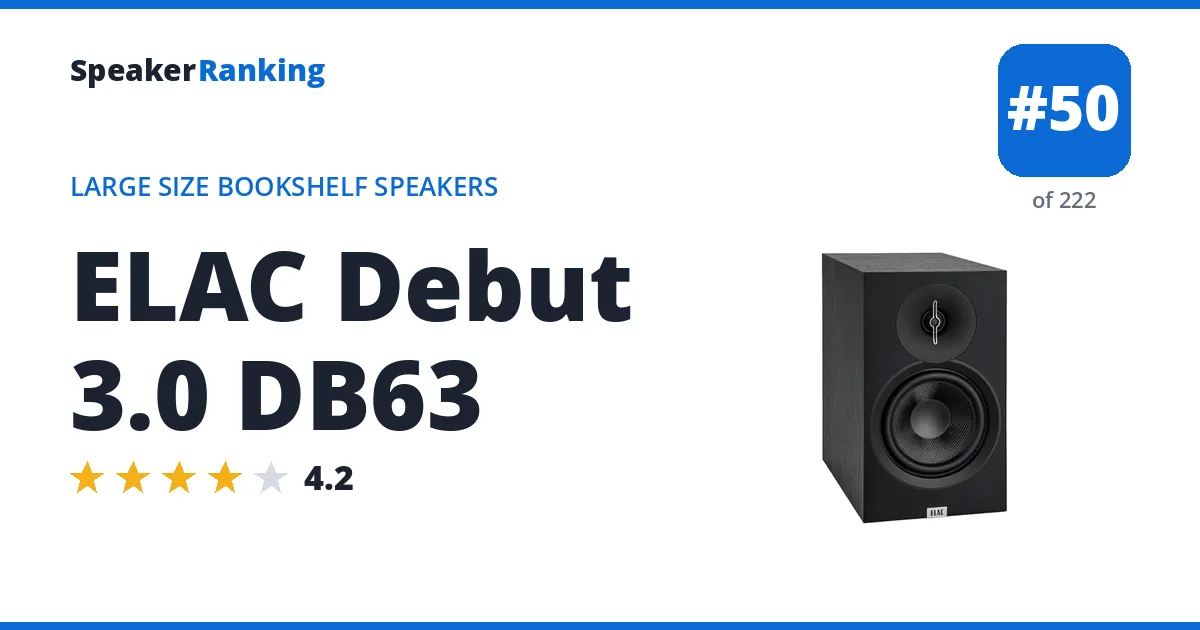
Older model: the ELAC Debut 2.0 B6.2 (ranked lower, rated 3.5/5). See every ELAC Debut generation.
Same family: the ELAC Debut 3.0 DB53 (smaller bookshelf, estimated 3.9/5), the ELAC Debut 3.0 DF53 (smaller floorstanding, estimated 4.2/5), the ELAC Debut 3.0 DF63 (larger floorstanding, rated 4.2/5), the ELAC Debut 3.0 DC53 (smaller center, estimated 3.4/5) and the ELAC Debut 3.0 DC63 (larger center, estimated 3.5/5).
Pros: 1” aluminum dome tweeter with a distinctive partial-lens waveguide design paired with a 6.5” third-generation aramid fiber cone woofer, in a robustly built cabinet for the price. Shallow bass rolloff (F3 76Hz, F10 40Hz) allows placement close to a wall without excessive boominess, useful for smaller living rooms. Solid measured performance for the price: on-axis linearity within about 2.5dB, impedance dipping only to about 4.4 ohms (easily AVR-driven), and roughly 20-26dB of usable dynamic range. A clear improvement over its sibling ELAC DB62, which has a sibilance issue tied to the crossover that can’t be fixed with EQ. Wide horizontal radiation of about ±60°, giving a spacious soundstage. Distortion looks good at a moderate 86dB and still reasonable at 96dB. Takes well to EQ correction: the reviewer provides a specific filter set (a low-shelf boost at 650Hz plus peaking cuts/boosts at 550Hz, 660Hz, and 3kHz) that meaningfully smooths out its known deviations. Measured bass extension of 76Hz (-3dB), with a measured sensitivity of 86.2dB.
Cons: A dip in the lower midrange (300-600Hz, about 1.5dB) reduces vocal warmth and can make voices sound slightly hollow. A high-Q resonance around 650-750Hz shows up clearly in measurements, though the reviewer couldn’t reliably hear it in his own A/B testing. A dip around 2-3kHz (roughly 1-2dB) slightly reduces speech intelligibility and attack in the upper midrange. Directivity droops above about 2kHz as the midwoofer narrows toward its beaming frequency while the tweeter’s pattern behaves differently: an inherent trade-off of physically separated drivers that can’t be fully corrected without introducing other issues. Multitone distortion crosses the reviewer’s 3% threshold in the 200Hz-1kHz range, and adding a subwoofer at an 80Hz crossover only modestly reduces it. Toeing the speaker away from the listener loses noticeable top-end air and cymbal energy, giving a softer upper register. Practical loudness ceiling is around 90dB at typical listening distance before midrange distortion and bass attack begin to degrade. Still needs a subwoofer for extension below about 40Hz.
Full ELAC Debut 3.0 DB63 review and specifications →
| Released | Sep 2024 (2 years ago) |
|---|---|
| Bass Extension (-10dB) | 40Hz (measured, Erin’s Audio Corner) |
| Bass Extension (-3dB) | 76Hz (measured, Erin’s Audio Corner) |
| DIY Kit | No |
| Dimensions | 13.3”H x 7.7”W x 11.7”D (337.8 x 195.6 x 297.2 mm) |
| Drivers | 6.5” Aramid Fiber woofer, 1” soft dome tweeter |
| Impedance | 6 ohms nominal (4.4 ohms minimum, measured, Erin’s Audio Corner) |
| Sensitivity | 86.2dB (measured, Erin’s Audio Corner) |
| Weight | 17.2 lbs (7.8 kg) each |
| Woofer Cabinet | ported, rear |
- Links
- Reviews, Comparisons and Sound Samples
- Head-to-Head Comparisons
- ELAC Debut 3.0 DB63 vs Emotiva Airmotiv XB2
- ELAC Debut 3.0 DB63 vs Arendal 1723 Bookshelf S THX
- ELAC Debut 3.0 DB63 vs Perlisten A3m
- ELAC Debut 3.0 DB63 vs JBL HDI-1600
- ELAC Debut 3.0 DB63 vs Aalto Speakers Aalto 3 Passive
- ELAC Debut 3.0 DB63 vs Danley SH50
- ELAC Debut 3.0 DB63 vs JTR Speakers Noesis 210HT
- ELAC Debut 3.0 DB63 vs Arendal Sound 1723 Monitor THX
- See all 131 comparisons
 The highest-ranked medium bookshelf speaker under $1,000 is the Philharmonic Ceramic Mini: $900 per pair Philharmonic Audio $900 eBay
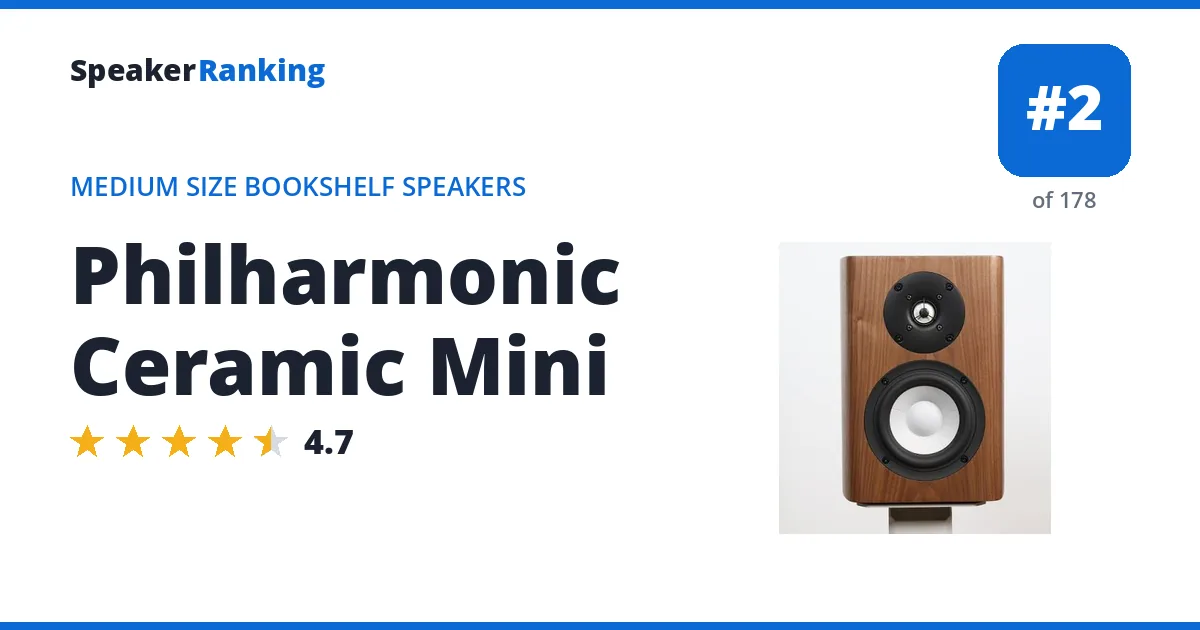
Pros: Gorgeous looks and finish options for the price. Very low midrange distortion for the size, well under 1% above about 400-500Hz. Excellent on-axis linearity. Mild, pleasant bass bump around 100Hz that adds welcome warmth without being excessive. Wide soundstage and dispersion (~70-80 degrees horizontally). Clean cabinet and port with no measured resonances. A great value combination of looks and performance at this price. Measured bass extension of 51Hz (-3dB), with a measured sensitivity of 82dB.
Cons: Somewhat limited output capability for its size: audible woofer compression (“flopping”) around 95dB at 3 meters for a stereo pair, so keep to moderate levels or pair with a subwoofer for home theater use. A mild diffraction-related dip around 4-6kHz can cause occasional sibilance on some vocal tracks. Measured sensitivity (82.2dB average) runs a bit below the manufacturer’s claimed 84dB, so it needs more amp power than the spec alone suggests. Needs a subwoofer for real bass authority below about 40Hz.
Full Philharmonic Ceramic Mini review and specifications →
| Released | Jul 2023 (3 years ago) |
|---|---|
| Bass Extension (-10dB) | 36Hz (measured, Erin’s Audio Corner) |
| Bass Extension (-3dB) | 51Hz (measured, Erin’s Audio Corner) |
| Country | USA (Vienna, Virginia) |
| Crossover Frequency | 2kHz (Linkwitz-Riley 4th order) |
| DIY Kit | No |
| Dimensions | 12” x 8.5” x 11.3” (305 x 216 x 286 mm) |
| Drivers | 5.25” ceramic woofer, 1” ceramic dome tweeter |
| Frequency Response | 55Hz - 20kHz (+1.5/-3dB, Manufacturer specified, ported) |
| Impedance | 4 ohms nominal (3.2 ohms min, 15 ohms max) (measured, Erin’s Audio Corner) |
| Sensitivity | 82dB (2.83V/1m, measured by Erin’s Audio Corner) |
| Spinorama Preference Score | 5.77 |
| Spinorama Preference Score with Perfect Sub | 7.78 |
| Weight | 17 lbs (7.7 kg) |
| Woofer Cabinet | ported, rear |
- Links
- Reviews, Comparisons and Sound Samples
- Head-to-Head Comparisons
- Philharmonic Ceramic Mini vs Ascend Acoustics Sierra 1 v2
- Philharmonic Ceramic Mini vs Audio First Fidelia
- Philharmonic Ceramic Mini vs KEF LS50 Meta
- Philharmonic Ceramic Mini vs XMechanik Mechano23 DIY
- Philharmonic Ceramic Mini vs Ascend Acoustics HTM-200SE2
- Philharmonic Ceramic Mini vs Arendal 1961 Monitor
- Philharmonic Ceramic Mini vs Ascend Acoustics Luna V2 Mini-Monitor Titan
- Philharmonic Ceramic Mini vs Aalto Speakers Aalto 1 EVO
- See all 24 comparisons
 The best value pick among high-end bookshelf speakers, the AsciLab C6B: $1145 per pair Ascilab $1145 eBay
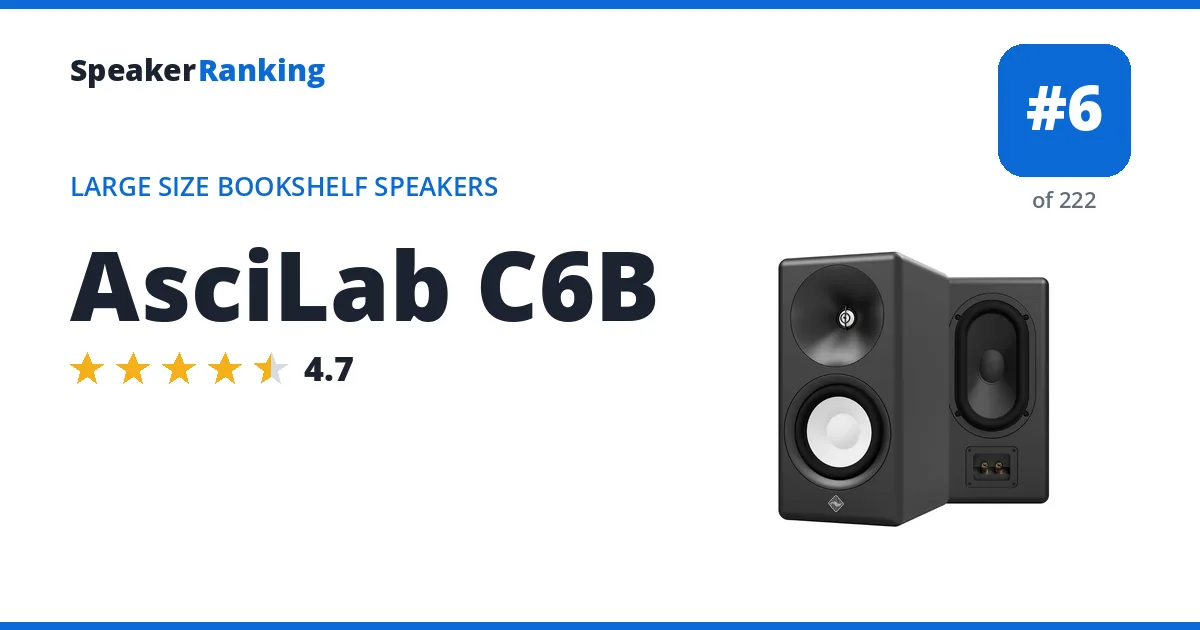
Same family: the AsciLab C5B (smaller bookshelf, rated 4.2/5).
Pros: Two-way design pairing a 1” aluminum ceramic dome tweeter on a large waveguide with a 6” aluminum ceramic cone woofer, crossed over at 1.1kHz, plus a rear passive radiator. Unusual trait: horizontal radiation actually widens at higher frequencies instead of narrowing like most two-way designs, which keeps image focus and soundstage depth consistent whether you toe the speakers in or out (5-10° off-axis was the sweet spot in testing). Vertical radiation also stays wide straight through the 2kHz crossover region, so the sound doesn’t collapse when standing up: unusual at this price. CA2034 measurements show strong on-axis linearity, listening window, early reflections, and directivity. Midrange and tweeter distortion stay very low even at 96dB, holding up against a $5,900 Arendal speaker in that regard despite roughly a 5x price gap. At $1145 shipped to the US, the reviewer calls it the best-value bookshelf speaker he’s tested, rivaling speakers 2-5x the price. Measured bass extension of 54Hz (-3dB), with a measured sensitivity of 85.6dB.
Cons: Bass rolls off around 50Hz in-room (F3 54Hz, F10 35Hz), so a subwoofer is needed for real extension below that. Low-frequency harmonic distortion increases substantially at 96dB versus 86dB, though it’s second-order and less audible than it looks on paper. Minimum impedance dips to 2.6 ohms (EPDR as low as 1.2 ohms), so it wants an amplifier comfortable driving 4-ohm loads, ideally 100W or more. At 102dB, compression noticeably eats into midrange, bass, and some treble output. Shipping to the US adds roughly $200 on top of AsciLab’s list price. Against the reviewer’s reference Audiofirst Fidelia at a similar price, has slightly less lower-midrange body (about 1dB difference) and a smaller perceived soundstage size.
Full AsciLab C6B review and specifications →
| Bass Extension (-10dB) | 35Hz (measured, Erin’s Audio Corner) |
|---|---|
| Bass Extension (-3dB) | 54Hz (measured, Erin’s Audio Corner) |
| DIY Kit | No |
| Dimensions | 15.7”H x 8”W x 10.4”D (398.8 x 203.2 x 264.2 mm) |
| Drivers | 6” Aluminium Ceramic Cone with cast Aluminium Chassis woofer, 1” Aluminium Ceramic Dome tweeter |
| Impedance | 4 ohms nominal, 2.6 ohms minimum (measured, Erin’s Audio Corner) |
| Sensitivity | 85.6dB (measured, Erin’s Audio Corner) |
| Spinorama Preference Score | 6.33 |
| Spinorama Preference Score with Perfect Sub | 8.28 |
| Weight | 18.5 lbs (8.4 kg) each |
| Woofer Cabinet | passive radiator |
- Links
- Reviews, Comparisons and Sound Samples
- Head-to-Head Comparisons
 The best large passive bookshelf value among the ranking leaders is the GR-Research NX-Studio: $3630 per pair GR Research $3630 eBay
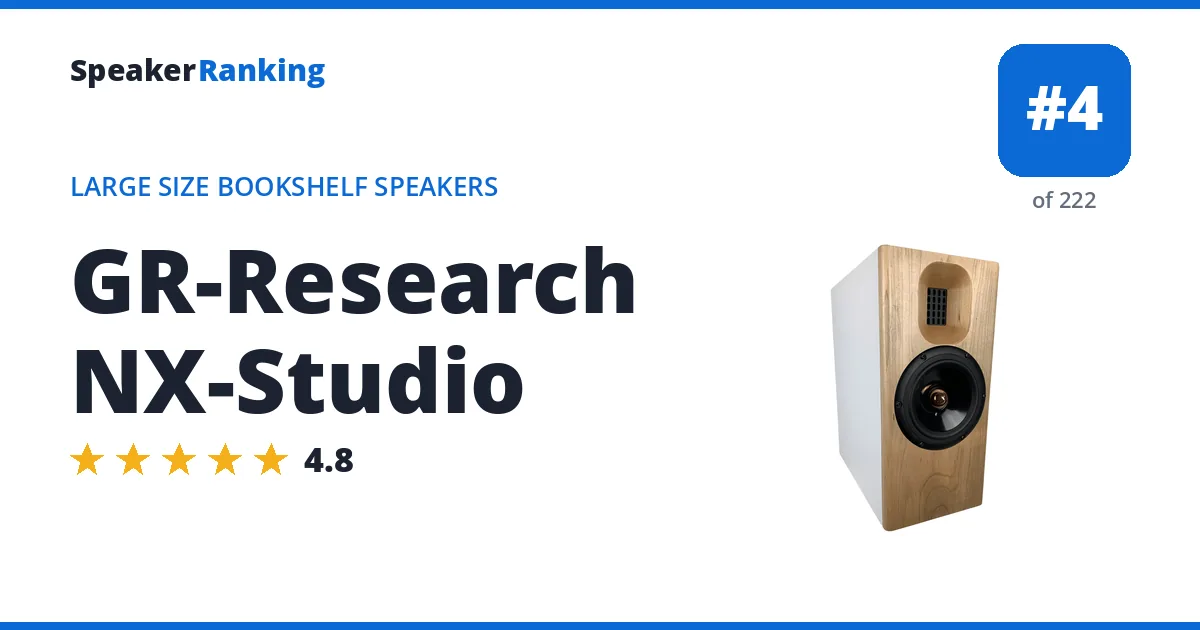
Same family: the GR-Research NX-Bravo (smaller bookshelf, ranked lower, rated 4.4/5) and the GR-Research NX-Treme (floorstanding, rated 4.8/5).
Pros: Ultra clean burst decay/waterfall plot. Amazingly open sounding due to the semi open baffle Neo3 ribbon tweeter, will image better than any other bookshelf speaker. Neo3 ribbon tweeter is one of the best ribbons around for detail. Bass will be very tight and fast due to the sealed enclosure, but may possibly need a sub.
Cons: Bass will be very tight but won’t be quite as deep as others due to the sealed woofer enclosure.
Full GR-Research NX-Studio review and specifications →
| Released | Feb 2020 (6 years ago) |
|---|---|
| DIY Kit | Yes |
| Dimensions | 18”H x 8.5”W x 15.5”D (457.2 x 215.9 x 393.7 mm) |
| Drivers | GR-Research M165NQ 6.5” paper cone, non-resonant polymer frame, copper shorting rings and aluminum phase plug sealed enclosure woofer, GR-Research Neo3 Planar Magnetic Ribbon open baffle tweeter |
| Impedance | 8 ohms |
| Sensitivity | 87dB |
| Weight | 20.5 lbs (9.3 kg) each |
| Woofer Cabinet | sealed |
- Links
- Reviews, Comparisons and Sound Samples
- Head-to-Head Comparisons
- GR-Research NX-Studio vs KEF Reference 1 Meta
- GR-Research NX-Studio vs March Audio Sointuva AWG
- GR-Research NX-Studio vs AsciLab C6B
- GR-Research NX-Studio vs Perlisten S4b
- GR-Research NX-Studio vs Audio First Cadentia 3
- GR-Research NX-Studio vs KEF R3 Meta
- GR-Research NX-Studio vs KEF Q Concerto Meta
- GR-Research NX-Studio vs Wharfedale Aura 2
- See all 51 comparisons
 For reference-level measured performance at a substantially lower price than the flagship, the Perlisten S4b: $8,000 per pair Perlisten Dealer Locator $8,000 eBay
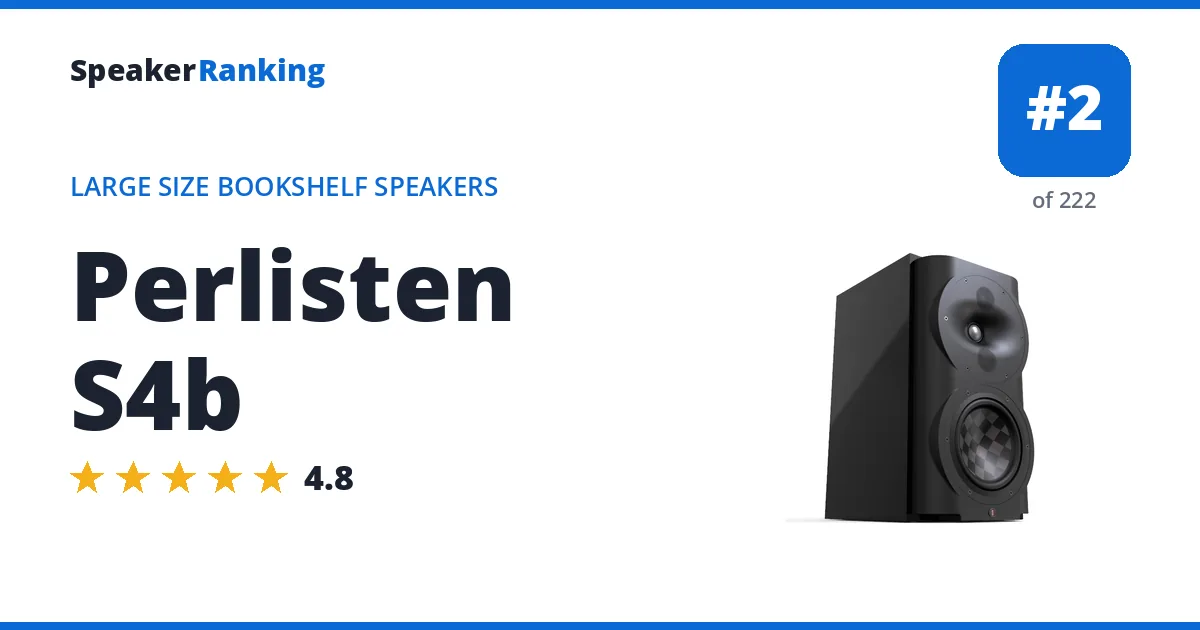
Same family: the Perlisten S5m (larger bookshelf, ranked lower, rated 4.4/5), the Perlisten S5t (smaller floorstanding, estimated 4.5/5), the Perlisten S7t (larger floorstanding, rated 4.5/5), the Perlisten S5c (smaller center, estimated 4.5/5), the Perlisten S7c (larger center, rated 4.6/5) and the Perlisten S4s (surround, rated 4.6/5).
Pros: Reference-grade directivity and output from a compact sealed monitor. Erin called its radiation behavior the smoothest he had measured: Perlisten’s DPC array (beryllium tweeter between two midrange domes) shapes vertical output while transitioning cleanly to the 7-inch woofer. Harmonic distortion remains below 1% at 86dB and, above 100Hz, also below 1% at 96dB; compression is exceptionally low. The response is highly linear, the midrange was a listening highlight, and the sealed F10 of 40Hz provides a predictable slope for subwoofer integration. Measured bass extension of 78Hz (-3dB), with a measured sensitivity of 84.5dB.
Cons: Erin measured only 84.5dB sensitivity and an impedance minimum just under 4 ohms, a difficult efficiency/load combination that deserves substantial clean amplification. Its 78Hz F3 means a subwoofer is effectively mandatory for full-range listening despite the 40Hz F10. A roughly +3dB feature around 10kHz appears on-axis, though Erin did not find it objectionable. Price is extreme for a stand-mount and the tightly managed vertical radiation makes correct stand height important.
Full Perlisten S4b review and specifications →
| Released | Jun 2021 (5 years ago) |
|---|---|
| Bass Extension (-10dB) | 40Hz (measured, Erin’s Audio Corner) |
| Bass Extension (-3dB) | 78Hz (measured, Erin’s Audio Corner) |
| DIY Kit | No |
| Dimensions | 16.5”H x 9.4”W x 7.3”D |
| Drivers | DPC array with 28mm beryllium tweeter and dual 28mm midrange domes; 7” woofer |
| Impedance | Just under 4 ohms minimum (measured, Erin’s Audio Corner) |
| Sensitivity | 84.5dB/2.83V/1m (measured, Erin’s Audio Corner) |
| Spinorama Preference Score | 5.35 |
| Spinorama Preference Score with Perfect Sub | 8.01 |
| Weight | 24.3 lbs (11 kg) each |
| Woofer Cabinet | sealed |
- Links
- Reviews, Comparisons and Sound Samples
- Head-to-Head Comparisons
 The highest-ranked large passive bookshelf speaker for sound quality, cost no object, is the TAD Compact Reference One (CR1TX): $87,500 per pair eBay
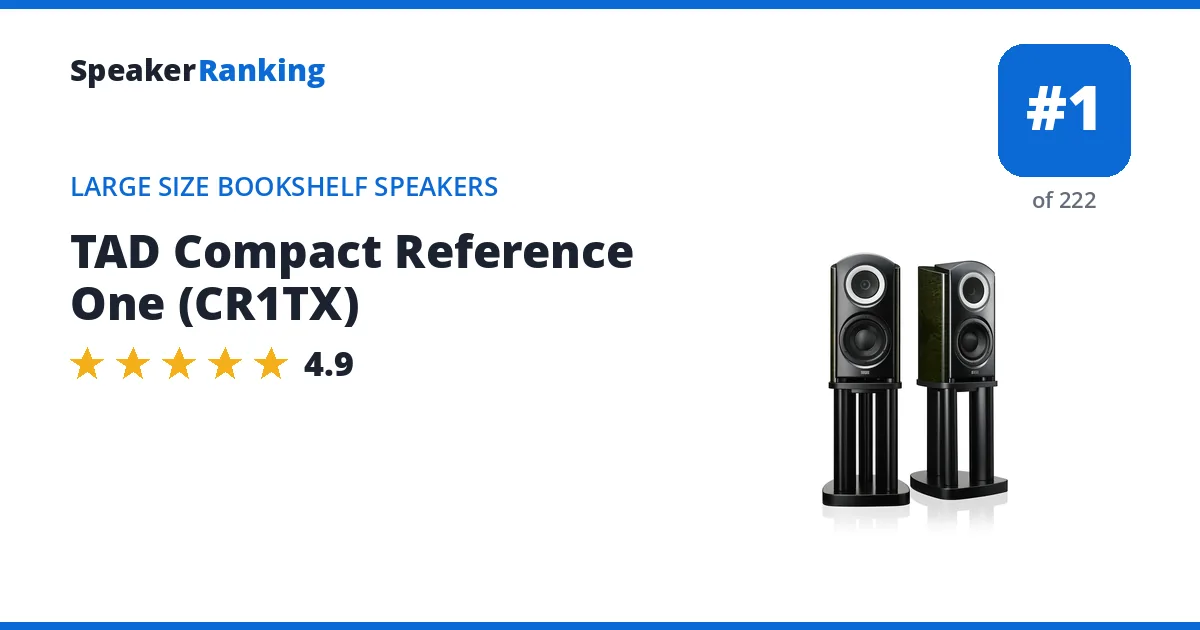
Pros: A 3-way stand-mount design built around a coaxial tweeter-and-6.5” midrange assembly plus an 8” woofer, crossed over at 250Hz and 2kHz, rated for 200W and 86dB sensitivity (measured at about 85.2dB, 2.83V/1m). On-axis linearity holds within about ±3dB down to its F3 of 69Hz (F10 38Hz). The coaxial layout gives it exceptionally wide, consistent tonality moving around the room (both horizontally and vertically) since the tweeter and midrange radiate from the same point, unlike a conventional offset tweeter-over-woofer layout that narrows vertically much sooner. Harmonic and multitone distortion measured the lowest the reviewer has recorded to date, beating even the KEF Blade Two Meta and PS Audio Aspen FR10, previously his two lowest-distortion references. Compression is minimal: only about 0.5dB of low-frequency loss between 76dB and 102dB output (26dB of usable dynamic range), with softening only appearing at the very top end at 102dB. At 101 lbs each, the massive, heavily braced cabinet is completely inert: no audible panel resonance even driven hard with full-range bass. CTA-2034 sound power is excellent, and a mild dip in the lower treble/upper midrange shows up with smooth, consistent directivity through that region, indicating it’s a deliberate voicing choice rather than a crossover flaw. Measured bass extension of 69Hz (-3dB), with a measured sensitivity of 85.5dB.
Cons: Extraordinarily expensive at $87500 per pair. Despite the manual recommending the speakers be placed close to a wall (about 1-2 feet) and aimed directly at the listener, the reviewer found direct on-axis aiming made the treble read a bit hot, and preferred toeing them out about 20-30° for a smoother top end: worth experimenting with in your own room. The mid-base-to-midrange transition region is deliberately sloped down in anechoic measurement, meaning it’s designed to be reinforced by nearby wall boundary gain rather than played free-standing well out into the room. At 101 lbs each, the speakers are genuinely difficult to move or set up alone.
Full TAD Compact Reference One (CR1TX) review and specifications →
| Released | Oct 2022 (4 years ago) |
|---|---|
| Bass Extension (-10dB) | 38Hz (measured, Erin’s Audio Corner) |
| Bass Extension (-3dB) | 69Hz (measured, Erin’s Audio Corner) |
| Country | Japan |
| Crossover Frequency | 250Hz, 2kHz |
| DIY Kit | No |
| Dimensions | 24.7”H x 13.4”W x 17.6”D (628 x 341 x 446 mm) |
| Drivers | Coaxial 1.38” tweeter + 6.5” midrange, 8” woofer |
| Frequency Response | 32Hz - 100kHz (manufacturer specified) |
| Impedance | 4 ohms nominal, 3.7 ohms minimum (measured above 80Hz, Erin’s Audio Corner) |
| Power Handling | 200W max |
| Sensitivity | 85.5dB (measured average 300Hz-3kHz @ 2.83V/1m, Erin’s Audio Corner) |
| Spinorama Preference Score | 5.45 |
| Spinorama Preference Score with Perfect Sub | 7.79 |
| Weight | 101 lbs (45.8 kg) each |
- Links
- Reviews, Comparisons and Sound Samples
- Head-to-Head Comparisons
- TAD Compact Reference One (CR1TX) vs Revel M106
- TAD Compact Reference One (CR1TX) vs KEF R3 Meta
- TAD Compact Reference One (CR1TX) vs KEF Q Concerto Meta
- TAD Compact Reference One (CR1TX) vs KEF R3
- TAD Compact Reference One (CR1TX) vs Buchardt Audio S400
- TAD Compact Reference One (CR1TX) vs ELAC Debut 3.0 DB63
- TAD Compact Reference One (CR1TX) vs Klipsch RP-600M II
Frequently Asked Questions
Do I need a separate amplifier for passive speakers? Yes, always. A passive speaker has no built-in electronics: you supply an amplifier or an AV receiver’s speaker-level output, and the two are sold and bought separately. Budget for both together, not the speakers alone.
Should I buy bookshelf or floorstanding passive speakers? Floorstanding speakers generally reach deeper bass and higher output from the same driver complement, since the cabinet has more internal volume. Bookshelf speakers make more sense on a desk, a high shelf, or a stand in a room too small to give a tower speaker room to breathe.
Can I use passive speakers with a soundbar or a powered speaker’s amp section? Only if that device has a dedicated speaker-level output built for driving passive speakers directly - most soundbars and powered speakers don’t. Check for binding posts or bare speaker-wire terminals, not just a line-level RCA or 3.5mm jack, before assuming a device can drive them.