Short answer: the TAD Compact Reference One (CR1TX) if sound quality matters most, the Klipsch RP-600M II if price matters most. The TAD Compact Reference One (CR1TX) ranks #1 of 130 bookshelf speakers at $87500. The Klipsch RP-600M II ranks #74 at $449.99, $87050.01 cheaper.
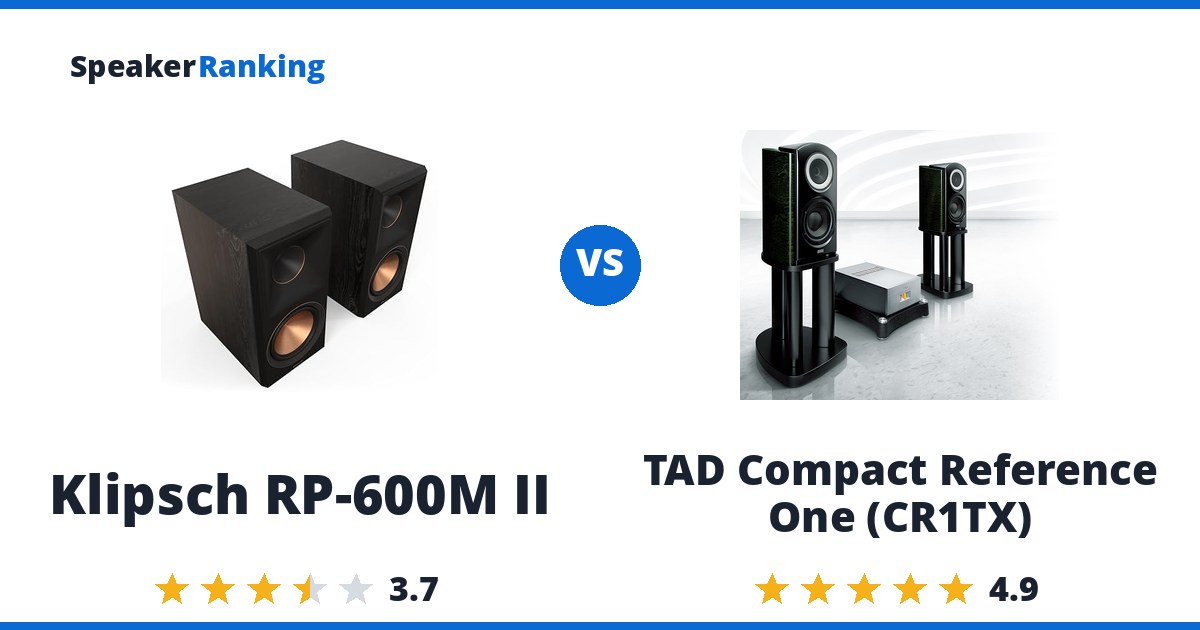
What the Klipsch RP-600M II offers: Redesigned waveguide extends flush to the baffle edge, reducing diffraction compared to the original RP-600M. Roughly 10-20° wider horizontal radiation than the original, giving more soundstage envelopment while retaining precise imaging. A major step up in overall tonal neutrality compared to the original RP-600M, largely eliminating that model’s midrange resonance issues. Unusually, sounds better with the grille on - the grille smooths out the elevated treble rather than degrading the sound, a rare trait among speakers the reviewer has tested. More refined back-panel hardware, including anodized binding posts and jumper cables for optional bi-amping. Responds well to EQ correction (verified using measurement software and a miniDSP), letting the on-axis response be made genuinely linear. Watch for: On-axis, the treble runs notably hot - even hotter than the original RP-600M in some respects - and needs about 20° of toe-out or the grille installed to sound balanced. Horizontal dispersion is very slightly less linear across angles than the original RP-600M, a minor trade-off for the wider overall radiation pattern. Klipsch’s marketed sensitivity (about 94.5dB) is, like the original, a half-space rating roughly 9dB above the anechoic reality (closer to 85-86dB). In-room bass rolls off around 60Hz in practice, and a 120Hz boost paired with a midrange scoop gives kick drums their “tambour” without real low-end weight - a subwoofer is still recommended. Vertical listening tolerance is limited to about ±10° from the tweeter axis. Toeing the speaker out for better on-axis tonality (rather than using the grille) introduces slightly more diffuse imaging from added sidewall reflections.
What the TAD Compact Reference One (CR1TX) offers: A 3-way stand-mount design built around a coaxial tweeter-and-6.5” midrange assembly plus an 8” woofer, crossed over at 250Hz and 2kHz, rated for 200W and 86dB sensitivity (measured at about 85.2dB, 2.83V/1m). On-axis linearity holds within about ±3dB down to its F3 of 69Hz (F10 38Hz). The coaxial layout gives it exceptionally wide, consistent tonality moving around the room - both horizontally and vertically - since the tweeter and midrange radiate from the same point, unlike a conventional offset tweeter-over-woofer layout that narrows vertically much sooner. Harmonic and multitone distortion measured the lowest the reviewer has recorded to date, beating even the KEF Blade Two Meta and PS Audio Aspen FR10, previously his two lowest-distortion references. Compression is minimal - only about 0.5dB of low-frequency loss between 76dB and 102dB output (26dB of usable dynamic range), with softening only appearing at the very top end at 102dB. At 101 lbs each, the massive, heavily braced cabinet is completely inert - no audible panel resonance even driven hard with full-range bass. CTA-2034 sound power is excellent, and a mild dip in the lower treble/upper midrange shows up with smooth, consistent directivity through that region, indicating it’s a deliberate voicing choice rather than a crossover flaw. Watch for: Extraordinarily expensive at $87,500 per pair. Despite the manual recommending the speakers be placed close to a wall (about 1-2 feet) and aimed directly at the listener, the reviewer found direct on-axis aiming made the treble read a bit hot, and preferred toeing them out about 20-30° for a smoother top end - worth experimenting with in your own room. The mid-base-to-midrange transition region is deliberately sloped down in anechoic measurement, meaning it’s designed to be reinforced by nearby wall boundary gain rather than played free-standing well out into the room. At 101 lbs each, the speakers are genuinely difficult to move or set up alone.
Buy the Klipsch RP-600M II when the price outweighs sound quality for you, and the TAD Compact Reference One (CR1TX) when sound quality outweighs the price instead.
Looking for alternatives? See the complete Passive Home rankings.
Specifications Side By Side
| Klipsch RP-600M II | TAD Compact Reference One (CR1TX) | |
|---|---|---|
| Price | $449.99 per pair | $87,500.00 per pair |
| Ranked | #74 of 130 in Large Size Bookshelf Speakers | #1 of 130 in Large Size Bookshelf Speakers |
| Bass Extension (-10dB) | 41Hz (measured, Erin's Audio Corner) | 38Hz (measured, Erin's Audio Corner) |
| Bass Extension (-3dB) | 70Hz (measured, Erin's Audio Corner) | 69Hz (measured, Erin's Audio Corner) |
| Dimensions | 15.7"H x 8"W x 12.5"D (398.8 x 203.2 x 317.5 mm) | 24.7"H x 13.4"W x 17.6"D (628 x 341 x 446 mm) |
| Impedance | 8 ohms nominal (3.5 ohms minimum above 80Hz, measured by Erin's Audio Corner) | 4 ohms nominal, 3.7 ohms minimum (measured above 80Hz, Erin's Audio Corner) |
| Sensitivity | 86dB (measured, Erin's Audio Corner) | 85.5dB (measured average 300Hz-3kHz @ 2.83V/1m, Erin's Audio Corner) |
| Drivers | 6.5" Cerametallic cone woofer, 1" titanium LTS vented tweeter with Tractrix horn | Coaxial 1.38" tweeter + 6.5" midrange, 8" woofer |
| Weight | 13 lbs (5.9 kg) each | 101 lbs (45.8 kg) each |
| Woofer Cabinet | ported | - |
| Spinorama Preference Score | 4.75 | 4.58 |
| Spinorama Preference Score with Perfect Sub | 6.88 | 6.92 |
| Power Handling | - | 200W max |
| Crossover Frequency | - | 250Hz, 2kHz |
| Frequency Response | - | 32Hz - 100kHz (manufacturer specified) |
| Country | - | Japan |
Related Speaker Comparisons
More worthwhile head-to-heads for TAD Compact Reference One (CR1TX):
- TAD Compact Reference One (CR1TX) vs Revel M106
- TAD Compact Reference One (CR1TX) vs Buchardt Audio S400
- ELAC Debut 3.0 DB63 vs TAD Compact Reference One (CR1TX)
- Klipsch RP-600M II vs KEF Reference 1 Meta
- Klipsch RP-600M II vs Perlisten S4b
Prices on this page were last checked September 16, 2026 at 12:41 AM UTC. Product prices and availability are accurate as of that date/time and are subject to change; the price and availability shown on Amazon at the time of purchase will apply to the purchase of this product.
As an eBay Partner, we may be compensated if you make a purchase.
The Two Speakers In Full
 Klipsch RP-600M II: $449.99 per pair Amazon eBay
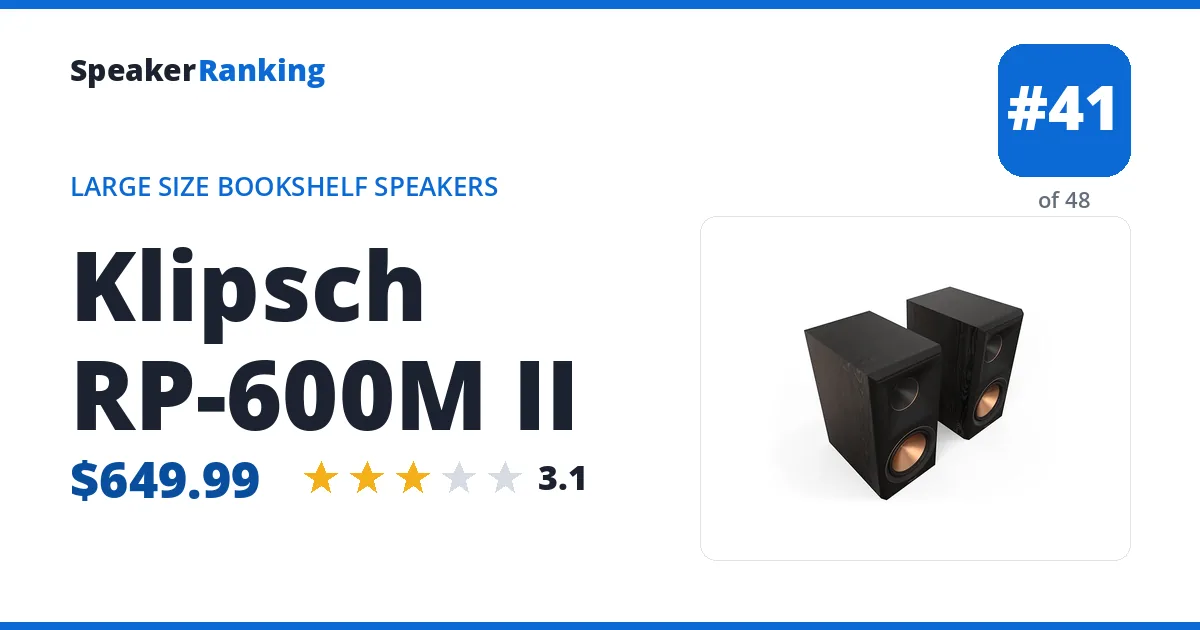
Pros: Redesigned waveguide extends flush to the baffle edge, reducing diffraction compared to the original RP-600M. Roughly 10-20° wider horizontal radiation than the original, giving more soundstage envelopment while retaining precise imaging. A major step up in overall tonal neutrality compared to the original RP-600M, largely eliminating that model’s midrange resonance issues. Unusually, sounds better with the grille on - the grille smooths out the elevated treble rather than degrading the sound, a rare trait among speakers the reviewer has tested. More refined back-panel hardware, including anodized binding posts and jumper cables for optional bi-amping. Responds well to EQ correction (verified using measurement software and a miniDSP), letting the on-axis response be made genuinely linear. Measured bass extension of 70Hz (-3dB), with a measured sensitivity of 86dB.
Cons: On-axis, the treble runs notably hot - even hotter than the original RP-600M in some respects - and needs about 20° of toe-out or the grille installed to sound balanced. Horizontal dispersion is very slightly less linear across angles than the original RP-600M, a minor trade-off for the wider overall radiation pattern. Klipsch’s marketed sensitivity (about 94.5dB) is, like the original, a half-space rating roughly 9dB above the anechoic reality (closer to 85-86dB). In-room bass rolls off around 60Hz in practice, and a 120Hz boost paired with a midrange scoop gives kick drums their “tambour” without real low-end weight - a subwoofer is still recommended. Vertical listening tolerance is limited to about ±10° from the tweeter axis. Toeing the speaker out for better on-axis tonality (rather than using the grille) introduces slightly more diffuse imaging from added sidewall reflections.
Full Klipsch RP-600M II review and specifications →
| Bass Extension (-10dB) | 41Hz (measured, Erin's Audio Corner) |
|---|---|
| Bass Extension (-3dB) | 70Hz (measured, Erin's Audio Corner) |
| Dimensions | 15.7"H x 8"W x 12.5"D (398.8 x 203.2 x 317.5 mm) |
| Drivers | 6.5" Cerametallic cone woofer, 1" titanium LTS vented tweeter with Tractrix horn |
| Impedance | 8 ohms nominal (3.5 ohms minimum above 80Hz, measured by Erin's Audio Corner) |
| Sensitivity | 86dB (measured, Erin's Audio Corner) |
| Spinorama Preference Score | 4.75 |
| Spinorama Preference Score with Perfect Sub | 6.88 |
| Weight | 13 lbs (5.9 kg) each |
| Woofer Cabinet | ported |
- Links
- Reviews, Comparisons and Sound Samples
- Erin’s Audio Corner: The Truth about Klipsch’s “NEW” Sound. RP-600M Update. More from Erin’s Audio Corner →
- Erin’s Audio Corner Website Klipsch RP-600M II
- GR-Research: We Bought The "NEW" RP-600M II Is KLIPSCH Listening?! More from GR-Research →
- Erin’s Audio Corner: 5 AWESOME SPEAKERS Under $1000 You Won’t Regret
- Erin’s Audio Corner Measurements (spinorama.org)
- Head-to-Head Comparisons
- Klipsch RP-600M II vs Dynaudio Emit 20
- Klipsch RP-600M II vs Aoshida Audio Musician Knight I V2
- Klipsch RP-600M II vs Philharmonic BMR Monitor
- Klipsch RP-600M II vs JBL 708i
- Klipsch RP-600M II vs JBL Studio 630
- Klipsch RP-600M II vs PS Audio Aspen FR5
- Klipsch RP-600M II vs Behringer B2030P
- Klipsch RP-600M II vs Theory Audio sb25
- See all 116 comparisons
 TAD Compact Reference One (CR1TX): $87,500.00 per pair eBay
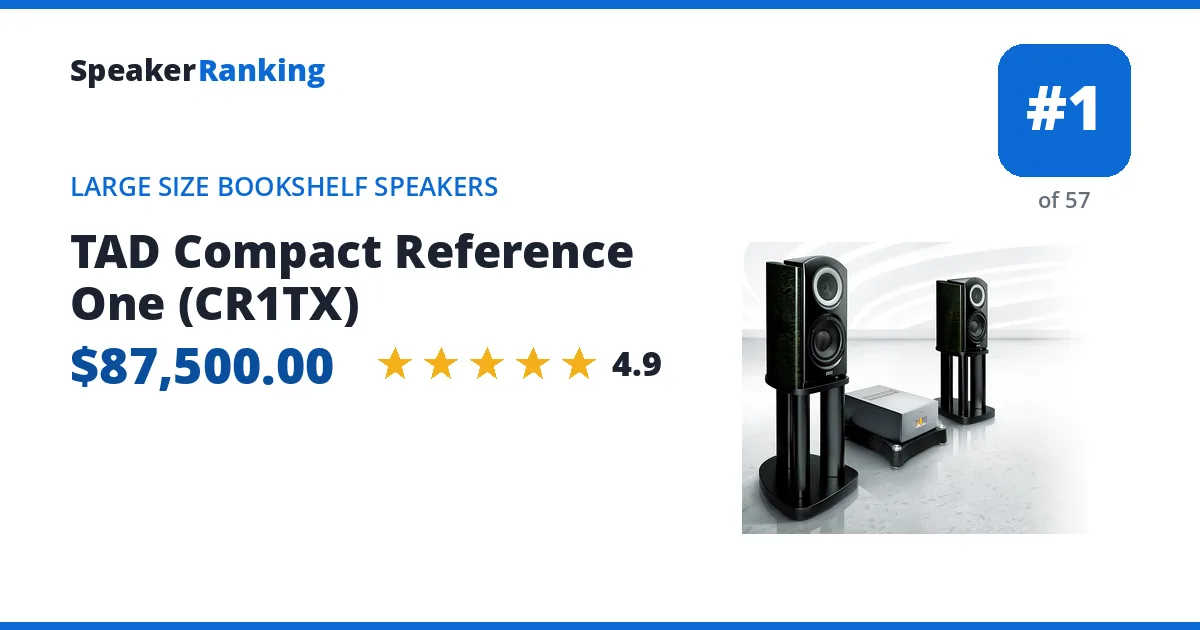
Pros: A 3-way stand-mount design built around a coaxial tweeter-and-6.5” midrange assembly plus an 8” woofer, crossed over at 250Hz and 2kHz, rated for 200W and 86dB sensitivity (measured at about 85.2dB, 2.83V/1m). On-axis linearity holds within about ±3dB down to its F3 of 69Hz (F10 38Hz). The coaxial layout gives it exceptionally wide, consistent tonality moving around the room - both horizontally and vertically - since the tweeter and midrange radiate from the same point, unlike a conventional offset tweeter-over-woofer layout that narrows vertically much sooner. Harmonic and multitone distortion measured the lowest the reviewer has recorded to date, beating even the KEF Blade Two Meta and PS Audio Aspen FR10, previously his two lowest-distortion references. Compression is minimal - only about 0.5dB of low-frequency loss between 76dB and 102dB output (26dB of usable dynamic range), with softening only appearing at the very top end at 102dB. At 101 lbs each, the massive, heavily braced cabinet is completely inert - no audible panel resonance even driven hard with full-range bass. CTA-2034 sound power is excellent, and a mild dip in the lower treble/upper midrange shows up with smooth, consistent directivity through that region, indicating it’s a deliberate voicing choice rather than a crossover flaw. Measured bass extension of 69Hz (-3dB), with a measured sensitivity of 85.5dB.
Cons: Extraordinarily expensive at $87,500 per pair. Despite the manual recommending the speakers be placed close to a wall (about 1-2 feet) and aimed directly at the listener, the reviewer found direct on-axis aiming made the treble read a bit hot, and preferred toeing them out about 20-30° for a smoother top end - worth experimenting with in your own room. The mid-base-to-midrange transition region is deliberately sloped down in anechoic measurement, meaning it’s designed to be reinforced by nearby wall boundary gain rather than played free-standing well out into the room. At 101 lbs each, the speakers are genuinely difficult to move or set up alone.
Full TAD Compact Reference One (CR1TX) review and specifications →
| Bass Extension (-10dB) | 38Hz (measured, Erin's Audio Corner) |
|---|---|
| Bass Extension (-3dB) | 69Hz (measured, Erin's Audio Corner) |
| Country | Japan |
| Crossover Frequency | 250Hz, 2kHz |
| Dimensions | 24.7"H x 13.4"W x 17.6"D (628 x 341 x 446 mm) |
| Drivers | Coaxial 1.38" tweeter + 6.5" midrange, 8" woofer |
| Frequency Response | 32Hz - 100kHz (manufacturer specified) |
| Impedance | 4 ohms nominal, 3.7 ohms minimum (measured above 80Hz, Erin's Audio Corner) |
| Power Handling | 200W max |
| Sensitivity | 85.5dB (measured average 300Hz-3kHz @ 2.83V/1m, Erin's Audio Corner) |
| Spinorama Preference Score | 4.58 |
| Spinorama Preference Score with Perfect Sub | 6.92 |
| Weight | 101 lbs (45.8 kg) each |
- Links
- Reviews, Comparisons and Sound Samples
- Head-to-Head Comparisons