Short answer: the TAD Compact Reference One (CR1TX) if sound quality matters most, the KEF R3 if price matters most. The TAD Compact Reference One (CR1TX) ranks #1 of 131 bookshelf speakers, rated 4.9/5, at $87,500. The KEF R3 ranks #15, rated 4.5/5, at $2,200, $85,300 cheaper.
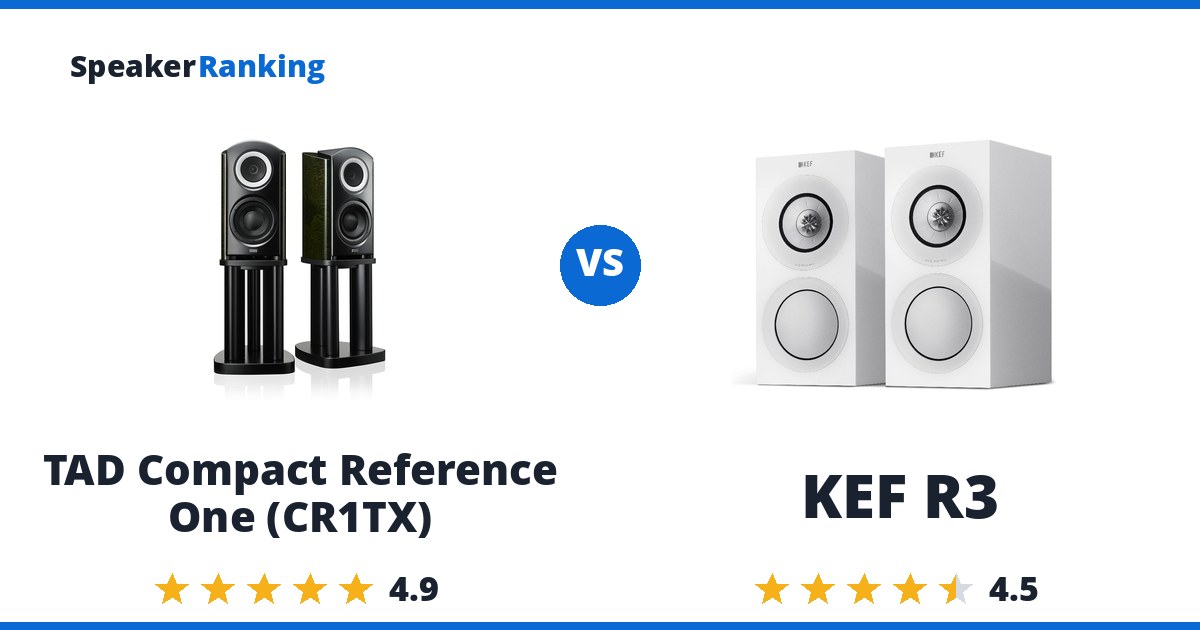
What the TAD Compact Reference One (CR1TX) does well: A 3-way stand-mount design built around a coaxial tweeter-and-6.5” midrange assembly plus an 8” woofer, crossed over at 250Hz and 2kHz, rated for 200W and 86dB sensitivity (measured at about 85.2dB, 2.83V/1m). The tradeoff: Extraordinarily expensive at $87500 per pair.
The case for the KEF R3: True three-way stand-mount with a 6.5-inch woofer below KEF’s 5-inch Uni-Q midrange/1-inch tweeter. The catch: The low-frequency alignment rolls gradually rather than delivering high-output sub-bass; KEF specifies 58Hz +/-3dB and Erin’s high-level data supports using an 80Hz subwoofer crossover.
Buy the TAD Compact Reference One (CR1TX) when sound quality outweighs the price for you, and the KEF R3 when the price outweighs sound quality instead.
Want more options? Browse the full Passive Home rankings.
Specifications Side By Side
| TAD Compact Reference One (CR1TX) | KEF R3 | |
|---|---|---|
| Price | $87,500.00 per pair | $2,200 per pair |
| Ranked | #1 of 131 in Large Size Bookshelf Speakers | #15 of 131 in Large Size Bookshelf Speakers |
| Bass Extension (-10dB) | 38Hz (measured, Erin’s Audio Corner) | 35.2Hz (measured, Audio Science Review) |
| Bass Extension (-3dB) | 69Hz (measured, Erin’s Audio Corner) | Approximately 58Hz (manufacturer specified; consistent with Erin’s measured roll-off) |
| Drivers | Coaxial 1.38” tweeter + 6.5” midrange, 8” woofer | 1” tweeter coaxial with 5” midrange; 6.5” woofer |
| Weight | 101 lbs (45.8 kg) each | 29.9 lbs (13.55 kg) each |
| Sensitivity | 85.5dB (measured average 300Hz-3kHz @ 2.83V/1m, Erin’s Audio Corner) | Approximately 86-87dB/2.83V/1m (measured, Erin’s Audio Corner) |
| Power Handling | 200W max | - |
| Crossover Frequency | 250Hz, 2kHz | - |
| Dimensions | 24.7”H x 13.4”W x 17.6”D (628 x 341 x 446 mm) | 16.6”H x 7.9”W x 13.2”D |
| Impedance | 4 ohms nominal, 3.7 ohms minimum (measured above 80Hz, Erin’s Audio Corner) | 8 ohms nominal; suitable for Erin’s 4/8-ohm-rated amplifier |
| Frequency Response | 32Hz - 100kHz (manufacturer specified) | - |
| Country | Japan | - |
| Spinorama Preference Score | 5.45 | 6.2 (spinorama.org) |
| Spinorama Preference Score with Perfect Sub | 7.79 | 7.97 (spinorama.org) |
| DIY Kit | No | No |
| Woofer Cabinet | - | ported, rear Flexible Port |
Related Speaker Comparisons
More top alternatives to TAD Compact Reference One (CR1TX):
- TAD Compact Reference One (CR1TX) vs Revel M106
- TAD Compact Reference One (CR1TX) vs KEF R3 Meta
- TAD Compact Reference One (CR1TX) vs KEF Q Concerto Meta
- TAD Compact Reference One (CR1TX) vs Buchardt Audio S400
- ELAC Debut 3.0 DB63 vs TAD Compact Reference One (CR1TX)
Prices on this page were last checked September 30, 2026 at 2:57 PM UTC. Product prices and availability are accurate as of that date/time and are subject to change; the price and availability shown on Amazon at the time of purchase will apply to the purchase of this product.
As an eBay Partner, we may be compensated if you make a purchase.
The Two Speakers In Full
 TAD Compact Reference One (CR1TX): $87,500.00 per pair eBay
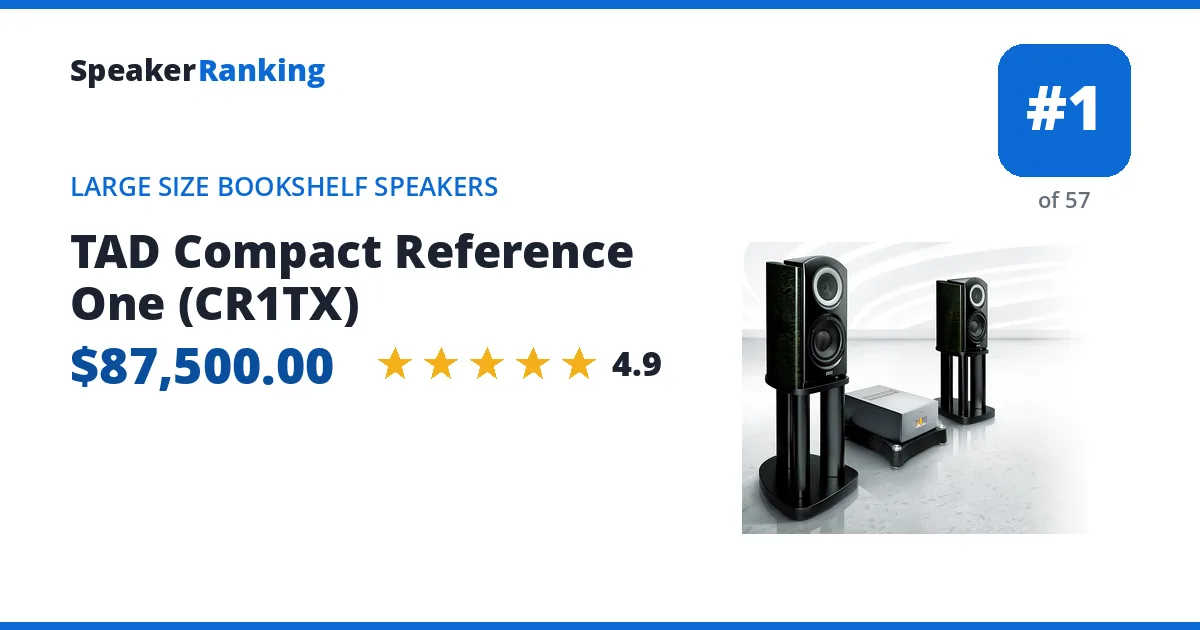
Pros: A 3-way stand-mount design built around a coaxial tweeter-and-6.5” midrange assembly plus an 8” woofer, crossed over at 250Hz and 2kHz, rated for 200W and 86dB sensitivity (measured at about 85.2dB, 2.83V/1m). On-axis linearity holds within about ±3dB down to its F3 of 69Hz (F10 38Hz). The coaxial layout gives it exceptionally wide, consistent tonality moving around the room (both horizontally and vertically) since the tweeter and midrange radiate from the same point, unlike a conventional offset tweeter-over-woofer layout that narrows vertically much sooner. Harmonic and multitone distortion measured the lowest the reviewer has recorded to date, beating even the KEF Blade Two Meta and PS Audio Aspen FR10, previously his two lowest-distortion references. Compression is minimal: only about 0.5dB of low-frequency loss between 76dB and 102dB output (26dB of usable dynamic range), with softening only appearing at the very top end at 102dB. At 101 lbs each, the massive, heavily braced cabinet is completely inert: no audible panel resonance even driven hard with full-range bass. CTA-2034 sound power is excellent, and a mild dip in the lower treble/upper midrange shows up with smooth, consistent directivity through that region, indicating it’s a deliberate voicing choice rather than a crossover flaw. Measured bass extension of 69Hz (-3dB), with a measured sensitivity of 85.5dB.
Cons: Extraordinarily expensive at $87500 per pair. Despite the manual recommending the speakers be placed close to a wall (about 1-2 feet) and aimed directly at the listener, the reviewer found direct on-axis aiming made the treble read a bit hot, and preferred toeing them out about 20-30° for a smoother top end: worth experimenting with in your own room. The mid-base-to-midrange transition region is deliberately sloped down in anechoic measurement, meaning it’s designed to be reinforced by nearby wall boundary gain rather than played free-standing well out into the room. At 101 lbs each, the speakers are genuinely difficult to move or set up alone.
Full TAD Compact Reference One (CR1TX) review and specifications →
| Bass Extension (-10dB) | 38Hz (measured, Erin’s Audio Corner) |
|---|---|
| Bass Extension (-3dB) | 69Hz (measured, Erin’s Audio Corner) |
| Country | Japan |
| Crossover Frequency | 250Hz, 2kHz |
| DIY Kit | No |
| Dimensions | 24.7”H x 13.4”W x 17.6”D (628 x 341 x 446 mm) |
| Drivers | Coaxial 1.38” tweeter + 6.5” midrange, 8” woofer |
| Frequency Response | 32Hz - 100kHz (manufacturer specified) |
| Impedance | 4 ohms nominal, 3.7 ohms minimum (measured above 80Hz, Erin’s Audio Corner) |
| Power Handling | 200W max |
| Sensitivity | 85.5dB (measured average 300Hz-3kHz @ 2.83V/1m, Erin’s Audio Corner) |
| Spinorama Preference Score | 5.45 |
| Spinorama Preference Score with Perfect Sub | 7.79 |
| Weight | 101 lbs (45.8 kg) each |
- Links
- Reviews, Comparisons and Sound Samples
- Head-to-Head Comparisons
- TAD Compact Reference One (CR1TX) vs Revel M106
- TAD Compact Reference One (CR1TX) vs KEF R3 Meta
- TAD Compact Reference One (CR1TX) vs KEF Q Concerto Meta
- TAD Compact Reference One (CR1TX) vs Buchardt Audio S400
- TAD Compact Reference One (CR1TX) vs ELAC Debut 3.0 DB63
- TAD Compact Reference One (CR1TX) vs Klipsch RP-600M II
 KEF R3: $2,200 per pair Amazon eBay
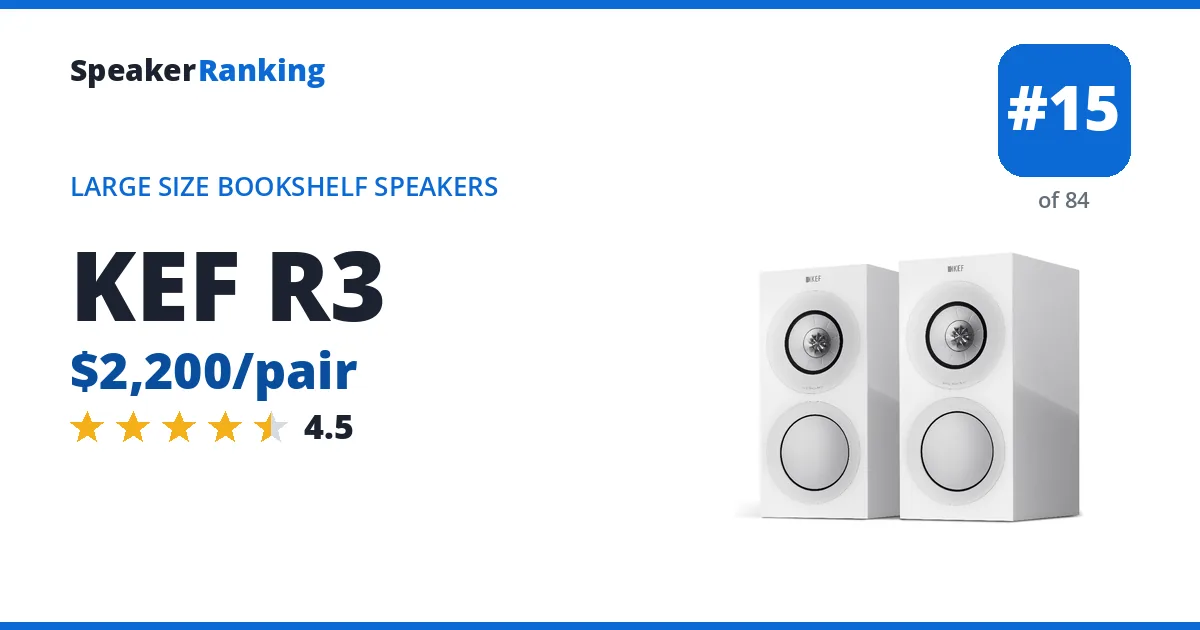
Pros: True three-way stand-mount with a 6.5-inch woofer below KEF’s 5-inch Uni-Q midrange/1-inch tweeter. Erin measured approximately 86-87dB/2.83V/1m sensitivity, exceptionally low sub-1% distortion at 86dB and orderly directivity in both planes. The coaxial geometry maintains image stability across seats, while Flexible Port Technology avoids the strong midrange port resonance common to rear-vented competitors. A 110W Parasound drove it successfully in Erin’s listening. Measured bass extension of 35.2Hz (-10dB), with a measured sensitivity of 87dB.
Cons: The low-frequency alignment rolls gradually rather than delivering high-output sub-bass; KEF specifies 58Hz +/-3dB and Erin’s high-level data supports using an 80Hz subwoofer crossover. Narrow high-frequency features and natural Uni-Q narrowing toward the top octave make toe angle audible, although off-axis tracking remains smooth. Sensitivity is moderate, the cabinet weighs almost 30 lb, and this original R3 lacks the Meta successor’s MAT absorber.
Full KEF R3 review and specifications →
| Bass Extension (-10dB) | 35.2Hz (measured, Audio Science Review) |
|---|---|
| Bass Extension (-3dB) | Approximately 58Hz (manufacturer specified; consistent with Erin’s measured roll-off) |
| DIY Kit | No |
| Dimensions | 16.6”H x 7.9”W x 13.2”D |
| Drivers | 1” tweeter coaxial with 5” midrange; 6.5” woofer |
| Impedance | 8 ohms nominal; suitable for Erin’s 4/8-ohm-rated amplifier |
| Sensitivity | Approximately 86-87dB/2.83V/1m (measured, Erin’s Audio Corner) |
| Spinorama Preference Score | 6.2 (spinorama.org) |
| Spinorama Preference Score with Perfect Sub | 7.97 (spinorama.org) |
| Weight | 29.9 lbs (13.55 kg) each |
| Woofer Cabinet | ported, rear Flexible Port |
- Links
- Reviews, Comparisons and Sound Samples
- Head-to-Head Comparisons