Short answer: the MoFi SourcePoint 888 on price, the Revel F226Be for a beryllium tweeter. The F226Be is a three-way with a beryllium tweeter, a dedicated 5.25” mid-range and dual 5.25” midwoofers rather than a coaxial layout, but its 3.7-ohm minimum impedance wants a 4-ohm-capable amplifier, and it costs $2205 more. The 888 uses an 8” coaxial mid-range plus two 8” woofers crossed at about 130Hz.
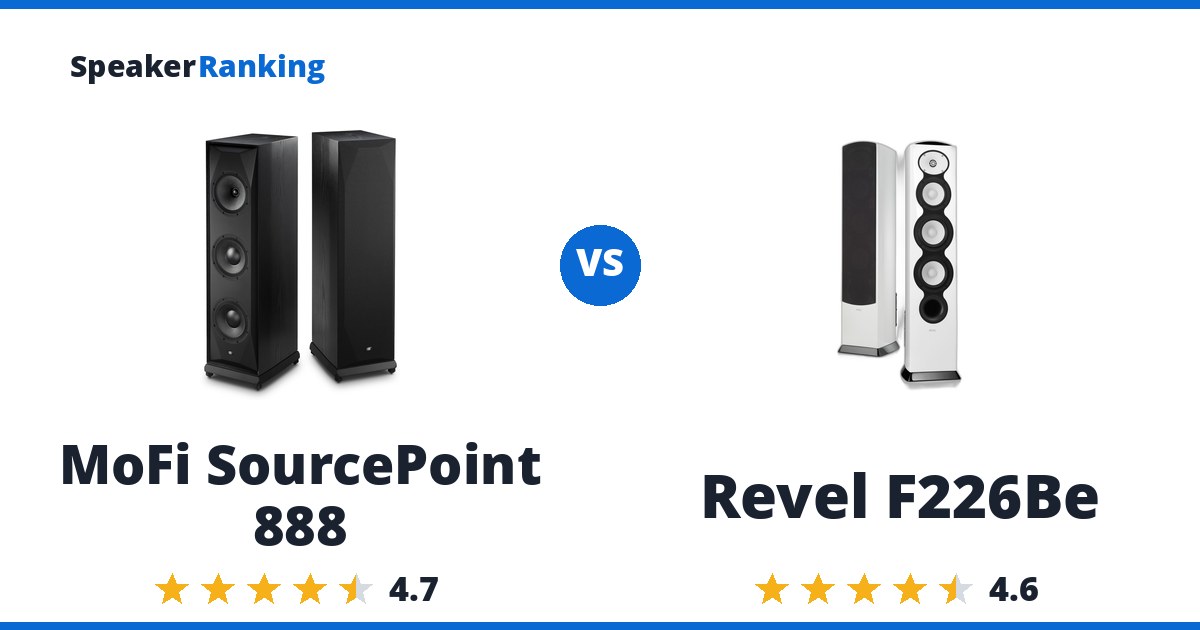
The case for the MoFi SourcePoint 888: Three-way vented design: an 8” coaxial mid-range/1.25” dome tweeter driver plus two additional 8” woofers crossed at about 130Hz. The tradeoff: A significant investment, best ordered from a dealer with a good return policy.
What the Revel F226Be gets right: Three-way design with a beryllium tweeter, a dedicated 5.25” mid-range, and dual 5.25” midwoofers (not a coaxial layout). The catch: Minimum impedance of 3.7 ohms means it wants a 4-ohm-capable amplifier.
Buy the MoFi SourcePoint 888. It is rated higher for sound quality than the Revel F226Be and costs less, so there is no real case for the other one.
Still deciding? The full Passive Home rankings cover every ranked option.
Specifications Side By Side
| MoFi SourcePoint 888 | Revel F226Be | |
|---|---|---|
| Price | $5495 per pair | $7700 per pair |
| Ranked | #4 of 71 in Large Size Floorstanding Speakers | #11 of 71 in Large Size Floorstanding Speakers |
| Bass Extension (-10dB) | 26Hz (measured, Erin's Audio Corner) | 36Hz (measured, Erin's Audio Corner) |
| Bass Extension (-3dB) | 34Hz (measured, Erin's Audio Corner) | 56Hz (measured, Erin's Audio Corner) |
| Dimensions | 41.2"H x 12.6"W x 16.1"D (1046.5 x 320 x 408.9 mm) | 41.3"H x 9.8"W x 13.7"D (1049 x 248.9 x 348 mm) |
| Impedance | 6 ohms nominal, 5 ohms minimum (measured, Erin's Audio Corner) | 8 ohms nominal (3.7 ohms minimum, measured, Erin's Audio Corner) |
| Drivers | Dual 8" paper cone woofers, 8" Paper Cone midrange, 1.25" wide roll soft dome tweeter | Two 6.5" (165mm) Deep Ceramic Composite aluminum cones, with cast frames woofer, 5-1/4" (130mm) Deep Ceramic Composite aluminum cone, with cast frame midrange, 1" (25mm) Beryllium dome, with acoustic lens waveguide tweeter |
| Sensitivity | 85.6dB (measured, Erin's Audio Corner) | 89.7dB (measured, Erin's Audio Corner) |
| Weight | 94.8 lbs (43 kg) each | 58.2 lbs (26.4 kg) each |
| Woofer Cabinet | ported, rear | ported, front |
| Spinorama Preference Score | 5.21 | 5.96 (spinorama.org) |
| Spinorama Preference Score with Perfect Sub | 6.33 | 8.15 (spinorama.org) |
| DIY Kit | No | No |
Related Speaker Comparisons
More worthwhile head-to-heads for MoFi SourcePoint 888:
- GR-Research NX-Treme vs MoFi SourcePoint 888
- KEF Blade Two Meta vs MoFi SourcePoint 888
- MoFi SourcePoint 888 vs MoFi SourcePoint V10 Master Edition
- Radiant Acoustics Clarity 66 vs MoFi SourcePoint 888
- MoFi SourcePoint 888 vs Ascend Acoustics ELX Ribbon Tower
Prices on this page were last checked September 23, 2026 at 11:24 PM UTC. Product prices and availability are accurate as of that date/time and are subject to change; the price and availability shown on Amazon at the time of purchase will apply to the purchase of this product.
As an eBay Partner, we may be compensated if you make a purchase.
The Two Speakers In Full
 MoFi SourcePoint 888: $5495 per pair Crutchfield eBay
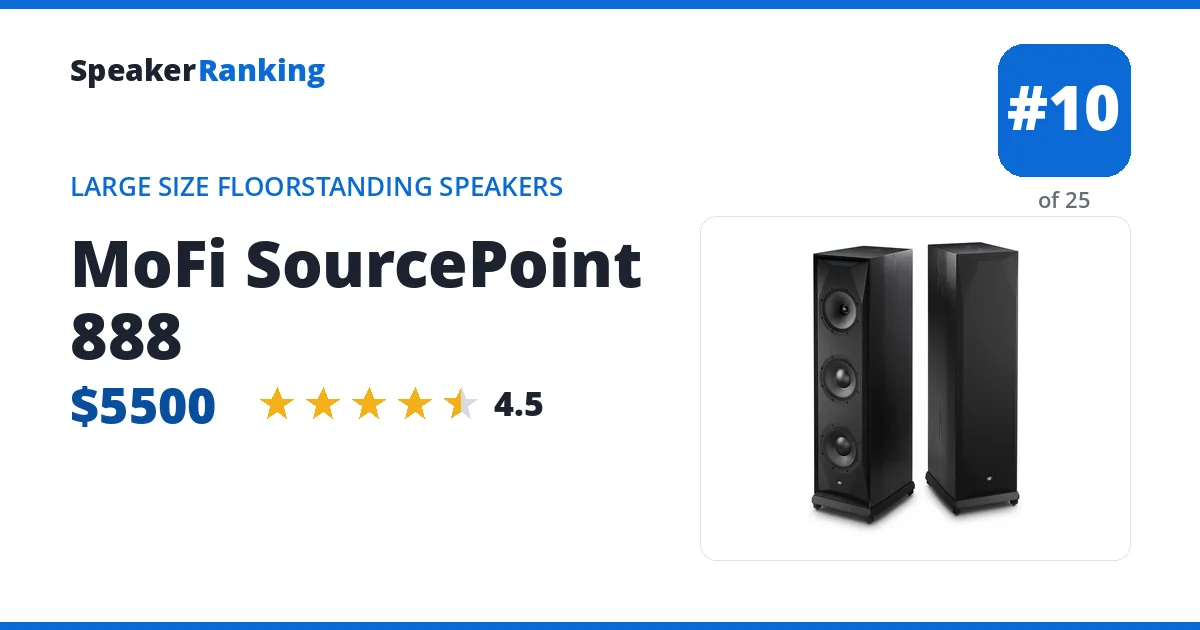
Pros: Three-way vented design: an 8” coaxial mid-range/1.25” dome tweeter driver plus two additional 8” woofers crossed at about 130Hz, giving genuinely full-range output (F3 34Hz, F10 26Hz) other than the deepest subsonic content. Ranked by the reviewer among his personal top three speakers out of roughly 200 tested, alongside the KEF Blade 2 Meta and Dutch & Dutch 8C, despite costing a small fraction of either. Excellent compression/dynamic-range linearity, holding its own against much pricier speakers like the March Audio Sointuva AWG, KEF Reference 1 Meta, and KEF Blade 2 Meta. On-axis (0°) and 30°-off-axis estimated in-room responses track within about 1-1.5dB of each other above 500Hz, so tonal balance barely changes with placement or listening angle - excellent for multi-seat home theater or entertaining. Wide horizontal dispersion of about ±60°. Distortion stays low: under 1% at 86dB, and under 1% above 200Hz even at 96dB, with multitone distortion mostly under 1% as well. Not a difficult amplifier load (5-ohm minimum impedance, 4.2-ohm minimum EPDR). Checks the three boxes the reviewer considers essential for a home theater speaker: low compression, low distortion, and excellent directivity. Measured bass extension of 34Hz (-3dB), with a measured sensitivity of 85.6dB.
Cons: A significant investment, best ordered from a dealer with a good return policy. Large and heavy floorstander (about 96 lbs, 42” tall) requiring real floor space and rear clearance. Positioning is fairly specific: needs about 2 feet from the rear wall - closer causes boominess in the 40-50Hz region, farther loses bass extension. Vertical dispersion (about ±50°) is narrower than horizontal (about ±60°), since the two 8” woofers are spaced vertically apart on a tower cabinet, causing some vertical mismatch at lower frequencies. A small on-axis dip around 500Hz and a deliberately lower tweeter level (about 0.5dB below the midrange) are intentional design choices for smoother in-room response, but mean the raw on-axis measurement isn’t perfectly flat. A mild diffraction-related dip appears around 3kHz in directivity measurements. Toeing the speaker out more than about 10° starts to noticeably reduce top-end energy.
Full MoFi SourcePoint 888 review and specifications →
| Bass Extension (-10dB) | 26Hz (measured, Erin's Audio Corner) |
|---|---|
| Bass Extension (-3dB) | 34Hz (measured, Erin's Audio Corner) |
| DIY Kit | No |
| Dimensions | 41.2"H x 12.6"W x 16.1"D (1046.5 x 320 x 408.9 mm) |
| Drivers | Dual 8" paper cone woofers, 8" Paper Cone midrange, 1.25" wide roll soft dome tweeter |
| Impedance | 6 ohms nominal, 5 ohms minimum (measured, Erin's Audio Corner) |
| Sensitivity | 85.6dB (measured, Erin's Audio Corner) |
| Spinorama Preference Score | 5.21 |
| Spinorama Preference Score with Perfect Sub | 6.33 |
| Weight | 94.8 lbs (43 kg) each |
| Woofer Cabinet | ported, rear |
- Links
- Reviews, Comparisons and Sound Samples
- Head-to-Head Comparisons
- MoFi SourcePoint 888 vs MoFi SourcePoint V10 Master Edition
- MoFi SourcePoint 888 vs Radiant Acoustics Clarity 66
- MoFi SourcePoint 888 vs KEF Blade Two Meta
- MoFi SourcePoint 888 vs Ascend Acoustics ELX Ribbon Tower
- MoFi SourcePoint 888 vs GR-Research NX-Treme
- MoFi SourcePoint 888 vs JBL HDI-3800
- MoFi SourcePoint 888 vs Revel F328Be
- MoFi SourcePoint 888 vs KEF R5 Meta
- See all 35 comparisons
 Revel F226Be: $7700 per pair Crutchfield eBay
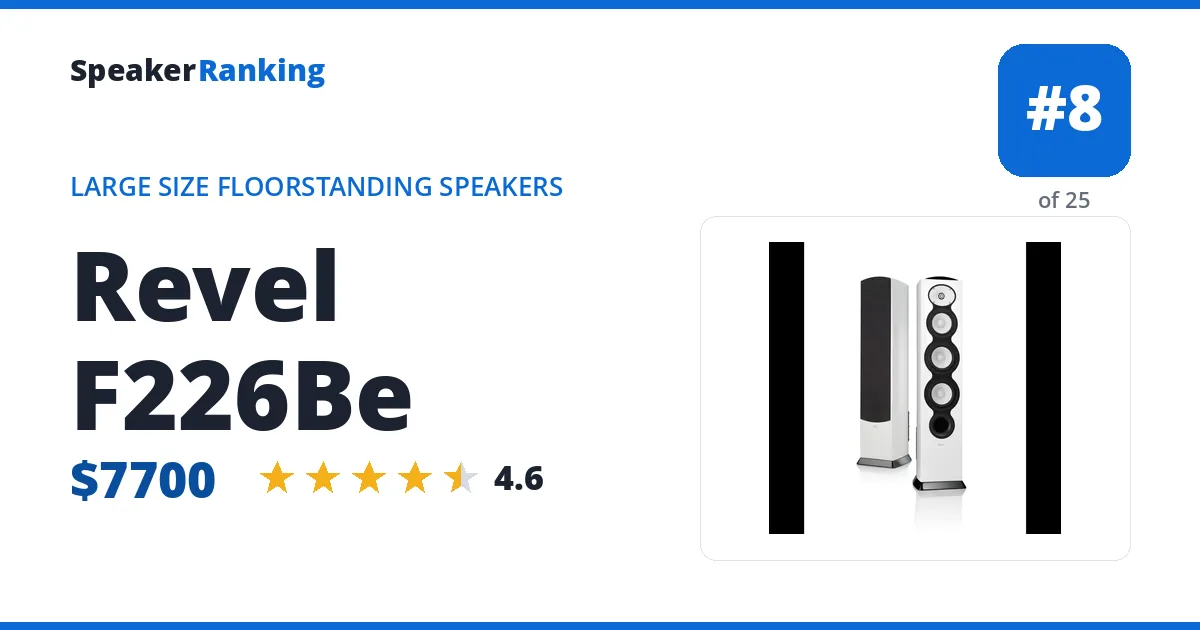
Pros: Compact three-way tower with a beryllium dome tweeter in an acoustic lens waveguide, a dedicated 5.25” mid-range, and dual 6.5” woofers (not a coaxial layout) - all Deep Ceramic Composite aluminum cones engineered specifically to avoid breakup outside their crossover bands, and it measures that way: neither the woofers nor the mid-range show breakup spikes even well outside their intended pass bands, and even the front port measures unusually clean (only a mild ~3dB bump around 150Hz, well controlled versus the resonances the reviewer typically sees from ports). On-axis frequency response holds within about ±1.5dB above roughly 65Hz - excellent linearity - and off-axis behavior tracks it closely, with only mild, subdued peaking around 4-6kHz that doesn’t show up as real resonance in the spinorama data. Average sensitivity around 90dB (2.83V/1m), notably higher than some competing three-way designs and most bookshelf speakers, translating directly into better dynamic range at both low and high listening levels - one reviewer specifically praised its ability to deliver full transient impact (snare hits, kick drum) even at quiet, conversational volumes rather than needing to be cranked up to feel dynamic. Wide, consistent horizontal radiation of about ±60-70° at the -6dB point, landing right in the reviewer’s preferred range for an enveloping soundstage without excess diffusion, and exceptionally wide vertical dispersion - roughly ±80° up to 10kHz and still ±70° above that, which one reviewer called the widest vertical radiation pattern he had measured to date. Distortion stays under 3% even at 104dB SPL, and in real-world testing up to 105dB from 12-14 feet away, full-range with no crossover, the reviewer heard no audible mechanical noise, port chuffing, or compression at all. Flat enough on- and off-axis response that toeing the speaker 10-15° away from the listener preserves the same tonal balance rather than changing it, and the wide, well-controlled directivity lets sidewall reflections reinforce rather than smear the soundstage. Measured bass extension of 56Hz (-3dB), with a measured sensitivity of 89.7dB.
Cons: Minimum impedance dips to about 3.7-4 ohms below roughly 500Hz despite the 8-ohm nominal rating, so it wants a genuine 4-ohm-capable two-channel amplifier; budget AVRs rated only for 6 or 8 ohms may struggle. F3 of 56Hz and F10 of 36Hz mean it doesn’t extend nearly as low as some three-way rivals with larger woofers - a dedicated subwoofer (10-12”, or 15” for content below 30Hz) is recommended for home theater or bass-heavy music, even though the speaker itself can play surprisingly loud without one. Vertical directivity tolerance is tighter in the crossover handoff region than a true coaxial design would offer, since the tweeter, midrange, and woofers are physically separated - a mild directivity bump appears around 2-2.5kHz that’s typical of non-coaxial multi-way speakers, though not audibly problematic within about ±10° vertically. On-axis, the top end reads as a bit bright according to one reviewer’s subjective impression, generally benefiting from some toe-out. High-gloss cabinet finish can create distracting reflections if used behind a projector screen in a home theater setup. Front-ported, so it can technically sit close to a wall, but doing so makes the bass boomier.
Full Revel F226Be review and specifications →
| Bass Extension (-10dB) | 36Hz (measured, Erin's Audio Corner) |
|---|---|
| Bass Extension (-3dB) | 56Hz (measured, Erin's Audio Corner) |
| DIY Kit | No |
| Dimensions | 41.3"H x 9.8"W x 13.7"D (1049 x 248.9 x 348 mm) |
| Drivers | Two 6.5" (165mm) Deep Ceramic Composite aluminum cones, with cast frames woofer, 5-1/4" (130mm) Deep Ceramic Composite aluminum cone, with cast frame midrange, 1" (25mm) Beryllium dome, with acoustic lens waveguide tweeter |
| Impedance | 8 ohms nominal (3.7 ohms minimum, measured, Erin's Audio Corner) |
| Sensitivity | 89.7dB (measured, Erin's Audio Corner) |
| Spinorama Preference Score | 5.96 (spinorama.org) |
| Spinorama Preference Score with Perfect Sub | 8.15 (spinorama.org) |
| Weight | 58.2 lbs (26.4 kg) each |
| Woofer Cabinet | ported, front |
- Links
- Reviews, Comparisons and Sound Samples
- Erin’s Audio Corner: Revel PerformaBe F226Be Floorstanding Loudspeaker Review. I love this speaker. More from Erin’s Audio Corner →
- Erin’s Audio Corner: Should You Buy the Revel F226Be or the MoFi 888?
- Erin’s Audio Review Website Revel F226B
- Erin’s Audio Corner: My Top 5 Speakers at Any Price
- Erin’s Audio Corner Measurements (spinorama.org)
- Head-to-Head Comparisons