Short answer: the KEF Blade Two Meta. It ranks #2 of 73 floorstanding speakers by sound quality, rated 4.8/5, at $28,000; the Magico S5 2024 ranks #8, rated 4.6/5, and costs $82,000, so there is not much of a tradeoff to weigh.
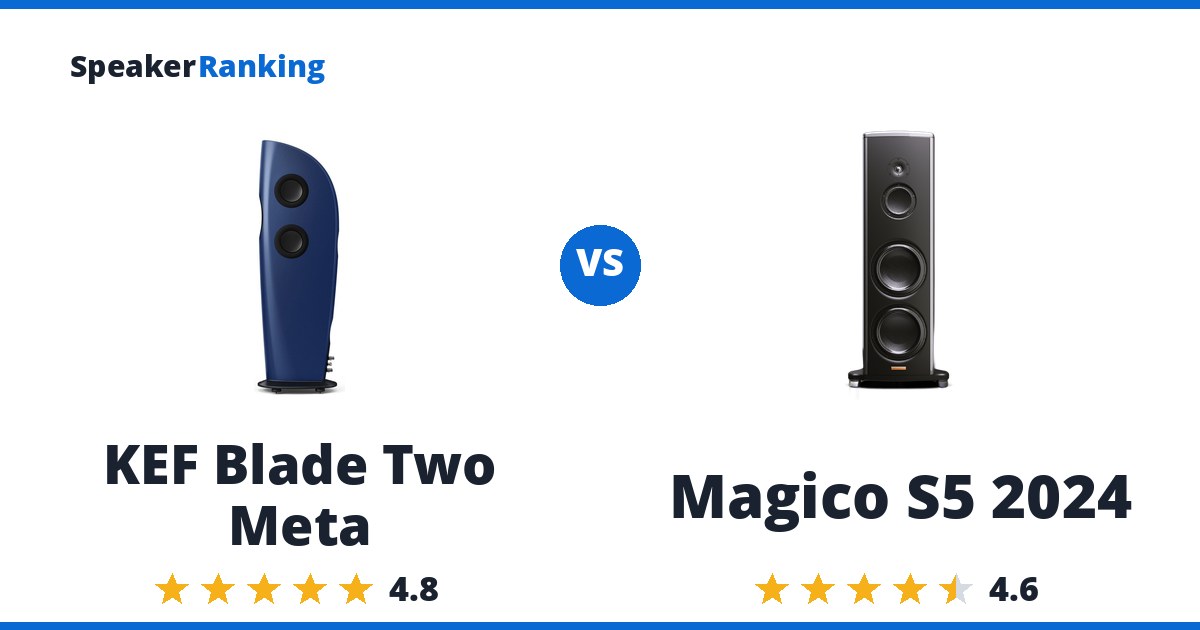
Why pick the KEF Blade Two Meta: True point-source coaxial design (four 6.5in mid-bass drivers flanking a coincident mid/tweeter) with matched ~50 degree horizontal and vertical dispersion, unusual for a multi-driver speaker. The catch: 2dB dip and slight resonance around 200Hz, also visible in KEF white paper and likely cabinet-related.
Why pick the Magico S5 2024: Manufacturer Spinorama data shows exceptionally flat on-axis response, with just 0.15dB average absolute deviation and 0.89 listening-window smoothness inside a narrow 1.3dB reference band. The tradeoff: At $41000 per pair it is one of the most expensive speakers we list, and it is sold only through Magico dealers.
Buy the KEF Blade Two Meta. It is rated higher for sound quality than the Magico S5 2024 and costs less, so only choose the other one for a particular feature it does better.
Want more options? Browse the full Passive Home rankings.
Specifications Side By Side
| KEF Blade Two Meta | Magico S5 2024 | |
|---|---|---|
| Price | $28000 per pair only sold in stores | $82,000 per pair |
| Ranked | #2 of 73 in Large Size Floorstanding Speakers | #8 of 73 in Large Size Floorstanding Speakers |
| Bass Extension (-10dB) | 26Hz (measured, Erin’s Audio Corner) | approximately 20.8Hz (measured, manufacturer data on spinorama.org) |
| Bass Extension (-3dB) | 31Hz (measured, Erin’s Audio Corner) | 37Hz (measured, manufacturer data on spinorama.org) |
| Dimensions | 46.6”H x 13.5”W x 14.8”D (1183.6 x 342.9 x 375.9 mm) | 48”H x 19.1”W x 19.3”D (1220 x 485 x 490 mm) |
| Impedance | 4 ohms nominal (3.3 ohms minimum, measured, Erin’s Audio Corner) | 4 ohms nominal |
| Drivers | 4 x 165 mm (6.5 in.) aluminium cone, force cancelling woofers, 125 mm (5 in.) aluminium cone midrange, 25 mm (1 in.) aluminium dome with MAT tweeter | Two 10” graphene Nano-Tec woofers; 6” graphene Nano-Tec midrange; 28mm diamond-coated beryllium tweeter |
| Sensitivity | 86.8dB (measured, Erin’s Audio Corner) | 88dB (manufacturer specified) |
| Weight | 79.4 lbs (36 kg) each | 260.1 lbs (118 kg) each |
| Woofer Cabinet | ported, rear | - |
| Spinorama Preference Score | 6.99 | 7.35 |
| Spinorama Preference Score with Perfect Sub | 8.11 | 8.52 |
| DIY Kit | No | No |
| Enclosure | - | Curved aluminum |
| Power Handling | - | 50-1000W recommended amplifier power |
| Frequency Response | - | 20Hz-50kHz (manufacturer, in-room) |
Related Speaker Comparisons
More top alternatives to KEF Blade Two Meta:
- GR-Research NX-Treme vs KEF Blade Two Meta
- KEF Blade Two Meta vs MoFi SourcePoint V10 Master Edition
- KEF Blade Two Meta vs MoFi SourcePoint 888
- KEF Blade Two Meta vs Revel F328Be
- Radiant Acoustics Clarity 66 vs KEF Blade Two Meta
Prices on this page were last checked September 26, 2026 at 11:14 PM UTC. Product prices and availability are accurate as of that date/time and are subject to change; the price and availability shown on Amazon at the time of purchase will apply to the purchase of this product.
As an eBay Partner, we may be compensated if you make a purchase.
The Two Speakers In Full
 KEF Blade Two Meta: $28000 per pair only sold in stores eBay
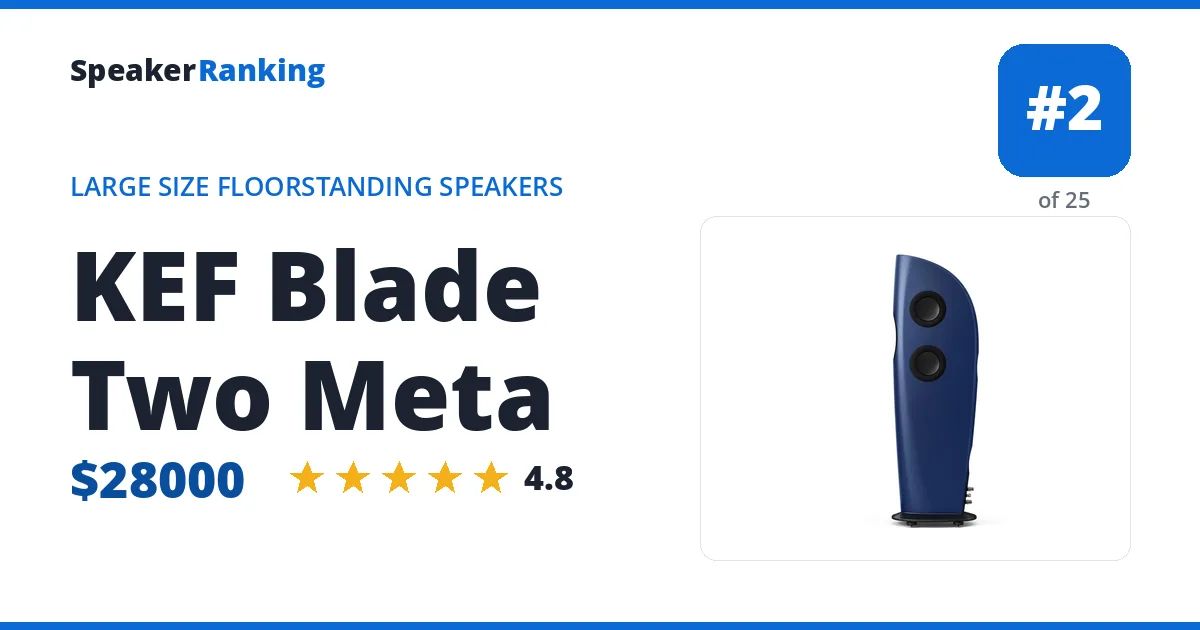
Pros: True point-source coaxial design (four 6.5in mid-bass drivers flanking a coincident mid/tweeter) with matched ~50 degree horizontal and vertical dispersion, unusual for a multi-driver speaker. Fully rounded, edgeless cabinet eliminates baffle diffraction. Frequency response holds within about 2.5dB across the listening window. Extremely low harmonic and multitone distortion even at 96dB, with under 0.5dB of compression at full output, rivaling the Reference 1 Meta and JBL 4367 in dynamic range. Reviewer described the imaging and soundstage depth as revealing recording details other speakers he tested (PS Audio FR10, MoFi SourcePoint 8, Neumann KH80) masked. Available in any custom finish at no extra charge. Measured bass extension of 31Hz (-3dB), with a measured sensitivity of 86.8dB.
Cons: 2dB dip and slight resonance around 200Hz, also visible in KEF white paper and likely cabinet-related. Bass rolls off fairly quickly below its 31Hz F3. Horizontal dispersion (~50 degrees) is narrower than the reviewer preferred 70-80 degrees; benefits from toeing out 10-20 degrees to open soundstage without losing image focus. Needs a separate power amp, not AVR-friendly.
Full KEF Blade Two Meta review and specifications →
| Bass Extension (-10dB) | 26Hz (measured, Erin’s Audio Corner) |
|---|---|
| Bass Extension (-3dB) | 31Hz (measured, Erin’s Audio Corner) |
| DIY Kit | No |
| Dimensions | 46.6”H x 13.5”W x 14.8”D (1183.6 x 342.9 x 375.9 mm) |
| Drivers | 4 x 165 mm (6.5 in.) aluminium cone, force cancelling woofers, 125 mm (5 in.) aluminium cone midrange, 25 mm (1 in.) aluminium dome with MAT tweeter |
| Impedance | 4 ohms nominal (3.3 ohms minimum, measured, Erin’s Audio Corner) |
| Sensitivity | 86.8dB (measured, Erin’s Audio Corner) |
| Spinorama Preference Score | 6.99 |
| Spinorama Preference Score with Perfect Sub | 8.11 |
| Weight | 79.4 lbs (36 kg) each |
| Woofer Cabinet | ported, rear |
- Links
- Reviews, Comparisons and Sound Samples
- Head-to-Head Comparisons
- KEF Blade Two Meta vs GR-Research NX-Treme
- KEF Blade Two Meta vs MoFi SourcePoint V10 Master Edition
- KEF Blade Two Meta vs MoFi SourcePoint 888
- KEF Blade Two Meta vs Revel F328Be
- KEF Blade Two Meta vs Radiant Acoustics Clarity 66
- KEF Blade Two Meta vs Ascend Acoustics ELX Ribbon Tower
- KEF Blade Two Meta vs KEF R5 Meta
- KEF Blade Two Meta vs Revel F226Be
- See all 36 comparisons
 Magico S5 2024: $82,000 per pair Audio Solutions eBay
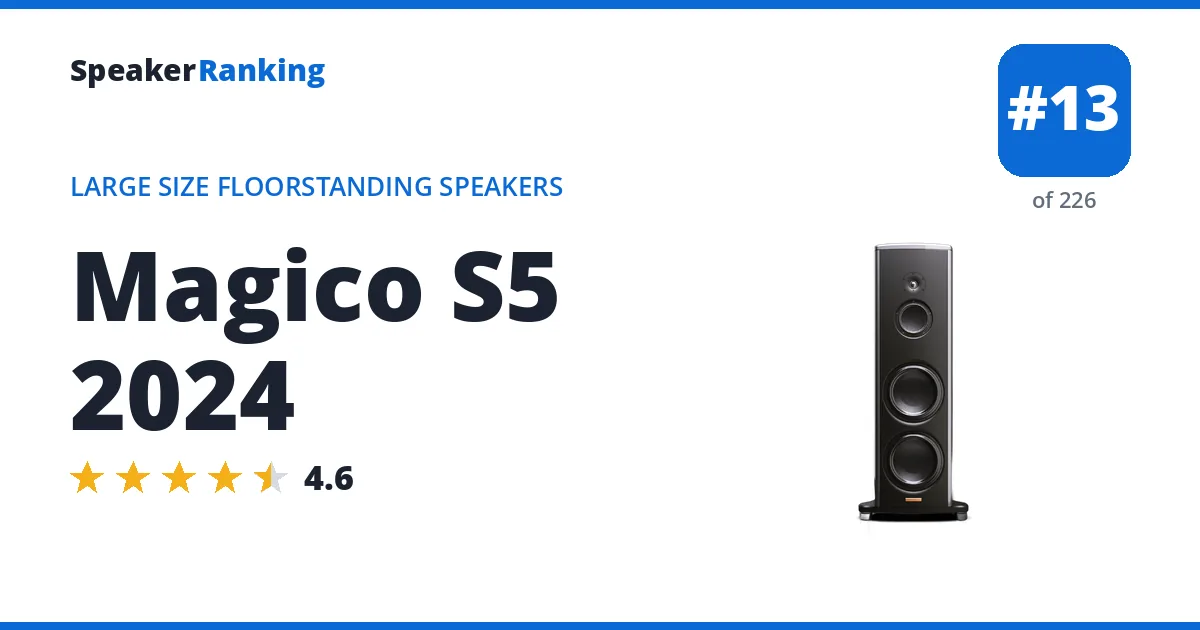
Pros: Manufacturer Spinorama data shows exceptionally flat on-axis response, with just 0.15dB average absolute deviation and 0.89 listening-window smoothness inside a narrow 1.3dB reference band. Preference scores are 7.35 without a subwoofer and 8.52 with one. Bass reaches 37Hz at -3dB, 27.9Hz at -6dB and about 20.8Hz at -10dB from two 10-inch woofers, so most music needs no subwoofer. The diamond-coated beryllium tweeter, graphene midrange and heavily braced curved aluminum cabinet are built for high output with low coloration.
Cons: At $41000 per pair it is one of the most expensive speakers we list, and it is sold only through Magico dealers. The measurements are manufacturer supplied and digitized from published graphs rather than an independent ASR or Erin test. A 2.78 directivity-index deviation is less even than the flattest on-axis numbers suggest. The 4 ohm load, 88dB sensitivity and 118kg weight call for a powerful amplifier and careful placement.
Full Magico S5 2024 review and specifications →
| Bass Extension (-10dB) | approximately 20.8Hz (measured, manufacturer data on spinorama.org) |
|---|---|
| Bass Extension (-3dB) | 37Hz (measured, manufacturer data on spinorama.org) |
| DIY Kit | No |
| Dimensions | 48”H x 19.1”W x 19.3”D (1220 x 485 x 490 mm) |
| Drivers | Two 10” graphene Nano-Tec woofers; 6” graphene Nano-Tec midrange; 28mm diamond-coated beryllium tweeter |
| Enclosure | Curved aluminum |
| Frequency Response | 20Hz-50kHz (manufacturer, in-room) |
| Impedance | 4 ohms nominal |
| Power Handling | 50-1000W recommended amplifier power |
| Sensitivity | 88dB (manufacturer specified) |
| Spinorama Preference Score | 7.35 |
| Spinorama Preference Score with Perfect Sub | 8.52 |
| Weight | 260.1 lbs (118 kg) each |
- Links
- Reviews, Comparisons and Sound Samples
- Head-to-Head Comparisons