Short answer: the ELAC Debut 2.0 B6.2, unless you are buying the Sonus Faber Lumina II for how it looks. The Lumina II is handmade in Italy with a gloss-finished front baffle and a black leather-wrapped cabinet, and it has real brand cachet, but it is not neutral: a persistent high-frequency boost makes it sound forward and bright whether pointed at the listener or toed out. The B6.2’s fault is a good size resonant peak around 700Hz.
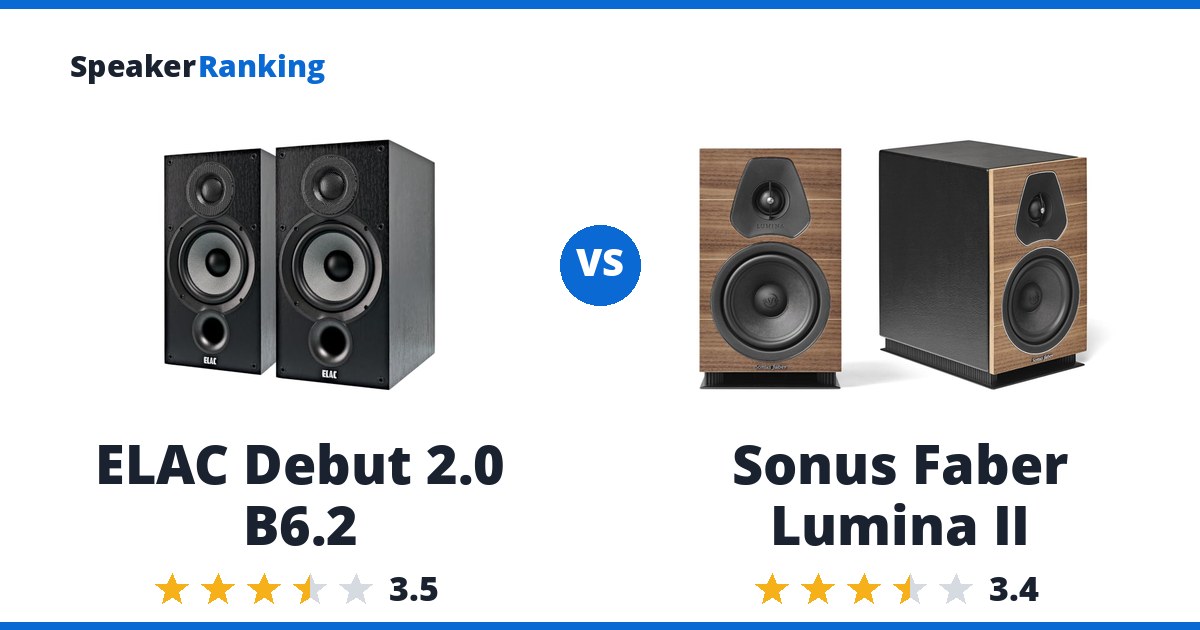
Buy the ELAC Debut 2.0 B6.2. It is rated higher for sound quality than the Sonus Faber Lumina II and costs less, so it is the default pick unless a specific strength of the other one matters more to you.
Want more options? Browse the full Passive Home rankings.
Specifications Side By Side
| ELAC Debut 2.0 B6.2 | Sonus Faber Lumina II | |
|---|---|---|
| Price | $479.00 per pair | $1,600 per pair |
| Ranked | #89 of 134 in Large Size Bookshelf Speakers | #94 of 134 in Large Size Bookshelf Speakers |
| Bass Extension (-10dB) | 40Hz (measured, Erin’s Audio Corner) | 41Hz (measured, Erin’s Audio Corner) |
| Bass Extension (-3dB) | 64Hz (measured, Erin’s Audio Corner) | 60Hz (measured, Erin’s Audio Corner) |
| Impedance | 6 ohms nominal, 5.2 ohms minimum (measured, Erin’s Audio Corner) | 4 ohms nominal, 4.1 ohms minimum (measured, Erin’s Audio Corner) |
| Sensitivity | 86.5dB (measured, Audio Science Review) | 86dB (measured average, Erin’s Audio Corner; matches manufacturer spec) |
| Drivers | 25mm tweeter + 165mm woofer | 29mm DAD dome tweeter, 150mm paper cone mid-woofer |
| Weight | 29.1 lbs (13.2 kg) | 12.5 lbs (5.65 kg) each |
| Dimensions | 14.8”H x 7.7”W x 10.6”D (375.0 x 195.0 x 268.0 mm) | 12” x 7.1” x 10.4” (304 x 180 x 263 mm) |
| Woofer Cabinet | ported, front | - |
| Spinorama Preference Score | 4.75 (spinorama.org) | 3.81 |
| Spinorama Preference Score with Perfect Sub | 7.0 (spinorama.org) | 6.10 |
| DIY Kit | No | No |
| Crossover Frequency | - | 1800Hz |
| Frequency Response | - | 55Hz - 24kHz (manufacturer specified) |
| Recommended Power | - | 30W - 150W |
Related Speaker Comparisons
More top alternatives to ELAC Debut 2.0 B6.2:
- ELAC Debut 2.0 B6.2 vs Perlisten S4b
- ELAC Debut 2.0 B6.2 vs KEF Reference 1 Meta
- ELAC Debut 2.0 B6.2 vs GR-Research NX-Studio
- AsciLab C6B vs ELAC Debut 2.0 B6.2
- ELAC Debut 2.0 B6.2 vs Audio First Cadentia 3
Prices on this page were last checked October 2, 2026 at 10:18 PM UTC. Product prices and availability are accurate as of that date/time and are subject to change; the price and availability shown on Amazon at the time of purchase will apply to the purchase of this product.
As an eBay Partner, we may be compensated if you make a purchase.
The Two Speakers In Full
 ELAC Debut 2.0 B6.2: $479.00 per pair Amazon Crutchfield eBay
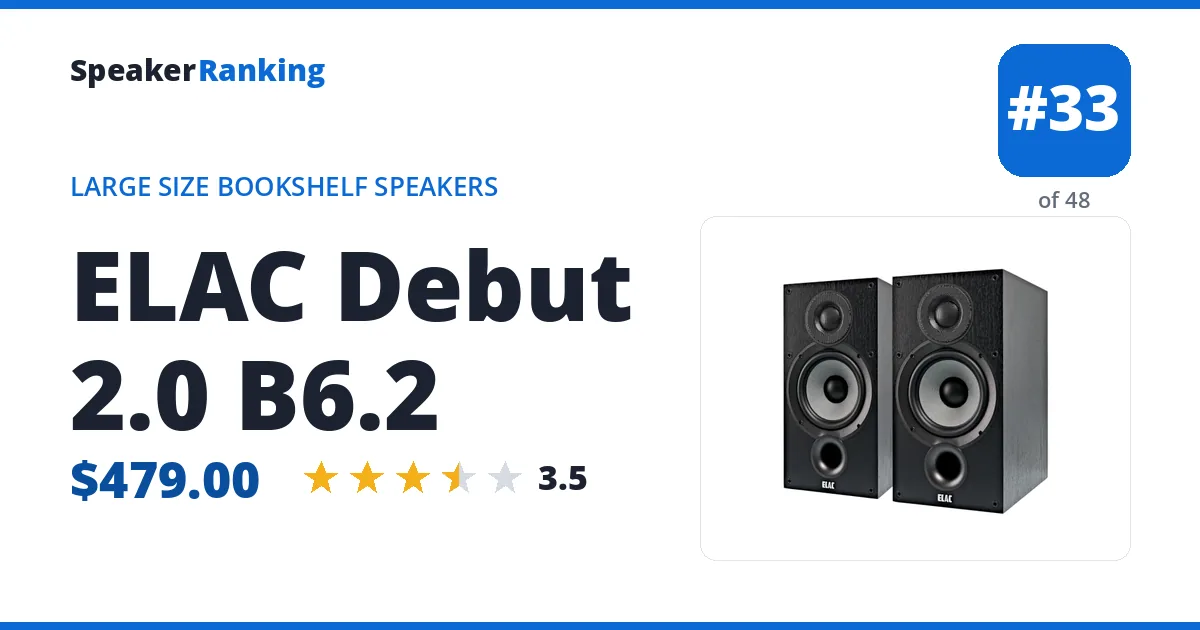
Pros: Reasonably flat on-axis and listening-window response with reasonably even horizontal directivity, holding about ±60° up to roughly 8kHz for consistent stereo width whether aimed directly at the listener or toed out. Its larger-than-typical woofer lets it play very loud with minimal distortion, staying under about 1% THD down to 50Hz at 86dB, and minimum impedance stays a comfortable 5-6 ohms. In-room bass extension reaches about 50Hz without much trouble, enough for a solid kick-drum sound. Takes equalization very well: correcting the on-axis response doesn’t cost sensitivity through the midrange, and the underlying directivity behavior (diffraction, vertical mismatch) is mild enough that EQ alone gets most of the way to a well-balanced sound. Vertical tolerance is asymmetric and fairly forgiving: about 10° above the tweeter axis and 20° below it before tonal balance meaningfully shifts. One reviewer called it “a good speaker” with “a good price” rather than just good-for-the-price, and found it fairly neutral overall in-room. Measured bass extension of 64Hz (-3dB), with a measured sensitivity of 86.5dB.
Cons: A good size resonant peak around 700Hz stands out from an otherwise smooth response and lingers in cumulative spectral decay (waterfall) measurements: in one reviewer’s sighted A/B test, reducing it by about 5dB via EQ made a noticeable but not dramatic difference. Directivity error shows up around 3.3kHz, and the upper-midrange around 4-6kHz stood out as edgy and sharp, almost sibilant at times, in casual listening: the predicted in-room response shows a lack of energy between 1-2kHz and a bit too much above that, which one reviewer thought would sound bright. Distortion at 96dB SPL/1m shows two harmonic peaks the reviewer says “should not be there,” one from woofer breakup around 400Hz and another around 7-8kHz from the tweeter, and multitone distortion approaches 10% in the 500-800Hz range at that output level. Real compression shows up even at moderate volume and worsens at 96dB and above, with the woofer clearly giving up around 60-70Hz: a subwoofer is recommended for anyone wanting to listen loud, since running it full-range at high output costs real dynamic range in the midbass and bass. Don’t place it close to a wall: boundary reinforcement adds a midbass bump that undoes the otherwise smooth, linear response. Getting the best out of it takes EQ (taming the 700Hz peak, filling in the 1-2kHz dip, and trimming the highs).
Full ELAC Debut 2.0 B6.2 review and specifications →
| Bass Extension (-10dB) | 40Hz (measured, Erin’s Audio Corner) |
|---|---|
| Bass Extension (-3dB) | 64Hz (measured, Erin’s Audio Corner) |
| DIY Kit | No |
| Dimensions | 14.8”H x 7.7”W x 10.6”D (375.0 x 195.0 x 268.0 mm) |
| Drivers | 25mm tweeter + 165mm woofer |
| Impedance | 6 ohms nominal, 5.2 ohms minimum (measured, Erin’s Audio Corner) |
| Sensitivity | 86.5dB (measured, Audio Science Review) |
| Spinorama Preference Score | 4.75 (spinorama.org) |
| Spinorama Preference Score with Perfect Sub | 7.0 (spinorama.org) |
| Weight | 29.1 lbs (13.2 kg) |
| Woofer Cabinet | ported, front |
- Links
- Reviews, Comparisons and Sound Samples
- Head-to-Head Comparisons
- ELAC Debut 2.0 B6.2 vs SVS Prime Bookshelf
- ELAC Debut 2.0 B6.2 vs Dynaudio Special Forty
- ELAC Debut 2.0 B6.2 vs Infinity IL10
- ELAC Debut 2.0 B6.2 vs GR-Research X-LS Encore
- ELAC Debut 2.0 B6.2 vs KEF Q3 Meta
- ELAC Debut 2.0 B6.2 vs Polk Monitor XT20
- ELAC Debut 2.0 B6.2 vs Parts Express Samba MT
- ELAC Debut 2.0 B6.2 vs XTZ Spirit 4
- See all 63 comparisons
 Sonus Faber Lumina II: $1,600 per pair Crutchfield eBay
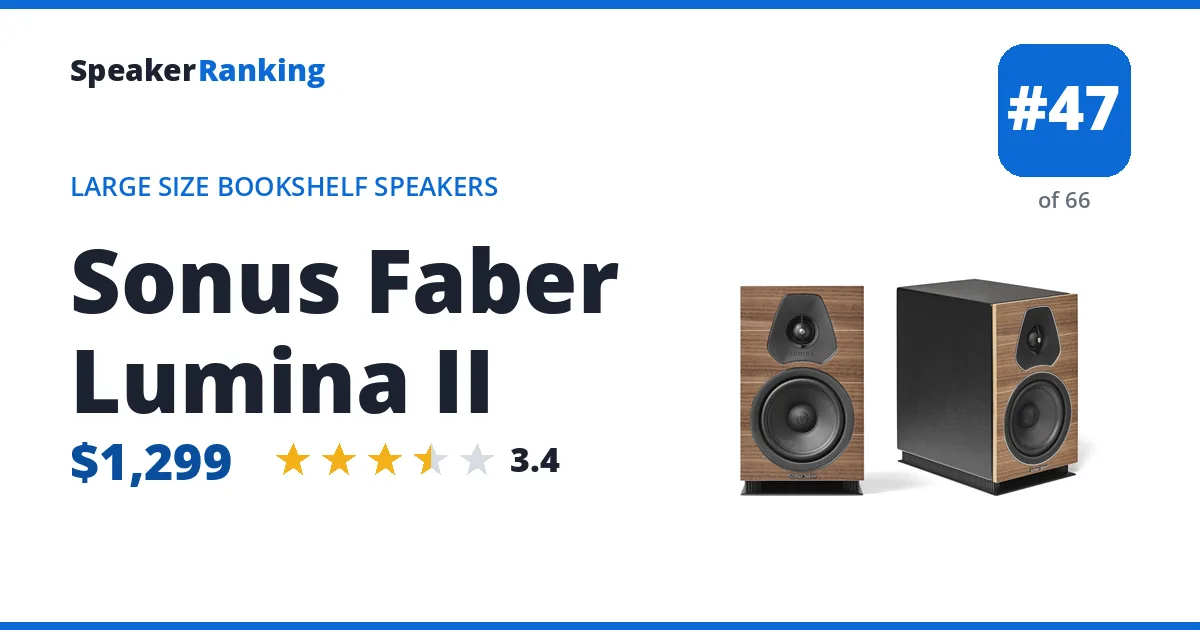
Pros: Handmade in Italy with a gloss-finished front baffle and black leather-wrapped cabinet: genuinely nice-looking speaker with real brand cachet. Bass extension is competitive for the size, reaching about 50 Hz in-room with mild compression and good distortion figures, so higher output levels and greater listening distances aren’t a problem down to that point. About 20 dB of dynamic range at typical listening levels (73 dB at 4m), which comfortably covers most music without the tonal balance shifting as instruments and vocals peak. Off-axis behavior is consistent: toeing the speakers 20-30 degrees out doesn’t meaningfully change the in-room high-frequency character, so placement flexibility is good once you’ve dialed in the tonal balance. Measured bass extension of 60Hz (-3dB), with a measured sensitivity of 86dB.
Cons: Not a neutral speaker: has a persistent high-frequency boost/lift that makes it sound forward and bright, present whether pointed directly at the listener or toed out. A slightly nasal quality traced to a resonance around 1 kHz that EQ can address. The reviewer needed to trim treble by about 4 dB on his preamp to get the tonal balance he wanted, meaning most listeners will want equalization available to fully enjoy this speaker. At roughly the same $1,000ish price point, alternatives like the Ascend Acoustics Sierra 1 V2 measure more linear (with a tradeoff in distortion and crossover-region directivity), and the Dynaudio Emit 20 offers deeper bass extension and lower compression at the cost of a more deliberately colored tonal signature.
Full Sonus Faber Lumina II review and specifications →
| Bass Extension (-10dB) | 41Hz (measured, Erin’s Audio Corner) |
|---|---|
| Bass Extension (-3dB) | 60Hz (measured, Erin’s Audio Corner) |
| Crossover Frequency | 1800Hz |
| DIY Kit | No |
| Dimensions | 12” x 7.1” x 10.4” (304 x 180 x 263 mm) |
| Drivers | 29mm DAD dome tweeter, 150mm paper cone mid-woofer |
| Frequency Response | 55Hz - 24kHz (manufacturer specified) |
| Impedance | 4 ohms nominal, 4.1 ohms minimum (measured, Erin’s Audio Corner) |
| Recommended Power | 30W - 150W |
| Sensitivity | 86dB (measured average, Erin’s Audio Corner; matches manufacturer spec) |
| Spinorama Preference Score | 3.81 |
| Spinorama Preference Score with Perfect Sub | 6.10 |
| Weight | 12.5 lbs (5.65 kg) each |
- Links
- Reviews, Comparisons and Sound Samples
- Head-to-Head Comparisons
- Sonus Faber Lumina II vs Polk Monitor XT20
- Sonus Faber Lumina II vs XTZ Spirit 4
- Sonus Faber Lumina II vs KEF Q3 Meta
- Sonus Faber Lumina II vs Polk Reserve R100
- Sonus Faber Lumina II vs Focal Aria 906
- Sonus Faber Lumina II vs Revel Performa M22
- Sonus Faber Lumina II vs SVS Prime Bookshelf
- Sonus Faber Lumina II vs Dynaudio Special Forty
- See all 57 comparisons