Short answer: the JBL 4305P. It ranks #28 of 68 powered bookshelf speakers by sound quality, rated 4.4/5, at $1,499.99; the APS Klasik 2020 ranks #34, rated 4.3/5, and costs $1,800, so there is not much of a tradeoff to weigh.
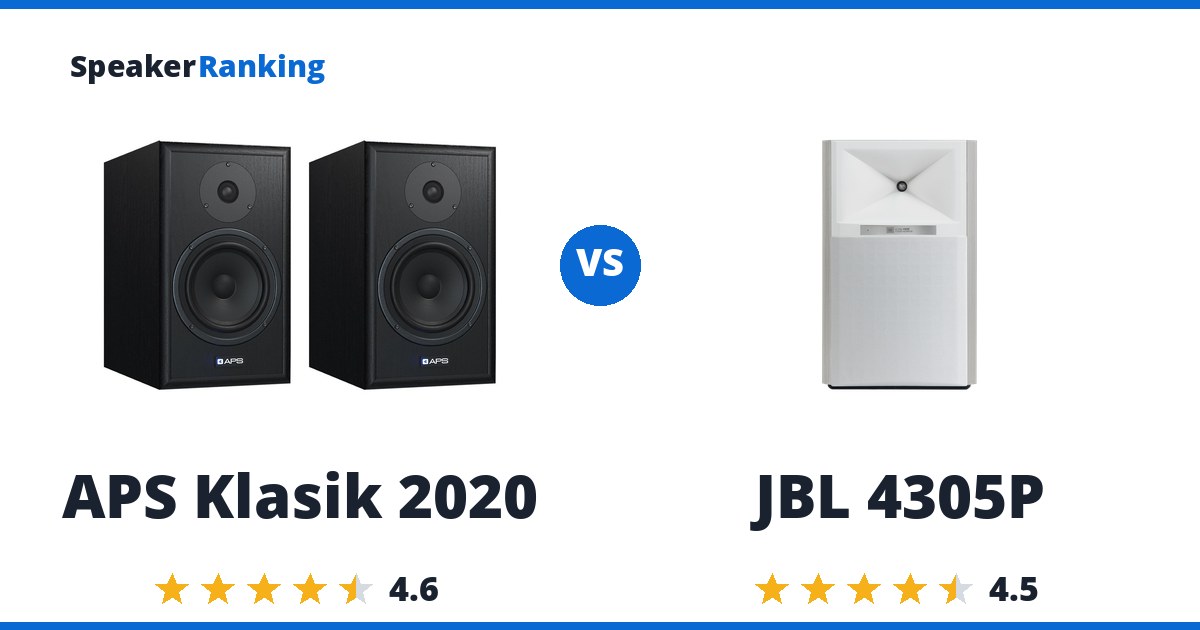
What the APS Klasik 2020 does well: A remarkably capable analogue nearfield monitor with 100W amplification per speaker, balanced XLR and RCA inputs, and three low-frequency adjustment options. The catch: Its all-analogue design means no streaming, Bluetooth, DSP or automatic room correction.
What the JBL 4305P does well: The measured 1.5dB response span from 300Hz to 5kHz supports even mids, with a 7.45 ideal-subwoofer score and 45.4Hz -3dB bass extension. Watch for: Crossover-region directivity changes mean the narrow on-axis span does not describe every listening angle.
Buy the JBL 4305P. It is rated higher for sound quality than the APS Klasik 2020 and costs less, so it is the default pick unless a specific strength of the other one matters more to you.
Looking for alternatives? See the complete Powered Home rankings.
Specifications Side By Side
| APS Klasik 2020 | JBL 4305P | |
|---|---|---|
| Price | $1,800 per pair | $1,499.99 per pair |
| Ranked | #34 of 68 in Large Size Powered Bookshelf Speakers | #28 of 68 in Large Size Powered Bookshelf Speakers |
| Dimensions | 14.2”H x 8.3”W x 12.6”D (360.7 x 210.8 x 320 mm) | 13.2H x 8.3W x 8.8D inches |
| Frequency Response | 39Hz - 25kHz (-3dB) (Manufacturer specified) | 45Hz - 25kHz (-6dB) (Manufacturer specified) |
| Inputs | XLR, RCA | XLR/TRS combo, 3.5mm Aux, Optical, USB-B, Ethernet |
| Weight | 22 lbs (10.0 kg) each | Primary 14.6 lbs (6.6 kg), Secondary 14.1 lbs (6.4 kg) |
| Drivers | 7” (178mm) woofer | 5.25-inch pulp woofer; 1-inch annular compression driver |
| App | No | - |
| Bluetooth | No | Yes, 5.1 |
| EQ | Yes (Room adjustment) | - |
| DSP | No | - |
| Amplifier Power | 100w Per Speaker | 300W system: 125W LF + 25W HF per speaker |
| XLR Input | Yes | Yes |
| RCA Input | Yes | No |
| TRS Input | No | Yes |
| Optical Input | No | Yes |
| Coaxial Input | No | No |
| USB Input | No | Yes |
| HDMI Input | No | No |
| AES Input | No | No |
| Aux Input | No | Yes |
| Bass Extension (-3dB) | - | 45Hz (measured, Erin’s Audio Corner) |
| Bass Extension (-10dB) | - | 40.5Hz (measured, Erin’s Audio Corner) |
| Maximum SPL | - | ~93dB at 2m in-room before limiting (measured, Erin’s Audio Corner) |
| Spinorama Preference Score | - | 5.44 |
| Spinorama Preference Score with Perfect Sub | - | 7.45 |
Related Speaker Comparisons
More worthwhile head-to-heads for JBL 4305P:
- Genelec 8351B vs JBL 4305P
- Neumann KH420 vs JBL 4305P
- Genelec 8361A vs JBL 4305P
- JBL 4305P vs Genelec 8341A
- Neumann KH 150 vs JBL 4305P
Prices on this page were last checked September 30, 2026 at 2:57 PM UTC. Product prices and availability are accurate as of that date/time and are subject to change; the price and availability shown on Amazon at the time of purchase will apply to the purchase of this product.
As an eBay Partner, we may be compensated if you make a purchase.
The Two Speakers In Full
 APS Klasik 2020: $1,800 per pair APS eBay
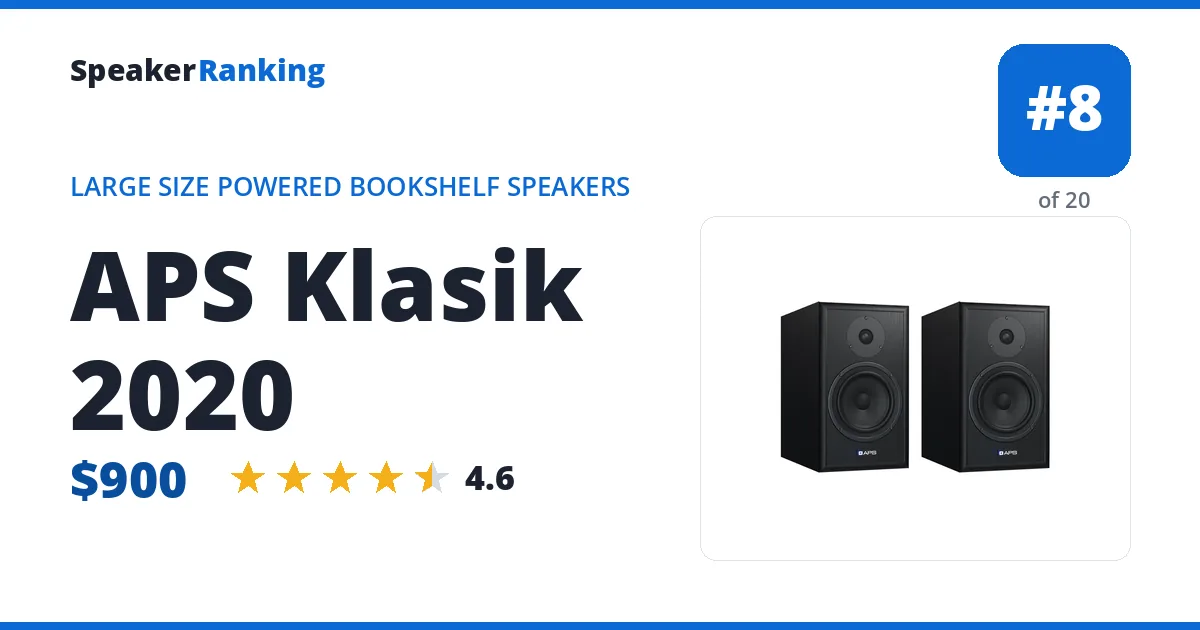
Pros: A remarkably capable analogue nearfield monitor with 100W amplification per speaker, balanced XLR and RCA inputs, and three low-frequency adjustment options. Independent review finds its response exceptionally even through the vocal range, with precise, tuneful bass, natural voices, pin-sharp imaging and unusually strong mix detail for the class.
Cons: Its all-analogue design means no streaming, Bluetooth, DSP or automatic room correction. The most extended bass setting loses some precision as volume rises, while the top end is competent rather than the system’s standout feature. It is built for a serious nearfield setup, not all-in-one convenience. It is hard to find for sale, with no dealers in the United States.
Full APS Klasik 2020 review and specifications →
| AES Input | No |
|---|---|
| Amplifier Power | 100w Per Speaker |
| App | No |
| Aux Input | No |
| Bluetooth | No |
| Coaxial Input | No |
| DSP | No |
| Dimensions | 14.2”H x 8.3”W x 12.6”D (360.7 x 210.8 x 320 mm) |
| Drivers | 7” (178mm) woofer |
| EQ | Yes (Room adjustment) |
| Frequency Response | 39Hz - 25kHz (-3dB) (Manufacturer specified) |
| HDMI Input | No |
| Inputs | XLR, RCA |
| Optical Input | No |
| RCA Input | Yes |
| TRS Input | No |
| USB Input | No |
| Weight | 22 lbs (10.0 kg) each |
| XLR Input | Yes |
- Links
- Reviews, Comparisons and Sound Samples
- Head-to-Head Comparisons
 JBL 4305P: $1,499.99 per pair Amazon JBL eBay
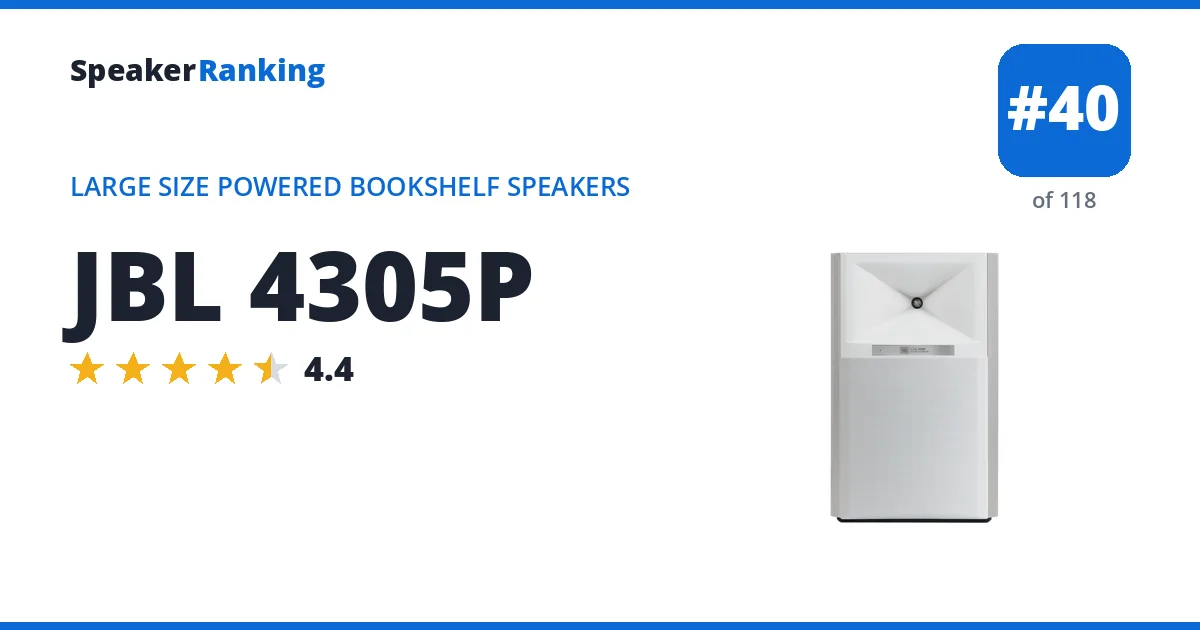
Pros: The measured 1.5dB response span from 300Hz to 5kHz supports even mids, with a 7.45 ideal-subwoofer score and 45.4Hz -3dB bass extension. Integrated consumer connectivity makes this a more convenient living-room system than many studio monitors. Measured bass extension of 45Hz (-3dB).
Cons: Crossover-region directivity changes mean the narrow on-axis span does not describe every listening angle. Limiting becomes relevant at high output, particularly with bass-heavy music. It suits near- to midfield listening better than the largest high-output systems here. Erin measured about 8dB lost near 50Hz at the highest drive level and reached roughly 93dB unweighted at 2m in-room.
Full JBL 4305P review and specifications →
| AES Input | No |
|---|---|
| Amplifier Power | 300W system: 125W LF + 25W HF per speaker |
| Aux Input | Yes |
| Bass Extension (-10dB) | 40.5Hz (measured, Erin’s Audio Corner) |
| Bass Extension (-3dB) | 45Hz (measured, Erin’s Audio Corner) |
| Bluetooth | Yes, 5.1 |
| Coaxial Input | No |
| Dimensions | 13.2H x 8.3W x 8.8D inches |
| Drivers | 5.25-inch pulp woofer; 1-inch annular compression driver |
| Frequency Response | 45Hz - 25kHz (-6dB) (Manufacturer specified) |
| HDMI Input | No |
| Inputs | XLR/TRS combo, 3.5mm Aux, Optical, USB-B, Ethernet |
| Maximum SPL | ~93dB at 2m in-room before limiting (measured, Erin’s Audio Corner) |
| Optical Input | Yes |
| RCA Input | No |
| Spinorama Preference Score | 5.44 |
| Spinorama Preference Score with Perfect Sub | 7.45 |
| TRS Input | Yes |
| USB Input | Yes |
| Weight | Primary 14.6 lbs (6.6 kg), Secondary 14.1 lbs (6.4 kg) |
| XLR Input | Yes |
- Links
- Reviews, Comparisons and Sound Samples
- Head-to-Head Comparisons