Short answer: the Yamaha HS8. It ranks #36 of 119 powered bookshelf speakers by sound quality, rated 4.4/5, at $797.98. The PreSonus Eris Studio 8 ranks #99, rated 3.9/5, at $419.98, $378 cheaper, not enough of a saving to outweigh the sound-quality gap.
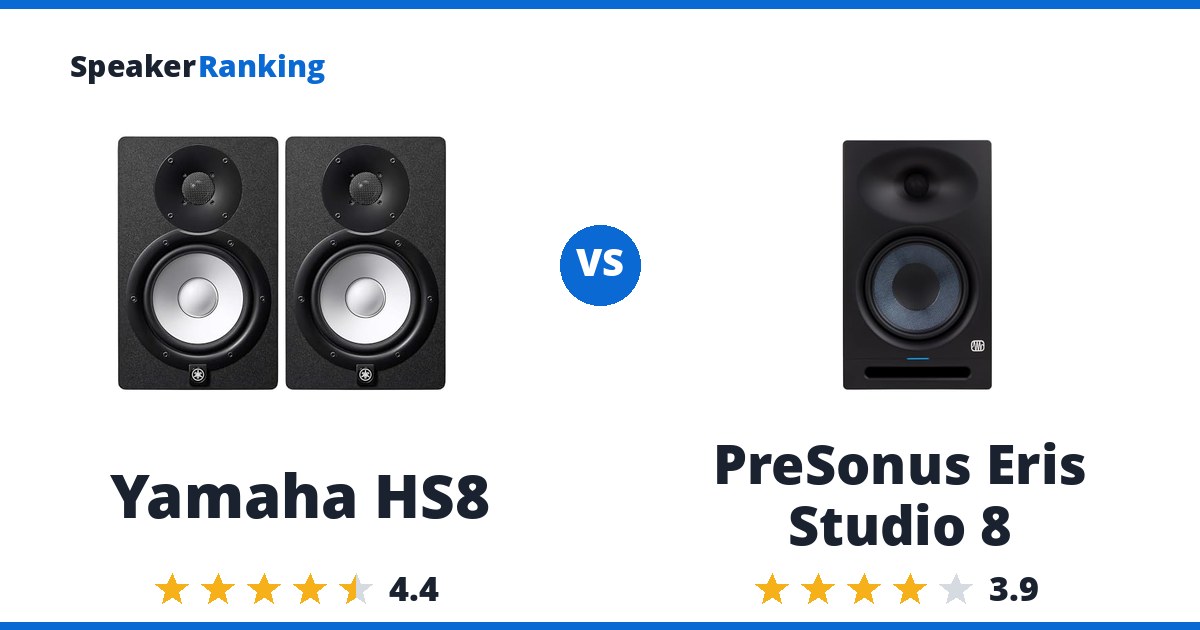
The HS8 is the measured, neutral 8-inch monitor. Audio Science Review found a 2.3dB response span from 300Hz to 5kHz, a preference score of 5.85, and bass reaching 43.9Hz before falling 3dB. It has balanced inputs and room-adjustment switches. Its off-axis sound is less refined than the best monitors, so sit level with the tweeter.
The Eris Studio 8 is the cheaper 8-inch with more inputs. It runs on 140W per speaker and adds RCA inputs alongside XLR and TRS, plus room-adjustment controls, which makes it easy to connect to consumer gear. Its large cabinet needs real stand space. It is sold individually, so budget for two.
Buy the Yamaha HS8. It is rated higher for sound quality, and saving $378 with the PreSonus Eris Studio 8 does not make up for the sound-quality gap.
Looking for alternatives? See the complete Powered Home rankings.
Prices on this page were last checked November 14, 2026 at 6:17 PM UTC. Product prices and availability are accurate as of that date/time and are subject to change; the price and availability shown on Amazon at the time of purchase will apply to the purchase of this product.
As an eBay Partner, we may be compensated if you make a purchase.
Specifications Side By Side
| Yamaha HS8 | PreSonus Eris Studio 8 | |
|---|---|---|
| Price | $797.98 per pair | $419.98 per pair |
| Ranked | #36 of 119 in Large Size Powered Bookshelf Speakers | #99 of 119 in Large Size Powered Bookshelf Speakers |
| Dimensions | 15.4”H x 9.8”W x 13.1”D (391.2 x 248.9 x 332.7 mm) | 16.5”H x 9.8”W x 11.7”D (419.1 x 248.9 x 297.2 mm) |
| Frequency Response | 47Hz - 24kHz (-3dB) (Manufacturer specified) | 35Hz - 20kHz (Manufacturer specified) |
| Bass Extension (-3dB) | 43.9Hz (measured, Audio Science Review) | - |
| Bass Extension (-10dB) | 34.7Hz (measured, Audio Science Review) | - |
| Inputs | XLR | TRS, XLR, RCA |
| Weight | 22.5 lbs (10.2 kg) | 22.3 lbs (10.1 kg) each |
| Drivers | 8” woofer, 1” dome tweeter | 8” (203mm) woofer |
| App | No | No |
| Bluetooth | No | No |
| EQ | Yes (Room adjustment) | Yes (Room adjustment) |
| DSP | No | No |
| Amplifier Power | 120w Per Speaker | 140w Per Speaker |
| Spinorama Preference Score | 5.85 | - |
| Spinorama Preference Score with Perfect Sub | 7.58 | - |
| XLR Input | Yes | Yes |
| RCA Input | No | Yes |
| TRS Input | No | Yes |
| Optical Input | No | No |
| Coaxial Input | No | No |
| USB Input | No | No |
| HDMI Input | No | No |
| AES Input | No | No |
| Aux Input | No | No |
Watch Them Compared
Videos and reviews that test both speakers side by side.
Where the Ratings Come From
- Yamaha HS8: Spinorama.org measurements and reviews by Audio Science Review, DSAUDIO.review and Sercan Solmaz.
- PreSonus Eris Studio 8: reviews by DSAUDIO.review.
This comparison is generated from the ratings, specifications and measurements on each product’s own page, and it updates when that data changes. How we rank explains how each rating is decided.
Related Speaker Comparisons
More top alternatives to Yamaha HS8: