Short answer: the JBL 305P MKII. It ranks #18 of 108 powered bookshelf speakers by sound quality, rated 4.3/5, at $289; the ADAM Audio T5V ranks #38, rated 4.0/5, and costs $457.12, which makes this an easy call rather than a real tradeoff.
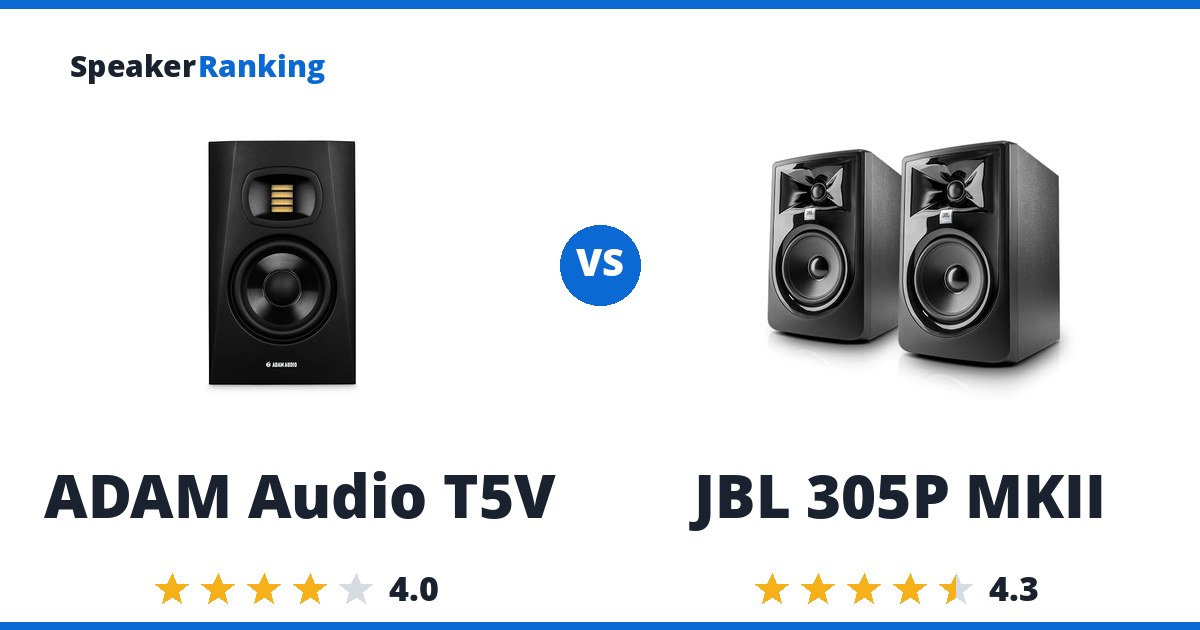
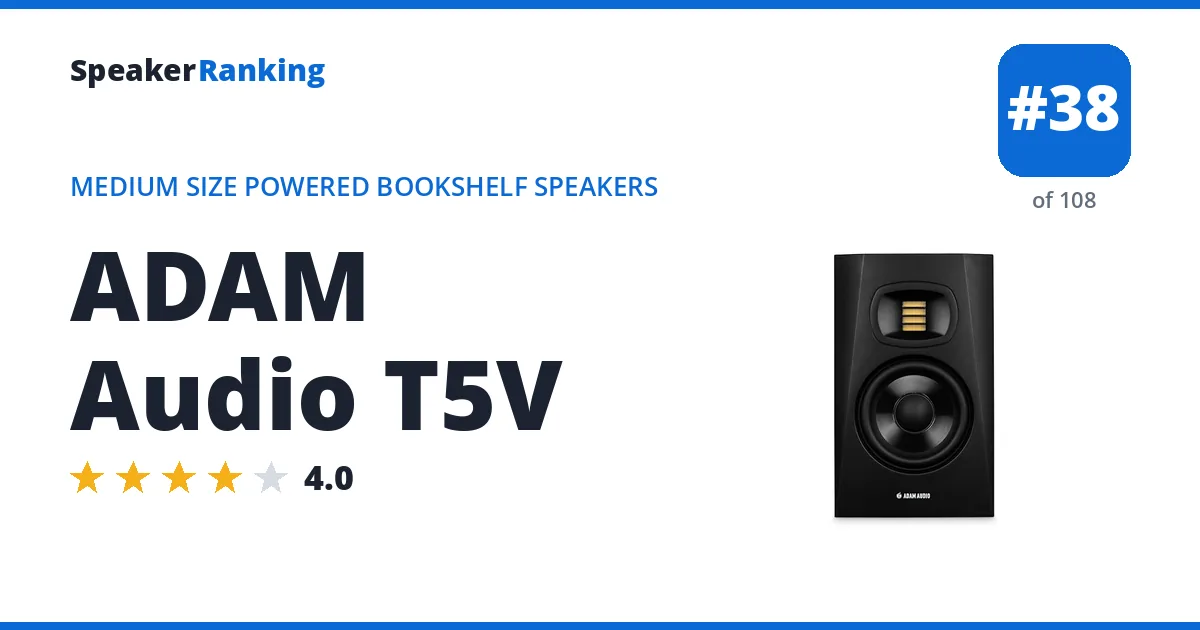
Our notes credit the T5V with real strengths over the class benchmark HS5: better vocal detail and a stronger low end. Its tradeoff is the AMT tweeter’s characteristic elevated, slightly uneven top end, a trait shared across Adam’s T-series line.
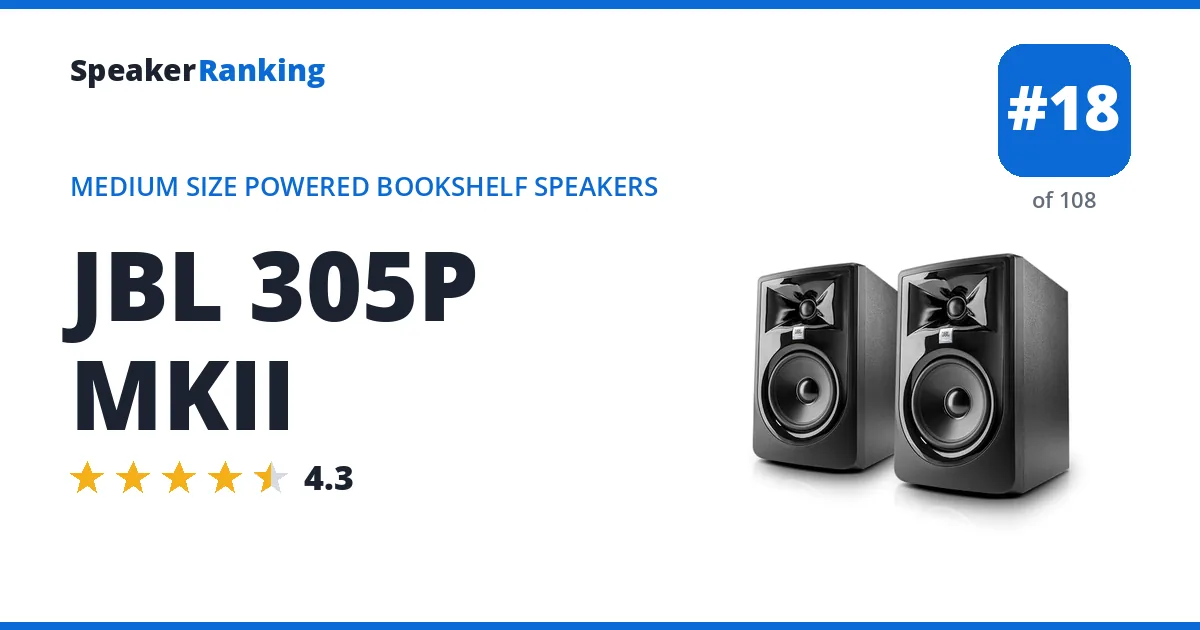
The 305P MkII is described as extremely close to the Focal Alpha 50 EVO, almost indistinguishable, with only minor complaints: possible slight amp hiss at low levels, and a rear port that wants clearance from the wall behind it.
Buy the T5V for the lower price at nearly the same ranking. Buy the 305P MkII if its rear-ported design fits your setup better and you want the speaker our notes compare directly to the Focal.
Still deciding? The full Powered Home rankings cover every ranked option.
Specifications Side By Side
| ADAM Audio T5V | JBL 305P MKII | |
|---|---|---|
| Price | $457.12 per pair | $289.00 per pair |
| Ranked | #38 of 108 in Medium Size Powered Bookshelf Speakers | #18 of 108 in Medium Size Powered Bookshelf Speakers |
| Bass Extension (-3dB) | 58.6Hz (measured, Audio Science Review) | 50Hz (measured, Erin’s Audio Corner) |
| Bass Extension (-10dB) | 45.9Hz (derived, log-interpolated between spinorama.org -9dB/-12dB points) | 43Hz (measured, Erin’s Audio Corner) |
| Dimensions | 11.7”H x 7”W x 11.7”D (297.2 x 177.8 x 297.2 mm) | 11.7”H x 7.3”W x 9.1”D (297.2 x 185.4 x 231.1 mm) |
| Frequency Response | 58Hz - 24kHz (-3dB) (Manufacturer specified) | 49 Hz - 20 kHz (+-3 dB) (Manufacturer specified) |
| Inputs | XLR, RCA | XLR, TRS |
| Weight | 12.6 lbs (5.7 kg) each | 10.4 lbs (4.7 kg) each |
| Drivers | 5” (127mm) woofer | 5” (127mm) woofer |
| App | No | No |
| Bluetooth | No | No |
| EQ | Yes (Room adjustment) | Yes (Room adjustment) |
| Amplifier Power | 70w Per Speaker | 81w Per Speaker |
| Spinorama Preference Score | 4.65 | 5.38 |
| Spinorama Preference Score with Perfect Sub | 7.02 | 7.52 |
| XLR Input | Yes | Yes |
| RCA Input | Yes | No |
| TRS Input | No | Yes |
| Optical Input | No | No |
| Coaxial Input | No | No |
| USB Input | No | No |
| HDMI Input | No | No |
| AES Input | No | No |
| Aux Input | No | No |
| Sensitivity | - | 91.1dB (measured at 0.3V/1m, Erin’s Audio Corner) |
Frequency Response Compared
Both speakers’ spinorama measurements, overlaid. A flatter line is more neutral: peaks sound forward or harsh, dips sound recessed. Each curve is shifted so its average from 300 Hz to 3 kHz sits at 0 dB, so loudness differences between the two are removed and only the shape is compared. The two were measured by different sources, so small differences, especially in the bass, can come from the measurement setup rather than the speakers.
Measurement data: ADAM Audio T5V (measured by Audio Science Review) and JBL 305P MKII (measured by Erin’s Audio Corner), via spinorama.org.
Watch Them Compared
Videos and reviews that test both speakers side by side.
- DSAUDIO.review: JBL 305P MKII vs Adam Audio T5V 6-Track Comparison
- Jasper Tech: Are the iLoud Micro Monitor Pro the Best Studio Monitor Speakers for your Home Studio?
- Jasper Tech: Best Desktop Computer Speakers for Every Budget – 2026
Related Speaker Comparisons
How JBL 305P MKII compares with other leading options:
- Genelec 8331A vs JBL 305P MKII
- JBL 305P MKII vs Neumann KH120 MKII
- Genelec 8030C vs JBL 305P MKII
- JBL 305P MKII vs Neumann KH80 DSP
- JBL 305P MKII vs Reflector Audio Square Two
Prices on this page were last checked October 14, 2026 at 2:38 PM UTC. Product prices and availability are accurate as of that date/time and are subject to change; the price and availability shown on Amazon at the time of purchase will apply to the purchase of this product.
As an eBay Partner, we may be compensated if you make a purchase.
The Two Speakers In Full
 ADAM Audio T5V: $457.12 per pair Amazon $228.56 eBay
Same family: the ADAM Audio T7V (larger bookshelf, rated 3.9/5) and the ADAM Audio T8V (larger bookshelf, rated 3.9/5).
Pros: ASR’s data shows a small 2.0dB span from 300Hz to 5kHz, a -3dB point around 59Hz, and scores of 4.65 standalone and 7.02 with an ideal subwoofer. It offers useful bass and midrange performance for an affordable studio monitor. Rear tonal trims allow broad placement adjustment. Measured bass extension of 58.6Hz (-3dB).
Cons: The response rises toward the treble by about 0.56dB per octave, so the small midrange span should not be mistaken for flat full-band response. Upper-frequency unevenness remains, and a shelving control cannot precisely remove every peak. The existing review finds distortion reasonable for the price rather than reference-class; deeper bass and demanding levels still call for more capable hardware.
Full ADAM Audio T5V review and specifications →
| Released | 2018 (8 years ago) |
|---|---|
| AES Input | No |
| Amplifier Power | 70w Per Speaker |
| App | No |
| Aux Input | No |
| Bass Extension (-10dB) | 45.9Hz (derived, log-interpolated between spinorama.org -9dB/-12dB points) |
| Bass Extension (-3dB) | 58.6Hz (measured, Audio Science Review) |
| Bluetooth | No |
| Coaxial Input | No |
| Dimensions | 11.7”H x 7”W x 11.7”D (297.2 x 177.8 x 297.2 mm) |
| Drivers | 5” (127mm) woofer |
| EQ | Yes (Room adjustment) |
| Frequency Response | 58Hz - 24kHz (-3dB) (Manufacturer specified) |
| HDMI Input | No |
| Inputs | XLR, RCA |
| Optical Input | No |
| RCA Input | Yes |
| Spinorama Preference Score | 4.65 |
| Spinorama Preference Score with Perfect Sub | 7.02 |
| TRS Input | No |
| USB Input | No |
| Weight | 12.6 lbs (5.7 kg) each |
| XLR Input | Yes |
- Links
- Reviews, Comparisons and Sound Samples
- Audio Science Review Measurements More from Audio Science Review →
- Audio Science Review Measurements (spinorama.org)
- DSAUDIO.review: JBL 305P MKII vs Adam Audio T5V 6-Track Comparison More from DSAUDIOreview →
- DSAUDIO.review: Kali LP-6 vs Adam Audio T5V Sound & Frequency Response Comparison
- DSAUDIO.review: Adam Audio T5V vs Yamaha HS5 5 Track Comparison
- DSAUDIO.review: DSAUDIO.review Adam Audio A5X vs Adam Audio T5V sound.DEMO
- DSAUDIO.review: DSAUDIO.review Focal Alpha 50 EVO vs Adam Audio T5V sound.DEMO
- DSAUDIO.review: Adam Audio T5V vs Presonus Eris E5 5 Track Comparison
- DSAUDIO.review: KRK Rokit 5 G4 RP5G4 vs Adam Audio T5V Sound & Frequency Response Comparison
- DSAUDIO.review: Bright and brighter. PreSonus E5 XT takes on Adam Audio T5V SOUND & FREQUENCY RESPONSE COMPARISON
- DSAUDIO.review: Adam Audio T5V vs Adam Audio T7V Sound & Frequency Response Comparison
- DSAUDIO.review: Genelec 8020D vs Adam Audo T5V Sound & Frequency Response Comparison
- Jasper Tech: Are the iLoud Micro Monitor Pro the Best Studio Monitor Speakers for your Home Studio? More from Jasper Tech →
- Jasper Tech: Best Desktop Computer Speakers for Every Budget – 2026
- Head-to-Head Comparisons
 JBL 305P MKII: $289.00 per pair Amazon $289.00 eBay
Older model: the JBL LSR305 (ranked lower, rated 4.2/5). See every JBL 3 Series generation.
Same family: the JBL 306P MKII (larger bookshelf, rated 4.1/5) and the JBL 308P MKII (larger bookshelf, rated 4.4/5).
Pros: Erin’s Klippel data gives 5.38 standalone and 7.52 with an ideal subwoofer, with bass reaching -3dB around 51Hz. Broad horizontal coverage and reasonably smooth reflected sound support stable imaging across a desk. The existing review reports effective limiting and little sustained thermal compression, making it a strong budget-monitor option rather than just a speaker with a promising frequency curve. Measured bass extension of 50Hz (-3dB), with a measured sensitivity of 91.1dB.
Cons: The 3.3dB midrange span and rising response show it is not perfectly neutral. A port-related feature around 1.6kHz and some excess treble can be audible; the review recommends the treble-trim switch. Vertical crossover interference makes ear height important. Amplifier hiss may matter in very quiet nearfield use, and rear-port placement needs room-boundary adjustment.
Full JBL 305P MKII review and specifications →
| Released | Jan 2018 (8 years ago) |
|---|---|
| AES Input | No |
| Amplifier Power | 81w Per Speaker |
| App | No |
| Aux Input | No |
| Bass Extension (-10dB) | 43Hz (measured, Erin’s Audio Corner) |
| Bass Extension (-3dB) | 50Hz (measured, Erin’s Audio Corner) |
| Bluetooth | No |
| Coaxial Input | No |
| Dimensions | 11.7”H x 7.3”W x 9.1”D (297.2 x 185.4 x 231.1 mm) |
| Drivers | 5” (127mm) woofer |
| EQ | Yes (Room adjustment) |
| Frequency Response | 49 Hz - 20 kHz (+-3 dB) (Manufacturer specified) |
| HDMI Input | No |
| Inputs | XLR, TRS |
| Optical Input | No |
| RCA Input | No |
| Sensitivity | 91.1dB (measured at 0.3V/1m, Erin’s Audio Corner) |
| Spinorama Preference Score | 5.38 |
| Spinorama Preference Score with Perfect Sub | 7.52 |
| TRS Input | Yes |
| USB Input | No |
| Weight | 10.4 lbs (4.7 kg) each |
| XLR Input | Yes |
- Links
- Reviews, Comparisons and Sound Samples
- Erin’s Audio Corner: LIVE! JBL 305P MkII Powered Studio Monitor Review More from Erin’s Audio Corner →
- Erin’s Audio Corner Review Measurements
- Erin’s Audio Corner Measurements (spinorama.org)
- Audio Science Review Measurements More from Audio Science Review →
- DSAUDIO.review: DSAUDIO.review Focal Alpha 50 EVO vs JBL 305P MKII sound.DEMO More from DSAUDIOreview →
- DSAUDIO.review: JBL 305P MKII vs Yamaha HS5 6-Track Comparison
- DSAUDIO.review: DSAUDIO.review JBL 305P MKII vs KRK Classic 5 CL5G3 sound.DEMO
- DSAUDIO.review: JBL 305P MKII vs Adam Audio T5V 6-Track Comparison
- DSAUDIO.review: DSAUDIO.review Adam Audio A5X vs JBL 305P MKII sound.DEMO
- DSAUDIO.review: DSAUDIO.review Kali Audio LP-6 V2 (2nd Wave) vs JBL 305P MKII sound.DEMO
- DSAUDIO.review: DSAUDIO.review Edifier MR4 vs JBL 305P MKII sound.DEMO
- DSAUDIO.review: Kali Audio IN-5 vs JBL 305P MKII Sound & Frequency Response Comparison
- DSAUDIO.review: JBL 308P MKII vs JBL 305P MKII Sound & Frequency Response Comparison
- DSAUDIO.review: Neumann KH80 DSP vs JBL 305P MKII Sound & Frquency Response Comparison
- DSAUDIO.review: JBL 305P MKII vs PreSonus Eris E5 6-Track Comparison
- Jasper Tech: Best Powered Bookshelf Speakers for Every Budget - 2025 More from Jasper Tech →
- Jasper Tech: Are the iLoud Micro Monitor Pro the Best Studio Monitor Speakers for your Home Studio?
- Jasper Tech: Best Desktop Computer Speakers for Every Budget – 2026
- Head-to-Head Comparisons
- JBL 305P MKII vs KEF LS50 Wireless II
- JBL 305P MKII vs Klipsch The Fives
- JBL 305P MKII vs Vanatoo Transparent One Encore Plus
- JBL 305P MKII vs Genelec 8020D
- JBL 305P MKII vs IK Multimedia iLoud MTM MKII
- JBL 305P MKII vs Topping MA4
- JBL 305P MKII vs Sigberg Audio SBS Gen 2
- JBL 305P MKII vs HEDD Type 05 A-CORE
- See all 71 comparisons