Short answer: the Edifier M60. It ranks #6 of 24 powered bookshelf speakers by sound quality, rated 4.0/5, at $199.99. The Presonus Eris E3.5 2nd Gen ranks #22, rated 2.5/5, at $99.99, $100 cheaper, a saving that is not big enough to make up the sound-quality gap.
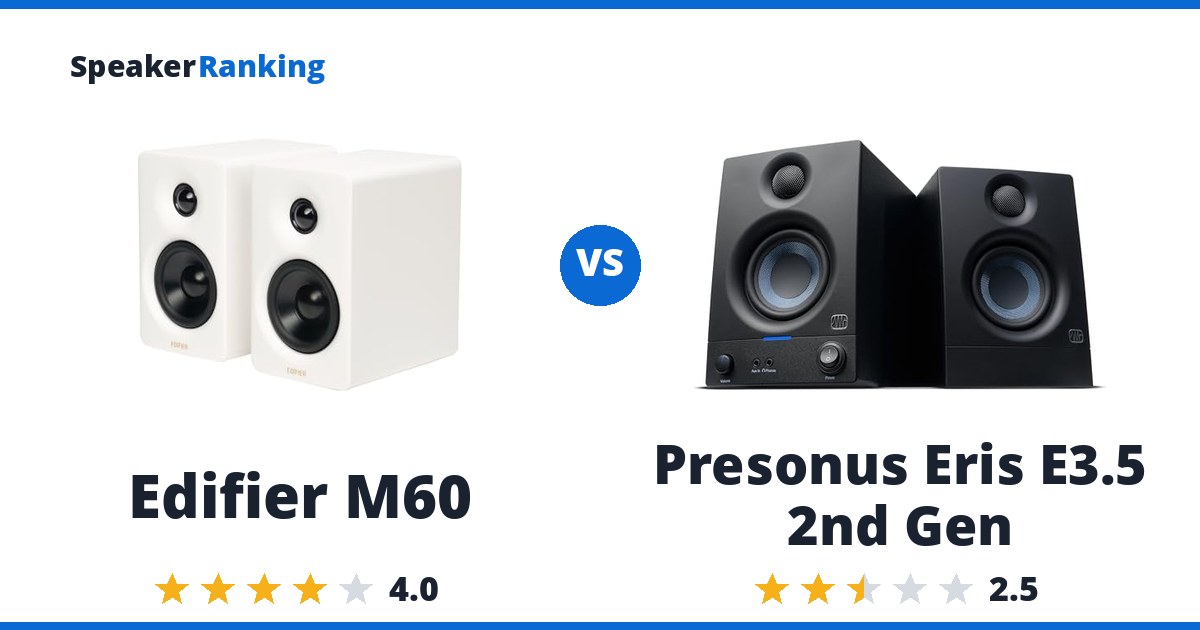
Why pick the Edifier M60: Erin’s Klippel data shows a reasonably even midrange, spanning 2.8dB from 300Hz to 5kHz, with broad horizontal coverage for desktop listening. Watch for: The on-axis response rises by about 0.57dB per octave, so the tonal balance becomes brighter toward the treble.
The case for the Presonus Eris E3.5 2nd Gen: Rear-panel bass and treble controls allow broad correction for desk and wall placement. Watch for: The stock response spans 7.2dB from 300Hz to 5kHz and has a strong rising trend of about 1.27dB per octave, emphasizing treble over the midrange.
Buy the Edifier M60. It is rated higher for sound quality, and saving $100 with the Presonus Eris E3.5 2nd Gen does not make up for the sound-quality gap.
Want more options? Browse the full Powered Home rankings.
Specifications Side By Side
| Edifier M60 | Presonus Eris E3.5 2nd Gen | |
|---|---|---|
| Price | $199.99 per pair | $99.99 per pair |
| Ranked | #6 of 24 in Small Size Powered Bookshelf Speakers | #22 of 24 in Small Size Powered Bookshelf Speakers |
| App | Yes | No |
| Bass Extension (-10dB) | 57Hz (measured, Erin's Audio Corner) | 70Hz (measured, Erin's Audio Corner) |
| Bass Extension (-3dB) | 67Hz (measured, Erin's Audio Corner) | 80Hz (measured, Erin's Audio Corner) |
| Bluetooth | Yes | No |
| Bluetooth Codecs | SBC, LDAC | - |
| Dimensions | 6.6"H x 3.9"W x 5.8"D (167.6 x 99.1 x 147.3 mm) | 8.3"H x 6"W x 5.5"D (210.8 x 152.4 x 139.7 mm) |
| EQ | Yes | Yes (Acoustic space) |
| Inputs | Bluetooth, Aux, USB-C | RCA, 1/4" Balanced |
| Drivers | 3" woofer, 1" silk dome tweeter | 3.5" woofer, 1" silk dome tweeter |
| Weight | 6.6 lbs (3 kg) | 8.6 lbs (3.9 kg) |
| Bluetooth Version | 5.3 | - |
| Frequency Response | 55Hz - 40kHz (Manufacturer specified) | 80 Hz-20 kHz (-3dB) (Manufacturer specified) |
| Sensitivity | 87.5dB (measured at 0.3V/1m, Erin's Audio Corner) | 87.4dB (measured at 0.3V/1m, Erin's Audio Corner) |
| Amplifier Power | 66W total (33W per speaker) | 50W total (25W per speaker) |
| Maximum SPL | 96dB @ 1m (manufacturer specified) | 95dB @ 1m (manufacturer specified) |
| Spinorama Preference Score | 4.60 | 1.51 |
| Spinorama Preference Score with Perfect Sub | 7.33 | 4.17 |
| XLR Input | No | No |
| RCA Input | No | Yes |
| TRS Input | No | No |
| Optical Input | No | No |
| Coaxial Input | No | No |
| USB Input | Yes | No |
| HDMI Input | No | No |
| AES Input | No | No |
| Aux Input | Yes | No |
| Outputs | - | 1/8" headphone jack |
| Headphone Output | - | Yes |
Related Speaker Comparisons
More top alternatives to Edifier M60:
- Edifier M60 vs Genelec 8010A
- Adam Audio D3v vs Edifier M60
- Edifier M60 vs Cambridge Audio L/R S
- Edifier M60 vs IK Multimedia iLoud Micro Monitor
- HiVi Swan X3 vs Edifier M60
Prices on this page were last checked September 23, 2026 at 11:24 PM UTC. Product prices and availability are accurate as of that date/time and are subject to change; the price and availability shown on Amazon at the time of purchase will apply to the purchase of this product.
As an eBay Partner, we may be compensated if you make a purchase.
The Two Speakers In Full
 Edifier M60: $199.99 per pair Amazon eBay
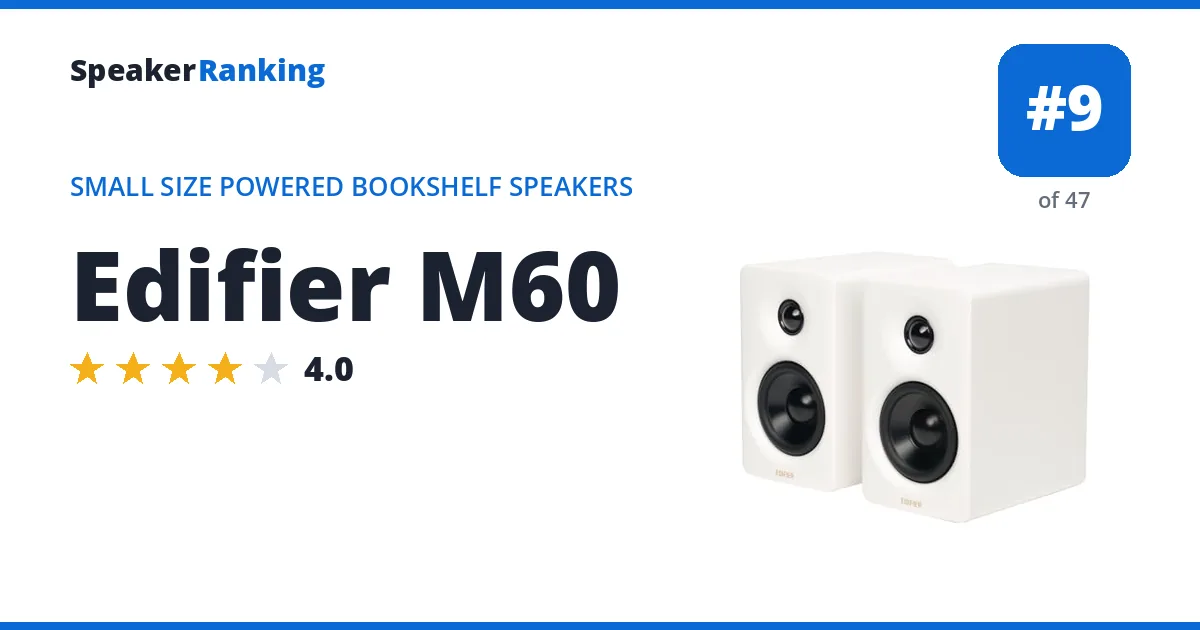
Pros: Erin’s Klippel data shows a reasonably even midrange, spanning 2.8dB from 300Hz to 5kHz, with broad horizontal coverage for desktop listening. Predicted preference scores are 4.60 standalone and 7.33 with an ideal subwoofer, a comparatively strong result in this compact category. USB-C, auxiliary input, Bluetooth and included angled stands make it easy to integrate into a small desk setup. Measured bass extension of 67Hz (-3dB), with a measured sensitivity of 87.5dB.
Cons: The on-axis response rises by about 0.57dB per octave, so the tonal balance becomes brighter toward the treble. Measured -3dB bass extension is about 70Hz; it cannot reproduce deep bass at full level. Sitting below the tweeter axis worsens the crossover-region response. Limiting and compression constrain louder playback, so use it nearfield rather than expecting room-filling output.
Full Edifier M60 review and specifications →
| AES Input | No |
|---|---|
| Amplifier Power | 66W total (33W per speaker) |
| App | Yes |
| Aux Input | Yes |
| Bass Extension (-10dB) | 57Hz (measured, Erin's Audio Corner) |
| Bass Extension (-3dB) | 67Hz (measured, Erin's Audio Corner) |
| Bluetooth | Yes |
| Bluetooth Codecs | SBC, LDAC |
| Bluetooth Version | 5.3 |
| Coaxial Input | No |
| Dimensions | 6.6"H x 3.9"W x 5.8"D (167.6 x 99.1 x 147.3 mm) |
| Drivers | 3" woofer, 1" silk dome tweeter |
| EQ | Yes |
| Frequency Response | 55Hz - 40kHz (Manufacturer specified) |
| HDMI Input | No |
| Inputs | Bluetooth, Aux, USB-C |
| Maximum SPL | 96dB @ 1m (manufacturer specified) |
| Optical Input | No |
| RCA Input | No |
| Sensitivity | 87.5dB (measured at 0.3V/1m, Erin's Audio Corner) |
| Spinorama Preference Score | 4.60 |
| Spinorama Preference Score with Perfect Sub | 7.33 |
| TRS Input | No |
| USB Input | Yes |
| Weight | 6.6 lbs (3 kg) |
| XLR Input | No |
- Links
- Reviews, Comparisons and Sound Samples
- Erin’s Audio Corner: Edifier M60 Desktop Speaker Delivers Big Fun! More from Erin’s Audio Corner →
- Erin’s Audio Corner: The Best Budget Desktop Speakers, Tested & Rated
- Erin’s Audio Corner Website: Edifier M60
- Erin’s Audio Corner Measurements (spinorama.org)
- Jasper Tech: Best Desktop Computer Speakers for Every Budget – 2026 More from Jasper Tech →
- Head-to-Head Comparisons
 Presonus Eris E3.5 2nd Gen: $99.99 per pair Amazon eBay
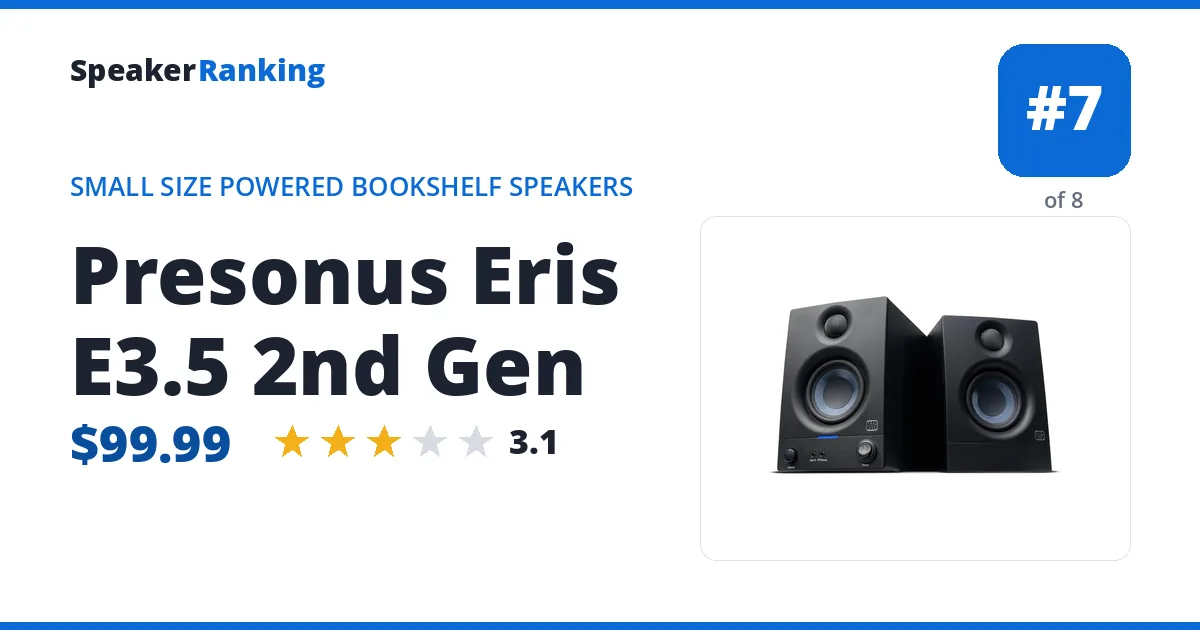
Pros: Rear-panel bass and treble controls allow broad correction for desk and wall placement. Erin’s second-generation Klippel measurements give a -3dB point around 69Hz, so the speaker has useful upper-bass reach for its size. Its adjustable balance is more flexible than a fixed-response budget desktop pair. Measured bass extension of 80Hz (-3dB), with a measured sensitivity of 87.4dB.
Cons: The stock response spans 7.2dB from 300Hz to 5kHz and has a strong rising trend of about 1.27dB per octave, emphasizing treble over the midrange. Preference scores of 1.51 standalone and 4.17 with an ideal subwoofer indicate major tonal problems beyond bass extension. EQ may help, but a subwoofer alone will not make it neutral. Output and port-modification results from reviews of the original E3.5 should not be assumed to apply to this second-generation model.
Full Presonus Eris E3.5 2nd Gen review and specifications →
| AES Input | No |
|---|---|
| Amplifier Power | 50W total (25W per speaker) |
| App | No |
| Aux Input | No |
| Bass Extension (-10dB) | 70Hz (measured, Erin's Audio Corner) |
| Bass Extension (-3dB) | 80Hz (measured, Erin's Audio Corner) |
| Bluetooth | No |
| Coaxial Input | No |
| Dimensions | 8.3"H x 6"W x 5.5"D (210.8 x 152.4 x 139.7 mm) |
| Drivers | 3.5" woofer, 1" silk dome tweeter |
| EQ | Yes (Acoustic space) |
| Frequency Response | 80 Hz-20 kHz (-3dB) (Manufacturer specified) |
| HDMI Input | No |
| Headphone Output | Yes |
| Inputs | RCA, 1/4" Balanced |
| Maximum SPL | 95dB @ 1m (manufacturer specified) |
| Optical Input | No |
| Outputs | 1/8" headphone jack |
| RCA Input | Yes |
| Sensitivity | 87.4dB (measured at 0.3V/1m, Erin's Audio Corner) |
| Spinorama Preference Score | 1.51 |
| Spinorama Preference Score with Perfect Sub | 4.17 |
| TRS Input | No |
| USB Input | No |
| Weight | 8.6 lbs (3.9 kg) |
| XLR Input | No |
- Links
- Reviews, Comparisons and Sound Samples
- Erin’s Audio Corner Review Measurements More from Erin’s Audio Corner →
- Audio Science Review Measurements More from Audio Science Review →
- DSAUDIO.review: DSAUDIO.review Edifier MR4 vs Presonus Eris E3.5 sound.DEMO More from DSAUDIOreview →
- DSAUDIO.review: Presonus Eris E3.5 vs Edifier R1280T Sound Demo w/ Bass Test
- DSAUDIO.review: Presonus Eris E3.5 vs Mackie CR3 Sound Demo w/ Bass Test
- Erin’s Audio Corner: Mackie CR3-X vs PreSonus E3.5 Budget Monitor Showdown!
- Erin’s Audio Corner: 10 Great (and Terrible) Speakers Under $300!
- Erin’s Audio Corner Measurements (spinorama.org)
- Jasper Tech: Are the iLoud Micro Monitor Pro the Best Studio Monitor Speakers for your Home Studio? More from Jasper Tech →
- Jasper Tech: Best Desktop Computer Speakers for Every Budget
- Head-to-Head Comparisons
- Presonus Eris E3.5 2nd Gen vs Midiplus MI3 II
- Presonus Eris E3.5 2nd Gen vs M-Audio BX3
- Presonus Eris E3.5 2nd Gen vs Fiio SP3
- Presonus Eris E3.5 2nd Gen vs Monoprice DT-3
- Presonus Eris E3.5 2nd Gen vs Fluid Audio C35BT
- Presonus Eris E3.5 2nd Gen vs Mackie CR3-X
- Presonus Eris E3.5 2nd Gen vs Audioengine HD3
- Presonus Eris E3.5 2nd Gen vs Klipsch ProMedia Lumina
- See all 15 comparisons